Social Learning

Internet-gestütztes soziales Lernen als neuer Trend
- Auswirkungen auf die Zukunft des Lernens


    Next Vision Partnertag 2012
    Volkmar Langer
    6. September 2012

           Dieser Foliensatz steht unter einer Creative Commons Namensnennung-Weitergabe unter gleichen Bedingungen 3.0 Deutschland Lizenz.
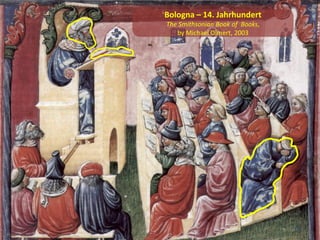
Bologna – 14. Jahrhundert
The Smithsonian Book of Books,
   by Michael Olmert, 2003


                                 (2)
1. Lernen im Wandel

2. Lernmodell Konnektivismus

3. Neue Lernszenarien


                               (3)
1. Lernen im Wandel

2. Lernmodell Konnektivismus

3. Neue Lernszenarien


                               (4)
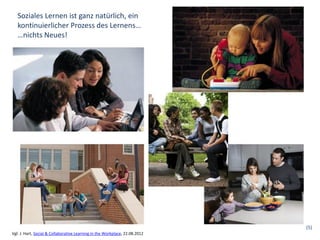
Soziales Lernen ist ganz natürlich, ein
   kontinuierlicher Prozess des Lernens…
   …nichts Neues!


                                                                             (5)
Vgl. J. Hart, Social & Collaborative Learning in the Workplace, 22.08.2012
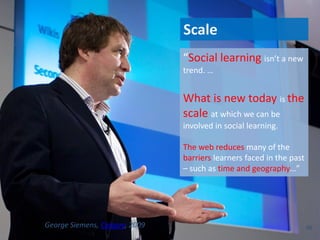
Scale
                                “Social learning isn’t a new
                                trend. …


                                What is new today is the
                                scale at which we can be
                                involved in social learning.

                                The web reduces many of the
                                barriers learners faced in the past
                                – such as time and geography…”


George Siemens, Calgary, 2009                                         (6)
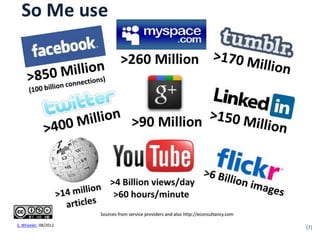
S. Wheeler, 08/2012
                      (7)
More pedagogic change
in 10 years than last 1000 years –
all driven by 10 technology innovations


vgl. Donald Clark Plan B, Blogarticle, Dec. 07, 2011
                                                       (8)
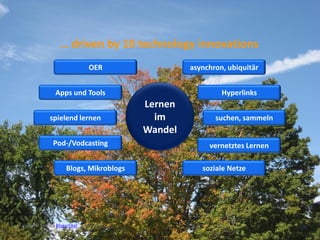
… driven by 10 technology innovations
                                      OER                 asynchron, ubiquitär


                     Apps und Tools                                Hyperlinks
                                                 Lernen
                  spielend lernen                  im            suchen, sammeln
                                                 Wandel
                    Pod-/Vodcasting                            vernetztes Lernen

                          Blogs, Mikroblogs                  soziale Netze


vgl. Volkmar Langer, Blogartikel, 3. Jan. 2012                                     (9)
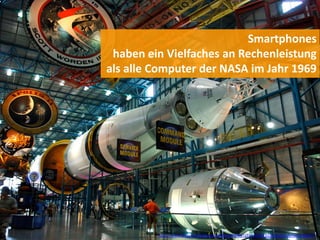
Smartphones
 haben ein Vielfaches an Rechenleistung
als alle Computer der NASA im Jahr 1969


                                                                             (10)
         http://www.flickr.com/photos/43533334@N07/5153726732/sizes/l/in/photostream/
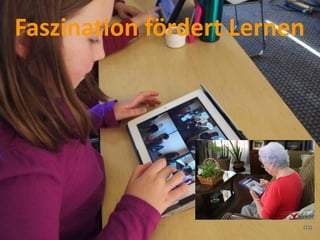
Faszination fördert Lernen


                         (11)
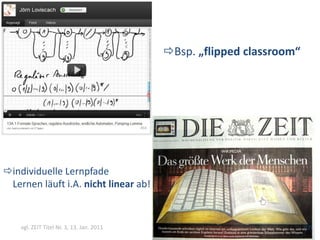
Bsp. „flipped classroom“


individuelle Lernpfade
 Lernen läuft i.A. nicht linear ab!


    vgl. ZEIT Titel Nr. 3, 13. Jan. 2011                               (12)
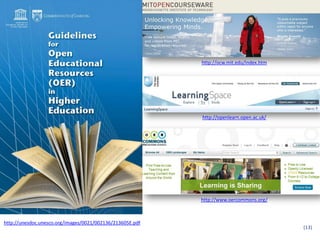
http://ocw.mit.edu/index.htm


                                                           http://openlearn.open.ac.uk/


                                                           http://www.oercommons.org/


http://unesdoc.unesco.org/images/0021/002136/213605E.pdf
                                                                                          (13)
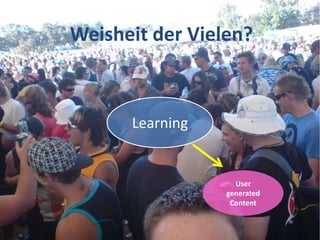
Weisheit der Vielen?


      Learning


                   User
                 generated
                  Content

                             (14)
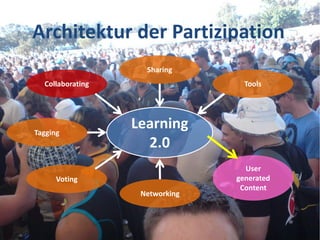
Architektur der Partizipation
                    Sharing
  Collaborating                   Tools


Tagging
                  Learning
                    2.0
                                  User
      Voting                    generated
                                 Content
                   Networking


                                            (15)
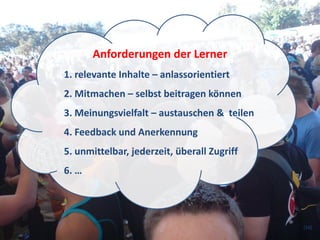
Anforderungen der Lerner
1. relevante Inhalte – anlassorientiert
2. Mitmachen – selbst beitragen können
3. Meinungsvielfalt – austauschen & teilen
4. Feedback und Anerkennung
5. unmittelbar, jederzeit, überall Zugriff
6. …


                                             (16)
1. Lernen im Wandel

2. Lernmodell Konnektivismus

3. Neue Lernszenarien


                               (17)
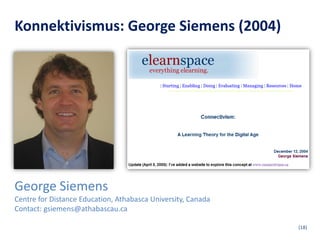
Konnektivismus: George Siemens (2004)


George Siemens
Centre for Distance Education, Athabasca University, Canada
Contact: gsiemens@athabascau.ca

                                                              (18)
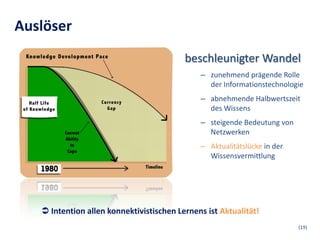
Auslöser
                                          beschleunigter Wandel
                                              – zunehmend prägende Rolle
                                                der Informationstechnologie
                                              – abnehmende Halbwertszeit
                                                des Wissens
                                              – steigende Bedeutung von
                                                Netzwerken
                                              – Aktualitätslücke in der
                                                Wissensvermittlung


    Intention allen konnektivistischen Lernens ist Aktualität!
                                                                          (19)
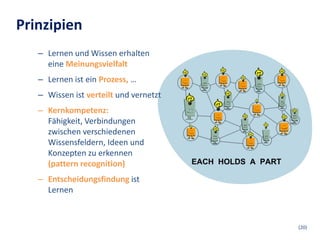
Prinzipien
   – Lernen und Wissen erhalten
     eine Meinungsvielfalt
   – Lernen ist ein Prozess, …
   – Wissen ist verteilt und vernetzt
   – Kernkompetenz:
     Fähigkeit, Verbindungen
     zwischen verschiedenen
     Wissensfeldern, Ideen und
     Konzepten zu erkennen
     (pattern recognition)
   – Entscheidungsfindung ist
     Lernen


                                        (20)
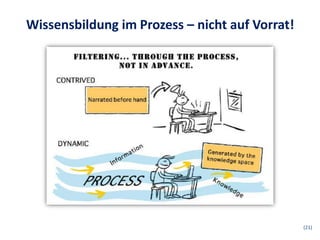
Wissensbildung im Prozess – nicht auf Vorrat!


                                                (21)
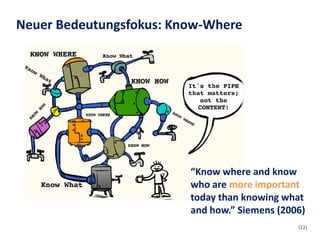
Neuer Bedeutungsfokus: Know-Where


                         “Know where and know
                         who are more important
                         today than knowing what
                         and how.” Siemens (2006)
                                               (22)
“Connectivism means networked learning […] our ability to
  learn and stay current is directly related to the strength and
  diversity of our personal learning network” (Siemens, 2007)


PLE-Bild, Esteve, F., http://www.flickr.com/photos/francescesteve/3039956497/sizes/m/in/photostream/, Stand 20.1.2012   (23)
(24)


       http://www.flickr.com/photos/will-lion/2595497078/sizes/z/in/photostream/
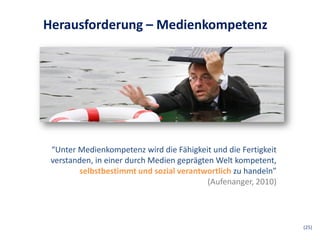
Herausforderung – Medienkompetenz


 “Unter Medienkompetenz wird die Fähigkeit und die Fertigkeit
 verstanden, in einer durch Medien geprägten Welt kompetent,
        selbstbestimmt und sozial verantwortlich zu handeln”
                                           (Aufenanger, 2010)


                                                                (25)
1. Lernen im Wandel

2. Lernmodell Konnektivismus

3. Neue Lernszenarien


                               (26)
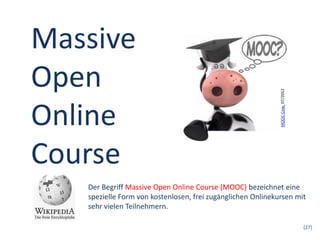
Massive
Open


                                                             MOOC-Cow, 07/2012
Online
Course
   Der Begriff Massive Open Online Course (MOOC) bezeichnet eine
   spezielle Form von kostenlosen, frei zugänglichen Onlinekursen mit
   sehr vielen Teilnehmern.

                                                                                 (27)
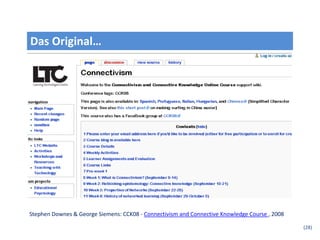
Das Original…


Stephen Downes & George Siemens: CCK08 - Connectivism and Connective Knowledge Course , 2008

                                                                                               (28)
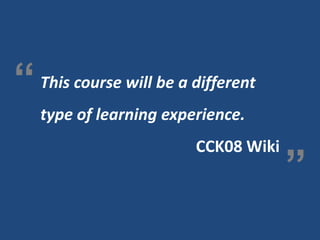
„   This course will be a different
    type of learning experience.
                          CCK08 Wiki   „
                                       (29)
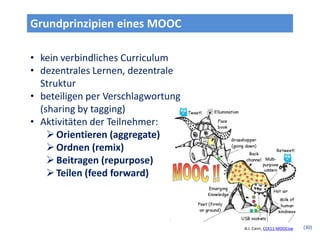
Grundprinzipien eines MOOC

• kein verbindliches Curriculum
• dezentrales Lernen, dezentrale
  Struktur
• beteiligen per Verschlagwortung
  (sharing by tagging)
• Aktivitäten der Teilnehmer:
     Orientieren (aggregate)
     Ordnen (remix)
     Beitragen (repurpose)
     Teilen (feed forward)


                                    A.J. Cann, CCK11-MOOCow   (30)
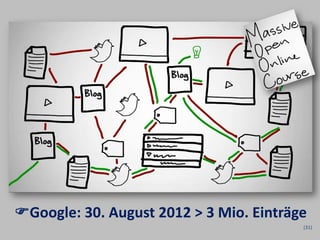
Google: 30. August 2012 > 3 Mio. Einträge
                                         (31)
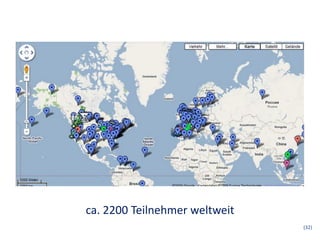
ca. 2200 Teilnehmer weltweit
                               (32)
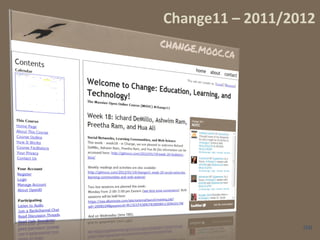
Change11 – 2011/2012


                  (33)
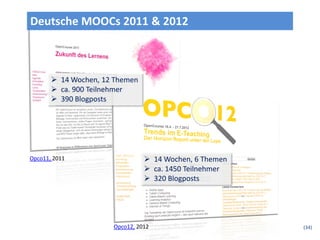
Deutsche MOOCs 2011 & 2012


        14 Wochen, 12 Themen
        ca. 900 Teilnehmer
        390 Blogposts


Opco11, 2011                     14 Wochen, 6 Themen
                                 ca. 1450 Teilnehmer
                                 320 Blogposts


                      Opco12, 2012                      (34)
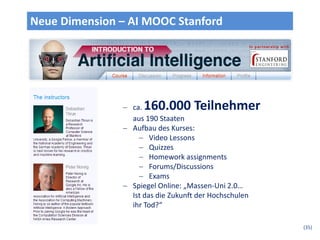
Neue Dimension – AI MOOC Stanford


                ca. 160.000 Teilnehmer
                 aus 190 Staaten
                Aufbau des Kurses:
                    Video Lessons
                    Quizzes
                    Homework assignments
                    Forums/Discussions
                    Exams
                Spiegel Online: „Massen-Uni 2.0…
                 Ist das die Zukunft der Hochschulen
                 ihr Tod?“

                                                       (35)
(36)
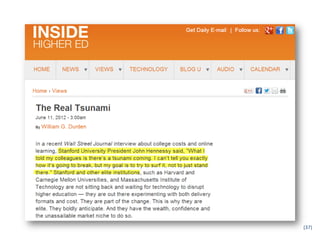
(37)
(38)
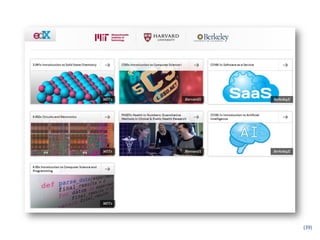
(39)
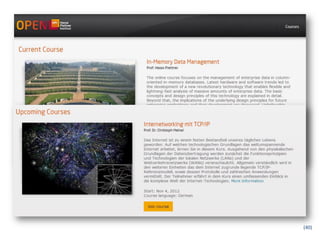
(40)
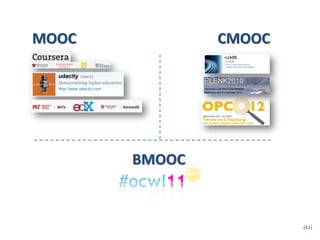
MOOC           CMOOC


       BMOOC


                       (41)
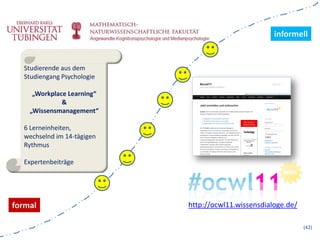
informell


  Studierende aus dem
  Studiengang Psychologie

     „Workplace Learning“
              &
    „Wissensmanagement“

  6 Lerneinheiten,
  wechselnd im 14-tägigen
  Rythmus

  Expertenbeiträge


formal                      http://ocwl11.wissensdialoge.de/

                                                               (42)
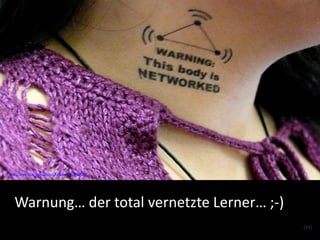
http://www.flickr.com/photos/funksoup/403990660/


   Warnung… der total vernetzte Lerner… ;-)
                                                   (43)
Vielen Dank!
Kontakt:
Hochschule Weserbergland
Prof. Dr. Volkmar Langer

E-Mail: langer@hsw-hameln.de
Twitter: @volkmarla
Blog: hsw-learningblog.de
Skype: volkmarl
…
… Am Stockhof 2, 31785 Hameln ;-)


                                    (44)
Quellen und Bildnachweise
Folie 1,3,4,17,26:
Vikne, E., Bildausschnitt, http://www.flickr.com/photos/iboy/5909630213/in/faves-volkmarl/,
Stand 30.8.2012
Folie 2:
Olmert, M., The Smithsonian Book of Books, 2003
Langer, V., http://www.flickr.com/photos/volkmarl/3153487333/sizes/l/in/photostream/, Stand 4.1.2012
Folie 3, 4, 15, 24:
Langer, V., Bildausschnitt “In den Wolken”, http://www.flickr.com/photos/volkmarl/3153524617 , Stand 20.3.2011
Folie 5:
Hart, J., Social & Collaborative Learning in the Workplace, http://de.slideshare.net/janehart/social-collaborative-
learning-in-the-workplace, Stand 22.08.2012
Folie 6:
Siemens, G., Artikel in http://www.weiterbildungsblog.de/2011/06/08/the-network-is-the-learning-an-interview-
with-george-siemens/, Stand 30.8.2012
Folie 7:
Wheeler, S., Slides from http://de.slideshare.net/timbuckteeth/2012-cilips-dundee, Stand 30.8.2012
Folie 8:
D. Clark, Plan B Blogarticle, http://donaldclarkplanb.blogspot.com/2011/12/more-pedagogic-change-in-last-10-
years.html, Dec. 07, 2011
Folie 9:
Bild, mrsdkrebs, http://www.flickr.com/photos/mrsdkrebs/6176316668/sizes/l/in/photostream/, Stand 28.1.2012
V. Langer, HSW-Learningblog, http://www.hsw-learningblog.de/2012/01/mehr-veranderungen-beim-lernverhalten-in-
den-letzten-10-jahren-als-in-1000-jahren-zuvor-%E2%80%93-alle-im-wesentlichen-bedingt-durch-technische-
innovationen/, Stand 28.1.2012
Folie 10:
Bild, Evelyn Proimos, http://www.flickr.com/photos/43533334@N07/5153726732/sizes/l/in/photostream/,
Stand 23.1.2012
Folie 11:
Bild Kind mit iPad, Brad Flickinger, http://www.flickr.com/photos/56155476@N08/6660091109/, Stand 23.1.2012
Bild Oma mit iPad, Tomasita Gomez, http://www.ambergristoday.com/content/everybodys-
reading/2011/february/14/mrs-tomasita-gomez-keeps-updated-her-ipad, Stand 20.1.2012                                   45
Folie 12:
Bildschirmaufnahme: Jörn Loviscach, Youtube (2012),
http://www.youtube.com/user/JoernLoviscach?feature=watch, Stand 20.1.2012
Foto, V. Langer, Zeitartikel vom 13.1.2011
Folie 13:
Bildschirmaufnahmen, http://unesdoc.unesco.org/images/0021/002136/213605E.pdf, http://ocw.mit.edu/index.htm,
http://openlearn.open.ac.uk/, http://www.oercommons.org/, Stand 20.1.2012
Folie 14, 15 ,16:
Digital Learning Futures, S. Wheeler, http://www.slideshare.net/timbuckteeth/digital-learning-futures, Stand 28.1.2012
Bild, M. Spencer, http://www.flickr.com/photos/michaelspencer/3140805971/sizes/l/in/photostream/, Stand 28.1.2012
Folie 18:
Siemens, G. (2006), Connectivism: A Learning Theory for a Digital Age,
http://www.elearnspace.org/presentations/connectivism_utrecht.ppt , Stand 18.3.2011
Folie 19, 20, 21:
Siemens, G. (2006a): Knowing Knowledge, Winnipeg, Manitoba, 2006,
http://www.elearnspace.org/KnowingKnowledge_LowRes.pdf, Stand 18.3.2011
Folie 22:
Siemens, G. (2007): Connectivism – Learning conceptualized through the lense of today’s world (Presentation on OCC),
http://www.elearnspace.org/presentations/connectivism_online_OCC2007.ppt and MP3,
http://www.elearnspace.org/media/OCC2007/georgesiemens1.mp3, Stand 20.3.2011
Folie 23:
Siemens, G. (2007): Connectivism – Learning conceptualized through the lense of today’s world (Presentation on OCC),
http://www.elearnspace.org/presentations/connectivism_online_OCC2007.ppt,
PLE-Bild, Esteve, F., http://www.flickr.com/photos/francescesteve/3039956497/sizes/m/in/photostream/, Stand 20.1.2012
Folie 24:
Lion, W., http://www.flickr.com/photos/will-lion/2595497078/sizes/z/in/photostream/, Stand 30.8.2012
Folie 25:
Bild von der Themenseite Medienkompetenz, e-Teaching.org (2009), http://www.e-teaching.org/specials/medienkompetenz,
Stand 20.3.2011
Aufenanger, S. (2010), Stellungnahme zu den Fragen der öffentlichen Anhörung Medienkompetenz am 13.12.2010 der
Enquete-Kommission Internet und digitale Gesellschaft des Deutschen Bundestags,
http://www.bundestag.de/internetenquete/dokumentation/2010/Sitzungen/20101213/A-Drs__17_24_014-I_-
_Stellungnahme_Univ_-Prof__Dr__Aufenanger.pdf , Stand 21.3.2011
                                                                                                                         (46)
Folie 27:
Holdcroft, J., MOOC-Cow, http://highlighter.com/2012/07/how-we-learned-to-stand-out-in-a-class-of-100000-people/, Stand
30.8.2012
Folie 28,29,30:
Downes, S., Siemens, G., Screenshot CCK08, http://ltc.umanitoba.ca/wiki/Connectivism, Stand 18.3.2012
Folie 31:
Bildschirmfoto, Cormier, D. (2010), What ist a MOOC?, http://www.youtube.com/watch?v=eW3gMGqcZQc , Stand 18.3.2011
Folie 32:
Downes, S., Engagement and Motivation in MOOCs,
http://www.slideshare.net/Downes/engagement-and-motivation-in-moocs, Stand 20.1.2012
Folie 33:
D. Cormier, S. Downes, G. Siemens (2011), Change11-MOOC, http://change.mooc.ca/, Stand 29.1.2012
Folie 34:
Bildschirmfoto, OpenCourse “Zukunft des Lernens”, http://blog.studiumdigitale.uni-frankfurt.de/opco11/, Stand 11.11.2011
Bildschirmfoto, OpenCourse „Trends im E-Teaching“, http://opco12.de/, Stand 30.8.2012
Folie 35:
Screenshot, https://www.ai-class.com/, Stand 30.8.2012
Folie 36:
Screenshot, http://www.udacity.com/, Stand 30.8.2012
Folie 37:
Screenshot, http://www.insidehighered.com/views/2012/06/11/essay-changes-may-most-threaten-traditional-higher-
education, Stand 30.8.2012
Folie 38:
Screenshot, https://www.coursera.org/, Stand 30.8.2012
Folie 39:
Screenshot, https://www.edx.org/, Stand 30.8.2012
Folie 40:
Screenshot, https://openhpi.de/, Stand 30.8.2012
Folie 41, 42:
Langer, V., Slides from http://de.slideshare.net/volkmarl/offene-kurse-in-klassischen-lehr-lernformaten20072012, Stand
30.8.2012
Folie 43:
Dorado, J., Bild, http://www.flickr.com/photos/funksoup/403990660/, Stand 30.8.2012
Folie 44:
Bild The Elliott, T., Web 2.0 Manager (Cartoon, 2009), http://www.sapweb20.com/blog/2009/03/the_web_20_manager/ ,
Stand 17.3.2011                                                                                                            (47)

Social learning-06-09-2012

  • 1.
    Social Learning Internet-gestütztes sozialesLernen als neuer Trend - Auswirkungen auf die Zukunft des Lernens Next Vision Partnertag 2012 Volkmar Langer 6. September 2012 Dieser Foliensatz steht unter einer Creative Commons Namensnennung-Weitergabe unter gleichen Bedingungen 3.0 Deutschland Lizenz.
  • 2.
    Bologna – 14.Jahrhundert The Smithsonian Book of Books, by Michael Olmert, 2003 (2)
  • 3.
    1. Lernen imWandel 2. Lernmodell Konnektivismus 3. Neue Lernszenarien (3)
  • 4.
    1. Lernen imWandel 2. Lernmodell Konnektivismus 3. Neue Lernszenarien (4)
  • 5.
    Soziales Lernen istganz natürlich, ein kontinuierlicher Prozess des Lernens… …nichts Neues! (5) Vgl. J. Hart, Social & Collaborative Learning in the Workplace, 22.08.2012
  • 6.
    Scale “Social learning isn’t a new trend. … What is new today is the scale at which we can be involved in social learning. The web reduces many of the barriers learners faced in the past – such as time and geography…” George Siemens, Calgary, 2009 (6)
  • 7.
  • 8.
    More pedagogic change in10 years than last 1000 years – all driven by 10 technology innovations vgl. Donald Clark Plan B, Blogarticle, Dec. 07, 2011 (8)
  • 9.
    … driven by10 technology innovations OER asynchron, ubiquitär Apps und Tools Hyperlinks Lernen spielend lernen im suchen, sammeln Wandel Pod-/Vodcasting vernetztes Lernen Blogs, Mikroblogs soziale Netze vgl. Volkmar Langer, Blogartikel, 3. Jan. 2012 (9)
  • 10.
    Smartphones haben einVielfaches an Rechenleistung als alle Computer der NASA im Jahr 1969 (10) http://www.flickr.com/photos/43533334@N07/5153726732/sizes/l/in/photostream/
  • 11.
  • 12.
    Bsp. „flipped classroom“ individuelleLernpfade Lernen läuft i.A. nicht linear ab! vgl. ZEIT Titel Nr. 3, 13. Jan. 2011 (12)
  • 13.
    http://ocw.mit.edu/index.htm http://openlearn.open.ac.uk/ http://www.oercommons.org/ http://unesdoc.unesco.org/images/0021/002136/213605E.pdf (13)
  • 14.
    Weisheit der Vielen? Learning User generated Content (14)
  • 15.
    Architektur der Partizipation Sharing Collaborating Tools Tagging Learning 2.0 User Voting generated Content Networking (15)
  • 16.
    Anforderungen der Lerner 1.relevante Inhalte – anlassorientiert 2. Mitmachen – selbst beitragen können 3. Meinungsvielfalt – austauschen & teilen 4. Feedback und Anerkennung 5. unmittelbar, jederzeit, überall Zugriff 6. … (16)
  • 17.
    1. Lernen imWandel 2. Lernmodell Konnektivismus 3. Neue Lernszenarien (17)
  • 18.
    Konnektivismus: George Siemens(2004) George Siemens Centre for Distance Education, Athabasca University, Canada Contact: gsiemens@athabascau.ca (18)
  • 19.
    Auslöser beschleunigter Wandel – zunehmend prägende Rolle der Informationstechnologie – abnehmende Halbwertszeit des Wissens – steigende Bedeutung von Netzwerken – Aktualitätslücke in der Wissensvermittlung  Intention allen konnektivistischen Lernens ist Aktualität! (19)
  • 20.
    Prinzipien – Lernen und Wissen erhalten eine Meinungsvielfalt – Lernen ist ein Prozess, … – Wissen ist verteilt und vernetzt – Kernkompetenz: Fähigkeit, Verbindungen zwischen verschiedenen Wissensfeldern, Ideen und Konzepten zu erkennen (pattern recognition) – Entscheidungsfindung ist Lernen (20)
  • 21.
    Wissensbildung im Prozess– nicht auf Vorrat! (21)
  • 22.
    Neuer Bedeutungsfokus: Know-Where “Know where and know who are more important today than knowing what and how.” Siemens (2006) (22)
  • 23.
    “Connectivism means networkedlearning […] our ability to learn and stay current is directly related to the strength and diversity of our personal learning network” (Siemens, 2007) PLE-Bild, Esteve, F., http://www.flickr.com/photos/francescesteve/3039956497/sizes/m/in/photostream/, Stand 20.1.2012 (23)
  • 24.
    (24) http://www.flickr.com/photos/will-lion/2595497078/sizes/z/in/photostream/
  • 25.
    Herausforderung – Medienkompetenz “Unter Medienkompetenz wird die Fähigkeit und die Fertigkeit verstanden, in einer durch Medien geprägten Welt kompetent, selbstbestimmt und sozial verantwortlich zu handeln” (Aufenanger, 2010) (25)
  • 26.
    1. Lernen imWandel 2. Lernmodell Konnektivismus 3. Neue Lernszenarien (26)
  • 27.
    Massive Open MOOC-Cow, 07/2012 Online Course Der Begriff Massive Open Online Course (MOOC) bezeichnet eine spezielle Form von kostenlosen, frei zugänglichen Onlinekursen mit sehr vielen Teilnehmern. (27)
  • 28.
    Das Original… Stephen Downes& George Siemens: CCK08 - Connectivism and Connective Knowledge Course , 2008 (28)
  • 29.
    This course will be a different type of learning experience. CCK08 Wiki „ (29)
  • 30.
    Grundprinzipien eines MOOC •kein verbindliches Curriculum • dezentrales Lernen, dezentrale Struktur • beteiligen per Verschlagwortung (sharing by tagging) • Aktivitäten der Teilnehmer:  Orientieren (aggregate)  Ordnen (remix)  Beitragen (repurpose)  Teilen (feed forward) A.J. Cann, CCK11-MOOCow (30)
  • 31.
    Google: 30. August2012 > 3 Mio. Einträge (31)
  • 32.
    ca. 2200 Teilnehmerweltweit (32)
  • 33.
  • 34.
    Deutsche MOOCs 2011& 2012  14 Wochen, 12 Themen  ca. 900 Teilnehmer  390 Blogposts Opco11, 2011  14 Wochen, 6 Themen  ca. 1450 Teilnehmer  320 Blogposts Opco12, 2012 (34)
  • 35.
    Neue Dimension –AI MOOC Stanford  ca. 160.000 Teilnehmer aus 190 Staaten  Aufbau des Kurses:  Video Lessons  Quizzes  Homework assignments  Forums/Discussions  Exams  Spiegel Online: „Massen-Uni 2.0… Ist das die Zukunft der Hochschulen ihr Tod?“ (35)
  • 36.
  • 37.
  • 38.
  • 39.
  • 40.
  • 41.
    MOOC CMOOC BMOOC (41)
  • 42.
    informell Studierendeaus dem Studiengang Psychologie „Workplace Learning“ & „Wissensmanagement“ 6 Lerneinheiten, wechselnd im 14-tägigen Rythmus Expertenbeiträge formal http://ocwl11.wissensdialoge.de/ (42)
  • 43.
    http://www.flickr.com/photos/funksoup/403990660/ Warnung… der total vernetzte Lerner… ;-) (43)
  • 44.
    Vielen Dank! Kontakt: Hochschule Weserbergland Prof.Dr. Volkmar Langer E-Mail: langer@hsw-hameln.de Twitter: @volkmarla Blog: hsw-learningblog.de Skype: volkmarl … … Am Stockhof 2, 31785 Hameln ;-) (44)
  • 45.
    Quellen und Bildnachweise Folie1,3,4,17,26: Vikne, E., Bildausschnitt, http://www.flickr.com/photos/iboy/5909630213/in/faves-volkmarl/, Stand 30.8.2012 Folie 2: Olmert, M., The Smithsonian Book of Books, 2003 Langer, V., http://www.flickr.com/photos/volkmarl/3153487333/sizes/l/in/photostream/, Stand 4.1.2012 Folie 3, 4, 15, 24: Langer, V., Bildausschnitt “In den Wolken”, http://www.flickr.com/photos/volkmarl/3153524617 , Stand 20.3.2011 Folie 5: Hart, J., Social & Collaborative Learning in the Workplace, http://de.slideshare.net/janehart/social-collaborative- learning-in-the-workplace, Stand 22.08.2012 Folie 6: Siemens, G., Artikel in http://www.weiterbildungsblog.de/2011/06/08/the-network-is-the-learning-an-interview- with-george-siemens/, Stand 30.8.2012 Folie 7: Wheeler, S., Slides from http://de.slideshare.net/timbuckteeth/2012-cilips-dundee, Stand 30.8.2012 Folie 8: D. Clark, Plan B Blogarticle, http://donaldclarkplanb.blogspot.com/2011/12/more-pedagogic-change-in-last-10- years.html, Dec. 07, 2011 Folie 9: Bild, mrsdkrebs, http://www.flickr.com/photos/mrsdkrebs/6176316668/sizes/l/in/photostream/, Stand 28.1.2012 V. Langer, HSW-Learningblog, http://www.hsw-learningblog.de/2012/01/mehr-veranderungen-beim-lernverhalten-in- den-letzten-10-jahren-als-in-1000-jahren-zuvor-%E2%80%93-alle-im-wesentlichen-bedingt-durch-technische- innovationen/, Stand 28.1.2012 Folie 10: Bild, Evelyn Proimos, http://www.flickr.com/photos/43533334@N07/5153726732/sizes/l/in/photostream/, Stand 23.1.2012 Folie 11: Bild Kind mit iPad, Brad Flickinger, http://www.flickr.com/photos/56155476@N08/6660091109/, Stand 23.1.2012 Bild Oma mit iPad, Tomasita Gomez, http://www.ambergristoday.com/content/everybodys- reading/2011/february/14/mrs-tomasita-gomez-keeps-updated-her-ipad, Stand 20.1.2012 45
  • 46.
    Folie 12: Bildschirmaufnahme: JörnLoviscach, Youtube (2012), http://www.youtube.com/user/JoernLoviscach?feature=watch, Stand 20.1.2012 Foto, V. Langer, Zeitartikel vom 13.1.2011 Folie 13: Bildschirmaufnahmen, http://unesdoc.unesco.org/images/0021/002136/213605E.pdf, http://ocw.mit.edu/index.htm, http://openlearn.open.ac.uk/, http://www.oercommons.org/, Stand 20.1.2012 Folie 14, 15 ,16: Digital Learning Futures, S. Wheeler, http://www.slideshare.net/timbuckteeth/digital-learning-futures, Stand 28.1.2012 Bild, M. Spencer, http://www.flickr.com/photos/michaelspencer/3140805971/sizes/l/in/photostream/, Stand 28.1.2012 Folie 18: Siemens, G. (2006), Connectivism: A Learning Theory for a Digital Age, http://www.elearnspace.org/presentations/connectivism_utrecht.ppt , Stand 18.3.2011 Folie 19, 20, 21: Siemens, G. (2006a): Knowing Knowledge, Winnipeg, Manitoba, 2006, http://www.elearnspace.org/KnowingKnowledge_LowRes.pdf, Stand 18.3.2011 Folie 22: Siemens, G. (2007): Connectivism – Learning conceptualized through the lense of today’s world (Presentation on OCC), http://www.elearnspace.org/presentations/connectivism_online_OCC2007.ppt and MP3, http://www.elearnspace.org/media/OCC2007/georgesiemens1.mp3, Stand 20.3.2011 Folie 23: Siemens, G. (2007): Connectivism – Learning conceptualized through the lense of today’s world (Presentation on OCC), http://www.elearnspace.org/presentations/connectivism_online_OCC2007.ppt, PLE-Bild, Esteve, F., http://www.flickr.com/photos/francescesteve/3039956497/sizes/m/in/photostream/, Stand 20.1.2012 Folie 24: Lion, W., http://www.flickr.com/photos/will-lion/2595497078/sizes/z/in/photostream/, Stand 30.8.2012 Folie 25: Bild von der Themenseite Medienkompetenz, e-Teaching.org (2009), http://www.e-teaching.org/specials/medienkompetenz, Stand 20.3.2011 Aufenanger, S. (2010), Stellungnahme zu den Fragen der öffentlichen Anhörung Medienkompetenz am 13.12.2010 der Enquete-Kommission Internet und digitale Gesellschaft des Deutschen Bundestags, http://www.bundestag.de/internetenquete/dokumentation/2010/Sitzungen/20101213/A-Drs__17_24_014-I_- _Stellungnahme_Univ_-Prof__Dr__Aufenanger.pdf , Stand 21.3.2011 (46)
  • 47.
    Folie 27: Holdcroft, J.,MOOC-Cow, http://highlighter.com/2012/07/how-we-learned-to-stand-out-in-a-class-of-100000-people/, Stand 30.8.2012 Folie 28,29,30: Downes, S., Siemens, G., Screenshot CCK08, http://ltc.umanitoba.ca/wiki/Connectivism, Stand 18.3.2012 Folie 31: Bildschirmfoto, Cormier, D. (2010), What ist a MOOC?, http://www.youtube.com/watch?v=eW3gMGqcZQc , Stand 18.3.2011 Folie 32: Downes, S., Engagement and Motivation in MOOCs, http://www.slideshare.net/Downes/engagement-and-motivation-in-moocs, Stand 20.1.2012 Folie 33: D. Cormier, S. Downes, G. Siemens (2011), Change11-MOOC, http://change.mooc.ca/, Stand 29.1.2012 Folie 34: Bildschirmfoto, OpenCourse “Zukunft des Lernens”, http://blog.studiumdigitale.uni-frankfurt.de/opco11/, Stand 11.11.2011 Bildschirmfoto, OpenCourse „Trends im E-Teaching“, http://opco12.de/, Stand 30.8.2012 Folie 35: Screenshot, https://www.ai-class.com/, Stand 30.8.2012 Folie 36: Screenshot, http://www.udacity.com/, Stand 30.8.2012 Folie 37: Screenshot, http://www.insidehighered.com/views/2012/06/11/essay-changes-may-most-threaten-traditional-higher- education, Stand 30.8.2012 Folie 38: Screenshot, https://www.coursera.org/, Stand 30.8.2012 Folie 39: Screenshot, https://www.edx.org/, Stand 30.8.2012 Folie 40: Screenshot, https://openhpi.de/, Stand 30.8.2012 Folie 41, 42: Langer, V., Slides from http://de.slideshare.net/volkmarl/offene-kurse-in-klassischen-lehr-lernformaten20072012, Stand 30.8.2012 Folie 43: Dorado, J., Bild, http://www.flickr.com/photos/funksoup/403990660/, Stand 30.8.2012 Folie 44: Bild The Elliott, T., Web 2.0 Manager (Cartoon, 2009), http://www.sapweb20.com/blog/2009/03/the_web_20_manager/ , Stand 17.3.2011 (47)