Social Learning

Internet-gestütztes soziales Lernen als neuer Trend
- Auswirkungen auf die Zukunft des Lernens


                                                                                                                                             Foto: familymwr
    Prof. Dr. Volkmar Langer
    Wolfsburg, 18. März 2013


          Dieser Foliensatz steht unter einer Creative Commons Namensnennung-Weitergabe unter gleichen Bedingungen 3.0 Deutschland Lizenz.
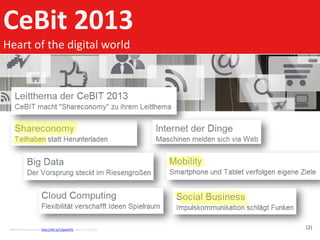
CeBit 2013
Heart of the digital world


 Bildschirmaufnahme: http://bit.ly/12pwFD5 , Stand 4.3.2013   (2)
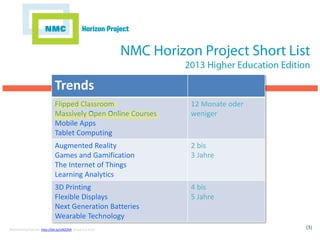
Trends
                             Flipped Classroom               12 Monate oder
                             Massively Open Online Courses   weniger
                             Mobile Apps
                             Tablet Computing
                             Augmented Reality               2 bis
                             Games and Gamification          3 Jahre
                             The Internet of Things
                             Learning Analytics
                             3D Printing                     4 bis
                             Flexible Displays               5 Jahre
                             Next Generation Batteries
                             Wearable Technology
Bildschirmaufnahme: http://bit.ly/UN22hR, Stand 4.3.2013                      (3)
1. Lernen im Wandel

2. Neue Lernszenarien

3. Herausforderungen


                          Foto: familymwr
                        (4)
1. Lernen im Wandel

2. Neue Lernszenarien

3. Herausforderungen


                          Foto: familymwr
                        (5)
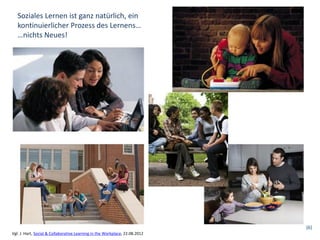
Soziales Lernen ist ganz natürlich, ein
   kontinuierlicher Prozess des Lernens…
   …nichts Neues!


                                                                             (6)
Vgl. J. Hart, Social & Collaborative Learning in the Workplace, 22.08.2012
Scale
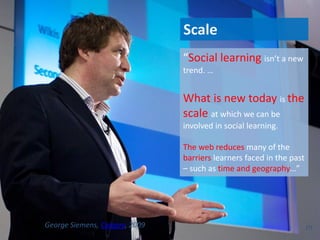
                                “Social learning isn’t a new
                                trend. …


                                What is new today is the
                                scale at which we can be
                                involved in social learning.

                                The web reduces many of the
                                barriers learners faced in the past
                                – such as time and geography…”


George Siemens, Calgary, 2009                                         (7)
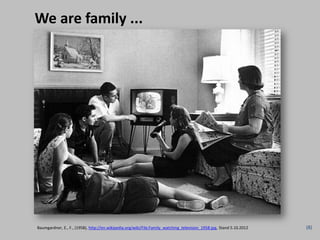
We are family ...


Baumgardner, E., F., (1958), http://en.wikipedia.org/wiki/File:Family_watching_television_1958.jpg, Stand 5.10.2012   (8)
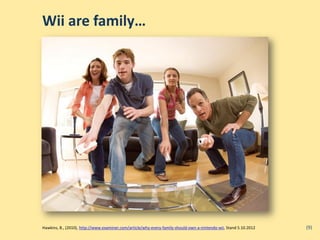
Wii are family…


Hawkins, B., (2010), http://www.examiner.com/article/why-every-family-should-own-a-nintendo-wii, Stand 5.10.2012   (9)
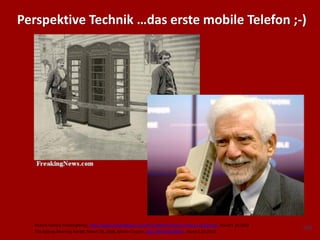
Perspektive Technik …das erste mobile Telefon ;-)


  Picture Gallery FreakingNews, http://www.freakingnews.com/First-Mobile-Phone-Pictures-45324.asp, Stand 5.10.2012
                                                                                                                     (10)
  The Sydney Morning Harald, March 28, 2008, Martin Cooper, http://bit.ly/OGYRLq , Stand 5.10.2012
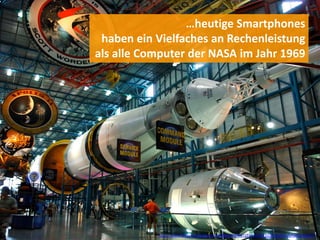
…heutige Smartphones
 haben ein Vielfaches an Rechenleistung
als alle Computer der NASA im Jahr 1969


                                                                               (11)
           http://www.flickr.com/photos/43533334@N07/5153726732/sizes/l/in/photostream/
The Social Data Revolution


                             (12)
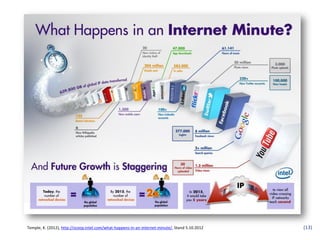
Temple, K. (2012), http://scoop.intel.com/what-happens-in-an-internet-minute/, Stand 5.10.2012   (13)
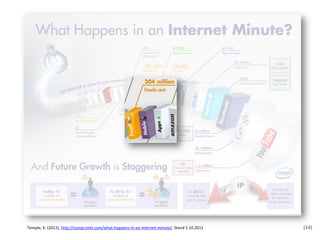
Temple, K. (2012), http://scoop.intel.com/what-happens-in-an-internet-minute/, Stand 5.10.2012   (14)
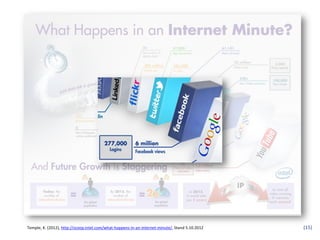
Temple, K. (2012), http://scoop.intel.com/what-happens-in-an-internet-minute/, Stand 5.10.2012   (15)
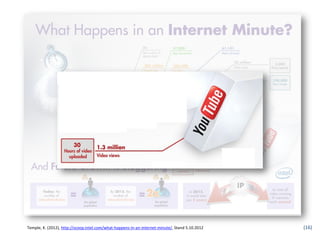
Temple, K. (2012), http://scoop.intel.com/what-happens-in-an-internet-minute/, Stand 5.10.2012   (16)
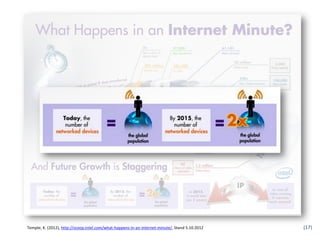
Temple, K. (2012), http://scoop.intel.com/what-happens-in-an-internet-minute/, Stand 5.10.2012   (17)
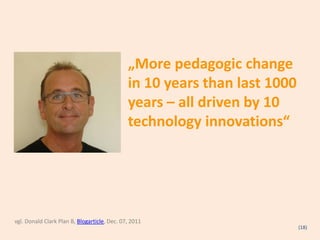
„More pedagogic change
                                              in 10 years than last 1000
                                              years – all driven by 10
                                              technology innovations“


vgl. Donald Clark Plan B, Blogarticle, Dec. 07, 2011
                                                                           (18)
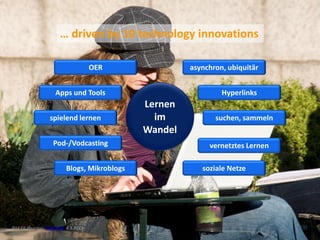
… driven by 10 technology innovations

                                        OER              asynchron, ubiquitär


                      Apps und Tools                              Hyperlinks
                                                Lernen
                   spielend lernen                im            suchen, sammeln
                                                Wandel
                     Pod-/Vodcasting                          vernetztes Lernen

                            Blogs, Mikroblogs               soziale Netze


Bild Ed Yourdon, Flickrbild, 4.3.2013                                             (19)
1. Lernen im Wandel

2. Neue Lernszenarien

3. Herausforderungen


                           Foto: familymwr
                        (20)
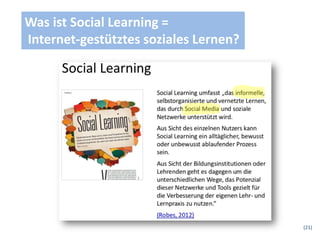
Was ist Social Learning =
Internet-gestütztes soziales Lernen?


                                       (21)
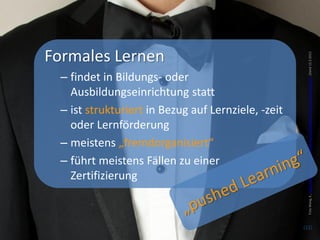
Formales Lernen


                                                      Foto Wang, K., http://www.flickr.com/photos/kentwang/6610828273/sizes/o/in/photostream/ ,Stand 12.3.2013
 – findet in Bildungs- oder
   Ausbildungseinrichtung statt
 – ist strukturiert in Bezug auf Lernziele, -zeit
   oder Lernförderung
 – meistens „fremdorganisiert“
 – führt meistens Fällen zu einer
   Zertifizierung


                                                    (22)
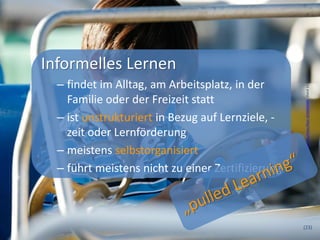
Informelles Lernen


                                                    Foto Proimos, A., http://www.fotopedia.com/items/flickr-6926000084 , Stand 12.3.2013
  – findet im Alltag, am Arbeitsplatz, in der
    Familie oder der Freizeit statt
  – ist unstrukturiert in Bezug auf Lernziele, -
    zeit oder Lernförderung
  – meistens selbstorganisiert
  – führt meistens nicht zu einer Zertifizierung


                                                   (23)
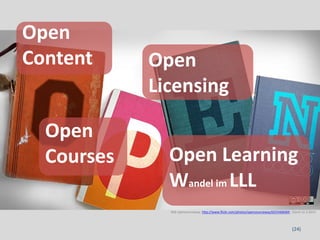
Open
Content     Open
            Licensing

  Open
  Courses     Open Learning
              Wandel im LLL
              Bild opensourceway, http://www.flickr.com/photos/opensourceway/6555466069 , Stand 12.3.2013


                                                                                          (24)
http://ocw.mit.edu/index.htm


                                                           http://openlearn.open.ac.uk/


                                                           http://www.oercommons.org/


http://unesdoc.unesco.org/images/0021/002136/213605E.pdf
                                                                                          (25)
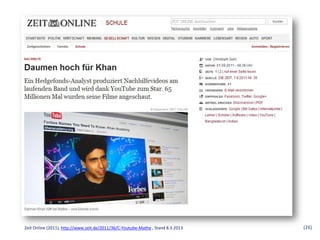
Zeit Online (2011), http://www.zeit.de/2011/36/C-Youtube-Mathe , Stand 8.3.2013   (26)
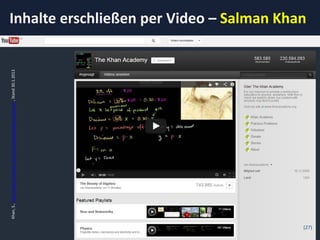
Khan, S., http://www.youtube.com/user/khanacademy/featured , Stand 30.1.2013
                                                                                      Inhalte erschließen per Video – Salman Khan


(27)
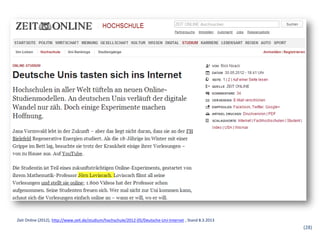
Zeit Online (2012), http://www.zeit.de/studium/hochschule/2012-05/Deutsche-Uni-Internet , Stand 8.3.2013
                                                                                                           (28)
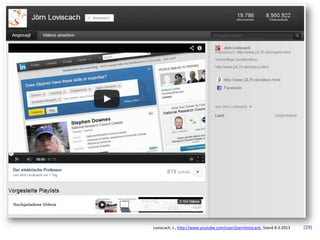
Loviscach, J., http://www.youtube.com/user/joernloviscach, Stand 8.3.2013   (29)
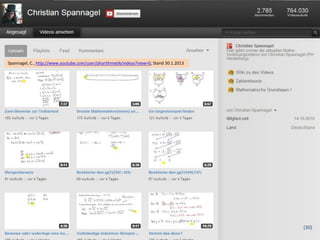
Spannagel, C., http://www.youtube.com/user/pharithmetik/videos?view=0, Stand 30.1.2013


                                                                                         (30)
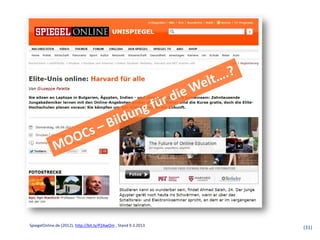
SpiegelOnline.de (2012), http://bit.ly/P2AwOm , Stand 9.3.2013
                                                                 (31)
Massive
Open


                                                             MOOC-Cow, 07/2012
Online
Course
   Der Begriff Massive Open Online Course (MOOC) bezeichnet eine
   spezielle Form von kostenlosen, frei zugänglichen Onlinekursen mit
   sehr vielen Teilnehmern.

                                                                                 (32)
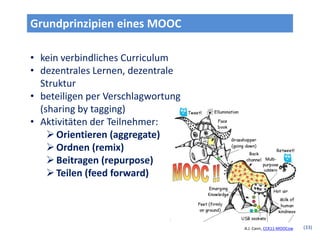
Grundprinzipien eines MOOC

• kein verbindliches Curriculum
• dezentrales Lernen, dezentrale
  Struktur
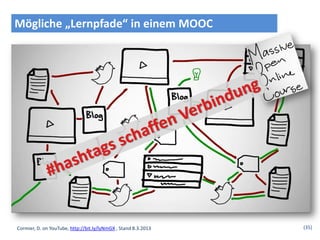
• beteiligen per Verschlagwortung
  (sharing by tagging)
• Aktivitäten der Teilnehmer:
     Orientieren (aggregate)
     Ordnen (remix)
     Beitragen (repurpose)
     Teilen (feed forward)


                                    A.J. Cann, CCK11-MOOCow   (33)
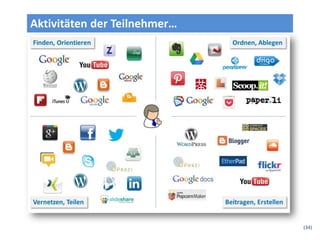
Aktivitäten der Teilnehmer…


                              (34)
Mögliche „Lernpfade“ in einem MOOC


Cormier, D. on YouTube, http://bit.ly/lyNmGX , Stand 8.3.2013   (35)
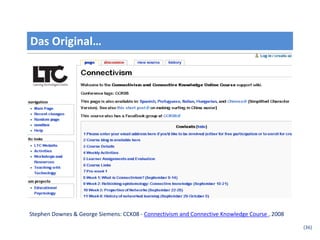
Das Original…


Stephen Downes & George Siemens: CCK08 - Connectivism and Connective Knowledge Course , 2008

                                                                                               (36)
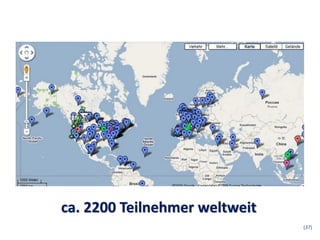
ca. 2200 Teilnehmer weltweit
                               (37)
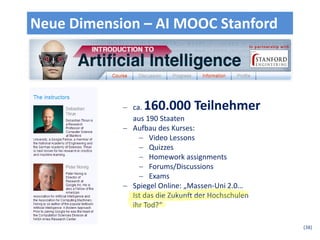
Neue Dimension – AI MOOC Stanford


             ca. 160.000 Teilnehmer
              aus 190 Staaten
             Aufbau des Kurses:
                 Video Lessons
                 Quizzes
                 Homework assignments
                 Forums/Discussions
                 Exams
             Spiegel Online: „Massen-Uni 2.0…
              Ist das die Zukunft der Hochschulen
              ihr Tod?“

                                                    (38)
(39)
(40)
(41)
(42)
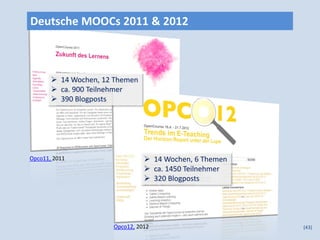
Deutsche MOOCs 2011 & 2012


        14 Wochen, 12 Themen
        ca. 900 Teilnehmer
        390 Blogposts


Opco11, 2011                     14 Wochen, 6 Themen
                                 ca. 1450 Teilnehmer
                                 320 Blogposts


                      Opco12, 2012                      (43)
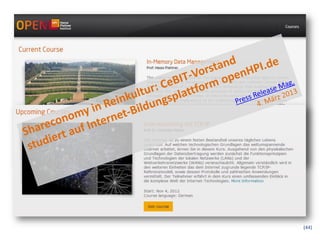
(44)
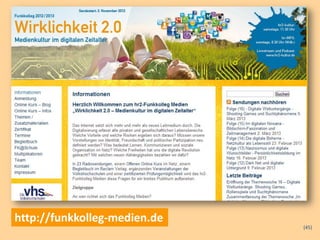
http://funkkolleg-medien.de
                              (45)
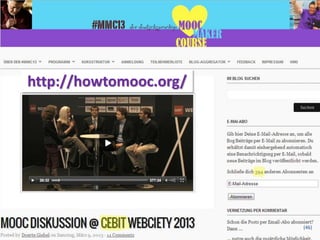
http://howtomooc.org/


                        (46)
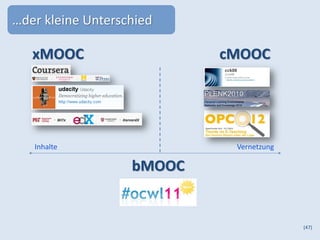
…der kleine Unterschied

   xMOOC                   cMOOC


   Inhalte                  Vernetzung

                   bMOOC


                                         (47)
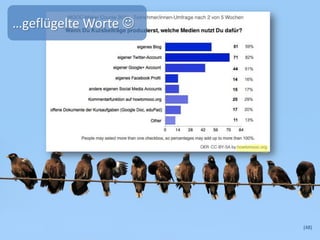
…geflügelte Worte 


                      (48)
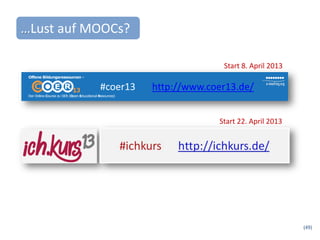
…Lust auf MOOCs?

                                   Start 8. April 2013

           #coer13   http://www.coer13.de/


                                  Start 22. April 2013


                                                         (49)
1. Lernen im Wandel

2. Neue Lernszenarien

3. Herausforderungen


                           Foto: familymwr
                        (50)
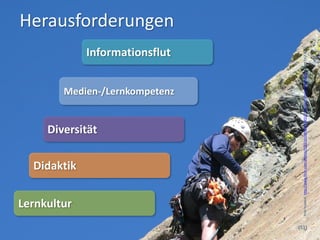
Lernkultur
                                  Didaktik
                                                         Diversität
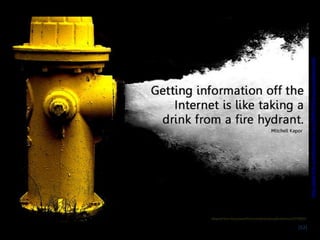
                                                                                                          Informationsflut
                                                                                                                             Herausforderungen


                                                                                  Medien-/Lernkompetenz


       Foto hojaleaf, http://www.flickr.com/photos/55231619@N00/924512714/sizes/o/in/photostream/, Stand 16.7.2012
(51)
(52)


       http://www.flickr.com/photos/will-lion/2595497078/sizes/z/in/photostream/
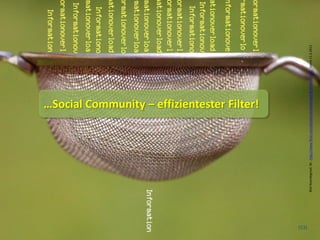
…Social Community – effizientester Filter!


(53)


       Bild Noordegraaf, M., http://www.flickr.com/photos/verbeeldingskr8/3638834128/ , Stand 11.3.2013
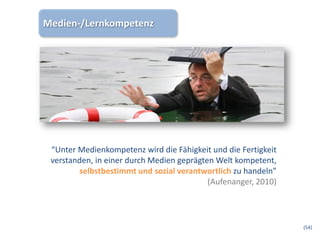
Medien-/Lernkompetenz


 “Unter Medienkompetenz wird die Fähigkeit und die Fertigkeit
 verstanden, in einer durch Medien geprägten Welt kompetent,
        selbstbestimmt und sozial verantwortlich zu handeln”
                                           (Aufenanger, 2010)


                                                                (54)
“Connectivism means networked learning […] our ability to
  learn and stay current is directly related to the strength and
  diversity of our personal learning network” (Siemens, 2007)


PLE-Bild, Esteve, F., http://www.flickr.com/photos/francescesteve/3039956497/sizes/m/in/photostream/, Stand 20.1.2012   (55)
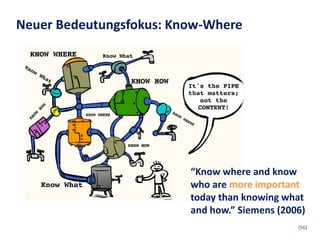
Neuer Bedeutungsfokus: Know-Where


                         “Know where and know
                         who are more important
                         today than knowing what
                         and how.” Siemens (2006)
                                               (56)
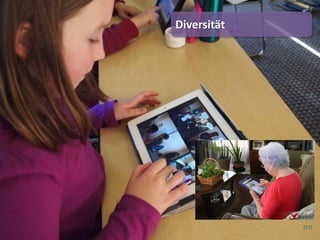
Diversität


             (57)
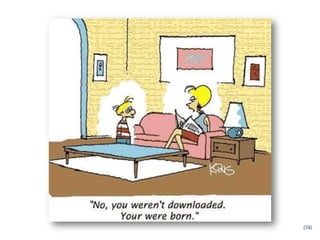
(58)
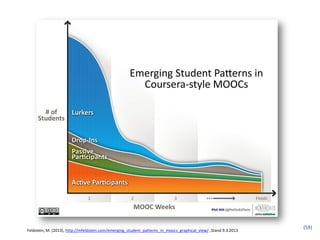
(59)
Feldstein, M. (2013), http://mfeldstein.com/emerging_student_patterns_in_moocs_graphical_view/ ,Stand 9.3.2013
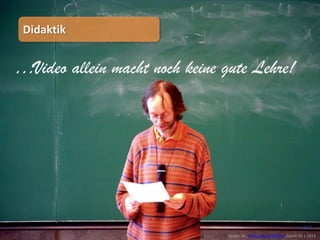
Didaktik


…Video allein macht noch keine gute Lehre!


                                                                         (60)
                                Braun, M., http://bit.ly/VvRUjv ,Stand 30.1.2013
Problem!


Sherbet, P., http://www.flickr.com/photos/pinksherbet/6961676525/sizes/l/in/photostream/, Stand 30.1.2013
                                                                                                            61
http://www.flickr.com/photos/haniamir/2012078096/sizes/l/in/photostream/


           #flipclass
                                flipped Classroom


(62)
                                                      inverted Classroom
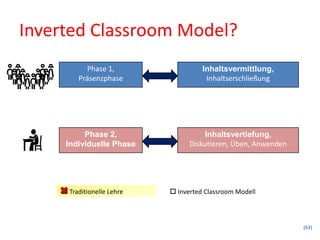
Inverted Classroom Model?
            Phase 1,                  Inhaltsvermittlung,
         Präsenzphase                  Inhaltserschließung


          Phase 2,                    Inhaltsvertiefung,
     Individuelle Phase           Diskutieren, Üben, Anwenden


     Traditionelle Lehre    Inverted Classroom Modell


                                                                (63)
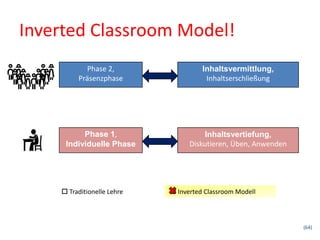
Inverted Classroom Model!
            Phase 2,                  Inhaltsvermittlung,
         Präsenzphase                  Inhaltserschließung


          Phase 1,                    Inhaltsvertiefung,
     Individuelle Phase           Diskutieren, Üben, Anwenden


     Traditionelle Lehre    Inverted Classroom Modell


                                                                (64)
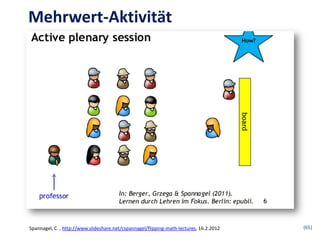
Mehrwert-Aktivität


Spannagel, C. , http://www.slideshare.net/cspannagel/flipping-math-lectures, 16.2.2012   (65)
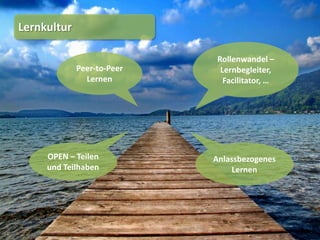
Lernkultur

                             Rollenwandel –
             Peer-to-Peer     Lernbegleiter,
               Lernen          Facilitator, …


     OPEN – Teilen          Anlassbezogenes
     und Teilhaben               Lernen


                                                (66)
Vielen Dank!
Kontakt:
Hochschule Weserbergland
Prof. Dr. Volkmar Langer

E-Mail: langer@hsw-hameln.de
Twitter: @volkmarla
Blog: hsw-learningblog.de
Scoopit: zukunft-des-lernens
…
Am Stockhof 2, 31785 Hameln


                               (67)
Quellen und Bildnachweise
Folie 1, 4, 5, 20, 50:
Foto familymwr, http://bit.ly/14S65yc , Stand 12.3.2013
Folie 2:
Trendbarometer Cebit 2013: Bildschirmaufnahme: http://bit.ly/12pwFD5 , Stand 4.3.2013
Folie 3:
NMC Horizon Report HE 2013, http://www.nmc.org/publications/2013-horizon-report-higher-ed, Stand 4.3.2013
Johnson, L., Adams Becker, S., Cummins, M., Estrada, V., Freeman, A., and
Ludgate, H. (2013). NMC Horizon Report: 2013 Higher Education Edition.
Austin, Texas: The New Media Consortium
Folie 6:
Hart, J., Social & Collaborative Learning in the Workplace, http://de.slideshare.net/janehart/social-collaborative-
learning-in-the-workplace, Stand 4.3.2013
Folie 7:
Siemens, G., Artikel in http://www.weiterbildungsblog.de/2011/06/08/the-network-is-the-learning-an-interview-
with-george-siemens/, Stand 30.8.2012
Folie 8, 9 , 10, 11:
Vgl. Cc-Bildverweise auf den Folien, Stand 12.3.2013
Folie 12:
Weigend, A., Havard Business Review (2009), The Social Data Revolution(s), http://blogs.hbr.org/now-new-
next/2009/05/the-social-data-revolution.html, Stand 8.3.2013
Hintergrundbild: http://commons.wikimedia.org/wiki/File:WDW_SpaceMountain_Tunnel.JPG , Stand 12.3.2013
Folie 13, 14, 15, 16, 17:
Temple, K. (2012), http://scoop.intel.com/what-happens-in-an-internet-minute/, Stand 5.10.2012
Folie 18:
D. Clark, Plan B Blogarticle, http://donaldclarkplanb.blogspot.com/2011/12/more-pedagogic-change-in-last-10-
years.html, Dec. 07, 2011
Folie 19:
Hintergrundbild, Ed Yourdon, http://www.flickr.com/photos/yourdon/3405811164/sizes/l/in/photostream/ 4.3.2013
V. Langer, HSW-Learningblog, http://www.hsw-learningblog.de/2012/01/mehr-veranderungen-beim-lernverhalten-in-
den-letzten-10-jahren-als-in-1000-jahren-zuvor-%E2%80%93-alle-im-wesentlichen-bedingt-durch-technische-
innovationen/, Stand 28.1.2012
                                                                                                                      68
Folie 21:
Robes, J., Social Learning (2012), http://www.weiterbildungsblog.de/2012/09/14/social-learning/ , Stand 12.3.2013
Folie 22, 23, 24:
Vgl. Cc-Bildverweise auf den Folien
Folie 25, 26, 27, 28, 29, 30, 31:
Bildschirmaufnahmen, vgl. Verweise auf den Folien
Folie 32:
Holdcroft, J., MOOC-Cow, http://highlighter.com/2012/07/how-we-learned-to-stand-out-in-a-class-of-100000-people/, Stand
30.8.2012
Folie 33:
Downes, S., Siemens, G., Screenshot CCK08, http://ltc.umanitoba.ca/wiki/Connectivism, Stand 15.10.2012
Folie 34:
Langer, V., Bildschirmaufnahmen von Web 2.0 Tools, Stand 12.3.2013
Folie 35:
Bildschirmfoto, Cormier, D. (2010), What ist a MOOC?, http://www.youtube.com/watch?v=eW3gMGqcZQc , Stand
15.10.2012
Folie 36:
Downes, S., Siemens, G., Screenshot CCK08, http://ltc.umanitoba.ca/wiki/Connectivism, Stand 15.10.2012
Folie 37:
Downes, S., Engagement and Motivation in MOOCs,
http://www.slideshare.net/Downes/engagement-and-motivation-in-moocs, Stand 15.10.2012
Folie 38:
Bildschirmaufnahme https://www.ai-class.com/, Stand 30.8.2012
Folie 39:
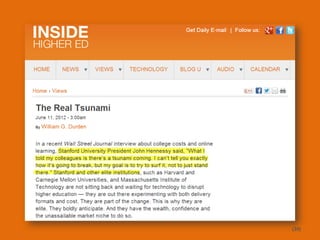
Bildschirmaufnahme, http://www.insidehighered.com/views/2012/06/11/essay-changes-may-most-threaten-traditional-
higher-education, Stand 30.8.2012
Folie 40:
Bildschirmaufnahme, http://www.udacity.com/, Stand 30.8.2012
Folie 41:
Bildschirmaufnahme, https://www.coursera.org/, Stand 30.8.2012
Folie 42:
Bildschirmaufnahme, https://www.edx.org/, Stand 30.8.2012
Folie 43:
Bildschirmfoto, OpenCourse “Zukunft des Lernens”, http://blog.studiumdigitale.uni-frankfurt.de/opco11/, Stand 11.11.2011
Bildschirmfoto, OpenCourse „Trends im E-Teaching“, http://opco12.de/, Stand 30.8.2012                                      (69)
Folie 44:
Bildschirmaufnahme, https://openhpi.de/, Stand 30.8.2012
Folie 45:
Bildschirmaufnahme, http://funkkolleg-medien.de , Stand 12.3.2013
Folie 46:
Bildschirmaufnahme, http://howtomooc.org , Stand 11.3.2013
Folie 47:
Langer, V., Slides from http://de.slideshare.net/volkmarl/offene-kurse-in-klassischen-lehr-lernformaten20072012, Stand
30.8.2012
Folie 48:
Hintergrundbild, Rayker, K., http://www.flickr.com/photos/krayker/4962969492 , Stand 12.3.2013
Statistik von howtomooc.org, Giebel, D., http://www.flickr.com/photos/diegoerelebt/8442128632/in/pool-2131322@N24 ,
Stand 12.3.2013
Folie 49:
Bildschirmaufnahmen vgl. Verweise auf der Folie, Stand 12.3.2013
Folie 51, 52, 53:
Vgl. Cc-Bildverweise auf den Folien, Stand 12.3.2013
Folie 54:
Bild von der Themenseite Medienkompetenz, e-Teaching.org (2009), http://www.e-teaching.org/specials/medienkompetenz,
Stand 20.3.2011
Aufenanger, S. (2010), Stellungnahme zu den Fragen der öffentlichen Anhörung Medienkompetenz am 13.12.2010 der
Enquete-Kommission Internet und digitale Gesellschaft des Deutschen Bundestags,
http://www.bundestag.de/internetenquete/dokumentation/2010/Sitzungen/20101213/A-Drs__17_24_014-I_-
_Stellungnahme_Univ_-Prof__Dr__Aufenanger.pdf , Stand 21.3.2011
Folie 55:
Siemens, G. (2007): Connectivism – Learning conceptualized through the lense of today’s world (Presentation on OCC),
http://www.elearnspace.org/presentations/connectivism_online_OCC2007.ppt,
PLE-Bild, Esteve, F., http://www.flickr.com/photos/francescesteve/3039956497/sizes/m/in/photostream/, Stand 20.1.2012
Folie 56:
Siemens, G. (2007): Connectivism – Learning conceptualized through the lense of today’s world (Presentation on OCC),
http://www.elearnspace.org/presentations/connectivism_online_OCC2007.ppt and MP3,
http://www.elearnspace.org/media/OCC2007/georgesiemens1.mp3, Stand 15.10.2012
Folie 57:
Bild Kind mit iPad, Brad Flickinger, http://www.flickr.com/photos/56155476@N08/6660091109/, Stand 23.1.2012
Bild Oma mit iPad, Tomasita Gomez, http://www.ambergristoday.com/content/everybodys-reading/2011/february/14/mrs-
tomasita-gomez-keeps-updated-her-ipad, Stand 20.1.2012                                                                   (70)
Folie 58:
Bildschirmaufnahme von Blogbeitrag, http://janachen2407.wordpress.com/2010/03/04/digital-natives/ Stand 12.3.2013
Folie 59:
Feldstein, M. (2013), http://mfeldstein.com/emerging_student_patterns_in_moocs_graphical_view/ ,Stand 9.3.2013
Folie 60, 61, 62, 66:
Bildschirmaufnahmen vgl. Verweise auf der Folie, Stand 12.3.2013
Folie 63, 64:
Langer, V., Inverted Classroom Model Darstellung in Anlehnung an Handke, J.,
http://invertedclassroom.wordpress.com/konferenz2013/ Stand 12.3.2013
Folie 65:
Spannagel, C. , http://www.slideshare.net/cspannagel/flipping-math-lectures, 16.2.2012


                                                                                                                    (71)

Internet-gestütztes soziales Lernen als neuer Trend - Auswirkungen auf die Zukunft des Lernens

  • 1.
    Social Learning Internet-gestütztes sozialesLernen als neuer Trend - Auswirkungen auf die Zukunft des Lernens Foto: familymwr Prof. Dr. Volkmar Langer Wolfsburg, 18. März 2013 Dieser Foliensatz steht unter einer Creative Commons Namensnennung-Weitergabe unter gleichen Bedingungen 3.0 Deutschland Lizenz.
  • 2.
    CeBit 2013 Heart ofthe digital world Bildschirmaufnahme: http://bit.ly/12pwFD5 , Stand 4.3.2013 (2)
  • 3.
    Trends Flipped Classroom 12 Monate oder Massively Open Online Courses weniger Mobile Apps Tablet Computing Augmented Reality 2 bis Games and Gamification 3 Jahre The Internet of Things Learning Analytics 3D Printing 4 bis Flexible Displays 5 Jahre Next Generation Batteries Wearable Technology Bildschirmaufnahme: http://bit.ly/UN22hR, Stand 4.3.2013 (3)
  • 4.
    1. Lernen imWandel 2. Neue Lernszenarien 3. Herausforderungen Foto: familymwr (4)
  • 5.
    1. Lernen imWandel 2. Neue Lernszenarien 3. Herausforderungen Foto: familymwr (5)
  • 6.
    Soziales Lernen istganz natürlich, ein kontinuierlicher Prozess des Lernens… …nichts Neues! (6) Vgl. J. Hart, Social & Collaborative Learning in the Workplace, 22.08.2012
  • 7.
    Scale “Social learning isn’t a new trend. … What is new today is the scale at which we can be involved in social learning. The web reduces many of the barriers learners faced in the past – such as time and geography…” George Siemens, Calgary, 2009 (7)
  • 8.
    We are family... Baumgardner, E., F., (1958), http://en.wikipedia.org/wiki/File:Family_watching_television_1958.jpg, Stand 5.10.2012 (8)
  • 9.
    Wii are family… Hawkins,B., (2010), http://www.examiner.com/article/why-every-family-should-own-a-nintendo-wii, Stand 5.10.2012 (9)
  • 10.
    Perspektive Technik …daserste mobile Telefon ;-) Picture Gallery FreakingNews, http://www.freakingnews.com/First-Mobile-Phone-Pictures-45324.asp, Stand 5.10.2012 (10) The Sydney Morning Harald, March 28, 2008, Martin Cooper, http://bit.ly/OGYRLq , Stand 5.10.2012
  • 11.
    …heutige Smartphones habenein Vielfaches an Rechenleistung als alle Computer der NASA im Jahr 1969 (11) http://www.flickr.com/photos/43533334@N07/5153726732/sizes/l/in/photostream/
  • 12.
    The Social DataRevolution (12)
  • 13.
    Temple, K. (2012),http://scoop.intel.com/what-happens-in-an-internet-minute/, Stand 5.10.2012 (13)
  • 14.
    Temple, K. (2012),http://scoop.intel.com/what-happens-in-an-internet-minute/, Stand 5.10.2012 (14)
  • 15.
    Temple, K. (2012),http://scoop.intel.com/what-happens-in-an-internet-minute/, Stand 5.10.2012 (15)
  • 16.
    Temple, K. (2012),http://scoop.intel.com/what-happens-in-an-internet-minute/, Stand 5.10.2012 (16)
  • 17.
    Temple, K. (2012),http://scoop.intel.com/what-happens-in-an-internet-minute/, Stand 5.10.2012 (17)
  • 18.
    „More pedagogic change in 10 years than last 1000 years – all driven by 10 technology innovations“ vgl. Donald Clark Plan B, Blogarticle, Dec. 07, 2011 (18)
  • 19.
    … driven by10 technology innovations OER asynchron, ubiquitär Apps und Tools Hyperlinks Lernen spielend lernen im suchen, sammeln Wandel Pod-/Vodcasting vernetztes Lernen Blogs, Mikroblogs soziale Netze Bild Ed Yourdon, Flickrbild, 4.3.2013 (19)
  • 20.
    1. Lernen imWandel 2. Neue Lernszenarien 3. Herausforderungen Foto: familymwr (20)
  • 21.
    Was ist SocialLearning = Internet-gestütztes soziales Lernen? (21)
  • 22.
    Formales Lernen Foto Wang, K., http://www.flickr.com/photos/kentwang/6610828273/sizes/o/in/photostream/ ,Stand 12.3.2013 – findet in Bildungs- oder Ausbildungseinrichtung statt – ist strukturiert in Bezug auf Lernziele, -zeit oder Lernförderung – meistens „fremdorganisiert“ – führt meistens Fällen zu einer Zertifizierung (22)
  • 23.
    Informelles Lernen Foto Proimos, A., http://www.fotopedia.com/items/flickr-6926000084 , Stand 12.3.2013 – findet im Alltag, am Arbeitsplatz, in der Familie oder der Freizeit statt – ist unstrukturiert in Bezug auf Lernziele, - zeit oder Lernförderung – meistens selbstorganisiert – führt meistens nicht zu einer Zertifizierung (23)
  • 24.
    Open Content Open Licensing Open Courses Open Learning Wandel im LLL Bild opensourceway, http://www.flickr.com/photos/opensourceway/6555466069 , Stand 12.3.2013 (24)
  • 25.
    http://ocw.mit.edu/index.htm http://openlearn.open.ac.uk/ http://www.oercommons.org/ http://unesdoc.unesco.org/images/0021/002136/213605E.pdf (25)
  • 26.
    Zeit Online (2011),http://www.zeit.de/2011/36/C-Youtube-Mathe , Stand 8.3.2013 (26)
  • 27.
    Khan, S., http://www.youtube.com/user/khanacademy/featured, Stand 30.1.2013 Inhalte erschließen per Video – Salman Khan (27)
  • 28.
    Zeit Online (2012),http://www.zeit.de/studium/hochschule/2012-05/Deutsche-Uni-Internet , Stand 8.3.2013 (28)
  • 29.
  • 30.
  • 31.
  • 32.
    Massive Open MOOC-Cow, 07/2012 Online Course Der Begriff Massive Open Online Course (MOOC) bezeichnet eine spezielle Form von kostenlosen, frei zugänglichen Onlinekursen mit sehr vielen Teilnehmern. (32)
  • 33.
    Grundprinzipien eines MOOC •kein verbindliches Curriculum • dezentrales Lernen, dezentrale Struktur • beteiligen per Verschlagwortung (sharing by tagging) • Aktivitäten der Teilnehmer:  Orientieren (aggregate)  Ordnen (remix)  Beitragen (repurpose)  Teilen (feed forward) A.J. Cann, CCK11-MOOCow (33)
  • 34.
  • 35.
    Mögliche „Lernpfade“ ineinem MOOC Cormier, D. on YouTube, http://bit.ly/lyNmGX , Stand 8.3.2013 (35)
  • 36.
    Das Original… Stephen Downes& George Siemens: CCK08 - Connectivism and Connective Knowledge Course , 2008 (36)
  • 37.
    ca. 2200 Teilnehmerweltweit (37)
  • 38.
    Neue Dimension –AI MOOC Stanford  ca. 160.000 Teilnehmer aus 190 Staaten  Aufbau des Kurses:  Video Lessons  Quizzes  Homework assignments  Forums/Discussions  Exams  Spiegel Online: „Massen-Uni 2.0… Ist das die Zukunft der Hochschulen ihr Tod?“ (38)
  • 39.
  • 40.
  • 41.
  • 42.
  • 43.
    Deutsche MOOCs 2011& 2012  14 Wochen, 12 Themen  ca. 900 Teilnehmer  390 Blogposts Opco11, 2011  14 Wochen, 6 Themen  ca. 1450 Teilnehmer  320 Blogposts Opco12, 2012 (43)
  • 44.
  • 45.
  • 46.
  • 47.
    …der kleine Unterschied xMOOC cMOOC Inhalte Vernetzung bMOOC (47)
  • 48.
  • 49.
    …Lust auf MOOCs? Start 8. April 2013 #coer13 http://www.coer13.de/ Start 22. April 2013 (49)
  • 50.
    1. Lernen imWandel 2. Neue Lernszenarien 3. Herausforderungen Foto: familymwr (50)
  • 51.
    Lernkultur Didaktik Diversität Informationsflut Herausforderungen Medien-/Lernkompetenz Foto hojaleaf, http://www.flickr.com/photos/55231619@N00/924512714/sizes/o/in/photostream/, Stand 16.7.2012 (51)
  • 52.
    (52) http://www.flickr.com/photos/will-lion/2595497078/sizes/z/in/photostream/
  • 53.
    …Social Community –effizientester Filter! (53) Bild Noordegraaf, M., http://www.flickr.com/photos/verbeeldingskr8/3638834128/ , Stand 11.3.2013
  • 54.
    Medien-/Lernkompetenz “Unter Medienkompetenzwird die Fähigkeit und die Fertigkeit verstanden, in einer durch Medien geprägten Welt kompetent, selbstbestimmt und sozial verantwortlich zu handeln” (Aufenanger, 2010) (54)
  • 55.
    “Connectivism means networkedlearning […] our ability to learn and stay current is directly related to the strength and diversity of our personal learning network” (Siemens, 2007) PLE-Bild, Esteve, F., http://www.flickr.com/photos/francescesteve/3039956497/sizes/m/in/photostream/, Stand 20.1.2012 (55)
  • 56.
    Neuer Bedeutungsfokus: Know-Where “Know where and know who are more important today than knowing what and how.” Siemens (2006) (56)
  • 57.
  • 58.
  • 59.
    (59) Feldstein, M. (2013),http://mfeldstein.com/emerging_student_patterns_in_moocs_graphical_view/ ,Stand 9.3.2013
  • 60.
    Didaktik …Video allein machtnoch keine gute Lehre! (60) Braun, M., http://bit.ly/VvRUjv ,Stand 30.1.2013
  • 61.
  • 62.
    http://www.flickr.com/photos/haniamir/2012078096/sizes/l/in/photostream/ #flipclass flipped Classroom (62) inverted Classroom
  • 63.
    Inverted Classroom Model? Phase 1, Inhaltsvermittlung, Präsenzphase Inhaltserschließung Phase 2, Inhaltsvertiefung, Individuelle Phase Diskutieren, Üben, Anwenden  Traditionelle Lehre  Inverted Classroom Modell (63)
  • 64.
    Inverted Classroom Model! Phase 2, Inhaltsvermittlung, Präsenzphase Inhaltserschließung Phase 1, Inhaltsvertiefung, Individuelle Phase Diskutieren, Üben, Anwenden  Traditionelle Lehre  Inverted Classroom Modell (64)
  • 65.
    Mehrwert-Aktivität Spannagel, C. ,http://www.slideshare.net/cspannagel/flipping-math-lectures, 16.2.2012 (65)
  • 66.
    Lernkultur Rollenwandel – Peer-to-Peer Lernbegleiter, Lernen Facilitator, … OPEN – Teilen Anlassbezogenes und Teilhaben Lernen (66)
  • 67.
    Vielen Dank! Kontakt: Hochschule Weserbergland Prof.Dr. Volkmar Langer E-Mail: langer@hsw-hameln.de Twitter: @volkmarla Blog: hsw-learningblog.de Scoopit: zukunft-des-lernens … Am Stockhof 2, 31785 Hameln (67)
  • 68.
    Quellen und Bildnachweise Folie1, 4, 5, 20, 50: Foto familymwr, http://bit.ly/14S65yc , Stand 12.3.2013 Folie 2: Trendbarometer Cebit 2013: Bildschirmaufnahme: http://bit.ly/12pwFD5 , Stand 4.3.2013 Folie 3: NMC Horizon Report HE 2013, http://www.nmc.org/publications/2013-horizon-report-higher-ed, Stand 4.3.2013 Johnson, L., Adams Becker, S., Cummins, M., Estrada, V., Freeman, A., and Ludgate, H. (2013). NMC Horizon Report: 2013 Higher Education Edition. Austin, Texas: The New Media Consortium Folie 6: Hart, J., Social & Collaborative Learning in the Workplace, http://de.slideshare.net/janehart/social-collaborative- learning-in-the-workplace, Stand 4.3.2013 Folie 7: Siemens, G., Artikel in http://www.weiterbildungsblog.de/2011/06/08/the-network-is-the-learning-an-interview- with-george-siemens/, Stand 30.8.2012 Folie 8, 9 , 10, 11: Vgl. Cc-Bildverweise auf den Folien, Stand 12.3.2013 Folie 12: Weigend, A., Havard Business Review (2009), The Social Data Revolution(s), http://blogs.hbr.org/now-new- next/2009/05/the-social-data-revolution.html, Stand 8.3.2013 Hintergrundbild: http://commons.wikimedia.org/wiki/File:WDW_SpaceMountain_Tunnel.JPG , Stand 12.3.2013 Folie 13, 14, 15, 16, 17: Temple, K. (2012), http://scoop.intel.com/what-happens-in-an-internet-minute/, Stand 5.10.2012 Folie 18: D. Clark, Plan B Blogarticle, http://donaldclarkplanb.blogspot.com/2011/12/more-pedagogic-change-in-last-10- years.html, Dec. 07, 2011 Folie 19: Hintergrundbild, Ed Yourdon, http://www.flickr.com/photos/yourdon/3405811164/sizes/l/in/photostream/ 4.3.2013 V. Langer, HSW-Learningblog, http://www.hsw-learningblog.de/2012/01/mehr-veranderungen-beim-lernverhalten-in- den-letzten-10-jahren-als-in-1000-jahren-zuvor-%E2%80%93-alle-im-wesentlichen-bedingt-durch-technische- innovationen/, Stand 28.1.2012 68
  • 69.
    Folie 21: Robes, J.,Social Learning (2012), http://www.weiterbildungsblog.de/2012/09/14/social-learning/ , Stand 12.3.2013 Folie 22, 23, 24: Vgl. Cc-Bildverweise auf den Folien Folie 25, 26, 27, 28, 29, 30, 31: Bildschirmaufnahmen, vgl. Verweise auf den Folien Folie 32: Holdcroft, J., MOOC-Cow, http://highlighter.com/2012/07/how-we-learned-to-stand-out-in-a-class-of-100000-people/, Stand 30.8.2012 Folie 33: Downes, S., Siemens, G., Screenshot CCK08, http://ltc.umanitoba.ca/wiki/Connectivism, Stand 15.10.2012 Folie 34: Langer, V., Bildschirmaufnahmen von Web 2.0 Tools, Stand 12.3.2013 Folie 35: Bildschirmfoto, Cormier, D. (2010), What ist a MOOC?, http://www.youtube.com/watch?v=eW3gMGqcZQc , Stand 15.10.2012 Folie 36: Downes, S., Siemens, G., Screenshot CCK08, http://ltc.umanitoba.ca/wiki/Connectivism, Stand 15.10.2012 Folie 37: Downes, S., Engagement and Motivation in MOOCs, http://www.slideshare.net/Downes/engagement-and-motivation-in-moocs, Stand 15.10.2012 Folie 38: Bildschirmaufnahme https://www.ai-class.com/, Stand 30.8.2012 Folie 39: Bildschirmaufnahme, http://www.insidehighered.com/views/2012/06/11/essay-changes-may-most-threaten-traditional- higher-education, Stand 30.8.2012 Folie 40: Bildschirmaufnahme, http://www.udacity.com/, Stand 30.8.2012 Folie 41: Bildschirmaufnahme, https://www.coursera.org/, Stand 30.8.2012 Folie 42: Bildschirmaufnahme, https://www.edx.org/, Stand 30.8.2012 Folie 43: Bildschirmfoto, OpenCourse “Zukunft des Lernens”, http://blog.studiumdigitale.uni-frankfurt.de/opco11/, Stand 11.11.2011 Bildschirmfoto, OpenCourse „Trends im E-Teaching“, http://opco12.de/, Stand 30.8.2012 (69)
  • 70.
    Folie 44: Bildschirmaufnahme, https://openhpi.de/,Stand 30.8.2012 Folie 45: Bildschirmaufnahme, http://funkkolleg-medien.de , Stand 12.3.2013 Folie 46: Bildschirmaufnahme, http://howtomooc.org , Stand 11.3.2013 Folie 47: Langer, V., Slides from http://de.slideshare.net/volkmarl/offene-kurse-in-klassischen-lehr-lernformaten20072012, Stand 30.8.2012 Folie 48: Hintergrundbild, Rayker, K., http://www.flickr.com/photos/krayker/4962969492 , Stand 12.3.2013 Statistik von howtomooc.org, Giebel, D., http://www.flickr.com/photos/diegoerelebt/8442128632/in/pool-2131322@N24 , Stand 12.3.2013 Folie 49: Bildschirmaufnahmen vgl. Verweise auf der Folie, Stand 12.3.2013 Folie 51, 52, 53: Vgl. Cc-Bildverweise auf den Folien, Stand 12.3.2013 Folie 54: Bild von der Themenseite Medienkompetenz, e-Teaching.org (2009), http://www.e-teaching.org/specials/medienkompetenz, Stand 20.3.2011 Aufenanger, S. (2010), Stellungnahme zu den Fragen der öffentlichen Anhörung Medienkompetenz am 13.12.2010 der Enquete-Kommission Internet und digitale Gesellschaft des Deutschen Bundestags, http://www.bundestag.de/internetenquete/dokumentation/2010/Sitzungen/20101213/A-Drs__17_24_014-I_- _Stellungnahme_Univ_-Prof__Dr__Aufenanger.pdf , Stand 21.3.2011 Folie 55: Siemens, G. (2007): Connectivism – Learning conceptualized through the lense of today’s world (Presentation on OCC), http://www.elearnspace.org/presentations/connectivism_online_OCC2007.ppt, PLE-Bild, Esteve, F., http://www.flickr.com/photos/francescesteve/3039956497/sizes/m/in/photostream/, Stand 20.1.2012 Folie 56: Siemens, G. (2007): Connectivism – Learning conceptualized through the lense of today’s world (Presentation on OCC), http://www.elearnspace.org/presentations/connectivism_online_OCC2007.ppt and MP3, http://www.elearnspace.org/media/OCC2007/georgesiemens1.mp3, Stand 15.10.2012 Folie 57: Bild Kind mit iPad, Brad Flickinger, http://www.flickr.com/photos/56155476@N08/6660091109/, Stand 23.1.2012 Bild Oma mit iPad, Tomasita Gomez, http://www.ambergristoday.com/content/everybodys-reading/2011/february/14/mrs- tomasita-gomez-keeps-updated-her-ipad, Stand 20.1.2012 (70)
  • 71.
    Folie 58: Bildschirmaufnahme vonBlogbeitrag, http://janachen2407.wordpress.com/2010/03/04/digital-natives/ Stand 12.3.2013 Folie 59: Feldstein, M. (2013), http://mfeldstein.com/emerging_student_patterns_in_moocs_graphical_view/ ,Stand 9.3.2013 Folie 60, 61, 62, 66: Bildschirmaufnahmen vgl. Verweise auf der Folie, Stand 12.3.2013 Folie 63, 64: Langer, V., Inverted Classroom Model Darstellung in Anlehnung an Handke, J., http://invertedclassroom.wordpress.com/konferenz2013/ Stand 12.3.2013 Folie 65: Spannagel, C. , http://www.slideshare.net/cspannagel/flipping-math-lectures, 16.2.2012 (71)