Emerging Technologies -
from social to mobile and
seamless learning
Martin Ebner
This work is licensed under a 

Creative Commons Attribution 

4.0 International License.
http://www.facebook.com/
martin.ebner
http://www.martinebner.at
https://twitter.com/#!/
mebner
http://
elearningblog.
tugraz.at
https://
www.researchgate.net/
profile/Martin_Ebner2
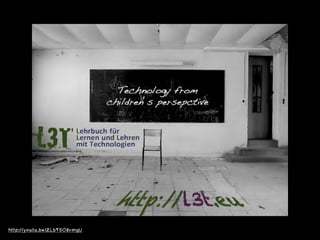
http://youtu.be/ZLbT5O8vmgU
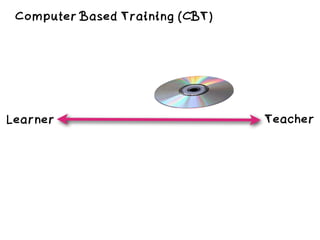
Computer Based Training (CBT)
TeacherLearner
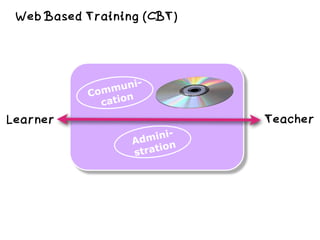
Communi-
cation
Admini-
stration
Web Based Training (CBT)
TeacherLearner
Welt der WBTs
Communi-
cation
Admini-
stration
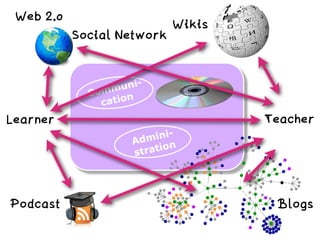
Web 2.0
Podcast
Wikis
Blogs
Social Network
TeacherLearner
Begriffsdefinition: Social Software
Web-2.0-Anwendungen werden dann
als Social Software bezeichnet,
wenn sie Interaktionen innerhalb
einer Nutzergemeinschaft gezielt unterstützen
Koch & Richter, 2008Enterprise 2.0: Planung,
Einführung und erfolgreicher Einsatz
von Social Software in Unternehmen.
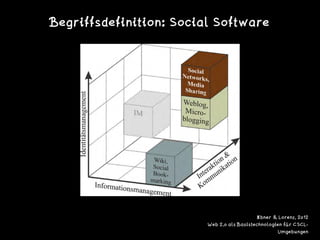
Begriffsdefinition: Social Software
Ebner & Lorenz, 2012

Web 2.0 als Basistechnologien für CSCL-
Umgebungen
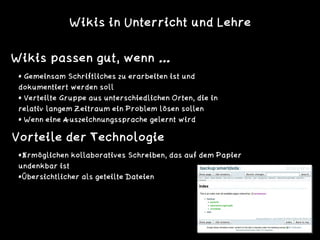
Wikis in Unterricht und Lehre
Wikis passen gut, wenn …
• Gemeinsam Schriftliches zu erarbeiten ist und
dokumentiert werden soll

• Verteilte Gruppe aus unterschiedlichen Orten, die in
relativ langem Zeitraum ein Problem lösen sollen
• Wenn eine Auszeichnungssprache gelernt wird
•Ermöglichen kollaboratives Schreiben, das auf dem Papier
undenkbar ist
•Übersichtlicher als geteilte Dateien
Vorteile der Technologie
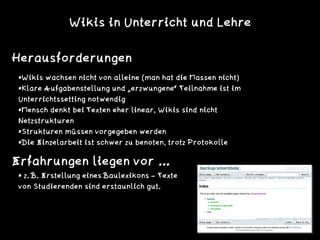
Wikis in Unterricht und Lehre
Herausforderungen
• z. B. Erstellung eines Baulexikons – Texte
von Studierenden sind erstaunlich gut.
Erfahrungen liegen vor …
•Wikis wachsen nicht von alleine (man hat die Massen nicht)
•Klare Aufgabenstellung und „erzwungene“ Teilnahme ist im
Unterrichtssetting notwendig
•Mensch denkt bei Texten eher linear, Wikis sind nicht
Netzstrukturen
•Strukturen müssen vorgegeben werden
•Die Einzelarbeit ist schwer zu benoten, trotz Protokolle
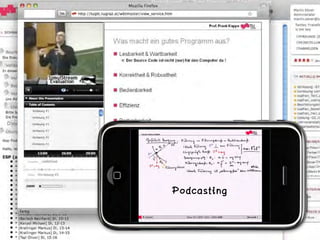
Podcasts in Unterricht und Lehre
Podcast passen gut, wenn …
• Nachbereitung des Unterrichts
• Bei komplexen mathematischen Darstellungen
• Das Entstehen von Zeichnungen, Skizzen essentieller
Bestandteil des Unterrichts ist (Vodcast)
• Bei „einmaligen“ Events (z.B. Gastredner)
• Wenn reine Mitschnitte ohne großen
Mehraufwand
• Lernende können sich die Sequenzen beliebig
ansehen/-hören
Vorteile der Technologie
Herausforderungen
• Evaluationen zeigen, dass Lernende es sehr
begrüßen
• Lehrende zeichnen sich ungern auf
• Sehr interessant in Kombination mit TabletPC/
Tablets
Erfahrungen liegen vor …
• Nachbearbeitung kann sehr hoch sein
• Liveaufnahmen keine Studioaufnahmen
• Große Datenmengen
• Transparenz der Lehre
Podcasts in Unterricht und Lehre
Weblogs in Unterricht und Lehre
Weblogs passen gut, wenn …
• Individuelle Arbeiten zu dokumentieren sind
• Es um den Weg geht, und nicht das Ziel (es muss etwas
entwickelt werden)
• Längerer Zeitraum – mindestens ein Semester
• z. B. Lerntagebuch, E-Portfolio
• Nicht überwiegend Kommunikation statt finden soll,
sondern Einzelarbeit
• Multimedia kann abgespeichert werden
• Relativ einfach
Vorteile der Technologie
Herausforderungen
• Blogger behalten Wissen aus einer
Veranstaltung besser als Nichtblogger
Erfahrungen liegen vor …
•Regelmäßigkeit muss „erzwungen“ werden, z. B. durch
Benotung
•Studierende finden es erst lustig, dann lästig und
anstrengend
•Monitoren ist für Lehrende auch aufwändig
•Man kann kommentieren, es ist aber keine Kommunikation
auf gleicher Augenhöhe (Hauptmeinung und Kommentare)
Weblogs in Unterricht und Lehre
Weitere Technologien …
• Microblogging
• Videos
• MOOCs
• Video-Konferenz
• Echtzeit-Kollaboration
• …. Übergang zu m-Learning
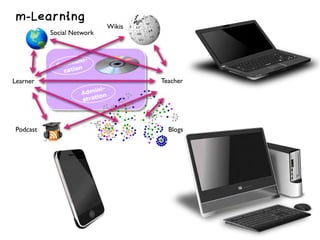
m-Learning
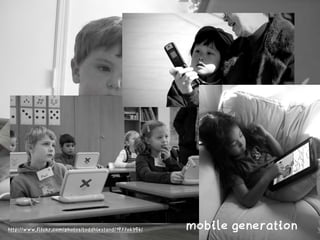
http://www.flickr.com/photos/toddhiestand/197704394/ mobile generation
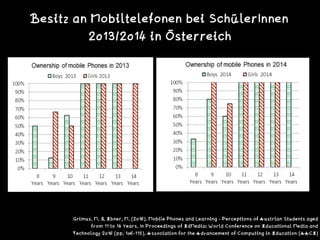
Grimus, M. & Ebner, M. (2016). Mobile Phones and Learning - Perceptions of Austrian Students aged
from 11 to 14 Years. In Proceedings of EdMedia: World Conference on Educational Media and
Technology 2016 (pp. 106-115). Association for the Advancement of Computing in Education (AACE)
	 	
Besitz an Mobiltelefonen bei SchülerInnen 

2013/2014 in Österreich
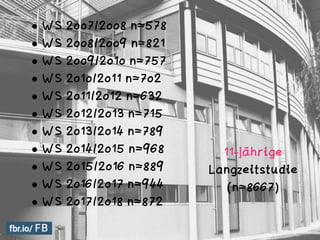
• WS 2007/2008 n=578
• WS 2008/2009 n=821
• WS 2009/2010 n=757
• WS 2010/2011 n=702
• WS 2011/2012 n=632
• WS 2012/2013 n=715
• WS 2013/2014 n=789
• WS 2014/2015 n=968
• WS 2015/2016 n=889
• WS 2016/2017 n=944
• WS 2017/2018 n=872

11-jährige
Langzeitstudie 

(n=8667)
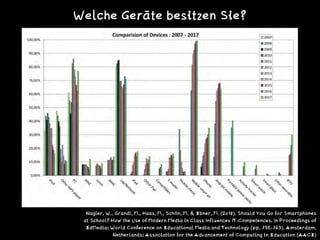
Nagler, W., Grandl, M., Haas, M., Schön, M. & Ebner, M. (2018). Should You Go for Smartphones
at School? How the Use of Modern Media in Class Influences IT-Competences. In Proceedings of
EdMedia: World Conference on Educational Media and Technology (pp. 735-743). Amsterdam,
Netherlands: Association for the Advancement of Computing in Education (AACE)
Welche Geräte besitzen Sie?
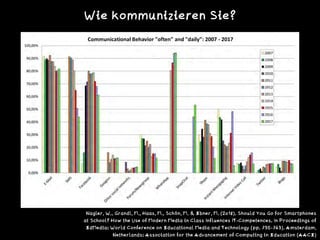
Wie kommunizieren Sie?
Nagler, W., Grandl, M., Haas, M., Schön, M. & Ebner, M. (2018). Should You Go for Smartphones
at School? How the Use of Modern Media in Class Influences IT-Competences. In Proceedings of
EdMedia: World Conference on Educational Media and Technology (pp. 735-743). Amsterdam,
Netherlands: Association for the Advancement of Computing in Education (AACE)
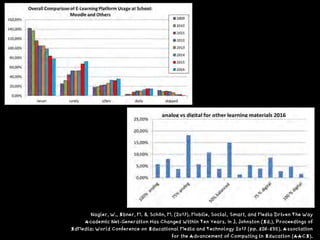
Nagler, W., Ebner, M. & Schön, M. (2017). Mobile, Social, Smart, and Media Driven The Way
Academic Net-Generation Has Changed Within Ten Years. In J. Johnston (Ed.), Proceedings of
EdMedia: World Conference on Educational Media and Technology 2017 (pp. 826-835). Association
for the Advancement of Computing in Education (AACE).
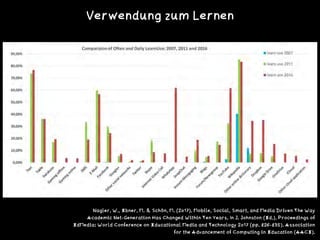
Nagler, W., Ebner, M. & Schön, M. (2017). Mobile, Social, Smart, and Media Driven The Way
Academic Net-Generation Has Changed Within Ten Years. In J. Johnston (Ed.), Proceedings of
EdMedia: World Conference on Educational Media and Technology 2017 (pp. 826-835). Association
for the Advancement of Computing in Education (AACE).
Verwendung zum Lernen
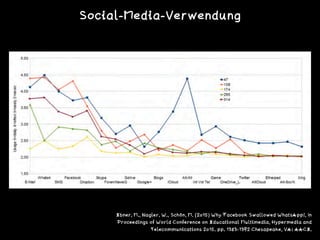
Ebner, M., Nagler, W., Schön, M. (2015) Why Facebook Swallowed WhatsApp!, In
Proceedings of World Conference on Educational Multimedia, Hypermedia and
Telecommunications 2015. pp. 1383-1392 Chesapeake, VA: AACE.
Social-Media-Verwendung
http://www.flickr.com/photos/nathaninsandiego/4275817106/
Lernen neu denken
Learning theories:
• Location based Learning: Real life

situations
• Social Learning: Learning is an active part

on the learners themselves and occurs

through participation
• Game-based Learning
• Collaborative Learning
Sandra Schön et al, 2010
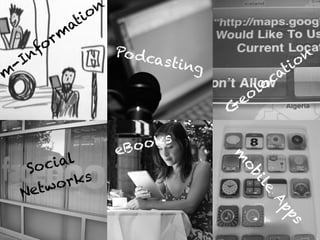
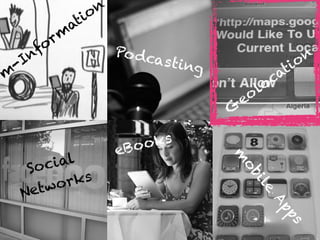
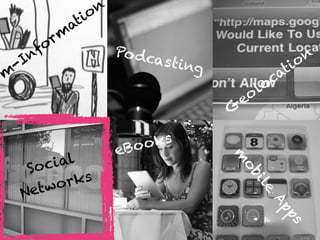
Step towards digital
lecture room
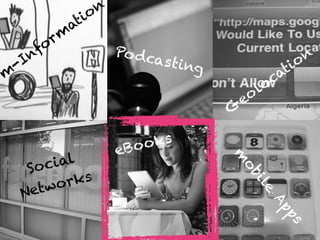
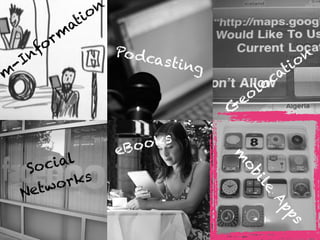
m
-Inform
ation
Podcasting
G
eolocation
Social 

Networks
eBooks
m
obile
Apps
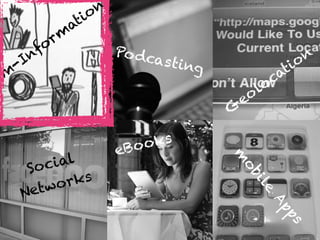
Step towards digital
lecture room
m
-Inform
ation
Podcasting
G
eolocation
Social 

Networks
eBooks
m
obile
Apps
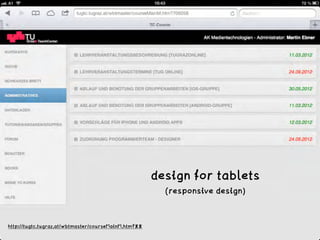
design for tablets

(responsive design)
http://tugtc.tugraz.at/wbtmaster/courseMainM.htm?EE
Step towards digital
lecture room
m
-Inform
ation
Podcasting
G
eolocation
Social 

Networks
eBooks
m
obile
Apps
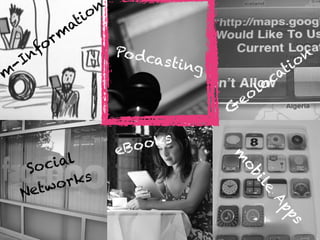
Podcasting
Step towards digital
lecture room
m
-Inform
ation
Podcasting
G
eolocation
Social 

Networks
eBooks
m
obile
Apps
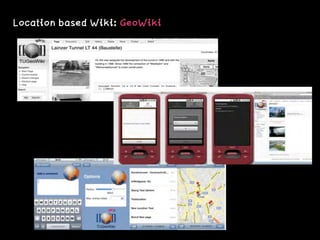
Location based Wiki: GeoWiki
Step towards digital
lecture room
m
-Inform
ation
Podcasting
G
eolocation
Social 

Networks
eBooks
m
obile
Apps
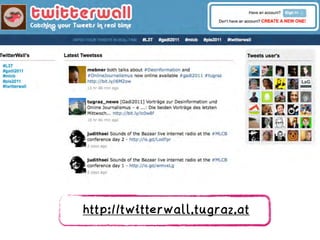
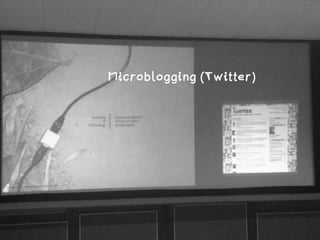
Microblogging (Twitter)
http://www.flickr.com/photos/pshab/498122926
http://twitterwall.tugraz.at
Step towards digital
lecture room
m
-Inform
ation
Podcasting
G
eolocation
Social 

Networks
eBooks
m
obile
Apps
Step towards digital
lecture room
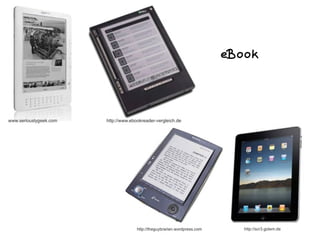
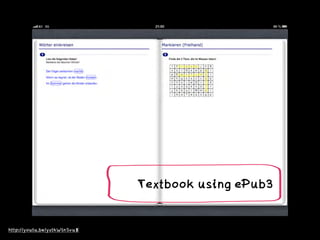
eBook
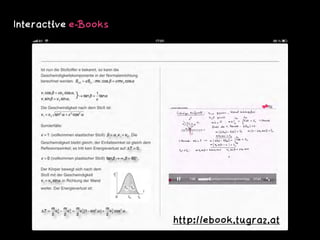
Interactive e-Books
http://ebook.tugraz.at
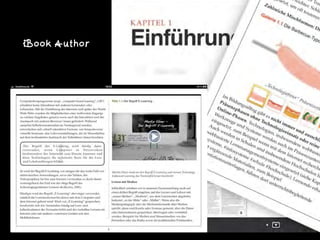
iBook Author
http://youtu.be/yxtkWinSvuE
Textbook using ePub3
Step towards digital
lecture room
m
-Inform
ation
Podcasting
G
eolocation
Social 

Networks
eBooks
m
obile
Apps
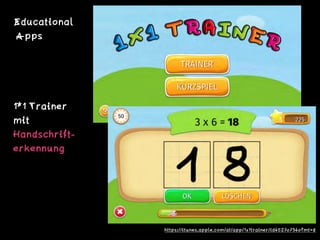
https://itunes.apple.com/at/app/1x1trainer/id452707340?mt=8
Educational

Apps
1*1 Trainer
mit
Handschrift-

erkennung
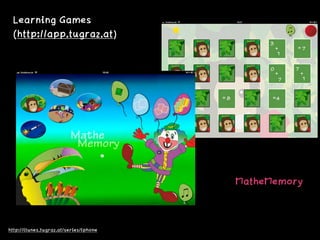
http://itunes.tugraz.at/series/iphone
MatheMemory
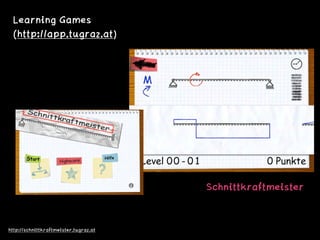
Learning Games

(http://app.tugraz.at)
http://schnittkraftmeister.tugraz.at
Schnittkraftmeister
Learning Games

(http://app.tugraz.at)
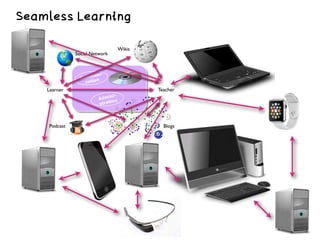
Seamless Learning
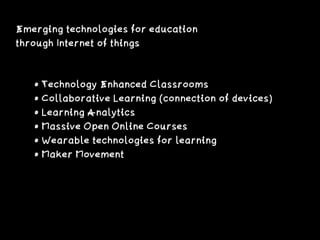
Emerging technologies for education
through Internet of things
• Technology Enhanced Classrooms
• Collaborative Learning (connection of devices)
• Learning Analytics
• Massive Open Online Courses
• Wearable technologies for learning
• Maker Movement
http://flickr.com/photos/nettsu/1365343292/
Step towards digital
lecture room
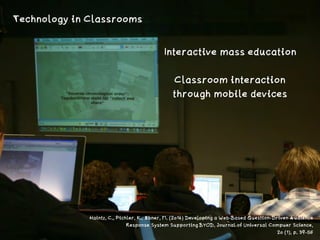
Interactive mass education 

Classroom interaction
through mobile devices
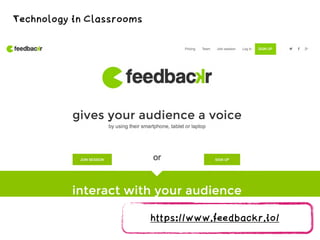
Technology in Classrooms
Haintz, C., Pichler, K., Ebner, M. (2014) Developing a Web-Based Question-Driven Audience 

Response System Supporting BYOD, Journal of Universal Compuer Science, 

20 (1), p. 39-56
http://flickr.com/photos/nettsu/1365343292/
https://www.feedbackr.io/
Technology in Classrooms
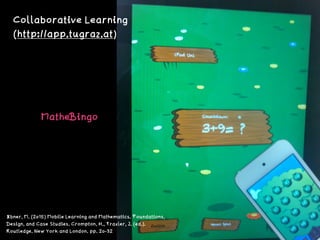
Collaborative Learning

(http://app.tugraz.at)
MatheBingo

Ebner, M. (2015) Mobile Learning and Mathematics. Foundations,
Design, and Case Studies. Crompton, H., Traxler, J. (ed.).
Routledge. New York and London. pp. 20-32
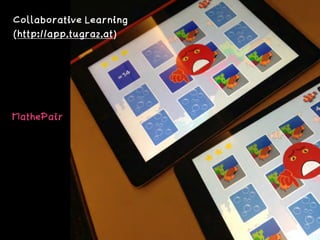
MathePair

Collaborative Learning

(http://app.tugraz.at)
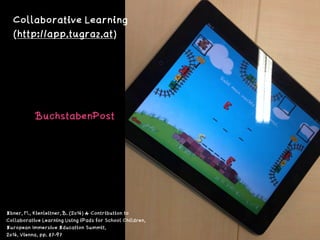
BuchstabenPost

Collaborative Learning

(http://app.tugraz.at)
Ebner, M., Kienleitner, B. (2014) A Contribution to
Collaborative Learning Using iPads for School Children,
European Immersive Education Summit,
2014, Vienna, pp. 87-97
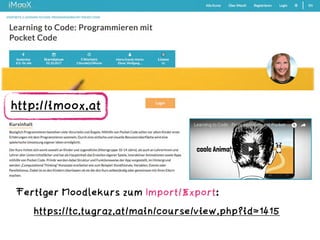
http://imoox.at
http://imoox.at
Fertiger Moodlekurs zum Import/Export:
https://tc.tugraz.at/main/course/view.php?id=1415
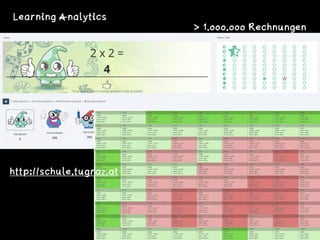
http://schule.learninglab.tugraz.at
> 1.000.000 Rechnungen
Learning Analytics
http://schule.tugraz.at
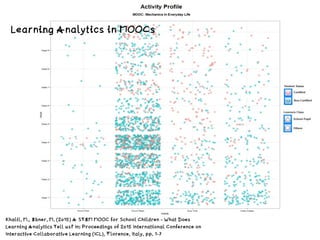
Khalil, M., Ebner, M. (2015) A STEM MOOC for School Children - What Does
Learning Analytics Tell us? In: Proceedings of 2015 International Conference on
Interactive Collaborative Learning (ICL), Florence, Italy, pp. 1-7
Learning Analytics in MOOCs
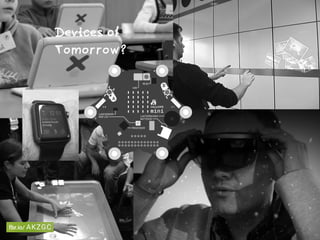
Devices of
Tomorrow?
http://www.flickr.com/photos/phatcontroller/1392243699
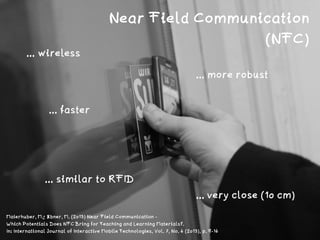
Near Field Communication
(NFC)
... wireless
... similar to RFID
... more robust
... faster
... very close (10 cm)
Maierhuber, M.; Ebner, M. (2013) Near Field Communication - 

Which Potentials Does NFC Bring for Teaching and Learning Materials?. 

In: International Journal of Interactive Mobile Technologies, Vol. 7, No. 4 (2013), p. 9-14
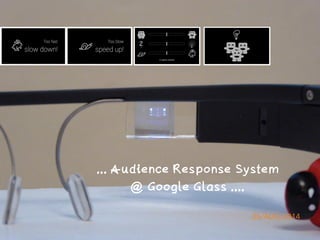
... Audience Response System
@ Google Glass ....
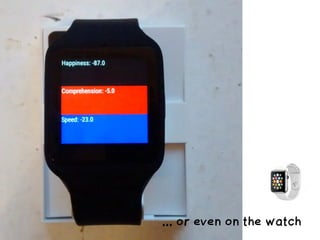
... or even on the watch
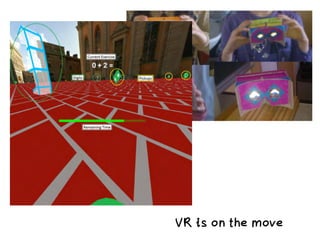
VR is on the move
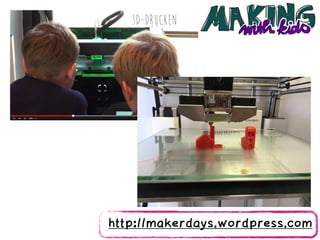
http://makerdays.wordpress.com
https://learninglab.tugraz.at/informatischegrundbildung/index.php/oer-schulbuch/ozobot-unterrichtsbeispiele
Microcontroller & Roboter zur
informatischen Grundbildung
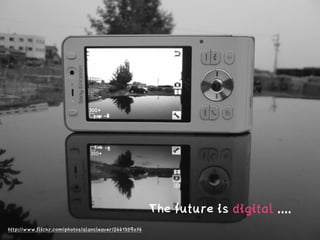
http://www.flickr.com/photos/alancleaver/2441359074
The future is digital ....
...
• ... with all factual knowledge in your pocket
• ... in permanent exchange with your (real and

virtual) community
• ... with permanent access to your individual

work and learning environment
• … in use of many different ubiquitous devices
Learning becomes
ubiquitous and seamless
Graz University of Technology
EDUCATIONAL 

TECHNOLOGY
Graz University 

of Technology
Martin Ebner 

(Bildungsinformatiker)
http://elearning.tugraz.at
martin.ebner@tugraz.at
Slides available at:
This work is licensed under a 

Creative Commons Attribution 

4.0 International License.
https://learninglab.tugraz.at/informatischegrundbildung/
@mebner
http://elearningblog.tugraz.at
Yes, we care :-)

Emerging technologies - from social to mobile and seamless learning