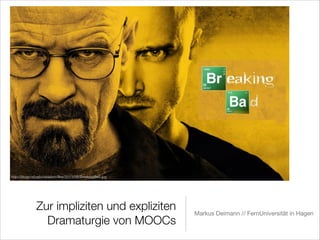
http://blogs.nd.edu/oblation/files/2013/09/BreakingBad.jpg

Zur impliziten und expliziten
Dramaturgie von MOOCs

Markus Deimann // FernUniversität in Hagen
Es war einmal in Kanada…

http://commons.wikimedia.org/wiki/File:Aschenputtel-Richter.JPG
und schwappte über nach Deutschland
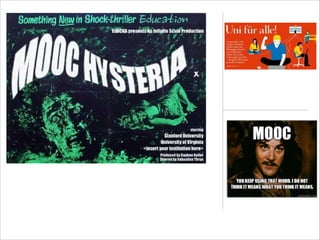
MOOC wird Mainstream
Anbieter, Kurse, Teilnehmer, Kapital
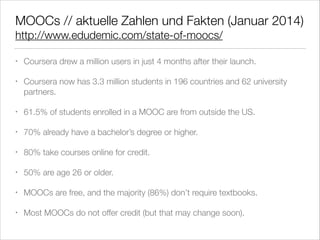
MOOCs // aktuelle Zahlen und Fakten (Januar 2014)
http://www.edudemic.com/state-of-moocs/
•

Coursera drew a million users in just 4 months after their launch.

•

Coursera now has 3.3 million students in 196 countries and 62 university
partners.

•

61.5% of students enrolled in a MOOC are from outside the US.

•

70% already have a bachelor’s degree or higher.

•

80% take courses online for credit.

•

50% are age 26 or older.

•

MOOCs are free, and the majority (86%) don’t require textbooks.

•

Most MOOCs do not offer credit (but that may change soon).
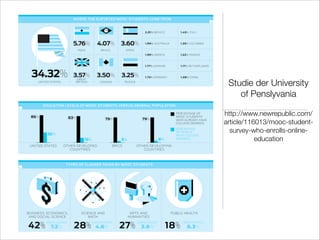
Studie der University
of Penslyvania
http://www.newrepublic.com/
article/116013/mooc-studentsurvey-who-enrolls-onlineeducation
http://scholarlykitchen.files.wordpress.com/2013/10/mooc3.png?w=750&h=416

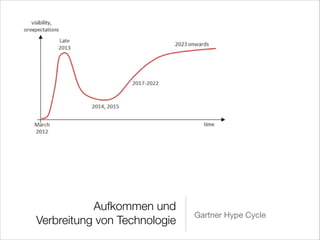
Aufkommen und
Verbreitung von Technologie

Gartner Hype Cycle
Zwei wirkmächtige Narrative
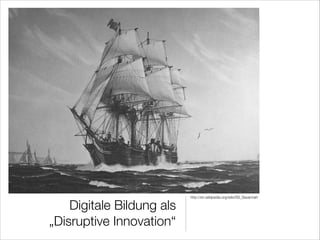
Digitale Bildung als
„Disruptive Innovation“

http://en.wikipedia.org/wiki/SS_Savannah
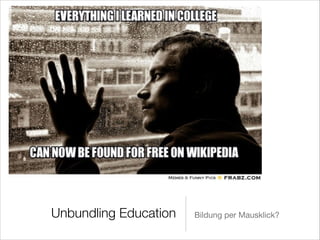
Unbundling Education

Bildung per Mausklick?
Mem
„Education is broken“ (and somebody should fix it)
•

•

Bildung als Vermittlung von Inhalten, das nun neue
Distributionswege braucht (analog zu Musik- und
Buchmarkt)
„Solutions“ aus dem Silicon Valley stehen parat
MOOCs ein neues Phänomen?
Welcome to the college education revolution. Big
breakthroughs happen when what is suddenly possible
meets what is desperately necessary. The costs of
getting a college degree have been rising faster than
those of health care, so the need to provide low-cost,
quality higher education is more acute than ever. At the
same time, in a knowledge economy, getting a highereducation degree is more vital than ever. And thanks to
the spread of high-speed wireless technology, highspeed Internet, smartphones, Facebook, the cloud and
tablet computers, the world has gone from connected to
hyperconnected in just seven years. Finally, a generation
that has grown up on these technologies is increasingly
comfortable learning and interacting with professors
through online platforms.

Thomas Friedman, New York Times
15.05.2012
http://www.nytimes.com/2012/05/16/
opinion/friedman-come-therevolution.html

But if we look further into the future,
there could be no schools and no
teachers. Schoolwork may not exist.
Instead you will have to do homework,
for you will learn everything at home
using your home video computer. You'll
learn a wide range of subjects quickly
and at a time of day to suit you.
However, it's probably that someone like
a teacher will visit your home to check
that all is going well.

Neil Ardley (1981) World of Tomorrow:
Work and Play
Aufstieg und Fall
einer Utopie
•

Ein Drama in fünf Akten


•

Protagonist: Sebastian Thrun


•

Professor Stanford University
(beurlaubt)


•

Projektleiter Google 


•

CEO Udacity

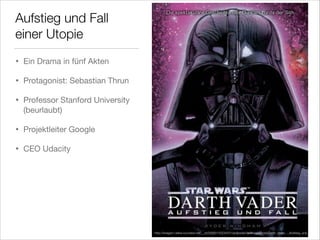
http://images1.wikia.nocookie.net/__cb20080130234551/jedipedia/de/images/e/eb/Darth_Vader_-_Aufstieg_und_Fall.jpg
I. Akt Exposition
•

Winter 2011: ST öffnet seinen Kurs „Introduction to
Artificial Intelligence“ (Stanford University) für jeden mit
einer Internetverbindung

•

ca. 160.000 TN aus 190 Ländern; 100 Freiwillige
übersetzen den Kurs in 44 Sprachen

•

Der Begriff xMOOC wird geboren und als etwas völlig
Neuartiges ausgegeben
II. Handlungssteigerung
•

25.01.2012: ST verkündet, dass er nicht länger in Stanford unterrichten
kann

•

"The effect it had on me was really profound. I never thought that this
would happen. I always thought that I was, in Stanford, the world's
best university, and I was a great teacher. Having done this, I can't
teach at Stanford again. It's impossible. I feel like there's a red pill and a
blue pill, and you can take the blue pill and go back to your classroom
and lecture your 20 students, but I have taken the red pill, and I've seen
wonderland. And we have changed the world, I think, with education. If
we can make education free for the world, accessible everywhere, I
think we can help people in the developing world, in Africa, and India,
and China, to become much better, much stronger, and I think that's
going to be core to the new society. I'm extremely exited about this."
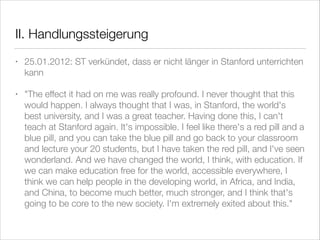
http://2.bp.blogspot.com/-fp8M5g_Vf74/USsWJP-gQ1I/AAAAAAAAAeQ/995GBGgo5mU/s1600/Matrix_Pill_by_arielgr92.jpg
III. Höhepunkt und Peripetie
•

März 2013: Senate Bill 520 eingebracht (Automatic MOOC Transfer
Credit)

•

April 2013: Udacity pilotiert zusammen mit der San Jose State
University u.a. einen Mathematik Nachhilfe MOOC

•

Juli 2013: Aufgrund enttäuschender Ergebnisse (ca. 50% fallen
durch) aus dem „Mathe-MOOC“ unterbricht SJSU die
Zusammenarbeit mit Udacity

•

August 2013: SB 520 scheitert, da noch keine überzeugenden
Befunde vorliegen

•

August 2013: ST verkündet, die „Magic Formula“ gefunden zu haben
IV. Fallende Handlung mit retardierendem Moment
•

September 2013: Udacity verkündet die „Open
Education Alliance“

•

November 2013: ST verkündet die Abkehr (Pivot) von
offenen MOOCs: "We were on the front pages of
newspapers and magazines, and at the same time, I was
realizing, we don't educate people as others wished, or
as I wished. We have a lousy product“

•

Corporate Training als neues Betätigungsfeld
„Godfather of Online
Education changes course“

http://www.fastcompany.com/3021473/udacity-sebastianthrun-uphill-climb
V. Katastrophe oder Konfliktlösung?
•

Welche Konsequenzen können Hochschulen aus dem
MOOC-Hype ziehen?

•

Welche Herausforderungen sind mit der Digitalisierung
verbunden?
Th	 Battle for Open
e
•

Die erste „Schlacht“ scheint gewonnen, Openness ist
Mainstream

•

Openness wird zum Fluchtpunkt (Forschung, Lehre,
Zugang, Politik, Daten) und weckt Interesse kommerzieller
Anbieter
•

•

z.B. Georgia Tech Master in Verbindung mit Udacity

Openness ist kein Selbstläufer, sondern erfordert aktives
Engagement von Lehrenden, Forschenden und
Bildungsinstitutionen
Was heißt Lernen mit/durch/im MOOC eigentlich?
aktuelles Beispiel
Implizite vs. explizite Dramaturgie von MOOCs
•

Explizite Botschaft leicht verständlich: kostenfreie,
qualitativ hochwertige Bildung für alle ohne
Einschränkungen auf der ganzen Welt, zu jedem Zeitpunkt

•

Darunter verbirgt sich jedoch ein impliziter Layer: Lernen
mit MOOCs ist an bestimmte Voraussetzungen gebunden
—> kulturelles Kapital

•

Analogie zu „Breaking Bad“

•

Matthäus-Effekt: Erfolgreich sind die, die schon ein hohes
Vorwissen und digitale Kompetenzen haben

Bigger Picture: Open Education
Der Blick nach vorne
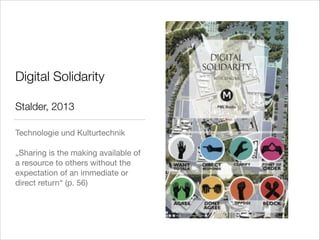
Digital Solidarity
!

Stalder, 2013
Technologie und Kulturtechnik 

!
„Sharing is the making available of
a resource to others without the
expectation of an immediate or
direct return“ (p. 56)
Internet als „Social Laboratory“
•

soziale Produktion von Wissen jenseits von Marktlogik
und öffentlicher/privater Bürokratie
•

Commons: längerfristiger Zusammenschluss von
Menschen zur gemeinsamen Nutzung von Gütern (z.B.
Wikipedia)

•

Versammlung: greift Tradition der Mitbestimmung auf,
richtet sich jedoch gegen Schwächen direkter
Demokratie (Wahlen, Mehrheitsprinzip); Bsp. Occupy
Bewegung
Internet als „Social Laboratory“ (Teil 2)
•

Schwärme: spontaner und kurzfristiger
Zusammenschluss von Individuen, organisiert durch
digitale Werkzeuge; Bsp. Anonymous

•

„schwache“ Netzwerke: gelegentlicher und
eingeschränkter Austausch auf sozialen Netzwerken
(Facebook); bestimmen, was es heißt sozial aktiv zu
sein. Künstlich aufrechterhaltene Trennung zwischen
online und offline (Lanz-Petition)
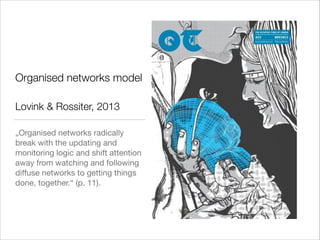
Organised networks model
!

Lovink & Rossiter, 2013
„Organised networks radically
break with the updating and
monitoring logic and shift attention
away from watching and following
diffuse networks to getting things
done, together.“ (p. 11).
Technologie und
soziale Praktiken
Beispiel Löschanträge:

keine automatisierte „Lösung“,
sondern menschlicher Dialog und
Konsens 

!
Vertrauen statt Kontrolle
„Reading a few sentences in Wikipedia about
some theories on the causes of the Great
Depression does not mean that one thereby
knows or understands this topic. Being able to
read (or view) anything quickly on a topic can
provide one with information, but actually
having a knowledge of or understanding about
the topic will always require critical study. The
Internet will never change that.“

–Larry Sanger, 2010, p. 17
Mitgründer von Wikipedia
Zusammenfassung
•

MOOCs katalysieren viele digitale Trends und bringen sie
in die Hochschule ein

•

MOOCs sollten als digitale Manifestation einer offenen
Kultur und Philosophie (Open Education) begriffen
werden

•

Wir müssen lernen, mit Openness als kulturelle
Errungenschaft verantwortungsvoll und aktiv umzugehen
Danke für die Aufmerksamkeit!
!
!
!

markus.deimann@fernuni-hagen.de
Twitter: @mdeimann

Implizite explizite dramaturgie_moo_cs

  • 1.
    http://blogs.nd.edu/oblation/files/2013/09/BreakingBad.jpg Zur impliziten undexpliziten Dramaturgie von MOOCs Markus Deimann // FernUniversität in Hagen
  • 2.
    Es war einmalin Kanada… http://commons.wikimedia.org/wiki/File:Aschenputtel-Richter.JPG
  • 5.
    und schwappte übernach Deutschland
  • 7.
    MOOC wird Mainstream Anbieter,Kurse, Teilnehmer, Kapital
  • 8.
    MOOCs // aktuelleZahlen und Fakten (Januar 2014) http://www.edudemic.com/state-of-moocs/ • Coursera drew a million users in just 4 months after their launch. • Coursera now has 3.3 million students in 196 countries and 62 university partners. • 61.5% of students enrolled in a MOOC are from outside the US. • 70% already have a bachelor’s degree or higher. • 80% take courses online for credit. • 50% are age 26 or older. • MOOCs are free, and the majority (86%) don’t require textbooks. • Most MOOCs do not offer credit (but that may change soon).
  • 9.
    Studie der University ofPenslyvania http://www.newrepublic.com/ article/116013/mooc-studentsurvey-who-enrolls-onlineeducation
  • 10.
  • 11.
  • 12.
    Digitale Bildung als „DisruptiveInnovation“ http://en.wikipedia.org/wiki/SS_Savannah
  • 13.
  • 14.
    Mem „Education is broken“(and somebody should fix it) • • Bildung als Vermittlung von Inhalten, das nun neue Distributionswege braucht (analog zu Musik- und Buchmarkt) „Solutions“ aus dem Silicon Valley stehen parat
  • 15.
    MOOCs ein neuesPhänomen? Welcome to the college education revolution. Big breakthroughs happen when what is suddenly possible meets what is desperately necessary. The costs of getting a college degree have been rising faster than those of health care, so the need to provide low-cost, quality higher education is more acute than ever. At the same time, in a knowledge economy, getting a highereducation degree is more vital than ever. And thanks to the spread of high-speed wireless technology, highspeed Internet, smartphones, Facebook, the cloud and tablet computers, the world has gone from connected to hyperconnected in just seven years. Finally, a generation that has grown up on these technologies is increasingly comfortable learning and interacting with professors through online platforms. Thomas Friedman, New York Times 15.05.2012 http://www.nytimes.com/2012/05/16/ opinion/friedman-come-therevolution.html But if we look further into the future, there could be no schools and no teachers. Schoolwork may not exist. Instead you will have to do homework, for you will learn everything at home using your home video computer. You'll learn a wide range of subjects quickly and at a time of day to suit you. However, it's probably that someone like a teacher will visit your home to check that all is going well. Neil Ardley (1981) World of Tomorrow: Work and Play
  • 16.
    Aufstieg und Fall einerUtopie • Ein Drama in fünf Akten • Protagonist: Sebastian Thrun • Professor Stanford University (beurlaubt) • Projektleiter Google • CEO Udacity http://images1.wikia.nocookie.net/__cb20080130234551/jedipedia/de/images/e/eb/Darth_Vader_-_Aufstieg_und_Fall.jpg
  • 17.
    I. Akt Exposition • Winter2011: ST öffnet seinen Kurs „Introduction to Artificial Intelligence“ (Stanford University) für jeden mit einer Internetverbindung • ca. 160.000 TN aus 190 Ländern; 100 Freiwillige übersetzen den Kurs in 44 Sprachen • Der Begriff xMOOC wird geboren und als etwas völlig Neuartiges ausgegeben
  • 18.
    II. Handlungssteigerung • 25.01.2012: STverkündet, dass er nicht länger in Stanford unterrichten kann • "The effect it had on me was really profound. I never thought that this would happen. I always thought that I was, in Stanford, the world's best university, and I was a great teacher. Having done this, I can't teach at Stanford again. It's impossible. I feel like there's a red pill and a blue pill, and you can take the blue pill and go back to your classroom and lecture your 20 students, but I have taken the red pill, and I've seen wonderland. And we have changed the world, I think, with education. If we can make education free for the world, accessible everywhere, I think we can help people in the developing world, in Africa, and India, and China, to become much better, much stronger, and I think that's going to be core to the new society. I'm extremely exited about this."
  • 19.
  • 20.
    III. Höhepunkt undPeripetie • März 2013: Senate Bill 520 eingebracht (Automatic MOOC Transfer Credit) • April 2013: Udacity pilotiert zusammen mit der San Jose State University u.a. einen Mathematik Nachhilfe MOOC • Juli 2013: Aufgrund enttäuschender Ergebnisse (ca. 50% fallen durch) aus dem „Mathe-MOOC“ unterbricht SJSU die Zusammenarbeit mit Udacity • August 2013: SB 520 scheitert, da noch keine überzeugenden Befunde vorliegen • August 2013: ST verkündet, die „Magic Formula“ gefunden zu haben
  • 21.
    IV. Fallende Handlungmit retardierendem Moment • September 2013: Udacity verkündet die „Open Education Alliance“ • November 2013: ST verkündet die Abkehr (Pivot) von offenen MOOCs: "We were on the front pages of newspapers and magazines, and at the same time, I was realizing, we don't educate people as others wished, or as I wished. We have a lousy product“ • Corporate Training als neues Betätigungsfeld
  • 22.
    „Godfather of Online Educationchanges course“ http://www.fastcompany.com/3021473/udacity-sebastianthrun-uphill-climb
  • 24.
    V. Katastrophe oderKonfliktlösung? • Welche Konsequenzen können Hochschulen aus dem MOOC-Hype ziehen? • Welche Herausforderungen sind mit der Digitalisierung verbunden?
  • 25.
    Th Battle forOpen e • Die erste „Schlacht“ scheint gewonnen, Openness ist Mainstream • Openness wird zum Fluchtpunkt (Forschung, Lehre, Zugang, Politik, Daten) und weckt Interesse kommerzieller Anbieter • • z.B. Georgia Tech Master in Verbindung mit Udacity Openness ist kein Selbstläufer, sondern erfordert aktives Engagement von Lehrenden, Forschenden und Bildungsinstitutionen
  • 26.
    Was heißt Lernenmit/durch/im MOOC eigentlich?
  • 27.
  • 28.
    Implizite vs. expliziteDramaturgie von MOOCs • Explizite Botschaft leicht verständlich: kostenfreie, qualitativ hochwertige Bildung für alle ohne Einschränkungen auf der ganzen Welt, zu jedem Zeitpunkt • Darunter verbirgt sich jedoch ein impliziter Layer: Lernen mit MOOCs ist an bestimmte Voraussetzungen gebunden —> kulturelles Kapital • Analogie zu „Breaking Bad“ • Matthäus-Effekt: Erfolgreich sind die, die schon ein hohes Vorwissen und digitale Kompetenzen haben
  • 29.
  • 31.
  • 32.
    Digital Solidarity ! Stalder, 2013 Technologieund Kulturtechnik ! „Sharing is the making available of a resource to others without the expectation of an immediate or direct return“ (p. 56)
  • 33.
    Internet als „SocialLaboratory“ • soziale Produktion von Wissen jenseits von Marktlogik und öffentlicher/privater Bürokratie • Commons: längerfristiger Zusammenschluss von Menschen zur gemeinsamen Nutzung von Gütern (z.B. Wikipedia) • Versammlung: greift Tradition der Mitbestimmung auf, richtet sich jedoch gegen Schwächen direkter Demokratie (Wahlen, Mehrheitsprinzip); Bsp. Occupy Bewegung
  • 34.
    Internet als „SocialLaboratory“ (Teil 2) • Schwärme: spontaner und kurzfristiger Zusammenschluss von Individuen, organisiert durch digitale Werkzeuge; Bsp. Anonymous • „schwache“ Netzwerke: gelegentlicher und eingeschränkter Austausch auf sozialen Netzwerken (Facebook); bestimmen, was es heißt sozial aktiv zu sein. Künstlich aufrechterhaltene Trennung zwischen online und offline (Lanz-Petition)
  • 35.
    Organised networks model ! Lovink& Rossiter, 2013 „Organised networks radically break with the updating and monitoring logic and shift attention away from watching and following diffuse networks to getting things done, together.“ (p. 11).
  • 36.
    Technologie und soziale Praktiken BeispielLöschanträge: keine automatisierte „Lösung“, sondern menschlicher Dialog und Konsens ! Vertrauen statt Kontrolle
  • 37.
    „Reading a fewsentences in Wikipedia about some theories on the causes of the Great Depression does not mean that one thereby knows or understands this topic. Being able to read (or view) anything quickly on a topic can provide one with information, but actually having a knowledge of or understanding about the topic will always require critical study. The Internet will never change that.“ –Larry Sanger, 2010, p. 17 Mitgründer von Wikipedia
  • 38.
    Zusammenfassung • MOOCs katalysieren vieledigitale Trends und bringen sie in die Hochschule ein • MOOCs sollten als digitale Manifestation einer offenen Kultur und Philosophie (Open Education) begriffen werden • Wir müssen lernen, mit Openness als kulturelle Errungenschaft verantwortungsvoll und aktiv umzugehen
  • 39.
    Danke für dieAufmerksamkeit! ! ! ! markus.deimann@fernuni-hagen.de Twitter: @mdeimann