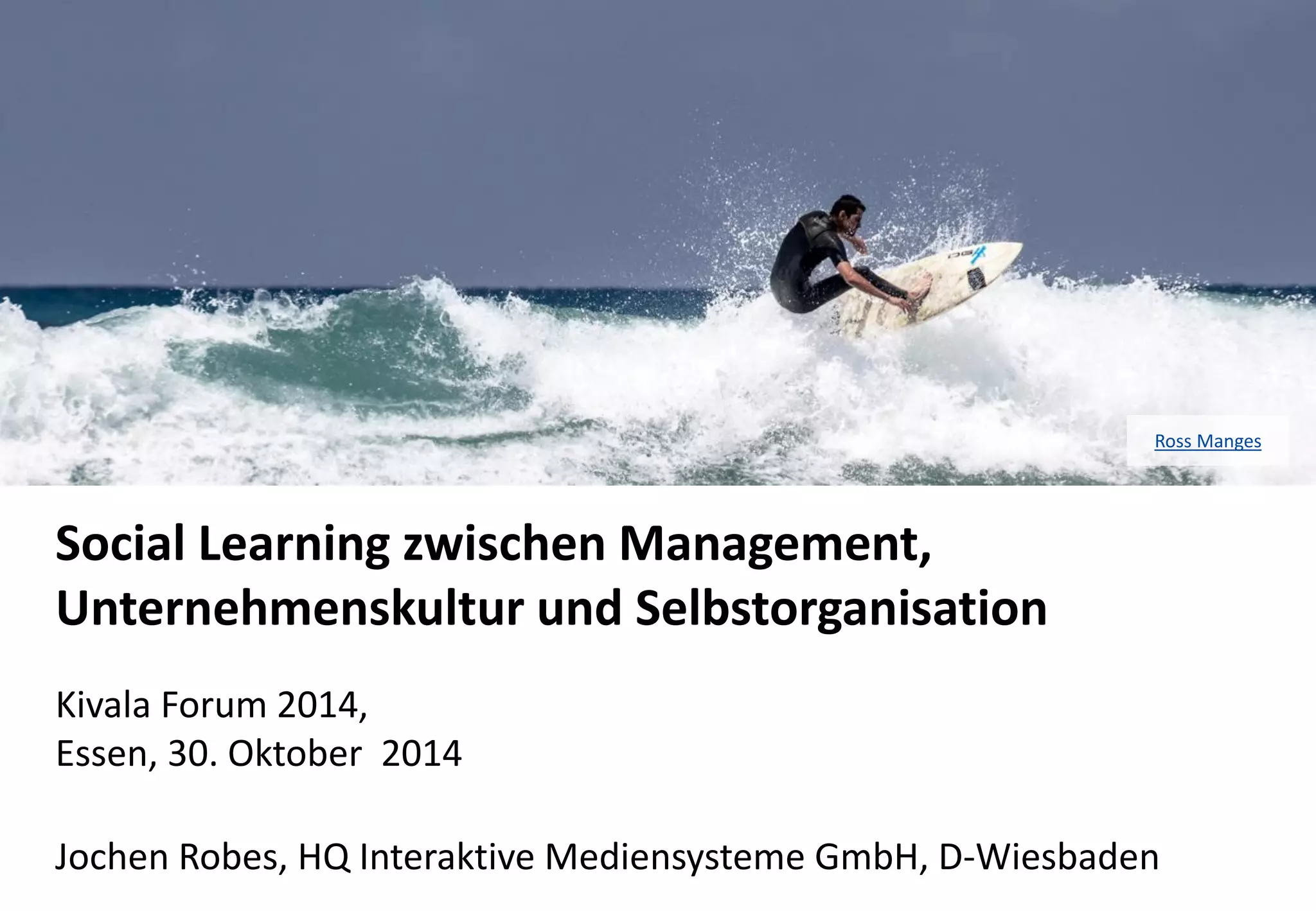
Social Learning zwischen Management, Unternehmenskultur und Selbstorganisation 
Kivala Forum 2014, Essen, 30. Oktober 2014 
Jochen Robes, HQ Interaktive Mediensysteme GmbH, D-Wiesbaden 
Ross Manges
2 
Agenda 
„Doch zuerst, 
was ist eigentlich Social Learning?“
3 
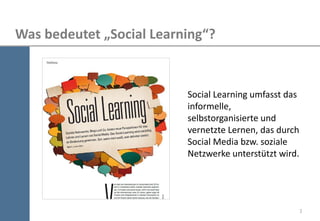
Was bedeutet „Social Learning“? 
Social Learning umfasst das informelle, selbstorganisierte und vernetzte Lernen, das durch Social Media bzw. soziale Netzwerke unterstützt wird.
4 
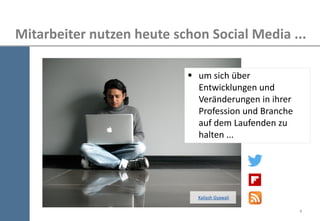
Mitarbeiter nutzen heute schon Social Media ... 
um sich über Entwicklungen und Veränderungen in ihrer Profession und Branche auf dem Laufenden zu halten ... 
Kailash Gyawali
5 
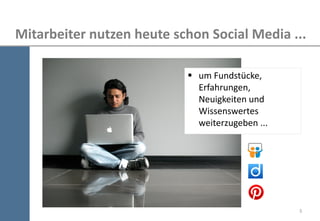
Mitarbeiter nutzen heute schon Social Media ... 
um Fundstücke, Erfahrungen, Neuigkeiten und Wissenswertes weiterzugeben ...
6 
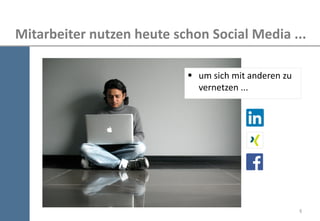
Mitarbeiter nutzen heute schon Social Media ... 
um sich mit anderen zu vernetzen ...
7 
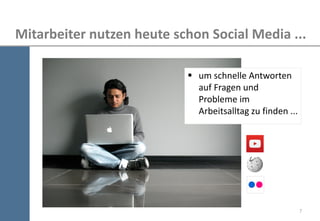
Mitarbeiter nutzen heute schon Social Media ... 
um schnelle Antworten auf Fragen und Probleme im Arbeitsalltag zu finden ...
8 
Agenda 
„Okay, doch warum ist das für Corporate Learning ein Thema?“
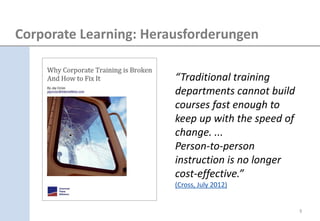
“Traditional training departments cannot build courses fast enough to keep up with the speed of change. ... 
Person-to-person instruction is no longer cost-effective.” (Cross, July 2012) 
9 
Corporate Learning: Herausforderungen
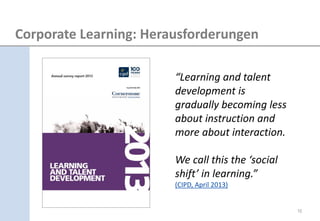
“Learning and talent development is gradually becoming less about instruction and more about interaction. 
We call this the ‘social shift’ in learning.” (CIPD, April 2013) 
10 
Corporate Learning: Herausforderungen
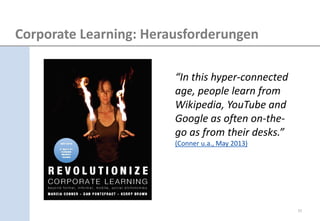
“In this hyper-connected age, people learn from Wikipedia, YouTube and Google as often on-the- go as from their desks.” (Conner u.a., May 2013) 
Corporate Learning: Herausforderungen 
11
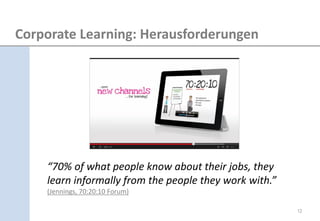
“70% of what people know about their jobs, they learn informally from the people they work with.” (Jennings, 70:20:10 Forum) 
Corporate Learning: Herausforderungen 
12
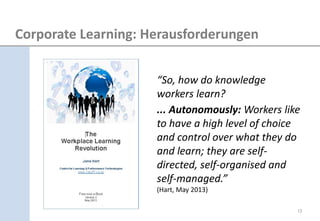
“So, how do knowledge workers learn? ... Autonomously: Workers like to have a high level of choice and control over what they do and learn; they are self- directed, self-organised and self-managed.” (Hart, May 2013) 
Corporate Learning: Herausforderungen 
13
14 
Agenda 
Erstes Beispiel: adidas Group „Learning Campus“
15 
1. adidas Group „Learning Campus“ 
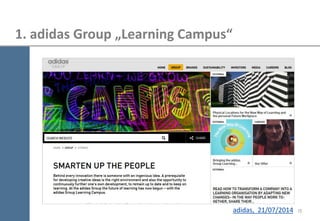
adidas, 21/07/2014
16 
1. adidas Group „Learning Campus“ 
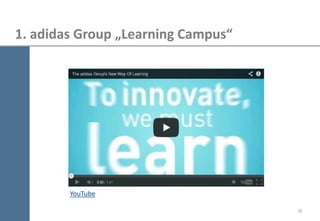
YouTube
17 
1. adidas Group „Learning Campus“ 
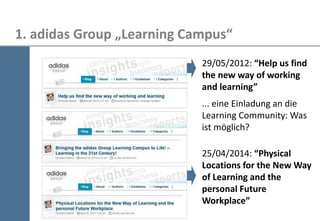
29/05/2012: “Help us find the new way of working and learning” ... eine Einladung an die Learning Community: Was ist möglich? 
25/04/2014: “Physical Locations for the New Way of Learning and the personal Future Workplace”
18 
1. adidas Group „Learning Campus“ 
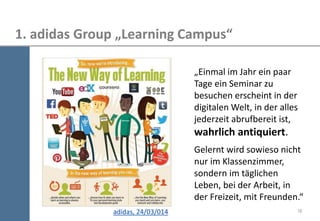
adidas, 24/03/014 
„Einmal im Jahr ein paar Tage ein Seminar zu besuchen erscheint in der digitalen Welt, in der alles jederzeit abrufbereit ist, wahrlich antiquiert. Gelernt wird sowieso nicht nur im Klassenzimmer, sondern im täglichen Leben, bei der Arbeit, in der Freizeit, mit Freunden.“
19 
1. adidas Group „Learning Campus“ 
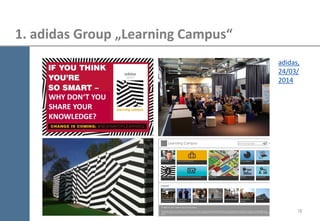
adidas, 24/03/ 2014
20 
Agenda 
Credit Suisse „Discover Social Learning“
21 
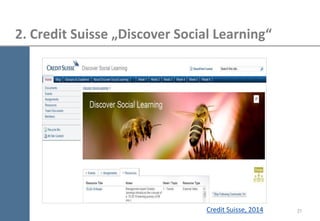
2. Credit Suisse „Discover Social Learning“ 
Credit Suisse, 2014
22 
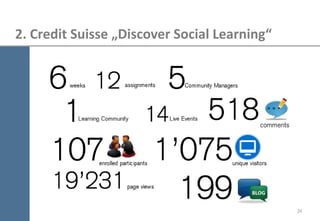
2. Credit Suisse „Discover Social Learning“ 
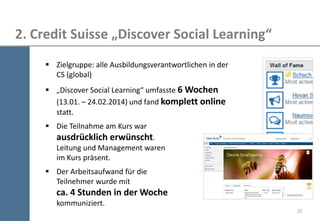
Zielgruppe: alle Ausbildungsverantwortlichen in der CS (global) 
„Discover Social Learning“ umfasste 6 Wochen (13.01. – 24.02.2014) und fand komplett online statt. 
Die Teilnahme am Kurs war ausdrücklich erwünscht. Leitung und Management waren im Kurs präsent. 
Der Arbeitsaufwand für die Teilnehmer wurde mit ca. 4 Stunden in der Woche kommuniziert.
23 
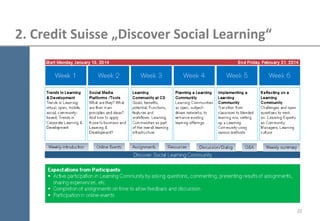
2. Credit Suisse „Discover Social Learning“
24 
2. Credit Suisse „Discover Social Learning“
25 
Agenda 
Deutsche Telekom „Magenta MOOC“
26 
3. Deutsche Telekom AG „Magenta MOOC“ 
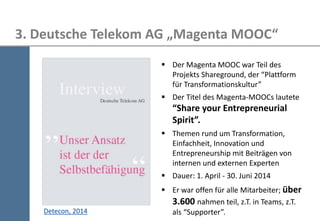
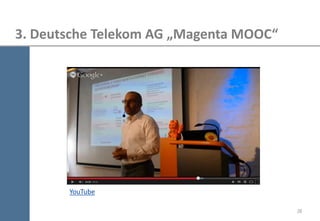
Der Magenta MOOC war Teil des Projekts Shareground, der “Plattform für Transformationskultur” 
Der Titel des Magenta-MOOCs lautete “Share your Entrepreneurial Spirit”. 
Themen rund um Transformation, Einfachheit, Innovation und Entrepreneurship mit Beiträgen von internen und externen Experten 
Dauer: 1. April - 30. Juni 2014 
Er war offen für alle Mitarbeiter; über 3.600 nahmen teil, z.T. in Teams, z.T. als “Supporter”. 
Detecon, 2014
27 
3. Deutsche Telekom AG „Magenta MOOC“ 
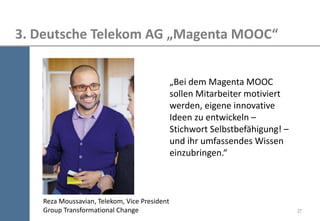
„Bei dem Magenta MOOC sollen Mitarbeiter motiviert werden, eigene innovative Ideen zu entwickeln – Stichwort Selbstbefähigung! – und ihr umfassendes Wissen einzubringen.“ 
Reza Moussavian, Telekom, Vice President Group Transformational Change
3. Deutsche Telekom AG „Magenta MOOC“ 
28 
YouTube
29 
Agenda 
Erste Zusammenfassung: Konsequenzen für Corporate Learning
30 
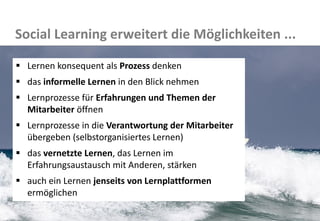
Social Learning erweitert die Möglichkeiten ... 
Lernen konsequent als Prozess denken 
das informelle Lernen in den Blick nehmen 
Lernprozesse für Erfahrungen und Themen der Mitarbeiter öffnen 
Lernprozesse in die Verantwortung der Mitarbeiter übergeben (selbstorganisiertes Lernen) 
das vernetzte Lernen, das Lernen im Erfahrungsaustausch mit Anderen, stärken 
auch ein Lernen jenseits von Lernplattformen ermöglichen
31 
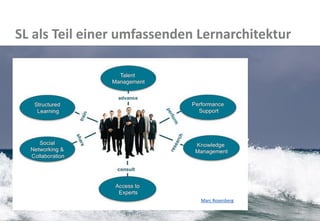
SL als Teil einer umfassenden Lernarchitektur 
Marc Rosenberg
32 
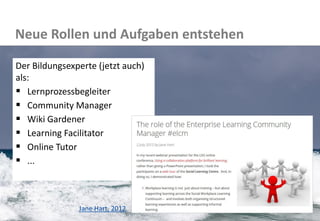
Neue Rollen und Aufgaben entstehen 
Der Bildungsexperte (jetzt auch) als: 
Lernprozessbegleiter 
Community Manager 
Wiki Gardener 
Learning Facilitator 
Online Tutor 
... 
Jane Hart, 2012
33 
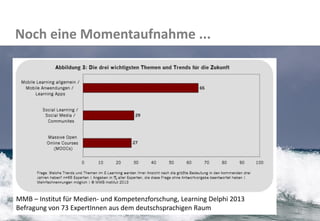
Noch eine Momentaufnahme ... 
MMB – Institut für Medien- und Kompetenzforschung, Learning Delphi 2013 Befragung von 73 ExpertInnen aus dem deutschsprachigen Raum
34 
Agenda 
Unter welchen Voraussetzungen funktioniert Social Learning (gut/ besser)?
35 
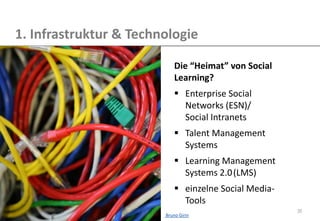
1. Infrastruktur & Technologie 
Die “Heimat” von Social Learning? 
Enterprise Social Networks (ESN)/ Social Intranets 
Talent Management Systems 
Learning Management Systems 2.0 (LMS) 
einzelne Social Media- Tools 
Bruno Girin
36 
1. Infrastruktur & Technologie 
Bersin, Oktober 2014 
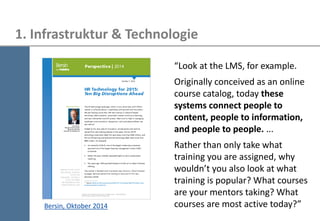
“Look at the LMS, for example. 
Originally conceived as an online course catalog, today these systems connect people to content, people to information, and people to people. ... 
Rather than only take what training you are assigned, why wouldn’t you also look at what training is popular? What courses are your mentors taking? What courses are most active today?”
37 
2. Unternehmenskultur und -organisation 
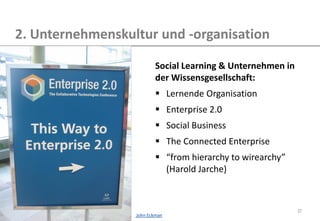
Social Learning & Unternehmen in der Wissensgesellschaft: 
Lernende Organisation 
Enterprise 2.0 
Social Business 
The Connected Enterprise 
“from hierarchy to wirearchy” (Harold Jarche) 
John Eckman
38 
2. Unternehmenskultur und -organisation 
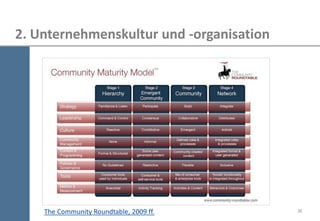
The Community Roundtable, 2009 ff.
39 
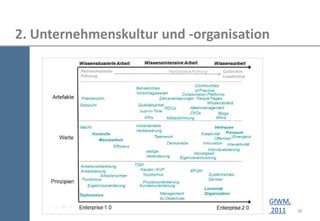
2. Unternehmenskultur und -organisation 
GfWM, 2011
40 
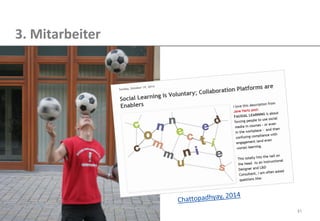
3. Mitarbeiter 
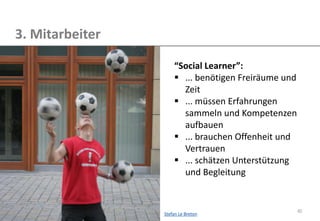
“Social Learner”: 
... benötigen Freiräume und Zeit 
... müssen Erfahrungen sammeln und Kompetenzen aufbauen 
... brauchen Offenheit und Vertrauen 
... schätzen Unterstützung und Begleitung 
Stefan Le Breton
41 
3. Mitarbeiter
42 
3. Mitarbeiter 
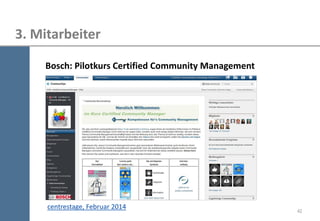
centrestage, Februar 2014 
Bosch: Pilotkurs Certified Community Management
43 
3. Mitarbeiter 
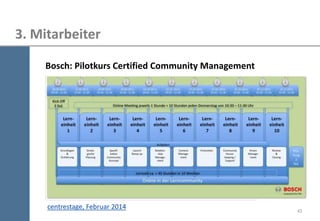
centrestage, Februar 2014 
Bosch: Pilotkurs Certified Community Management
44 
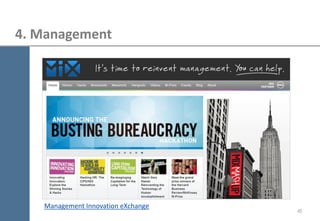
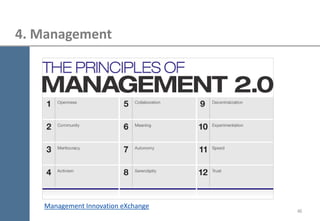
4. Management 
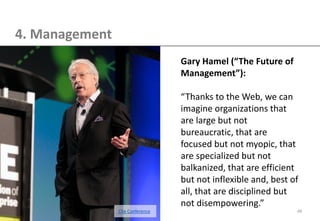
Gary Hamel (“The Future of Management”): 
“Thanks to the Web, we can imagine organizations that are large but not bureaucratic, that are focused but not myopic, that are specialized but not balkanized, that are efficient but not inflexible and, best of all, that are disciplined but not disempowering.” 
Cite Conference
45 
4. Management 
Management Innovation eXchange
46 
4. Management 
Management Innovation eXchange
47 
Agenda 
“By bringing together people who share interests, no matter their location or time zone, social media has the potential to transform the workplace into an environment where learning is as natural as it is powerful.” (Marcia Conner)
Vielen Dank für Ihre Aufmerksamkeit! 
Dr. Jochen Robes HQ Interaktive Mediensysteme GmbH, Am Schloßpark 123, D- 65203 Wiesbaden 0049 611 – 99 212 -0, jr@hq.de 
Weiterbildungsblog: www.weiterbildungsblog.de info@weiterbildungsblog.de 
LinkedIn: de.linkedin.com/pub/jochen-robes/10/57a/98 
Xing: https://www.xing.com/profile/Jochen_Robes 
Facebook: http://www.facebook.com/jochen.robes 
Google+: www.gplus.to/jrobes 
Slideshare: http://www.slideshare.net/jrobes 
Twitter: http://twitter.com/jrobes 
48

Social Learning zwischen Management, Unternehmenskultur und Selbstorganisation

  • 1.
    Social Learning zwischenManagement, Unternehmenskultur und Selbstorganisation Kivala Forum 2014, Essen, 30. Oktober 2014 Jochen Robes, HQ Interaktive Mediensysteme GmbH, D-Wiesbaden Ross Manges
  • 2.
    2 Agenda „Dochzuerst, was ist eigentlich Social Learning?“
  • 3.
    3 Was bedeutet„Social Learning“? Social Learning umfasst das informelle, selbstorganisierte und vernetzte Lernen, das durch Social Media bzw. soziale Netzwerke unterstützt wird.
  • 4.
    4 Mitarbeiter nutzenheute schon Social Media ... um sich über Entwicklungen und Veränderungen in ihrer Profession und Branche auf dem Laufenden zu halten ... Kailash Gyawali
  • 5.
    5 Mitarbeiter nutzenheute schon Social Media ... um Fundstücke, Erfahrungen, Neuigkeiten und Wissenswertes weiterzugeben ...
  • 6.
    6 Mitarbeiter nutzenheute schon Social Media ... um sich mit anderen zu vernetzen ...
  • 7.
    7 Mitarbeiter nutzenheute schon Social Media ... um schnelle Antworten auf Fragen und Probleme im Arbeitsalltag zu finden ...
  • 8.
    8 Agenda „Okay,doch warum ist das für Corporate Learning ein Thema?“
  • 9.
    “Traditional training departmentscannot build courses fast enough to keep up with the speed of change. ... Person-to-person instruction is no longer cost-effective.” (Cross, July 2012) 9 Corporate Learning: Herausforderungen
  • 10.
    “Learning and talentdevelopment is gradually becoming less about instruction and more about interaction. We call this the ‘social shift’ in learning.” (CIPD, April 2013) 10 Corporate Learning: Herausforderungen
  • 11.
    “In this hyper-connectedage, people learn from Wikipedia, YouTube and Google as often on-the- go as from their desks.” (Conner u.a., May 2013) Corporate Learning: Herausforderungen 11
  • 12.
    “70% of whatpeople know about their jobs, they learn informally from the people they work with.” (Jennings, 70:20:10 Forum) Corporate Learning: Herausforderungen 12
  • 13.
    “So, how doknowledge workers learn? ... Autonomously: Workers like to have a high level of choice and control over what they do and learn; they are self- directed, self-organised and self-managed.” (Hart, May 2013) Corporate Learning: Herausforderungen 13
  • 14.
    14 Agenda ErstesBeispiel: adidas Group „Learning Campus“
  • 15.
    15 1. adidasGroup „Learning Campus“ adidas, 21/07/2014
  • 16.
    16 1. adidasGroup „Learning Campus“ YouTube
  • 17.
    17 1. adidasGroup „Learning Campus“ 29/05/2012: “Help us find the new way of working and learning” ... eine Einladung an die Learning Community: Was ist möglich? 25/04/2014: “Physical Locations for the New Way of Learning and the personal Future Workplace”
  • 18.
    18 1. adidasGroup „Learning Campus“ adidas, 24/03/014 „Einmal im Jahr ein paar Tage ein Seminar zu besuchen erscheint in der digitalen Welt, in der alles jederzeit abrufbereit ist, wahrlich antiquiert. Gelernt wird sowieso nicht nur im Klassenzimmer, sondern im täglichen Leben, bei der Arbeit, in der Freizeit, mit Freunden.“
  • 19.
    19 1. adidasGroup „Learning Campus“ adidas, 24/03/ 2014
  • 20.
    20 Agenda CreditSuisse „Discover Social Learning“
  • 21.
    21 2. CreditSuisse „Discover Social Learning“ Credit Suisse, 2014
  • 22.
    22 2. CreditSuisse „Discover Social Learning“ Zielgruppe: alle Ausbildungsverantwortlichen in der CS (global) „Discover Social Learning“ umfasste 6 Wochen (13.01. – 24.02.2014) und fand komplett online statt. Die Teilnahme am Kurs war ausdrücklich erwünscht. Leitung und Management waren im Kurs präsent. Der Arbeitsaufwand für die Teilnehmer wurde mit ca. 4 Stunden in der Woche kommuniziert.
  • 23.
    23 2. CreditSuisse „Discover Social Learning“
  • 24.
    24 2. CreditSuisse „Discover Social Learning“
  • 25.
    25 Agenda DeutscheTelekom „Magenta MOOC“
  • 26.
    26 3. DeutscheTelekom AG „Magenta MOOC“ Der Magenta MOOC war Teil des Projekts Shareground, der “Plattform für Transformationskultur” Der Titel des Magenta-MOOCs lautete “Share your Entrepreneurial Spirit”. Themen rund um Transformation, Einfachheit, Innovation und Entrepreneurship mit Beiträgen von internen und externen Experten Dauer: 1. April - 30. Juni 2014 Er war offen für alle Mitarbeiter; über 3.600 nahmen teil, z.T. in Teams, z.T. als “Supporter”. Detecon, 2014
  • 27.
    27 3. DeutscheTelekom AG „Magenta MOOC“ „Bei dem Magenta MOOC sollen Mitarbeiter motiviert werden, eigene innovative Ideen zu entwickeln – Stichwort Selbstbefähigung! – und ihr umfassendes Wissen einzubringen.“ Reza Moussavian, Telekom, Vice President Group Transformational Change
  • 28.
    3. Deutsche TelekomAG „Magenta MOOC“ 28 YouTube
  • 29.
    29 Agenda ErsteZusammenfassung: Konsequenzen für Corporate Learning
  • 30.
    30 Social Learningerweitert die Möglichkeiten ... Lernen konsequent als Prozess denken das informelle Lernen in den Blick nehmen Lernprozesse für Erfahrungen und Themen der Mitarbeiter öffnen Lernprozesse in die Verantwortung der Mitarbeiter übergeben (selbstorganisiertes Lernen) das vernetzte Lernen, das Lernen im Erfahrungsaustausch mit Anderen, stärken auch ein Lernen jenseits von Lernplattformen ermöglichen
  • 31.
    31 SL alsTeil einer umfassenden Lernarchitektur Marc Rosenberg
  • 32.
    32 Neue Rollenund Aufgaben entstehen Der Bildungsexperte (jetzt auch) als: Lernprozessbegleiter Community Manager Wiki Gardener Learning Facilitator Online Tutor ... Jane Hart, 2012
  • 33.
    33 Noch eineMomentaufnahme ... MMB – Institut für Medien- und Kompetenzforschung, Learning Delphi 2013 Befragung von 73 ExpertInnen aus dem deutschsprachigen Raum
  • 34.
    34 Agenda Unterwelchen Voraussetzungen funktioniert Social Learning (gut/ besser)?
  • 35.
    35 1. Infrastruktur& Technologie Die “Heimat” von Social Learning? Enterprise Social Networks (ESN)/ Social Intranets Talent Management Systems Learning Management Systems 2.0 (LMS) einzelne Social Media- Tools Bruno Girin
  • 36.
    36 1. Infrastruktur& Technologie Bersin, Oktober 2014 “Look at the LMS, for example. Originally conceived as an online course catalog, today these systems connect people to content, people to information, and people to people. ... Rather than only take what training you are assigned, why wouldn’t you also look at what training is popular? What courses are your mentors taking? What courses are most active today?”
  • 37.
    37 2. Unternehmenskulturund -organisation Social Learning & Unternehmen in der Wissensgesellschaft: Lernende Organisation Enterprise 2.0 Social Business The Connected Enterprise “from hierarchy to wirearchy” (Harold Jarche) John Eckman
  • 38.
    38 2. Unternehmenskulturund -organisation The Community Roundtable, 2009 ff.
  • 39.
    39 2. Unternehmenskulturund -organisation GfWM, 2011
  • 40.
    40 3. Mitarbeiter “Social Learner”: ... benötigen Freiräume und Zeit ... müssen Erfahrungen sammeln und Kompetenzen aufbauen ... brauchen Offenheit und Vertrauen ... schätzen Unterstützung und Begleitung Stefan Le Breton
  • 41.
  • 42.
    42 3. Mitarbeiter centrestage, Februar 2014 Bosch: Pilotkurs Certified Community Management
  • 43.
    43 3. Mitarbeiter centrestage, Februar 2014 Bosch: Pilotkurs Certified Community Management
  • 44.
    44 4. Management Gary Hamel (“The Future of Management”): “Thanks to the Web, we can imagine organizations that are large but not bureaucratic, that are focused but not myopic, that are specialized but not balkanized, that are efficient but not inflexible and, best of all, that are disciplined but not disempowering.” Cite Conference
  • 45.
    45 4. Management Management Innovation eXchange
  • 46.
    46 4. Management Management Innovation eXchange
  • 47.
    47 Agenda “Bybringing together people who share interests, no matter their location or time zone, social media has the potential to transform the workplace into an environment where learning is as natural as it is powerful.” (Marcia Conner)
  • 48.
    Vielen Dank fürIhre Aufmerksamkeit! Dr. Jochen Robes HQ Interaktive Mediensysteme GmbH, Am Schloßpark 123, D- 65203 Wiesbaden 0049 611 – 99 212 -0, jr@hq.de Weiterbildungsblog: www.weiterbildungsblog.de info@weiterbildungsblog.de LinkedIn: de.linkedin.com/pub/jochen-robes/10/57a/98 Xing: https://www.xing.com/profile/Jochen_Robes Facebook: http://www.facebook.com/jochen.robes Google+: www.gplus.to/jrobes Slideshare: http://www.slideshare.net/jrobes Twitter: http://twitter.com/jrobes 48