Dr. Max Völkel, Calpano
max.voelkel@calpano.com


                           1
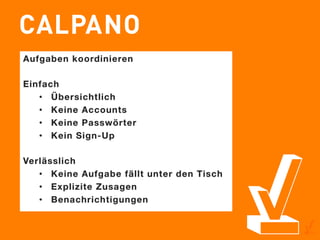
Aufgaben koordinieren 

Einfach
   •  Übersichtlich
   •  Keine Accounts
   •  Keine Passwörter
   •  Kein Sign-Up

Verlässlich
   •  Keine Aufgabe fällt unter den Tisch
   •  Explizite Zusagen
   •  Benachrichtigungen
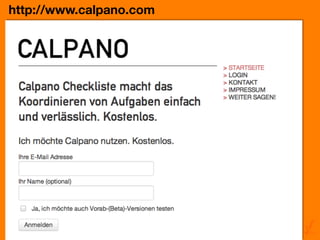
http://www.calpano.com


             AKWM Technology Day | Dr. Max Völkel | 2012 Calpano.com
                                                                        3
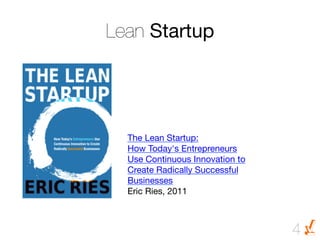
Lean Startup


  The Lean Startup:
  How Today's Entrepreneurs
  Use Continuous Innovation to
  Create Radically Successful
  Businesses
  Eric Ries, 2011


                                 4
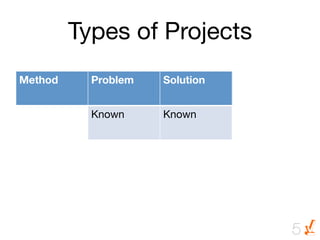
Types of Projects
Method
        Problem
   Solution
   Unit of
                                      Progress

Waterfall
     Known
     Known
      Project
                                      milestones

Agile          Known
     Unknown
    Lines of code
Methods

Lean Startup
 Unknown
    Unknown
    Validated
                                      learning


                                                    5
What is a Startup?
§  Startup: A project that tries to create and sell
    a product that did not exist like this before
    (aka: from idea to innovation)
  •  Different technology (cheaper, better)
  •  Different market positioning
     •    Target group
     •    Distribution channel
     •    Value proposition
     •    …
§  Entrepreneur / Intrapreneur: A person that
    works on a startup project

                                                  6
No waste
(Keine Verschwendung)


                         7
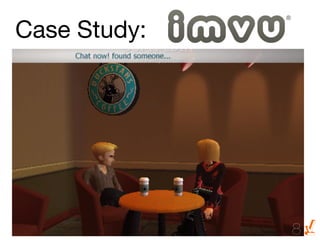
Case Study:


               8
The Story of …


§  Start a company with a compelling long-term vision. 
§  Raise sufficient capital 
§  Hire the absolute best and the brightest. Bring in an expert CEO.
§  Build a truly mainstream product. 
§  Focus on quality. 
§  Insist on high levels of usability, UI design, and polish. 
§  Conduct constant focus groups and usability tests.
§  Build a world-class technology platform, with the ability to scale to
    millions of simultaneous users.
§  Launch with a big PR event


                                                                      9
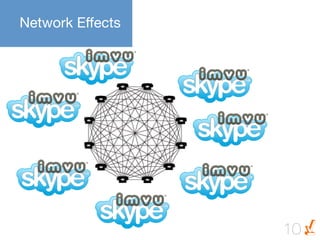
Network Effects


                   10
Facts à Plan
§  Let teenagers chat with their friends 
§  à Need to re-use existing buddy-list
§  à imvu needs to be a plugin

§  Teenagers don’t want to install a second instant
    messenger client. 
§  à imvu needs to be a plugin.

§  Instant messenger plugin is easier to install than a whole
    new instant messenger


                                                          11
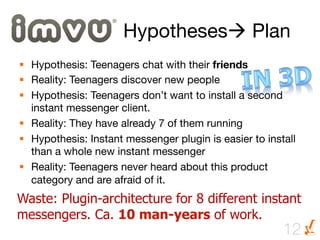
Hypothesesà Plan
§  Hypothesis: Teenagers chat with their friends 
§  Reality: Teenagers discover new people
§  Hypothesis: Teenagers don’t want to install a second
    instant messenger client. 
§  Reality: They have already 7 of them running
§  Hypothesis: Instant messenger plugin is easier to install
    than a whole new instant messenger
§  Reality: Teenagers never heard about this product
    category and are afraid of it.
Waste: Plugin-architecture for 8 different instant
messengers. Ca. 10 man-years of work.
                                                          12
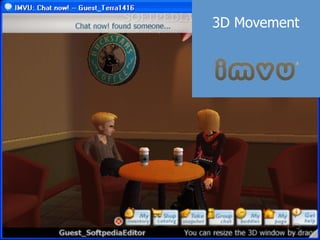
3D Movement


        13
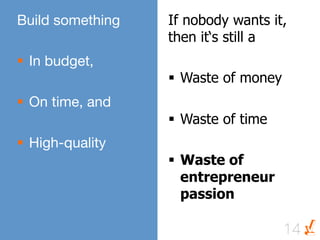
Build something 
   If nobody wants it,
                    then it‘s still a
§  In budget,
                    §  Waste of money
§  On time, and
                    §  Waste of time
§  High-quality
                    §  Waste of
                        entrepreneur
                        passion

                                         14
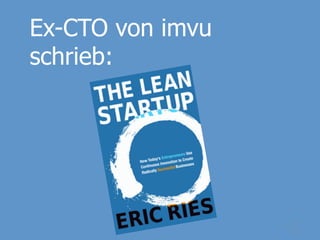
Ex-CTO von imvu
schrieb:


                  15
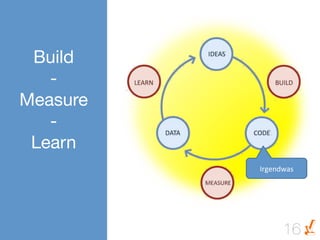
Build
   -
Measure
   -
 Learn
          Irgendwas	


                  16
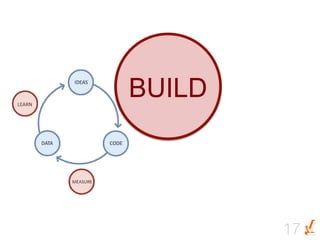
BUILD


        17
BUILD
 Minimum Viable Product


  brauchbar	
  
                             feasible	
  durchführbar	
  
                           [biol.]	
  entwicklungsfähig	
  
                                  existenzfähig	
  
                                           gangbar	
  
                               [med.]	
  lebensfähig	
  
                                feasible	
  machbar	
  
Klein                         feasible	
  prak>kabel	
  
                              feasible	
  realisierbar	
  

anfangen                         überlebensfähig	
  
                            [biol.]	
  wachstumsfähig	


                                                    18
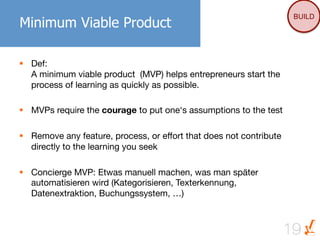
BUILD
Minimum Viable Product

§  Def:
    A minimum viable product (MVP) helps entrepreneurs start the
    process of learning as quickly as possible.

§  MVPs require the courage to put one‘s assumptions to the test

§  Remove any feature, process, or effort that does not contribute
    directly to the learning you seek

§  Concierge MVP: Etwas manuell machen, was man später
    automatisieren wird (Kategorisieren, Texterkennung,
    Datenextraktion, Buchungssystem, …)


                                                                      19
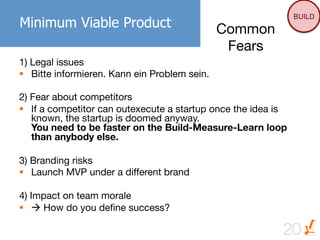
BUILD
Minimum Viable Product                      Common
                                             Fears
1) Legal issues
§  Bitte informieren. Kann ein Problem sein.

2) Fear about competitors
§  If a competitor can outexecute a startup once the idea is
    known, the startup is doomed anyway.
    You need to be faster on the Build-Measure-Learn loop
    than anybody else.

3) Branding risks
§  Launch MVP under a different brand

4) Impact on team morale
§  à How do you define success?

                                                            20
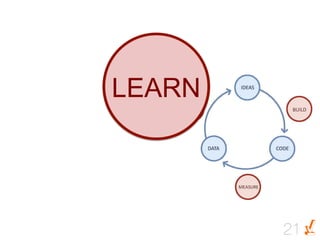
LEARN


        21
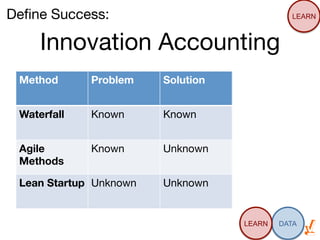
Define Success:
                                     LEARN


     Innovation Accounting
 Method
      Problem
    Solution
   Unit of
                                      Progress

 Waterfall
   Known
      Known
      Project
                                      milestones

 Agile        Known
      Unknown
    Lines of code
 Methods

 Lean Startup
 Unknown
   Unknown
    Validated
                                      learning


                                                  22
                                       LEARN   DATA
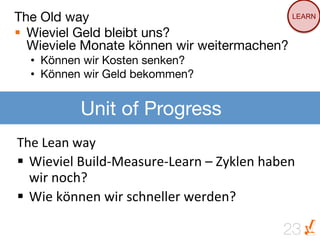
The Old way
                                 LEARN

§  Wieviel Geld bleibt uns?
    Wieviele Monate können wir weitermachen? 
   •  Können wir Kosten senken? 
   •  Können wir Geld bekommen?


              Unit of Progress
The	
  Lean	
  way	
  
§  Wieviel	
  Build-­‐Measure-­‐Learn	
  –	
  Zyklen	
  haben	
  
    wir	
  noch?	
  
§  Wie	
  können	
  wir	
  schneller	
  werden?	
  

                                                              23
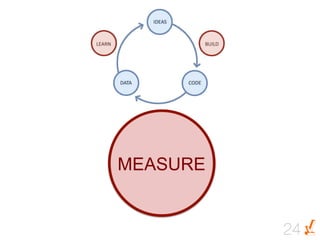
MEASURE


          24
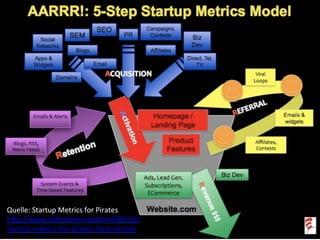
Quelle:	
  Startup	
  Metrics	
  for	
  Pirates	
  
hOp://www.slideshare.net/dmc500hats/
startup-­‐metrics-­‐for-­‐pirates-­‐long-­‐version	
  
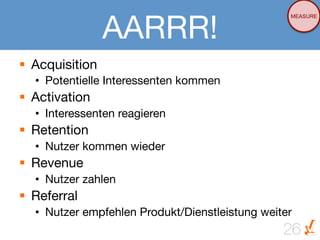
AARRR!
                                                    MEASURE


§  Acquisition
   •  Potentielle Interessenten kommen
§  Activation
   •  Interessenten reagieren
§  Retention
   •  Nutzer kommen wieder
§  Revenue
   •  Nutzer zahlen
§  Referral
   •  Nutzer empfehlen Produkt/Dienstleistung weiter
                                                  26
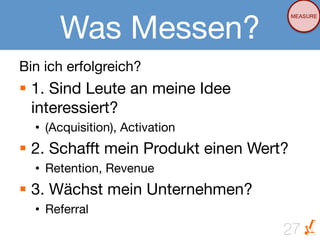
Was Messen?
                                       MEASURE


Bin ich erfolgreich?
§  1. Sind Leute an meine Idee
    interessiert?
  •  (Acquisition), Activation
§  2. Schafft mein Produkt einen Wert?
  •  Retention, Revenue
§  3. Wächst mein Unternehmen?
  •  Referral
                                      27
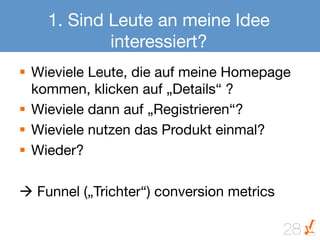
1. Sind Leute an meine Idee
            interessiert?
§  Wieviele Leute, die auf meine Homepage
    kommen, klicken auf „Details“ ?
§  Wieviele dann auf „Registrieren“?
§  Wieviele nutzen das Produkt einmal?
§  Wieder?

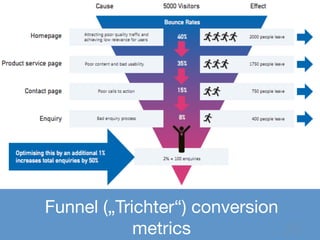
à Funnel („Trichter“) conversion metrics

                                        28
Funnel („Trichter“) conversion
            metrics
           29
2. Schafft mein Produkt einen
                Wert?
§  Kommen die Nutzer wieder?
  •  Cookies, Google Analytics, Server Logs, …


§  Zahlen sie?
  •  Bank-Konto


                                              30
Schafft Feature X einen Wert?

Entscheidung:
§  Mit Feature X weitermachen oder kostet
    die Pflege nur unnötig Ressourcen?

§  A/B-Tests
§  Kohorten-Analyse


                                         31
A/B Tests
§  Was ist das?
§  Ist das teuer?

Tools
§  Google Webmaster Tools
§  Optimize.ly


                               32
A/B Tests
§  Was ist das?
§  Ist das teuer?

Werkzeuge
§  Google Webmaster Tools
§  Optimize.ly


                               33
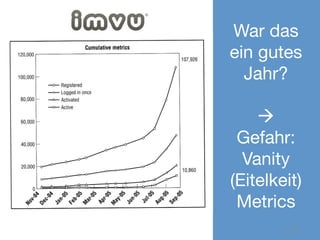
War das
ein gutes
  Jahr?

    à
 Gefahr:
  Vanity
(Eitelkeit)
 Metrics
        34
Kohorten-Analyse
           schafft Durchblick
§  Kohorte = Gruppe von Nutzern mit
    gleichen Eigenschaften
  •  z.B. „Alle Nutzer, die an einem Tag/Monat neu
     kamen“
  •  Alle Nutzer aus Testgruppe „B“


§  Messung in %


                                               35
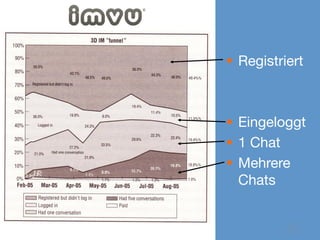
§  Registriert


§  Eingeloggt
§  1 Chat
§  Mehrere
    Chats


           36


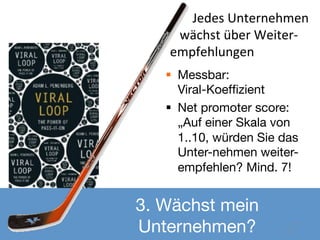
  Jedes	
  Unternehmen	


  wächst	
  über	
  Weiter-­‐	


  empfehlungen	
  
   §  Messbar:
       Viral-Koeffizient
   §  Net promoter score:
       „Auf einer Skala von
       1..10, würden Sie das
       Unter-nehmen weiter-
       empfehlen? Mind. 7!


3. Wächst mein
Unternehmen?
                                      37
Gute Metriken
                 §  Actionable
                   •  Keine Vanity-Metrics!
                   •  Kohorten & A/B-Tests
                   •  Nutzer-Verhalten messen

                 §  Accessible
                   •  Jeder Mitarbeiter kommt
                      jederzeit an die aktuellen Daten
                      ran

                 §  Auditable
                   •  Überprüfbar, verlässlich

                                                         38
Messen
                                       MEASURE


   Zusammenfasung:

Bin ich erfolgreich?
§  1. Sind Leute an meine Idee
    interessiert?
  •  (Acquisition), Activation
§  2. Schafft mein Produkt einen Wert?
  •  Retention, Revenue
§  3. Wächst mein Unternehmen?
  •  Referral
                                      39
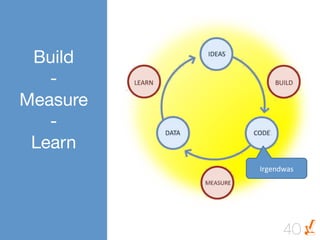
Build
   -
Measure
   -
 Learn
          Irgendwas	


                  40
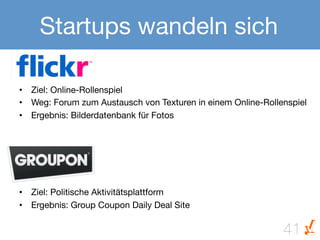
Startups wandeln sich

•  Ziel: Online-Rollenspiel 
•  Weg: Forum zum Austausch von Texturen in einem Online-Rollenspiel
•  Ergebnis: Bilderdatenbank für Fotos


•  Ziel: Politische Aktivitätsplattform 
•  Ergebnis: Group Coupon Daily Deal Site

                                                              41
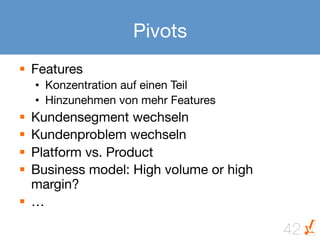
Pivots
§  Features
      •  Konzentration auf einen Teil
      •  Hinzunehmen von mehr Features
§  Kundensegment wechseln
§  Kundenproblem wechseln
§  Platform vs. Product
§  Business model: High volume or high
    margin?
§  …

                                          42
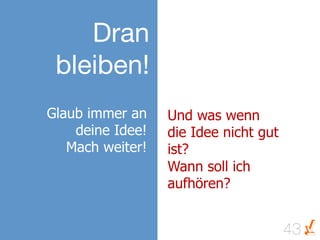
Dran
 bleiben!
Glaub immer an    Und was wenn
    deine Idee!   die Idee nicht gut
   Mach weiter!   ist?
                  Wann soll ich
                  aufhören?


                                       43
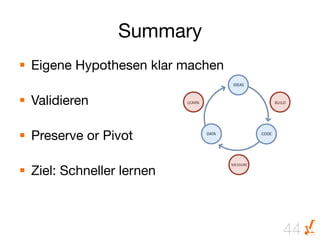
Summary
§  Eigene Hypothesen klar machen

§  Validieren

§  Preserve or Pivot

§  Ziel: Schneller lernen


                                     44

2012-07 Lean Startup at #bcka by Calpano

  • 1.
    Dr. Max Völkel,Calpano max.voelkel@calpano.com 1
  • 2.
    Aufgaben koordinieren Einfach •  Übersichtlich •  Keine Accounts •  Keine Passwörter •  Kein Sign-Up Verlässlich •  Keine Aufgabe fällt unter den Tisch •  Explizite Zusagen •  Benachrichtigungen
  • 3.
    http://www.calpano.com AKWM Technology Day | Dr. Max Völkel | 2012 Calpano.com 3
  • 4.
    Lean Startup The Lean Startup: How Today's Entrepreneurs Use Continuous Innovation to Create Radically Successful Businesses Eric Ries, 2011 4
  • 5.
    Types of Projects Method Problem Solution Unit of Progress Waterfall Known Known Project milestones Agile Known Unknown Lines of code Methods Lean Startup Unknown Unknown Validated learning 5
  • 6.
    What is aStartup? §  Startup: A project that tries to create and sell a product that did not exist like this before (aka: from idea to innovation) •  Different technology (cheaper, better) •  Different market positioning •  Target group •  Distribution channel •  Value proposition •  … §  Entrepreneur / Intrapreneur: A person that works on a startup project 6
  • 7.
  • 8.
  • 9.
    The Story of… §  Start a company with a compelling long-term vision. §  Raise sufficient capital §  Hire the absolute best and the brightest. Bring in an expert CEO. §  Build a truly mainstream product. §  Focus on quality. §  Insist on high levels of usability, UI design, and polish. §  Conduct constant focus groups and usability tests. §  Build a world-class technology platform, with the ability to scale to millions of simultaneous users. §  Launch with a big PR event 9
  • 10.
  • 11.
    Facts à Plan § Let teenagers chat with their friends §  à Need to re-use existing buddy-list §  à imvu needs to be a plugin §  Teenagers don’t want to install a second instant messenger client. §  à imvu needs to be a plugin. §  Instant messenger plugin is easier to install than a whole new instant messenger 11
  • 12.
    Hypothesesà Plan §  Hypothesis:Teenagers chat with their friends §  Reality: Teenagers discover new people §  Hypothesis: Teenagers don’t want to install a second instant messenger client. §  Reality: They have already 7 of them running §  Hypothesis: Instant messenger plugin is easier to install than a whole new instant messenger §  Reality: Teenagers never heard about this product category and are afraid of it. Waste: Plugin-architecture for 8 different instant messengers. Ca. 10 man-years of work. 12
  • 13.
  • 14.
    Build something If nobody wants it, then it‘s still a §  In budget, §  Waste of money §  On time, and §  Waste of time §  High-quality §  Waste of entrepreneur passion 14
  • 15.
  • 16.
    Build - Measure - Learn Irgendwas   16
  • 17.
  • 18.
    BUILD Minimum ViableProduct  brauchbar   feasible  durchführbar   [biol.]  entwicklungsfähig   existenzfähig   gangbar   [med.]  lebensfähig   feasible  machbar   Klein feasible  prak>kabel   feasible  realisierbar   anfangen überlebensfähig   [biol.]  wachstumsfähig   18
  • 19.
    BUILD Minimum Viable Product § Def: A minimum viable product (MVP) helps entrepreneurs start the process of learning as quickly as possible. §  MVPs require the courage to put one‘s assumptions to the test §  Remove any feature, process, or effort that does not contribute directly to the learning you seek §  Concierge MVP: Etwas manuell machen, was man später automatisieren wird (Kategorisieren, Texterkennung, Datenextraktion, Buchungssystem, …) 19
  • 20.
    BUILD Minimum Viable Product Common Fears 1) Legal issues §  Bitte informieren. Kann ein Problem sein. 2) Fear about competitors §  If a competitor can outexecute a startup once the idea is known, the startup is doomed anyway. You need to be faster on the Build-Measure-Learn loop than anybody else. 3) Branding risks §  Launch MVP under a different brand 4) Impact on team morale §  à How do you define success? 20
  • 21.
  • 22.
    Define Success: LEARN Innovation Accounting Method Problem Solution Unit of Progress Waterfall Known Known Project milestones Agile Known Unknown Lines of code Methods Lean Startup Unknown Unknown Validated learning 22 LEARN DATA
  • 23.
    The Old way LEARN §  Wieviel Geld bleibt uns? Wieviele Monate können wir weitermachen? •  Können wir Kosten senken? •  Können wir Geld bekommen? Unit of Progress The  Lean  way   §  Wieviel  Build-­‐Measure-­‐Learn  –  Zyklen  haben   wir  noch?   §  Wie  können  wir  schneller  werden?   23
  • 24.
  • 25.
    Quelle:  Startup  Metrics  for  Pirates   hOp://www.slideshare.net/dmc500hats/ startup-­‐metrics-­‐for-­‐pirates-­‐long-­‐version  
  • 26.
    AARRR! MEASURE §  Acquisition •  Potentielle Interessenten kommen §  Activation •  Interessenten reagieren §  Retention •  Nutzer kommen wieder §  Revenue •  Nutzer zahlen §  Referral •  Nutzer empfehlen Produkt/Dienstleistung weiter 26
  • 27.
    Was Messen? MEASURE Bin ich erfolgreich? §  1. Sind Leute an meine Idee interessiert? •  (Acquisition), Activation §  2. Schafft mein Produkt einen Wert? •  Retention, Revenue §  3. Wächst mein Unternehmen? •  Referral 27
  • 28.
    1. Sind Leutean meine Idee interessiert? §  Wieviele Leute, die auf meine Homepage kommen, klicken auf „Details“ ? §  Wieviele dann auf „Registrieren“? §  Wieviele nutzen das Produkt einmal? §  Wieder? à Funnel („Trichter“) conversion metrics 28
  • 29.
  • 30.
    2. Schafft meinProdukt einen Wert? §  Kommen die Nutzer wieder? •  Cookies, Google Analytics, Server Logs, … §  Zahlen sie? •  Bank-Konto 30
  • 31.
    Schafft Feature Xeinen Wert? Entscheidung: §  Mit Feature X weitermachen oder kostet die Pflege nur unnötig Ressourcen? §  A/B-Tests §  Kohorten-Analyse 31
  • 32.
    A/B Tests §  Wasist das? §  Ist das teuer? Tools §  Google Webmaster Tools §  Optimize.ly 32
  • 33.
    A/B Tests §  Wasist das? §  Ist das teuer? Werkzeuge §  Google Webmaster Tools §  Optimize.ly 33
  • 34.
    War das ein gutes Jahr? à Gefahr: Vanity (Eitelkeit) Metrics 34
  • 35.
    Kohorten-Analyse schafft Durchblick §  Kohorte = Gruppe von Nutzern mit gleichen Eigenschaften •  z.B. „Alle Nutzer, die an einem Tag/Monat neu kamen“ •  Alle Nutzer aus Testgruppe „B“ §  Messung in % 35
  • 36.
    §  Registriert §  Eingeloggt § 1 Chat §  Mehrere Chats 36
  • 37.
                     Jedes  Unternehmen            wächst  über  Weiter-­‐      empfehlungen   §  Messbar: Viral-Koeffizient §  Net promoter score: „Auf einer Skala von 1..10, würden Sie das Unter-nehmen weiter- empfehlen? Mind. 7! 3. Wächst mein Unternehmen? 37
  • 38.
    Gute Metriken §  Actionable •  Keine Vanity-Metrics! •  Kohorten & A/B-Tests •  Nutzer-Verhalten messen §  Accessible •  Jeder Mitarbeiter kommt jederzeit an die aktuellen Daten ran §  Auditable •  Überprüfbar, verlässlich 38
  • 39.
    Messen MEASURE Zusammenfasung: Bin ich erfolgreich? §  1. Sind Leute an meine Idee interessiert? •  (Acquisition), Activation §  2. Schafft mein Produkt einen Wert? •  Retention, Revenue §  3. Wächst mein Unternehmen? •  Referral 39
  • 40.
    Build - Measure - Learn Irgendwas   40
  • 41.
    Startups wandeln sich • Ziel: Online-Rollenspiel •  Weg: Forum zum Austausch von Texturen in einem Online-Rollenspiel •  Ergebnis: Bilderdatenbank für Fotos •  Ziel: Politische Aktivitätsplattform •  Ergebnis: Group Coupon Daily Deal Site 41
  • 42.
    Pivots §  Features •  Konzentration auf einen Teil •  Hinzunehmen von mehr Features §  Kundensegment wechseln §  Kundenproblem wechseln §  Platform vs. Product §  Business model: High volume or high margin? §  … 42
  • 43.
    Dran bleiben! Glaub immeran Und was wenn deine Idee! die Idee nicht gut Mach weiter! ist? Wann soll ich aufhören? 43
  • 44.
    Summary §  Eigene Hypothesenklar machen §  Validieren §  Preserve or Pivot §  Ziel: Schneller lernen 44