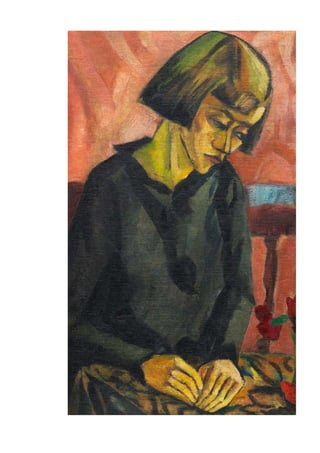
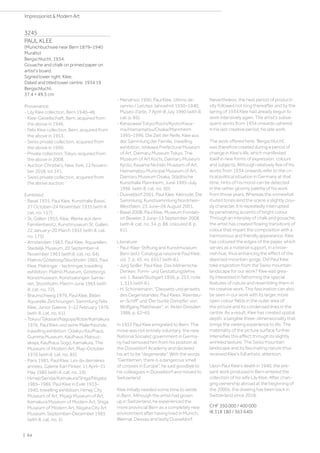
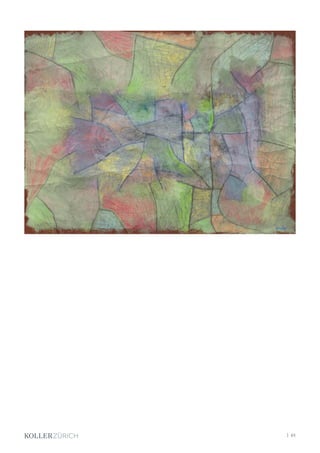
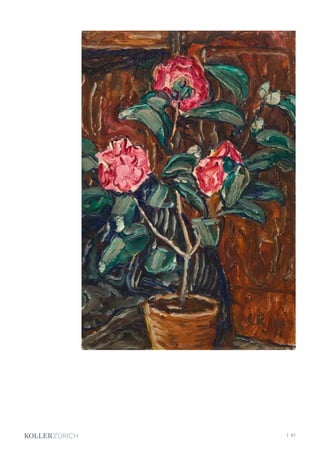
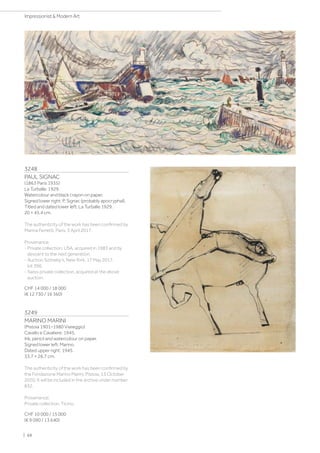
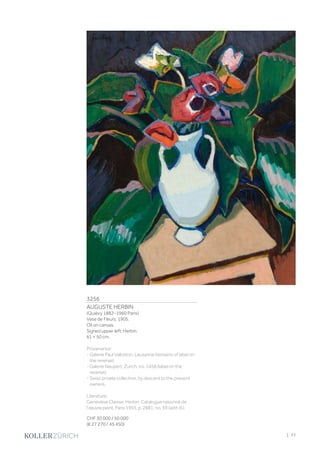
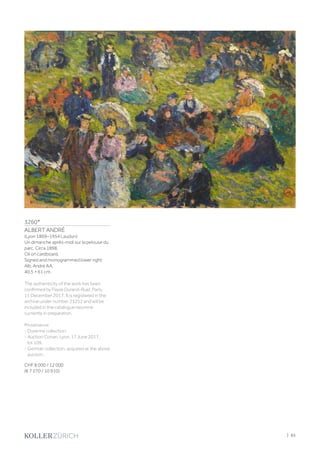
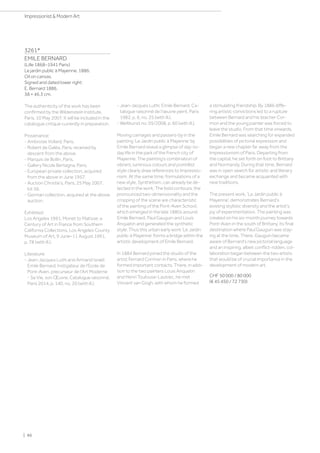
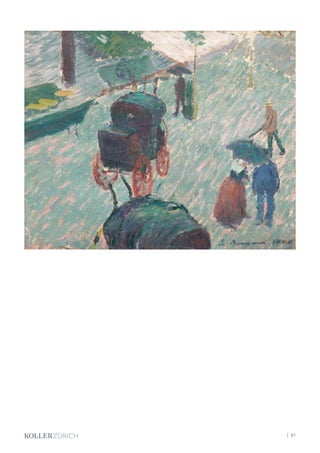
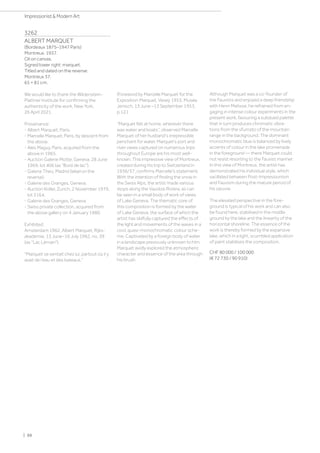
Auktion: 2. Juli 2021
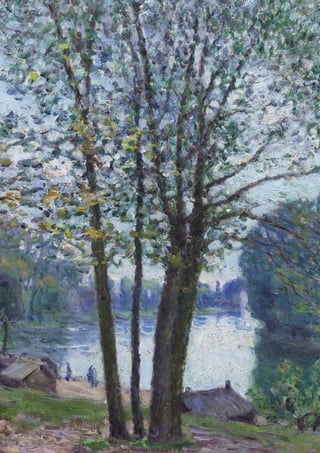
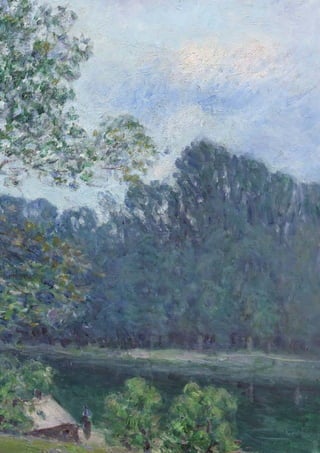
IMPRESSIONISMUS & MODERNE
AUKTION IBID 121
Bieten: 22. Juni bis 6./7. Juli 2021
Vorbesichtigung: Donnerstag 24. bis Montag 28. Juni 2021, 10–18 Uhr
Dienstag 29. Juni 2021, 10–16 Uhr
Art Nouveau & Art Déco, Design, Möbel & Varia, Silber
Gemälde & Grafik des 20. & 21. Jahrhunderts
Schweizer Kunst, Fotografie, Fashion & Vintage
AUKTIONSPROGRAMM IBID 121
AUKTION ONLINE ONLY
22. JUNI BIS 7. JULI 2021
VORBESICHTIGUNG
Donnerstag 24. bis Montag 28. Juni 2021, 10–18 Uhr
Dienstag 29. Juni 2021, 10–16 Uhr
Hardturmstrasse 121, 8031 Zürich, Schweiz
IBID GEMÄLDE&GRAFIKDES20.&21.
Bieten ab 22. Juni bis 7. Juli 2021
IBIDMÖBEL&VARIA
Bieten ab 22. Juni bis 6. Juli 2021
IBIDARTDÉCO&ARTNOUVEAU
Bieten ab 22. Juni bis 6. Juli 2021
IBID DESIGN
Bieten ab 22. Juni bis 6. Juli 2021
IBID SILBER
Bieten ab 22. Juni bis 6. Juli 2021
IBID PHOTOGRAPHIE
Bieten ab 22. Juni bis 7. Juli 2021
IBID FASHION & VINTAGE
Bieten ab 22. Juni bis 7. Juli 2021
IBID SCHWEIZER KUNST
Bieten ab 22. Juni bis 7. Juli 2021
Koller Auktionen AG, Hardturmstrasse 102, 8031 Zürich, Schweiz
Tel +41 44 445 63 63, Fax +41 44 273 19 66 
office@kollerauktionen.ch, www.kollerauktionen.ch
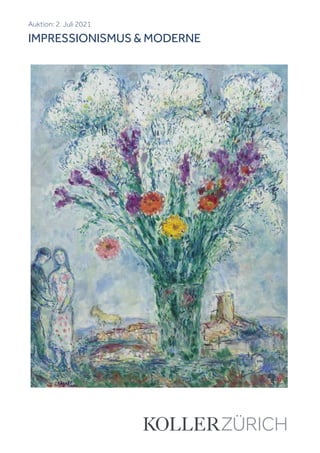
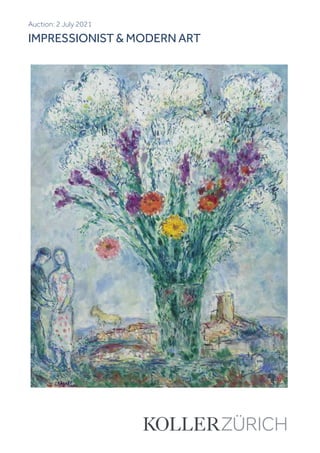
Auktion: 2. Juli 2021
IMPRESSIONISMUS & MODERNE
JULI
2021
IMPRESSIONISMUS
&
MODERNE
A197
POSTWAR
&
CONTEMPORARY
A197
JULI
2021
Koller Auktionen AG, Hardturmstrasse 102, 8031 Zürich, Schweiz
Tel +41 44 445 63 63, Fax +41 44 273 19 66 
office@kollerauktionen.ch, www.kollerauktionen.ch
Auktion: 1. Juli 2021
POSTWAR & CONTEMPORARY
A197
JULI
2021
SCHWEIZER
KUNST
Auktion: 2. Juli 2021
SCHWEIZER KUNST
Koller Auktionen AG, Hardturmstrasse 102, 8031 Zürich, Schweiz
Tel +41 44 445 63 63, Fax +41 44 273 19 66 
office@kollerauktionen.ch, www.kollerauktionen.ch
JULI
2021
GRAFIK
&
MULTIPLES
A197
h, Schweiz
Auktion: 1. Juli 2021
GRAFIK & MULTIPLES
Koller Auktionen AG, Hardturmstrasse 102, 8031 Zürich, Schweiz
Tel +41 44 445 63 63, Fax +41 44 273 19 66
office@kollerauktionen.ch, www.kollerauktionen.ch
SCHMUCK
&
JUWELEN
JUNI
2021
Auktion: 30. Juni 2021
SCHMUCK & JUWELEN
A195
ARMBAND-
UND
TASCHENUHREN
JUNI
2021
Auktion: 30. Juni 2021
ARMBAND- & TASCHENUHREN
Koller Auktionen AG, Hardturmstrasse 102, 8031 Zürich, Schweiz
Tel +41 44 445 63 63, Fax +41 44 273 19 66
office@kollerauktionen.ch, www.kollerauktionen.ch
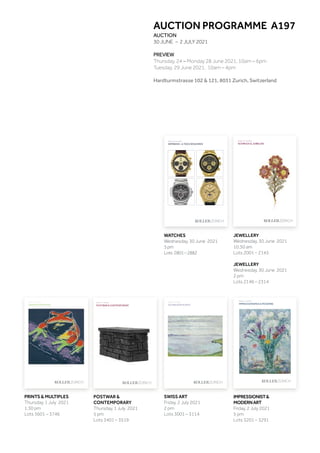
AUKTIONSPROGRAMM A197
AUKTION
30. JUNI BIS 2. JULI 2021
VORBESICHTIGUNG
Donnerstag 24. bis Montag 28. Juni 2021, 10–18 Uhr
Dienstag 29. Juni 2021, 10–16 Uhr
Hardturmstrasse 102 & 121, 8031 Zürich, Schweiz
POSTWAR &
CONTEMPORARY
Donnerstag, 1. Juli 2021
17.00 Uhr
Lot 3401 – 3519
SCHWEIZER KUNST
Freitag, 2. Juli 2021
14.00 Uhr
Lot 3001 – 3114
GRAFIK & MULTIPLES
Donnerstag, 1. Juli 2021
13.30 Uhr
Lot 3601 – 3746
IMPRESSIONISMUS &
MODERNE
Freitag, 2. Juli 2021
17.00 Uhr
Lot 3201 – 3291
SCHMUCK TEIL 1
Mitwoch, 30. Juni 2021
10.30 Uhr
Lot 2001 – 2145
SCHMUCK TEIL 2
Mitwoch, 30. Juni 2021
14.00 Uhr
Lot 2146 – 2314
TASCHEN- &
ARMBANDUHREN
Mitwoch, 30. Juni 2021
17.00Uhr
Lot 2801–2882
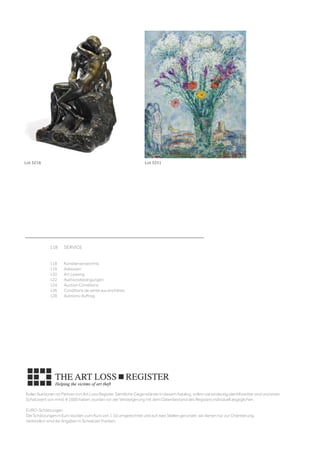
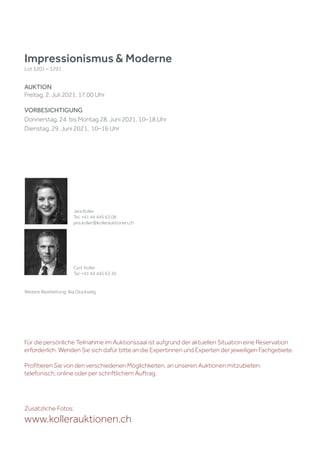
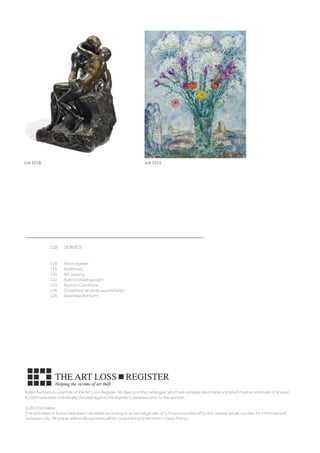
Lot 3218 Lot 3251
	 118	 SERVICE	
									
	
	 118	 Künstlerverzeichnis	
	        119	 Adressen 	
	        120	 Art Leasing  	
	        122	 Auktionsbedingungen 
	 124	 Auction Conditions	
	 126	 Conditions de vente aux enchères	
	 128	 Auktions-Auftrag
Koller Auktionen ist Partner von Art Loss Register. Sämtliche Gegenstände in diesem Katalog, sofern sie eindeutig identifizierbar sind und einen
Schätzwert von mind. € 1000 haben, wurden vor der Versteigerung mit dem Datenbestand des Registers individuell abgeglichen.
EURO-Schätzungen
Die Schätzungen in Euro wurden zum Kurs von 1.10 umgerechnet und auf zwei Stellen gerundet, sie dienen nur zur Orientierung.
Verbindlich sind die Angaben in Schweizer Franken.
Impressionismus & Moderne
Lot 3201 – 3291
AUKTION
Freitag, 2. Juli 2021, 17.00 Uhr
VORBESICHTIGUNG
Donnerstag, 24. bis Montag 28. Juni 2021, 10–18 Uhr
Dienstag, 29. Juni 2021, 10–16 Uhr
Zusätzliche Fotos:
www.kollerauktionen.ch
Jara Koller
Tel. +41 44 445 63 08
jara.koller@kollerauktionen.ch
Cyril Koller
Tel. +41 44 445 63 30
Weitere Bearbeitung: Ilka Glückselig
Für die persönliche Teilnahme im Auktionssaal ist aufgrund der aktuellen Situation eine Reservation
erforderlich. Wenden Sie sich dafür bitte an die Expertinnen und Experten der jeweiligen Fachgebiete.
Profitieren Sie von den verschiedenen Möglichkeiten, an unseren Auktionen mitzubieten:
telefonisch, online oder per schriftlichem Auftrag.
| 2
Impressionismus & Moderne
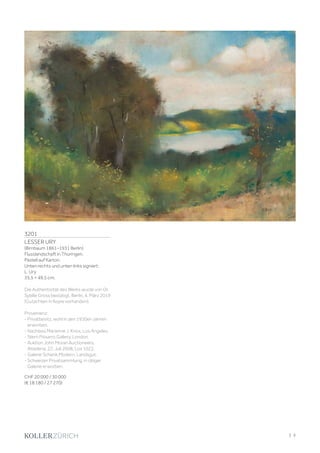
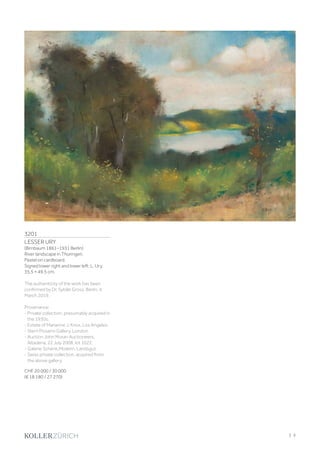
3201
LESSER URY
(Birnbaum 1861–1931 Berlin)
Flusslandschaft in Thüringen.
Pastell auf Karton.
Unten rechts und unten links signiert:
L. Ury
35,5 × 49,5 cm.
Die Authentizität des Werks wurde von Dr.
Sybille Gross bestätigt, Berlin, 4. März 2019
(Gutachten in Kopie vorhanden).
Provenienz:
- Privatbesitz, wohl in den 1930er-Jahren
erworben.
- Nachlass Marianne J. Knox, Los Angeles.
- Stern Pissarro Gallery, London.
- Auktion John Moran Auctioneers,
Altadena, 22. Juli 2008, Los 1022.
- Galerie Schenk.Modern, Landsgut.
- Schweizer Privatsammlung, in obiger
Galerie erworben.
CHF 20 000 / 30 000
(€ 18 180 / 27 270)
| 3
Die Sammlung Robert Neumann
Eine Sammlung, zwei Wege, dazwischen der Atlantik: Die Schicksale der beiden Gemälde von Max Liebermann, die hier in der Auktion
angeboten werden, des Bildnis des Kaufmanns Robert Neumann (Los 3202) und der Studie zu den Netzflickerinnen (Los 3203),
könnten unterschiedlicher nicht sein. Dabei gehörten sie einst beide dem jüdischen Kaufmann Robert Neumann (1875–1937), der in
Berlin und im ostpreussischen Königsberg Warenhäuser mit dem Namen Sommerfeld besass und eine beachtliche Kunstsammlung
mit Werken u.a. von Monet, Degas, Gauguin, Sisley, Corinth, Leible, Cranach d.Ä. und anderen zusammengetragen hatte.
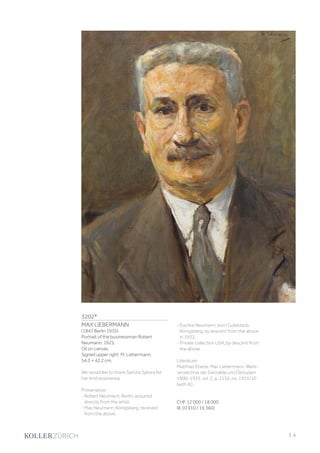
Offenbar war Robert Neumann auch ein grosser Verehrer der Kunst von Max Liebermann, dem er 1925 für das hier angebotene
feinfühlige Porträt Modell sass. In diesem Jahr feierte Robert Neumann seinen fünfzigsten Geburtstag – vielleicht der Anlass für den
erfolgreichen Unternehmer Bilanz zu ziehen und sich mit Anzug, Gilet, weissem Hemd, Krawatte und Einstecktuch gepflegt und doch
zurückhaltend verewigen zu lassen.
Von Max Liebermann besass Neumann noch weitere Gemälde, unter anderem ein Selbstbildnis des Künstlers nach rechts mit der
Zigarette in der Linken (1902), sowie den Rosengarten in Wannsee mit der Tochter und der Enkelin des Künstlers. Diese zauberhafte
intime Gartenansicht von 1920 schenkte Robert Neumann seinem Sohn Max 1926 anlässlich dessen Hochzeit mit Eva Ilse Goldstaub,
der Tochter eines prominenten Anwalts. Auch das hier angebotene Porträt seines Vaters erhielt schliesslich Max Neumann, der in Kö-
nigsberg die Filiale seines Vaters führte.
Schon im März 1933 jedoch wurde Max Neumann Opfer des brutalen Überfalls eines NS-Schlägertrupps; seine Witwe floh mit der
1927 geborenen gemeinsamen Tochter Toni zunächst in die Niederlande, später in die USA. Den Rosengarten sowie das Porträt ihres
Schwiegervaters Robert Neumann nahm sie mit in die neue Heimat, wo sie im November 1938 ankam.
Die Studie zu den Netzflickerinnen stammen dagegen aus der Sammlung des Breslauer Sammlers Max Böhm, der ebenfalls von
Max Liebermann porträtiert worden war. Im Januar 1931 lieferte Böhm seine Sammlung im Auktionshaus Lepke ein, doch viele Werke
gingen zurück: Mitten in der Weltwirtschaftskrise war die Zeit für Kunstverkäufe nicht günstig. Jedenfalls hat sich im Zentralarchiv der
Staatlichen Museen Berlin ein Schreiben vom 18. Februar 1931 erhalten, in dem Max Böhm die Netzflickerinnen zusammen mit an-
deren Werken dem damaligen Direktor der Nationalgalerie Ludwig Justi zum Kauf anbot. Das Museum lehnte aber mit Verweis auf den
fehlenden Ankaufsetat ab. Offenbar übernahm stattdessen der jüdische Kunsthändler Dr. Fritz Nathan das Gemälde und vermittelte es
an Robert Neumann weiter.
1936 emigrierte Robert Neumann mit seiner zweiten Frau Ilse Neumann, geb. Meinhart-Tucholsky (1887–1940), einer Cousine des
Schriftstellers Kurt Tucholsky (1890–1935), ins italienische Meran. Der Kunsthändler Nathan seinerseits wanderte in die Schweiz aus.
Durch einen geschickten Schachzug gelang es Nathan, nach und nach insgesamt 54 Werke der Neumann’schen Kunstsammlung vor
dem Zugriff der Nationalsozialisten zu bewahren, darunter die Netzflickerinnen: Er deklarierte sie mit der Hilfe des damaligen Stadt-
präsidenten von St. Gallen, Konrad Naegeli, kurzerhand als Dauerleihgabe des dortigen Kunstmuseums und lagerte sie dort ein.
Im Juni 1936 schenkte Robert Neumann die in St. Gallen befindlichen Kunstwerke seiner zweiten Frau Ilse Neumann und verschied
1937 in Meran. Seine Witwe, deren Ausweispapiere abgelaufen waren, konnte, wiederum mit der Hilfe von Nathan und Naegeli, von
Italien in die Schweiz ausreisen und emigrierte schliesslich im Juli 1939 in die USA. Zuvor betraute sie Nathan mit dem Verkauf ihrer
Sammlung; diese wurde teilweise an Privatsammler vermittelt, teilweise von Museen übernommen und teilweise bei der Galerie Fischer
Luzern 1941 in die Auktion gegeben. Auch die Netzflickerinnen wurden dort mit gutem Erfolg verkauft.
Ilse Neumann verstarb bereits 1940, nur wenige Monate nach ihrer Ankunft in den USA. Ihre in der Schweiz verbliebene Kunstsammlung
beziehungsweise den Erlös des Verkaufs vermachte sie testamentarisch der Tochter ihres verstorbenen Mannes, Irmgard Neumann,
sowie seiner Enkelin, Toni Neumann, der Tochter des Sohnes Max Neumanns.
Nach intensiven Recherchen konnten kürzlich alle Erben nach Ilse Neumann ausfindig gemacht und eine einvernehmliche Lösung für
den Verkauf der Netzflickerinnen mit ihnen gefunden werden. Die Freude war gross, als im Laufe der Verhandlungen mit einem der Er-
ben nach Toni Neumann dieser dem Auktionshaus Koller auch das Bildnis des Kaufmanns Robert Neumann zum Verkauf anvertraute.
Das Porträt des Urgrossvaters befand sich immer noch im Besitz der Familie und trat nun ein zweites Mal den Weg über den Atlantik an.
Sandra Sykora, Juristin und Kunsthistorikerin.
Wir danken dem Kunstmuseum St. Gallen für Hinweise zur Sammlung Neumann.
| 4
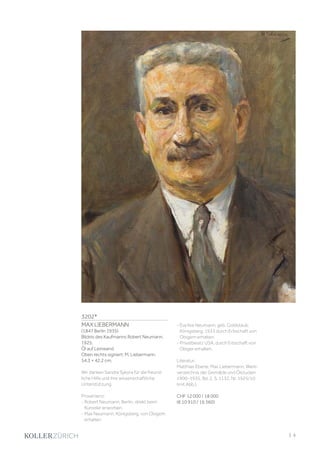
3202*
MAX LIEBERMANN
(1847 Berlin 1935)
Bildnis des Kaufmanns Robert Neumann.
1925.
Öl auf Leinwand.
Oben rechts signiert: M. Liebermann.
54,3 × 42,2 cm.
Wir danken Sandra Sykora für die freund-
liche Hilfe und ihre wissenschaftliche
Unterstützung.
Provenienz:
- Robert Neumann, Berlin, direkt beim
Künstler erworben.
- Max Neumann, Königsberg, von Obigem
erhalten.
- Eva Ilse Neumann, geb. Goldstaub,
Königsberg, 1933 durch Erbschaft von
Obigem erhalten.
- Privatbesitz USA, durch Erbschaft von
Obiger erhalten.
Literatur:
Matthias Eberle: Max Liebermann, Werk-
verzeichnis der Gemälde und Ölstudien
1900–1935, Bd. 2, S. 1132, Nr. 1925/10
(mit Abb.).
CHF 12 000 / 18 000
(€ 10 910 / 16 360)
| 5
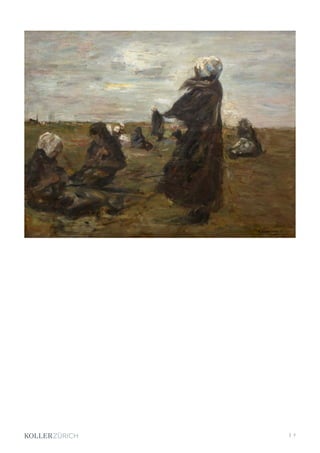
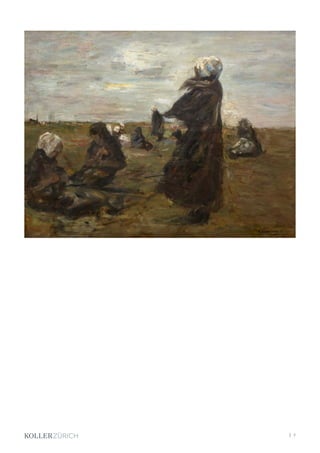
3203
MAX LIEBERMANN
(1847 Berlin 1935)
Studie zu den Netzflickerinnen. 1887.
Öl auf Karton auf Holz.
Unten rechts signiert und datiert:
MLiebermann 87.
70 × 91 cm.
Provenienz:
- Auktion Rudolph Lepke, Berlin, 6./7.
November 1898, Nr. 52.
- G. Hempel, Berlin, 1907–15.
- Max Böhm, Berlin, 1923–31.
- Auktion Rudolph Lepke, Berlin,
Sammlung Max Böhm, 28. Januar 1931,
Nr. 32 (Werk blieb unverkauft).
- Dr. Fritz Nathan, München, 1931 wohl
direkt von Max Böhm erworben.
- Robert Neumann, Berlin, von Obigem
erworben, bis 1936.
- Ilse Neumann, Meran, 1936 durch
Schenkung von Obigem erhalten.
- Auktion Galerie Fischer, Luzern 20.–24.
Mai 1941, Nr. 953.
- Dr. Scherrer, Luzern, an obiger Auktion
erworben.
- Auktion Galerie Fischer, Luzern, 25.–27.
Mai 1944, Nr. 768.
- Hans Soraperra-Blattmann, Zürich.
- Schweizer Privatbesitz.
Ausstellungen:
- Berlin 1907, XIII. Ausstellung der Berliner
Secession, Nr. 130.
- Frankfurt am Main 1907, Liebermann,
Frankfurter Kunstverein, Nr. 25.
- Leipzig 1907, Max Liebermann, Leipziger
Kunstverein, Nr. 24.
- Berlin 1915, Werke deutscher Meister
aus Privatbesitz, II. Ausstellung, Galerie
Fritz Gurlitt, April 1915, Nr. 50.
- Zürich 1923, Max Liebermann, Kunst-
haus Zürich, Nr. 32 (mit Abb. im Ausst.
Kat. Tafel XVII).
- Berlin 1927, Max Liebermann zum 80.
Geburtstag, Preussische Akademie der
Künste Berlin, Nr. 27.
- Berlin 1930, Sammlung Max Böhm,
Preussische Akademie der Künste Berlin,
Juni–Juli 1930, Nr. 33.
- Wien 1937, Max Liebermann, Neue
Galerie Wien, Nr. 16.
- Basel 1937, Max Liebermann, Kunsthalle
Basel, Nr. 139.
- Bern 1937, Albert Welti - Max Lieber-
mann, Kunsthalle Bern, Nr. 144 (Besitz:
St. Gallen, Dr. Fritz Nathan).
- St. Gallen 1938, Gemälde - Hand­
zeichnungen, Dr. Fritz Nathan
(mit Abb. im Ausst. Kat. S. 15).
- Schaffhausen 1955, Deutsche Impressi-
onisten, Liebermann - Corinth - Slevogt,
Museum zu Allerheiligen, 23. April–24.
Juli 1955, Nr. 12.
Literatur:
- Matthias Eberle: Max Liebermann,
Werkverzeichnis der Gemälde und
Ölstudien 1900–1935, Bd. 1, S. 322/323,
Nr. 1887/28 (mit Abb.).
- Katrin Boskamp: Studien zum Frühwerk
von Max Liebermann mit einem
Verzeichnis der Gemälde und Ölstudien
von 1866–1889, Hildesheim/Zürich/New
York 1994, Nr. 221.
- Günter Busch: Max Liebermann. Maler,
Zeichner, Graphiker, Frankfurt am Main
1986, S. 61 (mit Abb.).
- Karl Scheffler: Rückblick auf Max Lieber-
mann, in: Kunst und Volk, Jg. XII 1950,
Heft 5, S. 103–113 (mit Abb. S. 108).
- W. D.: Die Liebermann-Ausstellung in
der Neuen Galerie, in: Neue Freie Presse,
Wien 15. Januar 1937.
- Hans Ostwald: Das Liebermann-Buch
mit 270 Illustrationen, Berlin 1930.
- Erich Hancke: Max Liebermann. Sein
Leben und seine Werke, Berlin 1923,
S. 235.
- N.N.: Von Ausstellungen, Berlin, in: Kunst
für Alle, Jg. XXX, Beilage zu Heft 19/20,
Juli 1915, S. 1.
- Erich Hancke: Max Liebermann. Sein Le-
ben und seine Werke, Berlin 1923, S. 235.
- Gustav Pauli: Liebermann, eine Auswahl
aus dem Lebenswerk des Meisters in 101
Abbildungen, Anm. auf S. 245 zu S. 80 (d),
S. 252.
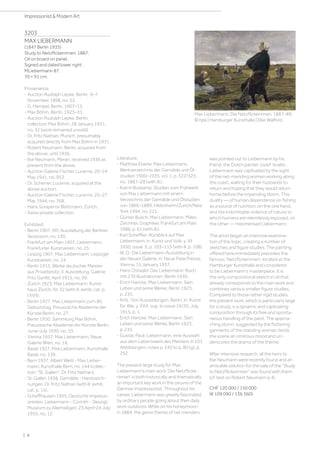
Die vorliegende, grossformatige Studie
zu Max Liebermanns Hauptwerk die
Netzflickerinnen ist sowohl historisch als
auch thematisch ein wichtiges Schlüssel-
werk im Œuvre des deutschen Impres-
sionisten. Liebermann hegt zeit seines
Schaffens eine grosse Faszination für die
einfache Bevölkerung, die ihrer täglichen
Arbeit im Freien nachgeht. Während seiner
Hochzeitsreise 1884 wird er von seinem
niederländischen Malerfreund Jozef Israëls
auf das Genrethema der Netzflickerinnen
hingewiesen. Liebermann ist gefesselt
von dem Anblick der netzflickenden
Frauen, die an der Küste arbeitend, auf
die Rückkehr ihrer Männer warten und
darauf hoffen, dass diese noch vor dem
Sturm heimkehren. Diese Dualität der
menschlichen Abhängigkeit vom Fischfang
als Ernährungsquelle einerseits, und der
unbezwingbaren Gewalt der Natur, der
der Mensch schonungslos ausgeliefert ist
andererseits, fesselt Liebermann.
Es beginnt eine intensive Auseinanderset-
zung mit dem Thema und etliche Skizzen
und Figurenstudien entstehen. Das von uns
angebotene Gemälde ist den berühmten
Netzflickerinnen, das sich als Hauptwerk
Liebermanns heute in der Kunsthalle Ham-
burg befindet, unmittelbar vorangehend.
Es ist der einzige Kompositionsentwurf in
Öl, der bereits dem Hauptwerk entspricht
und kombiniert verschiedene kleinere
Figurenstudien. Im Vergleich zu diesen
eher starren Studien, ist das vorliegende,
für eine Studie besonders grosse Gemälde,
eine bewegte Komposition, die durch einen
freien und spontanen Farbauftrag besticht.
Der herannahende Sturm wird bereits durch
das flatternde Gewand der stehenden Frau
angedeutet und verleiht dem Gemälde eine
bedrohliche Stimmung, die die Dramatik
des Themas nochmals unterstreicht.
Nach intensiven Recherchen konnten
kürzlich alle Erben nach Ilse Neumann aus-
findig gemacht und eine einvernehmliche
Lösung für den Verkauf der Studie zu den
Netzflickerinnen gefunden werden (vgl.
Text zur Sammlung Neumann S. 4).
CHF 120 000 / 150 000
(€ 90 910 / 136 360)
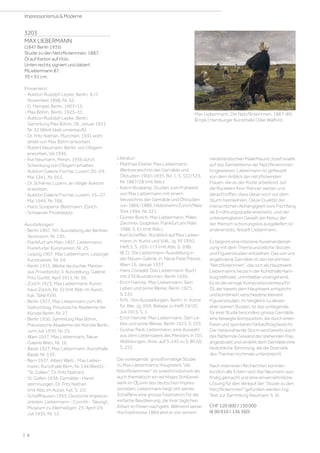
Max Liebermann, Die Netzflickerinnen, 1887–89,
© bpk | Hamburger Kunsthalle | Elke Walford.
| 6
Impressionismus  Moderne
| 7
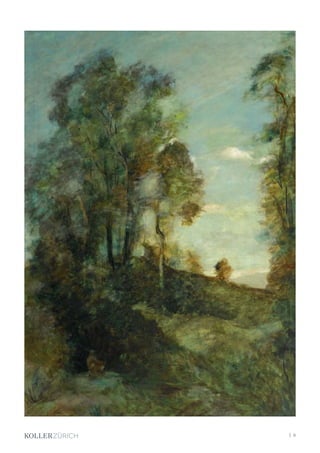
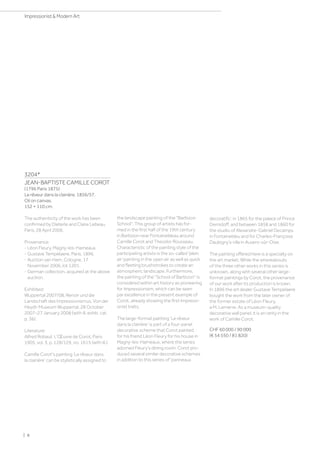
3204*
JEAN-BAPTISTE CAMILLE COROT
(1796 Paris 1875)
Le rêveur dans la clairière. 1856/57.
Öl auf Leinwand.
152 × 110 cm.
Die Authentizität des Werks wurde von
Martin Dieterle und Claire Lebeau bestä-
tigt, Paris, 28. April 2006.
Provenienz:
- Léon Fleury, Magny-les-Hameaux.
- Gustave Tempelaere, Paris, 1896.
- Auktion van Ham, Köln, 17. November
2006, Los 1201.
- Deutsche Sammlung, an obiger Auktion
erworben.
Ausstellung:
Wuppertal 2007/08, Renoir und die
Landschaft des Impressionismus, Von der
Heydt-Museum Wuppertal, 28. Oktober
2007–27. Januar 2008 (mit Abb. im Ausst.
Kat. S. 36).
Literatur:
Alfred Robaut: L'œuvre de Corot, Paris
1905, Bd. 3, S. 128/129, Nr. 1615 (mit
Abb.).
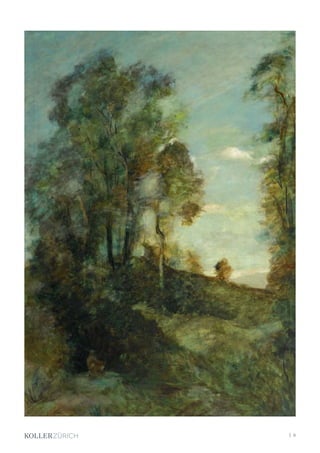
Camille Corots Gemälde Le rêveur
dans la clairière ist stilistisch der Land-
schaftsmalerei der Schule von Barbizon
zuzuordnen. Hierbei handelt es sich um
eine Künstlergruppe, die sich in der ersten
Hälfte des 19. Jahrhunderts in Barbizon
bei Fontainebleau um Camille Corot und
Theodor Rousseau gebildet hat. Charak-
teristisch für die Malweise der beteiligten
Künstler ist die sogenannte Pleinairmalerei
unter freiem Himmel sowie schnelle und
flüchtige Pinselstriche, um eine stim-
mungsvolle Landschaftsatmosphäre zu
erzeugen. Darüber hinaus gilt die Malerei
der Schule von Barbizon innerhalb der
Kunstgeschichte als wegbereitend für
den Impressionismus, was sich an dem
vorliegenden Beispiel Corots, das bereits
erste impressionistische Züge aufweist,
par excellence ablesen lässt.
Das grossformatige Gemälde Le rêveur
dans la clairière gehört zu einer viertei-
ligen Serie von Wandarbeiten, die Corot
für seinen Freund Léon Fleury in dessen
Haus in Magny-les-Hameaux malte. Dort
schmückte die Werkreihe das Esszimmer
Fleurys. Neben dieser Serie von panneaux
decoratifs schuf Corot einige weitere
Arbeiten dieser Art, wie beispielsweise
1865 für das Palais des Prince Demidoff
oder zwischen 1858 und 1860 für das
Atelier von Alexandre-Gabriel Decamps in
Fontainebleau und für Charles-Françoise
Daubignys Villa in Auvers-sûr-Oise.
Auf dem Kunstmarkt stellt das hier ange-
botene Gemälde eine Besonderheit dar.
Während der Verbleib der drei anderen
Wandarbeiten dieser Serie sowie einiger
weiterer grossformatiger Gemälde Corots
nicht überliefert ist, ist die Provenienz des
hier zum Verkauf stehenden Werks direkt
nach der Entstehung bekannt. 1896 kaufte
der Kunsthändler Gustave Tempelaere das
Werk bei dem späteren Besitzer des ehe-
maligen Anwesens von Léon Fleury, einem
M. Lemerre. Als dekoratives Wandgemälde
mit musealem Charakter ist es eine Rarität
im Œuvre Camille Corots.
CHF 60 000 / 90 000
(€ 54 550 / 81 820)
| 8
Impressionismus  Moderne
| 9
3205
GIOVANNI BOLDINI
(Ferrara 1842–1931 Paris)
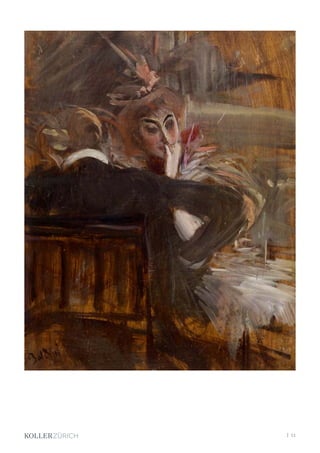
Al Ristorante. Um 1896.
Öl auf Holz.
Unten links signiert: Boldini.
34,5 × 27 cm.
Provenienz:
- Atelier Boldini.
- Sammlung Stramezzi, Crema.
- Galleria Silbernagl, Daverio (verso mit
Stempel).
- Tessiner Privatsammlung, durch Erb-
schaft erhalten.
Ausstellung:
Paris 1951, Parisiens d'Italie, Galerie de
la Maison du Livre Italien, 1.–20. Februar
1951 (verso mit Etikett).
Literatur:
- Tiziano Panconi: Giovanni Boldini: L'opera
completa, Florenz 2002, S. 374 (mit s/w
Abb.).
- Bianca Doria: Giovanni Boldini: catalogo
generale dagli archivi Boldini, Mailand
2000, Nr. 360.
- Giuseppe Luigi Marini: Catalogo Bolaffi
della pittura italiana dell'Ottocento, Turin
2009, S. 25, Nr. 9.
- Enrico Piceni: Giovanni Boldini. L'uomo e
l'opera, Busto Arsizio 1981, Nr. 41.
- Ettore Camesasca und Carlo L. Ragghi-
anti: Boldini. L'opera completa, Mailand
1970, S. 11, Nr. 267b (mit Abb.).
Giovanni Boldini lebt in der Pariser Belle
Époque am Puls der Zeit. Auf den lebendi-
gen Strassen der französischen Haupt-
stadt, in Bars und Restaurants oder in The-
atern und Kabaretts, schöpft er Inspiration
für seine Arbeit. Nach Stationen in Florenz
und London kommt der aus dem italieni-
schen Ferrara stammende Boldini 1873
nach Paris, wo er rasch auf sich aufmerk-
sam macht. Er porträtiert die gehobene
Pariser Gesellschaft in edlen Kleidern,
flanierend in Gärten oder in dekorativen
Interieurs. Boldini erweist sich als aktiver
Beobachter des modernen Pariser Lebens
und seine Gemälde erfreuen sich schnell
grosser Beliebtheit. Gut vernetzt im
künstlerischen Umfeld der französischen
Hauptstadt, pflegt er Freundschaften
zu Edgar Degas, Édouard Manet, Ernest
Meissonier oder Berthe Morisot.
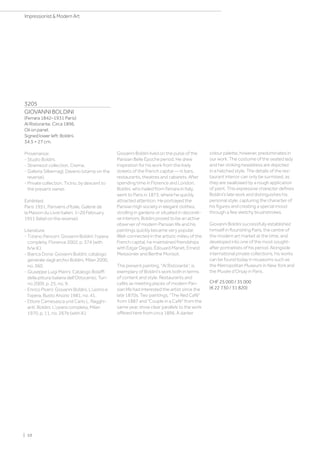
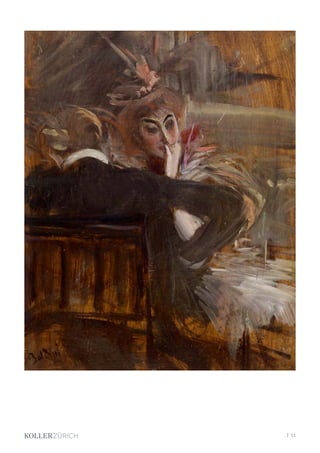
Das hier angebotene Gemälde „Al
Ristorante“ ist sowohl inhaltlich als auch
stilistisch exemplarisch für Boldinis Werk.
Restaurants und Cafés als Treffpunkte
des modernen Lebens interessieren
den Künstler bereits seit den späten
1870er-Jahren. So weisen die beiden
Gemälde „Interno di Caffé a Parigi, con
tenda rossa“ von 1887 und „Interno di
Caffé con Coppia Abbracciata“ aus dem
gleichen Jahr deutliche Parallelen zu der
unsrigen, um 1896 entstandenen Arbeit,
auf. Hier überwiegt jedoch eine dunklere
Farbpalette. Das Kostüm der sitzenden
Dame und ihr auffallender Kopfschmuck
sind schraffurartig dargestellt. Auch die
Details der Restauranteinrichtung sind nur
zu erahnen, werden sie doch von grobem
Farbauftrag verschluckt. Dieser expressive
Duktus ist prägend für Boldinis Spätwerk
und kennzeichnet seinen persönlichen Stil:
Mit wenigen, skizzenhaften Pinselstrichen
fängt er den Charakter seiner Figuren ein
und schafft eine besondere Stimmung.
Giovanni Boldini gelingt es, sich im florie-
renden Paris, dem damaligen Zentrum des
modernen Kunstmarkts, zu etablieren und
zu einem der gefragtesten Porträtisten
seiner Zeit zu entwickeln. Heute finden
sich seine Werke nicht nur in internatio-
nalen Privatsammlungen sondern auch in
bedeutenden Museen wie dem Metropoli-
tan Museum in New York oder dem Musée
d’Orsay in Paris.
CHF 25 000 / 35 000
(€ 22 730 / 31 820)
| 10
Impressionismus  Moderne
| 11
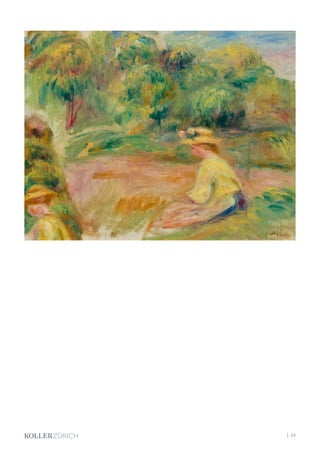
3206
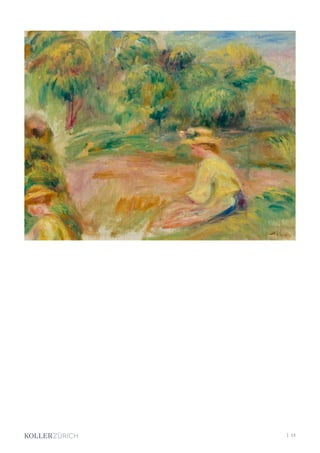
PIERRE-AUGUSTE RENOIR
(Limoges 1841–1919 Cagnes-sur-Mer)
Paysage aux deux figures. Um 1915.
Öl auf Leinwand.
Unten rechts monogrammiert: AR.
31,5 × 41 cm.
Wir danken Guy-Patrice und Floriane Dau-
berville für die Bestätigung der Authentizi-
tät des Werks, Paris, 16. April 2021.
Wir danken dem Wildenstein-Plattner Ins-
titut für die Bestätigung der Authentizität
des Werks, New York, 8. April 2021.
Provenienz:
- Ambroise Vollard, vor 1919 direkt beim
Künstler erworben.
- Sammlung Pierre Bloch.
- Wohl Schweizer Privatsammlung.
- Auktion Koller, Zürich, 28. Mai 1976, Los
5036.
- Schweizer Privatsammlung, an obiger
Auktion erworben und durch Erbschaft
an die heutigen Besitzer.
Literatur:
Ambroise Vollard: Pierre-Auguste Renoir.
Paintings, Pastels and Drawings. Tableaux,
Pastels et Dessins (revidierte Auflage,
Original von 1918), San Francisco 1989, S.
272, Nr. 1282 (mit Abb.).
Das vorliegende, von harmonischer Farb-
vielfalt geprägte Gemälde von 1915, ist
ein ausgezeichnetes Beispiel für Renoirs
Spätwerk. So heben die Renoir-Experten
das Werk als besonders schöne Arbeit des
Künstlers hervor.
Renoir kauft 1907 ein Haus in Cagnes-sur-
Mer und verbringt fortan die meiste Zeit
des Jahres mit seiner Familie im Süden
Frankreichs. Das milde, mediterrane Klima
bekommt dem an Rheuma erkrankten
Künstler sehr gut. Er hofft fern von der
Stadt auf Linderung seiner Beschwerden.
Gleichzeitig ist Renoir fasziniert von der
Landschaft Südfrankreichs, den leucht-
enden Farben und dem Licht – er lässt
das Atmosphärische der dortigen Natur
gekonnt in sein Werk einfliessen.
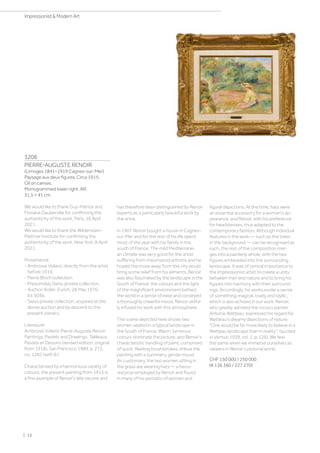
Die hier dargestellte Szene zeigt zwei
sitzende Frauen in typisch südfranzösi-
scher Landschaft. Warme und leucht-
ende Farben dominieren die Darstellung
und Renoirs charakteristische Malweise
bestehend aus schnellen, flüchtigen
Pinselstrichen verleiht dem Gemälde
einen sommerlichen, sanften Charakter.
Klassischerweise tragen die beiden im
Gras sitzenden Frauen Hüte – ein beliebtes
Requisit Renoirs, das in zahlreichen seiner
Damenporträts und Figurendarstellungen
zu finden ist. Seinerzeit waren Hüte ein
wesentliches Accessoire für das Erschei-
nungsbild einer Frau, sodass sich Renoir
mit seiner Vorliebe für den Kopfschmuck
an die zeitgenössische Mode anpasst.
Für eine stimmige Gesamtkomposition
bettet der Künstler die beiden Figuren im
vorliegenden Beispiel charakteristisch in
die umliegende Landschaft ein. Einzelne
Konturen verschwimmen dabei und Renoir
erzeugt so ein harmonisches, von Ruhe
geprägtes Zusammenspiel zwischen
Mensch und Natur. Dem Werk wohnt
etwas Märchenhaftes und Idyllisches bei.
Renoir, der ein grosser Bewunderer des
Rokoko-Malers Antoine Watteaus war,
äussert hinsichtlich dessen träumerischer
Naturdarstellungen: Man könnte sich
viel eher in einer Landschaft von Watteau
glauben als in der Wirklichkeit. (Renoir,
in Venturi 1939, Bd. 1, S. 126). Gleiches
empfinden die Betrachtenden ebenfalls,
wenn sie in die malerische Welt Renoirs
eintauchen.
CHF 150 000 / 250 000
(€ 136 360 / 227 270)
| 12
Impressionismus  Moderne
| 13
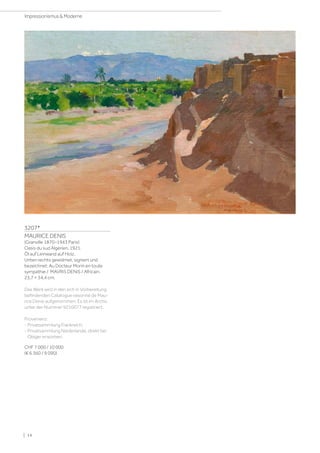
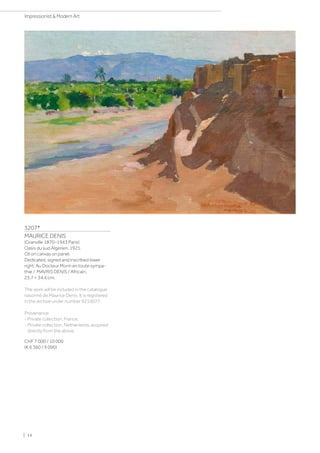
3207*
MAURICE DENIS
(Granville 1870–1943 Paris)
Oasis du sud Algérien. 1921.
Öl auf Leinwand auf Holz.
Unten rechts gewidmet, signiert und
bezeichnet: Au Docteur Morin en toute
sympathie / MAVRIS DENIS / Africain.
23,7 × 34,4 cm.
Das Werk wird in den sich in Vorbereitung
befindenden Catalogue raisonné de Mau-
rice Denis aufgenommen. Es ist im Archiv
unter der Nummer 9210077 registriert.
Provenienz:
- Privatsammlung Frankreich.
- Privatsammlung Niederlande, direkt bei
Obiger erworben.
CHF 7 000 / 10 000
(€ 6 360 / 9 090)
| 14
Impressionismus  Moderne
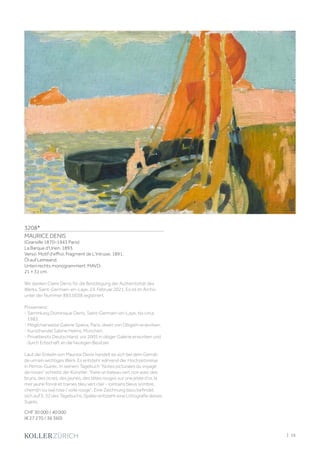
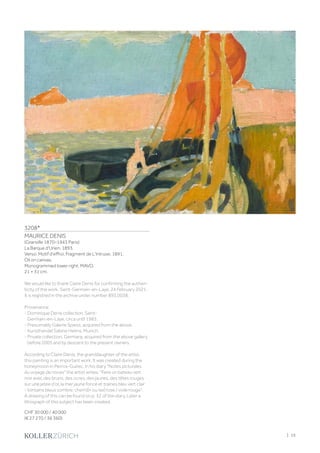
3208*
MAURICE DENIS
(Granville 1870–1943 Paris)
La Barque d'Urien. 1893.
Verso: Motif d'effroi, Fragment de L'Intruse. 1891.
Öl auf Leinwand.
Unten rechts monogrammiert: MAVD.
21 × 31 cm.
Wir danken Claire Denis für die Bestätigung der Authentizität des
Werks, Saint-Germain-en-Laye, 24. Februar 2021. Es ist im Archiv
unter der Nummer 893.0038 registriert.
Provenienz:
- Sammlung Dominique Denis, Saint-Germain-en-Laye, bis circa
1983.
- Möglicherweise Galerie Spiess, Paris, direkt von Obigem erworben.
- Kunsthandel Sabine Helms, München.
- Privatbesitz Deutschland, vor 2005 in obiger Galerie erworben und
durch Erbschaft an die heutigen Besitzer.
Laut der Enkelin von Maurice Denis handelt es sich bei dem Gemäl-
de um ein wichtiges Werk. Es entsteht während der Hochzeitsreise
in Perros-Guirec. In seinem Tagebuch Notes picturales du voyage
de noces schreibt der Künstler: Faire un bateau vert noir avec des
bruns, des ocres, des jaunes, des têtes rouges sur une jetée d'or, la
mer jaune foncé et traines bleu vert clair - lointains bleus sombre,
chemi[n ou ise| rose / voile rouge. Eine Zeichnung dazu befindet
sich auf S. 32 des Tagebuchs. Später entsteht eine Lithografie dieses
Sujets.
CHF 30 000 / 40 000
(€ 27 270 / 36 360)
| 15
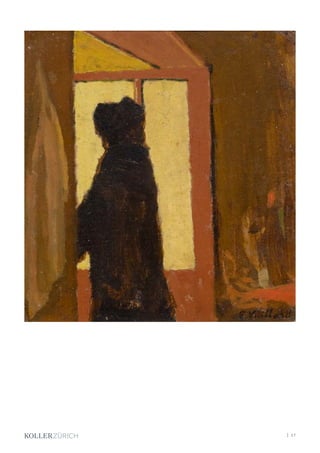
3209
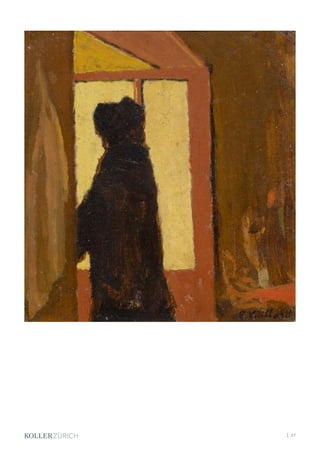
EDOUARD VUILLARD
(Cuiseaux 1868–1940 La Baule)
Femme devant un vitrage. Um 1891.
Öl auf Karton auf Holz.
Unten rechts mit dem Signaturstempel:
E. Vuillard.
19,3 × 17,2 cm.
Provenienz:
- Atelier des Künstlers.
- Louis Carré, Paris.
- Albert Skira, Genf.
- Galerie Rosengart, Luzern (verso mit
Etikett).
- Sammlung Fred Uhler, Neuchâtel, um
1945.
- Schweizer Privatsammlung, durch
Erbschaft erhalten.
Ausstellungen:
- Basel 1949, Kunsthalle, Nr. 31 (als
Devant la porte, datiert um 1898).
- Neuchâtel 1956, Exposition des collec-
tion neuchâteloises, Musée des Beaux-
Arts, Frühling 1956, Nr. 190 (verso mit
Etikett).
- Neuchâtel 1975, Musée d'Art et
d'Histoire, Nr. 97.
Literatur:
Antoine Salomon und Guy Cogeval:
Vuillard. Le Regard innombrable. Catalogue
critique des peintures et pastels, Bd. I, Paris
2003, S. 126, Nr. II–97 (mit Abb.).
Die Gemälde aus dieser Zeit, die vom
Talisman inspiriert sind, sind kleine Werke,
die langsam, aber unaufhaltsam ihre eige-
ne innere Klangfülle ausstrahlen, (…) Viele
der Werke, die der Nabi Visionär [Vuillard]
schuf, sind Rätsel, die gelöst werden müs-
sen, Werke, deren Rhythmus und Linie sich
seinem Bewusstsein aufdrängten wie eine
Art automatisches Schreiben (Ausst. Kat.
Washington D.C., 2003, S. 53).
Das vorliegende, kleinformatige Gemälde
ist ein wunderbares Beispiel für Vuillards
Werk der Nabi-Zeit. Die Künstlergruppe
rund um Vuillard, Vallotton, Bonnard, Denis,
Sérusier und Co. befindet sich 1891/92
auf dem Höhepunkt. Inspiriert von den
strukturierten Innenräumen der Belle Épo-
que, schaffen sie ihre charakteristischen
Kompositionen. Im Schneideratelier seiner
Mutter verbringt Vuillard viel Zeit und
durch die schwach beleuchtenden Räume
beobachtet er die Frauen bei der Arbeit.
Es entstehen mysteriöse Umrisse von ge-
heimnisvollen, meist von Hinten gezeigten
und kaum beleuchteten Figuren inmitten
von kontrastreichen Flächen.
CHF 30 000 / 50 000
(€ 27 270 / 45 450)
| 16
Impressionismus  Moderne
| 17
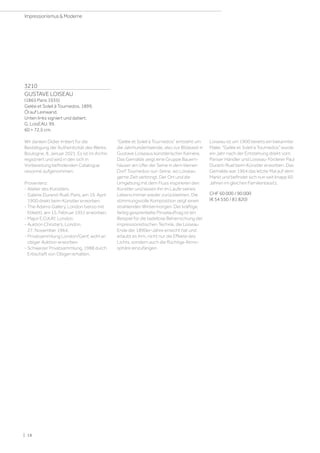
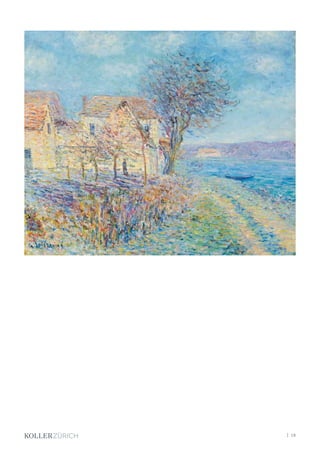
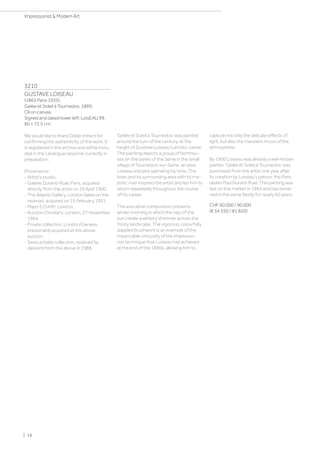
3210
GUSTAVE LOISEAU
(1865 Paris 1935)
Gelée et Soleil à Tournedos. 1899.
Öl auf Leinwand.
Unten links signiert und datiert:
G. LoisEAU. 99.
60 × 72,5 cm.
Wir danken Didier Imbert für die
Bestätigung der Authentizität des Werks,
Boulogne, 8. Januar 2021. Es ist im Archiv
registriert und wird in den sich in
Vorbereitung befindenden Catalogue
raisonné aufgenommen.
Provenienz:
- Atelier des Künstlers.
- Galerie Durand-Ruel, Paris, am 19. April
1900 direkt beim Künstler erworben.
- The Adams Gallery, London (verso mit
Etikett), am 15. Februar 1951 erworben.
- Major E.O.KAY, London.
- Auktion Christie's, London,
27. November 1964.
- Privatsammlung London/Genf, wohl an
obiger Auktion erworben.
- Schweizer Privatsammlung, 1988 durch
Erbschaft von Obigen erhalten.
Gelée et Soleil à Tournedos entsteht um
die Jahrhundertwende, also zur Blütezeit in
Gustave Loiseaus künstlerischer Karriere.
Das Gemälde zeigt eine Gruppe Bauern-
häuser am Ufer der Seine in dem kleinen
Dorf Tournedos-sur-Seine, wo Loiseau
gerne Zeit verbringt. Der Ort und die
Umgebung mit dem Fluss inspirieren den
Künstler und lassen ihn im Laufe seines
Lebens immer wieder zurückkehren. Die
stimmungsvolle Komposition zeigt einen
strahlenden Wintermorgen. Der kräftige,
farbig gesprenkelte Pinselauftrag ist ein
Beispiel für die tadellose Beherrschung der
impressionistischen Technik, die Loiseau
Ende der 1890er-Jahre erreicht hat und
erlaubt es ihm, nicht nur die Effekte des
Lichts, sondern auch die flüchtige Atmo-
sphäre einzufangen.
Loiseau ist um 1900 bereits ein bekannter
Maler. Gelée et Soleil à Tournedos wurde
ein Jahr nach der Entstehung direkt vom
Pariser Händler und Loiseau-Förderer Paul
Durant-Ruel beim Künstler erworben. Das
Gemälde war 1964 das letzte Mal auf dem
Markt und befindet sich nun seit knapp 60
Jahren im gleichen Familienbesitz.
CHF 60 000 / 90 000
(€ 54 550 / 81 820)
| 18
Impressionismus  Moderne
| 19
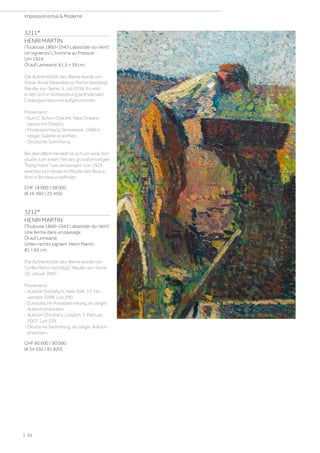
3211*
HENRI MARTIN
(Toulouse 1860–1943 Labastide-du-Vert)
Un vigneron/ L'homme au Pressoir.
Um 1924.
Öl auf Leinwand. 61,5 × 39 cm.
Die Authentizität des Werks wurde von
Marie-Anne Destrebecq-Martin bestätigt,
Neuilly-sur-Seine, 5. Juli 2018. Es wird
in den sich in Vorbereitung befindenden
Catalogue raisonné aufgenommen.
Provenienz:
- Kurt E. Schon Fine Art, New Orleans
(verso mit Etikett).
- Privatsammlung Tennessee, 1988 in
obiger Galerie erworben.
- Deutsche Sammlung.
Bei dem Werk handelt es sich um eine Vor-
studie zum linken Teil des grossformatigen
Triptychons Les vendanges von 1929,
welches sich heute im Musée des Beaux-
Arts in Bordeaux befindet.
CHF 18 000 / 28 000
(€ 16 360 / 25 450)
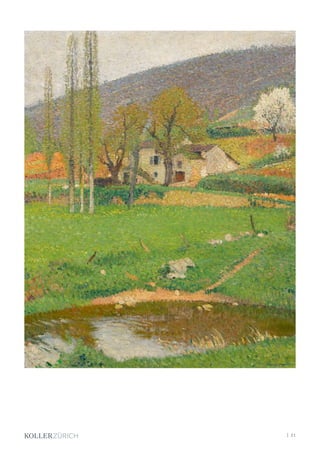
3212*
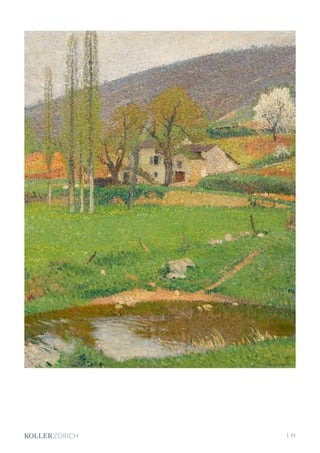
HENRI MARTIN
(Toulouse 1860–1943 Labastide-du-Vert)
Une ferme dans un paysage.
Öl auf Leinwand.
Unten rechts signiert: Henri Martin.
81 × 65 cm.
Die Authentizität des Werks wurde von
Cyrille Martin bestätigt, Neuilly-sur-Seine,
10. Januar 2007.
Provenienz:
- Auktion Sotheby's, New York, 17. No-
vember 1998, Los 290.
- Europäische Privatsammlung, an obiger
Auktion erworben.
- Auktion Christie's, London, 7. Februar
2007, Los 329.
- Deutsche Sammlung, an obiger Auktion
erworben.
CHF 60 000 / 90 000
(€ 54 550 / 81 820)
| 20
Impressionismus  Moderne
| 21
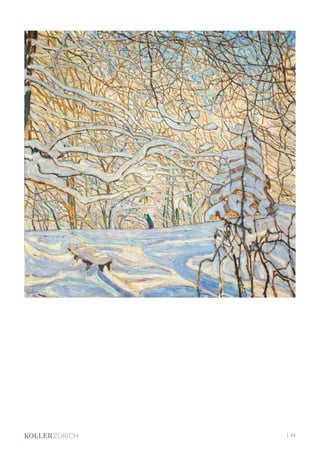
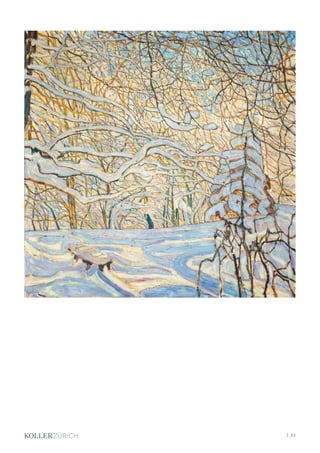
3213
ABRAHAM MANIEVICH
(Mszislau 1881–1942 New York)
Neige dans la forêt. 1913.
Öl auf Leinwand.
Unten links signiert und datiert:
Manievich 1913.
135,5 × 132 cm.
Provenienz:
- Sammlung Artur Horvatt, Genf, wohl
1913 in Paris erworben.
- Sammlung Chavan, Genf.
- Auktion Galerie Moos, Genf, 3. Juni 1937
Nr. 146 (verso mit Nummer).
- Galerie Moos, Genf, Nr. 4163 (verso mit
Etikett).
- Schweizer Privatsammlung, wohl in
obiger Galerie erworben und durch
Erbschaft an die heutigen Besitzer.
Ausstellung:
Wohl Paris 1913, Exposition Manievich,
Galerie Durand-Ruel, 26. Februar–15. März
1913 (möglicherweise Nr. 63).
1912 zieht es den in der Ukraine gebo-
renen Künstler Abraham Manievich in die
Metropole Paris. Bereits zuvor hat Manie-
vich Gelegenheit, seine Bilder in verschie-
denen Ausstellungen zu zeigen, so 1907
im Kunstverein in München oder 1909 im
Kiew City Museum. Die bedeutende Ein-
zel-Ausstellung im Februar und März 1913
in der Galerie Durand-Ruel mitten in Paris,
wird aber die bisher wichtigste Werkschau
und bringt Manievich internationalen Ruhm
ein. Die Ausstellung zeigt 75 Gemälde
des Künstlers, es wird ein eigener Katalog
gedruckt mit der Auflistung aller Werke
und der Reproduktion von vier Gemälden.
Einer der Haupt-Leihgeber der Ausstel-
lung ist ein Genfer Privatsammler namens
Artur Horvatt. Aus dessen Besitz werden
13 Gemälde gezeigt, zwei davon dürfen
wir im Zuge dieser Auktion anbieten. Die
Ausstellung wird von Kritikern gelobt und
wird auch finanziell ein Erfolg. Das Musée
du Luxembourg, das dazumal wichtigste
zeitgenössische Museum Frankreichs,
kauft das Gemälde „À travers les braches“
an, welches sich heute im Centre Geor-
ges Pompidou befindet. Das bedeuten-
de Kunstmagazin International Studio
schreibt über Manievich: manifesting a
rare power of expression which could not
fail to make a lasting appeal to unbigoted
artists and critics alike (Ginsburg/Pensler
2012, S. 19).
Aus einer Genfer Privatsammlung bieten
wir fünf Gemälde Manievichs an, die wohl
alle Teil der Ausstellung 1913 in Paris
waren. Wie bereits erwähnt, befanden sich
zwei Gemälde (Los 3217 und Los 3218)
bereits vor 1913 im Besitz des Sammlers
Artur Horvatt und waren als Leihgabe in
der Ausstellung bei Durand-Ruel. Es liegt
nahe, dass die drei anderen Gemälde (Los
3215, Los 3216 und Los 3219) während
der Ausstellung in Paris von Horvatt er-
worben wurden und so in die Schweiz ka-
men. Danach wurden die Bilder mit grosser
Wahrscheinlichkeit von den Nachfahren
Horvatts bei der Galerie Moos in Genf zum
Verkauf angeboten. Bei den fünf Gemäl-
den handelt es sich um aussergewöhnlich
schöne Arbeiten des Künstlers, die er zur
Blütezeit seines künstlerischen Schaffens
zwischen 1910 und 1913 gemalt hat.
Die vorliegende, faszinierende Schnee-
landschaft entsteht vermutlich im Winter
1912/13, also kurz vor der Ausstellung
in Paris. Es ist das bisher grösste Werk
Manievichs, welches je an einer Auktion
angeboten wurde. Das brillante Licht und
die schillernden Farben sind charakteris-
tisch für die Arbeiten aus dieser Zeit. Der
imposante Baum ist ein typisches Kom-
positionsmittel Manievichs. Das elegante,
komplexe Geflecht aus Ästen und Schat-
ten wird in kurzen, dicken Pinselstrichen
auf die raue Leinwand aufgetragen und ist
exemplarisch für die besten Arbeiten des
Künstlers.
Wir beide stehen im Dienste der Sterne:
Sie als Künstler und ich als Wissenschaft-
ler. (Albert Einstein über Manievich).
CHF 40 000 / 60 000
(€ 36 360 / 54 550)
| 22
Impressionismus  Moderne
| 23
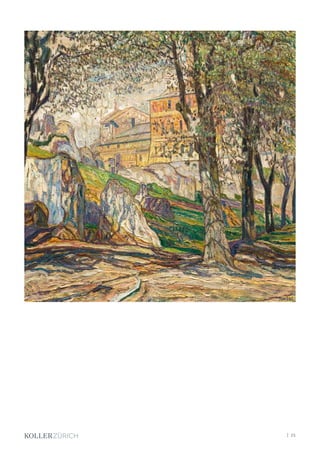
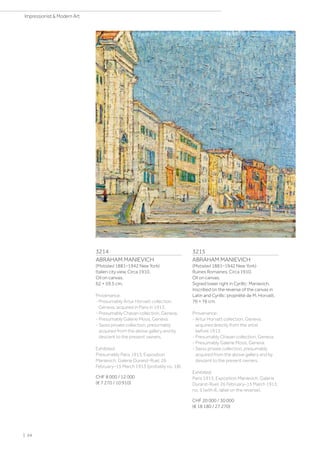
3214
ABRAHAM MANIEVICH
(Mszislau 1881–1942 New York)
Italienische Stadtansicht. Um 1910.
Öl auf Leinwand.
62 × 59,5 cm.
Provenienz:
- Wohl Sammlung Artur Horvatt, Genf,
1913 in Paris erworben.
- Wohl Sammlung Chavan, Genf.
- Wohl Galerie Moos, Genf.
- Schweizer Privatsammlung, wohl in
obiger Galerie erworben und durch Erb-
schaft an die heutigen Besitzer.
Ausstellung:
Wohl Paris 1913, Exposition Manievich,
Galerie Durand-Ruel, 26. Februar–15. März
1913 (möglicherweise Nr. 18).
CHF 8 000 / 12 000
(€ 7 270 / 10 910)
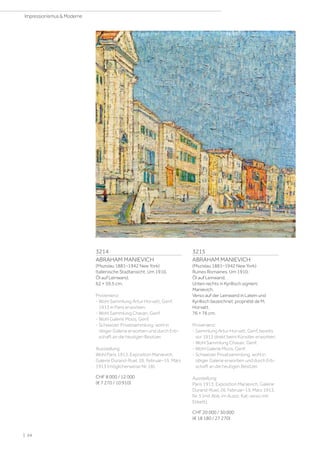
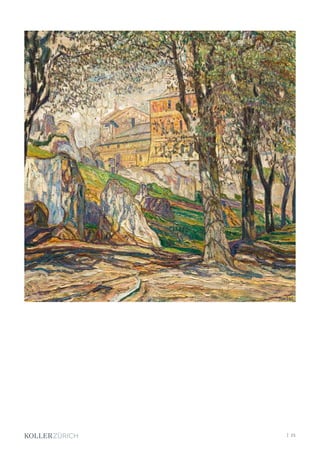
3215
ABRAHAM MANIEVICH
(Mszislau 1881–1942 New York)
Ruines Romaines. Um 1910.
Öl auf Leinwand.
Unten rechts in Kyrillisch signiert:
Manievich.
Verso auf der Leinwand in Latein und
Kyrillisch bezeichnet: propriété de M.
Horvatt.
76 × 76 cm.
Provenienz:
- Sammlung Artur Horvatt, Genf, bereits
vor 1913 direkt beim Künstler erworben.
- Wohl Sammlung Chavan, Genf.
- Wohl Galerie Moos, Genf.
- Schweizer Privatsammlung, wohl in
obiger Galerie erworben und durch Erb-
schaft an die heutigen Besitzer.
Ausstellung:
Paris 1913, Exposition Manievich, Galerie
Durand-Ruel, 26. Februar–15. März 1913,
Nr. 5 (mit Abb. im Ausst. Kat; verso mit
Etikett).
CHF 20 000 / 30 000
(€ 18 180 / 27 270)
| 24
Impressionismus  Moderne
| 25
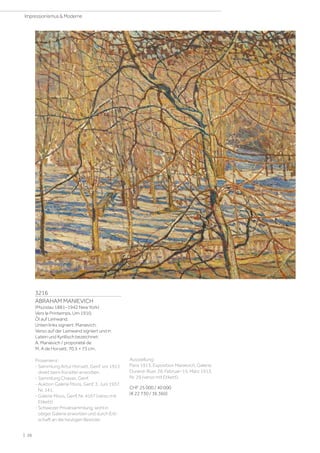
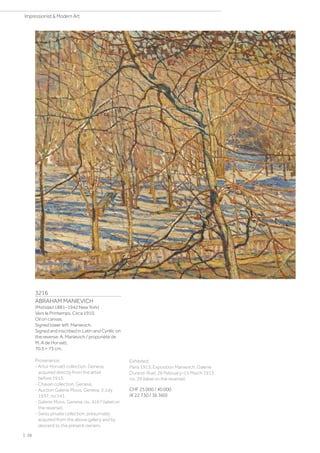
3216
ABRAHAM MANIEVICH
(Mszislau 1881–1942 New York)
Vers le Printemps. Um 1910.
Öl auf Leinwand.
Unten links signiert: Manievich.
Verso auf der Leinwand signiert und in
Latein und Kyrillisch bezeichnet:
A. Manievich / proporiété de
M. A de Horvatt. 70,5 × 73 cm.
Provenienz:
- Sammlung Artur Horvatt, Genf, vor 1913
direkt beim Künstler erworben.
- Sammlung Chavan, Genf.
- Auktion Galerie Moos, Genf, 3. Juni 1937,
Nr. 141.
- Galerie Moos, Genf, Nr. 4167 (verso mit
Etikett)
- Schweizer Privatsammlung, wohl in
obiger Galerie erworben und durch Erb-
schaft an die heutigen Besitzer.
Ausstellung:
Paris 1913, Exposition Manievich, Galerie
Durand-Ruel, 26. Februar–15. März 1913,
Nr. 29 (verso mit Etikett).
CHF 25 000 / 40 000
(€ 22 730 / 36 360)
| 26
Impressionismus  Moderne
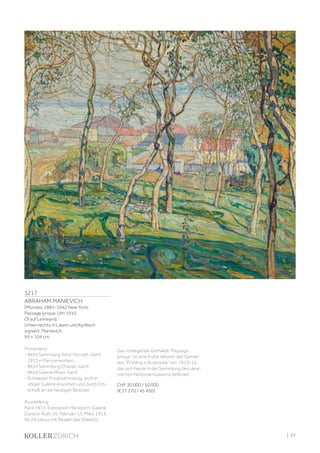
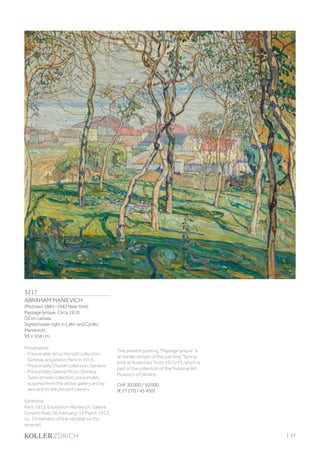
3217
ABRAHAM MANIEVICH
(Mszislau 1881–1942 New York)
Paysage lyrique. Um 1910.
Öl auf Leinwand.
Unten rechts in Latein und Kyrillisch
signiert: Manievich.
95 × 104 cm.
Provenienz:
- Wohl Sammlung Artur Horvatt, Genf,
1913 in Paris erworben.
- Wohl Sammlung Chavan, Genf.
- Wohl Galerie Moos, Genf.
- Schweizer Privatsammlung, wohl in
obiger Galerie erworben und durch Erb-
schaft an die heutigen Besitzer.
Ausstellung:
Paris 1913, Exposition Manievich, Galerie
Durand-Ruel, 26. Februar–15. März 1913,
Nr. 24 (verso mit Resten des Etiketts).
Das vorliegende Gemälde Paysage
lyrique ist eine frühe Version des Gemäl-
des Frühling in Kurenivka von 1913–15,
das sich heute in der Sammlung des ukrai-
nischen Nationalmuseums befindet.
CHF 30 000 / 50 000
(€ 27 270 / 45 450)
| 27
3218
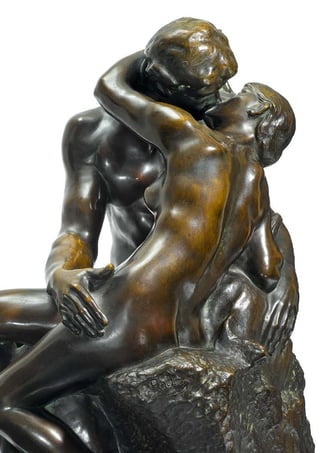
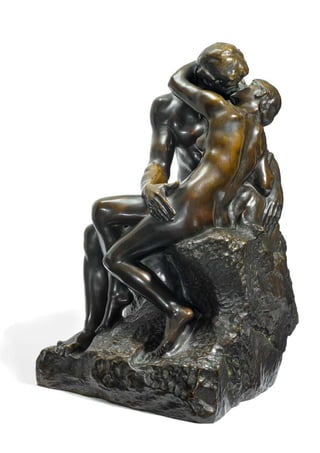
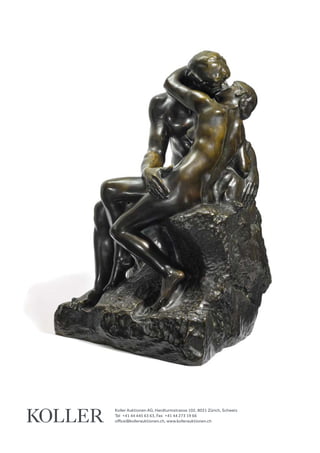
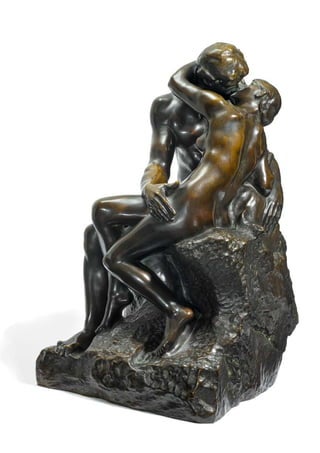
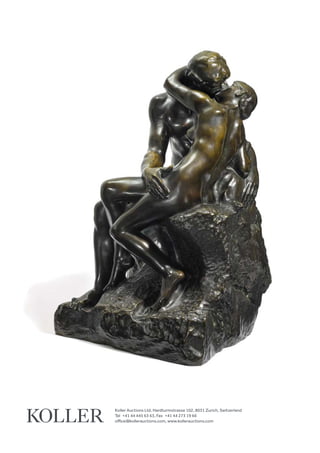
AUGUSTE RODIN
(Paris 1840–1917 Meudon)
Le Baiser. 2ème réduction dite aussi
réduction n°4. 1886.
Guss vom 8. Juni 1905.
Bronze, braune Patina.
Mittig rechts signiert: Rodin.
Unten links mit dem Giesserstempel:
F. Barbedienne. Fondeur.
Innen mit den eingravierten Nummerie-
rungen 996 und dreimal 9, der Bezeich-
nung D am Rand und der Nummerierung
in Tinte 62451 gulg.
H 59,8 cm.
Wir danken der Galerie Brame  Loren-
ceau, François Lorenceau und Jérôme Le
Blay, für die Bestätigung der Authentizität
des Werks, Paris, 28. Februar 2021. Es
wird unter der Nummer 2021-6289B in
den sich in Vorbereitung befindenden
Catalogue critique de l'œuvre sculpté
d’Auguste Rodin aufgenommen.
Provenienz:
Schweizer Privatbesitz, zwischen 1905
und 1910 in Paris erworben und seitdem
im gleichen Familienbesitz.
Literatur:
- Antoinette Le Normand-Romain: The
Bronzes of Rodin, Catalogue of Works in
the Musée Rodin, Paris 2007, Bd. I, Nr. S.
776 (mit Abb. anderer Guss S. 161).
- Georges Grappe: Catalogue du Musée
Rodin, Paris 1927 (mit Abb. des Marmors
S. 47).
- Georges Grappe: Le Musée Rodin, Paris
1947 (mit Abb. des Marmors S. 71).
- Cécile Goldscheider: Rodin, sa vie, son
œuvre, son héritage, Paris 1962 (mit Abb.
des Marmors).
- Albert E. Else: Rodin, London 1963, S. 63
(mit Abb. anderer Guss).
- Bernard Champigneulle: Rodin, London
1967 (mit Abb. des Marmors S. 162/163).
- Robert Descharnes und Jean François
Chabrun: Auguste Rodin, Lausanne 1967
(mit Abb. des Marmors S. 54/55).
- Ionel Jianou und Cécile Goldscheider:
Rodin, Paris 1967 (mit Abb. des Marmors
S. 54/55).
- Ludwig Goldscheider: Rodin Sculptures,
London 1970 (mit Abb. des Marmors S.
121).
- John L. Tancock: The Sculpture of
Auguste Rodin, Philadelphia 1976 (mit
Abb. des Marmors S. 77).
- Jacques de Caso und Patricia Sanders:
Rodin's Sculpture, A Critical Study of the
Spreckels Collection, California Palace of
the Legion of Honor, San Francisco 1977,
S. 150 (mit Abb. anderer Guss).
- Nicole Barbier: Marbres de Rodin,
collection du musée, Paris 1987 (mit Abb.
des Marmors S. 186/187).
- Antoinette Le Normand-Romain: Le
Baiser de Rodin/The Kiss by Rodin, Paris
1995 (mit Abb. anderer Guss Fig. 3).
- Antoinette Le Normand-Romain: Rodin,
Paris 1997 (mit Abb. des Terracottas
S. 48).
- Albert E. Else: Rodin's Art, The Rodin
Collection of the Iris  B. Gerald Cantor
Center for the Visual Arts at Stanford
University, New York 2003 (mit Abb.
anderer Guss S. 214/215).
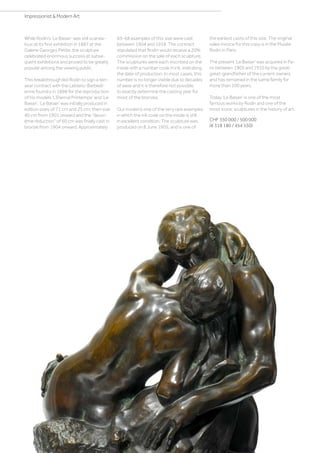
“Le Baiser” war ursprünglich als Teil von
Auguste Rodins Höllentor geplant. Die
Figur entsteht als eine der ersten Skulp-
turengruppen, wird zwischen 1880 und
1882 ausgearbeitet und sollte am linken
Flügel des monumentalen Tors ange-
bracht werden. Das dargestellte Paar
basiert auf der Geschichte der verbotenen
Liebe zwischen Francesca da Rimini und
Paolo Malatesta, von der Dante im zweiten
Höllenkreis des Infernos seiner göttlichen
Komödie berichtet. Obwohl Francesca be-
reits mit Giovanni Malatesta, dem älteren
Bruder Paolos, verheiratet ist, verlieben sie
und Paolo sich während des gemeinsamen
Lesens ineinander. Laut Überlieferung
küssen sich die Liebenden zum ersten Mal,
als der Ehemann von Francesca die beiden
erwischt. In Rage über den Verrat seines
Bruders und seiner Frau ermordet er das
Liebespaar. Von dort an sind Francesca
und Paolo verdammt zur Ewigkeit in der
Hölle.
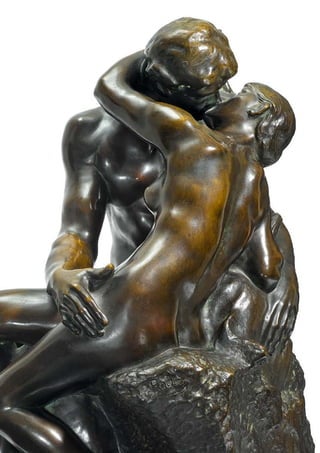
Rodin stellt in seiner Skulptur diesen
intimen Moment des ersten Kusses dar.
Die liebliche Botschaft und die Schönheit
dieser Skulptur sind dem Künstler für
sein Höllentor schliesslich doch zu wenig
tragisch, weswegen sich Rodin 1886 dazu
entschliesst, „Le Baiser“ vom Kanon des
| 28
Impressionismus  Moderne
Höllentors zu trennen und eine eigenstän-
dige Skulptur daraus zu machen.
Galt der Kuss auf der ersten Ausstellung
1887 in der Galerie Georges Petit noch
als skandalös, feierte „Le Baiser“ bei den
darauffolgenden Ausstellungen einen
enormen Erfolg und erfreute sich beim
Ausstellungspublikum grosser Beliebtheit.
Aufgrund dieses Durchbruchs schloss
Rodin 1898 einen 10-Jahresvertrag mit
der Giesserei Leblanc-Barbedienne über
die Reproduktion seiner Modelle „L’Eternal
Printemps“ und „Le Baiser“ ab. Zuerst
erschien der Kuss in den Grössen 71 cm
und 25 cm, ab 1901 dann in der Grösse
40 cm und ab 1904 wurde schliesslich die
„deuxième réduction“ von 60 cm in Bronze
gegossen. Von dieser Grösse wurden zwi-
schen 1904 und 1918 ca. 65–69 Exempla-
re gegossen. Vertraglich war geregelt, dass
Rodin für den Verkauf jeder Skulptur eine
Provision von 20 % erhalten soll. Die Skulp-
turen wurden jeweils im Innern mit einem
Nummerncode in Tinte beschriftet, der für
das Datum der Entstehung steht. In den
meisten Fällen ist diese Nummer durch die
jahrzehntelange Abnutzung nicht mehr
ersichtlich und deshalb ist bei den meisten
Bronzen nicht genau nachvollziehbar, wann
sie gegossen worden sind. Unser Modell
ist eines der sehr seltenen Exemplare,
bei dem der Tintencode im Innern noch
hervorragend erhalten ist. Die Skulptur ist
auf den Tag genau am 8. Juni 1905 ent-
standen und ist somit einer der frühesten
Abgüsse dieser Grösse. Die ursprüngliche
Verkaufsrechnung zu diesem Exemplar
befindet sich im Musée Rodin in Paris.
Der vorliegende „Le Baiser“ wurde
zwischen 1905 und 1910 vom Ur-Ur-
Grossvater der heutigen Besitzer in Paris
erworben und blieb bis heute, seit mehr als
100 Jahren, im gleichen Familienbesitz.
Heute zählt die Skulptur zu den berühm-
testen Werken Rodins und ist eine der
bekanntesten Plastiken überhaupt.
CHF 350 000 / 500 000
(€ 318 180 / 454 550)
Impressionismus  Moderne
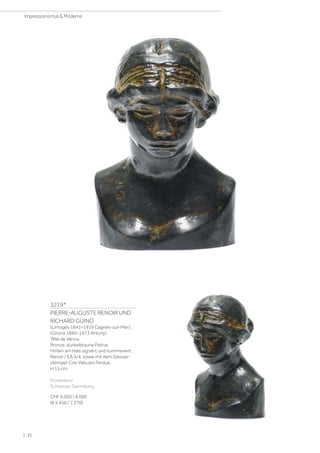
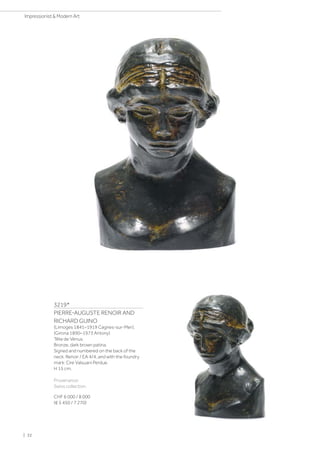
3219*
PIERRE-AUGUSTE RENOIR UND
RICHARD GUINO
(Limoges 1841–1919 Cagnes-sur-Mer);
(Girona 1890–1973 Antony)
Tête de Vénus.
Bronze, dunkelbraune Patina.
Hinten am Hals signiert und nummeriert:
Renoir / EA 4/4, sowie mit dem Giesser-
stempel: Cire Valsuani Perdue.
H 15 cm.
Provenienz:
Schweizer Sammlung.
CHF 6 000 / 8 000
(€ 5 450 / 7 270)
| 32
Impressionismus  Moderne
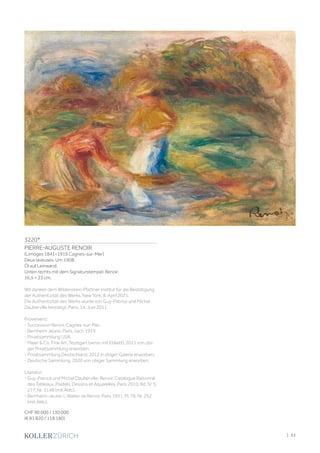
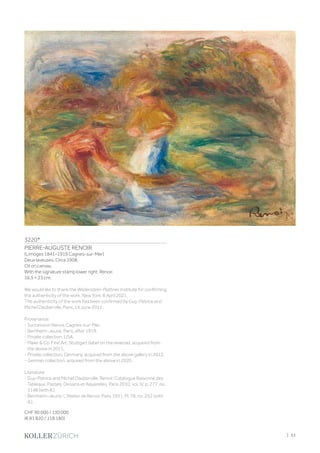
3220*
PIERRE-AUGUSTE RENOIR
(Limoges 1841–1919 Cagnes-sur-Mer)
Deux laveuses. Um 1908.
Öl auf Leinwand.
Unten rechts mit dem Signaturstempel: Renoir.
16,5 × 23 cm.
Wir danken dem Wildenstein-Plattner Institut für die Bestätigung
der Authentizität des Werks, New York, 8. April 2021.
Die Authentizität des Werks wurde von Guy-Patrice und Michel
Dauberville bestätigt, Paris, 14. Juni 2011.
Provenienz:
- Succession Renoir, Cagnes-sur-Mer.
- Bernheim Jeune, Paris, nach 1919.
- Privatsammlung USA.
- Maier  Co. Fine Art, Stuttgart (verso mit Etikett), 2011 von obi-
ger Privatsammlung erworben.
- Privatsammlung Deutschland, 2012 in obiger Galerie erworben.
- Deutsche Sammlung, 2020 von obiger Sammlung erworben.
Literatur:
- Guy-Patrice und Michel Dauberville: Renoir. Catalogue Raisonné
des Tableaux, Pastels, Dessins et Aquarelles, Paris 2010, Bd. IV, S.
277, Nr. 3148 (mit Abb.).
- Bernheim-Jeune: L'Atelier de Renoir, Paris 1931, Pl. 78, Nr. 252
(mit Abb.).
CHF 90 000 / 130 000
(€ 81 820 / 118 180)
| 33
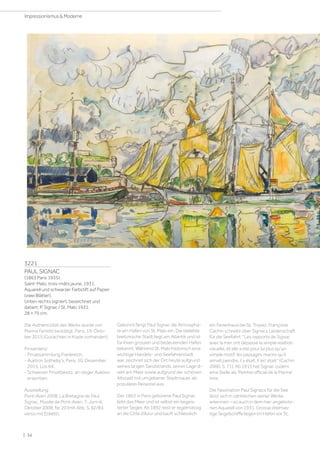
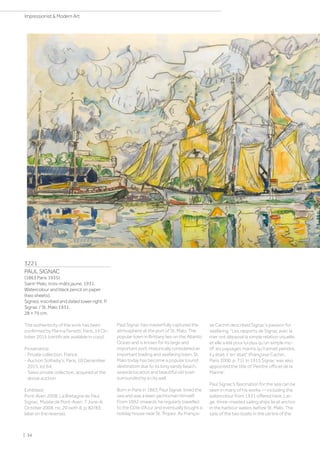
3221
PAUL SIGNAC
(1863 Paris 1935)
Saint-Malo, trois-mâts jaune. 1931.
Aquarell und schwarzer Farbstift auf Papier
(zwei Blätter).
Unten rechts signiert, bezeichnet und
datiert: P. Signac / St. Malo 1931.
28 × 75 cm.
Die Authentizität des Werks wurde von
Marina Ferretti bestätigt, Paris, 19. Okto-
ber 2015 (Gutachten in Kopie vorhanden).
Provenienz:
- Privatsammlung Frankreich.
- Auktion Sotheby's, Paris, 10. Dezember
2015, Los 64.
- Schweizer Privatbesitz, an obiger Auktion
erworben.
Ausstellung:
Pont-Aven 2008, La Bretagne de Paul
Signac, Musée de Pont-Aven, 7. Juni–6.
Oktober 2008, Nr. 20 (mit Abb. S. 82/83;
verso mit Etikett).
Gekonnt fängt Paul Signac die Atmosphä-
re am Hafen von St. Malo ein. Die beliebte
bretonische Stadt liegt am Atlantik und ist
für ihren grossen und bedeutenden Hafen
bekannt. Während St. Malo historisch eine
wichtige Handels- und Seefahrerstadt
war, zeichnet sich der Ort heute aufgrund
seines langen Sandstrands, seiner Lage di-
rekt am Meer sowie aufgrund der schönen
Altstadt mit umgebener Stadtmauer als
populäres Reiseziel aus.
Der 1863 in Paris geborene Paul Signac
liebt das Meer und ist selbst ein begeis-
terter Segler. Ab 1892 reist er regelmässig
an die Côte d’Azur und kauft schliesslich
ein Ferienhaus bei St. Tropez. Françoise
Cachin schreibt über Signacs Leidenschaft
für die Seefahrt: Les rapports de Signac
avec la mer ont dépassé la simple relation
visuelle, et elle a été pour lui plus qu’un
simple motif: les paysages marins qu’il
aimait peindre, il y était, il ‘en’ était (Cachin
2000, S. 71). Ab 1915 hat Signac zudem
eine Stelle als ‘Peintre officiel de la Marine’
inne.
Die Faszination Paul Signacs für die See
lässt sich in zahlreichen seiner Werke
erkennen – so auch in dem hier angebote-
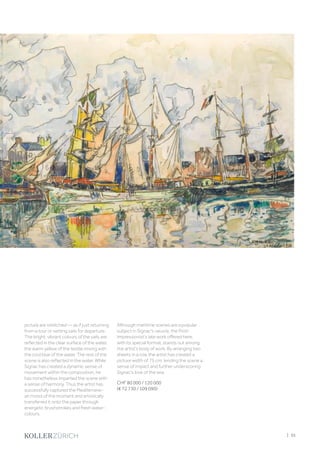
nen Aquarell von 1931. Grosse dreimas-
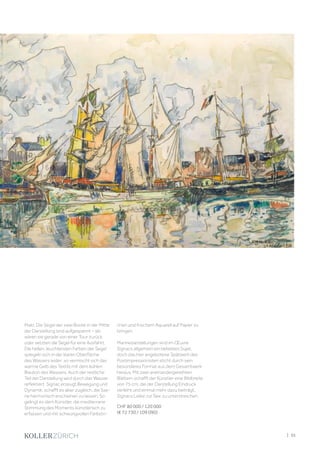
tige Segelschiffe liegen im Hafen vor St.
| 34
Impressionismus  Moderne
Malo. Die Segel der zwei Boote in der Mitte
der Darstellung sind aufgespannt – als
wären sie gerade von einer Tour zurück
oder setzten die Segel für eine Ausfahrt.
Die hellen, leuchtenden Farben der Segel
spiegeln sich in der klaren Oberfläche
des Wassers wider: so vermischt sich das
warme Gelb des Textils mit dem kühlen
Blauton des Wassers. Auch der restliche
Teil der Darstellung wird durch das Wasser
reflektiert. Signac erzeugt Bewegung und
Dynamik, schafft es aber zugleich, die Sze-
ne harmonisch erscheinen zu lassen. So
gelingt es dem Künstler, die mediterrane
Stimmung des Moments künstlerisch zu
erfassen und mit schwungvollen Farbstri-
chen und frischem Aquarell auf Papier zu
bringen.
Marinedarstellungen sind im Œuvre
Signacs allgemein ein beliebtes Sujet,
doch das hier angebotene Spätwerk des
Postimpressionisten sticht durch sein
besonderes Format aus dem Gesamtwerk
heraus. Mit zwei aneinandergereihten
Blättern schafft der Künstler eine Bildbreite
von 75 cm, die der Darstellung Eindruck
verleiht und einmal mehr dazu beiträgt,
Signacs Liebe zur See zu unterstreichen.
CHF 80 000 / 120 000
(€ 72 730 / 109 090)
| 35
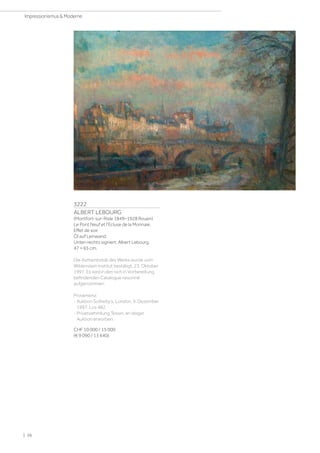
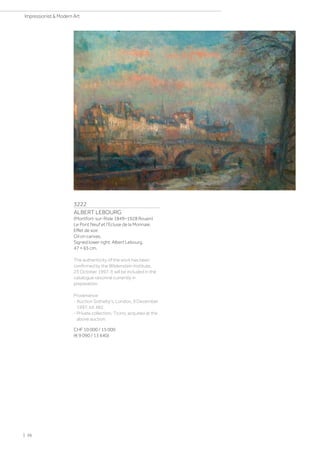
3222
ALBERT LEBOURG
(Montfort-sur-Risle 1849–1928 Rouen)
Le Pont Neuf et l’Ecluse de la Monnaie,
Effet de soir.
Öl auf Leinwand.
Unten rechts signiert: Albert Lebourg.
47 × 65 cm.
Die Authentizität des Werks wurde vom
Wildenstein Institut bestätigt, 23. Oktober
1997. Es wird in den sich in Vorbereitung
befindenden Catalogue raisonné
aufgenommen.
Provenienz:
- Auktion Sotheby's, London, 9. Dezember
1997, Los 482.
- Privatsammlung Tessin, an obiger
Auktion erworben.
CHF 10 000 / 15 000
(€ 9 090 / 13 640)
| 36
Impressionismus  Moderne
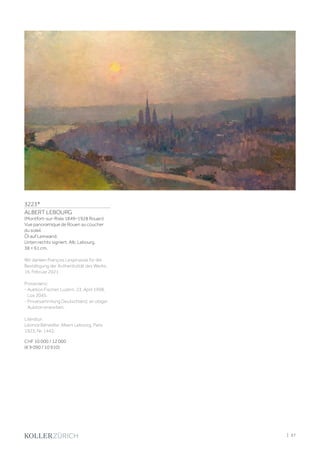
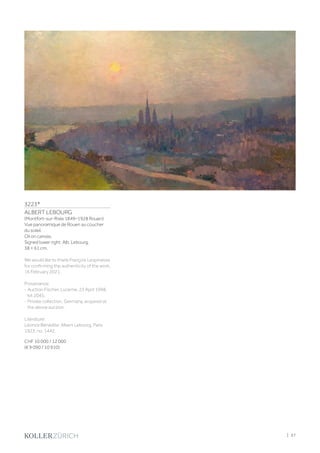
3223*
ALBERT LEBOURG
(Montfort-sur-Risle 1849–1928 Rouen)
Vue panoramique de Rouen au coucher
du soleil.
Öl auf Leinwand.
Unten rechts signiert: Alb. Lebourg.
38 × 61 cm.
Wir danken François Lespinasse für die
Bestätigung der Authentizität des Werks,
16. Februar 2021.
Provenienz:
- Auktion Fischer, Luzern, 23. April 1998,
Los 2045.
- Privatsammlung Deutschland, an obiger
Auktion erworben.
Literatur:
Léonce Bénédite: Albert Lebourg, Paris
1923, Nr. 1442.
CHF 10 000 / 12 000
(€ 9 090 / 10 910)
| 37
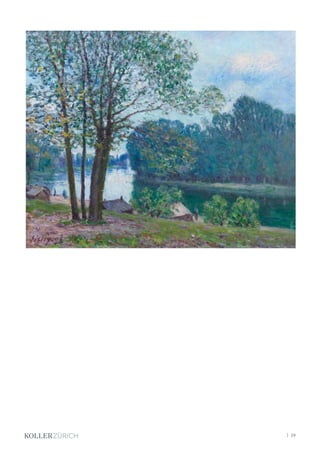
3224
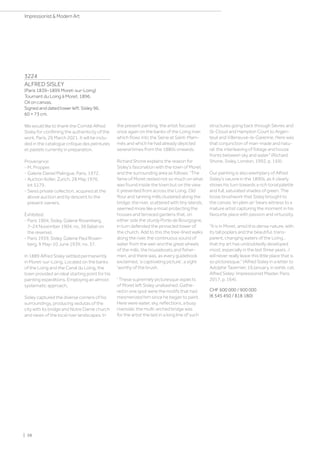
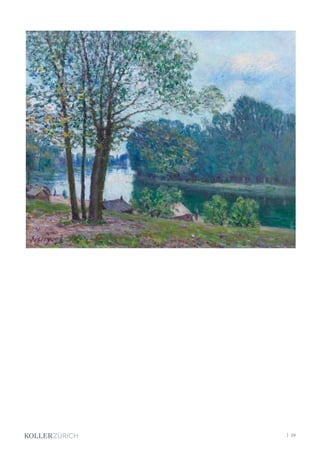
ALFRED SISLEY
(Paris 1839–1899 Moret-sur-Loing)
Tournant du Loing à Moret. 1896.
Öl auf Leinwand.
Unten links signiert und datiert: Sisley 96.
60 × 73 cm.
Wir danken dem Comité Alfred Sisley für
die Bestätigung der Authentizität des
Werks, Paris, 29. März 2021. Es wird in den
sich in Vorbereitung befindenden Cata-
logue critique des peintures et pastels
aufgenommen.
Provenienz:
- M. Propper.
- Galerie Daniel Malingue, Paris, 1972.
- Auktion Koller, Zürich, 28. Mai 1976, Los
5179.
- Schweizer Privatsammlung, an obiger
Auktion erworben und durch Erbschaft
an die heutigen Besitzer.
Ausstellungen:
- Paris 1904, Sisley, Galerie Rosenberg,
7.–24. November 1904, Nr. 36 (verso mit
Etikett).
- Paris 1939, Sisley, Galerie Paul Rosen-
berg, 9. Mai–10. Juni 1939, Nr. 37.
1889 lässt sich Alfred Sisley endgültig in
Moret-sur-Loing nieder. Am Ufer der Loing
gelegen, ist das Städtchen ein idealer Aus-
gangspunkt für seine malerischen Expedi-
tionen. Mit einem beinahe systematischen
Vorgehen fängt Sisley die verschiedenen
Winkel der Umgebung ein. Es entstehen
Veduten wie die der Stadt mit ihrer Brücke,
und der Kirche Notre-Dame und Ansich-
ten der umliegenden Flusslandschaften.
Auf die Ufer des Flüsschens Loing, das
bei Saint-Mammès in die Seine mündet
und die er ab den 1880er-Jahren bereits
mehrfach dargestellt hat, konzentriert er
sich nun erneut.
Der Grund für die Faszination, die Sisley
für das Städtchen Moret und die nähere
Umgebung hegt, erörtert Richard Shone
folgendermassen: Der Ruhm von Moret
beruhte nicht so sehr auf dem, was im
Inneren der Stadt zu finden war, sondern
auf dem Blick, den sie von der anderen
Seite des Loing bot. Alte Mehl- und Ger-
bermühlen reihten sich entlang der Brücke
aneinander; der Fluss, der mit winzigen
Inseln übersät war, wirkte eher wie ein
Wassergraben, der die Häuser und terras-
senförmig angelegten Gärten schützte,
die zu beiden Seiten der robusten Porte
de Bourgogne lagen, die ihrerseits den
mit Fialen versehenen Turm der Kirche
verteidigte. Dazu kamen die von Bäumen
gesäumten Spazierwege entlang des Flus-
ses, das ständige Rauschen des Wassers
vom Wehr und den grossen Rädern der
Mühlen, die Hausboote und Fischer, und es
ergab sich, wie jeder Reiseführer ausrief,
ein fesselndes Bild, ein Anblick, der eines
Pinsels würdig ist. Diese überaus pittores-
ken Aspekte von Moret liessen Sisley keine
Ruhe. An einem Ort waren die Motive ver-
sammelt, die ihn seit Beginn seiner Malerei
faszinierten. Hier waren Wasser, Himmel,
Spiegelungen, ein belebtes Flussufer; die
mehrbogige Brücke war für den Künstler
die letzte in einer langen Reihe solcher
Bauwerke, die über Sèvres und St. Cloud
und Hampton Court bis nach Argenteuil
und Villeneuve-la-Garenne zurückreicht.
Hier gab es diese Verbindung von Mensch
und Natur, die Verflechtung von Laub und
Häuserfronten zwischen Himmel und
Wasser (Shone, 1992, S. 159).
Exemplarisch für das Schaffen Alfred
Sisleys in den 1890er-Jahren ist unser Ge-
mälde Tournant du Loing à Moret auch
deshalb, weil sich darin besonders deutlich
seine Hinwendung zu einer tonigen Farb-
palette und zu vollen, satten Grüntönen
offenbart. Die lockeren Pinselstriche, die
Sisley hier en plein air  auf die Leinwand
überträgt, zeugen von einem reifen Künst-
ler, der leidenschaftlich und mit grosser
Könnerschaft den Moment an seinem
liebsten Ort festhält.
C’est à Moret, devant cette nature touf-
fue, ses grands peupliers, cette eau de
Loing si belle, si transparente, si changean-
te, c’est à Moret certainement que j’ai fait
le plus de progrès dans mon art, surtout
depuis trois ans…je ne quitterai jamais
complètement ce coin si pittoresque.
(Alfred Sisley in einem Brief an Adolphe
Tavernier, 19. Januar 1892, in: Ausst. Kat.
Alfred Sisley: Impressionist Master, Paris
2017, S. 164)
CHF 600 000 / 900 000
(€ 545 450 / 818 180)
| 38
Impressionismus  Moderne
| 39
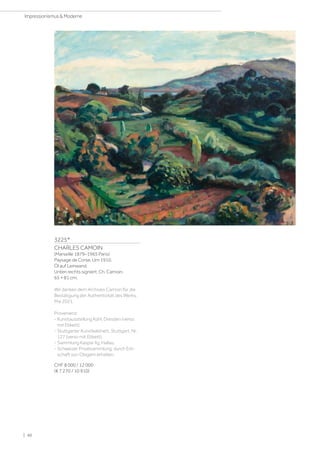
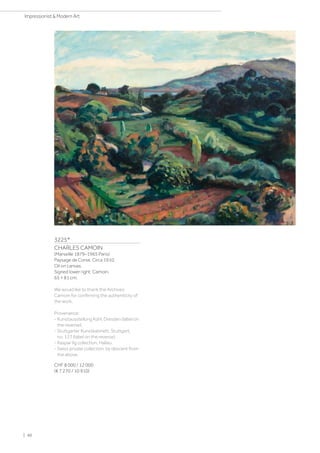
3225*
CHARLES CAMOIN
(Marseille 1879–1965 Paris)
Paysage de Corse. Um 1910.
Öl auf Leinwand.
Unten rechts signiert: Ch. Camoin.
65 × 81 cm.
Wir danken dem Archives Camoin für die
Bestätigung der Authentizität des Werks,
Mai 2021.
Provenienz:
- Kunstausstellung Kühl, Dresden (verso
mit Etikett).
- Stuttgarter Kunstkabinett, Stuttgart, Nr.
127 (verso mit Etikett).
- Sammlung Kaspar Ilg, Hallau.
- Schweizer Privatsammlung, durch Erb-
schaft von Obigem erhalten.
CHF 8 000 / 12 000
(€ 7 270 / 10 910)
| 40
Impressionismus  Moderne
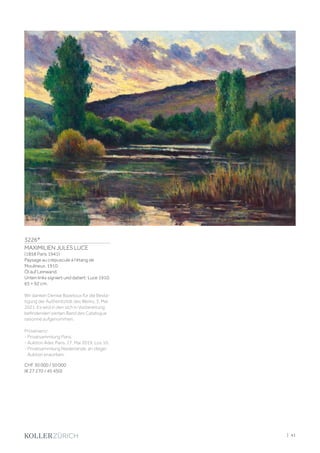
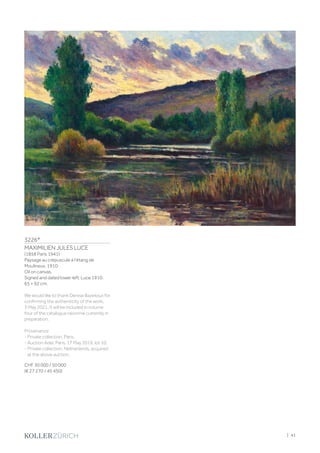
3226*
MAXIMILIEN JULES LUCE
(1858 Paris 1941)
Paysage au crépuscule à l'étang de
Moulineux. 1910.
Öl auf Leinwand.
Unten links signiert und datiert: Luce 1910.
65 × 92 cm.
Wir danken Denise Bazetoux für die Bestä-
tigung der Authentizität des Werks, 3. Mai
2021. Es wird in den sich in Vorbereitung
befindenden vierten Band des Catalogue
raisonné aufgenommen.
Provenienz:
- Privatsammlung Paris.
- Auktion Ader, Paris, 17. Mai 2019, Los 10.
- Privatsammlung Niederlande, an obiger
Auktion erworben.
CHF 30 000 / 50 000
(€ 27 270 / 45 450)
| 41
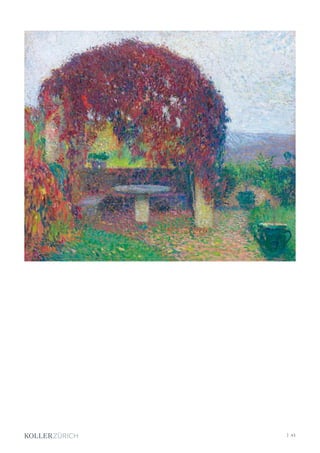
3227*
HENRI MARTIN
(Toulouse 1860–1943 Labastide-du-Vert)
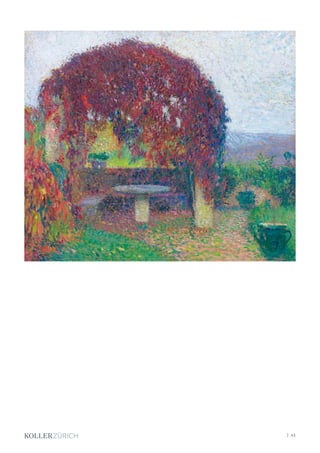
Pergola Nord-Ouest de Marquayrol en fin
d'automne. 1910–20.
Öl auf Leinwand.
Unten links signiert: Henri Martin.
68,5 × 82 cm.
Die Authentizität des Werkes wurde von
Cyrille Martin bestätigt, Neuilly-sur-Seine,
12. Januar 2017.
Provenienz:
- Galerie Félix Vercel, Paris.
- Privatsammlung Caracas, am 25. Mai
1971 in obiger Galerie erworben.
- Privatsammlung Deutschland.
Nach 10 Jahren auf der Suche nach dem
perfekten Landhaus kauft Henri Martin im
Jahr 1900 im Alter von 40 Jahren das aus
dem 17. Jahrhundert stammende grosse
Haus Marquayrol im Dorf Labastide-du-
Vert im Lot im Südwesten Frankreichs. Das
Haus und die Region werden zu Martins
Sommerurlaubsort, wo er sich zwischen
Mai und November aus der Grossstadt
Paris zurückzieht, um die Gelassenheit der
Natur zu geniessen.
Das auf einem Hügel stehende Haus mit
grosser Terrasse und Blick auf das Dorf
und das umliegende Tal wird zu Martins
wichtigster Inspirationsquelle und beein-
flusst seinen Stil nachhaltig. Anders als
in Paris herrscht hier ein südliches Licht,
das ihn künstlerisch anspornt und sein
Auge anregt. Die friedliche Umgebung
zusammen mit Natur und Licht wird mehr
als 40 Jahre lang zu Martins bevorzugtem
Sujet. Dieser Umzug zum Lot im Alter
von 40 Jahren stellt einen entscheidenden
Wendepunkt in seinem künstlerischen
Schaffen dar. Musen und Leiern verschwin-
den von seinen Leinwänden und er wagt
es, sich täglich mit dem Licht des Südens
auseinanderzusetzen. (Juskiewenski
1993, S. 98)
Zu beiden Seiten des Anwesens befindet
sich eine Laube, eine kleine Pergola, la
petite, und eine grössere, la tonnerelle.
In dem vorliegenden Werk, welches in den
1920er-Jahren entsteht und ein schönes
Beispiel für den reifen Stil Martins ist, wird
die grosse Pergola la tonnerelle abgebil-
det. Die Darstellungen der Pergola greift
Martin während der ganzen Sommer- und
Herbstmonate wieder auf, sodass sich die
Farben der Blätter im Verlauf der Bilderzy-
klen ändern. Das herbstliche Rot, welches
unser Bild beherrscht, symbolisiert das
Ende der warmen Jahreszeit und die baldi-
ge Rückkehr Martins nach Paris.
Henri Martin war zweifellos ein Impressi-
onist und einer, der die tiefste Sensibilität
besass, die sicherlich der von Monet ent-
sprach, den er am meisten bewunderte.
Dank ihrer höchsten Sensibilität und nicht
durch die Erforschung eines technischen
Verfahrens ist ihre Interpretation der Natur
sicherlich eine poetische, von tausend Far-
ben gefärbte Evokation (...) Seine Palette
ist eine Verzauberung. Viele verschiede-
ne Vermischungen von Farben ergeben
eine seltene und reiche Harmonie... Und
es ist viel schwieriger, eine gute Harmo-
nie der Farben zu finden, wenn man die
Natur darstellt, als einige schöne Farben
zusammenzustellen, die nichts darstellen.
Hierin liegt die Gabe der Impressionisten,
und deshalb gibt es so wenige (Martin-
Ferrières 1967, S. 35–42).
CHF 80 000 / 120 000
(€ 72 730 / 109 090)
| 42
Impressionismus  Moderne
| 43
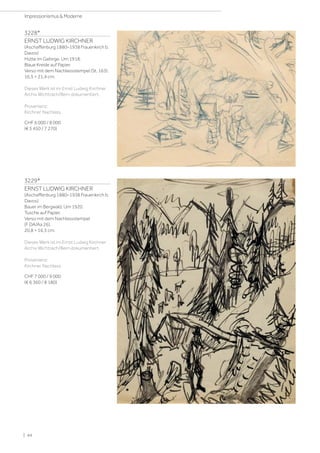
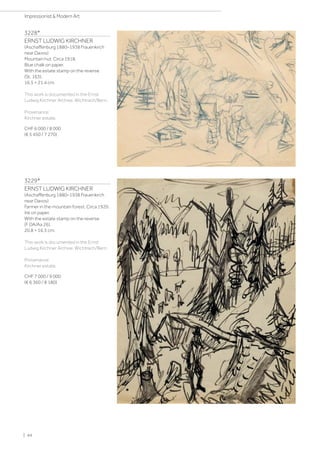
3228*
ERNST LUDWIG KIRCHNER
(Aschaffenburg 1880–1938 Frauenkirch b.
Davos)
Hütte im Gebirge. Um 1918.
Blaue Kreide auf Papier.
Verso mit dem Nachlassstempel (St. 163).
16,5 × 21,4 cm.
Dieses Werk ist im Ernst Ludwig Kirchner
Archiv Wichtrach/Bern dokumentiert.
Provenienz:
Kirchner Nachlass.
CHF 6 000 / 8 000
(€ 5 450 / 7 270)
3229*
ERNST LUDWIG KIRCHNER
(Aschaffenburg 1880–1938 Frauenkirch b.
Davos)
Bauer im Bergwald. Um 1920.
Tusche auf Papier.
Verso mit dem Nachlassstempel
(F DA/Aa 26).
20,8 × 16,3 cm.
Dieses Werk ist im Ernst Ludwig Kirchner
Archiv Wichtrach/Bern dokumentiert.
Provenienz:
Kirchner Nachlass.
CHF 7 000 / 9 000
(€ 6 360 / 8 180)
| 44
Impressionismus  Moderne
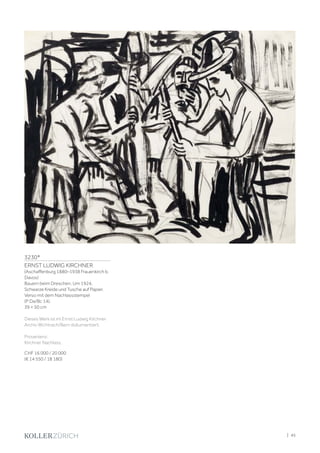
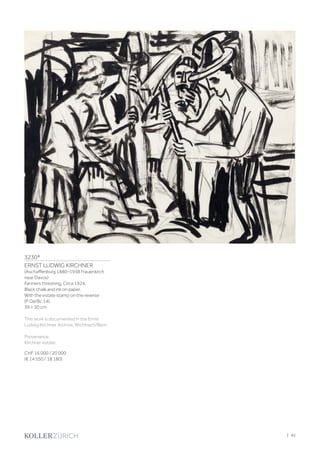
3230*
ERNST LUDWIG KIRCHNER
(Aschaffenburg 1880–1938 Frauenkirch b.
Davos)
Bauern beim Dreschen. Um 1924.
Schwarze Kreide und Tusche auf Papier.
Verso mit dem Nachlassstempel
(P Da/Bc 14).
39 × 50 cm
Dieses Werk ist im Ernst Ludwig Kirchner
Archiv Wichtrach/Bern dokumentiert.
Provenienz:
Kirchner Nachlass.
CHF 16 000 / 20 000
(€ 14 550 / 18 180)
| 45
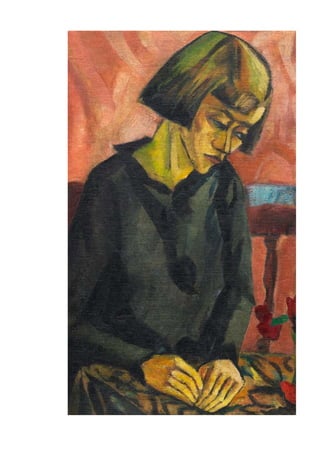
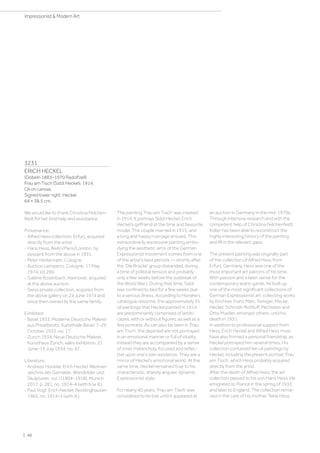
3231
ERICH HECKEL
(Döbeln 1883–1970 Radolfzell)
Frau am Tisch (Siddi Heckel). 1914.
Öl auf Leinwand.
Unten rechts signiert: Heckel.
64 × 38,5 cm.
Wir danken Christina Feilchenfeldt für die
freundliche Hilfe und die wissenschaftliche
Unterstützung.
Provenienz:
- Sammlung Alfred Hess, Erfurt, direkt
beim Künstler erworben.
- Hans Hess, Berlin/Paris/London, 1931
durch Erbschaft von Obigem erhalten.
- Peter Herkenrath, Köln.
- Auktion Lempertz, Köln, 17. Mai 1974,
Los 269.
- Galerie Rosenbach, Hannover, an obiger
Auktion erworben.
- Schweizer Privatsammlung, am 24. Juni
1974 in obiger Galerie erworben und
seither im gleichen Familienbesitz.
Ausstellungen:
- Basel 1933, Moderne Deutsche Malerei
aus Privatbesitz, Kunsthalle Basel, 7.–29.
Oktober 1933, Nr. 17.
- Zürich 1934, Neue Deutsche Malerei,
Verkaufsausstellung, Kunsthaus Zürich,
21. Juni–15. Juli 1934, Nr. 47.
Literatur:
- Andreas Hüneke: Erich Heckel. Werkver-
zeichnis der Gemälde, Wandbilder und
Skulpturen, Bd. I (1904–1918), München
2017, S. 281, Nr. 1914-4 (mit s/w Abb.).
- Paul Vogt: Erich Heckel, Recklinghausen
1965, Nr. 1914-3 (mit Abb.).
Das Gemälde Frau am Tisch entsteht
1914. Dargestellt ist Siddi Heckel, die
damalige Freundin und liebstes Modell
Erich Heckels. 1915 heiratet das Paar und
es folgt eine lange und glückliche Ehe.
Das ausserordentlich ausdrucksstarke,
typisch expressionistische Gemälde
stammt aus einer der besten Zeiten des
Künstlers - kurz nach der Auflösung der
Künstlergruppe die Brücke, zu einer Zeit
der politischen Spannungen und wohl nur
einige Wochen vor dem Ausbruch des
Ersten Weltkriegs. Gleichzeitig muss Siddi
durch eine schwere Erkrankung einige Wo-
chen das Krankenbett hüten. Die ungefähr
35 Ölgemälde, die Heckel laut Hünekes
Werkverzeichnis im Jahr 1914 malt, sind
vorwiegend Landschaften mit oder ohne
Figuren sowie einige wenige Porträts. Wie
auch bei Frau am Tisch malt der Künst-
ler die Porträtierten nicht bewegt oder
voller Lebensfreude, vielmehr werden sie
begleitet von einer inneren Melancholie,
konzentriert und besonnen auf das eigene
Sein. Sie sind ein Spiegel von Heckels
Gefühlswelt. Dabei bleibt Heckel stilistisch
seinem charakteristisch scharfkantigen,
dynamischen Expressionismus treu.
Frau am Tisch galt knapp 40 Jahre lang
als verschollen, bis es Mitte der 1970er-
Jahre an einer Auktion in Deutschland
wieder auftauchte. Durch intensive
Recherchen und mit der kompetenten
Hilfe von Christina Feilchenfeldt konnte
Koller die hoch interessante Geschichte
des Gemäldes rekonstruieren und die
fraglichen Lücken füllen.
Das zur Auktion kommende Gemälde
war ursprünglich im Besitz des Erfurter
Kunstsammlers Alfred Hess. Hess war
einer der bedeutendsten Kunstmäzenen
seiner Zeit. Mit Leidenschaft und grossem
Gespür für die zeitgenössische Avantgar-
de baute er bis zu seinem Tod 1931 eine
der wichtigsten Sammlungen Deutscher
Expressionistischer Kunst auf, die Werke
von Kirchner, Franz Marc, Feininger, Macke,
Heckel, Schmidt-Rottluff, Pechstein, Otto
Mueller etc. enthielt.
Erich Heckel und Alfred Hess muss neben
der beruflichen Unterstützung seitens
Hess auch eine persönliche Freundschaft
verbunden haben, hat Heckel ihn doch
mehrfach porträtiert. Seine Sammlung
beinhaltete 10 Ölgemälde von Heckel,
darunter auch das vorliegende Porträt
Frau am Tisch, welches Hess wohl direkt
bei Heckel erworben hatte.
Nach dem Tod von Alfred Hess ging die
Kunstsammlung an seinen Sohn Hans
Hess über. Dieser emigrierte im Frühjahr
1933 zunächst nach Frankreich und später
| 46
Impressionismus  Moderne
weiter nach England. Die Sammlung blieb
in der Obhut seiner Mutter Tekla Hess.
In der Hoffnung, die Kunstwerke in der
Schweiz vor dem Zugriff der Nationalso-
zialisten zu schützen und bei Gelegenheit
auch Käufer für die Kunstwerke zu finden,
versendete Tekla Hess im Sommer des
Jahres 1933 rund 100 Kunstwerke auf Frei-
pass nach Basel. Die Gemälde, darunter
auch Frau am Tisch, wurden in der Aus-
stellung Moderne deutsche Malerei aus
Privatbesitz im Oktober in der Kunsthalle
Basel präsentiert. Ein Jahr später wurde
das Porträt im Kunsthaus Zürich gezeigt,
wo es nach der Ausstellung zusammen
mit den anderen Werken der Sammlung
zunächst verblieb. Trotz der immer stärker
werdenden Repressionen gegenüber allen
Juden in Deutschland, bat Tekla Hess den
damaligen Direktor des Züricher Kunst-
hauses um Rücksendungen der Werke
aus ihrem Besitz nach Deutschland. Nach
dem Krieg bekundete Tekla Hess an Eides
statt, dass die Gestapo sie aufgefordert
hatte, die noch in der Schweiz befindlichen
Bilder der Sammlung nach Deutschland
zurückzuholen. Im März 1937 wurde ein
Transport von 70 Kunstwerken an den
Kölnischen Kunstverein getätigt, darunter
befand sich auch unser Werk von Erich
Heckel.
Der damalige Direktor des Kölnischen
Kunstvereins, Herr Walter Klug, hatte Frau
Hess eine kostenlose Aufbewahrung der
Bilder in Aussicht gestellt und bot diese
im Folgenden auch zum Verkauf an. Auf
diesem Weg wurde unter anderem das
bedeutende Gemälde Berliner Stras-
senszene von Ernst Ludwig Kirchner, das
ebenfalls nach Basel und Zürich versandt
und dann wieder nach Deutschland
zurückbeordert worden war, vom Kölni-
schen Kunstverein an den Sammler Carl
Hagemann verkauft.
Tekla Hess, die wie Ihr Mann jüdischer
Abstammung war, sah sich gezwungen,
vor dem Nationalsozialistischen Regime zu
fliehen und emigrierte 1939 nach England,
wo sich ihr Sohn bereits befand. Einen
Teil der Sammlung, vor allem Arbeiten auf
Papier aber auch einige Gemälde, hatte sie
noch vor ihrer Emigration zu ihrem Sohn
nach England senden können. Ein anderer
Teil der Sammlung blieb im Kölnischen
Kunstverein zurück. Der Hausmeister des
Kunstvereins, Joseph Jenniches, hatte
für die Lagerung der Bilder eine grosse
Holzkiste gezimmert und diese im Keller
des Kunstvereins untergestellt. In dieser
Kiste befand sich auch das Porträt von
Siddi Heckel.
DurcheinenBombenangriffam29.Juli1943
branntederKölnischeKunstvereinbisauf
denKellernieder.DiesichimKellerbefinden-
denKunstwerkeundGegenständewurden
einenTagspätermiteinemTransporterin
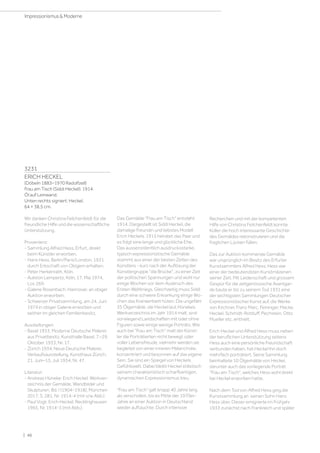
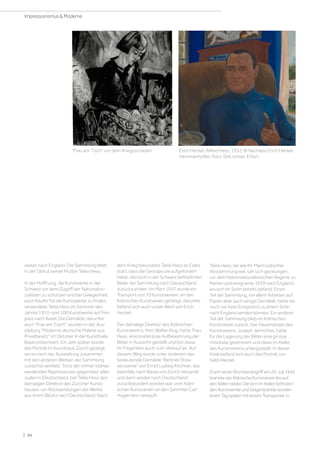
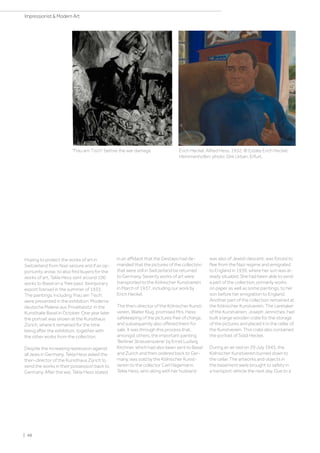
Frau am Tisch vor dem Kriegsschaden Erich Heckel, Alfred Hess, 1932; © Nachlass Erich Heckel,
Hemmenhofen; Foto: Dirk Urban, Erfurt.
| 48
Impressionismus  Moderne
Sicherheitgebracht.AufgrundPlatzmangels,
wieesspäterhieß,wurdedieKiste mitden
BildernderSammlungHesszurückgelassen
undgingdannvergessen.AlssichTeklaHess
nachdemKriegbemühte,etwasüberden
VerbleibdereingelagertenBilderzuerfahren,
wurdeihrmitgeteilt,dassdieBilderverbrannt
undnichtmehrvorhandenseien.
Was genaumitdemGemäldeFrauam
Tischgeschehenwar,konntebisheutenicht
vollständigaufgeklärtwerden.AlsJenni-
ches1945ausderKriegsgefangenschaft
zurückkehrte,fanderdenteilsunterWasser
stehendenKellervorunddarindieaufge-
brocheneHess-Kiste.Esistbekannt,dass
JennichesbereitsvordemKriegeinzelne
WerkeausderKisteentwendetundveräus-
serthatte,wofürer1950auchangeklagtund
verurteiltwordenwar.
Das Porträt von Siddi gelangte danach
an den Kunstmaler Peter Herkenrath.
Dieser hatte im Gerichtsprozess als Zeuge
zugegeben, zwei seiner vier Bilder aus der
Hess-Sammlung von Jenniches erworben
zu haben, Frau am Tisch erwähnte er in
diesem Fall aber nicht. Bekannt ist, dass
Herkenrath selber im Kellner des Kölni-
schen Kunstvereins gewesen war und sich
ein Gemälde von Heckel aus der Hess-
Kiste genommen hatte. Ob es sich dabei
um dieses Werk gehandelt hatte, ist aber
nicht beweisbar.
Das Gemälde hatte ursprünglich die Masse
80 × 70 cm, zeigte einen Tisch und etwas
mehr Hintergrund. In dem von Paul Vogt
erstellten Werkverzeichnis der Gemäl-
de von Erich Heckel aus dem Jahr 1965
wird Herkenrath als Besitzer des Werks
genannt sowie die Tatsache, dass das
Werk zu diesem Zeitpunkt aufgrund seines
Kriegsschadens unter Mitwirkung von
Erich Heckel bereits beschnitten und auch
von ihm erneut signiert worden war. Die
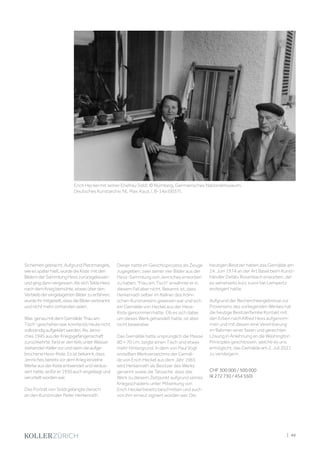
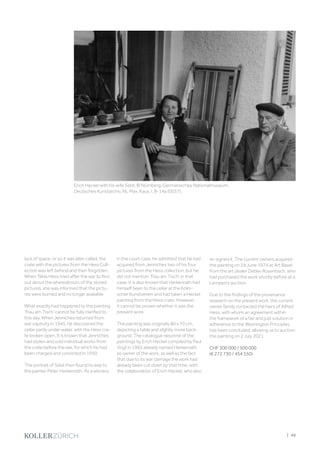
Erich Heckel mit seiner Ehefrau Siddi; © Nürnberg, Germanisches Nationalmuseum,
Deutsches Kunstarchiv, NL Max, Kaus, I, B-14a (0037).
heutigen Besitzer haben das Gemälde am
24. Juni 1974 an der Art Basel beim Kunst-
händler Detlev Rosenbach erworben, der
es seinerseits kurz zuvor bei Lempertz
ersteigert hatte.
Aufgrund der Rechercheergebnisse zur
Provenienz des vorliegenden Werkes hat
die heutige Besitzerfamilie Kontakt mit
den Erben nach Alfred Hess aufgenom-
men und mit diesen eine Vereinbarung
im Rahmen einer fairen und gerechten
Lösung in Anlehnung an die Washington
Priniciples geschlossen, welche es uns
ermöglicht, das Gemälde am 2. Juli 2021
zu versteigern.
CHF 300 000 / 500 000
(€ 272 730 / 454 550)
| 49
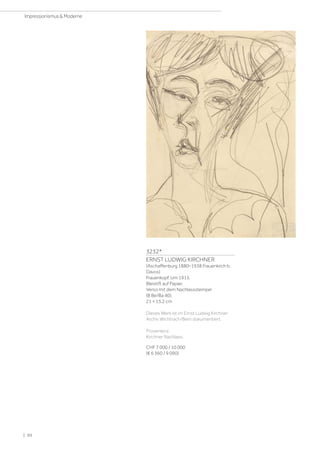
3232*
ERNST LUDWIG KIRCHNER
(Aschaffenburg 1880–1938 Frauenkirch b.
Davos)
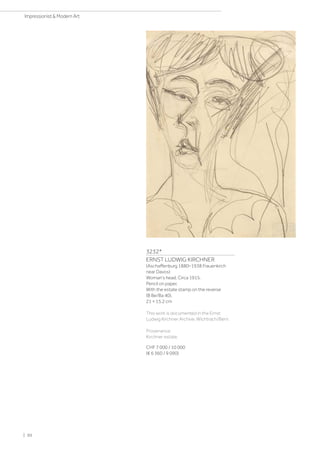
Frauenkopf. Um 1915.
Bleistift auf Papier.
Verso mit dem Nachlassstempel
(B Be/Ba 40).
21 × 15,2 cm
Dieses Werk ist im Ernst Ludwig Kirchner
Archiv Wichtrach/Bern dokumentiert.
Provenienz:
Kirchner Nachlass.
CHF 7 000 / 10 000
(€ 6 360 / 9 090)
| 50
Impressionismus  Moderne
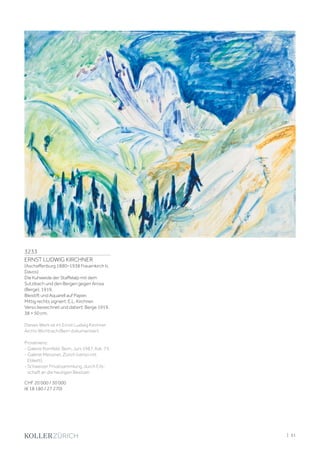
3233
ERNST LUDWIG KIRCHNER
(Aschaffenburg 1880–1938 Frauenkirch b.
Davos)
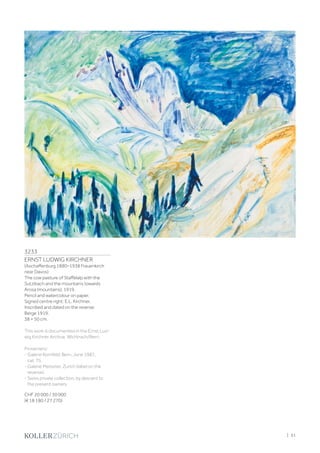
Die Kuhweide der Staffelalp mit dem
Sutzibach und den Bergen gegen Arosa
(Berge). 1919.
Bleistift und Aquarell auf Papier.
Mittig rechts signiert: E.L. Kirchner.
Verso bezeichnet und datiert: Berge 1919.
38 × 50 cm.
Dieses Werk ist im Ernst Ludwig Kirchner
Archiv Wichtrach/Bern dokumentiert.
Provenienz:
- Galerie Kornfeld, Bern, Juni 1987, Kat. 75.
- Galerie Meissner, Zürich (verso mit
Etikett).
- Schweizer Privatsammlung, durch Erb-
schaft an die heutigen Besitzer.
CHF 20 000 / 30 000
(€ 18 180 / 27 270)
| 51
3234
LYONEL FEININGER
(1871 New York 1956)
Die kleine Försterei. 1922.
Aquarell und Tusche auf Papier.
Unten links signiert: Feininger, unten mittig
betitelt: die kleine Försterei, und unten
rechts datiert: 28. VI. 22.
27,5 × 31,2 cm.
Die Authentizität des Werks wurde von
Achim Moeller, Direktor des Lyonel Feinin-
ger Project LLC, New York/Berlin, bestä-
tigt, New York, 29. März 2016. Es ist im
Archiv unter der Nummer 1379-03-29-16
registriert.
Provenienz:
- Atelier des Künstlers.
- Emma Ritter, Oldenburg, direkt vom
Künstler als Geschenk erhalten.
- Karl Schwoon, Oldenburg, als Geschenk
von Obiger erhalten.
- Privatsammlung USA.
- Schweizer Privatsammlung.
Die hier angebotene Zeichnung Die kleine
Försterei entsteht in Lyonel Feiningers
Zeit am Bauhaus in Weimar. Dort war der
Künstler 1919 von Walter Gropius als
erster Meister der neugegründeten Schule
berufen worden. Zudem stammt die erste
Veröffentlichung des Bauhauses, eine
Mappe mit 12 Holzschnitten, ebenfalls aus
Lyonel Feiningers Hand. Während seiner
gesamten Bauhauszeit – ab 1926 dann
in Dessau – verbringt der Künstler viel
Zeit auf dem Thüringer Land, studiert die
dortigen Ortschaften, die Architektur und
die Natur.
Unsere Zeichnung Die kleine Försterei
wird ebenfalls auf einer der Erkundungs-
touren Feiningers im Weimarer Umland
entstanden sein. Mit zarten Konturen aus
Tusche skizziert der Künstler eine Lichtung
umrahmt von grossen Tannen, auf der sich
eine kleine Försterei befindet. Charakteris-
tisch für Feiningers Stil wirkt das Aquarell
als Füllfarbe seiner Darstellungen weich
und zaghaft und die Ränder der Umris-
se verschwimmen gar. Feininger selbst
erklärt über seine Arbeitsweise, dass er in
Aquarell vollkommen das ausdrücken kön-
ne, was er darzustellen vermöge (Lyonel
Feininger, in: Ruhmer 1961, S. 9). Selten
überträgt er deshalb bereits vollendete
Aquarellarbeiten in die Ölmalerei. Im Fall
des hier angebotenen Werks hat jedoch
eine mediale Übersetzung in anderer Rei-
henfolge stattgefunden. So fertigt Feinin-
ger bereits 1920, zwei Jahre vor unserer
Zeichnung, das Ölbild Die kleine Försterei
an. Während die Masse des Gemäldes
variieren und einige wenige farbliche
Veränderungen zu beobachten sind, ist
unsere Zeichnung mit dem Vorgängerbild
in Ölfarbe auf inhaltlicher Ebene identisch.
Eberhard Ruhmer erklärt hinsichtlich Fei-
ningers Faszination für die Aquarelltechnik:
Da nun ein geheimnisvoller Zusammen-
hang besteht zwischen der Technik und
dem vom Künstler gewählten Gegenstand,
scheint mir in den zarten, zurückhalten-
den und vergleichsweise anspruchslosen
Lösungen der Aquarelle das vielleicht
entscheidende Moment Feiningerscher
Kunstabsichten seine adäquateste und
vollkommenste Realisierung gefunden zu
haben (Ruhmer 1961, S. 9).
CHF 60 000 / 80 000
(€ 54 550 / 72 730)
| 52
Impressionismus  Moderne
| 53
3235
LE CORBUSIER (CHARLES-
EDOUARD JEANNERET)
(La Chaux-de-Fonds 1887–1965 Roque­
brune-Cap-Martin)
Symphonie Cesar Franck. 1947.
Tusche auf Papier.
Unten rechts betitelt: Symphonie
Cesar Franck. Oben rechts gewidmet
und signiert: Pour Marcel Levaillant / avec
ma fidèle / amitié / Ce vieux bien / vieux
souvenir / au jour de mes / soixante ans
/ Le Corbusier. Verso bezeichnet und
datiert: Chaux de fonds, le 21/X/16 / [ ] / 6
Octobre 1947.
17,3 × 22,2 cm.
Das Werk ist im Archiv der Fondation Le
Corbusier, Paris, registriert. Es wird in den
sich in Vorbereitung befindenden Cata-
logue de l'œuvre dessiné de Le Corbusier
aufgenommen.
Provenienz:
Schweizer Privatsammlung.
CHF 4 000 / 6 000
(€ 3 640 / 5 450)
3236*
ERNST LUDWIG KIRCHNER
(Aschaffenburg 1880–1938 Frauenkirch b.
Davos)
Haus in Davos. Um 1922.
Tusche und Aquarell auf Papier.
Verso mit dem Nachlassstempel
(F Da/Aa 54).
17 × 22 cm.
Dieses Werk ist im Ernst Ludwig Kirchner
Archiv Wichtrach/Bern dokumentiert.
Provenienz:
Kirchner Nachlass.
CHF 6 000 / 8 000
(€ 5 450 / 7 270)
| 54
Impressionismus  Moderne
3237*
ERNST LUDWIG KIRCHNER
(Aschaffenburg 1880–1938 Frauenkirch b.
Davos)
Zwei Akrobatinnen. 1932.
Schwarze Kreide auf Papier.
Verso mit dem Nachlassstempel
(K Da/Be 77).
51 × 35 cm.
Dieses Werk ist im Ernst Ludwig Kirchner
Archiv Wichtrach/Bern dokumentiert.
Provenienz:
Kirchner Nachlass.
CHF 16 000 / 20 000
(€ 14 550 / 18 180)
| 55
3238
PAUL KLEE
(Münchenbuchsee bei Bern 1879–1940
Muralto)
Kleine Landschaft, Hauptsächlich mit
Farb=Quadraten. 1915.
Aquarell und Bleistift über Kreide­
grundierung auf Papier auf Künstlerkarton.
Unten links signiert: Klee.
Unten links auf dem Künstlerkarton datiert
und bezeichnet: 1915 / 252.
13,5 × 11,5 cm.
Provenienz:
- Berggruen  Cie, Paris.
- Galerie Georges Moos, Genf, Nr. 4021
(verso mit Etikett), in obiger Galerie
erworben.
- Schweizer Privatbesitz, durch Erbschaft
von Obigem erhalten und seit drei
Generationen im gleichen Familienbesitz.
Ausstellung:
Genf 1973, Art du XXe siècle - Collections
genevoises, Musée Rath et Cabinet des
Estampes, 28. Juni–23. September 1973,
Nr. 71 (verso mit Etikett).
Literatur:
- Paul-Klee-Stiftung und Kunstmuseum
Bern (Hrsg.): Catalogue raisonné Paul
Klee, Bd. 2 (1913–1918), Bern 2000, S.
324, Nr. 1587 (mit Abb.).
- Ausst.-Kat. Paul Klee. Im Zeichen der
Teilung, hrsg. von der Kunstsammlung
Nordrhein-Westfalen und Staatsgalerie
Stuttgart, Stuttgart 1995 (Abb. S. 330).
„Aber ich habe gelernt, das ist wichtig, zu
reduzieren“
(Paul Klee, in: Kersten/Okuda 1995, S. 25)
Paul Klee, einer der wichtigsten Vertreter
der Moderne, Pionier der ungegenständli-
chen Kunst und prägender Lehrer am Bau-
haus, ist einzigartig in seiner auf Teilung,
Kombination, Reduktion und Harmonie
bedachten Hinwendung zur Abstrakti-
on. In dem hier angebotenen Aquarell
Kleine Landschaft, hauptsächlich mit
Farb=Quadraten vermittelt nicht nur der
Titel – jenseits einer linearen Leseweise –
den Prozess des Abstrahierens, sondern
er wird auch im kompositorischen Aufbau
und der Farbfeldgestaltung sichtbar.
Angeregt durch die Begegnung mit
Wassily Kandinsky und Robert Delaunay,
gelingt Paul Klee während der berühm-
ten Tunisreise 1914 der Durchbruch zu
abstrahierenden und farbig leuchtenden
Kompositionen. Zusammen mit August
Macke und Louis Moilliet unternimmt er
eine dreiwöchige Studienreise nach Tune-
sien, in der sich die Künstler gegenseitig
inspirieren. Das intensive Licht und die
Farben des Südens üben, insbesondere für
Paul Klee, einen nachhaltigen Einfluss auf
das weitere Schaffen aus.
“Die Farbe hat mich. Ich brauche nicht
nach ihr zu haschen. Sie hat mich für
immer, ich weiß das. Das ist der glücklichen
Stunde Sinn: ich und die Farbe sind eins. Ich
bin Maler.“ (Paul Klee, in: Giedion-Welcker
2004, S. 43).
Der Prozess, das Gesehene zu abstra-
hieren – vornehmlich Stadt- und Land-
schaftsansichten –, in geometrische
Strukturen zu überführen, die plan auf der
Bildfläche entwickelt werden, zeigt sich
exemplarisch in dem vorliegenden Aqua-
rell, welches 1915, zwischen Tunisreise
und Einzug als Soldat im Ersten Weltkrieg,
entstanden ist. Hinter dem strukturier-
ten Bildaufbau und der Ablehnung der
Perspektive steht auch das Werk von Paul
Cézanne, das Klee aufgrund seiner Reduk-
tion sehr schätzte. Bereits zwei Jahre vor
dem denkwürdigen Aufenthalt in Nordafri-
ka hatte Paul Klee dieses Raster entwickelt,
das ihn in den folgenden drei Jahrzehnten
immer wieder in abgewandelter Form
beschäftigte. Das hier gewählte impressi-
onistische Ausschnittsprinzip verdichtet
die in Tunesien ausgebildete Farbkompo-
sition, ein rosafarbenes Element wird zum
Bildmittelpunkt, eingerahmt von unter-
schiedlich schwarz schattierten Kuben, die
in einem engen Beziehungsgeflecht die
umliegenden Farben leuchten lassen. Die
Assoziationsmöglichkeiten der Farben der
Natur und der gebäudeähnlichen Formen,
die Analogie von organischen Phänome-
nen und architektonischem Bildaufbau
lassen, bei aller abstrahierenden Reduk-
tion, immer wieder spielerisch Momente
der Erzählung und Gegenstandsreferenz
durchschimmern.
CHF 250 000 / 350 000
(€ 227 270 / 318 180)
| 56
Impressionismus  Moderne
| 57
3239
MARIANNE VON WEREFKIN
(Tula 1860–1938 Ascona)
Karneval. Um 1920.
Verso: Pferdegespann auf einem Platz in
einer Stadt.
Aquarell und Gouache auf Papier.
20 × 27 cm.
Die Authentizität des Werks wurde von Dr.
Bernd Fäthke bestätigt, Wiesbaden, 26.
Juli 2015.
Provenienz:
- Schweizer Privatsammlung.
- Auktion Schuler, Zürich, 11. Dezember
2015, Los 3441.
- Arttrust Gallery, Melano.
- Schweizer Privatsammlung, am 12. De-
zember 2017 in obiger Galerie erworben.
Ausstellung:
Melano 2016, Marianne Werefkin, I colori
di un'anima in viaggio, 10. Oktober–10.
Dezember 2016 (mit Abb. im Ausst. Kat.
S. 80/81).
CHF 4 000 / 6 000
(€ 3 640 / 5 450)
Verso
| 58
Impressionismus  Moderne
3240
MARIANNE VON WEREFKIN
(Tula 1860–1938 Ascona)
Heiliger Franziskus und Wolf.
Aquarell und Pastell auf Papier.
24,5 × 33,5 cm.
Wir danken Dr. Bernd Fäthke für die Bestä-
tigung der Authentizität des Werks, April
2021.
Provenienz:
- Schweizer Privatsammlung.
- Auktion Koller, Zürich, 27. Juni 2014, Los
3242.
- Privatsammlung Tessin, an obiger Aukti-
on erworben.
- Arttrust Gallery, Melano.
- Schweizer Privatsammlung, am 12. Ok-
tober 2017 in obiger Galerie erworben.
Ausstellung:
Melano 2016, Marianne Werefkin, I colori
di un'anima in viaggio, 10. Oktober–10.
Dezember 2016 (mit Abb. im Ausst. Kat. S.
94/95).
CHF 12 000 / 18 000
(€ 10 910 / 16 360)
| 59
3241*
PAUL KLEE
(Münchenbuchsee bei Bern 1879–1940
Muralto)
Côte de Provence 5. 1927.
Aquarell auf Papier auf zweitem Papier auf
Künstlerkarton.
Oben rechts signiert: Klee.
Unten links auf dem Künstlerkarton datiert:
1927 X.3, und rechts betitelt: Côte de
Provence 5.
11,4 × 32 cm.
Provenienz:
- Alfred Flechtheim, Düsseldorf/Berlin/
Paris/London, ab 1928.
- Sammlung Lilly Klee, Bern, 1940–42.
- Bettie Thommen, Basel, ab 1942.
- Yuji Okuso, Tokio.
- Auktion Sotheby's, London, 5. Dezember
1990, Los 341.
- Wohl Privatsammlung Europa, an obiger
Auktion erworben.
- Auktion Sotheby's, New York,
18. November 1998, Los 377.
- Privatsammlung Italien, an obiger
Auktion erworben.
Literatur:
- Paul-Klee-Stiftung und Kunstmuseum
Bern (Hrsg.): Catalogue raisonné Paul
Klee, Bd. 5 (1927–1939), Bern 2001, S.
139, Nr. 4447 (mit Abb.).
- Jürg Spiller (Hrsg.): Paul Klee. Unendliche
Naturgeschichte. Prinzipielle Ordnung
der bildnerischen Mittel verbunden mit
Naturstudium, und konstruktive Kom-
positionswege. Form- und Gestaltungs-
lehre, Bd. 2, Basel/Stuttgart 1970, S. 124
(mit Abb. S 379).
- Wolfgang Kersten und Osamu Okuda:
Paul Klee. Im Zeichen der Teilung, Düs-
seldorf/Stuttgart 1995, S. 185 (mit Abb.
S. 355).
Im Juli des Jahres 1926 zieht Paul Klee mit
seiner Familie nach Dessau. Dort wohnt er
zusammen mit dem Ehepaar Kandinsky in
einem von Walter Gropius erbauten Zwei-
familienhaus für Bauhaus-Meister. Bereits
fünf Jahre vorher folgt Klee der Einladung
Gropius’ nach Weimar ans Bauhaus, um
eine Anstellung als Lehrer anzunehmen.
Am Bauhaus verbringt Klee einige der
innovativsten und produktivsten Jahre
seiner Karriere. Inspiriert vom Umkreis des
Bauhauses und dem Glauben an die Kunst
des Konstruktivismus, werden Klees Werke
zunehmend abstrakter und geometri-
scher.
Das vorliegende, farbintensive Aquarell
Provence 5 ist ein grossartiges Beispiel
für diesen neuen kreativen Impuls. Klee
malt 1927 eine Reihe von sieben Aquarel-
len (Provence 1 bis Provence 7), die durch
ihre kleinen geometrischen Formen, be-
wusst gesetzten Linien und schriftartigen
Zeichen bestechen. Die Farben bleiben
bei Klee eines der wichtigsten Elemente
seiner Kunst und sind in Côte de Provence
5 besonders hervorzuheben.
CHF 220 000 / 300 000
(€ 200 000 / 272 730)
| 60
Impressionismus  Moderne
3242*
ELISABETH EPSTEIN
(Schytomyr 1879–1956 Genf)
Stillleben. 1937.
Öl auf Leinwand.
Unten links signiert und datiert:
EEpstein 37.
50 × 73 cm.
Provenienz:
Sammlung USA.
CHF 5 000 / 8 000
(€ 4 550 / 7 270)
3243
ALEXANDER ARCHIPENKO
(Kiew 1878–1964 New York)
Kubistische Figur. Um 1915.
Aquarell und Bleistift auf Papier.
Unten rechts signiert: Archipenko.
29 × 23,3 cm.
Wir danken der Archipenko Foundation
für die Bestätigung der Authentizität des
Werks, New York, 6. Mai 2021. Es ist im
Archiv unter der Nummer 6326 verzeich-
net und wird in den sich in Vorbereitung
befindenden Catalogue raisonné aufge-
nommen.
Provenienz:
- Privatsammlung Wien.
- Auktion Auctionata, Berlin, 7. März 2014,
Los 4.
- Schweizer Privatsammlung, an obiger
Auktion erworben und durch Erbschaft
an den heutigen Besitzer.
CHF 8 000 / 12 000
(€ 7 270 / 10 910)
| 62
Impressionismus  Moderne
3244*
GEORG KOLBE
(Waldheim 1877–1947 Berlin)
Statuette II (Statuette aufsteigendes
Weib). 1921.
Bronze, rötlich-braune Patina.
Unten am Fuss monogrammiert: GK.
Hinten mit dem Giesserstempel:
H. NOACK BERLIN FRIEDENAU.
H 41,5 cm.
Wir danken Dr. Ursel Berger für die Bestä-
tigung der Authentizität des Werks, Mai
2021.
Provenienz:
- Schweizer Privatsammlung.
- Auktion Koller, Zürich, 28. November
1978, Los 5680.
- Privatsammlung Deutschland, an obiger
Auktion erworben.
CHF 30 000 / 40 000
(€ 27 270 / 36 360)
| 63
3245
PAUL KLEE
(Münchenbuchsee bei Bern 1879–1940
Muralto)
Bergschlucht. 1934.
Gouache und Kreide auf grundiertem
Papier auf Künstlerkarton.
Unten rechts signiert: Klee.
Unten mittig auf dem Künstlerkarton
datiert und betitelt: 1934 19 Bergschlucht.
37,4 × 49,3 cm.
Provenienz:
- Sammlung Lily Klee, Bern, 1940–46.
- Klee-Gesellschaft, Bern, 1946 von
Obiger erworben.
- Sammlung Felix Klee, Bern, 1953 von
Obigen erworben.
- Schweizer Privatsammlung, 1990 von
Obigem erworben.
- Privatsammlung Tokio, 2008 von Obigem
erworben.
- Auktion Christie's, New York,
12. November 2018, Los 141.
- Schweizer Privatsammlung, an obiger
Auktion erworben.
Ausstellungen:
- Basel 1935, Paul Klee, Kunsthalle Basel,
27. Oktober–24. November 1935, Nr. 157
(mit Abb. im Ausst. Kat.).
- St. Gallen 1955, Klee, Werke aus dem
Familienbesitz, Kunstmuseum St. Gallen,
22. Januar–20. März 1955, Nr. 175 (mit
Abb. im Ausst. Kat.).
- Amsterdam 1963, Paul Klee. Aquarellen,
Stedelijk Museum, 20. September–4.
November 1963, Nr. 64 (mit Abb. im
Ausst. Kat.).
- Malmö/Göteborg/Stockholm 1965, Paul
Klee. Malningar - teckningar, Wander-
ausstellung: Malmö Museum, Göteborgs
Konstmuseum, Konstsalongen Samla-
ren, Stockholm, März–Juni 1965 (mit Abb.
im Ausst. Kat Nr. 72).
- Braunschweig 1976, Paul Klee. Bilder,
Aquarelle Zeichnungen, Sammlung Felix
Klee, Junior Galerie, 1.–22. Februar 1976
(mit Abb. im Ausst. Kat. Nr. 61).
- Tokio/Takasari/Nagoya/Kobe/Kamakura
1976: Paul Klee und seine Malerfreunde,
Wanderausstellung: Odakyu Kaufhaus,
Gumma Museum, Kaufhaus Matsuzaka-
ya, Kaufhaus Sogo, Kamakura Museum of
Modern Art, Mai–Oktober 1976 (mit Abb.
im Ausst. Kat. Nr. 85).
- Paris 1985, Paul Klee. Les dix dernières
années, Galerie Karl Flinker, 11. April–31.
Mai 1985 (mit Abb. im Ausst. Kat. Nr. 19).
- Himeji/Sendai/Kamakura/Shiga/Niigata
1985–1986, Paul Klee in Exile 1933–
1940, Wanderausstellung: Himeji City
Museum of Art, Miyagi Museum of Art,
Kamakura Museum of Modern Art, Shiga
Museum of Modern Art, Niigata City Art
Museum, September–Dezember 1985
(mit farbiger Abb. im Ausst. Kat. Nr. 5).
- Mendrisio 1990, Paul Klee. Ultimo de-
cennio / Letztes Jahrzehnt 1930–1940,
Museo d'arte, 7. April–8. Juli 1990 (mit
Abb. im Ausst. Kat. S. 85).
- Kanazawa/Tokio/Kochi/Kyoto/Kasama/
Hamamatsu/Osaka/Mannheim 1995–
1996, Die Zeit der Reife. Klee aus der
Sammlung der Familie, Wanderausstel-
lung: Ishikawa Prefectural Museum of Art,
Daimaru Museum Tokio, The Museum
of Art Kochi, Daimaru Museum Kyoto,
Kasama Nichido Museum of Art, Hama-
matsu Municipal Museum of Art, Daimaru
Museum Osaka, Städtische Kunsthalle
Mannheim, Juni 1995–Juli 1996 (mit
farbiger Abb. im Ausst. Kat. Nr. 50).
- Düsseldorf 2001, Paul Klee. Kleinode, Die
Sammlung. Kunstsammlung Nordrhein-
Westfalen, 23. Juni–26. August 2001.
- Basel 2008, Paul Klee, Museum Fondati-
on Beyeler, 3. Juni–13. September 2008
(mit Abb. im Ausst. Kat. Nr. 34, S. 88,
farbige Abb. S. 61; verso mit Etikett).
Literatur:
- Paul-Klee-Stiftung und Kunstmuseum
Bern (Hrsg.): Catalogue raisonné Paul
Klee, Bonn 2003, Bd. 7, S. 45, Nr. 6557
(mit Abb.).
- Jürg Spiller: Paul Klee. Das bildnerische
Denken. Form- und Gestaltungslehre,
Bd. 1, Basel/Stuttgart 1956, S. 253, Anm.
1, 515 (mit Abb.).
- H. Schönemann: Diesseits und jenseits
des Gegenstandes: Paul Klees 'Abenteu-
er-Schiff' und 'Der bunte Dampfer' von
Wolfgang Mattheuer, in: Akten Dresden
1986, S. 62–65.
Paul Klee emigriert 1933 nach Bern. Der
Umzug erfolgt nicht ganz freiwillig: In
Deutschland enthebt ihn die neue natio-
nalsozialistische Regierung seines Amtes
an der Düsseldorfer Kunstakademie und
ruft seine Kunst als entartet aus. An sei-
ne Mitarbeitenden in Düsseldorf gewandt,
erklärt Klee daraufhin, dass es in Europa
bedenklich nach Leichen rieche und zieht
in die Schweiz.
In Bern benötigt er zunächst etwas Zeit
zum Ankommen. Zwar ist der Künstler in
der Schweiz aufgewachsen, doch nach
Stationen in München, Weimar, Dessau
und zuletzt in Düsseldorf, erlebt er das
eher provinziell geprägte Bern als vollauf
neues Umfeld. Dennoch lässt die nächs-
te Produktivitätsphase nicht lange auf
sich warten und bereits im Frühjahr 1934
beginnt Klee wieder intensiv zu arbeiten.
Das nun folgende künstlerische Werk des
Malers ab 1934 leitet seine letzte Schaf-
fensperiode, sein Spätwerk, ein.
Die hier angebotene Arbeit Bergschlucht
entsteht somit im Kontext einer veränder-
ten Lebensphase Klees, die sich in neuen
Ausdrucksformen, Farben und Sujets äus-
sert. Zwar weisen verhältnismässig wenige
seiner Werke ab 1934 Bezüge zu der kriti-
schen politischen Situation in Deutschland
auf, doch in der eher düsteren Farbgebung
seiner Arbeiten aus diesen Jahren können
sich die Spuren seines Gemüts ablesen
lassen. Obgleich die eher gedeckten Far-
ben der hiesigen Darstellung einen leicht
trüben Charakter verleihen, wird dieser
von leuchtenden Farbakzenten wieder
aufgebrochen. Mit dem Wechselspiel von
Kreide und Gouache schafft der Künstler
fliessende, farbliche Übergänge, die die
Komposition harmonisch und freundlich
erscheinen lassen. Das grundierte Papier,
das als Materialträger dient, färbt Klee
an den Rändern bräunlich, und verstärkt
damit die Wirkung des Dargestellten, der
Bergschlucht. Hat sich Paul Klee für unser
Werk von der schweizerischen Bergland-
schaft inspirieren lassen? Klee war es stets
ein grosses Anliegen, sich den Besonder-
heiten der Natur künstlerisch anzunähern
und sie zu ergründen. Diese Faszination
visualisiert er auch hier: Während sich in
unserem Werk die Farbfelder im äusseren
Bereich der Darstellung grösser und offe-
ner präsentieren, verdichten sich die Linien
in der Mitte. Klee erzeugt so Bildtiefe, ja gar
eine dreidimensionale Wirkung. Die Materi-
alität der Bildoberfläche intensiviert diese
Wirkung umso mehr aufgrund ihrer leicht
knittrigen Beschaffenheit.
Das vorliegende, in Bern entstandene
Werk, gelangt nach Paul Klees Tod 1940 in
die Sammlung seiner Frau Lily Klee. Nach
Besitzwechseln zu Beginn der 2000er-
Jahre ins Ausland, befindet sich die Zeich-
nung nun seit 2018 wieder in der Schweiz.
CHF 350 000 / 400 000
(€ 318 180 / 363 640)
| 64
Impressionismus  Moderne
| 65
3246*
CHRISTIAN ROHLFS
(Niendorf 1849–1938 Hagen)
Haus in Soest.
Aquarell und Kohle auf Papier.
Unten rechts monogrammiert: CR.
34,8 × 49,2 cm.
Provenienz:
- Kunsthaus Bühler, München (verso mit
Etikett).
- Privatsammlung Deutschland.
CHF 4 000 / 6 000
(€ 3 640 / 5 450)
3247*
CHRISTIAN ROHLFS
(Niendorf 1849–1938 Hagen)
Kamelienstöckchen. 1910.
Öl auf Leinwandkarton.
Unten rechts monogrammiert und datiert:
CR 10.
56 × 39 cm.
Provenienz:
- Johannes Geller, Neuss.
- Galerie Grosshennig, Düsseldorf.
- Privatbesitz Deutschland.
- Kunsthaus Bühler, München (verso mit
Etikett).
- Privatsammlung Deutschland.
Literatur:
- Paul Vogt: Christian Rohlfs. Œuvre-Kata-
log der Gemälde, Recklinghausen 1978,
Nr. 464 (mit Abb.).
- Johannes Geller: Verzeichnis der Samm-
lung des Rechtsanwalts Johannes Geller
in Neuss [zum 70. Geburtstag von J. Gel-
ler zusammengestellt von August Hoff],
München 1943, Nr. 81 (datiert 1911).
CHF 8 000 / 12 000
(€ 7 270 / 10 910)
| 66
Impressionismus  Moderne
| 67
3248
PAUL SIGNAC
(1863 Paris 1935)
La Turballe. 1929.
Aquarell und schwarzer Farbstift auf Papier.
Unten rechts signiert: P. Signac. (wohl apokryph)
Unten links betitelt und datiert: La Turballe 1929.
20 × 45,4 cm.
Die Authentizität des Werks wurde von Marina
Ferretti bestätigt, Paris, 3. April 2017.
Provenienz:
- Privatsammlung USA, 1983 erworben und durch
Erbschaft an die nächste Generation.
- Auktion Sotheby's, New York, 17. Mai 2017,
Los 396.
- Schweizer Privatbesitz, an obiger Auktion
erworben.
CHF 14 000 / 18 000
(€ 12 730 / 16 360)
3249
MARINO MARINI
(Pistoia 1901–1980 Viareggio)
Cavallo e Cavaliere. 1945.
Tusche, Bleistift und Aquarell auf Papier.
Unten links signiert: Marino.
Oben rechts datiert: 1945.
33,7 × 26,7 cm.
Die Authentizität des Werks wurde von der Fonda-
zione Marino Marini bestätigt, Pistoia, 13. Oktober
2020. Es wird im Archiv unter der Nummer 832
aufgenommen.
Provenienz:
Privatsammlung Tessin.
CHF 10 000 / 15 000
(€ 9 090 / 13 640)
| 68
Impressionismus  Moderne
3250
TSUGUHARU FOUJITA
(Tokio 1886–1968 Zürich)
Portrait de femme. 1924.
Tusche auf Japanpapier.
Unten rechts signiert und datiert:
Tsuguharu Foujita / 1924.
21,2 × 16,9 cm.
Wir danken Sylvie Buisson für die Bestä-
tigung der Authentizität des Werks, Paris,
13. April 2021. Es wird in den vierten Band
des Catalogue raisonné aufgenommen.
Provenienz:
Schweizer Privatsammlung.
CHF 12 000 / 18 000
(€ 10 910 / 16 360)
| 69
3251
MARC CHAGALL
(Witebsk 1887–1985 St. Paul-de-Vence)
Bouquet d'été. 1973.
Öl auf Leinwand.
Unten links signiert: Chagall Marc.
Verso auf der Leinwand signiert:
Marc Chagall.
92 × 73 cm.
Wir danken dem Comité Marc Chagall
für die Bestätigung der Authentizität des
Werks, Paris, 31. März 2021.
Provenienz:
- Galerie Maeght, Paris (verso mit Etikett).
- Auktion Koller, Zürich, 2. November 1979,
Los 5074.
- Schweizer Privatsammlung, an obiger
Auktion erworben und durch Erbschaft
an die heutigen Besitzer.
Bouquet d'été entsteht 1973. Chagall ist
bereits ein international gefeierter Künstler
und gilt als einer der grössten lebenden
Maler überhaupt. Seit Mitte der 1960er-
Jahre wohnt Chagall zusammen mit seiner
Familie im französischen Saint-Paul-de-
Vence; einem ruhigen, idyllischen Dorf auf
einem Hügel an der Côte d’Azur, wo der
Künstler auf sein erfülltes Leben zurückbli-
cken kann.
Das vorliegende Werk zeugt vom reifen
Stil des Künstlers, der seine malerische
Energie nie verloren hat. Durch neue
Aufträge und die Arbeit mit einer Vielzahl
von Medien in den 1960er-und 70er-
Jahren, wird Chagall von einer neuen Welle
der Kreativität durchflutet. In der Malerei
lässt er Elemente aus seinem Frühwerk
wieder aufleben. Die Erinnerung wird
für Chagall im zunehmenden Alter zum
Schlüssel seiner Malerei. Das Thema der
Liebenden und der Blumensträusse sind
Sujets, die Chagall seit den 1920er-Jahren
immer wieder aufgreift. Dominiert wird das
grossformatige Werk vom zentralen Blu-
menbouquet, das aus einer transparenten
Vase in die Luft ragt. Links das Liebespaar,
ein Symbol für die immerwährende Liebe,
daneben die Ziege, und im Hintergrund
das Hügelpanorama von St. Paul-de-
Vence. Mit energievollen Pinselstrichen
gleitet Chagall über die Leinwand und
lässt den Betrachter nichts von seinem
fortgeschrittenen Alter spüren. Die Farben
hat Chagall in Bouquet d'été eher zu-
rückhaltend gewählt, in dem er sich für das
helle, monochrome Blau des Hintergrunds
in Kombination mit den weissen Blüten
entschieden hat. Die für Chagall typischen
Farbakzente dürfen aber auch hier nicht
fehlen und er lässt sie gekonnt als farbige
Blüten in den Strauss einfliessen.
CHF 800 000 / 1 400 000
(€ 727 270 / 1 272 730)
| 70
Impressionismus  Moderne
| 71
3252
MAURICE UTRILLO
(Paris 1883–1955 Dax)
Moulin de Sannois. 1952.
Öl auf Leinwand.
Unten rechts signiert: Maurice, Utrillo, V,
und unten links bezeichnet: Sannois (S et
Oise).
Verso auf dem Keilrahmen mit Widmung:
Amicalement à Monsieur Hermann Haller,
Maurice, Utrillo, V.
38 × 46 cm.
Wir danken der Association Maurice Utrillo
für die Bestätigung der Authentizität des
Werks, Paris, Mai 2021.
Provenienz:
- Hermann Haller, Zürich, direkt vom
Künstler erhalten.
- Schweizer Privatsammlung, 1993
erworben.
CHF 28 000 / 35 000
(€ 25 450 / 31 820)
| 72
Impressionismus  Moderne
3253
MAURICE UTRILLO
(Paris 1883–1955 Dax)
La chaumière d'Henri IV à Montmartre. Um 1935.
Öl auf Leinwand.
Unten rechts signiert: Maurice, Utrillo, V.
33 × 41 cm.
Wir danken der Association Maurice Utrillo für die
Bestätigung der Authentizität des Werks, Paris, Mai
2021.
Provenienz:
- Sammlung Mme. Morgan, Paris.
- Auktion Koller, Zürich, 29. November 1985,
Los 5144.
- Schweizer Privatsammlung, an obiger Auktion
erworben und durch Erbschaft an die heutigen
Besitzer.
Literatur:
Paul Pétridès: L'œuvre complet de Maurice Utrillo,
Paris 1966, Bd. V, Supplément, S. 264, Nr. 2770 (mit
Abb.).
CHF 30 000 / 50 000
(€ 27 270 / 45 450)
| 73
3254
ALBERT MARQUET
(Bordeaux 1875–1947 Paris)
Mer agitée à Collioure. 1940.
Öl auf Holz.
Unten links signiert: marquet.
32 x 41,2 cm.
Wir danken dem Wildenstein-Plattner
Institut für die Bestätigung der Authentizi-
tät des Werks, New York, 26. April 2021.
Provenienz:
- R. Peter, um 1954.
- Wohl Galerie des Granges, Genf.
- Schweizer Privatsammlung, wohl in obi-
ger Galerie erworben und durch
Erbschaft an die heutigen Besitzer.
Ausstellung:
Toulouse 1954, Marquet, Musée des
Augustins, 19. Juni–18. Juli 1954, Nr. 39
(als Collioure).
Diese harmonische Komposition von
Albert Marquet zeigt den Ort Collioure an
der Côte Vermeille. Eine kleine, reizende
Gemeinde zwischen türkisblauer Bucht,
fruchtbaren Weinbergen und den Pyre-
näen, die mit dem Massiv des Albères im
Mittelmeer versinken. Berühmtheit er-
langte Collioure durch Matisse und Derain,
die den Sommer des Jahres 1905 dort
verbringen. Es ist das einzigartige Licht
und die Farbenvielfalt, welche die beiden
Künstler inspirieren und ein kunsthisto-
risch bedeutendes Ereignis auslöst: die
Geburtsstunde des Fauvismus.
Als Mitglied der Fauvisten kennt Mar-
quet diesen Ort bestens und er malt den
Umriss der malerischen Küstenstadt mit
ihrem charakteristischen Turm bereits
früher. Indem er das tiefe Blau des Wassers
in Kontrast zu den rötlichen Gebäudefas-
saden setzt, versteht es Marquet in dem
vorliegenden Gemälde, die südlich medi-
terrane Stimmung Collioures einzufangen.
CHF 40 000 / 50 000
(€ 36 360 / 45 450)
| 74
Impressionismus  Moderne
| 75
3255*
PABLO GARGALLO
(Maella 1881–1934 Reus)
Femme couchée en creux. 1923.
Bronze, schwarz-grüne Patina.
Späterer Guss.
Auf der Platte rechts monogrammiert: P,
mit der Nummerierung EA 2/3 und dem
Giesserstempel: E. GODARD Fond.
37,5 × 15,5 × 6,5 cm.
Die Authentizität des Werks wurde von
Pierrette Gargallo Anguera bestätigt, Paris,
Dezember 1988.
Provenienz:
- Galerie Marwan Hoss, Paris.
- Schweizer Sammlung.
Literatur:
- Pierre Courthion: L'œuvre complet de
Pablo Gargallo, Paris 1973, Nr. 78 (mit
Abb. des Blei-Gusses).
- Jean Anguera: Gargallo, Paris 1979 (mit
Abb. anderer Guss S. 88).
- Pierrette Gargallo-Anguera: Pablo Gar-
gallo, Catalogue raisonné, Paris 1998, Nr.
101 (mit Abb. des Blei-Gusses S. 41).
CHF 12 000 / 18 000
(€ 10 910 / 16 360)
| 76
Impressionismus  Moderne
3256
AUGUSTE HERBIN
(Quiévy 1882–1960 Paris)
Vase de Fleurs. 1905.
Öl auf Leinwand.
Oben links signiert: Herbin.
61 × 50 cm.
Provenienz:
- Galerie Paul Vallotton, Lausanne (verso mit Resten
des Etiketts).
- Galerie Neupert, Zürich, Nr. 1458 (verso mit Etikett).
- Schweizer Privatsammlung, durch Erbschaft an die
heutigen Besitzer.
Literatur:
Geneviève Claisse: Herbin. Catalogue raisonné de
l'œuvre peint, Paris 1993, S. 2881, Nr. 59 (mit Abb.).
CHF 30 000 / 50 000
(€ 27 270 / 45 450)
| 77
3257
MAURICE UTRILLO
(Paris 1883–1955 Dax)
Château de Chaintré (Saône-et-Loire).
Um 1929.
Öl auf Leinwand.
Unten rechts signiert: Maurice, Utrillo, V.
Verso auf der Leinwand betitelt und
signiert: Château de Chaintré (Saône-et-
Loire) / Maurice Utrillo.
50 × 61 cm.
Wir danken der Association Maurice Utrillo
für die Bestätigung der Authentizität des
Werks, Paris, Mai 2021.
Provenienz:
- Wohl Galerie Drouand David, Paris.
- Galerie Beyeler, Basel.
- Basler Privatbesitz, wohl in obiger Galerie
erworben und durch Erbschaft an die
heutigen Besitzer.
Literatur:
Paul Pétridès: L'œuvre complet de Maurice
Utrillo, Paris 1962, Bd. II, S. 522, Nr. 1239
(mit Abb.).
Das vorliegende Gemälde Château de
Chaintré (Saône-et-Loire) stellt im Œuvre
Maurice Utrillos eine Besonderheit dar. So
ist der im Pariser Quartier Montmartre auf-
gewachsene Künstler vorrangig für seine
Café- und Strassenszenen des Pariser
Lebens bekannt. Das hier angebotene Ge-
mälde bietet aufgrund seines Sujets eine
einzigartige Ergänzung im Gesamtwerk
Utrillos. Während sich das Werk inhaltlich
von Utrillos restlichem Œuvre unterschei-
det, gliedert es sich stilistisch und farblich
passend in das Schaffen des Künstlers in
den späten 20er- und frühen 30er-Jahren
an. Mit kräftigen und frischen Farben fängt
der Künstler einen Moment des entspann-
ten Flanierens im Schlosspark ein.
Das dargestellte Château de Chaintré
befindet sich in der circa einer Stunde
Entfernung zu Lyon befindlichen Gemein-
de Crêches-sur-Saône. Erbaut im 12.
Jahrhundert, befand sich das Schloss bis
Mitte des 16. Jahrhunderts im Besitz der
Familie Chaintré. Anschliessend folgten
mehrere Besitzwechsel, in deren Zuge das
Anwesen unter anderem um einen engli-
schen Garten erweitert wurde. Heute wird
das Schloss als Luxusresidenz genutzt.
Es kann angenommen werden, dass eine
Reise entlang der Saône-et-Loire Ende
der 1920er-Jahre Maurice Utrillo zu der
Darstellung des Châteaus inspiriert hat, das
sich seinerzeit im Besitz eines ehemaligen
Abgeordneten Lyons befand. Vielleicht
malt Utrillo die Szene sogar direkt in der
Parkanlage Chaintrés, da er seine Werke
typischerweise vor Ort anfertigt – wie von
seinen Montmartre-Darstellungen überlie-
fert ist. Möglich wäre aber auch, dass es sich
bei der dargestellten Szene um das Motiv
einer Postkarte des Schlosses handelt, die
Utrillo als Idee für sein Gemälde diente.
CHF 50 000 / 80 000
(€ 45 450 / 72 730)
Postkarte des Château de Chaintré.
| 78
Impressionismus  Moderne
| 79
3258
OSSIP ZADKINE
(Witebsk 1890–1967 Paris)
Les trois sœurs ou les trois grâces ou les
trois belles ou les trois amies. 1926.
Bronze, dunkelbraune Patina.
Guss von 1926.
Unten rechts signiert und bezeichnet:
O.ZADKINE / ORIGINAL.
53 × 41 × 22 cm.
Wir danken dem Zadkine Research Center
für die wissenschaftliche Unterstützung.
Provenienz:
- Galerie Livingood, Paris, wohl direkt vom
Nachlass des Künstlers.
- Kunsthandel Tjerk Wiegersma, Deur-
ne Niederlande, 1972 in obiger Galerie
erworben.
- Privatsammlung Niederlande, 1972 in
obiger Galerie erworben.
- Wiegersma Fine Art, Brüssel, 2016 von
obigen Erben erworben.
- Privatsammlung Genf, 2016 in obiger
Galerie erworben.
Ausstellungen:
- Paris 1926, Salon des Tuileries, Nr. 2116.
- Venedig 1932, XVIII Biennale, Italieni-
scher Pavillion, Saal 13, Mai–November
1932, Nr. 7.
- Brüssel 1933, Palais des Beaux-Arts,
Januar 1933, Nr. 67 oder Nr. 85.
- New York 1937, Brummer Gallery, 25.
Januar–20. März 1937, Nr. 15 oder Nr. 30.
- Paris 1937, Maître de l'art indépendant
1895–1937, Petit Palais, Juni–Oktober
1937, Nr. 12 oder Nr.19.
- Darmstadt 1953, Neue Darmstädter
Sezession mit Ossip Zadkine, Mathilden-
höhe, 6. Dezember–11. Oktober 1953,
Nr. 39.
- Köln/ Düsseldorf/Berlin/Amsterdam
1954, Zadkine, Wanderausstellung der
Galerie Czwiklitzer, Nr. 10 (mit Abb.).
- Kanada/USA 1956/57, Ossip Zadkine,
Wanderausstellung: The Art Gallery of
Toronto, Montreal Museum of Fine Arts,
Winnipeg Art Gallery, Vancouver Art Gal-
lery, Seattle Art Museum, San Francisco
Museum of Art, Oktober 1956–Juli 1957,
Nr. 3 (datiert 1924, mit Abb.).
- Paris 1958, Ossip Zadkine, Maison de la
Pensée Francaise, Juli–Oktober 1958,
Nr. 52.
- Japan 1959/60, Ossip Zadkine, Wander-
ausstellung der Galerie Fujikawa, Herbst
1959–Frühling 1960, Nr. 20 (datiert 1927,
mit Abb.).
- Köln/Mannheim 1960, Ossip Zadkine,
Wallraf-Richartz-Museum und Städti-
sche Kunsthalle (datiert 1929, mit Abb.,
wohl anderes Exemplar).
Literatur:
- Sylvain Lecombre: Ossip Zadkine.
L'Œuvre sculpté, Paris 1994, S. 220, Nr.
167 (mit Abb.).
- L' Art vivant, Paris, Oktober 1926, S. 873.
- Selection Chronique de la vie artistique,
Cahier 3, Antwerpen 1928, S. 118.
- André de Ridder: Zadkine, Paris 1929, S.
21 (datiert 1927).
- Pierre Humbourg: Zadkine. Collection
Les Sculpteurs nouveaux, Paris 1930,
S. 63.
- Presse et revues: Art et Decoration,
Paris, Oktober 1930, S. 119.
- Winnipeg Tribune, 22. Februar 1957.
- Kolner Leben, Köln, 25. März 1960.
- A. M. Hammacher: Zadkine, Paris 1961, S.
11 (datiert 1929).
- Kieler Nachrichten, 20. Juni 1961.
- T. Spiteris: Zadkine, Mailand 1966, S. 8.
- G. Marussi: Zadkine, in: Le Arti, Mailand,
Juni 1967, S. 31.
- Anita Belobek-Hammer: Zum 100.
Geburtstag Ossip Zadkines, in: Bildende
Kunst, Berlin 1990, Ausg. 7.
- Ionel Jianou, Zadkine l'artiste et le
poète, in: Journal Artcurial, Paris 1979,
Nr. 141.
- Sylvain Lecombre: Ossip Zadkine.
L'Œuvre sculpté, Paris 1994, Nr. 167.
Les Trois Grâces ensteht 1926. Zadkine
befindet sich in Paris und ist inspiriert von
den verschiedenen Kunstrichtungen des
Kubismus, des Expressionismus und des
Futurismus, die im Paris der 1910er- und
20er-Jahre aufeinanderprallen. Vor 1926
widmet sich Zadkine hauptsächlich den
Skulpturen aus Stein und Holz. Für die
Ausstellung im Salon des Tuileries 1926
entscheidet er sich aber dazu, anstelle
dieser, von ihm zu erwartenden Materiali-
en, nur zwei Bronzefiguren zu zeigen. Eine
davon ist Les trois grâces.
Die vorliegende Skulptur ist ein einschnei-
dendes Werk im Œuvre des Künstlers. Bis-
her hat Zadkine, die Oberfläche von Stein
oder Holz bearbeitend, Werke geschaf-
fen, die eher in den Bereich des Reliefs
gehören. Seine Figuren blieben abhängig
vom Anfangsblock. Die Technik der Bronze
eröffnet ihm ein neues Feld von Möglich-
keiten, in dem er wie bei Les Trois Grâces
| 80
Impressionismus  Moderne
komplexe und durchbrochene Kompositi-
onen durch Modellieren erschaffen kann.
Typische Elemente wie das Konvex-konka-
ve oder die eingeritzten Linienelemente an
der Oberfläche sind exemplarisch für das
bildhauerische Arbeiten des kubistisch-
expressionistischen Künstlers und auch in
der vorliegenden Skulptur schön zu sehen.
Sylvaine Lecombre, der Autor des Zadkine
Werkverzeichnisses, schreibt über unsere
Skulptur: In Les Trois Grâces erlauben
die Lücken den Figuren, sich frei im Raum
zu entfalten. Zadkine fühlte sich mit dem
Kubismus erst wohl, als er dessen formale
Prinzipien auf seine eigenen Themen
und seine künstlerische Vision anwenden
konnte. In dieser Gruppe von drei eng mit-
einander verbundenen Frauen verlieren die
konkaven Schnitte, die plötzlichen Brüche
in den Fugen, die flache Oberfläche eines
Gesichts ihre Strenge. Was im Kubismus
aggressiv gewesen sein mag, wird aufge-
weicht, was mechanisch gewesen sein
mag, wird vom Menschlichen zurücker-
obert  (übersetzt aus dem Französischen,
in: Lecombre 1994, S. 199).
Zadkines bildhauerisches Œuvre ist
geprägt von der Beschäftigung mit dem
klassischen Altertum. Seine Faszination
für diese frühen Beispiele der Bildhauerei
führt ihn oft dazu, mythologische Themen
zu erforschen. So bedient er sich auch
bei der vorliegenden Arbeit dem griechi-
schen Motiv der drei Grazien. Allgemein ist
die Figurengruppe ein wiederkehrendes
Element bei Zadkine und taucht in vielen
Variationen auf. Die drei Grazien nimmt er
beispielsweise 1950 in einer abgewandel-
ten und etwas grösseren Version wieder
auf.
Von der Bronze Les Trois Grâces exis-
tieren fünf Güsse, vier davon sind später,
teils nach 1961 gegossen. Bei dem zur
Auktion kommenden Exemplar handelt es
sich laut dem Zadkine Research Centre
um den ersten Guss überhaupt und den
einzigen frühen Guss von 1926, der bereits
im Salon de Tuileries gestanden hat. Frühe
Güsse von Zadkine sind extrem selten und
kaum auf dem Kunstmarkt anzutreffen.
Zadkine hat in den 1920er- und 30er-
Jahren seine Skulpturen oft erst beim
Verkauf nummeriert. Das vorliegende Ex-
emplar bleibt unnummeriert, während die
Exemplare zwei bis fünf nummeriert sind.
Dies lässt darauf schliessen, dass Zadkine
dieser erste Abguss besonders wichtig war
und er ihn nicht verkaufen wollte, weshalb
er lange im Besitz des Künstlers blieb.
Drei der vier anderen Exemplare befinden
sich heute in Museen, das Vierte ist Teil
einer niederländischen Privatsammlung.
CHF 200 000 / 300 000
(€ 181 820 / 272 730)
| 82
Impressionismus  Moderne
Ossip Zadkine in seinem Atelier mit unserem Exemplar von
Les Trois Grâces, 1926. © Zadkine Research Center, photo by Marc Vaux.
3259*
PIERRE EUGÈNE MONTÉZIN
(Paris 1874–1946 Moëlan-sur-Mer)
Cour de ferme.
Öl auf Leinwand.
Unten links signiert: Montezin.
53,9 × 64,7 cm.
Die Authentizität des Werks wurde von
Cyril Klein Montézin bestätigt.
Provenienz:
- Nachlass des Künstlers.
- Marie-Claude Fischer Fine Arts, New
York, direkt vom Nachlass erworben.
- Sammlung Mr.  Mrs. David T. Johnston,
Chicago, im August 1981 in obiger
Galerie erworben.
- Privatsammlung Delaware.
- Wally Findlay Galleries, New York.
- Privatsammlung USA, in obiger Galerie
erworben.
- Auktion Sotheby's, USA, 17. Dezember
2019, Los 94.
- Privatsammlung Niederlande, an obiger
Auktion erworben.
CHF 4 000 / 7 000
(€ 3 640 / 6 360)
| 84
Impressionismus  Moderne
3260*
ALBERT ANDRÉ
(Lyon 1869–1954 Laudun)
Un dimanche après-midi sur la pelouse du
parc. Um 1898.
Öl auf Karton.
Unten rechts signiert und mono­
grammiert: Alb. André AA.
40,5 × 61 cm.
Die Authentizität des Werks wurde von
Flavie Durand-Ruel bestätigt, Paris,
11. Dezember 2017. Es ist im Archiv unter
der Nummer 23252 registriert und wird
in den sich in Vorbereitung befindenden
Catalogue raisonné aufgenommen.
Provenienz:
- Collection Durenne.
- Auktion Conan, Lyon, 17. Juni 2017, Los
109.
- Deutsche Sammlung, an obiger Auktion
erworben.
CHF 8 000 / 12 000
(€ 7 270 / 10 910)
| 85
3261*
EMILE BERNARD
(Lille 1868–1941 Paris)
Le jardin public à Mayenne. 1886.
Öl auf Leinwand.
Unten rechts signiert und datiert:
E. Bernard 1886.
38 × 46,3 cm.
Die Authentizität des Werks wurde vom
Wildenstein Institut bestätigt, Paris, 10. Mai
2007. Es wird in den sich in Vorbereitung
befindenden Catalogue critique aufge-
nommen.
Provenienz:
- Ambroise Vollard, Paris.
- Robert de Galéa, Paris, durch Erbschaft
von Obigem erhalten.
- Marquis de Bollin, Paris.
- Galerie Nicole Bertagna, Paris.
- Europäische Privatsammlung, im Juni
1957 von Obigem erworben.
- Auktion Christie's, Paris, 25. Mai 2007,
Los 56.
- Deutsche Sammlung, an obiger Auktion
erworben.
Ausstellung:
Los Angeles 1991, Monet to Matisse: a
Century of Art in France from Southern
California Collections, Los Angeles County
Museum of Art, 9. Juni–11. August 1991,
S. 78 (mit Abb.).
Literatur:
- Jean-Jacques Luthi und Armand Israël:
Emile Bernard, Instigateur de l‘École de
Pont-Aven, precurseur de l‘Art Moderne
– Sa Vie, son Œuvre, Catalogue raisonné,
Paris 2014, S. 140, Nr. 20 (mit Abb.).
- Jean-Jacques Luthi: Emile Bernard, Ca-
talogue raisonné de l'œuvre peint, Paris
1982, S. 6, Nr. 25 (mit Abb.).
- Weltkunst Nr. 05/2008, S. 60 (mit Abb.).
Fahrende Kutschen und vorbeilaufende
Passanten im Gemälde Le Jardin public
à Mayenne von Emile Bernard veran-
schaulichen das alltägliche Leben im Park
der französischen Stadt Mayenne. Die
Kombination aus lebendigen, leuchten-
den Farben und pointillistischer Mal-
weise assoziiert deutliche Bezüge zum
Stil des Impressionismus. Parallel dazu
lassen sich an dem Werk zudem bereits
Formulierungen eines neuen Stils, dem
Synthetismus, ablesen: starke Konturen,
ausgeprägte Flächigkeit und die Wahl des
Bildausschnitts sind charakteristisch für
die Malerei der sogenannten Schule von
Pont-Aven, die sich ab den späten 1880er-
Jahren um Emile Bernard, Paul Gauguin
oder Louis Anquetin herausbildet und den
synthetischen Stil entstehen lässt.
So nimmt das hiesige Frühwerk Le Jardin
public à Mayenne eine Art Scharnierfunk-
tion innerhalb der künstlerischen Entwick-
lung Emile Bernards ein.
1884 beginnt Bernard im Atelier des
Künstlers Fernard Cormon in Paris zu ar-
beiten, wo er bedeutende Kontakte knüpft.
Neben den beiden Malern Louis Anquetin
und Henri Toulouse-Lautrec lernt er dort
auch Vincent van Gogh kennen, zu dem
er eine freundschaftliche Verbindung
aufbaut. Aufgrund unterschiedlicher
künstlerischer Überzeugungen kommt es
bereits 1886 zum Bruch zwischen Bernard
und seinem Lehrer Cormon und der junge
Maler muss das Atelier verlassen. Emile
Bernard sucht fortan nach erweiterten
visuellen Gestaltungsmöglichkeiten
und beginnt ein neues Kapitel fern vom
impressionistisch geprägten Paris. Zu
Fuss macht er sich von der Hauptstadt
aus auf den Weg in die Bretagne und in die
Normandie. Während dieser Zeit zeigt sich
Bernard offen auf der Suche nach künstle-
rischem und literarischem Austausch und
lernt neue Traditionen kennen.
Das hier angebotene Gemälde Le Jardin
public à Mayenne veranschaulicht die
stilistische Vielfalt und Bernards Freude
am Experimentieren. Das Werk entsteht
auf seiner sechsmonatigen Reise mit dem
Ziel der Ankunft im Süden der Bretag-
ne, in Pont-Aven, wo sich seinerzeit Paul
Gauguin aufhielt. Dieser wird vor Ort auf
Bernards neue Bildsprache aufmerksam
und es beginnt eine inspirierende, wenn
auch konfliktreiche, Zusammenarbeit
zwischen den beiden Künstlern, die für die
Kunst der Moderne von entscheidender
Bedeutung ist.
CHF 50 000 / 80 000
(€ 45 450 / 72 730)
| 86
Impressionismus  Moderne
| 87
3262
ALBERT MARQUET
(Bordeaux 1875–1947 Paris)
Montreux. 1937.
Öl auf Leinwand.
Unten rechts signiert: marquet.
Verso betitelt und datiert: Montreux 37.
65 × 81 cm.
Wir danken dem Wildenstein-Plattner
Institut für die Bestätigung der Authentizi-
tät des Werks, New York, 26. April 2021.
Provenienz:
- Albert Marquet, Paris.
- Marcelle Marquet, Paris, durch Erbschaft
von Obigem erhalten.
- Alex Maguy, Paris, 1965 von Obiger
erworben.
- Auktion Galerie Motte, Genf, 28. Juni
1969, Los 406 (als Bord de lac).
- Galeria Theo, Madrid (verso mit Etikett).
- Galerie des Granges, Genf.
- Auktion Koller, Zürich, 2. November 1979,
Los 5164.
- Galerie des Granges, Genf.
- Schweizer Privatsammlung, am 4. Januar
1980 in obiger Galerie erworben.
Ausstellung:
Amsterdam 1962, Albert Marquet, Rijks-
akademie, 13. Juni–16. Juli 1962, Nr. 39
(als Lac Léman).
Marquet se sentait chez lui, partout où il y
avait de l’eau et des bateaux.
(Vorwort von Marcelle Marquet für die Aus-
stellung Marquet in Vevey 1953, S. 12.)
So kommentiert Marcelle Marquet die
unbändige Vorliebe ihres Gatten für das
nasse Element. Bekannt sind vor allem
Marquets Hafen- und Flussansichten, die
er auf zahlreichen Reisen durch Europa
festhält. Diese eindrucksvolle Ansicht
von Montreux, welche anlässlich seiner
Schweizreise in den Jahren 1936/37
entsteht, bestätigt Marcelles Aussage. Mit
der Absicht, den Schnee in den Schweizer
Alpen zu finden, macht der Künstler an
verschiedenen Stationen an der Waadtlän-
der Riviera halt, wovon ein kleiner Werkkor-
pus von Genfersee-Ansichten zeugt.
Das Wasser des Genfersees, auf dessen
Oberfläche der Künstler die Lichteffekte
und Wellenbewegungen gekonnt in einem
kühlen, quasi monochromen Kolorit in
Szene setzt, bildet den thematischen Kern
seiner Komposition. Das für den Künstler
fremde Gewässer in einer bisher unbe-
kannten Landschaft, fesselt sein Interesse
und treibt ihn an, den atmosphärischen
Charakter dieser Gegend und deren We-
sen malerisch zu ergründen.
Obwohl Marquet ein Mitbegründer der
Fauvisten ist und mit Henri Matisse eine
tiefe Freundschaft pflegt, verzichtet er für
die vorliegende Arbeit auf heftige Farbex-
perimente zugunsten einer gedämpften
Farbgebung, die wiederum aufgrund des
Sfumato im Hintergrund auf der Höhe des
Gebirgszuges chromatische Vibrationen
erzeugt. Die dominierende Monochromie
in Blau wird durch vife Farbakzente der
vordergründigen Seepromenade ausba-
lanciert – den Rückgriff auf die fauvistische
Manier kann sich Marquet dann doch nicht
verkneifen. In dieser Ansicht von Montreux
veranschaulicht er seinen individuellen Stil,
welcher in der Reifephase seines Œuvres
zwischen Postimpressionismus und Fau-
vismus schwingt.
Typisch für seine Werke ist die auch hier
vorzufindende Überkopfperspektive des
Vordergrunds, die sich im Mittelgrund
mithilfe des Sees und der Linearität des
Uferhorizontes stabilisiert. Die Essenz des
Werks bildet somit der raumgreifende See,
der in lichtem, lasierendem Farbauftrag der
Komposition Halt gibt.
CHF 80 000 / 100 000
(€ 72 730 / 90 910)
| 88
Impressionismus  Moderne
| 89
3263*
LOUIS VALTAT
(Dieppe 1869–1952 Paris)
Les pommes. 1937.
Öl auf Holz.
Unten rechts mit dem Monogramm­
stempel: L.V.
20 × 16 cm.
Provenienz:
- Alex Maguy Galerie, Paris.
- Privatsammlung New York, bei Obigem
erworben und durch Erbschaft an die
nächste Generation.
- Auktion Sotheby's, New York, 15. Dezem-
ber 2014, Los 37.
- Deutsche Sammlung, an obiger Auktion
erworben.
Literatur:
Jean Valtat: Louis Valtat. Catalogue rai-
sonné de l'œuvre peint, Neuchâtel 1977, S.
280, Nr. 2512 (mit Abb.).
CHF 8 000 / 12 000
(€ 7 270 / 10 910)
| 90
Impressionismus  Moderne
3264*
LOUIS VALTAT
(Dieppe 1869–1952 Paris)
Les raisins blancs.
Öl auf Holz.
Unten rechts signiert: L. Valtat.
23 × 40 cm.
Die Authentizität des Werks wurde von
Louis-André Valtat bestätigt, Choisel,
20. Juli 1999. Es ist unter der Nummer
460/1335 im Archiv registriert.
Provenienz:
- Collection Jacques Dransard, Paris.
- Auktion Aguttes, Neuilly-sur-Seine, 22.
Oktober 2018, Los 61.
- Deutsche Sammlung, an obiger Auktion
erworben.
Ausstellung:
Bordeaux 1995, L. Valtat, Galerie des
Beaux-Arts, 19. Mai–27. August 1995, Nr.
106 (verso mit Etikett).
CHF 12 000 / 18 000
(€ 10 910 / 16 360)
| 91
3265*
MAURICE DE VLAMINCK
(Paris 1876–1958 Rueil-la-Gadelière)
Paysage aux trois cyprès. Um 1912.
Öl auf Leinwand.
Unten rechts signiert: Vlaminck.
46 × 55 cm.
Die Authentizität des Werks wurde vom
Wildenstein Institut bestätigt, Paris, 25.
September 2002. Es wird in den sich in
Vorbereitung befindenden digitalen Cata-
logue critique aufgenommen.
Provenienz:
- Galerie Kahnweiler, Paris, Nr. 1559 (verso
mit Etikett).
- Sammlung Dr. Bonnet, Paris, bis 1948.
Verkauf seiner Sammlung im Hôtel Savoy,
Nizza, 26.–27. April 1948, Los 51.
- Privatsammlung Frankreich, an obiger
Auktion erworben.
- Auktion Sotheby's, London, 6. Februar
2007, Los 466.
- Deutsche Sammlung, an obiger Auktion
erworben.
Inspiriert von der Bildsprache Paul Cézan-
nes, sucht Maurice de Vlaminck ab 1907
nach neuen künstlerischen Ausdrucks-
formen und entfernt sich sukzessive von
seiner vorherigen fauvistischen Phase. Der
Künstler hat kurz zuvor eine Retrospektive
Cézannes im Salon d’Automne in Paris
gesehen.
An dem Werk Paysage aux trois cyprès
von 1912 lässt sich der daraus resultie-
rende, neu entfachte cézanneseque
Anspruch seiner Landschaftsdarstel-
lungen exemplarisch ablesen. Während
Vlaminck seine Farbpalette im Vergleich
zu seinem bisherigen Œuvre reduziert,
gewinnen Formen und Strukturen nun an
Relevanz. Er experimentiert mit verein-
fachten Gestaltungsformen und redu-
ziert die Landschaft auf ihr wesentliches
Erscheinungsbild. So gibt Vlaminck im
hier angebotenen Werk die Fassaden und
Dächer der Häuser auf dem Hang allein
durch schlichte geometrische Umrisse
wieder und skizziert den Himmel und die
Vegetation im Hintergrund mit kantigen
Pinselstrichen. Der grosse, in der Mitte der
Darstellung verortete Zypressenbaum,
strukturiert die Komposition und macht
Vlamincks neue Ausrichtung nach Gestal-
tungsformen noch deutlicher.
Das Gemälde Paysage aux trois cyprès
kann sowohl im biografischen Kontext
Vlamincks als auch eingebettet in dessen
stilistische Entwicklungsschritte, als
bedeutendes Werk verstanden werden
und als charakteristisches Beispiel für
den Beginn seines neuen künstlerischen
Interesses.
CHF 60 000 / 80 000
(€ 54 550 / 72 730)
| 92
Impressionismus  Moderne
| 93
3266*
THÉO VAN RYSSELBERGHE
(Gent 1862–1926 Saint-Clair-en-Pro-
vence)
Maria van Rysselberghe aux tulipes. 1918.
Öl auf Leinwand.
Oben links monogrammiert und datiert:
R 7 avril 1918.
92 × 73 cm.
Provenienz :
- Auktion Me Martin, Versailles, 7. Juni
1961, Los 59.
- Sammlung Oscar Ghez, Musée du Petit
Palais, Genf.
- Auktion Hôtel Drouot, Paris, 22. Novem-
ber 2019, Los 43.
- Privatsammlung Niederlande, an obiger
Auktion erworben.
Ausstellungen:
- Utrecht 1924, Théo Van Rysselberghe,
Vereniging Voor de Kunst, 9. Novem-
ber–7. Dezember 1924, Nr. 7.
- Turin 1964, 80 Pittori da Renoir a Kisling,
Galleria Civica d'Arte Moderna, 5. Febru-
ar–5. April 1996, Nr. 76 (verso mit Etikett).
- Genf 1996, Le Pointillisme, Musée du
Petit Palais, 12. Juni–30. September (mit
Abb. im Ausst. Kat. S. 37).
Literatur:
- Ronald Feltkamp: Théo van Rysselberg-
he. Catalogue raisonné. 1862–1926,
Brüssel 2003, S. 420, Nr. 1918-012 (mit
Abb.).
- Oscar Ghez und François Daulte: À l'aube
du XXe siècle, Genf 1968.
- Revue Scarabée n°4, September 1974,
S. 4.
- Jean-Jacques Lévêque: Les Années
Folles: 1918–1939: le triomphe de l'art
moderne, Courbevoie 1992, S. 215.
- O. Scheps: Pointillisme Collection O.
Ghez Petit Palais Genève, Turin 1996.
CHF 15 000 / 20 000
(€ 13 640 / 18 180)
| 94
Impressionismus  Moderne
3267
LUCIEN LÉVY-DHURMER
(Algier 1865–1953 Le Vésinet)
Venise. 1912.
Pastell auf Papier.
Unten rechts signiert und datiert:
Lévy Dhurmer / 1912.
60 × 83 cm (Lichtmass).
Provenienz:
Privatsammlung Basel.
CHF 25 000 / 35 000
(€ 22 730 / 31 820)
| 95
3268
CHARLOTTE BEREND-CORINTH
(Berlin 1880–1967 New York)
Traubenstillleben. 1923.
Öl auf Leinwand.
Unten rechts signiert und datiert:
Charlotte Berend / 23.
30 × 40,5 cm.
Provenienz:
- Privatsammlung USA.
- Galerie Jörg Schuhmacher, Frankfurt am
Main.
- Schweizer Privatsammlung, am 27.
Februar 2005 in obiger Galerie erworben.
CHF 3 000 / 5 000
(€ 2 730 / 4 550)
| 96
Impressionismus  Moderne
3269*
ALBERT ANDRÉ
(Lyon 1869–1954 Laudun)
Fruits, Pichet et Pain. 1935.
Öl auf Leinwand.
Unten rechts signiert: Albert André.
46 × 55 cm.
Wir danken Flavie Durand-Ruel für die
Bestätigung der Authentizität des Werks,
Paris, 7. April 2021. Es wird in den sich von
Béatrice Roche, Alain Girard und Flavie
Durand-Ruel in Vorbereitung befinden-
den Catalogue critique de l'œuvre peint
d'Albert André aufgenommen.
Provenienz:
- Atelier des Künstlers.
- Galerie Durand-Ruel Paris, am 21. Febru-
ar 1944 direkt beim Künstler erworben.
- Sammlung Martin, Paris, am 2. Januar
1947 in obiger Galerie erworben.
- Galerie Charles und André Bailly, Paris.
- Auktion Sotheby's, New York, 12. Mai
1994, Los 249/a.
- Auktion Christie's, London, 3. Februar
2004, Los 193.
- Privatsammlung Deutschland.
- Privatsammlung Deutschland, von Obi-
ger erworben.
Ausstellung:
Paris 1946, Exposition de Tableaux par
Albert André, Galerie Durand-Ruel, 25.
Oktober–16. November 1946, Nr. 27 (mit
Abb.).
CHF 7 000 / 10 000
(€ 6 360 / 9 090)
| 97
3270
CAMILLE BOMBOIS
(Vénarey Côte d'Or 1883–1970 Paris)
Le cour de château. Um 1926.
Öl auf Leinwand.
Unten rechts signiert: Bombois. C.lle.
60 × 92 cm.
Provenienz:
- Perls Galleries, New York, Nr. 10955
(verso mit Etikett).
- Schweizer Privatsammlung, in obiger
Galerie erworben und durch Erbschaft an
die heutigen Besitzer.
CHF 8 000 / 12 000
(€ 7 270 / 10 910)
| 98
Impressionismus  Moderne
3271
THEO MEIER
(Basel 1908–1982 Bern)
Junge balinesische Frau mit Opfergabe.
1937.
Öl auf Leinwand.
Unten rechts signiert und datiert:
Theomeier 37.
54 × 45 cm.
Provenienz:
Schweizer Privatbesitz.
CHF 16 000 / 24 000
(€ 14 550 / 21 820)
| 99
3272
ANDRÉ LANSKOY
(Moskau 1902–1976 Paris)
Intérieur.
Öl auf Leinwand.
Unten rechts signiert: Lanskoy.
60 × 81 cm.
Wir danken dem Comité André Lanskoy
für die Bestätigung der Authentizität des
Werks, Paris, 19. März 2021. Es wird in den
sich in Vorbereitung befindenden Cata-
logue raisonné aufgenommen.
Provenienz:
Schweizer Privatsammlung, durch Erb-
schaft erhalten und seit mindestens 40
Jahren im gleichen Familienbesitz.
CHF 4 000 / 7 000
(€ 3 640 / 6 360)
3273
ANDRÉ LANSKOY
(Moskau 1902–1976 Paris)
Intérieur.
Öl auf Leinwand.
Unten rechts signiert: Lanskoy.
54,3 × 73 cm.
Wir danken dem Comité André Lanskoy
für die Bestätigung der Authentizität des
Werks, Paris, 19. März 2021. Es wird in den
sich in Vorbereitung befindenden Cata-
logue raisonné aufgenommen.
Provenienz:
Schweizer Privatsammlung, durch Erb-
schaft erhalten und seit mindestens 40
Jahren im gleichen Familienbesitz.
CHF 3 500 / 5 500
(€ 3 180 / 5 000)
| 100
Impressionismus  Moderne
3274
ANDRÉ LANSKOY
(Moskau 1902–1976 Paris)
Une rue la nuit.
Öl auf Leinwand.
Unten links signiert: André Lanskoy.
Verso auf dem Keilrahmen betitelt:
Une rue la nuit.
61,5 × 80,5 cm.
Wir danken dem Comité André Lanskoy
für die Bestätigung der Authentizität des
Werks, Paris, 19. März 2021. Es wird in den
sich in Vorbereitung befindenden Cata-
logue raisonné aufgenommen.
Provenienz:
Schweizer Privatsammlung, durch Erb-
schaft erhalten und seit mindestens 40
Jahren im gleichen Familienbesitz.
CHF 4 000 / 7 000
(€ 3 640 / 6 360)
| 101
3275
ANDRÉ LANSKOY
(Moskau 1902–1976 Paris)
La réponse du Batelier. 1970.
Öl auf Leinwand.
Unten rechts signiert und datiert:
Lanskoy 70.
Verso auf der Leinwand datiert und in
Kyrillisch betitelt: fev mars 70 /
La réponse du Batelier.
54 × 80 cm.
Wir danken dem Comité André Lanskoy
für die Bestätigung der Authentizität des
Werks, Paris, 19. März 2021. Es wird in den
sich in Vorbereitung befindenden Cata-
logue raisonné aufgenommen.
Provenienz:
Schweizer Privatsammlung.
CHF 20 000 / 30 000
(€ 18 180 / 27 270)
3276
BERNARD BUFFET
(Paris 1928–1999 Tourtour)
Nature morte. 1955.
Aquarell und Gouache auf Papier.
Oben mittig signiert und datiert: B. Buffet
55, und unten rechts signiert und datiert:
Bernard / Buffet 55.
65 × 51 cm.
Wir danken der Galerie Maurice Garnier
für die Bestätigung der Authentizität des
Werks, Paris, 28. Januar 2021.
Provenienz:
- Sammlung Düby-Müller, Solothurn.
- Sammlung Jean Andereggen, Zürich.
- Privatsammlung Fürstentum Liechten-
stein, am 1. November 1988 von Obigem
erworben.
CHF 20 000 / 30 000
(€ 18 180 / 27 270)
| 102
Impressionismus  Moderne
| 103
3277*
ANDRÉ LANSKOY
(Moskau 1902–1976 Paris)
Composition abstraite. 1960.
Gouache auf Papier auf Leinwand.
Unten links signiert: Lanskoy.
200 × 135 cm.
Die Authentizität des Werks wurde vom
Comité André Lanskoy bestätigt, Paris,
20. September 2019. Es wird in den sich
in Vorbereitung befindenden Catalogue
raisonné aufgenommen.
Provenienz:
Schweizer Besitz.
J’aime le plus Lanskoy et de Staël qui sont
les plus abstraits, qui ne suivent ni Matisse,
ni Bonnard, ni même Picasso.
(Jeanne Bucher (1872–1946), Kunsthänd-
lerin, in einem Brief vom 28. Mai 1945 über
André Lanskoy und Nicolas de Staël)
André Lanskoys hier angebotenes gross-
formatiges Werk ist ein mustergültiges
Beispiel für das gänzlich der Abstraktion
gewidmete Spätwerk des Künstlers. Auf
2 × 1,35 Metern präsentiert er Formen-
vielfalt in ausgeprägter Farbigkeit. Die
Komposition ist warm und harmonisch:
Orange- und Gelbtöne sind abgestimmt
auf dunkles Grün und treffen auf blaue,
weisse und dunkelrote Pigmente. Farb-
felder und Linien verbinden sich zu einer
Einheit und verleihen der Darstellung in
ihrer grossformatigen Gesamtheit etwas
Eindrucksvolles, Bewegtes und Lyrisches.
Lanskoy nimmt die Betrachtenden mit in
seine heitere Farbwelt.
Der in Moskau geborene Lanskoy kommt
1921 nach Paris, wo er für den Rest seines
Lebens wohnen und arbeiten wird. Nach
einer figurativen Schaffensphase – in
welcher er sich unter anderem von Künst-
lern wie van Gogh, Matisse oder Soutine
inspirieren lässt – wendet er sich bereits ab
den 1930er-Jahren verstärkt der Abstrak-
tion zu. Mit Unterstützung seines Freun-
des und Künstlerkollegen Nicolas de Staël,
entwickelt Lanskoy schliesslich bis 1950
eine eigene charakteristisch-abstrakte
Formensprache. Sein persönlicher Stil
verhilft dem Künstler in den Folgejahren zu
internationalem Ruhm und zu zahlreichen
Ausstellungen in den USA oder auf der
documenta in Kassel.
Das hier angebotene Gemälde ist zeitlich
einzubetten in eine Phase, in der Lanskoy
als etablierter Künstler selbstbewusst
seinem persönlichen Abstraktionsbegriff
folgt. Auf dem Kunstmarkt ist ein dekorati-
ves Grossformat, wie das hier angebotene,
eine Seltenheit.
CHF 40 000 / 60 000
(€ 36 360 / 54 550)
| 104
Impressionismus  Moderne
| 105
3278
LE CORBUSIER (CHARLES-
ÉDOUARD JEANNERET-GRIS)
(La Chaux-de-Fonds 1887–1965 Roque­
brune-Cap-Martin)
Deux femmes debout et assise
conversant. 1932–35.
Pastellkreide und Tuschfeder auf Papier.
Unten rechts signiert: Le Corbusier.
21,4 × 27,6 cm.
Wir danken Naïma Jornod für die
Bestätigung der Authentizität des Werks,
Genf, 26. April 2021. Es wird in den sich in
Vorbereitung befindenden Catalogue rai-
sonné der Papierarbeiten von Le Corbusier
aufgenommen.
Provenienz:
- Auktion Kurt Huber - Villa Ulmberg, Zü-
rich, 23.–24. Oktober 1980, Los 92.
- Schweizer Privatsammlung, an obiger
Auktion erworben und durch Erbschaft
an die heutigen Besitzer.
CHF 8 000 / 12 000
(€ 7 270 / 10 910)
3279
LOUIS SOUTTER
(Morges 1871–1942 Ballaigues)
Voila, voici. 1937.
Verso: Groupes de femmes nues.
Öl und Tusche auf Papier (Fingermalerei).
Oben links und rechts betitelt: Voila voici.
34,4 × 25 cm.
Provenienz:
- Sammlung Fondation Le Corbusier, Paris,
Inv. Nr. 412.
- Schweizer Privatbesitz.
Literatur:
Michael Thévoz: Louis Soutter. Catalogue
de l'œuvre, Zürich 1976, Bd. II, S. 362, Nr.
2824 (mit Abb.).
Das vorliegende Werk entstammt der
letzten und bedeutendsten Phase in Louis
Soutters künstlerischer Entwicklung. 1923
im Alter von 52 Jahren wird Soutter in ein
Altenheim eingewiesen. Hier beginnt er
im Verborgenen regelmässig in Hefte zu
zeichnen. Es entstehen unverfälschte,
expressive Werke von Gesichtern und
Figuren. Ab 1937 leidet Louis Soutter an
Sehschwäche und Arthritis. Er kann den
Zeichenstift nicht mehr richtig halten.
Seit da trägt Soutter die Tusche direkt mit
dem Finger auf, dessen er sich wie eines
Pinsels aus Fleisch und Blut bedient, indem
er den Bewegungsimpuls zum Ellenbogen
hin verlagert und dabei den Körpereinsatz
verstärkt. Gleichzeitig beschränkt er sich
zunehmend auf das reine Zeichnen, in ei-
nem dramatischen Spiel mit dem Kontrast
von Schwarz und Weiss. (Michel Thévoz
2016, in: SIKART, Lexikon zur Kunst in der
Schweiz, Louis Soutter, online-Version).
CHF 40 000 / 60 000
(€ 36 360 / 54 550)
Verso
| 106
Impressionismus  Moderne
3280
SERGE CHARCHOUNE
(Buguruslan 1888–1975 Paris)
Kubistische Komposition. 1943.
Öl auf Leinwand.
Unten rechts signiert und datiert:
Charchoune I 43.
19,3 × 32,3 cm.
Provenienz:
- Galerie Roque, Paris.
- Schweizer Privatsammlung, 1984 in
obiger Galerie erworben und durch
Erbschaft an die heutigen Besitzer.
CHF 4 000 / 7 000
(€ 3 640 / 6 360)
3281
SERGE CHARCHOUNE
(Buguruslan 1888–1975 Paris)
Thème musical. Um 1960.
Öl auf Leinwand.
Unten rechts monogrammiert: CH.
24 × 19 cm.
Provenienz:
- Galerie Berthet-Aittouares, Paris.
- Schweizer Privatsammlung, 1989 in
obiger Galerie erworben und durch
Erbschaft an die heutigen Besitzer.
CHF 2 000 / 3 000
(€ 1 820 / 2 730)
| 108
Impressionismus  Moderne
3282
SERGE CHARCHOUNE
(Buguruslan 1888–1975 Paris)
Composition Noisette. 1927.
Öl auf Leinwand.
Unten rechts signiert und datiert:
S. Charchoune II 27.
27,4 × 41 cm.
Provenienz:
- Galerie Roque, Paris.
- Schweizer Privatsammlung, 1984 in
obiger Galerie erworben und durch
Erbschaft an die heutigen Besitzer.
Literatur:
- Pierre Guenegan: Serge Charchoune,
Catalogue raisonné, 1925–1930, Bd. 2,
S. 191, Nr. 1927/060 (mit Abb.).
- Raymond Creuze: Charchoune, Bd. 1,
Paris 1975, S. 88, Nr. 97 (mit Abb.).
CHF 7 000 / 10 000
(€ 6 360 / 9 090)
| 109
3283
LE CORBUSIER (CHARLES-
ÉDOUARD JEANNERET-GRIS)
(La Chaux-de-Fonds 1887–1965 Roque­
brune-Cap-Martin)
Esquisse pour Nature morte aux
nombreux objets. 1923.
Bleistift auf Papier.
Unten rechts signiert und datiert:
Le Corbusier / 23.
28 × 36 cm.
Das Werk ist im Archiv der Fondation Le
Corbusier registriert. Es wird im zweiten
Band des sich in Vorbereitung befinden-
den Catalogue raisonné erscheinen.
Provenienz:
- Galerie Heidi Weber, Zürich.
- Schweizer Privatbesitz, um 1964 in
obiger Galerie erworben und durch
Erbschaft an die heutigen Besitzer.
Literatur:
Maurice Jardot: Le Corbusier dessins, Paris
1955, Nr. 13 (mit Abb.).
CHF 6 000 / 9 000
(€ 5 450 / 8 180)
| 110
Impressionismus  Moderne
3284
LE CORBUSIER (CHARLES-
ÉDOUARD JEANNERET-GRIS)
(La Chaux-de-Fonds 1887–1965 Roque­
brune-Cap-Martin)
Esquisse au trait pour Nature morte du
pavillon de l'Esprit Nouveau. 1924.
Schwarzer Farbstift auf Papier.
Unten rechts signiert: Jeanneret.
84 × 102 cm (Lichtmass).
Das Werk ist im Archiv der Fondation Le
Corbusier registriert. Es wird im zweiten
Band des sich in Vorbereitung befinden-
den Catalogue raisonné erscheinen.
Provenienz:
- Galerie Heidi Weber, Zürich.
- Schweizer Privatbesitz, um 1964 in
obiger Galerie erworben und durch
Erbschaft an die heutigen Besitzer.
Literatur:
- Naïma Jornod und Jean-Pierre Jornod:
Le Corbusier (Charles Edouard Jeanne-
ret): Catalogue raisonné de l'œuvre peint,
Mailand 2005, S. 390, Fig. 114 (mit Abb.).
- Maurice Jardot: Le Corbusier. L'Atelier de
la recherche patiente (dt. Le Corbusier.
Mein Werk), Stuttgart 1960, S. 207 (mit
Abb.).
- Vgl. Maurice Jardot: Le Corbusier dessins,
Paris 1955, Nr. 16 (mit Abb.).
Bei dieser grossformatigen Zeichnung
handelt es sich um eine direkte Vorzeich-
nung zu dem Gemälde Nature morte du
pavillon de l'Esprit Nouveau. Le Corbusier
hat solche Vorzeichnungen meistens in
kleineren Formaten gehalten und später
dann grösser ins Gemälde übertragen. In
seiner Grösse ist dieses Blatt deshalb eine
Seltenheit, da die Darstellung bereits der
Grösse des Ölgemäldes entspricht.
CHF 30 000 / 50 000
(€ 27 270 / 45 450)
| 111
3285
CAMILLE BOMBOIS
(Vénarey Côte d'Or 1883–1970 Paris)
Bouquet de champs. 1955.
Öl auf Leinwand.
Unten links signiert: Bombois. C.lle.
Verso auf dem Keilrahmen betitelt und
datiert: Bouquet de champs / 1955.
27 × 22 cm.
Provenienz:
- Sammlung Franz Meyer, Zürich.
- Schweizer Privatsammlung, von Obigem
erworben und durch Erbschaft an die
heutigen Besitzer.
CHF 2 500 / 3 500
(€ 2 270 / 3 180)
| 112
Impressionismus  Moderne
3286
CAMILLE BOMBOIS
(Vénarey Côte d'Or 1883–1970 Paris)
Etang avec nenuphars.
Öl auf Holz.
Unten links signiert: Bombois. C.lle.
16,5 × 23,5 cm.
Provenienz:
- Galerie Charlotte Zander, München.
- Schweizer Privatsammlung, am 30. Juni
1991 in obiger Galerie erworben und
durch Erbschaft an die heutigen Besitzer.
CHF 5 000 / 8 000
(€ 4 550 / 7 270)
| 113
3287*
JEAN LOUIS FORAIN
(Reims 1852–1931 Paris)
The Road to Emmaus. 1902–07.
Öl auf Leinwand.
Unten links signiert: Forain.
60 × 73 cm.
Wir danken Florence und Alice Valdès-
Forain für ihre wissenschaftliche Hilfe.
Das Werk wird in den sich in Vorbereitung
befindenden Catalogue raisonné aufge-
nommen, Crans-Montana, 26. März 2021.
Provenienz:
- Privatbesitz Massachusetts, USA.
- Auktion Grogan  Company, Boston, 15.
November 2020, Los 196.
- Privatbesitz Ukraine, an obiger Auktion
erworben.
Von dem dargestellten Sujet hat Forain
1909 eine Radierung angefertigt.
CHF 3 000 / 5 000
(€ 2 730 / 4 550)
3288
HANS FRONIUS
(Sarajevo 1903–1988 Mödling)
Stillleben mit Fischen und Zitrone. 1936.
Öl auf Leinwand.
Unten rechts signiert und datiert:
Hans fronius 36.
57 × 77 cm.
Provenienz:
- Privatbesitz Graz, um 1940 direkt vom
Künstler als Geschenk erhalten.
- Schweizer Privatbesitz, durch Erbschaft
von Obigem erhalten.
CHF 3 000 / 5 000
(€ 2 730 / 4 550)
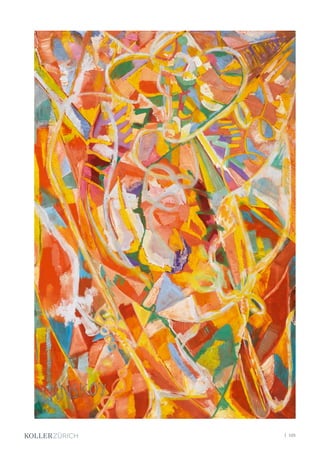
| 114
Impressionismus  Moderne
3289
HANS FRONIUS
(Sarajevo 1903–1988 Mödling)
Brücke in Wien. 1931.
Öl auf Leinwand.
Unten links signiert und datiert:
H. fronius 31.
59,5 × 80,5 cm.
Provenienz:
- Privatbesitz Graz, um 1940 direkt vom
Künstler als Geschenk erhalten.
- Schweizer Privatbesitz, durch Erbschaft
von Obigem erhalten.
CHF 4 000 / 6 000
(€ 3 640 / 5 450)
| 115
3290*
FELIX LABISSE
(Marchiennes 1905–1982 Neuilly-sur-
Seine)
Libidoscaphes dans la baie de Rio. 1962.
Öl auf Leinwand.
Unten rechts signiert: Labisse.
Verso auf der Leinwand betitelt, signiert
und datiert: Libidoscaphes dans la baie de
Rio / Labisse / 1962.
89 × 116 cm.
Provenienz:
- Sammlung Madam Akston, New York.
- Auktion van Ham, Köln, 24. Mai 2003, Los
346.
- Privatbesitz Deutschland, an obiger
Auktion erworben.
Ausstellungen:
- Paris 1956, Galerie Iris Clert.
- Paris 1962, Labisse, Musée Galliéra,
Mai 1962.
- Rio de Janeiro 1963, Galleria Barcinski.
- New York 1964, Felix Labisse, Gallery 63,
26. Februar–16. März 1964.
Literatur:
- Isy Brachot: Labisse, Catalogue de
l'œuvre peint, 1927–79, Brüssel 1979, Nr.
360, S. 192 (mit Abb.).
- P. Waldberg: Félix Labisse, Brüssel 1970,
S. 214 (mit Abb.).
- Douglas (Hrsg.), in: Fate, Ile de Man, Mai
1963 (mit Abb.)
- Dario Carioca, Rio de Janeiro, Oktober
1963 (mit Abb.).
- Douglas (Hrsg.): Gurdjeff, Ile de Man 1963
(mit Abb.).
- Planète (Hrsg.): Les chefs d'œuvre de
l'érotisme, Paris 1964 (mit Abb.).
- J.J. Pauvert: Dictionnaire de sexologie,
Paris 1965 (mit Abb.).
- Erotique de l'art, in: La Jeune Parque,
Paris 1966 (mit Abb.).
- Lo Duca (Hrsg.): Dictionnaire de sexolo-
gie, encyclopédie francaise de Poche, Bd.
III, Paris 1972 (mit Abb.).
CHF 7 000 / 10 000
(€ 6 360 / 9 090)
| 116
Impressionismus  Moderne
3291
BALTASAR LOBO
(Cerecinos de Campos/Spanien 1910–1993 Paris)
Torse centauresse. 1979.
Bronze, dunkelgrüne Patina.
Unten am Hinterbein signiert und nummeriert: Lobo 2/8.
Am Schweif mit dem Giesserstempel: Fondeur Susse
Paris.
31 × 27 × 12 cm.
Provenienz:
Schweizer Privatsammlung, durch Erbschaft erhalten.
Literatur:
Joseph-Émile Muller: Lobo. Catalogue raisonné de
l'œuvre sculpté, Lausanne 1985, Nr. 491 (mit Abb.).
CHF 12 000 / 18 000
(€ 10 910 / 16 360)
| 117
ANDRÉ, ALBERT 3260, 3269
ARCHIPENKO, ALEXANDER 3243
BEREND-CORINTH,
CHARLOTTE
3268
BERNARD, EMILE 3261
BOLDINI, GIOVANNI 3205
BOMBOIS, CAMILLE 3270, 3285, 3286
BUFFET, BERNARD 3276
CAMOIN, CHARLES 3225
CHAGALL, MARC 3251
CHARCHOUNE, SERGE 3280, 3281, 3282
COROT, JEAN-BAPTISTE
CAMILLE
3204
DENIS, MAURICE 3207, 3208
EPSTEIN, ELISABETH 3242
FEININGER, LYONEL 3234
FORAIN, JEAN LOUIS 3287
FOUJITA, TSUGUHARU 3250
FRONIUS, HANS 3288, 3289
GARGALLO, PABLO 3255
HECKEL, ERICH 3231
HERBIN, AUGUSTE 3256
KIRCHNER, ERNST LUDWIG 3228, 3229, 3230,
3232, 3233, 3236, 3237
KLEE, PAUL 3238, 3241, 3245
KOLBE, GEORG 3244
LABISSE, FELIX 3290
LANSKOY, ANDRÉ 3272, 3273,
3274, 3275, 3277
LE CORBUSIER (JEANNERET-
GRIS, CHARLES-ÉDOUARD)
3235, 3278,
3283, 3284
LEBOURG, ALBERT 3222, 3223
LÉVY-DHURMER, LUCIEN 3267
LIEBERMANN, MAX 3202, 3203
LOBO, BALTASAR 3291
LOISEAU, GUSTAVE 3210
VALTAT, LOUIS 3263, 3264
LUCE, MAXIMILIEN JULES 3226
MANIEVICH, ABRAHAM 3213, 3214,
3215, 3216, 3217
MARINI, MARINO 3249
MARQUET, ALBERT 3254, 2162
MARTIN, HENRI 3211, 3212, 3227
MEIER, THEO 3271
MONTÉZIN, PIERRE EUGÈNE 3259
RENOIR, PIERRE-AUGUSTE 3206, 3219, 3220
RODIN, AUGUSTE 3218
ROHLFS, CHRISTIAN 3246, 3247
RYSSELBERGHE, THÉO VAN 3266
SIGNAC, PAUL 3221, 3248
SISLEY, ALFRED 3224
SOUTTER, LOUIS 3279
URY, LESSER 3201
UTRILLO, MAURICE 3252, 3253, 3257
VLAMINCK, MAURICE DE 3265
VUILLARD, EDOUARD 3209
WEREFKIN, MARIANNE VON 3239, 3240
ZADKINE, OSSIP 3258
| 118
Künstlerregister
VORBESICHTIGUNG
Hardturmstrasse 102/121
8031 Zürich, Schweiz
AUKTION
Hardturmstrasse 102
8031 Zürich, Schweiz
VORBESICHTIGUNG
Hardturmstrasse 121
8031 Zürich, Schweiz
AUKTION
ONLINE ONLY
VORBESICHTIGUNG
2, Rue de l‘Athénée
1205 Genf, Schweiz
AUKTION
2, Rue de l‘Athénée
1205 Genf, Schweiz
AUKTIONEN
REPRÄSENTANTEN
Koller Auktionen AG
Hardturmstrasse 102
8031 Zürich, Schweiz
Tel +41 44 445 63 63 
Fax +41 44 273 19 66 
office@kollerauktionen.ch
www.kollerauktionen.ch
Koller Auktionen AG
2, Rue de l‘Athénée
1205 Genf, Schweiz
Tél +41 22 311 03 85
Fax +41 22 810 06 30
geneva@kollerauktionen.ch
www.kollerauktionen.ch
MÜNCHEN
Fiona Seidler
Maximiliansplatz 20
80333 München
Tel. +49 89 22 80 27 66
Fax +49 89 22 80 27 67
Mobile +49 177 257 63 98
muenchen@kollerauktionen.com
DÜSSELDORF
Ulrike Gruben
Citadellstrasse 4
40213 Düsseldorf
Tel. +49 211 30 14 36 38
Fax +49 211 30 14 36 39
Mobile +49 175 586 38 64
duesseldorf@kollerauktionen.com
MOSKAU
Vadim Goncharenko
Mobile +41 76 431 81 64
moscow@kollerauctions.com
BEIJING
Jing Li
Haidianque Chedaogou 10# 6/4-307
100089 Beijing
Tel. +86 135 2039 8057
beijing@kollerauctions.com
HAMBURG
Ulrike Gruben
Tel. +49 211 30 14 36 38
hamburg@kollerauktionen.com
ITALIEN
LuigiPesce
ViaCairoli18
16124Genua
Tel.+393395962768
italia@kollerauktionen.ch
KOLLER
Auktionen
Sie können
sämtliche
Kunstwerke
aus diesen
Auktionen über
das Leasing
erwerben:
PostWar 
Contemporary
1. Juli 2021
Grafik  Multiples
1. Juli 2021
Schweizer Kunst
2. Juli 2021
Impressionismus 
Klassische Moderne
2. Juli 2021
Koller Auktionen AG
Hardturmstrasse 102
CH-8031 Zürich
Tel +41 44 445 63 63
Fax +41 44 273 19 66
office@kollerauktionen.ch
LOT 3673;
ANDY WARHOL
$1. 1982
Farbserigrafie. 25/60.
Unten rechts mit
Bleistift signiert: Andy
Warhol, sowie verso
mit dem Copyright-
Stempel: © ANDY
WARHOL 1982.
Blattmass:
50,2 × 39,8 cm.
Schätzwert:
35'000 - 45'000 CHF
Monatlicher
Leasingbetrag:
437 - 562 CHF *)
ART LEASING  INVEST AG
Seestrasse 455a CH - 8038 Zürich
Tel +41 44 480 06 90 | Fax +41 44 480 06 91
contact@artleasing.com | www.artleasing.com
Be SmArt, Lease Art
ARTLEASING - IHRE VORTEILE
• Geringer Liquiditätsbedarf
• Nach dem Leasing gehört das Kunstwerk Ihnen
• „All Risk“ Kunstversicherung inbegriffen
• Attraktive Konditionen
• Erleichterter Einstieg in die Kunstwelt
MAXIMALE FLEXIBILITÄT BEIM KUNSTERWERB
Wir finanzieren die Hälfte Ihres erfolgreichen Gebotes!
Sie können sich beim Leasing für einen Zeitraum von 3
oder 4 Jahren entscheiden. Sie können sich sofort am
Kunstwerk erfreuen und nach dem Leasing gehört es
Ihnen.
LEASINGBEISPIEL AUS DER AKTUELLEN AUKTION
437 – 562 CHF PRO MONAT
KOLLER
Auktionen
Sie können
sämtliche
Kunstwerke
aus diesen
Auktionen über
das Leasing
erwerben:
PostWar 
Contemporary
1. Juli 2021
Grafik  Multiples
1. Juli 2021
Schweizer Kunst
2. Juli 2021
Impressionismus 
Klassische Moderne
2. Juli 2021
Koller Auktionen AG
Hardturmstrasse 102
CH-8031 Zürich
Tel +41 44 445 63 63
Fax +41 44 273 19 66
office@kollerauktionen.ch
LOT 3438; ROY LICHTENSTEIN; (1923 New York 1997); Ohne Titel.
1979; Öl auf Leinwand.; 31,5 × 42,5 cm.
Schätzwert: 25'000 - 35'000 CHF
Monatlicher Leasingbetrag: 312 - 437 CHF *)
ART LEASING  INVEST AG
Seestrasse 455a CH - 8038 Zürich
Tel +41 44 480 06 90 | Fax +41 44 480 06 91
contact@artleasing.com | www.artleasing.com
ARTLEASING – SO EINFACH GEHT‘S
Option 1
Kontaktieren Sie uns vor der Auktion und erfahren Sie
mit welchem Spielraum Sie rechnen können.
Option 2
Bieten Sie an der Auktion für das Kunstwerk Ihrer Wahl.
Nach erfolgreicher Prüfung Ihres Leasingantrages treten
wir in Ihren Bietvertrag ein und ermöglichen Ihnen das
Leasing.
ART LEASING  INVEST AG - SEIT 2006
Ihr umfassender und vertraulicher Partner in allen
Fragen der Kunstfinanzierung und -verwaltung (MY ART
MANAGER) für private und institutionelle Kunden.
Wir verfügen über ein Steuer-Ruling mit dem Kanton
Zürich zur steuerlichen Absetzbarkeit der Leasingraten
und unterstehen dem GWG.
* zzgl. MwSt. und „All Risk“ Kunstversicherung. Erste Rate 50%. (Stand Jan. 2021 /
Änderungen vorbehalten)
312 - 437 CHF PRO MONAT
LEASINGBEISPIEL AUS DER AKTUELLEN AUKTION
| 122
| 122
BEDINGUNGEN FÜR KLASSISCHE AUKTIONEN
Diese Bedingungen gelten für Objekte, die von
Koller (gemäss Definition unten) live im Aukti-
onssaal versteigert werden.
Durch die Teilnahme an der Auktion unterzieht
sich der Bieter den nachstehenden Auktions-
bedingungen („AGB“) der Koller Auktionen AG,
Hardturmstrasse 102, 8005 Zürich, Schweiz
(„Koller“):
1. Rechtsstellung der Parteien
Die Steigerungsobjekte werden durch Koller im
Namen und auf Rechnung des Einlieferers des zu
versteigernden Objektes („Einlieferer“) verstei-
gert. Koller handelt in fremdem Namen und auf
fremde Rechnung als direkte/unmittelbare Stell-
vertreterin des Einlieferers im Sinne von Art. 32
Abs. 1 des schweizerischen Obligationenrechts
(„OR“). Der Zuschlag erfolgt an den von Koller im
Rahmen der Auktion anerkannten Bieter mit dem
höchsten Gebot in Schweizer Franken („Käufer“),
wodurch das betroffene ersteigerte Objekt ein
verbindlicher Kaufvertrag zwischen Einlieferer
und Käufer entsteht („Kaufvertrag“). Koller wird
dadurch nicht Partei des Kaufvertrages.
2. Aufgeld
2.1 Nebst dem Zuschlagspreis ist vom Käufer
auf den Zuschlagspreis ein Aufgeld zu entrich-
ten, das wie folgt berechnet wird:
i. bei einem Zuschlag bis CHF 10‘000: 25%
ii. bei einem Zuschlag ab CHF 10‘000 bis
CHF 400‘000: 25% auf die ersten CHF 10‘000
und 22% auf die Differenz von CHF 10‘000 bis
zur Höhe des Zuschlags
iii. 
bei einem Zuschlag ab CHF 400‘000: 25% auf
die ersten CHF 10‘000; 22% auf CHF 390‘000
und 15% auf die Differenz von CHF 400‘000
bis zur Höhe des Zuschlags.
2.2 Falls der Käufer während einer online über-
tragenen Saal-Auktion („Live-Auktion“) live im
Internet mitbietet, oder ein Vorgebot über eine
fremde, mit Koller verlinkten Seite abgibt, wird
ein zusätzlicher Aufpreis von 3% des Zuschlags
verrechnet. Für Gebotsabgaben im Rahmen
einer Live-Auktion gelten im Übrigen die Bedin-
gungen, welche auf der Live-Auktion Webseite
publiziert sind. Diese können von den hier pub-
lizieren abweichen.
2.3 Auf das Aufgeld hat der Käufer die schwei-
zerische Mehrwertsteuer („MWST“) zu entrich-
ten. Die angegebenen %-Sätze des Aufgeldes
beziehen sich auf den Zuschlagspreis für jedes
einzelne Objekt. 
2.4 Alle im Auktionskatalog mit * (Asterisk) be-
zeichneten Objekte sind vollumfänglich mehr-
wertsteuerpflichtig, d. h. bei diesen Objekten
wird die MWST auf den Zuschlagspreis plus
Aufgeld berechnet. Käufer, die eine rechtsgültig
abgestempelte Ausfuhrdeklaration vorlegen, er-
halten die MWST rückvergütet. 
2.5 Der Käufer erklärt sich damit einverstanden,
dass Koller allenfalls auch vom Einlieferer eine
Kommission erhält.
3. Garantie
3.1 Koller wird den Kauf (unter Vorbehalt nachfol-
gender Ziffern 3.2 und 3.3) namens des Einlieferers
rückgängig machen und dem Käufer Kaufpreis und
Aufgeld (inkl. MWST) zurückerstatten, falls sich das
Objekt als Fälschung erweist. Eine Fälschung liegt
vor, wenn das Objekt nach vernünftiger Auffassung
von Koller eine im Hinblick auf Urheberschaft, Alter,
Periode,KulturoderHerkunftinTäuschungsabsicht
geschaffene Imitation ist, bei der sich die korrekte
Beschreibung solcher Inhalte nicht in der Beschrei-
bungimAuktionskatalog(unterBeachtungjeglicher
Ergänzungen) widerspiegelt und dieser Umstand
denWertdesObjektsimVergleichzueinemderKa-
talogbeschreibung entsprechenden Gegenstand
wesentlich beeinträchtigt. Ein Objekt gilt nicht als
gefälscht, wenn es lediglich beschädigt ist und/oder
an ihm Restaurierungsarbeiten und/oder Verände-
rungenirgendwelcherArtvorgenommenwurden. 
3.2 Eine Rückabwicklung gemäss vorstehender
Bestimmung findet nach Ermessen von Koller
nicht statt, falls:
i. 
die Beschreibung des Objekts im Auktions-
katalog im Einklang mit der Meinung einer
Fachperson oder mit der herrschenden Mei-
nung von Fachpersonen stand oder die Be-
schreibung im Auktionskatalog andeutete,
dass hierüber Meinungsverschiedenheiten
bestanden, 
ii. 
die Fälschung zur Zeit des Zuschlages nach
dem Stand der Forschung und mit den allge-
mein anerkannten und üblichen Methoden
noch nicht oder nur mit unverhältnismässi-
gem Aufwand als solche erkennbar war,
iii. 
die Fälschung (nach Kollers sorgfältiger Ein-
schätzung) vor 1880 hergestellt wurde oder 
iv. 
es sich beim Kaufobjekt um ein Gemälde,
Aquarell, eine Zeichnung oder Skulptur han-
delt, das gemäss den Angaben im Auktions-
katalog vor 1880 entstanden sein müsste.
3.3 Der Käufer kann von Koller (als Vertreterin
des Einlieferers) die Rückabwicklung ab dem Tag
des Zuschlages für einen Zeitraum von zwei (2)
Jahren (drei (3) Wochen für Schmuck) verlangen.
Sie wird ausschliesslich dem Käufer eingeräumt
und darf nicht an Dritte abgetreten werden. Die
Geltendmachung des Anspruchs setzt voraus,
dass der Käufer gegenüber Koller sofort nach
Entdeckung des Mangels mit eingeschriebe-
nem Brief Mängelrüge erhebt und Koller das ge-
fälschte Kaufobjekt im gleichen Zustand, wie es
ihm übergeben wurde, und unbelastet von An-
sprüchen Dritter, zurückgibt. Der Käufer hat den
Nachweis zu erbringen, dass es sich beim Ob-
jekt um eine Fälschung handelt. Koller kann vom
Käufer verlangen, dass dieser auf eigene Kosten
Gutachten von zwei unabhängigen und in dem
Bereich anerkannten Experten einholt, ist jedoch
nicht an solche Gutachten gebunden und behält
sich das Recht vor, zusätzlichen Expertenrat auf
eigene Kosten einzuholen.
3.4 KollerkannnachfreiemErmessenaufdieGel-
tendmachung eines Ausschlussgrundes gemäss
vorstehender Ziffer 3.2 oder auf die Erfüllung von
Voraussetzungen nach obiger Ziffer 3.3 verzich-
ten.
3.5 Die Ansprüche des Käufers gegen Koller als
Vertreterin des Einlieferers unter dieser Ziffer
3.1 beschränken sich auf die Rückerstattung des
von diesem bezahlten Kaufpreises und Aufgel-
des (inkl. MWST). Weitergehende oder andere
Ansprüche des Käufers sind unter jedwelchem
Rechtstitel (inklusive Irrtumsanfechtung gemäss
Art. 23 ff. OR) ausgeschlossen.
4. Haftungsausschluss
4.1 Die Steigerungsobjekte werden in dem Zu-
stand versteigert, in dem sie sich im Augenblick
des Zuschlags befinden. Bei den Steigerungsob-
jekten handelt es sich um „gebrauchte“ Waren.
Diese befinden sich naturgemäss nicht mehr in
neuwertigem Zustand.
4.2 Zu jedem Objekt beinhaltet der Auktionskata-
log eine Beschreibung mit Abbildung. Die Informa-
tionenindenAuktionskatalogen,sowie Zustands-
berichte von Koller die vor der Auktion angefordert
werden können, geben lediglich ein allgemeines
Bild und eine unverbindliche Einschätzung von
Koller wieder. Die Beschreibung der Objekte er-
folgt nach bestem Wissen und Gewissen, doch
kann Koller für die Katalogangaben keine Haftung
übernehmen. Während der Ausstellung besteht
die Möglichkeit, die Gegenstände zu besichtigen.
Entsprechend wird der Käufer aufgefordert, das
ObjektvorderAuktioninAugenscheinzunehmen,
und sich, allenfalls unter Heranziehung unabhän-
giger Fachberatung, ein eigenes Urteil über die
Übereinstimmung des Objekts mit der Katalog-
beschreibung zu bilden. Für die Objektbeschrei-
bungen ist die gedruckte Ausgabe des Katalogs
(inkl. späterer Ergänzungen) in deutscher Sprache
ausschliesslich massgebend. Koller behält sich
das Recht vor, zur Meinungsbildung Experten oder
Fachkräfte ihrer Wahl beizuziehen und sich auf
diese abzustützen. Koller kann für die Richtigkeit
solcher Meinungen nicht verantwortlich gemacht
werden. Solche Expertenmeinungen oder Gut-
achten stellen genauso wenig wie von Koller vor-
genommene Objektbeschreibungen oder sonsti-
ge Aussagen über ein Objekt (inklusive Aussagen
über dessen Wert) explizite oder stillschweigende
Zusicherungendar.
4.3 UnterVorbehaltvonvorstehenderZiff.3wird
jede Haftung für Rechts- und Sachmängel weg-
bedungen. Die Verpflichtungen des Einlieferers
gegenüber dem Käufer sind im gleichen Masse
eingeschränkt wie die Verbindlichkeiten von Kol-
ler gegenüber dem Käufer.
5. Teilnahme an der Auktion
5.1 Die Teilnahme an einer Auktion als Bieter
steht jedermann offen. Koller behält sich aber
das Recht vor, nach freiem Ermessen jeder
Person den Zutritt zu ihren Geschäftsräumlich-
keiten oder die Anwesenheit bzw. Teilnahme an
ihren Auktionen zu untersagen. 
5.2 Bieter, die Koller nicht persönlich bekannt
sind, müssen sich bis 48 Stunden vor der Auktion
mittels des dafür vorgesehenen Formulars re-
gistrieren. Der rechtsgültig unterzeichneten Re-
gistrierung ist eine Kopie des gültigen Reisepas-
ses und eine Kopie der Kreditkarte beizulegen.
Bei jedem Zahlungsverzug des Bieters ist Koller
berechtigt, die Kreditkarte des Bieters gemäss
Angaben auf dem Registrierungsformular bis
zur Höhe des geschuldeten Betrages zuzüglich
Spesen des Kartenanbieters zu belasten. 
5.3 Koller kann von jedem Bieter vorgängig einen
Bonitätsnachweis einer für Koller akzeptablen
Bank verlangen. 
5.4 Bei Geboten für Objekte mit oberen Schätz-
werten von mehr als CHF 30 000 kann Koller vom
Bieter jederzeit die vorgängige Überweisung von
20% der unteren Schätzwerte als Sicherheit ver-
langen. Koller wird diesen Betrag nach der Aukti-
on mit ihren und den Ansprüchen der Einlieferer
verrechnenundeinenallfälligenÜberschussum-
gehend an den Käufer / Bieter zurückerstatten.
| 123
| 123
6. Versteigerung
6.1 Koller kann ein Objekt unterhalb des mit dem
Einlieferer vereinbarten Mindestverkaufspreises
zum Ausruf bringen. Die Abgabe eines Gebots
anlässlich der Versteigerung bedeutet eine ver-
bindliche Offerte. Der Bieter bleibt an sein Gebot
gebunden, bis dieses entweder überboten oder
von Koller abgelehnt wird. Doppelgebote werden
sofort nochmals aufgerufen; in Zweifelsfällen
entscheidet die Auktionsleitung. 
6.2 Es steht Koller frei, ein Angebot ohne be-
sondere Gründe abzulehnen oder aber, falls ein
Bieter die Voraussetzungen zur Teilnahme an
einer Auktion gemäss obiger Ziffer 5.2 bis 5.4
nicht erfüllt. Ebenso steht es Koller frei, Steige-
rungsgegenstände ohne Verkauf zuzuschlagen
oder zurückzunehmen, selbst wenn dies für die
Auktionsteilnehmer nicht erkennbar sein sollte. 
6.3 Koller behält sich das Recht vor, Nummern
des Katalogs zu vereinigen, zu trennen, ausser-
halb der Reihenfolge anzubieten oder wegzulas-
sen. Koller behält sich vor, einen Zuschlag bei Vor-
liegen besonderer Umstände nur unter Vorbehalt
vorzunehmen. Erfolgt der Zuschlag unter Vorbe-
halt, so bleibt der Bieter noch während 14 Tagen
anseinGebotgebunden.Erwirdwiederfrei,wenn
die Erklärung von Koller, der Zuschlag sei definitiv,
nicht innert dieser Frist bei ihm eintrifft. 
6.4 Steigerungsangebote von Kaufinteressen-
ten, die der Auktion nicht persönlich beiwohnen
können, werden bis 48 Stunden vor Beginn der
Steigerung schriftlich entgegengenommen. 
6.5 Interessenten können telefonisch mitbieten,
wenn sie dies mindestens 48 Stunden vor Aukti-
onsbeginn schriftlich vorangemeldet haben. Auf
Objekte mit Schätzpreisen unter CHF 500 kann
nicht telefonisch geboten werden und Interes-
senten werden um Abgabe eines schriftlichen
Gebots bzw. um persönliches Mitbieten im Auk-
tionssaal gebeten. 
6.6 Interessenten, die ihr Gebot im Rahmen ei-
ner Live-Auktion abgeben möchten, können an
der Auktion teilnehmen, nachdem sie von Koller
aufgrund eines Registrierungsgesuchs zur Auk-
tion zugelassen worden sind. Koller behält sich
das Recht vor, Registrierungsgesuche ohne wei-
teres abzulehnen. 
6.7 Koller lehnt jede Haftung für nicht berück-
sichtigte Gebote aller Art sowie für nicht berück-
sichtigte Anmeldungen für telefonisches Mitbie-
tenab.FürtelefonischeMitbieterundschriftliche
Auftraggeber gilt bezüglich Legitimierung und
Bonitätsnachweis ebenfalls Ziff. 5.
7. Eigentumsübergang
Das Eigentum an einem ersteigerten Objekt
geht auf den Käufer über, sobald der Kaufpreis
und das Aufgeld (inkl. MWST) vollständig in
Schweizer Franken bezahlt sind und Koller die-
se Zahlungen dem entsprechenden Objekt zu-
geordnet hat.
8. Abholung der ersteigerten Objekte
8.1 Die ersteigerten Gegenstände müssen vom
Käufer innerhalb von 7 Tagen nach Abschluss
der Auktion während der Öffnungszeiten auf ei-
gene Kosten abgeholt werden. Erfüllungsort des
Kaufvertrages zwischen Käufer und Einlieferer ist
mithin der Geschäftssitz von Koller. Wenn die Zeit
es erlaubt, werden die Objekte nach jeder Sitzung
ausgegeben. Die Herausgabe erfolgt nach voll-
ständiger Bezahlung des Kaufpreises sowie des
Aufgeldes (inkl. MWST) und Zuordnung dieses
Betrages zum ersteigerten Objekt durch Koller.
8.2 Während der vorgenannten Frist haftet Kol-
ler für Verlust, Diebstahl, Beschädigung oder
Zerstörung zugeschlagener und bezahlter Ob-
jekte, jedoch nur bei grobfahrlässiger oder vor-
sätzlicher Handlung durch Koller und nur bis zur
Höhe von Zuschlagspreis, Aufgeld und MWST.
Nach Ablauf dieser Frist haftet Koller nicht mehr
und es ist Sache des Käufers, für eine angemes-
sene Versicherung des ersteigerten Objekts zu
sorgen. Für Rahmen und Glas kann keine Haf-
tung übernommen werden. Werden die erstei-
gerten Objekte nicht innert 7 Tagen abgeholt,
lagert Koller diese wahlweise auf Kosten und Ge-
fahr des Käufers bei einer Firma ihrer Wahl oder
in ihren eigenen Räumen zu einem Tagessatz
von CHF 10 pro Objekt ein. 
8.3 Transportaufträge nimmt Koller schriftlich
entgegen. Die Transportkosten trägt der Käufer.
Ohne anders lautende schriftliche Abmachung
werden die zugeschlagenen Objekte für den
Transport durch Koller auf Kosten des Käufers
versichert. Verglaste Bilder und zerbrechliche
Objekte werden von Koller nicht versandt.
9. Bezahlung der ersteigerten Objekte
9.1 Die Rechnung aufgrund eines Zuschlags für
ein ersteigertes Objekt ist innert 7 Tagen nach
Abschluss der Auktion in Schweizer Franken
zu bezahlen. Zahlungen mittels Kreditkarte sind
nur nach Rücksprache mit der Buchhaltung von
Koller möglich und unterliegen einer Bearbei-
tungsgebühr zwischen 2 und 4%, die vom Käufer
zu bezahlen ist und auf den Rechnungsbetrag
erhoben wird.
9.2 Koller kann Zahlungen des Käufers auch ent-
gegen dessen anderslautenden Instruktionen auf
jedebeliebigeSchulddesKäufersgegenüberKoller
oder gegenüber dem Einlieferer anrechnen und
allfällige Forderungen des Käufers gegen sie mit
eigenen Ansprüchen verrechnen. Ist der Käufer
im Zahlungsverzug, wird auf den Rechnungsbe-
trag ein Verzugszins von 10% p.a. erhoben. Falls
der Käufer den Rechnungsbetrag nicht innert 7
TagennachderbetreffendenAuktionbegleicht,ist
Koller ohne weitere Rücksprache mit dem Käufer
berechtigt, den geschuldeten Rechnungsbetrag
der Kreditkarte des Käufers zu belasten. In solchen
Fällen wird auf den Rechnungsbetrag sodann eine
Bearbeitungsgebühr zwischen 2 und 4% erhoben,
dieebenfallsderKreditkartebelastetwird.
9.3 Leistet der Käufer die geschuldete Zahlung
nicht oder nicht rechtzeitig, kann Koller zudem
namens des Einlieferers wahlweise (i) weiterhin
Erfüllung des Kaufvertrags verlangen oder (ii)
ohne Fristansetzung auf Leistung des Käufers
verzichten und vom Kaufvertrag zurücktreten
oder Schadenersatz wegen Nichterfüllung ver-
langen; im letzteren Fall ist Koller auch berech-
tigt, das Objekt ohne Beachtung eines Min-
destverkaufspreises entweder freihändig oder
anlässlich einer Auktion zu verkaufen und den
Erlös zur Reduktion der Schulden des Käufers
zu verwenden. Ein allfälliger über dem ursprüng-
lichen Zuschlagspreis liegender Verkaufspreis
wird an den Einlieferer ausbezahlt. Der Käufer
haftet Koller und dem Einlieferer für allen aus der
Nichtzahlung bzw. Zahlungsverspätung entste-
henden Schaden. 
9.4 BiszurvollständigenBezahlungallergeschulde-
tenBeträgebehältKolleranallensichinihremBesitz
befindlichen Objekten des Käufers ein Pfandrecht.
Koller ist zur betreibungsrechtlichen oder privaten
Verwertung (inkl. Selbsteintritt) solcher Pfänder
berechtigt. Die Einrede der vorgängigen Pfandver-
wertung nach Art. 41 des Schweizer Schuldbetrei-
bungs-undKonkursrechtsistausgeschlossen.
10. Vertretung
Jeder Käufer haftet persönlich aus dem ihm erteil-
ten Zuschlag und aus dem durch ihn eingegange-
nen Kaufvertrag mit dem Einlieferer. Von Perso-
nen, die als Stellvertreter in fremdem Namen oder
als Organ einer juristischen Person bieten, kann
der Nachweis der Vertretungsbefugnis verlangt
werden. Ein solcher Stellvertreter haftet mit dem
Vertretenen unbeschränkt und solidarisch für die
ErfüllungsämtlicherVerbindlichkeiten.
11. Verschiedene Bestimmungen
11.1 Die Auktion erfolgt unter Mitwirkung eines
Beamten des Stadtammannamtes Zürich. Jede
Haftung des anwesenden Beamten, der Ge-
meinde oder des Staates für Handlungen von
Koller ist ausgeschlossen. 
11.2 Koller behält sich das Recht vor, einzelne
oder alle Rechte und Pflichten aus diesen AGB
an einen Dritten zu übertragen oder durch einen
Dritten ausüben zu lassen. Der Bieter resp. der
Käufer ist nicht berechtigt, Rechte und Pflichten
aus diesen AGB Dritten zu übertragen.
11.3 Koller behält sich das Recht vor, Fotografien
und Abbildungen von verkauften Objekten in den
eigenen Publikationen und in den Medien zu ver-
öffentlichen und damit Werbung zu betreiben. 
11.4 Die vorstehenden Bedingungen sind Be-
standteil jedes einzelnen an der Auktion ge-
schlossenen Kaufvertrags. Abänderungen sind
nur mit schriftlichem Einverständnis von Koller
verbindlich. 
11.5 Sollten einzelne Bestimmungen dieser
AGB ganz oder teilweise nichtig und/oder un-
wirksam sein, bleibt die Gültigkeit und/oder
Wirksamkeit der übrigen Bestimmungen oder
Teile solcher Bestimmungen unberührt. Die un-
gültigen und/oder unwirksamen Bestimmungen
werden durch solche ersetzt, die dem Sinn und
Zweck der ungültigen und/oder unwirksamen
Bestimmungen in rechtswirksamer Weise wirt-
schaftlich am nächsten kommt. Das gleiche gilt
bei eventuellen Lücken der Regelung.
11.6 Die vorliegenden AGB und alle Änderungen
daran unterliegen Schweizer Recht, unter Aus-
schluss von allfälligen Verweisungen des Bun-
desgesetztes über das Internationale Privat-
recht (IPRG) und unter Ausschluss des Wiener
Kaufrechts (UN-Kaufrechts). 
11.7 Für die Beurteilung von Streitigkeiten (unter
Einschluss der Geltendmachung von Verrech-
nungen und Gegenforderungen), welche aus oder
im Zusammenhang mit diesen AGB (einschliess-
lich deren Gültigkeit, Rechtswirkung, Auslegung
oder Erfüllung) entstehen, sind ausschliesslich
die Gerichte des Kantons Zürich zuständig. Kol-
ler ist aber berechtigt, ein Verfahren vor jedem
sonst zuständigen Gericht anhängig zu machen.
Zürich, 1. Juli 2018
AUCTION CONDITIONS (CLASSIC AUCTIONS)
These conditions apply solely to items which are
auctioned by Koller (according to the definition
below) live in the saleroom.
By participating in the auction the bidder
accepts the following Auction Conditions of
Koller Auctions Ltd, Hardturmstrasse 102, 8005
Zurich, Switzerland (“Koller”).
1. Legal status of the parties
The auction items are auctioned by Koller in
the name of and on the account of the seller
of the auctioned item (“Seller”). Koller acts on
behalf of and for the account of the Seller as his
agent as defined in article 32, section 1 of the
Swiss Code of Obligations (“CO”). The hammer
price is determined by the bidder recognised by
Koller as having made the highest bid in Swiss
Francs in the course of an auction (“Purchaser”),
resulting in the conclusion of a purchase
contract between the Seller and the Purchaser
(“Purchase Contract”). Koller is thereby not a
party to the Purchase Contract.
2. Surcharge
2.1 In addition to the bid price, the Purchaser
must pay a surcharge on such bid price
calculated as follows:
i.  on a successful bid of up to CHF 10 000: 25%
ii. NEW: on a successful bid over CHF 10 000 up
to CHF 400 000: 25% on the first CHF 10 000
and 22% on the difference between CHF 10 000
and the bid.
iii. NEW: on a successful bid over CHF 400 000:
25% on the first CHF 10 000, 22% on
CHF 390 000 and 15% on the difference
between CHF 400 000 and the bid.
2.2 If the winning bid is placed over the internet
in the course of a saleroom auction which is
broadcast online (“Live Auction”), or leaves a
pre-sale bid through an independent bidding
platform which is linked with Koller, there will be
anadditional3%addedtothesurcharge.Bidders
are subject to Koller’s terms and conditions as
listed on the Live Auction website, which may
differ in some respects from those listed here.
2.3 The Purchaser must pay Swiss value added
tax (“VAT”) on the surcharge. The stated
percentage of the surcharge corresponds to the
successful bid for each individual item.
2.4 The full tax is charged on all items marked * in
the auction catalogue, i.e. VAT is charged on the
sum of the bid price plus the surcharge for those
items. The VAT will be refunded to Purchasers
providing a validly stamped export declaration.
2.5 The Purchaser agrees that Koller also has
the possibility to receive a commission from the
Seller.
3. Guarantee
3.1 Koller shall rescind the purchase (subject to
Sections 3.2 and 3.3 below) in the name of the
Seller and shall reimburse the purchase price
and the surcharge (incl. VAT) to the Purchaser if
an item proves to be a forgery. A “forgery” shall
be deemed to exist if the item, in the reasonable
opinion of Koller, is an imitation created
with the intention of causing a deception
with respect to the authorship, age, period,
culture or origin, if the correct description of
such content is not reflected in the auction
catalogue (taking account of any additions),
and if this circumstance significantly impairs
the value of the item in comparison to an item
corresponding to the catalogue description. An
item shall not be deemed to have been forged if
it is merely damaged and/or has been subjected
to restoration work and/or modifications of any
nature whatsoever.
3.2 A rescission in accordance with the above
provision shall not take place at the discretion of
Koller if:
i. 
the description of the item in the auction
catalogue was supported by the view of
a specialist or by the prevailing view of
specialists, or if the description in the auction
catalogue suggested that differences of
opinion exist in this respect;
ii. the forgery was not identifiable as such at the
time of the successful bid in accordance with
the current state of research and with the
generally acknowledged and usual methods,
or only with disproportionate effort;
iii. 
the forgery (based on Koller’s conscientious
assessment) was produced before 1880; or
iv. 
the purchased item is a painting, watercolour,
drawing or sculpture which according to the
details set out in the auction catalogue was
created prior to 1880.
3.3 The Purchaser may request rescission from
Koller (as the agent of the Seller) from the day
of the successful bid for a period of two (2)
years (three (3) weeks for jewellery). It shall be
granted exclusively to the Purchaser and may
not be assigned to any third party. Assertion of
theclaimshallbeconditionaluponthePurchaser
making a complaint to Koller by registered letter
immediately after the discovery of the defect,
and returning the purchased item to Koller in
the same condition as it was handed over to him
and unencumbered by third parties› claims. The
Purchaser must provide proof that the item is a
forgery. Koller may demand that the Purchaser
obtains at his own expense expert opinions from
two independent individuals who are recognised
experts in the field. However, Koller shall not be
bound by any such expert opinion, and reserves
the right to obtain additional expert advice at its
own expense.
3.4 Koller may at its complete discretion waive
the assertion of grounds for exclusion pursuant
to the above Section 3.2 or the fulfilment of
preconditionspursuanttotheaboveSection3.3.
3.5 The claims of the Purchaser against Koller
as the agent of the Seller under Section
3.1 are limited to the reimbursement of the
purchase price and surcharge (incl. VAT) paid
by the Purchaser. Further or other claims of
the Purchaser are excluded under any legal
title (including error according to art. 23 ff. CO)
whatsoever.
4. Disclaimer
4.1 The items are auctioned in the condition
existing at the time of the successful bid. The
auctioned items are “used” objects and are
therefore generally not in pristine condition.
4.2 Each item in the auction catalogue is listed
with a description and an illustration. The
information in the auction catalogue, as well
as the condition reports issued by Koller, are
intended to provide an overall impression and
a non-binding assessment by Koller. The items
are described to the best of our knowledge
and belief. However, Koller cannot accept any
liability for the details provided in the catalogue.
The items may be inspected during the preview.
The Purchaser is therefore invited to inspect an
item prior to the auction and, possibly with the
assistance of an independent specialist advisor,
to form his own opinion of the concordance
betweentheitemandthecataloguedescription.
Concerning the descriptions of the items, the
German-language print edition of the catalogue
(including any later amendments) shall be
exclusively applicable. Koller reserves the right
to call upon experts or specialists of its choice to
give an opinion and to rely on that opinion. Koller
cannot be held liable for the correctness of such
opinions. Neither any such expert opinions or
reports, nor the descriptions of items provided
by Koller, nor other statements pertaining to
an item (including statements pertaining to
the value thereof) constitute explicit or implicit
warranties.
4.3 Subject to Article 3 above, no guarantee or
warranty whatsoever is given in respect to legal
and material defects. The liabilities of the Seller
vis-à-vis the Purchaser are limited to the same
extent as the liabilities of Koller vis-à-vis the
Purchaser.
5. Participation in the auction
5.1 Any party may participate in an auction as
a bidder. However, Koller reserves the right
at its complete discretion to prevent any
person entering its premises or attending or
participating in its auctions.
5.2 Bidders who are not personally known to
Koller must register at least 48 hours before the
auction,usingtheformprovidedforthispurpose.
The registration form must be signed, with legal
effect, and a copy of the bidder’s passport must
be enclosed, as well as current, valid credit card
information. In the event of payment default by
the Purchaser, Koller shall be entitled to charge
the Purchaser’s credit card in accordance with
the details provided on the registration form for
the entire amount of the invoice, plus the credit
card processing fees.
5.3 Koller may demand in advance from any
bidder a certificate of creditworthiness issued by
a bank approved by Koller.
5.4 In the case of bids for items with upper
estimated values of more than CHF 30 000,
Koller may demand that the bidder first remits
20% of the lower estimated value as security.
Following the auction, Koller will offset this sum
against its claims and the claims of the Seller,
and will reimburse any possible surpluses to the
Purchaser/bidder without delay.
6. Auction
6.1 Koller may initiate the auctioning of an item
below the minimum selling price agreed upon
with the Seller. A bid placed at an auction is a
binding offer. The bidder shall remain bound by
his bid until this is either outbid or rejected by
Koller. Double bids shall immediately be called
once again; in case of uncertainty, the auction
management shall decide.
6.2 Koller may refuse a bid without providing
| 124
justification if a Purchaser fails to fulfil the
conditions for participation in an auction
pursuant to the above Sections 5.2 to 5.4. Koller
may also pass or withdraw auctioned items
without a sale even if this is not apparent to the
auction participants.
6.3 Koller reserves the right to combine,
separate or omit numbered lots in the catalogue
or to offer them out of sequence. Koller reserves
the right to sell lots “conditionally” at its sole
discretion, in which event the hammer price will
be considered as conditional and the highest
bidder will remain bound by his bid for 14 days
following the auction. The highest bidder will
be released from all obligations if he does not
receiveastatementfromKollerwithinthisperiod
declaring the hammer price as final.
6.4 Written bids from potential Purchasers
who cannot attend the auction in person are
accepted up to 48 hours before the auction
begins.
6.5 Potential Purchasers may bid by telephone
if they have given written notice at least 48
hours before the auction starts. Koller does not
accept telephone bids for lots estimated under
CHF 500, and bidders are requested to leave a
written bid or participate in the salesroom for
such items.
6.6 Potential Purchasers who intend to place
their bids in the course of a Live Auction may
participate in the auction once their registration
applications have been approved by Koller.
Koller reserves the right to decline registration
applications at its discretion.
6.7 Koller shall not be liable for any bids
including advance notifications of telephone
bidding which are not taken into consideration.
Telephone bidders and persons giving written
instructions are also subject to the provisions of
Article 5 relating to proof of identity and financial
soundness.
7. Transfer of title
Ownership of an auctioned item shall be
transferred to the Purchaser as soon as the
purchase price and the surcharge (incl. VAT)
have been comprehensively paid in Swiss francs
and Koller has attributed these payments to the
corresponding item.
8. Collection of the auctioned items
8.1Theauctioneditemsmustbecollectedatthe
Purchaser›s own expense within 7 days from the
end of the auction during official opening hours.
The place of performance for the purchase
contract between the Purchaser and the Seller
is therefore the registered office of Koller. If
time permits, the items may be handed over
after each auction session. The handover shall
take place following comprehensive payment
of the purchase price as well as the surcharge
(incl. VAT) and the attribution of this sum to the
auctioned item by Koller.
8.2 During the aforementioned period, Koller
shall be liable for loss, theft, damage or
destruction of items which have been auctioned
and paid for, although solely due to intentional or
grossly negligent acts on the part of Koller, and
onlyuptothetotaloftheauctionprice,surcharge
and VAT. Koller ceases to have liability after the
aforementioned period, and the Purchaser shall
be responsible for ensuring adequate insurance
cover for the auctioned item. No liability can be
assumed for frames and glass. If the auctioned
items are not collected within 7 days, Koller will
store the works at a company of their choice
at the purchaser’s own risk and expense or on
their own premises at a daily rate of CHF 10 per
object.
8.3 Shipping orders may be given to Koller in
writing. All shipping costs shall be borne by the
Purchaser. Unless otherwise agreed in writing,
transport insurance shall be contracted for the
sold items at the expense of the Purchaser.
Glass-covered pictures and fragile items shall
not be sent by Koller.
9. Payment for the auctioned items
9.1 The invoice for a successful bid for an
auctioned item is payable in Swiss francs within
7 days from the end of the auction. Payments by
credit card are only possible with the approval of
Koller’s accounting department, and are subject
to processing fees amounting to between 2
and 4% of the invoiced amount, payable by the
purchaser and added to the invoice total.
9.2 Irrespective of the Purchaser‘s instructions,
KollermayuseanypaymentsbythePurchaseras
settlement for any debt owed by the Purchaser
to Koller or the Seller and set off any debt which
it owes to the Purchaser against its own claims.
If the Purchaser defaults on a payment, default
interestof10%p.a.shallbechargedontopofthe
invoiced sum. If Koller does not receive payment
for purchases within seven (7) days following
the auction, Koller reserves the right to charge
the Purchaser’s credit card for the full amount
of the invoice, without further notification to
the Purchaser. In such cases the credit card
processing fees of 2–4% as described above
are also applicable, and will be charged to the
Purchaser’s credit card.
9.3 If the Purchaser does not pay or does not
pay promptly, Koller may moreover in its own
name and in the Seller›s name either (i) insist
on the fulfilment of the purchase agreement
or (ii) without further notice withdraw from the
purchase agreement and waive the subsequent
performance of the Purchaser or assert a
claim for compensation for non-performance;
in the latter case Koller shall also be entitled,
irrespective of any minimum sales price, to sell
the item either directly or in an auction, and
may use the proceeds to reduce the debts of
the Purchaser. Any amount realised above the
original hammer price shall be paid out to the
Seller. The Purchaser is liable to Koller and the
Seller for all prejudice caused by non-payment or
late payment.
9.4 Koller retains a right of retention and a lien on
all the Purchaser›s items in its custody until full
payment of all monies owed. Koller may exercise
such liens in accordance with the legislation
on the enforcement of debts or by private sale
(including in its own name). The plea of prior
lien exploitation pursuant to Art. 41 of the Swiss
Debt Collection and Bankruptcy Act is excluded.
10. Representation
Each Purchaser shall be personally liable for each
bid he places, and for the purchase contract
between the Purchaser and the Seller. Proof of
the power of representation may be requested
from persons bidding as agents for a third
party or as an organ of a corporate body. The
agent shall be jointly and severally liable with his
principal for the fulfilment of all obligations.
11. Miscellaneous provisions
11.1 The auction shall be attended by an official
fromthecityofZurich.Theattendingofficial,the
local authority and the state have no liability for
the acts of Koller.
11.2 Koller reserves the right to transfer any or
all rights and obligations from these Auction
Conditions to a third party or to have these
carried out by a third party. The bidder and/or
Purchaser does not have the right to transfer
any rights from these Auction Conditions to a
third party.
11.3 Koller reserves the right to publish
illustrations and photographs of sold items in its
own publications and the media and to publicise
its services therewith.
11.4Theaforementionedprovisionsformpartof
each individual purchase agreement concluded
at the auction. Amendments are binding only
with Koller›s written agreement.
11.5 Should certain provisions of these Auction
Conditions be or become partially or fully
invalid and/or unenforceable, this does not
affect the validity of the remaining provisions.
The invalid and/or unenforceable provisions
shall be replaced by those which most closely
approximate the economic meaning and
intended economic purpose of said provisions.
The same shall be applicable to any possible
gaps or loopholes in the provisions.
11.6 The present Auction Conditions and all
amendments thereof are governed by Swiss
law, under exclusion of possible references
to Switzerland’s Federal Code on Private
International Law (CPIL), and under exclusion of
the Vienna C.I.S.G. Convention (UN Convention).
11.7 The courts of the Canton of Zurich
shall be exclusively responsible for settling
disputes (including the assertion of offsetting
and counterclaims) which arise out of or in
conjunction with these Auction Conditions
(includingtheirvalidity,legaleffect,interpretation
or fulfilment). Koller may, however, initiate legal
proceedings before any other competent court.
11.8 In the event of any discrepancy between
the different language versions of these Auction
Conditions, the German language version shall
prevail.
Zurich, 1 July 2018
| 125
CONDITIONS DE VENTE AUX ENCHÈRES (CLASSIQUES)
Ces conditions s’appliquent aux objets que Koller
(selon la définition ci-après) présente lors d’une vente
auxenchèresclassiquedansunesalledevente.
En prenant part à la vente aux enchères,
l’enchérisseur se soumet aux Conditions de
Vente aux Enchères («CV»)  ci-dessous de Koller
Ventes aux Enchères SA, Hardturmstrasse 102,
8005 Zurich, Suisse («Koller»):
1. Statut juridique des parties
Les objets d’enchères seront mis aux enchères par
Koller au nom de et pour le compte de celui qui les
a remis («Mandant»). Koller agit au nom et pour le
compte du Mandant comme représentant direct/
immédiatdanslesensdel’art.32par.1duCodedes
Obligations suisse («CO»). L’adjudication a lieu au
plus offrant en francs suisses reconnu par Koller lors
de la vente aux enchères («Acheteur»), par laquelle
est créé un contrat de vente «Contrat de Vente»  de
pleindroitentrel’AcheteuretleMandantconcernant
l’objet vendu. Koller n’est ainsi pas partie du Contrat
deVente.
2.Prixmajoré(supplémentsurleprixd’adjudication)
2.1 Outre le prix d’adjudication, l’Acheteur est
débiteurd’unsupplémentsurleprixd’adjudication
qui sera calculé de la manière suivante:
i. pour une adjudication jusqu’à CHF 10’000: 25%
ii. pour une adjudication dès CHF 10’000 jusqu’à
CHF 400’000: 22% sur les premiers CHF 10’000
et 20% sur la différence de CHF 10’000 jusqu’au
montant de l’adjudication
iii. pour une adjudication dès CHF 400’000:
25% sur les premiers CHF 10’000; 22% sur
CHF 390’000 et 15% sur la différence de CHF
400’000 jusqu’au montant de l’adjudication.
2.2 Dans le cas où l’acheteur a enchéri dans le
cadre d’une vente aux enchères en salle qui a été
transmise en direct sur Internet («Enchères Live»),
ou a transmis un ordre d’achat à travers un site
indépendant en relation avec Koller, le supplément
sur le prix d’adjudication sera majoré de 3%.
l’Acheteur est sujet aux Conditions de Vente aux
Enchères publiées sur le site des Enchères Live, qui
pourraient varier des présentes conditions.
2.3 L’Acheteur doit s’acquitter de la Taxe sur la
valeur ajoutée («TVA») suisse sur le prix majoré.
Les taux indiqués en % du prix majoré se réfèrent
au prix d’adjudication pour chaque objet adjugé.
2.4 Tous les objets marqués d’un * dans le
catalogue de la vente aux enchères sont
pleinement assujettis à la TVA, c’est-à-dire que
ces objets sont frappés de la TVA sur le prix
d’adjudication augmenté du prix majoré. Les
Acheteurs qui sont en mesure de présenter une
déclaration d’exportation valablement timbrée se
voient rembourser la TVA.
2.5L’AcheteurdéclareaccepterqueKollerperçoive
également une commission par le Mandant.
3. Garantie
3.1 Si un objet acheté devait s’avérer être un faux,
Koller annulera l’adjudication (sous réserve des
chiffres 3.2 et 3.3 ci-dessous) au nom du Mandant
et remboursera à l’Acheteur le prix de l’adjudication
et le prix majoré, TVA en sus. Il faut entendre par
faux tout objet qui constitue, conformément à une
évaluation raisonnable de Koller, une imitation faite
dans l’intention de tromper fallacieusement autrui,
quecesoitencequiconcernel’auteur,l’âge,l’époque,
lecercledecultureoul’origine,sansqueladescription
correcte de ces éléments ne ressorte du catalogue
de la ventes aux enchères (en tenant compte de
toutemodificationapportée)etquecetétatdesfaits
diminuesensiblementlavaleurdel’objetparrapportà
unobjetcorrespondantàladescriptionducatalogue.
Un lot n’est pas considéré comme falsifié s’il est
seulementendommagéous’ilafaitl’objetdetravaux
derestaurationet/oudemodificationsquelconques.
3.2 L’adjudication ne sera pas annulée
conformément à la disposition ci-dessus, en
fonction de l’appréciation de Koller, lorsque:
i. 
la description de l’objet dans le catalogue de
la vente aux enchères était conforme à l’avis
d’un expert ou à l’avis général des experts ou
lorsque la description dans le catalogue de
la vente aux enchères laissait supposer qu’il
existait des divergences de vue à cet égard ;
ii. 
l’état d’avancement technique et les procédés
généralement acceptés et pratiqués n’ont pas
permis de reconnaître le faux au moment de
l’adjudicationoulacomplexitédeleurutilisation
aurait été disproportionnée par rapport à la
valeur de l’objet ;
iii. 
le faux a été réalisé (selon l’estimation
soigneuse de Koller) avant 1880 ; ou
iv. 
l’objet acheté est un tableau, une aquarelle,
un dessin ou une sculpture dont la date de
réalisation devrait être antérieure à 1880
conformément aux indications fournies dans le
catalogue de la vente aux enchères.
3.3 L’Acheteur peut demander l’annulation de
l’adjudication à Koller (en tant que représentant
du Mandant) à compter de la date de l’adjudication
pourunepériodededeux(2)ans(trois(3)semaines
pour la joaillerie). Elle est accordée exclusivement
à l’Acheteur et sa cession à des tiers n’est pas
autorisée. La mise en œuvre de la réclamation
exige que l’Acheteur adresse à Koller une lettre
sous pli recommandé dès la découverte du vice et
qu’il restitue immédiatement l’objet acheté falsifié
à Koller dans le même état que le jour de la remise
et exempt de toute prétention de tiers. L’Acheteur
doit fournir la preuve que l’objet adjugé est un
faux. Koller peut exiger de l’Acheteur que celui-ci
fasse réaliser à ses propres frais des expertises
par deux experts indépendants reconnus dans la
matière, mais elle n’est pas tenue de prendre en
considération ces expertises et se réserve le droit
desefaireconseilleràsesfraispard’autresexperts.
3.4 Selon sa propre appréciation, Koller peut
renoncer à faire valoir un motif d’exclusion
conformémentàl’article3.2ci-dessusouaurespect
desconditionsstipuléesàl’article3.3ci-dessus.
3.5 Les prétentions que l’Acheteur peut faire
valoir à l’égard de Koller en tant que représentant
du Mandant sous l’article 3.1 se limitent au
remboursement du prix de vente payé et du prix
majoré, TVA en sus. Toute prétention ultérieure
ou prétention d’une autre nature de l’Acheteur à
l’égard de Koller ou ses collaborateurs est exclue
quel que soit le motif juridique (y compris l’erreur
essentielle selon l’article 23 ff. du CO).
4. Exclusion de responsabilité
4.1 Les objets sont mis aux enchères dans
l’état dans lequel ils se trouvent au moment
de l’adjudication. Les objets sont par définition
«usés» et donc rarement en parfait état.
4.2 Chaque objet est décrit et illustré dans le
catalogue de vente aux enchères. Les informations
dans le catalogue, ainsi que dans les rapports
sur l’état de conservation (condition reports)
représentent uniquement une idée générale et
une évaluation sans engagement de la part de
Koller. La description des objets est faite en toute
conscience, Koller ne peut cependant assumer
aucune responsabilité pour les indications
figurant dans le catalogue. Pendant l’exposition,
il est possible de voir les objets. Par conséquent,
l’acheteur est invité à examiner l’objet avant la vente
auxenchèresetàévaluerlui-mêmelaconformitédu
lot avec la description de celui-ci dans le catalogue,
le cas échéant en se faisant assister par un conseil
techniqueindépendant.Lesdescriptionsdesobjets
dans la version allemande de l’édition imprimée
du catalogue (avec modifications ultérieures)
s’appliquentexclusivement.Kollerseréserveledroit
de faire appel à des experts ou des spécialistes de
son choix pour s’appuyer sur leur avis et se forger
elle-mêmesapropreopinion.Kollernepeutpasêtre
tenueresponsabledel’exactitudedetellesopinions.
Les avis de ces spécialistes ou des expertises, les
descriptions d’objets effectuées par Koller ou tout
autre énoncé concernant un objet (y compris des
énoncésrelatifsàsavaleur)neconstituentenaucun
casdespromessesexplicitesoutacites.
4.3 Sous réserve du chiffre 3 ci-dessus, toute
responsabilité pour défauts matériels ou
juridiques est exclue. Les obligations du Mandant
à l’égard de l’Acheteur sont restreintes dans la
même mesure que les engagements de Koller à
l’égard de l’Acheteur.
5. Participation à une vente aux enchères
5.1 La participation à une vente aux enchères
en qualité d’enchérisseur est autorisée à toute
personne. Cependant, Koller se réserve le droit –
à son libre arbitre – de refuser à toute personne
l’accès de ses locaux commerciaux ou d’interdire
à toute personne la présence ou la participation à
l’une de ses ventes aux enchères.
5.2 Les enchérisseurs qui ne sont pas
personnellement connus par Koller doivent
s’enregistrer 48 heures avant la vente aux
enchères à l’aide du formulaire prévu à cet effet.
L’enregistrement valablement signé devra être
accompagné d’une copie du passeport de
l’enchérisseur, ainsi que d’une copie de sa carte de
crédit. En cas de retard de paiement de l’Acheteur,
Koller est autorisée à débiter la carte de crédit de
celui-ci conformément aux informations fournies
sur le formulaire d’enregistrement et à concurrence
dumontantdû,majorésdesfraisdegestionfacturés
parlasociétédecartedecrédit.
5.3 Koller peut demander à chaque enchérisseur un
justificatif de solvabilité d’une banque acceptable par
Koller.
5.4 En cas d’offres pour les objets dont
l’estimation haute est supérieure à CHF 30’000,
Koller peut demander à l’enchérisseur le virement
préalable de 20% de l’estimation basse à titre de
garantie. Après la vente, Koller compensera ce
montant avec ses prétentions et les prétentions
du Mandant et remboursera sans délai tout
excédent éventuel à l’enchérisseur / l’Acheteur.
6. Vente aux enchères
6.1 Koller peut commencer les enchères en-
dessousduprixderéserveconvenuavecleMandant.
Laremised’uneoffrelorsdelaventeauxenchères
signifie que celle-ci est juridiquement obligatoire.
L’enchérisseur demeure lié à son offre jusqu’à
ce que celle-ci fasse l’objet d’une surenchère
ou qu’elle soit écartée par Koller. Les enchères
doubles font l’objet d’un nouvel appel immédiat;
dans les cas douteux, la direction des enchères
tranche.
| 126
6.2 Koller est libre d’écarter une enchère sans
indication de motifs particuliers. Il en est de
même lorsqu’un enchérisseur ne satisfait pas
aux conditions de participation à une vente aux
enchères conformément au chiffre 5.2 à 5.4 ci-
dessus. Koller est également en droit d’adjuger
des objets sans vente ou de retirer des objets de
la vente aux enchères, sans que ce soit forcément
évident pour le spectateur.
6.3 Koller se réserve le droit de réunir les lots du
catalogue, de les séparer, de les proposer aux
enchères dans un ordre différent ou encore de
renoncer à mettre certains lots aux enchères.
Koller se réserve le droit d’adjuger des lots
«sous condition», dans des circonstances
particulières. L’adjudication sera considérée
comme conditionnelle, et l’enchérisseur sera
tenu à son offre pendant 14 jours après la vente
aux enchères. L’enchérisseur sera délié de toute
obligation de paiement s’il ne reçoit pas un avis de
Koller avant ce délai déclarant que l’adjudication
est définitive.
6.4 Les offres d’enchères de personnes
intéressées ne pouvant pas assister
personnellement à la vente aux enchères sont
réceptionnées par écrit jusqu’à 48 heures avant le
début de la vente.
6.5. Les personnes intéressées peuvent enchérir
par téléphone à condition de s’être inscrites
par écrit au moins 48 heures avant le début
de la vente aux enchères. Aucune enchère par
téléphone n’est possible pour les objets dont
la valeur estimée est inférieure à CHF 500, et
les personnes intéressées à de tels objets sont
invitées à déposer une offre écrite ou à enchérir
personnellement dans la salle des ventes.
6.6 Les personnes intéressées qui souhaitent
déposer leur offre dans le cadre des Enchères
Live, peuvent participer à la vente après être
admises à celle-ci par Koller suite à leur demande
d’enregistrement. Koller se réserve le droit de
refuser des demandes d’enregistrement sans
indiquer un motif particulier.
6.7 Koller décline toute responsabilité pour les
offres de tout type n’ayant pas été prises en
considération ainsi que pour les enregistrements
d’enchères téléphoniques qui n’auraient pas
été pris en compte. Les normes prévues au
chiffre 5 concernant la légitimation et la preuve
de la solvabilité s’appliquent également aux
enchérisseurs par téléphone et par écrit.
7. Transfert de propriété
La propriété d’un objet adjugé est transférée
à l’Acheteur dès que le prix de vente et le prix
majoré, TVA en sus, ont été intégralement versés
en francs suisses et que Koller a affecté ces
paiements à l’objet correspondant.
8. Enlèvement des objets adjugés
8.1 L’Acheteur doit venir retirer à ses propres frais
les objets adjugés dans les 7 jours qui suivent
la clôture de la vente aux enchères pendant les
heures d’ouverture de Koller. Le lieu d’exécution du
Contrat de Vente entre le Mandant et l’Acheteur
est par conséquent le siège social de Koller. Si le
temps à disposition est suffisant, les objets seront
délivrésaprèschaqueséance.Laremisealieuaprès
paiementintégralduprixdeventeetdusupplément
sur le prix majoré, TVA en sus, ainsi que l’affectation
decemontantàl’objetadjugéparKoller.
8.2 Pendant le délai précité, Koller est responsable
de la perte, du vol, de l’endommagement ou de
la destruction des objets adjugés et payés, mais
seulement dans les cas de négligence grave ou
intentionnelle de la part de Koller, à concurrence
toutefois du montant du prix de l’adjudication, du
supplément sur le prix d’adjudication et de la TVA.
A l’expiration de ce délai, la responsabilité de Koller
cesse et il incombe alors à l’Acheteur de contracter
une assurance appropriée pour l’objet adjugé. Il n’est
assumé aucune responsabilité pour les cadres et le
verre. Si les objets adjugés ne sont pas retirés dans
les7jours,Kollerseréserveledroitdelesentreposer
à la charge et au risque de l’acheteur auprès d’une
société de son choix ou dans ses propres locaux au
tarifjournalierdeCHF10parobjet.
8.3 Les commandes de transport sont
réceptionnées par écrit par Koller. Le transport
est aux frais de l’Acheteur. A défaut d’accord
écrit contraire, les objets adjugés sont assurés
par Koller aux frais de l’Acheteur en vue de leur
transport. Les tableaux sous verre et les objets
fragiles ne sont pas expédiés par Koller.
9. Paiement des objets adjugés
9.1 La facture émise suite à l’adjudication d’un
objet devra être payée en francs suisses dans
un délai de 7 jours après la clôture de la vente aux
enchères. Les paiements par carte de crédit ne
sont possibles qu’après l’accord du département
de comptabilité de Koller Zurich, et induisent
des frais de gestion entre 2 et 4% du total de la
facture, payables par l’Acheteur et ajoutés au total
de la facture.
9.2 Koller est également en droit d’imputer des
paiements de l’Acheteur, contrairement aux
instructions de celui-ci, à toute dette de l’Acheteur
envers Koller ou envers le commettant et à
compenser toute créance éventuelle de l’acheteur
à l’égard de lui-même ou du commettant avec ses
propres prétentions. En cas de retard de paiement
de l’Acheteur, une pénalité de retard au taux annuel
de10%seraappliquéesurlemontantdelafacture.
Silepaiementdel’AcheteurneparvientpasàKoller
sept (7) jours après la vente aux enchères, Koller
se réserve le droit de débiter la carte de crédit de
l’Acheteur sans avertissement au préalable, à la
hauteur du total de la facture, majoré des frais de
gestion entre 2 et 4% comme indiqué ci-dessus,
qui seront également débités de la carte de crédit
de l’Acheteur.
9.3 Si le paiement dû par l’Acheteur n’a pas lieu ou
n’intervientpasàtemps,Kollerpeutaussi,auchoix,
en son nom et également au nom du Mandant (i)
continuer à exiger l’exécution du contrat de vente
ou (ii), sans être tenu d’impartir un délai, renoncer
au droit de demander l’exécution du contrat
et résilier le contrat de vente ou réclamer des
dommages-intérêts pour cause d’inexécution;
dans ce dernier cas, Koller est également en droit
devendrel’objetdegréàgréoudanslecadred’une
vente aux enchères et d’utiliser le produit de la
vente pour la réduction des dettes de l’Acheteur.
Un prix de vente éventuellement supérieur au
prix d’adjudication d’origine est versé au vendeur.
L’Acheteurestresponsablevis-à-visdeKolleretdu
Mandant de tous les dommages résultant du non-
paiement ou du paiement tardif.
9.4Jusqu’aupaiementcompletdetouslesmontants
dus, Koller se réserve un droit de gage sur tous les
objets de l’Acheteur en sa possession. Koller est
habilitée à réaliser par la voie de l’exécution forcée
de tels gages ou de les réaliser de manière privée (y
comprisl’achatparKoller).Lebénéficedelaréalisation
préalabledugageselonarticle41delaLoisuissesurla
poursuitepourdettesetlafailliteestexclu.
10. Représentation
Chaque Acheteur répond personnellement
de l’adjudication qui lui a été faite ainsi que du
Contrat de Vente entre l’Acheteur et le Mandant
qui en résulte. La preuve des pouvoirs de
représentation peut être exigée de personnes
qui agissent comme représentants pour le
compte de tiers ou comme organe d’une
personne morale. Le représentant répond
indéfiniment et solidairement avec le représenté
de l’accomplissement de tous les engagements.
11. Dispositions diverses
11.1 La vente aux enchères se déroule sous
l’autorité conjointe d’un fonctionnaire de la
Municipalité de Zurich. Toute responsabilité pour
des actes du fonctionnaire présent, de la commune
oudel’EtatpourdesopérationsdeKollerestexclue.
11.2 Koller se réserve le droit de transférer tout ou
chacun de ses droits ou obligations dans ces CV
à un tiers, ou de confier leur exécution à un tiers.
L’enchérisseur ou l’Acheteur n’ont pas le droit de
transmettrelesdroitsouobligationsdecesCVàuntiers.
11.3 Koller se réserve le droit de publier des
photographies et des illustrations des objets
vendus dans ses propres publications et dans les
médias et d’en faire un usage publicitaire.
11.4 Les dispositions qui précèdent font
intégralement partie de chaque Contrat de Vente
individuel conclu lors des ventes aux enchères.
Leurs modifications n’ont de portée obligatoire
que si Koller leur a donné son accord écrit.
11.5 Dans l’hypothèse où une quelconque des
stipulations présen­tes serait illégale, nulle, non
valable ou inapplicable au regard d’une règle de
droit ou d’une loi en vigueur, elle serait réputée
non-écrite, mais n’entraînerait pas la nullité des
présentesCV.Dansunetellehypothèse,lesparties
s’engagent à né­gocier de bonne foi, en prenant en
compte l’esprit de la présente convention, toute
autre disposition qui pourrait être substituée à
une telle stipulation qui serait considérée comme
illégale, nulle, non valable ou inapplicable.
11.6 Le droit suisse est exclusivement applicable
aux présentes CV et à toutes les modifications
de ces Conditions, à l’exclusion de références
possibles à la loi fédérale sur le droit international
privé (LDIP), et à l’exclusion de la Convention de
Vienne (Convention des Nations Unies).
11.7 Le règlement de tous les litiges (également
lorsqu’il s’agit de faire valoir des compensations et
des contre-créances) résultant des présentes CV
ou en relation avec ces CV (y compris leur validité,
leurs effets juridiques, leur interprétation ou leur
exécution) relève exclusivement des tribunaux
du canton de Zurich. Koller est toutefois habilitée
à intenter une action judiciaire devant tout autre
Tribunal également compétent.
11.8 En cas de divergence entre les différentes
traductions, la version allemande fait seule et
exclusivement foi.
Zurich, le 1
er
juillet 2018
| 127
Koller
Auktionen
AG,
Hardturmstrasse
102,
8031
Zürich,
Schweiz.
Tel 
+41 44 445 63 63, Fax 
+41 44 273 19 66, office@kollerauktionen.ch 
Auktions-Aufträge
/
Ordres
d’achats
/
Absentee
Bid
Form
Date
Signature
Auktion
Vente/Sale
Lot.
no.
Gegenstand
/
Déscription
Gebot
/
Ordre
CHF
Maximum
bid
(CHF)
Bitte
beachten
Sie,
dass
wir
für
Objekte
unter
CHF
500.–
keine
Telefon-Gebote
annehmen
können.
Veuillez
prendre
note
que
nous
ne
pouvons
pas
accepter
d’ordres
d’achat
téléphoniques
pour
des
lots
au-dessous
de
CHF
500.–
Please
note
that
we
cannot
accept
telephone
bids
for
objects
below
CHF
500.–
Der
Bieter
willigt
hiermit
in
die
Bearbeitung
seiner
Personendaten
durch
Koller
gemäss
Datenschutzerklärung
(siehe
Homepage)
ein.
L‘enchérisseur autorise le traitement de ses données personnelles par Koller selon la Déclaration de Confidentialité (voir site Internet).
The
bidder
hereby
agrees
to
the
processing
of
his
personal
data
by
Koller
in
accordance
with
the
Privacy
Notice
(see
website).
Anwendbar
sind
die
Auktionsbedingungen,
die
im
Katalog
und
auf
unserer
Homepage
publiziert
sind.
Gerichtsstand
ist
Zürich
1.
Les Conditions de Vente publiées dans le cataloque et sur notre site Internet font foi. Le tribunal compétent est à Zurich 1.
I agree to abide by the Auction Conditions published in the catalogue and on our website. The courts of Zurich 1 have jurisdiction.
Ich möchte alle Dokumente/Rechnungen von Koller in Zukunft ausschliesslich elektronisch erhalten.
Je
voudrais
recevoir
tous
les
documents
/
factures
de
Koller
exclusivement
par
voie
électronique.
I would like to receive all documents/invoices from Koller electronically only (paperless).
Name
/
Nom
Adresse
/
Address
Ort,
Land
/
Ville,
Pays
/
City
State,
Country
Tel.
E-Mail
INTERNATIONAL
AUCTIONS
|
SWISS
MADE
Ja
/
Oui
/
Yes
Nein
/
Non
/
No
x
Koller
Auktionen
AG,
Hardturmstrasse
102,
8031
Zürich,
Schweiz.
Tel 
+41 44 445 63 63, Fax 
+41 44 273 19 66, office@kollerauktionen.ch 
Auktions-Aufträge
/
Ordres
d’achats
/
Absentee
Bid
Form
Date
Signature
Auktion
Vente/Sale
Lot.
no.
Gegenstand
/
Déscription
Gebot
/
Ordre
CHF
Maximum
bid
(CHF)
Bitte
beachten
Sie,
dass
wir
für
Objekte
unter
CHF
500.–
keine
Telefon-Gebote
annehmen
können.
Veuillez
prendre
note
que
nous
ne
pouvons
pas
accepter
d’ordres
d’achat
téléphoniques
pour
des
lots
au-dessous
de
CHF
500.–
Please
note
that
we
cannot
accept
telephone
bids
for
objects
below
CHF
500.–
Der
Bieter
willigt
hiermit
in
die
Bearbeitung
seiner
Personendaten
durch
Koller
gemäss
Datenschutzerklärung
(siehe
Homepage)
ein.
L‘enchérisseur autorise le traitement de ses données personnelles par Koller selon la Déclaration de Confidentialité (voir site Internet).
The
bidder
hereby
agrees
to
the
processing
of
his
personal
data
by
Koller
in
accordance
with
the
Privacy
Notice
(see
website).
Anwendbar
sind
die
Auktionsbedingungen,
die
im
Katalog
und
auf
unserer
Homepage
publiziert
sind.
Gerichtsstand
ist
Zürich
1.
Les Conditions de Vente publiées dans le cataloque et sur notre site Internet font foi. Le tribunal compétent est à Zurich 1.
I agree to abide by the Auction Conditions published in the catalogue and on our website. The courts of Zurich 1 have jurisdiction.
Ich möchte alle Dokumente/Rechnungen von Koller in Zukunft ausschliesslich elektronisch erhalten.
Je
voudrais
recevoir
tous
les
documents
/
factures
de
Koller
exclusivement
par
voie
électronique.
I would like to receive all documents/invoices from Koller electronically only (paperless).
Name
/
Nom
Adresse
/
Address
Ort,
Land
/
Ville,
Pays
/
City
State,
Country
Tel.
E-Mail
INTERNATIONAL
AUCTIONS
|
SWISS
MADE
Ja
/
Oui
/
Yes
Nein
/
Non
/
No
x
Koller Auktionen AG, Hardturmstrasse 102, 8031 Zürich, Schweiz
Tel +41 44 445 63 63, Fax +41 44 273 19 66 
office@kollerauktionen.ch, www.kollerauktionen.ch
Auction: 2 July 2021
IMPRESSIONIST  MODERN ART
AUKTION IBID 121
Bieten: 22. Juni bis 6./7. Juli 2021
Vorbesichtigung: Donnerstag 24. bis Montag 28. Juni 2021, 10–18 Uhr
Dienstag 29. Juni 2021, 10–16 Uhr
Art Nouveau  Art Déco, Design, Möbel  Varia, Silber
Gemälde  Grafik des 20.  21. Jahrhunderts
Schweizer Kunst, Fotografie, Fashion  Vintage
AUCTION PROGRAMME IBID 121
AUCTION ONLINE ONLY
22 JUNE – 7 JULY 2021
PREVIEW
Thursday, 24 – Monday 28 June 2021, 10am – 6pm
Tuesday, 29 June 2021, 10am – 4pm
Hardturmstrasse 121, 8031 Zurich, Switzerland
IBID 20th
21st
C.PAINTINGSPRINTS
22 June ‒ 7 July 2021
IBIDFURNITURE
22 June ‒ 6 July 2021
IBIDARTDECOARTNOUVEAU
22 June ‒ 6 July 2021
IBID DESIGN
22 June ‒ 6 July 2021
IBID PHOTOGRAPHY
22 June ‒ 7 July 2021
IBID SWISS ART
22 June ‒ 7 July 2021
IBID SILVER
22 June ‒ 6 July 2021
IBID FASHION  VINTAGE
22 June ‒ 7 July 2021
Koller Auktionen AG, Hardturmstrasse 102, 8031 Zürich, Schweiz
Tel +41 44 445 63 63, Fax +41 44 273 19 66 
office@kollerauktionen.ch, www.kollerauktionen.ch
Auktion: 2. Juli 2021
IMPRESSIONISMUS  MODERNE
JULI
2021
IMPRESSIONISMUS

MODERNE
A197
POSTWAR

CONTEMPORARY
A197
JULI
2021
Koller Auktionen AG, Hardturmstrasse 102, 8031 Zürich, Schweiz
Tel +41 44 445 63 63, Fax +41 44 273 19 66 
office@kollerauktionen.ch, www.kollerauktionen.ch
Auktion: 1. Juli 2021
POSTWAR  CONTEMPORARY
A197
JULI
2021
SCHWEIZER
KUNST
Auktion: 2. Juli 2021
SCHWEIZER KUNST
Koller Auktionen AG, Hardturmstrasse 102, 8031 Zürich, Schweiz
Tel +41 44 445 63 63, Fax +41 44 273 19 66 
office@kollerauktionen.ch, www.kollerauktionen.ch
JULI
2021
GRAFIK

MULTIPLES
A197
h, Schweiz
Auktion: 1. Juli 2021
GRAFIK  MULTIPLES
Koller Auktionen AG, Hardturmstrasse 102, 8031 Zürich, Schweiz
Tel +41 44 445 63 63, Fax +41 44 273 19 66
office@kollerauktionen.ch, www.kollerauktionen.ch
SCHMUCK

JUWELEN
JUNI
2021
Auktion: 30. Juni 2021
SCHMUCK  JUWELEN
A195
ARMBAND-
UND
TASCHENUHREN
JUNI
2021
Auktion: 30. Juni 2021
ARMBAND-  TASCHENUHREN
Koller Auktionen AG, Hardturmstrasse 102, 8031 Zürich, Schweiz
Tel +41 44 445 63 63, Fax +41 44 273 19 66
office@kollerauktionen.ch, www.kollerauktionen.ch
AUCTION PROGRAMME A197
AUCTION
30 JUNE – 2 JULY 2021
PREVIEW
Thursday, 24 – Monday 28 June 2021, 10am – 6pm
Tuesday, 29 June 2021, 10am – 4pm
Hardturmstrasse 102  121, 8031 Zurich, Switzerland
POSTWAR 
CONTEMPORARY
Thursday, 1 July 2021
5 pm
Lots 3401 – 3519
SWISS ART
Friday, 2 July 2021
2 pm
Lots 3001 – 3114
PRINTS  MULTIPLES
Thursday, 1 July 2021
1:30 pm
Lots 3601 – 3746
IMPRESSIONIST
MODERNART
Friday, 2 July 2021
5 pm
Lots 3201 – 3291
JEWELLERY
Wednesday, 30 June 2021
2 pm
Lots 2146 – 2314
JEWELLERY
Wednesday, 30 June 2021
10:30 am
Lots 2001 – 2145
WATCHES
Wednesday, 30 June 2021
5pm
Lots 2801–2882
Lot 3218 Lot 3251
	 118	 SERVICE	
									
	
	 118	 Artist register	
	        119	 Addresses  	
	        120	 Art Leasing  	
	        122	 Auktionsbedingungen 
	 124	 Auction Conditions	
	 126	 Conditions de vente aux enchères	
	 128	 Absentee Bid Form
Koller Auctions is a partner of the Art Loss Register. All objects in this catalogue, which are uniquely identifiable and which have an estimate of at least
€1 000 have been individually checked against the register’s database prior to the auction.
EURO Estimates
The estimates in Euros have been calculated according to an exchange rate of 1.10 and rounded off to the nearest whole number, for informational
purposes only. All bids as well as all payments will be conducted and remitted in Swiss Francs.
Impressionist  Modern Art
Lot 3201 – 3291
AUCTION
Friday, 2 July 2021, 5pm
PREVIEW
Thursday, 24 to Monday 28 June 2021, 10am – 6pm
Tuesday, 29 June 2021, 10am – 4pm
Additional photos:
www.kollerauctions.com
Jara Koller
Tel. +41 44 445 63 08
jara.koller@kollerauctions.com
Cyril Koller
Tel. +41 44 445 63 30
Further editing: Ilka Glückselig
Please note that due to the current situation, personal participation in the auction room is by
reservation only. Please contact one of our department heads for more information.
Take advantage of the various ways to bid at our auctions: by telephone, online, or by written bid.
| 2
Impressionist  Modern Art
3201
LESSER URY
(Birnbaum 1861–1931 Berlin)
River landscape in Thüringen.
Pastel on cardboard.
Signed lower right and lower left: L. Ury.
35.5 × 49.5 cm.
The authenticity of the work has been
confirmed by Dr. Sybille Gross, Berlin, 4
March 2019.
Provenance:
- Private collection, presumably acquired in
the 1930s.
- Estate of Marianne J. Knox, Los Angeles.
- Stern Pissarro Gallery, London.
- Auction John Moran Auctioneers,
Altadena, 22 July 2008, lot 1022.
- Galerie Schenk.Modern, Landsgut.
- Swiss private collection, acquired from
the above gallery.
CHF 20 000 / 30 000
(€ 18 180 / 27 270)
| 3
The collection of Robert Neumann
One collection, two paths, with the Atlantic in between: The fates of the two paintings by Max Liebermann that are offered here in the
auction, the “Portrait of the businessman Robert Neumann” (lot 3202) and the “Study to Netzflickerinnen” (lot 3202), could not be
more different. They both once belonged to the Jewish merchant Robert Neumann (1875–1937), who owned warehouses in Berlin and
Königsberg in East Prussia under the name Sommerfeld and a considerable art collection with works by Monet, Degas, Gauguin, Sisley,
Corinth, Leible, Cranach the Elder, among others.
Apparently, Robert Neumann was also a great admirer of the art of Max Liebermann for whom he sat as model in 1925 for the sensitive
portrait offered here. That year Robert Neumann celebrated his fiftieth birthday - perhaps the reason for the successful entrepreneur
to take stock and to be immortalized with a suit, waistcoat, white shirt, tie and pocket square, well-groomed and yet reserved.
Neumann owned other paintings by Max Liebermann, including a self-portrait by the artist to the right with the cigarette in his left
(1902), as well as the rose garden in Wannsee with the artist's daughter and granddaughter. Robert Neumann gave this enchanting, in-
timate garden view from 1920 to his son Max in 1926 on the occasion of Max’s wedding to Eva Ilse Goldstaub, the daughter of a promi-
nent lawyer. The portrait of his father offered here was also finally received by Max Neumann, who ran his father's branch in Königsberg.
In March 1933, however, Max Neumann was the victim of a brutal attack by Nazi thugs; his widow fled with their daughter Toni, who was
born in 1927, first to the Netherlands and later to the USA. She took the rose garden and the portrait of her father-in-law Robert Neu-
mann with her to her new home, where she arrived in November 1938.
The Netzflickerinnen, on the other hand, came from the collection of the Breslau collector Max Böhm, who was also portrayed by Max
Liebermann. In January 1931, Böhm tried to sell his collection at the Lepke auction house in Berlin, but many works were not sold: in the
midst of the global economic crisis, the time was not favorable for art sales. In any case, a letter dated February 18, 1931 has been pre-
served in the central archive of the Staatliche Museen Berlin in which Max Böhm offered the Netzflickerinnen along with other works
to the director of the National Gallery at the time, Ludwig Justi. However, the museum declined with reference to the lack of a purchase
budget. Apparently, the Jewish art dealer Dr. Fritz Nathan then bought the painting and passed it on to Robert Neumann.
In 1936 Robert Neumann emigrated to Merano, Italy, with his second wife Ilse Neumann, née Meinhart-Tucholski (1887–1940), a cousin
of the writer Kurt Tucholsky (1890-1935). The art dealer Nathan, for his part, emigrated to Switzerland. In a clever move, Nathan mana-
ged to keep a total of 54 works, that were in the Neumann art collection, from being accessed by the National Socialists, including the
Netzflickerinnen: He declared them with the help of the then Mayor of St. Gallen, Konrad Naegeli, without further ado as a permanent
loan to the local art museum, and had them deposited in the museum.
In June 1936 Robert Neumann gifted the works of art, which were stored in St. Gallen, to his second wife Ilse Neumann and passed away
in Meran in 1937. His widow, whose identity papers had expired, was able to travel from Italy to Switzerland, again with the help of Nathan
and Naegeli, and finally emigrated to the USA in July 1939. Prior to leaving Switzerland, she gave Nathan the job of selling her collec-
tion; the works were partly brokered to private collectors, partly taken over by museums and partly put up for auction at Galerie Fischer
Lucerne in 1941, including the “Netzflickerinnen”.
Ilse Neumann died in 1940, just a few months after arriving in the USA. In a will, she bequeathed the art collection that remained in Swit-
zerland (or rather the proceeds from the sale) to the daughter of her deceased husband, Irmgard Neumann, and his granddaughter, Toni
Neumann, the daughter of Max.
After intensive research, all the heirs to Ilse Neumann were recently found and an amicable solution for the sale of the Netzflickerin-
nen was found with them. In the course of negotiations with one of Toni Neumann's heirs, he also entrusted Koller Auctions with the
Portrait of the businessman Robert Neumann for sale. The portrait of the great-grandfather was still in the family's possession and
has now made the journey across the Atlantic a second time.
Sandra Sykora, Jurist and Art historian
We would like to thank the Kunstmuseum St. Gallen for references to the Neumann Collection.
3202*
MAX LIEBERMANN
(1847 Berlin 1935)
Portrait of the businessman Robert
Neumann. 1925.
Oil on canvas.
Signed upper right: M. Liebermann.
54.3 × 42.2 cm.
We would like to thank Sandra Sykora for
her kind assistance.
Provenance:
- Robert Neumann, Berlin, acquired
directly from the artist.
- Max Neumann, Königsberg, received
from the above.
- Eva Ilse Neumann, born Goldstaub,
Königsberg, by descent from the above
in 1933.
- Private collection USA, by descent from
the above.
Literature:
Matthias Eberle: Max Liebermann, Werk-
verzeichnis der Gemälde und Ölstudien
1900–1935, vol. 2, p. 1132, no. 1925/10
(with ill.).
CHF 12 000 / 18 000
(€ 10 910 / 16 360)
| 5
3203
MAX LIEBERMANN
(1847 Berlin 1935)
Study to Netzflickerinnen. 1887.
Oil on board on panel.
Signed and dated lower right:
MLiebermann 87.
70 × 91 cm.
Provenance:
- Auction Rudolph Lepke, Berlin, 6–7
November 1898, no. 52.
- G. Hempel, Berlin, 1907–15.
- Max Böhm, Berlin, 1923–31.
- Auction Rudolph Lepke, Berlin,
collection Max Böhm, 28 January 1931,
no. 32 (work remained unsold).
- Dr. Fritz Nathan, Munich, presumably
acquired directly from Max Böhm in 1931.
- Robert Neumann, Berlin, acquired from
the above, until 1936.
- Ilse Neumann, Meran, received 1936 as
present from the above.
- Auction Galerie Fischer, Lucerne, 20–24
May 1941, no. 953.
- Dr. Scherrer, Lucerne, acquired at the
above auction.
- Auction Galerie Fischer, Lucerne, 25–27
May 1944, no. 768.
- Hans Soraperra-Blattmann, Zurich.
- Swiss private collection.
Exhibited:
- Berlin 1907, XIII. Ausstellung der Berliner
Secession, no. 130.
- Frankfurt am Main 1907, Liebermann,
Frankfurter Kunstverein, no. 25.
- Leipzig 1907, Max Liebermann, Leipziger
Kunstverein, no. 24.
- Berlin 1915, Werke deutscher Meister
aus Privatbesitz, II. Ausstellung, Galerie
Fritz Gurlitt, April 1915, no. 50.
- Zurich 1923, Max Liebermann, Kunst-
haus Zürich, Nr. 32 (with ill. exhib. cat. p.
l XVII).
- Berlin 1927, Max Liebermann zum 80.
Geburtstag, Preussische Akademie der
Künste Berlin, no. 27.
- Berlin 1930, Sammlung Max Böhm,
Preussische Akademie der Künste Berlin,
June–July 1930, no. 33.
- Vienna 1937, Max Liebermann, Neue
Galerie Wien, no. 16.
- Basel 1937, Max Liebermann, Kunsthalle
Basel, no. 139.
- Bern 1937, Albert Welti - Max Lieber-
mann, Kunsthalle Bern, no. 144 (collec-
tion: St. Gallen, Dr. Fritz Nathan).
- St. Gallen 1938, Gemälde - Handzeich-
nungen, Dr. Fritz Nathan (with ill. exhib.
cat. p. 15).
- Schaffhausen 1955, Deutsche Impressi-
onisten, Liebermann - Corinth - Slevogt,
Museum zu Allerheiligen, 23 April–24 July
1955, no. 12.
Literature:
- Matthias Eberle: Max Liebermann,
Werkverzeichnis der Gemälde und Öl­
studien 1900–1935, vol. 1, p. 322/323,
no. 1887–28 (with ill.).
- Katrin Boskamp: Studien zum Frühwerk
von Max Liebermann mit einem
Verzeichnis der Gemälde und Ölstudien
von 1866–1889, Hildesheim/Zurich/New
York 1994, no. 221.
- Günter Busch: Max Liebermann. Maler,
Zeichner, Graphiker, Frankfurt am Main
1986, p. 61 (with ill.).
- Karl Scheffler: Rückblick auf Max
Liebermann, in: Kunst und Volk, y. XII
1950, issue 5, p. 103–113 (with ill. p. 108).
- W. D.: Die Liebermann-Ausstellung in
der Neuen Galerie, in: Neue Freie Presse,
Vienna, 15 January 1937.
- Hans Ostwald: Das Liebermann-Buch
mit 270 Illustrationen, Berlin 1930.
- Erich Hancke: Max Liebermann. Sein
Leben und seine Werke, Berlin 1923,
p. 235.
- N.N.: Von Ausstellungen, Berlin, in: Kunst
für Alle, y. XXX, sup. to issue 19/20, July
1915, p. 1.
- Erich Hancke: Max Liebermann. Sein
Leben und seine Werke, Berlin 1923,
p. 235.
- Gustav Pauli: Liebermann, eine Auswahl
aus dem Lebenswerk des Meisters in 101
Abbildungen, notes p. 245 to p. 80 (g), p.
252.
The present large study for Max
Liebermann's main work ‘Die Netzflicke-
rinnen’ is both historically and thematically
an important key work in the oeuvre of the
German Impressionist. Throughout his
career, Liebermann was greatly fascinated
by ordinary people going about their daily
work outdoors. While on his honeymoon
in 1884, the genre theme of net menders
was pointed out to Liebermann by his
friend, the Dutch painter Jozef Israëls .
Liebermann was captivated by the sight
of the net-mending women working along
the coast, waiting for their husbands to
return and hoping that they would return
home before the impending storm. This
duality — of human dependence on fishing
as a source of nutrition, on the one hand,
and the indomitable violence of nature to
which humans are relentlessly exposed, on
the other — mesmerised Liebermann.
The artist began an intensive examina-
tion of the topic, creating a number of
sketches and figure studies. The painting
offered here immediately precedes the
famous ‘Netzflickerinnen’, located at the
Hamburger Kunsthalle and considered
to be Liebermann's masterpiece. It is
the only compositional sketch in oil that
already corresponds to the main work and
combines various smaller figure studies.
Compared to those rather rigid studies,
the present work, which is particularly large
for a study, is a dynamic and captivating
composition through its free and sponta-
neous handling of the paint. The approa-
ching storm, suggested by the fluttering
garments of the standing woman, lends
the scene an ominous mood and un-
derscores the drama of the theme.
After intensive research, all the heirs to
Ilse Neumann were recently found and an
amicable solution for the sale of the Study
to Netzflickerinnen was found with them
(cf. text on Robert Neumann p.4).
CHF 120 000 / 150 000
(€ 109 090 / 136 360)
Max Liebermann, Die Netzflickerinnen, 1887–89,
© bpk | Hamburger Kunsthalle | Elke Walford.
| 6
Impressionist  Modern Art
| 7
3204*
JEAN-BAPTISTE CAMILLE COROT
(1796 Paris 1875)
Le rêveur dans la clairière. 1856/57.
Oil on canvas.
152 × 110 cm.
The authenticity of the work has been
confirmed by Dieterle and Claire Lebeau,
Paris, 28 April 2006.
Provenance:
- Léon Fleury, Magny-les-Hameaux.
- Gustave Tempelaere, Paris, 1896.
- Auction van Ham, Cologne, 17
November 2006, lot 1201.
- German collection, acquired at the above
auction.
Exhibited:
Wuppertal 2007/08, Renoir und die
Landschaft des Impressionismus, Von der
Heydt-Museum Wuppertal, 28 October
2007–27 January 2008 (with ill. exhib. cat.
p. 36).
Literature:
Alfred Robaut: L'Œuvre de Corot, Paris
1905, vol. 3, p. 128/129, no. 1615 (with ill.).
Camille Corot's painting ‘Le rêveur dans
la clairière’ can be stylistically assigned to
the landscape painting of the Barbizon
School. This group of artists has for-
med in the first half of the 19th century
in Barbizon near Fontainebleau around
Camille Corot and Theodor Rousseau.
Characteristic of the painting style of the
participating artists is the so-called 'plein
air' painting in the open air as well as quick
and fleeting brushstrokes to create an
atmospheric landscape. Furthermore,
the painting of the School of Barbizon is
considered within art history as pioneering
for Impressionism, which can be seen
par excellence in the present example of
Corot, already showing the first Impressi-
onist traits.
The large-format painting ‘Le rêveur
dans la clairière’ is part of a four-panel
decorative scheme that Corot painted
for his friend Léon Fleury for his house in
Magny-les-Hameaux, where the series
adorned Fleury's dining room. Corot pro-
duced several similar decorative schemes
in addition to this series of ‘panneaux
decoratifs’: in 1865 for the palace of Prince
Demidoff, and between 1858 and 1860 for
the studio of Alexandre-Gabriel Decamps
in Fontainebleu and for Charles-Françoise
Daubigny's villa in Auvers-sûr-Oise.
The painting offered here is a specialty on
the art market. While the whereabouts
of the three other works in this series is
unknown, along with several other large-
format paintings by Corot, the provenance
of our work after its production is known.
In 1896 the art dealer Gustave Tempelaere
bought the work from the later owner of
the former estate of Léon Fleury,
a M. Lemerre. As a museum-quality
decorative wall panel, it is an rarity in the
work of Camille Corot.
CHF 60 000 / 90 000
(€ 54 550 / 81 820)
| 8
Impressionist  Modern Art
| 9
3205
GIOVANNI BOLDINI
(Ferrara 1842–1931 Paris)
Al Ristorante. Circa 1896.
Oil on panel.
Signed lower left: Boldini.
34.5 × 27 cm.
Provenance:
- Studio Boldini.
- Stramezzi collection, Crema.
- Galleria Silbernagl, Daverio (stamp on the
reverse).
- Private collection, Ticino, by descent to
the present owner.
Exhibited:
Paris 1951, Parisiens d'Italie, Galerie de
la Maison du Livre Italien, 1–20 February
1951 (label on the reverse).
Literature:
- Tiziano Panconi: Giovanni Boldini: l'opera
completa, Florence 2002, p. 374 (with
b/w ill.).
- Bianca Doria: Giovanni Boldini: catalogo
generale dagli archivi Boldini, Milan 2000,
no. 360.
- Giuseppe Luigi Marini: Catalogo Bolaffi
della pittura italiana dell'Ottocento, Turi-
no 2009, p. 25, no. 9.
- Enrico Piceni: Giovanni Boldini. L'uomo e
l'opera, Busto Arsizio 1981, no. 41.
- Ettore Camesasca und Carlo L. Ragghi-
anti: Boldini. L'opera completa, Milan
1970, p. 11, no. 267b (with ill.).
Giovanni Boldini lived on the pulse of the
Parisian Belle Époche period. He drew
inspiration for his work from the lively
streets of the French capital — in bars,
restaurants, theatres and cabarets. After
spending time in Florence and London,
Boldini, who hailed from Ferrara in Italy,
went to Paris in 1873, where he quickly
attracted attention. He portrayed the
Parisian high society in elegant clothes,
strolling in gardens or situated in decorati-
ve interiors. Boldini proved to be an active
observer of modern Parisian life and his
paintings quickly became very popular.
Well-connected in the artistic milieu of the
French capital, he maintained friendships
with Edgar Degas, Édouard Manet, Ernest
Meissonier and Berthe Morisot.
The present painting, Al Ristorante”, is
exemplary of Boldini's work both in terms
of content and style. Restaurants and
cafés as meeting places of modern Pari-
sian life had interested the artist since the
late 1870s. Two paintings, The Red Café
from 1887 and Couple in a Café from the
same year, show clear parallels to the work
offered here from circa 1896. A darker
colour palette, however, predominates in
our work. The costume of the seated lady
and her striking headdress are depicted
in a hatched style. The details of the res-
taurant interior can only be surmised, as
they are swallowed by a rough application
of paint. This expressive character defines
Boldini's late work and distinguishes his
personal style, capturing the character of
his figures and creating a special mood
through a few sketchy brushstrokes.
Giovanni Boldini successfully established
himself in flourishing Paris, the centre of
the modern art market at the time, and
developed into one of the most sought-
after portraitists of his period. Alongside
international private collections, his works
can be found today in museums such as
the Metropolitan Museum in New York and
the Musée d’Orsay in Paris.
CHF 25 000 / 35 000
(€ 22 730 / 31 820)
| 10
Impressionist  Modern Art
| 11
3206
PIERRE-AUGUSTE RENOIR
(Limoges 1841–1919 Cagnes-sur-Mer)
Paysage aux deux figures. Circa 1915.
Oil on canvas.
Monogrammed lower right: AR.
31.5 × 41 cm.
We would like to thank Guy-Patrice and
Floriane Dauberville for confirming the
authenticity of the work, Paris, 16 April
2021.
We would like to thank the Wildenstein-
Plattner Institute for confirming the
authenticity of the work, New York, 8 April
2021.
Provenance:
- Ambroise Vollard, directly from the artist
before 1919.
- Pierre Bloch collection.
- Presumably Swiss private collection.
- Auction Koller, Zurich, 28 May 1976,
lot 5036.
- Swiss private collection, acquired at the
above auction and by descent to the
present owners.
Literature:
Ambroise Vollard: Pierre-Auguste Renoir.
Paintings, Pastels and Drawings. Tableaux,
Pastels et Dessins (revised edition, original
from 1918), San Francisco 1989, p. 272,
no. 1282 (with ill.).
Characterised by a harmonious variety of
colours, the present painting from 1915 is
a fine example of Renoir's late oeuvre and
has therefore been distinguished by Renoir
experts as a particularly beautiful work by
the artist.
In 1907 Renoir bought a house in Cagnes-
sur-Mer and for the rest of his life spent
most of the year with his family in the
south of France. The mild Mediterrane-
an climate was very good for the artist
suffering from rheumatoid arthritis and he
hoped the move away from the city would
bring some relief from his ailments. Renoir
was also fascinated by the landscape in the
South of France: the colours and the light
of the magnificent environment bathed
the world in a sense of ease and conveyed
a thoroughly cheerful mood. Renoir skilful-
ly infused his work with this atmosphere.
The scene depicted here shows two
women seated in a typical landscape in
the South of France. Warm, luminous
colours dominate the picture, and Renoir's
characteristic handling of paint, comprised
of quick, fleeting brushstrokes, imbue the
painting with a summery, gentle mood.
As customary, the two women sitting in
the grass are wearing hats — a favou-
red prop employed by Renoir and found
in many of his portraits of women and
figural depictions. At the time, hats were
an essential accessory for a woman's ap-
pearance, and Renoir, with his preference
for headdresses, thus adapted to the
contemporary fashion. Although individual
features in the work — such as the trees
in the background — can be recognised as
such, the rest of the composition mer-
ges into a painterly whole, with the two
figures embedded into the surrounding
landscape. It was of central importance to
the Impressionist artist to create a unity
between man and nature and to bring his
figures into harmony with their surround-
ings. Accordingly, his works evoke a sense
of something magical, lovely and idyllic,
which is also echoed in our work. Renoir,
who greatly admired the rococo painter
Antoine Watteau, expressed his regard for
Watteau’s dreamy depictions of nature:
One would be far more likely to believe in a
Watteau landscape than in reality. (quoted
in Venturi 1939, vol. 1, p. 126). We feel
the same when we immerse ourselves as
viewers in Renoir's pictorial world.
CHF 150 000 / 250 000
(€ 136 360 / 227 270)
| 12
Impressionist  Modern Art
| 13
3207*
MAURICE DENIS
(Granville 1870–1943 Paris)
Oasis du sud Algérien. 1921.
Oil on canvas on panel.
Dedicated, signed and inscribed lower
right: Au Docteur Morin en toute sympa-
thie / MAVRIS DENIS / Africain.
23.7 × 34.4 cm.
The work will be included in the catalogue
raisonné de Maurice Denis. It is registered
in the archive under number 9210077.
Provenance:
- Private collection, France.
- Private collection, Netherlands, acquired
directly from the above.
CHF 7 000 / 10 000
(€ 6 360 / 9 090)
| 14
Impressionist  Modern Art
3208*
MAURICE DENIS
(Granville 1870–1943 Paris)
La Barque d'Urien. 1893.
Verso: Motif d'effroi, Fragment de L'Intruse. 1891.
Oil on canvas.
Monogrammed lower right: MAVD.
21 × 31 cm.
We would like to thank Claire Denis for confirming the authen-
ticity of the work, Saint-Germain-en-Laye, 24 February 2021.
It is registred in the archive under number 893.0038.
Provenance:
- Dominique Denis collection, Saint-
Germain-en-Laye, circa until 1983.
- Presumably Galerie Spiess, acquired from the above.
- Kunsthandel Sabine Helms, Munich.
- Private collection, Germany, acquired from the above gallery
before 2005 and by descent to the present owners.
According to Claire Denis, the granddaughter of the artist,
this painting is an important work. It was created during the
honeymoon in Perros-Guirec. In his diary Notes picturales
du voyage de noces the artist writes: Faire un bateau vert
noir avec des bruns, des ocres, des jaunes, des têtes rouges
sur une jetée d'or, la mer jaune foncé et traines bleu vert clair
- lointains bleus sombre, chemi[n ou ise| rose / voile rouge.
A drawing of this can be found on p. 32 of the diary. Later a
lithograph of this subject has been created.
CHF 30 000 / 40 000
(€ 27 270 / 36 360)
| 15
3209
EDOUARD VUILLARD
(Cuiseaux 1868–1940 La Baule)
Femme devant un vitrage. Circa 1891.
Oil on cardboard on panel.
With the signature stamp lower right:
E. Vuillard.
19.3 × 17.2 cm.
Provenance:
- Artist's studio.
- Louis Carré, Paris.
- Albert Skira, Geneva.
- Galerie Rosengart, Lucerne (label on the
reverse).
- Fred Uhler collection, Neuchâtel,
circa 1945.
- Swiss private collection, by descent to
the present owners.
Exhibited:
- Basel 1949, Kunsthalle, no. 31 (as De-
vant la porte, dated circa 1898).
- Neuchâtel 1956, Exposition des collec-
tion neuchâteloises, Musée des Beaux-
Arts, Spring 1956, no. 190 (label on the
reverse).
- Neuchâtel 1975, Musée d'Art et
d'Histoire, no. 97.
Literature:
Antoine Salomon und Guy Cogeval: Vuil-
lard. Le Regard innombrable. Catalogue
critique des peintures et pastels, vol. I,
Paris 2003, p. 126, no. II-97 (with ill.).
“The paintings from this period, inspired by
the Talisman, are small works, which slowly
but inexorably radiate their own inner
sonority, [. . .] Many of the works produced
by the visionary Nabi [Vuillard] are myste-
ries that have to be solved, works whose
rhythm and line imposed themselves on
his consciousness like a kind of automatic
writing” (Vuillard, exh. cat., National Gallery
of Art, Washington, D.C., 2003, p. 53).
The present, small painting is a wonderful
example of Vuillard's work from his Nabi
period. The Nabi artist group including
Vuillard, Vallotton, Bonnard, Denis, and
Sérusier among others, was at its peak
in 1891/92 . Their characteristic compo-
sitions were inspired by the structured
interiors of the Belle Époque. Vuillard had
spent considerable time in his mother's
tailoring atelier watching the women at
work in the dimly lit rooms. Mysterious
outlines of enigmatic figures, mostly
shown from behind and barely illuminated,
emerge amidst richly contrasting surfaces.
CHF 30 000 / 50 000
(€ 27 270 / 45 450)
| 16
Impressionist  Modern Art
| 17
3210
GUSTAVE LOISEAU
(1865 Paris 1935)
Gelée et Soleil à Tournedos. 1899.
Oil on canvas.
Signed and dated lower left: LoisEAU 99.
60 × 72.5 cm.
We would like to thank Didier Imbert for
confirming the authenticity of the work. It
is registered in the archive and will be inclu-
ded in the catalogue raisonné currently in
preparation.
Provenance:
- Artist's studio.
- Galerie Durand-Ruel, Paris, acquired
directly from the artist on 19 April 1900.
- The Adams Gallery, London (label on the
reverse), acquired on 15 February 1951.
- Major E.O.KAY, London.
- Auction Christie's, London, 27 November
1964.
- Private collection, London/Geneva,
presumably acquired at the above
auction.
- Swiss private collection, received by
descent from the above in 1988.
‘Gelée et Soleil à Tournedos’ was painted
around the turn of the century, at the
height of Gustave Loiseau's artistic career.
The painting depicts a group of farmhou-
ses on the banks of the Seine in the small
village of Tournedos-sur-Seine, an area
Loiseau enjoyed spending his time. The
town and its surrounding area with its ma-
jestic river inspired the artist and led him to
return repeatedly throughout the course
of his career.
The evocative composition presents
winter morning in which the rays of the
sun create a wintery shimmer across the
frosty landscape. The vigorous, colourfully
dappled brushwork is an example of the
impeccable virtuosity of the Impressio-
nist technique that Loiseau had achieved
at the end of the 1890s, allowing him to
capture not only the delicate effects of
light, but also the transient mood of the
atmosphere.
By 1900 Loiseau was already a well-known
painter. ‘Gelée et Soleil à Tournedos’ was
purchased from the artist one year after
its creation by Loiseau's patron, the Paris
dealer Paul Durant-Ruel. The painting was
last on the market in 1964 and has remai-
ned in the same family for nearly 60 years.
CHF 60 000 / 90 000
(€ 54 550 / 81 820)
| 18
Impressionist  Modern Art
| 19
3211*
HENRI MARTIN
(Toulouse 1860–1943 Labastide-du-Vert)
Un vigneron/ L'homme au Pressoir.
Circa 1924.
Oil on canvas.
61.5 × 39 cm.
The authenticity of the work has been
confirmed by Marie-Anne Destrebecq-
Martin, Neuilly-sur-Seine, 5 June 2018. It
will be included in the catalogue raisonné
currently in preparation.
Provenance:
- Kurt E. Schon Fine Art, New Orleans
(label on the reverse).
- Private collection, Tennessee, acquired
from the above gallery in 1988.
- German collection.
This work is a study for the left part of the
large-format triptych Les vendanges
from 1929, which is located in the Musée
des Beaux-Arts in Bordeaux.
CHF 18 000 / 28 000
(€ 16 360 / 25 450)
3212*
HENRI MARTIN
(Toulouse 1860–1943 Labastide-du-Vert)
Une ferme dans un paysage.
Oil on canvas.
Signed lower right: Henri Martin.
81 × 65 cm.
The authenticity of the work has been
confirmed by Cyrille Martin, Neuilly-sur-
Seine, 10 January 2007.
Provenance:
- Auction Sotheby's, New York,
17 November 1998, lot 290.
- European private collection, acquired at
the above auction.
- Auction Christie's, London, 7 February
2007, lot 329.
- German collection, acquired at the above
auction.
CHF 60 000 / 90 000
(€ 54 550 / 81 820)
| 20
Impressionist  Modern Art
| 21
3213
ABRAHAM MANIEVICH
(Mstislavl 1881–1942 New York)
Neige dans la forêt. 1913.
Oil on canvas.
Signed and dated lower left:
Manievich 1913.
135.5 × 132 cm.
Provenance:
- Artur Horvatt collection, Geneva, presu-
mably acquired in Paris in 1913.
- Chavan collection, Geneva.
- Auction Galerie Moos, Geneva, 3 June
1937, no. 146.
- Galerie Moos, Geneva, no. 4163 (label on
the reverse).
- Swiss private collection, presumably
acquired from the above gallery and by
descent to the present owners.
Exhibited:
Presumably Paris 1913, Exposition
Manievich, Galerie Durand-Ruel, 26
February–15 March 1913 (probably no. 63).
In 1912 the Ukrainian-born artist Abraham
Manievich moved to the metropolis of
Paris. Manievich had already had the op-
portunity to show his paintings in various
exhibitions, such as at the Kunstverein
München in Munich in 1907 and at the Kiev
City Museum in 1909. Manievich’s impor-
tant solo exhibition in February and March
of 1913 at the Galerie Durand-Ruel in the
centre of Paris, however, was his most im-
portant exhibition thus far and established
his international reputation. The exhibi-
tion showed 75 paintings by the artist; a
separate catalogue was printed with a list
of all works and the reproduction of four
paintings. One of the main lenders to the
exhibition was a private collector from
Geneva named Arthur Horvatt, who lent
thirteen paintings from his collection. We
are pleased to offer at least two of them in
this auction. The Durand-Ruel exhibition
received critical acclaim and was also a
financial success. The Musée du Luxem-
bourg, the most important contemporary
museum in France at the time, bought
the painting “à travers les braches”, which
is today located in the Centre Georges
Pompidou. In a review, the important art
magazine International Studio described
the painter as: manifesting a rare power
of expression which could not fail to make
a lasting appeal to unbigoted artists and
critics alike. (Ginsburg and Pensler, Manie-
vich, p. 19)
From a Geneva private collection we offer
five Manievich paintings, all of which proba-
bly were part of the 1913 exhibition in Paris.
As already mentioned, two paintings (lot
3217 and 3218) were already part of the
Arthur Horvatt collection before 1913 and
were on loan to Durand-Ruel for exhibition.
It stands to reason that the other three
paintings (Lots 3215, 3216 and 3219) were
acquired by Horvatt during the exhibition
and subsequently came to Switzerland.
Afterwards, the paintings were most likely
offered for sale by Horvatt's descendants
at the Galerie Moos in Geneva. The five
paintings are exceptionally beautiful works
by the artist that he painted between 1910
and 1913, thus at the height of his creative
work.
The present, fascinating snowy landscape
was probably produced in the winter of
1912/13, shortly before the exhibition in
Paris. To date, it is Manievich's largest work
to ever be offered at auction. The brilliant
light and the shimmering colour are
characteristic of his work from this period.
The imposing tree is a typical compositi-
onal device employed by Manievich. The
elegant, complex network of branches and
shadows has been rendered onto the raw
canvas in short, thick brushstrokes and is
exemplary of the artist's best work.
Both of us are serving the stars: you as
an artist and me as a scientist. (Albert
Einstein on Manievich).
CHF 40 000 / 60 000
(€ 36 360 / 54 550)
| 22
Impressionist  Modern Art
| 23
3214
ABRAHAM MANIEVICH
(Mstislavl 1881–1942 New York)
Italien city view. Circa 1910.
Oil on canvas.
62 × 59.5 cm.
Provenance:
- Presumably Artur Horvatt collection,
Geneva, acquired in Paris in 1913.
- Presumably Chavan collection, Geneva.
- Presumably Galerie Moos, Geneva.
- Swiss private collection, presumably
acquired from the above gallery and by
descent to the present owners.
Exhibited:
Presumably Paris 1913, Exposition
Manievich, Galerie Durand-Ruel, 26
February–15 March 1913 (probably no. 18).
CHF 8 000 / 12 000
(€ 7 270 / 10 910)
3215
ABRAHAM MANIEVICH
(Mstislavl 1881–1942 New York)
Ruines Romaines. Circa 1910.
Oil on canvas.
Signed lower right in Cyrillic: Manievich.
Inscribed on the reverse of the canvas in
Latin and Cyrillic: propriété de M. Horvatt.
76 × 76 cm.
Provenance:
- Artur Horvatt collection, Geneva,
acquired directly from the artist
before 1913.
- Presumably Chavan collection, Geneva.
- Presumably Galerie Moos, Geneva.
- Swiss private collection, presumably
acquired from the above gallery and by
descent to the present owners.
Exhibited:
Paris 1913, Exposition Manievich, Galerie
Durand-Ruel, 26 February–15 March 1913,
no. 5 (with ill.; label on the reverse).
CHF 20 000 / 30 000
(€ 18 180 / 27 270)
| 24
Impressionist  Modern Art
| 25
3216
ABRAHAM MANIEVICH
(Mstislavl 1881–1942 New York)
Vers le Printemps. Circa 1910.
Oil on canvas.
Signed lower left: Manievich.
Signed and inscribed in Latin and Cyrillic on
the reverse: A. Manievich / proporiété de
M. A de Horvatt.
70.5 × 73 cm.
Provenance:
- Artur Horvatt collection, Geneva,
acquired directly from the artist
before 1913.
- Chavan collection, Geneva.
- Auction Galerie Moos, Geneva, 3 July
1937, no 141.
- Galerie Moos, Geneva, no. 4167 (label on
the reverse).
- Swiss private collection, presumably
acquired from the above gallery and by
descent to the present owners.
Exhibited:
Paris 1913, Exposition Manievich, Galerie
Durand-Ruel, 26 February–15 March 1913,
no. 29 (label on the reverse).
CHF 25 000 / 40 000
(€ 22 730 / 36 360)
| 26
Impressionist  Modern Art
3217
ABRAHAM MANIEVICH
(Mstislavl 1881–1942 New York)
Paysage lyrique. Circa 1910.
Oil on canvas.
Signed lower right in Latin and Cyrillic:
Manievich.
95 × 104 cm.
Provenance:
- Presumably Artur Horvatt collection,
Geneva, acquired in Paris in 1913.
- Presumably Chavan collection, Geneva.
- Presumably Galerie Moos, Geneva.
- Swiss private collection, presumably
acquired from the above gallery and by
descent to the present owners.
Exhibited:
Paris 1913, Exposition Manievich, Galerie
Durand-Ruel, 26 February–15 March 1913,
no. 24 (remains of the old label on the
reverse).
The present painting Paysage lyrique is
an earlier version of the painting Spring-
time at Kurenivka from 1913/15, which is
part of the collection of the National Art
Museum of Ukraine.
CHF 30 000 / 50 000
(€ 27 270 / 45 450)
| 27
3218
AUGUSTE RODIN
(Paris 1840–1917 Meudon)
Le Baiser. 2ème réduction dite aussi
réduction n°4. 1886.
Cast on 8 June 1905.
Bronze, brown patina.
Signed in the centre on the right: Rodin.
Lower left with the foundry mark:
F. Barbedienne. Fondeur.
Inside with the engraved numbers 996
and three times 9, the letter D on the
edge and the numbering in ink
62451 gulg.
H 59.8 cm.
We would like to thank the Galerie Brame 
Lorenceau, François Lorenceau and Jérô-
me Le Blay, for confirming the authenticity
of the work, Paris, 28 February 2021. It will
be registered under number 2021-6289B
and will be included in the catalogue
critique de l'œuvre sculpté d’Auguste
Rodin currently in preparation.
Provenance:
Swiss private collection, acquired in Paris
between 1905 and 1910 and since then
owned by the same family.
Literature:
- Antoinette Le Normand-Romain: The
Bronzes of Rodin, Catalogue of Works in
the Musée Rodin, Paris 2007, vol. I, no. p.
776 (with ill. another cast p. 161).
- Georges Grappe: Catalogue du Musée
Rodin, Paris 1927 (with ill. of the marble
p. 47).
- Georges Grappe: Le Musée Rodin, Paris
1947 (with ill. of the marble p. 71).
- Cécile Goldscheider: Rodin, sa vie, son
œuvre, son héritage, Paris 1962 (with ill.
of the marble).
- Albert E. Else: Rodin, London 1963, S. 63
(with ill. another cast).
- Bernard Champigneulle: Rodin, London
1967 (with ill. of the marble p. 162/163).
- Robert Descharnes and Jean François
Chabrun: Auguste Rodin, Lausanne 1967
(with ill. of the marble p. 54/55).
- Ionel Jianou and Cécile Goldscheider:
Rodin, Paris 1967 (with ill. of the marble
p. 54/55).
- Ludwig Goldscheider: Rodin Sculptures,
London 1970 (with ill. of the marble p.
121).
- John L. Tancock: The Sculpture of Au-
guste Rodin, Philadelphia 1976 (with ill. of
the marble p. 77).
- Jacques de Caso and Patricia Sanders:
Rodin's Sculpture, A Critical Study of the
Spreckels Collection, California Palace of
the Legion of Honor, San Francisco 1977,
p. 150 (with ill. another cast).
- Nicole Barbier: Marbres de Rodin, collec-
tion du musée, Paris 1987 (with ill. of the
marble p. 186/187).
- Antoinette Le Normand-Romain: Le
Baiser de Rodin/The Kiss by Rodin, Paris
1995 (with ill. another cast fig. 3).
- Antoinette Le Normand-Romain: Rodin,
Paris 1997 (with ill. of the terracotta p.
48).
- Albert E. Else: Rodin's Art, The Rodin
Collection of the Iris  B. Gerald Cantor
Center for the Visual Arts at Stanford
University, New York 2003 (with ill. ano-
ther cast p. 214/215).
‘Le Baiser’ was originally planned as part of
Auguste Rodin's project for ‘The Gates of
Hell’. The sculpture was conceived as one
of the first groups, developed between
1880 and 1882, and was to be attached to
the left wing of the monumental gate. The
depicted couple is inspired by the story
of the forbidden love between Francesca
da Rimini and Paolo Malatesta, as rela-
ted in the second circle of hell in Dante’s
Inferno from his Divine Comedy. Although
Francesca was already married to Giovanni
Malatesta, Paolo's older brother, the two
fall in love while reading together. Accor-
ding to the tale, the lovers are discovered
by Francesca's husband in the midst of
their first kiss. Enraged by the betrayal
of his brother and his wife, he murders
Francesca and Paolo, condemning the
lovers to an eternity spent in hell.
In his sculpture, Rodin has captured the
intimate moment of their first kiss. The
sculpture’s beauty and expression of ten-
der love was incongruous with the tragic
intensity that the artist envisioned for his
‘Gates of Hell’ and in 1886 Rodin decided
to separate ‘Le Baiser’ from the canon of
the 'Gates of Hell' and to make it an inde-
pendent sculpture.
| 28
Impressionist  Modern Art
While Rodin’s ‘Le Baiser’ was still scanda-
lous at its first exhibition in 1887 at the
Galerie Georges Petite, the sculpture
celebrated enormous success at subse-
quent exhibitions and proved to be greatly
popular among the viewing public.
This breakthrough led Rodin to sign a ten-
year contract with the Leblanc-Barbedi-
enne foundry in 1898 for the reproduction
of his models ‘L’Eternal Printemps’ and ‘Le
Baiser’. ‘Le Baiser’ was initially produced in
edition sizes of 71 cm and 25 cm, then size
40 cm from 1901 onward and the deuxi-
ème réduction of 60 cm was finally cast in
bronze from 1904 onward. Approximately
65–68 examples of this size were cast
between 1904 and 1918. The contract
stipulated that Rodin would receive a 20%
commission on the sale of each sculpture.
The sculptures were each inscribed on the
inside with a number code in ink, indicating
the date of production. In most cases, this
number is no longer visible due to decades
of wear and it is therefore not possible
to exactly determine the casting year for
most of the bronzes.
Our model is one of the very rare examples
in which the ink code on the inside is still
in excellent condition. The sculpture was
produced on 8 June 1905, and is one of
the earliest casts of this size. The original
sales invoice for this copy is in the Musée
Rodin in Paris.
The present ‘Le Baiser’ was acquired in Pa-
ris between 1905 and 1910 by the great-
great-grandfather of the current owners
and has remained in the same family for
more than 100 years.
Today ‘Le Baiser’ is one of the most
famous works by Rodin and one of the
most iconic sculptures in the history of art.
CHF 350 000 / 500 000
(€ 318 180 / 454 550)
Impressionist  Modern Art
3219*
PIERRE-AUGUSTE RENOIR AND
RICHARD GUINO
(Limoges 1841–1919 Cagnes-sur-Mer);
(Girona 1890–1973 Antony)
Tête de Vénus.
Bronze, dark brown patina.
Signed and numbered on the back of the
neck: Renoir / EA 4/4, and with the foundry
mark: Cire Valsuani Perdue.
H 15 cm.
Provenance:
Swiss collection.
CHF 6 000 / 8 000
(€ 5 450 / 7 270)
| 32
Impressionist  Modern Art
3220*
PIERRE-AUGUSTE RENOIR
(Limoges 1841–1919 Cagnes-sur-Mer)
Deux laveuses. Circa 1908.
Oil on canvas.
With the signature stamp lower right: Renoir.
16.5 × 23 cm.
We would like to thank the Wildenstein-Plattner Institute for confirming
the authenticity of the work, New York, 8 April 2021.
The authenticity of the work has been confirmed by Guy-Patrice and
Michel Dauberville, Paris, 14 June 2011.
Provenance:
- Succession Renoir, Cagnes-sur-Mer.
- Bernheim-Jeune, Paris, after 1919.
- Private collection, USA.
- Maier  Co. Fine Art, Stuttgart (label on the reverse), acquired from
the above in 2011.
- Private collection, Germany, acquired from the above gallery in 2012.
- German collection, acquired from the above in 2020.
Literature:
- Guy-Patrice and Michel Dauberville: Renoir. Catalogue Raisonné des
Tableaux, Pastels, Dessins et Aquarelles, Paris 2010, vol. IV, p. 277, no.
3148 (with ill.).
- Bernheim-Jeune: L'Atelier de Renoir, Paris 1931, Pl. 78, no. 252 (with
ill.).
CHF 90 000 / 130 000
(€ 81 820 / 118 180)
| 33
3221
PAUL SIGNAC
(1863 Paris 1935)
Saint-Malo, trois-mâts jaune. 1931.
Watercolour and black pencil on paper
(two sheets).
Signed, inscribed and dated lower right: P.
Signac / St. Malo 1931.
28 × 75 cm.
The authenticity of the work has been
confirmed by Marina Ferretti, Paris, 19 Oc-
tober 2015 (certificate available in copy).
Provenance:
- Private collection, France.
- Auction Sotheby's, Paris, 10 December
2015, lot 64.
- Swiss private collection, acquired at the
above auction
Exhibited:
Pont-Aven 2008, La Bretagne de Paul
Signac, Musée de Pont-Aven, 7 June–6
October 2008, no. 20 (with ill. p. 82/83;
label on the reverse).
Paul Signac has masterfully captured the
atmosphere at the port of St. Malo. The
popular town in Brittany lies on the Atlantic
Ocean and is known for its large and
important port. Historically considered an
important trading and seafaring town, St.
Malo today has become a popular tourist
destination due to its long sandy beach,
seaside location and beautiful old town
surrounded by a city wall.
Born in Paris in 1863, Paul Signac loved the
sea and was a keen yachtsman himself.
From 1892 onwards he regularly travelled
to the Côte d’Azur and eventually bought a
holiday house near St. Tropez. As Françoi-
se Cachin described Signac's passion for
seafaring: “Les rapports de Signac avec la
mer ont dépassé la simple relation visuelle,
et elle a été pour lui plus qu’un simple mo-
tif: les paysages marins qu’il aimait peindre,
il y était, il ‘en’ était (Françoise Cachin,
Paris 2000, p. 71). In 1915 Signac was also
appointed the title of ‘Peintre officiel de la
Marine’.
Paul Signac's fascination for the sea can be
seen in many of his works — including the
watercolour from 1931 offered here. Lar-
ge, three-masted sailing ships lie at anchor
in the harbour waters before St. Malo. The
sails of the two boats in the centre of the
| 34
Impressionist  Modern Art
picture are stretched — as if just returning
from a tour or setting sails for departure.
The bright, vibrant colours of the sails are
reflected in the clear surface of the water,
the warm yellow of the textile mixing with
the cool blue of the water. The rest of the
scene is also reflected in the water. While
Signac has created a dynamic sense of
movement within the composition, he
has nonetheless imparted the scene with
a sense of harmony. Thus the artist has
successfully captured the Mediterrane-
an mood of the moment and artistically
transferred it onto the paper through
energetic brushstrokes and fresh water-
colours.
Although maritime scenes are a popular
subject in Signac's oeuvre, the Post-
Impressionist’s late work offered here,
with its special format, stands out among
the artist’s body of work. By arranging two
sheets in a row, the artist has created a
picture width of 75 cm, lending the scene a
sense of impact and further underscoring
Signac's love of the sea.
CHF 80 000 / 120 000
(€ 72 730 / 109 090)
| 35
3222
ALBERT LEBOURG
(Montfort-sur-Risle 1849–1928 Rouen)
Le Pont Neuf et l’Ecluse de la Monnaie,
Effet de soir.
Oil on canvas.
Signed lower right: Albert Lebourg.
47 × 65 cm.
The authenticity of the work has been
confirmed by the Wildenstein Institute,
23 October 1997. It will be included in the
catalogue raisonné currently in
preparation.
Provenance:
- Auction Sotheby's, London, 9 December
1997, lot 482.
- Private collection, Ticino, acquired at the
above auction.
CHF 10 000 / 15 000
(€ 9 090 / 13 640)
| 36
Impressionist  Modern Art
3223*
ALBERT LEBOURG
(Montfort-sur-Risle 1849–1928 Rouen)
Vue panoramique de Rouen au coucher
du soleil.
Oil on canvas.
Signed lower right: Alb. Lebourg.
38 × 61 cm.
We would like to thank François Lespinasse
for confirming the authenticity of the work,
16 February 2021.
Provenance:
- Auction Fischer, Lucerne, 23 April 1998,
lot 2045.
- Private collection, Germany, acquired at
the above auction.
Literature:
Léonce Bénédite: Albert Lebourg, Paris
1923, no. 1442.
CHF 10 000 / 12 000
(€ 9 090 / 10 910)
| 37
3224
ALFRED SISLEY
(Paris 1839–1899 Moret-sur-Loing)
Tournant du Loing à Moret. 1896.
Oil on canvas.
Signed and dated lower left: Sisley 96.
60 × 73 cm.
We would like to thank the Comité Alfred
Sisley for confiming the authenticity of the
work, Paris, 29 March 2021. It will be inclu-
ded in the catalogue critique des peintures
et pastels currently in preparation.
Provenance:
- M. Propper.
- Galerie Daniel Malingue, Paris, 1972.
- Auction Koller, Zurich, 28 May 1976,
lot 5179.
- Swiss private collection, acquired at the
above auction and by descent to the
present owners.
Exhibited:
- Paris 1904, Sisley, Galerie Rosenberg,
7–24 November 1904, no. 36 (label on
the reverse).
- Paris 1939, Sisley, Galerie Paul Rosen-
berg, 9 May–10 June 1939, no. 37.
In 1889 Alfred Sisley settled permanently
in Moret-sur-Loing. Located on the banks
of the Loing and the Canal du Loing, the
town provided an ideal starting point for his
painting expeditions. Employing an almost
systematic approach,
Sisley captured the diverse corners of his
surroundings, producing vedutas of the
city with its bridge and Notre Dame church
and views of the local river landscapes. In
the present painting, the artist focused
once again on the banks of the Loing river,
which flows into the Seine at Saint-Mam-
mès and which he had already depicted
several times from the 1880s onwards.
Richard Shone explains the reason for
Sisley's fascination with the town of Moret
and the surrounding area as follows: The
fame of Moret rested not so much on what
was found inside the town but on the view
it presented from across the Loing. Old
flour and tanning mills clustered along the
bridge; the river, scattered with tiny islands,
seemed more like a moat protecting the
houses and terraced gardens that, on
either side the sturdy Porte de Bourgogne,
in turn defended the pinnacled tower of
the church. Add to this the tree-lined walks
along the river, the continuous sound of
water from the weir and the great wheels
of the mills, the houseboats and fisher-
men, and there was, as every guidebook
exclaimed, 'a captivating picture', a sight
'worthy of the brush.
' These supremely picturesque aspects
of Moret left Sisley unabashed. Gathe-
red in one spot were the motifs that had
mesmerized him since he began to paint.
Here were water, sky, reflections, a busy
riverside; the multi-arched bridge was
for the artist the last in a long line of such
structures going back through Sèvres and
St-Cloud and Hampton Court to Argen-
teuil and Villeneuve-la-Garenne. Here was
that conjunction of man-made and natu-
ral, the interleaving of foliage and house
fronts between sky and water (Richard
Shone, Sisley, London, 1992, p. 159).
Our painting is also exemplary of Alfred
Sisley's oeuvre in the 1890s, as it clearly
shows his turn towards a rich tonal palette
and full, saturated shades of green. The
loose brushwork that Sisley brought to
the canvas ‘en plein air’ bears witness to a
mature artist capturing the moment in his
favourite place with passion and virtuosity.
“It is in Moret, amid this dense nature, with
its tall poplars and the beautiful, trans-
parent, changing waters of the Loing…
that my art has undoubtedly developed
most; especially in the last three years…I
will never really leave this little place that is
so pictoresque.” (Alfred Sisley in a letter to
Adolphe Tavernier, 19January, in exhib. cat.
Alfred Sisley: Impressionist Master, Paris
2017, p. 164).
CHF 600 000 / 900 000
(€ 545 450 / 818 180)
| 38
Impressionist  Modern Art
| 39
3225*
CHARLES CAMOIN
(Marseille 1879–1965 Paris)
Paysage de Corse. Circa 1910.
Oil on canvas.
Signed lower right: Camoin.
65 × 81 cm.
We would like to thank the Archives
Camoin for confirming the authenticity of
the work.
Provenance:
- Kunstausstellung Kühl, Dresden (label on
the reverse).
- Stuttgarter Kunstkabinett, Stuttgart,
no. 127 (label on the reverse).
- Kaspar Ilg collection, Hallau.
- Swiss private collection, by descent from
the above.
CHF 8 000 / 12 000
(€ 7 270 / 10 910)
| 40
Impressionist  Modern Art
3226*
MAXIMILIEN JULES LUCE
(1858 Paris 1941)
Paysage au crépuscule à l'étang de
Moulineux. 1910.
Oil on canvas.
Signed and dated lower left: Luce 1910.
65 × 92 cm.
We would like to thank Denise Bazetoux for
confirming the authenticity of the work,
3 May 2021. It will be included in volume
four of the catalogue raisonné currently in
preparation.
Provenance:
- Private collection, Paris.
- Auction Ader, Paris, 17 May 2019, lot 10.
- Private collection, Netherlands, acquired
at the above auction.
CHF 30 000 / 50 000
(€ 27 270 / 45 450)
| 41
3227*
HENRI MARTIN
(Toulouse 1860–1943 Labastide-du-Vert)
Pergola Nord-Ouest de Marquayrol en fin
d'automne. 1910–20.
Oil on canvas.
Signed lower left: Henri Martin.
68.5 × 82 cm.
The authenticity of the work has been
confirmed by Cyrille Martin, Neuilly-sur-
Seine, 12 January 2017.
Provenance:
- Galerie Félix Vercel, Paris.
- Private collection, Caracas, acquired from
the above gallery on 25 May 1971.
- Private collection, Germany.
In 1900, after 10 years of searching for
the perfect country house, Henri Martin
acquired the large 17th-century house
Marquayrol in the village of Labastide-du-
Vert in Lot in southwestern France when
he was 40 years old. The house and the
region became Martin's summer holiday
destination, where he withdrew from the
city of Paris between May and November
to enjoy the serenity of nature.
The house, sitting on a hill with a large
terrace and a view of the village and the
surrounding valley, became Martin's most
important source of inspiration and had a
lasting influence on his style. There, unlike
in Paris, a southern light reigned, which
inspired the artist and stimulated his eye.
The peaceful environment, together with
nature and light, became Martin's prefer-
red subject and would remain so for more
than 40 years.
This move to Lot at the age of 40 marks
a decisive turning point in his artistic
work. Muses and lyres disappear from his
canvases and he dares to grapple daily with
the light of the south (Juskiewenski, 1993,
p. 98).
On both sides of the property there was
an arbor, a small pergola, la petite, and
a larger one, la tonnerelle. The present
work, which was produced in the 1920s
and is a fine example of Martin's ma-
ture style, depicts the large pergola la
tonnerelle. Martin repeatedly took up the
depictions of the pergola during the entire
summer, so that the colours of the leaves
change in the course of the picture cycle.
The autumnal red that dominates our
picture symbolises the end of summer and
Martin's imminent return to Paris.
“Henri Martin was undoubtedly an Impressi-
onist and one who possessed the deepest
sensitivity, which certainly corresponded to
that of Monet, whom he admired the most.
Thanks to their extreme sensitivity and not
through the investigation of a technical
process, their interpretation of nature is
certainly a poetic evocation coloured by
a thousand colours […] His palette is an
enchantment. Many different blends of
colours produce a rare and rich harmony. […]
And it is much more difficult to find a good
harmony of colours when one represents
nature than to put together some beautiful
colours that do not represent anything.
Herein lies the gift of the Impressionists,
and that is why there are so few” ( Martin-
Ferrières 1967, p. 35–42).
CHF 80 000 / 120 000
(€ 72 730 / 109 090)
| 42
Impressionist  Modern Art
| 43
3228*
ERNST LUDWIG KIRCHNER
(Aschaffenburg 1880–1938 Frauenkirch
near Davos)
Mountain hut. Circa 1918.
Blue chalk on paper.
With the estate stamp on the reverse
(St. 163).
16.5 × 21.4 cm.
This work is documented in the Ernst
Ludwig Kirchner Archive, Wichtrach/Bern.
Provenance:
Kirchner estate.
CHF 6 000 / 8 000
(€ 5 450 / 7 270)
3229*
ERNST LUDWIG KIRCHNER
(Aschaffenburg 1880–1938 Frauenkirch
near Davos)
Farmer in the mountain forest. Circa 1920.
Ink on paper.
With the estate stamp on the reverse
(F DA/Aa 26).
20.8 × 16.3 cm.
This work is documented in the Ernst
Ludwig Kirchner Archive, Wichtrach/Bern.
Provenance:
Kirchner estate.
CHF 7 000 / 9 000
(€ 6 360 / 8 180)
| 44
Impressionist  Modern Art
3230*
ERNST LUDWIG KIRCHNER
(Aschaffenburg 1880–1938 Frauenkirch
near Davos)
Farmers threshing. Circa 1924.
Black chalk and ink on paper.
With the estate stamp on the reverse
(P Da/Bc 14).
39 × 50 cm
This work is documented in the Ernst
Ludwig Kirchner Archive, Wichtrach/Bern.
Provenance:
Kirchner estate.
CHF 16 000 / 20 000
(€ 14 550 / 18 180)
| 45
3231
ERICH HECKEL
(Döbeln 1883–1970 Radolfzell)
Frau am Tisch (Siddi Heckel). 1914.
Oil on canvas.
Signed lower right: Heckel.
64 × 38.5 cm.
We would like to thank Christina Feilchen-
feldt for her kind help and assistance.
Provenance:
- Alfred Hess collection, Erfurt, acquired
directly from the artist
- Hans Hess, Berlin/Paris/London, by
descent from the above in 1931.
- Peter Herkenrath, Cologne.
- Auction Lempertz, Cologne, 17 May
1974, lot 269.
- Galerie Rosenbach, Hannover, acquired
at the above auction.
- Swiss private collection, acquired from
the above gallery on 24 June 1974 and
since then owned by the same family.
Exhibited:
- Basel 1933, Moderne Deutsche Malerei
aus Privatbesitz, Kunsthalle Basel, 7–29
October 1933, no. 17.
- Zurich 1934, Neue Deutsche Malerei,
Kunsthaus Zürich, sales exhibition, 21
June–15 July 1934, no. 47.
Literature:
- Andreas Hüneke: Erich Heckel. Werkver-
zeichnis der Gemälde, Wandbilder und
Skulpturen, vol. I (1904–1918), Munich
2017, p. 281, no. 1914–4 (with b/w ill.).
- Paul Vogt: Erich Heckel, Recklinghausen
1965, no. 1914–3 (with ill.).
The painting ‘Frau am Tisch’ was created
in 1914. It portrays Siddi Heckel, Erich
Heckel's girlfriend at the time and favourite
model. The couple married in 1915, and
a long and happy marriage ensued. This
extraordinarily expressive painting embo-
dying the aesthetic aims of the German
Expressionist movement comes from one
of the artist’s best periods — shortly after
the 'Die Brücke' group disbanded, during
a time of political tension and probably
only a few weeks before the outbreak of
the World War I. During that time, Siddi
was confined to bed for a few weeks due
to a serious illness. According to Hüneke’s
catalogue raisonné, the approximately 35
oil paintings that Heckel painted in 1914
are predominantly comprised of lands-
capes, with or without figures, as well as a
few portraits. As can also be seen in ‘Frau
am Tisch’, the depicted are not portrayed
in an emotional manner or full of vitality,
instead they are accompanied by a sense
of inner melancholy, focused and reflec-
tive upon one’s own existence. They are a
mirror of Heckel's emotional world. At the
same time, Heckel remained true to his
characteristic, sharply angular, dynamic
Expressionist style.
For nearly 40 years, ‘Frau am Tisch’ was
considered to be lost until it appeared at
an auction in Germany in the mid-1970s.
Through intensive research and with the
competent help of Christina Feilchenfeldt,
Koller has been able to reconstruct the
highly interesting history of the painting
and fill in the relevant gaps.
The present painting was originally part
of the collection of Alfred Hess from
Erfurt, Germany. Hess was one of the
most important art patrons of his time.
With passion and a keen sense for the
contemporary avant-garde, he built up
one of the most significant collections of
German Expressionist art, collecting works
by Kirchner, Franz Marc, Feiniger, Macke,
Heckel, Schmidt-Rottluff, Pechstein and
Otto Mueller, amongst others, until his
death in 1931.
In addition to professional support from
Hess, Erich Heckel and Alfred Hess must
have also formed a personal friendship, as
Heckel portrayed him several times. His
collection contained ten oil paintings by
Heckel, including the present portrait ‘Frau
am Tisch’, which Hess probably acquired
directly from the artist.
After the death of Alfred Hess, the art
collection passed to his son Hans Hess. He
emigrated to France in the spring of 1933
and later to England. The collection remai-
ned in the care of his mother Tekla Hess.
| 46
Impressionist  Modern Art
Hoping to protect the works of art in
Switzerland from Nazi seizure and if an op-
portunity arose, to also find buyers for the
works of art, Tekla Hess sent around 100
works to Basel on a ‘free pass’ (temporary
export license) in the summer of 1933.
The paintings, including ‘Frau am Tisch’,
were presented in the exhibition ‘Moderne
deutsche Malerei aus Privatbesitz’ in the
Kunsthalle Basel in October. One year later
the portrait was shown at the Kunsthaus
Zürich, where it remained for the time
being after the exhibition, together with
the other works from the collection.
Despite the increasing repression against
all Jews in Germany, Tekla Hess asked the
then-director of the Kunsthaus Zürich to
send the works in their possession back to
Germany. After the war, Tekla Hess stated
in an affidavit that the Gestapo had de-
manded that the pictures of the collection
that were still in Switzerland be returned
to Germany. Seventy works of art were
transported to the Kölnischer Kunstverein
in March of 1937, including our work by
Erich Heckel.
The then-director of the Kölnischer Kunst-
verein, Walter Klug, promised Mrs. Hess
safekeeping of the pictures free of charge,
and subsequently also offered them for
sale. It was through this process that,
amongst others, the important painting
‘Berliner Strassenszene’ by Ernst Ludwig
Kirchner, which had also been sent to Basel
and Zurich and then ordered back to Ger-
many, was sold by the Kölnischer Kunst-
verein to the collector Carl Hagemann.
Tekla Hess, who along with her husband
was also of Jewish descent, was forced to
flee from the Nazi regime and emigrated
to England in 1939, where her son was al-
ready situated. She had been able to send
a part of the collection, primarily works
on paper as well as some paintings, to her
son before her emigration to England.
Another part of the collection remained at
the Kölnischer Kunstverein. The caretaker
of the Kunstverein, Joseph Jenniches, had
built a large wooden crate for the storage
of the pictures and placed it in the cellar of
the Kunstverein. This crate also contained
the portrait of Siddi Heckel.
During an air raid on 29 July 1943, the
Kölnischer Kunstverein burned down to
the cellar. The artworks and objects in
the basement were brought to safety in
a transport vehicle the next day. Due to a
Frau am Tisch before the war damage Erich Heckel, Alfred Hess, 1932; © Estate Erich Heckel,
Hemmenhofen; photo: Dirk Urban, Erfurt.
| 48
Impressionist  Modern Art
lack of space, or so it was later called, the
crate with the pictures from the Hess Coll-
ection was left behind and then forgotten.
When Tekla Hess tried after the war to find
out about the whereabouts of the stored
pictures, she was informed that the pictu-
res were burned and no longer available.
What exactly had happened to the painting
‘Frau am Tisch’ cannot be fully clarified to
this day. When Jenniches returned from
war captivity in 1945, he discovered the
cellar partly under water, with the Hess cra-
te broken open. It is known that Jenniches
had stolen and sold individual works from
the crate before the war, for which he had
been charged and convicted in 1950.
The portrait of Siddi then found its way to
the painter Peter Herkenrath. As a witness
in the court case, he admitted that he had
acquired from Jenniches two of his four
pictures from the Hess collection, but he
did not mention ‘Frau am Tisch’ in that
case. It is also known that Herkenrath had
himself been to the cellar at the Kölni-
scher Kunstverein and had taken a Heckel
painting from the Hess crate. However,
it cannot be proven whether it was the
present work.
The painting was originally 80 x 70 cm,
depicting a table and slightly more back-
ground. The catalogue raisonné of the
paintings by Erich Heckel compiled by Paul
Vogt in 1965 already named Herkenrath
as owner of the work, as well as the fact
that due to its war damage the work had
already been cut down by that time, with
the collaboration of Erich Heckel, who also
Erich Heckel with his wife Siddi; © Nürnberg, Germanisches Nationalmuseum,
Deutsches Kunstarchiv, NL Max, Kaus, I, B-14a (0037).
re-signed it. The current owners acquired
the painting on 24 June 1974 at Art Basel
from the art dealer Detlev Rosenbach, who
had purchased the work shortly before at a
Lempertz auction.
Due to the findings of the provenance
research on the present work, the current
owner family contacted the heirs of Alfred
Hess, with whom an agreement within
the framework of a fair and just solution in
adherence to the Washington Principles
has been concluded, allowing us to auction
the painting on 2 July 2021.
CHF 300 000 / 500 000
(€ 272 730 / 454 550)
Erich Heckel with his wife Siddi; © Nürnberg, Germanisches Nationalmuseum,
Deutsches Kunstarchiv, NL Max, Kaus, I, B-14a (0037).
| 49
3232*
ERNST LUDWIG KIRCHNER
(Aschaffenburg 1880–1938 Frauenkirch
near Davos)
Woman's head. Circa 1915.
Pencil on paper.
With the estate stamp on the reverse
(B Be/Ba 40).
21 × 15.2 cm
This work is documented in the Ernst
Ludwig Kirchner Archive, Wichtrach/Bern.
Provenance:
Kirchner estate.
CHF 7 000 / 10 000
(€ 6 360 / 9 090)
| 50
Impressionist  Modern Art
3233
ERNST LUDWIG KIRCHNER
(Aschaffenburg 1880–1938 Frauenkirch
near Davos)
The cow pasture of Staffelalp with the
Sutzibach and the mountains towards
Arosa (mountains). 1919.
Pencil and watercolour on paper.
Signed centre right: E.L. Kirchner.
Inscribed and dated on the reverse:
Berge 1919.
38 × 50 cm.
This work is documented in the Ernst Lud-
wig Kirchner Archive, Wichtrach/Bern.
Provenienz:
- Galerie Kornfeld, Bern, June 1987,
cat. 75.
- Galerie Meissner, Zurich (label on the
reverse).
- Swiss private collection, by descent to
the present owners.
CHF 20 000 / 30 000
(€ 18 180 / 27 270)
| 51
3234
LYONEL FEININGER
(1871 New York 1956)
Die kleine Försterei. 1922.
Watercolour and ink on paper.
Signed lower left: Feininger, titled lower
centre: die kleine Försterei, and dated
lower right: 28. VI. 22.
27.5 × 31.2 cm.
The authenticity of the work has been
confirmed by Achim Moeller, Director of
the Lyonel Feininger Project LLC, New
York/Berlin, New York, 29 March 2016. It
is registered in the archive under number
1379-03-29-16.
Provenance:
- Artist's studio.
- Emma Ritter, Oldenburg, received directly
from the artist as a gift.
- Karl Schwoon, Oldenburg, received as a
gift from the above.
- Private collection, USA.
- Swiss private collection.
The present drawing ‘Die kleine Försterei’
was produced during Lyonel Feininger's
time at the Bauhaus in Weimar, whe-
re the artist was appointed in 1919 by
Walter Gropius as the first master of the
newly founded school. The first Bauhaus
publication, a portfolio with 12 woodcuts,
additionally came from Lyonel Feininger's
hand. During his entire Bauhaus period —
in Dessau from 1926 onwards — the artist
spent considerable time in the Thurin-
gian countryside, studying its localities,
architecture and nature.
Our drawing ‘Die kleine Försterei’ was also
created on one of Feininger's exploratory
tours in the Weimar region. With delica-
te outlines in ink, the artist sketched a
clearing framed by large fir trees in which a
small forester’s house is located. Charac-
teristic of Feininger's style, the watercolour
infilled in his scenes has a soft and reser-
ved appearance, even blurring the edges
of the outlines. Regarding his creative
practice, Feininger himself explained that
in watercolour he could fully express that
which he was able to represent (Lyonel
Feininger, in: Ruhmer 1961, p. 9). Thus he
seldom transferred fully-worked water-
colours into oil paintings. In the case of
the work offered here, however, a trans-
lation of mediums occurred in a different
direction. In 1920, two years before our
drawing, Feininger had already produced
the oil painting ‘Die kleine Försterei’. While
the dimensions of the works vary and a
few changes in colour can be observed,
our drawing is identical in terms of content
to the previous painting in oil. As Eberhard
Ruhmer explained Feininger's fascination
for the watercolour technique: “As there is
now a mysterious connection between the
technique and the object chosen by the
artist, it seems to me that in the delicate,
reserved and comparatively undemanding
solutions of the watercolours, perhaps the
decisive moment of Feininger's artistic
intentions found their most adequate and
perfect realisation” (Ruhmer 1961, p. 9).
CHF 60 000 / 80 000
(€ 54 550 / 72 730)
| 52
Impressionist  Modern Art
| 53
3235
LE CORBUSIER (CHARLES-
EDOUARD JEANNERET)
(La Chaux-de-Fonds 1887–1965 Roque­
brune-Cap-Martin)
Symphonie Cesar Franck. 1947.
Ink on paper.
Titled lower right: Symphonie Cesar
Franck. Dedicated and signed upper right:
Pour Marcel Levaillant / avec ma fidèle /
amitié / Ce vieux bien / vieux souvenir / au
jour de mes / soixante ans / Le Corbusier.
On the reverse inscribed and dated: Chaux
de fonds, le 21/X/16 / [ ] / 6 Octobre 1947.
17.3 × 22.2 cm.
The work is registered in the archives of
the Fondation Le Corbusier, Paris. It will be
included in the forthcoming catalogue de
l'œuvre dessiné de Le Corbusier.
Provenance:
Swiss private collection.
CHF 4 000 / 6 000
(€ 3 640 / 5 450)
3236*
ERNST LUDWIG KIRCHNER
(Aschaffenburg 1880–1938 Frauenkirch
near Davos)
House in Davos. Circa 1922.
Ink and watercolour on paper.
With the estate stamp on the reverse
(F Da/Aa 54).
17 × 22 cm.
This work is documented in the Ernst
Ludwig Kirchner Archive, Wichtrach/Bern.
Provenance:
Kirchner estate.
CHF 6 000 / 8 000
(€ 5 450 / 7 270)
| 54
Impressionist  Modern Art
3237*
ERNST LUDWIG KIRCHNER
(Aschaffenburg 1880–1938 Frauenkirch
near Davos)
Two female acrobats. 1932.
Black chalk on paper.
With the estate stamp on the reverse
(K Da/Be 77).
51 × 35 cm.
This work is documented in the Ernst
Ludwig Kirchner Archive, Wichtrach/Bern.
Provenance:
Kirchner estate.
CHF 16 000 / 20 000
(€ 14 550 / 18 180)
| 55
3238
PAUL KLEE
(Munichbuchsee near Bern 1879–1940
Muralto)
Kleine Landschaft, Hauptsächlich mit
Farb=Quadraten. 1915.
Watercolour and pencil on chalk-primed
paper on artist's board.
Signed lower left: Klee.
Dated and inscribed lower left on artist's
board: 1915 / 252.
13.5 × 11.5 cm.
Provenance:
- Berggruen  Cie, Paris.
- Galerie Georges Moos, Geneva, no. 4021
(label on the reverse), acquired from the
above gallery.
- Swiss private collection, by descent from
the above and owned by the same family
for three generations.
Exhibited:
Geneva 1973, Art du XXe siècle – Collec-
tions genevoises, Musée Rath et Cabinet
des Estampes, 28 June–23 September
1973, no. 71 (label on the reverse).
Literature:
- Paul-Klee-Stiftung and Kunstmuseum
Bern (ed.): Catalogue raisonné Paul Klee,
vol. 2 (1913–1918), Bern 2000, p. 324, no.
1587 (with ill.).
- Exhib. cat. Paul Klee. Im Zeichen der Tei-
lung, ed. by Kunstsammlung Nordrhein-
Westfalen and Staatsgalerie Stuttgart,
Stuttgart 1995 (ill. p. 330).
“But I've learned that it's important to
reduce”(Paul Klee, in: Kersten/Okuda 1995,
p. 25)
Paul Klee, one of the most important
representatives of modern art, a pioneer
of nonrepresentational art and a forma-
tive teacher at the Bauhaus, is unique
in his turn to abstraction in regards to
his approach to division, combination,
reduction and harmony. In the present
watercolour, the process of abstraction is
not only expressed beyond a linear reading
of the title ‘Kl. Landschaft, hauptsächlich
m. Farb=Quadraten’, it is also visible in the
compositional structure and the design of
the fields of colour.
Inspired by his encounter with Wassily
Kandinsky and Robert Delaunay, Paul Klee
successfully made his breakthrough to
abstraction and brightly coloured compo-
sitions during his famous journey to Tunisia
in 1914. Together with August Macke and
Louis Moilliet, he travelled on a three-
week study trip to Tunisia, during which
the artists each inspired one another. The
intense light and colours of the southern
land exerted a lasting influence on their
subsequent work, especially for Paul Klee.
Colour possesses me. I don't have to
pursue it. It will always possess me, I know
it. That is the meaning of this happy hour:
colour and I are one. I am a painter
The process of abstracting what he has
seen — primarily city and landscape
views — into flat geometric structures
formed on the picture surface is exemp-
lified in the present watercolour, created
in 1915 between the trip to Tunisia and
his entry into World War I as a soldier. The
structured composition and the rejection
of perspective is also informed by Paul
Cézanne’s work, which Klee highly valued
for its reduction. Two years before his
memorable trip to North Africa, Paul Klee
had already developed the grid pattern
that he used in a modified form time and
again over the next three decades. The
impressionistic principle of cropping the
pictorial space employed in the present
work condenses the colour composition
developed in Tunisia. Forming the centre of
the picture is a pink element, framed by va-
rying black-shaded cubes, which in a tightly
connected network allow the surrounding
colours to glow. The association possibi-
lities between the colours of nature and
the building-like forms, and the analogy of
organic phenomena and the architectural
composition, playfully allow moments
of the narrative and object reference to
continually filter through the abstracting
reduction.
CHF 250 000 / 350 000
(€ 227 270 / 318 180)
| 56
Impressionist  Modern Art
| 57
3239
MARIANNE VON WEREFKIN
(Tula 1860–1938 Ascona)
Carnival. Circa 1920.
On the reverse: Horse and carriage on a
square in a city.
Watercolour and gouache on Papier.
20 × 27 cm.
The authenticity of the work has been
confirmed by Dr. Bernd Fäthke, Wiesbaden,
26 July 2015.
Provenance:
- Swiss private collection.
- Auction Schuler, Zurich, 11 December
2015, lot 3441.
- Arttrust Gallery, Melano.
- Swiss private collection, acquired from
the above gallery on 12 December 2017.
Exhibited:
Melano 2016, Marianne Werefkin, I colori
di un'anima in viaggio, 10 October–10
December 2016 (with ill. in exhib. cat. p.
80/81).
CHF 4 000 / 6 000
(€ 3 640 / 5 450)
Reverse
| 58
Impressionist  Modern Art
3240
MARIANNE VON WEREFKIN
(Tula 1860–1938 Ascona)
Saint Francis and the wolf.
Watercolour and pastel on paper.
24.5 × 33.5 cm.
We would like to thank Dr. Bernd Fäthke for
confirming the authenticity of the work,
April 2021.
Provenance:
- Swiss private collection.
- Auction Koller, Zurich, 27 June 2014,
lot 3242.
- Private collection, Ticino, acquired at the
above auction.
- Arttrust Gallery, Melano.
- Swiss private collection, acquired from
the above gallery on 12 October 2017.
Exhibited:
Melano 2016, Marianne Werefkin, I colori
di un'anima in viaggio, 10 October–10
December 2016 (with ill. in exhib cat. p.
94/95).
CHF 12 000 / 18 000
(€ 10 910 / 16 360)
| 59
3241*
PAUL KLEE
(Munichbuchsee near Bern 1879–1940
Muralto)
Côte de Provence 5. 1927.
Watercolour on paper, on a second paper
on artist's board.
Signed upper right: Klee. Dated lower left
on artist's board: 1927 X.3, and titled lower
right: Côte de Provence 5.
11.4 x 32 cm.
Provenance:
- Alfred Flechtheim, Dusseldorf/Berlin/
Paris/London, from 1928.
- Lilly Klee collection, Bern, 1940–42.
- Bettie Thommen, Basel, from 1942.
- Yuji Okuso, Tokyo.
- Auction Sotheby's, London, 5 December
1990, lot 341.
- Presumably private collection, Europe,
acquired at the above auction.
- Auction Sotheby's, New York,
18 November 1998, lot 377.
- Private collection, Italy, acquired at the
above auction.
Literature:
- Paul-Klee-Stiftung and Kunstmuseum
Bern (ed.): Catalogue raisonné Paul Klee,
vol. 5 (1927–1939), Bern 2001, p. 139, no.
4447 (with ill.).
- Jürg Spiller (ed.): Paul Klee. Unendliche
Naturgeschichte. Prinzipielle Ordnung
der bildnerischen Mittel verbunden mit
Naturstudium, und konstruktive Kom-
positionswege. Form- und Gestaltungs-
lehre, vol. 2, Basel/Stuttgart 1970, p. 124
(with ill. p. 379).
- Wolfgang Kersten and Osamu Okuda:
Paul Klee. Im Zeichen der Teilung, Dus-
seldorf/Stuttgart 1995, p. 185 (with ill.
p. 355).
In July of 1926 Klee moved to Dessau with
his family. There he lived side-by-side with
the Kandinskys in two semi-detached
houses built by Walter Gropius for Bauhaus
masters. Five years earlier, at Gropius’
invitation, Klee had joined the faculty at the
Bauhaus in Weimar.
The years that Klee spent at the Bauhaus
were also some of the most innovative and
productive of his career. Inspired by the
Bauhaus belief in constructivist art, Klee's
works became increasingly abstract and
geometric.
The present intensely coloured waterco-
lour, ‘Provence 5’, is a magnificent example
of this new influence. In 1927 Klee painted
a series of seven watercolours (Provence 1
to Provence 7) characterised by a capti-
vating combination of small geometric
forms, carefully inscribed lines and script-
like symbols. For Klee, colour remained one
of the most important elements in art and
is a particularly distinctive feature of ‘Côte
de Provence 5’.
CHF 220 000 / 300 000
(€ 200 000 / 272 730)
| 60
Impressionist  Modern Art
3242*
ELISABETH EPSTEIN
(Schytomyr 1879–1956 Geneva)
Still life. 1937.
Oil on canvas.
Signed and dated lower left: EEpstein 37.
50 × 73 cm.
Provenance:
North American collection.
CHF 5 000 / 8 000
(€ 4 550 / 7 270)
3243
ALEXANDER ARCHIPENKO
(Kiev 1878–1964 New York)
Cubist figure. Circa 1915.
Watercolour and pencil on paper.
Signed lower right: Archipenko.
29 × 23.3 cm.
We would like to thank the Archipenko
Foundation for confirming the authenti-
city of the work, New York, 6 May 2021. It
is registered in the archive under number
6326 and will be included in the catalogue
raisonné currently in preparation.
Provenance:
- Private collection, Vienna.
- Auction Auctionata, Berlin, 7 March 2014,
lot 4.
- Swiss private collection, acquired at the
above auction and by descent to the
present owner.
CHF 8 000 / 12 000
(€ 7 270 / 10 910)
| 62
Impressionist  Modern Art
3244*
GEORG KOLBE
(Waldheim 1877–1947 Berlin)
Statuette II. 1921.
Bronze, red-brown patina.
Monogrammed on the foot: GK.
With foundry mark on the reverse:
H. NOACK BERLIN FRIEDENAU.
H 41.5 cm.
We would like to thank Dr. Ursel Berger for
confirming the authenticity of the work,
May 2021.
Provenance:
- Swiss private collection.
- Auction Koller, Zurich, 28 November
1978, lot 5680.
- Private collection, Germany, acquired at
the above auction.
CHF 30 000 / 40 000
(€ 27 270 / 36 360)
| 63
3245
PAUL KLEE
(Munichbuchsee near Bern 1879–1940
Muralto)
Bergschlucht. 1934.
Gouache and chalk on primed paper on
artist's board.
Signed lower right: Klee.
Dated and titled lower centre: 1934 19
Bergschlucht.
37.4 × 49.3 cm
Provenance:
- Lily Klee collection, Bern 1940–46.
- Klee-Gesellschaft, Bern, acquired from
the above in 1946.
- Felix Klee collection, Bern, acquired from
the above in 1953.
- Swiss private collection, acquired from
the above in 1990.
- Private collection, Tokyo, acquired from
the above in 2008.
- Auction Christie's, New York, 12 Novem-
ber 2018, lot 141.
- Swiss private collection, acquired from
the above auction.
Exhibited:
- Basel 1935, Paul Klee. Kunsthalle Basel,
27 October–24 November 1935 (with ill.
cat. no. 157).
- St. Gallen 1955, Klee, Werke aus dem
Familienbesitz, Kunstmuseum St. Gallen,
22 January–20 March 1955 (with ill. cat.
no. 175)
- Amsterdam 1963, Paul Klee. Aquarellen,
Stedelijk Museum, 20 September–4
November 1963 (with ill. cat. no. 64).
- Malmö/Göteborg/Stockholm 1965, Paul
Klee. Malningar - teckningar, travelling
exhibition: Malmö Museum, Göteborgs
Konstmuseum, Konstsalongen Samla-
ren, Stockholm, March–June 1965 (with
ill. cat. no. 72).
- Braunschweig 1976, Paul Klee. Bilder,
Aquarelle Zeichnungen, Sammlung Felix
Klee, Junior Galerie, 1–22 February 1976
(with ill. cat. no. 61).
- Tokyo/Takasari/Nagoya/Kobe/Kamakura
1976, Paul Klee und seine Malerfreunde,
travelling exhibition: Odakyu Kaufhaus,
Gumma Museum, Kaufhaus Matsuz-
akaya, Kaufhaus Sogo, Kamakura. The
Museum of Modern Art, May–October
1976 (with ill. cat. no. 85).
- Paris 1985, Paul Klee. Les dix dernières
années, Galerie Karl Flinker, 11 April–31
May 1985 (with ill. cat. no. 19).
- Himeji/Sendai/Kamakura/Shiga/Niigata
1985–1986, Paul Klee in Exile 1933–
1940, travelling exhibition: Himeji City
Museum of Art, Miyagi Museum of Art,
Kamakura Museum of Modern Art, Shiga
Museum of Modern Art, Niigata City Art
Museum, September–December 1985
(with ill. cat. no. 5).
- Mendrisio 1990, Paul Klee. Ultimo de-
cennio / Letztes Jahrzehnt 1930–1940,
Museo d'arte, 7 April–8 July 1990 (with ill.
cat. p. 85).
- Kanazawa/Tokyo/Kochi/Kyoto/Kasa-
ma/Hamamatsu/Osaka/Mannheim
1995–1996, Die Zeit der Reife, Klee aus
der Sammlung der Familie, travelling
exhibition: Ishikawa Prefectural Museum
of Art, Daimaru Museum Tokyo, The
Museum of Art Kochi, Daimaru Museum
Kyoto, Kasama Nichido Museum of Art,
Hamamatsu Municipal Museum of Art,
Daimaru Museum Osaka, Städtische
Kunsthalle Mannheim, June 1995–July
1996 (with ill. cat. no. 50).
- Dusseldorf 2001, Paul Klee. Kleinode, Die
Sammlung, Kunstsammlung Nordrhein-
Westfalen, 23 June–26 August 2001.
- Basel 2008, Paul Klee, Museum Fondati-
on Beyeler, 3 June–13 September 2008
(with ill. cat. no. 34, p. 88, coloured ill. p.
61).
Literature:
- Paul-Klee-Stiftung and Kunstmuseum
Bern (ed.): Catalogue raisonné Paul Klee,
vol. 7, p. 45, no. 6557 (with ill.).
- Jürg Spiller: Paul Klee. Das bildnerische
Denken. Form- und Gestaltungslehre,
vol. 1, Basel/Stuttgart 1956, p. 253, note
1, 515 (with ill.).
- H. Schönemann: Diesseits und jenseits
des Gegenstandes: Paul Klees 'Abenteu-
er-Schiff' und 'Der bunte Dampfer' von
Wolfgang Mattheuer, in: Akten Dresden
1986, p. 62–65.
In 1933 Paul Klee emigrated to Bern. The
move was not entirely voluntary: the new
National Socialist government in Germa-
ny had removed him from his position at
the Düsseldorf Academy and declared
his art to be “degenerate”. With the words
“Gentlemen, there is a dangerous smell
of corpses in Europe”, he said goodbye to
his colleagues in Dusseldorf and moved to
Switzerland.
Klee initially needed some time to settle
in Bern. Although the artist had grown
up in Switzerland, he experienced the
more provincial Bern as a completely new
environment after having lived in Munich,
Weimar, Dessau and lastly Dusseldorf.
Nevertheless, the next period of producti-
vity followed not long thereafter and by the
spring of 1934 Klee had already begun to
work intensively again. The artist’s subse-
quent works from 1934 onwards ushered
in his last creative period, his late work.
The work offered here, ‘Bergschlucht’,
was therefore created during a period of
change in Klee's life, which manifested
itself in new forms of expression, colours
and subjects. Although relatively few of his
works from 1934 onwards refer to the cri-
tical political situation in Germany at that
time, hints of his mood can be detected
in the rather gloomy palette of his work
from those years. Whereas the somewhat
muted tones lend the scene a slightly clou-
dy character, it is repeatedly interrupted
by penetrating accents of bright colour.
Through an interplay of chalk and gouache,
the artist has created flowing transitions of
colour that impart the composition with a
harmonious and friendly appearance. Klee
has coloured the edges of the paper, which
serves as a material support, in a brow-
nish hue, thus enhancing the effect of the
depicted mountain gorge. Did Paul Klee
take inspiration from the Swiss mountain
landscape for our work? Klee was grea-
tly interested in fathoming the special
features of nature and resembling them in
his creative work. This fascination can also
be seen in our work with its larger, more
open colour fields in the outer area of
the picture and its condensed lines in the
centre. As a result, Klee has created spatial
depth, a tangible three-dimensionality that
brings the viewing experience to life. The
materiality of the picture surface further
intensifies this effect through its slightly
wrinkled texture. The Swiss mountain
landscape and its fascinating nature thus
received Klee's full artistic attention.
Upon Paul Klee's death in 1940, the pre-
sent work produced in Bern entered the
collection of his wife Lily Klee. After chan-
ging ownership abroad at the beginning of
the 2000s, the drawing has been back in
Switzerland since 2018.
CHF 350 000 / 400 000
(€ 318 180 / 363 640)
| 64
Impressionist  Modern Art
| 65
3246*
CHRISTIAN ROHLFS
(Niendorf 1849–1938 Hagen)
House in Soest.
Watercolour and charcoal on paper.
Monogrammed lower right: CR.
34.8 × 49.2 cm.
Provenance:
- Kunsthaus Bühler, Munich (label on the
reverse).
- Private collection, Germany.
CHF 4 000 / 6 000
(€ 3 640 / 5 450)
3247*
CHRISTIAN ROHLFS
(Niendorf 1849–1938 Hagen)
Camellia bushes. 1910.
Oil on canvas board.
Monogrammed and dated lower right:
CR 10.
56 × 39 cm.
Provenance:
- Johannes Geller, Neuss.
- Galerie Grosshennig, Dusseldorf.
- Private collection, Germany.
- Kunsthaus Bühler, Munich (label on the
reverse).
- Private collection, Germany.
Literature:
- Paul Vogt: Christian Rohlfs. Œuvre-Kata-
log der Gemälde, Recklinghausen 1978,
no. 464 (with ill.).
- Johannes Geller: Verzeichnis der Samm-
lung des Rechtsanwalts Johannes Geller
in Neuss [zum 70. Geburtstag von J. Gel-
ler zusammengestellt von August Hoff],
Munich 1943, no. 81 (dated 1911).
CHF 8 000 / 12 000
(€ 7 270 / 10 910)
| 66
Impressionist  Modern Art
| 67
3248
PAUL SIGNAC
(1863 Paris 1935)
La Turballe. 1929.
Watercolour and black crayon on paper.
Signed lower right: P. Signac (probably apocryphal).
Titled and dated lower left: La Turballe 1929.
20 × 45.4 cm.
The authenticity of the work has been confirmed by
Marina Ferretti, Paris, 3 April 2017.
Provenance:
- Private collection, USA, acquired in 1983 and by
descent to the next generation.
- Auction Sotheby's, New York, 17 May 2017,
lot 396.
- Swiss private collection, acquired at the above
auction.
CHF 14 000 / 18 000
(€ 12 730 / 16 360)
3249
MARINO MARINI
(Pistoia 1901–1980 Viareggio)
Cavallo e Cavaliere. 1945.
Ink, pencil and watercolour on paper.
Signed lower left: Marino.
Dated upper right: 1945.
33.7 × 26.7 cm.
The authenticity of the work has been confirmed by
the Fondazione Marino Marini, Pistoia, 13 October
2020. It will be included in the archive under number
832.
Provenance:
Private collection, Ticino.
CHF 10 000 / 15 000
(€ 9 090 / 13 640)
| 68
Impressionist  Modern Art
3250
TSUGUHARU FOUJITA
(Tokyo 1886–1968 Zurich)
Portrait d'une femme. 1924.
Ink on japan paper.
Signed and dated lower right: Tsuguharu
Foujita / 1924.
21.2 × 16.9 cm.
We would like to thank Sylvie Buisson for
confirming the authenticity of the work,
Paris, 13 April 2021. It will be included in
volume four of the catalogue raisonné
currently in preparation.
Provenance:
Swiss private collection.
CHF 12 000 / 18 000
(€ 10 910 / 16 360)
| 69
3251
MARC CHAGALL
(Witebsk 1887–1985 St. Paul-de-Vence)
Bouquet d'été. 1973.
Oil on canvas.
Signed lower left: Chagall Marc.
Signed on the reverse: Marc Chagall.
92 × 73 cm.
We would like to thank the Comité Marc
Chagall for confirming the authenticity of
the work, Paris, 31 March 2021.
Provenance:
- Galerie Maeght, Paris (label on the
reverse).
- Auction Koller, Zurich, 2 November 1979,
lot 5074.
- Swiss private collection, acquired at the
above auction and by descent to the
present owners.
‘Bouquet d’été' was created in 1973. By
then Chagall was already an internationally
acclaimed artist and was considered one
of the greatest living painters overall. Since
the mid-1960s, Chagall had been living
with his family in Saint-Paul-de-Vence,
France, a quiet, idyllic village on a hill on the
Cote d’Azur where the artist could reflect
on his fulfilled life.
The present work demonstrates the
mature style of a painter who never lost his
artistic energy. Through new commissions
and his work with a variety of media in the
1960s and 1970s, Chagall was filled with
a new wave of creativity. In his painting he
revived elements from his early work. As
Chagall grew older, memory became a key
element in his paintings.
The theme of lovers and bouquets of
flowers are subjects that Chagall had
repeatedly taken up since the 1920s. This
large work is dominated by a central flower
bouquet that projects into the sky from a
transparent vase. To the left of the vase
are two lovers, as a symbol of everlasting
love, with a goat next to them and the
panorama of St. Paul-de-Vence on the hill
in the background. Chagall has filled the
canvas with energetic, wild brushstrokes,
leaving the viewer without a hint of his
advanced age. Chagall exercised some
restraint in choosing the colours for “Bou-
quet d’été”, opting for the light, monochro-
me blue of the background in combination
with the white flowers.
However, Chagall’s typical colour accents
are also not to be missed here, as he skil-
fully incorporated them into the bouquet
as coloured flowers.
CHF 800 000 / 1 400 000
(€ 727 270 / 1 272 730)
| 70
Impressionist  Modern Art
| 71
3252
MAURICE UTRILLO
(Paris 1883–1955 Dax)
Moulin de Sannois. 1952.
Oil on canvas.
Signed lower right: Maurice, Utrillo, V, and
inscribed lower left: Sannois (S et Oise).
Dedicated on the reverse on the stretcher:
Amicalement à Monsieur Hermann Haller,
Maurice, Utrillo, V.
38 × 46 cm.
We would like to thank the Association
Maurice Utrillo for confirming the authenti-
city of the work, Paris, May 2021.
Provenance:
- Hermann Haller, Zurich, received directly
from the artist.
- Swiss private collection, acquired in 1993.
CHF 28 000 / 35 000
(€ 25 450 / 31 820)
| 72
Impressionist  Modern Art
3253
MAURICE UTRILLO
(Paris 1883–1955 Dax)
La chaumière d'Henri IV à Montmartre. Circa 1935.
Oil on canvas.
Signed lower right: Maurice, Utrillo, V.
33 × 41 cm.
We would like to thank the Association Maurice
Utrillo for confirming the authenticity of the work,
Paris, May 2021.
Provenance:
- Mme. Morgan collection, Paris.
- Auction Koller, Zurich, 29 November 1985,
lot 5144.
- Swiss private collection, acquired at the above
auction and by descent to the present owners.
Literature:
Paul Pétridès: L'œuvre complet de Maurice Utrillo,
Paris 1966, vol. V, supplément, p. 264, no. 2770
(with ill.).
CHF 30 000 / 50 000
(€ 27 270 / 45 450)
| 73
3254
ALBERT MARQUET
(Bordeaux 1875–1947 Paris)
Mer agitée à Collioure. 1940.
Oil on panel.
Signed lower left: marquet.
32 × 41.2 cm.
We would like to thank the Wildenstein-
Plattner Institute for confirming the
authenticity of the work, New York,
26 April 2021.
Provenance:
- R. Peter, circa 1954.
- Presumably Galerie des Granges,
Geneva.
- Swiss private collection, presumably
acquired from the above gallery and by
descent to the present owners.
Exhibited:
Toulouse 1954, Marquet, Musée des Au-
gustins, 19 June–18 July 1954, no. 39 (as
Collioure).
This harmonious composition by Albert
Marquet shows the town of Collioure on
the Côte Vermeille. A small, charming
commune nestled between a turquoise
bay, fertile vineyards and the Pyrenees
Mountains, which dive into the Mediter-
ranean with the Albères Massif. Collioure
became famous through Matisse and
Derain, who spent their summer there in
1905. The area’s unique light and variety
of colours inspired the two artists and
triggered a significant art historical event:
the birth of Fauvism.
As a member of the Fauves, Marquet was
very well acquainted with Collioure and he
had already painted the sketch of the
delightful coastal town with its characte-
ristic tower earlier. By contrasting the deep
blue of the water with the reddish facades
of the buildings, Marquet successfully cap-
tured the southern Mediterranean mood
of Collioure in the present painting.
CHF 40 000 / 50 000
(€ 36 360 / 45 450)
| 74
Impressionist  Modern Art
| 75
3255*
PABLO GARGALLO
(Maella 1881–1934 Reus)
Femme couchée en creux. 1923.
Bronze, black-green patina. Later cast.
Monogrammed on the right of the base:
P, numbered EA 2/3 and with the foundry
mark: E. GODARD Fond.
37.5 × 15.5 × 6.5 cm.
The authenticity of the work has been
confirmed by Pierrette Gargallo Anguera,
Paris, December 1988.
Provenance:
- Galerie Marwan Hoss, Paris.
- Swiss collection.
Literature:
- Pierre Courthion: L'œuvre complet de
Pablo Gargallo, Paris 1973, no. 78 (with ill.
of the lead casting).
- Jean Anguera: Gargallo, Paris 1979 (with
ill. another cast p. 88).
- Pierrette Gargallo-Anguera: Pablo Gar-
gallo, catalogue raisonné, Paris 1998, no.
101 (with ill. of the lead casting p. 41).
CHF 12 000 / 18 000
(€ 10 910 / 16 360)
| 76
Impressionist  Modern Art
3256
AUGUSTE HERBIN
(Quiévy 1882–1960 Paris)
Vase de Fleurs. 1905.
Oil on canvas.
Signed upper left: Herbin.
61 × 50 cm.
Provenance:
- Galerie Paul Vallotton, Lausanne (remains of label on
the reverse).
- Galerie Neupert, Zurich, no. 1458 (label on the
reverse).
- Swiss private collection, by descent to the present
owners.
Literature:
Geneviève Claisse: Herbin. Catalogue raisonné de
l'œuvre peint, Paris 1993, p. 2881, no. 59 (with ill.).
CHF 30 000 / 50 000
(€ 27 270 / 45 450)
| 77
3257
MAURICE UTRILLO
(Paris 1883–1955 Dax)
Château de Chaintré (Saône-et-Loire).
Circa 1929.
Oil on canvas.
Signed lower right: Maurice, Utrillo, V.
Titled and signed on the reverse of the
canvas: Château de Chaintré (Saône-et-
Loire) / Maurice Utrillo.
50 × 61 cm.
We would like to thank the Association
Maurice Utrillo for confirming the authenti-
city of the work, Paris, May 2021.
Provenance:
- Presumably Galerie Drouand David, Paris.
- Galerie Beyeler, Basel.
- Private collection, Basel, presumably
acquired from the above gallery and by
descent to the present owner.
Literature:
Paul Pétridès: L'Œuvre complet de Mau-
rice Utrillo, Paris 1962, vol. II, p. 522, no.
1239 (with ill.).
The present painting ‘Château de Chaintré
(Saône-et-Loire)’ is characteristically
distinct in the oeuvre of Maurice Utrillo.
The artist, who grew up in the Parisian
quarter of Montmartre, is primarily known
for his café and street scenes of Parisian
life. Due to its subject, the painting offered
here presents a unique addition to Utrillo's
oeuvre. While the work differs from the
rest of Utrillo's oeuvre in terms of content,
it fittingly corresponds in terms of style
and colour with the artist's work of the late
1920s and early 1930s. Through the use of
vivid and fresh colours, Utrillo has captured
a moment of relaxed strolling in a castle
park.
The Château de Chaintré depicted here is
located in the commune of Crêches-sur-
Saône, about an hour away from Lyon. Built
in the 12th century, the castle was owned
by the Chaintré family until the middle of
the 16th century. The property was expan-
ded during the course of several subse-
quent changes of ownership, including the
addition of an English garden. Today the
castle serves as a luxury residence.
It can be assumed that a trip along the
Saône-et-Loire in the late 1920s ins-
pired Maurice Utrillo to depict the châ-
teau, which at the time was owned by a
former deputy from Lyon. Perhaps Utrillo
even painted the scene directly on the
park grounds of Chaintré, as he typically
created his works on site, as revealed in his
Montmartre depictions. It is also possible,
however, that the depicted scene is based
on an image from a postcard of the castle
that Utrillo could have used as an idea for
his painting.
CHF 50 000 / 80 000
(€ 45 450 / 72 730)
Postcard of the Château de Chaintré
| 78
Impressionist  Modern Art
| 79
3258
OSSIP ZADKINE
(Witebsk 1890–1967 Paris)
Les trois sœurs ou les trois grâces ou les
trois belles ou les trois amies. 1926.
Bronze, dark brown patina.
Cast from 1926.
Signed and inscribed lower right:
O.ZADKINE / ORIGINAL.
53 × 41 × 22 cm.
We would like to thank the Zadkine
Research Center for their assistance.
Provenance:
- Gallery Livingood, Paris, presumably
directly from the artist's estate.
- Art trade Tjerk Wiegersma, Deurne
Netherlands, acquired from the above
gallery in 1972.
- Private collection, Netherlands, acquired
from the above gallery in 1972.
- Wiegersma Fine Art, Brussels, acquired
from the above heirs in 2016.
- Private collection, Geneva, acquired from
the above gallery in 2016.
Exhibited:
- Paris 1926, Salon des Tuileries, no. 2116.
- Venice 1932, XVIII Biennale, Italian Pavilli-
on, Hall 13, May–November 1932, no. 7.
- Brussels 1933, Palais des Beaux-Arts,
January 1933, no. 67 or no. 85.
- New York 1937, Brummer Gallery, 25
January–20 March 1937, no. 15 or no. 30.
- Paris 1937, Maître de l'art indépendant
1895–1937, Petit Palais, June–October
1937, no. 12 or no.19.
- Darmstadt 1953, Neue Darmstädter
Sezession mit Ossip Zadkine, Mathilden-
höhe, 6 December–11 October 1953,
no. 39.
- Cologne/ Dusseldorf/Berlin/Amsterdam
1954, Zadkine, Travelling exhibition of the
Gallery Czwiklitzer, no. 10 (with ill.).
- Canada/USA 1956/57, Ossip Zadkine,
Travelling exhibition: The Art Gallery of
Toronto, Montreal Museum of Fine Arts,
Winnipeg Art Gallery, Vancouver Art
Gallery, Seattle Art Museum, San Fran-
cisco Museum of Art, October 1956–July
1957, no. 3 (dated 1924, with ill.).
- Paris 1958, Ossip Zadkine, Maison de la
Pensée Francaise, July–October 1958,
no. 52.
- Japan 1959/60, Ossip Zadkine, Travelling
exhibition of the Gallery Fujikawa, autumn
1959–spring 1960, no. 20 (dated 1927,
with ill.).
Literature:
- Sylvain Lecombre: Ossip Zadkine.
L'Œuvre sculpté, Paris 1994, p. 220, no.
167 (with ill.).
- L' Art vivant, Paris, October 1926, p. 873.
- Selection Chronique de la vie artistique.
Cahier 3, Antwerp 1928, p. 118.
- André de Ridder: Zadkine, Paris 1929, p.
21 (dated 1927).
- Pierre Humbourg: Zadkine. Collection
Les Sculpteurs nouveaux, Paris 1930,
p. 63.
- Presse et revues: Art et Decoration,
Paris, October 1930, p. 119.
- Winnipeg Tribune, 22 February 1957.
- Kolner Leben, Cologne, 25 March 1960.
- A. M. Hammacher: Zadkine, Paris 1961, p.
11 (dated 1929).
- Kieler Nachrichten, 20 June 1961.
- T. Spiteris: Zadkine, Milan 1966, p. 8.
- G. Marussi: Zadkine, in: Le Arti, Milan,
June 1967, p. 31.
- Anita Belobek-Hammer: Zum 100.
Geburtstag Ossip Zadkines, in: Bildende
Kunst, Berlin 1990, ed. 7.
- Ionel Jianou, Zadkine l'artiste et le
poète, in: Journal Artcurial, Paris 1979,
no. 141.
- Sylvain Lecombre: Ossip Zadkine. LŒuv-
re sculpté, Paris 1994, no. 167.
‘Les Trois Grâces’ was created in 1926.
Living in Paris, Zadkine was inspired by the
various art movements colliding in the city
in the 1910s and 1920s: Cubism, Expres-
sionism and Futurism. Before 1926, the
artist had mainly focused his efforts on
creating sculptures in stone and wood. For
the exhibition in the Salon des Tuileries in
1926, he decided to show only two bronze
figures rather than the materials typically
expected of him. One of the bronzes was
‘Les Trois Grâces'.
The sculpture presented here is a decisive
work in the artist's oeuvre. Up until that
time, his practice of working the surfaces
of stone or wood had created works that
related more to the category of relief. His
figures remained dependent on the block
of stone or wood. The technique of bronze
opened up a new field of possibilities for
him in which he could create complex and
| 80
Impressionist  Modern Art
open compositions through modelling, as
seen in ‘Les Trois Grâces’. Typical elements
such as the interplay of convex-concave
planes and the incised lines on the surface
are examples of the sculptural work of the
Cubist-Expressionist artist and are also
beautifully demonstrated in the present
sculpture.
The author of Zadkine’s catalogue rai-
sonné, Sylvaine Lecombre, writes about
our sculpture: “In 'Les Trois Grâces', the
gaps allow the figures to unfold freely in
space. Zadkine did not feel comfortable
with Cubism until he was able to apply
its formal principles to his own subjects
and artistic vision. In this group of three
intimately connected women, the concave
sections, the sudden breaks in the joints,
the flat surface of a face all lose their se-
verity. The aggressive aspects of Cubism
are softened, and its mechanical aspects
are reclaimed by a sense of humanity”
(translated from French in: Ossip Zadkine.
L’œuvre sculpté, p. 199).
Zadkine's sculptural oeuvre is shaped by
a preoccupation with classical antiquity.
His innate fascination with these early
examples of sculpture often led him to ex-
plore mythological subjects, such as in the
present work employing the Greek motif
of the ‘Three Graces’. Groups of figures are
a common recurring element with Zadkine
and appear in many variations. He revisited
the subject of the ‘Three Graces’, for
example, in 1950 in a modified and slightly
larger version.
Five bronze casts exist of 'Les Trois
Grâces’, four of which are later, some after
1961. The example presented at auction
is the first of the casts and the only early
cast from 1926 that stood in the Salon de
Tuileries. Early casts by Zadkine are extre-
mely rare and are scarcely found on the art
market. In the 1920s and 1930s, Zadkine
often numbered his sculptures only upon
sale. The present example remains unn-
umbered, while the examples two to five
are numbered. This suggests that Zadkine
was particularly fond of this first cast and
did not wish to sell it, the reason for which
it long remained in the artist's possession.
Three of the four other examples are loca-
ted in museums; the fourth is in a private
collection in the Netherlands.
CHF 200 000 / 300 000
(€ 181 820 / 272 730)
| 82
Impressionist  Modern Art
Ossip Zadkine in his studio with our bronze of Les Trois Grâces,
1926. © Zadkine Research Center, photo by Marc Vaux.
3259*
PIERRE EUGÈNE MONTÉZIN
(Paris 1874–1946 Moëlan-sur-Mer)
Cour de ferme.
Oil on canvas.
Signed lower left: Montezin.
53.9 × 64.7 cm.
The authenticity of the work has been
confirmed by Cyril Klein Montézin.
Provenance:
- Artist's estate.
- Marie-Claude Fischer Fine Arts, New
York, acquired directly from the artist's
estate.
- Mr.  Mrs. David T. Johnston collection,
Chicago, acquired from the above gallery
in August 1981.
- Private collection, Delaware.
- Wally Findlay Galleries, New York.
- Private collection, USA, acquired from
the above gallery.
- Auction Sotheby's, USA, 17 December
2019, lot 94.
- Private collection, Netherlands, acquired
from the above auction.
CHF 4 000 / 7 000
(€ 3 640 / 6 360)
| 84
Impressionist  Modern Art
3260*
ALBERT ANDRÉ
(Lyon 1869–1954 Laudun)
Un dimanche après-midi sur la pelouse du
parc. Circa 1898.
Oil on cardboard.
Signed and monogrammed lower right:
Alb. André AA.
40.5 × 61 cm.
The authenticity of the work has been
confirmed by Flavie Durand-Ruel, Paris,
11 December 2017. It is registered in the
archive under number 23252 and will be
included in the catalogue raisonné
currently in preparation.
Provenance:
- Durenne collection.
- Auction Conan, Lyon, 17 June 2017,
lot 109.
- German collection, acquired at the above
auction.
CHF 8 000 / 12 000
(€ 7 270 / 10 910)
| 85
3261*
EMILE BERNARD
(Lille 1868–1941 Paris)
Le jardin public à Mayenne. 1886.
Oil on canvas.
Signed and dated lower right:
E. Bernard 1886.
38 × 46.3 cm.
The authenticity of the work has been
confirmed by the Wildenstein Institute,
Paris, 10 May 2007. It will be included in the
catalogue critique currently in preparation.
Provenance:
- Ambroise Vollard, Paris.
- Robert de Galéa, Paris, received by
descent from the above.
- Marquis de Bollin, Paris.
- Gallery Nicole Bertagna, Paris.
- European private collection, acquired
from the above in June 1957.
- Auction Christie's, Paris, 25 May 2007,
lot 56.
- German collection, acquired at the above
auction.
Exhibited:
Los Angeles 1991, Monet to Matisse: a
Century of Art in France from Southern
California Collections, Los Angeles County
Museum of Art, 9 June–11 August 1991,
p. 78 (with ill.).
Literature:
- Jean-Jacques Luthi and Armand Israël:
Emile Bernard, Instigateur de l'Ecole de
Pont-Aven, precurseur de l'Art Moderne
- Sa Vie, son Œuvre, Catalogue raisonné,
Paris 2014, p. 140, no. 20 (with ill.).
- Jean-Jacques Luthi: Emile Bernard, Ca-
talogue raisonné de l'œuvre peint, Paris
1982, p. 6, no. 25 (with ill.).
- Weltkunst no. 05/2008, p. 60 (with ill.).
Moving carriages and passers-by in the
painting ‘Le Jardin public à Mayenne’ by
Emile Bernard reveal a glimpse of day-to-
day life in the park of the French city of
Mayenne. The painting’s combination of
vibrant, luminous colours and pointillist
style clearly draw references to Impressio-
nism. At the same time, formulations of a
new style, Synthetism, can already be de-
tected in the work. The bold contours, the
pronounced two-dimensionality and the
cropping of the scene are characteristic
of the painting of the Pont-Aven School,
which emerged in the late 1880s around
Emile Bernard, Paul Gauguin and Louis
Anquetin and generated the synthetic
style. Thus this urban early work ‘Le Jardin
public à Mayenne’ forms a bridge within the
artistic development of Emile Bernard.
In 1884 Bernard joined the studio of the
artist Fernard Cormon in Paris, where he
formed important contacts. There, in addi-
tion to the two painters Louis Anquetin
and Henri Toulouse-Lautrec, he met
Vincent van Gogh, with whom he formed
a stimulating friendship. By 1886 diffe-
ring artistic convictions led to a rupture
between Bernard and his teacher Cor-
mon and the young painter was forced to
leave the studio. From that time onwards,
Emile Bernard was searching for expanded
possibilities of pictorial expression and
began a new chapter far away from the
Impressionism of Paris. Departing from
the capital, he set forth on foot to Brittany
and Normandy. During that time, Bernard
was in open search for artistic and literary
exchange and became acquainted with
new traditions.
The present work, ‘Le Jardin public à
Mayenne’, demonstrates Bernard's
existing stylistic diversity and the artist’s
joy of experimentation. The painting was
created on his six-month journey towards
Pont-Aven in the south of Brittany, its final
destination where Paul Gauguin was stay-
ing at the time. There, Gauguin became
aware of Bernard's new pictorial language
and an inspiring, albeit conflict-ridden, col-
laboration began between the two artists
that would be of crucial importance in the
development of modern art.
CHF 50 000 / 80 000
(€ 45 450 / 72 730)
| 86
Impressionist  Modern Art
| 87
3262
ALBERT MARQUET
(Bordeaux 1875–1947 Paris)
Montreux. 1937.
Oil on canvas.
Signed lower right: marquet.
Titled and dated on the reverse:
Montreux 37.
65 × 81 cm.
We would like to thank the Wildenstein-
Plattner Institute for confirming the
authenticity of the work, New York,
26 April 2021.
Provenance:
- Albert Marquet, Paris.
- Marcelle Marquet, Paris, by descent from
the above.
- Alex Maguy, Paris, acquired from the
above in 1965.
- Auction Galerie Motte, Geneva, 28 June
1969, lot 406 (as Bord de lac).
- Galeria Theo, Madrid (label on the
reverse).
- Galerie des Granges, Geneva.
- Auction Koller, Zurich, 2 November 1979,
lot 5164.
- Galerie des Granges, Geneva.
- Swiss private collection, acquired from
the above gallery on 4 January 1980.
Exhibited:
Amsterdam 1962, Albert Marquet, Rijks-
akademie, 13 June–16 July 1962, no. 39
(as Lac Léman).
Marquet se sentait chez lui, partout où il y
avait de l’eau et des bateaux.
(Foreword by Marcelle Marquet for the
Exposition Marquet. Vevey 1953. Musée
Jenisch, 13 June –13 September 1953,
p.12.)
“Marquet felt at home, wherever there
was water and boats”, observed Marcelle
Marquet of her husband's irrepressible
penchant for water. Marquet’s port and
river views captured on numerous trips
throughout Europe are his most well-
known. This impressive view of Montreux,
created during his trip to Switzerland in
1936/37, confirms Marcelle's statement.
With the intention of finding the snow in
the Swiss Alps, the artist made various
stops along the Vaudois Riviera, as can
be seen in a small body of work of views
of Lake Geneva. The thematic core of
this composition is formed by the water
of Lake Geneva, the surface of which the
artist has skilfully captured the effects of
the light and movements of the waves in a
cool, quasi-monochromatic colour sche-
me. Captivated by a foreign body of water
in a landscape previously unknown to him,
Marquet avidly explored the atmospheric
character and essence of the area through
his brush.
Although Marquet was a co-founder of
the Fauvists and enjoyed a deep friendship
with Henri Matisse, he refrained from en-
gaging in intense colour experiments in the
present work, favouring a subdued palette
that in turn produces chromatic vibra-
tions from the sfumato of the mountain
range in the background. The dominant
monochromatic blue is balanced by lively
accents of colour in the lake promenade
in the foreground — there Marquet could
not resist resorting to the Fauvist manner.
In this view of Montreux, the artist has
demonstrated his individual style, which
vacillated between Post-Impressionism
and Fauvism during the mature period of
his oeuvre.
The elevated perspective in the fore-
ground is typical of his work and can also
be found here, stabilised in the middle
ground by the lake and the linearity of the
horizontal shoreline. The essence of the
work is thereby formed by the expansive
lake, which in a light, scumbled application
of paint stabilises the composition.
CHF 80 000 / 100 000
(€ 72 730 / 90 910)
| 88
Impressionist  Modern Art
| 89
3263*
LOUIS VALTAT
(Dieppe 1869–1952 Paris)
Les pommes. 1937.
Oil on panel.
Lower right with the monogram stamp: L.V.
20 × 16 cm.
Provenance:
- Alex Maguy Galerie, Paris.
- Private collection, New York, acquired
from the above gallery and by descent to
the next generation.
- Auction Sotheby's, New York, 15 Decem-
ber 2014, lot 37.
- German collection, acquired at the above
auction.
Literature:
Jean Valtat: Louis Valtat. Catalogue
raisonné de l'œuvre peint, Neuchâtel
1977, p. 280, no. 2512 (with ill.).
CHF 8 000 / 12 000
(€ 7 270 / 10 910)
| 90
Impressionist  Modern Art
3264*
LOUIS VALTAT
(Dieppe 1869–1952 Paris)
Les raisins blancs.
Oil on panel.
Signed lower right: L. Valtat.
23 × 40 cm.
The authenticity of the work has been
confirmed by Louis-André Valtat, Choisel,
20 July 1999. It is registred in the archive
under number 460/1335.
Provenance:
- Jacques Dransard collection, Paris.
- Auction Aguttes, Neuilly-sur-Seine, 22
October 2018, lot 61.
- German collection, acquired at the above
auction.
Exhibited:
Bordeaux 1995, L. Valtat, Galerie des
Beaux-Arts, 19 May–27 August 1995, no.
106 (label on the reverse).
CHF 12 000 / 18 000
(€ 10 910 / 16 360)
| 91
3265*
MAURICE DE VLAMINCK
(Paris 1876–1958 Rueil-la-Gadelière)
Paysage aux trois cyprès. Circa 1912.
Oil on canvas.
Signed lower right: Vlaminck.
46 × 55 cm.
The authenticity of the work has been
confirmed by the Wildenstein Institute,
Paris, 25 September 2002. It will be
included in the digital catalogue critique
currently in preparation.
Provenance:
- Galerie Kahnweiler, Paris, no. 1559 (label
on the reverse).
- Dr. Bonnet collection, Paris, until 1948.
Sale of his collection in the Hôtel Savoy,
Nice, 26/27 April 1948, lot 51.
- Private collection, France, acquired at the
above auction.
- Auction Sotheby's, London, 6 February
2007, lot 466.
- German collection, acquired at the above
auction.
Inspired by the pictorial language of Paul
Cézanne, Maurice de Vlaminck searched
for new forms of artistic expression after
1907 and gradually moved away from his
previous Fauvist period. The artist had
recently visited a Cézanne retrospective
at the Salon d’Automne in Paris. The work
‘Paysage aux trois cyprès’ from 1912, is
an example of the resulting newfound
‘Cézanneseque’ approach to his landscape
depictions.
As Vlaminck adopted a more restrained
palette in comparison to his previous work,
form and structure gained increasing im-
portance. He experimented with simplified
forms and reduced the landscape to its
essential elements. In the present work,
Vlaminck has rendered the facades and
roofs of the houses on the hillside solely
through simple geometric outlines and has
delineated the sky and the vegetation in
the background with angular brushstrokes.
The large cypress tree located in the cen-
tre of the picture structures the compo-
sition and further reveals Vlaminck's new
emphasis on form.
The painting ‘Paysage aux trois cyprès’ can
be understood as an important work both
within the biographical context of Vlaminck
as well as his stylistic development, and is a
characteristic example of the beginning of
his new expressive approach.
CHF 60 000 / 80 000
(€ 54 550 / 72 730)
| 92
Impressionist  Modern Art
| 93
3266*
THÉO VAN RYSSELBERGHE
(Gent 1862–1926 Saint-Clair-en-
Provence)
Maria van Rysselberghe aux tulipes. 1918.
Oil on canvas.
Monogrammed and dated upper left:
R 7 avril 1918.
92 × 73 cm.
Provenance:
- Auction Me Martin, Versailles, 7 June
1961, lot 59.
- Oscar Ghez collection, Musée du Petit
Palais, Geneva.
- Auction Hôtel Drouot, Paris,
22 November 2019, lot 43.
- Private collection, Netherlands, acquired
at the above auction.
Exhibited:
- Utrecht 1924, Théo Van Rysselberghe,
Vereniging Voor de Kunst, 9 November–7
December 1924, no. 7.
- Turin 1964, 80 Pittori da Renoir a Kisling,
Galleria Civica d'Arte Moderna, 5 Feb-
ruary–5 April 1996, no. 76 (label on the
reverse).
- Geneva 1996, Le Pointillisme, Musée du
Petit Palais, 12 June–30 September (with
ill. cat. p. 37).
Literature:
- Ronald Feltkamp: Théo van Rysselberg-
he. Catalogue raisonné, 1862–1926,
Brussels 2003, p. 420, no. 1918-012
(with ill.).
- Oscar Ghez and François Daulte: À l'aube
du XXe siècle, Geneva 1968.
- Revue Scarabée n°4, September 1974,
p. 4.
- Jean-Jacques Lévêque: Les Années
Folles: 1918-1939: le triomphe de l'art
moderne, Courbevoie 1992, p. 215.
- O. Scheps: Pointillisme Collection O.
Ghez, Petit Palais Genève, Turin 1996.
CHF 15 000 / 20 000
(€ 13 640 / 18 180)
| 94
Impressionist  Modern Art
3267
LUCIEN LÉVY-DHURMER
(Algier 1865–1953 Le Vésinet)
Venise. 1912.
Pastel on paper.
Signed and dated lower right:
Lévy Dhurmer / 1912.
60 × 83 cm (visible dimensions).
Provenance:
Private collection, Basel.
CHF 25 000 / 35 000
(€ 22 730 / 31 820)
| 95
3268
CHARLOTTE BEREND-CORINTH
(Berlin 1880–1967 New York)
Still life with grapes. 1923.
Oil on canvas.
Signed and dated lower right:
Charlotte Berend / 23.
30 × 40.5 cm.
Provenance:
- Private collection, USA.
- Galerie Jörg Schuhmacher, Frankfurt am
Main.
- Swiss private collection, acquired from
the above gallery on 27 February 2005.
CHF 3 000 / 5 000
(€ 2 730 / 4 550)
| 96
Impressionist  Modern Art
3269*
ALBERT ANDRÉ
(Lyon 1869–1954 Laudun)
Fruits, Pichet et Pain. 1935.
Oil on canvas.
Signed lower right: Albert André.
46 × 55 cm.
We would like to thank Flavie Durand-Ruel
for confirming the authenticity of the
work, Paris, 7 April 2021. It will be included
in the catalogue critique de l'œuvre peint
d'Albert André currently in preparation
by Béatrice Roche, Alain Girard and Flavie
Durand-Ruel.
Provenance:
- Artist's studio.
- Galerie Durand-Ruel Paris, acquired
directly from the artist on 21 February
1944.
- Martin collection, Paris, acquired from the
above gallery on 2 January 1947.
- Gallery Charles and André Bailly, Paris.
- Auction Sotheby's, New York, 12 May
1994, lot 249/a.
- Auction Christie's, London, 3 February
2004, lot 193.
- Private collection, Germany.
- Private collection, Germany, acquired
from the above.
Exhibited:
Paris 1946, Exposition de Tableaux par
Albert André, Galerie Durand-Ruel, 25
October–16 November 1946, no. 27
(with ill.).
CHF 7 000 / 10 000
(€ 6 360 / 9 090)
| 97
3270
CAMILLE BOMBOIS
(Vénarey Côte d'Or 1883–1970 Paris)
Le cour de château. Circa 1926.
Oil on canvas.
Signed lower right: Bombois. C.lle.
60 × 92 cm.
Provenance:
- Perls Galleries, New York, no. 10955 (label
on the reverse).
- Swiss private collection, acquired from
the above gallery and by descent to the
present owners.
CHF 8 000 / 12 000
(€ 7 270 / 10 910)
| 98
Impressionist  Modern Art
3271
THEO MEIER
(Basel 1908–1982 Northern Thailand)
Young Balinese Woman with Offering.
1937.
Oil on canvas.
Signed and dated lower right:
Theomeier 37.
54 × 45 cm.
Provenance:
Swiss private collection.
CHF 16 000 / 24 000
(€ 14 550 / 21 820)
| 99
3272
ANDRÉ LANSKOY
(Moscow 1902–1976 Paris)
Intérieur.
Oil on canvas.
Signed lower right: Lanskoy.
60 × 81 cm.
We would like to thank the Comité André
Lanskoy for confirming the authenticity of
the work, Paris, 19 March 2021. It will be
included in the catalogue raisonné cur-
rently in preparation.
Provenance:
Swiss private collection, received by
descent and owned by the same family for
more than 40 years.
CHF 4 000 / 7 000
(€ 3 640 / 6 360)
3273
ANDRÉ LANSKOY
(Moscow 1902–1976 Paris)
Intérieur.
Oil on canvas.
Signed lower right: Lanskoy.
54.3 × 73 cm.
We would like to thank the Comité André
Lanskoy for confirming the authenticity of
the work, Paris, 19 March 2021. It will be
included in the catalogue raisonné cur-
rently in preparation.
Provenance:
Swiss private collection, received by
descent and owned by the same family for
more than 40 years.
CHF 3 500 / 5 500
(€ 3 180 / 5 000)
| 100
Impressionist  Modern Art
3274
ANDRÉ LANSKOY
(Moscow 1902–1976 Paris)
Une rue la nuit.
Oil on canvas.
Signed lower left: André Lanskoy.
Titled on the stretcher: Une rue la nuit.
61.5 × 80.5 cm.
We would like to thank the Comité André
Lanskoy for confirming the authenticity of
the work, Paris, 19 March 2021. It will be
included in the catalogue raisonné cur-
rently in preparation.
Provenance:
Swiss private collection, received by
descent and owned by the same family for
more than 40 years.
CHF 4 000 / 7 000
(€ 3 640 / 6 360)
| 101
3275
ANDRÉ LANSKOY
(Moscow 1902–1976 Paris)
La réponse du Batelier. 1970.
Oil on canvas.
Signed and dated lower right: Lanskoy 70.
Dated and titled in Cyrillic on the reverse
of the canvas: fev mars 70 / La réponse du
Batelier.
60 × 80 cm.
We would like to thank the Comité André
Lanskoy for confirming the authenticity of
the work, Paris, 19 March 2021. It will be in-
cluded in the catalogue raisonné currently
in preparation.
Provenance:
Swiss private collection.
CHF 20 000 / 30 000
(€ 18 180 / 27 270)
3276
BERNARD BUFFET
(Paris 1928–1999 Tourtour)
Nature morte. 1955.
Watercolour and gouache on paper.
Signed and dated upper centre: B. Buffet,
and signed and dated lower right: Bernard
/ Buffet 55.
65 × 51 cm.
We would like to thank the Galerie Maurice
Garnier for confirming the authenticity of
the work, Paris, 28 January 2021.
Provenance:
- Düby-Müller collection, Solothurn.
- Jean Andereggen collection, Zurich.
- Private collection, Fürstentum
Liechtenstein, acquired from the above
on 1 November 1988.
CHF 20 000 / 30 000
(€ 18 180 / 27 270)
| 102
Impressionist  Modern Art
| 103
3277*
ANDRÉ LANSKOY
(Moscow 1902–1976 Paris)
Composition abstraite. 1960.
Gouache on paper on canvas.
Signed lower left: Lanskoy.
200 × 135 cm.
The authenticity of the work has been
confirmed by the Comité André Lanskoy,
Paris, 20 September 2019. It will be
included in the catalogue raisonné
currently in preparation.
Provenance:
Swiss collection.
J’aime le plus Lanskoy et de Staël qui sont
les plus abstraits, qui ne suivent ni Matisse,
ni Bonnard, ni même Picasso. Jeanne
Bucher (1872-1946), art dealer, in a letter
dated 28 May 1945 on André Lanskoy and
Nicolas de Staël.
The large painting by André Lanskoy offe-
red here is a classic example of the artist's
late work, which was entirely dedicated
to abstraction. It features a multiplicity
of forms, rendered in distinctive colours
covering 2 x 1.35 meters of canvas. The
composition is warm and harmonious,
with shades of orange and yellow gouache
balanced with dark green and met by blue,
white and dark red pigments. Fields of
colour and lines combine to form an overall
unity and impart the work in its large-
format totality with a powerful, moving and
lyrical effect. Lanskoy takes the viewer into
his cheerful world of colour.
Born in Moscow, Lanskoy went to Paris in
1921, where he would live and work for the
rest of his life. After a period of working in a
figurative style — in which he was inspired
by artists such as van Gogh, Matisse and
Soutine — he turned increasingly to abs-
traction from the 1930s onwards. With the
support of his friend and colleague Nicolas
de Staël, Lanskoy eventually developed
his own characteristic, abstract formal
vocabulary by 1950. In the following years,
his individual style helped the artist to
achieve international fame, exhibiting at
numerous exhibitions in the USA, as well as
at documenta in Kassel.
The present painting is to be classified in a
period in which Lanskoy confidently follo-
wed his personal concept of abstraction as
an established artist. An impressive large
painting like the one offered here is a rarity
on the art market.
CHF 40 000 / 60 000
(€ 36 360 / 54 550)
| 104
Impressionist  Modern Art
| 105
3278
LE CORBUSIER (CHARLES-
ÉDOUARD JEANNERET-GRIS)
(La Chaux-de-Fonds 1887–1965 Roque­
brune-Cap-Martin)
Deux femmes debout et assise
conversant. 1932–35.
Pastel chalk and ink on paper.
Signed lower right: Le Corbusier.
21.4 × 27.6 cm.
We would like to thank Naïma Jornod for
confiming the authenticity of the work,
Geneva, 26 April 2021. It will be included in
the catalogue raisonné of works on paper
by Le Corbusier currently in preparation.
Provenance:
- Auction Kurt Huber – Villa Ulmberg, Zu-
rich, 23–24 October 1980, lot 92.
- Swiss private collection, acquired at the
above auction and by descent to the
present owners.
CHF 8 000 / 12 000
(€ 7 270 / 10 910)
3279
LOUIS SOUTTER
(Morges 1871–1942 Ballaigues)
Voila, voici. 1937.
Reverse: Groupes de femmes nues.
Oil and ink on paper (finger painting).
Titled upper left and right: Voila voici.
34.4 × 25 cm.
Provenance:
- Fondation Le Corbusier collection, Paris,
inv. no. 412.
- Swiss private collection.
Literature:
Michael Thévoz: Louis Soutter. Catalogue
de l'œuvre, Zurich 1976, vol. II, p. 362, no.
2824 (with ill.).
The present work comes from the last and
most important period in Louis Soutter's
artistic development. In 1923, at the age
of 52, Soutter was admitted to a nursing
home. There he began a regular practi-
ce of secretly drawing in his notebooks,
creating unadulterated, expressive works
of faces and figures. From 1937 onwards
Louis Soutter suffered from impaired
vision and arthritis and he was no longer
able to hold the pencil correctly: “Since
then, Soutter applies the ink directly with
his finger, which he uses like a living brush
by shifting the impulse of movement back
towards the elbow and thereby increasing
the use of physical strength. This coincides
with an increasingly limitation to the pure
sign, dramatically playing on a contrast
of black and white.” (Michel Thévoz, 2016
in: SIKART, Lexicon on Art in Switzerland,
Louis Soutter, online version).
CHF 40 000 / 60 000
(€ 36 360 / 54 550)
Reverse
| 106
Impressionist  Modern Art
3280
SERGE CHARCHOUNE
(Buguruslan 1888–1975 Paris)
Cubist composition. 1943.
Oil on canvas.
Signed and dated lower right:
Charchoune I 43
19.3 × 32.3 cm.
Provenance:
- Galerie Roque, Paris.
- Swiss private collection, acquired from
the above gallery in 1984 and by descent
to the present owners.
CHF 4 000 / 7 000
(€ 3 640 / 6 360)
3281
SERGE CHARCHOUNE
(Buguruslan 1888–1975 Paris)
Thème musical. Circa 1960.
Oil on canvas.
Monogrammed lower right: CH.
24 × 19 cm.
Provenance:
- Galerie Berthet-Aittouares, Paris.
- Swiss private collection, acquired from
the above gallery in 1989 and by descent
to the present owners.
CHF 2 000 / 3 000
(€ 1 820 / 2 730)
| 108
Impressionist  Modern Art
3282
SERGE CHARCHOUNE
(Buguruslan 1888–1975 Paris)
Composition Noisette. 1927.
Oil on canvas.
Signed and dated lower right:
S. Charchoune II 27.
27.4 × 41 cm.
Provenance:
- Galerie Roque, Paris.
- Swiss private collection, acquired from
the above gallery in 1984 and by descent
to the present owners.
Literature:
- Pierre Guenegan: Serge Charchoune,
Catalogue raisonné, 1925–1930, vol. 2,
p. 191, no. 1927/060 (with ill.).
- Raymond Creuze: Charchoune, vol. 1,
Paris 1975, p. 88, no. 97 (with ill.).
CHF 7 000 / 10 000
(€ 6 360 / 9 090)
| 109
3283
LE CORBUSIER (CHARLES-
ÉDOUARD JEANNERET-GRIS)
(La Chaux-de-Fonds 1887–1965 Roque­
brune-Cap-Martin)
Esquisse pour Nature morte aux nom-
breux objets. 1923.
Pencil on paper.
Signed and dated lower right:
Le Corbusier / 23.
28 × 36 cm.
The work is registered in the archive of the
Fondation Le Corbusier. It will be included
in volume two of the catalogue raisonné
currently in preparation.
Provenance:
- Galerie Heidi Weber, Zurich.
- Swiss private collection, acquired from
the above gallery circa 1964 and by
descent to the present owners.
Literature:
Maurice Jardot: Le Corbusier dessins, Paris
1955, no. 13 (with ill.).
CHF 6 000 / 9 000
(€ 5 450 / 8 180)
| 110
Impressionist  Modern Art
3284
LE CORBUSIER (CHARLES-
ÉDOUARD JEANNERET-GRIS)
(La Chaux-de-Fonds 1887–1965 Roque­
brune-Cap-Martin)
Esquisse au trait pour Nature morte du
pavillon de l'Esprit Nouveau. 1924.
Black pencil on paper.
Signed lower right: Jeanneret.
84 × 102 cm (visible dimensions).
The work is registered in the archive of the
Fondation Le Corbusier. It will be included
in volume two of the catalogue raisonné
currently in preparation.
Provenance:
- Galerie Heidi Weber, Zurich.
- Swiss private collection, acquired from
the above gallery circa in 1964 and by
descent to the present owners.
Literature:
- Naïma Jornod and Jean-Pierre Jornod:
Le Corbusier (Charles Edouard Jeanne-
ret): Catalogue raisonné de l'œuvre peint,
Milan 2005, p. 390, fig. 114 (with ill.).
- Maurice Jardot: Le Corbusier. L'Atelier
de la recherche patiente (germ. Le
Corbusier. Mein Werk), Stuttgart 1960, p.
207 (with ill.).
- see Maurice Jardot: Le Corbusier
dessins, Paris 1955, no. 16 (with ill.).
This large-sized drawing is a direct pre-
paratory drawing for the painting Nature
morte du pavillon de l'Esprit Nouveau. Le
Corbusier usually kept such drawings in
smaller formats and transferred them to
the painting in larger formats later. In its
size, this sheet is therefore a rarity, as the
representation already corresponds to the
size of the oil painting.
CHF 30 000 / 50 000
(€ 27 270 / 45 450)
| 111
3285
CAMILLE BOMBOIS
(Vénarey Côte d'Or 1883–1970 Paris)
Bouquet de champs. 1955.
Oil on canvas.
Signed lower left: Bombois. C.lle.
Titled and dated on the reverse on the
stretcher: Bouquet de champs / 1955.
27 × 22 cm.
Provenance:
- Franz Meyer collection, Zurich.
- Swiss private collection, acquired from
the above and and by descent to the
present owners.
CHF 2 500 / 3 500
(€ 2 270 / 3 180)
| 112
Impressionist  Modern Art
3286
CAMILLE BOMBOIS
(Vénarey Côte d'Or 1883–1970 Paris)
Etang avec nenuphars.
Oil on panel.
Signed lower left: Bombois. C.lle.
16.5 × 23.5 cm.
Provenance:
- Galerie Charlotte Zander, Munich.
- Swiss private collection, acquired from
the above gallery on 30 June 1991 and by
descent to the present owner.
CHF 5 000 / 8 000
(€ 4 550 / 7 270)
| 113
3287*
JEAN LOUIS FORAIN
(Reims 1852–1931 Paris)
The Road to Emmaus. 1902–07.
Oil on canvas.
Signed lower left: Forain.
60 × 73 cm.
We would like to thank Florence and Alice
Valdès-Forain for their assistance. The
work will be included in the catalogue
raisonné currently in preparation, Crans-
Montana, 26 March 2021.
Provenance:
- Private collection, Massachusetts, USA.
- Auction Grogan  Company, Boston,
15 November 2020, lot 196.
- Private collection, Ukraine, acquired at
the above auction.
Forain made an etching of this subject in
1909.
CHF 3 000 / 5 000
(€ 2 730 / 4 550)
3288
HANS FRONIUS
(Sarajevo 1903–1988 Mödling)
Still life with fish and lemon. 1936.
Oil on canvas.
Signed and dated lower right:
Hans fronius 36.
57 × 77 cm.
Provenance:
- Private collection, Graz, received circa
1940 directly from the artist as a gift.
- Swiss private collection, received by
descent from the above.
CHF 3 000 / 5 000
(€ 2 730 / 4 550)
| 114
Impressionist  Modern Art
3289
HANS FRONIUS
(Sarajevo 1903–1988 Mödling)
Bridge in Vienna. 1931.
Oil on canvas.
Signed and dated lower left: H. fronius 31.
59.5 × 80.5 cm.
Provenance:
- Private collection, Graz, received circa
1940 directly from the artist as a gift.
- Swiss private collection, received by
descent from the above.
CHF 4 000 / 6 000
(€ 3 640 / 5 450)
| 115
3290*
FELIX LABISSE
(Marchiennes 1905–1982 Neuilly-sur-Seine)
Libidoscaphes dans la baie de Rio. 1962.
Oil on canvas.
Signed lower right: Labisse.
Titled, signed and dated on the reverse: Libi-
doscaphes dans la baie de Rio / Labisse / 1962.
89 × 116 cm.
Provenance:
- Madam Akston collection, New York.
- Auction van Ham, Cologne, 24 May 2003, lot
346.
- Private collection, Germany, acquired at the
above auction.
Exhibited:
- Paris 1956, Gallery Iris Clert.
- Paris 1962, Labisse, Musée Galliéra,
May 1962.
- Rio de Janeiro 1963, Galleria Barcinski.
- New York 1964, Felix Labisse, Gallery 63, 26
February–16 March 1964.
Literature:
- Isy Brachot: Labisse, Catalogue de l'œuvre
peint, 1927–79, Brussels 1979, no. 360, p. 192
(with ill.).
- P. Waldberg: Félix Labisse, Brussels 1970, p.
214 (with ill.).
- Douglas (ed.), in: Fate, Ile de Man, May 1963
(with ill.).
- Dario Carioca, Rio de Janeiro, October
1963 (with ill.).
- Douglas (ed.): Gurdjeff, Ile de Man 1963
(with ill.).
- Planète (ed.): Les chefs d'œuvre de
l'érotisme, Paris 1964 (with ill.).
- J.J. Pauvert: Dictionnaire de sexologie,
Paris 1965 (with ill.).
- Erotique de l'art, in: La Jeune Parque, Paris
1966 (with ill.).
- Lo Duca (ed.): Dictionnaire de sexologie,
encyclopédie francaise de Poche, vol. III,
Paris 1972 (with ill.).
CHF 7 000 / 10 000
(€ 6 360 / 9 090)
| 116
Impressionist  Modern Art
3291
BALTASAR LOBO
(Cerecinos de Campos/Spain 1910–1993 Paris)
Torse centauresse. 1979.
Bronze, dark green patina.
Signed and numbered on the front of the rear leg:
Lobo 2/8.
With the foundry mark on the tail: Fondeur Susse Paris.
31 × 27 × 12 cm.
Provenance:
Swiss private collection, by descent to the present
owners.
Literature:
Joseph-Émile Muller: Lobo. Catalogue raisonné de
l'œuvre sculpté, Lausanne 1985, no. 491 (with ill.).
CHF 12 000 / 18 000
(€ 10 910 / 16 360)
| 117
ANDRÉ, ALBERT 3260, 3269
ARCHIPENKO, ALEXANDER 3243
BEREND-CORINTH,
CHARLOTTE
3268
BERNARD, EMILE 3261
BOLDINI, GIOVANNI 3205
BOMBOIS, CAMILLE 3270, 3285, 3286
BUFFET, BERNARD 3276
CAMOIN, CHARLES 3225
CHAGALL, MARC 3251
CHARCHOUNE, SERGE 3280, 3281, 3282
COROT, JEAN-BAPTISTE
CAMILLE
3204
DENIS, MAURICE 3207, 3208
EPSTEIN, ELISABETH 3242
FEININGER, LYONEL 3234
FORAIN, JEAN LOUIS 3287
FOUJITA, TSUGUHARU 3250
FRONIUS, HANS 3288, 3289
GARGALLO, PABLO 3255
HECKEL, ERICH 3231
HERBIN, AUGUSTE 3256
KIRCHNER, ERNST LUDWIG 3228, 3229, 3230,
3232, 3233, 3236, 3237
KLEE, PAUL 3238, 3241, 3245
KOLBE, GEORG 3244
LABISSE, FELIX 3290
LANSKOY, ANDRÉ 3272, 3273,
3274, 3275, 3277
LE CORBUSIER (JEANNERET-
GRIS, CHARLES-ÉDOUARD)
3235, 3278,
3283, 3284
LEBOURG, ALBERT 3222, 3223
LÉVY-DHURMER, LUCIEN 3267
LIEBERMANN, MAX 3202, 3203
LOBO, BALTASAR 3291
LOISEAU, GUSTAVE 3210
VALTAT, LOUIS 3263, 3264
LUCE, MAXIMILIEN JULES 3226
MANIEVICH, ABRAHAM 3213, 3214,
3215, 3216, 3217
MARINI, MARINO 3249
MARQUET, ALBERT 3254, 2162
MARTIN, HENRI 3211, 3212, 3227
MEIER, THEO 3271
MONTÉZIN, PIERRE EUGÈNE 3259
RENOIR, PIERRE-AUGUSTE 3206, 3219, 3220
RODIN, AUGUSTE 3218
ROHLFS, CHRISTIAN 3246, 3247
RYSSELBERGHE, THÉO VAN 3266
SIGNAC, PAUL 3221, 3248
SISLEY, ALFRED 3224
SOUTTER, LOUIS 3279
URY, LESSER 3201
UTRILLO, MAURICE 3252, 3253, 3257
VLAMINCK, MAURICE DE 3265
VUILLARD, EDOUARD 3209
WEREFKIN, MARIANNE VON 3239, 3240
ZADKINE, OSSIP 3258
| 118
Artist Register
MAP
PREVIEW
Hardturmstrasse 121
8031 Zurich, Switzerland
AUKTION
ONLINE ONLY
AUCTIONS
Koller Auctions Ltd
Hardturmstrasse 102
8031 Zurich, Switzerland
Tel +41 44 445 63 63 
Fax +41 44 273 19 66 
office@kollerauctions.com
www.kollerauctions.com.ch
Koller Auktionen AG
2, Rue de l‘Athénée
1205 Geneva, Switzerland
Tél +41 22 311 03 85
Fax +41 22 810 06 30
geneva@kollerauctions.com.ch
www.kollerauctions.com.ch
PREVIEW
Hardturmstrasse 102/121
8031 Zurich, Switzerland
AUCTION
Hardturmstrasse 102
8031 Zurich, Switzerland
PREVIEW
2, Rue de l‘Athénée
1205 Geneva, Switzerland
AUCTION
2, Rue de l‘Athénée
1205 Geneva, Switzerland
REPRESENTATIVES
MUNICH
Fiona Seidler
Maximiliansplatz 20
80333 Munich
Tel. +49 89 22 80 27 66
Fax +49 89 22 80 27 67
Mobile +49 177 257 63 98
muenchen@kollerauctions.com
DÜSSELDORF
Ulrike Gruben
Citadellstrasse 4
40213 Düsseldorf
Tel. +49 211 30 14 36 38
Fax +49 211 30 14 36 39
Mobile +49 175 586 38 64
duesseldorf@kollerauctions.com
MOSCOW
Vadim Goncharenko
Mobile +41 76 431 81 64
moscow@kollerauctions.com
BEIJING
Jing Li
Haidian Qu Chedaogou 10# 6/4-307
100089 Beijing
Tel. +86 135 2039 8057
beijing@kollerauctions.com
HAMBURG
Ulrike Gruben
Tel. +49 40 33 38 12 39
hamburg@kollerauctions.com
ITALY
LuigiPesce
ViaCairoli18
16124Genua
Tel.+393395962768
italia@kollerauctions.com
KOLLER
Auktionen
Sie können
sämtliche
Kunstwerke
aus diesen
Auktionen über
das Leasing
erwerben:
PostWar 
Contemporary
1. Juli 2021
Grafik  Multiples
1. Juli 2021
Schweizer Kunst
2. Juli 2021
Impressionismus 
Klassische Moderne
2. Juli 2021
Koller Auktionen AG
Hardturmstrasse 102
CH-8031 Zürich
Tel +41 44 445 63 63
Fax +41 44 273 19 66
office@kollerauktionen.ch
LOT 3673;
ANDY WARHOL
$1. 1982
Farbserigrafie. 25/60.
Unten rechts mit
Bleistift signiert: Andy
Warhol, sowie verso
mit dem Copyright-
Stempel: © ANDY
WARHOL 1982.
Blattmass:
50,2 × 39,8 cm.
Schätzwert:
35'000 - 45'000 CHF
Monatlicher
Leasingbetrag:
437 - 562 CHF *)
ART LEASING  INVEST AG
Seestrasse 455a CH - 8038 Zürich
Tel +41 44 480 06 90 | Fax +41 44 480 06 91
contact@artleasing.com | www.artleasing.com
Be SmArt, Lease Art
ARTLEASING - IHRE VORTEILE
• Geringer Liquiditätsbedarf
• Nach dem Leasing gehört das Kunstwerk Ihnen
• „All Risk“ Kunstversicherung inbegriffen
• Attraktive Konditionen
• Erleichterter Einstieg in die Kunstwelt
MAXIMALE FLEXIBILITÄT BEIM KUNSTERWERB
Wir finanzieren die Hälfte Ihres erfolgreichen Gebotes!
Sie können sich beim Leasing für einen Zeitraum von 3
oder 4 Jahren entscheiden. Sie können sich sofort am
Kunstwerk erfreuen und nach dem Leasing gehört es
Ihnen.
LEASINGBEISPIEL AUS DER AKTUELLEN AUKTION
437 – 562 CHF PRO MONAT
KOLLER
Auktionen
Sie können
sämtliche
Kunstwerke
aus diesen
Auktionen über
das Leasing
erwerben:
PostWar 
Contemporary
1. Juli 2021
Grafik  Multiples
1. Juli 2021
Schweizer Kunst
2. Juli 2021
Impressionismus 
Klassische Moderne
2. Juli 2021
Koller Auktionen AG
Hardturmstrasse 102
CH-8031 Zürich
Tel +41 44 445 63 63
Fax +41 44 273 19 66
office@kollerauktionen.ch
LOT 3438; ROY LICHTENSTEIN; (1923 New York 1997); Ohne Titel.
1979; Öl auf Leinwand.; 31,5 × 42,5 cm.
Schätzwert: 25'000 - 35'000 CHF
Monatlicher Leasingbetrag: 312 - 437 CHF *)
ART LEASING  INVEST AG
Seestrasse 455a CH - 8038 Zürich
Tel +41 44 480 06 90 | Fax +41 44 480 06 91
contact@artleasing.com | www.artleasing.com
ARTLEASING – SO EINFACH GEHT‘S
Option 1
Kontaktieren Sie uns vor der Auktion und erfahren Sie
mit welchem Spielraum Sie rechnen können.
Option 2
Bieten Sie an der Auktion für das Kunstwerk Ihrer Wahl.
Nach erfolgreicher Prüfung Ihres Leasingantrages treten
wir in Ihren Bietvertrag ein und ermöglichen Ihnen das
Leasing.
ART LEASING  INVEST AG - SEIT 2006
Ihr umfassender und vertraulicher Partner in allen
Fragen der Kunstfinanzierung und -verwaltung (MY ART
MANAGER) für private und institutionelle Kunden.
Wir verfügen über ein Steuer-Ruling mit dem Kanton
Zürich zur steuerlichen Absetzbarkeit der Leasingraten
und unterstehen dem GWG.
* zzgl. MwSt. und „All Risk“ Kunstversicherung. Erste Rate 50%. (Stand Jan. 2021 /
Änderungen vorbehalten)
312 - 437 CHF PRO MONAT
LEASINGBEISPIEL AUS DER AKTUELLEN AUKTION
AUCTION CONDITIONS (CLASSIC AUCTIONS)
These conditions apply solely to items which are
auctioned by Koller (according to the definition
below) live in the saleroom.
By participating in the auction the bidder
accepts the following Auction Conditions of
Koller Auctions Ltd, Hardturmstrasse 102, 8005
Zurich, Switzerland (“Koller”).
1. Legal status of the parties
The auction items are auctioned by Koller in
the name of and on the account of the seller
of the auctioned item (“Seller”). Koller acts on
behalf of and for the account of the Seller as his
agent as defined in article 32, section 1 of the
Swiss Code of Obligations (“CO”). The hammer
price is determined by the bidder recognised by
Koller as having made the highest bid in Swiss
Francs in the course of an auction (“Purchaser”),
resulting in the conclusion of a purchase
contract between the Seller and the Purchaser
(“Purchase Contract”). Koller is thereby not a
party to the Purchase Contract.
2. Surcharge
2.1 In addition to the bid price, the Purchaser
must pay a surcharge on such bid price
calculated as follows:
i.  on a successful bid of up to CHF 10 000: 25%
ii. NEW: on a successful bid over CHF 10 000 up
to CHF 400 000: 25% on the first CHF 10 000
and 22% on the difference between CHF 10 000
and the bid.
iii. NEW: on a successful bid over CHF 400 000:
25% on the first CHF 10 000, 22% on
CHF 390 000 and 15% on the difference
between CHF 400 000 and the bid.
2.2 If the winning bid is placed over the internet
in the course of a saleroom auction which is
broadcast online (“Live Auction”), or leaves a
pre-sale bid through an independent bidding
platform which is linked with Koller, there will be
anadditional3%addedtothesurcharge.Bidders
are subject to Koller’s terms and conditions as
listed on the Live Auction website, which may
differ in some respects from those listed here.
2.3 The Purchaser must pay Swiss value added
tax (“VAT”) on the surcharge. The stated
percentage of the surcharge corresponds to the
successful bid for each individual item.
2.4 The full tax is charged on all items marked * in
the auction catalogue, i.e. VAT is charged on the
sum of the bid price plus the surcharge for those
items. The VAT will be refunded to Purchasers
providing a validly stamped export declaration.
2.5 The Purchaser agrees that Koller also has
the possibility to receive a commission from the
Seller.
3. Guarantee
3.1 Koller shall rescind the purchase (subject to
Sections 3.2 and 3.3 below) in the name of the
Seller and shall reimburse the purchase price
and the surcharge (incl. VAT) to the Purchaser if
an item proves to be a forgery. A “forgery” shall
be deemed to exist if the item, in the reasonable
opinion of Koller, is an imitation created
with the intention of causing a deception
with respect to the authorship, age, period,
culture or origin, if the correct description of
such content is not reflected in the auction
catalogue (taking account of any additions),
and if this circumstance significantly impairs
the value of the item in comparison to an item
corresponding to the catalogue description. An
item shall not be deemed to have been forged if
it is merely damaged and/or has been subjected
to restoration work and/or modifications of any
nature whatsoever.
3.2 A rescission in accordance with the above
provision shall not take place at the discretion of
Koller if:
i. 
the description of the item in the auction
catalogue was supported by the view of
a specialist or by the prevailing view of
specialists, or if the description in the auction
catalogue suggested that differences of
opinion exist in this respect;
ii. the forgery was not identifiable as such at the
time of the successful bid in accordance with
the current state of research and with the
generally acknowledged and usual methods,
or only with disproportionate effort;
iii. 
the forgery (based on Koller’s conscientious
assessment) was produced before 1880; or
iv. 
the purchased item is a painting, watercolour,
drawing or sculpture which according to the
details set out in the auction catalogue was
created prior to 1880.
3.3 The Purchaser may request rescission from
Koller (as the agent of the Seller) from the day
of the successful bid for a period of two (2)
years (three (3) weeks for jewellery). It shall be
granted exclusively to the Purchaser and may
not be assigned to any third party. Assertion of
theclaimshallbeconditionaluponthePurchaser
making a complaint to Koller by registered letter
immediately after the discovery of the defect,
and returning the purchased item to Koller in
the same condition as it was handed over to him
and unencumbered by third parties› claims. The
Purchaser must provide proof that the item is a
forgery. Koller may demand that the Purchaser
obtains at his own expense expert opinions from
two independent individuals who are recognised
experts in the field. However, Koller shall not be
bound by any such expert opinion, and reserves
the right to obtain additional expert advice at its
own expense.
3.4 Koller may at its complete discretion waive
the assertion of grounds for exclusion pursuant
to the above Section 3.2 or the fulfilment of
preconditionspursuanttotheaboveSection3.3.
3.5 The claims of the Purchaser against Koller
as the agent of the Seller under Section
3.1 are limited to the reimbursement of the
purchase price and surcharge (incl. VAT) paid
by the Purchaser. Further or other claims of
the Purchaser are excluded under any legal
title (including error according to art. 23 ff. CO)
whatsoever.
4. Disclaimer
4.1 The items are auctioned in the condition
existing at the time of the successful bid. The
auctioned items are “used” objects and are
therefore generally not in pristine condition.
4.2 Each item in the auction catalogue is listed
with a description and an illustration. The
information in the auction catalogue, as well
as the condition reports issued by Koller, are
intended to provide an overall impression and
a non-binding assessment by Koller. The items
are described to the best of our knowledge
and belief. However, Koller cannot accept any
liability for the details provided in the catalogue.
The items may be inspected during the preview.
The Purchaser is therefore invited to inspect an
item prior to the auction and, possibly with the
assistance of an independent specialist advisor,
to form his own opinion of the concordance
betweentheitemandthecataloguedescription.
Concerning the descriptions of the items, the
German-language print edition of the catalogue
(including any later amendments) shall be
exclusively applicable. Koller reserves the right
to call upon experts or specialists of its choice to
give an opinion and to rely on that opinion. Koller
cannot be held liable for the correctness of such
opinions. Neither any such expert opinions or
reports, nor the descriptions of items provided
by Koller, nor other statements pertaining to
an item (including statements pertaining to
the value thereof) constitute explicit or implicit
warranties.
4.3 Subject to Article 3 above, no guarantee or
warranty whatsoever is given in respect to legal
and material defects. The liabilities of the Seller
vis-à-vis the Purchaser are limited to the same
extent as the liabilities of Koller vis-à-vis the
Purchaser.
5. Participation in the auction
5.1 Any party may participate in an auction as
a bidder. However, Koller reserves the right
at its complete discretion to prevent any
person entering its premises or attending or
participating in its auctions.
5.2 Bidders who are not personally known to
Koller must register at least 48 hours before the
auction,usingtheformprovidedforthispurpose.
The registration form must be signed, with legal
effect, and a copy of the bidder’s passport must
be enclosed, as well as current, valid credit card
information. In the event of payment default by
the Purchaser, Koller shall be entitled to charge
the Purchaser’s credit card in accordance with
the details provided on the registration form for
the entire amount of the invoice, plus the credit
card processing fees.
5.3 Koller may demand in advance from any
bidder a certificate of creditworthiness issued by
a bank approved by Koller.
5.4 In the case of bids for items with upper
estimated values of more than CHF 30 000,
Koller may demand that the bidder first remits
20% of the lower estimated value as security.
Following the auction, Koller will offset this sum
against its claims and the claims of the Seller,
and will reimburse any possible surpluses to the
Purchaser/bidder without delay.
6. Auction
6.1 Koller may initiate the auctioning of an item
below the minimum selling price agreed upon
with the Seller. A bid placed at an auction is a
binding offer. The bidder shall remain bound by
his bid until this is either outbid or rejected by
Koller. Double bids shall immediately be called
once again; in case of uncertainty, the auction
management shall decide.
6.2 Koller may refuse a bid without providing
| 124
justification if a Purchaser fails to fulfil the
conditions for participation in an auction
pursuant to the above Sections 5.2 to 5.4. Koller
may also pass or withdraw auctioned items
without a sale even if this is not apparent to the
auction participants.
6.3 Koller reserves the right to combine,
separate or omit numbered lots in the catalogue
or to offer them out of sequence. Koller reserves
the right to sell lots “conditionally” at its sole
discretion, in which event the hammer price will
be considered as conditional and the highest
bidder will remain bound by his bid for 14 days
following the auction. The highest bidder will
be released from all obligations if he does not
receiveastatementfromKollerwithinthisperiod
declaring the hammer price as final.
6.4 Written bids from potential Purchasers
who cannot attend the auction in person are
accepted up to 48 hours before the auction
begins.
6.5 Potential Purchasers may bid by telephone
if they have given written notice at least 48
hours before the auction starts. Koller does not
accept telephone bids for lots estimated under
CHF 500, and bidders are requested to leave a
written bid or participate in the salesroom for
such items.
6.6 Potential Purchasers who intend to place
their bids in the course of a Live Auction may
participate in the auction once their registration
applications have been approved by Koller.
Koller reserves the right to decline registration
applications at its discretion.
6.7 Koller shall not be liable for any bids
including advance notifications of telephone
bidding which are not taken into consideration.
Telephone bidders and persons giving written
instructions are also subject to the provisions of
Article 5 relating to proof of identity and financial
soundness.
7. Transfer of title
Ownership of an auctioned item shall be
transferred to the Purchaser as soon as the
purchase price and the surcharge (incl. VAT)
have been comprehensively paid in Swiss francs
and Koller has attributed these payments to the
corresponding item.
8. Collection of the auctioned items
8.1Theauctioneditemsmustbecollectedatthe
Purchaser›s own expense within 7 days from the
end of the auction during official opening hours.
The place of performance for the purchase
contract between the Purchaser and the Seller
is therefore the registered office of Koller. If
time permits, the items may be handed over
after each auction session. The handover shall
take place following comprehensive payment
of the purchase price as well as the surcharge
(incl. VAT) and the attribution of this sum to the
auctioned item by Koller.
8.2 During the aforementioned period, Koller
shall be liable for loss, theft, damage or
destruction of items which have been auctioned
and paid for, although solely due to intentional or
grossly negligent acts on the part of Koller, and
onlyuptothetotaloftheauctionprice,surcharge
and VAT. Koller ceases to have liability after the
aforementioned period, and the Purchaser shall
be responsible for ensuring adequate insurance
cover for the auctioned item. No liability can be
assumed for frames and glass. If the auctioned
items are not collected within 7 days, Koller will
store the works at a company of their choice
at the purchaser’s own risk and expense or on
their own premises at a daily rate of CHF 10 per
object.
8.3 Shipping orders may be given to Koller in
writing. All shipping costs shall be borne by the
Purchaser. Unless otherwise agreed in writing,
transport insurance shall be contracted for the
sold items at the expense of the Purchaser.
Glass-covered pictures and fragile items shall
not be sent by Koller.
9. Payment for the auctioned items
9.1 The invoice for a successful bid for an
auctioned item is payable in Swiss francs within
7 days from the end of the auction. Payments by
credit card are only possible with the approval of
Koller’s accounting department, and are subject
to processing fees amounting to between 2
and 4% of the invoiced amount, payable by the
purchaser and added to the invoice total.
9.2 Irrespective of the Purchaser‘s instructions,
KollermayuseanypaymentsbythePurchaseras
settlement for any debt owed by the Purchaser
to Koller or the Seller and set off any debt which
it owes to the Purchaser against its own claims.
If the Purchaser defaults on a payment, default
interestof10%p.a.shallbechargedontopofthe
invoiced sum. If Koller does not receive payment
for purchases within seven (7) days following
the auction, Koller reserves the right to charge
the Purchaser’s credit card for the full amount
of the invoice, without further notification to
the Purchaser. In such cases the credit card
processing fees of 2–4% as described above
are also applicable, and will be charged to the
Purchaser’s credit card.
9.3 If the Purchaser does not pay or does not
pay promptly, Koller may moreover in its own
name and in the Seller›s name either (i) insist
on the fulfilment of the purchase agreement
or (ii) without further notice withdraw from the
purchase agreement and waive the subsequent
performance of the Purchaser or assert a
claim for compensation for non-performance;
in the latter case Koller shall also be entitled,
irrespective of any minimum sales price, to sell
the item either directly or in an auction, and
may use the proceeds to reduce the debts of
the Purchaser. Any amount realised above the
original hammer price shall be paid out to the
Seller. The Purchaser is liable to Koller and the
Seller for all prejudice caused by non-payment or
late payment.
9.4 Koller retains a right of retention and a lien on
all the Purchaser›s items in its custody until full
payment of all monies owed. Koller may exercise
such liens in accordance with the legislation
on the enforcement of debts or by private sale
(including in its own name). The plea of prior
lien exploitation pursuant to Art. 41 of the Swiss
Debt Collection and Bankruptcy Act is excluded.
10. Representation
Each Purchaser shall be personally liable for each
bid he places, and for the purchase contract
between the Purchaser and the Seller. Proof of
the power of representation may be requested
from persons bidding as agents for a third
party or as an organ of a corporate body. The
agent shall be jointly and severally liable with his
principal for the fulfilment of all obligations.
11. Miscellaneous provisions
11.1 The auction shall be attended by an official
fromthecityofZurich.Theattendingofficial,the
local authority and the state have no liability for
the acts of Koller.
11.2 Koller reserves the right to transfer any or
all rights and obligations from these Auction
Conditions to a third party or to have these
carried out by a third party. The bidder and/or
Purchaser does not have the right to transfer
any rights from these Auction Conditions to a
third party.
11.3 Koller reserves the right to publish
illustrations and photographs of sold items in its
own publications and the media and to publicise
its services therewith.
11.4Theaforementionedprovisionsformpartof
each individual purchase agreement concluded
at the auction. Amendments are binding only
with Koller›s written agreement.
11.5 Should certain provisions of these Auction
Conditions be or become partially or fully
invalid and/or unenforceable, this does not
affect the validity of the remaining provisions.
The invalid and/or unenforceable provisions
shall be replaced by those which most closely
approximate the economic meaning and
intended economic purpose of said provisions.
The same shall be applicable to any possible
gaps or loopholes in the provisions.
11.6 The present Auction Conditions and all
amendments thereof are governed by Swiss
law, under exclusion of possible references
to Switzerland’s Federal Code on Private
International Law (CPIL), and under exclusion of
the Vienna C.I.S.G. Convention (UN Convention).
11.7 The courts of the Canton of Zurich
shall be exclusively responsible for settling
disputes (including the assertion of offsetting
and counterclaims) which arise out of or in
conjunction with these Auction Conditions
(includingtheirvalidity,legaleffect,interpretation
or fulfilment). Koller may, however, initiate legal
proceedings before any other competent court.
11.8 In the event of any discrepancy between
the different language versions of these Auction
Conditions, the German language version shall
prevail.
Zurich, 1 July 2018
| 125
CONDITIONS DE VENTE AUX ENCHÈRES (CLASSIQUES)
Ces conditions s’appliquent aux objets que Koller
(selon la définition ci-après) présente lors d’une vente
auxenchèresclassiquedansunesalledevente.
En prenant part à la vente aux enchères,
l’enchérisseur se soumet aux Conditions de
Vente aux Enchères («CV»)  ci-dessous de Koller
Ventes aux Enchères SA, Hardturmstrasse 102,
8005 Zurich, Suisse («Koller»):
1. Statut juridique des parties
Les objets d’enchères seront mis aux enchères par
Koller au nom de et pour le compte de celui qui les
a remis («Mandant»). Koller agit au nom et pour le
compte du Mandant comme représentant direct/
immédiatdanslesensdel’art.32par.1duCodedes
Obligations suisse («CO»). L’adjudication a lieu au
plus offrant en francs suisses reconnu par Koller lors
de la vente aux enchères («Acheteur»), par laquelle
est créé un contrat de vente «Contrat de Vente»  de
pleindroitentrel’AcheteuretleMandantconcernant
l’objet vendu. Koller n’est ainsi pas partie du Contrat
deVente.
2.Prixmajoré(supplémentsurleprixd’adjudication)
2.1 Outre le prix d’adjudication, l’Acheteur est
débiteurd’unsupplémentsurleprixd’adjudication
qui sera calculé de la manière suivante:
i. pour une adjudication jusqu’à CHF 10’000: 25%
ii. pour une adjudication dès CHF 10’000 jusqu’à
CHF 400’000: 22% sur les premiers CHF 10’000
et 20% sur la différence de CHF 10’000 jusqu’au
montant de l’adjudication
iii. pour une adjudication dès CHF 400’000:
25% sur les premiers CHF 10’000; 22% sur
CHF 390’000 et 15% sur la différence de CHF
400’000 jusqu’au montant de l’adjudication.
2.2 Dans le cas où l’acheteur a enchéri dans le
cadre d’une vente aux enchères en salle qui a été
transmise en direct sur Internet («Enchères Live»),
ou a transmis un ordre d’achat à travers un site
indépendant en relation avec Koller, le supplément
sur le prix d’adjudication sera majoré de 3%.
l’Acheteur est sujet aux Conditions de Vente aux
Enchères publiées sur le site des Enchères Live, qui
pourraient varier des présentes conditions.
2.3 L’Acheteur doit s’acquitter de la Taxe sur la
valeur ajoutée («TVA») suisse sur le prix majoré.
Les taux indiqués en % du prix majoré se réfèrent
au prix d’adjudication pour chaque objet adjugé.
2.4 Tous les objets marqués d’un * dans le
catalogue de la vente aux enchères sont
pleinement assujettis à la TVA, c’est-à-dire que
ces objets sont frappés de la TVA sur le prix
d’adjudication augmenté du prix majoré. Les
Acheteurs qui sont en mesure de présenter une
déclaration d’exportation valablement timbrée se
voient rembourser la TVA.
2.5L’AcheteurdéclareaccepterqueKollerperçoive
également une commission par le Mandant.
3. Garantie
3.1 Si un objet acheté devait s’avérer être un faux,
Koller annulera l’adjudication (sous réserve des
chiffres 3.2 et 3.3 ci-dessous) au nom du Mandant
et remboursera à l’Acheteur le prix de l’adjudication
et le prix majoré, TVA en sus. Il faut entendre par
faux tout objet qui constitue, conformément à une
évaluation raisonnable de Koller, une imitation faite
dans l’intention de tromper fallacieusement autrui,
quecesoitencequiconcernel’auteur,l’âge,l’époque,
lecercledecultureoul’origine,sansqueladescription
correcte de ces éléments ne ressorte du catalogue
de la ventes aux enchères (en tenant compte de
toutemodificationapportée)etquecetétatdesfaits
diminuesensiblementlavaleurdel’objetparrapportà
unobjetcorrespondantàladescriptionducatalogue.
Un lot n’est pas considéré comme falsifié s’il est
seulementendommagéous’ilafaitl’objetdetravaux
derestaurationet/oudemodificationsquelconques.
3.2 L’adjudication ne sera pas annulée
conformément à la disposition ci-dessus, en
fonction de l’appréciation de Koller, lorsque:
i. 
la description de l’objet dans le catalogue de
la vente aux enchères était conforme à l’avis
d’un expert ou à l’avis général des experts ou
lorsque la description dans le catalogue de
la vente aux enchères laissait supposer qu’il
existait des divergences de vue à cet égard ;
ii. 
l’état d’avancement technique et les procédés
généralement acceptés et pratiqués n’ont pas
permis de reconnaître le faux au moment de
l’adjudicationoulacomplexitédeleurutilisation
aurait été disproportionnée par rapport à la
valeur de l’objet ;
iii. 
le faux a été réalisé (selon l’estimation
soigneuse de Koller) avant 1880 ; ou
iv. 
l’objet acheté est un tableau, une aquarelle,
un dessin ou une sculpture dont la date de
réalisation devrait être antérieure à 1880
conformément aux indications fournies dans le
catalogue de la vente aux enchères.
3.3 L’Acheteur peut demander l’annulation de
l’adjudication à Koller (en tant que représentant
du Mandant) à compter de la date de l’adjudication
pourunepériodededeux(2)ans(trois(3)semaines
pour la joaillerie). Elle est accordée exclusivement
à l’Acheteur et sa cession à des tiers n’est pas
autorisée. La mise en œuvre de la réclamation
exige que l’Acheteur adresse à Koller une lettre
sous pli recommandé dès la découverte du vice et
qu’il restitue immédiatement l’objet acheté falsifié
à Koller dans le même état que le jour de la remise
et exempt de toute prétention de tiers. L’Acheteur
doit fournir la preuve que l’objet adjugé est un
faux. Koller peut exiger de l’Acheteur que celui-ci
fasse réaliser à ses propres frais des expertises
par deux experts indépendants reconnus dans la
matière, mais elle n’est pas tenue de prendre en
considération ces expertises et se réserve le droit
desefaireconseilleràsesfraispard’autresexperts.
3.4 Selon sa propre appréciation, Koller peut
renoncer à faire valoir un motif d’exclusion
conformémentàl’article3.2ci-dessusouaurespect
desconditionsstipuléesàl’article3.3ci-dessus.
3.5 Les prétentions que l’Acheteur peut faire
valoir à l’égard de Koller en tant que représentant
du Mandant sous l’article 3.1 se limitent au
remboursement du prix de vente payé et du prix
majoré, TVA en sus. Toute prétention ultérieure
ou prétention d’une autre nature de l’Acheteur à
l’égard de Koller ou ses collaborateurs est exclue
quel que soit le motif juridique (y compris l’erreur
essentielle selon l’article 23 ff. du CO).
4. Exclusion de responsabilité
4.1 Les objets sont mis aux enchères dans
l’état dans lequel ils se trouvent au moment
de l’adjudication. Les objets sont par définition
«usés» et donc rarement en parfait état.
4.2 Chaque objet est décrit et illustré dans le
catalogue de vente aux enchères. Les informations
dans le catalogue, ainsi que dans les rapports
sur l’état de conservation (condition reports)
représentent uniquement une idée générale et
une évaluation sans engagement de la part de
Koller. La description des objets est faite en toute
conscience, Koller ne peut cependant assumer
aucune responsabilité pour les indications
figurant dans le catalogue. Pendant l’exposition,
il est possible de voir les objets. Par conséquent,
l’acheteur est invité à examiner l’objet avant la vente
auxenchèresetàévaluerlui-mêmelaconformitédu
lot avec la description de celui-ci dans le catalogue,
le cas échéant en se faisant assister par un conseil
techniqueindépendant.Lesdescriptionsdesobjets
dans la version allemande de l’édition imprimée
du catalogue (avec modifications ultérieures)
s’appliquentexclusivement.Kollerseréserveledroit
de faire appel à des experts ou des spécialistes de
son choix pour s’appuyer sur leur avis et se forger
elle-mêmesapropreopinion.Kollernepeutpasêtre
tenueresponsabledel’exactitudedetellesopinions.
Les avis de ces spécialistes ou des expertises, les
descriptions d’objets effectuées par Koller ou tout
autre énoncé concernant un objet (y compris des
énoncésrelatifsàsavaleur)neconstituentenaucun
casdespromessesexplicitesoutacites.
4.3 Sous réserve du chiffre 3 ci-dessus, toute
responsabilité pour défauts matériels ou
juridiques est exclue. Les obligations du Mandant
à l’égard de l’Acheteur sont restreintes dans la
même mesure que les engagements de Koller à
l’égard de l’Acheteur.
5. Participation à une vente aux enchères
5.1 La participation à une vente aux enchères
en qualité d’enchérisseur est autorisée à toute
personne. Cependant, Koller se réserve le droit –
à son libre arbitre – de refuser à toute personne
l’accès de ses locaux commerciaux ou d’interdire
à toute personne la présence ou la participation à
l’une de ses ventes aux enchères.
5.2 Les enchérisseurs qui ne sont pas
personnellement connus par Koller doivent
s’enregistrer 48 heures avant la vente aux
enchères à l’aide du formulaire prévu à cet effet.
L’enregistrement valablement signé devra être
accompagné d’une copie du passeport de
l’enchérisseur, ainsi que d’une copie de sa carte de
crédit. En cas de retard de paiement de l’Acheteur,
Koller est autorisée à débiter la carte de crédit de
celui-ci conformément aux informations fournies
sur le formulaire d’enregistrement et à concurrence
dumontantdû,majorésdesfraisdegestionfacturés
parlasociétédecartedecrédit.
5.3 Koller peut demander à chaque enchérisseur un
justificatif de solvabilité d’une banque acceptable par
Koller.
5.4 En cas d’offres pour les objets dont
l’estimation haute est supérieure à CHF 30’000,
Koller peut demander à l’enchérisseur le virement
préalable de 20% de l’estimation basse à titre de
garantie. Après la vente, Koller compensera ce
montant avec ses prétentions et les prétentions
du Mandant et remboursera sans délai tout
excédent éventuel à l’enchérisseur / l’Acheteur.
6. Vente aux enchères
6.1 Koller peut commencer les enchères en-
dessousduprixderéserveconvenuavecleMandant.
Laremised’uneoffrelorsdelaventeauxenchères
signifie que celle-ci est juridiquement obligatoire.
L’enchérisseur demeure lié à son offre jusqu’à
ce que celle-ci fasse l’objet d’une surenchère
ou qu’elle soit écartée par Koller. Les enchères
doubles font l’objet d’un nouvel appel immédiat;
dans les cas douteux, la direction des enchères
tranche.
6.2 Koller est libre d’écarter une enchère sans
indication de motifs particuliers. Il en est de
même lorsqu’un enchérisseur ne satisfait pas
aux conditions de participation à une vente aux
enchères conformément au chiffre 5.2 à 5.4 ci-
dessus. Koller est également en droit d’adjuger
des objets sans vente ou de retirer des objets de
la vente aux enchères, sans que ce soit forcément
évident pour le spectateur.
6.3 Koller se réserve le droit de réunir les lots du
catalogue, de les séparer, de les proposer aux
enchères dans un ordre différent ou encore de
renoncer à mettre certains lots aux enchères.
Koller se réserve le droit d’adjuger des lots
«sous condition», dans des circonstances
particulières. L’adjudication sera considérée
comme conditionnelle, et l’enchérisseur sera
tenu à son offre pendant 14 jours après la vente
aux enchères. L’enchérisseur sera délié de toute
obligation de paiement s’il ne reçoit pas un avis de
Koller avant ce délai déclarant que l’adjudication
est définitive.
6.4 Les offres d’enchères de personnes
intéressées ne pouvant pas assister
personnellement à la vente aux enchères sont
réceptionnées par écrit jusqu’à 48 heures avant le
début de la vente.
6.5. Les personnes intéressées peuvent enchérir
par téléphone à condition de s’être inscrites
par écrit au moins 48 heures avant le début
de la vente aux enchères. Aucune enchère par
téléphone n’est possible pour les objets dont
la valeur estimée est inférieure à CHF 500, et
les personnes intéressées à de tels objets sont
invitées à déposer une offre écrite ou à enchérir
personnellement dans la salle des ventes.
6.6 Les personnes intéressées qui souhaitent
déposer leur offre dans le cadre des Enchères
Live, peuvent participer à la vente après être
admises à celle-ci par Koller suite à leur demande
d’enregistrement. Koller se réserve le droit de
refuser des demandes d’enregistrement sans
indiquer un motif particulier.
6.7 Koller décline toute responsabilité pour les
offres de tout type n’ayant pas été prises en
considération ainsi que pour les enregistrements
d’enchères téléphoniques qui n’auraient pas
été pris en compte. Les normes prévues au
chiffre 5 concernant la légitimation et la preuve
de la solvabilité s’appliquent également aux
enchérisseurs par téléphone et par écrit.
7. Transfert de propriété
La propriété d’un objet adjugé est transférée
à l’Acheteur dès que le prix de vente et le prix
majoré, TVA en sus, ont été intégralement versés
en francs suisses et que Koller a affecté ces
paiements à l’objet correspondant.
8. Enlèvement des objets adjugés
8.1 L’Acheteur doit venir retirer à ses propres frais
les objets adjugés dans les 7 jours qui suivent
la clôture de la vente aux enchères pendant les
heures d’ouverture de Koller. Le lieu d’exécution du
Contrat de Vente entre le Mandant et l’Acheteur
est par conséquent le siège social de Koller. Si le
temps à disposition est suffisant, les objets seront
délivrésaprèschaqueséance.Laremisealieuaprès
paiementintégralduprixdeventeetdusupplément
sur le prix majoré, TVA en sus, ainsi que l’affectation
decemontantàl’objetadjugéparKoller.
8.2 Pendant le délai précité, Koller est responsable
de la perte, du vol, de l’endommagement ou de
la destruction des objets adjugés et payés, mais
seulement dans les cas de négligence grave ou
intentionnelle de la part de Koller, à concurrence
toutefois du montant du prix de l’adjudication, du
supplément sur le prix d’adjudication et de la TVA.
A l’expiration de ce délai, la responsabilité de Koller
cesse et il incombe alors à l’Acheteur de contracter
une assurance appropriée pour l’objet adjugé. Il n’est
assumé aucune responsabilité pour les cadres et le
verre. Si les objets adjugés ne sont pas retirés dans
les7jours,Kollerseréserveledroitdelesentreposer
à la charge et au risque de l’acheteur auprès d’une
société de son choix ou dans ses propres locaux au
tarifjournalierdeCHF10parobjet.
8.3 Les commandes de transport sont
réceptionnées par écrit par Koller. Le transport
est aux frais de l’Acheteur. A défaut d’accord
écrit contraire, les objets adjugés sont assurés
par Koller aux frais de l’Acheteur en vue de leur
transport. Les tableaux sous verre et les objets
fragiles ne sont pas expédiés par Koller.
9. Paiement des objets adjugés
9.1 La facture émise suite à l’adjudication d’un
objet devra être payée en francs suisses dans
un délai de 7 jours après la clôture de la vente aux
enchères. Les paiements par carte de crédit ne
sont possibles qu’après l’accord du département
de comptabilité de Koller Zurich, et induisent
des frais de gestion entre 2 et 4% du total de la
facture, payables par l’Acheteur et ajoutés au total
de la facture.
9.2 Koller est également en droit d’imputer des
paiements de l’Acheteur, contrairement aux
instructions de celui-ci, à toute dette de l’Acheteur
envers Koller ou envers le commettant et à
compenser toute créance éventuelle de l’acheteur
à l’égard de lui-même ou du commettant avec ses
propres prétentions. En cas de retard de paiement
de l’Acheteur, une pénalité de retard au taux annuel
de10%seraappliquéesurlemontantdelafacture.
Silepaiementdel’AcheteurneparvientpasàKoller
sept (7) jours après la vente aux enchères, Koller
se réserve le droit de débiter la carte de crédit de
l’Acheteur sans avertissement au préalable, à la
hauteur du total de la facture, majoré des frais de
gestion entre 2 et 4% comme indiqué ci-dessus,
qui seront également débités de la carte de crédit
de l’Acheteur.
9.3 Si le paiement dû par l’Acheteur n’a pas lieu ou
n’intervientpasàtemps,Kollerpeutaussi,auchoix,
en son nom et également au nom du Mandant (i)
continuer à exiger l’exécution du contrat de vente
ou (ii), sans être tenu d’impartir un délai, renoncer
au droit de demander l’exécution du contrat
et résilier le contrat de vente ou réclamer des
dommages-intérêts pour cause d’inexécution;
dans ce dernier cas, Koller est également en droit
devendrel’objetdegréàgréoudanslecadred’une
vente aux enchères et d’utiliser le produit de la
vente pour la réduction des dettes de l’Acheteur.
Un prix de vente éventuellement supérieur au
prix d’adjudication d’origine est versé au vendeur.
L’Acheteurestresponsablevis-à-visdeKolleretdu
Mandant de tous les dommages résultant du non-
paiement ou du paiement tardif.
9.4Jusqu’aupaiementcompletdetouslesmontants
dus, Koller se réserve un droit de gage sur tous les
objets de l’Acheteur en sa possession. Koller est
habilitée à réaliser par la voie de l’exécution forcée
de tels gages ou de les réaliser de manière privée (y
comprisl’achatparKoller).Lebénéficedelaréalisation
préalabledugageselonarticle41delaLoisuissesurla
poursuitepourdettesetlafailliteestexclu.
10. Représentation
Chaque Acheteur répond personnellement
de l’adjudication qui lui a été faite ainsi que du
Contrat de Vente entre l’Acheteur et le Mandant
qui en résulte. La preuve des pouvoirs de
représentation peut être exigée de personnes
qui agissent comme représentants pour le
compte de tiers ou comme organe d’une
personne morale. Le représentant répond
indéfiniment et solidairement avec le représenté
de l’accomplissement de tous les engagements.
11. Dispositions diverses
11.1 La vente aux enchères se déroule sous
l’autorité conjointe d’un fonctionnaire de la
Municipalité de Zurich. Toute responsabilité pour
des actes du fonctionnaire présent, de la commune
oudel’EtatpourdesopérationsdeKollerestexclue.
11.2 Koller se réserve le droit de transférer tout ou
chacun de ses droits ou obligations dans ces CV
à un tiers, ou de confier leur exécution à un tiers.
L’enchérisseur ou l’Acheteur n’ont pas le droit de
transmettrelesdroitsouobligationsdecesCVàuntiers.
11.3 Koller se réserve le droit de publier des
photographies et des illustrations des objets
vendus dans ses propres publications et dans les
médias et d’en faire un usage publicitaire.
11.4 Les dispositions qui précèdent font
intégralement partie de chaque Contrat de Vente
individuel conclu lors des ventes aux enchères.
Leurs modifications n’ont de portée obligatoire
que si Koller leur a donné son accord écrit.
11.5 Dans l’hypothèse où une quelconque des
stipulations présen­tes serait illégale, nulle, non
valable ou inapplicable au regard d’une règle de
droit ou d’une loi en vigueur, elle serait réputée
non-écrite, mais n’entraînerait pas la nullité des
présentesCV.Dansunetellehypothèse,lesparties
s’engagent à né­gocier de bonne foi, en prenant en
compte l’esprit de la présente convention, toute
autre disposition qui pourrait être substituée à
une telle stipulation qui serait considérée comme
illégale, nulle, non valable ou inapplicable.
11.6 Le droit suisse est exclusivement applicable
aux présentes CV et à toutes les modifications
de ces Conditions, à l’exclusion de références
possibles à la loi fédérale sur le droit international
privé (LDIP), et à l’exclusion de la Convention de
Vienne (Convention des Nations Unies).
11.7 Le règlement de tous les litiges (également
lorsqu’il s’agit de faire valoir des compensations et
des contre-créances) résultant des présentes CV
ou en relation avec ces CV (y compris leur validité,
leurs effets juridiques, leur interprétation ou leur
exécution) relève exclusivement des tribunaux
du canton de Zurich. Koller est toutefois habilitée
à intenter une action judiciaire devant tout autre
Tribunal également compétent.
11.8 En cas de divergence entre les différentes
traductions, la version allemande fait seule et
exclusivement foi.
Zurich, le 1
er
juillet 2018
Koller
Auktionen
AG,
Hardturmstrasse
102,
8031
Zürich,
Schweiz.
Tel 
+41 44 445 63 63, Fax 
+41 44 273 19 66, office@kollerauktionen.ch 
Auktions-Aufträge
/
Ordres
d’achats
/
Absentee
Bid
Form
Date
Signature
Auktion
Vente/Sale
Lot.
no.
Gegenstand
/
Déscription
Gebot
/
Ordre
CHF
Maximum
bid
(CHF)
Bitte
beachten
Sie,
dass
wir
für
Objekte
unter
CHF
500.–
keine
Telefon-Gebote
annehmen
können.
Veuillez
prendre
note
que
nous
ne
pouvons
pas
accepter
d’ordres
d’achat
téléphoniques
pour
des
lots
au-dessous
de
CHF
500.–
Please
note
that
we
cannot
accept
telephone
bids
for
objects
below
CHF
500.–
Der
Bieter
willigt
hiermit
in
die
Bearbeitung
seiner
Personendaten
durch
Koller
gemäss
Datenschutzerklärung
(siehe
Homepage)
ein.
L‘enchérisseur autorise le traitement de ses données personnelles par Koller selon la Déclaration de Confidentialité (voir site Internet).
The
bidder
hereby
agrees
to
the
processing
of
his
personal
data
by
Koller
in
accordance
with
the
Privacy
Notice
(see
website).
Anwendbar
sind
die
Auktionsbedingungen,
die
im
Katalog
und
auf
unserer
Homepage
publiziert
sind.
Gerichtsstand
ist
Zürich
1.
Les Conditions de Vente publiées dans le cataloque et sur notre site Internet font foi. Le tribunal compétent est à Zurich 1.
I agree to abide by the Auction Conditions published in the catalogue and on our website. The courts of Zurich 1 have jurisdiction.
Ich möchte alle Dokumente/Rechnungen von Koller in Zukunft ausschliesslich elektronisch erhalten.
Je
voudrais
recevoir
tous
les
documents
/
factures
de
Koller
exclusivement
par
voie
électronique.
I would like to receive all documents/invoices from Koller electronically only (paperless).
Name
/
Nom
Adresse
/
Address
Ort,
Land
/
Ville,
Pays
/
City
State,
Country
Tel.
E-Mail
INTERNATIONAL
AUCTIONS
|
SWISS
MADE
Ja
/
Oui
/
Yes
Nein
/
Non
/
No
x
Koller
Auktionen
AG,
Hardturmstrasse
102,
8031
Zürich,
Schweiz.
Tel 
+41 44 445 63 63, Fax 
+41 44 273 19 66, office@kollerauktionen.ch 
Auktions-Aufträge
/
Ordres
d’achats
/
Absentee
Bid
Form
Date
Signature
Auktion
Vente/Sale
Lot.
no.
Gegenstand
/
Déscription
Gebot
/
Ordre
CHF
Maximum
bid
(CHF)
Bitte
beachten
Sie,
dass
wir
für
Objekte
unter
CHF
500.–
keine
Telefon-Gebote
annehmen
können.
Veuillez
prendre
note
que
nous
ne
pouvons
pas
accepter
d’ordres
d’achat
téléphoniques
pour
des
lots
au-dessous
de
CHF
500.–
Please
note
that
we
cannot
accept
telephone
bids
for
objects
below
CHF
500.–
Der
Bieter
willigt
hiermit
in
die
Bearbeitung
seiner
Personendaten
durch
Koller
gemäss
Datenschutzerklärung
(siehe
Homepage)
ein.
L‘enchérisseur autorise le traitement de ses données personnelles par Koller selon la Déclaration de Confidentialité (voir site Internet).
The
bidder
hereby
agrees
to
the
processing
of
his
personal
data
by
Koller
in
accordance
with
the
Privacy
Notice
(see
website).
Anwendbar
sind
die
Auktionsbedingungen,
die
im
Katalog
und
auf
unserer
Homepage
publiziert
sind.
Gerichtsstand
ist
Zürich
1.
Les Conditions de Vente publiées dans le cataloque et sur notre site Internet font foi. Le tribunal compétent est à Zurich 1.
I agree to abide by the Auction Conditions published in the catalogue and on our website. The courts of Zurich 1 have jurisdiction.
Ich möchte alle Dokumente/Rechnungen von Koller in Zukunft ausschliesslich elektronisch erhalten.
Je
voudrais
recevoir
tous
les
documents
/
factures
de
Koller
exclusivement
par
voie
électronique.
I would like to receive all documents/invoices from Koller electronically only (paperless).
Name
/
Nom
Adresse
/
Address
Ort,
Land
/
Ville,
Pays
/
City
State,
Country
Tel.
E-Mail
INTERNATIONAL
AUCTIONS
|
SWISS
MADE
Ja
/
Oui
/
Yes
Nein
/
Non
/
No
x
Koller Auctions Ltd, Hardturmstrasse 102, 8031 Zurich, Switzerland
Tel +41 44 445 63 63, Fax +41 44 273 19 66 
office@kollerauctions.com, www.kollerauctions.com

IMPRESSIONISMUS & MODERNE 2 Juli 2021

  • 1.
    Auktion: 2. Juli2021 IMPRESSIONISMUS & MODERNE
  • 4.
    AUKTION IBID 121 Bieten:22. Juni bis 6./7. Juli 2021 Vorbesichtigung: Donnerstag 24. bis Montag 28. Juni 2021, 10–18 Uhr Dienstag 29. Juni 2021, 10–16 Uhr Art Nouveau & Art Déco, Design, Möbel & Varia, Silber Gemälde & Grafik des 20. & 21. Jahrhunderts Schweizer Kunst, Fotografie, Fashion & Vintage AUKTIONSPROGRAMM IBID 121 AUKTION ONLINE ONLY 22. JUNI BIS 7. JULI 2021 VORBESICHTIGUNG Donnerstag 24. bis Montag 28. Juni 2021, 10–18 Uhr Dienstag 29. Juni 2021, 10–16 Uhr Hardturmstrasse 121, 8031 Zürich, Schweiz IBID GEMÄLDE&GRAFIKDES20.&21. Bieten ab 22. Juni bis 7. Juli 2021 IBIDMÖBEL&VARIA Bieten ab 22. Juni bis 6. Juli 2021 IBIDARTDÉCO&ARTNOUVEAU Bieten ab 22. Juni bis 6. Juli 2021 IBID DESIGN Bieten ab 22. Juni bis 6. Juli 2021 IBID SILBER Bieten ab 22. Juni bis 6. Juli 2021 IBID PHOTOGRAPHIE Bieten ab 22. Juni bis 7. Juli 2021 IBID FASHION & VINTAGE Bieten ab 22. Juni bis 7. Juli 2021 IBID SCHWEIZER KUNST Bieten ab 22. Juni bis 7. Juli 2021
  • 5.
    Koller Auktionen AG,Hardturmstrasse 102, 8031 Zürich, Schweiz Tel +41 44 445 63 63, Fax +41 44 273 19 66  office@kollerauktionen.ch, www.kollerauktionen.ch Auktion: 2. Juli 2021 IMPRESSIONISMUS & MODERNE JULI 2021 IMPRESSIONISMUS & MODERNE A197 POSTWAR & CONTEMPORARY A197 JULI 2021 Koller Auktionen AG, Hardturmstrasse 102, 8031 Zürich, Schweiz Tel +41 44 445 63 63, Fax +41 44 273 19 66  office@kollerauktionen.ch, www.kollerauktionen.ch Auktion: 1. Juli 2021 POSTWAR & CONTEMPORARY A197 JULI 2021 SCHWEIZER KUNST Auktion: 2. Juli 2021 SCHWEIZER KUNST Koller Auktionen AG, Hardturmstrasse 102, 8031 Zürich, Schweiz Tel +41 44 445 63 63, Fax +41 44 273 19 66  office@kollerauktionen.ch, www.kollerauktionen.ch JULI 2021 GRAFIK & MULTIPLES A197 h, Schweiz Auktion: 1. Juli 2021 GRAFIK & MULTIPLES Koller Auktionen AG, Hardturmstrasse 102, 8031 Zürich, Schweiz Tel +41 44 445 63 63, Fax +41 44 273 19 66 office@kollerauktionen.ch, www.kollerauktionen.ch SCHMUCK & JUWELEN JUNI 2021 Auktion: 30. Juni 2021 SCHMUCK & JUWELEN A195 ARMBAND- UND TASCHENUHREN JUNI 2021 Auktion: 30. Juni 2021 ARMBAND- & TASCHENUHREN Koller Auktionen AG, Hardturmstrasse 102, 8031 Zürich, Schweiz Tel +41 44 445 63 63, Fax +41 44 273 19 66 office@kollerauktionen.ch, www.kollerauktionen.ch AUKTIONSPROGRAMM A197 AUKTION 30. JUNI BIS 2. JULI 2021 VORBESICHTIGUNG Donnerstag 24. bis Montag 28. Juni 2021, 10–18 Uhr Dienstag 29. Juni 2021, 10–16 Uhr Hardturmstrasse 102 & 121, 8031 Zürich, Schweiz POSTWAR & CONTEMPORARY Donnerstag, 1. Juli 2021 17.00 Uhr Lot 3401 – 3519 SCHWEIZER KUNST Freitag, 2. Juli 2021 14.00 Uhr Lot 3001 – 3114 GRAFIK & MULTIPLES Donnerstag, 1. Juli 2021 13.30 Uhr Lot 3601 – 3746 IMPRESSIONISMUS & MODERNE Freitag, 2. Juli 2021 17.00 Uhr Lot 3201 – 3291 SCHMUCK TEIL 1 Mitwoch, 30. Juni 2021 10.30 Uhr Lot 2001 – 2145 SCHMUCK TEIL 2 Mitwoch, 30. Juni 2021 14.00 Uhr Lot 2146 – 2314 TASCHEN- & ARMBANDUHREN Mitwoch, 30. Juni 2021 17.00Uhr Lot 2801–2882
  • 6.
    Lot 3218 Lot3251 118 SERVICE 118 Künstlerverzeichnis 119 Adressen  120 Art Leasing   122 Auktionsbedingungen  124 Auction Conditions 126 Conditions de vente aux enchères 128 Auktions-Auftrag Koller Auktionen ist Partner von Art Loss Register. Sämtliche Gegenstände in diesem Katalog, sofern sie eindeutig identifizierbar sind und einen Schätzwert von mind. € 1000 haben, wurden vor der Versteigerung mit dem Datenbestand des Registers individuell abgeglichen. EURO-Schätzungen Die Schätzungen in Euro wurden zum Kurs von 1.10 umgerechnet und auf zwei Stellen gerundet, sie dienen nur zur Orientierung. Verbindlich sind die Angaben in Schweizer Franken.
  • 7.
    Impressionismus & Moderne Lot3201 – 3291 AUKTION Freitag, 2. Juli 2021, 17.00 Uhr VORBESICHTIGUNG Donnerstag, 24. bis Montag 28. Juni 2021, 10–18 Uhr Dienstag, 29. Juni 2021, 10–16 Uhr Zusätzliche Fotos: www.kollerauktionen.ch Jara Koller Tel. +41 44 445 63 08 jara.koller@kollerauktionen.ch Cyril Koller Tel. +41 44 445 63 30 Weitere Bearbeitung: Ilka Glückselig Für die persönliche Teilnahme im Auktionssaal ist aufgrund der aktuellen Situation eine Reservation erforderlich. Wenden Sie sich dafür bitte an die Expertinnen und Experten der jeweiligen Fachgebiete. Profitieren Sie von den verschiedenen Möglichkeiten, an unseren Auktionen mitzubieten: telefonisch, online oder per schriftlichem Auftrag.
  • 8.
  • 9.
    3201 LESSER URY (Birnbaum 1861–1931Berlin) Flusslandschaft in Thüringen. Pastell auf Karton. Unten rechts und unten links signiert: L. Ury 35,5 × 49,5 cm. Die Authentizität des Werks wurde von Dr. Sybille Gross bestätigt, Berlin, 4. März 2019 (Gutachten in Kopie vorhanden). Provenienz: - Privatbesitz, wohl in den 1930er-Jahren erworben. - Nachlass Marianne J. Knox, Los Angeles. - Stern Pissarro Gallery, London. - Auktion John Moran Auctioneers, Altadena, 22. Juli 2008, Los 1022. - Galerie Schenk.Modern, Landsgut. - Schweizer Privatsammlung, in obiger Galerie erworben. CHF 20 000 / 30 000 (€ 18 180 / 27 270) | 3
  • 10.
    Die Sammlung RobertNeumann Eine Sammlung, zwei Wege, dazwischen der Atlantik: Die Schicksale der beiden Gemälde von Max Liebermann, die hier in der Auktion angeboten werden, des Bildnis des Kaufmanns Robert Neumann (Los 3202) und der Studie zu den Netzflickerinnen (Los 3203), könnten unterschiedlicher nicht sein. Dabei gehörten sie einst beide dem jüdischen Kaufmann Robert Neumann (1875–1937), der in Berlin und im ostpreussischen Königsberg Warenhäuser mit dem Namen Sommerfeld besass und eine beachtliche Kunstsammlung mit Werken u.a. von Monet, Degas, Gauguin, Sisley, Corinth, Leible, Cranach d.Ä. und anderen zusammengetragen hatte. Offenbar war Robert Neumann auch ein grosser Verehrer der Kunst von Max Liebermann, dem er 1925 für das hier angebotene feinfühlige Porträt Modell sass. In diesem Jahr feierte Robert Neumann seinen fünfzigsten Geburtstag – vielleicht der Anlass für den erfolgreichen Unternehmer Bilanz zu ziehen und sich mit Anzug, Gilet, weissem Hemd, Krawatte und Einstecktuch gepflegt und doch zurückhaltend verewigen zu lassen. Von Max Liebermann besass Neumann noch weitere Gemälde, unter anderem ein Selbstbildnis des Künstlers nach rechts mit der Zigarette in der Linken (1902), sowie den Rosengarten in Wannsee mit der Tochter und der Enkelin des Künstlers. Diese zauberhafte intime Gartenansicht von 1920 schenkte Robert Neumann seinem Sohn Max 1926 anlässlich dessen Hochzeit mit Eva Ilse Goldstaub, der Tochter eines prominenten Anwalts. Auch das hier angebotene Porträt seines Vaters erhielt schliesslich Max Neumann, der in Kö- nigsberg die Filiale seines Vaters führte. Schon im März 1933 jedoch wurde Max Neumann Opfer des brutalen Überfalls eines NS-Schlägertrupps; seine Witwe floh mit der 1927 geborenen gemeinsamen Tochter Toni zunächst in die Niederlande, später in die USA. Den Rosengarten sowie das Porträt ihres Schwiegervaters Robert Neumann nahm sie mit in die neue Heimat, wo sie im November 1938 ankam. Die Studie zu den Netzflickerinnen stammen dagegen aus der Sammlung des Breslauer Sammlers Max Böhm, der ebenfalls von Max Liebermann porträtiert worden war. Im Januar 1931 lieferte Böhm seine Sammlung im Auktionshaus Lepke ein, doch viele Werke gingen zurück: Mitten in der Weltwirtschaftskrise war die Zeit für Kunstverkäufe nicht günstig. Jedenfalls hat sich im Zentralarchiv der Staatlichen Museen Berlin ein Schreiben vom 18. Februar 1931 erhalten, in dem Max Böhm die Netzflickerinnen zusammen mit an- deren Werken dem damaligen Direktor der Nationalgalerie Ludwig Justi zum Kauf anbot. Das Museum lehnte aber mit Verweis auf den fehlenden Ankaufsetat ab. Offenbar übernahm stattdessen der jüdische Kunsthändler Dr. Fritz Nathan das Gemälde und vermittelte es an Robert Neumann weiter. 1936 emigrierte Robert Neumann mit seiner zweiten Frau Ilse Neumann, geb. Meinhart-Tucholsky (1887–1940), einer Cousine des Schriftstellers Kurt Tucholsky (1890–1935), ins italienische Meran. Der Kunsthändler Nathan seinerseits wanderte in die Schweiz aus. Durch einen geschickten Schachzug gelang es Nathan, nach und nach insgesamt 54 Werke der Neumann’schen Kunstsammlung vor dem Zugriff der Nationalsozialisten zu bewahren, darunter die Netzflickerinnen: Er deklarierte sie mit der Hilfe des damaligen Stadt- präsidenten von St. Gallen, Konrad Naegeli, kurzerhand als Dauerleihgabe des dortigen Kunstmuseums und lagerte sie dort ein. Im Juni 1936 schenkte Robert Neumann die in St. Gallen befindlichen Kunstwerke seiner zweiten Frau Ilse Neumann und verschied 1937 in Meran. Seine Witwe, deren Ausweispapiere abgelaufen waren, konnte, wiederum mit der Hilfe von Nathan und Naegeli, von Italien in die Schweiz ausreisen und emigrierte schliesslich im Juli 1939 in die USA. Zuvor betraute sie Nathan mit dem Verkauf ihrer Sammlung; diese wurde teilweise an Privatsammler vermittelt, teilweise von Museen übernommen und teilweise bei der Galerie Fischer Luzern 1941 in die Auktion gegeben. Auch die Netzflickerinnen wurden dort mit gutem Erfolg verkauft. Ilse Neumann verstarb bereits 1940, nur wenige Monate nach ihrer Ankunft in den USA. Ihre in der Schweiz verbliebene Kunstsammlung beziehungsweise den Erlös des Verkaufs vermachte sie testamentarisch der Tochter ihres verstorbenen Mannes, Irmgard Neumann, sowie seiner Enkelin, Toni Neumann, der Tochter des Sohnes Max Neumanns. Nach intensiven Recherchen konnten kürzlich alle Erben nach Ilse Neumann ausfindig gemacht und eine einvernehmliche Lösung für den Verkauf der Netzflickerinnen mit ihnen gefunden werden. Die Freude war gross, als im Laufe der Verhandlungen mit einem der Er- ben nach Toni Neumann dieser dem Auktionshaus Koller auch das Bildnis des Kaufmanns Robert Neumann zum Verkauf anvertraute. Das Porträt des Urgrossvaters befand sich immer noch im Besitz der Familie und trat nun ein zweites Mal den Weg über den Atlantik an. Sandra Sykora, Juristin und Kunsthistorikerin. Wir danken dem Kunstmuseum St. Gallen für Hinweise zur Sammlung Neumann. | 4
  • 11.
    3202* MAX LIEBERMANN (1847 Berlin1935) Bildnis des Kaufmanns Robert Neumann. 1925. Öl auf Leinwand. Oben rechts signiert: M. Liebermann. 54,3 × 42,2 cm. Wir danken Sandra Sykora für die freund- liche Hilfe und ihre wissenschaftliche Unterstützung. Provenienz: - Robert Neumann, Berlin, direkt beim Künstler erworben. - Max Neumann, Königsberg, von Obigem erhalten. - Eva Ilse Neumann, geb. Goldstaub, Königsberg, 1933 durch Erbschaft von Obigem erhalten. - Privatbesitz USA, durch Erbschaft von Obiger erhalten. Literatur: Matthias Eberle: Max Liebermann, Werk- verzeichnis der Gemälde und Ölstudien 1900–1935, Bd. 2, S. 1132, Nr. 1925/10 (mit Abb.). CHF 12 000 / 18 000 (€ 10 910 / 16 360) | 5
  • 12.
    3203 MAX LIEBERMANN (1847 Berlin1935) Studie zu den Netzflickerinnen. 1887. Öl auf Karton auf Holz. Unten rechts signiert und datiert: MLiebermann 87. 70 × 91 cm. Provenienz: - Auktion Rudolph Lepke, Berlin, 6./7. November 1898, Nr. 52. - G. Hempel, Berlin, 1907–15. - Max Böhm, Berlin, 1923–31. - Auktion Rudolph Lepke, Berlin, Sammlung Max Böhm, 28. Januar 1931, Nr. 32 (Werk blieb unverkauft). - Dr. Fritz Nathan, München, 1931 wohl direkt von Max Böhm erworben. - Robert Neumann, Berlin, von Obigem erworben, bis 1936. - Ilse Neumann, Meran, 1936 durch Schenkung von Obigem erhalten. - Auktion Galerie Fischer, Luzern 20.–24. Mai 1941, Nr. 953. - Dr. Scherrer, Luzern, an obiger Auktion erworben. - Auktion Galerie Fischer, Luzern, 25.–27. Mai 1944, Nr. 768. - Hans Soraperra-Blattmann, Zürich. - Schweizer Privatbesitz. Ausstellungen: - Berlin 1907, XIII. Ausstellung der Berliner Secession, Nr. 130. - Frankfurt am Main 1907, Liebermann, Frankfurter Kunstverein, Nr. 25. - Leipzig 1907, Max Liebermann, Leipziger Kunstverein, Nr. 24. - Berlin 1915, Werke deutscher Meister aus Privatbesitz, II. Ausstellung, Galerie Fritz Gurlitt, April 1915, Nr. 50. - Zürich 1923, Max Liebermann, Kunst- haus Zürich, Nr. 32 (mit Abb. im Ausst. Kat. Tafel XVII). - Berlin 1927, Max Liebermann zum 80. Geburtstag, Preussische Akademie der Künste Berlin, Nr. 27. - Berlin 1930, Sammlung Max Böhm, Preussische Akademie der Künste Berlin, Juni–Juli 1930, Nr. 33. - Wien 1937, Max Liebermann, Neue Galerie Wien, Nr. 16. - Basel 1937, Max Liebermann, Kunsthalle Basel, Nr. 139. - Bern 1937, Albert Welti - Max Lieber- mann, Kunsthalle Bern, Nr. 144 (Besitz: St. Gallen, Dr. Fritz Nathan). - St. Gallen 1938, Gemälde - Hand­ zeichnungen, Dr. Fritz Nathan (mit Abb. im Ausst. Kat. S. 15). - Schaffhausen 1955, Deutsche Impressi- onisten, Liebermann - Corinth - Slevogt, Museum zu Allerheiligen, 23. April–24. Juli 1955, Nr. 12. Literatur: - Matthias Eberle: Max Liebermann, Werkverzeichnis der Gemälde und Ölstudien 1900–1935, Bd. 1, S. 322/323, Nr. 1887/28 (mit Abb.). - Katrin Boskamp: Studien zum Frühwerk von Max Liebermann mit einem Verzeichnis der Gemälde und Ölstudien von 1866–1889, Hildesheim/Zürich/New York 1994, Nr. 221. - Günter Busch: Max Liebermann. Maler, Zeichner, Graphiker, Frankfurt am Main 1986, S. 61 (mit Abb.). - Karl Scheffler: Rückblick auf Max Lieber- mann, in: Kunst und Volk, Jg. XII 1950, Heft 5, S. 103–113 (mit Abb. S. 108). - W. D.: Die Liebermann-Ausstellung in der Neuen Galerie, in: Neue Freie Presse, Wien 15. Januar 1937. - Hans Ostwald: Das Liebermann-Buch mit 270 Illustrationen, Berlin 1930. - Erich Hancke: Max Liebermann. Sein Leben und seine Werke, Berlin 1923, S. 235. - N.N.: Von Ausstellungen, Berlin, in: Kunst für Alle, Jg. XXX, Beilage zu Heft 19/20, Juli 1915, S. 1. - Erich Hancke: Max Liebermann. Sein Le- ben und seine Werke, Berlin 1923, S. 235. - Gustav Pauli: Liebermann, eine Auswahl aus dem Lebenswerk des Meisters in 101 Abbildungen, Anm. auf S. 245 zu S. 80 (d), S. 252. Die vorliegende, grossformatige Studie zu Max Liebermanns Hauptwerk die Netzflickerinnen ist sowohl historisch als auch thematisch ein wichtiges Schlüssel- werk im Œuvre des deutschen Impres- sionisten. Liebermann hegt zeit seines Schaffens eine grosse Faszination für die einfache Bevölkerung, die ihrer täglichen Arbeit im Freien nachgeht. Während seiner Hochzeitsreise 1884 wird er von seinem niederländischen Malerfreund Jozef Israëls auf das Genrethema der Netzflickerinnen hingewiesen. Liebermann ist gefesselt von dem Anblick der netzflickenden Frauen, die an der Küste arbeitend, auf die Rückkehr ihrer Männer warten und darauf hoffen, dass diese noch vor dem Sturm heimkehren. Diese Dualität der menschlichen Abhängigkeit vom Fischfang als Ernährungsquelle einerseits, und der unbezwingbaren Gewalt der Natur, der der Mensch schonungslos ausgeliefert ist andererseits, fesselt Liebermann. Es beginnt eine intensive Auseinanderset- zung mit dem Thema und etliche Skizzen und Figurenstudien entstehen. Das von uns angebotene Gemälde ist den berühmten Netzflickerinnen, das sich als Hauptwerk Liebermanns heute in der Kunsthalle Ham- burg befindet, unmittelbar vorangehend. Es ist der einzige Kompositionsentwurf in Öl, der bereits dem Hauptwerk entspricht und kombiniert verschiedene kleinere Figurenstudien. Im Vergleich zu diesen eher starren Studien, ist das vorliegende, für eine Studie besonders grosse Gemälde, eine bewegte Komposition, die durch einen freien und spontanen Farbauftrag besticht. Der herannahende Sturm wird bereits durch das flatternde Gewand der stehenden Frau angedeutet und verleiht dem Gemälde eine bedrohliche Stimmung, die die Dramatik des Themas nochmals unterstreicht. Nach intensiven Recherchen konnten kürzlich alle Erben nach Ilse Neumann aus- findig gemacht und eine einvernehmliche Lösung für den Verkauf der Studie zu den Netzflickerinnen gefunden werden (vgl. Text zur Sammlung Neumann S. 4). CHF 120 000 / 150 000 (€ 90 910 / 136 360) Max Liebermann, Die Netzflickerinnen, 1887–89, © bpk | Hamburger Kunsthalle | Elke Walford. | 6 Impressionismus Moderne
  • 13.
  • 14.
    3204* JEAN-BAPTISTE CAMILLE COROT (1796Paris 1875) Le rêveur dans la clairière. 1856/57. Öl auf Leinwand. 152 × 110 cm. Die Authentizität des Werks wurde von Martin Dieterle und Claire Lebeau bestä- tigt, Paris, 28. April 2006. Provenienz: - Léon Fleury, Magny-les-Hameaux. - Gustave Tempelaere, Paris, 1896. - Auktion van Ham, Köln, 17. November 2006, Los 1201. - Deutsche Sammlung, an obiger Auktion erworben. Ausstellung: Wuppertal 2007/08, Renoir und die Landschaft des Impressionismus, Von der Heydt-Museum Wuppertal, 28. Oktober 2007–27. Januar 2008 (mit Abb. im Ausst. Kat. S. 36). Literatur: Alfred Robaut: L'œuvre de Corot, Paris 1905, Bd. 3, S. 128/129, Nr. 1615 (mit Abb.). Camille Corots Gemälde Le rêveur dans la clairière ist stilistisch der Land- schaftsmalerei der Schule von Barbizon zuzuordnen. Hierbei handelt es sich um eine Künstlergruppe, die sich in der ersten Hälfte des 19. Jahrhunderts in Barbizon bei Fontainebleau um Camille Corot und Theodor Rousseau gebildet hat. Charak- teristisch für die Malweise der beteiligten Künstler ist die sogenannte Pleinairmalerei unter freiem Himmel sowie schnelle und flüchtige Pinselstriche, um eine stim- mungsvolle Landschaftsatmosphäre zu erzeugen. Darüber hinaus gilt die Malerei der Schule von Barbizon innerhalb der Kunstgeschichte als wegbereitend für den Impressionismus, was sich an dem vorliegenden Beispiel Corots, das bereits erste impressionistische Züge aufweist, par excellence ablesen lässt. Das grossformatige Gemälde Le rêveur dans la clairière gehört zu einer viertei- ligen Serie von Wandarbeiten, die Corot für seinen Freund Léon Fleury in dessen Haus in Magny-les-Hameaux malte. Dort schmückte die Werkreihe das Esszimmer Fleurys. Neben dieser Serie von panneaux decoratifs schuf Corot einige weitere Arbeiten dieser Art, wie beispielsweise 1865 für das Palais des Prince Demidoff oder zwischen 1858 und 1860 für das Atelier von Alexandre-Gabriel Decamps in Fontainebleau und für Charles-Françoise Daubignys Villa in Auvers-sûr-Oise. Auf dem Kunstmarkt stellt das hier ange- botene Gemälde eine Besonderheit dar. Während der Verbleib der drei anderen Wandarbeiten dieser Serie sowie einiger weiterer grossformatiger Gemälde Corots nicht überliefert ist, ist die Provenienz des hier zum Verkauf stehenden Werks direkt nach der Entstehung bekannt. 1896 kaufte der Kunsthändler Gustave Tempelaere das Werk bei dem späteren Besitzer des ehe- maligen Anwesens von Léon Fleury, einem M. Lemerre. Als dekoratives Wandgemälde mit musealem Charakter ist es eine Rarität im Œuvre Camille Corots. CHF 60 000 / 90 000 (€ 54 550 / 81 820) | 8 Impressionismus Moderne
  • 15.
  • 16.
    3205 GIOVANNI BOLDINI (Ferrara 1842–1931Paris) Al Ristorante. Um 1896. Öl auf Holz. Unten links signiert: Boldini. 34,5 × 27 cm. Provenienz: - Atelier Boldini. - Sammlung Stramezzi, Crema. - Galleria Silbernagl, Daverio (verso mit Stempel). - Tessiner Privatsammlung, durch Erb- schaft erhalten. Ausstellung: Paris 1951, Parisiens d'Italie, Galerie de la Maison du Livre Italien, 1.–20. Februar 1951 (verso mit Etikett). Literatur: - Tiziano Panconi: Giovanni Boldini: L'opera completa, Florenz 2002, S. 374 (mit s/w Abb.). - Bianca Doria: Giovanni Boldini: catalogo generale dagli archivi Boldini, Mailand 2000, Nr. 360. - Giuseppe Luigi Marini: Catalogo Bolaffi della pittura italiana dell'Ottocento, Turin 2009, S. 25, Nr. 9. - Enrico Piceni: Giovanni Boldini. L'uomo e l'opera, Busto Arsizio 1981, Nr. 41. - Ettore Camesasca und Carlo L. Ragghi- anti: Boldini. L'opera completa, Mailand 1970, S. 11, Nr. 267b (mit Abb.). Giovanni Boldini lebt in der Pariser Belle Époque am Puls der Zeit. Auf den lebendi- gen Strassen der französischen Haupt- stadt, in Bars und Restaurants oder in The- atern und Kabaretts, schöpft er Inspiration für seine Arbeit. Nach Stationen in Florenz und London kommt der aus dem italieni- schen Ferrara stammende Boldini 1873 nach Paris, wo er rasch auf sich aufmerk- sam macht. Er porträtiert die gehobene Pariser Gesellschaft in edlen Kleidern, flanierend in Gärten oder in dekorativen Interieurs. Boldini erweist sich als aktiver Beobachter des modernen Pariser Lebens und seine Gemälde erfreuen sich schnell grosser Beliebtheit. Gut vernetzt im künstlerischen Umfeld der französischen Hauptstadt, pflegt er Freundschaften zu Edgar Degas, Édouard Manet, Ernest Meissonier oder Berthe Morisot. Das hier angebotene Gemälde „Al Ristorante“ ist sowohl inhaltlich als auch stilistisch exemplarisch für Boldinis Werk. Restaurants und Cafés als Treffpunkte des modernen Lebens interessieren den Künstler bereits seit den späten 1870er-Jahren. So weisen die beiden Gemälde „Interno di Caffé a Parigi, con tenda rossa“ von 1887 und „Interno di Caffé con Coppia Abbracciata“ aus dem gleichen Jahr deutliche Parallelen zu der unsrigen, um 1896 entstandenen Arbeit, auf. Hier überwiegt jedoch eine dunklere Farbpalette. Das Kostüm der sitzenden Dame und ihr auffallender Kopfschmuck sind schraffurartig dargestellt. Auch die Details der Restauranteinrichtung sind nur zu erahnen, werden sie doch von grobem Farbauftrag verschluckt. Dieser expressive Duktus ist prägend für Boldinis Spätwerk und kennzeichnet seinen persönlichen Stil: Mit wenigen, skizzenhaften Pinselstrichen fängt er den Charakter seiner Figuren ein und schafft eine besondere Stimmung. Giovanni Boldini gelingt es, sich im florie- renden Paris, dem damaligen Zentrum des modernen Kunstmarkts, zu etablieren und zu einem der gefragtesten Porträtisten seiner Zeit zu entwickeln. Heute finden sich seine Werke nicht nur in internatio- nalen Privatsammlungen sondern auch in bedeutenden Museen wie dem Metropoli- tan Museum in New York oder dem Musée d’Orsay in Paris. CHF 25 000 / 35 000 (€ 22 730 / 31 820) | 10 Impressionismus Moderne
  • 17.
  • 18.
    3206 PIERRE-AUGUSTE RENOIR (Limoges 1841–1919Cagnes-sur-Mer) Paysage aux deux figures. Um 1915. Öl auf Leinwand. Unten rechts monogrammiert: AR. 31,5 × 41 cm. Wir danken Guy-Patrice und Floriane Dau- berville für die Bestätigung der Authentizi- tät des Werks, Paris, 16. April 2021. Wir danken dem Wildenstein-Plattner Ins- titut für die Bestätigung der Authentizität des Werks, New York, 8. April 2021. Provenienz: - Ambroise Vollard, vor 1919 direkt beim Künstler erworben. - Sammlung Pierre Bloch. - Wohl Schweizer Privatsammlung. - Auktion Koller, Zürich, 28. Mai 1976, Los 5036. - Schweizer Privatsammlung, an obiger Auktion erworben und durch Erbschaft an die heutigen Besitzer. Literatur: Ambroise Vollard: Pierre-Auguste Renoir. Paintings, Pastels and Drawings. Tableaux, Pastels et Dessins (revidierte Auflage, Original von 1918), San Francisco 1989, S. 272, Nr. 1282 (mit Abb.). Das vorliegende, von harmonischer Farb- vielfalt geprägte Gemälde von 1915, ist ein ausgezeichnetes Beispiel für Renoirs Spätwerk. So heben die Renoir-Experten das Werk als besonders schöne Arbeit des Künstlers hervor. Renoir kauft 1907 ein Haus in Cagnes-sur- Mer und verbringt fortan die meiste Zeit des Jahres mit seiner Familie im Süden Frankreichs. Das milde, mediterrane Klima bekommt dem an Rheuma erkrankten Künstler sehr gut. Er hofft fern von der Stadt auf Linderung seiner Beschwerden. Gleichzeitig ist Renoir fasziniert von der Landschaft Südfrankreichs, den leucht- enden Farben und dem Licht – er lässt das Atmosphärische der dortigen Natur gekonnt in sein Werk einfliessen. Die hier dargestellte Szene zeigt zwei sitzende Frauen in typisch südfranzösi- scher Landschaft. Warme und leucht- ende Farben dominieren die Darstellung und Renoirs charakteristische Malweise bestehend aus schnellen, flüchtigen Pinselstrichen verleiht dem Gemälde einen sommerlichen, sanften Charakter. Klassischerweise tragen die beiden im Gras sitzenden Frauen Hüte – ein beliebtes Requisit Renoirs, das in zahlreichen seiner Damenporträts und Figurendarstellungen zu finden ist. Seinerzeit waren Hüte ein wesentliches Accessoire für das Erschei- nungsbild einer Frau, sodass sich Renoir mit seiner Vorliebe für den Kopfschmuck an die zeitgenössische Mode anpasst. Für eine stimmige Gesamtkomposition bettet der Künstler die beiden Figuren im vorliegenden Beispiel charakteristisch in die umliegende Landschaft ein. Einzelne Konturen verschwimmen dabei und Renoir erzeugt so ein harmonisches, von Ruhe geprägtes Zusammenspiel zwischen Mensch und Natur. Dem Werk wohnt etwas Märchenhaftes und Idyllisches bei. Renoir, der ein grosser Bewunderer des Rokoko-Malers Antoine Watteaus war, äussert hinsichtlich dessen träumerischer Naturdarstellungen: Man könnte sich viel eher in einer Landschaft von Watteau glauben als in der Wirklichkeit. (Renoir, in Venturi 1939, Bd. 1, S. 126). Gleiches empfinden die Betrachtenden ebenfalls, wenn sie in die malerische Welt Renoirs eintauchen. CHF 150 000 / 250 000 (€ 136 360 / 227 270) | 12 Impressionismus Moderne
  • 19.
  • 20.
    3207* MAURICE DENIS (Granville 1870–1943Paris) Oasis du sud Algérien. 1921. Öl auf Leinwand auf Holz. Unten rechts gewidmet, signiert und bezeichnet: Au Docteur Morin en toute sympathie / MAVRIS DENIS / Africain. 23,7 × 34,4 cm. Das Werk wird in den sich in Vorbereitung befindenden Catalogue raisonné de Mau- rice Denis aufgenommen. Es ist im Archiv unter der Nummer 9210077 registriert. Provenienz: - Privatsammlung Frankreich. - Privatsammlung Niederlande, direkt bei Obiger erworben. CHF 7 000 / 10 000 (€ 6 360 / 9 090) | 14 Impressionismus Moderne
  • 21.
    3208* MAURICE DENIS (Granville 1870–1943Paris) La Barque d'Urien. 1893. Verso: Motif d'effroi, Fragment de L'Intruse. 1891. Öl auf Leinwand. Unten rechts monogrammiert: MAVD. 21 × 31 cm. Wir danken Claire Denis für die Bestätigung der Authentizität des Werks, Saint-Germain-en-Laye, 24. Februar 2021. Es ist im Archiv unter der Nummer 893.0038 registriert. Provenienz: - Sammlung Dominique Denis, Saint-Germain-en-Laye, bis circa 1983. - Möglicherweise Galerie Spiess, Paris, direkt von Obigem erworben. - Kunsthandel Sabine Helms, München. - Privatbesitz Deutschland, vor 2005 in obiger Galerie erworben und durch Erbschaft an die heutigen Besitzer. Laut der Enkelin von Maurice Denis handelt es sich bei dem Gemäl- de um ein wichtiges Werk. Es entsteht während der Hochzeitsreise in Perros-Guirec. In seinem Tagebuch Notes picturales du voyage de noces schreibt der Künstler: Faire un bateau vert noir avec des bruns, des ocres, des jaunes, des têtes rouges sur une jetée d'or, la mer jaune foncé et traines bleu vert clair - lointains bleus sombre, chemi[n ou ise| rose / voile rouge. Eine Zeichnung dazu befindet sich auf S. 32 des Tagebuchs. Später entsteht eine Lithografie dieses Sujets. CHF 30 000 / 40 000 (€ 27 270 / 36 360) | 15
  • 22.
    3209 EDOUARD VUILLARD (Cuiseaux 1868–1940La Baule) Femme devant un vitrage. Um 1891. Öl auf Karton auf Holz. Unten rechts mit dem Signaturstempel: E. Vuillard. 19,3 × 17,2 cm. Provenienz: - Atelier des Künstlers. - Louis Carré, Paris. - Albert Skira, Genf. - Galerie Rosengart, Luzern (verso mit Etikett). - Sammlung Fred Uhler, Neuchâtel, um 1945. - Schweizer Privatsammlung, durch Erbschaft erhalten. Ausstellungen: - Basel 1949, Kunsthalle, Nr. 31 (als Devant la porte, datiert um 1898). - Neuchâtel 1956, Exposition des collec- tion neuchâteloises, Musée des Beaux- Arts, Frühling 1956, Nr. 190 (verso mit Etikett). - Neuchâtel 1975, Musée d'Art et d'Histoire, Nr. 97. Literatur: Antoine Salomon und Guy Cogeval: Vuillard. Le Regard innombrable. Catalogue critique des peintures et pastels, Bd. I, Paris 2003, S. 126, Nr. II–97 (mit Abb.). Die Gemälde aus dieser Zeit, die vom Talisman inspiriert sind, sind kleine Werke, die langsam, aber unaufhaltsam ihre eige- ne innere Klangfülle ausstrahlen, (…) Viele der Werke, die der Nabi Visionär [Vuillard] schuf, sind Rätsel, die gelöst werden müs- sen, Werke, deren Rhythmus und Linie sich seinem Bewusstsein aufdrängten wie eine Art automatisches Schreiben (Ausst. Kat. Washington D.C., 2003, S. 53). Das vorliegende, kleinformatige Gemälde ist ein wunderbares Beispiel für Vuillards Werk der Nabi-Zeit. Die Künstlergruppe rund um Vuillard, Vallotton, Bonnard, Denis, Sérusier und Co. befindet sich 1891/92 auf dem Höhepunkt. Inspiriert von den strukturierten Innenräumen der Belle Épo- que, schaffen sie ihre charakteristischen Kompositionen. Im Schneideratelier seiner Mutter verbringt Vuillard viel Zeit und durch die schwach beleuchtenden Räume beobachtet er die Frauen bei der Arbeit. Es entstehen mysteriöse Umrisse von ge- heimnisvollen, meist von Hinten gezeigten und kaum beleuchteten Figuren inmitten von kontrastreichen Flächen. CHF 30 000 / 50 000 (€ 27 270 / 45 450) | 16 Impressionismus Moderne
  • 23.
  • 24.
    3210 GUSTAVE LOISEAU (1865 Paris1935) Gelée et Soleil à Tournedos. 1899. Öl auf Leinwand. Unten links signiert und datiert: G. LoisEAU. 99. 60 × 72,5 cm. Wir danken Didier Imbert für die Bestätigung der Authentizität des Werks, Boulogne, 8. Januar 2021. Es ist im Archiv registriert und wird in den sich in Vorbereitung befindenden Catalogue raisonné aufgenommen. Provenienz: - Atelier des Künstlers. - Galerie Durand-Ruel, Paris, am 19. April 1900 direkt beim Künstler erworben. - The Adams Gallery, London (verso mit Etikett), am 15. Februar 1951 erworben. - Major E.O.KAY, London. - Auktion Christie's, London, 27. November 1964. - Privatsammlung London/Genf, wohl an obiger Auktion erworben. - Schweizer Privatsammlung, 1988 durch Erbschaft von Obigen erhalten. Gelée et Soleil à Tournedos entsteht um die Jahrhundertwende, also zur Blütezeit in Gustave Loiseaus künstlerischer Karriere. Das Gemälde zeigt eine Gruppe Bauern- häuser am Ufer der Seine in dem kleinen Dorf Tournedos-sur-Seine, wo Loiseau gerne Zeit verbringt. Der Ort und die Umgebung mit dem Fluss inspirieren den Künstler und lassen ihn im Laufe seines Lebens immer wieder zurückkehren. Die stimmungsvolle Komposition zeigt einen strahlenden Wintermorgen. Der kräftige, farbig gesprenkelte Pinselauftrag ist ein Beispiel für die tadellose Beherrschung der impressionistischen Technik, die Loiseau Ende der 1890er-Jahre erreicht hat und erlaubt es ihm, nicht nur die Effekte des Lichts, sondern auch die flüchtige Atmo- sphäre einzufangen. Loiseau ist um 1900 bereits ein bekannter Maler. Gelée et Soleil à Tournedos wurde ein Jahr nach der Entstehung direkt vom Pariser Händler und Loiseau-Förderer Paul Durant-Ruel beim Künstler erworben. Das Gemälde war 1964 das letzte Mal auf dem Markt und befindet sich nun seit knapp 60 Jahren im gleichen Familienbesitz. CHF 60 000 / 90 000 (€ 54 550 / 81 820) | 18 Impressionismus Moderne
  • 25.
  • 26.
    3211* HENRI MARTIN (Toulouse 1860–1943Labastide-du-Vert) Un vigneron/ L'homme au Pressoir. Um 1924. Öl auf Leinwand. 61,5 × 39 cm. Die Authentizität des Werks wurde von Marie-Anne Destrebecq-Martin bestätigt, Neuilly-sur-Seine, 5. Juli 2018. Es wird in den sich in Vorbereitung befindenden Catalogue raisonné aufgenommen. Provenienz: - Kurt E. Schon Fine Art, New Orleans (verso mit Etikett). - Privatsammlung Tennessee, 1988 in obiger Galerie erworben. - Deutsche Sammlung. Bei dem Werk handelt es sich um eine Vor- studie zum linken Teil des grossformatigen Triptychons Les vendanges von 1929, welches sich heute im Musée des Beaux- Arts in Bordeaux befindet. CHF 18 000 / 28 000 (€ 16 360 / 25 450) 3212* HENRI MARTIN (Toulouse 1860–1943 Labastide-du-Vert) Une ferme dans un paysage. Öl auf Leinwand. Unten rechts signiert: Henri Martin. 81 × 65 cm. Die Authentizität des Werks wurde von Cyrille Martin bestätigt, Neuilly-sur-Seine, 10. Januar 2007. Provenienz: - Auktion Sotheby's, New York, 17. No- vember 1998, Los 290. - Europäische Privatsammlung, an obiger Auktion erworben. - Auktion Christie's, London, 7. Februar 2007, Los 329. - Deutsche Sammlung, an obiger Auktion erworben. CHF 60 000 / 90 000 (€ 54 550 / 81 820) | 20 Impressionismus Moderne
  • 27.
  • 28.
    3213 ABRAHAM MANIEVICH (Mszislau 1881–1942New York) Neige dans la forêt. 1913. Öl auf Leinwand. Unten links signiert und datiert: Manievich 1913. 135,5 × 132 cm. Provenienz: - Sammlung Artur Horvatt, Genf, wohl 1913 in Paris erworben. - Sammlung Chavan, Genf. - Auktion Galerie Moos, Genf, 3. Juni 1937 Nr. 146 (verso mit Nummer). - Galerie Moos, Genf, Nr. 4163 (verso mit Etikett). - Schweizer Privatsammlung, wohl in obiger Galerie erworben und durch Erbschaft an die heutigen Besitzer. Ausstellung: Wohl Paris 1913, Exposition Manievich, Galerie Durand-Ruel, 26. Februar–15. März 1913 (möglicherweise Nr. 63). 1912 zieht es den in der Ukraine gebo- renen Künstler Abraham Manievich in die Metropole Paris. Bereits zuvor hat Manie- vich Gelegenheit, seine Bilder in verschie- denen Ausstellungen zu zeigen, so 1907 im Kunstverein in München oder 1909 im Kiew City Museum. Die bedeutende Ein- zel-Ausstellung im Februar und März 1913 in der Galerie Durand-Ruel mitten in Paris, wird aber die bisher wichtigste Werkschau und bringt Manievich internationalen Ruhm ein. Die Ausstellung zeigt 75 Gemälde des Künstlers, es wird ein eigener Katalog gedruckt mit der Auflistung aller Werke und der Reproduktion von vier Gemälden. Einer der Haupt-Leihgeber der Ausstel- lung ist ein Genfer Privatsammler namens Artur Horvatt. Aus dessen Besitz werden 13 Gemälde gezeigt, zwei davon dürfen wir im Zuge dieser Auktion anbieten. Die Ausstellung wird von Kritikern gelobt und wird auch finanziell ein Erfolg. Das Musée du Luxembourg, das dazumal wichtigste zeitgenössische Museum Frankreichs, kauft das Gemälde „À travers les braches“ an, welches sich heute im Centre Geor- ges Pompidou befindet. Das bedeuten- de Kunstmagazin International Studio schreibt über Manievich: manifesting a rare power of expression which could not fail to make a lasting appeal to unbigoted artists and critics alike (Ginsburg/Pensler 2012, S. 19). Aus einer Genfer Privatsammlung bieten wir fünf Gemälde Manievichs an, die wohl alle Teil der Ausstellung 1913 in Paris waren. Wie bereits erwähnt, befanden sich zwei Gemälde (Los 3217 und Los 3218) bereits vor 1913 im Besitz des Sammlers Artur Horvatt und waren als Leihgabe in der Ausstellung bei Durand-Ruel. Es liegt nahe, dass die drei anderen Gemälde (Los 3215, Los 3216 und Los 3219) während der Ausstellung in Paris von Horvatt er- worben wurden und so in die Schweiz ka- men. Danach wurden die Bilder mit grosser Wahrscheinlichkeit von den Nachfahren Horvatts bei der Galerie Moos in Genf zum Verkauf angeboten. Bei den fünf Gemäl- den handelt es sich um aussergewöhnlich schöne Arbeiten des Künstlers, die er zur Blütezeit seines künstlerischen Schaffens zwischen 1910 und 1913 gemalt hat. Die vorliegende, faszinierende Schnee- landschaft entsteht vermutlich im Winter 1912/13, also kurz vor der Ausstellung in Paris. Es ist das bisher grösste Werk Manievichs, welches je an einer Auktion angeboten wurde. Das brillante Licht und die schillernden Farben sind charakteris- tisch für die Arbeiten aus dieser Zeit. Der imposante Baum ist ein typisches Kom- positionsmittel Manievichs. Das elegante, komplexe Geflecht aus Ästen und Schat- ten wird in kurzen, dicken Pinselstrichen auf die raue Leinwand aufgetragen und ist exemplarisch für die besten Arbeiten des Künstlers. Wir beide stehen im Dienste der Sterne: Sie als Künstler und ich als Wissenschaft- ler. (Albert Einstein über Manievich). CHF 40 000 / 60 000 (€ 36 360 / 54 550) | 22 Impressionismus Moderne
  • 29.
  • 30.
    3214 ABRAHAM MANIEVICH (Mszislau 1881–1942New York) Italienische Stadtansicht. Um 1910. Öl auf Leinwand. 62 × 59,5 cm. Provenienz: - Wohl Sammlung Artur Horvatt, Genf, 1913 in Paris erworben. - Wohl Sammlung Chavan, Genf. - Wohl Galerie Moos, Genf. - Schweizer Privatsammlung, wohl in obiger Galerie erworben und durch Erb- schaft an die heutigen Besitzer. Ausstellung: Wohl Paris 1913, Exposition Manievich, Galerie Durand-Ruel, 26. Februar–15. März 1913 (möglicherweise Nr. 18). CHF 8 000 / 12 000 (€ 7 270 / 10 910) 3215 ABRAHAM MANIEVICH (Mszislau 1881–1942 New York) Ruines Romaines. Um 1910. Öl auf Leinwand. Unten rechts in Kyrillisch signiert: Manievich. Verso auf der Leinwand in Latein und Kyrillisch bezeichnet: propriété de M. Horvatt. 76 × 76 cm. Provenienz: - Sammlung Artur Horvatt, Genf, bereits vor 1913 direkt beim Künstler erworben. - Wohl Sammlung Chavan, Genf. - Wohl Galerie Moos, Genf. - Schweizer Privatsammlung, wohl in obiger Galerie erworben und durch Erb- schaft an die heutigen Besitzer. Ausstellung: Paris 1913, Exposition Manievich, Galerie Durand-Ruel, 26. Februar–15. März 1913, Nr. 5 (mit Abb. im Ausst. Kat; verso mit Etikett). CHF 20 000 / 30 000 (€ 18 180 / 27 270) | 24 Impressionismus Moderne
  • 31.
  • 32.
    3216 ABRAHAM MANIEVICH (Mszislau 1881–1942New York) Vers le Printemps. Um 1910. Öl auf Leinwand. Unten links signiert: Manievich. Verso auf der Leinwand signiert und in Latein und Kyrillisch bezeichnet: A. Manievich / proporiété de M. A de Horvatt. 70,5 × 73 cm. Provenienz: - Sammlung Artur Horvatt, Genf, vor 1913 direkt beim Künstler erworben. - Sammlung Chavan, Genf. - Auktion Galerie Moos, Genf, 3. Juni 1937, Nr. 141. - Galerie Moos, Genf, Nr. 4167 (verso mit Etikett) - Schweizer Privatsammlung, wohl in obiger Galerie erworben und durch Erb- schaft an die heutigen Besitzer. Ausstellung: Paris 1913, Exposition Manievich, Galerie Durand-Ruel, 26. Februar–15. März 1913, Nr. 29 (verso mit Etikett). CHF 25 000 / 40 000 (€ 22 730 / 36 360) | 26 Impressionismus Moderne
  • 33.
    3217 ABRAHAM MANIEVICH (Mszislau 1881–1942New York) Paysage lyrique. Um 1910. Öl auf Leinwand. Unten rechts in Latein und Kyrillisch signiert: Manievich. 95 × 104 cm. Provenienz: - Wohl Sammlung Artur Horvatt, Genf, 1913 in Paris erworben. - Wohl Sammlung Chavan, Genf. - Wohl Galerie Moos, Genf. - Schweizer Privatsammlung, wohl in obiger Galerie erworben und durch Erb- schaft an die heutigen Besitzer. Ausstellung: Paris 1913, Exposition Manievich, Galerie Durand-Ruel, 26. Februar–15. März 1913, Nr. 24 (verso mit Resten des Etiketts). Das vorliegende Gemälde Paysage lyrique ist eine frühe Version des Gemäl- des Frühling in Kurenivka von 1913–15, das sich heute in der Sammlung des ukrai- nischen Nationalmuseums befindet. CHF 30 000 / 50 000 (€ 27 270 / 45 450) | 27
  • 34.
    3218 AUGUSTE RODIN (Paris 1840–1917Meudon) Le Baiser. 2ème réduction dite aussi réduction n°4. 1886. Guss vom 8. Juni 1905. Bronze, braune Patina. Mittig rechts signiert: Rodin. Unten links mit dem Giesserstempel: F. Barbedienne. Fondeur. Innen mit den eingravierten Nummerie- rungen 996 und dreimal 9, der Bezeich- nung D am Rand und der Nummerierung in Tinte 62451 gulg. H 59,8 cm. Wir danken der Galerie Brame Loren- ceau, François Lorenceau und Jérôme Le Blay, für die Bestätigung der Authentizität des Werks, Paris, 28. Februar 2021. Es wird unter der Nummer 2021-6289B in den sich in Vorbereitung befindenden Catalogue critique de l'œuvre sculpté d’Auguste Rodin aufgenommen. Provenienz: Schweizer Privatbesitz, zwischen 1905 und 1910 in Paris erworben und seitdem im gleichen Familienbesitz. Literatur: - Antoinette Le Normand-Romain: The Bronzes of Rodin, Catalogue of Works in the Musée Rodin, Paris 2007, Bd. I, Nr. S. 776 (mit Abb. anderer Guss S. 161). - Georges Grappe: Catalogue du Musée Rodin, Paris 1927 (mit Abb. des Marmors S. 47). - Georges Grappe: Le Musée Rodin, Paris 1947 (mit Abb. des Marmors S. 71). - Cécile Goldscheider: Rodin, sa vie, son œuvre, son héritage, Paris 1962 (mit Abb. des Marmors). - Albert E. Else: Rodin, London 1963, S. 63 (mit Abb. anderer Guss). - Bernard Champigneulle: Rodin, London 1967 (mit Abb. des Marmors S. 162/163). - Robert Descharnes und Jean François Chabrun: Auguste Rodin, Lausanne 1967 (mit Abb. des Marmors S. 54/55). - Ionel Jianou und Cécile Goldscheider: Rodin, Paris 1967 (mit Abb. des Marmors S. 54/55). - Ludwig Goldscheider: Rodin Sculptures, London 1970 (mit Abb. des Marmors S. 121). - John L. Tancock: The Sculpture of Auguste Rodin, Philadelphia 1976 (mit Abb. des Marmors S. 77). - Jacques de Caso und Patricia Sanders: Rodin's Sculpture, A Critical Study of the Spreckels Collection, California Palace of the Legion of Honor, San Francisco 1977, S. 150 (mit Abb. anderer Guss). - Nicole Barbier: Marbres de Rodin, collection du musée, Paris 1987 (mit Abb. des Marmors S. 186/187). - Antoinette Le Normand-Romain: Le Baiser de Rodin/The Kiss by Rodin, Paris 1995 (mit Abb. anderer Guss Fig. 3). - Antoinette Le Normand-Romain: Rodin, Paris 1997 (mit Abb. des Terracottas S. 48). - Albert E. Else: Rodin's Art, The Rodin Collection of the Iris B. Gerald Cantor Center for the Visual Arts at Stanford University, New York 2003 (mit Abb. anderer Guss S. 214/215). “Le Baiser” war ursprünglich als Teil von Auguste Rodins Höllentor geplant. Die Figur entsteht als eine der ersten Skulp- turengruppen, wird zwischen 1880 und 1882 ausgearbeitet und sollte am linken Flügel des monumentalen Tors ange- bracht werden. Das dargestellte Paar basiert auf der Geschichte der verbotenen Liebe zwischen Francesca da Rimini und Paolo Malatesta, von der Dante im zweiten Höllenkreis des Infernos seiner göttlichen Komödie berichtet. Obwohl Francesca be- reits mit Giovanni Malatesta, dem älteren Bruder Paolos, verheiratet ist, verlieben sie und Paolo sich während des gemeinsamen Lesens ineinander. Laut Überlieferung küssen sich die Liebenden zum ersten Mal, als der Ehemann von Francesca die beiden erwischt. In Rage über den Verrat seines Bruders und seiner Frau ermordet er das Liebespaar. Von dort an sind Francesca und Paolo verdammt zur Ewigkeit in der Hölle. Rodin stellt in seiner Skulptur diesen intimen Moment des ersten Kusses dar. Die liebliche Botschaft und die Schönheit dieser Skulptur sind dem Künstler für sein Höllentor schliesslich doch zu wenig tragisch, weswegen sich Rodin 1886 dazu entschliesst, „Le Baiser“ vom Kanon des | 28 Impressionismus Moderne
  • 36.
    Höllentors zu trennenund eine eigenstän- dige Skulptur daraus zu machen. Galt der Kuss auf der ersten Ausstellung 1887 in der Galerie Georges Petit noch als skandalös, feierte „Le Baiser“ bei den darauffolgenden Ausstellungen einen enormen Erfolg und erfreute sich beim Ausstellungspublikum grosser Beliebtheit. Aufgrund dieses Durchbruchs schloss Rodin 1898 einen 10-Jahresvertrag mit der Giesserei Leblanc-Barbedienne über die Reproduktion seiner Modelle „L’Eternal Printemps“ und „Le Baiser“ ab. Zuerst erschien der Kuss in den Grössen 71 cm und 25 cm, ab 1901 dann in der Grösse 40 cm und ab 1904 wurde schliesslich die „deuxième réduction“ von 60 cm in Bronze gegossen. Von dieser Grösse wurden zwi- schen 1904 und 1918 ca. 65–69 Exempla- re gegossen. Vertraglich war geregelt, dass Rodin für den Verkauf jeder Skulptur eine Provision von 20 % erhalten soll. Die Skulp- turen wurden jeweils im Innern mit einem Nummerncode in Tinte beschriftet, der für das Datum der Entstehung steht. In den meisten Fällen ist diese Nummer durch die jahrzehntelange Abnutzung nicht mehr ersichtlich und deshalb ist bei den meisten Bronzen nicht genau nachvollziehbar, wann sie gegossen worden sind. Unser Modell ist eines der sehr seltenen Exemplare, bei dem der Tintencode im Innern noch hervorragend erhalten ist. Die Skulptur ist auf den Tag genau am 8. Juni 1905 ent- standen und ist somit einer der frühesten Abgüsse dieser Grösse. Die ursprüngliche Verkaufsrechnung zu diesem Exemplar befindet sich im Musée Rodin in Paris. Der vorliegende „Le Baiser“ wurde zwischen 1905 und 1910 vom Ur-Ur- Grossvater der heutigen Besitzer in Paris erworben und blieb bis heute, seit mehr als 100 Jahren, im gleichen Familienbesitz. Heute zählt die Skulptur zu den berühm- testen Werken Rodins und ist eine der bekanntesten Plastiken überhaupt. CHF 350 000 / 500 000 (€ 318 180 / 454 550) Impressionismus Moderne
  • 38.
    3219* PIERRE-AUGUSTE RENOIR UND RICHARDGUINO (Limoges 1841–1919 Cagnes-sur-Mer); (Girona 1890–1973 Antony) Tête de Vénus. Bronze, dunkelbraune Patina. Hinten am Hals signiert und nummeriert: Renoir / EA 4/4, sowie mit dem Giesser- stempel: Cire Valsuani Perdue. H 15 cm. Provenienz: Schweizer Sammlung. CHF 6 000 / 8 000 (€ 5 450 / 7 270) | 32 Impressionismus Moderne
  • 39.
    3220* PIERRE-AUGUSTE RENOIR (Limoges 1841–1919Cagnes-sur-Mer) Deux laveuses. Um 1908. Öl auf Leinwand. Unten rechts mit dem Signaturstempel: Renoir. 16,5 × 23 cm. Wir danken dem Wildenstein-Plattner Institut für die Bestätigung der Authentizität des Werks, New York, 8. April 2021. Die Authentizität des Werks wurde von Guy-Patrice und Michel Dauberville bestätigt, Paris, 14. Juni 2011. Provenienz: - Succession Renoir, Cagnes-sur-Mer. - Bernheim Jeune, Paris, nach 1919. - Privatsammlung USA. - Maier Co. Fine Art, Stuttgart (verso mit Etikett), 2011 von obi- ger Privatsammlung erworben. - Privatsammlung Deutschland, 2012 in obiger Galerie erworben. - Deutsche Sammlung, 2020 von obiger Sammlung erworben. Literatur: - Guy-Patrice und Michel Dauberville: Renoir. Catalogue Raisonné des Tableaux, Pastels, Dessins et Aquarelles, Paris 2010, Bd. IV, S. 277, Nr. 3148 (mit Abb.). - Bernheim-Jeune: L'Atelier de Renoir, Paris 1931, Pl. 78, Nr. 252 (mit Abb.). CHF 90 000 / 130 000 (€ 81 820 / 118 180) | 33
  • 40.
    3221 PAUL SIGNAC (1863 Paris1935) Saint-Malo, trois-mâts jaune. 1931. Aquarell und schwarzer Farbstift auf Papier (zwei Blätter). Unten rechts signiert, bezeichnet und datiert: P. Signac / St. Malo 1931. 28 × 75 cm. Die Authentizität des Werks wurde von Marina Ferretti bestätigt, Paris, 19. Okto- ber 2015 (Gutachten in Kopie vorhanden). Provenienz: - Privatsammlung Frankreich. - Auktion Sotheby's, Paris, 10. Dezember 2015, Los 64. - Schweizer Privatbesitz, an obiger Auktion erworben. Ausstellung: Pont-Aven 2008, La Bretagne de Paul Signac, Musée de Pont-Aven, 7. Juni–6. Oktober 2008, Nr. 20 (mit Abb. S. 82/83; verso mit Etikett). Gekonnt fängt Paul Signac die Atmosphä- re am Hafen von St. Malo ein. Die beliebte bretonische Stadt liegt am Atlantik und ist für ihren grossen und bedeutenden Hafen bekannt. Während St. Malo historisch eine wichtige Handels- und Seefahrerstadt war, zeichnet sich der Ort heute aufgrund seines langen Sandstrands, seiner Lage di- rekt am Meer sowie aufgrund der schönen Altstadt mit umgebener Stadtmauer als populäres Reiseziel aus. Der 1863 in Paris geborene Paul Signac liebt das Meer und ist selbst ein begeis- terter Segler. Ab 1892 reist er regelmässig an die Côte d’Azur und kauft schliesslich ein Ferienhaus bei St. Tropez. Françoise Cachin schreibt über Signacs Leidenschaft für die Seefahrt: Les rapports de Signac avec la mer ont dépassé la simple relation visuelle, et elle a été pour lui plus qu’un simple motif: les paysages marins qu’il aimait peindre, il y était, il ‘en’ était (Cachin 2000, S. 71). Ab 1915 hat Signac zudem eine Stelle als ‘Peintre officiel de la Marine’ inne. Die Faszination Paul Signacs für die See lässt sich in zahlreichen seiner Werke erkennen – so auch in dem hier angebote- nen Aquarell von 1931. Grosse dreimas- tige Segelschiffe liegen im Hafen vor St. | 34 Impressionismus Moderne
  • 41.
    Malo. Die Segelder zwei Boote in der Mitte der Darstellung sind aufgespannt – als wären sie gerade von einer Tour zurück oder setzten die Segel für eine Ausfahrt. Die hellen, leuchtenden Farben der Segel spiegeln sich in der klaren Oberfläche des Wassers wider: so vermischt sich das warme Gelb des Textils mit dem kühlen Blauton des Wassers. Auch der restliche Teil der Darstellung wird durch das Wasser reflektiert. Signac erzeugt Bewegung und Dynamik, schafft es aber zugleich, die Sze- ne harmonisch erscheinen zu lassen. So gelingt es dem Künstler, die mediterrane Stimmung des Moments künstlerisch zu erfassen und mit schwungvollen Farbstri- chen und frischem Aquarell auf Papier zu bringen. Marinedarstellungen sind im Œuvre Signacs allgemein ein beliebtes Sujet, doch das hier angebotene Spätwerk des Postimpressionisten sticht durch sein besonderes Format aus dem Gesamtwerk heraus. Mit zwei aneinandergereihten Blättern schafft der Künstler eine Bildbreite von 75 cm, die der Darstellung Eindruck verleiht und einmal mehr dazu beiträgt, Signacs Liebe zur See zu unterstreichen. CHF 80 000 / 120 000 (€ 72 730 / 109 090) | 35
  • 42.
    3222 ALBERT LEBOURG (Montfort-sur-Risle 1849–1928Rouen) Le Pont Neuf et l’Ecluse de la Monnaie, Effet de soir. Öl auf Leinwand. Unten rechts signiert: Albert Lebourg. 47 × 65 cm. Die Authentizität des Werks wurde vom Wildenstein Institut bestätigt, 23. Oktober 1997. Es wird in den sich in Vorbereitung befindenden Catalogue raisonné aufgenommen. Provenienz: - Auktion Sotheby's, London, 9. Dezember 1997, Los 482. - Privatsammlung Tessin, an obiger Auktion erworben. CHF 10 000 / 15 000 (€ 9 090 / 13 640) | 36 Impressionismus Moderne
  • 43.
    3223* ALBERT LEBOURG (Montfort-sur-Risle 1849–1928Rouen) Vue panoramique de Rouen au coucher du soleil. Öl auf Leinwand. Unten rechts signiert: Alb. Lebourg. 38 × 61 cm. Wir danken François Lespinasse für die Bestätigung der Authentizität des Werks, 16. Februar 2021. Provenienz: - Auktion Fischer, Luzern, 23. April 1998, Los 2045. - Privatsammlung Deutschland, an obiger Auktion erworben. Literatur: Léonce Bénédite: Albert Lebourg, Paris 1923, Nr. 1442. CHF 10 000 / 12 000 (€ 9 090 / 10 910) | 37
  • 44.
    3224 ALFRED SISLEY (Paris 1839–1899Moret-sur-Loing) Tournant du Loing à Moret. 1896. Öl auf Leinwand. Unten links signiert und datiert: Sisley 96. 60 × 73 cm. Wir danken dem Comité Alfred Sisley für die Bestätigung der Authentizität des Werks, Paris, 29. März 2021. Es wird in den sich in Vorbereitung befindenden Cata- logue critique des peintures et pastels aufgenommen. Provenienz: - M. Propper. - Galerie Daniel Malingue, Paris, 1972. - Auktion Koller, Zürich, 28. Mai 1976, Los 5179. - Schweizer Privatsammlung, an obiger Auktion erworben und durch Erbschaft an die heutigen Besitzer. Ausstellungen: - Paris 1904, Sisley, Galerie Rosenberg, 7.–24. November 1904, Nr. 36 (verso mit Etikett). - Paris 1939, Sisley, Galerie Paul Rosen- berg, 9. Mai–10. Juni 1939, Nr. 37. 1889 lässt sich Alfred Sisley endgültig in Moret-sur-Loing nieder. Am Ufer der Loing gelegen, ist das Städtchen ein idealer Aus- gangspunkt für seine malerischen Expedi- tionen. Mit einem beinahe systematischen Vorgehen fängt Sisley die verschiedenen Winkel der Umgebung ein. Es entstehen Veduten wie die der Stadt mit ihrer Brücke, und der Kirche Notre-Dame und Ansich- ten der umliegenden Flusslandschaften. Auf die Ufer des Flüsschens Loing, das bei Saint-Mammès in die Seine mündet und die er ab den 1880er-Jahren bereits mehrfach dargestellt hat, konzentriert er sich nun erneut. Der Grund für die Faszination, die Sisley für das Städtchen Moret und die nähere Umgebung hegt, erörtert Richard Shone folgendermassen: Der Ruhm von Moret beruhte nicht so sehr auf dem, was im Inneren der Stadt zu finden war, sondern auf dem Blick, den sie von der anderen Seite des Loing bot. Alte Mehl- und Ger- bermühlen reihten sich entlang der Brücke aneinander; der Fluss, der mit winzigen Inseln übersät war, wirkte eher wie ein Wassergraben, der die Häuser und terras- senförmig angelegten Gärten schützte, die zu beiden Seiten der robusten Porte de Bourgogne lagen, die ihrerseits den mit Fialen versehenen Turm der Kirche verteidigte. Dazu kamen die von Bäumen gesäumten Spazierwege entlang des Flus- ses, das ständige Rauschen des Wassers vom Wehr und den grossen Rädern der Mühlen, die Hausboote und Fischer, und es ergab sich, wie jeder Reiseführer ausrief, ein fesselndes Bild, ein Anblick, der eines Pinsels würdig ist. Diese überaus pittores- ken Aspekte von Moret liessen Sisley keine Ruhe. An einem Ort waren die Motive ver- sammelt, die ihn seit Beginn seiner Malerei faszinierten. Hier waren Wasser, Himmel, Spiegelungen, ein belebtes Flussufer; die mehrbogige Brücke war für den Künstler die letzte in einer langen Reihe solcher Bauwerke, die über Sèvres und St. Cloud und Hampton Court bis nach Argenteuil und Villeneuve-la-Garenne zurückreicht. Hier gab es diese Verbindung von Mensch und Natur, die Verflechtung von Laub und Häuserfronten zwischen Himmel und Wasser (Shone, 1992, S. 159). Exemplarisch für das Schaffen Alfred Sisleys in den 1890er-Jahren ist unser Ge- mälde Tournant du Loing à Moret auch deshalb, weil sich darin besonders deutlich seine Hinwendung zu einer tonigen Farb- palette und zu vollen, satten Grüntönen offenbart. Die lockeren Pinselstriche, die Sisley hier en plein air auf die Leinwand überträgt, zeugen von einem reifen Künst- ler, der leidenschaftlich und mit grosser Könnerschaft den Moment an seinem liebsten Ort festhält. C’est à Moret, devant cette nature touf- fue, ses grands peupliers, cette eau de Loing si belle, si transparente, si changean- te, c’est à Moret certainement que j’ai fait le plus de progrès dans mon art, surtout depuis trois ans…je ne quitterai jamais complètement ce coin si pittoresque. (Alfred Sisley in einem Brief an Adolphe Tavernier, 19. Januar 1892, in: Ausst. Kat. Alfred Sisley: Impressionist Master, Paris 2017, S. 164) CHF 600 000 / 900 000 (€ 545 450 / 818 180) | 38 Impressionismus Moderne
  • 45.
  • 46.
    3225* CHARLES CAMOIN (Marseille 1879–1965Paris) Paysage de Corse. Um 1910. Öl auf Leinwand. Unten rechts signiert: Ch. Camoin. 65 × 81 cm. Wir danken dem Archives Camoin für die Bestätigung der Authentizität des Werks, Mai 2021. Provenienz: - Kunstausstellung Kühl, Dresden (verso mit Etikett). - Stuttgarter Kunstkabinett, Stuttgart, Nr. 127 (verso mit Etikett). - Sammlung Kaspar Ilg, Hallau. - Schweizer Privatsammlung, durch Erb- schaft von Obigem erhalten. CHF 8 000 / 12 000 (€ 7 270 / 10 910) | 40 Impressionismus Moderne
  • 47.
    3226* MAXIMILIEN JULES LUCE (1858Paris 1941) Paysage au crépuscule à l'étang de Moulineux. 1910. Öl auf Leinwand. Unten links signiert und datiert: Luce 1910. 65 × 92 cm. Wir danken Denise Bazetoux für die Bestä- tigung der Authentizität des Werks, 3. Mai 2021. Es wird in den sich in Vorbereitung befindenden vierten Band des Catalogue raisonné aufgenommen. Provenienz: - Privatsammlung Paris. - Auktion Ader, Paris, 17. Mai 2019, Los 10. - Privatsammlung Niederlande, an obiger Auktion erworben. CHF 30 000 / 50 000 (€ 27 270 / 45 450) | 41
  • 48.
    3227* HENRI MARTIN (Toulouse 1860–1943Labastide-du-Vert) Pergola Nord-Ouest de Marquayrol en fin d'automne. 1910–20. Öl auf Leinwand. Unten links signiert: Henri Martin. 68,5 × 82 cm. Die Authentizität des Werkes wurde von Cyrille Martin bestätigt, Neuilly-sur-Seine, 12. Januar 2017. Provenienz: - Galerie Félix Vercel, Paris. - Privatsammlung Caracas, am 25. Mai 1971 in obiger Galerie erworben. - Privatsammlung Deutschland. Nach 10 Jahren auf der Suche nach dem perfekten Landhaus kauft Henri Martin im Jahr 1900 im Alter von 40 Jahren das aus dem 17. Jahrhundert stammende grosse Haus Marquayrol im Dorf Labastide-du- Vert im Lot im Südwesten Frankreichs. Das Haus und die Region werden zu Martins Sommerurlaubsort, wo er sich zwischen Mai und November aus der Grossstadt Paris zurückzieht, um die Gelassenheit der Natur zu geniessen. Das auf einem Hügel stehende Haus mit grosser Terrasse und Blick auf das Dorf und das umliegende Tal wird zu Martins wichtigster Inspirationsquelle und beein- flusst seinen Stil nachhaltig. Anders als in Paris herrscht hier ein südliches Licht, das ihn künstlerisch anspornt und sein Auge anregt. Die friedliche Umgebung zusammen mit Natur und Licht wird mehr als 40 Jahre lang zu Martins bevorzugtem Sujet. Dieser Umzug zum Lot im Alter von 40 Jahren stellt einen entscheidenden Wendepunkt in seinem künstlerischen Schaffen dar. Musen und Leiern verschwin- den von seinen Leinwänden und er wagt es, sich täglich mit dem Licht des Südens auseinanderzusetzen. (Juskiewenski 1993, S. 98) Zu beiden Seiten des Anwesens befindet sich eine Laube, eine kleine Pergola, la petite, und eine grössere, la tonnerelle. In dem vorliegenden Werk, welches in den 1920er-Jahren entsteht und ein schönes Beispiel für den reifen Stil Martins ist, wird die grosse Pergola la tonnerelle abgebil- det. Die Darstellungen der Pergola greift Martin während der ganzen Sommer- und Herbstmonate wieder auf, sodass sich die Farben der Blätter im Verlauf der Bilderzy- klen ändern. Das herbstliche Rot, welches unser Bild beherrscht, symbolisiert das Ende der warmen Jahreszeit und die baldi- ge Rückkehr Martins nach Paris. Henri Martin war zweifellos ein Impressi- onist und einer, der die tiefste Sensibilität besass, die sicherlich der von Monet ent- sprach, den er am meisten bewunderte. Dank ihrer höchsten Sensibilität und nicht durch die Erforschung eines technischen Verfahrens ist ihre Interpretation der Natur sicherlich eine poetische, von tausend Far- ben gefärbte Evokation (...) Seine Palette ist eine Verzauberung. Viele verschiede- ne Vermischungen von Farben ergeben eine seltene und reiche Harmonie... Und es ist viel schwieriger, eine gute Harmo- nie der Farben zu finden, wenn man die Natur darstellt, als einige schöne Farben zusammenzustellen, die nichts darstellen. Hierin liegt die Gabe der Impressionisten, und deshalb gibt es so wenige (Martin- Ferrières 1967, S. 35–42). CHF 80 000 / 120 000 (€ 72 730 / 109 090) | 42 Impressionismus Moderne
  • 49.
  • 50.
    3228* ERNST LUDWIG KIRCHNER (Aschaffenburg1880–1938 Frauenkirch b. Davos) Hütte im Gebirge. Um 1918. Blaue Kreide auf Papier. Verso mit dem Nachlassstempel (St. 163). 16,5 × 21,4 cm. Dieses Werk ist im Ernst Ludwig Kirchner Archiv Wichtrach/Bern dokumentiert. Provenienz: Kirchner Nachlass. CHF 6 000 / 8 000 (€ 5 450 / 7 270) 3229* ERNST LUDWIG KIRCHNER (Aschaffenburg 1880–1938 Frauenkirch b. Davos) Bauer im Bergwald. Um 1920. Tusche auf Papier. Verso mit dem Nachlassstempel (F DA/Aa 26). 20,8 × 16,3 cm. Dieses Werk ist im Ernst Ludwig Kirchner Archiv Wichtrach/Bern dokumentiert. Provenienz: Kirchner Nachlass. CHF 7 000 / 9 000 (€ 6 360 / 8 180) | 44 Impressionismus Moderne
  • 51.
    3230* ERNST LUDWIG KIRCHNER (Aschaffenburg1880–1938 Frauenkirch b. Davos) Bauern beim Dreschen. Um 1924. Schwarze Kreide und Tusche auf Papier. Verso mit dem Nachlassstempel (P Da/Bc 14). 39 × 50 cm Dieses Werk ist im Ernst Ludwig Kirchner Archiv Wichtrach/Bern dokumentiert. Provenienz: Kirchner Nachlass. CHF 16 000 / 20 000 (€ 14 550 / 18 180) | 45
  • 52.
    3231 ERICH HECKEL (Döbeln 1883–1970Radolfzell) Frau am Tisch (Siddi Heckel). 1914. Öl auf Leinwand. Unten rechts signiert: Heckel. 64 × 38,5 cm. Wir danken Christina Feilchenfeldt für die freundliche Hilfe und die wissenschaftliche Unterstützung. Provenienz: - Sammlung Alfred Hess, Erfurt, direkt beim Künstler erworben. - Hans Hess, Berlin/Paris/London, 1931 durch Erbschaft von Obigem erhalten. - Peter Herkenrath, Köln. - Auktion Lempertz, Köln, 17. Mai 1974, Los 269. - Galerie Rosenbach, Hannover, an obiger Auktion erworben. - Schweizer Privatsammlung, am 24. Juni 1974 in obiger Galerie erworben und seither im gleichen Familienbesitz. Ausstellungen: - Basel 1933, Moderne Deutsche Malerei aus Privatbesitz, Kunsthalle Basel, 7.–29. Oktober 1933, Nr. 17. - Zürich 1934, Neue Deutsche Malerei, Verkaufsausstellung, Kunsthaus Zürich, 21. Juni–15. Juli 1934, Nr. 47. Literatur: - Andreas Hüneke: Erich Heckel. Werkver- zeichnis der Gemälde, Wandbilder und Skulpturen, Bd. I (1904–1918), München 2017, S. 281, Nr. 1914-4 (mit s/w Abb.). - Paul Vogt: Erich Heckel, Recklinghausen 1965, Nr. 1914-3 (mit Abb.). Das Gemälde Frau am Tisch entsteht 1914. Dargestellt ist Siddi Heckel, die damalige Freundin und liebstes Modell Erich Heckels. 1915 heiratet das Paar und es folgt eine lange und glückliche Ehe. Das ausserordentlich ausdrucksstarke, typisch expressionistische Gemälde stammt aus einer der besten Zeiten des Künstlers - kurz nach der Auflösung der Künstlergruppe die Brücke, zu einer Zeit der politischen Spannungen und wohl nur einige Wochen vor dem Ausbruch des Ersten Weltkriegs. Gleichzeitig muss Siddi durch eine schwere Erkrankung einige Wo- chen das Krankenbett hüten. Die ungefähr 35 Ölgemälde, die Heckel laut Hünekes Werkverzeichnis im Jahr 1914 malt, sind vorwiegend Landschaften mit oder ohne Figuren sowie einige wenige Porträts. Wie auch bei Frau am Tisch malt der Künst- ler die Porträtierten nicht bewegt oder voller Lebensfreude, vielmehr werden sie begleitet von einer inneren Melancholie, konzentriert und besonnen auf das eigene Sein. Sie sind ein Spiegel von Heckels Gefühlswelt. Dabei bleibt Heckel stilistisch seinem charakteristisch scharfkantigen, dynamischen Expressionismus treu. Frau am Tisch galt knapp 40 Jahre lang als verschollen, bis es Mitte der 1970er- Jahre an einer Auktion in Deutschland wieder auftauchte. Durch intensive Recherchen und mit der kompetenten Hilfe von Christina Feilchenfeldt konnte Koller die hoch interessante Geschichte des Gemäldes rekonstruieren und die fraglichen Lücken füllen. Das zur Auktion kommende Gemälde war ursprünglich im Besitz des Erfurter Kunstsammlers Alfred Hess. Hess war einer der bedeutendsten Kunstmäzenen seiner Zeit. Mit Leidenschaft und grossem Gespür für die zeitgenössische Avantgar- de baute er bis zu seinem Tod 1931 eine der wichtigsten Sammlungen Deutscher Expressionistischer Kunst auf, die Werke von Kirchner, Franz Marc, Feininger, Macke, Heckel, Schmidt-Rottluff, Pechstein, Otto Mueller etc. enthielt. Erich Heckel und Alfred Hess muss neben der beruflichen Unterstützung seitens Hess auch eine persönliche Freundschaft verbunden haben, hat Heckel ihn doch mehrfach porträtiert. Seine Sammlung beinhaltete 10 Ölgemälde von Heckel, darunter auch das vorliegende Porträt Frau am Tisch, welches Hess wohl direkt bei Heckel erworben hatte. Nach dem Tod von Alfred Hess ging die Kunstsammlung an seinen Sohn Hans Hess über. Dieser emigrierte im Frühjahr 1933 zunächst nach Frankreich und später | 46 Impressionismus Moderne
  • 54.
    weiter nach England.Die Sammlung blieb in der Obhut seiner Mutter Tekla Hess. In der Hoffnung, die Kunstwerke in der Schweiz vor dem Zugriff der Nationalso- zialisten zu schützen und bei Gelegenheit auch Käufer für die Kunstwerke zu finden, versendete Tekla Hess im Sommer des Jahres 1933 rund 100 Kunstwerke auf Frei- pass nach Basel. Die Gemälde, darunter auch Frau am Tisch, wurden in der Aus- stellung Moderne deutsche Malerei aus Privatbesitz im Oktober in der Kunsthalle Basel präsentiert. Ein Jahr später wurde das Porträt im Kunsthaus Zürich gezeigt, wo es nach der Ausstellung zusammen mit den anderen Werken der Sammlung zunächst verblieb. Trotz der immer stärker werdenden Repressionen gegenüber allen Juden in Deutschland, bat Tekla Hess den damaligen Direktor des Züricher Kunst- hauses um Rücksendungen der Werke aus ihrem Besitz nach Deutschland. Nach dem Krieg bekundete Tekla Hess an Eides statt, dass die Gestapo sie aufgefordert hatte, die noch in der Schweiz befindlichen Bilder der Sammlung nach Deutschland zurückzuholen. Im März 1937 wurde ein Transport von 70 Kunstwerken an den Kölnischen Kunstverein getätigt, darunter befand sich auch unser Werk von Erich Heckel. Der damalige Direktor des Kölnischen Kunstvereins, Herr Walter Klug, hatte Frau Hess eine kostenlose Aufbewahrung der Bilder in Aussicht gestellt und bot diese im Folgenden auch zum Verkauf an. Auf diesem Weg wurde unter anderem das bedeutende Gemälde Berliner Stras- senszene von Ernst Ludwig Kirchner, das ebenfalls nach Basel und Zürich versandt und dann wieder nach Deutschland zurückbeordert worden war, vom Kölni- schen Kunstverein an den Sammler Carl Hagemann verkauft. Tekla Hess, die wie Ihr Mann jüdischer Abstammung war, sah sich gezwungen, vor dem Nationalsozialistischen Regime zu fliehen und emigrierte 1939 nach England, wo sich ihr Sohn bereits befand. Einen Teil der Sammlung, vor allem Arbeiten auf Papier aber auch einige Gemälde, hatte sie noch vor ihrer Emigration zu ihrem Sohn nach England senden können. Ein anderer Teil der Sammlung blieb im Kölnischen Kunstverein zurück. Der Hausmeister des Kunstvereins, Joseph Jenniches, hatte für die Lagerung der Bilder eine grosse Holzkiste gezimmert und diese im Keller des Kunstvereins untergestellt. In dieser Kiste befand sich auch das Porträt von Siddi Heckel. DurcheinenBombenangriffam29.Juli1943 branntederKölnischeKunstvereinbisauf denKellernieder.DiesichimKellerbefinden- denKunstwerkeundGegenständewurden einenTagspätermiteinemTransporterin Frau am Tisch vor dem Kriegsschaden Erich Heckel, Alfred Hess, 1932; © Nachlass Erich Heckel, Hemmenhofen; Foto: Dirk Urban, Erfurt. | 48 Impressionismus Moderne
  • 55.
    Sicherheitgebracht.AufgrundPlatzmangels, wieesspäterhieß,wurdedieKiste mitden BildernderSammlungHesszurückgelassen undgingdannvergessen.AlssichTeklaHess nachdemKriegbemühte,etwasüberden VerbleibdereingelagertenBilderzuerfahren, wurdeihrmitgeteilt,dassdieBilderverbrannt undnichtmehrvorhandenseien. Was genaumitdemGemäldeFrauam Tischgeschehenwar,konntebisheutenicht vollständigaufgeklärtwerden.AlsJenni- ches1945ausderKriegsgefangenschaft zurückkehrte,fanderdenteilsunterWasser stehendenKellervorunddarindieaufge- brocheneHess-Kiste.Esistbekannt,dass JennichesbereitsvordemKriegeinzelne WerkeausderKisteentwendetundveräus- serthatte,wofürer1950auchangeklagtund verurteiltwordenwar. DasPorträt von Siddi gelangte danach an den Kunstmaler Peter Herkenrath. Dieser hatte im Gerichtsprozess als Zeuge zugegeben, zwei seiner vier Bilder aus der Hess-Sammlung von Jenniches erworben zu haben, Frau am Tisch erwähnte er in diesem Fall aber nicht. Bekannt ist, dass Herkenrath selber im Kellner des Kölni- schen Kunstvereins gewesen war und sich ein Gemälde von Heckel aus der Hess- Kiste genommen hatte. Ob es sich dabei um dieses Werk gehandelt hatte, ist aber nicht beweisbar. Das Gemälde hatte ursprünglich die Masse 80 × 70 cm, zeigte einen Tisch und etwas mehr Hintergrund. In dem von Paul Vogt erstellten Werkverzeichnis der Gemäl- de von Erich Heckel aus dem Jahr 1965 wird Herkenrath als Besitzer des Werks genannt sowie die Tatsache, dass das Werk zu diesem Zeitpunkt aufgrund seines Kriegsschadens unter Mitwirkung von Erich Heckel bereits beschnitten und auch von ihm erneut signiert worden war. Die Erich Heckel mit seiner Ehefrau Siddi; © Nürnberg, Germanisches Nationalmuseum, Deutsches Kunstarchiv, NL Max, Kaus, I, B-14a (0037). heutigen Besitzer haben das Gemälde am 24. Juni 1974 an der Art Basel beim Kunst- händler Detlev Rosenbach erworben, der es seinerseits kurz zuvor bei Lempertz ersteigert hatte. Aufgrund der Rechercheergebnisse zur Provenienz des vorliegenden Werkes hat die heutige Besitzerfamilie Kontakt mit den Erben nach Alfred Hess aufgenom- men und mit diesen eine Vereinbarung im Rahmen einer fairen und gerechten Lösung in Anlehnung an die Washington Priniciples geschlossen, welche es uns ermöglicht, das Gemälde am 2. Juli 2021 zu versteigern. CHF 300 000 / 500 000 (€ 272 730 / 454 550) | 49
  • 56.
    3232* ERNST LUDWIG KIRCHNER (Aschaffenburg1880–1938 Frauenkirch b. Davos) Frauenkopf. Um 1915. Bleistift auf Papier. Verso mit dem Nachlassstempel (B Be/Ba 40). 21 × 15,2 cm Dieses Werk ist im Ernst Ludwig Kirchner Archiv Wichtrach/Bern dokumentiert. Provenienz: Kirchner Nachlass. CHF 7 000 / 10 000 (€ 6 360 / 9 090) | 50 Impressionismus Moderne
  • 57.
    3233 ERNST LUDWIG KIRCHNER (Aschaffenburg1880–1938 Frauenkirch b. Davos) Die Kuhweide der Staffelalp mit dem Sutzibach und den Bergen gegen Arosa (Berge). 1919. Bleistift und Aquarell auf Papier. Mittig rechts signiert: E.L. Kirchner. Verso bezeichnet und datiert: Berge 1919. 38 × 50 cm. Dieses Werk ist im Ernst Ludwig Kirchner Archiv Wichtrach/Bern dokumentiert. Provenienz: - Galerie Kornfeld, Bern, Juni 1987, Kat. 75. - Galerie Meissner, Zürich (verso mit Etikett). - Schweizer Privatsammlung, durch Erb- schaft an die heutigen Besitzer. CHF 20 000 / 30 000 (€ 18 180 / 27 270) | 51
  • 58.
    3234 LYONEL FEININGER (1871 NewYork 1956) Die kleine Försterei. 1922. Aquarell und Tusche auf Papier. Unten links signiert: Feininger, unten mittig betitelt: die kleine Försterei, und unten rechts datiert: 28. VI. 22. 27,5 × 31,2 cm. Die Authentizität des Werks wurde von Achim Moeller, Direktor des Lyonel Feinin- ger Project LLC, New York/Berlin, bestä- tigt, New York, 29. März 2016. Es ist im Archiv unter der Nummer 1379-03-29-16 registriert. Provenienz: - Atelier des Künstlers. - Emma Ritter, Oldenburg, direkt vom Künstler als Geschenk erhalten. - Karl Schwoon, Oldenburg, als Geschenk von Obiger erhalten. - Privatsammlung USA. - Schweizer Privatsammlung. Die hier angebotene Zeichnung Die kleine Försterei entsteht in Lyonel Feiningers Zeit am Bauhaus in Weimar. Dort war der Künstler 1919 von Walter Gropius als erster Meister der neugegründeten Schule berufen worden. Zudem stammt die erste Veröffentlichung des Bauhauses, eine Mappe mit 12 Holzschnitten, ebenfalls aus Lyonel Feiningers Hand. Während seiner gesamten Bauhauszeit – ab 1926 dann in Dessau – verbringt der Künstler viel Zeit auf dem Thüringer Land, studiert die dortigen Ortschaften, die Architektur und die Natur. Unsere Zeichnung Die kleine Försterei wird ebenfalls auf einer der Erkundungs- touren Feiningers im Weimarer Umland entstanden sein. Mit zarten Konturen aus Tusche skizziert der Künstler eine Lichtung umrahmt von grossen Tannen, auf der sich eine kleine Försterei befindet. Charakteris- tisch für Feiningers Stil wirkt das Aquarell als Füllfarbe seiner Darstellungen weich und zaghaft und die Ränder der Umris- se verschwimmen gar. Feininger selbst erklärt über seine Arbeitsweise, dass er in Aquarell vollkommen das ausdrücken kön- ne, was er darzustellen vermöge (Lyonel Feininger, in: Ruhmer 1961, S. 9). Selten überträgt er deshalb bereits vollendete Aquarellarbeiten in die Ölmalerei. Im Fall des hier angebotenen Werks hat jedoch eine mediale Übersetzung in anderer Rei- henfolge stattgefunden. So fertigt Feinin- ger bereits 1920, zwei Jahre vor unserer Zeichnung, das Ölbild Die kleine Försterei an. Während die Masse des Gemäldes variieren und einige wenige farbliche Veränderungen zu beobachten sind, ist unsere Zeichnung mit dem Vorgängerbild in Ölfarbe auf inhaltlicher Ebene identisch. Eberhard Ruhmer erklärt hinsichtlich Fei- ningers Faszination für die Aquarelltechnik: Da nun ein geheimnisvoller Zusammen- hang besteht zwischen der Technik und dem vom Künstler gewählten Gegenstand, scheint mir in den zarten, zurückhalten- den und vergleichsweise anspruchslosen Lösungen der Aquarelle das vielleicht entscheidende Moment Feiningerscher Kunstabsichten seine adäquateste und vollkommenste Realisierung gefunden zu haben (Ruhmer 1961, S. 9). CHF 60 000 / 80 000 (€ 54 550 / 72 730) | 52 Impressionismus Moderne
  • 59.
  • 60.
    3235 LE CORBUSIER (CHARLES- EDOUARDJEANNERET) (La Chaux-de-Fonds 1887–1965 Roque­ brune-Cap-Martin) Symphonie Cesar Franck. 1947. Tusche auf Papier. Unten rechts betitelt: Symphonie Cesar Franck. Oben rechts gewidmet und signiert: Pour Marcel Levaillant / avec ma fidèle / amitié / Ce vieux bien / vieux souvenir / au jour de mes / soixante ans / Le Corbusier. Verso bezeichnet und datiert: Chaux de fonds, le 21/X/16 / [ ] / 6 Octobre 1947. 17,3 × 22,2 cm. Das Werk ist im Archiv der Fondation Le Corbusier, Paris, registriert. Es wird in den sich in Vorbereitung befindenden Cata- logue de l'œuvre dessiné de Le Corbusier aufgenommen. Provenienz: Schweizer Privatsammlung. CHF 4 000 / 6 000 (€ 3 640 / 5 450) 3236* ERNST LUDWIG KIRCHNER (Aschaffenburg 1880–1938 Frauenkirch b. Davos) Haus in Davos. Um 1922. Tusche und Aquarell auf Papier. Verso mit dem Nachlassstempel (F Da/Aa 54). 17 × 22 cm. Dieses Werk ist im Ernst Ludwig Kirchner Archiv Wichtrach/Bern dokumentiert. Provenienz: Kirchner Nachlass. CHF 6 000 / 8 000 (€ 5 450 / 7 270) | 54 Impressionismus Moderne
  • 61.
    3237* ERNST LUDWIG KIRCHNER (Aschaffenburg1880–1938 Frauenkirch b. Davos) Zwei Akrobatinnen. 1932. Schwarze Kreide auf Papier. Verso mit dem Nachlassstempel (K Da/Be 77). 51 × 35 cm. Dieses Werk ist im Ernst Ludwig Kirchner Archiv Wichtrach/Bern dokumentiert. Provenienz: Kirchner Nachlass. CHF 16 000 / 20 000 (€ 14 550 / 18 180) | 55
  • 62.
    3238 PAUL KLEE (Münchenbuchsee beiBern 1879–1940 Muralto) Kleine Landschaft, Hauptsächlich mit Farb=Quadraten. 1915. Aquarell und Bleistift über Kreide­ grundierung auf Papier auf Künstlerkarton. Unten links signiert: Klee. Unten links auf dem Künstlerkarton datiert und bezeichnet: 1915 / 252. 13,5 × 11,5 cm. Provenienz: - Berggruen Cie, Paris. - Galerie Georges Moos, Genf, Nr. 4021 (verso mit Etikett), in obiger Galerie erworben. - Schweizer Privatbesitz, durch Erbschaft von Obigem erhalten und seit drei Generationen im gleichen Familienbesitz. Ausstellung: Genf 1973, Art du XXe siècle - Collections genevoises, Musée Rath et Cabinet des Estampes, 28. Juni–23. September 1973, Nr. 71 (verso mit Etikett). Literatur: - Paul-Klee-Stiftung und Kunstmuseum Bern (Hrsg.): Catalogue raisonné Paul Klee, Bd. 2 (1913–1918), Bern 2000, S. 324, Nr. 1587 (mit Abb.). - Ausst.-Kat. Paul Klee. Im Zeichen der Teilung, hrsg. von der Kunstsammlung Nordrhein-Westfalen und Staatsgalerie Stuttgart, Stuttgart 1995 (Abb. S. 330). „Aber ich habe gelernt, das ist wichtig, zu reduzieren“ (Paul Klee, in: Kersten/Okuda 1995, S. 25) Paul Klee, einer der wichtigsten Vertreter der Moderne, Pionier der ungegenständli- chen Kunst und prägender Lehrer am Bau- haus, ist einzigartig in seiner auf Teilung, Kombination, Reduktion und Harmonie bedachten Hinwendung zur Abstrakti- on. In dem hier angebotenen Aquarell Kleine Landschaft, hauptsächlich mit Farb=Quadraten vermittelt nicht nur der Titel – jenseits einer linearen Leseweise – den Prozess des Abstrahierens, sondern er wird auch im kompositorischen Aufbau und der Farbfeldgestaltung sichtbar. Angeregt durch die Begegnung mit Wassily Kandinsky und Robert Delaunay, gelingt Paul Klee während der berühm- ten Tunisreise 1914 der Durchbruch zu abstrahierenden und farbig leuchtenden Kompositionen. Zusammen mit August Macke und Louis Moilliet unternimmt er eine dreiwöchige Studienreise nach Tune- sien, in der sich die Künstler gegenseitig inspirieren. Das intensive Licht und die Farben des Südens üben, insbesondere für Paul Klee, einen nachhaltigen Einfluss auf das weitere Schaffen aus. “Die Farbe hat mich. Ich brauche nicht nach ihr zu haschen. Sie hat mich für immer, ich weiß das. Das ist der glücklichen Stunde Sinn: ich und die Farbe sind eins. Ich bin Maler.“ (Paul Klee, in: Giedion-Welcker 2004, S. 43). Der Prozess, das Gesehene zu abstra- hieren – vornehmlich Stadt- und Land- schaftsansichten –, in geometrische Strukturen zu überführen, die plan auf der Bildfläche entwickelt werden, zeigt sich exemplarisch in dem vorliegenden Aqua- rell, welches 1915, zwischen Tunisreise und Einzug als Soldat im Ersten Weltkrieg, entstanden ist. Hinter dem strukturier- ten Bildaufbau und der Ablehnung der Perspektive steht auch das Werk von Paul Cézanne, das Klee aufgrund seiner Reduk- tion sehr schätzte. Bereits zwei Jahre vor dem denkwürdigen Aufenthalt in Nordafri- ka hatte Paul Klee dieses Raster entwickelt, das ihn in den folgenden drei Jahrzehnten immer wieder in abgewandelter Form beschäftigte. Das hier gewählte impressi- onistische Ausschnittsprinzip verdichtet die in Tunesien ausgebildete Farbkompo- sition, ein rosafarbenes Element wird zum Bildmittelpunkt, eingerahmt von unter- schiedlich schwarz schattierten Kuben, die in einem engen Beziehungsgeflecht die umliegenden Farben leuchten lassen. Die Assoziationsmöglichkeiten der Farben der Natur und der gebäudeähnlichen Formen, die Analogie von organischen Phänome- nen und architektonischem Bildaufbau lassen, bei aller abstrahierenden Reduk- tion, immer wieder spielerisch Momente der Erzählung und Gegenstandsreferenz durchschimmern. CHF 250 000 / 350 000 (€ 227 270 / 318 180) | 56 Impressionismus Moderne
  • 63.
  • 64.
    3239 MARIANNE VON WEREFKIN (Tula1860–1938 Ascona) Karneval. Um 1920. Verso: Pferdegespann auf einem Platz in einer Stadt. Aquarell und Gouache auf Papier. 20 × 27 cm. Die Authentizität des Werks wurde von Dr. Bernd Fäthke bestätigt, Wiesbaden, 26. Juli 2015. Provenienz: - Schweizer Privatsammlung. - Auktion Schuler, Zürich, 11. Dezember 2015, Los 3441. - Arttrust Gallery, Melano. - Schweizer Privatsammlung, am 12. De- zember 2017 in obiger Galerie erworben. Ausstellung: Melano 2016, Marianne Werefkin, I colori di un'anima in viaggio, 10. Oktober–10. Dezember 2016 (mit Abb. im Ausst. Kat. S. 80/81). CHF 4 000 / 6 000 (€ 3 640 / 5 450) Verso | 58 Impressionismus Moderne
  • 65.
    3240 MARIANNE VON WEREFKIN (Tula1860–1938 Ascona) Heiliger Franziskus und Wolf. Aquarell und Pastell auf Papier. 24,5 × 33,5 cm. Wir danken Dr. Bernd Fäthke für die Bestä- tigung der Authentizität des Werks, April 2021. Provenienz: - Schweizer Privatsammlung. - Auktion Koller, Zürich, 27. Juni 2014, Los 3242. - Privatsammlung Tessin, an obiger Aukti- on erworben. - Arttrust Gallery, Melano. - Schweizer Privatsammlung, am 12. Ok- tober 2017 in obiger Galerie erworben. Ausstellung: Melano 2016, Marianne Werefkin, I colori di un'anima in viaggio, 10. Oktober–10. Dezember 2016 (mit Abb. im Ausst. Kat. S. 94/95). CHF 12 000 / 18 000 (€ 10 910 / 16 360) | 59
  • 66.
    3241* PAUL KLEE (Münchenbuchsee beiBern 1879–1940 Muralto) Côte de Provence 5. 1927. Aquarell auf Papier auf zweitem Papier auf Künstlerkarton. Oben rechts signiert: Klee. Unten links auf dem Künstlerkarton datiert: 1927 X.3, und rechts betitelt: Côte de Provence 5. 11,4 × 32 cm. Provenienz: - Alfred Flechtheim, Düsseldorf/Berlin/ Paris/London, ab 1928. - Sammlung Lilly Klee, Bern, 1940–42. - Bettie Thommen, Basel, ab 1942. - Yuji Okuso, Tokio. - Auktion Sotheby's, London, 5. Dezember 1990, Los 341. - Wohl Privatsammlung Europa, an obiger Auktion erworben. - Auktion Sotheby's, New York, 18. November 1998, Los 377. - Privatsammlung Italien, an obiger Auktion erworben. Literatur: - Paul-Klee-Stiftung und Kunstmuseum Bern (Hrsg.): Catalogue raisonné Paul Klee, Bd. 5 (1927–1939), Bern 2001, S. 139, Nr. 4447 (mit Abb.). - Jürg Spiller (Hrsg.): Paul Klee. Unendliche Naturgeschichte. Prinzipielle Ordnung der bildnerischen Mittel verbunden mit Naturstudium, und konstruktive Kom- positionswege. Form- und Gestaltungs- lehre, Bd. 2, Basel/Stuttgart 1970, S. 124 (mit Abb. S 379). - Wolfgang Kersten und Osamu Okuda: Paul Klee. Im Zeichen der Teilung, Düs- seldorf/Stuttgart 1995, S. 185 (mit Abb. S. 355). Im Juli des Jahres 1926 zieht Paul Klee mit seiner Familie nach Dessau. Dort wohnt er zusammen mit dem Ehepaar Kandinsky in einem von Walter Gropius erbauten Zwei- familienhaus für Bauhaus-Meister. Bereits fünf Jahre vorher folgt Klee der Einladung Gropius’ nach Weimar ans Bauhaus, um eine Anstellung als Lehrer anzunehmen. Am Bauhaus verbringt Klee einige der innovativsten und produktivsten Jahre seiner Karriere. Inspiriert vom Umkreis des Bauhauses und dem Glauben an die Kunst des Konstruktivismus, werden Klees Werke zunehmend abstrakter und geometri- scher. Das vorliegende, farbintensive Aquarell Provence 5 ist ein grossartiges Beispiel für diesen neuen kreativen Impuls. Klee malt 1927 eine Reihe von sieben Aquarel- len (Provence 1 bis Provence 7), die durch ihre kleinen geometrischen Formen, be- wusst gesetzten Linien und schriftartigen Zeichen bestechen. Die Farben bleiben bei Klee eines der wichtigsten Elemente seiner Kunst und sind in Côte de Provence 5 besonders hervorzuheben. CHF 220 000 / 300 000 (€ 200 000 / 272 730) | 60 Impressionismus Moderne
  • 68.
    3242* ELISABETH EPSTEIN (Schytomyr 1879–1956Genf) Stillleben. 1937. Öl auf Leinwand. Unten links signiert und datiert: EEpstein 37. 50 × 73 cm. Provenienz: Sammlung USA. CHF 5 000 / 8 000 (€ 4 550 / 7 270) 3243 ALEXANDER ARCHIPENKO (Kiew 1878–1964 New York) Kubistische Figur. Um 1915. Aquarell und Bleistift auf Papier. Unten rechts signiert: Archipenko. 29 × 23,3 cm. Wir danken der Archipenko Foundation für die Bestätigung der Authentizität des Werks, New York, 6. Mai 2021. Es ist im Archiv unter der Nummer 6326 verzeich- net und wird in den sich in Vorbereitung befindenden Catalogue raisonné aufge- nommen. Provenienz: - Privatsammlung Wien. - Auktion Auctionata, Berlin, 7. März 2014, Los 4. - Schweizer Privatsammlung, an obiger Auktion erworben und durch Erbschaft an den heutigen Besitzer. CHF 8 000 / 12 000 (€ 7 270 / 10 910) | 62 Impressionismus Moderne
  • 69.
    3244* GEORG KOLBE (Waldheim 1877–1947Berlin) Statuette II (Statuette aufsteigendes Weib). 1921. Bronze, rötlich-braune Patina. Unten am Fuss monogrammiert: GK. Hinten mit dem Giesserstempel: H. NOACK BERLIN FRIEDENAU. H 41,5 cm. Wir danken Dr. Ursel Berger für die Bestä- tigung der Authentizität des Werks, Mai 2021. Provenienz: - Schweizer Privatsammlung. - Auktion Koller, Zürich, 28. November 1978, Los 5680. - Privatsammlung Deutschland, an obiger Auktion erworben. CHF 30 000 / 40 000 (€ 27 270 / 36 360) | 63
  • 70.
    3245 PAUL KLEE (Münchenbuchsee beiBern 1879–1940 Muralto) Bergschlucht. 1934. Gouache und Kreide auf grundiertem Papier auf Künstlerkarton. Unten rechts signiert: Klee. Unten mittig auf dem Künstlerkarton datiert und betitelt: 1934 19 Bergschlucht. 37,4 × 49,3 cm. Provenienz: - Sammlung Lily Klee, Bern, 1940–46. - Klee-Gesellschaft, Bern, 1946 von Obiger erworben. - Sammlung Felix Klee, Bern, 1953 von Obigen erworben. - Schweizer Privatsammlung, 1990 von Obigem erworben. - Privatsammlung Tokio, 2008 von Obigem erworben. - Auktion Christie's, New York, 12. November 2018, Los 141. - Schweizer Privatsammlung, an obiger Auktion erworben. Ausstellungen: - Basel 1935, Paul Klee, Kunsthalle Basel, 27. Oktober–24. November 1935, Nr. 157 (mit Abb. im Ausst. Kat.). - St. Gallen 1955, Klee, Werke aus dem Familienbesitz, Kunstmuseum St. Gallen, 22. Januar–20. März 1955, Nr. 175 (mit Abb. im Ausst. Kat.). - Amsterdam 1963, Paul Klee. Aquarellen, Stedelijk Museum, 20. September–4. November 1963, Nr. 64 (mit Abb. im Ausst. Kat.). - Malmö/Göteborg/Stockholm 1965, Paul Klee. Malningar - teckningar, Wander- ausstellung: Malmö Museum, Göteborgs Konstmuseum, Konstsalongen Samla- ren, Stockholm, März–Juni 1965 (mit Abb. im Ausst. Kat Nr. 72). - Braunschweig 1976, Paul Klee. Bilder, Aquarelle Zeichnungen, Sammlung Felix Klee, Junior Galerie, 1.–22. Februar 1976 (mit Abb. im Ausst. Kat. Nr. 61). - Tokio/Takasari/Nagoya/Kobe/Kamakura 1976: Paul Klee und seine Malerfreunde, Wanderausstellung: Odakyu Kaufhaus, Gumma Museum, Kaufhaus Matsuzaka- ya, Kaufhaus Sogo, Kamakura Museum of Modern Art, Mai–Oktober 1976 (mit Abb. im Ausst. Kat. Nr. 85). - Paris 1985, Paul Klee. Les dix dernières années, Galerie Karl Flinker, 11. April–31. Mai 1985 (mit Abb. im Ausst. Kat. Nr. 19). - Himeji/Sendai/Kamakura/Shiga/Niigata 1985–1986, Paul Klee in Exile 1933– 1940, Wanderausstellung: Himeji City Museum of Art, Miyagi Museum of Art, Kamakura Museum of Modern Art, Shiga Museum of Modern Art, Niigata City Art Museum, September–Dezember 1985 (mit farbiger Abb. im Ausst. Kat. Nr. 5). - Mendrisio 1990, Paul Klee. Ultimo de- cennio / Letztes Jahrzehnt 1930–1940, Museo d'arte, 7. April–8. Juli 1990 (mit Abb. im Ausst. Kat. S. 85). - Kanazawa/Tokio/Kochi/Kyoto/Kasama/ Hamamatsu/Osaka/Mannheim 1995– 1996, Die Zeit der Reife. Klee aus der Sammlung der Familie, Wanderausstel- lung: Ishikawa Prefectural Museum of Art, Daimaru Museum Tokio, The Museum of Art Kochi, Daimaru Museum Kyoto, Kasama Nichido Museum of Art, Hama- matsu Municipal Museum of Art, Daimaru Museum Osaka, Städtische Kunsthalle Mannheim, Juni 1995–Juli 1996 (mit farbiger Abb. im Ausst. Kat. Nr. 50). - Düsseldorf 2001, Paul Klee. Kleinode, Die Sammlung. Kunstsammlung Nordrhein- Westfalen, 23. Juni–26. August 2001. - Basel 2008, Paul Klee, Museum Fondati- on Beyeler, 3. Juni–13. September 2008 (mit Abb. im Ausst. Kat. Nr. 34, S. 88, farbige Abb. S. 61; verso mit Etikett). Literatur: - Paul-Klee-Stiftung und Kunstmuseum Bern (Hrsg.): Catalogue raisonné Paul Klee, Bonn 2003, Bd. 7, S. 45, Nr. 6557 (mit Abb.). - Jürg Spiller: Paul Klee. Das bildnerische Denken. Form- und Gestaltungslehre, Bd. 1, Basel/Stuttgart 1956, S. 253, Anm. 1, 515 (mit Abb.). - H. Schönemann: Diesseits und jenseits des Gegenstandes: Paul Klees 'Abenteu- er-Schiff' und 'Der bunte Dampfer' von Wolfgang Mattheuer, in: Akten Dresden 1986, S. 62–65. Paul Klee emigriert 1933 nach Bern. Der Umzug erfolgt nicht ganz freiwillig: In Deutschland enthebt ihn die neue natio- nalsozialistische Regierung seines Amtes an der Düsseldorfer Kunstakademie und ruft seine Kunst als entartet aus. An sei- ne Mitarbeitenden in Düsseldorf gewandt, erklärt Klee daraufhin, dass es in Europa bedenklich nach Leichen rieche und zieht in die Schweiz. In Bern benötigt er zunächst etwas Zeit zum Ankommen. Zwar ist der Künstler in der Schweiz aufgewachsen, doch nach Stationen in München, Weimar, Dessau und zuletzt in Düsseldorf, erlebt er das eher provinziell geprägte Bern als vollauf neues Umfeld. Dennoch lässt die nächs- te Produktivitätsphase nicht lange auf sich warten und bereits im Frühjahr 1934 beginnt Klee wieder intensiv zu arbeiten. Das nun folgende künstlerische Werk des Malers ab 1934 leitet seine letzte Schaf- fensperiode, sein Spätwerk, ein. Die hier angebotene Arbeit Bergschlucht entsteht somit im Kontext einer veränder- ten Lebensphase Klees, die sich in neuen Ausdrucksformen, Farben und Sujets äus- sert. Zwar weisen verhältnismässig wenige seiner Werke ab 1934 Bezüge zu der kriti- schen politischen Situation in Deutschland auf, doch in der eher düsteren Farbgebung seiner Arbeiten aus diesen Jahren können sich die Spuren seines Gemüts ablesen lassen. Obgleich die eher gedeckten Far- ben der hiesigen Darstellung einen leicht trüben Charakter verleihen, wird dieser von leuchtenden Farbakzenten wieder aufgebrochen. Mit dem Wechselspiel von Kreide und Gouache schafft der Künstler fliessende, farbliche Übergänge, die die Komposition harmonisch und freundlich erscheinen lassen. Das grundierte Papier, das als Materialträger dient, färbt Klee an den Rändern bräunlich, und verstärkt damit die Wirkung des Dargestellten, der Bergschlucht. Hat sich Paul Klee für unser Werk von der schweizerischen Bergland- schaft inspirieren lassen? Klee war es stets ein grosses Anliegen, sich den Besonder- heiten der Natur künstlerisch anzunähern und sie zu ergründen. Diese Faszination visualisiert er auch hier: Während sich in unserem Werk die Farbfelder im äusseren Bereich der Darstellung grösser und offe- ner präsentieren, verdichten sich die Linien in der Mitte. Klee erzeugt so Bildtiefe, ja gar eine dreidimensionale Wirkung. Die Materi- alität der Bildoberfläche intensiviert diese Wirkung umso mehr aufgrund ihrer leicht knittrigen Beschaffenheit. Das vorliegende, in Bern entstandene Werk, gelangt nach Paul Klees Tod 1940 in die Sammlung seiner Frau Lily Klee. Nach Besitzwechseln zu Beginn der 2000er- Jahre ins Ausland, befindet sich die Zeich- nung nun seit 2018 wieder in der Schweiz. CHF 350 000 / 400 000 (€ 318 180 / 363 640) | 64 Impressionismus Moderne
  • 71.
  • 72.
    3246* CHRISTIAN ROHLFS (Niendorf 1849–1938Hagen) Haus in Soest. Aquarell und Kohle auf Papier. Unten rechts monogrammiert: CR. 34,8 × 49,2 cm. Provenienz: - Kunsthaus Bühler, München (verso mit Etikett). - Privatsammlung Deutschland. CHF 4 000 / 6 000 (€ 3 640 / 5 450) 3247* CHRISTIAN ROHLFS (Niendorf 1849–1938 Hagen) Kamelienstöckchen. 1910. Öl auf Leinwandkarton. Unten rechts monogrammiert und datiert: CR 10. 56 × 39 cm. Provenienz: - Johannes Geller, Neuss. - Galerie Grosshennig, Düsseldorf. - Privatbesitz Deutschland. - Kunsthaus Bühler, München (verso mit Etikett). - Privatsammlung Deutschland. Literatur: - Paul Vogt: Christian Rohlfs. Œuvre-Kata- log der Gemälde, Recklinghausen 1978, Nr. 464 (mit Abb.). - Johannes Geller: Verzeichnis der Samm- lung des Rechtsanwalts Johannes Geller in Neuss [zum 70. Geburtstag von J. Gel- ler zusammengestellt von August Hoff], München 1943, Nr. 81 (datiert 1911). CHF 8 000 / 12 000 (€ 7 270 / 10 910) | 66 Impressionismus Moderne
  • 73.
  • 74.
    3248 PAUL SIGNAC (1863 Paris1935) La Turballe. 1929. Aquarell und schwarzer Farbstift auf Papier. Unten rechts signiert: P. Signac. (wohl apokryph) Unten links betitelt und datiert: La Turballe 1929. 20 × 45,4 cm. Die Authentizität des Werks wurde von Marina Ferretti bestätigt, Paris, 3. April 2017. Provenienz: - Privatsammlung USA, 1983 erworben und durch Erbschaft an die nächste Generation. - Auktion Sotheby's, New York, 17. Mai 2017, Los 396. - Schweizer Privatbesitz, an obiger Auktion erworben. CHF 14 000 / 18 000 (€ 12 730 / 16 360) 3249 MARINO MARINI (Pistoia 1901–1980 Viareggio) Cavallo e Cavaliere. 1945. Tusche, Bleistift und Aquarell auf Papier. Unten links signiert: Marino. Oben rechts datiert: 1945. 33,7 × 26,7 cm. Die Authentizität des Werks wurde von der Fonda- zione Marino Marini bestätigt, Pistoia, 13. Oktober 2020. Es wird im Archiv unter der Nummer 832 aufgenommen. Provenienz: Privatsammlung Tessin. CHF 10 000 / 15 000 (€ 9 090 / 13 640) | 68 Impressionismus Moderne
  • 75.
    3250 TSUGUHARU FOUJITA (Tokio 1886–1968Zürich) Portrait de femme. 1924. Tusche auf Japanpapier. Unten rechts signiert und datiert: Tsuguharu Foujita / 1924. 21,2 × 16,9 cm. Wir danken Sylvie Buisson für die Bestä- tigung der Authentizität des Werks, Paris, 13. April 2021. Es wird in den vierten Band des Catalogue raisonné aufgenommen. Provenienz: Schweizer Privatsammlung. CHF 12 000 / 18 000 (€ 10 910 / 16 360) | 69
  • 76.
    3251 MARC CHAGALL (Witebsk 1887–1985St. Paul-de-Vence) Bouquet d'été. 1973. Öl auf Leinwand. Unten links signiert: Chagall Marc. Verso auf der Leinwand signiert: Marc Chagall. 92 × 73 cm. Wir danken dem Comité Marc Chagall für die Bestätigung der Authentizität des Werks, Paris, 31. März 2021. Provenienz: - Galerie Maeght, Paris (verso mit Etikett). - Auktion Koller, Zürich, 2. November 1979, Los 5074. - Schweizer Privatsammlung, an obiger Auktion erworben und durch Erbschaft an die heutigen Besitzer. Bouquet d'été entsteht 1973. Chagall ist bereits ein international gefeierter Künstler und gilt als einer der grössten lebenden Maler überhaupt. Seit Mitte der 1960er- Jahre wohnt Chagall zusammen mit seiner Familie im französischen Saint-Paul-de- Vence; einem ruhigen, idyllischen Dorf auf einem Hügel an der Côte d’Azur, wo der Künstler auf sein erfülltes Leben zurückbli- cken kann. Das vorliegende Werk zeugt vom reifen Stil des Künstlers, der seine malerische Energie nie verloren hat. Durch neue Aufträge und die Arbeit mit einer Vielzahl von Medien in den 1960er-und 70er- Jahren, wird Chagall von einer neuen Welle der Kreativität durchflutet. In der Malerei lässt er Elemente aus seinem Frühwerk wieder aufleben. Die Erinnerung wird für Chagall im zunehmenden Alter zum Schlüssel seiner Malerei. Das Thema der Liebenden und der Blumensträusse sind Sujets, die Chagall seit den 1920er-Jahren immer wieder aufgreift. Dominiert wird das grossformatige Werk vom zentralen Blu- menbouquet, das aus einer transparenten Vase in die Luft ragt. Links das Liebespaar, ein Symbol für die immerwährende Liebe, daneben die Ziege, und im Hintergrund das Hügelpanorama von St. Paul-de- Vence. Mit energievollen Pinselstrichen gleitet Chagall über die Leinwand und lässt den Betrachter nichts von seinem fortgeschrittenen Alter spüren. Die Farben hat Chagall in Bouquet d'été eher zu- rückhaltend gewählt, in dem er sich für das helle, monochrome Blau des Hintergrunds in Kombination mit den weissen Blüten entschieden hat. Die für Chagall typischen Farbakzente dürfen aber auch hier nicht fehlen und er lässt sie gekonnt als farbige Blüten in den Strauss einfliessen. CHF 800 000 / 1 400 000 (€ 727 270 / 1 272 730) | 70 Impressionismus Moderne
  • 77.
  • 78.
    3252 MAURICE UTRILLO (Paris 1883–1955Dax) Moulin de Sannois. 1952. Öl auf Leinwand. Unten rechts signiert: Maurice, Utrillo, V, und unten links bezeichnet: Sannois (S et Oise). Verso auf dem Keilrahmen mit Widmung: Amicalement à Monsieur Hermann Haller, Maurice, Utrillo, V. 38 × 46 cm. Wir danken der Association Maurice Utrillo für die Bestätigung der Authentizität des Werks, Paris, Mai 2021. Provenienz: - Hermann Haller, Zürich, direkt vom Künstler erhalten. - Schweizer Privatsammlung, 1993 erworben. CHF 28 000 / 35 000 (€ 25 450 / 31 820) | 72 Impressionismus Moderne
  • 79.
    3253 MAURICE UTRILLO (Paris 1883–1955Dax) La chaumière d'Henri IV à Montmartre. Um 1935. Öl auf Leinwand. Unten rechts signiert: Maurice, Utrillo, V. 33 × 41 cm. Wir danken der Association Maurice Utrillo für die Bestätigung der Authentizität des Werks, Paris, Mai 2021. Provenienz: - Sammlung Mme. Morgan, Paris. - Auktion Koller, Zürich, 29. November 1985, Los 5144. - Schweizer Privatsammlung, an obiger Auktion erworben und durch Erbschaft an die heutigen Besitzer. Literatur: Paul Pétridès: L'œuvre complet de Maurice Utrillo, Paris 1966, Bd. V, Supplément, S. 264, Nr. 2770 (mit Abb.). CHF 30 000 / 50 000 (€ 27 270 / 45 450) | 73
  • 80.
    3254 ALBERT MARQUET (Bordeaux 1875–1947Paris) Mer agitée à Collioure. 1940. Öl auf Holz. Unten links signiert: marquet. 32 x 41,2 cm. Wir danken dem Wildenstein-Plattner Institut für die Bestätigung der Authentizi- tät des Werks, New York, 26. April 2021. Provenienz: - R. Peter, um 1954. - Wohl Galerie des Granges, Genf. - Schweizer Privatsammlung, wohl in obi- ger Galerie erworben und durch Erbschaft an die heutigen Besitzer. Ausstellung: Toulouse 1954, Marquet, Musée des Augustins, 19. Juni–18. Juli 1954, Nr. 39 (als Collioure). Diese harmonische Komposition von Albert Marquet zeigt den Ort Collioure an der Côte Vermeille. Eine kleine, reizende Gemeinde zwischen türkisblauer Bucht, fruchtbaren Weinbergen und den Pyre- näen, die mit dem Massiv des Albères im Mittelmeer versinken. Berühmtheit er- langte Collioure durch Matisse und Derain, die den Sommer des Jahres 1905 dort verbringen. Es ist das einzigartige Licht und die Farbenvielfalt, welche die beiden Künstler inspirieren und ein kunsthisto- risch bedeutendes Ereignis auslöst: die Geburtsstunde des Fauvismus. Als Mitglied der Fauvisten kennt Mar- quet diesen Ort bestens und er malt den Umriss der malerischen Küstenstadt mit ihrem charakteristischen Turm bereits früher. Indem er das tiefe Blau des Wassers in Kontrast zu den rötlichen Gebäudefas- saden setzt, versteht es Marquet in dem vorliegenden Gemälde, die südlich medi- terrane Stimmung Collioures einzufangen. CHF 40 000 / 50 000 (€ 36 360 / 45 450) | 74 Impressionismus Moderne
  • 81.
  • 82.
    3255* PABLO GARGALLO (Maella 1881–1934Reus) Femme couchée en creux. 1923. Bronze, schwarz-grüne Patina. Späterer Guss. Auf der Platte rechts monogrammiert: P, mit der Nummerierung EA 2/3 und dem Giesserstempel: E. GODARD Fond. 37,5 × 15,5 × 6,5 cm. Die Authentizität des Werks wurde von Pierrette Gargallo Anguera bestätigt, Paris, Dezember 1988. Provenienz: - Galerie Marwan Hoss, Paris. - Schweizer Sammlung. Literatur: - Pierre Courthion: L'œuvre complet de Pablo Gargallo, Paris 1973, Nr. 78 (mit Abb. des Blei-Gusses). - Jean Anguera: Gargallo, Paris 1979 (mit Abb. anderer Guss S. 88). - Pierrette Gargallo-Anguera: Pablo Gar- gallo, Catalogue raisonné, Paris 1998, Nr. 101 (mit Abb. des Blei-Gusses S. 41). CHF 12 000 / 18 000 (€ 10 910 / 16 360) | 76 Impressionismus Moderne
  • 83.
    3256 AUGUSTE HERBIN (Quiévy 1882–1960Paris) Vase de Fleurs. 1905. Öl auf Leinwand. Oben links signiert: Herbin. 61 × 50 cm. Provenienz: - Galerie Paul Vallotton, Lausanne (verso mit Resten des Etiketts). - Galerie Neupert, Zürich, Nr. 1458 (verso mit Etikett). - Schweizer Privatsammlung, durch Erbschaft an die heutigen Besitzer. Literatur: Geneviève Claisse: Herbin. Catalogue raisonné de l'œuvre peint, Paris 1993, S. 2881, Nr. 59 (mit Abb.). CHF 30 000 / 50 000 (€ 27 270 / 45 450) | 77
  • 84.
    3257 MAURICE UTRILLO (Paris 1883–1955Dax) Château de Chaintré (Saône-et-Loire). Um 1929. Öl auf Leinwand. Unten rechts signiert: Maurice, Utrillo, V. Verso auf der Leinwand betitelt und signiert: Château de Chaintré (Saône-et- Loire) / Maurice Utrillo. 50 × 61 cm. Wir danken der Association Maurice Utrillo für die Bestätigung der Authentizität des Werks, Paris, Mai 2021. Provenienz: - Wohl Galerie Drouand David, Paris. - Galerie Beyeler, Basel. - Basler Privatbesitz, wohl in obiger Galerie erworben und durch Erbschaft an die heutigen Besitzer. Literatur: Paul Pétridès: L'œuvre complet de Maurice Utrillo, Paris 1962, Bd. II, S. 522, Nr. 1239 (mit Abb.). Das vorliegende Gemälde Château de Chaintré (Saône-et-Loire) stellt im Œuvre Maurice Utrillos eine Besonderheit dar. So ist der im Pariser Quartier Montmartre auf- gewachsene Künstler vorrangig für seine Café- und Strassenszenen des Pariser Lebens bekannt. Das hier angebotene Ge- mälde bietet aufgrund seines Sujets eine einzigartige Ergänzung im Gesamtwerk Utrillos. Während sich das Werk inhaltlich von Utrillos restlichem Œuvre unterschei- det, gliedert es sich stilistisch und farblich passend in das Schaffen des Künstlers in den späten 20er- und frühen 30er-Jahren an. Mit kräftigen und frischen Farben fängt der Künstler einen Moment des entspann- ten Flanierens im Schlosspark ein. Das dargestellte Château de Chaintré befindet sich in der circa einer Stunde Entfernung zu Lyon befindlichen Gemein- de Crêches-sur-Saône. Erbaut im 12. Jahrhundert, befand sich das Schloss bis Mitte des 16. Jahrhunderts im Besitz der Familie Chaintré. Anschliessend folgten mehrere Besitzwechsel, in deren Zuge das Anwesen unter anderem um einen engli- schen Garten erweitert wurde. Heute wird das Schloss als Luxusresidenz genutzt. Es kann angenommen werden, dass eine Reise entlang der Saône-et-Loire Ende der 1920er-Jahre Maurice Utrillo zu der Darstellung des Châteaus inspiriert hat, das sich seinerzeit im Besitz eines ehemaligen Abgeordneten Lyons befand. Vielleicht malt Utrillo die Szene sogar direkt in der Parkanlage Chaintrés, da er seine Werke typischerweise vor Ort anfertigt – wie von seinen Montmartre-Darstellungen überlie- fert ist. Möglich wäre aber auch, dass es sich bei der dargestellten Szene um das Motiv einer Postkarte des Schlosses handelt, die Utrillo als Idee für sein Gemälde diente. CHF 50 000 / 80 000 (€ 45 450 / 72 730) Postkarte des Château de Chaintré. | 78 Impressionismus Moderne
  • 85.
  • 86.
    3258 OSSIP ZADKINE (Witebsk 1890–1967Paris) Les trois sœurs ou les trois grâces ou les trois belles ou les trois amies. 1926. Bronze, dunkelbraune Patina. Guss von 1926. Unten rechts signiert und bezeichnet: O.ZADKINE / ORIGINAL. 53 × 41 × 22 cm. Wir danken dem Zadkine Research Center für die wissenschaftliche Unterstützung. Provenienz: - Galerie Livingood, Paris, wohl direkt vom Nachlass des Künstlers. - Kunsthandel Tjerk Wiegersma, Deur- ne Niederlande, 1972 in obiger Galerie erworben. - Privatsammlung Niederlande, 1972 in obiger Galerie erworben. - Wiegersma Fine Art, Brüssel, 2016 von obigen Erben erworben. - Privatsammlung Genf, 2016 in obiger Galerie erworben. Ausstellungen: - Paris 1926, Salon des Tuileries, Nr. 2116. - Venedig 1932, XVIII Biennale, Italieni- scher Pavillion, Saal 13, Mai–November 1932, Nr. 7. - Brüssel 1933, Palais des Beaux-Arts, Januar 1933, Nr. 67 oder Nr. 85. - New York 1937, Brummer Gallery, 25. Januar–20. März 1937, Nr. 15 oder Nr. 30. - Paris 1937, Maître de l'art indépendant 1895–1937, Petit Palais, Juni–Oktober 1937, Nr. 12 oder Nr.19. - Darmstadt 1953, Neue Darmstädter Sezession mit Ossip Zadkine, Mathilden- höhe, 6. Dezember–11. Oktober 1953, Nr. 39. - Köln/ Düsseldorf/Berlin/Amsterdam 1954, Zadkine, Wanderausstellung der Galerie Czwiklitzer, Nr. 10 (mit Abb.). - Kanada/USA 1956/57, Ossip Zadkine, Wanderausstellung: The Art Gallery of Toronto, Montreal Museum of Fine Arts, Winnipeg Art Gallery, Vancouver Art Gal- lery, Seattle Art Museum, San Francisco Museum of Art, Oktober 1956–Juli 1957, Nr. 3 (datiert 1924, mit Abb.). - Paris 1958, Ossip Zadkine, Maison de la Pensée Francaise, Juli–Oktober 1958, Nr. 52. - Japan 1959/60, Ossip Zadkine, Wander- ausstellung der Galerie Fujikawa, Herbst 1959–Frühling 1960, Nr. 20 (datiert 1927, mit Abb.). - Köln/Mannheim 1960, Ossip Zadkine, Wallraf-Richartz-Museum und Städti- sche Kunsthalle (datiert 1929, mit Abb., wohl anderes Exemplar). Literatur: - Sylvain Lecombre: Ossip Zadkine. L'Œuvre sculpté, Paris 1994, S. 220, Nr. 167 (mit Abb.). - L' Art vivant, Paris, Oktober 1926, S. 873. - Selection Chronique de la vie artistique, Cahier 3, Antwerpen 1928, S. 118. - André de Ridder: Zadkine, Paris 1929, S. 21 (datiert 1927). - Pierre Humbourg: Zadkine. Collection Les Sculpteurs nouveaux, Paris 1930, S. 63. - Presse et revues: Art et Decoration, Paris, Oktober 1930, S. 119. - Winnipeg Tribune, 22. Februar 1957. - Kolner Leben, Köln, 25. März 1960. - A. M. Hammacher: Zadkine, Paris 1961, S. 11 (datiert 1929). - Kieler Nachrichten, 20. Juni 1961. - T. Spiteris: Zadkine, Mailand 1966, S. 8. - G. Marussi: Zadkine, in: Le Arti, Mailand, Juni 1967, S. 31. - Anita Belobek-Hammer: Zum 100. Geburtstag Ossip Zadkines, in: Bildende Kunst, Berlin 1990, Ausg. 7. - Ionel Jianou, Zadkine l'artiste et le poète, in: Journal Artcurial, Paris 1979, Nr. 141. - Sylvain Lecombre: Ossip Zadkine. L'Œuvre sculpté, Paris 1994, Nr. 167. Les Trois Grâces ensteht 1926. Zadkine befindet sich in Paris und ist inspiriert von den verschiedenen Kunstrichtungen des Kubismus, des Expressionismus und des Futurismus, die im Paris der 1910er- und 20er-Jahre aufeinanderprallen. Vor 1926 widmet sich Zadkine hauptsächlich den Skulpturen aus Stein und Holz. Für die Ausstellung im Salon des Tuileries 1926 entscheidet er sich aber dazu, anstelle dieser, von ihm zu erwartenden Materiali- en, nur zwei Bronzefiguren zu zeigen. Eine davon ist Les trois grâces. Die vorliegende Skulptur ist ein einschnei- dendes Werk im Œuvre des Künstlers. Bis- her hat Zadkine, die Oberfläche von Stein oder Holz bearbeitend, Werke geschaf- fen, die eher in den Bereich des Reliefs gehören. Seine Figuren blieben abhängig vom Anfangsblock. Die Technik der Bronze eröffnet ihm ein neues Feld von Möglich- keiten, in dem er wie bei Les Trois Grâces | 80 Impressionismus Moderne
  • 88.
    komplexe und durchbrocheneKompositi- onen durch Modellieren erschaffen kann. Typische Elemente wie das Konvex-konka- ve oder die eingeritzten Linienelemente an der Oberfläche sind exemplarisch für das bildhauerische Arbeiten des kubistisch- expressionistischen Künstlers und auch in der vorliegenden Skulptur schön zu sehen. Sylvaine Lecombre, der Autor des Zadkine Werkverzeichnisses, schreibt über unsere Skulptur: In Les Trois Grâces erlauben die Lücken den Figuren, sich frei im Raum zu entfalten. Zadkine fühlte sich mit dem Kubismus erst wohl, als er dessen formale Prinzipien auf seine eigenen Themen und seine künstlerische Vision anwenden konnte. In dieser Gruppe von drei eng mit- einander verbundenen Frauen verlieren die konkaven Schnitte, die plötzlichen Brüche in den Fugen, die flache Oberfläche eines Gesichts ihre Strenge. Was im Kubismus aggressiv gewesen sein mag, wird aufge- weicht, was mechanisch gewesen sein mag, wird vom Menschlichen zurücker- obert (übersetzt aus dem Französischen, in: Lecombre 1994, S. 199). Zadkines bildhauerisches Œuvre ist geprägt von der Beschäftigung mit dem klassischen Altertum. Seine Faszination für diese frühen Beispiele der Bildhauerei führt ihn oft dazu, mythologische Themen zu erforschen. So bedient er sich auch bei der vorliegenden Arbeit dem griechi- schen Motiv der drei Grazien. Allgemein ist die Figurengruppe ein wiederkehrendes Element bei Zadkine und taucht in vielen Variationen auf. Die drei Grazien nimmt er beispielsweise 1950 in einer abgewandel- ten und etwas grösseren Version wieder auf. Von der Bronze Les Trois Grâces exis- tieren fünf Güsse, vier davon sind später, teils nach 1961 gegossen. Bei dem zur Auktion kommenden Exemplar handelt es sich laut dem Zadkine Research Centre um den ersten Guss überhaupt und den einzigen frühen Guss von 1926, der bereits im Salon de Tuileries gestanden hat. Frühe Güsse von Zadkine sind extrem selten und kaum auf dem Kunstmarkt anzutreffen. Zadkine hat in den 1920er- und 30er- Jahren seine Skulpturen oft erst beim Verkauf nummeriert. Das vorliegende Ex- emplar bleibt unnummeriert, während die Exemplare zwei bis fünf nummeriert sind. Dies lässt darauf schliessen, dass Zadkine dieser erste Abguss besonders wichtig war und er ihn nicht verkaufen wollte, weshalb er lange im Besitz des Künstlers blieb. Drei der vier anderen Exemplare befinden sich heute in Museen, das Vierte ist Teil einer niederländischen Privatsammlung. CHF 200 000 / 300 000 (€ 181 820 / 272 730) | 82 Impressionismus Moderne
  • 89.
    Ossip Zadkine inseinem Atelier mit unserem Exemplar von Les Trois Grâces, 1926. © Zadkine Research Center, photo by Marc Vaux.
  • 90.
    3259* PIERRE EUGÈNE MONTÉZIN (Paris1874–1946 Moëlan-sur-Mer) Cour de ferme. Öl auf Leinwand. Unten links signiert: Montezin. 53,9 × 64,7 cm. Die Authentizität des Werks wurde von Cyril Klein Montézin bestätigt. Provenienz: - Nachlass des Künstlers. - Marie-Claude Fischer Fine Arts, New York, direkt vom Nachlass erworben. - Sammlung Mr. Mrs. David T. Johnston, Chicago, im August 1981 in obiger Galerie erworben. - Privatsammlung Delaware. - Wally Findlay Galleries, New York. - Privatsammlung USA, in obiger Galerie erworben. - Auktion Sotheby's, USA, 17. Dezember 2019, Los 94. - Privatsammlung Niederlande, an obiger Auktion erworben. CHF 4 000 / 7 000 (€ 3 640 / 6 360) | 84 Impressionismus Moderne
  • 91.
    3260* ALBERT ANDRÉ (Lyon 1869–1954Laudun) Un dimanche après-midi sur la pelouse du parc. Um 1898. Öl auf Karton. Unten rechts signiert und mono­ grammiert: Alb. André AA. 40,5 × 61 cm. Die Authentizität des Werks wurde von Flavie Durand-Ruel bestätigt, Paris, 11. Dezember 2017. Es ist im Archiv unter der Nummer 23252 registriert und wird in den sich in Vorbereitung befindenden Catalogue raisonné aufgenommen. Provenienz: - Collection Durenne. - Auktion Conan, Lyon, 17. Juni 2017, Los 109. - Deutsche Sammlung, an obiger Auktion erworben. CHF 8 000 / 12 000 (€ 7 270 / 10 910) | 85
  • 92.
    3261* EMILE BERNARD (Lille 1868–1941Paris) Le jardin public à Mayenne. 1886. Öl auf Leinwand. Unten rechts signiert und datiert: E. Bernard 1886. 38 × 46,3 cm. Die Authentizität des Werks wurde vom Wildenstein Institut bestätigt, Paris, 10. Mai 2007. Es wird in den sich in Vorbereitung befindenden Catalogue critique aufge- nommen. Provenienz: - Ambroise Vollard, Paris. - Robert de Galéa, Paris, durch Erbschaft von Obigem erhalten. - Marquis de Bollin, Paris. - Galerie Nicole Bertagna, Paris. - Europäische Privatsammlung, im Juni 1957 von Obigem erworben. - Auktion Christie's, Paris, 25. Mai 2007, Los 56. - Deutsche Sammlung, an obiger Auktion erworben. Ausstellung: Los Angeles 1991, Monet to Matisse: a Century of Art in France from Southern California Collections, Los Angeles County Museum of Art, 9. Juni–11. August 1991, S. 78 (mit Abb.). Literatur: - Jean-Jacques Luthi und Armand Israël: Emile Bernard, Instigateur de l‘École de Pont-Aven, precurseur de l‘Art Moderne – Sa Vie, son Œuvre, Catalogue raisonné, Paris 2014, S. 140, Nr. 20 (mit Abb.). - Jean-Jacques Luthi: Emile Bernard, Ca- talogue raisonné de l'œuvre peint, Paris 1982, S. 6, Nr. 25 (mit Abb.). - Weltkunst Nr. 05/2008, S. 60 (mit Abb.). Fahrende Kutschen und vorbeilaufende Passanten im Gemälde Le Jardin public à Mayenne von Emile Bernard veran- schaulichen das alltägliche Leben im Park der französischen Stadt Mayenne. Die Kombination aus lebendigen, leuchten- den Farben und pointillistischer Mal- weise assoziiert deutliche Bezüge zum Stil des Impressionismus. Parallel dazu lassen sich an dem Werk zudem bereits Formulierungen eines neuen Stils, dem Synthetismus, ablesen: starke Konturen, ausgeprägte Flächigkeit und die Wahl des Bildausschnitts sind charakteristisch für die Malerei der sogenannten Schule von Pont-Aven, die sich ab den späten 1880er- Jahren um Emile Bernard, Paul Gauguin oder Louis Anquetin herausbildet und den synthetischen Stil entstehen lässt. So nimmt das hiesige Frühwerk Le Jardin public à Mayenne eine Art Scharnierfunk- tion innerhalb der künstlerischen Entwick- lung Emile Bernards ein. 1884 beginnt Bernard im Atelier des Künstlers Fernard Cormon in Paris zu ar- beiten, wo er bedeutende Kontakte knüpft. Neben den beiden Malern Louis Anquetin und Henri Toulouse-Lautrec lernt er dort auch Vincent van Gogh kennen, zu dem er eine freundschaftliche Verbindung aufbaut. Aufgrund unterschiedlicher künstlerischer Überzeugungen kommt es bereits 1886 zum Bruch zwischen Bernard und seinem Lehrer Cormon und der junge Maler muss das Atelier verlassen. Emile Bernard sucht fortan nach erweiterten visuellen Gestaltungsmöglichkeiten und beginnt ein neues Kapitel fern vom impressionistisch geprägten Paris. Zu Fuss macht er sich von der Hauptstadt aus auf den Weg in die Bretagne und in die Normandie. Während dieser Zeit zeigt sich Bernard offen auf der Suche nach künstle- rischem und literarischem Austausch und lernt neue Traditionen kennen. Das hier angebotene Gemälde Le Jardin public à Mayenne veranschaulicht die stilistische Vielfalt und Bernards Freude am Experimentieren. Das Werk entsteht auf seiner sechsmonatigen Reise mit dem Ziel der Ankunft im Süden der Bretag- ne, in Pont-Aven, wo sich seinerzeit Paul Gauguin aufhielt. Dieser wird vor Ort auf Bernards neue Bildsprache aufmerksam und es beginnt eine inspirierende, wenn auch konfliktreiche, Zusammenarbeit zwischen den beiden Künstlern, die für die Kunst der Moderne von entscheidender Bedeutung ist. CHF 50 000 / 80 000 (€ 45 450 / 72 730) | 86 Impressionismus Moderne
  • 93.
  • 94.
    3262 ALBERT MARQUET (Bordeaux 1875–1947Paris) Montreux. 1937. Öl auf Leinwand. Unten rechts signiert: marquet. Verso betitelt und datiert: Montreux 37. 65 × 81 cm. Wir danken dem Wildenstein-Plattner Institut für die Bestätigung der Authentizi- tät des Werks, New York, 26. April 2021. Provenienz: - Albert Marquet, Paris. - Marcelle Marquet, Paris, durch Erbschaft von Obigem erhalten. - Alex Maguy, Paris, 1965 von Obiger erworben. - Auktion Galerie Motte, Genf, 28. Juni 1969, Los 406 (als Bord de lac). - Galeria Theo, Madrid (verso mit Etikett). - Galerie des Granges, Genf. - Auktion Koller, Zürich, 2. November 1979, Los 5164. - Galerie des Granges, Genf. - Schweizer Privatsammlung, am 4. Januar 1980 in obiger Galerie erworben. Ausstellung: Amsterdam 1962, Albert Marquet, Rijks- akademie, 13. Juni–16. Juli 1962, Nr. 39 (als Lac Léman). Marquet se sentait chez lui, partout où il y avait de l’eau et des bateaux. (Vorwort von Marcelle Marquet für die Aus- stellung Marquet in Vevey 1953, S. 12.) So kommentiert Marcelle Marquet die unbändige Vorliebe ihres Gatten für das nasse Element. Bekannt sind vor allem Marquets Hafen- und Flussansichten, die er auf zahlreichen Reisen durch Europa festhält. Diese eindrucksvolle Ansicht von Montreux, welche anlässlich seiner Schweizreise in den Jahren 1936/37 entsteht, bestätigt Marcelles Aussage. Mit der Absicht, den Schnee in den Schweizer Alpen zu finden, macht der Künstler an verschiedenen Stationen an der Waadtlän- der Riviera halt, wovon ein kleiner Werkkor- pus von Genfersee-Ansichten zeugt. Das Wasser des Genfersees, auf dessen Oberfläche der Künstler die Lichteffekte und Wellenbewegungen gekonnt in einem kühlen, quasi monochromen Kolorit in Szene setzt, bildet den thematischen Kern seiner Komposition. Das für den Künstler fremde Gewässer in einer bisher unbe- kannten Landschaft, fesselt sein Interesse und treibt ihn an, den atmosphärischen Charakter dieser Gegend und deren We- sen malerisch zu ergründen. Obwohl Marquet ein Mitbegründer der Fauvisten ist und mit Henri Matisse eine tiefe Freundschaft pflegt, verzichtet er für die vorliegende Arbeit auf heftige Farbex- perimente zugunsten einer gedämpften Farbgebung, die wiederum aufgrund des Sfumato im Hintergrund auf der Höhe des Gebirgszuges chromatische Vibrationen erzeugt. Die dominierende Monochromie in Blau wird durch vife Farbakzente der vordergründigen Seepromenade ausba- lanciert – den Rückgriff auf die fauvistische Manier kann sich Marquet dann doch nicht verkneifen. In dieser Ansicht von Montreux veranschaulicht er seinen individuellen Stil, welcher in der Reifephase seines Œuvres zwischen Postimpressionismus und Fau- vismus schwingt. Typisch für seine Werke ist die auch hier vorzufindende Überkopfperspektive des Vordergrunds, die sich im Mittelgrund mithilfe des Sees und der Linearität des Uferhorizontes stabilisiert. Die Essenz des Werks bildet somit der raumgreifende See, der in lichtem, lasierendem Farbauftrag der Komposition Halt gibt. CHF 80 000 / 100 000 (€ 72 730 / 90 910) | 88 Impressionismus Moderne
  • 95.
  • 96.
    3263* LOUIS VALTAT (Dieppe 1869–1952Paris) Les pommes. 1937. Öl auf Holz. Unten rechts mit dem Monogramm­ stempel: L.V. 20 × 16 cm. Provenienz: - Alex Maguy Galerie, Paris. - Privatsammlung New York, bei Obigem erworben und durch Erbschaft an die nächste Generation. - Auktion Sotheby's, New York, 15. Dezem- ber 2014, Los 37. - Deutsche Sammlung, an obiger Auktion erworben. Literatur: Jean Valtat: Louis Valtat. Catalogue rai- sonné de l'œuvre peint, Neuchâtel 1977, S. 280, Nr. 2512 (mit Abb.). CHF 8 000 / 12 000 (€ 7 270 / 10 910) | 90 Impressionismus Moderne
  • 97.
    3264* LOUIS VALTAT (Dieppe 1869–1952Paris) Les raisins blancs. Öl auf Holz. Unten rechts signiert: L. Valtat. 23 × 40 cm. Die Authentizität des Werks wurde von Louis-André Valtat bestätigt, Choisel, 20. Juli 1999. Es ist unter der Nummer 460/1335 im Archiv registriert. Provenienz: - Collection Jacques Dransard, Paris. - Auktion Aguttes, Neuilly-sur-Seine, 22. Oktober 2018, Los 61. - Deutsche Sammlung, an obiger Auktion erworben. Ausstellung: Bordeaux 1995, L. Valtat, Galerie des Beaux-Arts, 19. Mai–27. August 1995, Nr. 106 (verso mit Etikett). CHF 12 000 / 18 000 (€ 10 910 / 16 360) | 91
  • 98.
    3265* MAURICE DE VLAMINCK (Paris1876–1958 Rueil-la-Gadelière) Paysage aux trois cyprès. Um 1912. Öl auf Leinwand. Unten rechts signiert: Vlaminck. 46 × 55 cm. Die Authentizität des Werks wurde vom Wildenstein Institut bestätigt, Paris, 25. September 2002. Es wird in den sich in Vorbereitung befindenden digitalen Cata- logue critique aufgenommen. Provenienz: - Galerie Kahnweiler, Paris, Nr. 1559 (verso mit Etikett). - Sammlung Dr. Bonnet, Paris, bis 1948. Verkauf seiner Sammlung im Hôtel Savoy, Nizza, 26.–27. April 1948, Los 51. - Privatsammlung Frankreich, an obiger Auktion erworben. - Auktion Sotheby's, London, 6. Februar 2007, Los 466. - Deutsche Sammlung, an obiger Auktion erworben. Inspiriert von der Bildsprache Paul Cézan- nes, sucht Maurice de Vlaminck ab 1907 nach neuen künstlerischen Ausdrucks- formen und entfernt sich sukzessive von seiner vorherigen fauvistischen Phase. Der Künstler hat kurz zuvor eine Retrospektive Cézannes im Salon d’Automne in Paris gesehen. An dem Werk Paysage aux trois cyprès von 1912 lässt sich der daraus resultie- rende, neu entfachte cézanneseque Anspruch seiner Landschaftsdarstel- lungen exemplarisch ablesen. Während Vlaminck seine Farbpalette im Vergleich zu seinem bisherigen Œuvre reduziert, gewinnen Formen und Strukturen nun an Relevanz. Er experimentiert mit verein- fachten Gestaltungsformen und redu- ziert die Landschaft auf ihr wesentliches Erscheinungsbild. So gibt Vlaminck im hier angebotenen Werk die Fassaden und Dächer der Häuser auf dem Hang allein durch schlichte geometrische Umrisse wieder und skizziert den Himmel und die Vegetation im Hintergrund mit kantigen Pinselstrichen. Der grosse, in der Mitte der Darstellung verortete Zypressenbaum, strukturiert die Komposition und macht Vlamincks neue Ausrichtung nach Gestal- tungsformen noch deutlicher. Das Gemälde Paysage aux trois cyprès kann sowohl im biografischen Kontext Vlamincks als auch eingebettet in dessen stilistische Entwicklungsschritte, als bedeutendes Werk verstanden werden und als charakteristisches Beispiel für den Beginn seines neuen künstlerischen Interesses. CHF 60 000 / 80 000 (€ 54 550 / 72 730) | 92 Impressionismus Moderne
  • 99.
  • 100.
    3266* THÉO VAN RYSSELBERGHE (Gent1862–1926 Saint-Clair-en-Pro- vence) Maria van Rysselberghe aux tulipes. 1918. Öl auf Leinwand. Oben links monogrammiert und datiert: R 7 avril 1918. 92 × 73 cm. Provenienz : - Auktion Me Martin, Versailles, 7. Juni 1961, Los 59. - Sammlung Oscar Ghez, Musée du Petit Palais, Genf. - Auktion Hôtel Drouot, Paris, 22. Novem- ber 2019, Los 43. - Privatsammlung Niederlande, an obiger Auktion erworben. Ausstellungen: - Utrecht 1924, Théo Van Rysselberghe, Vereniging Voor de Kunst, 9. Novem- ber–7. Dezember 1924, Nr. 7. - Turin 1964, 80 Pittori da Renoir a Kisling, Galleria Civica d'Arte Moderna, 5. Febru- ar–5. April 1996, Nr. 76 (verso mit Etikett). - Genf 1996, Le Pointillisme, Musée du Petit Palais, 12. Juni–30. September (mit Abb. im Ausst. Kat. S. 37). Literatur: - Ronald Feltkamp: Théo van Rysselberg- he. Catalogue raisonné. 1862–1926, Brüssel 2003, S. 420, Nr. 1918-012 (mit Abb.). - Oscar Ghez und François Daulte: À l'aube du XXe siècle, Genf 1968. - Revue Scarabée n°4, September 1974, S. 4. - Jean-Jacques Lévêque: Les Années Folles: 1918–1939: le triomphe de l'art moderne, Courbevoie 1992, S. 215. - O. Scheps: Pointillisme Collection O. Ghez Petit Palais Genève, Turin 1996. CHF 15 000 / 20 000 (€ 13 640 / 18 180) | 94 Impressionismus Moderne
  • 101.
    3267 LUCIEN LÉVY-DHURMER (Algier 1865–1953Le Vésinet) Venise. 1912. Pastell auf Papier. Unten rechts signiert und datiert: Lévy Dhurmer / 1912. 60 × 83 cm (Lichtmass). Provenienz: Privatsammlung Basel. CHF 25 000 / 35 000 (€ 22 730 / 31 820) | 95
  • 102.
    3268 CHARLOTTE BEREND-CORINTH (Berlin 1880–1967New York) Traubenstillleben. 1923. Öl auf Leinwand. Unten rechts signiert und datiert: Charlotte Berend / 23. 30 × 40,5 cm. Provenienz: - Privatsammlung USA. - Galerie Jörg Schuhmacher, Frankfurt am Main. - Schweizer Privatsammlung, am 27. Februar 2005 in obiger Galerie erworben. CHF 3 000 / 5 000 (€ 2 730 / 4 550) | 96 Impressionismus Moderne
  • 103.
    3269* ALBERT ANDRÉ (Lyon 1869–1954Laudun) Fruits, Pichet et Pain. 1935. Öl auf Leinwand. Unten rechts signiert: Albert André. 46 × 55 cm. Wir danken Flavie Durand-Ruel für die Bestätigung der Authentizität des Werks, Paris, 7. April 2021. Es wird in den sich von Béatrice Roche, Alain Girard und Flavie Durand-Ruel in Vorbereitung befinden- den Catalogue critique de l'œuvre peint d'Albert André aufgenommen. Provenienz: - Atelier des Künstlers. - Galerie Durand-Ruel Paris, am 21. Febru- ar 1944 direkt beim Künstler erworben. - Sammlung Martin, Paris, am 2. Januar 1947 in obiger Galerie erworben. - Galerie Charles und André Bailly, Paris. - Auktion Sotheby's, New York, 12. Mai 1994, Los 249/a. - Auktion Christie's, London, 3. Februar 2004, Los 193. - Privatsammlung Deutschland. - Privatsammlung Deutschland, von Obi- ger erworben. Ausstellung: Paris 1946, Exposition de Tableaux par Albert André, Galerie Durand-Ruel, 25. Oktober–16. November 1946, Nr. 27 (mit Abb.). CHF 7 000 / 10 000 (€ 6 360 / 9 090) | 97
  • 104.
    3270 CAMILLE BOMBOIS (Vénarey Côted'Or 1883–1970 Paris) Le cour de château. Um 1926. Öl auf Leinwand. Unten rechts signiert: Bombois. C.lle. 60 × 92 cm. Provenienz: - Perls Galleries, New York, Nr. 10955 (verso mit Etikett). - Schweizer Privatsammlung, in obiger Galerie erworben und durch Erbschaft an die heutigen Besitzer. CHF 8 000 / 12 000 (€ 7 270 / 10 910) | 98 Impressionismus Moderne
  • 105.
    3271 THEO MEIER (Basel 1908–1982Bern) Junge balinesische Frau mit Opfergabe. 1937. Öl auf Leinwand. Unten rechts signiert und datiert: Theomeier 37. 54 × 45 cm. Provenienz: Schweizer Privatbesitz. CHF 16 000 / 24 000 (€ 14 550 / 21 820) | 99
  • 106.
    3272 ANDRÉ LANSKOY (Moskau 1902–1976Paris) Intérieur. Öl auf Leinwand. Unten rechts signiert: Lanskoy. 60 × 81 cm. Wir danken dem Comité André Lanskoy für die Bestätigung der Authentizität des Werks, Paris, 19. März 2021. Es wird in den sich in Vorbereitung befindenden Cata- logue raisonné aufgenommen. Provenienz: Schweizer Privatsammlung, durch Erb- schaft erhalten und seit mindestens 40 Jahren im gleichen Familienbesitz. CHF 4 000 / 7 000 (€ 3 640 / 6 360) 3273 ANDRÉ LANSKOY (Moskau 1902–1976 Paris) Intérieur. Öl auf Leinwand. Unten rechts signiert: Lanskoy. 54,3 × 73 cm. Wir danken dem Comité André Lanskoy für die Bestätigung der Authentizität des Werks, Paris, 19. März 2021. Es wird in den sich in Vorbereitung befindenden Cata- logue raisonné aufgenommen. Provenienz: Schweizer Privatsammlung, durch Erb- schaft erhalten und seit mindestens 40 Jahren im gleichen Familienbesitz. CHF 3 500 / 5 500 (€ 3 180 / 5 000) | 100 Impressionismus Moderne
  • 107.
    3274 ANDRÉ LANSKOY (Moskau 1902–1976Paris) Une rue la nuit. Öl auf Leinwand. Unten links signiert: André Lanskoy. Verso auf dem Keilrahmen betitelt: Une rue la nuit. 61,5 × 80,5 cm. Wir danken dem Comité André Lanskoy für die Bestätigung der Authentizität des Werks, Paris, 19. März 2021. Es wird in den sich in Vorbereitung befindenden Cata- logue raisonné aufgenommen. Provenienz: Schweizer Privatsammlung, durch Erb- schaft erhalten und seit mindestens 40 Jahren im gleichen Familienbesitz. CHF 4 000 / 7 000 (€ 3 640 / 6 360) | 101
  • 108.
    3275 ANDRÉ LANSKOY (Moskau 1902–1976Paris) La réponse du Batelier. 1970. Öl auf Leinwand. Unten rechts signiert und datiert: Lanskoy 70. Verso auf der Leinwand datiert und in Kyrillisch betitelt: fev mars 70 / La réponse du Batelier. 54 × 80 cm. Wir danken dem Comité André Lanskoy für die Bestätigung der Authentizität des Werks, Paris, 19. März 2021. Es wird in den sich in Vorbereitung befindenden Cata- logue raisonné aufgenommen. Provenienz: Schweizer Privatsammlung. CHF 20 000 / 30 000 (€ 18 180 / 27 270) 3276 BERNARD BUFFET (Paris 1928–1999 Tourtour) Nature morte. 1955. Aquarell und Gouache auf Papier. Oben mittig signiert und datiert: B. Buffet 55, und unten rechts signiert und datiert: Bernard / Buffet 55. 65 × 51 cm. Wir danken der Galerie Maurice Garnier für die Bestätigung der Authentizität des Werks, Paris, 28. Januar 2021. Provenienz: - Sammlung Düby-Müller, Solothurn. - Sammlung Jean Andereggen, Zürich. - Privatsammlung Fürstentum Liechten- stein, am 1. November 1988 von Obigem erworben. CHF 20 000 / 30 000 (€ 18 180 / 27 270) | 102 Impressionismus Moderne
  • 109.
  • 110.
    3277* ANDRÉ LANSKOY (Moskau 1902–1976Paris) Composition abstraite. 1960. Gouache auf Papier auf Leinwand. Unten links signiert: Lanskoy. 200 × 135 cm. Die Authentizität des Werks wurde vom Comité André Lanskoy bestätigt, Paris, 20. September 2019. Es wird in den sich in Vorbereitung befindenden Catalogue raisonné aufgenommen. Provenienz: Schweizer Besitz. J’aime le plus Lanskoy et de Staël qui sont les plus abstraits, qui ne suivent ni Matisse, ni Bonnard, ni même Picasso. (Jeanne Bucher (1872–1946), Kunsthänd- lerin, in einem Brief vom 28. Mai 1945 über André Lanskoy und Nicolas de Staël) André Lanskoys hier angebotenes gross- formatiges Werk ist ein mustergültiges Beispiel für das gänzlich der Abstraktion gewidmete Spätwerk des Künstlers. Auf 2 × 1,35 Metern präsentiert er Formen- vielfalt in ausgeprägter Farbigkeit. Die Komposition ist warm und harmonisch: Orange- und Gelbtöne sind abgestimmt auf dunkles Grün und treffen auf blaue, weisse und dunkelrote Pigmente. Farb- felder und Linien verbinden sich zu einer Einheit und verleihen der Darstellung in ihrer grossformatigen Gesamtheit etwas Eindrucksvolles, Bewegtes und Lyrisches. Lanskoy nimmt die Betrachtenden mit in seine heitere Farbwelt. Der in Moskau geborene Lanskoy kommt 1921 nach Paris, wo er für den Rest seines Lebens wohnen und arbeiten wird. Nach einer figurativen Schaffensphase – in welcher er sich unter anderem von Künst- lern wie van Gogh, Matisse oder Soutine inspirieren lässt – wendet er sich bereits ab den 1930er-Jahren verstärkt der Abstrak- tion zu. Mit Unterstützung seines Freun- des und Künstlerkollegen Nicolas de Staël, entwickelt Lanskoy schliesslich bis 1950 eine eigene charakteristisch-abstrakte Formensprache. Sein persönlicher Stil verhilft dem Künstler in den Folgejahren zu internationalem Ruhm und zu zahlreichen Ausstellungen in den USA oder auf der documenta in Kassel. Das hier angebotene Gemälde ist zeitlich einzubetten in eine Phase, in der Lanskoy als etablierter Künstler selbstbewusst seinem persönlichen Abstraktionsbegriff folgt. Auf dem Kunstmarkt ist ein dekorati- ves Grossformat, wie das hier angebotene, eine Seltenheit. CHF 40 000 / 60 000 (€ 36 360 / 54 550) | 104 Impressionismus Moderne
  • 111.
  • 112.
    3278 LE CORBUSIER (CHARLES- ÉDOUARDJEANNERET-GRIS) (La Chaux-de-Fonds 1887–1965 Roque­ brune-Cap-Martin) Deux femmes debout et assise conversant. 1932–35. Pastellkreide und Tuschfeder auf Papier. Unten rechts signiert: Le Corbusier. 21,4 × 27,6 cm. Wir danken Naïma Jornod für die Bestätigung der Authentizität des Werks, Genf, 26. April 2021. Es wird in den sich in Vorbereitung befindenden Catalogue rai- sonné der Papierarbeiten von Le Corbusier aufgenommen. Provenienz: - Auktion Kurt Huber - Villa Ulmberg, Zü- rich, 23.–24. Oktober 1980, Los 92. - Schweizer Privatsammlung, an obiger Auktion erworben und durch Erbschaft an die heutigen Besitzer. CHF 8 000 / 12 000 (€ 7 270 / 10 910) 3279 LOUIS SOUTTER (Morges 1871–1942 Ballaigues) Voila, voici. 1937. Verso: Groupes de femmes nues. Öl und Tusche auf Papier (Fingermalerei). Oben links und rechts betitelt: Voila voici. 34,4 × 25 cm. Provenienz: - Sammlung Fondation Le Corbusier, Paris, Inv. Nr. 412. - Schweizer Privatbesitz. Literatur: Michael Thévoz: Louis Soutter. Catalogue de l'œuvre, Zürich 1976, Bd. II, S. 362, Nr. 2824 (mit Abb.). Das vorliegende Werk entstammt der letzten und bedeutendsten Phase in Louis Soutters künstlerischer Entwicklung. 1923 im Alter von 52 Jahren wird Soutter in ein Altenheim eingewiesen. Hier beginnt er im Verborgenen regelmässig in Hefte zu zeichnen. Es entstehen unverfälschte, expressive Werke von Gesichtern und Figuren. Ab 1937 leidet Louis Soutter an Sehschwäche und Arthritis. Er kann den Zeichenstift nicht mehr richtig halten. Seit da trägt Soutter die Tusche direkt mit dem Finger auf, dessen er sich wie eines Pinsels aus Fleisch und Blut bedient, indem er den Bewegungsimpuls zum Ellenbogen hin verlagert und dabei den Körpereinsatz verstärkt. Gleichzeitig beschränkt er sich zunehmend auf das reine Zeichnen, in ei- nem dramatischen Spiel mit dem Kontrast von Schwarz und Weiss. (Michel Thévoz 2016, in: SIKART, Lexikon zur Kunst in der Schweiz, Louis Soutter, online-Version). CHF 40 000 / 60 000 (€ 36 360 / 54 550) Verso | 106 Impressionismus Moderne
  • 114.
    3280 SERGE CHARCHOUNE (Buguruslan 1888–1975Paris) Kubistische Komposition. 1943. Öl auf Leinwand. Unten rechts signiert und datiert: Charchoune I 43. 19,3 × 32,3 cm. Provenienz: - Galerie Roque, Paris. - Schweizer Privatsammlung, 1984 in obiger Galerie erworben und durch Erbschaft an die heutigen Besitzer. CHF 4 000 / 7 000 (€ 3 640 / 6 360) 3281 SERGE CHARCHOUNE (Buguruslan 1888–1975 Paris) Thème musical. Um 1960. Öl auf Leinwand. Unten rechts monogrammiert: CH. 24 × 19 cm. Provenienz: - Galerie Berthet-Aittouares, Paris. - Schweizer Privatsammlung, 1989 in obiger Galerie erworben und durch Erbschaft an die heutigen Besitzer. CHF 2 000 / 3 000 (€ 1 820 / 2 730) | 108 Impressionismus Moderne
  • 115.
    3282 SERGE CHARCHOUNE (Buguruslan 1888–1975Paris) Composition Noisette. 1927. Öl auf Leinwand. Unten rechts signiert und datiert: S. Charchoune II 27. 27,4 × 41 cm. Provenienz: - Galerie Roque, Paris. - Schweizer Privatsammlung, 1984 in obiger Galerie erworben und durch Erbschaft an die heutigen Besitzer. Literatur: - Pierre Guenegan: Serge Charchoune, Catalogue raisonné, 1925–1930, Bd. 2, S. 191, Nr. 1927/060 (mit Abb.). - Raymond Creuze: Charchoune, Bd. 1, Paris 1975, S. 88, Nr. 97 (mit Abb.). CHF 7 000 / 10 000 (€ 6 360 / 9 090) | 109
  • 116.
    3283 LE CORBUSIER (CHARLES- ÉDOUARDJEANNERET-GRIS) (La Chaux-de-Fonds 1887–1965 Roque­ brune-Cap-Martin) Esquisse pour Nature morte aux nombreux objets. 1923. Bleistift auf Papier. Unten rechts signiert und datiert: Le Corbusier / 23. 28 × 36 cm. Das Werk ist im Archiv der Fondation Le Corbusier registriert. Es wird im zweiten Band des sich in Vorbereitung befinden- den Catalogue raisonné erscheinen. Provenienz: - Galerie Heidi Weber, Zürich. - Schweizer Privatbesitz, um 1964 in obiger Galerie erworben und durch Erbschaft an die heutigen Besitzer. Literatur: Maurice Jardot: Le Corbusier dessins, Paris 1955, Nr. 13 (mit Abb.). CHF 6 000 / 9 000 (€ 5 450 / 8 180) | 110 Impressionismus Moderne
  • 117.
    3284 LE CORBUSIER (CHARLES- ÉDOUARDJEANNERET-GRIS) (La Chaux-de-Fonds 1887–1965 Roque­ brune-Cap-Martin) Esquisse au trait pour Nature morte du pavillon de l'Esprit Nouveau. 1924. Schwarzer Farbstift auf Papier. Unten rechts signiert: Jeanneret. 84 × 102 cm (Lichtmass). Das Werk ist im Archiv der Fondation Le Corbusier registriert. Es wird im zweiten Band des sich in Vorbereitung befinden- den Catalogue raisonné erscheinen. Provenienz: - Galerie Heidi Weber, Zürich. - Schweizer Privatbesitz, um 1964 in obiger Galerie erworben und durch Erbschaft an die heutigen Besitzer. Literatur: - Naïma Jornod und Jean-Pierre Jornod: Le Corbusier (Charles Edouard Jeanne- ret): Catalogue raisonné de l'œuvre peint, Mailand 2005, S. 390, Fig. 114 (mit Abb.). - Maurice Jardot: Le Corbusier. L'Atelier de la recherche patiente (dt. Le Corbusier. Mein Werk), Stuttgart 1960, S. 207 (mit Abb.). - Vgl. Maurice Jardot: Le Corbusier dessins, Paris 1955, Nr. 16 (mit Abb.). Bei dieser grossformatigen Zeichnung handelt es sich um eine direkte Vorzeich- nung zu dem Gemälde Nature morte du pavillon de l'Esprit Nouveau. Le Corbusier hat solche Vorzeichnungen meistens in kleineren Formaten gehalten und später dann grösser ins Gemälde übertragen. In seiner Grösse ist dieses Blatt deshalb eine Seltenheit, da die Darstellung bereits der Grösse des Ölgemäldes entspricht. CHF 30 000 / 50 000 (€ 27 270 / 45 450) | 111
  • 118.
    3285 CAMILLE BOMBOIS (Vénarey Côted'Or 1883–1970 Paris) Bouquet de champs. 1955. Öl auf Leinwand. Unten links signiert: Bombois. C.lle. Verso auf dem Keilrahmen betitelt und datiert: Bouquet de champs / 1955. 27 × 22 cm. Provenienz: - Sammlung Franz Meyer, Zürich. - Schweizer Privatsammlung, von Obigem erworben und durch Erbschaft an die heutigen Besitzer. CHF 2 500 / 3 500 (€ 2 270 / 3 180) | 112 Impressionismus Moderne
  • 119.
    3286 CAMILLE BOMBOIS (Vénarey Côted'Or 1883–1970 Paris) Etang avec nenuphars. Öl auf Holz. Unten links signiert: Bombois. C.lle. 16,5 × 23,5 cm. Provenienz: - Galerie Charlotte Zander, München. - Schweizer Privatsammlung, am 30. Juni 1991 in obiger Galerie erworben und durch Erbschaft an die heutigen Besitzer. CHF 5 000 / 8 000 (€ 4 550 / 7 270) | 113
  • 120.
    3287* JEAN LOUIS FORAIN (Reims1852–1931 Paris) The Road to Emmaus. 1902–07. Öl auf Leinwand. Unten links signiert: Forain. 60 × 73 cm. Wir danken Florence und Alice Valdès- Forain für ihre wissenschaftliche Hilfe. Das Werk wird in den sich in Vorbereitung befindenden Catalogue raisonné aufge- nommen, Crans-Montana, 26. März 2021. Provenienz: - Privatbesitz Massachusetts, USA. - Auktion Grogan Company, Boston, 15. November 2020, Los 196. - Privatbesitz Ukraine, an obiger Auktion erworben. Von dem dargestellten Sujet hat Forain 1909 eine Radierung angefertigt. CHF 3 000 / 5 000 (€ 2 730 / 4 550) 3288 HANS FRONIUS (Sarajevo 1903–1988 Mödling) Stillleben mit Fischen und Zitrone. 1936. Öl auf Leinwand. Unten rechts signiert und datiert: Hans fronius 36. 57 × 77 cm. Provenienz: - Privatbesitz Graz, um 1940 direkt vom Künstler als Geschenk erhalten. - Schweizer Privatbesitz, durch Erbschaft von Obigem erhalten. CHF 3 000 / 5 000 (€ 2 730 / 4 550) | 114 Impressionismus Moderne
  • 121.
    3289 HANS FRONIUS (Sarajevo 1903–1988Mödling) Brücke in Wien. 1931. Öl auf Leinwand. Unten links signiert und datiert: H. fronius 31. 59,5 × 80,5 cm. Provenienz: - Privatbesitz Graz, um 1940 direkt vom Künstler als Geschenk erhalten. - Schweizer Privatbesitz, durch Erbschaft von Obigem erhalten. CHF 4 000 / 6 000 (€ 3 640 / 5 450) | 115
  • 122.
    3290* FELIX LABISSE (Marchiennes 1905–1982Neuilly-sur- Seine) Libidoscaphes dans la baie de Rio. 1962. Öl auf Leinwand. Unten rechts signiert: Labisse. Verso auf der Leinwand betitelt, signiert und datiert: Libidoscaphes dans la baie de Rio / Labisse / 1962. 89 × 116 cm. Provenienz: - Sammlung Madam Akston, New York. - Auktion van Ham, Köln, 24. Mai 2003, Los 346. - Privatbesitz Deutschland, an obiger Auktion erworben. Ausstellungen: - Paris 1956, Galerie Iris Clert. - Paris 1962, Labisse, Musée Galliéra, Mai 1962. - Rio de Janeiro 1963, Galleria Barcinski. - New York 1964, Felix Labisse, Gallery 63, 26. Februar–16. März 1964. Literatur: - Isy Brachot: Labisse, Catalogue de l'œuvre peint, 1927–79, Brüssel 1979, Nr. 360, S. 192 (mit Abb.). - P. Waldberg: Félix Labisse, Brüssel 1970, S. 214 (mit Abb.). - Douglas (Hrsg.), in: Fate, Ile de Man, Mai 1963 (mit Abb.) - Dario Carioca, Rio de Janeiro, Oktober 1963 (mit Abb.). - Douglas (Hrsg.): Gurdjeff, Ile de Man 1963 (mit Abb.). - Planète (Hrsg.): Les chefs d'œuvre de l'érotisme, Paris 1964 (mit Abb.). - J.J. Pauvert: Dictionnaire de sexologie, Paris 1965 (mit Abb.). - Erotique de l'art, in: La Jeune Parque, Paris 1966 (mit Abb.). - Lo Duca (Hrsg.): Dictionnaire de sexolo- gie, encyclopédie francaise de Poche, Bd. III, Paris 1972 (mit Abb.). CHF 7 000 / 10 000 (€ 6 360 / 9 090) | 116 Impressionismus Moderne
  • 123.
    3291 BALTASAR LOBO (Cerecinos deCampos/Spanien 1910–1993 Paris) Torse centauresse. 1979. Bronze, dunkelgrüne Patina. Unten am Hinterbein signiert und nummeriert: Lobo 2/8. Am Schweif mit dem Giesserstempel: Fondeur Susse Paris. 31 × 27 × 12 cm. Provenienz: Schweizer Privatsammlung, durch Erbschaft erhalten. Literatur: Joseph-Émile Muller: Lobo. Catalogue raisonné de l'œuvre sculpté, Lausanne 1985, Nr. 491 (mit Abb.). CHF 12 000 / 18 000 (€ 10 910 / 16 360) | 117
  • 124.
    ANDRÉ, ALBERT 3260,3269 ARCHIPENKO, ALEXANDER 3243 BEREND-CORINTH, CHARLOTTE 3268 BERNARD, EMILE 3261 BOLDINI, GIOVANNI 3205 BOMBOIS, CAMILLE 3270, 3285, 3286 BUFFET, BERNARD 3276 CAMOIN, CHARLES 3225 CHAGALL, MARC 3251 CHARCHOUNE, SERGE 3280, 3281, 3282 COROT, JEAN-BAPTISTE CAMILLE 3204 DENIS, MAURICE 3207, 3208 EPSTEIN, ELISABETH 3242 FEININGER, LYONEL 3234 FORAIN, JEAN LOUIS 3287 FOUJITA, TSUGUHARU 3250 FRONIUS, HANS 3288, 3289 GARGALLO, PABLO 3255 HECKEL, ERICH 3231 HERBIN, AUGUSTE 3256 KIRCHNER, ERNST LUDWIG 3228, 3229, 3230, 3232, 3233, 3236, 3237 KLEE, PAUL 3238, 3241, 3245 KOLBE, GEORG 3244 LABISSE, FELIX 3290 LANSKOY, ANDRÉ 3272, 3273, 3274, 3275, 3277 LE CORBUSIER (JEANNERET- GRIS, CHARLES-ÉDOUARD) 3235, 3278, 3283, 3284 LEBOURG, ALBERT 3222, 3223 LÉVY-DHURMER, LUCIEN 3267 LIEBERMANN, MAX 3202, 3203 LOBO, BALTASAR 3291 LOISEAU, GUSTAVE 3210 VALTAT, LOUIS 3263, 3264 LUCE, MAXIMILIEN JULES 3226 MANIEVICH, ABRAHAM 3213, 3214, 3215, 3216, 3217 MARINI, MARINO 3249 MARQUET, ALBERT 3254, 2162 MARTIN, HENRI 3211, 3212, 3227 MEIER, THEO 3271 MONTÉZIN, PIERRE EUGÈNE 3259 RENOIR, PIERRE-AUGUSTE 3206, 3219, 3220 RODIN, AUGUSTE 3218 ROHLFS, CHRISTIAN 3246, 3247 RYSSELBERGHE, THÉO VAN 3266 SIGNAC, PAUL 3221, 3248 SISLEY, ALFRED 3224 SOUTTER, LOUIS 3279 URY, LESSER 3201 UTRILLO, MAURICE 3252, 3253, 3257 VLAMINCK, MAURICE DE 3265 VUILLARD, EDOUARD 3209 WEREFKIN, MARIANNE VON 3239, 3240 ZADKINE, OSSIP 3258 | 118 Künstlerregister
  • 125.
    VORBESICHTIGUNG Hardturmstrasse 102/121 8031 Zürich,Schweiz AUKTION Hardturmstrasse 102 8031 Zürich, Schweiz VORBESICHTIGUNG Hardturmstrasse 121 8031 Zürich, Schweiz AUKTION ONLINE ONLY VORBESICHTIGUNG 2, Rue de l‘Athénée 1205 Genf, Schweiz AUKTION 2, Rue de l‘Athénée 1205 Genf, Schweiz AUKTIONEN REPRÄSENTANTEN Koller Auktionen AG Hardturmstrasse 102 8031 Zürich, Schweiz Tel +41 44 445 63 63  Fax +41 44 273 19 66  office@kollerauktionen.ch www.kollerauktionen.ch Koller Auktionen AG 2, Rue de l‘Athénée 1205 Genf, Schweiz Tél +41 22 311 03 85 Fax +41 22 810 06 30 geneva@kollerauktionen.ch www.kollerauktionen.ch MÜNCHEN Fiona Seidler Maximiliansplatz 20 80333 München Tel. +49 89 22 80 27 66 Fax +49 89 22 80 27 67 Mobile +49 177 257 63 98 muenchen@kollerauktionen.com DÜSSELDORF Ulrike Gruben Citadellstrasse 4 40213 Düsseldorf Tel. +49 211 30 14 36 38 Fax +49 211 30 14 36 39 Mobile +49 175 586 38 64 duesseldorf@kollerauktionen.com MOSKAU Vadim Goncharenko Mobile +41 76 431 81 64 moscow@kollerauctions.com BEIJING Jing Li Haidianque Chedaogou 10# 6/4-307 100089 Beijing Tel. +86 135 2039 8057 beijing@kollerauctions.com HAMBURG Ulrike Gruben Tel. +49 211 30 14 36 38 hamburg@kollerauktionen.com ITALIEN LuigiPesce ViaCairoli18 16124Genua Tel.+393395962768 italia@kollerauktionen.ch
  • 126.
    KOLLER Auktionen Sie können sämtliche Kunstwerke aus diesen Auktionenüber das Leasing erwerben: PostWar Contemporary 1. Juli 2021 Grafik Multiples 1. Juli 2021 Schweizer Kunst 2. Juli 2021 Impressionismus Klassische Moderne 2. Juli 2021 Koller Auktionen AG Hardturmstrasse 102 CH-8031 Zürich Tel +41 44 445 63 63 Fax +41 44 273 19 66 office@kollerauktionen.ch LOT 3673; ANDY WARHOL $1. 1982 Farbserigrafie. 25/60. Unten rechts mit Bleistift signiert: Andy Warhol, sowie verso mit dem Copyright- Stempel: © ANDY WARHOL 1982. Blattmass: 50,2 × 39,8 cm. Schätzwert: 35'000 - 45'000 CHF Monatlicher Leasingbetrag: 437 - 562 CHF *) ART LEASING INVEST AG Seestrasse 455a CH - 8038 Zürich Tel +41 44 480 06 90 | Fax +41 44 480 06 91 contact@artleasing.com | www.artleasing.com Be SmArt, Lease Art ARTLEASING - IHRE VORTEILE • Geringer Liquiditätsbedarf • Nach dem Leasing gehört das Kunstwerk Ihnen • „All Risk“ Kunstversicherung inbegriffen • Attraktive Konditionen • Erleichterter Einstieg in die Kunstwelt MAXIMALE FLEXIBILITÄT BEIM KUNSTERWERB Wir finanzieren die Hälfte Ihres erfolgreichen Gebotes! Sie können sich beim Leasing für einen Zeitraum von 3 oder 4 Jahren entscheiden. Sie können sich sofort am Kunstwerk erfreuen und nach dem Leasing gehört es Ihnen. LEASINGBEISPIEL AUS DER AKTUELLEN AUKTION 437 – 562 CHF PRO MONAT
  • 127.
    KOLLER Auktionen Sie können sämtliche Kunstwerke aus diesen Auktionenüber das Leasing erwerben: PostWar Contemporary 1. Juli 2021 Grafik Multiples 1. Juli 2021 Schweizer Kunst 2. Juli 2021 Impressionismus Klassische Moderne 2. Juli 2021 Koller Auktionen AG Hardturmstrasse 102 CH-8031 Zürich Tel +41 44 445 63 63 Fax +41 44 273 19 66 office@kollerauktionen.ch LOT 3438; ROY LICHTENSTEIN; (1923 New York 1997); Ohne Titel. 1979; Öl auf Leinwand.; 31,5 × 42,5 cm. Schätzwert: 25'000 - 35'000 CHF Monatlicher Leasingbetrag: 312 - 437 CHF *) ART LEASING INVEST AG Seestrasse 455a CH - 8038 Zürich Tel +41 44 480 06 90 | Fax +41 44 480 06 91 contact@artleasing.com | www.artleasing.com ARTLEASING – SO EINFACH GEHT‘S Option 1 Kontaktieren Sie uns vor der Auktion und erfahren Sie mit welchem Spielraum Sie rechnen können. Option 2 Bieten Sie an der Auktion für das Kunstwerk Ihrer Wahl. Nach erfolgreicher Prüfung Ihres Leasingantrages treten wir in Ihren Bietvertrag ein und ermöglichen Ihnen das Leasing. ART LEASING INVEST AG - SEIT 2006 Ihr umfassender und vertraulicher Partner in allen Fragen der Kunstfinanzierung und -verwaltung (MY ART MANAGER) für private und institutionelle Kunden. Wir verfügen über ein Steuer-Ruling mit dem Kanton Zürich zur steuerlichen Absetzbarkeit der Leasingraten und unterstehen dem GWG. * zzgl. MwSt. und „All Risk“ Kunstversicherung. Erste Rate 50%. (Stand Jan. 2021 / Änderungen vorbehalten) 312 - 437 CHF PRO MONAT LEASINGBEISPIEL AUS DER AKTUELLEN AUKTION
  • 128.
    | 122 | 122 BEDINGUNGENFÜR KLASSISCHE AUKTIONEN Diese Bedingungen gelten für Objekte, die von Koller (gemäss Definition unten) live im Aukti- onssaal versteigert werden. Durch die Teilnahme an der Auktion unterzieht sich der Bieter den nachstehenden Auktions- bedingungen („AGB“) der Koller Auktionen AG, Hardturmstrasse 102, 8005 Zürich, Schweiz („Koller“): 1. Rechtsstellung der Parteien Die Steigerungsobjekte werden durch Koller im Namen und auf Rechnung des Einlieferers des zu versteigernden Objektes („Einlieferer“) verstei- gert. Koller handelt in fremdem Namen und auf fremde Rechnung als direkte/unmittelbare Stell- vertreterin des Einlieferers im Sinne von Art. 32 Abs. 1 des schweizerischen Obligationenrechts („OR“). Der Zuschlag erfolgt an den von Koller im Rahmen der Auktion anerkannten Bieter mit dem höchsten Gebot in Schweizer Franken („Käufer“), wodurch das betroffene ersteigerte Objekt ein verbindlicher Kaufvertrag zwischen Einlieferer und Käufer entsteht („Kaufvertrag“). Koller wird dadurch nicht Partei des Kaufvertrages. 2. Aufgeld 2.1 Nebst dem Zuschlagspreis ist vom Käufer auf den Zuschlagspreis ein Aufgeld zu entrich- ten, das wie folgt berechnet wird: i. bei einem Zuschlag bis CHF 10‘000: 25% ii. bei einem Zuschlag ab CHF 10‘000 bis CHF 400‘000: 25% auf die ersten CHF 10‘000 und 22% auf die Differenz von CHF 10‘000 bis zur Höhe des Zuschlags iii. bei einem Zuschlag ab CHF 400‘000: 25% auf die ersten CHF 10‘000; 22% auf CHF 390‘000 und 15% auf die Differenz von CHF 400‘000 bis zur Höhe des Zuschlags. 2.2 Falls der Käufer während einer online über- tragenen Saal-Auktion („Live-Auktion“) live im Internet mitbietet, oder ein Vorgebot über eine fremde, mit Koller verlinkten Seite abgibt, wird ein zusätzlicher Aufpreis von 3% des Zuschlags verrechnet. Für Gebotsabgaben im Rahmen einer Live-Auktion gelten im Übrigen die Bedin- gungen, welche auf der Live-Auktion Webseite publiziert sind. Diese können von den hier pub- lizieren abweichen. 2.3 Auf das Aufgeld hat der Käufer die schwei- zerische Mehrwertsteuer („MWST“) zu entrich- ten. Die angegebenen %-Sätze des Aufgeldes beziehen sich auf den Zuschlagspreis für jedes einzelne Objekt.  2.4 Alle im Auktionskatalog mit * (Asterisk) be- zeichneten Objekte sind vollumfänglich mehr- wertsteuerpflichtig, d. h. bei diesen Objekten wird die MWST auf den Zuschlagspreis plus Aufgeld berechnet. Käufer, die eine rechtsgültig abgestempelte Ausfuhrdeklaration vorlegen, er- halten die MWST rückvergütet.  2.5 Der Käufer erklärt sich damit einverstanden, dass Koller allenfalls auch vom Einlieferer eine Kommission erhält. 3. Garantie 3.1 Koller wird den Kauf (unter Vorbehalt nachfol- gender Ziffern 3.2 und 3.3) namens des Einlieferers rückgängig machen und dem Käufer Kaufpreis und Aufgeld (inkl. MWST) zurückerstatten, falls sich das Objekt als Fälschung erweist. Eine Fälschung liegt vor, wenn das Objekt nach vernünftiger Auffassung von Koller eine im Hinblick auf Urheberschaft, Alter, Periode,KulturoderHerkunftinTäuschungsabsicht geschaffene Imitation ist, bei der sich die korrekte Beschreibung solcher Inhalte nicht in der Beschrei- bungimAuktionskatalog(unterBeachtungjeglicher Ergänzungen) widerspiegelt und dieser Umstand denWertdesObjektsimVergleichzueinemderKa- talogbeschreibung entsprechenden Gegenstand wesentlich beeinträchtigt. Ein Objekt gilt nicht als gefälscht, wenn es lediglich beschädigt ist und/oder an ihm Restaurierungsarbeiten und/oder Verände- rungenirgendwelcherArtvorgenommenwurden.  3.2 Eine Rückabwicklung gemäss vorstehender Bestimmung findet nach Ermessen von Koller nicht statt, falls: i. die Beschreibung des Objekts im Auktions- katalog im Einklang mit der Meinung einer Fachperson oder mit der herrschenden Mei- nung von Fachpersonen stand oder die Be- schreibung im Auktionskatalog andeutete, dass hierüber Meinungsverschiedenheiten bestanden,  ii. die Fälschung zur Zeit des Zuschlages nach dem Stand der Forschung und mit den allge- mein anerkannten und üblichen Methoden noch nicht oder nur mit unverhältnismässi- gem Aufwand als solche erkennbar war, iii. die Fälschung (nach Kollers sorgfältiger Ein- schätzung) vor 1880 hergestellt wurde oder  iv. es sich beim Kaufobjekt um ein Gemälde, Aquarell, eine Zeichnung oder Skulptur han- delt, das gemäss den Angaben im Auktions- katalog vor 1880 entstanden sein müsste. 3.3 Der Käufer kann von Koller (als Vertreterin des Einlieferers) die Rückabwicklung ab dem Tag des Zuschlages für einen Zeitraum von zwei (2) Jahren (drei (3) Wochen für Schmuck) verlangen. Sie wird ausschliesslich dem Käufer eingeräumt und darf nicht an Dritte abgetreten werden. Die Geltendmachung des Anspruchs setzt voraus, dass der Käufer gegenüber Koller sofort nach Entdeckung des Mangels mit eingeschriebe- nem Brief Mängelrüge erhebt und Koller das ge- fälschte Kaufobjekt im gleichen Zustand, wie es ihm übergeben wurde, und unbelastet von An- sprüchen Dritter, zurückgibt. Der Käufer hat den Nachweis zu erbringen, dass es sich beim Ob- jekt um eine Fälschung handelt. Koller kann vom Käufer verlangen, dass dieser auf eigene Kosten Gutachten von zwei unabhängigen und in dem Bereich anerkannten Experten einholt, ist jedoch nicht an solche Gutachten gebunden und behält sich das Recht vor, zusätzlichen Expertenrat auf eigene Kosten einzuholen. 3.4 KollerkannnachfreiemErmessenaufdieGel- tendmachung eines Ausschlussgrundes gemäss vorstehender Ziffer 3.2 oder auf die Erfüllung von Voraussetzungen nach obiger Ziffer 3.3 verzich- ten. 3.5 Die Ansprüche des Käufers gegen Koller als Vertreterin des Einlieferers unter dieser Ziffer 3.1 beschränken sich auf die Rückerstattung des von diesem bezahlten Kaufpreises und Aufgel- des (inkl. MWST). Weitergehende oder andere Ansprüche des Käufers sind unter jedwelchem Rechtstitel (inklusive Irrtumsanfechtung gemäss Art. 23 ff. OR) ausgeschlossen. 4. Haftungsausschluss 4.1 Die Steigerungsobjekte werden in dem Zu- stand versteigert, in dem sie sich im Augenblick des Zuschlags befinden. Bei den Steigerungsob- jekten handelt es sich um „gebrauchte“ Waren. Diese befinden sich naturgemäss nicht mehr in neuwertigem Zustand. 4.2 Zu jedem Objekt beinhaltet der Auktionskata- log eine Beschreibung mit Abbildung. Die Informa- tionenindenAuktionskatalogen,sowie Zustands- berichte von Koller die vor der Auktion angefordert werden können, geben lediglich ein allgemeines Bild und eine unverbindliche Einschätzung von Koller wieder. Die Beschreibung der Objekte er- folgt nach bestem Wissen und Gewissen, doch kann Koller für die Katalogangaben keine Haftung übernehmen. Während der Ausstellung besteht die Möglichkeit, die Gegenstände zu besichtigen. Entsprechend wird der Käufer aufgefordert, das ObjektvorderAuktioninAugenscheinzunehmen, und sich, allenfalls unter Heranziehung unabhän- giger Fachberatung, ein eigenes Urteil über die Übereinstimmung des Objekts mit der Katalog- beschreibung zu bilden. Für die Objektbeschrei- bungen ist die gedruckte Ausgabe des Katalogs (inkl. späterer Ergänzungen) in deutscher Sprache ausschliesslich massgebend. Koller behält sich das Recht vor, zur Meinungsbildung Experten oder Fachkräfte ihrer Wahl beizuziehen und sich auf diese abzustützen. Koller kann für die Richtigkeit solcher Meinungen nicht verantwortlich gemacht werden. Solche Expertenmeinungen oder Gut- achten stellen genauso wenig wie von Koller vor- genommene Objektbeschreibungen oder sonsti- ge Aussagen über ein Objekt (inklusive Aussagen über dessen Wert) explizite oder stillschweigende Zusicherungendar. 4.3 UnterVorbehaltvonvorstehenderZiff.3wird jede Haftung für Rechts- und Sachmängel weg- bedungen. Die Verpflichtungen des Einlieferers gegenüber dem Käufer sind im gleichen Masse eingeschränkt wie die Verbindlichkeiten von Kol- ler gegenüber dem Käufer. 5. Teilnahme an der Auktion 5.1 Die Teilnahme an einer Auktion als Bieter steht jedermann offen. Koller behält sich aber das Recht vor, nach freiem Ermessen jeder Person den Zutritt zu ihren Geschäftsräumlich- keiten oder die Anwesenheit bzw. Teilnahme an ihren Auktionen zu untersagen.  5.2 Bieter, die Koller nicht persönlich bekannt sind, müssen sich bis 48 Stunden vor der Auktion mittels des dafür vorgesehenen Formulars re- gistrieren. Der rechtsgültig unterzeichneten Re- gistrierung ist eine Kopie des gültigen Reisepas- ses und eine Kopie der Kreditkarte beizulegen. Bei jedem Zahlungsverzug des Bieters ist Koller berechtigt, die Kreditkarte des Bieters gemäss Angaben auf dem Registrierungsformular bis zur Höhe des geschuldeten Betrages zuzüglich Spesen des Kartenanbieters zu belasten.  5.3 Koller kann von jedem Bieter vorgängig einen Bonitätsnachweis einer für Koller akzeptablen Bank verlangen.  5.4 Bei Geboten für Objekte mit oberen Schätz- werten von mehr als CHF 30 000 kann Koller vom Bieter jederzeit die vorgängige Überweisung von 20% der unteren Schätzwerte als Sicherheit ver- langen. Koller wird diesen Betrag nach der Aukti- on mit ihren und den Ansprüchen der Einlieferer verrechnenundeinenallfälligenÜberschussum- gehend an den Käufer / Bieter zurückerstatten.
  • 129.
    | 123 | 123 6.Versteigerung 6.1 Koller kann ein Objekt unterhalb des mit dem Einlieferer vereinbarten Mindestverkaufspreises zum Ausruf bringen. Die Abgabe eines Gebots anlässlich der Versteigerung bedeutet eine ver- bindliche Offerte. Der Bieter bleibt an sein Gebot gebunden, bis dieses entweder überboten oder von Koller abgelehnt wird. Doppelgebote werden sofort nochmals aufgerufen; in Zweifelsfällen entscheidet die Auktionsleitung.  6.2 Es steht Koller frei, ein Angebot ohne be- sondere Gründe abzulehnen oder aber, falls ein Bieter die Voraussetzungen zur Teilnahme an einer Auktion gemäss obiger Ziffer 5.2 bis 5.4 nicht erfüllt. Ebenso steht es Koller frei, Steige- rungsgegenstände ohne Verkauf zuzuschlagen oder zurückzunehmen, selbst wenn dies für die Auktionsteilnehmer nicht erkennbar sein sollte.  6.3 Koller behält sich das Recht vor, Nummern des Katalogs zu vereinigen, zu trennen, ausser- halb der Reihenfolge anzubieten oder wegzulas- sen. Koller behält sich vor, einen Zuschlag bei Vor- liegen besonderer Umstände nur unter Vorbehalt vorzunehmen. Erfolgt der Zuschlag unter Vorbe- halt, so bleibt der Bieter noch während 14 Tagen anseinGebotgebunden.Erwirdwiederfrei,wenn die Erklärung von Koller, der Zuschlag sei definitiv, nicht innert dieser Frist bei ihm eintrifft.  6.4 Steigerungsangebote von Kaufinteressen- ten, die der Auktion nicht persönlich beiwohnen können, werden bis 48 Stunden vor Beginn der Steigerung schriftlich entgegengenommen.  6.5 Interessenten können telefonisch mitbieten, wenn sie dies mindestens 48 Stunden vor Aukti- onsbeginn schriftlich vorangemeldet haben. Auf Objekte mit Schätzpreisen unter CHF 500 kann nicht telefonisch geboten werden und Interes- senten werden um Abgabe eines schriftlichen Gebots bzw. um persönliches Mitbieten im Auk- tionssaal gebeten.  6.6 Interessenten, die ihr Gebot im Rahmen ei- ner Live-Auktion abgeben möchten, können an der Auktion teilnehmen, nachdem sie von Koller aufgrund eines Registrierungsgesuchs zur Auk- tion zugelassen worden sind. Koller behält sich das Recht vor, Registrierungsgesuche ohne wei- teres abzulehnen.  6.7 Koller lehnt jede Haftung für nicht berück- sichtigte Gebote aller Art sowie für nicht berück- sichtigte Anmeldungen für telefonisches Mitbie- tenab.FürtelefonischeMitbieterundschriftliche Auftraggeber gilt bezüglich Legitimierung und Bonitätsnachweis ebenfalls Ziff. 5. 7. Eigentumsübergang Das Eigentum an einem ersteigerten Objekt geht auf den Käufer über, sobald der Kaufpreis und das Aufgeld (inkl. MWST) vollständig in Schweizer Franken bezahlt sind und Koller die- se Zahlungen dem entsprechenden Objekt zu- geordnet hat. 8. Abholung der ersteigerten Objekte 8.1 Die ersteigerten Gegenstände müssen vom Käufer innerhalb von 7 Tagen nach Abschluss der Auktion während der Öffnungszeiten auf ei- gene Kosten abgeholt werden. Erfüllungsort des Kaufvertrages zwischen Käufer und Einlieferer ist mithin der Geschäftssitz von Koller. Wenn die Zeit es erlaubt, werden die Objekte nach jeder Sitzung ausgegeben. Die Herausgabe erfolgt nach voll- ständiger Bezahlung des Kaufpreises sowie des Aufgeldes (inkl. MWST) und Zuordnung dieses Betrages zum ersteigerten Objekt durch Koller. 8.2 Während der vorgenannten Frist haftet Kol- ler für Verlust, Diebstahl, Beschädigung oder Zerstörung zugeschlagener und bezahlter Ob- jekte, jedoch nur bei grobfahrlässiger oder vor- sätzlicher Handlung durch Koller und nur bis zur Höhe von Zuschlagspreis, Aufgeld und MWST. Nach Ablauf dieser Frist haftet Koller nicht mehr und es ist Sache des Käufers, für eine angemes- sene Versicherung des ersteigerten Objekts zu sorgen. Für Rahmen und Glas kann keine Haf- tung übernommen werden. Werden die erstei- gerten Objekte nicht innert 7 Tagen abgeholt, lagert Koller diese wahlweise auf Kosten und Ge- fahr des Käufers bei einer Firma ihrer Wahl oder in ihren eigenen Räumen zu einem Tagessatz von CHF 10 pro Objekt ein.  8.3 Transportaufträge nimmt Koller schriftlich entgegen. Die Transportkosten trägt der Käufer. Ohne anders lautende schriftliche Abmachung werden die zugeschlagenen Objekte für den Transport durch Koller auf Kosten des Käufers versichert. Verglaste Bilder und zerbrechliche Objekte werden von Koller nicht versandt. 9. Bezahlung der ersteigerten Objekte 9.1 Die Rechnung aufgrund eines Zuschlags für ein ersteigertes Objekt ist innert 7 Tagen nach Abschluss der Auktion in Schweizer Franken zu bezahlen. Zahlungen mittels Kreditkarte sind nur nach Rücksprache mit der Buchhaltung von Koller möglich und unterliegen einer Bearbei- tungsgebühr zwischen 2 und 4%, die vom Käufer zu bezahlen ist und auf den Rechnungsbetrag erhoben wird. 9.2 Koller kann Zahlungen des Käufers auch ent- gegen dessen anderslautenden Instruktionen auf jedebeliebigeSchulddesKäufersgegenüberKoller oder gegenüber dem Einlieferer anrechnen und allfällige Forderungen des Käufers gegen sie mit eigenen Ansprüchen verrechnen. Ist der Käufer im Zahlungsverzug, wird auf den Rechnungsbe- trag ein Verzugszins von 10% p.a. erhoben. Falls der Käufer den Rechnungsbetrag nicht innert 7 TagennachderbetreffendenAuktionbegleicht,ist Koller ohne weitere Rücksprache mit dem Käufer berechtigt, den geschuldeten Rechnungsbetrag der Kreditkarte des Käufers zu belasten. In solchen Fällen wird auf den Rechnungsbetrag sodann eine Bearbeitungsgebühr zwischen 2 und 4% erhoben, dieebenfallsderKreditkartebelastetwird. 9.3 Leistet der Käufer die geschuldete Zahlung nicht oder nicht rechtzeitig, kann Koller zudem namens des Einlieferers wahlweise (i) weiterhin Erfüllung des Kaufvertrags verlangen oder (ii) ohne Fristansetzung auf Leistung des Käufers verzichten und vom Kaufvertrag zurücktreten oder Schadenersatz wegen Nichterfüllung ver- langen; im letzteren Fall ist Koller auch berech- tigt, das Objekt ohne Beachtung eines Min- destverkaufspreises entweder freihändig oder anlässlich einer Auktion zu verkaufen und den Erlös zur Reduktion der Schulden des Käufers zu verwenden. Ein allfälliger über dem ursprüng- lichen Zuschlagspreis liegender Verkaufspreis wird an den Einlieferer ausbezahlt. Der Käufer haftet Koller und dem Einlieferer für allen aus der Nichtzahlung bzw. Zahlungsverspätung entste- henden Schaden.  9.4 BiszurvollständigenBezahlungallergeschulde- tenBeträgebehältKolleranallensichinihremBesitz befindlichen Objekten des Käufers ein Pfandrecht. Koller ist zur betreibungsrechtlichen oder privaten Verwertung (inkl. Selbsteintritt) solcher Pfänder berechtigt. Die Einrede der vorgängigen Pfandver- wertung nach Art. 41 des Schweizer Schuldbetrei- bungs-undKonkursrechtsistausgeschlossen. 10. Vertretung Jeder Käufer haftet persönlich aus dem ihm erteil- ten Zuschlag und aus dem durch ihn eingegange- nen Kaufvertrag mit dem Einlieferer. Von Perso- nen, die als Stellvertreter in fremdem Namen oder als Organ einer juristischen Person bieten, kann der Nachweis der Vertretungsbefugnis verlangt werden. Ein solcher Stellvertreter haftet mit dem Vertretenen unbeschränkt und solidarisch für die ErfüllungsämtlicherVerbindlichkeiten. 11. Verschiedene Bestimmungen 11.1 Die Auktion erfolgt unter Mitwirkung eines Beamten des Stadtammannamtes Zürich. Jede Haftung des anwesenden Beamten, der Ge- meinde oder des Staates für Handlungen von Koller ist ausgeschlossen.  11.2 Koller behält sich das Recht vor, einzelne oder alle Rechte und Pflichten aus diesen AGB an einen Dritten zu übertragen oder durch einen Dritten ausüben zu lassen. Der Bieter resp. der Käufer ist nicht berechtigt, Rechte und Pflichten aus diesen AGB Dritten zu übertragen. 11.3 Koller behält sich das Recht vor, Fotografien und Abbildungen von verkauften Objekten in den eigenen Publikationen und in den Medien zu ver- öffentlichen und damit Werbung zu betreiben.  11.4 Die vorstehenden Bedingungen sind Be- standteil jedes einzelnen an der Auktion ge- schlossenen Kaufvertrags. Abänderungen sind nur mit schriftlichem Einverständnis von Koller verbindlich.  11.5 Sollten einzelne Bestimmungen dieser AGB ganz oder teilweise nichtig und/oder un- wirksam sein, bleibt die Gültigkeit und/oder Wirksamkeit der übrigen Bestimmungen oder Teile solcher Bestimmungen unberührt. Die un- gültigen und/oder unwirksamen Bestimmungen werden durch solche ersetzt, die dem Sinn und Zweck der ungültigen und/oder unwirksamen Bestimmungen in rechtswirksamer Weise wirt- schaftlich am nächsten kommt. Das gleiche gilt bei eventuellen Lücken der Regelung. 11.6 Die vorliegenden AGB und alle Änderungen daran unterliegen Schweizer Recht, unter Aus- schluss von allfälligen Verweisungen des Bun- desgesetztes über das Internationale Privat- recht (IPRG) und unter Ausschluss des Wiener Kaufrechts (UN-Kaufrechts).  11.7 Für die Beurteilung von Streitigkeiten (unter Einschluss der Geltendmachung von Verrech- nungen und Gegenforderungen), welche aus oder im Zusammenhang mit diesen AGB (einschliess- lich deren Gültigkeit, Rechtswirkung, Auslegung oder Erfüllung) entstehen, sind ausschliesslich die Gerichte des Kantons Zürich zuständig. Kol- ler ist aber berechtigt, ein Verfahren vor jedem sonst zuständigen Gericht anhängig zu machen. Zürich, 1. Juli 2018
  • 130.
    AUCTION CONDITIONS (CLASSICAUCTIONS) These conditions apply solely to items which are auctioned by Koller (according to the definition below) live in the saleroom. By participating in the auction the bidder accepts the following Auction Conditions of Koller Auctions Ltd, Hardturmstrasse 102, 8005 Zurich, Switzerland (“Koller”). 1. Legal status of the parties The auction items are auctioned by Koller in the name of and on the account of the seller of the auctioned item (“Seller”). Koller acts on behalf of and for the account of the Seller as his agent as defined in article 32, section 1 of the Swiss Code of Obligations (“CO”). The hammer price is determined by the bidder recognised by Koller as having made the highest bid in Swiss Francs in the course of an auction (“Purchaser”), resulting in the conclusion of a purchase contract between the Seller and the Purchaser (“Purchase Contract”). Koller is thereby not a party to the Purchase Contract. 2. Surcharge 2.1 In addition to the bid price, the Purchaser must pay a surcharge on such bid price calculated as follows: i. on a successful bid of up to CHF 10 000: 25% ii. NEW: on a successful bid over CHF 10 000 up to CHF 400 000: 25% on the first CHF 10 000 and 22% on the difference between CHF 10 000 and the bid. iii. NEW: on a successful bid over CHF 400 000: 25% on the first CHF 10 000, 22% on CHF 390 000 and 15% on the difference between CHF 400 000 and the bid. 2.2 If the winning bid is placed over the internet in the course of a saleroom auction which is broadcast online (“Live Auction”), or leaves a pre-sale bid through an independent bidding platform which is linked with Koller, there will be anadditional3%addedtothesurcharge.Bidders are subject to Koller’s terms and conditions as listed on the Live Auction website, which may differ in some respects from those listed here. 2.3 The Purchaser must pay Swiss value added tax (“VAT”) on the surcharge. The stated percentage of the surcharge corresponds to the successful bid for each individual item. 2.4 The full tax is charged on all items marked * in the auction catalogue, i.e. VAT is charged on the sum of the bid price plus the surcharge for those items. The VAT will be refunded to Purchasers providing a validly stamped export declaration. 2.5 The Purchaser agrees that Koller also has the possibility to receive a commission from the Seller. 3. Guarantee 3.1 Koller shall rescind the purchase (subject to Sections 3.2 and 3.3 below) in the name of the Seller and shall reimburse the purchase price and the surcharge (incl. VAT) to the Purchaser if an item proves to be a forgery. A “forgery” shall be deemed to exist if the item, in the reasonable opinion of Koller, is an imitation created with the intention of causing a deception with respect to the authorship, age, period, culture or origin, if the correct description of such content is not reflected in the auction catalogue (taking account of any additions), and if this circumstance significantly impairs the value of the item in comparison to an item corresponding to the catalogue description. An item shall not be deemed to have been forged if it is merely damaged and/or has been subjected to restoration work and/or modifications of any nature whatsoever. 3.2 A rescission in accordance with the above provision shall not take place at the discretion of Koller if: i. the description of the item in the auction catalogue was supported by the view of a specialist or by the prevailing view of specialists, or if the description in the auction catalogue suggested that differences of opinion exist in this respect; ii. the forgery was not identifiable as such at the time of the successful bid in accordance with the current state of research and with the generally acknowledged and usual methods, or only with disproportionate effort; iii. the forgery (based on Koller’s conscientious assessment) was produced before 1880; or iv. the purchased item is a painting, watercolour, drawing or sculpture which according to the details set out in the auction catalogue was created prior to 1880. 3.3 The Purchaser may request rescission from Koller (as the agent of the Seller) from the day of the successful bid for a period of two (2) years (three (3) weeks for jewellery). It shall be granted exclusively to the Purchaser and may not be assigned to any third party. Assertion of theclaimshallbeconditionaluponthePurchaser making a complaint to Koller by registered letter immediately after the discovery of the defect, and returning the purchased item to Koller in the same condition as it was handed over to him and unencumbered by third parties› claims. The Purchaser must provide proof that the item is a forgery. Koller may demand that the Purchaser obtains at his own expense expert opinions from two independent individuals who are recognised experts in the field. However, Koller shall not be bound by any such expert opinion, and reserves the right to obtain additional expert advice at its own expense. 3.4 Koller may at its complete discretion waive the assertion of grounds for exclusion pursuant to the above Section 3.2 or the fulfilment of preconditionspursuanttotheaboveSection3.3. 3.5 The claims of the Purchaser against Koller as the agent of the Seller under Section 3.1 are limited to the reimbursement of the purchase price and surcharge (incl. VAT) paid by the Purchaser. Further or other claims of the Purchaser are excluded under any legal title (including error according to art. 23 ff. CO) whatsoever. 4. Disclaimer 4.1 The items are auctioned in the condition existing at the time of the successful bid. The auctioned items are “used” objects and are therefore generally not in pristine condition. 4.2 Each item in the auction catalogue is listed with a description and an illustration. The information in the auction catalogue, as well as the condition reports issued by Koller, are intended to provide an overall impression and a non-binding assessment by Koller. The items are described to the best of our knowledge and belief. However, Koller cannot accept any liability for the details provided in the catalogue. The items may be inspected during the preview. The Purchaser is therefore invited to inspect an item prior to the auction and, possibly with the assistance of an independent specialist advisor, to form his own opinion of the concordance betweentheitemandthecataloguedescription. Concerning the descriptions of the items, the German-language print edition of the catalogue (including any later amendments) shall be exclusively applicable. Koller reserves the right to call upon experts or specialists of its choice to give an opinion and to rely on that opinion. Koller cannot be held liable for the correctness of such opinions. Neither any such expert opinions or reports, nor the descriptions of items provided by Koller, nor other statements pertaining to an item (including statements pertaining to the value thereof) constitute explicit or implicit warranties. 4.3 Subject to Article 3 above, no guarantee or warranty whatsoever is given in respect to legal and material defects. The liabilities of the Seller vis-à-vis the Purchaser are limited to the same extent as the liabilities of Koller vis-à-vis the Purchaser. 5. Participation in the auction 5.1 Any party may participate in an auction as a bidder. However, Koller reserves the right at its complete discretion to prevent any person entering its premises or attending or participating in its auctions. 5.2 Bidders who are not personally known to Koller must register at least 48 hours before the auction,usingtheformprovidedforthispurpose. The registration form must be signed, with legal effect, and a copy of the bidder’s passport must be enclosed, as well as current, valid credit card information. In the event of payment default by the Purchaser, Koller shall be entitled to charge the Purchaser’s credit card in accordance with the details provided on the registration form for the entire amount of the invoice, plus the credit card processing fees. 5.3 Koller may demand in advance from any bidder a certificate of creditworthiness issued by a bank approved by Koller. 5.4 In the case of bids for items with upper estimated values of more than CHF 30 000, Koller may demand that the bidder first remits 20% of the lower estimated value as security. Following the auction, Koller will offset this sum against its claims and the claims of the Seller, and will reimburse any possible surpluses to the Purchaser/bidder without delay. 6. Auction 6.1 Koller may initiate the auctioning of an item below the minimum selling price agreed upon with the Seller. A bid placed at an auction is a binding offer. The bidder shall remain bound by his bid until this is either outbid or rejected by Koller. Double bids shall immediately be called once again; in case of uncertainty, the auction management shall decide. 6.2 Koller may refuse a bid without providing | 124
  • 131.
    justification if aPurchaser fails to fulfil the conditions for participation in an auction pursuant to the above Sections 5.2 to 5.4. Koller may also pass or withdraw auctioned items without a sale even if this is not apparent to the auction participants. 6.3 Koller reserves the right to combine, separate or omit numbered lots in the catalogue or to offer them out of sequence. Koller reserves the right to sell lots “conditionally” at its sole discretion, in which event the hammer price will be considered as conditional and the highest bidder will remain bound by his bid for 14 days following the auction. The highest bidder will be released from all obligations if he does not receiveastatementfromKollerwithinthisperiod declaring the hammer price as final. 6.4 Written bids from potential Purchasers who cannot attend the auction in person are accepted up to 48 hours before the auction begins. 6.5 Potential Purchasers may bid by telephone if they have given written notice at least 48 hours before the auction starts. Koller does not accept telephone bids for lots estimated under CHF 500, and bidders are requested to leave a written bid or participate in the salesroom for such items. 6.6 Potential Purchasers who intend to place their bids in the course of a Live Auction may participate in the auction once their registration applications have been approved by Koller. Koller reserves the right to decline registration applications at its discretion. 6.7 Koller shall not be liable for any bids including advance notifications of telephone bidding which are not taken into consideration. Telephone bidders and persons giving written instructions are also subject to the provisions of Article 5 relating to proof of identity and financial soundness. 7. Transfer of title Ownership of an auctioned item shall be transferred to the Purchaser as soon as the purchase price and the surcharge (incl. VAT) have been comprehensively paid in Swiss francs and Koller has attributed these payments to the corresponding item. 8. Collection of the auctioned items 8.1Theauctioneditemsmustbecollectedatthe Purchaser›s own expense within 7 days from the end of the auction during official opening hours. The place of performance for the purchase contract between the Purchaser and the Seller is therefore the registered office of Koller. If time permits, the items may be handed over after each auction session. The handover shall take place following comprehensive payment of the purchase price as well as the surcharge (incl. VAT) and the attribution of this sum to the auctioned item by Koller. 8.2 During the aforementioned period, Koller shall be liable for loss, theft, damage or destruction of items which have been auctioned and paid for, although solely due to intentional or grossly negligent acts on the part of Koller, and onlyuptothetotaloftheauctionprice,surcharge and VAT. Koller ceases to have liability after the aforementioned period, and the Purchaser shall be responsible for ensuring adequate insurance cover for the auctioned item. No liability can be assumed for frames and glass. If the auctioned items are not collected within 7 days, Koller will store the works at a company of their choice at the purchaser’s own risk and expense or on their own premises at a daily rate of CHF 10 per object. 8.3 Shipping orders may be given to Koller in writing. All shipping costs shall be borne by the Purchaser. Unless otherwise agreed in writing, transport insurance shall be contracted for the sold items at the expense of the Purchaser. Glass-covered pictures and fragile items shall not be sent by Koller. 9. Payment for the auctioned items 9.1 The invoice for a successful bid for an auctioned item is payable in Swiss francs within 7 days from the end of the auction. Payments by credit card are only possible with the approval of Koller’s accounting department, and are subject to processing fees amounting to between 2 and 4% of the invoiced amount, payable by the purchaser and added to the invoice total. 9.2 Irrespective of the Purchaser‘s instructions, KollermayuseanypaymentsbythePurchaseras settlement for any debt owed by the Purchaser to Koller or the Seller and set off any debt which it owes to the Purchaser against its own claims. If the Purchaser defaults on a payment, default interestof10%p.a.shallbechargedontopofthe invoiced sum. If Koller does not receive payment for purchases within seven (7) days following the auction, Koller reserves the right to charge the Purchaser’s credit card for the full amount of the invoice, without further notification to the Purchaser. In such cases the credit card processing fees of 2–4% as described above are also applicable, and will be charged to the Purchaser’s credit card. 9.3 If the Purchaser does not pay or does not pay promptly, Koller may moreover in its own name and in the Seller›s name either (i) insist on the fulfilment of the purchase agreement or (ii) without further notice withdraw from the purchase agreement and waive the subsequent performance of the Purchaser or assert a claim for compensation for non-performance; in the latter case Koller shall also be entitled, irrespective of any minimum sales price, to sell the item either directly or in an auction, and may use the proceeds to reduce the debts of the Purchaser. Any amount realised above the original hammer price shall be paid out to the Seller. The Purchaser is liable to Koller and the Seller for all prejudice caused by non-payment or late payment. 9.4 Koller retains a right of retention and a lien on all the Purchaser›s items in its custody until full payment of all monies owed. Koller may exercise such liens in accordance with the legislation on the enforcement of debts or by private sale (including in its own name). The plea of prior lien exploitation pursuant to Art. 41 of the Swiss Debt Collection and Bankruptcy Act is excluded. 10. Representation Each Purchaser shall be personally liable for each bid he places, and for the purchase contract between the Purchaser and the Seller. Proof of the power of representation may be requested from persons bidding as agents for a third party or as an organ of a corporate body. The agent shall be jointly and severally liable with his principal for the fulfilment of all obligations. 11. Miscellaneous provisions 11.1 The auction shall be attended by an official fromthecityofZurich.Theattendingofficial,the local authority and the state have no liability for the acts of Koller. 11.2 Koller reserves the right to transfer any or all rights and obligations from these Auction Conditions to a third party or to have these carried out by a third party. The bidder and/or Purchaser does not have the right to transfer any rights from these Auction Conditions to a third party. 11.3 Koller reserves the right to publish illustrations and photographs of sold items in its own publications and the media and to publicise its services therewith. 11.4Theaforementionedprovisionsformpartof each individual purchase agreement concluded at the auction. Amendments are binding only with Koller›s written agreement. 11.5 Should certain provisions of these Auction Conditions be or become partially or fully invalid and/or unenforceable, this does not affect the validity of the remaining provisions. The invalid and/or unenforceable provisions shall be replaced by those which most closely approximate the economic meaning and intended economic purpose of said provisions. The same shall be applicable to any possible gaps or loopholes in the provisions. 11.6 The present Auction Conditions and all amendments thereof are governed by Swiss law, under exclusion of possible references to Switzerland’s Federal Code on Private International Law (CPIL), and under exclusion of the Vienna C.I.S.G. Convention (UN Convention). 11.7 The courts of the Canton of Zurich shall be exclusively responsible for settling disputes (including the assertion of offsetting and counterclaims) which arise out of or in conjunction with these Auction Conditions (includingtheirvalidity,legaleffect,interpretation or fulfilment). Koller may, however, initiate legal proceedings before any other competent court. 11.8 In the event of any discrepancy between the different language versions of these Auction Conditions, the German language version shall prevail. Zurich, 1 July 2018 | 125
  • 132.
    CONDITIONS DE VENTEAUX ENCHÈRES (CLASSIQUES) Ces conditions s’appliquent aux objets que Koller (selon la définition ci-après) présente lors d’une vente auxenchèresclassiquedansunesalledevente. En prenant part à la vente aux enchères, l’enchérisseur se soumet aux Conditions de Vente aux Enchères («CV»)  ci-dessous de Koller Ventes aux Enchères SA, Hardturmstrasse 102, 8005 Zurich, Suisse («Koller»): 1. Statut juridique des parties Les objets d’enchères seront mis aux enchères par Koller au nom de et pour le compte de celui qui les a remis («Mandant»). Koller agit au nom et pour le compte du Mandant comme représentant direct/ immédiatdanslesensdel’art.32par.1duCodedes Obligations suisse («CO»). L’adjudication a lieu au plus offrant en francs suisses reconnu par Koller lors de la vente aux enchères («Acheteur»), par laquelle est créé un contrat de vente «Contrat de Vente»  de pleindroitentrel’AcheteuretleMandantconcernant l’objet vendu. Koller n’est ainsi pas partie du Contrat deVente. 2.Prixmajoré(supplémentsurleprixd’adjudication) 2.1 Outre le prix d’adjudication, l’Acheteur est débiteurd’unsupplémentsurleprixd’adjudication qui sera calculé de la manière suivante: i. pour une adjudication jusqu’à CHF 10’000: 25% ii. pour une adjudication dès CHF 10’000 jusqu’à CHF 400’000: 22% sur les premiers CHF 10’000 et 20% sur la différence de CHF 10’000 jusqu’au montant de l’adjudication iii. pour une adjudication dès CHF 400’000: 25% sur les premiers CHF 10’000; 22% sur CHF 390’000 et 15% sur la différence de CHF 400’000 jusqu’au montant de l’adjudication. 2.2 Dans le cas où l’acheteur a enchéri dans le cadre d’une vente aux enchères en salle qui a été transmise en direct sur Internet («Enchères Live»), ou a transmis un ordre d’achat à travers un site indépendant en relation avec Koller, le supplément sur le prix d’adjudication sera majoré de 3%. l’Acheteur est sujet aux Conditions de Vente aux Enchères publiées sur le site des Enchères Live, qui pourraient varier des présentes conditions. 2.3 L’Acheteur doit s’acquitter de la Taxe sur la valeur ajoutée («TVA») suisse sur le prix majoré. Les taux indiqués en % du prix majoré se réfèrent au prix d’adjudication pour chaque objet adjugé. 2.4 Tous les objets marqués d’un * dans le catalogue de la vente aux enchères sont pleinement assujettis à la TVA, c’est-à-dire que ces objets sont frappés de la TVA sur le prix d’adjudication augmenté du prix majoré. Les Acheteurs qui sont en mesure de présenter une déclaration d’exportation valablement timbrée se voient rembourser la TVA. 2.5L’AcheteurdéclareaccepterqueKollerperçoive également une commission par le Mandant. 3. Garantie 3.1 Si un objet acheté devait s’avérer être un faux, Koller annulera l’adjudication (sous réserve des chiffres 3.2 et 3.3 ci-dessous) au nom du Mandant et remboursera à l’Acheteur le prix de l’adjudication et le prix majoré, TVA en sus. Il faut entendre par faux tout objet qui constitue, conformément à une évaluation raisonnable de Koller, une imitation faite dans l’intention de tromper fallacieusement autrui, quecesoitencequiconcernel’auteur,l’âge,l’époque, lecercledecultureoul’origine,sansqueladescription correcte de ces éléments ne ressorte du catalogue de la ventes aux enchères (en tenant compte de toutemodificationapportée)etquecetétatdesfaits diminuesensiblementlavaleurdel’objetparrapportà unobjetcorrespondantàladescriptionducatalogue. Un lot n’est pas considéré comme falsifié s’il est seulementendommagéous’ilafaitl’objetdetravaux derestaurationet/oudemodificationsquelconques. 3.2 L’adjudication ne sera pas annulée conformément à la disposition ci-dessus, en fonction de l’appréciation de Koller, lorsque: i. la description de l’objet dans le catalogue de la vente aux enchères était conforme à l’avis d’un expert ou à l’avis général des experts ou lorsque la description dans le catalogue de la vente aux enchères laissait supposer qu’il existait des divergences de vue à cet égard ; ii. l’état d’avancement technique et les procédés généralement acceptés et pratiqués n’ont pas permis de reconnaître le faux au moment de l’adjudicationoulacomplexitédeleurutilisation aurait été disproportionnée par rapport à la valeur de l’objet ; iii. le faux a été réalisé (selon l’estimation soigneuse de Koller) avant 1880 ; ou iv. l’objet acheté est un tableau, une aquarelle, un dessin ou une sculpture dont la date de réalisation devrait être antérieure à 1880 conformément aux indications fournies dans le catalogue de la vente aux enchères. 3.3 L’Acheteur peut demander l’annulation de l’adjudication à Koller (en tant que représentant du Mandant) à compter de la date de l’adjudication pourunepériodededeux(2)ans(trois(3)semaines pour la joaillerie). Elle est accordée exclusivement à l’Acheteur et sa cession à des tiers n’est pas autorisée. La mise en œuvre de la réclamation exige que l’Acheteur adresse à Koller une lettre sous pli recommandé dès la découverte du vice et qu’il restitue immédiatement l’objet acheté falsifié à Koller dans le même état que le jour de la remise et exempt de toute prétention de tiers. L’Acheteur doit fournir la preuve que l’objet adjugé est un faux. Koller peut exiger de l’Acheteur que celui-ci fasse réaliser à ses propres frais des expertises par deux experts indépendants reconnus dans la matière, mais elle n’est pas tenue de prendre en considération ces expertises et se réserve le droit desefaireconseilleràsesfraispard’autresexperts. 3.4 Selon sa propre appréciation, Koller peut renoncer à faire valoir un motif d’exclusion conformémentàl’article3.2ci-dessusouaurespect desconditionsstipuléesàl’article3.3ci-dessus. 3.5 Les prétentions que l’Acheteur peut faire valoir à l’égard de Koller en tant que représentant du Mandant sous l’article 3.1 se limitent au remboursement du prix de vente payé et du prix majoré, TVA en sus. Toute prétention ultérieure ou prétention d’une autre nature de l’Acheteur à l’égard de Koller ou ses collaborateurs est exclue quel que soit le motif juridique (y compris l’erreur essentielle selon l’article 23 ff. du CO). 4. Exclusion de responsabilité 4.1 Les objets sont mis aux enchères dans l’état dans lequel ils se trouvent au moment de l’adjudication. Les objets sont par définition «usés» et donc rarement en parfait état. 4.2 Chaque objet est décrit et illustré dans le catalogue de vente aux enchères. Les informations dans le catalogue, ainsi que dans les rapports sur l’état de conservation (condition reports) représentent uniquement une idée générale et une évaluation sans engagement de la part de Koller. La description des objets est faite en toute conscience, Koller ne peut cependant assumer aucune responsabilité pour les indications figurant dans le catalogue. Pendant l’exposition, il est possible de voir les objets. Par conséquent, l’acheteur est invité à examiner l’objet avant la vente auxenchèresetàévaluerlui-mêmelaconformitédu lot avec la description de celui-ci dans le catalogue, le cas échéant en se faisant assister par un conseil techniqueindépendant.Lesdescriptionsdesobjets dans la version allemande de l’édition imprimée du catalogue (avec modifications ultérieures) s’appliquentexclusivement.Kollerseréserveledroit de faire appel à des experts ou des spécialistes de son choix pour s’appuyer sur leur avis et se forger elle-mêmesapropreopinion.Kollernepeutpasêtre tenueresponsabledel’exactitudedetellesopinions. Les avis de ces spécialistes ou des expertises, les descriptions d’objets effectuées par Koller ou tout autre énoncé concernant un objet (y compris des énoncésrelatifsàsavaleur)neconstituentenaucun casdespromessesexplicitesoutacites. 4.3 Sous réserve du chiffre 3 ci-dessus, toute responsabilité pour défauts matériels ou juridiques est exclue. Les obligations du Mandant à l’égard de l’Acheteur sont restreintes dans la même mesure que les engagements de Koller à l’égard de l’Acheteur. 5. Participation à une vente aux enchères 5.1 La participation à une vente aux enchères en qualité d’enchérisseur est autorisée à toute personne. Cependant, Koller se réserve le droit – à son libre arbitre – de refuser à toute personne l’accès de ses locaux commerciaux ou d’interdire à toute personne la présence ou la participation à l’une de ses ventes aux enchères. 5.2 Les enchérisseurs qui ne sont pas personnellement connus par Koller doivent s’enregistrer 48 heures avant la vente aux enchères à l’aide du formulaire prévu à cet effet. L’enregistrement valablement signé devra être accompagné d’une copie du passeport de l’enchérisseur, ainsi que d’une copie de sa carte de crédit. En cas de retard de paiement de l’Acheteur, Koller est autorisée à débiter la carte de crédit de celui-ci conformément aux informations fournies sur le formulaire d’enregistrement et à concurrence dumontantdû,majorésdesfraisdegestionfacturés parlasociétédecartedecrédit. 5.3 Koller peut demander à chaque enchérisseur un justificatif de solvabilité d’une banque acceptable par Koller. 5.4 En cas d’offres pour les objets dont l’estimation haute est supérieure à CHF 30’000, Koller peut demander à l’enchérisseur le virement préalable de 20% de l’estimation basse à titre de garantie. Après la vente, Koller compensera ce montant avec ses prétentions et les prétentions du Mandant et remboursera sans délai tout excédent éventuel à l’enchérisseur / l’Acheteur. 6. Vente aux enchères 6.1 Koller peut commencer les enchères en- dessousduprixderéserveconvenuavecleMandant. Laremised’uneoffrelorsdelaventeauxenchères signifie que celle-ci est juridiquement obligatoire. L’enchérisseur demeure lié à son offre jusqu’à ce que celle-ci fasse l’objet d’une surenchère ou qu’elle soit écartée par Koller. Les enchères doubles font l’objet d’un nouvel appel immédiat; dans les cas douteux, la direction des enchères tranche. | 126
  • 133.
    6.2 Koller estlibre d’écarter une enchère sans indication de motifs particuliers. Il en est de même lorsqu’un enchérisseur ne satisfait pas aux conditions de participation à une vente aux enchères conformément au chiffre 5.2 à 5.4 ci- dessus. Koller est également en droit d’adjuger des objets sans vente ou de retirer des objets de la vente aux enchères, sans que ce soit forcément évident pour le spectateur. 6.3 Koller se réserve le droit de réunir les lots du catalogue, de les séparer, de les proposer aux enchères dans un ordre différent ou encore de renoncer à mettre certains lots aux enchères. Koller se réserve le droit d’adjuger des lots «sous condition», dans des circonstances particulières. L’adjudication sera considérée comme conditionnelle, et l’enchérisseur sera tenu à son offre pendant 14 jours après la vente aux enchères. L’enchérisseur sera délié de toute obligation de paiement s’il ne reçoit pas un avis de Koller avant ce délai déclarant que l’adjudication est définitive. 6.4 Les offres d’enchères de personnes intéressées ne pouvant pas assister personnellement à la vente aux enchères sont réceptionnées par écrit jusqu’à 48 heures avant le début de la vente. 6.5. Les personnes intéressées peuvent enchérir par téléphone à condition de s’être inscrites par écrit au moins 48 heures avant le début de la vente aux enchères. Aucune enchère par téléphone n’est possible pour les objets dont la valeur estimée est inférieure à CHF 500, et les personnes intéressées à de tels objets sont invitées à déposer une offre écrite ou à enchérir personnellement dans la salle des ventes. 6.6 Les personnes intéressées qui souhaitent déposer leur offre dans le cadre des Enchères Live, peuvent participer à la vente après être admises à celle-ci par Koller suite à leur demande d’enregistrement. Koller se réserve le droit de refuser des demandes d’enregistrement sans indiquer un motif particulier. 6.7 Koller décline toute responsabilité pour les offres de tout type n’ayant pas été prises en considération ainsi que pour les enregistrements d’enchères téléphoniques qui n’auraient pas été pris en compte. Les normes prévues au chiffre 5 concernant la légitimation et la preuve de la solvabilité s’appliquent également aux enchérisseurs par téléphone et par écrit. 7. Transfert de propriété La propriété d’un objet adjugé est transférée à l’Acheteur dès que le prix de vente et le prix majoré, TVA en sus, ont été intégralement versés en francs suisses et que Koller a affecté ces paiements à l’objet correspondant. 8. Enlèvement des objets adjugés 8.1 L’Acheteur doit venir retirer à ses propres frais les objets adjugés dans les 7 jours qui suivent la clôture de la vente aux enchères pendant les heures d’ouverture de Koller. Le lieu d’exécution du Contrat de Vente entre le Mandant et l’Acheteur est par conséquent le siège social de Koller. Si le temps à disposition est suffisant, les objets seront délivrésaprèschaqueséance.Laremisealieuaprès paiementintégralduprixdeventeetdusupplément sur le prix majoré, TVA en sus, ainsi que l’affectation decemontantàl’objetadjugéparKoller. 8.2 Pendant le délai précité, Koller est responsable de la perte, du vol, de l’endommagement ou de la destruction des objets adjugés et payés, mais seulement dans les cas de négligence grave ou intentionnelle de la part de Koller, à concurrence toutefois du montant du prix de l’adjudication, du supplément sur le prix d’adjudication et de la TVA. A l’expiration de ce délai, la responsabilité de Koller cesse et il incombe alors à l’Acheteur de contracter une assurance appropriée pour l’objet adjugé. Il n’est assumé aucune responsabilité pour les cadres et le verre. Si les objets adjugés ne sont pas retirés dans les7jours,Kollerseréserveledroitdelesentreposer à la charge et au risque de l’acheteur auprès d’une société de son choix ou dans ses propres locaux au tarifjournalierdeCHF10parobjet. 8.3 Les commandes de transport sont réceptionnées par écrit par Koller. Le transport est aux frais de l’Acheteur. A défaut d’accord écrit contraire, les objets adjugés sont assurés par Koller aux frais de l’Acheteur en vue de leur transport. Les tableaux sous verre et les objets fragiles ne sont pas expédiés par Koller. 9. Paiement des objets adjugés 9.1 La facture émise suite à l’adjudication d’un objet devra être payée en francs suisses dans un délai de 7 jours après la clôture de la vente aux enchères. Les paiements par carte de crédit ne sont possibles qu’après l’accord du département de comptabilité de Koller Zurich, et induisent des frais de gestion entre 2 et 4% du total de la facture, payables par l’Acheteur et ajoutés au total de la facture. 9.2 Koller est également en droit d’imputer des paiements de l’Acheteur, contrairement aux instructions de celui-ci, à toute dette de l’Acheteur envers Koller ou envers le commettant et à compenser toute créance éventuelle de l’acheteur à l’égard de lui-même ou du commettant avec ses propres prétentions. En cas de retard de paiement de l’Acheteur, une pénalité de retard au taux annuel de10%seraappliquéesurlemontantdelafacture. Silepaiementdel’AcheteurneparvientpasàKoller sept (7) jours après la vente aux enchères, Koller se réserve le droit de débiter la carte de crédit de l’Acheteur sans avertissement au préalable, à la hauteur du total de la facture, majoré des frais de gestion entre 2 et 4% comme indiqué ci-dessus, qui seront également débités de la carte de crédit de l’Acheteur. 9.3 Si le paiement dû par l’Acheteur n’a pas lieu ou n’intervientpasàtemps,Kollerpeutaussi,auchoix, en son nom et également au nom du Mandant (i) continuer à exiger l’exécution du contrat de vente ou (ii), sans être tenu d’impartir un délai, renoncer au droit de demander l’exécution du contrat et résilier le contrat de vente ou réclamer des dommages-intérêts pour cause d’inexécution; dans ce dernier cas, Koller est également en droit devendrel’objetdegréàgréoudanslecadred’une vente aux enchères et d’utiliser le produit de la vente pour la réduction des dettes de l’Acheteur. Un prix de vente éventuellement supérieur au prix d’adjudication d’origine est versé au vendeur. L’Acheteurestresponsablevis-à-visdeKolleretdu Mandant de tous les dommages résultant du non- paiement ou du paiement tardif. 9.4Jusqu’aupaiementcompletdetouslesmontants dus, Koller se réserve un droit de gage sur tous les objets de l’Acheteur en sa possession. Koller est habilitée à réaliser par la voie de l’exécution forcée de tels gages ou de les réaliser de manière privée (y comprisl’achatparKoller).Lebénéficedelaréalisation préalabledugageselonarticle41delaLoisuissesurla poursuitepourdettesetlafailliteestexclu. 10. Représentation Chaque Acheteur répond personnellement de l’adjudication qui lui a été faite ainsi que du Contrat de Vente entre l’Acheteur et le Mandant qui en résulte. La preuve des pouvoirs de représentation peut être exigée de personnes qui agissent comme représentants pour le compte de tiers ou comme organe d’une personne morale. Le représentant répond indéfiniment et solidairement avec le représenté de l’accomplissement de tous les engagements. 11. Dispositions diverses 11.1 La vente aux enchères se déroule sous l’autorité conjointe d’un fonctionnaire de la Municipalité de Zurich. Toute responsabilité pour des actes du fonctionnaire présent, de la commune oudel’EtatpourdesopérationsdeKollerestexclue. 11.2 Koller se réserve le droit de transférer tout ou chacun de ses droits ou obligations dans ces CV à un tiers, ou de confier leur exécution à un tiers. L’enchérisseur ou l’Acheteur n’ont pas le droit de transmettrelesdroitsouobligationsdecesCVàuntiers. 11.3 Koller se réserve le droit de publier des photographies et des illustrations des objets vendus dans ses propres publications et dans les médias et d’en faire un usage publicitaire. 11.4 Les dispositions qui précèdent font intégralement partie de chaque Contrat de Vente individuel conclu lors des ventes aux enchères. Leurs modifications n’ont de portée obligatoire que si Koller leur a donné son accord écrit. 11.5 Dans l’hypothèse où une quelconque des stipulations présen­tes serait illégale, nulle, non valable ou inapplicable au regard d’une règle de droit ou d’une loi en vigueur, elle serait réputée non-écrite, mais n’entraînerait pas la nullité des présentesCV.Dansunetellehypothèse,lesparties s’engagent à né­gocier de bonne foi, en prenant en compte l’esprit de la présente convention, toute autre disposition qui pourrait être substituée à une telle stipulation qui serait considérée comme illégale, nulle, non valable ou inapplicable. 11.6 Le droit suisse est exclusivement applicable aux présentes CV et à toutes les modifications de ces Conditions, à l’exclusion de références possibles à la loi fédérale sur le droit international privé (LDIP), et à l’exclusion de la Convention de Vienne (Convention des Nations Unies). 11.7 Le règlement de tous les litiges (également lorsqu’il s’agit de faire valoir des compensations et des contre-créances) résultant des présentes CV ou en relation avec ces CV (y compris leur validité, leurs effets juridiques, leur interprétation ou leur exécution) relève exclusivement des tribunaux du canton de Zurich. Koller est toutefois habilitée à intenter une action judiciaire devant tout autre Tribunal également compétent. 11.8 En cas de divergence entre les différentes traductions, la version allemande fait seule et exclusivement foi. Zurich, le 1 er juillet 2018 | 127
  • 134.
    Koller Auktionen AG, Hardturmstrasse 102, 8031 Zürich, Schweiz. Tel  +41 44 445 63 63, Fax  +41 44 273 19 66, office@kollerauktionen.ch  Auktions-Aufträge / Ordres d’achats / Absentee Bid Form Date Signature Auktion Vente/Sale Lot. no. Gegenstand / Déscription Gebot / Ordre CHF Maximum bid (CHF) Bitte beachten Sie, dass wir für Objekte unter CHF 500.– keine Telefon-Gebote annehmen können. Veuillez prendre note que nous ne pouvons pas accepter d’ordres d’achat téléphoniques pour des lots au-dessous de CHF 500.– Please note that we cannot accept telephone bids for objects below CHF 500.– Der Bieter willigt hiermit in die Bearbeitung seiner Personendaten durch Koller gemäss Datenschutzerklärung (siehe Homepage) ein. L‘enchérisseur autorise le traitement de ses données personnelles par Koller selon la Déclaration de Confidentialité (voir site Internet). The bidder hereby agrees to the processing of his personal data by Koller in accordance with the Privacy Notice (see website). Anwendbar sind die Auktionsbedingungen, die im Katalog und auf unserer Homepage publiziert sind. Gerichtsstand ist Zürich 1. Les Conditions de Vente publiées dans le cataloque et sur notre site Internet font foi. Le tribunal compétent est à Zurich 1. I agree to abide by the Auction Conditions published in the catalogue and on our website. The courts of Zurich 1 have jurisdiction. Ich möchte alle Dokumente/Rechnungen von Koller in Zukunft ausschliesslich elektronisch erhalten. Je voudrais recevoir tous les documents / factures de Koller exclusivement par voie électronique. I would like to receive all documents/invoices from Koller electronically only (paperless). Name / Nom Adresse / Address Ort, Land / Ville, Pays / City State, Country Tel. E-Mail INTERNATIONAL AUCTIONS | SWISS MADE Ja / Oui / Yes Nein / Non / No x Koller Auktionen AG, Hardturmstrasse 102, 8031 Zürich, Schweiz. Tel  +41 44 445 63 63, Fax  +41 44 273 19 66, office@kollerauktionen.ch  Auktions-Aufträge / Ordres d’achats / Absentee Bid Form Date Signature Auktion Vente/Sale Lot. no. Gegenstand / Déscription Gebot / Ordre CHF Maximum bid (CHF) Bitte beachten Sie, dass wir für Objekte unter CHF 500.– keine Telefon-Gebote annehmen können. Veuillez prendre note que nous ne pouvons pas accepter d’ordres d’achat téléphoniques pour des lots au-dessous de CHF 500.– Please note that we cannot accept telephone bids for objects below CHF 500.– Der Bieter willigt hiermit in die Bearbeitung seiner Personendaten durch Koller gemäss Datenschutzerklärung (siehe Homepage) ein. L‘enchérisseur autorise le traitement de ses données personnelles par Koller selon la Déclaration de Confidentialité (voir site Internet). The bidder hereby agrees to the processing of his personal data by Koller in accordance with the Privacy Notice (see website). Anwendbar sind die Auktionsbedingungen, die im Katalog und auf unserer Homepage publiziert sind. Gerichtsstand ist Zürich 1. Les Conditions de Vente publiées dans le cataloque et sur notre site Internet font foi. Le tribunal compétent est à Zurich 1. I agree to abide by the Auction Conditions published in the catalogue and on our website. The courts of Zurich 1 have jurisdiction. Ich möchte alle Dokumente/Rechnungen von Koller in Zukunft ausschliesslich elektronisch erhalten. Je voudrais recevoir tous les documents / factures de Koller exclusivement par voie électronique. I would like to receive all documents/invoices from Koller electronically only (paperless). Name / Nom Adresse / Address Ort, Land / Ville, Pays / City State, Country Tel. E-Mail INTERNATIONAL AUCTIONS | SWISS MADE Ja / Oui / Yes Nein / Non / No x
  • 136.
    Koller Auktionen AG,Hardturmstrasse 102, 8031 Zürich, Schweiz Tel +41 44 445 63 63, Fax +41 44 273 19 66  office@kollerauktionen.ch, www.kollerauktionen.ch
  • 137.
    Auction: 2 July2021 IMPRESSIONIST MODERN ART
  • 140.
    AUKTION IBID 121 Bieten:22. Juni bis 6./7. Juli 2021 Vorbesichtigung: Donnerstag 24. bis Montag 28. Juni 2021, 10–18 Uhr Dienstag 29. Juni 2021, 10–16 Uhr Art Nouveau Art Déco, Design, Möbel Varia, Silber Gemälde Grafik des 20. 21. Jahrhunderts Schweizer Kunst, Fotografie, Fashion Vintage AUCTION PROGRAMME IBID 121 AUCTION ONLINE ONLY 22 JUNE – 7 JULY 2021 PREVIEW Thursday, 24 – Monday 28 June 2021, 10am – 6pm Tuesday, 29 June 2021, 10am – 4pm Hardturmstrasse 121, 8031 Zurich, Switzerland IBID 20th 21st C.PAINTINGSPRINTS 22 June ‒ 7 July 2021 IBIDFURNITURE 22 June ‒ 6 July 2021 IBIDARTDECOARTNOUVEAU 22 June ‒ 6 July 2021 IBID DESIGN 22 June ‒ 6 July 2021 IBID PHOTOGRAPHY 22 June ‒ 7 July 2021 IBID SWISS ART 22 June ‒ 7 July 2021 IBID SILVER 22 June ‒ 6 July 2021 IBID FASHION VINTAGE 22 June ‒ 7 July 2021
  • 141.
    Koller Auktionen AG,Hardturmstrasse 102, 8031 Zürich, Schweiz Tel +41 44 445 63 63, Fax +41 44 273 19 66  office@kollerauktionen.ch, www.kollerauktionen.ch Auktion: 2. Juli 2021 IMPRESSIONISMUS MODERNE JULI 2021 IMPRESSIONISMUS MODERNE A197 POSTWAR CONTEMPORARY A197 JULI 2021 Koller Auktionen AG, Hardturmstrasse 102, 8031 Zürich, Schweiz Tel +41 44 445 63 63, Fax +41 44 273 19 66  office@kollerauktionen.ch, www.kollerauktionen.ch Auktion: 1. Juli 2021 POSTWAR CONTEMPORARY A197 JULI 2021 SCHWEIZER KUNST Auktion: 2. Juli 2021 SCHWEIZER KUNST Koller Auktionen AG, Hardturmstrasse 102, 8031 Zürich, Schweiz Tel +41 44 445 63 63, Fax +41 44 273 19 66  office@kollerauktionen.ch, www.kollerauktionen.ch JULI 2021 GRAFIK MULTIPLES A197 h, Schweiz Auktion: 1. Juli 2021 GRAFIK MULTIPLES Koller Auktionen AG, Hardturmstrasse 102, 8031 Zürich, Schweiz Tel +41 44 445 63 63, Fax +41 44 273 19 66 office@kollerauktionen.ch, www.kollerauktionen.ch SCHMUCK JUWELEN JUNI 2021 Auktion: 30. Juni 2021 SCHMUCK JUWELEN A195 ARMBAND- UND TASCHENUHREN JUNI 2021 Auktion: 30. Juni 2021 ARMBAND- TASCHENUHREN Koller Auktionen AG, Hardturmstrasse 102, 8031 Zürich, Schweiz Tel +41 44 445 63 63, Fax +41 44 273 19 66 office@kollerauktionen.ch, www.kollerauktionen.ch AUCTION PROGRAMME A197 AUCTION 30 JUNE – 2 JULY 2021 PREVIEW Thursday, 24 – Monday 28 June 2021, 10am – 6pm Tuesday, 29 June 2021, 10am – 4pm Hardturmstrasse 102 121, 8031 Zurich, Switzerland POSTWAR CONTEMPORARY Thursday, 1 July 2021 5 pm Lots 3401 – 3519 SWISS ART Friday, 2 July 2021 2 pm Lots 3001 – 3114 PRINTS MULTIPLES Thursday, 1 July 2021 1:30 pm Lots 3601 – 3746 IMPRESSIONIST MODERNART Friday, 2 July 2021 5 pm Lots 3201 – 3291 JEWELLERY Wednesday, 30 June 2021 2 pm Lots 2146 – 2314 JEWELLERY Wednesday, 30 June 2021 10:30 am Lots 2001 – 2145 WATCHES Wednesday, 30 June 2021 5pm Lots 2801–2882
  • 142.
    Lot 3218 Lot3251 118 SERVICE 118 Artist register 119 Addresses   120 Art Leasing   122 Auktionsbedingungen  124 Auction Conditions 126 Conditions de vente aux enchères 128 Absentee Bid Form Koller Auctions is a partner of the Art Loss Register. All objects in this catalogue, which are uniquely identifiable and which have an estimate of at least €1 000 have been individually checked against the register’s database prior to the auction. EURO Estimates The estimates in Euros have been calculated according to an exchange rate of 1.10 and rounded off to the nearest whole number, for informational purposes only. All bids as well as all payments will be conducted and remitted in Swiss Francs.
  • 143.
    Impressionist ModernArt Lot 3201 – 3291 AUCTION Friday, 2 July 2021, 5pm PREVIEW Thursday, 24 to Monday 28 June 2021, 10am – 6pm Tuesday, 29 June 2021, 10am – 4pm Additional photos: www.kollerauctions.com Jara Koller Tel. +41 44 445 63 08 jara.koller@kollerauctions.com Cyril Koller Tel. +41 44 445 63 30 Further editing: Ilka Glückselig Please note that due to the current situation, personal participation in the auction room is by reservation only. Please contact one of our department heads for more information. Take advantage of the various ways to bid at our auctions: by telephone, online, or by written bid.
  • 144.
  • 145.
    3201 LESSER URY (Birnbaum 1861–1931Berlin) River landscape in Thüringen. Pastel on cardboard. Signed lower right and lower left: L. Ury. 35.5 × 49.5 cm. The authenticity of the work has been confirmed by Dr. Sybille Gross, Berlin, 4 March 2019. Provenance: - Private collection, presumably acquired in the 1930s. - Estate of Marianne J. Knox, Los Angeles. - Stern Pissarro Gallery, London. - Auction John Moran Auctioneers, Altadena, 22 July 2008, lot 1022. - Galerie Schenk.Modern, Landsgut. - Swiss private collection, acquired from the above gallery. CHF 20 000 / 30 000 (€ 18 180 / 27 270) | 3
  • 146.
    The collection ofRobert Neumann One collection, two paths, with the Atlantic in between: The fates of the two paintings by Max Liebermann that are offered here in the auction, the “Portrait of the businessman Robert Neumann” (lot 3202) and the “Study to Netzflickerinnen” (lot 3202), could not be more different. They both once belonged to the Jewish merchant Robert Neumann (1875–1937), who owned warehouses in Berlin and Königsberg in East Prussia under the name Sommerfeld and a considerable art collection with works by Monet, Degas, Gauguin, Sisley, Corinth, Leible, Cranach the Elder, among others. Apparently, Robert Neumann was also a great admirer of the art of Max Liebermann for whom he sat as model in 1925 for the sensitive portrait offered here. That year Robert Neumann celebrated his fiftieth birthday - perhaps the reason for the successful entrepreneur to take stock and to be immortalized with a suit, waistcoat, white shirt, tie and pocket square, well-groomed and yet reserved. Neumann owned other paintings by Max Liebermann, including a self-portrait by the artist to the right with the cigarette in his left (1902), as well as the rose garden in Wannsee with the artist's daughter and granddaughter. Robert Neumann gave this enchanting, in- timate garden view from 1920 to his son Max in 1926 on the occasion of Max’s wedding to Eva Ilse Goldstaub, the daughter of a promi- nent lawyer. The portrait of his father offered here was also finally received by Max Neumann, who ran his father's branch in Königsberg. In March 1933, however, Max Neumann was the victim of a brutal attack by Nazi thugs; his widow fled with their daughter Toni, who was born in 1927, first to the Netherlands and later to the USA. She took the rose garden and the portrait of her father-in-law Robert Neu- mann with her to her new home, where she arrived in November 1938. The Netzflickerinnen, on the other hand, came from the collection of the Breslau collector Max Böhm, who was also portrayed by Max Liebermann. In January 1931, Böhm tried to sell his collection at the Lepke auction house in Berlin, but many works were not sold: in the midst of the global economic crisis, the time was not favorable for art sales. In any case, a letter dated February 18, 1931 has been pre- served in the central archive of the Staatliche Museen Berlin in which Max Böhm offered the Netzflickerinnen along with other works to the director of the National Gallery at the time, Ludwig Justi. However, the museum declined with reference to the lack of a purchase budget. Apparently, the Jewish art dealer Dr. Fritz Nathan then bought the painting and passed it on to Robert Neumann. In 1936 Robert Neumann emigrated to Merano, Italy, with his second wife Ilse Neumann, née Meinhart-Tucholski (1887–1940), a cousin of the writer Kurt Tucholsky (1890-1935). The art dealer Nathan, for his part, emigrated to Switzerland. In a clever move, Nathan mana- ged to keep a total of 54 works, that were in the Neumann art collection, from being accessed by the National Socialists, including the Netzflickerinnen: He declared them with the help of the then Mayor of St. Gallen, Konrad Naegeli, without further ado as a permanent loan to the local art museum, and had them deposited in the museum. In June 1936 Robert Neumann gifted the works of art, which were stored in St. Gallen, to his second wife Ilse Neumann and passed away in Meran in 1937. His widow, whose identity papers had expired, was able to travel from Italy to Switzerland, again with the help of Nathan and Naegeli, and finally emigrated to the USA in July 1939. Prior to leaving Switzerland, she gave Nathan the job of selling her collec- tion; the works were partly brokered to private collectors, partly taken over by museums and partly put up for auction at Galerie Fischer Lucerne in 1941, including the “Netzflickerinnen”. Ilse Neumann died in 1940, just a few months after arriving in the USA. In a will, she bequeathed the art collection that remained in Swit- zerland (or rather the proceeds from the sale) to the daughter of her deceased husband, Irmgard Neumann, and his granddaughter, Toni Neumann, the daughter of Max. After intensive research, all the heirs to Ilse Neumann were recently found and an amicable solution for the sale of the Netzflickerin- nen was found with them. In the course of negotiations with one of Toni Neumann's heirs, he also entrusted Koller Auctions with the Portrait of the businessman Robert Neumann for sale. The portrait of the great-grandfather was still in the family's possession and has now made the journey across the Atlantic a second time. Sandra Sykora, Jurist and Art historian We would like to thank the Kunstmuseum St. Gallen for references to the Neumann Collection.
  • 147.
    3202* MAX LIEBERMANN (1847 Berlin1935) Portrait of the businessman Robert Neumann. 1925. Oil on canvas. Signed upper right: M. Liebermann. 54.3 × 42.2 cm. We would like to thank Sandra Sykora for her kind assistance. Provenance: - Robert Neumann, Berlin, acquired directly from the artist. - Max Neumann, Königsberg, received from the above. - Eva Ilse Neumann, born Goldstaub, Königsberg, by descent from the above in 1933. - Private collection USA, by descent from the above. Literature: Matthias Eberle: Max Liebermann, Werk- verzeichnis der Gemälde und Ölstudien 1900–1935, vol. 2, p. 1132, no. 1925/10 (with ill.). CHF 12 000 / 18 000 (€ 10 910 / 16 360) | 5
  • 148.
    3203 MAX LIEBERMANN (1847 Berlin1935) Study to Netzflickerinnen. 1887. Oil on board on panel. Signed and dated lower right: MLiebermann 87. 70 × 91 cm. Provenance: - Auction Rudolph Lepke, Berlin, 6–7 November 1898, no. 52. - G. Hempel, Berlin, 1907–15. - Max Böhm, Berlin, 1923–31. - Auction Rudolph Lepke, Berlin, collection Max Böhm, 28 January 1931, no. 32 (work remained unsold). - Dr. Fritz Nathan, Munich, presumably acquired directly from Max Böhm in 1931. - Robert Neumann, Berlin, acquired from the above, until 1936. - Ilse Neumann, Meran, received 1936 as present from the above. - Auction Galerie Fischer, Lucerne, 20–24 May 1941, no. 953. - Dr. Scherrer, Lucerne, acquired at the above auction. - Auction Galerie Fischer, Lucerne, 25–27 May 1944, no. 768. - Hans Soraperra-Blattmann, Zurich. - Swiss private collection. Exhibited: - Berlin 1907, XIII. Ausstellung der Berliner Secession, no. 130. - Frankfurt am Main 1907, Liebermann, Frankfurter Kunstverein, no. 25. - Leipzig 1907, Max Liebermann, Leipziger Kunstverein, no. 24. - Berlin 1915, Werke deutscher Meister aus Privatbesitz, II. Ausstellung, Galerie Fritz Gurlitt, April 1915, no. 50. - Zurich 1923, Max Liebermann, Kunst- haus Zürich, Nr. 32 (with ill. exhib. cat. p. l XVII). - Berlin 1927, Max Liebermann zum 80. Geburtstag, Preussische Akademie der Künste Berlin, no. 27. - Berlin 1930, Sammlung Max Böhm, Preussische Akademie der Künste Berlin, June–July 1930, no. 33. - Vienna 1937, Max Liebermann, Neue Galerie Wien, no. 16. - Basel 1937, Max Liebermann, Kunsthalle Basel, no. 139. - Bern 1937, Albert Welti - Max Lieber- mann, Kunsthalle Bern, no. 144 (collec- tion: St. Gallen, Dr. Fritz Nathan). - St. Gallen 1938, Gemälde - Handzeich- nungen, Dr. Fritz Nathan (with ill. exhib. cat. p. 15). - Schaffhausen 1955, Deutsche Impressi- onisten, Liebermann - Corinth - Slevogt, Museum zu Allerheiligen, 23 April–24 July 1955, no. 12. Literature: - Matthias Eberle: Max Liebermann, Werkverzeichnis der Gemälde und Öl­ studien 1900–1935, vol. 1, p. 322/323, no. 1887–28 (with ill.). - Katrin Boskamp: Studien zum Frühwerk von Max Liebermann mit einem Verzeichnis der Gemälde und Ölstudien von 1866–1889, Hildesheim/Zurich/New York 1994, no. 221. - Günter Busch: Max Liebermann. Maler, Zeichner, Graphiker, Frankfurt am Main 1986, p. 61 (with ill.). - Karl Scheffler: Rückblick auf Max Liebermann, in: Kunst und Volk, y. XII 1950, issue 5, p. 103–113 (with ill. p. 108). - W. D.: Die Liebermann-Ausstellung in der Neuen Galerie, in: Neue Freie Presse, Vienna, 15 January 1937. - Hans Ostwald: Das Liebermann-Buch mit 270 Illustrationen, Berlin 1930. - Erich Hancke: Max Liebermann. Sein Leben und seine Werke, Berlin 1923, p. 235. - N.N.: Von Ausstellungen, Berlin, in: Kunst für Alle, y. XXX, sup. to issue 19/20, July 1915, p. 1. - Erich Hancke: Max Liebermann. Sein Leben und seine Werke, Berlin 1923, p. 235. - Gustav Pauli: Liebermann, eine Auswahl aus dem Lebenswerk des Meisters in 101 Abbildungen, notes p. 245 to p. 80 (g), p. 252. The present large study for Max Liebermann's main work ‘Die Netzflicke- rinnen’ is both historically and thematically an important key work in the oeuvre of the German Impressionist. Throughout his career, Liebermann was greatly fascinated by ordinary people going about their daily work outdoors. While on his honeymoon in 1884, the genre theme of net menders was pointed out to Liebermann by his friend, the Dutch painter Jozef Israëls . Liebermann was captivated by the sight of the net-mending women working along the coast, waiting for their husbands to return and hoping that they would return home before the impending storm. This duality — of human dependence on fishing as a source of nutrition, on the one hand, and the indomitable violence of nature to which humans are relentlessly exposed, on the other — mesmerised Liebermann. The artist began an intensive examina- tion of the topic, creating a number of sketches and figure studies. The painting offered here immediately precedes the famous ‘Netzflickerinnen’, located at the Hamburger Kunsthalle and considered to be Liebermann's masterpiece. It is the only compositional sketch in oil that already corresponds to the main work and combines various smaller figure studies. Compared to those rather rigid studies, the present work, which is particularly large for a study, is a dynamic and captivating composition through its free and sponta- neous handling of the paint. The approa- ching storm, suggested by the fluttering garments of the standing woman, lends the scene an ominous mood and un- derscores the drama of the theme. After intensive research, all the heirs to Ilse Neumann were recently found and an amicable solution for the sale of the Study to Netzflickerinnen was found with them (cf. text on Robert Neumann p.4). CHF 120 000 / 150 000 (€ 109 090 / 136 360) Max Liebermann, Die Netzflickerinnen, 1887–89, © bpk | Hamburger Kunsthalle | Elke Walford. | 6 Impressionist Modern Art
  • 149.
  • 150.
    3204* JEAN-BAPTISTE CAMILLE COROT (1796Paris 1875) Le rêveur dans la clairière. 1856/57. Oil on canvas. 152 × 110 cm. The authenticity of the work has been confirmed by Dieterle and Claire Lebeau, Paris, 28 April 2006. Provenance: - Léon Fleury, Magny-les-Hameaux. - Gustave Tempelaere, Paris, 1896. - Auction van Ham, Cologne, 17 November 2006, lot 1201. - German collection, acquired at the above auction. Exhibited: Wuppertal 2007/08, Renoir und die Landschaft des Impressionismus, Von der Heydt-Museum Wuppertal, 28 October 2007–27 January 2008 (with ill. exhib. cat. p. 36). Literature: Alfred Robaut: L'Œuvre de Corot, Paris 1905, vol. 3, p. 128/129, no. 1615 (with ill.). Camille Corot's painting ‘Le rêveur dans la clairière’ can be stylistically assigned to the landscape painting of the Barbizon School. This group of artists has for- med in the first half of the 19th century in Barbizon near Fontainebleau around Camille Corot and Theodor Rousseau. Characteristic of the painting style of the participating artists is the so-called 'plein air' painting in the open air as well as quick and fleeting brushstrokes to create an atmospheric landscape. Furthermore, the painting of the School of Barbizon is considered within art history as pioneering for Impressionism, which can be seen par excellence in the present example of Corot, already showing the first Impressi- onist traits. The large-format painting ‘Le rêveur dans la clairière’ is part of a four-panel decorative scheme that Corot painted for his friend Léon Fleury for his house in Magny-les-Hameaux, where the series adorned Fleury's dining room. Corot pro- duced several similar decorative schemes in addition to this series of ‘panneaux decoratifs’: in 1865 for the palace of Prince Demidoff, and between 1858 and 1860 for the studio of Alexandre-Gabriel Decamps in Fontainebleu and for Charles-Françoise Daubigny's villa in Auvers-sûr-Oise. The painting offered here is a specialty on the art market. While the whereabouts of the three other works in this series is unknown, along with several other large- format paintings by Corot, the provenance of our work after its production is known. In 1896 the art dealer Gustave Tempelaere bought the work from the later owner of the former estate of Léon Fleury, a M. Lemerre. As a museum-quality decorative wall panel, it is an rarity in the work of Camille Corot. CHF 60 000 / 90 000 (€ 54 550 / 81 820) | 8 Impressionist Modern Art
  • 151.
  • 152.
    3205 GIOVANNI BOLDINI (Ferrara 1842–1931Paris) Al Ristorante. Circa 1896. Oil on panel. Signed lower left: Boldini. 34.5 × 27 cm. Provenance: - Studio Boldini. - Stramezzi collection, Crema. - Galleria Silbernagl, Daverio (stamp on the reverse). - Private collection, Ticino, by descent to the present owner. Exhibited: Paris 1951, Parisiens d'Italie, Galerie de la Maison du Livre Italien, 1–20 February 1951 (label on the reverse). Literature: - Tiziano Panconi: Giovanni Boldini: l'opera completa, Florence 2002, p. 374 (with b/w ill.). - Bianca Doria: Giovanni Boldini: catalogo generale dagli archivi Boldini, Milan 2000, no. 360. - Giuseppe Luigi Marini: Catalogo Bolaffi della pittura italiana dell'Ottocento, Turi- no 2009, p. 25, no. 9. - Enrico Piceni: Giovanni Boldini. L'uomo e l'opera, Busto Arsizio 1981, no. 41. - Ettore Camesasca und Carlo L. Ragghi- anti: Boldini. L'opera completa, Milan 1970, p. 11, no. 267b (with ill.). Giovanni Boldini lived on the pulse of the Parisian Belle Époche period. He drew inspiration for his work from the lively streets of the French capital — in bars, restaurants, theatres and cabarets. After spending time in Florence and London, Boldini, who hailed from Ferrara in Italy, went to Paris in 1873, where he quickly attracted attention. He portrayed the Parisian high society in elegant clothes, strolling in gardens or situated in decorati- ve interiors. Boldini proved to be an active observer of modern Parisian life and his paintings quickly became very popular. Well-connected in the artistic milieu of the French capital, he maintained friendships with Edgar Degas, Édouard Manet, Ernest Meissonier and Berthe Morisot. The present painting, Al Ristorante”, is exemplary of Boldini's work both in terms of content and style. Restaurants and cafés as meeting places of modern Pari- sian life had interested the artist since the late 1870s. Two paintings, The Red Café from 1887 and Couple in a Café from the same year, show clear parallels to the work offered here from circa 1896. A darker colour palette, however, predominates in our work. The costume of the seated lady and her striking headdress are depicted in a hatched style. The details of the res- taurant interior can only be surmised, as they are swallowed by a rough application of paint. This expressive character defines Boldini's late work and distinguishes his personal style, capturing the character of his figures and creating a special mood through a few sketchy brushstrokes. Giovanni Boldini successfully established himself in flourishing Paris, the centre of the modern art market at the time, and developed into one of the most sought- after portraitists of his period. Alongside international private collections, his works can be found today in museums such as the Metropolitan Museum in New York and the Musée d’Orsay in Paris. CHF 25 000 / 35 000 (€ 22 730 / 31 820) | 10 Impressionist Modern Art
  • 153.
  • 154.
    3206 PIERRE-AUGUSTE RENOIR (Limoges 1841–1919Cagnes-sur-Mer) Paysage aux deux figures. Circa 1915. Oil on canvas. Monogrammed lower right: AR. 31.5 × 41 cm. We would like to thank Guy-Patrice and Floriane Dauberville for confirming the authenticity of the work, Paris, 16 April 2021. We would like to thank the Wildenstein- Plattner Institute for confirming the authenticity of the work, New York, 8 April 2021. Provenance: - Ambroise Vollard, directly from the artist before 1919. - Pierre Bloch collection. - Presumably Swiss private collection. - Auction Koller, Zurich, 28 May 1976, lot 5036. - Swiss private collection, acquired at the above auction and by descent to the present owners. Literature: Ambroise Vollard: Pierre-Auguste Renoir. Paintings, Pastels and Drawings. Tableaux, Pastels et Dessins (revised edition, original from 1918), San Francisco 1989, p. 272, no. 1282 (with ill.). Characterised by a harmonious variety of colours, the present painting from 1915 is a fine example of Renoir's late oeuvre and has therefore been distinguished by Renoir experts as a particularly beautiful work by the artist. In 1907 Renoir bought a house in Cagnes- sur-Mer and for the rest of his life spent most of the year with his family in the south of France. The mild Mediterrane- an climate was very good for the artist suffering from rheumatoid arthritis and he hoped the move away from the city would bring some relief from his ailments. Renoir was also fascinated by the landscape in the South of France: the colours and the light of the magnificent environment bathed the world in a sense of ease and conveyed a thoroughly cheerful mood. Renoir skilful- ly infused his work with this atmosphere. The scene depicted here shows two women seated in a typical landscape in the South of France. Warm, luminous colours dominate the picture, and Renoir's characteristic handling of paint, comprised of quick, fleeting brushstrokes, imbue the painting with a summery, gentle mood. As customary, the two women sitting in the grass are wearing hats — a favou- red prop employed by Renoir and found in many of his portraits of women and figural depictions. At the time, hats were an essential accessory for a woman's ap- pearance, and Renoir, with his preference for headdresses, thus adapted to the contemporary fashion. Although individual features in the work — such as the trees in the background — can be recognised as such, the rest of the composition mer- ges into a painterly whole, with the two figures embedded into the surrounding landscape. It was of central importance to the Impressionist artist to create a unity between man and nature and to bring his figures into harmony with their surround- ings. Accordingly, his works evoke a sense of something magical, lovely and idyllic, which is also echoed in our work. Renoir, who greatly admired the rococo painter Antoine Watteau, expressed his regard for Watteau’s dreamy depictions of nature: One would be far more likely to believe in a Watteau landscape than in reality. (quoted in Venturi 1939, vol. 1, p. 126). We feel the same when we immerse ourselves as viewers in Renoir's pictorial world. CHF 150 000 / 250 000 (€ 136 360 / 227 270) | 12 Impressionist Modern Art
  • 155.
  • 156.
    3207* MAURICE DENIS (Granville 1870–1943Paris) Oasis du sud Algérien. 1921. Oil on canvas on panel. Dedicated, signed and inscribed lower right: Au Docteur Morin en toute sympa- thie / MAVRIS DENIS / Africain. 23.7 × 34.4 cm. The work will be included in the catalogue raisonné de Maurice Denis. It is registered in the archive under number 9210077. Provenance: - Private collection, France. - Private collection, Netherlands, acquired directly from the above. CHF 7 000 / 10 000 (€ 6 360 / 9 090) | 14 Impressionist Modern Art
  • 157.
    3208* MAURICE DENIS (Granville 1870–1943Paris) La Barque d'Urien. 1893. Verso: Motif d'effroi, Fragment de L'Intruse. 1891. Oil on canvas. Monogrammed lower right: MAVD. 21 × 31 cm. We would like to thank Claire Denis for confirming the authen- ticity of the work, Saint-Germain-en-Laye, 24 February 2021. It is registred in the archive under number 893.0038. Provenance: - Dominique Denis collection, Saint- Germain-en-Laye, circa until 1983. - Presumably Galerie Spiess, acquired from the above. - Kunsthandel Sabine Helms, Munich. - Private collection, Germany, acquired from the above gallery before 2005 and by descent to the present owners. According to Claire Denis, the granddaughter of the artist, this painting is an important work. It was created during the honeymoon in Perros-Guirec. In his diary Notes picturales du voyage de noces the artist writes: Faire un bateau vert noir avec des bruns, des ocres, des jaunes, des têtes rouges sur une jetée d'or, la mer jaune foncé et traines bleu vert clair - lointains bleus sombre, chemi[n ou ise| rose / voile rouge. A drawing of this can be found on p. 32 of the diary. Later a lithograph of this subject has been created. CHF 30 000 / 40 000 (€ 27 270 / 36 360) | 15
  • 158.
    3209 EDOUARD VUILLARD (Cuiseaux 1868–1940La Baule) Femme devant un vitrage. Circa 1891. Oil on cardboard on panel. With the signature stamp lower right: E. Vuillard. 19.3 × 17.2 cm. Provenance: - Artist's studio. - Louis Carré, Paris. - Albert Skira, Geneva. - Galerie Rosengart, Lucerne (label on the reverse). - Fred Uhler collection, Neuchâtel, circa 1945. - Swiss private collection, by descent to the present owners. Exhibited: - Basel 1949, Kunsthalle, no. 31 (as De- vant la porte, dated circa 1898). - Neuchâtel 1956, Exposition des collec- tion neuchâteloises, Musée des Beaux- Arts, Spring 1956, no. 190 (label on the reverse). - Neuchâtel 1975, Musée d'Art et d'Histoire, no. 97. Literature: Antoine Salomon und Guy Cogeval: Vuil- lard. Le Regard innombrable. Catalogue critique des peintures et pastels, vol. I, Paris 2003, p. 126, no. II-97 (with ill.). “The paintings from this period, inspired by the Talisman, are small works, which slowly but inexorably radiate their own inner sonority, [. . .] Many of the works produced by the visionary Nabi [Vuillard] are myste- ries that have to be solved, works whose rhythm and line imposed themselves on his consciousness like a kind of automatic writing” (Vuillard, exh. cat., National Gallery of Art, Washington, D.C., 2003, p. 53). The present, small painting is a wonderful example of Vuillard's work from his Nabi period. The Nabi artist group including Vuillard, Vallotton, Bonnard, Denis, and Sérusier among others, was at its peak in 1891/92 . Their characteristic compo- sitions were inspired by the structured interiors of the Belle Époque. Vuillard had spent considerable time in his mother's tailoring atelier watching the women at work in the dimly lit rooms. Mysterious outlines of enigmatic figures, mostly shown from behind and barely illuminated, emerge amidst richly contrasting surfaces. CHF 30 000 / 50 000 (€ 27 270 / 45 450) | 16 Impressionist Modern Art
  • 159.
  • 160.
    3210 GUSTAVE LOISEAU (1865 Paris1935) Gelée et Soleil à Tournedos. 1899. Oil on canvas. Signed and dated lower left: LoisEAU 99. 60 × 72.5 cm. We would like to thank Didier Imbert for confirming the authenticity of the work. It is registered in the archive and will be inclu- ded in the catalogue raisonné currently in preparation. Provenance: - Artist's studio. - Galerie Durand-Ruel, Paris, acquired directly from the artist on 19 April 1900. - The Adams Gallery, London (label on the reverse), acquired on 15 February 1951. - Major E.O.KAY, London. - Auction Christie's, London, 27 November 1964. - Private collection, London/Geneva, presumably acquired at the above auction. - Swiss private collection, received by descent from the above in 1988. ‘Gelée et Soleil à Tournedos’ was painted around the turn of the century, at the height of Gustave Loiseau's artistic career. The painting depicts a group of farmhou- ses on the banks of the Seine in the small village of Tournedos-sur-Seine, an area Loiseau enjoyed spending his time. The town and its surrounding area with its ma- jestic river inspired the artist and led him to return repeatedly throughout the course of his career. The evocative composition presents winter morning in which the rays of the sun create a wintery shimmer across the frosty landscape. The vigorous, colourfully dappled brushwork is an example of the impeccable virtuosity of the Impressio- nist technique that Loiseau had achieved at the end of the 1890s, allowing him to capture not only the delicate effects of light, but also the transient mood of the atmosphere. By 1900 Loiseau was already a well-known painter. ‘Gelée et Soleil à Tournedos’ was purchased from the artist one year after its creation by Loiseau's patron, the Paris dealer Paul Durant-Ruel. The painting was last on the market in 1964 and has remai- ned in the same family for nearly 60 years. CHF 60 000 / 90 000 (€ 54 550 / 81 820) | 18 Impressionist Modern Art
  • 161.
  • 162.
    3211* HENRI MARTIN (Toulouse 1860–1943Labastide-du-Vert) Un vigneron/ L'homme au Pressoir. Circa 1924. Oil on canvas. 61.5 × 39 cm. The authenticity of the work has been confirmed by Marie-Anne Destrebecq- Martin, Neuilly-sur-Seine, 5 June 2018. It will be included in the catalogue raisonné currently in preparation. Provenance: - Kurt E. Schon Fine Art, New Orleans (label on the reverse). - Private collection, Tennessee, acquired from the above gallery in 1988. - German collection. This work is a study for the left part of the large-format triptych Les vendanges from 1929, which is located in the Musée des Beaux-Arts in Bordeaux. CHF 18 000 / 28 000 (€ 16 360 / 25 450) 3212* HENRI MARTIN (Toulouse 1860–1943 Labastide-du-Vert) Une ferme dans un paysage. Oil on canvas. Signed lower right: Henri Martin. 81 × 65 cm. The authenticity of the work has been confirmed by Cyrille Martin, Neuilly-sur- Seine, 10 January 2007. Provenance: - Auction Sotheby's, New York, 17 November 1998, lot 290. - European private collection, acquired at the above auction. - Auction Christie's, London, 7 February 2007, lot 329. - German collection, acquired at the above auction. CHF 60 000 / 90 000 (€ 54 550 / 81 820) | 20 Impressionist Modern Art
  • 163.
  • 164.
    3213 ABRAHAM MANIEVICH (Mstislavl 1881–1942New York) Neige dans la forêt. 1913. Oil on canvas. Signed and dated lower left: Manievich 1913. 135.5 × 132 cm. Provenance: - Artur Horvatt collection, Geneva, presu- mably acquired in Paris in 1913. - Chavan collection, Geneva. - Auction Galerie Moos, Geneva, 3 June 1937, no. 146. - Galerie Moos, Geneva, no. 4163 (label on the reverse). - Swiss private collection, presumably acquired from the above gallery and by descent to the present owners. Exhibited: Presumably Paris 1913, Exposition Manievich, Galerie Durand-Ruel, 26 February–15 March 1913 (probably no. 63). In 1912 the Ukrainian-born artist Abraham Manievich moved to the metropolis of Paris. Manievich had already had the op- portunity to show his paintings in various exhibitions, such as at the Kunstverein München in Munich in 1907 and at the Kiev City Museum in 1909. Manievich’s impor- tant solo exhibition in February and March of 1913 at the Galerie Durand-Ruel in the centre of Paris, however, was his most im- portant exhibition thus far and established his international reputation. The exhibi- tion showed 75 paintings by the artist; a separate catalogue was printed with a list of all works and the reproduction of four paintings. One of the main lenders to the exhibition was a private collector from Geneva named Arthur Horvatt, who lent thirteen paintings from his collection. We are pleased to offer at least two of them in this auction. The Durand-Ruel exhibition received critical acclaim and was also a financial success. The Musée du Luxem- bourg, the most important contemporary museum in France at the time, bought the painting “à travers les braches”, which is today located in the Centre Georges Pompidou. In a review, the important art magazine International Studio described the painter as: manifesting a rare power of expression which could not fail to make a lasting appeal to unbigoted artists and critics alike. (Ginsburg and Pensler, Manie- vich, p. 19) From a Geneva private collection we offer five Manievich paintings, all of which proba- bly were part of the 1913 exhibition in Paris. As already mentioned, two paintings (lot 3217 and 3218) were already part of the Arthur Horvatt collection before 1913 and were on loan to Durand-Ruel for exhibition. It stands to reason that the other three paintings (Lots 3215, 3216 and 3219) were acquired by Horvatt during the exhibition and subsequently came to Switzerland. Afterwards, the paintings were most likely offered for sale by Horvatt's descendants at the Galerie Moos in Geneva. The five paintings are exceptionally beautiful works by the artist that he painted between 1910 and 1913, thus at the height of his creative work. The present, fascinating snowy landscape was probably produced in the winter of 1912/13, shortly before the exhibition in Paris. To date, it is Manievich's largest work to ever be offered at auction. The brilliant light and the shimmering colour are characteristic of his work from this period. The imposing tree is a typical compositi- onal device employed by Manievich. The elegant, complex network of branches and shadows has been rendered onto the raw canvas in short, thick brushstrokes and is exemplary of the artist's best work. Both of us are serving the stars: you as an artist and me as a scientist. (Albert Einstein on Manievich). CHF 40 000 / 60 000 (€ 36 360 / 54 550) | 22 Impressionist Modern Art
  • 165.
  • 166.
    3214 ABRAHAM MANIEVICH (Mstislavl 1881–1942New York) Italien city view. Circa 1910. Oil on canvas. 62 × 59.5 cm. Provenance: - Presumably Artur Horvatt collection, Geneva, acquired in Paris in 1913. - Presumably Chavan collection, Geneva. - Presumably Galerie Moos, Geneva. - Swiss private collection, presumably acquired from the above gallery and by descent to the present owners. Exhibited: Presumably Paris 1913, Exposition Manievich, Galerie Durand-Ruel, 26 February–15 March 1913 (probably no. 18). CHF 8 000 / 12 000 (€ 7 270 / 10 910) 3215 ABRAHAM MANIEVICH (Mstislavl 1881–1942 New York) Ruines Romaines. Circa 1910. Oil on canvas. Signed lower right in Cyrillic: Manievich. Inscribed on the reverse of the canvas in Latin and Cyrillic: propriété de M. Horvatt. 76 × 76 cm. Provenance: - Artur Horvatt collection, Geneva, acquired directly from the artist before 1913. - Presumably Chavan collection, Geneva. - Presumably Galerie Moos, Geneva. - Swiss private collection, presumably acquired from the above gallery and by descent to the present owners. Exhibited: Paris 1913, Exposition Manievich, Galerie Durand-Ruel, 26 February–15 March 1913, no. 5 (with ill.; label on the reverse). CHF 20 000 / 30 000 (€ 18 180 / 27 270) | 24 Impressionist Modern Art
  • 167.
  • 168.
    3216 ABRAHAM MANIEVICH (Mstislavl 1881–1942New York) Vers le Printemps. Circa 1910. Oil on canvas. Signed lower left: Manievich. Signed and inscribed in Latin and Cyrillic on the reverse: A. Manievich / proporiété de M. A de Horvatt. 70.5 × 73 cm. Provenance: - Artur Horvatt collection, Geneva, acquired directly from the artist before 1913. - Chavan collection, Geneva. - Auction Galerie Moos, Geneva, 3 July 1937, no 141. - Galerie Moos, Geneva, no. 4167 (label on the reverse). - Swiss private collection, presumably acquired from the above gallery and by descent to the present owners. Exhibited: Paris 1913, Exposition Manievich, Galerie Durand-Ruel, 26 February–15 March 1913, no. 29 (label on the reverse). CHF 25 000 / 40 000 (€ 22 730 / 36 360) | 26 Impressionist Modern Art
  • 169.
    3217 ABRAHAM MANIEVICH (Mstislavl 1881–1942New York) Paysage lyrique. Circa 1910. Oil on canvas. Signed lower right in Latin and Cyrillic: Manievich. 95 × 104 cm. Provenance: - Presumably Artur Horvatt collection, Geneva, acquired in Paris in 1913. - Presumably Chavan collection, Geneva. - Presumably Galerie Moos, Geneva. - Swiss private collection, presumably acquired from the above gallery and by descent to the present owners. Exhibited: Paris 1913, Exposition Manievich, Galerie Durand-Ruel, 26 February–15 March 1913, no. 24 (remains of the old label on the reverse). The present painting Paysage lyrique is an earlier version of the painting Spring- time at Kurenivka from 1913/15, which is part of the collection of the National Art Museum of Ukraine. CHF 30 000 / 50 000 (€ 27 270 / 45 450) | 27
  • 170.
    3218 AUGUSTE RODIN (Paris 1840–1917Meudon) Le Baiser. 2ème réduction dite aussi réduction n°4. 1886. Cast on 8 June 1905. Bronze, brown patina. Signed in the centre on the right: Rodin. Lower left with the foundry mark: F. Barbedienne. Fondeur. Inside with the engraved numbers 996 and three times 9, the letter D on the edge and the numbering in ink 62451 gulg. H 59.8 cm. We would like to thank the Galerie Brame Lorenceau, François Lorenceau and Jérô- me Le Blay, for confirming the authenticity of the work, Paris, 28 February 2021. It will be registered under number 2021-6289B and will be included in the catalogue critique de l'œuvre sculpté d’Auguste Rodin currently in preparation. Provenance: Swiss private collection, acquired in Paris between 1905 and 1910 and since then owned by the same family. Literature: - Antoinette Le Normand-Romain: The Bronzes of Rodin, Catalogue of Works in the Musée Rodin, Paris 2007, vol. I, no. p. 776 (with ill. another cast p. 161). - Georges Grappe: Catalogue du Musée Rodin, Paris 1927 (with ill. of the marble p. 47). - Georges Grappe: Le Musée Rodin, Paris 1947 (with ill. of the marble p. 71). - Cécile Goldscheider: Rodin, sa vie, son œuvre, son héritage, Paris 1962 (with ill. of the marble). - Albert E. Else: Rodin, London 1963, S. 63 (with ill. another cast). - Bernard Champigneulle: Rodin, London 1967 (with ill. of the marble p. 162/163). - Robert Descharnes and Jean François Chabrun: Auguste Rodin, Lausanne 1967 (with ill. of the marble p. 54/55). - Ionel Jianou and Cécile Goldscheider: Rodin, Paris 1967 (with ill. of the marble p. 54/55). - Ludwig Goldscheider: Rodin Sculptures, London 1970 (with ill. of the marble p. 121). - John L. Tancock: The Sculpture of Au- guste Rodin, Philadelphia 1976 (with ill. of the marble p. 77). - Jacques de Caso and Patricia Sanders: Rodin's Sculpture, A Critical Study of the Spreckels Collection, California Palace of the Legion of Honor, San Francisco 1977, p. 150 (with ill. another cast). - Nicole Barbier: Marbres de Rodin, collec- tion du musée, Paris 1987 (with ill. of the marble p. 186/187). - Antoinette Le Normand-Romain: Le Baiser de Rodin/The Kiss by Rodin, Paris 1995 (with ill. another cast fig. 3). - Antoinette Le Normand-Romain: Rodin, Paris 1997 (with ill. of the terracotta p. 48). - Albert E. Else: Rodin's Art, The Rodin Collection of the Iris B. Gerald Cantor Center for the Visual Arts at Stanford University, New York 2003 (with ill. ano- ther cast p. 214/215). ‘Le Baiser’ was originally planned as part of Auguste Rodin's project for ‘The Gates of Hell’. The sculpture was conceived as one of the first groups, developed between 1880 and 1882, and was to be attached to the left wing of the monumental gate. The depicted couple is inspired by the story of the forbidden love between Francesca da Rimini and Paolo Malatesta, as rela- ted in the second circle of hell in Dante’s Inferno from his Divine Comedy. Although Francesca was already married to Giovanni Malatesta, Paolo's older brother, the two fall in love while reading together. Accor- ding to the tale, the lovers are discovered by Francesca's husband in the midst of their first kiss. Enraged by the betrayal of his brother and his wife, he murders Francesca and Paolo, condemning the lovers to an eternity spent in hell. In his sculpture, Rodin has captured the intimate moment of their first kiss. The sculpture’s beauty and expression of ten- der love was incongruous with the tragic intensity that the artist envisioned for his ‘Gates of Hell’ and in 1886 Rodin decided to separate ‘Le Baiser’ from the canon of the 'Gates of Hell' and to make it an inde- pendent sculpture. | 28 Impressionist Modern Art
  • 172.
    While Rodin’s ‘LeBaiser’ was still scanda- lous at its first exhibition in 1887 at the Galerie Georges Petite, the sculpture celebrated enormous success at subse- quent exhibitions and proved to be greatly popular among the viewing public. This breakthrough led Rodin to sign a ten- year contract with the Leblanc-Barbedi- enne foundry in 1898 for the reproduction of his models ‘L’Eternal Printemps’ and ‘Le Baiser’. ‘Le Baiser’ was initially produced in edition sizes of 71 cm and 25 cm, then size 40 cm from 1901 onward and the deuxi- ème réduction of 60 cm was finally cast in bronze from 1904 onward. Approximately 65–68 examples of this size were cast between 1904 and 1918. The contract stipulated that Rodin would receive a 20% commission on the sale of each sculpture. The sculptures were each inscribed on the inside with a number code in ink, indicating the date of production. In most cases, this number is no longer visible due to decades of wear and it is therefore not possible to exactly determine the casting year for most of the bronzes. Our model is one of the very rare examples in which the ink code on the inside is still in excellent condition. The sculpture was produced on 8 June 1905, and is one of the earliest casts of this size. The original sales invoice for this copy is in the Musée Rodin in Paris. The present ‘Le Baiser’ was acquired in Pa- ris between 1905 and 1910 by the great- great-grandfather of the current owners and has remained in the same family for more than 100 years. Today ‘Le Baiser’ is one of the most famous works by Rodin and one of the most iconic sculptures in the history of art. CHF 350 000 / 500 000 (€ 318 180 / 454 550) Impressionist Modern Art
  • 174.
    3219* PIERRE-AUGUSTE RENOIR AND RICHARDGUINO (Limoges 1841–1919 Cagnes-sur-Mer); (Girona 1890–1973 Antony) Tête de Vénus. Bronze, dark brown patina. Signed and numbered on the back of the neck: Renoir / EA 4/4, and with the foundry mark: Cire Valsuani Perdue. H 15 cm. Provenance: Swiss collection. CHF 6 000 / 8 000 (€ 5 450 / 7 270) | 32 Impressionist Modern Art
  • 175.
    3220* PIERRE-AUGUSTE RENOIR (Limoges 1841–1919Cagnes-sur-Mer) Deux laveuses. Circa 1908. Oil on canvas. With the signature stamp lower right: Renoir. 16.5 × 23 cm. We would like to thank the Wildenstein-Plattner Institute for confirming the authenticity of the work, New York, 8 April 2021. The authenticity of the work has been confirmed by Guy-Patrice and Michel Dauberville, Paris, 14 June 2011. Provenance: - Succession Renoir, Cagnes-sur-Mer. - Bernheim-Jeune, Paris, after 1919. - Private collection, USA. - Maier Co. Fine Art, Stuttgart (label on the reverse), acquired from the above in 2011. - Private collection, Germany, acquired from the above gallery in 2012. - German collection, acquired from the above in 2020. Literature: - Guy-Patrice and Michel Dauberville: Renoir. Catalogue Raisonné des Tableaux, Pastels, Dessins et Aquarelles, Paris 2010, vol. IV, p. 277, no. 3148 (with ill.). - Bernheim-Jeune: L'Atelier de Renoir, Paris 1931, Pl. 78, no. 252 (with ill.). CHF 90 000 / 130 000 (€ 81 820 / 118 180) | 33
  • 176.
    3221 PAUL SIGNAC (1863 Paris1935) Saint-Malo, trois-mâts jaune. 1931. Watercolour and black pencil on paper (two sheets). Signed, inscribed and dated lower right: P. Signac / St. Malo 1931. 28 × 75 cm. The authenticity of the work has been confirmed by Marina Ferretti, Paris, 19 Oc- tober 2015 (certificate available in copy). Provenance: - Private collection, France. - Auction Sotheby's, Paris, 10 December 2015, lot 64. - Swiss private collection, acquired at the above auction Exhibited: Pont-Aven 2008, La Bretagne de Paul Signac, Musée de Pont-Aven, 7 June–6 October 2008, no. 20 (with ill. p. 82/83; label on the reverse). Paul Signac has masterfully captured the atmosphere at the port of St. Malo. The popular town in Brittany lies on the Atlantic Ocean and is known for its large and important port. Historically considered an important trading and seafaring town, St. Malo today has become a popular tourist destination due to its long sandy beach, seaside location and beautiful old town surrounded by a city wall. Born in Paris in 1863, Paul Signac loved the sea and was a keen yachtsman himself. From 1892 onwards he regularly travelled to the Côte d’Azur and eventually bought a holiday house near St. Tropez. As Françoi- se Cachin described Signac's passion for seafaring: “Les rapports de Signac avec la mer ont dépassé la simple relation visuelle, et elle a été pour lui plus qu’un simple mo- tif: les paysages marins qu’il aimait peindre, il y était, il ‘en’ était (Françoise Cachin, Paris 2000, p. 71). In 1915 Signac was also appointed the title of ‘Peintre officiel de la Marine’. Paul Signac's fascination for the sea can be seen in many of his works — including the watercolour from 1931 offered here. Lar- ge, three-masted sailing ships lie at anchor in the harbour waters before St. Malo. The sails of the two boats in the centre of the | 34 Impressionist Modern Art
  • 177.
    picture are stretched— as if just returning from a tour or setting sails for departure. The bright, vibrant colours of the sails are reflected in the clear surface of the water, the warm yellow of the textile mixing with the cool blue of the water. The rest of the scene is also reflected in the water. While Signac has created a dynamic sense of movement within the composition, he has nonetheless imparted the scene with a sense of harmony. Thus the artist has successfully captured the Mediterrane- an mood of the moment and artistically transferred it onto the paper through energetic brushstrokes and fresh water- colours. Although maritime scenes are a popular subject in Signac's oeuvre, the Post- Impressionist’s late work offered here, with its special format, stands out among the artist’s body of work. By arranging two sheets in a row, the artist has created a picture width of 75 cm, lending the scene a sense of impact and further underscoring Signac's love of the sea. CHF 80 000 / 120 000 (€ 72 730 / 109 090) | 35
  • 178.
    3222 ALBERT LEBOURG (Montfort-sur-Risle 1849–1928Rouen) Le Pont Neuf et l’Ecluse de la Monnaie, Effet de soir. Oil on canvas. Signed lower right: Albert Lebourg. 47 × 65 cm. The authenticity of the work has been confirmed by the Wildenstein Institute, 23 October 1997. It will be included in the catalogue raisonné currently in preparation. Provenance: - Auction Sotheby's, London, 9 December 1997, lot 482. - Private collection, Ticino, acquired at the above auction. CHF 10 000 / 15 000 (€ 9 090 / 13 640) | 36 Impressionist Modern Art
  • 179.
    3223* ALBERT LEBOURG (Montfort-sur-Risle 1849–1928Rouen) Vue panoramique de Rouen au coucher du soleil. Oil on canvas. Signed lower right: Alb. Lebourg. 38 × 61 cm. We would like to thank François Lespinasse for confirming the authenticity of the work, 16 February 2021. Provenance: - Auction Fischer, Lucerne, 23 April 1998, lot 2045. - Private collection, Germany, acquired at the above auction. Literature: Léonce Bénédite: Albert Lebourg, Paris 1923, no. 1442. CHF 10 000 / 12 000 (€ 9 090 / 10 910) | 37
  • 180.
    3224 ALFRED SISLEY (Paris 1839–1899Moret-sur-Loing) Tournant du Loing à Moret. 1896. Oil on canvas. Signed and dated lower left: Sisley 96. 60 × 73 cm. We would like to thank the Comité Alfred Sisley for confiming the authenticity of the work, Paris, 29 March 2021. It will be inclu- ded in the catalogue critique des peintures et pastels currently in preparation. Provenance: - M. Propper. - Galerie Daniel Malingue, Paris, 1972. - Auction Koller, Zurich, 28 May 1976, lot 5179. - Swiss private collection, acquired at the above auction and by descent to the present owners. Exhibited: - Paris 1904, Sisley, Galerie Rosenberg, 7–24 November 1904, no. 36 (label on the reverse). - Paris 1939, Sisley, Galerie Paul Rosen- berg, 9 May–10 June 1939, no. 37. In 1889 Alfred Sisley settled permanently in Moret-sur-Loing. Located on the banks of the Loing and the Canal du Loing, the town provided an ideal starting point for his painting expeditions. Employing an almost systematic approach, Sisley captured the diverse corners of his surroundings, producing vedutas of the city with its bridge and Notre Dame church and views of the local river landscapes. In the present painting, the artist focused once again on the banks of the Loing river, which flows into the Seine at Saint-Mam- mès and which he had already depicted several times from the 1880s onwards. Richard Shone explains the reason for Sisley's fascination with the town of Moret and the surrounding area as follows: The fame of Moret rested not so much on what was found inside the town but on the view it presented from across the Loing. Old flour and tanning mills clustered along the bridge; the river, scattered with tiny islands, seemed more like a moat protecting the houses and terraced gardens that, on either side the sturdy Porte de Bourgogne, in turn defended the pinnacled tower of the church. Add to this the tree-lined walks along the river, the continuous sound of water from the weir and the great wheels of the mills, the houseboats and fisher- men, and there was, as every guidebook exclaimed, 'a captivating picture', a sight 'worthy of the brush. ' These supremely picturesque aspects of Moret left Sisley unabashed. Gathe- red in one spot were the motifs that had mesmerized him since he began to paint. Here were water, sky, reflections, a busy riverside; the multi-arched bridge was for the artist the last in a long line of such structures going back through Sèvres and St-Cloud and Hampton Court to Argen- teuil and Villeneuve-la-Garenne. Here was that conjunction of man-made and natu- ral, the interleaving of foliage and house fronts between sky and water (Richard Shone, Sisley, London, 1992, p. 159). Our painting is also exemplary of Alfred Sisley's oeuvre in the 1890s, as it clearly shows his turn towards a rich tonal palette and full, saturated shades of green. The loose brushwork that Sisley brought to the canvas ‘en plein air’ bears witness to a mature artist capturing the moment in his favourite place with passion and virtuosity. “It is in Moret, amid this dense nature, with its tall poplars and the beautiful, trans- parent, changing waters of the Loing… that my art has undoubtedly developed most; especially in the last three years…I will never really leave this little place that is so pictoresque.” (Alfred Sisley in a letter to Adolphe Tavernier, 19January, in exhib. cat. Alfred Sisley: Impressionist Master, Paris 2017, p. 164). CHF 600 000 / 900 000 (€ 545 450 / 818 180) | 38 Impressionist Modern Art
  • 181.
  • 182.
    3225* CHARLES CAMOIN (Marseille 1879–1965Paris) Paysage de Corse. Circa 1910. Oil on canvas. Signed lower right: Camoin. 65 × 81 cm. We would like to thank the Archives Camoin for confirming the authenticity of the work. Provenance: - Kunstausstellung Kühl, Dresden (label on the reverse). - Stuttgarter Kunstkabinett, Stuttgart, no. 127 (label on the reverse). - Kaspar Ilg collection, Hallau. - Swiss private collection, by descent from the above. CHF 8 000 / 12 000 (€ 7 270 / 10 910) | 40 Impressionist Modern Art
  • 183.
    3226* MAXIMILIEN JULES LUCE (1858Paris 1941) Paysage au crépuscule à l'étang de Moulineux. 1910. Oil on canvas. Signed and dated lower left: Luce 1910. 65 × 92 cm. We would like to thank Denise Bazetoux for confirming the authenticity of the work, 3 May 2021. It will be included in volume four of the catalogue raisonné currently in preparation. Provenance: - Private collection, Paris. - Auction Ader, Paris, 17 May 2019, lot 10. - Private collection, Netherlands, acquired at the above auction. CHF 30 000 / 50 000 (€ 27 270 / 45 450) | 41
  • 184.
    3227* HENRI MARTIN (Toulouse 1860–1943Labastide-du-Vert) Pergola Nord-Ouest de Marquayrol en fin d'automne. 1910–20. Oil on canvas. Signed lower left: Henri Martin. 68.5 × 82 cm. The authenticity of the work has been confirmed by Cyrille Martin, Neuilly-sur- Seine, 12 January 2017. Provenance: - Galerie Félix Vercel, Paris. - Private collection, Caracas, acquired from the above gallery on 25 May 1971. - Private collection, Germany. In 1900, after 10 years of searching for the perfect country house, Henri Martin acquired the large 17th-century house Marquayrol in the village of Labastide-du- Vert in Lot in southwestern France when he was 40 years old. The house and the region became Martin's summer holiday destination, where he withdrew from the city of Paris between May and November to enjoy the serenity of nature. The house, sitting on a hill with a large terrace and a view of the village and the surrounding valley, became Martin's most important source of inspiration and had a lasting influence on his style. There, unlike in Paris, a southern light reigned, which inspired the artist and stimulated his eye. The peaceful environment, together with nature and light, became Martin's prefer- red subject and would remain so for more than 40 years. This move to Lot at the age of 40 marks a decisive turning point in his artistic work. Muses and lyres disappear from his canvases and he dares to grapple daily with the light of the south (Juskiewenski, 1993, p. 98). On both sides of the property there was an arbor, a small pergola, la petite, and a larger one, la tonnerelle. The present work, which was produced in the 1920s and is a fine example of Martin's ma- ture style, depicts the large pergola la tonnerelle. Martin repeatedly took up the depictions of the pergola during the entire summer, so that the colours of the leaves change in the course of the picture cycle. The autumnal red that dominates our picture symbolises the end of summer and Martin's imminent return to Paris. “Henri Martin was undoubtedly an Impressi- onist and one who possessed the deepest sensitivity, which certainly corresponded to that of Monet, whom he admired the most. Thanks to their extreme sensitivity and not through the investigation of a technical process, their interpretation of nature is certainly a poetic evocation coloured by a thousand colours […] His palette is an enchantment. Many different blends of colours produce a rare and rich harmony. […] And it is much more difficult to find a good harmony of colours when one represents nature than to put together some beautiful colours that do not represent anything. Herein lies the gift of the Impressionists, and that is why there are so few” ( Martin- Ferrières 1967, p. 35–42). CHF 80 000 / 120 000 (€ 72 730 / 109 090) | 42 Impressionist Modern Art
  • 185.
  • 186.
    3228* ERNST LUDWIG KIRCHNER (Aschaffenburg1880–1938 Frauenkirch near Davos) Mountain hut. Circa 1918. Blue chalk on paper. With the estate stamp on the reverse (St. 163). 16.5 × 21.4 cm. This work is documented in the Ernst Ludwig Kirchner Archive, Wichtrach/Bern. Provenance: Kirchner estate. CHF 6 000 / 8 000 (€ 5 450 / 7 270) 3229* ERNST LUDWIG KIRCHNER (Aschaffenburg 1880–1938 Frauenkirch near Davos) Farmer in the mountain forest. Circa 1920. Ink on paper. With the estate stamp on the reverse (F DA/Aa 26). 20.8 × 16.3 cm. This work is documented in the Ernst Ludwig Kirchner Archive, Wichtrach/Bern. Provenance: Kirchner estate. CHF 7 000 / 9 000 (€ 6 360 / 8 180) | 44 Impressionist Modern Art
  • 187.
    3230* ERNST LUDWIG KIRCHNER (Aschaffenburg1880–1938 Frauenkirch near Davos) Farmers threshing. Circa 1924. Black chalk and ink on paper. With the estate stamp on the reverse (P Da/Bc 14). 39 × 50 cm This work is documented in the Ernst Ludwig Kirchner Archive, Wichtrach/Bern. Provenance: Kirchner estate. CHF 16 000 / 20 000 (€ 14 550 / 18 180) | 45
  • 188.
    3231 ERICH HECKEL (Döbeln 1883–1970Radolfzell) Frau am Tisch (Siddi Heckel). 1914. Oil on canvas. Signed lower right: Heckel. 64 × 38.5 cm. We would like to thank Christina Feilchen- feldt for her kind help and assistance. Provenance: - Alfred Hess collection, Erfurt, acquired directly from the artist - Hans Hess, Berlin/Paris/London, by descent from the above in 1931. - Peter Herkenrath, Cologne. - Auction Lempertz, Cologne, 17 May 1974, lot 269. - Galerie Rosenbach, Hannover, acquired at the above auction. - Swiss private collection, acquired from the above gallery on 24 June 1974 and since then owned by the same family. Exhibited: - Basel 1933, Moderne Deutsche Malerei aus Privatbesitz, Kunsthalle Basel, 7–29 October 1933, no. 17. - Zurich 1934, Neue Deutsche Malerei, Kunsthaus Zürich, sales exhibition, 21 June–15 July 1934, no. 47. Literature: - Andreas Hüneke: Erich Heckel. Werkver- zeichnis der Gemälde, Wandbilder und Skulpturen, vol. I (1904–1918), Munich 2017, p. 281, no. 1914–4 (with b/w ill.). - Paul Vogt: Erich Heckel, Recklinghausen 1965, no. 1914–3 (with ill.). The painting ‘Frau am Tisch’ was created in 1914. It portrays Siddi Heckel, Erich Heckel's girlfriend at the time and favourite model. The couple married in 1915, and a long and happy marriage ensued. This extraordinarily expressive painting embo- dying the aesthetic aims of the German Expressionist movement comes from one of the artist’s best periods — shortly after the 'Die Brücke' group disbanded, during a time of political tension and probably only a few weeks before the outbreak of the World War I. During that time, Siddi was confined to bed for a few weeks due to a serious illness. According to Hüneke’s catalogue raisonné, the approximately 35 oil paintings that Heckel painted in 1914 are predominantly comprised of lands- capes, with or without figures, as well as a few portraits. As can also be seen in ‘Frau am Tisch’, the depicted are not portrayed in an emotional manner or full of vitality, instead they are accompanied by a sense of inner melancholy, focused and reflec- tive upon one’s own existence. They are a mirror of Heckel's emotional world. At the same time, Heckel remained true to his characteristic, sharply angular, dynamic Expressionist style. For nearly 40 years, ‘Frau am Tisch’ was considered to be lost until it appeared at an auction in Germany in the mid-1970s. Through intensive research and with the competent help of Christina Feilchenfeldt, Koller has been able to reconstruct the highly interesting history of the painting and fill in the relevant gaps. The present painting was originally part of the collection of Alfred Hess from Erfurt, Germany. Hess was one of the most important art patrons of his time. With passion and a keen sense for the contemporary avant-garde, he built up one of the most significant collections of German Expressionist art, collecting works by Kirchner, Franz Marc, Feiniger, Macke, Heckel, Schmidt-Rottluff, Pechstein and Otto Mueller, amongst others, until his death in 1931. In addition to professional support from Hess, Erich Heckel and Alfred Hess must have also formed a personal friendship, as Heckel portrayed him several times. His collection contained ten oil paintings by Heckel, including the present portrait ‘Frau am Tisch’, which Hess probably acquired directly from the artist. After the death of Alfred Hess, the art collection passed to his son Hans Hess. He emigrated to France in the spring of 1933 and later to England. The collection remai- ned in the care of his mother Tekla Hess. | 46 Impressionist Modern Art
  • 190.
    Hoping to protectthe works of art in Switzerland from Nazi seizure and if an op- portunity arose, to also find buyers for the works of art, Tekla Hess sent around 100 works to Basel on a ‘free pass’ (temporary export license) in the summer of 1933. The paintings, including ‘Frau am Tisch’, were presented in the exhibition ‘Moderne deutsche Malerei aus Privatbesitz’ in the Kunsthalle Basel in October. One year later the portrait was shown at the Kunsthaus Zürich, where it remained for the time being after the exhibition, together with the other works from the collection. Despite the increasing repression against all Jews in Germany, Tekla Hess asked the then-director of the Kunsthaus Zürich to send the works in their possession back to Germany. After the war, Tekla Hess stated in an affidavit that the Gestapo had de- manded that the pictures of the collection that were still in Switzerland be returned to Germany. Seventy works of art were transported to the Kölnischer Kunstverein in March of 1937, including our work by Erich Heckel. The then-director of the Kölnischer Kunst- verein, Walter Klug, promised Mrs. Hess safekeeping of the pictures free of charge, and subsequently also offered them for sale. It was through this process that, amongst others, the important painting ‘Berliner Strassenszene’ by Ernst Ludwig Kirchner, which had also been sent to Basel and Zurich and then ordered back to Ger- many, was sold by the Kölnischer Kunst- verein to the collector Carl Hagemann. Tekla Hess, who along with her husband was also of Jewish descent, was forced to flee from the Nazi regime and emigrated to England in 1939, where her son was al- ready situated. She had been able to send a part of the collection, primarily works on paper as well as some paintings, to her son before her emigration to England. Another part of the collection remained at the Kölnischer Kunstverein. The caretaker of the Kunstverein, Joseph Jenniches, had built a large wooden crate for the storage of the pictures and placed it in the cellar of the Kunstverein. This crate also contained the portrait of Siddi Heckel. During an air raid on 29 July 1943, the Kölnischer Kunstverein burned down to the cellar. The artworks and objects in the basement were brought to safety in a transport vehicle the next day. Due to a Frau am Tisch before the war damage Erich Heckel, Alfred Hess, 1932; © Estate Erich Heckel, Hemmenhofen; photo: Dirk Urban, Erfurt. | 48 Impressionist Modern Art
  • 191.
    lack of space,or so it was later called, the crate with the pictures from the Hess Coll- ection was left behind and then forgotten. When Tekla Hess tried after the war to find out about the whereabouts of the stored pictures, she was informed that the pictu- res were burned and no longer available. What exactly had happened to the painting ‘Frau am Tisch’ cannot be fully clarified to this day. When Jenniches returned from war captivity in 1945, he discovered the cellar partly under water, with the Hess cra- te broken open. It is known that Jenniches had stolen and sold individual works from the crate before the war, for which he had been charged and convicted in 1950. The portrait of Siddi then found its way to the painter Peter Herkenrath. As a witness in the court case, he admitted that he had acquired from Jenniches two of his four pictures from the Hess collection, but he did not mention ‘Frau am Tisch’ in that case. It is also known that Herkenrath had himself been to the cellar at the Kölni- scher Kunstverein and had taken a Heckel painting from the Hess crate. However, it cannot be proven whether it was the present work. The painting was originally 80 x 70 cm, depicting a table and slightly more back- ground. The catalogue raisonné of the paintings by Erich Heckel compiled by Paul Vogt in 1965 already named Herkenrath as owner of the work, as well as the fact that due to its war damage the work had already been cut down by that time, with the collaboration of Erich Heckel, who also Erich Heckel with his wife Siddi; © Nürnberg, Germanisches Nationalmuseum, Deutsches Kunstarchiv, NL Max, Kaus, I, B-14a (0037). re-signed it. The current owners acquired the painting on 24 June 1974 at Art Basel from the art dealer Detlev Rosenbach, who had purchased the work shortly before at a Lempertz auction. Due to the findings of the provenance research on the present work, the current owner family contacted the heirs of Alfred Hess, with whom an agreement within the framework of a fair and just solution in adherence to the Washington Principles has been concluded, allowing us to auction the painting on 2 July 2021. CHF 300 000 / 500 000 (€ 272 730 / 454 550) Erich Heckel with his wife Siddi; © Nürnberg, Germanisches Nationalmuseum, Deutsches Kunstarchiv, NL Max, Kaus, I, B-14a (0037). | 49
  • 192.
    3232* ERNST LUDWIG KIRCHNER (Aschaffenburg1880–1938 Frauenkirch near Davos) Woman's head. Circa 1915. Pencil on paper. With the estate stamp on the reverse (B Be/Ba 40). 21 × 15.2 cm This work is documented in the Ernst Ludwig Kirchner Archive, Wichtrach/Bern. Provenance: Kirchner estate. CHF 7 000 / 10 000 (€ 6 360 / 9 090) | 50 Impressionist Modern Art
  • 193.
    3233 ERNST LUDWIG KIRCHNER (Aschaffenburg1880–1938 Frauenkirch near Davos) The cow pasture of Staffelalp with the Sutzibach and the mountains towards Arosa (mountains). 1919. Pencil and watercolour on paper. Signed centre right: E.L. Kirchner. Inscribed and dated on the reverse: Berge 1919. 38 × 50 cm. This work is documented in the Ernst Lud- wig Kirchner Archive, Wichtrach/Bern. Provenienz: - Galerie Kornfeld, Bern, June 1987, cat. 75. - Galerie Meissner, Zurich (label on the reverse). - Swiss private collection, by descent to the present owners. CHF 20 000 / 30 000 (€ 18 180 / 27 270) | 51
  • 194.
    3234 LYONEL FEININGER (1871 NewYork 1956) Die kleine Försterei. 1922. Watercolour and ink on paper. Signed lower left: Feininger, titled lower centre: die kleine Försterei, and dated lower right: 28. VI. 22. 27.5 × 31.2 cm. The authenticity of the work has been confirmed by Achim Moeller, Director of the Lyonel Feininger Project LLC, New York/Berlin, New York, 29 March 2016. It is registered in the archive under number 1379-03-29-16. Provenance: - Artist's studio. - Emma Ritter, Oldenburg, received directly from the artist as a gift. - Karl Schwoon, Oldenburg, received as a gift from the above. - Private collection, USA. - Swiss private collection. The present drawing ‘Die kleine Försterei’ was produced during Lyonel Feininger's time at the Bauhaus in Weimar, whe- re the artist was appointed in 1919 by Walter Gropius as the first master of the newly founded school. The first Bauhaus publication, a portfolio with 12 woodcuts, additionally came from Lyonel Feininger's hand. During his entire Bauhaus period — in Dessau from 1926 onwards — the artist spent considerable time in the Thurin- gian countryside, studying its localities, architecture and nature. Our drawing ‘Die kleine Försterei’ was also created on one of Feininger's exploratory tours in the Weimar region. With delica- te outlines in ink, the artist sketched a clearing framed by large fir trees in which a small forester’s house is located. Charac- teristic of Feininger's style, the watercolour infilled in his scenes has a soft and reser- ved appearance, even blurring the edges of the outlines. Regarding his creative practice, Feininger himself explained that in watercolour he could fully express that which he was able to represent (Lyonel Feininger, in: Ruhmer 1961, p. 9). Thus he seldom transferred fully-worked water- colours into oil paintings. In the case of the work offered here, however, a trans- lation of mediums occurred in a different direction. In 1920, two years before our drawing, Feininger had already produced the oil painting ‘Die kleine Försterei’. While the dimensions of the works vary and a few changes in colour can be observed, our drawing is identical in terms of content to the previous painting in oil. As Eberhard Ruhmer explained Feininger's fascination for the watercolour technique: “As there is now a mysterious connection between the technique and the object chosen by the artist, it seems to me that in the delicate, reserved and comparatively undemanding solutions of the watercolours, perhaps the decisive moment of Feininger's artistic intentions found their most adequate and perfect realisation” (Ruhmer 1961, p. 9). CHF 60 000 / 80 000 (€ 54 550 / 72 730) | 52 Impressionist Modern Art
  • 195.
  • 196.
    3235 LE CORBUSIER (CHARLES- EDOUARDJEANNERET) (La Chaux-de-Fonds 1887–1965 Roque­ brune-Cap-Martin) Symphonie Cesar Franck. 1947. Ink on paper. Titled lower right: Symphonie Cesar Franck. Dedicated and signed upper right: Pour Marcel Levaillant / avec ma fidèle / amitié / Ce vieux bien / vieux souvenir / au jour de mes / soixante ans / Le Corbusier. On the reverse inscribed and dated: Chaux de fonds, le 21/X/16 / [ ] / 6 Octobre 1947. 17.3 × 22.2 cm. The work is registered in the archives of the Fondation Le Corbusier, Paris. It will be included in the forthcoming catalogue de l'œuvre dessiné de Le Corbusier. Provenance: Swiss private collection. CHF 4 000 / 6 000 (€ 3 640 / 5 450) 3236* ERNST LUDWIG KIRCHNER (Aschaffenburg 1880–1938 Frauenkirch near Davos) House in Davos. Circa 1922. Ink and watercolour on paper. With the estate stamp on the reverse (F Da/Aa 54). 17 × 22 cm. This work is documented in the Ernst Ludwig Kirchner Archive, Wichtrach/Bern. Provenance: Kirchner estate. CHF 6 000 / 8 000 (€ 5 450 / 7 270) | 54 Impressionist Modern Art
  • 197.
    3237* ERNST LUDWIG KIRCHNER (Aschaffenburg1880–1938 Frauenkirch near Davos) Two female acrobats. 1932. Black chalk on paper. With the estate stamp on the reverse (K Da/Be 77). 51 × 35 cm. This work is documented in the Ernst Ludwig Kirchner Archive, Wichtrach/Bern. Provenance: Kirchner estate. CHF 16 000 / 20 000 (€ 14 550 / 18 180) | 55
  • 198.
    3238 PAUL KLEE (Munichbuchsee nearBern 1879–1940 Muralto) Kleine Landschaft, Hauptsächlich mit Farb=Quadraten. 1915. Watercolour and pencil on chalk-primed paper on artist's board. Signed lower left: Klee. Dated and inscribed lower left on artist's board: 1915 / 252. 13.5 × 11.5 cm. Provenance: - Berggruen Cie, Paris. - Galerie Georges Moos, Geneva, no. 4021 (label on the reverse), acquired from the above gallery. - Swiss private collection, by descent from the above and owned by the same family for three generations. Exhibited: Geneva 1973, Art du XXe siècle – Collec- tions genevoises, Musée Rath et Cabinet des Estampes, 28 June–23 September 1973, no. 71 (label on the reverse). Literature: - Paul-Klee-Stiftung and Kunstmuseum Bern (ed.): Catalogue raisonné Paul Klee, vol. 2 (1913–1918), Bern 2000, p. 324, no. 1587 (with ill.). - Exhib. cat. Paul Klee. Im Zeichen der Tei- lung, ed. by Kunstsammlung Nordrhein- Westfalen and Staatsgalerie Stuttgart, Stuttgart 1995 (ill. p. 330). “But I've learned that it's important to reduce”(Paul Klee, in: Kersten/Okuda 1995, p. 25) Paul Klee, one of the most important representatives of modern art, a pioneer of nonrepresentational art and a forma- tive teacher at the Bauhaus, is unique in his turn to abstraction in regards to his approach to division, combination, reduction and harmony. In the present watercolour, the process of abstraction is not only expressed beyond a linear reading of the title ‘Kl. Landschaft, hauptsächlich m. Farb=Quadraten’, it is also visible in the compositional structure and the design of the fields of colour. Inspired by his encounter with Wassily Kandinsky and Robert Delaunay, Paul Klee successfully made his breakthrough to abstraction and brightly coloured compo- sitions during his famous journey to Tunisia in 1914. Together with August Macke and Louis Moilliet, he travelled on a three- week study trip to Tunisia, during which the artists each inspired one another. The intense light and colours of the southern land exerted a lasting influence on their subsequent work, especially for Paul Klee. Colour possesses me. I don't have to pursue it. It will always possess me, I know it. That is the meaning of this happy hour: colour and I are one. I am a painter The process of abstracting what he has seen — primarily city and landscape views — into flat geometric structures formed on the picture surface is exemp- lified in the present watercolour, created in 1915 between the trip to Tunisia and his entry into World War I as a soldier. The structured composition and the rejection of perspective is also informed by Paul Cézanne’s work, which Klee highly valued for its reduction. Two years before his memorable trip to North Africa, Paul Klee had already developed the grid pattern that he used in a modified form time and again over the next three decades. The impressionistic principle of cropping the pictorial space employed in the present work condenses the colour composition developed in Tunisia. Forming the centre of the picture is a pink element, framed by va- rying black-shaded cubes, which in a tightly connected network allow the surrounding colours to glow. The association possibi- lities between the colours of nature and the building-like forms, and the analogy of organic phenomena and the architectural composition, playfully allow moments of the narrative and object reference to continually filter through the abstracting reduction. CHF 250 000 / 350 000 (€ 227 270 / 318 180) | 56 Impressionist Modern Art
  • 199.
  • 200.
    3239 MARIANNE VON WEREFKIN (Tula1860–1938 Ascona) Carnival. Circa 1920. On the reverse: Horse and carriage on a square in a city. Watercolour and gouache on Papier. 20 × 27 cm. The authenticity of the work has been confirmed by Dr. Bernd Fäthke, Wiesbaden, 26 July 2015. Provenance: - Swiss private collection. - Auction Schuler, Zurich, 11 December 2015, lot 3441. - Arttrust Gallery, Melano. - Swiss private collection, acquired from the above gallery on 12 December 2017. Exhibited: Melano 2016, Marianne Werefkin, I colori di un'anima in viaggio, 10 October–10 December 2016 (with ill. in exhib. cat. p. 80/81). CHF 4 000 / 6 000 (€ 3 640 / 5 450) Reverse | 58 Impressionist Modern Art
  • 201.
    3240 MARIANNE VON WEREFKIN (Tula1860–1938 Ascona) Saint Francis and the wolf. Watercolour and pastel on paper. 24.5 × 33.5 cm. We would like to thank Dr. Bernd Fäthke for confirming the authenticity of the work, April 2021. Provenance: - Swiss private collection. - Auction Koller, Zurich, 27 June 2014, lot 3242. - Private collection, Ticino, acquired at the above auction. - Arttrust Gallery, Melano. - Swiss private collection, acquired from the above gallery on 12 October 2017. Exhibited: Melano 2016, Marianne Werefkin, I colori di un'anima in viaggio, 10 October–10 December 2016 (with ill. in exhib cat. p. 94/95). CHF 12 000 / 18 000 (€ 10 910 / 16 360) | 59
  • 202.
    3241* PAUL KLEE (Munichbuchsee nearBern 1879–1940 Muralto) Côte de Provence 5. 1927. Watercolour on paper, on a second paper on artist's board. Signed upper right: Klee. Dated lower left on artist's board: 1927 X.3, and titled lower right: Côte de Provence 5. 11.4 x 32 cm. Provenance: - Alfred Flechtheim, Dusseldorf/Berlin/ Paris/London, from 1928. - Lilly Klee collection, Bern, 1940–42. - Bettie Thommen, Basel, from 1942. - Yuji Okuso, Tokyo. - Auction Sotheby's, London, 5 December 1990, lot 341. - Presumably private collection, Europe, acquired at the above auction. - Auction Sotheby's, New York, 18 November 1998, lot 377. - Private collection, Italy, acquired at the above auction. Literature: - Paul-Klee-Stiftung and Kunstmuseum Bern (ed.): Catalogue raisonné Paul Klee, vol. 5 (1927–1939), Bern 2001, p. 139, no. 4447 (with ill.). - Jürg Spiller (ed.): Paul Klee. Unendliche Naturgeschichte. Prinzipielle Ordnung der bildnerischen Mittel verbunden mit Naturstudium, und konstruktive Kom- positionswege. Form- und Gestaltungs- lehre, vol. 2, Basel/Stuttgart 1970, p. 124 (with ill. p. 379). - Wolfgang Kersten and Osamu Okuda: Paul Klee. Im Zeichen der Teilung, Dus- seldorf/Stuttgart 1995, p. 185 (with ill. p. 355). In July of 1926 Klee moved to Dessau with his family. There he lived side-by-side with the Kandinskys in two semi-detached houses built by Walter Gropius for Bauhaus masters. Five years earlier, at Gropius’ invitation, Klee had joined the faculty at the Bauhaus in Weimar. The years that Klee spent at the Bauhaus were also some of the most innovative and productive of his career. Inspired by the Bauhaus belief in constructivist art, Klee's works became increasingly abstract and geometric. The present intensely coloured waterco- lour, ‘Provence 5’, is a magnificent example of this new influence. In 1927 Klee painted a series of seven watercolours (Provence 1 to Provence 7) characterised by a capti- vating combination of small geometric forms, carefully inscribed lines and script- like symbols. For Klee, colour remained one of the most important elements in art and is a particularly distinctive feature of ‘Côte de Provence 5’. CHF 220 000 / 300 000 (€ 200 000 / 272 730) | 60 Impressionist Modern Art
  • 204.
    3242* ELISABETH EPSTEIN (Schytomyr 1879–1956Geneva) Still life. 1937. Oil on canvas. Signed and dated lower left: EEpstein 37. 50 × 73 cm. Provenance: North American collection. CHF 5 000 / 8 000 (€ 4 550 / 7 270) 3243 ALEXANDER ARCHIPENKO (Kiev 1878–1964 New York) Cubist figure. Circa 1915. Watercolour and pencil on paper. Signed lower right: Archipenko. 29 × 23.3 cm. We would like to thank the Archipenko Foundation for confirming the authenti- city of the work, New York, 6 May 2021. It is registered in the archive under number 6326 and will be included in the catalogue raisonné currently in preparation. Provenance: - Private collection, Vienna. - Auction Auctionata, Berlin, 7 March 2014, lot 4. - Swiss private collection, acquired at the above auction and by descent to the present owner. CHF 8 000 / 12 000 (€ 7 270 / 10 910) | 62 Impressionist Modern Art
  • 205.
    3244* GEORG KOLBE (Waldheim 1877–1947Berlin) Statuette II. 1921. Bronze, red-brown patina. Monogrammed on the foot: GK. With foundry mark on the reverse: H. NOACK BERLIN FRIEDENAU. H 41.5 cm. We would like to thank Dr. Ursel Berger for confirming the authenticity of the work, May 2021. Provenance: - Swiss private collection. - Auction Koller, Zurich, 28 November 1978, lot 5680. - Private collection, Germany, acquired at the above auction. CHF 30 000 / 40 000 (€ 27 270 / 36 360) | 63
  • 206.
    3245 PAUL KLEE (Munichbuchsee nearBern 1879–1940 Muralto) Bergschlucht. 1934. Gouache and chalk on primed paper on artist's board. Signed lower right: Klee. Dated and titled lower centre: 1934 19 Bergschlucht. 37.4 × 49.3 cm Provenance: - Lily Klee collection, Bern 1940–46. - Klee-Gesellschaft, Bern, acquired from the above in 1946. - Felix Klee collection, Bern, acquired from the above in 1953. - Swiss private collection, acquired from the above in 1990. - Private collection, Tokyo, acquired from the above in 2008. - Auction Christie's, New York, 12 Novem- ber 2018, lot 141. - Swiss private collection, acquired from the above auction. Exhibited: - Basel 1935, Paul Klee. Kunsthalle Basel, 27 October–24 November 1935 (with ill. cat. no. 157). - St. Gallen 1955, Klee, Werke aus dem Familienbesitz, Kunstmuseum St. Gallen, 22 January–20 March 1955 (with ill. cat. no. 175) - Amsterdam 1963, Paul Klee. Aquarellen, Stedelijk Museum, 20 September–4 November 1963 (with ill. cat. no. 64). - Malmö/Göteborg/Stockholm 1965, Paul Klee. Malningar - teckningar, travelling exhibition: Malmö Museum, Göteborgs Konstmuseum, Konstsalongen Samla- ren, Stockholm, March–June 1965 (with ill. cat. no. 72). - Braunschweig 1976, Paul Klee. Bilder, Aquarelle Zeichnungen, Sammlung Felix Klee, Junior Galerie, 1–22 February 1976 (with ill. cat. no. 61). - Tokyo/Takasari/Nagoya/Kobe/Kamakura 1976, Paul Klee und seine Malerfreunde, travelling exhibition: Odakyu Kaufhaus, Gumma Museum, Kaufhaus Matsuz- akaya, Kaufhaus Sogo, Kamakura. The Museum of Modern Art, May–October 1976 (with ill. cat. no. 85). - Paris 1985, Paul Klee. Les dix dernières années, Galerie Karl Flinker, 11 April–31 May 1985 (with ill. cat. no. 19). - Himeji/Sendai/Kamakura/Shiga/Niigata 1985–1986, Paul Klee in Exile 1933– 1940, travelling exhibition: Himeji City Museum of Art, Miyagi Museum of Art, Kamakura Museum of Modern Art, Shiga Museum of Modern Art, Niigata City Art Museum, September–December 1985 (with ill. cat. no. 5). - Mendrisio 1990, Paul Klee. Ultimo de- cennio / Letztes Jahrzehnt 1930–1940, Museo d'arte, 7 April–8 July 1990 (with ill. cat. p. 85). - Kanazawa/Tokyo/Kochi/Kyoto/Kasa- ma/Hamamatsu/Osaka/Mannheim 1995–1996, Die Zeit der Reife, Klee aus der Sammlung der Familie, travelling exhibition: Ishikawa Prefectural Museum of Art, Daimaru Museum Tokyo, The Museum of Art Kochi, Daimaru Museum Kyoto, Kasama Nichido Museum of Art, Hamamatsu Municipal Museum of Art, Daimaru Museum Osaka, Städtische Kunsthalle Mannheim, June 1995–July 1996 (with ill. cat. no. 50). - Dusseldorf 2001, Paul Klee. Kleinode, Die Sammlung, Kunstsammlung Nordrhein- Westfalen, 23 June–26 August 2001. - Basel 2008, Paul Klee, Museum Fondati- on Beyeler, 3 June–13 September 2008 (with ill. cat. no. 34, p. 88, coloured ill. p. 61). Literature: - Paul-Klee-Stiftung and Kunstmuseum Bern (ed.): Catalogue raisonné Paul Klee, vol. 7, p. 45, no. 6557 (with ill.). - Jürg Spiller: Paul Klee. Das bildnerische Denken. Form- und Gestaltungslehre, vol. 1, Basel/Stuttgart 1956, p. 253, note 1, 515 (with ill.). - H. Schönemann: Diesseits und jenseits des Gegenstandes: Paul Klees 'Abenteu- er-Schiff' und 'Der bunte Dampfer' von Wolfgang Mattheuer, in: Akten Dresden 1986, p. 62–65. In 1933 Paul Klee emigrated to Bern. The move was not entirely voluntary: the new National Socialist government in Germa- ny had removed him from his position at the Düsseldorf Academy and declared his art to be “degenerate”. With the words “Gentlemen, there is a dangerous smell of corpses in Europe”, he said goodbye to his colleagues in Dusseldorf and moved to Switzerland. Klee initially needed some time to settle in Bern. Although the artist had grown up in Switzerland, he experienced the more provincial Bern as a completely new environment after having lived in Munich, Weimar, Dessau and lastly Dusseldorf. Nevertheless, the next period of producti- vity followed not long thereafter and by the spring of 1934 Klee had already begun to work intensively again. The artist’s subse- quent works from 1934 onwards ushered in his last creative period, his late work. The work offered here, ‘Bergschlucht’, was therefore created during a period of change in Klee's life, which manifested itself in new forms of expression, colours and subjects. Although relatively few of his works from 1934 onwards refer to the cri- tical political situation in Germany at that time, hints of his mood can be detected in the rather gloomy palette of his work from those years. Whereas the somewhat muted tones lend the scene a slightly clou- dy character, it is repeatedly interrupted by penetrating accents of bright colour. Through an interplay of chalk and gouache, the artist has created flowing transitions of colour that impart the composition with a harmonious and friendly appearance. Klee has coloured the edges of the paper, which serves as a material support, in a brow- nish hue, thus enhancing the effect of the depicted mountain gorge. Did Paul Klee take inspiration from the Swiss mountain landscape for our work? Klee was grea- tly interested in fathoming the special features of nature and resembling them in his creative work. This fascination can also be seen in our work with its larger, more open colour fields in the outer area of the picture and its condensed lines in the centre. As a result, Klee has created spatial depth, a tangible three-dimensionality that brings the viewing experience to life. The materiality of the picture surface further intensifies this effect through its slightly wrinkled texture. The Swiss mountain landscape and its fascinating nature thus received Klee's full artistic attention. Upon Paul Klee's death in 1940, the pre- sent work produced in Bern entered the collection of his wife Lily Klee. After chan- ging ownership abroad at the beginning of the 2000s, the drawing has been back in Switzerland since 2018. CHF 350 000 / 400 000 (€ 318 180 / 363 640) | 64 Impressionist Modern Art
  • 207.
  • 208.
    3246* CHRISTIAN ROHLFS (Niendorf 1849–1938Hagen) House in Soest. Watercolour and charcoal on paper. Monogrammed lower right: CR. 34.8 × 49.2 cm. Provenance: - Kunsthaus Bühler, Munich (label on the reverse). - Private collection, Germany. CHF 4 000 / 6 000 (€ 3 640 / 5 450) 3247* CHRISTIAN ROHLFS (Niendorf 1849–1938 Hagen) Camellia bushes. 1910. Oil on canvas board. Monogrammed and dated lower right: CR 10. 56 × 39 cm. Provenance: - Johannes Geller, Neuss. - Galerie Grosshennig, Dusseldorf. - Private collection, Germany. - Kunsthaus Bühler, Munich (label on the reverse). - Private collection, Germany. Literature: - Paul Vogt: Christian Rohlfs. Œuvre-Kata- log der Gemälde, Recklinghausen 1978, no. 464 (with ill.). - Johannes Geller: Verzeichnis der Samm- lung des Rechtsanwalts Johannes Geller in Neuss [zum 70. Geburtstag von J. Gel- ler zusammengestellt von August Hoff], Munich 1943, no. 81 (dated 1911). CHF 8 000 / 12 000 (€ 7 270 / 10 910) | 66 Impressionist Modern Art
  • 209.
  • 210.
    3248 PAUL SIGNAC (1863 Paris1935) La Turballe. 1929. Watercolour and black crayon on paper. Signed lower right: P. Signac (probably apocryphal). Titled and dated lower left: La Turballe 1929. 20 × 45.4 cm. The authenticity of the work has been confirmed by Marina Ferretti, Paris, 3 April 2017. Provenance: - Private collection, USA, acquired in 1983 and by descent to the next generation. - Auction Sotheby's, New York, 17 May 2017, lot 396. - Swiss private collection, acquired at the above auction. CHF 14 000 / 18 000 (€ 12 730 / 16 360) 3249 MARINO MARINI (Pistoia 1901–1980 Viareggio) Cavallo e Cavaliere. 1945. Ink, pencil and watercolour on paper. Signed lower left: Marino. Dated upper right: 1945. 33.7 × 26.7 cm. The authenticity of the work has been confirmed by the Fondazione Marino Marini, Pistoia, 13 October 2020. It will be included in the archive under number 832. Provenance: Private collection, Ticino. CHF 10 000 / 15 000 (€ 9 090 / 13 640) | 68 Impressionist Modern Art
  • 211.
    3250 TSUGUHARU FOUJITA (Tokyo 1886–1968Zurich) Portrait d'une femme. 1924. Ink on japan paper. Signed and dated lower right: Tsuguharu Foujita / 1924. 21.2 × 16.9 cm. We would like to thank Sylvie Buisson for confirming the authenticity of the work, Paris, 13 April 2021. It will be included in volume four of the catalogue raisonné currently in preparation. Provenance: Swiss private collection. CHF 12 000 / 18 000 (€ 10 910 / 16 360) | 69
  • 212.
    3251 MARC CHAGALL (Witebsk 1887–1985St. Paul-de-Vence) Bouquet d'été. 1973. Oil on canvas. Signed lower left: Chagall Marc. Signed on the reverse: Marc Chagall. 92 × 73 cm. We would like to thank the Comité Marc Chagall for confirming the authenticity of the work, Paris, 31 March 2021. Provenance: - Galerie Maeght, Paris (label on the reverse). - Auction Koller, Zurich, 2 November 1979, lot 5074. - Swiss private collection, acquired at the above auction and by descent to the present owners. ‘Bouquet d’été' was created in 1973. By then Chagall was already an internationally acclaimed artist and was considered one of the greatest living painters overall. Since the mid-1960s, Chagall had been living with his family in Saint-Paul-de-Vence, France, a quiet, idyllic village on a hill on the Cote d’Azur where the artist could reflect on his fulfilled life. The present work demonstrates the mature style of a painter who never lost his artistic energy. Through new commissions and his work with a variety of media in the 1960s and 1970s, Chagall was filled with a new wave of creativity. In his painting he revived elements from his early work. As Chagall grew older, memory became a key element in his paintings. The theme of lovers and bouquets of flowers are subjects that Chagall had repeatedly taken up since the 1920s. This large work is dominated by a central flower bouquet that projects into the sky from a transparent vase. To the left of the vase are two lovers, as a symbol of everlasting love, with a goat next to them and the panorama of St. Paul-de-Vence on the hill in the background. Chagall has filled the canvas with energetic, wild brushstrokes, leaving the viewer without a hint of his advanced age. Chagall exercised some restraint in choosing the colours for “Bou- quet d’été”, opting for the light, monochro- me blue of the background in combination with the white flowers. However, Chagall’s typical colour accents are also not to be missed here, as he skil- fully incorporated them into the bouquet as coloured flowers. CHF 800 000 / 1 400 000 (€ 727 270 / 1 272 730) | 70 Impressionist Modern Art
  • 213.
  • 214.
    3252 MAURICE UTRILLO (Paris 1883–1955Dax) Moulin de Sannois. 1952. Oil on canvas. Signed lower right: Maurice, Utrillo, V, and inscribed lower left: Sannois (S et Oise). Dedicated on the reverse on the stretcher: Amicalement à Monsieur Hermann Haller, Maurice, Utrillo, V. 38 × 46 cm. We would like to thank the Association Maurice Utrillo for confirming the authenti- city of the work, Paris, May 2021. Provenance: - Hermann Haller, Zurich, received directly from the artist. - Swiss private collection, acquired in 1993. CHF 28 000 / 35 000 (€ 25 450 / 31 820) | 72 Impressionist Modern Art
  • 215.
    3253 MAURICE UTRILLO (Paris 1883–1955Dax) La chaumière d'Henri IV à Montmartre. Circa 1935. Oil on canvas. Signed lower right: Maurice, Utrillo, V. 33 × 41 cm. We would like to thank the Association Maurice Utrillo for confirming the authenticity of the work, Paris, May 2021. Provenance: - Mme. Morgan collection, Paris. - Auction Koller, Zurich, 29 November 1985, lot 5144. - Swiss private collection, acquired at the above auction and by descent to the present owners. Literature: Paul Pétridès: L'œuvre complet de Maurice Utrillo, Paris 1966, vol. V, supplément, p. 264, no. 2770 (with ill.). CHF 30 000 / 50 000 (€ 27 270 / 45 450) | 73
  • 216.
    3254 ALBERT MARQUET (Bordeaux 1875–1947Paris) Mer agitée à Collioure. 1940. Oil on panel. Signed lower left: marquet. 32 × 41.2 cm. We would like to thank the Wildenstein- Plattner Institute for confirming the authenticity of the work, New York, 26 April 2021. Provenance: - R. Peter, circa 1954. - Presumably Galerie des Granges, Geneva. - Swiss private collection, presumably acquired from the above gallery and by descent to the present owners. Exhibited: Toulouse 1954, Marquet, Musée des Au- gustins, 19 June–18 July 1954, no. 39 (as Collioure). This harmonious composition by Albert Marquet shows the town of Collioure on the Côte Vermeille. A small, charming commune nestled between a turquoise bay, fertile vineyards and the Pyrenees Mountains, which dive into the Mediter- ranean with the Albères Massif. Collioure became famous through Matisse and Derain, who spent their summer there in 1905. The area’s unique light and variety of colours inspired the two artists and triggered a significant art historical event: the birth of Fauvism. As a member of the Fauves, Marquet was very well acquainted with Collioure and he had already painted the sketch of the delightful coastal town with its characte- ristic tower earlier. By contrasting the deep blue of the water with the reddish facades of the buildings, Marquet successfully cap- tured the southern Mediterranean mood of Collioure in the present painting. CHF 40 000 / 50 000 (€ 36 360 / 45 450) | 74 Impressionist Modern Art
  • 217.
  • 218.
    3255* PABLO GARGALLO (Maella 1881–1934Reus) Femme couchée en creux. 1923. Bronze, black-green patina. Later cast. Monogrammed on the right of the base: P, numbered EA 2/3 and with the foundry mark: E. GODARD Fond. 37.5 × 15.5 × 6.5 cm. The authenticity of the work has been confirmed by Pierrette Gargallo Anguera, Paris, December 1988. Provenance: - Galerie Marwan Hoss, Paris. - Swiss collection. Literature: - Pierre Courthion: L'œuvre complet de Pablo Gargallo, Paris 1973, no. 78 (with ill. of the lead casting). - Jean Anguera: Gargallo, Paris 1979 (with ill. another cast p. 88). - Pierrette Gargallo-Anguera: Pablo Gar- gallo, catalogue raisonné, Paris 1998, no. 101 (with ill. of the lead casting p. 41). CHF 12 000 / 18 000 (€ 10 910 / 16 360) | 76 Impressionist Modern Art
  • 219.
    3256 AUGUSTE HERBIN (Quiévy 1882–1960Paris) Vase de Fleurs. 1905. Oil on canvas. Signed upper left: Herbin. 61 × 50 cm. Provenance: - Galerie Paul Vallotton, Lausanne (remains of label on the reverse). - Galerie Neupert, Zurich, no. 1458 (label on the reverse). - Swiss private collection, by descent to the present owners. Literature: Geneviève Claisse: Herbin. Catalogue raisonné de l'œuvre peint, Paris 1993, p. 2881, no. 59 (with ill.). CHF 30 000 / 50 000 (€ 27 270 / 45 450) | 77
  • 220.
    3257 MAURICE UTRILLO (Paris 1883–1955Dax) Château de Chaintré (Saône-et-Loire). Circa 1929. Oil on canvas. Signed lower right: Maurice, Utrillo, V. Titled and signed on the reverse of the canvas: Château de Chaintré (Saône-et- Loire) / Maurice Utrillo. 50 × 61 cm. We would like to thank the Association Maurice Utrillo for confirming the authenti- city of the work, Paris, May 2021. Provenance: - Presumably Galerie Drouand David, Paris. - Galerie Beyeler, Basel. - Private collection, Basel, presumably acquired from the above gallery and by descent to the present owner. Literature: Paul Pétridès: L'Œuvre complet de Mau- rice Utrillo, Paris 1962, vol. II, p. 522, no. 1239 (with ill.). The present painting ‘Château de Chaintré (Saône-et-Loire)’ is characteristically distinct in the oeuvre of Maurice Utrillo. The artist, who grew up in the Parisian quarter of Montmartre, is primarily known for his café and street scenes of Parisian life. Due to its subject, the painting offered here presents a unique addition to Utrillo's oeuvre. While the work differs from the rest of Utrillo's oeuvre in terms of content, it fittingly corresponds in terms of style and colour with the artist's work of the late 1920s and early 1930s. Through the use of vivid and fresh colours, Utrillo has captured a moment of relaxed strolling in a castle park. The Château de Chaintré depicted here is located in the commune of Crêches-sur- Saône, about an hour away from Lyon. Built in the 12th century, the castle was owned by the Chaintré family until the middle of the 16th century. The property was expan- ded during the course of several subse- quent changes of ownership, including the addition of an English garden. Today the castle serves as a luxury residence. It can be assumed that a trip along the Saône-et-Loire in the late 1920s ins- pired Maurice Utrillo to depict the châ- teau, which at the time was owned by a former deputy from Lyon. Perhaps Utrillo even painted the scene directly on the park grounds of Chaintré, as he typically created his works on site, as revealed in his Montmartre depictions. It is also possible, however, that the depicted scene is based on an image from a postcard of the castle that Utrillo could have used as an idea for his painting. CHF 50 000 / 80 000 (€ 45 450 / 72 730) Postcard of the Château de Chaintré | 78 Impressionist Modern Art
  • 221.
  • 222.
    3258 OSSIP ZADKINE (Witebsk 1890–1967Paris) Les trois sœurs ou les trois grâces ou les trois belles ou les trois amies. 1926. Bronze, dark brown patina. Cast from 1926. Signed and inscribed lower right: O.ZADKINE / ORIGINAL. 53 × 41 × 22 cm. We would like to thank the Zadkine Research Center for their assistance. Provenance: - Gallery Livingood, Paris, presumably directly from the artist's estate. - Art trade Tjerk Wiegersma, Deurne Netherlands, acquired from the above gallery in 1972. - Private collection, Netherlands, acquired from the above gallery in 1972. - Wiegersma Fine Art, Brussels, acquired from the above heirs in 2016. - Private collection, Geneva, acquired from the above gallery in 2016. Exhibited: - Paris 1926, Salon des Tuileries, no. 2116. - Venice 1932, XVIII Biennale, Italian Pavilli- on, Hall 13, May–November 1932, no. 7. - Brussels 1933, Palais des Beaux-Arts, January 1933, no. 67 or no. 85. - New York 1937, Brummer Gallery, 25 January–20 March 1937, no. 15 or no. 30. - Paris 1937, Maître de l'art indépendant 1895–1937, Petit Palais, June–October 1937, no. 12 or no.19. - Darmstadt 1953, Neue Darmstädter Sezession mit Ossip Zadkine, Mathilden- höhe, 6 December–11 October 1953, no. 39. - Cologne/ Dusseldorf/Berlin/Amsterdam 1954, Zadkine, Travelling exhibition of the Gallery Czwiklitzer, no. 10 (with ill.). - Canada/USA 1956/57, Ossip Zadkine, Travelling exhibition: The Art Gallery of Toronto, Montreal Museum of Fine Arts, Winnipeg Art Gallery, Vancouver Art Gallery, Seattle Art Museum, San Fran- cisco Museum of Art, October 1956–July 1957, no. 3 (dated 1924, with ill.). - Paris 1958, Ossip Zadkine, Maison de la Pensée Francaise, July–October 1958, no. 52. - Japan 1959/60, Ossip Zadkine, Travelling exhibition of the Gallery Fujikawa, autumn 1959–spring 1960, no. 20 (dated 1927, with ill.). Literature: - Sylvain Lecombre: Ossip Zadkine. L'Œuvre sculpté, Paris 1994, p. 220, no. 167 (with ill.). - L' Art vivant, Paris, October 1926, p. 873. - Selection Chronique de la vie artistique. Cahier 3, Antwerp 1928, p. 118. - André de Ridder: Zadkine, Paris 1929, p. 21 (dated 1927). - Pierre Humbourg: Zadkine. Collection Les Sculpteurs nouveaux, Paris 1930, p. 63. - Presse et revues: Art et Decoration, Paris, October 1930, p. 119. - Winnipeg Tribune, 22 February 1957. - Kolner Leben, Cologne, 25 March 1960. - A. M. Hammacher: Zadkine, Paris 1961, p. 11 (dated 1929). - Kieler Nachrichten, 20 June 1961. - T. Spiteris: Zadkine, Milan 1966, p. 8. - G. Marussi: Zadkine, in: Le Arti, Milan, June 1967, p. 31. - Anita Belobek-Hammer: Zum 100. Geburtstag Ossip Zadkines, in: Bildende Kunst, Berlin 1990, ed. 7. - Ionel Jianou, Zadkine l'artiste et le poète, in: Journal Artcurial, Paris 1979, no. 141. - Sylvain Lecombre: Ossip Zadkine. LŒuv- re sculpté, Paris 1994, no. 167. ‘Les Trois Grâces’ was created in 1926. Living in Paris, Zadkine was inspired by the various art movements colliding in the city in the 1910s and 1920s: Cubism, Expres- sionism and Futurism. Before 1926, the artist had mainly focused his efforts on creating sculptures in stone and wood. For the exhibition in the Salon des Tuileries in 1926, he decided to show only two bronze figures rather than the materials typically expected of him. One of the bronzes was ‘Les Trois Grâces'. The sculpture presented here is a decisive work in the artist's oeuvre. Up until that time, his practice of working the surfaces of stone or wood had created works that related more to the category of relief. His figures remained dependent on the block of stone or wood. The technique of bronze opened up a new field of possibilities for him in which he could create complex and | 80 Impressionist Modern Art
  • 224.
    open compositions throughmodelling, as seen in ‘Les Trois Grâces’. Typical elements such as the interplay of convex-concave planes and the incised lines on the surface are examples of the sculptural work of the Cubist-Expressionist artist and are also beautifully demonstrated in the present sculpture. The author of Zadkine’s catalogue rai- sonné, Sylvaine Lecombre, writes about our sculpture: “In 'Les Trois Grâces', the gaps allow the figures to unfold freely in space. Zadkine did not feel comfortable with Cubism until he was able to apply its formal principles to his own subjects and artistic vision. In this group of three intimately connected women, the concave sections, the sudden breaks in the joints, the flat surface of a face all lose their se- verity. The aggressive aspects of Cubism are softened, and its mechanical aspects are reclaimed by a sense of humanity” (translated from French in: Ossip Zadkine. L’œuvre sculpté, p. 199). Zadkine's sculptural oeuvre is shaped by a preoccupation with classical antiquity. His innate fascination with these early examples of sculpture often led him to ex- plore mythological subjects, such as in the present work employing the Greek motif of the ‘Three Graces’. Groups of figures are a common recurring element with Zadkine and appear in many variations. He revisited the subject of the ‘Three Graces’, for example, in 1950 in a modified and slightly larger version. Five bronze casts exist of 'Les Trois Grâces’, four of which are later, some after 1961. The example presented at auction is the first of the casts and the only early cast from 1926 that stood in the Salon de Tuileries. Early casts by Zadkine are extre- mely rare and are scarcely found on the art market. In the 1920s and 1930s, Zadkine often numbered his sculptures only upon sale. The present example remains unn- umbered, while the examples two to five are numbered. This suggests that Zadkine was particularly fond of this first cast and did not wish to sell it, the reason for which it long remained in the artist's possession. Three of the four other examples are loca- ted in museums; the fourth is in a private collection in the Netherlands. CHF 200 000 / 300 000 (€ 181 820 / 272 730) | 82 Impressionist Modern Art
  • 225.
    Ossip Zadkine inhis studio with our bronze of Les Trois Grâces, 1926. © Zadkine Research Center, photo by Marc Vaux.
  • 226.
    3259* PIERRE EUGÈNE MONTÉZIN (Paris1874–1946 Moëlan-sur-Mer) Cour de ferme. Oil on canvas. Signed lower left: Montezin. 53.9 × 64.7 cm. The authenticity of the work has been confirmed by Cyril Klein Montézin. Provenance: - Artist's estate. - Marie-Claude Fischer Fine Arts, New York, acquired directly from the artist's estate. - Mr. Mrs. David T. Johnston collection, Chicago, acquired from the above gallery in August 1981. - Private collection, Delaware. - Wally Findlay Galleries, New York. - Private collection, USA, acquired from the above gallery. - Auction Sotheby's, USA, 17 December 2019, lot 94. - Private collection, Netherlands, acquired from the above auction. CHF 4 000 / 7 000 (€ 3 640 / 6 360) | 84 Impressionist Modern Art
  • 227.
    3260* ALBERT ANDRÉ (Lyon 1869–1954Laudun) Un dimanche après-midi sur la pelouse du parc. Circa 1898. Oil on cardboard. Signed and monogrammed lower right: Alb. André AA. 40.5 × 61 cm. The authenticity of the work has been confirmed by Flavie Durand-Ruel, Paris, 11 December 2017. It is registered in the archive under number 23252 and will be included in the catalogue raisonné currently in preparation. Provenance: - Durenne collection. - Auction Conan, Lyon, 17 June 2017, lot 109. - German collection, acquired at the above auction. CHF 8 000 / 12 000 (€ 7 270 / 10 910) | 85
  • 228.
    3261* EMILE BERNARD (Lille 1868–1941Paris) Le jardin public à Mayenne. 1886. Oil on canvas. Signed and dated lower right: E. Bernard 1886. 38 × 46.3 cm. The authenticity of the work has been confirmed by the Wildenstein Institute, Paris, 10 May 2007. It will be included in the catalogue critique currently in preparation. Provenance: - Ambroise Vollard, Paris. - Robert de Galéa, Paris, received by descent from the above. - Marquis de Bollin, Paris. - Gallery Nicole Bertagna, Paris. - European private collection, acquired from the above in June 1957. - Auction Christie's, Paris, 25 May 2007, lot 56. - German collection, acquired at the above auction. Exhibited: Los Angeles 1991, Monet to Matisse: a Century of Art in France from Southern California Collections, Los Angeles County Museum of Art, 9 June–11 August 1991, p. 78 (with ill.). Literature: - Jean-Jacques Luthi and Armand Israël: Emile Bernard, Instigateur de l'Ecole de Pont-Aven, precurseur de l'Art Moderne - Sa Vie, son Œuvre, Catalogue raisonné, Paris 2014, p. 140, no. 20 (with ill.). - Jean-Jacques Luthi: Emile Bernard, Ca- talogue raisonné de l'œuvre peint, Paris 1982, p. 6, no. 25 (with ill.). - Weltkunst no. 05/2008, p. 60 (with ill.). Moving carriages and passers-by in the painting ‘Le Jardin public à Mayenne’ by Emile Bernard reveal a glimpse of day-to- day life in the park of the French city of Mayenne. The painting’s combination of vibrant, luminous colours and pointillist style clearly draw references to Impressio- nism. At the same time, formulations of a new style, Synthetism, can already be de- tected in the work. The bold contours, the pronounced two-dimensionality and the cropping of the scene are characteristic of the painting of the Pont-Aven School, which emerged in the late 1880s around Emile Bernard, Paul Gauguin and Louis Anquetin and generated the synthetic style. Thus this urban early work ‘Le Jardin public à Mayenne’ forms a bridge within the artistic development of Emile Bernard. In 1884 Bernard joined the studio of the artist Fernard Cormon in Paris, where he formed important contacts. There, in addi- tion to the two painters Louis Anquetin and Henri Toulouse-Lautrec, he met Vincent van Gogh, with whom he formed a stimulating friendship. By 1886 diffe- ring artistic convictions led to a rupture between Bernard and his teacher Cor- mon and the young painter was forced to leave the studio. From that time onwards, Emile Bernard was searching for expanded possibilities of pictorial expression and began a new chapter far away from the Impressionism of Paris. Departing from the capital, he set forth on foot to Brittany and Normandy. During that time, Bernard was in open search for artistic and literary exchange and became acquainted with new traditions. The present work, ‘Le Jardin public à Mayenne’, demonstrates Bernard's existing stylistic diversity and the artist’s joy of experimentation. The painting was created on his six-month journey towards Pont-Aven in the south of Brittany, its final destination where Paul Gauguin was stay- ing at the time. There, Gauguin became aware of Bernard's new pictorial language and an inspiring, albeit conflict-ridden, col- laboration began between the two artists that would be of crucial importance in the development of modern art. CHF 50 000 / 80 000 (€ 45 450 / 72 730) | 86 Impressionist Modern Art
  • 229.
  • 230.
    3262 ALBERT MARQUET (Bordeaux 1875–1947Paris) Montreux. 1937. Oil on canvas. Signed lower right: marquet. Titled and dated on the reverse: Montreux 37. 65 × 81 cm. We would like to thank the Wildenstein- Plattner Institute for confirming the authenticity of the work, New York, 26 April 2021. Provenance: - Albert Marquet, Paris. - Marcelle Marquet, Paris, by descent from the above. - Alex Maguy, Paris, acquired from the above in 1965. - Auction Galerie Motte, Geneva, 28 June 1969, lot 406 (as Bord de lac). - Galeria Theo, Madrid (label on the reverse). - Galerie des Granges, Geneva. - Auction Koller, Zurich, 2 November 1979, lot 5164. - Galerie des Granges, Geneva. - Swiss private collection, acquired from the above gallery on 4 January 1980. Exhibited: Amsterdam 1962, Albert Marquet, Rijks- akademie, 13 June–16 July 1962, no. 39 (as Lac Léman). Marquet se sentait chez lui, partout où il y avait de l’eau et des bateaux. (Foreword by Marcelle Marquet for the Exposition Marquet. Vevey 1953. Musée Jenisch, 13 June –13 September 1953, p.12.) “Marquet felt at home, wherever there was water and boats”, observed Marcelle Marquet of her husband's irrepressible penchant for water. Marquet’s port and river views captured on numerous trips throughout Europe are his most well- known. This impressive view of Montreux, created during his trip to Switzerland in 1936/37, confirms Marcelle's statement. With the intention of finding the snow in the Swiss Alps, the artist made various stops along the Vaudois Riviera, as can be seen in a small body of work of views of Lake Geneva. The thematic core of this composition is formed by the water of Lake Geneva, the surface of which the artist has skilfully captured the effects of the light and movements of the waves in a cool, quasi-monochromatic colour sche- me. Captivated by a foreign body of water in a landscape previously unknown to him, Marquet avidly explored the atmospheric character and essence of the area through his brush. Although Marquet was a co-founder of the Fauvists and enjoyed a deep friendship with Henri Matisse, he refrained from en- gaging in intense colour experiments in the present work, favouring a subdued palette that in turn produces chromatic vibra- tions from the sfumato of the mountain range in the background. The dominant monochromatic blue is balanced by lively accents of colour in the lake promenade in the foreground — there Marquet could not resist resorting to the Fauvist manner. In this view of Montreux, the artist has demonstrated his individual style, which vacillated between Post-Impressionism and Fauvism during the mature period of his oeuvre. The elevated perspective in the fore- ground is typical of his work and can also be found here, stabilised in the middle ground by the lake and the linearity of the horizontal shoreline. The essence of the work is thereby formed by the expansive lake, which in a light, scumbled application of paint stabilises the composition. CHF 80 000 / 100 000 (€ 72 730 / 90 910) | 88 Impressionist Modern Art
  • 231.
  • 232.
    3263* LOUIS VALTAT (Dieppe 1869–1952Paris) Les pommes. 1937. Oil on panel. Lower right with the monogram stamp: L.V. 20 × 16 cm. Provenance: - Alex Maguy Galerie, Paris. - Private collection, New York, acquired from the above gallery and by descent to the next generation. - Auction Sotheby's, New York, 15 Decem- ber 2014, lot 37. - German collection, acquired at the above auction. Literature: Jean Valtat: Louis Valtat. Catalogue raisonné de l'œuvre peint, Neuchâtel 1977, p. 280, no. 2512 (with ill.). CHF 8 000 / 12 000 (€ 7 270 / 10 910) | 90 Impressionist Modern Art
  • 233.
    3264* LOUIS VALTAT (Dieppe 1869–1952Paris) Les raisins blancs. Oil on panel. Signed lower right: L. Valtat. 23 × 40 cm. The authenticity of the work has been confirmed by Louis-André Valtat, Choisel, 20 July 1999. It is registred in the archive under number 460/1335. Provenance: - Jacques Dransard collection, Paris. - Auction Aguttes, Neuilly-sur-Seine, 22 October 2018, lot 61. - German collection, acquired at the above auction. Exhibited: Bordeaux 1995, L. Valtat, Galerie des Beaux-Arts, 19 May–27 August 1995, no. 106 (label on the reverse). CHF 12 000 / 18 000 (€ 10 910 / 16 360) | 91
  • 234.
    3265* MAURICE DE VLAMINCK (Paris1876–1958 Rueil-la-Gadelière) Paysage aux trois cyprès. Circa 1912. Oil on canvas. Signed lower right: Vlaminck. 46 × 55 cm. The authenticity of the work has been confirmed by the Wildenstein Institute, Paris, 25 September 2002. It will be included in the digital catalogue critique currently in preparation. Provenance: - Galerie Kahnweiler, Paris, no. 1559 (label on the reverse). - Dr. Bonnet collection, Paris, until 1948. Sale of his collection in the Hôtel Savoy, Nice, 26/27 April 1948, lot 51. - Private collection, France, acquired at the above auction. - Auction Sotheby's, London, 6 February 2007, lot 466. - German collection, acquired at the above auction. Inspired by the pictorial language of Paul Cézanne, Maurice de Vlaminck searched for new forms of artistic expression after 1907 and gradually moved away from his previous Fauvist period. The artist had recently visited a Cézanne retrospective at the Salon d’Automne in Paris. The work ‘Paysage aux trois cyprès’ from 1912, is an example of the resulting newfound ‘Cézanneseque’ approach to his landscape depictions. As Vlaminck adopted a more restrained palette in comparison to his previous work, form and structure gained increasing im- portance. He experimented with simplified forms and reduced the landscape to its essential elements. In the present work, Vlaminck has rendered the facades and roofs of the houses on the hillside solely through simple geometric outlines and has delineated the sky and the vegetation in the background with angular brushstrokes. The large cypress tree located in the cen- tre of the picture structures the compo- sition and further reveals Vlaminck's new emphasis on form. The painting ‘Paysage aux trois cyprès’ can be understood as an important work both within the biographical context of Vlaminck as well as his stylistic development, and is a characteristic example of the beginning of his new expressive approach. CHF 60 000 / 80 000 (€ 54 550 / 72 730) | 92 Impressionist Modern Art
  • 235.
  • 236.
    3266* THÉO VAN RYSSELBERGHE (Gent1862–1926 Saint-Clair-en- Provence) Maria van Rysselberghe aux tulipes. 1918. Oil on canvas. Monogrammed and dated upper left: R 7 avril 1918. 92 × 73 cm. Provenance: - Auction Me Martin, Versailles, 7 June 1961, lot 59. - Oscar Ghez collection, Musée du Petit Palais, Geneva. - Auction Hôtel Drouot, Paris, 22 November 2019, lot 43. - Private collection, Netherlands, acquired at the above auction. Exhibited: - Utrecht 1924, Théo Van Rysselberghe, Vereniging Voor de Kunst, 9 November–7 December 1924, no. 7. - Turin 1964, 80 Pittori da Renoir a Kisling, Galleria Civica d'Arte Moderna, 5 Feb- ruary–5 April 1996, no. 76 (label on the reverse). - Geneva 1996, Le Pointillisme, Musée du Petit Palais, 12 June–30 September (with ill. cat. p. 37). Literature: - Ronald Feltkamp: Théo van Rysselberg- he. Catalogue raisonné, 1862–1926, Brussels 2003, p. 420, no. 1918-012 (with ill.). - Oscar Ghez and François Daulte: À l'aube du XXe siècle, Geneva 1968. - Revue Scarabée n°4, September 1974, p. 4. - Jean-Jacques Lévêque: Les Années Folles: 1918-1939: le triomphe de l'art moderne, Courbevoie 1992, p. 215. - O. Scheps: Pointillisme Collection O. Ghez, Petit Palais Genève, Turin 1996. CHF 15 000 / 20 000 (€ 13 640 / 18 180) | 94 Impressionist Modern Art
  • 237.
    3267 LUCIEN LÉVY-DHURMER (Algier 1865–1953Le Vésinet) Venise. 1912. Pastel on paper. Signed and dated lower right: Lévy Dhurmer / 1912. 60 × 83 cm (visible dimensions). Provenance: Private collection, Basel. CHF 25 000 / 35 000 (€ 22 730 / 31 820) | 95
  • 238.
    3268 CHARLOTTE BEREND-CORINTH (Berlin 1880–1967New York) Still life with grapes. 1923. Oil on canvas. Signed and dated lower right: Charlotte Berend / 23. 30 × 40.5 cm. Provenance: - Private collection, USA. - Galerie Jörg Schuhmacher, Frankfurt am Main. - Swiss private collection, acquired from the above gallery on 27 February 2005. CHF 3 000 / 5 000 (€ 2 730 / 4 550) | 96 Impressionist Modern Art
  • 239.
    3269* ALBERT ANDRÉ (Lyon 1869–1954Laudun) Fruits, Pichet et Pain. 1935. Oil on canvas. Signed lower right: Albert André. 46 × 55 cm. We would like to thank Flavie Durand-Ruel for confirming the authenticity of the work, Paris, 7 April 2021. It will be included in the catalogue critique de l'œuvre peint d'Albert André currently in preparation by Béatrice Roche, Alain Girard and Flavie Durand-Ruel. Provenance: - Artist's studio. - Galerie Durand-Ruel Paris, acquired directly from the artist on 21 February 1944. - Martin collection, Paris, acquired from the above gallery on 2 January 1947. - Gallery Charles and André Bailly, Paris. - Auction Sotheby's, New York, 12 May 1994, lot 249/a. - Auction Christie's, London, 3 February 2004, lot 193. - Private collection, Germany. - Private collection, Germany, acquired from the above. Exhibited: Paris 1946, Exposition de Tableaux par Albert André, Galerie Durand-Ruel, 25 October–16 November 1946, no. 27 (with ill.). CHF 7 000 / 10 000 (€ 6 360 / 9 090) | 97
  • 240.
    3270 CAMILLE BOMBOIS (Vénarey Côted'Or 1883–1970 Paris) Le cour de château. Circa 1926. Oil on canvas. Signed lower right: Bombois. C.lle. 60 × 92 cm. Provenance: - Perls Galleries, New York, no. 10955 (label on the reverse). - Swiss private collection, acquired from the above gallery and by descent to the present owners. CHF 8 000 / 12 000 (€ 7 270 / 10 910) | 98 Impressionist Modern Art
  • 241.
    3271 THEO MEIER (Basel 1908–1982Northern Thailand) Young Balinese Woman with Offering. 1937. Oil on canvas. Signed and dated lower right: Theomeier 37. 54 × 45 cm. Provenance: Swiss private collection. CHF 16 000 / 24 000 (€ 14 550 / 21 820) | 99
  • 242.
    3272 ANDRÉ LANSKOY (Moscow 1902–1976Paris) Intérieur. Oil on canvas. Signed lower right: Lanskoy. 60 × 81 cm. We would like to thank the Comité André Lanskoy for confirming the authenticity of the work, Paris, 19 March 2021. It will be included in the catalogue raisonné cur- rently in preparation. Provenance: Swiss private collection, received by descent and owned by the same family for more than 40 years. CHF 4 000 / 7 000 (€ 3 640 / 6 360) 3273 ANDRÉ LANSKOY (Moscow 1902–1976 Paris) Intérieur. Oil on canvas. Signed lower right: Lanskoy. 54.3 × 73 cm. We would like to thank the Comité André Lanskoy for confirming the authenticity of the work, Paris, 19 March 2021. It will be included in the catalogue raisonné cur- rently in preparation. Provenance: Swiss private collection, received by descent and owned by the same family for more than 40 years. CHF 3 500 / 5 500 (€ 3 180 / 5 000) | 100 Impressionist Modern Art
  • 243.
    3274 ANDRÉ LANSKOY (Moscow 1902–1976Paris) Une rue la nuit. Oil on canvas. Signed lower left: André Lanskoy. Titled on the stretcher: Une rue la nuit. 61.5 × 80.5 cm. We would like to thank the Comité André Lanskoy for confirming the authenticity of the work, Paris, 19 March 2021. It will be included in the catalogue raisonné cur- rently in preparation. Provenance: Swiss private collection, received by descent and owned by the same family for more than 40 years. CHF 4 000 / 7 000 (€ 3 640 / 6 360) | 101
  • 244.
    3275 ANDRÉ LANSKOY (Moscow 1902–1976Paris) La réponse du Batelier. 1970. Oil on canvas. Signed and dated lower right: Lanskoy 70. Dated and titled in Cyrillic on the reverse of the canvas: fev mars 70 / La réponse du Batelier. 60 × 80 cm. We would like to thank the Comité André Lanskoy for confirming the authenticity of the work, Paris, 19 March 2021. It will be in- cluded in the catalogue raisonné currently in preparation. Provenance: Swiss private collection. CHF 20 000 / 30 000 (€ 18 180 / 27 270) 3276 BERNARD BUFFET (Paris 1928–1999 Tourtour) Nature morte. 1955. Watercolour and gouache on paper. Signed and dated upper centre: B. Buffet, and signed and dated lower right: Bernard / Buffet 55. 65 × 51 cm. We would like to thank the Galerie Maurice Garnier for confirming the authenticity of the work, Paris, 28 January 2021. Provenance: - Düby-Müller collection, Solothurn. - Jean Andereggen collection, Zurich. - Private collection, Fürstentum Liechtenstein, acquired from the above on 1 November 1988. CHF 20 000 / 30 000 (€ 18 180 / 27 270) | 102 Impressionist Modern Art
  • 245.
  • 246.
    3277* ANDRÉ LANSKOY (Moscow 1902–1976Paris) Composition abstraite. 1960. Gouache on paper on canvas. Signed lower left: Lanskoy. 200 × 135 cm. The authenticity of the work has been confirmed by the Comité André Lanskoy, Paris, 20 September 2019. It will be included in the catalogue raisonné currently in preparation. Provenance: Swiss collection. J’aime le plus Lanskoy et de Staël qui sont les plus abstraits, qui ne suivent ni Matisse, ni Bonnard, ni même Picasso. Jeanne Bucher (1872-1946), art dealer, in a letter dated 28 May 1945 on André Lanskoy and Nicolas de Staël. The large painting by André Lanskoy offe- red here is a classic example of the artist's late work, which was entirely dedicated to abstraction. It features a multiplicity of forms, rendered in distinctive colours covering 2 x 1.35 meters of canvas. The composition is warm and harmonious, with shades of orange and yellow gouache balanced with dark green and met by blue, white and dark red pigments. Fields of colour and lines combine to form an overall unity and impart the work in its large- format totality with a powerful, moving and lyrical effect. Lanskoy takes the viewer into his cheerful world of colour. Born in Moscow, Lanskoy went to Paris in 1921, where he would live and work for the rest of his life. After a period of working in a figurative style — in which he was inspired by artists such as van Gogh, Matisse and Soutine — he turned increasingly to abs- traction from the 1930s onwards. With the support of his friend and colleague Nicolas de Staël, Lanskoy eventually developed his own characteristic, abstract formal vocabulary by 1950. In the following years, his individual style helped the artist to achieve international fame, exhibiting at numerous exhibitions in the USA, as well as at documenta in Kassel. The present painting is to be classified in a period in which Lanskoy confidently follo- wed his personal concept of abstraction as an established artist. An impressive large painting like the one offered here is a rarity on the art market. CHF 40 000 / 60 000 (€ 36 360 / 54 550) | 104 Impressionist Modern Art
  • 247.
  • 248.
    3278 LE CORBUSIER (CHARLES- ÉDOUARDJEANNERET-GRIS) (La Chaux-de-Fonds 1887–1965 Roque­ brune-Cap-Martin) Deux femmes debout et assise conversant. 1932–35. Pastel chalk and ink on paper. Signed lower right: Le Corbusier. 21.4 × 27.6 cm. We would like to thank Naïma Jornod for confiming the authenticity of the work, Geneva, 26 April 2021. It will be included in the catalogue raisonné of works on paper by Le Corbusier currently in preparation. Provenance: - Auction Kurt Huber – Villa Ulmberg, Zu- rich, 23–24 October 1980, lot 92. - Swiss private collection, acquired at the above auction and by descent to the present owners. CHF 8 000 / 12 000 (€ 7 270 / 10 910) 3279 LOUIS SOUTTER (Morges 1871–1942 Ballaigues) Voila, voici. 1937. Reverse: Groupes de femmes nues. Oil and ink on paper (finger painting). Titled upper left and right: Voila voici. 34.4 × 25 cm. Provenance: - Fondation Le Corbusier collection, Paris, inv. no. 412. - Swiss private collection. Literature: Michael Thévoz: Louis Soutter. Catalogue de l'œuvre, Zurich 1976, vol. II, p. 362, no. 2824 (with ill.). The present work comes from the last and most important period in Louis Soutter's artistic development. In 1923, at the age of 52, Soutter was admitted to a nursing home. There he began a regular practi- ce of secretly drawing in his notebooks, creating unadulterated, expressive works of faces and figures. From 1937 onwards Louis Soutter suffered from impaired vision and arthritis and he was no longer able to hold the pencil correctly: “Since then, Soutter applies the ink directly with his finger, which he uses like a living brush by shifting the impulse of movement back towards the elbow and thereby increasing the use of physical strength. This coincides with an increasingly limitation to the pure sign, dramatically playing on a contrast of black and white.” (Michel Thévoz, 2016 in: SIKART, Lexicon on Art in Switzerland, Louis Soutter, online version). CHF 40 000 / 60 000 (€ 36 360 / 54 550) Reverse | 106 Impressionist Modern Art
  • 250.
    3280 SERGE CHARCHOUNE (Buguruslan 1888–1975Paris) Cubist composition. 1943. Oil on canvas. Signed and dated lower right: Charchoune I 43 19.3 × 32.3 cm. Provenance: - Galerie Roque, Paris. - Swiss private collection, acquired from the above gallery in 1984 and by descent to the present owners. CHF 4 000 / 7 000 (€ 3 640 / 6 360) 3281 SERGE CHARCHOUNE (Buguruslan 1888–1975 Paris) Thème musical. Circa 1960. Oil on canvas. Monogrammed lower right: CH. 24 × 19 cm. Provenance: - Galerie Berthet-Aittouares, Paris. - Swiss private collection, acquired from the above gallery in 1989 and by descent to the present owners. CHF 2 000 / 3 000 (€ 1 820 / 2 730) | 108 Impressionist Modern Art
  • 251.
    3282 SERGE CHARCHOUNE (Buguruslan 1888–1975Paris) Composition Noisette. 1927. Oil on canvas. Signed and dated lower right: S. Charchoune II 27. 27.4 × 41 cm. Provenance: - Galerie Roque, Paris. - Swiss private collection, acquired from the above gallery in 1984 and by descent to the present owners. Literature: - Pierre Guenegan: Serge Charchoune, Catalogue raisonné, 1925–1930, vol. 2, p. 191, no. 1927/060 (with ill.). - Raymond Creuze: Charchoune, vol. 1, Paris 1975, p. 88, no. 97 (with ill.). CHF 7 000 / 10 000 (€ 6 360 / 9 090) | 109
  • 252.
    3283 LE CORBUSIER (CHARLES- ÉDOUARDJEANNERET-GRIS) (La Chaux-de-Fonds 1887–1965 Roque­ brune-Cap-Martin) Esquisse pour Nature morte aux nom- breux objets. 1923. Pencil on paper. Signed and dated lower right: Le Corbusier / 23. 28 × 36 cm. The work is registered in the archive of the Fondation Le Corbusier. It will be included in volume two of the catalogue raisonné currently in preparation. Provenance: - Galerie Heidi Weber, Zurich. - Swiss private collection, acquired from the above gallery circa 1964 and by descent to the present owners. Literature: Maurice Jardot: Le Corbusier dessins, Paris 1955, no. 13 (with ill.). CHF 6 000 / 9 000 (€ 5 450 / 8 180) | 110 Impressionist Modern Art
  • 253.
    3284 LE CORBUSIER (CHARLES- ÉDOUARDJEANNERET-GRIS) (La Chaux-de-Fonds 1887–1965 Roque­ brune-Cap-Martin) Esquisse au trait pour Nature morte du pavillon de l'Esprit Nouveau. 1924. Black pencil on paper. Signed lower right: Jeanneret. 84 × 102 cm (visible dimensions). The work is registered in the archive of the Fondation Le Corbusier. It will be included in volume two of the catalogue raisonné currently in preparation. Provenance: - Galerie Heidi Weber, Zurich. - Swiss private collection, acquired from the above gallery circa in 1964 and by descent to the present owners. Literature: - Naïma Jornod and Jean-Pierre Jornod: Le Corbusier (Charles Edouard Jeanne- ret): Catalogue raisonné de l'œuvre peint, Milan 2005, p. 390, fig. 114 (with ill.). - Maurice Jardot: Le Corbusier. L'Atelier de la recherche patiente (germ. Le Corbusier. Mein Werk), Stuttgart 1960, p. 207 (with ill.). - see Maurice Jardot: Le Corbusier dessins, Paris 1955, no. 16 (with ill.). This large-sized drawing is a direct pre- paratory drawing for the painting Nature morte du pavillon de l'Esprit Nouveau. Le Corbusier usually kept such drawings in smaller formats and transferred them to the painting in larger formats later. In its size, this sheet is therefore a rarity, as the representation already corresponds to the size of the oil painting. CHF 30 000 / 50 000 (€ 27 270 / 45 450) | 111
  • 254.
    3285 CAMILLE BOMBOIS (Vénarey Côted'Or 1883–1970 Paris) Bouquet de champs. 1955. Oil on canvas. Signed lower left: Bombois. C.lle. Titled and dated on the reverse on the stretcher: Bouquet de champs / 1955. 27 × 22 cm. Provenance: - Franz Meyer collection, Zurich. - Swiss private collection, acquired from the above and and by descent to the present owners. CHF 2 500 / 3 500 (€ 2 270 / 3 180) | 112 Impressionist Modern Art
  • 255.
    3286 CAMILLE BOMBOIS (Vénarey Côted'Or 1883–1970 Paris) Etang avec nenuphars. Oil on panel. Signed lower left: Bombois. C.lle. 16.5 × 23.5 cm. Provenance: - Galerie Charlotte Zander, Munich. - Swiss private collection, acquired from the above gallery on 30 June 1991 and by descent to the present owner. CHF 5 000 / 8 000 (€ 4 550 / 7 270) | 113
  • 256.
    3287* JEAN LOUIS FORAIN (Reims1852–1931 Paris) The Road to Emmaus. 1902–07. Oil on canvas. Signed lower left: Forain. 60 × 73 cm. We would like to thank Florence and Alice Valdès-Forain for their assistance. The work will be included in the catalogue raisonné currently in preparation, Crans- Montana, 26 March 2021. Provenance: - Private collection, Massachusetts, USA. - Auction Grogan Company, Boston, 15 November 2020, lot 196. - Private collection, Ukraine, acquired at the above auction. Forain made an etching of this subject in 1909. CHF 3 000 / 5 000 (€ 2 730 / 4 550) 3288 HANS FRONIUS (Sarajevo 1903–1988 Mödling) Still life with fish and lemon. 1936. Oil on canvas. Signed and dated lower right: Hans fronius 36. 57 × 77 cm. Provenance: - Private collection, Graz, received circa 1940 directly from the artist as a gift. - Swiss private collection, received by descent from the above. CHF 3 000 / 5 000 (€ 2 730 / 4 550) | 114 Impressionist Modern Art
  • 257.
    3289 HANS FRONIUS (Sarajevo 1903–1988Mödling) Bridge in Vienna. 1931. Oil on canvas. Signed and dated lower left: H. fronius 31. 59.5 × 80.5 cm. Provenance: - Private collection, Graz, received circa 1940 directly from the artist as a gift. - Swiss private collection, received by descent from the above. CHF 4 000 / 6 000 (€ 3 640 / 5 450) | 115
  • 258.
    3290* FELIX LABISSE (Marchiennes 1905–1982Neuilly-sur-Seine) Libidoscaphes dans la baie de Rio. 1962. Oil on canvas. Signed lower right: Labisse. Titled, signed and dated on the reverse: Libi- doscaphes dans la baie de Rio / Labisse / 1962. 89 × 116 cm. Provenance: - Madam Akston collection, New York. - Auction van Ham, Cologne, 24 May 2003, lot 346. - Private collection, Germany, acquired at the above auction. Exhibited: - Paris 1956, Gallery Iris Clert. - Paris 1962, Labisse, Musée Galliéra, May 1962. - Rio de Janeiro 1963, Galleria Barcinski. - New York 1964, Felix Labisse, Gallery 63, 26 February–16 March 1964. Literature: - Isy Brachot: Labisse, Catalogue de l'œuvre peint, 1927–79, Brussels 1979, no. 360, p. 192 (with ill.). - P. Waldberg: Félix Labisse, Brussels 1970, p. 214 (with ill.). - Douglas (ed.), in: Fate, Ile de Man, May 1963 (with ill.). - Dario Carioca, Rio de Janeiro, October 1963 (with ill.). - Douglas (ed.): Gurdjeff, Ile de Man 1963 (with ill.). - Planète (ed.): Les chefs d'œuvre de l'érotisme, Paris 1964 (with ill.). - J.J. Pauvert: Dictionnaire de sexologie, Paris 1965 (with ill.). - Erotique de l'art, in: La Jeune Parque, Paris 1966 (with ill.). - Lo Duca (ed.): Dictionnaire de sexologie, encyclopédie francaise de Poche, vol. III, Paris 1972 (with ill.). CHF 7 000 / 10 000 (€ 6 360 / 9 090) | 116 Impressionist Modern Art
  • 259.
    3291 BALTASAR LOBO (Cerecinos deCampos/Spain 1910–1993 Paris) Torse centauresse. 1979. Bronze, dark green patina. Signed and numbered on the front of the rear leg: Lobo 2/8. With the foundry mark on the tail: Fondeur Susse Paris. 31 × 27 × 12 cm. Provenance: Swiss private collection, by descent to the present owners. Literature: Joseph-Émile Muller: Lobo. Catalogue raisonné de l'œuvre sculpté, Lausanne 1985, no. 491 (with ill.). CHF 12 000 / 18 000 (€ 10 910 / 16 360) | 117
  • 260.
    ANDRÉ, ALBERT 3260,3269 ARCHIPENKO, ALEXANDER 3243 BEREND-CORINTH, CHARLOTTE 3268 BERNARD, EMILE 3261 BOLDINI, GIOVANNI 3205 BOMBOIS, CAMILLE 3270, 3285, 3286 BUFFET, BERNARD 3276 CAMOIN, CHARLES 3225 CHAGALL, MARC 3251 CHARCHOUNE, SERGE 3280, 3281, 3282 COROT, JEAN-BAPTISTE CAMILLE 3204 DENIS, MAURICE 3207, 3208 EPSTEIN, ELISABETH 3242 FEININGER, LYONEL 3234 FORAIN, JEAN LOUIS 3287 FOUJITA, TSUGUHARU 3250 FRONIUS, HANS 3288, 3289 GARGALLO, PABLO 3255 HECKEL, ERICH 3231 HERBIN, AUGUSTE 3256 KIRCHNER, ERNST LUDWIG 3228, 3229, 3230, 3232, 3233, 3236, 3237 KLEE, PAUL 3238, 3241, 3245 KOLBE, GEORG 3244 LABISSE, FELIX 3290 LANSKOY, ANDRÉ 3272, 3273, 3274, 3275, 3277 LE CORBUSIER (JEANNERET- GRIS, CHARLES-ÉDOUARD) 3235, 3278, 3283, 3284 LEBOURG, ALBERT 3222, 3223 LÉVY-DHURMER, LUCIEN 3267 LIEBERMANN, MAX 3202, 3203 LOBO, BALTASAR 3291 LOISEAU, GUSTAVE 3210 VALTAT, LOUIS 3263, 3264 LUCE, MAXIMILIEN JULES 3226 MANIEVICH, ABRAHAM 3213, 3214, 3215, 3216, 3217 MARINI, MARINO 3249 MARQUET, ALBERT 3254, 2162 MARTIN, HENRI 3211, 3212, 3227 MEIER, THEO 3271 MONTÉZIN, PIERRE EUGÈNE 3259 RENOIR, PIERRE-AUGUSTE 3206, 3219, 3220 RODIN, AUGUSTE 3218 ROHLFS, CHRISTIAN 3246, 3247 RYSSELBERGHE, THÉO VAN 3266 SIGNAC, PAUL 3221, 3248 SISLEY, ALFRED 3224 SOUTTER, LOUIS 3279 URY, LESSER 3201 UTRILLO, MAURICE 3252, 3253, 3257 VLAMINCK, MAURICE DE 3265 VUILLARD, EDOUARD 3209 WEREFKIN, MARIANNE VON 3239, 3240 ZADKINE, OSSIP 3258 | 118 Artist Register
  • 261.
    MAP PREVIEW Hardturmstrasse 121 8031 Zurich,Switzerland AUKTION ONLINE ONLY AUCTIONS Koller Auctions Ltd Hardturmstrasse 102 8031 Zurich, Switzerland Tel +41 44 445 63 63  Fax +41 44 273 19 66  office@kollerauctions.com www.kollerauctions.com.ch Koller Auktionen AG 2, Rue de l‘Athénée 1205 Geneva, Switzerland Tél +41 22 311 03 85 Fax +41 22 810 06 30 geneva@kollerauctions.com.ch www.kollerauctions.com.ch PREVIEW Hardturmstrasse 102/121 8031 Zurich, Switzerland AUCTION Hardturmstrasse 102 8031 Zurich, Switzerland PREVIEW 2, Rue de l‘Athénée 1205 Geneva, Switzerland AUCTION 2, Rue de l‘Athénée 1205 Geneva, Switzerland REPRESENTATIVES MUNICH Fiona Seidler Maximiliansplatz 20 80333 Munich Tel. +49 89 22 80 27 66 Fax +49 89 22 80 27 67 Mobile +49 177 257 63 98 muenchen@kollerauctions.com DÜSSELDORF Ulrike Gruben Citadellstrasse 4 40213 Düsseldorf Tel. +49 211 30 14 36 38 Fax +49 211 30 14 36 39 Mobile +49 175 586 38 64 duesseldorf@kollerauctions.com MOSCOW Vadim Goncharenko Mobile +41 76 431 81 64 moscow@kollerauctions.com BEIJING Jing Li Haidian Qu Chedaogou 10# 6/4-307 100089 Beijing Tel. +86 135 2039 8057 beijing@kollerauctions.com HAMBURG Ulrike Gruben Tel. +49 40 33 38 12 39 hamburg@kollerauctions.com ITALY LuigiPesce ViaCairoli18 16124Genua Tel.+393395962768 italia@kollerauctions.com
  • 262.
    KOLLER Auktionen Sie können sämtliche Kunstwerke aus diesen Auktionenüber das Leasing erwerben: PostWar Contemporary 1. Juli 2021 Grafik Multiples 1. Juli 2021 Schweizer Kunst 2. Juli 2021 Impressionismus Klassische Moderne 2. Juli 2021 Koller Auktionen AG Hardturmstrasse 102 CH-8031 Zürich Tel +41 44 445 63 63 Fax +41 44 273 19 66 office@kollerauktionen.ch LOT 3673; ANDY WARHOL $1. 1982 Farbserigrafie. 25/60. Unten rechts mit Bleistift signiert: Andy Warhol, sowie verso mit dem Copyright- Stempel: © ANDY WARHOL 1982. Blattmass: 50,2 × 39,8 cm. Schätzwert: 35'000 - 45'000 CHF Monatlicher Leasingbetrag: 437 - 562 CHF *) ART LEASING INVEST AG Seestrasse 455a CH - 8038 Zürich Tel +41 44 480 06 90 | Fax +41 44 480 06 91 contact@artleasing.com | www.artleasing.com Be SmArt, Lease Art ARTLEASING - IHRE VORTEILE • Geringer Liquiditätsbedarf • Nach dem Leasing gehört das Kunstwerk Ihnen • „All Risk“ Kunstversicherung inbegriffen • Attraktive Konditionen • Erleichterter Einstieg in die Kunstwelt MAXIMALE FLEXIBILITÄT BEIM KUNSTERWERB Wir finanzieren die Hälfte Ihres erfolgreichen Gebotes! Sie können sich beim Leasing für einen Zeitraum von 3 oder 4 Jahren entscheiden. Sie können sich sofort am Kunstwerk erfreuen und nach dem Leasing gehört es Ihnen. LEASINGBEISPIEL AUS DER AKTUELLEN AUKTION 437 – 562 CHF PRO MONAT
  • 263.
    KOLLER Auktionen Sie können sämtliche Kunstwerke aus diesen Auktionenüber das Leasing erwerben: PostWar Contemporary 1. Juli 2021 Grafik Multiples 1. Juli 2021 Schweizer Kunst 2. Juli 2021 Impressionismus Klassische Moderne 2. Juli 2021 Koller Auktionen AG Hardturmstrasse 102 CH-8031 Zürich Tel +41 44 445 63 63 Fax +41 44 273 19 66 office@kollerauktionen.ch LOT 3438; ROY LICHTENSTEIN; (1923 New York 1997); Ohne Titel. 1979; Öl auf Leinwand.; 31,5 × 42,5 cm. Schätzwert: 25'000 - 35'000 CHF Monatlicher Leasingbetrag: 312 - 437 CHF *) ART LEASING INVEST AG Seestrasse 455a CH - 8038 Zürich Tel +41 44 480 06 90 | Fax +41 44 480 06 91 contact@artleasing.com | www.artleasing.com ARTLEASING – SO EINFACH GEHT‘S Option 1 Kontaktieren Sie uns vor der Auktion und erfahren Sie mit welchem Spielraum Sie rechnen können. Option 2 Bieten Sie an der Auktion für das Kunstwerk Ihrer Wahl. Nach erfolgreicher Prüfung Ihres Leasingantrages treten wir in Ihren Bietvertrag ein und ermöglichen Ihnen das Leasing. ART LEASING INVEST AG - SEIT 2006 Ihr umfassender und vertraulicher Partner in allen Fragen der Kunstfinanzierung und -verwaltung (MY ART MANAGER) für private und institutionelle Kunden. Wir verfügen über ein Steuer-Ruling mit dem Kanton Zürich zur steuerlichen Absetzbarkeit der Leasingraten und unterstehen dem GWG. * zzgl. MwSt. und „All Risk“ Kunstversicherung. Erste Rate 50%. (Stand Jan. 2021 / Änderungen vorbehalten) 312 - 437 CHF PRO MONAT LEASINGBEISPIEL AUS DER AKTUELLEN AUKTION
  • 264.
    AUCTION CONDITIONS (CLASSICAUCTIONS) These conditions apply solely to items which are auctioned by Koller (according to the definition below) live in the saleroom. By participating in the auction the bidder accepts the following Auction Conditions of Koller Auctions Ltd, Hardturmstrasse 102, 8005 Zurich, Switzerland (“Koller”). 1. Legal status of the parties The auction items are auctioned by Koller in the name of and on the account of the seller of the auctioned item (“Seller”). Koller acts on behalf of and for the account of the Seller as his agent as defined in article 32, section 1 of the Swiss Code of Obligations (“CO”). The hammer price is determined by the bidder recognised by Koller as having made the highest bid in Swiss Francs in the course of an auction (“Purchaser”), resulting in the conclusion of a purchase contract between the Seller and the Purchaser (“Purchase Contract”). Koller is thereby not a party to the Purchase Contract. 2. Surcharge 2.1 In addition to the bid price, the Purchaser must pay a surcharge on such bid price calculated as follows: i. on a successful bid of up to CHF 10 000: 25% ii. NEW: on a successful bid over CHF 10 000 up to CHF 400 000: 25% on the first CHF 10 000 and 22% on the difference between CHF 10 000 and the bid. iii. NEW: on a successful bid over CHF 400 000: 25% on the first CHF 10 000, 22% on CHF 390 000 and 15% on the difference between CHF 400 000 and the bid. 2.2 If the winning bid is placed over the internet in the course of a saleroom auction which is broadcast online (“Live Auction”), or leaves a pre-sale bid through an independent bidding platform which is linked with Koller, there will be anadditional3%addedtothesurcharge.Bidders are subject to Koller’s terms and conditions as listed on the Live Auction website, which may differ in some respects from those listed here. 2.3 The Purchaser must pay Swiss value added tax (“VAT”) on the surcharge. The stated percentage of the surcharge corresponds to the successful bid for each individual item. 2.4 The full tax is charged on all items marked * in the auction catalogue, i.e. VAT is charged on the sum of the bid price plus the surcharge for those items. The VAT will be refunded to Purchasers providing a validly stamped export declaration. 2.5 The Purchaser agrees that Koller also has the possibility to receive a commission from the Seller. 3. Guarantee 3.1 Koller shall rescind the purchase (subject to Sections 3.2 and 3.3 below) in the name of the Seller and shall reimburse the purchase price and the surcharge (incl. VAT) to the Purchaser if an item proves to be a forgery. A “forgery” shall be deemed to exist if the item, in the reasonable opinion of Koller, is an imitation created with the intention of causing a deception with respect to the authorship, age, period, culture or origin, if the correct description of such content is not reflected in the auction catalogue (taking account of any additions), and if this circumstance significantly impairs the value of the item in comparison to an item corresponding to the catalogue description. An item shall not be deemed to have been forged if it is merely damaged and/or has been subjected to restoration work and/or modifications of any nature whatsoever. 3.2 A rescission in accordance with the above provision shall not take place at the discretion of Koller if: i. the description of the item in the auction catalogue was supported by the view of a specialist or by the prevailing view of specialists, or if the description in the auction catalogue suggested that differences of opinion exist in this respect; ii. the forgery was not identifiable as such at the time of the successful bid in accordance with the current state of research and with the generally acknowledged and usual methods, or only with disproportionate effort; iii. the forgery (based on Koller’s conscientious assessment) was produced before 1880; or iv. the purchased item is a painting, watercolour, drawing or sculpture which according to the details set out in the auction catalogue was created prior to 1880. 3.3 The Purchaser may request rescission from Koller (as the agent of the Seller) from the day of the successful bid for a period of two (2) years (three (3) weeks for jewellery). It shall be granted exclusively to the Purchaser and may not be assigned to any third party. Assertion of theclaimshallbeconditionaluponthePurchaser making a complaint to Koller by registered letter immediately after the discovery of the defect, and returning the purchased item to Koller in the same condition as it was handed over to him and unencumbered by third parties› claims. The Purchaser must provide proof that the item is a forgery. Koller may demand that the Purchaser obtains at his own expense expert opinions from two independent individuals who are recognised experts in the field. However, Koller shall not be bound by any such expert opinion, and reserves the right to obtain additional expert advice at its own expense. 3.4 Koller may at its complete discretion waive the assertion of grounds for exclusion pursuant to the above Section 3.2 or the fulfilment of preconditionspursuanttotheaboveSection3.3. 3.5 The claims of the Purchaser against Koller as the agent of the Seller under Section 3.1 are limited to the reimbursement of the purchase price and surcharge (incl. VAT) paid by the Purchaser. Further or other claims of the Purchaser are excluded under any legal title (including error according to art. 23 ff. CO) whatsoever. 4. Disclaimer 4.1 The items are auctioned in the condition existing at the time of the successful bid. The auctioned items are “used” objects and are therefore generally not in pristine condition. 4.2 Each item in the auction catalogue is listed with a description and an illustration. The information in the auction catalogue, as well as the condition reports issued by Koller, are intended to provide an overall impression and a non-binding assessment by Koller. The items are described to the best of our knowledge and belief. However, Koller cannot accept any liability for the details provided in the catalogue. The items may be inspected during the preview. The Purchaser is therefore invited to inspect an item prior to the auction and, possibly with the assistance of an independent specialist advisor, to form his own opinion of the concordance betweentheitemandthecataloguedescription. Concerning the descriptions of the items, the German-language print edition of the catalogue (including any later amendments) shall be exclusively applicable. Koller reserves the right to call upon experts or specialists of its choice to give an opinion and to rely on that opinion. Koller cannot be held liable for the correctness of such opinions. Neither any such expert opinions or reports, nor the descriptions of items provided by Koller, nor other statements pertaining to an item (including statements pertaining to the value thereof) constitute explicit or implicit warranties. 4.3 Subject to Article 3 above, no guarantee or warranty whatsoever is given in respect to legal and material defects. The liabilities of the Seller vis-à-vis the Purchaser are limited to the same extent as the liabilities of Koller vis-à-vis the Purchaser. 5. Participation in the auction 5.1 Any party may participate in an auction as a bidder. However, Koller reserves the right at its complete discretion to prevent any person entering its premises or attending or participating in its auctions. 5.2 Bidders who are not personally known to Koller must register at least 48 hours before the auction,usingtheformprovidedforthispurpose. The registration form must be signed, with legal effect, and a copy of the bidder’s passport must be enclosed, as well as current, valid credit card information. In the event of payment default by the Purchaser, Koller shall be entitled to charge the Purchaser’s credit card in accordance with the details provided on the registration form for the entire amount of the invoice, plus the credit card processing fees. 5.3 Koller may demand in advance from any bidder a certificate of creditworthiness issued by a bank approved by Koller. 5.4 In the case of bids for items with upper estimated values of more than CHF 30 000, Koller may demand that the bidder first remits 20% of the lower estimated value as security. Following the auction, Koller will offset this sum against its claims and the claims of the Seller, and will reimburse any possible surpluses to the Purchaser/bidder without delay. 6. Auction 6.1 Koller may initiate the auctioning of an item below the minimum selling price agreed upon with the Seller. A bid placed at an auction is a binding offer. The bidder shall remain bound by his bid until this is either outbid or rejected by Koller. Double bids shall immediately be called once again; in case of uncertainty, the auction management shall decide. 6.2 Koller may refuse a bid without providing | 124
  • 265.
    justification if aPurchaser fails to fulfil the conditions for participation in an auction pursuant to the above Sections 5.2 to 5.4. Koller may also pass or withdraw auctioned items without a sale even if this is not apparent to the auction participants. 6.3 Koller reserves the right to combine, separate or omit numbered lots in the catalogue or to offer them out of sequence. Koller reserves the right to sell lots “conditionally” at its sole discretion, in which event the hammer price will be considered as conditional and the highest bidder will remain bound by his bid for 14 days following the auction. The highest bidder will be released from all obligations if he does not receiveastatementfromKollerwithinthisperiod declaring the hammer price as final. 6.4 Written bids from potential Purchasers who cannot attend the auction in person are accepted up to 48 hours before the auction begins. 6.5 Potential Purchasers may bid by telephone if they have given written notice at least 48 hours before the auction starts. Koller does not accept telephone bids for lots estimated under CHF 500, and bidders are requested to leave a written bid or participate in the salesroom for such items. 6.6 Potential Purchasers who intend to place their bids in the course of a Live Auction may participate in the auction once their registration applications have been approved by Koller. Koller reserves the right to decline registration applications at its discretion. 6.7 Koller shall not be liable for any bids including advance notifications of telephone bidding which are not taken into consideration. Telephone bidders and persons giving written instructions are also subject to the provisions of Article 5 relating to proof of identity and financial soundness. 7. Transfer of title Ownership of an auctioned item shall be transferred to the Purchaser as soon as the purchase price and the surcharge (incl. VAT) have been comprehensively paid in Swiss francs and Koller has attributed these payments to the corresponding item. 8. Collection of the auctioned items 8.1Theauctioneditemsmustbecollectedatthe Purchaser›s own expense within 7 days from the end of the auction during official opening hours. The place of performance for the purchase contract between the Purchaser and the Seller is therefore the registered office of Koller. If time permits, the items may be handed over after each auction session. The handover shall take place following comprehensive payment of the purchase price as well as the surcharge (incl. VAT) and the attribution of this sum to the auctioned item by Koller. 8.2 During the aforementioned period, Koller shall be liable for loss, theft, damage or destruction of items which have been auctioned and paid for, although solely due to intentional or grossly negligent acts on the part of Koller, and onlyuptothetotaloftheauctionprice,surcharge and VAT. Koller ceases to have liability after the aforementioned period, and the Purchaser shall be responsible for ensuring adequate insurance cover for the auctioned item. No liability can be assumed for frames and glass. If the auctioned items are not collected within 7 days, Koller will store the works at a company of their choice at the purchaser’s own risk and expense or on their own premises at a daily rate of CHF 10 per object. 8.3 Shipping orders may be given to Koller in writing. All shipping costs shall be borne by the Purchaser. Unless otherwise agreed in writing, transport insurance shall be contracted for the sold items at the expense of the Purchaser. Glass-covered pictures and fragile items shall not be sent by Koller. 9. Payment for the auctioned items 9.1 The invoice for a successful bid for an auctioned item is payable in Swiss francs within 7 days from the end of the auction. Payments by credit card are only possible with the approval of Koller’s accounting department, and are subject to processing fees amounting to between 2 and 4% of the invoiced amount, payable by the purchaser and added to the invoice total. 9.2 Irrespective of the Purchaser‘s instructions, KollermayuseanypaymentsbythePurchaseras settlement for any debt owed by the Purchaser to Koller or the Seller and set off any debt which it owes to the Purchaser against its own claims. If the Purchaser defaults on a payment, default interestof10%p.a.shallbechargedontopofthe invoiced sum. If Koller does not receive payment for purchases within seven (7) days following the auction, Koller reserves the right to charge the Purchaser’s credit card for the full amount of the invoice, without further notification to the Purchaser. In such cases the credit card processing fees of 2–4% as described above are also applicable, and will be charged to the Purchaser’s credit card. 9.3 If the Purchaser does not pay or does not pay promptly, Koller may moreover in its own name and in the Seller›s name either (i) insist on the fulfilment of the purchase agreement or (ii) without further notice withdraw from the purchase agreement and waive the subsequent performance of the Purchaser or assert a claim for compensation for non-performance; in the latter case Koller shall also be entitled, irrespective of any minimum sales price, to sell the item either directly or in an auction, and may use the proceeds to reduce the debts of the Purchaser. Any amount realised above the original hammer price shall be paid out to the Seller. The Purchaser is liable to Koller and the Seller for all prejudice caused by non-payment or late payment. 9.4 Koller retains a right of retention and a lien on all the Purchaser›s items in its custody until full payment of all monies owed. Koller may exercise such liens in accordance with the legislation on the enforcement of debts or by private sale (including in its own name). The plea of prior lien exploitation pursuant to Art. 41 of the Swiss Debt Collection and Bankruptcy Act is excluded. 10. Representation Each Purchaser shall be personally liable for each bid he places, and for the purchase contract between the Purchaser and the Seller. Proof of the power of representation may be requested from persons bidding as agents for a third party or as an organ of a corporate body. The agent shall be jointly and severally liable with his principal for the fulfilment of all obligations. 11. Miscellaneous provisions 11.1 The auction shall be attended by an official fromthecityofZurich.Theattendingofficial,the local authority and the state have no liability for the acts of Koller. 11.2 Koller reserves the right to transfer any or all rights and obligations from these Auction Conditions to a third party or to have these carried out by a third party. The bidder and/or Purchaser does not have the right to transfer any rights from these Auction Conditions to a third party. 11.3 Koller reserves the right to publish illustrations and photographs of sold items in its own publications and the media and to publicise its services therewith. 11.4Theaforementionedprovisionsformpartof each individual purchase agreement concluded at the auction. Amendments are binding only with Koller›s written agreement. 11.5 Should certain provisions of these Auction Conditions be or become partially or fully invalid and/or unenforceable, this does not affect the validity of the remaining provisions. The invalid and/or unenforceable provisions shall be replaced by those which most closely approximate the economic meaning and intended economic purpose of said provisions. The same shall be applicable to any possible gaps or loopholes in the provisions. 11.6 The present Auction Conditions and all amendments thereof are governed by Swiss law, under exclusion of possible references to Switzerland’s Federal Code on Private International Law (CPIL), and under exclusion of the Vienna C.I.S.G. Convention (UN Convention). 11.7 The courts of the Canton of Zurich shall be exclusively responsible for settling disputes (including the assertion of offsetting and counterclaims) which arise out of or in conjunction with these Auction Conditions (includingtheirvalidity,legaleffect,interpretation or fulfilment). Koller may, however, initiate legal proceedings before any other competent court. 11.8 In the event of any discrepancy between the different language versions of these Auction Conditions, the German language version shall prevail. Zurich, 1 July 2018 | 125
  • 266.
    CONDITIONS DE VENTEAUX ENCHÈRES (CLASSIQUES) Ces conditions s’appliquent aux objets que Koller (selon la définition ci-après) présente lors d’une vente auxenchèresclassiquedansunesalledevente. En prenant part à la vente aux enchères, l’enchérisseur se soumet aux Conditions de Vente aux Enchères («CV»)  ci-dessous de Koller Ventes aux Enchères SA, Hardturmstrasse 102, 8005 Zurich, Suisse («Koller»): 1. Statut juridique des parties Les objets d’enchères seront mis aux enchères par Koller au nom de et pour le compte de celui qui les a remis («Mandant»). Koller agit au nom et pour le compte du Mandant comme représentant direct/ immédiatdanslesensdel’art.32par.1duCodedes Obligations suisse («CO»). L’adjudication a lieu au plus offrant en francs suisses reconnu par Koller lors de la vente aux enchères («Acheteur»), par laquelle est créé un contrat de vente «Contrat de Vente»  de pleindroitentrel’AcheteuretleMandantconcernant l’objet vendu. Koller n’est ainsi pas partie du Contrat deVente. 2.Prixmajoré(supplémentsurleprixd’adjudication) 2.1 Outre le prix d’adjudication, l’Acheteur est débiteurd’unsupplémentsurleprixd’adjudication qui sera calculé de la manière suivante: i. pour une adjudication jusqu’à CHF 10’000: 25% ii. pour une adjudication dès CHF 10’000 jusqu’à CHF 400’000: 22% sur les premiers CHF 10’000 et 20% sur la différence de CHF 10’000 jusqu’au montant de l’adjudication iii. pour une adjudication dès CHF 400’000: 25% sur les premiers CHF 10’000; 22% sur CHF 390’000 et 15% sur la différence de CHF 400’000 jusqu’au montant de l’adjudication. 2.2 Dans le cas où l’acheteur a enchéri dans le cadre d’une vente aux enchères en salle qui a été transmise en direct sur Internet («Enchères Live»), ou a transmis un ordre d’achat à travers un site indépendant en relation avec Koller, le supplément sur le prix d’adjudication sera majoré de 3%. l’Acheteur est sujet aux Conditions de Vente aux Enchères publiées sur le site des Enchères Live, qui pourraient varier des présentes conditions. 2.3 L’Acheteur doit s’acquitter de la Taxe sur la valeur ajoutée («TVA») suisse sur le prix majoré. Les taux indiqués en % du prix majoré se réfèrent au prix d’adjudication pour chaque objet adjugé. 2.4 Tous les objets marqués d’un * dans le catalogue de la vente aux enchères sont pleinement assujettis à la TVA, c’est-à-dire que ces objets sont frappés de la TVA sur le prix d’adjudication augmenté du prix majoré. Les Acheteurs qui sont en mesure de présenter une déclaration d’exportation valablement timbrée se voient rembourser la TVA. 2.5L’AcheteurdéclareaccepterqueKollerperçoive également une commission par le Mandant. 3. Garantie 3.1 Si un objet acheté devait s’avérer être un faux, Koller annulera l’adjudication (sous réserve des chiffres 3.2 et 3.3 ci-dessous) au nom du Mandant et remboursera à l’Acheteur le prix de l’adjudication et le prix majoré, TVA en sus. Il faut entendre par faux tout objet qui constitue, conformément à une évaluation raisonnable de Koller, une imitation faite dans l’intention de tromper fallacieusement autrui, quecesoitencequiconcernel’auteur,l’âge,l’époque, lecercledecultureoul’origine,sansqueladescription correcte de ces éléments ne ressorte du catalogue de la ventes aux enchères (en tenant compte de toutemodificationapportée)etquecetétatdesfaits diminuesensiblementlavaleurdel’objetparrapportà unobjetcorrespondantàladescriptionducatalogue. Un lot n’est pas considéré comme falsifié s’il est seulementendommagéous’ilafaitl’objetdetravaux derestaurationet/oudemodificationsquelconques. 3.2 L’adjudication ne sera pas annulée conformément à la disposition ci-dessus, en fonction de l’appréciation de Koller, lorsque: i. la description de l’objet dans le catalogue de la vente aux enchères était conforme à l’avis d’un expert ou à l’avis général des experts ou lorsque la description dans le catalogue de la vente aux enchères laissait supposer qu’il existait des divergences de vue à cet égard ; ii. l’état d’avancement technique et les procédés généralement acceptés et pratiqués n’ont pas permis de reconnaître le faux au moment de l’adjudicationoulacomplexitédeleurutilisation aurait été disproportionnée par rapport à la valeur de l’objet ; iii. le faux a été réalisé (selon l’estimation soigneuse de Koller) avant 1880 ; ou iv. l’objet acheté est un tableau, une aquarelle, un dessin ou une sculpture dont la date de réalisation devrait être antérieure à 1880 conformément aux indications fournies dans le catalogue de la vente aux enchères. 3.3 L’Acheteur peut demander l’annulation de l’adjudication à Koller (en tant que représentant du Mandant) à compter de la date de l’adjudication pourunepériodededeux(2)ans(trois(3)semaines pour la joaillerie). Elle est accordée exclusivement à l’Acheteur et sa cession à des tiers n’est pas autorisée. La mise en œuvre de la réclamation exige que l’Acheteur adresse à Koller une lettre sous pli recommandé dès la découverte du vice et qu’il restitue immédiatement l’objet acheté falsifié à Koller dans le même état que le jour de la remise et exempt de toute prétention de tiers. L’Acheteur doit fournir la preuve que l’objet adjugé est un faux. Koller peut exiger de l’Acheteur que celui-ci fasse réaliser à ses propres frais des expertises par deux experts indépendants reconnus dans la matière, mais elle n’est pas tenue de prendre en considération ces expertises et se réserve le droit desefaireconseilleràsesfraispard’autresexperts. 3.4 Selon sa propre appréciation, Koller peut renoncer à faire valoir un motif d’exclusion conformémentàl’article3.2ci-dessusouaurespect desconditionsstipuléesàl’article3.3ci-dessus. 3.5 Les prétentions que l’Acheteur peut faire valoir à l’égard de Koller en tant que représentant du Mandant sous l’article 3.1 se limitent au remboursement du prix de vente payé et du prix majoré, TVA en sus. Toute prétention ultérieure ou prétention d’une autre nature de l’Acheteur à l’égard de Koller ou ses collaborateurs est exclue quel que soit le motif juridique (y compris l’erreur essentielle selon l’article 23 ff. du CO). 4. Exclusion de responsabilité 4.1 Les objets sont mis aux enchères dans l’état dans lequel ils se trouvent au moment de l’adjudication. Les objets sont par définition «usés» et donc rarement en parfait état. 4.2 Chaque objet est décrit et illustré dans le catalogue de vente aux enchères. Les informations dans le catalogue, ainsi que dans les rapports sur l’état de conservation (condition reports) représentent uniquement une idée générale et une évaluation sans engagement de la part de Koller. La description des objets est faite en toute conscience, Koller ne peut cependant assumer aucune responsabilité pour les indications figurant dans le catalogue. Pendant l’exposition, il est possible de voir les objets. Par conséquent, l’acheteur est invité à examiner l’objet avant la vente auxenchèresetàévaluerlui-mêmelaconformitédu lot avec la description de celui-ci dans le catalogue, le cas échéant en se faisant assister par un conseil techniqueindépendant.Lesdescriptionsdesobjets dans la version allemande de l’édition imprimée du catalogue (avec modifications ultérieures) s’appliquentexclusivement.Kollerseréserveledroit de faire appel à des experts ou des spécialistes de son choix pour s’appuyer sur leur avis et se forger elle-mêmesapropreopinion.Kollernepeutpasêtre tenueresponsabledel’exactitudedetellesopinions. Les avis de ces spécialistes ou des expertises, les descriptions d’objets effectuées par Koller ou tout autre énoncé concernant un objet (y compris des énoncésrelatifsàsavaleur)neconstituentenaucun casdespromessesexplicitesoutacites. 4.3 Sous réserve du chiffre 3 ci-dessus, toute responsabilité pour défauts matériels ou juridiques est exclue. Les obligations du Mandant à l’égard de l’Acheteur sont restreintes dans la même mesure que les engagements de Koller à l’égard de l’Acheteur. 5. Participation à une vente aux enchères 5.1 La participation à une vente aux enchères en qualité d’enchérisseur est autorisée à toute personne. Cependant, Koller se réserve le droit – à son libre arbitre – de refuser à toute personne l’accès de ses locaux commerciaux ou d’interdire à toute personne la présence ou la participation à l’une de ses ventes aux enchères. 5.2 Les enchérisseurs qui ne sont pas personnellement connus par Koller doivent s’enregistrer 48 heures avant la vente aux enchères à l’aide du formulaire prévu à cet effet. L’enregistrement valablement signé devra être accompagné d’une copie du passeport de l’enchérisseur, ainsi que d’une copie de sa carte de crédit. En cas de retard de paiement de l’Acheteur, Koller est autorisée à débiter la carte de crédit de celui-ci conformément aux informations fournies sur le formulaire d’enregistrement et à concurrence dumontantdû,majorésdesfraisdegestionfacturés parlasociétédecartedecrédit. 5.3 Koller peut demander à chaque enchérisseur un justificatif de solvabilité d’une banque acceptable par Koller. 5.4 En cas d’offres pour les objets dont l’estimation haute est supérieure à CHF 30’000, Koller peut demander à l’enchérisseur le virement préalable de 20% de l’estimation basse à titre de garantie. Après la vente, Koller compensera ce montant avec ses prétentions et les prétentions du Mandant et remboursera sans délai tout excédent éventuel à l’enchérisseur / l’Acheteur. 6. Vente aux enchères 6.1 Koller peut commencer les enchères en- dessousduprixderéserveconvenuavecleMandant. Laremised’uneoffrelorsdelaventeauxenchères signifie que celle-ci est juridiquement obligatoire. L’enchérisseur demeure lié à son offre jusqu’à ce que celle-ci fasse l’objet d’une surenchère ou qu’elle soit écartée par Koller. Les enchères doubles font l’objet d’un nouvel appel immédiat; dans les cas douteux, la direction des enchères tranche.
  • 267.
    6.2 Koller estlibre d’écarter une enchère sans indication de motifs particuliers. Il en est de même lorsqu’un enchérisseur ne satisfait pas aux conditions de participation à une vente aux enchères conformément au chiffre 5.2 à 5.4 ci- dessus. Koller est également en droit d’adjuger des objets sans vente ou de retirer des objets de la vente aux enchères, sans que ce soit forcément évident pour le spectateur. 6.3 Koller se réserve le droit de réunir les lots du catalogue, de les séparer, de les proposer aux enchères dans un ordre différent ou encore de renoncer à mettre certains lots aux enchères. Koller se réserve le droit d’adjuger des lots «sous condition», dans des circonstances particulières. L’adjudication sera considérée comme conditionnelle, et l’enchérisseur sera tenu à son offre pendant 14 jours après la vente aux enchères. L’enchérisseur sera délié de toute obligation de paiement s’il ne reçoit pas un avis de Koller avant ce délai déclarant que l’adjudication est définitive. 6.4 Les offres d’enchères de personnes intéressées ne pouvant pas assister personnellement à la vente aux enchères sont réceptionnées par écrit jusqu’à 48 heures avant le début de la vente. 6.5. Les personnes intéressées peuvent enchérir par téléphone à condition de s’être inscrites par écrit au moins 48 heures avant le début de la vente aux enchères. Aucune enchère par téléphone n’est possible pour les objets dont la valeur estimée est inférieure à CHF 500, et les personnes intéressées à de tels objets sont invitées à déposer une offre écrite ou à enchérir personnellement dans la salle des ventes. 6.6 Les personnes intéressées qui souhaitent déposer leur offre dans le cadre des Enchères Live, peuvent participer à la vente après être admises à celle-ci par Koller suite à leur demande d’enregistrement. Koller se réserve le droit de refuser des demandes d’enregistrement sans indiquer un motif particulier. 6.7 Koller décline toute responsabilité pour les offres de tout type n’ayant pas été prises en considération ainsi que pour les enregistrements d’enchères téléphoniques qui n’auraient pas été pris en compte. Les normes prévues au chiffre 5 concernant la légitimation et la preuve de la solvabilité s’appliquent également aux enchérisseurs par téléphone et par écrit. 7. Transfert de propriété La propriété d’un objet adjugé est transférée à l’Acheteur dès que le prix de vente et le prix majoré, TVA en sus, ont été intégralement versés en francs suisses et que Koller a affecté ces paiements à l’objet correspondant. 8. Enlèvement des objets adjugés 8.1 L’Acheteur doit venir retirer à ses propres frais les objets adjugés dans les 7 jours qui suivent la clôture de la vente aux enchères pendant les heures d’ouverture de Koller. Le lieu d’exécution du Contrat de Vente entre le Mandant et l’Acheteur est par conséquent le siège social de Koller. Si le temps à disposition est suffisant, les objets seront délivrésaprèschaqueséance.Laremisealieuaprès paiementintégralduprixdeventeetdusupplément sur le prix majoré, TVA en sus, ainsi que l’affectation decemontantàl’objetadjugéparKoller. 8.2 Pendant le délai précité, Koller est responsable de la perte, du vol, de l’endommagement ou de la destruction des objets adjugés et payés, mais seulement dans les cas de négligence grave ou intentionnelle de la part de Koller, à concurrence toutefois du montant du prix de l’adjudication, du supplément sur le prix d’adjudication et de la TVA. A l’expiration de ce délai, la responsabilité de Koller cesse et il incombe alors à l’Acheteur de contracter une assurance appropriée pour l’objet adjugé. Il n’est assumé aucune responsabilité pour les cadres et le verre. Si les objets adjugés ne sont pas retirés dans les7jours,Kollerseréserveledroitdelesentreposer à la charge et au risque de l’acheteur auprès d’une société de son choix ou dans ses propres locaux au tarifjournalierdeCHF10parobjet. 8.3 Les commandes de transport sont réceptionnées par écrit par Koller. Le transport est aux frais de l’Acheteur. A défaut d’accord écrit contraire, les objets adjugés sont assurés par Koller aux frais de l’Acheteur en vue de leur transport. Les tableaux sous verre et les objets fragiles ne sont pas expédiés par Koller. 9. Paiement des objets adjugés 9.1 La facture émise suite à l’adjudication d’un objet devra être payée en francs suisses dans un délai de 7 jours après la clôture de la vente aux enchères. Les paiements par carte de crédit ne sont possibles qu’après l’accord du département de comptabilité de Koller Zurich, et induisent des frais de gestion entre 2 et 4% du total de la facture, payables par l’Acheteur et ajoutés au total de la facture. 9.2 Koller est également en droit d’imputer des paiements de l’Acheteur, contrairement aux instructions de celui-ci, à toute dette de l’Acheteur envers Koller ou envers le commettant et à compenser toute créance éventuelle de l’acheteur à l’égard de lui-même ou du commettant avec ses propres prétentions. En cas de retard de paiement de l’Acheteur, une pénalité de retard au taux annuel de10%seraappliquéesurlemontantdelafacture. Silepaiementdel’AcheteurneparvientpasàKoller sept (7) jours après la vente aux enchères, Koller se réserve le droit de débiter la carte de crédit de l’Acheteur sans avertissement au préalable, à la hauteur du total de la facture, majoré des frais de gestion entre 2 et 4% comme indiqué ci-dessus, qui seront également débités de la carte de crédit de l’Acheteur. 9.3 Si le paiement dû par l’Acheteur n’a pas lieu ou n’intervientpasàtemps,Kollerpeutaussi,auchoix, en son nom et également au nom du Mandant (i) continuer à exiger l’exécution du contrat de vente ou (ii), sans être tenu d’impartir un délai, renoncer au droit de demander l’exécution du contrat et résilier le contrat de vente ou réclamer des dommages-intérêts pour cause d’inexécution; dans ce dernier cas, Koller est également en droit devendrel’objetdegréàgréoudanslecadred’une vente aux enchères et d’utiliser le produit de la vente pour la réduction des dettes de l’Acheteur. Un prix de vente éventuellement supérieur au prix d’adjudication d’origine est versé au vendeur. L’Acheteurestresponsablevis-à-visdeKolleretdu Mandant de tous les dommages résultant du non- paiement ou du paiement tardif. 9.4Jusqu’aupaiementcompletdetouslesmontants dus, Koller se réserve un droit de gage sur tous les objets de l’Acheteur en sa possession. Koller est habilitée à réaliser par la voie de l’exécution forcée de tels gages ou de les réaliser de manière privée (y comprisl’achatparKoller).Lebénéficedelaréalisation préalabledugageselonarticle41delaLoisuissesurla poursuitepourdettesetlafailliteestexclu. 10. Représentation Chaque Acheteur répond personnellement de l’adjudication qui lui a été faite ainsi que du Contrat de Vente entre l’Acheteur et le Mandant qui en résulte. La preuve des pouvoirs de représentation peut être exigée de personnes qui agissent comme représentants pour le compte de tiers ou comme organe d’une personne morale. Le représentant répond indéfiniment et solidairement avec le représenté de l’accomplissement de tous les engagements. 11. Dispositions diverses 11.1 La vente aux enchères se déroule sous l’autorité conjointe d’un fonctionnaire de la Municipalité de Zurich. Toute responsabilité pour des actes du fonctionnaire présent, de la commune oudel’EtatpourdesopérationsdeKollerestexclue. 11.2 Koller se réserve le droit de transférer tout ou chacun de ses droits ou obligations dans ces CV à un tiers, ou de confier leur exécution à un tiers. L’enchérisseur ou l’Acheteur n’ont pas le droit de transmettrelesdroitsouobligationsdecesCVàuntiers. 11.3 Koller se réserve le droit de publier des photographies et des illustrations des objets vendus dans ses propres publications et dans les médias et d’en faire un usage publicitaire. 11.4 Les dispositions qui précèdent font intégralement partie de chaque Contrat de Vente individuel conclu lors des ventes aux enchères. Leurs modifications n’ont de portée obligatoire que si Koller leur a donné son accord écrit. 11.5 Dans l’hypothèse où une quelconque des stipulations présen­tes serait illégale, nulle, non valable ou inapplicable au regard d’une règle de droit ou d’une loi en vigueur, elle serait réputée non-écrite, mais n’entraînerait pas la nullité des présentesCV.Dansunetellehypothèse,lesparties s’engagent à né­gocier de bonne foi, en prenant en compte l’esprit de la présente convention, toute autre disposition qui pourrait être substituée à une telle stipulation qui serait considérée comme illégale, nulle, non valable ou inapplicable. 11.6 Le droit suisse est exclusivement applicable aux présentes CV et à toutes les modifications de ces Conditions, à l’exclusion de références possibles à la loi fédérale sur le droit international privé (LDIP), et à l’exclusion de la Convention de Vienne (Convention des Nations Unies). 11.7 Le règlement de tous les litiges (également lorsqu’il s’agit de faire valoir des compensations et des contre-créances) résultant des présentes CV ou en relation avec ces CV (y compris leur validité, leurs effets juridiques, leur interprétation ou leur exécution) relève exclusivement des tribunaux du canton de Zurich. Koller est toutefois habilitée à intenter une action judiciaire devant tout autre Tribunal également compétent. 11.8 En cas de divergence entre les différentes traductions, la version allemande fait seule et exclusivement foi. Zurich, le 1 er juillet 2018
  • 268.
    Koller Auktionen AG, Hardturmstrasse 102, 8031 Zürich, Schweiz. Tel  +41 44 445 63 63, Fax  +41 44 273 19 66, office@kollerauktionen.ch  Auktions-Aufträge / Ordres d’achats / Absentee Bid Form Date Signature Auktion Vente/Sale Lot. no. Gegenstand / Déscription Gebot / Ordre CHF Maximum bid (CHF) Bitte beachten Sie, dass wir für Objekte unter CHF 500.– keine Telefon-Gebote annehmen können. Veuillez prendre note que nous ne pouvons pas accepter d’ordres d’achat téléphoniques pour des lots au-dessous de CHF 500.– Please note that we cannot accept telephone bids for objects below CHF 500.– Der Bieter willigt hiermit in die Bearbeitung seiner Personendaten durch Koller gemäss Datenschutzerklärung (siehe Homepage) ein. L‘enchérisseur autorise le traitement de ses données personnelles par Koller selon la Déclaration de Confidentialité (voir site Internet). The bidder hereby agrees to the processing of his personal data by Koller in accordance with the Privacy Notice (see website). Anwendbar sind die Auktionsbedingungen, die im Katalog und auf unserer Homepage publiziert sind. Gerichtsstand ist Zürich 1. Les Conditions de Vente publiées dans le cataloque et sur notre site Internet font foi. Le tribunal compétent est à Zurich 1. I agree to abide by the Auction Conditions published in the catalogue and on our website. The courts of Zurich 1 have jurisdiction. Ich möchte alle Dokumente/Rechnungen von Koller in Zukunft ausschliesslich elektronisch erhalten. Je voudrais recevoir tous les documents / factures de Koller exclusivement par voie électronique. I would like to receive all documents/invoices from Koller electronically only (paperless). Name / Nom Adresse / Address Ort, Land / Ville, Pays / City State, Country Tel. E-Mail INTERNATIONAL AUCTIONS | SWISS MADE Ja / Oui / Yes Nein / Non / No x Koller Auktionen AG, Hardturmstrasse 102, 8031 Zürich, Schweiz. Tel  +41 44 445 63 63, Fax  +41 44 273 19 66, office@kollerauktionen.ch  Auktions-Aufträge / Ordres d’achats / Absentee Bid Form Date Signature Auktion Vente/Sale Lot. no. Gegenstand / Déscription Gebot / Ordre CHF Maximum bid (CHF) Bitte beachten Sie, dass wir für Objekte unter CHF 500.– keine Telefon-Gebote annehmen können. Veuillez prendre note que nous ne pouvons pas accepter d’ordres d’achat téléphoniques pour des lots au-dessous de CHF 500.– Please note that we cannot accept telephone bids for objects below CHF 500.– Der Bieter willigt hiermit in die Bearbeitung seiner Personendaten durch Koller gemäss Datenschutzerklärung (siehe Homepage) ein. L‘enchérisseur autorise le traitement de ses données personnelles par Koller selon la Déclaration de Confidentialité (voir site Internet). The bidder hereby agrees to the processing of his personal data by Koller in accordance with the Privacy Notice (see website). Anwendbar sind die Auktionsbedingungen, die im Katalog und auf unserer Homepage publiziert sind. Gerichtsstand ist Zürich 1. Les Conditions de Vente publiées dans le cataloque et sur notre site Internet font foi. Le tribunal compétent est à Zurich 1. I agree to abide by the Auction Conditions published in the catalogue and on our website. The courts of Zurich 1 have jurisdiction. Ich möchte alle Dokumente/Rechnungen von Koller in Zukunft ausschliesslich elektronisch erhalten. Je voudrais recevoir tous les documents / factures de Koller exclusivement par voie électronique. I would like to receive all documents/invoices from Koller electronically only (paperless). Name / Nom Adresse / Address Ort, Land / Ville, Pays / City State, Country Tel. E-Mail INTERNATIONAL AUCTIONS | SWISS MADE Ja / Oui / Yes Nein / Non / No x
  • 270.
    Koller Auctions Ltd,Hardturmstrasse 102, 8031 Zurich, Switzerland Tel +41 44 445 63 63, Fax +41 44 273 19 66  office@kollerauctions.com, www.kollerauctions.com