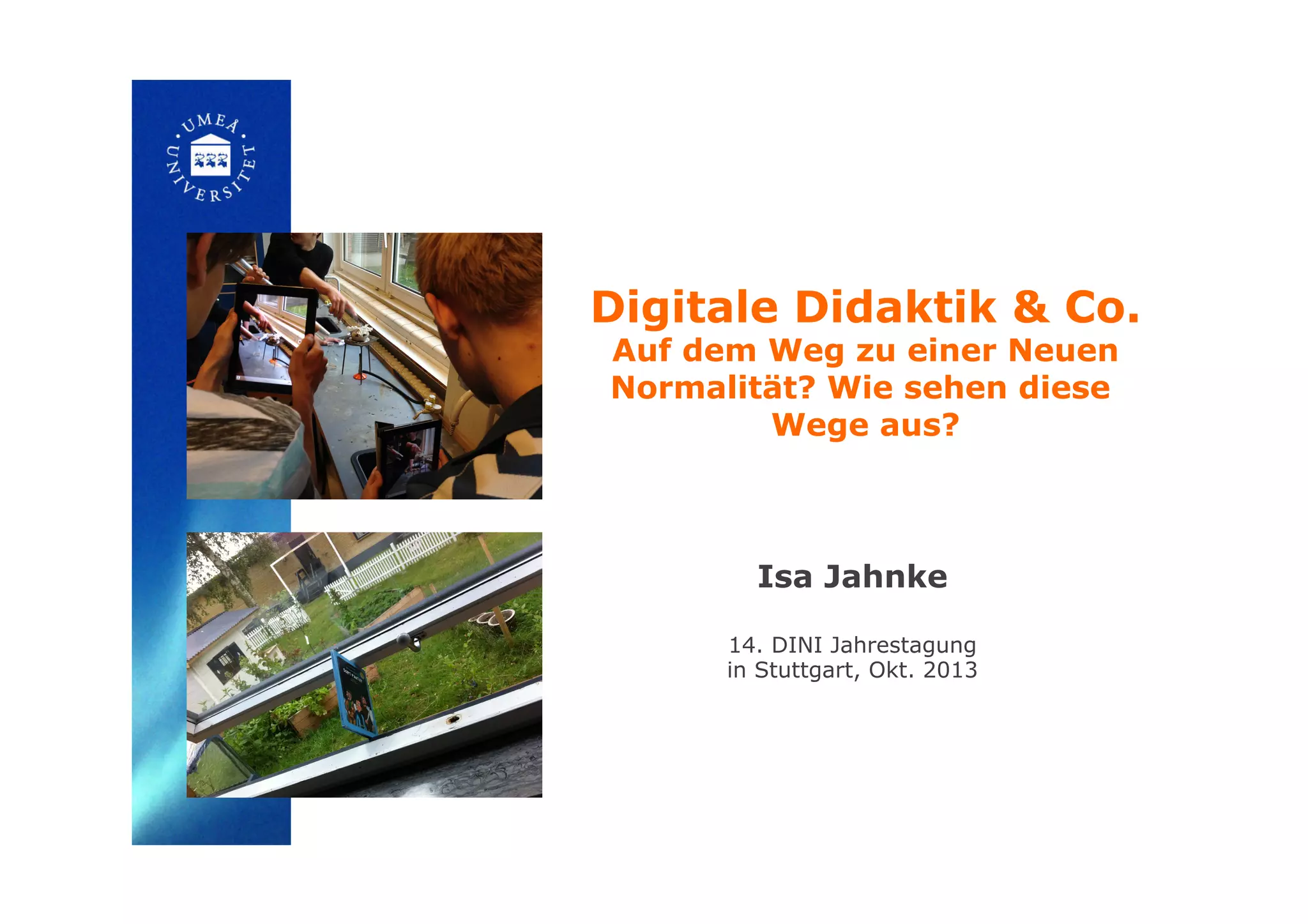
Digitale Didaktik & Co.
Auf dem Weg zu einer Neuen
Normalität? Wie sehen diese
Wege aus?!
Isa Jahnke
14. DINI Jahrestagung
in Stuttgart, Okt. 2013!
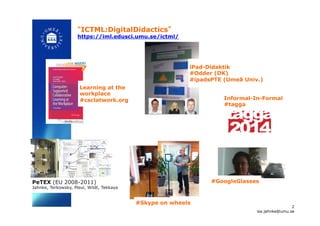
“ICTML:DigitalDidactics”
https://iml.edusci.umu.se/ictml/
#Skype on wheels !
#GoogleGlasses !
Learning at the
workplace
#csclatwork.org! Informal-In-Formal
#tagga!
iPad-Didaktik
#Odder (DK)
#ipadsPTE (Umeå Univ.)
2
isa.jahnke@umu.se!
PeTEX (EU 2008-2011)
Jahnke, Terkowsky, Pleul, Wildt, Tekkaya!
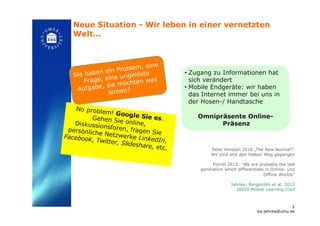
Neue Situation - Wir leben in einer vernetzten
Welt... !
Peter Hinssen 2010 „The New Normal?“
Wir sind erst den halben Weg gegangen
Floridi 2012: “We are probably the last
generation which differentiate in Online- und
Offline Worlds“
Jahnke, Bergström et al. 2012
IADIS Mobile Learning Conf!
No problem! Google Sie es.Gehen Sie online,Diskussionsforen, fragen Siepersönliche Netzwerke LinkedIn,
Facebook, Twitter, Slideshare, etc. !
• Zugang zu Informationen hat
sich verändert
• Mobile Endgeräte: wir haben
das Internet immer bei uns in
der Hosen-/ Handtasche
Omnipräsente Online-
Präsenz!
Sie haben ein Problem, eine
Frage, eine ungelöste
Aufgabe, sie möchten was
lernen?!
3
isa.jahnke@umu.se!
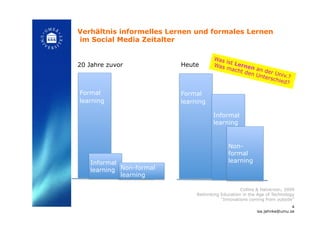
Verhältnis informelles Lernen und formales Lernen
im Social Media Zeitalter!
Formal
learning
Informal
learning!
Formal
learning
Informal
learning
20 Jahre zuvor! Heute!
Non-formal
learning!
Non-
formal
learning!
Collins & Halverson, 2009
Rethinking Education in the Age of Technology
“Innovations coming from outside”!
Was ist Lernen an der Univ.?
Was macht den Unterschied?!
4
isa.jahnke@umu.se!
Designs für Lehren und Lernen zur
Ermöglichung von
vertieftem Lernen
deeper learning
mehr
als
ein Oberflächenlernen
beyond surface levels
beyond Behaviorism
!
Jahnke & Liebscher, 2013
International Journal ELiSS!
Vygotsky 1978
Zone of Proximal Development
From Scaffolding (Bruner 1976) to
“Networked Scaffolding”
(Maart et al. 2013)!
5
isa.jahnke@umu.se!
Gibt es eigentlich ein Problem?
Annahme und Forschungsfrage!
In letzten Jahren, Textbook
learning ist im Mittelpunkt von
Lehre (consumer learning;
passive learning)
es werden geeignete
didaktische Designs benötigt,
wo Studierende aktiviert und
pro-sumer werden;
Aktivitätsgetriebene
Designs, die vertieftes Lernen
fördern.!
Was passiert wenn alle
Studierende und Lehrende
iPads & Co. wenn alle Internet
Zugang haben?
Wird die Textbuch-Methode
überleben, oder wenden
Lehrenden neue “Designs” an
und wenn ja welche Designs
(warum/wie)? !
6
isa.jahnke@umu.se!
iPad-Projekt in Dänemark!
6 (von 7) Schulen (April 2012, Aug 2012, Aug 2013)
•  200 LehrerInnen, 2,000 SchülerInnen haben iPads (1:1)
•  24 Klassenraumbeobachtungen (je 45-90 mins.)
inkl. Interviews mit LehrerInnen (ca. je 60 mins.)
•  Meetings mit SchulleiterInnen, päd. LeiterInnen, Schulführung,...
Fächer:
•  Dänisch, Mathe, Englisch, Kunst, Physik, Chemie, …
Klassen:
•  Vorschulklasse bis 9. Klasse
•  10-27 SchülerInnen!
Wir folgen den innovativen
Lehrenden (Rogers 2003)!
7
isa.jahnke@umu.se!
S.Hyysalo (2013) "not rely on
snap-shot studies, encompass
multiple times/loci where
technology is shaped"!
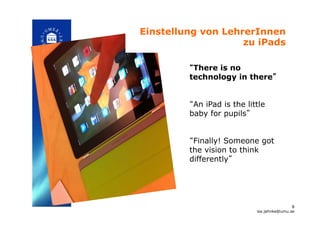
“There is no
technology in there”
“An iPad is the little
baby for pupils”
“Finally! Someone got
the vision to think
differently”!
Einstellung von LehrerInnen
zu iPads!
8
isa.jahnke@umu.se!
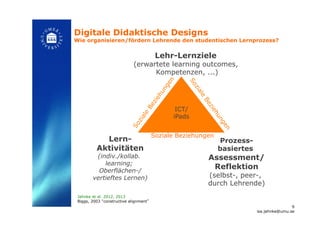
ICT/
iPads!
Lehr-Lernziele
(erwartete learning outcomes,
Kompetenzen, ...)!
Lern-
Aktivitäten
(indiv./kollab.
learning;
Oberflächen-/
vertieftes Lernen)!
Prozess-
basiertes
Assessment/
Reflektion
(selbst-, peer-,
durch Lehrende)!
Digitale Didaktische Designs
Wie organisieren/fördern Lehrende den studentischen Lernprozess?!
Soziale Beziehungen!
Jahnke et al. 2012, 2013
Biggs, 2003 “constructive alignment”!
9
isa.jahnke@umu.se!
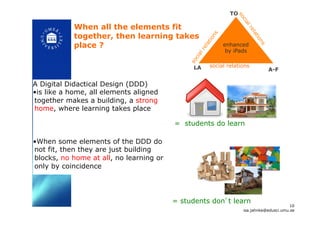
enhanced
by iPads!
TO!
LA! A-F!
social relations!
10
isa.jahnke@edusci.umu.se!
A Digital Didactical Design (DDD)
• is like a home, all elements aligned
together makes a building, a strong
home, where learning takes place
• When some elements of the DDD do
not fit, then they are just building
blocks, no home at all, no learning or
only by coincidence !
When all the elements fit
together, then learning takes
place ?!
= students do learn!
= students don’t learn!
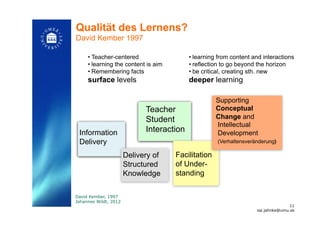
David Kember, 1997
Johannes Wildt, 2012 !
Information
Delivery!
Delivery of
Structured
Knowledge!
Teacher
Student
Interaction!
Facilitation
of Under-
standing!
Supporting
Conceptual
Change and
Intellectual
Development
(Verhaltensveränderung)!
Qualität des Lernens?
David Kember 1997!
• learning from content and interactions
• reflection to go beyond the horizon
• be critical, creating sth. new
deeper learning!
• Teacher-centered
• learning the content is aim
• Remembering facts
surface levels!
11
isa.jahnke@umu.se!
ID 19 und ID 21 !
Timeline
From birthday
until today
Popplet
mindmap app !
Chronological order
Students journeys during
summer vacation
Pages
app!
Was denken Sie
passierte hier?!
13
isa.jahnke@umu.se!
5 patterns
Rethinking digital didactical designs!
1. Innovative iPad-classrooms
Alignment of didactics & technology (11 classes) = ipad-didactics
2. Almost innovative classrooms
(not as strong as in pattern 1) (5 classes)
3. Weak alignment of Digital Didactics but learning benefit through
iPad-integration (1 class)
4. A Potential for Digital Didactics, alignment differs & medium/low
extent of iPad-use (4 classes)
5. Applied designs limited learning experiences, re-alignment of
digital didactical design is required; better without iPads?
(3 classes)!
14
isa.jahnke@umu.se!
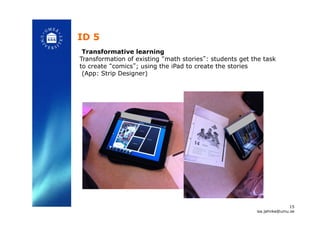
ID 5!
Transformative learning
Transformation of existing “math stories”: students get the task
to create “comics”; using the iPad to create the stories
(App: Strip Designer)!
15
isa.jahnke@umu.se!
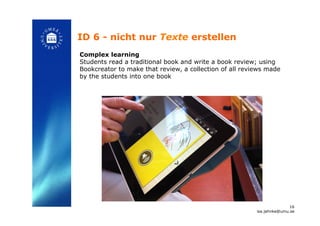
ID 6 - nicht nur Texte erstellen!
Complex learning
Students read a traditional book and write a book review; using
Bookcreator to make that review, a collection of all reviews made
by the students into one book
!
16
isa.jahnke@umu.se!
ID 8
!
Peer-Reflective learning
Students write something
from their childhood and
reflect in peer-reviews their
writing skills using Facebook;
iPads deliver Internet-Access!
17
isa.jahnke@umu.se!
Facebook closed student group photo!
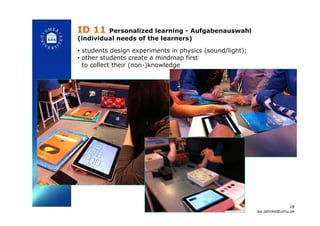
ID 11 Personalized learning - Aufgabenauswahl
(individual needs of the learners)
!
•  students design experiments in physics (sound/light);
•  other students create a mindmap first
to collect their (non-)knowledge!
18
isa.jahnke@umu.se!
ID 17 !
Learning expeditions 1
• Students search for QR codes,
which lead them to a website
to answer questions about
Grammar (improving writing
skills)
• Combining learning outdoors
and learning in trad.
Classroom
• Reflections about the process!
19
isa.jahnke@umu.se!
Photo 2 !
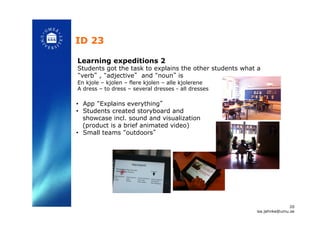
ID 23!
Learning expeditions 2
Students got the task to explains the other students what a
“verb” , “adjective” and “noun” is
En kjole – kjolen – flere kjolen – alle kjolerene
A dress – to dress – several dresses - all dresses!
•  App “Explains everything”
•  Students created storyboard and
showcase incl. sound and visualization
(product is a brief animated video)
•  Small teams “outdoors”!
20
isa.jahnke@umu.se!
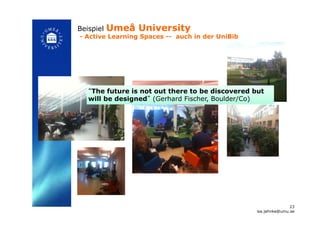
Beispiel Umeå University
- Active Learning Spaces -- auch in der UniBib!
“The future is not out there to be discovered but
will be designed” (Gerhard Fischer, Boulder/Co)!
23
isa.jahnke@umu.se!
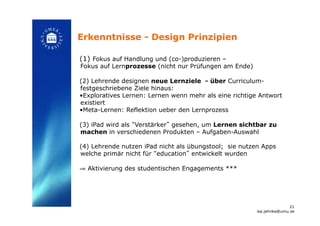
Erkenntnisse - Design Prinzipien!
(1) Fokus auf Handlung und (co-)produzieren –
Fokus auf Lernprozesse (nicht nur Prüfungen am Ende)
(2) Lehrende designen neue Lernziele - über Curriculum-
festgeschriebene Ziele hinaus:
• Exploratives Lernen: Lernen wenn mehr als eine richtige Antwort
existiert
• Meta-Lernen: Reflektion ueber den Lernprozess
(3) iPad wird als “Verstärker” gesehen, um Lernen sichtbar zu
machen in verschiedenen Produkten – Aufgaben-Auswahl
(4) Lehrende nutzen iPad nicht als übungstool; sie nutzen Apps
welche primär nicht für “education” entwickelt wurden
⇒  Aktivierung des studentischen Engagements *** !
21
isa.jahnke@umu.se!
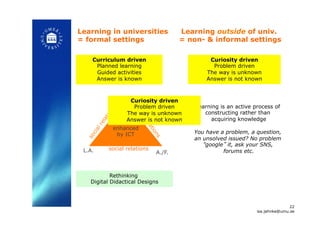
enhanced
by ICT!
T.O.!
L.A.! A./F.!
social relations!
Learning in universities
= formal settings!
Curiosity driven
Problem driven
The way is unknown
Answer is not known!
Curriculum driven
Planned learning
Guided activities
Answer is known!
Learning outside of univ.
= non- & informal settings!
Learning is an active process of
constructing rather than
acquiring knowledge
You have a problem, a question,
an unsolved issued? No problem
“google” it, ask your SNS,
forums etc.!
Rethinking
Digital Didactical Designs!
Curiosity driven
Problem driven
The way is unknown
Answer is not known!
22
isa.jahnke@umu.se!
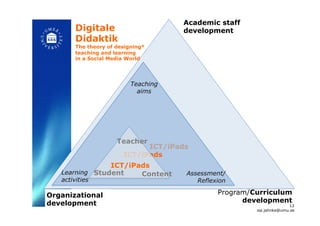
ICT/iPads!
ICT/iPads!
ICT/iPads!
Student!
Teacher!
Content!
Teaching
aims!
Assessment/
Reflexion!
Learning
activities!
Academic staff
development!
Program/Curriculum
development!
Organizational
development!
Digitale
Didaktik
The theory of designing*
teaching and learning
in a Social Media World!
12
isa.jahnke@umu.se!
Zukunft von Lehren und Lernen?
"Reimagining learning"!
Weg vom Denken in "Kursen" -->
hin zu "Learning Expeditionen"
a) 50% of the ECTS for content & curriculum
b) 50% of the ECTS for learning walkthroughs - unabhängig
vom Inhalt - die studentische Wahl, z.B.
i.  trad. Vorlesung
ii.  MOOCS
iii.  KreativWerkstatt
iv.  Projekt forschendes Lernen
v.  etwas vollständig ohne Lehrende
vi.  ...
=Studierende begründen in ihren ePortfolios, warum sie
welchen Walkthrough gemacht haben mit Bezug was sie
gelernt haben!
24
isa.jahnke@umu.se!
Jahnke & Norberg, 2013!
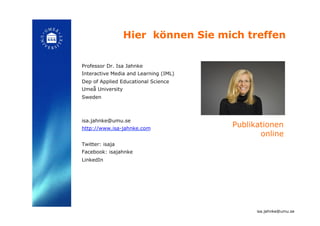
Hier können Sie mich treffen!
Professor Dr. Isa Jahnke
Interactive Media and Learning (IML)
Dep of Applied Educational Science
Umeå University
Sweden
isa.jahnke@umu.se
http://www.isa-jahnke.com
Twitter: isaja
Facebook: isajahnke
LinkedIn!
isa.jahnke@umu.se!
Publikationen
online!

2013-10-dini2013-isajahnke-v4k-web

  • 1.
    Digitale Didaktik &Co. Auf dem Weg zu einer Neuen Normalität? Wie sehen diese Wege aus?! Isa Jahnke 14. DINI Jahrestagung in Stuttgart, Okt. 2013!
  • 2.
    “ICTML:DigitalDidactics” https://iml.edusci.umu.se/ictml/ #Skype on wheels! #GoogleGlasses ! Learning at the workplace #csclatwork.org! Informal-In-Formal #tagga! iPad-Didaktik #Odder (DK) #ipadsPTE (Umeå Univ.) 2 isa.jahnke@umu.se! PeTEX (EU 2008-2011) Jahnke, Terkowsky, Pleul, Wildt, Tekkaya!
  • 3.
    Neue Situation -Wir leben in einer vernetzten Welt... ! Peter Hinssen 2010 „The New Normal?“ Wir sind erst den halben Weg gegangen Floridi 2012: “We are probably the last generation which differentiate in Online- und Offline Worlds“ Jahnke, Bergström et al. 2012 IADIS Mobile Learning Conf! No problem! Google Sie es.Gehen Sie online,Diskussionsforen, fragen Siepersönliche Netzwerke LinkedIn, Facebook, Twitter, Slideshare, etc. ! • Zugang zu Informationen hat sich verändert • Mobile Endgeräte: wir haben das Internet immer bei uns in der Hosen-/ Handtasche Omnipräsente Online- Präsenz! Sie haben ein Problem, eine Frage, eine ungelöste Aufgabe, sie möchten was lernen?! 3 isa.jahnke@umu.se!
  • 4.
    Verhältnis informelles Lernenund formales Lernen im Social Media Zeitalter! Formal learning Informal learning! Formal learning Informal learning 20 Jahre zuvor! Heute! Non-formal learning! Non- formal learning! Collins & Halverson, 2009 Rethinking Education in the Age of Technology “Innovations coming from outside”! Was ist Lernen an der Univ.? Was macht den Unterschied?! 4 isa.jahnke@umu.se!
  • 5.
    Designs für Lehrenund Lernen zur Ermöglichung von vertieftem Lernen deeper learning mehr als ein Oberflächenlernen beyond surface levels beyond Behaviorism ! Jahnke & Liebscher, 2013 International Journal ELiSS! Vygotsky 1978 Zone of Proximal Development From Scaffolding (Bruner 1976) to “Networked Scaffolding” (Maart et al. 2013)! 5 isa.jahnke@umu.se!
  • 6.
    Gibt es eigentlichein Problem? Annahme und Forschungsfrage! In letzten Jahren, Textbook learning ist im Mittelpunkt von Lehre (consumer learning; passive learning) es werden geeignete didaktische Designs benötigt, wo Studierende aktiviert und pro-sumer werden; Aktivitätsgetriebene Designs, die vertieftes Lernen fördern.! Was passiert wenn alle Studierende und Lehrende iPads & Co. wenn alle Internet Zugang haben? Wird die Textbuch-Methode überleben, oder wenden Lehrenden neue “Designs” an und wenn ja welche Designs (warum/wie)? ! 6 isa.jahnke@umu.se!
  • 7.
    iPad-Projekt in Dänemark! 6(von 7) Schulen (April 2012, Aug 2012, Aug 2013) •  200 LehrerInnen, 2,000 SchülerInnen haben iPads (1:1) •  24 Klassenraumbeobachtungen (je 45-90 mins.) inkl. Interviews mit LehrerInnen (ca. je 60 mins.) •  Meetings mit SchulleiterInnen, päd. LeiterInnen, Schulführung,... Fächer: •  Dänisch, Mathe, Englisch, Kunst, Physik, Chemie, … Klassen: •  Vorschulklasse bis 9. Klasse •  10-27 SchülerInnen! Wir folgen den innovativen Lehrenden (Rogers 2003)! 7 isa.jahnke@umu.se! S.Hyysalo (2013) "not rely on snap-shot studies, encompass multiple times/loci where technology is shaped"!
  • 8.
    “There is no technologyin there” “An iPad is the little baby for pupils” “Finally! Someone got the vision to think differently”! Einstellung von LehrerInnen zu iPads! 8 isa.jahnke@umu.se!
  • 9.
    ICT/ iPads! Lehr-Lernziele (erwartete learning outcomes, Kompetenzen,...)! Lern- Aktivitäten (indiv./kollab. learning; Oberflächen-/ vertieftes Lernen)! Prozess- basiertes Assessment/ Reflektion (selbst-, peer-, durch Lehrende)! Digitale Didaktische Designs Wie organisieren/fördern Lehrende den studentischen Lernprozess?! Soziale Beziehungen! Jahnke et al. 2012, 2013 Biggs, 2003 “constructive alignment”! 9 isa.jahnke@umu.se!
  • 10.
    enhanced by iPads! TO! LA! A-F! socialrelations! 10 isa.jahnke@edusci.umu.se! A Digital Didactical Design (DDD) • is like a home, all elements aligned together makes a building, a strong home, where learning takes place • When some elements of the DDD do not fit, then they are just building blocks, no home at all, no learning or only by coincidence ! When all the elements fit together, then learning takes place ?! = students do learn! = students don’t learn!
  • 11.
    David Kember, 1997 JohannesWildt, 2012 ! Information Delivery! Delivery of Structured Knowledge! Teacher Student Interaction! Facilitation of Under- standing! Supporting Conceptual Change and Intellectual Development (Verhaltensveränderung)! Qualität des Lernens? David Kember 1997! • learning from content and interactions • reflection to go beyond the horizon • be critical, creating sth. new deeper learning! • Teacher-centered • learning the content is aim • Remembering facts surface levels! 11 isa.jahnke@umu.se!
  • 12.
    ID 19 undID 21 ! Timeline From birthday until today Popplet mindmap app ! Chronological order Students journeys during summer vacation Pages app! Was denken Sie passierte hier?! 13 isa.jahnke@umu.se!
  • 13.
    5 patterns Rethinking digitaldidactical designs! 1. Innovative iPad-classrooms Alignment of didactics & technology (11 classes) = ipad-didactics 2. Almost innovative classrooms (not as strong as in pattern 1) (5 classes) 3. Weak alignment of Digital Didactics but learning benefit through iPad-integration (1 class) 4. A Potential for Digital Didactics, alignment differs & medium/low extent of iPad-use (4 classes) 5. Applied designs limited learning experiences, re-alignment of digital didactical design is required; better without iPads? (3 classes)! 14 isa.jahnke@umu.se!
  • 14.
    ID 5! Transformative learning Transformationof existing “math stories”: students get the task to create “comics”; using the iPad to create the stories (App: Strip Designer)! 15 isa.jahnke@umu.se!
  • 15.
    ID 6 -nicht nur Texte erstellen! Complex learning Students read a traditional book and write a book review; using Bookcreator to make that review, a collection of all reviews made by the students into one book ! 16 isa.jahnke@umu.se!
  • 16.
    ID 8 ! Peer-Reflective learning Studentswrite something from their childhood and reflect in peer-reviews their writing skills using Facebook; iPads deliver Internet-Access! 17 isa.jahnke@umu.se! Facebook closed student group photo!
  • 17.
    ID 11 Personalizedlearning - Aufgabenauswahl (individual needs of the learners) ! •  students design experiments in physics (sound/light); •  other students create a mindmap first to collect their (non-)knowledge! 18 isa.jahnke@umu.se!
  • 18.
    ID 17 ! Learningexpeditions 1 • Students search for QR codes, which lead them to a website to answer questions about Grammar (improving writing skills) • Combining learning outdoors and learning in trad. Classroom • Reflections about the process! 19 isa.jahnke@umu.se! Photo 2 !
  • 19.
    ID 23! Learning expeditions2 Students got the task to explains the other students what a “verb” , “adjective” and “noun” is En kjole – kjolen – flere kjolen – alle kjolerene A dress – to dress – several dresses - all dresses! •  App “Explains everything” •  Students created storyboard and showcase incl. sound and visualization (product is a brief animated video) •  Small teams “outdoors”! 20 isa.jahnke@umu.se!
  • 20.
    Beispiel Umeå University -Active Learning Spaces -- auch in der UniBib! “The future is not out there to be discovered but will be designed” (Gerhard Fischer, Boulder/Co)! 23 isa.jahnke@umu.se!
  • 21.
    Erkenntnisse - DesignPrinzipien! (1) Fokus auf Handlung und (co-)produzieren – Fokus auf Lernprozesse (nicht nur Prüfungen am Ende) (2) Lehrende designen neue Lernziele - über Curriculum- festgeschriebene Ziele hinaus: • Exploratives Lernen: Lernen wenn mehr als eine richtige Antwort existiert • Meta-Lernen: Reflektion ueber den Lernprozess (3) iPad wird als “Verstärker” gesehen, um Lernen sichtbar zu machen in verschiedenen Produkten – Aufgaben-Auswahl (4) Lehrende nutzen iPad nicht als übungstool; sie nutzen Apps welche primär nicht für “education” entwickelt wurden ⇒  Aktivierung des studentischen Engagements *** ! 21 isa.jahnke@umu.se!
  • 22.
    enhanced by ICT! T.O.! L.A.! A./F.! socialrelations! Learning in universities = formal settings! Curiosity driven Problem driven The way is unknown Answer is not known! Curriculum driven Planned learning Guided activities Answer is known! Learning outside of univ. = non- & informal settings! Learning is an active process of constructing rather than acquiring knowledge You have a problem, a question, an unsolved issued? No problem “google” it, ask your SNS, forums etc.! Rethinking Digital Didactical Designs! Curiosity driven Problem driven The way is unknown Answer is not known! 22 isa.jahnke@umu.se!
  • 23.
  • 24.
    Zukunft von Lehrenund Lernen? "Reimagining learning"! Weg vom Denken in "Kursen" --> hin zu "Learning Expeditionen" a) 50% of the ECTS for content & curriculum b) 50% of the ECTS for learning walkthroughs - unabhängig vom Inhalt - die studentische Wahl, z.B. i.  trad. Vorlesung ii.  MOOCS iii.  KreativWerkstatt iv.  Projekt forschendes Lernen v.  etwas vollständig ohne Lehrende vi.  ... =Studierende begründen in ihren ePortfolios, warum sie welchen Walkthrough gemacht haben mit Bezug was sie gelernt haben! 24 isa.jahnke@umu.se! Jahnke & Norberg, 2013!
  • 25.
    Hier können Siemich treffen! Professor Dr. Isa Jahnke Interactive Media and Learning (IML) Dep of Applied Educational Science Umeå University Sweden isa.jahnke@umu.se http://www.isa-jahnke.com Twitter: isaja Facebook: isajahnke LinkedIn! isa.jahnke@umu.se! Publikationen online!