IT Management Principles
Lost in translation?
by Raphael Rues, Digicomp Romandie SA

Digicomp ITIL Day Zürich, 22.3.2012
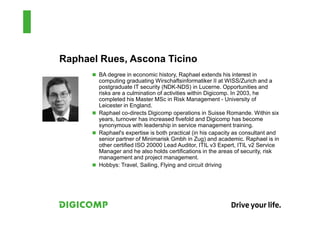
Raphael Rues, Ascona Ticino
       BA degree in economic history, Raphael extends his interest in
       computing graduating Wirschaftsinformatiker II at WISS/Zurich and a
       postgraduate IT security (NDK-NDS) in Lucerne. Opportunities and
       risks are a culmination of activities within Digicomp. In 2003, he
       completed his Master MSc in Risk Management - University of
       Leicester in England.
       Raphael co-directs Digicomp operations in Suisse Romande. Within six
       years, turnover has increased fivefold and Digicomp has become
       synonymous with leadership in service management training.
       Raphael's expertise is both practical (in his capacity as consultant and
       senior partner of Minimarisk Gmbh in Zug) and academic. Raphael is in
       other certified ISO 20000 Lead Auditor, ITIL v3 Expert, ITIL v2 Service
       Manager and he also holds certifications in the areas of security, risk
       management and project management.
       Hobbys: Travel, Sailing, Flying and circuit driving
Agenda
1. Introduction
2. IT Governance
3. Frameworks and Models in IT Management
     Value Delivery
     Risk Management
     Resource Management
     Performance Management
     Strategic Alignement
4. Improvement approaches
5. Final discussion
Goal of the presentation
 The purpose of this presentation is to understand and know how to
 apply the right framework (principle, baseline, standard) within the IT
 management context.

 This presentation “IT Management Principles” offers a state-of-the-art
 of the main frameworks and IT management models from an holistic
 and “swiss minded” view.

 You will become familiar not only with the frameworks’ challenges,
 standards and models, but also with their principles, key concepts and
 the main gains resulting from their implementation. However this may
 be only the tip of the iceberg, as (too) many standards are today
 available.
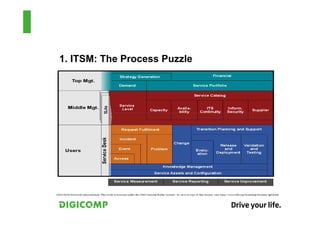
1. ITSM: The Process Puzzle
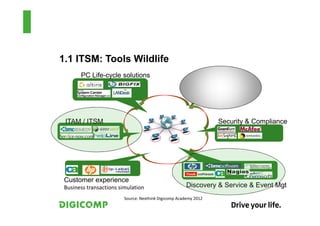
1.1 ITSM: Tools Wildlife
       PC Life-cycle solutions                            Endpoint Monitoring


 ITAM / ITSM                                                      Security & Compliance


 Customer experience
 Business transactions simulation                      Discovery & Service & Event Mgt
                         Source: Nexthink Digicomp Academy 2012
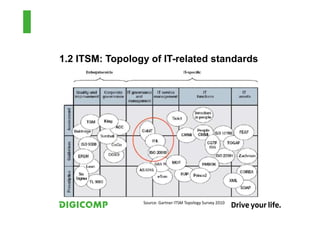
1.2 ITSM: Topology of IT-related standards


                 Source: Gartner ITSM Topology Survey 2010
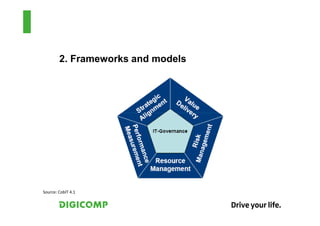
2. Frameworks and models


Source: CobIT 4.1
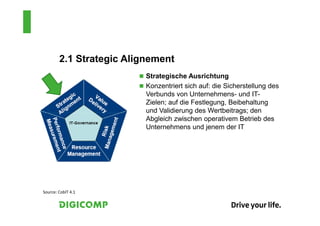
2.1 Strategic Alignement
                          Strategische Ausrichtung
                          Konzentriert sich auf: die Sicherstellung des
                          Verbunds von Unternehmens- und IT-
                          Zielen; auf die Festlegung, Beibehaltung
                          und Validierung des Wertbeitrags; den
                          Abgleich zwischen operativem Betrieb des
                          Unternehmens und jenem der IT


Source: CobIT 4.1
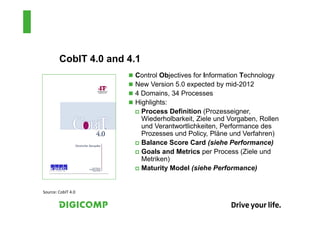
CobIT 4.0 and 4.1
                       Control Objectives for Information Technology
                       New Version 5.0 expected by mid-2012
                       4 Domains, 34 Processes
                       Highlights:
                         Process Definition (Prozesseigner,
                         Wiederholbarkeit, Ziele und Vorgaben, Rollen
                         und Verantwortlichkeiten, Performance des
                         Prozesses und Policy, Pläne und Verfahren)
                         Balance Score Card (siehe Performance)
                         Goals and Metrics per Process (Ziele und
                         Metriken)
                         Maturity Model (siehe Performance)


Source: CobIT 4.0
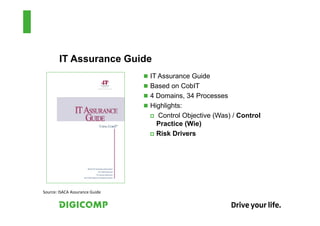
IT Assurance Guide
                                IT Assurance Guide
                                Based on CobIT
                                4 Domains, 34 Processes
                                Highlights:
                                   Control Objective (Was) / Control
                                  Practice (Wie)
                                  Risk Drivers


Source: ISACA Assurance Guide
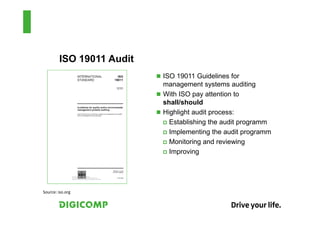
ISO 19011 Audit
                          ISO 19011 Guidelines for
                          management systems auditing
                          With ISO pay attention to
                          shall/should
                          Highlight audit process:
                            Establishing the audit programm
                            Implementing the audit programm
                            Monitoring and reviewing
                            Improving


Source: iso.org
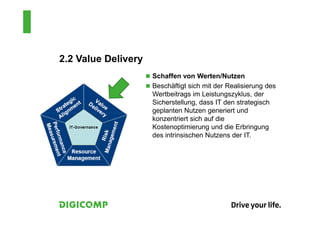
2.2 Value Delivery
                     Schaffen von Werten/Nutzen
                     Beschäftigt sich mit der Realisierung des
                     Wertbeitrags im Leistungszyklus, der
                     Sicherstellung, dass IT den strategisch
                     geplanten Nutzen generiert und
                     konzentriert sich auf die
                     Kostenoptimierung und die Erbringung
                     des intrinsischen Nutzens der IT.
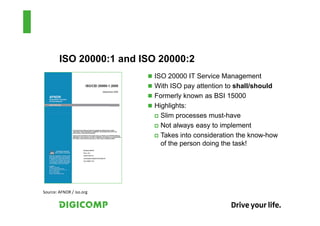
ISO 20000:1 and ISO 20000:2
                          ISO 20000 IT Service Management
                          With ISO pay attention to shall/should
                          Formerly known as BSI 15000
                          Highlights:
                            Slim processes must-have
                            Not always easy to implement
                            Takes into consideration the know-how
                            of the person doing the task!


Source: AFNOR / iso.org
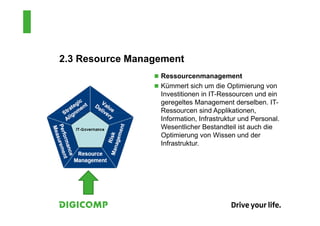
2.3 Resource Management
                  Ressourcenmanagement
                  Kümmert sich um die Optimierung von
                  Investitionen in IT-Ressourcen und ein
                  geregeltes Management derselben. IT-
                  Ressourcen sind Applikationen,
                  Information, Infrastruktur und Personal.
                  Wesentlicher Bestandteil ist auch die
                  Optimierung von Wissen und der
                  Infrastruktur.
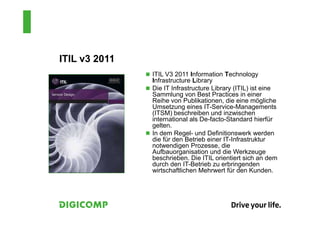
ITIL v3 2011
               ITIL V3 2011 Information Technology
               Infrastructure Library
               Die IT Infrastructure Library (ITIL) ist eine
               Sammlung von Best Practices in einer
               Reihe von Publikationen, die eine mögliche
               Umsetzung eines IT-Service-Managements
               (ITSM) beschreiben und inzwischen
               international als De-facto-Standard hierfür
               gelten.
               In dem Regel- und Definitionswerk werden
               die für den Betrieb einer IT-Infrastruktur
               notwendigen Prozesse, die
               Aufbauorganisation und die Werkzeuge
               beschrieben. Die ITIL orientiert sich an dem
               durch den IT-Betrieb zu erbringenden
               wirtschaftlichen Mehrwert für den Kunden.
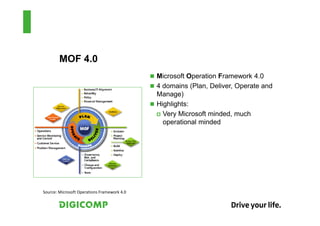
MOF 4.0
                                             Microsoft Operation Framework 4.0
                                             4 domains (Plan, Deliver, Operate and
                                             Manage)
                                             Highlights:
                                               Very Microsoft minded, much
                                               operational minded


Source: Microsoft Operations Framework 4.0
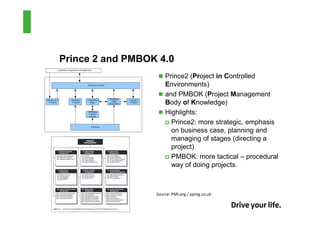
Prince 2 and PMBOK 4.0
                      Prince2 (Project in Controlled
                      Environments)
                      and PMBOK (Project Management
                      Body of Knowledge)
                      Highlights:
                        Prince2: more strategic, emphasis
                        on business case, planning and
                        managing of stages (directing a
                        project)
                        PMBOK: more tactical – procedural
                        way of doing projects.


                  Source: PMI.org / apmg.co.uk
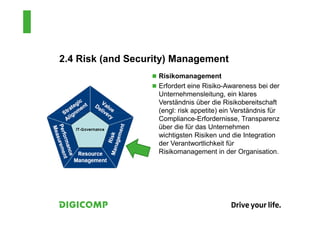
2.4 Risk (and Security) Management
                   Risikomanagement
                   Erfordert eine Risiko-Awareness bei der
                   Unternehmensleitung, ein klares
                   Verständnis über die Risikobereitschaft
                   (engl: risk appetite) ein Verständnis für
                   Compliance-Erfordernisse, Transparenz
                   über die für das Unternehmen
                   wichtigsten Risiken und die Integration
                   der Verantwortlichkeit für
                   Risikomanagement in der Organisation.
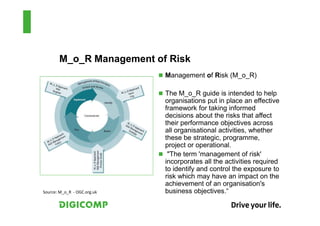
M_o_R Management of Risk
                             Management of Risk (M_o_R)

                             The M_o_R guide is intended to help
                             organisations put in place an effective
                             framework for taking informed
                             decisions about the risks that affect
                             their performance objectives across
                             all organisational activities, whether
                             these be strategic, programme,
                             project or operational.
                              "The term 'management of risk'
                             incorporates all the activities required
                             to identify and control the exposure to
                             risk which may have an impact on the
                             achievement of an organisation's
Source: M_o_R - OGC.org.uk   business objectives.“
ISO 27001, ISO 27002, ISO 27005
                         ISO 27001 (formerly BS 7799) is an information
                         security “shall” standard providing requirements on a
                         range of controls for implementing security. ISO
                         27002 provides “should” guidance.

                         ISO 27001 contains following domains:
                           Security policy and Organization of information
                           security
                           Asset management and Human resources security
                           Physical and environmental security
                           Communications and operations management
                           Access control
                           Systems acquisition, development and
                           maintenance
                           Security incident management
Source: iso.org
                           Business continuity management
                           Compliance
Grundschutzhandbuch
                          Das "IT-Grundschutzhandbuch" heißt
                          seit der Version 2005 "IT-
                          Grundschutz-Kataloge".
                          Die IT-Grundschutz-Kataloge
                          beinhalten die Baustein-,
                          Maßnahmen- und
                          Gefährdungskataloge.
                          Die Vorgehensweise nach IT-
                          Grundschutz, Ausführungen zum
                          Informationssicherheitsmanagement
                          und zur Risikoanalyse finden Sie nun
                          unter den BSI-Standards.


Source: bsi.de
Standard: BS 25999 (formerly PAS 56)
                           BS 25999 is a Business Continuity
                           Management (BCM) standard (albeit not
                           recognized by ISO) in two parts.

                           The first, "BS 25999-1:2006 Business
                           Continuity Management. Code of
                           Practice", takes the form of general
                           “should” guidance and seeks to
                           establish processes, principles and
                           terminology for Business Continuity
                           Management.

                           The second, "BS 25999-2:2007
                           Specification for Business Continuity
                           Management", specifies “shall”
                           requirements for implementing, operating
                           and improving a documented Business
                           Continuity Management System
                           (BCMS), describing only requirements
                           that can be objectively and
                           independently audited.
Source: bsi.org.uk
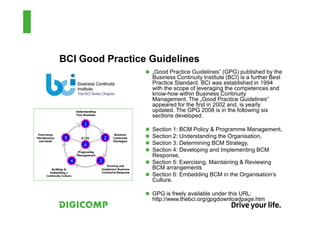
BCI Good Practice Guidelines
                  „Good Practice Guidelines” (GPG) published by the
                  Business Continuity Institute (BCI) is a further Best
                  Practice Standard. BCI was established in 1994
                  with the scope of leveraging the competences and
                  know-how within Business Continuity
                  Management. The „Good Practice Guidelines“
                  appeared for the first in 2002 and, is yearly
                  updated. The GPG 2008 is in the following six
                  sections developed:

                  Section 1: BCM Policy & Programme Management,
                  Section 2: Understanding the Organisation,
                  Section 3: Determining BCM Strategy,
                  Section 4: Developing and Implementing BCM
                  Response,
                  Section 5: Exercising, Maintaining & Reviewing
                  BCM arrangements
                  Section 6: Embedding BCM in the Organisation’s
                  Culture.

                  GPG is freely available under this URL:
                  http://www.thebci.org/gpgdownloadpage.htm
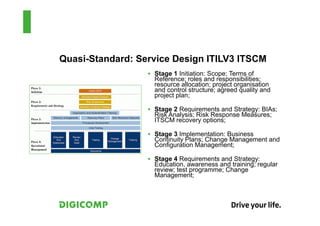
Quasi-Standard: Service Design ITILV3 ITSCM
                   Stage 1 Initiation: Scope; Terms of
                   Reference; roles and responsibilities;
                   resource allocation; project organisation
                   and control structure; agreed quality and
                   project plan;

                   Stage 2 Requirements and Strategy: BIAs;
                   Risk Analysis; Risk Response Measures;
                   ITSCM recovery options;

                   Stage 3 Implementation: Business
                   Continuity Plans; Change Management and
                   Configuration Management;

                   Stage 4 Requirements and Strategy:
                   Education, awareness and training; regular
                   review; test programme; Change
                   Management;
Empfehlungen für das Business Continuity Mgmt

                     The Federal Banking Commission (SFBC)
                     considers that a Business Continuity
                     Management is appropriate for a bank, a
                     prerequisite for authorization to carry on
                     business within the meaning of art. 3 of
                     the Bank Act.

                     With respect to this document, it includes
                     in principle the recommendations with
                     which compliance is not mandatory,
                     except as regards the establishment of an
                     impact assessment (Chapter 5.4.1) and
                     the definition of a Business Continuity
                     strategy (chapter 5.4.2). These two
                     elements are considered essential by the
                     SFBC as a minimum standard required of
                     a point of view of surveillance.
                      Source: SwissBanking,
                      http://www.swissbanking.org/11107_d.pdf
CH Obligationsrecht
                 IKS OR Art. 728a seit Januar 2008.

                 Risikobeurteilung OR Art. 663b z12 (Risk
                 Management) seit July 2007 – anycase
                 overall responsability for RM is on VR

                 Who (Wer)? Public „economic“ companies,
                 which fulfill at least two of the three
                 criterias:
                   Balance sheet > CHF 10 Mio;
                   Turnover >CHF 20 Mio;
                   Employees > 50;
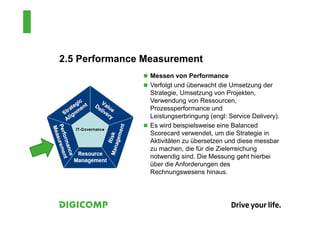
2.5 Performance Measurement
                 Messen von Performance
                 Verfolgt und überwacht die Umsetzung der
                 Strategie, Umsetzung von Projekten,
                 Verwendung von Ressourcen,
                 Prozessperformance und
                 Leistungserbringung (engl: Service Delivery).
                 Es wird beispielsweise eine Balanced
                 Scorecard verwendet, um die Strategie in
                 Aktivitäten zu übersetzen und diese messbar
                 zu machen, die für die Zielerreichung
                 notwendig sind. Die Messung geht hierbei
                 über die Anforderungen des
                 Rechnungswesens hinaus.
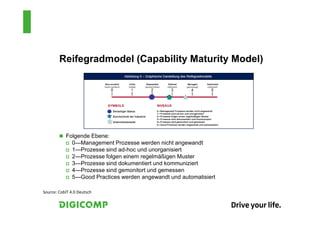
Reifegradmodel (Capability Maturity Model)


           Folgende Ebene:
             0—Management Prozesse werden nicht angewandt
             1—Prozesse sind ad-hoc und unorganisiert
             2—Prozesse folgen einem regelmäßigen Muster
             3—Prozesse sind dokumentiert und kommuniziert
             4—Prozesse sind gemonitort und gemessen
             5—Good Practices werden angewandt und automatisiert

Source: CobIT 4.0 Deutsch
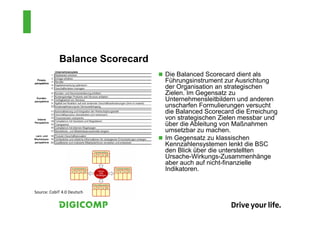
Balance Scorecard
                                Die Balanced Scorecard dient als
                                Führungsinstrument zur Ausrichtung
                                der Organisation an strategischen
                                Zielen. Im Gegensatz zu
                                Unternehmensleitbildern und anderen
                                unscharfen Formulierungen versucht
                                die Balanced Scorecard die Erreichung
                                von strategischen Zielen messbar und
                                über die Ableitung von Maßnahmen
                                umsetzbar zu machen.
                                Im Gegensatz zu klassischen
                                Kennzahlensystemen lenkt die BSC
                                den Blick über die unterstellten
                                Ursache-Wirkungs-Zusammenhänge
                                aber auch auf nicht-finanzielle
                                Indikatoren.


Source: CobIT 4.0 Deutsch
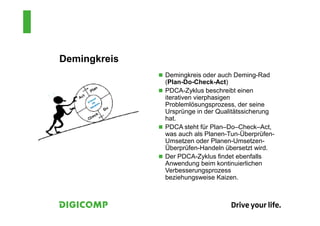
Demingkreis
              Demingkreis oder auch Deming-Rad
              (Plan-Do-Check-Act)
              PDCA-Zyklus beschreibt einen
              iterativen vierphasigen
              Problemlösungsprozess, der seine
              Ursprünge in der Qualitätssicherung
              hat.
              PDCA steht für Plan–Do–Check–Act,
              was auch als Planen-Tun-Überprüfen-
              Umsetzen oder Planen-Umsetzen-
              Überprüfen-Handeln übersetzt wird.
              Der PDCA-Zyklus findet ebenfalls
              Anwendung beim kontinuierlichen
              Verbesserungsprozess
              beziehungsweise Kaizen.
Improvement approaches
 Reifegradmodel (Capability Maturity Model)
 Balance Scorecard
  Ziele und Metriken
 Demingkreis
Vielen Dank
 Raphael Rues (Digicomp Academy)
 phone direct: +41 21 321 65 00
 email: raphael.rues@digicomp.ch
Appendix - Quellen
 Strategic Alignement
   CobIT 4.1 and IT Assurance Guide
   ISO Standards:
 Value Delivery
   SECO ITSM CH-Firmen
   MOF 4.0
   ITIL V3 2011
 Resource Management
   Prince2
 Risk Management
   OR 728 und OR 663
   Enisa Risk Management
   M_o_R
   SECO ISO27k CH-Firmen

Lost in translation – ein praktischer Wegweiser

  • 1.
    IT Management Principles Lostin translation? by Raphael Rues, Digicomp Romandie SA Digicomp ITIL Day Zürich, 22.3.2012
  • 2.
    Raphael Rues, AsconaTicino BA degree in economic history, Raphael extends his interest in computing graduating Wirschaftsinformatiker II at WISS/Zurich and a postgraduate IT security (NDK-NDS) in Lucerne. Opportunities and risks are a culmination of activities within Digicomp. In 2003, he completed his Master MSc in Risk Management - University of Leicester in England. Raphael co-directs Digicomp operations in Suisse Romande. Within six years, turnover has increased fivefold and Digicomp has become synonymous with leadership in service management training. Raphael's expertise is both practical (in his capacity as consultant and senior partner of Minimarisk Gmbh in Zug) and academic. Raphael is in other certified ISO 20000 Lead Auditor, ITIL v3 Expert, ITIL v2 Service Manager and he also holds certifications in the areas of security, risk management and project management. Hobbys: Travel, Sailing, Flying and circuit driving
  • 3.
    Agenda 1. Introduction 2. ITGovernance 3. Frameworks and Models in IT Management Value Delivery Risk Management Resource Management Performance Management Strategic Alignement 4. Improvement approaches 5. Final discussion
  • 4.
    Goal of thepresentation The purpose of this presentation is to understand and know how to apply the right framework (principle, baseline, standard) within the IT management context. This presentation “IT Management Principles” offers a state-of-the-art of the main frameworks and IT management models from an holistic and “swiss minded” view. You will become familiar not only with the frameworks’ challenges, standards and models, but also with their principles, key concepts and the main gains resulting from their implementation. However this may be only the tip of the iceberg, as (too) many standards are today available.
  • 5.
    1. ITSM: TheProcess Puzzle
  • 6.
    1.1 ITSM: ToolsWildlife PC Life-cycle solutions Endpoint Monitoring ITAM / ITSM Security & Compliance Customer experience Business transactions simulation Discovery & Service & Event Mgt Source: Nexthink Digicomp Academy 2012
  • 7.
    1.2 ITSM: Topologyof IT-related standards Source: Gartner ITSM Topology Survey 2010
  • 8.
    2. Frameworks andmodels Source: CobIT 4.1
  • 9.
    2.1 Strategic Alignement Strategische Ausrichtung Konzentriert sich auf: die Sicherstellung des Verbunds von Unternehmens- und IT- Zielen; auf die Festlegung, Beibehaltung und Validierung des Wertbeitrags; den Abgleich zwischen operativem Betrieb des Unternehmens und jenem der IT Source: CobIT 4.1
  • 10.
    CobIT 4.0 and4.1 Control Objectives for Information Technology New Version 5.0 expected by mid-2012 4 Domains, 34 Processes Highlights: Process Definition (Prozesseigner, Wiederholbarkeit, Ziele und Vorgaben, Rollen und Verantwortlichkeiten, Performance des Prozesses und Policy, Pläne und Verfahren) Balance Score Card (siehe Performance) Goals and Metrics per Process (Ziele und Metriken) Maturity Model (siehe Performance) Source: CobIT 4.0
  • 11.
    IT Assurance Guide IT Assurance Guide Based on CobIT 4 Domains, 34 Processes Highlights: Control Objective (Was) / Control Practice (Wie) Risk Drivers Source: ISACA Assurance Guide
  • 12.
    ISO 19011 Audit ISO 19011 Guidelines for management systems auditing With ISO pay attention to shall/should Highlight audit process: Establishing the audit programm Implementing the audit programm Monitoring and reviewing Improving Source: iso.org
  • 13.
    2.2 Value Delivery Schaffen von Werten/Nutzen Beschäftigt sich mit der Realisierung des Wertbeitrags im Leistungszyklus, der Sicherstellung, dass IT den strategisch geplanten Nutzen generiert und konzentriert sich auf die Kostenoptimierung und die Erbringung des intrinsischen Nutzens der IT.
  • 14.
    ISO 20000:1 andISO 20000:2 ISO 20000 IT Service Management With ISO pay attention to shall/should Formerly known as BSI 15000 Highlights: Slim processes must-have Not always easy to implement Takes into consideration the know-how of the person doing the task! Source: AFNOR / iso.org
  • 15.
    2.3 Resource Management Ressourcenmanagement Kümmert sich um die Optimierung von Investitionen in IT-Ressourcen und ein geregeltes Management derselben. IT- Ressourcen sind Applikationen, Information, Infrastruktur und Personal. Wesentlicher Bestandteil ist auch die Optimierung von Wissen und der Infrastruktur.
  • 16.
    ITIL v3 2011 ITIL V3 2011 Information Technology Infrastructure Library Die IT Infrastructure Library (ITIL) ist eine Sammlung von Best Practices in einer Reihe von Publikationen, die eine mögliche Umsetzung eines IT-Service-Managements (ITSM) beschreiben und inzwischen international als De-facto-Standard hierfür gelten. In dem Regel- und Definitionswerk werden die für den Betrieb einer IT-Infrastruktur notwendigen Prozesse, die Aufbauorganisation und die Werkzeuge beschrieben. Die ITIL orientiert sich an dem durch den IT-Betrieb zu erbringenden wirtschaftlichen Mehrwert für den Kunden.
  • 17.
    MOF 4.0 Microsoft Operation Framework 4.0 4 domains (Plan, Deliver, Operate and Manage) Highlights: Very Microsoft minded, much operational minded Source: Microsoft Operations Framework 4.0
  • 18.
    Prince 2 andPMBOK 4.0 Prince2 (Project in Controlled Environments) and PMBOK (Project Management Body of Knowledge) Highlights: Prince2: more strategic, emphasis on business case, planning and managing of stages (directing a project) PMBOK: more tactical – procedural way of doing projects. Source: PMI.org / apmg.co.uk
  • 19.
    2.4 Risk (andSecurity) Management Risikomanagement Erfordert eine Risiko-Awareness bei der Unternehmensleitung, ein klares Verständnis über die Risikobereitschaft (engl: risk appetite) ein Verständnis für Compliance-Erfordernisse, Transparenz über die für das Unternehmen wichtigsten Risiken und die Integration der Verantwortlichkeit für Risikomanagement in der Organisation.
  • 20.
    M_o_R Management ofRisk Management of Risk (M_o_R) The M_o_R guide is intended to help organisations put in place an effective framework for taking informed decisions about the risks that affect their performance objectives across all organisational activities, whether these be strategic, programme, project or operational. "The term 'management of risk' incorporates all the activities required to identify and control the exposure to risk which may have an impact on the achievement of an organisation's Source: M_o_R - OGC.org.uk business objectives.“
  • 21.
    ISO 27001, ISO27002, ISO 27005 ISO 27001 (formerly BS 7799) is an information security “shall” standard providing requirements on a range of controls for implementing security. ISO 27002 provides “should” guidance. ISO 27001 contains following domains: Security policy and Organization of information security Asset management and Human resources security Physical and environmental security Communications and operations management Access control Systems acquisition, development and maintenance Security incident management Source: iso.org Business continuity management Compliance
  • 22.
    Grundschutzhandbuch Das "IT-Grundschutzhandbuch" heißt seit der Version 2005 "IT- Grundschutz-Kataloge". Die IT-Grundschutz-Kataloge beinhalten die Baustein-, Maßnahmen- und Gefährdungskataloge. Die Vorgehensweise nach IT- Grundschutz, Ausführungen zum Informationssicherheitsmanagement und zur Risikoanalyse finden Sie nun unter den BSI-Standards. Source: bsi.de
  • 23.
    Standard: BS 25999(formerly PAS 56) BS 25999 is a Business Continuity Management (BCM) standard (albeit not recognized by ISO) in two parts. The first, "BS 25999-1:2006 Business Continuity Management. Code of Practice", takes the form of general “should” guidance and seeks to establish processes, principles and terminology for Business Continuity Management. The second, "BS 25999-2:2007 Specification for Business Continuity Management", specifies “shall” requirements for implementing, operating and improving a documented Business Continuity Management System (BCMS), describing only requirements that can be objectively and independently audited. Source: bsi.org.uk
  • 24.
    BCI Good PracticeGuidelines „Good Practice Guidelines” (GPG) published by the Business Continuity Institute (BCI) is a further Best Practice Standard. BCI was established in 1994 with the scope of leveraging the competences and know-how within Business Continuity Management. The „Good Practice Guidelines“ appeared for the first in 2002 and, is yearly updated. The GPG 2008 is in the following six sections developed: Section 1: BCM Policy & Programme Management, Section 2: Understanding the Organisation, Section 3: Determining BCM Strategy, Section 4: Developing and Implementing BCM Response, Section 5: Exercising, Maintaining & Reviewing BCM arrangements Section 6: Embedding BCM in the Organisation’s Culture. GPG is freely available under this URL: http://www.thebci.org/gpgdownloadpage.htm
  • 25.
    Quasi-Standard: Service DesignITILV3 ITSCM Stage 1 Initiation: Scope; Terms of Reference; roles and responsibilities; resource allocation; project organisation and control structure; agreed quality and project plan; Stage 2 Requirements and Strategy: BIAs; Risk Analysis; Risk Response Measures; ITSCM recovery options; Stage 3 Implementation: Business Continuity Plans; Change Management and Configuration Management; Stage 4 Requirements and Strategy: Education, awareness and training; regular review; test programme; Change Management;
  • 26.
    Empfehlungen für dasBusiness Continuity Mgmt The Federal Banking Commission (SFBC) considers that a Business Continuity Management is appropriate for a bank, a prerequisite for authorization to carry on business within the meaning of art. 3 of the Bank Act. With respect to this document, it includes in principle the recommendations with which compliance is not mandatory, except as regards the establishment of an impact assessment (Chapter 5.4.1) and the definition of a Business Continuity strategy (chapter 5.4.2). These two elements are considered essential by the SFBC as a minimum standard required of a point of view of surveillance. Source: SwissBanking, http://www.swissbanking.org/11107_d.pdf
  • 27.
    CH Obligationsrecht IKS OR Art. 728a seit Januar 2008. Risikobeurteilung OR Art. 663b z12 (Risk Management) seit July 2007 – anycase overall responsability for RM is on VR Who (Wer)? Public „economic“ companies, which fulfill at least two of the three criterias: Balance sheet > CHF 10 Mio; Turnover >CHF 20 Mio; Employees > 50;
  • 28.
    2.5 Performance Measurement Messen von Performance Verfolgt und überwacht die Umsetzung der Strategie, Umsetzung von Projekten, Verwendung von Ressourcen, Prozessperformance und Leistungserbringung (engl: Service Delivery). Es wird beispielsweise eine Balanced Scorecard verwendet, um die Strategie in Aktivitäten zu übersetzen und diese messbar zu machen, die für die Zielerreichung notwendig sind. Die Messung geht hierbei über die Anforderungen des Rechnungswesens hinaus.
  • 29.
    Reifegradmodel (Capability MaturityModel) Folgende Ebene: 0—Management Prozesse werden nicht angewandt 1—Prozesse sind ad-hoc und unorganisiert 2—Prozesse folgen einem regelmäßigen Muster 3—Prozesse sind dokumentiert und kommuniziert 4—Prozesse sind gemonitort und gemessen 5—Good Practices werden angewandt und automatisiert Source: CobIT 4.0 Deutsch
  • 30.
    Balance Scorecard Die Balanced Scorecard dient als Führungsinstrument zur Ausrichtung der Organisation an strategischen Zielen. Im Gegensatz zu Unternehmensleitbildern und anderen unscharfen Formulierungen versucht die Balanced Scorecard die Erreichung von strategischen Zielen messbar und über die Ableitung von Maßnahmen umsetzbar zu machen. Im Gegensatz zu klassischen Kennzahlensystemen lenkt die BSC den Blick über die unterstellten Ursache-Wirkungs-Zusammenhänge aber auch auf nicht-finanzielle Indikatoren. Source: CobIT 4.0 Deutsch
  • 31.
    Demingkreis Demingkreis oder auch Deming-Rad (Plan-Do-Check-Act) PDCA-Zyklus beschreibt einen iterativen vierphasigen Problemlösungsprozess, der seine Ursprünge in der Qualitätssicherung hat. PDCA steht für Plan–Do–Check–Act, was auch als Planen-Tun-Überprüfen- Umsetzen oder Planen-Umsetzen- Überprüfen-Handeln übersetzt wird. Der PDCA-Zyklus findet ebenfalls Anwendung beim kontinuierlichen Verbesserungsprozess beziehungsweise Kaizen.
  • 32.
    Improvement approaches Reifegradmodel(Capability Maturity Model) Balance Scorecard Ziele und Metriken Demingkreis
  • 33.
    Vielen Dank RaphaelRues (Digicomp Academy) phone direct: +41 21 321 65 00 email: raphael.rues@digicomp.ch
  • 34.
    Appendix - Quellen Strategic Alignement CobIT 4.1 and IT Assurance Guide ISO Standards: Value Delivery SECO ITSM CH-Firmen MOF 4.0 ITIL V3 2011 Resource Management Prince2 Risk Management OR 728 und OR 663 Enisa Risk Management M_o_R SECO ISO27k CH-Firmen