Web 2.0 Eine medienethische Sondierung.
Aufbau Einleitung Web 2.0? Weblogs Soziale Netzwerke Partizipation Ausblick
Mediale Umbrüche und Revolutionen  Utopien und Dystopien Medienethik aus der Distanz  Einleitung  | Web 2.0? | Weblogs | Soziale Netzwerke | Partizipation | Ausblick
Das Social Web oder Web 2.0 analysiere ich als eine offene „Struktur“, die (teil-) öffentliche Online-Kommunikationen als situierte und kreative Handlungen ermöglicht und stabilisiert.  Einleitung  | Web 2.0? | Weblogs | Soziale Netzwerke | Partizipation | Ausblick
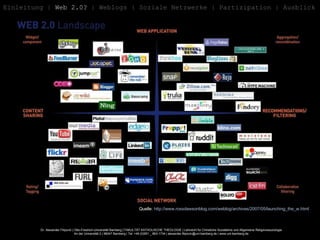
Einleitung   |  Web 2.0?  | Weblogs | Soziale Netzwerke | Partizipation | Ausblick Quelle:  http:// www.rossdawsonblog.com / weblog / archives /2007/05/ launching_the_w.html
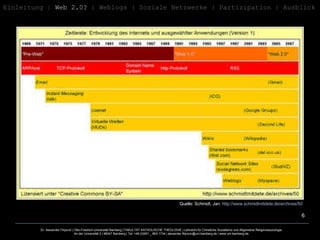
Einleitung   |  Web 2.0?  | Weblogs | Soziale Netzwerke | Partizipation | Ausblick Quelle: Schmidt, Jan:  http:// www.schmidtmitdete.de / archives /50
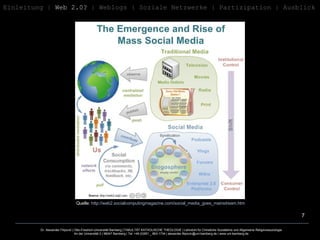
Einleitung   |  Web 2.0?  | Weblogs | Soziale Netzwerke | Partizipation | Ausblick Quelle:  http://web2.socialcomputingmagazine.com/ social_media_goes_mainstream.htm
Einleitung   |  Web 2.0?  | Weblogs | Soziale Netzwerke | Partizipation | Ausblick Quelle:  http:// www.rossdawsonblog.com / weblog / archives /2007/05/ launching_the_w.html
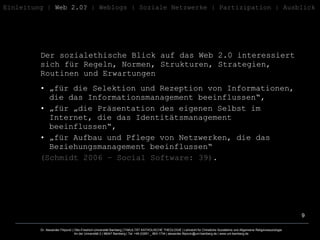
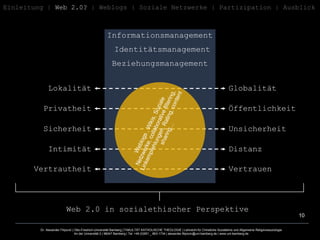
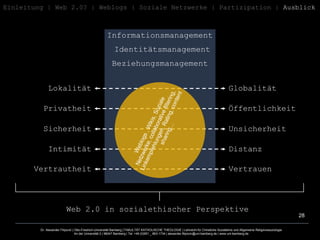
Der sozialethische Blick auf das Web 2.0 interessiert sich für Regeln, Normen, Strukturen, Strategien, Routinen und Erwartungen  „ für die Selektion und Rezeption von Informationen, die das Informationsmanagement beeinflussen“, „ für „die Präsentation des eigenen Selbst im Internet, die das Identitätsmanagement beeinflussen“, „ für Aufbau und Pflege von Netzwerken, die das Beziehungsmanagement beeinflussen“  (Schmidt 2006 – Social Software: 39) . Einleitung   |  Web 2.0?  | Weblogs | Soziale Netzwerke | Partizipation | Ausblick
Informationsmanagement Identitätsmanagement Beziehungsmanagement  Lokalität Privatheit Sicherheit Intimität Vertrautheit Globalität Öffentlichkeit Distanz Unsicherheit Vertrauen Web 2.0 in sozialethischer Perspektive  Weblogs , Wikis, Soziale Netzwerke, collaborative filtering, Linkempfehlungen, Rating, content sharing… Einleitung   |  Web 2.0?  | Weblogs | Soziale Netzwerke | Partizipation | Ausblick
Einleitung   | Web 2.0? |  Weblogs  | Soziale Netzwerke | Partizipation | Ausblick
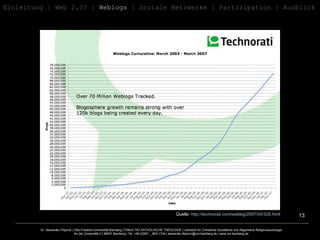
Quelle:  http:// technorati.com / weblog /2007/04/328.html Einleitung   | Web 2.0? |  Weblogs  | Soziale Netzwerke | Partizipation | Ausblick
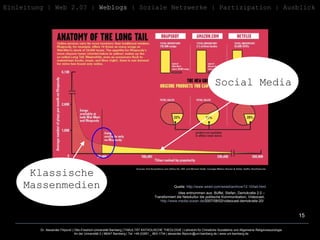
Quelle:  http:// www.wired.com / wired / archive /12.10/ tail.html Idee entnommen aus: Büffel, Stefan, Demokratie 2.0 –  Transformiert die Netzkultur die politische Kommunikation, Videocast,  http:// www.media-ocean.de /2007/08/02/videocast-demokratie-20 /  Einleitung   | Web 2.0? |  Weblogs  | Soziale Netzwerke | Partizipation | Ausblick Klassische Massenmedien Social Media
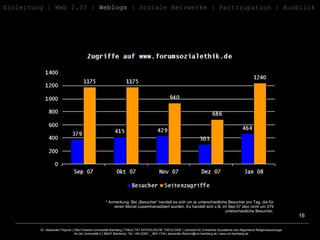
Einleitung   | Web 2.0? |  Weblogs  | Soziale Netzwerke | Partizipation | Ausblick * Anmerkung: Bei „Besucher“ handelt es sich um je unterschiedliche Besucher pro Tag, die für einen Monat zusammenaddiert wurden. Es handelt sich z.B. im Sep 07 also nicht um 379 unterschiedliche Besucher.
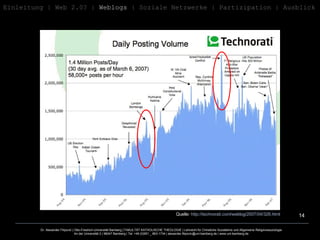
Einleitung   | Web 2.0? |  Weblogs  | Soziale Netzwerke | Partizipation | Ausblick
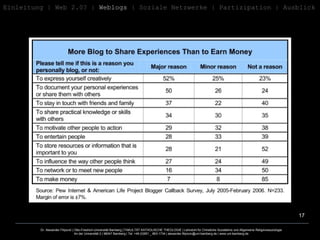
Quelle: Schmidt, Wilbers 2006 – Wie ich blogge?: 12 Einleitung   | Web 2.0? |  Weblogs  | Soziale Netzwerke | Partizipation | Ausblick
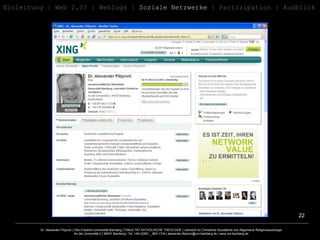
Einleitung   | Web 2.0? | Weblogs |  Soziale Netzwerke  | Partizipation | Ausblick
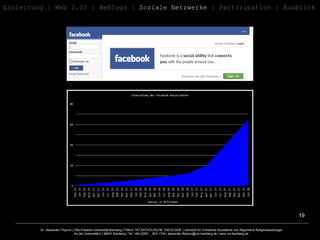
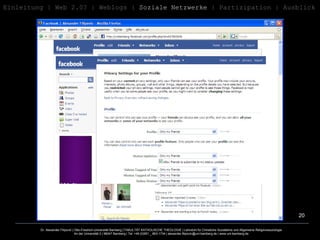
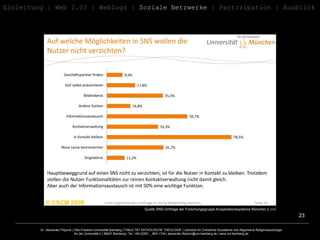
Einleitung   | Web 2.0? | Weblogs |  Soziale Netzwerke  | Partizipation | Ausblick Quelle SNS-Umfrage der Forschungsgruppe Kooperationssysteme München ( Link )
“ And does Facebook really connect people? Doesn't it rather disconnect us, since instead of doing something enjoyable such as talking and eating […] with my friends, I am merely sending them little ungrammatical notes and amusing photos in cyberspace, while chained to my desk? […] Far from connecting us, Facebook actually isolates us at our workstations.”   ( Hodgkinson 2008 – With friends like these .. ) “ Ambient intimacy is about being able to keep in touch with people with a level of regularity and intimacy that you wouldn’t usually have access to, because time and space conspire to make it impossible.” ( Reichelt 01.03.2007 – Ambient Intimacy ) Einleitung   | Web 2.0? | Weblogs |  Soziale Netzwerke  | Partizipation | Ausblick
participatory culture?   Einleitung   | Web 2.0? | Weblogs | Soziale   Netzwerke |  Partizipation  | Ausblick „ Interactivity is a property of the technology, while participation is a property of culture. Participatory culture is emerging as the culture absorbs and responds to the explosion of new media technologies that make it possible for average consumers to archive, annotate, appropriate, and recirculate media content in powerful new ways.“  ( Henry Jenkins )
„ participation gap“ statt „digital divide“?  Einleitung   | Web 2.0? | Weblogs | Soziale   Netzwerke |  Partizipation  | Ausblick „ The unevenness of participation is not a consequence of lack of access to the hardware and software and internet connections, but a consequence of uneven motivations and literacies.“ ( Jean  Burgess )
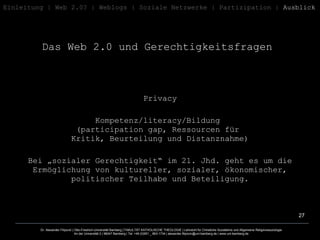
Das Web 2.0 und Gerechtigkeitsfragen   Einleitung   | Web 2.0? | Weblogs | Soziale   Netzwerke | Partizipation |  Ausblick Privacy Kompetenz/literacy/Bildung  (participation gap, Ressourcen für  Kritik, Beurteilung und Distanznahme) Bei „sozialer Gerechtigkeit“ im 21. Jhd. geht es um die Ermöglichung von kultureller, sozialer, ökonomischer, politischer Teilhabe und Beteiligung.
Informationsmanagement Identitätsmanagement Beziehungsmanagement  Lokalität Privatheit Sicherheit Intimität Vertrautheit Globalität Öffentlichkeit Distanz Unsicherheit Vertrauen Web 2.0 in sozialethischer Perspektive  Weblogs , Wikis, Soziale Netzwerke, collaborative filtering, Linkempfehlungen, Rating, content sharing… Einleitung   | Web 2.0? | Weblogs | Soziale Netzwerke | Partizipation |  Ausblick
Diese Präsentation steht im Zusammenhang mit dem Forschungsprojekt “ Social  Software and  Social   Ethics “, das am  Lehrstuhl Christliche Soziallehre und Allgemeine Religionssoziologie  an der Uni Bamberg (Prof. Dr. Marianne Heimbach-Steins) unter meiner Leitung durchgeführt wird. Vgl. die Einträge in meinem Weblog zum Forschungsprojekt unter dem Stichwort “ SocSoftEthics “. Ich danke Herrn Daniel Stumpf für wichtige Unterstützung in diesem Projekt.
Boyd, Danah (2005): Why Web2.0 Matters: Preparing for Glocalization. Online verfügbar unter http://www.zephoria.org/thoughts/archives/2005/09/05/why_web20_matte.html, zuletzt geprüft am 05.08.2006. Bush, Vannevar (1945): As We May Think. In: The Atlantic Monthly, Jg. 176, H. 1 (Juli), S. 101–108. Filipović, Alexander (2007): Neue Medienkompetenz und Beteiligungsgerechtigkeit. Herausforderungen für die Medien- und Kommunikationsethik. In: Communicatio Socialis, Jg. 37, H. 3, S. 233–245. Hodgkinson, Tom (2008): With friends like these … In: The Guardian, 14.01.2008. Online verfügbar unter  http:// www.guardian.co.uk /technology/2008/ jan /14/  facebook . Jenkins, Henry (2006): Convergence culture. Where old and new media collide. New York, NY: New York Univ. Press. Lenhart, Amanda; Fox, Susannah (2006): Bloggers. A portrait of the internet’s new storytellers. PEW Internet & American Life Project. Online verfügbar unter  http:// www.pewinternet.org / pdfs /PIP%20Bloggers%20Report%20July%2019%202006.pdf , zuletzt geprüft am 15.08.2006. Lévy, Pierre (1994): L'intelligence collective. Pour une anthropologie du cyberspace. Paris: La Découverte (Sciences et société). Lievrouw, Leah A.; Livingstone, Sonia M. (2002): Handbook of new media. Social shaping and consequences of ICTs. London: Sage. Reichelt, Leisa (2007): Ambient Intimacy. Online verfügbar unter http://www.disambiguity.com/ambient-intimacy/, zuletzt aktualisiert am 01.03.2007, zuletzt geprüft am 20.02.2008. Schmidt, Jan (2006): Social Software: Onlinegestütztes Informations-, Identitäts- und Beziehungsmanagement. In: Forschungsjournal Neue Soziale Bewegungen, Jg. 19, H. 2, S. 37–47. Schmidt, Jan (2007): Social Software als Gegenstand und Werkzeug der Online-Forschung. In: Welker, Martin (Hg.): Online-Forschung 2007. Grundlagen und Fallstudien. Köln: Halem, S. 251–272. Schmidt, Jan; Wilbers, Martin (2006): Wie ich blogge?! Erste Ergebnisse der Weblogbefragung 2005. (Berichte der Forschungsstelle "Neue Kommunikationsmedien", 06-01). Online verfügbar unter  http://141.13.22.238/ fonkblog / pdf / fonkbericht0601.pdf . Literatur (Auswahl)

Web 2.0 in sozialethischer Perspektive

  • 1.
    Web 2.0 Einemedienethische Sondierung.
  • 2.
    Aufbau Einleitung Web2.0? Weblogs Soziale Netzwerke Partizipation Ausblick
  • 3.
    Mediale Umbrüche undRevolutionen Utopien und Dystopien Medienethik aus der Distanz Einleitung | Web 2.0? | Weblogs | Soziale Netzwerke | Partizipation | Ausblick
  • 4.
    Das Social Weboder Web 2.0 analysiere ich als eine offene „Struktur“, die (teil-) öffentliche Online-Kommunikationen als situierte und kreative Handlungen ermöglicht und stabilisiert. Einleitung | Web 2.0? | Weblogs | Soziale Netzwerke | Partizipation | Ausblick
  • 5.
    Einleitung | Web 2.0? | Weblogs | Soziale Netzwerke | Partizipation | Ausblick Quelle: http:// www.rossdawsonblog.com / weblog / archives /2007/05/ launching_the_w.html
  • 6.
    Einleitung | Web 2.0? | Weblogs | Soziale Netzwerke | Partizipation | Ausblick Quelle: Schmidt, Jan: http:// www.schmidtmitdete.de / archives /50
  • 7.
    Einleitung | Web 2.0? | Weblogs | Soziale Netzwerke | Partizipation | Ausblick Quelle: http://web2.socialcomputingmagazine.com/ social_media_goes_mainstream.htm
  • 8.
    Einleitung | Web 2.0? | Weblogs | Soziale Netzwerke | Partizipation | Ausblick Quelle: http:// www.rossdawsonblog.com / weblog / archives /2007/05/ launching_the_w.html
  • 9.
    Der sozialethische Blickauf das Web 2.0 interessiert sich für Regeln, Normen, Strukturen, Strategien, Routinen und Erwartungen „ für die Selektion und Rezeption von Informationen, die das Informationsmanagement beeinflussen“, „ für „die Präsentation des eigenen Selbst im Internet, die das Identitätsmanagement beeinflussen“, „ für Aufbau und Pflege von Netzwerken, die das Beziehungsmanagement beeinflussen“ (Schmidt 2006 – Social Software: 39) . Einleitung | Web 2.0? | Weblogs | Soziale Netzwerke | Partizipation | Ausblick
  • 10.
    Informationsmanagement Identitätsmanagement Beziehungsmanagement Lokalität Privatheit Sicherheit Intimität Vertrautheit Globalität Öffentlichkeit Distanz Unsicherheit Vertrauen Web 2.0 in sozialethischer Perspektive Weblogs , Wikis, Soziale Netzwerke, collaborative filtering, Linkempfehlungen, Rating, content sharing… Einleitung | Web 2.0? | Weblogs | Soziale Netzwerke | Partizipation | Ausblick
  • 11.
    Einleitung | Web 2.0? | Weblogs | Soziale Netzwerke | Partizipation | Ausblick
  • 12.
    Einleitung | Web 2.0? | Weblogs | Soziale Netzwerke | Partizipation | Ausblick
  • 13.
    Quelle: http://technorati.com / weblog /2007/04/328.html Einleitung | Web 2.0? | Weblogs | Soziale Netzwerke | Partizipation | Ausblick
  • 14.
    Quelle: http://technorati.com / weblog /2007/04/328.html Einleitung | Web 2.0? | Weblogs | Soziale Netzwerke | Partizipation | Ausblick
  • 15.
    Quelle: http://www.wired.com / wired / archive /12.10/ tail.html Idee entnommen aus: Büffel, Stefan, Demokratie 2.0 – Transformiert die Netzkultur die politische Kommunikation, Videocast, http:// www.media-ocean.de /2007/08/02/videocast-demokratie-20 / Einleitung | Web 2.0? | Weblogs | Soziale Netzwerke | Partizipation | Ausblick Klassische Massenmedien Social Media
  • 16.
    Einleitung | Web 2.0? | Weblogs | Soziale Netzwerke | Partizipation | Ausblick * Anmerkung: Bei „Besucher“ handelt es sich um je unterschiedliche Besucher pro Tag, die für einen Monat zusammenaddiert wurden. Es handelt sich z.B. im Sep 07 also nicht um 379 unterschiedliche Besucher.
  • 17.
    Einleitung | Web 2.0? | Weblogs | Soziale Netzwerke | Partizipation | Ausblick
  • 18.
    Quelle: Schmidt, Wilbers2006 – Wie ich blogge?: 12 Einleitung | Web 2.0? | Weblogs | Soziale Netzwerke | Partizipation | Ausblick
  • 19.
    Einleitung | Web 2.0? | Weblogs | Soziale Netzwerke | Partizipation | Ausblick
  • 20.
    Einleitung | Web 2.0? | Weblogs | Soziale Netzwerke | Partizipation | Ausblick
  • 21.
    Einleitung | Web 2.0? | Weblogs | Soziale Netzwerke | Partizipation | Ausblick
  • 22.
    Einleitung | Web 2.0? | Weblogs | Soziale Netzwerke | Partizipation | Ausblick
  • 23.
    Einleitung | Web 2.0? | Weblogs | Soziale Netzwerke | Partizipation | Ausblick Quelle SNS-Umfrage der Forschungsgruppe Kooperationssysteme München ( Link )
  • 24.
    “ And doesFacebook really connect people? Doesn't it rather disconnect us, since instead of doing something enjoyable such as talking and eating […] with my friends, I am merely sending them little ungrammatical notes and amusing photos in cyberspace, while chained to my desk? […] Far from connecting us, Facebook actually isolates us at our workstations.” ( Hodgkinson 2008 – With friends like these .. ) “ Ambient intimacy is about being able to keep in touch with people with a level of regularity and intimacy that you wouldn’t usually have access to, because time and space conspire to make it impossible.” ( Reichelt 01.03.2007 – Ambient Intimacy ) Einleitung | Web 2.0? | Weblogs | Soziale Netzwerke | Partizipation | Ausblick
  • 25.
    participatory culture? Einleitung | Web 2.0? | Weblogs | Soziale Netzwerke | Partizipation | Ausblick „ Interactivity is a property of the technology, while participation is a property of culture. Participatory culture is emerging as the culture absorbs and responds to the explosion of new media technologies that make it possible for average consumers to archive, annotate, appropriate, and recirculate media content in powerful new ways.“ ( Henry Jenkins )
  • 26.
    „ participation gap“statt „digital divide“? Einleitung | Web 2.0? | Weblogs | Soziale Netzwerke | Partizipation | Ausblick „ The unevenness of participation is not a consequence of lack of access to the hardware and software and internet connections, but a consequence of uneven motivations and literacies.“ ( Jean Burgess )
  • 27.
    Das Web 2.0und Gerechtigkeitsfragen Einleitung | Web 2.0? | Weblogs | Soziale Netzwerke | Partizipation | Ausblick Privacy Kompetenz/literacy/Bildung (participation gap, Ressourcen für Kritik, Beurteilung und Distanznahme) Bei „sozialer Gerechtigkeit“ im 21. Jhd. geht es um die Ermöglichung von kultureller, sozialer, ökonomischer, politischer Teilhabe und Beteiligung.
  • 28.
    Informationsmanagement Identitätsmanagement Beziehungsmanagement Lokalität Privatheit Sicherheit Intimität Vertrautheit Globalität Öffentlichkeit Distanz Unsicherheit Vertrauen Web 2.0 in sozialethischer Perspektive Weblogs , Wikis, Soziale Netzwerke, collaborative filtering, Linkempfehlungen, Rating, content sharing… Einleitung | Web 2.0? | Weblogs | Soziale Netzwerke | Partizipation | Ausblick
  • 29.
    Diese Präsentation stehtim Zusammenhang mit dem Forschungsprojekt “ Social Software and Social Ethics “, das am Lehrstuhl Christliche Soziallehre und Allgemeine Religionssoziologie an der Uni Bamberg (Prof. Dr. Marianne Heimbach-Steins) unter meiner Leitung durchgeführt wird. Vgl. die Einträge in meinem Weblog zum Forschungsprojekt unter dem Stichwort “ SocSoftEthics “. Ich danke Herrn Daniel Stumpf für wichtige Unterstützung in diesem Projekt.
  • 30.
    Boyd, Danah (2005):Why Web2.0 Matters: Preparing for Glocalization. Online verfügbar unter http://www.zephoria.org/thoughts/archives/2005/09/05/why_web20_matte.html, zuletzt geprüft am 05.08.2006. Bush, Vannevar (1945): As We May Think. In: The Atlantic Monthly, Jg. 176, H. 1 (Juli), S. 101–108. Filipović, Alexander (2007): Neue Medienkompetenz und Beteiligungsgerechtigkeit. Herausforderungen für die Medien- und Kommunikationsethik. In: Communicatio Socialis, Jg. 37, H. 3, S. 233–245. Hodgkinson, Tom (2008): With friends like these … In: The Guardian, 14.01.2008. Online verfügbar unter http:// www.guardian.co.uk /technology/2008/ jan /14/ facebook . Jenkins, Henry (2006): Convergence culture. Where old and new media collide. New York, NY: New York Univ. Press. Lenhart, Amanda; Fox, Susannah (2006): Bloggers. A portrait of the internet’s new storytellers. PEW Internet & American Life Project. Online verfügbar unter http:// www.pewinternet.org / pdfs /PIP%20Bloggers%20Report%20July%2019%202006.pdf , zuletzt geprüft am 15.08.2006. Lévy, Pierre (1994): L'intelligence collective. Pour une anthropologie du cyberspace. Paris: La Découverte (Sciences et société). Lievrouw, Leah A.; Livingstone, Sonia M. (2002): Handbook of new media. Social shaping and consequences of ICTs. London: Sage. Reichelt, Leisa (2007): Ambient Intimacy. Online verfügbar unter http://www.disambiguity.com/ambient-intimacy/, zuletzt aktualisiert am 01.03.2007, zuletzt geprüft am 20.02.2008. Schmidt, Jan (2006): Social Software: Onlinegestütztes Informations-, Identitäts- und Beziehungsmanagement. In: Forschungsjournal Neue Soziale Bewegungen, Jg. 19, H. 2, S. 37–47. Schmidt, Jan (2007): Social Software als Gegenstand und Werkzeug der Online-Forschung. In: Welker, Martin (Hg.): Online-Forschung 2007. Grundlagen und Fallstudien. Köln: Halem, S. 251–272. Schmidt, Jan; Wilbers, Martin (2006): Wie ich blogge?! Erste Ergebnisse der Weblogbefragung 2005. (Berichte der Forschungsstelle "Neue Kommunikationsmedien", 06-01). Online verfügbar unter http://141.13.22.238/ fonkblog / pdf / fonkbericht0601.pdf . Literatur (Auswahl)