Mobile Revolution
auch bei Business Software

       Claudio Hintermann
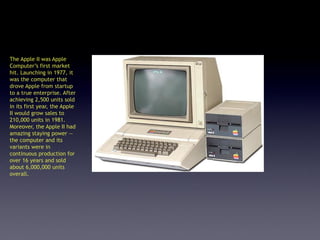
The Apple II was Apple
Computer’s first market
hit. Launching in 1977, it
was the computer that
drove Apple from startup
to a true enterprise. After
achieving 2,500 units sold
in its first year, the Apple
II would grow sales to
210,000 units in 1981.
Moreover, the Apple II had
amazing staying power —
the computer and its
variants were in
continuous production for
over 16 years and sold
about 6,000,000 units
overall.
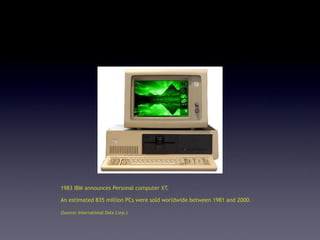
1983 IBM announces Personal computer XT.

An estimated 835 million PCs were sold worldwide between 1981 and 2000.

(Source: International Data Corp.)
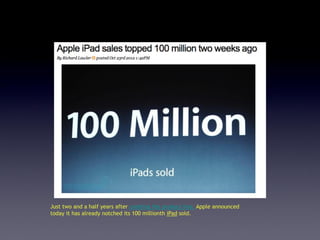
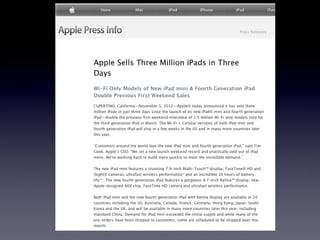
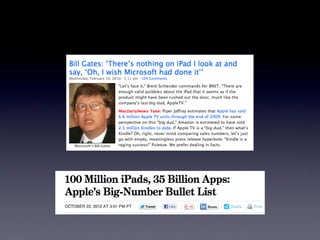
Just two and a half years after creating the product line, Apple announced
today it has already notched its 100 millionth iPad sold.
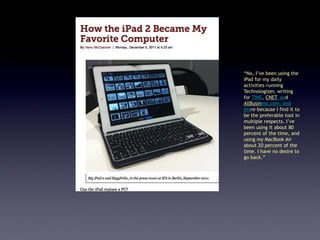
“No, I’ve been using the
iPad for my daily
activities–running
Technologizer, writing
for TIME, CNET, and
AllBusiness.com, and
more–because I find it to
be the preferable tool in
multiple respects. I’ve
been using it about 80
percent of the time, and
using my MacBook Air
about 20 percent of the
time. I have no desire to
go back.”
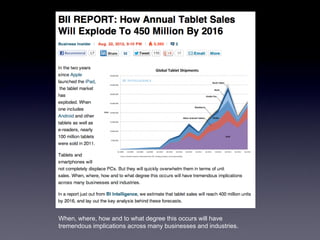
When, where, how and to what degree this occurs will have
tremendous implications across many businesses and industries.
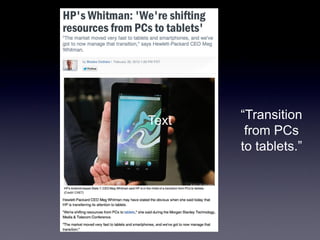
Text   “Transition
        from PCs
       to tablets.”
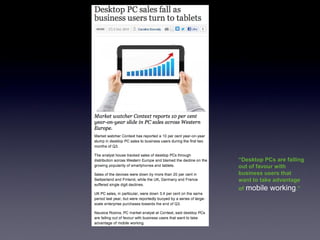
“Desktop PCs are falling
out of favour with
business users that
want to take advantage
of   mobile working.”
Mobile Working
• Erfassung, Verarbeitung und Abfrage
  von Business-Prozessen wird öfter
  über “Smart-Devices” vorgenommen.
• PC wird noch für schreibintensive
  Prozesse verwendet oder um
  Informationen zu vervollständigen, die
  mobil erfasst wurden.
• Tastatur verliert an Bedeutung.
Es geht nicht um iPads, Tablets,
       iPhones oder Smartphones,
es geht um eine Welt, die mobil wird.
     Es verändert den Weg, wie wir
     Informationen abrufen, welche
Informationen wir eingeben und wie wir
             sie eingeben.
        Es verändert Prozesse.
Veränderte Prozesse
• Belege zum Buchhalter
• Zeit-/Projekterfassung
• Abfragen der ERP-Daten
• Formularerfassung
• Belegvisierung
• Zahlungsprozess / Freigabe
Informationen im ERP
• Früher fast ausschiesslich Text und
  Grafiken
• Heute: Bild, Ton, Film, Text und GPS
• Zeitpunkt: Informationen gelangen
  früher (bei der Entstehung) ins ERP
  und werden aktueller aus dem ERP
  abgefragt.
Danke für Ihre Aufmerksamkeit

SeEF 2013 | Use IT as a service (Claudio Hintermann)

  • 1.
    Mobile Revolution auch beiBusiness Software Claudio Hintermann
  • 3.
    The Apple IIwas Apple Computer’s first market hit. Launching in 1977, it was the computer that drove Apple from startup to a true enterprise. After achieving 2,500 units sold in its first year, the Apple II would grow sales to 210,000 units in 1981. Moreover, the Apple II had amazing staying power — the computer and its variants were in continuous production for over 16 years and sold about 6,000,000 units overall.
  • 4.
    1983 IBM announcesPersonal computer XT. An estimated 835 million PCs were sold worldwide between 1981 and 2000. (Source: International Data Corp.)
  • 5.
    Just two anda half years after creating the product line, Apple announced today it has already notched its 100 millionth iPad sold.
  • 7.
    “No, I’ve beenusing the iPad for my daily activities–running Technologizer, writing for TIME, CNET, and AllBusiness.com, and more–because I find it to be the preferable tool in multiple respects. I’ve been using it about 80 percent of the time, and using my MacBook Air about 20 percent of the time. I have no desire to go back.”
  • 12.
    When, where, howand to what degree this occurs will have tremendous implications across many businesses and industries.
  • 13.
    Text “Transition from PCs to tablets.”
  • 14.
    “Desktop PCs arefalling out of favour with business users that want to take advantage of mobile working.”
  • 15.
    Mobile Working • Erfassung,Verarbeitung und Abfrage von Business-Prozessen wird öfter über “Smart-Devices” vorgenommen. • PC wird noch für schreibintensive Prozesse verwendet oder um Informationen zu vervollständigen, die mobil erfasst wurden. • Tastatur verliert an Bedeutung.
  • 16.
    Es geht nichtum iPads, Tablets, iPhones oder Smartphones, es geht um eine Welt, die mobil wird. Es verändert den Weg, wie wir Informationen abrufen, welche Informationen wir eingeben und wie wir sie eingeben. Es verändert Prozesse.
  • 17.
    Veränderte Prozesse • Belegezum Buchhalter • Zeit-/Projekterfassung • Abfragen der ERP-Daten • Formularerfassung • Belegvisierung • Zahlungsprozess / Freigabe
  • 18.
    Informationen im ERP •Früher fast ausschiesslich Text und Grafiken • Heute: Bild, Ton, Film, Text und GPS • Zeitpunkt: Informationen gelangen früher (bei der Entstehung) ins ERP und werden aktueller aus dem ERP abgefragt.
  • 19.
    Danke für IhreAufmerksamkeit