DIE CLOUD
SASCHA OEHL
1
REAL DYNAMIC INFRASTRUCTURE
RDI – Real Dynamische Infrastruktur
Eine Rechenzentrums Philosophie, die die Menschen entlastet und
der Business Unit die Infrastruktur bereitstellt die sie benötigt
RDS – Real Dynamischer Speicher
Speicher und Managementprozesse die einfach,
zuverlässig und sicher die Daten verfügbar halten
RDD–RealDynamicDataManagement
DatenbeschützenundeinLebenlangbetreuen
RDC – Real Dynamic Content
Dateien und Objekte optimiert ablegen
und mit der richtigen Geschwindigkeit
bereitstellen
RDP – Real Dynamic Compute
Rechenressourcen die anpassbar, flexibel und skalierbar die
Rechenleistung bereitstellen, die die Anwendung benötigt
WARUM EINE CLOUD?
• Hohe Ausgaben
CAPEX und OPEX
WARUM EINE CLOUD?
• Hohe Ausgaben
CAPEX und OPEX
• Lange Bestellzeiten
0
2
4
6
8
10
12
Jan Feb Mar Apr Mai Jun Jul Aug Sep Okt Nov Dez
Series 1
Series 2
Series 3
• Hohe Ausgaben
CAPEX und OPEX
• Lange Bestellzeiten
• Gerine Flexibilität
WARUM EINE CLOUD?
• Hohe Ausgaben
CAPEX und OPEX
• Lange Bestellzeiten
• Gerine Flexibilität
• Schwierige Abrechnung
WARUM EINE CLOUD?
• Hohe Ausgaben
CAPEX und OPEX
• Lange Bestellzeiten
• Gerine Flexibilität
• Schwierige Abrechnung
• Zu wenig Ressourcen
WARUM EINE CLOUD?
• Hohe Ausgaben
CAPEX und OPEX
• Lange Bestellzeiten
• Gerine Flexibilität
• Schwierige Abrechnung
• Zu wenig Ressourcen
• Migrationen & Downtimes
WARUM EINE CLOUD?
Bei IT geht es um
Business
NICHT um
Infrastrukturen
WARUM CLOUD?
RESSOURCEN VERFÜGBARKEIT
Ressourcen verfügbar
-Genügend
-Flexibel
-Jetzt
WARUM CLOUD?
BUSINESS UPTIME – 7 * 24 * 365 * IMMER
Transparente Infrastruktur
Immer Verfügbar
Keine IS Zusatzkosten
WARUM CLOUD?
MEHR FOKUS AUF DAS BUSINESS
Mitarbeiter für
das Business,
nicht für die IS
WARUM CLOUD?
DATEN BLEIBEN
The Data never sleeps
WARUM CLOUD?
BESCHAFFUNGSFLEXIBILITÄT
0
50
100
150
200
250
300
350
Q1 Q2 Q3 Q4 Q1 Q2 Q3 Q4
Bedarf
Klassich
Cloud
SOURCE: DATA
Bezahlung der
genutzten Ressoucen
Scale Up and Down
Ausgaben angepasst
an Bedarf
CLOUD? FÜR WEN?
Daten schlafen NIE
Cloud Consumer Cloud Provider
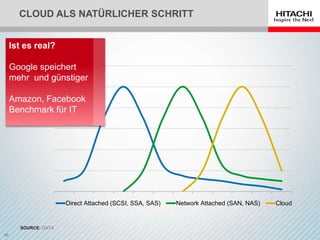
CLOUD ALS NATÜRLICHER SCHRITT
Direct Attached (SCSI, SSA, SAS) Network Attached (SAN, NAS) Cloud
SOURCE: DATA
Ist es real?
Google speichert
mehr und günstiger
Amazon, Facebook
Benchmark für IT
WAS IST DIE CLOUD?
Protection
Location independence
Dynamic provisioning
Virtualization
Mobility
Multitenancy
Discoverability
1. Self-service
2. Pay-per-use
3. Dynamic scale ↑↓
WELCHE CLOUD?
PRIVATE
Private
Nutzung interner Anbieter
Umstellung der Betriebsteams
und der Prozesse
Klares Chargeback
Transparente Migrationen
WELCHE CLOUD?
PUBLIC
Private
Public
Nutzung externer Anbieter
Strenges SLA Modell
und Monitoring
Datenverlagerung, transparent
und fliessend, zwischen
verschiedenen Cloud Providern
WELCHE CLOUD?
HYBRID
Private
Hybrid
Public
Nutzung sowohl externer
als auch interner Anbieter
Selektion der Daten nach
Wichtigkeit
Datenverlagerung, transparent
und fliessend, zwischen den
Clouds
„ALS EIN WAS“?
STORAGE – PLATTFORM – SOFTWARE…
StAAS – Storage-as-a-Service
IAAS – Infrastructure-as-a-Service
•SAAS
•Server
•Netzwerk
PAAS – Platform-as-a-Service
•IAAS
•Laufzeitumgebungen
SAAS – Application-as-a-Service
•PAAS
•Anwendung
Skalierbar nach Bedarf
Bezahlung nach Nutzung
Management inklusive
HITACHI DATA SYSTEMS
CLOUD VISION
 Einfache Infrastruktur
‒ Lösung im Rack
‒ Schnelles provisioning
und deployment
‒ SLA Monitoring und
Management
 Data intelligence
– Data lifecycle
management
– Index und
Suche/Finden
 Information analytics
– Daten unabhängig von
der Anwendung
– Daten
wiederverwenden und
in anderem Kontext
betrachten
Single Virtualization Platform
– Hitachi Storage and Servers –
Information
Cloud
Content
Cloud
Infrastructure
Cloud
Informations
Wiederverwendung
Intelligenz
WAS LIEFERN WIR FÜR DIE CLOUD?
Cloud Hardware
Hitachi Data Systems liefert
GESAMTE Hardware
Storage, Content , Compute
Cloud Concepts & Software
Monitoring, Chargeback,
Interfaces (S3), Virtualisierung
(Managment improvemts comming)
Financial Models
HOW HITACHI DATA SYSTEMS
LIEFERT HEUTE CLOUD SOLUTIONS
Deployment
 Deployment
– Private
– Hybrid
– Public
Delivery
 Delivery
– Billing and metering
– Self-service
– Pay-per-use consumption
– Flex up and down
Services
 Services
– Remote managed services
– Managed storage utilityConnectivity
 Connectivity
– Support existing applications
– REST API, MAPIInfrastructure
 Infrastructure
– Integrated block, file and content
platforms and technologies
– Converged and compute solutions
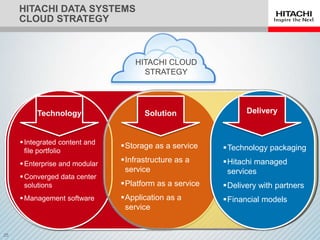
Hitachi Cloud Strategy
HITACHI DATA SYSTEMS
CLOUD STRATEGY
Integrated content and
file portfolio
Enterprise and modular
Converged data center
solutions
Management software
Technology
Storage as a service
Infrastructure as a
service
Platform as a service
Application as a
service
Solution
Technology packaging
Hitachi managed
services
Delivery with partners
Financial models
Delivery
HITACHI CLOUD
STRATEGY
THANK YOU

The cloud 2011

  • 1.
  • 2.
    REAL DYNAMIC INFRASTRUCTURE RDI– Real Dynamische Infrastruktur Eine Rechenzentrums Philosophie, die die Menschen entlastet und der Business Unit die Infrastruktur bereitstellt die sie benötigt RDS – Real Dynamischer Speicher Speicher und Managementprozesse die einfach, zuverlässig und sicher die Daten verfügbar halten RDD–RealDynamicDataManagement DatenbeschützenundeinLebenlangbetreuen RDC – Real Dynamic Content Dateien und Objekte optimiert ablegen und mit der richtigen Geschwindigkeit bereitstellen RDP – Real Dynamic Compute Rechenressourcen die anpassbar, flexibel und skalierbar die Rechenleistung bereitstellen, die die Anwendung benötigt
  • 3.
    WARUM EINE CLOUD? •Hohe Ausgaben CAPEX und OPEX
  • 4.
    WARUM EINE CLOUD? •Hohe Ausgaben CAPEX und OPEX • Lange Bestellzeiten
  • 5.
    0 2 4 6 8 10 12 Jan Feb MarApr Mai Jun Jul Aug Sep Okt Nov Dez Series 1 Series 2 Series 3 • Hohe Ausgaben CAPEX und OPEX • Lange Bestellzeiten • Gerine Flexibilität
  • 6.
    WARUM EINE CLOUD? •Hohe Ausgaben CAPEX und OPEX • Lange Bestellzeiten • Gerine Flexibilität • Schwierige Abrechnung
  • 7.
    WARUM EINE CLOUD? •Hohe Ausgaben CAPEX und OPEX • Lange Bestellzeiten • Gerine Flexibilität • Schwierige Abrechnung • Zu wenig Ressourcen
  • 8.
    WARUM EINE CLOUD? •Hohe Ausgaben CAPEX und OPEX • Lange Bestellzeiten • Gerine Flexibilität • Schwierige Abrechnung • Zu wenig Ressourcen • Migrationen & Downtimes
  • 9.
    WARUM EINE CLOUD? BeiIT geht es um Business NICHT um Infrastrukturen
  • 10.
    WARUM CLOUD? RESSOURCEN VERFÜGBARKEIT Ressourcenverfügbar -Genügend -Flexibel -Jetzt
  • 11.
    WARUM CLOUD? BUSINESS UPTIME– 7 * 24 * 365 * IMMER Transparente Infrastruktur Immer Verfügbar Keine IS Zusatzkosten
  • 12.
    WARUM CLOUD? MEHR FOKUSAUF DAS BUSINESS Mitarbeiter für das Business, nicht für die IS
  • 13.
  • 14.
    WARUM CLOUD? BESCHAFFUNGSFLEXIBILITÄT 0 50 100 150 200 250 300 350 Q1 Q2Q3 Q4 Q1 Q2 Q3 Q4 Bedarf Klassich Cloud SOURCE: DATA Bezahlung der genutzten Ressoucen Scale Up and Down Ausgaben angepasst an Bedarf
  • 15.
    CLOUD? FÜR WEN? Datenschlafen NIE Cloud Consumer Cloud Provider
  • 16.
    CLOUD ALS NATÜRLICHERSCHRITT Direct Attached (SCSI, SSA, SAS) Network Attached (SAN, NAS) Cloud SOURCE: DATA Ist es real? Google speichert mehr und günstiger Amazon, Facebook Benchmark für IT
  • 17.
    WAS IST DIECLOUD? Protection Location independence Dynamic provisioning Virtualization Mobility Multitenancy Discoverability 1. Self-service 2. Pay-per-use 3. Dynamic scale ↑↓
  • 18.
    WELCHE CLOUD? PRIVATE Private Nutzung internerAnbieter Umstellung der Betriebsteams und der Prozesse Klares Chargeback Transparente Migrationen
  • 19.
    WELCHE CLOUD? PUBLIC Private Public Nutzung externerAnbieter Strenges SLA Modell und Monitoring Datenverlagerung, transparent und fliessend, zwischen verschiedenen Cloud Providern
  • 20.
    WELCHE CLOUD? HYBRID Private Hybrid Public Nutzung sowohlexterner als auch interner Anbieter Selektion der Daten nach Wichtigkeit Datenverlagerung, transparent und fliessend, zwischen den Clouds
  • 21.
    „ALS EIN WAS“? STORAGE– PLATTFORM – SOFTWARE… StAAS – Storage-as-a-Service IAAS – Infrastructure-as-a-Service •SAAS •Server •Netzwerk PAAS – Platform-as-a-Service •IAAS •Laufzeitumgebungen SAAS – Application-as-a-Service •PAAS •Anwendung Skalierbar nach Bedarf Bezahlung nach Nutzung Management inklusive
  • 22.
    HITACHI DATA SYSTEMS CLOUDVISION  Einfache Infrastruktur ‒ Lösung im Rack ‒ Schnelles provisioning und deployment ‒ SLA Monitoring und Management  Data intelligence – Data lifecycle management – Index und Suche/Finden  Information analytics – Daten unabhängig von der Anwendung – Daten wiederverwenden und in anderem Kontext betrachten Single Virtualization Platform – Hitachi Storage and Servers – Information Cloud Content Cloud Infrastructure Cloud Informations Wiederverwendung Intelligenz
  • 23.
    WAS LIEFERN WIRFÜR DIE CLOUD? Cloud Hardware Hitachi Data Systems liefert GESAMTE Hardware Storage, Content , Compute Cloud Concepts & Software Monitoring, Chargeback, Interfaces (S3), Virtualisierung (Managment improvemts comming) Financial Models
  • 24.
    HOW HITACHI DATASYSTEMS LIEFERT HEUTE CLOUD SOLUTIONS Deployment  Deployment – Private – Hybrid – Public Delivery  Delivery – Billing and metering – Self-service – Pay-per-use consumption – Flex up and down Services  Services – Remote managed services – Managed storage utilityConnectivity  Connectivity – Support existing applications – REST API, MAPIInfrastructure  Infrastructure – Integrated block, file and content platforms and technologies – Converged and compute solutions
  • 25.
    Hitachi Cloud Strategy HITACHIDATA SYSTEMS CLOUD STRATEGY Integrated content and file portfolio Enterprise and modular Converged data center solutions Management software Technology Storage as a service Infrastructure as a service Platform as a service Application as a service Solution Technology packaging Hitachi managed services Delivery with partners Financial models Delivery HITACHI CLOUD STRATEGY
  • 26.

Hinweis der Redaktion

  • #23 Infrastructure Cloud: building on our core technology we have today, we’re building the infrastructure plumbing for data centers. Key components are converged data center solutions which integrate storage, compute and network. And the ability to deliver dynamic provisioning. Content Cloud: deliver intelligence to enable customers to manage the life cycle of their data. Access, tier, search and discover data. Eg. Hitachi Clinical Repository plays is a great example of content cloud. Information Cloud: Re-purpose of content to enable business decision making. It’s the data warehousing for content.
  • #25 Cloud computing is not a product. It’s a way to deliver IT services in an on demand, rapid, flexible and scalable fashion. Hitachi lets customers to choose the best possible delivery method, deployment model and underlying infrastructure to address your particular cloud needs, all at your own pace. We start with our integrated infrastructure and cloud enabling technologies. Then provide connectivity options for customers to move data into the cloud, whether it’s their existing applications or new applications that can talk directly to the cloud (via REST for example). Next we layer in our service capabilities, which can be remote and utility based – allowing pay-per-use consumption of storage resources. Then we provide the fundamental delivery mechanisms to enable a cloud service delivery model, such as billing/chargeback which can be segregated by tenant (i.e. business unit or even company for service providers), self-service on demand access to storage, pay per use consumption and the ability to scale up or down to meet the needs of the business. The cloud architecture can be deployed in any of the following ways: Private: Hosted within an organization’s firewall and managed internally or externally Public: Hosted on the internet and managed by a provider Hybrid: A combination of private and public
  • #26 25