www.vom-mathelehrer.de 1
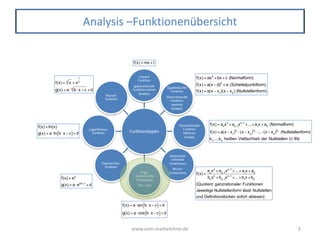
Analysis –Funktionenübersicht
Funktionstypen
Lineare
Funktion
(ganzrationale
Funktion ersten
Grades)
Quadratische
Funktion
(Ganzrationale
Funktion
zweiten
Grades)
Ganzrationale
Funktion
höheren
Grades
Gebrochen
rationale
Funktionen
(Bruch-
funktionen)Trigo-
nometrische
Funktionen
(Sin, Cos)
Exponential-
funktion
Logarithmus-
funktion
Wurzel-
funktion
f(x) = mx + t
f(x) = ax2
+bx + c (Normalform)
f(x) = a(x − d)2
+ e (Scheitelpunktform)
f(x) = a(x − x1
)(x − x2
) (Nullstellenform)
f(x) = an
xn
+ an−1
xn−1
+...+ a1
x + a0
(Normalform)
f(x) = a(x − x1
)
k1
⋅(x − x2
)
k2
⋅...⋅(x − xn
)
kn
(Nullstellenform)
k1
,...,kn
heißen Vielfachheit der Nullstellen (∈ IN)
f(x) =
az
xz
+ az−1
xz−1
+...+ a1
x + a0
bn
xn
+bn−1
xn−1
+...+b1
x +b0
(Quotient ganzrationaler Funktionen
Jeweilige Nullstellenform lässt Nullstellen
und Definitionslücken sofort ablesen)
f(x) = a⋅sin b⋅ x − c( )+ d
g(x) = a⋅cos b⋅ x − c( )+ d
f(x) = ex
g(x) = a⋅ebx−c
+ d
f(x) = ln(x)
g(x) = a⋅ln b⋅ x − c( )+ d
f(x) = xn
= x
1
n
g(x) = a⋅ b⋅ x − cn
+ d
www.vom-mathelehrer.de 2
www.vom-mathelehrer.de 3
Analysis – Trigonometrische Funktionen
•f(x)=
•D=IR
•W=[-2; +2] -> Amplitude: 4
•Periode P: 2π
•Verschiebung in x-Richtung: +1
•Nullstellen:
Trigonometrische
Funktion
f(x) = sinx
2sin(x −1)
x −1= kπ ⇔ xk
= kπ +1
P =
2π
|b |
⎛
⎝
⎜
⎞
⎠
⎟
x = kπ +
1
2
π
Graphen von trigonometrischen Funktionen:
f(x)=sin(x)
• Df=IR
• Nullstellen: für sin: ; für cos:
• Periodenlänge:
x = kπ
f(x) = sinx
www.vom-mathelehrer.de 4
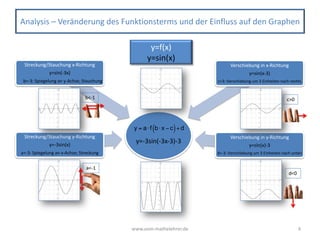
Analysis – Veränderung des Funktionsterms und der Einfluss auf den Graphen
y=-3sin(-3x-3)-3
Streckung/Stauchung y-Richtung
y=-3sin(x)
a=-3: Spiegelung an x-Achse; Streckung
Streckung/Stauchung x-Richtung
y=sin(-3x)
b=-3: Spiegelung an y-Achse; Stauchung
Verschiebung in x-Richtung
y=sin(x-3)
c=3: Verschiebung um 3 Einheiten nach rechts
Verschiebung in y-Richtung
y=sin(x)-3
d=-3: Verschiebung um 3 Einheiten nach unten
y=f(x)
y=sin(x)
a<-1
b<-1 c>0
d<0
y = a⋅ f b⋅ x − c( )+ d
www.vom-mathelehrer.de
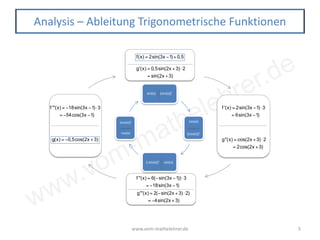
Analysis – Ableitung Trigonometrische Funktionen
www.vom-mathelehrer.de 5
sin(x) (sin(x))‘
cos(x)
(cos(x))‘
(-sin(x))‘ -sin(x)
-(cos(x))‘
-cos(x)
f(x) = 2sin(3x −1) +0,5
f '(x) = 2sin(3x −1)⋅3
= 6sin(3x −1)
f ''(x) = 6(−sin(3x −1))⋅3
= −18sin(3x −1)
f '''(x) = −18sin(3x −1)⋅3
= −54cos(3x −1)
g(x) = −0,5cos(2x +3)
g'(x) = 0,5sin(2x +3)⋅ 2
= sin(2x +3)
g''(x) = cos(2x +3)⋅ 2
= 2cos(2x +3)
g'''(x) = 2(−sin(2x +3)⋅ 2)
= −4sin(2x +3)
www.vom-mathelehrer.de
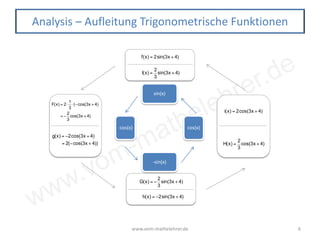
Analysis – Aufleitung Trigonometrische Funktionen
www.vom-mathelehrer.de 6
sin(x)
cos(x)
-sin(x)
-cos(x)
f(x) = 2sin(3x + 4)
i(x) = 2cos(3x + 4)
G(x) = −
2
3
sin(3x + 4)
F(x) = 2⋅
1
3
⋅(−cos(3x + 4)
= −
2
3
cos(3x + 4)
g(x) = −2cos(3x + 4)
= 2(−cos(3x + 4))
I(x) =
2
3
sin(3x + 4)
H(x) =
2
3
cos(3x + 4)
h(x) = −2sin(3x + 4)
www.vom-mathelehrer.de
www.vom-mathelehrer.de 9
Analysis – Trigonometrische Funktionen
•F(x)=
•Integral:
Stammfunktion
•D=IR
•f(x)=
•W=[-2; +2] -> Amplitude: 4
•Periode P: 2π
•Verschiebung in x-Richtung: +1
•Nullstellen:
Funktion f mit
• f‘=
•f‘(x)=0:
•Extremstellen an den Nullstellen von f‘, da jede mit VZW
1. Ableitung
•f‘‘(x)=
•f‘‘(x)=0:
•Wendepunkte an den Nullstellen von f‘‘, da jede mit VZW
2. Ableitung
•f‘‘‘(x)=
3. Ableitung
Aufleiten
Ableiten
Summenregel
Faktorregel
Produktregel
Quotientenregel
Kettenregel
Verkettete
Funktionen
F(x) = −cosx
f(x) = sinx
f '(x) = cosx
f ''(x) = −sinx
f '''(x) = −cosx
f(x) = 2sin(x −1)
2cos(x −1)
f(x)dx =
1
2π+1
∫ F(2π +1) −F(1) = 0
2sin(x −1)
x −1= kπ ⇔ xk
= kπ +1
−2sin(x −1)
−2cos(x −1)
−2cos(x −1)
P =
2π
|b |
⎛
⎝
⎜
⎞
⎠
⎟
xk
−1= kπ +
1
2
π ⇔ xk
= kπ +
1
2
π +1
x −1= kπ ⇔ xk
= kπ +1

01.4 abiturvorbereitung analysis winkelfkt2

  • 1.
  • 2.
    Analysis –Funktionenübersicht Funktionstypen Lineare Funktion (ganzrationale Funktion ersten Grades) Quadratische Funktion (Ganzrationale Funktion zweiten Grades) Ganzrationale Funktion höheren Grades Gebrochen rationale Funktionen (Bruch- funktionen)Trigo- nometrische Funktionen (Sin,Cos) Exponential- funktion Logarithmus- funktion Wurzel- funktion f(x) = mx + t f(x) = ax2 +bx + c (Normalform) f(x) = a(x − d)2 + e (Scheitelpunktform) f(x) = a(x − x1 )(x − x2 ) (Nullstellenform) f(x) = an xn + an−1 xn−1 +...+ a1 x + a0 (Normalform) f(x) = a(x − x1 ) k1 ⋅(x − x2 ) k2 ⋅...⋅(x − xn ) kn (Nullstellenform) k1 ,...,kn heißen Vielfachheit der Nullstellen (∈ IN) f(x) = az xz + az−1 xz−1 +...+ a1 x + a0 bn xn +bn−1 xn−1 +...+b1 x +b0 (Quotient ganzrationaler Funktionen Jeweilige Nullstellenform lässt Nullstellen und Definitionslücken sofort ablesen) f(x) = a⋅sin b⋅ x − c( )+ d g(x) = a⋅cos b⋅ x − c( )+ d f(x) = ex g(x) = a⋅ebx−c + d f(x) = ln(x) g(x) = a⋅ln b⋅ x − c( )+ d f(x) = xn = x 1 n g(x) = a⋅ b⋅ x − cn + d www.vom-mathelehrer.de 2
  • 3.
    www.vom-mathelehrer.de 3 Analysis –Trigonometrische Funktionen •f(x)= •D=IR •W=[-2; +2] -> Amplitude: 4 •Periode P: 2π •Verschiebung in x-Richtung: +1 •Nullstellen: Trigonometrische Funktion f(x) = sinx 2sin(x −1) x −1= kπ ⇔ xk = kπ +1 P = 2π |b | ⎛ ⎝ ⎜ ⎞ ⎠ ⎟ x = kπ + 1 2 π Graphen von trigonometrischen Funktionen: f(x)=sin(x) • Df=IR • Nullstellen: für sin: ; für cos: • Periodenlänge: x = kπ f(x) = sinx
  • 4.
    www.vom-mathelehrer.de 4 Analysis –Veränderung des Funktionsterms und der Einfluss auf den Graphen y=-3sin(-3x-3)-3 Streckung/Stauchung y-Richtung y=-3sin(x) a=-3: Spiegelung an x-Achse; Streckung Streckung/Stauchung x-Richtung y=sin(-3x) b=-3: Spiegelung an y-Achse; Stauchung Verschiebung in x-Richtung y=sin(x-3) c=3: Verschiebung um 3 Einheiten nach rechts Verschiebung in y-Richtung y=sin(x)-3 d=-3: Verschiebung um 3 Einheiten nach unten y=f(x) y=sin(x) a<-1 b<-1 c>0 d<0 y = a⋅ f b⋅ x − c( )+ d
  • 5.
    www.vom-mathelehrer.de Analysis – AbleitungTrigonometrische Funktionen www.vom-mathelehrer.de 5 sin(x) (sin(x))‘ cos(x) (cos(x))‘ (-sin(x))‘ -sin(x) -(cos(x))‘ -cos(x) f(x) = 2sin(3x −1) +0,5 f '(x) = 2sin(3x −1)⋅3 = 6sin(3x −1) f ''(x) = 6(−sin(3x −1))⋅3 = −18sin(3x −1) f '''(x) = −18sin(3x −1)⋅3 = −54cos(3x −1) g(x) = −0,5cos(2x +3) g'(x) = 0,5sin(2x +3)⋅ 2 = sin(2x +3) g''(x) = cos(2x +3)⋅ 2 = 2cos(2x +3) g'''(x) = 2(−sin(2x +3)⋅ 2) = −4sin(2x +3)
  • 6.
    www.vom-mathelehrer.de Analysis – AufleitungTrigonometrische Funktionen www.vom-mathelehrer.de 6 sin(x) cos(x) -sin(x) -cos(x) f(x) = 2sin(3x + 4) i(x) = 2cos(3x + 4) G(x) = − 2 3 sin(3x + 4) F(x) = 2⋅ 1 3 ⋅(−cos(3x + 4) = − 2 3 cos(3x + 4) g(x) = −2cos(3x + 4) = 2(−cos(3x + 4)) I(x) = 2 3 sin(3x + 4) H(x) = 2 3 cos(3x + 4) h(x) = −2sin(3x + 4)
  • 7.
    www.vom-mathelehrer.de www.vom-mathelehrer.de 9 Analysis –Trigonometrische Funktionen •F(x)= •Integral: Stammfunktion •D=IR •f(x)= •W=[-2; +2] -> Amplitude: 4 •Periode P: 2π •Verschiebung in x-Richtung: +1 •Nullstellen: Funktion f mit • f‘= •f‘(x)=0: •Extremstellen an den Nullstellen von f‘, da jede mit VZW 1. Ableitung •f‘‘(x)= •f‘‘(x)=0: •Wendepunkte an den Nullstellen von f‘‘, da jede mit VZW 2. Ableitung •f‘‘‘(x)= 3. Ableitung Aufleiten Ableiten Summenregel Faktorregel Produktregel Quotientenregel Kettenregel Verkettete Funktionen F(x) = −cosx f(x) = sinx f '(x) = cosx f ''(x) = −sinx f '''(x) = −cosx f(x) = 2sin(x −1) 2cos(x −1) f(x)dx = 1 2π+1 ∫ F(2π +1) −F(1) = 0 2sin(x −1) x −1= kπ ⇔ xk = kπ +1 −2sin(x −1) −2cos(x −1) −2cos(x −1) P = 2π |b | ⎛ ⎝ ⎜ ⎞ ⎠ ⎟ xk −1= kπ + 1 2 π ⇔ xk = kπ + 1 2 π +1 x −1= kπ ⇔ xk = kπ +1