www.vom-mathelehrer.de
Analysis
Wurzelfunktion
©www.vom-mathelehrer.de 1
www.vom-mathelehrer.de
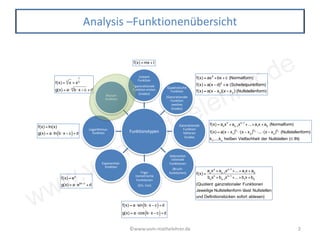
Analysis –Funktionenübersicht
Funktionstypen
Lineare
Funktion
(ganzrationale
Funktion ersten
Grades)
Quadratische
Funktion
(Ganzrationale
Funktion
zweiten
Grades)
Ganzrationale
Funktion
höheren
Grades
Gebrochen
rationale
Funktionen
(Bruch-
funktionen)Trigo-
nometrische
Funktionen
(Sin, Cos)
Exponential-
funktion
Logarithmus-
funktion
Wurzel-
funktion
f(x) = mx + t
f(x) = ax2
+bx + c (Normalform)
f(x) = a(x − d)2
+ e (Scheitelpunktform)
f(x) = a(x − x1
)(x − x2
) (Nullstellenform)
f(x) = an
xn
+ an−1
xn−1
+...+ a1
x + a0
(Normalform)
f(x) = a(x − x1
)
k1
⋅(x − x2
)
k2
⋅...⋅(x − xn
)
kn
(Nullstellenform)
k1
,...,kn
heißen Vielfachheit der Nullstellen (∈ IN)
f(x) =
az
xz
+ az−1
xz−1
+...+ a1
x + a0
bn
xn
+bn−1
xn−1
+...+b1
x +b0
(Quotient ganzrationaler Funktionen
Jeweilige Nullstellenform lässt Nullstellen
und Definitionslücken sofort ablesen)
f(x) = a⋅sin b⋅ x − c( )+ d
g(x) = a⋅cos b⋅ x − c( )+ d
f(x) = ex
g(x) = a⋅ebx−c
+ d
f(x) = ln(x)
g(x) = a⋅ln b⋅ x − c( )+ d
f(x) = xn
= x
1
n
g(x) = a⋅ b⋅ x − cn
+ d
©www.vom-mathelehrer.de 2
www.vom-mathelehrer.de
©www.vom-mathelehrer.de 3
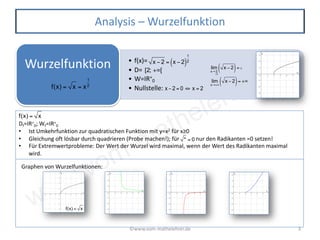
Analysis – Wurzelfunktion
• f(x)=
• D=
• W=IR+
0
• Nullstelle:
Wurzelfunktion
f(x) = x = x
1
2
x − 2 = x − 2( )
1
2
x − 2 = 0 ⇔ x = 2
lim
x→2
>2
x − 2( )= 0
lim
x→+∞
x − 2( )= +∞
[2; +∞[
Df=IR+
0; Wf=IR+
0
• Ist Umkehrfunktion zur quadratischen Funktion mit y=x2 für x≥0
• Gleichung oft lösbar durch quadrieren (Probe machen!); für nur den Radikanten =0 setzen!
• Für Extremwertprobleme: Der Wert der Wurzel wird maximal, wenn der Wert des Radikanten maximal
wird.
Graphen von Wurzelfunktionen:
f(x) = x
* = 0
f(x) = x
www.vom-mathelehrer.de
©www.vom-mathelehrer.de 4
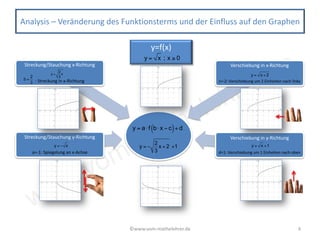
Analysis – Veränderung des Funktionsterms und der Einfluss auf den Graphen
Streckung/Stauchung y-Richtung
a=-1: Spiegelung an x-Achse
Streckung/Stauchung x-Richtung
: Streckung in x-Richtung
Verschiebung in x-Richtung
c=-2: Verschiebung um 2 Einheiten nach links
Verschiebung in y-Richtung
d=1: Verschiebung um 1 Einheiten nach oben
y=f(x)
b =
2
3
y = a⋅ f b⋅ x − c( )+ d
y = x ; x ≥ 0
y = − x
y =
2
3
x y = x + 2
y = x +1y = −
2
3
x + 2 +1
www.vom-mathelehrer.de
www.vom-mathelehrer.de 5
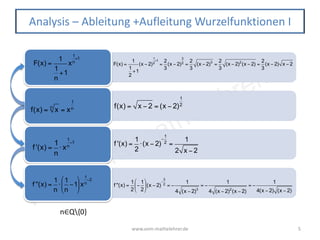
Analysis – Ableitung +Aufleitung Wurzelfunktionen I
f(x) = xn
= x
1
n
f '(x) =
1
n
⋅ x
1
n
−1
f ''(x) =
1
n
⋅
1
n
−1
⎛
⎝
⎜
⎞
⎠
⎟x
1
n
−2
F(x) =
1
1
n
+1
x
1
n
+1
f(x) = x − 2 = (x − 2)
1
2
f '(x) =
1
2
⋅(x − 2)
−
1
2 =
1
2 x − 2
f ''(x) =
1
2
−
1
2
⎛
⎝
⎜
⎞
⎠
⎟(x − 2)
−
3
2 = −
1
4 (x − 2)3
= −
1
4 (x − 2)2
(x − 2)
= −
1
4(x − 2) (x − 2)
F(x) =
1
1
2
+1
(x − 2)
1
2
+1
=
2
3
(x − 2)
3
2 =
2
3
(x − 2)3
=
2
3
(x − 2)2
(x − 2) =
2
3
(x − 2) x − 2
n∈Q{0}
www.vom-mathelehrer.de
www.vom-mathelehrer.de 6
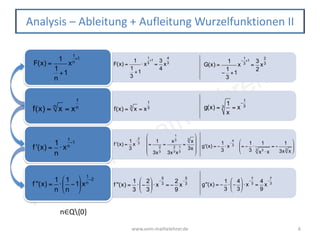
Analysis – Ableitung + Aufleitung Wurzelfunktionen II
f(x) = xn
= x
1
n
f '(x) =
1
n
⋅ x
1
n
−1
f ''(x) =
1
n
⋅
1
n
−1
⎛
⎝
⎜
⎞
⎠
⎟x
1
n
−2
F(x) =
1
1
n
+1
x
1
n
+1
f(x) = x3
= x
1
3 g(x) =
1
x
3 = x
−
1
3
f '(x) =
1
3
x
−
2
3 =
1
3x
2
3
=
x
1
3
3x
2
3x
1
3
=
x3
3x
⎛
⎝
⎜
⎜
⎜
⎞
⎠
⎟
⎟
⎟
g'(x) = −
1
3
⋅ x
−
4
3 = −
1
3
⋅
1
x3
⋅ x3
= −
1
3x x3
⎛
⎝
⎜⎜
⎞
⎠
⎟⎟
f ''(x) =
1
3
⋅ −
2
3
⎛
⎝
⎜
⎞
⎠
⎟⋅ x
−
5
3 = −
2
9
x
−
5
3 g''(x) = −
1
3
⋅ −
4
3
⎛
⎝
⎜
⎞
⎠
⎟⋅ x
−
7
3 =
4
9
x
−
7
3
F(x) =
1
1
3
+1
⋅ x
1
3
+1
=
3
4
x
4
3
G(x) =
1
−
1
3
+1
x
−
1
3
+1
=
3
2
x
2
3
n∈Q{0}
www.vom-mathelehrer.de
www.vom-mathelehrer.de 10
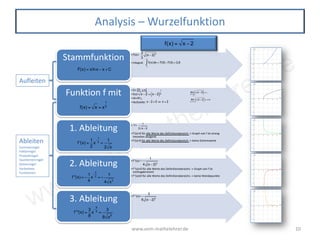
Analysis – Wurzelfunktion
•F(x)=
•Integral:
Stammfunktion
•D=
•f(x)=
•W=IR+
0
•Nullstelle:
Funktion f mit
• f‘=
•f‘(x)>0 für alle Werte des Definitionsbereich -> Graph von f ist streng
monoton steigend
•f‘(x)>0 für alle Werte des Definitionsbereich -> keine Extremwerte
1. Ableitung
•f‘‘(x)=
•f‘‘(x)<0 für alle Werte des Definitionsbereichs -> Graph von f ist
rechtsgekrümmt
•f‘‘(x)≠0 für alle Werte des Definitionsbereichs -> keine Wendepunkte
2. Ableitung
•f‘‘‘(x)=
3. Ableitung
Aufleiten
Ableiten
Summenregel
Faktorregel
Produktregel
Quotientenregel
Kettenregel
Verkettete
Funktionen
F(x) = xlnx − x +C
f(x) = x = x
1
2
f '(x) =
1
2
x
−
1
2 =
1
2 x
f ''(x) = −
1
4
x
−
3
2 = −
1
4 x3
f '''(x) =
3
8
x
−
5
2 =
3
8 x5
f(x) = x − 2
1
2 x − 2
f(x)dx =
3
5
∫ F(5) −F(3) ≈ 2,8
x − 2 = x − 2( )
1
2
x − 2 = 0 ⇔ x = 2
−
1
4 (x − 2)3
3
8 (x − 2)5
2
3
(x − 2)3
lim
x→2
>2
x − 2( )= 0
lim
x→+∞
x − 2( )= +∞
[2; +∞[

01.3 abiturvorbereitung analysis wurzelfkt2

  • 1.
  • 2.
    www.vom-mathelehrer.de Analysis –Funktionenübersicht Funktionstypen Lineare Funktion (ganzrationale Funktion ersten Grades) Quadratische Funktion (Ganzrationale Funktion zweiten Grades) Ganzrationale Funktion höheren Grades Gebrochen rationale Funktionen (Bruch- funktionen)Trigo- nometrische Funktionen (Sin,Cos) Exponential- funktion Logarithmus- funktion Wurzel- funktion f(x) = mx + t f(x) = ax2 +bx + c (Normalform) f(x) = a(x − d)2 + e (Scheitelpunktform) f(x) = a(x − x1 )(x − x2 ) (Nullstellenform) f(x) = an xn + an−1 xn−1 +...+ a1 x + a0 (Normalform) f(x) = a(x − x1 ) k1 ⋅(x − x2 ) k2 ⋅...⋅(x − xn ) kn (Nullstellenform) k1 ,...,kn heißen Vielfachheit der Nullstellen (∈ IN) f(x) = az xz + az−1 xz−1 +...+ a1 x + a0 bn xn +bn−1 xn−1 +...+b1 x +b0 (Quotient ganzrationaler Funktionen Jeweilige Nullstellenform lässt Nullstellen und Definitionslücken sofort ablesen) f(x) = a⋅sin b⋅ x − c( )+ d g(x) = a⋅cos b⋅ x − c( )+ d f(x) = ex g(x) = a⋅ebx−c + d f(x) = ln(x) g(x) = a⋅ln b⋅ x − c( )+ d f(x) = xn = x 1 n g(x) = a⋅ b⋅ x − cn + d ©www.vom-mathelehrer.de 2
  • 3.
    www.vom-mathelehrer.de ©www.vom-mathelehrer.de 3 Analysis –Wurzelfunktion • f(x)= • D= • W=IR+ 0 • Nullstelle: Wurzelfunktion f(x) = x = x 1 2 x − 2 = x − 2( ) 1 2 x − 2 = 0 ⇔ x = 2 lim x→2 >2 x − 2( )= 0 lim x→+∞ x − 2( )= +∞ [2; +∞[ Df=IR+ 0; Wf=IR+ 0 • Ist Umkehrfunktion zur quadratischen Funktion mit y=x2 für x≥0 • Gleichung oft lösbar durch quadrieren (Probe machen!); für nur den Radikanten =0 setzen! • Für Extremwertprobleme: Der Wert der Wurzel wird maximal, wenn der Wert des Radikanten maximal wird. Graphen von Wurzelfunktionen: f(x) = x * = 0 f(x) = x
  • 4.
    www.vom-mathelehrer.de ©www.vom-mathelehrer.de 4 Analysis –Veränderung des Funktionsterms und der Einfluss auf den Graphen Streckung/Stauchung y-Richtung a=-1: Spiegelung an x-Achse Streckung/Stauchung x-Richtung : Streckung in x-Richtung Verschiebung in x-Richtung c=-2: Verschiebung um 2 Einheiten nach links Verschiebung in y-Richtung d=1: Verschiebung um 1 Einheiten nach oben y=f(x) b = 2 3 y = a⋅ f b⋅ x − c( )+ d y = x ; x ≥ 0 y = − x y = 2 3 x y = x + 2 y = x +1y = − 2 3 x + 2 +1
  • 5.
    www.vom-mathelehrer.de www.vom-mathelehrer.de 5 Analysis –Ableitung +Aufleitung Wurzelfunktionen I f(x) = xn = x 1 n f '(x) = 1 n ⋅ x 1 n −1 f ''(x) = 1 n ⋅ 1 n −1 ⎛ ⎝ ⎜ ⎞ ⎠ ⎟x 1 n −2 F(x) = 1 1 n +1 x 1 n +1 f(x) = x − 2 = (x − 2) 1 2 f '(x) = 1 2 ⋅(x − 2) − 1 2 = 1 2 x − 2 f ''(x) = 1 2 − 1 2 ⎛ ⎝ ⎜ ⎞ ⎠ ⎟(x − 2) − 3 2 = − 1 4 (x − 2)3 = − 1 4 (x − 2)2 (x − 2) = − 1 4(x − 2) (x − 2) F(x) = 1 1 2 +1 (x − 2) 1 2 +1 = 2 3 (x − 2) 3 2 = 2 3 (x − 2)3 = 2 3 (x − 2)2 (x − 2) = 2 3 (x − 2) x − 2 n∈Q{0}
  • 6.
    www.vom-mathelehrer.de www.vom-mathelehrer.de 6 Analysis –Ableitung + Aufleitung Wurzelfunktionen II f(x) = xn = x 1 n f '(x) = 1 n ⋅ x 1 n −1 f ''(x) = 1 n ⋅ 1 n −1 ⎛ ⎝ ⎜ ⎞ ⎠ ⎟x 1 n −2 F(x) = 1 1 n +1 x 1 n +1 f(x) = x3 = x 1 3 g(x) = 1 x 3 = x − 1 3 f '(x) = 1 3 x − 2 3 = 1 3x 2 3 = x 1 3 3x 2 3x 1 3 = x3 3x ⎛ ⎝ ⎜ ⎜ ⎜ ⎞ ⎠ ⎟ ⎟ ⎟ g'(x) = − 1 3 ⋅ x − 4 3 = − 1 3 ⋅ 1 x3 ⋅ x3 = − 1 3x x3 ⎛ ⎝ ⎜⎜ ⎞ ⎠ ⎟⎟ f ''(x) = 1 3 ⋅ − 2 3 ⎛ ⎝ ⎜ ⎞ ⎠ ⎟⋅ x − 5 3 = − 2 9 x − 5 3 g''(x) = − 1 3 ⋅ − 4 3 ⎛ ⎝ ⎜ ⎞ ⎠ ⎟⋅ x − 7 3 = 4 9 x − 7 3 F(x) = 1 1 3 +1 ⋅ x 1 3 +1 = 3 4 x 4 3 G(x) = 1 − 1 3 +1 x − 1 3 +1 = 3 2 x 2 3 n∈Q{0}
  • 7.
    www.vom-mathelehrer.de www.vom-mathelehrer.de 10 Analysis –Wurzelfunktion •F(x)= •Integral: Stammfunktion •D= •f(x)= •W=IR+ 0 •Nullstelle: Funktion f mit • f‘= •f‘(x)>0 für alle Werte des Definitionsbereich -> Graph von f ist streng monoton steigend •f‘(x)>0 für alle Werte des Definitionsbereich -> keine Extremwerte 1. Ableitung •f‘‘(x)= •f‘‘(x)<0 für alle Werte des Definitionsbereichs -> Graph von f ist rechtsgekrümmt •f‘‘(x)≠0 für alle Werte des Definitionsbereichs -> keine Wendepunkte 2. Ableitung •f‘‘‘(x)= 3. Ableitung Aufleiten Ableiten Summenregel Faktorregel Produktregel Quotientenregel Kettenregel Verkettete Funktionen F(x) = xlnx − x +C f(x) = x = x 1 2 f '(x) = 1 2 x − 1 2 = 1 2 x f ''(x) = − 1 4 x − 3 2 = − 1 4 x3 f '''(x) = 3 8 x − 5 2 = 3 8 x5 f(x) = x − 2 1 2 x − 2 f(x)dx = 3 5 ∫ F(5) −F(3) ≈ 2,8 x − 2 = x − 2( ) 1 2 x − 2 = 0 ⇔ x = 2 − 1 4 (x − 2)3 3 8 (x − 2)5 2 3 (x − 2)3 lim x→2 >2 x − 2( )= 0 lim x→+∞ x − 2( )= +∞ [2; +∞[