Mathematik für Informatiker C
          Serie 12

Fynn Holst, Henrik Dubaschny & Christian Schielke
                    Gruppe B

                 23. Januar 2012
Fynn Holst, Henrik Dubaschny & Christian Schielke
Mathematik für Informatiker C                                     23. Januar 2012

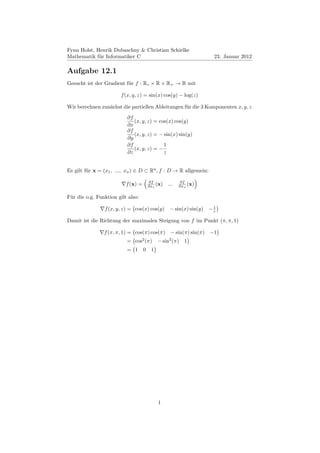
Aufgabe 12.1
Gesucht ist der Gradient für f : R∗ × R × R+ → R mit

                       f (x, y, z) = sin(x) cos(y) − log(z)

Wir berechnen zunächst die partiellen Ableitungen für die 3 Komponenten x, y, z
                          ∂f
                             (x, y, z) = cos(x) cos(y)
                          ∂x
                          ∂f
                             (x, y, z) = − sin(x) sin(y)
                          ∂y
                          ∂f               1
                             (x, y, z) = −
                          ∂z               z


Es gilt für x = (x1 , ..., xn ) ∈ D ⊂ Rn , f : D → R allgemein:

                                        ∂f               ∂f
                          f (x) =       ∂x1 (x)   ...   ∂xn (x)


Für die o.g. Funktion gilt also:
                                                              1
                f (x, y, z) = cos(x) cos(y) − sin(x) sin(y) − z

Damit ist die Richtung der maximalen Steigung von f im Punkt (π, π, 1)

                f (π, π, 1) = cos(π) cos(π) − sin(π) sin(π) −1
                          = cos2 (π) − sin2 (π)           1
                          = 1       0    1


                                             1
Fynn Holst, Henrik Dubaschny & Christian Schielke
Mathematik für Informatiker C                                                                            23. Januar 2012


Aufgabe 12.2
                               f : R2 → R, f (x, y) = y                         x2 + y 2


      1
                                                                          1.0
          0
                                                                    0.5
          1

          1.0                                                 0.0

                0.5

                         0.0                            0.5

                                0.5
                                                  1.0
                                            1.0


                      Abbildung 1: f (x, y) im Intervall [−1, 1] × [−1, 1]

Zunächst bestimmen wir die partielle von Ableitung der Funktion nach der x-
Komponente mit der Produktregel.
                      ∂f
                         (x, y) = ∂x y            x2 + y 2
                      ∂x
                               = ∂x (y)             x2 + y 2 + y ∂ x                          x2 + y 2
                                       =0
                                                                                                           √
Wir wenden die Kettenregel an. Setze g(x, y) := x2 + y 2 , f (u) =                                             u.
              df          1                                                      1                 ∂g
     f (u) =     (u) = √ = f (g(x, y)) =                                                              (x, y) = 2x
              du        2 u              2                                      x2   +   y2        ∂x
     ∂f              xy
        (x, y) =
     ∂x             x2 + y 2
                 ∂g            x
     f (g(x, y))    (x, y) =
                 ∂x          x2 + y 2
Um die partielle Ableitung nach der y-Komponente zu bestimmen formen wir
zunächst die Funktion um.
                 f (x, y) = y         x2 + y 2 =
                                          y 2 x2 + y 2 = y 2 x2 + y 4
                                          √
Setze g(x, y) := y 2 x2 + y 4 und f (u) := u. Dann lautet die partielle Ableitung
der Funktion nach der y-Komponente:
                        ∂g
                           (x, y) = 2yx2 + 4y 3 = 2y(x2 + 2y 2 )
                        ∂y
                        df          1                          1                                                    1
               f (u) = (u) = √ = f (g(x, y)) =                         =
                        du        2 u                   2 y 2 x2 + y 4   2y                                         x2 + y 2
                             2      2     2      2
            ∂g          2y(x + 2y )      x + 2y
f (g(x, y))    (x, y) =               =
            ∂y          2y x   2 + y2      x2 + y 2
Die Funktion ist also partiell differenzierbar für (x, y) = (0, 0).


                                                              2
Fynn Holst, Henrik Dubaschny & Christian Schielke
Mathematik für Informatiker C                                                                                                                    23. Januar 2012


Aufgabe 12.3


              2.0                                                                         10

              1.5
                                                                               1.0                                                                     1.0
               1.0                                                                             5

                0.5                                                      0.5                                                                     0.5

                    0.0                                                                        0
                     1.0                                           0.0                         1.0                                         0.0

                           0.5                                                                       0.5

                                   0.0                       0.5                                            0.0                      0.5

                                         0.5                                                                       0.5
                                                       1.0                                                                     1.0
                                                 1.0                                                                     1.0


                                                                                                        1
Abbildung 2: f (x, y) = x2 + y 2 und g(x, y) =                                                       x2 +y 2      im Intervall [−1, 1] × [−1, 1]


   • f (x, y) = x2 + y 2 . In Polarkoordinatenform:

                                               F (r, θ) = (r cos θ)2 + (r sin θ)2
                                                                     = r2 (cos2 θ + sin2 θ)
                                                                                                       =1
                                                                                     2
                                                                     =r

     Diese Funktion ist also stetig partiell differenzierbar auf R2 , mit:

                                                                         ∂r F (r, θ) = 2r
                                                                         ∂θ F (r, θ) = 0

     Die Steigung ist also unabhängig vom Winkel und linear zur Entfernung
     zum Ursprung da F das Quadrat des Abstandes zum Urspung liefert.
                          1
   • g(x, y) =         x2 +y 2 .     In Polarkoordinatenform:

                                                                              1
                                               G(r, θ) =
                                                                               (r cos θ)2
                                                                              + (r sin θ)2
                                                                             1
                                                                    = 2
                                                                     r (cos θ + sin2 θ)
                                                                           2

                                                                                                       =1
                                                                                     −2
                                                                    =r

     Die Funktion G ist also für r = 0 nicht definiert. g ist für R2
                                                                  {(0,0)} definiert.
     Auf R∗ × R ist G partiell differenzierbar mit:

                                                                   ∂r G(r, θ) = −r−3
                                                                   ∂θ G(r, θ) = 0

     Die Steigung ist also wieder unabhängig vom Winkel.


                                                                                     3
Fynn Holst, Henrik Dubaschny & Christian Schielke
Mathematik für Informatiker C                                          23. Januar 2012


Aufgabe 12.4
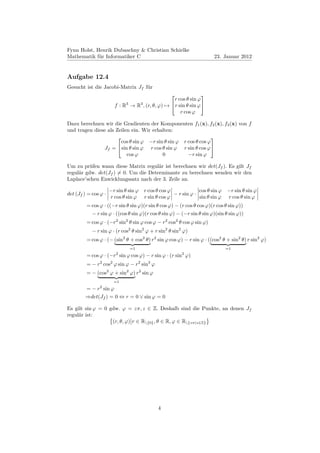
Gesucht ist die Jacobi-Matrix Jf für
                                                                 
                                                   r cos θ sin ϕ
                        f : R3 → R3 , (r, θ, ϕ) →  r sin θ sin ϕ 
                                                       r cos ϕ

Dazu berechnen wir die Gradienten der Komponenten f1 (x), f2 (x), f3 (x) von f
und tragen diese als Zeilen ein. Wir erhalten:
                                                              
                       cos θ sin ϕ −r sin θ sin ϕ r cos θ cos ϕ
               Jf =  sin θ sin ϕ r cos θ sin ϕ r sin θ cos ϕ 
                          cos ϕ          0          −r sin ϕ

Um zu prüfen wann diese Matrix regulär ist berechnen wir det(Jf ). Es gilt Jf
regulär gdw. det(Jf ) = 0. Um die Determinante zu berechnen wenden wir den
Laplace’schen Enwicklungssatz nach der 3. Zeile an.

                      −r sin θ sin ϕ   r cos θ cos ϕ             cos θ sin ϕ −r sin θ sin ϕ
det (Jf ) = cos ϕ ·                                  − r sin ϕ ·
                      r cos θ sin ϕ    r sin θ cos ϕ             sin θ sin ϕ r cos θ sin ϕ
         = cos ϕ · ((−r sin θ sin ϕ)(r sin θ cos ϕ) − (r cos θ cos ϕ)(r cos θ sin ϕ))
            − r sin ϕ · ((cos θ sin ϕ)(r cos θ sin ϕ) − (−r sin θ sin ϕ)(sin θ sin ϕ))
         = cos ϕ · (−r2 sin2 θ sin ϕ cos ϕ − r2 cos2 θ cos ϕ sin ϕ)
            − r sin ϕ · (r cos2 θ sin2 ϕ + r sin2 θ sin2 ϕ)
         = cos ϕ · (− (sin2 θ + cos2 θ) r2 sin ϕ cos ϕ) − r sin ϕ · ((cos2 θ + sin2 θ) r sin2 ϕ)
                               =1                                            =1
         = cos ϕ · (−r2 sin ϕ cos ϕ) − r sin ϕ · (r sin2 ϕ)
         = − r2 cos2 ϕ sin ϕ − r2 sin3 ϕ
         = − (cos2 ϕ + sin2 ϕ) r2 sin ϕ
                        =1
         = − r2 sin ϕ
        ⇒det(Jf ) = 0 ⇔ r = 0 ∨ sin ϕ = 0

Es gilt sin ϕ = 0 gdw. ϕ = zπ, z ∈ Z. Deshalb sind die Punkte, an denen Jf
regulär ist:
                   (r, θ, ϕ) r ∈ R{0} , θ ∈ R, ϕ ∈ R{zπ|z∈Z}


                                             4

Serie12

  • 1.
    Mathematik für InformatikerC Serie 12 Fynn Holst, Henrik Dubaschny & Christian Schielke Gruppe B 23. Januar 2012
  • 2.
    Fynn Holst, HenrikDubaschny & Christian Schielke Mathematik für Informatiker C 23. Januar 2012 Aufgabe 12.1 Gesucht ist der Gradient für f : R∗ × R × R+ → R mit f (x, y, z) = sin(x) cos(y) − log(z) Wir berechnen zunächst die partiellen Ableitungen für die 3 Komponenten x, y, z ∂f (x, y, z) = cos(x) cos(y) ∂x ∂f (x, y, z) = − sin(x) sin(y) ∂y ∂f 1 (x, y, z) = − ∂z z Es gilt für x = (x1 , ..., xn ) ∈ D ⊂ Rn , f : D → R allgemein: ∂f ∂f f (x) = ∂x1 (x) ... ∂xn (x) Für die o.g. Funktion gilt also: 1 f (x, y, z) = cos(x) cos(y) − sin(x) sin(y) − z Damit ist die Richtung der maximalen Steigung von f im Punkt (π, π, 1) f (π, π, 1) = cos(π) cos(π) − sin(π) sin(π) −1 = cos2 (π) − sin2 (π) 1 = 1 0 1 1
  • 3.
    Fynn Holst, HenrikDubaschny & Christian Schielke Mathematik für Informatiker C 23. Januar 2012 Aufgabe 12.2 f : R2 → R, f (x, y) = y x2 + y 2 1 1.0 0 0.5 1 1.0 0.0 0.5 0.0 0.5 0.5 1.0 1.0 Abbildung 1: f (x, y) im Intervall [−1, 1] × [−1, 1] Zunächst bestimmen wir die partielle von Ableitung der Funktion nach der x- Komponente mit der Produktregel. ∂f (x, y) = ∂x y x2 + y 2 ∂x = ∂x (y) x2 + y 2 + y ∂ x x2 + y 2 =0 √ Wir wenden die Kettenregel an. Setze g(x, y) := x2 + y 2 , f (u) = u. df 1 1 ∂g f (u) = (u) = √ = f (g(x, y)) = (x, y) = 2x du 2 u 2 x2 + y2 ∂x ∂f xy (x, y) = ∂x x2 + y 2 ∂g x f (g(x, y)) (x, y) = ∂x x2 + y 2 Um die partielle Ableitung nach der y-Komponente zu bestimmen formen wir zunächst die Funktion um. f (x, y) = y x2 + y 2 = y 2 x2 + y 2 = y 2 x2 + y 4 √ Setze g(x, y) := y 2 x2 + y 4 und f (u) := u. Dann lautet die partielle Ableitung der Funktion nach der y-Komponente: ∂g (x, y) = 2yx2 + 4y 3 = 2y(x2 + 2y 2 ) ∂y df 1 1 1 f (u) = (u) = √ = f (g(x, y)) = = du 2 u 2 y 2 x2 + y 4 2y x2 + y 2 2 2 2 2 ∂g 2y(x + 2y ) x + 2y f (g(x, y)) (x, y) = = ∂y 2y x 2 + y2 x2 + y 2 Die Funktion ist also partiell differenzierbar für (x, y) = (0, 0). 2
  • 4.
    Fynn Holst, HenrikDubaschny & Christian Schielke Mathematik für Informatiker C 23. Januar 2012 Aufgabe 12.3 2.0 10 1.5 1.0 1.0 1.0 5 0.5 0.5 0.5 0.0 0 1.0 0.0 1.0 0.0 0.5 0.5 0.0 0.5 0.0 0.5 0.5 0.5 1.0 1.0 1.0 1.0 1 Abbildung 2: f (x, y) = x2 + y 2 und g(x, y) = x2 +y 2 im Intervall [−1, 1] × [−1, 1] • f (x, y) = x2 + y 2 . In Polarkoordinatenform: F (r, θ) = (r cos θ)2 + (r sin θ)2 = r2 (cos2 θ + sin2 θ) =1 2 =r Diese Funktion ist also stetig partiell differenzierbar auf R2 , mit: ∂r F (r, θ) = 2r ∂θ F (r, θ) = 0 Die Steigung ist also unabhängig vom Winkel und linear zur Entfernung zum Ursprung da F das Quadrat des Abstandes zum Urspung liefert. 1 • g(x, y) = x2 +y 2 . In Polarkoordinatenform: 1 G(r, θ) = (r cos θ)2 + (r sin θ)2 1 = 2 r (cos θ + sin2 θ) 2 =1 −2 =r Die Funktion G ist also für r = 0 nicht definiert. g ist für R2 {(0,0)} definiert. Auf R∗ × R ist G partiell differenzierbar mit: ∂r G(r, θ) = −r−3 ∂θ G(r, θ) = 0 Die Steigung ist also wieder unabhängig vom Winkel. 3
  • 5.
    Fynn Holst, HenrikDubaschny & Christian Schielke Mathematik für Informatiker C 23. Januar 2012 Aufgabe 12.4 Gesucht ist die Jacobi-Matrix Jf für   r cos θ sin ϕ f : R3 → R3 , (r, θ, ϕ) →  r sin θ sin ϕ  r cos ϕ Dazu berechnen wir die Gradienten der Komponenten f1 (x), f2 (x), f3 (x) von f und tragen diese als Zeilen ein. Wir erhalten:   cos θ sin ϕ −r sin θ sin ϕ r cos θ cos ϕ Jf =  sin θ sin ϕ r cos θ sin ϕ r sin θ cos ϕ  cos ϕ 0 −r sin ϕ Um zu prüfen wann diese Matrix regulär ist berechnen wir det(Jf ). Es gilt Jf regulär gdw. det(Jf ) = 0. Um die Determinante zu berechnen wenden wir den Laplace’schen Enwicklungssatz nach der 3. Zeile an. −r sin θ sin ϕ r cos θ cos ϕ cos θ sin ϕ −r sin θ sin ϕ det (Jf ) = cos ϕ · − r sin ϕ · r cos θ sin ϕ r sin θ cos ϕ sin θ sin ϕ r cos θ sin ϕ = cos ϕ · ((−r sin θ sin ϕ)(r sin θ cos ϕ) − (r cos θ cos ϕ)(r cos θ sin ϕ)) − r sin ϕ · ((cos θ sin ϕ)(r cos θ sin ϕ) − (−r sin θ sin ϕ)(sin θ sin ϕ)) = cos ϕ · (−r2 sin2 θ sin ϕ cos ϕ − r2 cos2 θ cos ϕ sin ϕ) − r sin ϕ · (r cos2 θ sin2 ϕ + r sin2 θ sin2 ϕ) = cos ϕ · (− (sin2 θ + cos2 θ) r2 sin ϕ cos ϕ) − r sin ϕ · ((cos2 θ + sin2 θ) r sin2 ϕ) =1 =1 = cos ϕ · (−r2 sin ϕ cos ϕ) − r sin ϕ · (r sin2 ϕ) = − r2 cos2 ϕ sin ϕ − r2 sin3 ϕ = − (cos2 ϕ + sin2 ϕ) r2 sin ϕ =1 = − r2 sin ϕ ⇒det(Jf ) = 0 ⇔ r = 0 ∨ sin ϕ = 0 Es gilt sin ϕ = 0 gdw. ϕ = zπ, z ∈ Z. Deshalb sind die Punkte, an denen Jf regulär ist: (r, θ, ϕ) r ∈ R{0} , θ ∈ R, ϕ ∈ R{zπ|z∈Z} 4