The Past Tense – Das Perfekt by Iosif Otto 2008
The Past Tense has two parts - The auxiliary verb (das Hilfsverb)  haben (to have) sein (to be) The past participle (das Partizip) Think at the Rammstein song  Du hast Du... Du hast ... Du hast mich... Du hast mich gefragt hast – auxiliary verb (haben) gefragt – past participle
Things to do: 1. Decide which auxiliary verb you use: haben or sein 2.  Look at the list of Irregular Verbs the teacher gave you (Before you go to 3. or 4. look at the SPECIAL CASES) 3. If the Verb  IS  on the list look at  IRREGULAR VERBS 4. If the Verb  IS NOT  on the list go to REGULAR VERBS
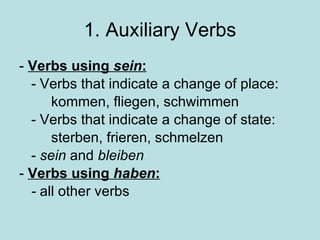
1. Auxiliary Verbs -  Verbs using  sein : - Verbs that indicate a change of place: kommen, fliegen, schwimmen - Verbs that indicate a change of state: sterben, frieren, schmelzen -  sein  and  bleiben  -  Verbs using  haben : -  all other verbs
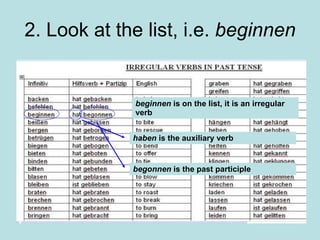
2. Look at the list, i.e.  beginnen beginnen  is on the list, it is an irregular verb haben  is the auxiliary verb begonnen  is the past participle
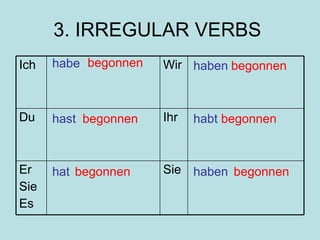
3. IRREGULAR VERBS  habe hast hat haben habt haben begonnen begonnen begonnen begonnen begonnen begonnen Sie Er Sie Es Ihr Du Wir Ich
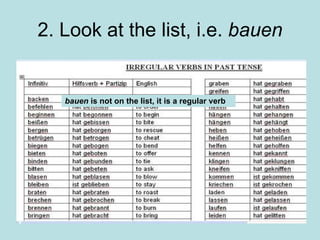
2. Look at the list, i.e.  bauen bauen  is not on the list, it is a regular verb
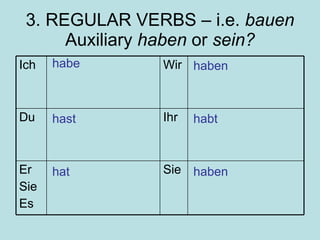
3. REGULAR VERBS – i.e.  bauen Auxiliary  haben  or  sein? habe hast hat haben habt haben Sie Er Sie Es Ihr Du Wir Ich
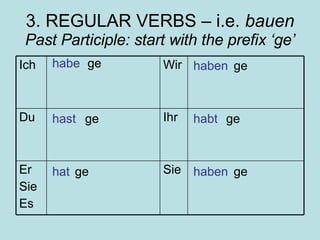
3. REGULAR VERBS – i.e.  bauen Past Participle: start with the prefix ‘ge’ habe hast hat haben habt haben ge ge ge ge ge ge Sie Er Sie Es Ihr Du Wir Ich
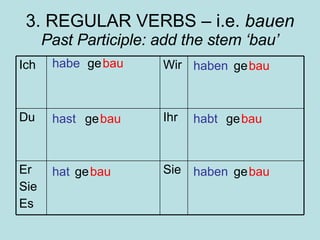
3. REGULAR VERBS – i.e.  bauen Past Participle: add the stem ‘bau’ habe hast hat haben habt haben ge ge ge ge ge ge bau bau bau bau bau bau Sie Er Sie Es Ihr Du Wir Ich
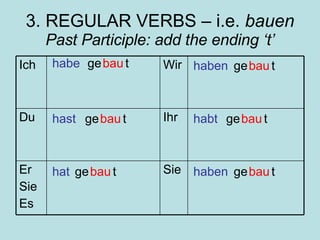
3. REGULAR VERBS – i.e.  bauen Past Participle: add the ending ‘t’ habe hast hat haben habt haben ge ge ge ge ge ge bau bau bau bau bau bau t t t t t t Sie Er Sie Es Ihr Du Wir Ich
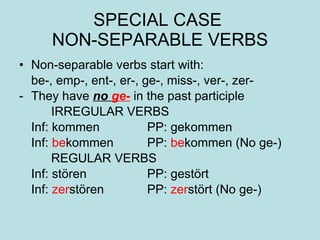
SPECIAL CASE  NON-SEPARABLE VERBS Non-separable verbs start with: be-, emp-, ent-, er-, ge-, miss-, ver-, zer- They have  no  ge-  in the past participle IRREGULAR VERBS Inf: kommen PP: gekommen Inf:  be kommen PP:  be kommen (No ge-) REGULAR VERBS Inf: st ören PP: gestört Inf:  zer stören PP:  zer stört (No ge-)
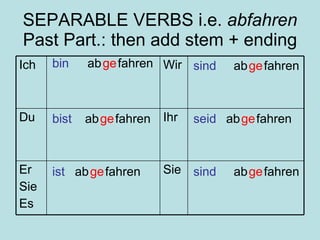
SPECIAL CASE  SEPARABLE VERBS Separable verbs start with a prefix: ab-, an-, auf-, aus-, bei-, ein-, fest-, her-, hin-, los-, mit-, nach-, vor-, weg-, wieder-, zu-, zurück-, zusammen- etc. - In the past participle the „ge“ goes between the prefix and the stem, i.e. see table below
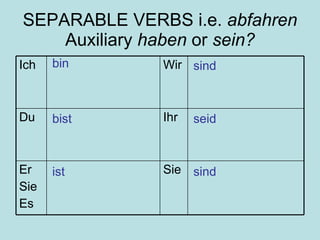
SEPARABLE VERBS i.e.  abfahren Auxiliary  haben  or  sein? bin bist ist sind seid sind Sie Er Sie Es Ihr Du Wir Ich
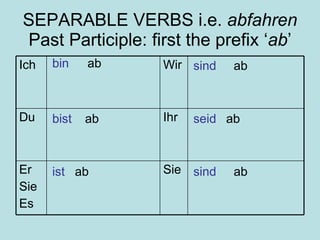
SEPARABLE VERBS i.e.  abfahren Past Participle: first the prefix ‘ ab ’ bin bist ist sind seid sind ab ab ab ab ab ab Sie Er Sie Es Ihr Du Wir Ich
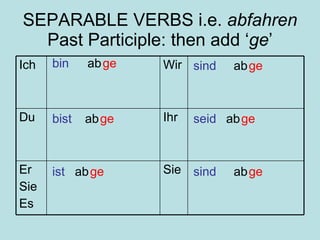
SEPARABLE VERBS i.e.  abfahren Past Participle: then add ‘ ge ’ bin bist ist sind seid sind ab ab ab ab ab ab ge ge ge ge ge ge Sie Er Sie Es Ihr Du Wir Ich
SEPARABLE VERBS i.e.  abfahren Past Part.: then add stem + ending bin bist ist sind seid sind ab ab ab ab ab ab ge ge ge ge ge ge fahren ge ge fahren fahren fahren fahren fahren Sie Er Sie Es Ihr Du Wir Ich
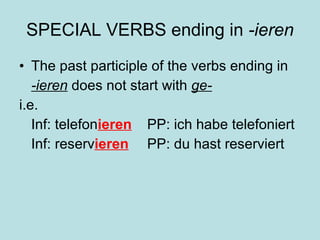
SPECIAL VERBS ending in  -ieren The past participle of the verbs ending in  -ieren  does not start with  ge- i.e.  Inf: telefon ieren   PP: ich habe telefoniert Inf: reserv ieren PP: du hast reserviert

The Past Tense - Das Perfekt

  • 1.
    The Past Tense– Das Perfekt by Iosif Otto 2008
  • 2.
    The Past Tensehas two parts - The auxiliary verb (das Hilfsverb) haben (to have) sein (to be) The past participle (das Partizip) Think at the Rammstein song Du hast Du... Du hast ... Du hast mich... Du hast mich gefragt hast – auxiliary verb (haben) gefragt – past participle
  • 3.
    Things to do:1. Decide which auxiliary verb you use: haben or sein 2. Look at the list of Irregular Verbs the teacher gave you (Before you go to 3. or 4. look at the SPECIAL CASES) 3. If the Verb IS on the list look at IRREGULAR VERBS 4. If the Verb IS NOT on the list go to REGULAR VERBS
  • 4.
    1. Auxiliary Verbs- Verbs using sein : - Verbs that indicate a change of place: kommen, fliegen, schwimmen - Verbs that indicate a change of state: sterben, frieren, schmelzen - sein and bleiben - Verbs using haben : - all other verbs
  • 5.
    2. Look atthe list, i.e. beginnen beginnen is on the list, it is an irregular verb haben is the auxiliary verb begonnen is the past participle
  • 6.
    3. IRREGULAR VERBS habe hast hat haben habt haben begonnen begonnen begonnen begonnen begonnen begonnen Sie Er Sie Es Ihr Du Wir Ich
  • 7.
    2. Look atthe list, i.e. bauen bauen is not on the list, it is a regular verb
  • 8.
    3. REGULAR VERBS– i.e. bauen Auxiliary haben or sein? habe hast hat haben habt haben Sie Er Sie Es Ihr Du Wir Ich
  • 9.
    3. REGULAR VERBS– i.e. bauen Past Participle: start with the prefix ‘ge’ habe hast hat haben habt haben ge ge ge ge ge ge Sie Er Sie Es Ihr Du Wir Ich
  • 10.
    3. REGULAR VERBS– i.e. bauen Past Participle: add the stem ‘bau’ habe hast hat haben habt haben ge ge ge ge ge ge bau bau bau bau bau bau Sie Er Sie Es Ihr Du Wir Ich
  • 11.
    3. REGULAR VERBS– i.e. bauen Past Participle: add the ending ‘t’ habe hast hat haben habt haben ge ge ge ge ge ge bau bau bau bau bau bau t t t t t t Sie Er Sie Es Ihr Du Wir Ich
  • 12.
    SPECIAL CASE NON-SEPARABLE VERBS Non-separable verbs start with: be-, emp-, ent-, er-, ge-, miss-, ver-, zer- They have no ge- in the past participle IRREGULAR VERBS Inf: kommen PP: gekommen Inf: be kommen PP: be kommen (No ge-) REGULAR VERBS Inf: st ören PP: gestört Inf: zer stören PP: zer stört (No ge-)
  • 13.
    SPECIAL CASE SEPARABLE VERBS Separable verbs start with a prefix: ab-, an-, auf-, aus-, bei-, ein-, fest-, her-, hin-, los-, mit-, nach-, vor-, weg-, wieder-, zu-, zurück-, zusammen- etc. - In the past participle the „ge“ goes between the prefix and the stem, i.e. see table below
  • 14.
    SEPARABLE VERBS i.e. abfahren Auxiliary haben or sein? bin bist ist sind seid sind Sie Er Sie Es Ihr Du Wir Ich
  • 15.
    SEPARABLE VERBS i.e. abfahren Past Participle: first the prefix ‘ ab ’ bin bist ist sind seid sind ab ab ab ab ab ab Sie Er Sie Es Ihr Du Wir Ich
  • 16.
    SEPARABLE VERBS i.e. abfahren Past Participle: then add ‘ ge ’ bin bist ist sind seid sind ab ab ab ab ab ab ge ge ge ge ge ge Sie Er Sie Es Ihr Du Wir Ich
  • 17.
    SEPARABLE VERBS i.e. abfahren Past Part.: then add stem + ending bin bist ist sind seid sind ab ab ab ab ab ab ge ge ge ge ge ge fahren ge ge fahren fahren fahren fahren fahren Sie Er Sie Es Ihr Du Wir Ich
  • 18.
    SPECIAL VERBS endingin -ieren The past participle of the verbs ending in -ieren does not start with ge- i.e. Inf: telefon ieren PP: ich habe telefoniert Inf: reserv ieren PP: du hast reserviert