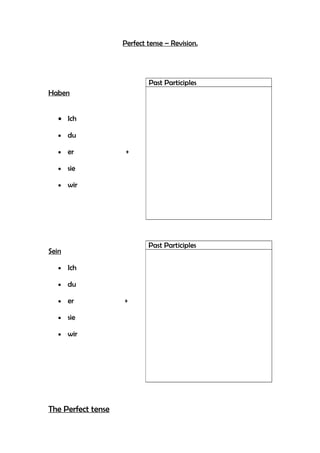
Perfect tense – Revision.


                            Past Participles
Haben


   • Ich

   •   du

   •   er            +

   •   sie

   •   wir


                            Past Participles
Sein

   •   Ich

   •   du

   •   er           +

   •   sie

   •   wir


The Perfect tense
Complete the missing part of “haben “ or “sein” and complete
with a suitable past participle.


  1. Ich ………….. viel Pizza ……………….

  2. Ich ………….. nach Deutschland …………….. und ich ……………
     viel Bier .......................

  3. Ich ................ mit dem Flugzeug ...................

  4. Du ............... Tennis und Fußball ..................

  5. Sie ............... ihre Tante in Amerika.................

  6. Shane, ................ du deine Hausaufgaben ................. ?

  7. Ich ............... in einem Hotel ....................

  8. Du ............. einen Schottenrock ...................

  9. Er ............. ins Kino ................ und er ............ einen
     Film ..............

  10.Wir.............. Musik sehr laut .................

  11. Ich war sehr müde, Ich ............ viel ..................

   12. Sie ………….. einen Unfall ………………


Tip – müde = tired
      der Unfall = accident

Strong and weak verbs
Weak verbs follow a pattern. Basically weak verbs do as
they are told and like to conform. In the perfect tense weak
verbs form their past participle be adding a ge – to the
beginning and taking off the –en and adding –t to the end.

Examples of weak verbs

spielen – gespielt
haben – gehabt
machen – gemacht


Strong verbs do not follow a set and predictable pattern.
You will find them in a table of strong verbs, but it is useful
to learn the more common ones off by heart. Some are more
unpredictable than others.

Examples of strong verbs

schlafen – geschlafen
bleiben – geblieben
besuchen – besucht
gehen – gegangen
Find the past participles for the following verbs. Mark the verb
with a * if it takes “sein”.


1. beginnen – to begin     ………………………………..

2. genießen – to enjoy     ………………………………..

3. laufen - to run         ………………………………..

4. nehnen - to take        ………………………………..

5. verschwinden – to disappear …………………………

6. tanzen – to dance       ……………………………

Perfect Tense Revision With Boxes

  • 1.
    Perfect tense –Revision. Past Participles Haben • Ich • du • er + • sie • wir Past Participles Sein • Ich • du • er + • sie • wir The Perfect tense
  • 2.
    Complete the missingpart of “haben “ or “sein” and complete with a suitable past participle. 1. Ich ………….. viel Pizza ………………. 2. Ich ………….. nach Deutschland …………….. und ich …………… viel Bier ....................... 3. Ich ................ mit dem Flugzeug ................... 4. Du ............... Tennis und Fußball .................. 5. Sie ............... ihre Tante in Amerika................. 6. Shane, ................ du deine Hausaufgaben ................. ? 7. Ich ............... in einem Hotel .................... 8. Du ............. einen Schottenrock ................... 9. Er ............. ins Kino ................ und er ............ einen Film .............. 10.Wir.............. Musik sehr laut ................. 11. Ich war sehr müde, Ich ............ viel .................. 12. Sie ………….. einen Unfall ……………… Tip – müde = tired der Unfall = accident Strong and weak verbs
  • 3.
    Weak verbs followa pattern. Basically weak verbs do as they are told and like to conform. In the perfect tense weak verbs form their past participle be adding a ge – to the beginning and taking off the –en and adding –t to the end. Examples of weak verbs spielen – gespielt haben – gehabt machen – gemacht Strong verbs do not follow a set and predictable pattern. You will find them in a table of strong verbs, but it is useful to learn the more common ones off by heart. Some are more unpredictable than others. Examples of strong verbs schlafen – geschlafen bleiben – geblieben besuchen – besucht gehen – gegangen
  • 4.
    Find the pastparticiples for the following verbs. Mark the verb with a * if it takes “sein”. 1. beginnen – to begin ……………………………….. 2. genießen – to enjoy ……………………………….. 3. laufen - to run ……………………………….. 4. nehnen - to take ……………………………….. 5. verschwinden – to disappear ………………………… 6. tanzen – to dance ……………………………