The Present Tense

The present tense is used to talk about what is happening now.
Examples are I am playing or I play.

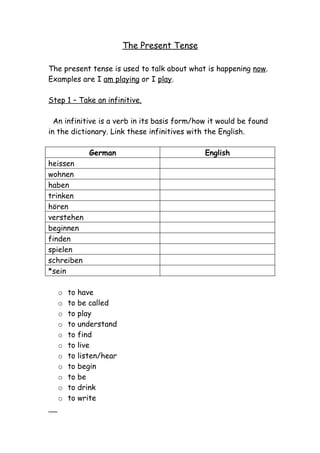
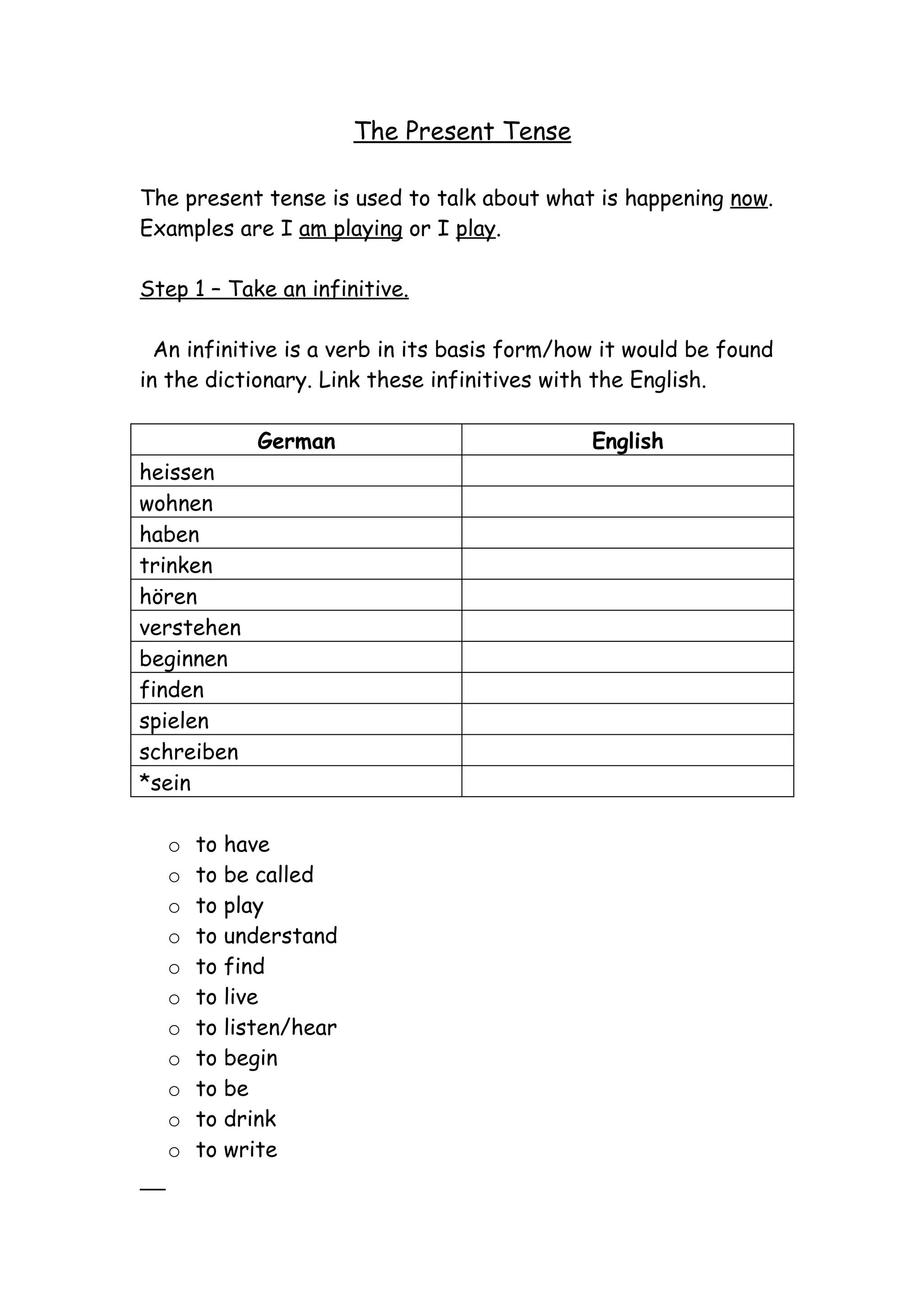
Step 1 – Take an infinitive.

  An infinitive is a verb in its basis form/how it would be found
in the dictionary. Link these infinitives with the English.

              German                          English
heissen
wohnen
haben
trinken
hören
verstehen
beginnen
finden
spielen
schreiben
*sein

  o   to   have
  o   to   be called
  o   to   play
  o   to   understand
  o   to   find
  o   to   live
  o   to   listen/hear
  o   to   begin
  o   to   be
  o   to   drink
  o   to   write
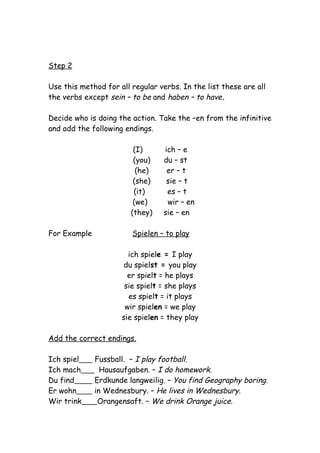
Step 2

Use this method for all regular verbs. In the list these are all
the verbs except sein – to be and haben – to have.

Decide who is doing the action. Take the –en from the infinitive
and add the following endings.

                         (I)     ich – e
                         (you)   du – st
                          (he)    er – t
                         (she)    sie – t
                         (it)     es – t
                         (we)     wir – en
                        (they)   sie – en

For Example             Spielen – to play

                       ich spiele = I play
                      du spielst = you play
                       er spielt = he plays
                      sie spielt = she plays
                       es spielt = it plays
                      wir spielen = we play
                     sie spielen = they play

Add the correct endings.

Ich spiel     Fussball. – I play football.
Ich mach        Hausaufgaben. – I do homework.
Du find       Erdkunde langweilig. – You find Geography boring.
Er wohn       in Wednesbury. – He lives in Wednesbury.
Wir trink      Orangensaft. – We drink Orange juice.
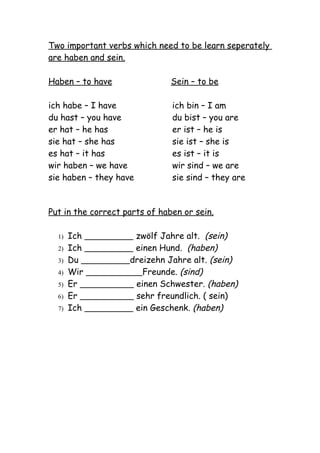
Two important verbs which need to be learn seperately
are haben and sein.

Haben – to have                Sein – to be

ich habe – I have              ich bin – I am
du hast – you have             du bist – you are
er hat – he has                er ist – he is
sie hat – she has              sie ist – she is
es hat – it has                es ist – it is
wir haben – we have            wir sind – we are
sie haben – they have          sie sind – they are


Put in the correct parts of haben or sein.

  1)   Ich           zwölf Jahre alt. (sein)
  2)   Ich           einen Hund. (haben)
  3)   Du           dreizehn Jahre alt. (sein)
  4)   Wir             Freunde. (sind)
  5)   Er            einen Schwester. (haben)
  6)   Er            sehr freundlich. ( sein)
  7)   Ich           ein Geschenk. (haben)
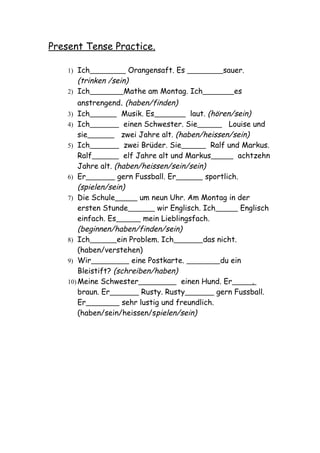
Present Tense Practice.

    1) Ich            Orangensaft. Es               sauer.
       (trinken /sein)
    2) Ich           Mathe am Montag. Ich              es
        anstrengend. (haben/finden)
    3) Ich           Musik. Es             laut. (hören/sein)
    4) Ich            einen Schwester. Sie             Louise und
        sie          zwei Jahre alt. (haben/heissen/sein)
    5) Ich            zwei Brüder. Sie            Ralf und Markus.
        Ralf          elf Jahre alt und Markus            achtzehn
        Jahre alt. (haben/heissen/sein/sein)
    6) Er           gern Fussball. Er           sportlich.
        (spielen/sein)
    7) Die Schule          um neun Uhr. Am Montag in der
        ersten Stunde            wir Englisch. Ich         Englisch
        einfach. Es         mein Lieblingsfach.
        (beginnen/haben/finden/sein)
    8) Ich          ein Problem. Ich           das nicht.
        (haben/verstehen)
    9) Wir               eine Postkarte.             du ein
        Bleistift? (schreiben/haben)
    10) Meine Schwester                 einen Hund. Er        .
        braun. Er           Rusty. Rusty           gern Fussball.
        Er            sehr lustig und freundlich.
        (haben/sein/heissen/spielen/sein)
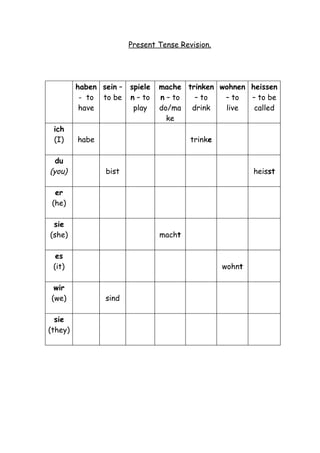
Present Tense Revision.


         haben sein –   spiele   mache trinken wohnen heissen
          - to to be    n – to   n – to  – to   – to  – to be
          have           play    do/ma drink    live   called
                                   ke
 ich
 (I)     habe                            trinke

  du
(you)           bist                                      heisst

  er
 (he)

 sie
(she)                            macht

  es
 (it)                                             wohnt

 wir
(we)            sind

  sie
(they)
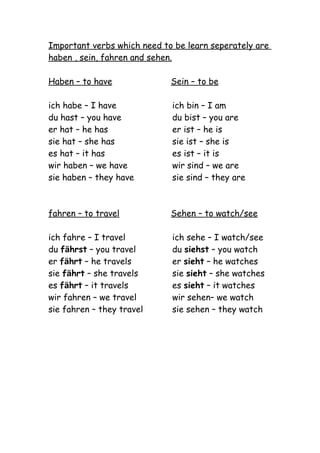
Important verbs which need to be learn seperately are
haben , sein, fahren and sehen.

Haben – to have              Sein – to be

ich habe – I have            ich bin – I am
du hast – you have           du bist – you are
er hat – he has              er ist – he is
sie hat – she has            sie ist – she is
es hat – it has              es ist – it is
wir haben – we have          wir sind – we are
sie haben – they have        sie sind – they are


fahren – to travel           Sehen – to watch/see

ich fahre – I travel         ich sehe – I watch/see
du fährst – you travel       du siehst – you watch
er fährt – he travels        er sieht – he watches
sie fährt – she travels      sie sieht – she watches
es fährt – it travels        es sieht – it watches
wir fahren – we travel       wir sehen– we watch
sie fahren – they travel     sie sehen – they watch

Infinitives And Introduction To The Present Tense

  • 1.
    The Present Tense Thepresent tense is used to talk about what is happening now. Examples are I am playing or I play. Step 1 – Take an infinitive. An infinitive is a verb in its basis form/how it would be found in the dictionary. Link these infinitives with the English. German English heissen wohnen haben trinken hören verstehen beginnen finden spielen schreiben *sein o to have o to be called o to play o to understand o to find o to live o to listen/hear o to begin o to be o to drink o to write
  • 2.
    Step 2 Use thismethod for all regular verbs. In the list these are all the verbs except sein – to be and haben – to have. Decide who is doing the action. Take the –en from the infinitive and add the following endings. (I) ich – e (you) du – st (he) er – t (she) sie – t (it) es – t (we) wir – en (they) sie – en For Example Spielen – to play ich spiele = I play du spielst = you play er spielt = he plays sie spielt = she plays es spielt = it plays wir spielen = we play sie spielen = they play Add the correct endings. Ich spiel Fussball. – I play football. Ich mach Hausaufgaben. – I do homework. Du find Erdkunde langweilig. – You find Geography boring. Er wohn in Wednesbury. – He lives in Wednesbury. Wir trink Orangensaft. – We drink Orange juice.
  • 3.
    Two important verbswhich need to be learn seperately are haben and sein. Haben – to have Sein – to be ich habe – I have ich bin – I am du hast – you have du bist – you are er hat – he has er ist – he is sie hat – she has sie ist – she is es hat – it has es ist – it is wir haben – we have wir sind – we are sie haben – they have sie sind – they are Put in the correct parts of haben or sein. 1) Ich zwölf Jahre alt. (sein) 2) Ich einen Hund. (haben) 3) Du dreizehn Jahre alt. (sein) 4) Wir Freunde. (sind) 5) Er einen Schwester. (haben) 6) Er sehr freundlich. ( sein) 7) Ich ein Geschenk. (haben)
  • 4.
    Present Tense Practice. 1) Ich Orangensaft. Es sauer. (trinken /sein) 2) Ich Mathe am Montag. Ich es anstrengend. (haben/finden) 3) Ich Musik. Es laut. (hören/sein) 4) Ich einen Schwester. Sie Louise und sie zwei Jahre alt. (haben/heissen/sein) 5) Ich zwei Brüder. Sie Ralf und Markus. Ralf elf Jahre alt und Markus achtzehn Jahre alt. (haben/heissen/sein/sein) 6) Er gern Fussball. Er sportlich. (spielen/sein) 7) Die Schule um neun Uhr. Am Montag in der ersten Stunde wir Englisch. Ich Englisch einfach. Es mein Lieblingsfach. (beginnen/haben/finden/sein) 8) Ich ein Problem. Ich das nicht. (haben/verstehen) 9) Wir eine Postkarte. du ein Bleistift? (schreiben/haben) 10) Meine Schwester einen Hund. Er . braun. Er Rusty. Rusty gern Fussball. Er sehr lustig und freundlich. (haben/sein/heissen/spielen/sein)
  • 5.
    Present Tense Revision. haben sein – spiele mache trinken wohnen heissen - to to be n – to n – to – to – to – to be have play do/ma drink live called ke ich (I) habe trinke du (you) bist heisst er (he) sie (she) macht es (it) wohnt wir (we) sind sie (they)
  • 6.
    Important verbs whichneed to be learn seperately are haben , sein, fahren and sehen. Haben – to have Sein – to be ich habe – I have ich bin – I am du hast – you have du bist – you are er hat – he has er ist – he is sie hat – she has sie ist – she is es hat – it has es ist – it is wir haben – we have wir sind – we are sie haben – they have sie sind – they are fahren – to travel Sehen – to watch/see ich fahre – I travel ich sehe – I watch/see du fährst – you travel du siehst – you watch er fährt – he travels er sieht – he watches sie fährt – she travels sie sieht – she watches es fährt – it travels es sieht – it watches wir fahren – we travel wir sehen– we watch sie fahren – they travel sie sehen – they watch