Deutsch I für Anfänger Beginning German I Frau Caplan-Carbin Introduction to German Verb Conjugation
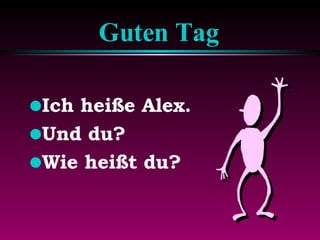
Guten Tag Ich heiße Alex. Und du? Wie heißt du?
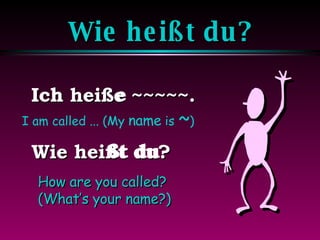
Wie heißt du? Ich heiße ~~~~~. Wie heißt du? ßt du I am called ... (My  name  is  ~ ) How are you called?  (What’s your name?) Ich e
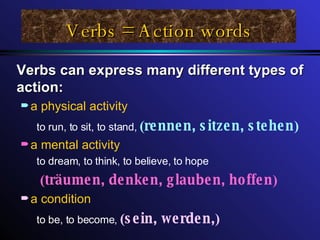
Verbs = Action words Verbs can express many different types of action: a physical activity to run, to sit, to stand,   ( rennen, sitzen, stehen ) a mental activity to dream, to think, to believe, to hope ( träumen, denken, glauben, hoffen ) a condition to be, to become,  ( sein, werden, )
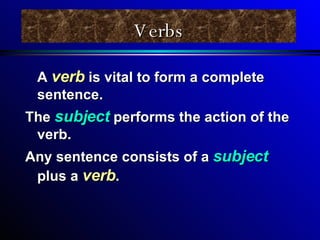
Verbs A  verb  is vital to form a complete sentence.  The  subject  performs the action of the verb. Any sentence consists of a  subject  plus a  verb .
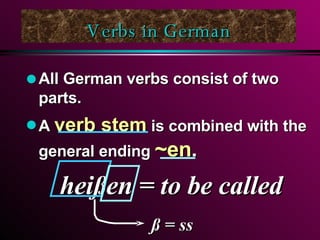
Verbs in German All German verbs consist of two parts. A  verb stem  is combined with the general ending  ~en . heißen = to be called ß = ss
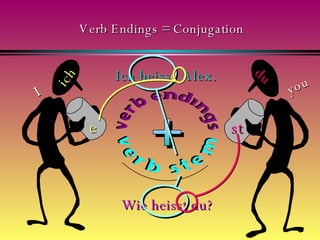
Verb Endings = Conjugation ich e st du I you Ich heiss e  Alex. Wie heis st  du?
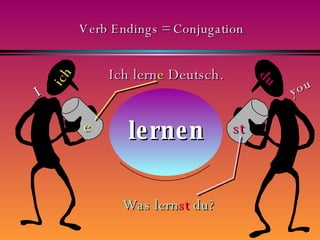
Verb Endings = Conjugation ich e st du I you Ich   lern e   Deutsch. Was lern st  du? lernen
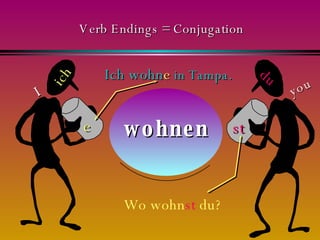
Verb Endings = Conjugation ich e st du I you wohnen Ich wohn e   in Tampa. Wo   wohn st  du?
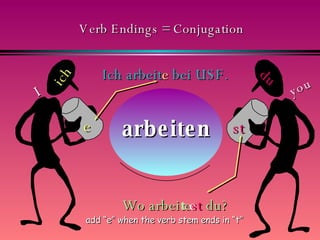
Verb Endings = Conjugation ich e st du I you arbeiten Ich arbeit e   bei USF . Wo   arbeite st  du? e add “e” when the verb stem ends in “t”   t t
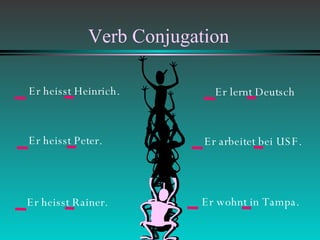
Verb Conjugation Er heisst Heinrich. Er lernt Deutsch Er heisst Peter. Er arbeitet bei USF. Er heisst Rainer. Er wohnt in Tampa.
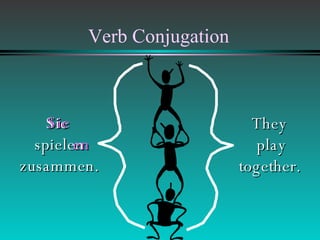
Verb Conjugation Sie  spielen zusammen. They play together. Sie en
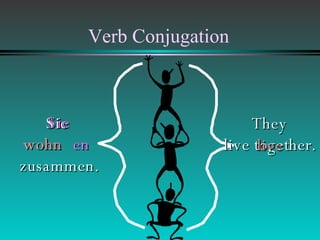
Verb Conjugation Sie  zusammen. They live together. wohn Sie en wohn live
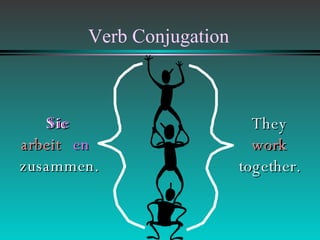
Verb Conjugation Sie  zusammen. They work together. arbeit Sie en arbeit work
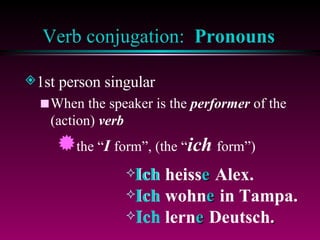
Verb conjugation:  Pronouns 1st person singular When the speaker is the  performer  of the (action)  verb the “ I  form”, (the “ ich  form”) Ich heiss  Alex.  Ich wohn  in Tampa. Ich lern  Deutsch . e Ich e Ich e Ich
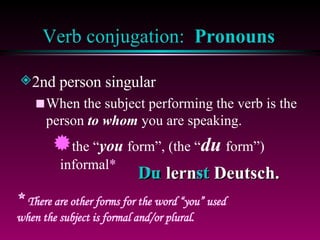
Verb conjugation:  Pronouns 2nd person singular When the subject performing the verb is the person  to whom  you are speaking. the “ you  form”, (the “ du  form”) informal * *  There are other forms for the word “you” used when the subject is formal and/or plural. Du lernst Deutsch. Du  st
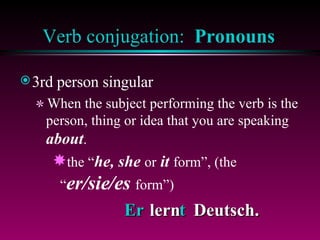
Verb conjugation:  Pronouns 3rd person singular When the subject performing the verb is the person, thing or idea that you are speaking  about . the “ he, she  or  it  form”, (the “ er/sie/es  form”)  Er  t lern  Deutsch.
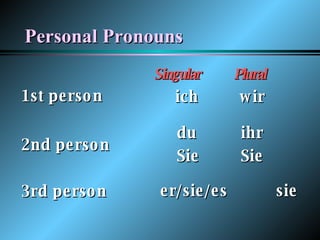
Personal Pronouns 1st person 2nd person 3rd person ich wir du ihr Sie Sie   er/sie/es    sie Singular   Plural
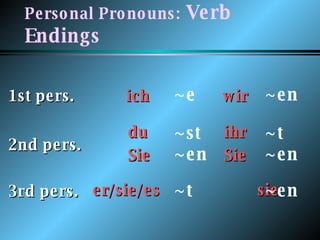
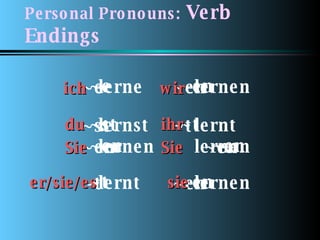
Personal Pronouns:  Verb Endings 1st pers. 2nd pers. 3rd pers. ich wir du ihr Sie Sie er/sie/es    sie ~e ~en ~st ~t ~en ~en ~t ~en
ich wir du ihr Sie Sie er/sie/es   sie Personal Pronouns:  Verb Endings ~e ~en ~st ~t ~en ~en ~t ~en lerne lernen lernst lernt lernen lernen lernt lernen ~e ~en ~st ~t ~en ~en ~t ~en
Danke schön Viel Spaß beim Deutsch lernen!

Conjugation Ppt

  • 1.
    Deutsch I fürAnfänger Beginning German I Frau Caplan-Carbin Introduction to German Verb Conjugation
  • 2.
    Guten Tag Ichheiße Alex. Und du? Wie heißt du?
  • 3.
    Wie heißt du?Ich heiße ~~~~~. Wie heißt du? ßt du I am called ... (My name is ~ ) How are you called? (What’s your name?) Ich e
  • 4.
    Verbs = Actionwords Verbs can express many different types of action: a physical activity to run, to sit, to stand, ( rennen, sitzen, stehen ) a mental activity to dream, to think, to believe, to hope ( träumen, denken, glauben, hoffen ) a condition to be, to become, ( sein, werden, )
  • 5.
    Verbs A verb is vital to form a complete sentence. The subject performs the action of the verb. Any sentence consists of a subject plus a verb .
  • 6.
    Verbs in GermanAll German verbs consist of two parts. A verb stem is combined with the general ending ~en . heißen = to be called ß = ss
  • 7.
    Verb Endings =Conjugation ich e st du I you Ich heiss e Alex. Wie heis st du?
  • 8.
    Verb Endings =Conjugation ich e st du I you Ich lern e Deutsch. Was lern st du? lernen
  • 9.
    Verb Endings =Conjugation ich e st du I you wohnen Ich wohn e in Tampa. Wo wohn st du?
  • 10.
    Verb Endings =Conjugation ich e st du I you arbeiten Ich arbeit e bei USF . Wo arbeite st du? e add “e” when the verb stem ends in “t” t t
  • 11.
    Verb Conjugation Erheisst Heinrich. Er lernt Deutsch Er heisst Peter. Er arbeitet bei USF. Er heisst Rainer. Er wohnt in Tampa.
  • 12.
    Verb Conjugation Sie spielen zusammen. They play together. Sie en
  • 13.
    Verb Conjugation Sie zusammen. They live together. wohn Sie en wohn live
  • 14.
    Verb Conjugation Sie zusammen. They work together. arbeit Sie en arbeit work
  • 15.
    Verb conjugation: Pronouns 1st person singular When the speaker is the performer of the (action) verb the “ I form”, (the “ ich form”) Ich heiss Alex. Ich wohn in Tampa. Ich lern Deutsch . e Ich e Ich e Ich
  • 16.
    Verb conjugation: Pronouns 2nd person singular When the subject performing the verb is the person to whom you are speaking. the “ you form”, (the “ du form”) informal * * There are other forms for the word “you” used when the subject is formal and/or plural. Du lernst Deutsch. Du st
  • 17.
    Verb conjugation: Pronouns 3rd person singular When the subject performing the verb is the person, thing or idea that you are speaking about . the “ he, she or it form”, (the “ er/sie/es form”) Er t lern Deutsch.
  • 18.
    Personal Pronouns 1stperson 2nd person 3rd person ich wir du ihr Sie Sie er/sie/es sie Singular Plural
  • 19.
    Personal Pronouns: Verb Endings 1st pers. 2nd pers. 3rd pers. ich wir du ihr Sie Sie er/sie/es sie ~e ~en ~st ~t ~en ~en ~t ~en
  • 20.
    ich wir duihr Sie Sie er/sie/es sie Personal Pronouns: Verb Endings ~e ~en ~st ~t ~en ~en ~t ~en lerne lernen lernst lernt lernen lernen lernt lernen ~e ~en ~st ~t ~en ~en ~t ~en
  • 21.
    Danke schön VielSpaß beim Deutsch lernen!