Konjugation der Verben - Pr äsens Verbs conjugation – Present Tense Iosif Otto 2008
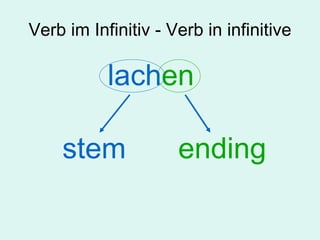
Verb im Infinitiv - Verb in infinitive lach en stem ending
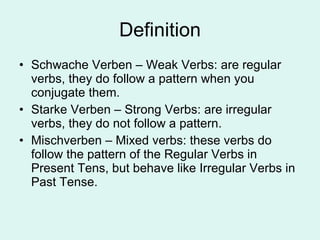
Definition Schwache Verben – Weak Verbs: are regular verbs, they do follow a pattern when you conjugate them. Starke Verben – Strong Verbs: are irregular verbs, they do not follow a pattern. Mischverben – Mixed verbs: these verbs do follow the pattern of the Regular Verbs in Present Tens, but behave like Irregular Verbs in Past Tense.
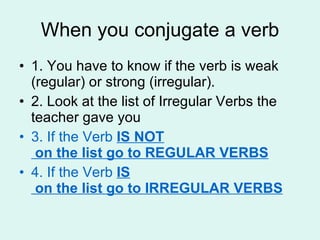
When you conjugate a verb 1. You have to know if the verb is weak (regular) or strong (irregular). 2. Look at the list of Irregular Verbs the teacher gave you 3. If the Verb  IS NOT  on the list go to REGULAR VERBS 4. If the Verb  IS  on the list go to IRREGULAR VERBS
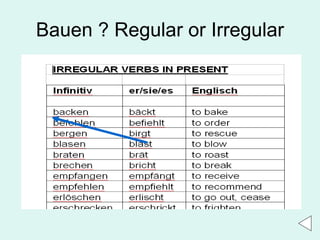
Bauen ? Regular or Irregular
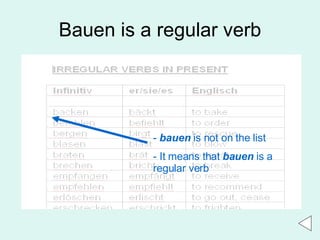
Bauen is a regular verb -   bauen  is not on the list - It means that  bauen  is a regular verb
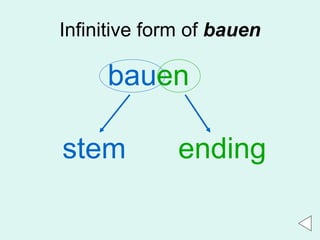
Infinitive form of  bauen bau en stem ending
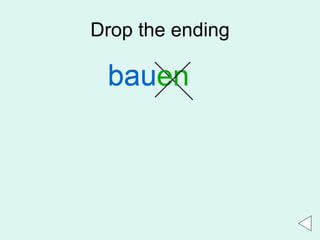
Drop the ending bau bau en
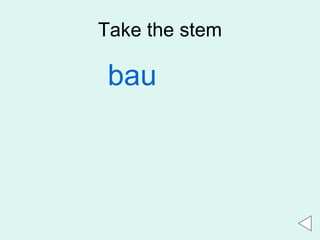
Take the stem bau
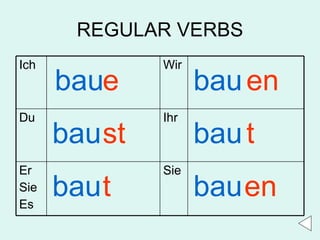
REGULAR VERBS bau bau bau bau bau bau e st t en t en Sie Er Sie Es Ihr Du Wir Ich
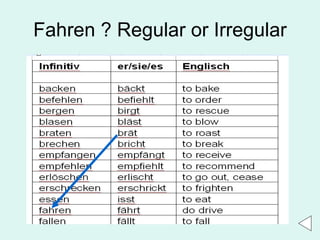
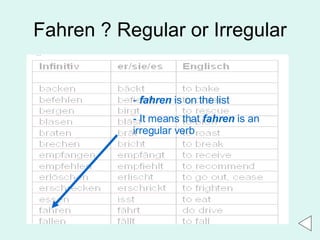
Fahren ? Regular or Irregular
Fahren ? Regular or Irregular -   fahren  is on the list - It means that  fahren  is an irregular verb
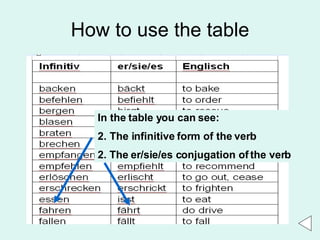
How to use the table In the table you can see: The infinitive form of the verb 2. The er/sie/es conjugation of the verb
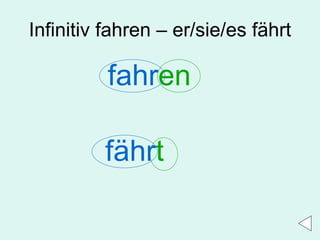
Infinitiv fahren – er/sie/es fährt fahr en fähr t
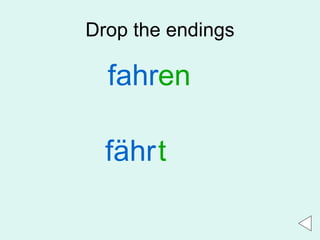
Drop the endings fahr fähr en t
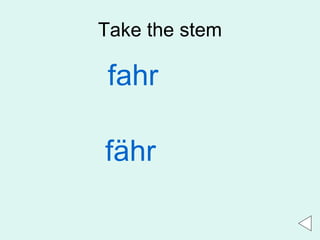
Take the stem fahr fähr
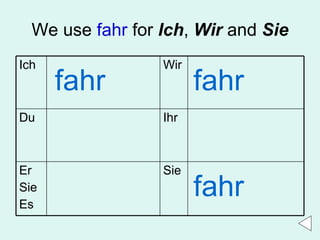
We use  fahr  for  Ich ,  Wir  and  Sie fahr fahr fahr Sie Er Sie Es Ihr Du Wir Ich
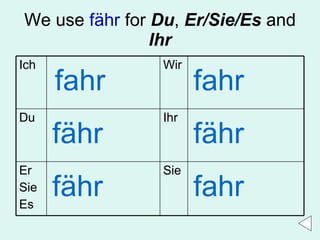
We use  fähr  for  Du ,  Er/Sie/Es  and  Ihr fahr fähr fähr fahr fähr fahr Sie Er Sie Es Ihr Du Wir Ich
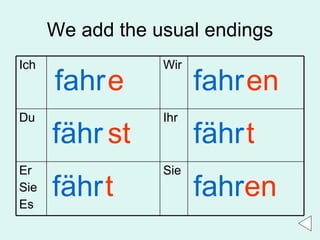
We add the usual endings fahr fähr fähr fahr fähr fahr e st t en t en Sie Er Sie Es Ihr Du Wir Ich
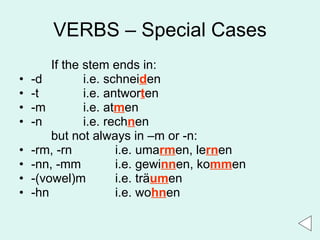
VERBS – Special Cases If the stem ends in: -d i.e. schnei d en -t i.e. antwor t en -m i.e. at m en -n i.e. rech n en but not always in –m or -n: -rm, -rn  i.e. uma rm en, le rn en -nn, -mm  i.e. gewi nn en, ko mm en -(vowel)m  i.e. tr ä um en -hn i.e. wo hn en
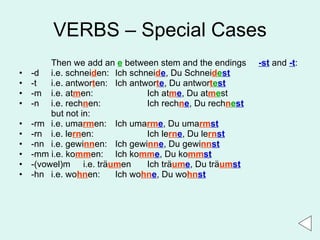
VERBS – Special Cases Then we add an  e  between stem and the endings  -st  and  -t : -d i.e. schnei d en:  Ich schnei d e , Du Schnei d e st -t i.e. antwor t en:  Ich antwor t e , Du antwor t e st -m i.e. at m en:  Ich at m e , Du at m e st -n i.e. rech n en:  Ich rech n e , Du rech n e st but not in: -rm i.e. uma rm en:  Ich uma rm e , Du uma rm st -rn i.e. le rn en: Ich le rn e , Du le rn st -nn i.e. gewi nn en:  Ich gewi nn e , Du gewi nn st -mm i.e. ko mm en:  Ich ko mm e , Du ko mm st -(vowel)m  i.e. tr ä um en Ich trä um e , Du trä um st -hn i.e. wo hn en: Ich wo hn e , Du wo hn st
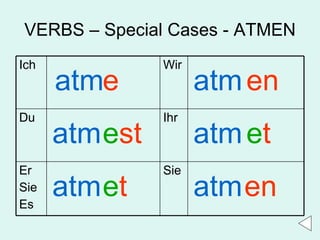
VERBS – Special Cases - ATMEN atm atm atm atm atm atm e e st e t en e t en Sie Er Sie Es Ihr Du Wir Ich
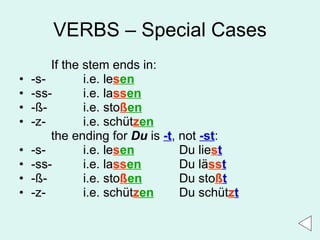
VERBS – Special Cases If the stem ends in: -s- i.e. le s en -ss- i.e. la ss en -ß- i.e. sto ß en -z- i.e. schüt z en the ending for  Du  is  -t , not  -st : -s- i.e. le s en Du lie s t -ss- i.e. la ss en Du lä ss t -ß- i.e. sto ß en Du sto ß t -z- i.e. schüt z en Du schüt z t
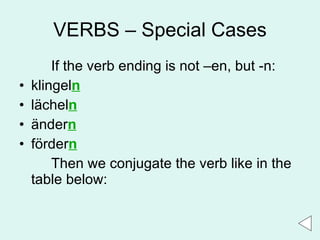
VERBS – Special Cases If the verb ending is not –en, but -n: klingel n lächel n änder n förder n Then we conjugate the verb like in the table below:
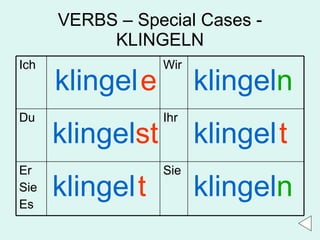
VERBS – Special Cases - KLINGELN klingel klingel klingel klingel klingel klingel e st t n t n Sie Er Sie Es Ihr Du Wir Ich

Konjugation der Verben - Praesens

  • 1.
    Konjugation der Verben- Pr äsens Verbs conjugation – Present Tense Iosif Otto 2008
  • 2.
    Verb im Infinitiv- Verb in infinitive lach en stem ending
  • 3.
    Definition Schwache Verben– Weak Verbs: are regular verbs, they do follow a pattern when you conjugate them. Starke Verben – Strong Verbs: are irregular verbs, they do not follow a pattern. Mischverben – Mixed verbs: these verbs do follow the pattern of the Regular Verbs in Present Tens, but behave like Irregular Verbs in Past Tense.
  • 4.
    When you conjugatea verb 1. You have to know if the verb is weak (regular) or strong (irregular). 2. Look at the list of Irregular Verbs the teacher gave you 3. If the Verb IS NOT on the list go to REGULAR VERBS 4. If the Verb IS on the list go to IRREGULAR VERBS
  • 5.
    Bauen ? Regularor Irregular
  • 6.
    Bauen is aregular verb - bauen is not on the list - It means that bauen is a regular verb
  • 7.
    Infinitive form of bauen bau en stem ending
  • 8.
    Drop the endingbau bau en
  • 9.
  • 10.
    REGULAR VERBS baubau bau bau bau bau e st t en t en Sie Er Sie Es Ihr Du Wir Ich
  • 11.
    Fahren ? Regularor Irregular
  • 12.
    Fahren ? Regularor Irregular - fahren is on the list - It means that fahren is an irregular verb
  • 13.
    How to usethe table In the table you can see: The infinitive form of the verb 2. The er/sie/es conjugation of the verb
  • 14.
    Infinitiv fahren –er/sie/es fährt fahr en fähr t
  • 15.
    Drop the endingsfahr fähr en t
  • 16.
    Take the stemfahr fähr
  • 17.
    We use fahr for Ich , Wir and Sie fahr fahr fahr Sie Er Sie Es Ihr Du Wir Ich
  • 18.
    We use fähr for Du , Er/Sie/Es and Ihr fahr fähr fähr fahr fähr fahr Sie Er Sie Es Ihr Du Wir Ich
  • 19.
    We add theusual endings fahr fähr fähr fahr fähr fahr e st t en t en Sie Er Sie Es Ihr Du Wir Ich
  • 20.
    VERBS – SpecialCases If the stem ends in: -d i.e. schnei d en -t i.e. antwor t en -m i.e. at m en -n i.e. rech n en but not always in –m or -n: -rm, -rn i.e. uma rm en, le rn en -nn, -mm i.e. gewi nn en, ko mm en -(vowel)m i.e. tr ä um en -hn i.e. wo hn en
  • 21.
    VERBS – SpecialCases Then we add an e between stem and the endings -st and -t : -d i.e. schnei d en: Ich schnei d e , Du Schnei d e st -t i.e. antwor t en: Ich antwor t e , Du antwor t e st -m i.e. at m en: Ich at m e , Du at m e st -n i.e. rech n en: Ich rech n e , Du rech n e st but not in: -rm i.e. uma rm en: Ich uma rm e , Du uma rm st -rn i.e. le rn en: Ich le rn e , Du le rn st -nn i.e. gewi nn en: Ich gewi nn e , Du gewi nn st -mm i.e. ko mm en: Ich ko mm e , Du ko mm st -(vowel)m i.e. tr ä um en Ich trä um e , Du trä um st -hn i.e. wo hn en: Ich wo hn e , Du wo hn st
  • 22.
    VERBS – SpecialCases - ATMEN atm atm atm atm atm atm e e st e t en e t en Sie Er Sie Es Ihr Du Wir Ich
  • 23.
    VERBS – SpecialCases If the stem ends in: -s- i.e. le s en -ss- i.e. la ss en -ß- i.e. sto ß en -z- i.e. schüt z en the ending for Du is -t , not -st : -s- i.e. le s en Du lie s t -ss- i.e. la ss en Du lä ss t -ß- i.e. sto ß en Du sto ß t -z- i.e. schüt z en Du schüt z t
  • 24.
    VERBS – SpecialCases If the verb ending is not –en, but -n: klingel n lächel n änder n förder n Then we conjugate the verb like in the table below:
  • 25.
    VERBS – SpecialCases - KLINGELN klingel klingel klingel klingel klingel klingel e st t n t n Sie Er Sie Es Ihr Du Wir Ich