UX Roundtable 10.10.2011


          Konzeption
                 p
          akustisch unterstützter
          animierter Karten
          zur Präsentation von
          raumzeitlicher Information
                   l h     f
           beate.weninger@hcu-hamburg.de


                                                                            Lab for Geoinformatics
HCU            HafenCity University
               Hamburg
                                      University of the Built Environment
                                      and Metropolitan Development          and Geovisualization
EINLEITUNG


>> Begriffsklärung
   animierte Karte: mehrere konstruierte Bilder zu Sequenzen verbunden
   akustisch unterstützt: hinzufügen von Ton (nicht Sprache, Musik)
                                  g                   p
   Raumzeitliche Information


>> Sonification


                                                                       Lab for Geoinformatics
HCU       HafenCity University
          Hamburg
                                 University of the Built Environment
                                 and Metropolitan Development          and Geovisualization
MOTIVATION

>> Nachteile von Animationen
   Hohe Informationsdichte
   „split attention“ (Aufmerksamkeitsverteilung)
   „change blindness“


                                                                       Lab for Geoinformatics
HCU       HafenCity University
          Hamburg
                                 University of the Built Environment
                                 and Metropolitan Development          and Geovisualization
MOTIVATION

>> Vorteil durch die Integration von Ton
   „modality effect“
     modality effect


1) Fähigkeit des Menschen gleichzeitig sehen und hören zu können
2) Menge an Information wird reduziert
      g
3) die gleichzeitige Verwendung von audio und visuellen Inhalten
   ermöglicht eine aktive Informationsverarbeitung
         g                                       g


                                                                       Lab for Geoinformatics
HCU       HafenCity University
          Hamburg
                                 University of the Built Environment
                                 and Metropolitan Development          and Geovisualization
HYPOTHESEN

>> Multikodale bzw. modale Vermittlung ermöglicht eine umfangreichere
  und flexiblere Kommunikation von zeitabhängigen, quantitativen
  Geoinformationen.


>> Werte können anhand der Tonhöhe zusätzlich zur und anstatt einer
  visuellen Darstellung verwendet werden und sorgen für ein besseres,
  schnelleres Verständnis der Karte.


                                                                      Lab for Geoinformatics
HCU      HafenCity University
         Hamburg
                                University of the Built Environment
                                and Metropolitan Development          and Geovisualization
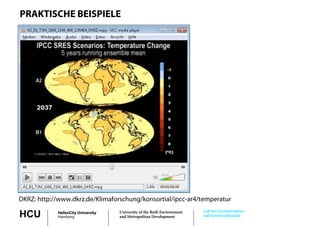
PRAKTISCHE BEISPIELE


DKRZ: http://www.dkrz.de/Klimaforschung/konsortial/ipcc-ar4/temperatur
      http://www.dkrz.de/Klimaforschung/konsortial/ipcc ar4/temperatur
                                                                         Lab for Geoinformatics
HCU         HafenCity University
            Hamburg
                                   University of the Built Environment
                                   and Metropolitan Development          and Geovisualization
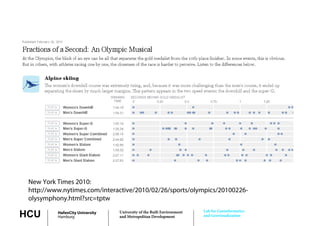
New York Times 2010:
 http://www.nytimes.com/interactive/2010/02/26/sports/olympics/20100226-
 olysymphony.html?src=tptw
   yy p     y          p
                                                                       Lab for Geoinformatics
HCU       HafenCity University
          Hamburg
                                 University of the Built Environment
                                 and Metropolitan Development          and Geovisualization
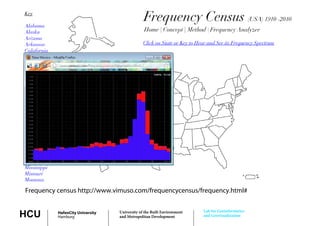
Frequency census http://www.vimuso.com/frequencycensus/frequency.html#

                                                                       Lab for Geoinformatics
HCU       HafenCity University
          Hamburg
                                 University of the Built Environment
                                 and Metropolitan Development          and Geovisualization
FORSCHUNGSSTAND

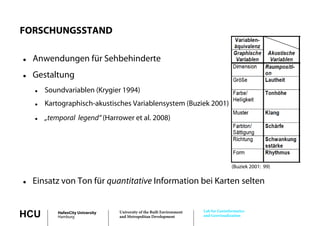
   Anwendungen für Sehbehinderte
   Gestaltung
       Soundvariablen (Krygier 1994)
       Kartographisch-akustisches Variablensystem (Buziek 2001)
                 h h k         h        bl               k
       „temporal legend“ (Harrower et al. 2008)


                                                                                        (Buziek 2001: 99)

   Einsatz von Ton für quantitative Information bei Karten selten


                                                                         Lab for Geoinformatics
HCU         HafenCity University
            Hamburg
                                   University of the Built Environment
                                   and Metropolitan Development          and Geovisualization
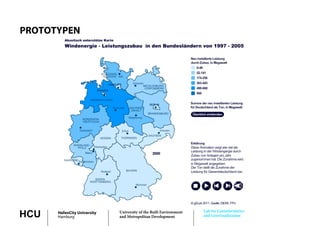
PROTOTYPEN


                                                                   Lab for Geoinformatics
HCU   HafenCity University
      Hamburg
                             University of the Built Environment
                             and Metropolitan Development          and Geovisualization
PROTOTYP 1

>>Die Notenhöhe repräsentiert den jährlichen Anstieg bzw. die Abnahme
  des Zubaus für Gesamtdeutschland.


                                                                     Lab for Geoinformatics
HCU     HafenCity University
        Hamburg
                               University of the Built Environment
                               and Metropolitan Development          and Geovisualization
PROTOTYP 1

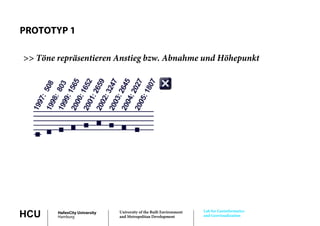
>> Töne repräsentieren Anstieg bzw. Abnahme und Höhepunkt


                                                                     Lab for Geoinformatics
HCU     HafenCity University
        Hamburg
                               University of the Built Environment
                               and Metropolitan Development          and Geovisualization
PROTOTYP 2

>> Die Notenhöhe repräsentiert den absoluten Betrag der jährlichen
  Veränderung des Zubaus für Gesamtdeutschland.
  Pro 100 MW (gerundet) wurde ein Halbton bzw. Ganztonschritt höher
  oder tiefer gewählt.
          f g


                                                                      Lab for Geoinformatics
HCU      HafenCity University
         Hamburg
                                University of the Built Environment
                                and Metropolitan Development          and Geovisualization
PROTOTYP 2

>> Große Spanne zwischen Werten kann dargestellt werden (c2 bis c6).
  Fraglich ist, ob diese Information tatsächlich von den Nutzern
  wahrgenommen werden kann.


                                                                     Lab for Geoinformatics
HCU     HafenCity University
        Hamburg
                               University of the Built Environment
                               and Metropolitan Development          and Geovisualization
ERFAHRUNGEN MIT DEN PROTOTYPEN

   Klangfarbe
   Tonhöhe: Darstellung Veränderung vs absoluten Werten
                                     vs.
   Begleittext wird nicht gelesen
   Darstellung / Platzierung der Zeit-Legende


                                                                       Lab for Geoinformatics
HCU       HafenCity University
          Hamburg
                                 University of the Built Environment
                                 and Metropolitan Development          and Geovisualization
WEITERFÜHRENDE FORSCHUNGSFRAGEN


>> Usability-Tests zur Nutzung der Tonhöhe für Veränderungen vs.
  absolute Werte
   b l t W t

>> U t
   Unterschiede i d U bilit i Abhä i k it vom Z
          hi d in der Usability in Abhängigkeit Zusammenhang
                                                        h
  der dargestellten Merkmale

>> Wie kann ein Verständnis für die akustische Unterstützung aufgebaut
  werden?


                                                                     Lab for Geoinformatics
HCU     HafenCity University
        Hamburg
                               University of the Built Environment
                               and Metropolitan Development          and Geovisualization
MÖGLICHE ANWENDUNGEN

Ein rein wissenschaftliches Thema????
NEIN: Vielzahl praktischer Anwendungen!!


   Lärmkarten
   Darstellung von statistischen Daten und ihrer Verteilung im Raum
   Thematische Karten generell zur Bürgerinformation


                                                                       Lab for Geoinformatics
HCU       HafenCity University
          Hamburg
                                 University of the Built Environment
                                 and Metropolitan Development          and Geovisualization
“Who the hell wants to hear actors talk?”
Harry Warner on being confronted with the prospect of the sound movie. (1927
in Krygier 1994)


                                                                       Lab for Geoinformatics
HCU       HafenCity University
          Hamburg
                                 University of the Built Environment
                                 and Metropolitan Development          and Geovisualization
Anmerkungen, Diskussionsbeiträge?


beate.weninger@hcu-hamburg.de
b t      i    @h h b       d


                                                                     Lab for Geoinformatics
HCU     HafenCity University
        Hamburg
                               University of the Built Environment
                               and Metropolitan Development          and Geovisualization

Konzeption akustisch unterstützter animierter Karten

  • 1.
    UX Roundtable 10.10.2011 Konzeption p akustisch unterstützter animierter Karten zur Präsentation von raumzeitlicher Information l h f beate.weninger@hcu-hamburg.de Lab for Geoinformatics HCU HafenCity University Hamburg University of the Built Environment and Metropolitan Development and Geovisualization
  • 2.
    EINLEITUNG >> Begriffsklärung  animierte Karte: mehrere konstruierte Bilder zu Sequenzen verbunden  akustisch unterstützt: hinzufügen von Ton (nicht Sprache, Musik) g p  Raumzeitliche Information >> Sonification Lab for Geoinformatics HCU HafenCity University Hamburg University of the Built Environment and Metropolitan Development and Geovisualization
  • 3.
    MOTIVATION >> Nachteile vonAnimationen  Hohe Informationsdichte  „split attention“ (Aufmerksamkeitsverteilung)  „change blindness“ Lab for Geoinformatics HCU HafenCity University Hamburg University of the Built Environment and Metropolitan Development and Geovisualization
  • 4.
    MOTIVATION >> Vorteil durchdie Integration von Ton  „modality effect“ modality effect 1) Fähigkeit des Menschen gleichzeitig sehen und hören zu können 2) Menge an Information wird reduziert g 3) die gleichzeitige Verwendung von audio und visuellen Inhalten ermöglicht eine aktive Informationsverarbeitung g g Lab for Geoinformatics HCU HafenCity University Hamburg University of the Built Environment and Metropolitan Development and Geovisualization
  • 5.
    HYPOTHESEN >> Multikodale bzw.modale Vermittlung ermöglicht eine umfangreichere und flexiblere Kommunikation von zeitabhängigen, quantitativen Geoinformationen. >> Werte können anhand der Tonhöhe zusätzlich zur und anstatt einer visuellen Darstellung verwendet werden und sorgen für ein besseres, schnelleres Verständnis der Karte. Lab for Geoinformatics HCU HafenCity University Hamburg University of the Built Environment and Metropolitan Development and Geovisualization
  • 6.
    PRAKTISCHE BEISPIELE DKRZ: http://www.dkrz.de/Klimaforschung/konsortial/ipcc-ar4/temperatur http://www.dkrz.de/Klimaforschung/konsortial/ipcc ar4/temperatur Lab for Geoinformatics HCU HafenCity University Hamburg University of the Built Environment and Metropolitan Development and Geovisualization
  • 7.
    New York Times2010: http://www.nytimes.com/interactive/2010/02/26/sports/olympics/20100226- olysymphony.html?src=tptw yy p y p Lab for Geoinformatics HCU HafenCity University Hamburg University of the Built Environment and Metropolitan Development and Geovisualization
  • 8.
    Frequency census http://www.vimuso.com/frequencycensus/frequency.html# Lab for Geoinformatics HCU HafenCity University Hamburg University of the Built Environment and Metropolitan Development and Geovisualization
  • 9.
    FORSCHUNGSSTAND  Anwendungen für Sehbehinderte  Gestaltung  Soundvariablen (Krygier 1994)  Kartographisch-akustisches Variablensystem (Buziek 2001) h h k h bl k  „temporal legend“ (Harrower et al. 2008) (Buziek 2001: 99)  Einsatz von Ton für quantitative Information bei Karten selten Lab for Geoinformatics HCU HafenCity University Hamburg University of the Built Environment and Metropolitan Development and Geovisualization
  • 10.
    PROTOTYPEN Lab for Geoinformatics HCU HafenCity University Hamburg University of the Built Environment and Metropolitan Development and Geovisualization
  • 11.
    PROTOTYP 1 >>Die Notenhöherepräsentiert den jährlichen Anstieg bzw. die Abnahme des Zubaus für Gesamtdeutschland. Lab for Geoinformatics HCU HafenCity University Hamburg University of the Built Environment and Metropolitan Development and Geovisualization
  • 12.
    PROTOTYP 1 >> Tönerepräsentieren Anstieg bzw. Abnahme und Höhepunkt Lab for Geoinformatics HCU HafenCity University Hamburg University of the Built Environment and Metropolitan Development and Geovisualization
  • 13.
    PROTOTYP 2 >> DieNotenhöhe repräsentiert den absoluten Betrag der jährlichen Veränderung des Zubaus für Gesamtdeutschland. Pro 100 MW (gerundet) wurde ein Halbton bzw. Ganztonschritt höher oder tiefer gewählt. f g Lab for Geoinformatics HCU HafenCity University Hamburg University of the Built Environment and Metropolitan Development and Geovisualization
  • 14.
    PROTOTYP 2 >> GroßeSpanne zwischen Werten kann dargestellt werden (c2 bis c6). Fraglich ist, ob diese Information tatsächlich von den Nutzern wahrgenommen werden kann. Lab for Geoinformatics HCU HafenCity University Hamburg University of the Built Environment and Metropolitan Development and Geovisualization
  • 15.
    ERFAHRUNGEN MIT DENPROTOTYPEN  Klangfarbe  Tonhöhe: Darstellung Veränderung vs absoluten Werten vs.  Begleittext wird nicht gelesen  Darstellung / Platzierung der Zeit-Legende Lab for Geoinformatics HCU HafenCity University Hamburg University of the Built Environment and Metropolitan Development and Geovisualization
  • 16.
    WEITERFÜHRENDE FORSCHUNGSFRAGEN >> Usability-Testszur Nutzung der Tonhöhe für Veränderungen vs. absolute Werte b l t W t >> U t Unterschiede i d U bilit i Abhä i k it vom Z hi d in der Usability in Abhängigkeit Zusammenhang h der dargestellten Merkmale >> Wie kann ein Verständnis für die akustische Unterstützung aufgebaut werden? Lab for Geoinformatics HCU HafenCity University Hamburg University of the Built Environment and Metropolitan Development and Geovisualization
  • 17.
    MÖGLICHE ANWENDUNGEN Ein reinwissenschaftliches Thema???? NEIN: Vielzahl praktischer Anwendungen!!  Lärmkarten  Darstellung von statistischen Daten und ihrer Verteilung im Raum  Thematische Karten generell zur Bürgerinformation Lab for Geoinformatics HCU HafenCity University Hamburg University of the Built Environment and Metropolitan Development and Geovisualization
  • 18.
    “Who the hellwants to hear actors talk?” Harry Warner on being confronted with the prospect of the sound movie. (1927 in Krygier 1994) Lab for Geoinformatics HCU HafenCity University Hamburg University of the Built Environment and Metropolitan Development and Geovisualization
  • 19.
    Anmerkungen, Diskussionsbeiträge? beate.weninger@hcu-hamburg.de b t i @h h b d Lab for Geoinformatics HCU HafenCity University Hamburg University of the Built Environment and Metropolitan Development and Geovisualization