IBM Lotus NotesVon PLATO zur führenden GroupwareplattformUlrich Krause  EntwicklerCamp, 21. – 23.02.2011, Maritim Hotel, Gelsenkirchen, Deutschland
1974
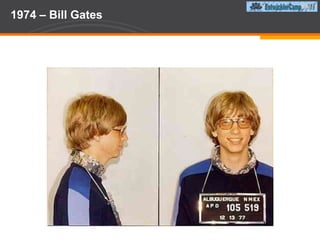
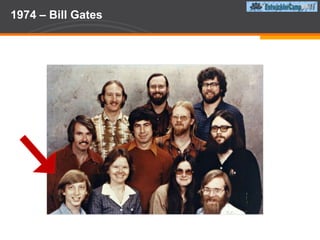
1974 – Bill Gates
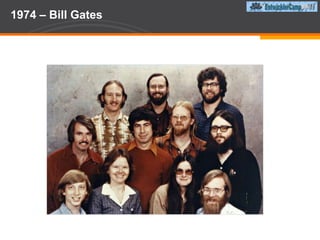
1974 – Bill Gates
1974 – Bill Gates
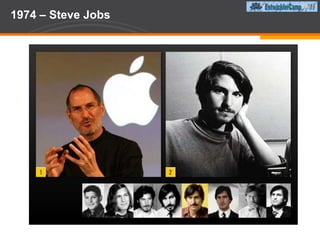
1974 – Steve Jobs
Steve Jobs
1974 – Steve Jobs
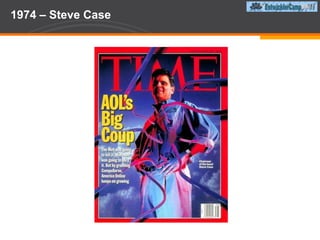
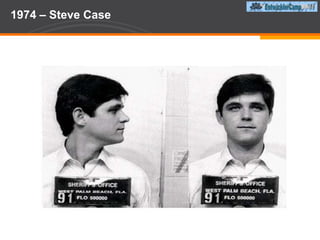
1974 – Steve Case
1974 – Steve Case
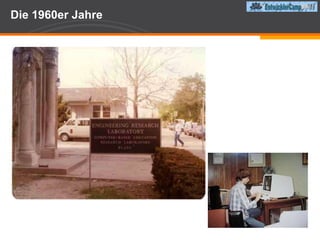
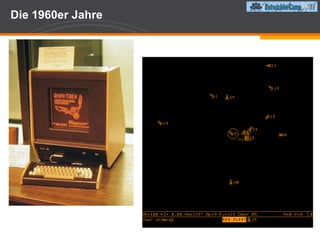
Die 1960er Jahre
Die 1960er Jahre
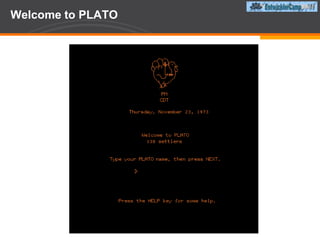
Welcome to PLATO
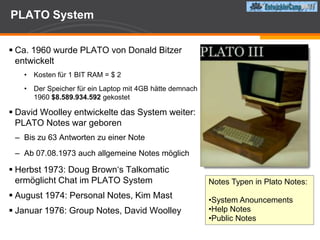
PLATO SystemCa. 1960 wurde PLATO von DonaldBitzer entwickeltKosten für 1 BIT RAM = $ 2Der Speicher für ein Laptop mit 4GB hätte demnach 1960 $8.589.934.592 gekostetDavid Woolley entwickelte das System weiter: PLATO Notes war geborenBis zu 63 Antworten zu einer NoteAb 07.08.1973 auch allgemeine Notes möglichHerbst 1973: Doug Brown‘sTalkomatic ermöglicht Chat im PLATO SystemAugust 1974: Personal Notes, Kim MastJanuar 1976: Group Notes, David WoolleyNotes Typen in Plato Notes:System Anouncements
Help Notes
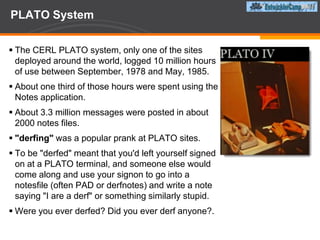
Public NotesPLATO SystemThe CERL PLATO system, only one of the sites deployed around the world, logged 10 million hours of use between September, 1978 and May, 1985.About one third of those hours were spent using the Notes application. About 3.3 million messages were posted in about 2000 notes files."derfing" was a popular prank at PLATO sites. To be "derfed" meant that you'd left yourself signed on at a PLATO terminal, and someone else would come along and use your signon to go into a notesfile (often PAD or derfnotes) and write a note saying "I are a derf" or something similarly stupid. Were you ever derfed? Did you ever derf anyone?.
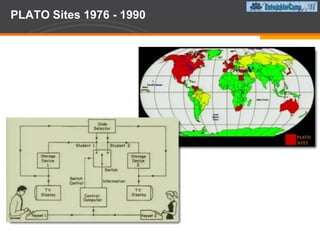
PLATO Sites 1976 - 1990
The friendly orange glowhttp://www.friendlyorangeglow.com/PLATO: The Emergence of Online Community  http://www.thinkofit.com/plato/dwplato.htmThe PLATO Historyfoundationhttp://www.platohistory.org/
Iris Associates07.12.1984: Iris Associates wird von Raymond „Ray“ Ozzie gegründetFinanziert wird das Unternehmen von Lotus unter der Leitung von Mitch KaporIm Januar 1985 stoßen Tim Halvorsen und Len Kawellhinzu, kurzdanachauch Steven Beckhardt und Alan EldridgeUnternehmensziel war die Entwicklung einer Software nach dem Vorbild PLATO, die on-line Diskussion, das Verwalten von AdressenDokumentenablage und auch e-Mail ermöglicht.Zunächst als PIM System gedacht, entwickelte sich Lotus Notes zu einem Client/Server System. Der Begriff „Groupware“ wurde geboren."It was eccentric to think about group communication software in 1984, when most people had never touched an email system...the product was very far ahead of its time. It was the first commercial client/server product."  Tom Diaz, former Vice President of Engineering at Iris
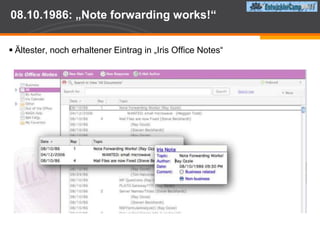
08.10.1986: „Note forwardingworks!“Ältester, noch erhaltener Eintrag in „Iris Office Notes“
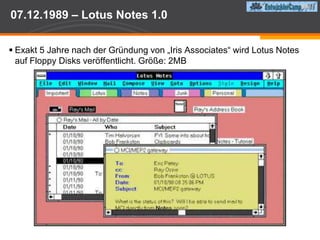
07.12.1989 – Lotus Notes 1.0Exakt 5 Jahre nach der Gründung von „Iris Associates“ wird Lotus Notes auf Floppy Disks veröffentlicht. Größe: 2MB
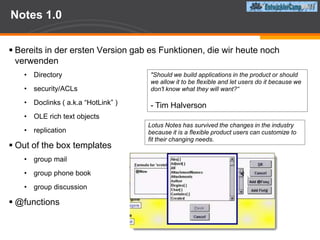
Notes 1.0Bereits in der ersten Version gab es Funktionen, die wir heute noch verwendenDirectory security/ACLsDoclinks ( a.k.a “HotLink” )OLE rich text objectsreplicationOut of the box templates group mailgroup phone bookgroup discussion @functions"Should we build applications in the product or should we allow it to be flexible and let users do it because we don't know what they will want?“ - Tim HalversonLotus Notes has survived the changes in the industry because it is a flexible product users can customize to fit their changing needs.
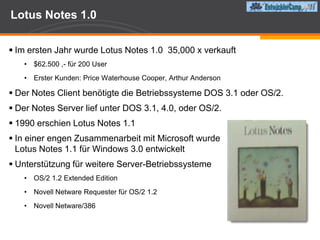
Lotus Notes 1.0ImerstenJahrwurde Lotus Notes 1.0  35,000 x verkauft$62.500 ,- für 200 UserErsterKunden: Price Waterhouse Cooper, Arthur AndersonDer Notes Client benötigte die Betriebssysteme DOS 3.1 oder OS/2. Der Notes Server liefunter DOS 3.1, 4.0, oder OS/2. 1990 erschien Lotus Notes 1.1In einer engenZusammenarbeitmit Microsoft wurdeLotus Notes 1.1 für Windows 3.0 entwickeltUnterstützungfürweitere Server-BetriebssystemeOS/2 1.2 Extended EditionNovell Netware Requester für OS/2 1.2Novell Netware/386
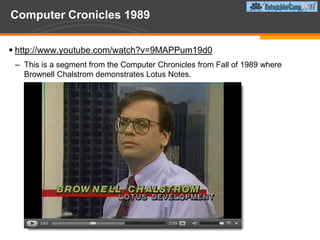
Computer Cronicles 1989http://www.youtube.com/watch?v=9MAPPum19d0This is a segment from the Computer Chronicles from Fall of 1989 where Brownell Chalstrom demonstrates Lotus Notes.
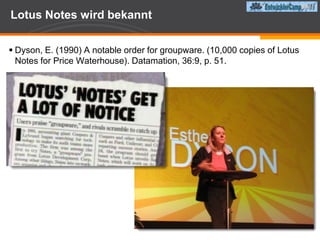
Lotus Notes wird bekanntDyson, E. (1990) A notable order for groupware. (10,000 copies of Lotus Notes for Price Waterhouse). Datamation, 36:9, p. 51.
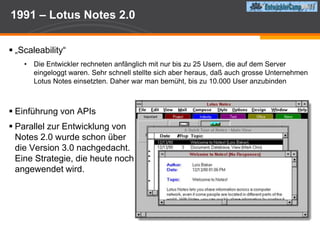
1991 – Lotus Notes 2.0„Scaleability“ Die Entwickler rechneten anfänglich mit nur bis zu 25 Usern, die auf dem Server eingeloggt waren. Sehr schnell stellte sich aber heraus, daß auch grosse Unternehmen Lotus Notes einsetzten. Daher war man bemüht, bis zu 10.000 User anzubindenEinführung von APIsParallel zur Entwicklung von Notes 2.0 wurde schon über die Version 3.0 nachgedacht.Eine Strategie, die heute nochangewendet wird.
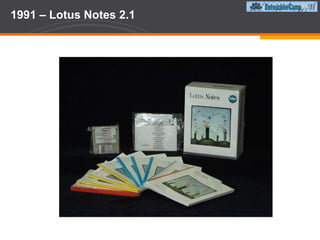
1991 – Lotus Notes 2.1
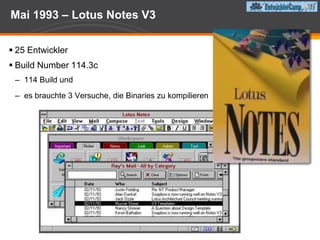
Mai 1993 – Lotus Notes V325 EntwicklerBuildNumber 114.3c114 Build und es brauchte 3 Versuche, die Binaries zu kompilieren
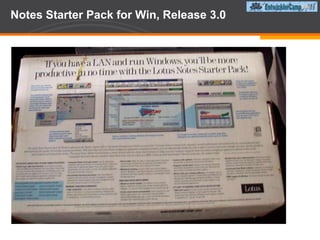
Notes Starter Pack for Win, Release 3.0
1993 / 1994 – Notes erobert den MarktLotus kauft IrisLotus kauft cc:MailDas Business Partner Modell entsteht„NiftyFifty“Sammlung von 50 Templateshttp://www.wissel.net/blog/d6plinks/SHWL-7P27CR
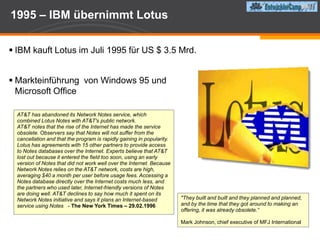
1995 – IBM übernimmt LotusIBM kauft Lotus im Juli 1995 für US $ 3.5 Mrd.Markteinführung  von Windows 95 und Microsoft Office AT&T has abandoned its Network Notes service, which combined Lotus Notes with AT&T's public network. AT&T notes that the rise of the Internet has made the service obsolete. Observers say that Notes will not suffer from the cancellation and that the program is rapidly gaining in popularity. Lotus has agreements with 15 other partners to provide access to Notes databases over the Internet. Experts believe that AT&T lost out because it entered the field too soon, using an early version of Notes that did not work well over the Internet. Because Network Notes relies on the AT&T network, costs are high, averaging $40 a month per user before usage fees. Accessing a Notes database directly over the Internet costs much less, and the partners who used later, Internet-friendly versions of Notes are doing well. AT&T declines to say how much it spent on its Network Notes initiative and says it plans an Internet-based service using Notes   - The New York Times – 29.02.1996"They built and built and they planned and planned, and by the time that they got around to making an offering, it was already obsolete.“Mark Johnson, chief executive of MFJ International
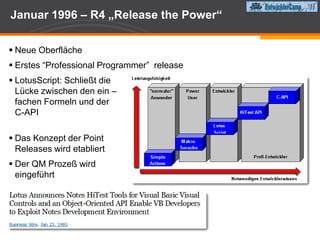
Januar 1996 – R4 „Release the Power“Neue OberflächeErstes “Professional Programmer”  releaseLotusScript: Schließt die Lücke zwischen den ein –fachen Formeln und der C-APIDas Konzept der Point Releases wird etabliertDer QM Prozeß wird eingeführt
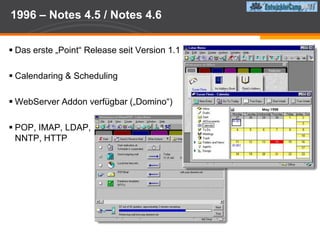
1996 – Notes 4.5 / Notes 4.6Das erste „Point“ Release seit Version 1.1Calendaring & SchedulingWebServer Addon verfügbar („Domino“)POP, IMAP, LDAP, NNTP, HTTP
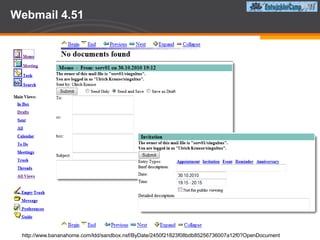
Webmail 4.51http://www.bananahome.com/ldd/sandbox.nsf/ByDate/2450f21823f08bdb85256736007a12f0?OpenDocument
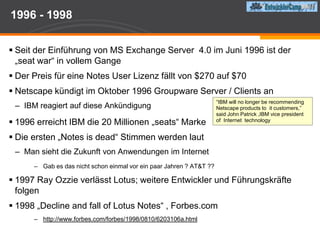
1996 - 1998Seit der Einführung von MS Exchange Server  4.0 im Juni 1996 ist der „seat war“ in vollem GangeDer Preis für eine Notes User Lizenz fällt von $270 auf $70Netscape kündigt im Oktober 1996 Groupware Server / Clients anIBM reagiert auf diese Ankündigung 1996 erreicht IBM die 20 Millionen „seats“ MarkeDie ersten „Notes is dead“ Stimmen werden lautMan sieht die Zukunft von Anwendungen im InternetGab es das nicht schon einmal vor ein paar Jahren ? AT&T ??1997 Ray Ozzie verlässt Lotus; weitere Entwickler und Führungskräfte folgen1998 „Decline and fall of Lotus Notes“ , Forbes.comhttp://www.forbes.com/forbes/1998/0810/6203106a.html“IBM will no longer be recommending Netscape products to  it customers,” said John Patrick ,IBM vice president of  Internet  technology
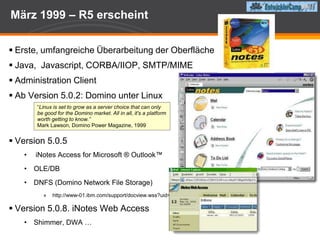
März 1999 – R5 erscheintErste, umfangreiche Überarbeitung der OberflächeJava,  Javascript, CORBA/IIOP, SMTP/MIMEAdministration ClientAb Version 5.0.2: Domino unter LinuxVersion 5.0.5iNotes Access for Microsoft ® Outlook™OLE/DBDNFS (Domino Network File Storage)http://www-01.ibm.com/support/docview.wss?uid=swg27003677Version 5.0.8. iNotes Web AccessShimmer, DWA …“Linux is set to grow as a server choice that can only be good for the Domino market. All in all, it's a platform worth getting to know.”Mark Lawson, Domino Power Magazine, 1999
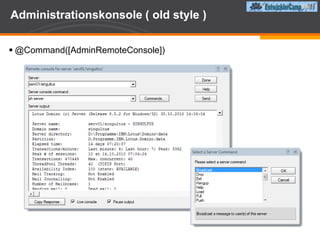
Administrationskonsole ( old style )@Command([AdminRemoteConsole])
Private Edition
Oktober 2002 – Lotus Notes /Domino 6Noch einmal eine Überarbeitung der OberflächePolicies
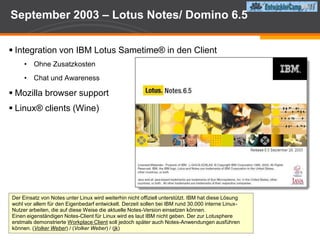
 Server/ Performance MonitorSeptember 2003 – Lotus Notes/ Domino 6.5Integration von IBM Lotus Sametime® in den ClientOhne ZusatzkostenChat und AwarenessMozilla browser supportLinux® clients (Wine)Der Einsatz von Notes unter Linux wird weiterhin nicht offiziell unterstützt. IBM hat diese Lösung wohl vor allem für den Eigenbedarf entwickelt. Derzeit sollen bei IBM rund 30.000 interne Linux-Nutzer arbeiten, die auf diese Weise die aktuelle Notes-Version einsetzen können.Einen eigenständigen Notes-Client für Linux wird es laut IBM nicht geben. Der zur Lotusphere erstmals demonstrierte Workplace Client soll jedoch später auch Notes-Anwendungen ausführen können. (Volker Weber) / (Volker Weber) / (jk)
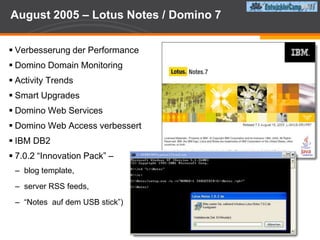
August 2005 – Lotus Notes / Domino 7Verbesserung der PerformanceDomino Domain MonitoringActivity TrendsSmart UpgradesDomino Web ServicesDomino Web Access verbessertIBM DB2 7.0.2 “Innovation Pack” – blog template, server RSS feeds, “Notes  auf dem USB stick”)
Juni 2005
Hannover 1.0
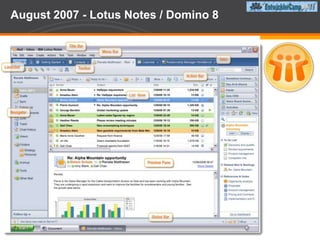
August 2007 - Lotus Notes / Domino 8
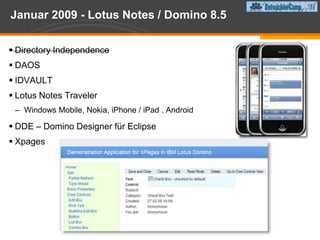
Januar 2009 - Lotus Notes / Domino 8.5Directory IndependenceDAOSIDVAULTLotus Notes TravelerWindows Mobile, Nokia, iPhone / iPad . AndroidDDE – Domino Designer für EclipseXpages
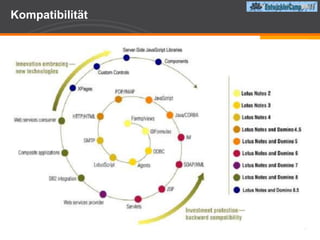
Kompatibilität
Wer hat‘s erfunden ?Len KawellRay OzzieTim HalvorsenMitch Kapor
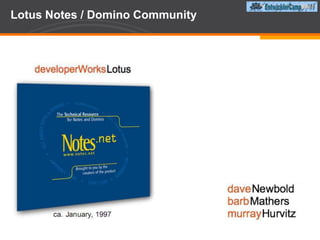
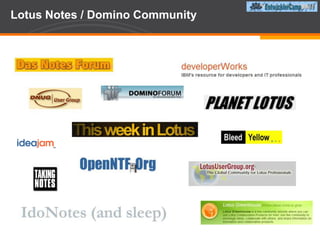
Lotus Notes / Domino Community

EntwicklerCamp CGS

  • 1.
    IBM Lotus NotesVonPLATO zur führenden GroupwareplattformUlrich Krause EntwicklerCamp, 21. – 23.02.2011, Maritim Hotel, Gelsenkirchen, Deutschland
  • 2.
  • 3.
  • 4.
  • 5.
  • 6.
  • 7.
  • 8.
  • 9.
  • 10.
  • 12.
  • 13.
  • 14.
  • 15.
    PLATO SystemCa. 1960wurde PLATO von DonaldBitzer entwickeltKosten für 1 BIT RAM = $ 2Der Speicher für ein Laptop mit 4GB hätte demnach 1960 $8.589.934.592 gekostetDavid Woolley entwickelte das System weiter: PLATO Notes war geborenBis zu 63 Antworten zu einer NoteAb 07.08.1973 auch allgemeine Notes möglichHerbst 1973: Doug Brown‘sTalkomatic ermöglicht Chat im PLATO SystemAugust 1974: Personal Notes, Kim MastJanuar 1976: Group Notes, David WoolleyNotes Typen in Plato Notes:System Anouncements
  • 16.
  • 17.
    Public NotesPLATO SystemTheCERL PLATO system, only one of the sites deployed around the world, logged 10 million hours of use between September, 1978 and May, 1985.About one third of those hours were spent using the Notes application. About 3.3 million messages were posted in about 2000 notes files."derfing" was a popular prank at PLATO sites. To be "derfed" meant that you'd left yourself signed on at a PLATO terminal, and someone else would come along and use your signon to go into a notesfile (often PAD or derfnotes) and write a note saying "I are a derf" or something similarly stupid. Were you ever derfed? Did you ever derf anyone?.
  • 18.
  • 19.
    The friendly orangeglowhttp://www.friendlyorangeglow.com/PLATO: The Emergence of Online Community http://www.thinkofit.com/plato/dwplato.htmThe PLATO Historyfoundationhttp://www.platohistory.org/
  • 20.
    Iris Associates07.12.1984: IrisAssociates wird von Raymond „Ray“ Ozzie gegründetFinanziert wird das Unternehmen von Lotus unter der Leitung von Mitch KaporIm Januar 1985 stoßen Tim Halvorsen und Len Kawellhinzu, kurzdanachauch Steven Beckhardt und Alan EldridgeUnternehmensziel war die Entwicklung einer Software nach dem Vorbild PLATO, die on-line Diskussion, das Verwalten von AdressenDokumentenablage und auch e-Mail ermöglicht.Zunächst als PIM System gedacht, entwickelte sich Lotus Notes zu einem Client/Server System. Der Begriff „Groupware“ wurde geboren."It was eccentric to think about group communication software in 1984, when most people had never touched an email system...the product was very far ahead of its time. It was the first commercial client/server product." Tom Diaz, former Vice President of Engineering at Iris
  • 21.
    08.10.1986: „Note forwardingworks!“Ältester,noch erhaltener Eintrag in „Iris Office Notes“
  • 22.
    07.12.1989 – LotusNotes 1.0Exakt 5 Jahre nach der Gründung von „Iris Associates“ wird Lotus Notes auf Floppy Disks veröffentlicht. Größe: 2MB
  • 23.
    Notes 1.0Bereits inder ersten Version gab es Funktionen, die wir heute noch verwendenDirectory security/ACLsDoclinks ( a.k.a “HotLink” )OLE rich text objectsreplicationOut of the box templates group mailgroup phone bookgroup discussion @functions"Should we build applications in the product or should we allow it to be flexible and let users do it because we don't know what they will want?“ - Tim HalversonLotus Notes has survived the changes in the industry because it is a flexible product users can customize to fit their changing needs.
  • 24.
    Lotus Notes 1.0ImerstenJahrwurdeLotus Notes 1.0 35,000 x verkauft$62.500 ,- für 200 UserErsterKunden: Price Waterhouse Cooper, Arthur AndersonDer Notes Client benötigte die Betriebssysteme DOS 3.1 oder OS/2. Der Notes Server liefunter DOS 3.1, 4.0, oder OS/2. 1990 erschien Lotus Notes 1.1In einer engenZusammenarbeitmit Microsoft wurdeLotus Notes 1.1 für Windows 3.0 entwickeltUnterstützungfürweitere Server-BetriebssystemeOS/2 1.2 Extended EditionNovell Netware Requester für OS/2 1.2Novell Netware/386
  • 25.
    Computer Cronicles 1989http://www.youtube.com/watch?v=9MAPPum19d0Thisis a segment from the Computer Chronicles from Fall of 1989 where Brownell Chalstrom demonstrates Lotus Notes.
  • 26.
    Lotus Notes wirdbekanntDyson, E. (1990) A notable order for groupware. (10,000 copies of Lotus Notes for Price Waterhouse). Datamation, 36:9, p. 51.
  • 27.
    1991 – LotusNotes 2.0„Scaleability“ Die Entwickler rechneten anfänglich mit nur bis zu 25 Usern, die auf dem Server eingeloggt waren. Sehr schnell stellte sich aber heraus, daß auch grosse Unternehmen Lotus Notes einsetzten. Daher war man bemüht, bis zu 10.000 User anzubindenEinführung von APIsParallel zur Entwicklung von Notes 2.0 wurde schon über die Version 3.0 nachgedacht.Eine Strategie, die heute nochangewendet wird.
  • 28.
  • 29.
    Mai 1993 –Lotus Notes V325 EntwicklerBuildNumber 114.3c114 Build und es brauchte 3 Versuche, die Binaries zu kompilieren
  • 30.
    Notes Starter Packfor Win, Release 3.0
  • 31.
    Notes Starter Packfor Win, Release 3.0
  • 32.
    1993 / 1994– Notes erobert den MarktLotus kauft IrisLotus kauft cc:MailDas Business Partner Modell entsteht„NiftyFifty“Sammlung von 50 Templateshttp://www.wissel.net/blog/d6plinks/SHWL-7P27CR
  • 33.
    1995 – IBMübernimmt LotusIBM kauft Lotus im Juli 1995 für US $ 3.5 Mrd.Markteinführung von Windows 95 und Microsoft Office AT&T has abandoned its Network Notes service, which combined Lotus Notes with AT&T's public network. AT&T notes that the rise of the Internet has made the service obsolete. Observers say that Notes will not suffer from the cancellation and that the program is rapidly gaining in popularity. Lotus has agreements with 15 other partners to provide access to Notes databases over the Internet. Experts believe that AT&T lost out because it entered the field too soon, using an early version of Notes that did not work well over the Internet. Because Network Notes relies on the AT&T network, costs are high, averaging $40 a month per user before usage fees. Accessing a Notes database directly over the Internet costs much less, and the partners who used later, Internet-friendly versions of Notes are doing well. AT&T declines to say how much it spent on its Network Notes initiative and says it plans an Internet-based service using Notes - The New York Times – 29.02.1996"They built and built and they planned and planned, and by the time that they got around to making an offering, it was already obsolete.“Mark Johnson, chief executive of MFJ International
  • 34.
    Januar 1996 –R4 „Release the Power“Neue OberflächeErstes “Professional Programmer” releaseLotusScript: Schließt die Lücke zwischen den ein –fachen Formeln und der C-APIDas Konzept der Point Releases wird etabliertDer QM Prozeß wird eingeführt
  • 35.
    1996 – Notes4.5 / Notes 4.6Das erste „Point“ Release seit Version 1.1Calendaring & SchedulingWebServer Addon verfügbar („Domino“)POP, IMAP, LDAP, NNTP, HTTP
  • 36.
  • 37.
    1996 - 1998Seitder Einführung von MS Exchange Server 4.0 im Juni 1996 ist der „seat war“ in vollem GangeDer Preis für eine Notes User Lizenz fällt von $270 auf $70Netscape kündigt im Oktober 1996 Groupware Server / Clients anIBM reagiert auf diese Ankündigung 1996 erreicht IBM die 20 Millionen „seats“ MarkeDie ersten „Notes is dead“ Stimmen werden lautMan sieht die Zukunft von Anwendungen im InternetGab es das nicht schon einmal vor ein paar Jahren ? AT&T ??1997 Ray Ozzie verlässt Lotus; weitere Entwickler und Führungskräfte folgen1998 „Decline and fall of Lotus Notes“ , Forbes.comhttp://www.forbes.com/forbes/1998/0810/6203106a.html“IBM will no longer be recommending Netscape products to it customers,” said John Patrick ,IBM vice president of Internet technology
  • 38.
    März 1999 –R5 erscheintErste, umfangreiche Überarbeitung der OberflächeJava, Javascript, CORBA/IIOP, SMTP/MIMEAdministration ClientAb Version 5.0.2: Domino unter LinuxVersion 5.0.5iNotes Access for Microsoft ® Outlook™OLE/DBDNFS (Domino Network File Storage)http://www-01.ibm.com/support/docview.wss?uid=swg27003677Version 5.0.8. iNotes Web AccessShimmer, DWA …“Linux is set to grow as a server choice that can only be good for the Domino market. All in all, it's a platform worth getting to know.”Mark Lawson, Domino Power Magazine, 1999
  • 39.
    Administrationskonsole ( oldstyle )@Command([AdminRemoteConsole])
  • 40.
  • 41.
    Oktober 2002 –Lotus Notes /Domino 6Noch einmal eine Überarbeitung der OberflächePolicies
  • 42.
    Server/ PerformanceMonitorSeptember 2003 – Lotus Notes/ Domino 6.5Integration von IBM Lotus Sametime® in den ClientOhne ZusatzkostenChat und AwarenessMozilla browser supportLinux® clients (Wine)Der Einsatz von Notes unter Linux wird weiterhin nicht offiziell unterstützt. IBM hat diese Lösung wohl vor allem für den Eigenbedarf entwickelt. Derzeit sollen bei IBM rund 30.000 interne Linux-Nutzer arbeiten, die auf diese Weise die aktuelle Notes-Version einsetzen können.Einen eigenständigen Notes-Client für Linux wird es laut IBM nicht geben. Der zur Lotusphere erstmals demonstrierte Workplace Client soll jedoch später auch Notes-Anwendungen ausführen können. (Volker Weber) / (Volker Weber) / (jk)
  • 43.
    August 2005 –Lotus Notes / Domino 7Verbesserung der PerformanceDomino Domain MonitoringActivity TrendsSmart UpgradesDomino Web ServicesDomino Web Access verbessertIBM DB2 7.0.2 “Innovation Pack” – blog template, server RSS feeds, “Notes auf dem USB stick”)
  • 44.
  • 45.
  • 46.
    August 2007 -Lotus Notes / Domino 8
  • 47.
    Januar 2009 -Lotus Notes / Domino 8.5Directory IndependenceDAOSIDVAULTLotus Notes TravelerWindows Mobile, Nokia, iPhone / iPad . AndroidDDE – Domino Designer für EclipseXpages
  • 48.
  • 49.
    Wer hat‘s erfunden?Len KawellRay OzzieTim HalvorsenMitch Kapor
  • 50.
    Lotus Notes /Domino Community
  • 51.
    Lotus Notes /Domino Community