#COOPS
VIADRINA
A PLATFORMCOOP MAGAZINE
• JULY 2019 • VOLUME 2 •
Photos in this issue/Fotos in
diesem Heft
Platform Coops in Asia: CC BY-
NC-SA 2.0 Trebor Scholz (flickr)
Bauwens: CC BY 2.0; Sebastiaan
ter Burg (flickr)
Trebor Scholz: CC BY-SA 2.0
David Fernández
(La Manada) Medialab Prado(flickr)
Fairmondo: Kristoffer Schwetje,
2014
& Canva
Imprint
Impressum
02 | #IMPRINT
Herausgegeben #CoopsViadrina
Team
V. i. S. d. P.: Johanna Voll
Stiftung Europa-Universität
Viadrina
Große Scharrnstraße 59
15230 Frankfurt (Oder)
voll@europa-uni.de
Redaktionsschluss: Juli 2019
Redaktion/Layout: Johanna Voll +
Team
Herstellung: Lindner Druck,
Landsberg am Lech
Gedruckt auf 100% Recycling
Team:
Claudius Voss,
Fjona Uka,
Harumi
Yoshida,
Johanna Voll,
Kazuma
Yamashita,
Krystyna
Vodianytska,
Rebecca Guez
Kintana
 & guests
Corentin
Cornette,
Tetiana
Semeiko
Contents-
8
PLATFORM COOPERATIVES ACROSS
THE WORLD.
Inhalte
IMPRINT 02     CONTENTS 03    INTRO 04   
  REFERENCES 49   OUTRO 50
03 | #CONTENTS
18
PLATFORM COOPS IN ASIA
22
FOCUS ON JAPAN
15
THE COMMONS MANIFESTO BOOK
IAUNCH IN BERLIN
26
RETHINK WITH RESONATE
31
COOPS AND COWORKING -
FAIRMONDO
34
MAP
36
COOPS AND COMMUNITIES
41
INTERVIEW BAUWENS
6
10 PRINCIPLES
One more time we managed to put together a very
international editorial board from across Europe, but
also Japan. This is why this issue includes a spotlight
on platform coops in Asia.
 
We would like to thank Ela Kagel and Thomas
Dönnebrink for their insights, advice and support;
Linda Pickney and BLOK O for a great session; the
members of the “friends of the Viadrina” for
supporting us in order to distribute printed issues
free of charge and the European University Viadrina
for providing us with the opportunity for this
learning experience within a class taught in the
summer semester of 2019.
The biggest thank you is for the team behind me -
without these six curious minds who have
researched, written and edited this issue, this would
not have been possible.
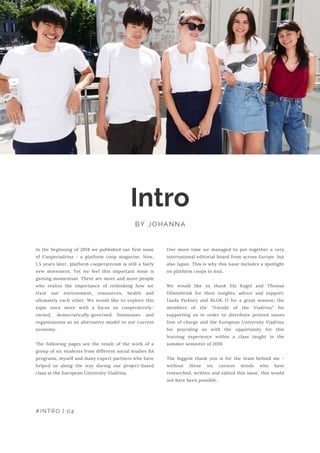
Intro
BY JOHANNA
In the beginning of 2018 we published our first issue
of Coopsviadrina - a platform coop magazine. Now,
1.5 years later, platform cooperativism is still a fairly
new movement. Yet we feel this important issue is
gaining momentum. There are more and more people
who realize the importance of rethinking how we
treat our environment, ressources, health and
ultimately each other. We would like to explore this
topic once more with a focus on cooperatively-
owned, democratically-governed businesses and
organizations as an alternative model to our current
economy. 
The following pages are the result of the work of a
group of six students from different social studies BA
programs, myself and many expert partners who have
helped us along the way during our project-based
class at the European University Viadrina.
#INTRO | 04
Anfang 2018 haben wir unsere erste Ausgabe dieses Magazins
veröffentlicht: Coopsviadrina a platform coop magazine. Jetzt, 1,5
Jahre später, ist Plattformkooperativismus weiterhin eine ziemlich
neue Bewegung. Wir sehen aber auch, dass dieses wichtige Thema
an Dynamik gewinnt. Es gibt immer mehr Menschen, die erkennen,
wie wichtig es ist, unseren Umgang mit der Umwelt, Ressourcen,
Gesundheit und letztendlich auch miteinander zu überdenken. Wir
möchten dieses Thema noch einmal mit dem Fokus auf kooperativ
geführte und demokratisch organisierte Unternehmen und
Organisationen als alternatives Modell zu unserer gegenwärtigen
Wirtschaftspraxis untersuchen.
Die folgenden Seiten sind das Ergebnis der Arbeit einer Gruppe von
sechs Studierenden aus verschiedenen sozialwissenschaftlichen
Bachelor-Studiengängen, mir und vielen engagierten Partner*innen,
die uns während unseres Seminarprojekts an der Europa-
Universität Viadrina geholfen haben. Wieder ist es uns gelungen,
eine sehr internationale Redaktionsgruppe aus ganz Europa, aber
auch aus Japan zusammenzustellen. Aus diesem Grund wird in
dieser Ausgabe ein Schwerpunkt auf Plattformcoops in Asien gelegt.
Wir möchten Ela Kagel und Thomas Dönnebrink für ihren Input,
Ratschläge und die tolle Unterstützung danken. Ebenso geht unser
Dank an Linda Pickney und BLOK O für eine großartige Session; die
Mitglieder des Förderkreises der Viadrina, die uns bei der
Erstellung der gedruckten Ausgaben finanziell unterstützt haben;
und die Europa-Universität Viadrina, die uns die Möglichkeit
gegeben hat, dieses Lernexperiment ein weiteres Mal im
Sommersemester 2019 durchzuführen..
Das größte Dankeschön geht an das Team hinter mir - ohne diese
sechs neugierigen Köpfe, die diese Ausgabe recherchiert,
geschrieben und bearbeitet haben, wäre das nicht möglich gewesen.
Intro
BY JOHANNA
05 | #INTRO
Trebor Scholz, one of the protagonists of the platform
coop movement, is perfectly aware of the limits of
theoretical principles. Still, he created 10 core principles
for platform cooperativism:
Principles
for a
better
Internet
BY CORENTIN
06 | #PRINCIPLES
As we see, these 10 principles do not only concern
platform coops but also the Internet as a whole. These
new actors that are platform coops can help to create
a better Internet, based on the described values. (See
Scholz, T. (2016) for more information)
1 OWNERSHIP
This idea is to have a people-centered Internet by collectively owned platform
cooperatives, owned by the people who generate most of the value on those
platforms. It could reinvigorate this public-minded history of Internet and the
way to think of the Internet as a common good.
2 DECENT PAY AND INCOME SECURITY
Today, we see that there is not really a minimum wage. Numerous examples can
be found in big Internet companies. Especially crowdworking platforms do not
offer a decent income for the clickworkers.  
3 TRANSPARENCY AND DATA PORTABILITY
The goal is to assure an operational transparency to every user, and a secure and
legitimate handling of data that can also be transferred when you are switching
from one platform to another.
4 APPRECIATION AND ACKNOWLEDGMENT
Another aspect is a good working atmosphere for the companies’ employees. He
considers that workers deserve the acknowledgment and appreciation of owners
and operators and the ability to communicate with them, with the enforceable
right to get an explanation.
5 CO-DETERMINED WORK
He also considers that the involvement of workers from the moment of the
programming of the platform and while using it.
6 A PROTECTIVE LEGAL FRAMEWORK
Platform co-ops require legal help because they are deemed unusual. Another
aspect of the legal system is the possibility to create defenses against adverse
legal actions.
7 PORTABLE WORKER PROTECTIONS AND BENEFITS
Social protections should not be tied to one particular workplace. It would greatly
reduce the incentives for employers to resort to contingent workers as a way of
avoiding paying for benefits and worker supports.
8 PROTECTION AGAINST ARBITRARY BEHAVIOR
In platform capitalism, where for instance on platforms such as Uber or Lyft,
consumers take on managerial powers over workers lives, we see many problems.
Furthermore, workers reputation systems are stored on centralized private
servers of the company. A perverse effect can be the impossibility for the worker
to use their reputation independently.
9 REJECTION OF EXCESSIVE WORKPLACE SURVEILLANCE
This means to end the surveillance practices, which leave workers without much
dignity, for example accessing your laptop’s camera to control your work sessions
on crowdwork platforms.
10 THE RIGHT TO LOG OFF
Decent digital work must have clear boundaries. There needs to be time for
relaxation, lifelong learning and voluntary political work.
Trebor Scholz, einer der Protagonisten der Plattform-
Coop-Bewegung, kennt die Grenzen der theoretischen
Prinzipien genau. Dennoch schuf er 10 Grundprinzipien
für das Konzept des Plattformkooperativismus:
Prinzipien
für ein
besseres
Internet
BY CORENTIN
Wie wir sehen, betreffen diese 10 Prinzipien nicht nur
Plattform-Coops, sondern das Internet als Ganzes.
Diese neuen Akteur*innen, die Plattform-
genossenschaften, können dazu beitragen, auf der
Grundlage der beschriebenen Werte ein besseres
Internet für alle zu schaffen (siehe Scholz, T. (2016) für
weitere Informationen).
1 EIGENTUM
Diese Idee dahinter ist, ein menschlich geprägtes Internet rund um Plattform-
Coops zu schaffen, die im Besitz derjenigen sind, die den größten Wert auf diesen
Plattformen erwirtschaften. Das kann die ursprüngliche Idee, das Internet als ein
Gemeinwohl zu betrachten, neu beleben.
2 ANSTÄNDIGE BEZAHLUNG UND EINKOMMENSSICHERHEIT
Wir sehen heute, dass es eigentlich keinen Mindestlohn gibt. Zahlreiche Beispiele
finden sich in großen Internetunternehmen. Insbesondere Crowdworking-
Plattformen bieten den Clickworkern kein angemessenes Einkommen.
3 TRANSPARENZ UND DATENÜBERTRAGBARKEIT
Ziel ist es, eine Transparenz für jede*n Benutzer*in zu erzielen sowie einen
sicheren und legitimen Umgang mit Daten zu gewährleisten, die auch beim Wechsel
von einer Plattform auf eine andere übertragen werden können.
4 ANERKENNUNG UND WERTSCHÄTZUNG
Ein weiterer Aspekt ist ein gutes Arbeitsklima für die Mitarbeiter*innen der
Unternehmen. Scholz ist der Ansicht, dass die Arbeitnehmer*innen die
Anerkennung und Wertschätzung der Eigentümer*innen und Betreiber*innen
sowie die Fähigkeit, mit ihnen zu kommunizieren, zusteht. 
5 MITBESTIMMTE ARBEIT
Er ist auch der Auffassung, dass die Beteiligung der Arbeitnehmer*innen ab dem
Zeitpunkt der Programmierung der Plattform und während der Nutzung gegeben
sein muss.
6 EIN GESCHÜTZTER RECHTLICHER RAHMEN
Plattform-Coops benötigen weitere rechtliche Hilfe, da sie bislang als ungewöhnlich
gelten. Ein weiterer Aspekt des Rechtssystems ist die Möglichkeit,
Abwehrmaßnahmen gegen nachteilige rechtliche Maßnahmen zu etablieren.
7 SCHUTZ UND LEISTUNGEN FÜR FLEXIBLE ARBEITNEHMER*INNEN
Sozialschutz sollte nicht an einen bestimmten Arbeitsplatz gebunden sein. Dies
würde die Anreize für Arbeitgeber*innen, auf Selbstständige zurückzugreifen,
erheblich verringern, um die Bezahlung von Leistungen und die Unterstützung der
Arbeitnehmer*innen zu vermeiden.
8 SCHUTZ VOR WILLKÜRLICHEM VERHALTEN
Im Plattformkapitalismus, in dem Verbraucher*innen beispielsweise auf
Plattformen wie Uber oder Lyft Einfluss auf das Leben von Arbeitnehmer*innen
übernehmen, sehen wir viele Probleme. Darüber hinaus werden die Bewertungen
der Arbeiter*innen auf zentralen privaten Servern eines Unternehmens
gespeichert. Damit ist der Zugriff stark eingeschränkt.
9 ABLEHNUNG EINER ÜBERMÄSSIGEN ÜBERWACHUNG DES ARBEITSPLATZES
Dies bedeutet, die Überwachungspraktiken zu beenden, die den
Arbeitnehmer*innen wenig Würde einräumen, z. B. den Zugriff auf die Kamera des
Laptops, um die Arbeitsleistung auf Crowdwork-Plattformen zu kontrollieren.
10 DAS RECHT ABZUSCHALTEN
Menschenwürdige digitale Arbeit muss klare Grenzen haben. Es muss Zeit für
Entspannung, lebenslanges Lernen und freiwilliges politisches Engagement geben..
07 | #PRINCIPLES
08| #OVERVIEW
Nowadays, it is not an easy task to find a person who would know
what a “platform cooperative” is and where to find one. However, it
is widely spread across the globe and the concept is used effectively
in more and more places. This article will provide an overview of
the international platform coop landscape. Yet this list is not
intended to be exhaustive, as many platform coops are still
initiatives and thought experiments. Depending on the country of
registration there are different regulations and approaches. In
Europe western countries seem more willing to open collaboration
rather than in Central Europe or the East.
Digital Platform Economy: It’s all about sharing 
The collaborative economy is hugely based on digital platforms.
These make it easier, faster, and less expensive to share and
exchange information, services or goods. There are also other forms
of sharing and collaboration, which take place in physical spaces
(coworking) or through different organizational forms (Como,
Mathis, Tognetti, & Rapisardi, 2016). As trust and the ability of
working within a community are essentials it is important to
consider (inter-) cultural aspects and mentality. For instance, in
Poland and the Czech Republic, the debate about the collaborative
economy is still starting to emerge. This is mainly due to the
contextual factors that derive from the history and current
transformations of these countries (Como et al., 2016). This becomes
clearer when we compare it to other countries like the UK, Germany,
Italy, Spain, Belgium, and the Netherlands where platform
cooperatives are evolving. The fastest and the most developed
platform coops started emerging in the USA though.
Heutzutage ist es keine leichte Aufgabe, eine Person zu finden, die wüsste, was
ein "Platform Cooperative" ist und wo man so etwas findet. Sie sind jedoch auf
der ganzen Welt verbreitet und werden immer effektiver an verschiedenen
Orten angewendet. Dieser Artikel gibt einen Überblick über internationale
Plattform-Coop-Projekte. Je nachdem in welchem Land die Genossenschaft
registriert wird, gibt es unterschiedliche Regelungen. In Europa scheinen die
westlichen Länder eher bereit zu sein, sich einer Zusammenarbeit zu öffnen
als in Mitteleuropa oder im Osten Europas.
Digital Platform Economy: It’s all about sharing 
 
Die kollaborative Wirtschaft basiert in hohem Maße auf digitalen
Plattformen. Diese machen den Austausch von Informationen,
Dienstleistungen oder Waren einfacher, schneller und kostengünstiger. Es
gibt auch andere Formen des Teilens und der Zusammenarbeit, die in
physischen Räumen (Coworking) oder durch verschiedene
Organisationsformen stattfinden (Como, Mathis, Tognetti, & Rapisardi, 2016).
Vertrauen und die Fähigkeit, in einer Gemeinschaft arbeiten zu können, sind
unerlässlich. Ebenso ist es wichtig, (inter-) kulturelle Aspekte und
Mentalitäten zu berücksichtigen. Dies ist in Ländern wie Großbritannien,
Deutschland, Italien, Spanien, Belgien und den Niederlanden bereits
verinnerlicht, wo sich „Platform Cooperatives“  etabliert haben. Die
schnellsten und am weitesten entwickelten Plattform-Coops entstanden
jedoch in den USA.
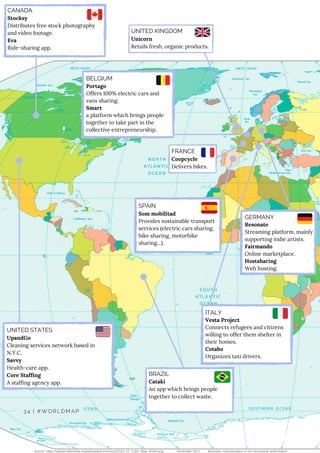
Platform cooperatives
across the world.
An international
movement
BY KRYSTYNA
Austria
In Austria they are making important efforts to raise the interest of
cooperative companies and is supporting the birth of new platforms in the
cooperative form through the Crowdcoopfunding platform. There is even
a federation to support people who want to establish a cooperative.
https://crowdcoopfunding.at/ 
https://rueckenwind.coop/
Regarding Europe, the interest of the European Commission on the
phenomenon is rather recent. Only in June 2016  they released an official
position about the collaborative economy, focusing mainly on the
collaborative consumption and peer-to-peer markets due to three main
reasons: economic potential, consumers’ opportunities, and a new market
generation (European Commission, 2016c; Como et al., 2016). However,
there are still no concrete decisions or legislation. Countries such as the
UK, France, and Italy for example, have a long and known cooperative
tradition and present a high number of cooperatives that have developed
in mature markets. In these countries, some cooperatives have reached a
significant size (in terms of membership, turnover, employees), and their
innovation dynamics are influenced by the conditions of the different
markets in which they operate (Como et al., 2016). Many researchers say
that the mentioned above countries have long established historical
cooperatives, and younger cooperative startups can proft of that. They are
created by younger generation who tend to have a higher affinity to
digital technologies and might be closer to the collaborative economy
culture in general. In other Western countries the interest in platform
coops is growing as well.
Was Europa betrifft, so ist das Interesse der Europäischen Kommission an
diesem Phänomen eher neu. Erst im Juni 2016 wurde eine Stellungnahme
zur kollaborativen Wirtschaft veröffentlicht, wobei der Fokus auf dem
kollaborativen Konsum und den Peer-to-Peer-Märkten lag. Diese umfasst
drei Punkte: wirtschaftliches Potenzial, die Einbindung der
Verbraucher*innen und neue Märkte (Europäische Kommission, 2016c;
Como et al., 2016). Es gibt jedoch noch keine konkreten Entscheidungen
oder Rechtsvorschriften. Länder wie das Großbritannien, Frankreich und
Italien zum Beispiel haben eine lange Genossenschaftstradition, die sich in
reifen Märkten entwickelt hat. In diesen Ländern haben einige
Genossenschaften eine beträchtliche Größe erreicht (in Bezug auf
Mitgliedschaft, Umsatz, Mitarbeiter*innen), und ihre Innovationsdynamik
wird durch die Bedingungen der verschiedenen Märkte, in denen sie tätig
sind, beeinflusst (Como et al., 2016). Laut Forscher*innen gibt es bei den
oben genannten Ländern historisch etablierte Genossenschaften, die sich
bereits vor langer Zeit gegründet haben
 und davon können jüngere Genossenschaften profitieren. Sie, die jüngeren
Genossenschaften, werden von einer jüngeren Generation getragen, die
tendenziell eine höhere Affinität zu digitalen Technologien hat und der
kollaborativen Ökonomie im Allgemeinen aufgeschlossen gegenüber tritt.
Auch in anderen westlichen Ländern wächst das Interesse an Plattform-
Coops.
Österreich
  In Österreich werden wichtige Anstrengungen unternommen, um das
Interesse von Genossenschaften zu wecken, ebenso wird die Entstehung
neuer Plattformen in kooperativer Form über die Crowdcoopfunding-
Plattform unterstützt. Es gibt sogar einen Verband, der Menschen
unterstützt, die eine Genossenschaft gründen wollen.
EUROPE'S ROLE IN THE PLATFORM COOP
MOVEMENT
Switzerland 
Midata offers a shared data platform infrastructure that enables the
citizens’ control over their personal data while contributing to medical
research and clinical studies.
https://www.midata.coop/ 
Schweiz 
Midata bietet eine gemeinsame Datenplattform-Infrastruktur, die es
den Bürger*innen ermöglicht, ihre personenbezogenen Daten zu
kontrollieren und gleichzeitig zu medizinischer Forschung und
klinischen Studien beizutragen.
https://www.midata.coop/
 
Germany
Fairmondo is an online marketplace that offers an alternative to existing
online shops that is owned by their customers as well as the sellers. 
https://www.fairmondo.de/ 
There is also Resonate - a Berlin-based platform coop that allows you to
stream music. Find an article about the ideas behind it on the following
pages of this magazine.
https://resonate.is/ 
Sport Coop is currently in the process of being founded in Berlin and will
provide a digital platform to book and pay different sports classes in a
sustainable and inclusive way.
https://sportcoop.berlin/de 
Hostsharing is a small German platform coop for web hosting that is
based in Hamburg. 
https://www.hostsharing.net/
 Deutschland
 Fairmondo ist ein Online-Marktplatz, der eine Alternative zu bestehenden
Online-Shops bietet. Hier besitzen sowohl Kund*innen, als auch
Verkäufer*innen Anteile an der Plattform. 
https://www.fairmondo.de/   
 Ebenso interessant ist Resonate - ein Berliner Plattform-Coop, mit dem
man Musik streamen kann. Einen Artikel über die Ideen dahinter ist in
diesem Magazin zu finden.
https://resonate.is/  
 Sport Coop wird derzeit in Berlin gegründet und soll eine digitale Plattform
bieten, um verschiedene Sportkurse zu buchen und zu bezahlen –
nachhaltig mit fairer Bezahlung aller.
https://sportcoop.berlin/de  
Hostsharing ist ein kleines deutsches Plattform-Coop für Webhosting mit
Sitz in Hamburg. 
https://www.hostsharing.net/
 
#OVERVIEW| 09
10 | #OVERVIEW
Italy
Another country like Austria, Italy with its Confcooperative started
promoting some debate and training on the collaborative economy topic
within its Coop Up project, which promotes cooperative startups across
Italy (Como et al., 2016).
https://www.confcooperative.it/
The Vesta project in Italy is developed by the Italian Cooperative Camelot.
It uses a digital platform to recruit families that want to host refugees in
their houses, sharing their spare rooms with those who need them. 
http://www.progettovesta.com/en/
Cotabo is a platform coop in Bologna, that organizes taxi drivers through
digital technology with easy to access information and payment options. 
http://www.cotabo.it/
Netherlands
In the Netherlands there are many small, local platforms whose
members approach the cooperative model for ideological and value
reasons. Mainly focusing on the social aspects of cooperation, they
underestimate the significance  of a sustainable business model. 
Fairbnb is a platform coop that is now starting to be active in many cities
providing holiday accommodations that started out in Amsterdam. We
wrote about their approach to community powered tourism in the first
issue of #CoopsViadrina. 
https://fairbnb.coop/ 
Belgium
Pertago is a platform coop which provides a car sharing service with
100% electric cars and vans. By having an app on the smartphone you
can easily access it. Every ride is based on your driving credits. Their
goal is to provide sustainable forms of mobility. As they say: ”With fewer
cars we still can provide the necessary car mobility for everyone”. 
https://www.partago.be/
SMart (Societe Mutuelle pour artistes) was originally founded in 1998 in
Belgium. It has now expanded in 9 European countries and almost
100.000 members and is a freelancer coop. 
https://smart.coop/
Many more Belgian platform coops are in the making and can be found
here (in French): https://platformcoop.brusselso enhance the flavours
and texture.
Italien
Italien begann mit Confcooperative, ähnlich wie Österreich, einige
Diskussionen und Schulungen zum Thema kollaborative Wirtschaft im
Rahmen eines Coop Up-Projekts zu fördern. Hier werden genossenschaftliche
Startups in ganz Italien gefördert.(Como et al., 2016). 
https://www.confcooperative.it/ 
Das Vesta-Projekt in Italien wird von der italienischen Genossenschaft
Camelot entwickelt. Sie nutzt eine digitale Plattform, um Familien zu finden,
die Geflüchtete in ihren Häusern/Wohnungen aufnehmen wollen und teilt
deren freie Zimmer mit denen, die sie brauchen. 
 http://www.progettovesta.com/en/ 
Cotabo ist ein Plattform-Coop in Bologna, bei dem Taxifahrer*innen mit Hilfe
digitaler Technologie eine einfachere Organisation der täglichen Arbeit, durch
leicht zugänglichen Informationen und Zahlungsoptionen ermöglicht wird. 
http://www.cotabo.it/
Niederlande
In den Niederlanden gibt es viele kleine, lokale Plattformen, deren Mitglieder
sich aus ideologischen und sozialen Gründen dem Genossenschaftsmodell
verbunden fühlen. Sie konzentrieren sich vor allem auf die sozialen Aspekte
der Zusammenarbeit und unterschätzen die Bedeutung eines nachhaltigen
Geschäftsmodells.
Fairbnb, ursprünglich für Amsterdam entwickelt, ist ein Plattform-Coop,
dasmittlerweile in vielen Städten aktiv ist und Ferienunterkünfte anbietet. Wir
haben bereits in der ersten Ausgabe von #CoopsViadrina darüber berichtet. 
https://fairbnb.coop/ 
Belgien
Pertago ist ein Plattform-Coop, das einen Carsharing-Service mit 100%
Elektroautos und Lieferwagen bietet. Mit einer App kann man ganz einfach
darauf zugreifen. Ziel ist es, nachhaltige Formen der Mobilität zu schaffen,
denn: "Mit weniger Autos können wir immer noch die notwendige
Automobilität für alle bieten". 
https://www.partago.be/ 
Smart (Societe Mutuelle pour artistes) wurde ursprünglich 1998 in Belgien
gegründet. Man kann es mittlerweile in 9 europäischen Ländern nutzen, es hat
sich um fast 100.000 Mitgliedern erweitert und ist ein Freelancer-Coop. 
https://smart.coop/ 
Viele weitere belgische Plattform-Coops sind in der Entstehung und können
hier (auf Französisch) eingesehen werden: https://platformcoop.brussel
Spain
Som Mobilitat is a car non-profit platform consumer cooperative that
provides mobility products and services.They promote sustainable
vehicles. To make a reservation you need to have an app. Besides cars
they offers bike-, motorbike-sharing, car-pooling, and ride-sharing. They
are established as local groups, but also work on the EU level. The
REScoop Mobility network cooperatives in Europe was created by
Spanish Som Mobilitat.
https://www.sommobilitat.coop/
France
CoopcycleisafederationofbikedeliverydriversinFrance. 
https://coopcycle.org/en/
Spanien
Som Mobilitat ist eine gemeinnützige Carsharing-Plattform, die
Fortbewegungsmittel und -dienstleistungen anbietet. Sie fördern nachhaltige
Fahrzeuge. Um eine Reservierung vorzunehmen, benötigt man eine App. Neben
Autos, kann man hier auch Bike-Sharing, Car-Pooling und Ride-Sharing in
Anspruch nehmen. Als lokale Gruppe gestartet, arbeiten sie mittlerweile auch auf
EU-Ebene. 
https://www.sommobilitat.coop/
Frankreich
Coopcycle ist ein Verband von Fahrradlieferfahrer*innen . 
https://coopcycle.org/en/
Brazil
Cataki is an app for self-employed people who collect about 90% of
everything that is currently recycled in Brazil. It is often compared to
Tinder due to its functionalities. This has had a great impact on the
waste management in the country.
https://cataki.org/en
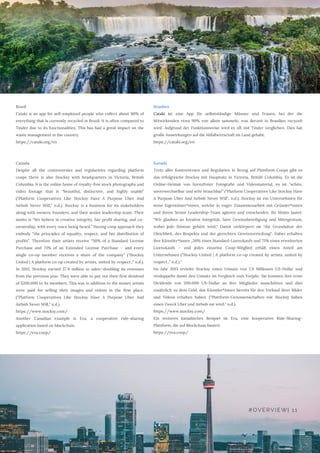
Canada 
Despite all the controversies and regularities regarding platform
coops there is also Stocksy with headquarters in Victoria, British
Columbia. It is the online home of royalty-free stock photography and
video footage that is “beautiful, distinctive, and highly usable”
(“Platform Cooperatives Like Stocksy Have A Purpose Uber And
Airbnb Never Will,” n.d.). Stocksy is a business for its stakeholders
along with owners, founders, and their senior leadership team. Their
motto is “We believe in creative integrity, fair profit sharing, and co-
ownership, with every voice being heard.” Having coop approach they
embody “the principles of equality, respect, and fair distribution of
profits”. Therefore their artists receive “50% of a Standard License
Purchase and 75% of an Extended License Purchase – and every
single co-op member receives a share of the company” (“Stocksy
United | A platform co-op created by artists, united by respect.,” n.d.).
In 2015, Stocksy earned $7.9 million in sales—doubling its revenues
from the previous year. They were able to pay out their first dividend
of $200,000 to its members. This was in addition to the money artists
were paid for selling their images and videos in the first place.
(“Platform Cooperatives Like Stocksy Have A Purpose Uber And
Airbnb Never Will,” n.d.).
https://www.stocksy.com/
Another Canadian example is Eva, a cooperative ride-sharing
application based on blockchain.
https://eva.coop/
Brasilien
Cataki ist eine App für selbstständige Männer und Frauen, bei der die
Mitwirkenden etwa 90% von allem sammeln, was derzeit in Brasilien recycelt
wird. Aufgrund der Funktionsweise wird es oft mit Tinder verglichen. Dies hat
große Auswirkungen auf die Abfallwirtschaft im Land gehabt.
https://cataki.org/en 
Kanada
Trotz aller Kontroversen und Regularien in Bezug auf Plattform-Coops gibt es
das erfolgreiche Stocksy mit Hauptsitz in Victoria, British Columbia. Es ist die
Online-Heimat von lizenzfreier Fotografie und Videomaterial, es ist "schön,
unverwechselbar und sehr brauchbar” ("Platform Cooperatives Like Stocksy Have
A Purpose Uber And Airbnb Never Will", n.d.). Stocksy ist ein Unternehmen für
seine Eigentümer*innen, welche in enger Zusammenarbeit mit Gründer*innen
und ihrem Senior Leadership-Team agieren und entscheiden. Ihr Motto lautet:
"Wir glauben an kreative Integrität, faire Gewinnbeteiligung und Miteigentum,
wobei jede Stimme gehört wird." Damit verkörpern sie "die Grundsätze der
Gleichheit, des Respekts und der gerechten Gewinnverteilung". Daher erhalten
ihre Künstler*innen „50% eines Standard-Lizenzkaufs und 75% eines erweiterten
Lizenzkaufs – und jedes einzelne Coop-Mitglied erhält einen Anteil am
Unternehmen (“Stocksy United | A platform co-op created by artists, united by
respect.,” n.d.).“
Im Jahr 2015 erzielte Stocksy einen Umsatz von 7,9 Millionen US-Dollar und
verdoppelte damit den Umsatz im Vergleich zum Vorjahr. Sie konnten ihre erste
Dividende von 200.000 US-Dollar an ihre Mitglieder ausschütten und dies
zusätzlich zu dem Geld, das Künstler*innen bereits für den Verkauf ihrer Bilder
und Videos erhalten haben. ("Plattform-Genossenschaften wie Stocksy haben
einen Zweck Uber und Airbnb nie wird," n.d.).
https://www.stocksy.com/ 
Ein weiteres kanadisches Beispiel ist Eva, eine kooperative Ride-Sharing-
Plattform, die auf Blockchain basiert.
https://eva.coop/
#OVERVIEW| 11
12 | #OVERVIEW
“There is no ‘us’
and ‘them’, so we
all work as hard
as we can to make
it work.”
Vereinigtes Königreich
Wie viele der Länder, die wir bereits erwähnt haben, hat das Vereinigte
Königreich vor langer Zeit eine breite Palette von Genossenschaften entwickelt
und etabliert. Die Nutzung einer digitalen Plattform macht sie sichtbar und
sensibilisiert die Öffentlichkeit. Eines der erfolgreichsten Plattform-Coops ist
"Unicorn". 2017 wurde es von den BBC Food/Farming Awards zum "Best Food
Retailer" gekürt. Es wurde 1996 in Manchester gegründet und bereits damals
hatten die Menschen die Vision eines Ladens mit erschwinglichen, frischen und
gesunden Lebensmitteln mit einem Schwerpunkt auf Bio-, Fairtrade- und lokalen
Produkten ("Unicorn-Lebensmittel - frische Bio-Produkte und Vollwertkost in
Manchester"). Die Plattform wird von ihren Arbeiter*innen geführt, die eine
soziale und ökologische Agenda verfolgen. Es gibt eine Website, auf der man
online Lebensmittel ordern kann. Nach Bedarf können die Produkte auch
geliefert werden. Durch die ständige Weiterentwicklung der Technologie,
werden Genossenschaften zu Plattform-Coops. Eine weitere Möglichkeit, wie
Genossenschaften Technologie zur Umsetzung kollaborativer Praktiken nutzen
können, besteht darin, sie auf ihre internen Governance-Systeme anzuwenden,
um die Beteiligung von Mitgliedern und Gemeinschaften zu fördern. Darüber
hinaus gibt es Genossenschaften, die dank des Einsatzes neuer Technologien die
Erfahrungen kollektiver Einkaufsgruppen erneuern und neue Formen der
Solidarität und des kollektiven Handelns fördern (Como et al., 2016). 
www.unicorn-grocery.coop/
United Kingdom
Just like many of the countries we have mentioned before, the UK has
developed a wide range of cooperatives a long time ago. The use of a
digital platform makes it visible and raises public awareness. One of
the successful platform coops is “Unicorn”. It was named ‘Best Food
Retailer’ in 2017 by BBC Food/Farming Awards. It was established in
the early 1996 in Manchester and back then people already had this
vision of a store with affordable, fresh and wholesome food with an
emphasis on organic, fair-trade and local produce (“Unicorn Grocery -
fresh organic produce and wholefoods in Manchester,” n.d.). It is run
by its workers-owners who are following a social and environmental
agenda. Later they created their website where you can shop and all
the products can be delivered. As the technology is constantly
evolving that is how the cooperatives are turning into the platform
coops. Another way in which cooperatives can use technology to
implement collaborative practices is by applying it to their internal
governance systems to straighten and innovate participation of
members and communities. Moreover, there are cooperatives that
thanks to the use of new technologies are innovating the experience
of collective purchasing groups, and promoting new forms of
solidarity and collective action (Como et al., 2016). 
www.unicorn-grocery.coop/
'Es gibt kein 'wir' und
'sie', also arbeiten wir
alle so hart wie
möglich daran, dass
es funktioniert."
Demokratische Prozesse sind ein wichtiges Thema, mit dem sich Platform-Coops
konfrontiert sehen. Nathan Brown, Mitglied der Beratungsfirma Co-Operantics,
arbeitet mit Unternehmen zusammen, um ihnen zu helfen, partizipativer zu
werden. Er betont die Bedeutung einer genossenschaftlichen Kultur sowie die
eines formalen Prozesses, um solch ein Unternehmen zu führen (Guardian
Sustainable Business | Der Wächter, " n.d.). Es hat einige Zeit gedauert, Prozesse
bei der Arbeiter*innengenossenschaft Unicorn Grocery in Manchester zu
entwickeln, aber wie Kellie Bubble (Angestellte von Unicorn) sagt, muss jeder in
das Geschäft einbezogen werden, Kommunikation ist entscheidend ("Lessons for
co-operatives on ensuring a fair and democratic structure | Guardian Sustainable
Business | The Guardian," n.d.).
This is a major issue that platform coops are facing with – democratic
governance. Nathan Brown, who is a member of consultancy Co-
operantics, works with businesses to help them become more
participative. He stresses the importance of a co-operative culture as
well as having a formal process in order to run a business (Guardian
Sustainable Business | The Guardian,” n.d.). It has taken time to develop
processes at the worker cooperative Unicorn Grocery in Manchester,
but  as Kellie Bubble (worker-owner of Unicorn) states, everyone has to
be involved in the business and delegating along with communication is
vital (“Lessons for co-operatives on ensuring a fair and democratic
structure | Guardian Sustainable Business | The Guardian,” n.d.). 
USA
We found many coops beyond Europe. However, many of their problems
are universal. Especially the process of setting up the legal framework -
even though it differs from country to country - is a challenging process.
Many activists express that the more governments understood about their
current challenges platform coops could be better equipped to strive the
ecosystem around them. 
Another fundamental feature is that everybody has to be aware of what
quality is. In the case of the platform coop “UpandGo”, a cleaning service,
based in NY, they have to make sure that the customer experience is the
same no matter which member of the cooperative is providing the service. 
https://www.upandgo.coop/
Another example that is based in New York is Savvy, the first patient-
owned coop that empowers people to use their experience to create
positive change for all. It is especially interesting for people with chronic
diseases as they often are the experts of their symptoms and how this
affects them in their daily life.   
https://www.savvy.coop 
Core Staffing is a staffing agency that focuses on previously incarcerated
people who are returning to the workforce with the use of different
educational programs and methods to help their members achieve career
goals. 
https://www.corestaffing.us/
USA
Wir haben viele Coops außerhalb Europas gefunden, viele haben ähnliche
Probleme wie die hiesigen Coops. Vor allem die Schaffung des Rechtsrahmens
gestaltet sich oft als schwierig und ist ein herausfordernder Prozess - auch
wenn dies von Land zu Land unterschiedlich ist. Viele Aktivist*innen bringen
zum Ausdruck, dass die jeweiligen Landesregierungen mehr Interesse und
Initiative zeigen müssten, um besser gerüstet zu sein, um so ein gutes
Ökosystem aufbauen zu können.
Ein weiteres grundlegendes Merkmal ist, dass sich jeder dessen bewusst sein
muss, was Qualität ist. Im Falle vom Platform-Coop "UpandGo", einem
Reinigungsservice mit Sitz in NY, muss sichergestellt sein, dass das
Kund*innenerlebnis gleich ist, unabhängig davon, welches Mitglied der
Genossenschaft den Service erbietet. 
https://www.upandgo.coop/ 
 Ein weiteres Beispiel, welches den Ursprung ebenso in New York hat, ist Savvy,
das erste patienteneigene Coop, das es Menschen ermöglicht ihre Erfahrung zu
nutzen und sie mit anderen auszutauschen, um positive Veränderungen für alle
zu schaffen. Es ist besonders interessant für Menschen mit chronischen
Krankheiten, da sie oft die Expert*innen ihrer Symptome sind und so selbst
bestmöglich beschreiben können, wie sich dies auf das eigene, alltägliche Leben
auswirkt und was helfen kann.
https://www.savvy.coop/ 
  Coretaffing ist eine Personalagentur, die sich auf zuvor inhaftierte Personen
konzentriert, die mit verschiedenen Bildungsprogrammen und Methoden ins
Erwerbsleben zurückkehren sollen. Sie wollen ihren Mitgliedern dabei helfen
ihre Karriereziele zu verwirklichen.
https://www.corestaffing.us/
However, one of our biggest strengths is that we multitask so we have an
awful lot of interaction, resulting in a really deep understanding of the
business. We could start our day unloading a pallet of veg, then work on
the till and do financial planning in the afternoon,” says Kellie.  “There is no
‘us’ and ‘them’, so we all work as hard as we can to make it work.” (“Lessons
for co-operatives on ensuring a fair and democratic structure | Guardian
Sustainable Business | The Guardian,” n.d.). 
https://www.unicorn-grocery.coop/ 
It is important to get the right balance of structure and culture. Operating
in the highly competitive telecoms market we found the Phone Coop. A
UK-wide customer-owned coop that has 10,000 members.
https://www.thephone.coop/
"Eine unserer größten Stärken ist jedoch die Möglichkeit des Multitaskings,
durch die Menge an Interaktion haben wir ein tiefes Verständnis für das
tägliche Geschäft. Wir könnten unseren Tag mit dem Entladen einer Palette
Gemüse beginnen, dann an der Kasse arbeiten und am Nachmittag eine
Finanzplanung machen", sagt Kellie. "Es gibt kein 'wir' und 'sie', also arbeiten
wir alle so hart wie möglich daran, dass es funktioniert." ("Lessons for co-
operatives on ensuring a fair and democratic structure | Guardian Sustainable
Business | The Guardian,” n.d.). 
https://www.unicorn-grocery.coop/  
Es ist wichtig das richtige Gleichgewicht zwischen Struktur und Kultur zu
finden. Auf dem hart umkämpften Telekommunikationsmarkt haben wir das
Phone-Coop gefunden. Eine britische Kunden-Coop mit 10.000 Mitgliedern.
https://www.thephone.coop/
#OVERVIEW| 13
14 | #OVERVIEW
More and more people are disappointed in the capitalistic system many
people live in today. However, we are trying to find a way out to find a
better system. We can see from the platform coops which are mentioned
above that there already are some projects which are functioning quite
well. People are willing to cooperate, even on international levels despite
all the struggle. As Trebor Scholz says: “Cooperatives are not a panacea
for all the wrongs of platform capitalism but they could help to weave
some ethical threads into the fabric of 21st century work” (Scholz, 2016).
Read more about platform coops in Asia and especially Japan in the
following articles in this magazine.
“Unity is strength …
when there is teamwork
and collaboration,
wonderful things can be
achieved”.
 Mattie Stepanek
"Einheit ist Stärke ... wenn
es Teamwork und
Zusammenarbeit gibt,
können wunderbare Dinge
erreicht werden."
Mattie Stepanek
Immer mehr Menschen sind enttäuscht von dem kapitalistischen System, in
dem viele Menschen heute leben. Wir versuchen jedoch, einen Ausweg zu
finden, um ein besseres System zu erschaffen. Wir können an den oben
erwähnten Plattform-Kooperativen erkennen, dass es bereits einige Projekte
gibt, die recht gut funktionieren. Die Menschen sind bereit,
zusammenzuarbeiten, auch auf internationaler Ebene trotz aller Problemen,
die damit einhergehen. Trebor Scholz sagt: "Genossenschaften sind kein
Allheilmittel für all das Unrecht des Plattformkapitalismus, aber sie könnten
helfen, einige ethische Fäden in das Gefüge der Arbeit des 21.Jahrhunderts zu
verweben" (Scholz, 2016). Lest  mehr über Plattform-Coops in Asien und
insbesondere Japan in den folgenden Artikeln in diesem Magazin.
New Zealand 
The last but not least there is Enspiral that was founded in New Zealand
by people who were inspired to create something together. In 2011 it
started to be called a social enterprise and they started Loomio, a
collective decision-making tool. The support continued to grow and the
Enspiral Space was established. They started to gain some major
projects and partnerships. This way they became the voice and brand in
New Zealand’s social enterprise sector (“Ventures - enspiral-dev,” n.d.).
They help to facilitate collaboration between people and different types
of organizations.
“Since inception we’ve been testing ways of working together with trust
and respect to share money, information and control as openly as
possible. As a community we’ve supported hundreds of people to launch
and build all sorts of initiatives, projects and world-changing ventures.”
We’re committed to continue to learn and grow our positive impact
together”
Loomio is such an open source collaborative governance tool that is a
part of Enspiral network. It helps to support cooperatives all over the
world. Loomio aims for the adaptive and self-reflexive tools of the
community’s collective wisdom. Its owners are committed to high
standards of sharing information. 
“A worker-owned cooperative structure is a powerful way to live our
values of collaboration and collective ownership”. 
https://www.loomio.org/
https://enspiral.com/pages/about
Neuseeland
Nicht zuletzt gibt es Enspiral, das in Neuseeland von Menschen gegründet
wurde, die die Inspiration hatten, etwas zusammen zu erschaffen. Im Jahr 2011
wurde es als soziales Unternehmen bezeichnet und so wurde eine Plattform
namens Loomio erschaffen, ein Online-Entscheidungs-Tool. Die
Unterstützung wuchs weiter und der Enspiral Space wurde gegründet. Sie
begannen einige große Projekte und Partnerschaften für sich zu gewinnen. Auf
diese Weise wurden sie zur Stimme und Marke im neuseeländischen Social-
Enterprise-Sektor ("Ventures - enspiral-dev", n.d.). Sie tragen dazu bei, die
Zusammenarbeit zwischen Menschen und verschiedenen Arten von
Organisationen zu erleichtern.
"Seit unserer Gründung testen wir Möglichkeiten, mit Vertrauen und Respekt
zusammenzuarbeiten, um Geld, Informationen und Kontrolle so offen wie
möglich auszutauschen. Als Community haben wir Hunderte von Menschen
unterstützt, um alle möglichen Initiativen, Projekte und weltverändernden
Unternehmungen zu starten und aufzubauen."
„Wir sind entschlossen, weiterhin zusammen zu lernen und uns zu steigern,
um so von den positiven Auswirkungen zu profitieren.“
Loomio ist ein Open-Source-Tool, das Teil des Enspiral-Netzwerks ist. Es hilft,
Genossenschaften und Initiativen auf der ganzen Welt zu unterstützen.
Loomio zielt auf die adaptiven und selbstreflexiven Werkzeuge der kollektiven
Weisheit der Gemeinschaft ab. Seine Eigentümer*innen verpflichten sich zu
hohen Standards des Informationsaustauschs.
"Eine genossenschaftliche Struktur im Besitz von Arbeitnehmer*innen ist eine
leistungsstarke Möglichkeit, unsere Werte der Zusammenarbeit und des
kollektiven Eigentums zu leben." 
https://www.loomio.org/ 
https://enspiral.com/pages/about
 The Guardian reports on the multiple strikes of
Uber drivers about their pay and working
conditions and names about ten cities that ask
for EU help to fight Airbnb’s expansion.
Meanwhile, in Berlin happens the launch of the
Commons Manifesto – the recent book about
peer-to-peer technologies and p2p production
written by Michel Bauwens, Vasilis Kostakis and
Alex Pazaitis.
 
 
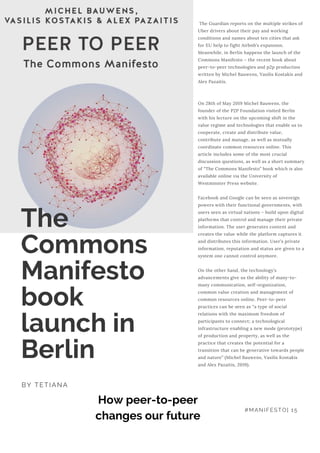
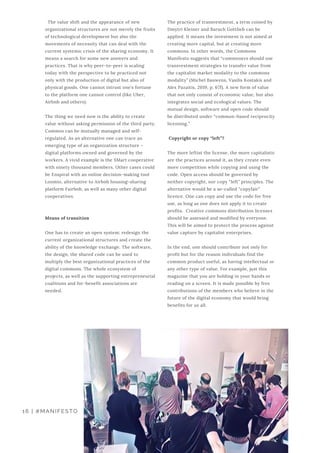
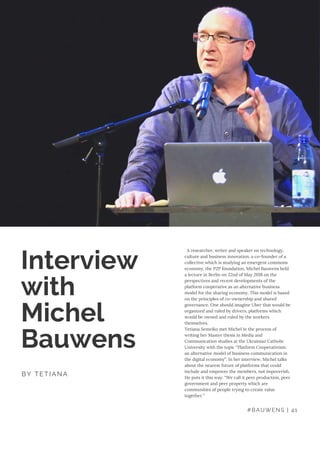
On 28th of May 2019 Michel Bauwens, the
founder of the P2P Foundation visited Berlin
with his lecture on the upcoming shift in the
value regime and technologies that enable us to
cooperate, create and distribute value,
contribute and manage, as well as mutually
coordinate common resources online. This
article includes some of the most crucial
discussion questions, as well as a short summary
of “The Commons Manifesto” book which is also
available online via the University of
Westminster Press website.
 
Facebook and Google can be seen as sovereign
powers with their functional governments, with
users seen as virtual nations – build upon digital
platforms that control and manage their private
information. The user generates content and
creates the value while the platform captures it
and distributes this information. User’s private
information, reputation and status are given to a
system one cannot control anymore.
 
On the other hand, the technology’s
advancements give us the ability of many-to-
many communication, self-organization,
common value creation and management of
common resources online. Peer-to-peer
practices can be seen as “a type of social
relations with the maximum freedom of
participants to connect; a technological
infrastructure enabling a new mode (prototype)
of production and property, as well as the
practice that creates the potential for a
transition that can be generative towards people
and nature” (Michel Bauwens, Vasilis Kostakis
and Alex Pazaitis, 2019).
The
Commons
Manifesto
book
launch in
Berlin
BY TETIANA
How peer-to-peer
changes our future
#MANIFESTO| 15
The practice of transvestment, a term coined by
Dmytri Kleiner and Baruch Gottlieb can be
applied. It means the investment is not aimed at
creating more capital, but at creating more
commons. In other words, the Commons
Manifesto suggests that “commoners should use
transvestment strategies to transfer value from
the capitalist market modality to the commons
modality” (Michel Bauwens, Vasilis Kostakis and
Alex Pazaitis, 2019, p. 67f). A new form of value
that not only consist of economic value, but also
integrates social and ecological values. The
mutual design, software and open code should
be distributed under “common-based reciprocity
licensing.”
 Copyright or copy “left”?
 
The more leftist the license, the more capitalistic
are the practices around it, as they create even
more competition while copying and using the
code. Open access should be governed by
neither copyright, nor copy “left” principles. The
alternative would be a so-called “copyfair”
licence. One can copy and use the code for free
use, as long as one does not apply it to create
profits.  Creative commons distribution licenses
should be assessed and modified by everyone.
This will be aimed to protect the process against
value capture by capitalist enterprises.
 
In the end, one should contribute not only for
profit but for the reason individuals find the
common product useful, as having intellectual or
any other type of value. For example, just this
magazine that you are holding in your hands or
reading on a screen. It is made possible by free
contributions of the members who believe in the
future of the digital economy that would bring
benefits for us all.
  The value shift and the appearance of new
organizational structures are not merely the fruits
of technological development but also the
movements of necessity that can deal with the
current systemic crisis of the sharing economy. It
means a search for some new answers and
practices. That is why peer-to-peer is scaling
today with the perspective to be practiced not
only with the production of digital but also of
physical goods. One cannot intrust one’s fortune
to the platform one cannot control (like Uber,
Airbnb and others).
 
The thing we need now is the ability to create
value without asking permission of the third party.
Commos can be mutually managed and self-
regulated. As an alternative one can trace an
emerging type of an organization structure –
digital platforms owned and governed by the
workers. A vivid example is the SMart cooperative
with ninety thousand members. Other cases could
be Enspiral with an online decision-making tool
Loomio, alternative to Airbnb housing-sharing
platform Fairbnb, as well as many other digital
cooperatives.
 
 
Means of transition
 
One has to create an open system; redesign the
current organizational structures and create the
ability of the knowledge exchange. The software,
the design, the shared code can be used to
multiply the best organizational practices of the
digital commons. The whole ecosystem of
projects, as well as the supporting entrepreneurial
coalitions and for-benefit associations are
needed. 
16 | #MANIFESTO
Der Guardian berichtet über die mehrfachen Streiks von Uber-
Fahrer*innen aufgrund ihrer schlechten Bezahlung sowie
Arbeitsbedingungen und nennt etwa zehn Städte, die um EU-Hilfe
bei der Bekämpfung der Airbnb-Expansion bitten. Parallel wird in
Berlin das Commons Manifesto vorgestellt - das kürzlich
erschienene Buch über Peer-to-Peer-Technologien und P2P-
Produktion von Michel Bauwens, Vasilis Kostakis und Alex
Pazaitis.
Am 28. Mai 2019 besuchte Michel Bauwens, der Gründer der P2P-
Stiftung, Berlin mit seinem Vortrag über die bevorstehende
Veränderung des Werteregimes und der Technologien, die es uns
ermöglichen, zusammenzuarbeiten, Werte zu schaffen und zu
verbreiten, Beiträge zu leisten und zu verwalten sowie
Gemeingüter online zu koordinieren. Dieser Artikel enthält einige
der wichtigsten Diskussionsfragen sowie eine kurze
Zusammenfassung des Buches „The Commons Manifesto“, das
auch online über die Website der University of Westminster Press
erhältlich ist.
Facebook und Google können mit ihren quasi funktionalen
Regierungen als souveräne Mächte angesehen werden. Die
Nutzer*innen werden als virtuelle Nationen betrachtet. Sie bauen
auf digitalen Plattformen auf, die ihre privaten Informationen
kontrollieren und verwalten. Die Benutzer*innen generieren
Inhalte und erstellen den eigentlichen Wert, während die
Plattform ihn erfasst und diese Informationen wiederum verteilt.
Die privaten Informationen, das digitale Ansehen (Reputation) und
der Status der Benutzer*innen werden einem System zugewiesen,
das nicht mehr von ihnen kontrolliert werden kann.
Auf der anderen Seite ermöglichen uns die Fortschritte der
Technologie eine Kommunikation von vielen zu vielen,
Selbstorganisation, gemeinsame Wertschöpfung und die
Verwaltung gemeinsamer Online-Ressourcen. Peer-to-Peer-
Praktiken können als „eine Art sozialer Beziehungen mit der
größtmöglichen Freiheit der Teilnehmer*innen gesehen werden;
eine technologische Infrastruktur, die einen neuen Produktions-
und Eigentumsmodus (Prototyp) ermöglicht, sowie die Praxis, die
das Potenzial für einen Übergang schafft, der für Mensch und
Natur generativ sein kann“ (Michel Bauwens, Vasilis Kostakis und
Alex Pazaitis, 2019).
Die Wertverschiebung und das Auftreten neuer
Organisationsstrukturen sind nicht nur die Früchte der
technologischen Entwicklung, sondern auch eine Bewegung der
Notwendigkeit, die sich mit der gegenwärtigen Systemkrise der
Sharing Economy auseinandersetzen könne. Dies ist auch eine
Suche nach neuen Antworten und Praktiken. Deshalb skaliert
Peer-to-Peer heute mit der Perspektive, nicht nur bei der
Die Buchvorstellung des Commons
Manifesto in Berlin: Wie Peer-to-Peer unsere
Zukunft verändert
BY TETIANA
17 | #MANIFESTO
Produktion von digitalen, sondern auch von physischen Gütern
praktiziert zu werden. Man kann sein „Vermögen“ nicht der
Plattform anvertrauen, die man nicht mehr kontrollieren kann
(wie Uber, Airbnb und andere).
Das, was wir jetzt brauchen, ist die Fähigkeit, Wert zu schaffen,
ohne die Erlaubnis des Dritten einzuholen. Commos können
gegenseitig verwaltet und selbst reguliert werden. Als
Alternative kann man einen aufkommenden Typ einer
Organisationsstruktur verfolgen - digitale Plattformen, die den
Arbeiter*innen gehören und von ihnen verwaltet werden. Ein
anschauliches Beispiel ist die SMart-Genossenschaft mit
neunzigtausend Mitgliedern. Andere Beispiele sind Enspiral mit
einem Online-Entscheidungstool, Loomio, eine Alternative zur
Airbnb-Plattform für Ferienaufenthalte, Fairbnb, sowie viele
andere digitale Genossenschaften.
Mittel der Transformation
Wir müssen ein offenes System schaffen, gekoppelt mit der
Neugestaltung der aktuellen Organisationsstrukturen und
Möglichkeiten zum Wissensaustausch. Die Software, das Design
und der gemeinsam genutzte Code können verwendet werden,
um die Best Practices der Digital Commons zu multiplizieren.
Das gesamte Ökosystem der Projekte sowie die unterstützenden
unternehmerischen Koalitionen und gemeinnützigen
Vereinigungen werden dazu benötigt.
Die von Dmytri Kleiner und Baruch Gottlieb geprägte
Transvestitionspraxis kann angewendet werden. Dies bedeutet,
dass die Investition nicht auf die Schaffung von mehr Kapital
abzielt, sondern auf die Schaffung von mehr Gemeingütern. Mit
anderen Worten, das Commons-Manifest schlägt vor, dass
„Bürger*innen Transvestitionsstrategien anwenden sollten, um
den Wert von der kapitalistischen Marktmodalität auf die
Commons-Modalität zu übertragen“ (Michel Bauwens, Vasilis
Kostakis und Alex Pazaitis, 2019, S. 67f). Eine neue Wertform, die
nicht nur aus wirtschaftlichem Wert besteht, sondern auch
soziale und ökologische Werte integriert. Das jeweilige Design,
die Software und der offene Code sollten unter einer "Common-
Based-Reciprocity-Lizenzierung" verbreitet werden.
Copyright oder Copy "Left"?
Je linksorientierter die Lizenz ist, desto kapitalistischer sind die
Praktiken, die sie umgeben. Open Access sollte weder durch
Urheberrechte noch durch Copyleft-Prinzipien geregelt werden.
Die Alternative wäre eine sogenannte "Copyfair" -Lizenz. Man
kann den Code (oder die Informationen allgemein) kopieren und
zur freien Verwendung verwenden, solange man ihn nicht nutzt,
um Gewinne zu erzielen. Creative-Commons-Lizenzen sollten
von jedem geprüft und geändert werden können. Dies soll den
Prozess vor der Ausbeutung durch kapitalistische Unternehmen
schützen.
Am Ende sollte man nicht nur zum Profit beitragen, sondern
auch zu einer gemeinsamen Produktion beitragen, weil es einen
intellektuellen oder einen anderen Wert hat. Zum Beispiel dieses
Magazin, das Ihr in Euren Händen haltet oder auf einem
Bildschirm lest. Möglich wird dies durch kostenlose Beiträge der
Mitglieder, die an die Zukunft einer anderen digitalen Wirtschaft
glauben von der wir alle profitieren können.
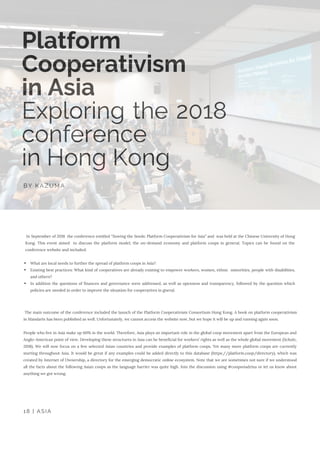
 In September of 2018  the conference entitled “Sowing the Seeds: Platform Cooperativism for Asia” and  was held at the Chinese University of Hong
Kong. This event aimed  to discuss the platform model, the on-demand economy and platform coops in general. Topics can be found on the
conference website and included:
What are local needs to further the spread of platform coops in Asia?
Existing best practices: What kind of cooperatives are already existing to empower workers, women, ethnic minorities, people with disabilities,
and others?
In addition the questions of finances and governance were addressed, as well as openness and transparency, followed by the question which
policies are needed in order to improve the situation for cooperatives in gneral.
Platform
Cooperativism
in Asia
Exploring the 2018
conference
in Hong Kong
BY KAZUMA
18 | ASIA
 The main outcome of the conference included the launch of the Platform Cooperativism Consortium Hong Kong. A book on platform cooperativism
in Mandarin has been published as well. Unfortunately, we cannot access the website now, but we hope it will be up and running again soon.
People who live in Asia make up 60% in the world. Therefore, Asia plays an important role in the global coop movement apart from the European and
Anglo-American point of view. Developing these structures in Asia can be beneficial for workers’ rights as well as the whole global movement (Scholz,
2018). We will now focus on a few selected Asian countries and provide examples of platform coops. Yet many more platform coops are currently
starting throughout Asia. It would be great if any examples could be added directly to this database (https://platform.coop/directory), which was
created by Internet of Ownership, a directory for the emerging democratic online ecosystem. Note that we are sometimes not sure if we understood
all the facts about the following Asian coops as the language barrier was quite high. Join the discussion using #coopsviadrina or let us know about
anything we got wrong.
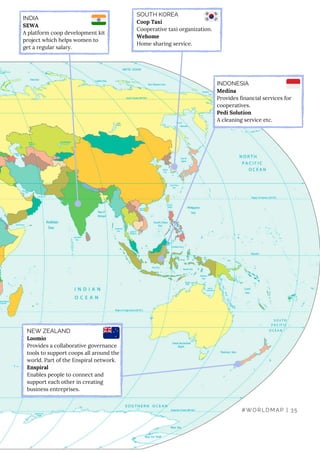
South Korea: Wehome & Coop Taxi
Indonesia: Pedi Solution &
Medina
India: SEWA
Platform Coop Development Kit: 
Founded by the Google.org Foundation and funded with 1
million Dollars, its focus is “creating a critical analysis of the
digital economy, and designing open source tools that will
support platform co-ops working in sectors such as child care,
elder care, home services, and recycling in the United States,
Brazil, Australia, Germany, and India” (Borkin 2019).
Wehome is a home sharing service owned by guests and hosts in
South Korea. The platform coop uses blockchain technology, so it is
quite trustworthy and transparent. The guests and hosts govern the
community together. Moreover, Wehome builds on a token economy
to evolve into a DAO (Decentralized Autonomous Organization) with
decentralized structures across all of Asia.
http://wehome.me/en/
Coop Taxi is a cooperative taxi organization in Seoul that enables
drivers to better social security and ultimately higher incomes -
compared to traditional taxi companies.
http://coop-taxi.kr/
According to Trebor Scholz there are about 30 platform coops in Indonesia. Pedi
Solution is a pioneer co-op platform that is an application-based digital
marketplace for different services, e.g. cleaning.
https://www.facebook.com/pedi.id/
Medina is an app for financial services for cooperatives and SMEs.
https://medina.id/
In 2018 SEWA (Self- Employed Women’s Association), a well-
established trade union and the Platform Co-op Development Kit
(see below) started out to create platform co-ops over the next two
years to help women in India to have a regular salary. SEWA has been
actively involved in women’s rights issues in the informal sector for
the past 40 years. Now they plan to establish a digital coop in the
beauty sector that not only enables them to have access to more
customers, but also to provide a safe working environment without
exploitation.
http://www.sewa.org/
Concluding we would like to mention the Platform Coop
Development Kit that can improve the conditions and rights of
workers on a global scale.
ASIA | 19
Plattform
kooperativismus
in Asien
Rückblick auf die
Konferenz 2018
in Hongkong
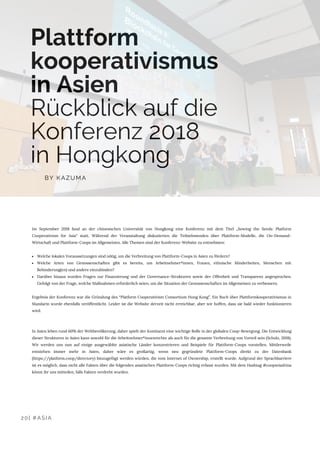
Im September 2018 fand an der chinesischen Universität von Hongkong eine Konferenz mit dem Titel „Sowing the Seeds: Platform
Cooperativism for Asia“ statt. Während der Veranstaltung diskutierten die Teilnehmenden über Plattform-Modelle, die On-Demand-
Wirtschaft und Plattform-Coops im Allgemeinen. Alle Themen sind der Konferenz-Website zu entnehmen:
Welche lokalen Voraussetzungen sind nötig, um die Verbreitung von Plattform-Coops in Asien zu fördern?
Welche Arten von Genossenschaften gibt es bereits, um Arbeitnehmer*innen, Frauen, ethnische Minderheiten, Menschen mit
Behinderung(en) und andere einzubinden?
Darüber hinaus wurden Fragen zur Finanzierung und der Governance-Strukturen sowie der Offenheit und Transparenz angesprochen.
Gefolgt von der Frage, welche Maßnahmen erforderlich seien, um die Situation der Genossenschaften im Allgemeinen zu verbessern.
Ergebnis der Konferenz war die Gründung des “Platform Cooperativism Consortium Hong Kong”. Ein Buch über Plattformkooperativismus in
Mandarin wurde ebenfalls veröffentlicht. Leider ist die Website derzeit nicht erreichbar, aber wir hoffen, dass sie bald wieder funktionieren
wird.
In Asien leben rund 60% der Weltbevölkerung, daher spielt der Kontinent eine wichtige Rolle in der globalen Coop-Bewegung. Die Entwicklung
dieser Strukturen in Asien kann sowohl für die Arbeitnehmer*innenrechte als auch für die gesamte Verbreitung von Vorteil sein (Scholz, 2018).
Wir werden uns nun auf einige ausgewählte asiatische Länder konzentrieren und Beispiele für Plattform-Coops vorstellen. Mittlerweile
entstehen immer mehr in Asien, daher wäre es großartig, wenn neu gegründete Plattform-Coops direkt zu der Datenbank
(https://platform.coop/directory) hinzugefügt werden würden, die vom Internet of Ownership, erstellt wurde. Aufgrund der Sprachbarriere
ist es möglich, dass nicht alle Fakten über die folgenden asiatischen Plattform-Coops richtig erfasst wurden. Mit dem Hashtag #coopsviadrina
könnt ihr uns mitteilen, falls Fakten verdreht wurden.
BY KAZUMA
20| #ASIA
Südkorea:
Wehome & Coop Taxi
Wehome ist ein Home-Sharing-Service, der Gästen und
Gastgeber*innen in Südkorea gehört. Das Plattform-Coop nutzt die
Blockchain-Technologie und ist daher sehr vertrauenswürdig und
transparent. Die Gäste und Gastgeber*innen sind gleichermaßen an
der Plattform beteiligt. Darüber hinaus setzt Wehome, um sich zu
einer DAO (Decentralized Autonomous Organization) mit dezentralen
Strukturen in ganz Asien zu entwickeln, auf ein Token-System.
http://wehome.me/en/
Coop Taxi ist eine Plattform in Seoul, die Fahrer*innen im Vergleich
zu traditionellen Taxiunternehmen eine bessere soziale Sicherheit
und letztendlich ein höheres Einkommen ermöglicht.
http://coop-taxi.kr/
Indonesien:
Pedi Solution & Medina
Laut Trebor Scholz gibt es in Indonesien etwa 30 Plattform-Coops.
Pedi Solution beispielsweise ist eine Plattform, genauer gesagt ein
digitaler Marktplatz, für verschiedene Dienste.
https://www.facebook.com/pedi.id/
Medina ist eine App für Finanzdienstleistungen für
Genossenschaften.
 https://medina.id/
Indien: SEWA
Im Jahr 2018 begannen SEWA (Self-Employed Women's Association)
und der “Platform Coop Development Kit” (siehe unten), Plattform-
Coops zu gründen, um Frauen in Indien zu helfen und ihnen somit
unter anderem ein angemessenes Gehalt zu ermöglichen. SEWA
engagiert sich seit 40 Jahren aktiv für Frauenrechte im informellen
Sektor. Nun planen sie, eine digitale Genossenschaft im mit Fokus auf
Friseurinnen und Kosmetikerinnen einzurichten. Diese soll ihnen
nicht nur den Zugang zu mehr Kund*innen ermöglichen, sondern
auch ein sicheres Arbeitsumfeld ohne Ausbeutung bieten.
http://www.sewa.org/
Abschließend möchten wir den “Platform Coop Development Kit”
erwähnen, mit dem die Bedingungen und Rechte der
Arbeitnehmer*innen auf globaler Ebene verbessert werden können.
Platform Coop Entwicklungskit:
Der Kit wurde von der Google.org Foundation gegründete und
mit 1 Million US-Dollar dotiert. Der Schwerpunkt liegt auf der
Erstellung  kritischer Analysen der digitalen Wirtschaft und der
Entwicklung von Open-Source-Tools zur Unterstützung von
Plattform-Coops in Bereichen wie Kinderbetreuung, Altenpflege,
Haushaltsdienstleistungen und Recycling in den USA, Brasilien,
Australien, Deutschland und Indien“ (Borkin 2019).
ASIA | 21
BY HARUMI
Platform Coops in
Japan
Japan’s cooperative sector does not seem large, yet the country has a long tradition when it come to coops. Especially
consumer cooperatives are quite popular: “A consumer co-op is an autonomous association of consumers united
voluntarily to meet their common needs and aspirations”( JAPANESE CONSUMER'S CO-OPERATIVE UNION). Such a
Japanese consumer co-op is allowed to do business only in the prefecture where it is registered and non-members
are not allowed to use the co-op's services. But there are also other services that cooperatives offer such as home
delivery and health services. Indeed, roughly one-third of the Japanese households are members of a consumer co-op.
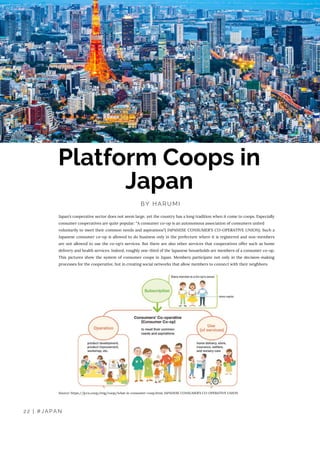
This pictures show the system of consumer coops in Japan. Members participate not only in the decision-making
processes for the cooperative, but in creating social networks that allow members to connect with their neighbors.
Source: https://jccu.coop/eng/coop/what-is-consumer-coop.html, JAPANESE CONSUMER’S CO-OPERATIVE UNION
22 | #JAPAN
Basically, members send a form every week ordering specific items
listed in a vast catalog through the paper system, and then these
products are delivered weekly to their homes. However, an online
and digital ordering system was recently launched and so they can
do everything online. This might initiate a shift from consumer
coops to platform coops. Comparing consumer coops and platform
coops, we can see that the main difference is whether digital
technology is used or not. Furthermore the average member’s age of
a consumer coops in Japan is 55 and it is getting older. Because of
this condition, it might be tough to introduce digital technology into
the Japanese consumer coop culture.
PLATFORM COOPS IN JAPAN
Generally speaking platform cooperatives try to bring the concept
of ownership to the digital economy, exploring not only employee
ownership but also user data ownership, says Mathias Sager from
the Platform Cooperative Japan Consortium ( PCJ). The PCJ was
founded in 2018 as one of the first organizations in Asia which
focuses on promoting the idea of platform cooperatives. They set
out to support the cooperative digital economy through research,
experimentation, education, technical support and events. In their
opinion, platform co-ops can address the problems that Japan faces.
It can help provide many part-time workers with fairer job
opportunities and establishing more opportunities for freelancers.
That is because Japan‘s youth is often unable to find regular jobs
after their graduation due to the seniority-based promotion
systems, which is one of the major features of labor practices
prevalent in Japan. Many people work for one company for their
entire life. Furthermore, Japan’s corporation demand long working
hours. The starting salaries are quite low and as a result of these
poor working conditions, more and more people are questioning
this system. That is why platform cooperativism can be a solution to
these issues by responding to the desire for more balance between
work and life. The PCJ is no longer active. Yet there is a different
initiative around the Japanese worker worker coop movement
planning a conference in September of 2019 to further explore the
role of platform coops in Japan.
#JAPAN | 23
24 | #JAPAN
BY HARUMI 
Plattform-Coops in
Japan
Plattform-Coops scheinen in Japan noch nicht weit verbreitet zu sein, dennoch hat das
Land eine lange Tradition, wenn es um Genossenschaften geht. Besonders
Verbraucher*innengenossenschaften (Consumer Coops) sind sehr beliebt: „Ein
Consumer Coop ist ein autonomer Zusammenschluss von Verbraucher*innen, die sich
freiwillig zusammentun, um ihre gemeinsamen Bedürfnisse und Ansprüche zu erfüllen“
(JAPANESE CONSUMER'S COOPERATIVE UNION). Solche japanischen Coops dürfen nur
in der Präfektur aktiv sein, in der sie registriert sind und Nichtmitglieder dürfen die
Dienste der Genossenschaft auch nicht nutzen. Es gibt aber auch andere Coops, die
unterschiedliche Dienstleistungen anbieten. Tatsächlich ist etwa ein Drittel der
japanischen Haushalte Mitglied eines Consumer Coops. Das nachfolgende Bild zeigt das
System der Verbrauchergenossenschaften in Japan. Die Mitglieder beteiligen sich nicht
nur an den Entscheidungsprozessen, sondern schaffen soziale Netzwerke, die es den
Mitgliedern ermöglichen, sich mit ihren Nachbar*innen zu verbinden.
Grundsätzlich ordern die Mitglieder jede Woche mit einem Papierformular bestimmte
Artikel, die in einem umfangreichen Katalog aufgeführt sind. Diese Produkte werden
dann wöchentlich nach Hause geliefert. Vor kurzem wurde jedoch ein digitales
Bestellsystem eingeführt, mit dem alle Funktionen online ausgeführt werden können.
Dies könnte eine Verlagerung von Consumer Coops zu Plattform-Coops einleiten. Beim
Vergleich von Consumer Coops und Plattform-Coops können wir feststellen, dass der
Hauptunterschied darin besteht, ob digitale Technologien verwendet werden oder nicht.
Darüber hinaus liegt das Durchschnittsalter eines/r Verbrauchers*in in Japan bei 55
Jahren, Tendenz steigend. Aufgrund dieser Situation könnte es schwierig sein, digitale
Technologien in die japanische Konsumgüterkultur einzuführen.
PLATTFORM-COOPS IN JAPAN
Plattform-Coops in Japan stellen die Eigentumsfrage in der
digitalen Wirtschaft.. Dabei geht es nicht nur um das Eigentum der
Mitarbeiter*innen, sondern auch um das Eigentum der
Benutzer*innendaten, sagt Mathias Sager vom Platform
Cooperative Japan Consortium (PCJ). Das PCJ wurde 2018 als eine
der ersten Organisationen in Asien gegründet, die sich für die
Förderung von Coops einsetzen. Sie wollten die kooperative digitale
Wirtschaft durch Forschung, Experimente, Bildung, technische
Unterstützung und Veranstaltungen unterstützen. Ihrer Meinung
nach können Plattform-Coops die Probleme, mit denen Japan
konfrontiert ist, lösen. Sie können dazu beitragen, dass viele
Teilzeitbeschäftigte fairere Beschäftigungsmöglichkeiten erhalten,
außerdem können mehr Möglichkeiten für Freiberufler*innen
geschaffen werden. Japanische Jugendliche  haben nach Erhalt ihres
Abschlusses oft Probleme einen regulären Job zu finden. Ein Grund
sind die vorherrschenden Arbeitspraktiken Japans. Viele Menschen
arbeiten ein Leben lang für das gleiche Unternehmen. Darüber
hinaus sind lange Arbeitszeiten mit vielen Überstunden Normalität
in japanischen Unternehmen. Die Einstiegsgehälter sind recht
niedrig und aufgrund dieser schlechten Arbeitsbedingungen
hinterfragen immer mehr Menschen dieses System. Deshalb kann
Plattformkooperativismus eine Lösung für diese Probleme sein -
auch indem auf den Wunsch nach mehr Vereinbarkeit von Beruf
und Leben reagiert wird. Der PCJ ist mittlerweile nicht mehr aktiv.
Es gibt jedoch eine andere Initiative mit ähnlichen Plänen, die im
September 2019 eine Konferenz veranstaltet, um die Rolle der
Plattform-Coops in Japan weiter zu untersuchen.
#JAPAN| 25
We go to work, to university  or to the gym and if we want to
we are accompanied by music every second of the day until we
finally go back to bed.
Music streaming services such as Spotify are either
advertisement-supported or subscription-based. This means
we either have to put up with listening to ads every 5 songs or
we pay around 10 Euros/Dollars a month and enjoy 16 millions
tracks without one single ad coming up.
An attractive offer that a lot of us cannot resist. As listeners,
we appreciate the convenience. 
Rethink with Resonate
BY FJONA AND CLAUDIUS
A click, a skip, a pause, a stop, a like, an add to your favorite new
playlist. When it comes to listening to music one can say that
streaming is the way to go. Although we could not imagine a
world without Spotify and other platforms listening to music is
not equal to streaming music.
We would turn on the radio or TV and hope for our favorite song
to start playing. We used to go to the shops to buy CDs or vinyl
records if we wanted to listen to our favorite artists. We
bought their singles or albums and contributed to the artists
fame, chart position, wealth and ultimately success.
That way the artists could at least earn a decent income on
sales. If we wanted to listen to music on the go, we had to play
the CDs on our Discmans. Gadgets that some teens nowadays
have never heard of before.
But with a little help from new technologies and the Internet we
are now able to enjoy music whenever and wherever we want.
"We play music and
we do not stop."
26 | #RESONATE
We rely on these services and as long as our wifi or mobile data performs well, we do not
have to worry. As musicians however, we worry a lot.
Despite record revenues, on Spotify it has become extremely difficult for less popular
artists to make a living in the digital age. In order to make a proper amount of money
artist's songs have to achieve about 1 million streams on the service. Depending on
whether the song is streamed in the ad-supported or premium version a per-stream US
play on Spotify pays between $0.00121 and $0.00653. To simplify: an artists needs about
200 streams on a song to earn 1$.
There are many artists worldwide, especially newcomers, that are dissatisfied with
Spotify’s “miserable“ payment. However, even famous artists like Taylor Swift had big
feuds with the streaming provider.
An inter-professional organisation that protects the interests  of the French record
industry, called Syndicat national de l'édition phonographique (SNEP), tried to ascertain
the reason. After comprehensive research they found out that the musicians only get
seven percent per subscription, which means that the artists are getting €0,68 from
€9,99. Remember  that we are talking about an average artist and especially newcomer
musicians, so artists who really depend on their earnings. Unfortunately these are the
artists that are getting paid less.
Nevertheless, Spotify, as the streaming provider, does not get as much money as the
record labels. The streaming platform pays 45 % of their revenues to the music industry,
which means the major record labels are pulling in an average of €4,56 per subscriber
every month after tax. That seems to be a lot, but SNEP calculated that the net income of
labels is at just 5 % of total revenue, which is attributable to fees for marketing,
promotion, studio, producer and other costs. So, all in all, record labels earn €0,26 for
each subscription, which leads to the problem that labels and managers crave more cash
for their musicians, because even major labels cannot pay more with such a tiny profit
margin.
As users of streaming platforms such as Spotify we often ignore the background and the
consequences for the artists. It is indeed affordable and we can listen to nearly every
song we want, no matter where and when. Time and society have changed and people
are aware of issues concerning the music and streaming industry. We want to be able to
stream music without a bad conscience. We want to support and appreciate artists
instead of exploiting them.
"This is not how you make a
living out of music, is it?"
#RESONATE | 27
This is the moment you can rethink with Resonate. Resonate is a community-owned
music network with one goal: Building a music economy based on fairness, transparency
and cooperation, where artists get paid fairly. Using Resonate as your streaming
platform, you pay per click and not per subscription – a big difference to Spotify.
As a listener you pay $0,002 for the first time you listen to a song.
The second time you pay $0,004 and the third time $0,008 until the 9th play. After the
9th play you have bought the song for $1,022. Afterwards you can download and listen to
it as often as you want to.
Peter Harris, founder of Resonate, says: “It takes somewhere between 150 to 200 plays
on Spotify to reach the price of a download, and we do that in nine.“ Resonate
guarantees the artists a fair payment as 30% of the revenue for a song goes to Resonate,
70% goes to the musician. There are cases where the artist wants Resonate to pay the
label, but this is a choice the artists makes. For Harris Resonate is a “protest against
capitalism, it is a protest against the Silicon Valley model of startups and platforms and,
in some sense, it is a protest against the way music is now being distributed and
consumed.“ Therefore the listeners, board members and artists have a stake in the
company. By paying $5,00 a year you as a listener can participate in the cooperative
platform with full voting rights and as soon as the platform makes profits you also
benefit from it.
Resonate is the world’s first cooperatively owned streaming service. The platform is
growing every day and by now, you can listen to a few thousand artists. It is becoming a
new niche, a sustainable and alternative way to listen to music. This way, it could enable
rising artists to earn enough money to make a living. By using Resonate fans can support
the artists and the songs directly. Harris wants to connect listeners to the artists in a
way that both sides can control the platform. It is an approach that could change the
music business and achieve a new sustainable connection between music, Internet and
artists. If you want to be a part of this new and fair movement join us on our ride to
rethink with Resonate.
"Stream it till you own it."
Join us on our ride to
rethink with Resonate.
28 | #RESONATE
Wir spielen unsere liebsten Alben und Songs tagtäglich ab und
hören nie richtig auf. Wir gehen zur Arbeit, zur Universität
oder ins Fitnessstudio und wenn wir wollen, begleitet uns die
Musik auf Schritt und Tritt, bis wir abends wieder ins Bett
gehen. Streaming-Dienste wie Spotify finanzieren sich
entweder über Werbeeinnahmen oder über Abonnements. Das
bedeutet, dass wir entweder alle 5 Songs Werbung hören
müssen oder wir zahlen etwa 10 Euro/Dollar pro Monat und
können dadurch auf ein Repertoire von über 16 Millionen
Songs zurückgreifen, ohne dass eine einzige Anzeige
auftaucht. Ein attraktives Angebot, welches für viele
unwiderstehlich ist und wir als Nutzer*innen der Platform 
nicht verzichten möchten.
Fair Streaming - Resonate
VON FJONA UND CLAUDIUS
Klicken, überspringen, stoppen, liken, einen Song zur nur neuen
Lieblingsplaylist hinzufügen:
Wenn es um das Hören von Musik geht, kann man sagen, dass
Streaming der moderne Weg ist. Auch wenn wir uns eine Welt
ohne Spotify und andere Plattformen nicht mehr vorstellen
können, gibt es einen wesentlichen Unterschied zwischen Musik
streamen und Musik hören. Wir schalten das Radio oder den
Fernseher ein und hoffen, dass unser Lieblingssong zu spielen
beginnt und schon läuft. Früher sind wir in Läden gegangen, um
CDs oder Vinyl-Schallplatten zu kaufen, wenn wir unsere
Lieblingskünstler*innen hören und unterstützen wollten. Wir
kauften ihre Singles oder Alben und ermöglichten ihnen dadurch
Ruhm, gute Chart-Positionen, beachtliche Einnahmen und
letztlich auch Erfolg. Auf diese Weise konnten die
Künstler*innen zumindest ein anständiges Einkommen für Ihre
Dienstleistung erzielen. Wenn wir unterwegs Musik hören
wollten, mussten wir die CDs in unsere Discmans einlegen und
abspielen. Veraltete Technik, von denen einige Teenager
heutzutage noch nie etwas gehört haben. Eine Streaming-
Plattform gab es nicht. Doch heutzutage leben wir in einer Welt,
in der neue Technologien und das Internet alles möglich
machen.
"Wir tragen Musik stets
mit uns. Egal wann
und wo."
#RESONATE | 29
Wir verlassen uns auf diese Dienste und solange wir eine gute
Internetverbindung haben, müssen wir uns keine Sorgen machen.
Aus der Sicht der Künstlers allerdings, machen wir uns große
Sorgen.
Für weniger populäre Künstler*innen ist es extrem schwierig
geworden, im digitalen Zeitalter einen angemessenen
Lebensunterhalt zu verdienen – trotz Rekordeinnahmen der
Streaming-Dienste. Um eine angemessene Menge an Geld zu
verdienen, benötigt ein*e Künstler*in etwa 1 Million Klicks pro
Song. Je nachdem, ob der Song in der werbefinanzierten oder
Premium-Version gestreamt wird, bekommt ein*e Künstler*in in
den USA pro Stream auf Spotify zwischen 0,00121 und 0,00653 US-
Dollar. Oder einfacher ausgedrückt: Ein*e Künstler*in benötigt
etwa 200 Streams eines Song, um 1€ zu verdienen.
Es gibt viele Künstler*innen weltweit, vor allem Newcomer, die mit
Spotifys "miserabler" Bezahlung unzufrieden sind. Selbst berühmte
Künstler*innen, wie Taylor Swift, hatten große Fehden mit dem
Streaming-Anbieter. Eine interprofessionelle Organisation, die die
Interessen der französischen Plattenindustrie schützt, Syndicat
national de l'édition phonographique (SNEP), versuchte den Grund
zu ermitteln. Nach umfangreichen Recherchen fand man heraus,
dass die Musiker*innen nur sieben Prozent pro Abonnement
bekommen, was bedeutet, dass die Künstler*innen bei 9,99 €
lediglich 0,68 € bekommen. Hierbei muss man bedenken, dass dies
das Durchschnittseinkommen pro Abonnement ist. Newcomer oder
weniger bekannte Musiker*innen bekommen nur einen Bruchteil
davon. Anders als gedacht, bekommt Spotify als Streaming-Anbieter
weniger Geld pro Abonnement als die Plattenlabels. Die Streaming-
Plattform zahlt 45 % ihrer Einnahmen an die Musikindustrie, was
bedeutet, dass die großen Plattenfirmen durchschnittlich 4,56 €
pro Abonnent pro Monat (nach Steuern) erhalten. Das scheint eine
Menge Geld zu sein, aber SNEP hat errechnet, dass das
Nettoeinkommen der Labels nur 5 % des Gesamtumsatzes beträgt,
was auf Gebühren für Marketing, Promotion, Studio, Hersteller und
andere Kosten zurückzuführen ist. Insgesamt verdienen
Plattenlabels also 0,26 €  pro Abonnement. Das führt zu dem
Problem, dass Labels und Manager*innen zu Recht mehr Geld für
ihre Musiker*innen verlangen, da selbst große Labels mit einer so
geringen Gewinnspanne nicht mehr bezahlen können. Als
Nutzer*innen von Streaming-Plattformen wie Spotify ignorieren
wir oft den Hintergrund und die Folgen für die Künstler*innnen. Es
ist in der Tat erschwinglich und wir können fast jeden Song hören,
den wir wollen, egal wo und wann.
Doch die Zeiten haben sich geändert, ebenso wie die Gesellschaft - 
die Menschen sind sich der Probleme in der Musik- und Streaming-
Industrie bewusst. Wir wollen Musik ohne schlechtes Gewissen
streamen können. Wir wollen Künstler*innen unterstützen und
schätzen, anstatt sie auszubeuten.
Aus diesem Grund ist Resonate entstanden.
Resonate ist ein Musiknetzwerk im Gemeinschaftsbesitz, welches
folgendes Ziel hat: Den Aufbau einer Musikwirtschaft, die auf Fairness,
Transparenz und Zusammenarbeit basiert, in der Künstler*innen fair
bezahlt werden. Wenn du Resonate als Streaming-Plattform
verwendest, zahlst du pro Klick und nicht pro Abonnement – ein
großer Unterschied zu Spotify. Doch die Zeiten haben sich geändert,
ebenso wie die Gesellschaft -  die Menschen sind sich der Probleme in
der Musik- und Streaming-Industrie bewusst. Wir wollen Musik ohne
schlechtes Gewissen streamen können. Wir wollen Künstler*innen
unterstützen und schätzen, anstatt sie auszubeuten.  Aus diesem
Grund ist Resonate entstanden. Resonate ist ein Musiknetzwerk im
Gemeinschaftsbesitz, welches folgendes Ziel hat: Den Aufbau einer
Musikwirtschaft, die auf Fairness, Transparenz und Zusammenarbeit
basiert, in der Künstler*innen fair bezahlt werden. Wenn du Resonate
als Streaming-Plattform verwendest, zahlst du pro Klick und nicht pro
Abonnement – ein großer Unterschied zu Spotify.
Als Nutzer*in zahlst du 0,002 USD beim erstmaligen hören, das zweite
Mal 0,004 USD, das dritte Mal 0,008 USD bis zum 9. Hören. Nach dem
9. Abspielen des jeweiligen Songs hat man den Song für 1.022 US-
Dollar gekauft. Danach kann er heruntergeladen werden und so oft
abgespielt werden, wie der/die Nutzer*in will, ohne weitere Kosten.
Peter Harris, Gründer von Resonate, sagt: "Es dauert irgendwo
zwischen 150 und 200 Plays auf Spotify, um den Preis eines
Downloads zu erreichen, und wir tun das in neun."
Resonate garantiert den Künstler*innen eine faire Bezahlung. Für
einen Song gehen 70% des Umsatzes an die Musiker*innen und 30%
an Resonate. Für Harris ist Resonate ein "Protest gegen den
Kapitalismus, es ist ein Protest gegen das Silicon-Valley-Modell von
Startups und Plattformen und in gewisser Weise ist es ein Protest
gegen die Art und Weise, wie Musik jetzt verbreitet und konsumiert
wird." Daher sind die Hörer*innen, Vorstandsmitglieder und
Künstler*innen an dem Unternehmen beteiligt. Wenn man 5,00 USD
pro Jahr zahlen, kann man an der kooperativen Plattform mit vollem
Stimmrecht teilnehmen und wenn die Plattform Gewinne macht,
erhält man diese auch. Es ist der weltweit erste genossenschaftliche
Streaming-Dienst. Die Plattform wächst jeden Tag und mittlerweile
sind bereits tausende Künstler*innen auf Resonate vertreten.
Resonate ist eine neue Nische, eine nachhaltige und alternative Art,
Musik zu hören. Es könnte ein Weg für neue Künstler*innen sein,
genug Geld zu verdienen, um ihren Lebensunterhalt zu bestreiten. Mit
Resonate können Fans die Künstler*innen und die Songs direkt
unterstützen. Harris möchte die Hörer*innen mit den Künstler*innen
so verbinden, dass beide Seiten die Plattform kontrollieren können. Es
ist ein Ansatz, der das Musikgeschäft verändern und eine neue
nachhaltige Verbindung zwischen Musik, Internet und Künstler*innen
erschaffen könnte. 
Wenn Du ein Teil dieser neuen und fairen Bewegung sein möchtest,
begleite uns und unterstütze Resonate auf dem Weg zu einer fairen
Musikwelt.
"So baut man sich nicht
gerade ein Vermögen
auf, oder?" "Stream it till you
own it."
30 | #RESONATE
Coops and Coworking
Fairmondo
BY CLAUDIUS
Fairmondo is an online platform where you can
buy and sell products. The platform represents a
fair alternative to market giants, such as Amazon.
It is also fairer and more sustainable, because
Fairmondo is owned by its users and employees.
The aim is that individuals and commercial
providers are able to offer products of all kinds on
the platform. The use of the website is free of
charge for private commissions, which are fair
and transparent. Nevertheless Fairmondo recently
started a relaunch process. They will focus more
on bookselling.
Following the motto "together we are stronger",
Fairmondo now also offers a coworking space in
their loft in Berlin-Kreuzberg.
The number of coworking spaces in Berlin is
constantly growing, but most do not have a focus
on NGOs or coops. The Fairmondo space is a place
for transformative cooperatives, social enterprises
und organisations or self-employed people with
projects that fit these categories. Mutual
exchange and mutual support are as much wanted
in this project as mutual motivation
"Together we are
stronger."
Fairmondo
GLOGAUER STRAßE 21
10999 BERLIN
#FAIRMONDO| 31
For prospective coworkers there are different
renting options between flex desks and more
expensive fixed desks varying between 100 and
200 Euro per month. Depending on your choice
you can use the space during opening hours.
This includes the shared use of the kitchen.
Meeting rooms can be booked according to
availability. The advantage of fixed desk is that
you also get additional storage. In addition, the
offer includes two hours a week in which you
can use one of the meeting rooms, beyond the
two hours, can also be rented aat reduced rates.
We can only recommend this coop coworking
space especially if you have the same values like
Fairmondo. If we have caught your interest, you
can contact the following address for further
information by Email: space@fairmondo.de and
find more information here:
https://fairmondo.de/coopspace (in German).
     32 | #FAIRMONDO
Coops und Coworking
FairmondoBY CLAUDIUS
Fairmondo ist eine Online-Plattform, auf der du
Produkte kaufen und verkaufen kannst. Die
Plattform ist eine faire Alternative zu den
Marktriesen wie Amazon. Es ist auch fairer und
nachhaltiger, weil Fairmondo seinen Nutzer*innen
und Mitarbeiter*innen gehört. Ziel ist es, dass
Privatpersonen und gewerbliche Anbieter auf der
Plattform Produkte aller Art anbieten können. Die
Nutzung der Website ist für Privatpersonen
kostenfrei, gewerbliche Anbieter müssen
Verkaufsprovisionen zahlen, die fair und
transparent sind. Dennoch hat Fairmondo kürzlich
einen Relaunch-Prozess gestartet. Sie werden sich
mehr auf den Buchhandel konzentrieren.
Nach dem Motto "Gemeinsam sind wir stärker"
bietet Fairmondo jetzt auch einen Coworking
Space in ihrem Loft in Berlin-Kreuzberg an.
Die Zahl der Coworking Spaces in Berlin wächst
stetig, aber die meisten konzentrieren sich nicht
auf NGOs oder Coops. Der Fairmondo-Raum ist
ein Ort für transformative Genossenschaften,
soziale Unternehmen und Organisationen oder für
Selbstständige mit Projekten, die diesen
Kategorien entsprechen. Gegenseitiger Austausch
und gegenseitige Unterstützung sind bei diesem
Projekt ebenso erwünscht wie gegenseitige
Motivation.
Für angehende Coworker gibt es unterschiedliche
Mietoptionen zwischen flexiblen Schreibtischen
und teureren festen Schreibtischen, die zwischen
100 und 200 Euro pro Monat variieren. Je nach
deiner Wahl kannst du den Space während der
Öffnungszeiten nutzen. Dies beinhaltet die
Mitbenutzung der Küche. Tagungsräume können
nach Verfügbarkeit gebucht werden. Der Vorteil
eines festen Schreibtisches ist, dass du auch
zusätzlichen Platz für deine Sachen erhältst.
Darüber hinaus umfasst das Angebot zwei
Stunden pro Woche, in denen du einen der
Meeting-Raum nutzen kannst. Eine zusätzliche
Nutzung der Tagungsräume über die zwei
Stunden hinaus kann zu ermäßigten Preisen
gebucht werden.
Wir können diesen Coworking Space nur
empfehlen, besonders wenn du die gleichen Werte
wie Fairmondo verfolgst. Wenn wir dein Interesse
geweckt haben, kannst du dich per E-Mail an
folgende Adresse wenden, um weitere
Informationen zu erhalten: space@fairmondo.de.
Weitere Informationen finden sich hier:
https://www.fairmondo.de/coopspace.
#FAIRMONDO| 33
CANADA
Stocksy
Distributes free stock photography
and video footage.
Eva
Ride-sharing app.
SPAIN
Som mobilitad 
Provides sustainable transport
services (electric cars sharing,
bike sharing, motorbike
sharing...).
Source: https://upload.wikimedia.org/wikipedia/commons/2/2e/1-12_Color_Map_World.png November 2011 Boundary representation is not necessarily authoritative.
34 | #WORLDMAP
BRAZIL
Cataki 
An app which brings people
together to collect waste.
UNITED STATES
UpandGo 
Cleaning services network based in
N.Y.C.
Savvy
Health-care app.
Core Staffing
A staffing agency app.
BELGIUM
Portago
Offers 100% electric cars and
vans sharing.
Smart
a platform which brings people
together to take part in the
collective entrepreneurship.
ITALY
Vesta Project 
Connects refugees and citizens
willing to offer them shelter in
their homes.
Cotabo
Organizes taxi drivers.
GERMANY
Resonate
Streaming platform, mainly
supporting indie artists.
Fairmando
Online marketplace.
Hostsharing
Web hosting.
FRANCE
Coopcycle
Delivers bikes.
UNITED KINGDOM
Unicorn 
Retails fresh, organic products.
NEW ZEALAND
Loomio
Provides a collaborative governance
tools to support coops all around the
world. Part of the Enspiral network.
Enspiral 
Enables people to connect and
support each other in creating
business entreprises.
#WORLDMAP | 35
INDIA
SEWA 
A platform coop development kit
project which helps women to
get a regular salary.
SOUTH KOREA
Coop Taxi 
Cooperative taxi organization.
Wehome
Home sharing service.
INDONESIA
Medina 
Provides financial services for
cooperatives.
Pedi Solution 
A cleaning service etc.
Coops and
Communities
BY REBECCA
Cooperatives are formed by people gathering
together, and with respect for each other,
deciding to build something along their own set of
rules, something that resembles them.
If cooperatives are made of people, made of
communities, what does it mean in terms of social
ties? Is a cooperative a particular social
experience for its members, and in what way does
it impact them and the group that they form?
As I researched on the subject, I discovered
Majee and Hoyt’s studies of a homecare
cooperative in the United States, based in a low-
income community (Majee & Hoyt, 2009, 2010).
Located in the rural Midwest, this cooperative is
owned by its members -  the homecare workers -
who provide home and personal care to elderly
and disabled clients. It also employs four non-
member, professional administrative staff - an
executive director, a business office manager and
an assistant, as well as a registered nurse.  What
they could prove is that once people involved
themselves in the cooperative project, they built
not only a sense of community but also
individually, personally blossomed by involving
themselves in it. Yet, Majee and Hoyt also remark
that certain requirements must be fulfilled in
order to generate these positive effects.
Gemeinschaften bestehen aus Menschen, die sich
treffen, gegenseitig respektieren und dazu entschließen,
etwas nach ihren eigenen Regeln zu erschaffen. Etwas,
das ihren Werten und Normen entspricht und das sie
widerspiegelt. Wenn Communities aus diesen Menschen
bestehen, was bedeutet das dann für soziale Bindungen?
Ist eine Genossenschaft eine besondere soziale
Erfahrung für ihre Mitglieder und wie wirkt sie sich auf
sie und die Gruppe aus?
Als ich zu diesem Thema recherchierte, stieß ich auf
Majee und Hoyts Studien zu einer Homecare-
Genossenschaft in den USA, die in einer
einkommensschwachen Gemeinschaft ansässig war
(Majee & Hoyt, 2009, 2010). Die im ländlichen
Mittelwesten gelegene Genossenschaft gehört den
Mitgliedern bzw. den Homecare-Mitarbeiter*innen, die
ältere Personen und Menschen mit Behinderung häuslich
und persönlich betreuen. Das Unternehmen beschäftigt
außerdem vier professionelle Verwaltungsmitarbei-
ter*innen - einen Geschäftsführer, einen Geschäftsstel-
lenleiter und einen Assistenten, sowie eine ausgebildete
Krankenpflegerin. Dabei haben sie festgestellt, dass die
Leute, die sich einmal an dem Kooperationsprojekt
beteiligt hatten, nicht nur ein Gemeinschaftsgefühl
aufbauten, sondern auch in ihrer eigenen Person
aufblühen konnten.  Majee und Hoyt weisen jedoch auch
darauf hin, dass bestimmte Anforderungen erfüllt sein
müssen, um diese positiven Effekte zu erzielen.
36 | COOPS AND COMMUNITIES
community in which people can be active, and can
build something together.
On another level, to work in a cooperative also
transformed the members, individually. It seems that
the cooperative environment enabled its members
to  blossom and expand their capacities,beyond their
assigned job. For a certain amount of members,
working in this company and involving themselves in
its operation increased their  self-confidence. ‘I
believe it [the cooperative] has boosted their self-
esteem and their confidence enormously. […]  They
walk taller, they have pride in what they are doing,
they are able to verbalize.’ affirms the cooperative’s
registered nurse. So for certain members, it enabled
personal growth, and encouraged them to get out of
their comfort zones and stand up. 
It also improved their  interpersonal skills. That to
listen, to respect, to accept others, to communicate
and work as a team is encouraged by the cooperative
system allows its members to get more familiar and
comfortable in these social interactions. Moreover,
such a system makes them more familiar with the
mechanisms of democratic decision-making — a skill
necessary in the wider society. 
Besides, it appears the cooperative environment
influences workers to involve themselves beyond ‘just
work’. They seem to have a new motivation to work
‘beyond the paycheck’.  Certain members start
actively  engaging  themselves in the ownership and
decision-making of the company — which in turn
reinforces the benefits that I mentioned before.
Moreover, they tend to  participate  in the other
events organised by the cooperative as well, whether
it is for business or community-building
purposes.  Therefore, the people who engage
themselves in the cooperative, gain confidence,
knowledge, and the desire to go beyond,to involve
themselves and get closer to the community — a
community revived by the cooperative.
What Majee and Hoyt also shed light on is that those
benefits are enabled by  certain measures, certain
conditions  which allow individuals and communities
to grow thanks to the cooperative. When it comes to
trust, the cooperative must establish a certain
environment to allow it to develop. It must establish
a  set of values and principles  — such as equity,
respect, listening, fairness — and incite its members
to follow them.It can mean that the cooperative 
At the level of the community, that people engaged
themselves in the cooperative enhanced
the trust between them, between the workers. As their
working environment encourages contact, interaction
and mutual aid between each other, their trust in the
people they work with is increased — especially when
it is compared to their former job, in a non-
cooperative company. As the interviewee P. Williams
declares,  ‘But at my hairdressing job, people kind of
look down upon others. I think it’s different here […].
Here you trust everybody’.
What is also interesting is that it changed the
relationship between the caregivers and their clients
too. The way the cooperative was conceiving business
allowed the workers to have ‘quality time’ with their
clients. This, in turn, enabled the construction of a
more trusting relationship between each other. Plus,
that the cooperative is locally-based and locally-
oriented gave caregiving work another perspective, of
a more caring, community supportive, and long-term
commitment.
The cooperative business system also ameliorated
the relationship between the professional
administrators of the company and the workers. From
their study, their interaction is more made of listening,
support and help: ‘You can talk to them [office staff
and mentors] with a problem and they will help you as
much as they can’. In a nutshell, Majee and Hoyt
concluded that, trust-wise, roughly half of the workers
felt a positive change by working in a cooperative.
But the cooperative improved  other aspects of the
community life too. The system of the cooperative
itself encourages its members, administrators and
clients to  communicate and interact  with each other.
Most importantly, the cooperative organises events,
inviting its members and clients to engage in  social
activities. It creates spaces where people can meet and
socialise, where social contacts can be made. In the
same vein, it also encourages its members to share
information, experiences, to help each other —
creating an atmosphere of  mutual aid, that in turn
reinforces trust. In addition, to work in a cooperative
made some workers realise that collectively, they can
‘own their own solutions’: it enabled
the empowerment of their community.
So the formation of the local cooperative  provided
the opportunity for those involved in it to
connect,support each other and create a sense of 
COOPS AND COMMUNITIES | 37
 einigen Arbeitnehmer*innen außerdem klar, dass
sie gemeinsam zu eigenen und neuen
Lösungen kommen können: Dies ermöglichte
die Stärkung ihrer Gemeinschaft.
Für eine bestimmte Anzahl von Mitgliedern hat die
Arbeit in diesem Unternehmen und die Einbeziehung
in dessen Betrieb ihr Selbstvertrauen erhöht.„Ich
glaube, dass [die Genossenschaft]
ihr Selbstwertgefühl und ihr Selbstvertrauen enorm
gestärkt hat. […] Sie gehen aufs Ganze und sind stolz
auf das, was sie tun.“, bekräftigt die Pflegerin der
Genossenschaft. Für bestimmte Mitglieder
ermöglichte dies persönliches Wachstum und
ermutigte sie, ihre Komfortzonen zu verlassen und
aufzustehen.
Es verbesserte auch ihre zwischenmenschlichen
Fähigkeiten. Das Zuhören, Respektieren, Akzeptieren,
Kommunizieren und Arbeiten im Team wird durch
das kooperative System gefördert. Es ermöglicht
seinen Mitgliedern sich mit diesen sozialen
Interaktionen vertraut zu machen. Ein solches
System macht Menschen mit den Mechanismen
demokratischer Entscheidungsfindung vertraut -
eine Fähigkeit, die in der Gesellschaft insgesamt
fehlt.
Außerdem scheint das kooperative Umfeld die
Arbeitnehmer*innen dazu zu veranlassen, sich über
die reine Arbeit hinaus zu engagieren. Die Leute
scheinen eine neue Motivation zu haben, „jenseits
des Gehaltsschecks“ zu arbeiten.
Einige Mitglieder beteiligen sich aktiv am
Eigentum und an der Entscheidungsfindung des
Unternehmens, was wiederum die zuvor erwähnten
Vorteile verstärkt. Darüber hinaus nehmen sie
tendenziell auch an anderen von der Genossenschaft
organisierten Veranstaltungen teil, sei es zu
geschäftlichen Zwecken oder zum Aufbau von
Gemeinschaften. Daher gewinnen die Menschen, die
sich in der Genossenschaft engagieren,
Selbstvertrauen, Wissen und den Wunsch, sich zu
engagieren und näher an die Gemeinschaft
heranzukommen - eine von der Genossenschaft
wiederbelebte Gemeinschaft.
Majee und Hoyt erwähnen auch, dass die
Genossenschaft ein bestimmtes Umfeld schaffen
muss, damit sie und die Mitglieder sich entwickeln
können.Es müssen eine Reihe von Werten und
Prinzipien festgelegt werden - wie Gerechtigkeit,
Respekt, Aufmerksamkeit, Fairness - und seine
Die Leute, die sich für die Genossenschaft engagiert
haben, konnten das Vertrauen zwischen ihnen und den
Mitarbeiter*innen stärken. Da ihr Arbeitsumfeld den
Kontakt, die Interaktion und die gegenseitige
Unterstützung untereinander fördert, steigt das
Vertrauen in die Menschen, insbesondere im Vergleich
zu ihrem früheren Arbeitsplatz in einem nicht
kooperativen Unternehmen. Der Befragte P. Williams
erklärt: „Bei meinem Friseurjob schauen die Leute auf
andere herab. Ich denke, dass es hier anders ist […].
Hier vertraust du allen.”
Interessant ist auch, dass sich dadurch auch die
Beziehung zwischen den Betreuer*innen und ihren
Kund*innen verändert habe. Die Art und Weise, wie die
Genossenschaft das Geschäft konzipierte, ermöglichte
es den Mitarbeiter*innen, „quality time“ mit ihren
Kunden zu verbringen. Dies wiederum ermöglichte den
Aufbau einer vertrauenswürdigen Beziehung
untereinander. Da die Genossenschaft lokal ansässig
und lokal orientiert ist, hat die Pflege eine andere
Perspektive erhalten und dadurch auch
ein fürsorgliches, gemeinschaftliches und langfristiges
Engagement.
Das kooperative Geschäftssystem verbesserte auch
die Beziehung zwischen den professionellen
Administrator*innen des Unternehmens und den
Arbeitnehmer*innen. Durch die Studie konnten sie
beweisen, dass die Interaktion zwischen Chef*in und
Arbeitnehmer*innen nun mehr aus Zuhören,
Unterstützung und Hilfe besteht: „Sie können mit
ihnen [Büropersonal und Mentor*innen] über ein
Problem sprechen und sie werden Ihnen so gut wie
möglich helfen.“ Zusammenfassend kamen Majee und
Hoyt zu dem Schluss, dass sich etwa die Hälfte der
Beschäftigten durch die Zusammenarbeit in einer
Genossenschaft positiv verändert hat.
Die Genossenschaft hat aber auch andere Aspekte des
Gemeinschaftslebens verbessert. Das System ermutigt
ihre Mitglieder, Administrator*innen und Kund*innen,
miteinander zu kommunizieren und zu interagieren.
Die Genossenschaft organisiert Veranstaltungen und
lädt ihre Mitglieder und Kund*innen zu verschiedenen
sozialen Aktivitäten ein. So können sich die Leute
treffen und Kontakte knüpfen. Die Mitglieder werden
dazu ermutigt, Informationen und Erfahrungen
auszutauschen und sich gegenseitig zu helfen. Dies
schafft eine Atmosphäre der gegenseitigen Hilfe, die
wiederum das Vertrauen stärkt. Durch
die. Zusammenarbeit in einer Genossenschaft wurde
38 | COOPS AND COMMUNITIES
Mitglieder auffordern, diesen zu folgen. Dies kann
bedeuten, dass die Genossenschaft sich nach diesen
Grundsätzen aus- und weiterbilden muss. Sie muss
auch die tatsächlichen Möglichkeiten zur Interaktion
und zum Erfahrungsaustausch zwischen den von der
Genossenschaft betroffenen Personen bieten -
beispielsweise bei Veranstaltungen und Aktivitäten.
Eine Genossenschaft regt auch dazu an, sich am
Projekt zu beteiligen. Wenn sich die Leute bereits
kennen, wird dies den Aufbau von Gemeinschaft und
Vertrauen erleichtern.
Die von der Genossenschaft beschäftigten
Koordinator*innen müssen ein unterstüt-
zendes,  positives Management  einführen, das die
festgelegten Werte beibehält.
Um die Teilnahme zu fördern, muss die
Genossenschaft ihre Organisation so gestalten, dass
die Eigenverantwortung der lokalen
Wirtschaft  demokratisch  wird. Damit sich Menschen
verbinden können, muss die Genossenschaft ein
Umfeld für Kommunikation und Teamarbeit bieten -
mit besonderem Schwerpunkt auf Werten.
Interessanterweise ist es schließlich die  Steigerung
des Selbstbewusstseins, die es den Mitgliedern
ermöglicht, sich zu beteiligen und sich mit anderen 
must provide training and education on these
principles. It must also provide the
actual opportunities for interaction and the sharing of
experiences  between the people concerned by the
cooperative — with for instance events and activities.
That a cooperative is local also incites people to
engage themselves in the project. Similarly, if people
already know each other, it will ease the community-
building and trust-building process. The
administrators employed by the cooperative must also
adopt a supportive,  positive management, which
uphold the established values — so that they
encourage and sign to the cooperative members to do
so as well. 
As to the encouragement of participation, the
cooperative must also (and obviously) design its
organisation in a way that makes the ownership of the
local business democratic. For people to connect, the
cooperative must offer the  environment for
communication and teamwork  — with notably the
emphasis on values. Finally, and interestingly, it is the
increase in  self-confidence  that enables the members
to stand up, participate and network with others.
To conclude, the studies by Majee and Hoyt
demonstrate that cooperatives can have several,
socially beneficial effects on whoever gets involved in
it. The formation of local cooperates can create social
ties, can reconnect people with a community and make
them more familiar with collective living and decision-
making. Furthermore, the authors observe that such
personal achievements can also have a  ‘ripple
effect’  and can be transmitted to relatives or other
members of the community. This is giving us hope for
the positive effects to expand beyond the small circle
of a local cooperative. Yet we badly need more studies
on how cooperatives impact the social fabric of a
locality in other parts of the world, with other types of
cooperatives, and on what were the necessary
conditions for positive effects to grow. 
Most importantly, what does it mean for the digital
cooperatives, the platform coops?  How can these
cooperatives be designed in a way that fosters social
contact, community-building and personal growth?
zu vernetzen.
Abschließend zeigen die Studien von Majee und
Hoyt, dass Genossenschaften für jeden, der sich
daran beteiligt, mehrere  soziale Vorteile  haben
können. Die Bildung lokaler Kooperationen kann
soziale Bindungen schaffen, die Menschen wieder mit
einer Gemeinschaft verbinden und sie mit dem
kollektiven Leben und der Entscheidungsfindung
vertraut machen. Darüber hinaus stellen die
Autor*innen fest, dass solche persönlichen
Errungenschaften auch einen  „Welleneffekt“  haben
und an Verwandte oder andere Mitglieder der
Gemeinschaft weitergegeben werden können. Dies
gibt uns Hoffnung, dass sich die positiven Effekte
über den kleinen Kreis einer lokalen Genossenschaft
hinaus ausdehnen. Wir benötigen weitere Studien
darüber, wie sich Genossenschaften auf das soziale
Gefüge eines Ortes in anderen Teilen der Welt und
auf andere Arten von Genossenschaften auswirken
und unter welchen Bedingungen positive Effekte
erzielt werden können.
Was bedeutet es vor allem für die digitalen
Genossenschaften, die Plattform Coops? Wie können
diese Genossenschaften so gestaltet werden, dass
sozialer Kontakt, Aufbau von Gemeinschaften und
persönliches Wachstum gefördert werden?
COOPS AND COMMUNITIES | 39
KARL-MARX-STRASSE 182
15230 FRANKFURT (ODER)
blok-o.de
  A researcher, writer and speaker on technology,
culture and business innovation, a co-founder of a
collective which is studying an emergent commons
economy, the P2P foundation, Michel Bauwens held
a lecture in Berlin on 22nd of May 2018 on the
perspectives and recent developments of the
platform cooperative as an alternative business
model for the sharing economy. This model is based
on the principles of co-ownership and shared
governance. One should imagine Uber that would be
organized and ruled by drivers, platforms which
would be owned and ruled by the workers
themselves.
Tetiana Semeiko met Michel in the process of
writing her Master thesis in Media and
Communication studies at the Ukrainian Catholic
University with the topic “Platform Cooperativism:
an alternative model of business communication in
the digital economy”. In her interview, Michel talks
about the nearest future of platforms that could
include and empower the members, not impoverish.
He puts it this way: “We call it peer production, peer
government and peer property which are
communities of people trying to create value
together.”
Interview
with
Michel
Bauwens
BY TETIANA
#BAUWENS | 41
Tetiana: Cooperatives are definitely not a
new phenomenon, but what stays
interesting is how are we going to transfer
this notion into the digital age. What are
the challenges that worker-owned
cooperatives face today?
Michel: I have a bit of a different vision of
it. I think it is digital commons who have
brought back the commons in the West
because we kind of privatized them in a
very massive way. If you go to Africa there
is still 85 percent of the land which is
common, but in Europe it almost
disappeared. So, actually it was more the
fact that people were able to work
together globally, creating knowledge
together, sharing knowledge. Wikipedia,
Linux who brought back the notion of
commons in the West and now it is
moving back to the physical world. There
are a lot of young people in cities,
especially for the reason of
unemployment, precariousness. They also
see that a number of things [need to
happen] to be done with it. That is why a
lot of people are organizing to create
urban commons. And the challenge is how
to mix both together in the most optimal
way. A common is never purely digital, it is
also the need of people to meet, talk to
each other. How do you combine that?
That is what I think to be a challenge.
What you do online together, what do you
do in physical world, how many times do
you meet? It is all these kinds of a
questions that arise when you are using
commons.
Could you name projects that are
currently functioning as platform
cooperatives?
First of all, I would name Enspiral – a
coalition of entrepreneurs in New
Zealand; they have one cooperative and 18
social entities organized under a common
co-budget. SMART initially founded in
Belgium is also a good example. It is a
platform for freelancers which creates
social security for them by invoicing the
community. Transforming the invoice
payments into the salary that freelancer
 
can get, as well as benefits of the salary
protection, like pensions and healthcare.
There are emerging platform cooperatives
in a car-sharing project. They are all
relatively small. Only SMART has about 85
000 members [number from the official
website of the SMart cooperative].
It is really interesting how people from
different fields come together in the
SMart project, translators, designers,
musicians. Is a complete shift to commons
possible, or is there always a coexistence?
Yes, there is always a coexistence. But the
question is who an attractor is [dominant
power]. Today under capitalism, it is still
not everything, people still care for their
kids for free and share with their friends,
with family. By no means, everything is
capital. But for the reason it is dominant
today, it transforms everything. Today if
you go dating, you probably look for an
app, and you would probably need to buy
it. If you want enlightenment, you take a
course and you pay for a workshop. So, it
is commodified. It takes a capitalist form.
So, you should see the commons, the
commodification, as the reverse. Not
meaning 100 percent commons but
meaning that commons become the
attractor. The reasons why we need to do
this are especially ecological reasons. So,
if we mutualize infrastructure, we can
dramatically lower our footprint. For
example, a non-profit car-sharing system
needs 7 cars for a thousand people. They
eliminate a lot of energy that can stay in
the earth. That is why we have to organize
our societies, so these solutions can
actually grow instead of remaining
marginal to the system. That is going to
take some time, of course.
What are the areas that actively use this
model, are there fields where the shift to
the platform cooperative model can be
done?
Food and agriculture areas are growing
really fast with these new models, services
of course, gig economy. And we see can
see in the West now, there are the unions
investing in platforms: there is one for
nurses, one for domestic workers. It is the
heaviest, the most difficult [part], where
you need the most capital to start.
 
And that is why we need to build this
coalitions that we mentioned before.
Maybe I use a difficult word
“transvestment”. Investments means a
capital aimed to generate more capital.
Transvestment means using capital to
create more commons. How can we do
this? We are inventing different technics.
For example, we make a purpose driven
company and we completely split it from
the ownership of the capital. So, the
capital can have some return, but cannot
have any decision-making power that
means that the entity is protected. We are
in period of invention. We have to find out
solutions to many of these things.
What are the main problems structurally?
The main directions in which problems
acquire right now?
Essentially the key problem of commons is
livelihoods. People are now empowered to
communicate on a massive scale, to self-
organize, to create value together. It is
still quite a challenge to create livelihoods
for these activities. That is one of the
main challenges. The second one is how
do you make decisions when you are not
together, especially when it comes to
digital commons. And what we use in P2P
Foundation is Loomio [an open-source
decision-making tool]. We talk about
three weeks and then we have a vote, and
that gives legitimacy to our decisions, and
we have people responsible for caring it
out. The main [aspect] of the things you
have to decide is how to create a
community, legitimacy and bounding
when you are not necessarily in the same
physical space.
All of these people in the named fields
[agricultural sector] and service, as well as
drivers, are people who are not aware of
[existing] software and things like that.
So, my other question was also what are
the main fields that should be involved to
support these people to create platform
cooperatives?
42 | #BAUWENS
Deutsche Übersetzung
What I would like to see are coalitions.
Today we have very extractive forms of
the collaborative economy, of a gig
economy where people are put into the
situation where they have to compete with
each other, which brings the prices down,
where people impoverish. Instead of Uber
we can have “mini rains”, Fairbnb instead
of Airbnb. What I advocate is a coalition
building between cities, as much as locals,
they can work to work together, they can
create a basis, a global open source design
depository for mobility, for housing and
then we to find coops, unions, cities,
ethical finance, find us capital needed for
this work. And then just the local initiative
can use it and improve it, just as we do
with an open source software. We need a
decision-making system that will take this
holistic frame into account and we do not
have them right now.
 
Today we face a highly individualistic
approach to work, how does that go
together with a feeling of belonging to a
certain community on the other hand?
We should be passion-driven, have skills
for that. So, you join an open-source
community, which creates common
knowledge and it creates bounding
because you are all working for the same
thing. Is it useful? Can I get income from
it in a long-term run? Along a common
core you build a coalition of
entrepreneurs, [create] a generative
approach towards a common
infrastructure. We have very diverse
quality aspirations, and so we join
different commons, being recognised by a
contribution. So, we build our identity not
because we have a job, like being a
postman or a hairdresser but the identity
by saying “I do Linux, I do car-sharing,
open-gardening.” And you are recognized
in different communities by your
contribution. It is another way of seeing
relationship between people. Before you
had collectivism, and everyone had a fixed
place, now we have an individualism, and
now we have relationism, which is the
capacity to create affinity-based
communities. It is like new tribes. We do
that because we share same products, we
do same thing. It also goes with passionate
engagement.
Michel Bauwens ist sowohl Forscher, Autor und Speaker für Themen wie Technologie, Kultur und Unternehmensinnovation,
Mitbegründer eines Kollektivs, das sich mit der aufstrebenden commonsbasierten Gemeinwohlökonomie befasst, der P2P-Stiftung, und
hielt am 22. Mai 2018 in Berlin einen Vortrag über Perspektiven und aktuelle Entwicklungen Entwicklungen der
Plattformgenossenschaft als alternatives Geschäftsmodell für die Sharing Economy. Dieses Modell basiert auf den Grundsätzen des
gemeinsamen Eigentums und der geteilten Governance-Strukturen. Man kann sich darunter ein Uber vorstellen, das von Fahrer*innen
organisiert und koordiniert wird. 
Tetiana Semeiko lernte Michel beim Schreiben ihrer Masterarbeit in Medien- und Kommunikationswissenschaften an der Ukrainischen
Katholischen Universität (Thema „Plattform Kooperativismus: ein alternatives Modell der Geschäftskommunikation in der digitalen
Wirtschaft“) kennen. In ihrem Interview spricht Michel über die nächste Zukunft von Plattformen. Er drückt es so aus: „Wir nennen es
Peer Production, Peer Government und Peer Property, Gemeinschaften von Menschen, die versuchen, gemeinsam Werte zu schaffen.“
#BAUWENS | 43
Tetiana: Genossenschaften sind definitiv
kein neues Phänomen, aber was
interessant bleibt, ist, wie wir diesen
Begriff in das digitale Zeitalter übertragen
werden. Was sind die Herausforderungen,
denen sich Genossenschaften heute
gegenübersehen?
Michel: Ich habe eine etwas andere Vision
davon. Ich denke, es sind digitale
Commons, die die Gemeingüter im Westen
zurückgebracht haben, weil wir sie hier
auf sehr massive Weise privatisiert haben.
Wenn wir nach Afrika blicken, gibt es
immer noch 85 Prozent des Landes, das
Gemeingut ist, aber in Europa ist es fast
verschwunden. Eigentlich war es eher die
Tatsache, dass Menschen in der Lage
waren, global zusammenzuarbeiten,
gemeinsam Wissen zu schaffen und
Wissen auszutauschen, z.b. durch
Wikipedia, Linux. Das brachte die
Vorstellung von Commons in den Westen
zurück sich also wieder in die physische
Welt zurückbewegt. Es gibt viele junge
Leute in Städten, die in prekären
Verhältnissen leben und arbeitslos sind.
Sie sehen auch, dass eine Reihe von
Dingen geschehen müsste, um das zu
beenden. Aus diesem Grund organisieren
sich viele Menschen, um städtische
Gemeingüter [Commons] zu schaffen. Und
die Herausforderung besteht darin, beides
optimal zu vernetzen. Ein Common ist
niemals rein digital, es ist auch das
Bedürfnis von Menschen, sich zu treffen,
miteinander zu reden. Wie kombinierst du
das? Das halte ich für eine
Herausforderung. Was machst du online
zusammen, was machst du in der
physischen Welt, wie oft triffst du dich?
All diese Fragen stellen sich, wenn wir
Commons verwenden.
Kannst du Projekte nennen, die derzeit als
Plattformcoops funktionieren?
Zunächst möchte ich Enspiral nennen -
eine Koalition von Unternehmern in
Neuseeland. Sie haben eine
Genossenschaft und 18 soziale
Einrichtungen, die im Rahmen eines
gemeinsamen Gemeinschaftshaushalts
 
organisiert sind. Das ursprünglich in
Belgien gegründete SMART ist ebenfalls
ein gutes Beispiel. Es ist eine Plattform für
Freiberufler*innen, die durch die
Abrechnungsmodalitäten mit der
Community soziale Sicherheit für alle
schafft. Die jeweiligen Rechnungs-
zahlungen werden in das Gehalt
umgewandelt. Hinzu kommen Leistungen
der Lohnfortzahlung, Renten und
Krankenkassenbeiträge. Es gibt auf-
strebende Plattformcoops in einem
Carsharing-Projekt. Sie sind alle relativ
klein. Nur SMART hat ungefähr 85 000
Mitglieder [Zahlen von der offiziellen
Website der SMART-Genossenschaft].
Es ist wirklich interessant, wie Menschen
aus verschiedenen Bereichen im SMart-
Projekt zusammenkommen, Überset-
zer*innen, Designer*innen, Musiker*in
nen. Ist eine vollständige Verlagerung auf
das Gemeinwesen möglich oder gibt es
immer eine Koexistenz?
Ja, es gibt immer eine Koexistenz. Aber die
Frage ist, wer ein “Attraktor” ist.
Heutzutage im Kapitalismus ist noch nicht
alles verloren. Die Menschen kümmern
sich immer noch kostenlos um ihre Kinder
und teilen mit ihren Freunden oder der
Familie. Auf keinen Fall ist alles nur
kapitalgesteuert. Aber da es heute ein
vorherrschendes Prinzip ist, wandelt es
alles. Wenn wir heute ausgehen, suchen
wir wahrscheinlich nach einer App, und
wir müssten sie wahrscheinlich kaufen.
Wenn du Erleuchtung willst, nimmst du an
einem Kurs teil und bezahlst für einen
Workshop. Es ist also Ware. Es nimmt eine
kapitalistische Form an. Wir sollten also
die Commons, die “Commodification”, als
das Gegenteil sehen. Das bedeutet nicht
100 Prozent Commons, sondern, dass
Commons zum Attraktor werden. Die
Gründe, warum wir dies tun müssen, sind
besonders ökologische Gründe. Wenn wir
also die Infrastruktur gemeinsam nutzen,
können wir unseren Fußabdruck drastisch
verringern. Zum Beispiel benötigt ein
gemeinnütziges Carsharing-System 7
Autos für tausend Menschen. Sie sparen
viel Energie, die in der Erde verbleiben
kann. Deshalb müssen wir unsere
Gesellschaften anders organisieren, damit
diese Lösungen tatsächlich wachsen
können, anstatt am Rande des Systems zu
bleiben. Das wird natürlich einige Zeit
dauern.
Was sind die strukturellen
Hauptprobleme? 
Grundsätzlich ist das Hauptproblem von
Commons der Lebensunterhalt. Die
Menschen haben jetzt die Möglichkeit, in
großem Umfang zu kommunizieren, sich
selbst zu organisieren und gemeinsam
Wert zu schaffen. Es ist immer noch eine
ziemliche Herausforderung,
Lebensgrundlagen für diese Aktivitäten zu
schaffen. Das ist eine der größten
Herausforderungen. Die zweite ist, wie wir
Entscheidungen treffen, wenn wir nicht
zusammen sind, insbesondere wenn es um
digitale Commons geht. Und was wir in
P2P Foundation verwenden, ist Loomio
[ein Open-Source-Tool zur
Entscheidungsfindung]. Wir reden über
drei Wochen und dann haben wir eine
Abstimmung, und das gibt unseren
Entscheidungen Validität, und wir haben
Leute, die dafür verantwortlich sind, sich
darum zu kümmern. Der Hauptaspekt der
Dinge, über die wir entscheiden müssen,
ist, wie wir Gemeinschaft, Legitimität und
Grenzen schaffen, wenn wir uns nicht
unbedingt im selben physischen Raum
befinden.
Alle diese Personen in den genannten
Bereichen [Landwirtschaft] und
Dienstleistungssektor sowie die Fahrer*-
innen, sind Personen, die sich mit
[vorhandener] Software und ähnlichen
Dingen nicht auskennen. Meine andere
Frage ist also, auf welchen Hauptgebieten
diese Personen bei der Schaffung von
Plattformcoops unterstützt werden
sollten?
Was ich sehen möchte, sind Koalitionen.
Wir haben heute sehr extraktive Formen
der kollaborativen Ökonomie, einer Gig-
Ökonomie, in der die Menschen in die
Lage versetzt werden, miteinander zu
konkurrieren, was die Preise senkt und die
Menschen verarmt. Anstelle von Uber
können wir "Mini-Flotten" haben, Fairbnb
statt Airbnb. Was ich befürworte, ist eine
Koalitionsabsicht zwischen Städten.
Genauso aber auch zwischen
Bewohner*innen: sie können zusammen-
arbeiten, sie können eine Basis44 | #BAUWENS
schaffen, ein globales Open-Source-
Designdepot für Mobilität, für Wohnen
schaffen. Und dann finden wir
Kooperationen, Gewerkschaften, Städte,
und letztendlich auch Kapital, das für
diese Arbeit benötigt wird. Und dann kann
es die lokale Initiative nutzen und
verbessern, genau wie wir es mit einer
Open-Source-Software tun. Wir brauchen
ein Entscheidungsfindungssystem, das
diesen ganzheitlichen Rahmen
berücksichtigt, und das haben wir derzeit
nicht.
Wir stehen heute vor einem sehr
individualistischen Arbeitsbegriff. Wie
geht das andererseits mit dem Gefühl der
Zugehörigkeit zu einer bestimmten
#BAUWENS | 45
Gemeinschaft einher?
Wir sollten leidenschaftlich motiviert sein
und die Fähigkeiten haben dies
umzusetzen. Wir treten einer Open-
Source-Community bei, die gemeinsames
Wissen und Verbundenheit schafft, weil
Sie alle für dasselbe arbeiten. Ist es
nützlich? Kann ich langfristig Einnahmen
daraus erzielen? Entlang eines
gemeinsamen Kerns bilden wir eine
Koalition von Unternehmer*innen,
[schaffen] einen generativen Ansatz für
eine gemeinsame Infrastruktur. Wir haben
sehr unterschiedliche Qualitätsansprüche
und schließen uns daher verschiedenen
Gemeinwesen an. Wir bauen unsere
Identität also nicht auf, weil wir einen Job
haben, als Briefträger*in oder Friseur*in,
sondern indem wir sagen: "Ich mache
Linux, ich mache Carsharing, Open
Gardening." Es ist eine andere Art, die
Beziehung zwischen Menschen zu sehen.
Zuvor hatten wir den Kollektivismus und
jede*r einen festen Platz. Jetzt gibt es
einen Individualismus, aber auch einen
Relativismus, der die Fähigkeit darstellt,
affinitätsbasierte Gemeinschaften zu
schaffen. Es ist wie bei neuen Stämmen
[tribes]. Wir machen das, weil wir
dieselben Produkte teilen und das Gleiche
machen. Es geht auch immer um
leidenschaftliches Engagement.
Supermarkt is a platform for digital culture,
collaborative economies and new forms of work.
Mehringplatz 9
10969 Berlin, Germany
supermarkt-berlin.net
Bauwens, M., Kostakis, V., & Pazaitis, A. (2019). Peer to Peer: The Commons
Manifesto. London: University of Westminster Press.
doi:https://doi.org/10.16997/book33
Borkin, S. (2019, February). Platform co-operatives – solving the capital
conundrum. Retrieved June 12, 2019, from
https://media.nesta.org.uk/documents/Nesta_Platform_Report_FINAL-
WEB_b1qZGj7.pdf
Coca, N. (2018, November 19). How Japan is working towards creating a true
sharing economy. Retrieved June 12, 2019, from
https://www.shareable.net/how-japan-is-working-towards-creating-a-
true-sharing-economy/
Como, E., Mathis, A., Tognetti, M., & Rapisardi, A. (2016). Cooperative
Platforms in a European Landscape: an Exploratory Study. ISIRC Conference,
(September).
Kopkun institute. (2018, May 15). Kopkun Institute Menginkubasi Koperasi
Pekerja (Worker Coop) [Press release]. Retrieved June 29, 2019, from
https://kopkuninstitute.org/portfolio/kopkun-institute-menginkubasi-
koperasi-pekerja-worker-coop/
Lechner, R. (2016). Resonate - endlich ein fairer Streaming-Dienst?.
GROOVE. Retrieved June 15, 2019, from
https://groove.de/2016/08/09/resonate-fair-streaming-spotify/
Lischka, K. (n.d.). Künstler beklagen unfaire Spotify-Geldverteilung. Spiegel
Online.  Retrieved June 15, 2019, from
https://www.spiegel.de/netzwelt/web/spotify-musiker-klagen-ueber-
niedrige-streaming-erloese-a-841643.html
Lischka, K. (n.d.). Künstler beklagen unfaire Spotify-Geldverteilung. Spiegel
Online.  Retrieved June 15, 2019, from
https://www.spiegel.de/netzwelt/web/spotify-musiker-klagen-ueber-
niedrige-streaming-erloese-a-841643.html
Majee, W., & Hoyt, A. (2010). Are worker-owned cooperatives the brewing
pots for social capital?. Community Development, 41(4), 417-430.
Majee, W., & Hoyt, A. (2009). Building Community Trust Through
Cooperatives: A Case Study of a Worker-Owned Homecare Cooperative.
Journal of Community Practice, 17(4), 444-463.
Motion to support platform co-operatives passed at General Assembly in
Malaysia. (2017, December 13). https://www.ica.coop. Retrieved June 29,
2019, from https://www.ica.coop/en/media/news/motion-support-
platform-co-operatives-passed-general-assembly-malaysia
O'Brien, C., Skeehan, E., Skeehan, E., & Nithin Coca. (2019, March 04).
Consumer Cooperatives in Japan Enter the Digital Age. Retrieved June, 24,
2019, from https://www.shareable.net/consumer-cooperatives-in-japan-
enter-the-digital-age/
Own This! A Portfolio of Platform Cooperativism, in Progress [Google Doc].
(n.d.). Retrieved June 29, 2019, from
https://docs.google.com/document/d/1Amo_JsD6m5IPH7xniaiQ4Y8S2ppjv
fkjJrA2K4s5Fus/edit
References
Quellen
YOU WANT TO KNOW MORE...
FÜR ALLE, DIE MEHR WISSEN WOLLEN...
46 | #REFERENCES
Pontefract, D. (2016, October 05). Platform Cooperatives Like Stocksy
Have A Purpose Uber And Airbnb Never Will. Retrieved June 24, 2019,
from
https://www.forbes.com/sites/danpontefract/2016/10/01/platform-
cooperatives-like-stocksy-have-a-purpose-uber-and-airbnb-never-
will/
Platform Cooperativism Consortium. (2018, September 3). Strengthening
the Movement for a Cooperative Digital Economy Through The Platform
Co-op Development Kit. Retrieved June 12, 2019, from
https://platform.coop/stories/the-platform-co-op-development-kit
Resonate. (n.d.). Play fair. The community-owned music network,
Resonate. Retrieved June 2, 2019, from https://resonate.is/
Resnikoff P. (2016). How Many Streams Does It Take To Earn 1$? Take a
look…. Digital Music News. Retrieved June 15, 2019, from
https://www.digitalmusicnews.com/2016/09/15/streaming-music-
earn-1-dollar/
Sang-kyung, B. (2015, August 07). Coop Taxi and Kakao Taxi reshaping S.
Korea taxi industry. Pulse by Maeil Business News Korea. Retrieved June
29, 2019, from https://pulsenews.co.kr/
Scholz, T. (2016). Challenging the Corporate Sharing Economy. 26.
Retrieved June 24, 2019, from www.rosalux-nyc.org
Scholz, T. (2018, December 31). 2018 & Onward. Retrieved June 12, 2019,
from https://platform.coop/stories/where-we-are-at-2018-2019
Scholz, T. (2018, November 8). Platform co-op movement gathers in
Hong Kong for its global conference. Retrieved June 12, 2019, from
https://www.thenews.coop/133605/sector/platform-co-op-
movement-gathers-hong-kong-global-conference/
Shareable. (2018, September 16). Bringing platform cooperatives to
Japan: Q&A with Mathias Sager. Retrieved June 24, 2019, from
https://commonsfilm.com/2018/09/16/bringing-platform-
cooperatives-to-japan-qa-with-mathias-sager/
Simon, G. (2014, September 23). Lessons for co-operatives on ensuring a
fair and democratic structure. Retrieved June 24, 2019, from
https://www.theguardian.com/sustainable-
business/2014/sep/23/lessons-for-co-operatives-on-ensuring-a-fair-
and-democratic-structure
Spitzberg, D. (2019, August 16). Where Next for #platformcoop?
Https://medium.com/. Retrieved June 29, 2019, from
https://medium.com/@daspitzberg/where-next-for-platformcoop-
70987b68a5a6
Stocksy. (n.d.). Stock photography cinematography, made with love.
Retrieved June 24, 2019, from
https://www.stocksy.com/service/about/
Sylvester-Bradley, O. (2018, June 15). Resonation – An Interview with
Peter Harris. Retrieved June 24, 2019, from
https://www.resilience.org/stories/2018-06-15/resonation-an-
interview-with-peter-harris/
The New School, MARKETING AND COMMUNICATION. (2019, May 21).
THE NEW SCHOOL ANNOUNCES THE LAUNCH OF THE INSTITUTE FOR
THE COOPERATIVE DIGITAL ECONOMY: The new institute will research
the co-op sector of the digital economy [Press release]. Retrieved June
29, 2019, from
https://ww2.newschool.edu/pressroom/pressreleases/2019/platform
coop2019.htm
Unicorn. (n.d.). Our Co-Op. Retrieved June 24, 2019, from
https://www.unicorn-grocery.coop/our-co-op/
Utratel, A. M., & Troncoso, S. (2019, April). From Platform to Open
Cooperativism. http://commonstransition.org. Retrieved June 29, 2019,
from http://commonstransition.org/from-platform-to-open-
cooperativism/
Ventures - enspiral-dev. (n.d.). Retrieved May 29, 2019, from
https://enspiral.com/pages/ventures
Watkins, C. (n.d.). Platform Cooperative Development Kit - Fluid.
Retrieved June 12, 2019, from
https://wiki.fluidproject.org/display/fluid/Platform%20Cooperative%
20Development%20Kit
What is Consumer Co-op. (n.d.). Retrieved June 24, 2019, from
https://jccu.coop/eng/coop/what-is-consumer-coop.html
We hope we could show you a little part of the
growing platform coop landscape. We could not
cover all of the new developments but are happy to
hear that more and more people start exploring
alternative approaches to a truly collaborative
economy. This might include seeing more distributed
cooperative organizations (DisCOs), built as a
reaction to decentralized autonomous organizations
(DAOs); more connections between the coop world
and (value orientated) coworking spaces; ever new
ways to use the blockchain technology and more
ecosystems of support for cooperative experiments.
One of the prominent players, the NYC-based New
School has just announced the launch of the institute
for the cooperative digital economy which will
research the co-op sector in more detail. There will
be a relauch of their website, platform.coop, as well
as a newsletter in the near future. Nevertheless it is
important to state that there are many hubs within
the coop movement in many countries. 
Many challenges are yet to be conquered. For
example issues with the present money system,
financing a coop in general and different regulations
for digital coops are not easy to understand and
apply, especially on an international level. We found
that these resources can be a good starting point:
Outro
WHAT'S NEXT?
platform.coop
mailing list:
lists.riseup.net/www/info/platformcoop-announce 
Facebook group:
facebook.com/groups/platformcoop/ 
social.coop 
STIR Magazine: www.stirtoaction.com/ 
International Co-operative Alliance
www.ica.coop/en 
Internet of Ownership
Open Co-op
Start.coop
Supermarkt Berlin
Unfound
Cooperatives UK and the Nesta Foundation
We encourage everyone to join the discussion online
using #platformcoop and/or #coopsviadrina. 
You can support us and many other activists by
donating to the Platform Cooperativism Consortium
and or supporting your local cooperative scene. There
is a very limited number of printed issues of this
magazine available. As long as we have copies left, we
are happy to a send a magazine to you, please contact
Johanna: voll@europa-uni.de. 
#OUTRO | 47
Wir hoffen, wir konnten einen kleinen Ausschnitt aus
der wachsenden Plattform-Coop-Landschaft zeigen.
Wir konnten nicht alle neuen Entwicklungen
gleichermaßen abdecken, freuen usn aber, dass
immer mehr Menschen alternative Ansätze für eine
wirklich kollaborative Wirtschaft ausprobieren. Dies
könnte die Schaffung “distributed cooperative
organizations” (DisCOs) als Reaktion auf dezentrale
autonome Organisationen (DAOs) umfassen.
Wünschenswert sind auch mehr Verbindungen
zwischen der Coop-Welt und (wertorientierten)
Coworking Spaces, das Nutzen der neuen
Möglichkeiten der Blockchain-Technologie sowie
Ökosysteme zur Unterstützung kooperativer
Experimente.
Die New School mit Sitz in NYC, einer der
bekanntesten Akteure, hat gerade die Gründung des
Instituts für kooperative digitale Wirtschaft
angekündigt, das den Genossenschaftssektor genauer
untersuchen wird. In naher Zukunft wird es einen
Relauch ihrer Website, platform.coop, sowie einen
Newsletter geben. Es ist jedoch wichtig zu erwähnen,
dass es in vielen Ländern innerhalb der
Genossenschaftsbewegung viele verschiedene
Knotenpunkte (Hubs) gibt.
Viele Herausforderungen sind noch zu meistern.
Beispielsweise sind das Probleme mit dem
Outro
WHAT'S NEXT?
gegenwärtigen Geldsystem, der Finanzierung einer
Genossenschaft im Allgemeinen und
unterschiedlichen Regelungen für digitale
Genossenschaften, insbesondere auf internationaler
Ebene, die nicht immer leicht zu verstehen und
anzuwenden sind. Wir haben festgestellt, dass diese
Ressourcen ein guter Ausgangspunkt sein können:
platform.coop
mailing list: lists.riseup.net/www/info/platformcoop-
announce 
Facebook group: facebook.com/groups/platformcoop/ 
social.coop 
STIR Magazine: www.stirtoaction.com/ 
International Co-operative Alliance www.ica.coop/en 
Internet of Ownership
Open Co-op
Start.coop
Supermarkt Berlin
Unfound
Cooperatives UK and the Nesta Foundation
Wir ermutigen alle, online mit #platformcoop und /
oder #coopsviadrina an der Diskussion teilzunehmen.
Du kannst uns und viele andere Aktivist*innen helfen,
indem du das Platform Cooperativism Consortium
oder deine lokale Coops-Szene unterstützt. Es gibt
nur eine sehr begrenzte Anzahl gedruckter Ausgaben
dieses Magazins. Solange wir noch Exemplare haben,
senden wir dir gerne eines zu. Schreib dazu Johanna:
voll@europa-uni.de.
#OUTRO | 48

#Coopsviadrina 2 - a platformcoop magazine

  • 1.
  • 2.
    Photos in thisissue/Fotos in diesem Heft Platform Coops in Asia: CC BY- NC-SA 2.0 Trebor Scholz (flickr) Bauwens: CC BY 2.0; Sebastiaan ter Burg (flickr) Trebor Scholz: CC BY-SA 2.0 David Fernández (La Manada) Medialab Prado(flickr) Fairmondo: Kristoffer Schwetje, 2014 & Canva Imprint Impressum 02 | #IMPRINT Herausgegeben #CoopsViadrina Team V. i. S. d. P.: Johanna Voll Stiftung Europa-Universität Viadrina Große Scharrnstraße 59 15230 Frankfurt (Oder) voll@europa-uni.de Redaktionsschluss: Juli 2019 Redaktion/Layout: Johanna Voll + Team Herstellung: Lindner Druck, Landsberg am Lech Gedruckt auf 100% Recycling Team: Claudius Voss, Fjona Uka, Harumi Yoshida, Johanna Voll, Kazuma Yamashita, Krystyna Vodianytska, Rebecca Guez Kintana  & guests Corentin Cornette, Tetiana Semeiko
  • 3.
    Contents- 8 PLATFORM COOPERATIVES ACROSS THEWORLD. Inhalte IMPRINT 02     CONTENTS 03    INTRO 04      REFERENCES 49   OUTRO 50 03 | #CONTENTS 18 PLATFORM COOPS IN ASIA 22 FOCUS ON JAPAN 15 THE COMMONS MANIFESTO BOOK IAUNCH IN BERLIN 26 RETHINK WITH RESONATE 31 COOPS AND COWORKING - FAIRMONDO 34 MAP 36 COOPS AND COMMUNITIES 41 INTERVIEW BAUWENS 6 10 PRINCIPLES
  • 4.
    One more timewe managed to put together a very international editorial board from across Europe, but also Japan. This is why this issue includes a spotlight on platform coops in Asia.   We would like to thank Ela Kagel and Thomas Dönnebrink for their insights, advice and support; Linda Pickney and BLOK O for a great session; the members of the “friends of the Viadrina” for supporting us in order to distribute printed issues free of charge and the European University Viadrina for providing us with the opportunity for this learning experience within a class taught in the summer semester of 2019. The biggest thank you is for the team behind me - without these six curious minds who have researched, written and edited this issue, this would not have been possible. Intro BY JOHANNA In the beginning of 2018 we published our first issue of Coopsviadrina - a platform coop magazine. Now, 1.5 years later, platform cooperativism is still a fairly new movement. Yet we feel this important issue is gaining momentum. There are more and more people who realize the importance of rethinking how we treat our environment, ressources, health and ultimately each other. We would like to explore this topic once more with a focus on cooperatively- owned, democratically-governed businesses and organizations as an alternative model to our current economy.  The following pages are the result of the work of a group of six students from different social studies BA programs, myself and many expert partners who have helped us along the way during our project-based class at the European University Viadrina. #INTRO | 04
  • 5.
    Anfang 2018 habenwir unsere erste Ausgabe dieses Magazins veröffentlicht: Coopsviadrina a platform coop magazine. Jetzt, 1,5 Jahre später, ist Plattformkooperativismus weiterhin eine ziemlich neue Bewegung. Wir sehen aber auch, dass dieses wichtige Thema an Dynamik gewinnt. Es gibt immer mehr Menschen, die erkennen, wie wichtig es ist, unseren Umgang mit der Umwelt, Ressourcen, Gesundheit und letztendlich auch miteinander zu überdenken. Wir möchten dieses Thema noch einmal mit dem Fokus auf kooperativ geführte und demokratisch organisierte Unternehmen und Organisationen als alternatives Modell zu unserer gegenwärtigen Wirtschaftspraxis untersuchen. Die folgenden Seiten sind das Ergebnis der Arbeit einer Gruppe von sechs Studierenden aus verschiedenen sozialwissenschaftlichen Bachelor-Studiengängen, mir und vielen engagierten Partner*innen, die uns während unseres Seminarprojekts an der Europa- Universität Viadrina geholfen haben. Wieder ist es uns gelungen, eine sehr internationale Redaktionsgruppe aus ganz Europa, aber auch aus Japan zusammenzustellen. Aus diesem Grund wird in dieser Ausgabe ein Schwerpunkt auf Plattformcoops in Asien gelegt. Wir möchten Ela Kagel und Thomas Dönnebrink für ihren Input, Ratschläge und die tolle Unterstützung danken. Ebenso geht unser Dank an Linda Pickney und BLOK O für eine großartige Session; die Mitglieder des Förderkreises der Viadrina, die uns bei der Erstellung der gedruckten Ausgaben finanziell unterstützt haben; und die Europa-Universität Viadrina, die uns die Möglichkeit gegeben hat, dieses Lernexperiment ein weiteres Mal im Sommersemester 2019 durchzuführen.. Das größte Dankeschön geht an das Team hinter mir - ohne diese sechs neugierigen Köpfe, die diese Ausgabe recherchiert, geschrieben und bearbeitet haben, wäre das nicht möglich gewesen. Intro BY JOHANNA 05 | #INTRO
  • 6.
    Trebor Scholz, oneof the protagonists of the platform coop movement, is perfectly aware of the limits of theoretical principles. Still, he created 10 core principles for platform cooperativism: Principles for a better Internet BY CORENTIN 06 | #PRINCIPLES As we see, these 10 principles do not only concern platform coops but also the Internet as a whole. These new actors that are platform coops can help to create a better Internet, based on the described values. (See Scholz, T. (2016) for more information) 1 OWNERSHIP This idea is to have a people-centered Internet by collectively owned platform cooperatives, owned by the people who generate most of the value on those platforms. It could reinvigorate this public-minded history of Internet and the way to think of the Internet as a common good. 2 DECENT PAY AND INCOME SECURITY Today, we see that there is not really a minimum wage. Numerous examples can be found in big Internet companies. Especially crowdworking platforms do not offer a decent income for the clickworkers.   3 TRANSPARENCY AND DATA PORTABILITY The goal is to assure an operational transparency to every user, and a secure and legitimate handling of data that can also be transferred when you are switching from one platform to another. 4 APPRECIATION AND ACKNOWLEDGMENT Another aspect is a good working atmosphere for the companies’ employees. He considers that workers deserve the acknowledgment and appreciation of owners and operators and the ability to communicate with them, with the enforceable right to get an explanation. 5 CO-DETERMINED WORK He also considers that the involvement of workers from the moment of the programming of the platform and while using it. 6 A PROTECTIVE LEGAL FRAMEWORK Platform co-ops require legal help because they are deemed unusual. Another aspect of the legal system is the possibility to create defenses against adverse legal actions. 7 PORTABLE WORKER PROTECTIONS AND BENEFITS Social protections should not be tied to one particular workplace. It would greatly reduce the incentives for employers to resort to contingent workers as a way of avoiding paying for benefits and worker supports. 8 PROTECTION AGAINST ARBITRARY BEHAVIOR In platform capitalism, where for instance on platforms such as Uber or Lyft, consumers take on managerial powers over workers lives, we see many problems. Furthermore, workers reputation systems are stored on centralized private servers of the company. A perverse effect can be the impossibility for the worker to use their reputation independently. 9 REJECTION OF EXCESSIVE WORKPLACE SURVEILLANCE This means to end the surveillance practices, which leave workers without much dignity, for example accessing your laptop’s camera to control your work sessions on crowdwork platforms. 10 THE RIGHT TO LOG OFF Decent digital work must have clear boundaries. There needs to be time for relaxation, lifelong learning and voluntary political work.
  • 7.
    Trebor Scholz, einerder Protagonisten der Plattform- Coop-Bewegung, kennt die Grenzen der theoretischen Prinzipien genau. Dennoch schuf er 10 Grundprinzipien für das Konzept des Plattformkooperativismus: Prinzipien für ein besseres Internet BY CORENTIN Wie wir sehen, betreffen diese 10 Prinzipien nicht nur Plattform-Coops, sondern das Internet als Ganzes. Diese neuen Akteur*innen, die Plattform- genossenschaften, können dazu beitragen, auf der Grundlage der beschriebenen Werte ein besseres Internet für alle zu schaffen (siehe Scholz, T. (2016) für weitere Informationen). 1 EIGENTUM Diese Idee dahinter ist, ein menschlich geprägtes Internet rund um Plattform- Coops zu schaffen, die im Besitz derjenigen sind, die den größten Wert auf diesen Plattformen erwirtschaften. Das kann die ursprüngliche Idee, das Internet als ein Gemeinwohl zu betrachten, neu beleben. 2 ANSTÄNDIGE BEZAHLUNG UND EINKOMMENSSICHERHEIT Wir sehen heute, dass es eigentlich keinen Mindestlohn gibt. Zahlreiche Beispiele finden sich in großen Internetunternehmen. Insbesondere Crowdworking- Plattformen bieten den Clickworkern kein angemessenes Einkommen. 3 TRANSPARENZ UND DATENÜBERTRAGBARKEIT Ziel ist es, eine Transparenz für jede*n Benutzer*in zu erzielen sowie einen sicheren und legitimen Umgang mit Daten zu gewährleisten, die auch beim Wechsel von einer Plattform auf eine andere übertragen werden können. 4 ANERKENNUNG UND WERTSCHÄTZUNG Ein weiterer Aspekt ist ein gutes Arbeitsklima für die Mitarbeiter*innen der Unternehmen. Scholz ist der Ansicht, dass die Arbeitnehmer*innen die Anerkennung und Wertschätzung der Eigentümer*innen und Betreiber*innen sowie die Fähigkeit, mit ihnen zu kommunizieren, zusteht.  5 MITBESTIMMTE ARBEIT Er ist auch der Auffassung, dass die Beteiligung der Arbeitnehmer*innen ab dem Zeitpunkt der Programmierung der Plattform und während der Nutzung gegeben sein muss. 6 EIN GESCHÜTZTER RECHTLICHER RAHMEN Plattform-Coops benötigen weitere rechtliche Hilfe, da sie bislang als ungewöhnlich gelten. Ein weiterer Aspekt des Rechtssystems ist die Möglichkeit, Abwehrmaßnahmen gegen nachteilige rechtliche Maßnahmen zu etablieren. 7 SCHUTZ UND LEISTUNGEN FÜR FLEXIBLE ARBEITNEHMER*INNEN Sozialschutz sollte nicht an einen bestimmten Arbeitsplatz gebunden sein. Dies würde die Anreize für Arbeitgeber*innen, auf Selbstständige zurückzugreifen, erheblich verringern, um die Bezahlung von Leistungen und die Unterstützung der Arbeitnehmer*innen zu vermeiden. 8 SCHUTZ VOR WILLKÜRLICHEM VERHALTEN Im Plattformkapitalismus, in dem Verbraucher*innen beispielsweise auf Plattformen wie Uber oder Lyft Einfluss auf das Leben von Arbeitnehmer*innen übernehmen, sehen wir viele Probleme. Darüber hinaus werden die Bewertungen der Arbeiter*innen auf zentralen privaten Servern eines Unternehmens gespeichert. Damit ist der Zugriff stark eingeschränkt. 9 ABLEHNUNG EINER ÜBERMÄSSIGEN ÜBERWACHUNG DES ARBEITSPLATZES Dies bedeutet, die Überwachungspraktiken zu beenden, die den Arbeitnehmer*innen wenig Würde einräumen, z. B. den Zugriff auf die Kamera des Laptops, um die Arbeitsleistung auf Crowdwork-Plattformen zu kontrollieren. 10 DAS RECHT ABZUSCHALTEN Menschenwürdige digitale Arbeit muss klare Grenzen haben. Es muss Zeit für Entspannung, lebenslanges Lernen und freiwilliges politisches Engagement geben.. 07 | #PRINCIPLES
  • 8.
    08| #OVERVIEW Nowadays, itis not an easy task to find a person who would know what a “platform cooperative” is and where to find one. However, it is widely spread across the globe and the concept is used effectively in more and more places. This article will provide an overview of the international platform coop landscape. Yet this list is not intended to be exhaustive, as many platform coops are still initiatives and thought experiments. Depending on the country of registration there are different regulations and approaches. In Europe western countries seem more willing to open collaboration rather than in Central Europe or the East. Digital Platform Economy: It’s all about sharing  The collaborative economy is hugely based on digital platforms. These make it easier, faster, and less expensive to share and exchange information, services or goods. There are also other forms of sharing and collaboration, which take place in physical spaces (coworking) or through different organizational forms (Como, Mathis, Tognetti, & Rapisardi, 2016). As trust and the ability of working within a community are essentials it is important to consider (inter-) cultural aspects and mentality. For instance, in Poland and the Czech Republic, the debate about the collaborative economy is still starting to emerge. This is mainly due to the contextual factors that derive from the history and current transformations of these countries (Como et al., 2016). This becomes clearer when we compare it to other countries like the UK, Germany, Italy, Spain, Belgium, and the Netherlands where platform cooperatives are evolving. The fastest and the most developed platform coops started emerging in the USA though. Heutzutage ist es keine leichte Aufgabe, eine Person zu finden, die wüsste, was ein "Platform Cooperative" ist und wo man so etwas findet. Sie sind jedoch auf der ganzen Welt verbreitet und werden immer effektiver an verschiedenen Orten angewendet. Dieser Artikel gibt einen Überblick über internationale Plattform-Coop-Projekte. Je nachdem in welchem Land die Genossenschaft registriert wird, gibt es unterschiedliche Regelungen. In Europa scheinen die westlichen Länder eher bereit zu sein, sich einer Zusammenarbeit zu öffnen als in Mitteleuropa oder im Osten Europas. Digital Platform Economy: It’s all about sharing    Die kollaborative Wirtschaft basiert in hohem Maße auf digitalen Plattformen. Diese machen den Austausch von Informationen, Dienstleistungen oder Waren einfacher, schneller und kostengünstiger. Es gibt auch andere Formen des Teilens und der Zusammenarbeit, die in physischen Räumen (Coworking) oder durch verschiedene Organisationsformen stattfinden (Como, Mathis, Tognetti, & Rapisardi, 2016). Vertrauen und die Fähigkeit, in einer Gemeinschaft arbeiten zu können, sind unerlässlich. Ebenso ist es wichtig, (inter-) kulturelle Aspekte und Mentalitäten zu berücksichtigen. Dies ist in Ländern wie Großbritannien, Deutschland, Italien, Spanien, Belgien und den Niederlanden bereits verinnerlicht, wo sich „Platform Cooperatives“  etabliert haben. Die schnellsten und am weitesten entwickelten Plattform-Coops entstanden jedoch in den USA. Platform cooperatives across the world. An international movement BY KRYSTYNA
  • 9.
    Austria In Austria theyare making important efforts to raise the interest of cooperative companies and is supporting the birth of new platforms in the cooperative form through the Crowdcoopfunding platform. There is even a federation to support people who want to establish a cooperative. https://crowdcoopfunding.at/  https://rueckenwind.coop/ Regarding Europe, the interest of the European Commission on the phenomenon is rather recent. Only in June 2016  they released an official position about the collaborative economy, focusing mainly on the collaborative consumption and peer-to-peer markets due to three main reasons: economic potential, consumers’ opportunities, and a new market generation (European Commission, 2016c; Como et al., 2016). However, there are still no concrete decisions or legislation. Countries such as the UK, France, and Italy for example, have a long and known cooperative tradition and present a high number of cooperatives that have developed in mature markets. In these countries, some cooperatives have reached a significant size (in terms of membership, turnover, employees), and their innovation dynamics are influenced by the conditions of the different markets in which they operate (Como et al., 2016). Many researchers say that the mentioned above countries have long established historical cooperatives, and younger cooperative startups can proft of that. They are created by younger generation who tend to have a higher affinity to digital technologies and might be closer to the collaborative economy culture in general. In other Western countries the interest in platform coops is growing as well. Was Europa betrifft, so ist das Interesse der Europäischen Kommission an diesem Phänomen eher neu. Erst im Juni 2016 wurde eine Stellungnahme zur kollaborativen Wirtschaft veröffentlicht, wobei der Fokus auf dem kollaborativen Konsum und den Peer-to-Peer-Märkten lag. Diese umfasst drei Punkte: wirtschaftliches Potenzial, die Einbindung der Verbraucher*innen und neue Märkte (Europäische Kommission, 2016c; Como et al., 2016). Es gibt jedoch noch keine konkreten Entscheidungen oder Rechtsvorschriften. Länder wie das Großbritannien, Frankreich und Italien zum Beispiel haben eine lange Genossenschaftstradition, die sich in reifen Märkten entwickelt hat. In diesen Ländern haben einige Genossenschaften eine beträchtliche Größe erreicht (in Bezug auf Mitgliedschaft, Umsatz, Mitarbeiter*innen), und ihre Innovationsdynamik wird durch die Bedingungen der verschiedenen Märkte, in denen sie tätig sind, beeinflusst (Como et al., 2016). Laut Forscher*innen gibt es bei den oben genannten Ländern historisch etablierte Genossenschaften, die sich bereits vor langer Zeit gegründet haben  und davon können jüngere Genossenschaften profitieren. Sie, die jüngeren Genossenschaften, werden von einer jüngeren Generation getragen, die tendenziell eine höhere Affinität zu digitalen Technologien hat und der kollaborativen Ökonomie im Allgemeinen aufgeschlossen gegenüber tritt. Auch in anderen westlichen Ländern wächst das Interesse an Plattform- Coops. Österreich   In Österreich werden wichtige Anstrengungen unternommen, um das Interesse von Genossenschaften zu wecken, ebenso wird die Entstehung neuer Plattformen in kooperativer Form über die Crowdcoopfunding- Plattform unterstützt. Es gibt sogar einen Verband, der Menschen unterstützt, die eine Genossenschaft gründen wollen. EUROPE'S ROLE IN THE PLATFORM COOP MOVEMENT Switzerland  Midata offers a shared data platform infrastructure that enables the citizens’ control over their personal data while contributing to medical research and clinical studies. https://www.midata.coop/  Schweiz  Midata bietet eine gemeinsame Datenplattform-Infrastruktur, die es den Bürger*innen ermöglicht, ihre personenbezogenen Daten zu kontrollieren und gleichzeitig zu medizinischer Forschung und klinischen Studien beizutragen. https://www.midata.coop/   Germany Fairmondo is an online marketplace that offers an alternative to existing online shops that is owned by their customers as well as the sellers.  https://www.fairmondo.de/  There is also Resonate - a Berlin-based platform coop that allows you to stream music. Find an article about the ideas behind it on the following pages of this magazine. https://resonate.is/  Sport Coop is currently in the process of being founded in Berlin and will provide a digital platform to book and pay different sports classes in a sustainable and inclusive way. https://sportcoop.berlin/de  Hostsharing is a small German platform coop for web hosting that is based in Hamburg.  https://www.hostsharing.net/  Deutschland  Fairmondo ist ein Online-Marktplatz, der eine Alternative zu bestehenden Online-Shops bietet. Hier besitzen sowohl Kund*innen, als auch Verkäufer*innen Anteile an der Plattform.  https://www.fairmondo.de/     Ebenso interessant ist Resonate - ein Berliner Plattform-Coop, mit dem man Musik streamen kann. Einen Artikel über die Ideen dahinter ist in diesem Magazin zu finden. https://resonate.is/    Sport Coop wird derzeit in Berlin gegründet und soll eine digitale Plattform bieten, um verschiedene Sportkurse zu buchen und zu bezahlen – nachhaltig mit fairer Bezahlung aller. https://sportcoop.berlin/de   Hostsharing ist ein kleines deutsches Plattform-Coop für Webhosting mit Sitz in Hamburg.  https://www.hostsharing.net/   #OVERVIEW| 09
  • 10.
    10 | #OVERVIEW Italy Anothercountry like Austria, Italy with its Confcooperative started promoting some debate and training on the collaborative economy topic within its Coop Up project, which promotes cooperative startups across Italy (Como et al., 2016). https://www.confcooperative.it/ The Vesta project in Italy is developed by the Italian Cooperative Camelot. It uses a digital platform to recruit families that want to host refugees in their houses, sharing their spare rooms with those who need them.  http://www.progettovesta.com/en/ Cotabo is a platform coop in Bologna, that organizes taxi drivers through digital technology with easy to access information and payment options.  http://www.cotabo.it/ Netherlands In the Netherlands there are many small, local platforms whose members approach the cooperative model for ideological and value reasons. Mainly focusing on the social aspects of cooperation, they underestimate the significance  of a sustainable business model.  Fairbnb is a platform coop that is now starting to be active in many cities providing holiday accommodations that started out in Amsterdam. We wrote about their approach to community powered tourism in the first issue of #CoopsViadrina.  https://fairbnb.coop/  Belgium Pertago is a platform coop which provides a car sharing service with 100% electric cars and vans. By having an app on the smartphone you can easily access it. Every ride is based on your driving credits. Their goal is to provide sustainable forms of mobility. As they say: ”With fewer cars we still can provide the necessary car mobility for everyone”.  https://www.partago.be/ SMart (Societe Mutuelle pour artistes) was originally founded in 1998 in Belgium. It has now expanded in 9 European countries and almost 100.000 members and is a freelancer coop.  https://smart.coop/ Many more Belgian platform coops are in the making and can be found here (in French): https://platformcoop.brusselso enhance the flavours and texture. Italien Italien begann mit Confcooperative, ähnlich wie Österreich, einige Diskussionen und Schulungen zum Thema kollaborative Wirtschaft im Rahmen eines Coop Up-Projekts zu fördern. Hier werden genossenschaftliche Startups in ganz Italien gefördert.(Como et al., 2016).  https://www.confcooperative.it/  Das Vesta-Projekt in Italien wird von der italienischen Genossenschaft Camelot entwickelt. Sie nutzt eine digitale Plattform, um Familien zu finden, die Geflüchtete in ihren Häusern/Wohnungen aufnehmen wollen und teilt deren freie Zimmer mit denen, die sie brauchen.   http://www.progettovesta.com/en/  Cotabo ist ein Plattform-Coop in Bologna, bei dem Taxifahrer*innen mit Hilfe digitaler Technologie eine einfachere Organisation der täglichen Arbeit, durch leicht zugänglichen Informationen und Zahlungsoptionen ermöglicht wird.  http://www.cotabo.it/ Niederlande In den Niederlanden gibt es viele kleine, lokale Plattformen, deren Mitglieder sich aus ideologischen und sozialen Gründen dem Genossenschaftsmodell verbunden fühlen. Sie konzentrieren sich vor allem auf die sozialen Aspekte der Zusammenarbeit und unterschätzen die Bedeutung eines nachhaltigen Geschäftsmodells. Fairbnb, ursprünglich für Amsterdam entwickelt, ist ein Plattform-Coop, dasmittlerweile in vielen Städten aktiv ist und Ferienunterkünfte anbietet. Wir haben bereits in der ersten Ausgabe von #CoopsViadrina darüber berichtet.  https://fairbnb.coop/  Belgien Pertago ist ein Plattform-Coop, das einen Carsharing-Service mit 100% Elektroautos und Lieferwagen bietet. Mit einer App kann man ganz einfach darauf zugreifen. Ziel ist es, nachhaltige Formen der Mobilität zu schaffen, denn: "Mit weniger Autos können wir immer noch die notwendige Automobilität für alle bieten".  https://www.partago.be/  Smart (Societe Mutuelle pour artistes) wurde ursprünglich 1998 in Belgien gegründet. Man kann es mittlerweile in 9 europäischen Ländern nutzen, es hat sich um fast 100.000 Mitgliedern erweitert und ist ein Freelancer-Coop.  https://smart.coop/  Viele weitere belgische Plattform-Coops sind in der Entstehung und können hier (auf Französisch) eingesehen werden: https://platformcoop.brussel Spain Som Mobilitat is a car non-profit platform consumer cooperative that provides mobility products and services.They promote sustainable vehicles. To make a reservation you need to have an app. Besides cars they offers bike-, motorbike-sharing, car-pooling, and ride-sharing. They are established as local groups, but also work on the EU level. The REScoop Mobility network cooperatives in Europe was created by Spanish Som Mobilitat. https://www.sommobilitat.coop/ France CoopcycleisafederationofbikedeliverydriversinFrance.  https://coopcycle.org/en/ Spanien Som Mobilitat ist eine gemeinnützige Carsharing-Plattform, die Fortbewegungsmittel und -dienstleistungen anbietet. Sie fördern nachhaltige Fahrzeuge. Um eine Reservierung vorzunehmen, benötigt man eine App. Neben Autos, kann man hier auch Bike-Sharing, Car-Pooling und Ride-Sharing in Anspruch nehmen. Als lokale Gruppe gestartet, arbeiten sie mittlerweile auch auf EU-Ebene.  https://www.sommobilitat.coop/ Frankreich Coopcycle ist ein Verband von Fahrradlieferfahrer*innen .  https://coopcycle.org/en/
  • 11.
    Brazil Cataki is anapp for self-employed people who collect about 90% of everything that is currently recycled in Brazil. It is often compared to Tinder due to its functionalities. This has had a great impact on the waste management in the country. https://cataki.org/en Canada  Despite all the controversies and regularities regarding platform coops there is also Stocksy with headquarters in Victoria, British Columbia. It is the online home of royalty-free stock photography and video footage that is “beautiful, distinctive, and highly usable” (“Platform Cooperatives Like Stocksy Have A Purpose Uber And Airbnb Never Will,” n.d.). Stocksy is a business for its stakeholders along with owners, founders, and their senior leadership team. Their motto is “We believe in creative integrity, fair profit sharing, and co- ownership, with every voice being heard.” Having coop approach they embody “the principles of equality, respect, and fair distribution of profits”. Therefore their artists receive “50% of a Standard License Purchase and 75% of an Extended License Purchase – and every single co-op member receives a share of the company” (“Stocksy United | A platform co-op created by artists, united by respect.,” n.d.). In 2015, Stocksy earned $7.9 million in sales—doubling its revenues from the previous year. They were able to pay out their first dividend of $200,000 to its members. This was in addition to the money artists were paid for selling their images and videos in the first place. (“Platform Cooperatives Like Stocksy Have A Purpose Uber And Airbnb Never Will,” n.d.). https://www.stocksy.com/ Another Canadian example is Eva, a cooperative ride-sharing application based on blockchain. https://eva.coop/ Brasilien Cataki ist eine App für selbstständige Männer und Frauen, bei der die Mitwirkenden etwa 90% von allem sammeln, was derzeit in Brasilien recycelt wird. Aufgrund der Funktionsweise wird es oft mit Tinder verglichen. Dies hat große Auswirkungen auf die Abfallwirtschaft im Land gehabt. https://cataki.org/en  Kanada Trotz aller Kontroversen und Regularien in Bezug auf Plattform-Coops gibt es das erfolgreiche Stocksy mit Hauptsitz in Victoria, British Columbia. Es ist die Online-Heimat von lizenzfreier Fotografie und Videomaterial, es ist "schön, unverwechselbar und sehr brauchbar” ("Platform Cooperatives Like Stocksy Have A Purpose Uber And Airbnb Never Will", n.d.). Stocksy ist ein Unternehmen für seine Eigentümer*innen, welche in enger Zusammenarbeit mit Gründer*innen und ihrem Senior Leadership-Team agieren und entscheiden. Ihr Motto lautet: "Wir glauben an kreative Integrität, faire Gewinnbeteiligung und Miteigentum, wobei jede Stimme gehört wird." Damit verkörpern sie "die Grundsätze der Gleichheit, des Respekts und der gerechten Gewinnverteilung". Daher erhalten ihre Künstler*innen „50% eines Standard-Lizenzkaufs und 75% eines erweiterten Lizenzkaufs – und jedes einzelne Coop-Mitglied erhält einen Anteil am Unternehmen (“Stocksy United | A platform co-op created by artists, united by respect.,” n.d.).“ Im Jahr 2015 erzielte Stocksy einen Umsatz von 7,9 Millionen US-Dollar und verdoppelte damit den Umsatz im Vergleich zum Vorjahr. Sie konnten ihre erste Dividende von 200.000 US-Dollar an ihre Mitglieder ausschütten und dies zusätzlich zu dem Geld, das Künstler*innen bereits für den Verkauf ihrer Bilder und Videos erhalten haben. ("Plattform-Genossenschaften wie Stocksy haben einen Zweck Uber und Airbnb nie wird," n.d.). https://www.stocksy.com/  Ein weiteres kanadisches Beispiel ist Eva, eine kooperative Ride-Sharing- Plattform, die auf Blockchain basiert. https://eva.coop/ #OVERVIEW| 11
  • 12.
    12 | #OVERVIEW “Thereis no ‘us’ and ‘them’, so we all work as hard as we can to make it work.” Vereinigtes Königreich Wie viele der Länder, die wir bereits erwähnt haben, hat das Vereinigte Königreich vor langer Zeit eine breite Palette von Genossenschaften entwickelt und etabliert. Die Nutzung einer digitalen Plattform macht sie sichtbar und sensibilisiert die Öffentlichkeit. Eines der erfolgreichsten Plattform-Coops ist "Unicorn". 2017 wurde es von den BBC Food/Farming Awards zum "Best Food Retailer" gekürt. Es wurde 1996 in Manchester gegründet und bereits damals hatten die Menschen die Vision eines Ladens mit erschwinglichen, frischen und gesunden Lebensmitteln mit einem Schwerpunkt auf Bio-, Fairtrade- und lokalen Produkten ("Unicorn-Lebensmittel - frische Bio-Produkte und Vollwertkost in Manchester"). Die Plattform wird von ihren Arbeiter*innen geführt, die eine soziale und ökologische Agenda verfolgen. Es gibt eine Website, auf der man online Lebensmittel ordern kann. Nach Bedarf können die Produkte auch geliefert werden. Durch die ständige Weiterentwicklung der Technologie, werden Genossenschaften zu Plattform-Coops. Eine weitere Möglichkeit, wie Genossenschaften Technologie zur Umsetzung kollaborativer Praktiken nutzen können, besteht darin, sie auf ihre internen Governance-Systeme anzuwenden, um die Beteiligung von Mitgliedern und Gemeinschaften zu fördern. Darüber hinaus gibt es Genossenschaften, die dank des Einsatzes neuer Technologien die Erfahrungen kollektiver Einkaufsgruppen erneuern und neue Formen der Solidarität und des kollektiven Handelns fördern (Como et al., 2016).  www.unicorn-grocery.coop/ United Kingdom Just like many of the countries we have mentioned before, the UK has developed a wide range of cooperatives a long time ago. The use of a digital platform makes it visible and raises public awareness. One of the successful platform coops is “Unicorn”. It was named ‘Best Food Retailer’ in 2017 by BBC Food/Farming Awards. It was established in the early 1996 in Manchester and back then people already had this vision of a store with affordable, fresh and wholesome food with an emphasis on organic, fair-trade and local produce (“Unicorn Grocery - fresh organic produce and wholefoods in Manchester,” n.d.). It is run by its workers-owners who are following a social and environmental agenda. Later they created their website where you can shop and all the products can be delivered. As the technology is constantly evolving that is how the cooperatives are turning into the platform coops. Another way in which cooperatives can use technology to implement collaborative practices is by applying it to their internal governance systems to straighten and innovate participation of members and communities. Moreover, there are cooperatives that thanks to the use of new technologies are innovating the experience of collective purchasing groups, and promoting new forms of solidarity and collective action (Como et al., 2016).  www.unicorn-grocery.coop/ 'Es gibt kein 'wir' und 'sie', also arbeiten wir alle so hart wie möglich daran, dass es funktioniert." Demokratische Prozesse sind ein wichtiges Thema, mit dem sich Platform-Coops konfrontiert sehen. Nathan Brown, Mitglied der Beratungsfirma Co-Operantics, arbeitet mit Unternehmen zusammen, um ihnen zu helfen, partizipativer zu werden. Er betont die Bedeutung einer genossenschaftlichen Kultur sowie die eines formalen Prozesses, um solch ein Unternehmen zu führen (Guardian Sustainable Business | Der Wächter, " n.d.). Es hat einige Zeit gedauert, Prozesse bei der Arbeiter*innengenossenschaft Unicorn Grocery in Manchester zu entwickeln, aber wie Kellie Bubble (Angestellte von Unicorn) sagt, muss jeder in das Geschäft einbezogen werden, Kommunikation ist entscheidend ("Lessons for co-operatives on ensuring a fair and democratic structure | Guardian Sustainable Business | The Guardian," n.d.). This is a major issue that platform coops are facing with – democratic governance. Nathan Brown, who is a member of consultancy Co- operantics, works with businesses to help them become more participative. He stresses the importance of a co-operative culture as well as having a formal process in order to run a business (Guardian Sustainable Business | The Guardian,” n.d.). It has taken time to develop processes at the worker cooperative Unicorn Grocery in Manchester, but  as Kellie Bubble (worker-owner of Unicorn) states, everyone has to be involved in the business and delegating along with communication is vital (“Lessons for co-operatives on ensuring a fair and democratic structure | Guardian Sustainable Business | The Guardian,” n.d.). 
  • 13.
    USA We found manycoops beyond Europe. However, many of their problems are universal. Especially the process of setting up the legal framework - even though it differs from country to country - is a challenging process. Many activists express that the more governments understood about their current challenges platform coops could be better equipped to strive the ecosystem around them.  Another fundamental feature is that everybody has to be aware of what quality is. In the case of the platform coop “UpandGo”, a cleaning service, based in NY, they have to make sure that the customer experience is the same no matter which member of the cooperative is providing the service.  https://www.upandgo.coop/ Another example that is based in New York is Savvy, the first patient- owned coop that empowers people to use their experience to create positive change for all. It is especially interesting for people with chronic diseases as they often are the experts of their symptoms and how this affects them in their daily life.    https://www.savvy.coop  Core Staffing is a staffing agency that focuses on previously incarcerated people who are returning to the workforce with the use of different educational programs and methods to help their members achieve career goals.  https://www.corestaffing.us/ USA Wir haben viele Coops außerhalb Europas gefunden, viele haben ähnliche Probleme wie die hiesigen Coops. Vor allem die Schaffung des Rechtsrahmens gestaltet sich oft als schwierig und ist ein herausfordernder Prozess - auch wenn dies von Land zu Land unterschiedlich ist. Viele Aktivist*innen bringen zum Ausdruck, dass die jeweiligen Landesregierungen mehr Interesse und Initiative zeigen müssten, um besser gerüstet zu sein, um so ein gutes Ökosystem aufbauen zu können. Ein weiteres grundlegendes Merkmal ist, dass sich jeder dessen bewusst sein muss, was Qualität ist. Im Falle vom Platform-Coop "UpandGo", einem Reinigungsservice mit Sitz in NY, muss sichergestellt sein, dass das Kund*innenerlebnis gleich ist, unabhängig davon, welches Mitglied der Genossenschaft den Service erbietet.  https://www.upandgo.coop/   Ein weiteres Beispiel, welches den Ursprung ebenso in New York hat, ist Savvy, das erste patienteneigene Coop, das es Menschen ermöglicht ihre Erfahrung zu nutzen und sie mit anderen auszutauschen, um positive Veränderungen für alle zu schaffen. Es ist besonders interessant für Menschen mit chronischen Krankheiten, da sie oft die Expert*innen ihrer Symptome sind und so selbst bestmöglich beschreiben können, wie sich dies auf das eigene, alltägliche Leben auswirkt und was helfen kann. https://www.savvy.coop/    Coretaffing ist eine Personalagentur, die sich auf zuvor inhaftierte Personen konzentriert, die mit verschiedenen Bildungsprogrammen und Methoden ins Erwerbsleben zurückkehren sollen. Sie wollen ihren Mitgliedern dabei helfen ihre Karriereziele zu verwirklichen. https://www.corestaffing.us/ However, one of our biggest strengths is that we multitask so we have an awful lot of interaction, resulting in a really deep understanding of the business. We could start our day unloading a pallet of veg, then work on the till and do financial planning in the afternoon,” says Kellie.  “There is no ‘us’ and ‘them’, so we all work as hard as we can to make it work.” (“Lessons for co-operatives on ensuring a fair and democratic structure | Guardian Sustainable Business | The Guardian,” n.d.).  https://www.unicorn-grocery.coop/  It is important to get the right balance of structure and culture. Operating in the highly competitive telecoms market we found the Phone Coop. A UK-wide customer-owned coop that has 10,000 members. https://www.thephone.coop/ "Eine unserer größten Stärken ist jedoch die Möglichkeit des Multitaskings, durch die Menge an Interaktion haben wir ein tiefes Verständnis für das tägliche Geschäft. Wir könnten unseren Tag mit dem Entladen einer Palette Gemüse beginnen, dann an der Kasse arbeiten und am Nachmittag eine Finanzplanung machen", sagt Kellie. "Es gibt kein 'wir' und 'sie', also arbeiten wir alle so hart wie möglich daran, dass es funktioniert." ("Lessons for co- operatives on ensuring a fair and democratic structure | Guardian Sustainable Business | The Guardian,” n.d.).  https://www.unicorn-grocery.coop/   Es ist wichtig das richtige Gleichgewicht zwischen Struktur und Kultur zu finden. Auf dem hart umkämpften Telekommunikationsmarkt haben wir das Phone-Coop gefunden. Eine britische Kunden-Coop mit 10.000 Mitgliedern. https://www.thephone.coop/ #OVERVIEW| 13
  • 14.
    14 | #OVERVIEW Moreand more people are disappointed in the capitalistic system many people live in today. However, we are trying to find a way out to find a better system. We can see from the platform coops which are mentioned above that there already are some projects which are functioning quite well. People are willing to cooperate, even on international levels despite all the struggle. As Trebor Scholz says: “Cooperatives are not a panacea for all the wrongs of platform capitalism but they could help to weave some ethical threads into the fabric of 21st century work” (Scholz, 2016). Read more about platform coops in Asia and especially Japan in the following articles in this magazine. “Unity is strength … when there is teamwork and collaboration, wonderful things can be achieved”.  Mattie Stepanek "Einheit ist Stärke ... wenn es Teamwork und Zusammenarbeit gibt, können wunderbare Dinge erreicht werden." Mattie Stepanek Immer mehr Menschen sind enttäuscht von dem kapitalistischen System, in dem viele Menschen heute leben. Wir versuchen jedoch, einen Ausweg zu finden, um ein besseres System zu erschaffen. Wir können an den oben erwähnten Plattform-Kooperativen erkennen, dass es bereits einige Projekte gibt, die recht gut funktionieren. Die Menschen sind bereit, zusammenzuarbeiten, auch auf internationaler Ebene trotz aller Problemen, die damit einhergehen. Trebor Scholz sagt: "Genossenschaften sind kein Allheilmittel für all das Unrecht des Plattformkapitalismus, aber sie könnten helfen, einige ethische Fäden in das Gefüge der Arbeit des 21.Jahrhunderts zu verweben" (Scholz, 2016). Lest  mehr über Plattform-Coops in Asien und insbesondere Japan in den folgenden Artikeln in diesem Magazin. New Zealand  The last but not least there is Enspiral that was founded in New Zealand by people who were inspired to create something together. In 2011 it started to be called a social enterprise and they started Loomio, a collective decision-making tool. The support continued to grow and the Enspiral Space was established. They started to gain some major projects and partnerships. This way they became the voice and brand in New Zealand’s social enterprise sector (“Ventures - enspiral-dev,” n.d.). They help to facilitate collaboration between people and different types of organizations. “Since inception we’ve been testing ways of working together with trust and respect to share money, information and control as openly as possible. As a community we’ve supported hundreds of people to launch and build all sorts of initiatives, projects and world-changing ventures.” We’re committed to continue to learn and grow our positive impact together” Loomio is such an open source collaborative governance tool that is a part of Enspiral network. It helps to support cooperatives all over the world. Loomio aims for the adaptive and self-reflexive tools of the community’s collective wisdom. Its owners are committed to high standards of sharing information.  “A worker-owned cooperative structure is a powerful way to live our values of collaboration and collective ownership”.  https://www.loomio.org/ https://enspiral.com/pages/about Neuseeland Nicht zuletzt gibt es Enspiral, das in Neuseeland von Menschen gegründet wurde, die die Inspiration hatten, etwas zusammen zu erschaffen. Im Jahr 2011 wurde es als soziales Unternehmen bezeichnet und so wurde eine Plattform namens Loomio erschaffen, ein Online-Entscheidungs-Tool. Die Unterstützung wuchs weiter und der Enspiral Space wurde gegründet. Sie begannen einige große Projekte und Partnerschaften für sich zu gewinnen. Auf diese Weise wurden sie zur Stimme und Marke im neuseeländischen Social- Enterprise-Sektor ("Ventures - enspiral-dev", n.d.). Sie tragen dazu bei, die Zusammenarbeit zwischen Menschen und verschiedenen Arten von Organisationen zu erleichtern. "Seit unserer Gründung testen wir Möglichkeiten, mit Vertrauen und Respekt zusammenzuarbeiten, um Geld, Informationen und Kontrolle so offen wie möglich auszutauschen. Als Community haben wir Hunderte von Menschen unterstützt, um alle möglichen Initiativen, Projekte und weltverändernden Unternehmungen zu starten und aufzubauen." „Wir sind entschlossen, weiterhin zusammen zu lernen und uns zu steigern, um so von den positiven Auswirkungen zu profitieren.“ Loomio ist ein Open-Source-Tool, das Teil des Enspiral-Netzwerks ist. Es hilft, Genossenschaften und Initiativen auf der ganzen Welt zu unterstützen. Loomio zielt auf die adaptiven und selbstreflexiven Werkzeuge der kollektiven Weisheit der Gemeinschaft ab. Seine Eigentümer*innen verpflichten sich zu hohen Standards des Informationsaustauschs. "Eine genossenschaftliche Struktur im Besitz von Arbeitnehmer*innen ist eine leistungsstarke Möglichkeit, unsere Werte der Zusammenarbeit und des kollektiven Eigentums zu leben."  https://www.loomio.org/  https://enspiral.com/pages/about
  • 15.
     The Guardian reportson the multiple strikes of Uber drivers about their pay and working conditions and names about ten cities that ask for EU help to fight Airbnb’s expansion. Meanwhile, in Berlin happens the launch of the Commons Manifesto – the recent book about peer-to-peer technologies and p2p production written by Michel Bauwens, Vasilis Kostakis and Alex Pazaitis.     On 28th of May 2019 Michel Bauwens, the founder of the P2P Foundation visited Berlin with his lecture on the upcoming shift in the value regime and technologies that enable us to cooperate, create and distribute value, contribute and manage, as well as mutually coordinate common resources online. This article includes some of the most crucial discussion questions, as well as a short summary of “The Commons Manifesto” book which is also available online via the University of Westminster Press website.   Facebook and Google can be seen as sovereign powers with their functional governments, with users seen as virtual nations – build upon digital platforms that control and manage their private information. The user generates content and creates the value while the platform captures it and distributes this information. User’s private information, reputation and status are given to a system one cannot control anymore.   On the other hand, the technology’s advancements give us the ability of many-to- many communication, self-organization, common value creation and management of common resources online. Peer-to-peer practices can be seen as “a type of social relations with the maximum freedom of participants to connect; a technological infrastructure enabling a new mode (prototype) of production and property, as well as the practice that creates the potential for a transition that can be generative towards people and nature” (Michel Bauwens, Vasilis Kostakis and Alex Pazaitis, 2019). The Commons Manifesto book launch in Berlin BY TETIANA How peer-to-peer changes our future #MANIFESTO| 15
  • 16.
    The practice oftransvestment, a term coined by Dmytri Kleiner and Baruch Gottlieb can be applied. It means the investment is not aimed at creating more capital, but at creating more commons. In other words, the Commons Manifesto suggests that “commoners should use transvestment strategies to transfer value from the capitalist market modality to the commons modality” (Michel Bauwens, Vasilis Kostakis and Alex Pazaitis, 2019, p. 67f). A new form of value that not only consist of economic value, but also integrates social and ecological values. The mutual design, software and open code should be distributed under “common-based reciprocity licensing.”  Copyright or copy “left”?   The more leftist the license, the more capitalistic are the practices around it, as they create even more competition while copying and using the code. Open access should be governed by neither copyright, nor copy “left” principles. The alternative would be a so-called “copyfair” licence. One can copy and use the code for free use, as long as one does not apply it to create profits.  Creative commons distribution licenses should be assessed and modified by everyone. This will be aimed to protect the process against value capture by capitalist enterprises.   In the end, one should contribute not only for profit but for the reason individuals find the common product useful, as having intellectual or any other type of value. For example, just this magazine that you are holding in your hands or reading on a screen. It is made possible by free contributions of the members who believe in the future of the digital economy that would bring benefits for us all.   The value shift and the appearance of new organizational structures are not merely the fruits of technological development but also the movements of necessity that can deal with the current systemic crisis of the sharing economy. It means a search for some new answers and practices. That is why peer-to-peer is scaling today with the perspective to be practiced not only with the production of digital but also of physical goods. One cannot intrust one’s fortune to the platform one cannot control (like Uber, Airbnb and others).   The thing we need now is the ability to create value without asking permission of the third party. Commos can be mutually managed and self- regulated. As an alternative one can trace an emerging type of an organization structure – digital platforms owned and governed by the workers. A vivid example is the SMart cooperative with ninety thousand members. Other cases could be Enspiral with an online decision-making tool Loomio, alternative to Airbnb housing-sharing platform Fairbnb, as well as many other digital cooperatives.     Means of transition   One has to create an open system; redesign the current organizational structures and create the ability of the knowledge exchange. The software, the design, the shared code can be used to multiply the best organizational practices of the digital commons. The whole ecosystem of projects, as well as the supporting entrepreneurial coalitions and for-benefit associations are needed.  16 | #MANIFESTO
  • 17.
    Der Guardian berichtetüber die mehrfachen Streiks von Uber- Fahrer*innen aufgrund ihrer schlechten Bezahlung sowie Arbeitsbedingungen und nennt etwa zehn Städte, die um EU-Hilfe bei der Bekämpfung der Airbnb-Expansion bitten. Parallel wird in Berlin das Commons Manifesto vorgestellt - das kürzlich erschienene Buch über Peer-to-Peer-Technologien und P2P- Produktion von Michel Bauwens, Vasilis Kostakis und Alex Pazaitis. Am 28. Mai 2019 besuchte Michel Bauwens, der Gründer der P2P- Stiftung, Berlin mit seinem Vortrag über die bevorstehende Veränderung des Werteregimes und der Technologien, die es uns ermöglichen, zusammenzuarbeiten, Werte zu schaffen und zu verbreiten, Beiträge zu leisten und zu verwalten sowie Gemeingüter online zu koordinieren. Dieser Artikel enthält einige der wichtigsten Diskussionsfragen sowie eine kurze Zusammenfassung des Buches „The Commons Manifesto“, das auch online über die Website der University of Westminster Press erhältlich ist. Facebook und Google können mit ihren quasi funktionalen Regierungen als souveräne Mächte angesehen werden. Die Nutzer*innen werden als virtuelle Nationen betrachtet. Sie bauen auf digitalen Plattformen auf, die ihre privaten Informationen kontrollieren und verwalten. Die Benutzer*innen generieren Inhalte und erstellen den eigentlichen Wert, während die Plattform ihn erfasst und diese Informationen wiederum verteilt. Die privaten Informationen, das digitale Ansehen (Reputation) und der Status der Benutzer*innen werden einem System zugewiesen, das nicht mehr von ihnen kontrolliert werden kann. Auf der anderen Seite ermöglichen uns die Fortschritte der Technologie eine Kommunikation von vielen zu vielen, Selbstorganisation, gemeinsame Wertschöpfung und die Verwaltung gemeinsamer Online-Ressourcen. Peer-to-Peer- Praktiken können als „eine Art sozialer Beziehungen mit der größtmöglichen Freiheit der Teilnehmer*innen gesehen werden; eine technologische Infrastruktur, die einen neuen Produktions- und Eigentumsmodus (Prototyp) ermöglicht, sowie die Praxis, die das Potenzial für einen Übergang schafft, der für Mensch und Natur generativ sein kann“ (Michel Bauwens, Vasilis Kostakis und Alex Pazaitis, 2019). Die Wertverschiebung und das Auftreten neuer Organisationsstrukturen sind nicht nur die Früchte der technologischen Entwicklung, sondern auch eine Bewegung der Notwendigkeit, die sich mit der gegenwärtigen Systemkrise der Sharing Economy auseinandersetzen könne. Dies ist auch eine Suche nach neuen Antworten und Praktiken. Deshalb skaliert Peer-to-Peer heute mit der Perspektive, nicht nur bei der Die Buchvorstellung des Commons Manifesto in Berlin: Wie Peer-to-Peer unsere Zukunft verändert BY TETIANA 17 | #MANIFESTO Produktion von digitalen, sondern auch von physischen Gütern praktiziert zu werden. Man kann sein „Vermögen“ nicht der Plattform anvertrauen, die man nicht mehr kontrollieren kann (wie Uber, Airbnb und andere). Das, was wir jetzt brauchen, ist die Fähigkeit, Wert zu schaffen, ohne die Erlaubnis des Dritten einzuholen. Commos können gegenseitig verwaltet und selbst reguliert werden. Als Alternative kann man einen aufkommenden Typ einer Organisationsstruktur verfolgen - digitale Plattformen, die den Arbeiter*innen gehören und von ihnen verwaltet werden. Ein anschauliches Beispiel ist die SMart-Genossenschaft mit neunzigtausend Mitgliedern. Andere Beispiele sind Enspiral mit einem Online-Entscheidungstool, Loomio, eine Alternative zur Airbnb-Plattform für Ferienaufenthalte, Fairbnb, sowie viele andere digitale Genossenschaften. Mittel der Transformation Wir müssen ein offenes System schaffen, gekoppelt mit der Neugestaltung der aktuellen Organisationsstrukturen und Möglichkeiten zum Wissensaustausch. Die Software, das Design und der gemeinsam genutzte Code können verwendet werden, um die Best Practices der Digital Commons zu multiplizieren. Das gesamte Ökosystem der Projekte sowie die unterstützenden unternehmerischen Koalitionen und gemeinnützigen Vereinigungen werden dazu benötigt. Die von Dmytri Kleiner und Baruch Gottlieb geprägte Transvestitionspraxis kann angewendet werden. Dies bedeutet, dass die Investition nicht auf die Schaffung von mehr Kapital abzielt, sondern auf die Schaffung von mehr Gemeingütern. Mit anderen Worten, das Commons-Manifest schlägt vor, dass „Bürger*innen Transvestitionsstrategien anwenden sollten, um den Wert von der kapitalistischen Marktmodalität auf die Commons-Modalität zu übertragen“ (Michel Bauwens, Vasilis Kostakis und Alex Pazaitis, 2019, S. 67f). Eine neue Wertform, die nicht nur aus wirtschaftlichem Wert besteht, sondern auch soziale und ökologische Werte integriert. Das jeweilige Design, die Software und der offene Code sollten unter einer "Common- Based-Reciprocity-Lizenzierung" verbreitet werden. Copyright oder Copy "Left"? Je linksorientierter die Lizenz ist, desto kapitalistischer sind die Praktiken, die sie umgeben. Open Access sollte weder durch Urheberrechte noch durch Copyleft-Prinzipien geregelt werden. Die Alternative wäre eine sogenannte "Copyfair" -Lizenz. Man kann den Code (oder die Informationen allgemein) kopieren und zur freien Verwendung verwenden, solange man ihn nicht nutzt, um Gewinne zu erzielen. Creative-Commons-Lizenzen sollten von jedem geprüft und geändert werden können. Dies soll den Prozess vor der Ausbeutung durch kapitalistische Unternehmen schützen. Am Ende sollte man nicht nur zum Profit beitragen, sondern auch zu einer gemeinsamen Produktion beitragen, weil es einen intellektuellen oder einen anderen Wert hat. Zum Beispiel dieses Magazin, das Ihr in Euren Händen haltet oder auf einem Bildschirm lest. Möglich wird dies durch kostenlose Beiträge der Mitglieder, die an die Zukunft einer anderen digitalen Wirtschaft glauben von der wir alle profitieren können.
  • 18.
     In September of2018  the conference entitled “Sowing the Seeds: Platform Cooperativism for Asia” and  was held at the Chinese University of Hong Kong. This event aimed  to discuss the platform model, the on-demand economy and platform coops in general. Topics can be found on the conference website and included: What are local needs to further the spread of platform coops in Asia? Existing best practices: What kind of cooperatives are already existing to empower workers, women, ethnic minorities, people with disabilities, and others? In addition the questions of finances and governance were addressed, as well as openness and transparency, followed by the question which policies are needed in order to improve the situation for cooperatives in gneral. Platform Cooperativism in Asia Exploring the 2018 conference in Hong Kong BY KAZUMA 18 | ASIA  The main outcome of the conference included the launch of the Platform Cooperativism Consortium Hong Kong. A book on platform cooperativism in Mandarin has been published as well. Unfortunately, we cannot access the website now, but we hope it will be up and running again soon. People who live in Asia make up 60% in the world. Therefore, Asia plays an important role in the global coop movement apart from the European and Anglo-American point of view. Developing these structures in Asia can be beneficial for workers’ rights as well as the whole global movement (Scholz, 2018). We will now focus on a few selected Asian countries and provide examples of platform coops. Yet many more platform coops are currently starting throughout Asia. It would be great if any examples could be added directly to this database (https://platform.coop/directory), which was created by Internet of Ownership, a directory for the emerging democratic online ecosystem. Note that we are sometimes not sure if we understood all the facts about the following Asian coops as the language barrier was quite high. Join the discussion using #coopsviadrina or let us know about anything we got wrong.
  • 19.
    South Korea: Wehome& Coop Taxi Indonesia: Pedi Solution & Medina India: SEWA Platform Coop Development Kit:  Founded by the Google.org Foundation and funded with 1 million Dollars, its focus is “creating a critical analysis of the digital economy, and designing open source tools that will support platform co-ops working in sectors such as child care, elder care, home services, and recycling in the United States, Brazil, Australia, Germany, and India” (Borkin 2019). Wehome is a home sharing service owned by guests and hosts in South Korea. The platform coop uses blockchain technology, so it is quite trustworthy and transparent. The guests and hosts govern the community together. Moreover, Wehome builds on a token economy to evolve into a DAO (Decentralized Autonomous Organization) with decentralized structures across all of Asia. http://wehome.me/en/ Coop Taxi is a cooperative taxi organization in Seoul that enables drivers to better social security and ultimately higher incomes - compared to traditional taxi companies. http://coop-taxi.kr/ According to Trebor Scholz there are about 30 platform coops in Indonesia. Pedi Solution is a pioneer co-op platform that is an application-based digital marketplace for different services, e.g. cleaning. https://www.facebook.com/pedi.id/ Medina is an app for financial services for cooperatives and SMEs. https://medina.id/ In 2018 SEWA (Self- Employed Women’s Association), a well- established trade union and the Platform Co-op Development Kit (see below) started out to create platform co-ops over the next two years to help women in India to have a regular salary. SEWA has been actively involved in women’s rights issues in the informal sector for the past 40 years. Now they plan to establish a digital coop in the beauty sector that not only enables them to have access to more customers, but also to provide a safe working environment without exploitation. http://www.sewa.org/ Concluding we would like to mention the Platform Coop Development Kit that can improve the conditions and rights of workers on a global scale. ASIA | 19
  • 20.
    Plattform kooperativismus in Asien Rückblick aufdie Konferenz 2018 in Hongkong Im September 2018 fand an der chinesischen Universität von Hongkong eine Konferenz mit dem Titel „Sowing the Seeds: Platform Cooperativism for Asia“ statt. Während der Veranstaltung diskutierten die Teilnehmenden über Plattform-Modelle, die On-Demand- Wirtschaft und Plattform-Coops im Allgemeinen. Alle Themen sind der Konferenz-Website zu entnehmen: Welche lokalen Voraussetzungen sind nötig, um die Verbreitung von Plattform-Coops in Asien zu fördern? Welche Arten von Genossenschaften gibt es bereits, um Arbeitnehmer*innen, Frauen, ethnische Minderheiten, Menschen mit Behinderung(en) und andere einzubinden? Darüber hinaus wurden Fragen zur Finanzierung und der Governance-Strukturen sowie der Offenheit und Transparenz angesprochen. Gefolgt von der Frage, welche Maßnahmen erforderlich seien, um die Situation der Genossenschaften im Allgemeinen zu verbessern. Ergebnis der Konferenz war die Gründung des “Platform Cooperativism Consortium Hong Kong”. Ein Buch über Plattformkooperativismus in Mandarin wurde ebenfalls veröffentlicht. Leider ist die Website derzeit nicht erreichbar, aber wir hoffen, dass sie bald wieder funktionieren wird. In Asien leben rund 60% der Weltbevölkerung, daher spielt der Kontinent eine wichtige Rolle in der globalen Coop-Bewegung. Die Entwicklung dieser Strukturen in Asien kann sowohl für die Arbeitnehmer*innenrechte als auch für die gesamte Verbreitung von Vorteil sein (Scholz, 2018). Wir werden uns nun auf einige ausgewählte asiatische Länder konzentrieren und Beispiele für Plattform-Coops vorstellen. Mittlerweile entstehen immer mehr in Asien, daher wäre es großartig, wenn neu gegründete Plattform-Coops direkt zu der Datenbank (https://platform.coop/directory) hinzugefügt werden würden, die vom Internet of Ownership, erstellt wurde. Aufgrund der Sprachbarriere ist es möglich, dass nicht alle Fakten über die folgenden asiatischen Plattform-Coops richtig erfasst wurden. Mit dem Hashtag #coopsviadrina könnt ihr uns mitteilen, falls Fakten verdreht wurden. BY KAZUMA 20| #ASIA
  • 21.
    Südkorea: Wehome & CoopTaxi Wehome ist ein Home-Sharing-Service, der Gästen und Gastgeber*innen in Südkorea gehört. Das Plattform-Coop nutzt die Blockchain-Technologie und ist daher sehr vertrauenswürdig und transparent. Die Gäste und Gastgeber*innen sind gleichermaßen an der Plattform beteiligt. Darüber hinaus setzt Wehome, um sich zu einer DAO (Decentralized Autonomous Organization) mit dezentralen Strukturen in ganz Asien zu entwickeln, auf ein Token-System. http://wehome.me/en/ Coop Taxi ist eine Plattform in Seoul, die Fahrer*innen im Vergleich zu traditionellen Taxiunternehmen eine bessere soziale Sicherheit und letztendlich ein höheres Einkommen ermöglicht. http://coop-taxi.kr/ Indonesien: Pedi Solution & Medina Laut Trebor Scholz gibt es in Indonesien etwa 30 Plattform-Coops. Pedi Solution beispielsweise ist eine Plattform, genauer gesagt ein digitaler Marktplatz, für verschiedene Dienste. https://www.facebook.com/pedi.id/ Medina ist eine App für Finanzdienstleistungen für Genossenschaften.  https://medina.id/ Indien: SEWA Im Jahr 2018 begannen SEWA (Self-Employed Women's Association) und der “Platform Coop Development Kit” (siehe unten), Plattform- Coops zu gründen, um Frauen in Indien zu helfen und ihnen somit unter anderem ein angemessenes Gehalt zu ermöglichen. SEWA engagiert sich seit 40 Jahren aktiv für Frauenrechte im informellen Sektor. Nun planen sie, eine digitale Genossenschaft im mit Fokus auf Friseurinnen und Kosmetikerinnen einzurichten. Diese soll ihnen nicht nur den Zugang zu mehr Kund*innen ermöglichen, sondern auch ein sicheres Arbeitsumfeld ohne Ausbeutung bieten. http://www.sewa.org/ Abschließend möchten wir den “Platform Coop Development Kit” erwähnen, mit dem die Bedingungen und Rechte der Arbeitnehmer*innen auf globaler Ebene verbessert werden können. Platform Coop Entwicklungskit: Der Kit wurde von der Google.org Foundation gegründete und mit 1 Million US-Dollar dotiert. Der Schwerpunkt liegt auf der Erstellung  kritischer Analysen der digitalen Wirtschaft und der Entwicklung von Open-Source-Tools zur Unterstützung von Plattform-Coops in Bereichen wie Kinderbetreuung, Altenpflege, Haushaltsdienstleistungen und Recycling in den USA, Brasilien, Australien, Deutschland und Indien“ (Borkin 2019). ASIA | 21
  • 22.
    BY HARUMI Platform Coopsin Japan Japan’s cooperative sector does not seem large, yet the country has a long tradition when it come to coops. Especially consumer cooperatives are quite popular: “A consumer co-op is an autonomous association of consumers united voluntarily to meet their common needs and aspirations”( JAPANESE CONSUMER'S CO-OPERATIVE UNION). Such a Japanese consumer co-op is allowed to do business only in the prefecture where it is registered and non-members are not allowed to use the co-op's services. But there are also other services that cooperatives offer such as home delivery and health services. Indeed, roughly one-third of the Japanese households are members of a consumer co-op. This pictures show the system of consumer coops in Japan. Members participate not only in the decision-making processes for the cooperative, but in creating social networks that allow members to connect with their neighbors. Source: https://jccu.coop/eng/coop/what-is-consumer-coop.html, JAPANESE CONSUMER’S CO-OPERATIVE UNION 22 | #JAPAN
  • 23.
    Basically, members senda form every week ordering specific items listed in a vast catalog through the paper system, and then these products are delivered weekly to their homes. However, an online and digital ordering system was recently launched and so they can do everything online. This might initiate a shift from consumer coops to platform coops. Comparing consumer coops and platform coops, we can see that the main difference is whether digital technology is used or not. Furthermore the average member’s age of a consumer coops in Japan is 55 and it is getting older. Because of this condition, it might be tough to introduce digital technology into the Japanese consumer coop culture. PLATFORM COOPS IN JAPAN Generally speaking platform cooperatives try to bring the concept of ownership to the digital economy, exploring not only employee ownership but also user data ownership, says Mathias Sager from the Platform Cooperative Japan Consortium ( PCJ). The PCJ was founded in 2018 as one of the first organizations in Asia which focuses on promoting the idea of platform cooperatives. They set out to support the cooperative digital economy through research, experimentation, education, technical support and events. In their opinion, platform co-ops can address the problems that Japan faces. It can help provide many part-time workers with fairer job opportunities and establishing more opportunities for freelancers. That is because Japan‘s youth is often unable to find regular jobs after their graduation due to the seniority-based promotion systems, which is one of the major features of labor practices prevalent in Japan. Many people work for one company for their entire life. Furthermore, Japan’s corporation demand long working hours. The starting salaries are quite low and as a result of these poor working conditions, more and more people are questioning this system. That is why platform cooperativism can be a solution to these issues by responding to the desire for more balance between work and life. The PCJ is no longer active. Yet there is a different initiative around the Japanese worker worker coop movement planning a conference in September of 2019 to further explore the role of platform coops in Japan. #JAPAN | 23
  • 24.
    24 | #JAPAN BYHARUMI  Plattform-Coops in Japan Plattform-Coops scheinen in Japan noch nicht weit verbreitet zu sein, dennoch hat das Land eine lange Tradition, wenn es um Genossenschaften geht. Besonders Verbraucher*innengenossenschaften (Consumer Coops) sind sehr beliebt: „Ein Consumer Coop ist ein autonomer Zusammenschluss von Verbraucher*innen, die sich freiwillig zusammentun, um ihre gemeinsamen Bedürfnisse und Ansprüche zu erfüllen“ (JAPANESE CONSUMER'S COOPERATIVE UNION). Solche japanischen Coops dürfen nur in der Präfektur aktiv sein, in der sie registriert sind und Nichtmitglieder dürfen die Dienste der Genossenschaft auch nicht nutzen. Es gibt aber auch andere Coops, die unterschiedliche Dienstleistungen anbieten. Tatsächlich ist etwa ein Drittel der japanischen Haushalte Mitglied eines Consumer Coops. Das nachfolgende Bild zeigt das System der Verbrauchergenossenschaften in Japan. Die Mitglieder beteiligen sich nicht nur an den Entscheidungsprozessen, sondern schaffen soziale Netzwerke, die es den Mitgliedern ermöglichen, sich mit ihren Nachbar*innen zu verbinden. Grundsätzlich ordern die Mitglieder jede Woche mit einem Papierformular bestimmte Artikel, die in einem umfangreichen Katalog aufgeführt sind. Diese Produkte werden dann wöchentlich nach Hause geliefert. Vor kurzem wurde jedoch ein digitales Bestellsystem eingeführt, mit dem alle Funktionen online ausgeführt werden können. Dies könnte eine Verlagerung von Consumer Coops zu Plattform-Coops einleiten. Beim Vergleich von Consumer Coops und Plattform-Coops können wir feststellen, dass der Hauptunterschied darin besteht, ob digitale Technologien verwendet werden oder nicht. Darüber hinaus liegt das Durchschnittsalter eines/r Verbrauchers*in in Japan bei 55 Jahren, Tendenz steigend. Aufgrund dieser Situation könnte es schwierig sein, digitale Technologien in die japanische Konsumgüterkultur einzuführen.
  • 25.
    PLATTFORM-COOPS IN JAPAN Plattform-Coopsin Japan stellen die Eigentumsfrage in der digitalen Wirtschaft.. Dabei geht es nicht nur um das Eigentum der Mitarbeiter*innen, sondern auch um das Eigentum der Benutzer*innendaten, sagt Mathias Sager vom Platform Cooperative Japan Consortium (PCJ). Das PCJ wurde 2018 als eine der ersten Organisationen in Asien gegründet, die sich für die Förderung von Coops einsetzen. Sie wollten die kooperative digitale Wirtschaft durch Forschung, Experimente, Bildung, technische Unterstützung und Veranstaltungen unterstützen. Ihrer Meinung nach können Plattform-Coops die Probleme, mit denen Japan konfrontiert ist, lösen. Sie können dazu beitragen, dass viele Teilzeitbeschäftigte fairere Beschäftigungsmöglichkeiten erhalten, außerdem können mehr Möglichkeiten für Freiberufler*innen geschaffen werden. Japanische Jugendliche  haben nach Erhalt ihres Abschlusses oft Probleme einen regulären Job zu finden. Ein Grund sind die vorherrschenden Arbeitspraktiken Japans. Viele Menschen arbeiten ein Leben lang für das gleiche Unternehmen. Darüber hinaus sind lange Arbeitszeiten mit vielen Überstunden Normalität in japanischen Unternehmen. Die Einstiegsgehälter sind recht niedrig und aufgrund dieser schlechten Arbeitsbedingungen hinterfragen immer mehr Menschen dieses System. Deshalb kann Plattformkooperativismus eine Lösung für diese Probleme sein - auch indem auf den Wunsch nach mehr Vereinbarkeit von Beruf und Leben reagiert wird. Der PCJ ist mittlerweile nicht mehr aktiv. Es gibt jedoch eine andere Initiative mit ähnlichen Plänen, die im September 2019 eine Konferenz veranstaltet, um die Rolle der Plattform-Coops in Japan weiter zu untersuchen. #JAPAN| 25
  • 26.
    We go towork, to university  or to the gym and if we want to we are accompanied by music every second of the day until we finally go back to bed. Music streaming services such as Spotify are either advertisement-supported or subscription-based. This means we either have to put up with listening to ads every 5 songs or we pay around 10 Euros/Dollars a month and enjoy 16 millions tracks without one single ad coming up. An attractive offer that a lot of us cannot resist. As listeners, we appreciate the convenience.  Rethink with Resonate BY FJONA AND CLAUDIUS A click, a skip, a pause, a stop, a like, an add to your favorite new playlist. When it comes to listening to music one can say that streaming is the way to go. Although we could not imagine a world without Spotify and other platforms listening to music is not equal to streaming music. We would turn on the radio or TV and hope for our favorite song to start playing. We used to go to the shops to buy CDs or vinyl records if we wanted to listen to our favorite artists. We bought their singles or albums and contributed to the artists fame, chart position, wealth and ultimately success. That way the artists could at least earn a decent income on sales. If we wanted to listen to music on the go, we had to play the CDs on our Discmans. Gadgets that some teens nowadays have never heard of before. But with a little help from new technologies and the Internet we are now able to enjoy music whenever and wherever we want. "We play music and we do not stop." 26 | #RESONATE
  • 27.
    We rely onthese services and as long as our wifi or mobile data performs well, we do not have to worry. As musicians however, we worry a lot. Despite record revenues, on Spotify it has become extremely difficult for less popular artists to make a living in the digital age. In order to make a proper amount of money artist's songs have to achieve about 1 million streams on the service. Depending on whether the song is streamed in the ad-supported or premium version a per-stream US play on Spotify pays between $0.00121 and $0.00653. To simplify: an artists needs about 200 streams on a song to earn 1$. There are many artists worldwide, especially newcomers, that are dissatisfied with Spotify’s “miserable“ payment. However, even famous artists like Taylor Swift had big feuds with the streaming provider. An inter-professional organisation that protects the interests  of the French record industry, called Syndicat national de l'édition phonographique (SNEP), tried to ascertain the reason. After comprehensive research they found out that the musicians only get seven percent per subscription, which means that the artists are getting €0,68 from €9,99. Remember  that we are talking about an average artist and especially newcomer musicians, so artists who really depend on their earnings. Unfortunately these are the artists that are getting paid less. Nevertheless, Spotify, as the streaming provider, does not get as much money as the record labels. The streaming platform pays 45 % of their revenues to the music industry, which means the major record labels are pulling in an average of €4,56 per subscriber every month after tax. That seems to be a lot, but SNEP calculated that the net income of labels is at just 5 % of total revenue, which is attributable to fees for marketing, promotion, studio, producer and other costs. So, all in all, record labels earn €0,26 for each subscription, which leads to the problem that labels and managers crave more cash for their musicians, because even major labels cannot pay more with such a tiny profit margin. As users of streaming platforms such as Spotify we often ignore the background and the consequences for the artists. It is indeed affordable and we can listen to nearly every song we want, no matter where and when. Time and society have changed and people are aware of issues concerning the music and streaming industry. We want to be able to stream music without a bad conscience. We want to support and appreciate artists instead of exploiting them. "This is not how you make a living out of music, is it?" #RESONATE | 27
  • 28.
    This is themoment you can rethink with Resonate. Resonate is a community-owned music network with one goal: Building a music economy based on fairness, transparency and cooperation, where artists get paid fairly. Using Resonate as your streaming platform, you pay per click and not per subscription – a big difference to Spotify. As a listener you pay $0,002 for the first time you listen to a song. The second time you pay $0,004 and the third time $0,008 until the 9th play. After the 9th play you have bought the song for $1,022. Afterwards you can download and listen to it as often as you want to. Peter Harris, founder of Resonate, says: “It takes somewhere between 150 to 200 plays on Spotify to reach the price of a download, and we do that in nine.“ Resonate guarantees the artists a fair payment as 30% of the revenue for a song goes to Resonate, 70% goes to the musician. There are cases where the artist wants Resonate to pay the label, but this is a choice the artists makes. For Harris Resonate is a “protest against capitalism, it is a protest against the Silicon Valley model of startups and platforms and, in some sense, it is a protest against the way music is now being distributed and consumed.“ Therefore the listeners, board members and artists have a stake in the company. By paying $5,00 a year you as a listener can participate in the cooperative platform with full voting rights and as soon as the platform makes profits you also benefit from it. Resonate is the world’s first cooperatively owned streaming service. The platform is growing every day and by now, you can listen to a few thousand artists. It is becoming a new niche, a sustainable and alternative way to listen to music. This way, it could enable rising artists to earn enough money to make a living. By using Resonate fans can support the artists and the songs directly. Harris wants to connect listeners to the artists in a way that both sides can control the platform. It is an approach that could change the music business and achieve a new sustainable connection between music, Internet and artists. If you want to be a part of this new and fair movement join us on our ride to rethink with Resonate. "Stream it till you own it." Join us on our ride to rethink with Resonate. 28 | #RESONATE
  • 29.
    Wir spielen unsereliebsten Alben und Songs tagtäglich ab und hören nie richtig auf. Wir gehen zur Arbeit, zur Universität oder ins Fitnessstudio und wenn wir wollen, begleitet uns die Musik auf Schritt und Tritt, bis wir abends wieder ins Bett gehen. Streaming-Dienste wie Spotify finanzieren sich entweder über Werbeeinnahmen oder über Abonnements. Das bedeutet, dass wir entweder alle 5 Songs Werbung hören müssen oder wir zahlen etwa 10 Euro/Dollar pro Monat und können dadurch auf ein Repertoire von über 16 Millionen Songs zurückgreifen, ohne dass eine einzige Anzeige auftaucht. Ein attraktives Angebot, welches für viele unwiderstehlich ist und wir als Nutzer*innen der Platform  nicht verzichten möchten. Fair Streaming - Resonate VON FJONA UND CLAUDIUS Klicken, überspringen, stoppen, liken, einen Song zur nur neuen Lieblingsplaylist hinzufügen: Wenn es um das Hören von Musik geht, kann man sagen, dass Streaming der moderne Weg ist. Auch wenn wir uns eine Welt ohne Spotify und andere Plattformen nicht mehr vorstellen können, gibt es einen wesentlichen Unterschied zwischen Musik streamen und Musik hören. Wir schalten das Radio oder den Fernseher ein und hoffen, dass unser Lieblingssong zu spielen beginnt und schon läuft. Früher sind wir in Läden gegangen, um CDs oder Vinyl-Schallplatten zu kaufen, wenn wir unsere Lieblingskünstler*innen hören und unterstützen wollten. Wir kauften ihre Singles oder Alben und ermöglichten ihnen dadurch Ruhm, gute Chart-Positionen, beachtliche Einnahmen und letztlich auch Erfolg. Auf diese Weise konnten die Künstler*innen zumindest ein anständiges Einkommen für Ihre Dienstleistung erzielen. Wenn wir unterwegs Musik hören wollten, mussten wir die CDs in unsere Discmans einlegen und abspielen. Veraltete Technik, von denen einige Teenager heutzutage noch nie etwas gehört haben. Eine Streaming- Plattform gab es nicht. Doch heutzutage leben wir in einer Welt, in der neue Technologien und das Internet alles möglich machen. "Wir tragen Musik stets mit uns. Egal wann und wo." #RESONATE | 29
  • 30.
    Wir verlassen unsauf diese Dienste und solange wir eine gute Internetverbindung haben, müssen wir uns keine Sorgen machen. Aus der Sicht der Künstlers allerdings, machen wir uns große Sorgen. Für weniger populäre Künstler*innen ist es extrem schwierig geworden, im digitalen Zeitalter einen angemessenen Lebensunterhalt zu verdienen – trotz Rekordeinnahmen der Streaming-Dienste. Um eine angemessene Menge an Geld zu verdienen, benötigt ein*e Künstler*in etwa 1 Million Klicks pro Song. Je nachdem, ob der Song in der werbefinanzierten oder Premium-Version gestreamt wird, bekommt ein*e Künstler*in in den USA pro Stream auf Spotify zwischen 0,00121 und 0,00653 US- Dollar. Oder einfacher ausgedrückt: Ein*e Künstler*in benötigt etwa 200 Streams eines Song, um 1€ zu verdienen. Es gibt viele Künstler*innen weltweit, vor allem Newcomer, die mit Spotifys "miserabler" Bezahlung unzufrieden sind. Selbst berühmte Künstler*innen, wie Taylor Swift, hatten große Fehden mit dem Streaming-Anbieter. Eine interprofessionelle Organisation, die die Interessen der französischen Plattenindustrie schützt, Syndicat national de l'édition phonographique (SNEP), versuchte den Grund zu ermitteln. Nach umfangreichen Recherchen fand man heraus, dass die Musiker*innen nur sieben Prozent pro Abonnement bekommen, was bedeutet, dass die Künstler*innen bei 9,99 € lediglich 0,68 € bekommen. Hierbei muss man bedenken, dass dies das Durchschnittseinkommen pro Abonnement ist. Newcomer oder weniger bekannte Musiker*innen bekommen nur einen Bruchteil davon. Anders als gedacht, bekommt Spotify als Streaming-Anbieter weniger Geld pro Abonnement als die Plattenlabels. Die Streaming- Plattform zahlt 45 % ihrer Einnahmen an die Musikindustrie, was bedeutet, dass die großen Plattenfirmen durchschnittlich 4,56 € pro Abonnent pro Monat (nach Steuern) erhalten. Das scheint eine Menge Geld zu sein, aber SNEP hat errechnet, dass das Nettoeinkommen der Labels nur 5 % des Gesamtumsatzes beträgt, was auf Gebühren für Marketing, Promotion, Studio, Hersteller und andere Kosten zurückzuführen ist. Insgesamt verdienen Plattenlabels also 0,26 €  pro Abonnement. Das führt zu dem Problem, dass Labels und Manager*innen zu Recht mehr Geld für ihre Musiker*innen verlangen, da selbst große Labels mit einer so geringen Gewinnspanne nicht mehr bezahlen können. Als Nutzer*innen von Streaming-Plattformen wie Spotify ignorieren wir oft den Hintergrund und die Folgen für die Künstler*innnen. Es ist in der Tat erschwinglich und wir können fast jeden Song hören, den wir wollen, egal wo und wann. Doch die Zeiten haben sich geändert, ebenso wie die Gesellschaft -  die Menschen sind sich der Probleme in der Musik- und Streaming- Industrie bewusst. Wir wollen Musik ohne schlechtes Gewissen streamen können. Wir wollen Künstler*innen unterstützen und schätzen, anstatt sie auszubeuten. Aus diesem Grund ist Resonate entstanden. Resonate ist ein Musiknetzwerk im Gemeinschaftsbesitz, welches folgendes Ziel hat: Den Aufbau einer Musikwirtschaft, die auf Fairness, Transparenz und Zusammenarbeit basiert, in der Künstler*innen fair bezahlt werden. Wenn du Resonate als Streaming-Plattform verwendest, zahlst du pro Klick und nicht pro Abonnement – ein großer Unterschied zu Spotify. Doch die Zeiten haben sich geändert, ebenso wie die Gesellschaft -  die Menschen sind sich der Probleme in der Musik- und Streaming-Industrie bewusst. Wir wollen Musik ohne schlechtes Gewissen streamen können. Wir wollen Künstler*innen unterstützen und schätzen, anstatt sie auszubeuten.  Aus diesem Grund ist Resonate entstanden. Resonate ist ein Musiknetzwerk im Gemeinschaftsbesitz, welches folgendes Ziel hat: Den Aufbau einer Musikwirtschaft, die auf Fairness, Transparenz und Zusammenarbeit basiert, in der Künstler*innen fair bezahlt werden. Wenn du Resonate als Streaming-Plattform verwendest, zahlst du pro Klick und nicht pro Abonnement – ein großer Unterschied zu Spotify. Als Nutzer*in zahlst du 0,002 USD beim erstmaligen hören, das zweite Mal 0,004 USD, das dritte Mal 0,008 USD bis zum 9. Hören. Nach dem 9. Abspielen des jeweiligen Songs hat man den Song für 1.022 US- Dollar gekauft. Danach kann er heruntergeladen werden und so oft abgespielt werden, wie der/die Nutzer*in will, ohne weitere Kosten. Peter Harris, Gründer von Resonate, sagt: "Es dauert irgendwo zwischen 150 und 200 Plays auf Spotify, um den Preis eines Downloads zu erreichen, und wir tun das in neun." Resonate garantiert den Künstler*innen eine faire Bezahlung. Für einen Song gehen 70% des Umsatzes an die Musiker*innen und 30% an Resonate. Für Harris ist Resonate ein "Protest gegen den Kapitalismus, es ist ein Protest gegen das Silicon-Valley-Modell von Startups und Plattformen und in gewisser Weise ist es ein Protest gegen die Art und Weise, wie Musik jetzt verbreitet und konsumiert wird." Daher sind die Hörer*innen, Vorstandsmitglieder und Künstler*innen an dem Unternehmen beteiligt. Wenn man 5,00 USD pro Jahr zahlen, kann man an der kooperativen Plattform mit vollem Stimmrecht teilnehmen und wenn die Plattform Gewinne macht, erhält man diese auch. Es ist der weltweit erste genossenschaftliche Streaming-Dienst. Die Plattform wächst jeden Tag und mittlerweile sind bereits tausende Künstler*innen auf Resonate vertreten. Resonate ist eine neue Nische, eine nachhaltige und alternative Art, Musik zu hören. Es könnte ein Weg für neue Künstler*innen sein, genug Geld zu verdienen, um ihren Lebensunterhalt zu bestreiten. Mit Resonate können Fans die Künstler*innen und die Songs direkt unterstützen. Harris möchte die Hörer*innen mit den Künstler*innen so verbinden, dass beide Seiten die Plattform kontrollieren können. Es ist ein Ansatz, der das Musikgeschäft verändern und eine neue nachhaltige Verbindung zwischen Musik, Internet und Künstler*innen erschaffen könnte.  Wenn Du ein Teil dieser neuen und fairen Bewegung sein möchtest, begleite uns und unterstütze Resonate auf dem Weg zu einer fairen Musikwelt. "So baut man sich nicht gerade ein Vermögen auf, oder?" "Stream it till you own it." 30 | #RESONATE
  • 31.
    Coops and Coworking Fairmondo BYCLAUDIUS Fairmondo is an online platform where you can buy and sell products. The platform represents a fair alternative to market giants, such as Amazon. It is also fairer and more sustainable, because Fairmondo is owned by its users and employees. The aim is that individuals and commercial providers are able to offer products of all kinds on the platform. The use of the website is free of charge for private commissions, which are fair and transparent. Nevertheless Fairmondo recently started a relaunch process. They will focus more on bookselling. Following the motto "together we are stronger", Fairmondo now also offers a coworking space in their loft in Berlin-Kreuzberg. The number of coworking spaces in Berlin is constantly growing, but most do not have a focus on NGOs or coops. The Fairmondo space is a place for transformative cooperatives, social enterprises und organisations or self-employed people with projects that fit these categories. Mutual exchange and mutual support are as much wanted in this project as mutual motivation "Together we are stronger." Fairmondo GLOGAUER STRAßE 21 10999 BERLIN #FAIRMONDO| 31
  • 32.
    For prospective coworkersthere are different renting options between flex desks and more expensive fixed desks varying between 100 and 200 Euro per month. Depending on your choice you can use the space during opening hours. This includes the shared use of the kitchen. Meeting rooms can be booked according to availability. The advantage of fixed desk is that you also get additional storage. In addition, the offer includes two hours a week in which you can use one of the meeting rooms, beyond the two hours, can also be rented aat reduced rates. We can only recommend this coop coworking space especially if you have the same values like Fairmondo. If we have caught your interest, you can contact the following address for further information by Email: space@fairmondo.de and find more information here: https://fairmondo.de/coopspace (in German).      32 | #FAIRMONDO
  • 33.
    Coops und Coworking FairmondoBYCLAUDIUS Fairmondo ist eine Online-Plattform, auf der du Produkte kaufen und verkaufen kannst. Die Plattform ist eine faire Alternative zu den Marktriesen wie Amazon. Es ist auch fairer und nachhaltiger, weil Fairmondo seinen Nutzer*innen und Mitarbeiter*innen gehört. Ziel ist es, dass Privatpersonen und gewerbliche Anbieter auf der Plattform Produkte aller Art anbieten können. Die Nutzung der Website ist für Privatpersonen kostenfrei, gewerbliche Anbieter müssen Verkaufsprovisionen zahlen, die fair und transparent sind. Dennoch hat Fairmondo kürzlich einen Relaunch-Prozess gestartet. Sie werden sich mehr auf den Buchhandel konzentrieren. Nach dem Motto "Gemeinsam sind wir stärker" bietet Fairmondo jetzt auch einen Coworking Space in ihrem Loft in Berlin-Kreuzberg an. Die Zahl der Coworking Spaces in Berlin wächst stetig, aber die meisten konzentrieren sich nicht auf NGOs oder Coops. Der Fairmondo-Raum ist ein Ort für transformative Genossenschaften, soziale Unternehmen und Organisationen oder für Selbstständige mit Projekten, die diesen Kategorien entsprechen. Gegenseitiger Austausch und gegenseitige Unterstützung sind bei diesem Projekt ebenso erwünscht wie gegenseitige Motivation. Für angehende Coworker gibt es unterschiedliche Mietoptionen zwischen flexiblen Schreibtischen und teureren festen Schreibtischen, die zwischen 100 und 200 Euro pro Monat variieren. Je nach deiner Wahl kannst du den Space während der Öffnungszeiten nutzen. Dies beinhaltet die Mitbenutzung der Küche. Tagungsräume können nach Verfügbarkeit gebucht werden. Der Vorteil eines festen Schreibtisches ist, dass du auch zusätzlichen Platz für deine Sachen erhältst. Darüber hinaus umfasst das Angebot zwei Stunden pro Woche, in denen du einen der Meeting-Raum nutzen kannst. Eine zusätzliche Nutzung der Tagungsräume über die zwei Stunden hinaus kann zu ermäßigten Preisen gebucht werden. Wir können diesen Coworking Space nur empfehlen, besonders wenn du die gleichen Werte wie Fairmondo verfolgst. Wenn wir dein Interesse geweckt haben, kannst du dich per E-Mail an folgende Adresse wenden, um weitere Informationen zu erhalten: space@fairmondo.de. Weitere Informationen finden sich hier: https://www.fairmondo.de/coopspace. #FAIRMONDO| 33
  • 34.
    CANADA Stocksy Distributes free stockphotography and video footage. Eva Ride-sharing app. SPAIN Som mobilitad  Provides sustainable transport services (electric cars sharing, bike sharing, motorbike sharing...). Source: https://upload.wikimedia.org/wikipedia/commons/2/2e/1-12_Color_Map_World.png November 2011 Boundary representation is not necessarily authoritative. 34 | #WORLDMAP BRAZIL Cataki  An app which brings people together to collect waste. UNITED STATES UpandGo  Cleaning services network based in N.Y.C. Savvy Health-care app. Core Staffing A staffing agency app. BELGIUM Portago Offers 100% electric cars and vans sharing. Smart a platform which brings people together to take part in the collective entrepreneurship. ITALY Vesta Project  Connects refugees and citizens willing to offer them shelter in their homes. Cotabo Organizes taxi drivers. GERMANY Resonate Streaming platform, mainly supporting indie artists. Fairmando Online marketplace. Hostsharing Web hosting. FRANCE Coopcycle Delivers bikes. UNITED KINGDOM Unicorn  Retails fresh, organic products.
  • 35.
    NEW ZEALAND Loomio Provides acollaborative governance tools to support coops all around the world. Part of the Enspiral network. Enspiral  Enables people to connect and support each other in creating business entreprises. #WORLDMAP | 35 INDIA SEWA  A platform coop development kit project which helps women to get a regular salary. SOUTH KOREA Coop Taxi  Cooperative taxi organization. Wehome Home sharing service. INDONESIA Medina  Provides financial services for cooperatives. Pedi Solution  A cleaning service etc.
  • 36.
    Coops and Communities BY REBECCA Cooperativesare formed by people gathering together, and with respect for each other, deciding to build something along their own set of rules, something that resembles them. If cooperatives are made of people, made of communities, what does it mean in terms of social ties? Is a cooperative a particular social experience for its members, and in what way does it impact them and the group that they form? As I researched on the subject, I discovered Majee and Hoyt’s studies of a homecare cooperative in the United States, based in a low- income community (Majee & Hoyt, 2009, 2010). Located in the rural Midwest, this cooperative is owned by its members -  the homecare workers - who provide home and personal care to elderly and disabled clients. It also employs four non- member, professional administrative staff - an executive director, a business office manager and an assistant, as well as a registered nurse.  What they could prove is that once people involved themselves in the cooperative project, they built not only a sense of community but also individually, personally blossomed by involving themselves in it. Yet, Majee and Hoyt also remark that certain requirements must be fulfilled in order to generate these positive effects. Gemeinschaften bestehen aus Menschen, die sich treffen, gegenseitig respektieren und dazu entschließen, etwas nach ihren eigenen Regeln zu erschaffen. Etwas, das ihren Werten und Normen entspricht und das sie widerspiegelt. Wenn Communities aus diesen Menschen bestehen, was bedeutet das dann für soziale Bindungen? Ist eine Genossenschaft eine besondere soziale Erfahrung für ihre Mitglieder und wie wirkt sie sich auf sie und die Gruppe aus? Als ich zu diesem Thema recherchierte, stieß ich auf Majee und Hoyts Studien zu einer Homecare- Genossenschaft in den USA, die in einer einkommensschwachen Gemeinschaft ansässig war (Majee & Hoyt, 2009, 2010). Die im ländlichen Mittelwesten gelegene Genossenschaft gehört den Mitgliedern bzw. den Homecare-Mitarbeiter*innen, die ältere Personen und Menschen mit Behinderung häuslich und persönlich betreuen. Das Unternehmen beschäftigt außerdem vier professionelle Verwaltungsmitarbei- ter*innen - einen Geschäftsführer, einen Geschäftsstel- lenleiter und einen Assistenten, sowie eine ausgebildete Krankenpflegerin. Dabei haben sie festgestellt, dass die Leute, die sich einmal an dem Kooperationsprojekt beteiligt hatten, nicht nur ein Gemeinschaftsgefühl aufbauten, sondern auch in ihrer eigenen Person aufblühen konnten.  Majee und Hoyt weisen jedoch auch darauf hin, dass bestimmte Anforderungen erfüllt sein müssen, um diese positiven Effekte zu erzielen. 36 | COOPS AND COMMUNITIES
  • 37.
    community in whichpeople can be active, and can build something together. On another level, to work in a cooperative also transformed the members, individually. It seems that the cooperative environment enabled its members to  blossom and expand their capacities,beyond their assigned job. For a certain amount of members, working in this company and involving themselves in its operation increased their  self-confidence. ‘I believe it [the cooperative] has boosted their self- esteem and their confidence enormously. […]  They walk taller, they have pride in what they are doing, they are able to verbalize.’ affirms the cooperative’s registered nurse. So for certain members, it enabled personal growth, and encouraged them to get out of their comfort zones and stand up.  It also improved their  interpersonal skills. That to listen, to respect, to accept others, to communicate and work as a team is encouraged by the cooperative system allows its members to get more familiar and comfortable in these social interactions. Moreover, such a system makes them more familiar with the mechanisms of democratic decision-making — a skill necessary in the wider society.  Besides, it appears the cooperative environment influences workers to involve themselves beyond ‘just work’. They seem to have a new motivation to work ‘beyond the paycheck’.  Certain members start actively  engaging  themselves in the ownership and decision-making of the company — which in turn reinforces the benefits that I mentioned before. Moreover, they tend to  participate  in the other events organised by the cooperative as well, whether it is for business or community-building purposes.  Therefore, the people who engage themselves in the cooperative, gain confidence, knowledge, and the desire to go beyond,to involve themselves and get closer to the community — a community revived by the cooperative. What Majee and Hoyt also shed light on is that those benefits are enabled by  certain measures, certain conditions  which allow individuals and communities to grow thanks to the cooperative. When it comes to trust, the cooperative must establish a certain environment to allow it to develop. It must establish a  set of values and principles  — such as equity, respect, listening, fairness — and incite its members to follow them.It can mean that the cooperative  At the level of the community, that people engaged themselves in the cooperative enhanced the trust between them, between the workers. As their working environment encourages contact, interaction and mutual aid between each other, their trust in the people they work with is increased — especially when it is compared to their former job, in a non- cooperative company. As the interviewee P. Williams declares,  ‘But at my hairdressing job, people kind of look down upon others. I think it’s different here […]. Here you trust everybody’. What is also interesting is that it changed the relationship between the caregivers and their clients too. The way the cooperative was conceiving business allowed the workers to have ‘quality time’ with their clients. This, in turn, enabled the construction of a more trusting relationship between each other. Plus, that the cooperative is locally-based and locally- oriented gave caregiving work another perspective, of a more caring, community supportive, and long-term commitment. The cooperative business system also ameliorated the relationship between the professional administrators of the company and the workers. From their study, their interaction is more made of listening, support and help: ‘You can talk to them [office staff and mentors] with a problem and they will help you as much as they can’. In a nutshell, Majee and Hoyt concluded that, trust-wise, roughly half of the workers felt a positive change by working in a cooperative. But the cooperative improved  other aspects of the community life too. The system of the cooperative itself encourages its members, administrators and clients to  communicate and interact  with each other. Most importantly, the cooperative organises events, inviting its members and clients to engage in  social activities. It creates spaces where people can meet and socialise, where social contacts can be made. In the same vein, it also encourages its members to share information, experiences, to help each other — creating an atmosphere of  mutual aid, that in turn reinforces trust. In addition, to work in a cooperative made some workers realise that collectively, they can ‘own their own solutions’: it enabled the empowerment of their community. So the formation of the local cooperative  provided the opportunity for those involved in it to connect,support each other and create a sense of  COOPS AND COMMUNITIES | 37
  • 38.
     einigen Arbeitnehmer*innen außerdemklar, dass sie gemeinsam zu eigenen und neuen Lösungen kommen können: Dies ermöglichte die Stärkung ihrer Gemeinschaft. Für eine bestimmte Anzahl von Mitgliedern hat die Arbeit in diesem Unternehmen und die Einbeziehung in dessen Betrieb ihr Selbstvertrauen erhöht.„Ich glaube, dass [die Genossenschaft] ihr Selbstwertgefühl und ihr Selbstvertrauen enorm gestärkt hat. […] Sie gehen aufs Ganze und sind stolz auf das, was sie tun.“, bekräftigt die Pflegerin der Genossenschaft. Für bestimmte Mitglieder ermöglichte dies persönliches Wachstum und ermutigte sie, ihre Komfortzonen zu verlassen und aufzustehen. Es verbesserte auch ihre zwischenmenschlichen Fähigkeiten. Das Zuhören, Respektieren, Akzeptieren, Kommunizieren und Arbeiten im Team wird durch das kooperative System gefördert. Es ermöglicht seinen Mitgliedern sich mit diesen sozialen Interaktionen vertraut zu machen. Ein solches System macht Menschen mit den Mechanismen demokratischer Entscheidungsfindung vertraut - eine Fähigkeit, die in der Gesellschaft insgesamt fehlt. Außerdem scheint das kooperative Umfeld die Arbeitnehmer*innen dazu zu veranlassen, sich über die reine Arbeit hinaus zu engagieren. Die Leute scheinen eine neue Motivation zu haben, „jenseits des Gehaltsschecks“ zu arbeiten. Einige Mitglieder beteiligen sich aktiv am Eigentum und an der Entscheidungsfindung des Unternehmens, was wiederum die zuvor erwähnten Vorteile verstärkt. Darüber hinaus nehmen sie tendenziell auch an anderen von der Genossenschaft organisierten Veranstaltungen teil, sei es zu geschäftlichen Zwecken oder zum Aufbau von Gemeinschaften. Daher gewinnen die Menschen, die sich in der Genossenschaft engagieren, Selbstvertrauen, Wissen und den Wunsch, sich zu engagieren und näher an die Gemeinschaft heranzukommen - eine von der Genossenschaft wiederbelebte Gemeinschaft. Majee und Hoyt erwähnen auch, dass die Genossenschaft ein bestimmtes Umfeld schaffen muss, damit sie und die Mitglieder sich entwickeln können.Es müssen eine Reihe von Werten und Prinzipien festgelegt werden - wie Gerechtigkeit, Respekt, Aufmerksamkeit, Fairness - und seine Die Leute, die sich für die Genossenschaft engagiert haben, konnten das Vertrauen zwischen ihnen und den Mitarbeiter*innen stärken. Da ihr Arbeitsumfeld den Kontakt, die Interaktion und die gegenseitige Unterstützung untereinander fördert, steigt das Vertrauen in die Menschen, insbesondere im Vergleich zu ihrem früheren Arbeitsplatz in einem nicht kooperativen Unternehmen. Der Befragte P. Williams erklärt: „Bei meinem Friseurjob schauen die Leute auf andere herab. Ich denke, dass es hier anders ist […]. Hier vertraust du allen.” Interessant ist auch, dass sich dadurch auch die Beziehung zwischen den Betreuer*innen und ihren Kund*innen verändert habe. Die Art und Weise, wie die Genossenschaft das Geschäft konzipierte, ermöglichte es den Mitarbeiter*innen, „quality time“ mit ihren Kunden zu verbringen. Dies wiederum ermöglichte den Aufbau einer vertrauenswürdigen Beziehung untereinander. Da die Genossenschaft lokal ansässig und lokal orientiert ist, hat die Pflege eine andere Perspektive erhalten und dadurch auch ein fürsorgliches, gemeinschaftliches und langfristiges Engagement. Das kooperative Geschäftssystem verbesserte auch die Beziehung zwischen den professionellen Administrator*innen des Unternehmens und den Arbeitnehmer*innen. Durch die Studie konnten sie beweisen, dass die Interaktion zwischen Chef*in und Arbeitnehmer*innen nun mehr aus Zuhören, Unterstützung und Hilfe besteht: „Sie können mit ihnen [Büropersonal und Mentor*innen] über ein Problem sprechen und sie werden Ihnen so gut wie möglich helfen.“ Zusammenfassend kamen Majee und Hoyt zu dem Schluss, dass sich etwa die Hälfte der Beschäftigten durch die Zusammenarbeit in einer Genossenschaft positiv verändert hat. Die Genossenschaft hat aber auch andere Aspekte des Gemeinschaftslebens verbessert. Das System ermutigt ihre Mitglieder, Administrator*innen und Kund*innen, miteinander zu kommunizieren und zu interagieren. Die Genossenschaft organisiert Veranstaltungen und lädt ihre Mitglieder und Kund*innen zu verschiedenen sozialen Aktivitäten ein. So können sich die Leute treffen und Kontakte knüpfen. Die Mitglieder werden dazu ermutigt, Informationen und Erfahrungen auszutauschen und sich gegenseitig zu helfen. Dies schafft eine Atmosphäre der gegenseitigen Hilfe, die wiederum das Vertrauen stärkt. Durch die. Zusammenarbeit in einer Genossenschaft wurde 38 | COOPS AND COMMUNITIES
  • 39.
    Mitglieder auffordern, diesenzu folgen. Dies kann bedeuten, dass die Genossenschaft sich nach diesen Grundsätzen aus- und weiterbilden muss. Sie muss auch die tatsächlichen Möglichkeiten zur Interaktion und zum Erfahrungsaustausch zwischen den von der Genossenschaft betroffenen Personen bieten - beispielsweise bei Veranstaltungen und Aktivitäten. Eine Genossenschaft regt auch dazu an, sich am Projekt zu beteiligen. Wenn sich die Leute bereits kennen, wird dies den Aufbau von Gemeinschaft und Vertrauen erleichtern. Die von der Genossenschaft beschäftigten Koordinator*innen müssen ein unterstüt- zendes,  positives Management  einführen, das die festgelegten Werte beibehält. Um die Teilnahme zu fördern, muss die Genossenschaft ihre Organisation so gestalten, dass die Eigenverantwortung der lokalen Wirtschaft  demokratisch  wird. Damit sich Menschen verbinden können, muss die Genossenschaft ein Umfeld für Kommunikation und Teamarbeit bieten - mit besonderem Schwerpunkt auf Werten. Interessanterweise ist es schließlich die  Steigerung des Selbstbewusstseins, die es den Mitgliedern ermöglicht, sich zu beteiligen und sich mit anderen  must provide training and education on these principles. It must also provide the actual opportunities for interaction and the sharing of experiences  between the people concerned by the cooperative — with for instance events and activities. That a cooperative is local also incites people to engage themselves in the project. Similarly, if people already know each other, it will ease the community- building and trust-building process. The administrators employed by the cooperative must also adopt a supportive,  positive management, which uphold the established values — so that they encourage and sign to the cooperative members to do so as well.  As to the encouragement of participation, the cooperative must also (and obviously) design its organisation in a way that makes the ownership of the local business democratic. For people to connect, the cooperative must offer the  environment for communication and teamwork  — with notably the emphasis on values. Finally, and interestingly, it is the increase in  self-confidence  that enables the members to stand up, participate and network with others. To conclude, the studies by Majee and Hoyt demonstrate that cooperatives can have several, socially beneficial effects on whoever gets involved in it. The formation of local cooperates can create social ties, can reconnect people with a community and make them more familiar with collective living and decision- making. Furthermore, the authors observe that such personal achievements can also have a  ‘ripple effect’  and can be transmitted to relatives or other members of the community. This is giving us hope for the positive effects to expand beyond the small circle of a local cooperative. Yet we badly need more studies on how cooperatives impact the social fabric of a locality in other parts of the world, with other types of cooperatives, and on what were the necessary conditions for positive effects to grow.  Most importantly, what does it mean for the digital cooperatives, the platform coops?  How can these cooperatives be designed in a way that fosters social contact, community-building and personal growth? zu vernetzen. Abschließend zeigen die Studien von Majee und Hoyt, dass Genossenschaften für jeden, der sich daran beteiligt, mehrere  soziale Vorteile  haben können. Die Bildung lokaler Kooperationen kann soziale Bindungen schaffen, die Menschen wieder mit einer Gemeinschaft verbinden und sie mit dem kollektiven Leben und der Entscheidungsfindung vertraut machen. Darüber hinaus stellen die Autor*innen fest, dass solche persönlichen Errungenschaften auch einen  „Welleneffekt“  haben und an Verwandte oder andere Mitglieder der Gemeinschaft weitergegeben werden können. Dies gibt uns Hoffnung, dass sich die positiven Effekte über den kleinen Kreis einer lokalen Genossenschaft hinaus ausdehnen. Wir benötigen weitere Studien darüber, wie sich Genossenschaften auf das soziale Gefüge eines Ortes in anderen Teilen der Welt und auf andere Arten von Genossenschaften auswirken und unter welchen Bedingungen positive Effekte erzielt werden können. Was bedeutet es vor allem für die digitalen Genossenschaften, die Plattform Coops? Wie können diese Genossenschaften so gestaltet werden, dass sozialer Kontakt, Aufbau von Gemeinschaften und persönliches Wachstum gefördert werden? COOPS AND COMMUNITIES | 39
  • 40.
  • 41.
      A researcher,writer and speaker on technology, culture and business innovation, a co-founder of a collective which is studying an emergent commons economy, the P2P foundation, Michel Bauwens held a lecture in Berlin on 22nd of May 2018 on the perspectives and recent developments of the platform cooperative as an alternative business model for the sharing economy. This model is based on the principles of co-ownership and shared governance. One should imagine Uber that would be organized and ruled by drivers, platforms which would be owned and ruled by the workers themselves. Tetiana Semeiko met Michel in the process of writing her Master thesis in Media and Communication studies at the Ukrainian Catholic University with the topic “Platform Cooperativism: an alternative model of business communication in the digital economy”. In her interview, Michel talks about the nearest future of platforms that could include and empower the members, not impoverish. He puts it this way: “We call it peer production, peer government and peer property which are communities of people trying to create value together.” Interview with Michel Bauwens BY TETIANA #BAUWENS | 41
  • 42.
    Tetiana: Cooperatives aredefinitely not a new phenomenon, but what stays interesting is how are we going to transfer this notion into the digital age. What are the challenges that worker-owned cooperatives face today? Michel: I have a bit of a different vision of it. I think it is digital commons who have brought back the commons in the West because we kind of privatized them in a very massive way. If you go to Africa there is still 85 percent of the land which is common, but in Europe it almost disappeared. So, actually it was more the fact that people were able to work together globally, creating knowledge together, sharing knowledge. Wikipedia, Linux who brought back the notion of commons in the West and now it is moving back to the physical world. There are a lot of young people in cities, especially for the reason of unemployment, precariousness. They also see that a number of things [need to happen] to be done with it. That is why a lot of people are organizing to create urban commons. And the challenge is how to mix both together in the most optimal way. A common is never purely digital, it is also the need of people to meet, talk to each other. How do you combine that? That is what I think to be a challenge. What you do online together, what do you do in physical world, how many times do you meet? It is all these kinds of a questions that arise when you are using commons. Could you name projects that are currently functioning as platform cooperatives? First of all, I would name Enspiral – a coalition of entrepreneurs in New Zealand; they have one cooperative and 18 social entities organized under a common co-budget. SMART initially founded in Belgium is also a good example. It is a platform for freelancers which creates social security for them by invoicing the community. Transforming the invoice payments into the salary that freelancer   can get, as well as benefits of the salary protection, like pensions and healthcare. There are emerging platform cooperatives in a car-sharing project. They are all relatively small. Only SMART has about 85 000 members [number from the official website of the SMart cooperative]. It is really interesting how people from different fields come together in the SMart project, translators, designers, musicians. Is a complete shift to commons possible, or is there always a coexistence? Yes, there is always a coexistence. But the question is who an attractor is [dominant power]. Today under capitalism, it is still not everything, people still care for their kids for free and share with their friends, with family. By no means, everything is capital. But for the reason it is dominant today, it transforms everything. Today if you go dating, you probably look for an app, and you would probably need to buy it. If you want enlightenment, you take a course and you pay for a workshop. So, it is commodified. It takes a capitalist form. So, you should see the commons, the commodification, as the reverse. Not meaning 100 percent commons but meaning that commons become the attractor. The reasons why we need to do this are especially ecological reasons. So, if we mutualize infrastructure, we can dramatically lower our footprint. For example, a non-profit car-sharing system needs 7 cars for a thousand people. They eliminate a lot of energy that can stay in the earth. That is why we have to organize our societies, so these solutions can actually grow instead of remaining marginal to the system. That is going to take some time, of course. What are the areas that actively use this model, are there fields where the shift to the platform cooperative model can be done? Food and agriculture areas are growing really fast with these new models, services of course, gig economy. And we see can see in the West now, there are the unions investing in platforms: there is one for nurses, one for domestic workers. It is the heaviest, the most difficult [part], where you need the most capital to start.   And that is why we need to build this coalitions that we mentioned before. Maybe I use a difficult word “transvestment”. Investments means a capital aimed to generate more capital. Transvestment means using capital to create more commons. How can we do this? We are inventing different technics. For example, we make a purpose driven company and we completely split it from the ownership of the capital. So, the capital can have some return, but cannot have any decision-making power that means that the entity is protected. We are in period of invention. We have to find out solutions to many of these things. What are the main problems structurally? The main directions in which problems acquire right now? Essentially the key problem of commons is livelihoods. People are now empowered to communicate on a massive scale, to self- organize, to create value together. It is still quite a challenge to create livelihoods for these activities. That is one of the main challenges. The second one is how do you make decisions when you are not together, especially when it comes to digital commons. And what we use in P2P Foundation is Loomio [an open-source decision-making tool]. We talk about three weeks and then we have a vote, and that gives legitimacy to our decisions, and we have people responsible for caring it out. The main [aspect] of the things you have to decide is how to create a community, legitimacy and bounding when you are not necessarily in the same physical space. All of these people in the named fields [agricultural sector] and service, as well as drivers, are people who are not aware of [existing] software and things like that. So, my other question was also what are the main fields that should be involved to support these people to create platform cooperatives? 42 | #BAUWENS
  • 43.
    Deutsche Übersetzung What Iwould like to see are coalitions. Today we have very extractive forms of the collaborative economy, of a gig economy where people are put into the situation where they have to compete with each other, which brings the prices down, where people impoverish. Instead of Uber we can have “mini rains”, Fairbnb instead of Airbnb. What I advocate is a coalition building between cities, as much as locals, they can work to work together, they can create a basis, a global open source design depository for mobility, for housing and then we to find coops, unions, cities, ethical finance, find us capital needed for this work. And then just the local initiative can use it and improve it, just as we do with an open source software. We need a decision-making system that will take this holistic frame into account and we do not have them right now.   Today we face a highly individualistic approach to work, how does that go together with a feeling of belonging to a certain community on the other hand? We should be passion-driven, have skills for that. So, you join an open-source community, which creates common knowledge and it creates bounding because you are all working for the same thing. Is it useful? Can I get income from it in a long-term run? Along a common core you build a coalition of entrepreneurs, [create] a generative approach towards a common infrastructure. We have very diverse quality aspirations, and so we join different commons, being recognised by a contribution. So, we build our identity not because we have a job, like being a postman or a hairdresser but the identity by saying “I do Linux, I do car-sharing, open-gardening.” And you are recognized in different communities by your contribution. It is another way of seeing relationship between people. Before you had collectivism, and everyone had a fixed place, now we have an individualism, and now we have relationism, which is the capacity to create affinity-based communities. It is like new tribes. We do that because we share same products, we do same thing. It also goes with passionate engagement. Michel Bauwens ist sowohl Forscher, Autor und Speaker für Themen wie Technologie, Kultur und Unternehmensinnovation, Mitbegründer eines Kollektivs, das sich mit der aufstrebenden commonsbasierten Gemeinwohlökonomie befasst, der P2P-Stiftung, und hielt am 22. Mai 2018 in Berlin einen Vortrag über Perspektiven und aktuelle Entwicklungen Entwicklungen der Plattformgenossenschaft als alternatives Geschäftsmodell für die Sharing Economy. Dieses Modell basiert auf den Grundsätzen des gemeinsamen Eigentums und der geteilten Governance-Strukturen. Man kann sich darunter ein Uber vorstellen, das von Fahrer*innen organisiert und koordiniert wird.  Tetiana Semeiko lernte Michel beim Schreiben ihrer Masterarbeit in Medien- und Kommunikationswissenschaften an der Ukrainischen Katholischen Universität (Thema „Plattform Kooperativismus: ein alternatives Modell der Geschäftskommunikation in der digitalen Wirtschaft“) kennen. In ihrem Interview spricht Michel über die nächste Zukunft von Plattformen. Er drückt es so aus: „Wir nennen es Peer Production, Peer Government und Peer Property, Gemeinschaften von Menschen, die versuchen, gemeinsam Werte zu schaffen.“ #BAUWENS | 43
  • 44.
    Tetiana: Genossenschaften sinddefinitiv kein neues Phänomen, aber was interessant bleibt, ist, wie wir diesen Begriff in das digitale Zeitalter übertragen werden. Was sind die Herausforderungen, denen sich Genossenschaften heute gegenübersehen? Michel: Ich habe eine etwas andere Vision davon. Ich denke, es sind digitale Commons, die die Gemeingüter im Westen zurückgebracht haben, weil wir sie hier auf sehr massive Weise privatisiert haben. Wenn wir nach Afrika blicken, gibt es immer noch 85 Prozent des Landes, das Gemeingut ist, aber in Europa ist es fast verschwunden. Eigentlich war es eher die Tatsache, dass Menschen in der Lage waren, global zusammenzuarbeiten, gemeinsam Wissen zu schaffen und Wissen auszutauschen, z.b. durch Wikipedia, Linux. Das brachte die Vorstellung von Commons in den Westen zurück sich also wieder in die physische Welt zurückbewegt. Es gibt viele junge Leute in Städten, die in prekären Verhältnissen leben und arbeitslos sind. Sie sehen auch, dass eine Reihe von Dingen geschehen müsste, um das zu beenden. Aus diesem Grund organisieren sich viele Menschen, um städtische Gemeingüter [Commons] zu schaffen. Und die Herausforderung besteht darin, beides optimal zu vernetzen. Ein Common ist niemals rein digital, es ist auch das Bedürfnis von Menschen, sich zu treffen, miteinander zu reden. Wie kombinierst du das? Das halte ich für eine Herausforderung. Was machst du online zusammen, was machst du in der physischen Welt, wie oft triffst du dich? All diese Fragen stellen sich, wenn wir Commons verwenden. Kannst du Projekte nennen, die derzeit als Plattformcoops funktionieren? Zunächst möchte ich Enspiral nennen - eine Koalition von Unternehmern in Neuseeland. Sie haben eine Genossenschaft und 18 soziale Einrichtungen, die im Rahmen eines gemeinsamen Gemeinschaftshaushalts   organisiert sind. Das ursprünglich in Belgien gegründete SMART ist ebenfalls ein gutes Beispiel. Es ist eine Plattform für Freiberufler*innen, die durch die Abrechnungsmodalitäten mit der Community soziale Sicherheit für alle schafft. Die jeweiligen Rechnungs- zahlungen werden in das Gehalt umgewandelt. Hinzu kommen Leistungen der Lohnfortzahlung, Renten und Krankenkassenbeiträge. Es gibt auf- strebende Plattformcoops in einem Carsharing-Projekt. Sie sind alle relativ klein. Nur SMART hat ungefähr 85 000 Mitglieder [Zahlen von der offiziellen Website der SMART-Genossenschaft]. Es ist wirklich interessant, wie Menschen aus verschiedenen Bereichen im SMart- Projekt zusammenkommen, Überset- zer*innen, Designer*innen, Musiker*in nen. Ist eine vollständige Verlagerung auf das Gemeinwesen möglich oder gibt es immer eine Koexistenz? Ja, es gibt immer eine Koexistenz. Aber die Frage ist, wer ein “Attraktor” ist. Heutzutage im Kapitalismus ist noch nicht alles verloren. Die Menschen kümmern sich immer noch kostenlos um ihre Kinder und teilen mit ihren Freunden oder der Familie. Auf keinen Fall ist alles nur kapitalgesteuert. Aber da es heute ein vorherrschendes Prinzip ist, wandelt es alles. Wenn wir heute ausgehen, suchen wir wahrscheinlich nach einer App, und wir müssten sie wahrscheinlich kaufen. Wenn du Erleuchtung willst, nimmst du an einem Kurs teil und bezahlst für einen Workshop. Es ist also Ware. Es nimmt eine kapitalistische Form an. Wir sollten also die Commons, die “Commodification”, als das Gegenteil sehen. Das bedeutet nicht 100 Prozent Commons, sondern, dass Commons zum Attraktor werden. Die Gründe, warum wir dies tun müssen, sind besonders ökologische Gründe. Wenn wir also die Infrastruktur gemeinsam nutzen, können wir unseren Fußabdruck drastisch verringern. Zum Beispiel benötigt ein gemeinnütziges Carsharing-System 7 Autos für tausend Menschen. Sie sparen viel Energie, die in der Erde verbleiben kann. Deshalb müssen wir unsere Gesellschaften anders organisieren, damit diese Lösungen tatsächlich wachsen können, anstatt am Rande des Systems zu bleiben. Das wird natürlich einige Zeit dauern. Was sind die strukturellen Hauptprobleme?  Grundsätzlich ist das Hauptproblem von Commons der Lebensunterhalt. Die Menschen haben jetzt die Möglichkeit, in großem Umfang zu kommunizieren, sich selbst zu organisieren und gemeinsam Wert zu schaffen. Es ist immer noch eine ziemliche Herausforderung, Lebensgrundlagen für diese Aktivitäten zu schaffen. Das ist eine der größten Herausforderungen. Die zweite ist, wie wir Entscheidungen treffen, wenn wir nicht zusammen sind, insbesondere wenn es um digitale Commons geht. Und was wir in P2P Foundation verwenden, ist Loomio [ein Open-Source-Tool zur Entscheidungsfindung]. Wir reden über drei Wochen und dann haben wir eine Abstimmung, und das gibt unseren Entscheidungen Validität, und wir haben Leute, die dafür verantwortlich sind, sich darum zu kümmern. Der Hauptaspekt der Dinge, über die wir entscheiden müssen, ist, wie wir Gemeinschaft, Legitimität und Grenzen schaffen, wenn wir uns nicht unbedingt im selben physischen Raum befinden. Alle diese Personen in den genannten Bereichen [Landwirtschaft] und Dienstleistungssektor sowie die Fahrer*- innen, sind Personen, die sich mit [vorhandener] Software und ähnlichen Dingen nicht auskennen. Meine andere Frage ist also, auf welchen Hauptgebieten diese Personen bei der Schaffung von Plattformcoops unterstützt werden sollten? Was ich sehen möchte, sind Koalitionen. Wir haben heute sehr extraktive Formen der kollaborativen Ökonomie, einer Gig- Ökonomie, in der die Menschen in die Lage versetzt werden, miteinander zu konkurrieren, was die Preise senkt und die Menschen verarmt. Anstelle von Uber können wir "Mini-Flotten" haben, Fairbnb statt Airbnb. Was ich befürworte, ist eine Koalitionsabsicht zwischen Städten. Genauso aber auch zwischen Bewohner*innen: sie können zusammen- arbeiten, sie können eine Basis44 | #BAUWENS
  • 45.
    schaffen, ein globalesOpen-Source- Designdepot für Mobilität, für Wohnen schaffen. Und dann finden wir Kooperationen, Gewerkschaften, Städte, und letztendlich auch Kapital, das für diese Arbeit benötigt wird. Und dann kann es die lokale Initiative nutzen und verbessern, genau wie wir es mit einer Open-Source-Software tun. Wir brauchen ein Entscheidungsfindungssystem, das diesen ganzheitlichen Rahmen berücksichtigt, und das haben wir derzeit nicht. Wir stehen heute vor einem sehr individualistischen Arbeitsbegriff. Wie geht das andererseits mit dem Gefühl der Zugehörigkeit zu einer bestimmten #BAUWENS | 45 Gemeinschaft einher? Wir sollten leidenschaftlich motiviert sein und die Fähigkeiten haben dies umzusetzen. Wir treten einer Open- Source-Community bei, die gemeinsames Wissen und Verbundenheit schafft, weil Sie alle für dasselbe arbeiten. Ist es nützlich? Kann ich langfristig Einnahmen daraus erzielen? Entlang eines gemeinsamen Kerns bilden wir eine Koalition von Unternehmer*innen, [schaffen] einen generativen Ansatz für eine gemeinsame Infrastruktur. Wir haben sehr unterschiedliche Qualitätsansprüche und schließen uns daher verschiedenen Gemeinwesen an. Wir bauen unsere Identität also nicht auf, weil wir einen Job haben, als Briefträger*in oder Friseur*in, sondern indem wir sagen: "Ich mache Linux, ich mache Carsharing, Open Gardening." Es ist eine andere Art, die Beziehung zwischen Menschen zu sehen. Zuvor hatten wir den Kollektivismus und jede*r einen festen Platz. Jetzt gibt es einen Individualismus, aber auch einen Relativismus, der die Fähigkeit darstellt, affinitätsbasierte Gemeinschaften zu schaffen. Es ist wie bei neuen Stämmen [tribes]. Wir machen das, weil wir dieselben Produkte teilen und das Gleiche machen. Es geht auch immer um leidenschaftliches Engagement. Supermarkt is a platform for digital culture, collaborative economies and new forms of work. Mehringplatz 9 10969 Berlin, Germany supermarkt-berlin.net
  • 46.
    Bauwens, M., Kostakis,V., & Pazaitis, A. (2019). Peer to Peer: The Commons Manifesto. London: University of Westminster Press. doi:https://doi.org/10.16997/book33 Borkin, S. (2019, February). Platform co-operatives – solving the capital conundrum. Retrieved June 12, 2019, from https://media.nesta.org.uk/documents/Nesta_Platform_Report_FINAL- WEB_b1qZGj7.pdf Coca, N. (2018, November 19). How Japan is working towards creating a true sharing economy. Retrieved June 12, 2019, from https://www.shareable.net/how-japan-is-working-towards-creating-a- true-sharing-economy/ Como, E., Mathis, A., Tognetti, M., & Rapisardi, A. (2016). Cooperative Platforms in a European Landscape: an Exploratory Study. ISIRC Conference, (September). Kopkun institute. (2018, May 15). Kopkun Institute Menginkubasi Koperasi Pekerja (Worker Coop) [Press release]. Retrieved June 29, 2019, from https://kopkuninstitute.org/portfolio/kopkun-institute-menginkubasi- koperasi-pekerja-worker-coop/ Lechner, R. (2016). Resonate - endlich ein fairer Streaming-Dienst?. GROOVE. Retrieved June 15, 2019, from https://groove.de/2016/08/09/resonate-fair-streaming-spotify/ Lischka, K. (n.d.). Künstler beklagen unfaire Spotify-Geldverteilung. Spiegel Online.  Retrieved June 15, 2019, from https://www.spiegel.de/netzwelt/web/spotify-musiker-klagen-ueber- niedrige-streaming-erloese-a-841643.html Lischka, K. (n.d.). Künstler beklagen unfaire Spotify-Geldverteilung. Spiegel Online.  Retrieved June 15, 2019, from https://www.spiegel.de/netzwelt/web/spotify-musiker-klagen-ueber- niedrige-streaming-erloese-a-841643.html Majee, W., & Hoyt, A. (2010). Are worker-owned cooperatives the brewing pots for social capital?. Community Development, 41(4), 417-430. Majee, W., & Hoyt, A. (2009). Building Community Trust Through Cooperatives: A Case Study of a Worker-Owned Homecare Cooperative. Journal of Community Practice, 17(4), 444-463. Motion to support platform co-operatives passed at General Assembly in Malaysia. (2017, December 13). https://www.ica.coop. Retrieved June 29, 2019, from https://www.ica.coop/en/media/news/motion-support- platform-co-operatives-passed-general-assembly-malaysia O'Brien, C., Skeehan, E., Skeehan, E., & Nithin Coca. (2019, March 04). Consumer Cooperatives in Japan Enter the Digital Age. Retrieved June, 24, 2019, from https://www.shareable.net/consumer-cooperatives-in-japan- enter-the-digital-age/ Own This! A Portfolio of Platform Cooperativism, in Progress [Google Doc]. (n.d.). Retrieved June 29, 2019, from https://docs.google.com/document/d/1Amo_JsD6m5IPH7xniaiQ4Y8S2ppjv fkjJrA2K4s5Fus/edit References Quellen YOU WANT TO KNOW MORE... FÜR ALLE, DIE MEHR WISSEN WOLLEN... 46 | #REFERENCES Pontefract, D. (2016, October 05). Platform Cooperatives Like Stocksy Have A Purpose Uber And Airbnb Never Will. Retrieved June 24, 2019, from https://www.forbes.com/sites/danpontefract/2016/10/01/platform- cooperatives-like-stocksy-have-a-purpose-uber-and-airbnb-never- will/ Platform Cooperativism Consortium. (2018, September 3). Strengthening the Movement for a Cooperative Digital Economy Through The Platform Co-op Development Kit. Retrieved June 12, 2019, from https://platform.coop/stories/the-platform-co-op-development-kit Resonate. (n.d.). Play fair. The community-owned music network, Resonate. Retrieved June 2, 2019, from https://resonate.is/ Resnikoff P. (2016). How Many Streams Does It Take To Earn 1$? Take a look…. Digital Music News. Retrieved June 15, 2019, from https://www.digitalmusicnews.com/2016/09/15/streaming-music- earn-1-dollar/ Sang-kyung, B. (2015, August 07). Coop Taxi and Kakao Taxi reshaping S. Korea taxi industry. Pulse by Maeil Business News Korea. Retrieved June 29, 2019, from https://pulsenews.co.kr/ Scholz, T. (2016). Challenging the Corporate Sharing Economy. 26. Retrieved June 24, 2019, from www.rosalux-nyc.org Scholz, T. (2018, December 31). 2018 & Onward. Retrieved June 12, 2019, from https://platform.coop/stories/where-we-are-at-2018-2019 Scholz, T. (2018, November 8). Platform co-op movement gathers in Hong Kong for its global conference. Retrieved June 12, 2019, from https://www.thenews.coop/133605/sector/platform-co-op- movement-gathers-hong-kong-global-conference/ Shareable. (2018, September 16). Bringing platform cooperatives to Japan: Q&A with Mathias Sager. Retrieved June 24, 2019, from https://commonsfilm.com/2018/09/16/bringing-platform- cooperatives-to-japan-qa-with-mathias-sager/ Simon, G. (2014, September 23). Lessons for co-operatives on ensuring a fair and democratic structure. Retrieved June 24, 2019, from https://www.theguardian.com/sustainable- business/2014/sep/23/lessons-for-co-operatives-on-ensuring-a-fair- and-democratic-structure Spitzberg, D. (2019, August 16). Where Next for #platformcoop? Https://medium.com/. Retrieved June 29, 2019, from https://medium.com/@daspitzberg/where-next-for-platformcoop- 70987b68a5a6 Stocksy. (n.d.). Stock photography cinematography, made with love. Retrieved June 24, 2019, from https://www.stocksy.com/service/about/ Sylvester-Bradley, O. (2018, June 15). Resonation – An Interview with Peter Harris. Retrieved June 24, 2019, from https://www.resilience.org/stories/2018-06-15/resonation-an- interview-with-peter-harris/ The New School, MARKETING AND COMMUNICATION. (2019, May 21). THE NEW SCHOOL ANNOUNCES THE LAUNCH OF THE INSTITUTE FOR THE COOPERATIVE DIGITAL ECONOMY: The new institute will research the co-op sector of the digital economy [Press release]. Retrieved June 29, 2019, from https://ww2.newschool.edu/pressroom/pressreleases/2019/platform coop2019.htm Unicorn. (n.d.). Our Co-Op. Retrieved June 24, 2019, from https://www.unicorn-grocery.coop/our-co-op/ Utratel, A. M., & Troncoso, S. (2019, April). From Platform to Open Cooperativism. http://commonstransition.org. Retrieved June 29, 2019, from http://commonstransition.org/from-platform-to-open- cooperativism/ Ventures - enspiral-dev. (n.d.). Retrieved May 29, 2019, from https://enspiral.com/pages/ventures Watkins, C. (n.d.). Platform Cooperative Development Kit - Fluid. Retrieved June 12, 2019, from https://wiki.fluidproject.org/display/fluid/Platform%20Cooperative% 20Development%20Kit What is Consumer Co-op. (n.d.). Retrieved June 24, 2019, from https://jccu.coop/eng/coop/what-is-consumer-coop.html
  • 47.
    We hope wecould show you a little part of the growing platform coop landscape. We could not cover all of the new developments but are happy to hear that more and more people start exploring alternative approaches to a truly collaborative economy. This might include seeing more distributed cooperative organizations (DisCOs), built as a reaction to decentralized autonomous organizations (DAOs); more connections between the coop world and (value orientated) coworking spaces; ever new ways to use the blockchain technology and more ecosystems of support for cooperative experiments. One of the prominent players, the NYC-based New School has just announced the launch of the institute for the cooperative digital economy which will research the co-op sector in more detail. There will be a relauch of their website, platform.coop, as well as a newsletter in the near future. Nevertheless it is important to state that there are many hubs within the coop movement in many countries.  Many challenges are yet to be conquered. For example issues with the present money system, financing a coop in general and different regulations for digital coops are not easy to understand and apply, especially on an international level. We found that these resources can be a good starting point: Outro WHAT'S NEXT? platform.coop mailing list: lists.riseup.net/www/info/platformcoop-announce  Facebook group: facebook.com/groups/platformcoop/  social.coop  STIR Magazine: www.stirtoaction.com/  International Co-operative Alliance www.ica.coop/en  Internet of Ownership Open Co-op Start.coop Supermarkt Berlin Unfound Cooperatives UK and the Nesta Foundation We encourage everyone to join the discussion online using #platformcoop and/or #coopsviadrina.  You can support us and many other activists by donating to the Platform Cooperativism Consortium and or supporting your local cooperative scene. There is a very limited number of printed issues of this magazine available. As long as we have copies left, we are happy to a send a magazine to you, please contact Johanna: voll@europa-uni.de.  #OUTRO | 47
  • 48.
    Wir hoffen, wirkonnten einen kleinen Ausschnitt aus der wachsenden Plattform-Coop-Landschaft zeigen. Wir konnten nicht alle neuen Entwicklungen gleichermaßen abdecken, freuen usn aber, dass immer mehr Menschen alternative Ansätze für eine wirklich kollaborative Wirtschaft ausprobieren. Dies könnte die Schaffung “distributed cooperative organizations” (DisCOs) als Reaktion auf dezentrale autonome Organisationen (DAOs) umfassen. Wünschenswert sind auch mehr Verbindungen zwischen der Coop-Welt und (wertorientierten) Coworking Spaces, das Nutzen der neuen Möglichkeiten der Blockchain-Technologie sowie Ökosysteme zur Unterstützung kooperativer Experimente. Die New School mit Sitz in NYC, einer der bekanntesten Akteure, hat gerade die Gründung des Instituts für kooperative digitale Wirtschaft angekündigt, das den Genossenschaftssektor genauer untersuchen wird. In naher Zukunft wird es einen Relauch ihrer Website, platform.coop, sowie einen Newsletter geben. Es ist jedoch wichtig zu erwähnen, dass es in vielen Ländern innerhalb der Genossenschaftsbewegung viele verschiedene Knotenpunkte (Hubs) gibt. Viele Herausforderungen sind noch zu meistern. Beispielsweise sind das Probleme mit dem Outro WHAT'S NEXT? gegenwärtigen Geldsystem, der Finanzierung einer Genossenschaft im Allgemeinen und unterschiedlichen Regelungen für digitale Genossenschaften, insbesondere auf internationaler Ebene, die nicht immer leicht zu verstehen und anzuwenden sind. Wir haben festgestellt, dass diese Ressourcen ein guter Ausgangspunkt sein können: platform.coop mailing list: lists.riseup.net/www/info/platformcoop- announce  Facebook group: facebook.com/groups/platformcoop/  social.coop  STIR Magazine: www.stirtoaction.com/  International Co-operative Alliance www.ica.coop/en  Internet of Ownership Open Co-op Start.coop Supermarkt Berlin Unfound Cooperatives UK and the Nesta Foundation Wir ermutigen alle, online mit #platformcoop und / oder #coopsviadrina an der Diskussion teilzunehmen. Du kannst uns und viele andere Aktivist*innen helfen, indem du das Platform Cooperativism Consortium oder deine lokale Coops-Szene unterstützt. Es gibt nur eine sehr begrenzte Anzahl gedruckter Ausgaben dieses Magazins. Solange wir noch Exemplare haben, senden wir dir gerne eines zu. Schreib dazu Johanna: voll@europa-uni.de. #OUTRO | 48