Storages for (solar) heating systems
at domestic, community and industrial scales
Klaus Vajen, Kassel University (DE), Inst. of Thermal Engineering, Edinburgh, 21.10.14
1. Introduction
2. Conventional (solar) thermal storages
3. New storage developments > 3 m³
4. Systems with 50+ solar heating
5. Solar heat for industrial processes
6. New concept for district heating
≈ 25 scientists + students + spin-offs
R&D:
Coordination:
• MSc-programme „Renewable Energies and Energy Efficiency“
• Europewide PhD-education in solar heating (SolNet)
• Council „Teaching RE at Universities“ in German speaking countries
• Solar World Congress in Kassel 2011
• …
2
• (solar) thermal energy systems
• energy efficiency in buildings
• advice to policy makers
• higher education
Solar- and Systems Engineering
3
Angebot & Bedarf
2.
8
5.
5
6.
6
7.
4
8.
1
8.
8
9.
6
10
.3
11
.1
11
.8
12
.5
13
.3
14
.0
14
.7
15
.5
16
.2
17
.0
17
.7
18
.4
19
.2
19
.9
22
.4
Zeit [h] ->
Angebot 5m² Bedarfsdeckung 90%
Angebot & Bedarf
2.
8
5.
5
6.
6
7.
4
8.
1
8.
8
9.
6
10
.3
11
.1
11
.8
12
.5
13
.3
14
.0
14
.7
15
.5
16
.2
17
.0
17
.7
18
.4
19
.2
19
.9
22
.4
Zeit [h] ->
Angebot 5m² Bedarfsdeckung 90%
120 24
Tageszeit [h]
Leistung[kW]
15
20
12
6
3
power(kW)
time of day (h)
Solar irradiance on a 5 m² collector area
and domestic hot water demand of a single family dwelling
picture: H. Drück, Stuttgart Univ.
Why diurnal storage?
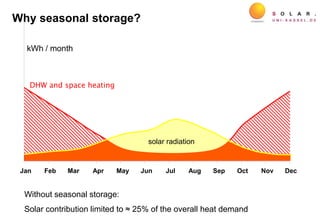
Jan Feb Mar Apr May Jun Jul Aug Sep Oct Nov Dec
TWW
DHW and space heating
Without seasonal storage:
Solar contribution limited to ≈ 25% of the overall heat demand
Why seasonal storage?
kWh / month
solar radiation
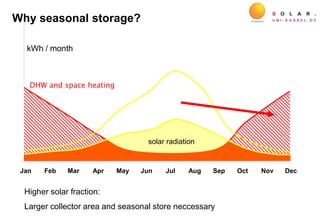
Jan Feb Mar Apr May Jun Jul Aug Sep Oct Nov Dec
TWW
DHW and space heating
Higher solar fraction:
Larger collector area and seasonal store neccessary
Why seasonal storage?
kWh / month
solar radiation
6
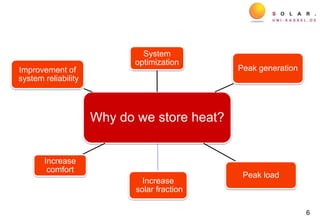
Why do we store heat?
System
optimization
Peak generation
Peak load
Increase
solar fraction
Increase
comfort
Improvement of
system reliability
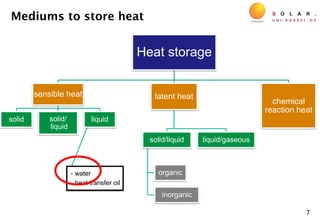
Heat storage
sensible heat
solid solid/
liquid
liquid
- water
- heat transfer oil
latent heat
solid/liquid
organic
inorganic
liquid/gaseous
chemical
reaction heat
7
Mediums to store heat
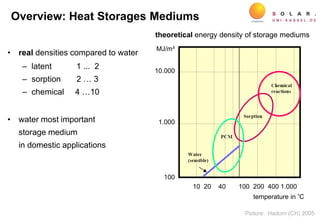
10.000
1.000
100
theoretical energy density of storage mediums
MJ/m³
10 20 40 100 200 400 1.000
temperature in °C
• real densities compared to water
– latent 1 ... 2
– sorption 2 … 3
– chemical 4 …10
• water most important
storage medium
in domestic applications
Overview: Heat Storages Mediums
Picture: Hadorn (CH) 2005
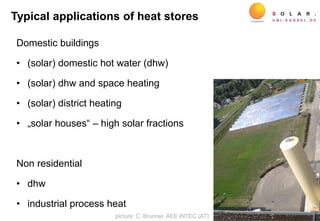
Domestic buildings
• (solar) domestic hot water (dhw)
• (solar) dhw and space heating
• (solar) district heating
• „solar houses“ – high solar fractions
Non residential
• dhw
• industrial process heat
9
Typical applications of heat stores
picture: C. Brunner, AEE INTEC (AT)
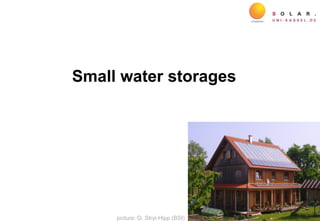
Small water storages
picture: G. Stryi-Hipp (BSI)
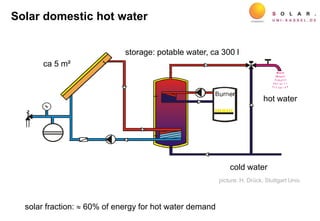
solar fraction:  60% of energy for hot water demand
picture: H. Drück, Stuttgart Univ.
Solar domestic hot water
storage: potable water, ca 300 l
cold water
hot water
ca 5 m²
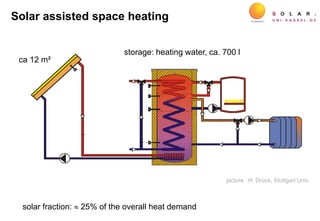
solar fraction:  25% of the overall heat demand
picture : H. Drück, Stuttgart Univ.
Solar assisted space heating
storage: heating water, ca. 700 l
ca 12 m²
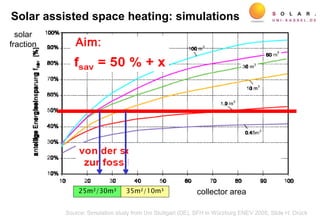
Source: Simulation study from Uni Stuttgart (DE), SFH in Würzburg ENEV 2005, Slide H. Drück
solar
fraction
25m²/30m³ 35m²/10m³
Solar assisted space heating: simulations
Aim:
collector area
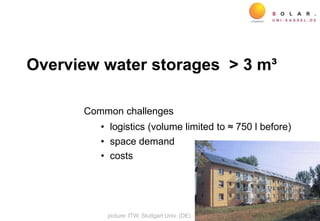
Overview water storages > 3 m³
Common challenges
• logistics (volume limited to ≈ 750 l before)
• space demand
• costs
picture: ITW, Stuttgart Univ. (DE)
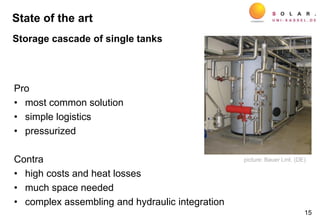
State of the art
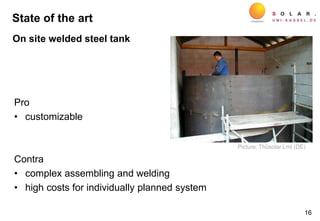
Pro
• most common solution
• simple logistics
• pressurized
Contra
• high costs and heat losses
• much space needed
• complex assembling and hydraulic integration
15
picture: Bauer Lmt. (DE)
Storage cascade of single tanks
Pro
• customizable
Contra
• complex assembling and welding
• high costs for individually planned system
16
Picture: Thüsolar Lmt (DE)
On site welded steel tank
State of the art
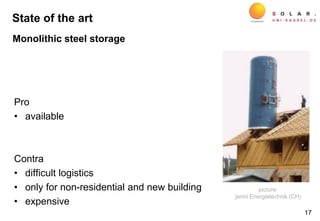
Pro
• available
Contra
• difficult logistics
• only for non-residential and new building
• expensive
17
picture:
Jenni Energietechnik (CH)
Monolithic steel storage
State of the art
Pro
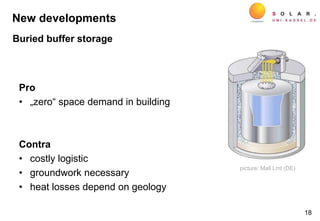
• „zero“ space demand in building
Contra
• costly logistic
• groundwork necessary
• heat losses depend on geology
18
picture: Mall Lmt (DE)
New developments
Buried buffer storage
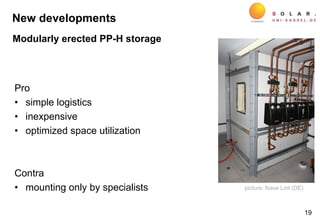
Pro
• simple logistics
• inexpensive
• optimized space utilization
Contra
• mounting only by specialists
19
picture: fsave Lmt (DE)
New developments
Modularly erected PP-H storage
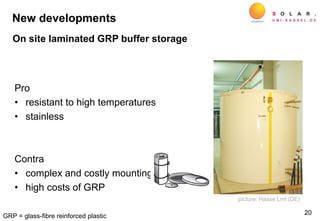
Pro
• resistant to high temperatures
• stainless
Contra
• complex and costly mounting
• high costs of GRP
20
picture: Haase Lmt (DE)
GRP = glass-fibre reinforced plastic
New developments
On site laminated GRP buffer storage
21
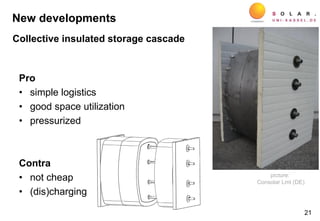
Pro
• simple logistics
• good space utilization
• pressurized
Contra
• not cheap
• (dis)charging
picture:
Consolar Lmt (DE)
New developments
Collective insulated storage cascade
22
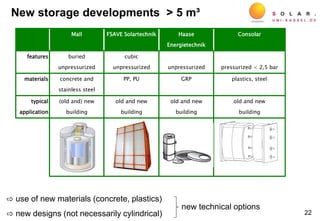
New storage developments > 5 m³
Mall FSAVE Solartechnik Haase
Energietechnik
Consolar
features buried
unpressurized
cubic
unpressurized unpressurized pressurized < 2,5 bar
materials concrete and
stainless steel
PP, PU GRP plastics, steel
typical
application
(old and) new
building
old and new
building
old and new
building
old and new
building
⇨ use of new materials (concrete, plastics)
⇨ new designs (not necessarily cylindrical)
new technical options
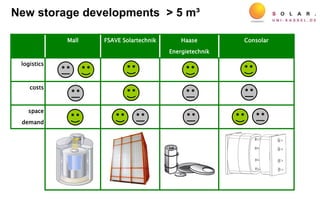
Mall FSAVE Solartechnik Haase
Energietechnik
Consolar
logistics
costs
space
demand
New storage developments > 5 m³
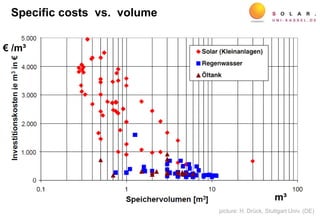
Specific costs vs. volume
picture: H. Drück, Stuttgart Univ. (DE)
€ /m³
m³
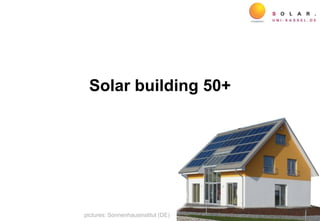
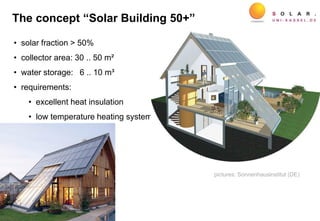
Solar building 50+
pictures: Sonnenhausinstitut (DE)
• solar fraction > 50%
• collector area: 30 .. 50 m²
• water storage: 6 .. 10 m³
• requirements:
• excellent heat insulation
• low temperature heating system
pictures: Sonnenhausinstitut (DE)
The concept “Solar Building 50+”
-0.625
-0.500
-0.375
-0.250
-0.125
0.000
0.125
0.250
0.375
0.500
0.625
0.750
0.875
1.000
-125
-100
-75
-50
-25
0
25
50
75
100
125
150
175
200
Nov Dez Jan Feb Mrz Apr Mai Jun Jul Aug Sep Okt
relativerWärmeinhaltSpeicher[-]
Wärmemenge[kWh]
Solar Pos. Zusatzwärm WW-Verbrau Gesamt-NUT Wärmeverl. Rel. WärmeQsol Qzusatz QTW QHK QSp,verl qSp,relativ
heating period 2011/2012 HP 2012summer period 2012
Qaux QDHW QSH Qsto,loss qsto,relQsol
OctMayDec
Heatconsumptionperday[kWh]
Relativeheatcontentofstore[-]
Storage management
source: H. Drück, Stuttgart Univ., 2013
House: 550 m², Collector 62 m² @ 44°, Storage: 15 m³
-0.625
-0.500
-0.375
-0.250
-0.125
0.000
0.125
0.250
0.375
0.500
0.625
0.750
0.875
1.000
-125
-100
-75
-50
-25
0
25
50
75
100
125
150
175
200
Nov Dez Jan Feb Mrz Apr Mai Jun Jul Aug Sep Okt
relativerWärmeinhaltSpeicher[-]
Wärmemenge[kWh]
Solar Pos. Zusatzwärm WW-Verbrau Gesamt-NUT Wärmeverl. Rel. WärmeQsol Qzusatz QTW QHK QSp,verl qSp,relativ
heating period 2011/2012 HP 2012summer period 2012
Qaux QDHW QSH Qsto,loss qsto,relQsol
OctMayDec
Heatconsumptionperday[kWh]
Relativeheatcontentofstore[-]
P1 P2 P3 P4
phase 1: storage discharching
Phase 2: auxiliary heating
Phase 3: storage charching
Phase 4: excess of solar energy
Storage management
source: H. Drück, Stuttgart Univ., 2013
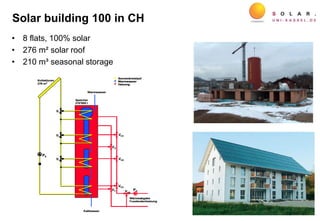
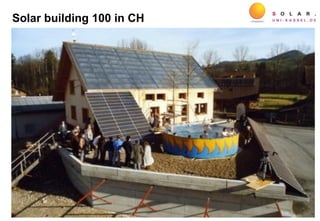
• 8 flats, 100% solar
• 276 m² solar roof
• 210 m³ seasonal storage
29
Solar building 100 in CH
• 8 Mietwohnungen, 100% Solar
• 276 m² Solardach
• 210 m³ saisonaler Speicher
30
Solar building 100 in CH
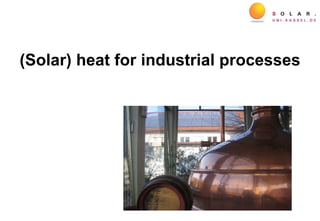
(Solar) heat for industrial processes
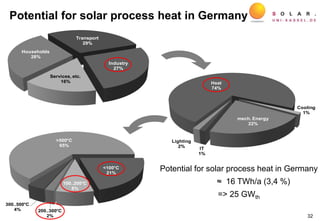
Potential for solar process heat in Germany
≈ 16 TWh/a (3,4 %)
=> 25 GWth
Industry
27%
Services, etc.
16%
Households
28%
Transport
29%
<100 C
21%
100..200 C
8%
200..300 C
2%
300..500 C
4%
>500 C
65%
Heat
74%
Cooling
1%
mech. Energy
22%
IT
1%
Lighting
2%
32
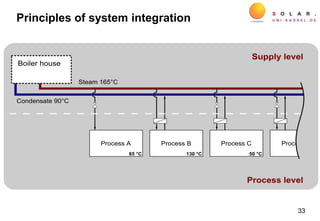
Principles of system integration
33
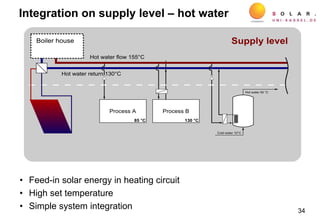
Integration on supply level – hot water
• Feed-in solar energy in heating circuit
• High set temperature
• Simple system integration 34
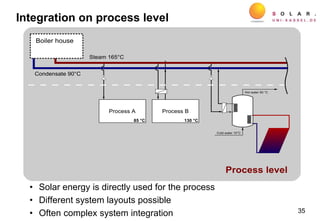
Integration on process level
• Solar energy is directly used for the process
• Different system layouts possible
• Often complex system integration 35
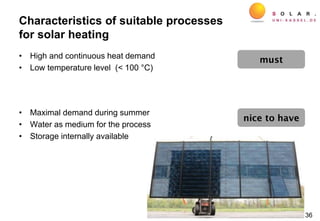
Characteristics of suitable processes
for solar heating
• High and continuous heat demand
• Low temperature level (< 100 °C)
• Maximal demand during summer
• Water as medium for the process
• Storage internally available
nice to have
must
36
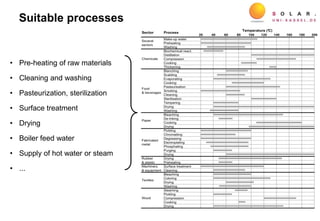
Suitable processes
37
• Pre-heating of raw materials
• Cleaning and washing
• Pasteurization, sterilization
• Surface treatment
• Drying
• Boiler feed water
• Supply of hot water or steam
• ...
Processes utilized as storages
Possibility to increase system performance and reduce system costs
• reduction of stagnation during off-times
• reduced volume of solar buffer tank
• …
Feasibility depends on
• maximum temperature
• sedimentation or cleaning periods
• …
38[www.gz-online.de]
[KRONES]
Electro plating baths
Tunnel pasteurizer for beverages
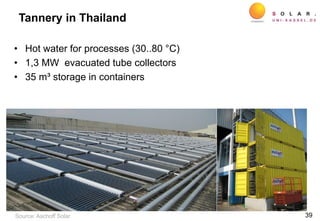
Tannery in Thailand
• Hot water for processes (30..80 °C)
• 1,3 MW evacuated tube collectors
• 35 m³ storage in containers
39Source: Aschoff Solar
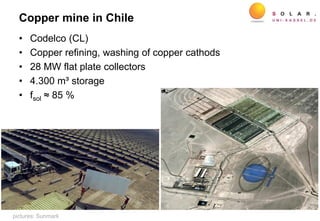
Copper mine in Chile
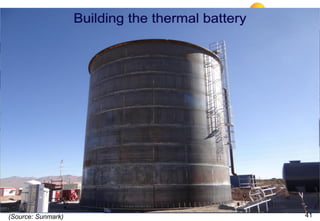
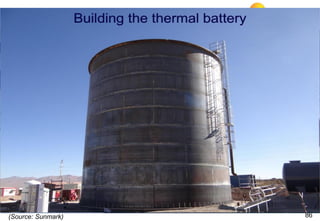
• Codelco (CL)
• Copper refining, washing of copper cathods
• 28 MW flat plate collectors
• 4.300 m³ storage
• fsol ≈ 85 %
pictures: Sunmark
41(Source: Sunmark)
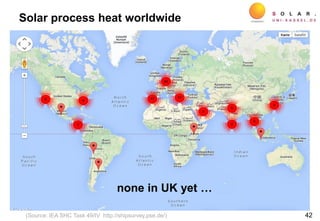
Solar process heat worldwide
42(Source: IEA SHC Task 49/IV http://shipsurvey.pse.de/)
none in UK yet …
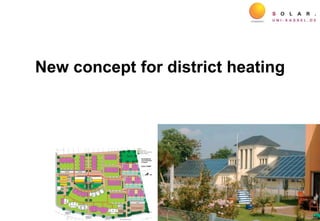
New concept for district heating
44
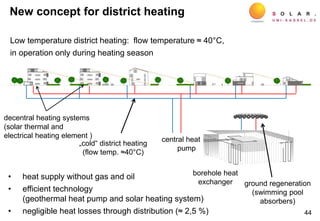
Low temperature district heating: flow temperature ≈ 40°C,
in operation only during heating season
central heat
pump
ground regeneration
(swimming pool
absorbers)
borehole heat
exchanger
New concept for district heating
• heat supply without gas and oil
• efficient technology
(geothermal heat pump and solar heating system)
• negligible heat losses through distribution (≈ 2,5 %)
„cold“ district heating
(flow temp. ≈40°C)
decentral heating systems
(solar thermal and
electrical heating element )
• small heat stores is mature technology
• several large storages > 3 m³ recently developed
• seasonal storages usually expensive due to few storage cycles/a
• > 10 x cheaper to store heat instead of el. or chemical energy
• new options with large storages and district heating
• R&D
• decreased heat losses (vacuum insulation)
• new materials for container and storage
(increased energy density)
• further decrease costs!
Conclusions
contact: solar@uni-kassel.de
46
Thank you
Prof. Dr. Klaus Vajen, Department of Solar and Systems Engineering
Potential in European countries
48
0
1
2
3
4
5
0
4
8
12
16
Germany Italy Spain Austria Portugal Netherlands
SHIPpotential/industrialheatdemand[%]
TechnicalSHIPpotential[TWhperyear]
SHIP Potential for EU 25 ≈ 70 TWh/a =>
approx. 110 GWth
(Source: IEA SHC Task 33/IV)
49
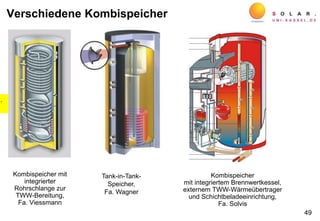
Kombispeicher
mit integriertem Brennwertkessel,
externem TWW-Wärmeübertrager
und Schichtbeladeeinrichtung,
Fa. Solvis
Kombispeicher mit
integrierter
Rohrschlange zur
TWW-Bereitung,
Fa. Viessmann
Tank-in-Tank-
Speicher,
Fa. Wagner
Verschiedene Kombispeicher
..
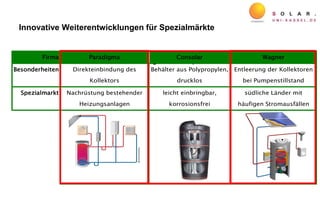
Innovative Weiterentwicklungen für Spezialmärkte
• Innovative Weiterentwicklungen für SpezialmärkteFirma Paradigma Consolar Wagner
Besonderheiten Direkteinbindung des
Kollektors
Behälter aus Polypropylen,
drucklos
Entleerung der Kollektoren
bei Pumpenstillstand
Spezialmarkt Nachrüstung bestehender
Heizungsanlagen
leicht einbringbar,
korrosionsfrei
südliche Länder mit
häufigen Stromausfällen
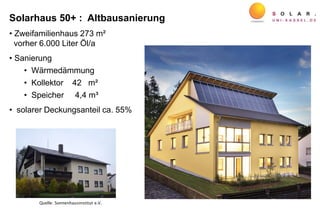
Solarhaus 50+ : Altbausanierung
Quelle: Sonnenhausinstitut e.V.
• Zweifamilienhaus 273 m²
vorher 6.000 Liter Öl/a
• Sanierung
• Wärmedämmung
• Kollektor 42 m²
• Speicher 4,4 m³
• solarer Deckungsanteil ca. 55%
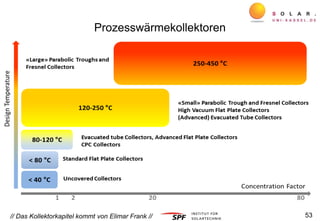
Prozesswärmekollektoren
53// Das Kollektorkapitel kommt von Elimar Frank //
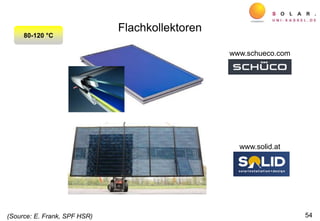
Flachkollektoren
54
www.schueco.com
www.solid.at
80-120 C
(Source: E. Frank, SPF HSR)
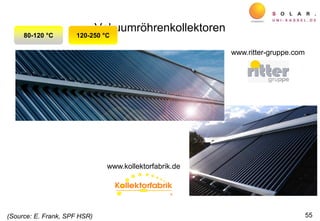
Vakuumröhrenkollektoren
55
www.ritter-gruppe.com
www.kollektorfabrik.de
120-250 C80-120 C
(Source: E. Frank, SPF HSR)
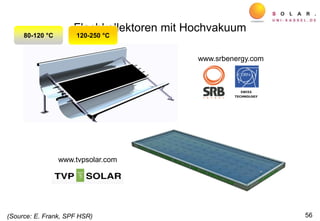
Flachkollektoren mit Hochvakuum
56
www.srbenergy.com
www.tvpsolar.com
120-250 C80-120 C
(Source: E. Frank, SPF HSR)
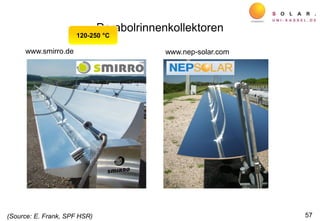
Parabolrinnenkollektoren
57
www.smirro.de
120-250 C
www.nep-solar.com
(Source: E. Frank, SPF HSR)
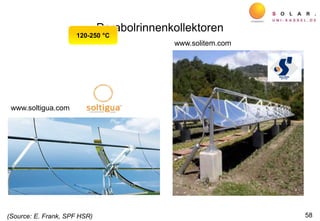
Parabolrinnenkollektoren
58
www.soltigua.com
120-250 C
www.solitem.com
(Source: E. Frank, SPF HSR)
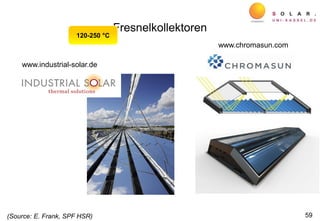
Fresnelkollektoren
59
www.chromasun.com
120-250 C
www.industrial-solar.de
(Source: E. Frank, SPF HSR)
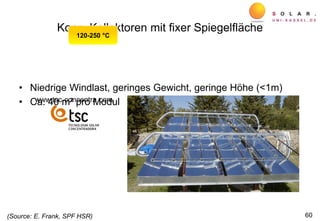
Konz. Kollektoren mit fixer Spiegelfläche
• Niedrige Windlast, geringes Gewicht, geringe Höhe (<1m)
• Ca. 40 m² pro Modul
60
www.tsc-concentra.com
(Source: E. Frank, SPF HSR)
120-250 C
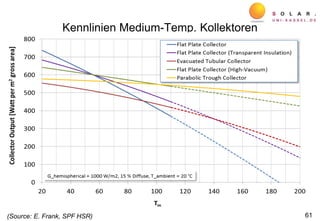
Kennlinien Medium-Temp. Kollektoren
61(Source: E. Frank, SPF HSR)
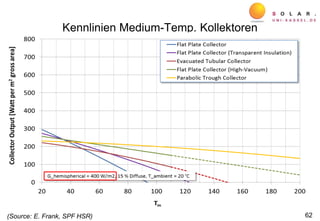
Kennlinien Medium-Temp. Kollektoren
62(Source: E. Frank, SPF HSR)
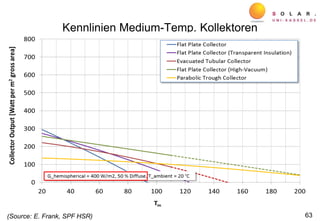
Kennlinien Medium-Temp. Kollektoren
63(Source: E. Frank, SPF HSR)
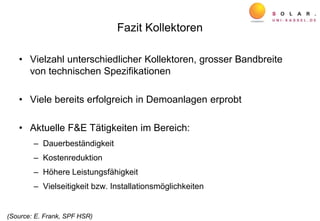
Fazit Kollektoren
• Vielzahl unterschiedlicher Kollektoren, grosser Bandbreite
von technischen Spezifikationen
• Viele bereits erfolgreich in Demoanlagen erprobt
• Aktuelle F&E Tätigkeiten im Bereich:
– Dauerbeständigkeit
– Kostenreduktion
– Höhere Leistungsfähigkeit
– Vielseitigkeit bzw. Installationsmöglichkeiten
(Source: E. Frank, SPF HSR)
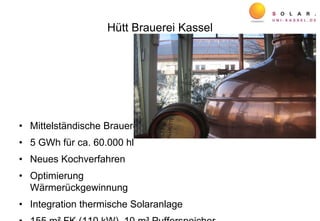
Hütt Brauerei Kassel
• Mittelständische Brauerei
• 5 GWh für ca. 60.000 hl
• Neues Kochverfahren
• Optimierung
Wärmerückgewinnung
• Integration thermische Solaranlage
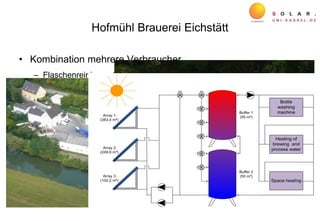
Hofmühl Brauerei Eichstätt
• Kombination mehrere Verbraucher
– Flaschenreinigung (> 90 °C)
– Warmwasserbereitstellung (60..85 °C)
– Gebäudeheizung (50..60 °C)
• 735 m² CPC (515 kW), 110 m³ Speicher
TU Chemnitz
Betriebserfahrungen:
• Spezifischer Systemertrag: 245 kWh/m²a
• Systemnutzungsgrad: 22 %
• Aktiver Forstschutz:
– Dez 09 – Feb 10: 13.000 kWhth (≈7% des Ertrags) + 1.500 kWhel
– Dez 10 – Feb 11: 6.000 kWhth (≈3% des Ertrags) + 1.800 kWhel
• Ungleichmäßige Durchströmung der Kollektoren
– Dampfbildung
– Frostschutz
Hofmühl Brauerei
67
Solar Dampferzeugung ALANOD GmbH
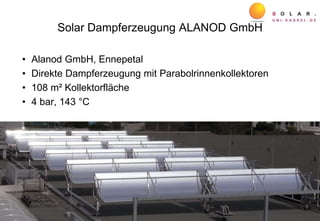
• Alanod GmbH, Ennepetal
• Direkte Dampferzeugung mit Parabolrinnenkollektoren
• 108 m² Kollektorfläche
• 4 bar, 143 °C
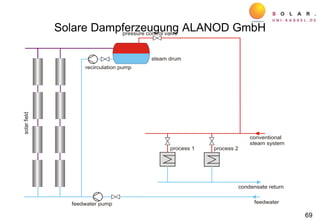
Solare Dampferzeugung ALANOD GmbH
steam drum
recirculation pump
process 1 process 2
feedwater pump
pressure control valve
solarfield
conventional
steam system
condensate return
feedwater
69
Solare Dampferzeugung ALANOD GmbH
Betriebserfahrungen :
• Fehlerfreie und verlässliche Dampfproduktion und
Einspeisung
• Geringer Dampfmassenstrom (niedriger
Systemnutzungsgrad)
• Lange Anfahrzeit (Ausrichtung und Fokussierung)
• Technisch machbar, allerdings hohe Kosten
Verbesserungsmaßnahmen: 70
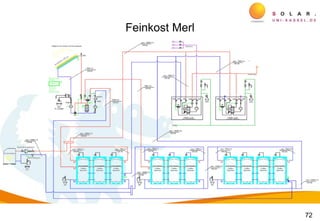
Feinkost Merl
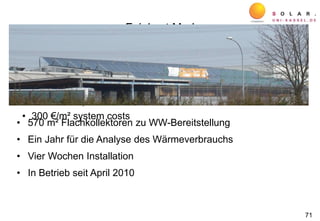
• Hot water demand for food production ≈ 30 m³/d, 60°C
• 568 m² flat plate collectors
• 10 x 3 m³ buffer stores
• 280 MWh/a, solar fraction 40 %
• 300 €/m² system costs
• 570 m² Flachkollektoren zu WW-Bereitstellung
• Ein Jahr für die Analyse des Wärmeverbrauchs
• Vier Wochen Installation
• In Betrieb seit April 2010
71
Feinkost Merl
72
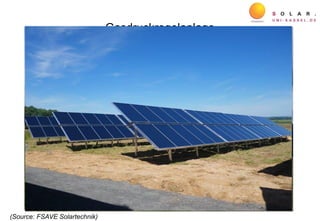
Gasdruckregelanlage
• Gasentspannung vor lokalem Gasnetz (90..16 bar)
=> Gaserwärmung um ca. 25 K („Gefrierschutz“)
• Niedriges Temperaturniveau (≈ 20..40 °C)
• Nahezu konstanter Bedarf
• 0,2 % des Energieinhalts wird benötigt
• 0,5 bis 4 GWh/a für eine Station
• Solaranlage mit 355 m² FK und 25 m³ Speicher
73
Gasdruckregelanlage
(Source: FSAVE Solartechnik)
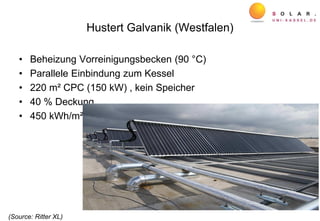
Hustert Galvanik (Westfalen)
• Beheizung Vorreinigungsbecken (90 °C)
• Parallele Einbindung zum Kessel
• 220 m² CPC (150 kW) , kein Speicher
• 40 % Deckung
• 450 kWh/m²
(Source: Ritter XL)
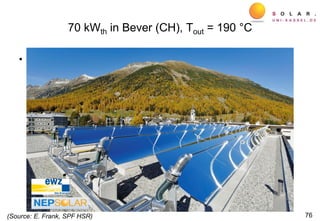
70 kWth in Bever (CH), Tout = 190 °C
• 115 m² zur Dampfbereitstellung
76(Source: E. Frank, SPF HSR)
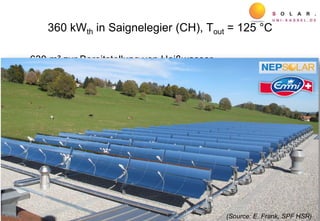
360 kWth in Saignelegier (CH), Tout = 125 °C
• 630 m² zur Bereitstellung von Heißwasser
77(Source: E. Frank, SPF HSR)
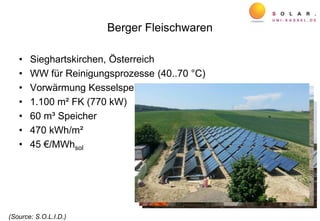
Berger Fleischwaren
• Sieghartskirchen, Österreich
• WW für Reinigungsprozesse (40..70 °C)
• Vorwärmung Kesselspeisewasser (28..93 °C)
• 1.100 m² FK (770 kW)
• 60 m³ Speicher
• 470 kWh/m²
• 45 €/MWhsol
(Source: S.O.L.I.D.)
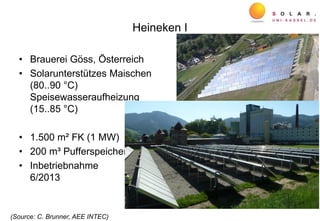
Heineken I
• Brauerei Göss, Österreich
• Solarunterstützes Maischen
(80..90 °C)
Speisewasseraufheizung
(15..85 °C)
• 1.500 m² FK (1 MW)
• 200 m³ Pufferspeicher
• Inbetriebnahme
6/2013
(Source: C. Brunner, AEE INTEC)
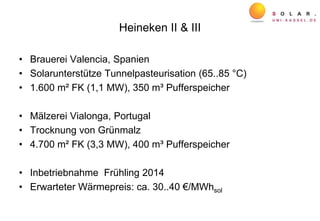
Heineken II & III
• Brauerei Valencia, Spanien
• Solarunterstütze Tunnelpasteurisation (65..85 °C)
• 1.600 m² FK (1,1 MW), 350 m³ Pufferspeicher
• Mälzerei Vialonga, Portugal
• Trocknung von Grünmalz
• 4.700 m² FK (3,3 MW), 400 m³ Pufferspeicher
• Inbetriebnahme Frühling 2014
• Erwarteter Wärmepreis: ca. 30..40 €/MWhsol
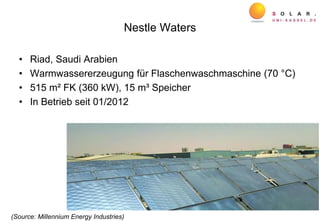
Nestle Waters
• Riad, Saudi Arabien
• Warmwassererzeugung für Flaschenwaschmaschine (70 °C)
• 515 m² FK (360 kW), 15 m³ Speicher
• In Betrieb seit 01/2012
(Source: Millennium Energy Industries)
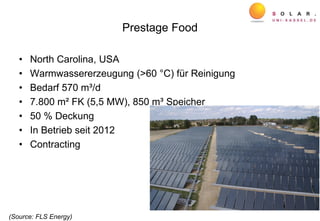
Prestage Food
• North Carolina, USA
• Warmwassererzeugung (>60 °C) für Reinigung
• Bedarf 570 m³/d
• 7.800 m² FK (5,5 MW), 850 m³ Speicher
• 50 % Deckung
• In Betrieb seit 2012
• Contracting
(Source: FLS Energy)
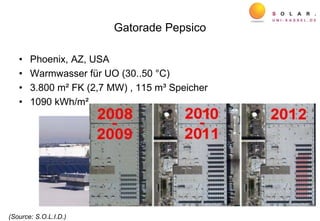
Gatorade Pepsico
• Phoenix, AZ, USA
• Warmwasser für UO (30..50 °C)
• 3.800 m² FK (2,7 MW) , 115 m³ Speicher
• 1090 kWh/m²
(Source: S.O.L.I.D.)
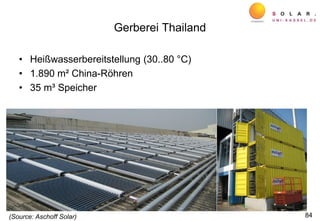
Gerberei Thailand
• Heißwasserbereitstellung (30..80 °C)
• 1.890 m² China-Röhren
• 35 m³ Speicher
84(Source: Aschoff Solar)
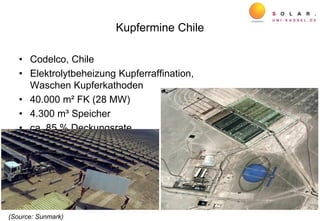
Kupfermine Chile
• Codelco, Chile
• Elektrolytbeheizung Kupferraffination,
Waschen Kupferkathoden
• 40.000 m² FK (28 MW)
• 4.300 m³ Speicher
• ca. 85 % Deckungsrate
(Source: Sunmark)
86(Source: Sunmark)
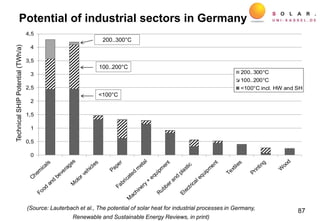
Potential of industrial sectors in Germany
87
0
0,5
1
1,5
2
2,5
3
3,5
4
4,5
TechnicalSHIPPotential(TWhperyear)
200..300°C
100..200°C
<100°C incl. HW and SH
(Source: Lauterbach et al., The potential of solar heat for industrial processes in Germany,
Renewable and Sustainable Energy Reviews, in print)
TechnicalSHIPPotential(TWh/a)
<100°C
100..200°C
200..300°C
88
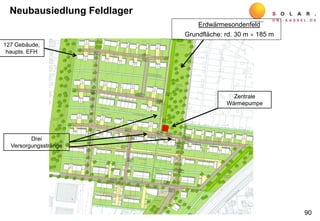
Feldlager
0
10
20
30
40
50
60
70
80
90
100
Tin°C
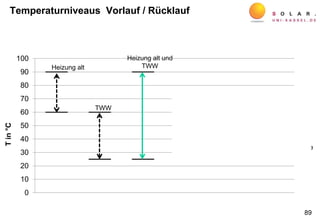
Heizung alt
Nahwärme
Solar, el.
Heizung neu
und TWW
Heizung alt und
TWW
TWW
Heizung neu
TWW
89
Temperaturniveaus Vorlauf / Rücklauf
Zentrale
Wärmepumpe
Drei
Versorgungsstränge
90
Erdwärmesondenfeld
Grundfläche: rd. 30 m  185 m
Neubausiedlung Feldlager
127 Gebäude,
haupts. EFH
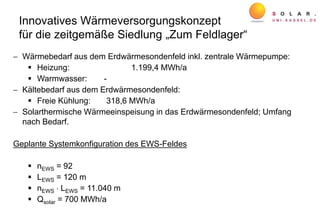
Innovatives Wärmeversorgungskonzept
für die zeitgemäße Siedlung „Zum Feldlager“
 Wärmebedarf aus dem Erdwärmesondenfeld inkl. zentrale Wärmepumpe:
 Heizung: 1.199,4 MWh/a
 Warmwasser: -
 Kältebedarf aus dem Erdwärmesondenfeld:
 Freie Kühlung: 318,6 MWh/a
 Solarthermische Wärmeeinspeisung in das Erdwärmesondenfeld; Umfang
nach Bedarf.
Geplante Systemkonfiguration des EWS-Feldes
 nEWS = 92
 LEWS = 120 m
 nEWS  LEWS = 11.040 m
 Qsolar = 700 MWh/a
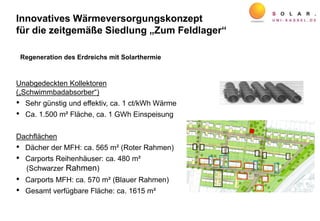
Innovatives Wärmeversorgungskonzept
für die zeitgemäße Siedlung „Zum Feldlager“
Regeneration des Erdreichs mit Solarthermie
Unabgedeckten Kollektoren
(„Schwimmbadabsorber“)
• Sehr günstig und effektiv, ca. 1 ct/kWh Wärme
• Ca. 1.500 m² Fläche, ca. 1 GWh Einspeisung
Dachflächen
• Dächer der MFH: ca. 565 m² (Roter Rahmen)
• Carports Reihenhäuser: ca. 480 m²
(Schwarzer Rahmen)
• Carports MFH: ca. 570 m² (Blauer Rahmen)
• Gesamt verfügbare Fläche: ca. 1615 m²
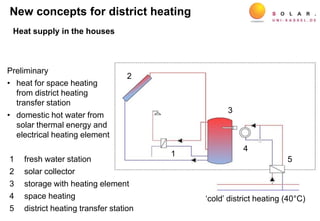
Preliminary
• heat for space heating
from district heating
transfer station
• domestic hot water from
solar thermal energy and
electrical heating element
New concepts for district heating
Heat supply in the houses
‘cold’ district heating (40°C)
2
1
3
4
51 fresh water station
2 solar collector
3 storage with heating element
4 space heating
5 district heating transfer station

Storages for (solar) heating systems at domestic, community and industrial scales | Klaus Vajen

  • 1.
    Storages for (solar)heating systems at domestic, community and industrial scales Klaus Vajen, Kassel University (DE), Inst. of Thermal Engineering, Edinburgh, 21.10.14 1. Introduction 2. Conventional (solar) thermal storages 3. New storage developments > 3 m³ 4. Systems with 50+ solar heating 5. Solar heat for industrial processes 6. New concept for district heating
  • 2.
    ≈ 25 scientists+ students + spin-offs R&D: Coordination: • MSc-programme „Renewable Energies and Energy Efficiency“ • Europewide PhD-education in solar heating (SolNet) • Council „Teaching RE at Universities“ in German speaking countries • Solar World Congress in Kassel 2011 • … 2 • (solar) thermal energy systems • energy efficiency in buildings • advice to policy makers • higher education Solar- and Systems Engineering
  • 3.
    3 Angebot & Bedarf 2. 8 5. 5 6. 6 7. 4 8. 1 8. 8 9. 6 10 .3 11 .1 11 .8 12 .5 13 .3 14 .0 14 .7 15 .5 16 .2 17 .0 17 .7 18 .4 19 .2 19 .9 22 .4 Zeit[h] -> Angebot 5m² Bedarfsdeckung 90% Angebot & Bedarf 2. 8 5. 5 6. 6 7. 4 8. 1 8. 8 9. 6 10 .3 11 .1 11 .8 12 .5 13 .3 14 .0 14 .7 15 .5 16 .2 17 .0 17 .7 18 .4 19 .2 19 .9 22 .4 Zeit [h] -> Angebot 5m² Bedarfsdeckung 90% 120 24 Tageszeit [h] Leistung[kW] 15 20 12 6 3 power(kW) time of day (h) Solar irradiance on a 5 m² collector area and domestic hot water demand of a single family dwelling picture: H. Drück, Stuttgart Univ. Why diurnal storage?
  • 4.
    Jan Feb MarApr May Jun Jul Aug Sep Oct Nov Dec TWW DHW and space heating Without seasonal storage: Solar contribution limited to ≈ 25% of the overall heat demand Why seasonal storage? kWh / month solar radiation
  • 5.
    Jan Feb MarApr May Jun Jul Aug Sep Oct Nov Dec TWW DHW and space heating Higher solar fraction: Larger collector area and seasonal store neccessary Why seasonal storage? kWh / month solar radiation
  • 6.
    6 Why do westore heat? System optimization Peak generation Peak load Increase solar fraction Increase comfort Improvement of system reliability
  • 7.
    Heat storage sensible heat solidsolid/ liquid liquid - water - heat transfer oil latent heat solid/liquid organic inorganic liquid/gaseous chemical reaction heat 7 Mediums to store heat
  • 8.
    10.000 1.000 100 theoretical energy densityof storage mediums MJ/m³ 10 20 40 100 200 400 1.000 temperature in °C • real densities compared to water – latent 1 ... 2 – sorption 2 … 3 – chemical 4 …10 • water most important storage medium in domestic applications Overview: Heat Storages Mediums Picture: Hadorn (CH) 2005
  • 9.
    Domestic buildings • (solar)domestic hot water (dhw) • (solar) dhw and space heating • (solar) district heating • „solar houses“ – high solar fractions Non residential • dhw • industrial process heat 9 Typical applications of heat stores picture: C. Brunner, AEE INTEC (AT)
  • 10.
    Small water storages picture:G. Stryi-Hipp (BSI)
  • 11.
    solar fraction: 60% of energy for hot water demand picture: H. Drück, Stuttgart Univ. Solar domestic hot water storage: potable water, ca 300 l cold water hot water ca 5 m²
  • 12.
    solar fraction: 25% of the overall heat demand picture : H. Drück, Stuttgart Univ. Solar assisted space heating storage: heating water, ca. 700 l ca 12 m²
  • 13.
    Source: Simulation studyfrom Uni Stuttgart (DE), SFH in Würzburg ENEV 2005, Slide H. Drück solar fraction 25m²/30m³ 35m²/10m³ Solar assisted space heating: simulations Aim: collector area
  • 14.
    Overview water storages> 3 m³ Common challenges • logistics (volume limited to ≈ 750 l before) • space demand • costs picture: ITW, Stuttgart Univ. (DE)
  • 15.
    State of theart Pro • most common solution • simple logistics • pressurized Contra • high costs and heat losses • much space needed • complex assembling and hydraulic integration 15 picture: Bauer Lmt. (DE) Storage cascade of single tanks
  • 16.
    Pro • customizable Contra • complexassembling and welding • high costs for individually planned system 16 Picture: Thüsolar Lmt (DE) On site welded steel tank State of the art
  • 17.
    Pro • available Contra • difficultlogistics • only for non-residential and new building • expensive 17 picture: Jenni Energietechnik (CH) Monolithic steel storage State of the art
  • 18.
    Pro • „zero“ spacedemand in building Contra • costly logistic • groundwork necessary • heat losses depend on geology 18 picture: Mall Lmt (DE) New developments Buried buffer storage
  • 19.
    Pro • simple logistics •inexpensive • optimized space utilization Contra • mounting only by specialists 19 picture: fsave Lmt (DE) New developments Modularly erected PP-H storage
  • 20.
    Pro • resistant tohigh temperatures • stainless Contra • complex and costly mounting • high costs of GRP 20 picture: Haase Lmt (DE) GRP = glass-fibre reinforced plastic New developments On site laminated GRP buffer storage
  • 21.
    21 Pro • simple logistics •good space utilization • pressurized Contra • not cheap • (dis)charging picture: Consolar Lmt (DE) New developments Collective insulated storage cascade
  • 22.
    22 New storage developments> 5 m³ Mall FSAVE Solartechnik Haase Energietechnik Consolar features buried unpressurized cubic unpressurized unpressurized pressurized < 2,5 bar materials concrete and stainless steel PP, PU GRP plastics, steel typical application (old and) new building old and new building old and new building old and new building ⇨ use of new materials (concrete, plastics) ⇨ new designs (not necessarily cylindrical) new technical options
  • 23.
    Mall FSAVE SolartechnikHaase Energietechnik Consolar logistics costs space demand New storage developments > 5 m³
  • 24.
    Specific costs vs.volume picture: H. Drück, Stuttgart Univ. (DE) € /m³ m³
  • 25.
    Solar building 50+ pictures:Sonnenhausinstitut (DE)
  • 26.
    • solar fraction> 50% • collector area: 30 .. 50 m² • water storage: 6 .. 10 m³ • requirements: • excellent heat insulation • low temperature heating system pictures: Sonnenhausinstitut (DE) The concept “Solar Building 50+”
  • 27.
    -0.625 -0.500 -0.375 -0.250 -0.125 0.000 0.125 0.250 0.375 0.500 0.625 0.750 0.875 1.000 -125 -100 -75 -50 -25 0 25 50 75 100 125 150 175 200 Nov Dez JanFeb Mrz Apr Mai Jun Jul Aug Sep Okt relativerWärmeinhaltSpeicher[-] Wärmemenge[kWh] Solar Pos. Zusatzwärm WW-Verbrau Gesamt-NUT Wärmeverl. Rel. WärmeQsol Qzusatz QTW QHK QSp,verl qSp,relativ heating period 2011/2012 HP 2012summer period 2012 Qaux QDHW QSH Qsto,loss qsto,relQsol OctMayDec Heatconsumptionperday[kWh] Relativeheatcontentofstore[-] Storage management source: H. Drück, Stuttgart Univ., 2013 House: 550 m², Collector 62 m² @ 44°, Storage: 15 m³
  • 28.
    -0.625 -0.500 -0.375 -0.250 -0.125 0.000 0.125 0.250 0.375 0.500 0.625 0.750 0.875 1.000 -125 -100 -75 -50 -25 0 25 50 75 100 125 150 175 200 Nov Dez JanFeb Mrz Apr Mai Jun Jul Aug Sep Okt relativerWärmeinhaltSpeicher[-] Wärmemenge[kWh] Solar Pos. Zusatzwärm WW-Verbrau Gesamt-NUT Wärmeverl. Rel. WärmeQsol Qzusatz QTW QHK QSp,verl qSp,relativ heating period 2011/2012 HP 2012summer period 2012 Qaux QDHW QSH Qsto,loss qsto,relQsol OctMayDec Heatconsumptionperday[kWh] Relativeheatcontentofstore[-] P1 P2 P3 P4 phase 1: storage discharching Phase 2: auxiliary heating Phase 3: storage charching Phase 4: excess of solar energy Storage management source: H. Drück, Stuttgart Univ., 2013
  • 29.
    • 8 flats,100% solar • 276 m² solar roof • 210 m³ seasonal storage 29 Solar building 100 in CH
  • 30.
    • 8 Mietwohnungen,100% Solar • 276 m² Solardach • 210 m³ saisonaler Speicher 30 Solar building 100 in CH
  • 31.
    (Solar) heat forindustrial processes
  • 32.
    Potential for solarprocess heat in Germany Potential for solar process heat in Germany ≈ 16 TWh/a (3,4 %) => 25 GWth Industry 27% Services, etc. 16% Households 28% Transport 29% <100 C 21% 100..200 C 8% 200..300 C 2% 300..500 C 4% >500 C 65% Heat 74% Cooling 1% mech. Energy 22% IT 1% Lighting 2% 32
  • 33.
    Principles of systemintegration 33
  • 34.
    Integration on supplylevel – hot water • Feed-in solar energy in heating circuit • High set temperature • Simple system integration 34
  • 35.
    Integration on processlevel • Solar energy is directly used for the process • Different system layouts possible • Often complex system integration 35
  • 36.
    Characteristics of suitableprocesses for solar heating • High and continuous heat demand • Low temperature level (< 100 °C) • Maximal demand during summer • Water as medium for the process • Storage internally available nice to have must 36
  • 37.
    Suitable processes 37 • Pre-heatingof raw materials • Cleaning and washing • Pasteurization, sterilization • Surface treatment • Drying • Boiler feed water • Supply of hot water or steam • ...
  • 38.
    Processes utilized asstorages Possibility to increase system performance and reduce system costs • reduction of stagnation during off-times • reduced volume of solar buffer tank • … Feasibility depends on • maximum temperature • sedimentation or cleaning periods • … 38[www.gz-online.de] [KRONES] Electro plating baths Tunnel pasteurizer for beverages
  • 39.
    Tannery in Thailand •Hot water for processes (30..80 °C) • 1,3 MW evacuated tube collectors • 35 m³ storage in containers 39Source: Aschoff Solar
  • 40.
    Copper mine inChile • Codelco (CL) • Copper refining, washing of copper cathods • 28 MW flat plate collectors • 4.300 m³ storage • fsol ≈ 85 % pictures: Sunmark
  • 41.
  • 42.
    Solar process heatworldwide 42(Source: IEA SHC Task 49/IV http://shipsurvey.pse.de/) none in UK yet …
  • 43.
    New concept fordistrict heating
  • 44.
    44 Low temperature districtheating: flow temperature ≈ 40°C, in operation only during heating season central heat pump ground regeneration (swimming pool absorbers) borehole heat exchanger New concept for district heating • heat supply without gas and oil • efficient technology (geothermal heat pump and solar heating system) • negligible heat losses through distribution (≈ 2,5 %) „cold“ district heating (flow temp. ≈40°C) decentral heating systems (solar thermal and electrical heating element )
  • 45.
    • small heatstores is mature technology • several large storages > 3 m³ recently developed • seasonal storages usually expensive due to few storage cycles/a • > 10 x cheaper to store heat instead of el. or chemical energy • new options with large storages and district heating • R&D • decreased heat losses (vacuum insulation) • new materials for container and storage (increased energy density) • further decrease costs! Conclusions contact: solar@uni-kassel.de
  • 46.
  • 47.
    Thank you Prof. Dr.Klaus Vajen, Department of Solar and Systems Engineering
  • 48.
    Potential in Europeancountries 48 0 1 2 3 4 5 0 4 8 12 16 Germany Italy Spain Austria Portugal Netherlands SHIPpotential/industrialheatdemand[%] TechnicalSHIPpotential[TWhperyear] SHIP Potential for EU 25 ≈ 70 TWh/a => approx. 110 GWth (Source: IEA SHC Task 33/IV)
  • 49.
    49 Kombispeicher mit integriertem Brennwertkessel, externemTWW-Wärmeübertrager und Schichtbeladeeinrichtung, Fa. Solvis Kombispeicher mit integrierter Rohrschlange zur TWW-Bereitung, Fa. Viessmann Tank-in-Tank- Speicher, Fa. Wagner Verschiedene Kombispeicher ..
  • 50.
    Innovative Weiterentwicklungen fürSpezialmärkte • Innovative Weiterentwicklungen für SpezialmärkteFirma Paradigma Consolar Wagner Besonderheiten Direkteinbindung des Kollektors Behälter aus Polypropylen, drucklos Entleerung der Kollektoren bei Pumpenstillstand Spezialmarkt Nachrüstung bestehender Heizungsanlagen leicht einbringbar, korrosionsfrei südliche Länder mit häufigen Stromausfällen
  • 51.
    Solarhaus 50+ :Altbausanierung Quelle: Sonnenhausinstitut e.V. • Zweifamilienhaus 273 m² vorher 6.000 Liter Öl/a • Sanierung • Wärmedämmung • Kollektor 42 m² • Speicher 4,4 m³ • solarer Deckungsanteil ca. 55%
  • 52.
  • 53.
  • 54.
  • 55.
  • 56.
  • 57.
  • 58.
  • 59.
    Konz. Kollektoren mitfixer Spiegelfläche • Niedrige Windlast, geringes Gewicht, geringe Höhe (<1m) • Ca. 40 m² pro Modul 60 www.tsc-concentra.com (Source: E. Frank, SPF HSR) 120-250 C
  • 60.
  • 61.
  • 62.
  • 63.
    Fazit Kollektoren • Vielzahlunterschiedlicher Kollektoren, grosser Bandbreite von technischen Spezifikationen • Viele bereits erfolgreich in Demoanlagen erprobt • Aktuelle F&E Tätigkeiten im Bereich: – Dauerbeständigkeit – Kostenreduktion – Höhere Leistungsfähigkeit – Vielseitigkeit bzw. Installationsmöglichkeiten (Source: E. Frank, SPF HSR)
  • 64.
    Hütt Brauerei Kassel •Mittelständische Brauerei • 5 GWh für ca. 60.000 hl • Neues Kochverfahren • Optimierung Wärmerückgewinnung • Integration thermische Solaranlage
  • 65.
    Hofmühl Brauerei Eichstätt •Kombination mehrere Verbraucher – Flaschenreinigung (> 90 °C) – Warmwasserbereitstellung (60..85 °C) – Gebäudeheizung (50..60 °C) • 735 m² CPC (515 kW), 110 m³ Speicher TU Chemnitz
  • 66.
    Betriebserfahrungen: • Spezifischer Systemertrag:245 kWh/m²a • Systemnutzungsgrad: 22 % • Aktiver Forstschutz: – Dez 09 – Feb 10: 13.000 kWhth (≈7% des Ertrags) + 1.500 kWhel – Dez 10 – Feb 11: 6.000 kWhth (≈3% des Ertrags) + 1.800 kWhel • Ungleichmäßige Durchströmung der Kollektoren – Dampfbildung – Frostschutz Hofmühl Brauerei 67
  • 67.
    Solar Dampferzeugung ALANODGmbH • Alanod GmbH, Ennepetal • Direkte Dampferzeugung mit Parabolrinnenkollektoren • 108 m² Kollektorfläche • 4 bar, 143 °C
  • 68.
    Solare Dampferzeugung ALANODGmbH steam drum recirculation pump process 1 process 2 feedwater pump pressure control valve solarfield conventional steam system condensate return feedwater 69
  • 69.
    Solare Dampferzeugung ALANODGmbH Betriebserfahrungen : • Fehlerfreie und verlässliche Dampfproduktion und Einspeisung • Geringer Dampfmassenstrom (niedriger Systemnutzungsgrad) • Lange Anfahrzeit (Ausrichtung und Fokussierung) • Technisch machbar, allerdings hohe Kosten Verbesserungsmaßnahmen: 70
  • 70.
    Feinkost Merl • Hotwater demand for food production ≈ 30 m³/d, 60°C • 568 m² flat plate collectors • 10 x 3 m³ buffer stores • 280 MWh/a, solar fraction 40 % • 300 €/m² system costs • 570 m² Flachkollektoren zu WW-Bereitstellung • Ein Jahr für die Analyse des Wärmeverbrauchs • Vier Wochen Installation • In Betrieb seit April 2010 71
  • 71.
  • 72.
    Gasdruckregelanlage • Gasentspannung vorlokalem Gasnetz (90..16 bar) => Gaserwärmung um ca. 25 K („Gefrierschutz“) • Niedriges Temperaturniveau (≈ 20..40 °C) • Nahezu konstanter Bedarf • 0,2 % des Energieinhalts wird benötigt • 0,5 bis 4 GWh/a für eine Station • Solaranlage mit 355 m² FK und 25 m³ Speicher 73
  • 73.
  • 74.
    Hustert Galvanik (Westfalen) •Beheizung Vorreinigungsbecken (90 °C) • Parallele Einbindung zum Kessel • 220 m² CPC (150 kW) , kein Speicher • 40 % Deckung • 450 kWh/m² (Source: Ritter XL)
  • 75.
    70 kWth inBever (CH), Tout = 190 °C • 115 m² zur Dampfbereitstellung 76(Source: E. Frank, SPF HSR)
  • 76.
    360 kWth inSaignelegier (CH), Tout = 125 °C • 630 m² zur Bereitstellung von Heißwasser 77(Source: E. Frank, SPF HSR)
  • 77.
    Berger Fleischwaren • Sieghartskirchen,Österreich • WW für Reinigungsprozesse (40..70 °C) • Vorwärmung Kesselspeisewasser (28..93 °C) • 1.100 m² FK (770 kW) • 60 m³ Speicher • 470 kWh/m² • 45 €/MWhsol (Source: S.O.L.I.D.)
  • 78.
    Heineken I • BrauereiGöss, Österreich • Solarunterstützes Maischen (80..90 °C) Speisewasseraufheizung (15..85 °C) • 1.500 m² FK (1 MW) • 200 m³ Pufferspeicher • Inbetriebnahme 6/2013 (Source: C. Brunner, AEE INTEC)
  • 79.
    Heineken II &III • Brauerei Valencia, Spanien • Solarunterstütze Tunnelpasteurisation (65..85 °C) • 1.600 m² FK (1,1 MW), 350 m³ Pufferspeicher • Mälzerei Vialonga, Portugal • Trocknung von Grünmalz • 4.700 m² FK (3,3 MW), 400 m³ Pufferspeicher • Inbetriebnahme Frühling 2014 • Erwarteter Wärmepreis: ca. 30..40 €/MWhsol
  • 80.
    Nestle Waters • Riad,Saudi Arabien • Warmwassererzeugung für Flaschenwaschmaschine (70 °C) • 515 m² FK (360 kW), 15 m³ Speicher • In Betrieb seit 01/2012 (Source: Millennium Energy Industries)
  • 81.
    Prestage Food • NorthCarolina, USA • Warmwassererzeugung (>60 °C) für Reinigung • Bedarf 570 m³/d • 7.800 m² FK (5,5 MW), 850 m³ Speicher • 50 % Deckung • In Betrieb seit 2012 • Contracting (Source: FLS Energy)
  • 82.
    Gatorade Pepsico • Phoenix,AZ, USA • Warmwasser für UO (30..50 °C) • 3.800 m² FK (2,7 MW) , 115 m³ Speicher • 1090 kWh/m² (Source: S.O.L.I.D.)
  • 83.
    Gerberei Thailand • Heißwasserbereitstellung(30..80 °C) • 1.890 m² China-Röhren • 35 m³ Speicher 84(Source: Aschoff Solar)
  • 84.
    Kupfermine Chile • Codelco,Chile • Elektrolytbeheizung Kupferraffination, Waschen Kupferkathoden • 40.000 m² FK (28 MW) • 4.300 m³ Speicher • ca. 85 % Deckungsrate (Source: Sunmark)
  • 85.
  • 86.
    Potential of industrialsectors in Germany 87 0 0,5 1 1,5 2 2,5 3 3,5 4 4,5 TechnicalSHIPPotential(TWhperyear) 200..300°C 100..200°C <100°C incl. HW and SH (Source: Lauterbach et al., The potential of solar heat for industrial processes in Germany, Renewable and Sustainable Energy Reviews, in print) TechnicalSHIPPotential(TWh/a) <100°C 100..200°C 200..300°C
  • 87.
  • 88.
    0 10 20 30 40 50 60 70 80 90 100 Tin°C Heizung alt Nahwärme Solar, el. Heizungneu und TWW Heizung alt und TWW TWW Heizung neu TWW 89 Temperaturniveaus Vorlauf / Rücklauf
  • 89.
    Zentrale Wärmepumpe Drei Versorgungsstränge 90 Erdwärmesondenfeld Grundfläche: rd. 30m  185 m Neubausiedlung Feldlager 127 Gebäude, haupts. EFH
  • 90.
    Innovatives Wärmeversorgungskonzept für diezeitgemäße Siedlung „Zum Feldlager“  Wärmebedarf aus dem Erdwärmesondenfeld inkl. zentrale Wärmepumpe:  Heizung: 1.199,4 MWh/a  Warmwasser: -  Kältebedarf aus dem Erdwärmesondenfeld:  Freie Kühlung: 318,6 MWh/a  Solarthermische Wärmeeinspeisung in das Erdwärmesondenfeld; Umfang nach Bedarf. Geplante Systemkonfiguration des EWS-Feldes  nEWS = 92  LEWS = 120 m  nEWS  LEWS = 11.040 m  Qsolar = 700 MWh/a
  • 91.
    Innovatives Wärmeversorgungskonzept für diezeitgemäße Siedlung „Zum Feldlager“ Regeneration des Erdreichs mit Solarthermie Unabgedeckten Kollektoren („Schwimmbadabsorber“) • Sehr günstig und effektiv, ca. 1 ct/kWh Wärme • Ca. 1.500 m² Fläche, ca. 1 GWh Einspeisung Dachflächen • Dächer der MFH: ca. 565 m² (Roter Rahmen) • Carports Reihenhäuser: ca. 480 m² (Schwarzer Rahmen) • Carports MFH: ca. 570 m² (Blauer Rahmen) • Gesamt verfügbare Fläche: ca. 1615 m²
  • 92.
    Preliminary • heat forspace heating from district heating transfer station • domestic hot water from solar thermal energy and electrical heating element New concepts for district heating Heat supply in the houses ‘cold’ district heating (40°C) 2 1 3 4 51 fresh water station 2 solar collector 3 storage with heating element 4 space heating 5 district heating transfer station