Einleitung
Motivation
Problem
Grundlagen
Literatur
EAM
EAF
TOGAF
Content
Metamodel
Artifacts
Deliverables
Building
Blocks
Schluss
Folgerungen
Ausblick
Fazit
TOGAF 9 – Teil IV:
Architecture Content Framework
IT-Management und Unternehmensarchitektur
Semesterarbeit
Studiengang: Informatik, Modul BTI7311 Informatik Seminar
Autor: Roland Bruggmann, roland.bruggmann@students.bfh.ch
Co-Autor: Tobias Millauer, tobias.millauer@students.bfh.ch
Dozent: Prof. Dr. Urs Sauter, urs.sauter@bfh.ch
Datum: 14. April 2015
Berner Fachhochschule | Haute ´ecole sp´ecialis´ee bernoise | Bern University of Applied Sciences
Einleitung
Motivation
Problem
Grundlagen
Literatur
EAM
EAF
TOGAF
Content
Metamodel
Artifacts
Deliverables
Building
Blocks
Schluss
Folgerungen
Ausblick
Fazit
¨Ubersicht
1 Einleitung
Motivation
Problemstellung
2 Grundlagen
Hintergrundliteratur
Enterprise Architecture Management
Enterprise Architecture Framework
Framework der Open Group
3 Architecture Content Framework
Content Metamodel
Architecture Artifacts
Deliverables
Building Blocks
4 Schlussfolgerungen und Ausblick
Schlussfolgerungen
Ausblick
Fazit
Berner Fachhochschule | Haute ´ecole sp´ecialis´ee bernoise | Bern University of Applied Sciences
Einleitung
Motivation
Problem
Grundlagen
Literatur
EAM
EAF
TOGAF
Content
Metamodel
Artifacts
Deliverables
Building
Blocks
Schluss
Folgerungen
Ausblick
Fazit
Einleitung
Berner Fachhochschule | Haute ´ecole sp´ecialis´ee bernoise | Bern University of Applied Sciences
Einleitung
Motivation
Problem
Grundlagen
Literatur
EAM
EAF
TOGAF
Content
Metamodel
Artifacts
Deliverables
Building
Blocks
Schluss
Folgerungen
Ausblick
Fazit
Einleitung
TOGAF 9 – Teil IV: Architecture Content Framework
Motivation
TOGAF ist ein wichtiger Standard
Komplexit¨at stellt Anwender vor grosse Herausforderungen
Gesichtspunkte von TOGAF beleuchten
Berner Fachhochschule | Haute ´ecole sp´ecialis´ee bernoise | Bern University of Applied Sciences
Einleitung
Motivation
Problem
Grundlagen
Literatur
EAM
EAF
TOGAF
Content
Metamodel
Artifacts
Deliverables
Building
Blocks
Schluss
Folgerungen
Ausblick
Fazit
Einleitung
TOGAF 9 – Teil IV: Architecture Content Framework
Problemstellung
TOGAF 9 – Teil IV: Architecture Content Framework
Content Metamodel
Artifacts, Deliverables und Building Blocks
Berner Fachhochschule | Haute ´ecole sp´ecialis´ee bernoise | Bern University of Applied Sciences
Einleitung
Motivation
Problem
Grundlagen
Literatur
EAM
EAF
TOGAF
Content
Metamodel
Artifacts
Deliverables
Building
Blocks
Schluss
Folgerungen
Ausblick
Fazit
Grundlagen
Berner Fachhochschule | Haute ´ecole sp´ecialis´ee bernoise | Bern University of Applied Sciences
Einleitung
Motivation
Problem
Grundlagen
Literatur
EAM
EAF
TOGAF
Content
Metamodel
Artifacts
Deliverables
Building
Blocks
Schluss
Folgerungen
Ausblick
Fazit
Grundlagen
TOGAF 9 – Teil IV: Architecture Content Framework
Hintergrundliteratur
Unternehmensarchitektur:
S. Aier, C. Riege und R. Winter (2008): Unternehmensarchitektur –
Literatur¨uberblick und Stand der Praxis. (ARW08)
D. Matthes (2011a): Enterprise Architecture Frameworks Kompendium – ¨Uber
50 Rahmenwerke f¨ur das IT-Management. (Mat11a)
D. Matthes (2011b): Matthes Framework Map - frameworks according to their
nationality and intention. (Mat11b)
W. Keller (2012): IT-Unternehmensarchitektur – Von der Gesch¨aftsstrategie zur
optimalen IT-Unterst¨utzung. (Kel12)
TOGAF:
D. Weinberger (2010): . . . und am Anfang steht die Gesch¨aftsanforderung, oder?
(Wei10)
A. Josey u.a. (2010): TOGAF Version 9 – Ein Pocket Guide. (Jos+10)
The Open Group (2010): TOGAF Version 9.1. Document Number: G116.
(Ope10)
Berner Fachhochschule | Haute ´ecole sp´ecialis´ee bernoise | Bern University of Applied Sciences
Einleitung
Motivation
Problem
Grundlagen
Literatur
EAM
EAF
TOGAF
Content
Metamodel
Artifacts
Deliverables
Building
Blocks
Schluss
Folgerungen
Ausblick
Fazit
Grundlagen
TOGAF 9 – Teil IV: Architecture Content Framework
Enterprise Architecture Management
Vereint Gesch¨aftsprozesse und IT-Architektur1
CRM, Portale usw. zu einem Ganzen kombinieren
Big Data, Cloud, Mobile Computing gezielt f¨ur Gesch¨aftst¨atigkeit nutzen2
Schl¨usselkompetenz des Betriebsmanagements,
hat stark an Bedeutung gewonnen (ARW08, S.292f)
1
Newsletter ELCA 08 2014
2
Flyer ELCA Berner Fachhochschule | Haute ´ecole sp´ecialis´ee bernoise | Bern University of Applied Sciences
Einleitung
Motivation
Problem
Grundlagen
Literatur
EAM
EAF
TOGAF
Content
Metamodel
Artifacts
Deliverables
Building
Blocks
Schluss
Folgerungen
Ausblick
Fazit
Grundlagen
TOGAF 9 – Teil IV: Architecture Content Framework
Enterprise Architecture Management
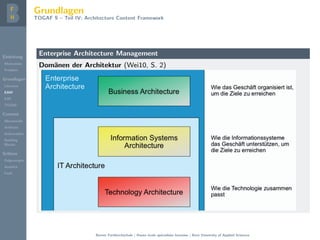
Dom¨anen der Architektur (Wei10, S. 2)
schi
Kon
der
abe
ode
Unt
Auc
die
Akt
Ken
mag
dur
Abe
drei
che
Ges
Kun
Eink
er A
kos
liegAbb. 2: Domänen der ArchitekturBerner Fachhochschule | Haute ´ecole sp´ecialis´ee bernoise | Bern University of Applied Sciences
Einleitung
Motivation
Problem
Grundlagen
Literatur
EAM
EAF
TOGAF
Content
Metamodel
Artifacts
Deliverables
Building
Blocks
Schluss
Folgerungen
Ausblick
Fazit
Grundlagen
TOGAF 9 – Teil IV: Architecture Content Framework
Enterprise Architecture Management
Ebenen der Unternehmensarchitektur gem¨ass IEEE (ARW08, S. 292f):
1 Strategie: Produkte, Dienstleistungen, Unternehmensziele, Kunden, Zulieferer.
2 Organisation: Vertriebskan¨ale, Gesch¨aftsprozesse, Organisationseinheiten, Rollen,
Standorte.
3 Integration: Applikationen, Dienste, Schnittstellen.
4 Software: Softwarekomponenten, Datenstrukturen.
5 IT-Infrastruktur: Hardware, Netzwerk, Software-Plattformen.
Berner Fachhochschule | Haute ´ecole sp´ecialis´ee bernoise | Bern University of Applied Sciences
Einleitung
Motivation
Problem
Grundlagen
Literatur
EAM
EAF
TOGAF
Content
Metamodel
Artifacts
Deliverables
Building
Blocks
Schluss
Folgerungen
Ausblick
Fazit
Grundlagen
TOGAF 9 – Teil IV: Architecture Content Framework
Enterprise Architecture Management
Nutzen (Wei10, S. 2f)
Transparenz der Zusammenh¨ange im Unternehmen
Management von Unternehmensver¨anderungen
Use Case:
”
Virtuelle Unternehmung” (z.B. ARGE)
Berner Fachhochschule | Haute ´ecole sp´ecialis´ee bernoise | Bern University of Applied Sciences
Einleitung
Motivation
Problem
Grundlagen
Literatur
EAM
EAF
TOGAF
Content
Metamodel
Artifacts
Deliverables
Building
Blocks
Schluss
Folgerungen
Ausblick
Fazit
Grundlagen
TOGAF 9 – Teil IV: Architecture Content Framework
Enterprise Architecture Management
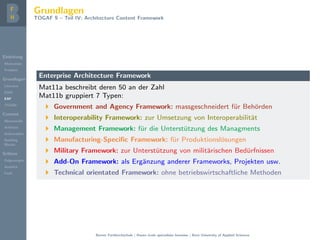
Zust¨andigkeiten
IT-Vorstand, auch eines ausgegr¨undeten IT-Dienstleisters (Kel12, S. xi)
Zentrale Disziplin des CIO, neben Strategie- und Portfoliomanagement3
3
Flyer ELCA Berner Fachhochschule | Haute ´ecole sp´ecialis´ee bernoise | Bern University of Applied Sciences
Einleitung
Motivation
Problem
Grundlagen
Literatur
EAM
EAF
TOGAF
Content
Metamodel
Artifacts
Deliverables
Building
Blocks
Schluss
Folgerungen
Ausblick
Fazit
Grundlagen
TOGAF 9 – Teil IV: Architecture Content Framework
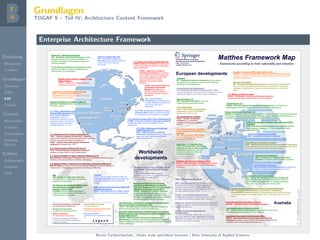
Enterprise Architecture Framework
Mat11a beschreibt deren 50 an der Zahl
Mat11b gruppiert 7 Typen:
Government and Agency Framework: massgeschneidert f¨ur Beh¨orden
Interoperability Framework: zur Umsetzung von Interoperabilit¨at
Management Framework: f¨ur die Unterst¨utzung des Managments
Manufacturing-Specific Framework: f¨ur Produktionsl¨osungen
Military Framework: zur Unterst¨utzung von milit¨arischen Bed¨urfnissen
Add-On Framework: als Erg¨anzung anderer Frameworks, Projekten usw.
Technical orientated Framework: ohne betriebswirtschaftliche Methoden
Berner Fachhochschule | Haute ´ecole sp´ecialis´ee bernoise | Bern University of Applied Sciences
Einleitung
Motivation
Problem
Grundlagen
Literatur
EAM
EAF
TOGAF
Content
Metamodel
Artifacts
Deliverables
Building
Blocks
Schluss
Folgerungen
Ausblick
Fazit
Grundlagen
TOGAF 9 – Teil IV: Architecture Content Framework
Enterprise Architecture Framework
Washington,
DC
Washington,
DC
New YorkNew York
West
Lafayette
West
Lafayette
Canada
United States
of America
Canada
Steven H. Spewak, New York
EAP - Enterprise Architecture
Planning provides steps to realise the
top two rows of the Zachman
Framework.
U. S. Department of Defence, Washington DC
C4ISR Architecture Framework provides views,
models and a method to describe an information
system architecture.
U. S. Office of Management and Budget
(OMB), Washington DC
EAAF - OMB Enterprise Architecture
Assessment Framework helps to measure and
assess the steady enterprise architecture
improvement process.
U. S. National Institutes of Health, Bethesda & Washington DC
NIH Enterprise Architecture Framework helps with the architecture development and
describes a business architecture modeling methodology.
U.S. National Institute of Standards and Technology, Gaithersburg (Maryland)
NIST EA Model provides a five-layered architectural reference model for managing an
integrated set of information and information technology architectures.
Purdue University, West Lafayette (Indiana)
PERA - Purdue Enterprise Reference
Architecture helps to analyse, design and develop
enterprise integration projects.
Zachman International, La Canada (California)
Zachman-Framework defines views and layers of an
information system.
La CanadaLa Canada
OttawaOttawa
National Defence and the Canadian Forces,
Ottawa (Ontario)
DNDAF - Department of National Defense
Architecture Framework
Joint development by IEEE (more than 380.000
members from 150 countries) and The Open
Group
POSIX OSE Reference Model supports
specification of interfaces for distributed systems
and distributed application platform
implementations.
Workgroup Architectures for Enterprise
Integration by International Federation for
Information Processing (IFIP) and International
Federation of Automatic Control (IFAC)
GERAM - Generalised Enterprise Reference
Architecture and Methodology provides a
general reference architecture to describe all
information and communication systems as well as
activities around the enterprise processes.
Worldwide
developments
Gartner Inc., Stamford (Connecticut)
EAF - Enterprise Architecture Framework provides
development steps for an optimal constellation of
business, information and technology to support the
business strategies.
IT City Planning Architecture Framework separates
between the business, functional, application und
technical layer of an architecture.
StamfordStamford
L e g e n d
Government and Agency Frameworks
specially-tailored for federal uses
Management Frameworks
to support the management branch
Military Frameworks
to support military requirements
Technical orientated Frameworks
without business orientated management
methods (e.g. BPML)
Interoperability Frameworks
to realise interactivity
Manufacturing-Specific Frameworks
for manufacturing solutions
Add-On Frameworks
in addition to other frameworks, projects
etc.
United States
of America
U. S. Department of the Treasury, Washington DC
TEAF - Treasury Enterprise Architecture Framework
supports the architecture development with guides, templates,
common concepts to standards, principles etc.
TISAF - Treasury Information System Architecture
Framework is revised by the TEAF.
U. S. Chief Information Officers (CIO) Council
FEAF- Federal Enterprise Architecture Framework
provides an empty frame for the EA-development.
U. S. General Accounting Office (GAO), Washington DC
EAMMF - Enterprise Architecture Management Maturity
Framework helps to define the maturity of the EA-
development.
DoDAF - Department of Defence
Architecture Framework as successor
of the C4ISR the DoDAF provides views
and models to develop an information
system architecture for weapon
integration and service-oriented
structures.
JTA - Joint Technical
Architecture as knowledge base
provides standards, interfaces and
services for other (DoD)
frameworks.
TAFIM - Technical Architectural
Framework for Information
Management helped with a
reference model and steps to
describe and develop a technical
architecture.
U. S. Office of Management and
Budget (OMB), Washington DC
FEA - Federal Enterprise
Architecture contains a
performance, business, service
component, data and a technical
reference model for describing
important elements of an EA.
DoD TRM - Department of Defence Technical
Reference Model supports a technical structure
for development and acquisition of IT-solutions.
IBM
ADS - Architecture Description Standard
provides notations, terminology and semantics
for architecture description.
The Open Group (Initiated ArchiMate project
was managed by Telematica Instituut,
Enschede - Netherlands.)
ArchiMate defines provides terminology for
modelling the global structure of domains and
relations between the domains.
Casewise
Based on the Zachman Framework offers the
Casewise Framework structure, templates and
guidance to create enterprise architecture
models.
IEEE Architecture Working Group (AWG) with
multinational members
ISO/IEC 42010 (IEEE Std 1471-2000) describes
required contents of an architecture description.
The Open Group - Consortium by members from North America
(50%), Europe (25%) and Asia-Pacific (25%)
TOGAF - The Open Group Architecture Framework supports the
development and description of technical architectures.
Globemen (Global Engineering and Manufacturing in Enterprise
Networks) project is part of international Intelligent Manufacturing
Systems (IMS) program
VERAM - Virtual Enterprise Reference Architecture and
Methodology is a framework that positions elements according to its
support, modelling, formation/set up, management of virtual enterprises
and the underlying IT.
France
Germany
Netherlands
United
Kingdom
United
Kingdom
France
Germany
Netherlands
EuropeEurope
Australian Department of Defence, Canberra
AusDAF - Australian Defence Architecture Framework
consultant-educators Robinson and Gout
XAF - eXtreme Enterprise Architecture is practical for reengineering
activities and software applications in the enterprise.
Queensland Government Chief Information Office
QGEAF - Queensland Government Enterprise Architecture
Framework provides a structure for the information management and
information and communication technology policy.
Institute For Enterprise Architecture Developments (IFEAD),
Amersfoort
E2AF - Extended Enterprise Architecture Framework describes
views and steps to enhance an EA to an extended enterprise
architecture (E2A).
AmersfoortAmersfoort
BordeauxBordeaux
Délégation Générale pour l'Armement (DGA)
AGATE - Atelier de Gestion de l'Architecture provides
viewpoints including models of the information system
architecture.
LondonLondon
U. K. Ministry of Defence, London
MoDAF - UK Ministry of Defence Architectural Framework
supports the description and specification of an architecture.
SaarbrückenSaarbrücken
Australia
Matthes Framework Map
Capgemini
IAF - Integrated Architecture Framework provides views on
and layers of an architecture as well as tools (workshops,
interviews) for their development.
Comité Européen de Normalisation
HIF - Healthcare Information Framework (ENV 12443)
supports specification of services on the middleware layer and
describes a healthcare information system architecture.
Université de Bordeaux, Laboratory
of Automation and Productics (LAP),
Bordeaux
GIM - GRAI Integrated Methodology
supports analysis and specification of
CIM systems components.
European Consortium AMICE (IBM, Siemens, FIAT, ...)
CIMOSA - Computer Integrated Manufacturing Open System Architecture
provides a modelling framework for the corporate structure including computer
integrated manufacturing.
European developments
- frameworks according to their nationality and intention -
IDS Scheer AG, Saarbrücken
ARIS - Architecture of Integrated Information
Systems to model and optimize business processes.
EnschedeEnschede
Atos Origin – IT Consulting, Paris
CLEAR (Comprehensive, Landscaped,
Enterprise Architecture Representation)
Framework provides taxonomy and
ontology and reference models for
architecture development.
ParisParis
Vassilios Peristeras (Greek) & Konstantinos Tarabanis (Macedonia)
C4IF - Connection, Communication, Consolidation, Collaboration
Interoperability Framework defines four interoperability types to refers the ability
of information systems to exchange signals, data, to understand data and to act
together.
GreekGreek
U. K. Cabinet Office
e-GIF - e-Government Interoperability
Framework to realise interoperability
between A2A, A2B and A2C.
Federal Ministry of the Interior, Germany
SAGA - Standards and Architecture for e-Government Applications
defines standards and architecture model for e-government applications
and unifies processes and data in the administrations.
John Sherwood, U.K.
SABSA - Sherwood Applied Business Security Architecture is a framework and
methodology for Enterprise Security Architecture and Service Management.
European Commission
EIF - European Interoperability Framework provides layers of interopability
that are to realise according specific standards as condition for interactivity.
Especially to realise electronic government services across the EU member
states.
Fergus Cloughley and Paul Wallis, U.K.
OBASHI Framework provides a six-layered architectural reference model for placing the elements
on the layers ownership, business process, application, system, hardware and infrastructure. Its
illustrating the relationships between business and information technology.
SAP AG, Walldorf (Germany)
SAP Enterprise Architecture Framework complements
TOGAF to support the effective adoption of SOA.
act! consulting GmbH, Braunschweig
t-eam - toolbox for enterprise architecture management
defines amongst others an architecture reference model. Its
helps to answer the questions like the Zachman Framework:
where, what, who, how, why, with what and when.
OMG – Object Management Group
OMA - Object Management Architecture provides
terminology and a architecture reference model for
separation the information system components in
interface categories and a central handling component -
the Object Request Broker (ORB).
CORBA - Common Object Request Broker
Architecture specify the Object Request Broker (ORB),
its interface and interfaces of other OMG standards.
MDA Guide - Model Driven Architecture Guide contains
a procedure reference models for a model driven software
development approach.
ISO - the International Organization for
Standardization
The Standards ISO/IEC 10746-1 till 4 are known as
Reference Model for Open Distributed Processing
(RM-ODP), that specify information systems to enable
distributed information processing.
U.K. Department for Transport
TRAK – The Rail Architecture
Framework is a rail-specific
architecture framework in adapting
MODAF
Roger Evernden, U.K.
IFW - Information FrameWork a matrix for
analysing and structuring information.
Nederlands Architectur Forum (NAF)
xAF - Extensible Architecture Framework
www.EAF-Book.de - Enterprise
Architecture Frameworks Kompendium
ISBN: 3642129544
mail@DirkMatthes.com
©DirkMatthes.com
Berner Fachhochschule | Haute ´ecole sp´ecialis´ee bernoise | Bern University of Applied Sciences
Einleitung
Motivation
Problem
Grundlagen
Literatur
EAM
EAF
TOGAF
Content
Metamodel
Artifacts
Deliverables
Building
Blocks
Schluss
Folgerungen
Ausblick
Fazit
Grundlagen
TOGAF 9 – Teil IV: Architecture Content Framework
Enterprise Architecture Framework
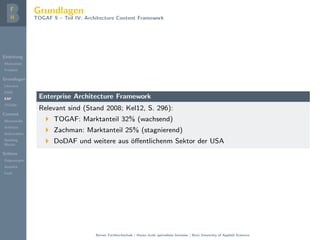
Relevant sind (Stand 2008; Kel12, S. 296):
TOGAF: Marktanteil 32% (wachsend)
Zachman: Marktanteil 25% (stagnierend)
DoDAF und weitere aus ¨offentlichenm Sektor der USA
Berner Fachhochschule | Haute ´ecole sp´ecialis´ee bernoise | Bern University of Applied Sciences
Einleitung
Motivation
Problem
Grundlagen
Literatur
EAM
EAF
TOGAF
Content
Metamodel
Artifacts
Deliverables
Building
Blocks
Schluss
Folgerungen
Ausblick
Fazit
Grundlagen
TOGAF 9 – Teil IV: Architecture Content Framework
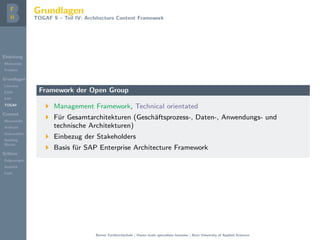
Framework der Open Group
Management Framework, Technical orientated
F¨ur Gesamtarchitekturen (Gesch¨aftsprozess-, Daten-, Anwendungs- und
technische Architekturen)
Einbezug der Stakeholders
Basis f¨ur SAP Enterprise Architecture Framework
Berner Fachhochschule | Haute ´ecole sp´ecialis´ee bernoise | Bern University of Applied Sciences
Einleitung
Motivation
Problem
Grundlagen
Literatur
EAM
EAF
TOGAF
Content
Metamodel
Artifacts
Deliverables
Building
Blocks
Schluss
Folgerungen
Ausblick
Fazit
Grundlagen
TOGAF 9 – Teil IV: Architecture Content Framework
Framework der Open Group
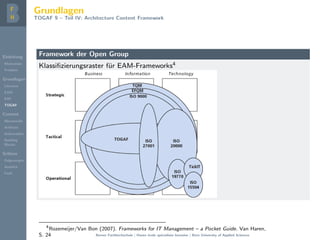
Klassifizierungsraster f¨ur EAM-Frameworks4
4
Rozemeijer/Van Bon (2007). Frameworks for IT Management – a Pocket Guide. Van Haren,
S. 24 Berner Fachhochschule | Haute ´ecole sp´ecialis´ee bernoise | Bern University of Applied Sciences
Einleitung
Motivation
Problem
Grundlagen
Literatur
EAM
EAF
TOGAF
Content
Metamodel
Artifacts
Deliverables
Building
Blocks
Schluss
Folgerungen
Ausblick
Fazit
Grundlagen
TOGAF 9 – Teil IV: Architecture Content Framework
Framework der Open Group
Capability-Based Planning (Wei10, S. 3)
Die fä
also um
eine be
Aufgabe
erheblic
die Mig
angeht.
Geschäf
Geschäf
Auge un
Unterne
Architec
Fazit
Capabil
stellt m
um auf
schäftsr
bauen u
diese M
anwend
Abb. 5: Capability Increments and Dimensions – TOGAF 9
Berner Fachhochschule | Haute ´ecole sp´ecialis´ee bernoise | Bern University of Applied Sciences
Einleitung
Motivation
Problem
Grundlagen
Literatur
EAM
EAF
TOGAF
Content
Metamodel
Artifacts
Deliverables
Building
Blocks
Schluss
Folgerungen
Ausblick
Fazit
Grundlagen
TOGAF 9 – Teil IV: Architecture Content Framework
Framework der Open Group
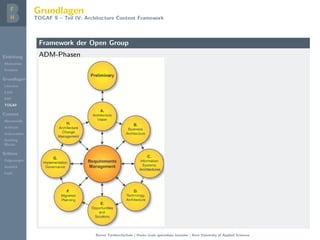
ADM-Phasen
Berner Fachhochschule | Haute ´ecole sp´ecialis´ee bernoise | Bern University of Applied Sciences
Einleitung
Motivation
Problem
Grundlagen
Literatur
EAM
EAF
TOGAF
Content
Metamodel
Artifacts
Deliverables
Building
Blocks
Schluss
Folgerungen
Ausblick
Fazit
Architecture Content Framework
Berner Fachhochschule | Haute ´ecole sp´ecialis´ee bernoise | Bern University of Applied Sciences
Einleitung
Motivation
Problem
Grundlagen
Literatur
EAM
EAF
TOGAF
Content
Metamodel
Artifacts
Deliverables
Building
Blocks
Schluss
Folgerungen
Ausblick
Fazit
Architecture Content Framework
TOGAF 9 – Teil IV: Architecture Content Framework
Content Metamodel
Berner Fachhochschule | Haute ´ecole sp´ecialis´ee bernoise | Bern University of Applied Sciences
Einleitung
Motivation
Problem
Grundlagen
Literatur
EAM
EAF
TOGAF
Content
Metamodel
Artifacts
Deliverables
Building
Blocks
Schluss
Folgerungen
Ausblick
Fazit
Architecture Content Framework
TOGAF 9 – Teil IV: Architecture Content Framework
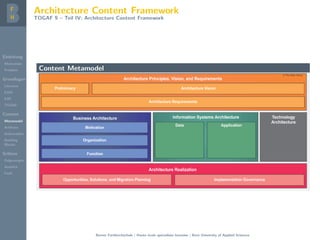
Content Metamodel
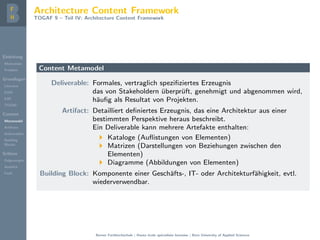
Deliverable: Formales, vertraglich spezifiziertes Erzeugnis
das von Stakeholdern ¨uberpr¨uft, genehmigt und abgenommen wird,
h¨aufig als Resultat von Projekten.
Artifact: Detailliert definiertes Erzeugnis, das eine Architektur aus einer
bestimmten Perspektive heraus beschreibt.
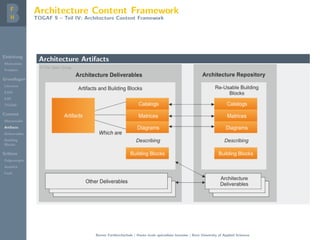
Ein Deliverable kann mehrere Artefakte enthalten:
Kataloge (Auflistungen von Elementen)
Matrizen (Darstellungen von Beziehungen zwischen den
Elementen)
Diagramme (Abbildungen von Elementen)
Building Block: Komponente einer Gesch¨afts-, IT- oder Architekturf¨ahigkeit, evtl.
wiederverwendbar.
Berner Fachhochschule | Haute ´ecole sp´ecialis´ee bernoise | Bern University of Applied Sciences
Einleitung
Motivation
Problem
Grundlagen
Literatur
EAM
EAF
TOGAF
Content
Metamodel
Artifacts
Deliverables
Building
Blocks
Schluss
Folgerungen
Ausblick
Fazit
Architecture Content Framework
TOGAF 9 – Teil IV: Architecture Content Framework
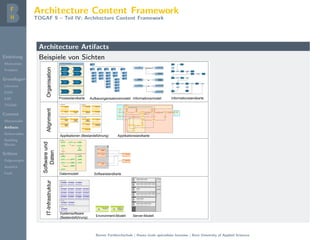
Architecture Artifacts
Berner Fachhochschule | Haute ´ecole sp´ecialis´ee bernoise | Bern University of Applied Sciences
Einleitung
Motivation
Problem
Grundlagen
Literatur
EAM
EAF
TOGAF
Content
Metamodel
Artifacts
Deliverables
Building
Blocks
Schluss
Folgerungen
Ausblick
Fazit
Architecture Content Framework
TOGAF 9 – Teil IV: Architecture Content Framework
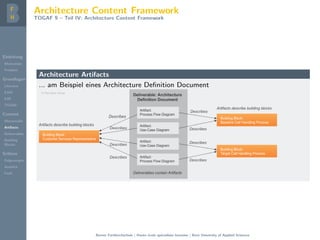
Architecture Artifacts
... am Beispiel eines Architecture Definition Document
Berner Fachhochschule | Haute ´ecole sp´ecialis´ee bernoise | Bern University of Applied Sciences
Einleitung
Motivation
Problem
Grundlagen
Literatur
EAM
EAF
TOGAF
Content
Metamodel
Artifacts
Deliverables
Building
Blocks
Schluss
Folgerungen
Ausblick
Fazit
Architecture Content Framework
TOGAF 9 – Teil IV: Architecture Content Framework
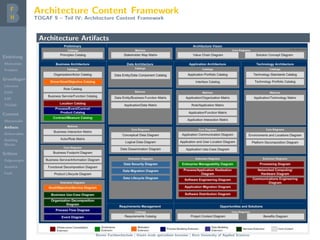
Architecture Artifacts
Berner Fachhochschule | Haute ´ecole sp´ecialis´ee bernoise | Bern University of Applied Sciences
Einleitung
Motivation
Problem
Grundlagen
Literatur
EAM
EAF
TOGAF
Content
Metamodel
Artifacts
Deliverables
Building
Blocks
Schluss
Folgerungen
Ausblick
Fazit
Architecture Content Framework
TOGAF 9 – Teil IV: Architecture Content Framework
Architecture Artifacts
Beispiele von Sichten
© Aug-09, IWI-HSG
Seite 22
Beispiel für einen „ausgewogenen“ UA-Ansatz
Kundensysteme
Lieferanten-Systeme
Kernsysteme
Interne Systeme
Ÿ
Web-Portal
Ÿ
CRM-System
Ÿ
Kundenverwaltungs-
System
Ÿ
Produkt-Datenbank
Ÿ
Angebots- und
Buchungssystem
Ÿ
Lieferanten-
Datenbank
Ÿ
Internes
Mitarbeiter-
Informationssystem
Ÿ
HR-System
Ÿ
Finanzsystem
(Individualentwicklung)
Ÿ
DWH
Ÿ
Abrechnungssystem
Ÿ
Lieferanten-
Schnittstellen-
System
Ÿ
Produkt-Liste (Excel)
Ÿ
Finanzsystem (SAP)
Ÿ
Schnittstelle zu
Markt-
forschungsinstitut
Applikationen (Bestandsführung)
Ausserhalb deseigenen Unternehmens
Ausserhalb des eigenen Unternehmens Applikationen der smartTravel AG
Web-Frontend
Back-Office
Ÿ
Web -Po rta l
Ÿ
CR M-Syst em
D
Ku nd en spe zi fisc he
Em pfeh lu ng en
Ÿ
Kun denver waltu ngs-
SystemD
K un de nprä feren ze n
D
Ku den da ten
Ÿ
Pr oduk t-D at enbank
D
A ktue ll e A ng eb ote
Ÿ
An gebot s- und
Bu ch ungssystem
D
An ge bote
D
K un de na nfrag e
D
An ge bo te
D
An frage ,
B esta nd sko rrektu r
Ÿ
Ab rechnu ngssyst em
D
Z ah lu ng sda ten
Ÿ
Lief eran ten-
D at enbank
D
A nbi e te rda ten
Ÿ
Liefer ant en-
Schnit tste llen-
System
D
A nfrag e, Bu chu ng
D
A ng ebo te,
B uch un gsb estä tig un g
Ÿ
An gebot s- und
Bu ch ungssystem
( Liefer ant)
D
An frage , B uch un g
D
A ng eb ote,
B u chu ng sbe stäti gu ng
D
Sch ni ttste ll en da ten
Ÿ
Int ern es
Mit arb eiter -
I nf orm ations s ys tem
D
A nb ie terda ten
Ÿ
H R -Syste m
D
Mi ta rbei terd ate n
Ÿ
Finan zs ys te m
( In dividualen twic klun g) D
D aten z ur R enta bi l itä t
v on
G esch äftsb ezi eh un ge n
D
R ech nu ng sda ten
D
A nal yti sch e
Fi na nz date n
Ÿ
D WH
D
A ufbe rei tete
F in an zda ten
D
A nb ie terda ten
(A bg le ic h)
Ÿ
Zahlun gs sys t em
(K redit kart enun ter nehmen
und B anken)
D
Z ah lu ng sd ta en
Ÿ
Schnit tste lle zu
Mar kt-
for schungsinst itut
D
Mark tda ten
Ÿ
Fin anzsys t em ( SAP)
Ÿ
Pr odukt -List e (Excel)
Applikationslandkarte
Prozesslandkarte
smartTravelAG - Gesamtunternehmen
Führungsprozesse
Leistungsprozesse
Unterstützungsprozesse
05 Unternehmens-
strategie
entwickeln
06 Unternehmens-
comntrolling
durchführen
07 IT-Betrieb
08 Finanz- und
Rechnungswesen
01
Kundengewinnung
und -Beziehungs-
management
02 Reiseabwicklung
03 Lieferanten-
gewinnung und
-Beziehungs-
management
04 Angebots-
erstellung
Geschäftsleitung
Funktionen auf
Konzernebene
Controlling und
Budgetierung
Innovati ons-
Management
Personal-Managem ent
Finanzen und
Administration
Marketing und
Werbung
Kundenwerbung
Anbieterwerbung
Marktforschung
Lieferanten-
Management
Airli nes
Hotel s
Mi etwagenfirmen
Kundenmanagement
Individualreisen
Paus chalreis en
Städtereis en
Aktivurlaub
Erlebnisurlaub
Club-U rlaub
IT
Familienurlaub
Anwendungs-
Entwicklung
Anbieter-Integration
IT-Infrastruktur
Reiseversicherer
Angebote vor Ort
Zusatzdi enste
Aufbauorganisationsmodell
Lieferanten-
Information
ii
Lieferanten-
Schnittstellen-
Informationii
Zahlungs-Information
ii
Reiseinformation
ii
Reiseverlaufs-
information
ii
Reise
ii
Buchung
ii
Buchungsbestätigung
ii
beschrieben in
hat
hat
Informationsmodell
Kunden-
bedarfsanalyse -
Individualreisen
i
Kundenbeda rf Lieferanten-
gewinnung -
Individualreisen
i
Lieferanten-
Information
Lieferanten-
betreuung -
Pauschalreisen
Lieferanten-
Anbindung -
Pauschalreisen
Komponenten-
einkauf -
Pauschalreisen
i
Reise-Kompone nte Referenzprozess
Erstellung
Pauschalangebote
i
Leistungspake t
i
Kundena nfrage
Anfrage-Eingang
und
Angebotserstellung
- Pauschalreisen
Reisebuchung -
Pauschalreisen
i
Leistungspak et
i
Reiseinformation
Reisebetreuung -
Pauschalreisen
08Finanz- und
Rechnungswesen
i
Zahlungs-Information
07IT-Betriebi
Lie feranten-
Schnittste llen-
Information
Kunden- und
Marktanalyse -
Pauschalreisen
Kunden-
Beziehungs-
management -
Pauschalreisen
Kundenwerbung -
Pauschalreisen
i
Reiseverlaufs-
informati on
i
Kundenpräferenz
i
Marktanalyse
Informationslandkarte
smartTravel AG Geschäftskunden
Privatkunden
P auschalreisen
Transport
Mietwagen-Anbieter
Reiseversicherer
Hotel s
Routenplaner
Wetterdienste
Anbieter von S prachführern
Anbieter von Ausfügen und
V eranstaltungen
Anbieter von Auslands-
Telefonkarte n
Anbieter von Reisebücher n
bzw. Reiseführern
Foto-Dienstleister
F
Indivi dualrei sen
F
Städterei sen
Privatkunde
Ei nzelpersonen
F
Akti vurl aub
F
Cl ub-Url aub
F
Erlebnisrei sen
F
Fam il i enurl aub
Ai rlines
SharedServi c eProvi der
Mi etwagen-Anbi eter
Shared Servi ce Provi der
Rei seversi c herer
Shared Servi ce Provi der
H otels
Shared Servi ce Provi der
R outenpl aner
Shared Servi ce Provi der
Wetterdienste
Exc lus iveServi ce. ..
Anbi etervon
Srachführern
ExclusiveService...
Anbi etervon Ausfl ügen
und Veranstal tungen
SharedServi c eProvi der
Anbi etervon
Ausl andstel efonkarten
SharedServi c eProvi der
Anbi etervon
Reis eführern bz w.
Reisebüchern
SharedServi c eProvi der
Online-Fotoal ben
ExclusiveService...
Tradi tionel le
Fotoentwic kler
ExclusiveService...
U nternehmenBahn
SharedServi c eProvi der
Busunternehmen
SharedServi c eProvi der
®
Buchungspl attform
der Bahn
BCI
F
Individualreise n Privat kunde
Û
Auf ruf de r
Reiseplattf orm /
Konta ktanbahnung
Û
Konfiguration eine r
Indiv idualreise
Ü
Market ing(Werbung
durchf ühren,
Plattform-, Reise-...
Ü
Erst elklung eine r
Resiek onfiguratio n
Ü
Verwalt ung vo n
Reiseko nfiguratione n
Û
Inform at ione nübe r
die Reiseplattf orm
Ü
Angebot
kont exta bhängige r
Zusat zangebot e... Û
Suche nac h
Zusat zangeboten
(Tele fonk art en,...
Û
Buchung des
individuellen Angebot s
Ü
Buchungde s
individuellen Angebot s
Ü
Zahlungsabwicklung
Ü
Angebot zusätzliche r
Mögli chkei tenv or Ort
(Veranstaltungen,... Û
Suche nac h
Ange bote nvorOrt
(Veranstalt ungen,.. .
Û
Zahlung
Û
Unt erstützung bei
Probleme n
Ü
Hot line
Ü
Bet reuung vor Ort
Û
Verwa ltungde r
Urlauibsfotos
Û
Reiseinfor matione n
Ü
Entwic klung /
Bereitst ellung der
Urlaubsf otos
Ü
Buchungsbest ätigung
Ü
Identif ikation vo n
Alternativangebot en
Û
Inform at ione nübe r
Alternativangebot e
Ü
Zusatzinformationen
(Wetter, etc.)
Û
Last Minute -
Inf orm ationen vor
Reiseant rit t
®
Pay Servic e
Pauschalreisen
001
Städtereise:
v
®®
Ü
002
Club-Urlaub:
v
®
®
Ü
003
Familienurlaub:
v
®
®
Ü
004
Erlebnisreisen:
v
®
®
Ü
005
Aktivurlaub:
v
®®
Ü
006
Jugendreisen:
v
®®
Ü
007
Studentenreisen:
v
®®
Ü
008
Studienreisen:
v
®
®
Ü
009
Single-Reisen:
v
®
®
Ü
002
Sporturlaub:
v
®
®
Ü
009
Themenreisen:
v
®®
Ü
ZielgruppeImage/MarkeLeistungsangeobotZweiseitigeKommunikationMitbewerber
Gruppenstruktur
Alte rsst rukt ur
Kostenstruktu r
Tra nsport -Prä ferenz
Werte
Int eraktionsziele
Mit bewerber
Nebenkosten-Präf erenz
Bet reuungs-Int ensit ät
Präferenzen zur Gestalt ung des Auf enthalts
Image / Mark e
Kommunikations-Präferen z
All ei nr ei se n Si ngl e-R ei se nPaarre is en Fam il ie nr ei se n G rup penrei se n
J ug en d Stude nt en Jun ge B er uf stätig e Be ru fs täti g e Se ni or en
D is co un te r Mit tel kla ss e Obere Mi ttel kla ss e Lu xu s
Fl u g Bus Indi vidual -Anrei s eZu g
Erl ebni s &
Abent eu er
Erholu n g Sp o rtKun st & K ul tur
D esi gn &
Am b ie nt e
Party
I ndi vid ual i tät
G ruppen -
ind ivi du ali tät
Ko ntaktori en ti ert
Reis eb üro s
On li ne-
Pl attform e n
Lok al e
Re is eanb ieter
Re is ek on ze rn e
Lan d & Le ute
Selb st v ers orge r
Ü be rn ac ht un g &
Frühs tüc k
Vo ll pe ns ionHal bp ens ion Al l I nc l us iv e
H ot lin e
Ans pr ec hpar tn er
vor Ort
Rei se le itung vor
Or t
Bi ld un g
I nd ivi dual
Vor -O rt
Paketan ge bo te
Ko mp l ett -
Arran ge m en ts
Kul in ari sc h
Tradi ti on el l Conveni enc e Exkl usi v Fac hkundi g Pr ei s we rt
Mo de rn &
I nnovati v
Kun den -S B
pas s i ver-
s em ip er sö nl i c he...
pa ss iver-
pe rs önl i c her.. .
U nte rnehem ens -
ak ti ve r Kontak t
Geschäftsnetzwerk-
modell
Geschäftspartner-
prozessmodell
Produkte und Services
(Bestandsführung)
Strategische
Positionierung
Stammdaten
Operative Daten
Analytische Daten
Kundenanfrage
Reiseangebot
Kunde Kundenpräferenz
Zahlungs-
information
Lieferanten-
Schnittstellenin...
Anbieter
Analytische
Finanzinformati...
Rechnung
Anbieter-
Rentabilität
Mitarbeiter
Finanz-
information
Buchung Buchungs-
bestätigung
hat
hat
Produkt-
information
bezieht sich auf
gehört zu
bezieht sich auf
gehört zu
gehört zu
Marktdaten
Datenmodell
C01 Cluster 1
001
DWH Te mp Tables
003
Komponente
Auswertungen
003
DWH Core Customer
004
Preismodell
002
Komponente
Buchung
Softwarelandkarte
ZonenPhysische Server Servercluster
Anton
Bert
Cl audia
Die te r
Egon
Freddy
01
Ant on
V
0101
Alf ons
V
0102
Albert
V
0103
Arne
02
B ert
V
0201
Bernd
V
0202
Bet tina
V
0204
Bine
V
0203
Beat
03
Claudia
V
0301
Claus
04
Diet er
V
0401
Diet mar
V
0402
Dagobert
V
0404
Denise
V
0403
Dagmar
05
Egon
V
0501
Ernie
06
Freddy
V
0601
Frieda
V
0602
Friedmann
V
0604
Franzi
V
0603
Fritz
V
0405
Dolce
ŸŸ
C01
Cluster 1
V
0205
Bertram
ŸŸ
C02
Cluster 2
ŸŸ
C03
Cluster 3
ŸŸ
C04
Cluster 4
ŸŸ
C05
Cluster 5
V
Edeltraut
Server-Modell
Unix/Linux
Microsoft Windows
Novell Netware
IBM OS/390
Ÿ
Windows 2000
Ÿ
Windows 2003
Ÿ
OS/390 V2R6
Ÿ
Windows NT 4.0
Ÿ
Solaris 9
Ÿ
HP-UX 11.00
Ÿ
SUSE Linux 8.1
Ÿ
Solaris 8
Ÿ
Solaris 10
Ÿ
Solaris 2.6
Ÿ
AIX 5.2
Ÿ
AIX 5.3
Ÿ
HP-UX 10.20
Ÿ
Debian Linux 3.1
Ÿ
Red Hat Enterprise
Linux
Ÿ
Embedded Linux
Ÿ
Net Ware 5.1
Ÿ
NetWare 4.11
Systemsoftware
(Bestandsführung)
ŸŸ
ŸŸŸ
Ÿ
Produkt-Datenbank
(Produktion)
ŸŸ
ŸŸŸ
Ÿ
Angebots- und
Buchungssystem
(Produktion)
Environment-Modell
StrategieOrganisationAlignment
Softwareund
Daten
IT-Infrastruktur
Berner Fachhochschule | Haute ´ecole sp´ecialis´ee bernoise | Bern University of Applied Sciences
Einleitung
Motivation
Problem
Grundlagen
Literatur
EAM
EAF
TOGAF
Content
Metamodel
Artifacts
Deliverables
Building
Blocks
Schluss
Folgerungen
Ausblick
Fazit
Architecture Content Framework
TOGAF 9 – Teil IV: Architecture Content Framework
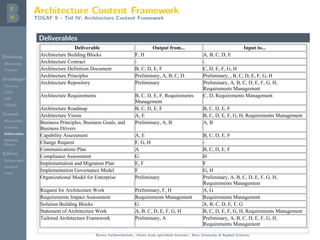
Deliverables
Deliverable Output from... Input to...
Architecture Building Blocks F, H A, B, C, D, E
Architecture Contract ­ ­
Architecture Definition Document B, C, D, E, F C, D, E, F, G, H
Architecture Principles Preliminary, A, B, C, D Preliminary, , B, C, D, E, F, G, H
Architecture Repository Preliminary Preliminary, A, B, C, D, E, F, G, H,
Requirements Management
Architecture Requirements B, C, D, E, F, Requirements
Management
C, D, Requirements Management
Architecture Roadmap B, C, D, E, F B, C, D, E, F
Architecture Vision A, E B, C, D, E, F, G, H, Requirements Management
Business Principles, Business Goals, and
Business Drivers
Preliminary, A, B A, B
Capability Assessment A, E B, C, D, E, F
Change Request F, G, H ­
Communications Plan A B, C, D, E, F
Compliance Assessment G H
Implementation and Migration Plan E, F F
Implementation Governance Model F G, H
Organizational Model for Enterprise Preliminary Preliminary, A, B, C, D, E, F, G, H,
Requirements Management
Request for Architecture Work Preliminary, F, H A, G
Requirements Impact Assessment Requirements Management Requirements Management
Solution Building Blocks G A, B, C, D, E, F, G
Statement of Architecture Work A, B, C, D, E, F, G, H B, C, D, E, F, G, H, Requirements Management
Tailored Architecture Framework Preliminary, A Preliminary, A, B, C, D, E, F, G, H,
Requirements Management
Berner Fachhochschule | Haute ´ecole sp´ecialis´ee bernoise | Bern University of Applied Sciences
Einleitung
Motivation
Problem
Grundlagen
Literatur
EAM
EAF
TOGAF
Content
Metamodel
Artifacts
Deliverables
Building
Blocks
Schluss
Folgerungen
Ausblick
Fazit
Architecture Content Framework
TOGAF 9 – Teil IV: Architecture Content Framework
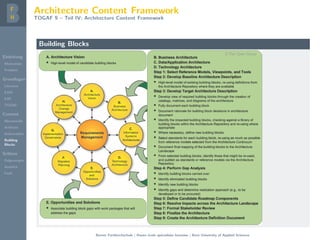
Building Blocks
Berner Fachhochschule | Haute ´ecole sp´ecialis´ee bernoise | Bern University of Applied Sciences
Einleitung
Motivation
Problem
Grundlagen
Literatur
EAM
EAF
TOGAF
Content
Metamodel
Artifacts
Deliverables
Building
Blocks
Schluss
Folgerungen
Ausblick
Fazit
Schlussfolgerungen und Ausblick
Berner Fachhochschule | Haute ´ecole sp´ecialis´ee bernoise | Bern University of Applied Sciences
Einleitung
Motivation
Problem
Grundlagen
Literatur
EAM
EAF
TOGAF
Content
Metamodel
Artifacts
Deliverables
Building
Blocks
Schluss
Folgerungen
Ausblick
Fazit
Schlussfolgerungen und Ausblick
TOGAF 9 – Teil IV: Architecture Content Framework
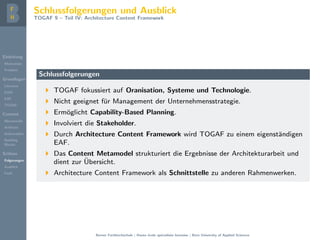
Schlussfolgerungen
TOGAF fokussiert auf Oranisation, Systeme und Technologie.
Nicht geeignet f¨ur Management der Unternehmensstrategie.
Erm¨oglicht Capability-Based Planning.
Involviert die Stakeholder.
Durch Architecture Content Framework wird TOGAF zu einem eigenst¨andigen
EAF.
Das Content Metamodel strukturiert die Ergebnisse der Architekturarbeit und
dient zur ¨Ubersicht.
Architecture Content Framework als Schnittstelle zu anderen Rahmenwerken.
Berner Fachhochschule | Haute ´ecole sp´ecialis´ee bernoise | Bern University of Applied Sciences
Einleitung
Motivation
Problem
Grundlagen
Literatur
EAM
EAF
TOGAF
Content
Metamodel
Artifacts
Deliverables
Building
Blocks
Schluss
Folgerungen
Ausblick
Fazit
Schlussfolgerungen und Ausblick
TOGAF 9 – Teil IV: Architecture Content Framework
Ausblick
Vergleich EAFs als Matrix:
ARW08 (S. 293): Frameworks lassen sich
”
Aufgrund ihrer Komplexit¨at und den
zum Teil unterschiedlichen Zielstellungen . . . nur bedingt miteinander
vergleichen”.
ARW08 erw¨ahnt GERAM Framework,
beurteilt Resultate jedoch als
”
weitgehend abstrakt”.
Berner Fachhochschule | Haute ´ecole sp´ecialis´ee bernoise | Bern University of Applied Sciences
Einleitung
Motivation
Problem
Grundlagen
Literatur
EAM
EAF
TOGAF
Content
Metamodel
Artifacts
Deliverables
Building
Blocks
Schluss
Folgerungen
Ausblick
Fazit
Schlussfolgerungen und Ausblick
TOGAF 9 – Teil IV: Architecture Content Framework
Fazit
TOGAF Core Content Metamodel f¨ur Mindestsatz an Architekturinhalte.
Mit Extensions kann verfeinert werden, auch zu sp¨aterem Zeitpunkt.
Damit l¨asst sich eine EA mit vern¨unftigem Aufwand umsetzen.
Berner Fachhochschule | Haute ´ecole sp´ecialis´ee bernoise | Bern University of Applied Sciences
Einleitung
Motivation
Problem
Grundlagen
Literatur
EAM
EAF
TOGAF
Content
Metamodel
Artifacts
Deliverables
Building
Blocks
Schluss
Folgerungen
Ausblick
Fazit
TOGAF 9 – Teil IV: Architecture Content Framework
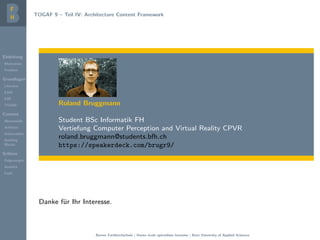
Roland Bruggmann
Student BSc Informatik FH
Vertiefung Computer Perception and Virtual Reality CPVR
roland.bruggmann@students.bfh.ch
https://speakerdeck.com/brugr9/
Danke f¨ur Ihr Interesse.
Berner Fachhochschule | Haute ´ecole sp´ecialis´ee bernoise | Bern University of Applied Sciences

TOGAF Architecture Content Framework

  • 1.
    Einleitung Motivation Problem Grundlagen Literatur EAM EAF TOGAF Content Metamodel Artifacts Deliverables Building Blocks Schluss Folgerungen Ausblick Fazit TOGAF 9 –Teil IV: Architecture Content Framework IT-Management und Unternehmensarchitektur Semesterarbeit Studiengang: Informatik, Modul BTI7311 Informatik Seminar Autor: Roland Bruggmann, roland.bruggmann@students.bfh.ch Co-Autor: Tobias Millauer, tobias.millauer@students.bfh.ch Dozent: Prof. Dr. Urs Sauter, urs.sauter@bfh.ch Datum: 14. April 2015 Berner Fachhochschule | Haute ´ecole sp´ecialis´ee bernoise | Bern University of Applied Sciences
  • 2.
    Einleitung Motivation Problem Grundlagen Literatur EAM EAF TOGAF Content Metamodel Artifacts Deliverables Building Blocks Schluss Folgerungen Ausblick Fazit ¨Ubersicht 1 Einleitung Motivation Problemstellung 2 Grundlagen Hintergrundliteratur EnterpriseArchitecture Management Enterprise Architecture Framework Framework der Open Group 3 Architecture Content Framework Content Metamodel Architecture Artifacts Deliverables Building Blocks 4 Schlussfolgerungen und Ausblick Schlussfolgerungen Ausblick Fazit Berner Fachhochschule | Haute ´ecole sp´ecialis´ee bernoise | Bern University of Applied Sciences
  • 3.
  • 4.
    Einleitung Motivation Problem Grundlagen Literatur EAM EAF TOGAF Content Metamodel Artifacts Deliverables Building Blocks Schluss Folgerungen Ausblick Fazit Einleitung TOGAF 9 –Teil IV: Architecture Content Framework Motivation TOGAF ist ein wichtiger Standard Komplexit¨at stellt Anwender vor grosse Herausforderungen Gesichtspunkte von TOGAF beleuchten Berner Fachhochschule | Haute ´ecole sp´ecialis´ee bernoise | Bern University of Applied Sciences
  • 5.
    Einleitung Motivation Problem Grundlagen Literatur EAM EAF TOGAF Content Metamodel Artifacts Deliverables Building Blocks Schluss Folgerungen Ausblick Fazit Einleitung TOGAF 9 –Teil IV: Architecture Content Framework Problemstellung TOGAF 9 – Teil IV: Architecture Content Framework Content Metamodel Artifacts, Deliverables und Building Blocks Berner Fachhochschule | Haute ´ecole sp´ecialis´ee bernoise | Bern University of Applied Sciences
  • 6.
  • 7.
    Einleitung Motivation Problem Grundlagen Literatur EAM EAF TOGAF Content Metamodel Artifacts Deliverables Building Blocks Schluss Folgerungen Ausblick Fazit Grundlagen TOGAF 9 –Teil IV: Architecture Content Framework Hintergrundliteratur Unternehmensarchitektur: S. Aier, C. Riege und R. Winter (2008): Unternehmensarchitektur – Literatur¨uberblick und Stand der Praxis. (ARW08) D. Matthes (2011a): Enterprise Architecture Frameworks Kompendium – ¨Uber 50 Rahmenwerke f¨ur das IT-Management. (Mat11a) D. Matthes (2011b): Matthes Framework Map - frameworks according to their nationality and intention. (Mat11b) W. Keller (2012): IT-Unternehmensarchitektur – Von der Gesch¨aftsstrategie zur optimalen IT-Unterst¨utzung. (Kel12) TOGAF: D. Weinberger (2010): . . . und am Anfang steht die Gesch¨aftsanforderung, oder? (Wei10) A. Josey u.a. (2010): TOGAF Version 9 – Ein Pocket Guide. (Jos+10) The Open Group (2010): TOGAF Version 9.1. Document Number: G116. (Ope10) Berner Fachhochschule | Haute ´ecole sp´ecialis´ee bernoise | Bern University of Applied Sciences
  • 8.
    Einleitung Motivation Problem Grundlagen Literatur EAM EAF TOGAF Content Metamodel Artifacts Deliverables Building Blocks Schluss Folgerungen Ausblick Fazit Grundlagen TOGAF 9 –Teil IV: Architecture Content Framework Enterprise Architecture Management Vereint Gesch¨aftsprozesse und IT-Architektur1 CRM, Portale usw. zu einem Ganzen kombinieren Big Data, Cloud, Mobile Computing gezielt f¨ur Gesch¨aftst¨atigkeit nutzen2 Schl¨usselkompetenz des Betriebsmanagements, hat stark an Bedeutung gewonnen (ARW08, S.292f) 1 Newsletter ELCA 08 2014 2 Flyer ELCA Berner Fachhochschule | Haute ´ecole sp´ecialis´ee bernoise | Bern University of Applied Sciences
  • 9.
    Einleitung Motivation Problem Grundlagen Literatur EAM EAF TOGAF Content Metamodel Artifacts Deliverables Building Blocks Schluss Folgerungen Ausblick Fazit Grundlagen TOGAF 9 –Teil IV: Architecture Content Framework Enterprise Architecture Management Dom¨anen der Architektur (Wei10, S. 2) schi Kon der abe ode Unt Auc die Akt Ken mag dur Abe drei che Ges Kun Eink er A kos liegAbb. 2: Domänen der ArchitekturBerner Fachhochschule | Haute ´ecole sp´ecialis´ee bernoise | Bern University of Applied Sciences
  • 10.
    Einleitung Motivation Problem Grundlagen Literatur EAM EAF TOGAF Content Metamodel Artifacts Deliverables Building Blocks Schluss Folgerungen Ausblick Fazit Grundlagen TOGAF 9 –Teil IV: Architecture Content Framework Enterprise Architecture Management Ebenen der Unternehmensarchitektur gem¨ass IEEE (ARW08, S. 292f): 1 Strategie: Produkte, Dienstleistungen, Unternehmensziele, Kunden, Zulieferer. 2 Organisation: Vertriebskan¨ale, Gesch¨aftsprozesse, Organisationseinheiten, Rollen, Standorte. 3 Integration: Applikationen, Dienste, Schnittstellen. 4 Software: Softwarekomponenten, Datenstrukturen. 5 IT-Infrastruktur: Hardware, Netzwerk, Software-Plattformen. Berner Fachhochschule | Haute ´ecole sp´ecialis´ee bernoise | Bern University of Applied Sciences
  • 11.
    Einleitung Motivation Problem Grundlagen Literatur EAM EAF TOGAF Content Metamodel Artifacts Deliverables Building Blocks Schluss Folgerungen Ausblick Fazit Grundlagen TOGAF 9 –Teil IV: Architecture Content Framework Enterprise Architecture Management Nutzen (Wei10, S. 2f) Transparenz der Zusammenh¨ange im Unternehmen Management von Unternehmensver¨anderungen Use Case: ” Virtuelle Unternehmung” (z.B. ARGE) Berner Fachhochschule | Haute ´ecole sp´ecialis´ee bernoise | Bern University of Applied Sciences
  • 12.
    Einleitung Motivation Problem Grundlagen Literatur EAM EAF TOGAF Content Metamodel Artifacts Deliverables Building Blocks Schluss Folgerungen Ausblick Fazit Grundlagen TOGAF 9 –Teil IV: Architecture Content Framework Enterprise Architecture Management Zust¨andigkeiten IT-Vorstand, auch eines ausgegr¨undeten IT-Dienstleisters (Kel12, S. xi) Zentrale Disziplin des CIO, neben Strategie- und Portfoliomanagement3 3 Flyer ELCA Berner Fachhochschule | Haute ´ecole sp´ecialis´ee bernoise | Bern University of Applied Sciences
  • 13.
    Einleitung Motivation Problem Grundlagen Literatur EAM EAF TOGAF Content Metamodel Artifacts Deliverables Building Blocks Schluss Folgerungen Ausblick Fazit Grundlagen TOGAF 9 –Teil IV: Architecture Content Framework Enterprise Architecture Framework Mat11a beschreibt deren 50 an der Zahl Mat11b gruppiert 7 Typen: Government and Agency Framework: massgeschneidert f¨ur Beh¨orden Interoperability Framework: zur Umsetzung von Interoperabilit¨at Management Framework: f¨ur die Unterst¨utzung des Managments Manufacturing-Specific Framework: f¨ur Produktionsl¨osungen Military Framework: zur Unterst¨utzung von milit¨arischen Bed¨urfnissen Add-On Framework: als Erg¨anzung anderer Frameworks, Projekten usw. Technical orientated Framework: ohne betriebswirtschaftliche Methoden Berner Fachhochschule | Haute ´ecole sp´ecialis´ee bernoise | Bern University of Applied Sciences
  • 14.
    Einleitung Motivation Problem Grundlagen Literatur EAM EAF TOGAF Content Metamodel Artifacts Deliverables Building Blocks Schluss Folgerungen Ausblick Fazit Grundlagen TOGAF 9 –Teil IV: Architecture Content Framework Enterprise Architecture Framework Washington, DC Washington, DC New YorkNew York West Lafayette West Lafayette Canada United States of America Canada Steven H. Spewak, New York EAP - Enterprise Architecture Planning provides steps to realise the top two rows of the Zachman Framework. U. S. Department of Defence, Washington DC C4ISR Architecture Framework provides views, models and a method to describe an information system architecture. U. S. Office of Management and Budget (OMB), Washington DC EAAF - OMB Enterprise Architecture Assessment Framework helps to measure and assess the steady enterprise architecture improvement process. U. S. National Institutes of Health, Bethesda & Washington DC NIH Enterprise Architecture Framework helps with the architecture development and describes a business architecture modeling methodology. U.S. National Institute of Standards and Technology, Gaithersburg (Maryland) NIST EA Model provides a five-layered architectural reference model for managing an integrated set of information and information technology architectures. Purdue University, West Lafayette (Indiana) PERA - Purdue Enterprise Reference Architecture helps to analyse, design and develop enterprise integration projects. Zachman International, La Canada (California) Zachman-Framework defines views and layers of an information system. La CanadaLa Canada OttawaOttawa National Defence and the Canadian Forces, Ottawa (Ontario) DNDAF - Department of National Defense Architecture Framework Joint development by IEEE (more than 380.000 members from 150 countries) and The Open Group POSIX OSE Reference Model supports specification of interfaces for distributed systems and distributed application platform implementations. Workgroup Architectures for Enterprise Integration by International Federation for Information Processing (IFIP) and International Federation of Automatic Control (IFAC) GERAM - Generalised Enterprise Reference Architecture and Methodology provides a general reference architecture to describe all information and communication systems as well as activities around the enterprise processes. Worldwide developments Gartner Inc., Stamford (Connecticut) EAF - Enterprise Architecture Framework provides development steps for an optimal constellation of business, information and technology to support the business strategies. IT City Planning Architecture Framework separates between the business, functional, application und technical layer of an architecture. StamfordStamford L e g e n d Government and Agency Frameworks specially-tailored for federal uses Management Frameworks to support the management branch Military Frameworks to support military requirements Technical orientated Frameworks without business orientated management methods (e.g. BPML) Interoperability Frameworks to realise interactivity Manufacturing-Specific Frameworks for manufacturing solutions Add-On Frameworks in addition to other frameworks, projects etc. United States of America U. S. Department of the Treasury, Washington DC TEAF - Treasury Enterprise Architecture Framework supports the architecture development with guides, templates, common concepts to standards, principles etc. TISAF - Treasury Information System Architecture Framework is revised by the TEAF. U. S. Chief Information Officers (CIO) Council FEAF- Federal Enterprise Architecture Framework provides an empty frame for the EA-development. U. S. General Accounting Office (GAO), Washington DC EAMMF - Enterprise Architecture Management Maturity Framework helps to define the maturity of the EA- development. DoDAF - Department of Defence Architecture Framework as successor of the C4ISR the DoDAF provides views and models to develop an information system architecture for weapon integration and service-oriented structures. JTA - Joint Technical Architecture as knowledge base provides standards, interfaces and services for other (DoD) frameworks. TAFIM - Technical Architectural Framework for Information Management helped with a reference model and steps to describe and develop a technical architecture. U. S. Office of Management and Budget (OMB), Washington DC FEA - Federal Enterprise Architecture contains a performance, business, service component, data and a technical reference model for describing important elements of an EA. DoD TRM - Department of Defence Technical Reference Model supports a technical structure for development and acquisition of IT-solutions. IBM ADS - Architecture Description Standard provides notations, terminology and semantics for architecture description. The Open Group (Initiated ArchiMate project was managed by Telematica Instituut, Enschede - Netherlands.) ArchiMate defines provides terminology for modelling the global structure of domains and relations between the domains. Casewise Based on the Zachman Framework offers the Casewise Framework structure, templates and guidance to create enterprise architecture models. IEEE Architecture Working Group (AWG) with multinational members ISO/IEC 42010 (IEEE Std 1471-2000) describes required contents of an architecture description. The Open Group - Consortium by members from North America (50%), Europe (25%) and Asia-Pacific (25%) TOGAF - The Open Group Architecture Framework supports the development and description of technical architectures. Globemen (Global Engineering and Manufacturing in Enterprise Networks) project is part of international Intelligent Manufacturing Systems (IMS) program VERAM - Virtual Enterprise Reference Architecture and Methodology is a framework that positions elements according to its support, modelling, formation/set up, management of virtual enterprises and the underlying IT. France Germany Netherlands United Kingdom United Kingdom France Germany Netherlands EuropeEurope Australian Department of Defence, Canberra AusDAF - Australian Defence Architecture Framework consultant-educators Robinson and Gout XAF - eXtreme Enterprise Architecture is practical for reengineering activities and software applications in the enterprise. Queensland Government Chief Information Office QGEAF - Queensland Government Enterprise Architecture Framework provides a structure for the information management and information and communication technology policy. Institute For Enterprise Architecture Developments (IFEAD), Amersfoort E2AF - Extended Enterprise Architecture Framework describes views and steps to enhance an EA to an extended enterprise architecture (E2A). AmersfoortAmersfoort BordeauxBordeaux Délégation Générale pour l'Armement (DGA) AGATE - Atelier de Gestion de l'Architecture provides viewpoints including models of the information system architecture. LondonLondon U. K. Ministry of Defence, London MoDAF - UK Ministry of Defence Architectural Framework supports the description and specification of an architecture. SaarbrückenSaarbrücken Australia Matthes Framework Map Capgemini IAF - Integrated Architecture Framework provides views on and layers of an architecture as well as tools (workshops, interviews) for their development. Comité Européen de Normalisation HIF - Healthcare Information Framework (ENV 12443) supports specification of services on the middleware layer and describes a healthcare information system architecture. Université de Bordeaux, Laboratory of Automation and Productics (LAP), Bordeaux GIM - GRAI Integrated Methodology supports analysis and specification of CIM systems components. European Consortium AMICE (IBM, Siemens, FIAT, ...) CIMOSA - Computer Integrated Manufacturing Open System Architecture provides a modelling framework for the corporate structure including computer integrated manufacturing. European developments - frameworks according to their nationality and intention - IDS Scheer AG, Saarbrücken ARIS - Architecture of Integrated Information Systems to model and optimize business processes. EnschedeEnschede Atos Origin – IT Consulting, Paris CLEAR (Comprehensive, Landscaped, Enterprise Architecture Representation) Framework provides taxonomy and ontology and reference models for architecture development. ParisParis Vassilios Peristeras (Greek) & Konstantinos Tarabanis (Macedonia) C4IF - Connection, Communication, Consolidation, Collaboration Interoperability Framework defines four interoperability types to refers the ability of information systems to exchange signals, data, to understand data and to act together. GreekGreek U. K. Cabinet Office e-GIF - e-Government Interoperability Framework to realise interoperability between A2A, A2B and A2C. Federal Ministry of the Interior, Germany SAGA - Standards and Architecture for e-Government Applications defines standards and architecture model for e-government applications and unifies processes and data in the administrations. John Sherwood, U.K. SABSA - Sherwood Applied Business Security Architecture is a framework and methodology for Enterprise Security Architecture and Service Management. European Commission EIF - European Interoperability Framework provides layers of interopability that are to realise according specific standards as condition for interactivity. Especially to realise electronic government services across the EU member states. Fergus Cloughley and Paul Wallis, U.K. OBASHI Framework provides a six-layered architectural reference model for placing the elements on the layers ownership, business process, application, system, hardware and infrastructure. Its illustrating the relationships between business and information technology. SAP AG, Walldorf (Germany) SAP Enterprise Architecture Framework complements TOGAF to support the effective adoption of SOA. act! consulting GmbH, Braunschweig t-eam - toolbox for enterprise architecture management defines amongst others an architecture reference model. Its helps to answer the questions like the Zachman Framework: where, what, who, how, why, with what and when. OMG – Object Management Group OMA - Object Management Architecture provides terminology and a architecture reference model for separation the information system components in interface categories and a central handling component - the Object Request Broker (ORB). CORBA - Common Object Request Broker Architecture specify the Object Request Broker (ORB), its interface and interfaces of other OMG standards. MDA Guide - Model Driven Architecture Guide contains a procedure reference models for a model driven software development approach. ISO - the International Organization for Standardization The Standards ISO/IEC 10746-1 till 4 are known as Reference Model for Open Distributed Processing (RM-ODP), that specify information systems to enable distributed information processing. U.K. Department for Transport TRAK – The Rail Architecture Framework is a rail-specific architecture framework in adapting MODAF Roger Evernden, U.K. IFW - Information FrameWork a matrix for analysing and structuring information. Nederlands Architectur Forum (NAF) xAF - Extensible Architecture Framework www.EAF-Book.de - Enterprise Architecture Frameworks Kompendium ISBN: 3642129544 mail@DirkMatthes.com ©DirkMatthes.com Berner Fachhochschule | Haute ´ecole sp´ecialis´ee bernoise | Bern University of Applied Sciences
  • 15.
    Einleitung Motivation Problem Grundlagen Literatur EAM EAF TOGAF Content Metamodel Artifacts Deliverables Building Blocks Schluss Folgerungen Ausblick Fazit Grundlagen TOGAF 9 –Teil IV: Architecture Content Framework Enterprise Architecture Framework Relevant sind (Stand 2008; Kel12, S. 296): TOGAF: Marktanteil 32% (wachsend) Zachman: Marktanteil 25% (stagnierend) DoDAF und weitere aus ¨offentlichenm Sektor der USA Berner Fachhochschule | Haute ´ecole sp´ecialis´ee bernoise | Bern University of Applied Sciences
  • 16.
    Einleitung Motivation Problem Grundlagen Literatur EAM EAF TOGAF Content Metamodel Artifacts Deliverables Building Blocks Schluss Folgerungen Ausblick Fazit Grundlagen TOGAF 9 –Teil IV: Architecture Content Framework Framework der Open Group Management Framework, Technical orientated F¨ur Gesamtarchitekturen (Gesch¨aftsprozess-, Daten-, Anwendungs- und technische Architekturen) Einbezug der Stakeholders Basis f¨ur SAP Enterprise Architecture Framework Berner Fachhochschule | Haute ´ecole sp´ecialis´ee bernoise | Bern University of Applied Sciences
  • 17.
    Einleitung Motivation Problem Grundlagen Literatur EAM EAF TOGAF Content Metamodel Artifacts Deliverables Building Blocks Schluss Folgerungen Ausblick Fazit Grundlagen TOGAF 9 –Teil IV: Architecture Content Framework Framework der Open Group Klassifizierungsraster f¨ur EAM-Frameworks4 4 Rozemeijer/Van Bon (2007). Frameworks for IT Management – a Pocket Guide. Van Haren, S. 24 Berner Fachhochschule | Haute ´ecole sp´ecialis´ee bernoise | Bern University of Applied Sciences
  • 18.
    Einleitung Motivation Problem Grundlagen Literatur EAM EAF TOGAF Content Metamodel Artifacts Deliverables Building Blocks Schluss Folgerungen Ausblick Fazit Grundlagen TOGAF 9 –Teil IV: Architecture Content Framework Framework der Open Group Capability-Based Planning (Wei10, S. 3) Die fä also um eine be Aufgabe erheblic die Mig angeht. Geschäf Geschäf Auge un Unterne Architec Fazit Capabil stellt m um auf schäftsr bauen u diese M anwend Abb. 5: Capability Increments and Dimensions – TOGAF 9 Berner Fachhochschule | Haute ´ecole sp´ecialis´ee bernoise | Bern University of Applied Sciences
  • 19.
    Einleitung Motivation Problem Grundlagen Literatur EAM EAF TOGAF Content Metamodel Artifacts Deliverables Building Blocks Schluss Folgerungen Ausblick Fazit Grundlagen TOGAF 9 –Teil IV: Architecture Content Framework Framework der Open Group ADM-Phasen Berner Fachhochschule | Haute ´ecole sp´ecialis´ee bernoise | Bern University of Applied Sciences
  • 20.
  • 21.
    Einleitung Motivation Problem Grundlagen Literatur EAM EAF TOGAF Content Metamodel Artifacts Deliverables Building Blocks Schluss Folgerungen Ausblick Fazit Architecture Content Framework TOGAF9 – Teil IV: Architecture Content Framework Content Metamodel Berner Fachhochschule | Haute ´ecole sp´ecialis´ee bernoise | Bern University of Applied Sciences
  • 22.
    Einleitung Motivation Problem Grundlagen Literatur EAM EAF TOGAF Content Metamodel Artifacts Deliverables Building Blocks Schluss Folgerungen Ausblick Fazit Architecture Content Framework TOGAF9 – Teil IV: Architecture Content Framework Content Metamodel Deliverable: Formales, vertraglich spezifiziertes Erzeugnis das von Stakeholdern ¨uberpr¨uft, genehmigt und abgenommen wird, h¨aufig als Resultat von Projekten. Artifact: Detailliert definiertes Erzeugnis, das eine Architektur aus einer bestimmten Perspektive heraus beschreibt. Ein Deliverable kann mehrere Artefakte enthalten: Kataloge (Auflistungen von Elementen) Matrizen (Darstellungen von Beziehungen zwischen den Elementen) Diagramme (Abbildungen von Elementen) Building Block: Komponente einer Gesch¨afts-, IT- oder Architekturf¨ahigkeit, evtl. wiederverwendbar. Berner Fachhochschule | Haute ´ecole sp´ecialis´ee bernoise | Bern University of Applied Sciences
  • 23.
    Einleitung Motivation Problem Grundlagen Literatur EAM EAF TOGAF Content Metamodel Artifacts Deliverables Building Blocks Schluss Folgerungen Ausblick Fazit Architecture Content Framework TOGAF9 – Teil IV: Architecture Content Framework Architecture Artifacts Berner Fachhochschule | Haute ´ecole sp´ecialis´ee bernoise | Bern University of Applied Sciences
  • 24.
    Einleitung Motivation Problem Grundlagen Literatur EAM EAF TOGAF Content Metamodel Artifacts Deliverables Building Blocks Schluss Folgerungen Ausblick Fazit Architecture Content Framework TOGAF9 – Teil IV: Architecture Content Framework Architecture Artifacts ... am Beispiel eines Architecture Definition Document Berner Fachhochschule | Haute ´ecole sp´ecialis´ee bernoise | Bern University of Applied Sciences
  • 25.
    Einleitung Motivation Problem Grundlagen Literatur EAM EAF TOGAF Content Metamodel Artifacts Deliverables Building Blocks Schluss Folgerungen Ausblick Fazit Architecture Content Framework TOGAF9 – Teil IV: Architecture Content Framework Architecture Artifacts Berner Fachhochschule | Haute ´ecole sp´ecialis´ee bernoise | Bern University of Applied Sciences
  • 26.
    Einleitung Motivation Problem Grundlagen Literatur EAM EAF TOGAF Content Metamodel Artifacts Deliverables Building Blocks Schluss Folgerungen Ausblick Fazit Architecture Content Framework TOGAF9 – Teil IV: Architecture Content Framework Architecture Artifacts Beispiele von Sichten © Aug-09, IWI-HSG Seite 22 Beispiel für einen „ausgewogenen“ UA-Ansatz Kundensysteme Lieferanten-Systeme Kernsysteme Interne Systeme Ÿ Web-Portal Ÿ CRM-System Ÿ Kundenverwaltungs- System Ÿ Produkt-Datenbank Ÿ Angebots- und Buchungssystem Ÿ Lieferanten- Datenbank Ÿ Internes Mitarbeiter- Informationssystem Ÿ HR-System Ÿ Finanzsystem (Individualentwicklung) Ÿ DWH Ÿ Abrechnungssystem Ÿ Lieferanten- Schnittstellen- System Ÿ Produkt-Liste (Excel) Ÿ Finanzsystem (SAP) Ÿ Schnittstelle zu Markt- forschungsinstitut Applikationen (Bestandsführung) Ausserhalb deseigenen Unternehmens Ausserhalb des eigenen Unternehmens Applikationen der smartTravel AG Web-Frontend Back-Office Ÿ Web -Po rta l Ÿ CR M-Syst em D Ku nd en spe zi fisc he Em pfeh lu ng en Ÿ Kun denver waltu ngs- SystemD K un de nprä feren ze n D Ku den da ten Ÿ Pr oduk t-D at enbank D A ktue ll e A ng eb ote Ÿ An gebot s- und Bu ch ungssystem D An ge bote D K un de na nfrag e D An ge bo te D An frage , B esta nd sko rrektu r Ÿ Ab rechnu ngssyst em D Z ah lu ng sda ten Ÿ Lief eran ten- D at enbank D A nbi e te rda ten Ÿ Liefer ant en- Schnit tste llen- System D A nfrag e, Bu chu ng D A ng ebo te, B uch un gsb estä tig un g Ÿ An gebot s- und Bu ch ungssystem ( Liefer ant) D An frage , B uch un g D A ng eb ote, B u chu ng sbe stäti gu ng D Sch ni ttste ll en da ten Ÿ Int ern es Mit arb eiter - I nf orm ations s ys tem D A nb ie terda ten Ÿ H R -Syste m D Mi ta rbei terd ate n Ÿ Finan zs ys te m ( In dividualen twic klun g) D D aten z ur R enta bi l itä t v on G esch äftsb ezi eh un ge n D R ech nu ng sda ten D A nal yti sch e Fi na nz date n Ÿ D WH D A ufbe rei tete F in an zda ten D A nb ie terda ten (A bg le ic h) Ÿ Zahlun gs sys t em (K redit kart enun ter nehmen und B anken) D Z ah lu ng sd ta en Ÿ Schnit tste lle zu Mar kt- for schungsinst itut D Mark tda ten Ÿ Fin anzsys t em ( SAP) Ÿ Pr odukt -List e (Excel) Applikationslandkarte Prozesslandkarte smartTravelAG - Gesamtunternehmen Führungsprozesse Leistungsprozesse Unterstützungsprozesse 05 Unternehmens- strategie entwickeln 06 Unternehmens- comntrolling durchführen 07 IT-Betrieb 08 Finanz- und Rechnungswesen 01 Kundengewinnung und -Beziehungs- management 02 Reiseabwicklung 03 Lieferanten- gewinnung und -Beziehungs- management 04 Angebots- erstellung Geschäftsleitung Funktionen auf Konzernebene Controlling und Budgetierung Innovati ons- Management Personal-Managem ent Finanzen und Administration Marketing und Werbung Kundenwerbung Anbieterwerbung Marktforschung Lieferanten- Management Airli nes Hotel s Mi etwagenfirmen Kundenmanagement Individualreisen Paus chalreis en Städtereis en Aktivurlaub Erlebnisurlaub Club-U rlaub IT Familienurlaub Anwendungs- Entwicklung Anbieter-Integration IT-Infrastruktur Reiseversicherer Angebote vor Ort Zusatzdi enste Aufbauorganisationsmodell Lieferanten- Information ii Lieferanten- Schnittstellen- Informationii Zahlungs-Information ii Reiseinformation ii Reiseverlaufs- information ii Reise ii Buchung ii Buchungsbestätigung ii beschrieben in hat hat Informationsmodell Kunden- bedarfsanalyse - Individualreisen i Kundenbeda rf Lieferanten- gewinnung - Individualreisen i Lieferanten- Information Lieferanten- betreuung - Pauschalreisen Lieferanten- Anbindung - Pauschalreisen Komponenten- einkauf - Pauschalreisen i Reise-Kompone nte Referenzprozess Erstellung Pauschalangebote i Leistungspake t i Kundena nfrage Anfrage-Eingang und Angebotserstellung - Pauschalreisen Reisebuchung - Pauschalreisen i Leistungspak et i Reiseinformation Reisebetreuung - Pauschalreisen 08Finanz- und Rechnungswesen i Zahlungs-Information 07IT-Betriebi Lie feranten- Schnittste llen- Information Kunden- und Marktanalyse - Pauschalreisen Kunden- Beziehungs- management - Pauschalreisen Kundenwerbung - Pauschalreisen i Reiseverlaufs- informati on i Kundenpräferenz i Marktanalyse Informationslandkarte smartTravel AG Geschäftskunden Privatkunden P auschalreisen Transport Mietwagen-Anbieter Reiseversicherer Hotel s Routenplaner Wetterdienste Anbieter von S prachführern Anbieter von Ausfügen und V eranstaltungen Anbieter von Auslands- Telefonkarte n Anbieter von Reisebücher n bzw. Reiseführern Foto-Dienstleister F Indivi dualrei sen F Städterei sen Privatkunde Ei nzelpersonen F Akti vurl aub F Cl ub-Url aub F Erlebnisrei sen F Fam il i enurl aub Ai rlines SharedServi c eProvi der Mi etwagen-Anbi eter Shared Servi ce Provi der Rei seversi c herer Shared Servi ce Provi der H otels Shared Servi ce Provi der R outenpl aner Shared Servi ce Provi der Wetterdienste Exc lus iveServi ce. .. Anbi etervon Srachführern ExclusiveService... Anbi etervon Ausfl ügen und Veranstal tungen SharedServi c eProvi der Anbi etervon Ausl andstel efonkarten SharedServi c eProvi der Anbi etervon Reis eführern bz w. Reisebüchern SharedServi c eProvi der Online-Fotoal ben ExclusiveService... Tradi tionel le Fotoentwic kler ExclusiveService... U nternehmenBahn SharedServi c eProvi der Busunternehmen SharedServi c eProvi der ® Buchungspl attform der Bahn BCI F Individualreise n Privat kunde Û Auf ruf de r Reiseplattf orm / Konta ktanbahnung Û Konfiguration eine r Indiv idualreise Ü Market ing(Werbung durchf ühren, Plattform-, Reise-... Ü Erst elklung eine r Resiek onfiguratio n Ü Verwalt ung vo n Reiseko nfiguratione n Û Inform at ione nübe r die Reiseplattf orm Ü Angebot kont exta bhängige r Zusat zangebot e... Û Suche nac h Zusat zangeboten (Tele fonk art en,... Û Buchung des individuellen Angebot s Ü Buchungde s individuellen Angebot s Ü Zahlungsabwicklung Ü Angebot zusätzliche r Mögli chkei tenv or Ort (Veranstaltungen,... Û Suche nac h Ange bote nvorOrt (Veranstalt ungen,.. . Û Zahlung Û Unt erstützung bei Probleme n Ü Hot line Ü Bet reuung vor Ort Û Verwa ltungde r Urlauibsfotos Û Reiseinfor matione n Ü Entwic klung / Bereitst ellung der Urlaubsf otos Ü Buchungsbest ätigung Ü Identif ikation vo n Alternativangebot en Û Inform at ione nübe r Alternativangebot e Ü Zusatzinformationen (Wetter, etc.) Û Last Minute - Inf orm ationen vor Reiseant rit t ® Pay Servic e Pauschalreisen 001 Städtereise: v ®® Ü 002 Club-Urlaub: v ® ® Ü 003 Familienurlaub: v ® ® Ü 004 Erlebnisreisen: v ® ® Ü 005 Aktivurlaub: v ®® Ü 006 Jugendreisen: v ®® Ü 007 Studentenreisen: v ®® Ü 008 Studienreisen: v ® ® Ü 009 Single-Reisen: v ® ® Ü 002 Sporturlaub: v ® ® Ü 009 Themenreisen: v ®® Ü ZielgruppeImage/MarkeLeistungsangeobotZweiseitigeKommunikationMitbewerber Gruppenstruktur Alte rsst rukt ur Kostenstruktu r Tra nsport -Prä ferenz Werte Int eraktionsziele Mit bewerber Nebenkosten-Präf erenz Bet reuungs-Int ensit ät Präferenzen zur Gestalt ung des Auf enthalts Image / Mark e Kommunikations-Präferen z All ei nr ei se n Si ngl e-R ei se nPaarre is en Fam il ie nr ei se n G rup penrei se n J ug en d Stude nt en Jun ge B er uf stätig e Be ru fs täti g e Se ni or en D is co un te r Mit tel kla ss e Obere Mi ttel kla ss e Lu xu s Fl u g Bus Indi vidual -Anrei s eZu g Erl ebni s & Abent eu er Erholu n g Sp o rtKun st & K ul tur D esi gn & Am b ie nt e Party I ndi vid ual i tät G ruppen - ind ivi du ali tät Ko ntaktori en ti ert Reis eb üro s On li ne- Pl attform e n Lok al e Re is eanb ieter Re is ek on ze rn e Lan d & Le ute Selb st v ers orge r Ü be rn ac ht un g & Frühs tüc k Vo ll pe ns ionHal bp ens ion Al l I nc l us iv e H ot lin e Ans pr ec hpar tn er vor Ort Rei se le itung vor Or t Bi ld un g I nd ivi dual Vor -O rt Paketan ge bo te Ko mp l ett - Arran ge m en ts Kul in ari sc h Tradi ti on el l Conveni enc e Exkl usi v Fac hkundi g Pr ei s we rt Mo de rn & I nnovati v Kun den -S B pas s i ver- s em ip er sö nl i c he... pa ss iver- pe rs önl i c her.. . U nte rnehem ens - ak ti ve r Kontak t Geschäftsnetzwerk- modell Geschäftspartner- prozessmodell Produkte und Services (Bestandsführung) Strategische Positionierung Stammdaten Operative Daten Analytische Daten Kundenanfrage Reiseangebot Kunde Kundenpräferenz Zahlungs- information Lieferanten- Schnittstellenin... Anbieter Analytische Finanzinformati... Rechnung Anbieter- Rentabilität Mitarbeiter Finanz- information Buchung Buchungs- bestätigung hat hat Produkt- information bezieht sich auf gehört zu bezieht sich auf gehört zu gehört zu Marktdaten Datenmodell C01 Cluster 1 001 DWH Te mp Tables 003 Komponente Auswertungen 003 DWH Core Customer 004 Preismodell 002 Komponente Buchung Softwarelandkarte ZonenPhysische Server Servercluster Anton Bert Cl audia Die te r Egon Freddy 01 Ant on V 0101 Alf ons V 0102 Albert V 0103 Arne 02 B ert V 0201 Bernd V 0202 Bet tina V 0204 Bine V 0203 Beat 03 Claudia V 0301 Claus 04 Diet er V 0401 Diet mar V 0402 Dagobert V 0404 Denise V 0403 Dagmar 05 Egon V 0501 Ernie 06 Freddy V 0601 Frieda V 0602 Friedmann V 0604 Franzi V 0603 Fritz V 0405 Dolce ŸŸ C01 Cluster 1 V 0205 Bertram ŸŸ C02 Cluster 2 ŸŸ C03 Cluster 3 ŸŸ C04 Cluster 4 ŸŸ C05 Cluster 5 V Edeltraut Server-Modell Unix/Linux Microsoft Windows Novell Netware IBM OS/390 Ÿ Windows 2000 Ÿ Windows 2003 Ÿ OS/390 V2R6 Ÿ Windows NT 4.0 Ÿ Solaris 9 Ÿ HP-UX 11.00 Ÿ SUSE Linux 8.1 Ÿ Solaris 8 Ÿ Solaris 10 Ÿ Solaris 2.6 Ÿ AIX 5.2 Ÿ AIX 5.3 Ÿ HP-UX 10.20 Ÿ Debian Linux 3.1 Ÿ Red Hat Enterprise Linux Ÿ Embedded Linux Ÿ Net Ware 5.1 Ÿ NetWare 4.11 Systemsoftware (Bestandsführung) ŸŸ ŸŸŸ Ÿ Produkt-Datenbank (Produktion) ŸŸ ŸŸŸ Ÿ Angebots- und Buchungssystem (Produktion) Environment-Modell StrategieOrganisationAlignment Softwareund Daten IT-Infrastruktur Berner Fachhochschule | Haute ´ecole sp´ecialis´ee bernoise | Bern University of Applied Sciences
  • 27.
    Einleitung Motivation Problem Grundlagen Literatur EAM EAF TOGAF Content Metamodel Artifacts Deliverables Building Blocks Schluss Folgerungen Ausblick Fazit Architecture Content Framework TOGAF9 – Teil IV: Architecture Content Framework Deliverables Deliverable Output from... Input to... Architecture Building Blocks F, H A, B, C, D, E Architecture Contract ­ ­ Architecture Definition Document B, C, D, E, F C, D, E, F, G, H Architecture Principles Preliminary, A, B, C, D Preliminary, , B, C, D, E, F, G, H Architecture Repository Preliminary Preliminary, A, B, C, D, E, F, G, H, Requirements Management Architecture Requirements B, C, D, E, F, Requirements Management C, D, Requirements Management Architecture Roadmap B, C, D, E, F B, C, D, E, F Architecture Vision A, E B, C, D, E, F, G, H, Requirements Management Business Principles, Business Goals, and Business Drivers Preliminary, A, B A, B Capability Assessment A, E B, C, D, E, F Change Request F, G, H ­ Communications Plan A B, C, D, E, F Compliance Assessment G H Implementation and Migration Plan E, F F Implementation Governance Model F G, H Organizational Model for Enterprise Preliminary Preliminary, A, B, C, D, E, F, G, H, Requirements Management Request for Architecture Work Preliminary, F, H A, G Requirements Impact Assessment Requirements Management Requirements Management Solution Building Blocks G A, B, C, D, E, F, G Statement of Architecture Work A, B, C, D, E, F, G, H B, C, D, E, F, G, H, Requirements Management Tailored Architecture Framework Preliminary, A Preliminary, A, B, C, D, E, F, G, H, Requirements Management Berner Fachhochschule | Haute ´ecole sp´ecialis´ee bernoise | Bern University of Applied Sciences
  • 28.
    Einleitung Motivation Problem Grundlagen Literatur EAM EAF TOGAF Content Metamodel Artifacts Deliverables Building Blocks Schluss Folgerungen Ausblick Fazit Architecture Content Framework TOGAF9 – Teil IV: Architecture Content Framework Building Blocks Berner Fachhochschule | Haute ´ecole sp´ecialis´ee bernoise | Bern University of Applied Sciences
  • 29.
  • 30.
    Einleitung Motivation Problem Grundlagen Literatur EAM EAF TOGAF Content Metamodel Artifacts Deliverables Building Blocks Schluss Folgerungen Ausblick Fazit Schlussfolgerungen und Ausblick TOGAF9 – Teil IV: Architecture Content Framework Schlussfolgerungen TOGAF fokussiert auf Oranisation, Systeme und Technologie. Nicht geeignet f¨ur Management der Unternehmensstrategie. Erm¨oglicht Capability-Based Planning. Involviert die Stakeholder. Durch Architecture Content Framework wird TOGAF zu einem eigenst¨andigen EAF. Das Content Metamodel strukturiert die Ergebnisse der Architekturarbeit und dient zur ¨Ubersicht. Architecture Content Framework als Schnittstelle zu anderen Rahmenwerken. Berner Fachhochschule | Haute ´ecole sp´ecialis´ee bernoise | Bern University of Applied Sciences
  • 31.
    Einleitung Motivation Problem Grundlagen Literatur EAM EAF TOGAF Content Metamodel Artifacts Deliverables Building Blocks Schluss Folgerungen Ausblick Fazit Schlussfolgerungen und Ausblick TOGAF9 – Teil IV: Architecture Content Framework Ausblick Vergleich EAFs als Matrix: ARW08 (S. 293): Frameworks lassen sich ” Aufgrund ihrer Komplexit¨at und den zum Teil unterschiedlichen Zielstellungen . . . nur bedingt miteinander vergleichen”. ARW08 erw¨ahnt GERAM Framework, beurteilt Resultate jedoch als ” weitgehend abstrakt”. Berner Fachhochschule | Haute ´ecole sp´ecialis´ee bernoise | Bern University of Applied Sciences
  • 32.
    Einleitung Motivation Problem Grundlagen Literatur EAM EAF TOGAF Content Metamodel Artifacts Deliverables Building Blocks Schluss Folgerungen Ausblick Fazit Schlussfolgerungen und Ausblick TOGAF9 – Teil IV: Architecture Content Framework Fazit TOGAF Core Content Metamodel f¨ur Mindestsatz an Architekturinhalte. Mit Extensions kann verfeinert werden, auch zu sp¨aterem Zeitpunkt. Damit l¨asst sich eine EA mit vern¨unftigem Aufwand umsetzen. Berner Fachhochschule | Haute ´ecole sp´ecialis´ee bernoise | Bern University of Applied Sciences
  • 33.
    Einleitung Motivation Problem Grundlagen Literatur EAM EAF TOGAF Content Metamodel Artifacts Deliverables Building Blocks Schluss Folgerungen Ausblick Fazit TOGAF 9 –Teil IV: Architecture Content Framework Roland Bruggmann Student BSc Informatik FH Vertiefung Computer Perception and Virtual Reality CPVR roland.bruggmann@students.bfh.ch https://speakerdeck.com/brugr9/ Danke f¨ur Ihr Interesse. Berner Fachhochschule | Haute ´ecole sp´ecialis´ee bernoise | Bern University of Applied Sciences