Präpos itionen + A kk/Dat

            an


       in          auf
das Wohnzimmer

         D at.
Niemand ist im Wohnzimmer
       Akk.
Gehen wir ins Wohnzimmer
Niemand ist im Wohnzimmer


Gehen wir ins Wohnzimmer
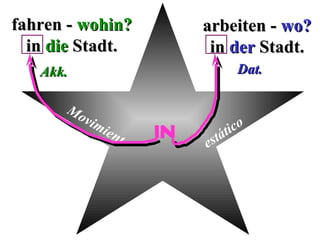
fahren - wohin?                   arbeiten - wo?
  in die Stadt.                    in der Stadt.
   Akk.                                      Dat.

      Mo
         vi   mi
                             in              co
                   en
                        to          st   á ti
                                  e
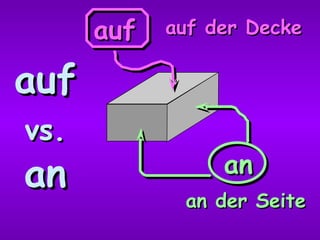
auf   auf der Decke


auf
vs.
an               an
             an der Seite
an
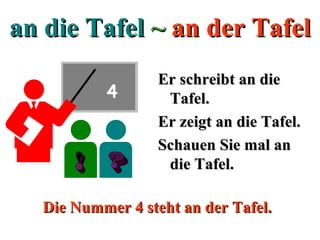
an die Tafel ~ an der Tafel
                  Er schreibt an die
          4        Tafel.
                  Er zeigt an die Tafel.
                  Schauen Sie mal an
                   die Tafel.

  Die Nummer 4 steht an der Tafel.
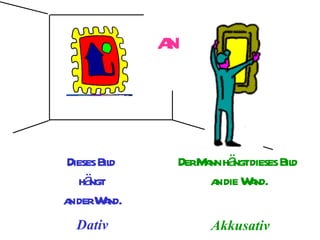
an


Dieses Bil
         d    DerM nn hä dieses Bil
                  a ngt           d
   hängt           a die Wnd.
                    n     a
a derWnd.
 n      a
  Dativ            Akkusativ
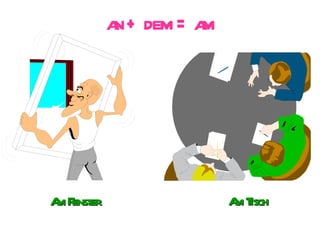
a + dem = a
           n         m


A F er
 m enst                  AT
                         m isch
an
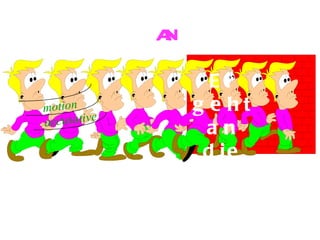
                     Er
motion             g e ht
a ccusative
                    an
                    d ie
                   Wa n
                     d.
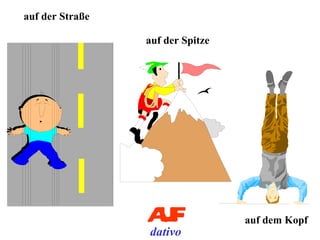
auf der Straße

                 auf der Spitze


                 auf
                 dativo
                                  auf dem Kopf
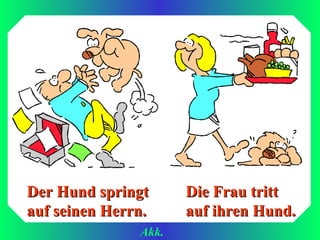
Der Hund springt      Die Frau tritt
auf seinen Herrn.     auf ihren Hund.
               Akk.
in
 in
in
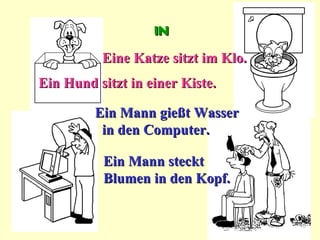
          Eine Katze sitzt im Klo.
Ein Hund sitzt in einer Kiste.

         Ein Mann gießt Wasser
          in den Computer.

          Ein Mann steckt
          Blumen in den Kopf.
in
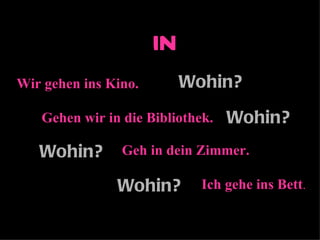
Wir gehen ins Kino.        Wohin?
   Gehen wir in die Bibliothek.   Wohin?
   Wohin?       Geh in dein Zimmer.

               Wohin?        Ich gehe ins Bett.

A1 Präpositionen AN AUF IN mit Akkusativ oder Dativ

  • 1.
    Präpos itionen +A kk/Dat an in auf
  • 2.
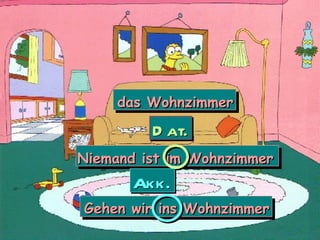
    das Wohnzimmer D at. Niemand ist im Wohnzimmer Akk. Gehen wir ins Wohnzimmer
  • 3.
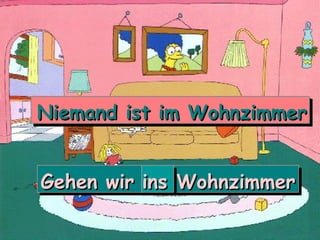
    Niemand ist imWohnzimmer Niemand ist im Wohnzimmer Gehen wir ins Wohnzimmer
  • 4.
    fahren - wohin? arbeiten - wo? in die Stadt. in der Stadt. Akk. Dat. Mo vi mi in co en to st á ti e
  • 5.
    auf auf der Decke auf vs. an an an der Seite
  • 6.
  • 7.
    an die Tafel~ an der Tafel Er schreibt an die 4 Tafel. Er zeigt an die Tafel. Schauen Sie mal an die Tafel. Die Nummer 4 steht an der Tafel.
  • 8.
    an Dieses Bil d DerM nn hä dieses Bil a ngt d hängt a die Wnd. n a a derWnd. n a Dativ Akkusativ
  • 9.
    a + dem= a n m A F er m enst AT m isch
  • 10.
    an Er motion g e ht a ccusative an d ie Wa n d.
  • 11.
    auf der Straße auf der Spitze auf dativo auf dem Kopf
  • 12.
    Der Hund springt Die Frau tritt auf seinen Herrn. auf ihren Hund. Akk.
  • 13.
  • 14.
    in Eine Katze sitzt im Klo. Ein Hund sitzt in einer Kiste. Ein Mann gießt Wasser in den Computer. Ein Mann steckt Blumen in den Kopf.
  • 15.
    in Wir gehen insKino. Wohin? Gehen wir in die Bibliothek. Wohin? Wohin? Geh in dein Zimmer. Wohin? Ich gehe ins Bett.

Hinweis der Redaktion

  • #3 1. Inductive learning is fostered by implicit instruction. Learners who figure out for themselves the target concept implied in these sentences will have a better chance of retaining, recalling and applying the concept. 2. Enhanced instruction gives this type of learning a boost by drawing attention to the salient features. 3. Explicit instruction points out what is necessary to notice so that learners do not miss it. 4. Explicit instruction with metalinguistic analysis informs learners of the rationale behind the concept and gives them reason to apply it.
  • #4 1. Inductive learning is fostered by implicit instruction. Learners who figure out for themselves the target concept implied in these sentences will have a better chance of retaining, recalling and applying the concept. 2. Enhanced instruction gives this type of learning a boost by drawing attention to the salient features. 3. Explicit instruction points out what is necessary to notice so that learners do not miss it. 4. Explicit instruction with metalinguistic analysis informs learners of the rationale behind the concept and gives them reason to apply it.