Service. 6
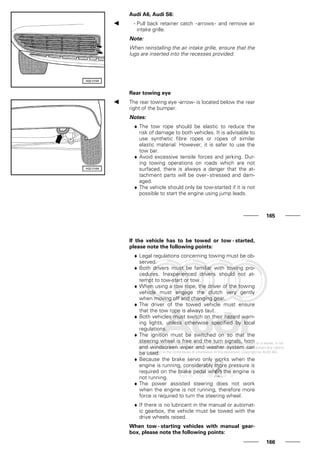
Maintenance
Audi 100 1991 >
Booklet No. 54: Audi 100 1991>
Edition 01.98
Booklet
Service Department. Technical Information
Service. 6
Maintenance
Audi 100 1991 >
Booklet No. 54: Audi 100 1991>
Edition 01.98
Booklet
Technical Bulletins
Oil Change Service
Inspection Service
Lifting the vehicle
Tow-starting/towing
Technical Information should always be available to all foremen and mechanics, because their com- pliance with
the instructions given is essential to ensure vehicle roadworthiness and safety. In the normal safety precautions
to be observed when working on motor vehicles are also applicable.
All rights reserved.
No reproduction without prior agreement from publisher. Printed in Germany
Copyright © 1998 Audi AG, Ingolstadt 005.5251.50.20
Contents
Page
- Survey of engines . . . . . . . . . . . . . . . . . . . . . . . . . . . . . . . . . . . . . . . . . . . . . . . . . . . . . . . . . . . . . . . . . . . . . . . 1
Oil Change Service . . . . . . . . . . . . . . . . . . . . . . . . . . . . . . . . . . . . . . . . . . . . . . . . . . . . . . . . . . . . . . . . . . . . . . . 9
Inspection Service . . . . . . . . . . . . . . . . . . . . . . . . . . . . . . . . . . . . . . . . . . . . . . . . . . . . . . . . . . . . . . . . . . . . . . . 10
- Windscreen wiper and washer system and headlight washer system: adjust washer jet settings and check
function . . . . . . . . . . . . . . . . . . . . . . . . . . . . . . . . . . . . . . . . . . . . . . . . . . . . . . . . . . . . . . . . . . . . . . . . . . . . . . . . 15
- Windscreen washer system: check washer jet settings and adjust if necessary . . . . . . . . . . . . . . . . . . . . . . . 15
- Headlight washer system: check washer jet settings . . . . . . . . . . . . . . . . . . . . . . . . . . . . . . . . . . . . . . . . . . . . 18
- Wiper blades: check park position and check for damage . . . . . . . . . . . . . . . . . . . . . . . . . . . . . . . . . . . . . . . . . 18
- Self-diagnosis: interrogate fault memory with fault reader V.A.G 1551 . . . . . . . . . . . . . . . . . . . . . . . . . . . . . . . 21
- Service interval display: reset . . . . . . . . . . . . . . . . . . . . . . . . . . . . . . . . . . . . . . . . . . . . . . . . . . . . . . . . . . . . . . . 24
- Door arresters and lock cylinders: lubricate . . . . . . . . . . . . . . . . . . . . . . . . . . . . . . . . . . . . . . . . . . . . . . . . . . . . 30
- Sun roof: check function, clean guide rails and spray with lubricating spray . . . . . . . . . . . . . . . . . . . . . . . . . . . 31
- Removing plenum chamber cover . . . . . . . . . . . . . . . . . . . . . . . . . . . . . . . . . . . . . . . . . . . . . . . . . . . . . . . . . . . 31
- Battery: check electrolyte level and top up with distilled water if necessary . . . . . . . . . . . . . . . . . . . . . . . . . . 32
- Removing engine cover . . . . . . . . . . . . . . . . . . . . . . . . . . . . . . . . . . . . . . . . . . . . . . . . . . . . . . . . . . . . . . . . . . . 34
- Engine (from above and below) and engine compartment: visual check for leaks and damage . . . . . . . . . . . . 38
- Windscreen / headlight washer system: top up fluid . . . . . . . . . . . . . . . . . . . . . . . . . . . . . . . . . . . . . . . . . . . . . 39
- Cooling system: check antifreeze and top up coolant if necessary . . . . . . . . . . . . . . . . . . . . . . . . . . . . . . . . . . 40
- Coolant G11: Change (V8 petrol engines only) . . . . . . . . . . . . . . . . . . . . . . . . . . . . . . . . . . . . . . . . . . . . . . . . . . 44
- Air cleaner: clean housing and replace filter element . . . . . . . . . . . . . . . . . . . . . . . . . . . . . . . . . . . . . . . . . . . . 45
- Spark plugs: replace . . . . . . . . . . . . . . . . . . . . . . . . . . . . . . . . . . . . . . . . . . . . . . . . . . . . . . . . . . . . . . . . . . . . . . 47
- Hydraulic system: check for leaks, check fluid level and top up hydraulic fluid if necessary . . . . . . . . . . . . . . . 54
- Fuel filter: replace (diesel and TDI engines) . . . . . . . . . . . . . . . . . . . . . . . . . . . . . . . . . . . . . . . . . . . . . . . . . . . . 56
- Fuel filter: drain off water (Diesel and TDI engines) . . . . . . . . . . . . . . . . . . . . . . . . . . . . . . . . . . . . . . . . . . . . . . 58
- Dust and pollen filter: replace . . . . . . . . . . . . . . . . . . . . . . . . . . . . . . . . . . . . . . . . . . . . . . . . . . . . . . . . . . . . . . 61
- Plenum chamber and water drain valves: check for dirt and clean if necessary . . . . . . . . . . . . . . . . . . . . . . . . 63
- Noise insulation: remove . . . . . . . . . . . . . . . . . . . . . . . . . . . . . . . . . . . . . . . . . . . . . . . . . . . . . . . . . . . . . . . . . . 64
- V-belt: check for damage and check tension; adjust tension if necessary . . . . . . . . . . . . . . . . . . . . . . . . . . . . . 65
- V-belts: tensioning . . . . . . . . . . . . . . . . . . . . . . . . . . . . . . . . . . . . . . . . . . . . . . . . . . . . . . . . . . . . . . . . . . . . . . . 66
- V-belt (not ribbed belt) for alternator: replace . . . . . . . . . . . . . . . . . . . . . . . . . . . . . . . . . . . . . . . . . . . . . . . . . . . 70
- Ribbed belt: check for damage . . . . . . . . . . . . . . . . . . . . . . . . . . . . . . . . . . . . . . . . . . . . . . . . . . . . . . . . . . . . . 72
- Ribbed belt: check tension; adjust if necessary . . . . . . . . . . . . . . . . . . . . . . . . . . . . . . . . . . . . . . . . . . . . . . . . . 73
- V-belt and ribbed belt: replace (4-cyl. 5V engines) . . . . . . . . . . . . . . . . . . . . . . . . . . . . . . . . . . . . . . . . . . . . . . . 74
- Ribbed belt: replace (V6 engines) . . . . . . . . . . . . . . . . . . . . . . . . . . . . . . . . . . . . . . . . . . . . . . . . . . . . . . . . . . . . 77
- Toothed belt for camshaft drive: check for damage and measure toothed belt width (4-cyl. TDI engines) . . . . 81
- Toothed belt for camshaft drive: check for damage and check tension (5-cylinder diesel and TDI engines) . . . 82
- Toothed belt for injection pump: check for damage and check tension (5-cyl. TDI engines), tension toothed belt85
- Toothed belt for camshaft drive: check for damage (2.6l 2V and 2.8l 2V engines only) . . . . . . . . . . . . . . . . . . 89
- Toothed belt: replace . . . . . . . . . . . . . . . . . . . . . . . . . . . . . . . . . . . . . . . . . . . . . . . . . . . . . . . . . . . . . . . . . . . . . 90
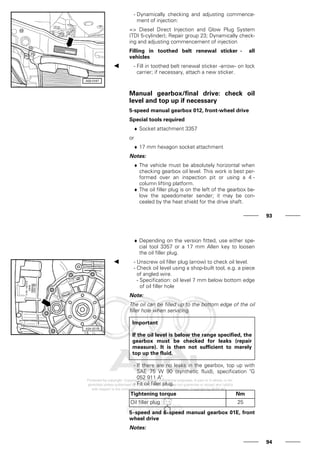
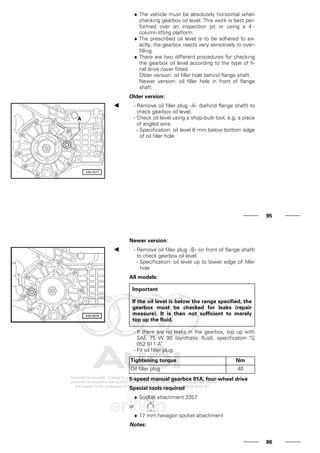
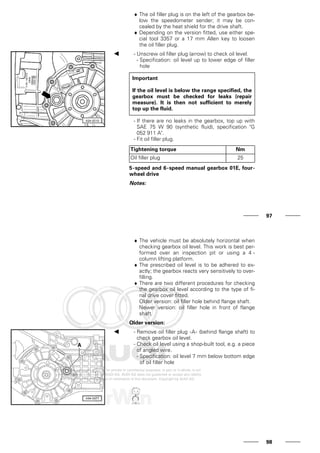
- Manual gearbox/final drive: check oil level and top up if necessary . . . . . . . . . . . . . . . . . . . . . . . . . . . . . . . . . . 93
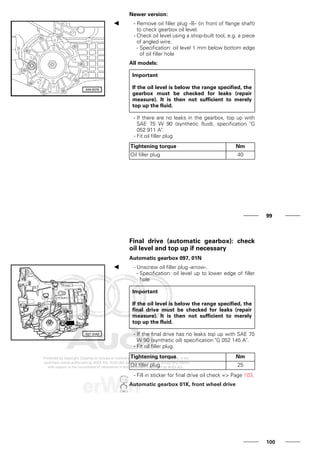
- Final drive (automatic gearbox): check oil level and top up if necessary . . . . . . . . . . . . . . . . . . . . . . . . . . . . . . 100
- Engine oil: drain or extract, change oil filter . . . . . . . . . . . . . . . . . . . . . . . . . . . . . . . . . . . . . . . . . . . . . . . . . . . . 104
- Brake system: visual check for leaks and damage . . . . . . . . . . . . . . . . . . . . . . . . . . . . . . . . . . . . . . . . . . . . . . . 107
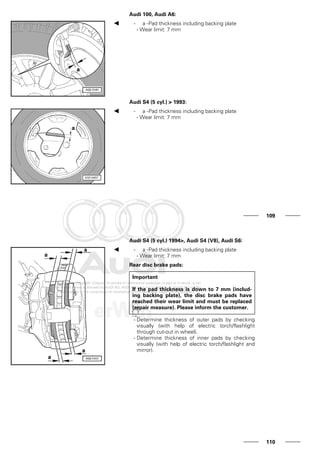
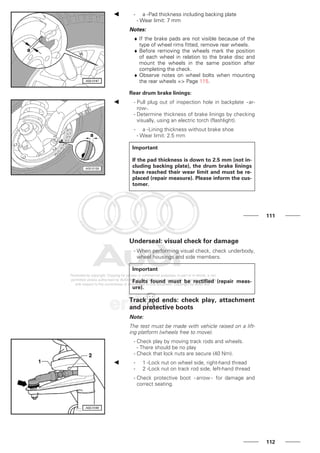
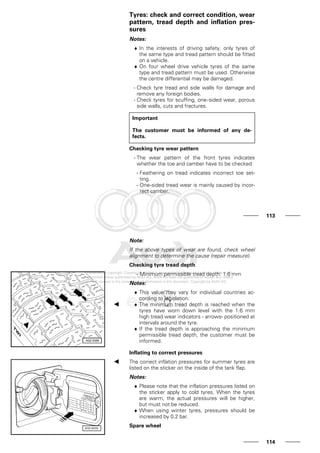
- Brake pads: check thickness . . . . . . . . . . . . . . . . . . . . . . . . . . . . . . . . . . . . . . . . . . . . . . . . . . . . . . . . . . . . . . . 108
- Underseal: visual check for damage . . . . . . . . . . . . . . . . . . . . . . . . . . . . . . . . . . . . . . . . . . . . . . . . . . . . . . . . . 112
- Track rod ends: check play, attachment and protective boots . . . . . . . . . . . . . . . . . . . . . . . . . . . . . . . . . . . . . . 112
- Tyres: check and correct condition, wear pattern, tread depth and inflation pressures . . . . . . . . . . . . . . . . . . 113
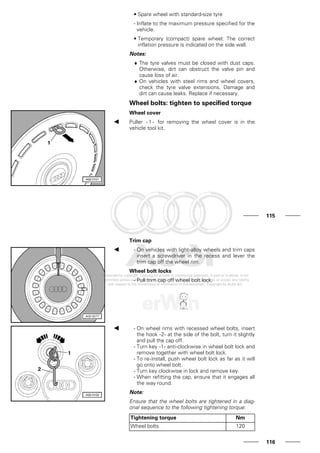
- Wheel bolts: tighten to specified torque . . . . . . . . . . . . . . . . . . . . . . . . . . . . . . . . . . . . . . . . . . . . . . . . . . . . . . 115
- Engine oil: fill . . . . . . . . . . . . . . . . . . . . . . . . . . . . . . . . . . . . . . . . . . . . . . . . . . . . . . . . . . . . . . . . . . . . . . . . . . . 118
- Engine: check oil level . . . . . . . . . . . . . . . . . . . . . . . . . . . . . . . . . . . . . . . . . . . . . . . . . . . . . . . . . . . . . . . . . . . . 122
- Automatic gearbox: change ATF (except 01N gearbox) . . . . . . . . . . . . . . . . . . . . . . . . . . . . . . . . . . . . . . . . . . . 123
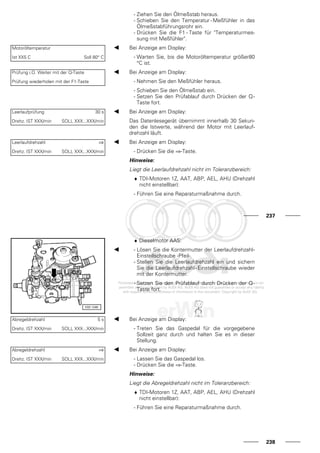
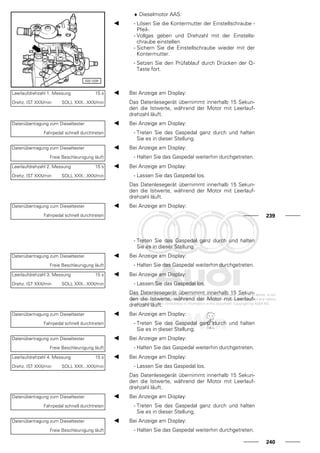
- Idling speed: check and adjust if necessary (2.4 ltr diesel AAS only) . . . . . . . . . . . . . . . . . . . . . . . . . . . . . . . . . 142
- Brake fluid level (depending on brake pad wear): checking . . . . . . . . . . . . . . . . . . . . . . . . . . . . . . . . . . . . . . . . 144
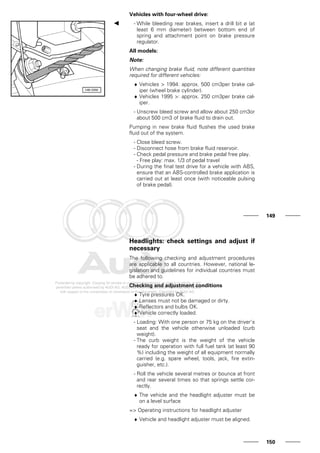
- Brake fluid: change brake fluid (every 24 months) . . . . . . . . . . . . . . . . . . . . . . . . . . . . . . . . . . . . . . . . . . . . . . . 146
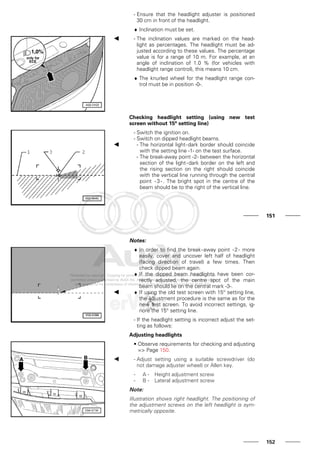
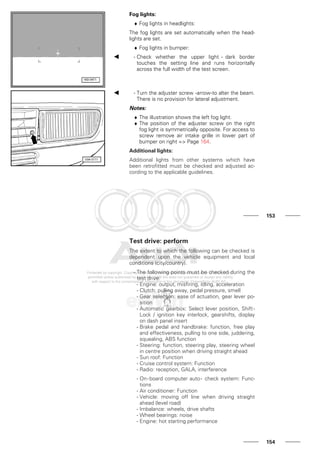
- Headlights: check settings and adjust if necessary . . . . . . . . . . . . . . . . . . . . . . . . . . . . . . . . . . . . . . . . . . . . . . 150
- Test drive: perform . . . . . . . . . . . . . . . . . . . . . . . . . . . . . . . . . . . . . . . . . . . . . . . . . . . . . . . . . . . . . . . . . . . . . . . 154
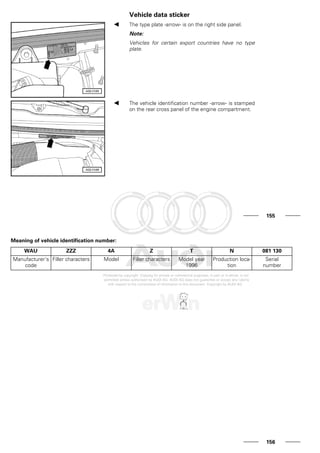
- Vehicle data sticker . . . . . . . . . . . . . . . . . . . . . . . . . . . . . . . . . . . . . . . . . . . . . . . . . . . . . . . . . . . . . . . . . . . . . . 155
- Engine code and engine number . . . . . . . . . . . . . . . . . . . . . . . . . . . . . . . . . . . . . . . . . . . . . . . . . . . . . . . . . . . . 158
Lifting the vehicle . . . . . . . . . . . . . . . . . . . . . . . . . . . . . . . . . . . . . . . . . . . . . . . . . . . . . . . . . . . . . . . . . . . . . . . 162
Tow-starting/towing . . . . . . . . . . . . . . . . . . . . . . . . . . . . . . . . . . . . . . . . . . . . . . . . . . . . . . . . . . . . . . . . . . . . . 164
- Arbeitsabläufe Benzinmotoren . . . . . . . . . . . . . . . . . . . . . . . . . . . . . . . . . . . . . . . . . . . . . . . . . . . . . . . . . . . . . . 169
- Arbeitsabläufe Dieselmotoren . . . . . . . . . . . . . . . . . . . . . . . . . . . . . . . . . . . . . . . . . . . . . . . . . . . . . . . . . . . . . . 170
- Abgasuntersuchung Deutschland . . . . . . . . . . . . . . . . . . . . . . . . . . . . . . . . . . . . . . . . . . . . . . . . . . . . . . . . . . . 171
- Arbeitsabläufe Benzinmotoren . . . . . . . . . . . . . . . . . . . . . . . . . . . . . . . . . . . . . . . . . . . . . . . . . . . . . . . . . . . . . . 172
- Störgröße vorbereiten . . . . . . . . . . . . . . . . . . . . . . . . . . . . . . . . . . . . . . . . . . . . . . . . . . . . . . . . . . . . . . . . . . . . 173
- Prüfgeräte . . . . . . . . . . . . . . . . . . . . . . . . . . . . . . . . . . . . . . . . . . . . . . . . . . . . . . . . . . . . . . . . . . . . . . . . . . . . . 177
- Prüfablauf . . . . . . . . . . . . . . . . . . . . . . . . . . . . . . . . . . . . . . . . . . . . . . . . . . . . . . . . . . . . . . . . . . . . . . . . . . . . . . 179
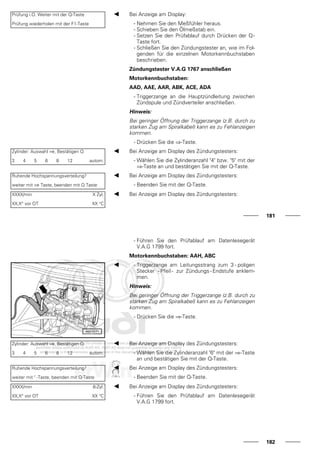
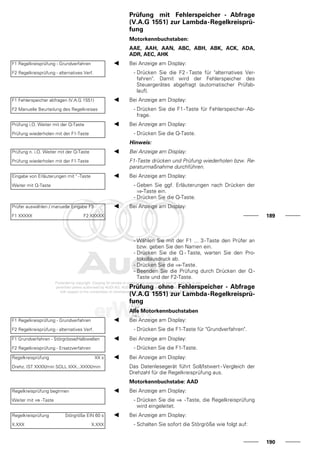
- Prüfung mit Fehlerspeicher-Abfrage (V.A.G 1551) zur Lambda-Regelkreisprüfung . . . . . . . . . . . . . . . . . . . . . . 189
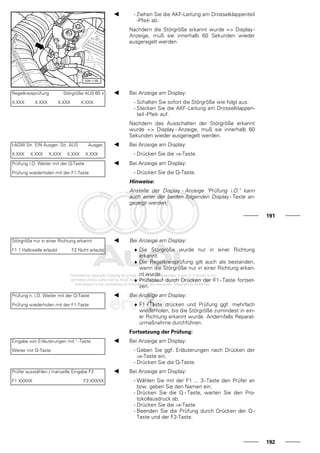
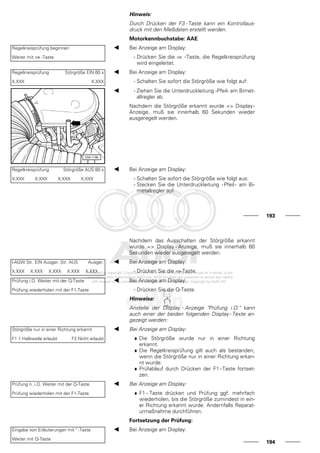
- Prüfung ohne Fehlerspeicher-Abfrage (V.A.G 1551) zur Lambda-Regelkreisprüfung . . . . . . . . . . . . . . . . . . . . 190
- Arbeitsablauf Dieselmotoren . . . . . . . . . . . . . . . . . . . . . . . . . . . . . . . . . . . . . . . . . . . . . . . . . . . . . . . . . . . . . . . 231
- Prüfgeräte . . . . . . . . . . . . . . . . . . . . . . . . . . . . . . . . . . . . . . . . . . . . . . . . . . . . . . . . . . . . . . . . . . . . . . . . . . . . . 232
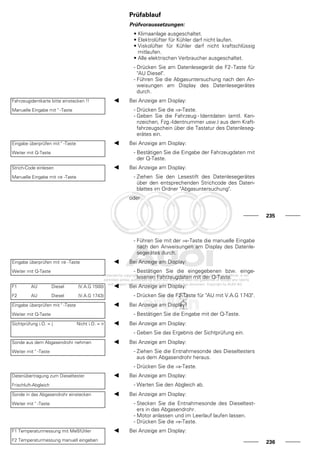
- Prüfablauf . . . . . . . . . . . . . . . . . . . . . . . . . . . . . . . . . . . . . . . . . . . . . . . . . . . . . . . . . . . . . . . . . . . . . . . . . . . . . . 235
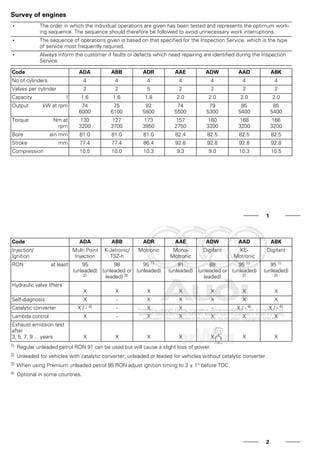
Survey of engines
1 The order in which the individual operations are given has been tested and represents the optimum work-
ing sequence. The sequence should therefore be followed to avoid unnecessary work interruptions.
1 The sequence of operations given is based on that specified for the Inspection Service, which is the type
of service most frequently required.
1 Always inform the customer if faults or defects which need repairing are identified during the Inspection
Service.
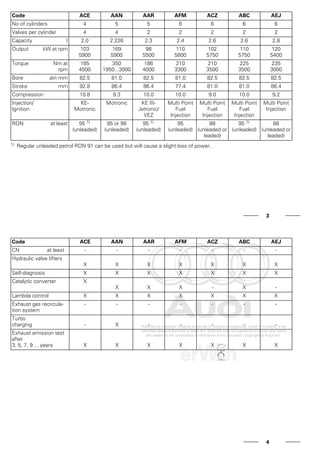
Code ADA ABB ADR AAE ADW AAD ABK
No of cylinders 4 4 4 4 4 4 4
Valves per cylinder 2 2 5 2 2 2 2
Capacity l 1.6 1.6 1.8 2.0 2.0 2.0 2.0
Output kW at rpm 74
6000
75
6100
92
5800
74
5500
79
5300
85
5400
85
5400
Torque Nm at
rpm
130
3200
127
3700
173
3950
157
2750
160
3200
168
3200
166
3200
Bore øin mm 81.0 81.0 81.0 82.4 82.5 82.5 82.5
Stroke mm 77.4 77.4 86.4 92.8 92.8 92.8 92.8
Compression 10.5 10.0 10.3 9.3 9.0 10.3 10.5
1
Code ADA ABB ADR AAE ADW AAD ABK
Injection/
Ignition
Multi Point
Injection
K-Jetronic/
TSZ-h
Motronic Mono-
Motronic
Digifant KE-
Motronic
Digifant
RON at least 95
(unleaded)
2)
98
(unleaded or
leaded) 3)
95 1)
(unleaded)
91
(unleaded)
88
(unleaded or
leaded)
95 1)
(unleaded)
2)
95 1)
(unleaded)
2)
Hydraulic valve lifters
X X X X X X X
Self-diagnosis X - X X X X X
Catalytic converter X / - 4) - X X - X / - 4) X / - 4)
Lambda control X - X X X X X
Exhaust emission test
after
3, 5, 7, 9 ... years X X X X X X X
1) Regular unleaded petrol RON 91 can be used but will cause a slight loss of power.
2) Unleaded for vehicles with catalytic converter; unleaded or leaded for vehicles without catalytic converter.
3) When using Premium unleaded petrol 95 RON adjust ignition timing to 3 ± 1° before TDC.
4) Optional in some countries.
2
Code ACE AAN AAR AFM ACZ ABC AEJ
No of cylinders 4 5 5 6 6 6 6
Valves per cylinder 4 4 2 2 2 2 2
Capacity l 2.0 2.226 2.3 2.4 2.6 2.6 2.8
Output kW at rpm 103
5900
169
5900
98
5500
110
5800
102
5750
110
5750
120
5400
Torque Nm at
rpm
185
4500
350
1950...3000
186
4000
210
3300
210
3500
225
3500
235
3000
Bore øin mm 82.5 81.0 82.5 81.0 82.5 82.5 82.5
Stroke mm 92.8 86.4 86.4 77.4 81.0 81.0 86.4
Compression 10.8 9.3 10.0 10.0 9.0 10.0 9.2
Injection/
Ignition
KE-
Motronic
Motronic KE III-
Jetronic/
VEZ
Multi Point
Fuel
Injection
Multi Point
Fuel
Injection
Multi Point
Fuel
Injection
Multi Point
Injection
RON at least 95 1)
(unleaded)
95 or 98
(unleaded)
95 1)
(unleaded)
95
(unleaded)
88
(unleaded or
leaded)
95 1)
(unleaded)
88
(unleaded or
leaded)
1) Regular unleaded petrol RON 91 can be used but will cause a slight loss of power.
3
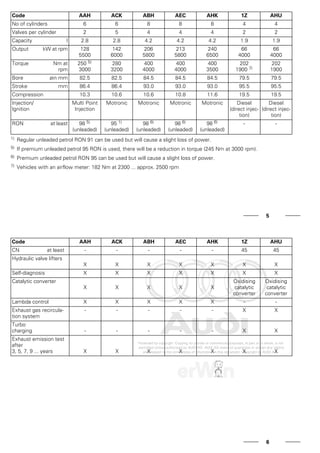
Code ACE AAN AAR AFM ACZ ABC AEJ
CN at least - - - - - - -
Hydraulic valve lifters
X X X X X X X
Self-diagnosis X X X X X X X
Catalytic converter X
X X X - X -
Lambda control X X X X X X X
Exhaust gas recircula-
tion system
- - - - - - -
Turbo
charging - X - - - - -
Exhaust emission test
after
3, 5, 7, 9 ... years X X X X X X X
4
Code AAH ACK ABH AEC AHK 1Z AHU
No of cylinders 6 6 8 8 8 4 4
Valves per cylinder 2 5 4 4 4 2 2
Capacity l 2.8 2.8 4.2 4.2 4.2 1.9 1.9
Output kW at rpm 128
5500
142
6000
206
5800
213
5800
240
6500
66
4000
66
4000
Torque Nm at
rpm
250 5)
3000
280
3200
400
4000
400
4000
400
3500
202
1900 7)
202
1900
Bore øin mm 82.5 82.5 84.5 84.5 84.5 79.5 79.5
Stroke mm 86.4 86.4 93.0 93.0 93.0 95.5 95.5
Compression 10.3 10.6 10.6 10.8 11.6 19.5 19.5
Injection/
Ignition
Multi Point
Injection
Motronic Motronic Motronic Motronic Diesel
(direct injec-
tion)
Diesel
(direct injec-
tion)
RON at least 98 5)
(unleaded)
95 1)
(unleaded)
98 6)
(unleaded)
98 6)
(unleaded)
98 6)
(unleaded)
- -
1) Regular unleaded petrol RON 91 can be used but will cause a slight loss of power.
5) If premium unleaded petrol 95 RON is used, there will be a reduction in torque (245 Nm at 3000 rpm).
6) Premium unleaded petrol RON 95 can be used but will cause a slight loss of power.
7) Vehicles with an airflow meter: 182 Nm at 2300 ... approx. 2500 rpm
5
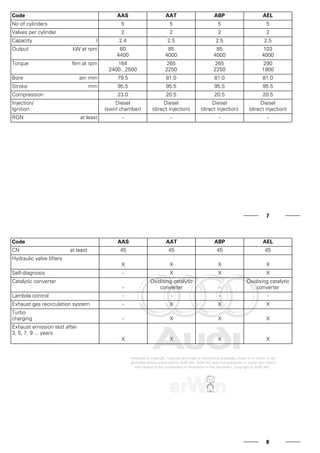
Code AAH ACK ABH AEC AHK 1Z AHU
CN at least - - - - - 45 45
Hydraulic valve lifters
X X X X X X X
Self-diagnosis X X X X X X X
Catalytic converter
X X X X X
Oxidising
catalytic
converter
Oxidising
catalytic
converter
Lambda control X X X X X - -
Exhaust gas recircula-
tion system
- - - - - X X
Turbo
charging - - - - - X X
Exhaust emission test
after
3, 5, 7, 9 ... years X X X X X X X
6
Code AAS AAT ABP AEL
No of cylinders 5 5 5 5
Valves per cylinder 2 2 2 2
Capacity l 2.4 2.5 2.5 2.5
Output kW at rpm 60
4400
85
4000
85
4000
103
4000
Torque Nm at rpm 164
2400...2500
265
2250
265
2250
290
1900
Bore øin mm 79.5 81.0 81.0 81.0
Stroke mm 95.5 95.5 95.5 95.5
Compression 23.0 20.5 20.5 20.5
Injection/
Ignition
Diesel
(swirl chamber)
Diesel
(direct injection)
Diesel
(direct injection)
Diesel
(direct injection)
RON at least - - - -
7
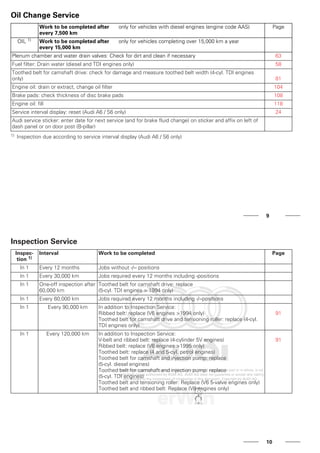
Code AAS AAT ABP AEL
CN at least 45 45 45 45
Hydraulic valve lifters
X X X X
Self-diagnosis - X X X
Catalytic converter
-
Oxidising catalytic
converter -
Oxidising catalytic
converter
Lambda control - - - -
Exhaust gas recirculation system - X X X
Turbo
charging - X X X
Exhaust emission test after
3, 5, 7, 9 ... years
X X X X
8
Oil Change Service
Work to be completed after
every 7,500 km
only for vehicles with diesel engines (engine code AAS) Page
OIL 1) Work to be completed after
every 15,000 km
only for vehicles completing over 15,000 km a year
Plenum chamber and water drain valves: Check for dirt and clean if necessary 63
Fuel filter: Drain water (diesel and TDI engines only) 58
Toothed belt for camshaft drive: check for damage and measure toothed belt width (4-cyl. TDI engines
only) 81
Engine oil: drain or extract, change oil filter 104
Brake pads: check thickness of disc brake pads 108
Engine oil: fill 118
Service interval display: reset (Audi A6 / S6 only) 24
Audi service sticker: enter date for next service (and for brake fluid change) on sticker and affix on left of
dash panel or on door post (B-pillar)
1) Inspection due according to service interval display (Audi A6 / S6 only)
9
Inspection Service
Inspec-
tion 1)
Interval Work to be completed Page
In 1 Every 12 months Jobs without -/-- positions
In 1 Every 30,000 km Jobs required every 12 months including -positions
In 1 One-off inspection after
60,000 km
Toothed belt for camshaft drive: replace
(5-cyl. TDI engines > 1994 only)
In 1 Every 60,000 km Jobs required every 12 months including -/--positions
In 1 Every 90,000 km In addition to Inspection Service:
Ribbed belt: replace (V6 engines >1994 only)
Toothed belt for camshaft drive and tensioning roller: replace (4-cyl.
TDI engines only)
91
In 1 Every 120,000 km In addition to Inspection Service:
V-belt and ribbed belt: replace (4-cylinder 5V engines)
Ribbed belt: replace (V6 engines >1995 only)
Toothed belt: replace (4 and 5-cyl. petrol engines)
Toothed belt for camshaft and injection pump: replace
(5-cyl. diesel engines)
Toothed belt for camshaft and injection pump: replace
(5-cyl. TDI engines)
Toothed belt and tensioning roller: Replace (V6 5-valve engines only)
Toothed belt and ribbed belt: Replace (V8 engines only)
91
10
Inspec-
tion 1)
Interval Work to be completed Page
In 2 Every 24 months In addition to Inspection Service:
Brake fluid: change 146
In 1 Every 36 months In addition to Inspection Service:
Coolant G11: Renew (V8 petrol engines only)
Coolant "G12" need not be changed, even after changing from "G11"
to "G12" coolant
44
After the first 36
months, then every 24
months
Exhaust emissions test 169
Work to be completed 5
1) Inspection due according to service interval display (Audi A6 / S6 only)
Work to be completed Page
Front and rear lights, turn signals, hazard warning lights, luggage compartment lights: check func-
tion
Interior lights and glove compartment light, warning lamps, horn: check function
Windscreen wiper and washer system and headlight washer system: adjust washer jet settings
and check function
15
Wiper blades: check park position and check for damage 18
Self-diagnosis: interrogate fault memory with fault reader V.A.G 1551 21
Service interval display: reset (Audi A6 / S6 only) 24
Door arresters and lock cylinders: lubricate 30
- Sun roof: check function, clean guide rails and spray with lubricating spray 31
Battery: check electrolyte level and top up with distilled water if necessary 32
11
Engine (from above) and engine compartment: visual check for leaks and damage 38
Windscreen / headlight washer system: top up fluid 39
Cooling system: check antifreeze and top up coolant if necessary 40
-- Air cleaner: clean housing and replace filter element
(every 60,000 km or every 2 years, whichever comes first) 45
- Spark plugs: Replace (vehicles > 1993) 47
-- Spark plugs: Replace (vehicles 1994 >, every 60,000 km or every 3 years, whichever comes first) 47
Continued 5
- Hydraulic system: check for leaks and check fluid level, top up hydraulic fluid if necessary (vehicles >
1991 only)
54
-- Hydraulic system: check for leaks and check fluid level, top up hydraulic fluid if necessary (vehicles >
1992 only)
54
- Fuel filter: Replace (diesel and TDI engines only) 56
Fuel filter: Drain water (diesel and TDI engines only) 58
- Dust and pollen filter: replace
(Audi 100 > 1992 with 2V1 => vehicle data sticker, Audi 100 1993 > 1994 without air conditioner,
Audi A6 1995 >) 61
Plenum chamber and water drain valves: Check for dirt and clean if necessary 63
V-belt: check for damage and check tension; adjust tension if necessary 65
-- V-belt (not ribbed belt) for alternator: Replace (vehicles > 1993 only) 70
- Ribbed belt: check for damage (vehicles > 1994 only) 72
- Ribbed belt: check tension; adjust if necessary
(4-and 5-cyl. 1993 engines only) 73
Toothed belt for camshaft drive: check for damage, measure toothed belt width
(4-cyl. TDI engines only) 81
12
- Toothed belt for camshaft drive: check for damage and check tension
(5-cyl. diesel and TDI engines only) 82
- Toothed belt for injection pump: check for damage and check tension (5-cyl. TDI engines),
adjust tension of toothed belt - Additional job 85
Continued 5
-- Toothed belt for camshaft drive: check for damage (2.6l 2V and 2.8l 2V engines only). 89
Engine (from below): visual check for leaks and damage 38
Gearbox, final drive, steering and protective boots: visual check for leaks and damage
- Manual gearbox/final drive: check oil level and top up if necessary 93
-- Final drive (automatic gearbox): check oil level and top up if necessary 100
Engine oil: drain or extract, change oil filter 104
Brake system (from below): visual check for leaks and damage 107
Brake pads: check thickness 108
- Underseal: visual check for damage 112
Exhaust system: visual check for leaks and damage, check that parts are properly secured
Track rod ends: check play, attachment and protective boots 112
Ball joints: check protective boots for leaks and damage
Tyres (incl. spare wheel): check condition and wear pattern 113
Tyres (incl. spare wheel): check and record tread
depths
FL FR RR RL Spare 114
Tyres (incl. spare wheel): Inflating to correct pressures 114
Engine oil: fill 118
-- Automatic gearbox: change - ATF (additional job) (every 60,000 km or every 4 years, whichever
comes first)
123
13
Idling speed: check and adjust if necessary (2.4 ltr diesel AAS only) 142
Continued 5
Brake fluid level (depending on brake pad wear): check 144
- Headlights: check settings and adjust if necessary 150
Audi service sticker: enter date for next service (and for brake fluid change) on sticker and affix on
left of dash panel or on door post (B-pillar)
Test drive: perform 154
14
Windscreen wiper and washer system
and headlight washer system: adjust
washer jet settings and check function
Note:
If the wiper blades judder or make a noise when
tested, check the contact angle of the wiper blades
=>Page 19.
Windscreen washer system: check
washer jet settings and adjust if neces-
sary
Special tools required
♦ Windscreen wiper jet adjusting tool 3125 A with
needle 3125/5
Note:
Never use pins or other sharp objects as these will
damage the water channels in the jet.
Windscreen washer jet settings
- Mark the four points on the windscreen with wa-
ter-soluble ink.
15
Setting dimensions:
♦ Dimension a = 230 mm
♦ Dimension b = 280 mm
♦ Dimension c = 160 mm
♦ Dimension d = 480 mm
Note:
The setting dimensions are calculated from the outer
edges of the windscreen.
- Use the special tool 3125 A to aim the individual
jets at the points marked.
Notes:
♦ The setting dimensions give the values for the
vehicle when moving. The spray from the jets
will be slightly offset when stationary.
♦ If the jet of water is irregular or cannot be adjus-
ted to the specified setting, replace the jet (re-
pair measure).
16
Rear window washer jet setting
- Adjust the washer jet using special tool 3125 A
so that the water jet is directed onto the rear win-
dow within the dimension a = 280 mm above the
wiper arm pivot mounting.
17
Headlight washer system: check washer
jet settings
The headlight washer jets are set by the manufac-
turer and therefore do not require adjustment.
Wiper blades: check park position and
check for damage
Park position for windscreen wiper blades
- Switch windscreen wipers on and off and allow
to return to the park position.
- Check that the wiper blades are in the correct po-
sition on the windscreen.
- A - End of wiper blade on passenger's side at
upper edge of dotted pattern.
- B - Wiper blade on driver's side: a = 10 mm
below upper edge of dotted pattern.
Note:
The positioning is symmetrically opposite for right -
hand drive vehicles.
- If necessary, loosen the wiper arm, align and
tighten fastening nut.
- Actuate flick wipe switch and check settings.
Tightening torque Nm
Wiper arms to pivot mountings 16
Park position for rear window wiper blade
18
- Switch rear window wipers on and off and allow
to return to the park position.
- Check that the wiper blade is on upper edge of
the dotted pattern on rear window.
- If necessary, loosen the wiper arm, align and
tighten fastening nut.
Tightening torque Nm
Wiper arm to pivot mounting 16
Contact angle of front wiper blades
Note:
Only check the contact angle when the wiper blades
judder or make noises.
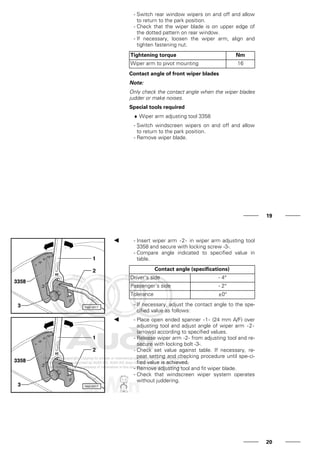
Special tools required
♦ Wiper arm adjusting tool 3358
- Switch windscreen wipers on and off and allow
to return to the park position.
- Remove wiper blade.
19
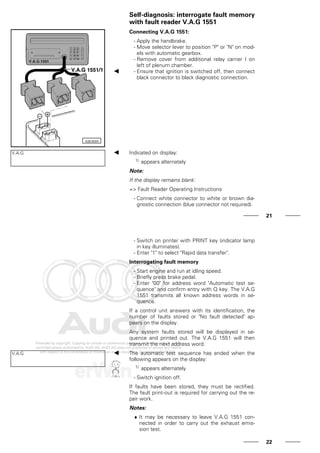
- Insert wiper arm -2- in wiper arm adjusting tool
3358 and secure with locking screw -3-.
- Compare angle indicated to specified value in
table.
Contact angle (specifications)
Driver's side - 4°
Passenger's side - 2°
Tolerance ±0°
- If necessary, adjust the contact angle to the spe-
cified value as follows:
- Place open ended spanner -1- (24 mm A/F) over
adjusting tool and adjust angle of wiper arm -2-
(arrows) according to specified values.
- Release wiper arm -2- from adjusting tool and re-
secure with locking bolt -3-.
- Check set value against table. If necessary, re-
peat setting and checking procedure until spe-ci-
fied value is achieved.
- Remove adjusting tool and fit wiper blade.
- Check that windscreen wiper system operates
without juddering.
20
Self-diagnosis: interrogate fault memory
with fault reader V.A.G 1551
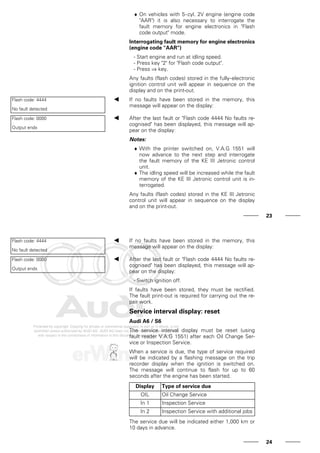
Connecting V.A.G 1551:
- Apply the handbrake.
- Move selector lever to position "P" or "N" on mod-
els with automatic gearbox.
- Remove cover from additional relay carrier I on
left of plenum chamber.
- Ensure that ignition is switched off, then connect
black connector to black diagnostic connection.
V.A.G Indicated on display:
1) appears alternately
Note:
If the display remains blank:
=> Fault Reader Operating Instructions
- Connect white connector to white or brown dia-
gnostic connection (blue connector not required).
21
- Switch on printer with PRINT key (indicator lamp
in key illuminates).
- Enter "1" to select "Rapid data transfer".
Interrogating fault memory
- Start engine and run at idling speed.
- Briefly press brake pedal.
- Enter "00" for address word "Automatic test se-
quence" and confirm entry with Q key. The V.A.G
1551 transmits all known address words in se-
quence.
If a control unit answers with its identification, the
number of faults stored or "No fault detected" ap-
pears on the display.
Any system faults stored will be displayed in se-
quence and printed out. The V.A.G 1551 will then
transmit the next address word.
V.A.G The automatic test sequence has ended when the
following appears on the display:
1) appears alternately
- Switch ignition off.
If faults have been stored, they must be rectified.
The fault print-out is required for carrying out the re-
pair work.
Notes:
♦ It may be necessary to leave V.A.G 1551 con-
nected in order to carry out the exhaust emis-
sion test.
22
♦ On vehicles with 5-cyl. 2V engine (engine code
"AAR") it is also necessary to interrogate the
fault memory for engine electronics in "Flash
code output" mode.
Interrogating fault memory for engine electronics
(engine code "AAR")
- Start engine and run at idling speed.
- Press key "2" for "Flash code output".
- Press ⇒ key.
Any faults (flash codes) stored in the fully-electronic
ignition control unit will appear in sequence on the
display and on the print-out.
Flash code: 4444
No fault detected
If no faults have been stored in the memory, this
message will appear on the display:
Flash code: 0000
Output ends
After the last fault or "Flash code 4444 No faults re-
cognised" has been displayed, this message will ap-
pear on the display:
Notes:
♦ With the printer switched on, V.A.G 1551 will
now advance to the next step and interrogate
the fault memory of the KE III Jetronic control
unit.
♦ The idling speed will be increased while the fault
memory of the KE III Jetronic control unit is in-
terrogated.
Any faults (flash codes) stored in the KE III Jetronic
control unit will appear in sequence on the display
and on the print-out.
23
Flash code: 4444
No fault detected
If no faults have been stored in the memory, this
message will appear on the display:
Flash code: 0000
Output ends
After the last fault or "Flash code 4444 No faults re-
cognised" has been displayed, this message will ap-
pear on the display:
- Switch ignition off.
If faults have been stored, they must be rectified.
The fault print-out is required for carrying out the re-
pair work.
Service interval display: reset
Audi A6 / S6
The service interval display must be reset (using
fault reader V.A.G 1551) after each Oil Change Ser-
vice or Inspection Service.
When a service is due, the type of service required
will be indicated by a flashing message on the trip
recorder display when the ignition is switched on.
The message will continue to flash for up to 60
seconds after the engine has been started.
Display Type of service due
OIL Oil Change Service
In 1 Inspection Service
In 2 Inspection Service with additional jobs
The service due will be indicated either 1,000 km or
10 days in advance.
24
- Connect V.A.G 1551 => Page 23.
- Switch the ignition on.
V.A.G Indicated on display:
1) appears alternately
- Enter "1" to select "Rapid data transfer".
Rapid data transfer HELP
Enter address word XX
Indicated on display
- Enter "17" for address word "Dash panel insert"
and confirm entry with Q key.
4A1919033HG
C4-INSTRUMENT CLUSTER D20 ⇒
Coding 00040 WSC 12345
If following display appears (example):
- Press ⇒ key to continue.
- Enter "10" to select the "Adaption" function and
confirm with the Q key.
Adaption Q
Enter channel no. XX
Indicated on display
- Enter the required adaption channel according to
the following table.
25
Type of
service
due
service
due
to be
can-
celled
Adap-
tion
channel
Input value
OIL OIL 05 00015
In 1 OIL
In 1 (dis-
tance)
In 1
(time)
05
06
07
00015
00030
00036
In 2 OIL
In 1 (dis-
tance)
In 1
(time)
In 2
05
06
07
08
00015
00030
00036
00073
Resetting SID in adaption channel 05 (OIL):
- Enter "05" to select "Adaption channel 05" and
confirm entry with Q key.
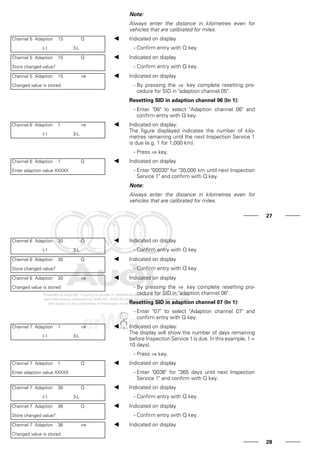
Channel 5 Adaption 1 ⇒
(-1 3-L
Indicated on display:
The figure displayed indicates the number of kilo-
metres remaining until the OIL Service is due (e.g.
"1" for 1,000 km).
- Press ⇒ key.
Channel 5 Adaption 1 Q
Enter adaption value XXXXX
Indicated on display
- Enter "00015" for "15,000 km until next OIL Ser-
vice" and confirm with Q key.
26
Note:
Always enter the distance in kilometres even for
vehicles that are calibrated for miles.
Channel 5 Adaption 15 Q
(-1 3-L
Indicated on display
- Confirm entry with Q key.
Channel 5 Adaption 15 Q
Store changed value?
Indicated on display
- Confirm entry with Q key.
Channel 5 Adaption 15 ⇒
Changed value is stored
Indicated on display
- By pressing the ⇒ key complete resetting pro-
cedure for SID in "adaption channel 05".
Resetting SID in adaption channel 06 (In 1):
- Enter "06" to select "Adaption channel 06" and
confirm entry with Q key.
Channel 6 Adaption 1 ⇒
(-1 3-L
Indicated on display:
The figure displayed indicates the number of kilo-
metres remaining until the next Inspection Service 1
is due (e.g. 1 for 1,000 km).
- Press ⇒ key.
Channel 6 Adaption 1 Q
Enter adaption value XXXXX
Indicated on display
- Enter "00030" for "30,000 km until next Inspection
Service 1" and confirm with Q key.
Note:
Always enter the distance in kilometres even for
vehicles that are calibrated for miles.
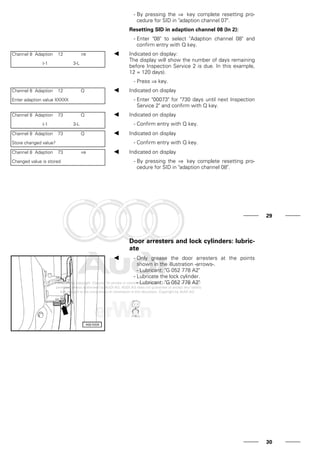
27
Channel 6 Adaption 30 Q
(-1 3-L
Indicated on display
- Confirm entry with Q key.
Channel 6 Adaption 30 Q
Store changed value?
Indicated on display
- Confirm entry with Q key.
Channel 6 Adaption 30 ⇒
Changed value is stored
Indicated on display
- By pressing the ⇒ key complete resetting pro-
cedure for SID in "adaption channel 06".
Resetting SID in adaption channel 07 (In 1):
- Enter "07" to select "Adaption channel 07" and
confirm entry with Q key.
Channel 7 Adaption 1 ⇒
(-1 3-L
Indicated on display:
The display will show the number of days remaining
before Inspection Service 1 is due. In this example, 1 =
10 days).
- Press ⇒ key.
Channel 7 Adaption 1 Q
Enter adaption value XXXXX
Indicated on display
- Enter "0036" for "365 days until next Inspection
Service 1" and confirm with Q key.
Channel 7 Adaption 36 Q
(-1 3-L
Indicated on display
- Confirm entry with Q key.
Channel 7 Adaption 36 Q
Store changed value?
Indicated on display
- Confirm entry with Q key.
Channel 7 Adaption 36 ⇒
Changed value is stored
Indicated on display
28
- By pressing the ⇒ key complete resetting pro-
cedure for SID in "adaption channel 07".
Resetting SID in adaption channel 08 (In 2):
- Enter "08" to select "Adaption channel 08" and
confirm entry with Q key.
Channel 8 Adaption 12 ⇒
(-1 3-L
Indicated on display:
The display will show the number of days remaining
before Inspection Service 2 is due. In this example,
12 = 120 days).
- Press ⇒ key.
Channel 8 Adaption 12 Q
Enter adaption value XXXXX
Indicated on display
- Enter "00073" for "730 days until next Inspection
Service 2" and confirm with Q key.
Channel 8 Adaption 73 Q
(-1 3-L
Indicated on display
- Confirm entry with Q key.
Channel 8 Adaption 73 Q
Store changed value?
Indicated on display
- Confirm entry with Q key.
Channel 8 Adaption 73 ⇒
Changed value is stored
Indicated on display
- By pressing the ⇒ key complete resetting pro-
cedure for SID in "adaption channel 08".
29
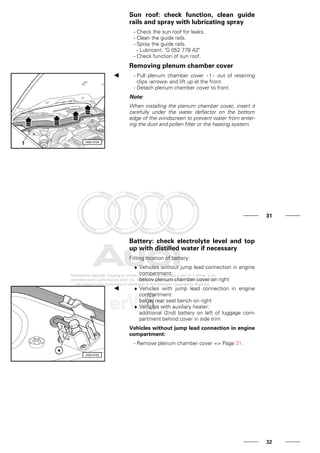
Door arresters and lock cylinders: lubric-
ate
- Only grease the door arresters at the points
shown in the illustration -arrows-.
- Lubricant: "G 052 778 A2"
- Lubricate the lock cylinder.
- Lubricant: "G 052 778 A2"
30
Sun roof: check function, clean guide
rails and spray with lubricating spray
- Check the sun roof for leaks.
- Clean the guide rails.
- Spray the guide rails.
- Lubricant: "G 052 778 A2"
- Check function of sun roof.
Removing plenum chamber cover
- Pull plenum chamber cover - 1 - out of retaining
clips -arrows- and lift up at the front.
- Detach plenum chamber cover to front.
Note:
When installing the plenum chamber cover, insert it
carefully under the water deflector on the bottom
edge of the windscreen to prevent water from enter-
ing the dust and pollen filter or the heating system.
31
Battery: check electrolyte level and top
up with distilled water if necessary
Fitting location of battery:
♦ Vehicles without jump lead connection in engine
compartment:
below plenum chamber cover on right
♦ Vehicles with jump lead connection in engine
compartment:
below rear seat bench on right
♦ Vehicles with auxiliary heater:
additional (2nd) battery on left of luggage com-
partment behind cover in side trim
Vehicles without jump lead connection in engine
compartment:
- Remove plenum chamber cover => Page 31.
32
Vehicles with jump lead connection in engine
compartment:
- To remove rear seat bench, unscrew cross-head
screws on left and right.
- Raise rear seat bench slightly and take out to-
wards the front.
Additional (2nd) battery on vehicles with auxili-
ary heater:
- Open cover in side trim on left of luggage com-
partment.
All models:
- Checking electrolyte level:
- The electrolyte level should be between the
MIN and MAX markings.
- If necessary, top up battery cells to max. mark
with distilled water.
Notes:
♦ For batteries with clearly visible min and max
mark, the electrolyte level can be checked visu-
ally from the outside of the battery.
♦ If the electrolyte level is not visible from the out-
side unscrew the battery caps.
♦ The electrolyte level must align with the marking
inside the battery - plastic web - . This corres-
ponds to the outer max marking.
33
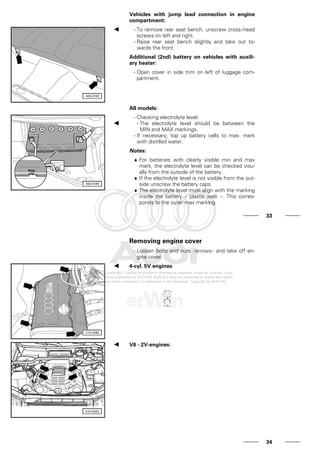
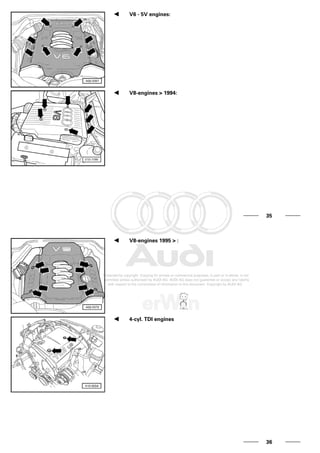
Removing engine cover
- Loosen bolts and nuts -arrows- and take off en-
gine cover.
4-cyl. 5V engines
V6 - 2V-engines:
34
V6 - 5V engines:
V8-engines > 1994:
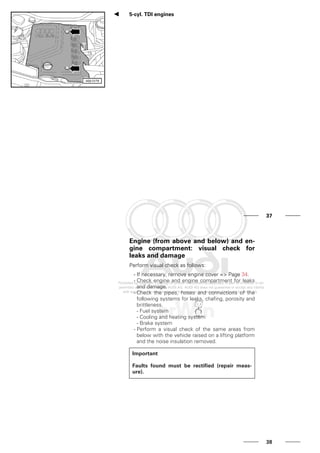
35
V8-engines 1995 > :
4-cyl. TDI engines
36
5-cyl. TDI engines
37
Engine (from above and below) and en-
gine compartment: visual check for
leaks and damage
Perform visual check as follows:
- If necessary, remove engine cover => Page 34.
- Check engine and engine compartment for leaks
and damage.
- Check the pipes, hoses and connections of the
following systems for leaks, chafing, porosity and
brittleness.
- Fuel system
- Cooling and heating system
- Brake system
- Perform a visual check of the same areas from
below with the vehicle raised on a lifting platform
and the noise insulation removed.
Important
Faults found must be rectified (repair meas-
ure).
38
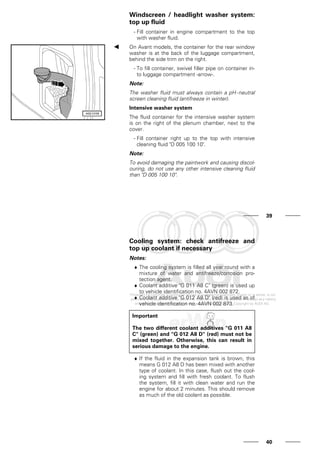
Windscreen / headlight washer system:
top up fluid
- Fill container in engine compartment to the top
with washer fluid.
On Avant models, the container for the rear window
washer is at the back of the luggage compartment,
behind the side trim on the right.
- To fill container, swivel filler pipe on container in-
to luggage compartment -arrow-.
Note:
The washer fluid must always contain a pH-neutral
screen cleaning fluid (antifreeze in winter).
Intensive washer system
The fluid container for the intensive washer system
is on the right of the plenum chamber, next to the
cover.
- Fill container right up to the top with intensive
cleaning fluid "D 005 100 10".
Note:
To avoid damaging the paintwork and causing discol-
ouring, do not use any other intensive cleaning fluid
than "D 005 100 10".
39
Cooling system: check antifreeze and
top up coolant if necessary
Notes:
♦ The cooling system is filled all year round with a
mixture of water and antifreeze/corrosion pro-
tection agent.
♦ Coolant additive "G 011 A8 C" (green) is used up
to vehicle identification no. 4AVN 002 872.
♦ Coolant additive "G 012 A8 D" (red) is used as of
vehicle identification no. 4AVN 002 873.
Important
The two different coolant additives "G 011 A8
C" (green) and "G 012 A8 D" (red) must not be
mixed together. Otherwise, this can result in
serious damage to the engine.
♦ If the fluid in the expansion tank is brown, this
means G 012 A8 D has been mixed with another
type of coolant. In this case, flush out the cool-
ing system and fill with fresh coolant. To flush
the system, fill it with clean water and run the
engine for about 2 minutes. This should remove
as much of the old coolant as possible.
40
♦ "G 011 A8 C" and coolant additives "conforming
to TL VW 774 C" or "G 012 A8 D" and coolant ad-
ditives "conforming to TL VW 774 D" prevent
frost and corrosion damage, scaling and also
raise the boiling point of the coolant. For these
reasons the cooling system must be filled all
year round with the correct anti freeze and anti
corrosion additive.
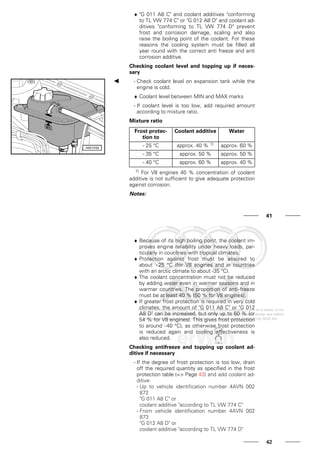
Checking coolant level and topping up if neces-
sary
- Check coolant level on expansion tank while the
engine is cold.
♦ Coolant level between MIN and MAX marks
- If coolant level is too low, add required amount
according to mixture ratio.
Mixture ratio
Frost protec-
tion to
Coolant additive Water
- 25 °C approx. 40 % 1) approx. 60 %
- 35 °C approx. 50 % approx. 50 %
- 40 °C approx. 60 % approx. 40 %
1) For V8 engines 40 % concentration of coolant
additive is not sufficient to give adequate protection
against corrosion.
Notes:
41
♦ Because of its high boiling point, the coolant im-
proves engine reliability under heavy loads, par-
ticularly in countries with tropical climates.
♦ Protection against frost must be assured to
about - 25 °C (for V8 engines and in countries
with an arctic climate to about -35 °C).
♦ The coolant concentration must not be reduced
by adding water even in warmer seasons and in
warmer countries. The proportion of anti-freeze
must be at least 40 % (50 % for V8 engines).
♦ If greater frost protection is required in very cold
climates, the amount of "G 011 A8 C" or "G 012
A8 D" can be increased, but only up to 60 % (or
54 % for V8 engines). This gives frost protection
to around -40 °C), as otherwise frost protection
is reduced again and cooling effectiveness is
also reduced.
Checking antifreeze and topping up coolant ad-
ditive if necessary
- If the degree of frost protection is too low, drain
off the required quantity as specified in the frost
protection table (=> Page 43) and add coolant ad-
ditive:
- Up to vehicle identification number 4AVN 002
872
"G 011 A8 C" or
coolant additive "according to TL VW 774 C"
- From vehicle identification number 4AVN 002
873
"G 012 A8 D" or
coolant additive "according to TL VW 774 D"
42
Note:
Observe environmental requirements for disposal.
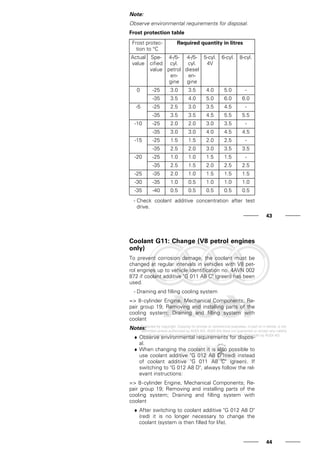
Frost protection table
Frost protec-
tion to °C
Required quantity in litres
Actual
value
Spe-
cified
value
4-/5-
cyl.
petrol
en-
gine
4-/5-
cyl.
diesel
en-
gine
5-cyl.
4V
6-cyl. 8-cyl.
0 -25 3.0 3.5 4.0 5.0 -
-35 3.5 4.0 5.0 6.0 6.0
-5 -25 2.5 3.0 3.5 4.5 -
-35 3.5 3.5 4.5 5.5 5.5
-10 -25 2.0 2.0 3.0 3.5 -
-35 3.0 3.0 4.0 4.5 4.5
-15 -25 1.5 1.5 2.0 2.5 -
-35 2.5 2.0 3.0 3.5 3.5
-20 -25 1.0 1.0 1.5 1.5 -
-35 2.5 1.5 2.0 2.5 2.5
-25 -35 2.0 1.0 1.5 1.5 1.5
-30 -35 1.0 0.5 1.0 1.0 1.0
-35 -40 0.5 0.5 0.5 0.5 0.5
- Check coolant additive concentration after test
drive.
43
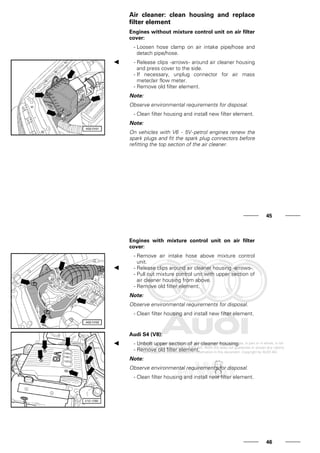
Coolant G11: Change (V8 petrol engines
only)
To prevent corrosion damage, the coolant must be
changed at regular intervals in vehicles with V8 pet-
rol engines up to vehicle identification no. 4AVN 002
872 if coolant additive "G 011 A8 C" (green) has been
used.
- Draining and filling cooling system
=> 8-cylinder Engine, Mechanical Components; Re-
pair group 19; Removing and installing parts of the
cooling system; Draining and filling system with
coolant
Notes:
♦ Observe environmental requirements for dispos-
al.
♦ When changing the coolant it is also possible to
use coolant additive "G 012 A8 D" (red) instead
of coolant additive "G 011 A8 C" (green). If
switching to "G 012 A8 D", always follow the rel-
evant instructions:
=> 8-cylinder Engine, Mechanical Components; Re-
pair group 19; Removing and installing parts of the
cooling system; Draining and filling system with
coolant
♦ After switching to coolant additive "G 012 A8 D"
(red) it is no longer necessary to change the
coolant (system is then filled for life).
44
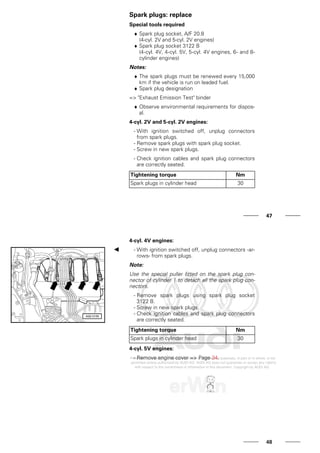
Air cleaner: clean housing and replace
filter element
Engines without mixture control unit on air filter
cover:
- Loosen hose clamp on air intake pipe/hose and
detach pipe/hose.
- Release clips -arrows- around air cleaner housing
and press cover to the side.
- If necessary, unplug connector for air mass
meter/air flow meter.
- Remove old filter element.
Note:
Observe environmental requirements for disposal.
- Clean filter housing and install new filter element.
Note:
On vehicles with V6 - 5V-petrol engines renew the
spark plugs and fit the spark plug connectors before
refitting the top section of the air cleaner.
45
Engines with mixture control unit on air filter
cover:
- Remove air intake hose above mixture control
unit.
- Release clips around air cleaner housing -arrows-.
- Pull out mixture control unit with upper section of
air cleaner housing from above.
- Remove old filter element.
Note:
Observe environmental requirements for disposal.
- Clean filter housing and install new filter element.
Audi S4 (V8):
- Unbolt upper section of air cleaner housing.
- Remove old filter element.
Note:
Observe environmental requirements for disposal.
- Clean filter housing and install new filter element.
46
Spark plugs: replace
Special tools required
♦ Spark plug socket, A/F 20.8
(4-cyl. 2V and 5-cyl. 2V engines)
♦ Spark plug socket 3122 B
(4-cyl. 4V, 4-cyl. 5V, 5-cyl. 4V engines, 6- and 8-
cylinder engines)
Notes:
♦ The spark plugs must be renewed every 15,000
km if the vehicle is run on leaded fuel.
♦ Spark plug designation
=> "Exhaust Emission Test" binder
♦ Observe environmental requirements for dispos-
al.
4-cyl. 2V and 5-cyl. 2V engines:
- With ignition switched off, unplug connectors
from spark plugs.
- Remove spark plugs with spark plug socket.
- Screw in new spark plugs.
- Check ignition cables and spark plug connectors
are correctly seated.
Tightening torque Nm
Spark plugs in cylinder head 30
47
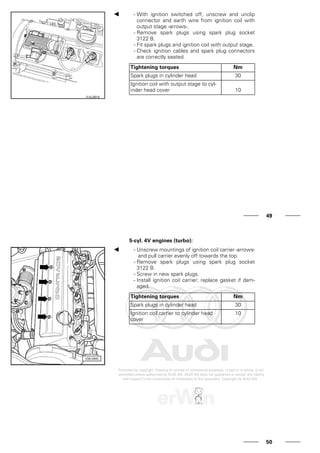
4-cyl. 4V engines:
- With ignition switched off, unplug connectors -ar-
rows- from spark plugs.
Note:
Use the special puller fitted on the spark plug con-
nector of cylinder 1 to detach all the spark plug con-
nectors.
- Remove spark plugs using spark plug socket
3122 B.
- Screw in new spark plugs.
- Check ignition cables and spark plug connectors
are correctly seated.
Tightening torque Nm
Spark plugs in cylinder head 30
4-cyl. 5V engines:
- Remove engine cover => Page 34.
48
- With ignition switched off, unscrew and unclip
connector and earth wire from ignition coil with
output stage -arrows-.
- Remove spark plugs using spark plug socket
3122 B.
- Fit spark plugs and ignition coil with output stage.
- Check ignition cables and spark plug connectors
are correctly seated.
Tightening torques Nm
Spark plugs in cylinder head 30
Ignition coil with output stage to cyl-
inder head cover 10
49
5-cyl. 4V engines (turbo):
- Unscrew mountings of ignition coil carrier -arrows-
and pull carrier evenly off towards the top.
- Remove spark plugs using spark plug socket
3122 B.
- Screw in new spark plugs.
- Install ignition coil carrier; replace gasket if dam-
aged.
Tightening torques Nm
Spark plugs in cylinder head 30
Ignition coil carrier to cylinder head
cover
10
50
V6 - 2V engines:
- If necessary remove air intake pipe -1- between
air cleaner and throttle valve unit.
- Remove engine cover => Page 34.
- With ignition switched off, unplug connectors -ar-
rows- from spark plugs.
- Remove spark plugs using spark plug socket
3122 B.
- Screw in new spark plugs.
- Check ignition cables and spark plug connectors
are correctly seated.
Tightening torque Nm
Spark plugs in cylinder head 30
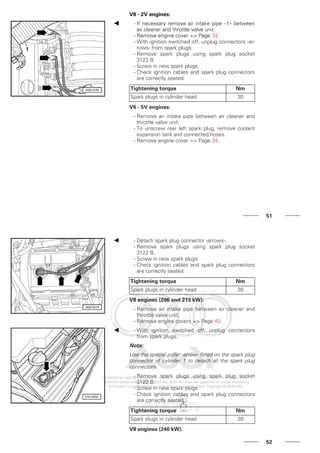
V6 - 5V engines:
- Remove air intake pipe between air cleaner and
throttle valve unit.
- To unscrew rear left spark plug, remove coolant
expansion tank and connected hoses.
- Remove engine cover => Page 34.
51
- Detach spark plug connector -arrows-.
- Remove spark plugs using spark plug socket
3122 B.
- Screw in new spark plugs.
- Check ignition cables and spark plug connectors
are correctly seated.
Tightening torque Nm
Spark plugs in cylinder head 30
V8 engines (206 and 213 kW):
- Remove air intake pipe between air cleaner and
throttle valve unit.
- Remove engine covers => Page 40.
- With ignition switched off, unplug connectors
from spark plugs.
Note:
Use the special puller -arrow- fitted on the spark plug
connector of cylinder 1 to detach all the spark plug
connectors.
- Remove spark plugs using spark plug socket
3122 B.
- Screw in new spark plugs.
- Check ignition cables and spark plug connectors
are correctly seated.
Tightening torque Nm
Spark plugs in cylinder head 30
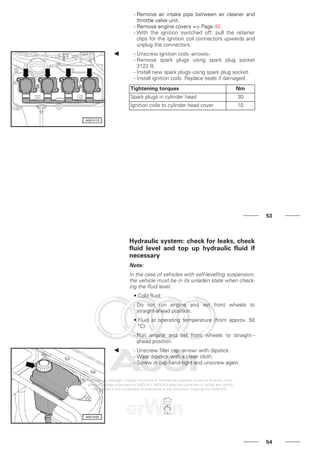
V8 engines (240 kW):
52
- Remove air intake pipe between air cleaner and
throttle valve unit.
- Remove engine covers => Page 40.
- With the ignition switched off, pull the retainer
clips for the ignition coil connectors upwards and
unplug the connectors.
- Unscrew ignition coils -arrows-.
- Remove spark plugs using spark plug socket
3122 B.
- Install new spark plugs using spark plug socket.
- Install ignition coils. Replace seals if damaged.
Tightening torques Nm
Spark plugs in cylinder head 30
Ignition coils to cylinder head cover 10
53
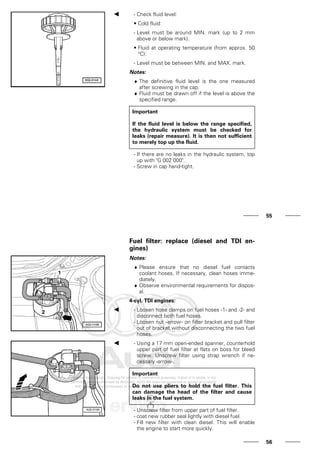
Hydraulic system: check for leaks, check
fluid level and top up hydraulic fluid if
necessary
Note:
In the case of vehicles with self-levelling suspension,
the vehicle must be in its unladen state when check-
ing the fluid level.
• Cold fluid:
- Do not run engine and set front wheels to
straight-ahead position.
• Fluid at operating temperature (from approx. 50
°C):
- Run engine and set front wheels to straight -
ahead position.
- Unscrew filler cap -arrow- with dipstick.
- Wipe dipstick with a clean cloth.
- Screw in cap hand-tight and unscrew again.
54
- Check fluid level:
• Cold fluid:
- Level must be around MIN. mark (up to 2 mm
above or below mark).
• Fluid at operating temperature (from approx. 50
°C):
- Level must be between MIN. and MAX. mark.
Notes:
♦ The definitive fluid level is the one measured
after screwing in the cap.
♦ Fluid must be drawn off if the level is above the
specified range.
Important
If the fluid level is below the range specified,
the hydraulic system must be checked for
leaks (repair measure). It is then not sufficient
to merely top up the fluid.
- If there are no leaks in the hydraulic system, top
up with "G 002 000".
- Screw in cap hand-tight.
55
Fuel filter: replace (diesel and TDI en-
gines)
Notes:
♦ Please ensure that no diesel fuel contacts
coolant hoses. If necessary, clean hoses imme-
diately.
♦ Observe environmental requirements for dispos-
al.
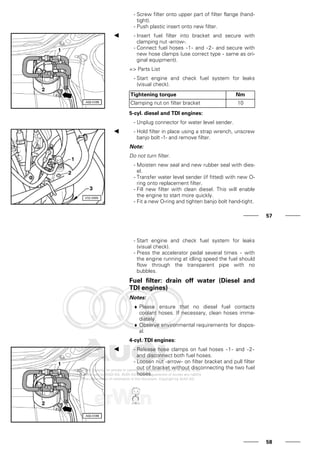
4-cyl. TDI engines:
- Loosen hose clamps on fuel hoses -1- and -2- and
disconnect both fuel hoses.
- Loosen nut -arrow- on filter bracket and pull filter
out of bracket without disconnecting the two fuel
hoses.
- Using a 17 mm open-ended spanner, counterhold
upper part of fuel filter at flats on boss for bleed
screw. Unscrew filter using strap wrench if ne-
cessary -arrow-.
Important
Do not use pliers to hold the fuel filter. This
can damage the head of the filter and cause
leaks in the fuel system.
- Unscrew filter from upper part of fuel filter.
- coat new rubber seal lightly with diesel fuel.
- Fill new filter with clean diesel. This will enable
the engine to start more quickly.
56
- Screw filter onto upper part of filter flange (hand-
tight).
- Push plastic insert onto new filter.
- Insert fuel filter into bracket and secure with
clamping nut -arrow-.
- Connect fuel hoses -1- and -2- and secure with
new hose clamps (use correct type - same as ori-
ginal equipment).
=> Parts List
- Start engine and check fuel system for leaks
(visual check).
Tightening torque Nm
Clamping nut on filter bracket 10
5-cyl. diesel and TDI engines:
- Unplug connector for water level sender.
- Hold filter in place using a strap wrench, unscrew
banjo bolt -1- and remove filter.
Note:
Do not turn filter.
- Moisten new seal and new rubber seal with dies-
el.
- Transfer water level sender (if fitted) with new O-
ring onto replacement filter.
- Fill new filter with clean diesel. This will enable
the engine to start more quickly.
- Fit a new O-ring and tighten banjo bolt hand-tight.
57
- Start engine and check fuel system for leaks
(visual check).
- Press the accelerator pedal several times - with
the engine running at idling speed the fuel should
flow through the transparent pipe with no
bubbles.
Fuel filter: drain off water (Diesel and
TDI engines)
Notes:
♦ Please ensure that no diesel fuel contacts
coolant hoses. If necessary, clean hoses imme-
diately.
♦ Observe environmental requirements for dispos-
al.
4-cyl. TDI engines:
- Release hose clamps on fuel hoses -1- and -2-
and disconnect both fuel hoses.
- Loosen nut -arrow- on filter bracket and pull filter
out of bracket without disconnecting the two fuel
hoses.
58
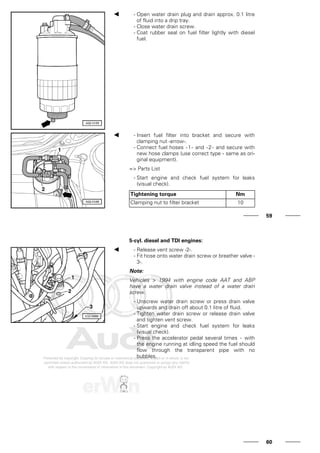
- Open water drain plug and drain approx. 0.1 litre
of fluid into a drip tray.
- Close water drain screw.
- Coat rubber seal on fuel filter lightly with diesel
fuel.
- Insert fuel filter into bracket and secure with
clamping nut -arrow-.
- Connect fuel hoses -1- and -2- and secure with
new hose clamps (use correct type - same as ori-
ginal equipment).
=> Parts List
- Start engine and check fuel system for leaks
(visual check).
Tightening torque Nm
Clamping nut to filter bracket 10
59
5-cyl. diesel and TDI engines:
- Release vent screw -2-.
- Fit hose onto water drain screw or breather valve -
3-.
Note:
Vehicles > 1994 with engine code AAT and ABP
have a water drain valve instead of a water drain
screw.
- Unscrew water drain screw or press drain valve
upwards and drain off about 0.1 litre of fluid.
- Tighten water drain screw or release drain valve
and tighten vent screw.
- Start engine and check fuel system for leaks
(visual check).
- Press the accelerator pedal several times - with
the engine running at idling speed the fuel should
flow through the transparent pipe with no
bubbles.
60
Dust and pollen filter: replace
The filter is located below the plenum chamber cov-
er on the right.
Vehicle Page
Audi 100 > 1992 without air conditioner
with M-Nr. 2V1 61
Audi 100 1993 > 1994 without air condi-
tioner
61
Audi A6 1995 > without air conditioner 61
Audi A6 1995 > with air conditioner 62
Audi 100 > 1994 without air conditioner:
- Remove plenum chamber cover => Page 31.
- Unscrew both nuts -A-.
- Turn filter cartridge and take out of bracket.
Note:
Observe environmental requirements for disposal.
- Install new filter element.
- Before fitting plenum chamber cover, check plen-
um chamber and water drain valves for dirt =>
Page 63.
Audi A6 1995 > without air conditioner:
- Remove plenum chamber cover => Page 31.
- Depending on the size of the battery, either
loosen battery retainer and push battery towards
wing panel or remove battery completely.
61
- Push clamp -A- up and remove dust and pollen fil-
ter -B- from filter holder.
Note:
Observe environmental requirements for disposal.
- Install new filter element.
- Before fitting plenum chamber cover, check plen-
um chamber and water drain valves for dirt =>
Page 63.
Audi A6 1995 > with air conditioner:
- Remove plenum chamber cover => Page 31.
- Unscrew the three bolts -A-.
- Remove cover -B- and pull dust and pollen filter -
C- out of evaporator.
Note:
Observe environmental requirements for disposal.
- Before installing dust and pollen filter, check
evaporator for dirt and clean if necessary.
- Insert dust and pollen filter (ensure that filter is
the right way round).
- Arrow on filter element points towards evaporat-
or.
- Before fitting plenum chamber cover, check plen-
um chamber and water drain valves for dirt =>
Page 63.
62
Plenum chamber and water drain
valves: check for dirt and clean if neces-
sary
- Remove plenum chamber cover => Page 31.
- Check plenum chamber for dirt (leaves, etc.) and
clean as necessary.
- Check that water drain valves are functioning
properly, and clean and replace as necessary.
Note:
Ensure that water drain valves close properly and are
not blocked by wax or underseal.
- Observe note on installing plenum chamber cover
=> Page 31.
63
Noise insulation: remove
On vehicles with diesel and TDI engines the noise in-
sulation consists of two parts.
- Turn quick - release screws - arrows - in an anti -
clockwise direction.
- Pull front noise insulation off bumper towards
rear of vehicle and remove.
- Pull rear noise insulation (on diesel and TDI en-
gines only) towards rear of vehicle and remove.
Note:
When installing ensure that the noise insulation is
pushed in over the bumper cover at the front.
64
V-belt: check for damage and check ten-
sion; adjust tension if necessary
- Check condition of V-belts along entire length of
belt:
- Cracks, fractured core, cross-sectional breaks
- Layer separation (base, cord strands)
- Base break-up
- Fraying of cord strands
- Wear on sides of belt (material worn down,
sides of belt frayed, surface cracking or sides of
belt hardened - indicated by smooth, shiny sur-
face)
- Traces of oil and grease
Important
Faults found must be rectified (repair meas-
ure).
- Check tension of V-belts:
- Press in the ribbed belt firmly with the thumb at a
point half-way between the two pulleys which are
farthest apart.
The amount of yield should be as follows:
65
V-belt for alternator Belt yield (max)
- New V-belt 2 mm
- Used V-belt 5 mm
V-belt for PAS vane pump
- Petrol engines 10 mm
- TDI engines 5 mm
V-belt for air conditioner
compressor
- All models 5 mm
V-belts: tensioning
Note:
With the 4-cyl. 5V-engine it is not possible to adjust
the tension of the V-belt for the coolant pump.
Special tools required
♦ V.A.G 1410 Torque wrench
♦ Ring spanner attachment V.A.G 1410/2 (22 mm
A/F)
• V-belt for alternator
66
- loosen all bolts securing alternator and tensioning
bar -A- at least one turn.
- Loosen clamping bolt for tensioner nut -B-.
- Using torque wrench V.A.G 1410 and ring span-
ner attachment V.A.G 1410/2 (22 mm A/F), apply
the following torque to the tensioner nut:
- Used V-belt:4 Nm
- New V-belt: 8 Nm
- Maintain this torque on tensioning bolt, and tight-
en clamping bolt to 35 Nm.
Tightening torques Nm
Clamping bolt for tensioner nut to ten-
sioning bar
35
Tensioning bar to lifting eye 20
Alternator to bottom mounting 35
Note:
If the V-belt has been replaced:
- Start engine and run at idling speed for 5
minutes.
- Switch off the engine and re-adjust the belt ten-
sion as described above.
- Apply a torque of 8 Nm to tensioner nut.
• V-belt for PAS vane pump
- Remove noise insulation => Page 64.
67
- Loosen bolts 2 ... 6.
- Adjust belt tension with tensioner nut -1-.
- The amount of yield should be as follows:
- Petrol engines:10 mm
- TDI engines: 5 mm
- Tighten securing bolts on vane pump.
Tightening torques Nm
Vane pump to bracket 25
Vane pump to tensioning bar 25
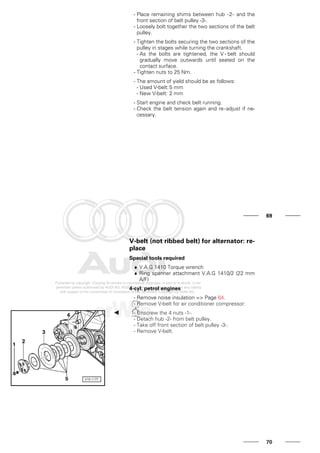
• V-belt for air conditioner compressor
- Remove noise insulation => Page 64.
- Unscrew the 4 nuts -1-.
- Detach hub -2- from belt pulley.
- Take off front section of belt pulley -3-.
Notes:
♦ Belt tension is adjusted by adding or taking out
shims -5- between front section -3- and rear sec-
tion -4- of belt pulley.
♦ To reduce tension, add shims between two sec-
tions of belt pulley.
♦ To increase tension, remove shims between
two sections of belt pulley.
68
- Place remaining shims between hub -2- and the
front section of belt pulley -3-.
- Loosely bolt together the two sections of the belt
pulley.
- Tighten the bolts securing the two sections of the
pulley in stages while turning the crankshaft.
- As the bolts are tightened, the V - belt should
gradually move outwards until seated on the
contact surface.
- Tighten nuts to 25 Nm.
- The amount of yield should be as follows:
- Used V-belt:5 mm
- New V-belt: 2 mm
- Start engine and check belt running.
- Check the belt tension again and re-adjust if ne-
cessary.
69
V-belt (not ribbed belt) for alternator: re-
place
Special tools required
♦ V.A.G 1410 Torque wrench
♦ Ring spanner attachment V.A.G 1410/2 (22 mm
A/F)
4-cyl. petrol engines
- Remove noise insulation => Page 64.
- Remove V-belt for air conditioner compressor:
- Unscrew the 4 nuts -1-.
- Detach hub -2- from belt pulley.
- Take off front section of belt pulley -3-.
- Remove V-belt.
70
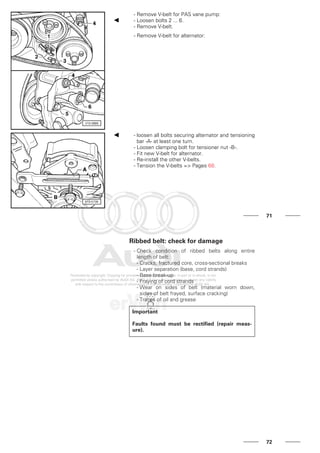
- Remove V-belt for PAS vane pump:
- Loosen bolts 2 ... 6.
- Remove V-belt.
- Remove V-belt for alternator:
- loosen all bolts securing alternator and tensioning
bar -A- at least one turn.
- Loosen clamping bolt for tensioner nut -B-.
- Fit new V-belt for alternator.
- Re-install the other V-belts.
- Tension the V-belts => Pages 68.
71
Ribbed belt: check for damage
- Check condition of ribbed belts along entire
length of belt:
- Cracks, fractured core, cross-sectional breaks
- Layer separation (base, cord strands)
- Base break-up
- Fraying of cord strands
- Wear on sides of belt (material worn down,
sides of belt frayed, surface cracking)
- Traces of oil and grease
Important
Faults found must be rectified (repair meas-
ure).
72
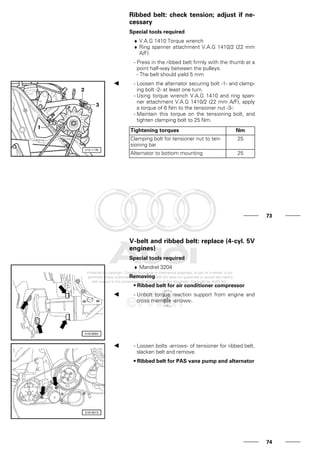
Ribbed belt: check tension; adjust if ne-
cessary
Special tools required
♦ V.A.G 1410 Torque wrench
♦ Ring spanner attachment V.A.G 1410/2 (22 mm
A/F)
- Press in the ribbed belt firmly with the thumb at a
point half-way between the pulleys.
- The belt should yield 5 mm
- Loosen the alternator securing bolt -1- and clamp-
ing bolt -2- at least one turn.
- Using torque wrench V.A.G 1410 and ring span-
ner attachment V.A.G 1410/2 (22 mm A/F), apply
a torque of 6 Nm to the tensioner nut -3-:
- Maintain this torque on the tensioning bolt, and
tighten clamping bolt to 25 Nm.
Tightening torques Nm
Clamping bolt for tensioner nut to ten-
sioning bar
25
Alternator to bottom mounting 25
73
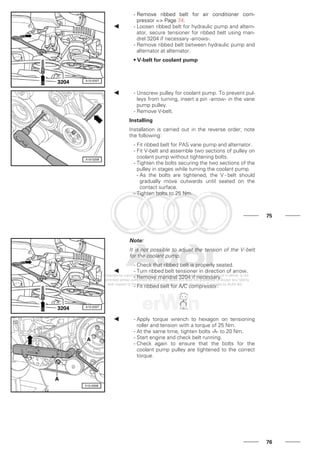
V-belt and ribbed belt: replace (4-cyl. 5V
engines)
Special tools required
♦ Mandrel 3204
Removing
• Ribbed belt for air conditioner compressor
- Unbolt torque reaction support from engine and
cross member -arrows-.
- Loosen bolts -arrows- of tensioner for ribbed belt,
slacken belt and remove.
• Ribbed belt for PAS vane pump and alternator
74
- Remove ribbed belt for air conditioner com-
pressor => Page 74.
- Loosen ribbed belt for hydraulic pump and altern-
ator, secure tensioner for ribbed belt using man-
drel 3204 if necessary -arrows-.
- Remove ribbed belt between hydraulic pump and
alternator at alternator.
• V-belt for coolant pump
- Unscrew pulley for coolant pump. To prevent pul-
leys from turning, insert a pin -arrow- in the vane
pump pulley.
- Remove V-belt.
Installing
Installation is carried out in the reverse order; note
the following:
- Fit ribbed belt for PAS vane pump and alternator.
- Fit V-belt and assemble two sections of pulley on
coolant pump without tightening bolts.
- Tighten the bolts securing the two sections of the
pulley in stages while turning the coolant pump.
- As the bolts are tightened, the V - belt should
gradually move outwards until seated on the
contact surface.
- Tighten bolts to 25 Nm.
75
Note:
It is not possible to adjust the tension of the V-belt
for the coolant pump.
- Check that ribbed belt is properly seated.
- Turn ribbed belt tensioner in direction of arrow.
- Remove mandrel 3204 if necessary.
- Fit ribbed belt for A/C compressor.
- Apply torque wrench to hexagon on tensioning
roller and tension with a torque of 25 Nm.
- At the same time, tighten bolts -A- to 20 Nm.
- Start engine and check belt running.
- Check again to ensure that the bolts for the
coolant pump pulley are tightened to the correct
torque.
76
Ribbed belt: replace (V6 engines)
Special tools required
♦ Mandrel 3204
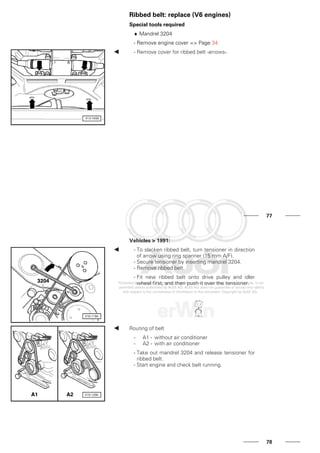
- Remove engine cover => Page 34.
- Remove cover for ribbed belt -arrows-.
77
Vehicles > 1991:
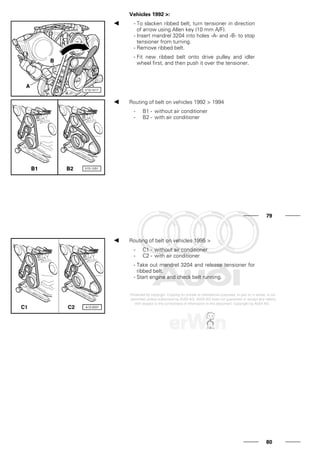
- To slacken ribbed belt, turn tensioner in direction
of arrow using ring spanner (15 mm A/F).
- Secure tensioner by inserting mandrel 3204.
- Remove ribbed belt.
- Fit new ribbed belt onto drive pulley and idler
wheel first, and then push it over the tensioner.
Routing of belt
- A1 - without air conditioner
- A2 - with air conditioner
- Take out mandrel 3204 and release tensioner for
ribbed belt.
- Start engine and check belt running.
78
Vehicles 1992 >:
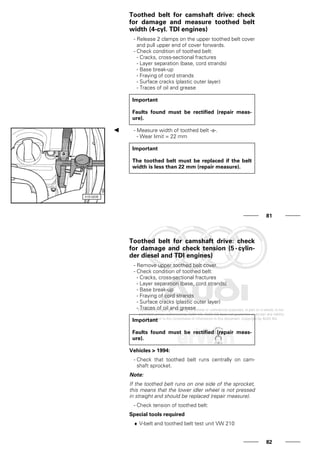
- To slacken ribbed belt, turn tensioner in direction
of arrow using Allen key (10 mm A/F).
- Insert mandrel 3204 into holes -A- and -B- to stop
tensioner from turning.
- Remove ribbed belt.
- Fit new ribbed belt onto drive pulley and idler
wheel first, and then push it over the tensioner.
Routing of belt on vehicles 1992 > 1994
- B1 - without air conditioner
- B2 - with air conditioner
79
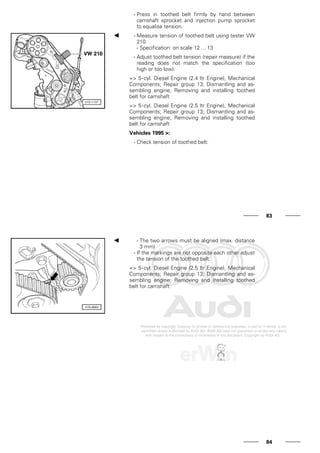
Routing of belt on vehicles 1995 >
- C1 - without air conditioner
- C2 - with air conditioner
- Take out mandrel 3204 and release tensioner for
ribbed belt.
- Start engine and check belt running.
80
Toothed belt for camshaft drive: check
for damage and measure toothed belt
width (4-cyl. TDI engines)
- Release 2 clamps on the upper toothed belt cover
and pull upper end of cover forwards.
- Check condition of toothed belt:
- Cracks, cross-sectional fractures
- Layer separation (base, cord strands)
- Base break-up
- Fraying of cord strands
- Surface cracks (plastic outer layer)
- Traces of oil and grease
Important
Faults found must be rectified (repair meas-
ure).
- Measure width of toothed belt -a-.
- Wear limit = 22 mm
Important
The toothed belt must be replaced if the belt
width is less than 22 mm (repair measure).
81
Toothed belt for camshaft drive: check
for damage and check tension (5-cylin-
der diesel and TDI engines)
- Remove upper toothed belt cover.
- Check condition of toothed belt:
- Cracks, cross-sectional fractures
- Layer separation (base, cord strands)
- Base break-up
- Fraying of cord strands
- Surface cracks (plastic outer layer)
- Traces of oil and grease
Important
Faults found must be rectified (repair meas-
ure).
Vehicles > 1994:
- Check that toothed belt runs centrally on cam-
shaft sprocket.
Note:
If the toothed belt runs on one side of the sprocket,
this means that the lower idler wheel is not pressed
in straight and should be replaced (repair measure).
- Check tension of toothed belt:
Special tools required
♦ V-belt and toothed belt test unit VW 210
82
- Press in toothed belt firmly by hand between
camshaft sprocket and injection pump sprocket
to equalise tension.
- Measure tension of toothed belt using tester VW
210.
- Specification: on scale 12 ... 13
- Adjust toothed belt tension (repair measure) if the
reading does not match the specification (too
high or too low):
=> 5-cyl. Diesel Engine (2.4 ltr Engine), Mechanical
Components; Repair group 13; Dismantling and as-
sembling engine; Removing and installing toothed
belt for camshaft
=> 5-cyl. Diesel Engine (2.5 ltr Engine), Mechanical
Components; Repair group 13; Dismantling and as-
sembling engine; Removing and installing toothed
belt for camshaft
Vehicles 1995 >:
- Check tension of toothed belt:
83
- The two arrows must be aligned (max. distance
3 mm)
- If the markings are not opposite each other adjust
the tension of the toothed belt:
=> 5-cyl. Diesel Engine (2.5 ltr Engine), Mechanical
Components; Repair group 13; Dismantling and as-
sembling engine; Removing and installing toothed
belt for camshaft
84
Toothed belt for injection pump: check
for damage and check tension (5-cyl. TDI
engines), tension toothed belt
Special tools required
♦ Tensioner 3303
Vehicles > 1994:
- Remove rear toothed belt cover.
Vehicles 1995 >:
- Remove engine cover => Page 40.
All models:
- Check condition of toothed belt:
- Cracks, cross-sectional fractures
- Layer separation (base, cord strands)
- Base break-up
- Fraying of cord strands
- Surface cracks (plastic outer layer)
- Traces of oil and grease
Important
Faults found must be rectified (repair meas-
ure).
85
- Check tension of toothed belt for injection pump.
Vehicles 1995 >:
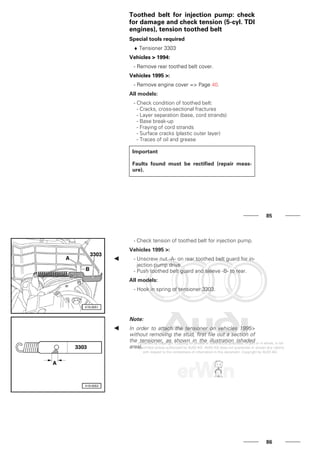
- Unscrew nut -A- on rear toothed belt guard for in-
jection pump drive.
- Push toothed belt guard and sleeve -B- to rear.
All models:
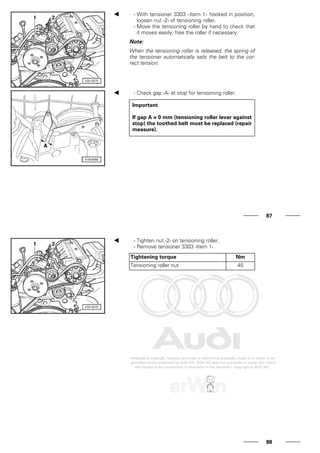
- Hook in spring of tensioner 3303.
Note:
In order to attach the tensioner on vehicles 1995>
without removing the stud, first file out a section of
the tensioner, as shown in the illustration (shaded
area).
86
- With tensioner 3303 -Item 1- hooked in position,
loosen nut -2- of tensioning roller.
- Move the tensioning roller by hand to check that
it moves easily; free the roller if necessary.
Note:
When the tensioning roller is released, the spring of
the tensioner automatically sets the belt to the cor-
rect tension.
- Check gap -A- at stop for tensioning roller.
Important
If gap A = 0 mm (tensioning roller lever against
stop) the toothed belt must be replaced (repair
measure).
87
- Tighten nut -2- on tensioning roller.
- Remove tensioner 3303 -Item 1-
Tightening torque Nm
Tensioning roller nut 45
88
Toothed belt for camshaft drive: check
for damage (2.6l 2V and 2.8l 2V engines
only)
- Remove engine cover => Page 34
- Remove upper toothed belt cover.
- Check condition of toothed belt:
- Cracks, cross-sectional fractures
- Layer separation (base, cord strands)
- Base break-up
- Fraying of cord strands
- Surface cracks (plastic outer layer)
- Traces of oil and grease
Important
Faults found must be rectified (repair meas-
ure).
89
Toothed belt: replace
Toothed belt: replace (4-cyl. petrol engines)
- Removing and installing toothed belt:
=> 4-cylinder Engine (2-valve), Mechanical Compon-
ents; Repair group 13; Dismantling and assembling
engine
=> 4-cylinder Injection Engine (4-valve), Mechanical
Components; Repair group 13; Dismantling and as-
sembling engine
Toothed belt: Replace (5-cyl. petrol engines)
- Removing and installing toothed belt:
=> 5-cylinder Engine (2-valve), Mechanical Compon-
ents; Repair group 13; Dismantling and assembling
engine
=> 5-cylinder Injection Engine (4-valve), Mechanical
Components; Repair group 13; Dismantling and as-
sembling engine
4-cylinder 5V 1.8 litre petrol engines
- Removing and installing toothed belt
=> 4-cyl. Engine (5-valve), Mechanical Components;
Repair group 13; Dismantling and assembling engine
Toothed belt and tensioning roller: replace (V6 -
5V engines)
- Removing and installing toothed belt, replacing
toothed belt tensioning roller:
90
=> 6-cylinder Engine (5-valve), Mechanical Compon-
ents; Repair group 13; Dismantling and assembling
cylinder crankcase, crank shaft and flywheel
Ribbed belt: replace (V8 engines)
=> 8-cylinder Engine, Mechanical Components; Re-
pair group 15; Cylinder head, valve gear; Removing
and installing ribbed belt
Toothed belt: replace (V8 engines)
=> 8-cylinder Engine, Mechanical Components; Re-
pair group 15; Cylinder head, valve gear; Removing
and installing toothed belt
Toothed belt for camshaft drive and tensioning
roller: replace (4-cyl. TDI engines)
- Removing and installing toothed belt, replacing
toothed belt tensioning roller:
=> 4-cyl. Diesel Direct Injection Engine (TDI), Mech-
anical Components; Repair group 13; Dismantling
and assembling engine
- Dynamically checking and adjusting commence-
ment of injection:
=> Diesel Direct Injection and Glow Plug System
(TDI 4-cylinder); Repair group 23; Servicing diesel dir-
ect injection system
91
Toothed belt for camshaft and injection pump:
replace (5-cylinder diesel engines)
=> 5-cyl. Diesel Engine (2.4 ltr Engine), Mechanical
Components; Repair group 13; Dismantling and as-
sembling engine; Removing and installing toothed
belt for camshaft, and toothed belt for injection
pump
- Dynamically checking and adjusting commence-
ment of injection.
=> Diesel Injection and Glow Plug System (2.4 l en-
gine); Repair group 23; Servicing diesel injection sys-
tem
Toothed belt for camshaft and injection pump:
replace: (5-cylinder TDI engines)
=> 5-cyl. Diesel Engine (2.5 ltr Engine), Mechanical
Components; Repair group 13; Dismantling and as-
sembling engine; Removing and installing toothed
belt for camshaft, and toothed belt for injection
pump
92
- Dynamically checking and adjusting commence-
ment of injection:
=> Diesel Direct Injection and Glow Plug System
(TDI 5-cylinder); Repair group 23; Dynamically check-
ing and adjusting commencement of injection
Filling in toothed belt renewal sticker - all
vehicles
- Fill in toothed belt renewal sticker -arrow- on lock
carrier; if necessary, attach a new sticker.
Manual gearbox/final drive: check oil
level and top up if necessary
5-speed manual gearbox 012, front-wheel drive
Special tools required
♦ Socket attachment 3357
or
♦ 17 mm hexagon socket attachment
Notes:
♦ The vehicle must be absolutely horizontal when
checking gearbox oil level. This work is best per-
formed over an inspection pit or using a 4 -
column lifting platform.
♦ The oil filler plug is on the left of the gearbox be-
low the speedometer sender; it may be con-
cealed by the heat shield for the drive shaft.
93
♦ Depending on the version fitted, use either spe-
cial tool 3357 or a 17 mm Allen key to loosen
the oil filler plug.
- Unscrew oil filler plug (arrow) to check oil level.
- Check oil level using a shop-built tool, e.g. a piece
of angled wire.
- Specification: oil level 7 mm below bottom edge
of oil filler hole
Note:
The oil can be filled up to the bottom edge of the oil
filler hole when servicing.
Important
If the oil level is below the range specified, the
gearbox must be checked for leaks (repair
measure). It is then not sufficient to merely
top up the fluid.
- If there are no leaks in the gearbox, top up with
SAE 75 W 90 (synthetic fluid), specification "G
052 911 A".
- Fit oil filler plug.
Tightening torque Nm
Oil filler plug 25
5-speed and 6-speed manual gearbox 01E, front
wheel drive
Notes:
94
♦ The vehicle must be absolutely horizontal when
checking gearbox oil level. This work is best per-
formed over an inspection pit or using a 4 -
column lifting platform.
♦ The prescribed oil level is to be adhered to ex-
actly; the gearbox reacts very sensitively to over-
filling.
♦ There are two different procedures for checking
the gearbox oil level according to the type of fi-
nal drive cover fitted.
Older version: oil filler hole behind flange shaft.
Newer version: oil filler hole in front of flange
shaft.
Older version:
- Remove oil filler plug -A- (behind flange shaft) to
check gearbox oil level.
- Check oil level using a shop-built tool, e.g. a piece
of angled wire.
- Specification: oil level 6 mm below bottom edge
of oil filler hole
95
Newer version:
- Remove oil filler plug -B- (in front of flange shaft)
to check gearbox oil level.
- Specification: oil level up to lower edge of filler
hole
All models:
Important
If the oil level is below the range specified, the
gearbox must be checked for leaks (repair
measure). It is then not sufficient to merely
top up the fluid.
- If there are no leaks in the gearbox, top up with
SAE 75 W 90 (synthetic fluid), specification "G
052 911 A".
- Fit oil filler plug.
Tightening torque Nm
Oil filler plug 40
5-speed manual gearbox 01A, four-wheel drive
Special tools required
♦ Socket attachment 3357
or
♦ 17 mm hexagon socket attachment
Notes:
96
♦ The oil filler plug is on the left of the gearbox be-
low the speedometer sender; it may be con-
cealed by the heat shield for the drive shaft.
♦ Depending on the version fitted, use either spe-
cial tool 3357 or a 17 mm Allen key to loosen
the oil filler plug.
- Unscrew oil filler plug (arrow) to check oil level.
- Specification: oil level up to lower edge of filler
hole
Important
If the oil level is below the range specified, the
gearbox must be checked for leaks (repair
measure). It is then not sufficient to merely
top up the fluid.
- If there are no leaks in the gearbox, top up with
SAE 75 W 90 (synthetic fluid), specification "G
052 911 A".
- Fit oil filler plug.
Tightening torque Nm
Oil filler plug 25
5-speed and 6-speed manual gearbox 01E, four-
wheel drive
Notes:
97
♦ The vehicle must be absolutely horizontal when
checking gearbox oil level. This work is best per-
formed over an inspection pit or using a 4 -
column lifting platform.
♦ The prescribed oil level is to be adhered to ex-
actly; the gearbox reacts very sensitively to over-
filling.
♦ There are two different procedures for checking
the gearbox oil level according to the type of fi-
nal drive cover fitted.
Older version: oil filler hole behind flange shaft.
Newer version: oil filler hole in front of flange
shaft.
Older version:
- Remove oil filler plug -A- (behind flange shaft) to
check gearbox oil level.
- Check oil level using a shop-built tool, e.g. a piece
of angled wire.
- Specification: oil level 7 mm below bottom edge
of oil filler hole
98
Newer version:
- Remove oil filler plug -B- (in front of flange shaft)
to check gearbox oil level.
- Check oil level using a shop-built tool, e.g. a piece
of angled wire.
- Specification: oil level 1 mm below bottom edge
of oil filler hole
All models:
Important
If the oil level is below the range specified, the
gearbox must be checked for leaks (repair
measure). It is then not sufficient to merely
top up the fluid.
- If there are no leaks in the gearbox, top up with
SAE 75 W 90 (synthetic fluid), specification "G
052 911 A".
- Fit oil filler plug.
Tightening torque Nm
Oil filler plug 40
99
Final drive (automatic gearbox): check
oil level and top up if necessary
Automatic gearbox 097, 01N
- Unscrew oil filler plug -arrow-.
- Specification: oil level up to lower edge of filler
hole
Important
If the oil level is below the range specified, the
final drive must be checked for leaks (repair
measure). It is then not sufficient to merely
top up the fluid.
- If the final drive has no leaks top up with SAE 75
W 90 (synthetic oil) specification "G 052 145 A".
- Fit oil filler plug.
Tightening torque Nm
Oil filler plug 25
- Fill in sticker for final drive oil check => Page 103.
Automatic gearbox 01K, front wheel drive
100
01F four-wheel drive
- Unscrew oil filler plug -arrow-.
- Specification: oil level up to lower edge of filler
hole
Important
If the oil level is below the range specified, the
final drive must be checked for leaks (repair
measure). It is then not sufficient to merely
top up the fluid.
- If the final drive has no leaks top up with SAE 75
W 90 (synthetic oil) specification "G 052 145 A".
- Fit oil filler plug.
Tightening torque Nm
Oil filler plug 25
- Fill in sticker for final drive oil check => Page 103.
101
Automatic gearbox 018; four-wheel drive
- Unscrew oil filler plug -arrow-.
- Specification: oil level up to lower edge of filler
hole
Important
If the oil level is below the range specified, the
final drive must be checked for leaks (repair
measure). It is then not sufficient to merely
top up the fluid.
- If the final drive has no leaks top up with SAE 75
W 90 (synthetic oil) specification "G 052 145 A".
- Fit oil filler plug.
Tightening torque Nm
Oil filler plug 25
- Fill in sticker for final drive oil check => Page 103.
102
Filling in sticker for final drive oil check - all
vehicles
- Fill in sticker for final drive oil check -arrow- on
lock carrier; if necessary, attach a new sticker.
103
Engine oil: drain or extract, change oil
filter
Special tools required
♦ Oil filter spanner 3417
(4-cyl. petrol engines)
♦ Strap wrench Hazet 2171 - 1 (5 - cyl. petrol en-
gines, V6-engines, 4-cyl. TDI engines, 5-cyl. dies-
el and TDI engines)
♦ Socket attachment, long, 36 A/F
♦ Oil extractor V.A.G 1307 A or V.A.G 1358 A
Note:
Observe environmental requirements for disposal.
- Remove noise insulation => Page 64.
4-cyl. petrol engines:
- Loosen oil filter - arrow - with oil filter spanner
3417.
5 - cyl. petrol engines, 4 - cyl. TDI engines, 5 - cyl.
diesel and TDI engines:
- Loosen oil filter with strap wrench (e.g. Hazet
2171-1).
104
V6 engines:
- Loosen oil filter -arrow- strap wrench (e.g. Hazet
2171-1).
V8 engines:
- Loosen oil filter -arrow- with socket attachment
30 mm A/F.
All models:
- Remove oil filter.
- Unscrew oil drain plug or extract engine oil.
- Clean sealing surface on engine for oil filter.
- Lightly lubricate rubber seal.
- Screw in new filter and tighten.
Notes:
Note the fitting instructions on the oil filter.
For engines with oil cooler
105
Important
After replacement of oil filter cartridge, check
clearance of hoses from oil cooler to adjacent
components; if necessary correct oil cooler po-
sition.
- Screw in oil drain plug with new seal.
- Top up engine oil, specifications => Page 119.
- Observe instructions for turbo engines => Page
121.
- Note different oil specifications for Audi S6 with
V8 engine AHK => Page 121.
Tightening torques Nm
Oil drain plug 4- and 5-cyl.-engines 30
Oil drain plug V6 - 2V engines: 40
Oil drain plug V6 - 5V engines: 30
Oil drain plugs V8 engines 35
106
Brake system: visual check for leaks and
damage
- Check the following components for leaks and
damage:
- Brake master cylinder
- Brake servo
- ABS hydraulic unit
- Brake calipers
- Brake pressure regulator
- Ensure that brake hoses are not twisted.
- Ensure that brake hoses do not touch any vehicle
components when steering is on full lock.
- Check brake hoses for porosity, blistering and
brittleness.
- Check brake hoses and pipes for chafing.
- Check brake pipe connections and mountings for
correct seating, leaks and corrosion.
Important
Faults found must be rectified (repair meas-
ure).
107
Brake pads: check thickness
Front disc brake pads:
Important
If the pad thickness is down to 7 mm (includ-
ing backing plate), the disc brake pads have
reached their wear limit and must be replaced
(repair measure). Please inform the customer.
- Determine thickness of outer pads by checking
visually (with help of electric torch/flashlight
through cut-out in wheel).
- Determine thickness of inner pads by checking
visually (with help of electric torch/flashlight and
mirror).
Notes:
♦ If the brake pads are not visible because of the
type of wheel rims fitted, remove front wheels.
♦ Before removing the wheels mark the position
of each wheel in relation to the brake disc and
mount the wheels in the same position after
completing the check.
♦ Observe notes on wheel bolts when mounting
the front wheels => Page 115.
108
Audi 100, Audi A6:
- a -Pad thickness including backing plate
- Wear limit: 7 mm
Audi S4 (5 cyl.) > 1993:
- a -Pad thickness including backing plate
- Wear limit: 7 mm
109
Audi S4 (5 cyl.) 1994>, Audi S4 (V8), Audi S6:
- a -Pad thickness including backing plate
- Wear limit: 7 mm
Rear disc brake pads:
Important
If the pad thickness is down to 7 mm (includ-
ing backing plate), the disc brake pads have
reached their wear limit and must be replaced
(repair measure). Please inform the customer.
- Determine thickness of outer pads by checking
visually (with help of electric torch/flashlight
through cut-out in wheel).
- Determine thickness of inner pads by checking
visually (with help of electric torch/flashlight and
mirror).
110
- a -Pad thickness including backing plate
- Wear limit: 7 mm
Notes:
♦ If the brake pads are not visible because of the
type of wheel rims fitted, remove rear wheels.
♦ Before removing the wheels mark the position
of each wheel in relation to the brake disc and
mount the wheels in the same position after
completing the check.
♦ Observe notes on wheel bolts when mounting
the rear wheels => Page 115.
Rear drum brake linings:
- Pull plug out of inspection hole in backplate -ar-
row-.
- Determine thickness of brake linings by checking
visually, using an electric torch (flashlight).
- a -Lining thickness without brake shoe
- Wear limit: 2.5 mm
Important
If the pad thickness is down to 2.5 mm (not in-
cluding backing plate), the drum brake linings
have reached their wear limit and must be re-
placed (repair measure). Please inform the cus-
tomer.
111
Underseal: visual check for damage
- When performing visual check, check underbody,
wheel housings and side members.
Important
Faults found must be rectified (repair meas-
ure).
Track rod ends: check play, attachment
and protective boots
Note:
The test must be made with vehicle raised on a lift-
ing platform (wheels free to move).
- Check play by moving track rods and wheels.
- There should be no play
- Check that lock nuts are secure (40 Nm).
- 1 -Lock nut on wheel side, right-hand thread
- 2 -Lock nut on track rod side, left-hand thread
- Check protective boot - arrow - for damage and
correct seating.
112
Tyres: check and correct condition, wear
pattern, tread depth and inflation pres-
sures
Notes:
♦ In the interests of driving safety, only tyres of
the same type and tread pattern should be fitted
on a vehicle.
♦ On four wheel drive vehicle tyres of the same
type and tread pattern must be used. Otherwise
the centre differential may be damaged.
- Check tyre tread and side walls for damage and
remove any foreign bodies.
- Check tyres for scuffing, one-sided wear, porous
side walls, cuts and fractures.
Important
The customer must be informed of any de-
fects.
Checking tyre wear pattern
- The wear pattern of the front tyres indicates
whether the toe and camber have to be checked
- Feathering on tread indicates incorrect toe set-
ting.
- One-sided tread wear is mainly caused by incor-
rect camber.
113
Note:
If the above types of wear are found, check wheel
alignment to determine the cause (repair measure).
Checking tyre tread depth
- Minimum permissible tread depth: 1.6 mm
Notes:
♦ This value may vary for individual countries ac-
cording to legislation.
♦ The minimum tread depth is reached when the
tyres have worn down level with the 1.6 mm
high tread wear indicators - arrows- positioned at
intervals around the tyre.
♦ If the tread depth is approaching the minimum
permissible tread depth, the customer must be
informed.
Inflating to correct pressures
The correct inflation pressures for summer tyres are
listed on the sticker on the inside of the tank flap.
Notes:
♦ Please note that the inflation pressures listed on
the sticker apply to cold tyres. When the tyres
are warm, the actual pressures will be higher,
but must not be reduced.
♦ When using winter tyres, pressures should be
increased by 0.2 bar.
Spare wheel
114
• Spare wheel with standard-size tyre
- Inflate to the maximum pressure specified for the
vehicle.
• Temporary (compact) spare wheel: The correct
inflation pressure is indicated on the side wall.
Notes:
♦ The tyre valves must be closed with dust caps.
Otherwise, dirt can obstruct the valve pin and
cause loss of air.
♦ On vehicles with steel rims and wheel covers,
check the tyre valve extensions. Damage and
dirt can cause leaks. Replace if necessary.
Wheel bolts: tighten to specified torque
Wheel cover
Puller - 1 - for removing the wheel cover is in the
vehicle tool kit.
115
Trim cap
- On vehicles with light-alloy wheels and trim caps
insert a screwdriver in the recess and lever the
trim cap off the wheel rim.
Wheel bolt locks
- Pull trim cap off wheel bolt lock.
- On wheel rims with recessed wheel bolts, insert
the hook -2- at the side of the bolt, turn it slightly
and pull the cap off.
- Turn key -1- anti-clockwise in wheel bolt lock and
remove together with wheel bolt lock.
- To re-install, push wheel bolt lock as far as it will
go onto wheel bolt.
- Turn key clockwise in lock and remove key.
- When refitting the cap, ensure that it engages all
the way round.
Note:
Ensure that the wheel bolts are tightened in a diag-
onal sequence to the following tightening torque:
Tightening torque Nm
Wheel bolts 120
116
Correct installation of wheels
- When fitting the road wheels note the following
points to ensure that the wheels remain secure at
all times.
• Always tighten the wheel bolts to the specified
torque, excessive torque can distort the wheel
bolt seats in the rim.
• When fitting a wheel do not torque down the
first wheel bolt immediately (e.g. with an impact
wrench), as this would prevent the other bolts
from centring the wheel properly when they are
screwed in. The rim could then come loose even
though the bolts have been tightened to the spe-
cified torque.
• Before installing the wheels examine the seats
of the wheel bolts and the contact surfaces
between the rims and the hubs for rust and cor-
rosion. Clean off these parts if necessary other-
wise this can affect the clamping force of the
bolts after installation and the rims can come
loose.
117
Important
♦ If the points listed above are not observed
the wheel mountings can come loose and
the wheel bolt seats can become distorted.
♦ This distortion may be very slight and not
visible to the naked eye.
♦ Even this slight distortion of the wheel
bolt seats can prevent the rims from being
held firmly and the wheels will come loose
repeatedly.
Engine oil: fill
The engine is filled with a high quality multigrade oil
at the factory which can be used all year round, ex-
cept in extremely cold climates.
Viscosity grades
Note:
The oil does not need changing for brief variations of
outside temperature beyond the temperature ranges
shown.
118
Viscosity grades for petrol, diesel and TDI en-
gines (but not for Audi S6 with V8 engine AHK):
Select the viscosity grade of the oil according to the
chart.
- A - Multigrade high lubricity oils, specification
=> Page 120
- B - Multigrade oils, specification => Page 120
Viscosity grades for Audi S6 with V8 engine
AHK:
Select the viscosity gradeof the oil according to the
chart 1).
- A - Multigrade high lubricity oils, specification
=> Page 121
1) If these oils are not available engine oils with
other viscosity grades may be used as an emer-
gency measure as long as they conform to VW
standard 500 00 => Page 121.
Oil specifications
The specifications listed here should appear on the
container - either singly or together with other spe-ci-
fications.
119
Note:
When topping up, different types of oil may be
mixed if necessary.
Oil specification for petrol engines (but not for
Audi S6 with V8 engine AHK) and diesel engines
(but not for TDI engines):
- A - High lubricity multigrade oils, specification
VW 500 00 1)
High - lubricity multigrade oils, specification VW
502 00 2)
- B - Multigrade oils, specification VW 501 01
1)
- - Multigrade oils, Specification API-SF 3)or API-
SG 3)
1) The date given after the VW specification must
not be earlier than 10.97.
2) These oils are particularly suitable for tur-
bocharged petrol engines.
3) These oils should only be used if the approved
engine oils are not available.
Oil specifications for TDI engines:
- A - High-lubricity multigrade oils, specification
VW 500 00 1) (only in combination with specifica-
tion VW 505 00)
- B - Multigrade oils, specification VW 505 00
1)
- - Multigrade oils, specification VW 501 01 1)
(only in conjunction with specification VW 505 00)
120
- - Multigrade oils, specification API-CD (should
only be used for emergency topping up)
1) The date given after the VW specification must
not be earlier than 10.97.
Oil specifications for Audi S6 with V8 engine
AHK:
- A - High lubricity multigrade oils, specification
VW 500 00 1)
1) The date given after the VW specification must
not be earlier than 10.97.
- Top up engine oil.
Capacities with filter replacement:
=> ELSA Maintenance table
Engines with turbocharger:
- When the engine oil and oil filter have been
changed, it is important to note the following
after starting the engine for the first time:
- The engine must only run at idling speed until
the oil pressure warning lamp in the dash panel
insert goes out.Do not press the accelerat-
or!This could cause severe damage to the tur-
bocharger.
- The full oil pressure is only reached when the
warning lamp goes out, and the accelerator can
then be pressed.
All models:
- Finally, check the engine oil level => Page 122.
121
Engine: check oil level
Test requirements:
• Engine oil temperature at least 60 °C
• Vehicle must be level (horizontal)
• Wait a few minutes after switching off the en-
gine to allow the oil to flow back into the sump.
- Pull out the dipstick, wipe with a clean cloth and
insert again to stop.
- Pull out the dipstick again and read off the oil
level.
Markings on oil dipstick:
- a -Oilmust not be topped up.
- b -Oil may be topped up. The oil level may rise
as far as area -a- after topping up.
- c -Oilmustbe topped up. The oil level is suffi-
cient if somewhere in area -b- (grooved area) after
topping up.
Note:
The oil level must not be above marking -a- on the
dipstick.
122
Automatic gearbox: change ATF (except
01N gearbox)
Engine Gearbox Page
4- and 5-cyl. engines > 12.94
V6 engines (front-wheel drive) >
02.92
097 124
5 cyl. TDI engines > 05.94
V6 engines (front-wheel drive)
03.92 > 05.94
01K 128
5 cyl. TDI engines 06.94 >
V6 engines (front-wheel drive)
06.94 >
01K 133
5-cyl. 4V engines > 05.94
V6 engines (four-wheel drive) >
05.94
01F 128
5-cyl. 4V engines 06.94 >
V6 engines (four-wheel drive)
06.94 >
01F 133
V8 engines 018 137
Notes:
♦ Use only ATF with the part no. G 052 162 A.
(colour: clear/yellow). Do not use any additives!
♦ The engine must not be started or towed
without ATF in gearbox.
♦ When filling is started, the ATF temperature
must not be higher than 35 °C.
♦ Observe environmental requirements for dispos-
al.
123
Special tools, testers and auxiliary items required
♦ Drip tray V.A.G 1306
♦ Oil extractor V.A.G 1358 A with oil suction probe
V.A.G 1358 A/1 (automatic gearbox 097 only)
♦ Fault reader V.A.G 1551 with diagnostic cable
V.A.G 1551/1
♦ ATF filling system V.A.G 1924 and protective
goggles
(not for automatic gearbox 097)
Automatic gearbox 097
Draining ATF
- Draw off ATF with oil extractor V.A.G 1358 A with
oil suction probe 1358/A 1.
or
- Raise vehicle.
- Place drip tray V.A.G 1306 underneath the gear-
box.
124
- Unscrew union nut on lower ATF filler pipe -5-
and pull filler pipe out of oil pan.
- Allow the ATF to drain out.
- Re - attach ATF filler pipe: tightening torque 80
Nm.
Filling ATF
- First fill approx. 3.0 litres of ATF into the filler pipe
using a funnel.
- Move selector lever to position "P".
- Start engine and run at idling speed.
- With the engine idling press the brake pedal and
shift the selector lever through all the selector
lever positions leaving the selector lever 2 ... 3
seconds in each position.
- Move selector lever to position "P".
- Pull out ATF dipstick and wipe clean using a lint-
free cloth.
- Insert the ATF dipstick all the way into the ATF
filler pipe and pull it out again.
125
- Check ATF level on dipstick.
- ATF should be filled up to the 20 °C-mark when
cold.
- Switch ignition off.
Checking ATF level
Test requirements:
• Gearbox not in emergency running mode, ATF
temperature between 50 ... 70 °C.
• Vehicle must be level (horizontal)
• Set the selector lever to "P".
• The air conditioner and heating system must be
switched off.
- Connect V.A.G 1551 => Page 23.
- Start engine and run at idling speed.
- Enter "1" to select "Rapid data transfer".
- Enter "02" for address word "Gearbox electronics"
and confirm entry with Q key.
- Press ⇒ key to continue.
- Enter "08" to select the function "Reading meas-
ured value block" and confirm entry with Q key.
Reading measured value block Q
Enter display group number XXX
Indicated on display
- Enter "005" to select display group number "005"
and confirm entry with Q key.
Read measured value block 5 ⇒
1 2 3 4
Indicated on display
- Read off ATF temperature in display zone 1.
- When the ATF has reached a temperature of
about. 50 °C, pull out the ATF dipstick and wipe it
clean using a lint-free cloth.
126
- Insert the ATF dipstick all the way into the ATF
filler pipe and pull it out again.
- Check ATF level on dipstick.
• If the ATF level is between the min. and max.
markings at a temperature of 50 ... 70 °C, the
ATF level is OK.
Notes:
♦ The ATF level must not be checked at temperat-
ures above 70 °C. If necessary wait for the ATF
to cool down again.
♦ The markings on the ATF dipstick are for an ATF
temperature of 60°C.
Important
An insufficient ATF filling as well as filling to
excess affects the function of the gearbox.
• If ATF level is too low:
- Fill up with ATF using a clean funnel.
Note:
Use only ATF "G 052 162 A." (colour: clear/yellow).
Do not use any additives!
- With vehicle stationary and engine running, move
selector lever through all selector lever positions.
- Check ATF level again at test temperature.
• If ATF level is too high:
127
- Draw off excess ATF with oil extractor V.A.G
1358 A and oil suction probe 1358/A 1.
- Check ATF level again at test temperature.
Automatic gearbox 01K, front wheel drive
01F four-wheel drive > 1994
Draining ATF
- Raise vehicle.
- Place drip tray V.A.G 1306 underneath the gear-
box.
- Unscrew ATF drain plug -arrow 1-.
- Allow the ATF to drain out.
Filling ATF
- Fit ATF drain plug with new seal and screw in.
- Pull sealing cap -arrow- off ATF filler pipe.
- First put approx. 2.7 litres of ATF into the filler
pipe using a funnel.
- Move selector lever to position "P".
- Start engine and run at idling speed.
- With the engine idling press the brake pedal and
shift the selector lever through all the selector
lever positions leaving the selector lever 2 ... 3
seconds in each position.
- Move selector lever to position "P".
128
- Measure ATF level using ATF dipstick.
- For the following vehicles, check the ATF level
using the dipstick marked "02":
- All vehicles with V6 engines
- Audi S4 up to vehicle identification number 4A
RN 033 426
( > approx. 11.93)
Note:
Vehicles requiring "02" dipstick have "02" marked on
ATF filler pipe -arrow-.
- For the following vehicles, check the ATF level
using the dipstick marked "03":
- All with 5 cyl. TDI engine
- Audi S4 from vehicle identification number 4A
RN 033 427 (approx. 11.93 >)
Note:
Vehicles requiring "03" dipstick have "03" marked on
ATF filler pipe -arrow-.
- Use a lint - free cloth to wipe the ATF dipstick
clean.
- Insert the ATF dipstick all the way into the ATF
filler pipe and pull it out again.
- Check ATF level on dipstick.
129
- ATF should be filled up to the 20 °C mark when
cold.
- Switch ignition off.
Tightening torque Nm
ATF drain plug 40
Checking ATF level
Test requirements:
• Gearbox not in emergency running mode, ATF
temperature between 50 ... 70 °C.
• Vehicle must be level (horizontal)
• Set the selector lever to "P".
• The air conditioner and heating system must be
switched off.
- Connect V.A.G 1551 => Page 23.
- Start engine and run at idling speed.
- Enter "1" to select "Rapid data transfer".
- Enter "02" for address word "Gearbox electronics"
and confirm entry with Q key.
4A0927156AL AG4 01F 2.8l 5V RoW D26 ⇒
Coding 00001 WSC 06744
If following display appears (example):
- Check control unit identification.
Control unit identification containing code "01D".
- Press ⇒ key to continue.
- Enter "08" to select the function "Reading meas-
ured value block" and confirm entry with Q key.
Reading measured value block Q
Enter display group number XXX
Indicated on display
130
- Enter "000" for "display group number 000" and
confirm entry with Q key.
Read measured value block 00 ⇒
1 2 3 4 5 6 7 8 9
Indicated on display
- Read off ATF temperature in display zone 1.
Notes:
♦ Subtract 50 from displayed value to calculate
ATF temperature in °C.
♦ The display is only accurate if the temperature
shown is above 40 °C.
Control unit identification containing code "01F"
or "01K":
- Press ⇒ key to continue.
- Enter "08" to select the function "Reading meas-
ured value block" and confirm entry with Q key.
Reading measured value block Q
Enter display group number XXX
Indicated on display
- Enter "004" for "display group number 004" and
confirm entry with Q key.
Read measured value block 4 ⇒
1 2 3 4
Indicated on display
- Read off ATF temperature in display zone 4.
All models:
- When the ATF has reached a temperature of
about. 70 °C, pull out the ATF dipstick and wipe it
clean using a lint-free cloth.
- Insert the ATF dipstick all the way into the ATF
filler pipe and pull it out again.
- Check ATF level on dipstick.
131
• If the ATF level is between the min. and max.
markings at a temperature of 70... 90 °C, the ATF
level is OK.
Notes:
♦ The ATF level must not be checked at temperat-
ures above 90 °C. If necessary wait for the ATF
to cool down again.
♦ The MIN and MAX-markings on the ATF dipstick
are for an ATF temperature of 80 ° ± 10 °C, (i.e.
the ATF level should be between the "MIN" and
"MAX" markings within this temperature range.
Important
An insufficient ATF filling as well as filling to
excess affects the function of the gearbox.
• If ATF level is too low:
- Fill up with ATF using a clean funnel.
Note:
Use only ATF "G 052 162 A." (colour: clear/yellow).
Do not use any additives!
- With vehicle stationary and engine running, move
selector lever through all selector lever positions.
- Check ATF level again at test temperature.
• If ATF level is too high:
- Draw off excess ATF with oil extractor V.A.G
1358 A and oil suction probe 1358/A 1.
132
- Check ATF level again at test temperature.
Automatic gearbox 01K, front wheel drive
01F four-wheel drive 1995 >
Draining ATF
- Hang the full ATF container V.A.G 1924 as high as
possible on the vehicle (e.g. radiator grille).
- Raise vehicle.
- Place drip tray V.A.G 1306 underneath the gear-
box.
- Unscrew ATF drain plug -arrow 2-.
- Allow the ATF to drain out.
Filling ATF
- Unscrew ATF filler plug -arrow 1-.
- Fit ATF drain plug with new seal and screw in.
133
- Use V.A.G 1924 to add ATF up to lower edge of
filler hole.
- Start engine and run at idling speed.
Important
Wear protective goggles.
- With the engine running add more ATF until fluid
level reaches lower edge of filler hole again.
- Cut open seal -arrow- for ATF filler plug using side-
cutting pliers and fit new seal.
- Screw in ATF filler plug hand-tight.
- With the engine idling press the brake pedal and
shift the selector lever through all the selector
lever positions leaving the selector lever 2 ... 3
seconds in each position.
- Switch ignition off.
Tightening torque Nm
ATF drain plug 40
Checking ATF level
Test requirements:
• Gearbox not in emergency running mode; ATF
temperature not more than approx. 30 °C
• Vehicle must be level (horizontal)
• Set the selector lever to "P".
134
• The air conditioner and heating system must be
switched off.
- Connect V.A.G 1551 => Page 23.
- Start engine and run at idling speed.
- Enter "1" to select "Rapid data transfer".
- Enter "02" for address word "Gearbox electronics"
and confirm entry with Q key.
- Press ⇒ key to continue.
- Enter "08" to select the function "Reading meas-
ured value block" and confirm entry with Q key.
Reading measured value block Q
Enter display group number XXX
Indicated on display
- Enter "004" to select display group number "004"
and confirm entry with Q key.
Read measured value block 4 ⇒
1 2 3 4
Indicated on display
- Read off ATF temperature in display zone 4.
Note:
The ATF temperature must not be more than 30 °C.
135
- Unscrew ATF filler plug -arrow 1-.
Important
Wear protective goggles.
- The ATF level is correct if a small quantity of flu-
id leaks out at the hole when the ATF temperat-
ure is between 35 and 40 °C 1) .The leak occurs
because the ATF level rises as the temperature
increases.
1)50 °C for tropical countries
• If ATF flows out of the hole the ATF level is OK.
- Tighten ATF filler plug -arrow 1-. The ATF check is
nowcompleted.
Tightening torque Nm
ATF filler plug 60
136
Topping up ATF
• If no ATF comes out of the hole when the check
is performed, fill up with ATF:
- Use V.A.G 1924 to add ATF up to lower edge of
filler hole.
Note:
Use only ATF "G 052 162 A." (colour: clear/yellow).
Do not use any additives!
Important
An insufficient ATF filling as well as filling to
excess affects the function of the gearbox.
- Tighten ATF-filler plug -arrow 1-. The ATF check is
now completed.
Tightening torque Nm
ATF filler plug 60
Automatic gearbox 018; four-wheel drive
137
Draining ATF
- Hang the full ATF container V.A.G 1924 as high as
possible on the vehicle (e.g. radiator grille).
- Raise vehicle.
- Place drip tray V.A.G 1306 underneath the gear-
box.
- Unscrew ATF drain plug -arrow 2-.
- Allow the ATF to drain out.
Filling ATF
- Unscrew ATF filler plug -arrow 1-.
- Fit ATF drain plug with new seal and screw in.
138
- Use V.A.G 1924 to add ATF up to lower edge of
filler hole.
- Start engine and run at idling speed.
Important
Wear protective goggles.
- With the engine running add more ATF until fluid
level reaches lower edge of filler hole again.
- Cut open seal -arrow- for ATF filler plug using side-
cutting pliers and fit new seal.
- Screw in ATF filler plug hand-tight.
- With the engine idling press the brake pedal and
shift the selector lever through all the selector
lever positions leaving the selector lever 2 ... 3
seconds in each position.
- Switch ignition off.
Tightening torque Nm
ATF drain plug 40
Checking ATF level
Test requirements:
• Gearbox not in emergency running mode; ATF
temperature not more than approx. 30 °C
• Vehicle must be level (horizontal)
• Set the selector lever to "P".
139
• The air conditioner and heating system must be
switched off.
- Start engine and run at idling speed.
Note:
The ATF temperature must not be more than 30 °C
(the oil pan should be warm but not too hot to
touch).
- Unscrew ATF filler plug -arrow 1-.
Important
Wear protective goggles.
- The ATF level is correct if a small quantity of flu-
id leaks out at the hole when the ATF temperat-
ure is between 35 and 40 °C 1) .The leak occurs
because the ATF level rises as the temperature
increases.
1)50°C for tropical countries
• If ATF flows out of the hole the ATF level is OK.
140
- Tighten ATF-filler plug -arrow 1-. The ATF check is
now completed.
Tightening torque Nm
ATF filler plug 60
Topping up ATF
• If no ATF flows out of the hole (apart from the
ATF in the overflow pipe) top up with ATF as fol-
lows:
- Use V.A.G 1924 to add ATF up to lower edge of
filler hole.
Note:
Use only ATF "G 052 162 A." (colour: clear/yellow).
Do not use any additives!
Important
An insufficient ATF filling as well as filling to
excess affects the function of the gearbox.
141
- Tighten ATF-filler plug -arrow 1-. The ATF check is
now completed.
Tightening torque Nm
ATF filler plug 60
Idling speed: check and adjust if neces-
sary (2.4 ltr diesel AAS only)
Special tools required
♦ Diesel tester V.A.G 1743
- Connect diesel tester V.A.G 1743:
=> Operating Instructions
142
- Before connecting the piezo-electric sender -1-,
remove any dirt and corrosion from the connec-
tion point of the injector pipe for cylinder 1.
- Ensure that adequate contact is made with the
earth terminal -2-.
Notes:
♦ Illustration shows 4-cylinder engine.
♦ If the piezo - electric sender is clamped to the
pipe, it must not be rotated.
♦ If the speed signal issued from the piezo-electric
sender cannot be utilised, the engine speed can
be measured using the TDC sender of the diesel
tester. Insert TDC sender to stop in bore on bell
housing.
- Start engine and run at idling speed.
- Check the engine idling speed on diesel tester
V.A.G 1743
- Specification: 800...900 rpm1)
1) Current values:
=> "Exhaust Emission Test" binder
If the idling speed shown is in not within the toler-
ance range:
143
- Loosen lock nut on idling speed adjuster screw -
arrow-.
- Adjust idling speed and secure idling speed ad-
juster screw again with lock nut.
Brake fluid level (depending on brake
pad wear): checking
Only use new genuine VW/Audi brake fluid accord-
ing to US standard FMVSS 116 DOT 4.
Important
♦ Brake fluid is poisonous. On account of its
corrosive effect it must also never be al-
lowed to come into contact with paint.
♦ Brake fluid is hygroscopic, i.e. it absorbs
moisture from the surrounding atmo-
sphere. It is thus always to be kept in con-
tainers with an air-tight seal.
- Note the following:
When the vehicle is driven, the brake fluid level will
decrease slightly with use and as a result of the
automatic adjustment of the brake pads.
144
- When checking the brake fluid level, always take
into account the amount of wear on the brake
pads:
- If the brake pads are new or a long way from
reaching the wear limit, the fluid level should be
between the MIN and MAX marks.
- If the brake fluid level is at or slightly above the
MIN mark and the brake pads have almost
reached the wear limit, topping up is not re-
quired.
Important
If the fluid level has fallen below the MIN
mark, the brake system must be checked (re-
pair measure) before adding brake fluid.
145
Brake fluid: change brake fluid (every 24
months)
Only use new genuine VW/Audi brake fluid accord-
ing to US standard FMVSS 116 DOT 4.
Important
♦ Do not under any circumstances allow
brake fluid to come into contact with li-
quids which contain mineral oils (e.g. oil,
petrol, cleaning agents). Mineral oils dam-
age the plugs and seals in the brake sys-
tem.
♦ Brake fluid is poisonous and must on no
account be siphoned by mouth through a
hose. Because of its caustic properties it
must also not come into contact with
paintwork.
Important
♦ Brake fluid is hygroscopic, i.e. it absorbs
moisture from the surrounding atmo-
sphere. It is thus always to be kept in con-
tainers with an air-tight seal.
♦ Always observe the relevant environment-
al regulations for disposal.
Special tools and auxiliary equipment required
♦ Brake filling and bleeding unit V.A.G 1238 B or
V.A.G 1869
♦ Container
Changing brake fluid with brake filling and bleed-
ing unit V.A.G 1238 B or V.A.G 1869 146
- Open the brake fluid reservoir.
Note:
The brake fluid reservoir must be kept adequately
filled to ensure that no air can enter the brake sys-
tem from the reservoir.
- Open the bleed screw on rear right brake caliper/
wheel brake cylinder.
- Place a suitable container under the bleed screw
to catch the used brake fluid.
- With the engine running, use the brake pedal to
pump out brake fluid until the fluid level reaches
the connection-arrow- on the reservoir.
- Close bleed screw.
On vehicles with manual gearbox the clutch slave
cylinder should also be "flushed" with new brake flu-
id. When doing so, note the following:
- Connect V.A.G 1238 B or V.A.G 1869 but do not
switch on.
- Open bleed screw on clutch slave cylinder.
- Connect breather hose of brake fluid collector to
bleed screw on clutch slave cylinder.
- Switch on the bleeder appliance and allow about
100 cm3 of brake fluid to drain out.
- Close bleed screw.
Sequence for changing brake fluid in brake calipers
(or wheel brake cylinders):
- 1 -Rear right brake calliper/brake cylinder
- 2 -Rear left brake calliper/brake cylinder
147
- 3 -Front right brake caliper
- 4 -Front left brake caliper
- Connect breather hose of brake fluid collector to
bleed screw on relevant brake caliper or brake
cylinder.
Vehicles with front-wheel drive:
- While bleeding rear brakes, grip lever for brake
pressure regulator - arrow - and push firmly to-
wards rear axle.
148
Vehicles with four-wheel drive:
- While bleeding rear brakes, insert a drill bit ø (at
least 6 mm diameter) between bottom end of
spring and attachment point on brake pressure
regulator.
All models:
Note:
When changing brake fluid, note different quantities
required for different vehicles:
♦ Vehicles > 1994: approx. 500 cm3per brake cal-
iper (wheel brake cylinder).
♦ Vehicles 1995 >: approx. 250 cm3per brake cal-
iper.
- Unscrew bleed screw and allow about 250 cm3or
about 500 cm3 of brake fluid to drain out.
Pumping in new brake fluid flushes the used brake
fluid out of the system.
- Close bleed screw.
- Disconnect hose from brake fluid reservoir.
- Check pedal pressure and brake pedal free play.
- Free play: max. 1/3 of pedal travel
- During the final test drive for a vehicle with ABS,
ensure that an ABS-controlled brake application is
carried out at least once (with noticeable pulsing
of brake pedal).
149
Headlights: check settings and adjust if
necessary
The following checking and adjustment procedures
are applicable to all countries. However, national le-
gislation and guidelines for individual countries must
be adhered to.
Checking and adjustment conditions
♦ Tyre pressures OK.
♦ Lenses must not be damaged or dirty.
♦ Reflectors and bulbs OK.
♦ Vehicle correctly loaded.
- Loading: With one person or 75 kg on the driver's
seat and the vehicle otherwise unloaded (curb
weight).
- The curb weight is the weight of the vehicle
ready for operation with full fuel tank (at least 90
%) including the weight of all equipment normally
carried (e.g. spare wheel, tools, jack, fire extin-
guisher, etc.).
- Roll the vehicle several metres or bounce at front
and rear several times so that springs settle cor-
rectly.
♦ The vehicle and the headlight adjuster must be
on a level surface
=> Operating instructions for headlight adjuster
♦ Vehicle and headlight adjuster must be aligned.
150
- Ensure that the headlight adjuster is positioned
30 cm in front of the headlight.
♦ Inclination must be set.
- The inclination values are marked on the head-
light as percentages. The headlight must be ad-
justed according to these values. The percentage
value is for a range of 10 m. For example, at an
angle of inclination of 1.0 % (for vehicles with
headlight range control), this means 10 cm.
♦ The knurled wheel for the headlight range con-
trol must be in position -0-.
Checking headlight setting (using new test
screen without 15° setting line)
- Switch the ignition on.
- Switch on dipped headlight beams.
- The horizontal light-dark border should coincide
with the setting line -1- on the test surface.
- The break-away point -2- between the horizontal
section of the light-dark border on the left and
the rising section on the right should coincide
with the vertical line running through the central
point -3-. The bright spot in the centre of the
beam should be to the right of the vertical line.
151
Notes:
♦ In order to find the break-away point -2- more
easily, cover and uncover left half of headlight
(facing direction of travel) a few times. Then
check dipped beam again.
♦ If the dipped beam headlights have been cor-
rectly adjusted, the centre spot of the main
beam should lie on the central mark -3-.
♦ If using the old test screen with 15° setting line,
the adjustment procedure is the same as for the
new test screen. To avoid incorrect settings, ig-
nore the 15° setting line.
- If the headlight setting is incorrect adjust the set-
ting as follows:
Adjusting headlights
• Observe requirements for checking and adjusting
=> Page 150.
- Adjust setting using a suitable screwdriver (do
not damage adjuster wheel) or Allen key.
- A - Height adjustment screw
- B - Lateral adjustment screw
Note:
Illustration shows right headlight. The positioning of
the adjustment screws on the left headlight is sym-
metrically opposite.
152
Fog lights:
♦ Fog lights in headlights:
The fog lights are set automatically when the head-
lights are set.
♦ Fog lights in bumper:
- Check whether the upper light - dark border
touches the setting line and runs horizontally
across the full width of the test screen.
- Turn the adjuster screw -arrow-to alter the beam.
There is no provision for lateral adjustment.
Notes:
♦ The illustration shows the left fog light.
♦ The position of the adjuster screw on the right
fog light is symmetrically opposite. For access to
screw remove air intake grille in lower part of
bumper on right => Page 164.
Additional lights:
Additional lights from other systems which have
been retrofitted must be checked and adjusted ac-
cording to the applicable guidelines.
153
Test drive: perform
The extent to which the following can be checked is
dependent upon the vehicle equipment and local
conditions (city/country).
- The following points must be checked during the
test drive:
- Engine: output, misfiring, idling, acceleration
- Clutch: pulling away, pedal pressure, smell
- Gear selection: ease of actuation, gear lever po-
sition
- Automatic gearbox: Select lever position, Shift-
Lock / ignition key interlock, gearshifts, display
on dash panel insert
- Brake pedal and handbrake: function, free play
and effectiveness, pulling to one side, juddering,
squealing, ABS function
- Steering: function, steering play, steering wheel
in centre position when driving straight ahead
- Sun roof: Function
- Cruise control system: Function
- Radio: reception, GALA, interference
- On-board computer auto- check system: Func-
tions
- Air conditioner: Function
- Vehicle: moving off line when driving straight
ahead (level road)
- Imbalance: wheels, drive shafts
- Wheel bearings: noise
- Engine: hot starting performance
154
Vehicle data sticker
The type plate -arrow- is on the right side panel.
Note:
Vehicles for certain export countries have no type
plate.
The vehicle identification number -arrow- is stamped
on the rear cross panel of the engine compartment.
155
Meaning of vehicle identification number:
WAU ZZZ 4A Z T N 081 130
Manufacturer's
code
Filler characters Model Filler characters Model year
1996
Production loca-
tion
Serial
number
156
The vehicle data sticker can be found in the custom-
er's service schedule and in the spare wheel well or
on the luggage compartment floor.
The sticker contains the following vehicle data:
- 1 -Production control number (not specified in
Service Schedule)
- 2 -Vehicle identification number
- 3 -Model identification number/production con-
trol number
- 4 -Model code
- 5 -Engine output/emissions standard/gearbox
- 6 -Engine- and gearbox code (not specified on
some export versions)
- 7 -Paint number/interior equipment identifica-
tion number
- 8 -Identification numbers for optional equip-
ment
157
Engine code and engine number
Notes:
♦ The "engine code" can be found on the vehicle
data stickers in the service schedule and in the
spare wheel well or on the luggage compart-
ment floor.
♦ Additionally, there is a sticker on the toothed
belt cover with engine code and engine number.
4 - cyl. - 2V petrol engines, 5 - cyl. 2V petrol en-
gines:
The engine number ("Engine code" and "Serial num-
ber") is on the left of the cylinder block, below the
exhauster on the 5-cylinder. - 2V engine.
158
4-cyl. 4V petrol engines:
The engine number ("Engine code" and "Serial num-
ber") can be found on the left of the cylinder block -
arrow-.
4-cyl. 5V petrol engines:
The engine number ("Engine code" and "Serial num-
ber") can be found on the left of the cylinder block.
159
4-cyl. TDI engines:
The engine number ("Engine code" and "serial num-
ber") can be found on the cylinder block - arrow -
between the injection pump and exhauster.
5-cyl. 4V petrol engines (turbo):
The engine number ("Engine code" and "Serial num-
ber") can be found on the rear right of the cylinder
head.
160
5-cyl. diesel and TDI engines:
The engine number ("Engine code" and "Serial num-
ber") can be found on the left of the cylinder block -
arrow-.
V6 petrol engines:
The engine number ("engine code" and "serial num-
ber") is stamped on the right inner side of the cylin-
der block between cylinder head and hydraulic
pump.
161
V8 petrol engines:
The engine number (engine code and serial number)
is stamped on the left side of the cylinder block im-
mediately above the hydraulic pump.
Lifting the vehicle
Important
♦ To avoid damaging the vehicle floor and to
prevent the vehicle from tipping, the
vehicle should only be lifted at the points
shown in the illustration.
♦ Never start engine and engage gear with
the vehicle lifted, even with only one
wheel on the floor. There is a risk of acci-
dent if this is not observed.
♦ If work is to be performed under the
vehicle, it must be securely supported by
suitable stands.
162
Trolley jack
Always use a suitable rubber or wooden block to
avoid damage.
A trolley jack can only be applied at the lifting points
shown in the illustrations.
On no account should the vehicle be lifted at the en-
gine sump, gearbox or front or rear axle, as this may
cause serious damage.
Lifting platform
Before driving on to a lifting platform, ensure there is
sufficient clearance between the low - lying vehicle
components and lifting platform.
Lifting points for lifting platform and trolley jack
On the trolley jack lifting points on the underside of
the door sills.
163
Front:
Rear:
Tow-starting/towing
- Attach tow rope or tow bar only to the following
towing eyes:
Front towing eye
The front towing eye is behind the air intake grille on
the lower right of the bumper.
Audi 100, Audi S4:
- Unclip the air intake grille to the lower right of the
bumper -arrows-.
164
Audi A6, Audi S6:
- Pull back retainer catch -arrows- and remove air
intake grille.
Note:
When reinstalling the air intake grille, ensure that the
lugs are inserted into the recesses provided.
Rear towing eye
The rear towing eye -arrow- is located below the rear
right of the bumper.
Notes:
♦ The tow rope should be elastic to reduce the
risk of damage to both vehicles. It is advisable to
use synthetic fibre ropes or ropes of similar
elastic material. However, it is safer to use the
tow bar.
♦ Avoid excessive tensile forces and jerking. Dur-
ing towing operations on roads which are not
surfaced, there is always a danger that the at-
tachment parts will be over-stressed and dam-
aged.
♦ The vehicle should only be tow-started if it is not
possible to start the engine using jump leads.
165
If the vehicle has to be towed or tow - started,
please note the following points:
♦ Legal regulations concerning towing must be ob-
served.
♦ Both drivers must be familiar with towing pro-
cedures. Inexperienced drivers should not at-
tempt to tow-start or tow.
♦ When using a tow rope, the driver of the towing
vehicle must engage the clutch very gently
when moving off and changing gear.
♦ The driver of the towed vehicle must ensure
that the tow rope is always taut.
♦ Both vehicles must switch on their hazard warn-
ing lights, unless otherwise specified by local
regulations.
♦ The ignition must be switched on so that the
steering wheel is free and the turn signals, horn
and windscreen wiper and washer system can
be used.
♦ Because the brake servo only works when the
engine is running, considerably more pressure is
required on the brake pedal when the engine is
not running.
♦ The power assisted steering does not work
when the engine is not running, therefore more
force is required to turn the steering wheel.
♦ If there is no lubricant in the manual or automat-
ic gearbox, the vehicle must be towed with the
drive wheels raised.
When tow - starting vehicles with manual gear-
box, please note the following points:
166
- Before moving off, engage 2nd or 3rd gear, press
clutch pedal and hold.
- Switch ignition on.
- When both vehicles are moving, release clutch
pedal.
- As soon as the engine starts, depress clutch and
move gear stick to neutral to avoid running into
the towing vehicle.
Notes:
♦ Vehicles with a catalytic converter (petrol en-
gines only) must not be tow-started over a dis-
tance of more than 50 m with the catalytic con-
verter at operating temperature. Otherwise, un-
burned fuel may enter the catalytic converter
and cause damage.
♦ For technical reasons, it is not possible to tow-
start a vehicle with an automatic gearbox.
When towinga vehicle with front - wheel drive
and automatic gearbox the following points
must also be noted:
♦ Selector lever must be in position "N".
♦ Do not tow vehicle at a speed of more than 50
km/h.
♦ The maximum towing distance is 50 km.
If towing over greater distances, the vehicle must be
lifted at the front.
167
- Reason: When the engine is not running, the
gearbox oil pump does not work, therefore the
gearbox is not sufficiently lubricated for high
speeds and long distances.
Using a breakdown vehicle, the vehicle can only be
towed with the front wheels raised.
- Reason: If raised at the rear, the drive shafts turn
backwards. As a result, the planetary gears in the
automatic gearbox will then turn at such high
speeds that the gearbox will be severely dam-
aged in a short time.
When towinga vehicle with four wheel drive and
manual gearbox the following points must also
be noted:
♦ Do not tow vehicle at a speed of more than 50
km/h.
♦ The maximum towing distance is 50 km.
Using a breakdown vehicle the vehicle may be
towed suspended at front or rear.
Note:
If it is not possible to tow the vehicle normally, it
must be transported by a special transporter or trail-
er. This also applies to distances greater than 50 kilo-
metres.
When towinga vehicle with four-wheel drive and
automatic gearbox the following points must
also be noted:
♦ Selector lever must be in position "N".
168
♦ Do not tow vehicle at a speed of more than 50
km/h.
♦ The maximum towing distance is 50 km.
If using a breakdown vehicle or tow truck the vehicle
must not be suspended (either at front or rear) when
towing.
Note:
If it is not possible to tow the vehicle normally, it
must be transported by a special transporter or trail-
er.
Arbeitsabläufe Benzinmotoren
Motorspezifischer Arbeitsablauf nach Motorken-
nbuchstaben:
AAD: Seite 190
AAE: Seite 193
AAH: Seite 195
AAN: Seite 198
AAR: Seite 201
ABC: Seite 204
ABH: Seite 207
ABK: Seite 210
ACE: Seite 213
ACK: Seite 215
ADA: Seite 220
169
ADR: Seite 222
AEC: Seite 207
AHK: Seite 227
Arbeitsabläufe Dieselmotoren
Arbeitsablauf nach Motorkennbuchstaben:
1Z: Seite 231
AAS: Seite 231
AAT: Seite 231
ABP: Seite 231
AEL:Seite 231
AHU: Seite 231
170
Abgasuntersuchung Deutschland
Intervalle für die Abgasuntersuchung
Fahrzeuge mit geregeltem Katalysator bzw.
Fahrzeuge mit Dieselmotor:
♦ 36 Monate nach der Erstzulassung und dann alle
24 Monate nach der letzten AU.
♦ Taxi und Mietwagen: Alle 12 Monate.
Der Fälligkeitstermin für die nächste Abgasunter-
suchung ist der AU-Plakette zu entnehmen.
Beispiel
Ein Fahrzeug mit der abgebildeten AU-Plakette auf
dem amtlichen Kennzeichen vorn muß im Dezember
1997 zur Abgasuntersuchung.
Nach bestandener Abgasuntersuchung erhält das
Fahrzeug eine AU-Plakette mit einer Gültigkeitsdauer
bis Dezember 1999.
Hinweis:
Bei Taxi und Mietwagen wird eine Plakette mit
Gültigkeitsdauer 12 Monate vergeben.
171
Arbeitsabläufe Benzinmotoren
Hinweise:
♦ Intervalle für Abgasuntersuchung =>Seite 171.
♦ Alle für die Abgasuntersuchung benötigten Prüf-
bedingungen und Daten:
=> Ordner "Abgasuntersuchung"
♦ Beheben Sie beim Abfragen des Fehlerspeich-
ers erkannte Fehler (Motorelektronik) und
löschen Sie den Fehlerspeicher vor der Ab-
gasuntersuchung.
♦ Bei der Lambda-Regelkreisprüfung durch Fehler-
speicher - Abfrage über das V.A.G 1551 ist die
Vorbereitung einer Störgröße nicht erforderlich.
♦ Speziell bei neuen Katalysatoren kann es
vorkommen, daß die Störgröße von der Regel-
ung so schnell ausgeregelt wird, daß der Re-
gelvorgang von den Meßgeräten nicht aus-
reichend erfaßt wird.
♦ Bei der Lambda-Regelkreisprüfung durch Fehler-
speicher - Abfrage über das V.A.G 1551 ist die
Vorbereitung einer Störgröße nicht erforderlich.
Sichtprüfung
- Führen Sie eine Sichtprüfung der schadstoffbee-
influssenden Bauteile durch auf:
- Vorhandensein
- Vollständigkeit
- Dichtigkeit
- Beschädigung
172
Störgröße vorbereiten
Das Vorbereiten einer Störgröße ist nur erforderlich
bei Prüfung ohne Fehlerspeicher - Abfrage (V.A.G
1551) zur Lambda-Regelkreisprüfung => Seite 190.
Hinweise:
♦ Die nachstehend beschriebenen Benzinmotoren,
ausgenommen Kennbuchstaben AAD und AAR,
sind mit Fehlerspeichern ausgestattet, die es er-
möglichen, die Lambda-Regelkreisprüfung durch
Fehlerspeicher - Abfrage über das V.A.G 1551
bzw. 1552 vorzunehmen.
♦ Unterdruckleitungen nicht bei laufendem Motor
abziehen, sonst erfolgt Fehlerspeicher-Eintrag.
♦ Unterdruckleitung für Störgröße beim Ab-
schneiden nicht quetschen; der Leitungsquer-
schnitt muß frei sein.
Motorkennbuchstaben: AAR
- Bereiten Sie die Störgröße wie folgt vor:
173
- Ziehen Sie den Blindstopfen bzw. den Leitung-
sanschluß am hinteren Unterdruckanschluß des
Sammelsaugrohrs ab.
- Montieren Sie folgende Teile, wie in der Abb.
dargestellt:
- 1 -Tülle 034 133 335 A
- 2 -Unterdruckleitung 85 mm lang N 020 139 1
- 3 -Verschlußkappe 034 133 335
Motorkennbuchstaben: ABC
- Prüfen Sie bei Lambda - Regelkreisprüfung ohne
Fehlerspeicher-Abfrage (V.A.G 1551), ob die fol-
genden, zur AU-Prüfung notwendigen Teile einge-
baut sind:
- 1 -Verschlußkappe 034 133 335
- 2 -Unterdruckleitung 30 mm lang, N 020 139 1;
mit Kabelbinder -Pfeil- befestigen.
- 3 -Gewebeschläuche 40 mm lang, N 020 353 5
- 4 -T-Anschluß 113 201 943 B
- Ggf. Teile einbauen.
174
Vorbereitung zu Prüfung
- Verschlußkappe -1- von T-Anschluß -4- abziehen
und auf Unterdruckleitung -2- stecken.
- Unterdruckleitung -2- mit T-Anschluß -4- verbind-
en.
Hinweis:
Nach der AU alle Unterdruckleitungen wieder an-
schließen => Abb. A28-0014, Seite 174, da sonst
Fahrverhaltensmängel zu erwarten sind.
Motorkennbuchstaben: ABK
- Prüfen Sie bei Lambda - Regelkreisprüfung ohne
Fehlerspeicher-Abfrage (V.A.G 1551), ob die fol-
genden, zur AU-Prüfung notwendigen Teile einge-
baut sind:
- 1 -Verschlußkappe 034 133 335
- 2 -Unterdruckleitung 30 mm lang N 020 139 1
- 3 -Gewebeschlauch 40 mm lang N 020 353 5
- Ggf. Teile einbauen.
Motorkennbuchstaben: ADR
- Bauen Sie bei Lambda - Regelkreisprüfung ohne
Fehlerspeicher - Abfrage (V.A.G 1551) die fol-
genden, zur AU-Prüfung notwendigen Teile ein:
175
- 1 -Verschlußkappe 034 133 335 (3x)
- 2 -Unterdruckleitung 15 mm lang, N 020 139 1
- 3 -Gewebeschlauch 40 mm lang, N 020 353 5
- 4 -Winkelstück 034 129 737
- 5 -Schlauch 50 mm lang, 050 133 784 G
- Ziehen Sie den Schlauch -Pfeil- zum AKF-Behälter
von der starren Leitung zum Saugrohr ab.
- Bestücken Sie das Winkelstück -4-, wie unten in
der Abb. gezeigt.
- Stecken Sie das Winkelstück mit Schlauch auf die
starre Leitung auf, wie oben in der Abb. gezeigt.
Hinweise:
♦ Prüfen Sie den Innenquerschnitt des Winkel-
stücks mit Draht auf freien Durchgang.
♦ Feilen Sie den Anschluß des Winkelstücks zum
leichteren Einstecken in den Schlauch ggf. et-
was dünner.
176
Prüfgeräte
Der Prüfablauf ist ausgelegt für Prüfungen mit der
Prüfgerätekombination für Abgasuntersuchung, be-
stehend aus:
♦ Fehlerauslesegerät V.A.G 1551 mit Diagnoselei-
tung V.A.G 1551/1
♦ Zündungstester V.A.G 1767
♦ 4-Komponenten-Abgastester V.A.G 1788
♦ Datenlesegerät V.A.G 1799
montiert und verbunden auf Meßgerätewagen V.A.G
1700
Achtung!
Um Verletzungen von Personen und/oder eine
Zerstörung der Einspritz - und Zündanlage zu
vermeiden, ist folgendes zu beachten:
♦ Zündleitungen bei laufendem Motor bzw.
bei Anlaßdrehzahl nicht berühren bzw.
abziehen.
♦ Leitungen der Einspritz- und Zündanlage,
auch Meßgeräteleitungen nur bei aus-
geschalteter Zündung ab- und anklemmen.
177
Fehlerauslesegerät V.A.G 1551 anschließen
Hinweis:
Das Fehlerauslesegerät wird zur Datenübertragung
vom Abgastester zum Datenlesegerät gebraucht und
muß deshalb immer angeschlossen sein.
- Ziehen Sie die Handbremse an.
- Schalten Sie bei Fahrzeugen mit Automatischem
Getriebe den Wählhebel in Stellung "P" oder "N".
- Nehmen Sie die Abdeckung vom Zusatzrelais-
träger I im Wasserkasten links ab.
- Schließen Sie bei ausgeschalteter Zündung den
schwarzen Stecker am schwarzen Diagnosean-
schluß an.
V.A.G - EIGENDIAGNOSE HELP
1 - Schnelle Datenübertragung 1)
2 - Blinkcodeausgabe 1)
Anzeige am Display:
1) erscheint wechselweise
Hinweis:
Erfolgt keine Anzeige am Display:
=> Bedienungsanleitung des Fehlerauslesegerätes
- Schließen Sie den weißen Stecker am weißen
bzw. braunen Diagnoseanschluß an (Stecker blau
wird nicht verwendet).
178
Prüfablauf
am Datenlesegerät V.A.G 1799
Prüfvoraussetzungen:
• Klimaanlage ausgeschaltet.
• Elektrolüfter für Kühler darf nicht laufen.
• Viskolüfter für Kühler darf nicht kraftschlüssig
mitlaufen.
• Alle elektrischen Verbraucher ausgeschaltet.
- Motor anlassen und im Leerlauf laufen lassen.
- Drücken Sie am Datenlesegerät die F1-Taste für
"AU Benzin".
- Führen Sie die Abgasuntersuchung nach den An-
weisungen am Display des Datenlesegerätes
durch.
Fahrzeugidentkarte bitte einstecken !!
Manuelle Eingabe mit " -Taste
Bei Anzeige am Display:
- Drücken Sie die ⇒-Taste.
- Geben Sie die Fahrzeug - Identdaten (amtl. Ken-
nzeichen, Fzg.-Identnummer usw.) aus dem Kraft-
fahrzeugschein über die Tastatur des Datenleseg-
erätes ein.
Eingabe überprüfen mit " -Taste
Weiter mit Q-Taste
Bei Anzeige am Display:
- Bestätigen Sie die Eingabe der Fahrzeugdaten mit
der Q-Taste.
Strich-Code einlesen
Manuelle Eingabe mit ⇒ -Taste
Bei Anzeige am Display:
- Ziehen Sie den Lesestift des Datenlesegerätes
über den entsprechenden Strichcode des Daten-
blattes im Ordner "Abgasuntersuchung".
179
oder
- Führen Sie mit der ⇒-Taste die manuelle Eingabe
nach den Anweisungen am Display des Datenle-
segerätes durch.
Eingabe überprüfen mit ⇒ -Taste
Weiter mit Q-Taste
Bei Anzeige am Display:
- Bestätigen Sie die eingegebenen bzw. einge-
lesenen Fahrzeugdaten mit der Q-Taste.
Sichtprüfung i.O. = j Nicht i.O. = n Bei Anzeige am Display:
- Geben Sie das Ergebnis der Sichtprüfung ein.
HC-Rückstandstest
Sonde an Frischluft? X ppm vol HC
Bei Anzeige am Display:
Der Abgastester führt einen HC-Rückstandstest aus.
Ist der Wert über 20 ppm, wird der Ablauf nicht weit-
ergeführt. Die Entnahmesonde darf sich nicht im Ab-
gasendrohr befinden.
AU-Prüfablauf beginnen
Sonde im Abgasendrohr? X % CO
Bei Anzeige am Display:
- Setzen Sie die Entnahmesonde des Abgastesters
in das Abgasendrohr ein.
F1 Temperaturmessung mit Meßfühler
F2 Temperaturmessung manuell eingeben
Bei Anzeige am Display:
- Ziehen Sie den Ölmeßstab heraus.
- Schieben Sie den Temperatur - Meßfühler in das
Ölmeßstabführungsrohr ein.
- Drücken Sie die F1 - Taste für "Temperaturmes-
sung mit Meßfühler".
Motoröltemperatur
Ist XX5 C Soll 80° C
Bei Anzeige am Display:
- Warten Sie, bis die Motoröltemperatur größer80
°C ist.
180
Prüfung i.O. Weiter mit der Q-Taste
Prüfung wiederholen mit der F1-Taste
Bei Anzeige am Display:
- Nehmen Sie den Meßfühler heraus.
- Schieben Sie den Ölmeßstab ein.
- Setzen Sie den Prüfablauf durch Drücken der Q-
Taste fort.
- Schließen Sie den Zündungstester an, wie im Fol-
genden für die einzelnen Motorkennbuchstaben
beschrieben.
Zündungstester V.A.G 1767 anschließen
Motorkennbuchstaben:
AAD, AAE, AAR, ABK, ACE, ADA
- Triggerzange an die Hauptzündleitung zwischen
Zündspule und Zündverteiler anschließen.
Hinweis:
Bei geringer Öffnung der Triggerzange (z.B. durch zu
starken Zug am Spiralkabel) kann es zu Fehlanzeigen
kommen.
- Drücken Sie die ⇒-Taste.
Zylinder: Auswahl ⇒, Bestätigen Q
3 4 5 6 8 12 autom.
Bei Anzeige am Display des Zündungstesters:
- Wählen Sie die Zylinderanzahl "4" bzw. "5" mit der
⇒-Taste an und bestätigen Sie mit der Q-Taste.
Ruhende Hochspannungsverteilung?
weiter mit ⇒ Taste, beenden mit Q Taste
Bei Anzeige am Display des Zündungstesters:
- Beenden Sie mit der Q-Taste.
XXXX/min X Zyl.
XX,X° vor OT XX °C
Bei Anzeige am Display des Zündungstesters:
181
- Führen Sie den Prüfablauf am Datenlesegerät
V.A.G 1799 fort.
Motorkennbuchstaben: AAH, ABC
- Triggerzange am Leitungsstrang zum 3 - poligen
Stecker - Pfeil - zur Zündungs - Endstufe anklem-
men.
Hinweis:
Bei geringer Öffnung der Triggerzange (z.B. durch zu
starken Zug am Spiralkabel) kann es zu Fehlanzeigen
kommen.
- Drücken Sie die ⇒-Taste.
Zylinder: Auswahl ⇒, Bestätigen Q
3 4 5 6 8 12 autom.
Bei Anzeige am Display des Zündungstesters:
- Wählen Sie die Zylinderanzahl "6" mit der ⇒-Taste
an und bestätigen Sie mit der Q-Taste.
Ruhende Hochspannungsverteilung?
weiter mit " -Taste, beenden mit Q-Taste
Bei Anzeige am Display des Zündungstesters:
- Beenden Sie mit der Q-Taste.
XXXX/min 6-Zyl.
XX,X° vor OT XX °C
Bei Anzeige am Display des Zündungstesters:
- Führen Sie den Prüfablauf am Datenlesegerät
V.A.G 1799 fort.
182
Motorkennbuchstaben: AAN
- Triggerzange an der Zuleitung zu den Zündspulen
anklemmen.
Hinweis:
Bei geringer Öffnung der Triggerzange (z.B. durch zu
starken Zug am Spiralkabel) kann es zu Fehlanzeigen
kommen.
- Drücken Sie die ⇒-Taste.
Zylinder: Auswahl ⇒, Bestätigen Q
3 4 5 6 8 12 autom.
Bei Anzeige am Display des Zündungstesters:
- Wählen Sie die Zylinderanzahl "5" mit der ⇒-Taste
an und bestätigen Sie mit der Q-Taste.
Ruhende Hochspannungsverteilung?
weiter mit ⇒ Taste, beenden mit Q Taste
Bei Anzeige am Display des Zündungstesters:
- Beenden Sie mit der Q-Taste.
XXXX/min 5-Zyl.
XX,X° vor OT XX °C
Bei Anzeige am Display des Zündungstesters:
- Führen Sie den Prüfablauf am Datenlesegerät
V.A.G 1799 fort.
183
Motorkennbuchstaben: ABH, AEC
- Triggerzange an der Hauptzündleitung Klemme 4
an einer der Zündspulen anschließen -Pfeil-.
Hinweis:
Bei geringer Öffnung der Triggerzange (z.B. durch zu
starken Zug am Spiralkabel) kann es zu Fehlanzeigen
kommen.
- Drücken Sie die ⇒-Taste.
Zylinder: Auswahl ⇒, Bestätigen Q
3 4 5 6 8 12 autom.
Bei Anzeige am Display des Zündungstesters:
- Wählen Sie die Zylinderanzahl "4" mit der ⇒-Taste
an (obwohl 8-Zylinder) und bestätigen Sie mit der
Q-Taste.
Ruhende Hochspannungsverteilung?
weiter mit ⇒ -Taste, beenden mit Q-Taste
Bei Anzeige am Display des Zündungstesters:
- Beenden Sie mit der Q-Taste.
XXXX/min 4 Zyl.
XX,X° vor OT XX °C
Bei Anzeige am Display des Zündungstesters:
- Führen Sie den Prüfablauf am Datenlesegerät
V.A.G 1799 fort.
184
Motorkennbuchstaben: ACK
- Motor-Abdeckung ausbauen -Pfeile-.
- Klemmen Sie die Triggerzange am Leitungsstrang
- Pfeil - zur Steckverbindung 3fach der Leistung-
sendstufe an.
Hinweis:
Bei geringer Öffnung der Triggerzange (z.B. durch zu
starken Zug am Spiralkabel) kann es zu Fehlanzeigen
kommen.
- Drücken Sie die ⇒-Taste.
Zylinder: Auswahl ⇒, Bestätigen Q
3 4 5 6 8 12 autom.
Bei Anzeige am Display des Zündungstesters:
- Wählen Sie die Zylinderanzahl "6" mit der ⇒-Taste
an und bestätigen Sie mit der Q-Taste.
Ruhende Hochspannungsverteilung?
weiter mit " -Taste, beenden mit Q-Taste
Bei Anzeige am Display des Zündungstesters:
185
- Beenden Sie mit der Q-Taste.
XXXX/min 6-Zyl.
XX,X° vor OT XX °C
Bei Anzeige am Display des Zündungstesters:
- Führen Sie den Prüfablauf am Datenlesegerät
V.A.G 1799 fort.
Motorkennbuchstaben: ADR
- Motorabdeckung ausbauen.
- Triggerzange am Leitungsstrang -2- zum Stecker
der Zündungs-Endstufe anklemmen.
Hinweise:
♦ Das Massekabel -1- darf sich nicht in der Trig-
gerzange befinden, sonst ungenaue Drehzahlan-
zeige.
♦ Bei geringer Öffnung der Triggerzange (z.B.
durch zu starken Zug am Spiralkabel) kann es zu
Fehlanzeigen kommen.
- Drücken Sie die ⇒-Taste.
Zylinder: Auswahl ⇒, Bestätigen Q
3 4 5 6 8 12 autom.
Bei Anzeige am Display des Zündungstesters:
- Wählen Sie die Zylinderanzahl "4" mit der ⇒-Taste
an und bestätigen Sie mit der Q-Taste.
Ruhende Hochspannungsverteilung?
weiter mit " -Taste, beenden mit Q-Taste
Bei Anzeige am Display des Zündungstesters:
- Beenden Sie mit der Q-Taste.
XXXX/min 4 Zyl.
XX,X° vor OT XX °C
Bei Anzeige am Display des Zündungstesters:
- Führen Sie den Prüfablauf am Datenlesegerät
V.A.G 1799 fort.
186
Motorkennbuchstaben: AHK
- Triggerzange am Leitungsstrang - Pfeil - zum
Stecker 4 - fach der Zündungs - Endstufe anklem-
men.
Hinweis:
Bei geringer Öffnung der Triggerzange (z.B. durch zu
starken Zug am Spiralkabel) kann es zu Fehlanzeigen
kommen.
- Drücken Sie die ⇒-Taste.
Zylinder: Auswahl ⇒, Bestätigen Q
3 4 5 6 8 12 autom.
Bei Anzeige am Display des Zündungstesters:
- Wählen Sie die Zylinderanzahl "4" mit der ⇒-Taste
an (obwohl 8-Zylinder) und bestätigen Sie mit der
Q-Taste.
Ruhende Hochspannungsverteilung?
weiter mit ⇒ -Taste, beenden mit Q-Taste
Bei Anzeige am Display des Zündungstesters:
- Beenden Sie mit der Q-Taste.
XXXX/min 4 Zyl.
XX,X° vor OT XX °C
Bei Anzeige am Display des Zündungstesters:
- Führen Sie den Prüfablauf am Datenlesegerät
V.A.G 1799 fort.
Prüfablauf am Datenlesegerät V.A.G 1799
(Fortsetzung)
Alle Motorkennbuchstaben
Warmlaufzeit für KAT XX s
Drehz.IST XXX/min SOLL XXXX/min
Bei Anzeige am Display:
187
- Erhöhen Sie die Drehzahl zur Aufwärmung des
Katalysators für vorgegebene Warmlaufzeit auf
über Sollwert.
Prüfung im erhöhten Leerlauf 30 s
Drehz.IST XXXX/min SOLL 2500...2800/min
Bei Anzeige am Display:
- Halten Sie die Drehzahl für 30 Sekunden im Soll-
wertbereich.
Hinweis:
Falls der Drehzahl - Sollwertbereich auf Grund des
schnell ein- und ausschaltenden Lüfters für Kühlmit-
tel nicht gehalten werden kann (z.B. bei Motorken-
nbuchstaben AAN), Motor zur Prüfung wieder etwas
abkühlen lassen.
- Überprüfen Sie die Istwerte (CO-Gehalt, Lambda-
Wert). Schalten Sie dazu mit der ⇒ - Taste die
Istwerteanzeige weiter.
- Wiederholen Sie ggf. die Prüfung.
- Setzen Sie den Prüfablauf durch Drücken der Q-
Taste fort.
Leerlaufprüfung 10 s
Drehz. IST XXX/min SOLL XXX...XXX/min
Bei Anzeige am Display:
Das Datenlesegerät übernimmt innerhalb 10 Sekun-
den die Istwerte.
- Überprüfen Sie den Istwert (CO-Gehalt), schalten
Sie dazu mit der ⇒ - Taste die Istwerteanzeige
weiter.
- Wiederholen Sie ggf. die Prüfung.
- Setzen Sie den Prüfablauf durch Drücken der Q-
Taste fort.
188
Prüfung mit Fehlerspeicher - Abfrage
(V.A.G 1551) zur Lambda-Regelkreisprü-
fung
Motorkennbuchstaben:
AAE, AAH, AAN, ABC, ABH, ABK, ACK, ADA,
ADR, AEC, AHK
F1 Regelkreisprüfung - Grundverfahren
F2 Regelkreisprüfung - alternatives Verf.
Bei Anzeige am Display:
- Drücken Sie die F2 - Taste für "alternatives Ver-
fahren". Damit wird der Fehlerspeicher des
Steuergerätes abgefragt (automatischer Prüfab-
lauf).
F1 Fehlerspeicher abfragen (V.A.G 1551)
F2 Manuelle Beurteilung des Regelkreises
Bei Anzeige am Display:
- Drücken Sie die F1-Taste für Fehlerspeicher-Ab-
frage.
Prüfung i.O. Weiter mit der Q-Taste
Prüfung wiederholen mit der F1-Taste
Bei Anzeige am Display:
- Drücken Sie die Q-Taste.
Hinweis:
Prüfung n. i.O. Weiter mit der Q-Taste
Prüfung wiederholen mit der F1-Taste
Bei Anzeige am Display:
F1-Taste drücken und Prüfung wiederholen bzw. Re-
paraturmaßnahme durchführen.
Eingabe von Erläuterungen mit " -Taste
Weiter mit Q-Taste
Bei Anzeige am Display:
- Geben Sie ggf. Erläuterungen nach Drücken der
⇒-Taste ein.
- Drücken Sie die Q-Taste.
Prüfer auswählen / manuelle Eingabe F3
F1 XXXXX F2 XXXXX
Bei Anzeige am Display:
189
- Wählen Sie mit der F1 ... 3-Taste den Prüfer an
bzw. geben Sie den Namen ein.
- Drücken Sie die Q - Taste, warten Sie den Pro-
tokollausdruck ab.
- Drücken Sie die ⇒-Taste.
- Beenden Sie die Prüfung durch Drücken der Q -
Taste und der F2-Taste.
Prüfung ohne Fehlerspeicher - Abfrage
(V.A.G 1551) zur Lambda-Regelkreisprü-
fung
Alle Motorkennbuchstaben
F1 Regelkreisprüfung - Grundverfahren
F2 Regelkreisprüfung - alternatives Verf.
Bei Anzeige am Display:
- Drücken Sie die F1-Taste für "Grundverfahren".
F1 Grundverfahren - Störgrösse/Halbwellen
F2 Regelkreisprüfung - Ersatzverfahren
Bei Anzeige am Display:
- Drücken Sie die F1-Taste.
Regelkreisprüfung XX s
Drehz. IST XXXX/min SOLL XXX...XXXX/min
Bei Anzeige am Display:
Das Datenlesegerät führt Soll/Istwert - Vergleich der
Drehzahl für die Regelkreisprüfung aus.
Motorkennbuchstabe: AAD
Regelkreisprüfung beginnen
Weiter mit ⇒ -Taste
Bei Anzeige am Display:
- Drücken Sie die ⇒ -Taste, die Regelkreisprüfung
wird eingeleitet.
Regelkreisprüfung Störgröße EIN 60 s
X.XXX X.XXX
Bei Anzeige am Display:
- Schalten Sie sofort die Störgröße wie folgt auf:
190
- Ziehen Sie die AKF-Leitung am Drosselklappenteil
-Pfeil- ab.
Nachdem die Störgröße erkannt wurde => Display-
Anzeige, muß sie innerhalb 60 Sekunden wieder
ausgeregelt werden.
Regelkreisprüfung Störgröße AUS 60 s
X.XXX X.XXX X.XXX X.XXX
Bei Anzeige am Display:
- Schalten Sie sofort die Störgröße wie folgt aus:
- Stecken Sie die AKF-Leitung am Drosselklappen-
teil -Pfeil- auf.
Nachdem das Ausschalten der Störgröße erkannt
wurde => Display - Anzeige, muß sie innerhalb 60
Sekunden wieder ausgeregelt werden.
l-AGW Str. EIN Ausger. Str. AUS Ausger.
X.XXX X.XXX X.XXX X.XXX X.XXX
Bei Anzeige am Display:
- Drücken Sie die ⇒-Taste.
Prüfung i.O. Weiter mit der Q-Taste
Prüfung wiederholen mit der F1-Taste
Bei Anzeige am Display:
- Drücken Sie die Q-Taste.
Hinweise:
Anstelle der Display - Anzeige "Prüfung i.O." kann
auch einer der beiden folgenden Display - Texte an-
gezeigt werden:
191
Störgröße nur in einer Richtung erkannt
F1 1 Halbwelle erlaubt F2 Nicht erlaubt
Bei Anzeige am Display:
♦ Die Störgröße wurde nur in einer Richtung
erkannt.
♦ Die Regelkreisprüfung gilt auch als bestanden,
wenn die Störgröße nur in einer Richtung erkan-
nt wurde.
♦ Prüfablauf durch Drücken der F1 - Taste fortset-
zen.
Prüfung n. i.O. Weiter mit der Q-Taste
Prüfung wiederholen mit der F1-Taste
Bei Anzeige am Display:
♦ F1 - Taste drücken und Prüfung ggf. mehrfach
wiederholen, bis die Störgröße zumindest in ein-
er Richtung erkannt wurde. Andernfalls Reparat-
urmaßnahme durchführen.
Fortsetzung der Prüfung:
Eingabe von Erläuterungen mit " -Taste
Weiter mit Q-Taste
Bei Anzeige am Display:
- Geben Sie ggf. Erläuterungen nach Drücken der
⇒-Taste ein.
- Drücken Sie die Q-Taste.
Prüfer auswählen / manuelle Eingabe F3
F1 XXXXX F2 XXXXX
Bei Anzeige am Display:
- Wählen Sie mit der F1 ... 3-Taste den Prüfer an
bzw. geben Sie den Namen ein.
- Drücken Sie die Q - Taste, warten Sie den Pro-
tokollausdruck ab.
- Drücken Sie die ⇒-Taste.
- Beenden Sie die Prüfung durch Drücken der Q -
Taste und der F2-Taste.
192
Hinweis:
Durch Drücken der F3 - Taste kann ein Kontrollaus-
druck mit den Meßdaten erstellt werden.
Motorkennbuchstabe: AAE
Regelkreisprüfung beginnen
Weiter mit ⇒ -Taste
Bei Anzeige am Display:
- Drücken Sie die ⇒ -Taste, die Regelkreisprüfung
wird eingeleitet.
Regelkreisprüfung Störgröße EIN 60 s
X.XXX X.XXX
Bei Anzeige am Display:
- Schalten Sie sofort die Störgröße wie folgt auf:
- Ziehen Sie die Unterdruckleitung -Pfeil- am Bimet-
allregler ab.
Nachdem die Störgröße erkannt wurde => Display-
Anzeige, muß sie innerhalb 60 Sekunden wieder
ausgeregelt werden.
Regelkreisprüfung Störgröße AUS 60 s
X.XXX X.XXX X.XXX X.XXX
Bei Anzeige am Display:
- Schalten Sie sofort die Störgröße wie folgt aus:
- Stecken Sie die Unterdruckleitung -Pfeil- am Bi-
metallregler auf.
193
Nachdem das Ausschalten der Störgröße erkannt
wurde => Display - Anzeige, muß sie innerhalb 60
Sekunden wieder ausgeregelt werden.
l-AGW Str. EIN Ausger. Str. AUS Ausger.
X.XXX X.XXX X.XXX X.XXX X.XXX
Bei Anzeige am Display:
- Drücken Sie die ⇒-Taste.
Prüfung i.O. Weiter mit der Q-Taste
Prüfung wiederholen mit der F1-Taste
Bei Anzeige am Display:
- Drücken Sie die Q-Taste.
Hinweise:
Anstelle der Display - Anzeige "Prüfung i.O." kann
auch einer der beiden folgenden Display - Texte an-
gezeigt werden:
Störgröße nur in einer Richtung erkannt
F1 1 Halbwelle erlaubt F2 Nicht erlaubt
Bei Anzeige am Display:
♦ Die Störgröße wurde nur in einer Richtung
erkannt.
♦ Die Regelkreisprüfung gilt auch als bestanden,
wenn die Störgröße nur in einer Richtung erkan-
nt wurde.
♦ Prüfablauf durch Drücken der F1 - Taste fortset-
zen.
Prüfung n. i.O. Weiter mit der Q-Taste
Prüfung wiederholen mit der F1-Taste
Bei Anzeige am Display:
♦ F1 - Taste drücken und Prüfung ggf. mehrfach
wiederholen, bis die Störgröße zumindest in ein-
er Richtung erkannt wurde. Andernfalls Reparat-
urmaßnahme durchführen.
Fortsetzung der Prüfung:
Eingabe von Erläuterungen mit " -Taste
Weiter mit Q-Taste
Bei Anzeige am Display:
194
- Geben Sie ggf. Erläuterungen nach Drücken der
⇒-Taste ein.
- Drücken Sie die Q-Taste.
Prüfer auswählen / manuelle Eingabe F3
F1 XXXXX F2 XXXXX
Bei Anzeige am Display:
- Wählen Sie mit der F1 ... 3-Taste den Prüfer an
bzw. geben Sie den Namen ein.
- Drücken Sie die Q - Taste, warten Sie den Pro-
tokollausdruck ab.
- Drücken Sie die ⇒-Taste.
- Beenden Sie die Prüfung durch Drücken der Q -
Taste und der F2-Taste.
Hinweis:
Durch Drücken der F3 - Taste kann ein Kontrollaus-
druck mit den Meßdaten erstellt werden.
Motorkennbuchstaben: AAH
- Motorabdeckung abbauen.
- Ziehen Sie den Unterdruckschlauch für Kraftstoff-
Druckregler an der Saugrohrseite ab und ver-
schließen Sie den Stutzen -Pfeil- von Hand, bis
sich die Lambda-Regelung eingeregelt hat (mind.
20 Sekunden).
Hinweis:
Statt von Hand läßt sich der Stutzen des Unter-
druckschlauches auch mit einer Gummi - Ver-
schlußkappe 034 133 335 verschließen (z.B. bei
heißem Motor).
195
Regelkreisprüfung beginnen
Weiter mit ⇒ -Taste
Bei Anzeige am Display:
- Drücken Sie die ⇒ -Taste, die Regelkreisprüfung
wird eingeleitet.
Regelkreisprüfung Störgröße EIN 60 s
X.XXX X.XXX
Bei Anzeige am Display:
- Schalten Sie sofort die Störgröße wie folgt auf:
- Öffnen Sie den Unterdruckanschluß Saugrohr-
seite.
Nachdem die Störgröße erkannt wurde => Display-
Anzeige, muß sie innerhalb 60 Sekunden wieder
ausgeregelt werden.
Regelkreisprüfung Störgröße AUS 60 s
X.XXX X.XXX X.XXX X.XXX
Bei Anzeige am Display:
- Schalten Sie sofort die Störgröße wie folgt aus:
- Verschließen Sie den Unterdruckanschluß
Saugrohrseite -Pfeil- von Hand.
Nachdem das Ausschalten der Störgröße erkannt
wurde => Display - Anzeige, muß sie innerhalb 60
Sekunden wieder ausgeregelt werden.
l-AGW Str. EIN Ausger. Str. AUS Ausger.
X.XXX X.XXX X.XXX X.XXX X.XXX
Bei Anzeige am Display:
- Drücken Sie die ⇒-Taste.
Prüfung i.O. Weiter mit der Q-Taste
Prüfung wiederholen mit der F1-Taste
Bei Anzeige am Display:
196
- Drücken Sie die Q-Taste.
Hinweise:
Anstelle der Display - Anzeige "Prüfung i.O." kann
auch einer der beiden folgenden Display - Texte an-
gezeigt werden:
Störgröße nur in einer Richtung erkannt
F1 1 Halbwelle erlaubt F2 Nicht erlaubt
Bei Anzeige am Display:
♦ Die Störgröße wurde nur in einer Richtung
erkannt.
♦ Die Regelkreisprüfung gilt auch als bestanden,
wenn die Störgröße nur in einer Richtung erkan-
nt wurde.
♦ Prüfablauf durch Drücken der F1 - Taste fortset-
zen.
Prüfung n. i.O. Weiter mit der Q-Taste
Prüfung wiederholen mit der F1-Taste
Bei Anzeige am Display:
♦ F1 - Taste drücken und Prüfung ggf. mehrfach
wiederholen, bis die Störgröße zumindest in ein-
er Richtung erkannt wurde. Andernfalls Reparat-
urmaßnahme durchführen.
Fortsetzung der Prüfung:
Eingabe von Erläuterungen mit " -Taste
Weiter mit Q-Taste
Bei Anzeige am Display:
- Geben Sie ggf. Erläuterungen nach Drücken der
⇒-Taste ein.
- Drücken Sie die Q-Taste.
Prüfer auswählen / manuelle Eingabe F3
F1 XXXXX F2 XXXXX
Bei Anzeige am Display:
- Wählen Sie mit der F1 ... 3-Taste den Prüfer an
bzw. geben Sie den Namen ein.
197
- Drücken Sie die Q - Taste, warten Sie den Pro-
tokollausdruck ab.
- Drücken Sie die ⇒-Taste.
- Beenden Sie die Prüfung durch Drücken der Q -
Taste und der F2-Taste.
Hinweise:
♦ Durch Drücken der F3 - Taste kann ein Kontrol-
lausdruck mit den Meßdaten erstellt werden.
♦ Schließen Sie nach der AU den Unterdrucksch-
lauch wieder am Stutzen -Pfeil- an.
Motorkennbuchstabe: AAN
Regelkreisprüfung beginnen
Weiter mit ⇒ -Taste
Bei Anzeige am Display:
- Drücken Sie die ⇒ -Taste, die Regelkreisprüfung
wird eingeleitet.
Regelkreisprüfung Störgröße EIN 60 s
X.XXX X.XXX
Bei Anzeige am Display:
- Schalten Sie sofort die Störgröße wie folgt auf:
198
- Ziehen Sie die Unterdruckleitung -Pfeil- am Kraft-
stoffdruckregler ab.
Nachdem die Störgröße erkannt wurde => Display-
Anzeige, muß sie innerhalb 60 Sekunden wieder
ausgeregelt werden.
Regelkreisprüfung Störgröße AUS 60 s
X.XXX X.XXX X.XXX X.XXX
Bei Anzeige am Display:
- Schalten Sie sofort die Störgröße wie folgt aus:
- Stecken Sie die Unterdruckleitung -Pfeil- am Kraft-
stoffdruckregler auf.
Nachdem das Ausschalten der Störgröße erkannt
wurde => Display - Anzeige, muß sie innerhalb 60
Sekunden wieder ausgeregelt werden.
l-AGW Str. EIN Ausger. Str. AUS Ausger.
X.XXX X.XXX X.XXX X.XXX X.XXX
Bei Anzeige am Display:
- Drücken Sie die ⇒-Taste.
Prüfung i.O. Weiter mit der Q-Taste
Prüfung wiederholen mit der F1-Taste
Bei Anzeige am Display:
- Drücken Sie die Q-Taste.
Hinweise:
Anstelle der Display - Anzeige "Prüfung i.O." kann
auch einer der beiden folgenden Display - Texte an-
gezeigt werden:
199
Störgröße nur in einer Richtung erkannt
F1 1 Halbwelle erlaubt F2 Nicht erlaubt
Bei Anzeige am Display:
♦ Die Störgröße wurde nur in einer Richtung
erkannt.
♦ Die Regelkreisprüfung gilt auch als bestanden,
wenn die Störgröße nur in einer Richtung erkan-
nt wurde.
♦ Prüfablauf durch Drücken der F1 - Taste fortset-
zen.
Prüfung n. i.O. Weiter mit der Q-Taste
Prüfung wiederholen mit der F1-Taste
Bei Anzeige am Display:
♦ F1 - Taste drücken und Prüfung ggf. mehrfach
wiederholen, bis die Störgröße zumindest in ein-
er Richtung erkannt wurde. Andernfalls Reparat-
urmaßnahme durchführen.
♦ Im Ausnahmefall kann es vorkommen, daß die
Störgröße nicht erkannt wird.
• Maßnahme bei nicht erkannter Störgröße:
- Ziehen Sie die Unterdruckleitung -Pfeil- vom Kraft-
stoffdruckregler ab.
- Verschließen Sie das Leitungsende mit einem
Dorn.
- Warten Sie, bis sich die Lambda - Regelung
eingeregelt hat (mind. 20 Sekunden).
- Ziehen Sie zum Aufschalten der Störgröße den
Dorn von der Unterdruckleitung ab.
- Stecken Sie zum Ausschalten der Störgröße den
Dorn wieder auf die Unterdruckleitung auf.
Fortsetzung der Prüfung:
Eingabe von Erläuterungen mit " -Taste
Weiter mit Q-Taste
Bei Anzeige am Display:
200
- Geben Sie ggf. Erläuterungen nach Drücken der
⇒-Taste ein.
- Drücken Sie die Q-Taste.
Prüfer auswählen / manuelle Eingabe F3
F1 XXXXX F2 XXXXX
Bei Anzeige am Display:
- Wählen Sie mit der F1 ... 3-Taste den Prüfer an
bzw. geben Sie den Namen ein.
- Drücken Sie die Q - Taste, warten Sie den Pro-
tokollausdruck ab.
- Drücken Sie die ⇒-Taste.
- Beenden Sie die Prüfung durch Drücken der Q -
Taste und der F2-Taste.
Hinweis:
Durch Drücken der F3 - Taste kann ein Kontrollaus-
druck mit den Meßdaten erstellt werden.
Motorkennbuchstabe: AAR
Regelkreisprüfung beginnen
Weiter mit ⇒ -Taste
Bei Anzeige am Display:
- Drücken Sie die ⇒ -Taste, die Regelkreisprüfung
wird eingeleitet.
Regelkreisprüfung Störgröße EIN 60 s
X.XXX X.XXX
Bei Anzeige am Display:
- Schalten Sie sofort die Störgröße wie folgt auf:
201
- Ziehen Sie die Verschlußkappe -3- ab.
Nachdem die Störgröße erkannt wurde => Display-
Anzeige, muß sie innerhalb 60 Sekunden wieder
ausgeregelt werden.
Regelkreisprüfung Störgröße AUS 60 s
X.XXX X.XXX X.XXX X.XXX
Bei Anzeige am Display:
- Schalten Sie sofort die Störgröße wie folgt aus:
- Stecken Sie die Verschlußkappe auf.
Nachdem das Ausschalten der Störgröße erkannt
wurde => Display - Anzeige, muß sie innerhalb 60
Sekunden wieder ausgeregelt werden.
l-AGW Str. EIN Ausger. Str. AUS Ausger.
X.XXX X.XXX X.XXX X.XXX X.XXX
Bei Anzeige am Display:
- Drücken Sie die ⇒-Taste.
Prüfung i.O. Weiter mit der Q-Taste
Prüfung wiederholen mit der F1-Taste
Bei Anzeige am Display:
- Drücken Sie die Q-Taste.
Hinweise:
Anstelle der Display - Anzeige "Prüfung i.O." kann
auch einer der beiden folgenden Display - Texte an-
gezeigt werden:
Störgröße nur in einer Richtung erkannt
F1 1 Halbwelle erlaubt F2 Nicht erlaubt
Bei Anzeige am Display:
202
♦ Die Störgröße wurde nur in einer Richtung
erkannt.
♦ Die Regelkreisprüfung gilt auch als bestanden,
wenn die Störgröße nur in einer Richtung erkan-
nt wurde.
♦ Prüfablauf durch Drücken der F1 - Taste fortset-
zen.
Prüfung n. i.O. Weiter mit der Q-Taste
Prüfung wiederholen mit der F1-Taste
Bei Anzeige am Display:
♦ F1 - Taste drücken und Prüfung ggf. mehrfach
wiederholen, bis die Störgröße zumindest in ein-
er Richtung erkannt wurde.
♦ Im Ausnahmefall kann es vorkommen, daß die
Störgröße nicht erkannt oder nicht ausgeregelt
wird.
• Maßnahme bei nicht erkannter Störgröße:
- Verkürzen Sie die Unterdruckleitung - 2 - schritt-
weise um 10 mm, bis die Störgröße erkannt wird.
• Maßnahme bei nicht ausgeregelter Störgröße:
- Verlängern Sie die Unterdruckleitung -2- schritt-
weise um 10 mm, bis Störgröße ausgeregelt wer-
den kann.
Fortsetzung der Prüfung:
Eingabe von Erläuterungen mit " -Taste
Weiter mit Q-Taste
Bei Anzeige am Display:
203
- Geben Sie ggf. Erläuterungen nach Drücken der
⇒-Taste ein.
- Drücken Sie die Q-Taste.
Prüfer auswählen / manuelle Eingabe F3
F1 XXXXX F2 XXXXX
Bei Anzeige am Display:
- Wählen Sie mit der F1 ... 3-Taste den Prüfer an
bzw. geben Sie den Namen ein.
- Drücken Sie die Q - Taste, warten Sie den Pro-
tokollausdruck ab.
- Drücken Sie die ⇒-Taste.
- Beenden Sie die Prüfung durch Drücken der Q -
Taste und der F2-Taste.
Hinweise:
♦ Durch Drücken der F3 - Taste kann ein Kontrol-
lausdruck mit den Meßdaten erstellt werden.
♦ Stecken Sie nach der AU den Blindstopfen bzw.
den Leitungsanschluß des Sammelsaugrohrs
wieder auf. Montieren Sie eine Schlauchschelle,
die dem Serienstand entspricht.
=> Teile-Katalog
♦ Unterdruckleitungen nicht bei laufendem Motor
abziehen, sonst Fehlerspeicher-Eintrag.
Motorkennbuchstaben: ABC
Regelkreisprüfung beginnen
Weiter mit ⇒ -Taste
Bei Anzeige am Display:
- Drücken Sie die ⇒ -Taste, die Regelkreisprüfung
wird eingeleitet.
Regelkreisprüfung Störgröße EIN 60 s
X.XXX X.XXX
Bei Anzeige am Display:
204
- Schalten Sie sofort die Störgröße wie folgt auf:
- Ziehen Sie die Verschlußkappe -1- ab.
Nachdem die Störgröße erkannt wurde => Display-
Anzeige, muß sie innerhalb 60 Sekunden wieder
ausgeregelt werden.
Regelkreisprüfung Störgröße AUS 60 s
X.XXX X.XXX X.XXX X.XXX
Bei Anzeige am Display:
- Schalten Sie sofort die Störgröße wie folgt aus:
- Stecken Sie die Verschlußkappe -1- auf.
Nachdem das Ausschalten der Störgröße erkannt
wurde => Display - Anzeige, muß sie innerhalb 60
Sekunden wieder ausgeregelt werden.
l-AGW Str. EIN Ausger. Str. AUS Ausger.
X.XXX X.XXX X.XXX X.XXX X.XXX
Bei Anzeige am Display:
- Drücken Sie die ⇒-Taste.
Prüfung i.O. Weiter mit der Q-Taste
Prüfung wiederholen mit der F1-Taste
Bei Anzeige am Display:
- Drücken Sie die Q-Taste.
Hinweise:
Anstelle der Display - Anzeige "Prüfung i.O." kann
auch einer der beiden folgenden Display - Texte an-
gezeigt werden:
205
Störgröße nur in einer Richtung erkannt
F1 1 Halbwelle erlaubt F2 Nicht erlaubt
Bei Anzeige am Display:
♦ Die Störgröße wurde nur in einer Richtung
erkannt.
♦ Die Regelkreisprüfung gilt auch als bestanden,
wenn die Störgröße nur in einer Richtung erkan-
nt wurde.
♦ Prüfablauf durch Drücken der F1 - Taste fortset-
zen.
Prüfung n. i.O. Weiter mit der Q-Taste
Prüfung wiederholen mit der F1-Taste
Bei Anzeige am Display:
♦ F1 - Taste drücken und Prüfung ggf. mehrfach
wiederholen, bis die Störgröße zumindest in ein-
er Richtung erkannt wurde.
♦ Im Ausnahmefall kann es vorkommen, daß die
Störgröße nicht erkannt oder nicht ausgeregelt
wird.
• Maßnahme bei nicht erkannter Störgröße:
- Verkürzen Sie den Schlauch -2- schrittweise um
100 mm, bis die Störgröße erkannt wird.
• Maßnahme bei nicht ausgeregelter Störgröße:
- Verlängern Sie den Schlauch -2- schrittweise um
100 mm, bis Störgröße ausgeregelt werden kann.
Fortsetzung der Prüfung:
Eingabe von Erläuterungen mit " -Taste
Weiter mit Q-Taste
Bei Anzeige am Display:
206
- Geben Sie ggf. Erläuterungen nach Drücken der
⇒-Taste ein.
- Drücken Sie die Q-Taste.
Prüfer auswählen / manuelle Eingabe F3
F1 XXXXX F2 XXXXX
Bei Anzeige am Display:
- Wählen Sie mit der F1 ... 3-Taste den Prüfer an
bzw. geben Sie den Namen ein.
- Drücken Sie die Q - Taste, warten Sie den Pro-
tokollausdruck ab.
- Drücken Sie die ⇒-Taste.
- Beenden Sie die Prüfung durch Drücken der Q -
Taste und der F2-Taste.
Hinweise:
♦ Durch Drücken der F3 - Taste kann ein Kontrol-
lausdruck mit den Meßdaten erstellt werden.
♦ Schließen Sie nach der AU alle Unterdruckleitun-
gen wieder an, wie in der Abb. gezeigt, da sonst
Fahrverhaltensmängel zu erwarten sind.
♦ Unterdruckleitungen nicht bei laufendem Motor
abziehen, sonst Fehlerspeicher-Eintrag.
Motorkennbuchstaben: ABH, AEC
Regelkreisprüfung beginnen
Weiter mit ⇒ -Taste
Bei Anzeige am Display:
207
- Unterdruckleitung - A - vom Kraftstoffdruckregler
abziehen und mit Dorn verschließen, Handvak-
uumpumpe V.A.G 1390 mit Hilfsschlauch -B- am
Druckregler anschließen, bis sich die Lambda-Re-
gelung eingeregelt hat (min. 20 Sekunden).
- Drücken Sie die ⇒ -Taste, die Regelkreisprüfung
wird eingeleitet.
Regelkreisprüfung Störgröße EIN 60 s
X.XXX X.XXX
Bei Anzeige am Display:
- Schalten Sie sofort die Störgröße wie folgt auf:
- Gleichzeitig Unterdruckleitung - A - öffnen und
Handvakuumpumpe mehrmals schnell betätigen.
Nachdem die Störgröße erkannt wurde => Display-
Anzeige, muß sie innerhalb 60 Sekunden wieder
ausgeregelt werden.
Regelkreisprüfung Störgröße AUS 60 s
X.XXX X.XXX X.XXX X.XXX
Bei Anzeige am Display:
- Schalten Sie sofort die Störgröße wie folgt aus:
208
- Gleichzeitig Handvakuumpumpe am Kraftstoff-
druckregler abziehen und Unterdruckleitung - A -
verschließen.
Nachdem das Ausschalten der Störgröße erkannt
wurde => Display - Anzeige, muß sie innerhalb 60
Sekunden wieder ausgeregelt werden.
- Stecken Sie die Unterdruckleitung -A- am Kraft-
stoffdruckregler wieder auf.
l-AGW Str. EIN Ausger. Str. AUS Ausger.
X.XXX X.XXX X.XXX X.XXX X.XXX
Bei Anzeige am Display:
- Drücken Sie die ⇒-Taste.
Prüfung i.O. Weiter mit der Q-Taste
Prüfung wiederholen mit der F1-Taste
Bei Anzeige am Display:
- Drücken Sie die Q-Taste.
Hinweise:
Anstelle der Display - Anzeige "Prüfung i.O." kann
auch einer der beiden folgenden Display - Texte an-
gezeigt werden:
Störgröße nur in einer Richtung erkannt
F1 1 Halbwelle erlaubt F2 Nicht erlaubt
Bei Anzeige am Display:
♦ Die Störgröße wurde nur in einer Richtung
erkannt.
♦ Die Regelkreisprüfung gilt auch als bestanden,
wenn die Störgröße nur in einer Richtung erkan-
nt wurde.
♦ Prüfablauf durch Drücken der F1 - Taste fortset-
zen.
209
Prüfung n. i.O. Weiter mit der Q-Taste
Prüfung wiederholen mit der F1-Taste
Bei Anzeige am Display:
♦ F1 - Taste drücken und Prüfung ggf. mehrfach
wiederholen, bis die Störgröße zumindest in ein-
er Richtung erkannt wurde. Andernfalls Reparat-
urmaßnahme durchführen.
Fortsetzung der Prüfung:
Eingabe von Erläuterungen mit " -Taste
Weiter mit Q-Taste
Bei Anzeige am Display:
- Geben Sie ggf. Erläuterungen nach Drücken der
⇒-Taste ein.
- Drücken Sie die Q-Taste.
Prüfer auswählen / manuelle Eingabe F3
F1 XXXXX F2 XXXXX
Bei Anzeige am Display:
- Wählen Sie mit der F1 ... 3-Taste den Prüfer an
bzw. geben Sie den Namen ein.
- Drücken Sie die Q - Taste, warten Sie den Pro-
tokollausdruck ab.
- Drücken Sie die ⇒-Taste.
- Beenden Sie die Prüfung durch Drücken der Q -
Taste und der F2-Taste.
Hinweis:
Durch Drücken der F3 - Taste kann ein Kontrollaus-
druck mit den Meßdaten erstellt werden.
Motorkennbuchstaben: ABK
Regelkreisprüfung beginnen
Weiter mit ⇒ -Taste
Bei Anzeige am Display:
- Drücken Sie die ⇒ -Taste, die Regelkreisprüfung
wird eingeleitet.
Regelkreisprüfung Störgröße EIN 60 s
X.XXX X.XXX
Bei Anzeige am Display:
210
- Schalten Sie sofort die Störgröße wie folgt auf:
- Ziehen Sie die Verschlußkappe -1- ab.
Nachdem die Störgröße erkannt wurde => Display-
Anzeige, muß sie innerhalb 60 Sekunden wieder
ausgeregelt werden.
Regelkreisprüfung Störgröße AUS 60 s
X.XXX X.XXX X.XXX X.XXX
Bei Anzeige am Display:
- Schalten Sie sofort die Störgröße wie folgt aus:
- Stecken Sie die Verschlußkappe -1- auf.
Nachdem das Ausschalten der Störgröße erkannt
wurde => Display - Anzeige, muß sie innerhalb 60
Sekunden wieder ausgeregelt werden.
l-AGW Str. EIN Ausger. Str. AUS Ausger.
X.XXX X.XXX X.XXX X.XXX X.XXX
Bei Anzeige am Display:
- Drücken Sie die ⇒-Taste.
Prüfung i.O. Weiter mit der Q-Taste
Prüfung wiederholen mit der F1-Taste
Bei Anzeige am Display:
- Drücken Sie die Q-Taste.
Hinweise:
Anstelle der Display - Anzeige "Prüfung i.O." kann
auch einer der beiden folgenden Display - Texte an-
gezeigt werden:
211
Störgröße nur in einer Richtung erkannt
F1 1 Halbwelle erlaubt F2 Nicht erlaubt
Bei Anzeige am Display:
♦ Die Störgröße wurde nur in einer Richtung
erkannt.
♦ Die Regelkreisprüfung gilt auch als bestanden,
wenn die Störgröße nur in einer Richtung erkan-
nt wurde.
♦ Prüfablauf durch Drücken der F1 - Taste fortset-
zen.
Prüfung n. i.O. Weiter mit der Q-Taste
Prüfung wiederholen mit der F1-Taste
Bei Anzeige am Display:
♦ F1 - Taste drücken und Prüfung ggf. mehrfach
wiederholen, bis die Störgröße zumindest in ein-
er Richtung erkannt wurde. Andernfalls Reparat-
urmaßnahme durchführen.
Fortsetzung der Prüfung:
Eingabe von Erläuterungen mit " -Taste
Weiter mit Q-Taste
Bei Anzeige am Display:
- Geben Sie ggf. Erläuterungen nach Drücken der
⇒-Taste ein.
- Drücken Sie die Q-Taste.
Prüfer auswählen / manuelle Eingabe F3
F1 XXXXX F2 XXXXX
Bei Anzeige am Display:
- Wählen Sie mit der F1 ... 3-Taste den Prüfer an
bzw. geben Sie den Namen ein.
- Drücken Sie die Q - Taste, warten Sie den Pro-
tokollausdruck ab.
- Drücken Sie die ⇒-Taste.
- Beenden Sie die Prüfung durch Drücken der Q -
Taste und der F2-Taste.
212
Hinweis:
Durch Drücken der F3 - Taste kann ein Kontrollaus-
druck mit den Meßdaten erstellt werden.
Motorkennbuchstaben: ACE
Regelkreisprüfung beginnen
Weiter mit ⇒ -Taste
Bei Anzeige am Display:
- Unterdruckleitung - Pfeil - am Saugrohr abziehen
und mit Dorn verschließen, bis sich die Lambda-
Regelung eingeregelt hat (min. 20 Sekunden).
- Drücken Sie die ⇒ -Taste, die Regelkreisprüfung
wird eingeleitet.
Regelkreisprüfung Störgröße EIN 60 s
X.XXX X.XXX
Bei Anzeige am Display:
- Schalten Sie sofort die Störgröße wie folgt auf:
- Öffnen Sie die Unterdruckleitung -Pfeil-.
Nachdem die Störgröße erkannt wurde => Display-
Anzeige, muß sie innerhalb 60 Sekunden wieder
ausgeregelt werden.
Regelkreisprüfung Störgröße AUS 60 s
X.XXX X.XXX X.XXX X.XXX
Bei Anzeige am Display:
- Schalten Sie sofort die Störgröße wie folgt aus:
213
- Verschließen Sie die Unterdruckleitung -Pfeil-.
Nachdem das Ausschalten der Störgröße erkannt
wurde => Display - Anzeige, muß sie innerhalb 60
Sekunden wieder ausgeregelt werden.
l-AGW Str. EIN Ausger. Str. AUS Ausger.
X.XXX X.XXX X.XXX X.XXX X.XXX
Bei Anzeige am Display:
- Drücken Sie die ⇒-Taste.
Prüfung i.O. Weiter mit der Q-Taste
Prüfung wiederholen mit der F1-Taste
Bei Anzeige am Display:
- Drücken Sie die Q-Taste.
Hinweise:
Anstelle der Display - Anzeige "Prüfung i.O." kann
auch einer der beiden folgenden Display - Texte an-
gezeigt werden:
Störgröße nur in einer Richtung erkannt
F1 1 Halbwelle erlaubt F2 Nicht erlaubt
Bei Anzeige am Display:
♦ Die Störgröße wurde nur in einer Richtung
erkannt.
♦ Die Regelkreisprüfung gilt auch als bestanden,
wenn die Störgröße nur in einer Richtung erkan-
nt wurde.
♦ Prüfablauf durch Drücken der F1 - Taste fortset-
zen.
214
Prüfung n. i.O. Weiter mit der Q-Taste
Prüfung wiederholen mit der F1-Taste
Bei Anzeige am Display:
♦ F1 - Taste drücken und Prüfung ggf. mehrfach
wiederholen, bis die Störgröße zumindest in ein-
er Richtung erkannt wurde. Andernfalls Reparat-
urmaßnahme durchführen.
Fortsetzung der Prüfung:
Eingabe von Erläuterungen mit " -Taste
Weiter mit Q-Taste
Bei Anzeige am Display:
- Geben Sie ggf. Erläuterungen nach Drücken der
⇒-Taste ein.
- Drücken Sie die Q-Taste.
Prüfer auswählen / manuelle Eingabe F3
F1 XXXXX F2 XXXXX
Bei Anzeige am Display:
- Wählen Sie mit der F1 ... 3-Taste den Prüfer an
bzw. geben Sie den Namen ein.
- Drücken Sie die Q - Taste, warten Sie den Pro-
tokollausdruck ab.
- Drücken Sie die ⇒-Taste.
- Beenden Sie die Prüfung durch Drücken der Q -
Taste und der F2-Taste.
Hinweis:
Durch Drücken der F3 - Taste kann ein Kontrollaus-
druck mit den Meßdaten erstellt werden.
Motorkennbuchstabe: ACK
Regelkreisprüfung beginnen
Weiter mit ⇒ -Taste
Bei Anzeige am Display:
215
- Unterdruckschlauch vom Stutzen am Kraftstoff -
Druckregler -Pfeil 2- abziehen und mit Dorn -Pfeil
3 - verschließen, bis sich die Lambda - Regelung
eingeregelt hat (min. 20 Sekunden).
- Drücken Sie die ⇒ -Taste, die Regelkreisprüfung
wird eingeleitet.
Regelkreisprüfung Störgröße EIN 60 s
X.XXX X.XXX
Bei Anzeige am Display:
- Schalten Sie sofort die Störgröße wie folgt auf:
- Ziehen Sie den Dorn - Pfeil 3 - aus dem Unter-
druckschlauch und ziehen Sie zusätzlich den Sch-
lauch -Pfeil 1- am Rückschlagventil ab.
Nachdem die Störgröße erkannt wurde => Display-
Anzeige, muß sie innerhalb 60 Sekunden wieder
ausgeregelt werden.
Regelkreisprüfung Störgröße AUS 60 s
X.XXX X.XXX X.XXX X.XXX
Bei Anzeige am Display:
- Schalten Sie sofort die Störgröße wie folgt aus:
216
- Stecken Sie den Dorn -Pfeil 3-wieder in den Un-
terdruckschlauch und stecken Sie den Schlauch -
Pfeil 1- auf das Rückschlagventil.
Nachdem das Ausschalten der Störgröße erkannt
wurde => Display - Anzeige, muß sie innerhalb 60
Sekunden wieder ausgeregelt werden.
l-AGW Str. EIN Ausger. Str. AUS Ausger.
X.XXX X.XXX X.XXX X.XXX X.XXX
Bei Anzeige am Display:
- Drücken Sie die ⇒-Taste.
Prüfung i.O. Weiter mit der Q-Taste
Prüfung wiederholen mit der F1-Taste
Bei Anzeige am Display:
- Drücken Sie die Q-Taste.
Hinweise:
Anstelle der Display - Anzeige "Prüfung i.O." kann
auch einer der beiden folgenden Display - Texte an-
gezeigt werden:
Störgröße nur in einer Richtung erkannt
F1 1 Halbwelle erlaubt F2 Nicht erlaubt
Bei Anzeige am Display:
♦ Die Störgröße wurde nur in einer Richtung
erkannt.
♦ Die Regelkreisprüfung gilt auch als bestanden,
wenn die Störgröße nur in einer Richtung erkan-
nt wurde.
♦ Prüfablauf durch Drücken der F1 - Taste fortset-
zen.
217
Prüfung n. i.O. Weiter mit der Q-Taste
Prüfung wiederholen mit der F1-Taste
Bei Anzeige am Display:
♦ F1 - Taste drücken und Prüfung ggf. mehrfach
wiederholen, bis die Störgröße zumindest in ein-
er Richtung erkannt wurde.
♦ Im Ausnahmefall kann es vorkommen, daß die
Störgröße nicht erkannt wird.
• Maßnahme bei nicht erkannter Störgröße:
- Klemmen Sie den Unterdruckschlauch -Pfeil- vom
Motor zum AKF - Ventil mit Schlauchklemme
V.A.G 3094 ab.
- Ziehen Sie den abgeklemmten Unterdrucksch-
lauch am AKF-Ventil ab. Stecker des AKF-Ventils
nicht abziehen, sonst Fehlerspeicher-Eintrag!
- Stecken Sie das Winkelstück 034 129 737 -Pos. 4-
auf den abgezogenen Unterdruckschlauch -Pfeil-
auf.
- Feilen Sie ggf. den Anschluß des Winkelstückes
zum leichteren Einstecken in den Schlauch etwas
dünner.
- Prüfen Sie den Innenquerschnitt des Winkel-
stückes mit Draht auf freien Durchgang.
218
- Bestücken Sie das Winkelstück -4-, wie gezeigt:
1 - Verschlußkappe 034 133 335 (3x)
2 - Unterdruckleitung 30 mm lang, N 020 139 1
3 - Gewebeschlauch 40 mm lang, N 020 353 5
- Bauen Sie die Schlauchklemme V.A.G 3094
wieder aus.
- Ziehen Sie zum Aufschalten der Störgröße die
beiden mit Pfeilen gekennzeichneten Ver-
schlußkappengleichzeitigab.
- Stecken Sie zum Ausschalten der Störgröße
beide Verschlußkappengleichzeitigauf.
Fortsetzung der Prüfung:
Eingabe von Erläuterungen mit ⇒ -Taste
Weiter mit Q-Taste
Bei Anzeige am Display:
- Geben Sie ggf. Erläuterungen nach Drücken der
⇒-Taste ein.
- Drücken Sie die Q-Taste.
Prüfer auswählen / manuelle Eingabe F3
F1 XXXXX F2 XXXXX
Bei Anzeige am Display:
- Wählen Sie mit der F1 ... 3-Taste den Prüfer an
bzw. geben Sie den Namen ein.
- Drücken Sie die Q - Taste, warten Sie den Pro-
tokollausdruck ab.
- Drücken Sie die ⇒-Taste.
- Beenden Sie die Prüfung durch Drücken der Q -
Taste und der F2-Taste.
Hinweise:
♦ Durch Drücken der F3 - Taste kann ein Kontrol-
lausdruck mit den Meßdaten erstellt werden.
219
♦ Ziehen Sie keine Unterdruckschläuche bei
laufendem Motor ab, sonst erfolgt Fehlerspeich-
er-Eintrag.
♦ Schließen Sie nach der AU alle Unter-
druckschläuche wieder an.
♦ Entfernen Sie nach der AU das ggf. eingebaute
Winkelstück wieder und befestigen Sie den Sch-
lauch am AKF - Behälter mit einer Schlauch-
schelle, die dem Serienstand entspricht.
=> Teile-Katalog
Motorkennbuchstaben: ADA
Regelkreisprüfung beginnen
Weiter mit ⇒ -Taste
Bei Anzeige am Display:
- Drücken Sie die ⇒ -Taste, die Regelkreisprüfung
wird eingeleitet.
Regelkreisprüfung Störgröße EIN 60 s
X.XXX X.XXX
Bei Anzeige am Display:
- Schalten Sie sofort die Störgröße wie folgt auf:
- Ziehen Sie die Unterdruckleitung - Pfeil - am
Saugrohr ab.
Nachdem die Störgröße erkannt wurde => Display-
Anzeige, muß sie innerhalb 60 Sekunden wieder
ausgeregelt werden.
220
Regelkreisprüfung Störgröße AUS 60 s
X.XXX X.XXX X.XXX X.XXX
Bei Anzeige am Display:
- Schalten Sie sofort die Störgröße wie folgt aus:
- Stecken Sie die Unterdruckleitung - Pfeil - am
Saugrohr auf.
Nachdem das Ausschalten der Störgröße erkannt
wurde => Display - Anzeige, muß sie innerhalb 60
Sekunden wieder ausgeregelt werden.
l-AGW Str. EIN Ausger. Str. AUS Ausger.
X.XXX X.XXX X.XXX X.XXX X.XXX
Bei Anzeige am Display:
- Drücken Sie die ⇒-Taste.
Prüfung i.O. Weiter mit der Q-Taste
Prüfung wiederholen mit der F1-Taste
Bei Anzeige am Display:
- Drücken Sie die Q-Taste.
Hinweise:
Anstelle der Display - Anzeige "Prüfung i.O." kann
auch einer der beiden folgenden Display - Texte an-
gezeigt werden:
Störgröße nur in einer Richtung erkannt
F1 1 Halbwelle erlaubt F2 Nicht erlaubt
Bei Anzeige am Display:
♦ Die Störgröße wurde nur in einer Richtung
erkannt.
♦ Die Regelkreisprüfung gilt auch als bestanden,
wenn die Störgröße nur in einer Richtung erkan-
nt wurde.
♦ Prüfablauf durch Drücken der F1 - Taste fortset-
zen.
Prüfung n. i.O. Weiter mit der Q-Taste
Prüfung wiederholen mit der F1-Taste
Bei Anzeige am Display:
221
♦ F1 - Taste drücken und Prüfung ggf. mehrfach
wiederholen, bis die Störgröße zumindest in ein-
er Richtung erkannt wurde. Andernfalls Reparat-
urmaßnahme durchführen.
Fortsetzung der Prüfung:
Eingabe von Erläuterungen mit " -Taste
Weiter mit Q-Taste
Bei Anzeige am Display:
- Geben Sie ggf. Erläuterungen nach Drücken der
⇒-Taste ein.
- Drücken Sie die Q-Taste.
Prüfer auswählen / manuelle Eingabe F3
F1 XXXXX F2 XXXXX
Bei Anzeige am Display:
- Wählen Sie mit der F1 ... 3-Taste den Prüfer an
bzw. geben Sie den Namen ein.
- Drücken Sie die Q - Taste, warten Sie den Pro-
tokollausdruck ab.
- Drücken Sie die ⇒-Taste.
- Beenden Sie die Prüfung durch Drücken der Q -
Taste und der F2-Taste.
Hinweis:
Durch Drücken der F3 - Taste kann ein Kontrollaus-
druck mit den Meßdaten erstellt werden.
Motorkennbuchstaben: ADR
Regelkreisprüfung beginnen
Weiter mit ⇒ -Taste
Bei Anzeige am Display:
- Drücken Sie die ⇒ -Taste, die Regelkreisprüfung
wird eingeleitet.
Regelkreisprüfung Störgröße EIN 60 s
X.XXX X.XXX
Bei Anzeige am Display:
- Schalten Sie sofort die Störgröße wie folgt auf:
222
- Ziehen Sie die Verschlußkappe -1- von der Lei-
tung -2- ab (die beiden anderen Verschlußkappen
bleiben immer aufgesteckt).
Nachdem die Störgröße erkannt wurde => Display-
Anzeige, muß sie innerhalb 60 Sekunden wieder
ausgeregelt werden.
Regelkreisprüfung Störgröße AUS 60 s
X.XXX X.XXX X.XXX X.XXX
Bei Anzeige am Display:
- Schalten Sie sofort die Störgröße wie folgt aus:
223
- Stecken Sie die Verschlußkappe -1- auf die Lei-
tung -2- auf.
Nachdem das Ausschalten der Störgröße erkannt
wurde => Display - Anzeige, muß sie innerhalb 60
Sekunden wieder ausgeregelt werden.
l-AGW Str. EIN Ausger. Str. AUS Ausger.
X.XXX X.XXX X.XXX X.XXX X.XXX
Bei Anzeige am Display:
- Drücken Sie die ⇒-Taste.
Prüfung i.O. Weiter mit der Q-Taste
Prüfung wiederholen mit der F1-Taste
Bei Anzeige am Display:
- Drücken Sie die Q-Taste.
Hinweise:
Anstelle der Display - Anzeige "Prüfung i.O." kann
auch einer der beiden folgenden Display - Texte an-
gezeigt werden:
Störgröße nur in einer Richtung erkannt
F1 1 Halbwelle erlaubt F2 Nicht erlaubt
Bei Anzeige am Display:
224
♦ Die Störgröße wurde nur in einer Richtung
erkannt.
♦ Die Regelkreisprüfung gilt auch als bestanden,
wenn die Störgröße nur in einer Richtung erkan-
nt wurde.
♦ Prüfablauf durch Drücken der F1 - Taste fortset-
zen.
Prüfung n. i.O. Weiter mit der Q-Taste
Prüfung wiederholen mit der F1-Taste
Bei Anzeige am Display:
♦ F1 - Taste drücken und Prüfung ggf. mehrfach
wiederholen, bis die Störgröße zumindest in ein-
er Richtung erkannt wurde.
♦ Im Ausnahmefall kann es vorkommen, daß die
Störgröße nicht erkannt bzw. nicht ausgeregelt
wird.
• Maßnahme bei nicht erkannter Störgröße:
225
- Verkürzen Sie die Leitung -2- schrittweise um 5
mm, bis Störgröße erkannt wird.
- Entfernen Sie ggf. die Leitung -2- zum Aufschal-
ten der Störgröße ganz.
• Maßnahme bei nicht ausgeregelter Störgröße:
- Verlängern Sie die Leitung -2- schrittweise um 5
mm, bis Störgröße ausgeregelt werden kann.
Fortsetzung der Prüfung:
Eingabe von Erläuterungen mit " -Taste
Weiter mit Q-Taste
Bei Anzeige am Display:
- Geben Sie ggf. Erläuterungen nach Drücken der
⇒-Taste ein.
- Drücken Sie die Q-Taste.
Prüfer auswählen / manuelle Eingabe F3
F1 XXXXX F2 XXXXX
Bei Anzeige am Display:
- Wählen Sie mit der F1 ... 3-Taste den Prüfer an
bzw. geben Sie den Namen ein.
- Drücken Sie die Q - Taste, warten Sie den Pro-
tokollausdruck ab.
- Drücken Sie die ⇒-Taste.
226
- Beenden Sie die Prüfung durch Drücken der Q -
Taste und der F2-Taste.
Hinweise:
♦ Durch Drücken der F3 - Taste kann ein Kontrol-
lausdruck mit den Meßdaten erstellt werden.
♦ Entfernen Sie nach der AU das Winkelstück
wieder und befestigen Sie den Schlauch zum
AKF - Behälter an der starren Leitung zum
Saugrohr mit einer Schlauchschelle, die dem
Serienstand entspricht.
=> Teile-Katalog
♦ Unterdruckleitungen nicht bei laufendem Motor
abziehen, sonst Fehlerspeicher-Eintrag.
Motorkennbuchstaben: AHK
Regelkreisprüfung beginnen
Weiter mit ⇒ -Taste
Bei Anzeige am Display:
- Drücken Sie die ⇒ -Taste, die Regelkreisprüfung
wird eingeleitet.
Regelkreisprüfung Störgröße EIN 60 s
X.XXX X.XXX
Bei Anzeige am Display:
- Schalten Sie sofort die Störgröße wie folgt auf:
227
- Ziehen Sie den Unterdruckschlauch -Pfeil- an der
Stirnseite des Saugrohrs in Motormitte ab.
Hinweis:
Der Saugrohr-Anschluß befindet sich je nach Motor-
Baudatum weiter unten am Saugrohr.
Nachdem die Störgröße erkannt wurde => Display-
Anzeige, muß sie innerhalb 60 Sekunden wieder
ausgeregelt werden.
Regelkreisprüfung Störgröße AUS 60 s
X.XXX X.XXX X.XXX X.XXX
Bei Anzeige am Display:
- Schalten Sie sofort die Störgröße wie folgt aus:
- Stecken Sie den Unterdruckschlauch - Pfeil -
wieder auf den Schlauchstutzen.
Nachdem das Ausschalten der Störgröße erkannt
wurde => Display - Anzeige, muß sie innerhalb 60
Sekunden wieder ausgeregelt werden.
l-AGW Str. EIN Ausger. Str. AUS Ausger.
X.XXX X.XXX X.XXX X.XXX X.XXX
Bei Anzeige am Display:
- Drücken Sie die ⇒-Taste.
Prüfung i.O. Weiter mit der Q-Taste
Prüfung wiederholen mit der F1-Taste
Bei Anzeige am Display:
- Drücken Sie die Q-Taste.
Hinweise:
Anstelle der Display - Anzeige "Prüfung i.O." kann
auch einer der beiden folgenden Display - Texte an-
gezeigt werden:
228
Störgröße nur in einer Richtung erkannt
F1 1 Halbwelle erlaubt F2 Nicht erlaubt
Bei Anzeige am Display:
♦ Die Störgröße wurde nur in einer Richtung
erkannt.
♦ Die Regelkreisprüfung gilt auch als bestanden,
wenn die Störgröße nur in einer Richtung erkan-
nt wurde.
♦ Prüfablauf durch Drücken der F1 - Taste fortset-
zen.
Prüfung n. i.O. Weiter mit der Q-Taste
Prüfung wiederholen mit der F1-Taste
Bei Anzeige am Display:
♦ F1 - Taste drücken und Prüfung ggf. mehrfach
wiederholen, bis die Störgröße zumindest in ein-
er Richtung erkannt wurde.
♦ Im Ausnahmefall kann es vorkommen, daß die
Störgröße nicht erkannt wird.
• Maßnahme bei nicht erkannter Störgröße:
- Klemmen Sie den Unterdruckschlauch - 2 - vom
Motor zum AKF - Ventil mit Schlauchklemme
V.A.G 3094 ab.
- Ziehen Sie den abgeklemmten Unterdrucksch-
lauch am AKF-Ventil ab. Stecker des AKF-Ventils
nicht abziehen, sonst Fehlerspeicher-Eintrag!
- Stecken Sie das Winkelstück 034 129 737 -Pos. 1-
auf den abgezogenen Unterdruckschlauch - 2 -
auf.
- Feilen Sie ggf. den Anschluß des Winkelstückes
zum leichteren Einstecken in den Schlauch etwas
dünner.
- Prüfen Sie den Innenquerschnitt des Winkel-
stückes mit Draht auf freien Durchgang.
229
- Bestücken Sie das Winkelstück -1-, wie gezeigt
mit 3 Verschlußkappen 034 133 335.
- Bauen Sie die Schlauchklemme V.A.G 3094
wieder aus.
- Ziehen Sie zum Aufschalten der Störgröße zwei
der Verschlußkappen -Pfeile-gleichzeitigab.
- Stecken Sie zum Ausschalten der Störgröße
beide Verschlußkappen gleichzeitigauf.
Fortsetzung der Prüfung:
Eingabe von Erläuterungen mit " -Taste
Weiter mit Q-Taste
Bei Anzeige am Display:
- Geben Sie ggf. Erläuterungen nach Drücken der
⇒-Taste ein.
- Drücken Sie die Q-Taste.
Prüfer auswählen / manuelle Eingabe F3
F1 XXXXX F2 XXXXX
Bei Anzeige am Display:
- Wählen Sie mit der F1 ... 3-Taste den Prüfer an
bzw. geben Sie den Namen ein.
- Drücken Sie die Q - Taste, warten Sie den Pro-
tokollausdruck ab.
- Drücken Sie die ⇒-Taste.
- Beenden Sie die Prüfung durch Drücken der Q -
Taste und der F2-Taste.
Hinweise:
♦ Durch Drücken der F3 - Taste kann ein Kontrol-
lausdruck mit den Meßdaten erstellt werden.
♦ Ziehen Sie keine Unterdruckschläuche bei
laufendem Motor ab, sonst erfolgt Fehlerspeich-
er-Eintrag.
♦ Schließen Sie nach der AU alle Unter-
druckschläuche wieder an.
230
♦ Entfernen Sie nach der AU das ggf. eingebaute
Winkelstück wieder und befestigen Sie den Sch-
lauch am AKF - Behälter mit einer Schlauch-
schelle, die dem Serienstand entspricht.
=> Teile-Katalog
Arbeitsablauf Dieselmotoren
Motorkennbuchstaben: 1Z, AAS, AAT, ABP, AEL,
AHU
Hinweise:
♦ Intervalle für Abgasuntersuchung =>Seite 171.
♦ Alle für die Abgasuntersuchung benötigten Prüf-
bedingungen und Daten:
=> Ordner "Abgasuntersuchung"
♦ Beheben Sie beim Abfragen des Fehlerspeich-
ers erkannte Fehler (Motorelektronik) und
löschen Sie den Fehlerspeicher vor der Ab-
gasuntersuchung.
♦ Motor nicht im Stand warmlaufen lassen, son-
dern anläßlich einer Probefahrt warmfahren.
♦ Sind die Trübungswerte nicht im Sollbereich, zü-
gige Probefahrt durchführen und Messung
wiederholen.
Sichtprüfung
- Führen Sie eine Sichtprüfung der schadstoffbee-
influssenden Bauteile durch auf:
- Vorhandensein
- Vollständigkeit
- Dichtigkeit
231
- Beschädigung
Prüfgeräte
Der Prüfablauf ist ausgelegt für Prüfungen mit der
Prüfgerätekombination für Abgasuntersuchung, be-
stehend aus:
♦ Datenlesegerät V.A.G 1799
♦ Dieseltester V.A.G 1743
♦ Fehlerauslesegerät V.A.G 1551 mit Diagnoselei-
tung V.A.G 1551/1
montiert und verbunden auf Meßgerätewagen V.A.G
1700
Prüfgeräte anschließen
- Ziehen Sie die Handbremse an.
- Schalten Sie bei Fahrzeugen mit Automatischem
Getriebe den Wählhebel in Stellung "P" oder "N".
Dieseltester V.A.G 1743 anschließen
- Bauen Sie bei den TDI - Motoren die Motor - Ab-
deckung aus -Pfeile-.
- 4-Zyl TDI-Motor
232
- 5-Zyl TDI-Motor
- Schließen Sie den Dieseltester V.A.G 1743 an:
=> Bedienungsanleitung
- Reinigen Sie vor dem Anklemmen des Piezo-Ge-
bers - 1 - die Einspritzleitung Zylinder 1 an der
Klemmstelle von Schmutz und Korrosion.
- Achten Sie auf guten Kontakt der Masseklemme -
2-.
Hinweise:
♦ Ist der Piezo-Geber an der Leitung angeklemmt,
darf er nicht mehr auf der Leitung gedreht wer-
den.
♦ Falls der Piezo - Geber kein verwertbares Dre-
hzahlsignal liefert, kann die Motordrehzahl mit
dem OT - Geber des Dieseltesters abgegriffen
werden. OT-Geber in Bohrung an der Getriebeg-
locke bis zum Anschlag einstecken.
233
Fehlerauslesegerät V.A.G 1551 anschließen
Hinweis:
Das Fehlerauslesegerät wird zur Datenübertragung
vom Dieseltester zum Datenlesegerät gebraucht und
muß deshalb immer angeschlossen sein. Dabei ist
es gleichgültig, ob die Spannungsversorgung - wie
beschrieben - vom Fahrzeug kommt oder ob sie über
die Spannungsversorgungsleitung (5-poliger Stecker)
vom Meßgerätewagen aus erfolgt.
- Nehmen Sie die Abdeckung vom Zusatzrelais-
träger I im Wasserkasten links ab.
- Schließen Sie bei ausgeschalteter Zündung den
schwarzen Stecker am schwarzen Diagnosean-
schluß an.
V.A.G - EIGENDIAGNOSE HELP
1 - Schnelle Datenübertragung 1)
2 - Blinkcodeausgabe 1)
Anzeige am Display:
1) erscheint wechselweise
Hinweis:
Erfolgt keine Anzeige am Display:
=> Bedienungsanleitung des Fehlerauslesegerätes
- Schließen Sie den weißen Stecker am weißen
Diagnoseanschluß an (Stecker blau wird nicht ver-
wendet).
234
Prüfablauf
Prüfvoraussetzungen:
• Klimaanlage ausgeschaltet.
• Elektrolüfter für Kühler darf nicht laufen.
• Viskolüfter für Kühler darf nicht kraftschlüssig
mitlaufen.
• Alle elektrischen Verbraucher ausgeschaltet.
- Drücken Sie am Datenlesegerät die F2-Taste für
"AU Diesel".
- Führen Sie die Abgasuntersuchung nach den An-
weisungen am Display des Datenlesegerätes
durch.
Fahrzeugidentkarte bitte einstecken !!
Manuelle Eingabe mit " -Taste
Bei Anzeige am Display:
- Drücken Sie die ⇒-Taste.
- Geben Sie die Fahrzeug - Identdaten (amtl. Ken-
nzeichen, Fzg.-Identnummer usw.) aus dem Kraft-
fahrzeugschein über die Tastatur des Datenleseg-
erätes ein.
Eingabe überprüfen mit " -Taste
Weiter mit Q-Taste
Bei Anzeige am Display:
- Bestätigen Sie die Eingabe der Fahrzeugdaten mit
der Q-Taste.
Strich-Code einlesen
Manuelle Eingabe mit ⇒ -Taste
Bei Anzeige am Display:
- Ziehen Sie den Lesestift des Datenlesegerätes
über den entsprechenden Strichcode des Daten-
blattes im Ordner "Abgasuntersuchung".
oder
235
- Führen Sie mit der ⇒-Taste die manuelle Eingabe
nach den Anweisungen am Display des Datenle-
segerätes durch.
Eingabe überprüfen mit ⇒ -Taste
Weiter mit Q-Taste
Bei Anzeige am Display:
- Bestätigen Sie die eingegebenen bzw. einge-
lesenen Fahrzeugdaten mit der Q-Taste.
F1 AU Diesel (V.A.G 1500)
F2 AU Diesel (V.A.G 1743)
Bei Anzeige am Display:
- Drücken Sie die F2-Taste für "AU mit V.A.G 1743".
Eingabe überprüfen mit " -Taste
Weiter mit Q-Taste
Bei Anzeige am Display:
- Bestätigen Sie die Eingabe mit der Q-Taste.
Sichtprüfung i.O. = j Nicht i.O. = n Bei Anzeige am Display:
- Geben Sie das Ergebnis der Sichtprüfung ein.
Sonde aus dem Abgasendrohr nehmen
Weiter mit " -Taste
Bei Anzeige am Display:
- Ziehen Sie die Entnahmesonde des Dieseltesters
aus dem Abgasendrohr heraus.
- Drücken Sie die ⇒-Taste.
Datenübertragung zum Dieseltester
Frischluft-Abgleich
Bei Anzeige am Display:
- Warten Sie den Abgleich ab.
Sonde in das Abgasendrohr einstecken
Weiter mit " -Taste
Bei Anzeige am Display:
- Stecken Sie die Entnahmesonde des Dieseltest-
ers in das Abgasendrohr.
- Motor anlassen und im Leerlauf laufen lassen.
- Drücken Sie die ⇒-Taste.
F1 Temperaturmessung mit Meßfühler
F2 Temperaturmessung manuell eingeben
Bei Anzeige am Display:
236
- Ziehen Sie den Ölmeßstab heraus.
- Schieben Sie den Temperatur - Meßfühler in das
Ölmeßstabführungsrohr ein.
- Drücken Sie die F1 - Taste für "Temperaturmes-
sung mit Meßfühler".
Motoröltemperatur
Ist XX5 C Soll 80° C
Bei Anzeige am Display:
- Warten Sie, bis die Motoröltemperatur größer80
°C ist.
Prüfung i.O. Weiter mit der Q-Taste
Prüfung wiederholen mit der F1-Taste
Bei Anzeige am Display:
- Nehmen Sie den Meßfühler heraus.
- Schieben Sie den Ölmeßstab ein.
- Setzen Sie den Prüfablauf durch Drücken der Q-
Taste fort.
Leerlaufprüfung 30 s
Drehz. IST XXX/min SOLL XXX...XXX/min
Bei Anzeige am Display:
Das Datenlesegerät übernimmt innerhalb 30 Sekun-
den die Istwerte, während der Motor mit Leerlauf-
drehzahl läuft.
Leerlaufdrehzahl ⇒
Drehz. IST XXX/min SOLL XXX...XXX/min
Bei Anzeige am Display:
- Drücken Sie die ⇒-Taste.
Hinweise:
Liegt die Leerlaufdrehzahl nicht im Toleranzbereich:
♦ TDI-Motoren 1Z, AAT, ABP, AEL, AHU (Drehzahl
nicht einstellbar):
- Führen Sie eine Reparaturmaßnahme durch.
237
♦ Dieselmotor AAS:
- Lösen Sie die Kontermutter der Leerlaufdrehzahl-
Einstellschraube -Pfeil-.
- Stellen Sie die Leerlaufdrehzahl ein und sichern
Sie die Leerlaufdrehzahl-Einstellschraube wieder
mit der Kontermutter.
- Setzen Sie den Prüfablauf durch Drücken der Q-
Taste fort.
Abregeldrehzahl 5 s
Drehz. IST XXX/min SOLL XXX...XXX/min
Bei Anzeige am Display:
- Treten Sie das Gaspedal für die vorgegebene
Sollzeit ganz durch und halten Sie es in dieser
Stellung.
Abregeldrehzahl ⇒
Drehz. IST XXX/min SOLL XXX...XXX/min
Bei Anzeige am Display:
- Lassen Sie das Gaspedal los.
- Drücken Sie die ⇒-Taste.
Hinweise:
Liegt die Abregeldrehzahl nicht im Toleranzbereich:
♦ TDI-Motoren 1Z, AAT, ABP, AEL, AHU (Drehzahl
nicht einstellbar):
- Führen Sie eine Reparaturmaßnahme durch.
238
♦ Dieselmotor AAS:
- Lösen Sie die Kontermutter der Einstellschraube -
Pfeil-.
- Vollgas geben und Drehzahl mit der Einstells-
chraube einstellen.
- Sichern Sie die Einstellschraube wieder mit der
Kontermutter.
- Setzen Sie den Prüfablauf durch Drücken der Q-
Taste fort.
Leerlaufdrehzahl 1. Messung 15 s
Drehz. IST XXX/min SOLL XXX...XXX/min
Bei Anzeige am Display:
Das Datenlesegerät übernimmt innerhalb 15 Sekun-
den die Istwerte, während der Motor mit Leerlauf-
drehzahl läuft.
Datenübertragung zum Dieseltester
Fahrpedal schnell durchtreten
Bei Anzeige am Display:
- Treten Sie das Gaspedal ganz durch und halten
Sie es in dieser Stellung.
Datenübertragung zum Dieseltester
Freie Beschleunigung läuft
Bei Anzeige am Display:
- Halten Sie das Gaspedal weiterhin durchgetreten.
Leerlaufdrehzahl 2. Messung 15 s
Drehz. IST XXX/min SOLL XXX...XXX/min
Bei Anzeige am Display:
- Lassen Sie das Gaspedal los.
Das Datenlesegerät übernimmt innerhalb 15 Sekun-
den die Istwerte, während der Motor mit Leerlauf-
drehzahl läuft.
Datenübertragung zum Dieseltester
Fahrpedal schnell durchtreten
Bei Anzeige am Display:
239
- Treten Sie das Gaspedal ganz durch und halten
Sie es in dieser Stellung.
Datenübertragung zum Dieseltester
Freie Beschleunigung läuft
Bei Anzeige am Display:
- Halten Sie das Gaspedal weiterhin durchgetreten.
Leerlaufdrehzahl 3. Messung 15 s
Drehz. IST XXX/min SOLL XXX...XXX/min
Bei Anzeige am Display:
- Lassen Sie das Gaspedal los.
Das Datenlesegerät übernimmt innerhalb 15 Sekun-
den die Istwerte, während der Motor mit Leerlauf-
drehzahl läuft.
Datenübertragung zum Dieseltester
Fahrpedal schnell durchtreten
Bei Anzeige am Display:
- Treten Sie das Gaspedal ganz durch und halten
Sie es in dieser Stellung.
Datenübertragung zum Dieseltester
Freie Beschleunigung läuft
Bei Anzeige am Display:
- Halten Sie das Gaspedal weiterhin durchgetreten.
Leerlaufdrehzahl 4. Messung 15 s
Drehz. IST XXX/min SOLL XXX...XXX/min
Bei Anzeige am Display:
- Lassen Sie das Gaspedal los.
Das Datenlesegerät übernimmt innerhalb 15 Sekun-
den die Istwerte, während der Motor mit Leerlauf-
drehzahl läuft.
Datenübertragung zum Dieseltester
Fahrpedal schnell durchtreten
Bei Anzeige am Display:
- Treten Sie das Gaspedal ganz durch und halten
Sie es in dieser Stellung.
Datenübertragung zum Dieseltester
Freie Beschleunigung läuft
Bei Anzeige am Display:
- Halten Sie das Gaspedal weiterhin durchgetreten.
240
Trübungswert-Spitzenwert ⇒
IST X,XX/m SOLL X...X,XX/m
Bei Anzeige am Display:
- Lassen Sie das Gaspedal los.
- Drücken Sie die ⇒-Taste.
Trübungswert-Mittelwert ⇒
IST X,XX/m SOLL X...X,XX/m
Bei Anzeige am Display:
- Drücken Sie die ⇒-Taste.
Trübungswert-Bandbreite ⇒
IST X,XX/m SOLL X...X,XX/m
Bei Anzeige am Display:
- Drücken Sie die ⇒-Taste.
Prüfung i.O. Weiter mit der Q-Taste
Prüfung wiederholen mit der F1-Taste
Bei Anzeige am Display:
- Drücken Sie die Q-Taste.
Hinweis:
Prüfung n. i.O. Weiter mit der Q-Taste
Prüfung wiederholen mit der F1-Taste
Bei Anzeige am Display:
F1-Taste drücken und Prüfung wiederholen bzw. Re-
paraturmaßnahme durchführen.
Eingabe von Erläuterungen mit " -Taste
Weiter mit Q-Taste
Bei Anzeige am Display:
- Geben Sie ggf. Erläuterungen nach Drücken der
⇒-Taste ein.
- Drücken Sie die Q-Taste.
Prüfer auswählen / manuelle Eingabe F3
F1 XXXXX F2 XXXXX
Bei Anzeige am Display:
- Wählen Sie mit der F1 ... 3-Taste den Prüfer an
bzw. geben Sie den Namen ein.
- Drücken Sie die Q - Taste, warten Sie den Pro-
tokollausdruck ab.
- Drücken Sie die ⇒-Taste.
- Beenden Sie die Prüfung durch Drücken der Q -
Taste und der F2-Taste.
241
242

Maintenance audi 100

  • 1.
    Service. 6 Maintenance Audi 1001991 > Booklet No. 54: Audi 100 1991> Edition 01.98 Booklet Service Department. Technical Information
  • 2.
    Service. 6 Maintenance Audi 1001991 > Booklet No. 54: Audi 100 1991> Edition 01.98 Booklet Technical Bulletins Oil Change Service Inspection Service Lifting the vehicle Tow-starting/towing Technical Information should always be available to all foremen and mechanics, because their com- pliance with the instructions given is essential to ensure vehicle roadworthiness and safety. In the normal safety precautions to be observed when working on motor vehicles are also applicable. All rights reserved. No reproduction without prior agreement from publisher. Printed in Germany Copyright © 1998 Audi AG, Ingolstadt 005.5251.50.20
  • 3.
    Contents Page - Survey ofengines . . . . . . . . . . . . . . . . . . . . . . . . . . . . . . . . . . . . . . . . . . . . . . . . . . . . . . . . . . . . . . . . . . . . . . . 1 Oil Change Service . . . . . . . . . . . . . . . . . . . . . . . . . . . . . . . . . . . . . . . . . . . . . . . . . . . . . . . . . . . . . . . . . . . . . . . 9 Inspection Service . . . . . . . . . . . . . . . . . . . . . . . . . . . . . . . . . . . . . . . . . . . . . . . . . . . . . . . . . . . . . . . . . . . . . . . 10 - Windscreen wiper and washer system and headlight washer system: adjust washer jet settings and check function . . . . . . . . . . . . . . . . . . . . . . . . . . . . . . . . . . . . . . . . . . . . . . . . . . . . . . . . . . . . . . . . . . . . . . . . . . . . . . . . 15 - Windscreen washer system: check washer jet settings and adjust if necessary . . . . . . . . . . . . . . . . . . . . . . . 15 - Headlight washer system: check washer jet settings . . . . . . . . . . . . . . . . . . . . . . . . . . . . . . . . . . . . . . . . . . . . 18 - Wiper blades: check park position and check for damage . . . . . . . . . . . . . . . . . . . . . . . . . . . . . . . . . . . . . . . . . 18 - Self-diagnosis: interrogate fault memory with fault reader V.A.G 1551 . . . . . . . . . . . . . . . . . . . . . . . . . . . . . . . 21 - Service interval display: reset . . . . . . . . . . . . . . . . . . . . . . . . . . . . . . . . . . . . . . . . . . . . . . . . . . . . . . . . . . . . . . . 24 - Door arresters and lock cylinders: lubricate . . . . . . . . . . . . . . . . . . . . . . . . . . . . . . . . . . . . . . . . . . . . . . . . . . . . 30 - Sun roof: check function, clean guide rails and spray with lubricating spray . . . . . . . . . . . . . . . . . . . . . . . . . . . 31 - Removing plenum chamber cover . . . . . . . . . . . . . . . . . . . . . . . . . . . . . . . . . . . . . . . . . . . . . . . . . . . . . . . . . . . 31 - Battery: check electrolyte level and top up with distilled water if necessary . . . . . . . . . . . . . . . . . . . . . . . . . . 32 - Removing engine cover . . . . . . . . . . . . . . . . . . . . . . . . . . . . . . . . . . . . . . . . . . . . . . . . . . . . . . . . . . . . . . . . . . . 34 - Engine (from above and below) and engine compartment: visual check for leaks and damage . . . . . . . . . . . . 38 - Windscreen / headlight washer system: top up fluid . . . . . . . . . . . . . . . . . . . . . . . . . . . . . . . . . . . . . . . . . . . . . 39 - Cooling system: check antifreeze and top up coolant if necessary . . . . . . . . . . . . . . . . . . . . . . . . . . . . . . . . . . 40 - Coolant G11: Change (V8 petrol engines only) . . . . . . . . . . . . . . . . . . . . . . . . . . . . . . . . . . . . . . . . . . . . . . . . . . 44 - Air cleaner: clean housing and replace filter element . . . . . . . . . . . . . . . . . . . . . . . . . . . . . . . . . . . . . . . . . . . . 45 - Spark plugs: replace . . . . . . . . . . . . . . . . . . . . . . . . . . . . . . . . . . . . . . . . . . . . . . . . . . . . . . . . . . . . . . . . . . . . . . 47 - Hydraulic system: check for leaks, check fluid level and top up hydraulic fluid if necessary . . . . . . . . . . . . . . . 54 - Fuel filter: replace (diesel and TDI engines) . . . . . . . . . . . . . . . . . . . . . . . . . . . . . . . . . . . . . . . . . . . . . . . . . . . . 56 - Fuel filter: drain off water (Diesel and TDI engines) . . . . . . . . . . . . . . . . . . . . . . . . . . . . . . . . . . . . . . . . . . . . . . 58 - Dust and pollen filter: replace . . . . . . . . . . . . . . . . . . . . . . . . . . . . . . . . . . . . . . . . . . . . . . . . . . . . . . . . . . . . . . 61 - Plenum chamber and water drain valves: check for dirt and clean if necessary . . . . . . . . . . . . . . . . . . . . . . . . 63 - Noise insulation: remove . . . . . . . . . . . . . . . . . . . . . . . . . . . . . . . . . . . . . . . . . . . . . . . . . . . . . . . . . . . . . . . . . . 64 - V-belt: check for damage and check tension; adjust tension if necessary . . . . . . . . . . . . . . . . . . . . . . . . . . . . . 65 - V-belts: tensioning . . . . . . . . . . . . . . . . . . . . . . . . . . . . . . . . . . . . . . . . . . . . . . . . . . . . . . . . . . . . . . . . . . . . . . . 66 - V-belt (not ribbed belt) for alternator: replace . . . . . . . . . . . . . . . . . . . . . . . . . . . . . . . . . . . . . . . . . . . . . . . . . . . 70 - Ribbed belt: check for damage . . . . . . . . . . . . . . . . . . . . . . . . . . . . . . . . . . . . . . . . . . . . . . . . . . . . . . . . . . . . . 72 - Ribbed belt: check tension; adjust if necessary . . . . . . . . . . . . . . . . . . . . . . . . . . . . . . . . . . . . . . . . . . . . . . . . . 73 - V-belt and ribbed belt: replace (4-cyl. 5V engines) . . . . . . . . . . . . . . . . . . . . . . . . . . . . . . . . . . . . . . . . . . . . . . . 74 - Ribbed belt: replace (V6 engines) . . . . . . . . . . . . . . . . . . . . . . . . . . . . . . . . . . . . . . . . . . . . . . . . . . . . . . . . . . . . 77 - Toothed belt for camshaft drive: check for damage and measure toothed belt width (4-cyl. TDI engines) . . . . 81 - Toothed belt for camshaft drive: check for damage and check tension (5-cylinder diesel and TDI engines) . . . 82 - Toothed belt for injection pump: check for damage and check tension (5-cyl. TDI engines), tension toothed belt85 - Toothed belt for camshaft drive: check for damage (2.6l 2V and 2.8l 2V engines only) . . . . . . . . . . . . . . . . . . 89 - Toothed belt: replace . . . . . . . . . . . . . . . . . . . . . . . . . . . . . . . . . . . . . . . . . . . . . . . . . . . . . . . . . . . . . . . . . . . . . 90 - Manual gearbox/final drive: check oil level and top up if necessary . . . . . . . . . . . . . . . . . . . . . . . . . . . . . . . . . . 93 - Final drive (automatic gearbox): check oil level and top up if necessary . . . . . . . . . . . . . . . . . . . . . . . . . . . . . . 100 - Engine oil: drain or extract, change oil filter . . . . . . . . . . . . . . . . . . . . . . . . . . . . . . . . . . . . . . . . . . . . . . . . . . . . 104 - Brake system: visual check for leaks and damage . . . . . . . . . . . . . . . . . . . . . . . . . . . . . . . . . . . . . . . . . . . . . . . 107 - Brake pads: check thickness . . . . . . . . . . . . . . . . . . . . . . . . . . . . . . . . . . . . . . . . . . . . . . . . . . . . . . . . . . . . . . . 108 - Underseal: visual check for damage . . . . . . . . . . . . . . . . . . . . . . . . . . . . . . . . . . . . . . . . . . . . . . . . . . . . . . . . . 112 - Track rod ends: check play, attachment and protective boots . . . . . . . . . . . . . . . . . . . . . . . . . . . . . . . . . . . . . . 112 - Tyres: check and correct condition, wear pattern, tread depth and inflation pressures . . . . . . . . . . . . . . . . . . 113 - Wheel bolts: tighten to specified torque . . . . . . . . . . . . . . . . . . . . . . . . . . . . . . . . . . . . . . . . . . . . . . . . . . . . . . 115 - Engine oil: fill . . . . . . . . . . . . . . . . . . . . . . . . . . . . . . . . . . . . . . . . . . . . . . . . . . . . . . . . . . . . . . . . . . . . . . . . . . . 118 - Engine: check oil level . . . . . . . . . . . . . . . . . . . . . . . . . . . . . . . . . . . . . . . . . . . . . . . . . . . . . . . . . . . . . . . . . . . . 122 - Automatic gearbox: change ATF (except 01N gearbox) . . . . . . . . . . . . . . . . . . . . . . . . . . . . . . . . . . . . . . . . . . . 123 - Idling speed: check and adjust if necessary (2.4 ltr diesel AAS only) . . . . . . . . . . . . . . . . . . . . . . . . . . . . . . . . . 142 - Brake fluid level (depending on brake pad wear): checking . . . . . . . . . . . . . . . . . . . . . . . . . . . . . . . . . . . . . . . . 144 - Brake fluid: change brake fluid (every 24 months) . . . . . . . . . . . . . . . . . . . . . . . . . . . . . . . . . . . . . . . . . . . . . . . 146 - Headlights: check settings and adjust if necessary . . . . . . . . . . . . . . . . . . . . . . . . . . . . . . . . . . . . . . . . . . . . . . 150 - Test drive: perform . . . . . . . . . . . . . . . . . . . . . . . . . . . . . . . . . . . . . . . . . . . . . . . . . . . . . . . . . . . . . . . . . . . . . . . 154 - Vehicle data sticker . . . . . . . . . . . . . . . . . . . . . . . . . . . . . . . . . . . . . . . . . . . . . . . . . . . . . . . . . . . . . . . . . . . . . . 155 - Engine code and engine number . . . . . . . . . . . . . . . . . . . . . . . . . . . . . . . . . . . . . . . . . . . . . . . . . . . . . . . . . . . . 158 Lifting the vehicle . . . . . . . . . . . . . . . . . . . . . . . . . . . . . . . . . . . . . . . . . . . . . . . . . . . . . . . . . . . . . . . . . . . . . . . 162 Tow-starting/towing . . . . . . . . . . . . . . . . . . . . . . . . . . . . . . . . . . . . . . . . . . . . . . . . . . . . . . . . . . . . . . . . . . . . . 164 - Arbeitsabläufe Benzinmotoren . . . . . . . . . . . . . . . . . . . . . . . . . . . . . . . . . . . . . . . . . . . . . . . . . . . . . . . . . . . . . . 169 - Arbeitsabläufe Dieselmotoren . . . . . . . . . . . . . . . . . . . . . . . . . . . . . . . . . . . . . . . . . . . . . . . . . . . . . . . . . . . . . . 170
  • 4.
    - Abgasuntersuchung Deutschland. . . . . . . . . . . . . . . . . . . . . . . . . . . . . . . . . . . . . . . . . . . . . . . . . . . . . . . . . . . 171 - Arbeitsabläufe Benzinmotoren . . . . . . . . . . . . . . . . . . . . . . . . . . . . . . . . . . . . . . . . . . . . . . . . . . . . . . . . . . . . . . 172 - Störgröße vorbereiten . . . . . . . . . . . . . . . . . . . . . . . . . . . . . . . . . . . . . . . . . . . . . . . . . . . . . . . . . . . . . . . . . . . . 173 - Prüfgeräte . . . . . . . . . . . . . . . . . . . . . . . . . . . . . . . . . . . . . . . . . . . . . . . . . . . . . . . . . . . . . . . . . . . . . . . . . . . . . 177 - Prüfablauf . . . . . . . . . . . . . . . . . . . . . . . . . . . . . . . . . . . . . . . . . . . . . . . . . . . . . . . . . . . . . . . . . . . . . . . . . . . . . . 179 - Prüfung mit Fehlerspeicher-Abfrage (V.A.G 1551) zur Lambda-Regelkreisprüfung . . . . . . . . . . . . . . . . . . . . . . 189 - Prüfung ohne Fehlerspeicher-Abfrage (V.A.G 1551) zur Lambda-Regelkreisprüfung . . . . . . . . . . . . . . . . . . . . 190 - Arbeitsablauf Dieselmotoren . . . . . . . . . . . . . . . . . . . . . . . . . . . . . . . . . . . . . . . . . . . . . . . . . . . . . . . . . . . . . . . 231 - Prüfgeräte . . . . . . . . . . . . . . . . . . . . . . . . . . . . . . . . . . . . . . . . . . . . . . . . . . . . . . . . . . . . . . . . . . . . . . . . . . . . . 232 - Prüfablauf . . . . . . . . . . . . . . . . . . . . . . . . . . . . . . . . . . . . . . . . . . . . . . . . . . . . . . . . . . . . . . . . . . . . . . . . . . . . . . 235
  • 5.
    Survey of engines 1The order in which the individual operations are given has been tested and represents the optimum work- ing sequence. The sequence should therefore be followed to avoid unnecessary work interruptions. 1 The sequence of operations given is based on that specified for the Inspection Service, which is the type of service most frequently required. 1 Always inform the customer if faults or defects which need repairing are identified during the Inspection Service. Code ADA ABB ADR AAE ADW AAD ABK No of cylinders 4 4 4 4 4 4 4 Valves per cylinder 2 2 5 2 2 2 2 Capacity l 1.6 1.6 1.8 2.0 2.0 2.0 2.0 Output kW at rpm 74 6000 75 6100 92 5800 74 5500 79 5300 85 5400 85 5400 Torque Nm at rpm 130 3200 127 3700 173 3950 157 2750 160 3200 168 3200 166 3200 Bore øin mm 81.0 81.0 81.0 82.4 82.5 82.5 82.5 Stroke mm 77.4 77.4 86.4 92.8 92.8 92.8 92.8 Compression 10.5 10.0 10.3 9.3 9.0 10.3 10.5 1 Code ADA ABB ADR AAE ADW AAD ABK Injection/ Ignition Multi Point Injection K-Jetronic/ TSZ-h Motronic Mono- Motronic Digifant KE- Motronic Digifant RON at least 95 (unleaded) 2) 98 (unleaded or leaded) 3) 95 1) (unleaded) 91 (unleaded) 88 (unleaded or leaded) 95 1) (unleaded) 2) 95 1) (unleaded) 2) Hydraulic valve lifters X X X X X X X Self-diagnosis X - X X X X X Catalytic converter X / - 4) - X X - X / - 4) X / - 4) Lambda control X - X X X X X Exhaust emission test after 3, 5, 7, 9 ... years X X X X X X X 1) Regular unleaded petrol RON 91 can be used but will cause a slight loss of power. 2) Unleaded for vehicles with catalytic converter; unleaded or leaded for vehicles without catalytic converter. 3) When using Premium unleaded petrol 95 RON adjust ignition timing to 3 ± 1° before TDC. 4) Optional in some countries. 2
  • 6.
    Code ACE AANAAR AFM ACZ ABC AEJ No of cylinders 4 5 5 6 6 6 6 Valves per cylinder 4 4 2 2 2 2 2 Capacity l 2.0 2.226 2.3 2.4 2.6 2.6 2.8 Output kW at rpm 103 5900 169 5900 98 5500 110 5800 102 5750 110 5750 120 5400 Torque Nm at rpm 185 4500 350 1950...3000 186 4000 210 3300 210 3500 225 3500 235 3000 Bore øin mm 82.5 81.0 82.5 81.0 82.5 82.5 82.5 Stroke mm 92.8 86.4 86.4 77.4 81.0 81.0 86.4 Compression 10.8 9.3 10.0 10.0 9.0 10.0 9.2 Injection/ Ignition KE- Motronic Motronic KE III- Jetronic/ VEZ Multi Point Fuel Injection Multi Point Fuel Injection Multi Point Fuel Injection Multi Point Injection RON at least 95 1) (unleaded) 95 or 98 (unleaded) 95 1) (unleaded) 95 (unleaded) 88 (unleaded or leaded) 95 1) (unleaded) 88 (unleaded or leaded) 1) Regular unleaded petrol RON 91 can be used but will cause a slight loss of power. 3 Code ACE AAN AAR AFM ACZ ABC AEJ CN at least - - - - - - - Hydraulic valve lifters X X X X X X X Self-diagnosis X X X X X X X Catalytic converter X X X X - X - Lambda control X X X X X X X Exhaust gas recircula- tion system - - - - - - - Turbo charging - X - - - - - Exhaust emission test after 3, 5, 7, 9 ... years X X X X X X X 4
  • 7.
    Code AAH ACKABH AEC AHK 1Z AHU No of cylinders 6 6 8 8 8 4 4 Valves per cylinder 2 5 4 4 4 2 2 Capacity l 2.8 2.8 4.2 4.2 4.2 1.9 1.9 Output kW at rpm 128 5500 142 6000 206 5800 213 5800 240 6500 66 4000 66 4000 Torque Nm at rpm 250 5) 3000 280 3200 400 4000 400 4000 400 3500 202 1900 7) 202 1900 Bore øin mm 82.5 82.5 84.5 84.5 84.5 79.5 79.5 Stroke mm 86.4 86.4 93.0 93.0 93.0 95.5 95.5 Compression 10.3 10.6 10.6 10.8 11.6 19.5 19.5 Injection/ Ignition Multi Point Injection Motronic Motronic Motronic Motronic Diesel (direct injec- tion) Diesel (direct injec- tion) RON at least 98 5) (unleaded) 95 1) (unleaded) 98 6) (unleaded) 98 6) (unleaded) 98 6) (unleaded) - - 1) Regular unleaded petrol RON 91 can be used but will cause a slight loss of power. 5) If premium unleaded petrol 95 RON is used, there will be a reduction in torque (245 Nm at 3000 rpm). 6) Premium unleaded petrol RON 95 can be used but will cause a slight loss of power. 7) Vehicles with an airflow meter: 182 Nm at 2300 ... approx. 2500 rpm 5 Code AAH ACK ABH AEC AHK 1Z AHU CN at least - - - - - 45 45 Hydraulic valve lifters X X X X X X X Self-diagnosis X X X X X X X Catalytic converter X X X X X Oxidising catalytic converter Oxidising catalytic converter Lambda control X X X X X - - Exhaust gas recircula- tion system - - - - - X X Turbo charging - - - - - X X Exhaust emission test after 3, 5, 7, 9 ... years X X X X X X X 6
  • 8.
    Code AAS AATABP AEL No of cylinders 5 5 5 5 Valves per cylinder 2 2 2 2 Capacity l 2.4 2.5 2.5 2.5 Output kW at rpm 60 4400 85 4000 85 4000 103 4000 Torque Nm at rpm 164 2400...2500 265 2250 265 2250 290 1900 Bore øin mm 79.5 81.0 81.0 81.0 Stroke mm 95.5 95.5 95.5 95.5 Compression 23.0 20.5 20.5 20.5 Injection/ Ignition Diesel (swirl chamber) Diesel (direct injection) Diesel (direct injection) Diesel (direct injection) RON at least - - - - 7 Code AAS AAT ABP AEL CN at least 45 45 45 45 Hydraulic valve lifters X X X X Self-diagnosis - X X X Catalytic converter - Oxidising catalytic converter - Oxidising catalytic converter Lambda control - - - - Exhaust gas recirculation system - X X X Turbo charging - X X X Exhaust emission test after 3, 5, 7, 9 ... years X X X X 8
  • 9.
    Oil Change Service Workto be completed after every 7,500 km only for vehicles with diesel engines (engine code AAS) Page OIL 1) Work to be completed after every 15,000 km only for vehicles completing over 15,000 km a year Plenum chamber and water drain valves: Check for dirt and clean if necessary 63 Fuel filter: Drain water (diesel and TDI engines only) 58 Toothed belt for camshaft drive: check for damage and measure toothed belt width (4-cyl. TDI engines only) 81 Engine oil: drain or extract, change oil filter 104 Brake pads: check thickness of disc brake pads 108 Engine oil: fill 118 Service interval display: reset (Audi A6 / S6 only) 24 Audi service sticker: enter date for next service (and for brake fluid change) on sticker and affix on left of dash panel or on door post (B-pillar) 1) Inspection due according to service interval display (Audi A6 / S6 only) 9 Inspection Service Inspec- tion 1) Interval Work to be completed Page In 1 Every 12 months Jobs without -/-- positions In 1 Every 30,000 km Jobs required every 12 months including -positions In 1 One-off inspection after 60,000 km Toothed belt for camshaft drive: replace (5-cyl. TDI engines > 1994 only) In 1 Every 60,000 km Jobs required every 12 months including -/--positions In 1 Every 90,000 km In addition to Inspection Service: Ribbed belt: replace (V6 engines >1994 only) Toothed belt for camshaft drive and tensioning roller: replace (4-cyl. TDI engines only) 91 In 1 Every 120,000 km In addition to Inspection Service: V-belt and ribbed belt: replace (4-cylinder 5V engines) Ribbed belt: replace (V6 engines >1995 only) Toothed belt: replace (4 and 5-cyl. petrol engines) Toothed belt for camshaft and injection pump: replace (5-cyl. diesel engines) Toothed belt for camshaft and injection pump: replace (5-cyl. TDI engines) Toothed belt and tensioning roller: Replace (V6 5-valve engines only) Toothed belt and ribbed belt: Replace (V8 engines only) 91 10
  • 10.
    Inspec- tion 1) Interval Workto be completed Page In 2 Every 24 months In addition to Inspection Service: Brake fluid: change 146 In 1 Every 36 months In addition to Inspection Service: Coolant G11: Renew (V8 petrol engines only) Coolant "G12" need not be changed, even after changing from "G11" to "G12" coolant 44 After the first 36 months, then every 24 months Exhaust emissions test 169 Work to be completed 5 1) Inspection due according to service interval display (Audi A6 / S6 only) Work to be completed Page Front and rear lights, turn signals, hazard warning lights, luggage compartment lights: check func- tion Interior lights and glove compartment light, warning lamps, horn: check function Windscreen wiper and washer system and headlight washer system: adjust washer jet settings and check function 15 Wiper blades: check park position and check for damage 18 Self-diagnosis: interrogate fault memory with fault reader V.A.G 1551 21 Service interval display: reset (Audi A6 / S6 only) 24 Door arresters and lock cylinders: lubricate 30 - Sun roof: check function, clean guide rails and spray with lubricating spray 31 Battery: check electrolyte level and top up with distilled water if necessary 32 11 Engine (from above) and engine compartment: visual check for leaks and damage 38 Windscreen / headlight washer system: top up fluid 39 Cooling system: check antifreeze and top up coolant if necessary 40 -- Air cleaner: clean housing and replace filter element (every 60,000 km or every 2 years, whichever comes first) 45 - Spark plugs: Replace (vehicles > 1993) 47 -- Spark plugs: Replace (vehicles 1994 >, every 60,000 km or every 3 years, whichever comes first) 47 Continued 5 - Hydraulic system: check for leaks and check fluid level, top up hydraulic fluid if necessary (vehicles > 1991 only) 54 -- Hydraulic system: check for leaks and check fluid level, top up hydraulic fluid if necessary (vehicles > 1992 only) 54 - Fuel filter: Replace (diesel and TDI engines only) 56 Fuel filter: Drain water (diesel and TDI engines only) 58 - Dust and pollen filter: replace (Audi 100 > 1992 with 2V1 => vehicle data sticker, Audi 100 1993 > 1994 without air conditioner, Audi A6 1995 >) 61 Plenum chamber and water drain valves: Check for dirt and clean if necessary 63 V-belt: check for damage and check tension; adjust tension if necessary 65 -- V-belt (not ribbed belt) for alternator: Replace (vehicles > 1993 only) 70 - Ribbed belt: check for damage (vehicles > 1994 only) 72 - Ribbed belt: check tension; adjust if necessary (4-and 5-cyl. 1993 engines only) 73 Toothed belt for camshaft drive: check for damage, measure toothed belt width (4-cyl. TDI engines only) 81 12
  • 11.
    - Toothed beltfor camshaft drive: check for damage and check tension (5-cyl. diesel and TDI engines only) 82 - Toothed belt for injection pump: check for damage and check tension (5-cyl. TDI engines), adjust tension of toothed belt - Additional job 85 Continued 5 -- Toothed belt for camshaft drive: check for damage (2.6l 2V and 2.8l 2V engines only). 89 Engine (from below): visual check for leaks and damage 38 Gearbox, final drive, steering and protective boots: visual check for leaks and damage - Manual gearbox/final drive: check oil level and top up if necessary 93 -- Final drive (automatic gearbox): check oil level and top up if necessary 100 Engine oil: drain or extract, change oil filter 104 Brake system (from below): visual check for leaks and damage 107 Brake pads: check thickness 108 - Underseal: visual check for damage 112 Exhaust system: visual check for leaks and damage, check that parts are properly secured Track rod ends: check play, attachment and protective boots 112 Ball joints: check protective boots for leaks and damage Tyres (incl. spare wheel): check condition and wear pattern 113 Tyres (incl. spare wheel): check and record tread depths FL FR RR RL Spare 114 Tyres (incl. spare wheel): Inflating to correct pressures 114 Engine oil: fill 118 -- Automatic gearbox: change - ATF (additional job) (every 60,000 km or every 4 years, whichever comes first) 123 13 Idling speed: check and adjust if necessary (2.4 ltr diesel AAS only) 142 Continued 5 Brake fluid level (depending on brake pad wear): check 144 - Headlights: check settings and adjust if necessary 150 Audi service sticker: enter date for next service (and for brake fluid change) on sticker and affix on left of dash panel or on door post (B-pillar) Test drive: perform 154 14
  • 12.
    Windscreen wiper andwasher system and headlight washer system: adjust washer jet settings and check function Note: If the wiper blades judder or make a noise when tested, check the contact angle of the wiper blades =>Page 19. Windscreen washer system: check washer jet settings and adjust if neces- sary Special tools required ♦ Windscreen wiper jet adjusting tool 3125 A with needle 3125/5 Note: Never use pins or other sharp objects as these will damage the water channels in the jet. Windscreen washer jet settings - Mark the four points on the windscreen with wa- ter-soluble ink. 15 Setting dimensions: ♦ Dimension a = 230 mm ♦ Dimension b = 280 mm ♦ Dimension c = 160 mm ♦ Dimension d = 480 mm Note: The setting dimensions are calculated from the outer edges of the windscreen. - Use the special tool 3125 A to aim the individual jets at the points marked. Notes: ♦ The setting dimensions give the values for the vehicle when moving. The spray from the jets will be slightly offset when stationary. ♦ If the jet of water is irregular or cannot be adjus- ted to the specified setting, replace the jet (re- pair measure). 16
  • 13.
    Rear window washerjet setting - Adjust the washer jet using special tool 3125 A so that the water jet is directed onto the rear win- dow within the dimension a = 280 mm above the wiper arm pivot mounting. 17 Headlight washer system: check washer jet settings The headlight washer jets are set by the manufac- turer and therefore do not require adjustment. Wiper blades: check park position and check for damage Park position for windscreen wiper blades - Switch windscreen wipers on and off and allow to return to the park position. - Check that the wiper blades are in the correct po- sition on the windscreen. - A - End of wiper blade on passenger's side at upper edge of dotted pattern. - B - Wiper blade on driver's side: a = 10 mm below upper edge of dotted pattern. Note: The positioning is symmetrically opposite for right - hand drive vehicles. - If necessary, loosen the wiper arm, align and tighten fastening nut. - Actuate flick wipe switch and check settings. Tightening torque Nm Wiper arms to pivot mountings 16 Park position for rear window wiper blade 18
  • 14.
    - Switch rearwindow wipers on and off and allow to return to the park position. - Check that the wiper blade is on upper edge of the dotted pattern on rear window. - If necessary, loosen the wiper arm, align and tighten fastening nut. Tightening torque Nm Wiper arm to pivot mounting 16 Contact angle of front wiper blades Note: Only check the contact angle when the wiper blades judder or make noises. Special tools required ♦ Wiper arm adjusting tool 3358 - Switch windscreen wipers on and off and allow to return to the park position. - Remove wiper blade. 19 - Insert wiper arm -2- in wiper arm adjusting tool 3358 and secure with locking screw -3-. - Compare angle indicated to specified value in table. Contact angle (specifications) Driver's side - 4° Passenger's side - 2° Tolerance ±0° - If necessary, adjust the contact angle to the spe- cified value as follows: - Place open ended spanner -1- (24 mm A/F) over adjusting tool and adjust angle of wiper arm -2- (arrows) according to specified values. - Release wiper arm -2- from adjusting tool and re- secure with locking bolt -3-. - Check set value against table. If necessary, re- peat setting and checking procedure until spe-ci- fied value is achieved. - Remove adjusting tool and fit wiper blade. - Check that windscreen wiper system operates without juddering. 20
  • 15.
    Self-diagnosis: interrogate faultmemory with fault reader V.A.G 1551 Connecting V.A.G 1551: - Apply the handbrake. - Move selector lever to position "P" or "N" on mod- els with automatic gearbox. - Remove cover from additional relay carrier I on left of plenum chamber. - Ensure that ignition is switched off, then connect black connector to black diagnostic connection. V.A.G Indicated on display: 1) appears alternately Note: If the display remains blank: => Fault Reader Operating Instructions - Connect white connector to white or brown dia- gnostic connection (blue connector not required). 21 - Switch on printer with PRINT key (indicator lamp in key illuminates). - Enter "1" to select "Rapid data transfer". Interrogating fault memory - Start engine and run at idling speed. - Briefly press brake pedal. - Enter "00" for address word "Automatic test se- quence" and confirm entry with Q key. The V.A.G 1551 transmits all known address words in se- quence. If a control unit answers with its identification, the number of faults stored or "No fault detected" ap- pears on the display. Any system faults stored will be displayed in se- quence and printed out. The V.A.G 1551 will then transmit the next address word. V.A.G The automatic test sequence has ended when the following appears on the display: 1) appears alternately - Switch ignition off. If faults have been stored, they must be rectified. The fault print-out is required for carrying out the re- pair work. Notes: ♦ It may be necessary to leave V.A.G 1551 con- nected in order to carry out the exhaust emis- sion test. 22
  • 16.
    ♦ On vehicleswith 5-cyl. 2V engine (engine code "AAR") it is also necessary to interrogate the fault memory for engine electronics in "Flash code output" mode. Interrogating fault memory for engine electronics (engine code "AAR") - Start engine and run at idling speed. - Press key "2" for "Flash code output". - Press ⇒ key. Any faults (flash codes) stored in the fully-electronic ignition control unit will appear in sequence on the display and on the print-out. Flash code: 4444 No fault detected If no faults have been stored in the memory, this message will appear on the display: Flash code: 0000 Output ends After the last fault or "Flash code 4444 No faults re- cognised" has been displayed, this message will ap- pear on the display: Notes: ♦ With the printer switched on, V.A.G 1551 will now advance to the next step and interrogate the fault memory of the KE III Jetronic control unit. ♦ The idling speed will be increased while the fault memory of the KE III Jetronic control unit is in- terrogated. Any faults (flash codes) stored in the KE III Jetronic control unit will appear in sequence on the display and on the print-out. 23 Flash code: 4444 No fault detected If no faults have been stored in the memory, this message will appear on the display: Flash code: 0000 Output ends After the last fault or "Flash code 4444 No faults re- cognised" has been displayed, this message will ap- pear on the display: - Switch ignition off. If faults have been stored, they must be rectified. The fault print-out is required for carrying out the re- pair work. Service interval display: reset Audi A6 / S6 The service interval display must be reset (using fault reader V.A.G 1551) after each Oil Change Ser- vice or Inspection Service. When a service is due, the type of service required will be indicated by a flashing message on the trip recorder display when the ignition is switched on. The message will continue to flash for up to 60 seconds after the engine has been started. Display Type of service due OIL Oil Change Service In 1 Inspection Service In 2 Inspection Service with additional jobs The service due will be indicated either 1,000 km or 10 days in advance. 24
  • 17.
    - Connect V.A.G1551 => Page 23. - Switch the ignition on. V.A.G Indicated on display: 1) appears alternately - Enter "1" to select "Rapid data transfer". Rapid data transfer HELP Enter address word XX Indicated on display - Enter "17" for address word "Dash panel insert" and confirm entry with Q key. 4A1919033HG C4-INSTRUMENT CLUSTER D20 ⇒ Coding 00040 WSC 12345 If following display appears (example): - Press ⇒ key to continue. - Enter "10" to select the "Adaption" function and confirm with the Q key. Adaption Q Enter channel no. XX Indicated on display - Enter the required adaption channel according to the following table. 25 Type of service due service due to be can- celled Adap- tion channel Input value OIL OIL 05 00015 In 1 OIL In 1 (dis- tance) In 1 (time) 05 06 07 00015 00030 00036 In 2 OIL In 1 (dis- tance) In 1 (time) In 2 05 06 07 08 00015 00030 00036 00073 Resetting SID in adaption channel 05 (OIL): - Enter "05" to select "Adaption channel 05" and confirm entry with Q key. Channel 5 Adaption 1 ⇒ (-1 3-L Indicated on display: The figure displayed indicates the number of kilo- metres remaining until the OIL Service is due (e.g. "1" for 1,000 km). - Press ⇒ key. Channel 5 Adaption 1 Q Enter adaption value XXXXX Indicated on display - Enter "00015" for "15,000 km until next OIL Ser- vice" and confirm with Q key. 26
  • 18.
    Note: Always enter thedistance in kilometres even for vehicles that are calibrated for miles. Channel 5 Adaption 15 Q (-1 3-L Indicated on display - Confirm entry with Q key. Channel 5 Adaption 15 Q Store changed value? Indicated on display - Confirm entry with Q key. Channel 5 Adaption 15 ⇒ Changed value is stored Indicated on display - By pressing the ⇒ key complete resetting pro- cedure for SID in "adaption channel 05". Resetting SID in adaption channel 06 (In 1): - Enter "06" to select "Adaption channel 06" and confirm entry with Q key. Channel 6 Adaption 1 ⇒ (-1 3-L Indicated on display: The figure displayed indicates the number of kilo- metres remaining until the next Inspection Service 1 is due (e.g. 1 for 1,000 km). - Press ⇒ key. Channel 6 Adaption 1 Q Enter adaption value XXXXX Indicated on display - Enter "00030" for "30,000 km until next Inspection Service 1" and confirm with Q key. Note: Always enter the distance in kilometres even for vehicles that are calibrated for miles. 27 Channel 6 Adaption 30 Q (-1 3-L Indicated on display - Confirm entry with Q key. Channel 6 Adaption 30 Q Store changed value? Indicated on display - Confirm entry with Q key. Channel 6 Adaption 30 ⇒ Changed value is stored Indicated on display - By pressing the ⇒ key complete resetting pro- cedure for SID in "adaption channel 06". Resetting SID in adaption channel 07 (In 1): - Enter "07" to select "Adaption channel 07" and confirm entry with Q key. Channel 7 Adaption 1 ⇒ (-1 3-L Indicated on display: The display will show the number of days remaining before Inspection Service 1 is due. In this example, 1 = 10 days). - Press ⇒ key. Channel 7 Adaption 1 Q Enter adaption value XXXXX Indicated on display - Enter "0036" for "365 days until next Inspection Service 1" and confirm with Q key. Channel 7 Adaption 36 Q (-1 3-L Indicated on display - Confirm entry with Q key. Channel 7 Adaption 36 Q Store changed value? Indicated on display - Confirm entry with Q key. Channel 7 Adaption 36 ⇒ Changed value is stored Indicated on display 28
  • 19.
    - By pressingthe ⇒ key complete resetting pro- cedure for SID in "adaption channel 07". Resetting SID in adaption channel 08 (In 2): - Enter "08" to select "Adaption channel 08" and confirm entry with Q key. Channel 8 Adaption 12 ⇒ (-1 3-L Indicated on display: The display will show the number of days remaining before Inspection Service 2 is due. In this example, 12 = 120 days). - Press ⇒ key. Channel 8 Adaption 12 Q Enter adaption value XXXXX Indicated on display - Enter "00073" for "730 days until next Inspection Service 2" and confirm with Q key. Channel 8 Adaption 73 Q (-1 3-L Indicated on display - Confirm entry with Q key. Channel 8 Adaption 73 Q Store changed value? Indicated on display - Confirm entry with Q key. Channel 8 Adaption 73 ⇒ Changed value is stored Indicated on display - By pressing the ⇒ key complete resetting pro- cedure for SID in "adaption channel 08". 29 Door arresters and lock cylinders: lubric- ate - Only grease the door arresters at the points shown in the illustration -arrows-. - Lubricant: "G 052 778 A2" - Lubricate the lock cylinder. - Lubricant: "G 052 778 A2" 30
  • 20.
    Sun roof: checkfunction, clean guide rails and spray with lubricating spray - Check the sun roof for leaks. - Clean the guide rails. - Spray the guide rails. - Lubricant: "G 052 778 A2" - Check function of sun roof. Removing plenum chamber cover - Pull plenum chamber cover - 1 - out of retaining clips -arrows- and lift up at the front. - Detach plenum chamber cover to front. Note: When installing the plenum chamber cover, insert it carefully under the water deflector on the bottom edge of the windscreen to prevent water from enter- ing the dust and pollen filter or the heating system. 31 Battery: check electrolyte level and top up with distilled water if necessary Fitting location of battery: ♦ Vehicles without jump lead connection in engine compartment: below plenum chamber cover on right ♦ Vehicles with jump lead connection in engine compartment: below rear seat bench on right ♦ Vehicles with auxiliary heater: additional (2nd) battery on left of luggage com- partment behind cover in side trim Vehicles without jump lead connection in engine compartment: - Remove plenum chamber cover => Page 31. 32
  • 21.
    Vehicles with jumplead connection in engine compartment: - To remove rear seat bench, unscrew cross-head screws on left and right. - Raise rear seat bench slightly and take out to- wards the front. Additional (2nd) battery on vehicles with auxili- ary heater: - Open cover in side trim on left of luggage com- partment. All models: - Checking electrolyte level: - The electrolyte level should be between the MIN and MAX markings. - If necessary, top up battery cells to max. mark with distilled water. Notes: ♦ For batteries with clearly visible min and max mark, the electrolyte level can be checked visu- ally from the outside of the battery. ♦ If the electrolyte level is not visible from the out- side unscrew the battery caps. ♦ The electrolyte level must align with the marking inside the battery - plastic web - . This corres- ponds to the outer max marking. 33 Removing engine cover - Loosen bolts and nuts -arrows- and take off en- gine cover. 4-cyl. 5V engines V6 - 2V-engines: 34
  • 22.
    V6 - 5Vengines: V8-engines > 1994: 35 V8-engines 1995 > : 4-cyl. TDI engines 36
  • 23.
    5-cyl. TDI engines 37 Engine(from above and below) and en- gine compartment: visual check for leaks and damage Perform visual check as follows: - If necessary, remove engine cover => Page 34. - Check engine and engine compartment for leaks and damage. - Check the pipes, hoses and connections of the following systems for leaks, chafing, porosity and brittleness. - Fuel system - Cooling and heating system - Brake system - Perform a visual check of the same areas from below with the vehicle raised on a lifting platform and the noise insulation removed. Important Faults found must be rectified (repair meas- ure). 38
  • 24.
    Windscreen / headlightwasher system: top up fluid - Fill container in engine compartment to the top with washer fluid. On Avant models, the container for the rear window washer is at the back of the luggage compartment, behind the side trim on the right. - To fill container, swivel filler pipe on container in- to luggage compartment -arrow-. Note: The washer fluid must always contain a pH-neutral screen cleaning fluid (antifreeze in winter). Intensive washer system The fluid container for the intensive washer system is on the right of the plenum chamber, next to the cover. - Fill container right up to the top with intensive cleaning fluid "D 005 100 10". Note: To avoid damaging the paintwork and causing discol- ouring, do not use any other intensive cleaning fluid than "D 005 100 10". 39 Cooling system: check antifreeze and top up coolant if necessary Notes: ♦ The cooling system is filled all year round with a mixture of water and antifreeze/corrosion pro- tection agent. ♦ Coolant additive "G 011 A8 C" (green) is used up to vehicle identification no. 4AVN 002 872. ♦ Coolant additive "G 012 A8 D" (red) is used as of vehicle identification no. 4AVN 002 873. Important The two different coolant additives "G 011 A8 C" (green) and "G 012 A8 D" (red) must not be mixed together. Otherwise, this can result in serious damage to the engine. ♦ If the fluid in the expansion tank is brown, this means G 012 A8 D has been mixed with another type of coolant. In this case, flush out the cool- ing system and fill with fresh coolant. To flush the system, fill it with clean water and run the engine for about 2 minutes. This should remove as much of the old coolant as possible. 40
  • 25.
    ♦ "G 011A8 C" and coolant additives "conforming to TL VW 774 C" or "G 012 A8 D" and coolant ad- ditives "conforming to TL VW 774 D" prevent frost and corrosion damage, scaling and also raise the boiling point of the coolant. For these reasons the cooling system must be filled all year round with the correct anti freeze and anti corrosion additive. Checking coolant level and topping up if neces- sary - Check coolant level on expansion tank while the engine is cold. ♦ Coolant level between MIN and MAX marks - If coolant level is too low, add required amount according to mixture ratio. Mixture ratio Frost protec- tion to Coolant additive Water - 25 °C approx. 40 % 1) approx. 60 % - 35 °C approx. 50 % approx. 50 % - 40 °C approx. 60 % approx. 40 % 1) For V8 engines 40 % concentration of coolant additive is not sufficient to give adequate protection against corrosion. Notes: 41 ♦ Because of its high boiling point, the coolant im- proves engine reliability under heavy loads, par- ticularly in countries with tropical climates. ♦ Protection against frost must be assured to about - 25 °C (for V8 engines and in countries with an arctic climate to about -35 °C). ♦ The coolant concentration must not be reduced by adding water even in warmer seasons and in warmer countries. The proportion of anti-freeze must be at least 40 % (50 % for V8 engines). ♦ If greater frost protection is required in very cold climates, the amount of "G 011 A8 C" or "G 012 A8 D" can be increased, but only up to 60 % (or 54 % for V8 engines). This gives frost protection to around -40 °C), as otherwise frost protection is reduced again and cooling effectiveness is also reduced. Checking antifreeze and topping up coolant ad- ditive if necessary - If the degree of frost protection is too low, drain off the required quantity as specified in the frost protection table (=> Page 43) and add coolant ad- ditive: - Up to vehicle identification number 4AVN 002 872 "G 011 A8 C" or coolant additive "according to TL VW 774 C" - From vehicle identification number 4AVN 002 873 "G 012 A8 D" or coolant additive "according to TL VW 774 D" 42
  • 26.
    Note: Observe environmental requirementsfor disposal. Frost protection table Frost protec- tion to °C Required quantity in litres Actual value Spe- cified value 4-/5- cyl. petrol en- gine 4-/5- cyl. diesel en- gine 5-cyl. 4V 6-cyl. 8-cyl. 0 -25 3.0 3.5 4.0 5.0 - -35 3.5 4.0 5.0 6.0 6.0 -5 -25 2.5 3.0 3.5 4.5 - -35 3.5 3.5 4.5 5.5 5.5 -10 -25 2.0 2.0 3.0 3.5 - -35 3.0 3.0 4.0 4.5 4.5 -15 -25 1.5 1.5 2.0 2.5 - -35 2.5 2.0 3.0 3.5 3.5 -20 -25 1.0 1.0 1.5 1.5 - -35 2.5 1.5 2.0 2.5 2.5 -25 -35 2.0 1.0 1.5 1.5 1.5 -30 -35 1.0 0.5 1.0 1.0 1.0 -35 -40 0.5 0.5 0.5 0.5 0.5 - Check coolant additive concentration after test drive. 43 Coolant G11: Change (V8 petrol engines only) To prevent corrosion damage, the coolant must be changed at regular intervals in vehicles with V8 pet- rol engines up to vehicle identification no. 4AVN 002 872 if coolant additive "G 011 A8 C" (green) has been used. - Draining and filling cooling system => 8-cylinder Engine, Mechanical Components; Re- pair group 19; Removing and installing parts of the cooling system; Draining and filling system with coolant Notes: ♦ Observe environmental requirements for dispos- al. ♦ When changing the coolant it is also possible to use coolant additive "G 012 A8 D" (red) instead of coolant additive "G 011 A8 C" (green). If switching to "G 012 A8 D", always follow the rel- evant instructions: => 8-cylinder Engine, Mechanical Components; Re- pair group 19; Removing and installing parts of the cooling system; Draining and filling system with coolant ♦ After switching to coolant additive "G 012 A8 D" (red) it is no longer necessary to change the coolant (system is then filled for life). 44
  • 27.
    Air cleaner: cleanhousing and replace filter element Engines without mixture control unit on air filter cover: - Loosen hose clamp on air intake pipe/hose and detach pipe/hose. - Release clips -arrows- around air cleaner housing and press cover to the side. - If necessary, unplug connector for air mass meter/air flow meter. - Remove old filter element. Note: Observe environmental requirements for disposal. - Clean filter housing and install new filter element. Note: On vehicles with V6 - 5V-petrol engines renew the spark plugs and fit the spark plug connectors before refitting the top section of the air cleaner. 45 Engines with mixture control unit on air filter cover: - Remove air intake hose above mixture control unit. - Release clips around air cleaner housing -arrows-. - Pull out mixture control unit with upper section of air cleaner housing from above. - Remove old filter element. Note: Observe environmental requirements for disposal. - Clean filter housing and install new filter element. Audi S4 (V8): - Unbolt upper section of air cleaner housing. - Remove old filter element. Note: Observe environmental requirements for disposal. - Clean filter housing and install new filter element. 46
  • 28.
    Spark plugs: replace Specialtools required ♦ Spark plug socket, A/F 20.8 (4-cyl. 2V and 5-cyl. 2V engines) ♦ Spark plug socket 3122 B (4-cyl. 4V, 4-cyl. 5V, 5-cyl. 4V engines, 6- and 8- cylinder engines) Notes: ♦ The spark plugs must be renewed every 15,000 km if the vehicle is run on leaded fuel. ♦ Spark plug designation => "Exhaust Emission Test" binder ♦ Observe environmental requirements for dispos- al. 4-cyl. 2V and 5-cyl. 2V engines: - With ignition switched off, unplug connectors from spark plugs. - Remove spark plugs with spark plug socket. - Screw in new spark plugs. - Check ignition cables and spark plug connectors are correctly seated. Tightening torque Nm Spark plugs in cylinder head 30 47 4-cyl. 4V engines: - With ignition switched off, unplug connectors -ar- rows- from spark plugs. Note: Use the special puller fitted on the spark plug con- nector of cylinder 1 to detach all the spark plug con- nectors. - Remove spark plugs using spark plug socket 3122 B. - Screw in new spark plugs. - Check ignition cables and spark plug connectors are correctly seated. Tightening torque Nm Spark plugs in cylinder head 30 4-cyl. 5V engines: - Remove engine cover => Page 34. 48
  • 29.
    - With ignitionswitched off, unscrew and unclip connector and earth wire from ignition coil with output stage -arrows-. - Remove spark plugs using spark plug socket 3122 B. - Fit spark plugs and ignition coil with output stage. - Check ignition cables and spark plug connectors are correctly seated. Tightening torques Nm Spark plugs in cylinder head 30 Ignition coil with output stage to cyl- inder head cover 10 49 5-cyl. 4V engines (turbo): - Unscrew mountings of ignition coil carrier -arrows- and pull carrier evenly off towards the top. - Remove spark plugs using spark plug socket 3122 B. - Screw in new spark plugs. - Install ignition coil carrier; replace gasket if dam- aged. Tightening torques Nm Spark plugs in cylinder head 30 Ignition coil carrier to cylinder head cover 10 50
  • 30.
    V6 - 2Vengines: - If necessary remove air intake pipe -1- between air cleaner and throttle valve unit. - Remove engine cover => Page 34. - With ignition switched off, unplug connectors -ar- rows- from spark plugs. - Remove spark plugs using spark plug socket 3122 B. - Screw in new spark plugs. - Check ignition cables and spark plug connectors are correctly seated. Tightening torque Nm Spark plugs in cylinder head 30 V6 - 5V engines: - Remove air intake pipe between air cleaner and throttle valve unit. - To unscrew rear left spark plug, remove coolant expansion tank and connected hoses. - Remove engine cover => Page 34. 51 - Detach spark plug connector -arrows-. - Remove spark plugs using spark plug socket 3122 B. - Screw in new spark plugs. - Check ignition cables and spark plug connectors are correctly seated. Tightening torque Nm Spark plugs in cylinder head 30 V8 engines (206 and 213 kW): - Remove air intake pipe between air cleaner and throttle valve unit. - Remove engine covers => Page 40. - With ignition switched off, unplug connectors from spark plugs. Note: Use the special puller -arrow- fitted on the spark plug connector of cylinder 1 to detach all the spark plug connectors. - Remove spark plugs using spark plug socket 3122 B. - Screw in new spark plugs. - Check ignition cables and spark plug connectors are correctly seated. Tightening torque Nm Spark plugs in cylinder head 30 V8 engines (240 kW): 52
  • 31.
    - Remove airintake pipe between air cleaner and throttle valve unit. - Remove engine covers => Page 40. - With the ignition switched off, pull the retainer clips for the ignition coil connectors upwards and unplug the connectors. - Unscrew ignition coils -arrows-. - Remove spark plugs using spark plug socket 3122 B. - Install new spark plugs using spark plug socket. - Install ignition coils. Replace seals if damaged. Tightening torques Nm Spark plugs in cylinder head 30 Ignition coils to cylinder head cover 10 53 Hydraulic system: check for leaks, check fluid level and top up hydraulic fluid if necessary Note: In the case of vehicles with self-levelling suspension, the vehicle must be in its unladen state when check- ing the fluid level. • Cold fluid: - Do not run engine and set front wheels to straight-ahead position. • Fluid at operating temperature (from approx. 50 °C): - Run engine and set front wheels to straight - ahead position. - Unscrew filler cap -arrow- with dipstick. - Wipe dipstick with a clean cloth. - Screw in cap hand-tight and unscrew again. 54
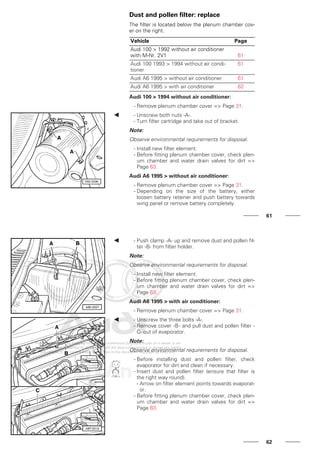
  • 32.
    - Check fluidlevel: • Cold fluid: - Level must be around MIN. mark (up to 2 mm above or below mark). • Fluid at operating temperature (from approx. 50 °C): - Level must be between MIN. and MAX. mark. Notes: ♦ The definitive fluid level is the one measured after screwing in the cap. ♦ Fluid must be drawn off if the level is above the specified range. Important If the fluid level is below the range specified, the hydraulic system must be checked for leaks (repair measure). It is then not sufficient to merely top up the fluid. - If there are no leaks in the hydraulic system, top up with "G 002 000". - Screw in cap hand-tight. 55 Fuel filter: replace (diesel and TDI en- gines) Notes: ♦ Please ensure that no diesel fuel contacts coolant hoses. If necessary, clean hoses imme- diately. ♦ Observe environmental requirements for dispos- al. 4-cyl. TDI engines: - Loosen hose clamps on fuel hoses -1- and -2- and disconnect both fuel hoses. - Loosen nut -arrow- on filter bracket and pull filter out of bracket without disconnecting the two fuel hoses. - Using a 17 mm open-ended spanner, counterhold upper part of fuel filter at flats on boss for bleed screw. Unscrew filter using strap wrench if ne- cessary -arrow-. Important Do not use pliers to hold the fuel filter. This can damage the head of the filter and cause leaks in the fuel system. - Unscrew filter from upper part of fuel filter. - coat new rubber seal lightly with diesel fuel. - Fill new filter with clean diesel. This will enable the engine to start more quickly. 56
  • 33.
    - Screw filteronto upper part of filter flange (hand- tight). - Push plastic insert onto new filter. - Insert fuel filter into bracket and secure with clamping nut -arrow-. - Connect fuel hoses -1- and -2- and secure with new hose clamps (use correct type - same as ori- ginal equipment). => Parts List - Start engine and check fuel system for leaks (visual check). Tightening torque Nm Clamping nut on filter bracket 10 5-cyl. diesel and TDI engines: - Unplug connector for water level sender. - Hold filter in place using a strap wrench, unscrew banjo bolt -1- and remove filter. Note: Do not turn filter. - Moisten new seal and new rubber seal with dies- el. - Transfer water level sender (if fitted) with new O- ring onto replacement filter. - Fill new filter with clean diesel. This will enable the engine to start more quickly. - Fit a new O-ring and tighten banjo bolt hand-tight. 57 - Start engine and check fuel system for leaks (visual check). - Press the accelerator pedal several times - with the engine running at idling speed the fuel should flow through the transparent pipe with no bubbles. Fuel filter: drain off water (Diesel and TDI engines) Notes: ♦ Please ensure that no diesel fuel contacts coolant hoses. If necessary, clean hoses imme- diately. ♦ Observe environmental requirements for dispos- al. 4-cyl. TDI engines: - Release hose clamps on fuel hoses -1- and -2- and disconnect both fuel hoses. - Loosen nut -arrow- on filter bracket and pull filter out of bracket without disconnecting the two fuel hoses. 58
  • 34.
    - Open waterdrain plug and drain approx. 0.1 litre of fluid into a drip tray. - Close water drain screw. - Coat rubber seal on fuel filter lightly with diesel fuel. - Insert fuel filter into bracket and secure with clamping nut -arrow-. - Connect fuel hoses -1- and -2- and secure with new hose clamps (use correct type - same as ori- ginal equipment). => Parts List - Start engine and check fuel system for leaks (visual check). Tightening torque Nm Clamping nut to filter bracket 10 59 5-cyl. diesel and TDI engines: - Release vent screw -2-. - Fit hose onto water drain screw or breather valve - 3-. Note: Vehicles > 1994 with engine code AAT and ABP have a water drain valve instead of a water drain screw. - Unscrew water drain screw or press drain valve upwards and drain off about 0.1 litre of fluid. - Tighten water drain screw or release drain valve and tighten vent screw. - Start engine and check fuel system for leaks (visual check). - Press the accelerator pedal several times - with the engine running at idling speed the fuel should flow through the transparent pipe with no bubbles. 60
  • 35.
    Dust and pollenfilter: replace The filter is located below the plenum chamber cov- er on the right. Vehicle Page Audi 100 > 1992 without air conditioner with M-Nr. 2V1 61 Audi 100 1993 > 1994 without air condi- tioner 61 Audi A6 1995 > without air conditioner 61 Audi A6 1995 > with air conditioner 62 Audi 100 > 1994 without air conditioner: - Remove plenum chamber cover => Page 31. - Unscrew both nuts -A-. - Turn filter cartridge and take out of bracket. Note: Observe environmental requirements for disposal. - Install new filter element. - Before fitting plenum chamber cover, check plen- um chamber and water drain valves for dirt => Page 63. Audi A6 1995 > without air conditioner: - Remove plenum chamber cover => Page 31. - Depending on the size of the battery, either loosen battery retainer and push battery towards wing panel or remove battery completely. 61 - Push clamp -A- up and remove dust and pollen fil- ter -B- from filter holder. Note: Observe environmental requirements for disposal. - Install new filter element. - Before fitting plenum chamber cover, check plen- um chamber and water drain valves for dirt => Page 63. Audi A6 1995 > with air conditioner: - Remove plenum chamber cover => Page 31. - Unscrew the three bolts -A-. - Remove cover -B- and pull dust and pollen filter - C- out of evaporator. Note: Observe environmental requirements for disposal. - Before installing dust and pollen filter, check evaporator for dirt and clean if necessary. - Insert dust and pollen filter (ensure that filter is the right way round). - Arrow on filter element points towards evaporat- or. - Before fitting plenum chamber cover, check plen- um chamber and water drain valves for dirt => Page 63. 62
  • 36.
    Plenum chamber andwater drain valves: check for dirt and clean if neces- sary - Remove plenum chamber cover => Page 31. - Check plenum chamber for dirt (leaves, etc.) and clean as necessary. - Check that water drain valves are functioning properly, and clean and replace as necessary. Note: Ensure that water drain valves close properly and are not blocked by wax or underseal. - Observe note on installing plenum chamber cover => Page 31. 63 Noise insulation: remove On vehicles with diesel and TDI engines the noise in- sulation consists of two parts. - Turn quick - release screws - arrows - in an anti - clockwise direction. - Pull front noise insulation off bumper towards rear of vehicle and remove. - Pull rear noise insulation (on diesel and TDI en- gines only) towards rear of vehicle and remove. Note: When installing ensure that the noise insulation is pushed in over the bumper cover at the front. 64
  • 37.
    V-belt: check fordamage and check ten- sion; adjust tension if necessary - Check condition of V-belts along entire length of belt: - Cracks, fractured core, cross-sectional breaks - Layer separation (base, cord strands) - Base break-up - Fraying of cord strands - Wear on sides of belt (material worn down, sides of belt frayed, surface cracking or sides of belt hardened - indicated by smooth, shiny sur- face) - Traces of oil and grease Important Faults found must be rectified (repair meas- ure). - Check tension of V-belts: - Press in the ribbed belt firmly with the thumb at a point half-way between the two pulleys which are farthest apart. The amount of yield should be as follows: 65 V-belt for alternator Belt yield (max) - New V-belt 2 mm - Used V-belt 5 mm V-belt for PAS vane pump - Petrol engines 10 mm - TDI engines 5 mm V-belt for air conditioner compressor - All models 5 mm V-belts: tensioning Note: With the 4-cyl. 5V-engine it is not possible to adjust the tension of the V-belt for the coolant pump. Special tools required ♦ V.A.G 1410 Torque wrench ♦ Ring spanner attachment V.A.G 1410/2 (22 mm A/F) • V-belt for alternator 66
  • 38.
    - loosen allbolts securing alternator and tensioning bar -A- at least one turn. - Loosen clamping bolt for tensioner nut -B-. - Using torque wrench V.A.G 1410 and ring span- ner attachment V.A.G 1410/2 (22 mm A/F), apply the following torque to the tensioner nut: - Used V-belt:4 Nm - New V-belt: 8 Nm - Maintain this torque on tensioning bolt, and tight- en clamping bolt to 35 Nm. Tightening torques Nm Clamping bolt for tensioner nut to ten- sioning bar 35 Tensioning bar to lifting eye 20 Alternator to bottom mounting 35 Note: If the V-belt has been replaced: - Start engine and run at idling speed for 5 minutes. - Switch off the engine and re-adjust the belt ten- sion as described above. - Apply a torque of 8 Nm to tensioner nut. • V-belt for PAS vane pump - Remove noise insulation => Page 64. 67 - Loosen bolts 2 ... 6. - Adjust belt tension with tensioner nut -1-. - The amount of yield should be as follows: - Petrol engines:10 mm - TDI engines: 5 mm - Tighten securing bolts on vane pump. Tightening torques Nm Vane pump to bracket 25 Vane pump to tensioning bar 25 • V-belt for air conditioner compressor - Remove noise insulation => Page 64. - Unscrew the 4 nuts -1-. - Detach hub -2- from belt pulley. - Take off front section of belt pulley -3-. Notes: ♦ Belt tension is adjusted by adding or taking out shims -5- between front section -3- and rear sec- tion -4- of belt pulley. ♦ To reduce tension, add shims between two sec- tions of belt pulley. ♦ To increase tension, remove shims between two sections of belt pulley. 68
  • 39.
    - Place remainingshims between hub -2- and the front section of belt pulley -3-. - Loosely bolt together the two sections of the belt pulley. - Tighten the bolts securing the two sections of the pulley in stages while turning the crankshaft. - As the bolts are tightened, the V - belt should gradually move outwards until seated on the contact surface. - Tighten nuts to 25 Nm. - The amount of yield should be as follows: - Used V-belt:5 mm - New V-belt: 2 mm - Start engine and check belt running. - Check the belt tension again and re-adjust if ne- cessary. 69 V-belt (not ribbed belt) for alternator: re- place Special tools required ♦ V.A.G 1410 Torque wrench ♦ Ring spanner attachment V.A.G 1410/2 (22 mm A/F) 4-cyl. petrol engines - Remove noise insulation => Page 64. - Remove V-belt for air conditioner compressor: - Unscrew the 4 nuts -1-. - Detach hub -2- from belt pulley. - Take off front section of belt pulley -3-. - Remove V-belt. 70
  • 40.
    - Remove V-beltfor PAS vane pump: - Loosen bolts 2 ... 6. - Remove V-belt. - Remove V-belt for alternator: - loosen all bolts securing alternator and tensioning bar -A- at least one turn. - Loosen clamping bolt for tensioner nut -B-. - Fit new V-belt for alternator. - Re-install the other V-belts. - Tension the V-belts => Pages 68. 71 Ribbed belt: check for damage - Check condition of ribbed belts along entire length of belt: - Cracks, fractured core, cross-sectional breaks - Layer separation (base, cord strands) - Base break-up - Fraying of cord strands - Wear on sides of belt (material worn down, sides of belt frayed, surface cracking) - Traces of oil and grease Important Faults found must be rectified (repair meas- ure). 72
  • 41.
    Ribbed belt: checktension; adjust if ne- cessary Special tools required ♦ V.A.G 1410 Torque wrench ♦ Ring spanner attachment V.A.G 1410/2 (22 mm A/F) - Press in the ribbed belt firmly with the thumb at a point half-way between the pulleys. - The belt should yield 5 mm - Loosen the alternator securing bolt -1- and clamp- ing bolt -2- at least one turn. - Using torque wrench V.A.G 1410 and ring span- ner attachment V.A.G 1410/2 (22 mm A/F), apply a torque of 6 Nm to the tensioner nut -3-: - Maintain this torque on the tensioning bolt, and tighten clamping bolt to 25 Nm. Tightening torques Nm Clamping bolt for tensioner nut to ten- sioning bar 25 Alternator to bottom mounting 25 73 V-belt and ribbed belt: replace (4-cyl. 5V engines) Special tools required ♦ Mandrel 3204 Removing • Ribbed belt for air conditioner compressor - Unbolt torque reaction support from engine and cross member -arrows-. - Loosen bolts -arrows- of tensioner for ribbed belt, slacken belt and remove. • Ribbed belt for PAS vane pump and alternator 74
  • 42.
    - Remove ribbedbelt for air conditioner com- pressor => Page 74. - Loosen ribbed belt for hydraulic pump and altern- ator, secure tensioner for ribbed belt using man- drel 3204 if necessary -arrows-. - Remove ribbed belt between hydraulic pump and alternator at alternator. • V-belt for coolant pump - Unscrew pulley for coolant pump. To prevent pul- leys from turning, insert a pin -arrow- in the vane pump pulley. - Remove V-belt. Installing Installation is carried out in the reverse order; note the following: - Fit ribbed belt for PAS vane pump and alternator. - Fit V-belt and assemble two sections of pulley on coolant pump without tightening bolts. - Tighten the bolts securing the two sections of the pulley in stages while turning the coolant pump. - As the bolts are tightened, the V - belt should gradually move outwards until seated on the contact surface. - Tighten bolts to 25 Nm. 75 Note: It is not possible to adjust the tension of the V-belt for the coolant pump. - Check that ribbed belt is properly seated. - Turn ribbed belt tensioner in direction of arrow. - Remove mandrel 3204 if necessary. - Fit ribbed belt for A/C compressor. - Apply torque wrench to hexagon on tensioning roller and tension with a torque of 25 Nm. - At the same time, tighten bolts -A- to 20 Nm. - Start engine and check belt running. - Check again to ensure that the bolts for the coolant pump pulley are tightened to the correct torque. 76
  • 43.
    Ribbed belt: replace(V6 engines) Special tools required ♦ Mandrel 3204 - Remove engine cover => Page 34. - Remove cover for ribbed belt -arrows-. 77 Vehicles > 1991: - To slacken ribbed belt, turn tensioner in direction of arrow using ring spanner (15 mm A/F). - Secure tensioner by inserting mandrel 3204. - Remove ribbed belt. - Fit new ribbed belt onto drive pulley and idler wheel first, and then push it over the tensioner. Routing of belt - A1 - without air conditioner - A2 - with air conditioner - Take out mandrel 3204 and release tensioner for ribbed belt. - Start engine and check belt running. 78
  • 44.
    Vehicles 1992 >: -To slacken ribbed belt, turn tensioner in direction of arrow using Allen key (10 mm A/F). - Insert mandrel 3204 into holes -A- and -B- to stop tensioner from turning. - Remove ribbed belt. - Fit new ribbed belt onto drive pulley and idler wheel first, and then push it over the tensioner. Routing of belt on vehicles 1992 > 1994 - B1 - without air conditioner - B2 - with air conditioner 79 Routing of belt on vehicles 1995 > - C1 - without air conditioner - C2 - with air conditioner - Take out mandrel 3204 and release tensioner for ribbed belt. - Start engine and check belt running. 80
  • 45.
    Toothed belt forcamshaft drive: check for damage and measure toothed belt width (4-cyl. TDI engines) - Release 2 clamps on the upper toothed belt cover and pull upper end of cover forwards. - Check condition of toothed belt: - Cracks, cross-sectional fractures - Layer separation (base, cord strands) - Base break-up - Fraying of cord strands - Surface cracks (plastic outer layer) - Traces of oil and grease Important Faults found must be rectified (repair meas- ure). - Measure width of toothed belt -a-. - Wear limit = 22 mm Important The toothed belt must be replaced if the belt width is less than 22 mm (repair measure). 81 Toothed belt for camshaft drive: check for damage and check tension (5-cylin- der diesel and TDI engines) - Remove upper toothed belt cover. - Check condition of toothed belt: - Cracks, cross-sectional fractures - Layer separation (base, cord strands) - Base break-up - Fraying of cord strands - Surface cracks (plastic outer layer) - Traces of oil and grease Important Faults found must be rectified (repair meas- ure). Vehicles > 1994: - Check that toothed belt runs centrally on cam- shaft sprocket. Note: If the toothed belt runs on one side of the sprocket, this means that the lower idler wheel is not pressed in straight and should be replaced (repair measure). - Check tension of toothed belt: Special tools required ♦ V-belt and toothed belt test unit VW 210 82
  • 46.
    - Press intoothed belt firmly by hand between camshaft sprocket and injection pump sprocket to equalise tension. - Measure tension of toothed belt using tester VW 210. - Specification: on scale 12 ... 13 - Adjust toothed belt tension (repair measure) if the reading does not match the specification (too high or too low): => 5-cyl. Diesel Engine (2.4 ltr Engine), Mechanical Components; Repair group 13; Dismantling and as- sembling engine; Removing and installing toothed belt for camshaft => 5-cyl. Diesel Engine (2.5 ltr Engine), Mechanical Components; Repair group 13; Dismantling and as- sembling engine; Removing and installing toothed belt for camshaft Vehicles 1995 >: - Check tension of toothed belt: 83 - The two arrows must be aligned (max. distance 3 mm) - If the markings are not opposite each other adjust the tension of the toothed belt: => 5-cyl. Diesel Engine (2.5 ltr Engine), Mechanical Components; Repair group 13; Dismantling and as- sembling engine; Removing and installing toothed belt for camshaft 84
  • 47.
    Toothed belt forinjection pump: check for damage and check tension (5-cyl. TDI engines), tension toothed belt Special tools required ♦ Tensioner 3303 Vehicles > 1994: - Remove rear toothed belt cover. Vehicles 1995 >: - Remove engine cover => Page 40. All models: - Check condition of toothed belt: - Cracks, cross-sectional fractures - Layer separation (base, cord strands) - Base break-up - Fraying of cord strands - Surface cracks (plastic outer layer) - Traces of oil and grease Important Faults found must be rectified (repair meas- ure). 85 - Check tension of toothed belt for injection pump. Vehicles 1995 >: - Unscrew nut -A- on rear toothed belt guard for in- jection pump drive. - Push toothed belt guard and sleeve -B- to rear. All models: - Hook in spring of tensioner 3303. Note: In order to attach the tensioner on vehicles 1995> without removing the stud, first file out a section of the tensioner, as shown in the illustration (shaded area). 86
  • 48.
    - With tensioner3303 -Item 1- hooked in position, loosen nut -2- of tensioning roller. - Move the tensioning roller by hand to check that it moves easily; free the roller if necessary. Note: When the tensioning roller is released, the spring of the tensioner automatically sets the belt to the cor- rect tension. - Check gap -A- at stop for tensioning roller. Important If gap A = 0 mm (tensioning roller lever against stop) the toothed belt must be replaced (repair measure). 87 - Tighten nut -2- on tensioning roller. - Remove tensioner 3303 -Item 1- Tightening torque Nm Tensioning roller nut 45 88
  • 49.
    Toothed belt forcamshaft drive: check for damage (2.6l 2V and 2.8l 2V engines only) - Remove engine cover => Page 34 - Remove upper toothed belt cover. - Check condition of toothed belt: - Cracks, cross-sectional fractures - Layer separation (base, cord strands) - Base break-up - Fraying of cord strands - Surface cracks (plastic outer layer) - Traces of oil and grease Important Faults found must be rectified (repair meas- ure). 89 Toothed belt: replace Toothed belt: replace (4-cyl. petrol engines) - Removing and installing toothed belt: => 4-cylinder Engine (2-valve), Mechanical Compon- ents; Repair group 13; Dismantling and assembling engine => 4-cylinder Injection Engine (4-valve), Mechanical Components; Repair group 13; Dismantling and as- sembling engine Toothed belt: Replace (5-cyl. petrol engines) - Removing and installing toothed belt: => 5-cylinder Engine (2-valve), Mechanical Compon- ents; Repair group 13; Dismantling and assembling engine => 5-cylinder Injection Engine (4-valve), Mechanical Components; Repair group 13; Dismantling and as- sembling engine 4-cylinder 5V 1.8 litre petrol engines - Removing and installing toothed belt => 4-cyl. Engine (5-valve), Mechanical Components; Repair group 13; Dismantling and assembling engine Toothed belt and tensioning roller: replace (V6 - 5V engines) - Removing and installing toothed belt, replacing toothed belt tensioning roller: 90
  • 50.
    => 6-cylinder Engine(5-valve), Mechanical Compon- ents; Repair group 13; Dismantling and assembling cylinder crankcase, crank shaft and flywheel Ribbed belt: replace (V8 engines) => 8-cylinder Engine, Mechanical Components; Re- pair group 15; Cylinder head, valve gear; Removing and installing ribbed belt Toothed belt: replace (V8 engines) => 8-cylinder Engine, Mechanical Components; Re- pair group 15; Cylinder head, valve gear; Removing and installing toothed belt Toothed belt for camshaft drive and tensioning roller: replace (4-cyl. TDI engines) - Removing and installing toothed belt, replacing toothed belt tensioning roller: => 4-cyl. Diesel Direct Injection Engine (TDI), Mech- anical Components; Repair group 13; Dismantling and assembling engine - Dynamically checking and adjusting commence- ment of injection: => Diesel Direct Injection and Glow Plug System (TDI 4-cylinder); Repair group 23; Servicing diesel dir- ect injection system 91 Toothed belt for camshaft and injection pump: replace (5-cylinder diesel engines) => 5-cyl. Diesel Engine (2.4 ltr Engine), Mechanical Components; Repair group 13; Dismantling and as- sembling engine; Removing and installing toothed belt for camshaft, and toothed belt for injection pump - Dynamically checking and adjusting commence- ment of injection. => Diesel Injection and Glow Plug System (2.4 l en- gine); Repair group 23; Servicing diesel injection sys- tem Toothed belt for camshaft and injection pump: replace: (5-cylinder TDI engines) => 5-cyl. Diesel Engine (2.5 ltr Engine), Mechanical Components; Repair group 13; Dismantling and as- sembling engine; Removing and installing toothed belt for camshaft, and toothed belt for injection pump 92
  • 51.
    - Dynamically checkingand adjusting commence- ment of injection: => Diesel Direct Injection and Glow Plug System (TDI 5-cylinder); Repair group 23; Dynamically check- ing and adjusting commencement of injection Filling in toothed belt renewal sticker - all vehicles - Fill in toothed belt renewal sticker -arrow- on lock carrier; if necessary, attach a new sticker. Manual gearbox/final drive: check oil level and top up if necessary 5-speed manual gearbox 012, front-wheel drive Special tools required ♦ Socket attachment 3357 or ♦ 17 mm hexagon socket attachment Notes: ♦ The vehicle must be absolutely horizontal when checking gearbox oil level. This work is best per- formed over an inspection pit or using a 4 - column lifting platform. ♦ The oil filler plug is on the left of the gearbox be- low the speedometer sender; it may be con- cealed by the heat shield for the drive shaft. 93 ♦ Depending on the version fitted, use either spe- cial tool 3357 or a 17 mm Allen key to loosen the oil filler plug. - Unscrew oil filler plug (arrow) to check oil level. - Check oil level using a shop-built tool, e.g. a piece of angled wire. - Specification: oil level 7 mm below bottom edge of oil filler hole Note: The oil can be filled up to the bottom edge of the oil filler hole when servicing. Important If the oil level is below the range specified, the gearbox must be checked for leaks (repair measure). It is then not sufficient to merely top up the fluid. - If there are no leaks in the gearbox, top up with SAE 75 W 90 (synthetic fluid), specification "G 052 911 A". - Fit oil filler plug. Tightening torque Nm Oil filler plug 25 5-speed and 6-speed manual gearbox 01E, front wheel drive Notes: 94
  • 52.
    ♦ The vehiclemust be absolutely horizontal when checking gearbox oil level. This work is best per- formed over an inspection pit or using a 4 - column lifting platform. ♦ The prescribed oil level is to be adhered to ex- actly; the gearbox reacts very sensitively to over- filling. ♦ There are two different procedures for checking the gearbox oil level according to the type of fi- nal drive cover fitted. Older version: oil filler hole behind flange shaft. Newer version: oil filler hole in front of flange shaft. Older version: - Remove oil filler plug -A- (behind flange shaft) to check gearbox oil level. - Check oil level using a shop-built tool, e.g. a piece of angled wire. - Specification: oil level 6 mm below bottom edge of oil filler hole 95 Newer version: - Remove oil filler plug -B- (in front of flange shaft) to check gearbox oil level. - Specification: oil level up to lower edge of filler hole All models: Important If the oil level is below the range specified, the gearbox must be checked for leaks (repair measure). It is then not sufficient to merely top up the fluid. - If there are no leaks in the gearbox, top up with SAE 75 W 90 (synthetic fluid), specification "G 052 911 A". - Fit oil filler plug. Tightening torque Nm Oil filler plug 40 5-speed manual gearbox 01A, four-wheel drive Special tools required ♦ Socket attachment 3357 or ♦ 17 mm hexagon socket attachment Notes: 96
  • 53.
    ♦ The oilfiller plug is on the left of the gearbox be- low the speedometer sender; it may be con- cealed by the heat shield for the drive shaft. ♦ Depending on the version fitted, use either spe- cial tool 3357 or a 17 mm Allen key to loosen the oil filler plug. - Unscrew oil filler plug (arrow) to check oil level. - Specification: oil level up to lower edge of filler hole Important If the oil level is below the range specified, the gearbox must be checked for leaks (repair measure). It is then not sufficient to merely top up the fluid. - If there are no leaks in the gearbox, top up with SAE 75 W 90 (synthetic fluid), specification "G 052 911 A". - Fit oil filler plug. Tightening torque Nm Oil filler plug 25 5-speed and 6-speed manual gearbox 01E, four- wheel drive Notes: 97 ♦ The vehicle must be absolutely horizontal when checking gearbox oil level. This work is best per- formed over an inspection pit or using a 4 - column lifting platform. ♦ The prescribed oil level is to be adhered to ex- actly; the gearbox reacts very sensitively to over- filling. ♦ There are two different procedures for checking the gearbox oil level according to the type of fi- nal drive cover fitted. Older version: oil filler hole behind flange shaft. Newer version: oil filler hole in front of flange shaft. Older version: - Remove oil filler plug -A- (behind flange shaft) to check gearbox oil level. - Check oil level using a shop-built tool, e.g. a piece of angled wire. - Specification: oil level 7 mm below bottom edge of oil filler hole 98
  • 54.
    Newer version: - Removeoil filler plug -B- (in front of flange shaft) to check gearbox oil level. - Check oil level using a shop-built tool, e.g. a piece of angled wire. - Specification: oil level 1 mm below bottom edge of oil filler hole All models: Important If the oil level is below the range specified, the gearbox must be checked for leaks (repair measure). It is then not sufficient to merely top up the fluid. - If there are no leaks in the gearbox, top up with SAE 75 W 90 (synthetic fluid), specification "G 052 911 A". - Fit oil filler plug. Tightening torque Nm Oil filler plug 40 99 Final drive (automatic gearbox): check oil level and top up if necessary Automatic gearbox 097, 01N - Unscrew oil filler plug -arrow-. - Specification: oil level up to lower edge of filler hole Important If the oil level is below the range specified, the final drive must be checked for leaks (repair measure). It is then not sufficient to merely top up the fluid. - If the final drive has no leaks top up with SAE 75 W 90 (synthetic oil) specification "G 052 145 A". - Fit oil filler plug. Tightening torque Nm Oil filler plug 25 - Fill in sticker for final drive oil check => Page 103. Automatic gearbox 01K, front wheel drive 100
  • 55.
    01F four-wheel drive -Unscrew oil filler plug -arrow-. - Specification: oil level up to lower edge of filler hole Important If the oil level is below the range specified, the final drive must be checked for leaks (repair measure). It is then not sufficient to merely top up the fluid. - If the final drive has no leaks top up with SAE 75 W 90 (synthetic oil) specification "G 052 145 A". - Fit oil filler plug. Tightening torque Nm Oil filler plug 25 - Fill in sticker for final drive oil check => Page 103. 101 Automatic gearbox 018; four-wheel drive - Unscrew oil filler plug -arrow-. - Specification: oil level up to lower edge of filler hole Important If the oil level is below the range specified, the final drive must be checked for leaks (repair measure). It is then not sufficient to merely top up the fluid. - If the final drive has no leaks top up with SAE 75 W 90 (synthetic oil) specification "G 052 145 A". - Fit oil filler plug. Tightening torque Nm Oil filler plug 25 - Fill in sticker for final drive oil check => Page 103. 102
  • 56.
    Filling in stickerfor final drive oil check - all vehicles - Fill in sticker for final drive oil check -arrow- on lock carrier; if necessary, attach a new sticker. 103 Engine oil: drain or extract, change oil filter Special tools required ♦ Oil filter spanner 3417 (4-cyl. petrol engines) ♦ Strap wrench Hazet 2171 - 1 (5 - cyl. petrol en- gines, V6-engines, 4-cyl. TDI engines, 5-cyl. dies- el and TDI engines) ♦ Socket attachment, long, 36 A/F ♦ Oil extractor V.A.G 1307 A or V.A.G 1358 A Note: Observe environmental requirements for disposal. - Remove noise insulation => Page 64. 4-cyl. petrol engines: - Loosen oil filter - arrow - with oil filter spanner 3417. 5 - cyl. petrol engines, 4 - cyl. TDI engines, 5 - cyl. diesel and TDI engines: - Loosen oil filter with strap wrench (e.g. Hazet 2171-1). 104
  • 57.
    V6 engines: - Loosenoil filter -arrow- strap wrench (e.g. Hazet 2171-1). V8 engines: - Loosen oil filter -arrow- with socket attachment 30 mm A/F. All models: - Remove oil filter. - Unscrew oil drain plug or extract engine oil. - Clean sealing surface on engine for oil filter. - Lightly lubricate rubber seal. - Screw in new filter and tighten. Notes: Note the fitting instructions on the oil filter. For engines with oil cooler 105 Important After replacement of oil filter cartridge, check clearance of hoses from oil cooler to adjacent components; if necessary correct oil cooler po- sition. - Screw in oil drain plug with new seal. - Top up engine oil, specifications => Page 119. - Observe instructions for turbo engines => Page 121. - Note different oil specifications for Audi S6 with V8 engine AHK => Page 121. Tightening torques Nm Oil drain plug 4- and 5-cyl.-engines 30 Oil drain plug V6 - 2V engines: 40 Oil drain plug V6 - 5V engines: 30 Oil drain plugs V8 engines 35 106
  • 58.
    Brake system: visualcheck for leaks and damage - Check the following components for leaks and damage: - Brake master cylinder - Brake servo - ABS hydraulic unit - Brake calipers - Brake pressure regulator - Ensure that brake hoses are not twisted. - Ensure that brake hoses do not touch any vehicle components when steering is on full lock. - Check brake hoses for porosity, blistering and brittleness. - Check brake hoses and pipes for chafing. - Check brake pipe connections and mountings for correct seating, leaks and corrosion. Important Faults found must be rectified (repair meas- ure). 107 Brake pads: check thickness Front disc brake pads: Important If the pad thickness is down to 7 mm (includ- ing backing plate), the disc brake pads have reached their wear limit and must be replaced (repair measure). Please inform the customer. - Determine thickness of outer pads by checking visually (with help of electric torch/flashlight through cut-out in wheel). - Determine thickness of inner pads by checking visually (with help of electric torch/flashlight and mirror). Notes: ♦ If the brake pads are not visible because of the type of wheel rims fitted, remove front wheels. ♦ Before removing the wheels mark the position of each wheel in relation to the brake disc and mount the wheels in the same position after completing the check. ♦ Observe notes on wheel bolts when mounting the front wheels => Page 115. 108
  • 59.
    Audi 100, AudiA6: - a -Pad thickness including backing plate - Wear limit: 7 mm Audi S4 (5 cyl.) > 1993: - a -Pad thickness including backing plate - Wear limit: 7 mm 109 Audi S4 (5 cyl.) 1994>, Audi S4 (V8), Audi S6: - a -Pad thickness including backing plate - Wear limit: 7 mm Rear disc brake pads: Important If the pad thickness is down to 7 mm (includ- ing backing plate), the disc brake pads have reached their wear limit and must be replaced (repair measure). Please inform the customer. - Determine thickness of outer pads by checking visually (with help of electric torch/flashlight through cut-out in wheel). - Determine thickness of inner pads by checking visually (with help of electric torch/flashlight and mirror). 110
  • 60.
    - a -Padthickness including backing plate - Wear limit: 7 mm Notes: ♦ If the brake pads are not visible because of the type of wheel rims fitted, remove rear wheels. ♦ Before removing the wheels mark the position of each wheel in relation to the brake disc and mount the wheels in the same position after completing the check. ♦ Observe notes on wheel bolts when mounting the rear wheels => Page 115. Rear drum brake linings: - Pull plug out of inspection hole in backplate -ar- row-. - Determine thickness of brake linings by checking visually, using an electric torch (flashlight). - a -Lining thickness without brake shoe - Wear limit: 2.5 mm Important If the pad thickness is down to 2.5 mm (not in- cluding backing plate), the drum brake linings have reached their wear limit and must be re- placed (repair measure). Please inform the cus- tomer. 111 Underseal: visual check for damage - When performing visual check, check underbody, wheel housings and side members. Important Faults found must be rectified (repair meas- ure). Track rod ends: check play, attachment and protective boots Note: The test must be made with vehicle raised on a lift- ing platform (wheels free to move). - Check play by moving track rods and wheels. - There should be no play - Check that lock nuts are secure (40 Nm). - 1 -Lock nut on wheel side, right-hand thread - 2 -Lock nut on track rod side, left-hand thread - Check protective boot - arrow - for damage and correct seating. 112
  • 61.
    Tyres: check andcorrect condition, wear pattern, tread depth and inflation pres- sures Notes: ♦ In the interests of driving safety, only tyres of the same type and tread pattern should be fitted on a vehicle. ♦ On four wheel drive vehicle tyres of the same type and tread pattern must be used. Otherwise the centre differential may be damaged. - Check tyre tread and side walls for damage and remove any foreign bodies. - Check tyres for scuffing, one-sided wear, porous side walls, cuts and fractures. Important The customer must be informed of any de- fects. Checking tyre wear pattern - The wear pattern of the front tyres indicates whether the toe and camber have to be checked - Feathering on tread indicates incorrect toe set- ting. - One-sided tread wear is mainly caused by incor- rect camber. 113 Note: If the above types of wear are found, check wheel alignment to determine the cause (repair measure). Checking tyre tread depth - Minimum permissible tread depth: 1.6 mm Notes: ♦ This value may vary for individual countries ac- cording to legislation. ♦ The minimum tread depth is reached when the tyres have worn down level with the 1.6 mm high tread wear indicators - arrows- positioned at intervals around the tyre. ♦ If the tread depth is approaching the minimum permissible tread depth, the customer must be informed. Inflating to correct pressures The correct inflation pressures for summer tyres are listed on the sticker on the inside of the tank flap. Notes: ♦ Please note that the inflation pressures listed on the sticker apply to cold tyres. When the tyres are warm, the actual pressures will be higher, but must not be reduced. ♦ When using winter tyres, pressures should be increased by 0.2 bar. Spare wheel 114
  • 62.
    • Spare wheelwith standard-size tyre - Inflate to the maximum pressure specified for the vehicle. • Temporary (compact) spare wheel: The correct inflation pressure is indicated on the side wall. Notes: ♦ The tyre valves must be closed with dust caps. Otherwise, dirt can obstruct the valve pin and cause loss of air. ♦ On vehicles with steel rims and wheel covers, check the tyre valve extensions. Damage and dirt can cause leaks. Replace if necessary. Wheel bolts: tighten to specified torque Wheel cover Puller - 1 - for removing the wheel cover is in the vehicle tool kit. 115 Trim cap - On vehicles with light-alloy wheels and trim caps insert a screwdriver in the recess and lever the trim cap off the wheel rim. Wheel bolt locks - Pull trim cap off wheel bolt lock. - On wheel rims with recessed wheel bolts, insert the hook -2- at the side of the bolt, turn it slightly and pull the cap off. - Turn key -1- anti-clockwise in wheel bolt lock and remove together with wheel bolt lock. - To re-install, push wheel bolt lock as far as it will go onto wheel bolt. - Turn key clockwise in lock and remove key. - When refitting the cap, ensure that it engages all the way round. Note: Ensure that the wheel bolts are tightened in a diag- onal sequence to the following tightening torque: Tightening torque Nm Wheel bolts 120 116
  • 63.
    Correct installation ofwheels - When fitting the road wheels note the following points to ensure that the wheels remain secure at all times. • Always tighten the wheel bolts to the specified torque, excessive torque can distort the wheel bolt seats in the rim. • When fitting a wheel do not torque down the first wheel bolt immediately (e.g. with an impact wrench), as this would prevent the other bolts from centring the wheel properly when they are screwed in. The rim could then come loose even though the bolts have been tightened to the spe- cified torque. • Before installing the wheels examine the seats of the wheel bolts and the contact surfaces between the rims and the hubs for rust and cor- rosion. Clean off these parts if necessary other- wise this can affect the clamping force of the bolts after installation and the rims can come loose. 117 Important ♦ If the points listed above are not observed the wheel mountings can come loose and the wheel bolt seats can become distorted. ♦ This distortion may be very slight and not visible to the naked eye. ♦ Even this slight distortion of the wheel bolt seats can prevent the rims from being held firmly and the wheels will come loose repeatedly. Engine oil: fill The engine is filled with a high quality multigrade oil at the factory which can be used all year round, ex- cept in extremely cold climates. Viscosity grades Note: The oil does not need changing for brief variations of outside temperature beyond the temperature ranges shown. 118
  • 64.
    Viscosity grades forpetrol, diesel and TDI en- gines (but not for Audi S6 with V8 engine AHK): Select the viscosity grade of the oil according to the chart. - A - Multigrade high lubricity oils, specification => Page 120 - B - Multigrade oils, specification => Page 120 Viscosity grades for Audi S6 with V8 engine AHK: Select the viscosity gradeof the oil according to the chart 1). - A - Multigrade high lubricity oils, specification => Page 121 1) If these oils are not available engine oils with other viscosity grades may be used as an emer- gency measure as long as they conform to VW standard 500 00 => Page 121. Oil specifications The specifications listed here should appear on the container - either singly or together with other spe-ci- fications. 119 Note: When topping up, different types of oil may be mixed if necessary. Oil specification for petrol engines (but not for Audi S6 with V8 engine AHK) and diesel engines (but not for TDI engines): - A - High lubricity multigrade oils, specification VW 500 00 1) High - lubricity multigrade oils, specification VW 502 00 2) - B - Multigrade oils, specification VW 501 01 1) - - Multigrade oils, Specification API-SF 3)or API- SG 3) 1) The date given after the VW specification must not be earlier than 10.97. 2) These oils are particularly suitable for tur- bocharged petrol engines. 3) These oils should only be used if the approved engine oils are not available. Oil specifications for TDI engines: - A - High-lubricity multigrade oils, specification VW 500 00 1) (only in combination with specifica- tion VW 505 00) - B - Multigrade oils, specification VW 505 00 1) - - Multigrade oils, specification VW 501 01 1) (only in conjunction with specification VW 505 00) 120
  • 65.
    - - Multigradeoils, specification API-CD (should only be used for emergency topping up) 1) The date given after the VW specification must not be earlier than 10.97. Oil specifications for Audi S6 with V8 engine AHK: - A - High lubricity multigrade oils, specification VW 500 00 1) 1) The date given after the VW specification must not be earlier than 10.97. - Top up engine oil. Capacities with filter replacement: => ELSA Maintenance table Engines with turbocharger: - When the engine oil and oil filter have been changed, it is important to note the following after starting the engine for the first time: - The engine must only run at idling speed until the oil pressure warning lamp in the dash panel insert goes out.Do not press the accelerat- or!This could cause severe damage to the tur- bocharger. - The full oil pressure is only reached when the warning lamp goes out, and the accelerator can then be pressed. All models: - Finally, check the engine oil level => Page 122. 121 Engine: check oil level Test requirements: • Engine oil temperature at least 60 °C • Vehicle must be level (horizontal) • Wait a few minutes after switching off the en- gine to allow the oil to flow back into the sump. - Pull out the dipstick, wipe with a clean cloth and insert again to stop. - Pull out the dipstick again and read off the oil level. Markings on oil dipstick: - a -Oilmust not be topped up. - b -Oil may be topped up. The oil level may rise as far as area -a- after topping up. - c -Oilmustbe topped up. The oil level is suffi- cient if somewhere in area -b- (grooved area) after topping up. Note: The oil level must not be above marking -a- on the dipstick. 122
  • 66.
    Automatic gearbox: changeATF (except 01N gearbox) Engine Gearbox Page 4- and 5-cyl. engines > 12.94 V6 engines (front-wheel drive) > 02.92 097 124 5 cyl. TDI engines > 05.94 V6 engines (front-wheel drive) 03.92 > 05.94 01K 128 5 cyl. TDI engines 06.94 > V6 engines (front-wheel drive) 06.94 > 01K 133 5-cyl. 4V engines > 05.94 V6 engines (four-wheel drive) > 05.94 01F 128 5-cyl. 4V engines 06.94 > V6 engines (four-wheel drive) 06.94 > 01F 133 V8 engines 018 137 Notes: ♦ Use only ATF with the part no. G 052 162 A. (colour: clear/yellow). Do not use any additives! ♦ The engine must not be started or towed without ATF in gearbox. ♦ When filling is started, the ATF temperature must not be higher than 35 °C. ♦ Observe environmental requirements for dispos- al. 123 Special tools, testers and auxiliary items required ♦ Drip tray V.A.G 1306 ♦ Oil extractor V.A.G 1358 A with oil suction probe V.A.G 1358 A/1 (automatic gearbox 097 only) ♦ Fault reader V.A.G 1551 with diagnostic cable V.A.G 1551/1 ♦ ATF filling system V.A.G 1924 and protective goggles (not for automatic gearbox 097) Automatic gearbox 097 Draining ATF - Draw off ATF with oil extractor V.A.G 1358 A with oil suction probe 1358/A 1. or - Raise vehicle. - Place drip tray V.A.G 1306 underneath the gear- box. 124
  • 67.
    - Unscrew unionnut on lower ATF filler pipe -5- and pull filler pipe out of oil pan. - Allow the ATF to drain out. - Re - attach ATF filler pipe: tightening torque 80 Nm. Filling ATF - First fill approx. 3.0 litres of ATF into the filler pipe using a funnel. - Move selector lever to position "P". - Start engine and run at idling speed. - With the engine idling press the brake pedal and shift the selector lever through all the selector lever positions leaving the selector lever 2 ... 3 seconds in each position. - Move selector lever to position "P". - Pull out ATF dipstick and wipe clean using a lint- free cloth. - Insert the ATF dipstick all the way into the ATF filler pipe and pull it out again. 125 - Check ATF level on dipstick. - ATF should be filled up to the 20 °C-mark when cold. - Switch ignition off. Checking ATF level Test requirements: • Gearbox not in emergency running mode, ATF temperature between 50 ... 70 °C. • Vehicle must be level (horizontal) • Set the selector lever to "P". • The air conditioner and heating system must be switched off. - Connect V.A.G 1551 => Page 23. - Start engine and run at idling speed. - Enter "1" to select "Rapid data transfer". - Enter "02" for address word "Gearbox electronics" and confirm entry with Q key. - Press ⇒ key to continue. - Enter "08" to select the function "Reading meas- ured value block" and confirm entry with Q key. Reading measured value block Q Enter display group number XXX Indicated on display - Enter "005" to select display group number "005" and confirm entry with Q key. Read measured value block 5 ⇒ 1 2 3 4 Indicated on display - Read off ATF temperature in display zone 1. - When the ATF has reached a temperature of about. 50 °C, pull out the ATF dipstick and wipe it clean using a lint-free cloth. 126
  • 68.
    - Insert theATF dipstick all the way into the ATF filler pipe and pull it out again. - Check ATF level on dipstick. • If the ATF level is between the min. and max. markings at a temperature of 50 ... 70 °C, the ATF level is OK. Notes: ♦ The ATF level must not be checked at temperat- ures above 70 °C. If necessary wait for the ATF to cool down again. ♦ The markings on the ATF dipstick are for an ATF temperature of 60°C. Important An insufficient ATF filling as well as filling to excess affects the function of the gearbox. • If ATF level is too low: - Fill up with ATF using a clean funnel. Note: Use only ATF "G 052 162 A." (colour: clear/yellow). Do not use any additives! - With vehicle stationary and engine running, move selector lever through all selector lever positions. - Check ATF level again at test temperature. • If ATF level is too high: 127 - Draw off excess ATF with oil extractor V.A.G 1358 A and oil suction probe 1358/A 1. - Check ATF level again at test temperature. Automatic gearbox 01K, front wheel drive 01F four-wheel drive > 1994 Draining ATF - Raise vehicle. - Place drip tray V.A.G 1306 underneath the gear- box. - Unscrew ATF drain plug -arrow 1-. - Allow the ATF to drain out. Filling ATF - Fit ATF drain plug with new seal and screw in. - Pull sealing cap -arrow- off ATF filler pipe. - First put approx. 2.7 litres of ATF into the filler pipe using a funnel. - Move selector lever to position "P". - Start engine and run at idling speed. - With the engine idling press the brake pedal and shift the selector lever through all the selector lever positions leaving the selector lever 2 ... 3 seconds in each position. - Move selector lever to position "P". 128
  • 69.
    - Measure ATFlevel using ATF dipstick. - For the following vehicles, check the ATF level using the dipstick marked "02": - All vehicles with V6 engines - Audi S4 up to vehicle identification number 4A RN 033 426 ( > approx. 11.93) Note: Vehicles requiring "02" dipstick have "02" marked on ATF filler pipe -arrow-. - For the following vehicles, check the ATF level using the dipstick marked "03": - All with 5 cyl. TDI engine - Audi S4 from vehicle identification number 4A RN 033 427 (approx. 11.93 >) Note: Vehicles requiring "03" dipstick have "03" marked on ATF filler pipe -arrow-. - Use a lint - free cloth to wipe the ATF dipstick clean. - Insert the ATF dipstick all the way into the ATF filler pipe and pull it out again. - Check ATF level on dipstick. 129 - ATF should be filled up to the 20 °C mark when cold. - Switch ignition off. Tightening torque Nm ATF drain plug 40 Checking ATF level Test requirements: • Gearbox not in emergency running mode, ATF temperature between 50 ... 70 °C. • Vehicle must be level (horizontal) • Set the selector lever to "P". • The air conditioner and heating system must be switched off. - Connect V.A.G 1551 => Page 23. - Start engine and run at idling speed. - Enter "1" to select "Rapid data transfer". - Enter "02" for address word "Gearbox electronics" and confirm entry with Q key. 4A0927156AL AG4 01F 2.8l 5V RoW D26 ⇒ Coding 00001 WSC 06744 If following display appears (example): - Check control unit identification. Control unit identification containing code "01D". - Press ⇒ key to continue. - Enter "08" to select the function "Reading meas- ured value block" and confirm entry with Q key. Reading measured value block Q Enter display group number XXX Indicated on display 130
  • 70.
    - Enter "000"for "display group number 000" and confirm entry with Q key. Read measured value block 00 ⇒ 1 2 3 4 5 6 7 8 9 Indicated on display - Read off ATF temperature in display zone 1. Notes: ♦ Subtract 50 from displayed value to calculate ATF temperature in °C. ♦ The display is only accurate if the temperature shown is above 40 °C. Control unit identification containing code "01F" or "01K": - Press ⇒ key to continue. - Enter "08" to select the function "Reading meas- ured value block" and confirm entry with Q key. Reading measured value block Q Enter display group number XXX Indicated on display - Enter "004" for "display group number 004" and confirm entry with Q key. Read measured value block 4 ⇒ 1 2 3 4 Indicated on display - Read off ATF temperature in display zone 4. All models: - When the ATF has reached a temperature of about. 70 °C, pull out the ATF dipstick and wipe it clean using a lint-free cloth. - Insert the ATF dipstick all the way into the ATF filler pipe and pull it out again. - Check ATF level on dipstick. 131 • If the ATF level is between the min. and max. markings at a temperature of 70... 90 °C, the ATF level is OK. Notes: ♦ The ATF level must not be checked at temperat- ures above 90 °C. If necessary wait for the ATF to cool down again. ♦ The MIN and MAX-markings on the ATF dipstick are for an ATF temperature of 80 ° ± 10 °C, (i.e. the ATF level should be between the "MIN" and "MAX" markings within this temperature range. Important An insufficient ATF filling as well as filling to excess affects the function of the gearbox. • If ATF level is too low: - Fill up with ATF using a clean funnel. Note: Use only ATF "G 052 162 A." (colour: clear/yellow). Do not use any additives! - With vehicle stationary and engine running, move selector lever through all selector lever positions. - Check ATF level again at test temperature. • If ATF level is too high: - Draw off excess ATF with oil extractor V.A.G 1358 A and oil suction probe 1358/A 1. 132
  • 71.
    - Check ATFlevel again at test temperature. Automatic gearbox 01K, front wheel drive 01F four-wheel drive 1995 > Draining ATF - Hang the full ATF container V.A.G 1924 as high as possible on the vehicle (e.g. radiator grille). - Raise vehicle. - Place drip tray V.A.G 1306 underneath the gear- box. - Unscrew ATF drain plug -arrow 2-. - Allow the ATF to drain out. Filling ATF - Unscrew ATF filler plug -arrow 1-. - Fit ATF drain plug with new seal and screw in. 133 - Use V.A.G 1924 to add ATF up to lower edge of filler hole. - Start engine and run at idling speed. Important Wear protective goggles. - With the engine running add more ATF until fluid level reaches lower edge of filler hole again. - Cut open seal -arrow- for ATF filler plug using side- cutting pliers and fit new seal. - Screw in ATF filler plug hand-tight. - With the engine idling press the brake pedal and shift the selector lever through all the selector lever positions leaving the selector lever 2 ... 3 seconds in each position. - Switch ignition off. Tightening torque Nm ATF drain plug 40 Checking ATF level Test requirements: • Gearbox not in emergency running mode; ATF temperature not more than approx. 30 °C • Vehicle must be level (horizontal) • Set the selector lever to "P". 134
  • 72.
    • The airconditioner and heating system must be switched off. - Connect V.A.G 1551 => Page 23. - Start engine and run at idling speed. - Enter "1" to select "Rapid data transfer". - Enter "02" for address word "Gearbox electronics" and confirm entry with Q key. - Press ⇒ key to continue. - Enter "08" to select the function "Reading meas- ured value block" and confirm entry with Q key. Reading measured value block Q Enter display group number XXX Indicated on display - Enter "004" to select display group number "004" and confirm entry with Q key. Read measured value block 4 ⇒ 1 2 3 4 Indicated on display - Read off ATF temperature in display zone 4. Note: The ATF temperature must not be more than 30 °C. 135 - Unscrew ATF filler plug -arrow 1-. Important Wear protective goggles. - The ATF level is correct if a small quantity of flu- id leaks out at the hole when the ATF temperat- ure is between 35 and 40 °C 1) .The leak occurs because the ATF level rises as the temperature increases. 1)50 °C for tropical countries • If ATF flows out of the hole the ATF level is OK. - Tighten ATF filler plug -arrow 1-. The ATF check is nowcompleted. Tightening torque Nm ATF filler plug 60 136
  • 73.
    Topping up ATF •If no ATF comes out of the hole when the check is performed, fill up with ATF: - Use V.A.G 1924 to add ATF up to lower edge of filler hole. Note: Use only ATF "G 052 162 A." (colour: clear/yellow). Do not use any additives! Important An insufficient ATF filling as well as filling to excess affects the function of the gearbox. - Tighten ATF-filler plug -arrow 1-. The ATF check is now completed. Tightening torque Nm ATF filler plug 60 Automatic gearbox 018; four-wheel drive 137 Draining ATF - Hang the full ATF container V.A.G 1924 as high as possible on the vehicle (e.g. radiator grille). - Raise vehicle. - Place drip tray V.A.G 1306 underneath the gear- box. - Unscrew ATF drain plug -arrow 2-. - Allow the ATF to drain out. Filling ATF - Unscrew ATF filler plug -arrow 1-. - Fit ATF drain plug with new seal and screw in. 138
  • 74.
    - Use V.A.G1924 to add ATF up to lower edge of filler hole. - Start engine and run at idling speed. Important Wear protective goggles. - With the engine running add more ATF until fluid level reaches lower edge of filler hole again. - Cut open seal -arrow- for ATF filler plug using side- cutting pliers and fit new seal. - Screw in ATF filler plug hand-tight. - With the engine idling press the brake pedal and shift the selector lever through all the selector lever positions leaving the selector lever 2 ... 3 seconds in each position. - Switch ignition off. Tightening torque Nm ATF drain plug 40 Checking ATF level Test requirements: • Gearbox not in emergency running mode; ATF temperature not more than approx. 30 °C • Vehicle must be level (horizontal) • Set the selector lever to "P". 139 • The air conditioner and heating system must be switched off. - Start engine and run at idling speed. Note: The ATF temperature must not be more than 30 °C (the oil pan should be warm but not too hot to touch). - Unscrew ATF filler plug -arrow 1-. Important Wear protective goggles. - The ATF level is correct if a small quantity of flu- id leaks out at the hole when the ATF temperat- ure is between 35 and 40 °C 1) .The leak occurs because the ATF level rises as the temperature increases. 1)50°C for tropical countries • If ATF flows out of the hole the ATF level is OK. 140
  • 75.
    - Tighten ATF-fillerplug -arrow 1-. The ATF check is now completed. Tightening torque Nm ATF filler plug 60 Topping up ATF • If no ATF flows out of the hole (apart from the ATF in the overflow pipe) top up with ATF as fol- lows: - Use V.A.G 1924 to add ATF up to lower edge of filler hole. Note: Use only ATF "G 052 162 A." (colour: clear/yellow). Do not use any additives! Important An insufficient ATF filling as well as filling to excess affects the function of the gearbox. 141 - Tighten ATF-filler plug -arrow 1-. The ATF check is now completed. Tightening torque Nm ATF filler plug 60 Idling speed: check and adjust if neces- sary (2.4 ltr diesel AAS only) Special tools required ♦ Diesel tester V.A.G 1743 - Connect diesel tester V.A.G 1743: => Operating Instructions 142
  • 76.
    - Before connectingthe piezo-electric sender -1-, remove any dirt and corrosion from the connec- tion point of the injector pipe for cylinder 1. - Ensure that adequate contact is made with the earth terminal -2-. Notes: ♦ Illustration shows 4-cylinder engine. ♦ If the piezo - electric sender is clamped to the pipe, it must not be rotated. ♦ If the speed signal issued from the piezo-electric sender cannot be utilised, the engine speed can be measured using the TDC sender of the diesel tester. Insert TDC sender to stop in bore on bell housing. - Start engine and run at idling speed. - Check the engine idling speed on diesel tester V.A.G 1743 - Specification: 800...900 rpm1) 1) Current values: => "Exhaust Emission Test" binder If the idling speed shown is in not within the toler- ance range: 143 - Loosen lock nut on idling speed adjuster screw - arrow-. - Adjust idling speed and secure idling speed ad- juster screw again with lock nut. Brake fluid level (depending on brake pad wear): checking Only use new genuine VW/Audi brake fluid accord- ing to US standard FMVSS 116 DOT 4. Important ♦ Brake fluid is poisonous. On account of its corrosive effect it must also never be al- lowed to come into contact with paint. ♦ Brake fluid is hygroscopic, i.e. it absorbs moisture from the surrounding atmo- sphere. It is thus always to be kept in con- tainers with an air-tight seal. - Note the following: When the vehicle is driven, the brake fluid level will decrease slightly with use and as a result of the automatic adjustment of the brake pads. 144
  • 77.
    - When checkingthe brake fluid level, always take into account the amount of wear on the brake pads: - If the brake pads are new or a long way from reaching the wear limit, the fluid level should be between the MIN and MAX marks. - If the brake fluid level is at or slightly above the MIN mark and the brake pads have almost reached the wear limit, topping up is not re- quired. Important If the fluid level has fallen below the MIN mark, the brake system must be checked (re- pair measure) before adding brake fluid. 145 Brake fluid: change brake fluid (every 24 months) Only use new genuine VW/Audi brake fluid accord- ing to US standard FMVSS 116 DOT 4. Important ♦ Do not under any circumstances allow brake fluid to come into contact with li- quids which contain mineral oils (e.g. oil, petrol, cleaning agents). Mineral oils dam- age the plugs and seals in the brake sys- tem. ♦ Brake fluid is poisonous and must on no account be siphoned by mouth through a hose. Because of its caustic properties it must also not come into contact with paintwork. Important ♦ Brake fluid is hygroscopic, i.e. it absorbs moisture from the surrounding atmo- sphere. It is thus always to be kept in con- tainers with an air-tight seal. ♦ Always observe the relevant environment- al regulations for disposal. Special tools and auxiliary equipment required ♦ Brake filling and bleeding unit V.A.G 1238 B or V.A.G 1869 ♦ Container Changing brake fluid with brake filling and bleed- ing unit V.A.G 1238 B or V.A.G 1869 146
  • 78.
    - Open thebrake fluid reservoir. Note: The brake fluid reservoir must be kept adequately filled to ensure that no air can enter the brake sys- tem from the reservoir. - Open the bleed screw on rear right brake caliper/ wheel brake cylinder. - Place a suitable container under the bleed screw to catch the used brake fluid. - With the engine running, use the brake pedal to pump out brake fluid until the fluid level reaches the connection-arrow- on the reservoir. - Close bleed screw. On vehicles with manual gearbox the clutch slave cylinder should also be "flushed" with new brake flu- id. When doing so, note the following: - Connect V.A.G 1238 B or V.A.G 1869 but do not switch on. - Open bleed screw on clutch slave cylinder. - Connect breather hose of brake fluid collector to bleed screw on clutch slave cylinder. - Switch on the bleeder appliance and allow about 100 cm3 of brake fluid to drain out. - Close bleed screw. Sequence for changing brake fluid in brake calipers (or wheel brake cylinders): - 1 -Rear right brake calliper/brake cylinder - 2 -Rear left brake calliper/brake cylinder 147 - 3 -Front right brake caliper - 4 -Front left brake caliper - Connect breather hose of brake fluid collector to bleed screw on relevant brake caliper or brake cylinder. Vehicles with front-wheel drive: - While bleeding rear brakes, grip lever for brake pressure regulator - arrow - and push firmly to- wards rear axle. 148
  • 79.
    Vehicles with four-wheeldrive: - While bleeding rear brakes, insert a drill bit ø (at least 6 mm diameter) between bottom end of spring and attachment point on brake pressure regulator. All models: Note: When changing brake fluid, note different quantities required for different vehicles: ♦ Vehicles > 1994: approx. 500 cm3per brake cal- iper (wheel brake cylinder). ♦ Vehicles 1995 >: approx. 250 cm3per brake cal- iper. - Unscrew bleed screw and allow about 250 cm3or about 500 cm3 of brake fluid to drain out. Pumping in new brake fluid flushes the used brake fluid out of the system. - Close bleed screw. - Disconnect hose from brake fluid reservoir. - Check pedal pressure and brake pedal free play. - Free play: max. 1/3 of pedal travel - During the final test drive for a vehicle with ABS, ensure that an ABS-controlled brake application is carried out at least once (with noticeable pulsing of brake pedal). 149 Headlights: check settings and adjust if necessary The following checking and adjustment procedures are applicable to all countries. However, national le- gislation and guidelines for individual countries must be adhered to. Checking and adjustment conditions ♦ Tyre pressures OK. ♦ Lenses must not be damaged or dirty. ♦ Reflectors and bulbs OK. ♦ Vehicle correctly loaded. - Loading: With one person or 75 kg on the driver's seat and the vehicle otherwise unloaded (curb weight). - The curb weight is the weight of the vehicle ready for operation with full fuel tank (at least 90 %) including the weight of all equipment normally carried (e.g. spare wheel, tools, jack, fire extin- guisher, etc.). - Roll the vehicle several metres or bounce at front and rear several times so that springs settle cor- rectly. ♦ The vehicle and the headlight adjuster must be on a level surface => Operating instructions for headlight adjuster ♦ Vehicle and headlight adjuster must be aligned. 150
  • 80.
    - Ensure thatthe headlight adjuster is positioned 30 cm in front of the headlight. ♦ Inclination must be set. - The inclination values are marked on the head- light as percentages. The headlight must be ad- justed according to these values. The percentage value is for a range of 10 m. For example, at an angle of inclination of 1.0 % (for vehicles with headlight range control), this means 10 cm. ♦ The knurled wheel for the headlight range con- trol must be in position -0-. Checking headlight setting (using new test screen without 15° setting line) - Switch the ignition on. - Switch on dipped headlight beams. - The horizontal light-dark border should coincide with the setting line -1- on the test surface. - The break-away point -2- between the horizontal section of the light-dark border on the left and the rising section on the right should coincide with the vertical line running through the central point -3-. The bright spot in the centre of the beam should be to the right of the vertical line. 151 Notes: ♦ In order to find the break-away point -2- more easily, cover and uncover left half of headlight (facing direction of travel) a few times. Then check dipped beam again. ♦ If the dipped beam headlights have been cor- rectly adjusted, the centre spot of the main beam should lie on the central mark -3-. ♦ If using the old test screen with 15° setting line, the adjustment procedure is the same as for the new test screen. To avoid incorrect settings, ig- nore the 15° setting line. - If the headlight setting is incorrect adjust the set- ting as follows: Adjusting headlights • Observe requirements for checking and adjusting => Page 150. - Adjust setting using a suitable screwdriver (do not damage adjuster wheel) or Allen key. - A - Height adjustment screw - B - Lateral adjustment screw Note: Illustration shows right headlight. The positioning of the adjustment screws on the left headlight is sym- metrically opposite. 152
  • 81.
    Fog lights: ♦ Foglights in headlights: The fog lights are set automatically when the head- lights are set. ♦ Fog lights in bumper: - Check whether the upper light - dark border touches the setting line and runs horizontally across the full width of the test screen. - Turn the adjuster screw -arrow-to alter the beam. There is no provision for lateral adjustment. Notes: ♦ The illustration shows the left fog light. ♦ The position of the adjuster screw on the right fog light is symmetrically opposite. For access to screw remove air intake grille in lower part of bumper on right => Page 164. Additional lights: Additional lights from other systems which have been retrofitted must be checked and adjusted ac- cording to the applicable guidelines. 153 Test drive: perform The extent to which the following can be checked is dependent upon the vehicle equipment and local conditions (city/country). - The following points must be checked during the test drive: - Engine: output, misfiring, idling, acceleration - Clutch: pulling away, pedal pressure, smell - Gear selection: ease of actuation, gear lever po- sition - Automatic gearbox: Select lever position, Shift- Lock / ignition key interlock, gearshifts, display on dash panel insert - Brake pedal and handbrake: function, free play and effectiveness, pulling to one side, juddering, squealing, ABS function - Steering: function, steering play, steering wheel in centre position when driving straight ahead - Sun roof: Function - Cruise control system: Function - Radio: reception, GALA, interference - On-board computer auto- check system: Func- tions - Air conditioner: Function - Vehicle: moving off line when driving straight ahead (level road) - Imbalance: wheels, drive shafts - Wheel bearings: noise - Engine: hot starting performance 154
  • 82.
    Vehicle data sticker Thetype plate -arrow- is on the right side panel. Note: Vehicles for certain export countries have no type plate. The vehicle identification number -arrow- is stamped on the rear cross panel of the engine compartment. 155 Meaning of vehicle identification number: WAU ZZZ 4A Z T N 081 130 Manufacturer's code Filler characters Model Filler characters Model year 1996 Production loca- tion Serial number 156
  • 83.
    The vehicle datasticker can be found in the custom- er's service schedule and in the spare wheel well or on the luggage compartment floor. The sticker contains the following vehicle data: - 1 -Production control number (not specified in Service Schedule) - 2 -Vehicle identification number - 3 -Model identification number/production con- trol number - 4 -Model code - 5 -Engine output/emissions standard/gearbox - 6 -Engine- and gearbox code (not specified on some export versions) - 7 -Paint number/interior equipment identifica- tion number - 8 -Identification numbers for optional equip- ment 157 Engine code and engine number Notes: ♦ The "engine code" can be found on the vehicle data stickers in the service schedule and in the spare wheel well or on the luggage compart- ment floor. ♦ Additionally, there is a sticker on the toothed belt cover with engine code and engine number. 4 - cyl. - 2V petrol engines, 5 - cyl. 2V petrol en- gines: The engine number ("Engine code" and "Serial num- ber") is on the left of the cylinder block, below the exhauster on the 5-cylinder. - 2V engine. 158
  • 84.
    4-cyl. 4V petrolengines: The engine number ("Engine code" and "Serial num- ber") can be found on the left of the cylinder block - arrow-. 4-cyl. 5V petrol engines: The engine number ("Engine code" and "Serial num- ber") can be found on the left of the cylinder block. 159 4-cyl. TDI engines: The engine number ("Engine code" and "serial num- ber") can be found on the cylinder block - arrow - between the injection pump and exhauster. 5-cyl. 4V petrol engines (turbo): The engine number ("Engine code" and "Serial num- ber") can be found on the rear right of the cylinder head. 160
  • 85.
    5-cyl. diesel andTDI engines: The engine number ("Engine code" and "Serial num- ber") can be found on the left of the cylinder block - arrow-. V6 petrol engines: The engine number ("engine code" and "serial num- ber") is stamped on the right inner side of the cylin- der block between cylinder head and hydraulic pump. 161 V8 petrol engines: The engine number (engine code and serial number) is stamped on the left side of the cylinder block im- mediately above the hydraulic pump. Lifting the vehicle Important ♦ To avoid damaging the vehicle floor and to prevent the vehicle from tipping, the vehicle should only be lifted at the points shown in the illustration. ♦ Never start engine and engage gear with the vehicle lifted, even with only one wheel on the floor. There is a risk of acci- dent if this is not observed. ♦ If work is to be performed under the vehicle, it must be securely supported by suitable stands. 162
  • 86.
    Trolley jack Always usea suitable rubber or wooden block to avoid damage. A trolley jack can only be applied at the lifting points shown in the illustrations. On no account should the vehicle be lifted at the en- gine sump, gearbox or front or rear axle, as this may cause serious damage. Lifting platform Before driving on to a lifting platform, ensure there is sufficient clearance between the low - lying vehicle components and lifting platform. Lifting points for lifting platform and trolley jack On the trolley jack lifting points on the underside of the door sills. 163 Front: Rear: Tow-starting/towing - Attach tow rope or tow bar only to the following towing eyes: Front towing eye The front towing eye is behind the air intake grille on the lower right of the bumper. Audi 100, Audi S4: - Unclip the air intake grille to the lower right of the bumper -arrows-. 164
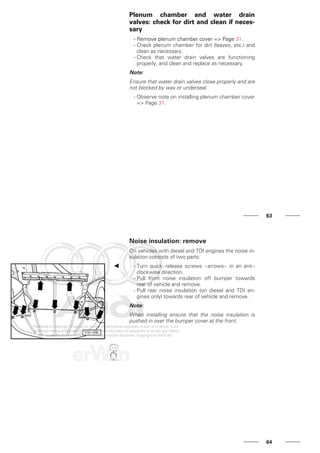
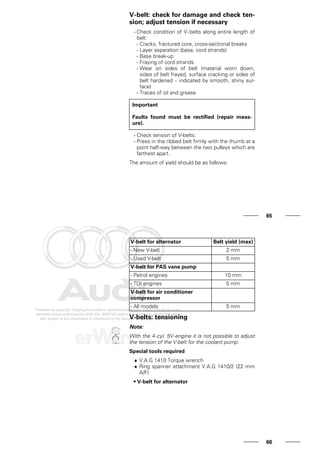
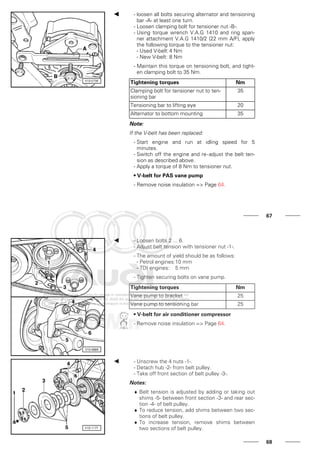
  • 87.
    Audi A6, AudiS6: - Pull back retainer catch -arrows- and remove air intake grille. Note: When reinstalling the air intake grille, ensure that the lugs are inserted into the recesses provided. Rear towing eye The rear towing eye -arrow- is located below the rear right of the bumper. Notes: ♦ The tow rope should be elastic to reduce the risk of damage to both vehicles. It is advisable to use synthetic fibre ropes or ropes of similar elastic material. However, it is safer to use the tow bar. ♦ Avoid excessive tensile forces and jerking. Dur- ing towing operations on roads which are not surfaced, there is always a danger that the at- tachment parts will be over-stressed and dam- aged. ♦ The vehicle should only be tow-started if it is not possible to start the engine using jump leads. 165 If the vehicle has to be towed or tow - started, please note the following points: ♦ Legal regulations concerning towing must be ob- served. ♦ Both drivers must be familiar with towing pro- cedures. Inexperienced drivers should not at- tempt to tow-start or tow. ♦ When using a tow rope, the driver of the towing vehicle must engage the clutch very gently when moving off and changing gear. ♦ The driver of the towed vehicle must ensure that the tow rope is always taut. ♦ Both vehicles must switch on their hazard warn- ing lights, unless otherwise specified by local regulations. ♦ The ignition must be switched on so that the steering wheel is free and the turn signals, horn and windscreen wiper and washer system can be used. ♦ Because the brake servo only works when the engine is running, considerably more pressure is required on the brake pedal when the engine is not running. ♦ The power assisted steering does not work when the engine is not running, therefore more force is required to turn the steering wheel. ♦ If there is no lubricant in the manual or automat- ic gearbox, the vehicle must be towed with the drive wheels raised. When tow - starting vehicles with manual gear- box, please note the following points: 166
  • 88.
    - Before movingoff, engage 2nd or 3rd gear, press clutch pedal and hold. - Switch ignition on. - When both vehicles are moving, release clutch pedal. - As soon as the engine starts, depress clutch and move gear stick to neutral to avoid running into the towing vehicle. Notes: ♦ Vehicles with a catalytic converter (petrol en- gines only) must not be tow-started over a dis- tance of more than 50 m with the catalytic con- verter at operating temperature. Otherwise, un- burned fuel may enter the catalytic converter and cause damage. ♦ For technical reasons, it is not possible to tow- start a vehicle with an automatic gearbox. When towinga vehicle with front - wheel drive and automatic gearbox the following points must also be noted: ♦ Selector lever must be in position "N". ♦ Do not tow vehicle at a speed of more than 50 km/h. ♦ The maximum towing distance is 50 km. If towing over greater distances, the vehicle must be lifted at the front. 167 - Reason: When the engine is not running, the gearbox oil pump does not work, therefore the gearbox is not sufficiently lubricated for high speeds and long distances. Using a breakdown vehicle, the vehicle can only be towed with the front wheels raised. - Reason: If raised at the rear, the drive shafts turn backwards. As a result, the planetary gears in the automatic gearbox will then turn at such high speeds that the gearbox will be severely dam- aged in a short time. When towinga vehicle with four wheel drive and manual gearbox the following points must also be noted: ♦ Do not tow vehicle at a speed of more than 50 km/h. ♦ The maximum towing distance is 50 km. Using a breakdown vehicle the vehicle may be towed suspended at front or rear. Note: If it is not possible to tow the vehicle normally, it must be transported by a special transporter or trail- er. This also applies to distances greater than 50 kilo- metres. When towinga vehicle with four-wheel drive and automatic gearbox the following points must also be noted: ♦ Selector lever must be in position "N". 168
  • 89.
    ♦ Do nottow vehicle at a speed of more than 50 km/h. ♦ The maximum towing distance is 50 km. If using a breakdown vehicle or tow truck the vehicle must not be suspended (either at front or rear) when towing. Note: If it is not possible to tow the vehicle normally, it must be transported by a special transporter or trail- er. Arbeitsabläufe Benzinmotoren Motorspezifischer Arbeitsablauf nach Motorken- nbuchstaben: AAD: Seite 190 AAE: Seite 193 AAH: Seite 195 AAN: Seite 198 AAR: Seite 201 ABC: Seite 204 ABH: Seite 207 ABK: Seite 210 ACE: Seite 213 ACK: Seite 215 ADA: Seite 220 169 ADR: Seite 222 AEC: Seite 207 AHK: Seite 227 Arbeitsabläufe Dieselmotoren Arbeitsablauf nach Motorkennbuchstaben: 1Z: Seite 231 AAS: Seite 231 AAT: Seite 231 ABP: Seite 231 AEL:Seite 231 AHU: Seite 231 170
  • 90.
    Abgasuntersuchung Deutschland Intervalle fürdie Abgasuntersuchung Fahrzeuge mit geregeltem Katalysator bzw. Fahrzeuge mit Dieselmotor: ♦ 36 Monate nach der Erstzulassung und dann alle 24 Monate nach der letzten AU. ♦ Taxi und Mietwagen: Alle 12 Monate. Der Fälligkeitstermin für die nächste Abgasunter- suchung ist der AU-Plakette zu entnehmen. Beispiel Ein Fahrzeug mit der abgebildeten AU-Plakette auf dem amtlichen Kennzeichen vorn muß im Dezember 1997 zur Abgasuntersuchung. Nach bestandener Abgasuntersuchung erhält das Fahrzeug eine AU-Plakette mit einer Gültigkeitsdauer bis Dezember 1999. Hinweis: Bei Taxi und Mietwagen wird eine Plakette mit Gültigkeitsdauer 12 Monate vergeben. 171 Arbeitsabläufe Benzinmotoren Hinweise: ♦ Intervalle für Abgasuntersuchung =>Seite 171. ♦ Alle für die Abgasuntersuchung benötigten Prüf- bedingungen und Daten: => Ordner "Abgasuntersuchung" ♦ Beheben Sie beim Abfragen des Fehlerspeich- ers erkannte Fehler (Motorelektronik) und löschen Sie den Fehlerspeicher vor der Ab- gasuntersuchung. ♦ Bei der Lambda-Regelkreisprüfung durch Fehler- speicher - Abfrage über das V.A.G 1551 ist die Vorbereitung einer Störgröße nicht erforderlich. ♦ Speziell bei neuen Katalysatoren kann es vorkommen, daß die Störgröße von der Regel- ung so schnell ausgeregelt wird, daß der Re- gelvorgang von den Meßgeräten nicht aus- reichend erfaßt wird. ♦ Bei der Lambda-Regelkreisprüfung durch Fehler- speicher - Abfrage über das V.A.G 1551 ist die Vorbereitung einer Störgröße nicht erforderlich. Sichtprüfung - Führen Sie eine Sichtprüfung der schadstoffbee- influssenden Bauteile durch auf: - Vorhandensein - Vollständigkeit - Dichtigkeit - Beschädigung 172
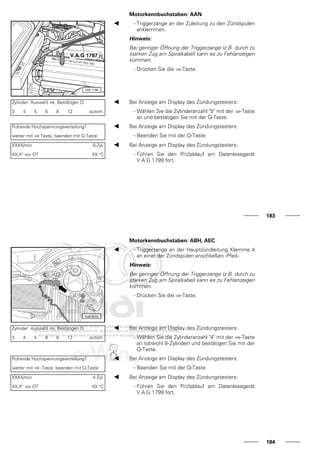
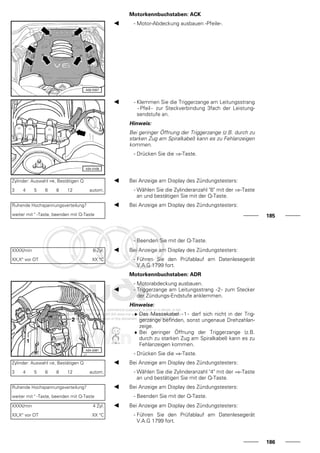
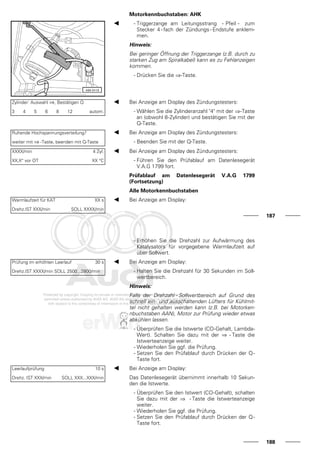
  • 91.
    Störgröße vorbereiten Das Vorbereiteneiner Störgröße ist nur erforderlich bei Prüfung ohne Fehlerspeicher - Abfrage (V.A.G 1551) zur Lambda-Regelkreisprüfung => Seite 190. Hinweise: ♦ Die nachstehend beschriebenen Benzinmotoren, ausgenommen Kennbuchstaben AAD und AAR, sind mit Fehlerspeichern ausgestattet, die es er- möglichen, die Lambda-Regelkreisprüfung durch Fehlerspeicher - Abfrage über das V.A.G 1551 bzw. 1552 vorzunehmen. ♦ Unterdruckleitungen nicht bei laufendem Motor abziehen, sonst erfolgt Fehlerspeicher-Eintrag. ♦ Unterdruckleitung für Störgröße beim Ab- schneiden nicht quetschen; der Leitungsquer- schnitt muß frei sein. Motorkennbuchstaben: AAR - Bereiten Sie die Störgröße wie folgt vor: 173 - Ziehen Sie den Blindstopfen bzw. den Leitung- sanschluß am hinteren Unterdruckanschluß des Sammelsaugrohrs ab. - Montieren Sie folgende Teile, wie in der Abb. dargestellt: - 1 -Tülle 034 133 335 A - 2 -Unterdruckleitung 85 mm lang N 020 139 1 - 3 -Verschlußkappe 034 133 335 Motorkennbuchstaben: ABC - Prüfen Sie bei Lambda - Regelkreisprüfung ohne Fehlerspeicher-Abfrage (V.A.G 1551), ob die fol- genden, zur AU-Prüfung notwendigen Teile einge- baut sind: - 1 -Verschlußkappe 034 133 335 - 2 -Unterdruckleitung 30 mm lang, N 020 139 1; mit Kabelbinder -Pfeil- befestigen. - 3 -Gewebeschläuche 40 mm lang, N 020 353 5 - 4 -T-Anschluß 113 201 943 B - Ggf. Teile einbauen. 174
  • 92.
    Vorbereitung zu Prüfung -Verschlußkappe -1- von T-Anschluß -4- abziehen und auf Unterdruckleitung -2- stecken. - Unterdruckleitung -2- mit T-Anschluß -4- verbind- en. Hinweis: Nach der AU alle Unterdruckleitungen wieder an- schließen => Abb. A28-0014, Seite 174, da sonst Fahrverhaltensmängel zu erwarten sind. Motorkennbuchstaben: ABK - Prüfen Sie bei Lambda - Regelkreisprüfung ohne Fehlerspeicher-Abfrage (V.A.G 1551), ob die fol- genden, zur AU-Prüfung notwendigen Teile einge- baut sind: - 1 -Verschlußkappe 034 133 335 - 2 -Unterdruckleitung 30 mm lang N 020 139 1 - 3 -Gewebeschlauch 40 mm lang N 020 353 5 - Ggf. Teile einbauen. Motorkennbuchstaben: ADR - Bauen Sie bei Lambda - Regelkreisprüfung ohne Fehlerspeicher - Abfrage (V.A.G 1551) die fol- genden, zur AU-Prüfung notwendigen Teile ein: 175 - 1 -Verschlußkappe 034 133 335 (3x) - 2 -Unterdruckleitung 15 mm lang, N 020 139 1 - 3 -Gewebeschlauch 40 mm lang, N 020 353 5 - 4 -Winkelstück 034 129 737 - 5 -Schlauch 50 mm lang, 050 133 784 G - Ziehen Sie den Schlauch -Pfeil- zum AKF-Behälter von der starren Leitung zum Saugrohr ab. - Bestücken Sie das Winkelstück -4-, wie unten in der Abb. gezeigt. - Stecken Sie das Winkelstück mit Schlauch auf die starre Leitung auf, wie oben in der Abb. gezeigt. Hinweise: ♦ Prüfen Sie den Innenquerschnitt des Winkel- stücks mit Draht auf freien Durchgang. ♦ Feilen Sie den Anschluß des Winkelstücks zum leichteren Einstecken in den Schlauch ggf. et- was dünner. 176
  • 93.
    Prüfgeräte Der Prüfablauf istausgelegt für Prüfungen mit der Prüfgerätekombination für Abgasuntersuchung, be- stehend aus: ♦ Fehlerauslesegerät V.A.G 1551 mit Diagnoselei- tung V.A.G 1551/1 ♦ Zündungstester V.A.G 1767 ♦ 4-Komponenten-Abgastester V.A.G 1788 ♦ Datenlesegerät V.A.G 1799 montiert und verbunden auf Meßgerätewagen V.A.G 1700 Achtung! Um Verletzungen von Personen und/oder eine Zerstörung der Einspritz - und Zündanlage zu vermeiden, ist folgendes zu beachten: ♦ Zündleitungen bei laufendem Motor bzw. bei Anlaßdrehzahl nicht berühren bzw. abziehen. ♦ Leitungen der Einspritz- und Zündanlage, auch Meßgeräteleitungen nur bei aus- geschalteter Zündung ab- und anklemmen. 177 Fehlerauslesegerät V.A.G 1551 anschließen Hinweis: Das Fehlerauslesegerät wird zur Datenübertragung vom Abgastester zum Datenlesegerät gebraucht und muß deshalb immer angeschlossen sein. - Ziehen Sie die Handbremse an. - Schalten Sie bei Fahrzeugen mit Automatischem Getriebe den Wählhebel in Stellung "P" oder "N". - Nehmen Sie die Abdeckung vom Zusatzrelais- träger I im Wasserkasten links ab. - Schließen Sie bei ausgeschalteter Zündung den schwarzen Stecker am schwarzen Diagnosean- schluß an. V.A.G - EIGENDIAGNOSE HELP 1 - Schnelle Datenübertragung 1) 2 - Blinkcodeausgabe 1) Anzeige am Display: 1) erscheint wechselweise Hinweis: Erfolgt keine Anzeige am Display: => Bedienungsanleitung des Fehlerauslesegerätes - Schließen Sie den weißen Stecker am weißen bzw. braunen Diagnoseanschluß an (Stecker blau wird nicht verwendet). 178
  • 94.
    Prüfablauf am Datenlesegerät V.A.G1799 Prüfvoraussetzungen: • Klimaanlage ausgeschaltet. • Elektrolüfter für Kühler darf nicht laufen. • Viskolüfter für Kühler darf nicht kraftschlüssig mitlaufen. • Alle elektrischen Verbraucher ausgeschaltet. - Motor anlassen und im Leerlauf laufen lassen. - Drücken Sie am Datenlesegerät die F1-Taste für "AU Benzin". - Führen Sie die Abgasuntersuchung nach den An- weisungen am Display des Datenlesegerätes durch. Fahrzeugidentkarte bitte einstecken !! Manuelle Eingabe mit " -Taste Bei Anzeige am Display: - Drücken Sie die ⇒-Taste. - Geben Sie die Fahrzeug - Identdaten (amtl. Ken- nzeichen, Fzg.-Identnummer usw.) aus dem Kraft- fahrzeugschein über die Tastatur des Datenleseg- erätes ein. Eingabe überprüfen mit " -Taste Weiter mit Q-Taste Bei Anzeige am Display: - Bestätigen Sie die Eingabe der Fahrzeugdaten mit der Q-Taste. Strich-Code einlesen Manuelle Eingabe mit ⇒ -Taste Bei Anzeige am Display: - Ziehen Sie den Lesestift des Datenlesegerätes über den entsprechenden Strichcode des Daten- blattes im Ordner "Abgasuntersuchung". 179 oder - Führen Sie mit der ⇒-Taste die manuelle Eingabe nach den Anweisungen am Display des Datenle- segerätes durch. Eingabe überprüfen mit ⇒ -Taste Weiter mit Q-Taste Bei Anzeige am Display: - Bestätigen Sie die eingegebenen bzw. einge- lesenen Fahrzeugdaten mit der Q-Taste. Sichtprüfung i.O. = j Nicht i.O. = n Bei Anzeige am Display: - Geben Sie das Ergebnis der Sichtprüfung ein. HC-Rückstandstest Sonde an Frischluft? X ppm vol HC Bei Anzeige am Display: Der Abgastester führt einen HC-Rückstandstest aus. Ist der Wert über 20 ppm, wird der Ablauf nicht weit- ergeführt. Die Entnahmesonde darf sich nicht im Ab- gasendrohr befinden. AU-Prüfablauf beginnen Sonde im Abgasendrohr? X % CO Bei Anzeige am Display: - Setzen Sie die Entnahmesonde des Abgastesters in das Abgasendrohr ein. F1 Temperaturmessung mit Meßfühler F2 Temperaturmessung manuell eingeben Bei Anzeige am Display: - Ziehen Sie den Ölmeßstab heraus. - Schieben Sie den Temperatur - Meßfühler in das Ölmeßstabführungsrohr ein. - Drücken Sie die F1 - Taste für "Temperaturmes- sung mit Meßfühler". Motoröltemperatur Ist XX5 C Soll 80° C Bei Anzeige am Display: - Warten Sie, bis die Motoröltemperatur größer80 °C ist. 180
  • 95.
    Prüfung i.O. Weitermit der Q-Taste Prüfung wiederholen mit der F1-Taste Bei Anzeige am Display: - Nehmen Sie den Meßfühler heraus. - Schieben Sie den Ölmeßstab ein. - Setzen Sie den Prüfablauf durch Drücken der Q- Taste fort. - Schließen Sie den Zündungstester an, wie im Fol- genden für die einzelnen Motorkennbuchstaben beschrieben. Zündungstester V.A.G 1767 anschließen Motorkennbuchstaben: AAD, AAE, AAR, ABK, ACE, ADA - Triggerzange an die Hauptzündleitung zwischen Zündspule und Zündverteiler anschließen. Hinweis: Bei geringer Öffnung der Triggerzange (z.B. durch zu starken Zug am Spiralkabel) kann es zu Fehlanzeigen kommen. - Drücken Sie die ⇒-Taste. Zylinder: Auswahl ⇒, Bestätigen Q 3 4 5 6 8 12 autom. Bei Anzeige am Display des Zündungstesters: - Wählen Sie die Zylinderanzahl "4" bzw. "5" mit der ⇒-Taste an und bestätigen Sie mit der Q-Taste. Ruhende Hochspannungsverteilung? weiter mit ⇒ Taste, beenden mit Q Taste Bei Anzeige am Display des Zündungstesters: - Beenden Sie mit der Q-Taste. XXXX/min X Zyl. XX,X° vor OT XX °C Bei Anzeige am Display des Zündungstesters: 181 - Führen Sie den Prüfablauf am Datenlesegerät V.A.G 1799 fort. Motorkennbuchstaben: AAH, ABC - Triggerzange am Leitungsstrang zum 3 - poligen Stecker - Pfeil - zur Zündungs - Endstufe anklem- men. Hinweis: Bei geringer Öffnung der Triggerzange (z.B. durch zu starken Zug am Spiralkabel) kann es zu Fehlanzeigen kommen. - Drücken Sie die ⇒-Taste. Zylinder: Auswahl ⇒, Bestätigen Q 3 4 5 6 8 12 autom. Bei Anzeige am Display des Zündungstesters: - Wählen Sie die Zylinderanzahl "6" mit der ⇒-Taste an und bestätigen Sie mit der Q-Taste. Ruhende Hochspannungsverteilung? weiter mit " -Taste, beenden mit Q-Taste Bei Anzeige am Display des Zündungstesters: - Beenden Sie mit der Q-Taste. XXXX/min 6-Zyl. XX,X° vor OT XX °C Bei Anzeige am Display des Zündungstesters: - Führen Sie den Prüfablauf am Datenlesegerät V.A.G 1799 fort. 182
  • 96.
    Motorkennbuchstaben: AAN - Triggerzangean der Zuleitung zu den Zündspulen anklemmen. Hinweis: Bei geringer Öffnung der Triggerzange (z.B. durch zu starken Zug am Spiralkabel) kann es zu Fehlanzeigen kommen. - Drücken Sie die ⇒-Taste. Zylinder: Auswahl ⇒, Bestätigen Q 3 4 5 6 8 12 autom. Bei Anzeige am Display des Zündungstesters: - Wählen Sie die Zylinderanzahl "5" mit der ⇒-Taste an und bestätigen Sie mit der Q-Taste. Ruhende Hochspannungsverteilung? weiter mit ⇒ Taste, beenden mit Q Taste Bei Anzeige am Display des Zündungstesters: - Beenden Sie mit der Q-Taste. XXXX/min 5-Zyl. XX,X° vor OT XX °C Bei Anzeige am Display des Zündungstesters: - Führen Sie den Prüfablauf am Datenlesegerät V.A.G 1799 fort. 183 Motorkennbuchstaben: ABH, AEC - Triggerzange an der Hauptzündleitung Klemme 4 an einer der Zündspulen anschließen -Pfeil-. Hinweis: Bei geringer Öffnung der Triggerzange (z.B. durch zu starken Zug am Spiralkabel) kann es zu Fehlanzeigen kommen. - Drücken Sie die ⇒-Taste. Zylinder: Auswahl ⇒, Bestätigen Q 3 4 5 6 8 12 autom. Bei Anzeige am Display des Zündungstesters: - Wählen Sie die Zylinderanzahl "4" mit der ⇒-Taste an (obwohl 8-Zylinder) und bestätigen Sie mit der Q-Taste. Ruhende Hochspannungsverteilung? weiter mit ⇒ -Taste, beenden mit Q-Taste Bei Anzeige am Display des Zündungstesters: - Beenden Sie mit der Q-Taste. XXXX/min 4 Zyl. XX,X° vor OT XX °C Bei Anzeige am Display des Zündungstesters: - Führen Sie den Prüfablauf am Datenlesegerät V.A.G 1799 fort. 184
  • 97.
    Motorkennbuchstaben: ACK - Motor-Abdeckungausbauen -Pfeile-. - Klemmen Sie die Triggerzange am Leitungsstrang - Pfeil - zur Steckverbindung 3fach der Leistung- sendstufe an. Hinweis: Bei geringer Öffnung der Triggerzange (z.B. durch zu starken Zug am Spiralkabel) kann es zu Fehlanzeigen kommen. - Drücken Sie die ⇒-Taste. Zylinder: Auswahl ⇒, Bestätigen Q 3 4 5 6 8 12 autom. Bei Anzeige am Display des Zündungstesters: - Wählen Sie die Zylinderanzahl "6" mit der ⇒-Taste an und bestätigen Sie mit der Q-Taste. Ruhende Hochspannungsverteilung? weiter mit " -Taste, beenden mit Q-Taste Bei Anzeige am Display des Zündungstesters: 185 - Beenden Sie mit der Q-Taste. XXXX/min 6-Zyl. XX,X° vor OT XX °C Bei Anzeige am Display des Zündungstesters: - Führen Sie den Prüfablauf am Datenlesegerät V.A.G 1799 fort. Motorkennbuchstaben: ADR - Motorabdeckung ausbauen. - Triggerzange am Leitungsstrang -2- zum Stecker der Zündungs-Endstufe anklemmen. Hinweise: ♦ Das Massekabel -1- darf sich nicht in der Trig- gerzange befinden, sonst ungenaue Drehzahlan- zeige. ♦ Bei geringer Öffnung der Triggerzange (z.B. durch zu starken Zug am Spiralkabel) kann es zu Fehlanzeigen kommen. - Drücken Sie die ⇒-Taste. Zylinder: Auswahl ⇒, Bestätigen Q 3 4 5 6 8 12 autom. Bei Anzeige am Display des Zündungstesters: - Wählen Sie die Zylinderanzahl "4" mit der ⇒-Taste an und bestätigen Sie mit der Q-Taste. Ruhende Hochspannungsverteilung? weiter mit " -Taste, beenden mit Q-Taste Bei Anzeige am Display des Zündungstesters: - Beenden Sie mit der Q-Taste. XXXX/min 4 Zyl. XX,X° vor OT XX °C Bei Anzeige am Display des Zündungstesters: - Führen Sie den Prüfablauf am Datenlesegerät V.A.G 1799 fort. 186
  • 98.
    Motorkennbuchstaben: AHK - Triggerzangeam Leitungsstrang - Pfeil - zum Stecker 4 - fach der Zündungs - Endstufe anklem- men. Hinweis: Bei geringer Öffnung der Triggerzange (z.B. durch zu starken Zug am Spiralkabel) kann es zu Fehlanzeigen kommen. - Drücken Sie die ⇒-Taste. Zylinder: Auswahl ⇒, Bestätigen Q 3 4 5 6 8 12 autom. Bei Anzeige am Display des Zündungstesters: - Wählen Sie die Zylinderanzahl "4" mit der ⇒-Taste an (obwohl 8-Zylinder) und bestätigen Sie mit der Q-Taste. Ruhende Hochspannungsverteilung? weiter mit ⇒ -Taste, beenden mit Q-Taste Bei Anzeige am Display des Zündungstesters: - Beenden Sie mit der Q-Taste. XXXX/min 4 Zyl. XX,X° vor OT XX °C Bei Anzeige am Display des Zündungstesters: - Führen Sie den Prüfablauf am Datenlesegerät V.A.G 1799 fort. Prüfablauf am Datenlesegerät V.A.G 1799 (Fortsetzung) Alle Motorkennbuchstaben Warmlaufzeit für KAT XX s Drehz.IST XXX/min SOLL XXXX/min Bei Anzeige am Display: 187 - Erhöhen Sie die Drehzahl zur Aufwärmung des Katalysators für vorgegebene Warmlaufzeit auf über Sollwert. Prüfung im erhöhten Leerlauf 30 s Drehz.IST XXXX/min SOLL 2500...2800/min Bei Anzeige am Display: - Halten Sie die Drehzahl für 30 Sekunden im Soll- wertbereich. Hinweis: Falls der Drehzahl - Sollwertbereich auf Grund des schnell ein- und ausschaltenden Lüfters für Kühlmit- tel nicht gehalten werden kann (z.B. bei Motorken- nbuchstaben AAN), Motor zur Prüfung wieder etwas abkühlen lassen. - Überprüfen Sie die Istwerte (CO-Gehalt, Lambda- Wert). Schalten Sie dazu mit der ⇒ - Taste die Istwerteanzeige weiter. - Wiederholen Sie ggf. die Prüfung. - Setzen Sie den Prüfablauf durch Drücken der Q- Taste fort. Leerlaufprüfung 10 s Drehz. IST XXX/min SOLL XXX...XXX/min Bei Anzeige am Display: Das Datenlesegerät übernimmt innerhalb 10 Sekun- den die Istwerte. - Überprüfen Sie den Istwert (CO-Gehalt), schalten Sie dazu mit der ⇒ - Taste die Istwerteanzeige weiter. - Wiederholen Sie ggf. die Prüfung. - Setzen Sie den Prüfablauf durch Drücken der Q- Taste fort. 188
  • 99.
    Prüfung mit Fehlerspeicher- Abfrage (V.A.G 1551) zur Lambda-Regelkreisprü- fung Motorkennbuchstaben: AAE, AAH, AAN, ABC, ABH, ABK, ACK, ADA, ADR, AEC, AHK F1 Regelkreisprüfung - Grundverfahren F2 Regelkreisprüfung - alternatives Verf. Bei Anzeige am Display: - Drücken Sie die F2 - Taste für "alternatives Ver- fahren". Damit wird der Fehlerspeicher des Steuergerätes abgefragt (automatischer Prüfab- lauf). F1 Fehlerspeicher abfragen (V.A.G 1551) F2 Manuelle Beurteilung des Regelkreises Bei Anzeige am Display: - Drücken Sie die F1-Taste für Fehlerspeicher-Ab- frage. Prüfung i.O. Weiter mit der Q-Taste Prüfung wiederholen mit der F1-Taste Bei Anzeige am Display: - Drücken Sie die Q-Taste. Hinweis: Prüfung n. i.O. Weiter mit der Q-Taste Prüfung wiederholen mit der F1-Taste Bei Anzeige am Display: F1-Taste drücken und Prüfung wiederholen bzw. Re- paraturmaßnahme durchführen. Eingabe von Erläuterungen mit " -Taste Weiter mit Q-Taste Bei Anzeige am Display: - Geben Sie ggf. Erläuterungen nach Drücken der ⇒-Taste ein. - Drücken Sie die Q-Taste. Prüfer auswählen / manuelle Eingabe F3 F1 XXXXX F2 XXXXX Bei Anzeige am Display: 189 - Wählen Sie mit der F1 ... 3-Taste den Prüfer an bzw. geben Sie den Namen ein. - Drücken Sie die Q - Taste, warten Sie den Pro- tokollausdruck ab. - Drücken Sie die ⇒-Taste. - Beenden Sie die Prüfung durch Drücken der Q - Taste und der F2-Taste. Prüfung ohne Fehlerspeicher - Abfrage (V.A.G 1551) zur Lambda-Regelkreisprü- fung Alle Motorkennbuchstaben F1 Regelkreisprüfung - Grundverfahren F2 Regelkreisprüfung - alternatives Verf. Bei Anzeige am Display: - Drücken Sie die F1-Taste für "Grundverfahren". F1 Grundverfahren - Störgrösse/Halbwellen F2 Regelkreisprüfung - Ersatzverfahren Bei Anzeige am Display: - Drücken Sie die F1-Taste. Regelkreisprüfung XX s Drehz. IST XXXX/min SOLL XXX...XXXX/min Bei Anzeige am Display: Das Datenlesegerät führt Soll/Istwert - Vergleich der Drehzahl für die Regelkreisprüfung aus. Motorkennbuchstabe: AAD Regelkreisprüfung beginnen Weiter mit ⇒ -Taste Bei Anzeige am Display: - Drücken Sie die ⇒ -Taste, die Regelkreisprüfung wird eingeleitet. Regelkreisprüfung Störgröße EIN 60 s X.XXX X.XXX Bei Anzeige am Display: - Schalten Sie sofort die Störgröße wie folgt auf: 190
  • 100.
    - Ziehen Siedie AKF-Leitung am Drosselklappenteil -Pfeil- ab. Nachdem die Störgröße erkannt wurde => Display- Anzeige, muß sie innerhalb 60 Sekunden wieder ausgeregelt werden. Regelkreisprüfung Störgröße AUS 60 s X.XXX X.XXX X.XXX X.XXX Bei Anzeige am Display: - Schalten Sie sofort die Störgröße wie folgt aus: - Stecken Sie die AKF-Leitung am Drosselklappen- teil -Pfeil- auf. Nachdem das Ausschalten der Störgröße erkannt wurde => Display - Anzeige, muß sie innerhalb 60 Sekunden wieder ausgeregelt werden. l-AGW Str. EIN Ausger. Str. AUS Ausger. X.XXX X.XXX X.XXX X.XXX X.XXX Bei Anzeige am Display: - Drücken Sie die ⇒-Taste. Prüfung i.O. Weiter mit der Q-Taste Prüfung wiederholen mit der F1-Taste Bei Anzeige am Display: - Drücken Sie die Q-Taste. Hinweise: Anstelle der Display - Anzeige "Prüfung i.O." kann auch einer der beiden folgenden Display - Texte an- gezeigt werden: 191 Störgröße nur in einer Richtung erkannt F1 1 Halbwelle erlaubt F2 Nicht erlaubt Bei Anzeige am Display: ♦ Die Störgröße wurde nur in einer Richtung erkannt. ♦ Die Regelkreisprüfung gilt auch als bestanden, wenn die Störgröße nur in einer Richtung erkan- nt wurde. ♦ Prüfablauf durch Drücken der F1 - Taste fortset- zen. Prüfung n. i.O. Weiter mit der Q-Taste Prüfung wiederholen mit der F1-Taste Bei Anzeige am Display: ♦ F1 - Taste drücken und Prüfung ggf. mehrfach wiederholen, bis die Störgröße zumindest in ein- er Richtung erkannt wurde. Andernfalls Reparat- urmaßnahme durchführen. Fortsetzung der Prüfung: Eingabe von Erläuterungen mit " -Taste Weiter mit Q-Taste Bei Anzeige am Display: - Geben Sie ggf. Erläuterungen nach Drücken der ⇒-Taste ein. - Drücken Sie die Q-Taste. Prüfer auswählen / manuelle Eingabe F3 F1 XXXXX F2 XXXXX Bei Anzeige am Display: - Wählen Sie mit der F1 ... 3-Taste den Prüfer an bzw. geben Sie den Namen ein. - Drücken Sie die Q - Taste, warten Sie den Pro- tokollausdruck ab. - Drücken Sie die ⇒-Taste. - Beenden Sie die Prüfung durch Drücken der Q - Taste und der F2-Taste. 192
  • 101.
    Hinweis: Durch Drücken derF3 - Taste kann ein Kontrollaus- druck mit den Meßdaten erstellt werden. Motorkennbuchstabe: AAE Regelkreisprüfung beginnen Weiter mit ⇒ -Taste Bei Anzeige am Display: - Drücken Sie die ⇒ -Taste, die Regelkreisprüfung wird eingeleitet. Regelkreisprüfung Störgröße EIN 60 s X.XXX X.XXX Bei Anzeige am Display: - Schalten Sie sofort die Störgröße wie folgt auf: - Ziehen Sie die Unterdruckleitung -Pfeil- am Bimet- allregler ab. Nachdem die Störgröße erkannt wurde => Display- Anzeige, muß sie innerhalb 60 Sekunden wieder ausgeregelt werden. Regelkreisprüfung Störgröße AUS 60 s X.XXX X.XXX X.XXX X.XXX Bei Anzeige am Display: - Schalten Sie sofort die Störgröße wie folgt aus: - Stecken Sie die Unterdruckleitung -Pfeil- am Bi- metallregler auf. 193 Nachdem das Ausschalten der Störgröße erkannt wurde => Display - Anzeige, muß sie innerhalb 60 Sekunden wieder ausgeregelt werden. l-AGW Str. EIN Ausger. Str. AUS Ausger. X.XXX X.XXX X.XXX X.XXX X.XXX Bei Anzeige am Display: - Drücken Sie die ⇒-Taste. Prüfung i.O. Weiter mit der Q-Taste Prüfung wiederholen mit der F1-Taste Bei Anzeige am Display: - Drücken Sie die Q-Taste. Hinweise: Anstelle der Display - Anzeige "Prüfung i.O." kann auch einer der beiden folgenden Display - Texte an- gezeigt werden: Störgröße nur in einer Richtung erkannt F1 1 Halbwelle erlaubt F2 Nicht erlaubt Bei Anzeige am Display: ♦ Die Störgröße wurde nur in einer Richtung erkannt. ♦ Die Regelkreisprüfung gilt auch als bestanden, wenn die Störgröße nur in einer Richtung erkan- nt wurde. ♦ Prüfablauf durch Drücken der F1 - Taste fortset- zen. Prüfung n. i.O. Weiter mit der Q-Taste Prüfung wiederholen mit der F1-Taste Bei Anzeige am Display: ♦ F1 - Taste drücken und Prüfung ggf. mehrfach wiederholen, bis die Störgröße zumindest in ein- er Richtung erkannt wurde. Andernfalls Reparat- urmaßnahme durchführen. Fortsetzung der Prüfung: Eingabe von Erläuterungen mit " -Taste Weiter mit Q-Taste Bei Anzeige am Display: 194
  • 102.
    - Geben Sieggf. Erläuterungen nach Drücken der ⇒-Taste ein. - Drücken Sie die Q-Taste. Prüfer auswählen / manuelle Eingabe F3 F1 XXXXX F2 XXXXX Bei Anzeige am Display: - Wählen Sie mit der F1 ... 3-Taste den Prüfer an bzw. geben Sie den Namen ein. - Drücken Sie die Q - Taste, warten Sie den Pro- tokollausdruck ab. - Drücken Sie die ⇒-Taste. - Beenden Sie die Prüfung durch Drücken der Q - Taste und der F2-Taste. Hinweis: Durch Drücken der F3 - Taste kann ein Kontrollaus- druck mit den Meßdaten erstellt werden. Motorkennbuchstaben: AAH - Motorabdeckung abbauen. - Ziehen Sie den Unterdruckschlauch für Kraftstoff- Druckregler an der Saugrohrseite ab und ver- schließen Sie den Stutzen -Pfeil- von Hand, bis sich die Lambda-Regelung eingeregelt hat (mind. 20 Sekunden). Hinweis: Statt von Hand läßt sich der Stutzen des Unter- druckschlauches auch mit einer Gummi - Ver- schlußkappe 034 133 335 verschließen (z.B. bei heißem Motor). 195 Regelkreisprüfung beginnen Weiter mit ⇒ -Taste Bei Anzeige am Display: - Drücken Sie die ⇒ -Taste, die Regelkreisprüfung wird eingeleitet. Regelkreisprüfung Störgröße EIN 60 s X.XXX X.XXX Bei Anzeige am Display: - Schalten Sie sofort die Störgröße wie folgt auf: - Öffnen Sie den Unterdruckanschluß Saugrohr- seite. Nachdem die Störgröße erkannt wurde => Display- Anzeige, muß sie innerhalb 60 Sekunden wieder ausgeregelt werden. Regelkreisprüfung Störgröße AUS 60 s X.XXX X.XXX X.XXX X.XXX Bei Anzeige am Display: - Schalten Sie sofort die Störgröße wie folgt aus: - Verschließen Sie den Unterdruckanschluß Saugrohrseite -Pfeil- von Hand. Nachdem das Ausschalten der Störgröße erkannt wurde => Display - Anzeige, muß sie innerhalb 60 Sekunden wieder ausgeregelt werden. l-AGW Str. EIN Ausger. Str. AUS Ausger. X.XXX X.XXX X.XXX X.XXX X.XXX Bei Anzeige am Display: - Drücken Sie die ⇒-Taste. Prüfung i.O. Weiter mit der Q-Taste Prüfung wiederholen mit der F1-Taste Bei Anzeige am Display: 196
  • 103.
    - Drücken Siedie Q-Taste. Hinweise: Anstelle der Display - Anzeige "Prüfung i.O." kann auch einer der beiden folgenden Display - Texte an- gezeigt werden: Störgröße nur in einer Richtung erkannt F1 1 Halbwelle erlaubt F2 Nicht erlaubt Bei Anzeige am Display: ♦ Die Störgröße wurde nur in einer Richtung erkannt. ♦ Die Regelkreisprüfung gilt auch als bestanden, wenn die Störgröße nur in einer Richtung erkan- nt wurde. ♦ Prüfablauf durch Drücken der F1 - Taste fortset- zen. Prüfung n. i.O. Weiter mit der Q-Taste Prüfung wiederholen mit der F1-Taste Bei Anzeige am Display: ♦ F1 - Taste drücken und Prüfung ggf. mehrfach wiederholen, bis die Störgröße zumindest in ein- er Richtung erkannt wurde. Andernfalls Reparat- urmaßnahme durchführen. Fortsetzung der Prüfung: Eingabe von Erläuterungen mit " -Taste Weiter mit Q-Taste Bei Anzeige am Display: - Geben Sie ggf. Erläuterungen nach Drücken der ⇒-Taste ein. - Drücken Sie die Q-Taste. Prüfer auswählen / manuelle Eingabe F3 F1 XXXXX F2 XXXXX Bei Anzeige am Display: - Wählen Sie mit der F1 ... 3-Taste den Prüfer an bzw. geben Sie den Namen ein. 197 - Drücken Sie die Q - Taste, warten Sie den Pro- tokollausdruck ab. - Drücken Sie die ⇒-Taste. - Beenden Sie die Prüfung durch Drücken der Q - Taste und der F2-Taste. Hinweise: ♦ Durch Drücken der F3 - Taste kann ein Kontrol- lausdruck mit den Meßdaten erstellt werden. ♦ Schließen Sie nach der AU den Unterdrucksch- lauch wieder am Stutzen -Pfeil- an. Motorkennbuchstabe: AAN Regelkreisprüfung beginnen Weiter mit ⇒ -Taste Bei Anzeige am Display: - Drücken Sie die ⇒ -Taste, die Regelkreisprüfung wird eingeleitet. Regelkreisprüfung Störgröße EIN 60 s X.XXX X.XXX Bei Anzeige am Display: - Schalten Sie sofort die Störgröße wie folgt auf: 198
  • 104.
    - Ziehen Siedie Unterdruckleitung -Pfeil- am Kraft- stoffdruckregler ab. Nachdem die Störgröße erkannt wurde => Display- Anzeige, muß sie innerhalb 60 Sekunden wieder ausgeregelt werden. Regelkreisprüfung Störgröße AUS 60 s X.XXX X.XXX X.XXX X.XXX Bei Anzeige am Display: - Schalten Sie sofort die Störgröße wie folgt aus: - Stecken Sie die Unterdruckleitung -Pfeil- am Kraft- stoffdruckregler auf. Nachdem das Ausschalten der Störgröße erkannt wurde => Display - Anzeige, muß sie innerhalb 60 Sekunden wieder ausgeregelt werden. l-AGW Str. EIN Ausger. Str. AUS Ausger. X.XXX X.XXX X.XXX X.XXX X.XXX Bei Anzeige am Display: - Drücken Sie die ⇒-Taste. Prüfung i.O. Weiter mit der Q-Taste Prüfung wiederholen mit der F1-Taste Bei Anzeige am Display: - Drücken Sie die Q-Taste. Hinweise: Anstelle der Display - Anzeige "Prüfung i.O." kann auch einer der beiden folgenden Display - Texte an- gezeigt werden: 199 Störgröße nur in einer Richtung erkannt F1 1 Halbwelle erlaubt F2 Nicht erlaubt Bei Anzeige am Display: ♦ Die Störgröße wurde nur in einer Richtung erkannt. ♦ Die Regelkreisprüfung gilt auch als bestanden, wenn die Störgröße nur in einer Richtung erkan- nt wurde. ♦ Prüfablauf durch Drücken der F1 - Taste fortset- zen. Prüfung n. i.O. Weiter mit der Q-Taste Prüfung wiederholen mit der F1-Taste Bei Anzeige am Display: ♦ F1 - Taste drücken und Prüfung ggf. mehrfach wiederholen, bis die Störgröße zumindest in ein- er Richtung erkannt wurde. Andernfalls Reparat- urmaßnahme durchführen. ♦ Im Ausnahmefall kann es vorkommen, daß die Störgröße nicht erkannt wird. • Maßnahme bei nicht erkannter Störgröße: - Ziehen Sie die Unterdruckleitung -Pfeil- vom Kraft- stoffdruckregler ab. - Verschließen Sie das Leitungsende mit einem Dorn. - Warten Sie, bis sich die Lambda - Regelung eingeregelt hat (mind. 20 Sekunden). - Ziehen Sie zum Aufschalten der Störgröße den Dorn von der Unterdruckleitung ab. - Stecken Sie zum Ausschalten der Störgröße den Dorn wieder auf die Unterdruckleitung auf. Fortsetzung der Prüfung: Eingabe von Erläuterungen mit " -Taste Weiter mit Q-Taste Bei Anzeige am Display: 200
  • 105.
    - Geben Sieggf. Erläuterungen nach Drücken der ⇒-Taste ein. - Drücken Sie die Q-Taste. Prüfer auswählen / manuelle Eingabe F3 F1 XXXXX F2 XXXXX Bei Anzeige am Display: - Wählen Sie mit der F1 ... 3-Taste den Prüfer an bzw. geben Sie den Namen ein. - Drücken Sie die Q - Taste, warten Sie den Pro- tokollausdruck ab. - Drücken Sie die ⇒-Taste. - Beenden Sie die Prüfung durch Drücken der Q - Taste und der F2-Taste. Hinweis: Durch Drücken der F3 - Taste kann ein Kontrollaus- druck mit den Meßdaten erstellt werden. Motorkennbuchstabe: AAR Regelkreisprüfung beginnen Weiter mit ⇒ -Taste Bei Anzeige am Display: - Drücken Sie die ⇒ -Taste, die Regelkreisprüfung wird eingeleitet. Regelkreisprüfung Störgröße EIN 60 s X.XXX X.XXX Bei Anzeige am Display: - Schalten Sie sofort die Störgröße wie folgt auf: 201 - Ziehen Sie die Verschlußkappe -3- ab. Nachdem die Störgröße erkannt wurde => Display- Anzeige, muß sie innerhalb 60 Sekunden wieder ausgeregelt werden. Regelkreisprüfung Störgröße AUS 60 s X.XXX X.XXX X.XXX X.XXX Bei Anzeige am Display: - Schalten Sie sofort die Störgröße wie folgt aus: - Stecken Sie die Verschlußkappe auf. Nachdem das Ausschalten der Störgröße erkannt wurde => Display - Anzeige, muß sie innerhalb 60 Sekunden wieder ausgeregelt werden. l-AGW Str. EIN Ausger. Str. AUS Ausger. X.XXX X.XXX X.XXX X.XXX X.XXX Bei Anzeige am Display: - Drücken Sie die ⇒-Taste. Prüfung i.O. Weiter mit der Q-Taste Prüfung wiederholen mit der F1-Taste Bei Anzeige am Display: - Drücken Sie die Q-Taste. Hinweise: Anstelle der Display - Anzeige "Prüfung i.O." kann auch einer der beiden folgenden Display - Texte an- gezeigt werden: Störgröße nur in einer Richtung erkannt F1 1 Halbwelle erlaubt F2 Nicht erlaubt Bei Anzeige am Display: 202
  • 106.
    ♦ Die Störgrößewurde nur in einer Richtung erkannt. ♦ Die Regelkreisprüfung gilt auch als bestanden, wenn die Störgröße nur in einer Richtung erkan- nt wurde. ♦ Prüfablauf durch Drücken der F1 - Taste fortset- zen. Prüfung n. i.O. Weiter mit der Q-Taste Prüfung wiederholen mit der F1-Taste Bei Anzeige am Display: ♦ F1 - Taste drücken und Prüfung ggf. mehrfach wiederholen, bis die Störgröße zumindest in ein- er Richtung erkannt wurde. ♦ Im Ausnahmefall kann es vorkommen, daß die Störgröße nicht erkannt oder nicht ausgeregelt wird. • Maßnahme bei nicht erkannter Störgröße: - Verkürzen Sie die Unterdruckleitung - 2 - schritt- weise um 10 mm, bis die Störgröße erkannt wird. • Maßnahme bei nicht ausgeregelter Störgröße: - Verlängern Sie die Unterdruckleitung -2- schritt- weise um 10 mm, bis Störgröße ausgeregelt wer- den kann. Fortsetzung der Prüfung: Eingabe von Erläuterungen mit " -Taste Weiter mit Q-Taste Bei Anzeige am Display: 203 - Geben Sie ggf. Erläuterungen nach Drücken der ⇒-Taste ein. - Drücken Sie die Q-Taste. Prüfer auswählen / manuelle Eingabe F3 F1 XXXXX F2 XXXXX Bei Anzeige am Display: - Wählen Sie mit der F1 ... 3-Taste den Prüfer an bzw. geben Sie den Namen ein. - Drücken Sie die Q - Taste, warten Sie den Pro- tokollausdruck ab. - Drücken Sie die ⇒-Taste. - Beenden Sie die Prüfung durch Drücken der Q - Taste und der F2-Taste. Hinweise: ♦ Durch Drücken der F3 - Taste kann ein Kontrol- lausdruck mit den Meßdaten erstellt werden. ♦ Stecken Sie nach der AU den Blindstopfen bzw. den Leitungsanschluß des Sammelsaugrohrs wieder auf. Montieren Sie eine Schlauchschelle, die dem Serienstand entspricht. => Teile-Katalog ♦ Unterdruckleitungen nicht bei laufendem Motor abziehen, sonst Fehlerspeicher-Eintrag. Motorkennbuchstaben: ABC Regelkreisprüfung beginnen Weiter mit ⇒ -Taste Bei Anzeige am Display: - Drücken Sie die ⇒ -Taste, die Regelkreisprüfung wird eingeleitet. Regelkreisprüfung Störgröße EIN 60 s X.XXX X.XXX Bei Anzeige am Display: 204
  • 107.
    - Schalten Siesofort die Störgröße wie folgt auf: - Ziehen Sie die Verschlußkappe -1- ab. Nachdem die Störgröße erkannt wurde => Display- Anzeige, muß sie innerhalb 60 Sekunden wieder ausgeregelt werden. Regelkreisprüfung Störgröße AUS 60 s X.XXX X.XXX X.XXX X.XXX Bei Anzeige am Display: - Schalten Sie sofort die Störgröße wie folgt aus: - Stecken Sie die Verschlußkappe -1- auf. Nachdem das Ausschalten der Störgröße erkannt wurde => Display - Anzeige, muß sie innerhalb 60 Sekunden wieder ausgeregelt werden. l-AGW Str. EIN Ausger. Str. AUS Ausger. X.XXX X.XXX X.XXX X.XXX X.XXX Bei Anzeige am Display: - Drücken Sie die ⇒-Taste. Prüfung i.O. Weiter mit der Q-Taste Prüfung wiederholen mit der F1-Taste Bei Anzeige am Display: - Drücken Sie die Q-Taste. Hinweise: Anstelle der Display - Anzeige "Prüfung i.O." kann auch einer der beiden folgenden Display - Texte an- gezeigt werden: 205 Störgröße nur in einer Richtung erkannt F1 1 Halbwelle erlaubt F2 Nicht erlaubt Bei Anzeige am Display: ♦ Die Störgröße wurde nur in einer Richtung erkannt. ♦ Die Regelkreisprüfung gilt auch als bestanden, wenn die Störgröße nur in einer Richtung erkan- nt wurde. ♦ Prüfablauf durch Drücken der F1 - Taste fortset- zen. Prüfung n. i.O. Weiter mit der Q-Taste Prüfung wiederholen mit der F1-Taste Bei Anzeige am Display: ♦ F1 - Taste drücken und Prüfung ggf. mehrfach wiederholen, bis die Störgröße zumindest in ein- er Richtung erkannt wurde. ♦ Im Ausnahmefall kann es vorkommen, daß die Störgröße nicht erkannt oder nicht ausgeregelt wird. • Maßnahme bei nicht erkannter Störgröße: - Verkürzen Sie den Schlauch -2- schrittweise um 100 mm, bis die Störgröße erkannt wird. • Maßnahme bei nicht ausgeregelter Störgröße: - Verlängern Sie den Schlauch -2- schrittweise um 100 mm, bis Störgröße ausgeregelt werden kann. Fortsetzung der Prüfung: Eingabe von Erläuterungen mit " -Taste Weiter mit Q-Taste Bei Anzeige am Display: 206
  • 108.
    - Geben Sieggf. Erläuterungen nach Drücken der ⇒-Taste ein. - Drücken Sie die Q-Taste. Prüfer auswählen / manuelle Eingabe F3 F1 XXXXX F2 XXXXX Bei Anzeige am Display: - Wählen Sie mit der F1 ... 3-Taste den Prüfer an bzw. geben Sie den Namen ein. - Drücken Sie die Q - Taste, warten Sie den Pro- tokollausdruck ab. - Drücken Sie die ⇒-Taste. - Beenden Sie die Prüfung durch Drücken der Q - Taste und der F2-Taste. Hinweise: ♦ Durch Drücken der F3 - Taste kann ein Kontrol- lausdruck mit den Meßdaten erstellt werden. ♦ Schließen Sie nach der AU alle Unterdruckleitun- gen wieder an, wie in der Abb. gezeigt, da sonst Fahrverhaltensmängel zu erwarten sind. ♦ Unterdruckleitungen nicht bei laufendem Motor abziehen, sonst Fehlerspeicher-Eintrag. Motorkennbuchstaben: ABH, AEC Regelkreisprüfung beginnen Weiter mit ⇒ -Taste Bei Anzeige am Display: 207 - Unterdruckleitung - A - vom Kraftstoffdruckregler abziehen und mit Dorn verschließen, Handvak- uumpumpe V.A.G 1390 mit Hilfsschlauch -B- am Druckregler anschließen, bis sich die Lambda-Re- gelung eingeregelt hat (min. 20 Sekunden). - Drücken Sie die ⇒ -Taste, die Regelkreisprüfung wird eingeleitet. Regelkreisprüfung Störgröße EIN 60 s X.XXX X.XXX Bei Anzeige am Display: - Schalten Sie sofort die Störgröße wie folgt auf: - Gleichzeitig Unterdruckleitung - A - öffnen und Handvakuumpumpe mehrmals schnell betätigen. Nachdem die Störgröße erkannt wurde => Display- Anzeige, muß sie innerhalb 60 Sekunden wieder ausgeregelt werden. Regelkreisprüfung Störgröße AUS 60 s X.XXX X.XXX X.XXX X.XXX Bei Anzeige am Display: - Schalten Sie sofort die Störgröße wie folgt aus: 208
  • 109.
    - Gleichzeitig Handvakuumpumpeam Kraftstoff- druckregler abziehen und Unterdruckleitung - A - verschließen. Nachdem das Ausschalten der Störgröße erkannt wurde => Display - Anzeige, muß sie innerhalb 60 Sekunden wieder ausgeregelt werden. - Stecken Sie die Unterdruckleitung -A- am Kraft- stoffdruckregler wieder auf. l-AGW Str. EIN Ausger. Str. AUS Ausger. X.XXX X.XXX X.XXX X.XXX X.XXX Bei Anzeige am Display: - Drücken Sie die ⇒-Taste. Prüfung i.O. Weiter mit der Q-Taste Prüfung wiederholen mit der F1-Taste Bei Anzeige am Display: - Drücken Sie die Q-Taste. Hinweise: Anstelle der Display - Anzeige "Prüfung i.O." kann auch einer der beiden folgenden Display - Texte an- gezeigt werden: Störgröße nur in einer Richtung erkannt F1 1 Halbwelle erlaubt F2 Nicht erlaubt Bei Anzeige am Display: ♦ Die Störgröße wurde nur in einer Richtung erkannt. ♦ Die Regelkreisprüfung gilt auch als bestanden, wenn die Störgröße nur in einer Richtung erkan- nt wurde. ♦ Prüfablauf durch Drücken der F1 - Taste fortset- zen. 209 Prüfung n. i.O. Weiter mit der Q-Taste Prüfung wiederholen mit der F1-Taste Bei Anzeige am Display: ♦ F1 - Taste drücken und Prüfung ggf. mehrfach wiederholen, bis die Störgröße zumindest in ein- er Richtung erkannt wurde. Andernfalls Reparat- urmaßnahme durchführen. Fortsetzung der Prüfung: Eingabe von Erläuterungen mit " -Taste Weiter mit Q-Taste Bei Anzeige am Display: - Geben Sie ggf. Erläuterungen nach Drücken der ⇒-Taste ein. - Drücken Sie die Q-Taste. Prüfer auswählen / manuelle Eingabe F3 F1 XXXXX F2 XXXXX Bei Anzeige am Display: - Wählen Sie mit der F1 ... 3-Taste den Prüfer an bzw. geben Sie den Namen ein. - Drücken Sie die Q - Taste, warten Sie den Pro- tokollausdruck ab. - Drücken Sie die ⇒-Taste. - Beenden Sie die Prüfung durch Drücken der Q - Taste und der F2-Taste. Hinweis: Durch Drücken der F3 - Taste kann ein Kontrollaus- druck mit den Meßdaten erstellt werden. Motorkennbuchstaben: ABK Regelkreisprüfung beginnen Weiter mit ⇒ -Taste Bei Anzeige am Display: - Drücken Sie die ⇒ -Taste, die Regelkreisprüfung wird eingeleitet. Regelkreisprüfung Störgröße EIN 60 s X.XXX X.XXX Bei Anzeige am Display: 210
  • 110.
    - Schalten Siesofort die Störgröße wie folgt auf: - Ziehen Sie die Verschlußkappe -1- ab. Nachdem die Störgröße erkannt wurde => Display- Anzeige, muß sie innerhalb 60 Sekunden wieder ausgeregelt werden. Regelkreisprüfung Störgröße AUS 60 s X.XXX X.XXX X.XXX X.XXX Bei Anzeige am Display: - Schalten Sie sofort die Störgröße wie folgt aus: - Stecken Sie die Verschlußkappe -1- auf. Nachdem das Ausschalten der Störgröße erkannt wurde => Display - Anzeige, muß sie innerhalb 60 Sekunden wieder ausgeregelt werden. l-AGW Str. EIN Ausger. Str. AUS Ausger. X.XXX X.XXX X.XXX X.XXX X.XXX Bei Anzeige am Display: - Drücken Sie die ⇒-Taste. Prüfung i.O. Weiter mit der Q-Taste Prüfung wiederholen mit der F1-Taste Bei Anzeige am Display: - Drücken Sie die Q-Taste. Hinweise: Anstelle der Display - Anzeige "Prüfung i.O." kann auch einer der beiden folgenden Display - Texte an- gezeigt werden: 211 Störgröße nur in einer Richtung erkannt F1 1 Halbwelle erlaubt F2 Nicht erlaubt Bei Anzeige am Display: ♦ Die Störgröße wurde nur in einer Richtung erkannt. ♦ Die Regelkreisprüfung gilt auch als bestanden, wenn die Störgröße nur in einer Richtung erkan- nt wurde. ♦ Prüfablauf durch Drücken der F1 - Taste fortset- zen. Prüfung n. i.O. Weiter mit der Q-Taste Prüfung wiederholen mit der F1-Taste Bei Anzeige am Display: ♦ F1 - Taste drücken und Prüfung ggf. mehrfach wiederholen, bis die Störgröße zumindest in ein- er Richtung erkannt wurde. Andernfalls Reparat- urmaßnahme durchführen. Fortsetzung der Prüfung: Eingabe von Erläuterungen mit " -Taste Weiter mit Q-Taste Bei Anzeige am Display: - Geben Sie ggf. Erläuterungen nach Drücken der ⇒-Taste ein. - Drücken Sie die Q-Taste. Prüfer auswählen / manuelle Eingabe F3 F1 XXXXX F2 XXXXX Bei Anzeige am Display: - Wählen Sie mit der F1 ... 3-Taste den Prüfer an bzw. geben Sie den Namen ein. - Drücken Sie die Q - Taste, warten Sie den Pro- tokollausdruck ab. - Drücken Sie die ⇒-Taste. - Beenden Sie die Prüfung durch Drücken der Q - Taste und der F2-Taste. 212
  • 111.
    Hinweis: Durch Drücken derF3 - Taste kann ein Kontrollaus- druck mit den Meßdaten erstellt werden. Motorkennbuchstaben: ACE Regelkreisprüfung beginnen Weiter mit ⇒ -Taste Bei Anzeige am Display: - Unterdruckleitung - Pfeil - am Saugrohr abziehen und mit Dorn verschließen, bis sich die Lambda- Regelung eingeregelt hat (min. 20 Sekunden). - Drücken Sie die ⇒ -Taste, die Regelkreisprüfung wird eingeleitet. Regelkreisprüfung Störgröße EIN 60 s X.XXX X.XXX Bei Anzeige am Display: - Schalten Sie sofort die Störgröße wie folgt auf: - Öffnen Sie die Unterdruckleitung -Pfeil-. Nachdem die Störgröße erkannt wurde => Display- Anzeige, muß sie innerhalb 60 Sekunden wieder ausgeregelt werden. Regelkreisprüfung Störgröße AUS 60 s X.XXX X.XXX X.XXX X.XXX Bei Anzeige am Display: - Schalten Sie sofort die Störgröße wie folgt aus: 213 - Verschließen Sie die Unterdruckleitung -Pfeil-. Nachdem das Ausschalten der Störgröße erkannt wurde => Display - Anzeige, muß sie innerhalb 60 Sekunden wieder ausgeregelt werden. l-AGW Str. EIN Ausger. Str. AUS Ausger. X.XXX X.XXX X.XXX X.XXX X.XXX Bei Anzeige am Display: - Drücken Sie die ⇒-Taste. Prüfung i.O. Weiter mit der Q-Taste Prüfung wiederholen mit der F1-Taste Bei Anzeige am Display: - Drücken Sie die Q-Taste. Hinweise: Anstelle der Display - Anzeige "Prüfung i.O." kann auch einer der beiden folgenden Display - Texte an- gezeigt werden: Störgröße nur in einer Richtung erkannt F1 1 Halbwelle erlaubt F2 Nicht erlaubt Bei Anzeige am Display: ♦ Die Störgröße wurde nur in einer Richtung erkannt. ♦ Die Regelkreisprüfung gilt auch als bestanden, wenn die Störgröße nur in einer Richtung erkan- nt wurde. ♦ Prüfablauf durch Drücken der F1 - Taste fortset- zen. 214
  • 112.
    Prüfung n. i.O.Weiter mit der Q-Taste Prüfung wiederholen mit der F1-Taste Bei Anzeige am Display: ♦ F1 - Taste drücken und Prüfung ggf. mehrfach wiederholen, bis die Störgröße zumindest in ein- er Richtung erkannt wurde. Andernfalls Reparat- urmaßnahme durchführen. Fortsetzung der Prüfung: Eingabe von Erläuterungen mit " -Taste Weiter mit Q-Taste Bei Anzeige am Display: - Geben Sie ggf. Erläuterungen nach Drücken der ⇒-Taste ein. - Drücken Sie die Q-Taste. Prüfer auswählen / manuelle Eingabe F3 F1 XXXXX F2 XXXXX Bei Anzeige am Display: - Wählen Sie mit der F1 ... 3-Taste den Prüfer an bzw. geben Sie den Namen ein. - Drücken Sie die Q - Taste, warten Sie den Pro- tokollausdruck ab. - Drücken Sie die ⇒-Taste. - Beenden Sie die Prüfung durch Drücken der Q - Taste und der F2-Taste. Hinweis: Durch Drücken der F3 - Taste kann ein Kontrollaus- druck mit den Meßdaten erstellt werden. Motorkennbuchstabe: ACK Regelkreisprüfung beginnen Weiter mit ⇒ -Taste Bei Anzeige am Display: 215 - Unterdruckschlauch vom Stutzen am Kraftstoff - Druckregler -Pfeil 2- abziehen und mit Dorn -Pfeil 3 - verschließen, bis sich die Lambda - Regelung eingeregelt hat (min. 20 Sekunden). - Drücken Sie die ⇒ -Taste, die Regelkreisprüfung wird eingeleitet. Regelkreisprüfung Störgröße EIN 60 s X.XXX X.XXX Bei Anzeige am Display: - Schalten Sie sofort die Störgröße wie folgt auf: - Ziehen Sie den Dorn - Pfeil 3 - aus dem Unter- druckschlauch und ziehen Sie zusätzlich den Sch- lauch -Pfeil 1- am Rückschlagventil ab. Nachdem die Störgröße erkannt wurde => Display- Anzeige, muß sie innerhalb 60 Sekunden wieder ausgeregelt werden. Regelkreisprüfung Störgröße AUS 60 s X.XXX X.XXX X.XXX X.XXX Bei Anzeige am Display: - Schalten Sie sofort die Störgröße wie folgt aus: 216
  • 113.
    - Stecken Sieden Dorn -Pfeil 3-wieder in den Un- terdruckschlauch und stecken Sie den Schlauch - Pfeil 1- auf das Rückschlagventil. Nachdem das Ausschalten der Störgröße erkannt wurde => Display - Anzeige, muß sie innerhalb 60 Sekunden wieder ausgeregelt werden. l-AGW Str. EIN Ausger. Str. AUS Ausger. X.XXX X.XXX X.XXX X.XXX X.XXX Bei Anzeige am Display: - Drücken Sie die ⇒-Taste. Prüfung i.O. Weiter mit der Q-Taste Prüfung wiederholen mit der F1-Taste Bei Anzeige am Display: - Drücken Sie die Q-Taste. Hinweise: Anstelle der Display - Anzeige "Prüfung i.O." kann auch einer der beiden folgenden Display - Texte an- gezeigt werden: Störgröße nur in einer Richtung erkannt F1 1 Halbwelle erlaubt F2 Nicht erlaubt Bei Anzeige am Display: ♦ Die Störgröße wurde nur in einer Richtung erkannt. ♦ Die Regelkreisprüfung gilt auch als bestanden, wenn die Störgröße nur in einer Richtung erkan- nt wurde. ♦ Prüfablauf durch Drücken der F1 - Taste fortset- zen. 217 Prüfung n. i.O. Weiter mit der Q-Taste Prüfung wiederholen mit der F1-Taste Bei Anzeige am Display: ♦ F1 - Taste drücken und Prüfung ggf. mehrfach wiederholen, bis die Störgröße zumindest in ein- er Richtung erkannt wurde. ♦ Im Ausnahmefall kann es vorkommen, daß die Störgröße nicht erkannt wird. • Maßnahme bei nicht erkannter Störgröße: - Klemmen Sie den Unterdruckschlauch -Pfeil- vom Motor zum AKF - Ventil mit Schlauchklemme V.A.G 3094 ab. - Ziehen Sie den abgeklemmten Unterdrucksch- lauch am AKF-Ventil ab. Stecker des AKF-Ventils nicht abziehen, sonst Fehlerspeicher-Eintrag! - Stecken Sie das Winkelstück 034 129 737 -Pos. 4- auf den abgezogenen Unterdruckschlauch -Pfeil- auf. - Feilen Sie ggf. den Anschluß des Winkelstückes zum leichteren Einstecken in den Schlauch etwas dünner. - Prüfen Sie den Innenquerschnitt des Winkel- stückes mit Draht auf freien Durchgang. 218
  • 114.
    - Bestücken Siedas Winkelstück -4-, wie gezeigt: 1 - Verschlußkappe 034 133 335 (3x) 2 - Unterdruckleitung 30 mm lang, N 020 139 1 3 - Gewebeschlauch 40 mm lang, N 020 353 5 - Bauen Sie die Schlauchklemme V.A.G 3094 wieder aus. - Ziehen Sie zum Aufschalten der Störgröße die beiden mit Pfeilen gekennzeichneten Ver- schlußkappengleichzeitigab. - Stecken Sie zum Ausschalten der Störgröße beide Verschlußkappengleichzeitigauf. Fortsetzung der Prüfung: Eingabe von Erläuterungen mit ⇒ -Taste Weiter mit Q-Taste Bei Anzeige am Display: - Geben Sie ggf. Erläuterungen nach Drücken der ⇒-Taste ein. - Drücken Sie die Q-Taste. Prüfer auswählen / manuelle Eingabe F3 F1 XXXXX F2 XXXXX Bei Anzeige am Display: - Wählen Sie mit der F1 ... 3-Taste den Prüfer an bzw. geben Sie den Namen ein. - Drücken Sie die Q - Taste, warten Sie den Pro- tokollausdruck ab. - Drücken Sie die ⇒-Taste. - Beenden Sie die Prüfung durch Drücken der Q - Taste und der F2-Taste. Hinweise: ♦ Durch Drücken der F3 - Taste kann ein Kontrol- lausdruck mit den Meßdaten erstellt werden. 219 ♦ Ziehen Sie keine Unterdruckschläuche bei laufendem Motor ab, sonst erfolgt Fehlerspeich- er-Eintrag. ♦ Schließen Sie nach der AU alle Unter- druckschläuche wieder an. ♦ Entfernen Sie nach der AU das ggf. eingebaute Winkelstück wieder und befestigen Sie den Sch- lauch am AKF - Behälter mit einer Schlauch- schelle, die dem Serienstand entspricht. => Teile-Katalog Motorkennbuchstaben: ADA Regelkreisprüfung beginnen Weiter mit ⇒ -Taste Bei Anzeige am Display: - Drücken Sie die ⇒ -Taste, die Regelkreisprüfung wird eingeleitet. Regelkreisprüfung Störgröße EIN 60 s X.XXX X.XXX Bei Anzeige am Display: - Schalten Sie sofort die Störgröße wie folgt auf: - Ziehen Sie die Unterdruckleitung - Pfeil - am Saugrohr ab. Nachdem die Störgröße erkannt wurde => Display- Anzeige, muß sie innerhalb 60 Sekunden wieder ausgeregelt werden. 220
  • 115.
    Regelkreisprüfung Störgröße AUS60 s X.XXX X.XXX X.XXX X.XXX Bei Anzeige am Display: - Schalten Sie sofort die Störgröße wie folgt aus: - Stecken Sie die Unterdruckleitung - Pfeil - am Saugrohr auf. Nachdem das Ausschalten der Störgröße erkannt wurde => Display - Anzeige, muß sie innerhalb 60 Sekunden wieder ausgeregelt werden. l-AGW Str. EIN Ausger. Str. AUS Ausger. X.XXX X.XXX X.XXX X.XXX X.XXX Bei Anzeige am Display: - Drücken Sie die ⇒-Taste. Prüfung i.O. Weiter mit der Q-Taste Prüfung wiederholen mit der F1-Taste Bei Anzeige am Display: - Drücken Sie die Q-Taste. Hinweise: Anstelle der Display - Anzeige "Prüfung i.O." kann auch einer der beiden folgenden Display - Texte an- gezeigt werden: Störgröße nur in einer Richtung erkannt F1 1 Halbwelle erlaubt F2 Nicht erlaubt Bei Anzeige am Display: ♦ Die Störgröße wurde nur in einer Richtung erkannt. ♦ Die Regelkreisprüfung gilt auch als bestanden, wenn die Störgröße nur in einer Richtung erkan- nt wurde. ♦ Prüfablauf durch Drücken der F1 - Taste fortset- zen. Prüfung n. i.O. Weiter mit der Q-Taste Prüfung wiederholen mit der F1-Taste Bei Anzeige am Display: 221 ♦ F1 - Taste drücken und Prüfung ggf. mehrfach wiederholen, bis die Störgröße zumindest in ein- er Richtung erkannt wurde. Andernfalls Reparat- urmaßnahme durchführen. Fortsetzung der Prüfung: Eingabe von Erläuterungen mit " -Taste Weiter mit Q-Taste Bei Anzeige am Display: - Geben Sie ggf. Erläuterungen nach Drücken der ⇒-Taste ein. - Drücken Sie die Q-Taste. Prüfer auswählen / manuelle Eingabe F3 F1 XXXXX F2 XXXXX Bei Anzeige am Display: - Wählen Sie mit der F1 ... 3-Taste den Prüfer an bzw. geben Sie den Namen ein. - Drücken Sie die Q - Taste, warten Sie den Pro- tokollausdruck ab. - Drücken Sie die ⇒-Taste. - Beenden Sie die Prüfung durch Drücken der Q - Taste und der F2-Taste. Hinweis: Durch Drücken der F3 - Taste kann ein Kontrollaus- druck mit den Meßdaten erstellt werden. Motorkennbuchstaben: ADR Regelkreisprüfung beginnen Weiter mit ⇒ -Taste Bei Anzeige am Display: - Drücken Sie die ⇒ -Taste, die Regelkreisprüfung wird eingeleitet. Regelkreisprüfung Störgröße EIN 60 s X.XXX X.XXX Bei Anzeige am Display: - Schalten Sie sofort die Störgröße wie folgt auf: 222
  • 116.
    - Ziehen Siedie Verschlußkappe -1- von der Lei- tung -2- ab (die beiden anderen Verschlußkappen bleiben immer aufgesteckt). Nachdem die Störgröße erkannt wurde => Display- Anzeige, muß sie innerhalb 60 Sekunden wieder ausgeregelt werden. Regelkreisprüfung Störgröße AUS 60 s X.XXX X.XXX X.XXX X.XXX Bei Anzeige am Display: - Schalten Sie sofort die Störgröße wie folgt aus: 223 - Stecken Sie die Verschlußkappe -1- auf die Lei- tung -2- auf. Nachdem das Ausschalten der Störgröße erkannt wurde => Display - Anzeige, muß sie innerhalb 60 Sekunden wieder ausgeregelt werden. l-AGW Str. EIN Ausger. Str. AUS Ausger. X.XXX X.XXX X.XXX X.XXX X.XXX Bei Anzeige am Display: - Drücken Sie die ⇒-Taste. Prüfung i.O. Weiter mit der Q-Taste Prüfung wiederholen mit der F1-Taste Bei Anzeige am Display: - Drücken Sie die Q-Taste. Hinweise: Anstelle der Display - Anzeige "Prüfung i.O." kann auch einer der beiden folgenden Display - Texte an- gezeigt werden: Störgröße nur in einer Richtung erkannt F1 1 Halbwelle erlaubt F2 Nicht erlaubt Bei Anzeige am Display: 224
  • 117.
    ♦ Die Störgrößewurde nur in einer Richtung erkannt. ♦ Die Regelkreisprüfung gilt auch als bestanden, wenn die Störgröße nur in einer Richtung erkan- nt wurde. ♦ Prüfablauf durch Drücken der F1 - Taste fortset- zen. Prüfung n. i.O. Weiter mit der Q-Taste Prüfung wiederholen mit der F1-Taste Bei Anzeige am Display: ♦ F1 - Taste drücken und Prüfung ggf. mehrfach wiederholen, bis die Störgröße zumindest in ein- er Richtung erkannt wurde. ♦ Im Ausnahmefall kann es vorkommen, daß die Störgröße nicht erkannt bzw. nicht ausgeregelt wird. • Maßnahme bei nicht erkannter Störgröße: 225 - Verkürzen Sie die Leitung -2- schrittweise um 5 mm, bis Störgröße erkannt wird. - Entfernen Sie ggf. die Leitung -2- zum Aufschal- ten der Störgröße ganz. • Maßnahme bei nicht ausgeregelter Störgröße: - Verlängern Sie die Leitung -2- schrittweise um 5 mm, bis Störgröße ausgeregelt werden kann. Fortsetzung der Prüfung: Eingabe von Erläuterungen mit " -Taste Weiter mit Q-Taste Bei Anzeige am Display: - Geben Sie ggf. Erläuterungen nach Drücken der ⇒-Taste ein. - Drücken Sie die Q-Taste. Prüfer auswählen / manuelle Eingabe F3 F1 XXXXX F2 XXXXX Bei Anzeige am Display: - Wählen Sie mit der F1 ... 3-Taste den Prüfer an bzw. geben Sie den Namen ein. - Drücken Sie die Q - Taste, warten Sie den Pro- tokollausdruck ab. - Drücken Sie die ⇒-Taste. 226
  • 118.
    - Beenden Siedie Prüfung durch Drücken der Q - Taste und der F2-Taste. Hinweise: ♦ Durch Drücken der F3 - Taste kann ein Kontrol- lausdruck mit den Meßdaten erstellt werden. ♦ Entfernen Sie nach der AU das Winkelstück wieder und befestigen Sie den Schlauch zum AKF - Behälter an der starren Leitung zum Saugrohr mit einer Schlauchschelle, die dem Serienstand entspricht. => Teile-Katalog ♦ Unterdruckleitungen nicht bei laufendem Motor abziehen, sonst Fehlerspeicher-Eintrag. Motorkennbuchstaben: AHK Regelkreisprüfung beginnen Weiter mit ⇒ -Taste Bei Anzeige am Display: - Drücken Sie die ⇒ -Taste, die Regelkreisprüfung wird eingeleitet. Regelkreisprüfung Störgröße EIN 60 s X.XXX X.XXX Bei Anzeige am Display: - Schalten Sie sofort die Störgröße wie folgt auf: 227 - Ziehen Sie den Unterdruckschlauch -Pfeil- an der Stirnseite des Saugrohrs in Motormitte ab. Hinweis: Der Saugrohr-Anschluß befindet sich je nach Motor- Baudatum weiter unten am Saugrohr. Nachdem die Störgröße erkannt wurde => Display- Anzeige, muß sie innerhalb 60 Sekunden wieder ausgeregelt werden. Regelkreisprüfung Störgröße AUS 60 s X.XXX X.XXX X.XXX X.XXX Bei Anzeige am Display: - Schalten Sie sofort die Störgröße wie folgt aus: - Stecken Sie den Unterdruckschlauch - Pfeil - wieder auf den Schlauchstutzen. Nachdem das Ausschalten der Störgröße erkannt wurde => Display - Anzeige, muß sie innerhalb 60 Sekunden wieder ausgeregelt werden. l-AGW Str. EIN Ausger. Str. AUS Ausger. X.XXX X.XXX X.XXX X.XXX X.XXX Bei Anzeige am Display: - Drücken Sie die ⇒-Taste. Prüfung i.O. Weiter mit der Q-Taste Prüfung wiederholen mit der F1-Taste Bei Anzeige am Display: - Drücken Sie die Q-Taste. Hinweise: Anstelle der Display - Anzeige "Prüfung i.O." kann auch einer der beiden folgenden Display - Texte an- gezeigt werden: 228
  • 119.
    Störgröße nur ineiner Richtung erkannt F1 1 Halbwelle erlaubt F2 Nicht erlaubt Bei Anzeige am Display: ♦ Die Störgröße wurde nur in einer Richtung erkannt. ♦ Die Regelkreisprüfung gilt auch als bestanden, wenn die Störgröße nur in einer Richtung erkan- nt wurde. ♦ Prüfablauf durch Drücken der F1 - Taste fortset- zen. Prüfung n. i.O. Weiter mit der Q-Taste Prüfung wiederholen mit der F1-Taste Bei Anzeige am Display: ♦ F1 - Taste drücken und Prüfung ggf. mehrfach wiederholen, bis die Störgröße zumindest in ein- er Richtung erkannt wurde. ♦ Im Ausnahmefall kann es vorkommen, daß die Störgröße nicht erkannt wird. • Maßnahme bei nicht erkannter Störgröße: - Klemmen Sie den Unterdruckschlauch - 2 - vom Motor zum AKF - Ventil mit Schlauchklemme V.A.G 3094 ab. - Ziehen Sie den abgeklemmten Unterdrucksch- lauch am AKF-Ventil ab. Stecker des AKF-Ventils nicht abziehen, sonst Fehlerspeicher-Eintrag! - Stecken Sie das Winkelstück 034 129 737 -Pos. 1- auf den abgezogenen Unterdruckschlauch - 2 - auf. - Feilen Sie ggf. den Anschluß des Winkelstückes zum leichteren Einstecken in den Schlauch etwas dünner. - Prüfen Sie den Innenquerschnitt des Winkel- stückes mit Draht auf freien Durchgang. 229 - Bestücken Sie das Winkelstück -1-, wie gezeigt mit 3 Verschlußkappen 034 133 335. - Bauen Sie die Schlauchklemme V.A.G 3094 wieder aus. - Ziehen Sie zum Aufschalten der Störgröße zwei der Verschlußkappen -Pfeile-gleichzeitigab. - Stecken Sie zum Ausschalten der Störgröße beide Verschlußkappen gleichzeitigauf. Fortsetzung der Prüfung: Eingabe von Erläuterungen mit " -Taste Weiter mit Q-Taste Bei Anzeige am Display: - Geben Sie ggf. Erläuterungen nach Drücken der ⇒-Taste ein. - Drücken Sie die Q-Taste. Prüfer auswählen / manuelle Eingabe F3 F1 XXXXX F2 XXXXX Bei Anzeige am Display: - Wählen Sie mit der F1 ... 3-Taste den Prüfer an bzw. geben Sie den Namen ein. - Drücken Sie die Q - Taste, warten Sie den Pro- tokollausdruck ab. - Drücken Sie die ⇒-Taste. - Beenden Sie die Prüfung durch Drücken der Q - Taste und der F2-Taste. Hinweise: ♦ Durch Drücken der F3 - Taste kann ein Kontrol- lausdruck mit den Meßdaten erstellt werden. ♦ Ziehen Sie keine Unterdruckschläuche bei laufendem Motor ab, sonst erfolgt Fehlerspeich- er-Eintrag. ♦ Schließen Sie nach der AU alle Unter- druckschläuche wieder an. 230
  • 120.
    ♦ Entfernen Sienach der AU das ggf. eingebaute Winkelstück wieder und befestigen Sie den Sch- lauch am AKF - Behälter mit einer Schlauch- schelle, die dem Serienstand entspricht. => Teile-Katalog Arbeitsablauf Dieselmotoren Motorkennbuchstaben: 1Z, AAS, AAT, ABP, AEL, AHU Hinweise: ♦ Intervalle für Abgasuntersuchung =>Seite 171. ♦ Alle für die Abgasuntersuchung benötigten Prüf- bedingungen und Daten: => Ordner "Abgasuntersuchung" ♦ Beheben Sie beim Abfragen des Fehlerspeich- ers erkannte Fehler (Motorelektronik) und löschen Sie den Fehlerspeicher vor der Ab- gasuntersuchung. ♦ Motor nicht im Stand warmlaufen lassen, son- dern anläßlich einer Probefahrt warmfahren. ♦ Sind die Trübungswerte nicht im Sollbereich, zü- gige Probefahrt durchführen und Messung wiederholen. Sichtprüfung - Führen Sie eine Sichtprüfung der schadstoffbee- influssenden Bauteile durch auf: - Vorhandensein - Vollständigkeit - Dichtigkeit 231 - Beschädigung Prüfgeräte Der Prüfablauf ist ausgelegt für Prüfungen mit der Prüfgerätekombination für Abgasuntersuchung, be- stehend aus: ♦ Datenlesegerät V.A.G 1799 ♦ Dieseltester V.A.G 1743 ♦ Fehlerauslesegerät V.A.G 1551 mit Diagnoselei- tung V.A.G 1551/1 montiert und verbunden auf Meßgerätewagen V.A.G 1700 Prüfgeräte anschließen - Ziehen Sie die Handbremse an. - Schalten Sie bei Fahrzeugen mit Automatischem Getriebe den Wählhebel in Stellung "P" oder "N". Dieseltester V.A.G 1743 anschließen - Bauen Sie bei den TDI - Motoren die Motor - Ab- deckung aus -Pfeile-. - 4-Zyl TDI-Motor 232
  • 121.
    - 5-Zyl TDI-Motor -Schließen Sie den Dieseltester V.A.G 1743 an: => Bedienungsanleitung - Reinigen Sie vor dem Anklemmen des Piezo-Ge- bers - 1 - die Einspritzleitung Zylinder 1 an der Klemmstelle von Schmutz und Korrosion. - Achten Sie auf guten Kontakt der Masseklemme - 2-. Hinweise: ♦ Ist der Piezo-Geber an der Leitung angeklemmt, darf er nicht mehr auf der Leitung gedreht wer- den. ♦ Falls der Piezo - Geber kein verwertbares Dre- hzahlsignal liefert, kann die Motordrehzahl mit dem OT - Geber des Dieseltesters abgegriffen werden. OT-Geber in Bohrung an der Getriebeg- locke bis zum Anschlag einstecken. 233 Fehlerauslesegerät V.A.G 1551 anschließen Hinweis: Das Fehlerauslesegerät wird zur Datenübertragung vom Dieseltester zum Datenlesegerät gebraucht und muß deshalb immer angeschlossen sein. Dabei ist es gleichgültig, ob die Spannungsversorgung - wie beschrieben - vom Fahrzeug kommt oder ob sie über die Spannungsversorgungsleitung (5-poliger Stecker) vom Meßgerätewagen aus erfolgt. - Nehmen Sie die Abdeckung vom Zusatzrelais- träger I im Wasserkasten links ab. - Schließen Sie bei ausgeschalteter Zündung den schwarzen Stecker am schwarzen Diagnosean- schluß an. V.A.G - EIGENDIAGNOSE HELP 1 - Schnelle Datenübertragung 1) 2 - Blinkcodeausgabe 1) Anzeige am Display: 1) erscheint wechselweise Hinweis: Erfolgt keine Anzeige am Display: => Bedienungsanleitung des Fehlerauslesegerätes - Schließen Sie den weißen Stecker am weißen Diagnoseanschluß an (Stecker blau wird nicht ver- wendet). 234
  • 122.
    Prüfablauf Prüfvoraussetzungen: • Klimaanlage ausgeschaltet. •Elektrolüfter für Kühler darf nicht laufen. • Viskolüfter für Kühler darf nicht kraftschlüssig mitlaufen. • Alle elektrischen Verbraucher ausgeschaltet. - Drücken Sie am Datenlesegerät die F2-Taste für "AU Diesel". - Führen Sie die Abgasuntersuchung nach den An- weisungen am Display des Datenlesegerätes durch. Fahrzeugidentkarte bitte einstecken !! Manuelle Eingabe mit " -Taste Bei Anzeige am Display: - Drücken Sie die ⇒-Taste. - Geben Sie die Fahrzeug - Identdaten (amtl. Ken- nzeichen, Fzg.-Identnummer usw.) aus dem Kraft- fahrzeugschein über die Tastatur des Datenleseg- erätes ein. Eingabe überprüfen mit " -Taste Weiter mit Q-Taste Bei Anzeige am Display: - Bestätigen Sie die Eingabe der Fahrzeugdaten mit der Q-Taste. Strich-Code einlesen Manuelle Eingabe mit ⇒ -Taste Bei Anzeige am Display: - Ziehen Sie den Lesestift des Datenlesegerätes über den entsprechenden Strichcode des Daten- blattes im Ordner "Abgasuntersuchung". oder 235 - Führen Sie mit der ⇒-Taste die manuelle Eingabe nach den Anweisungen am Display des Datenle- segerätes durch. Eingabe überprüfen mit ⇒ -Taste Weiter mit Q-Taste Bei Anzeige am Display: - Bestätigen Sie die eingegebenen bzw. einge- lesenen Fahrzeugdaten mit der Q-Taste. F1 AU Diesel (V.A.G 1500) F2 AU Diesel (V.A.G 1743) Bei Anzeige am Display: - Drücken Sie die F2-Taste für "AU mit V.A.G 1743". Eingabe überprüfen mit " -Taste Weiter mit Q-Taste Bei Anzeige am Display: - Bestätigen Sie die Eingabe mit der Q-Taste. Sichtprüfung i.O. = j Nicht i.O. = n Bei Anzeige am Display: - Geben Sie das Ergebnis der Sichtprüfung ein. Sonde aus dem Abgasendrohr nehmen Weiter mit " -Taste Bei Anzeige am Display: - Ziehen Sie die Entnahmesonde des Dieseltesters aus dem Abgasendrohr heraus. - Drücken Sie die ⇒-Taste. Datenübertragung zum Dieseltester Frischluft-Abgleich Bei Anzeige am Display: - Warten Sie den Abgleich ab. Sonde in das Abgasendrohr einstecken Weiter mit " -Taste Bei Anzeige am Display: - Stecken Sie die Entnahmesonde des Dieseltest- ers in das Abgasendrohr. - Motor anlassen und im Leerlauf laufen lassen. - Drücken Sie die ⇒-Taste. F1 Temperaturmessung mit Meßfühler F2 Temperaturmessung manuell eingeben Bei Anzeige am Display: 236
  • 123.
    - Ziehen Sieden Ölmeßstab heraus. - Schieben Sie den Temperatur - Meßfühler in das Ölmeßstabführungsrohr ein. - Drücken Sie die F1 - Taste für "Temperaturmes- sung mit Meßfühler". Motoröltemperatur Ist XX5 C Soll 80° C Bei Anzeige am Display: - Warten Sie, bis die Motoröltemperatur größer80 °C ist. Prüfung i.O. Weiter mit der Q-Taste Prüfung wiederholen mit der F1-Taste Bei Anzeige am Display: - Nehmen Sie den Meßfühler heraus. - Schieben Sie den Ölmeßstab ein. - Setzen Sie den Prüfablauf durch Drücken der Q- Taste fort. Leerlaufprüfung 30 s Drehz. IST XXX/min SOLL XXX...XXX/min Bei Anzeige am Display: Das Datenlesegerät übernimmt innerhalb 30 Sekun- den die Istwerte, während der Motor mit Leerlauf- drehzahl läuft. Leerlaufdrehzahl ⇒ Drehz. IST XXX/min SOLL XXX...XXX/min Bei Anzeige am Display: - Drücken Sie die ⇒-Taste. Hinweise: Liegt die Leerlaufdrehzahl nicht im Toleranzbereich: ♦ TDI-Motoren 1Z, AAT, ABP, AEL, AHU (Drehzahl nicht einstellbar): - Führen Sie eine Reparaturmaßnahme durch. 237 ♦ Dieselmotor AAS: - Lösen Sie die Kontermutter der Leerlaufdrehzahl- Einstellschraube -Pfeil-. - Stellen Sie die Leerlaufdrehzahl ein und sichern Sie die Leerlaufdrehzahl-Einstellschraube wieder mit der Kontermutter. - Setzen Sie den Prüfablauf durch Drücken der Q- Taste fort. Abregeldrehzahl 5 s Drehz. IST XXX/min SOLL XXX...XXX/min Bei Anzeige am Display: - Treten Sie das Gaspedal für die vorgegebene Sollzeit ganz durch und halten Sie es in dieser Stellung. Abregeldrehzahl ⇒ Drehz. IST XXX/min SOLL XXX...XXX/min Bei Anzeige am Display: - Lassen Sie das Gaspedal los. - Drücken Sie die ⇒-Taste. Hinweise: Liegt die Abregeldrehzahl nicht im Toleranzbereich: ♦ TDI-Motoren 1Z, AAT, ABP, AEL, AHU (Drehzahl nicht einstellbar): - Führen Sie eine Reparaturmaßnahme durch. 238
  • 124.
    ♦ Dieselmotor AAS: -Lösen Sie die Kontermutter der Einstellschraube - Pfeil-. - Vollgas geben und Drehzahl mit der Einstells- chraube einstellen. - Sichern Sie die Einstellschraube wieder mit der Kontermutter. - Setzen Sie den Prüfablauf durch Drücken der Q- Taste fort. Leerlaufdrehzahl 1. Messung 15 s Drehz. IST XXX/min SOLL XXX...XXX/min Bei Anzeige am Display: Das Datenlesegerät übernimmt innerhalb 15 Sekun- den die Istwerte, während der Motor mit Leerlauf- drehzahl läuft. Datenübertragung zum Dieseltester Fahrpedal schnell durchtreten Bei Anzeige am Display: - Treten Sie das Gaspedal ganz durch und halten Sie es in dieser Stellung. Datenübertragung zum Dieseltester Freie Beschleunigung läuft Bei Anzeige am Display: - Halten Sie das Gaspedal weiterhin durchgetreten. Leerlaufdrehzahl 2. Messung 15 s Drehz. IST XXX/min SOLL XXX...XXX/min Bei Anzeige am Display: - Lassen Sie das Gaspedal los. Das Datenlesegerät übernimmt innerhalb 15 Sekun- den die Istwerte, während der Motor mit Leerlauf- drehzahl läuft. Datenübertragung zum Dieseltester Fahrpedal schnell durchtreten Bei Anzeige am Display: 239 - Treten Sie das Gaspedal ganz durch und halten Sie es in dieser Stellung. Datenübertragung zum Dieseltester Freie Beschleunigung läuft Bei Anzeige am Display: - Halten Sie das Gaspedal weiterhin durchgetreten. Leerlaufdrehzahl 3. Messung 15 s Drehz. IST XXX/min SOLL XXX...XXX/min Bei Anzeige am Display: - Lassen Sie das Gaspedal los. Das Datenlesegerät übernimmt innerhalb 15 Sekun- den die Istwerte, während der Motor mit Leerlauf- drehzahl läuft. Datenübertragung zum Dieseltester Fahrpedal schnell durchtreten Bei Anzeige am Display: - Treten Sie das Gaspedal ganz durch und halten Sie es in dieser Stellung. Datenübertragung zum Dieseltester Freie Beschleunigung läuft Bei Anzeige am Display: - Halten Sie das Gaspedal weiterhin durchgetreten. Leerlaufdrehzahl 4. Messung 15 s Drehz. IST XXX/min SOLL XXX...XXX/min Bei Anzeige am Display: - Lassen Sie das Gaspedal los. Das Datenlesegerät übernimmt innerhalb 15 Sekun- den die Istwerte, während der Motor mit Leerlauf- drehzahl läuft. Datenübertragung zum Dieseltester Fahrpedal schnell durchtreten Bei Anzeige am Display: - Treten Sie das Gaspedal ganz durch und halten Sie es in dieser Stellung. Datenübertragung zum Dieseltester Freie Beschleunigung läuft Bei Anzeige am Display: - Halten Sie das Gaspedal weiterhin durchgetreten. 240
  • 125.
    Trübungswert-Spitzenwert ⇒ IST X,XX/mSOLL X...X,XX/m Bei Anzeige am Display: - Lassen Sie das Gaspedal los. - Drücken Sie die ⇒-Taste. Trübungswert-Mittelwert ⇒ IST X,XX/m SOLL X...X,XX/m Bei Anzeige am Display: - Drücken Sie die ⇒-Taste. Trübungswert-Bandbreite ⇒ IST X,XX/m SOLL X...X,XX/m Bei Anzeige am Display: - Drücken Sie die ⇒-Taste. Prüfung i.O. Weiter mit der Q-Taste Prüfung wiederholen mit der F1-Taste Bei Anzeige am Display: - Drücken Sie die Q-Taste. Hinweis: Prüfung n. i.O. Weiter mit der Q-Taste Prüfung wiederholen mit der F1-Taste Bei Anzeige am Display: F1-Taste drücken und Prüfung wiederholen bzw. Re- paraturmaßnahme durchführen. Eingabe von Erläuterungen mit " -Taste Weiter mit Q-Taste Bei Anzeige am Display: - Geben Sie ggf. Erläuterungen nach Drücken der ⇒-Taste ein. - Drücken Sie die Q-Taste. Prüfer auswählen / manuelle Eingabe F3 F1 XXXXX F2 XXXXX Bei Anzeige am Display: - Wählen Sie mit der F1 ... 3-Taste den Prüfer an bzw. geben Sie den Namen ein. - Drücken Sie die Q - Taste, warten Sie den Pro- tokollausdruck ab. - Drücken Sie die ⇒-Taste. - Beenden Sie die Prüfung durch Drücken der Q - Taste und der F2-Taste. 241 242