Copyright © 2016, Oracle and/or its affiliates. All rights reserved.
What's New in SQL und PL/SQL
in Oracle Database 12c Release 2
Ulrike Schwinn
Oracle Deutschland BV &CO K.G.
Ulrike.Schwinn@oracle.com
twitter: @uschwinn
Copyright © 2016, Oracle and/or its affiliates. All rights reserved.
Agenda
SQL
PL/SQL
Verschiedenes
1
2
3
Copyright © 2016, Oracle and/or its affiliates. All rights reserved.
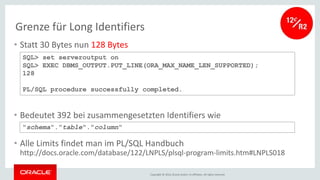
Grenze für Long Identifiers
• Statt 30 Bytes nun 128 Bytes
• Bedeutet 392 bei zusammengesetzten Identifiers wie
• Alle Limits findet man im PL/SQL Handbuch
http://docs.oracle.com/database/122/LNPLS/plsql-program-limits.htm#LNPLS018
SQL> set serveroutput on
SQL> EXEC DBMS_OUTPUT.PUT_LINE(ORA_MAX_NAME_LEN_SUPPORTED);
128
PL/SQL procedure successfully completed.
"schema"."table"."column"
Copyright © 2016, Oracle and/or its affiliates. All rights reserved.
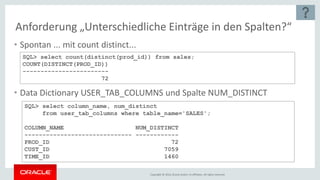
Anforderung „Unterschiedliche Einträge in den Spalten?“
• Spontan ... mit count distinct...
• Data Dictionary USER_TAB_COLUMNS und Spalte NUM_DISTINCT
SQL> select count(distinct(prod_id)) from sales;
COUNT(DISTINCT(PROD_ID))
------------------------
72
SQL> select column_name, num_distinct
from user_tab_columns where table_name='SALES';
COLUMN_NAME NUM_DISTINCT
------------------------------ ------------
PROD_ID 72
CUST_ID 7059
TIME_ID 1460
Copyright © 2016, Oracle and/or its affiliates. All rights reserved.
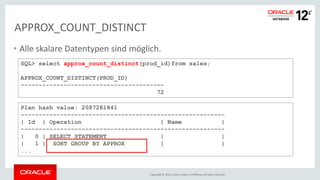
APPROX_COUNT_DISTINCT
• Alle skalare Datentypen sind möglich.
SQL> select approx_count_distinct(prod_id)from sales;
APPROX_COUNT_DISTINCT(PROD_ID)
----------------------------------------
72
Plan hash value: 2087281841
---------------------------------------------------------
| Id | Operation | Name |
---------------------------------------------------------
| 0 | SELECT STATEMENT | |
| 1 | SORT GROUP BY APPROX | |
...
Copyright © 2016, Oracle and/or its affiliates. All rights reserved.
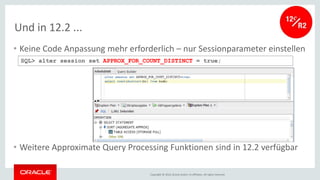
Und in 12.2 ...
• Keine Code Anpassung mehr erforderlich – nur Sessionparameter einstellen
• Weitere Approximate Query Processing Funktionen sind in 12.2 verfügbar
SQL> alter session set APPROX_FOR_COUNT_DISTINCT = true;
Copyright © 2016, Oracle and/or its affiliates. All rights reserved.
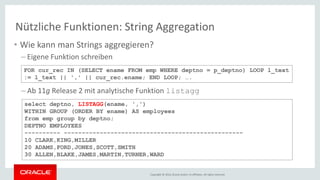
Nützliche Funktionen: String Aggregation
• Wie kann man Strings aggregieren?
– Eigene Funktion schreiben
– Ab 11g Release 2 mit analytische Funktion listagg
FOR cur_rec IN (SELECT ename FROM emp WHERE deptno = p_deptno) LOOP l_text
:= l_text || ',' || cur_rec.ename; END LOOP; ….
select deptno, LISTAGG(ename, ',')
WITHIN GROUP (ORDER BY ename) AS employees
from emp group by deptno;
DEPTNO EMPLOYEES
---------- --------------------------------------------------
10 CLARK,KING,MILLER
20 ADAMS,FORD,JONES,SCOTT,SMITH
30 ALLEN,BLAKE,JAMES,MARTIN,TURNER,WARD
Copyright © 2016, Oracle and/or its affiliates. All rights reserved.
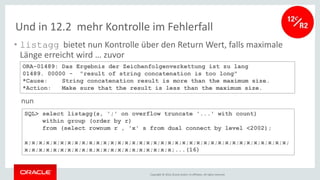
Und in 12.2 mehr Kontrolle im Fehlerfall
• listagg bietet nun Kontrolle über den Return Wert, falls maximale
Länge erreicht wird … zuvor
nun
ORA-01489: Das Ergebnis der Zeichenfolgenverkettung ist zu lang
01489. 00000 - "result of string concatenation is too long"
*Cause: String concatenation result is more than the maximum size.
*Action: Make sure that the result is less than the maximum size.
SQL> select listagg(s, ';' on overflow truncate '...' with count)
within group (order by r)
from (select rownum r , 'x' s from dual connect by level <2002);
x;x;x;x;x;x;x;x;x;x;x;x;x;x;x;x;x;x;x;x;x;x;x;x;x;x;x;x;x;x;x;x;x;x;x;x;x;
x;x;x;x;x;x;x;x;x;x;x;x;x;x;x;x;x;x;x;x;x;...(16)
Copyright © 2016, Oracle and/or its affiliates. All rights reserved.
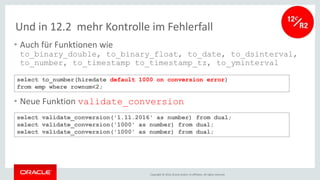
Und in 12.2 mehr Kontrolle im Fehlerfall
• Auch für Funktionen wie
to_binary_double, to_binary_float, to_date, to_dsinterval,
to_number, to_timestamp to_timestamp_tz, to_yminterval
• Neue Funktion validate_conversion
select to_number(hiredate default 1000 on conversion error)
from emp where rownum<2;
select validate_conversion('1.11.2016' as number) from dual;
select validate_conversion('1000' as number) from dual;
Copyright © 2016, Oracle and/or its affiliates. All rights reserved.
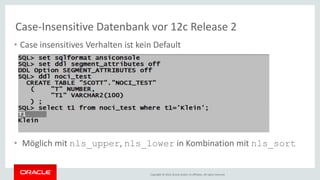
Case-Insensitive Datenbank vor 12c Release 2
• Case insensitives Verhalten ist kein Default
• Möglich mit nls_upper, nls_lower in Kombination mit nls_sort
Copyright © 2016, Oracle and/or its affiliates. All rights reserved.
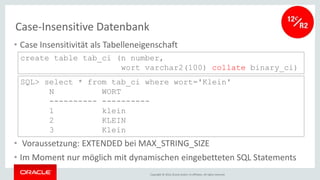
Case-Insensitive Datenbank
• Case Insensitivität als Tabelleneigenschaft
• Voraussetzung: EXTENDED bei MAX_STRING_SIZE
• Im Moment nur möglich mit dynamischen eingebetteten SQL Statements
create table tab_ci (n number,
wort varchar2(100) collate binary_ci)
SQL> select * from tab_ci where wort='Klein'
N WORT
---------- ----------
1 klein
2 KLEIN
3 Klein
Copyright © 2016, Oracle and/or its affiliates. All rights reserved.
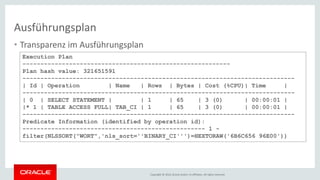
Ausführungsplan
• Transparenz im Ausführungsplan
Execution Plan
----------------------------------------------------------
Plan hash value: 321651591
----------------------------------------------------------------------------
| Id | Operation | Name | Rows | Bytes | Cost (%CPU)| Time |
----------------------------------------------------------------------------
| 0 | SELECT STATEMENT | | 1 | 65 | 3 (0) | 00:00:01 |
|* 1 | TABLE ACCESS FULL| TAB_CI | 1 | 65 | 3 (0) | 00:00:01 |
----------------------------------------------------------------------------
Predicate Information (identified by operation id):
--------------------------------------------------- 1 -
filter(NLSSORT("WORT",'nls_sort=''BINARY_CI''')=HEXTORAW('6B6C656 96E00'))
Copyright © 2016, Oracle and/or its affiliates. All rights reserved.
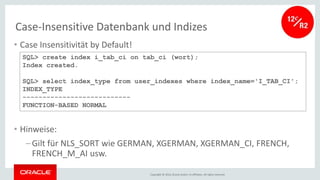
Case-Insensitive Datenbank und Indizes
• Case Insensitivität by Default!
• Hinweise:
–Gilt für NLS_SORT wie GERMAN, XGERMAN, XGERMAN_CI, FRENCH,
FRENCH_M_AI usw.
SQL> create index i_tab_ci on tab_ci (wort);
Index created.
SQL> select index_type from user_indexes where index_name='I_TAB_CI';
INDEX_TYPE
---------------------------
FUNCTION-BASED NORMAL
Copyright © 2016, Oracle and/or its affiliates. All rights reserved.
Agenda
SQL
PL/SQL
Verschiedenes
1
2
3
Copyright © 2016, Oracle and/or its affiliates. All rights reserved.
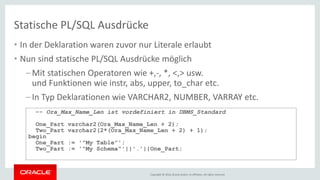
Statische PL/SQL Ausdrücke
-- Ora_Max_Name_Len ist vordefiniert in DBMS_Standard
One_Part varchar2(Ora_Max_Name_Len + 2);
Two_Part varchar2(2*(Ora_Max_Name_Len + 2) + 1);
begin
One_Part := '"My Table"';
Two_Part := '"My Schema"'||'.'||One_Part;
• In der Deklaration waren zuvor nur Literale erlaubt
• Nun sind statische PL/SQL Ausdrücke möglich
–Mit statischen Operatoren wie +,-, *, <,> usw.
und Funktionen wie instr, abs, upper, to_char etc.
–In Typ Deklarationen wie VARCHAR2, NUMBER, VARRAY etc.
Copyright © 2016, Oracle and/or its affiliates. All rights reserved.
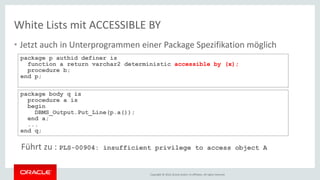
• Jetzt auch in Unterprogrammen einer Package Spezifikation möglich
Führt zu : PLS-00904: insufficient privilege to access object A
White Lists mit ACCESSIBLE BY
package p authid definer is
function a return varchar2 deterministic accessible by (x);
procedure b;
end p;
package body q is
procedure a is
begin
DBMS_Output.Put_Line(p.a());
end a;
...
end q;
Copyright © 2016, Oracle and/or its affiliates. All rights reserved.
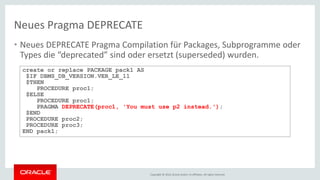
• Neues DEPRECATE Pragma Compilation für Packages, Subprogramme oder
Types die “deprecated” sind oder ersetzt (superseded) wurden.
Neues Pragma DEPRECATE
create or replace PACKAGE pack1 AS
$IF DBMS_DB_VERSION.VER_LE_11
$THEN
PROCEDURE proc1;
$ELSE
PROCEDURE proc1;
PRAGMA DEPRECATE(proc1, 'You must use p2 instead.');
$END
PROCEDURE proc2;
PROCEDURE proc3;
END pack1;
Copyright © 2016, Oracle and/or its affiliates. All rights reserved.
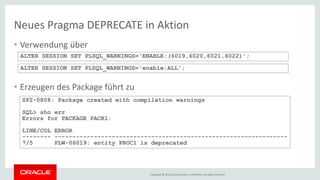
• Verwendung über
• Erzeugen des Package führt zu
Neues Pragma DEPRECATE in Aktion
SP2-0808: Package created with compilation warnings
SQL> sho err
Errors for PACKAGE PACK1:
LINE/COL ERROR
-------- -----------------------------------------------------------------
7/5 PLW-06019: entity PROC1 is deprecated
ALTER SESSION SET PLSQL_WARNINGS='ENABLE:(6019,6020,6021,6022)';
ALTER SESSION SET PLSQL_WARNINGS='enable:ALL';
Copyright © 2016, Oracle and/or its affiliates. All rights reserved.
• Weitere Nutzung führt zu
Neues Pragma DEPRECATE in Aktion
create or replace procedure pack2
as
begin
pack1.proc1;
end;
/
SP2-0804: Procedure created with compilation warnings
SQL> sho err
Errors for PROCEDURE PACK2:
LINE/COL ERROR
-------- -----------------------------------------------------------------
4/1 PLW-06020: reference to a deprecated entity: PROC1 declared in
unit PACK1[6,15]. You must use p2 instead.
Copyright © 2016, Oracle and/or its affiliates. All rights reserved.
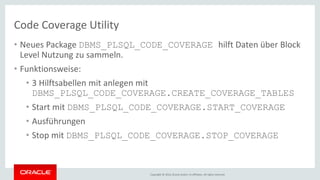
• Neues Package DBMS_PLSQL_CODE_COVERAGE hilft Daten über Block
Level Nutzung zu sammeln.
• Funktionsweise:
• 3 Hilftsabellen mit anlegen mit
DBMS_PLSQL_CODE_COVERAGE.CREATE_COVERAGE_TABLES
• Start mit DBMS_PLSQL_CODE_COVERAGE.START_COVERAGE
• Ausführungen
• Stop mit DBMS_PLSQL_CODE_COVERAGE.STOP_COVERAGE
Code Coverage Utility
Copyright © 2016, Oracle and/or its affiliates. All rights reserved.
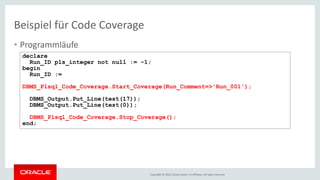
• Programmläufe
Beispiel für Code Coverage
declare
Run_ID pls_integer not null := -1;
begin
Run_ID :=
DBMS_Plsql_Code_Coverage.Start_Coverage(Run_Comment=>'Run_001');
DBMS_Output.Put_Line(test(17));
DBMS_Output.Put_Line(test(0));
DBMS_Plsql_Code_Coverage.Stop_Coverage();
end;
Copyright © 2016, Oracle and/or its affiliates. All rights reserved.
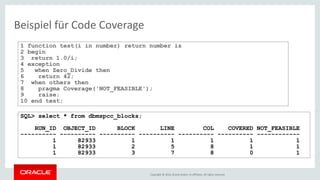
Beispiel für Code Coverage
1 function test(i in number) return number is
2 begin
3 return 1.0/i;
4 exception
5 when Zero_Divide then
6 return 42;
7 when others then
8 pragma Coverage('NOT_FEASIBLE');
9 raise;
10 end test;
SQL> select * from dbmspcc_blocks;
RUN_ID OBJECT_ID BLOCK LINE COL COVERED NOT_FEASIBLE
---------- ---------- ---------- ---------- ---------- ---------- ------------
1 82933 1 1 1 1 1
1 82933 2 5 8 1 1
1 82933 3 7 8 0 1
Copyright © 2016, Oracle and/or its affiliates. All rights reserved.
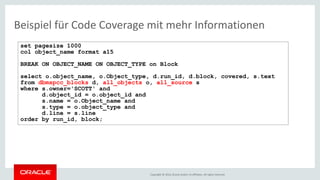
Beispiel für Code Coverage mit mehr Informationen
set pagesize 1000
col object_name format a15
BREAK ON OBJECT_NAME ON OBJECT_TYPE on Block
select o.object_name, o.Object_type, d.run_id, d.block, covered, s.text
from dbmspcc_blocks d, all_objects o, all_source s
where s.owner='SCOTT' and
d.object_id = o.object_id and
s.name = o.Object_name and
s.type = o.object_type and
d.line = s.line
order by run_id, block;
Copyright © 2016, Oracle and/or its affiliates. All rights reserved.
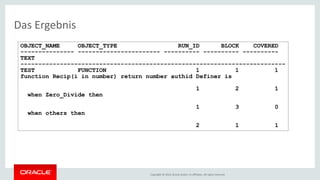
Das Ergebnis
OBJECT_NAME OBJECT_TYPE RUN_ID BLOCK COVERED
--------------- ----------------------- ---------- ---------- ----------
TEXT
--------------------------------------------------------------------------
TEST FUNCTION 1 1 1
function Recip(i in number) return number authid Definer is
1 2 1
when Zero_Divide then
1 3 0
when others then
2 1 1
Copyright © 2016, Oracle and/or its affiliates. All rights reserved.
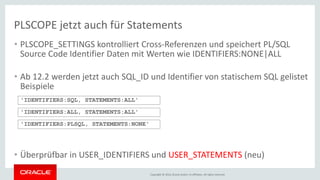
• PLSCOPE_SETTINGS kontrolliert Cross-Referenzen und speichert PL/SQL
Source Code Identifier Daten mit Werten wie IDENTIFIERS:NONE|ALL
• Ab 12.2 werden jetzt auch SQL_ID und Identifier von statischem SQL gelistet
Beispiele
• Überprüfbar in USER_IDENTIFIERS und USER_STATEMENTS (neu)
'IDENTIFIERS:SQL, STATEMENTS:ALL'
'IDENTIFIERS:ALL, STATEMENTS:ALL'
PLSCOPE jetzt auch für Statements
'IDENTIFIERS:PLSQL, STATEMENTS:NONE'
Copyright © 2016, Oracle and/or its affiliates. All rights reserved.
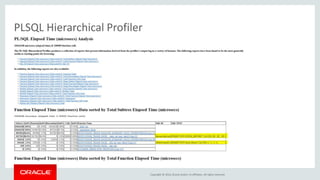
• Identifiziert nun SQL über SQL_ID
• Der Bericht enthält SQL Execution Informationen für jeden Child Cursor
PLSQL Hierarchical Profiler
Copyright © 2016, Oracle and/or its affiliates. All rights reserved.
PLSQL Hierarchical Profiler
Copyright © 2016, Oracle and/or its affiliates. All rights reserved.
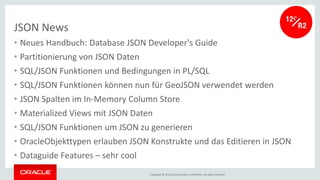
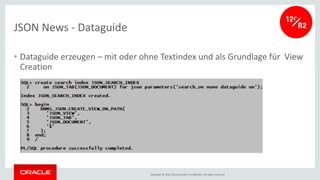
JSON News
• Neues Handbuch: Database JSON Developer's Guide
• Partitionierung von JSON Daten
• SQL/JSON Funktionen und Bedingungen in PL/SQL
• SQL/JSON Funktionen können nun für GeoJSON verwendet werden
• JSON Spalten im In-Memory Column Store
• Materialized Views mit JSON Daten
• SQL/JSON Funktionen um JSON zu generieren
• OracleObjekttypen erlauben JSON Konstrukte und das Editieren in JSON
• Dataguide Features – sehr cool
Copyright © 2016, Oracle and/or its affiliates. All rights reserved.
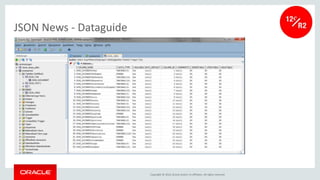
JSON News - Dataguide
• Dataguide erzeugen – mit oder ohne Textindex und als Grundlage für View
Creation
Copyright © 2016, Oracle and/or its affiliates. All rights reserved.
JSON News - Dataguide
Copyright © 2016, Oracle and/or its affiliates. All rights reserved.
• “Drop edition” ist neu implementiert um das Stillegen eines Edition zu
ermöglichen.
• Beim Drop wird die Edition als UNUSABLE markiert.
• Jedes editioned Objekt das nicht mehr vererbt ist, wird später automatisch
gelöscht
• Falls kein Objekt mehr übrig ist, wird die Edition selbst gelöscht.
Automatisches Retiring von ungenutzten Editionen
Copyright © 2016, Oracle and/or its affiliates. All rights reserved.
Agenda
SQL
PL/SQL
Verschiedenes
1
2
3
Copyright © 2016, Oracle and/or its affiliates. All rights reserved.
Noch kurz zu den Werkzeugen
• SQL*Plus: Release 12.2
Standard, Erweiterungen in 12c R2 (History, Performance,CSV Format)
• SQL Developer 4.2
einfache Verbindung zu Cloud Services
besonders gut geeignet für Tuning, Ausführungspläne,
schnelle Objekt-Übersicht, SQL Generierung, Laden etc.
• SQLcl: 4.2.0 – das neue Linemode Werkzeug schlechthin
einfache Cloud Verbindungen, Scripting, Vorteile von graphischem
Interface, einfache Formatgenerierung etc
https://apex.oracle.com/pls/apex/germancommunities/dbacommunity/tipp/5481/index.html
Copyright © 2016, Oracle and/or its affiliates. All rights reserved.
Weitere Informationen
• Deutschsprachiger Blog: http:/tinyurl.com/dbcommunity
– Inhaltsverzeichnis
• Database Online Documentation Library 12c Release 2 (12.2) :
http://docs.oracle.com/database/122/nav/portal_booklist.htm
– What‘s New Sections
• Monatl.Oracle Technology Update: http://tinyurl.com/oratech-monthly
• Twitter: @uschwinn, @oraclebudb
Copyright © 2016, Oracle and/or its affiliates. All rights reserved.

What's new in SQL und PL/SQL in 12.2

  • 2.
    Copyright © 2016,Oracle and/or its affiliates. All rights reserved. What's New in SQL und PL/SQL in Oracle Database 12c Release 2 Ulrike Schwinn Oracle Deutschland BV &CO K.G. Ulrike.Schwinn@oracle.com twitter: @uschwinn
  • 3.
    Copyright © 2016,Oracle and/or its affiliates. All rights reserved. Agenda SQL PL/SQL Verschiedenes 1 2 3
  • 4.
    Copyright © 2016,Oracle and/or its affiliates. All rights reserved. Grenze für Long Identifiers • Statt 30 Bytes nun 128 Bytes • Bedeutet 392 bei zusammengesetzten Identifiers wie • Alle Limits findet man im PL/SQL Handbuch http://docs.oracle.com/database/122/LNPLS/plsql-program-limits.htm#LNPLS018 SQL> set serveroutput on SQL> EXEC DBMS_OUTPUT.PUT_LINE(ORA_MAX_NAME_LEN_SUPPORTED); 128 PL/SQL procedure successfully completed. "schema"."table"."column"
  • 5.
    Copyright © 2016,Oracle and/or its affiliates. All rights reserved. Anforderung „Unterschiedliche Einträge in den Spalten?“ • Spontan ... mit count distinct... • Data Dictionary USER_TAB_COLUMNS und Spalte NUM_DISTINCT SQL> select count(distinct(prod_id)) from sales; COUNT(DISTINCT(PROD_ID)) ------------------------ 72 SQL> select column_name, num_distinct from user_tab_columns where table_name='SALES'; COLUMN_NAME NUM_DISTINCT ------------------------------ ------------ PROD_ID 72 CUST_ID 7059 TIME_ID 1460
  • 6.
    Copyright © 2016,Oracle and/or its affiliates. All rights reserved. APPROX_COUNT_DISTINCT • Alle skalare Datentypen sind möglich. SQL> select approx_count_distinct(prod_id)from sales; APPROX_COUNT_DISTINCT(PROD_ID) ---------------------------------------- 72 Plan hash value: 2087281841 --------------------------------------------------------- | Id | Operation | Name | --------------------------------------------------------- | 0 | SELECT STATEMENT | | | 1 | SORT GROUP BY APPROX | | ...
  • 7.
    Copyright © 2016,Oracle and/or its affiliates. All rights reserved. Und in 12.2 ... • Keine Code Anpassung mehr erforderlich – nur Sessionparameter einstellen • Weitere Approximate Query Processing Funktionen sind in 12.2 verfügbar SQL> alter session set APPROX_FOR_COUNT_DISTINCT = true;
  • 8.
    Copyright © 2016,Oracle and/or its affiliates. All rights reserved. Nützliche Funktionen: String Aggregation • Wie kann man Strings aggregieren? – Eigene Funktion schreiben – Ab 11g Release 2 mit analytische Funktion listagg FOR cur_rec IN (SELECT ename FROM emp WHERE deptno = p_deptno) LOOP l_text := l_text || ',' || cur_rec.ename; END LOOP; …. select deptno, LISTAGG(ename, ',') WITHIN GROUP (ORDER BY ename) AS employees from emp group by deptno; DEPTNO EMPLOYEES ---------- -------------------------------------------------- 10 CLARK,KING,MILLER 20 ADAMS,FORD,JONES,SCOTT,SMITH 30 ALLEN,BLAKE,JAMES,MARTIN,TURNER,WARD
  • 9.
    Copyright © 2016,Oracle and/or its affiliates. All rights reserved. Und in 12.2 mehr Kontrolle im Fehlerfall • listagg bietet nun Kontrolle über den Return Wert, falls maximale Länge erreicht wird … zuvor nun ORA-01489: Das Ergebnis der Zeichenfolgenverkettung ist zu lang 01489. 00000 - "result of string concatenation is too long" *Cause: String concatenation result is more than the maximum size. *Action: Make sure that the result is less than the maximum size. SQL> select listagg(s, ';' on overflow truncate '...' with count) within group (order by r) from (select rownum r , 'x' s from dual connect by level <2002); x;x;x;x;x;x;x;x;x;x;x;x;x;x;x;x;x;x;x;x;x;x;x;x;x;x;x;x;x;x;x;x;x;x;x;x;x; x;x;x;x;x;x;x;x;x;x;x;x;x;x;x;x;x;x;x;x;x;...(16)
  • 10.
    Copyright © 2016,Oracle and/or its affiliates. All rights reserved. Und in 12.2 mehr Kontrolle im Fehlerfall • Auch für Funktionen wie to_binary_double, to_binary_float, to_date, to_dsinterval, to_number, to_timestamp to_timestamp_tz, to_yminterval • Neue Funktion validate_conversion select to_number(hiredate default 1000 on conversion error) from emp where rownum<2; select validate_conversion('1.11.2016' as number) from dual; select validate_conversion('1000' as number) from dual; select validate_conversion('1000' as number) from dual;
  • 11.
    Copyright © 2016,Oracle and/or its affiliates. All rights reserved. Case-Insensitive Datenbank vor 12c Release 2 • Case insensitives Verhalten ist kein Default • Möglich mit nls_upper, nls_lower in Kombination mit nls_sort
  • 12.
    Copyright © 2016,Oracle and/or its affiliates. All rights reserved. Case-Insensitive Datenbank • Case Insensitivität als Tabelleneigenschaft • Voraussetzung: EXTENDED bei MAX_STRING_SIZE • Im Moment nur möglich mit dynamischen eingebetteten SQL Statements create table tab_ci (n number, wort varchar2(100) collate binary_ci) SQL> select * from tab_ci where wort='Klein' N WORT ---------- ---------- 1 klein 2 KLEIN 3 Klein
  • 13.
    Copyright © 2016,Oracle and/or its affiliates. All rights reserved. Ausführungsplan • Transparenz im Ausführungsplan Execution Plan ---------------------------------------------------------- Plan hash value: 321651591 ---------------------------------------------------------------------------- | Id | Operation | Name | Rows | Bytes | Cost (%CPU)| Time | ---------------------------------------------------------------------------- | 0 | SELECT STATEMENT | | 1 | 65 | 3 (0) | 00:00:01 | |* 1 | TABLE ACCESS FULL| TAB_CI | 1 | 65 | 3 (0) | 00:00:01 | ---------------------------------------------------------------------------- Predicate Information (identified by operation id): --------------------------------------------------- 1 - filter(NLSSORT("WORT",'nls_sort=''BINARY_CI''')=HEXTORAW('6B6C656 96E00'))
  • 14.
    Copyright © 2016,Oracle and/or its affiliates. All rights reserved. Case-Insensitive Datenbank und Indizes • Case Insensitivität by Default! • Hinweise: –Gilt für NLS_SORT wie GERMAN, XGERMAN, XGERMAN_CI, FRENCH, FRENCH_M_AI usw. SQL> create index i_tab_ci on tab_ci (wort); Index created. SQL> select index_type from user_indexes where index_name='I_TAB_CI'; INDEX_TYPE --------------------------- FUNCTION-BASED NORMAL
  • 15.
    Copyright © 2016,Oracle and/or its affiliates. All rights reserved. Agenda SQL PL/SQL Verschiedenes 1 2 3
  • 16.
    Copyright © 2016,Oracle and/or its affiliates. All rights reserved. Statische PL/SQL Ausdrücke -- Ora_Max_Name_Len ist vordefiniert in DBMS_Standard One_Part varchar2(Ora_Max_Name_Len + 2); Two_Part varchar2(2*(Ora_Max_Name_Len + 2) + 1); begin One_Part := '"My Table"'; Two_Part := '"My Schema"'||'.'||One_Part; • In der Deklaration waren zuvor nur Literale erlaubt • Nun sind statische PL/SQL Ausdrücke möglich –Mit statischen Operatoren wie +,-, *, <,> usw. und Funktionen wie instr, abs, upper, to_char etc. –In Typ Deklarationen wie VARCHAR2, NUMBER, VARRAY etc.
  • 17.
    Copyright © 2016,Oracle and/or its affiliates. All rights reserved. • Jetzt auch in Unterprogrammen einer Package Spezifikation möglich Führt zu : PLS-00904: insufficient privilege to access object A White Lists mit ACCESSIBLE BY package p authid definer is function a return varchar2 deterministic accessible by (x); procedure b; end p; package body q is procedure a is begin DBMS_Output.Put_Line(p.a()); end a; ... end q;
  • 18.
    Copyright © 2016,Oracle and/or its affiliates. All rights reserved. • Neues DEPRECATE Pragma Compilation für Packages, Subprogramme oder Types die “deprecated” sind oder ersetzt (superseded) wurden. Neues Pragma DEPRECATE create or replace PACKAGE pack1 AS $IF DBMS_DB_VERSION.VER_LE_11 $THEN PROCEDURE proc1; $ELSE PROCEDURE proc1; PRAGMA DEPRECATE(proc1, 'You must use p2 instead.'); $END PROCEDURE proc2; PROCEDURE proc3; END pack1;
  • 19.
    Copyright © 2016,Oracle and/or its affiliates. All rights reserved. • Verwendung über • Erzeugen des Package führt zu Neues Pragma DEPRECATE in Aktion SP2-0808: Package created with compilation warnings SQL> sho err Errors for PACKAGE PACK1: LINE/COL ERROR -------- ----------------------------------------------------------------- 7/5 PLW-06019: entity PROC1 is deprecated ALTER SESSION SET PLSQL_WARNINGS='ENABLE:(6019,6020,6021,6022)'; ALTER SESSION SET PLSQL_WARNINGS='enable:ALL';
  • 20.
    Copyright © 2016,Oracle and/or its affiliates. All rights reserved. • Weitere Nutzung führt zu Neues Pragma DEPRECATE in Aktion create or replace procedure pack2 as begin pack1.proc1; end; / SP2-0804: Procedure created with compilation warnings SQL> sho err Errors for PROCEDURE PACK2: LINE/COL ERROR -------- ----------------------------------------------------------------- 4/1 PLW-06020: reference to a deprecated entity: PROC1 declared in unit PACK1[6,15]. You must use p2 instead.
  • 21.
    Copyright © 2016,Oracle and/or its affiliates. All rights reserved. • Neues Package DBMS_PLSQL_CODE_COVERAGE hilft Daten über Block Level Nutzung zu sammeln. • Funktionsweise: • 3 Hilftsabellen mit anlegen mit DBMS_PLSQL_CODE_COVERAGE.CREATE_COVERAGE_TABLES • Start mit DBMS_PLSQL_CODE_COVERAGE.START_COVERAGE • Ausführungen • Stop mit DBMS_PLSQL_CODE_COVERAGE.STOP_COVERAGE Code Coverage Utility
  • 22.
    Copyright © 2016,Oracle and/or its affiliates. All rights reserved. • Programmläufe Beispiel für Code Coverage declare Run_ID pls_integer not null := -1; begin Run_ID := DBMS_Plsql_Code_Coverage.Start_Coverage(Run_Comment=>'Run_001'); DBMS_Output.Put_Line(test(17)); DBMS_Output.Put_Line(test(0)); DBMS_Plsql_Code_Coverage.Stop_Coverage(); end;
  • 23.
    Copyright © 2016,Oracle and/or its affiliates. All rights reserved. Beispiel für Code Coverage 1 function test(i in number) return number is 2 begin 3 return 1.0/i; 4 exception 5 when Zero_Divide then 6 return 42; 7 when others then 8 pragma Coverage('NOT_FEASIBLE'); 9 raise; 10 end test; SQL> select * from dbmspcc_blocks; RUN_ID OBJECT_ID BLOCK LINE COL COVERED NOT_FEASIBLE ---------- ---------- ---------- ---------- ---------- ---------- ------------ 1 82933 1 1 1 1 1 1 82933 2 5 8 1 1 1 82933 3 7 8 0 1
  • 24.
    Copyright © 2016,Oracle and/or its affiliates. All rights reserved. Beispiel für Code Coverage mit mehr Informationen set pagesize 1000 col object_name format a15 BREAK ON OBJECT_NAME ON OBJECT_TYPE on Block select o.object_name, o.Object_type, d.run_id, d.block, covered, s.text from dbmspcc_blocks d, all_objects o, all_source s where s.owner='SCOTT' and d.object_id = o.object_id and s.name = o.Object_name and s.type = o.object_type and d.line = s.line order by run_id, block;
  • 25.
    Copyright © 2016,Oracle and/or its affiliates. All rights reserved. Das Ergebnis OBJECT_NAME OBJECT_TYPE RUN_ID BLOCK COVERED --------------- ----------------------- ---------- ---------- ---------- TEXT -------------------------------------------------------------------------- TEST FUNCTION 1 1 1 function Recip(i in number) return number authid Definer is 1 2 1 when Zero_Divide then 1 3 0 when others then 2 1 1
  • 26.
    Copyright © 2016,Oracle and/or its affiliates. All rights reserved. • PLSCOPE_SETTINGS kontrolliert Cross-Referenzen und speichert PL/SQL Source Code Identifier Daten mit Werten wie IDENTIFIERS:NONE|ALL • Ab 12.2 werden jetzt auch SQL_ID und Identifier von statischem SQL gelistet Beispiele • Überprüfbar in USER_IDENTIFIERS und USER_STATEMENTS (neu) 'IDENTIFIERS:SQL, STATEMENTS:ALL' 'IDENTIFIERS:ALL, STATEMENTS:ALL' PLSCOPE jetzt auch für Statements 'IDENTIFIERS:PLSQL, STATEMENTS:NONE'
  • 27.
    Copyright © 2016,Oracle and/or its affiliates. All rights reserved. • Identifiziert nun SQL über SQL_ID • Der Bericht enthält SQL Execution Informationen für jeden Child Cursor PLSQL Hierarchical Profiler
  • 28.
    Copyright © 2016,Oracle and/or its affiliates. All rights reserved. PLSQL Hierarchical Profiler
  • 29.
    Copyright © 2016,Oracle and/or its affiliates. All rights reserved. JSON News • Neues Handbuch: Database JSON Developer's Guide • Partitionierung von JSON Daten • SQL/JSON Funktionen und Bedingungen in PL/SQL • SQL/JSON Funktionen können nun für GeoJSON verwendet werden • JSON Spalten im In-Memory Column Store • Materialized Views mit JSON Daten • SQL/JSON Funktionen um JSON zu generieren • OracleObjekttypen erlauben JSON Konstrukte und das Editieren in JSON • Dataguide Features – sehr cool
  • 30.
    Copyright © 2016,Oracle and/or its affiliates. All rights reserved. JSON News - Dataguide • Dataguide erzeugen – mit oder ohne Textindex und als Grundlage für View Creation
  • 31.
    Copyright © 2016,Oracle and/or its affiliates. All rights reserved. JSON News - Dataguide
  • 32.
    Copyright © 2016,Oracle and/or its affiliates. All rights reserved. • “Drop edition” ist neu implementiert um das Stillegen eines Edition zu ermöglichen. • Beim Drop wird die Edition als UNUSABLE markiert. • Jedes editioned Objekt das nicht mehr vererbt ist, wird später automatisch gelöscht • Falls kein Objekt mehr übrig ist, wird die Edition selbst gelöscht. Automatisches Retiring von ungenutzten Editionen
  • 33.
    Copyright © 2016,Oracle and/or its affiliates. All rights reserved. Agenda SQL PL/SQL Verschiedenes 1 2 3
  • 34.
    Copyright © 2016,Oracle and/or its affiliates. All rights reserved. Noch kurz zu den Werkzeugen • SQL*Plus: Release 12.2 Standard, Erweiterungen in 12c R2 (History, Performance,CSV Format) • SQL Developer 4.2 einfache Verbindung zu Cloud Services besonders gut geeignet für Tuning, Ausführungspläne, schnelle Objekt-Übersicht, SQL Generierung, Laden etc. • SQLcl: 4.2.0 – das neue Linemode Werkzeug schlechthin einfache Cloud Verbindungen, Scripting, Vorteile von graphischem Interface, einfache Formatgenerierung etc https://apex.oracle.com/pls/apex/germancommunities/dbacommunity/tipp/5481/index.html
  • 35.
    Copyright © 2016,Oracle and/or its affiliates. All rights reserved. Weitere Informationen • Deutschsprachiger Blog: http:/tinyurl.com/dbcommunity – Inhaltsverzeichnis • Database Online Documentation Library 12c Release 2 (12.2) : http://docs.oracle.com/database/122/nav/portal_booklist.htm – What‘s New Sections • Monatl.Oracle Technology Update: http://tinyurl.com/oratech-monthly • Twitter: @uschwinn, @oraclebudb
  • 36.
    Copyright © 2016,Oracle and/or its affiliates. All rights reserved.

Hinweis der Redaktion

  • #7 Row Generator: Insert into budb SELECT ROWNUM, 'x' || FROM ( SELECT 1 budb FROM dual CONNECT BY LEVEL <= 2000 )