BSB-Scala-Workshop 2012
       Andreas Neumann, AN-iT
       www.an-it.com


Mittwoch, 18. April 12
Überblick

       • Was ist Scala ?


       • Bausteine: val, var, Klassen, Objekte


       • Kernkonzepte


       • Tools


Mittwoch, 18. April 12
Was ist Scala ?

       • Eine JVM-Sprache


       • multiparadigmatisch


       • Funktional-Objektorientiert


Mittwoch, 18. April 12
Stärken

       • Skalierbarkeit


       • Parallelisierbarkeit


       • Integrierbarkeit


       • XML


       • DSL


Mittwoch, 18. April 12
Einführung

       • Code ausführen / kompilieren


       • Prinzipielles zur Syntax


       • Variablen deklarieren


       • Funktionen definieren


       • Klassen, Traits und Objekte


Mittwoch, 18. April 12
Code ausführen, compilieren

       • Scala Code kann unter unterschiedlichsten Umgebungen ausgeführt und
         benutzt werden:


              • Compilieren und auf einer JVM ausführen


              • Als Script direkt ausführen


              • In REPL, zum testen


Mittwoch, 18. April 12
Scala - Compiler / scalac

       • Compiler wird mit
         scalac aufgerufen


       • Klassen werden in
         JavaBytecode
         kompiliert


       • Aufruf mit scala
         <Klassenname>


Mittwoch, 18. April 12
Scala als Scriptsprache - Unix

       • Scala kann auch als        #!/bin/sh
         Skriptsprache eingesetzt   exec scala "$0" "$@"
         werden                     !#

                                    object HelloWorld {
       • Der Aufruf erfolg mit sh      def main(args: Array[String]) {
         oder mann kann die Daei          println("Hello, world! " +
                                                  args.toList)
         ausführbar machen              }
                                     }

                                     HelloWorld.main(args)


Mittwoch, 18. April 12
Scala als Scriptsprache - Windows

       • Scala als Scriptsprache unter
         Windows
                                         ::#!
                                         @echo off
       • In eine batch-Datei,            call scala %0 %*
         Endung .bat speichern           goto :eof
                                         ::!#

       • Aufrufen                         object HelloWorld {
                                            def main(args: Array[String]) {
                                              println("Hello, world! " +
                                                       args.toList)
                                            }
                                          }

                                          HelloWorld.main(args)


Mittwoch, 18. April 12
Scala - Interpreter / REPL

     • Bei der Installation
       von Scala wird
       neben dem
       compiler auch ein
       Interpreter installiert


     • Starten des
       Interpreters: $ scala


Mittwoch, 18. April 12
Online REPL


                         • http://www.simplyscala.com/


Mittwoch, 18. April 12
Prinzipielles zur Syntax

       • Keine abschließende Semikolons notwendig, eine Anweisung pro Zeile


       • Mehre Anweisungen pro Zeile können getrennt mit einem Semikolon
         angegeben werden


       • Bei eindeutiger Syntax kann der Punkt bei Methodenaufrufen weggelassen
         werden
                         1.+(5)     List(1,2.3).map(_ * 3).head
                                    List(1,2.3) map(_ * 3) head
                         1 + 5


Mittwoch, 18. April 12
val, vars

       • Das Keyword val erzeugt einen Value, einen unveränderbaren Wert,
         vergleichbar mit final in Java


       • Das Keyword var erzeugt eine Variable im klassischen Sinn


Mittwoch, 18. April 12
Beispiel: val und var


                         val x = 42
                         x: Int = 42
                         var y = 99
                         y: Int = 99
                         y = 1
                         y: Int = 1
                         x = 1
                         error: reassignment to val
                                x = 1
                                  ^


Mittwoch, 18. April 12
Typen und Typinferenz

       • Typangaben werden mit : eingeleitet und stehen hinter dem Value/der
         Variablen

                            s : String = "ein String"


       • In vielen Fällen sind sie optional, da die Typinferenz den Typ selbst ermitteln
         kann

                           val a = "Hallo"
                           a: java.lang.String = Hallo
                           val b = 1
                           b: Int = 1
                           val c = 3.5
                           c: Double = 3.5
                           val d = List(1,2.0)
                           d: List[Double] = List(1.0, 2.0)


Mittwoch, 18. April 12
Methoden definieren

           • Methoden werden mit dem
             Keyword def eingeleitet
                                                def write(aString: String) {
                                                  println(aString)
           • Darauf folgt eine optionale        }
             Parameterliste in runden
             Klammern                           write("Hallo ihr alle da draußen!")
                                                Hallo ihr alle da draußen!
           • Am Schluß folgt der
             Funktionsrumpf


           • Hat die Methode eine
             Rückgabewert wird der
                                                def add(x: Int, y:Int) : Int = {
             Funktionsrumpf mit einem =
                                                  x + y
             angeschlossen
                                                }

           • Der letzte Wert in einer Methode   add(40,2)
             ist der Rückgabewert
                                                res0: Int = 42


Mittwoch, 18. April 12
Collections

       • Scala wartet mit einer großen Collections-Bibliothek auf


       • Collections bieten ein nach Möglichkeit einheitliches Interface


       • Es gibt Collections in bis zu vier Ausführungen:


              • Basis


              • immutable : nicht Veränderbar


              • mutable : Veränderbar


              • (parallel: Parallele Version)


Mittwoch, 18. April 12
Scala Collection


Mittwoch, 18. April 12
Scala Collection - immutable


Mittwoch, 18. April 12
Scala Collection - mutable


Mittwoch, 18. April 12
Scala Collections : List
              val a = List("a","b","c")
              a: List[java.lang.String] = List(a, b, c)

              a head
              res5: java.lang.String = a

              a tail
              res6: List[java.lang.String] = List(b, c)

              val b = List(1,2,3)
              b: List[Int] = List(1, 2, 3)

              0 :: b
              res10: List[Int] = List(0, 1, 2, 3)

              a ++ b
              res11: List[Any] = List(a, b, c, 1, 2, 3)

              a zip b
              res12: List[(java.lang.String, Int)] = List((a,1), (b,2), (c,3))


Mittwoch, 18. April 12
Scala Collections : map


              val counting = Map(1 -> "eins", 2 -> "zwei", 3 -> "drei")
              counting:
              scala.collection.immutable.Map[Int,java.lang.String] =
              Map((1,eins), (2,zwei), (3,drei))

              counting(2)
              res2: java.lang.String = zwei

              counting.get(2)
              res3: Option[java.lang.String] = Some(zwei)

              counting get 99
              res4: Option[java.lang.String] = None


Mittwoch, 18. April 12
Klassen

       • Klassen werden mit dem Keyword class eingeleitet


       • Gefolgt von optionalen Konstruktorelmenten in Klammern


       • Daraufhin folgt optional der Körper der Klasse in geschweiften Klammern


       • Besonderheiten


              • Für Konstruktorelemente die mit dem Keyword val eingeleitetet werden wird automtisch
                ein getter unter dem gleichen Namen erzeugt (uniform access principle)


              • Für Konstruktorelemente die mit dem Keyword var eingeleitetet werden wird automtisch
                ein getter und ein setter unter dem gleichen Namen erzeugt (uniform access principle)


              • Alle aufegrufenen Operationen im Body der Klasse werden bei deren Konstruktion
                aufgerufen


Mittwoch, 18. April 12
Beispiel: Klasse in Scala

       class Document(val title: String, val author: String, yearInt: Int) {

                val year = yearInt.toString

                def shortCitation: String = author + " : " + title + ". " + year
       }

       val scalaBook = new Document("Programming In Scala","Martin Odersky","2011")

       println(scalaBook.title)
       println(scalaBook.year)


       • Instanzen werden mit new <Klassenname> erzeugt


Mittwoch, 18. April 12
Scala Object - Objekte

       • Objekte werden mit dem keyword object eingeleitet


       • Sie haben keine Konstruktorelemente


       • Funktionsweise entspricht grob einer Javaklasse mit static modifieren


       • Aufrufe von Members und Methoden erfolgt über Objektname.member bzw.
         Objektname.methode


       • Idiomatischer Weg um in Scala eine Singleton-Object zu erzeugen


Mittwoch, 18. April 12
Scala Object - Beispiel

      object DeepThought {
      ! val theMeaningOfLife =
         "The meaning of life: 42"

      ! def speak {
          println(theMeaningOfLife)
        }
      }

      DeepThought.speak
      The meaning of life: 42

Mittwoch, 18. April 12
Companion Object

       • Scala typisch


       • Ein object, welches den gleichen Namen wie eine Klasse trägt


       • Natives Constructor Pattern


Mittwoch, 18. April 12
Case Class

       • Wird mit dem Keywords case class eingeleitet


       • Ansonsten wie bei der „normalen Klasse“


       • Definiert eine companion object mit apply, unapply und einigen anderen
         Methoden


       • Für alle Konstruktorargumente werden getter erzeugt


       • Sollte nicht vererben!


Mittwoch, 18. April 12
Case Class - Beispiel


       case class Book(title: String, pages :Int)
       defined class Book

       val book = Book("Necronomicon",1000)
       book: Book = Book(Necronomicon,1000)

       println( book.title )
       Necronomicon


Mittwoch, 18. April 12
Trait

       • Wird mit dem keyword trait eingeleitet


       • Ähnlich einem Java-Interface


       • Erlaubt es einem der Mehrfachverebung ähnlichen Effekt zu erzeugen ohne
         die Probleme, die dieses Verfahren üblicherweise mit sich bringt


       • Bausteine


       • Wie Ruby mixins


Mittwoch, 18. April 12
Trait - Beispiel Definition
       • Es werden zwei              trait Edible {
         Eigenschafteen als Traits       def taste: String
                                         def eat = println(taste)
         definiert: Edible und
                                     }
         ExoticTaste
                                     trait ExoticTaste {
                                         def eat: Unit
       • Zwei Klassen werden             def describeTaste = {
         definiert: Cake, welcher             eat
         vom Trait Edible „erbt“             println("It tastes exotic")
                                         }
                                     }
       • Klasse: ChiliChocolate
         welche sowohl von Edible    case class Cake extends Edible{
         als auch ExoticTaste erbt       def taste = "sweet"
                                     }

                                     case class ChiliChocolate extends Edible with
                                     ExoticTaste{
                                         val taste = "sweet and hot"
                                     }

Mittwoch, 18. April 12
Trait - Beispiel : Anwendung

      val cake = new Cake
      cake.eat

      val chiliChoc = new ChiliChocolate
      chiliChoc.eat
      chiliChoc.describeTaste

      val cake = new Cake
      cake: Cake = Cake()

      cake.eat
      sweet

      val chiliChoc = new ChiliChocolate
      chiliChoc: ChiliChocolate = ChiliChocolate()

      chiliChoc.eat
      sweet and hot

      chiliChoc.describeTaste
      sweet and hot
      It tastes exotic
Mittwoch, 18. April 12
Kontrollstrukturen

       • if, else


       • while


       • foreach, map


       • For-Comprehensions


Mittwoch, 18. April 12
Klassische Kontrollstrukturen

       • Kontrollstrukturen wie while, if und else funktionieren wie gewohnt


       • Im Gegensatz zu Java sind es aber echte Funktionen, d.h. Sie haben einen
         Rückgabewert


       • if gibt den Wert des Blocks zurück wenn wahr


       • while hat den Rückgabewert Unit


                         val x = if ( 1 < 2 ) true
                         x: AnyVal = true


Mittwoch, 18. April 12
„Funktionale Kontrollstrukturen“

       • Alles Funktionen


       • Können gleiches Ergebnis erreichen wie klassische Kontrollstrukturen


       • Map : Eine Funktion auf jedes Element anwenden, Ergebnis zurückliefern

            List(1,2,3,4) map (x => x + 1)
            res1: List[Int] = List(2, 3, 4, 5)


       • Foreach: Eine Funktion auf jedes Element anwenden, Ergebnis verwerfen

           List(1,2,3) foreach( x => println("And a " + x))
           And a 1
           And a 2
           And a 3


Mittwoch, 18. April 12
matching

       • Pattern matching


       • Wird durch keyword match eingeleitet


       • Mehrere cases die mit keyword case eingeleitet werden


       • Ähnlich Java switch aber mit weitaus mehr möglichkeiten


       • Pattern Guards erweitern Möglichkeiten


       • Case Classes und Extractor Patterns erlauben einfaches zerlegen


Mittwoch, 18. April 12
Matching Example

      case class Book( title: String, pages: Int, year: Int)

      val books = List(
        Book("Programming Scala", 883, 2012),
        Book("Programming Pearl", 1104, 2000),
        Book("Necronomicon",666,666),
        "Ein String", 5, 42
      )

      val bookComments = books.map( book => book match {
          case Book("Programming Scala", pages, year) => "New Scala Book by Martin Odersky from " + year
          case Book(title, pages,year) => title + " " + pages + " " + year
          case x: Int if x > 10 => "an integer bigger than 10"
          case _ => "Something else"
      })


     // Ausgabe
     bookComments: List[java.lang.String] = List(
     New Scala Book by Martin Odersky from 2012,
     Programming Pearl 1104 2000,
      Necronomicon 666 666,
      Something else,
      Something else,
      an integer bigger than 10)

Mittwoch, 18. April 12
For-Comprehensions

       • Eleganter Weg um lesbar mehrere Operationen zu verbinden


       • Wird intern in eine folge von map, filter, flatMap und reduce Operationen
         umgewandelt

           def isEven(x: Int) = x % 2 == 0
           val integers = for {
             x <- 1 to 99
             if isEven(x)
             if x % 5 == 0
           } yield x
           integers: scala.collection.immutable.IndexedSeq[Int] =
           Vector(10, 20, 30, 40, 50, 60, 70, 80, 90)


           ~ Umgewandelt ~
           (1 to 99).filter(isEven(_)).filter( x % 5 == 0)

Mittwoch, 18. April 12
Weiterführende Sprachelemente

       • XML erzeugen und bearbeiten


       • Asynchrone Kommunikation mit Aktoren


       • Reguläre Ausdrücke


       • Parallele Collections


       • Implicits


Mittwoch, 18. April 12
XML in Scala

       • XML ist in Scala eine Sprachelement wie z.B. String in Java oder Ruby


       • Es kann also als Literal in den Quellcode eingebunden werden


Mittwoch, 18. April 12
Scala - XML erzeugen

       • Xml darf direkt im Scala Code stehen


       • Moderne Entwicklungsumgebungen (Eclipse, Netbeans, intelliJ) biten
         Syntaxhighlighting


       • Variablen und Code können mit {} in XML Literale eingebettet werden


Mittwoch, 18. April 12
XML erzeugen - Beispielcode

        case class Book( title: String, pages: Int, year: Int) {
            def toXML =
        <book>
            <title>{title}</title>
            <pages>{pages toString}</pages>
            <year>{year toString}</year>
        </book>


        }

        val books = List( Book("Programming Scala", 883, 2012), Book("Programming
        Perl", 1104, 2000), Book("Necronomicon",666,666) )

        for ( book <- books) {
            println(book.toXML)
        }


Mittwoch, 18. April 12
XML erzeugen - Ausgabe


                         <book>
                             <title>Programming Scala</title>
                             <pages>883</pages>
                             <year>2012</year>
                         </book>
                         <book>
                             <title>Programming Perl</title>
                             <pages>1104</pages>
                             <year>2000</year>
                         </book>
                         <book>
                             <title>Necronomicon</title>
                             <pages>666</pages>
                             <year>666</year>
                         </book>


Mittwoch, 18. April 12
Scala XML verarbeiten

       • XML kann mit XPath - ähnlicher Syntax verarbeite werden ( anstatt // und 
         anstatt / )


       • <xml></xml>  "tag" : für einen Shallow -Match


       • <xml></xml>  "tag" : für einen Deep -Match


       • <xml></xml>  "@attribut" : für einen Deep -Match auf ein Attribut


       • (<xml></xml>  "tag").text : Methode text gibt den Textwert des Knotens
         zurück


Mittwoch, 18. April 12
XML verarbeiten - Beispielcode

                case class Book( title: String, pages: Int, year: Int) {
                    def toXML =
                        <book>
                            <title>{title}</title>
                            <pages>{pages}</pages>
                            <year>{year}</year>
                        </book>

                         implicit def intToString(in : Int) : String =   in.toString
                }

                object Book {
                    def fromXML(bookXML: scala.xml.NodeSeq) : Book= {
                        val title = (bookXML  "title").text
                        val pages = (bookXML  "pages").text.toInt
                        val year = (bookXML  "year").text.toInt
                        new Book(title, pages, year)
                    }
                }

Mittwoch, 18. April 12
XML verarbeiten - Aufruf und Ausgabe
              val books =
              <books>
                  <book>
                       <title>Programming Scala</title>
                       <pages>883</pages>
                       <year>2012</year>
                  </book>
                  <book>
                       <title>Programming Perl</title>
                       <pages>1104</pages>
                       <year>2000</year>
                  </book>
                  <book>
                       <title>Necronomicon</title>
                       <pages>666</pages>
                       <year>666</year>
                  </book>
              </books>

              val booksInstances = (books  "book").map(Book.fromXML(_))
              val booksPages = (books  "pages").map(_.text.toInt)


              booksInstances: scala.collection.immutable.Seq[Book] = List(Book(Programming
              Scala,883,2012), Book(Programming Perl,1104,2000), Book(Necronomicon,666,666))
              booksPages: scala.collection.immutable.Seq[Int] = List(883, 1104, 666)
Mittwoch, 18. April 12
Aktoren

       • Erlauben asynchrone Kommunikation


       • Aus Erlang entlehnt


       • ! Sendet nachricht


       • react reagiert auf Nachricht


       • Vorstellung: Nachrichten senden, diese landen in einem Briefkasten und
         werden nacheinder verarbeitet


Mittwoch, 18. April 12
Actor - Beispielcode
        import scala.actors._
        import scala.actors.Actor._

        case class Comedy(who: String)
        case class Drama(who: String)

        class StageActor() extends Actor {
          def act() {
            loop {
              react {
                case Drama(who) => {
                   println(who + ": To be ..." )
                   println(who + ": or not To be" )
                }
                case Comedy(who) => {
                   println(who + ": Knock, Knock")
                   println("Someone: Who's there?")
                   println(who + "Honey bee. ")
                   println("Someone: Honey bee who?")
                   println(who + "Honey bee a dear and get me a beer.")
                }}}}}


Mittwoch, 18. April 12
Actor - Aufruf und Ausgabe

           val artist = new StageActor().start
           val clown = new StageActor().start

           println("Action")
           artist ! Drama("Artistical")
           clown ! Comedy("Clown")
           clown ! Drama("Clown")
           artist ! Comedy("Art")


          Action.
          Artistical: To be ...
          Artistical: or not To be
          Clown: Knock, Knock
          Someone: Who's there?
          ClownHoney bee.
          Someone: Honey bee who?
          ClownHoney bee a dear and get me a beer.
          Clown: To be ...
          Clown: or not To be
          Art: Knock, Knock
          Someone: Who's there?
          ArtHoney bee.
          Someone: Honey bee who?
          ArtHoney bee a dear and get me a beer.


Mittwoch, 18. April 12
Reguläre Ausdrücke

       • .r aus einem String erzeugen: """hrefs?=s?"([^"]+)"""".r


       • Nutzt Java Regex Engine


       • Automatische Erzeugung von Extraktoren für Pattern matching


Mittwoch, 18. April 12
Regex - Beispiel

          import scala.io.Source

          val html = Source.fromURL("http://www.an-it.com").getLines.mkString("")

          val urlExtractor = """hrefs?=s?"([^"]+)"""".r


          for {
              urlExtractor(url) <- (urlExtractor findAllIn html).matchData
              } {
              println("Url ->" + url)

          }


Mittwoch, 18. April 12
first-order-functions / Anonyme Funktionen
       • Funktionen sind ein Sprachelemente wie Integer oder String


       • Sie lassen sich als Argumente an Funktionen übergeben

             val y = (x: Int) => x * x
             y: (Int) => Int =

             y.apply(5)
             res10: Int = 25

             y(5)
             res11: Int = 25


             val add = (x: Int, y: Int) => x + y
             add: (Int, Int) => Int =

             add(1,2)
             res12: Int = 3

Mittwoch, 18. April 12
Implicits

       • Werden mit dem keyword implicit eingeleitet


       • Automatisch Umwandlung


       • Nicht stapelbar


       • Kann Code kürzen und duplikationen vermeiden


       • Pimp my library Pattern: Ähnlich monkey-patching , kann aber lokal
         begrenzt werden


Mittwoch, 18. April 12
Implicit: Beispiel


      case class Book( title: String, pages: Int, year: Int) {
          def toXML =
            <book>
              <title>{title}</title>
              <pages>{pages}</pages>
              <year>{year}</year>
            </book>

               implicit def intToString(in : Int) : String =   in.toString
      }


Mittwoch, 18. April 12
Parallele Collections

       • Asynchrone, parallele Verarbeitung nutzt moderne
         Mehrkernprozessorarchitekturen aus


       • Methode .par verwandelt normale Collection in parallele Version


       • Methode .seq verwandelt parallele Collection in lineare Version


       • Parralelität ist als Trait implementiert => eigene parallele Collections möglich


       • Auch für Maps


Mittwoch, 18. April 12
Parallele Collections - Beispielcode


        // Sequentiell
        (1 to 5).foreach(println)


        // Parallel
        (1 to 5).par foreach(println)


Mittwoch, 18. April 12
Parallele Collections - Beispielcode II


       // Ungeordnet

       val tenTimes = (1 to 10).map(_ * 10)


       //Geordnet
       //.seq verwandelt parallele Collection //wieder in eine sequentielle

       val tenTimes = (1 to 10).map(_ * 10).seq


Mittwoch, 18. April 12
Eigene Kontrollstrukturen definieren

         • Curryfizierte Funktionen erlauben Funktionen zu definieren, die sich wie
           Kontrollstrukturen anfühlen

     object ControlStructures {
       def unless( test: => Boolean)(action: => Any) =
         if (! test) {action}

          def times( n: Int )(action: => Unit) {
            (1 to n).foreach { i => action}
          }
     }


     times(2) { println("Hoorray :)")}
     Hoorray :)
     Hoorray :)


     unless (5 < 10) { println("Math stopped working.") }

     val ifNot = unless (2 + 2 != 4) { "Math still works." }
     ifNot: Any = Math still works.

Mittwoch, 18. April 12
Scala - imperativ, objektorientiert funktional


Mittwoch, 18. April 12
Scala - imperativ, objektorientiert funktional -
       Faustregeln

       • Funktional wenn möglich


       • Aber: Manches lässt sich imperativ intuitiver und performanter lösen


       • Mit vals und immutable Collections beginnen, auf vars und mutable
         collections ausweichen


       • Objektorientierung nutzen um Seiteneffekte oder imperative Programmteile zu
         kapseln


Mittwoch, 18. April 12
Funktional - Vorteile

       • Kurz


       • keine Seiteneffekt


       • Für Nebenläufigkeit geeignet


Mittwoch, 18. April 12
Imperativ - Vorteile

       • Intuitiv


Mittwoch, 18. April 12
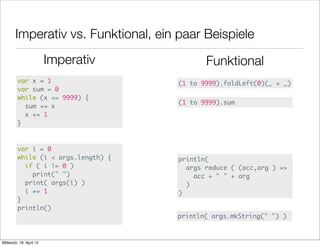
Imperativ vs. Funktional, ein paar Beispiele
                         Imperativ          Funktional
         var x = 1                   (1 to 9999).foldLeft(0)(_ + _)
         var sum = 0
         while (x <= 9999) {
                                     (1 to 9999).sum
           sum += x
           x += 1
         }


         var i = 0
         while (i < args.length) {   println(
           if ( i != 0 )               args reduce ( (acc,arg ) =>
             print(" ")                  acc + " " + arg
           print( args(i) )            )
           i += 1                    )
         }
         println()
                                     println( args.mkString(" ") )


Mittwoch, 18. April 12
Tools

       • Sbt : ein Build Tool


       • Specs2 : Testen mit Specifications


Mittwoch, 18. April 12
SBT - Simple Build Tool

       • Build-tool


       • Vergleichbar mit Maven


       • Kompatibel zu Maven


       • Verwaltet Abhängigkeiten selbsständig und notwendig Jars/Module nach


       • Contionuous build mit ~


       • g8 Vorlagen zum erstellen von scala Projekten


Mittwoch, 18. April 12
Ein Projekt mit g8 erzeugen


Mittwoch, 18. April 12
g8

       • Ein offenes Templating System für Projekte


       • g8 --list gibt eine Liste der vorhanden Templates


       • g8 <Template Name> erstellt ein Projekt anhad des Templates


Mittwoch, 18. April 12
build.sbt

       • Beschreibt Aufbau des zu erzeugenden Projekts


       • Gibt Abhängigkeiten an


Mittwoch, 18. April 12
SBT - Befehle, eine kurze Auswahl

       • sbt startet die sbt-shell


       • Abhängigkeiten werden automatisch geholt


       • Mit update und reload können Änderungen und neue Abhängigkeiten bei
         geändertem build.sbt im laufenen Betriebt geholt werden


       • run startet Anwendung


       • test tetstet die Anwenduung


       • package erzeugt ein jar


Mittwoch, 18. April 12
SBT - Example


Mittwoch, 18. April 12
SBT - Links

       • Source : https://github.com/harrah/xsbt


       • Doku: https://github.com/harrah/xsbt/wiki


       • SBT-Plugins um Projekte zu erzeugen, die sich in folgenden IDEs öffnen lasse:


              • Eclipse: https://github.com/typesafehub/sbteclipse


              • InteliJ IDEA : https://github.com/mpeltonen/sbt-idea


              • Netbenas: https://github.com/remeniuk/sbt-netbeans-plugin


       • Integration der sbt-Konsole in IDEs


       • Templates für SBT-Projekte, erspart das anlegen per Hand: https://github.com/n8han/giter8


Mittwoch, 18. April 12
Specs2

       • Eine DSL zum erstellen von unit-tests und acceptance-tests


       • Ausführbare Softwarespezifikationen


       • http://etorreborre.github.com/specs2/


Mittwoch, 18. April 12
Specs 2 Unit-Test Example

                         import org.specs2.mutable._

                           class HelloWorldSpec extends Specification {

                                 "The 'Hello world' string" should {
                                   "contain 11 characters" in {
                                     "Hello world" must have size(11)
                                   }
                                   "start with 'Hello'" in {
                                     "Hello world" must startWith("Hello")
                                   }
                                   "end with 'world'" in {
                                     "Hello world" must endWith("world")
                                   }
                                 }
                             }


       • Quelle: http://etorreborre.github.com/specs2/

Mittwoch, 18. April 12
Specs2 - Acceptance-Test - Example

      import org.specs2._

        class HelloWorldSpec extends Specification { def is =

               "This is a specification to check the 'Hello world' string"          ^
                                                                                    p^
               "The 'Hello world' string should"                                    ^
                 "contain 11 characters"                                            ! e1^
                 "start with 'Hello'"                                               ! e2^
                 "end with 'world'"                                                 ! e3^
                                                                                    end
           
               def e1 = "Hello world" must have size(11)
               def e2 = "Hello world" must startWith("Hello")
               def e3 = "Hello world" must endWith("world")
          }


       • Quelle: http://etorreborre.github.com/specs2/


Mittwoch, 18. April 12
Specs2 mit SBT in Netbeans

       • Mit sbt und Plugin erzeugte Projekte lassen sich in Netbeans integrieren


       • Um Specs2 für Tests anzuwenden muss nichts weiter konfiguriert werden


Mittwoch, 18. April 12
Literatur:

       • Wampler, D., & Payne, A. (2009). Programming Scala. Sebastopol, CA:
         O'Reilly.


       • Odersky, M., Spoon, L., & Venners, B. (2008). Programming in Scala.
         Mountain View, Calif: Artima.


       • http://www.scala-lang.org


       • http://www.an-it.com


Mittwoch, 18. April 12
Vielen Dank für die Aufmerksamkeit :)


Mittwoch, 18. April 12

Scala Workshop

  • 1.
    BSB-Scala-Workshop 2012 Andreas Neumann, AN-iT www.an-it.com Mittwoch, 18. April 12
  • 2.
    Überblick • Was ist Scala ? • Bausteine: val, var, Klassen, Objekte • Kernkonzepte • Tools Mittwoch, 18. April 12
  • 3.
    Was ist Scala? • Eine JVM-Sprache • multiparadigmatisch • Funktional-Objektorientiert Mittwoch, 18. April 12
  • 4.
    Stärken • Skalierbarkeit • Parallelisierbarkeit • Integrierbarkeit • XML • DSL Mittwoch, 18. April 12
  • 5.
    Einführung • Code ausführen / kompilieren • Prinzipielles zur Syntax • Variablen deklarieren • Funktionen definieren • Klassen, Traits und Objekte Mittwoch, 18. April 12
  • 6.
    Code ausführen, compilieren • Scala Code kann unter unterschiedlichsten Umgebungen ausgeführt und benutzt werden: • Compilieren und auf einer JVM ausführen • Als Script direkt ausführen • In REPL, zum testen Mittwoch, 18. April 12
  • 7.
    Scala - Compiler/ scalac • Compiler wird mit scalac aufgerufen • Klassen werden in JavaBytecode kompiliert • Aufruf mit scala <Klassenname> Mittwoch, 18. April 12
  • 8.
    Scala als Scriptsprache- Unix • Scala kann auch als #!/bin/sh Skriptsprache eingesetzt exec scala "$0" "$@" werden !# object HelloWorld { • Der Aufruf erfolg mit sh def main(args: Array[String]) { oder mann kann die Daei println("Hello, world! " + args.toList) ausführbar machen } } HelloWorld.main(args) Mittwoch, 18. April 12
  • 9.
    Scala als Scriptsprache- Windows • Scala als Scriptsprache unter Windows ::#! @echo off • In eine batch-Datei, call scala %0 %* Endung .bat speichern goto :eof ::!# • Aufrufen object HelloWorld { def main(args: Array[String]) { println("Hello, world! " + args.toList) } } HelloWorld.main(args) Mittwoch, 18. April 12
  • 10.
    Scala - Interpreter/ REPL • Bei der Installation von Scala wird neben dem compiler auch ein Interpreter installiert • Starten des Interpreters: $ scala Mittwoch, 18. April 12
  • 11.
    Online REPL • http://www.simplyscala.com/ Mittwoch, 18. April 12
  • 12.
    Prinzipielles zur Syntax • Keine abschließende Semikolons notwendig, eine Anweisung pro Zeile • Mehre Anweisungen pro Zeile können getrennt mit einem Semikolon angegeben werden • Bei eindeutiger Syntax kann der Punkt bei Methodenaufrufen weggelassen werden 1.+(5) List(1,2.3).map(_ * 3).head List(1,2.3) map(_ * 3) head 1 + 5 Mittwoch, 18. April 12
  • 13.
    val, vars • Das Keyword val erzeugt einen Value, einen unveränderbaren Wert, vergleichbar mit final in Java • Das Keyword var erzeugt eine Variable im klassischen Sinn Mittwoch, 18. April 12
  • 14.
    Beispiel: val undvar val x = 42 x: Int = 42 var y = 99 y: Int = 99 y = 1 y: Int = 1 x = 1 error: reassignment to val x = 1 ^ Mittwoch, 18. April 12
  • 15.
    Typen und Typinferenz • Typangaben werden mit : eingeleitet und stehen hinter dem Value/der Variablen s : String = "ein String" • In vielen Fällen sind sie optional, da die Typinferenz den Typ selbst ermitteln kann val a = "Hallo" a: java.lang.String = Hallo val b = 1 b: Int = 1 val c = 3.5 c: Double = 3.5 val d = List(1,2.0) d: List[Double] = List(1.0, 2.0) Mittwoch, 18. April 12
  • 16.
    Methoden definieren • Methoden werden mit dem Keyword def eingeleitet def write(aString: String) { println(aString) • Darauf folgt eine optionale } Parameterliste in runden Klammern write("Hallo ihr alle da draußen!") Hallo ihr alle da draußen! • Am Schluß folgt der Funktionsrumpf • Hat die Methode eine Rückgabewert wird der def add(x: Int, y:Int) : Int = { Funktionsrumpf mit einem = x + y angeschlossen } • Der letzte Wert in einer Methode add(40,2) ist der Rückgabewert res0: Int = 42 Mittwoch, 18. April 12
  • 17.
    Collections • Scala wartet mit einer großen Collections-Bibliothek auf • Collections bieten ein nach Möglichkeit einheitliches Interface • Es gibt Collections in bis zu vier Ausführungen: • Basis • immutable : nicht Veränderbar • mutable : Veränderbar • (parallel: Parallele Version) Mittwoch, 18. April 12
  • 18.
  • 19.
    Scala Collection -immutable Mittwoch, 18. April 12
  • 20.
    Scala Collection -mutable Mittwoch, 18. April 12
  • 21.
    Scala Collections :List val a = List("a","b","c") a: List[java.lang.String] = List(a, b, c) a head res5: java.lang.String = a a tail res6: List[java.lang.String] = List(b, c) val b = List(1,2,3) b: List[Int] = List(1, 2, 3) 0 :: b res10: List[Int] = List(0, 1, 2, 3) a ++ b res11: List[Any] = List(a, b, c, 1, 2, 3) a zip b res12: List[(java.lang.String, Int)] = List((a,1), (b,2), (c,3)) Mittwoch, 18. April 12
  • 22.
    Scala Collections :map val counting = Map(1 -> "eins", 2 -> "zwei", 3 -> "drei") counting: scala.collection.immutable.Map[Int,java.lang.String] = Map((1,eins), (2,zwei), (3,drei)) counting(2) res2: java.lang.String = zwei counting.get(2) res3: Option[java.lang.String] = Some(zwei) counting get 99 res4: Option[java.lang.String] = None Mittwoch, 18. April 12
  • 23.
    Klassen • Klassen werden mit dem Keyword class eingeleitet • Gefolgt von optionalen Konstruktorelmenten in Klammern • Daraufhin folgt optional der Körper der Klasse in geschweiften Klammern • Besonderheiten • Für Konstruktorelemente die mit dem Keyword val eingeleitetet werden wird automtisch ein getter unter dem gleichen Namen erzeugt (uniform access principle) • Für Konstruktorelemente die mit dem Keyword var eingeleitetet werden wird automtisch ein getter und ein setter unter dem gleichen Namen erzeugt (uniform access principle) • Alle aufegrufenen Operationen im Body der Klasse werden bei deren Konstruktion aufgerufen Mittwoch, 18. April 12
  • 24.
    Beispiel: Klasse inScala class Document(val title: String, val author: String, yearInt: Int) { val year = yearInt.toString def shortCitation: String = author + " : " + title + ". " + year } val scalaBook = new Document("Programming In Scala","Martin Odersky","2011") println(scalaBook.title) println(scalaBook.year) • Instanzen werden mit new <Klassenname> erzeugt Mittwoch, 18. April 12
  • 25.
    Scala Object -Objekte • Objekte werden mit dem keyword object eingeleitet • Sie haben keine Konstruktorelemente • Funktionsweise entspricht grob einer Javaklasse mit static modifieren • Aufrufe von Members und Methoden erfolgt über Objektname.member bzw. Objektname.methode • Idiomatischer Weg um in Scala eine Singleton-Object zu erzeugen Mittwoch, 18. April 12
  • 26.
    Scala Object -Beispiel object DeepThought { ! val theMeaningOfLife = "The meaning of life: 42" ! def speak { println(theMeaningOfLife) } } DeepThought.speak The meaning of life: 42 Mittwoch, 18. April 12
  • 27.
    Companion Object • Scala typisch • Ein object, welches den gleichen Namen wie eine Klasse trägt • Natives Constructor Pattern Mittwoch, 18. April 12
  • 28.
    Case Class • Wird mit dem Keywords case class eingeleitet • Ansonsten wie bei der „normalen Klasse“ • Definiert eine companion object mit apply, unapply und einigen anderen Methoden • Für alle Konstruktorargumente werden getter erzeugt • Sollte nicht vererben! Mittwoch, 18. April 12
  • 29.
    Case Class -Beispiel case class Book(title: String, pages :Int) defined class Book val book = Book("Necronomicon",1000) book: Book = Book(Necronomicon,1000) println( book.title ) Necronomicon Mittwoch, 18. April 12
  • 30.
    Trait • Wird mit dem keyword trait eingeleitet • Ähnlich einem Java-Interface • Erlaubt es einem der Mehrfachverebung ähnlichen Effekt zu erzeugen ohne die Probleme, die dieses Verfahren üblicherweise mit sich bringt • Bausteine • Wie Ruby mixins Mittwoch, 18. April 12
  • 31.
    Trait - BeispielDefinition • Es werden zwei trait Edible { Eigenschafteen als Traits def taste: String def eat = println(taste) definiert: Edible und } ExoticTaste trait ExoticTaste { def eat: Unit • Zwei Klassen werden def describeTaste = { definiert: Cake, welcher eat vom Trait Edible „erbt“ println("It tastes exotic") } } • Klasse: ChiliChocolate welche sowohl von Edible case class Cake extends Edible{ als auch ExoticTaste erbt def taste = "sweet" } case class ChiliChocolate extends Edible with ExoticTaste{ val taste = "sweet and hot" } Mittwoch, 18. April 12
  • 32.
    Trait - Beispiel: Anwendung val cake = new Cake cake.eat val chiliChoc = new ChiliChocolate chiliChoc.eat chiliChoc.describeTaste val cake = new Cake cake: Cake = Cake() cake.eat sweet val chiliChoc = new ChiliChocolate chiliChoc: ChiliChocolate = ChiliChocolate() chiliChoc.eat sweet and hot chiliChoc.describeTaste sweet and hot It tastes exotic Mittwoch, 18. April 12
  • 33.
    Kontrollstrukturen • if, else • while • foreach, map • For-Comprehensions Mittwoch, 18. April 12
  • 34.
    Klassische Kontrollstrukturen • Kontrollstrukturen wie while, if und else funktionieren wie gewohnt • Im Gegensatz zu Java sind es aber echte Funktionen, d.h. Sie haben einen Rückgabewert • if gibt den Wert des Blocks zurück wenn wahr • while hat den Rückgabewert Unit val x = if ( 1 < 2 ) true x: AnyVal = true Mittwoch, 18. April 12
  • 35.
    „Funktionale Kontrollstrukturen“ • Alles Funktionen • Können gleiches Ergebnis erreichen wie klassische Kontrollstrukturen • Map : Eine Funktion auf jedes Element anwenden, Ergebnis zurückliefern List(1,2,3,4) map (x => x + 1) res1: List[Int] = List(2, 3, 4, 5) • Foreach: Eine Funktion auf jedes Element anwenden, Ergebnis verwerfen List(1,2,3) foreach( x => println("And a " + x)) And a 1 And a 2 And a 3 Mittwoch, 18. April 12
  • 36.
    matching • Pattern matching • Wird durch keyword match eingeleitet • Mehrere cases die mit keyword case eingeleitet werden • Ähnlich Java switch aber mit weitaus mehr möglichkeiten • Pattern Guards erweitern Möglichkeiten • Case Classes und Extractor Patterns erlauben einfaches zerlegen Mittwoch, 18. April 12
  • 37.
    Matching Example case class Book( title: String, pages: Int, year: Int) val books = List( Book("Programming Scala", 883, 2012), Book("Programming Pearl", 1104, 2000), Book("Necronomicon",666,666), "Ein String", 5, 42 ) val bookComments = books.map( book => book match { case Book("Programming Scala", pages, year) => "New Scala Book by Martin Odersky from " + year case Book(title, pages,year) => title + " " + pages + " " + year case x: Int if x > 10 => "an integer bigger than 10" case _ => "Something else" }) // Ausgabe bookComments: List[java.lang.String] = List( New Scala Book by Martin Odersky from 2012, Programming Pearl 1104 2000, Necronomicon 666 666, Something else, Something else, an integer bigger than 10) Mittwoch, 18. April 12
  • 38.
    For-Comprehensions • Eleganter Weg um lesbar mehrere Operationen zu verbinden • Wird intern in eine folge von map, filter, flatMap und reduce Operationen umgewandelt def isEven(x: Int) = x % 2 == 0 val integers = for { x <- 1 to 99 if isEven(x) if x % 5 == 0 } yield x integers: scala.collection.immutable.IndexedSeq[Int] = Vector(10, 20, 30, 40, 50, 60, 70, 80, 90) ~ Umgewandelt ~ (1 to 99).filter(isEven(_)).filter( x % 5 == 0) Mittwoch, 18. April 12
  • 39.
    Weiterführende Sprachelemente • XML erzeugen und bearbeiten • Asynchrone Kommunikation mit Aktoren • Reguläre Ausdrücke • Parallele Collections • Implicits Mittwoch, 18. April 12
  • 40.
    XML in Scala • XML ist in Scala eine Sprachelement wie z.B. String in Java oder Ruby • Es kann also als Literal in den Quellcode eingebunden werden Mittwoch, 18. April 12
  • 41.
    Scala - XMLerzeugen • Xml darf direkt im Scala Code stehen • Moderne Entwicklungsumgebungen (Eclipse, Netbeans, intelliJ) biten Syntaxhighlighting • Variablen und Code können mit {} in XML Literale eingebettet werden Mittwoch, 18. April 12
  • 42.
    XML erzeugen -Beispielcode case class Book( title: String, pages: Int, year: Int) { def toXML = <book> <title>{title}</title> <pages>{pages toString}</pages> <year>{year toString}</year> </book> } val books = List( Book("Programming Scala", 883, 2012), Book("Programming Perl", 1104, 2000), Book("Necronomicon",666,666) ) for ( book <- books) { println(book.toXML) } Mittwoch, 18. April 12
  • 43.
    XML erzeugen -Ausgabe <book> <title>Programming Scala</title> <pages>883</pages> <year>2012</year> </book> <book> <title>Programming Perl</title> <pages>1104</pages> <year>2000</year> </book> <book> <title>Necronomicon</title> <pages>666</pages> <year>666</year> </book> Mittwoch, 18. April 12
  • 44.
    Scala XML verarbeiten • XML kann mit XPath - ähnlicher Syntax verarbeite werden ( anstatt // und anstatt / ) • <xml></xml> "tag" : für einen Shallow -Match • <xml></xml> "tag" : für einen Deep -Match • <xml></xml> "@attribut" : für einen Deep -Match auf ein Attribut • (<xml></xml> "tag").text : Methode text gibt den Textwert des Knotens zurück Mittwoch, 18. April 12
  • 45.
    XML verarbeiten -Beispielcode case class Book( title: String, pages: Int, year: Int) { def toXML = <book> <title>{title}</title> <pages>{pages}</pages> <year>{year}</year> </book> implicit def intToString(in : Int) : String = in.toString } object Book { def fromXML(bookXML: scala.xml.NodeSeq) : Book= { val title = (bookXML "title").text val pages = (bookXML "pages").text.toInt val year = (bookXML "year").text.toInt new Book(title, pages, year) } } Mittwoch, 18. April 12
  • 46.
    XML verarbeiten -Aufruf und Ausgabe val books = <books> <book> <title>Programming Scala</title> <pages>883</pages> <year>2012</year> </book> <book> <title>Programming Perl</title> <pages>1104</pages> <year>2000</year> </book> <book> <title>Necronomicon</title> <pages>666</pages> <year>666</year> </book> </books> val booksInstances = (books "book").map(Book.fromXML(_)) val booksPages = (books "pages").map(_.text.toInt) booksInstances: scala.collection.immutable.Seq[Book] = List(Book(Programming Scala,883,2012), Book(Programming Perl,1104,2000), Book(Necronomicon,666,666)) booksPages: scala.collection.immutable.Seq[Int] = List(883, 1104, 666) Mittwoch, 18. April 12
  • 47.
    Aktoren • Erlauben asynchrone Kommunikation • Aus Erlang entlehnt • ! Sendet nachricht • react reagiert auf Nachricht • Vorstellung: Nachrichten senden, diese landen in einem Briefkasten und werden nacheinder verarbeitet Mittwoch, 18. April 12
  • 48.
    Actor - Beispielcode import scala.actors._ import scala.actors.Actor._ case class Comedy(who: String) case class Drama(who: String) class StageActor() extends Actor { def act() { loop { react { case Drama(who) => { println(who + ": To be ..." ) println(who + ": or not To be" ) } case Comedy(who) => { println(who + ": Knock, Knock") println("Someone: Who's there?") println(who + "Honey bee. ") println("Someone: Honey bee who?") println(who + "Honey bee a dear and get me a beer.") }}}}} Mittwoch, 18. April 12
  • 49.
    Actor - Aufrufund Ausgabe val artist = new StageActor().start val clown = new StageActor().start println("Action") artist ! Drama("Artistical") clown ! Comedy("Clown") clown ! Drama("Clown") artist ! Comedy("Art") Action. Artistical: To be ... Artistical: or not To be Clown: Knock, Knock Someone: Who's there? ClownHoney bee. Someone: Honey bee who? ClownHoney bee a dear and get me a beer. Clown: To be ... Clown: or not To be Art: Knock, Knock Someone: Who's there? ArtHoney bee. Someone: Honey bee who? ArtHoney bee a dear and get me a beer. Mittwoch, 18. April 12
  • 50.
    Reguläre Ausdrücke • .r aus einem String erzeugen: """hrefs?=s?"([^"]+)"""".r • Nutzt Java Regex Engine • Automatische Erzeugung von Extraktoren für Pattern matching Mittwoch, 18. April 12
  • 51.
    Regex - Beispiel import scala.io.Source val html = Source.fromURL("http://www.an-it.com").getLines.mkString("") val urlExtractor = """hrefs?=s?"([^"]+)"""".r for { urlExtractor(url) <- (urlExtractor findAllIn html).matchData } { println("Url ->" + url) } Mittwoch, 18. April 12
  • 52.
    first-order-functions / AnonymeFunktionen • Funktionen sind ein Sprachelemente wie Integer oder String • Sie lassen sich als Argumente an Funktionen übergeben val y = (x: Int) => x * x y: (Int) => Int = y.apply(5) res10: Int = 25 y(5) res11: Int = 25 val add = (x: Int, y: Int) => x + y add: (Int, Int) => Int = add(1,2) res12: Int = 3 Mittwoch, 18. April 12
  • 53.
    Implicits • Werden mit dem keyword implicit eingeleitet • Automatisch Umwandlung • Nicht stapelbar • Kann Code kürzen und duplikationen vermeiden • Pimp my library Pattern: Ähnlich monkey-patching , kann aber lokal begrenzt werden Mittwoch, 18. April 12
  • 54.
    Implicit: Beispiel case class Book( title: String, pages: Int, year: Int) { def toXML = <book> <title>{title}</title> <pages>{pages}</pages> <year>{year}</year> </book> implicit def intToString(in : Int) : String = in.toString } Mittwoch, 18. April 12
  • 55.
    Parallele Collections • Asynchrone, parallele Verarbeitung nutzt moderne Mehrkernprozessorarchitekturen aus • Methode .par verwandelt normale Collection in parallele Version • Methode .seq verwandelt parallele Collection in lineare Version • Parralelität ist als Trait implementiert => eigene parallele Collections möglich • Auch für Maps Mittwoch, 18. April 12
  • 56.
    Parallele Collections -Beispielcode // Sequentiell (1 to 5).foreach(println) // Parallel (1 to 5).par foreach(println) Mittwoch, 18. April 12
  • 57.
    Parallele Collections -Beispielcode II // Ungeordnet val tenTimes = (1 to 10).map(_ * 10) //Geordnet //.seq verwandelt parallele Collection //wieder in eine sequentielle val tenTimes = (1 to 10).map(_ * 10).seq Mittwoch, 18. April 12
  • 58.
    Eigene Kontrollstrukturen definieren • Curryfizierte Funktionen erlauben Funktionen zu definieren, die sich wie Kontrollstrukturen anfühlen object ControlStructures { def unless( test: => Boolean)(action: => Any) = if (! test) {action} def times( n: Int )(action: => Unit) { (1 to n).foreach { i => action} } } times(2) { println("Hoorray :)")} Hoorray :) Hoorray :) unless (5 < 10) { println("Math stopped working.") } val ifNot = unless (2 + 2 != 4) { "Math still works." } ifNot: Any = Math still works. Mittwoch, 18. April 12
  • 59.
    Scala - imperativ,objektorientiert funktional Mittwoch, 18. April 12
  • 60.
    Scala - imperativ,objektorientiert funktional - Faustregeln • Funktional wenn möglich • Aber: Manches lässt sich imperativ intuitiver und performanter lösen • Mit vals und immutable Collections beginnen, auf vars und mutable collections ausweichen • Objektorientierung nutzen um Seiteneffekte oder imperative Programmteile zu kapseln Mittwoch, 18. April 12
  • 61.
    Funktional - Vorteile • Kurz • keine Seiteneffekt • Für Nebenläufigkeit geeignet Mittwoch, 18. April 12
  • 62.
    Imperativ - Vorteile • Intuitiv Mittwoch, 18. April 12
  • 63.
    Imperativ vs. Funktional,ein paar Beispiele Imperativ Funktional var x = 1 (1 to 9999).foldLeft(0)(_ + _) var sum = 0 while (x <= 9999) { (1 to 9999).sum sum += x x += 1 } var i = 0 while (i < args.length) { println( if ( i != 0 ) args reduce ( (acc,arg ) => print(" ") acc + " " + arg print( args(i) ) ) i += 1 ) } println() println( args.mkString(" ") ) Mittwoch, 18. April 12
  • 64.
    Tools • Sbt : ein Build Tool • Specs2 : Testen mit Specifications Mittwoch, 18. April 12
  • 65.
    SBT - SimpleBuild Tool • Build-tool • Vergleichbar mit Maven • Kompatibel zu Maven • Verwaltet Abhängigkeiten selbsständig und notwendig Jars/Module nach • Contionuous build mit ~ • g8 Vorlagen zum erstellen von scala Projekten Mittwoch, 18. April 12
  • 66.
    Ein Projekt mitg8 erzeugen Mittwoch, 18. April 12
  • 67.
    g8 • Ein offenes Templating System für Projekte • g8 --list gibt eine Liste der vorhanden Templates • g8 <Template Name> erstellt ein Projekt anhad des Templates Mittwoch, 18. April 12
  • 68.
    build.sbt • Beschreibt Aufbau des zu erzeugenden Projekts • Gibt Abhängigkeiten an Mittwoch, 18. April 12
  • 69.
    SBT - Befehle,eine kurze Auswahl • sbt startet die sbt-shell • Abhängigkeiten werden automatisch geholt • Mit update und reload können Änderungen und neue Abhängigkeiten bei geändertem build.sbt im laufenen Betriebt geholt werden • run startet Anwendung • test tetstet die Anwenduung • package erzeugt ein jar Mittwoch, 18. April 12
  • 70.
  • 71.
    SBT - Links • Source : https://github.com/harrah/xsbt • Doku: https://github.com/harrah/xsbt/wiki • SBT-Plugins um Projekte zu erzeugen, die sich in folgenden IDEs öffnen lasse: • Eclipse: https://github.com/typesafehub/sbteclipse • InteliJ IDEA : https://github.com/mpeltonen/sbt-idea • Netbenas: https://github.com/remeniuk/sbt-netbeans-plugin • Integration der sbt-Konsole in IDEs • Templates für SBT-Projekte, erspart das anlegen per Hand: https://github.com/n8han/giter8 Mittwoch, 18. April 12
  • 72.
    Specs2 • Eine DSL zum erstellen von unit-tests und acceptance-tests • Ausführbare Softwarespezifikationen • http://etorreborre.github.com/specs2/ Mittwoch, 18. April 12
  • 73.
    Specs 2 Unit-TestExample import org.specs2.mutable._   class HelloWorldSpec extends Specification {     "The 'Hello world' string" should {       "contain 11 characters" in {         "Hello world" must have size(11)       }       "start with 'Hello'" in {         "Hello world" must startWith("Hello")       }       "end with 'world'" in {         "Hello world" must endWith("world")       }     }   } • Quelle: http://etorreborre.github.com/specs2/ Mittwoch, 18. April 12
  • 74.
    Specs2 - Acceptance-Test- Example import org.specs2._   class HelloWorldSpec extends Specification { def is =     "This is a specification to check the 'Hello world' string"          ^                                                                          p^     "The 'Hello world' string should"                                    ^       "contain 11 characters"                                            ! e1^       "start with 'Hello'"                                               ! e2^       "end with 'world'"                                                 ! e3^                                                                          end         def e1 = "Hello world" must have size(11)     def e2 = "Hello world" must startWith("Hello")     def e3 = "Hello world" must endWith("world")   } • Quelle: http://etorreborre.github.com/specs2/ Mittwoch, 18. April 12
  • 75.
    Specs2 mit SBTin Netbeans • Mit sbt und Plugin erzeugte Projekte lassen sich in Netbeans integrieren • Um Specs2 für Tests anzuwenden muss nichts weiter konfiguriert werden Mittwoch, 18. April 12
  • 76.
    Literatur: • Wampler, D., & Payne, A. (2009). Programming Scala. Sebastopol, CA: O'Reilly. • Odersky, M., Spoon, L., & Venners, B. (2008). Programming in Scala. Mountain View, Calif: Artima. • http://www.scala-lang.org • http://www.an-it.com Mittwoch, 18. April 12
  • 77.
    Vielen Dank fürdie Aufmerksamkeit :) Mittwoch, 18. April 12