Patrick H. Lauke, Opera Software

Die Zukunft der Webstandards


 Patrick H. Lauke / Webinale 2010 / Berlin / 31 Mai 2010
Web Evangelist bei Opera
die Zukunft hat schon Heute begonnen...
HTML5
<!DOCTYPE html>
Geschichte von HTML5

● fing bei Opera an – Web Applications 1.0
● Gegenreaktion zu XHTML 2.0

● Mozilla und Apple machen mit – WHAT WG

● W3C HTML5

● Microsoft jetzt auch mit dabei
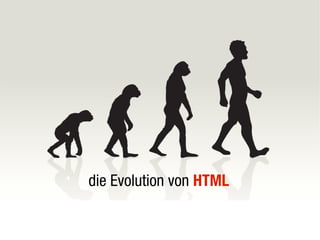
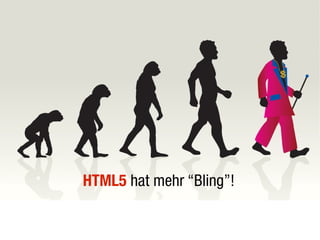
die Evolution von HTML
HTML5 hat mehr “Bling”!
“...extending the language to better
support Web applications [...] This puts
HTML in direct competition with other
technologies[...] , in particular Flash and
Silverlight.”
Ian Hickson, Editor of HTML5
http://lists.w3.org/Archives/Public/public-html/2009Jan/0215.html
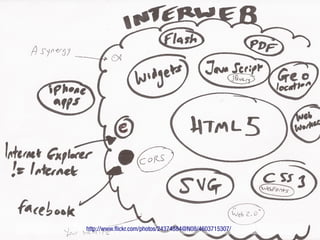
http://www.flickr.com/photos/24374884@N08/4603715307/
HTML5 Definition (ohne Hype):
    vereinfachte Syntax, standardisiertes
Browserverhalten, neue Markup-Elemente und
              JavaScript APIs
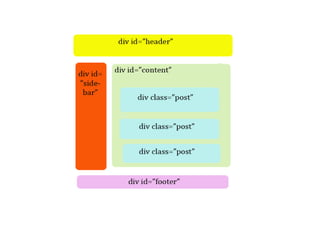
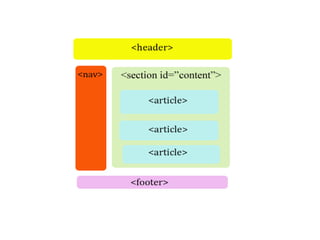
neue Elemente für bessere Semantik
HTML5 Elemente für einen
    typischen Blog
HTML5 – präziser und
  maschinenlesbar
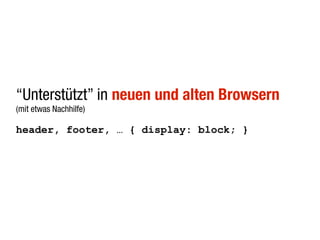
“Unterstützt” in neuen und alten Browsern
(mit etwas Nachhilfe)

header, footer, … { display: block; }
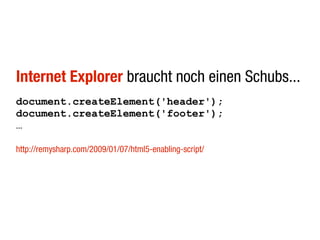
Internet Explorer braucht noch einen Schubs...
document.createElement('header');
document.createElement('footer');
…

http://remysharp.com/2009/01/07/html5-enabling-script/
webforms – bessere Formulare
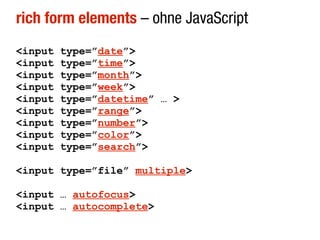
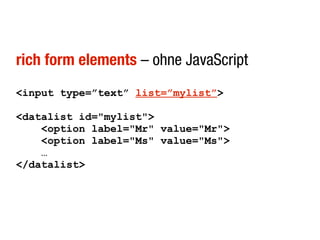
rich form elements – ohne JavaScript
<input   type=”date”>
<input   type=”time”>
<input   type=”month”>
<input   type=”week”>
<input   type=”datetime” … >
<input   type=”range”>
<input   type=”number”>
<input   type=”color”>
<input   type=”search”>

<input type=”file” multiple>

<input … autofocus>
<input … autocomplete>
rich form elements – ohne JavaScript
<input type=”text” list=”mylist”>

<datalist id="mylist">
    <option label="Mr" value="Mr">
    <option label="Ms" value="Ms">
    …
</datalist>
Typen und Attribute zur automatischen Validierung
(natürlich trotzdem auf dem Server noch validieren)

<input       type=”tel”>
<input       type=”email”>
<input       type=”url”>
<input       … pattern="[a-z]{3}[0-9]{3}">
<input       … required>

Demonstration: new input types, datetime, validation
<video>
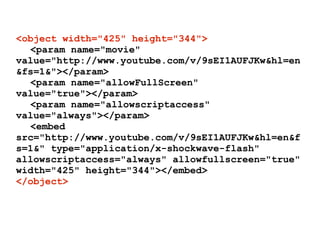
<object width="425" height="344">
  <param name="movie"
value="http://www.youtube.com/v/9sEI1AUFJKw&hl=en
&fs=1&"></param>
  <param name="allowFullScreen"
value="true"></param>
  <param name="allowscriptaccess"
value="always"></param>
  <embed
src="http://www.youtube.com/v/9sEI1AUFJKw&hl=en&f
s=1&" type="application/x-shockwave-flash"
allowscriptaccess="always" allowfullscreen="true"
width="425" height="344"></embed>
</object>
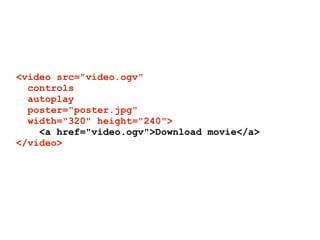
<video src="video.ogv"
  controls
  autoplay
  poster="poster.jpg"
  width="320" height="240">
    <a href="video.ogv">Download movie</a>
</video>
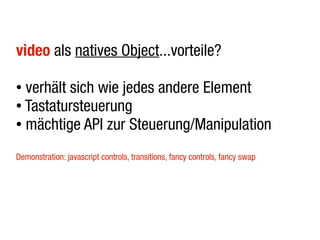
video als natives Object...vorteile?

● verhält sich wie jedes andere Element
● Tastatursteuerung

● mächtige API zur Steuerung/Manipulation


Demonstration: javascript controls, transitions, fancy controls, fancy swap
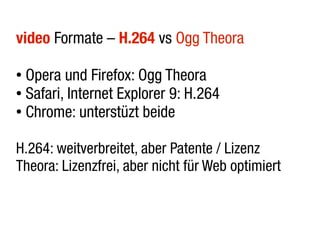
video Formate – H.264 vs Ogg Theora

● Opera und Firefox: Ogg Theora
● Safari, Internet Explorer 9: H.264

● Chrome: unterstüzt beide


H.264: weitverbreitet, aber Patente / Lizenz
Theora: Lizenzfrei, aber nicht für Web optimiert
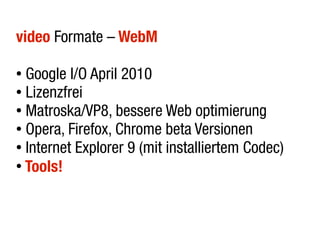
video Formate – WebM

● Google I/O April 2010
● Lizenzfrei

● Matroska/VP8, bessere Web optimierung

● Opera, Firefox, Chrome beta Versionen

● Internet Explorer 9 (mit installiertem Codec)

●
  Tools!
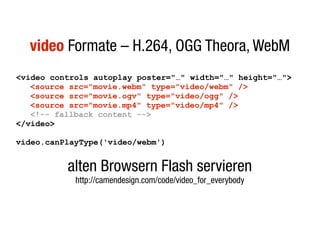
video Formate – H.264, OGG Theora, WebM
<video controls autoplay poster="…" width="…" height="…">
   <source src="movie.webm" type="video/webm" />
   <source src="movie.ogv" type="video/ogg" />
   <source src="movie.mp4" type="video/mp4" />
   <!-- fallback content -->
</video>

video.canPlayType('video/webm')


          alten Browsern Flash servieren
            http://camendesign.com/code/video_for_everybody
<audio>
audio fast gleich wie video
<audio src=”music.mp3” controls autoplay></audio>

[...]

<audio controls autoplay>
   <source src="music.mp3" type="audio/mpeg" />
   <source src="music.oga" type="audio/ogg" />
   <!-- fallback content -->
</audio>


                       MP3, Ogg Vorbis, WAV
Demonstration: audio
<canvas>
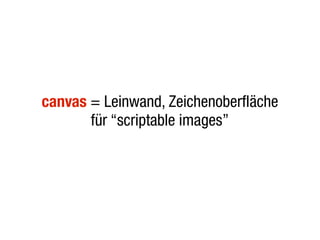
canvas = Leinwand, Zeichenoberfläche
       für “scriptable images”
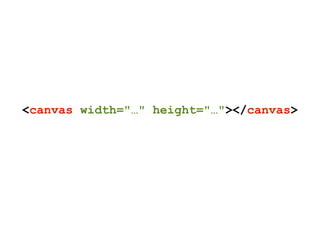
<canvas width="…" height="…"></canvas>
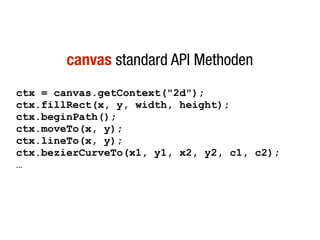
canvas standard API Methoden
ctx = canvas.getContext("2d");
ctx.fillRect(x, y, width, height);
ctx.beginPath();
ctx.moveTo(x, y);
ctx.lineTo(x, y);
ctx.bezierCurveTo(x1, y1, x2, y2, c1, c2);
…
canvas kommt auch mit externe Grafiken klar
ctx = canvas.drawImage(…);

Demonstration: canvas
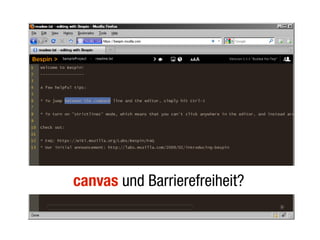
canvas und Barrierefreiheit?
canvas gut für “enhancements” – nicht für
            eigentliche Inhalte
video, audio und canvas … multimedia ohne
            “Steckeins” (plugins)
         (Java / Flash / Silverlight nicht überall vorhanden)
HTML5 als Flashkiller?
neue Standards
geben Entwicklern endlich Alternativen
      (vor allem auf mobilen Plattformen)
neue Features für mächtige
   Web Applikationen
geolocation
isgeolocationpartofhtml5.com
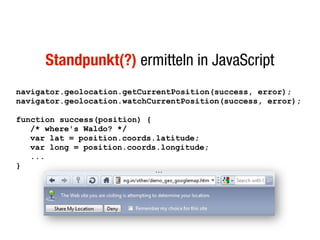
Standpunkt(?) ermitteln in JavaScript
navigator.geolocation.getCurrentPosition(success, error);
navigator.geolocation.watchCurrentPosition(success, error);

function success(position) {
   /* where's Waldo? */
   var lat = position.coords.latitude;
   var long = position.coords.longitude;
   ...
}
offline Unterstützung
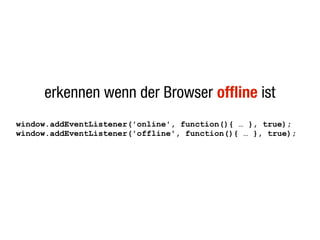
erkennen wenn der Browser offline ist
window.addEventListener('online', function(){ … }, true);
window.addEventListener('offline', function(){ … }, true);
application cache
UI/Resourcen zur Benutzung offline cachen
<html manifest=”blah.manifest”>

CACHE MANIFEST
# send this with correct text/cache-manifest MIME
images/sprites.png
scripts/common.js
scripts/jquery.js
styles/global.css
data.xml
storage
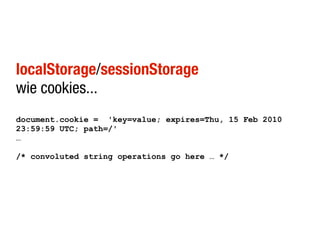
localStorage/sessionStorage
wie cookies...
document.cookie = 'key=value; expires=Thu, 15 Feb 2010
23:59:59 UTC; path=/'
…

/* convoluted string operations go here … */
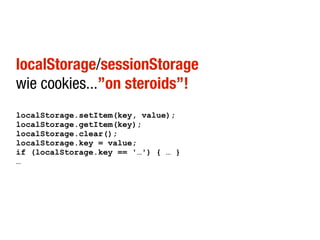
localStorage/sessionStorage
wie cookies...”on steroids”!
localStorage.setItem(key, value);
localStorage.getItem(key);
localStorage.clear();
localStorage.key = value;
if (localStorage.key == '…') { … }
…
Web Database – relationale DB / SQL
var db =
openDatabase(dbName, version, displayName, expectedSize);

db.transaction(function(tx) {
   tx.executeSql(sqlStatement, [], function (tx, result) {
      /* do something with the results */
   });
});
...und mehr!
(File API, File Writer, WebGL, Drag and Drop, Server-sent Events, Web Workers, …)
“Is it safe?”
kann ich diese Features schon jetzt
           verwenden?
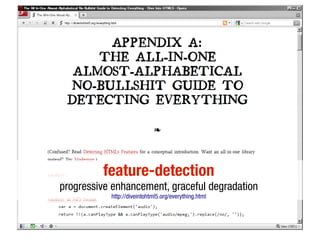
feature-detection
progressive enhancement, graceful degradation
           http://diveintohtml5.org/everything.html
Webstandards als high-level,
 plattformübergreifende
  Programmiersprachen
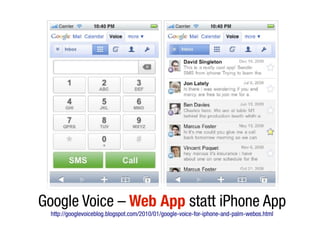
Google Voice – Web App statt iPhone App
 http://googlevoiceblog.blogspot.com/2010/01/google-voice-for-iphone-and-palm-webos.html
Palm WebOS, Google's “Installable Web Apps”,
            W3C Widgets, …
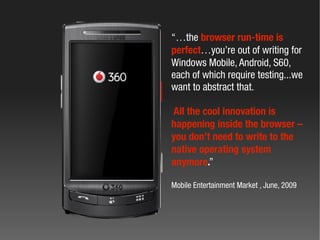
“…the browser run-time is
perfect…you’re out of writing for
Windows Mobile, Android, S60,
each of which require testing...we
want to abstract that.

All the cool innovation is
happening inside the browser –
you don’t need to write to the
native operating system
anymore.”

Mobile Entertainment Market , June, 2009
W3C Widgets
 standard-basierte Applikationen
mit Browser-Engine als Plattform
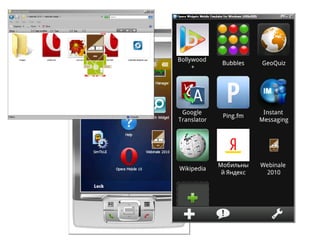
Widgets auf Desktop, Mobiltelefon, Fernseher...
Anatomie eines Widgets
index.html + […] + config.xml

“packaged” in einem ZIP Archiv
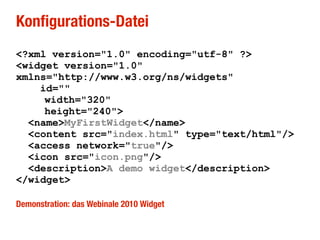
Konfigurations-Datei
<?xml version="1.0" encoding="utf-8" ?>
<widget version="1.0"
xmlns="http://www.w3.org/ns/widgets"
    id=""
     width="320"
     height="240">
  <name>MyFirstWidget</name>
  <content src="index.html" type="text/html"/>
  <access network="true"/>
  <icon src="icon.png"/>
  <description>A demo widget</description>
</widget>

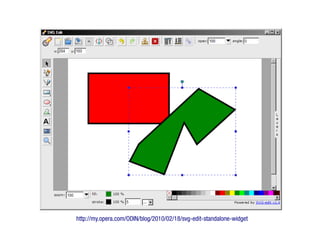
Demonstration: das Webinale 2010 Widget
http://my.opera.com/ODIN/blog/2010/02/18/svg-edit-standalone-widget
Warum Widgets?
Web App / Widget anstatt
 nativer Applikation?
www.opera.com/developer
people.opera.com/patrickl/presentations/webinale_31.05.2010/webinale_31.05.2010.pdf
                        patrick.lauke@opera.com

Die Zukunft der Webstandards - Webinale 31.05.2010