Tod Jesu between Bible and Poetry Florian Heyerick teaching at Conservatory Ghent performer (conducting) musicologist preparing PhD in Artistic Research on the music of Graupner  (dissemination)
Sayings of Jesus on the cross illustration of the musical setting what:  formal elements of text, music and structure why: crucial moment  between Pietism and Enlightenment (Neology) where: Hamburg (free republic) when: ca. 1700 towards 1755
Terms and definitions importance of passion in protestant liturgy protestant cantata passion music
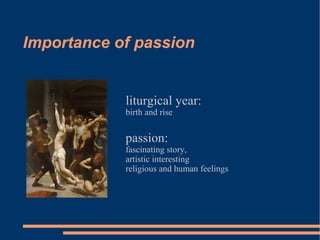
Importance of passion liturgical year:  birth and rise passion:  fascinating story,  artistic interesting religious and human feelings
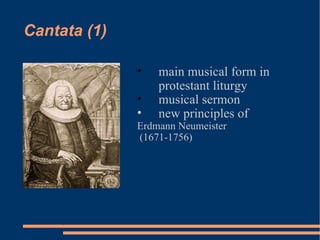
Cantata (1) main musical form in protestant liturgy  musical sermon new principles of  Erdmann Neumeister (1671-1756)
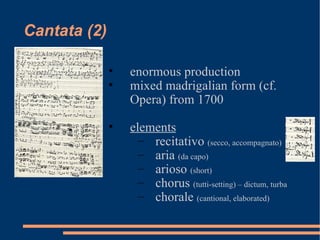
Cantata (2) enormous production mixed madrigalian form (cf. Opera) from 1700 elements recitativo  (secco, accompagnato) aria  (da capo) arioso  (short) chorus  (tutti-setting) – dictum, turba chorale  (cantional, elaborated)
Passion music different forms related with cantata hymnal oratorio passion passion oratorio lyrical meditation
Passion music (2) oratorio  passion :  Gospel text + poetry liturgical (f.i. Good Friday) passion  oratorio :  Poetry Hamburg Harmony Passion concert
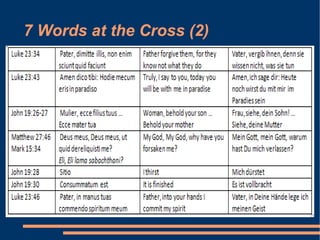
7 Sayings of Jesus at the Cross dramatic climax compilation of 4 Gospels with own tradition survey (table)
7 Words at the Cross (2)
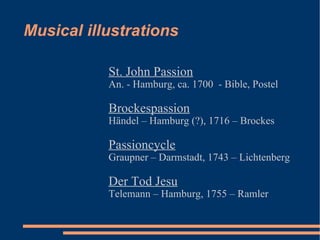
Musical illustrations St. John Passion An. - Hamburg, ca. 1700  - Bible, Postel Brockespassion Händel – Hamburg (?), 1716 – Brockes Passioncycle Graupner – Darmstadt, 1743 – Lichtenberg Der Tod Jesu Telemann – Hamburg, 1755 – Ramler
St. Johnpassion – the work 19th Century: attributed to young Händel famous for critical review of Mattheson rather conventional and old fashioned Böhm, Keiser, Ritter, … ?
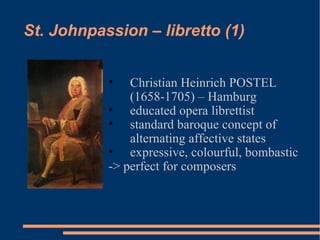
St. Johnpassion – libretto (1) Christian Heinrich POSTEL (1658-1705) – Hamburg educated opera librettist standard baroque concept of alternating affective states expressive, colourful, bombastic  -> perfect for composers
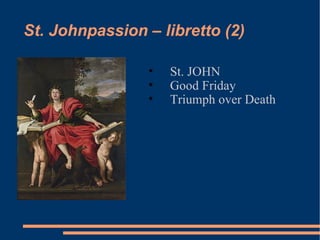
St. Johnpassion – libretto (2) St. JOHN  Good Friday Triumph over Death
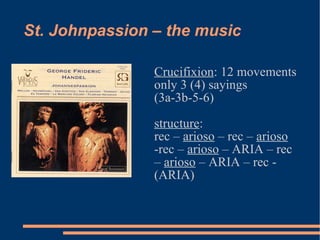
St. Johnpassion – the music Crucifixion : 12 movements only 3 (4) sayings  (3a-3b-5-6) structure : rec –  arioso  – rec –  arioso  -rec –  arioso  – ARIA – rec –  arioso  – ARIA – rec - (ARIA)
St. Johnpassion – Sitio REC: Darnach, als Jesus wusste, dass schon Alles vollbracht war, dass die Schrift erfüllet würde, spricht er:  ARIOSO:  Mich dürstet   ARIA: Jesu, wonach dürstet dich, da du ja die Matten tränkest?  Himmel, ich besinne mich,  dass du meiner Angst gedenkest,  und nach Trost in meiner Noth  Durstig bist bis an den Tod. 3'17
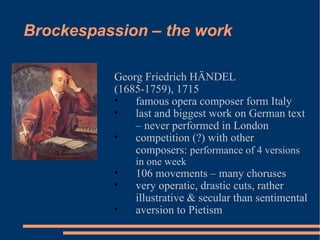
Brockespassion – the work Georg Friedrich HÄNDEL  (1685-1759), 1715 famous opera composer form Italy last and biggest work on German text – never performed in London competition (?) with other composers:  performance of 4 versions in one week 106 movements – many choruses very operatic, drastic cuts, rather illustrative & secular than sentimental aversion to Pietism
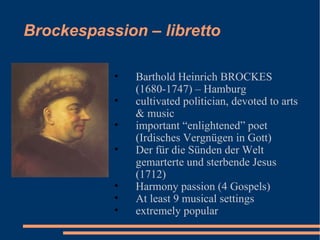
Brockespassion – libretto Barthold Heinrich BROCKES  (1680-1747) – Hamburg cultivated politician, devoted to arts & music important “enlightened” poet (Irdisches Vergnügen in Gott) Der für die Sünden der Welt gemarterte und sterbende Jesus (1712) Harmony passion (4 Gospels) At least 9 musical settings extremely popular
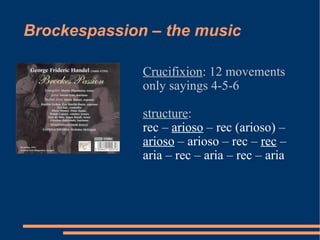
Brockespassion – the music Crucifixion : 12 movements only sayings 4-5-6 structure : rec –  arioso  – rec (arioso) –  arioso  – arioso – rec –  rec  – aria – rec – aria – rec – aria
Brockespassion – Sitio REC: Danach, wie ihm bewußt, dass alles schon vorbei, rief er, mit lechzendem Geschrei: ARIOSO:  Mich dürst’! (ARIOSO):  Mein Heiland, Herr und Fürst! Da Peitsch’ und Ruten dich zerfleischen, da Dorn und Nagel dich durchbohrt, sagst du ja nicht ein einzigs Wort. Jetzt hört man dich zu trinken heischen, so, wie ein Hirsch nach Wasser schreit. Wonach mag wohl dem Himmelsfürsten, des Lebenswassers Quelle, dürsten? Nach unser Seelen Seligkeit! 2'30
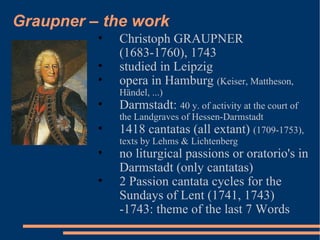
Graupner – the work Christoph GRAUPNER  (1683-1760), 1743 studied in Leipzig opera in Hamburg  (Keiser, Mattheson, Händel, ...) Darmstadt:  40 y. of activity at the court of the Landgraves of Hessen-Darmstadt 1418 cantatas (all extant)  (1709-1753), texts by Lehms & Lichtenberg no liturgical passions or oratorio's in Darmstadt (only cantatas) 2 Passion cantata cycles for the Sundays of Lent (1741, 1743) -1743: theme of the last 7 Words
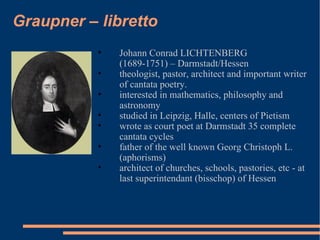
Graupner – libretto Johann Conrad LICHTENBERG  (1689-1751) – Darmstadt/Hessen theologist, pastor, architect and important writer of cantata poetry.  interested in mathematics, philosophy and astronomy studied in Leipzig, Halle, centers of Pietism wrote as court poet at Darmstadt 35 complete cantata cycles father of the well known Georg Christoph L. (aphorisms) architect of churches, schools, pastories, etc - at last superintendant (bisschop) of Hessen
Graupner – Cycle Passioncycle  of 7 Last sayings in 7 Cantatas from  “ Gute / Gedancken / In / Poetischen Texten / Zur / Kirchen-Musick, / In der / Hoffürstlichen / Schloß-CAPELLE / zu / DARMSTADT / Auf / Das 1743.ste Jahr. / Darmstadt, / gedruckt bey Godfried Eylau, Fürstl. Heßis. Hof- / und Canzley-Buchdrucker.” same formal structure: dictum (saying) rec acc – duettaria – rec – aria – rec – chorale
Graupner – Cycle (2) Invocavit - saying 1 Betrübte Sulamith geh hin / zur Schädestadte / Das erste Wort. / Die Liebes volle Verbitte Jesu, vor / seine Feinde.  / Dn. Invocavit /1743. Reminiscere - saying 2 Betrübte Seele mercke auf, / dein Heyland / Das ander Wort. / Der erfreuliche Trost vor den / Bußfertigen Schächer. / Dn. Reminiscere. / 1743. Oculi - saying 3 Wo blickst du hin o Seelen / Freund / Das dritte Wort. / Die treue Vorsorge deß sterbenden / Jesu, vor seine betrübte Mutter. / Dominica Oculi / 1743. Laetare - saying 4 Mein Gott, mein Gott, warum / hast du mich / Dn. Laetare / 1743. / Das Vierde Wort: / Das klägliche Angst Geschrey deß / gecreutzigten Heylandes. Judica -saying 5 Wen da dürstet der komme zu / mir / Das fünfte Wort. / Der schmertzliche Durst deß am Creutze schmachtenden / Erlößers der Welt. / Dn. Judica / 1743. Maundy Thursday - saying 6 Es ist vollbracht. / Das sechste Wort. / Die erfreuliche Versicherung von der gesegneten / Vollendung der Leyden Jesu. / D. Virid. / 1743. Good Friday - saying 7 Vater, Ich befehle meinen Geist / in deine Hände / D. Parasc. / 1743. / Das siebende Wort: / Deß sterbenden Heylandes erbauliches / Sterb-Gebeth.
Graupner – Sitio 1. Dictum (B, acc) Wen da dürstet, der komme zu mir und trincke.  (John VII, 37) Recitativo (A, acc) Mein Jesu deine Sulamith steht lechzend hier Sulamith bey deinem Creutz zu deinen Füßen Ach theile ihr, ach sie bedarfs dein Labsahl mit!  Laß sie den trost den du versprichst genießen Dictum/Recitativ (T, acc) Als Jesus wußte daß schon alles volbracht war, daß die Schrifft erfüllet würde, spricht Er: Dictum (B, acc) Mich dürstet. 3'00
Telemann – the work Georg Philip TELEMANN (1681-1767), Leipzig, Frankfurt, Hamburg most profilic and productiv baroque composer  composed for court, church but also for the new bourgeois society from 1721 music director in Hamburg 46 (!) oratorio passions (4 gospels in turn) – next to 3000 other works from 1750: several paraphrased passion oratorio's meant to be performed in concert hall! together with some other composers (Graun most famous en most popular) performed in Hamburg and Berlin correspondence between T. and Graun about technical and musical problems
Telemann – libretto Karl Wilhelm RAMLER (1725-1798), Berlin teaching logic and literature director of royal theatre Tod Jesu commissioned by Anna Amalia  of Prussia “ skilful but cold and uninspired versifier” strongly reflects the aesthetic and religious ideas of the mid-18th century "A musical poet must know in the main that music expresses only natural and unaffected passions and emotions. It tolerates absolutely no force and becomes ambiguous and confused as soon as nature is lacking. As in the first case, the proper expression is determined by the composer himself; so in the second case he will seek in vain with all his effort. It is thus that noless-simple ideas and images, long narratives, flowery and pointed styles of speech are entirely inappropriate for music."  (An.) Jesus is presented as a model of the virtuous life related to the life of the individual believer
Telemann – the music Crucifixion :  7 movements all 7 sayings structure rec acc (1) - aria duett - rec (2,3)- aria - chorus - chorale - rec acc (4-7) Mich dürstet : 1 sentence
Telemann – Sitio Auf einmal fällt der aufgehaltne Schmerz des Helden Seele wütend an. Sein Herz hebt die gespannte Brust, in jeder Ader wühlet ein Dolch. Sein ganzer Körper fließt am Kreuz empor. Er fühlet des Todes siebenfache Gräuel. Auf ihm liegt die Hölle ganz. Er kann ihn nicht mehr fassen, den Schmerz, der ihn allmächtig drückt. Er ruft:  Mein Gott! wie hast du mich verlassen! Und seht, die finstre Stunde rückt vorbei. Nun seufzet er:  Mich dürstet. Ihn erfrischet sein Volk mit Wein, den es mit Galle mischet. Nun steigt sein Leiden höher nicht, nun triumphieret er und spricht: Es ist vollbracht! Empfang, o Vater, meine Seele! Und neigt sein Haupt auf seine Brust und stirbt. 2'25
Tod Jesu between Bible and Poetry Conclusion Text evolved a lot in form and content baroque mono-affect aria -> free natural poetry universality of the Bible -> individual feelings and emotions Music evolved a little in the expression more dramatic accompagnati (cf. opera) Hamburg very clear evolution Berlin clearly moving towards Enlightenment Darmstadt very old fashioned in form and text  (ancien régime) Form didn't evolve at all completely traditional (elements of the cantata) cantata becoming old fashioned – no real alternative
Thank you!

Tod Jesu

  • 1.
    Tod Jesu betweenBible and Poetry Florian Heyerick teaching at Conservatory Ghent performer (conducting) musicologist preparing PhD in Artistic Research on the music of Graupner (dissemination)
  • 2.
    Sayings of Jesuson the cross illustration of the musical setting what: formal elements of text, music and structure why: crucial moment between Pietism and Enlightenment (Neology) where: Hamburg (free republic) when: ca. 1700 towards 1755
  • 3.
    Terms and definitionsimportance of passion in protestant liturgy protestant cantata passion music
  • 4.
    Importance of passionliturgical year: birth and rise passion: fascinating story, artistic interesting religious and human feelings
  • 5.
    Cantata (1) mainmusical form in protestant liturgy musical sermon new principles of Erdmann Neumeister (1671-1756)
  • 6.
    Cantata (2) enormousproduction mixed madrigalian form (cf. Opera) from 1700 elements recitativo (secco, accompagnato) aria (da capo) arioso (short) chorus (tutti-setting) – dictum, turba chorale (cantional, elaborated)
  • 7.
    Passion music differentforms related with cantata hymnal oratorio passion passion oratorio lyrical meditation
  • 8.
    Passion music (2)oratorio passion : Gospel text + poetry liturgical (f.i. Good Friday) passion oratorio : Poetry Hamburg Harmony Passion concert
  • 9.
    7 Sayings ofJesus at the Cross dramatic climax compilation of 4 Gospels with own tradition survey (table)
  • 10.
    7 Words atthe Cross (2)
  • 11.
    Musical illustrations St.John Passion An. - Hamburg, ca. 1700 - Bible, Postel Brockespassion Händel – Hamburg (?), 1716 – Brockes Passioncycle Graupner – Darmstadt, 1743 – Lichtenberg Der Tod Jesu Telemann – Hamburg, 1755 – Ramler
  • 12.
    St. Johnpassion –the work 19th Century: attributed to young Händel famous for critical review of Mattheson rather conventional and old fashioned Böhm, Keiser, Ritter, … ?
  • 13.
    St. Johnpassion –libretto (1) Christian Heinrich POSTEL (1658-1705) – Hamburg educated opera librettist standard baroque concept of alternating affective states expressive, colourful, bombastic -> perfect for composers
  • 14.
    St. Johnpassion –libretto (2) St. JOHN Good Friday Triumph over Death
  • 15.
    St. Johnpassion –the music Crucifixion : 12 movements only 3 (4) sayings (3a-3b-5-6) structure : rec – arioso – rec – arioso -rec – arioso – ARIA – rec – arioso – ARIA – rec - (ARIA)
  • 16.
    St. Johnpassion –Sitio REC: Darnach, als Jesus wusste, dass schon Alles vollbracht war, dass die Schrift erfüllet würde, spricht er: ARIOSO: Mich dürstet ARIA: Jesu, wonach dürstet dich, da du ja die Matten tränkest? Himmel, ich besinne mich, dass du meiner Angst gedenkest, und nach Trost in meiner Noth Durstig bist bis an den Tod. 3'17
  • 17.
    Brockespassion – thework Georg Friedrich HÄNDEL (1685-1759), 1715 famous opera composer form Italy last and biggest work on German text – never performed in London competition (?) with other composers: performance of 4 versions in one week 106 movements – many choruses very operatic, drastic cuts, rather illustrative & secular than sentimental aversion to Pietism
  • 18.
    Brockespassion – librettoBarthold Heinrich BROCKES (1680-1747) – Hamburg cultivated politician, devoted to arts & music important “enlightened” poet (Irdisches Vergnügen in Gott) Der für die Sünden der Welt gemarterte und sterbende Jesus (1712) Harmony passion (4 Gospels) At least 9 musical settings extremely popular
  • 19.
    Brockespassion – themusic Crucifixion : 12 movements only sayings 4-5-6 structure : rec – arioso – rec (arioso) – arioso – arioso – rec – rec – aria – rec – aria – rec – aria
  • 20.
    Brockespassion – SitioREC: Danach, wie ihm bewußt, dass alles schon vorbei, rief er, mit lechzendem Geschrei: ARIOSO: Mich dürst’! (ARIOSO): Mein Heiland, Herr und Fürst! Da Peitsch’ und Ruten dich zerfleischen, da Dorn und Nagel dich durchbohrt, sagst du ja nicht ein einzigs Wort. Jetzt hört man dich zu trinken heischen, so, wie ein Hirsch nach Wasser schreit. Wonach mag wohl dem Himmelsfürsten, des Lebenswassers Quelle, dürsten? Nach unser Seelen Seligkeit! 2'30
  • 21.
    Graupner – thework Christoph GRAUPNER (1683-1760), 1743 studied in Leipzig opera in Hamburg (Keiser, Mattheson, Händel, ...) Darmstadt: 40 y. of activity at the court of the Landgraves of Hessen-Darmstadt 1418 cantatas (all extant) (1709-1753), texts by Lehms & Lichtenberg no liturgical passions or oratorio's in Darmstadt (only cantatas) 2 Passion cantata cycles for the Sundays of Lent (1741, 1743) -1743: theme of the last 7 Words
  • 22.
    Graupner – librettoJohann Conrad LICHTENBERG (1689-1751) – Darmstadt/Hessen theologist, pastor, architect and important writer of cantata poetry. interested in mathematics, philosophy and astronomy studied in Leipzig, Halle, centers of Pietism wrote as court poet at Darmstadt 35 complete cantata cycles father of the well known Georg Christoph L. (aphorisms) architect of churches, schools, pastories, etc - at last superintendant (bisschop) of Hessen
  • 23.
    Graupner – CyclePassioncycle of 7 Last sayings in 7 Cantatas from “ Gute / Gedancken / In / Poetischen Texten / Zur / Kirchen-Musick, / In der / Hoffürstlichen / Schloß-CAPELLE / zu / DARMSTADT / Auf / Das 1743.ste Jahr. / Darmstadt, / gedruckt bey Godfried Eylau, Fürstl. Heßis. Hof- / und Canzley-Buchdrucker.” same formal structure: dictum (saying) rec acc – duettaria – rec – aria – rec – chorale
  • 24.
    Graupner – Cycle(2) Invocavit - saying 1 Betrübte Sulamith geh hin / zur Schädestadte / Das erste Wort. / Die Liebes volle Verbitte Jesu, vor / seine Feinde. / Dn. Invocavit /1743. Reminiscere - saying 2 Betrübte Seele mercke auf, / dein Heyland / Das ander Wort. / Der erfreuliche Trost vor den / Bußfertigen Schächer. / Dn. Reminiscere. / 1743. Oculi - saying 3 Wo blickst du hin o Seelen / Freund / Das dritte Wort. / Die treue Vorsorge deß sterbenden / Jesu, vor seine betrübte Mutter. / Dominica Oculi / 1743. Laetare - saying 4 Mein Gott, mein Gott, warum / hast du mich / Dn. Laetare / 1743. / Das Vierde Wort: / Das klägliche Angst Geschrey deß / gecreutzigten Heylandes. Judica -saying 5 Wen da dürstet der komme zu / mir / Das fünfte Wort. / Der schmertzliche Durst deß am Creutze schmachtenden / Erlößers der Welt. / Dn. Judica / 1743. Maundy Thursday - saying 6 Es ist vollbracht. / Das sechste Wort. / Die erfreuliche Versicherung von der gesegneten / Vollendung der Leyden Jesu. / D. Virid. / 1743. Good Friday - saying 7 Vater, Ich befehle meinen Geist / in deine Hände / D. Parasc. / 1743. / Das siebende Wort: / Deß sterbenden Heylandes erbauliches / Sterb-Gebeth.
  • 25.
    Graupner – Sitio1. Dictum (B, acc) Wen da dürstet, der komme zu mir und trincke. (John VII, 37) Recitativo (A, acc) Mein Jesu deine Sulamith steht lechzend hier Sulamith bey deinem Creutz zu deinen Füßen Ach theile ihr, ach sie bedarfs dein Labsahl mit! Laß sie den trost den du versprichst genießen Dictum/Recitativ (T, acc) Als Jesus wußte daß schon alles volbracht war, daß die Schrifft erfüllet würde, spricht Er: Dictum (B, acc) Mich dürstet. 3'00
  • 26.
    Telemann – thework Georg Philip TELEMANN (1681-1767), Leipzig, Frankfurt, Hamburg most profilic and productiv baroque composer composed for court, church but also for the new bourgeois society from 1721 music director in Hamburg 46 (!) oratorio passions (4 gospels in turn) – next to 3000 other works from 1750: several paraphrased passion oratorio's meant to be performed in concert hall! together with some other composers (Graun most famous en most popular) performed in Hamburg and Berlin correspondence between T. and Graun about technical and musical problems
  • 27.
    Telemann – librettoKarl Wilhelm RAMLER (1725-1798), Berlin teaching logic and literature director of royal theatre Tod Jesu commissioned by Anna Amalia of Prussia “ skilful but cold and uninspired versifier” strongly reflects the aesthetic and religious ideas of the mid-18th century "A musical poet must know in the main that music expresses only natural and unaffected passions and emotions. It tolerates absolutely no force and becomes ambiguous and confused as soon as nature is lacking. As in the first case, the proper expression is determined by the composer himself; so in the second case he will seek in vain with all his effort. It is thus that noless-simple ideas and images, long narratives, flowery and pointed styles of speech are entirely inappropriate for music." (An.) Jesus is presented as a model of the virtuous life related to the life of the individual believer
  • 28.
    Telemann – themusic Crucifixion : 7 movements all 7 sayings structure rec acc (1) - aria duett - rec (2,3)- aria - chorus - chorale - rec acc (4-7) Mich dürstet : 1 sentence
  • 29.
    Telemann – SitioAuf einmal fällt der aufgehaltne Schmerz des Helden Seele wütend an. Sein Herz hebt die gespannte Brust, in jeder Ader wühlet ein Dolch. Sein ganzer Körper fließt am Kreuz empor. Er fühlet des Todes siebenfache Gräuel. Auf ihm liegt die Hölle ganz. Er kann ihn nicht mehr fassen, den Schmerz, der ihn allmächtig drückt. Er ruft: Mein Gott! wie hast du mich verlassen! Und seht, die finstre Stunde rückt vorbei. Nun seufzet er: Mich dürstet. Ihn erfrischet sein Volk mit Wein, den es mit Galle mischet. Nun steigt sein Leiden höher nicht, nun triumphieret er und spricht: Es ist vollbracht! Empfang, o Vater, meine Seele! Und neigt sein Haupt auf seine Brust und stirbt. 2'25
  • 30.
    Tod Jesu betweenBible and Poetry Conclusion Text evolved a lot in form and content baroque mono-affect aria -> free natural poetry universality of the Bible -> individual feelings and emotions Music evolved a little in the expression more dramatic accompagnati (cf. opera) Hamburg very clear evolution Berlin clearly moving towards Enlightenment Darmstadt very old fashioned in form and text (ancien régime) Form didn't evolve at all completely traditional (elements of the cantata) cantata becoming old fashioned – no real alternative
  • 31.