Deutsche Substantive

im Plural

webgerman.com/Animated/plural

Lizz Caplan-Carbin, Ph.D.
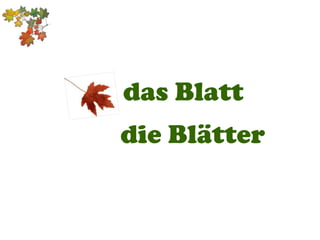
das Blatt
die Blätter
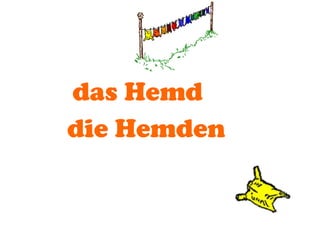
das Hemd
die Hemden
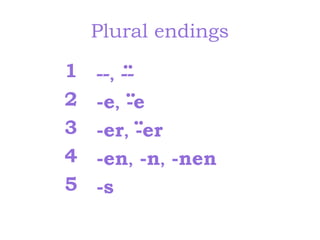
Plural endings
1
2
3
4
5

..

--, -..
-e, -e
..
-er, -er
-en, -n, -nen
-s
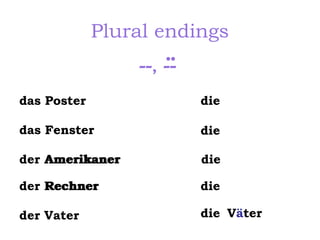
Plural endings
..

--, -das Poster

die

das Fenster

die

der Amerikaner

die

der Rechner

die

der Vater

die Väter
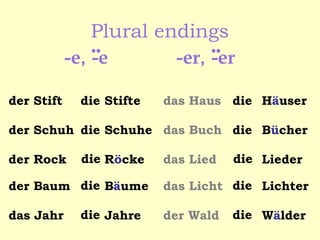
Plural endings
..
..
-e, -e
-er, -er
der Stift

die Stifte

das Haus die Häuser

der Schuh die Schuhe das Buch die Bücher
der Rock

die Röcke

der Baum die Bäume
das Jahr

die Jahre

das Lied

die Lieder

das Licht die Lichter
der Wald

die Wälder
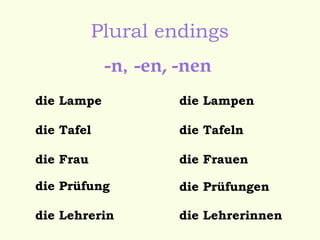
Plural endings
-n, -en, -nen
die Lampe

die Lampen

die Tafel

die Tafeln

die Frau

die Frauen

die Prüfung

die Prüfungen

die Lehrerin

die Lehrerinnen
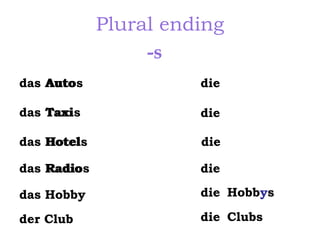
Plural ending
-s
das Auto
Autos

die

das Taxi
Taxis

die

das Hotel
Hotels

die

das Radio
Radios

die

das Hobby

die Hobbys

der Club

die Clubs
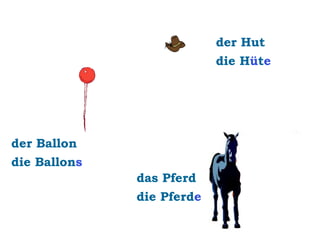
der Hut
die Hüte

der Ballon
die Ballons
das Pferd
die Pferde
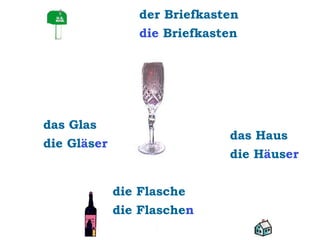
der Briefkasten
die Briefkasten

das Glas
die Gläser

das Haus
die Häuser
die Flasche
die Flaschen
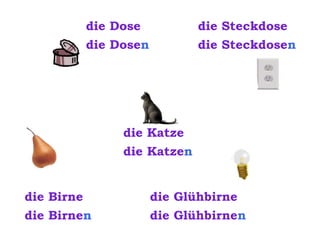
die Dose
die Dosen

die Steckdose
die Steckdosen

die Katze
die Katzen
die Birne
die Birnen

die Glühbirne
die Glühbirnen
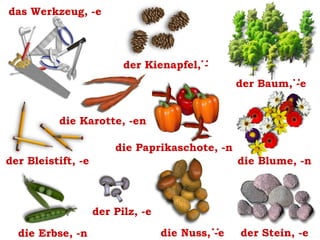
das Werkzeug, -e

:

der Kienapfel, -

:

der Baum, -e
die Karotte, -en
die Paprikaschote, -n
der Bleistift, -e

die Blume, -n

der Pilz, -e
die Nuss, -e

:

die Erbse, -n

der Stein, -e
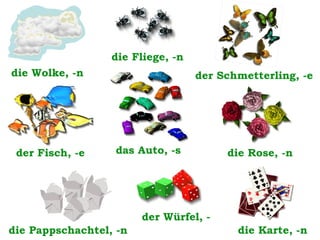
die Fliege, -n
die Wolke, -n

der Fisch, -e

der Schmetterling, -e

das Auto, -s

die Rose, -n

der Würfel, die Pappschachtel, -n

die Karte, -n
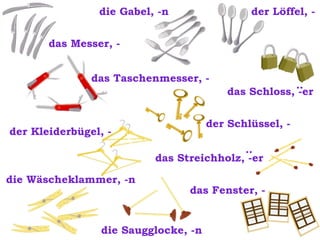
die Gabel, -n

der Löffel, -

das Messer, das Taschenmesser, -

:

das Schloss, -er
der Schlüssel, -

der Kleiderbügel, -

:

das Streichholz, -er
die Wäscheklammer, -n

das Fenster, -

die Saugglocke, -n
der Sack, -e
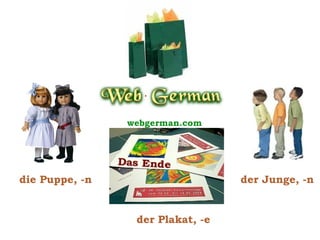
webgerman.com

die Puppe, -n

Das Ende
der Plakat, -e

der Junge, -n

German Grammer Plural ( Traum Academy Kadavanthra) 9745539266

Hinweis der Redaktion

  • #5 There are five types of plural markers. The first has no ending at all. The second type has an –e ending. It is the most common, so it should be your first guess. The third type has ending -er. For all of the first three markers, an umlaut should be added IF the noun has only ONE SYLLABLE with stem-vowel a, o, or u. The fourth type of plural marker, using at least one –n, does not add an umlaut. There are no single syllable words that form the plural with an –n. The fifth type of plural marker, with an –s, is used for words ending in vowels –i, –o, and –u (Taxi, Auto, Tabu). The –s ending is also used for foreign words as they are added to the German language (Handys, Hotels, Hobbys).
  • #6 The first type of plural marker is only for masculine and neuter words . It uses no ending at all. Words ending with “-er” often use the first type. EXCEPTION: die Mauer, -n Simply by changing the article from “der” or “das” to “die,” a word may be marked as plural.
  • #7 The second and third types of endings are also typical for masculine and neuter nouns – especially the one-syllable words. EXCEPTIONS: die Wand, die Wände; die Stadt, die Städte When a one-syllable masculine word has stem-vowel a,o,or u, add an umlaut EXCEPTIONS: der Ort, der Tag A one-syllable neuter word adds an umlaut for –er plurals, but not for –e plurals. (-e plural is most common for masculine nouns, -er plural is most common for neuter nouns.)
  • #8 The fourth type of plural marker is most common for feminine words, but is also used for many masculine an neuter words too. ( A feminine noun ending in –e or -l, only needs an –n to show plural. A noun signifying a person, with an –in suffix for the feminine counterpart, will use the –nen ending to show plural. This is the only use of the -nen ending. No nouns of any gender add an umlaut with the –n, -en, -nen plural marker.
  • #9 The last type of plural marker “–s” is only used for borrowed words of foreign origin, especially when they end in vowel. Borrowed words are usually neuter nouns, but there are exceptions (eg. der Club, die Niveau). Also, there are a few words which are German in origin, but still take the “-s” marker (eg. das Büro, der Kuli). What most of the “-s” marked nouns have in common is that they end in vowels. “Kuli” is short for Kugelschreiber (pl. die Kugelschreiber, die Kulis). When used as a plural marker, the “-s” is still pronounced as the /s/ in “das.” It does not change to a /z/ as it does in English.
  • #13 When you learn a new word, you should always learn its gender and plural form at the same time. The plural marker follows the noun, separated by a comma.
  • #18 This program was created by Lizz Caplan-Carbin, Ph.D. If you are a German teacher, feel free to use this in your classes and to change it as you wish. Please notify me if you find any errors. [email_address]