Industrial controller 
Version 407 
Operating Instructions 
9499 040 21601 
English-Deutsch-Français
Follow the warnings in the instructions! 
Warnvermerke in der Bedienungsanleitung beachten! 
Suivre les avertissement du mode d’emploi! 
ENGLISH . . . . . . . . . . . Page 1 
SAFETY INSTRUCTIONS . . . . . . . . . 1 
MOUNTING . . . . . . . . . . . . . . . . 2 
ELECTRICAL CONNECTIONS . . . . . . . 2 
CONFIGURATION LEVEL . . . . . . . . . 4 
PARAMETER LEVEL . . . . . . . . . . . 8 
CONTROLLER OPERATING LEVEL . . . . 10 
OPTIMIZING AID . . . . . . . . . . . . . 11 
SELF-TUNING . . . . . . . . . . . . . . . 12 
MATCHING THE PROCESS VALUE DISPLA. 1.Y. 4 . 
ADJUSTER OPERATING LEVEL . . . . . 16 
Manufacturer certificate . . . . . . . . . . 49 
DEUTSCH . . . . . . . . . Seite 17 
SICHERHEITSHINWEISE . . . . . . . . . 17 
MONTAGE . . . . . . . . . . . . . . . . . 18 
ELEKTRISCHER ANSCHLUSS . . . . . . 18 
KONFIGURATIONS-EBENE . . . . . . . . 20 
PARAMETER-EBENE . . . . . . . . . . . 24 
BEDIEN-EBENE (REGLER) . . . . . . . . 26 
OPTIMIERUNGSHILFE . . . . . . . . . . 27 
SELBSTOPTIMIERUNG . . . . . . . . . . 28 
ANPASSUNG DER ISTWERTANZEIGE . . 30 
BEDIEN-EBENE (STELLER) . . . . . . . . 32 
Bescheinigung des Herstellers . . . . . . 49 
FRANÇAIS . . . . . . . . . Page 33 
NOTICES DE SECURITE . . . . . . . . . . 33 
MONTAGE . . . . . . . . . . . . . . . . . 34 
RACCORDEMENTS ELECTRIQUES . . . 34 
CONFIGURATION . . . . . . . . . . . . . 36 
PARAMETRAGE . . . . . . . . . . . . . . 40 
UTILISATION REGULATEUR . . . . . . . 42 
AIDE D’OPTIMISATION . . . . . . . . . . 43 
AUTO-REGLAGE . . . . . . . . . . . . . 44 
ADAPTATION DE L’AFFICH. DE MESURE 46 
UTILISATION EMETTEUR . . . . . . . . . 48 
Certificat du fabricant . . . . . . . . . . . 49 
a 
1
Industrial 
controller 
Operating instructions 
9499 040 21601 
valid from 8297 
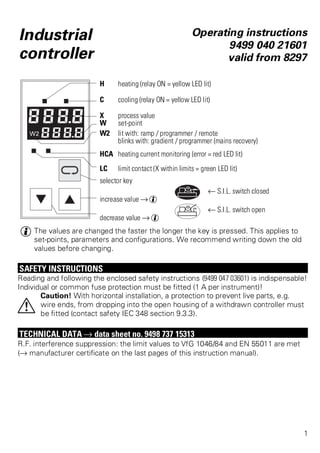
H heating (relay ON = yellow LED lit) 
C cooling (relay ON = yellow LED lit) 
X process value 
W set-point 
W2 lit with: ramp / programmer / remote 
blinks with: gradient / programmer (mains recovery) 
HCA heating current monitoring (error = red LED lit) 
LC limit contact (X within limits = green LED lit) 
selector key 
t S.I.L. switch closed 
increase value Ä g 
t S.I.L. switch open 
decrease value Ä g 
g The values are changed the faster the longer the key is pressed. This applies to 
set-points, parameters and configurations. We recommend writing down the old 
values before changing. 
SAFETY INSTRUCTIONS 
Reading and following the enclosed safety instructions (9499 047 03601) is indispensable! 
Individual or common fuse protection must be fitted (1 A per instrument)! 
Caution! With horizontal installation, a protection to prevent live parts, e.g. 
wire ends, from dropping into the open housing of a withdrawn controller must 
be fitted (contact safety IEC 348 section 9.3.3). 
a 
TECHNICAL DATA Ä data sheet no. 9498 737 15313 
R.F. interference suppression: the limit values to VfG 1046/84 and EN 55011 are met 
(Ä manufacturer certificate on the last pages of this instruction manual). 
1
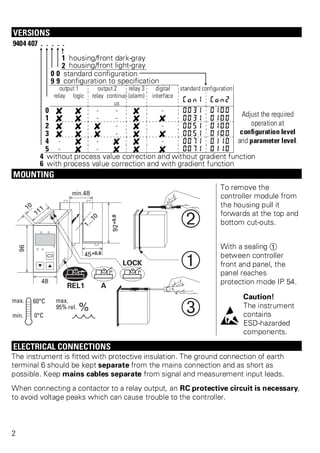
VERSIONS 
9404 407 . . . . . 
1 housing/front dark-gray 
2 housing/front light-gray 
0 0 standard configuration 
9 9 configuration to specification 
output 1 output 2 relay 3 digital standard configuration 
relay logic relay continuo 
us 
(alarm) interface 
Con1 Con2 
0 f f - - f - 0031 0100 Adjust the required 
1 f f - - f f 0031 0100 
2 f f f - f - 0051 0100 
3 f f f - f f 0051 0100 
4 - f - f f - 0071 0110 
5 - f - f f f 0071 0110 
4 without process value correction and without gradient function 
6 with process value correction and with gradient function 
operation at 
configuration level 
and parameter level. 
MOUNTING 
To remove the 
controller module from 
the housing pull it 
forwards at the top and 
bottom cut-outs. 
With a sealing Ü 
between controller 
front and panel, the 
panel reaches 
protection mode IP 54. 
l 
Caution! 
The instrument 
contains 
ESD-hazarded 
components. 
ELECTRICAL CONNECTIONS 
The instrument is fitted with protective insulation. The ground connection of earth 
terminal 6 should be kept separate from the mains connection and as short as 
possible. Keep mains cables separate from signal and measurement input leads. 
When connecting a contactor to a relay output, an RC protective circuit is necessary, 
to avoid voltage peaks which can cause trouble to the controller. 
2
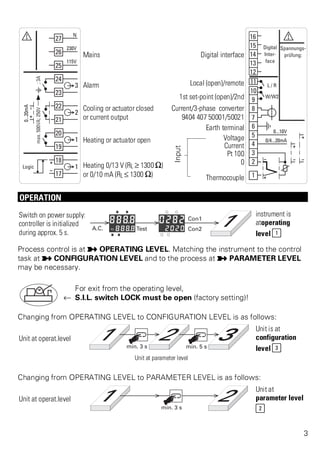
Mains Digital interface 
Alarm Local (open)/remote 
1st set-point (open)/2nd 
Cooling or actuator closed 
or current output 
Current/3-phase converter 
9404 407 50001/50021 
Earth terminal 
Heating or actuator open 
Input 
Voltage 
Current 
Pt 100 
Heating 0/13 V (RL ? 1300 [) 
or 0/10 mA (RL ß 1300 [) 
0 
Thermocouple 
OPERATION 
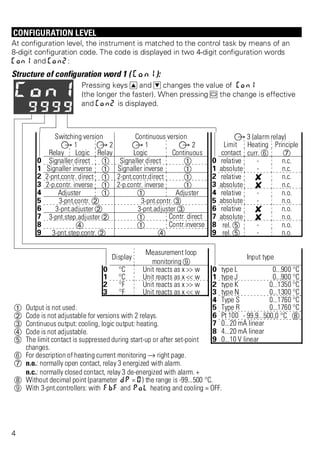
Switch on power supply: 
controller is initialized 
during approx. 5 s. 
instrument is 
atoperating 
level 1 
Process control is at p OPERATING LEVEL. Matching the instrument to the control 
task at p CONFIGURATION LEVEL and to the process at p PARAMETER LEVEL 
may be necessary. 
For exit from the operating level, 
t S.I.L. switch LOCK must be open (factory setting)! 
Changing from OPERATING LEVEL to CONFIGURATION LEVEL is as follows: 
Unit at operat.level 
Unit is at 
configuration 
level 3 
Unit at parameter level 
Changing from OPERATING LEVEL to PARAMETER LEVEL is as follows: 
Unit at operat.level 
Unit at 
parameter level 
2 
3
CONFIGURATION LEVEL 
At configuration level, the instrument is matched to the control task by means of an 
8-digit configuration code. The code is displayed in two 4-digit configuration words 
Con1 and Con2: 
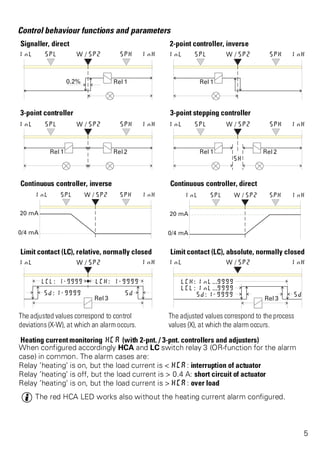
Structure of configuration word 1 ( Con1): 
Pressing keys I and D changes the value of Con1 
(the longer the faster). When pressing M the change is effective 
and Con2 is displayed. 
Switching version Continuous version  3 (alarm relay) 
 1  2  1  2 Limit Heating Principle 
Relay Logic Relay Logic Continuous contact curr. < > 
0 Signaller direct Ü Signaller direct Ü 0 relative - n.c. 
1 Signaller inverse Ü Signaller inverse Ü 1 absolute - n.c. 
2 2-pnt.contr. direct Ü 2-pnt.contr.direct Ü 2 relative f n.c. 
3 2-p.contr. inverse Ü 2-p.contr. inverse Ü 3 absolute f n.c. 
4 Adjuster Ü Ü Adjuster 4 relative - n.o. 
5 3-pnt.contr. * 3-pnt.contr. Ö 5 absolute - n.o. 
6 3-pnt.adjuster * 3-pnt.adjuster Ö 6 relative f n.o. 
7 3-pnt.step.adjuster * Ü Contr. direct 7 absolute f n.o. 
8 ä Ü Contr.inverse 8 rel. # - n.o. 
9 3-pnt.step.contr. * ä 9 rel. # - n.o. 
Display 
Measurement loop 
monitoring x 
Input type 
0 °C Unit reacts as x >> w 0 type L 0...900 °C 
1 °C Unit reacts as x << w 1 type J 0...900 °C 
2 °F Unit reacts as x >> w 2 type K 0...1350 °C 
3 °F Unit reacts as x << w 3 type N 0...1300 °C 
4 Type S 0...1760 °C 
Ü Output is not used. 5 Type R 0...1760 °C 
* Code is not adjustable for versions with 2 relays. 6 Pt 100 - 99,9...500,0 °C y 
Ö Continuous output: cooling, logic output: heating. 7 0...20 mA linear 
ä Code is not adjustable. 8 4...20 mA linear 
# The limit contact is suppressed during start-up or after set-point 9 0...10 V linear 
changes. 
< For description of heating current monitoring Ä right page. 
> n.o.: normally open contact, relay 3 energized with alarm. 
n.c.: normally closed contact, relay 3 de-energized with alarm. + 
y Without decimal point (parameter dP = 0) the range is -99...500 °C. 
x With 3-pnt.controllers: with FbF and PoL heating and cooling = OFF. 
4
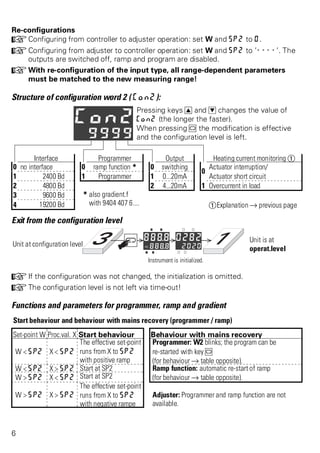
Control behaviour functions and parameters 
Signaller, direct 2-point controller, inverse 
3-point controller 3-point stepping controller 
Continuous controller, inverse Continuous controller, direct 
Limit contact (LC), relative, normally closed Limit contact (LC), absolute, normally closed 
The adjusted values correspond to control 
deviations (X-W), at which an alarm occurs. 
The adjusted values correspond to the process 
values (X), at which the alarm occurs. 
Heating current monitoring HCA (with 2-pnt. / 3-pnt. controllers and adjusters) 
When configured accordingly HCA and LC switch relay 3 (OR-function for the alarm 
case) in common. The alarm cases are: 
Relay ’heating’ is on, but the load current is < HCA: interruption of actuator 
Relay ’heating’ is off, but the load current is > 0.4 A: short circuit of actuator 
Relay ’heating’ is on, but the load current is > HCA: over load 
g The red HCA LED works also without the heating current alarm configured. 
5
Re-configurations 
+Configuring from controller to adjuster operation: set W and SP2 to 0. 
+Configuring from adjuster to controller operation: set W and SP2 to ’----’. The 
outputs are switched off, ramp and program are disabled. 
+With re-configuration of the input type, all range-dependent parameters 
must be matched to the new measuring range! 
Structure of configuration word 2 ( Con2): 
Pressing keys I and D changes the value of 
Con2 (the longer the faster). 
When pressing M the modification is effective 
and the configuration level is left. 
Interface Programmer Output Heating current monitoring Ü 
0 no interface 0 ramp function * 0 switching 
0 
Actuator interruption/ 
1 2400 Bd 1 Programmer 1 0...20mA Actuator short circuit 
2 4800 Bd 2 4...20mA 1 Overcurrent in load 
3 9600 Bd * also gradient.f 
4 19200 Bd with 9404 407 6.... ÜExplanation Ä previous page 
Exit from the configuration level 
Unit at configuration level 
Unit is at 
operat.level 
Instrument is initialized. 
+If the configuration was not changed, the initialization is omitted. 
+The configuration level is not left via time-out! 
Functions and parameters for programmer, ramp and gradient 
Start behaviour and behaviour with mains recovery (programmer / ramp) 
Set-point W Proc.val. X Start behaviour Behaviour with mains recovery 
W < SP2 X < SP2 
The effective set-point 
runs from X to SP2 
with positive ramp 
Programmer: W2 blinks; the program can be 
re-started with key M 
(for behaviour Ä table opposite). 
W < SP2 X > SP2 Start at SP2 Ramp function: automatic re-start of ramp 
W > SP2 X < SP2 Start at SP2 (for behaviour Ä table opposite). 
W > SP2 X > SP2 
The effective set-point 
runs from X to SP2 
with negative rampe 
Adjuster: Programmer and ramp function are not 
available. 
6
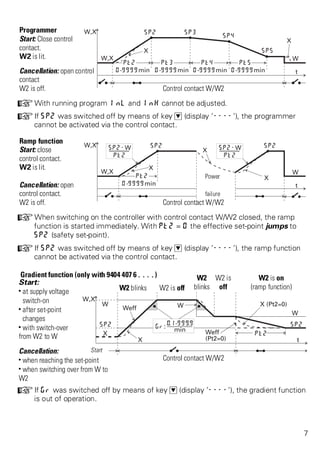
Programmer 
Start: Close control 
contact. 
W2 is lit. 
Cancellation: open control 
contact 
W2 is off. Control contact W/W2 
+With running program InL and InH cannot be adjusted. 
+If SP2 was switched off by means of key D (display ’----’), the programmer 
cannot be activated via the control contact. 
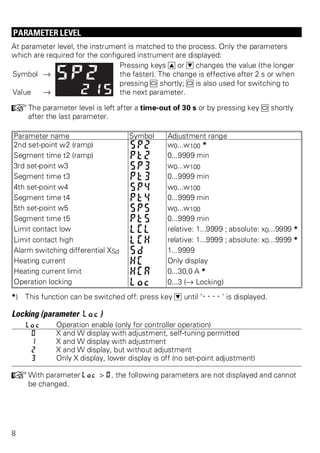
Ramp function 
Start: close 
control contact. 
W2 is lit. 
Power 
Cancellation: open 
control contact. failure 
W2 is off. Control contact W/W2 
+When switching on the controller with control contact W/W2 closed, the ramp 
function is started immediately. With Pt2 = 0 the effective set-point jumps to 
SP2 (safety set-point). 
+If SP2 was switched off by means of key D (display ’----’), the ramp function 
cannot be activated via the control contact. 
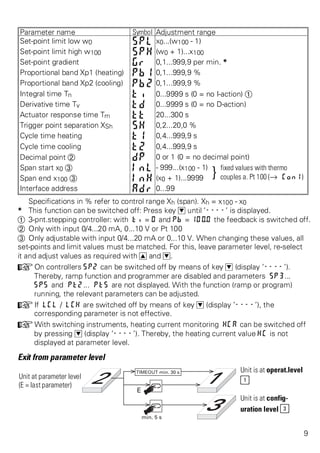
Gradient function (only with 9404 407 6....) W2 
W2 is 
W2 is on 
Start: 
at supply voltage 
W2 blinks W2 is off 
blinks 
off 
(ramp function) w switch-on 
w after set-point 
changes 
w with switch-over 
from W2 to W 
Cancellation: Start 
w when reaching the set-point Control contact W/W2 
w when switching over from W to 
W2 
+If Gr was switched off by means of key D (display ’----’), the gradient function 
is out of operation. 
7
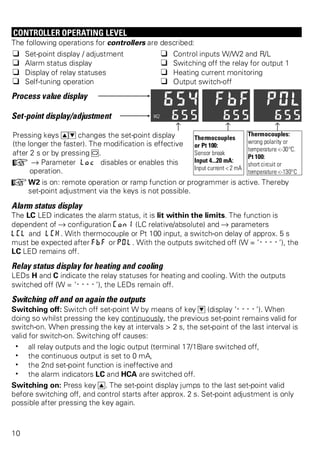
PARAMETER LEVEL 
At parameter level, the instrument is matched to the process. Only the parameters 
which are required for the configured instrument are displayed: 
Symbol Ä 
Value Ä 
Pressing keys I or D changes the value (the longer 
the faster). The change is effective after 2 s or when 
pressing M shortly; M is also used for switching to 
the next parameter. 
+The parameter level is left after a time-out of 30 s or by pressing key M shortly 
after the last parameter. 
Parameter name Symbol Adjustment range 
2nd set-point w2 (ramp) SP2 w0...w100 * 
Segment time t2 (ramp) Pt2 0...9999 min 
3rd set-point w3 SP3 w0...w100 
Segment time t3 Pt3 0...9999 min 
4th set-point w4 SP4 w0...w100 
Segment time t4 Pt4 0...9999 min 
5th set-point w5 SP5 w0...w100 
Segment time t5 Pt5 0...9999 min 
Limit contact low LCL relative: 1...9999 ; absolute: x0...9999 * 
Limit contact high LCH relative: 1...9999 ; absolute: x0...9999 * 
Alarm switching differential XSd Sd 1...9999 
Heating current HC Only display 
Heating current limit HCA 0...30,0 A * 
Operation locking Loc 0...3 (Ä Locking) 
*) This function can be switched off: press key D until ’----’ is displayed. 
Locking (parameter Loc) 
Loc Operation enable (only for controller operation) 
0 X and W display with adjustment, self-tuning permitted 
1 X and W display with adjustment 
2 X and W display, but without adjustment 
3 Only X display, lower display is off (no set-point adjustment) 
+With parameter Loc > 0, the following parameters are not displayed and cannot 
be changed. 
8
Parameter name Symbol Adjustment range 
Set-point limit low w0 SPL x0...(w100 - 1) 
Set-point limit high w100 SPH (w0 + 1)...x100 
Set-point gradient Gr 0,1...999,9 per min. * 
Proportional band Xp1 (heating) Pb1 0,1...999,9 % 
Proportional band Xp2 (cooling) Pb2 0,1...999,9 % 
Integral time Tn ti 0...9999 s (0 = no I-action) Ü 
Derivative time Tv td 0...9999 s (0 = no D-action) 
Actuator response time Tm tt 20...300 s 
Trigger point separation XSh SH 0,2...20,0 % 
Cycle time heating t1 0,4...999,9 s 
Cycle time cooling t2 0,4...999,9 s 
Decimal point * dP 0 or 1 (0 = no decimal point) 
Span start x0 Ö InL - 999...(x100 - 1) } fixed values with thermo 
Span end x100 Ö InH (x0 + 1)...9999 couples a. Pt 100 (Ä Con1) 
Interface address Adr 0...99 
Specifications in % refer to control range Xh (span). Xh = x100 - x0 
* This function can be switched off: Press key D until ’----’ is displayed. 
Ü 3-pnt.stepping controller: with ti = 0 and Pb = 100.0 the feedback is switched off. 
* Only with input 0/4...20 mA, 0...10 V or Pt 100 
Ö Only adjustable with input 0/4...20 mA or 0...10 V. When changing these values, all 
set-points and limit values must be matched. For this, leave parameter level, re-select 
it and adjust values as required with I and D. 
+On controllers SP2 can be switched off by means of key D (display ’----’). 
Thereby, ramp function and programmer are disabled and parameters SP3... 
SP5 and Pt2... Pt5 are not displayed. With the function (ramp or program) 
running, the relevant parameters can be adjusted. 
+If LCL / LCH are switched off by means of key D (display ’----’), the 
corresponding parameter is not effective. 
+With switching instruments, heating current monitoring HCA can be switched off 
by pressing D (display ’----’). Thereby, the heating current value HC is not 
displayed at parameter level. 
Exit from parameter level 
Unit at parameter level 
(E = last parameter) 
Unit is at operat.level 
1 
Unit is at config-uration 
level 3 
9
CONTROLLER OPERATING LEVEL 
The following operations for controllers are described: 
q Set-point display / adjustment q Control inputs W/W2 and R/L 
q Alarm status display q Switching off the relay for output 1 
q Display of relay statuses q Heating current monitoring 
q Self-tuning operation q Output switch-off 
Process value display 
Set-point display/adjustment 
z z z 
Pressing keys ID changes the set-point display 
(the longer the faster). The modification is effective 
after 2 s or by pressing M. 
+ Ä Parameter Loc disables or enables this 
operation. 
Thermocouples 
or Pt 100: 
Sensor break 
Input 4...20 mA: 
Input current < 2 mA 
Thermocouples: 
wrong polarity or 
temperature <-30°C. 
Pt 100: 
short circuit or 
temperature <-130°C 
+W2 is on: remote operation or ramp function or programmer is active. Thereby 
set-point adjustment via the keys is not possible. 
Alarm status display 
The LC LED indicates the alarm status, it is lit within the limits. The function is 
dependent of Ä configuration Con1 (LC relative/absolute) and Ä parameters 
LCL and LCH. With thermocouple or Pt 100 input, a switch-on delay of approx. 5 s 
must be expected after FbF or POl. With the outputs switched off (W = ’----’), the 
LC LED remains off. 
Relay status display for heating and cooling 
LEDs H and C indicate the relay statuses for heating and cooling. With the outputs 
switched off (W = ’----’), the LEDs remain off. 
Switching off and on again the outputs 
Switching off: Switch off set-point W by means of key D (display ’----’). When 
doing so whilst pressing the key continuously, the previous set-point remains valid for 
switch-on. When pressing the key at intervals > 2 s, the set-point of the last interval is 
valid for switch-on. Switching off causes: 
w all relay outputs and the logic output (terminal 17/18)are switched off, 
w the continuous output is set to 0 mA, 
w the 2nd set-point function is ineffective and 
w the alarm indicators LC and HCA are switched off. 
Switching on: Press key I. The set-point display jumps to the last set-point valid 
before switching off, and control starts after approx. 2 s. Set-point adjustment is only 
possible after pressing the key again. 
10
Switching off output 1 relay 
When using only the logic output, relay 1 can be switched off. For this, open S.I.L. 
switch REL1 (Ä MOUNTING). 
Heating current monitoring 
Heating current measurement is via current converter 9404 407 50001 or 3-phase 
current converter 9404 407 50021. The monitoring functions are explained at 
configuration level ( Con1) and at parameter level ( HCA, HC). 
Control inputs W/W2 and L/R 
Control input W/W2: 
Ramp function or programmer are started or stopped. 
The functions are explained at configuration level ( Con2) and parameter level. 
Control input L/R: 
Local or remote operation are switched, W2 is lit during remote mode. 
The remote mode is used for adjusting values via a digital interface. Adjustment via 
the key is not possible, however, the values can be displayed. 
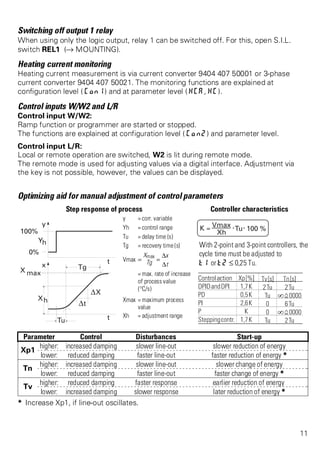
Optimizing aid for manual adjustment of control parameters 
Step response of process Controller characteristics 
y = corr. variable 
Yh = control range 
Tu = delay time (s) 
Tg = recovery time (s) With 2-point and 3-point controllers, the 
cycle time must be adjusted to 
Vmax = Xmax 
Tg 
t1 or t2 ß 0,25 Tu. 
= Dx 
Dt 
= max. rate of increase 
of process value 
(°C/s) 
Xmax = maximum process 
value 
Xh = adjustment range 
Parameter Control Disturbances Start-up 
Xp1 
higher: increased damping slower line-out slower reduction of energy 
lower: reduced damping faster line-out faster reduction of energy * 
Tn 
higher: increased damping slower line-out slower change of energy 
lower: reduced damping faster line-out faster change of energy * 
Tv 
higher: reduced damping faster response earlier reduction of energy 
lower: increased damping slower response later reduction of energy * 
* Increase Xp1, if line-out oscillates. 
11
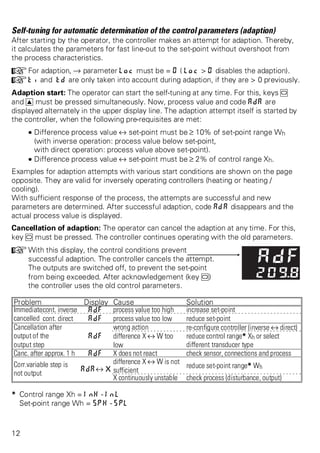
Self-tuning for automatic determination of the control parameters (adaption) 
After starting by the operator, the controller makes an attempt for adaption. Thereby, 
it calculates the parameters for fast line-out to the set-point without overshoot from 
the process characteristics. 
+For adaption, Ä parameter Loc must be = 0 ( Loc > 0 disables the adaption). 
+ti and td are only taken into account during adaption, if they are > 0 previously. 
Adaption start: The operator can start the self-tuning at any time. For this, keys M 
and I must be pressed simultaneously. Now, process value and code AdA are 
displayed alternately in the upper display line. The adaption attempt itself is started by 
the controller, when the following pre-requisites are met: 
· Difference process value i set-point must be ? 10% of set-point range Wh 
(with inverse operation: process value below set-point, 
with direct operation: process value above set-point). 
· Difference process value i set-point must be ? 2% of control range Xh. 
Examples for adaption attempts with various start conditions are shown on the page 
opposite. They are valid for inversely operating controllers (heating or heating / 
cooling). 
With sufficient response of the process, the attempts are successful and new 
parameters are determined. After successful adaption, code AdA disappears and the 
actual process value is displayed. 
Cancellation of adaption: The operator can cancel the adaption at any time. For this, 
key M must be pressed. The controller continues operating with the old parameters. 
+With this display, the control conditions prevent 
successful adaption. The controller cancels the attempt. 
The outputs are switched off, to prevent the set-point 
from being exceeded. After acknowledgement (key M) 
the controller uses the old control parameters. 
Problem Display Cause Solution 
Immediate 
cancelled 
cont. inverse AdF process value too high increase set-point 
cont. direct AdF process value too low reduce set-point 
Cancellation after 
output of the 
output step 
AdF 
wrong action re-configure controller (inverse i direct) 
difference X i W too 
reduce control range* Xh or select 
low 
different transducer type 
Canc. after approx. 1 h AdF X does not react check sensor, connections and process 
Corr.variable step is 
difference X i W is not 
reduce set-point range* AdAi Wh 
X 
not output 
sufficient 
X continuously unstable check process (disturbance, output) 
* Control range Xh = InH - InL 
Set-point range Wh = SPH - SPL 
12
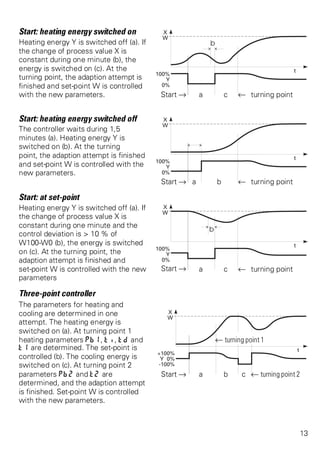
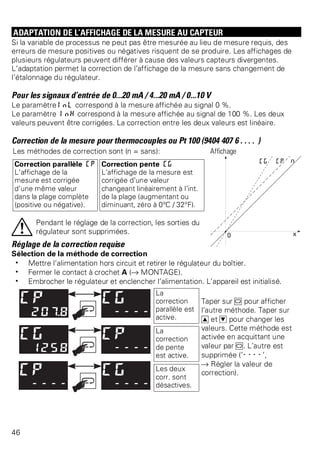
Start: heating energy switched on 
Heating energy Y is switched off (a). If 
the change of process value X is 
constant during one minute (b), the 
energy is switched on (c). At the 
turning point, the adaption attempt is 
finished and set-point W is controlled 
with the new parameters. Start Ä a c t turning point 
Start: heating energy switched off 
The controller waits during 1,5 
minutes (a). Heating energy Y is 
switched on (b). At the turning 
point, the adaption attempt is finished 
and set-point W is controlled with the 
new parameters. 
Start Äa b t turning point 
Start: at set-point 
Heating energy Y is switched off (a). If 
the change of process value X is 
constant during one minute and the 
control deviation is > 10 % of 
W100-W0 (b), the energy is switched 
on (c). At the turning point, the 
adaption attempt is finished and 
set-point W is controlled with the new 
parameters 
Start Ä a c t turning point 
Three-point controller 
The parameters for heating and 
cooling are determined in one 
attempt. The heating energy is 
switched on (a). At turning point 1 
heating parameters Pb1, ti, td and t turning point 1 
t1 are determined. The set-point is 
controlled (b). The cooling energy is 
switched on (c). At turning point 2 
parameters Pb2 and t2 are 
determined, and the adaption attempt 
is finished. Set-point W is controlled 
with the new parameters. 
Start Ä a b ct turning point 2 
13
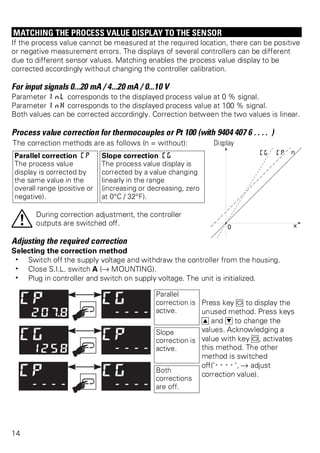
MATCHING THE PROCESS VALUE DISPLAY TO THE SENSOR 
If the process value cannot be measured at the required location, there can be positive 
or negative measurement errors. The displays of several controllers can be different 
due to different sensor values. Matching enables the process value display to be 
corrected accordingly without changing the controller calibration. 
For input signals 0...20 mA / 4...20 mA / 0...10 V 
Parameter InL corresponds to the displayed process value at 0 % signal. 
Parameter InH corresponds to the displayed process value at 100 % signal. 
Both values can be corrected accordingly. Correction between the two values is linear. 
Process value correction for thermocouples or Pt 100 (with 9404 407 6 . . . . ) 
The correction methods are as follows (n = without): Display 
Parallel correction CP 
Slope correction CG 
The process value 
The process value display is 
display is corrected by 
corrected by a value changing 
the same value in the 
linearly in the range 
overall range (positive or 
(increasing or decreasing, zero 
negative). 
at 0°C / 32°F). 
aDuring correction adjustment, the controller 
outputs are switched off. 
Adjusting the required correction 
Selecting the correction method 
w Switch off the supply voltage and withdraw the controller from the housing. 
w Close S.I.L. switch A (Ä MOUNTING). 
w Plug in controller and switch on supply voltage. The unit is initialized. 
Parallel 
correction is 
active. 
Press key M to display the 
unused method. Press keys 
I and D to change the 
values. Acknowledging a 
value with key M, activates 
this method. The other 
method is switched 
off(’----’, Ä adjust 
correction value). 
Slope 
correction is 
active. 
Both 
corrections 
are off. 
14
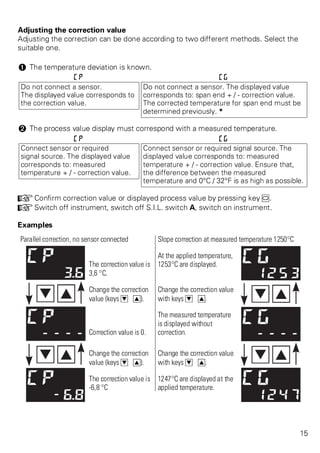
Adjusting the correction value 
Adjusting the correction can be done according to two different methods. Select the 
suitable one. 
1 The temperature deviation is known. 
CP CG 
Do not connect a sensor. 
The displayed value corresponds to 
the correction value. 
Do not connect a sensor. The displayed value 
corresponds to: span end + / - correction value. 
The corrected temperature for span end must be 
determined previously. * 
2 The process value display must correspond with a measured temperature. 
CP CG 
Connect sensor or required 
signal source. The displayed value 
corresponds to: measured 
temperature + / - correction value. 
Connect sensor or required signal source. The 
displayed value corresponds to: measured 
temperature + / - correction value. Ensure that, 
the difference between the measured 
temperature and 0°C / 32°F is as high as possible. 
+Confirm correction value or displayed process value by pressing key M. 
+Switch off instrument, switch off S.I.L. switch A, switch on instrument. 
Examples 
Parallel correction, no sensor connected Slope correction at measured temperature 1250°C 
The correction value is 
3,6 °C. 
At the applied temperature, 
1253°C are displayed. 
Change the correction 
value (keys D I). 
Change the correction value 
with keys D I. 
Correction value is 0. 
The measured temperature 
is displayed without 
correction. 
Change the correction 
value (keys D I). 
Change the correction value 
with keys D I. 
The correction value is 
-6,8 °C 
1247°C are displayed at the 
applied temperature. 
15
ADJUSTER OPERATING LEVEL 
Switching off relay 1, heating current monitoring and control contact L/R are as 
described for controllers. Control contact W/W2 is ineffective. The other conditions 
are as follows: 
Process value display (only with 3-point stepping adjuster) 
Displaying/adjusting the correcting value (all other adjusters) 
p Correcting values for heating: H... p for cooling: C... 
Pressing keys I D changes the correcting value display (the longer the faster). The 
change is effective after 2 s or by pressing M shortly. With 3-point stepping 
adjusters, the motor actuator is adjusted directly. 
The correcting value for two-point or three-point adjuster is determined from formula 
Y = rel. duty cycle [%] = 
Ton . 100 % 
Ton + Toff 
The parameters for cycle time (Ton + Toff at Y = 50%) are set as t1 or t2. 
+W2 is on: The adjuster is in remote mode (control contact L/R closed). Thereby, 
adjusting the correcting value with the keys is not possible. 
Display of the relay statuses 
The limit contact is without effect, the LC LED is off. LEDs H and C indicate the relay 
statuses for heating and cooling. With the outputs switched off ( H 0) and with 
continuous adjusters, the LEDs remain off. 
Switching off and on again the outputs 
Switching off: Set correcting value to H 0 by means of key D. Switch. off causes: 
w all relay outputs and the logic output (terminal 17/18) are switched off, 
w the continuous output is set to 0 mA, 
Switching on: Increase the output by pressing key I. With 3-point adjusters, 
changing the heating or cooling output accordingly is done by means of keys I and D. 
INTERFACE 
Information on the interface is given in operating notes 9499 040 15601 for the 
interface module and in interface description 9499 040 26218. 
MAINTENANCE / BEHAVIOUR IN CASE OF TROUBLE 
The controller needs no maintenance. The rules to be followed in case of trouble are: 
w Check, if all connections are correct. 
w Shut down the controller and replace it. 
16
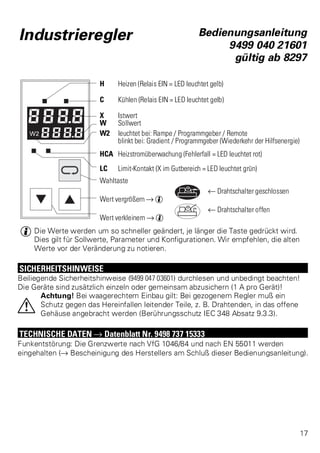
Industrieregler Bedienungsanleitung 
9499 040 21601 
gültig ab 8297 
H Heizen (Relais EIN = LED leuchtet gelb) 
C Kühlen (Relais EIN = LED leuchtet gelb) 
X Istwert 
W Sollwert 
W2 leuchtet bei: Rampe / Programmgeber / Remote 
blinkt bei: Gradient / Programmgeber (Wiederkehr der Hilfsenergie) 
HCA Heizstromüberwachung (Fehlerfall = LED leuchtet rot) 
LC Limit-Kontakt (X im Gutbereich = LED leuchtet grün) 
Wahltaste 
t Drahtschalter geschlossen 
Wert vergrößern Ä g 
t Drahtschalter offen 
Wert verkleinern Ä g 
g Die Werte werden um so schneller geändert, je länger die Taste gedrückt wird. 
Dies gilt für Sollwerte, Parameter und Konfigurationen. Wir empfehlen, die alten 
Werte vor der Veränderung zu notieren. 
SICHERHEITSHINWEISE 
Beiliegende Sicherheitshinweise (9499 047 03601) durchlesen und unbedingt beachten! 
Die Geräte sind zusätzlich einzeln oder gemeinsam abzusichern (1 A pro Gerät)! 
Achtung! Bei waagerechtem Einbau gilt: Bei gezogenem Regler muß ein 
Schutz gegen das Hereinfallen leitender Teile, z. B. Drahtenden, in das offene 
Gehäuse angebracht werden (Berührungsschutz IEC 348 Absatz 9.3.3). 
a 
TECHNISCHE DATEN Ä Datenblatt Nr. 9498 737 15333 
Funkentstörung: Die Grenzwerte nach VfG 1046/84 und nach EN 55011 werden 
eingehalten (Ä Bescheinigung des Herstellers am Schluß dieser Bedienungsanleitung). 
17
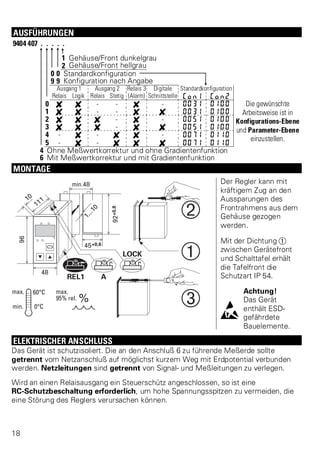
AUSFÜHRUNGEN 
9404 407 . . . . . 
1 Gehäuse/Front dunkelgrau 
2 Gehäuse/Front hellgrau 
0 0 Standardkonfiguration 
9 9 Konfiguration nach Angabe 
Ausgang 1 Ausgang 2 Relais 3 Digitale Standardkonfiguration 
Relais Logik Relais Stetig (Alarm) Schnittstelle Con1 Con2 
0 f f - - f - 0031 0100 Die gewünschte 
Arbeitsweise ist in 
Konfigurations-Ebene 
und Parameter-Ebene 
einzustellen. 
1 f f - - f f 0031 0100 
2 f f f - f - 0051 0100 
3 f f f - f f 0051 0100 
4 - f - f f - 0071 0110 
5 - f - f f f 0071 0110 
4 Ohne Meßwertkorrektur und ohne Gradientenfunktion 
6 Mit Meßwertkorrektur und mit Gradientenfunktion 
MONTAGE 
Der Regler kann mit 
kräftigem Zug an den 
Aussparungen des 
Frontrahmens aus dem 
Gehäuse gezogen 
werden. 
Mit der Dichtung Ü 
zwischen Gerätefront 
und Schalttafel erhält 
die Tafelfront die 
Schutzart IP 54. 
l 
Achtung! 
Das Gerät 
enthält ESD-gef 
ährdete 
Bauelemente. 
ELEKTRISCHER ANSCHLUSS 
Das Gerät ist schutzisoliert. Die an den Anschluß 6 zu führende Meßerde sollte 
getrennt vom Netzanschluß auf möglichst kurzem Weg mit Erdpotential verbunden 
werden. Netzleitungen sind getrennt von Signal- und Meßleitungen zu verlegen. 
Wird an einen Relaisausgang ein Steuerschütz angeschlossen, so ist eine 
RC-Schutzbeschaltung erforderlich, um hohe Spannungsspitzen zu vermeiden, die 
eine Störung des Reglers verursachen können. 
18
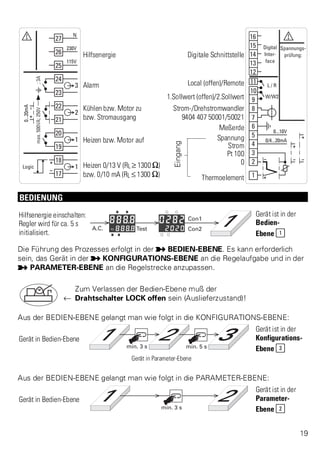
Hilfsenergie Digitale Schnittstelle 
Alarm Local (offen)/Remote 
1.Sollwert (offen)/2.Sollwert 
Kühlen bzw. Motor zu 
bzw. Stromausgang 
Strom-/Drehstromwandler 
9404 407 50001/50021 
Meßerde 
Heizen bzw. Motor auf 
Eingang 
Spannung 
Strom 
Pt 100 
Heizen 0/13 V (RL ? 1300 [) 
bzw. 0/10 mA (RL ß 1300 [) 
0 
Thermoelement 
BEDIENUNG 
Hilfsenergie einschalten: 
Regler wird für ca. 5 s 
initialisiert. 
Gerät ist in der 
Bedien- 
Ebene 1 
Die Führung des Prozesses erfolgt in der p BEDIEN-EBENE. Es kann erforderlich 
sein, das Gerät in der p KONFIGURATIONS-EBENE an die Regelaufgabe und in der 
p PARAMETER-EBENE an die Regelstrecke anzupassen. 
Zum Verlassen der Bedien-Ebene muß der 
t Drahtschalter LOCK offen sein (Auslieferzustand)! 
Aus der BEDIEN-EBENE gelangt man wie folgt in die KONFIGURATIONS-EBENE: 
Gerät in Bedien-Ebene 
Gerät ist in der 
Konfigurations- 
Ebene 3 
Gerät in Parameter-Ebene 
Aus der BEDIEN-EBENE gelangt man wie folgt in die PARAMETER-EBENE: 
Gerät in Bedien-Ebene 
Gerät ist in der 
Parameter- 
Ebene 2 
19
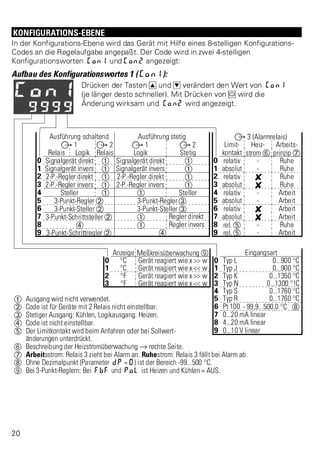
KONFIGURATIONS-EBENE 
In der Konfigurations-Ebene wird das Gerät mit Hilfe eines 8-stelligen Konfigurations- 
Codes an die Regelaufgabe angepaßt. Der Code wird in zwei 4-stelligen 
Konfigurationsworten Con1 und Con2 angezeigt: 
Aufbau des Konfigurationswortes 1 ( Con1): 
Drücken der Tasten I und D verändert den Wert von Con1 
(je länger desto schneller). Mit Drücken von M wird die 
Änderung wirksam und Con2 wird angezeigt. 
Ausführung schaltend Ausführung stetig  3 (Alarmrelais) 
 1  2  1  2 Limit- Heiz- Arbeits- 
Relais Logik Relais Logik Stetig kontakt strom < prinzip > 
0 Signalgerät direkt Ü Signalgerät direkt Ü 0 relativ - Ruhe 
1 Signalgerät invers Ü Signalgerät invers Ü 1 absolut - Ruhe 
2 2-P.-Regler direkt Ü 2-P.-Regler direkt Ü 2 relativ f Ruhe 
3 2-P.-Regler invers Ü 2-P.-Regler invers Ü 3 absolut f Ruhe 
4 Steller Ü Ü Steller 4 relativ - Arbeit 
5 3-Punkt-Regler * 3-Punkt-Regler Ö 5 absolut - Arbeit 
6 3-Punkt-Steller * 3-Punkt-Steller Ö 6 relativ f Arbeit 
7 3-Punkt-Schrittsteller * Ü Regler direkt 7 absolut f Arbeit 
8 ä Ü Regler invers 8 rel. # - Ruhe 
9 3-Punkt-Schrittregler * ä 9 rel. # - Arbeit 
Anzeige Meßkreisüberwachung x Eingangsart 
0 °C Gerät reagiert wie x >> w 0 Typ L 0...900 °C 
1 °C Gerät reagiert wie x << w 1 Typ J 0...900 °C 
2 °F Gerät reagiert wie x >> w 2 Typ K 0...1350 °C 
3 °F Gerät reagiert wie x << w 3 Typ N 0...1300 °!C 
4 Typ S 0...1760 °C 
Ü Ausgang wird nicht verwendet. 5 Typ R 0...1760 °C 
* Code ist für Geräte mit 2 Relais nicht einstellbar. 6 Pt 100 - 99,9...500,0 °C y 
Ö Stetiger Ausgang: Kühlen, Logikausgang: Heizen. 7 0...20 mA linear 
ä Code ist nicht einstellbar. 8 4...20 mA linear 
# Der Limitkontakt wird beim Anfahren oder bei Sollwert- 9 0...10 V linear 
änderungen unterdrückt. 
< Beschreibung der Heizstromüberwachung Ä rechte Seite. 
> Arbeitsstrom: Relais 3 zieht bei Alarm an. Ruhestrom: Relais 3 fällt bei Alarm ab. 
y Ohne Dezimalpunkt (Parameter dP = 0) ist der Bereich -99...500 °C. 
x Bei 3-Punkt-Reglern: Bei FbF und PoL ist Heizen und Kühlen = AUS. 
20
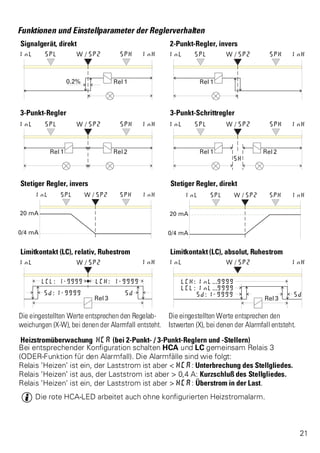
Funktionen und Einstellparameter der Reglerverhalten 
Signalgerät, direkt 2-Punkt-Regler, invers 
3-Punkt-Regler 3-Punkt-Schrittregler 
Stetiger Regler, invers Stetiger Regler, direkt 
Limitkontakt (LC), relativ, Ruhestrom Limitkontakt (LC), absolut, Ruhestrom 
Die eingestellten Werte entsprechen den Regelab-weichungen 
(X-W), bei denen der Alarmfall entsteht. 
Die eingestellten Werte entsprechen den 
Istwerten (X), bei denen der Alarmfall entsteht. 
Heizstromüberwachung HCA (bei 2-Punkt- / 3-Punkt-Reglern und -Stellern) 
Bei entsprechender Konfiguration schalten HCA und LC gemeinsam Relais 3 
(ODER-Funktion für den Alarmfall). Die Alarmfälle sind wie folgt: 
Relais ’Heizen’ ist ein, der Laststrom ist aber < HCA: Unterbrechung des Stellgliedes. 
Relais ’Heizen’ ist aus, der Laststrom ist aber > 0,4 A: Kurzschluß des Stellgliedes. 
Relais ’Heizen’ ist ein, der Laststrom ist aber > HCA: Überstrom in der Last. 
g Die rote HCA-LED arbeitet auch ohne konfigurierten Heizstromalarm. 
21
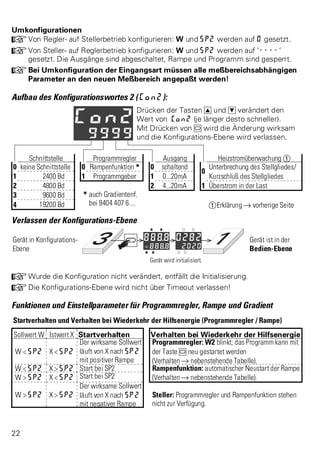
Umkonfigurationen 
+Von Regler- auf Stellerbetrieb konfigurieren: W und SP2 werden auf 0 gesetzt. 
+Von Steller- auf Reglerbetrieb konfigurieren: W und SP2 werden auf ’----’ 
gesetzt. Die Ausgänge sind abgeschaltet, Rampe und Programm sind gesperrt. 
+Bei Umkonfiguration der Eingangsart müssen alle meßbereichsabhängigen 
Parameter an den neuen Meßbereich angepaßt werden! 
Aufbau des Konfigurationswortes 2 ( Con2): 
Drücken der Tasten I und D verändert den 
Wert von Con2 (je länger desto schneller). 
Mit Drücken von M wird die Änderung wirksam 
und die Konfigurations-Ebene wird verlassen. 
Schnittstelle Programmregler Ausgang Heizstromüberwachung Ü 
0 keine Schnittstelle 0 Rampenfunktion * 0 schaltend 
0 
Unterbrechung des Stellgliedes/ 
1 2400 Bd 1 Programmgeber 1 0...20mA Kurzschluß des Stellgliedes 
2 4800 Bd 2 4...20mA 1 Überstrom in der Last 
3 9600 Bd * auch Gradientenf. 
4 19200 Bd bei 9404 407 6.... ÜErklärung Ä vorherige Seite 
Verlassen der Konfigurations-Ebene 
Gerät in Konfigurations- 
Ebene 
Gerät ist in der 
Bedien-Ebene 
Gerät wird initialisiert. 
+Wurde die Konfiguration nicht verändert, entfällt die Initialisierung. 
+Die Konfigurations-Ebene wird nicht über Timeout verlassen! 
Funktionen und Einstellparameter für Programmregler, Rampe und Gradient 
Startverhalten und Verhalten bei Wiederkehr der Hilfsenergie (Programmregler / Rampe) 
Sollwert W Istwert X Startverhalten Verhalten bei Wiederkehr der Hilfsenergie 
W < SP2 X < SP2 
Der wirksame Sollwert 
läuft von X nach SP2 
mit positiver Rampe 
Programmregler: W2 blinkt; das Programm kann mit 
der Taste M neu gestartet werden 
(Verhalten Ä nebenstehende Tabelle). 
W < SP2 X > SP2 Start bei SP2 Rampenfunktion: automatischer Neustart der Rampe 
W > SP2 X < SP2 Start bei SP2 (Verhalten Ä nebenstehende Tabelle). 
W > SP2 X > SP2 
Der wirksame Sollwert 
läuft von X nach SP2 
mit negativer Rampe 
Steller: Programmregler und Rampenfunktion stehen 
nicht zur Verfügung. 
22
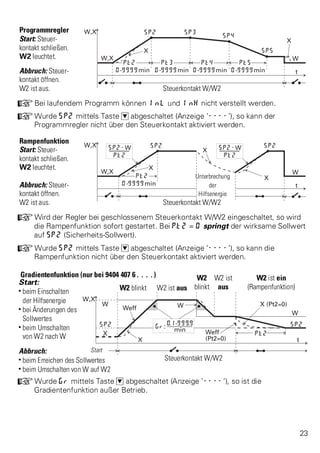
Programmregler 
Start: Steuer-kontakt 
schließen. 
W2 leuchtet. 
Abbruch: Steuer-kontakt 
öffnen. 
W2 ist aus. Steuerkontakt W/W2 
+Bei laufendem Programm können InL und InH nicht verstellt werden. 
+Wurde SP2 mittels Taste D abgeschaltet (Anzeige ’----’), so kann der 
Programmregler nicht über den Steuerkontakt aktiviert werden. 
Rampenfunktion 
Start: Steuer-kontakt 
schließen. 
W2 leuchtet. 
Unterbrechung 
Abbruch: Steuer- der 
kontakt öffnen. Hilfsenergie 
W2 ist aus. Steuerkontakt W/W2 
+Wird der Regler bei geschlossenem Steuerkontakt W/W2 eingeschaltet, so wird 
die Rampenfunktion sofort gestartet. Bei Pt2 = 0 springt der wirksame Sollwert 
auf SP2 (Sicherheits-Sollwert). 
+Wurde SP2 mittels Taste D abgeschaltet (Anzeige ’----’), so kann die 
Rampenfunktion nicht über den Steuerkontakt aktiviert werden. 
Gradientenfunktion (nur bei 9404 407 6....) W2 
blinkt 
W2 ist 
aus 
W2 ist ein 
Start: 
W2 blinkt W2 ist aus 
(Rampenfunktion) w beim Einschalten 
der Hilfsenergie 
w bei Änderungen des 
Sollwertes 
w beim Umschalten 
von W2 nach W 
Abbruch: Start 
w beim Erreichen des Sollwertes Steuerkontakt W/W2 
w beim Umschalten von W auf W2 
+Wurde Gr mittels Taste D abgeschaltet (Anzeige ’----’), so ist die 
Gradientenfunktion außer Betrieb. 
23
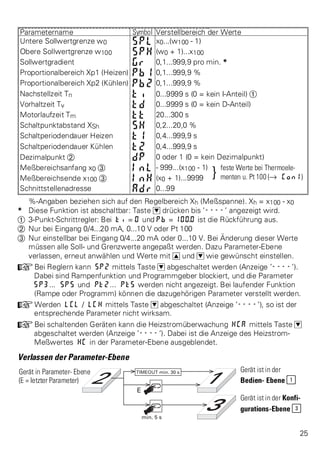
PARAMETER-EBENE 
In der Parameter-Ebene wird das Gerät an die Regelstrecke angepaßt. Es werden nur 
die Parameter angezeigt, die für das konfigurierte Gerät erforderlich sind: 
Symbol Ä 
Wert Ä 
Drücken der Tasten I oder D verändert den Wert (je 
länger desto schneller). Die Änderung wird nach 2 s 
oder durch kurzzeitiges Drücken von M wirksam; mit 
M wird auch auf den nächsten Parameter geschaltet. 
+Die Parameter-Ebene wird nach einer Timeout von 30 s verlassen oder wenn 
die Taste M nach dem letzten Parameter kurzzeitig gedrückt wird. 
Parametername Symbol Verstellbereich der Werte 
2. Sollwert w2 (Rampe) SP2 w0...w100 * 
Abschnittszeit t2 (Rampe) Pt2 0...9999 min 
3. Sollwert w3 SP3 w0...w100 
Abschnittszeit t3 Pt3 0...9999 min 
4. Sollwert w4 SP4 w0...w100 
Abschnittszeit t4 Pt4 0...9999 min 
5. Sollwert w5 SP5 w0...w100 
Abschnittszeit t5 Pt5 0...9999 min 
Limitkontakt unten LCL Relativ: 1...9999 ; Absolut: x0...9999 * 
Limitkontakt oben LCH Relativ: 1...9999 ; Absolut: x0...9999 * 
Alarm-Schaltdifferenz XSd Sd 1...9999 
Heizstrom HC Nur Anzeige 
Heizstromgrenze HCA 0...30,0 A * 
Blockierung Bedienung Loc 0...3 (Ä Blockierung) 
*) Diese Funktion ist abschaltbar: Taste D drücken bis ’----’ angezeigt wird. 
Blockierung (Parameter Loc) 
Loc Bedienungsfreigabe (nur für Reglerbetrieb) 
0 X- und W- Anzeige mit Verstellung, Selbstoptimierung zugelassen 
1 X- und W- Anzeige mit Verstellung 
2 X- und W- Anzeige, jedoch ohne Verstellung 
3 Nur X- Anzeige, untere Anzeige ist aus (keine Sollwertverstellung) 
+Ist der Parameter Loc > 0, so werden die folgenden Parameter nicht angezeigt 
und können somit nicht verändert werden. 
24
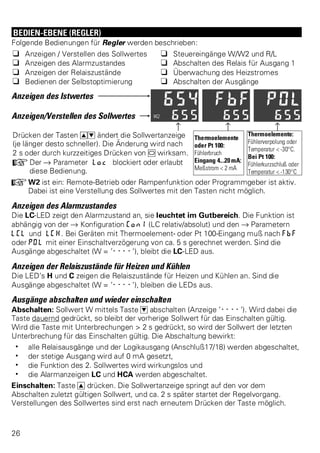
Parametername Symbol Verstellbereich der Werte 
Untere Sollwertgrenze w0 SPL x0...(w100 - 1) 
Obere Sollwertgrenze w100 SPH (w0 + 1)...x100 
Sollwertgradient Gr 0,1...999,9 pro min. * 
Proportionalbereich Xp1 (Heizen) Pb1 0,1...999,9 % 
Proportionalbereich Xp2 (Kühlen) Pb2 0,1...999,9 % 
Nachstellzeit Tn ti 0...9999 s (0 = kein I-Anteil) Ü 
Vorhaltzeit Tv td 0...9999 s (0 = kein D-Anteil) 
Motorlaufzeit Tm tt 20...300 s 
Schaltpunktabstand XSh SH 0,2...20,0 % 
Schaltperiodendauer Heizen t1 0,4...999,9 s 
Schaltperiodendauer Kühlen t2 0,4...999,9 s 
Dezimalpunkt * dP 0 oder 1 (0 = kein Dezimalpunkt) 
Meßbereichsanfang x0 Ö InL - 999...(x100 - 1) } feste Werte bei Thermoele- 
Meßbereichsende x100 Ö InH (x0 + 1)...9999 menten u. Pt 100 (Ä Con1) 
Schnittstellenadresse Adr 0...99 
%-Angaben beziehen sich auf den Regelbereich Xh (Meßspanne). Xh = x100 - x0 
* Diese Funktion ist abschaltbar: Taste D drücken bis ’----’ angezeigt wird. 
Ü 3-Punkt-Schrittregler: Bei ti = 0 und Pb = 1000. ist die Rückführung aus. 
* Nur bei Eingang 0/4...20 mA, 0...10 V oder Pt 100 
Ö Nur einstellbar bei Eingang 0/4...20 mA oder 0...10 V. Bei Änderung dieser Werte 
müssen alle Soll- und Grenzwerte angepaßt werden. Dazu Parameter-Ebene 
verlassen, erneut anwählen und Werte mit I und D wie gewünscht einstellen. 
+Bei Reglern kann SP2 mittels Taste D abgeschaltet werden (Anzeige ’----’). 
Dabei sind Rampenfunktion und Programmgeber blockiert, und die Parameter 
SP3... SP5 und Pt2... Pt5 werden nicht angezeigt. Bei laufender Funktion 
(Rampe oder Programm) können die dazugehörigen Parameter verstellt werden. 
+Werden LCL / LCH mittels Taste D abgeschaltet (Anzeige ’----’), so ist der 
entsprechende Parameter nicht wirksam. 
+Bei schaltenden Geräten kann die Heizstromüberwachung HCA mittels Taste D 
abgeschaltet werden (Anzeige ’----’). Dabei ist die Anzeige des Heizstrom- 
Meßwertes HC in der Parameter-Ebene ausgeblendet. 
Verlassen der Parameter-Ebene 
Gerät in Parameter- Ebene 
(E = letzter Parameter) 
Gerät ist in der 
Bedien- Ebene 1 
Gerät ist in der Konfi-gurations- 
Ebene 3 
25
BEDIEN-EBENE (REGLER) 
Folgende Bedienungen für Regler werden beschrieben: 
q Anzeigen / Verstellen des Sollwertes q Steuereingänge W/W2 und R/L 
q Anzeigen des Alarmzustandes q Abschalten des Relais für Ausgang 1 
q Anzeigen der Relaiszustände q Überwachung des Heizstromes 
q Bedienen der Selbstoptimierung q Abschalten der Ausgänge 
Anzeigen des Istwertes 
Anzeigen/Verstellen des Sollwertes 
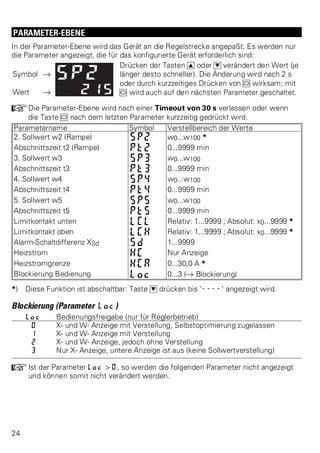
z z z 
Drücken der Tasten ID ändert die Sollwertanzeige 
(je länger desto schneller). Die Änderung wird nach 
2 s oder durch kurzzeitiges Drücken von M wirksam. 
+Der Ä Parameter Loc blockiert oder erlaubt 
diese Bedienung. 
Thermoelemente 
oder Pt 100: 
Fühlerbruch 
Eingang 4...20 mA: 
Meßstrom < 2 mA 
Thermoelemente: 
Fühlerverpolung oder 
Temperatur < -30°C. 
Bei Pt 100: 
Fühlerkurzschluß oder 
Temperatur < -130°C 
+W2 ist ein: Remote-Betrieb oder Rampenfunktion oder Programmgeber ist aktiv. 
Dabei ist eine Verstellung des Sollwertes mit den Tasten nicht möglich. 
Anzeigen des Alarmzustandes 
Die LC-LED zeigt den Alarmzustand an, sie leuchtet im Gutbereich. Die Funktion ist 
abhängig von der Ä Konfiguration Con1 (LC relativ/absolut) und den Ä Parametern 
LCL und LCH. Bei Geräten mit Thermoelement- oder Pt 100-Eingang muß nach FbF 
oder POl mit einer Einschaltverzögerung von ca. 5 s gerechnet werden. Sind die 
Ausgänge abgeschaltet (W = ’----’), bleibt die LC-LED aus. 
Anzeigen der Relaiszustände für Heizen und Kühlen 
Die LED’s H und C zeigen die Relaiszustände für Heizen und Kühlen an. Sind die 
Ausgänge abgeschaltet (W = ’----’), bleiben die LEDs aus. 
Ausgänge abschalten und wieder einschalten 
Abschalten: Sollwert W mittels Taste D abschalten (Anzeige ’----’). Wird dabei die 
Taste dauernd gedrückt, so bleibt der vorherige Sollwert für das Einschalten gültig. 
Wird die Taste mit Unterbrechungen > 2 s gedrückt, so wird der Sollwert der letzten 
Unterbrechung für das Einschalten gültig. Die Abschaltung bewirkt: 
w alle Relaisausgänge und der Logikausgang (Anschluß17/18) werden abgeschaltet, 
w der stetige Ausgang wird auf 0 mA gesetzt, 
w die Funktion des 2. Sollwertes wird wirkungslos und 
w die Alarmanzeigen LC und HCA werden abgeschaltet. 
Einschalten: Taste I drücken. Die Sollwertanzeige springt auf den vor dem 
Abschalten zuletzt gültigen Sollwert, und ca. 2 s später startet der Regelvorgang. 
Verstellungen des Sollwertes sind erst nach erneutem Drücken der Taste möglich. 
26
Relais des Ausgangs 1 abschalten 
Wird nur der Logikausgang verwendet, kann Relais 1 abgeschaltet werden. Dazu ist 
der Drahtschalter REL1 zu öffnen (Ä MONTAGE). 
Heizstromüberwachung 
Die Messung des Heizstromes erfolgt über den Stromwandler 9404 407 50001 oder 
den Drehstromwandler 9404 407 50021. Die Überwachungsfunktionen sind in der 
Konfigurations-Ebene ( Con1) und in der Parameter-Ebene ( HCA, HC) erläutert. 
Steuereingänge W/W2 und L/R 
Steuereingang W/W2: 
Rampenfunktion oder Programmregler werden gestartet oder gestoppt. 
Die Funktionen sind in Konfigurations-Ebene ( Con2) und Parameter-Ebene erläutert. 
Steuereingang L/R: 
Local- oder Remote-Betrieb werden geschaltet, W2 leuchtet im Remote-Betrieb. 
Der Remote-Betrieb dient der Verstellung von Werten über eine digitale Schnittstelle. 
Dabei ist das Verstellen von Werten über die Tasten nicht möglich, die Werte können 
jedoch angesehen werden. 
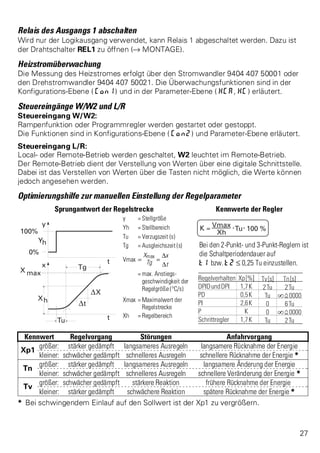
Optimierungshilfe zur manuellen Einstellung der Regelparameter 
Sprungantwort der Regelstrecke Kennwerte der Regler 
y = Stellgröße 
Yh = Stellbereich 
Tu = Verzugszeit (s) 
Tg = Ausgleichszeit (s) Bei den 2-Punkt- und 3-Punkt-Reglern ist 
die Schaltperiodendauer auf 
Vmax = Xmax 
Tg 
t1 bzw. t2 ß 0,25 Tu einzustellen. 
= Dx 
Dt 
= max. Anstiegs-geschwindigkeit 
der 
Regelgröße (°C/s) 
Xmax =Maximalwert der 
Regelstrecke 
Xh = Regelbereich 
Kennwert Regelvorgang Störungen Anfahrvorgang 
Xp1 
größer: stärker gedämpft langsameres Ausregeln langsamere Rücknahme der Energie 
kleiner: schwächer gedämpft schnelleres Ausregeln schnellere Rücknahme der Energie * 
Tn 
größer: stärker gedämpft langsameres Ausregeln langsamere Änderung der Energie 
kleiner: schwächer gedämpft schnelleres Ausregeln schnellere Veränderung der Energie * 
Tv 
größer: schwächer gedämpft stärkere Reaktion frühere Rücknahme der Energie 
kleiner: stärker gedämpft schwächere Reaktion spätere Rücknahme der Energie * 
* Bei schwingendem Einlauf auf den Sollwert ist der Xp1 zu vergrößern. 
27
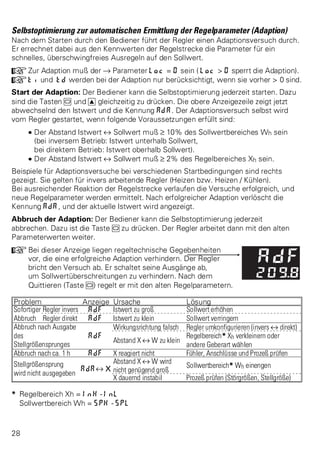
Selbstoptimierung zur automatischen Ermittlung der Regelparameter (Adaption) 
Nach dem Starten durch den Bediener führt der Regler einen Adaptionsversuch durch. 
Er errechnet dabei aus den Kennwerten der Regelstrecke die Parameter für ein 
schnelles, überschwingfreies Ausregeln auf den Sollwert. 
+Zur Adaption muß der Ä Parameter Loc = 0 sein ( Loc > 0 sperrt die Adaption). 
+ti und td werden bei der Adaption nur berücksichtigt, wenn sie vorher > 0 sind. 
Start der Adaption: Der Bediener kann die Selbstoptimierung jederzeit starten. Dazu 
sind die Tasten M und I gleichzeitig zu drücken. Die obere Anzeigezeile zeigt jetzt 
abwechselnd den Istwert und die Kennung AdA. Der Adaptionsversuch selbst wird 
vom Regler gestartet, wenn folgende Voraussetzungen erfüllt sind: 
· Der Abstand Istwert i Sollwert muß ? 10% des Sollwertbereiches Wh sein 
(bei inversem Betrieb: Istwert unterhalb Sollwert, 
bei direktem Betrieb: Istwert oberhalb Sollwert). 
· Der Abstand Istwert i Sollwert muß ? 2% des Regelbereiches Xh sein. 
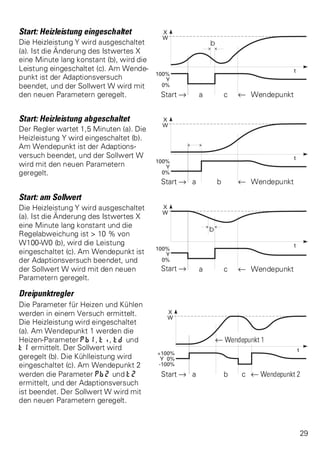
Beispiele für Adaptionsversuche bei verschiedenen Startbedingungen sind rechts 
gezeigt. Sie gelten für invers arbeitende Regler (Heizen bzw. Heizen / Kühlen). 
Bei ausreichender Reaktion der Regelstrecke verlaufen die Versuche erfolgreich, und 
neue Regelparameter werden ermittelt. Nach erfolgreicher Adaption verlöscht die 
Kennung AdA, und der aktuelle Istwert wird angezeigt. 
Abbruch der Adaption: Der Bediener kann die Selbstoptimierung jederzeit 
abbrechen. Dazu ist die Taste M zu drücken. Der Regler arbeitet dann mit den alten 
Parameterwerten weiter. 
+Bei dieser Anzeige liegen regeltechnische Gegebenheiten 
vor, die eine erfolgreiche Adaption verhindern. Der Regler 
bricht den Versuch ab. Er schaltet seine Ausgänge ab, 
um Sollwertüberschreitungen zu verhindern. Nach dem 
Quittieren (Taste M) regelt er mit den alten Regelparametern. 
Problem Anzeige Ursache Lösung 
Sofortiger 
Abbruch 
Regler invers AdF Istwert zu groß Sollwert erhöhen 
Regler direkt AdF Istwert zu klein Sollwert verringern 
Abbruch nach Ausgabe 
des 
Stellgrößensprunges 
AdF 
Wirkungsrichtung falsch Regler umkonfigurieren (invers i direkt) 
Abstand X i W zu klein 
Regelbereich* Xh verkleinern oder 
andere Geberart wählen 
Abbruch nach ca. 1 h AdF X reagiert nicht Fühler, Anschlüsse und Prozeß prüfen 
Stellgrößensprung 
Abstand X i W wird 
Sollwertbereich* Wh einengen 
AdAi X 
wird nicht ausgegeben 
nicht genügend groß 
X dauernd instabil Prozeß prüfen (Störgrößen, Stellgröße) 
* Regelbereich Xh = InH - InL 
Sollwertbereich Wh = SPH - SPL 
28
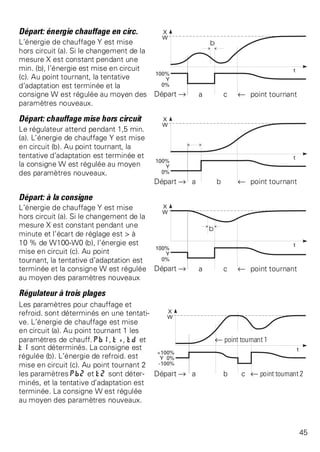
Start: Heizleistung eingeschaltet 
Die Heizleistung Y wird ausgeschaltet 
(a). Ist die Änderung des Istwertes X 
eine Minute lang konstant (b), wird die 
Leistung eingeschaltet (c). Am Wende-punkt 
ist der Adaptionsversuch 
beendet, und der Sollwert W wird mit 
den neuen Parametern geregelt. Start Ä a c t Wendepunkt 
Start: Heizleistung abgeschaltet 
Der Regler wartet 1,5 Minuten (a). Die 
Heizleistung Y wird eingeschaltet (b). 
Am Wendepunkt ist der Adaptions-versuch 
beendet, und der Sollwert W 
wird mit den neuen Parametern 
geregelt. 
Start Äa b t Wendepunkt 
Start: am Sollwert 
Die Heizleistung Y wird ausgeschaltet 
(a). Ist die Änderung des Istwertes X 
eine Minute lang konstant und die 
Regelabweichung ist > 10 % von 
W100-W0 (b), wird die Leistung 
eingeschaltet (c). Am Wendepunkt ist 
der Adaptionsversuch beendet, und 
der Sollwert W wird mit den neuen 
Parametern geregelt. 
Start Ä a c t Wendepunkt 
Dreipunktregler 
Die Parameter für Heizen und Kühlen 
werden in einem Versuch ermittelt. 
Die Heizleistung wird eingeschaltet 
(a). Am Wendepunkt 1 werden die 
Heizen-Parameter Pb1, ti, td und t Wendepunkt 1 
t1 ermittelt. Der Sollwert wird 
geregelt (b). Die Kühlleistung wird 
eingeschaltet (c). Am Wendepunkt 2 
werden die Parameter Pb2 und t2 
ermittelt, und der Adaptionsversuch 
ist beendet. Der Sollwert W wird mit 
den neuen Parametern geregelt. 
Start Ä a b c t Wendepunkt 2 
29
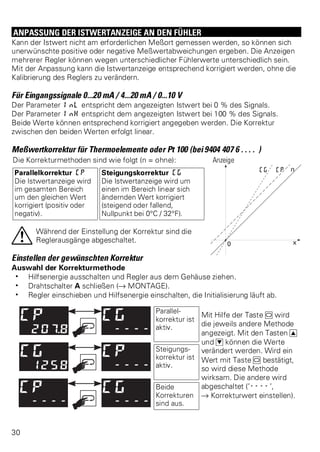
ANPASSUNG DER ISTWERTANZEIGE AN DEN FÜHLER 
Kann der Istwert nicht am erforderlichen Meßort gemessen werden, so können sich 
unerwünschte positive oder negative Meßwertabweichungen ergeben. Die Anzeigen 
mehrerer Regler können wegen unterschiedlicher Fühlerwerte unterschiedlich sein. 
Mit der Anpassung kann die Istwertanzeige entsprechend korrigiert werden, ohne die 
Kalibrierung des Reglers zu verändern. 
Für Eingangssignale 0...20 mA / 4...20 mA / 0...10 V 
Der Parameter InL entspricht dem angezeigten Istwert bei 0 % des Signals. 
Der Parameter InH entspricht dem angezeigten Istwert bei 100 % des Signals. 
Beide Werte können entsprechend korrigiert angegeben werden. Die Korrektur 
zwischen den beiden Werten erfolgt linear. 
Meßwertkorrektur für Thermoelemente oder Pt 100 (bei 9404 407 6 . . . . ) 
Die Korrekturmethoden sind wie folgt (n = ohne): Anzeige 
Parallelkorrektur CP 
Steigungskorrektur CG 
Die Istwertanzeige wird 
Die Istwertanzeige wird um 
im gesamten Bereich 
einen im Bereich linear sich 
um den gleichen Wert 
ändernden Wert korrigiert 
korrigiert (positiv oder 
(steigend oder fallend, 
negativ). 
Nullpunkt bei 0°C / 32°F). 
aWährend der Einstellung der Korrektur sind die 
Reglerausgänge abgeschaltet. 
Einstellen der gewünschten Korrektur 
Auswahl der Korrekturmethode 
w Hilfsenergie ausschalten und Regler aus dem Gehäuse ziehen. 
w Drahtschalter A schließen (Ä MONTAGE). 
w Regler einschieben und Hilfsenergie einschalten, die Initialisierung läuft ab. 
Parallel-korrektur 
ist 
aktiv. 
Mit Hilfe der Taste M wird 
die jeweils andere Methode 
angezeigt. Mit den Tasten I 
und D können die Werte 
verändert werden. Wird ein 
Wert mit Taste M bestätigt, 
so wird diese Methode 
wirksam. Die andere wird 
abgeschaltet (’----’, 
Ä Korrekturwert einstellen). 
Steigungs-korrektur 
ist 
aktiv. 
Beide 
Korrekturen 
sind aus. 
30
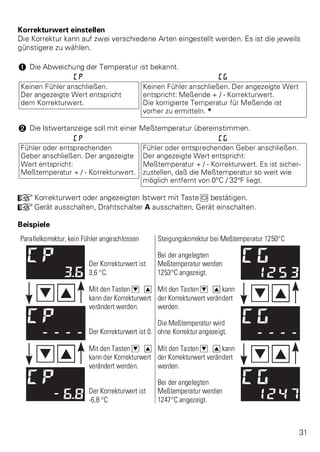
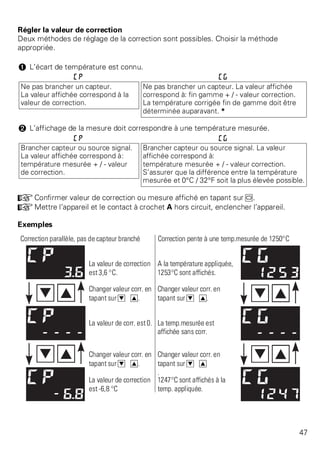
Korrekturwert einstellen 
Die Korrektur kann auf zwei verschiedene Arten eingestellt werden. Es ist die jeweils 
günstigere zu wählen. 
1 Die Abweichung der Temperatur ist bekannt. 
CP CG 
Keinen Fühler anschließen. 
Der angezeigte Wert entspricht 
dem Korrekturwert. 
Keinen Fühler anschließen. Der angezeigte Wert 
entspricht: Meßende + / - Korrekturwert. 
Die korrigierte Temperatur für Meßende ist 
vorher zu ermitteln. * 
2 Die Istwertanzeige soll mit einer Meßtemperatur übereinstimmen. 
CP CG 
Fühler oder entsprechenden 
Geber anschließen. Der angezeigte 
Wert entspricht: 
Meßtemperatur + / - Korrekturwert. 
Fühler oder entsprechenden Geber anschließen. 
Der angezeigte Wert entspricht: 
Meßtemperatur + / - Korrekturwert. Es ist sicher-zustellen, 
daß die Meßtemperatur so weit wie 
möglich entfernt von 0°C / 32°F liegt. 
+Korrekturwert oder angezeigten Istwert mit Taste M bestätigen. 
+Gerät ausschalten, Drahtschalter A ausschalten, Gerät einschalten. 
Beispiele 
Parallelkorrektur, kein Fühler angeschlossen Steigungskorrektur bei Meßtemperatur 1250°C 
Der Korrekturwert ist 
3,6 °C. 
Bei der angelegten 
Meßtemperatur werden 
1253°C angezeigt. 
Mit den Tasten D I 
kann der Korrekturwert 
verändert werden. 
Mit den Tasten D I kann 
der Korrekturwert verändert 
werden. 
Der Korrekturwert ist 0. 
Die Meßtemperatur wird 
ohne Korrektur angezeigt. 
Mit den Tasten D I 
kann der Korrekturwert 
verändert werden. 
Mit den Tasten D I kann 
der Korrekturwert verändert 
werden. 
Der Korrekturwert ist 
-6,8 °C 
Bei der angelegten 
Meßtemperatur werden 
1247°C angezeigt. 
31
BEDIEN-EBENE - STELLER 
Das Abschalten des Relais 1, die Heizstromüberwachung und der 
Steuerkontakt L/R sind wie bei Reglern beschrieben. Der Steuerkontakt W/W2 ist 
wirkungslos. Die weiteren Bedienungen sind wie folgt: 
Anzeigen des Istwertes (nur bei 3-Punkt-Schrittsteller) 
Anzeigen/Verstellen des Stellwertes (alle anderen Steller) 
p Stellwerte für Heizen: H... p Stellwerte für Kühlen: C... 
Drücken der Tasten I D ändert die Stellwertanzeige (je länger desto schneller). 
Die Änderung wird nach 2 s oder durch kurzzeitiges Drücken von M wirksam. 
Bei 3-Punkt-Schrittstellern wird der Stellmotor unmittelbar verstellt. 
Der Stellwert für Zweipunkt- und Dreipunkt-Steller ergibt sich aus der Formel 
Y = relative Einschaltdauer [%] = 
Tein . 100 % 
Tein + Taus 
Die Schaltperiodendauer (Tein + Taus bei Y = 50%) wird als t1 bzw. t2 parametriert. 
+W2 ist ein: Der Steller ist im Remote-Betrieb (Steuerkontakt L/R geschlossen). 
Dabei ist eine Verstellung des Stellwertes mit den Tasten nicht möglich. 
Anzeigen der Relaiszustände 
Der Limitkontakt ist wirkungslos, die LC-LED ist aus. Die LEDs H und C zeigen die 
Relaiszustände für Heizen und Kühlen an. Sind die Ausgänge abgeschaltet ( H 0) 
und bei stetigen Stellern bleiben die LEDs aus. 
Ausgänge abschalten und wieder einschalten 
Abschalten: Stellwert mittels Taste D auf H 0 stellen. Die Abschaltung bewirkt: 
w alle Relaisausgänge und der Logikausgang (Anschluß17/18) werden abgeschaltet, 
w der stetige Ausgang wird auf 0 mA gesetzt, 
Einschalten: Mit der Taste I wird der Stellwert erhöht. Bei 3-Punkt-Stellern wird mit 
den Tasten I und D der Heizen- oder der Kühlen-Stellwert entsprechend verändert. 
SCHNITTSTELLE 
Informationen zur Schnittstelle enthalten der Bedienhinweis 9499 040 15601 des 
Schnittstellenmoduls und die Schnittstellenbeschreibung 9499 040 26218. 
WARTUNG / VERHALTEN BEI STÖRUNG 
Der Regler ist wartungsfrei. Im Falle einer Störung sind folgende Punkte zu beachten: 
w Überprüfung aller Anschlüsse auf korrekten Anschluß. 
w Regler außer Betrieb nehmen und austauschen. 
32
Régulateur 
industriel 
Mode d’emploi 
9499 040 21601 
valable depuis 8297 
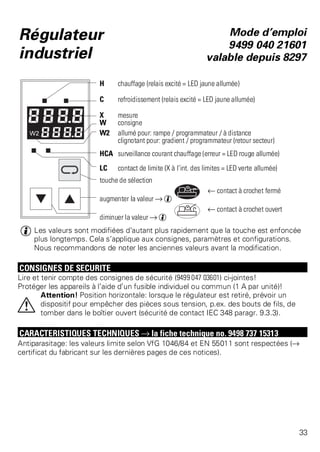
H chauffage (relais excité = LED jaune allumée) 
C refroidissement (relais excité = LED jaune allumée) 
X mesure 
W consigne 
W2 allumé pour: rampe / programmateur / à distance 
clignotant pour: gradient / programmateur (retour secteur) 
HCA surveillance courant chauffage (erreur = LED rouge allumée) 
LC contact de limite (X à l’int. des limites = LED verte allumée) 
touche de sélection 
t contact à crochet fermé 
augmenter la valeur Ä g 
t contact à crochet ouvert 
diminuer la valeur Ä g 
g Les valeurs sont modifiées d’autant plus rapidement que la touche est enfoncée 
plus longtemps. Cela s’applique aux consignes, paramètres et configurations. 
Nous recommandons de noter les anciennes valeurs avant la modification. 
CONSIGNES DE SECURITE 
Lire et tenir compte des consignes de sécurité (9499 047 03601) ci-jointes! 
Protéger les appareils à l’aide d’un fusible individuel ou commun (1 A par unité)! 
Attention! Position horizontale: lorsque le régulateur est retiré, prévoir un 
dispositif pour empêcher des pièces sous tension, p.ex. des bouts de fils, de 
tomber dans le boîtier ouvert (sécurité de contact IEC 348 paragr. 9.3.3). 
a 
CARACTERISTIQUES TECHNIQUES Ä la fiche technique no. 9498 737 15313 
Antiparasitage: les valeurs limite selon VfG 1046/84 et EN 55011 sont respectées (Ä 
certificat du fabricant sur les dernières pages de ces notices). 
33
VERSIONS 
9404 407 . . . . . 
1 boîtier/face avant grise foncée 
2 boîtier/face avant grise foncée 
0 0 configuration standard 
9 9 configuration selon specification 
sortie 1 sortie 2 relais 3 interface configuration standard 
relais logique relais continu (alarme) numérique Con1 Con2 
0 f f - - f - 0031 0100 Régler le 
fonctionnement requis 
en «configuration» et 
en «paramétrage». 
1 f f - - f f 0031 0100 
2 f f f - f - 0051 0100 
3 f f f - f f 0051 0100 
4 - f - f f - 0071 0110 
5 - f - f f f 0071 0110 
4 sans correction de la mesure et sans gradient 
6 avec correction de la mesure et avec gradient 
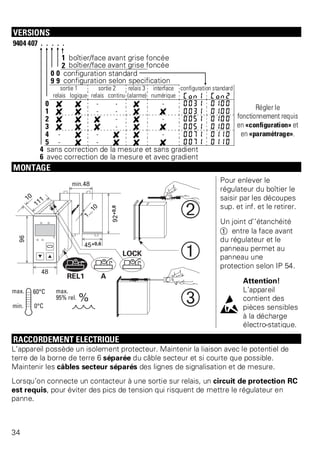
MONTAGE 
Pour enlever le 
régulateur du boîtier le 
saisir par les découpes 
sup. et inf. et le retirer. 
Un joint d’’étanchéité 
Ü entre la face avant 
du régulateur et le 
panneau permet au 
panneau une 
protection selon IP 54. 
l 
Attention! 
L’appareil 
contient des 
pièces sensibles 
à la décharge 
électro-statique. 
RACCORDEMENT ELECTRIQUE 
L’appareil possède un isolement protecteur. Maintenir la liaison avec le potentiel de 
terre de la borne de terre 6 séparée du câble secteur et si courte que possible. 
Maintenir les câbles secteur séparés des lignes de signalisation et de mesure. 
Lorsqu’on connecte un contacteur à une sortie sur relais, un circuit de protection RC 
est requis, pour éviter des pics de tension qui risquent de mettre le régulateur en 
panne. 
34
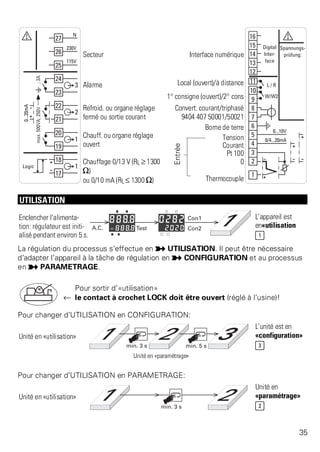
Secteur Interface numérique 
Alarme Local (ouvert)/à distance 
1° consigne (ouvert)/2° cons 
Refroid. ou organe réglage 
fermé ou sortie courant 
Convert. courant/triphasé 
9404 407 50001/50021 
Borne de terre 
Chauff. ou organe réglage 
ouvert 
Entrée 
Tension 
Courant 
Pt 100 
Chauffage 0/13 V (RL ? 1300 
[) 
ou 0/10 mA (RL ß 1300 [) 
0 
Thermocouple 
UTILISATION 
Enclencher l’alimenta-tion: 
régulateur est initi-alis 
é pendant environ 5 s. 
L’appareil est 
en«utilisation 
1 
La régulation du processus s’effectue en p UTILISATION. Il peut être nécessaire 
d’adapter l’appareil à la tâche de régulation en p CONFIGURATION et au processus 
en p PARAMETRAGE. 
Pour sortir d’«utilisation» 
t le contact à crochet LOCK doit être ouvert (réglé à l’usine)! 
Pour changer d’UTILISATION en CONFIGURATION: 
Unité en «utilisation» 
L’unité est en 
«configuration» 
3 
Unité en «paramétrage» 
Pour changer d’UTILISATION en PARAMETRAGE: 
Unité en «utilisation» 
Unité en 
«paramétrage» 
2 
35
«CONFIGURATION» 
En «configuration», l’appareil est adapté à la tâche de régulation à l’aide d’un code de 
configuration à 8 chiffres. Le code est affiché sous la forme des deux mots de 
configuration à 4 chiffres Con1 et Con2: 
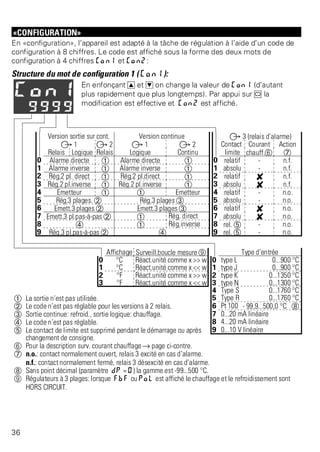
Structure du mot de configuration 1 ( Con1): 
En enfonçant I et D on change la valeur de Con1 (d’autant 
plus rapidement que plus longtemps). Par appui sur M la 
modification est effective et Con2 est affiché. 
Version sortie sur cont. Version continue  3 (relais d’alarme) 
 1  2  1  2 Contact Courant Action 
Relais Logique Relais Logique Continu limite chauff.< > 
0 Alarme directe Ü Alarme directe Ü 0 relatif - n.f. 
1 Alarme inverse Ü Alarme inverse Ü 1 absolu - n.f. 
2 Rég.2 pl. direct Ü Rég.2 pl.direct Ü 2 relatif f n.f. 
3 Rég.2 pl.inverse Ü Rég.2 pl.inverse Ü 3 absolu f n.f. 
4 Emetteur Ü Ü Emetteur 4 relatif - n.o. 
5 Rég.3 plages. * Rég.3 plages Ö 5 absolu - n.o. 
6 Emett.3 plages * Emett.3 plages Ö 6 relatif f n.o. 
7 Emett.3 pl.pas-à-pas * Ü Rég. direct 7 absolu f n.o. 
8 ä Ü Rég.inverse 8 rel. # - n.o. 
9 Rég.3 pl.pas-à-pas * ä 9 rel. # - n.o. 
Affichage Surveill.boucle mesure x Type d’entrée 
0 °C Réact.unité comme x >> w 0 type L 0...900 °C 
1 °C Réact.unité comme x << w 1 type J 0...900 °C 
2 °F Réact.unité comme x >> w 2 type K 0...1350 °C 
3 °F Réact.unité comme x << w 3 type N 0...1300 °C 
4 Type S 0...1760 °C 
Ü La sortie n’est pas utilisée. 5 Type R 0...1760 °C 
* Le code n’est pas réglable pour les versions à 2 relais. 6 Pt 100 - 99,9...500,0 °C y 
Ö Sortie continue: refroid., sortie logique: chauffage. 7 0...20 mA linéaire 
ä Le code n’est pas réglable. 8 4...20 mA linéaire 
# Le contact de limite est supprimé pendant le démarrage ou après 9 0...10 V linéaire 
changement de consigne. 
< Pour la description surv. courant chauffage Ä page ci-contre. 
> n.o.: contact normalement ouvert, relais 3 excité en cas d’alarme. 
n.f.: contact normalement fermé, relais 3 désexcité en cas d’alarme. 
y Sans point décimal (paramètre dP = 0) la gamme est -99...500 °C. 
x Régulateurs à 3 plages: lorsque FbF ou PoL est affiché le chauffage et le refroidissement sont 
HORS CIRCUIT. 
36
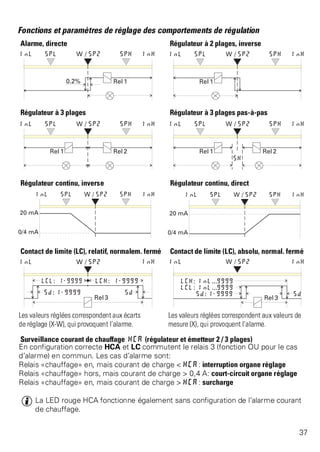
Fonctions et paramètres de réglage des comportements de régulation 
Alarme, directe Régulateur à 2 plages, inverse 
Régulateur à 3 plages Régulateur à 3 plages pas-à-pas 
Régulateur continu, inverse Régulateur continu, direct 
Contact de limite (LC), relatif, normalem. fermé Contact de limite (LC), absolu, normal. fermé 
Les valeurs réglées correspondent aux écarts 
de réglage (X-W), qui provoquent l’alarme. 
Les valeurs réglées correspondent aux valeurs de 
mesure (X), qui provoquent l’alarme. 
Surveillance courant de chauffage HCA (régulateur et émetteur 2 / 3 plages) 
En configuration correcte HCA et LC commutent le relais 3 (fonction OU pour le cas 
d’alarme) en commun. Les cas d’alarme sont: 
Relais «chauffage» en, mais courant de charge < HCA: interruption organe réglage 
Relais «chauffage» hors, mais courant de charge > 0,4 A: court-circuit organe réglage 
Relais «chauffage» en, mais courant de charge > HCA: surcharge 
g La LED rouge HCA fonctionne également sans configuration de l’alarme courant 
de chauffage. 
37
Réconfigurations 
+Réconfiguration fonct. régulateur en fonct. émetteur: mettre W et SP2 à 0. 
+Réconfiguration fonct. émetteur en fonct. régulateur: mettre W et SP2 à ’----’. 
Les sorties sont supprimées, la rampe et le programme sont interdits. 
+Lors d’une réconfiguration du type d’entrée, tous les paramètres détermi-nant 
la gamme de mesure doivent être adaptés à la gamme nouvelle! 
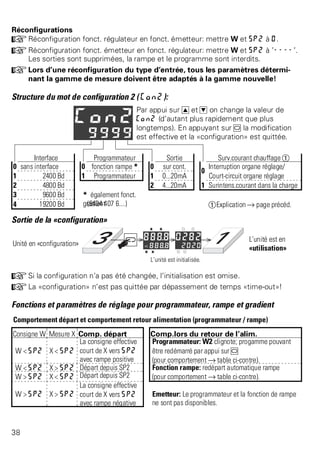
Structure du mot de configuration 2 ( Con2): 
Par appui sur I et D on change la valeur de 
Con2 (d’autant plus rapidement que plus 
longtemps). En appuyant sur M la modification 
est effective et la «configuration» est quittée. 
Interface Programmateur Sortie Surv.courant chauffage Ü 
0 sans interface 0 fonction rampe * 0 sur cont. 
0 
Interruption organe réglage/ 
1 2400 Bd 1 Programmateur 1 0...20mA Court-circuit organe réglage 
2 4800 Bd 2 4...20mA 1 Surintens.courant dans la charge 
3 9600 Bd * également fonct. 
4 19200 Bd gr(a9d4i0e4n t4 07 6....) ÜExplication Ä page précéd. 
Sortie de la «configuration» 
Unité en «configuration» 
L’unité est en 
«utilisation» 
L’unité est initialisée. 
+Si la configuration n’a pas été changée, l’initialisation est omise. 
+La «configuration» n’est pas quittée par dépassement de temps «time-out»! 
Fonctions et paramètres de réglage pour programmateur, rampe et gradient 
Comportement départ et comportement retour alimentation (programmateur / rampe) 
Consigne W Mesure X Comp. départ Comp.lors du retour de l’alim. 
W < SP2 X < SP2 
La consigne effective 
court de X vers SP2 
avec rampe positive 
Programmateur: W2 clignote; progamme pouvant 
être redémarré par appui sur M 
(pour comportement Ä table ci-contre). 
W < SP2 X > SP2 Départ depuis SP2 Fonction rampe: redépart automatique rampe 
W > SP2 X < SP2 Départ depuis SP2 (pour comportement Ä table ci-contre). 
W > SP2 X > SP2 
La consigne effective 
court de X vers SP2 
avec rampe négative 
Emetteur: Le programmateur et la fonction de rampe 
ne sont pas disponibles. 
38
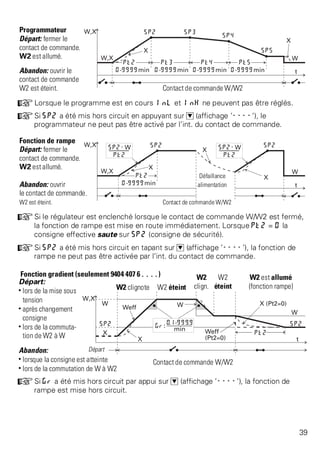
Programmateur 
Départ: fermer le 
contact de commande. 
W2 est allumé. 
Abandon: ouvrir le 
contact de commande 
W2 est éteint. Contact de commande W/W2 
+Lorsque le programme est en cours InL et InH ne peuvent pas être réglés. 
+Si SP2 a été mis hors circuit en appuyant sur D (affichage ’----’), le 
programmateur ne peut pas être activé par l’int. du contact de commande. 
Fonction de rampe 
Départ: fermer le 
contact de commande. 
W2 est allumé. 
Défaillance 
Abandon: ouvrir alimentation 
le contact de commande. 
W2 est éteint. Contact de commande W/W2 
+Si le régulateur est enclenché lorsque le contact de commande W/W2 est fermé, 
la fonction de rampe est mise en route immédiatement. Lorsque Pt2 = 0 la 
consigne effective saute sur SP2 (consigne de sécurité). 
+Si SP2 a été mis hors circuit en tapant sur D (affichage ’----’), la fonction de 
rampe ne peut pas être activée par l’int. du contact de commande. 
Fonction gradient (seulement 9404 407 6....) W2 
W2 
W2 est allumé 
Départ: 
clign. 
éteint 
(fonction rampe) w lors de la mise sous 
tension 
w après changement 
consigne 
w lors de la commuta-tion 
de W2 à W 
W2 clignote W2 éteint 
Abandon: Départ 
w lorsque la consigne est atteinte Contact de commande W/W2 
w lors de la commutation de W à W2 
+Si Gr a été mis hors circuit par appui sur D (affichage ’----’), la fonction de 
rampe est mise hors circuit. 
39
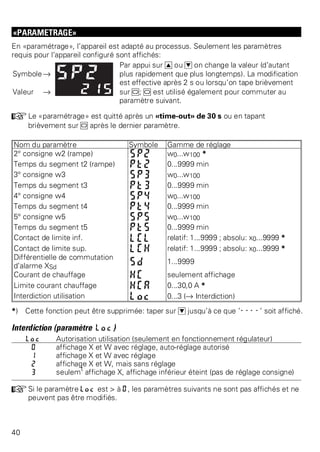
«PARAMETRAGE» 
En «paramétrage», l’appareil est adapté au processus. Seulement les paramètres 
requis pour l’appareil configuré sont affichés: 
SymboleÄ 
Valeur Ä 
Par appui sur I ou D on change la valeur (d’autant 
plus rapidement que plus longtemps). La modification 
est effective après 2 s ou lorsqu’on tape brièvement 
sur M; M est utilisé également pour commuter au 
paramètre suivant. 
+Le «paramétrage» est quitté après un «time-out» de 30 s ou en tapant 
brièvement sur M après le dernier paramètre. 
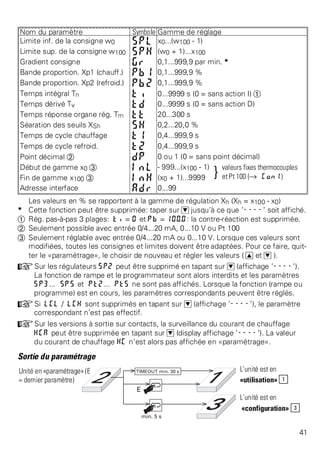
Nom du paramètre Symbole Gamme de réglage 
2° consigne w2 (rampe) SP2 w0...w100 * 
Temps du segment t2 (rampe) Pt2 0...9999 min 
3° consigne w3 SP3 w0...w100 
Temps du segment t3 Pt3 0...9999 min 
4° consigne w4 SP4 w0...w100 
Temps du segment t4 Pt4 0...9999 min 
5° consigne w5 SP5 w0...w100 
Temps du segment t5 Pt5 0...9999 min 
Contact de limite inf. LCL relatif: 1...9999 ; absolu: x0...9999 * 
Contact de limite sup. LCH relatif: 1...9999 ; absolu: x0...9999 * 
Différentielle de commutation 
Sd 1...9999 
d’alarme XSd 
Courant de chauffage HC seulement affichage 
Limite courant chauffage HCA 0...30,0 A * 
Interdiction utilisation Loc 0...3 (Ä Interdiction) 
*) Cette fonction peut être supprimée: taper sur D jusqu’à ce que ’----’ soit affiché. 
Interdiction (paramètre Loc) 
Loc Autorisation utilisation (seulement en fonctionnement régulateur) 
0 affichage X et W avec réglage, auto-réglage autorisé 
1 affichage X et W avec réglage 
2 affichage X et W, mais sans réglage 
3 seulemt affichage X, affichage inférieur éteint (pas de réglage consigne) 
+Si le paramètre Loc est > à 0, les paramètres suivants ne sont pas affichés et ne 
peuvent pas être modifiés. 
40
Nom du paramètre Symbole Gamme de réglage 
Limite inf. de la consigne w0 SPL x0...(w100 - 1) 
Limite sup. de la consigne w100 SPH (w0 + 1)...x100 
Gradient consigne Gr 0,1...999,9 par min. * 
Bande proportion. Xp1 (chauff.) Pb1 0,1...999,9 % 
Bande proportion. Xp2 (refroid.) Pb2 0,1...999,9 % 
Temps intégral Tn ti 0...9999 s (0 = sans action I) Ü 
Temps dérivé Tv td 0...9999 s (0 = sans action D) 
Temps réponse organe rég. Tm tt 20...300 s 
Séaration des seuils XSh SH 0,2...20,0 % 
Temps de cycle chauffage t1 0,4...999,9 s 
Temps de cycle refroid. t2 0,4...999,9 s 
Point décimal * dP 0 ou 1 (0 = sans point décimal) 
Début de gamme x0 Ö InL - 999...(x100 - 1) } valeurs fixes thermocouples 
Fin de gamme x100 Ö InH (x0 + 1)...9999 et Pt 100 (Ä Con1) 
Adresse interface Adr 0...99 
Les valeurs en % se rapportent à la gamme de régulation Xh (Xh = x100 - x0) 
* Cette fonction peut être supprimée: taper sur D jusqu’à ce que ’----’ soit affiché. 
Ü Rég. pas-à-pas 3 plages: ti = 0 et Pb = 1000. : la contre-réaction est supprimée. 
* Seulement possible avec entrée 0/4...20 mA, 0...10 V ou Pt 100 
Ö Seulement réglable avec entrée 0/4...20 mA ou 0...10 V. Lorsque ces valeurs sont 
modifiées, toutes les consignes et limites doivent être adaptées. Pour ce faire, quit-ter 
le «paramétrage», le choisir de nouveau et régler les valeurs ( I et D ). 
+Sur les régulateurs SP2 peut être supprimé en tapant sur D (affichage ’----’). 
La fonction de rampe et le programmateur sont alors interdits et les paramètres 
SP3... SP5 et Pt2... Pt5 ne sont pas affichés. Lorsque la fonction (rampe ou 
programme) est en cours, les paramètres correspondants peuvent être réglés. 
+Si LCL / LCH sont supprimés en tapant sur D (affichage ’----’), le paramètre 
correspondant n’est pas effectif. 
+Sur les versions à sortie sur contacts, la surveillance du courant de chauffage 
HCA peut être supprimée en tapant sur D (display affichage ’----’). La valeur 
du courant de chauffage HC n’est alors pas affichée en «paramétrage». 
Sortie du paramétrage 
Unité en «paramétrage» (E 
= dernier paramètre) 
L’unité est en 
«utilisation» 1 
L’unité est en 
«configuration» 3 
41
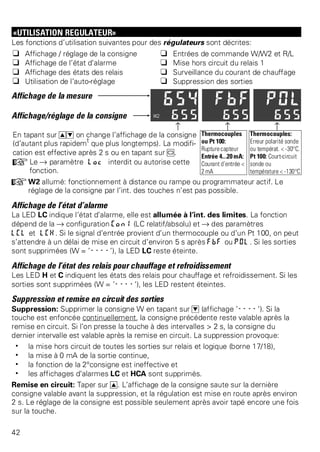
«UTILISATION REGULATEUR» 
Les fonctions d’utilisation suivantes pour des régulateurs sont décrites: 
q Affichage / réglage de la consigne q Entrées de commande W/W2 et R/L 
q Affichage de l’état d’alarme q Mise hors circuit du relais 1 
q Affichage des états des relais q Surveillance du courant de chauffage 
q Utilisation de l’auto-réglage q Suppression des sorties 
Affichage de la mesure 
Affichage/réglage de la consigne 
z z z 
En tapant sur ID on change l’affichage de la consigne 
(d’autant plus rapidemt que plus longtemps). La modifi-cation 
est effective après 2 s ou en tapant sur M. 
+Le Ä paramètre Loc interdit ou autorise cette 
fonction. 
Thermocouples 
ou Pt 100: 
Rupture capteur 
Entrée 4...20 mA: 
Courant d’entrée < 
2 mA 
Thermocouples: 
Erreur polarité sonde 
ou températ. < -30°C. 
Pt 100: Court-circuit 
sonde ou 
température < -130°C 
+W2 allumé: fonctionnement à distance ou rampe ou programmateur actif. Le 
réglage de la consigne par l’int. des touches n’est pas possible. 
Affichage de l’état d’alarme 
La LED LC indique l’état d’alarme, elle est allumée à l’int. des limites. La fonction 
dépend de la Ä configuration Con1 (LC relatif/absolu) et Ä des paramètres 
LCL et LCH. Si le signal d’entrée provient d’un thermocouple ou d’un Pt 100, on peut 
s’attendre à un délai de mise en circuit d’environ 5 s après FbF ou POl. Si les sorties 
sont supprimées (W = ’----’), la LED LC reste éteinte. 
Affichage de l’état des relais pour chauffage et refroidissement 
Les LED H et C indiquent les états des relais pour chauffage et refroidissement. Si les 
sorties sont supprimées (W = ’----’), les LED restent éteintes. 
Suppression et remise en circuit des sorties 
Suppression: Supprimer la consigne W en tapant sur D (affichage ’----’). Si la 
touche est enfoncée continuellement, la consigne précédente reste valable après la 
remise en circuit. Si l’on presse la touche à des intervalles > 2 s, la consigne du 
dernier intervalle est valable après la remise en circuit. La suppression provoque: 
w la mise hors circuit de toutes les sorties sur relais et logique (borne 17/18), 
w la mise à 0 mA de la sortie continue, 
w la fonction de la 2°consigne est ineffective et 
w les affichages d’alarmes LC et HCA sont supprimés. 
Remise en circuit: Taper sur I. L’affichage de la consigne saute sur la dernière 
consigne valable avant la suppression, et la régulation est mise en route après environ 
2 s. Le réglage de la consigne est possible seulement après avoir tapé encore une fois 
sur la touche. 
42
Mise hors circuit du relais 1 
Si l’on utilise seulement la sortie logique, le relais 1 peut être mis hors circuit. Pour ce 
faire ouvrir le contact à crochet REL1 (Ä MONTAGE). 
Surveillance du courant de chauffage 
Le courant de chauffage est mesuré par l’int. du convert. de courant 9404 407 50001 
ou par l’int du conv. de courant triphasé 9404 407 50021. Les fonctions de surveillan-ce 
sont expliquées en «configuration» ( Con1) et en «paramétrage» ( HCA, HC). 
Entrées de commande W/W2 et L/R 
Entrée de commande W/W2: 
La fonction de rampe ou le programmateur sont mis en route ou arrêtés. 
Les fonctions sont expliquées en «configuration» ( Con2) et en «paramétrage». 
Entrée de commande L/R: 
Les fonctions local ou à distance sont commutées, W2 est allumé pendant le mode à 
distance. Le mode à distance est utilisé pour le réglage de valeurs par l’int. d’une 
interface numérique. Le réglage par l’int. des touches n’est pas possible, cependant, 
les valeurs peuvent être affichées. 
Aide d’optimisation pour le réglage manuel des paramètres de régulation 
Réponse à un échelon du processus Caractéristiques des régulateurs 
y = variable de corr. 
Yh = étend.action corr. 
Tu = temps mort (s) 
Tg = temps restitution (s) Sur les régulateurs à 2 et à 3 pl. le 
temps de cycle doit être réglé à 
Vmax = Xmax 
Tg 
t1 ou à t2 ß 0,25 Tu. 
= Dx 
Dt 
= vitesse max.d’accroisse-ment 
variable 
de processus (°C/s) 
Xmax = valeur max. processus 
Xh = gamme de réglage 
Paramètre Régulation Perturbations Démarrage 
Xp1 
plus élevé: atténuation augmentée équilibrage plus lent réduction plus lente de l’énergie 
plus faible: atténuation réduite équilibrage plus rapide réduction plus rapide de l’énergie * 
Tn 
plus élevé: atténuation augmentée équilibrage plus lent changement plus lent de l’énergie 
plus faible: atténuation réduite équilibrage plus rapide changement plus rapide de l’énergie * 
Tv 
plus élevé: atténuation réduite réponse plus rapide réduction plus tôt de l’énergie 
plus faible: atténuation augmentée réponse plus lente réduction plus tard de l’énergie * 
* Augmenter Xp1, si l’équilibrage oscille. 
43
Auto-réglage pour la détermination automatique des paramètres de régulation 
Après la mise en route par l’opérateur, le régulateur fait une tentative d’adaptation. Il 
calcule les paramètres pour un équilibrage rapide sur la consigne sans dépassement à 
partir des caractéristiques du processus. 
+Pour l’adaptation, le Ä paramètre Loc doit être = 0. 
+ti et td sont pris en compte pendant l’adaptation à la condition qu’ils ont été 
> à 0 auparavant. 
Mise en route de l’adaptation: L’opérateur peut toujours mettre en route l’auto-rég-lage. 
A cet effect, taper sur M et I simult. La mesure et le code AdA sont alors 
affichés alternativement dans la ligne supérieure de l’affichage. La tentative d’adapta-tion 
est mise en route par le régulateur lorsque les conditions suivantes sont remplies: 
· La différence mesure i consigne doit être ? à 10% de la plage de consigne 
Wh (en fonct.inverse: mesure inférieure à la consigne, en «direct»: mesure 
supérieure à la consigne). 
· La différence mesure i consigne doit être ? à 2% de la gamme de réglage Xh. 
Pour des exemples de tentatives d’adaptation sous diverses conditions de mise en 
route, voir la page ci-contre. Ces exemples sont valables pour des rég. à fonct. inverse 
(chauffage ou chauffage / refroidissement). Lorsque la réponse du processus est 
suffisante, les tentatives réussissent et des paramètres nouveaux sont détermi- nés. 
Après une adaptation réussie, le code AdA disparaît et la mesure actuelle est affichée. 
Abandon de l’adaptation: L’opérateur peut toujours abandonner l’adaptation. Pour 
ce faire, taper sur M. Le régulateur poursuit le fonctionnement avec les valeurs 
anciennes des paramètres. 
+Cet affichage signifie que les conditions de régulation empêch-ent 
la réussite de l’adaptation. Le régulateur abandonne la 
tentative. Les sorties sont mises hors circuit pour éviter le 
dépassement de la consigne. Après l’acquittement (touche M), 
le régulateur utilise les anciens paramètres de régulation. 
Problème Affichage Cause Solution 
Abandon 
immédiat 
régul.inverse AdF mesure trop élevée augmenter la consigne 
régul.direct AdF mesure trop faible réduire la consigne 
Abandon après sortie 
de l’échelon variable 
correct. 
AdF 
sens d’action erronné réconfigurer le rég. (inverse i direct) 
différence X i W trop 
réduire la gamme de réglage* Xh ou 
faible 
choisir un type de capteur différent 
Abandon après 1 h AdF X ne répond pas vérifier capteur, connexions et processus 
Défaut sortie variable 
différence X i W 
réduire gamme de consigne* AdAi Wh 
X 
de correction 
insuffisante 
X continuellemt instable vérifier processus (perturbat., sortie) 
* Gamme de réglage Xh = InH - InL 
Plage de consigne Wh = SPH - SPL 
44
Départ: énergie chauffage en circ. 
L’énergie de chauffage Y est mise 
hors circuit (a). Si le changement de la 
mesure X est constant pendant une 
min. (b), l’énergie est mise en circuit 
(c). Au point tournant, la tentative 
d’adaptation est terminée et la 
consigne W est régulée au moyen des 
paramètres nouveaux. 
Départ Ä a c t point tournant 
Départ: chauffage mise hors circuit 
Le régulateur attend pendant 1,5 min. 
(a). L’énergie de chauffage Y est mise 
en circuit (b). Au point tournant, la 
tentative d’adaptation est terminée et 
la consigne W est régulée au moyen 
des paramètres nouveaux. 
Départ Äa b t point tournant 
Départ: à la consigne 
L’énergie de chauffage Y est mise 
hors circuit (a). Si le changement de la 
mesure X est constant pendant une 
minute et l’écart de réglage est > à 
10 % de W100-W0 (b), l’énergie est 
mise en circuit (c). Au point 
tournant, la tentative d’adaptation est 
terminée et la consigne W est régulée 
au moyen des paramètres nouveaux 
Départ Ä a c t point tournant 
Régulateur à trois plages 
Les paramètres pour chauffage et 
refroid. sont déterminés en une tentati-ve. 
L’énergie de chauffage est mise 
en circuit (a). Au point tournant 1 les 
paramètres de chauff. Pb1, ti, td et t point tournant 1 
t1 sont déterminés. La consigne est 
régulée (b). L’énergie de refroid. est 
mise en circuit (c). Au point tournant 2 
les paramètres Pb2 et t2 sont déter-min 
és, et la tentative d’adaptation est 
terminée. La consigne W est régulée 
au moyen des paramètres nouveaux. 
Départ Ä a b c t point tournant 2 
45
ADAPTATION DE L’AFFICHAGE DE LA MESURE AU CAPTEUR 
Si la variable de processus ne peut pas être mesurée au lieu de mesure requis, des 
erreurs de mesure positives ou négatives risquent de se produire. Les affichages de 
plusieurs régulateurs peuvent différer à cause des valeurs capteurs divergentes. 
L’adaptation permet la correction de l’affichage de la mesure sans changement de 
l’étalonnage du régulateur. 
Pour les signaux d’entrée de 0...20 mA / 4...20 mA / 0...10 V 
Le paramètre InL correspond à la mesure affichée au signal 0 %. 
Le paramètre InH correspond à la mesure affichée au signal de 100 %. Les deux 
valeurs peuvent être corrigées. La correction entre les deux valeurs est linéaire. 
Correction de la mesure pour thermocouples ou Pt 100 (9404 407 6 . . . . ) 
Les méthodes de correction sont (n = sans): Affichage 
Correction parallèle CP 
Correction pente CG 
L’affichage de la 
L’affichage de la mesure est 
mesure est corrigée 
corrigée d’une valeur 
d’une même valeur 
changeant linéairement à l’int. 
dans la plage complète 
de la plage (augmentant ou 
(positive ou négative). 
diminuant, zéro à 0°C / 32°F). 
aPendant le réglage de la correction, les sorties du 
régulateur sont supprimées. 
Réglage de la correction requise 
Sélection de la méthode de correction 
w Mettre l’alimentation hors circuit et retirer le régulateur du boîtier. 
w Fermer le contact à crochet A (Ä MONTAGE). 
w Embrocher le régulateur et enclencher l’alimentation. L’appareil est initialisé. 
La 
correction 
parallèle est 
active. 
Taper sur M pour afficher 
l’autre méthode. Taper sur 
I et D pour changer les 
valeurs. Cette méthode est 
activée en acquittant une 
valeur par M. L’autre est 
supprimée (’----’, 
Ä Régler la valeur de 
correction). 
La 
correction 
de pente 
est active. 
Les deux 
corr. sont 
désactives. 
46
Régler la valeur de correction 
Deux méthodes de réglage de la correction sont possibles. Choisir la méthode 
appropriée. 
1 L’écart de température est connu. 
CP CG 
Ne pas brancher un capteur. 
La valeur affichée correspond à la 
valeur de correction. 
Ne pas brancher un capteur. La valeur affichée 
correspond à: fin gamme + / - valeur correction. 
La température corrigée fin de gamme doit être 
déterminée auparavant. * 
2 L’affichage de la mesure doit correspondre à une température mesurée. 
CP CG 
Brancher capteur ou source signal. 
La valeur affichée correspond à: 
température mesurée + / - valeur 
de correction. 
Brancher capteur ou source signal. La valeur 
affichée correspond à: 
température mesurée + / - valeur correction. 
S’assurer que la différence entre la température 
mesurée et 0°C / 32°F soit la plus élevée possible. 
+Confirmer valeur de correction ou mesure affiché en tapant sur M. 
+Mettre l’appareil et le contact à crochet A hors circuit, enclencher l’appareil. 
Exemples 
Correction parallèle, pas de capteur branché Correction pente à une temp.mesurée de 1250°C 
La valeur de correction 
est 3,6 °C. 
A la température appliquée, 
1253°C sont affichés. 
Changer valeur corr. en 
tapant sur D I. 
Changer valeur corr. en 
tapant sur D I. 
La valeur de corr. est 0. La temp.mesurée est 
affichée sans corr. 
Changer valeur corr. en 
tapant sur D I. 
Changer valeur corr. en 
tapant sur D I 
. 
La valeur de correction 
est -6,8 °C 
1247°C sont affichés à la 
temp. appliquée. 
47
«UTILISATION EMETTEUR» 
La mise hors circuit du relais 1, la surveillance courant chauffage et le contact de 
commande L/R sont comme décrits pour les régulateurs. Le contact de commande 
W/W2 est ineffectif. Les autres conditions sont: 
Affichage mesure (seulem. émetteur 3 pl.pas-à-pas) 
Affichage/Réglage valeur correction (tous les autres émett.) 
p Valeurs correction chauff.: H... p correction refroid.: C... 
Taper sur I D pour changer l’affichage de la valeur de corr. (d’autant plus rapidemt 
que plus longtemps). La modif. est effective après 2 s ou en tapant brièvement sur 
M. Emetteur 3 plages pas-à-pas: l’organe de réglage est réglé directement. 
Déterminer la valeur de corr. pour émett. 2 ou 3 plages à partir de la formule 
Y = cycle [%] = 
Ten . 100 % 
Ten + Thors 
Les paramètres (temps du cycle, Ten+Thors à Y = 50%) sont réglés comme t1 ou t2. 
+W2 allumé: L’émetteur est en «à distance» (contact de commande L/R fermé). 
Le réglage de la valeur de correction par les touches n’est pas possible. 
Affichage des états des relais 
Le contact limite est sans effet, la LED LC est éteinte. Les LED H et C indiquent les 
états des relais chauffage et refroid. Si les sorties sont supprimées ( H 0) et sur les 
émetteurs continus, les LED restent éteintes. 
Suppression et remise en circuit des sorties 
Suppression: Mettre la sortie à H 0 en tapant sur D. La suppression provoque: 
w mise hors circuit toutes sorties relais et sortie logique (borne 17/18), 
w mise à 0 mA sortie continue, 
Mise en circuit: Augmenter valeur correction en tapant sur I. Emetteurs à 3 plages: 
changer valeur correction chauffage ou refroidissement en tapant sur I et D. 
INTERFACE 
Pour des renseignements sur l’interface, voir les notices d’utilisation 9499 040 15601 
(module d’interface) et la description de l’interface 9499 040 26218. 
ENTRETIEN / COMPORTEMENT EN CAS DE PANNE 
Le régulateur n’exige pas d’entretien. Panne: tenir compte des renseignemts suivants: 
w Vérifier si toutes les connexions sont correctes. 
w Mettre le régulateur hors service et le remplacer. 
48
Manufacturer certificate 
This is to certify that the 
Industrial Controller KS 40 
is in accordance with the 
specifications for RF 
interference suppression of 
Vfg 1046/84 regulation. 
Deutsche Bundespost was 
informed that this instrument 
was launched into the market, 
and on the right to check the 
series for conformity with the 
regulation. 
We are obliged to draw your 
attention to the following facts: 
- Vfg 1046/84 2 section 5 - 
· The object was carefully 
tested for conformity with 
the regulations for RF 
interference suppression. 
· When connecting the 
instrument with other units 
without sufficient RF 
interference suppression, 
additional measures for RF 
interference suppression may 
be necessary. 
Manufacturer: 
Name des Herstellers: 
Fabricant: 
Philips GmbH 
Unternehmensbereich Elektronik 
für Wissenschaft und Industrie 
Werk für Prozeßkontrolltechnik 
Miramstr. 87 
D- 3500 Kassel / Germany 
Bescheinigung des Herstellers 
Hiermit wird bescheinigt, daß der 
Industrieregler KS 40 
in Übereinstimmung mit den 
Bestimmungen der 
Vfg 1046/84 funk-entstört ist. 
Der Deutschen Bundespost 
wurde das Inverkehrbringen 
dieses Gerätes angezeigt und 
die Berechtigung zur 
Überprüfung der Serie auf 
Einhaltung der Bestimmungen 
eingeräumt. 
Wir sind verpflichtet, Sie auf 
folgende Fakten hinzuweisen: 
- Vfg 1046/84 § 2 Abschnitt 5 - 
· Das Objekt wurde 
funkstörtechnisch sorgfältig 
entstört und geprüft. 
· Beim Zusammenschalten mit 
nicht einwandfrei entstörten 
anderen Einheiten können 
Funkstörungen entstehen, 
die dann im einzelnen Fall 
zusätzliche Funk-Entstör-ma 
ßnahmen erfordern. 
Kassel, den 11.12.1991 
(Place and date ) 
(Ort und Datum ) 
(Lieu et date) 
Certificat du fabricant 
Nous attestons par la présente, 
que le 
Régulateur Industriel KS 40 
est en conformité avec les 
spécifications de la norme 
Vfg 1046/84concernant la 
suppression des interférences 
H.F. 
La poste allemande (Deutsche 
Bundespost) a été informée que 
cet appareil a été mis sur le 
marché, et de son droit de 
vérifier la conformité de la série 
avec la norme. 
Nous sommes obligé d’attirer 
votre attention au faits suivants: 
- Vfg 1046/84 2 paragraphe 5 - 
· La conformité de l’objet avec 
la norme concernant la 
suppression des 
interférences H.F. a été 
soigneusement vérifiée. 
· Lors d’un raccordement de 
l’appareil à d’autres unités 
sans suppression suffisante 
des interférences H.F., des 
mesures supplémentaires de 
suppression des 
interférences H.F. peuvent 
être nécessaires. 
(Stamp and signature) 
(Stempel und Unterschrift) 
(Cachet et signature) 
49
Subject to alterations without notice © P M A Prozeß- und Maschinen-Automation GmbH 
Änderungen vorbehalten P.O.B. 310 320, D-34113 Kassel, Germany 
Sous réserve de toutes modifications Printed in Germany 9499 040 21601 (9407)

Régulateur KS40-v2

  • 1.
    Industrial controller Version407 Operating Instructions 9499 040 21601 English-Deutsch-Français
  • 2.
    Follow the warningsin the instructions! Warnvermerke in der Bedienungsanleitung beachten! Suivre les avertissement du mode d’emploi! ENGLISH . . . . . . . . . . . Page 1 SAFETY INSTRUCTIONS . . . . . . . . . 1 MOUNTING . . . . . . . . . . . . . . . . 2 ELECTRICAL CONNECTIONS . . . . . . . 2 CONFIGURATION LEVEL . . . . . . . . . 4 PARAMETER LEVEL . . . . . . . . . . . 8 CONTROLLER OPERATING LEVEL . . . . 10 OPTIMIZING AID . . . . . . . . . . . . . 11 SELF-TUNING . . . . . . . . . . . . . . . 12 MATCHING THE PROCESS VALUE DISPLA. 1.Y. 4 . ADJUSTER OPERATING LEVEL . . . . . 16 Manufacturer certificate . . . . . . . . . . 49 DEUTSCH . . . . . . . . . Seite 17 SICHERHEITSHINWEISE . . . . . . . . . 17 MONTAGE . . . . . . . . . . . . . . . . . 18 ELEKTRISCHER ANSCHLUSS . . . . . . 18 KONFIGURATIONS-EBENE . . . . . . . . 20 PARAMETER-EBENE . . . . . . . . . . . 24 BEDIEN-EBENE (REGLER) . . . . . . . . 26 OPTIMIERUNGSHILFE . . . . . . . . . . 27 SELBSTOPTIMIERUNG . . . . . . . . . . 28 ANPASSUNG DER ISTWERTANZEIGE . . 30 BEDIEN-EBENE (STELLER) . . . . . . . . 32 Bescheinigung des Herstellers . . . . . . 49 FRANÇAIS . . . . . . . . . Page 33 NOTICES DE SECURITE . . . . . . . . . . 33 MONTAGE . . . . . . . . . . . . . . . . . 34 RACCORDEMENTS ELECTRIQUES . . . 34 CONFIGURATION . . . . . . . . . . . . . 36 PARAMETRAGE . . . . . . . . . . . . . . 40 UTILISATION REGULATEUR . . . . . . . 42 AIDE D’OPTIMISATION . . . . . . . . . . 43 AUTO-REGLAGE . . . . . . . . . . . . . 44 ADAPTATION DE L’AFFICH. DE MESURE 46 UTILISATION EMETTEUR . . . . . . . . . 48 Certificat du fabricant . . . . . . . . . . . 49 a 1
  • 3.
    Industrial controller Operatinginstructions 9499 040 21601 valid from 8297 H heating (relay ON = yellow LED lit) C cooling (relay ON = yellow LED lit) X process value W set-point W2 lit with: ramp / programmer / remote blinks with: gradient / programmer (mains recovery) HCA heating current monitoring (error = red LED lit) LC limit contact (X within limits = green LED lit) selector key t S.I.L. switch closed increase value Ä g t S.I.L. switch open decrease value Ä g g The values are changed the faster the longer the key is pressed. This applies to set-points, parameters and configurations. We recommend writing down the old values before changing. SAFETY INSTRUCTIONS Reading and following the enclosed safety instructions (9499 047 03601) is indispensable! Individual or common fuse protection must be fitted (1 A per instrument)! Caution! With horizontal installation, a protection to prevent live parts, e.g. wire ends, from dropping into the open housing of a withdrawn controller must be fitted (contact safety IEC 348 section 9.3.3). a TECHNICAL DATA Ä data sheet no. 9498 737 15313 R.F. interference suppression: the limit values to VfG 1046/84 and EN 55011 are met (Ä manufacturer certificate on the last pages of this instruction manual). 1
  • 4.
    VERSIONS 9404 407. . . . . 1 housing/front dark-gray 2 housing/front light-gray 0 0 standard configuration 9 9 configuration to specification output 1 output 2 relay 3 digital standard configuration relay logic relay continuo us (alarm) interface Con1 Con2 0 f f - - f - 0031 0100 Adjust the required 1 f f - - f f 0031 0100 2 f f f - f - 0051 0100 3 f f f - f f 0051 0100 4 - f - f f - 0071 0110 5 - f - f f f 0071 0110 4 without process value correction and without gradient function 6 with process value correction and with gradient function operation at configuration level and parameter level. MOUNTING To remove the controller module from the housing pull it forwards at the top and bottom cut-outs. With a sealing Ü between controller front and panel, the panel reaches protection mode IP 54. l Caution! The instrument contains ESD-hazarded components. ELECTRICAL CONNECTIONS The instrument is fitted with protective insulation. The ground connection of earth terminal 6 should be kept separate from the mains connection and as short as possible. Keep mains cables separate from signal and measurement input leads. When connecting a contactor to a relay output, an RC protective circuit is necessary, to avoid voltage peaks which can cause trouble to the controller. 2
  • 5.
    Mains Digital interface Alarm Local (open)/remote 1st set-point (open)/2nd Cooling or actuator closed or current output Current/3-phase converter 9404 407 50001/50021 Earth terminal Heating or actuator open Input Voltage Current Pt 100 Heating 0/13 V (RL ? 1300 [) or 0/10 mA (RL ß 1300 [) 0 Thermocouple OPERATION Switch on power supply: controller is initialized during approx. 5 s. instrument is atoperating level 1 Process control is at p OPERATING LEVEL. Matching the instrument to the control task at p CONFIGURATION LEVEL and to the process at p PARAMETER LEVEL may be necessary. For exit from the operating level, t S.I.L. switch LOCK must be open (factory setting)! Changing from OPERATING LEVEL to CONFIGURATION LEVEL is as follows: Unit at operat.level Unit is at configuration level 3 Unit at parameter level Changing from OPERATING LEVEL to PARAMETER LEVEL is as follows: Unit at operat.level Unit at parameter level 2 3
  • 6.
    CONFIGURATION LEVEL Atconfiguration level, the instrument is matched to the control task by means of an 8-digit configuration code. The code is displayed in two 4-digit configuration words Con1 and Con2: Structure of configuration word 1 ( Con1): Pressing keys I and D changes the value of Con1 (the longer the faster). When pressing M the change is effective and Con2 is displayed. Switching version Continuous version  3 (alarm relay)  1  2  1  2 Limit Heating Principle Relay Logic Relay Logic Continuous contact curr. < > 0 Signaller direct Ü Signaller direct Ü 0 relative - n.c. 1 Signaller inverse Ü Signaller inverse Ü 1 absolute - n.c. 2 2-pnt.contr. direct Ü 2-pnt.contr.direct Ü 2 relative f n.c. 3 2-p.contr. inverse Ü 2-p.contr. inverse Ü 3 absolute f n.c. 4 Adjuster Ü Ü Adjuster 4 relative - n.o. 5 3-pnt.contr. * 3-pnt.contr. Ö 5 absolute - n.o. 6 3-pnt.adjuster * 3-pnt.adjuster Ö 6 relative f n.o. 7 3-pnt.step.adjuster * Ü Contr. direct 7 absolute f n.o. 8 ä Ü Contr.inverse 8 rel. # - n.o. 9 3-pnt.step.contr. * ä 9 rel. # - n.o. Display Measurement loop monitoring x Input type 0 °C Unit reacts as x >> w 0 type L 0...900 °C 1 °C Unit reacts as x << w 1 type J 0...900 °C 2 °F Unit reacts as x >> w 2 type K 0...1350 °C 3 °F Unit reacts as x << w 3 type N 0...1300 °C 4 Type S 0...1760 °C Ü Output is not used. 5 Type R 0...1760 °C * Code is not adjustable for versions with 2 relays. 6 Pt 100 - 99,9...500,0 °C y Ö Continuous output: cooling, logic output: heating. 7 0...20 mA linear ä Code is not adjustable. 8 4...20 mA linear # The limit contact is suppressed during start-up or after set-point 9 0...10 V linear changes. < For description of heating current monitoring Ä right page. > n.o.: normally open contact, relay 3 energized with alarm. n.c.: normally closed contact, relay 3 de-energized with alarm. + y Without decimal point (parameter dP = 0) the range is -99...500 °C. x With 3-pnt.controllers: with FbF and PoL heating and cooling = OFF. 4
  • 7.
    Control behaviour functionsand parameters Signaller, direct 2-point controller, inverse 3-point controller 3-point stepping controller Continuous controller, inverse Continuous controller, direct Limit contact (LC), relative, normally closed Limit contact (LC), absolute, normally closed The adjusted values correspond to control deviations (X-W), at which an alarm occurs. The adjusted values correspond to the process values (X), at which the alarm occurs. Heating current monitoring HCA (with 2-pnt. / 3-pnt. controllers and adjusters) When configured accordingly HCA and LC switch relay 3 (OR-function for the alarm case) in common. The alarm cases are: Relay ’heating’ is on, but the load current is < HCA: interruption of actuator Relay ’heating’ is off, but the load current is > 0.4 A: short circuit of actuator Relay ’heating’ is on, but the load current is > HCA: over load g The red HCA LED works also without the heating current alarm configured. 5
  • 8.
    Re-configurations +Configuring fromcontroller to adjuster operation: set W and SP2 to 0. +Configuring from adjuster to controller operation: set W and SP2 to ’----’. The outputs are switched off, ramp and program are disabled. +With re-configuration of the input type, all range-dependent parameters must be matched to the new measuring range! Structure of configuration word 2 ( Con2): Pressing keys I and D changes the value of Con2 (the longer the faster). When pressing M the modification is effective and the configuration level is left. Interface Programmer Output Heating current monitoring Ü 0 no interface 0 ramp function * 0 switching 0 Actuator interruption/ 1 2400 Bd 1 Programmer 1 0...20mA Actuator short circuit 2 4800 Bd 2 4...20mA 1 Overcurrent in load 3 9600 Bd * also gradient.f 4 19200 Bd with 9404 407 6.... ÜExplanation Ä previous page Exit from the configuration level Unit at configuration level Unit is at operat.level Instrument is initialized. +If the configuration was not changed, the initialization is omitted. +The configuration level is not left via time-out! Functions and parameters for programmer, ramp and gradient Start behaviour and behaviour with mains recovery (programmer / ramp) Set-point W Proc.val. X Start behaviour Behaviour with mains recovery W < SP2 X < SP2 The effective set-point runs from X to SP2 with positive ramp Programmer: W2 blinks; the program can be re-started with key M (for behaviour Ä table opposite). W < SP2 X > SP2 Start at SP2 Ramp function: automatic re-start of ramp W > SP2 X < SP2 Start at SP2 (for behaviour Ä table opposite). W > SP2 X > SP2 The effective set-point runs from X to SP2 with negative rampe Adjuster: Programmer and ramp function are not available. 6
  • 9.
    Programmer Start: Closecontrol contact. W2 is lit. Cancellation: open control contact W2 is off. Control contact W/W2 +With running program InL and InH cannot be adjusted. +If SP2 was switched off by means of key D (display ’----’), the programmer cannot be activated via the control contact. Ramp function Start: close control contact. W2 is lit. Power Cancellation: open control contact. failure W2 is off. Control contact W/W2 +When switching on the controller with control contact W/W2 closed, the ramp function is started immediately. With Pt2 = 0 the effective set-point jumps to SP2 (safety set-point). +If SP2 was switched off by means of key D (display ’----’), the ramp function cannot be activated via the control contact. Gradient function (only with 9404 407 6....) W2 W2 is W2 is on Start: at supply voltage W2 blinks W2 is off blinks off (ramp function) w switch-on w after set-point changes w with switch-over from W2 to W Cancellation: Start w when reaching the set-point Control contact W/W2 w when switching over from W to W2 +If Gr was switched off by means of key D (display ’----’), the gradient function is out of operation. 7
  • 10.
    PARAMETER LEVEL Atparameter level, the instrument is matched to the process. Only the parameters which are required for the configured instrument are displayed: Symbol Ä Value Ä Pressing keys I or D changes the value (the longer the faster). The change is effective after 2 s or when pressing M shortly; M is also used for switching to the next parameter. +The parameter level is left after a time-out of 30 s or by pressing key M shortly after the last parameter. Parameter name Symbol Adjustment range 2nd set-point w2 (ramp) SP2 w0...w100 * Segment time t2 (ramp) Pt2 0...9999 min 3rd set-point w3 SP3 w0...w100 Segment time t3 Pt3 0...9999 min 4th set-point w4 SP4 w0...w100 Segment time t4 Pt4 0...9999 min 5th set-point w5 SP5 w0...w100 Segment time t5 Pt5 0...9999 min Limit contact low LCL relative: 1...9999 ; absolute: x0...9999 * Limit contact high LCH relative: 1...9999 ; absolute: x0...9999 * Alarm switching differential XSd Sd 1...9999 Heating current HC Only display Heating current limit HCA 0...30,0 A * Operation locking Loc 0...3 (Ä Locking) *) This function can be switched off: press key D until ’----’ is displayed. Locking (parameter Loc) Loc Operation enable (only for controller operation) 0 X and W display with adjustment, self-tuning permitted 1 X and W display with adjustment 2 X and W display, but without adjustment 3 Only X display, lower display is off (no set-point adjustment) +With parameter Loc > 0, the following parameters are not displayed and cannot be changed. 8
  • 11.
    Parameter name SymbolAdjustment range Set-point limit low w0 SPL x0...(w100 - 1) Set-point limit high w100 SPH (w0 + 1)...x100 Set-point gradient Gr 0,1...999,9 per min. * Proportional band Xp1 (heating) Pb1 0,1...999,9 % Proportional band Xp2 (cooling) Pb2 0,1...999,9 % Integral time Tn ti 0...9999 s (0 = no I-action) Ü Derivative time Tv td 0...9999 s (0 = no D-action) Actuator response time Tm tt 20...300 s Trigger point separation XSh SH 0,2...20,0 % Cycle time heating t1 0,4...999,9 s Cycle time cooling t2 0,4...999,9 s Decimal point * dP 0 or 1 (0 = no decimal point) Span start x0 Ö InL - 999...(x100 - 1) } fixed values with thermo Span end x100 Ö InH (x0 + 1)...9999 couples a. Pt 100 (Ä Con1) Interface address Adr 0...99 Specifications in % refer to control range Xh (span). Xh = x100 - x0 * This function can be switched off: Press key D until ’----’ is displayed. Ü 3-pnt.stepping controller: with ti = 0 and Pb = 100.0 the feedback is switched off. * Only with input 0/4...20 mA, 0...10 V or Pt 100 Ö Only adjustable with input 0/4...20 mA or 0...10 V. When changing these values, all set-points and limit values must be matched. For this, leave parameter level, re-select it and adjust values as required with I and D. +On controllers SP2 can be switched off by means of key D (display ’----’). Thereby, ramp function and programmer are disabled and parameters SP3... SP5 and Pt2... Pt5 are not displayed. With the function (ramp or program) running, the relevant parameters can be adjusted. +If LCL / LCH are switched off by means of key D (display ’----’), the corresponding parameter is not effective. +With switching instruments, heating current monitoring HCA can be switched off by pressing D (display ’----’). Thereby, the heating current value HC is not displayed at parameter level. Exit from parameter level Unit at parameter level (E = last parameter) Unit is at operat.level 1 Unit is at config-uration level 3 9
  • 12.
    CONTROLLER OPERATING LEVEL The following operations for controllers are described: q Set-point display / adjustment q Control inputs W/W2 and R/L q Alarm status display q Switching off the relay for output 1 q Display of relay statuses q Heating current monitoring q Self-tuning operation q Output switch-off Process value display Set-point display/adjustment z z z Pressing keys ID changes the set-point display (the longer the faster). The modification is effective after 2 s or by pressing M. + Ä Parameter Loc disables or enables this operation. Thermocouples or Pt 100: Sensor break Input 4...20 mA: Input current < 2 mA Thermocouples: wrong polarity or temperature <-30°C. Pt 100: short circuit or temperature <-130°C +W2 is on: remote operation or ramp function or programmer is active. Thereby set-point adjustment via the keys is not possible. Alarm status display The LC LED indicates the alarm status, it is lit within the limits. The function is dependent of Ä configuration Con1 (LC relative/absolute) and Ä parameters LCL and LCH. With thermocouple or Pt 100 input, a switch-on delay of approx. 5 s must be expected after FbF or POl. With the outputs switched off (W = ’----’), the LC LED remains off. Relay status display for heating and cooling LEDs H and C indicate the relay statuses for heating and cooling. With the outputs switched off (W = ’----’), the LEDs remain off. Switching off and on again the outputs Switching off: Switch off set-point W by means of key D (display ’----’). When doing so whilst pressing the key continuously, the previous set-point remains valid for switch-on. When pressing the key at intervals > 2 s, the set-point of the last interval is valid for switch-on. Switching off causes: w all relay outputs and the logic output (terminal 17/18)are switched off, w the continuous output is set to 0 mA, w the 2nd set-point function is ineffective and w the alarm indicators LC and HCA are switched off. Switching on: Press key I. The set-point display jumps to the last set-point valid before switching off, and control starts after approx. 2 s. Set-point adjustment is only possible after pressing the key again. 10
  • 13.
    Switching off output1 relay When using only the logic output, relay 1 can be switched off. For this, open S.I.L. switch REL1 (Ä MOUNTING). Heating current monitoring Heating current measurement is via current converter 9404 407 50001 or 3-phase current converter 9404 407 50021. The monitoring functions are explained at configuration level ( Con1) and at parameter level ( HCA, HC). Control inputs W/W2 and L/R Control input W/W2: Ramp function or programmer are started or stopped. The functions are explained at configuration level ( Con2) and parameter level. Control input L/R: Local or remote operation are switched, W2 is lit during remote mode. The remote mode is used for adjusting values via a digital interface. Adjustment via the key is not possible, however, the values can be displayed. Optimizing aid for manual adjustment of control parameters Step response of process Controller characteristics y = corr. variable Yh = control range Tu = delay time (s) Tg = recovery time (s) With 2-point and 3-point controllers, the cycle time must be adjusted to Vmax = Xmax Tg t1 or t2 ß 0,25 Tu. = Dx Dt = max. rate of increase of process value (°C/s) Xmax = maximum process value Xh = adjustment range Parameter Control Disturbances Start-up Xp1 higher: increased damping slower line-out slower reduction of energy lower: reduced damping faster line-out faster reduction of energy * Tn higher: increased damping slower line-out slower change of energy lower: reduced damping faster line-out faster change of energy * Tv higher: reduced damping faster response earlier reduction of energy lower: increased damping slower response later reduction of energy * * Increase Xp1, if line-out oscillates. 11
  • 14.
    Self-tuning for automaticdetermination of the control parameters (adaption) After starting by the operator, the controller makes an attempt for adaption. Thereby, it calculates the parameters for fast line-out to the set-point without overshoot from the process characteristics. +For adaption, Ä parameter Loc must be = 0 ( Loc > 0 disables the adaption). +ti and td are only taken into account during adaption, if they are > 0 previously. Adaption start: The operator can start the self-tuning at any time. For this, keys M and I must be pressed simultaneously. Now, process value and code AdA are displayed alternately in the upper display line. The adaption attempt itself is started by the controller, when the following pre-requisites are met: · Difference process value i set-point must be ? 10% of set-point range Wh (with inverse operation: process value below set-point, with direct operation: process value above set-point). · Difference process value i set-point must be ? 2% of control range Xh. Examples for adaption attempts with various start conditions are shown on the page opposite. They are valid for inversely operating controllers (heating or heating / cooling). With sufficient response of the process, the attempts are successful and new parameters are determined. After successful adaption, code AdA disappears and the actual process value is displayed. Cancellation of adaption: The operator can cancel the adaption at any time. For this, key M must be pressed. The controller continues operating with the old parameters. +With this display, the control conditions prevent successful adaption. The controller cancels the attempt. The outputs are switched off, to prevent the set-point from being exceeded. After acknowledgement (key M) the controller uses the old control parameters. Problem Display Cause Solution Immediate cancelled cont. inverse AdF process value too high increase set-point cont. direct AdF process value too low reduce set-point Cancellation after output of the output step AdF wrong action re-configure controller (inverse i direct) difference X i W too reduce control range* Xh or select low different transducer type Canc. after approx. 1 h AdF X does not react check sensor, connections and process Corr.variable step is difference X i W is not reduce set-point range* AdAi Wh X not output sufficient X continuously unstable check process (disturbance, output) * Control range Xh = InH - InL Set-point range Wh = SPH - SPL 12
  • 15.
    Start: heating energyswitched on Heating energy Y is switched off (a). If the change of process value X is constant during one minute (b), the energy is switched on (c). At the turning point, the adaption attempt is finished and set-point W is controlled with the new parameters. Start Ä a c t turning point Start: heating energy switched off The controller waits during 1,5 minutes (a). Heating energy Y is switched on (b). At the turning point, the adaption attempt is finished and set-point W is controlled with the new parameters. Start Äa b t turning point Start: at set-point Heating energy Y is switched off (a). If the change of process value X is constant during one minute and the control deviation is > 10 % of W100-W0 (b), the energy is switched on (c). At the turning point, the adaption attempt is finished and set-point W is controlled with the new parameters Start Ä a c t turning point Three-point controller The parameters for heating and cooling are determined in one attempt. The heating energy is switched on (a). At turning point 1 heating parameters Pb1, ti, td and t turning point 1 t1 are determined. The set-point is controlled (b). The cooling energy is switched on (c). At turning point 2 parameters Pb2 and t2 are determined, and the adaption attempt is finished. Set-point W is controlled with the new parameters. Start Ä a b ct turning point 2 13
  • 16.
    MATCHING THE PROCESSVALUE DISPLAY TO THE SENSOR If the process value cannot be measured at the required location, there can be positive or negative measurement errors. The displays of several controllers can be different due to different sensor values. Matching enables the process value display to be corrected accordingly without changing the controller calibration. For input signals 0...20 mA / 4...20 mA / 0...10 V Parameter InL corresponds to the displayed process value at 0 % signal. Parameter InH corresponds to the displayed process value at 100 % signal. Both values can be corrected accordingly. Correction between the two values is linear. Process value correction for thermocouples or Pt 100 (with 9404 407 6 . . . . ) The correction methods are as follows (n = without): Display Parallel correction CP Slope correction CG The process value The process value display is display is corrected by corrected by a value changing the same value in the linearly in the range overall range (positive or (increasing or decreasing, zero negative). at 0°C / 32°F). aDuring correction adjustment, the controller outputs are switched off. Adjusting the required correction Selecting the correction method w Switch off the supply voltage and withdraw the controller from the housing. w Close S.I.L. switch A (Ä MOUNTING). w Plug in controller and switch on supply voltage. The unit is initialized. Parallel correction is active. Press key M to display the unused method. Press keys I and D to change the values. Acknowledging a value with key M, activates this method. The other method is switched off(’----’, Ä adjust correction value). Slope correction is active. Both corrections are off. 14
  • 17.
    Adjusting the correctionvalue Adjusting the correction can be done according to two different methods. Select the suitable one. 1 The temperature deviation is known. CP CG Do not connect a sensor. The displayed value corresponds to the correction value. Do not connect a sensor. The displayed value corresponds to: span end + / - correction value. The corrected temperature for span end must be determined previously. * 2 The process value display must correspond with a measured temperature. CP CG Connect sensor or required signal source. The displayed value corresponds to: measured temperature + / - correction value. Connect sensor or required signal source. The displayed value corresponds to: measured temperature + / - correction value. Ensure that, the difference between the measured temperature and 0°C / 32°F is as high as possible. +Confirm correction value or displayed process value by pressing key M. +Switch off instrument, switch off S.I.L. switch A, switch on instrument. Examples Parallel correction, no sensor connected Slope correction at measured temperature 1250°C The correction value is 3,6 °C. At the applied temperature, 1253°C are displayed. Change the correction value (keys D I). Change the correction value with keys D I. Correction value is 0. The measured temperature is displayed without correction. Change the correction value (keys D I). Change the correction value with keys D I. The correction value is -6,8 °C 1247°C are displayed at the applied temperature. 15
  • 18.
    ADJUSTER OPERATING LEVEL Switching off relay 1, heating current monitoring and control contact L/R are as described for controllers. Control contact W/W2 is ineffective. The other conditions are as follows: Process value display (only with 3-point stepping adjuster) Displaying/adjusting the correcting value (all other adjusters) p Correcting values for heating: H... p for cooling: C... Pressing keys I D changes the correcting value display (the longer the faster). The change is effective after 2 s or by pressing M shortly. With 3-point stepping adjusters, the motor actuator is adjusted directly. The correcting value for two-point or three-point adjuster is determined from formula Y = rel. duty cycle [%] = Ton . 100 % Ton + Toff The parameters for cycle time (Ton + Toff at Y = 50%) are set as t1 or t2. +W2 is on: The adjuster is in remote mode (control contact L/R closed). Thereby, adjusting the correcting value with the keys is not possible. Display of the relay statuses The limit contact is without effect, the LC LED is off. LEDs H and C indicate the relay statuses for heating and cooling. With the outputs switched off ( H 0) and with continuous adjusters, the LEDs remain off. Switching off and on again the outputs Switching off: Set correcting value to H 0 by means of key D. Switch. off causes: w all relay outputs and the logic output (terminal 17/18) are switched off, w the continuous output is set to 0 mA, Switching on: Increase the output by pressing key I. With 3-point adjusters, changing the heating or cooling output accordingly is done by means of keys I and D. INTERFACE Information on the interface is given in operating notes 9499 040 15601 for the interface module and in interface description 9499 040 26218. MAINTENANCE / BEHAVIOUR IN CASE OF TROUBLE The controller needs no maintenance. The rules to be followed in case of trouble are: w Check, if all connections are correct. w Shut down the controller and replace it. 16
  • 19.
    Industrieregler Bedienungsanleitung 9499040 21601 gültig ab 8297 H Heizen (Relais EIN = LED leuchtet gelb) C Kühlen (Relais EIN = LED leuchtet gelb) X Istwert W Sollwert W2 leuchtet bei: Rampe / Programmgeber / Remote blinkt bei: Gradient / Programmgeber (Wiederkehr der Hilfsenergie) HCA Heizstromüberwachung (Fehlerfall = LED leuchtet rot) LC Limit-Kontakt (X im Gutbereich = LED leuchtet grün) Wahltaste t Drahtschalter geschlossen Wert vergrößern Ä g t Drahtschalter offen Wert verkleinern Ä g g Die Werte werden um so schneller geändert, je länger die Taste gedrückt wird. Dies gilt für Sollwerte, Parameter und Konfigurationen. Wir empfehlen, die alten Werte vor der Veränderung zu notieren. SICHERHEITSHINWEISE Beiliegende Sicherheitshinweise (9499 047 03601) durchlesen und unbedingt beachten! Die Geräte sind zusätzlich einzeln oder gemeinsam abzusichern (1 A pro Gerät)! Achtung! Bei waagerechtem Einbau gilt: Bei gezogenem Regler muß ein Schutz gegen das Hereinfallen leitender Teile, z. B. Drahtenden, in das offene Gehäuse angebracht werden (Berührungsschutz IEC 348 Absatz 9.3.3). a TECHNISCHE DATEN Ä Datenblatt Nr. 9498 737 15333 Funkentstörung: Die Grenzwerte nach VfG 1046/84 und nach EN 55011 werden eingehalten (Ä Bescheinigung des Herstellers am Schluß dieser Bedienungsanleitung). 17
  • 20.
    AUSFÜHRUNGEN 9404 407. . . . . 1 Gehäuse/Front dunkelgrau 2 Gehäuse/Front hellgrau 0 0 Standardkonfiguration 9 9 Konfiguration nach Angabe Ausgang 1 Ausgang 2 Relais 3 Digitale Standardkonfiguration Relais Logik Relais Stetig (Alarm) Schnittstelle Con1 Con2 0 f f - - f - 0031 0100 Die gewünschte Arbeitsweise ist in Konfigurations-Ebene und Parameter-Ebene einzustellen. 1 f f - - f f 0031 0100 2 f f f - f - 0051 0100 3 f f f - f f 0051 0100 4 - f - f f - 0071 0110 5 - f - f f f 0071 0110 4 Ohne Meßwertkorrektur und ohne Gradientenfunktion 6 Mit Meßwertkorrektur und mit Gradientenfunktion MONTAGE Der Regler kann mit kräftigem Zug an den Aussparungen des Frontrahmens aus dem Gehäuse gezogen werden. Mit der Dichtung Ü zwischen Gerätefront und Schalttafel erhält die Tafelfront die Schutzart IP 54. l Achtung! Das Gerät enthält ESD-gef ährdete Bauelemente. ELEKTRISCHER ANSCHLUSS Das Gerät ist schutzisoliert. Die an den Anschluß 6 zu führende Meßerde sollte getrennt vom Netzanschluß auf möglichst kurzem Weg mit Erdpotential verbunden werden. Netzleitungen sind getrennt von Signal- und Meßleitungen zu verlegen. Wird an einen Relaisausgang ein Steuerschütz angeschlossen, so ist eine RC-Schutzbeschaltung erforderlich, um hohe Spannungsspitzen zu vermeiden, die eine Störung des Reglers verursachen können. 18
  • 21.
    Hilfsenergie Digitale Schnittstelle Alarm Local (offen)/Remote 1.Sollwert (offen)/2.Sollwert Kühlen bzw. Motor zu bzw. Stromausgang Strom-/Drehstromwandler 9404 407 50001/50021 Meßerde Heizen bzw. Motor auf Eingang Spannung Strom Pt 100 Heizen 0/13 V (RL ? 1300 [) bzw. 0/10 mA (RL ß 1300 [) 0 Thermoelement BEDIENUNG Hilfsenergie einschalten: Regler wird für ca. 5 s initialisiert. Gerät ist in der Bedien- Ebene 1 Die Führung des Prozesses erfolgt in der p BEDIEN-EBENE. Es kann erforderlich sein, das Gerät in der p KONFIGURATIONS-EBENE an die Regelaufgabe und in der p PARAMETER-EBENE an die Regelstrecke anzupassen. Zum Verlassen der Bedien-Ebene muß der t Drahtschalter LOCK offen sein (Auslieferzustand)! Aus der BEDIEN-EBENE gelangt man wie folgt in die KONFIGURATIONS-EBENE: Gerät in Bedien-Ebene Gerät ist in der Konfigurations- Ebene 3 Gerät in Parameter-Ebene Aus der BEDIEN-EBENE gelangt man wie folgt in die PARAMETER-EBENE: Gerät in Bedien-Ebene Gerät ist in der Parameter- Ebene 2 19
  • 22.
    KONFIGURATIONS-EBENE In derKonfigurations-Ebene wird das Gerät mit Hilfe eines 8-stelligen Konfigurations- Codes an die Regelaufgabe angepaßt. Der Code wird in zwei 4-stelligen Konfigurationsworten Con1 und Con2 angezeigt: Aufbau des Konfigurationswortes 1 ( Con1): Drücken der Tasten I und D verändert den Wert von Con1 (je länger desto schneller). Mit Drücken von M wird die Änderung wirksam und Con2 wird angezeigt. Ausführung schaltend Ausführung stetig  3 (Alarmrelais)  1  2  1  2 Limit- Heiz- Arbeits- Relais Logik Relais Logik Stetig kontakt strom < prinzip > 0 Signalgerät direkt Ü Signalgerät direkt Ü 0 relativ - Ruhe 1 Signalgerät invers Ü Signalgerät invers Ü 1 absolut - Ruhe 2 2-P.-Regler direkt Ü 2-P.-Regler direkt Ü 2 relativ f Ruhe 3 2-P.-Regler invers Ü 2-P.-Regler invers Ü 3 absolut f Ruhe 4 Steller Ü Ü Steller 4 relativ - Arbeit 5 3-Punkt-Regler * 3-Punkt-Regler Ö 5 absolut - Arbeit 6 3-Punkt-Steller * 3-Punkt-Steller Ö 6 relativ f Arbeit 7 3-Punkt-Schrittsteller * Ü Regler direkt 7 absolut f Arbeit 8 ä Ü Regler invers 8 rel. # - Ruhe 9 3-Punkt-Schrittregler * ä 9 rel. # - Arbeit Anzeige Meßkreisüberwachung x Eingangsart 0 °C Gerät reagiert wie x >> w 0 Typ L 0...900 °C 1 °C Gerät reagiert wie x << w 1 Typ J 0...900 °C 2 °F Gerät reagiert wie x >> w 2 Typ K 0...1350 °C 3 °F Gerät reagiert wie x << w 3 Typ N 0...1300 °!C 4 Typ S 0...1760 °C Ü Ausgang wird nicht verwendet. 5 Typ R 0...1760 °C * Code ist für Geräte mit 2 Relais nicht einstellbar. 6 Pt 100 - 99,9...500,0 °C y Ö Stetiger Ausgang: Kühlen, Logikausgang: Heizen. 7 0...20 mA linear ä Code ist nicht einstellbar. 8 4...20 mA linear # Der Limitkontakt wird beim Anfahren oder bei Sollwert- 9 0...10 V linear änderungen unterdrückt. < Beschreibung der Heizstromüberwachung Ä rechte Seite. > Arbeitsstrom: Relais 3 zieht bei Alarm an. Ruhestrom: Relais 3 fällt bei Alarm ab. y Ohne Dezimalpunkt (Parameter dP = 0) ist der Bereich -99...500 °C. x Bei 3-Punkt-Reglern: Bei FbF und PoL ist Heizen und Kühlen = AUS. 20
  • 23.
    Funktionen und Einstellparameterder Reglerverhalten Signalgerät, direkt 2-Punkt-Regler, invers 3-Punkt-Regler 3-Punkt-Schrittregler Stetiger Regler, invers Stetiger Regler, direkt Limitkontakt (LC), relativ, Ruhestrom Limitkontakt (LC), absolut, Ruhestrom Die eingestellten Werte entsprechen den Regelab-weichungen (X-W), bei denen der Alarmfall entsteht. Die eingestellten Werte entsprechen den Istwerten (X), bei denen der Alarmfall entsteht. Heizstromüberwachung HCA (bei 2-Punkt- / 3-Punkt-Reglern und -Stellern) Bei entsprechender Konfiguration schalten HCA und LC gemeinsam Relais 3 (ODER-Funktion für den Alarmfall). Die Alarmfälle sind wie folgt: Relais ’Heizen’ ist ein, der Laststrom ist aber < HCA: Unterbrechung des Stellgliedes. Relais ’Heizen’ ist aus, der Laststrom ist aber > 0,4 A: Kurzschluß des Stellgliedes. Relais ’Heizen’ ist ein, der Laststrom ist aber > HCA: Überstrom in der Last. g Die rote HCA-LED arbeitet auch ohne konfigurierten Heizstromalarm. 21
  • 24.
    Umkonfigurationen +Von Regler-auf Stellerbetrieb konfigurieren: W und SP2 werden auf 0 gesetzt. +Von Steller- auf Reglerbetrieb konfigurieren: W und SP2 werden auf ’----’ gesetzt. Die Ausgänge sind abgeschaltet, Rampe und Programm sind gesperrt. +Bei Umkonfiguration der Eingangsart müssen alle meßbereichsabhängigen Parameter an den neuen Meßbereich angepaßt werden! Aufbau des Konfigurationswortes 2 ( Con2): Drücken der Tasten I und D verändert den Wert von Con2 (je länger desto schneller). Mit Drücken von M wird die Änderung wirksam und die Konfigurations-Ebene wird verlassen. Schnittstelle Programmregler Ausgang Heizstromüberwachung Ü 0 keine Schnittstelle 0 Rampenfunktion * 0 schaltend 0 Unterbrechung des Stellgliedes/ 1 2400 Bd 1 Programmgeber 1 0...20mA Kurzschluß des Stellgliedes 2 4800 Bd 2 4...20mA 1 Überstrom in der Last 3 9600 Bd * auch Gradientenf. 4 19200 Bd bei 9404 407 6.... ÜErklärung Ä vorherige Seite Verlassen der Konfigurations-Ebene Gerät in Konfigurations- Ebene Gerät ist in der Bedien-Ebene Gerät wird initialisiert. +Wurde die Konfiguration nicht verändert, entfällt die Initialisierung. +Die Konfigurations-Ebene wird nicht über Timeout verlassen! Funktionen und Einstellparameter für Programmregler, Rampe und Gradient Startverhalten und Verhalten bei Wiederkehr der Hilfsenergie (Programmregler / Rampe) Sollwert W Istwert X Startverhalten Verhalten bei Wiederkehr der Hilfsenergie W < SP2 X < SP2 Der wirksame Sollwert läuft von X nach SP2 mit positiver Rampe Programmregler: W2 blinkt; das Programm kann mit der Taste M neu gestartet werden (Verhalten Ä nebenstehende Tabelle). W < SP2 X > SP2 Start bei SP2 Rampenfunktion: automatischer Neustart der Rampe W > SP2 X < SP2 Start bei SP2 (Verhalten Ä nebenstehende Tabelle). W > SP2 X > SP2 Der wirksame Sollwert läuft von X nach SP2 mit negativer Rampe Steller: Programmregler und Rampenfunktion stehen nicht zur Verfügung. 22
  • 25.
    Programmregler Start: Steuer-kontakt schließen. W2 leuchtet. Abbruch: Steuer-kontakt öffnen. W2 ist aus. Steuerkontakt W/W2 +Bei laufendem Programm können InL und InH nicht verstellt werden. +Wurde SP2 mittels Taste D abgeschaltet (Anzeige ’----’), so kann der Programmregler nicht über den Steuerkontakt aktiviert werden. Rampenfunktion Start: Steuer-kontakt schließen. W2 leuchtet. Unterbrechung Abbruch: Steuer- der kontakt öffnen. Hilfsenergie W2 ist aus. Steuerkontakt W/W2 +Wird der Regler bei geschlossenem Steuerkontakt W/W2 eingeschaltet, so wird die Rampenfunktion sofort gestartet. Bei Pt2 = 0 springt der wirksame Sollwert auf SP2 (Sicherheits-Sollwert). +Wurde SP2 mittels Taste D abgeschaltet (Anzeige ’----’), so kann die Rampenfunktion nicht über den Steuerkontakt aktiviert werden. Gradientenfunktion (nur bei 9404 407 6....) W2 blinkt W2 ist aus W2 ist ein Start: W2 blinkt W2 ist aus (Rampenfunktion) w beim Einschalten der Hilfsenergie w bei Änderungen des Sollwertes w beim Umschalten von W2 nach W Abbruch: Start w beim Erreichen des Sollwertes Steuerkontakt W/W2 w beim Umschalten von W auf W2 +Wurde Gr mittels Taste D abgeschaltet (Anzeige ’----’), so ist die Gradientenfunktion außer Betrieb. 23
  • 26.
    PARAMETER-EBENE In derParameter-Ebene wird das Gerät an die Regelstrecke angepaßt. Es werden nur die Parameter angezeigt, die für das konfigurierte Gerät erforderlich sind: Symbol Ä Wert Ä Drücken der Tasten I oder D verändert den Wert (je länger desto schneller). Die Änderung wird nach 2 s oder durch kurzzeitiges Drücken von M wirksam; mit M wird auch auf den nächsten Parameter geschaltet. +Die Parameter-Ebene wird nach einer Timeout von 30 s verlassen oder wenn die Taste M nach dem letzten Parameter kurzzeitig gedrückt wird. Parametername Symbol Verstellbereich der Werte 2. Sollwert w2 (Rampe) SP2 w0...w100 * Abschnittszeit t2 (Rampe) Pt2 0...9999 min 3. Sollwert w3 SP3 w0...w100 Abschnittszeit t3 Pt3 0...9999 min 4. Sollwert w4 SP4 w0...w100 Abschnittszeit t4 Pt4 0...9999 min 5. Sollwert w5 SP5 w0...w100 Abschnittszeit t5 Pt5 0...9999 min Limitkontakt unten LCL Relativ: 1...9999 ; Absolut: x0...9999 * Limitkontakt oben LCH Relativ: 1...9999 ; Absolut: x0...9999 * Alarm-Schaltdifferenz XSd Sd 1...9999 Heizstrom HC Nur Anzeige Heizstromgrenze HCA 0...30,0 A * Blockierung Bedienung Loc 0...3 (Ä Blockierung) *) Diese Funktion ist abschaltbar: Taste D drücken bis ’----’ angezeigt wird. Blockierung (Parameter Loc) Loc Bedienungsfreigabe (nur für Reglerbetrieb) 0 X- und W- Anzeige mit Verstellung, Selbstoptimierung zugelassen 1 X- und W- Anzeige mit Verstellung 2 X- und W- Anzeige, jedoch ohne Verstellung 3 Nur X- Anzeige, untere Anzeige ist aus (keine Sollwertverstellung) +Ist der Parameter Loc > 0, so werden die folgenden Parameter nicht angezeigt und können somit nicht verändert werden. 24
  • 27.
    Parametername Symbol Verstellbereichder Werte Untere Sollwertgrenze w0 SPL x0...(w100 - 1) Obere Sollwertgrenze w100 SPH (w0 + 1)...x100 Sollwertgradient Gr 0,1...999,9 pro min. * Proportionalbereich Xp1 (Heizen) Pb1 0,1...999,9 % Proportionalbereich Xp2 (Kühlen) Pb2 0,1...999,9 % Nachstellzeit Tn ti 0...9999 s (0 = kein I-Anteil) Ü Vorhaltzeit Tv td 0...9999 s (0 = kein D-Anteil) Motorlaufzeit Tm tt 20...300 s Schaltpunktabstand XSh SH 0,2...20,0 % Schaltperiodendauer Heizen t1 0,4...999,9 s Schaltperiodendauer Kühlen t2 0,4...999,9 s Dezimalpunkt * dP 0 oder 1 (0 = kein Dezimalpunkt) Meßbereichsanfang x0 Ö InL - 999...(x100 - 1) } feste Werte bei Thermoele- Meßbereichsende x100 Ö InH (x0 + 1)...9999 menten u. Pt 100 (Ä Con1) Schnittstellenadresse Adr 0...99 %-Angaben beziehen sich auf den Regelbereich Xh (Meßspanne). Xh = x100 - x0 * Diese Funktion ist abschaltbar: Taste D drücken bis ’----’ angezeigt wird. Ü 3-Punkt-Schrittregler: Bei ti = 0 und Pb = 1000. ist die Rückführung aus. * Nur bei Eingang 0/4...20 mA, 0...10 V oder Pt 100 Ö Nur einstellbar bei Eingang 0/4...20 mA oder 0...10 V. Bei Änderung dieser Werte müssen alle Soll- und Grenzwerte angepaßt werden. Dazu Parameter-Ebene verlassen, erneut anwählen und Werte mit I und D wie gewünscht einstellen. +Bei Reglern kann SP2 mittels Taste D abgeschaltet werden (Anzeige ’----’). Dabei sind Rampenfunktion und Programmgeber blockiert, und die Parameter SP3... SP5 und Pt2... Pt5 werden nicht angezeigt. Bei laufender Funktion (Rampe oder Programm) können die dazugehörigen Parameter verstellt werden. +Werden LCL / LCH mittels Taste D abgeschaltet (Anzeige ’----’), so ist der entsprechende Parameter nicht wirksam. +Bei schaltenden Geräten kann die Heizstromüberwachung HCA mittels Taste D abgeschaltet werden (Anzeige ’----’). Dabei ist die Anzeige des Heizstrom- Meßwertes HC in der Parameter-Ebene ausgeblendet. Verlassen der Parameter-Ebene Gerät in Parameter- Ebene (E = letzter Parameter) Gerät ist in der Bedien- Ebene 1 Gerät ist in der Konfi-gurations- Ebene 3 25
  • 28.
    BEDIEN-EBENE (REGLER) FolgendeBedienungen für Regler werden beschrieben: q Anzeigen / Verstellen des Sollwertes q Steuereingänge W/W2 und R/L q Anzeigen des Alarmzustandes q Abschalten des Relais für Ausgang 1 q Anzeigen der Relaiszustände q Überwachung des Heizstromes q Bedienen der Selbstoptimierung q Abschalten der Ausgänge Anzeigen des Istwertes Anzeigen/Verstellen des Sollwertes z z z Drücken der Tasten ID ändert die Sollwertanzeige (je länger desto schneller). Die Änderung wird nach 2 s oder durch kurzzeitiges Drücken von M wirksam. +Der Ä Parameter Loc blockiert oder erlaubt diese Bedienung. Thermoelemente oder Pt 100: Fühlerbruch Eingang 4...20 mA: Meßstrom < 2 mA Thermoelemente: Fühlerverpolung oder Temperatur < -30°C. Bei Pt 100: Fühlerkurzschluß oder Temperatur < -130°C +W2 ist ein: Remote-Betrieb oder Rampenfunktion oder Programmgeber ist aktiv. Dabei ist eine Verstellung des Sollwertes mit den Tasten nicht möglich. Anzeigen des Alarmzustandes Die LC-LED zeigt den Alarmzustand an, sie leuchtet im Gutbereich. Die Funktion ist abhängig von der Ä Konfiguration Con1 (LC relativ/absolut) und den Ä Parametern LCL und LCH. Bei Geräten mit Thermoelement- oder Pt 100-Eingang muß nach FbF oder POl mit einer Einschaltverzögerung von ca. 5 s gerechnet werden. Sind die Ausgänge abgeschaltet (W = ’----’), bleibt die LC-LED aus. Anzeigen der Relaiszustände für Heizen und Kühlen Die LED’s H und C zeigen die Relaiszustände für Heizen und Kühlen an. Sind die Ausgänge abgeschaltet (W = ’----’), bleiben die LEDs aus. Ausgänge abschalten und wieder einschalten Abschalten: Sollwert W mittels Taste D abschalten (Anzeige ’----’). Wird dabei die Taste dauernd gedrückt, so bleibt der vorherige Sollwert für das Einschalten gültig. Wird die Taste mit Unterbrechungen > 2 s gedrückt, so wird der Sollwert der letzten Unterbrechung für das Einschalten gültig. Die Abschaltung bewirkt: w alle Relaisausgänge und der Logikausgang (Anschluß17/18) werden abgeschaltet, w der stetige Ausgang wird auf 0 mA gesetzt, w die Funktion des 2. Sollwertes wird wirkungslos und w die Alarmanzeigen LC und HCA werden abgeschaltet. Einschalten: Taste I drücken. Die Sollwertanzeige springt auf den vor dem Abschalten zuletzt gültigen Sollwert, und ca. 2 s später startet der Regelvorgang. Verstellungen des Sollwertes sind erst nach erneutem Drücken der Taste möglich. 26
  • 29.
    Relais des Ausgangs1 abschalten Wird nur der Logikausgang verwendet, kann Relais 1 abgeschaltet werden. Dazu ist der Drahtschalter REL1 zu öffnen (Ä MONTAGE). Heizstromüberwachung Die Messung des Heizstromes erfolgt über den Stromwandler 9404 407 50001 oder den Drehstromwandler 9404 407 50021. Die Überwachungsfunktionen sind in der Konfigurations-Ebene ( Con1) und in der Parameter-Ebene ( HCA, HC) erläutert. Steuereingänge W/W2 und L/R Steuereingang W/W2: Rampenfunktion oder Programmregler werden gestartet oder gestoppt. Die Funktionen sind in Konfigurations-Ebene ( Con2) und Parameter-Ebene erläutert. Steuereingang L/R: Local- oder Remote-Betrieb werden geschaltet, W2 leuchtet im Remote-Betrieb. Der Remote-Betrieb dient der Verstellung von Werten über eine digitale Schnittstelle. Dabei ist das Verstellen von Werten über die Tasten nicht möglich, die Werte können jedoch angesehen werden. Optimierungshilfe zur manuellen Einstellung der Regelparameter Sprungantwort der Regelstrecke Kennwerte der Regler y = Stellgröße Yh = Stellbereich Tu = Verzugszeit (s) Tg = Ausgleichszeit (s) Bei den 2-Punkt- und 3-Punkt-Reglern ist die Schaltperiodendauer auf Vmax = Xmax Tg t1 bzw. t2 ß 0,25 Tu einzustellen. = Dx Dt = max. Anstiegs-geschwindigkeit der Regelgröße (°C/s) Xmax =Maximalwert der Regelstrecke Xh = Regelbereich Kennwert Regelvorgang Störungen Anfahrvorgang Xp1 größer: stärker gedämpft langsameres Ausregeln langsamere Rücknahme der Energie kleiner: schwächer gedämpft schnelleres Ausregeln schnellere Rücknahme der Energie * Tn größer: stärker gedämpft langsameres Ausregeln langsamere Änderung der Energie kleiner: schwächer gedämpft schnelleres Ausregeln schnellere Veränderung der Energie * Tv größer: schwächer gedämpft stärkere Reaktion frühere Rücknahme der Energie kleiner: stärker gedämpft schwächere Reaktion spätere Rücknahme der Energie * * Bei schwingendem Einlauf auf den Sollwert ist der Xp1 zu vergrößern. 27
  • 30.
    Selbstoptimierung zur automatischenErmittlung der Regelparameter (Adaption) Nach dem Starten durch den Bediener führt der Regler einen Adaptionsversuch durch. Er errechnet dabei aus den Kennwerten der Regelstrecke die Parameter für ein schnelles, überschwingfreies Ausregeln auf den Sollwert. +Zur Adaption muß der Ä Parameter Loc = 0 sein ( Loc > 0 sperrt die Adaption). +ti und td werden bei der Adaption nur berücksichtigt, wenn sie vorher > 0 sind. Start der Adaption: Der Bediener kann die Selbstoptimierung jederzeit starten. Dazu sind die Tasten M und I gleichzeitig zu drücken. Die obere Anzeigezeile zeigt jetzt abwechselnd den Istwert und die Kennung AdA. Der Adaptionsversuch selbst wird vom Regler gestartet, wenn folgende Voraussetzungen erfüllt sind: · Der Abstand Istwert i Sollwert muß ? 10% des Sollwertbereiches Wh sein (bei inversem Betrieb: Istwert unterhalb Sollwert, bei direktem Betrieb: Istwert oberhalb Sollwert). · Der Abstand Istwert i Sollwert muß ? 2% des Regelbereiches Xh sein. Beispiele für Adaptionsversuche bei verschiedenen Startbedingungen sind rechts gezeigt. Sie gelten für invers arbeitende Regler (Heizen bzw. Heizen / Kühlen). Bei ausreichender Reaktion der Regelstrecke verlaufen die Versuche erfolgreich, und neue Regelparameter werden ermittelt. Nach erfolgreicher Adaption verlöscht die Kennung AdA, und der aktuelle Istwert wird angezeigt. Abbruch der Adaption: Der Bediener kann die Selbstoptimierung jederzeit abbrechen. Dazu ist die Taste M zu drücken. Der Regler arbeitet dann mit den alten Parameterwerten weiter. +Bei dieser Anzeige liegen regeltechnische Gegebenheiten vor, die eine erfolgreiche Adaption verhindern. Der Regler bricht den Versuch ab. Er schaltet seine Ausgänge ab, um Sollwertüberschreitungen zu verhindern. Nach dem Quittieren (Taste M) regelt er mit den alten Regelparametern. Problem Anzeige Ursache Lösung Sofortiger Abbruch Regler invers AdF Istwert zu groß Sollwert erhöhen Regler direkt AdF Istwert zu klein Sollwert verringern Abbruch nach Ausgabe des Stellgrößensprunges AdF Wirkungsrichtung falsch Regler umkonfigurieren (invers i direkt) Abstand X i W zu klein Regelbereich* Xh verkleinern oder andere Geberart wählen Abbruch nach ca. 1 h AdF X reagiert nicht Fühler, Anschlüsse und Prozeß prüfen Stellgrößensprung Abstand X i W wird Sollwertbereich* Wh einengen AdAi X wird nicht ausgegeben nicht genügend groß X dauernd instabil Prozeß prüfen (Störgrößen, Stellgröße) * Regelbereich Xh = InH - InL Sollwertbereich Wh = SPH - SPL 28
  • 31.
    Start: Heizleistung eingeschaltet Die Heizleistung Y wird ausgeschaltet (a). Ist die Änderung des Istwertes X eine Minute lang konstant (b), wird die Leistung eingeschaltet (c). Am Wende-punkt ist der Adaptionsversuch beendet, und der Sollwert W wird mit den neuen Parametern geregelt. Start Ä a c t Wendepunkt Start: Heizleistung abgeschaltet Der Regler wartet 1,5 Minuten (a). Die Heizleistung Y wird eingeschaltet (b). Am Wendepunkt ist der Adaptions-versuch beendet, und der Sollwert W wird mit den neuen Parametern geregelt. Start Äa b t Wendepunkt Start: am Sollwert Die Heizleistung Y wird ausgeschaltet (a). Ist die Änderung des Istwertes X eine Minute lang konstant und die Regelabweichung ist > 10 % von W100-W0 (b), wird die Leistung eingeschaltet (c). Am Wendepunkt ist der Adaptionsversuch beendet, und der Sollwert W wird mit den neuen Parametern geregelt. Start Ä a c t Wendepunkt Dreipunktregler Die Parameter für Heizen und Kühlen werden in einem Versuch ermittelt. Die Heizleistung wird eingeschaltet (a). Am Wendepunkt 1 werden die Heizen-Parameter Pb1, ti, td und t Wendepunkt 1 t1 ermittelt. Der Sollwert wird geregelt (b). Die Kühlleistung wird eingeschaltet (c). Am Wendepunkt 2 werden die Parameter Pb2 und t2 ermittelt, und der Adaptionsversuch ist beendet. Der Sollwert W wird mit den neuen Parametern geregelt. Start Ä a b c t Wendepunkt 2 29
  • 32.
    ANPASSUNG DER ISTWERTANZEIGEAN DEN FÜHLER Kann der Istwert nicht am erforderlichen Meßort gemessen werden, so können sich unerwünschte positive oder negative Meßwertabweichungen ergeben. Die Anzeigen mehrerer Regler können wegen unterschiedlicher Fühlerwerte unterschiedlich sein. Mit der Anpassung kann die Istwertanzeige entsprechend korrigiert werden, ohne die Kalibrierung des Reglers zu verändern. Für Eingangssignale 0...20 mA / 4...20 mA / 0...10 V Der Parameter InL entspricht dem angezeigten Istwert bei 0 % des Signals. Der Parameter InH entspricht dem angezeigten Istwert bei 100 % des Signals. Beide Werte können entsprechend korrigiert angegeben werden. Die Korrektur zwischen den beiden Werten erfolgt linear. Meßwertkorrektur für Thermoelemente oder Pt 100 (bei 9404 407 6 . . . . ) Die Korrekturmethoden sind wie folgt (n = ohne): Anzeige Parallelkorrektur CP Steigungskorrektur CG Die Istwertanzeige wird Die Istwertanzeige wird um im gesamten Bereich einen im Bereich linear sich um den gleichen Wert ändernden Wert korrigiert korrigiert (positiv oder (steigend oder fallend, negativ). Nullpunkt bei 0°C / 32°F). aWährend der Einstellung der Korrektur sind die Reglerausgänge abgeschaltet. Einstellen der gewünschten Korrektur Auswahl der Korrekturmethode w Hilfsenergie ausschalten und Regler aus dem Gehäuse ziehen. w Drahtschalter A schließen (Ä MONTAGE). w Regler einschieben und Hilfsenergie einschalten, die Initialisierung läuft ab. Parallel-korrektur ist aktiv. Mit Hilfe der Taste M wird die jeweils andere Methode angezeigt. Mit den Tasten I und D können die Werte verändert werden. Wird ein Wert mit Taste M bestätigt, so wird diese Methode wirksam. Die andere wird abgeschaltet (’----’, Ä Korrekturwert einstellen). Steigungs-korrektur ist aktiv. Beide Korrekturen sind aus. 30
  • 33.
    Korrekturwert einstellen DieKorrektur kann auf zwei verschiedene Arten eingestellt werden. Es ist die jeweils günstigere zu wählen. 1 Die Abweichung der Temperatur ist bekannt. CP CG Keinen Fühler anschließen. Der angezeigte Wert entspricht dem Korrekturwert. Keinen Fühler anschließen. Der angezeigte Wert entspricht: Meßende + / - Korrekturwert. Die korrigierte Temperatur für Meßende ist vorher zu ermitteln. * 2 Die Istwertanzeige soll mit einer Meßtemperatur übereinstimmen. CP CG Fühler oder entsprechenden Geber anschließen. Der angezeigte Wert entspricht: Meßtemperatur + / - Korrekturwert. Fühler oder entsprechenden Geber anschließen. Der angezeigte Wert entspricht: Meßtemperatur + / - Korrekturwert. Es ist sicher-zustellen, daß die Meßtemperatur so weit wie möglich entfernt von 0°C / 32°F liegt. +Korrekturwert oder angezeigten Istwert mit Taste M bestätigen. +Gerät ausschalten, Drahtschalter A ausschalten, Gerät einschalten. Beispiele Parallelkorrektur, kein Fühler angeschlossen Steigungskorrektur bei Meßtemperatur 1250°C Der Korrekturwert ist 3,6 °C. Bei der angelegten Meßtemperatur werden 1253°C angezeigt. Mit den Tasten D I kann der Korrekturwert verändert werden. Mit den Tasten D I kann der Korrekturwert verändert werden. Der Korrekturwert ist 0. Die Meßtemperatur wird ohne Korrektur angezeigt. Mit den Tasten D I kann der Korrekturwert verändert werden. Mit den Tasten D I kann der Korrekturwert verändert werden. Der Korrekturwert ist -6,8 °C Bei der angelegten Meßtemperatur werden 1247°C angezeigt. 31
  • 34.
    BEDIEN-EBENE - STELLER Das Abschalten des Relais 1, die Heizstromüberwachung und der Steuerkontakt L/R sind wie bei Reglern beschrieben. Der Steuerkontakt W/W2 ist wirkungslos. Die weiteren Bedienungen sind wie folgt: Anzeigen des Istwertes (nur bei 3-Punkt-Schrittsteller) Anzeigen/Verstellen des Stellwertes (alle anderen Steller) p Stellwerte für Heizen: H... p Stellwerte für Kühlen: C... Drücken der Tasten I D ändert die Stellwertanzeige (je länger desto schneller). Die Änderung wird nach 2 s oder durch kurzzeitiges Drücken von M wirksam. Bei 3-Punkt-Schrittstellern wird der Stellmotor unmittelbar verstellt. Der Stellwert für Zweipunkt- und Dreipunkt-Steller ergibt sich aus der Formel Y = relative Einschaltdauer [%] = Tein . 100 % Tein + Taus Die Schaltperiodendauer (Tein + Taus bei Y = 50%) wird als t1 bzw. t2 parametriert. +W2 ist ein: Der Steller ist im Remote-Betrieb (Steuerkontakt L/R geschlossen). Dabei ist eine Verstellung des Stellwertes mit den Tasten nicht möglich. Anzeigen der Relaiszustände Der Limitkontakt ist wirkungslos, die LC-LED ist aus. Die LEDs H und C zeigen die Relaiszustände für Heizen und Kühlen an. Sind die Ausgänge abgeschaltet ( H 0) und bei stetigen Stellern bleiben die LEDs aus. Ausgänge abschalten und wieder einschalten Abschalten: Stellwert mittels Taste D auf H 0 stellen. Die Abschaltung bewirkt: w alle Relaisausgänge und der Logikausgang (Anschluß17/18) werden abgeschaltet, w der stetige Ausgang wird auf 0 mA gesetzt, Einschalten: Mit der Taste I wird der Stellwert erhöht. Bei 3-Punkt-Stellern wird mit den Tasten I und D der Heizen- oder der Kühlen-Stellwert entsprechend verändert. SCHNITTSTELLE Informationen zur Schnittstelle enthalten der Bedienhinweis 9499 040 15601 des Schnittstellenmoduls und die Schnittstellenbeschreibung 9499 040 26218. WARTUNG / VERHALTEN BEI STÖRUNG Der Regler ist wartungsfrei. Im Falle einer Störung sind folgende Punkte zu beachten: w Überprüfung aller Anschlüsse auf korrekten Anschluß. w Regler außer Betrieb nehmen und austauschen. 32
  • 35.
    Régulateur industriel Moded’emploi 9499 040 21601 valable depuis 8297 H chauffage (relais excité = LED jaune allumée) C refroidissement (relais excité = LED jaune allumée) X mesure W consigne W2 allumé pour: rampe / programmateur / à distance clignotant pour: gradient / programmateur (retour secteur) HCA surveillance courant chauffage (erreur = LED rouge allumée) LC contact de limite (X à l’int. des limites = LED verte allumée) touche de sélection t contact à crochet fermé augmenter la valeur Ä g t contact à crochet ouvert diminuer la valeur Ä g g Les valeurs sont modifiées d’autant plus rapidement que la touche est enfoncée plus longtemps. Cela s’applique aux consignes, paramètres et configurations. Nous recommandons de noter les anciennes valeurs avant la modification. CONSIGNES DE SECURITE Lire et tenir compte des consignes de sécurité (9499 047 03601) ci-jointes! Protéger les appareils à l’aide d’un fusible individuel ou commun (1 A par unité)! Attention! Position horizontale: lorsque le régulateur est retiré, prévoir un dispositif pour empêcher des pièces sous tension, p.ex. des bouts de fils, de tomber dans le boîtier ouvert (sécurité de contact IEC 348 paragr. 9.3.3). a CARACTERISTIQUES TECHNIQUES Ä la fiche technique no. 9498 737 15313 Antiparasitage: les valeurs limite selon VfG 1046/84 et EN 55011 sont respectées (Ä certificat du fabricant sur les dernières pages de ces notices). 33
  • 36.
    VERSIONS 9404 407. . . . . 1 boîtier/face avant grise foncée 2 boîtier/face avant grise foncée 0 0 configuration standard 9 9 configuration selon specification sortie 1 sortie 2 relais 3 interface configuration standard relais logique relais continu (alarme) numérique Con1 Con2 0 f f - - f - 0031 0100 Régler le fonctionnement requis en «configuration» et en «paramétrage». 1 f f - - f f 0031 0100 2 f f f - f - 0051 0100 3 f f f - f f 0051 0100 4 - f - f f - 0071 0110 5 - f - f f f 0071 0110 4 sans correction de la mesure et sans gradient 6 avec correction de la mesure et avec gradient MONTAGE Pour enlever le régulateur du boîtier le saisir par les découpes sup. et inf. et le retirer. Un joint d’’étanchéité Ü entre la face avant du régulateur et le panneau permet au panneau une protection selon IP 54. l Attention! L’appareil contient des pièces sensibles à la décharge électro-statique. RACCORDEMENT ELECTRIQUE L’appareil possède un isolement protecteur. Maintenir la liaison avec le potentiel de terre de la borne de terre 6 séparée du câble secteur et si courte que possible. Maintenir les câbles secteur séparés des lignes de signalisation et de mesure. Lorsqu’on connecte un contacteur à une sortie sur relais, un circuit de protection RC est requis, pour éviter des pics de tension qui risquent de mettre le régulateur en panne. 34
  • 37.
    Secteur Interface numérique Alarme Local (ouvert)/à distance 1° consigne (ouvert)/2° cons Refroid. ou organe réglage fermé ou sortie courant Convert. courant/triphasé 9404 407 50001/50021 Borne de terre Chauff. ou organe réglage ouvert Entrée Tension Courant Pt 100 Chauffage 0/13 V (RL ? 1300 [) ou 0/10 mA (RL ß 1300 [) 0 Thermocouple UTILISATION Enclencher l’alimenta-tion: régulateur est initi-alis é pendant environ 5 s. L’appareil est en«utilisation 1 La régulation du processus s’effectue en p UTILISATION. Il peut être nécessaire d’adapter l’appareil à la tâche de régulation en p CONFIGURATION et au processus en p PARAMETRAGE. Pour sortir d’«utilisation» t le contact à crochet LOCK doit être ouvert (réglé à l’usine)! Pour changer d’UTILISATION en CONFIGURATION: Unité en «utilisation» L’unité est en «configuration» 3 Unité en «paramétrage» Pour changer d’UTILISATION en PARAMETRAGE: Unité en «utilisation» Unité en «paramétrage» 2 35
  • 38.
    «CONFIGURATION» En «configuration»,l’appareil est adapté à la tâche de régulation à l’aide d’un code de configuration à 8 chiffres. Le code est affiché sous la forme des deux mots de configuration à 4 chiffres Con1 et Con2: Structure du mot de configuration 1 ( Con1): En enfonçant I et D on change la valeur de Con1 (d’autant plus rapidement que plus longtemps). Par appui sur M la modification est effective et Con2 est affiché. Version sortie sur cont. Version continue  3 (relais d’alarme)  1  2  1  2 Contact Courant Action Relais Logique Relais Logique Continu limite chauff.< > 0 Alarme directe Ü Alarme directe Ü 0 relatif - n.f. 1 Alarme inverse Ü Alarme inverse Ü 1 absolu - n.f. 2 Rég.2 pl. direct Ü Rég.2 pl.direct Ü 2 relatif f n.f. 3 Rég.2 pl.inverse Ü Rég.2 pl.inverse Ü 3 absolu f n.f. 4 Emetteur Ü Ü Emetteur 4 relatif - n.o. 5 Rég.3 plages. * Rég.3 plages Ö 5 absolu - n.o. 6 Emett.3 plages * Emett.3 plages Ö 6 relatif f n.o. 7 Emett.3 pl.pas-à-pas * Ü Rég. direct 7 absolu f n.o. 8 ä Ü Rég.inverse 8 rel. # - n.o. 9 Rég.3 pl.pas-à-pas * ä 9 rel. # - n.o. Affichage Surveill.boucle mesure x Type d’entrée 0 °C Réact.unité comme x >> w 0 type L 0...900 °C 1 °C Réact.unité comme x << w 1 type J 0...900 °C 2 °F Réact.unité comme x >> w 2 type K 0...1350 °C 3 °F Réact.unité comme x << w 3 type N 0...1300 °C 4 Type S 0...1760 °C Ü La sortie n’est pas utilisée. 5 Type R 0...1760 °C * Le code n’est pas réglable pour les versions à 2 relais. 6 Pt 100 - 99,9...500,0 °C y Ö Sortie continue: refroid., sortie logique: chauffage. 7 0...20 mA linéaire ä Le code n’est pas réglable. 8 4...20 mA linéaire # Le contact de limite est supprimé pendant le démarrage ou après 9 0...10 V linéaire changement de consigne. < Pour la description surv. courant chauffage Ä page ci-contre. > n.o.: contact normalement ouvert, relais 3 excité en cas d’alarme. n.f.: contact normalement fermé, relais 3 désexcité en cas d’alarme. y Sans point décimal (paramètre dP = 0) la gamme est -99...500 °C. x Régulateurs à 3 plages: lorsque FbF ou PoL est affiché le chauffage et le refroidissement sont HORS CIRCUIT. 36
  • 39.
    Fonctions et paramètresde réglage des comportements de régulation Alarme, directe Régulateur à 2 plages, inverse Régulateur à 3 plages Régulateur à 3 plages pas-à-pas Régulateur continu, inverse Régulateur continu, direct Contact de limite (LC), relatif, normalem. fermé Contact de limite (LC), absolu, normal. fermé Les valeurs réglées correspondent aux écarts de réglage (X-W), qui provoquent l’alarme. Les valeurs réglées correspondent aux valeurs de mesure (X), qui provoquent l’alarme. Surveillance courant de chauffage HCA (régulateur et émetteur 2 / 3 plages) En configuration correcte HCA et LC commutent le relais 3 (fonction OU pour le cas d’alarme) en commun. Les cas d’alarme sont: Relais «chauffage» en, mais courant de charge < HCA: interruption organe réglage Relais «chauffage» hors, mais courant de charge > 0,4 A: court-circuit organe réglage Relais «chauffage» en, mais courant de charge > HCA: surcharge g La LED rouge HCA fonctionne également sans configuration de l’alarme courant de chauffage. 37
  • 40.
    Réconfigurations +Réconfiguration fonct.régulateur en fonct. émetteur: mettre W et SP2 à 0. +Réconfiguration fonct. émetteur en fonct. régulateur: mettre W et SP2 à ’----’. Les sorties sont supprimées, la rampe et le programme sont interdits. +Lors d’une réconfiguration du type d’entrée, tous les paramètres détermi-nant la gamme de mesure doivent être adaptés à la gamme nouvelle! Structure du mot de configuration 2 ( Con2): Par appui sur I et D on change la valeur de Con2 (d’autant plus rapidement que plus longtemps). En appuyant sur M la modification est effective et la «configuration» est quittée. Interface Programmateur Sortie Surv.courant chauffage Ü 0 sans interface 0 fonction rampe * 0 sur cont. 0 Interruption organe réglage/ 1 2400 Bd 1 Programmateur 1 0...20mA Court-circuit organe réglage 2 4800 Bd 2 4...20mA 1 Surintens.courant dans la charge 3 9600 Bd * également fonct. 4 19200 Bd gr(a9d4i0e4n t4 07 6....) ÜExplication Ä page précéd. Sortie de la «configuration» Unité en «configuration» L’unité est en «utilisation» L’unité est initialisée. +Si la configuration n’a pas été changée, l’initialisation est omise. +La «configuration» n’est pas quittée par dépassement de temps «time-out»! Fonctions et paramètres de réglage pour programmateur, rampe et gradient Comportement départ et comportement retour alimentation (programmateur / rampe) Consigne W Mesure X Comp. départ Comp.lors du retour de l’alim. W < SP2 X < SP2 La consigne effective court de X vers SP2 avec rampe positive Programmateur: W2 clignote; progamme pouvant être redémarré par appui sur M (pour comportement Ä table ci-contre). W < SP2 X > SP2 Départ depuis SP2 Fonction rampe: redépart automatique rampe W > SP2 X < SP2 Départ depuis SP2 (pour comportement Ä table ci-contre). W > SP2 X > SP2 La consigne effective court de X vers SP2 avec rampe négative Emetteur: Le programmateur et la fonction de rampe ne sont pas disponibles. 38
  • 41.
    Programmateur Départ: fermerle contact de commande. W2 est allumé. Abandon: ouvrir le contact de commande W2 est éteint. Contact de commande W/W2 +Lorsque le programme est en cours InL et InH ne peuvent pas être réglés. +Si SP2 a été mis hors circuit en appuyant sur D (affichage ’----’), le programmateur ne peut pas être activé par l’int. du contact de commande. Fonction de rampe Départ: fermer le contact de commande. W2 est allumé. Défaillance Abandon: ouvrir alimentation le contact de commande. W2 est éteint. Contact de commande W/W2 +Si le régulateur est enclenché lorsque le contact de commande W/W2 est fermé, la fonction de rampe est mise en route immédiatement. Lorsque Pt2 = 0 la consigne effective saute sur SP2 (consigne de sécurité). +Si SP2 a été mis hors circuit en tapant sur D (affichage ’----’), la fonction de rampe ne peut pas être activée par l’int. du contact de commande. Fonction gradient (seulement 9404 407 6....) W2 W2 W2 est allumé Départ: clign. éteint (fonction rampe) w lors de la mise sous tension w après changement consigne w lors de la commuta-tion de W2 à W W2 clignote W2 éteint Abandon: Départ w lorsque la consigne est atteinte Contact de commande W/W2 w lors de la commutation de W à W2 +Si Gr a été mis hors circuit par appui sur D (affichage ’----’), la fonction de rampe est mise hors circuit. 39
  • 42.
    «PARAMETRAGE» En «paramétrage»,l’appareil est adapté au processus. Seulement les paramètres requis pour l’appareil configuré sont affichés: SymboleÄ Valeur Ä Par appui sur I ou D on change la valeur (d’autant plus rapidement que plus longtemps). La modification est effective après 2 s ou lorsqu’on tape brièvement sur M; M est utilisé également pour commuter au paramètre suivant. +Le «paramétrage» est quitté après un «time-out» de 30 s ou en tapant brièvement sur M après le dernier paramètre. Nom du paramètre Symbole Gamme de réglage 2° consigne w2 (rampe) SP2 w0...w100 * Temps du segment t2 (rampe) Pt2 0...9999 min 3° consigne w3 SP3 w0...w100 Temps du segment t3 Pt3 0...9999 min 4° consigne w4 SP4 w0...w100 Temps du segment t4 Pt4 0...9999 min 5° consigne w5 SP5 w0...w100 Temps du segment t5 Pt5 0...9999 min Contact de limite inf. LCL relatif: 1...9999 ; absolu: x0...9999 * Contact de limite sup. LCH relatif: 1...9999 ; absolu: x0...9999 * Différentielle de commutation Sd 1...9999 d’alarme XSd Courant de chauffage HC seulement affichage Limite courant chauffage HCA 0...30,0 A * Interdiction utilisation Loc 0...3 (Ä Interdiction) *) Cette fonction peut être supprimée: taper sur D jusqu’à ce que ’----’ soit affiché. Interdiction (paramètre Loc) Loc Autorisation utilisation (seulement en fonctionnement régulateur) 0 affichage X et W avec réglage, auto-réglage autorisé 1 affichage X et W avec réglage 2 affichage X et W, mais sans réglage 3 seulemt affichage X, affichage inférieur éteint (pas de réglage consigne) +Si le paramètre Loc est > à 0, les paramètres suivants ne sont pas affichés et ne peuvent pas être modifiés. 40
  • 43.
    Nom du paramètreSymbole Gamme de réglage Limite inf. de la consigne w0 SPL x0...(w100 - 1) Limite sup. de la consigne w100 SPH (w0 + 1)...x100 Gradient consigne Gr 0,1...999,9 par min. * Bande proportion. Xp1 (chauff.) Pb1 0,1...999,9 % Bande proportion. Xp2 (refroid.) Pb2 0,1...999,9 % Temps intégral Tn ti 0...9999 s (0 = sans action I) Ü Temps dérivé Tv td 0...9999 s (0 = sans action D) Temps réponse organe rég. Tm tt 20...300 s Séaration des seuils XSh SH 0,2...20,0 % Temps de cycle chauffage t1 0,4...999,9 s Temps de cycle refroid. t2 0,4...999,9 s Point décimal * dP 0 ou 1 (0 = sans point décimal) Début de gamme x0 Ö InL - 999...(x100 - 1) } valeurs fixes thermocouples Fin de gamme x100 Ö InH (x0 + 1)...9999 et Pt 100 (Ä Con1) Adresse interface Adr 0...99 Les valeurs en % se rapportent à la gamme de régulation Xh (Xh = x100 - x0) * Cette fonction peut être supprimée: taper sur D jusqu’à ce que ’----’ soit affiché. Ü Rég. pas-à-pas 3 plages: ti = 0 et Pb = 1000. : la contre-réaction est supprimée. * Seulement possible avec entrée 0/4...20 mA, 0...10 V ou Pt 100 Ö Seulement réglable avec entrée 0/4...20 mA ou 0...10 V. Lorsque ces valeurs sont modifiées, toutes les consignes et limites doivent être adaptées. Pour ce faire, quit-ter le «paramétrage», le choisir de nouveau et régler les valeurs ( I et D ). +Sur les régulateurs SP2 peut être supprimé en tapant sur D (affichage ’----’). La fonction de rampe et le programmateur sont alors interdits et les paramètres SP3... SP5 et Pt2... Pt5 ne sont pas affichés. Lorsque la fonction (rampe ou programme) est en cours, les paramètres correspondants peuvent être réglés. +Si LCL / LCH sont supprimés en tapant sur D (affichage ’----’), le paramètre correspondant n’est pas effectif. +Sur les versions à sortie sur contacts, la surveillance du courant de chauffage HCA peut être supprimée en tapant sur D (display affichage ’----’). La valeur du courant de chauffage HC n’est alors pas affichée en «paramétrage». Sortie du paramétrage Unité en «paramétrage» (E = dernier paramètre) L’unité est en «utilisation» 1 L’unité est en «configuration» 3 41
  • 44.
    «UTILISATION REGULATEUR» Lesfonctions d’utilisation suivantes pour des régulateurs sont décrites: q Affichage / réglage de la consigne q Entrées de commande W/W2 et R/L q Affichage de l’état d’alarme q Mise hors circuit du relais 1 q Affichage des états des relais q Surveillance du courant de chauffage q Utilisation de l’auto-réglage q Suppression des sorties Affichage de la mesure Affichage/réglage de la consigne z z z En tapant sur ID on change l’affichage de la consigne (d’autant plus rapidemt que plus longtemps). La modifi-cation est effective après 2 s ou en tapant sur M. +Le Ä paramètre Loc interdit ou autorise cette fonction. Thermocouples ou Pt 100: Rupture capteur Entrée 4...20 mA: Courant d’entrée < 2 mA Thermocouples: Erreur polarité sonde ou températ. < -30°C. Pt 100: Court-circuit sonde ou température < -130°C +W2 allumé: fonctionnement à distance ou rampe ou programmateur actif. Le réglage de la consigne par l’int. des touches n’est pas possible. Affichage de l’état d’alarme La LED LC indique l’état d’alarme, elle est allumée à l’int. des limites. La fonction dépend de la Ä configuration Con1 (LC relatif/absolu) et Ä des paramètres LCL et LCH. Si le signal d’entrée provient d’un thermocouple ou d’un Pt 100, on peut s’attendre à un délai de mise en circuit d’environ 5 s après FbF ou POl. Si les sorties sont supprimées (W = ’----’), la LED LC reste éteinte. Affichage de l’état des relais pour chauffage et refroidissement Les LED H et C indiquent les états des relais pour chauffage et refroidissement. Si les sorties sont supprimées (W = ’----’), les LED restent éteintes. Suppression et remise en circuit des sorties Suppression: Supprimer la consigne W en tapant sur D (affichage ’----’). Si la touche est enfoncée continuellement, la consigne précédente reste valable après la remise en circuit. Si l’on presse la touche à des intervalles > 2 s, la consigne du dernier intervalle est valable après la remise en circuit. La suppression provoque: w la mise hors circuit de toutes les sorties sur relais et logique (borne 17/18), w la mise à 0 mA de la sortie continue, w la fonction de la 2°consigne est ineffective et w les affichages d’alarmes LC et HCA sont supprimés. Remise en circuit: Taper sur I. L’affichage de la consigne saute sur la dernière consigne valable avant la suppression, et la régulation est mise en route après environ 2 s. Le réglage de la consigne est possible seulement après avoir tapé encore une fois sur la touche. 42
  • 45.
    Mise hors circuitdu relais 1 Si l’on utilise seulement la sortie logique, le relais 1 peut être mis hors circuit. Pour ce faire ouvrir le contact à crochet REL1 (Ä MONTAGE). Surveillance du courant de chauffage Le courant de chauffage est mesuré par l’int. du convert. de courant 9404 407 50001 ou par l’int du conv. de courant triphasé 9404 407 50021. Les fonctions de surveillan-ce sont expliquées en «configuration» ( Con1) et en «paramétrage» ( HCA, HC). Entrées de commande W/W2 et L/R Entrée de commande W/W2: La fonction de rampe ou le programmateur sont mis en route ou arrêtés. Les fonctions sont expliquées en «configuration» ( Con2) et en «paramétrage». Entrée de commande L/R: Les fonctions local ou à distance sont commutées, W2 est allumé pendant le mode à distance. Le mode à distance est utilisé pour le réglage de valeurs par l’int. d’une interface numérique. Le réglage par l’int. des touches n’est pas possible, cependant, les valeurs peuvent être affichées. Aide d’optimisation pour le réglage manuel des paramètres de régulation Réponse à un échelon du processus Caractéristiques des régulateurs y = variable de corr. Yh = étend.action corr. Tu = temps mort (s) Tg = temps restitution (s) Sur les régulateurs à 2 et à 3 pl. le temps de cycle doit être réglé à Vmax = Xmax Tg t1 ou à t2 ß 0,25 Tu. = Dx Dt = vitesse max.d’accroisse-ment variable de processus (°C/s) Xmax = valeur max. processus Xh = gamme de réglage Paramètre Régulation Perturbations Démarrage Xp1 plus élevé: atténuation augmentée équilibrage plus lent réduction plus lente de l’énergie plus faible: atténuation réduite équilibrage plus rapide réduction plus rapide de l’énergie * Tn plus élevé: atténuation augmentée équilibrage plus lent changement plus lent de l’énergie plus faible: atténuation réduite équilibrage plus rapide changement plus rapide de l’énergie * Tv plus élevé: atténuation réduite réponse plus rapide réduction plus tôt de l’énergie plus faible: atténuation augmentée réponse plus lente réduction plus tard de l’énergie * * Augmenter Xp1, si l’équilibrage oscille. 43
  • 46.
    Auto-réglage pour ladétermination automatique des paramètres de régulation Après la mise en route par l’opérateur, le régulateur fait une tentative d’adaptation. Il calcule les paramètres pour un équilibrage rapide sur la consigne sans dépassement à partir des caractéristiques du processus. +Pour l’adaptation, le Ä paramètre Loc doit être = 0. +ti et td sont pris en compte pendant l’adaptation à la condition qu’ils ont été > à 0 auparavant. Mise en route de l’adaptation: L’opérateur peut toujours mettre en route l’auto-rég-lage. A cet effect, taper sur M et I simult. La mesure et le code AdA sont alors affichés alternativement dans la ligne supérieure de l’affichage. La tentative d’adapta-tion est mise en route par le régulateur lorsque les conditions suivantes sont remplies: · La différence mesure i consigne doit être ? à 10% de la plage de consigne Wh (en fonct.inverse: mesure inférieure à la consigne, en «direct»: mesure supérieure à la consigne). · La différence mesure i consigne doit être ? à 2% de la gamme de réglage Xh. Pour des exemples de tentatives d’adaptation sous diverses conditions de mise en route, voir la page ci-contre. Ces exemples sont valables pour des rég. à fonct. inverse (chauffage ou chauffage / refroidissement). Lorsque la réponse du processus est suffisante, les tentatives réussissent et des paramètres nouveaux sont détermi- nés. Après une adaptation réussie, le code AdA disparaît et la mesure actuelle est affichée. Abandon de l’adaptation: L’opérateur peut toujours abandonner l’adaptation. Pour ce faire, taper sur M. Le régulateur poursuit le fonctionnement avec les valeurs anciennes des paramètres. +Cet affichage signifie que les conditions de régulation empêch-ent la réussite de l’adaptation. Le régulateur abandonne la tentative. Les sorties sont mises hors circuit pour éviter le dépassement de la consigne. Après l’acquittement (touche M), le régulateur utilise les anciens paramètres de régulation. Problème Affichage Cause Solution Abandon immédiat régul.inverse AdF mesure trop élevée augmenter la consigne régul.direct AdF mesure trop faible réduire la consigne Abandon après sortie de l’échelon variable correct. AdF sens d’action erronné réconfigurer le rég. (inverse i direct) différence X i W trop réduire la gamme de réglage* Xh ou faible choisir un type de capteur différent Abandon après 1 h AdF X ne répond pas vérifier capteur, connexions et processus Défaut sortie variable différence X i W réduire gamme de consigne* AdAi Wh X de correction insuffisante X continuellemt instable vérifier processus (perturbat., sortie) * Gamme de réglage Xh = InH - InL Plage de consigne Wh = SPH - SPL 44
  • 47.
    Départ: énergie chauffageen circ. L’énergie de chauffage Y est mise hors circuit (a). Si le changement de la mesure X est constant pendant une min. (b), l’énergie est mise en circuit (c). Au point tournant, la tentative d’adaptation est terminée et la consigne W est régulée au moyen des paramètres nouveaux. Départ Ä a c t point tournant Départ: chauffage mise hors circuit Le régulateur attend pendant 1,5 min. (a). L’énergie de chauffage Y est mise en circuit (b). Au point tournant, la tentative d’adaptation est terminée et la consigne W est régulée au moyen des paramètres nouveaux. Départ Äa b t point tournant Départ: à la consigne L’énergie de chauffage Y est mise hors circuit (a). Si le changement de la mesure X est constant pendant une minute et l’écart de réglage est > à 10 % de W100-W0 (b), l’énergie est mise en circuit (c). Au point tournant, la tentative d’adaptation est terminée et la consigne W est régulée au moyen des paramètres nouveaux Départ Ä a c t point tournant Régulateur à trois plages Les paramètres pour chauffage et refroid. sont déterminés en une tentati-ve. L’énergie de chauffage est mise en circuit (a). Au point tournant 1 les paramètres de chauff. Pb1, ti, td et t point tournant 1 t1 sont déterminés. La consigne est régulée (b). L’énergie de refroid. est mise en circuit (c). Au point tournant 2 les paramètres Pb2 et t2 sont déter-min és, et la tentative d’adaptation est terminée. La consigne W est régulée au moyen des paramètres nouveaux. Départ Ä a b c t point tournant 2 45
  • 48.
    ADAPTATION DE L’AFFICHAGEDE LA MESURE AU CAPTEUR Si la variable de processus ne peut pas être mesurée au lieu de mesure requis, des erreurs de mesure positives ou négatives risquent de se produire. Les affichages de plusieurs régulateurs peuvent différer à cause des valeurs capteurs divergentes. L’adaptation permet la correction de l’affichage de la mesure sans changement de l’étalonnage du régulateur. Pour les signaux d’entrée de 0...20 mA / 4...20 mA / 0...10 V Le paramètre InL correspond à la mesure affichée au signal 0 %. Le paramètre InH correspond à la mesure affichée au signal de 100 %. Les deux valeurs peuvent être corrigées. La correction entre les deux valeurs est linéaire. Correction de la mesure pour thermocouples ou Pt 100 (9404 407 6 . . . . ) Les méthodes de correction sont (n = sans): Affichage Correction parallèle CP Correction pente CG L’affichage de la L’affichage de la mesure est mesure est corrigée corrigée d’une valeur d’une même valeur changeant linéairement à l’int. dans la plage complète de la plage (augmentant ou (positive ou négative). diminuant, zéro à 0°C / 32°F). aPendant le réglage de la correction, les sorties du régulateur sont supprimées. Réglage de la correction requise Sélection de la méthode de correction w Mettre l’alimentation hors circuit et retirer le régulateur du boîtier. w Fermer le contact à crochet A (Ä MONTAGE). w Embrocher le régulateur et enclencher l’alimentation. L’appareil est initialisé. La correction parallèle est active. Taper sur M pour afficher l’autre méthode. Taper sur I et D pour changer les valeurs. Cette méthode est activée en acquittant une valeur par M. L’autre est supprimée (’----’, Ä Régler la valeur de correction). La correction de pente est active. Les deux corr. sont désactives. 46
  • 49.
    Régler la valeurde correction Deux méthodes de réglage de la correction sont possibles. Choisir la méthode appropriée. 1 L’écart de température est connu. CP CG Ne pas brancher un capteur. La valeur affichée correspond à la valeur de correction. Ne pas brancher un capteur. La valeur affichée correspond à: fin gamme + / - valeur correction. La température corrigée fin de gamme doit être déterminée auparavant. * 2 L’affichage de la mesure doit correspondre à une température mesurée. CP CG Brancher capteur ou source signal. La valeur affichée correspond à: température mesurée + / - valeur de correction. Brancher capteur ou source signal. La valeur affichée correspond à: température mesurée + / - valeur correction. S’assurer que la différence entre la température mesurée et 0°C / 32°F soit la plus élevée possible. +Confirmer valeur de correction ou mesure affiché en tapant sur M. +Mettre l’appareil et le contact à crochet A hors circuit, enclencher l’appareil. Exemples Correction parallèle, pas de capteur branché Correction pente à une temp.mesurée de 1250°C La valeur de correction est 3,6 °C. A la température appliquée, 1253°C sont affichés. Changer valeur corr. en tapant sur D I. Changer valeur corr. en tapant sur D I. La valeur de corr. est 0. La temp.mesurée est affichée sans corr. Changer valeur corr. en tapant sur D I. Changer valeur corr. en tapant sur D I . La valeur de correction est -6,8 °C 1247°C sont affichés à la temp. appliquée. 47
  • 50.
    «UTILISATION EMETTEUR» Lamise hors circuit du relais 1, la surveillance courant chauffage et le contact de commande L/R sont comme décrits pour les régulateurs. Le contact de commande W/W2 est ineffectif. Les autres conditions sont: Affichage mesure (seulem. émetteur 3 pl.pas-à-pas) Affichage/Réglage valeur correction (tous les autres émett.) p Valeurs correction chauff.: H... p correction refroid.: C... Taper sur I D pour changer l’affichage de la valeur de corr. (d’autant plus rapidemt que plus longtemps). La modif. est effective après 2 s ou en tapant brièvement sur M. Emetteur 3 plages pas-à-pas: l’organe de réglage est réglé directement. Déterminer la valeur de corr. pour émett. 2 ou 3 plages à partir de la formule Y = cycle [%] = Ten . 100 % Ten + Thors Les paramètres (temps du cycle, Ten+Thors à Y = 50%) sont réglés comme t1 ou t2. +W2 allumé: L’émetteur est en «à distance» (contact de commande L/R fermé). Le réglage de la valeur de correction par les touches n’est pas possible. Affichage des états des relais Le contact limite est sans effet, la LED LC est éteinte. Les LED H et C indiquent les états des relais chauffage et refroid. Si les sorties sont supprimées ( H 0) et sur les émetteurs continus, les LED restent éteintes. Suppression et remise en circuit des sorties Suppression: Mettre la sortie à H 0 en tapant sur D. La suppression provoque: w mise hors circuit toutes sorties relais et sortie logique (borne 17/18), w mise à 0 mA sortie continue, Mise en circuit: Augmenter valeur correction en tapant sur I. Emetteurs à 3 plages: changer valeur correction chauffage ou refroidissement en tapant sur I et D. INTERFACE Pour des renseignements sur l’interface, voir les notices d’utilisation 9499 040 15601 (module d’interface) et la description de l’interface 9499 040 26218. ENTRETIEN / COMPORTEMENT EN CAS DE PANNE Le régulateur n’exige pas d’entretien. Panne: tenir compte des renseignemts suivants: w Vérifier si toutes les connexions sont correctes. w Mettre le régulateur hors service et le remplacer. 48
  • 51.
    Manufacturer certificate Thisis to certify that the Industrial Controller KS 40 is in accordance with the specifications for RF interference suppression of Vfg 1046/84 regulation. Deutsche Bundespost was informed that this instrument was launched into the market, and on the right to check the series for conformity with the regulation. We are obliged to draw your attention to the following facts: - Vfg 1046/84 2 section 5 - · The object was carefully tested for conformity with the regulations for RF interference suppression. · When connecting the instrument with other units without sufficient RF interference suppression, additional measures for RF interference suppression may be necessary. Manufacturer: Name des Herstellers: Fabricant: Philips GmbH Unternehmensbereich Elektronik für Wissenschaft und Industrie Werk für Prozeßkontrolltechnik Miramstr. 87 D- 3500 Kassel / Germany Bescheinigung des Herstellers Hiermit wird bescheinigt, daß der Industrieregler KS 40 in Übereinstimmung mit den Bestimmungen der Vfg 1046/84 funk-entstört ist. Der Deutschen Bundespost wurde das Inverkehrbringen dieses Gerätes angezeigt und die Berechtigung zur Überprüfung der Serie auf Einhaltung der Bestimmungen eingeräumt. Wir sind verpflichtet, Sie auf folgende Fakten hinzuweisen: - Vfg 1046/84 § 2 Abschnitt 5 - · Das Objekt wurde funkstörtechnisch sorgfältig entstört und geprüft. · Beim Zusammenschalten mit nicht einwandfrei entstörten anderen Einheiten können Funkstörungen entstehen, die dann im einzelnen Fall zusätzliche Funk-Entstör-ma ßnahmen erfordern. Kassel, den 11.12.1991 (Place and date ) (Ort und Datum ) (Lieu et date) Certificat du fabricant Nous attestons par la présente, que le Régulateur Industriel KS 40 est en conformité avec les spécifications de la norme Vfg 1046/84concernant la suppression des interférences H.F. La poste allemande (Deutsche Bundespost) a été informée que cet appareil a été mis sur le marché, et de son droit de vérifier la conformité de la série avec la norme. Nous sommes obligé d’attirer votre attention au faits suivants: - Vfg 1046/84 2 paragraphe 5 - · La conformité de l’objet avec la norme concernant la suppression des interférences H.F. a été soigneusement vérifiée. · Lors d’un raccordement de l’appareil à d’autres unités sans suppression suffisante des interférences H.F., des mesures supplémentaires de suppression des interférences H.F. peuvent être nécessaires. (Stamp and signature) (Stempel und Unterschrift) (Cachet et signature) 49
  • 52.
    Subject to alterationswithout notice © P M A Prozeß- und Maschinen-Automation GmbH Änderungen vorbehalten P.O.B. 310 320, D-34113 Kassel, Germany Sous réserve de toutes modifications Printed in Germany 9499 040 21601 (9407)