Users in Focus: Online-Participation
Peter Purgathofer
› Wann werden Partizipationsplattformen als funktional,
nützlich und bedienerfreundlich wahrgenommen?
›Wie kann konstruktives Zusammenwirken von Online- und
Offline-Beteiligung abgebildet werden
› Wie kann die Anwendernähe systematisch hergestellt und
während des gesamten Produktzyklus beibehalten
werden?
› Was leisten dabei Methoden und Denkschulen wie Service
Design, Design Thinking, User Research, teilnehmende
Beobachtung?
› Was kann/muss man über Zielgruppen, Nutzungsroutinen,
Technikaffinität wissen?
1
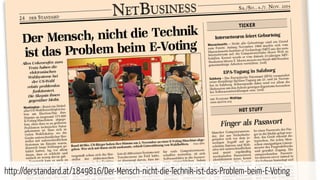
http://derstandard.at/1849816/Der-Mensch-nicht-die-Technik-ist-das-Problem-beim-E-Voting
»It is total chaos, we don't understand anything«
Suzanne Antoine, 70 years
»I have come here twice and twice I have had to walk
away without voting. It takes too long«
Pierre Bascoulergue, retired
»Amid big queues in general to vote, people using the
electronic machines were forced to wait up to two hours to
cast ballots. […] Researchers at Paul Verlaine University
in Metz said that trials on two of the three machines
used in France showed that four people out of every seven
aged over 65 could not get their votes recorded.«
physorg.com
Französische
Präsidentschaftswahlen
2007
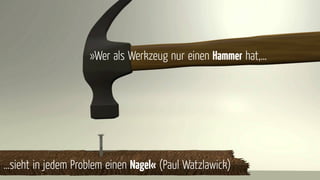
…sieht in jedem Problem einen Nagel« (Paul Watzlawick)
»Wer als Werkzeug nur einen Hammer hat,…
2
Beteiligung
Beteiligungsform als »Filter« ür
die Partizipation
»A more recent obstacle is the growth of the
›brogrammer‹—a shorthand term for a macho, just-
out-of-the-dorm-room culture that's being imported
from college campuses to startup offices.[…] it’s
interesting that the brogrammer identity is the
predominant one in pop culture right now.”«
3
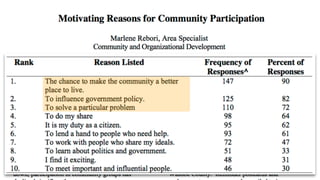
Motivation zur
Partizipation
»(selbst-)wirkungserfahrung«
4
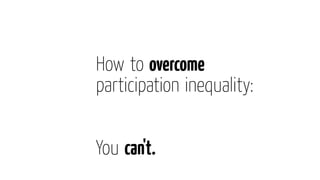
How to overcome 

participation inequality:
You can't.
› Wann werden Partizipationsplattformen als funktional,
nützlich und bedienerfreundlich wahrgenommen?
›Wie kann konstruktives Zusammenwirken von Online- und
Offline-Beteiligung abgebildet werden?
› Wie kann die Anwendernähe systematisch hergestellt und
während des gesamten Produktzyklus beibehalten
werden?
› Was leisten dabei Methoden und Denkschulen wie Service
Design, Design Thinking, User Research, teilnehmende
Beobachtung?
› Was kann/muss man über Zielgruppen, Nutzungsroutinen,
Technikaffinität wissen?

Online-Participation

  • 1.
    Users in Focus:Online-Participation Peter Purgathofer
  • 2.
    › Wann werdenPartizipationsplattformen als funktional, nützlich und bedienerfreundlich wahrgenommen? ›Wie kann konstruktives Zusammenwirken von Online- und Offline-Beteiligung abgebildet werden › Wie kann die Anwendernähe systematisch hergestellt und während des gesamten Produktzyklus beibehalten werden? › Was leisten dabei Methoden und Denkschulen wie Service Design, Design Thinking, User Research, teilnehmende Beobachtung? › Was kann/muss man über Zielgruppen, Nutzungsroutinen, Technikaffinität wissen?
  • 3.
  • 4.
  • 5.
    »It is totalchaos, we don't understand anything« Suzanne Antoine, 70 years »I have come here twice and twice I have had to walk away without voting. It takes too long« Pierre Bascoulergue, retired »Amid big queues in general to vote, people using the electronic machines were forced to wait up to two hours to cast ballots. […] Researchers at Paul Verlaine University in Metz said that trials on two of the three machines used in France showed that four people out of every seven aged over 65 could not get their votes recorded.« physorg.com Französische Präsidentschaftswahlen 2007
  • 6.
    …sieht in jedemProblem einen Nagel« (Paul Watzlawick) »Wer als Werkzeug nur einen Hammer hat,…
  • 7.
  • 8.
  • 9.
    Beteiligungsform als »Filter«ür die Partizipation
  • 10.
    »A more recentobstacle is the growth of the ›brogrammer‹—a shorthand term for a macho, just- out-of-the-dorm-room culture that's being imported from college campuses to startup offices.[…] it’s interesting that the brogrammer identity is the predominant one in pop culture right now.”«
  • 11.
  • 12.
  • 13.
  • 16.
  • 17.
  • 19.
    How to overcome
 participation inequality: You can't.
  • 20.
    › Wann werdenPartizipationsplattformen als funktional, nützlich und bedienerfreundlich wahrgenommen? ›Wie kann konstruktives Zusammenwirken von Online- und Offline-Beteiligung abgebildet werden? › Wie kann die Anwendernähe systematisch hergestellt und während des gesamten Produktzyklus beibehalten werden? › Was leisten dabei Methoden und Denkschulen wie Service Design, Design Thinking, User Research, teilnehmende Beobachtung? › Was kann/muss man über Zielgruppen, Nutzungsroutinen, Technikaffinität wissen?