renjin.org
Introduction to Renjin
Zürich R meetup
February 6, 2017
Maarten-Jan Kallen
@mj_kallen
BeDataDriven B.V.
Netherlands
BEDATADRIVEN.COM
renjin.org
Introduction to Renjin
● What is Renjin?
● Why Renjin?
● Example of improving performance
● Compatibility with GNU R
renjin.org
What is Renjin?
renjin.org
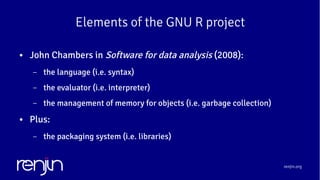
Elements of the GNU R project
● John Chambers in Software for data analysis (2008):
– the language (i.e. syntax)
– the evaluator (i.e. interpreter)
– the management of memory for objects (i.e. garbage collection)
● Plus:
– the packaging system (i.e. libraries)
renjin.org
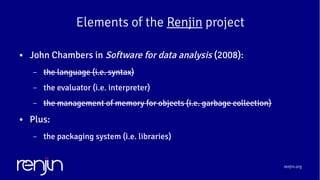
Elements of the Renjin project
● John Chambers in Software for data analysis (2008):
– the language (i.e. syntax)
– the evaluator (i.e. interpreter)
– the management of memory for objects (i.e. garbage collection)
● Plus:
– the packaging system (i.e. libraries)
renjin.org
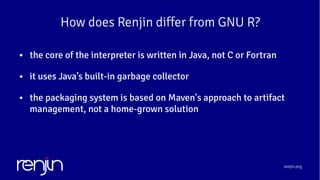
How does Renjin differ from GNU R?
● the core of the interpreter is written in Java, not C or Fortran
● it uses Java’s built-in garbage collector
● the packaging system is based on Maven's approach to artifact
management, not a home-grown solution
renjin.org
Renjin is an alternative interpreter (“engine”) for
the R programming language designed to run in the
Java Virtual Machine (JVM).
renjin.org
Other interpreters
● FastR is also implemented in Java, but in its current version is built
on top of Graal which is a “Polyglot Runtime for the JVM”
● Rho (formerly known as CXXR) is a rewrite in C++ of the GNU R
interpreter
● TERR (“TIBCO Enterprise Runtime for R”) is a closed-source
implementation in C++
● pqR (“pretty quick R”) is a fork of GNU R
renjin.org
Why Renjin?
renjin.org
Why did we create Renjin?
● compile everything to pure Java bytecode to run an R interpreter in
the JVM of a Platform-as-a-Service provider such as Google App
Engine or Microsoft Azure App Service
● improve performance for specific use-cases where GNU R ran out
of memory
● because it’s fun
renjin.org
Some other goals with Renjin
● better performance without the need to rewrite your R code using
– packages such as data.table, bigmemory, sqldf and others, and
– additional functions such as anyNA which tend to solve only one
particular problem
● better integration with enterprise-class tooling and systems
● better dependency management
renjin.org
Two examples of performance improvement using
deferred evaluation
renjin.org
Example 1: R as a Query Language
● research by Hannes Mühleisen to consider an R program as a
declaration of intent, much like a SQL statement
● apply common database query optimizations to the execution
graph of an R program
● case study using the American Community Survey data with the
survey package
*
crossprod 0.2
*
*
wts[,1]x
*
p
colSums
*
sum
/
*
wts[,2]
*
colSums
*
sum
/
*
wts[,3]
*
colSums
*
sum
/
*
wts[,4]
*
colSums
*
sum
/
*
wts[,5]
*
colSums
*
sum
/
repmeans
rep
47512
*
colSums sum
/
rep
5
t
- [5]
Without
optimization
Execution graph
analyzed by the
interpreter
through deferred
evaluation.
*
crossprod 0.2
*
*
wts[,1]x
colSums
/
(cached)
*
wts[,2]
colSums
/
(cached)
*
wts[,3]
colSums
/
(cached)
*
wts[,4]
colSums
/
(cached)
*
wts[,5]
colSums
/
(cached)
repmeans
*
(cached)
colSums
/
(cached)
rep
5
t
- [5]
With
optimizations
●
●
●●●● ●●
●
●
●●
●
●
●
●
●
● ●●
●
●
Re
0
25
50
75
100
47512 1060060
Dataset Size (elements, log
ExecutionTime(s)
Optimizations:
● Selection push-down
● Expression result
caching
● Identity removal
● Vectorized/specialized
operators
● Parallel execution
using worker threads
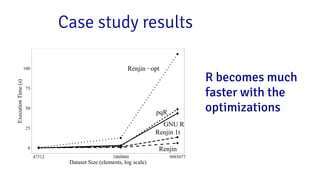
Case study results
●
●
●
●
●
●
●●●● ●●
●
●
●
●
●
●
●
●
●
●
●
●
●
●
● ●
●
●
●
●
pqR
GNU R
Renjin −opt
Renjin
Renjin 1t
0
25
50
75
100
47512 1060060 9093077
Dataset Size (elements, log scale)
ExecutionTime(s)
R becomes much
faster with the
optimizations
renjin.org
Example 2: anyNA(x)
● anyNA() was introduced in R 3.0 as any(is.na(x)) is inefficient
and slow for large x
● GNU R solution: mash into one function, farm implementation out to C
● But: introduces yet another oddly named function (paste0 anyone?)
and doesn’t solve similar cases:
– Y <- is.na(x); any(y)
– any(is.na(x) | is.na(y))
– all(!is.na(x))
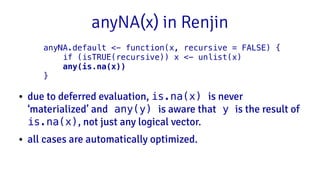
anyNA(x) in Renjin
● due to deferred evaluation, is.na(x) is never
‘materialized’ and any(y) is aware that y is the result of
is.na(x), not just any logical vector.
● all cases are automatically optimized.
anyNA.default <- function(x, recursive = FALSE) {
if (isTRUE(recursive)) x <- unlist(x)
any(is.na(x))
}
renjin.org
Compatibility with GNU R
renjin.org
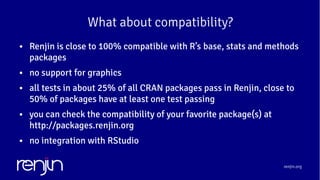
What about compatibility?
● Renjin is close to 100% compatible with R’s base, stats and methods
packages
● no support for graphics
● all tests in about 25% of all CRAN packages pass in Renjin, close to
50% of packages have at least one test passing
● you can check the compatibility of your favorite package(s) at
http://packages.renjin.org
● no integration with RStudio
renjin.org
To finish
● visit the project website at renjin.org and sign up to receive the
Renjin newsletter
● follow me on Twitter: twitter.com/mj_kallen
● send us an email at info@renjin.org

Introduction to Renjin, the alternative engine for R

  • 1.
    renjin.org Introduction to Renjin ZürichR meetup February 6, 2017 Maarten-Jan Kallen @mj_kallen BeDataDriven B.V. Netherlands
  • 2.
  • 3.
    renjin.org Introduction to Renjin ●What is Renjin? ● Why Renjin? ● Example of improving performance ● Compatibility with GNU R
  • 4.
  • 5.
    renjin.org Elements of theGNU R project ● John Chambers in Software for data analysis (2008): – the language (i.e. syntax) – the evaluator (i.e. interpreter) – the management of memory for objects (i.e. garbage collection) ● Plus: – the packaging system (i.e. libraries)
  • 6.
    renjin.org Elements of theRenjin project ● John Chambers in Software for data analysis (2008): – the language (i.e. syntax) – the evaluator (i.e. interpreter) – the management of memory for objects (i.e. garbage collection) ● Plus: – the packaging system (i.e. libraries)
  • 7.
    renjin.org How does Renjindiffer from GNU R? ● the core of the interpreter is written in Java, not C or Fortran ● it uses Java’s built-in garbage collector ● the packaging system is based on Maven's approach to artifact management, not a home-grown solution
  • 8.
    renjin.org Renjin is analternative interpreter (“engine”) for the R programming language designed to run in the Java Virtual Machine (JVM).
  • 9.
    renjin.org Other interpreters ● FastRis also implemented in Java, but in its current version is built on top of Graal which is a “Polyglot Runtime for the JVM” ● Rho (formerly known as CXXR) is a rewrite in C++ of the GNU R interpreter ● TERR (“TIBCO Enterprise Runtime for R”) is a closed-source implementation in C++ ● pqR (“pretty quick R”) is a fork of GNU R
  • 10.
  • 11.
    renjin.org Why did wecreate Renjin? ● compile everything to pure Java bytecode to run an R interpreter in the JVM of a Platform-as-a-Service provider such as Google App Engine or Microsoft Azure App Service ● improve performance for specific use-cases where GNU R ran out of memory ● because it’s fun
  • 12.
    renjin.org Some other goalswith Renjin ● better performance without the need to rewrite your R code using – packages such as data.table, bigmemory, sqldf and others, and – additional functions such as anyNA which tend to solve only one particular problem ● better integration with enterprise-class tooling and systems ● better dependency management
  • 13.
    renjin.org Two examples ofperformance improvement using deferred evaluation
  • 14.
    renjin.org Example 1: Ras a Query Language ● research by Hannes Mühleisen to consider an R program as a declaration of intent, much like a SQL statement ● apply common database query optimizations to the execution graph of an R program ● case study using the American Community Survey data with the survey package
  • 15.
  • 16.
    * crossprod 0.2 * * wts[,1]x colSums / (cached) * wts[,2] colSums / (cached) * wts[,3] colSums / (cached) * wts[,4] colSums / (cached) * wts[,5] colSums / (cached) repmeans * (cached) colSums / (cached) rep 5 t - [5] With optimizations ● ● ●●●●●● ● ● ●● ● ● ● ● ● ● ●● ● ● Re 0 25 50 75 100 47512 1060060 Dataset Size (elements, log ExecutionTime(s) Optimizations: ● Selection push-down ● Expression result caching ● Identity removal ● Vectorized/specialized operators ● Parallel execution using worker threads
  • 17.
    Case study results ● ● ● ● ● ● ●●●●●● ● ● ● ● ● ● ● ● ● ● ● ● ● ● ● ● ● ● ● ● pqR GNU R Renjin −opt Renjin Renjin 1t 0 25 50 75 100 47512 1060060 9093077 Dataset Size (elements, log scale) ExecutionTime(s) R becomes much faster with the optimizations
  • 18.
    renjin.org Example 2: anyNA(x) ●anyNA() was introduced in R 3.0 as any(is.na(x)) is inefficient and slow for large x ● GNU R solution: mash into one function, farm implementation out to C ● But: introduces yet another oddly named function (paste0 anyone?) and doesn’t solve similar cases: – Y <- is.na(x); any(y) – any(is.na(x) | is.na(y)) – all(!is.na(x))
  • 19.
    anyNA(x) in Renjin ●due to deferred evaluation, is.na(x) is never ‘materialized’ and any(y) is aware that y is the result of is.na(x), not just any logical vector. ● all cases are automatically optimized. anyNA.default <- function(x, recursive = FALSE) { if (isTRUE(recursive)) x <- unlist(x) any(is.na(x)) }
  • 20.
  • 21.
    renjin.org What about compatibility? ●Renjin is close to 100% compatible with R’s base, stats and methods packages ● no support for graphics ● all tests in about 25% of all CRAN packages pass in Renjin, close to 50% of packages have at least one test passing ● you can check the compatibility of your favorite package(s) at http://packages.renjin.org ● no integration with RStudio
  • 22.
    renjin.org To finish ● visitthe project website at renjin.org and sign up to receive the Renjin newsletter ● follow me on Twitter: twitter.com/mj_kallen ● send us an email at info@renjin.org