Formal Methods:
Whence and Whither?
Prof. Jonathan P. Bowen FRSA FBCS
Emeritus Professor of Computing
London South Bank University, UK
Adjunct Professor, Southwest University, Chongqing, China
Chairman, Museophile Limited, Oxford, UK
www.jpbowen.com
LSBU create a connected and Customisable Research Experience with Cayuse
Introduction
• Subjects: Mathematics, art, engineering, computer science,
software engineering, formal methods, museum informatics,
history of computing, digital culture
• Academia: Imperial College London, Oxford University
Computing Laboratory, University of Reading,
London South Bank University, Birmingham City University
• Visitor: UNU-IIST (Macau), King’s College London, Brunel Univ.,
Westminster (UK), Waikato Univ. (New Zealand), Pratt Institute
(New York, USA), East China Normal Univ. (Shanghai, China),
Institute for Advanced Studies (IIAS, Jerusalem, Israel),
Southwest University (Chongqing, China)
• Industry: Marconi Instrument, Logica, Silicon Graphics
(California, USA), Altran Praxis (now Capgemini)
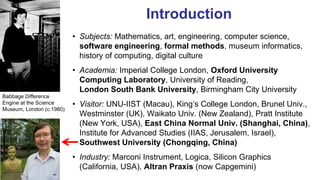
Babbage Difference
Engine at the Science
Museum, London (c.1980)
Background
• Academics vs. industrial practitioners
• Formal methods still little used in practice
(except for safety/security)
• Misconceptions
• Guidance
• Technology transfer issues
• Future – effect of Artificial Intelligence?
Software…
Failure is not an option…
It comes bundled with the software!
— From a fridge magnet!
Safety and reliability
The Flat Earth Society
Cf. formal methods community…
— Gerard J. Holzmann
Logic
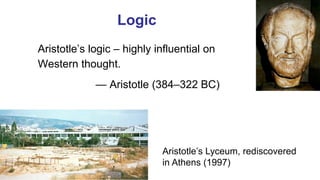
Aristotle’s logic – highly influential on
Western thought.
— Aristotle (384–322 BC)
Aristotle’s Lyceum, rediscovered
in Athens (1997)
Proof
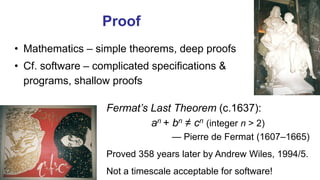
• Mathematics – simple theorems, deep proofs
• Cf. software – complicated specifications &
programs, shallow proofs
Fermat’s Last Theorem (c.1637):
an + bn ≠ cn (integer n > 2)
— Pierre de Fermat (1607–1665)
Proved 358 years later by Andrew Wiles, 1994/5.
Not a timescale acceptable for software!
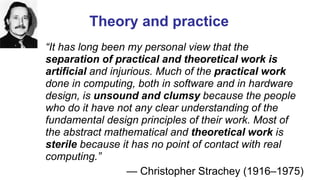
Theory and practice
“It has long been my personal view that the
separation of practical and theoretical work is
artificial and injurious. Much of the practical work
done in computing, both in software and in hardware
design, is unsound and clumsy because the people
who do it have not any clear understanding of the
fundamental design principles of their work. Most of
the abstract mathematical and theoretical work is
sterile because it has no point of contact with real
computing.”
— Christopher Strachey (1916–1975)
Computer Pioneers - Christopher Strachey
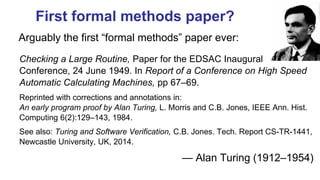
First formal methods paper?
Checking a Large Routine, Paper for the EDSAC Inaugural
Conference, 24 June 1949. In Report of a Conference on High Speed
Automatic Calculating Machines, pp 67–69.
Reprinted with corrections and annotations in:
An early program proof by Alan Turing, L. Morris and C.B. Jones, IEEE Ann. Hist.
Computing 6(2):129–143, 1984.
See also: Turing and Software Verification, C.B. Jones. Tech. Report CS-TR-1441,
Newcastle University, UK, 2014.
— Alan Turing (1912–1954)
Arguably the first “formal methods” paper ever:
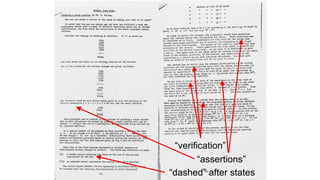
Turing and program proving
• A.M. Turing, “Checking a large routine” (1949)
• F.L. Morris & C.B. Jones, An Early Program
Proof by Alan Turing, IEEE Annals of the
History of Computing, 6(2):139–143, 1984.
“assertions”
“verification”
“dashed” after states
Checking a large routine (1949)
• “In order to assist the checker, the programmer should make
assertions about the various states that the machine can reach.”
• “The checker has to verify that the … initial condition and the
stopped condition agree with the claims that are made for the
routine as a whole.”
• “He has also to verify that each of the assertions … is correct.”
• “Finally the checker has to verify that the process comes to an
end.”
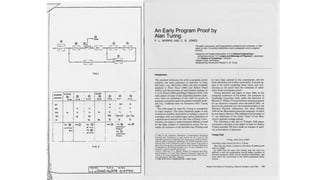
Turing and program proving
• A.M. Turing, “Checking a large routine” (1949)
• F.L. Morris & C.B. Jones, An Early Program
Proof by Alan Turing, IEEE Annals of the
History of Computing, 6(2):139–143, 1984.
Turing and program proving
• A.M. Turing, “Checking a large routine” (1949)
• F.L. Morris & C.B. Jones, An Early Program
Proof by Alan Turing, IEEE Annals of the
History of Computing, 6(2):139–143, 1984.
Dashed variables
for after states
Turing and program proving
Modernized flow diagram, with assertions
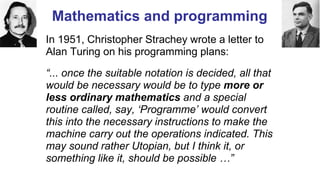
Mathematics and programming
In 1951, Christopher Strachey wrote a letter to
Alan Turing on his programming plans:
“... once the suitable notation is decided, all that
would be necessary would be to type more or
less ordinary mathematics and a special
routine called, say, ‘Programme’ would convert
this into the necessary instructions to make the
machine carry out the operations indicated. This
may sound rather Utopian, but I think it, or
something like it, should be possible …”
Computer Pioneers - Christopher Strachey
Turing’s influence on program proving
• Aad van Wijngaarden was at the Cambridge meeting –
but no known influence (1949…)
• Robert Floyd rediscovered ideas similar to those of Turing
(published 1967)
• Tony Hoare developed these further (published 1969)
• Had Turing lived longer, perhaps formal methods (in
particular program proving) would have developed more
rapidly, rather than being rediscovered
Turing and
program
proving
F.L. Morris & C.B.
Jones (1984), An
Early Program
Proof by Alan
Turing, IEEE
Annals of the
History of
Computing,
6(2):139–143.
1947
1949
1963
1976
1967
1969
1966
Assertions
An Axiomatic Basic for Computer Programming.
Communications of the ACM, October 1969
— Sir Tony Hoare (b.1934)
[Photograph]
Hoare logic: {pre} prog {post}
Program proving with pre- and post-conditions as
“assertions” (logical statements about the program)
30 years later … assertions widely used by programmers
for testing and debugging rather than proof
Formal …
“After great pain, a formal feeling comes—”
— Emily Dickinson (1862)
formal /fm()l/ a. LME. [L formalis, f. forma: see FORM n., -AL.] 1
a Philos. Of or pertaining to the form or constitutive essence of a thing; essential. LME.
b Pertaining to the specific form of an animal or plant. LME-L17. c Of or pertaining to
the outward form, shape, appearance, arrangement, or external qualities of a thing.
Formerly also (of knowledge), theoretical. M17. d Logic. Concerned with the
form, not the matter, of reasoning. M19.
… Methods
“By different methods different men excel;
But where is he who can do all things well?”
— Charles Churchill (1731–1764)
method /methd/ n. LME. [L methodus f. Gk methodos pursuit of
knowledge, mode of investigation, f. meta (see META-) + hodos
way.] I Procedure for attaining an object. 1 ... 2 A mode of procedure; a
(defined or systematic) way of doing a thing, esp. (w. specifying wd or wds) in accordance
with a particular theory or as associated with a particular person. L16. ... II Systematic
arrangement, order. 3 The branch of logic that deals with the
description and arrangement of arguments or propositions for
the investigation or exposition of a truth. M16. 4 Order in thinking or
expressing thoughts; the orderly arrangement of ideas; gen. orderliness, regularity, or
planning in doing anything. M16.
Formal Methods:
An Introduction to Symbolic Logic
and to the Study of Effective
Operations in Arithmetic and Logic
(1962)
Evert Willem Beth (1908–1964),
Dutch philosopher and logician
Earliest book with
“formal methods”
in the title?
Formal methods
• Term established by late 1970s
– Next stage from structured design
– Mathematical basis
• Formal specification and (optionally) proof:
– Validation (correct specification)
– Verification (correct implementation wrt spec.)
• But engineers calculate rather than prove
undefined
undefined
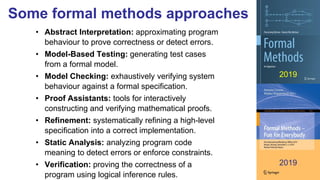
Some formal methods approaches
• Abstract Interpretation: approximating program
behaviour to prove correctness or detect errors.
• Model-Based Testing: generating test cases
from a formal model.
• Model Checking: exhaustively verifying system
behaviour against a formal specification.
• Proof Assistants: tools for interactively
constructing and verifying mathematical proofs.
• Refinement: systematically refining a high-level
specification into a correct implementation.
• Static Analysis: analyzing program code
meaning to detect errors or enforce constraints.
• Verification: proving the correctness of a
program using logical inference rules.
2019
2019
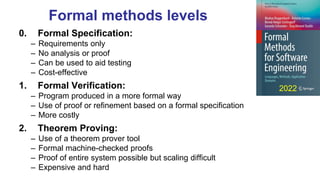
Formal methods levels
0. Formal Specification:
– Requirements only
– No analysis or proof
– Can be used to aid testing
– Cost-effective
1. Formal Verification:
– Program produced in a more formal way
– Use of proof or refinement based on a formal specification
– More costly
2. Theorem Proving:
– Use of a theorem prover tool
– Formal machine-checked proofs
– Proof of entire system possible but scaling difficult
– Expensive and hard
2022
Formal specification
1. A specification written and
approved in accordance
with established standards
2. A specification written in a
formal notation, often for
use in proof of correctness.
— IEEE glossary
Seven Myths of Formal Methods
1. Formal Methods can
guarantee that software is
perfect.
2. Formal Methods are all about
program proving.
3. Formal Methods are only
useful for safety-critical
systems.
4. Formal Methods require highly
trained mathematicians.
5. Formal Methods increase the
cost of development.
6. Formal Methods are
unacceptable to users.
7. Formal Methods are not used
on real, large-scale software.
– J.A. Hall, IEEE Software,
September 1990
ProCoS: Provably Correct Systems
• Requirements
• Specification
• Design
• Programming
• Compilation
• Hardware
European projects and Working Group (early 1990s)
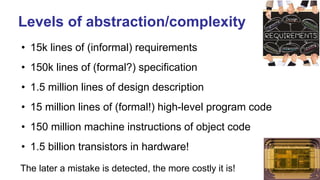
Levels of abstraction/complexity
• 15k lines of (informal) requirements
• 150k lines of (formal?) specification
• 1.5 million lines of design description
• 15 million lines of (formal!) high-level program code
• 150 million machine instructions of object code
• 1.5 billion transistors in hardware!
The later a mistake is detected, the more costly it is!
Ten Commandments of Formal Methods
I. Thou shalt choose an
appropriate notation
II. Thou shalt formalize but not
over-formalize
III. Thou shalt guestimate costs
IV. Thou shalt have a formal
methods guru on call
V. Thou shalt not abandon thy
traditional development
methods
VI. Thou shalt document sufficiently
VII. Thou shalt not compromise thy
quality standards
VIII. Thou shalt not be dogmatic
IX. Thou shalt test, test, and test
again
X. Thou shalt reuse
– J.P. Bowen & M.G. Hinchey
IEEE Computer, April 1995
Applications of Formal Methods
Examples:
• Tektronix (Z) – oscilloscopes
• STV algorithm (VDM) – voting
• IBM CICS (B) – transaction processing
• AAMP5 microprocessor (PVS) – hardware
• GEC Alsthom (B) – railway software
• A300/340 (Z) – airplane software
Prentice Hall, International Series in Computer Science,
1995
Seven More Myths of Formal Methods
8. Formal Methods delay the
development process.
9. Formal Methods do not have
tools.
10. Formal Methods mean
forsaking traditional
engineering design methods.
11. Formal Methods only apply
to software.
12. Formal Methods are not
required.
13. Formal Methods are not
supported.
14. Formal Methods people
always use Formal Methods.
– J.P. Bowen & M.G. Hinchey
IEEE Software, July 1995
Examples:
• Motorola CAP DSP (ACL2)
• Radiation Therapy Machine (Z)
• ATC system (VDM)
• Railways (Prover Technology)
And later: Microsoft
Industrial-Strength Formal Methods in Practice
C:UsersJonathanAppDataLocalMicrosoftWindowsTemporary Internet
FilesContent.IE58PADLV2LMC900432679[1].png
Springer, FACIT series, 1999
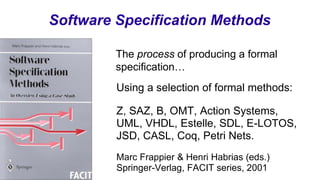
Software Specification Methods
Using a selection of formal methods:
Z, SAZ, B, OMT, Action Systems,
UML, VHDL, Estelle, SDL, E-LOTOS,
JSD, CASL, Coq, Petri Nets.
Marc Frappier & Henri Habrias (eds.)
Springer-Verlag, FACIT series, 2001
The process of producing a formal
specification…
http://ecx.images-amazon.com/images/I/51QtsF%2B5WAL._SS500_.jpg
http://ecx.images-amazon.com/images/I/51v4rGc0LwL._SS500_.jpg
Further books
• Boulanger, J.-L., ed. 2012.
Formal Methods: Industrial Use from Model
to the Code.
ISTE, Wiley.
ISBN 978-1848213623.
• Gnesi, S. and Margaria, T. 2012.
Formal Methods for Industrial Critical
Systems: A Survey of Applications.
IEEE Computer Society Press, Wiley.
ISBN 978-0470876183.
Education
• Resistance by students
• Resistance even by
academics
• Support by professional
societies (e.g., BCS
accreditation)
C:UsersJonathanAppDataLocalMicrosoftWindowsTemporary Internet
FilesContent.IE58PADLV2LMC900432679[1].png
Choosing a formal method – difficult
C:UsersJonathanAppDataLocalMicrosoftWindowsTemporary Internet
FilesContent.IE58PADLV2LMC900432679[1].png
Tools –
difficult
to use
C:UsersJonathanAppDataLocalMicrosoftWindowsTemporary Internet
FilesContent.IE58PADLV2LMC900432679[1].png
Technology transfer
• Courses (academia & industry)
• Textbooks (good choice)
• Tools (type-checkers, provers, …)
• Web resources (including Wikipedia)
• Mailing lists (e.g., JISCmail)
• Meetings (conference series)
• Standards (international)
C:UsersJonathanAppDataLocalMicrosoftWindowsTemporary Internet
FilesContent.IE58PADLV2LMC900432679[1].png
Standards mandating formal methods
• In highest level of safety and security applications
• From 1990s*
• Also, for formal notations themselves...
C:UsersJonathanAppDataLocalMicrosoftWindowsTemporary Internet
FilesContent.IE58PADLV2LMC900432679[1].png
*See:
Bowen, J.P. & Stavridou, V. (1993),
Safety-critical systems, formal methods
and standards. Software Engineering
Journal, 8(4):189–209. DOI:
https://doi.org/10.1049/sej.1993.0025
Example: Z Standard
• ISO/IEC 13568
– Long process (1990s)
– Inconsistencies found!
• Final Committee Draft
– accepted in 2001
• May help tools & industrial application
http://web.comlab.ox.ac.uk/oucl/research/groups/zstandards/images/zed.gif
C:UsersJonathanAppDataLocalMicrosoftWindowsTemporary Internet
FilesContent.IE58PADLV2LMC900432679[1].png
• 2.5 million flights per year (pre-Covid), covering the UK
and eastern North Atlantic.
• 250 million passengers per year in UK airspace.
• Among the busiest & most complex airspace in the world.
• Provides air traffic control from its centres at Swanwick,
Hampshire (England) and Prestwick, Ayrshire (Scotland).
• Also provides air traffic control services at 15 UK airports
including Heathrow, Gatwick, Stansted, Birmingham,
Manchester, Edinburgh, and Glasgow, together with air traffic
services at Gibraltar Airport.
Case study: National Air Traffic Services
File:Nats logo 2006.png
C:UsersJonathanAppDataLocalMicrosoftWindowsTemporary Internet
FilesContent.IE58PADLV2LMC900432679[1].png
National Air Traffic Services, UK
www.nats.co.uk
File:Nats logo 2006.png
Swanwick
southern England
C:UsersJonathanAppDataLocalMicrosoftWindowsTemporary Internet
FilesContent.IE58PADLV2LMC900432679[1].png
Flight strips on paper
Last flight of Concorde C:UsersJonathanAppDataLocalMicrosoftWindowsTemporary Internet
FilesContent.IE58PADLV2LMC900432679[1].png
European
airspace
Source: Wikipedia
London:
England
& Wales
C:UsersJonathanAppDataLocalMicrosoftWindowsTemporary Internet
FilesContent.IE58PADLV2LMC900432679[1].png
FlightRadar24
www.flightradar24.com
C:UsersJonathanAppDataLocalMicrosoftWindowsTemporary Internet
FilesContent.IE58PADLV2LMC900432679[1].png
National Air Traffic Services
• Advertisement at Heathrow Airport →
• Air Traffic Management (ATM)
• Single European Sky ATM Research
(SESAR)
• SESAR Joint Undertaking
• www.sesarju.eu
• SESAR project (2004–20)
File:Nats logo 2006.png
Copyright © Altran Praxis
Formal Methods in Air Traffic Control
(Slides by Neil White)
Open-DO
www.slideshare.net/AdaCore/white-open-do
www.youtube.com/watch?v=IQMWVqQfm5A
(Capgemini Engineering since 2019)
NATS, the UK’s leading air traffic services provider, has
pioneered research and development of advanced air
traffic control tools for several years from its simulator
and research centre.
The iFACTS project [provides] a subset of these tools
onto the system at the company’s main en-route Control
Centre at Swanwick.
C:UsersJonathanAppDataLocalMicrosoftWindowsTemporary Internet
FilesContent.IE58PADLV2LMC900432679[1].png
UK Air Traffic Control
Copyright © Altran Praxis limited 2010
C:UsersJonathanAppDataLocalMicrosoftWindowsTemporary Internet
FilesContent.IE58PADLV2LMC900432679[1].png
– The Notes of this slide and the previous slide give some guidance on style and usage.
Copyright © Altran Praxis limited 2010
Planner Tactical Assistant
(in/out) (controller) (flight strips)
ATC team
C:UsersJonathanAppDataLocalMicrosoftWindowsTemporary Internet
FilesContent.IE58PADLV2LMC900432679[1].png
Copyright © Altran Praxis
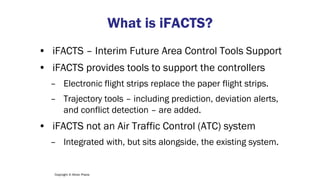
What is iFACTS?
• iFACTS – Interim Future Area Control Tools Support
• iFACTS provides tools to support the controllers
– Electronic flight strips replace the paper flight strips.
– Trajectory tools – including prediction, deviation alerts,
and conflict detection – are added.
• iFACTS not an Air Traffic Control (ATC) system
– Integrated with, but sits alongside, the existing system.
Medium Term Conflict Detection: Separation Monitor
Separation Monitor
Cancel Alert Lines Labels
Green
Separation(NM)
0
5
10
15
Time to Interaction (mins)
0 15
5 10
SAS123
BAW43BE
DLH4695
AMM1077
AZA292
BAL547
BAW028
ANZ001
UAL2
SAA321
BAW225
UAL3
Copyright © Altran Praxis limited 2010
Copyright © Altran Praxis
The complete iFACTS specification
• The functional specification
– Z notation
• The algorithm specification
– Mathematics (Mathematica)
• The Human-Machine Interface (HMI) specification
– State tables
• The rest of the specification
– English!
C:UsersJonathanAppDataLocalMicrosoftWindowsTemporary Internet
FilesContent.IE58PADLV2LMC900432679[1].png
The Z specification
C:UsersJonathanAppDataLocalMicrosoftWindowsTemporary Internet
FilesContent.IE58PADLV2LMC900432679[1].png
Copyright © Altran Praxis
Z training
• Z reader training
– 3-day course; fluency then comes after 1 week on the job.
– Trained 75 people to read Z.
– Engineers, domain experts, ATCOs.
• Z writer training
– 3-day course, fluency then comes after 3 months on the job.
– Trained 11 people to write Z.
– All engineers.
Copyright © Altran Praxis
Z tools
• Z written in Microsoft Word
– To get acceptance, you need to work
with what people know.
– Supported by Word Add-ins.
• A Z character set.
• A simple interface to the fuzz type checker.
• A graphical representation tool.
C:UsersJonathanAppDataLocalMicrosoftWindowsTemporary Internet
FilesContent.IE58PADLV2LMC900432679[1].png
Copyright © Altran Praxis
Z tools
• Advantages
– Easy to develop commentary and Z together.
– Hyperlinking of fuzz errors back to source.
– Cross-referencing of Z names in final document.
• Disadvantages
– All the problems of large Word documents.
– Tools can be slow on 1,000 page documents.
– Merging branches (for different releases) painful.
• Possible future
– Open Office XML C:UsersJonathanAppDataLocalMicrosoftWindowsTemporary Internet
FilesContent.IE58PADLV2LMC900432679[1].png
Copyright © Altran Praxis
The state machine specification
Button 1 Checkbox 1
State 1 State 2 N/A
State 2 State 1 State 3
State 3 State 1 State 2
Transition Actions
State 1 -> State 2 : De-select Checkbox 1 C:UsersJonathanAppDataLocalMicrosoftWindowsTemporary Internet
FilesContent.IE58PADLV2LMC900432679[1].png
Copyright © Altran Praxis
State machine training & tools
• Training
– So trivial that we don’t train!
– People “just get it”.
• Tools
– Err …. None.
C:UsersJonathanAppDataLocalMicrosoftWindowsTemporary Internet
FilesContent.IE58PADLV2LMC900432679[1].png
Copyright © Altran Praxis
The SPARK implementation
• SPARK Ada
– An annotated subset of Ada.
• 150 KSLOC (Logical)
• RTE (Run-Time Exception) Proof
– Formal partial correctness proof against
specification not considered cost-effective.
C:UsersJonathanAppDataLocalMicrosoftWindowsTemporary Internet
FilesContent.IE58PADLV2LMC900432679[1].png
Code
C:UsersJonathanAppDataLocalMicrosoftWindowsTemporary Internet
FilesContent.IE58PADLV2LMC900432679[1].png
Copyright © Altran Praxis
SPARK training and tools
• 57 people trained in SPARK
– Mostly contractors and clients.
– Diverse programming background.
– All SPARK coders also Z readers.
• Effective as SPARK coders immediately
• Picking up RTE proof takes longer.
– About 2 months.
• How long to pick up formal correctness proofs?
– No data, but suspect longer again.
The SPARK toolset:
– Examiner.
– Proof Simplifier.
– Proof Checker.
• See me later!
C:UsersJonathanAppDataLocalMicrosoftWindowsTemporary Internet
FilesContent.IE58PADLV2LMC900432679[1].png
Test Design
C:UsersJonathanAppDataLocalMicrosoftWindowsTemporary Internet
FilesContent.IE58PADLV2LMC900432679[1].png
The challenge of test design
How many potential tests for this fragment? C:UsersJonathanAppDataLocalMicrosoftWindowsTemporary Internet
FilesContent.IE58PADLV2LMC900432679[1].png
Copyright © Altran Praxis
The challenge of test design
• If you just turn the handle there are 1134
conditions to test.
• But if you work at it hard enough you can cover
the required subset in just 6 test scripts.
• Formal methods are not a substitute for
initiative.
C:UsersJonathanAppDataLocalMicrosoftWindowsTemporary Internet
FilesContent.IE58PADLV2LMC900432679[1].png
Copyright © Altran Praxis
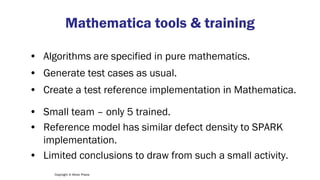
Mathematica tools & training
• Algorithms are specified in pure mathematics.
• Generate test cases as usual.
• Create a test reference implementation in Mathematica.
• Small team – only 5 trained.
• Reference model has similar defect density to SPARK
implementation.
• Limited conclusions to draw from such a small activity.
Copyright © Altran Praxis
Case study conclusions
• Formal methods are applicable to all phases of the lifecycle.
• Training engineers is not a barrier
– It’s a one-off cost
– Data shows that training is easy and cheap.
• Tool support is vital
– The Achilles heel of formal methods
•Except the SPARK Examiner! C:UsersJonathanAppDataLocalMicrosoftWindowsTemporary Internet
FilesContent.IE58PADLV2LMC900432679[1].png
Tracing
• Completeness of coverage
– e.g., testing all parts of a Z specification
• DOORS tool
– Dynamic Object-Oriented Requirements System
• Link all specification components with test case(s
– or argument for safety case
• Flag unlinked components
• Also, visualization of schema structure C:UsersJonathanAppDataLocalMicrosoftWindowsTemporary Internet
FilesContent.IE58PADLV2LMC900432679[1].png
Subsequent iFACTS developments
• iFACTS in operation (2011) – 18 minutes of prediction
• Traffic Load Prediction Device (TLPD):
– Forecast air traffic load up to 4 hours ahead
– Plan workloads for optimum traffic flows
• iFACTS – winner of the Duke of Edinburgh Navigation
Award for Technical Achievement (2013)
• MoD use for military air traffic control (2014)
• FourSight, successor to iFACTS (announced 2017)
for Swanwick/Prestwick – European SESAR compliant C:UsersJonathanAppDataLocalMicrosoftWindowsTemporary Internet
FilesContent.IE58PADLV2LMC900432679[1].png
How Important is mathematics to the
software practitioner?
Some consider it unimportant … !
— Robert L. Glass
IEEE Software, Nov./Dec. 2000
Mathematics debates
Some consider it important …
— William W. McMillan et al., Letters
IEEE Software, Jan./Feb. 2001
The debate has continued …
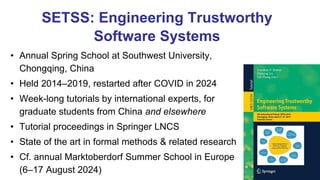
SETSS: Engineering Trustworthy
Software Systems
• Annual Spring School at Southwest University,
Chongqing, China
• Held 2014–2019, restarted after COVID in 2024
• Week-long tutorials by international experts, for
graduate students from China and elsewhere
• Tutorial proceedings in Springer LNCS
• State of the art in formal methods & related research
• Cf. annual Marktoberdorf Summer School in Europe
(6–17 August 2024)
SETSS
15–21 April 2024
• Seven tutorials over 5 days
• Workshop over 2 days
www.rise-swu.cn/SETSS2024
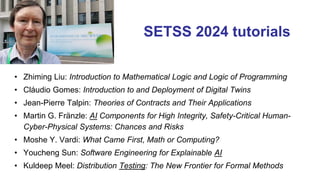
SETSS 2024 tutorials
• Zhiming Liu: Introduction to Mathematical Logic and Logic of Programming
• Cláudio Gomes: Introduction to and Deployment of Digital Twins
• Jean-Pierre Talpin: Theories of Contracts and Their Applications
• Martin G. Fränzle: AI Components for High Integrity, Safety-Critical Human-
Cyber-Physical Systems: Chances and Risks
• Moshe Y. Vardi: What Came First, Math or Computing?
• Youcheng Sun: Software Engineering for Explainable AI
• Kuldeep Meel: Distribution Testing: The New Frontier for Formal Methods
Formal Methods and AI – questions
Explainable AI, etc. C:UsersJonathanAppDataLocalMicrosoftWindowsTemporary Internet
FilesContent.IE58PADLV2LMC900432679[1].png
AI
–
large
“learned”
models
“Correct by construction” vs. “dog trained” C:UsersJonathanAppDataLocalMicrosoftWindowsTemporary Internet
FilesContent.IE58PADLV2LMC900432679[1].png
Formal methods and correctness
Rigorous specification C:UsersJonathanAppDataLocalMicrosoftWindowsTemporary Internet
FilesContent.IE58PADLV2LMC900432679[1].png
Formalized
mathematics
Precise language,
correctness checkable
by proof assistants
C:UsersJonathanAppDataLocalMicrosoftWindowsTemporary Internet
FilesContent.IE58PADLV2LMC900432679[1].png
Machine
learning
Human intuition
combined with AI
C:UsersJonathanAppDataLocalMicrosoftWindowsTemporary Internet
FilesContent.IE58PADLV2LMC900432679[1].png
Deep
Neural
Networks
(DNN)
Multiple layers
between input
and output,
explainable AI
C:UsersJonathanAppDataLocalMicrosoftWindowsTemporary Internet
FilesContent.IE58PADLV2LMC900432679[1].png
Coverage
criteria
for AI
Test coverage
for DNNs
C:UsersJonathanAppDataLocalMicrosoftWindowsTemporary Internet
FilesContent.IE58PADLV2LMC900432679[1].png
Formal
methods
and
testing
Formal approach for testing whether a sampling
subroutine generates a desired distribution
Reliance on
probability
distributions
Predictions dangerous
“ . . . these formal methods are the key to writing much
better software. Their widespread use will revolutionise
software writing, and the economic benefits will be
considerable – on a par with those of the revolution in
civil engineering during the last century.”
— Brian Oakley (1927–2012),
Alvey Achievements, June 1987
Computer Resurrection Issue 60
C:UsersJonathanAppDataLocalMicrosoftWindowsTemporary Internet
FilesContent.IE58PADLV2LMC900432679[1].png
Compare AI!
Future developments
• An engineering approach
• Proof vs. calculation
• “Light” approach (specification)
• Improved tools (Moore’s law helps)
• International standards
• Education / training (for all personnel)
• Unification of approaches? C:UsersJonathanAppDataLocalMicrosoftWindowsTemporary Internet
FilesContent.IE58PADLV2LMC900432679[1].png
Unified theory? Cf. physics
“The construction of a single mathematical model
obeying an elegant set of algebraic laws is a significant
intellectual achievement; so is the formulation of a set of
algebraic laws characterising an interesting and useful
set of models.”
— Sir Tony Hoare, 1993
[Photograph]
Operational, Denotational, Algebraic semantics
C:UsersJonathanAppDataLocalMicrosoftWindowsTemporary Internet
FilesContent.IE58PADLV2LMC900432679[1].png
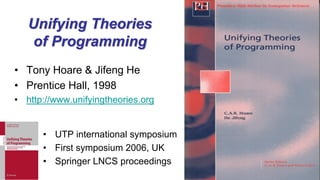
Unifying Theories
of Programming
• Tony Hoare & Jifeng He
• Prentice Hall, 1998
• http://www.unifyingtheories.org
A book with a red and blue cover
Description automatically generated
• UTP international symposium
• First symposium 2006, UK
• Springer LNCS proceedings
Future developments
• Safety-critical systems
• Security (e.g., smartcards)
• Harmonization of engineering practices
• Practical experience
• Assessment and measurement
• Technology transfer investment
• Use with AI, LLMs, etc… perhaps most promising! C:UsersJonathanAppDataLocalMicrosoftWindowsTemporary Internet
FilesContent.IE58PADLV2LMC900432679[1].png
Ronald Ross to ChatGPT:
The birth and strange life of a
random walk
Mathematical Institute, Oxford,
26 June 2024
— Jordan Ellenberg, Univ. of
Wisconsin–Madison (b. 1971)
youtube.com/watch?v=08FGB5x090M
• Computer science uses decades-old,
even centuries-old mathematics
• So, see what mathematicians are
doing now for the future
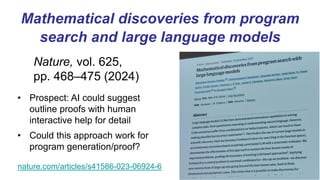
Mathematical discoveries from program
search and large language models
Nature, vol. 625,
pp. 468–475 (2024)
nature.com/articles/s41586-023-06924-6
• Prospect: AI could suggest
outline proofs with human
interactive help for detail
• Could this approach work for
program generation/proof?
The Potential for AI in
Science and Mathematics
Science Museum, London, 17 July 2024
(c/o Oxford Mathematics)
— Terence Tao FAA FRS,
UCLA (b. 1975)
2006 Fields Medalist
Oxford Mathematics London Public Lecture: The Potential for AI in Science and Mathematics - Terence Tao. SOLD OUT | Mathematical Institute
Terence Tao - Wikipedia
C:UsersJonathanAppDataLocalMicrosoftWindowsTemporary Internet
FilesContent.IE58PADLV2LMC900432679[1].png
youtube.com/watch?v=_sTDSO74D8Q
Science Museum, London, 17 July 2024
(c/o Oxford Mathematics)
The Potential for AI in
Science and Mathematics
C:UsersJonathanAppDataLocalMicrosoftWindowsTemporary Internet
FilesContent.IE58PADLV2LMC900432679[1].png
Maths Olympiad proof vs. arithmetic
Proof tools reliable vs. LLMs unreliable
The Potential for AI in
Science and Mathematics
Science Museum, London, 17 July 2024
(c/o Oxford Mathematics)
C:UsersJonathanAppDataLocalMicrosoftWindowsTemporary Internet
FilesContent.IE58PADLV2LMC900432679[1].png
Verify AI mathematical output
Reliable proof tools vs. unreliable LLMs
The Potential for AI in
Science and Mathematics
Science Museum, London, 17 July 2024
(c/o Oxford Mathematics)
C:UsersJonathanAppDataLocalMicrosoftWindowsTemporary Internet
FilesContent.IE58PADLV2LMC900432679[1].png
…maths …and also programs?
Use AI to fill in maths proof steps… …for program proofs too?
Proof assistants for formalization
Reflection
Oui, l'ouvre sort plus belle
D'une forme au travail
Rebelle,
Vers, marbre, onyx, émail.
[Yes, the work comes out more beautiful
from a material that resists the process,
verse, marble, onyx, or enamel.]
— Théophile Gautier (1811–1872) L’Art
http://mercator.ens.fr/home/letourne/gautier/gautier_demi.gif
Formal Methods:
Whence and Whither?
Prof. Jonathan P. Bowen FRSA FBCS
Emeritus Professor of Computing
London South Bank University, UK
Adjunct Professor, Southwest University, Chongqing, China
Chairman, Museophile Limited, Oxford, UK
www.jpbowen.com
LSBU create a connected and Customisable Research Experience with Cayuse
The End

Formal Methods: Whence and Whither? (keynote)

  • 1.
    Formal Methods: Whence andWhither? Prof. Jonathan P. Bowen FRSA FBCS Emeritus Professor of Computing London South Bank University, UK Adjunct Professor, Southwest University, Chongqing, China Chairman, Museophile Limited, Oxford, UK www.jpbowen.com LSBU create a connected and Customisable Research Experience with Cayuse
  • 2.
    Introduction • Subjects: Mathematics,art, engineering, computer science, software engineering, formal methods, museum informatics, history of computing, digital culture • Academia: Imperial College London, Oxford University Computing Laboratory, University of Reading, London South Bank University, Birmingham City University • Visitor: UNU-IIST (Macau), King’s College London, Brunel Univ., Westminster (UK), Waikato Univ. (New Zealand), Pratt Institute (New York, USA), East China Normal Univ. (Shanghai, China), Institute for Advanced Studies (IIAS, Jerusalem, Israel), Southwest University (Chongqing, China) • Industry: Marconi Instrument, Logica, Silicon Graphics (California, USA), Altran Praxis (now Capgemini) Babbage Difference Engine at the Science Museum, London (c.1980)
  • 3.
    Background • Academics vs.industrial practitioners • Formal methods still little used in practice (except for safety/security) • Misconceptions • Guidance • Technology transfer issues • Future – effect of Artificial Intelligence?
  • 4.
    Software… Failure is notan option… It comes bundled with the software! — From a fridge magnet!
  • 5.
  • 6.
    The Flat EarthSociety Cf. formal methods community… — Gerard J. Holzmann
  • 7.
    Logic Aristotle’s logic –highly influential on Western thought. — Aristotle (384–322 BC) Aristotle’s Lyceum, rediscovered in Athens (1997)
  • 8.
    Proof • Mathematics –simple theorems, deep proofs • Cf. software – complicated specifications & programs, shallow proofs Fermat’s Last Theorem (c.1637): an + bn ≠ cn (integer n > 2) — Pierre de Fermat (1607–1665) Proved 358 years later by Andrew Wiles, 1994/5. Not a timescale acceptable for software!
  • 9.
    Theory and practice “Ithas long been my personal view that the separation of practical and theoretical work is artificial and injurious. Much of the practical work done in computing, both in software and in hardware design, is unsound and clumsy because the people who do it have not any clear understanding of the fundamental design principles of their work. Most of the abstract mathematical and theoretical work is sterile because it has no point of contact with real computing.” — Christopher Strachey (1916–1975) Computer Pioneers - Christopher Strachey
  • 10.
    First formal methodspaper? Checking a Large Routine, Paper for the EDSAC Inaugural Conference, 24 June 1949. In Report of a Conference on High Speed Automatic Calculating Machines, pp 67–69. Reprinted with corrections and annotations in: An early program proof by Alan Turing, L. Morris and C.B. Jones, IEEE Ann. Hist. Computing 6(2):129–143, 1984. See also: Turing and Software Verification, C.B. Jones. Tech. Report CS-TR-1441, Newcastle University, UK, 2014. — Alan Turing (1912–1954) Arguably the first “formal methods” paper ever:
  • 11.
    Turing and programproving • A.M. Turing, “Checking a large routine” (1949) • F.L. Morris & C.B. Jones, An Early Program Proof by Alan Turing, IEEE Annals of the History of Computing, 6(2):139–143, 1984. “assertions” “verification” “dashed” after states
  • 12.
    Checking a largeroutine (1949) • “In order to assist the checker, the programmer should make assertions about the various states that the machine can reach.” • “The checker has to verify that the … initial condition and the stopped condition agree with the claims that are made for the routine as a whole.” • “He has also to verify that each of the assertions … is correct.” • “Finally the checker has to verify that the process comes to an end.”
  • 13.
    Turing and programproving • A.M. Turing, “Checking a large routine” (1949) • F.L. Morris & C.B. Jones, An Early Program Proof by Alan Turing, IEEE Annals of the History of Computing, 6(2):139–143, 1984.
  • 14.
    Turing and programproving • A.M. Turing, “Checking a large routine” (1949) • F.L. Morris & C.B. Jones, An Early Program Proof by Alan Turing, IEEE Annals of the History of Computing, 6(2):139–143, 1984. Dashed variables for after states
  • 15.
    Turing and programproving Modernized flow diagram, with assertions
  • 16.
    Mathematics and programming In1951, Christopher Strachey wrote a letter to Alan Turing on his programming plans: “... once the suitable notation is decided, all that would be necessary would be to type more or less ordinary mathematics and a special routine called, say, ‘Programme’ would convert this into the necessary instructions to make the machine carry out the operations indicated. This may sound rather Utopian, but I think it, or something like it, should be possible …” Computer Pioneers - Christopher Strachey
  • 17.
    Turing’s influence onprogram proving • Aad van Wijngaarden was at the Cambridge meeting – but no known influence (1949…) • Robert Floyd rediscovered ideas similar to those of Turing (published 1967) • Tony Hoare developed these further (published 1969) • Had Turing lived longer, perhaps formal methods (in particular program proving) would have developed more rapidly, rather than being rediscovered
  • 18.
    Turing and program proving F.L. Morris& C.B. Jones (1984), An Early Program Proof by Alan Turing, IEEE Annals of the History of Computing, 6(2):139–143. 1947 1949 1963 1976 1967 1969 1966
  • 19.
    Assertions An Axiomatic Basicfor Computer Programming. Communications of the ACM, October 1969 — Sir Tony Hoare (b.1934) [Photograph] Hoare logic: {pre} prog {post} Program proving with pre- and post-conditions as “assertions” (logical statements about the program) 30 years later … assertions widely used by programmers for testing and debugging rather than proof
  • 20.
    Formal … “After greatpain, a formal feeling comes—” — Emily Dickinson (1862) formal /fm()l/ a. LME. [L formalis, f. forma: see FORM n., -AL.] 1 a Philos. Of or pertaining to the form or constitutive essence of a thing; essential. LME. b Pertaining to the specific form of an animal or plant. LME-L17. c Of or pertaining to the outward form, shape, appearance, arrangement, or external qualities of a thing. Formerly also (of knowledge), theoretical. M17. d Logic. Concerned with the form, not the matter, of reasoning. M19.
  • 21.
    … Methods “By differentmethods different men excel; But where is he who can do all things well?” — Charles Churchill (1731–1764) method /methd/ n. LME. [L methodus f. Gk methodos pursuit of knowledge, mode of investigation, f. meta (see META-) + hodos way.] I Procedure for attaining an object. 1 ... 2 A mode of procedure; a (defined or systematic) way of doing a thing, esp. (w. specifying wd or wds) in accordance with a particular theory or as associated with a particular person. L16. ... II Systematic arrangement, order. 3 The branch of logic that deals with the description and arrangement of arguments or propositions for the investigation or exposition of a truth. M16. 4 Order in thinking or expressing thoughts; the orderly arrangement of ideas; gen. orderliness, regularity, or planning in doing anything. M16.
  • 22.
    Formal Methods: An Introductionto Symbolic Logic and to the Study of Effective Operations in Arithmetic and Logic (1962) Evert Willem Beth (1908–1964), Dutch philosopher and logician Earliest book with “formal methods” in the title?
  • 23.
    Formal methods • Termestablished by late 1970s – Next stage from structured design – Mathematical basis • Formal specification and (optionally) proof: – Validation (correct specification) – Verification (correct implementation wrt spec.) • But engineers calculate rather than prove undefined undefined
  • 24.
    Some formal methodsapproaches • Abstract Interpretation: approximating program behaviour to prove correctness or detect errors. • Model-Based Testing: generating test cases from a formal model. • Model Checking: exhaustively verifying system behaviour against a formal specification. • Proof Assistants: tools for interactively constructing and verifying mathematical proofs. • Refinement: systematically refining a high-level specification into a correct implementation. • Static Analysis: analyzing program code meaning to detect errors or enforce constraints. • Verification: proving the correctness of a program using logical inference rules. 2019 2019
  • 25.
    Formal methods levels 0.Formal Specification: – Requirements only – No analysis or proof – Can be used to aid testing – Cost-effective 1. Formal Verification: – Program produced in a more formal way – Use of proof or refinement based on a formal specification – More costly 2. Theorem Proving: – Use of a theorem prover tool – Formal machine-checked proofs – Proof of entire system possible but scaling difficult – Expensive and hard 2022
  • 26.
    Formal specification 1. Aspecification written and approved in accordance with established standards 2. A specification written in a formal notation, often for use in proof of correctness. — IEEE glossary
  • 27.
    Seven Myths ofFormal Methods 1. Formal Methods can guarantee that software is perfect. 2. Formal Methods are all about program proving. 3. Formal Methods are only useful for safety-critical systems. 4. Formal Methods require highly trained mathematicians. 5. Formal Methods increase the cost of development. 6. Formal Methods are unacceptable to users. 7. Formal Methods are not used on real, large-scale software. – J.A. Hall, IEEE Software, September 1990
  • 28.
    ProCoS: Provably CorrectSystems • Requirements • Specification • Design • Programming • Compilation • Hardware European projects and Working Group (early 1990s)
  • 29.
    Levels of abstraction/complexity •15k lines of (informal) requirements • 150k lines of (formal?) specification • 1.5 million lines of design description • 15 million lines of (formal!) high-level program code • 150 million machine instructions of object code • 1.5 billion transistors in hardware! The later a mistake is detected, the more costly it is!
  • 30.
    Ten Commandments ofFormal Methods I. Thou shalt choose an appropriate notation II. Thou shalt formalize but not over-formalize III. Thou shalt guestimate costs IV. Thou shalt have a formal methods guru on call V. Thou shalt not abandon thy traditional development methods VI. Thou shalt document sufficiently VII. Thou shalt not compromise thy quality standards VIII. Thou shalt not be dogmatic IX. Thou shalt test, test, and test again X. Thou shalt reuse – J.P. Bowen & M.G. Hinchey IEEE Computer, April 1995
  • 31.
    Applications of FormalMethods Examples: • Tektronix (Z) – oscilloscopes • STV algorithm (VDM) – voting • IBM CICS (B) – transaction processing • AAMP5 microprocessor (PVS) – hardware • GEC Alsthom (B) – railway software • A300/340 (Z) – airplane software Prentice Hall, International Series in Computer Science, 1995
  • 32.
    Seven More Mythsof Formal Methods 8. Formal Methods delay the development process. 9. Formal Methods do not have tools. 10. Formal Methods mean forsaking traditional engineering design methods. 11. Formal Methods only apply to software. 12. Formal Methods are not required. 13. Formal Methods are not supported. 14. Formal Methods people always use Formal Methods. – J.P. Bowen & M.G. Hinchey IEEE Software, July 1995
  • 33.
    Examples: • Motorola CAPDSP (ACL2) • Radiation Therapy Machine (Z) • ATC system (VDM) • Railways (Prover Technology) And later: Microsoft Industrial-Strength Formal Methods in Practice C:UsersJonathanAppDataLocalMicrosoftWindowsTemporary Internet FilesContent.IE58PADLV2LMC900432679[1].png Springer, FACIT series, 1999
  • 34.
    Software Specification Methods Usinga selection of formal methods: Z, SAZ, B, OMT, Action Systems, UML, VHDL, Estelle, SDL, E-LOTOS, JSD, CASL, Coq, Petri Nets. Marc Frappier & Henri Habrias (eds.) Springer-Verlag, FACIT series, 2001 The process of producing a formal specification…
  • 35.
    http://ecx.images-amazon.com/images/I/51QtsF%2B5WAL._SS500_.jpg http://ecx.images-amazon.com/images/I/51v4rGc0LwL._SS500_.jpg Further books • Boulanger,J.-L., ed. 2012. Formal Methods: Industrial Use from Model to the Code. ISTE, Wiley. ISBN 978-1848213623. • Gnesi, S. and Margaria, T. 2012. Formal Methods for Industrial Critical Systems: A Survey of Applications. IEEE Computer Society Press, Wiley. ISBN 978-0470876183.
  • 36.
    Education • Resistance bystudents • Resistance even by academics • Support by professional societies (e.g., BCS accreditation) C:UsersJonathanAppDataLocalMicrosoftWindowsTemporary Internet FilesContent.IE58PADLV2LMC900432679[1].png
  • 37.
    Choosing a formalmethod – difficult C:UsersJonathanAppDataLocalMicrosoftWindowsTemporary Internet FilesContent.IE58PADLV2LMC900432679[1].png
  • 38.
  • 39.
    Technology transfer • Courses(academia & industry) • Textbooks (good choice) • Tools (type-checkers, provers, …) • Web resources (including Wikipedia) • Mailing lists (e.g., JISCmail) • Meetings (conference series) • Standards (international) C:UsersJonathanAppDataLocalMicrosoftWindowsTemporary Internet FilesContent.IE58PADLV2LMC900432679[1].png
  • 40.
    Standards mandating formalmethods • In highest level of safety and security applications • From 1990s* • Also, for formal notations themselves... C:UsersJonathanAppDataLocalMicrosoftWindowsTemporary Internet FilesContent.IE58PADLV2LMC900432679[1].png *See: Bowen, J.P. & Stavridou, V. (1993), Safety-critical systems, formal methods and standards. Software Engineering Journal, 8(4):189–209. DOI: https://doi.org/10.1049/sej.1993.0025
  • 41.
    Example: Z Standard •ISO/IEC 13568 – Long process (1990s) – Inconsistencies found! • Final Committee Draft – accepted in 2001 • May help tools & industrial application http://web.comlab.ox.ac.uk/oucl/research/groups/zstandards/images/zed.gif C:UsersJonathanAppDataLocalMicrosoftWindowsTemporary Internet FilesContent.IE58PADLV2LMC900432679[1].png
  • 42.
    • 2.5 millionflights per year (pre-Covid), covering the UK and eastern North Atlantic. • 250 million passengers per year in UK airspace. • Among the busiest & most complex airspace in the world. • Provides air traffic control from its centres at Swanwick, Hampshire (England) and Prestwick, Ayrshire (Scotland). • Also provides air traffic control services at 15 UK airports including Heathrow, Gatwick, Stansted, Birmingham, Manchester, Edinburgh, and Glasgow, together with air traffic services at Gibraltar Airport. Case study: National Air Traffic Services File:Nats logo 2006.png C:UsersJonathanAppDataLocalMicrosoftWindowsTemporary Internet FilesContent.IE58PADLV2LMC900432679[1].png
  • 43.
    National Air TrafficServices, UK www.nats.co.uk File:Nats logo 2006.png Swanwick southern England C:UsersJonathanAppDataLocalMicrosoftWindowsTemporary Internet FilesContent.IE58PADLV2LMC900432679[1].png
  • 44.
    Flight strips onpaper Last flight of Concorde C:UsersJonathanAppDataLocalMicrosoftWindowsTemporary Internet FilesContent.IE58PADLV2LMC900432679[1].png
  • 45.
  • 46.
  • 47.
    National Air TrafficServices • Advertisement at Heathrow Airport → • Air Traffic Management (ATM) • Single European Sky ATM Research (SESAR) • SESAR Joint Undertaking • www.sesarju.eu • SESAR project (2004–20) File:Nats logo 2006.png
  • 48.
    Copyright © AltranPraxis Formal Methods in Air Traffic Control (Slides by Neil White) Open-DO www.slideshare.net/AdaCore/white-open-do www.youtube.com/watch?v=IQMWVqQfm5A (Capgemini Engineering since 2019) NATS, the UK’s leading air traffic services provider, has pioneered research and development of advanced air traffic control tools for several years from its simulator and research centre. The iFACTS project [provides] a subset of these tools onto the system at the company’s main en-route Control Centre at Swanwick. C:UsersJonathanAppDataLocalMicrosoftWindowsTemporary Internet FilesContent.IE58PADLV2LMC900432679[1].png
  • 49.
    UK Air TrafficControl Copyright © Altran Praxis limited 2010 C:UsersJonathanAppDataLocalMicrosoftWindowsTemporary Internet FilesContent.IE58PADLV2LMC900432679[1].png
  • 50.
    – The Notesof this slide and the previous slide give some guidance on style and usage. Copyright © Altran Praxis limited 2010 Planner Tactical Assistant (in/out) (controller) (flight strips) ATC team C:UsersJonathanAppDataLocalMicrosoftWindowsTemporary Internet FilesContent.IE58PADLV2LMC900432679[1].png
  • 51.
    Copyright © AltranPraxis What is iFACTS? • iFACTS – Interim Future Area Control Tools Support • iFACTS provides tools to support the controllers – Electronic flight strips replace the paper flight strips. – Trajectory tools – including prediction, deviation alerts, and conflict detection – are added. • iFACTS not an Air Traffic Control (ATC) system – Integrated with, but sits alongside, the existing system.
  • 52.
    Medium Term ConflictDetection: Separation Monitor Separation Monitor Cancel Alert Lines Labels Green Separation(NM) 0 5 10 15 Time to Interaction (mins) 0 15 5 10 SAS123 BAW43BE DLH4695 AMM1077 AZA292 BAL547 BAW028 ANZ001 UAL2 SAA321 BAW225 UAL3 Copyright © Altran Praxis limited 2010
  • 53.
    Copyright © AltranPraxis The complete iFACTS specification • The functional specification – Z notation • The algorithm specification – Mathematics (Mathematica) • The Human-Machine Interface (HMI) specification – State tables • The rest of the specification – English! C:UsersJonathanAppDataLocalMicrosoftWindowsTemporary Internet FilesContent.IE58PADLV2LMC900432679[1].png
  • 54.
    The Z specification C:UsersJonathanAppDataLocalMicrosoftWindowsTemporaryInternet FilesContent.IE58PADLV2LMC900432679[1].png
  • 55.
    Copyright © AltranPraxis Z training • Z reader training – 3-day course; fluency then comes after 1 week on the job. – Trained 75 people to read Z. – Engineers, domain experts, ATCOs. • Z writer training – 3-day course, fluency then comes after 3 months on the job. – Trained 11 people to write Z. – All engineers.
  • 56.
    Copyright © AltranPraxis Z tools • Z written in Microsoft Word – To get acceptance, you need to work with what people know. – Supported by Word Add-ins. • A Z character set. • A simple interface to the fuzz type checker. • A graphical representation tool. C:UsersJonathanAppDataLocalMicrosoftWindowsTemporary Internet FilesContent.IE58PADLV2LMC900432679[1].png
  • 57.
    Copyright © AltranPraxis Z tools • Advantages – Easy to develop commentary and Z together. – Hyperlinking of fuzz errors back to source. – Cross-referencing of Z names in final document. • Disadvantages – All the problems of large Word documents. – Tools can be slow on 1,000 page documents. – Merging branches (for different releases) painful. • Possible future – Open Office XML C:UsersJonathanAppDataLocalMicrosoftWindowsTemporary Internet FilesContent.IE58PADLV2LMC900432679[1].png
  • 58.
    Copyright © AltranPraxis The state machine specification Button 1 Checkbox 1 State 1 State 2 N/A State 2 State 1 State 3 State 3 State 1 State 2 Transition Actions State 1 -> State 2 : De-select Checkbox 1 C:UsersJonathanAppDataLocalMicrosoftWindowsTemporary Internet FilesContent.IE58PADLV2LMC900432679[1].png
  • 59.
    Copyright © AltranPraxis State machine training & tools • Training – So trivial that we don’t train! – People “just get it”. • Tools – Err …. None. C:UsersJonathanAppDataLocalMicrosoftWindowsTemporary Internet FilesContent.IE58PADLV2LMC900432679[1].png
  • 60.
    Copyright © AltranPraxis The SPARK implementation • SPARK Ada – An annotated subset of Ada. • 150 KSLOC (Logical) • RTE (Run-Time Exception) Proof – Formal partial correctness proof against specification not considered cost-effective. C:UsersJonathanAppDataLocalMicrosoftWindowsTemporary Internet FilesContent.IE58PADLV2LMC900432679[1].png
  • 61.
  • 62.
    Copyright © AltranPraxis SPARK training and tools • 57 people trained in SPARK – Mostly contractors and clients. – Diverse programming background. – All SPARK coders also Z readers. • Effective as SPARK coders immediately • Picking up RTE proof takes longer. – About 2 months. • How long to pick up formal correctness proofs? – No data, but suspect longer again. The SPARK toolset: – Examiner. – Proof Simplifier. – Proof Checker. • See me later! C:UsersJonathanAppDataLocalMicrosoftWindowsTemporary Internet FilesContent.IE58PADLV2LMC900432679[1].png
  • 63.
  • 64.
    The challenge oftest design How many potential tests for this fragment? C:UsersJonathanAppDataLocalMicrosoftWindowsTemporary Internet FilesContent.IE58PADLV2LMC900432679[1].png
  • 65.
    Copyright © AltranPraxis The challenge of test design • If you just turn the handle there are 1134 conditions to test. • But if you work at it hard enough you can cover the required subset in just 6 test scripts. • Formal methods are not a substitute for initiative. C:UsersJonathanAppDataLocalMicrosoftWindowsTemporary Internet FilesContent.IE58PADLV2LMC900432679[1].png
  • 66.
    Copyright © AltranPraxis Mathematica tools & training • Algorithms are specified in pure mathematics. • Generate test cases as usual. • Create a test reference implementation in Mathematica. • Small team – only 5 trained. • Reference model has similar defect density to SPARK implementation. • Limited conclusions to draw from such a small activity.
  • 67.
    Copyright © AltranPraxis Case study conclusions • Formal methods are applicable to all phases of the lifecycle. • Training engineers is not a barrier – It’s a one-off cost – Data shows that training is easy and cheap. • Tool support is vital – The Achilles heel of formal methods •Except the SPARK Examiner! C:UsersJonathanAppDataLocalMicrosoftWindowsTemporary Internet FilesContent.IE58PADLV2LMC900432679[1].png
  • 68.
    Tracing • Completeness ofcoverage – e.g., testing all parts of a Z specification • DOORS tool – Dynamic Object-Oriented Requirements System • Link all specification components with test case(s – or argument for safety case • Flag unlinked components • Also, visualization of schema structure C:UsersJonathanAppDataLocalMicrosoftWindowsTemporary Internet FilesContent.IE58PADLV2LMC900432679[1].png
  • 69.
    Subsequent iFACTS developments •iFACTS in operation (2011) – 18 minutes of prediction • Traffic Load Prediction Device (TLPD): – Forecast air traffic load up to 4 hours ahead – Plan workloads for optimum traffic flows • iFACTS – winner of the Duke of Edinburgh Navigation Award for Technical Achievement (2013) • MoD use for military air traffic control (2014) • FourSight, successor to iFACTS (announced 2017) for Swanwick/Prestwick – European SESAR compliant C:UsersJonathanAppDataLocalMicrosoftWindowsTemporary Internet FilesContent.IE58PADLV2LMC900432679[1].png
  • 70.
    How Important ismathematics to the software practitioner? Some consider it unimportant … ! — Robert L. Glass IEEE Software, Nov./Dec. 2000
  • 71.
    Mathematics debates Some considerit important … — William W. McMillan et al., Letters IEEE Software, Jan./Feb. 2001 The debate has continued …
  • 72.
    SETSS: Engineering Trustworthy SoftwareSystems • Annual Spring School at Southwest University, Chongqing, China • Held 2014–2019, restarted after COVID in 2024 • Week-long tutorials by international experts, for graduate students from China and elsewhere • Tutorial proceedings in Springer LNCS • State of the art in formal methods & related research • Cf. annual Marktoberdorf Summer School in Europe (6–17 August 2024)
  • 73.
    SETSS 15–21 April 2024 •Seven tutorials over 5 days • Workshop over 2 days www.rise-swu.cn/SETSS2024
  • 74.
    SETSS 2024 tutorials •Zhiming Liu: Introduction to Mathematical Logic and Logic of Programming • Cláudio Gomes: Introduction to and Deployment of Digital Twins • Jean-Pierre Talpin: Theories of Contracts and Their Applications • Martin G. Fränzle: AI Components for High Integrity, Safety-Critical Human- Cyber-Physical Systems: Chances and Risks • Moshe Y. Vardi: What Came First, Math or Computing? • Youcheng Sun: Software Engineering for Explainable AI • Kuldeep Meel: Distribution Testing: The New Frontier for Formal Methods
  • 75.
    Formal Methods andAI – questions Explainable AI, etc. C:UsersJonathanAppDataLocalMicrosoftWindowsTemporary Internet FilesContent.IE58PADLV2LMC900432679[1].png
  • 76.
    AI – large “learned” models “Correct by construction”vs. “dog trained” C:UsersJonathanAppDataLocalMicrosoftWindowsTemporary Internet FilesContent.IE58PADLV2LMC900432679[1].png
  • 77.
    Formal methods andcorrectness Rigorous specification C:UsersJonathanAppDataLocalMicrosoftWindowsTemporary Internet FilesContent.IE58PADLV2LMC900432679[1].png
  • 78.
    Formalized mathematics Precise language, correctness checkable byproof assistants C:UsersJonathanAppDataLocalMicrosoftWindowsTemporary Internet FilesContent.IE58PADLV2LMC900432679[1].png
  • 79.
    Machine learning Human intuition combined withAI C:UsersJonathanAppDataLocalMicrosoftWindowsTemporary Internet FilesContent.IE58PADLV2LMC900432679[1].png
  • 80.
    Deep Neural Networks (DNN) Multiple layers between input andoutput, explainable AI C:UsersJonathanAppDataLocalMicrosoftWindowsTemporary Internet FilesContent.IE58PADLV2LMC900432679[1].png
  • 81.
    Coverage criteria for AI Test coverage forDNNs C:UsersJonathanAppDataLocalMicrosoftWindowsTemporary Internet FilesContent.IE58PADLV2LMC900432679[1].png
  • 82.
    Formal methods and testing Formal approach fortesting whether a sampling subroutine generates a desired distribution Reliance on probability distributions
  • 83.
    Predictions dangerous “ .. . these formal methods are the key to writing much better software. Their widespread use will revolutionise software writing, and the economic benefits will be considerable – on a par with those of the revolution in civil engineering during the last century.” — Brian Oakley (1927–2012), Alvey Achievements, June 1987 Computer Resurrection Issue 60 C:UsersJonathanAppDataLocalMicrosoftWindowsTemporary Internet FilesContent.IE58PADLV2LMC900432679[1].png Compare AI!
  • 84.
    Future developments • Anengineering approach • Proof vs. calculation • “Light” approach (specification) • Improved tools (Moore’s law helps) • International standards • Education / training (for all personnel) • Unification of approaches? C:UsersJonathanAppDataLocalMicrosoftWindowsTemporary Internet FilesContent.IE58PADLV2LMC900432679[1].png
  • 85.
    Unified theory? Cf.physics “The construction of a single mathematical model obeying an elegant set of algebraic laws is a significant intellectual achievement; so is the formulation of a set of algebraic laws characterising an interesting and useful set of models.” — Sir Tony Hoare, 1993 [Photograph] Operational, Denotational, Algebraic semantics C:UsersJonathanAppDataLocalMicrosoftWindowsTemporary Internet FilesContent.IE58PADLV2LMC900432679[1].png
  • 86.
    Unifying Theories of Programming •Tony Hoare & Jifeng He • Prentice Hall, 1998 • http://www.unifyingtheories.org A book with a red and blue cover Description automatically generated • UTP international symposium • First symposium 2006, UK • Springer LNCS proceedings
  • 87.
    Future developments • Safety-criticalsystems • Security (e.g., smartcards) • Harmonization of engineering practices • Practical experience • Assessment and measurement • Technology transfer investment • Use with AI, LLMs, etc… perhaps most promising! C:UsersJonathanAppDataLocalMicrosoftWindowsTemporary Internet FilesContent.IE58PADLV2LMC900432679[1].png
  • 88.
    Ronald Ross toChatGPT: The birth and strange life of a random walk Mathematical Institute, Oxford, 26 June 2024 — Jordan Ellenberg, Univ. of Wisconsin–Madison (b. 1971) youtube.com/watch?v=08FGB5x090M • Computer science uses decades-old, even centuries-old mathematics • So, see what mathematicians are doing now for the future
  • 89.
    Mathematical discoveries fromprogram search and large language models Nature, vol. 625, pp. 468–475 (2024) nature.com/articles/s41586-023-06924-6 • Prospect: AI could suggest outline proofs with human interactive help for detail • Could this approach work for program generation/proof?
  • 90.
    The Potential forAI in Science and Mathematics Science Museum, London, 17 July 2024 (c/o Oxford Mathematics) — Terence Tao FAA FRS, UCLA (b. 1975) 2006 Fields Medalist Oxford Mathematics London Public Lecture: The Potential for AI in Science and Mathematics - Terence Tao. SOLD OUT | Mathematical Institute Terence Tao - Wikipedia C:UsersJonathanAppDataLocalMicrosoftWindowsTemporary Internet FilesContent.IE58PADLV2LMC900432679[1].png youtube.com/watch?v=_sTDSO74D8Q
  • 91.
    Science Museum, London,17 July 2024 (c/o Oxford Mathematics) The Potential for AI in Science and Mathematics C:UsersJonathanAppDataLocalMicrosoftWindowsTemporary Internet FilesContent.IE58PADLV2LMC900432679[1].png Maths Olympiad proof vs. arithmetic Proof tools reliable vs. LLMs unreliable
  • 92.
    The Potential forAI in Science and Mathematics Science Museum, London, 17 July 2024 (c/o Oxford Mathematics) C:UsersJonathanAppDataLocalMicrosoftWindowsTemporary Internet FilesContent.IE58PADLV2LMC900432679[1].png Verify AI mathematical output Reliable proof tools vs. unreliable LLMs
  • 93.
    The Potential forAI in Science and Mathematics Science Museum, London, 17 July 2024 (c/o Oxford Mathematics) C:UsersJonathanAppDataLocalMicrosoftWindowsTemporary Internet FilesContent.IE58PADLV2LMC900432679[1].png …maths …and also programs? Use AI to fill in maths proof steps… …for program proofs too? Proof assistants for formalization
  • 94.
    Reflection Oui, l'ouvre sortplus belle D'une forme au travail Rebelle, Vers, marbre, onyx, émail. [Yes, the work comes out more beautiful from a material that resists the process, verse, marble, onyx, or enamel.] — Théophile Gautier (1811–1872) L’Art http://mercator.ens.fr/home/letourne/gautier/gautier_demi.gif
  • 95.
    Formal Methods: Whence andWhither? Prof. Jonathan P. Bowen FRSA FBCS Emeritus Professor of Computing London South Bank University, UK Adjunct Professor, Southwest University, Chongqing, China Chairman, Museophile Limited, Oxford, UK www.jpbowen.com LSBU create a connected and Customisable Research Experience with Cayuse
  • 96.