100 YEARS FIFA 1904 - 2004
Fédération Internationale de Football Association
Report and Statistics
2006 FIFA World Cup Germany™
9 June – 9 July 2006
ReportandStatistics2006FIFAWorldCupGermany™
11
FÉDÉRATION INTERNATIONALE DE FOOTBALL ASSOCIATION (FIFA)
President BLATTER Joseph S., Switzerland
General Secretary LINSI Urs, Switzerland
Address Home of FIFA
FIFA-Strasse 20
P.O. Box
8044 Zurich
Switzerland
Telephone +41-(0)43-222 7777
Telefax +41-(0)43-222 7878
Internet www.FIFA.com
ORGANISING COMMITTEE FOR THE FIFA WORLD CUP™
Chairman JOHANSSON Lennart (Sweden)
Deputy Chairman GRONDONA Julio H. (Argentina)
Members WILL David H. (Scotland)
HAYATOU Issa (Cameroon)
WARNER Jack A. (Trinidad and Tobago)
VILLAR LLONA Angel Maria (Spain)
D’HOOGHE Michel, Dr (Belgium)
TEIXEIRA Ricardo Terra (Brazil)
ERZIK Senes (Turkey)
BLAZER Chuck (USA)
LEOZ Nicolás, Dr (Paraguay)
MAYER-VORFELDER Gerhard (Germany)
PLATINI Michel (France)
CHIBOUB Slim (Tunisia)
AL-DABAL Abdullah K. (Saudi Arabia)
ABUMOHOR Ricardo (Chile)
FIGUEREDO AGUERRE Eugenio (Uruguay)
CARRARO Franco, Dr (Italy)
SANDU Mircea (Romania)
THOMPSON Geoffrey (England)
VELAPPAN Peter, Dato’ (Malaysia)
ZHANG Jilong (China PR)
TEMARII Reynald (Tahiti)
MADAIL Gilberto, Dr (Portugal)
OLIPHANT Molefi (South Africa)
ALUFURAI Martin (Solomon Islands)
Korea/Japan 2002 CHUNG Mong Joon, Dr (Korea Republic)
OKANO Shun-Ichiro (Japan)
Germany 2006 BECKENBAUER Franz (Germany)
SCHMIDT Horst R. (Germany)
South Africa 2010 KHOZA Irvin (South Africa)
JORDAAN Danny (South Africa)
Honorary FIFA President HAVELANGE João (Brazil)
9696 9797
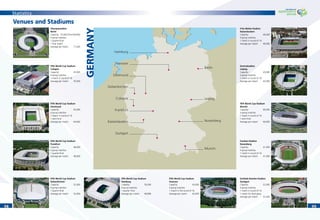
98 Venues and Stadiums
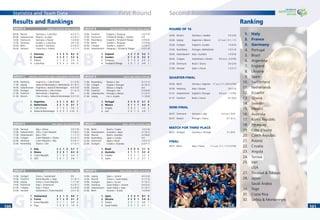
100 Results and Ranking
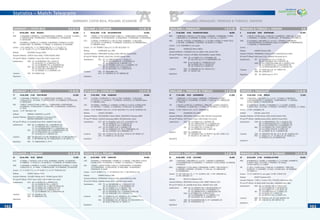
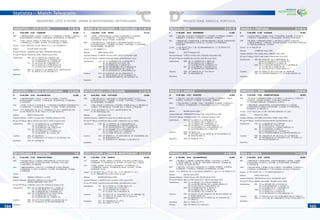
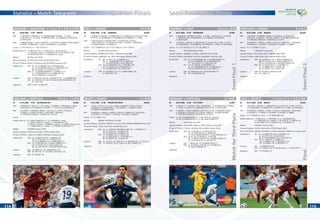
102 Match Telegrams
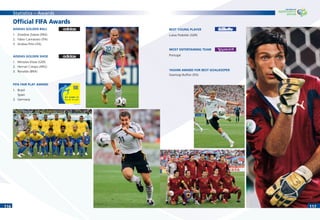
116 Official FIFA Awards
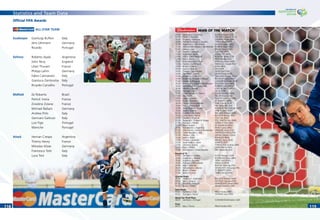
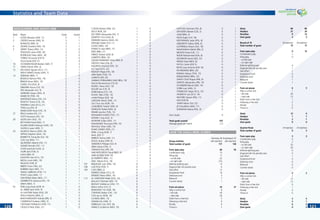
120 General Statistics
133 Tournament Facts and Rankings
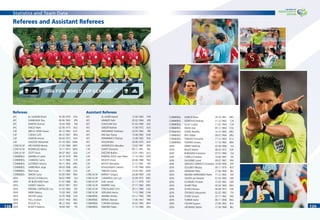
138 Referees and Assistant Referees
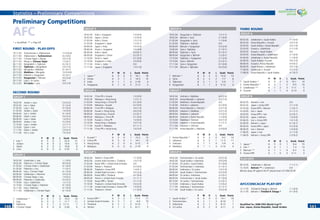
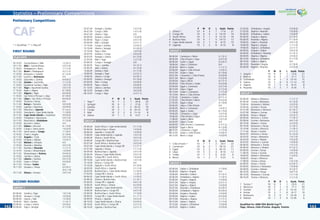
140 Preliminary Competitions
152 Team Data and Analysis
280 FIFA Delegation
Statistics and Team Data
10101010 11111111
12 General Organisation
16 Technical and Tactical Analysis
30 Story of the Championship
48 Comparison of the Semi-Finalists
54 Confederations‘ Analysis
68 Refereeing
74 Medical Report
80 Stadium and Security
86 Media Report
92 Marketing and Official Partners
Overall Analysis
22 33
Technical Report and Statistics
2006 FIFA World Cup Germany™
Rapport technique et statistiques
Informe técnico y estadísticas
Technischer Bericht und Statistik
Table of Contents
GENERAL 4
OVERALL ANALYSIS 10
STATISTICS AND TEAM DATA 96
Foreword by the FIFA President 4
Foreword by the Chairman of the Organising
Committee for the FIFA World Cup™ 6
Foreword by the Chairman of the
Local Organising Committee 8
General Organisation 12
Technical and Tactical Analysis 16
Story of the Championship 30
Comparison of the Semi-Finalists 48
Confederations’ Analysis 54
Refereeing 68
Medical Report 74
Stadiums and Security 80
Media Report 86
Marketing and Official Partners 92
Venues and Stadiums 98
Results and Ranking 100
Match Telegrams 102
Official FIFA Awards 116
General Statistics 120
Tournament Facts and Rankings 133
Referees and Assistant Referees 138
Preliminary Competitions 140
Team Data and Analysis 152
FIFA Delegation 280
Contents
44
Forewords
55
The 2006 FIFA World Cup Germany was a com-
plete success; it was a festival of football. The
organisation was faultless and there were no
incidents of note outside the stadia. I would like
to offer my thanks and express my respect to all
those who made the event possible, in particular
the German Local Organising Committee under
the leadership of Franz Beckenbauer as well as
its employees and, above all, the thousands of
volunteers.
The “old continent” teams, playing on their
home continent, clearly had the upper hand in
the World Cup. The final was a European classic.
The Asian teams bid farewell in the group stage,
followed by the representatives from Africa,
CONCACAF and Oceania in the round of 16 and
finally the South Americans in the quarterfinals.
The reasons behind this outcome will of course
be analysed in these parts of the world with the
objective of doing better next time.
As for the actual play, I expected to see more
attacking football from the round of 16 on-
wards, but the contrary was actually the case.
Too many coaches set out not to lose and their
players followed their instructions to the letter.
I think that this was a shame because we never
really witnessed a great spectacle even if we did
glimpse some minor attempts at more attacking
football.
With regards to the refereeing, I think that the
use of teams of three officials who are used
to working together, as well as rigorous selec-
tion and training since the start of 2005, led to
progress in the quality of the officiating. We
want referees to allow the game to flow while
protecting players. Improvements are only pos-
sible by taking on fully professional referees.
On a more general note, my abiding memory
is of a great festival. The 2006 World Cup reaf-
firms that football is the most popular sport on
the planet. Attendances at the stadia were near-
ly 100% of capacity. The “Fan Fests” in the host
and other cities, featuring giant screens, meant
that everyone could be involved. The German
people sent a positive image to the whole world
by their display of immense enthusiasm.
I hope that you find this detailed analysis of
the 2006 FIFA World Cup Germany useful. Our
flagship competition will be dissected during
the major FIFA conference scheduled for the
autumn in Berlin so that lessons can be learnt
for the next World Cup in South Africa in 2010.
The next World Cup will be a major test of an
entire people, of the entire young generation
and indeed of the entire continent. The aim will
be for football and FIFA to win in Africa – and
to win with Africa.
Joseph S. Blatter, FIFA President
La Coupe du Monde de la FIFA, Allemagne 2006
a été une réussite totale sur le plan de la fête du
football, une organisation sans faille et dépour-
vue d’incident notable en dehors des stades.
J’adresse mes remerciements et mon respect à
tous ceux qui ont œuvré pour la réalisation de
cet événement, notamment le Comité Organi-
sateur Local allemand sous la houlette de Franz
Beckenbauer, ses employés et surtout aussi les
milliers de bénévoles.
Sur leurs terres, les équipes du Vieux continent
ont clairement joué les premiers rôles. La finale fut
un classique européen. L’Asie a fait ses adieux au
premier tour, suivie par l’Afrique, la CONCACAF
et l’Océanie en huitièmes de finale et, finalement,
l’Amérique du Sud en quarts de finale. Les causes
de cette situation seront bien sûr analysées dans
le but de faire mieux la prochaine fois.
Sur le plan du jeu, je pensais que l’on allait se di-
riger vers un football plus offensif dès le deuxiè-
me tour, c’est le contraire qui s’est produit. Trop
d’entraîneurs ont d’abord fait jouer pour ne pas
perdre et leurs joueurs ont suivi les consignes au
pied de la lettre. Dommage, dirais-je, parce que
le grand spectacle ne s’est jamais véritablement
produit, même si l’on a pu entrevoir quelques
petits essais de football plus offensif.
Concernant l’arbitrage, je dirais que le choix de
trios qui avaient l’habitude de fonctionner en-
semble, la sélection rigoureuse et l’encadrement
depuis début 2005 nous ont fait progresser dans
la qualité de ce travail. Nous voulons des arbi-
tres qui favorisent le jeu et protègent les joueurs.
Maintenant, pour encore mieux s’organiser, il
est nécessaire d’engager des arbitres totalement
professionnels.
D’un point de vue général, je retiens l’image
d’une grande fête. Avec la Coupe du Monde
2006, on a constaté à nouveau que le football
est le sport le plus populaire de la planète, avec
un taux de remplissage des stades proche de
100%. Les « Fan Fest » dans les villes hôtes
et d’autres villes, où des écrans géants étaient
installés, ont permis à tous d’être de la partie.
Le peuple allemand a renvoyé ainsi une image
positive au monde entier, véhiculée par tant
d’enthousiasme.
Je vous souhaite à tous une bonne lecture de
cette analyse détaillée de la Coupe du Monde
de la FIFA, Allemagne 2006. Notre compétition-
phare sera disséquée lors d’une grande confé-
rence que la FIFA organisera en automne à Ber-
lin, afin d’en tirer les leçons appropriées pour la
prochaine édition, en 2010 en Afrique du Sud
– qui sera une épreuve majeure pour tout un
peuple, pour toute une jeunesse, pour tout un
continent, afin que le football et la FIFA gagnent
en Afrique avec l’Afrique.
La Copa Mundial de la FIFA Alemania 2006 fue
una exitosa fiesta del fútbol, con una perfec-
ta organización y sin incidentes importantes
fuera de los estadios. Me gustaría expresar mi
agradecimiento y respeto a todos aquellos que
participaron en la realización de este torneo,
principalmente al Comité Organizador Local
alemán bajo la batuta de Franz Beckenbauer, a
sus colaboradores y especialmente a los miles
de voluntarios.
En casa, los equipos del Viejo Continente se
impusieron claramente en estas lides, y así la fi-
nal fue un clásico europeo. Asia se despidió del
torneo en la primera fase, seguida de África, la
CONCACAF y Oceanía en los octavos de final,
y por último de Sudamérica en los cuartos de
final. Las causas de este resultado serán analiza-
das por las regiones respectivas a fin de mejorar
su próxima actuación.
En cuanto al estilo de juego, pensé que íbamos
a presenciar un fútbol más de ataque desde la
segunda fase, mas fue lo contrario. Demasiados
entrenadores apostaron por jugar para no perder
y sus jugadores siguieron sus órdenes al pie de
la letra. Opino que eso fue una lástima, porque
nos impidió ser testigos de un gran espectáculo,
aun si pudimos apreciar unos cuantos intentos
encaminados hacia un fútbol más ofensivo.
Con respecto al arbitraje, estimo que la elección
de los tríos que ya trabajaban bien juntos, la ri-
gurosa selección y el respaldo continuo desde
comienzos del 2005, ha hecho que mejoremos
ostensiblemente la calidad de esta labor. Que-
remos árbitros que contribuyan al desarrollo de
nuestro deporte y que protejan a los jugadores.
Debido a las circunstancias organizativas actua-
les, es necesario que contemos con árbitros ab-
solutamente profesionales.
En general, queda grabada en mi memoria el
grato recuerdo de una gran fiesta. Después de
la Copa Mundial 2006, constatamos una vez
más que el fútbol es el deporte más popular del
planeta, como lo demuestra la nutridísima con-
currencia a los estadios. Las “fiestas de los afi-
cionados” en las ciudades sede y otras ciudades
permitieron, gracias a la instalación de pantallas
gigantes, que todos pudieran participar del gran
espectáculo. El pueblo alemán también proyectó
una imagen sumamente positiva al mundo, en la
que se reflejó su gran entusiasmo.
Espero que disfruten la lectura de este análisis
detallado de la Copa Mundial de la FIFA Ale-
mania 2006. Nuestra competición estrella será
examinada hasta su más mínimo detalle durante
una gran conferencia que la FIFA organizará en
los próximos meses en Berlín, a fin de hacer un
balance y evitar los mismos errores en el Mundial
2010 en Sudáfrica. Dicho torneo será todo un
reto para el pueblo, la juventud y el continente
africano para que el fútbol y la FIFA ganen en
África con África.
Die FIFA Fussball-Weltmeisterschaft Deutschland
2006™ war ein grandioses Fussballfest, das,
perfekt organisiert, ohne nennenswerte Vorfälle
ausserhalb der Stadien über die Bühne ging. Ich
möchte deshalb all denjenigen herzlich danken,
die diesen Erfolg möglich gemacht haben, ins-
besondere dem lokalen Organisationskomitee
unter der Leitung von Franz Beckenbauer, all
seinen Mitarbeitenden und vor allem auch den
Zigtausenden Freiwilligen.
Vor heimischer Kulisse haben die Teams des
alten Kontinents das Feld klar beherrscht. Das
Endspiel war mit dem Klassiker Italien – Frank-
reich eine rein europäische Angelegenheit.
Während Asien bereits nach den Gruppenspie-
len die Segel streichen musste, war für Afrika,
die CONCACAF und Ozeanien das Achtelfinale,
für Südamerika das Viertelfinale Endstation. Die
Gründe für das frühe Aus werden von den Ver-
antwortlichen sicherlich genau analysiert, damit
den Fans beim nächsten Mal eine ähnliche Ent-
täuschung erspart bleiben wird.
Spielerisch erwartete ich ab dem Achtelfinale
mehr Offensivfussball, doch das Gegenteil war
der Fall. Zu viele Trainer predigten das Zu-null-
Spiel, und die Spieler nahmen sie beim Wort
– leider, weil so das grosse Spektakel ausblieb
und die Teams ihre Offensivqualitäten nur ab
und an aufblitzen liessen.
Beim Schiedsrichterwesen haben sich das Auf-
gebot eingespielter Trios, die strenge Selektion
und das Training seit Anfang 2005 ausbezahlt.
Wir wollen Schiedsrichter, die das Spiel laufen
lassen und gleichzeitig die Spieler schützen. Im
Sinne einer weiteren Verbesserung ist nun der
Schritt hin zu Profischiedsrichtern gekommen.
In Erinnerung wird zweifellos die Feststimmung
bleiben. Die WM 2006 mit den nahezu voll be-
setzten Stadien hat bewiesen, dass der Fussball
der weltweit beliebteste Sport ist. Die Fanfeste
in den Austragungsorten und die Übertragung
der Spiele auf Grossleinwänden in zahlreichen
anderen Städten haben die Weltmeisterschaft
zu einem einzigartigen Gemeinschaftserlebnis
gemacht. Die deutsche Bevölkerung hat sich
der Welt als überaus freundlicher und enthusi-
astischer Gastgeber präsentiert.
Ich wünsche Ihnen allen viel Spass beim Lesen
dieser detaillierten Analyse der FIFA Fussball-
Weltmeisterschaft Deutschland 2006™. Unser
bedeutendster Wettbewerb wird im Übrigen
auch Gegenstand einer grossen Konferenz sein,
die die FIFA im Herbst in Berlin durchführen
wird, um erste Rückschlüsse für die Weltmeister-
schaft 2010 in Südafrika zu ziehen. Diese ist für
ein ganzes Volk, eine ganze Jugend und einen
ganzen Kontinent eine grosse Herausforderung.
Für den Fussball und die FIFA heisst es schon
jetzt: in Afrika mit Afrika gewinnen.
66
Forewords
77
On 6 July 2000 the world held its breath as FIFA
President Joseph S. Blatter announced the country
selected to host the 2006 FIFA World Cup™.
Momentarily turning its attention away from
Korea and Japan, the football family looked to the
following tournament, which would take place in
the heart of Europe, in Germany.
From the moment the host nation was revealed,
the Germans showed exemplary diligence
and team spirit in building twelve magnificent
stadiums to ensure the teams, fans, VIPs and the
media would enjoy excellent facilities. In doing so,
they broke down old preconceptions, painting a
wonderful picture under the motto “A Time to
Make Friends”.
Detailed statistics are provided elsewhere in
this report, but I still wish to refer here to the
protagonists of any football event, the teams. In
847 qualifying matches between September 2003
and November 2005, they spent just over two
years preparing for their dream of lifting the FIFA
World Cup™ trophy on 9 July 2006.
As six teams were making their tournament debuts
(Angola, Côte d’Ivoire, Ghana, Togo, Trinidad and
Tobago and Ukraine), we witnessed a variety of
experience and skill levels. The football in Germany
was certainly very exciting. It was inspiring to see
less experienced nations progress beyond the group
stage (Australia and Ghana to the Second Round
and Ukraine to the quarter-finals). The pace and
style on display was impressive. We gasped in awe
as we watched Portugal’s Ronaldo expertly side-
stepping defenders, Beckham scoring a beautiful
goal from a free-kick, Argentina’s Rodriguez
netting possibly the best goal of the tournament
against Mexico, Australia heaping pressure on Italy
in the Round of 16 and many other moments of
genius from established and emerging players.
It was, of course, a pleasure to see the hosts secure
third place, a finish that also represented a huge
thank-you from the German team to their loyal fans
for their magnificent support, despite the criticism
of the players and coach Jurgen Klinsmann before
the tournament began.
The Final was played in front of a packed stadium
and a television audience in the billions. France
and Italy played some fine football before the final
was decided on penalties for only the second time
in World Cup history. Congratulations must go to
Italy, who lifted the trophy for the fourth time.
Our sincere thanks go to the LOC under Franz
Beckenbauer and all the staff, who worked tirelessly
across the country. Based on our experience in
Germany, it is clear that the LOC delivered a smooth
and well-organised FIFA World Cup™. They can be
proud of their achievements.
Lennart Johansson, Chairman of the
Organising Committee for the FIFA
World Cup™
Le 6 juillet 2000, le monde entier retenait son
souffle au moment où le Président de la FIFA,
Joseph S. Blatter, ouvrait l’enveloppe contenant
le nom du pays qui allait accueillir la Coupe du
Monde de la FIFA 2006 : l’Allemagne.
Depuis cette annonce, les Allemands ont travaillé
dur, vite et bien, construisant douze stades
magnifiques afin d’offrir un tournoi parfait aux
équipes, aux supporters, aux invités d’honneurs
et aux médias. Ils ont ainsi pu gommer de vieilles
idées reçues mais aussi et surtout faire honneur au
slogan « Le rendez-vous de l’amitié ».
Ce rapport offre de nombreuses statistiques
détailléesparailleursmaisjesouhaiteraisnéanmoins
parler des protagonistes de la compétition : les
équipes. Avec 847 matches qualificatifs joués entre
septembre 2003 et novembre 2005, les équipes
se sont longuement préparées à réaliser leur rêve :
soulever le trophée de la Coupe du Monde le 9
juillet 2006.
Six équipes disputaient leur toute première Coupe
du Monde (l’Angola, la Côte d’Ivoire, le Ghana, le
Togo, Trinité-et-Tobago et l’Ukraine) et nous avons
pu observer des matches très différents. Le football
pratiquélorsdecetournoiétaitfortdivertissantetce
fut plaisant de voir certaines des équipes les moins
chevronnées atteindre le second tour (l’Australie
et le Ghana en huitièmes, l’Ukraine en quarts). La
vitessedejeuétaitégalementimpressionnante.Quel
spectacle que de voir Cristiano Ronaldo prendre le
dessus sur son défenseur, Beckham enrouler un
splendide coup franc, Maxi Rodriguez marquer
un but splendide depuis l’angle de la surface ou
encore l’Australie pousser dans ses retranchements
le futur champion du monde en huitièmes, sans
parler des innombrables gestes techniques de
footballeurs confirmés ou en devenir !
Voir l’Allemagne s’adjuger la troisième place devant
son public était un plaisir ; c’était aussi un grand
« merci » adressé à ses fans, malgré les critiques
émises à l’encontre des joueurs et du sélectionneur
alors que le tournoi n’avait pas encore débuté.
La finale s’est disputée dans un stade comble, et
devant des milliards de téléspectateurs. La France
et l’Italie ont pratiqué un bon football avant d’en
venir à la séance des tirs au but, la deuxième de
l’histoire en finale de Coupe du Monde. Et c’est
l’Italie qui a décroché sa quatrième étoile.
En plus de féliciter le vainqueur, nos sincères
remerciements vont à Franz Beckenbauer et à
toute son équipe pour s’être démenés dans toute
l’Allemagne pendant un mois. Ce que nous avons
vécu nous permet d’affirmer que le COL a proposé
une Coupe du Monde bien organisée et sans
fausse note. Il peut en être fier.
El 6 de junio del 2000, el mundo entero seguía en
vilo el momento en el que el Presidente de la FIFA
Joseph S. Blatter abría el sobre con el nombre del
país anfitrión de la Copa Mundial de la FIFA 2006.
La gran familia del fútbol proyectó su mirada más
allá de los preparativos de Corea y Japón y se posó
por un momento en el escenario de la siguiente
Copa Mundial, Alemania.
Desde ese momento, los alemanes trabajaron
incansablemente en la construcción de 12
magníficos estadios para ofrecer a los equipos,
la hinchada, los invitados especiales y los medios
una magnífica infraestructura e hicieron realidad
el sueño de desterrar viejos prejuicios y proyectar
una imagen cordial bajo el lema: “El mundo entre
amigos”.
Con la ilusión de poder realizar su sueño de
conquistar el Mundial 2006, los aspirantes se
prepararon durante escasos 2 años y disputaron
847 partidos clasificatorios entre septiembre de
2003 y noviembre de 2005.
Seis equipos debutaron en este campeonato:
Angola, Costa de Marfil, Ghana, Togo, Ucrania
y Trinidad y Tobago; tuvimos la oportunidad de
disfrutar de un espectáculo de diferentes ritmos
y una gran variedad de estilos. Fue muy alentador
ver el avance de algunos de los equipos menos
experimentados: Australia y Ghana llegaron a la
segunda ronda y Ucrania a los cuartos de final.
Sobrecogidos, vimos como Ronaldo de Portugal
esquivó ágilmente a los defensas contrarios,
fuimos testigos del hermoso tiro libre que convirtió
Beckham, del gol de Rodríguez de Argentina
contra México, tal vez el más hermoso del torneo,
y de la asfixiante presión que los australianos
ejercieron sobre los futuros campeones mundiales;
disfrutamos momentos de auténtico genio
futbolístico de nuevos y consagrados jugadores.
Fue un gran placer ver cómo el equipo anfitrión
conquistó el tercer lugar; un maravilloso gesto
de gratitud hacia sus seguidores que le alentaron
siempre a pesar de las críticas previas a los jugadores
y a Jurgen Klinsmann.
La final se disputó en un estadio repleto y frente a
miles de millones de telespectadores. Francia e Italia
desplegaron exquisitas acciones futbolísticas antes
del segundo lanzamiento de penales que definiera
la final mundialista. Felicitaciones al equipo italiano
que conquistó el título mundial por cuarta vez.
Felicitaciones también al COL bajo la égida de
Franz Beckenbauer y a todos sus colaboradores
que trabajaron incansablemente a lo largo y ancho
del país. ¡Sin duda pueden estar orgullosos de sus
logros!
Die Welt hielt am 6. Juli 2000 den Atem an, als
FIFA-Präsident Joseph S. Blatter den Ausrichter der
FIFA Fussball-Weltmeisterschaft 2006™ bekannt
gab. Während die Vorbereitung in Korea und Japan
in vollem Gang war, freute sich die internationale
Fussballfamilie bereits auf die übernächste WM, die
also in Deutschland stattfinden würde.
Die Deutschen arbeiteten von Anfang an mit
vollem Engagement auf das Ereignis hin. Das
Ergebnis ihrer Bemühungen waren zwölf herrliche
Stadien und ausgezeichnete Einrichtungen für
Teams, Fans, Ehrengäste und Medien. So wurden
alte Vorurteile abgebaut und ein neues Image
ganz nach dem Motto „Die Welt zu Gast bei
Freunden™“ aufgebaut.
Auf Zahlen und Statistiken wird in diesem Bericht
an anderer Stelle eingegangen. Nur kurz ein Wort
zu den Hauptdarstellern jedes Fussballturniers: den
Mannschaften. Sie trugen von September 2003
bis November 2005 847 Vorrundenspiele aus und
arbeiteten somit über zwei Jahre lang auf das
grosse Finale am 9. Juli 2006 hin.
Sechs Mannschaften nahmen erstmals an einer
WM-Endrunde teil (Angola, Elfenbeinküste, Ghana,
Togo, Trinidad und Tobago sowie die Ukraine).
Insgesamt bot das Turnier grossartigen Fussball.
Erfreulicherweise konnten auch einige der weniger
erfahrenen Teams bis in die K.-o.-Runde vorstossen
(Australien, Ghana und die Ukraine). Viel Freude
bereiteten uns die Spieler, etwa der Portugiese
Cristiano Ronaldo mit seinen Tricks, der Engländer
Beckham mit seinem wunderschönen Freistosstor,
der Argentinier Rodriguez gegen Mexiko mit dem
wohl schönsten Treffer des Turniers, die kecken
Australier im Achtelfinale gegen den späteren
Weltmeister und viele weitere arrivierte Stars, aber
auch Neulinge.
Erfreulich war auch der dritte Platz des deutschen
Teams, vor allem für die treuen Fans, die trotz der
Kritik, die vor dem Turnier auf die deutschen Spieler
und ihren Trainer Jürgen Klinsmann einprasselte,
immer zu ihrem Team gehalten hatten.
Das Endspiel fand vor ausverkauften Rängen und
mehreren Milliarden Fernsehzuschauern statt. 120
Minuten lang lieferten sich Frankreich und Italien
eine packende Partie, bevor sich die Italiener im erst
zweiten Elfmeterschiessen in einem WM-Finale ihren
vierten Titel sichern konnten.
UnserDankgiltdemLOCunterderLeitungvonFranz
Beckenbauer und allen Helferinnen und Helfern, die
unermüdlich für dieses Turnier gearbeitet haben.
Das LOC darf mit Stolz auf eine gut organisierte
FIFA Fussball-WM™ zurückblicken.
88
Forewords
99
“Siamo campioni del mondo!” (“We are the
champions of the world!”) was the chant that
rang out as the Italian team and their fans cele-
brated themselves and their country after lifting
the World Cup.
The squadra azzurra owe their fourth World
Cup triumph primarily to a nigh on impenetrable
rearguard, personified by three superb
individuals: the outstanding Fabio Cannavaro at
the heart of the defence, the strategist Andrea
Pirlo, who pulled the strings in midfield, and the
excellent Gianluigi Buffon in goal.
France, Italy’s opponents in the final, got off
to a shaky start in the group stage. But after
convincing victories over Spain, Brazil and
Portugal in the knockout phase, as Zinedine
Zidane gradually began to impose himself on
the tournament, a second World Cup triumph
seemed well within their grasp. In the end,
however, France were defeated in a penalty
shoot-out by the unflappable Italians.
The tactical approach of both finalists – Italy
and France began with just one striker – was
indicative of the overall impression left by the
tournament in footballing terms. Attacking
play often suffered under overly strict tactical
instructions, something this report by the FIFA
Technical Study Group will no doubt illustrate in
detail. The battle for the ball rather than artistry
on it dominated the proceedings, with the
holders Brazil, who were my hot favourites, too,
looking strangely inhibited from the outset.
All in all we are left with the realisation that
the leading teams from Europe and South
America contested the quarter-finals among
themselves, dominating even more than they
did at the 2002 World Cup in Korea and Japan
and widening the gap to the teams of the other
confederations once again. None of the Asian
representatives managed to negotiate the group
stage. The USA finished a disappointing last in
their group. Africa at least saw debutants Ghana
through to the second round and was able to
take consolation from the host of compliments
for Côte d’Ivoire, who were better than their
group-stage elimination would suggest.
As the host nation we were delighted to see the
German team dazzle and delight not just their
own fans with their bright attacking play, thus
making a most decisive contribution to what
was a wonderful atmosphere. Overall it was a
memorable tournament which, immersed in the
fantastic atmosphere created by good-natured
and non-violent fans from across the globe,
proved a marvellous festival of world football.
I would like to thank everyone who played a
part.
Franz Beckenbauer
President of the FIFA 2006 World Cup
Local Organising Committee Germany
« Siamo campioni del mondo! », tel est le
refrain des joueurs italiens, de leurs fans et du
pays tout entier célébrant la victoire finale en
Coupe du Monde.
Ce quatrième titre mondial, la Squadra Azzurra
le doit en premier lieu à une arrière-garde
infranchissable, symbolisée par trois solistes de
premier ordre : Fabio Cannavaro, incontestable
patron de la défense, Andrea Pirlo, nettoyeur
mais aussi stratège de l’entrejeu, et Gianluigi
Buffon, exceptionnel gardien de but.
L’équipe de France qu’elle a affrontée en finale
a connu une entame de tournoi difficile, mais
des victoires convaincantes contre l’Espagne,
le Brésil et le Portugal lors des matches à
élimination directe ont permis aux Bleus d’un
Zinedine Zidane retrouvé de sérieusement
songer à reconquérir le trophée huit ans après
1998. Ce n’est finalement qu’aux tirs au but que
la France s’est inclinée, cédant face au sang-
froid des Italiens.
La disposition tactique des deux finalistes
– un seul attaquant pour l’Italie comme pour
la France – était significative de l’impression
générale du tournoi. Le jeu offensif a beaucoup
souffert des trop strictes consignes défensives,
ce que le Groupe d’Etude Technique de la FIFA
ne manquera pas de détailler dans ce rapport.
Récupérer le ballon était donc plus important
que bien l’exploiter, et même les champions en
titre brésiliens, mes grands favoris au début de la
compétition, ont été étrangement peu inspirés.
Cette tendance est aussi la constatation que les
grandeséquipeseuropéennesetsud-américaines
se sont retrouvées entre elles en quarts de
finale, asseyant bien plus leur domination qu’il
y quatre ans en Corée et au Japon, et creusant
de nouveau un large fossé avec les sélections
issues des autres confédérations. Aucune équipe
asiatique n’a passé le premier tour. Les Etats-
Unis ont déçu en terminant derniers de leur
groupe. L’Afrique a certes emmené en huitièmes
de finale un de ses nouveaux venus, le Ghana, et
reçu des éloges pour la Côte d’Ivoire, éliminée
avec les honneurs d’un groupe très relevé, mais
ce ne sont là que des lots de consolation.
Nous avons beaucoup apprécié le football
dynamique et offensif que le pays hôte a
pratiqué ; il a mis joie et sourire sur de nombreux
visages – pas seulement allemands – et a
réellement contribué à la merveilleuse ambiance
qui a régné sur l’ensemble du tournoi. Cette
Coupe du Monde restera un grand moment qui,
emprunt de la fantastique atmosphère créée par
les sympathiques supporters du monde entier,
s’est transformé en festival du football mondial.
Je souhaite remercier tous ceux et celles qui y
ont contribué.
“Siamo campioni del mondo!” Con este himno
victorioso celebraron la escuadra italiana y sus
hinchas su nuevo título mundial.
LaSquadraAzzurraagradecesucuartotítuloante
todo a su infranqueable defensa, conformada
por tres grandiosos solistas: el extraordinario
líder de la defensa Fabio Cannavaro, el estratega
Andrea Pirlo en calidad de dirigente de la línea
media, y el magnífico portero Gianluigi Buffon.
Francia, el contrincante de la final, tuvo
dificultades para encontrar su juego en los
partidos de grupo. Tras victorias convincentes
en la ronda eliminatoria contra España, Brasil y
Portugal, con un Zidane en excelente forma, el
segundo título mundial después de 1998 parecía
más cerca que nunca. No obstante, los franceses
sucumbieron en la tanda de penales ante una
escuadra italiana de nervios de acero.
El planteamiento táctico de ambas escuadras
finalistas – Italia y Francia actuaron con un
único punta de lanza – fue característico
durante todo el torneo. No pocas veces el
juego ofensivo fue dejado de lado debido a
las estrictas instrucciones tácticas, un punto
que seguramente será tratado en el presente
informe del Grupo de Estudio Técnico de la FIFA.
Las acciones no reflejaron tanto el arte con el
balón sino una lucha por él, e incluso el antiguo
poseedor del título y mi favorito Brasil actuó de
manera sorprendentemente refrenada.
En suma, las escuadras líderes de Europa y
Sudamérica predominaron en los cuartos de
final, aún más que en el Mundial de Corea y
Japón 2002, lo cual aumentó ostensiblemente
la brecha con las confederaciones restantes.
Los equipos asiáticos fracasaron en los partidos
de grupo; EE UU decepcionó con el último
puesto de su grupo. África logró clasificarse
con el debutante Ghana para octavos de
final, pudiendo por lo menos llevarse como
consuelo los numerosos elogios que recibió
gracias a Costa de Marfil, equipo que, a pesar
de su honrosa actuación, fue eliminado en su
poderoso grupo.
En calidad de organizadores nos ha alegrado
especialmente que el equipo alemán generara
espectáculo y entusiasmo – no sólo entre sus
propios seguidores – con su refrescante juego
ofensivo, contribuyendo así a la extraordinaria
atmósfera de este Mundial. Fue un torneo
memorable, una grandiosa fiesta del fútbol
mundial, inmersa en el fantástico ambiente de
alegres y pacíficos hinchas provenientes de todo
el planeta. A todos los que lo hicieron posible:
Mil gracias.
„Siamo campioni del mondo!“ Mit diesem
Schlachtruf feierten Italiens Team und seine Fans
sich selbst und ihr Land als neuen Weltmeister.
Ihren vierten WM-Titel verdankt die
„Squadra azzurra“ in erster Linie ihrer schier
unüberwindbaren Defensive, verkörpert durch
drei grossartige Solisten: den herausragenden
Abwehrchef Fabio Cannavaro, den Strategen
Andrea Pirlo als Ordnungsfaktor im Mittelfeld
sowie den herausragenden Torwart Gianluigi
Buffon.
Das Team des Endspielgegners Frankreich
hatte einige Mühe, in der Gruppenphase ins
Turnier zu finden. Nach überzeugenden Siegen
in den K.o.-Runden gegen Spanien, Brasilien
und Portugal mit einem immer dominanter
aufspielenden Zinedine Zidane schien der zweite
WM-Triumph nach 1998 durchaus in Reichweite.
Letztlich scheiterten die Franzosen jedoch im
Elfmeterschiessen gegen die nervenstarken
Italiener.
Die taktische Ausrichtung der beiden Endspiel-
Teams – Italien und Frankreich begannen mit nur
einer Sturmspitze – war bezeichnend für den
sportlichen Gesamteindruck dieses Turniers. Das
Offensivspiel litt oft unter zu strikten taktischen
Vorgaben, was dieser Bericht der technischen
Studiengruppe der FIFA sicherlich detailliert
darstellen wird. Weniger die Kunst am Ball als
vielmehr der Kampf um den Ball beherrschte
das Geschehen, wobei der Titelverteidiger und
auch mein Topfavorit Brasilien von Beginn an
rätselhaft gehemmt wirkten.
Unter dem Strich steht die Erkenntnis, dass die
führenden Teams aus Europa und Südamerika
im Viertelfinale unter sich waren, also noch
dominanter auftraten als bei der WM 2002
in Korea und Japan und den Abstand zu den
Verbänden der anderen Konföderationen
wieder vergrösserten. Die asiatischen Verbände
blieben alle schon in der Gruppenphase hängen.
Die USA enttäuschten als Letzte ihrer Gruppe.
Afrika brachte immerhin Neuling Ghana ins
Achtelfinale und konnte die vielen Komplimente
für die Elfenbeinküste, die in ihrer schweren
Gruppe unter Wert ausschied, als Trostpreis mit
auf den Schwarzen Kontinent nehmen.
Als Ausrichter hat es uns gefreut, dass die
deutsche Mannschaft mit ihrem engagierten
Offensivspiel – nicht nur bei ihren eigenen
Fans – Glanz und Begeisterung verbreiten und
damit einen ganz entscheidenden Beitrag zu der
wunderbaren Atmosphäre leisten konnte. Es
war ein denkwürdiges Turnier, das – eingebettet
in die fantastische Stimmung fröhlicher und
friedlicher Fans aus aller Welt – ein insgesamt
wunderschönes Festival des Weltfussballs
gewesen ist. Ich danke allen, die ihren Teil hierzu
beigetragen haben.
10101010 11111111
12 General Organisation
16 Technical and Tactical Analysis
30 Story of the Championship
48 Comparison of the Semi-Finalists
54 Confederations‘ Analysis
68 Refereeing
74 Medical Report
80 Stadiums and Security
86 Media Report
92 Marketing and Official Partners
Overall Analysis
1212
Overall Analysis
1313
General Organisation
It is not far off the truth to say that the whole
world has heard of the FIFA World Cup™.
FIFA and the Local Organising Committee in
Germany are therefore entrusted with the
pressure of guaranteeing that the month-
long event is run efficiently, effectively and
professionally, as the world enjoys the world’s
biggest and best football tournament.
The organisation of such a wildly popu-
lar event is very time-consuming and even
though the FIFA World Cup™ lasts just 30
days, work for the tournament starts many
years before. The LOC is responsible for de-
livering stadiums, hotels, training sites, media
centres, ticketing outlets, marketing facilities,
transportation links and vehicles, hospitality
villages, television infrastructure, locations for
protocol events, public viewing areas, highly
trained personnel, security infrastructure …
the list is certainly impressive.
FIFA and the LOC Germany 2006 worked
hand in hand from the outset with the joint
objective of organisational excellence. There
were monthly working meetings between
the two organisations to discuss concepts,
project planning, timelines and the many
other organisational aspects. There were also
bi-annual inspection visits of the stadiums to
meticulously ensure that the quality that FIFA
expects for its prime tournament is achieved,
that space management is optimised and
that circulation flows within the stadium are
as straightforward as possible.
Thanks go to the highly organised and com-
petent LOC and the countless volunteers who
were always ready with help and a smile. Ger-
many was certainly a perfect host, making
its slogan “A Time to Make Friends” come
alive.
The LOC also assisted FIFA in organising a
series of FIFA World Cup™-related events
such as the preliminary draw in Frankfurt in
December 2003, the final draw in Leipzig in
December 2005 and the team workshop in
Dusseldorf in March 2006.
We would also like to express thanks to the
12 host cities for ensuring that the venues ran
smoothly. It was thanks to them that the ‘fan
fests’ thrived in becoming a huge party, with
friendly, happy faces from all corners of the
world joining together to celebrate football.
The 12 stadiums of varying capacities and
styles were a fantastic stage for this wonder-
ful tournament and a great promotion of
Germany’s football tradition.
Within FIFA, a dedicated FIFA World Cup
Office was set up to take care of project
management, form the main interface with
both the LOC and the teams, analyse con-
cepts drawn up by the LOC, study related
contracts, make the necessary arrangements
for the FIFA delegation and devote their
working days to making the tournament
run smoothly according to FIFA guidelines
and standards.
Thanks also go to the numerous service pro-
viders who contributed to ensuring organisa-
tional success in ticketing, accommodation,
technology and telecommunications.
We must not, of course, forget the protago-
nists in any football tournament: the teams.
The focus on the teams certainly reached new
levels in 2006. The team workshop held in
Dusseldorf in March 2006 was attended by
all 32 teams and was a great basis for going
into detail on the organisational aspects of
the 2006 FIFA World Cup Germany™. This
year, the teams arrived in the host country
after a longer rest period than in the past.
Throughout Germany, each team selected
its own team base camp with top quality ac-
commodation and training facilities, allowing
them to prepare thoroughly for their matches.
Their performances on the pitch were equally
high-class, with many exciting matches, lots
of goals and memorable moments.
Finally, our congratulations go to the partici-
pating teams who made the 2006 FIFA World
Cup Germany™ an exhilarating football ex-
perience, and to the Italian team for succeed-
ing in becoming World Champions.
Il n’est pas exagéré d’affirmer que la Coupe
du Monde de la FIFA est universellement
connue. La FIFA et le Comité d’Organisation
Local allemand ont donc eu la lourde tâche de
veiller au bon déroulement de l’événement,
d’assurer la gestion efficace et professionnelle
de la plus grande compétition de football au
monde, suivie pendant un mois par les sup-
porters de la planète entière.
Organiser un événement de cette envergure
exige beaucoup de temps et bien que la
Coupe du Monde de la FIFA ne dure que 30
jours, le travail en amont débute de nom-
breuses années avant la compétition. Le COL
est notamment chargé d’organiser la mise à
disposition des stades, des hôtels, des sites
d’entraînement, des centres des médias, de
gérer les billetteries, les espaces marketing,
les réseaux et moyens de transport, les zo-
nes d’hospitalité, les installations de télévi-
sion, les espaces réservés aux manifestations
transformées en immenses fêtes, rassemblant
autour de cette célébration du football des vi-
sages souriants et amicaux, venus des quatre
coins du globe.
Les 12 stades, de capacité d’accueil variable
et d’architecture différente, constituaient
une scène fantastique pour cette magnifique
compétition, qui a permis de promouvoir la
tradition du football allemand.
La FIFA, quant à elle, a spécialement mis en
place un Bureau de la Coupe du Monde afin
d’assurer la gestion du projet, de constituer
l’interface principale pour le COL et les équi-
pes, d’analyser les idées formulées par le
COL, d’étudier les contrats, d’effectuer les
préparatifs nécessaires pour la délégation de
la FIFA et de faire quotidiennement en sorte
que le déroulement du tournoi réponde aux
directives et aux normes de la FIFA.
Nous adressons aussi nos remerciements aux
nombreux prestataires de services qui ont
contribué au succès de l’organisation en ma-
tière de billetterie, d’hébergement, de tech-
nologie et de télécommunications.
Evidemment, nous ne devons pas oublier les
principaux protagonistes : les équipes, qui
furent, plus que jamais, au centre de toutes
les attentions. En mars 2006 s’est tenu à Düs-
seldorf le séminaire des équipes auquel ont
assisté les 32 sélections et qui a permis de
considérer tous les détails de l’organisation
de la Coupe du Monde de la FIFA, Allemagne
2006. Cette année, les équipes sont arrivées
dans le pays hôte après une plus longue pé-
riode de repos. Chaque équipe a choisi son
propre camp de base, doté d’un héberge-
protocolaires, les emplacements dédiés aux
écrans géants, de recruter du personnel hau-
tement qualifié, de mettre en place des dis-
positifs de sécurité… La liste est réellement
impressionnante !
Dès le début, la FIFA et le COL Allemagne
2006 ont travaillé main dans la main avec
cette même volonté d’excellence. Au cours
des réunions mensuelles, les deux organisa-
tions ont échangé leurs idées, planifié les pro-
jets, établi des échéances et abordé de nom-
breux autres aspects liés à l’organisation. Les
stades ont été également inspectés tous les
semestres afin de s’assurer dans les moindres
détails de la qualité exigée pour cette com-
pétition phare, de l’optimisation de l’espace
et de la fluidité de la circulation à l’intérieur
des stades.
Nous remercions le COL pour son grand pro-
fessionnalisme et son talent d’organisateur,
ainsi que les très nombreux bénévoles, qui
ont toujours été disponibles, serviables et
souriants. L’Allemagne a été un hôte parfait,
ayant fait de son slogan « Le rendez-vous de
l’amitié » une réalité.
Le COL a également contribué à l’organisa-
tion de plusieurs événements liés à la Coupe
du Monde de la FIFA, dont le tirage au sort
préliminaire à Francfort en décembre 2003,
le tirage au sort final à Leipzig en décembre
2005 et le séminaire des équipes à Düsseldorf
en mars 2006.
Nous tenons également à exprimer nos re-
merciements aux 12 villes hôtes qui ont veillé
au bon déroulement des événements sur
les sites. Grâce à elles, les Fan Fests se sont
1414
Overall Analysis
1515
ment et d’une infrastructure d’entraînement
de grande qualité qui leur ont permis de
suivre une préparation approfondie. Leurs
performances sur le terrain ont été tout aussi
excellentes : ces équipes nous ont offert des
matches passionnants, de nombreux buts et
des moments inoubliables.
Nous adressons toutes nos félicitations aux
équipes participantes qui nous ont fait vibrer
durant cette Coupe du Monde de la FIFA,
Allemagne 2006, et à l’équipe italienne qui a
remporté le titre de champion du monde.
No resulta exagerado afirmar que el mundo
entero ha oído hablar de la Copa Mundial
de la FIFA. Sobre la FIFA y el Comité Organi-
zador de Alemania recaía la responsabilidad
de garantizar que este acontecimiento de un
mes de duración fuese dirigido de manera efi-
ciente y profesional, de tal manera que todo
el planeta pudiese gozar del más grande y
mejor torneo de fútbol del mundo.
La organización de un acontecimiento tan
popular requiere mucho tiempo y, pese a la
corta duración de la Copa Mundial, la pre-
paración de este certamen se inició muchos
años antes. El COL se responsabilizó de es-
tadios, hoteles, campos de entrenamiento,
centros de los medios, puntos de venta de en-
tradas, servicios de comercialización, servicio
de transportes y vehículos, núcleos de hos-
pitalidad, infraestructura televisiva, lugares
para eventos protocolares, lugares públicos
para seguir los partidos, personal altamente
capacitado, infraestructura de seguridad… la
lista es extensa.
La FIFA y el COL Alemania 2006 trabajaron
codo a codo desde el comienzo con el fin co-
mún de alcanzar la excelencia organizativa.
Se celebraron reuniones mensuales de traba-
jo para discutir conceptos, la planificación de
proyectos, plazos y muchos otros aspectos
organizativos. Cada seis meses se realizaron
visitas de inspección a los estadios para ga-
rantizar el logro de la calidad requerida por la
FIFA para su torneo emblemático, el óptimo
manejo del espacio disponible, y una infraes-
tructura que permitiera transitar lo más libre-
mente posible en los estadios.
Expresamos nuestro agradecimiento al COL,
un organismo muy organizado y competen-
te, y a los innumerables voluntarios siempre
dispuestos a ayudar y a brindar una sonrisa.
Alemania fue indudablemente un perfecto
anfitrión que hizo realidad su lema: “El mun-
do entre amigos”.
El COL asistió a la FIFA, igualmente, en la
organización de eventos relacionados con el
Mundial como el sorteo preliminar realizado
en diciembre de 2003 en Fráncfort, el sorteo
final en diciembre de 2005 en Leipzig, y el
seminario de los equipos en marzo de 2006
en Dusseldorf.
Deseamos agradecer también a las 12 sedes
anfitrionas por garantizar el óptimo desarrollo
de todas las actividades. Gracias a ellas, las
fiestas de los aficionados se convirtieron en
una celebración, con rostros felices de todos
los rincones del mundo unidos por el fútbol.
Los 12 estadios de distinta capacidad y estilo
constituyeron un grandioso escenario para este
maravilloso torneo y un extraordinario reconoci-
miento a la tradición futbolística de Alemania.
En la FIFA propiamente dicha, se instaló una
Oficina de la Copa Mundial que se encargó del
manejo del proyecto, de mantener el contacto
directo tanto con el COL como con los equi-
pos, de analizar los conceptos aportados por
el COL, de estudiar contratos relacionados con
estos asuntos, de hacer los preparativos nece-
sarios para la delegación de la FIFA, y, median-
te su esfuerzo laboral cotidiano y continuo, de
garantizar que el torneo se desarrollase acorde
a las directivas y exigencias de la FIFA.
No debemos olvidar a todos aquellos que
con sus servicios contribuyeron al torneo: las
oficinas encargadas de las entradas, el aloja-
miento de los funcionarios y de las telecomu-
nicaciones y por supuesto, a los principales
protagonistas: los equipos. Los 32 participan-
tes acudieron al seminario celebrado en Du-
sseldorf en marzo de 2006, que constituyó la
oportunidad más adecuada de dar a conocer
detalladamente los aspectos organizativos de
la Copa Mundial 2006. Este año, todas las
escuadras arribaron al país organizador tras
un periodo de descanso más prolongado que
en otras ocasiones. Cada equipo eligió su se-
de preferida en Alemania, con alojamientos
e instalaciones de entrenamiento de primera
categoría que les permitieron prepararse con-
cienzudamente para sus partidos.
En suma, felicitamos a los equipos participan-
tes que convirtieron a la Copa Mundial de la
FIFA Alemania 2006 en una excitante expe-
riencia futbolística, y a la selección italiana
por consagrarse Campeón Mundial.
Die FIFA Fussball-Weltmeisterschaft™ ist ein
Turnier, das man auf der ganzen Welt kennt.
Die FIFA und das lokale Organisationskomitee
übernahmen die verantwortungsvolle Aufga-
be, für einen effizienten, professionellen und
reibungslosen Ablauf des grössten und bes-
ten Fussballturniers der Welt zu sorgen.
Zwar dauert das Turnier selbst nur 30 Tage,
doch die Vorbereitungen beginnen schon Jahre
im Voraus. Zu den Aufgaben des LOC gehören
die Bereitstellung von Stadien, Hotels, Trainings-
anlagen, Medienzentren, Verkaufskanälen für
Tickets, Marketingplattformen, Transportver-
bindungen und Fahrzeugen, Hospitality-Ein-
richtungen, der TV-Infrastruktur, Örtlichkeiten
für offizielle Veranstaltungen, Public-Viewing-
Bereichen, bestens ausgebildetem Personal,
der sicherheitsrelevanten Infrastruktur … eine
wahrlich beeindruckende Liste.
Zur Erreichung ihres gemeinsamen Ziels, der
optimalen Organisation der Endrunde, ar-
beiteten die FIFA und das deutsche LOC von
Anfang an eng zusammen. Bei monatlichen
Arbeitssitzungen besprachen die beiden Or-
ganisationen Konzepte, geplante Projekte,
Termine und viele andere organisatorische
Aspekte. Die Stadien wurden zweimal jährlich
einer umfassenden Inspektion unterzogen,
um sicherzustellen, dass die Qualitätsansprü-
che der FIFA für ihr bedeutendstes Turnier
erfüllt werden, dass der vorhandene Platz
optimal genutzt wird und dass innerhalb der
Stadien für möglichst kurze, einfache Wege
für die Zuschauer gesorgt ist.
Grosser Dank gebührt dem sehr gut organi-
sierten und äusserst kompetenten LOC sowie
den unzähligen freiwilligen Helfern, die alle
Besucher hilfsbereit und mit einem Lächeln
empfingen. Deutschland machte als perfekter
Gastgeber dem WM-Slogan „Die Welt zu
Gast bei Freunden™“ alle Ehre.
Das LOC unterstützte die FIFA auch bei der
Ausrichtung einiger Veranstaltungen im Vor-
feld der WM, darunter die Auslosung der
Vorrunde im Dezember 2003 in Frankfurt,
die Endrundenauslosung im Dezember 2005
in Leipzig und der Teamworkshop im März
2006 in Düsseldorf.
Unser Dank gilt auch den zwölf Spielorten,
die ihre Aufgabe hervorragend erfüllten. Die
Besucher aus aller Welt freuten sich über den
herzlichen Empfang und machten die Fanfeste
zu fröhlichen Partys im Zeichen des Fussballs.
Die zwölf Stadien unterschiedlicher Bauart
und Kapazität boten die perfekte Bühne für
ein herrliches Turnier und bewiesen einmal
mehr, dass Deutschland eine echte Fussball-
nation ist.
Auf der Seite der FIFA war die Abteilung FIFA
Fussball-Weltmeisterschaften dafür zustän-
dig, die Vorbereitungen zu überwachen, den
Informationsaustausch mit dem LOC und
den Mannschaften zu gewährleisten, Kon-
zepte des LOC zu analysieren, entsprechende
Verträge zu prüfen, die notwendigen Vorbe-
reitungen für die FIFA-Delegation zu treffen,
kurz: für einen reibungslosen Ablauf des Tur-
niers gemäss den Richtlinien und Standards
der FIFA zu sorgen.
Weiterer Dank gebührt den zahlreichen
Dienstleistern in den Bereichen Ticketing,
Unterbringung, Technik und Telekommuni-
kation, die einen grossen Beitrag zum orga-
nisatorischen Erfolg leisteten.
Die wichtigsten Akteure eines Fussballturniers
sind natürlich die Spieler und ihre Teams, die
noch nie zuvor so stark eingebunden worden
waren. Der Teamworkshop im März 2006
in Düsseldorf, an dem alle 32 Mannschaften
teilnahmen, bot eine ausgezeichnete
Plattform, um organisatorische Aspekte der
FIFA Fussball-Weltmeisterschaft Deutschland
2006™ zu besprechen. Vor dieser WM hatten
die Spieler eine längere Erholungszeit als vor
früheren Turnieren. Nach ihrer Ankunft bezo-
gen die Teams in ganz Deutschland ihre eige-
nen Quartiere mit erstklassigen Unterkünften
und Trainingsanlagen, wo sie sich optimal auf
ihre Spiele vorbereiten konnten. Von ebenso
hoher Qualität war denn auch das Turnier, mit
vielen spannenden Partien, schönen Toren
und denkwürdigen Momenten.
Wir danken allen Mannschaften, die die
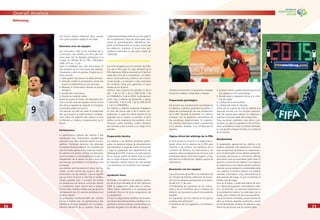
FIFA Fussball-Weltmeisterschaft Deutschland
2006™ zu einem so wunderbaren Ereignis
gemacht haben, und gratulieren dem italie-
nischen Team herzlich zum Weltmeistertitel.
General Organisation
1616
Overall Analysis
1717
Technical and Tactical Analysis
Playing systems
Compared with the 2002 FIFA World Cup
Korea/Japan, when 24 of the competing
nations opted for a conventional 4-4-2 and
eight went with a 3-5-2, in Germany there
was a clear trend towards a back four, with
27 teams choosing this option and just five
fielding a three-man rearguard. But even
these teams often made a flexible transition
to a four-man backline, as demonstrated by
Croatia. Costa Rica and Japan turned this into
a five-man defence by pushing back their wide
midfield players. Japan eventually went over
to a back four. Only Mexico employed a three-
man defence throughout the tournament.
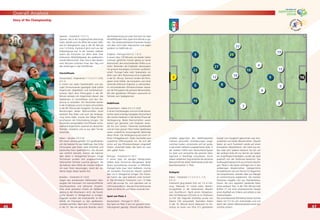
Various formations were to be observed
in midfield. Fourteen teams opted for the
classical structure of two central midfielders
in front of the defence and two men on the
flanks. Advocates of this approach included
England, Sweden, Brazil and Germany. Five
teams went with a diamond configuration
featuring a central holding midfielder, two
men on the flanks and an attacking player
behind the strikers, e.g. Spain, Argentina
and, to begin with, Italy. Seven set up a five-
man midfield in front of the back four at the
expense of the attack. Just one striker was
deployed up front, which often led to less
penetration when going forward. No uniform
five-man midfield was to be observed,
however, with various configurations in
evidence. Teams such as the Czech Republic
put a defensive player in front of the backline
and arranged a line of four in front, with
two wide men and two attack-minded
players (e.g. Rosicky and Nedved) in the
inside central positions. As the tournament
progressed England and Brazil also adopted
this system. A formation with two holding
midfielders in front of the defence and a
line of three consisting of two men on the
flanks and an attacking player behind a lone
striker was selected by Poland, Côte d’Ivoire,
France and Portugal. Italy and Switzerland
elected to change their original 4-4-2 to this
more compact alternative. The Netherlands
placed their faith in their traditional
4-3-3, in which a finely tuned midfield triangle
operated in front of the back four. In attack
the Dutch went with two attacking wingers
tasked with creating openings for the central
striker. Mexico remained true to their own
style, fielding a flexible five-man midfield in
front of a three-man defence. The central line
of three was bolstered on the flanks by two
hard-working players who supported the
attack and the defence in equal measure.
The longer the tournament went on, the
more cautious the play generally became,
with teams opting for a compact defence
to avoid going behind. Of the four teams
who reached the semi-finals, Italy, France
and Portugal played with one striker. Only
Germany stuck by their 4-4-2 system. With
the exception of Italy’s 3-0 win over Ukraine,
the goal tally was low from the quarter-final
stage on. Two quarter-finals were decided
on penalties, while France’s winner against
Brazil came from a free-kick. It was a similar
case in the semi-finals, when Italy triumphed
courtesy of two late extra-time goals and
France won by a penalty. The two goals
scored in the final which eventually went
to penalties also resulted from set pieces, a
penalty and a corner-kick. An exception with
regard to the number of goals scored was
the match for third and fourth place between
Germany and Portugal (3-1), which produced
some refreshing football.
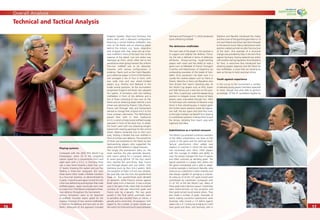
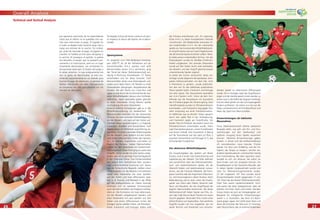
The defensive midfielder
The main task of the player in this position is
to support and stabilise the defence. Prima-
rily, the role is defined in terms of defensive
attributes. Strong-running, tough-tackling
players with vision and the ability to read a
game such as Makelele of France, Portugal’s
Costinha and Mascherano of Argentina are
outstanding examples of this breed of foot-
baller. Once possession has been won it is
usually the creative players such as Vieira or
Zidane, Maniche or Deco and Riquelme who
then dictate their team’s attacking play. At
this World Cup players such as Pirlo, Essien
and Xabi Alonso put a new face on this posi-
tion. Pirlo, in particular, used this deeper-lying
position to instigate moves. Almost all Italy’s
attacks were channelled through him. With
his technique and creativity he became a key
factor in their attacking play. In today’s game
the further teams advance inside the opposi-
tion half, the less space and time they have,
so this type of player can benefit from playing
in a withdrawn position. It allows them to pull
the strings, dictating their team’s play with
ingenuity and ideas.
Substitutions as a tactical measure
This World Cup provided numerous examples
of the effect substitutions can have on the
course of the game and the eventual result.
Tactical substitutions often added new
impetus to matches in which the two sides
had neutralised each other. Fresh players
with the courage to dribble and ability to
raise the tempo changed the face of games
and often conjured up deciding goals. The
typical substitute is a player who settles into
the game immediately and is able to adapt.
A prime example is Germany’s Neuville, who
came on as a substitute in seven matches and
was always capable of springing a surprise.
As many as 23 of the 147 goals scored were
contributed by substitutes (compared with
21 of 161 at the last World Cup). Many of
these goals had a decisive impact. Substitutes
were match-winners on five occasions and
their goals turned round several others. They
also made a number of goals. Examples of
teams making successful substitutions were
Australia, who turned a 1-0 deficit against
Japan into a 3-1 victory by bringing on Cahill
(two goals) and Aloisi, and Germany, who in
Odonkor and Neuville introduced the maker
and the scorer of the goal that gave them a 1-0
win over Poland and all but saw them through
to the second round. Many substitutions were
position-related and did not alter the structure
of the team. One example of a structural
change was provided by Italy in the semi-final
against Germany. Having replaced one striker
with another during regulation time (Gilardino
for Toni), in extra-time they introduced two
attacking players (Iaquinta and Del Piero) for
two midfielders, a move that can certainly be
seen as the key to Italy’s eventual victory.
Youth against experience
In the run-up to the tournament a number
of talented young players had been expected
to shine, though few were able to perform
accordingly. Of the 41 candidates eligible for
1818
Overall Analysis
1919
Technical and Tactical Analysis
the Gillette Best Young Player award (players
born in 1985 or later), only a fraction made
the step-up to their country’s first team.
Players such as Argentina’s Messi or Fabregas
of Spain, who had caught the eye at the FIFA
U-20 World Cup and the UEFA Champions
League, featured in the starting line-up only
once or twice. Otherwise a brief appearance
was the best they could manage. England’s
Rooney, who had eventually been selected
for the World Cup squad after a serious
injury and a long spell on the sidelines, was
never able to demonstrate his true ability.
Fifteen players saw no action at all and 15
made just brief appearances. Only Podolski
of Germany (seven matches in the starting
line-up), Cristiano Ronaldo of Portugal (six
matches), Valencia of Ecuador (four matches)
and Barnetta of Switzerland (played all four
matches from start to finish) can be considered
genuine first-team regulars. Gyan of Ghana
impressed with his tenacity and goal threat
in three of his country’s four matches. The
defenders Ramos of Spain, Kaabi of Iran and
Senderos of Switzerland also merit a mention.
Unfortunately, after some good performances
the Swiss player was sidelined by a shoulder
injury sustained in the third game.
In conclusion, it is safe to say that there is
a large number of very talented, promising
young players. For a player to develop his skills,
though, he needs match practice. In Germany
it was apparent that more value was being
placed on experience and dependability than
on youthful abandon. However, the chance
to be involved in a World Cup and become
acquainted with the special atmosphere it
offers, as well as make a brief appearance or
two, can by all means have a positive effect on
the development of talented young players.
Late goals
Forty-four of the 147 goals came in the last
15 minutes or in extra-time (compared with
34 out of 161 at the last World Cup). The
ability to concentrate to the end, especially
when temperatures are high, the mental
strength never to give up, the use of extra
attacking players, the added pressure and the
willingness to take risks are certainly factors
in the scoring of late goals. It is interesting
to consider who scored such goals. Australia
were the only team to turn a game around
in this way when they scored three times in
the closing stages against Japan. Late goals
settled seven matches that had long been
level, i.e. Germany v. Poland (1-0 Neuville
91’), Sweden v. Paraguay (1-0 Ljungberg
89’), Italy v. Australia (1-0 Totti 95’/penalty),
Spain v. France (1-2 Vieira 83’ and 1-3 Zidane
92’) and Germany v. Italy (0-1 Grosso 119’ and
0-2 Del Piero 121’). In four cases late goals
produced a draw or simply embellished the
scoreline. In 25 cases teams who were already
leading scored goals to increase their margin
of victory. Teams who were striving to come
from behind often lost their defensive shape.
Once they lost possession their opponents
were presented with lots of space in which
to counter attack and score (e.g. Ronaldo’s
goal for Brazil against Japan [4-1], Ze Roberto
for Brazil against Ghana [3-0], Del Piero for
Italy against Germany [2-0] and the goals by
Crespo, Tevez and Messi in Argentina’s 6-0
win over Serbia and Montenegro).
Charging forward in an attempt to claw back
from a deficit does not always achieve the
desired result. On the contrary, controlled
attacking play put together with considerable
effort and determination is the key, as
demonstrated by Grosso’s goal that gave Italy
the lead against Germany.
The significance of a 1-0 lead
In 41 of the 64 matches played at the 2006
FIFA World Cup™ the team that scored the
opening goal went on to win the game. As
there were also seven goalless draws and eight
games in which the team that went 1-0 down
managed to level the scores, there were only
eight matches in which a team came from
behind to win. This psychological aspect of a
lead was doubtless the principal reason why
teams were anxious not to go behind and
thus generally operated with a solid defence.
Taking the lead gave teams a sense of security
and allowed them to maintain their rhythm,
which in the heat was particularly important.
As a result they did not face the additional
pressure of having to chase the game. Besides
Japan,whowentaheadintwomatchesbefore
eventually succumbing 3-1 to Australia and
4-1 to Brazil, Tunisia also relinquished a 1-0
lead on two occasions. While they lost 3-1 to
Spain, against Saudi Arabia they were at least
able to salvage a point in a 2-2 draw. Côte
d’Ivoire were the only team to come from
two goals down to win when they overcame
Serbia and Montenegro 3-2.
Abuse of the fair play principle
At this World Cup the deplorable habit that
involves players staying down for no apparent
reason after minor collisions, thus causing
frequent breaks in play, was increasingly in
evidence. The ensuing attacks by the team
in possession were accompanied by wildly
gesticulating coaches and assistants on the
touchline, protests from the defending team,
who often simply stayed where they were, and
a reaction from the crowd until such time as
the referee stopped the game. In some cases
the player lying on the ground was treated
for quite a while before being led off the
pitch and was often ready to come back on
before the game had been restarted. When
play eventually continued the ball was played
back to the team who had been in possession
before the game was stopped, but in a place
that put them at a clear disadvantage.
Constant interruptions destroy the flow of
the game and make it less attractive. What
unquestionably began as a gesture of fair play
is developing into a method of disrupting the
other team’s play. In most cases, the associated
loss of time is not adequately reflected in the
time added on.
It is time to put a stop to this abuse of fair
play.
Systèmes de jeu
Par rapport à la Coupe du Monde de la FIFA,
Corée/Japon 2002, où 24 des participants
misaient sur un 4-4-2 classique et les huit
autres sur un 3-5-2, la tendance de cette édi-
tion était clairement à la défense à quatre. 27
sélections avaient opté pour cette variante.
Cinq organisaient leur défense à trois, mais
elles étaient souvent flexibles et passaient à
quatre en fonction des phases de jeu, comme
les Croates par exemple. Les milieux excen-
trés du Costa Rica et du Japon descendaient
pour former une défense à cinq. Le Japon
a par la suite complètement adopté la dé-
fense à quatre. Seul le Mexique a joué avec
une défense à trois d’un bout à l’autre de la
compétition.
Au milieu de terrain, l’organisation était très
variée. 14 équipes avaient une structure clas-
sique avec deux joueurs dans l’axe devant la
défense et deux sur les côtés (Angleterre,
Suède, Brésil et Allemagne notamment).
Cinq plaçaient leurs joueurs en losange, avec
un défensif central, deux joueurs sur les côtés
et un joueur offensif derrière l’attaquant de
pointe (Espagne, Argentine et Italie en début
de tournoi par exemple). Sept équipes orga-
nisaient leur milieu de terrain à cinq joueurs,
devant une défense à quatre. Cette forme
n’encourageait pas le jeu offensif. Seul un at-
taquant se trouvait aux avant-postes, ce qui a
souvent entraîné un manque d’impact en at-
taque. Cependant, le milieu à cinq n’était pas
partout organisé de la même façon, et faisait
apparaître différentes structures. La Républi-
que tchèque, par exemple, plaçait un joueur
devant la défense et organisaient devant une
ligne défensive à quatre avec deux joueurs
excentrés et deux joueurs offensifs dans l’axe
(par ex. Rosicky et Nedved). Plus tard dans le
tournoi, l’Angleterre et le Brésil ont adopté
ces systèmes. La formation avec deux joueurs
défensifs placés devant la défense et une
ligne de trois dont deux joueurs excentrés et
un joueur offensif derrière l’unique attaquant
était celle de la Pologne, de la Côte d’Ivoire,
de la France et du Portugal. L’Italie et la Suisse
ont modifié leur 4-4-2 d’origine pour adopter
cette variante plus compacte. Les Pays-Bas
sont restés fidèles à leur traditionnel 4-3-3.
Devant la défense à quatre se tenait un trian-
gle homogène. L’attaque s’appuyait sur deux
ailiers offensifs dont la mission était d’appro-
visionner l’avant-centre. Le Mexique est resté
fidèle à son style. Devant une défense à trois,
se trouvait un milieu flexible à cinq. Les trois
joueurs centraux étaient soutenus sur les cô-
tés par deux joueurs rapides qui aidaient tant
en phase défensive qu’offensive.
2020
Overall Analysis
2121
lon, ce sont ensuite les joueurs plus créatifs
comme Vieira ou Zidane, Maniche ou Deco
et Riquelme, qui dictent le jeu offensif de leur
équipe. Lors de cette Coupe du Monde, des
joueurs comme Pirlo, Essien ou Xabi Alonso
ont donné une nouvelle dimension à ce pos-
te. Pirlo notamment, profitait d’un placement
bas pour construire le jeu. Presque toutes les
offensives italiennes étaient amorcées par lui,
décisif grâce à sa technique et sa créativité.
Etant donné qu’aujourd’hui, les espaces pour
attaquer sont plus réduits et que le temps
de réaction est plus court, plus les joueurs
s’avancent dans la moitié de terrain adverse,
plus les milieux défensifs profitent de leur po-
sition. De là, ils construisent avec créativité le
jeu de leur équipe.
Le coaching
Cette Coupe du Monde a fourni de nom-
breux exemples illustrant l’impact des rem-
placements sur le cours du jeu et sur le
résultat final. Les remplacements tactiques
ont permis, dans des matches où les forces
en présence se neutralisaient, de décanter
le jeu. Des joueurs frais, prêts à dribbler et
à accélérer, ont créé de nouvelles situations
de jeu et ont souvent apporté des solutions
décisives. Les véritables « jokers » étaient
ceux qui pouvaient immédiatement trouver
leurs repères et s’adapter au jeu. Excellent
exemple : l’Allemand Neuville, entré en
cours de jeu à sept reprises, a constamment
créé la surprise. Au total, 23 des 147 buts
inscrits l’ont été par des joueurs entrés en
cours de match (21 sur 161 lors de la pré-
cédente édition). Nombreux de ces buts ont
été décisifs. Cinq fois, les « jokers » ont mar-
qué le but de la victoire, ou ont retourné le
match. Ils étaient aussi à l’origine des passes
décisives. Deux exemples de remplacements
réussis : l’Australie contre le Japon. Menée
1-0, elle fit entrer Cahill (deux buts) et Aloisi
pour gagner 3-1. L’Allemagne, contre la
Pologne dans un match important pour la
qualification au 2e
tour, choisit de faire jouer
Neuville, buteur décisif, et Odonkor, passeur
décisif. Souvent, les changement de joueurs
ont eu lieu poste pour poste, ne modifiant
donc rien à la structure de l’équipe. L’Italie en
demi-finale contre l’Allemagne a procédé à
un changement structurel. Durant le temps
réglementaire, la rentrée de Gilardino pour
Toni était un changement poste pour poste,
mais dans les prolongations, Iaquinta et Del
Piero ont apporté une force offensive double
en remplacement de deux milieux de terrain,
un changement qui a été décisif dans le suc-
cès italien.
Jeunesse contre expérience
Rares ont été les talents tant attendus à
l’approche de la compétition qui se sont
effectivement révélés. Sur les 41 candidats
(nés en 1985 ou après) au titre de Meilleur
jeune Gillette, peu étaient titulaires dans leur
équipe.
Des joueurs comme l’Argentin Messi ou
l’Espagnol Fabregas, qui avaient attiré l’at-
tention en compétition internationale telle
que le Championnat du Monde Juniors de
la FIFA ou la Ligue des Champions de l’UEFA,
n’ont fait partie du onze de départ qu’une
ou deux fois. Autrement, ils n’ont fait que
de courtes apparitions. L’Anglais Rooney,
revenu dans l’équipe après une grave bles-
sure, n’a jamais évolué à son niveau habi-
tuel. 15 joueurs n’ont pas joué du tout, et
15 autres ne sont entrés que brièvement.
Seuls l’Allemand Podolski (titulaire dans sept
matches), le Portugais Cristiano Ronaldo (six
matches), l’Equatorien Valencia (quatre mat-
ches) et le Suisse Barnetta (quatre matches)
peuvent être considérés comme véritables
titulaires. Le Ghanéen Gyan a impressionné
lors de trois de ses quatre matches par sa
capacité à s’imposer et par sa détermina-
tion devant les buts. Les défenseurs Ramos
(Espagne), Kaabi (Iran) et Senderos (Suisse)
doivent aussi être évoqués ici. Malheureu-
sement, le Suisse s’est blessé à l’épaule lors
du troisième match et sera absent pour un
certain temps.
Conclusion : les joueurs talentueux et pro-
metteurs existent en nombre. Pour dévelop-
per leurs capacités, il leur faut maintenant la
pratique. Lors de ce tournoi, l’accent a da-
vantage été mis sur l’expérience et le calcul
que sur l’insouciance de la jeunesse. Mais la
participation à une Coupe du Monde, la fa-
miliarisation à l’environnement, et de courtes
apparitions sur le terrain peuvent tout à fait
avoir une influence positive sur l’évolution
d’un joueur talentueux.
Buts tardifs
44 des 147 buts ont été inscrits dans le der-
nier quart d’heure ou lors des prolongations
(34 sur 161 buts en 2002). Une concentra-
tion sans faille, surtout dans des conditions
caniculaires, la force mentale, la volonté de
gagner, l’entrée en jeu de joueurs offensifs,
un pressing accentué et la prise de risques
sont des facteurs expliquant cette tendance.
Il est intéressant d’observer quelles équipes
ont inscrits ces buts tardifs. Seule l’Australie
est parvenue, contre le Japon, à renverser la
situation en marquant trois buts en fin de
match. En sept matches dont le score est
longtemps resté nul, les buts tardifs ont été
décisifs (par ex. Allemagne vs Pologne, 1-0
par Neuville à la 91e
minute ; Suède vs Pa-
raguay, 1-0 par Ljungberg à la 89e
minute ;
Italie vs Australie, 1-0 par Totti sur penalty à la
95e
minute ; Espagne vs France, 1-2 par Vieira
à la 83e
minute et 3-1 par Zidane à la 92e
minute ; Allemagne vs Italie, 0-1 par Grosso
à la 119e
minute et 0-2 par Del Piero à la 121e
minute). Dans quatre cas, les buts tardifs ont
été des buts égalisateurs ou n’avaient plus
aucune influence sur le résultat. Dans 25 cas,
les équipes déjà devant au score ont aggravé
le score. Les équipes qui tentaient d’amélio-
rer le résultat se sont souvent désorganisées
à l’arrière, offrant à l’adversaire beaucoup de
place en cas de perte du ballon et ainsi des
occasions de contres et de buts (par ex. Brésil
vs Japon, 3-1 de Ronaldo et Brésil vs Ghana,
3-0 par Zé Roberto ; Italie vs Allemagne, 2-0
par Del Piero ; ou encore les buts de Crespo,
Tevez et Messi lors du 6-0 de l’Argentine
contre la Serbie et Monténégro).
Une course désorganisée pour recoller au
score n’apporte souvent pas le résultat es-
compté. En revanche, un jeu offensif construit
et volontaire aboutit plus souvent, comme
l’a montrée l’ouverture du score par l’Italien
Grosso contre l’Allemagne.
L’importance du premier but
Dans 41 des 64 matches de la Coupe du
Monde de la FIFA, Allemagne 2006, l’équipe
qui a ouvert le score a remporté le match.
Sept matches se sont achevés sur le score
de 0-0, huit matches ont vu l’équipe menée
1-0 revenir au score. Il n’y a eu que huit mat-
ches lors desquels le retard a été refait pour
ensuite s’imposer. Cet aspect psychologique
explique aussi que l’objectif était d’empêcher
de concéder un but et que les équipes organi-
saient ainsi une défense solide. Mener au sco-
re donnait confiance, permettait de maintenir
le rythme, élément particulièrement impor-
tant par temps très chaud. Ainsi disparaissait
aussi la pression de ne pas vouloir concéder
de but. Hormis le Japon, qui a mené dans
deux matches avant de s’incliner, 1-3 contre
l’Australien et 1-4 contre le Brésil, la Tunisie
a aussi plié après avoir mené 1-0 (défaite 1-3
contre l’Espagne et, contre l’Arabie Saoudite,
Technical and Tactical Analysis
Plus le tournoi avançait, plus le style de jeu
devint prudent, avec une défense compacte
et l’objectif de ne pas concéder de but. Sur les
quatre demi-finalistes, l’Italie, la France et le
Portugal ne jouaient qu’avec un avant-centre.
Seule l’Allemagne est restée fidèle à son
4-4-2. En quarts déjà, peu de buts avaient
été inscrits, à l’exception des trois marqués
par l’Italie contre l’Ukraine. Deux matches se
sont joués aux tirs au but et la victoire de la
France sur le Brésil a été décrochée à la suite
d’un coup franc.
En demi-finales, la tendance s’est poursui-
vie : l’Italie a gagné en inscrivant deux buts
en toute fin de prolongation, et la France
s’est imposée en transformant un penalty.
Exception à cette pénurie de buts, le match
pour la troisième place entre l’Allemagne et
le Portugal (3-1) qui proposa un football ra-
fraîchissant.
Le milieu défensif
Les principaux rôles de ce poste sont le sou-
tien et la stabilisation de la défense. Sa tâche
se définit en fonction du comportement dé-
fensif. Excellent à ce poste, des joueurs en-
durants et solides dans les duels, disposant
d’une bonne lecture du jeu et d’un bon sens
de l’anticipation, comme le Français Make-
lele, le Portugais Costinha ou encore l’Argen-
tin Mascherano. Dès la récupération du bal-
2222
Overall Analysis
2323
elle put toutefois sauver un point, avec un
2-2). Seule la Côte d’Ivoire est parvenue à
remonter un retard de deux buts. Menée
2-0 contre la Serbie et Monténégro, elle
s’est imposée 3-2.
Non-respect du fair-play
Cette Coupe du Monde a mis au jour la
mauvaise habitude qu’ont les joueurs de
rester au sol au moindre petit contact,
retardant ainsi la reprise du jeu. L’action
était alors accompagnée de la touche par
des sélectionneurs gesticulants, sur le ter-
rain par des défenseurs qui s’arrêtaient de
jouer, et dans les tribunes par les protes-
tations des spectateurs, jusqu’à ce que
l’arbitre n’arrête le jeu. Le joueur au sol
était alors parfois longuement traité sur
le terrain avant d’être accompagné sur la
touche. Il était ensuite souvent remis avant
même la reprise du jeu. Une fois le ballon
remis en jeu, il était renvoyé à l’équipe qui
l’avait avant l’interruption, mais à un en-
droit clairement peu avantageux pour elle.
Les interruptions constantes empêchent le
déroulement fluide d’une partie, qui perd
ainsi en intérêt. Ce qui fut jadis un geste de
fair-play devient peu à peu une façon d’in-
terrompre le jeu adverse. Le temps perdu
dans ces actions n’est le plus souvent pas
totalement rattrapé dans les arrêts de jeu.
Il est grand temps de mettre un terme à ces
actions qui vont à l’encontre du fair-play.
Sistemas de juego
En comparación con la Copa Mundial de la
FIFA Corea/Japón 2002, en la cual 24 equi-
pos plantearon un 4-4-2 convencional, y
ocho un 3-5-2, la tendencia en el Mundial
actual se inclinó claramente hacia el cuar-
teto defensivo, variante que utilizaron 27
escuadras. Cinco selecciones jugaron con
un trío de contención que frecuentemen-
te cambiaron por una defensa de cuatro,
como por ejemplo Croacia. Costa Rica y
Japón rezagaban a los volantes externos,
formando una línea defensiva de cinco
hombres. Japón pasó más tarde definitiva-
mente a una línea de cuatro. Únicamente
Mexico jugó, sin excepción, con un trío
defensivo.
En la formación de la línea media se pudie-
ron observar diferentes sistemas: 14 equi-
pos optaron por una estructura clásica de
dos volantes centrales delante de la defensa
y dos en los flancos. Dicha variante fue utili-
zada por Inglaterra, Suecia, Brasil y Alema-
nia. Cinco equipos plantearon una formación
romboidal, con un volante central de conten-
ción delante de la defensa, dos centrocam-
pistas en los extremos, y un volante ofensivo
detrás de los delanteros, como por ejemplo,
España, Argentina e Italia a inicios del torneo.
Siete selecciones formaron una línea media
de cinco hombres delante del cuarteto defen-
sivo, lo cual conllevó una desventaja para el
ataque, ya que en dichos casos se jugaba con
un único punta de lanza, lo cual mermaba
la potencia de penetración en la vanguardia.
Dichas formaciones de cinco no eran pareci-
das, sino que mostraban diversas estructuras.
Por ejemplo, la República Checa colocaron un
volante de contención delante de la defensa,
al cual anteponían una línea de cuatro hom-
bres (dos en los flancos y dos más ofensivos
en el centro, p.ej. Rosicky y Nedved). Dicha
variante también fue utilizada en el trans-
curso del torneo por Inglaterra y Brasil. Las
selecciones de Polonia, Costa de Marfil, Fran-
cia y Portugal eligieron la alternativa con dos
volantes de contención delante de la defensa
y una línea de tres hombres, conformada por
dos volantes laterales y uno avanzado detrás
del único punta de lanza. Italia y Suiza opta-
ron por romper su molde táctico original de
4-4-2 y modificarlo a la mencionada variante
más compacta. Holanda confió en su tradi-
cional 4-3-3. Delante del cuarteto defensivo
operaba un coherente trío de centrocampis-
tas y dos punteros en el ataque, encargados
de habilitar al centrodelantero. México se atu-
vo a su estilo individual. Delante del trío de
contención, colocó una línea media flexible
de cinco hombres. La línea central de tres vo-
lantes fue completada en las bandas por dos
veloces laterales que apoyaban a la defensa y
participaban en el ataque.
A medida que progresaba el torneo, tanto
más cautelosa se tornaba la forma de jugar
de las selecciones. Se pasó a una actitud de-
fensiva compacta, con la intención fija de no
conceder goles. De los cuatro equipos clasi-
ficados para las semifinales, Italia, Francia y
Portugal jugaron con un único atacante. Sólo
Alemania se atuvo a su sistema habitual, el
4-4-2. A partir de los cuartos de final, todos
los resultados fueron muy estrechos, con ex-
cepción del 3 a 0 de Italia contra Ucrania.
Dos choques de cuartos de final se decidie-
ron únicamente en la tanda de penales, y la
victoria de Francia sobre Brasil fue producto
de un tiro libre. En las semifinales, el tenor
siguió siendo el mismo. Italia ganó gracias
a dos goles tardíos en el alargue, y Francia
se alzó con la victoria mediante un penal. La
final fue definida por penales, después de
que en el tiempo reglamentario se anotara
un gol de penal y uno de una situación a
balón parado. En cuanto a la cosecha de go-
les, la excepción fue el animado partido por
el tercer puesto entre Alemania y Portugal
(3 a 1).
El volante central de contención
La función principal del jugador en dicha
posición es apoyar y estabilizar la defensa. El
papel se define principalmente en base a la
capacidad defensiva del jugador. Jugadores
veloces y firmes en el mano a mano, dotados
de visión de juego y lucidez para leer el par-
tido, como por ejemplo, el francés Makelele,
el portugués Costinha, o el argentino Mas-
cherano, son ideales para esta posición. Tras
la recuperación del balón, son los jugadores
creativos como Vieira o Zidane, Maniche o
Deco y Riquelme, quienes se encargan de
dirigir el despliegue ofensivo de su escuadra.
En el presente Mundial, figuras tales como
Pirlo, Essien o Xabi Alonso le dieron otro sem-
blante a esta posición del volante central de
contención. Particularmente Pirlo aprovechó
su posición rezagada para armar el juego de
su escuadra. Prácticamente todos los ataques
fueron iniciados por él, quien acabó por con-
vertirse en la figura clave del sistema de juego
ofensivo italiano, gracias a su fina técnica y
creatividad. En vista de que en el fútbol ac-
tual se dispone de cada vez menos espacio
y tiempo para atacar cuanto más se adentre
en la zona adversaria, tanto más se beneficia-
rán los volantes centrales de contención de
su posición retrasada, manejando las riendas
desde dicha zona y determinando el juego de
su equipo con ingenio y creatividad.
Reemplazos como medida táctica
En el presente Mundial se registraron nume-
rosos ejemplos del efecto que tuvieron las
sustituciones sobre el desarrollo y el resultado
del juego. Por ejemplo, las sustituciones tácti-
cas otorgaban nuevos impulsos a partidos en
los cuales las dos escuadras se neutralizaban
entre sí. Jugadores de recambio con talento
gambeteador y capaces de incrementar el rit-
mo del partido generaban distintas situaciones
de juego que decidían frecuentemente un en-
cuentro. Como comodines fungen jugadores
protagonistas que de inmediato se integran y
adaptan al accionar de su equipo. Un clásico
ejemplo es el alemán Neuville, quien ingresó
como suplente en siete ocasiones y deparó
siempre situaciones sorpresivas. 23 de los 147
goles fueron anotados por suplentes (frente
a 21 de 161 goles anotados en el Mundial
pasado). Varios de estos tantos fueron decisi-
vos. En cuatro ocasiones, los comodines defi-
nieron un partido o volcaron el resultado del
encuentro con sus goles. Además, destacaron
como suministradores de pases de gol. Aus-
tralia fue un elocuente ejemplo de este tipo
de cambio exitoso y decisivo. Cuando perdía
1 a 0 contra Japón, hizo ingresar a los suplen-
tes Cahill (dos goles) y Aloisi (un gol), quienes
Technical and Tactical Analysis
2424
Overall Analysis
2525
volcaron el encuentro a favor de Australia por
3 a 1. Otro ejemplo fue Alemania, que en
el partido contra Polonia envió a la cancha
a Neuville, autor del ulterior 1 a 0 de la vic-
toria, y a Odonkor, el suministrador del pase
de gol para Neuville. A menudo, el cambio
fue únicamente de posición, sin alterar la es-
tructura del equipo. Italia, en cambio, realizó
una modificación estructural en la semifinal
contra Alemania. Durante el tiempo regla-
mentario, cambió a un ariete por otro (Gilar-
dino por Toni), mientras que en la prórroga
ingresaron Iaquinta y Del Piero, dos figuras
de corte ofensivo, por dos centrocampistas
defensivos. Dicha medida puede considerarse
la clave del triunfo italiano.
Juventud contra experiencia
De todos los talentos que esperaban triunfar
en este Mundial, solamente un puñado logró
colocarse positivamente en escena. De los 41
candidatos (menores de 21 años) elegibles
para el premio del “Mejor Jugador Juvenil”
de Gillette, solamente un pequeño grupo
consiguió integrar el plantel titular de su res-
pectiva selección.
Jugadores como el argentino Messi o el es-
pañol Fabregás, quienes destacaron en com-
peticiones internacionales como el Mundial
Sub-20 de la FIFA o la Liga de Campeones de
la UEFA, figuraron sólo una o dos veces en la
formación inicial de su escuadra, o jugaron
solamente durante breves minutos. El inglés
Rooney, quien fuera integrado en el plantel
mundialista pese a una larga lesión y ausen-
cia, no pudo desarrollar todo su potencial.
15 jugadores no tuvieron la oportunidad de
jugar, y 15 ingresaron solamente por algunos
minutos. Únicamente Podolski de Alemania
(siete partidos en el plantel titular), Cristiano
Ronaldo de Portugal (seis partidos), Valencia
de Ecuador (cuatro partidos) y el suizo Bar-
netta (jugó los cuatro partidos) pueden con-
siderarse como auténticos titulares. Gyan de
Ghana destacó en tres de sus cuatro partidos
por su facilidad para penetrar en la defensa
rival y su peligrosidad a la hora de la defini-
ción. Cabe mencionar igualmente a Ramos
de España, Kaabi de Irán, así como a Sen-
deros de Suiza. Lamentablemente, el suizo
– quien tuviera un magnífico desempeño en
sus primeros partidos – debió ausentarse a
partir del tercer encuentro a causa de una le-
sión del hombro.
Resumen: existe indudablemente un gran nú-
mero de jugadores talentosos y prometedo-
res, pero para el desarrollo de las habilidades
de un jugador se requiere normalmente prác-
tica de juego. Sin embargo, en el presente
torneo se dio aparentemente mayor impor-
tancia a la experiencia y la previsibilidad que
a la despreocupación juvenil. No obstante, el
mero hecho de estar presente en un Mundial
y conocer el ambiente especial, combinado
con breves actuaciones, puede influenciar
positivamente en el ulterior desarrollo de un
joven talento.
Goles tardíos
44 de los 147 goles anotados fueron rea-
lizados en los últimos 15 minutos o en la
prórroga (frente a 34 goles de 161 en el
Mundial pasado). La concentración hasta el
final del encuentro, particularmente en altas
temperaturas, la fuerza moral de creer en el
triunfo, la incorporación de figuras ofensivas
adicionales, así como una mayor presión de
ataque y la disposición al riesgo, fueron se-
guramente factores que condujeron a dichos
goles tardíos. Resulta interesante analizar qué
equipos han marcado estos goles. Australia
fue la única selección que logró remontar con
tres goles de última hora una desventaja y
convertirla en victoria (contra Japón). En siete
partidos, en los cuales prevaleciera la paridad
prácticamente hasta los últimos minutos, se
modificó el marcador con goles tardíos (p.ej.
Alemania – Polonia, min. 91, Neuville 1 a 0;
Suecia – Paraguay, min. 89, Ljungberg 1 a 0;
Italia – Australia, min. 95, Totti 1 a 0, mediante
penal; España – Francia, min. 83, Vieira 1 a 2,
así como min. 92, Zidane 1 a 3; Alemania
– Italia, min.119, Grosso 0 a 1, así como min.
121, Del Piero 0 a 2). En cuatro ocasiones,
dichos goles condujeron a una paridad o re-
sultaron solamente mero maquillaje del resul-
tado. En 25 casos, los equipos que iban ga-
nando anotaron goles tardíos y aumentaron
la ventaja. Varios equipos, en busca de una
mejora del resultado al filo de la conclusión
del partido, descuidaban frecuentemente el
orden defensivo y ofrecían a los rivales dema-
siado espacio y posibilidades de contraataque
en el momento de la pérdida del balón (p.ej.
en el 3 a 1 de Brasil contra Japón, con gol de
Ronaldo, o el 3 a 0 de Brasil contra Ghana,
Technical and Tactical Analysis
con gol de Zé Roberto, o el gol de Del Piero
en la victoria italiana por 2 a 0 contra Ale-
mania, o los goles tardíos de Crespo, Tévez y
Messi en el 6 a 0 de Argentina contra Serbia
y Montenegro).
Los ataques desenfrenados, con la intención
de remontar un marcador adverso, general-
mente no conducen al éxito deseado. Es más
recomendable armar un juego de ataque
pensado, con garra y voluntad, tal cual fuera
el caso del gol de ventaja italiano de Grosso
en el choque entre Italia y Alemania.
La importancia del 1 a 0
En 41 de los 64 partidos de la Copa Mun-
dial Alemania 2006, el equipo que marcara
el 1 a 0 salió de la cancha como ganador. En
siete encuentros se empató a cero; en ocho,
el equipo que perdía 1 a 0 logró igualar el
tanteador, y también en ocho choques, los
equipos que iban perdiendo dieron vuelta al
resultado, retirándose de la cancha como ga-
nadores. Dicho aspecto psicológico de hallarse
arriba en el marcador fue de seguro decisivo
para tratar de evitar un revés, lo cual condujo
a que se maniobrara desde una sólida y firme
defensa. La ventaja otorgaba seguridad, se
podía mantener el ritmo de juego deseado
– lo cual resultaba muy importante en las
calurosas condiciones climáticas. El hecho de
no tener que remontar un resultado adverso
evitaba una presión adicional. Además de Ja-
pón, que se había adelantado en el marcador
en dos partidos, que a la postre perdió por
3 a 1 contra Australia y 4 a 1 contra Brasil,
también Túnez dejó escapar una ventaja de
1 a 0 en dos ocasiones, y perdió por 3 a 1
contra España y empató a dos con Arabia
Saudita. Únicamente Costa de Marfil pudo
descontar en dos ocasiones y ganar incluso
3 a 2 el cotejo contra Serbia y Montenegro,
tras ir perdiendo por 2 a 0.
Abuso del espíritu de la
deportividad
En el presente Mundial se pudo observar el
creciente abuso de jugadores que permane-
cían tirados en el césped por motivos insignifi-
cantes o tras leves contactos físicos, causando
así a menudo una interrupción del juego. De
esta manera, el ataque en curso del equipo
adversario era hostigado generalmente desde
la línea de banda por entrenadores y dirigen-
tes gesticulando violentamente y con voces
de protesta de parte del equipo defensor, el
cual solía quedarse simplemente parado, y
2626
Overall Analysis
2727
por agresivas reacciones de los espectadores
hasta que al árbitro no le quedaba otra op-
ción que interrumpir el juego. El jugador en
el suelo se dejaba tratar durante largo rato y
luego era retirado de la cancha. Sin embar-
go, antes de reanudar el juego, el jugador en
cuestión se hallaba ya listo para reingresar a
la cancha. Al proseguir el partido, la pelota
era devuelta al equipo que la poseyera pre-
viamente a la interrupción, pero en un lugar
claramente desventajoso. Las constantes in-
terrupciones destruyen la fluidez del juego y
le restan atractivo. Lo que antiguamente era
aún un gesto de deportividad, se está con-
virtiendo crecientemente en un método para
truncar el juego del adversario. La pérdida de
tiempo relacionada con tales interrupciones
se compensa tan sólo parcialmente con los
minutos de descuento.
Ha llegado la hora de tomar cartas en el asun-
to respecto al abuso del espíritu de la depor-
tividad.
Spielsysteme
Im Vergleich zum FIFA-Weltpokal Korea/Ja-
pan 2002™, als 24 der Teilnehmer auf ein
konventionelles 4-4-2 setzten und acht
Mannschaften einem 3-5-2 vertrauten, ging
der Trend bei dieser Weltmeisterschaft ein-
deutig in Richtung Viererabwehr. 27 Teams
entschieden sich für diese Variante. Fünf
Mannschaften boten eine Dreierabwehr auf,
wobei auch diese Teams oft flexibel zu einer
Viererabwehr übergingen, beispielsweise die
Kroaten. Bei den Teams aus Costa Rica und
Japan wurde durch die Zurücknahme der äus-
seren Mittelfeldspieler daraus eine Fünferab-
wehrreihe. Japan wechselte später gänzlich
zu einer Viererkette. Einzig Mexiko spielte
durchgängig mit einer Dreierkette.
Unterschiedliche Formationen gab es in der
Mittelfeldanordnung zu beobachten. 14
Mannschaften warteten mit der klassischen
Struktur mit zwei zentralen Mittelfeldspielern
vor der Abwehr und zwei auf den Seiten auf.
Vertreter dieser Variante waren u. a. England,
Schweden, Brasilien und Deutschland. Fünf
Teams hatten ihr Mittelfeld rautenförmig an-
geordnet, mit einem zentralen Defensivspieler
vor der Abwehr, zwei Spielern auf den Seiten
und einem Offensivmann hinter den Spitzen,
so z. B. Spanien, Argentinien und Italien zu
Beginn des Turniers. Sieben Mannschaften
hatten vor der Viererkette ein Fünfermittel-
feld aufgebaut. Diese Form ging zu Lasten des
Angriffs. Vorne wurde nur eine Spitze aufge-
boten, was oft zu geringer Durchschlagskraft
in der Offensive führte. Das Fünfermittelfeld
bot jedoch kein einheitliches Bild, sondern
wies unterschiedliche Strukturen auf. Teams
wie die Tschechische Republik stellten einen
Defensivspieler vor die Abwehr und ordneten
davor eine Viererreihe mit zwei Spielern
auf den Seiten und zwei offensiveren Spie-
lern (z. B. Rosicky und Nedved) in der Mitte
auf den Halbpositionen an. Dieser Variante
schlossen sich im weiteren Turnierverlauf
auch die Mannschaften von England und Bra-
silien an. Die Formation mit zwei defensiven,
vor der Abwehr aufgebotenen Spielern und
einer Dreierreihe mit zwei Spielern auf den
Seiten und einem Offensivmann hinter der
einzigen Spitze wählten Polen, die Elfenbein-
küste, Frankreich und Portugal. Italien und
die Schweiz entschlossen sich, ihr ursprüng-
liches 4-4-2 zu dieser kompakteren Variante
umzuformen. Die Niederlande vertrauten ih-
rem traditionellen 4-3-3. Vor der Viererkette
spielte ein harmonierendes Mittelfelddreieck.
Im Angriff setzte man auf zwei Flügelstürmer,
die die zentrale Spitze einsetzen sollten. Mexi-
ko blieb seinem individuellen Stil treu. Vor der
Dreierabwehr wurde ein flexibles Fünfermit-
telfeld aufgeboten. Die zentrale Dreierreihe
wurde auf den Seiten durch zwei laufstarke,
die Abwehr und den Angriff gleichermassen
unterstützende Spieler ergänzt.
Je weiter das Turnier voranschritt, desto vor-
sichtiger wurde allgemein die Spielweise. Kom-
paktes Defensivverhalten mit dem Ziel, nicht
in Rückstand zu geraten, wurde praktiziert.
Von den vier für das Halbfinale qualifizierten
Teams spielten Italien, Frankreich und Portugal
mit einer Spitze. Nur Deutschland veränderte
sein 4-4-2-System nicht. Schon ab dem Vier-
telfinale war die Torausbeute mit Ausnahme
des 3:0 Italiens gegen die Ukraine gering. Zwei
Viertelfinalspiele wurden im Elfmeterschiessen
entschieden, und Frankreichs Sieg gegen Bra-
silien entsprang aus einer Freistosssituation.
Im Halbfinale war es ähnlich: Italien gewann
durch sehr späte Tore in der Verlängerung,
und Frankreich siegte per Foulelfmeter. Die
beiden Tore im Endspiel, das letzlich durch ein
Elfmeterschiessen entschieden wurde, fielen
nach Standardsituationen, einem Foulelfmeter
und einem Eckball. Eine Ausnahme in Bezug
auf die Torausbeute war das Spiel um Platz 3
zwischen Deutschland und Portugal (3:1), das
erfrischenden Fussball bot.
Der defensive Mittelfeldspieler
Die Hauptaufgaben des Spielers auf dieser
Position sind in erster Linie Unterstützung und
Stabilisierung der Abwehr. Die Rolle definiert
sich vornehmlich über das Defensivverhalten.
Lauf- und zweikampfstarke Spieler, die die
Übersicht haben und Spielsituationen voraus-
ahnen, wie der Franzose Makelele, der Portu-
giese Costinha oder der Argentinier Maschera-
no, sind hervorragend in dieser Position. Nach
Balleroberung sind es dann meist die Kreativ-
spieler wie Vieira oder Zidane, Maniche oder
Deco und Riquelme, die das Angriffsspiel der
eigenen Mannschaften bestimmen. Bei dieser
Weltmeisterschaft haben Spieler wie Pirlo, Es-
sien oder Xabi Alonso dieser Position ein neues
Gesicht gegeben. Besonders Pirlo nutzte seine
tiefere Position zum Spielaufbau. Fast sämtliche
Angriffe wurden von ihm eingeleitet, der mit
seiner Technik und Kreativität zum entschei-
denden Spieler im italienischen Offensivspiel
wurde. Da im heutigen Spiel der Angriffsraum
enger und die Handlungszeit kürzer werden, je
weiter man in die Hälfte des Gegners vordringt,
können diese Spieler von der zurückgezogenen
Position profitieren. Sie ziehen von hier aus die
Fäden und bestimmen mit Einfallsreichtum und
Ideen das Spiel ihrer Mannschaften.
Einwechslungen als taktische
Massnahme
Diese Weltmeisterschaft lieferte zahlreiche
Beispiele dafür, wie sehr sich Ein- und Aus-
wechslungen auf den Spielverlauf und
späteren Ausgang eines Spieles auswirken
können. Taktische Einwechslungen gaben
Spielen, in denen sich die Kräfteverhältnisse
oft neutralisierten, neue Impulse. Frische
Spieler mit Mut zum Dribbling und der Fä-
higkeit, das Tempo zu steigern, schufen ver-
änderte Spielsituationen und brachten häufig
eine Entscheidung. Bei dem typischen Joker
handelt es sich um Akteure, die sofort ins
Spiel finden und sich anpassen können. Ein
Paradebeispiel ist der Deutsche Neuville, der
in sieben Spielen eingewechselt wurde und
stets für Überraschungsmomente sorgte.
23 der insgesamt 147 Tore wurden durch
Einwechselspieler erzielt (gegenüber 21 von
161 Toren bei der letzten Weltmeisterschaft).
Viele Tore waren spielentscheidend. Fünf-
mal waren die Joker Spielgewinner, oder sie
drehten mit ihren Toren eine Partie. Darüber
hinaus traten sie auch als Vorlagengeber auf.
Beispiele für erfolgreiche Einwechslungen
waren u. a. Australien, das beim 0:1-Rück-
stand gegen Japan mit Cahill (zwei Tore) und
Aloisi die Schützen der Tore zum 3:1 brachte,
oder Deutschland, das im vorentscheidenden
Technical and Tactical Analysis
2828
Overall Analysis
2929
Gruppenspiel gegen Polen mit Neuville den
Schützen des 1:0-Siegtreffers und den Vorbe-
reiter Odonkor aufs Feld schickte. Häufig war
der Austausch eines Spielers nur positions-
bezogen, wodurch die Struktur einer Mann-
schaft unverändert blieb. Ein Beispiel für eine
strukturelle Änderung bot Italien im Halbfina-
le gegen Deutschland. Hatte man während
der regulären Spielzeit mit Gilardino für Toni
noch Stürmer gegen Stürmer getauscht, so
wurden in der Verlängerung mit Iaquinta
und Del Piero zwei Offensivkräfte für zwei
Mittelfeldspieler eingesetzt. Diese Massnah-
me kann durchaus als Schlüssel zum späteren
Erfolg Italiens angesehen werden.
Jugend gegen Erfahrung
Nur wenige der Talente, von denen vor dem
Turnier viel versprechende Auftritte erwartet
worden waren, konnten sich entsprechend in
Szene setzen. Von den 41 Kandidaten (Jahr-
gang 1985 und jünger), die für die Gillette-
Auszeichnung „Bester junger Spieler“ wähl-
bar waren, gelang nur einigen der Sprung in
die Startelf ihres Landes.
Spieler wie der Argentinier Messi oder der
Spanier Fabregas, die bei internationalen
Wettbewerben wie der FIFA U-20-Weltmeis-
terschaft oder der UEFA Champions League
auf sich aufmerksam machten, standen nur
ein- bzw. zweimal in der Anfangsformation
und kamen sonst maximal zu Kurzeinsät-
zen. Der Engländer Rooney, der nach einer
schweren Verletzung und längerer Pause doch
noch in den Weltmeisterschaftskader aufge-
nommen worden war, konnte nie seine echte
Leistungsstärke beweisen. 15 Spieler kamen
nie zum Einsatz und 15 nur zu Kurzeinsätzen.
Als echte Stammspieler konnten nur Podolski
aus Deutschland (sieben Spiele in der Start-
formation), Cristiano Ronaldo aus Portugal
(sechs Spiele), Valencia aus Ecuador (vier
Spiele) sowie der Schweizer Barnetta (alle vier
Spiele durchgespielt) gelten. Gyan aus Ghana
beeindruckte in drei von vier Spielen mit sei-
nem Durchsetzungsvermögen und seiner Tor-
gefährlichkeit. Die Abwehrspieler Ramos aus
Spanien, Kaabi aus Iran sowie Senderos aus
der Schweiz sind ebenso zu erwähnen. Leider
fiel der Schweizer im dritten Spiel nach guten
Leistungen wegen einer Schulterverletzung
langfristig aus.
Das Fazit: Es gibt durchaus eine grosse Anzahl
sehr talentierter und viel versprechender Spie-
ler. Zur Entwicklung der Anlagen eines Spie-
lers gehört die nötige Spielpraxis. In diesem
Turnier wurde offensichtlich mehr Wert auf
Erfahrung und Kalkulierbarkeit als auf jugend-
liche Unbekümmertheit gelegt. Aber auch die
Teilnahme an einer Weltmeisterschaft sowie
das Kennenlernen der speziellen Atmosphä-
re, verbunden mit Kurzeinsätzen, können die
weitere Entwicklung eines Talentes durchaus
positiv beeinflussen.
Späte Tore
44 der 147 Tore fielen in den letzten 15 Mi-
nuten oder in der Verlängerung eines Spieles
(gegenüber 34 von 161 Toren bei der letz-
ten Weltmeisterschaft). Konzentration bis
zum Ende, vor allem bei hohen Tempera-
turen, die psychische Stärke, stets an den
Erfolg zu glauben, der Einsatz zusätzlicher
Offensivkräfte sowie mehr Druck und Risiko-
bereitschaft sind sicher Faktoren, die mit
dem Erzielen später Tore zusammenhängen.
Interessant zu betrachten ist, wer diese Tore
erzielen konnte. Einzig Australien ist es ge-
gen Japan gelungen, aus einem Rückstand
durch drei Tore in der Schlussphase ein Spiel
zu drehen. In sieben Spielen, die lange un-
entschieden standen, führten späte Tore
zur Entscheidung (z. B. Deutschland – Po-
len, 91. Min. Neuville zum 1:0; Schweden
– Paraguay, 89. Min. Ljungberg zum 1:0;
Italien – Australien, 95. Min. Totti zum 1:0
mittels Elfmeter; Spanien – Frankreich, 83.
Min. Vieira zum 1:2 sowie 92. Min. Zidane
zum 1:3; Deutschland – Italien, 119. Min.
Grosso zum 0:1 sowie 121. Min. Del Piero
zum 0:2). In vier Fällen führten diese Tore zu
einem Unentschieden oder trugen nur zur
Ergebniskosmetik bei. In 25 Fällen erzielten
Teams, die bereits in Führung lagen, Tore, die
eine Erhöhung des Spielergebnisses brach-
ten. Mannschaften, die um Resultatsverbes-
serung bemüht waren, verloren häufig die
Ordnung nach hinten. Bei Ballverlust boten
sich dem Gegner viele Freiräume für Gegen-
stösse und Tormöglichkeiten (z. B. beim 3:1
von Brasilien gegen Japan durch Ronaldo
sowie beim 3:0 von Brasilien gegen Ghana
durch Zé Roberto, bei Del Pieros 2:0 von Ita-
lien gegen Deutschland oder bei den Toren
von Crespo, Tevez und Messi zum Schluss-
stand von 6:0 im Spiel Argentinien gegen
Serbien und Montenegro).
Ungestümes Anrennen gegen einen Rück-
stand führt oft nicht zum gewünschten
Erfolg, vielmehr ist es durchdachtes, mit
grossem Einsatz und Willen vorgetragenes
Angriffsspiel, wie Grossos Führungstor für
Italien gegen Deutschland bewies.
Die Bedeutung einer 1:0-Führung
In 41 von 64 Spielen der FIFA Fussball-Welt-
meisterschaft 2006™ ging die Mannschaft,
die das 1:0-Führungstor erzielt hatte, auch
als Sieger vom Platz. Da es dazu noch sieben
0:0-Spiele gab und in acht Partien die Mann-
schaft, die einen 0:1-Rückstand hinnehmen
musste, noch zum Ausgleich kam, gab es
nur acht Spiele, in denen ein Rückstand noch
in einen Sieg umgewandelt werden konnte.
Dieser psychologische Aspekt einer Führung
war sicher auch entscheidend dafür, dass man
unbedingt einen Rückstand verhindern wollte
und so generell aus einer gesicherten Defen-
sive operierte. Eine Führung gab Sicherheit,
und man konnte seinen Spielrhythmus beibe-
halten, was besonders bei der Hitze wichtig
war. Es entstand somit auch kein zusätzlicher
Druck, weil man nicht gegen einen Rückstand
anrennen musste. Neben Japan, das in zwei
Spielen in Führung gegangen war und gegen
Australien später mit 1:3 und Brasilien mit 1:4
verlor, verspielte auch Tunesien zweimal eine
1:0-Führung: Man verlor gegen Spanien mit
1:3 und konnte gegen Saudiarabien beim 2:2
wenigstens noch einen Punkt retten. Allein die
Elfenbeinküste konnte einen Zweitore-Rück-
stand aufholen. Gegen Serbien und Montene-
gro gelang ein 3:2-Sieg nach einem 0:2.
Missbrauch des Fairplay-Gedankens
Bei dieser Weltmeisterschaft war zunehmend
die Unsitte zu beobachten, dass Spieler aus
geringfügigen Anlässen und nach kleineren
Zusammenstössen am Boden liegen blieben
und damit häufig Spielunterbrechungen her-
vorriefen. Der folgende Angriff der sich im
Ballbesitz befindenden Mannschaft wurde
durch heftig an der Seitenlinie gestikulieren-
de Trainer und Betreuer, durch Proteste der
verteidigenden Mannschaft, die oft einfach
stehen blieb, und durch Zuschauerreakti-
onen begleitet, ehe der Schiedsrichter das
Spiel letztlich unterbrach. Der am Boden lie-
gende Spieler wurde manchmal länger auf
dem Spielfeld behandelt und dann vom Platz
geführt. Bevor das Spiel fortgesetzt wurde,
stand der Betreffende jedoch oftmals wieder
bereit. Bei der Spielfortsetzung wurde der
Ball an die Mannschaft, die vor der Unterbre-
chung in Ballbesitz war, zurückgegeben, aber
an einer Stelle, wo sich eindeutig ein Nachteil
für sie ergab.
Ständige Unterbrechungen zerstören den
Spielfluss und nehmen dem Spiel die Attrak-
tivität. Was sicher einmal eine Fairplay-Geste
war, entwickelt sich mehr und mehr zu einer
Methode, das Spiel des Gegners zu unterbre-
chen. Der mit den Unterbrechungen einher-
gehende Zeitverlust wird in der Nachspielzeit
meist nur unzureichend berücksichtigt.
Es ist an der Zeit, gegen diesen Missbrauch
des Fairplay anzugehen.
Technical and Tactical Analysis
3030
Overall Analysis
3131
sending-off. In the second round of matches
the European sides again edged wins, Eng-
land defeating Trinidad and Tobago 2-0 and
Sweden overcoming Paraguay with a late
goal, results that meant both teams were all
but through to the next round. England and
Sweden then fought out a lively 2-2 draw,
which was enough to give England victory in
the group, and Paraguay signed off with a
comfortable 2-0 defeat of Trinidad and To-
bago.
GROUP C: Outcome resolved early
Argentina and the Netherlands were the
teams most fancied to win the group and
both got off to a successful start. A 2-1 win
over Côte d’Ivoire proved more difficult than
Argentina might have expected, and the
Netherlands did not have it easy either, over-
coming Serbia and Montenegro 1-0. Argen-
tina then put on a gala performance to beat
Serbia and Montenegro 6-0, while the Dutch
recorded a narrow 2-1 victory over Côte
d’Ivoire, who again looked very strong. These
results ended Group C as a contest. In the
final games Argentina and the Netherlands
drew 0-0, which gave the former victory in
the group, and Côte d’Ivoire came from 2-0
down against Serbia and Montenegro to win
3-2, their first World Cup success.
GROUP D: Portugal in control
Mexico started the tournament on a positive
note, beating Iran 3-1 after going 1-0 behind.
Portugal also secured a win against a strong
Angola side, albeit by a narrow 1-0 scoreline,
and then booked their place in the next round
with a 2-0 defeat of Iran. Angola put on an-
other good performance to hold Mexico 0-0
and maintain their chance of progressing to
the Round of 16. In the final group match
against Iran the Angolans were unable to
hang on to a 1-0 lead and had to settle for a
1-1 draw. This meant Mexico went through in
second place, in spite of a 2-1 defeat against
Portugal.
GROUP E: Ghana spring a surprise
Italy drew on all their experience to defeat
Ghana 2-0 in an entertaining opener, while
in the second game in the group the Czech
Republic impressed with a comfortable 3-0
win over the USA. The clash between Italy
and the USA was one of the hardest fought
matches in the preliminary phase, with three
players sent off. It ended 1-1, which suited
the Italians more than it did the Americans.
Ghana then registered a surprise, yet de-
served 2-0 win over the Czechs, a result that
left the group wide open. In the deciding
match against a strong Italian side the Czech
Republic went down 2-0 to exit the tourna-
ment early after starting it so well. Elsewhere
Ghana overcame the USA 2-1 and thus be-
came the only African team to progress to
the next round.
GROUP F: Nine points for Brazil
In an evenly balanced opener Brazil secured
the desired three points with a 1-0 win over
Croatia, while Australia showed great resolve
to recover from 1-0 down to beat Japan 3-1.
In Brazil’s second game a few moments of
individual skill were again enough for them to
keep Australia at bay 2-0. Japan and Croatia
played out a scoreless draw, so it was left
for the final games to decide who finished
second in the group. Japan slipped to a 4-1
defeat after taking the lead against a Brazil
side who produced their best performance of
the tournament thus far, allowing Australia to
claim second spot in the group and a place in
the Round of 16 thanks to a 2-2 draw with
Croatia in which they twice came from be-
hind to level the scores.
GROUP G: A points win for Europe
In an opening match dominated by tactics,
France and Switzerland played out a goalless
draw. The second game saw Korea Republic
emerge as 2-1 victors over Togo, who played
very well in the first half, taking a 1-0 lead. In
their next match France again only managed
a draw, eventually conceding an equaliser
against the tireless Koreans after taking an
early lead. Switzerland went top of the group
with a comfortable 2-0 win over Togo. A 2-0
defeat of Togo then gave France the points
they needed to progress, while Switzerland
produced a good performance to beat Korea
Republic 2-0 to qualify for the next round as
group winners.
GROUP H: Impressive Spain
Spain got off to a convincing start to the
tournament with an outstanding and unex-
pectedly comfortable 4-0 win over Ukraine,
while Tunisia and Saudi Arabia contested a
2-2 draw that was open right until the end.
Ukraine then played themselves back into the
tournament with an impressive 4-0 defeat of
Saudi Arabia, and Spain left no one in any
doubt as to their ability in beating Tunisia
3-1. In the final round of matches Spain’s 1-0
win over Saudi Arabia was never in danger,
even though they fielded their second string,
while Ukraine progressed thanks to a penalty
against Tunisia (1-0), who were forced to
play the second half with ten men following
a sending-off.
SECOND PHASE
Round of 16
Germany v. Sweden 2-0 (2-0)
Hosts Germany overran Sweden with a
strong display of attacking football after two
early goals had given them the assurance
they needed. A first-half sending-off and a
penalty miss on the part of Sweden put Ger-
many firmly on the road to victory, though the
Germans never ceased their efforts to add to
the scoreline.
Argentina v. Mexico 2-1 a.e.t. (1-1, 1-1)
In a top-class encounter contested with great
passion by both teams Mexico took an early
Story of the Championship
GROUP PHASE
GROUP A: A clear-cut affair
Hosts Germany secured an important 4-2 win
over Costa Rica in an entertaining FIFA World
CupTM
opener. And when Ecuador beat the
more fancied Poles 2-0 in the second match
in the group, the next round of matches be-
tween the winners of the first games and the
respective losers took on decisive importance.
Once Germany had overcome Poland 1-0 and
Ecuador had seen off Costa Rica 3-0, the only
issue left to be settled was who would win
the group. The honours went to Germany,
who beat a revamped Ecuador side 3-0,
while Poland finally tasted success in defeat-
ing Costa Rica 2-1.
GROUP B: Favourites go through
The two European teams struggled in their
opening matches. England laboured to a 1-0
win over Paraguay courtesy of an own goal,
while Sweden could only manage a scoreless
draw against Trinidad and Tobago despite the
fact that the Caribbean side were forced to
play for 45 minutes with ten men following a
3232
Overall Analysis
3333
lead from a set piece, only for Argentina to re-
store parity shortly afterwards. The Mexicans
impressed with their flowing passing play and
excellent movement, but Argentina looked
slightly better organised and more composed.
In extra-time, the outcome of which was long
in doubt, Argentina scored the winning goal
with a wonder strike.
England v. Ecuador 1-0 (0-0)
Favourites England laboured for much of the
game against a very compact Ecuador rear-
guard. The technically accomplished South
Americans played a counterattacking game
and England struggled to mount any effective
attacks. As a logical consequence, England’s
winning goal came straight from a free-kick.
Portugal v. Netherlands 1-0 (1-0)
After a scrappy opening Portugal took the
lead in the 23rd
minute and had slightly more
of the game in the ensuing period. In first-
half of stoppage time, however, they lost a
player to a red card. With the man advantage,
the Netherlands stepped up the pace in the
second period in a bid to reverse the deficit.
The game then became more aggressive and
more disjointed when a Dutch defender was
dismissed for a second bookable offence af-
ter 63 minutes. Two more red cards – one
for each team – provided an inglorious end
to a match in which no further goals were
scored.
Italy v. Australia 1-0 (0-0)
Operating with two strikers, Italy controlled
the game against an accomplished, physically
strong Australian side. The picture changed,
however, when they had a defender sent
off for a professional foul not long into the
second half. Australia grew stronger as Italy
switched their focus to their defence. A stop-
page-time penalty eventually settled the con-
test in favour of the Azzurri.
Switzerland v. Ukraine 0-0 a.e.t., 0-3 PSO
Neither defence was seriously tested in a
scrappy affair devoid of highlights. Too many
misplaced passes by both sides meant the
game could never develop any genuine flow.
Any threat that did arise resulted from set
pieces. The game went to a penalty shoot-out
after extra-time failed to produce any goals,
with Ukraine winning 3-0.
Brazil v. Ghana 3-0 (2-0)
The 3-0 scoreline was not a true reflection
of the game. Ghana had the majority of the
play and impressed with their plucky, commit-
ted attacking football, but failed to convert
the chances that came their way. The World
Cup holders showed more composure and
made effective use of their opportunities on
the break. Brazil’s efficiency in front of goal
eventually made the difference.
Spain v. France 1-3 (1-1)
Spain, who had looked convincing in the group
phase, initially had the better of things and
took the lead in the 28th
minute. But France
restored parity before half-time and domi-
nated the proceedings in the second period,
thanks largely to their experienced midfield.
Two goals in the final ten minutes gave them
victory and a place in the quarter-finals.
Quarter-finals
Germany v. Argentina 1-1 a.e.t. (1-1, 0-0)
PSO 4-2
In a game characterised by lots of tackling
and little goalmouth action, Argentina looked
the more composed and more accomplished
passing side. But after taking the lead in the
49th
minute they opted to try to dictate the
pace of the game and protect their lead.
Germany came back in the closing stages
and levelled the score with ten minutes left.
As that was the end of the scoring, despite
the best efforts of both teams, and extra-
time also remained goalless, it was left to a
penalty shoot-out to resolve the issue. Ger-
many safely converted all their penalties, but
Argentina had two saved and thus exited the
tournament.
Italy v. Ukraine 3-0 (1-0)
Italy advanced to the semi-finals with a con-
vincing 3-0 win. An early opening goal gave
them assurance and determined the rhythm
of their play. As much as Ukraine tried, they
were rarely able to pose a threat. A number
of chances were defused by the excellent
Italian goalkeeper. And when Italy deservedly
extended their lead with two goals midway
through the second half, the outcome of the
game was in no doubt.
Brazil v. France 0-1 (0-0)
France impressed against the reigning world
champions with a cohesive team perform-
ance and tactical discipline. Despite enjoying
the majority of possession, Brazil were
unable to trouble the France defence. In
contrast, the creative players in the French
midfield became the factors that determined
the outcome. After going behind in the
57th
minute, Brazil attempted to turn things
round with the introduction of two strikers
for two midfielders. But a strong-tackling
French team were not about to be caught
unawares and progressed to the semi-finals
on merit.
England v. Portugal 0-0 a.e.t., 1-3 PSO
In a very hard-fought 120 minutes neither
team were able to score the decisive goal.
England, in particular, impressed with their
excellent team spirit and hard running.
Portugal had more of the play, especially after
England had had a man sent off in the 62nd
minute. Yet they were unable to find a way
to break down England’s compact and well-
organised defence. In the decisive penalty
shoot-out Portugal had the stronger nerves,
their goalkeeper emerging as the match-
winner by saving three spot-kicks.
Semi-finals
Germany v. Italy 0-2 a.e.t. (0-0)
In a top-class and ultimately dramatic
encounter, hosts Germany succumbed to
a strong Italian side in the closing stages
of extra-time. Both teams were extremely
well organised and pushed each other
right until the end. Enthralling duels and a
very high tempo, in spite of the heat, were
other outstanding aspects of the game. It
was end-to-end play in extra-time, with Italy
introducing two additional attacking players.
And just as everyone had resigned themselves
to a penalty shoot-out, Italy settled the contest
with two very late goals.
Portugal v. France 0-1 (0-1)
In a match with few highlights, clear-cut
opportunities remained a rarity as both teams
cancelled each other out in midfield. Though
Portugal had more of the possession, they
never seriously threatened the solid French
rearguard, and France had the game under
control throughout. So France’s opener from
the penalty spot remained the only goal, and
in some way it came as no surprise that the
contest was settled in this way.
Third-place play-off
Germany v. Portugal 3-1 (0-0)
The match for third place was a highly
entertaining affair. Although both coaches
Story of the Championship
3434
Overall Analysis
3535
made several changes to the teams that
played in the semi-finals, it was a good,
evenly balanced contest in the first half.
Germany came more into the game in the
second half and were able to convert their
superiority into goals. With this deserved win
Germany ended the tournament in a very
creditable third place.
Final
Italy v. France 1-1 a.e.t. (1-1, 1-1) 5-3 PSO
France took an early seventh-minute lead
when Malouda (7) capitalised on a misun-
derstanding in the Italian defence to burst
through. After coming into contact with
Materazzi (23) he went to ground in the
penalty area and Zidane (10) converted the
resulting penalty. Once Italy had equalised
through Materazzi in the 19th
minute after
a Pirlo (21) corner, the two defences took
hold. Both Italy and France went with a com-
pact defensive unit that was usually made
up of seven or eight players. As frequently
only three to four men were involved in the
attack, the match was essentially shaped
by the two defences. Much of the build-up
play consisted of a string of safe passes, with
terminé le tournoi sur une victoire 2-0 sur les
Caribéens.
GROUPE C : bon début des favoris
L’Argentine et les Pays-Bas étaient les favoris
du groupe. Tous deux ont connu un début
réussi. Lors de la victoire 2-1 contre la Côte
d’Ivoire, les Sud-américains ont connu plus de
difficultés que prévu, et les Néerlandais n’ont
pas non plus eu la vie facile contre la Serbie et
Monténégro (1-0). Contre celle-ci, l’Argentine
a fait le spectacle, un véritable festival de buts
(6-0) tandis que les Néerlandais s’imposaient
2-1 face à des Ivoiriens toujours aussi solides.
Les qualifiés étaient alors déjà connus dans le
groupe C. Dans le dernier match, l’Argentine
et les Pays-Bas se sont quittés sur un score nul
et vierge, ce qui a donné la première place
à l’Argentine. La Côte d’Ivoire a décroché sa
première victoire en Coupe du Monde, contre
la Serbie et Monténégro, 3-2, après avoir été
menée 2-0.
GROUPE D : un Portugal souverain
Après avoir été mené 1-0, le Mexique a battu
l’Iran 3-1 pour commencer son tournoi. Le
Portugal a aussi débuté par une victoire,
même étriquée, 1-0, contre de solides Ango-
lais. Grâce à une victoire 2-0 contre l’Iran, le
Portugal a décroché sa qualification dès son
second match. L’Angola a tenu en échec le
Mexique et avait alors encore des chances de
qualification pour les huitièmes. Dans le der-
nier match, contre l’Iran, l’Angola n’est ce-
pendant pas parvenu à maintenir son avance
1-0 et a dû concéder le nul, 1-1. Le Mexique
s’est donc ainsi qualifié, deuxième du groupe,
malgré une défaite 2-1 contre le Portugal.
GROUPE E : surprenant Ghana
Dans un match haletant, l’Italie a battu à l’ex-
périence le Ghana 2-0. De son côté, la Répu-
blique tchèque a puni les Etats-Unis 3-0. Le
match entre l’Italie et les Etats-Unis restera
comme l’un des plus disputés du premier
tour, avec l’expulsion de trois joueurs. Le nul
1-1 a davantage profité aux Italiens qu’aux
Américains. Le Ghana a surpris le monde
entier en battant avec panache les Tchèques
2-0. Ainsi, l’issue du groupe semblait-elle très
ouverte. Dans le dernier match, les Italiens ont
battu les Tchèques 2-0, synonyme d’élimina-
tion pour ces derniers malgré un bon début
balls played forward to the strikers often
getting caught up in the packed defensive
lines. Occasional individual runs by players
such as Henry (12) began promisingly, but
fizzled out due to a lack of support. Most
of the goalmouth action resulted from set
pieces. There was no further scoring in nor-
mal time, but in the 104th
minute Buffon
(1) produced a fantastic save to keep out
Zidane’s header and ensure the scores re-
mained level.
Italy won the ensuing penalty shoot-out 5-3
to lift the World Cup for the fourth time in
their history.
PREMIER TOUR
GROUPE A : une affaire claire
L’Allemagne, pays hôte, a remporté une vic-
toire importante lors d’un match d’ouver-
ture divertissant contre le Costa Rica (4-2).
Comme l’Equateur a pris le meilleur sur
la Pologne (2-0) pourtant donnée favorite
dans ce duel, la deuxième journée a pris
une dimension essentielle en vue de la qua-
lification pour le deuxième tour en mettant
aux prises les deux vainqueurs contre les
deux perdants. Après une nouvelle victoire
des Allemands (1-0 contre la Pologne) et de
l’Equateur (3-0 contre le Costa Rica), le troi-
sième match n’a été joué que pour déter-
miner le premier et le deuxième du groupe.
L’Allemagne a décroché la première place
en battant 3-0 une équipe équatorienne
modifiée à plusieurs postes. En s’imposant
2-1 contre le Costa Rica, la Pologne a tout
de même décroché une victoire.
GROUPE B : les favoris passent
Les deux équipes européennes ont eu un dé-
but de tournoi plutôt difficile. L’Angleterre a
laborieusement décroché un 1-0 (but contre
son camp) contre le Paraguay. La Suède n’est
pas parvenue à marquer contre Trinité-et-
Tobago, pourtant réduit à dix dès le retour
des vestiaires. Même lors de leur deuxième
match, l’Angleterre (2-0 contre Trinité-et-
Tobago) et la Suède (1-0 en fin de match
contre le Paraguay) n’ont pas convaincu.
Mais les deux équipes étaient ainsi prati-
quement qualifiées. Lors du dernier match,
Angleterre et Suède se sont séparées sur le
score de 2-2, synonyme de première place
du groupe pour l’Angleterre. Le Paraguay a
Story of the Championship
3636
Overall Analysis
3737
retard d’un but. Pour leur deuxième match,
les Brésiliens ont encore fait la différence sur
quelques actions individuelles (2-0) pour bat-
tre l’Australie et garder leurs distances. Le Ja-
pon et la Croatie se sont séparés sur un score
vierge, et c’est donc le dernier match qui de-
vait déterminer le deuxième du groupe. Après
avoir ouvert le score, le Japon a dû s’incliner
devant le Brésil (4-1), auteur de son meilleur
match jusque-là. Grâce à un nul 2-2 contre la
Croatie, l’Australie, pourtant menée au score
par deux fois, a décroché la deuxième place
du groupe, qualificative pour les huitièmes.
GROUPE G : l’Europe s’en sort
Dans un match dicté par la tactique, la Fran-
ce et la Suisse se sont séparées sur un score
vierge. Pour sa part, la Corée a battu le Togo
2-1, solide en première mi-temps et auteur
du premier but. Dans leur deuxième match,
les Français n’ont pas non plus réussi à faire la
différence. Après avoir marqué tôt, la France
s’est fait rejoindre par la Corée, rapide et en-
durante (1-1). La Suisse a remporté son match
contre le Togo (2-0) avec maîtrise et ainsi pris
la tête du groupe G. Sa victoire 2-0 sur le Togo
a permis à la France d’engranger les points
nécessaires à la qualification. La Suisse pour
sa part a battu 2-0 la Corée du Sud après une
performance solide, synonyme de première
place du groupe.
GROUPE H : l’Espagne convainc
L’Espagne a convaincu dès son premier match
en battant largement l’Ukraine, 4-0. La Tu-
nisie et l’Arabie Saoudite se sont séparées
sur un score nul (2-2) dans un match ouvert
jusqu’à la fin. Dans son deuxième match,
l’Ukraine s’est rattrapée en battant 4-0 l’Ara-
bie Saoudite. Contre la Tunisie, l’Espagne n’a
pas laissé planer de doute sur sa force (3-1).
Pour conclure le premier tour, l’Espagne a
aligné une équipe bis qui a assuré l’essentiel
(1-0) contre l’Arabie Saoudite. L’Ukraine s’est
qualifiée grâce à un penalty (1-0) contre la
Tunisie, qui a dû jouer à dix en deuxième pé-
riode.
DEUXIEME TOUR
Huitièmes de finale
Allemagne vs Suède 2-0 (2-0)
Très offensive, l’Allemagne a surclassé la Suè-
de. Deux buts inscrits rapidement ont donné
une certaine assurance à la Mannschaft. Une
expulsion avant la pause et un penalty man-
qué du côté des Suédois ont définitivement
placé l’Allemagne sur la voie de la victoire.
Elle a toutefois continué à attaquer.
Argentine vs Mexique 2-1 a.p. (1-1, 1-1)
Dans un match de haut niveau, mené avec
passion par les deux équipes, le Mexique a
ouvert le score sur coup de pied arrêté. L’Ar-
gentine a répondu rapidement en marquant
à son tour. Le Mexique a convaincu par la
fluidité de son jeu de passes et son mouve-
ment. L’Argentine a semblé plus structurée
et posée. Dans les prolongations, l’Argentine
a marqué un but magnifique synonyme de
victoire.
Angleterre vs Equateur 1-0 (0-0)
Les Anglais, favoris, ont peiné contre un ad-
versaire à la défense très compacte. Ils ne
parvenaient pas à trouver la faille en attaque
face à une équipe équatorienne technique et
jouant en contre. Logiquement, les Britan-
niques ont finalement marqué le but de la
victoire, sur coup franc.
Portugal vs Pays-Bas 1-0 (1-0)
Malgré un début assez distrait, le Portugal a
ouvert le score à la 22e
minute, ce qui a dé-
canté le jeu. Dans les arrêts de jeu de la pre-
mière période, il a perdu un joueur. Les Pays-
Bas, en supériorité numérique, tentaient alors
d’accélérer le jeu pour revenir au score. Lors-
qu’à la 63e
minute, un défenseur néerlandais
se vit expulsé pour un deuxième carton jaune,
le jeu est devenu chaotique et agressif. Deux
cartons rouges supplémentaires ont été distri-
bués (un par équipe), apothéose malheureuse
de cette rencontre, mais plus aucun but.
Italie vs Australie 1-0 (0-0)
Contre des Australiens physiques et solides,
les Italiens ont contrôlé le jeu grâce à leurs
deux attaquants placés en pointe. Lorsqu’un
défenseur italien fut expulsé en début de
seconde période, le visage de la rencontre
changea. Les Autraliens ont alors gagné en
assurance, et l’Italie se contentait de défen-
dre. Un penalty accordé dans les arrêts de jeu
a donné le but de la victoire aux Azzurri.
Suisse vs Ukraine 0-0 a.p., 0-3 TAB
Ce match restera comme une partie sans
grands moments, dans laquelle les deux dé-
fenses ont à peine été confrontées à des si-
tuations délicates. De nombreux ballons per-
dus des deux côtés ont empêché la rencontre
de trouver son rythme. Seuls les coups de
pied arrêtés pouvaient constituer un danger.
Après des prolongations sans but, l’Ukraine
s’est imposée aux tirs au but (3-0).
Brasil vs Ghana 3-0 (2-0)
Le score ne reflète pas la réalité du terrain. Le
Ghana a bien participé au jeu et a impression-
né par son engagement offensif. Cependant,
il n’a pas converti ses occasions de but. Le
champion sortant a joué de façon plus lucide
et a su exploiter les occasions de contre qui
se présentaient à lui. L’efficacité brésilienne
devant les buts a fait la différence.
Espagne vs France 1-3 (1-1)
L’Espagne avait convaincu en groupe, et a
dans un premier temps continué sur sa lan-
cée, ce qui lui a permis de mener 1-0.
La France a égalisé juste avant la pause. En
deuxième période, les Français dictaient le
jeu, grâce notamment à l’expérience de leur
milieu de terrain. Deux buts inscrits dans les
dix dernières minutes ont propulsé les Bleus
en quarts.
Quarts de finale
Allemagne vs Argentine 1-1 (1-1, 0-0),
4-2 TAB
Dans un match marqué par de nombreux
duels et peu d’action dans la surface, l’Ar-
gentine semblait plus lucide et mieux maî-
triser son sujet. Après avoir ouvert le score
à la 49e
minute, elle s’est attachée à dicter
le rythme et à gérer son avance. En fin de
match, les Allemands étaient plus présents
et ont égalisé à la 80e
minute. Mais comme
les prolongations sont restées vierges de but
malgré les efforts offensifs des deux équipes,
il a fallu avoir recours aux tirs au but. Les Al-
lemands ont transformé avec assurance leurs
tirs, tandis que l’Argentine a échoué deux fois
devant le gardien allemand et a ainsi quitté
le tournoi.
Italie vs Ukraine 3-0 (1-0)
L’Italie s’est qualifiée pour les demi-finales
après un convaincant 3-0. Le jeu italien a ga-
gné en assurance après le premier but et a
ensuite dicté le rythme du match. L’Ukraine
s’employait, mais n’avait pas les moyens de
gêner les Italiens. Quelques occasions de
but ont été anéanties par l’excellent gardien
italien. Avec un deuxième, puis un troisième
but, inscrits en deuxième mi-temps, il ne fai-
sait plus de doute quant au vainqueur de ce
match.
Story of the Championship
de compétition. Le Ghana s’est imposé 2-1
contre les Etats-Unis, ayant ainsi le privilège
d’être la seule équipe africaine qualifiée pour
le deuxième tour.
GROUPE F : 9 points pour le Brésil
Dans un match serré, le Brésil a battu la Croa-
tie 1-0 pour décrocher les trois points visés.
De son côté, l’Australie a dû s’employer pour
prendre le dessus sur le Japon (3-1) après un
3838
Overall Analysis
3939
Zidane (10) a transformé le penalty. L’Italie a
égalisé à la 19e
minute par Materazzi sur un
corner de Pirlo (21). Puis les deux défenses se
sont mises en place. L’Italie comme la France
ont installé leurs blocs défensifs de sept ou
huit joueurs. Comme seulement trois à quatre
joueurs participaient aux offensives, le jeu a
été pratiquement géré de la défense. Il a été
construit par des passes prudentes. Les passes
vers les attaquants finissaient souvent dans
les pieds des défenseurs. Des actions isolées,
d’Henry par exemple, étaient prometteuses,
mais sont restées dans résultat par manque
de soutien. La plupart des occasions de but
avaient lieu sur des coups de pied arrêtés. A
la fin du temps réglementaire, le score était
toujours nul. A la 104e
minute, Buffon (1) a
détourné une tête de Zidane, maintenant
ainsi le nul.
Aux tirs au but, ce sont les Italiens qui se sont
imposés, 5-3, décrochant ainsi le quatrième
titre de champions du monde de leur his-
toire.
LOS PARTIDOS DE GRUPO
GRUPO A: Una clara decisión
En el animado partido de apertura de la Copa
Mundial de la FIFA 2006, el anfitrión Alema-
nia se adjudicó una importante victoria por
4 a 2 sobre Costa Rica. En vista de que en el
segundo partido de este grupo la selección
ecuatoriana derrotara por 2 a 0 a los polacos,
considerados superiores, la segunda jornada
– en la cual se enfrentaban los ganadores de
la primera jornada contra los respectivos per-
dedores – obtuvo una importancia decisiva.
Después de que Alemania batiera a Polonia
por 1 a 0 y Ecuador a Costa Rica por 3 a 0,
en el último choque del grupo únicamente se
tuvo que decidir cuál de las dos selecciones
ganadoras ocuparía la primera plaza. Alema-
nia se impuso 3 a 0 a una escuadra ecuato-
riana modificada en varias posiciones. Polonia
logró contabilizar una victoria al batir a Costa
Rica por 2 a 1.
GRUPO B: los favoritos se imponen
Los dos equipos europeos arrancaron pe-
nosamente en el torneo. Inglaterra derrotó
a duras penas a Paraguay gracias a un au-
togol, y Suecia alcanzó un mero empate a
cero contra Trinidad y Tobago, pese a que
los caribeños jugaran únicamente con diez
vent le ballon, notamment après l’expulsion
d’un Anglais à la 62e
minute. Mais ils n’ont
pas trouvé la faille dans la défense anglaise,
compacte et solide. A la séance des tirs au
but, les Portugais se sont montrés forts men-
talement. Leur gardien, auteur de trois arrêts,
est devenu le héros du match.
Demi-finales
Allemagne vs Italie 0-2 a.p. (0-0)
Dans un grand match, à la dramatique in-
tenable, l’Allemagne s’est inclinée en fin de
prolongations devant les Italiens. Les deux
équipes étaient très bien organisées et se
sont défiées mutuellement jusqu’au bout.
Duels et rythme élevé malgré la chaleur ont
encore ajouté à la qualité du match. Dans
les prolongations, les deux équipes se sont
rendu coup pour coup. L’Italie a fait rentrer
deux joueurs offensifs supplémentaires. Et
alors que les tirs au but se profilaient, l’Italie
a inscrit deux buts décisifs pour s’octroyer
une place en finale.
Portugal vs France 0-1 (0-1)
Dans un match sans relief, peu d’occasions
de but ont été enregistrées. Les deux équi-
pes se sont neutralisées au milieu de terrain.
Le Portugal avait une possession du ballon
supérieure, mais ne pouvait pas percer la
compacte défense française. Les Français ont
contrôlé le match de bout en bout. Le penalty
du 1-0 pour les Français restera le seul but du
match, ce qui n’était pas étonnant au vu de
la physionomie du match.
Match pour la 3e
place
Allemagne vs Portugal 3-1 (0-0)
Le match pour la troisième place a été très
divertissant. Bien que les deux équipes aient
procédé à plusieurs changements après les de-
mi-finales, le match a été équilibré et agréable
en première mi-temps. L’Allemagne a mieux
entamé la deuxième période et a concrétisé
sa supériorité sur le terrain en marquant.
Grâce à cette victoire mérité, la Mannschaft
a décroché une remarquable troisième place
dans cette Coupe du Monde.
Finale
Italie vs France 1-1 a.p. (1-1, 1-1), 5-3 TAB
La France a très tôt pris les devants. Exploitant
une mésentente dans la défense italienne,
Malouda (7) a percé, puis est tombé dans la
surface après un contact avec Materazzi (23).
Brésil vs France 0-1 (0-0)
Contre les champions du monde en titre,
les Français ont convaincu par leur unité et
leur discipline tactique. Malgré une posses-
sion du ballon supérieure, les Brésiliens ne
sont pas parvenus à gêner la défense des
Français, dont le milieu de terrain s’est en re-
vanche avéré décisif par sa créativité. Après
l’ouverture du score à la 57e
minute, le Brésil
a fait rentrer deux avant-centres à la place de
deux milieux pour renverser la vapeur. Mais
les Français, batailleurs, ne se sont pas laissé
surprendre et se sont qualifiés pour les demi-
finales, résultat mérité.
Angleterre vs Portugal 0-0 a.p., 1-3 TAB
Dans un match tendu pendant 120 minutes,
aucune des deux équipes n’a inscrit de but.
Les Anglais ont convaincu par leur combati-
vité et leur vélocité. Le Portugal avait plus sou-
Story of the Championship
hombres durante todo el segundo tiempo.
También en la segunda jornada, la selección
inglesa evidenció dificultades para derrotar al
conjunto de Trinidad y Tobago por 2 a 0 en
los minutos finales del encuentro, al igual que
Suecia que consiguió el 1 a 0 salvador con-
tra Paraguay poco antes de la conclusión del
partido. Pese a todo, con dichos resultados,
ambos representantes europeos se hallaban
prácticamente clasificados. En el choque di-
recto, Inglaterra y Suecia empataron a dos en
un encuentro emocionante y atrayente, que
colocó a los ingleses a la cabeza del grupo.
La escuadra guaraní finalizó el torneo con
una clara victoria por 2 a 0 contra Trinidad
y Tobago.
GRUPO C: resultados prematuros
Argentina y Holanda eran los grandes fa-
voritos para ser punteros del grupo. Ambos
abrieron en su primer partido la exitosa sen-
da, aunque Argentina evidenciara mayores
problemas de los esperados en el 2 a 1 con-
tra Costa de Marfil, al igual que Holanda en
su ajustada victoria por 1 a 0 contra Serbia y
Montenegro. El elenco albiceleste hizo gala
de un fútbol espectacular en la 2ª jornada al
batir 6 a 0 a Serbia y Montenegro, mientras
que Holanda volvía a manifestar dificultades
en la apretada victoria por 2 a 1 contra la
selección marfileña, la cual dio nuevamente
prueba de gran espíritu de juego. Con tales
resultados, ya estaban determinados los ga-
nadores del grupo C. El 0 a 0 entre Argentina
y Holanda dio el primer puesto del grupo a los
sudamericanos. En un encuentro de alterna-
tivas cambiantes, vibrante y atrayente, Costa
de Marfil logró remontar un 2 a 0 contra Ser-
bia y Montenegro y ganar incluso el choque
por 3 a 2, adjudicándose así su primera victo-
ria en una Copa Mundial.
GRUPO D: un Portugal magistral
Tras ir perdiendo por 1 a 0 contra Irán, México
dio la vuelta al tanteador y ganó por 3 a 1 su
encuentro inaugural. Portugal arrancó igual-
mente con una victoria, aunque muy exigua
(1 a 0) contra una poderosa escuadra angole-
ña. El 2 a 0 contra Irán fue el pasaje de Portu-
gal a la siguiente ronda. La potente selección
de Angola consiguió un empate a cero contra
México, con lo cual disponía igualmente de
la posibilidad de clasificarse para octavos de
final. Sin embargo, no supo mantener la ven-
taja de 1 a 0 contra Irán, debiendo conceder
el empate a uno. Con este resultado, México
4040
Overall Analysis
4141
se clasificaba como segundo del grupo, pese
a perder por 2 a 1 contra Portugal.
GRUPO E: Sorprendente Ghana
En un emocionante encuentro, Italia derrotó
por 2 a 0 a Ghana, gracias a su rutina. En el
segundo partido del grupo, la República Che-
ca convenció con una terminante victoria por
3 a 0 sobre EE UU. Con tres expulsiones, el
choque entre italianos y estadounidenses fue
uno de los partidos más luchados y aguerridos
de esta primera fase. Finalmente, el empate
a uno fue más beneficioso para la selección
italiana que para el elenco norteamericano.
Ghana se alzó con una sorprendente, pero
merecida victoria por 2 a 0 frente a los che-
cos. De este modo, todo seguía abierto en
el grupo E. En el encuentro decisivo contra
la potente escuadra italiana, los checos per-
dieron por 2 a 0 y tuvieron que despedirse
prematuramente del torneo pese a su pro-
metedor inicio. Ghana se impuso por 2 a 1 a
EE UU para clasificarse como única escuadra
africana para la siguiente ronda.
GRUPO F: nueve puntos para Brasil
En un enfrentamiento muy parejo, Brasil de-
rrotó por 1 a 0 a Croacia y obtuvo así los tres
puntos anhelados. En el segundo encuentro
del grupo, Australia pudo remontar la transi-
toria ventaja de 1 a 0 de Japón, ganando con
mucho corazón y garra el choque por 3 a 1.
La selección brasileña requirió nuevamente
algunas acciones individuales para ganar su
segundo partido contra Australia por 2 a 0.
Japón y Croacia empataron a cero, de modo
que la tercera jornada decidiría sobre la se-
gunda plaza del grupo. Tras ir ganando por
1 a 0, el conjunto nipón tuvo que doblegar-
se por 4 a 1 ante un avasallador Brasil, que
exhibió su mejor actuación en el torneo. Tras
remontar el resultado en dos ocasiones y lo-
grar un empate a dos contra Croacia, la se-
lección australiana obtuvo el segundo puesto
del grupo y la clasificación para octavos de
final.
GRUPO G: puntos para Europa
Francia y Suiza empataron a cero en un parti-
do dominado por la táctica. En el segundo en-
cuentro, Corea derrotó a Togo por 2 a 1, pese
a que el once africano jugara muy bien y se
adelantara temporalmente en el marcador. En
su segundo partido, los franceses volvieron a
contabilizar otro empate, debiendo conceder
el uno a uno ante una velocísima escuadra
coreana, pese a su gol madrugador. Suiza de-
rrotó claramente a Togo por 2 a 0 para asumir
la cabeza del Grupo G. Un 2 a 0 contra Togo
dio a los franceses los puntos necesarios para
avanzar a la siguiente ronda. Suiza se clasificó
primera, tras una convincente actuación con-
tra la República de Corea (2 a 0).
GRUPO H: España contundente
España inició el torneo con una apabullante
victoria por 4 a 0 contra Ucrania. Túnez y
Arabia Saudita empataron a dos en un cho-
que de alternativas cambiantes hasta el silba-
to final. En la segunda jornada, la selección
de Ucrania enderezó su rumbo con una clara
victoria por 4 a 0 contra Arabia Saudita, y los
íberos no dejaron dudas en cuanto a sus as-
piraciones tras derrotar por 3 a 1 a Túnez. En
su tercer partido de grupo, los españoles se
presentaron con varios sustitutos, y, no obs-
tante, derrotaron sin mayores inconvenientes
por 1 a 0 a los árabes. Ucrania logró la cla-
sificación gracias a un gol de penal contra
Túnez (1 a 0), escuadra que tuvo sólo diez
hombres en la segunda mitad debido a una
tarjeta roja.
SEGUNDA FASE
Octavos de final
Alemania – Suecia 2-0 (2-0)
El dueño de casa arrolló a los suecos con un
grandioso desempeño ofensivo. Dos goles
madrugadores dieron a la selección germana
la tranquilidad necesaria. Una expulsión antes
de la pausa y un penal sueco fallado pusieron
a Alemania definitivamente en la senda de la
victoria. Cabe señalar además que el conjun-
to alemán estuvo constantemente en busca
de la red contraria.
Argentina – México 2-1 t.s. (1-1, 1-1)
En un cotejo de muchos quilates, disputado
con corazón y garra por ambos bandos, Méxi-
co se adelantó tempranamente con un tanto
de tiro libre, aunque Argentina igualó pocos
minutos después. El conjunto azteca desple-
gó un dinámico juego de combinaciones y de
gran velocidad y pujanza – Argentina era el
juego estructurado, pensado, y sustentado
en el control de la pelota. En el emocionan-
te alargue, con posibilidades de victoria para
ambos, Argentina se llevó el triunfo con un
gol de película.
Inglaterra – Ecuador 1-0 (0-0)
El favorito Inglaterra evidenció grandes di-
ficultades para desarrollar su juego ante un
adversario con un hermético baluarte defen-
sivo, gran calidad técnica y ágiles maniobras
de contraataque. Como consecuencia lógica,
el gol de la victoria inglesa fue producto de
un tiro libre directo.
Portugal – Holanda 1-0 (1-0)
Tras un inicio muy confuso, Portugal pasó al
frente por 1 a 0 en el minuto 23 y asumió el
control del juego. En el descuento del primer
tiempo, tuvo que prescindir de un jugador por
expulsión. Holanda intentó sacar provecho
de esta superioridad numérica en el segundo
tiempo y apretó fuertemente el acelerador.
Sin embargo, con la expulsión de un defen-
sor holandés en el minuto 63, se planteó un
juego de mucha pierna fuerte y agresiones
mutuas. Dos tarjetas rojas adicionales – una
para Portugal y una para Holanda – fueron
la deshonrosa culminación de este encuentro
que finalizó con el único gol lusitano.
Italia – Australia 1-0 (0-0)
Jugando con dos puntas de lanza, el conjunto
italiano dominó el cotejo contra una escuadra
australiana muy hábil y físicamente potente.
Tras la expulsión de un defensa italiano al fi-
lo del descanso, Australia asumió la batuta,
mientras que los italianos se limitaron a de-
fender durante todo el segundo tiempo. Un
penal en el descuento aportó la victoria para
la escuadra italiana.
Suiza – Ucrania 0-0 t.s., 0-3 PEN
Fue un partido insulso, carente de iniciativas,
en el cual las defensas se hallaban práctica-
mente sin trabajo; una lucha llena de impre-
cisiones, de la cual jamás salió una pelota
administrada correctamente. Los únicos mo-
mentos de peligro se dieron en situaciones
a balón parado. Tras finalizar igualmente el
tiempo suplementario 0-0, se pasó a la tanda
de penales, la que ganó Ucrania por 3 a 0.
Brasil – Ghana 3-0 (2-0)
El resultado contundente no refleja el ver-
dadero desarrollo del juego. Ghana dominó
durante largas fases del partido y desplegó
un juego ofensivo pleno de entrega y fibra
combativa. Su falta de acierto en los metros
finales fue, en definitiva, su perdición. El de-
fensor del título mundial jugó con serenidad
y madurez, utilizando con eficacia letal sus
contragolpes. Su precisión de tiro marcó, en
definitiva, la diferencia.
España – Francia 1-3 (1-1)
España, que había destacado con una brillan-
te actuación en los partidos de grupo, domi-
nó el juego hasta la mitad del primer tiempo.
Pasó al frente por 1-0 en el minuto 28, pero el
elenco galo logró remontar la ventaja al bor-
de del descanso. En el segundo tiempo, los
franceses comenzaron a dominar el cotejo,
gracias particularmente a sus experimentados
centrocampistas. Dos goles en los últimos
diez minutos sellaron su victoria y el pase a
cuartos de final.
Cuartos de final
Alemania – Argentina 1-1 t.s. (1-1, 0-0), 4-2 PEN
En un partido marcado por numerosos duelos
y pocas escenas en las áreas de rigor, Argenti-
na fue superior en razón de más presencia de
equipo y mayor sentido de combinación. Tras
abrir la cuenta en el minuto 49, los argentinos
se limitaron a controlar el juego y a adminis-
trar la ventaja. Alemania mejoró sensiblemen-
te en los compases finales del encuentro y
remontó el resultado en el minuto 80. Pese al
esfuerzo de ambas escuadras, ninguna logró
desempatar la paridad y tuvieron que pasar a
la tanda de penales tras el alargue. Los ale-
manes remataron con indiscutible precisión,
mientras que Argentina falló dos veces ante
el portero germano para ser eliminada del
torneo.
Story of the Championship
4242
Overall Analysis
4343
Italia – Ucrania 3-0 (1-0)
Italia se clasificó para las semifinales con una
grandiosa actuación. El gol madrugador le dio
seguridad y equilibrio, factores determinantes
para el ritmo del partido. Ucrania intentó pre-
sentar batalla, pero no pudo inquietar a los
italianos, y las pocas oportunidades de gol
fueron truncadas por el magnífico portero
italiano. Al anotar la Squadra Azzurra sus
primeros dos tantos en la mitad del segundo
tiempo, quedó definitivamente determinado
el merecido vencedor de este encuentro.
Brasil – Francia 0-1 (0-0)
Francia hizo gala de excelente andamiaje
colectivo y disciplina táctica ante el defensor
del título. Pese a poseer más la pelota, los
brasileños no lograron inquietar a la defensa
gala. Las figuras creativas en la línea media
francesa se fueron convirtiendo en los fac-
tores determinantes del partido. Tras el 1 a
0 de Francia en el minuto 57, Brasil procu-
ró volcar el partido con la inclusión de dos
delanteros por dos volantes, sin embargo, el
firme y sólido conjunto francés no se tamba-
leó y consiguió meritoriamente el pase a las
semifinales.
Inglaterra – Portugal 0-0 t.s., 1-3 PEN
En un aguerrido encuentro de más de 120
minutos ninguna de las dos selecciones lo-
gró anotar el gol decisivo. Particularmente
Inglaterra destacó por su enorme espíritu de
lucha y generoso despliegue físico. Portugal
dominó más, principalmente tras la expulsión
de un jugador inglés en el minuto 62, sin em-
bargo no logró superar a la firme y compacta
defensa sajona. En el lanzamiento de penales,
los portugueses mostraron nervios más tem-
plados. Con tres penales atajados, el portero
lusitano se convirtió en el indiscutible héroe
del partido.
Semifinales
Alemania – Italia 0-2 t.s. (0-0)
En un partido de extraordinaria calidad y de
gran dramatismo hasta el último minuto de
juego, Alemania tuvo que doblegarse ante
una poderosa Italia en los momentos finales
del alargue. Ambas escuadras mostraron un
orden perfecto y se combatieron sin cuartel.
Pese al gran calor reinante, duelos emocio-
nantes y un altísimo ritmo de juego fueron
otros elementos dignos de mención en este
grandioso encuentro. El alargue se convirtió
en un auténtico toma y daca. Italia hizo in-
gresar a dos jugadores ofensivos, y cuando
todo el mundo se preparaba ya para la tanda
de penales, la selección de la Bota liquidó el
pleito con dos goles al filo del silbato final.
Portugal – Francia 0-1 (0-1)
Las oportunidades de gol escasearon en este
choque insulso sin grandes momentos. Am-
bas escuadras se neutralizaron en la zona de
gestación. Portugal tuvo más la pelota, pe-
ro no logró inquietar a la compacta defensa
francesa. En todo momento el conjunto trico-
lor fue dueño del partido. De tal forma, el gol
de penal de Francia fue el único tanto del en-
cuentro. En realidad, no es sorprendente que
este encuentro se decidiese de tal manera.
Partido por el 3er
puesto
Alemania – Portugal 3-1 (0-0)
El encuentro por el tercer puesto fue muy en-
tretenido. A pesar de que ambas escuadras
modificaran su plantel con respecto a las se-
mifinales, se desarrolló un juego extraordina-
rio, muy equilibrado en el primer tiempo. En
la segunda parte, Alemania apretó más y tra-
dujo la superioridad óptica en goles. Gracias
a esta merecida victoria, el conjunto alemán
se alzó con el honroso tercer puesto final de
la Copa Mundial.
Final
Italia – Francia 1-1 t.s. (1-1, 1-1), 5-3 PEN
Francia abrió la cuenta ya en los instantes ini-
ciales del encuentro. Malouda (7) aprovechó
un desentendimiento de la defensa italiana
para infiltrarse en el área penal y ser derri-
bado por Materazzi (23) en la zona de rigor.
Zidane (10) se encargó de anidar el penal en
las redes. Tras el gol de empate de Materazzi
en el minuto 19 sobre saque de esquina de
Pirlo (21), ambas defensas se consolidaron,
operando tanto Francia como Italia con un
hermético bloque defensivo, formado gene-
ralmente por siete u ocho jugadores. Puesto
que en el área de enfrente participaban única-
mente tres o cuatro jugadores en las acciones
ofensivas, el juego estuvo claramente domi-
nado por los defensores. El armado ofensivo
de ambas escuadras se basó frecuentemente
en un juego pensado de toques lentos y devo-
luciones, ya que los pases largos a la punta se
perdían generalmente en la telaraña defensi-
va. Las ocasionales acciones individuales, co-
mo los arranques de Henry (12), se iniciaban
muy prometedores pero fracasaban por falta
del apoyo necesario. La mayoría de las esce-
nas críticas en el área penal fue producto de
situaciones a balón parado. Es así que no se
registraron más goles en el tiempo de juego
reglamentario. En el minuto 104, Buffon (1)
neutralizó con una increíble atajada el frenta-
zo de Zidane y mantuvo el empate.
Italia se impuso luego en la tanda de penales
por 5 a 3 para adjudicarse su cuarto título en
la historia de la Copa Mundial.
GRUPPENPHASE
GRUPPE A: Eine klare Entscheidung
Gastgeber Deutschland kam im unterhalt-
samen Eröffnungsspiel der FIFA Fussball-Welt-
meisterschaft™ zu einem wichtigen 4:2-Sieg
über Costa Rica. Da im zweiten Spiel dieser
Gruppe Ecuador die besser eingeschätzten
Polen 2:0 besiegen konnte, gewann der
zweite Spieltag, an dem die Sieger des ersten
Tages auf die jeweiligen Verlierer trafen, eine
vorentscheidende Bedeutung. Nachdem sich
auch hier Deutschland gegen Polen mit 1:0
und Ecuador gegen Costa Rica mit 3:0 be-
haupteten, ging es zum Abschluss nur noch
um den Gruppensieg, den sich Deutschland
mit einem 3:0 gegen eine auf mehreren Positi-
onen veränderte ecuadorianische Mannschaft
sicherte. Mit einem 2:1 gegen Costa Rica kam
Polen noch zu einem Erfolgserlebnis.
GRUPPE B:
Die Favoriten behaupten sich
Die beiden Teams aus Europa taten sich bei ih-
rem Start ins Turnier schwer. England gelang
ein mühevoller 1:0-Sieg gegen Paraguay, der
durch ein Eigentor Paraguays zustande kam.
Schweden kam gegen Trinidad und Tobago
nicht über ein torloses Unentschieden hinaus,
obwohl der Gegner nach einem Platzverweis
eine Halbzeit lang in Unterzahl spielen muss-
te. Auch in der zweiten Runde konnten sich
England mit 2:0 gegen Trinidad und Tobago
und Schweden mit einem kurz vor Spielende
erzielten Tor gegen Paraguay nur knapp
durchsetzen. Damit waren beide Teams so
gut wie qualifiziert. Im abschliessenden Spiel
trennten sich England und Schweden in einer
lebhaften Partie 2:2 unentschieden. Dieses
Story of the Championship
4444
Overall Analysis
4545
Ergebnis genügte England zum Gruppensieg.
Paraguay beendete das Turnier mit einem si-
cheren 2:0-Erfolg über Trinidad und Tobago.
GRUPPE C:
Frühe Klärung der Verhältnisse
Argentinien und die Niederlande waren
die höchstgehandelten Kandidaten für den
Gruppensieg. Beiden gelang ein erfolgreicher
Start in das Turnier. Bei dem 2:1 über die El-
fenbeinküste hatte Argentinien mehr Mühe
als erwartet, und auch die Niederlande hat-
ten kein leichtes Spiel beim 1:0 über Serbien
und Montenegro. Beim 6:0 über Serbien und
Montenegro bot Argentinien eine Galavor-
stellung, während die Niederländer zu einem
knappen 2:1-Sieg über die erneut stark auf-
spielende Elfenbeinküste kamen. Damit war
die Entscheidung in der Gruppe C gefallen.
Im abschliessenden Spiel trennten sich Ar-
gentinien und die Niederlande 0:0, was den
Argentiniern den Gruppensieg brachte. Die
Elfenbeinküste konnte gegen Serbien und
Montenegro einen 0:2-Rückstand aufholen
und kam mit einem 3:2 zu ihrem ersten Erfolg
bei einer Weltmeisterschaft.
GRUPPE D:
Souveränes Portugal
Mexiko besiegte den Iran nach einem 0:1-
Rückstand noch mit 3:1 und hatte einen
positiven Einstieg in das Turnier. Portugal be-
gann ebenfalls mit einem Sieg, der gegen die
starken Angolaner mit 1:0 allerdings knapp
ausfiel. Durch einen 2:0-Erfolg über den
Iran sicherte sich Portugal vorzeitig den Ein-
zug in die nächste Runde. Die erneut starke
Mannschaft Angolas trotzte Mexiko ein 0:0
ab und hatte noch die Möglichkeit, sich für
das Achtelfinale zu qualifizieren. Im abschlies-
senden Gruppenspiel gegen den Iran konnte
Angola den 1:0-Vorsprung nicht halten und
musste den 1:1-Ausgleich hinnehmen. So
qualifizierte sich Mexiko, obwohl es Portugal
mit 1:2 unterlag, als Gruppenzweiter für die
nächste Runde.
GRUPPE E:
Überraschendes Ghana
In einem unterhaltsamen Spiel besiegte Ita-
lien dank seiner Routine Ghana mit 2:0. Im
zweiten Spiel dieser Gruppe überzeugte die
Tschechische Republik mit einem klar heraus-
gespielten 3:0 gegen die USA. Das Spiel Ita-
liens gegen die USA war eines der meistum-
kämpften Spiele der Vorrunde, bei dem auch
drei Spieler des Feldes verwiesen worden wa-
ren. Das 1:1 nützte schliesslich den Italienern
mehr als den Amerikanern. Ghana kam ge-
gen die Tschechen zu einem überraschenden,
aber verdienten 2:0-Erfolg. Der Ausgang der
Gruppe war somit wieder offen. Im entschei-
denden Spiel gegen die starken Italiener un-
terlagen die Tschechen mit 0:2 und schieden
nach ihrem grandiosen Start frühzeitig aus
dem Turnier aus. Ghana setzte sich mit 2:1
gegen die USA durch und qualifizierte sich
als einzige afrikanische Mannschaft für die
nächste Runde.
GRUPPE F:
Neun Punkte für Brasilien
In einem ausgeglichenen Spiel besiegte Bra-
silien die Auswahl Kroatiens mit 1:0 und
sicherte sich die angestrebten drei Punkte.
Im zweiten Spiel dieser Gruppe konnte Aus-
tralien mit grossem Energieaufwand den
0:1-Rückstand gegen Japan aufholen und in
einen 3:1-Sieg umwandeln. Auch in ihrem
zweiten Spiel genügten den Brasilianern ei-
nige individuelle Aktionen, um die Australi-
er mit 2:0 auf Distanz zu halten. Japan und
Kroatien trennten sich torlos unentschieden,
und somit entschied das letzte Spiel über den
zweiten Gruppenplatz. Nach einer 1:0-Füh-
rung musste sich Japan Brasilien, das seine
bisher beste Turnierleistung zeigte, mit 1:4
geschlagen geben. Dank einem 2:2 gegen
Kroatien, bei dem Australien zweimal einen
Rückstand ausgleichen konnte, sicherten
sich die Australier den zweiten Gruppenplatz
und die Qualifikation für das Achtelfinale.
GRUPPE G:
Punktesieg für Europa
In einem von der Taktik bestimmten Spiel
trennten sich Frankreich und die Schweiz tor-
los unentschieden. Die zweite Partie sah das
Team aus der Republik Korea als Sieger gegen
Togo (2:1), das in der ersten Halbzeit stark
spielte und mit 1:0 in Führung ging. Auch in
ihrem nächsten Spiel kamen die Franzosen
nicht über ein Unentschieden hinaus. Nach
der frühen Führung mussten sie gegen die
laufstarke koreanische Mannschaft noch
den 1:1-Ausgleich hinnehmen. Die Schweiz
gewann gegen Togo sicher mit 2:0 und über-
nahm die Tabellenführung in der Gruppe G.
Ein 2:0 gegen Togo brachte Frankreich die zur
Qualifikation nötigen Punkte. Die Schweiz
zog nach einer guten Leistung und einem 2:0
gegen die Republik Korea als Gruppenerster
in die nächste Runde ein.
GRUPPE H:
Überzeugendes Spanien
Spanien überzeugte bei seinem Turnierstart
mit einem überragenden, in dieser Höhe uner-
warteten 4:0-Sieg über die Ukraine. Tunesien
und Saudiarabien trennten sich in einer bis
zum Schluss offenen Partie 2:2 unentschie-
den. Im zweiten Gruppenspiel schoss sich die
Ukraine mit einem überzeugenden 4:0 gegen
Saudiarabien wieder zurück ins Turnier. Spani-
en liess beim 3:1 gegen Tunesien keine Zweifel
an seiner Leistungsstärke aufkommen. Zum
Abschluss der Gruppenspiele bot Spanien ei-
ne Anzahl Spieler aus der zweiten Reihe auf,
dennoch war das 1:0 gegen Saudiarabien nie
in Gefahr. Die Ukraine qualifizierte sich dank
einem Elfmetertor gegen Tunesien (1:0), das
nach einer roten Karte die zweite Hälfte mit
zehn Mann bestreiten musste.
ZWEITE PHASE
Achtelfinale
Deutschland – Schweden 2:0 (2:0)
Gastgeber Deutschland überrannte die
schwedische Mannschaft mit einer starken
Offensivleistung. Zwei frühe Tore gaben der
Mannschaft Sicherheit. Ein Platzverweis vor
der Halbzeit und ein verschossener Elfmeter
auf schwedischer Seite brachten Deutschland
endgültig auf die Siegerstrasse. Zudem war
das deutsche Team stets bemüht, weitere
Tore zu erzielen.
Argentinien – Mexiko 2:1 n.V. (1:1, 1:1)
In einer erstklassigen Partie, die von beiden
Teams mit grosser Leidenschaft geführt wur-
de, ging Mexiko nach einer Standardsituati-
on früh in Führung. Argentinien glich jedoch
kurze Zeit später aus. Mexiko überzeugte mit
flüssigem Kombinationsspiel und viel Bewe-
gung. Argentinien wirkte etwas strukturierter
und abgeklärter. In der Verlängerung, deren
Ausgang weitgehend offen war, erzielte
Argentinien mit einem fabelhaften Tor den
Siegtreffer.
England – Ecuador 1:0 (0:0)
Der Favorit England tat sich über weite Stre-
cken des Spieles gegen einen Gegner, der in
der Abwehr sehr kompakt stand, schwer. Ge-
gen die technisch versierten und auf Konter
Story of the Championship
spielenden Ecuadorianer fanden die Englän-
der kaum zu gelungenen Angriffsaktionen.
Der Siegtreffer Englands fiel als logische Kon-
sequenz durch einen direkt verwandelten
Freistoss.
Portugal – Niederlande 1:0 (1:0)
Nach einer zerfahrenen Anfangsphase ging
Portugal in der 23. Minute mit 1:0 in Füh-
rung und hatte in der Folgezeit etwas mehr
vom Spiel. In der Nachspielzeit der ersten
Halbzeit verlor man dann einen Spieler durch
Platzverweis. Die in Überzahl spielenden Nie-
derländer versuchten im zweiten Durchgang
mit erhöhtem Tempo das Spiel umzudrehen.
Als in der 63. Minute ein niederländischer Ab-
wehrspieler ebenfalls die gelb-rote Karte sah,
wurde das Spiel aggressiver und zerrissener.
Zwei weitere rote Karten – je eine für Portugal
und die Niederlande – sorgten in einer Partie,
in der keine weiteren Tore fielen, für einen
unrühmlichen Höhepunkt in dieser Partie.
Italien – Australien 1:0 (0:0)
Gegen die spielerisch und physisch starken
Australier kontrollierten die mit zwei Spitzen
angetretenen Italiener das Spiel. Als kurz nach
der Halbzeit einer ihrer Abwehrspieler wegen
einer Notbremse vom Feld gestellt wurde,
änderte sich das Bild. Australien wurde stär-
ker, und Italien konzentrierte sich mehr auf
die Verteidigung. Ein verwandelter Elfmeter
in der Nachspielzeit brachte die Entscheidung
zu Gunsten der Azzurri.
Schweiz – Ukraine 0:0 n.V., 0:3 i.E.
Es war eine zerfahrene, ohne grosse Höhe-
punkte verlaufene Partie, in der beide Ab-
wehrreihen kaum vor Probleme gestellt wur-
den. Viele Fehlpässe auf beiden Seiten liessen
nie einen echten Spielfluss aufkommen. Ge-
fährlich wurde es meist nur bei Standardsi-
tuationen. Nachdem auch die Verlängerung
torlos blieb, musste die Entscheidung im Elf-
meterschiessen fallen, das die Ukraine mit 3:0
gewinnen konnte.
Brasilien – Ghana 3:0 (2:0)
Das klare Ergebnis spiegelt nicht den ei-
gentlichen Spielverlauf wider. Ghana hatte
wesentliche Spielanteile und beeindruckte
durch beherztes und engagiertes Angriffs-
spiel. Allerdings wurden die sich bietenden
Möglichkeiten nicht in Tore umgesetzt. Der
amtierende Weltmeister spielte abgeklärter
und nutzte seine Konterchancen effektiv. Bra-
siliens Effizienz im Abschluss machte schliess-
lich den Unterschied aus.
4646
Overall Analysis
4747
Spanien – Frankreich 1:3 (1:1)
Spanien, das in der Gruppenphase überzeugt
hatte, behielt auch bis Mitte der ersten Halb-
zeit ein Übergewicht, was in der 28. Minute
zum 1:0 führte. Frankreich glich noch vor der
Halbzeitpause aus. In der zweiten Halbzeit
waren die Franzosen vor allem dank ihrer
erfahrenen Mittelfeldspieler die spielbestim-
mende Mannschaft. Zwei Tore in den letzten
zehn Minuten sicherten ihnen den Sieg und
das Vordringen in das Viertelfinale.
Viertelfinale
Deutschland – Argentinien 1:1 n.V. (1:1, 0:0),
4:2 i.E.
In einem von vielen Zweikämpfen und we-
nigen Torraumszenen geprägten Spiel wirkte
Argentinien abgeklärter und kombinations-
sicherer. Nach dem Führungstor in der 49.
Minute verlegte sich Argentinien darauf, das
Spieltempo zu kontrollieren und den Vor-
sprung zu verwalten. Die Deutschen kamen
in der Endphase zurück ins Spiel und erzielten
in der 80. Minute den Ausgleich. Da trotz der
Bemühungen beider Mannschaften keine
weiteren Tore fielen und auch die Verlänge-
rung torlos blieb, musste das fällige Elfme-
terschiessen die Entscheidung bringen. Die
Deutschen verwandelten ihre Elfmeter sicher,
während Argentinien zweimal am deutschen
Torhüter scheiterte und so aus dem Turnier
ausschied.
Italien – Ukraine 3:0 (1:0)
Mit einem überzeugenden 3:0 qualifizierten
sich die Italiener für das Halbfinale. Das frühe
Führungstor gab ihrem Spiel Sicherheit und
bestimmte ihren Spielrhythmus. Die Ukraine
war sichtlich bemüht, konnte die Italiener
aber selten in Verlegenheit bringen. Einige
Torchancen wurden vom ausgezeichneten
italienischen Torhüter zunichte gemacht. Als
die Italiener dann Mitte der zweiten Halbzeit
mit zwei Toren davonzogen, stand der ver-
diente Sieger dieses Spieles fest.
Brasilien – Frankreich 0:1 (0:0)
Gegen den amtierenden Weltmeister über-
zeugten die Franzosen mit mannschaftlicher
Geschlossenheit und taktischer Disziplin.
Trotz eines grösseren Anteils am Ballbesitz
gelang es den Brasilianern nicht, die franzö-
sische Abwehr in Verlegenheit zu bringen.
Dagegen wurden die Kreativkräfte im Mit-
telfeld der Franzosen zu den spielbestim-
menden Faktoren. Nach dem 1:0 Frankreichs
in der 57. Minute versuchte Brasilien durch
die Einwechslung von zwei Stürmern für zwei
Mittelfeldspieler dem Spiel eine Wende zu ge-
ben. Die zweikampfstarken Franzosen liessen
sich aber nicht mehr überraschen und zogen
verdient ins Halbfinale ein.
England – Portugal 0:0 n.V., 1:3 i.E.
In einem über 120 Minuten von beiden Seiten
verbissen geführten Kampf gelang es keiner
Mannschaft, den entscheidenden Treffer zu er-
zielen. Besonders die Engländer überzeugten
mit grossem Kampfgeist und hoher Laufbereit-
schaft. Portugal hatte mehr Spielanteile, vor
allem nach dem Platzverweis eines Engländers
in der 62. Minute. Dennoch fanden die Portu-
giesen keine Mittel, die kompakte und sicher
stehende Defensive Englands zu überwinden.
Im entscheidenden Elfmeterschiessen bewie-
sen die Portugiesen die grössere Nervenstärke.
Mit drei gehaltenen Elfmetern avancierte ihr
Torhüter zum Spielgewinner.
Halbfinale
Deutschland – Italien 0:2 n.V. (0:0)
In einem hochklassigen und zum Ende drama-
tischen Spiel unterlag Gastgeber Deutschland
den starken Italienern in der letzten Phase der
Verlängerung. Beide Mannschaften waren
extrem gut geordnet und forderten einan-
der bis zum Letzten. Packende Zweikämpfe
und ein trotz grosser Hitze hohes Spieltempo
waren zusätzliche herausragende Merkmale
dieser Partie. Die Verlängerung bot einen of-
fenen Schlagabtausch. Italien wechselte zwei
zusätzliche Offensivspieler ein. Als sich alle
schon auf das Elfmeterschiessen eingestellt
hatten, entschied Italien das Spiel mit zwei
sehr späten Toren.
Portugal – Frankreich 0:1 (0:1)
In einem Spiel mit wenigen Höhepunkten
blieben klare Torchancen Mangelware. Beide
Teams neutralisierten einander im Mittelfeld.
Portugal hatte zwar mehr Ballbesitz, konnte
die kompakte französische Abwehr letztlich
aber nie in Verlegenheit bringen. Die Franzo-
sen hatten das Spiel jederzeit unter Kontrol-
le. Das Elfmetertor Frankreichs zum 1:0 blieb
somit das einzige Tor, und irgendwie war es
nicht verwunderlich, dass die Entscheidung des
Spiels auf diese Art und Weise zustande kam.
Spiel um Platz 3
Deutschland – Portugal 3:1 (0:0)
Das Spiel um Platz 3 war von grossem Unter-
haltungswert geprägt. Obwohl beide Mann-
schaften gegenüber den Halbfinalpartien
mehrere personelle Veränderungen vorge-
nommen hatten, entwickelte sich ein gutes,
in der ersten Halbzeit ausgeglichenes Spiel. In
der zweiten Hälfte kam Deutschland besser
ins Spiel und vermochte die optische Über-
legenheit in Torerfolge umzusetzen. Durch
diesen verdienten Sieg erreichte die deutsche
Mannschaft bei dieser Weltmeisterschaft den
beachtenswerten 3. Platz.
Endspiel
Italien – Frankreich 1:1 n.V. (1:1, 1:1),
5:3 i.E.
Frankreich ging bereits früh mit 1:0 in Füh-
rung. Malouda (7) nutzte einen Abstim-
mungsfehler in der italienischen Abwehr
zum Durchbruch. Nach einem Körperkon-
takt mit Materazzi (23) kam er im Strafraum
zu Fall. Der folgende Strafstoss wurde von
Zidane (10) verwandelt. Nachdem Italien
in der 19. Minute durch Materazzi im An-
schluss an einen von Pirlo (21) getretenen
Eckball zum Ausgleich gekommen war, kon-
solidierten sich beide Abwehrreihen. Sowohl
Italien als auch Frankreich setzte auf einen
kompakten Abwehrblock, der meist aus sie-
ben oder acht Spielern bestand. Da sich auf
der anderen Seite oft nur drei bis vier Spieler
am Angriffsspiel beteiligten, wurde das Spiel
praktisch von der Defensive bestimmt. Das
Aufbauspiel bestand oft aus sicheren Passfol-
gen. Pässe in die Spitze verfingen sich in den
vielbeinigen Abwehrreihen. Gelegentliche
Einzelaktionen wie von Henry (12) begannen
viel versprechend, verliefen aber aus Mangel
an Unterstützung ergebnislos. Die meisten
Torszenen ergaben sich aus Standardsitua-
tionen. Bis zum regulären Spielende fielen
keine weiteren Tore. In der 104. Minute hielt
Buffon (1) mit einer phantastischen Parade
einen Kopfball von Zidane und rettete so das
Unentschieden.
Das anschliessende Elfmeterschiessen konnte
Italien mit 5:3 für sich entscheiden und sich
damit den vierten Weltmeistertitel seiner Ge-
schichte sichern.
Story of the Championship
1 16
19
3
23
5
16
20
21
8
10
9
3
19
15
5
10
22
4
6
12
7
4848
Overall Analysis
4949
Comparison of the Semi-Finalists
Three of the four semi-finalists played with
an almost identical system (Italy, France and
Portugal), though there were some differ-
ences among the many similarities. The de-
fences comprised two excellent centre-backs
and two fast, tactically adept full-backs and
were very effective. In midfield these teams
had a strong-tackling ball-winner (Gattuso,
8, ITA, Makelele, 6, FRA and Costinha, 6,
POR) and a linkman between the midfield
and attack (Pirlo, 21, ITA, Vieira, 4, FRA and
Maniche, 18, POR). Germany’s back four
was equally as stable. Frings (8) played the
defensive role in midfield and Ballack (13)
also supported the attack.
On the flanks France and Portugal went
with attacking wingers, whereas Italy
nominated two hard-working midfielders.
Germany had a player with good dribbling
ability on the left and an accomplished
technician on the right, with the latter
frequently moving inside to provide a link
between defence and attack. In contrast,
the other three semi-finalists assigned the
attacking role to a central midfielder. Zidane
(10, FRA) and Deco (20, POR) were creative
sources, dictating the play and looking to
score themselves, while Totti (10, ITA) was
more of a second striker. The forwards also
showed different traits. With his pace and
dribbling ability, Henry (12, FRA) was able
to get past two or more defenders. Toni (9,
ITA) also made frequent attempts to go it
alone, whereas Pauleta (9, POR) relied on
support from the flanks. The German strik-
ers complemented each other well. Even
when long balls were played from the back
they were able to combine to threaten the
opposition goal.
When a lone striker was used it was evident
that support was often lacking. The player
concerned was faced with a solid block of
defenders and made little headway. Help
from midfield was too slow in coming, re-
sulting in a loss of possession. As the attack
lacked depth, many moves broke down in
midfield, which was ultimately reflected in
the small amount of chances created.
Bien que l’Italie, la France et le Portugal,
trois des quatre demi-finalistes, aient joué
avec un système presque identique, chaque
équipe avait ses particularités. Les défenses
étaient aussi efficaces les unes que les autres,
avec deux excellents défenseurs centraux et
des latéraux rapides et tactiquement inté-
ressants. Au milieu de terrain, les équipes
disposaient d’un joueur fort dans les duels
et à la récupération du ballon (Gattuso, 8,
ITA, Makelele, 6, FRA et Costinha, 6, POR)
et d’un relayeur entre le milieu et l’attaque
(Pirlo, 21, ITA, Vieira, 4, FRA et Maniche,
18, POR). Chez les Allemands, la défense
à quatre était tout aussi stable. Frings (8)
prenait une position défensive au milieu de
terrain, tandis que Ballack (13) épaulait en
plus l’attaque.
Sur les côtés, la France et le Portugal avaient
des joueurs aux qualités d’ailiers tandis que
l’Italie évoluait avec deux milieux de terrain
excentrés plus défensifs.
L’Allemagne avait à gauche un excellent
dribbleur, et à droite un technicien polyva-
lent, qui se replaçait souvent dans l’axe et
assurait ainsi le lien entre la défense et l’at-
taque. Les trois autres demi-finalistes en re-
vanche avaient un joueur offensif dans l’axe.
Zidane (10, FRA) et Deco (20, POR) étaient
les esprits créatifs et dictaient le jeu, tout en
tentant aussi de conclure, tandis que Totti
(10, ITA), jouait plutôt en tant que deuxième
attaquant de pointe.
Les avant-centres étaient aussi différents
selon les équipes. Henry (12, FRA) était ca-
pable, grâce à sa rapidité et à ses dribbles,
de s’imposer face à un nombre supérieur
de défenseurs. Toni (9, ITA) a souvent tenté
de s’imposer seul, tandis que Pauleta (9,
POR) attendait le soutien des ailes. Les
pointes allemandes se complétaient mu-
tuellement. Même sur de longues passes
de sa propre défense, l’Allemagne parve-
nait à mener des actions offensives dan-
gereuses.
Avec un seul avant-centre en pointe, il a été
observé que, souvent, le soutien manquait.
L’attaquant se trouvait devant un bloc dé-
fensif sur lequel il ne pouvait que buter. Les
milieux de terrain ne venant pas assez vite
en soutien, le ballon était perdu. Le jeu of-
fensif manquait souvent de profondeur et
de nombreuses actions ont échoué dès le
milieu de terrain, expliquant le faible nom-
bre d’occasions de but.
A pesar de que tres de los cuatro semifina-
listas (Italia, Francia y Portugal) plantearan
un sistema de juego prácticamente idéntico,
se pudieron observar determinadas caracte-
rísticas individuales. Los bloques defensivos
eran todos igualmente eficaces, con dos
excelentes marcadores centrales y veloces
zagueros laterales dotados de gran habili-
dad táctica. En la zona de gestación opera-
ba un dinámico volante, firme en el mano
a mano (Gattuso, 8, ITA, Makelele, 6, FRA
y Costinha, 6, POR), así como un jugador
de enlace entre la línea media y el ataque
(Pirlo, 21, ITA, Vieira, 4, FRA y Maniche, 18,
POR). También la selección alemana operó
con una línea central de cuatro muy sólida,
asumiendo Frings (8) la labor defensiva en
la media cancha, mientras que Ballack (13)
apoyaba a su vez los despliegues ofensi-
vos.
En los flancos de la zona de gestación,
Francia y Portugal dispusieron de dos hom-
bres con cualidades de puntero, mientras
que Italia optó por dos jugadores muy
sacrificados y generosos en el despliegue
físico. Alemania actuó con un volante de
gran habilidad gambeteadora en la ban-
da izquierda y, en la derecha, con uno de
consumada calidad técnica, quien frecuen-
temente se infiltraba por el medio para en-
lazar la defensa con el ataque. Los demás
tres semifinalistas dispusieron de un volan-
te central ofensivo. Zidane (10, FRA) y De-
co (20, POR) eran las figuras creativas que
movían los hilos de su escuadra, mientras
que Totti (10, ITA) actuaba más bien como
segundo punta de lanza. Los atacantes ma-
nifestaron igualmente diferentes caracte-
rísticas. Gracias a su velocidad y capacidad
gambeteadora, Henry (12, FRA) estaba en
condición de imponerse a una defensa nu-
méricamente superior. Toni (9, ITA) intenta-
ba igualmente buscar la red contraria con
acciones individuales, mientras que Pauleta
(9, POR) prefería beneficiarse del apoyo de
las puntas. Los atacantes alemanes com-
binaban hábilmente entre ellos, e incluso
en situaciones de largos balones desde la
defensa fueron capaces de inquietar a las
defensas contrarias con sus acciones ofen-
sivas.
En la variante táctica basada en un único
delantero, se pudo observar frecuente-
mente una cierta carencia de apoyo, con
el ariete solo y desgastándose inútilmente
frente a un sólido bloque defensivo. Debido
a que la línea media no subía con la velo-
cidad necesaria, se registraban numerosas
pérdidas de balón en el ataque, y la falta
de profundidad en los despliegues ofensi-
vos condujo a que numerosas acciones de
juego se perdieran en la media cancha, re-
flejándose en definitiva tal situación en las
escasas oportunidades de gol.
Obwohl mit Italien, Frankreich und Por-
tugal drei der vier Halbfinalisten mit fast
identischem System antraten, gab es trotz
einiger Übereinstimmungen individuelle
Besonderheiten. Die Abwehrreihen waren
gleichermassen effektiv mit zwei exzellenten
zentralen Verteidigern und schnellen, tak-
tisch klug agierenden Aussenverteidigern
aufgestellt. Die Mittelfeldabstimmung sah
einen kampfstarken und ballgewinnenden
Spieler (Gattuso, 8, ITA, Makelele, 6, FRA,
und Costinha, 6, POR) und einen Verbin-
dungsspieler zwischen Mittelfeld und
Angriff (Pirlo, 21, ITA, Vieira, 4, FRA, und
Maniche, 18, POR) vor. Bei den Deutschen
stand die Viererkette ebenso stabil. Frings
(8) spielte den defensiven Part im Mittel-
feld, während Ballack (13) zusätzlich auch
die Offensive unterstützte.
Auf den Seiten boten Frankreich und Por-
tugal Spieler mit Flügelstürmerqualitäten
auf, während Italien zwei hart arbeitende
Mittelfeldspieler nominierte. Deutschland
hatte links einen dribbelstarken Spieler und
rechts einen versierten Techniker, der oft
nach innen rückte und so als Anspielstation
die Verbindung zwischen Abwehr und An-
griff herstellte. Dagegen hatten die drei an-
deren Halbfinalisten die offensive Rolle zen-
tral besetzt. Zidane (10, FRA) und Deco (20,
POR) waren die kreativen Ideengeber und
spielbestimmenden Kräfte, die auch selber
den Abschluss suchten, während Totti (10,
ITA) sich mehr als zweite Spitze einbrachte.
Die Spitzen wiesen ebenso unterschied-
liche Merkmale auf. Henry (12, FRA) war
mit seiner Schnelligkeit und Dribbelstärke
in der Lage, sich gegen eine Überzahl von
Abwehrspielern durchzusetzen. Auch Toni
(9, ITA) versuchte oft, sich auf eigene Faust
durchzusetzen, während Pauleta (9, POR)
auf die Unterstützung von aussen hoffte.
Die deutschen Spitzen ergänzten sich ge-
genseitig. Auch bei langen Zuspielen aus
der eigenen Abwehr konnte man vereint
gefährliche Angriffsaktionen durchführen.
Bei der Variante mit einer Spitze war zu
beobachten, dass oft die Unterstützung
fehlte. Dieser Spieler stand einem massiven
Block von Abwehrspielern gegenüber und
rieb sich dabei auf. Aus dem Mittelfeld wur-
de nicht schnell genug nachgerückt, so dass
Ballverluste die Folge waren. Da dem An-
griffsspiel häufig die Tiefe fehlte, endeten
viele Spielaktionen im Mittelfeld, was sich
letztlich in der geringen Anzahl Tormöglich-
keiten äusserte.
5050
Overall Analysis
5151
Comparison of the Semi-Finalists
Brief analysis of Italy
- Buffon (1): outstanding goalkeeper
- Cannavaro (5) and Materazzi (23): central
defensive bulwark
- Cannavaro: the tournament’s most effec-
tive defender
- Grosso (3) and Zambrotta (19): strong in
the tackle, effective going forward
- Gattuso (8) and Pirlo (21): full of running
and fight
- Pirlo: initiator of Italy’s attacks, set-piece
specialist
- Camoranesi (16) and Perrotta (20): tire-
less battlers on the flanks, good defensive
work
- Totti (10): free role in attacking midfield
behind the lone striker
- Toni (9): most advanced striker, lone battler,
physically robust
Synthèse – Italie
- Buffon (1) : excellent gardien
- Cannavaro (5) et Materazzi (23) : bloc dé-
fensif central
- Cannavaro : meilleur défenseur du tour-
noi
- Grosso (3) et Zambrotta (19) : forts dans les
duels, efficaces dans le jeu vers l’avant
- Gattuso (8) et Pirlo (21) : véloces et forts
dans les duels
- Pirlo : initiateur des offensives italiennes,
spécialiste des coups de pied arrêtés
- Camoranesi (16) et Perrotta (20) : véloces
et combatifs sur les ailes, bon travail défen-
sif
- Totti (10) : libre au milieu offensif derrière
l’unique avant-centre
- Toni (9) : attaquant de pointe, physique,
forte individualité
Análisis sumario - Italia
- Buffon (1): portero extraordinario
- Cannavaro (5) y Materazzi (23): bloque de-
fensivo central
- Cannavaro: el defensor más eficaz del tor-
neo
- Grosso (3) y Zambrotta (19): firmes mar-
cadores, muy capaces en el juego hacia
adelante
- Gattuso (8) y Pirlo (21): veloces y firmes en
los duelos directos
- Pirlo: iniciador de los ataques italianos, es-
pecialista en situaciones a balón parado
- Camoranesi (16) y Perrotta (20): magnífico
espíritu de combate e infatigables carreras
por las bandas, buena labor defensiva
- Totti (10): libertad de acción en la línea me-
dia ofensiva, detrás del único delantero
- Toni (9): punta de lanza, luchador solitario,
muy robusto
Kurzanalyse Italien
- Buffon (1): herausragender Torhüter
- Cannavaro (5) und Materazzi (23): zen-
trales Abwehrbollwerk
- Cannavaro: effektivster Abwehrspieler des
Turniers
- Grosso (3) und Zambrotta (19): zweikampf-
stark, wirkungsvoll im Spiel nach vorne
- Gattuso (8) und Pirlo (21): lauf- und kampf-
stark
- Pirlo: Initiator der italienischen Angriffe,
Spezialist für Standardsituationen
- Camoranesi (16) und Perrotta (20): hohe
Lauf- und Kampfbereitschaft auf den Flü-
geln, gute Defensivarbeit
- Totti (10): frei im offensiven Mittelfeld hin-
ter der alleinigen Spitze
- Toni (9): vorderster Angreifer, Einzelkämp-
fer, körperlich robust
Brief analysis of France
- Barthez (16): experienced, reflex goalkeeper
- Compact defence, well-organised back
four
- Gallas (5) and Thuram (15): strong in the air
and in the challenge
- Abidal (3) and Sagnol (19): effective going
forward as well as in defence (overlaps)
- Makelele (6): holding midfielder, full of
energy, combative
- Vieira (4): link between defence and
attack
- Malouda (7) and Ribery (22): quick, strong
dribblers who stabilise the defence and
support the attack down the flanks
- Zidane (10): creative source, principal
outlet, excellent surprise passes, set-piece
specialist
- Henry (12): ability to beat more than one
defender, individualist, goal threat
Synthèse – France
- Barthez (16) : gardien expérimenté, bon
réflexes sur sa ligne
- Défense compacte, défense à quatre bien
organisée
- Gallas (5) et Thuram (15) : forts dans les
duels et de la tête
- Abidal (3) et Sagnol (19) : efficaces tant en
défense qu’en attaque (débordements)
- Makelele (6) : verrou à l’arrière, véloce, fort
dans les duels
- Vieira (4) : lien entre la défense et l’atta-
que
- Malouda (7) et Ribéry (22) : rapides et bons
dribbleurs, stabilisent la défense et soutien-
nent l’attaque sur les ailes
- Zidane (10) : créatif, plaque tournante du
jeu français, passes excellentes et surpre-
nantes, spécialiste des coups de pied arrê-
tés
- Henry (12) : bonne capacité à s’imposer,
même en infériorité numérique, individua-
liste, redoutable devant les buts
Análisis sumario - Francia
- Barthez (16): portero experimentado, de
felinas reacciones
- Defensa de cuatro hombres compacta y
bien organizada
- Gallas (5) y Thuram (15): hábiles rematado-
res de cabeza y firmes en el mano a mano
- Abidal (3) y Sagnol (19): defensores de cor-
te ofensivo (funcionalmente yuxtapuestos)
- Makelele (6): cobertura de retaguardia, ve-
locidad y firmeza en los duelos directos
- Vieira (4): enlace entre la defensa y el ata-
que
- Malouda (7) y Ribéry (22): veloces gambe-
teadores, estabilizaban la defensa y apoya-
ban el ataque por las bandas
- Zidane (10): creador y eje de pivote de to-
das las jugadas, pases sorprendentes de
máxima precisión, especialista en situacio-
nes a balón parado
- Henry (12): gran capacidad para imponerse,
también bajo superioridad numérica adver-
saria, individualista, letal ante la meta
Kurzanalyse Frankreich
- Barthez (16): erfahrener, reaktionsschneller
Torhüter
- kompakte Abwehr, Viererkette gut organi-
siert
- Gallas (5) und Thuram (15): zweikampf-
und kopfballstark
- Abidal (3) und Sagnol (19): neben Defensi-
ve auch effektiv im Spiel nach vorne (über-
lappend)
- Makelele (6): nach hinten absichernd, lauf-
und kampfstark
- Vieira (4): Verbindung zwischen Abwehr
und Angriff
- Malouda (7) und Ribéry (22): schnell und
dribbelstark, stabilisieren die Defensive und
unterstützen den Angriff über die Flügel
- Zidane (10): Kreativspieler, Hauptanspiel-
punkt, hervorragende, überraschende Päs-
se, Spezialist für Standardsituationen
- Henry (12): gutes Durchsetzungsvermö-
gen, auch gegen Überzahl, Individualist,
torgefährlich
ITALY
1
5 23 3
21
16
10
8
19
20
9
FRANCE
16
19
15 5
3
22
4
6
7
12
10
5252
Overall Analysis
5353
Comparison of the Semi-Finalists
Brief analysis of Germany
- Lehmann (1): assured, solid goalkeeper
- Well-organised defence
- Mertesacker (17) and Metzelder (21):
strong-tackling, aerially adept central de-
fenders
- Lahm (16): likes to get forward
- Friedrich (3): solid team player
- Frings (8): effective sweeper in front of the
defence
- Ballack (13): central figure operating from a
withdrawn position, stabilises the defence,
creative passes to the front men
- Schneider (19): good technician, link be-
tween defence and attack
- Schweinsteiger (7): lively element on the
left, effective runs inside, good shot
- Klose (11) and Podolski (20): dangerous
front pairing, Klose with vision and experi-
ence, Podolski with youthful élan
Synthèse – Allemagne
- Lehmann (1) : gardien sûr et solide
- Défense bien organisée
- Mertesacker (17) et Metzelder (21) : forts
dans les duels et de la tête dans l’axe
- Lahm (16): porté vers l’avant
- Friedrich (3) : joueur collectif solide
- Frings (8) : récupérateur efficace devant la
défense
- Ballack (13) : maître à jouer depuis une po-
sition défensive, stabilise la défense, passes
créatives vers l’avant
- Schneider (19) : bon technicien, lien entre
la défense et l’attaque
- Schweinsteiger (7) : élément dynamique
sur la gauche, bon dribbles vers l’intérieur,
bonne frappe
- Klose (11) et Podolski (20) : redoutable
duo offensif, Klose avec la vision du jeu et
l’expérience, Podolski avec la fougue de la
jeunesse
Análisis sumario - Alemania
- Lehmann (1): portero sereno y seguro
- Defensa perfectamente sincronizada
- Mertesacker (17) y Metzelder (21): hábiles
en el juego aéreo y firmes en el mano a
mano en el centro
- Lahm (16): tendencia ofensiva
- Friedrich (3): jugador con sentido colectivo
- Frings (8): hábil barredor delante de la de-
fensa
- Ballack (13): figura central que subía des-
de una posición rezagada, estabilizaba la
defensa, pases creativos a los puntas de
lanza
- Schneider (19): notable técnica, enlace en-
tre la defensa y el ataque
- Schweinsteiger (7): elemento dinámico en
la banda izquierda, hábiles gambetas hacia
adentro, buen remate
- Klose (11) y Podolski (20): dúo ofensivo le-
tal, Klose con visión panorámica y rutina,
Podolski con ímpetu juvenil.
Kurzanalyse Deutschland
- Lehmann (1): sicherer, solider Torhüter
- gut abgestimmte Abwehr
- Mertesacker (17) und Metzelder (21): zwei-
kampf- und kopfballstark im Zentrum
- Lahm (16): Offensivdrang
- Friedrich (3): solider Mannschaftsspieler
- Frings (8): wirkungsvoller Abräumer vor der
Abwehr
- Ballack (13): zentrale Figur aus zurückge-
zogener Position, stabilisiert die Defensive,
kreative Pässe in die Spitze
- Schneider (19): guter Techniker, Verbin-
dung zwischen Abwehr und Angriff
- Schweinsteiger (7): belebendes Element
auf links, wirkungsvolle Dribblings nach
innen, guter Schuss
- Klose (11) und Podolski (20): torgefähr-
liches Sturmduo, Klose mit Übersicht und
Routine, Podolski mit jugendlichem Elan
Brief analysis of Portugal
- Ricardo (1): reflex goalkeeper who controls
the penalty area well
- Fernando Meira (5) and Ricardo Carvalho
(16): stable and solid in central defence
- Miguel (13) and Nuno Valente (14): strong
defensively, like to get forward
- Costinha (6): provides additional defensive
cover, ball-winner
- Maniche (18): full of running, great ability,
link between defence and attack, good
shot
- Deco (20): attacking midfield playmaker,
creative, good long-range shot
- Figo (7) and Cristiano Ronaldo (17): pace
and dribbling ability from the wing, striker
qualities
- Pauleta (9): lone striker, holds the ball up
well, is reliant on support
Synthèse – Portugal
- Ricardo (1) : gardien aux bons réflexes, et
maître de sa surface
- Fernando Meira (5) et Ricardo Carvalho
(16) : défense centrale stable et solide
- Miguel (13) et Nuno Valente (14) : forts en
défense, avec un esprit offensif
- Costinha (6) : verrou supplémentaire à l’ar-
rière, récupérateur
- Maniche (18) : véloce et technique, lien en-
tre la défense et l’attaque, bonne frappe
- Deco (20) : meneur de jeu créatif, bonnes
frappes de loin
- Figo (7) et Cristiano Ronaldo (17) : rapides
et bons dribbleurs depuis les ailes
- Pauleta (9) : avant-centre, conserve les bal-
lons, dépend du soutien apporté.
Análisis sumario - Portugal
- Ricardo (1): portero de extraordinarias reac-
ciones y gran dominio del área de rigor
- Fernando Meira (5) y Ricardo Carvalho (16):
defensores centrales firmes y sólidos
- Miguel (13) y Nuno Valente (14): defenso-
res tenaces de corte ofensivo
- Costinha (6): cobertura adicional en la reta-
guardia, gran recuperador de balones
- Maniche (18): enorme capacidad de traba-
jo, engranaje entre la defensa y el ataque,
potencia de remate
- Deco (20): armador de juego en el medio
campo ofensivo, creativo, buenos tiros pro-
fundos
- Figo (7) y Cristiano Ronaldo (17): escurri-
dizos y hábiles gambeteadores desde las
bandas, dotes de punteros
- Pauleta (9): punta de lanza, retenía los ba-
lones y buscaba el apoyo
Kurzanalyse Portugal
- Ricardo (1): reaktionsschneller Torhüter mit
guter Strafraumbeherrschung
- Fernando Meira (5) und Ricardo Carvalho
(16): stabile und solide Abwehr im Zen-
trum
- Miguel (13) und Nuno Valente (14): defen-
siv stark, mit Offensivdrang
- Costinha (6): zusätzliche Sicherung nach
hinten, Ballgewinner
- Maniche (18): lauf- und spielstark, Ver-
bindung zwischen Abwehr und Angriff,
schussstark
- 20 Deco (20): Spielmacher im offensiven
Mittelfeld, kreativ, guter Distanzschütze
- Figo (7) und Cristiano Ronaldo (17): Schnel-
ligkeit und Dribbelstärke vom Flügel, Aus-
senstürmerattribute
- Pauleta (9): vordere Spitze, hält die Bälle, ist
auf Unterstützung angewiesen
GERMANY
1
3
PORTUGAL
1
13
162117
8
13
7
20
19
11
5 16
14
6
18
20 177
9
5454
Overall Analysis
5555
Confederations‘ Analysis
AFC
None of the four Asian teams managed to
qualify for the second round, despite the ef-
forts made in the various countries to improve
the game and its structures and gain interna-
tional experience. Professional leagues have
been established in Japan and South Korea
for many years and numerous players from
Japan, South Korea and Iran are under con-
tract to top European clubs. But though vari-
ous projects have been launched to develop
more young talent, the Asian nations fell a
long way short of repeating the successes of
four years ago.
Korea Republic had it in their own hands to
qualify for the second round when they met
Switzerland in the final group game. After
failing to convert their chances into goals,
however, they were eliminated.
Japan were already under pressure after their
opening match against Australia, when they
surrendered a 1-0 lead in the final ten minutes
to lose 3-1. A single point from the remaining
games was not enough for them to progress.
Iran never looked like qualifying for the sec-
ond round in spite of some bright perform-
ances. After holding their own against Por-
tugal and Mexico for around 70 minutes,
they were eventually forced to acknowledge
the superiority of their opponents. Iran’s sole
point came against Angola.
Saudi Arabia experienced a repeat of four
years ago. Shortly before the finals the coach
who had steered them through qualifying
was replaced. And while the team showed
some good signs in their opening clash with
Tunisia, they were left with little chance in
the remaining games against Ukraine and
Spain.
CAF
Expectations vis-à-vis the African representa-
tives were rather modest in comparison with
2002, with only Tunisia boasting any previous
World Cup finals experience. Whereas most
of the Ghana, Tunisia and Côte d’Ivoire play-
ers are contracted to top European clubs, the
majority of the Togo and Angola squads play
in their domestic leagues or for second and
third-division clubs abroad.
Angola were a positive surprise and a match
for all their group opponents, two draws
(against Mexico and Iran) contrasting with
just one defeat (against Portugal). In the
most favourable circumstances Angola could
even have secured qualification for the sec-
ond round in their final game. But to do so
would have required more than just a draw
against Iran.
Togo’s preparations were hampered by inter-
nal squabbling. Nevertheless, the team did
not fall away in any of their three matches,
showing good morale and individual techni-
cal ability.
Tunisia also had qualification for the last 16
in their own hands when they met Ukraine
in their final group game. The sending-off of
Jaziri just before the interval and a penalty
award in the last few minutes put paid to
their hopes, however.
Côte d’Ivoire were drawn in one of the
toughest groups alongside Argentina, the
Netherlands and Serbia and Montenegro. At
times they performed magnificently in both
technical and tactical terms, but they were
unable to fend off elimination at the group
stage. The Ivorians ended on a conciliatory
note, and deservedly so, with a 3-2 win over
Serbia and Montenegro in the final game.
Ghana were the only African team to sur-
vive the group phase. After losing to Italy in
the opening game they made a number of
changes in defence and midfield and went on
to beat both the highly fancied Czechs and
the USA. Though Brazil proved too strong
in the Round of 16, Ghana can be satisfied
with their maiden appearance at a FIFA World
Cup.
Although the African nations failed to per-
form as well as they did at the last World Cup,
they did not disappoint. The fact that new
teams emerged from the qualifying competi-
tion ahead of Nigeria, Senegal, South Africa
and Morocco shows that the level of competi-
tion has increased.
CONCACAF
The CONCACAF representatives performed
less successfully when compared with Ko-
rea and Japan in 2002, with Mexico the only
country to progress to the second round.
The Mexican team pleased the eye with their
balance, organisation and attractive brand of
attacking football. Their second-round elimi-
nation after extra-time against Argentina was
by no means a foregone conclusion, as Mexi-
co could easily have emerged victorious.
Costa Rica and the USA were unable to
emulate their performances of 2002. The
Central Americans had eight players in their
squad who had been involved four years
previously and thus possessed the requisite
experience. In Alex Guimaraes, they had also
re-appointed the same coach. But for all their
determination and team sprit they lost all three
games. The USA squad contained players who
are on the books of renowned European sides
and Major League Soccer clubs. Having topped
the CONCACAF qualifying competition, the
Americans came to Germany with high hopes.
But an opening defeat against the Czech
Republic proved a very heavy burden, and a
fine performance against Italy was not enough
to turn things round.
5656
Overall Analysis
5757
Confederations‘ Analysis
Trinidad and Tobago caused a surprise on
their debut appearance on the international
football stage. Armed with a solid defence,
an excellent goalkeeper and astute tactics
suited to the players’ strengths, they went
170 minutes without conceding a goal
against Sweden and England.
CONMEBOL
Despite the failure to retain the trophy the
overall showing of the South American teams
was an improvement on four years ago when,
apart from Brazil, no other side managed to
progress beyond the Round of 16. In Germa-
ny both Brazil and Argentina advanced as far
as the quarter-finals and Ecuador made the
last 16. Nevertheless, the absence of South
American teams in the semi-finals was disap-
pointing, all the more so as Argentina and
Brazil were two of the most fancied sides go-
ing into the tournament. Paraguay built their
system on a solid defence that restricted Eng-
land and Sweden to a goal apiece. But with
the attack lacking efficiency, they surrendered
the points in both games. A win over Trinidad
and Tobago in the final group match was not
enough to see them through.
Ecuador’s progression to the second round
ahead of Poland and Costa Rica was a posi-
tive surprise. The South Americans put in con-
vincing performances in both matches and
fully deserved their victories. Ecuador were
not without their chances against England in
the Round of 16 either. But a failure to take
some decent chances effectively left them
empty-handed.
Argentina impressed in the group phase with
two wins and a draw, the 6-0 triumph over
Serbia and Montenegro, in particular, likely to
remain etched in the memory. Their second-
round match against Mexico was a knife-edge
affair that either team could have won, but
it was Argentina who claimed the spoils with
a spectacular effort in extra-time. Against
host nation Germany the Argentines had to
make some enforced changes following an
injury to their goalkeeper. They took the lead
shortly after the interval, only for Germany to
level the scores ten minutes before the end
of normal time. Neither team found the net
in extra-time and Argentina were eliminated
after a penalty shoot-out.
Brazil failed to live up to the high
expectations. Despite some clear victories
in the group phase and the Round of 16,
the Brazilians were unable to reproduce the
thrilling performances they had shown at
the 2005 FIFA Confederations Cup. In the
quarter-final against France they made a
tactical adjustment in a bid for victory. But
once the French had taken the lead on the
hour, Brazil were unable to reverse the deficit
and the holders made an unexpected early
exit from the tournament.
OFC
Oceania were represented at the FIFA World
Cup for the first time since 1982. Australia,
who had last qualified for the finals in 1974,
joined the Asian Football Confederation on
1st
January 2006 but were still members of
the Oceania Football Confederation when
they contested the qualifying competition,
in which they eventually defeated the fifth-
placed South American team, Uruguay,
on penalties in a two-legged play-off. The
Australians were well organised and attack-
minded and showed great determination and
team spirit. With a little luck they could have
progressed even further than the last 16.
UEFA
The semi-finals of the FIFA World Cup™ were
contested by four European teams for the first
time since 1982. France, Italy and Germany
were all previous winners, while Portugal had
had to wait 40 years before advancing to the
semi-finals again.
Of the 14 European teams to qualify, four
(the Czech Republic, Poland, Serbia and
Montenegro and Croatia) went home af-
ter the group phase. Serbia and Montene-
gro lost all three group matches, but were
genuinely without a chance only against Ar-
gentina. The Czechs, who got off to a great
start but were dogged by injuries, and the
ambitious Poles won just one of their group
matches, not enough to see them through.
Croatia, one of just four teams to employ a
three-man defence, drew twice and lost by
the narrowest of margins to Brazil.
A further four European sides (Sweden, the
Netherlands, Switzerland and Spain) were
eliminated in the second round. The latter
two won their respective groups and had
high hopes of progressing further. But Swit-
zerland went out on penalties after a score-
less draw with Ukraine, while Spain surren-
dered a one-goal lead against France and
eventually lost 3-1. A well-organised Sweden
bemoaned an early dismissal against Germa-
ny, but were already 2-0 down at the time.
And the Dutch, who impressed with their
thrilling passing play and attacking football
down the flanks, were eventually eliminated
after a stormy encounter with Portugal.
In the quarter-finals it was the turn of
Ukraine and England to bow out of the
tournament. Contesting their first World
Cup finals, Ukraine’s outings were marked
by highs and lows. They lost their first match
(against Spain) and their last (against Italy)
4-0 and 3-0 respectively, but won three
games in between, including a dramatic
penalty shoot-out victory over Switzerland
in the Round of 16. England eventually suc-
cumbed to Portugal on penalties and went
out of the tournament without losing a
game.
Both semi-finals were hard-fought affairs.
Italy did not score the goals that gave them
victory over Germany until just before the
end of extra-time, while France overcame
Portugal with a first-half penalty. Germany
secured a bronze medal despite a number
of changes thanks to a convincing 3-1 win
over Portugal, a success that capped an
impressive tournament showing by the host
nation. In the final Italy and France cancelled
each other out for long periods of the game
in spite of two early goals. It therefore came
as no surprise to see the two teams locked at
1-1 at the end of extra-time. Italy recorded a
narrow penalty shoot-out victory to lift the
World Cup for the fourth time following
their successes in 1934, 1938 and 1982.
AFC
Aucune des quatre équipes asiatiques ne
s’est qualifiée pour le deuxième tour, malgré
d’importants efforts réalisés pour améliorer le
football et les infrastructures dans les diffé-
rents pays de la région, et pour gagner en
expérience. Au Japon et en Corée du Sud, les
championnats professionnels existent depuis
des années. De nombreux joueurs japonais,
coréens et iraniens sont sous contrat avec
des clubs européens, le développement des
jeunes talents a été intensifié au moyen de
différents projets et, pourtant, les succès en-
registrés il y a quatre ans n’ont pas pu être
répétés.
La Corée du Sud avait encore toutes les car-
tes en main pour se qualifier lors du dernier
match de groupe contre la Suisse. Mais par
manque de réalisme, elle a échoué.
Le Japon était sous pression dès le premier
match, contre l’Australie, dans lequel il a me-
né 1-0 avant de s’effondrer dans les dix der-
nières minutes et de s’incliner 3-1. Avec un
seul point engrangé dans les deux matches
suivants, la qualification était déjà perdue.
Malgré de bonnes performances, l’Iran n’a
pas pu se qualifier pour le deuxième tour.
Certes, l’équipe a bien tenu contre le Portugal
et le Mexique pendant 70 minutes, mais a dû
finalement reconnaître la supériorité adverse.
C’est seulement contre l’Angola qu’elle est
parvenue à obtenir un point.
L’Arabie Saoudite a connu le même scénario
qu’il y a quatre ans. Le sélectionneur national
qui avait amené l’équipe à la qualification a
été remplacé juste avant le début de la com-
5858
Overall Analysis
5959
Confederations‘ Analysis
pétition. L’équipe a fait preuve de volonté dès
le premier match, contre la Tunisie, mais n’a
eu aucune chance contre l’Ukraine et l’Espa-
gne.
CAF
En comparaison avec 2002, les attentes
étaient plus modérées pour les représentants
africains. Seule la Tunisie avait déjà disputé
une Coupe du Monde. Tandis que le Ghana,
la Tunisie et la Côte d’Ivoire comptent dans
leurs rangs de nombreux joueurs évoluant
dans des clubs européens, les Togolais et
les Angolais jouent majoritairement dans les
championnats locaux ou dans des divisions
inférieures à l’étranger.
L’Angola a été la bonne surprise du tournoi
en résistant bien à tous les adversaires de son
groupe : deux matches nuls (contre le Mexi-
que et l’Iran) et une défaite (contre le Portu-
gal). Dans le dernier match, des circonstances
plus favorables auraient pu lui permettre de
se qualifier. Mais il lui aurait fallu mieux qu’un
match nul.
La préparation du Togo a été perturbée par
diverses querelles. Pourtant, l’équipe n’a dé-
mérité dans aucun de ses trois matches, a
montré de la volonté et tout son talent tech-
nique.
Dans le dernier match, contre l’Ukraine, la Tu-
nisie avait encore une chance de se qualifier
pour les huitièmes. Mais l’exclusion de Jaziri
juste avant la pause et un penalty concédé
en fin de match ont anéanti ses chances de
poursuivre sa route.
La Côte d’Ivoire avait été placée dans l’un des
groupes les plus difficiles de la compétition,
avec l’Argentine, la Serbie et Monténégro et
les Pays-Bas. Malgré d’excellentes performan-
ces tant sur le plan tactique que technique,
l’élimination dès le premier tour était inévi-
table. La victoire 3-2 dans le dernier match,
contre la Serbie et Monténégro, lui a toute-
fois permis de finir sur une note positive.
Le Ghana est la seule équipe africaine sortie
des matches de groupes. Après une défaite
lors du premier match, contre l’Italie, quel-
ques modifications en défense et au milieu
de terrain ont permis aux Ghanéens de s’im-
poser face aux Tchèques et aux Américains.
En huitièmes, le Brésil était trop fort, mais les
Ghanéens peuvent être satisfaits de leur pre-
mière Coupe du Monde.
Malgré un bilan moins positif que lors de la
dernière édition de la Coupe du Monde, les
équipes africaines n’ont pas déçu. Le fait que
de nouvelles équipes aient pu s’imposer face
au Nigeria, au Sénégal, à l’Afrique du Sud et
au Maroc en éliminatoires montre la densité
de la compétition.
CONCACAF
Par rapport à Corée/Japon 2002, les équi-
pes de la CONCACAF ont moins brillé. Seul
le Mexique s’est qualifié pour le deuxième
tour. L’équipe a convaincu par son équilibre,
son organisation et son football offensif at-
trayant. En huitièmes de finale contre l’Ar-
gentine, dans les prolongations, la victoire
aurait pu changer de côté, mais les Mexicains
ont échoué.
Le Costa Rica et les Etats-Unis n’ont pas pu
réitérer leurs bonnes performances de 2002.
Les Costaricains comptaient dans leurs rangs
huit joueurs qui étaient présents lors de la
dernière édition il y a quatre ans, et qui dispo-
saient donc de l’expérience nécessaire. Alex
Guimaraes avait été reconduit dans ses fonc-
tions. Malgré engagement et esprit d’équipe,
tous les matches se sont soldés par des défai-
tes. Les Etats-Unis avaient des joueurs évo-
luant dans de grands clubs européens et dans
des clubs de la Major League Soccer (MLS).
Premiers des éliminatoires de la CONCACAF,
les Américains avaient de grandes ambitions
en arrivant en Allemagne. Mais la défaite
dans le premier match contre la République
tchèque a représenté un premier handicap.
Et la bonne performance contre l’Italie n’a
pas suffi.
Trinité-et-Tobago a été une bonne surprise
pour sa première apparition sur la scène in-
ternationale. Grâce à une défense solide, à
une tactique intelligente mettant l’accent sur
les points forts de l’équipe ainsi qu’à un excel-
lent gardien, les Caribéens n’ont pas concédé
de but durant 170 minutes, contre la Suède
et l’Angleterre.
CONMEBOL
Bien que l’objectif de la défense du titre n’ait
pas été atteint, le bilan global des équipes
sud-américaines est meilleur qu’il y a quatre
ans. En Corée et au Japon, seul le Brésil avait
passé le cap des huitièmes de finale. En Al-
lemagne, le Brésil et l’Argentine ont atteint
les quarts et l’Equateur les huitièmes. Mais
la déception est venue du fait qu’aucune
équipe sud-américaine n’était en demi-fi-
nales, d’autant que l’Argentine et le Brésil
étaient les grands favoris de la compétition.
Le Paraguay s’appuyait sur une défense so-
lide qui n’a plié que deux fois, contre l’An-
gleterre et la Suède. Mais comme l’attaque
était bien moins efficace, il n’a pas pu décro-
cher le moindre point lors de ces rencontres.
La victoire dans le dernier match de groupe
contre Trinité-et-Tobago n’a pas suffi pour la
qualification.
La qualification de l’Equateur pour le deuxiè-
me tour, après des victoires sur la Pologne
et le Costa Rica a été une surprise positive.
Les Sud-américains ont convaincu lors de ces
matches, et les succès obtenus étaient tout à
fait mérités. En huitièmes contre l’Angleterre,
l’Equateur a eu ses chances. Mais en man-
quant de les convertir, il a été éliminé.
L’Argentine s’est montrée solide dans les mat-
ches de groupes avec deux victoires et un nul,
le triomphe 6-0 contre la Serbie et Monté-
négro restant particulièrement en mémoire.
Le huitième de finale contre le Mexique était
tendu. Les deux équipes se sont approchées
de la victoire, mais c’est finalement l’Argen-
tine qui s’est imposée sur une belle frappe
dans les prolongations. En quarts contre l’Al-
lemagne, elle s’est vu contrainte à des chan-
gements imprévus en raison de la blessure
du gardien. Après avoir marqué juste après
la pause, l’Argentine s’est fait rejoindre par
l’Allemagne à dix minutes de la fin du temps
réglementaire. Après des prolongations qui
n’ont vu tomber aucun but, les Albicelestes
se sont inclinés aux tirs au but.
Le Brésil n’a pas pu satisfaire les attentes.
Malgré des victoires plutôt claires en matches
de groupes et en huitièmes de finale, les Sud-
américains n’ont pas pu répéter leur excellente
performance de la Coupe des Confédérations
de la FIFA, Allemagne 2005. En quarts contre
la France, les Brésiliens ont tenté d’appliquer
une tactique modifiée. Mais après l’ouverture
du score par les Français à l’heure de jeu, ils
ne sont pas parvenus à égaliser. Ainsi l’aven-
ture des tenants du titre s’est-elle achevée.
OFC
Pour la première fois depuis 1982, l’Océanie
était présente en Coupe du Monde de la FIFA.
L’Australie, qualifiée pour la compétition en
1974 pour la dernière fois, est membre de
la Confédération Asiatique de Football de-
puis le 1er
janvier 2006, mais a disputé les
éliminatoires dans l’OFC, avant de décrocher
son billet pour l’Allemagne dans un match
de barrage contre l’Uruguay, cinquième des
éliminatoires d’Amérique du Sud. L’équipe a
produit un football offensif bien organisé et
a fait preuve de beaucoup d’engagement et
d’esprit d’équipe. Elle aurait pu se qualifier
pour les quarts de finale avec un peu plus de
chance.
UEFA
Pour la première fois depuis 1982, quatre
équipes européennes composaient le dernier
carré d’une Coupe du Monde de la FIFA. La
France, l’Italie et l’Allemagne ont déjà été
titrés, tandis que le Portugal a dû attendre
40 ans pour atteindre de nouveau ce niveau
de la compétition.
Sur les quatorze représentants européens,
quatre (République tchèque, Pologne, Serbie
et Monténégro et Croatie) ont été éliminés au
premier tour. La Serbie et Monténégro a per-
6060
Overall Analysis
6161
enthousiasmant sur les ailes ont convaincu
avant de s’incliner contre le Portugal dans un
match physique des deux côtés.
En quarts de finale, c’était au tour de l’Ukrai-
ne et de l’Angleterre de quitter le tournoi. La
performance des Ukrainiens, qui participaient
là à leur première phase finale de Coupe du
Monde, a connu des hauts et des bas. Leur
premier (contre l’Espagne) et dernier match
(contre l’Italie) ont été conclus par de larges
défaites, respectivement 4-0 et 3-0 – entre les
deux, trois victoires ont été enregistrées, dont
le dramatique huitième de finale remporté
aux tirs au but contre la Suisse. L’Angleterre
a dû s’incliner devant le Portugal aux tirs au
but. Elle a finalement été éliminée sans avoir
perdu de match.
Les deux demi-finales ont été très disputées.
L’Italie a inscrit les buts de la victoire contre
l’Allemagne à quelques secondes de la fin des
prolongations et la France a battu le Portu-
gal en transformant un penalty en première
mi-temps. Malgré divers changements, l’Al-
lemagne a décroché la médaille de bronze
en s’imposant avec conviction devant le Por-
tugal, 3-1. Ce succès souligne l’excellente
performance des hôtes dans ce tournoi. En
finale, l’Italie et la France se sont longtemps
neutralisées. Les deux buts, inscrits tôt dans le
match, n’ont pourtant pas décanté la rencon-
tre. Il n’était donc pas étonnant que le vain-
queur n’ait pas été déterminé à l’issue de 120
minutes de jeu. L’Italie a maintenu son avance
aux tirs au but pour décrocher sa quatrième
étoile après 1934, 1938 et 1982.
AFC
Ninguno de los cuatro equipos asiáticos logró
clasificarse para octavos de final, no obstante
los grandes esfuerzos realizados en distintos
países del continente para mejorar el fútbol y
acumular experiencia internacional. En Japón
y la República de Corea existen desde hace
años ligas profesionales, y numerosos jugado-
res de ambos países y de Irán se hallan bajo
contrato en clubes europeos de renombre.
Igualmente, se ha reforzado la promoción
del fútbol juvenil mediante el lanzamiento
de diferentes proyectos pero, pese a todo, no
fue posible emular ni de cerca los grandiosos
triunfos alcanzados cuatro años antes en el
Mundial en Asia.
La República de Corea se hubiese podido
clasificar para la siguiente ronda en el último
partido de grupo contra la selección suiza,
pero fracasó debido a su incapacidad golea-
dora.
Japón se vio constreñido a lograr una victo-
ria, después de que en el primer partido de
grupo dejara escapar una ventaja de 1 a 0 en
los últimos diez minutos del partido contra
Australia, perdiendo finalmente el desenlace
por 3 a 1. Selló su eliminación al contabilizar
solamente un punto en los siguientes dos en-
cuentros.
Pese a una convincente actuación, Irán tam-
poco logró pasar a la segunda ronda. Contra
Portugal y México fue capaz de jugar de igual
a igual durante 70 minutos, pero finalmen-
te debió doblegarse ante la superioridad de
sus adversarios. El único punto obtenido fue
contra Angola.
Arabia Saudí vivió la misma experiencia de
hace cuatro años. Poco antes del inicio de la
competición final, se sustituyó al entrenador
que había logrado clasificar a la escuadra en
las eliminatorias del Mundial. El conjunto ára-
be causó buena impresión en el primer parti-
do contra Túnez, pero fue netamente inferior
en los siguientes encuentros contra Ucrania
y España.
CAF
Las expectativas con respecto a los represen-
tantes africanos eran más bien moderadas
en comparación con 2002. Únicamente Tú-
nez disponía de experiencia mundialista. La
mayoría de los jugadores de Ghana, Túnez y
Costa de Marfil integran las planillas de clu-
bes europeos de renombre, mientras que los
integrantes de Togo y Angola suelen jugar en
sus propias ligas locales o en equipos extran-
jeros de segunda o tercera división.
Angola sorprendió a los entendidos y pudo
dar la batalla a sus adversarios de grupo,
logrando contabilizar dos empates (contra
México e Irán) y una derrota (contra Portu-
gal). Bajo circunstancias favorables, incluso
hubiese podido clasificarse para la siguiente
ronda, pero el empate con Irán fue demasia-
do magro.
La preparación de la selección de Togo fue
negativamente influenciada por diversas dis-
cordias y, sin embargo, exhibió una actuación
equilibrada en sus tres choques, jugando con
mucho corazón y habilidad técnica.
Túnez tuvo también la posibilidad de clasifi-
carse a pulso para octavos de final en su últi-
mo partido contra Ucrania, pero la expulsión
de Jaziri poco antes de la pausa y un penal en
los instantes finales del encuentro truncaron
las ilusiones tunecinas.
Costa de Marfil se encontró en uno de los
grupos más difíciles con Argentina, Serbia y
Montenegro, y Holanda. No obstante una ex-
traordinaria actuación técnica y táctica en al-
gunas fases de sus encuentros, no pudo evitar
la eliminación en los partidos de grupo. Pese
a todo, la victoria por 3 a 2 contra Serbia y
Montenegro en el último enfrentamiento fue
un resultado conciliador y meritorio.
Ghana fue el único representativo africano
que logró pasar a la siguiente ronda. Tras una
derrota inicial contra Italia, pudo conquistar
dos victorias contra la República Checa, con-
siderada una de las favoritas, y EE UU, gracias
a algunos cambios en la defensa y la línea
media. En octavos de final, Brasil fue dema-
siado equipo para los africanos; no obstante,
los ghaneses pueden estar satisfechos con su
debut en una Copa Mundial de la FIFA.
A pesar de un balance general inferior al
Mundial pasado, las selecciones africanas
no han defraudado. El hecho de que nuevos
equipos lograran imponerse en las eliminato-
rias africanas contra potencias como Nigeria,
Senegal, Sudáfrica y Marruecos, indica que
el nivel de rendimiento se ha equilibrado en
dicho continente.
CONCACAF
La actuación de las selecciones de la CONCA-
CAF fue menos exitosa en el presente torneo
que en el Mundial de Corea/Japón 2002. Úni-
camente México logró clasificarse para la se-
gunda ronda tras exhibir una actuación muy
homogénea, una perfecta organización, y un
fútbol ofensivo altamente atractivo. La elimina-
ción en octavos de final contra Argentina en el
alargue no fue contundente, por cuanto Méxi-
co bien podría haberse alzado con la victoria.
Confederations‘ Analysis
du tous ses matches de groupes mais n’a vrai-
ment été complètement dépassée que contre
l’Argentine. Les Tchèques ont connu un dé-
part en trombe mais les blessures à répétition
les ont empêchés de gagné plus d’une fois, ce
qui ne suffit pas – la même chose vaut pour
les ambitieux Polonais. La Croatie, l’une des
quatre seules équipes à jouer avec une dé-
fense à trois, a obtenu deux nuls après s’être
inclinée de justesse contre le Brésil.
En huitièmes, quatre autres Européens ont
dû faire leurs valises : la Suède, les Pays-Bas,
la Suisse et l’Espagne. Ces deux derniers
avaient terminé premiers de leurs groupes
respectifs et ainsi éveillé de grands espoirs.
Mais la Suisse s’est inclinée aux tirs au but
contre l’Ukraine à l’issue d’un match vierge
de buts et l’Espagne, après avoir mené 1-0
contre la France, a finalement laissé échapper
la victoire, 3-1. La Suède, bien organisée, a dû
évoluer avec une expulsion tôt dans le match
contre l’Allemagne, mais elle était déjà me-
née 2-0. Les Pays-Bas et leur football offensif
6262
Overall Analysis
6363
Costa Rica y EE UU no pudieron emular sus
buenas actuaciones de 2002. Los ticos con-
taron con ocho integrantes experimentados
que habían participado ya en el Mundial pa-
sado y con el técnico Alex Guimaraes, quien
había dirigido ya al conjunto cuatro años an-
tes. Pese a jugar con un alto espíritu de com-
bate y sentido colectivo, perdieron los tres
encuentros. En el plantel de EE UU figuraron
jugadores que actúan en renombrados clu-
bes europeos, así como en clubes de la Major
League Soccer (MLS). Los estadounidenses
llegaron con grandes ambiciones a Alemania
tras ganar la ronda clasificatoria de la CON-
CACAF. Sin embargo, la derrota inicial contra
la República Checa les restó posibilidades pa-
ra seguir adelante, y la buena actuación en
el empate contra Italia no fue suficiente para
remontar la tabla de clasificaciones.
Trinidad y Tobago sorprendió a todos en su
primera aparición en el escenario futbolístico
internacional. Gracias a una sólida defensa,
una táctica perfectamente adaptada a la ca-
pacidad de los jugadores y a un extraordinario
portero, la escuadra caribeña mantuvo imba-
tida su meta durante 170 minutos contra
Suecia e Inglaterra.
CONMEBOL
Pese a no obtener la ansiada coronación, el
rendimiento general de las escuadras sudame-
ricanas fue superior al del Mundial pasado. En
dicho torneo, el único elenco sudamericano
que logró pasar a octavos de final fue Brasil.
En Alemania 2006, Brasil y Argentina llegaron
incluso a cuartos de final, y Ecuador a octa-
vos. Pese a todo, resulta algo decepcionan-
te que ningún representativo sudamericano
consiguiera el pase a las semifinales, especial-
mente porque que las selecciones de Argenti-
na y Brasil figuraban entre los candidatos más
firmes al título. Paraguay edificó su juego so-
bre una sólida y firme defensa, concediendo
únicamente un gol contra Inglaterra y contra
Suecia. Sin embargo, la incapacidad goleado-
ra de sus delanteros truncó la posibilidad de
puntuar en dichos encuentros, y la victoria en
el último partido de grupo contra Trinidad y
Tobago no alcanzó para seguir adelante.
La clasificación de Ecuador para la segunda
ronda frente a Polonia y Costa Rica fue una
gran sorpresa. En ambos choques, la escua-
dra sudamericana exhibió una gran actua-
ción, mereciendo claramente las victorias. En
octavos de final contra Inglaterra, la selec-
ción andina tuvo igualmente posibilidades de
triunfar, pero el gran número de goles malo-
grados propició su eliminación.
Argentina convenció en los partidos de gru-
po con dos victorias y un empate, luciéndose
particularmente en el desenlace contra Serbia
y Montenegro (6 a 0). El choque de octavos
de final contra México fue un encuentro ab-
solutamente parejo, con ambos equipos al fi-
lo de la victoria, pero fue finalmente un gol de
película en el alargue que inclinó la balanza
a favor de los sudamericanos. En el partido
contra Alemania, Argentina estuvo obligada
a realizar algunos cambios involuntarios de-
bido a la lesión de su portero. Después de
que la escuadra albiceleste abriera la cuenta
apenas iniciado el segundo tiempo, el once
germano consiguió el gol de paridad a diez
minutos del silbato final. Tras el alargue sin
goles, Argentina falló en la tanda de penales,
debiendo despedirse del torneo.
Brasil no estuvo en condición de cumplir las
grandes expectativas. No obstante las claras
victorias en los partidos de grupo y en octa-
vos de final, la selección auriverde no logró
emular su impresionante desempeño en la
Copa FIFA Confederaciones Alemania 2005.
En cuartos de final contra Francia, el conjunto
carioca intentó triunfar con una nueva táctica
que no logró el objetivo deseado. Tras la ven-
taja francesa por 1 a 0, el antiguo campeón
mundial no supo enderezar su rumbo, y fue
prematuramente eliminado del torneo, con-
tra todo pronóstico.
OFC
Oceanía estuvo representada nuevamente
en una Copa Mundial de la FIFA después de
1982. Australia – que se clasificó por última
vez para el Mundial en 1974 – es miembro de
la Confederación Asiática de Fútbol desde el
1º de enero de 2006, y sin embargo, disputó
las eliminatorias todavía en la Confederación
Oceánica, pudiendo imponerse en partidos
de repechaje al quinto representante sud-
americano, Uruguay, en los lanzamientos de
penales. Australia se presentó en el Mundial
de Alemania como un conjunto muy bien or-
ganizado y ofensivo, con mucha garra y gran
sentido colectivo. Con algo más de fortuna,
hubiera podido incluso remontar los octavos
de final.
UEFA
Por primera vez desde 1982, cuatro equipos
europeos lograron clasificarse para las se-
mifinales de una Copa Mundial de la FIFA.
Mientras que Francia, Italia y Alemania ya se
habían consagrado campeones mundiales,
Portugal debió esperar 40 años para poder-
se clasificar nuevamente para una semifinal
mundialista.
De las 14 selecciones europeas participan-
tes, cuatro (República Checa, Polonia, Serbia
y Montenegro, así como Croacia) debieron
despedirse después de los partidos de grupo.
Confederations‘ Analysis
6464
Overall Analysis
6565
Serbia y Montenegro perdió sus tres partidos,
siendo netamente inferior solamente en el
encuentro contra Argentina. Tanto los che-
cos, que habían arrancado con una promete-
dora actuación, y que fueron diezmados por
varias lesiones, como los ambiciosos polacos
ganaron únicamente un partido de grupo, lo
cual no fue suficiente para una clasificación.
Croacia, una de las cuatro escuadras que ope-
ró con tres hombres en la defensa, empató en
dos ocasiones y perdió muy ajustadamente
frente a Brasil.
En octavos de final volvieron a ser eliminados
cuatro conjuntos europeos: Suecia, Holanda,
Suiza y España. Los dos últimos tenían jus-
tificadas ilusiones de seguir triunfando, tras
haberse clasificado primeros en sus respecti-
vos grupos, sin embargo, Suiza perdió frente
a Ucrania en la tanda de penales tras un cero
a cero en el tiempo de juego reglamentario,
y España dejó escapar de las manos una ven-
taja de 1 a 0 contra Francia, perdiendo final-
mente por 3 a 1. La homogénea escuadra
sueca experimentó una prematura expulsión
contra Alemania, además de ir perdiendo ya
por 2 a 0 en dicho momento del encuentro.
La selección holandesa, que destacó con un
espectacular fútbol de combinaciones y ata-
que por las puntas, perdió en definitiva contra
Portugal en un partido de mucha pierna fuer-
te y agresiones mutuas.
En cuartos de final se despidieron Ucrania e
Inglaterra. El debut de los europeos orienta-
les en una Copa Mundial estuvo marcado por
altibajos. Su primer partido (contra España)
y su último choque (contra Italia) finalizaron
4 a 0 y 3 a 0 respectivamente, mientras que los
demás tres enfrentamientos fueron victorias,
incluyendo los octavos de final con la dramá-
tica tanda de penales contra Suiza. Inglaterra
fracasó contra Portugal en el lanzamiento de
penales, siendo eliminada sin perder ni un
partido.
Ambas semifinales constituyeron encuentros
sumamente luchados. Italia marcó los goles
decisivos contra Alemania únicamente en los
instantes finales del alargue, y Francia derro-
tó a Portugal mediante un penal anotado en
el primer tiempo. Pese a diversas sustitucio-
nes, el dueño de casa conquistó la medalla
de bronce frente a Portugal con una convin-
cente victoria por 3 a 1, subrayando así su
magnífico desempeño en este Mundial. Italia
y Francia se neutralizaron constantemente
en la final durante prácticamente todo el
encuentro. La temprana paridad tampo-
co contribuyó a aflojar la gran tensión, de
modo que no sorprende que no se perfila-
ra un ganador tras 120 minutos de juego.
Italia evidenció nervios más templados en el
lanzamiento de penales, adjudicándose así
su cuarto título mundial después de 1934,
1938 y 1982.
AFC
Keines der vier asiatischen Teams schaffte den
Einzug ins Achtelfinale. Dies obwohl zum Teil
grosse Anstrengungen unternommen wur-
den, den Fussball und dessen Strukturen in
den verschiedenen Ländern zu verbessern
und internationale Erfahrungen zu sammeln.
In Japan und der Republik Korea sind die Pro-
filigen seit Jahren etabliert. Zahlreiche Spie-
ler aus Japan, Korea und dem Iran sind bei
europäischen Spitzenklubs unter Vertrag, die
Nachwuchsförderung wurde durch die Lan-
cierung verschiedener Projekte intensiviert,
und trotzdem gelang es nicht, die vor vier
Jahren erzielten Erfolge nur annähernd zu
wiederholen.
Die Republik Korea hätte die Möglichkeit
gehabt, im letzten Gruppenspiel gegen die
Schweiz die Qualifikation für die zweite Run-
de aus eigener Kraft zu schaffen. Das Team
scheiterte jedoch an der ungenügenden
Chancenauswertung.
Japan war bereits nach dem ersten Gruppen-
spiel unter Zugzwang, als ein 1:0-Vorsprung
gegen Australien in den letzten zehn Minuten
aus der Hand gegeben wurde und das Spiel
noch 1:3 verloren ging. Mit nur einem Punkt
aus den verbleibenden zwei Spielen war ein
Weiterkommen nicht möglich.
Trotz ansprechender Leistungen blieb der Iran
ohne Aussichten auf die Qualifikation für die
zweite Runde. Die Mannschaft konnte zwar
gegen Portugal und Mexiko während rund 70
Minuten gut mithalten, musste dann aber die
Überlegenheit ihrer Gegner anerkennen. Der
einzige Punktgewinn gelang gegen Angola.
Das gleiche Szenario wie vor vier Jahren er-
lebte Saudiarabien. Kurz vor der Endrunde
wurde der Nationaltrainer ersetzt, der die
Mannschaft durch die Qualifikation geführt
hatte. Das Team zeigte zwar im ersten Spiel
gegen Tunesien gute Ansätze, war aber in
den übrigen Partien gegen die Ukraine und
Spanien chancenlos.
CAF
Die Erwartungshaltung gegenüber den afrika-
nischen Vertretern war im Gegensatz zu 2002
eher zurückhaltend. Nur Tunesien hatte WM-
Endrunden-Erfahrung. Während bei Ghana,
Tunesien und der Elfenbeinküste die meisten
Spieler bei europäischen Spitzenklubs unter
Vertrag stehen, sind die Spieler von Togo
und Angola mehrheitlich in den heimischen
Ligen oder bei zweit- bis drittklassigen aus-
ländischen Vereinen tätig.
Angola überraschte positiv und konnte mit
allen Gruppengegnern mithalten. Zwei Un-
entschieden (gegen Mexiko und Iran) standen
einer Niederlage (gegen Portugal) gegenüber.
Im letzten Spiel wäre unter günstigsten Um-
ständen sogar die Qualifikation für die zweite
Runde möglich gewesen. Dazu hätte es aber
mehr als nur ein Unentschieden gegen den
Iran gebraucht.
Togos Vorbereitung wurde durch verschie-
dene Querelen negativ beeinflusst. Trotzdem
fiel die Mannschaft in keinem der drei Spiele
ab, zeigte eine gute Moral und individuelles
technisches Können.
Tunesien hatte im letzten Spiel gegen die
Ukraine ebenfalls noch die Chance, sich aus
eigener Kraft für das Achtelfinale zu qualifi-
zieren. Der Ausschluss von Jaziri kurz vor der
Pause und ein in den letzten Spielminuten
verhängter Elfmeter machten diese Aus-
sichten jedoch zunichte.
Die Elfenbeinküste wurde einer der am
schwersten eingestuften Gruppen mit Ar-
gentinien, Serbien und Montenegro und den
Niederlanden zugelost. Trotz zum Teil tech-
nisch wie taktisch hervorragender Leistungen
war das Ausscheiden nach den Gruppenspie-
len nicht zu vermeiden. Der 3:2-Sieg in der
letzten Partie gegen Serbien und Montenegro
ergab verdientermassen einen versöhnlichen
Abschluss.
Als einzige Mannschaft Afrikas konnte sich
Ghana über die Gruppenspiele hinaus im
Wettbewerb halten. Nach einer Auftaktnie-
derlage gegen Italien gelangen dank einiger
Umstellungen in der Abwehr und im Mittel-
feld gegen die hoch gehandelten Tschechen
und die USA zwei Siege. Brasilien erwies sich
zwar im Achtelfinale als zu stark, die Ghanaer
können aber mit ihrem ersten Auftritt bei ei-
ner FIFA-Weltmeisterschaft zufrieden sein.
Trotz der gegenüber der letzten WM schlech-
teren Gesamtbilanz haben die afrikanischen
Teams nicht enttäuscht. Die Tatsache, dass
sich neue Mannschaften in der Qualifikation
gegen Nigeria, Senegal, Südafrika oder Ma-
rokko durchsetzen konnten, zeigt, dass die
Leistungsdichte grösser geworden ist.
CONCACAF
Im Vergleich mit Korea/Japan 2002 war das
Abschneiden der Mannschaften aus der
CONCACAF diesmal weniger erfolgreich.
Einzig Mexiko konnte sich für die zweite
Runde qualifizieren. Das Team gefiel durch
seine Ausgeglichenheit, Organisation und
attraktiven, offensiv ausgerichteten Fussball.
Das Ausscheiden im Achtelfinale gegen Ar-
gentinien nach Verlängerung war keineswegs
zwingend. Der Sieger hätte auch Mexiko heis-
sen können.
Costa Rica und die USA konnten die guten
Leistungen von 2002 nicht wiederholen. Die
Confederations‘ Analysis
6666
Overall Analysis
6767
Zentralamerikaner hatten acht Spieler in ih-
rem Kader, die auch vor vier Jahren mit dabei
gewesen waren und damit über die notwen-
dige Erfahrung verfügten. Mit Alex Guima-
raes wurde zudem derselbe Coach wieder
verpflichtet. Trotz Einsatzbereitschaft und
Teamgeist gingen jedoch alle drei Spiele ver-
loren. Die USA hatten Spieler in ihrem Kader,
die bei renommierten europäischen Klubs
und Vereinen der Major League Soccer (MLS)
unter Vertrag stehen. Als Qualifikations-
sieger der CONCACAF kamen die USA mit
Ambitionen auf ein gutes Abschneiden nach
Deutschland. Die Niederlage im ersten Spiel
gegen die Tschechische Republik erwies sich
jedoch bereits als sehr grosse Hypothek. Die
gute Leistung gegen Italien genügte nicht,
um das Rad noch in die richtige Richtung zu
drehen.
Trinidad und Tobago überraschte bei seinem
ersten Auftritt auf der internationalen Fuss-
ballbühne. Mit einer soliden Defensive, einer
klugen, auf die Stärken der Spieler ausgerich-
teten Taktik sowie einem hervorragenden Tor-
hüter musste gegen Schweden und England
während 170 Minuten kein Gegentor hinge-
nommen werden.
CONMEBOL
Obwohl die angestrebte Titelverteidigung
nicht realisiert werden konnte, fällt die Ge-
samtbilanz der südamerikanischen Mann-
schaften besser aus als vor vier Jahren. Da-
mals gab es neben Brasilien kein Team, das
sich weiter als für das Achtelfinale qualifizie-
ren konnte. In Deutschland kamen immerhin
Brasilien und Argentinien ins Viertelfinale,
und Ecuador erreichte das Achtelfinale.
Trotzdem enttäuscht die Tatsache, dass kein
südamerikanisches Team das Halbfinale er-
reichte, umso mehr als Argentinien und Bra-
silien zu den meistgenannten Titelanwärtern
gehörten. Paraguay baute sein System auf
einer soliden Abwehr auf, die gegen England
und Schweden nur je einen Gegentreffer
hinnehmen musste. Da sich aber die Offen-
sive wenig effizient zeigte, blieb man in den
beiden Partien ohne Punktgewinn. Der Sieg
im letzten Gruppenspiel gegen Trinidad und
Tobago reichte für ein Weiterkommen nicht.
Ecuadors Qualifikation für die zweite Run-
de gegen Polen und Costa Rica war eine
positive Überraschung. Gegen beide Teams
zeigten die Südamerikaner überzeugende
Leistungen, und die erzielten Erfolge waren
absolut verdient. Auch im Achtelfinale gegen
England war Ecuador nicht chancenlos. Da
gute Möglichkeiten aber ungenutzt blieben,
ging man im Endeffekt leer aus.
Argentinien überzeugte in den Gruppenspie-
len mit zwei Siegen und einem Unentschie-
den, wobei vor allem der Triumph gegen
Serbien und Montenegro (6:0) in Erinnerung
bleibt. Das Achtelfinale gegen Mexiko stand
auf des Messers Schneide. Beide Teams waren
dem Sieg nahe, jedoch war es Argentinien,
das durch einen Kunstschuss in der Verlänge-
rung das Spiel zu seinen Gunsten entschei-
den konnte. In der Partie gegen Gastgeber
Deutschland war man aufgrund der Verlet-
zung des Torhüters zu unvorhergesehenen
Wechseln gezwungen. Nachdem Argentinien
kurz nach der Halbzeitpause in Führung ge-
gangen war, gelang Deutschland rund zehn
Minuten vor Ende der regulären Spielzeit der
Ausgleich. Nach der torlosen Verlängerung
verlor Argentinien das Elfmeterschiessen und
musste sich vom Turnier verabschieden.
Brasilien konnte die hohen Erwartungen nicht
erfüllen. Trotz der zum Teil klaren Siege in den
Gruppenspielen und im Achtelfinale konnten
die Südamerikaner nicht an die begeisternden
Leistungen des FIFA Konföderationen-Pokals
Deutschland 2005 anknüpfen. Im Viertelfina-
le gegen Frankreich versuchte man mit einer
veränderten Taktik zum Erfolg zu kommen.
Nachdem die Franzosen nach etwa einer
Stunde mit 1:0 in Führung gegangen waren,
konnte dieses Ergebnis in der Folgezeit nicht
mehr korrigiert werden. Somit war der Titel-
verteidiger unerwartet früh aus dem Turnier
ausgeschieden.
OFC
Erstmals seit 1982 war Ozeanien wieder an
einer FIFA-Weltmeisterschaft vertreten. Aus-
tralien, das sich 1974 das letzte Mal qualifi-
ziert hatte, ist seit dem 1. Januar 2006 Mit-
glied der asiatischen Konföderation, bestritt
aber die Qualifikationsphase noch innerhalb
der Ozeanischen Fussballkonföderation und
konnte sich in Hin- und Rückspielen gegen
den fünften der Südamerika-Ausscheidung,
Uruguay, im Elfmeterschiessen durchsetzen.
Die Mannschaft zeigte einen gut organisier-
ten und vorwärts orientierten Fussball mit
hoher Einsatzbereitschaft und viel Teamgeist.
Mit etwas Glück wäre sogar mehr als nur die
Qualifikation für das Achtelfinale drin gele-
gen.
UEFA
Erstmals seit 1982 konnten sich wieder vier
europäische Mannschaften für das Halbfinale
einer FIFA Fussball-Weltmeisterschaft™ qua-
lifizieren. Frankreich, Italien und Deutschland
waren bereits zu Titelehren gekommen, wäh-
rend Portugal 40 Jahre warten musste, bis es
sich wieder für ein WM-Halbfinale qualifizie-
ren konnte.
Von den 14 qualifizierten europäischen
Teams mussten vier (Tschechische Republik,
Polen, Serbien und Montenegro sowie Kroa-
tien) nach den Gruppenspielen die Heimreise
antreten. Serbien und Montenegro verlor al-
le drei Gruppenspiele, war aber lediglich im
Spiel gegen Argentinien wirklich chancenlos.
Die grossartig gestarteten, aber aufgrund von
Verletzungen beeinträchtigten Tschechen und
die ambitionierten Polen konnten nur eines
ihrer Gruppenspiele gewinnen, was nicht
zum Weiterkommen reichte. Kroatien, das
als eine von nur vier Mannschaften mit einer
Dreierabwehrkette agierte, spielte zweimal
Unentschieden und verlor mit dem knappsten
aller Resultate gegen Brasilien.
Im Achtelfinale schieden wiederum vier Eu-
ropäer aus: Schweden, die Niederlande, die
Schweiz und Spanien. Die beiden letztge-
nannten hegten als Gruppensieger grosse
Hoffnungen auf ein weiteres Vordringen.
Die Schweiz verlor jedoch gegen die Ukraine
nach torlosem Spiel und Elfmeterschiessen,
und Spanien gab einen 1:0-Vorsprung ge-
gen Frankreich aus der Hand und unterlag
schliesslich mit 1:3. Die gut organisierten
Schweden hatten gegen Deutschland ei-
nen frühen Platzverweis zu beklagen, lagen
jedoch zu diesem Zeitpunkt bereits mit 0:2
im Rückstand. Die mit ihrem begeisternden
Kombinations- und Angriffsfussball über die
Flügel überzeugenden Niederländer schliess-
lich verloren in einer von beiden Seiten hart
geführten Partie gegen Portugal.
Im Viertelfinale war es an der Ukraine und
an England, sich aus dem Turnier zu verab-
schieden. Der Auftritt der erstmals an einer
Finalrunde teilnehmenden Osteuropäer war
von Hochs und Tiefs geprägt. Ihre erste (ge-
gen Spanien) und ihre letzte Partie (gegen
Italien) gingen 4:0 respektive 3:0 verloren
– dazwischen wurden drei Spiele gewon-
nen, darunter das dramatische Achtelfinale
im Elfmeterschiessen gegen die Schweiz. Für
England war Portugal im Elfmeterschiessen
Endstation. Die Mannschaft schied aus, ohne
ein Spiel verloren zu haben.
Beide Halbfinalpartien waren hart umkämpft.
Italien gelangen die siegbringenden Tore ge-
gen Deutschland erst kurz vor Schluss der
Verlängerung, und Frankreich bezwang
Portugal durch einen in der ersten Halbzeit
verwandelten Foulelfmeter. Deutschland si-
cherte sich trotz verschiedener Umstellungen
dank einem überzeugenden 3:1-Sieg gegen
Portugal die Bronzemedaille. Mit diesem Er-
folg unterstrich der Gastgeber seine überzeu-
gende Turnierleistung. Italien und Frankreich
neutralisierten sich im Finale lange Zeit ge-
genseitig. Auch die beiden frühen Tore brach-
ten keine Lockerung. Es verwunderte daher
nicht, dass nach 120 Minuten noch kein
Sieger feststand. Italien behielt im Elfmeter-
schiessen knapp die Oberhand und gewann
damit nach 1934, 1938 und 1982 den vierten
Weltmeistertitel.
Confederations‘ Analysis
6868
Overall Analysis
6969
Refereeing
The trios selected for the 2006 FIFA World Cup
Germany™ by the FIFA Referees’ Committee
(RefCo) in March 2006 gathered in Frankfurt
before the competition began. Theoretical
and practical courses to give final instructions
and fitness tests to ensure everyone was fit
took place on arrival of the referees.
Twenty-one trios (2 from AFC, 2 from CAF,
2 from CONCACAF, 5 from CONMEBOL, 1
from OFC and 9 from UEFA) officiated the
tournament. Five trios (1 from AFC, 2 from
CAF, 1 from CONCACAF, and 1 from CON-
MEBOL) were appointed in development and
support roles.
The referees and assistant referees worked
in trios from the same country or confedera-
tion. All referees were appointed for at least
one match. Eight referees were appointed for
three matches, five referees officiated four
matches, four referees two matches and two
referees handled five matches.
Technical preparation
The referees and assistant referees attended
daily training sessions. Four instructors led
these sessions under the supervision of the
FIFA referees department. A local junior
football team participated in these technical
training sessions to provide a more practical
approach during the exercises.
Daily debriefing sessions analysed each match
and highlighted the main incidents from
matches just played.
Fitness
The referees and assistant referees at the
2006 FIFA World Cup Germany™ enjoyed the
best ever preparation for a tournament. All
underwentacomprehensivefitnessprogramme
in the build-up to the competition.
Daily training sessions were scientifically moni-
tored and special pre- and post-match sessions
were also organised for team officials.
Full medical, massage and physiotherapy
services were provided.
Mental preparation
For the first time at a FIFA tournament the
mental preparation of the referees and
assistant referees was part of the overall
preparation. Two psychologists who are
experts in mental preparation supported the
referees teams throughout the tournament.
Special pre- and post-match sessions were
organised for team officials.
FIFA refereeing website
For this tournament the FIFA referees website
had the special task of informing the referees,
referees’ committee members, instructors
and assessors about the technical instruc-
tions and daily activities. The forums played
an important role in providing fast and safe
communication.
Meetings with the teams
The FIFA instructors and RefCo members had
32 meetings with all the teams participat-
ing in the 2006 FIFA World Cup Germany™,
starting on June 4 and finishing on June 11.
Taking into consideration the feedback from
the instructors and RefCo members, the eval-
uation was very positive.
We base this statement on the following cri-
teria:
• Attendance of the players and coaches
• Attitude, interest and involvement of the
players and coaches during the meetings
• Response to and reception of the informa-
tion given
• Quality of the instructors
• Quality of the materials used
Before the quarter-final matches a second
meeting took place with the relevant teams
to remind them of the targets and analyse the
previous part of the tournament.
These meetings were very useful and produc-
tive for a better understanding by the players
and coaches of the refereeing targets and led
to improved behaviour and manners on the
field of play.
Performance
The overall performance of the referees
and assistant referees was satisfactory. A
significant improvement in the performances
of the assistant referees was observed at
this tournament. Excellent tight decisions
allowed several crucial goals. The control
of serious foul play and elbowing exercised
by the referees helped to prevent injuries,
which were significantly down from previous
tournaments. The delaying of the restart of
play was strictly controlled by the referees,
allowing more actual playing time.
Referees are human and it is in all our natures
to make mistakes, whether we are players,
coaches or referees. This is not to dismiss the
need for the highest standards of refereeing
but to put the errors committed during
the tournament into some perspective,
considering that most of them came to
light only when the all-seeing eyes of the
25 television cameras and television replays
showed them.
The professional preparation of referees is
the right way to improve. The performances
of the referees and assistant referees
improved significantly under this system,
which is based on professionals taking
care of all aspects of training. Technical,
physical and psychological exercises and
debriefings, scientifically prepared, and the
support provided by doctors, masseurs and
physiotherapists will help us achieve the
highest standards of refereeing.
Les trios sélectionnés pour la Coupe du
Monde de la FIFA par la Commission des Ar-
bitres de la FIFA en mars 2006 se sont réunis
à Francfort avant le début de la compétition.
A leur arrivée, ils ont reçu lors de cours théo-
riques et pratiques des instructions finales et
ont passé des tests physiques afin de s’assurer
que tous étaient en forme.
Vingt-et-un trios (2 de l’AFC, 2 de la CAF,
2 de la CONCACAF, 5 de la CONMEBOL,
1 de l’OFC et 9 de l’UEFA) ont officié durant
le tournoi. Cinq trios (1 de l’AFC, 2 de la CAF,
1 de la CONCACAF, et 1 de la CONMEBOL)
ont été désignés dans des rôles de soutien et
de développement.
Les arbitres et leurs assistants ont fonction-
né en trios du même pays ou de la même
confédération. Tous les arbitres ont officié
lors d’un match au moins. Huit ont participé
à trois matches, cinq à quatre matches, qua-
tre à deux matches et deux ont arbitré cinq
matches.
Préparation technique
Les arbitres et arbitres assistants se sont en-
traînés tous les jours. Quatre instructeurs di-
rigeaient ces séances sous la supervision du
département de l’arbitrage de la FIFA. Une
équipe de football junior locale a participé
à ces séances techniques afin de donner un
aspect plus réel aux exercices.
De plus, des séances d’analyses quotidiennes
ont eu lieu après chaque match pour mettre
en lumière les principaux incidents.
Condition physique
Les arbitres et assistants présents à la Coupe
du Monde de la FIFA, Allemagne 2006 ont
joui d’une préparation sans précédent. Tous
ont suivi un programme complet de mise en
forme dans la perspective du tournoi.
Les séances quotidiennes étaient supervisées
scientifiquement et des séances d’avant et
d’après-match avaient également été organi-
sées pour les officiels.
Services médicaux complets, massage et kiné-
sithérapie étaient proposés.
Préparation mentale
Pour la première fois dans une compétition de
la FIFA, la préparation mentale des arbitres et
de leurs assistants faisait partie de la prépara-
tion générale. Deux psychologues spécialisés
dans la préparation mentale ont soutenu les
équipes d’arbitres durant toute la compéti-
tion. Avant et après les matches, des séances
étaient organisées pour les officiels.
Site Internet pour les arbitres FIFA
Pour le tournoi, le site Internet pour les arbi-
tres FIFA avait l’objectif d’informer les arbitres,
les membres de la Commission des Arbitres,
les instructeurs et les inspecteurs sur les ins-
tructions techniques et activités quotidiennes.
7070
Overall Analysis
7171
Refereeing
Les forums étaient important pour assurer
une communication rapide et sécurisée.
Réunions avec les équipes
Les instructeurs FIFA et les membres de la
Commission des Arbitres ont tenu des réu-
nions avec les 32 équipes participant à la
Coupe du Monde de la FIFA, Allemagne
2006, du 4 au 11 juin.
Selon le feedback reçu des instructeurs et
des membres de la Commission des Arbitres,
l’évaluation a été très positive, d’après les cri-
tères suivants :
• Participation des joueurs et sélectionneurs
• Attitude, intérêt et participation active des
joueurs et sélectionneurs aux réunions
• Réponse à l’information donnée et bonne
réception
• Qualité des instructeurs
• Qualité du matériel utilisé
Avant les quarts de finale, une deuxième réu-
nion a eu lieu avec les équipes encore en lice
afin de leur rappeler les objectifs et d’analyser
la première partie du tournoi.
Ces séances ont été très utiles et productives
afin que joueurs et sélectionneurs compren-
nent mieux les objectifs des arbitres et afin
d’atteindre un meilleur comportement sur le
terrain.
Performance
La performance globale des arbitres a été
satisfaisant. Une amélioration sensible des
assistants a pu être observée durant la com-
pétition. Certaines décisions très délicates
ont permis des buts décisifs. En contrôlant de
près les fautes graves et les coups de coudes,
les arbitres ont permis d’éviter les blessures,
dont le nombre a considérablement chuté. Le
retardement de la reprise du jeu a aussi été
suivi de près, permettant un temps de jeu réel
en hausse.
Les arbitres sont humains et l’erreur est hu-
maine, qu’elle vienne des joueurs, des sé-
lectionneurs ou des arbitres. Cela ne signifie
pas qu’il faut renoncer à chercher le meilleur
niveau possible mais il convient de mettre
en perspective les erreurs commises durant
la compétition étant donné que la plupart
d’entre elles n’étaient visibles que par les yeux
omniprésents des 25 caméras de télévision et
de leurs ralentis.
La préparation professionnelle des arbitres
est sur la bonne voie. Les performances des
arbitres et de leurs assistants ont considéra-
blement bénéficié de ce système, basé sur
l’approche professionnelle de tous les aspects
de l’entraînement. Exercices techniques, phy-
siques et psychologiques, débriefings pré-
parés scientifiquement et soutien fourni par
les médecins, masseurs et kinés nous per-
mettront d’atteindre le plus haut niveau de
l’arbitrage.
Los tríos escogidos por la Comisión de Árbi-
tros de la FIFA para la Copa Mundial de la
FIFA Alemania 2006 se reunieron en Fráncfort
antes del inicio de la competición. Se impar-
tieron cursos prácticos y teóricos con instruc-
ciones finales y se llevaron a cabo exámenes
de condición física para garantizar el buen
estado de los árbitros.
Veintiún tríos oficiaron los partidos (2 de la
AFC, 2 de la CAF, 2 de la CONCACAF, 5 de
la CONMEBOL y 9 de la UEFA). Se designaron
cinco tríos a labores de desarrollo y apoyo
(1 de la AFC, 2 de la CAF, 1 de la CONCACAF
y 1 de la CONMEBOL).
Los árbitros y árbitros asistentes trabajaron
en tríos del mismo país o de la misma con-
federación. A cada uno de los árbitros le fue
asignado por lo menos un partido. A ocho
árbitros se les asignaron tres partidos, cinco
oficiaron cuatro partidos, cuatro oficiaron
dos partidos y dos tuvieron a su cargo cinco
partidos.
Preparación técnica
Los árbitros y los árbitros asistentes partici-
paron en sesiones diarias de entrenamiento
que estuvieron a cargo de cuatro instructores
y bajo la supervisión del departamento de
arbitraje de la FIFA. Gracias a la participación
de un equipo juvenil de fútbol local se pudo
dar un mejor enfoque a dichas sesiones.
Se realizaron análisis diarios de cada partido
y se analizaron los incidentes más importan-
tes.
Condición física
Se brindó a los árbitros y los árbitros asisten-
tes de la Copa Mundial de la FIFA Alemania
2006 la preparación ideal para el torneo.
Todos fueron sometidos a un programa de
condición física en la etapa preparatoria de
la competición.
Se hizo un seguimiento científico de las sesio-
nes diarias de entrenamiento y también se or-
ganizaron sesiones previas y posteriores a los
partidos dirigidas a los oficiales de equipo.
También se suministró un programa completo
de servicio médico, fisioterapia y masajes.
Preparación psicológica
Por primera vez, la preparación psicológica de
los árbitros y árbitros asistentes fue parte in-
tegral de la preparación de una competición
de la FIFA. Durante el Mundial, los árbitros
contaron con la asistencia permanente de
dos psicólogos especializados. Se organiza-
ron sesiones especiales previas y posteriores
a los partidos dirigidas a los oficiales de los
equipos.
Página oficial del arbitraje de la FIFA
En este torneo se recurrió a la página de in-
ternet oficial de los árbitros de la FIFA para
informar a los árbitros, los miembros de la
Comisión de Árbitros, los instructores y los
asesores sobre las disposiciones técnicas y las
actividades diarias. Estos foros jugaron un pa-
pel clave en la distribución rápida y segura de
información.
Reuniones con los equipos
Los instructores de la FIFA y los miembros de
la Comisión de Árbitros celebraron 32 reunio-
nes con los equipos participantes en el perio-
do del 4 al 11 de junio.
Considerando las opiniones de los instruc-
tores y de los miembros de la Comisión de
Árbitros, las reuniones tuvieron una excelente
acogida.
Los siguientes son los criterios en los que se
sustenta esta afirmación:
• Asistencia de los jugadores y los entrena-
dores.
• Actitud, interés y grado de participación de
los jugadores y los entrenadores.
• Receptividad y respuesta frente a la infor-
mación dada.
• Calidad de los instructores.
• Calidad del material utilizado.
Antes de los cuartos de final se celebró una
segunda reunión con los oficiales responsa-
bles del equipo para reiterar los objetivos y
analizar la primera parte del campeonato.
Estas reuniones resultaron muy útiles y pro-
ductivas, ya que los jugadores y los entrena-
dores entendieron mejor las tareas arbitrales,
lo cual ayudó a mejorar el trato y la conducta
en la cancha.
Rendimiento
El desempeño general de los árbitros y los
árbitros asistentes fue satisfactorio. Durante
este campeonato se observó un mejoramien-
to en el desempeño de los árbitros asistentes.
Acertadas decisiones en momentos difíciles
permitieron que se convirtieran goles clave. El
estrecho control de los árbitros con respecto
al juego brusco y los codazos ayudó a prevenir
lesiones que se redujeron considerablemente
con respecto a torneos previos. Los árbitros
también controlaron muy estrictamente la
reanudación del juego, lo que incrementó el
tiempo real de juego.
Errar es humano, y nadie está exento de erro-
res, trátese de jugadores, entrenadores o árbi-
tros. Al afirmarlo, no restamos importancia a
la necesidad de mejorar los estándares de ar-
bitraje, pero tratamos de dar una justa dimen-
sión a los errores cometidos, ya que muchos de
ellos se hicieron patentes solamente cuando
las omnipresentes cámaras de televisión repi-
tieron las secuencias que los evidenciaban.
7272
Overall Analysis
7373
Refereeing
Sin duda, la preparación profesional de los
árbitros constituye el camino a seguir. El
desempeño de árbitros y árbitros asisten-
tes mejoró significativamente gracias a la
aplicación del sistema concebido a partir de
la profesionalización del personal encarga-
do del entrenamiento. Ejercicios técnicos,
físicos y psicológicos e informes científica-
mente preparados y el apoyo brindado por
médicos, masajistas y fisioterapeutas nos
ayudarán a alcanzar estándares más altos
de arbitraje.
Die Spielleiter-Trios, die im März 2006 von
der FIFA-Schiedsrichterkommission für die
FIFA Fussball-Weltmeisterschaft Deutschland
2006™ nominiert wurden, trafen sich vor
Beginn des Turniers in Frankfurt, wo sie letz-
te Anweisungen erhielten und sich einem
Fitnesstest unterzogen.
Bei dieser WM standen 21 Trios aus allen
Konföderationen im Einsatz (AFC 2, CAF 2,
CONCACAF 2, CONMEBOL 5, OFC 1 und
UEFA 9). Fünf weitere Trios (AFC 1, CAF 2,
CONCACAF 1 und CONMEBOL 1) bildeten
die Förderungs-/Supportgruppe.
Die Schiedsrichter und Schiedsrichterassis-
tenten eines Trios stammten jeweils aus dem
gleichen Land oder zumindest der gleichen
Konföderation. Alle Schiedsrichter leiteten
mindestens eine Partie. Acht Schiedsrichter
hatten je drei Einsätze, fünf Schiedsrichter
je vier, vier Schiedsrichter je zwei, und zwei
Schiedsrichter pfiffen je fünf Spiele.
Technische Vorbereitung
Auf dem Programm der Schiedsrichter und
Schiedsrichterassistenten standen jeden Tag
technische Übungen, die von vier Instruktoren
unter der Aufsicht der Abteilung Schiedsrich-
terwesen der FIFA geleitet wurden. Die Mit-
wirkung einer lokalen Juniorenmannschaft
half, die Übungen realistisch zu gestalten.
Täglich fanden zudem Spielbesprechungen
statt, bei denen die Schlüsselszenen jeder
Partie analysiert wurden.
Fitness
In konditioneller Hinsicht waren die Schieds-
richter und Schiedsrichterassistenten der
FIFA Fussball-Weltmeisterschaft Deutschland
2006™ so gut vorbereitet wie nie zuvor. Alle
absolvierten im Vorfeld der WM ein intensives
Fitnessprogramm.
Die Trainingseinheiten wurden wissenschaft-
lich überwacht und fanden täglich statt,
wobei für die Spielleiter vor und nach ihren
Einsätzen ein Spezialprogramm vorgesehen
war.
Für die medizinische Betreuung, einschliess-
lich Massage und Physiotherapie, war eben-
falls gesorgt.
Mentale Vorbereitung
Erstmals war bei einem FIFA-Turnier der
mentale Bereich ein fester Bestandteil
der Vorbereitung der Schiedsrichter und
Schiedsrichterassistenten. Während des
gesamten Turniers wurden die Spielleiter
von zwei Psychologen bei der mentalen
Vor- und Nachbereitung ihrer Einsätze un-
terstützt.
Schiedsrichter-Website
Auf der Schiedsrichter-Website der FIFA
konnten sich Schiedsrichter, Mitglieder der
Schiedsrichterkommission, Instrukteure und
Schiedsrichterexperten während des Turniers
über Anweisungen und Tagesprogramme
informieren. Dies erwies sich als nützliches
Hilfsmittel für schnelle und sichere Kommu-
nikation.
Sitzungen mit den Mannschaften
Vom 4. bis 11. Juni trafen sich die FIFA-In-
strukteure und die Mitglieder der Schiedsrich-
terkommission mit allen 32 Endrundenteams
der FIFA Fussball-Weltmeisterschaft Deutsch-
land 2006™.
Die Bilanz dieser Sitzungen fiel sehr erfreulich
aus, wofür folgende Faktoren verantwortlich
waren:
• hohe Anwesenheitsquote der Spieler und
Trainer;
• Aufmerksamkeit, Interesse und Engage-
ment der Spieler und Trainer bei den Sit-
zungen;
• gute Aufnahme der Informationen;
• Qualität der Instrukteure;
• Qualität des Lehrmaterials.
Vor den Viertelfinalspielen fanden mit den ver-
bliebenen Mannschaften weitere Sitzungen
statt, bei denen der bisherige Turnierverlauf
analysiert und an die angestrebten Ziele er-
innert wurde.
Durch diese Sitzungen wuchs das Verständ-
nis der Spieler und Trainer für die Ziele der
Schiedsrichter, was einen positiven Effekt auf
ihr Verhalten auf dem Spielfeld hatte.
Leistungsniveau
Die Leistungen der Schiedsrichter und
Schiedsrichterassistenten waren insgesamt
befriedigend. Deutlich verbessert zeigten
sichbeidiesemTurnierdieSchiedsrichterassis-
tenten. Einige ausgezeichnete, knappe Ent-
scheidungen ermöglichten mehrere wichtige
Tore. Die klare Linie der Schiedsrichter in Be-
zug auf schwere Fouls und Ellbogenstösse
trug dazu bei, dass es zu deutlich weniger
Verletzungen als bei früheren Turnieren kam.
Auch Spielverzögerungen wurden konse-
quent geahndet, wodurch sich die effektive
Spielzeit erhöhte.
Irren ist menschlich, und die Schiedsrichter
sind genau wie Spieler und Trainer nicht vor
Fehlern gefeit. Damit sollen Fehlentschei-
dungen nicht entschuldigt, aber zumindest
relativiert werden, zumal diese Fehler in den
meisten Fällen nur durch die Aufnahmen
von 25 Fernsehkameras und mit Hilfe von
Wiederholungen in Zeitlupe belegt werden
konnten.
Ein Grund für die deutlich verbesserten
Leistungen der Schiedsrichter und Schieds-
richterassistenten war sicherlich die professi-
onelle, umfassende Vorbereitung unter fach-
kundiger Anleitung. Technische, körperliche
und psychologische Übungen, die auf wissen-
schaftlichen Erkenntnissen beruhen, sowie
die Unterstützung durch Ärzte, Masseure und
Physiotherapeuten werden auch in Zukunft
wichtige Bausteine für gute Leistungen der
Spielleiter sein.
7474
Overall Analysis
7575
Medical Report
At all twelve venues for the 2006 FIFA World
Cup Germany™, Sports Medical Committee
chairman Michel D’Hooghe, MD allocated a
FIFA Medical Officer who worked closely with
the LOC medical officers. All but one were
committee members with many years of FIFA
tournament experience. In accordance with
the FIFA strategy, all were doctors with special
training in doping matters.
Prof. Toni Graf-Baumann, MD, chairman of
the FIFA Doping Control Sub-Committee,
oversaw the cooperation with the German
health authorities and local facilities. Col-
laboration with Prof. Wilfried Kindermann,
MD, the head of the LOC medical team, was
efficient and professional.
Health care of the FIFA delegation
The LOC medical officers offered regular con-
sultation hours for FIFA delegation members
at each venue. Among the FIFA and LOC dele-
gation, 130 complaints were reported to the
doctors (90% FIFA, 10% LOC!), covering the
spectrum of general practice. Admittance to
hospital was needed in two cases. In the VIP
lounges there were four to five occurrences
per match, most of them minor complaints,
though there were a small number of more
serious situations involving suspected heart
attacks. Collaboration with local hospitals
was coordinated by the LOC medical officers.
The German colleagues managed all health
issues with high professionalism and compe-
tence and provided a dedicated service.
Players’ health
For the first time at a FIFA World Cup™,
every single player underwent a pre-compe-
tition assessment, including a comprehensive
cardiac check, as had been proposed by the
FIFA Sports Medical Committee. Each player
gave his written consent and the results of the
investigations were documented on special
forms. All but two team doctors handed the
reports on their respective squads to the FIFA
medical officers, who guaranteed absolute
confidentiality. The reports will be anonymised
and analysed in a study conducted by F-MARC
with the aim of further improving prevention
of the injuries.
Slightly fewer injuries than 2002
Another premiere at the 2006 FIFA World
Cup™ was the video coverage of all on-pitch
treatment. While injury reports have been
collected from team doctors after every match
since 1998, it is now possible to compare them
with the video footage, which was reviewed
immediately after the game. Interestingly
enough, only 42% of the documented cases
in which an injury was treated on the pitch
were subsequently reported as injuries by
team doctors. This leaves room for discussion
on the reasons for this discrepancy.
The reports by the team doctors were treated
in the strictest confidence and analysed
in detail by Astrid Junge, PhD, F-MARC. In
total, 145 injuries were reported during the
64 matches of the 2006 FIFA World Cup™ at
an average of 2.3 injuries per match. This is
a slightly lower incidence rate than in 2002,
when 2.7 injuries per match occurred. Most
injuries resulted from contact with opponents
or team mates, but a considerable number
of players (26%) hurt themselves without
contact with others.
Studies by F-MARC have concluded that the
most dangerous injury pattern in head injuries
is that of elbow against head. This prompted a
modification in the Laws of the Game by the
International Football Association Board (IFAB)
and the instruction to referees to be strict in
penalising elbowing with a red card. During
the 64 matches of the 2006 FIFA World Cup
Germany™, 13 head injuries occurred, which
accounts for 9% of all injuries as compared
with 15% during the 2002 FIFA World Cup™.
This constitutes a promising downward trend,
suggesting that F-MARC is heading in the
right direction. A significant impact on the
frequency of injuries can be scientifically
proven only after analysing higher numbers.
Of importance for the further course of the
tournament, and as an indication of the
severity of an injury, is the time loss incurred.
Less than a third of injuries (29%) were minor,
with the result that the player was able to
participate in training or a match the day
after sustaining the injury. Some 65% of the
recorded injuries caused a time loss of one to
28 days until the player was fit to play again.
Seven injuries (5%) were so severe that the
player was expected to be sidelined for at
least four weeks.
No doping at FIFA’s flagship
competition
At each of the 64 games, two players per
team were drawn by lot and subjected to
a doping test. As at the 1998 FIFA World
Cup France™ and the 2002 FIFA World Cup
Korea/Japan™, none of the 256 urine samples
given by the players showed any traces of
forbidden substances. This also applied to
the 64 samples that were randomly tested for
erythropoietin and the 224 samples collected
after friendly matches and at training camps
before the 2006 FIFA World Cup™.
Under this approach, each team underwent
twelve doping tests during the group stage,
with the four teams that contested the final
and the 3rd
/4th
place play-off subjected to
as many as 20 to 22. The number of tests
increased from 472 at the 2002 FIFA World
Cup™ to 844 in 2006. These results support
the strategy of the Sports Medical Committee,
which is based on prevention and education,
and clearly indicate that more doping controls
in football will not lead to more positive
tests.
The collaboration with the two accredited
laboratories in Cologne and Kreischa was
outstanding. They both ran additional
shifts, allowing them to report all analysis
results within 24 hours. Their work was
most efficient and deserves credit. Once
again it demonstrated the importance of the
laboratories as partners in the fight against
doping.
Thanks to the collective efforts of the FIFA
Sports Medical Committee, team doctors,
players and laboratories, this is the third
consecutive doping-free FIFA World Cup™.
All footballers should take this as an example
and resist the temptation to use forbidden
substances or methods. There is no place for
doping in football.
Le Dr Michel D’Hooghe, président de la Com-
mission de Médecine Sportive de la FIFA, a
envoyé sur chacun des douze sites de la Cou-
pe du Monde de la FIFA, Allemagne 2006
un officiel médical, qui a travaillé en étroite
collaboration avec ses homologues du COL.
Tous les officiels médicaux, sauf un, étaient
membres de la commission et jouissaient
d’une longue expérience des compétitions de
la FIFA. Tous étaient des médecins disposant
d’une formation spécialisée en matière de do-
page, comme le souhaitait la FIFA.
Le Prof. Toni Graf-Baumann, président de la
Sous-commission du Contrôle de Dopage
de la FIFA, a supervisé la coordination avec
les autorités sanitaires allemandes et les in-
frastructures locales. La collaboration avec le
Prof. Wilfried Kindermann, médecin en chef
du COL, a été efficace et professionnelle.
L’encadrement médical de la
délégation de la FIFA
Le personnel médical du COL se tenait sur
chaque site à disposition des membres de
la délégation de la FIFA. Au total, les délé-
gations de la FIFA et du COL ont nécessité
130 interventions (FIFA : 90%, COL : 10% !)
relevant de la médecine générale. Deux pa-
tients ont dû être hospitalisés. Dans les loges
VIP, une moyenne de quatre à cinq malaises
par match a été enregistrée, pour la plupart
sans gravité, excepté quelques cas plus sé-
rieux impliquant des menaces d’infarctus.
Les officiels médicaux du COL ont coordonné
la collaboration avec les hôpitaux locaux. Les
officiels médicaux allemands, qui ont géré
les questions sanitaires avec compétence
et professionnalisme, se sont montrés très
engagés et ont offert un excellent encadre-
ment médical.
La santé des joueurs
Pour la première fois de l’histoire de la Coupe
du Monde de la FIFA et à l’instigation de la
Commission de Médecine Sportive de la FIFA,
les joueurs ont tous passé un examen médical
approfondi avant la compétition, dont un test
cardiaque complet. Les joueurs ont donné
leur consentement par écrit et les résultats
des tests ont été annotés dans des formulaires
spécifiques. Tous les médecins des équipes, à
l’exception de deux d’entre eux, ont remis
leurs rapports médicaux aux officiels médi-
caux de la FIFA, garants d’une confidentialité
absolue. Ces rapports, qui sont anonymes,
7676
Overall Analysis
7777
Medical Report
ont été analysés dans le cadre d’une étude
menée par le F-MARC, destinée à améliorer
la prévention.
Léger recul du nombre de blessures
par rapport à 2002
L’autre grande nouveauté de cette Coupe du
Monde de la FIFA a été l’enregistrement vidéo
de tous les soins prodigués sur le terrain. Les
rapports de blessure, qui depuis 1998 doivent
être remplis par les médecins des équipes
après chaque match, ont été confrontés pour
la première fois aux enregistrements vidéo et
visionnés dès la fin de la rencontre en ques-
tion. Seules 42% des blessures traitées sur le
terrain ont été qualifiées comme telles par les
médecins des équipes. Il reste désormais à
examiner les raisons d’une telle divergence.
Les rapports strictement confidentiels, établis
par les médecins des équipes, ont été ana-
lysés en détail par le Dr Astrid Junge, du F-
MARC. Au total, 145 blessures ont été réper-
toriées durant les 64 matches de la Coupe du
Monde de la FIFA 2006, soit une moyenne de
2,3 blessures par match. Ce chiffre est légère-
ment inférieur à celui de 2002 (2,7 blessures
par match à l’époque). La majorité des bles-
sures sont dues à des contacts avec les autres
joueurs, adversaires ou coéquipiers, mais le
nombre de joueurs se blessant tous seuls est
considérable (26%).
Les études menées par le F-MARC ont révélé
que les blessures à la tête les plus graves
étaient causées par des coups de coude. Ces
conclusions ont incité l’International Foot-
ball Association Board (IFAB) à modifier les
Lois du Jeu. Les arbitres ont également reçu
pour instruction de sanctionner les coups de
coude par un carton rouge. Au cours des 64
matches de la Coupe du Monde de la FIFA,
Allemagne 2006, on a dénombré 13 blessu-
res à la tête, ce qui représente 9% de toutes
les blessures recensées, contre un total de
15% en 2002. Cette tendance à la baisse,
qui pourrait se confirmer, conforte le travail
du F-MARC. Mais seule l’analyse d’un plus
grand nombre de cas pourra démontrer
scientifiquement si l’impact est réel sur la
fréquence des blessures.
Le temps de convalescence, crucial pour la
suite du tournoi, permet aussi de mesurer la
gravité de la blessure. Moins d’un tiers (29%)
des blessures étaient mineures : les joueurs
ont pu s’entraîner ou disputer un match le
lendemain. 65% des blessures enregistrées
ont nécessité un repos de 1 à 28 jours. En
revanche, sept blessures (5%) ont été si sévè-
res que les joueurs concernés auront certaine-
ment dû attendre au moins quatre semaines
avant de revenir sur un terrain.
Une Coupe du Monde sans dopage
Lors de chacun des 64 matches, deux joueurs
par équipe ont été tirés au sort et ont été sou-
mis à un contrôle de dopage. Les excellents
résultats de la Coupe du Monde de la FIFA,
France 1998 et de la Coupe du Monde de
la FIFA, Corée/Japon 2002 se sont confirmés,
puisque aucun des 256 échantillons d’urine
n’ont révélé la présence de substances inter-
dites. Il en a été de même pour les 64 pré-
lèvements effectués au hasard pour détecter
toute présence d’érythropoïétine, ou pour les
224 prélèvements réalisés au terme de mat-
ches amicaux ou lors des séances d’entraîne-
ment organisés avant la compétition.
Chaque équipe a donc subi douze contrôles
de dopage lors des matches de groupes, et
les quatre équipes qui ont disputé les demi-
finales en auront subi 20 à 22 jusqu’à la fin
de la compétition. Le nombre de contrôles est
passé de 472 lors de la Coupe du Monde de
la FIFA 2002 à 844 en 2006. Ces résultats, qui
confortent la stratégie de la Commission de
Médecine Sportive de la FIFA basée sur la pré-
vention et l’éducation, indiquent clairement
que l’augmentation du nombre de contrôles
n’a pas modifié la donne.
La coopération avec les deux laboratoires
accrédités, à Cologne et à Kreischa, a été
remarquable. Les deux laboratoires ont tra-
vaillé d’arrache-pied pour délivrer les résultats
d’analyse en moins de 24 heures. Leur travail
a été des plus efficaces et mérite les félicita-
tions. Une fois encore, le rôle primordial des
laboratoires dans la lutte contre le dopage a
été démontré.
Les efforts conjugués de la Commission de
Médecine Sportive, des médecins des équi-
pes, des joueurs et des laboratoires, ont per-
mis de réaliser, pour la troisième fois consé-
cutive, une Coupe du Monde de la FIFA sans
dopage. Tous les footballeurs devraient suivre
cet exemple et résister à la tentation d’avoir
recours à des pratiques ou des substances illi-
cites, car rappelons que le dopage n’a pas sa
place dans le football.
En las doce sedes de la Copa Mundial de
la FIFA Alemania 2006, la Comisión de Me-
dicina Deportiva de la FIFA, con su Presi-
dente el Dr. Michel D’Hooghe, nombró a un
médico de la FIFA para trabajar en estrecha
colaboración con los médicos del COL. Con
excepción de uno de ellos, todos eran miem-
bros de la Comisión con varios años de expe-
riencia en torneos de la FIFA. De acuerdo con
la estrategia de la FIFA, todos eran médicos
con una formación especial en asuntos de
dopaje.
El Dr. Toni Graf-Baumann, Presidente de la
Subcomisión de Control de Dopaje de la FIFA,
supervisó la cooperación con las autoridades
alemanas médicas y las instalaciones locales.
La colaboración con el jefe del equipo médico
local, el Prof. Wilfried Kindermann, fue efi-
ciente y profesional.
Asistencia médica para la
delegación de la FIFA
Los médicos del COL dispusieron un horario
regular de consulta para la delegación de la
FIFA en todas las sedes. En las delegaciones de
la FIFA y del COL se registraron 130 dolencias
(¡90% FIFA, 10% COL!), cubriéndose todo el
espectro de la práctica médica general. Dos
casos debieron ser tratados en un hospital,
y en las salas VIP se presentaron de 4 a 5 ca-
sos de problemas de salud por partido, la ma-
yoría de ellos de menor importancia, aunque
hubo algunos casos aislados de situaciones
graves con presuntos ataques cardíacos. La
colaboración con los hospitales locales fue
coordinada por los médicos del COL. Los co-
legas alemanes gestionaron todos los asun-
tos de salud con absoluto profesionalismo y
competencia, proporcionando un grandioso
servicio.
La salud de los jugadores
Por primera vez en una Copa Mundial de la
FIFA, todos los jugadores fueron sometidos a
un examen previo a la competición, incluidos
amplios exámenes cardíacos, de conformidad
con la Comisión de Medicina Deportiva de la
FIFA. Los resultados de las investigaciones
fueron documentados en formularios espe-
ciales. Con excepción de dos médicos de equi-
pos, todos los demás entregaron los informes
de sus respectivas escuadras a los médicos de
la FIFA, quienes garantizaron absoluta discre-
ción. Los informes serán tratados en forma
anónima y analizados en un estudio dirigido
por F-MARC, con la finalidad de incrementar
aún más las tareas de la prevención.
Ligeramente menos lesiones
que en 2002
Otro estreno en la Copa Mundial de la FIFA
2006 fue la grabación de todos los tratamien-
tos efectuados en la cancha. A partir de 1998,
los médicos de los equipos entregan después
de cada partido un informe sobre las lesiones
registradas en dicho encuentro, siendo ahora
posible compararlos con las secuencias de
vídeos inmediatamente después de partido.
Cabe señalar que únicamente el 42% de los
casos documentados de lesiones tratadas en
la cancha fueron efectivamente registrados
luego como lesiones por los médicos de los
equipos.
Los informes de los médicos de los equipos
fueron tratados con la máxima discreción, y
analizados en detalle por la Dra. Astrid Junge
del F-MARC. En total, se registraron 145 le-
siones en los 64 partidos de la Copa Mundial
de la FIFA 2006, lo cual equivale a un prome-
dio de 2,3 lesiones por partido, representan-
do una tasa de incidencia ligeramente inferior
a la de 2002 con 2,7 lesiones por encuentro.
La mayoría de las lesiones fue producto de
contactos con el adversario o un compañero,
aunque hubo igualmente un considerable
número de jugadores (26%) que se lesionó
sin tener contacto con otros.
En los últimos años, los estudios del F-MARC
han revelado que la lesión más peligrosa en la
zona craneana corresponde a codazos contra
la cabeza. Ello indujo a que el International
7878
Overall Analysis
7979
Medical Report
Football Association Board (IFAB) modificara
las Reglas de Juego para sancionar estricta-
mente los codazos con tarjeta roja. En los 64
partidos del Mundial 2006 se presentaron 13
lesiones en la cabeza, lo cual equivale al 9%
de todas las lesiones (15% durante el Mundial
2002) y demuestra una tendencia de reduc-
ción de lesiones muy prometedora que pone
de relieve el éxito de la labor del F-MARC.
El periodo de baja ocasionado por una lesión
constituye un aspecto importante del de-
sarrollo de un torneo y es un indicador de
la gravedad de la lesión. Menos de un ter-
cio de las lesiones (29%) fueron de menor
gravedad, lo cual condujo a que el jugador
en cuestión pudiese participar en el entre-
namiento o en el partido al día siguiente de
la lesión. Aproximadamente un 65% de las
lesiones registradas causaron un periodo de
baja de 1 a 28 días hasta que el jugador se
hallase en condición de jugar de nuevo. Siete
lesiones (5%) fueron tan graves que el juga-
dor debió asumir una baja de un mínimo de
cuatro semanas.
No hubo casos de dopaje en el torneo
En los 64 partidos se eligieron por sorteo a
dos jugadores por equipo para el control de
dopaje. Al igual que en Francia 98 y Corea/
Japón 2002, ninguna de las 256 muestras de
orina evidenció rastros de sustancias prohibi-
das. Lo mismo ocurrió con las 64 muestras
examinadas al azar en busca de eritropeyina
y las 224 muestras recolectadas en partidos
amistosos y campos de entrenamiento antes
del Mundial.
El número de controles aumentó de 472 en
el Mundial 2002 a 844 en 2006. Los resulta-
dos de este torneo confirman la estrategia
de la Comisión de Medicina Deportiva de la
FIFA, basada en la prevención y educación,
y demuestran claramente que más controles
de dopaje en el fútbol no conducen a más
pruebas positivas.
La colaboración con los dos laboratorios
acreditados en Colonia y Kreischa fue ex-
traordinaria. Ambos organizaron turnos adi-
cionales para poder tener listos los resultados
en 24 horas. Su trabajo fue muy eficiente y
merece una mención especial.
Gracias a los esfuerzos mancomunados de la
Comisión de Medicina Deportiva de la FIFA,
los médicos de los equipos, los jugadores y los
laboratorios, esta fue la tercera Copa Mundial
exenta de casos de dopaje.
Jedem der zwölf Spielorte der FIFA Fussball-
Weltmeisterschaft Deutschland 2006™ wur-
de von der Sportmedizinischen Kommission
der FIFA (Vorsitzender Dr. Michel D’Hooghe)
ein medizinischer Koordinator zugeteilt, der
eng mit dem medizinischen Personal des
LOC zusammenarbeitete. Mit einer Ausnah-
me waren die Koordinatoren Mitglieder der
Kommission mit langjähriger Erfahrung bei
FIFA-Turnieren. Gemäss der Strategie der
FIFA wurden für diese Aufgabe nur Ärzte mit
spezieller Ausbildung im Dopingbereich aus-
gewählt.
Prof. Toni Graf-Baumann, Vorsitzender
des FIFA-Dopingkontroll-Ausschusses, über-
wachte die Koordination mit den deutschen
Gesundheitsbehörden und den lokalen Ein-
richtungen. Die Zusammenarbeit mit Prof.
Wilfried Kindermann, dem Chefarzt des LOC,
war effizient und professionell.
Medizinische Betreuung der
Delegation
An allen Spielorten stand den Mitgliedern der
FIFA-Delegation medizinisches Personal des
LOC zur Verfügung. Insgesamt meldeten FIFA
und LOC 130 Fälle (90 % FIFA, 10 % LOC!)
aus dem gesamten Bereich der Allgemeinme-
dizin. Zwei Patienten mussten im Kranken-
haus behandelt werden. In den VIP-Logen
kam es zu vier bis fünf Vorfällen pro Spiel,
meist kleineren medizinischen Problemen,
aber auch einigen wenigen kritischeren Situ-
ationen (Verdacht auf Herzanfall). Die Zusam-
menarbeit mit den lokalen Krankenhäusern
wurde von den medizinischen Beauftragten
des LOC koordiniert. Die deutschen Kollegen
waren professionell, kompetent und enga-
giert und sorgten für eine ausgezeichnete
medizinische Betreuung.
Untersuchung der Spieler
Auf Initiative der Sportmedizinischen Kom-
mission wurden zum ersten Mal vor einer WM
alle Spieler einer gründlichen medizinischen
Untersuchung mit umfassenden kardiolo-
gischen Tests unterzogen. Die Ergebnisse der
Untersuchungen, zu denen jeder Spieler sein
schriftliches Einverständnis gab, wurden auf
speziellen Formularen festgehalten. Mit zwei
Ausnahmen übergaben alle Mannschaftsärzte
ihre Berichte den medizinischen Koordina-
toren der FIFA, die für absolute Vertraulichkeit
bürgten. Die anonymisierten Berichte werden
in eine Studie von F-MARC zur weiteren Ver-
besserung der Prävention einfliessen.
Leichter Rückgang der Verletzungen
Eine weitere Premiere bei dieser WM war die
Videoaufzeichnung aller Behandlungen auf
dem Feld. Diese Bilder, die unmittelbar nach
dem Spiel gesichtet wurden, erlaubten erst-
mals einen Vergleich der vorgenommenen
Behandlungen mit den Verletzungsberich-
ten, die die Mannschaftsärzte seit 1998 nach
jedem Spiel ausfüllen müssen. Nur 42 %
der auf dem Feld behandelten Fälle wurden
später von den Mannschaftsärzten als Verlet-
zungen gemeldet. Woran dies liegt, lässt sich
noch nicht sagen.
Die Berichte der Mannschaftsärzte wurden
streng vertraulich behandelt und durch PD Dr.
Astrid Junge von F-MARC eingehend analy-
siert. Insgesamt wurden bei den 64 Spielen
der Endrunde 145 Verletzungen verzeichnet,
was einem Schnitt von 2,3 Verletzungen pro
Spiel entspricht. Diese Quote liegt leicht tie-
fer als 2002 (2,7 Verletzungen pro Spiel). Die
meisten Verletzungen entstanden im Kontakt
mit Gegnern oder Mitspielern, aber auch die
Verletzungen ohne Fremdeinwirkung bildeten
einen beträchtlichen Anteil (26 %).
Studien von F-MARC haben ergeben, dass
Ellbogenstösse das gefährlichste Verletzungs-
muster für Kopfverletzungen darstellen. Die-
se Erkenntnis führte zu einer Anpassung der
Spielregeln durch den International Football
Association Board (IFAB) und zur Anwei-
sung an die Schiedsrichter, Ellbogenstösse
konsequent mit der roten Karte zu ahnden.
Bei den 64 Spielen des Turniers kam es zu
13 Kopfverletzungen, was 9 % aller Verlet-
zungen entspricht (WM 2002: 15 %). Dieser
Abwärtstrend ist erfreulich und zeigt, dass
F-MARC auf dem richtigen Weg ist. Der wis-
senschaftliche Beweis für einen bedeutenden
Einfluss auf die Häufigkeit von Verletzungen
wird erst durch die Analyse einer grösseren
Zahl von Fällen möglich sein.
Wichtig für den weiteren Turnierverlauf und
ein Indiz für die Schwere der Verletzung ist
die Dauer, für die ein Spieler ausfällt. Knapp
ein Drittel der Verletzungen (29 %) waren
geringfügig, so dass der Spieler schon am
nächsten Tag wieder trainieren oder spielen
konnte. In rund 65 % der gemeldeten Fälle
war der Spieler nach einem bis 28 Tagen wie-
der einsatzfähig. Sieben Verletzungen (5 %)
waren so schwer, dass der Spieler für voraus-
sichtlich mindestens vier Wochen ausfiel.
Erneut dopingfreie WM
Bei jeder der 64 Partien wurden zwei Spieler
pro Mannschaft ausgelost und einer Doping-
kontrolle unterzogen. Wie 1998 in Frankreich
und 2002 in Korea/Japan wies keine der
256 untersuchten Urinproben irgendwelche
Spuren verbotener Substanzen auf. Dies gilt
auch für die 64 zufällig ausgewählten Proben,
die auf Erythropoetin getestet wurden, sowie
die 224 Proben, die im Vorfeld der WM bei
Freundschaftsspielen und in Trainingslagern
abgenommen wurden.
Bei jeder Mannschaft, die die Gruppenspiele
bestritt, wurden somit mindestens zwölf
Dopingtests durchgeführt, bei den vier Halb-
finalisten bis zum Turnierende 20 bis 22. Im
Vergleich zu 2002 stieg die Zahl der Kontrol-
len von 472 auf 844. Diese Ergebnisse unter-
stützen die Strategie der Sportmedizinischen
Kommission, die auf Prävention und
Aufklärung setzt, und belegen, dass mehr
Dopingkontrollen im Fussball nicht automa-
tisch zu mehr positiven Tests führen.
Die Zusammenarbeit mit den beiden akkredi-
tierten Laboratorien in Köln and Kreischa war
hervorragend. Beide legten Sonderschichten
ein, um alle Proben innerhalb von 24 Stunden
analysieren zu können. Ihre Arbeit war sehr
effizient und verdient höchstes Lob. Einmal
mehr zeigte sich, wie wichtig die Laboratorien
als Partner im Kampf gegen Doping sind.
Dank der gemeinsamen Anstrengungen der
Sportmedizinischen Kommission sowie der
Mannschaftsärzte, Spieler und Laboratorien
war dies die dritte dopingfreie FIFA Fussball-
Weltmeisterschaft™ in Folge. Alle Fussballer
sollten sich daran ein Beispiel nehmen und
der Versuchung widerstehen, sich verbotener
Substanzen oder Methoden zu bedienen.
Doping darf im Fussball keinen Platz haben.
8080
Overall Analysis
8181
Stadiums and Security
Once Germany had been chosen to host
the 2006 FIFA World Cup™ on 6 July 2000,
several working groups were formed to
oversee the project on stadiums and security.
FIFA, the LOC and the German government
did their utmost to raise the safety and
security standards established in Korea and
Japan in 2002 to an even higher level.
When the stadiums in Germany were being
built or modernised, the nature of today’s
world called for heightened awareness in the
area of safety and security. In addition, the
fact that the FIFA World Cup™ was being
staged in the centre of Europe made it even
more important to prepare against hooligans
and troublemakers. These two risk factors
were omnipresent in our minds and were
tackled from an early stage by identifying the
corresponding solutions. The German Ministry
of Interior (BMI) mobilised all the necessary
resources and offered every guarantee for a
smooth event.
To prevent persons with football-related
criminal records or links to terrorism from
entering the country, Germany decided to
suspend the provisions of the Schengen
Agreement for the duration of the 2006 FIFA
World Cup™. This measure proved vital, with
strict and global controls in force throughout
the tournament. In addition, the LOC and the
German Government decided to personalise
match tickets, which meant that ticket holders
had to provide full identity details before
being granted access to the stadium.
Germany’s determination to stage a festive
event in a common spirit of fun, friendship and
celebration and bringing together supporters
from all over the world proved a total success.
All 64 matches were played in front of sell-out
crowds. In addition, the public viewing areas
in towns and cities throughout Germany,
not just at the match venues, were a huge
success. In Berlin over 500,000 spectators
were able to visit the Brandenburg Gate ‘fan
mile’ for each match. Germany was awash
with colour, and the melting-pot of fans from
all over the world that many had predicted
became a reality. Apart from a small number
of arrests for excessive alcohol consumption,
all the public viewing areas provided an
unforgettable atmosphere.
The twelve stadiums and cities hosted all 64
matches without a single serious incident.
The security concept was implemented
competently and the outer perimeter was
some distance away from the stadium. In
most cases the gates opened three hours
before kick-off and all supporters were
searched, as were their personal belongings.
Any object capable of being used as a missile
was confiscated for subsequent retrieval
after the match. Waste containers were
available in sufficient numbers at the outer
perimeter. Everything went very smoothly.
A large number of pyrotechnic devices were
discovered and hardly any case of their use
inside the stadiums was reported.
For the first time in World Cup history, FIFA
decided to appoint one dedicated security
officer per venue (Walter Gagg in Berlin,
Gerhard Kapl in Munich, Alan Hutchings in
Leipzig, Cornelis de Bruin in Dortmund, Will
van Rhee in Cologne, Adnan El Guindy in
Nuremberg, Ted Howard in Hamburg, Indran
Rasasingam in Frankfurt, Ahmad Noaimi in
Hanover, Abel Mbengue in Stuttgart, Bolaji
Ojo-Oba in Kaiserslautern and Hermann
Selbherr in Gelsenkirchen). They were all well
supported centrally by the FIFA administration.
The new role of the FIFA security officer
was highly appreciated by the FIFA general
coordinators and the LOC security officers on
site. A wide range of activities and duties was
covered by this group, with the emphasis on
matchsafetyandsecurityandliaisingwiththeir
LOC counterparts and the local authorities at
all levels. The Berlin-based FIFA headquarters
gave all the necessary support and filtered the
reports compiled by the security officers at
the venues to forward the instructions and
recommendations in between matches and
to the venues concerned.
All in all, the 2006 FIFA World Cup Germany™
proved to be a festive event, where people
from all over the world spent four weeks
enjoying the football, not only at the stadiums
but also in the public areas. The atmosphere
was one of a celebration of football and at no
time did any visitor feel unsafe in Germany.
There were no incidents to speak of and the
Final of 9 July 2006 closed the curtain on a
memorable month of football.
Après que l’annonce du pays organisateur de
la Coupe du Monde de la FIFA 2006 a été
faite le 6 juillet 2000, différents groupes de
travail ont été créés afin de superviser les
projets concernant les stades et la sécurité.
La FIFA, le Comité Organisateur Local et le
gouvernement allemand ont tout fait pour
encore améliorer le niveau de sûreté et de sé-
curité atteint en 2002 en Corée et au Japon.
Au moment de construire ou moderniser
ses stades, l’Allemagne avait bien à l’esprit
la nature du monde actuel et la question sé-
curitaire. En outre, la Coupe du Monde de
la FIFA allait avoir lieu au cœur de l’Europe
et il était d’autant plus important de se pré-
parer et de se prémunir contre les fauteurs
de trouble et les hooligans. Ces deux risques
potentiels étaient pour nous omniprésents et
ont été pris en compte très tôt ce qui a permis
d’apporter les solutions adéquates. Le minis-
tère allemand de l’Intérieur (BMI) a mobilisé
toutes les ressources nécessaires et a fourni
les garanties pour une compétition sûre.
Afin d’empêcher les individus ayant un casier
judiciaire relatif au football ou étant liés au
terrorisme de pénétrer sur le territoire alle-
mand, l’Allemagne avait décidé de suspen-
dre les dispositions des accords de Schengen
pour la durée de la Coupe du Monde de la
FIFA 2006. Cette mesure s’est avérée essen-
tielle et des contrôles strictes et généralisés
ont pu être pratiqués durant toute la com-
pétition. De plus, le COL et le gouvernement
allemand avaient décidé de personnaliser les
billets, ce qui impliquait que les spectateurs
devaient pouvoir justifier de leur identité à
l’entrée au stade.
La volonté de l’Allemagne d’organiser un
événement festif dans un esprit convivial et
fraternel fut une totale réussite, et la com-
munion entre les fans du monde entier fut
parfaite. Les 64 rencontres se sont disputées à
guichets fermés. Mais le succès fut aussi total
avec des écrans géants dans tout le pays et
pas seulement dans les villes hôtes. A Berlin
par exemple, chaque match était regardé par
plus de 500 000 personnes sur le « fan mile »
de la Porte de Brandebourg. L’Allemagne a
été submergée de couleurs et de nationalités,
et le melting-pot attendu a bien eu lieu. Mis à
part un petit nombre d’arrestations pour état
d’ébriété, tous les endroits publics où l’on
pouvait regarder les matches ont offert une
atmosphère inoubliable.
Les douze stades et villes hôtes ont accueilli les
64 matches sans incident majeur. Un périmè-
tre de sécurité avait été établi à bonne distan-
ce du stade et la sécurité a été garantie avec
toute la compétence nécessaire. Dans la plu-
part des cas, les portes ont été ouvertes trois
heures avant le coup d’envoi, et tous les spec-
tateurs ont été fouillés, ainsi que leurs sacs.
Tout objet susceptible d’être utilisé comme
projectile était systématiquement confisqué
et restitué après le match le cas échéant. Des
containers en nombre suffisant étaient à dis-
position autour du périmètre de sécurité. Tout
s’est passé dans le calme. Un grand nombre
8282
Overall Analysis
8383
Stadiums and Security
d’engins pyrotechniques ont été confisqués,
et presque tous ceux qui ont été allumés dans
les stades ont fait l’objet d’un rapport.
Pour la première fois dans l’histoire de la
Coupe du Monde, la FIFA avait dépêché un
responsable de la sécurité sur chaque site
(Walter Gagg à Berlin, Gerhard Kapl à Mu-
nich, Alan Hutchings à Leipzig, Cornelis de
Bruin à Dortmund, Will van Rhee à Cologne,
Adnan El Guindy à Nuremberg, Ted Howard
à Hambourg, Indran Rasasingam à Francfort,
Ahmad Noaimi à Hanovre, Abel Mbengue
à Stuttgart, Bolaji Ojo-Oba à Kaiserslautern
et Hermann Selbherr à Gelsenkirchen). Tous
recevaient par ailleurs l’aide centralisée de
l’administration de la FIFA. Le nouveau rôle
du responsable sécurité de la FIFA était gran-
dement apprécié des coordinateurs généraux
de la FIFA et des officiers de sécurité du COL
que et le rideau est tombé le 9 juillet 2006 sur
un exceptionnel mois de football.
Tras la elección de Alemania como anfitrión
del Mundial el 6 de julio de 2000, se crearon
grupos de trabajo para supervisar el proyecto
sobre los estadios y la seguridad. La FIFA, el
COL y el Gobierno alemán hicieron todo lo
que estuvo a su alcance para elevar aún más
los estándares de seguridad de Corea y Japón
en 2002.
Al mismo tiempo que los estadios en Alema-
nia fueron construidos o modernizados, el
mundo exigió un aumento de la seguridad.
Además, debido a que el Mundial se llevaría
a cabo en el centro de Europa, era imprescin-
dible estar preparados contra los hooligans
y los revoltosos. Estos dos riesgos estuvieron
presentes en todos nuestros pensamientos y
fueron abordados desde un comienzo a fin
de buscar las soluciones apropiadas. El Minis-
terio de Interior alemán (BMI) puso a dispo-
sición los recursos necesarios y ofreció todas
las garantías para la celebración de un torneo
sin contratiempos.
Para impedir el ingreso al país de personas
con antecedentes policiales relacionados con
el fútbol o el terrorismo, Alemania decidió
suspender las disposiciones del Acuerdo de
Schengen durante el Mundial 2006. Esta me-
dida fue muy acertada y se realizaron estrictos
controles generales durante todo el torneo.
Asimismo, el COL y el Gobierno alemán de-
cidieron personalizar las entradas para los
partidos y así los portadores de las entradas
debían proporcionar sus datos personales pa-
ra poder ingresar al estadio.
La firme intención de Alemania de organizar
una competición en la que debía predomi-
nar el ambiente festivo, la amistad y la unión
entre los aficionados de todo el mundo fue
todo un éxito. Para los 64 partidos se agota-
ron las entradas. Por otro lado, las áreas pú-
blicas en las que se retransmitió el Mundial
en pueblos y ciudades, y no sólo en las sedes,
causaron furor. En Berlín y para cada partido,
más de 500,000 espectadores pudieron visi-
tar el paseo de los aficionados en la Puerta
de Brandenburgo. Alemania era una fiesta de
colores, y el crisol de culturas y orígenes de los
aficionados del mundo entero que muchos
habían pronosticado se volvió realidad. A
excepción de algunas detenciones debido al
consumo excesivo de alcohol, todas las áreas
públicas fueron el escenario de un espectá-
culo inolvidable.
Sin ningún incidente serio, los doce estadios
y ciudades albergaron los 64 encuentros. El
concepto de seguridad fue implementado de
manera competente y el perímetro exterior se
encontraba a cierta distancia del estadio. Por
lo general, las puertas se abrieron tres horas
antes del partido y todos los aficionados y sus
pertenencias personales fueron controlados
al ingreso. Cualquier objeto que pudiera cau-
sar daños fue confiscado, y podía recuperarse
después del partido. En el perímetro exterior
se encontraban suficientes contenedores de
desechos. Se descubrieron muchos artículos
pirotécnicos y casi no se reportó ningún caso
de su uso dentro de los estadios.
Por primera vez en la historia de la Copa Mun-
dial, la FIFA decidió nombrar a un oficial de
seguridad por sede (Walter Gagg en Berlín,
Gerhard Kapl en Múnich, Alan Hutchings en
Leipzig, Cornelis de Bruin en Dortmund, Will
van Rhee en Colonia, Adnan El Guindy en Nú-
remberg, Ted Howard en Hamburgo, Indran
Rasasingam en Fráncfort, Ahmad Noaimi en
Hanóver, Abel Mbengue en Stuttgart, Bolaji
Ojo-Oba en Kaiserslautern y Hermann Sel-
bherr en Gelsenkirchen). Todos contaron con
el gran apoyo central de la administración de
la FIFA. La nueva función del oficial de segu-
ridad de la FIFA fue recibida con beneplácito
por los coordinadores generales de la FIFA y
los oficiales de seguridad del COL en el lugar.
Este grupo se encargó de una amplia gama de
actividades, todas destinadas a garantizar la
seguridad y la comunicación en las sedes con
sus homólogos del COL y de las autoridades
présents sur les sites. Les membres de ce
groupe avaient un grand nombre d’activités
et de tâches à effectuer, principalement lors
des matches et pour la coordination avec
leurs homologues du COL ou des autorités
locales à tous les niveaux. Le quartier général
de la FIFA basé à Berlin offrait tout le soutien
nécessaire, consignait les rapports effectués
par les responsables sécurité, et répercutait
les instructions et recommandations d’un
match à l’autre et d’un site à l’autre.
Dans l’ensemble, la Coupe du Monde de la
FIFA, Allemagne 2006 a été un événement
festif où des fans du monde entier ont passé
quatre semaines à profiter du football, à vivre
le football, dans les stades comme en dehors.
L’ambiance était mémorable en Allemagne et
jamais les visiteurs ne s’y sont sentis en insé-
curité. Aucun incident n’a défrayé la chroni-
8484
Overall Analysis
8585
Stadiums and Security
locales a todo nivel. El centro operativo de la
FIFA en Berlín brindó todo el apoyo necesario
y seleccionó los informes elaborados por las
oficinas de seguridad en las sedes para remitir
las recomendaciones entre los partidos y a las
sedes correspondientes.
En suma, la Copa Mundial de la FIFA Alema-
nia 2006 fue una gran fiesta futbolística, todo
el mundo vivió cuatro semanas de gran fútbol
en los estadios y las áreas públicas, y ningún
visitante se sintió en peligro en Alemania. Sin
ningún incidente digno de mención, la final
del 9 de julio fue el broche de oro de un inol-
vidable mes de fútbol.
Nach der Vergabe der FIFA Fussball-Weltmeis-
terschaft 2006™ an Deutschland am 6. Juli
2000 wurden für den Bereich Stadien und
Sicherheit mehrere Arbeitsgruppen gebildet.
Die FIFA, das LOC und die deutsche Regie-
rung unternahmen alles, um den hohen Si-
cherheitsstandard der WM 2002 in Korea und
Japan sogar noch zu übertreffen.
Beim Bau und der Modernisierung der deut-
schen Stadien musste der Sicherheit auch in
Bezug auf die Gefahr terroristischer Anschlä-
ge besondere Beachtung geschenkt werden.
Zudem stellten sich aufgrund der zentralen
geografischen Lage Deutschlands erhöhte
Anforderungen im Kampf gegen Hooligans
und Randalierer. Diese beiden Risikofaktoren
und die entsprechenden Massnahmen wur-
den von Anfang an in der Planung berück-
sichtigt. Das Bundesministerium des Innern
(BMI) mobilisierte alle notwendigen Ressour-
cen, um einen reibungslosen Ablauf der Ver-
anstaltung garantieren zu können.
Um die Einreise von Personen zu verhindern,
die sich bereits im Umfeld von Fussballspielen
straffällig gemacht hatten oder terroristischer
Verbindungen verdächtigt wurden, setzte
Deutschland die Bestimmungen des Schen-
gen-Abkommens für die Dauer der FIFA Fuss-
ball-Weltmeisterschaft 2006™ ausser Kraft.
Dies ermöglichte strenge Grenzkontrollen
während des Turniers, was sich als wirkungs-
volle Massnahme erwies. Zusätzlich beschlos-
sen das LOC und die deutsche Regierung, die
Tickets für die Spiele zu personalisieren. Dies
bedeutete, dass sich die Karteninhaber auf
Verlangen ausweisen mussten, um Zutritt
zum Stadion zu erhalten.
Deutschland wollte sich als Gastgeber eines
fröhlichen, freundschaftlichen Fussballfestes
für Fans aus aller Welt präsentieren und er-
reichte dieses Ziel mit Bravour. Alle 64 Spiele
fanden vor ausverkauften Rängen statt, und
auch die Grossleinwände in vielen Städten im
ganzen Land – nicht nur an den Spielorten –
wurden zu einem riesigen Erfolg. In Berlin bot
die Fanmeile vor dem Brandenburger Tor bei
jedem Spiel über 500 000 Zuschauern Platz.
Deutschland wurde zu einem Farbenmeer
und einem Schmelztiegel von Fussballanhän-
gern aus aller Welt. Abgesehen von einigen
wenigen Festnahmen wegen übermässigen
Alkoholkonsums blieb alles ruhig, und vor
den Grossleinwänden herrschte eine unver-
gessliche Atmosphäre.
Das Sicherheitskonzept wurde kompetent
umgesetzt, so dass an den zwölf Spielorten
während der 64 Partien kein einziger ernst-
hafter Vorfall verzeichnet wurde. Die Eingän-
ge wurden meistens drei Stunden vor dem
Anpfiff geöffnet. Alle Zuschauer mussten ei-
nen äusseren Sicherheitsring in einiger Entfer-
nung vom Stadion passieren, wo sie und alle
mitgebrachten Taschen durchsucht wurden.
Gegenstände, die sich als Wurfgeschosse
eigneten, mussten entweder in die ausrei-
chend vorhandenen Abfallbehälter geworfen
werden oder wurden konfisziert und konn-
ten nach dem Spiel wieder abgeholt werden.
Alles in allem liefen diese Zugangskontrollen
reibungslos ab. Bei den Durchsuchungen
wurden viele Petarden und Leuchtraketen
beschlagnahmt, weshalb ihre Verwendung in
den Stadien fast ausblieb.
Erstmals bei einer WM ernannte die FIFA für
jeden einzelnen Spielort einen Sicherheitsver-
antwortlichen (Walter Gagg in Berlin, Gerhard
Kapl in München, Alan Hutchings in Leipzig,
Cornelis de Bruin in Dortmund, Will van Rhee
in Köln, Adnan El Guindy in Nürnberg, Ted
Howard in Hamburg, Indran Rasasingam in
Frankfurt, Ahmad Noaimi in Hannover, Abel
Mbengue in Stuttgart, Bolaji Ojo-Oba in Kai-
serslautern und Hermann Selbherr in Gelsen-
kirchen). Zentrale Unterstützung erhielten sie
von der FIFA-Administration. Diese Sicherheits-
verantwortlichen, deren Arbeit von den FIFA-
Koordinatoren und den Sicherheitsverantwort-
lichen des LOC vor Ort sehr geschätzt wurde,
übernahmen eine ganze Reihe von Aufgaben,
insbesondere in Bezug auf die Sicherheit bei
den Spielen sowie auf die Koordination mit
dem LOC und den lokalen Behörden auf al-
len Ebenen. Das FIFA-Hauptquartier in Berlin
unterstützte die Sicherheitsverantwortlichen,
wertete ihre Berichte aus und gab daraus resul-
tierende Anweisungen und Empfehlungen ab.
Die FIFA Fussball-Weltmeisterschaft Deutsch-
land 2006™ war ein echtes Fussballfest. Die
Besucher aus aller Welt erlebten vier wun-
derbare Wochen, sowohl in den Stadien als
auch auf den Fanmeilen, und fühlten sich in
Deutschland zu jedem Zeitpunkt sicher und
willkommen. Mit dem Finale am 9. Juli 2006
ging das denkwürdige Turnier ohne nennens-
werte Zwischenfälle zu Ende.
8686
Overall Analysis
8787
Media Report
In light of the media echo those of us in the
media organisation are entitled to draw a very
positive conclusion. For more than four years
FIFA, the Local Organising Committee (LOC)
and the television production company HBS
(Host Broadcasting Services) worked together
with the following goals: to create the best-
possible working conditions for the media,
to provide the appropriate infrastructure and
services, and to process and relay information
on time and in the required form. The needs
of the media formed the focus of our
considerations at all times.
Guided by these principles and working from
a critical analysis of the 2002 FIFA World
Cup Korea/Japan™, we made a number of
successful changes. Instead of having a central
international media centre, the twelve stadium
media centres were upgraded and offered
the same working conditions, services and
infrastructure. In addition, the almost 15,000
accreditations were processed online, the first
time this has been accomplished. A password-
protected internal media channel served as a
source of media-relevant information, such
as the times and locations of team training
sessions, access to these sessions, forthcoming
events and logistical details such as transport
for the journalists. This medium was a major
success. We also improved the quality of the
mixed zone by restricting access to it and
reintroducing an official media conference
in return, a move that gave more journalists
access to first-hand information.
More than 50 FIFA media officials were
deployed in total, with at least four
overseeing ticketing arrangements, seat
allocations, information handouts and post-
match interviews at every game. For the first
time in World Cup history FIFA also allocated
a media official to the debutants among
the finalists to assist the association with its
media work, an offer that was readily taken
up and proved very successful. Referees were
also supported by a FIFA media official tasked
with finding the right balance between the
optimum preparation for match officials and
the legitimate needs of the media when it
comes to information and interviews. At
the international television centre in Munich
a FIFA representative was responsible for
matters pertaining to television and radio.
On the information side the daily media
conferences staged by FIFA and the LOC were
a success. The media representatives in Berlin
were provided with on-the-spot information
at 11 am each day, with the remainder able
to follow the briefings live on the media
channel. The media conferences also offered
an opportunity to put questions to FIFA and
the LOC. Issues such as doping and medical
work, referees, the work of the Technical
Study Group, the fan fests, etc. were able to
be explained in more detail and discussed with
journalists in this forum. Besides team sheets
and match analyses, our data management
team also produced detailed statistics on this
and previous World Cups that found extensive
use in the media. The competition website
www.FIFAworldcup.com also provided a
wealth of information, analyses, interviews
and reports prepared by more than 80 people.
The total of 4.2 billion page impressions was
more than twice that of 2002.
Television posted record viewing figures once
again, providing an extended offering of
pictures and features for the some 500 rights
holders. Building on the success of 2002,
the World Cup was also produced in high-
definition technology (HDTV) for the first time
by the Infront subsidiary HBS and set new
standards in the broadcasting of international
sporting events.
Even though it is and will always remain
difficult to strike a balance between the
sporting interests of the teams and the
needs of the media, we can conclude that
all worked well together and the teams were
very cooperative.
Our working relationship with the LOC, HBS
and additional partners such as Delta Tre was
excellent and characterised by mutual respect
and exceptional team spirit at all times. The IT
managers are also deserving of great praise,
as the media would not have been able
to do their job properly without smooth-
functioning information systems. Finally, very
special thanks go out to all the volunteers
in the stadiums, press boxes, TV areas and
media centres. You were great.
Les réactions des médias ont été telles que
nous ne pouvons tirer qu’un bilan très positif
de l’organisation des médias pendant la Cou-
pe du Monde. Pendant plus de quatre ans,
la FIFA, le Comité Organisateur Local (COL)
et l’entreprise de production télévisée HBS
(Host Broadcasting Services) ont travaillé de
concert afin d’atteindre les objectifs suivants :
créer les meilleures conditions de travail pos-
sibles pour les médias, mettre à disposition
une infrastructure et des services appropriés,
préparer et présenter les informations en res-
pectant les délais. Les exigences des médias
ont toujours été au centre de toutes les pré-
occupations.
Ces objectifs et l’analyse critique de la Coupe
du Monde de la FIFA Corée/Japon 2002 ont
engendré plusieurs innovations qui se sont
avérées efficaces. L’idée d’un centre interna-
tional des médias unique a été abandonnée. A
la place, les douze centres des médias installés
dans les différents stades ont été revalorisés :
ils ont été agencés et équipés de manière uni-
forme et dans l’objectif d’optimiser les condi-
tions de travail, les services proposés ainsi que
l’infrastructure. Près de 15 000 accréditations
ont été éditées en ligne – une première. Un
canal des médias, protégé par un mot de pas-
se, a été mis en place sur Internet à l’attention
des médias pour lesquels il représentait une
source d’informations essentielle, indiquant
notamment les horaires et lieux des entraîne-
ments des équipes, l’accès aux entraînements
et à diverses manifestations ou proposant des
informations logistiques comme le transport
des journalistes. Cette plate-forme a connu
un véritable succès. La zone mixte a égale-
ment été remodelée : l’accès y a été limité
et l’organisation de conférences de presse
officielles a permis d’en améliorer la qualité.
Les journalistes ont ainsi pu avoir accès aux
informations à la source.
La Coupe du Monde a occupé au total plus
de 50 responsables des médias de la FIFA. Au
moins quatre d’entre eux se chargeaient, pour
chaque match, de la billetterie, de la réparti-
tion des places assises, de la distribution des
informations et des interviews après les mat-
8888
Overall Analysis
8989
Media Report
ches. Pour la première fois dans l’histoire de la
Coupe du Monde, la FIFA avait en outre mis à
la disposition des nouveaux venus en Coupe
du Monde un responsable des médias dont
le rôle était d’assister l’association concernée
sur le plan médiatique. Un service qui a sou-
vent été très apprécié et qui s’est avéré très
efficace. Un responsable des médias de la FIFA
se tenait également à la disposition des arbi-
tres. Son rôle consistait à trouver un équilibre
entre une préparation optimale recherchée
par les arbitres et les besoins légitimes des
médias avides d’informations et d’interviews.
Un représentant de la FIFA était également
chargé, au centre international de la télévi-
sion à Munich, des questions de télévision et
de radiophonie.
Côté information, la conférence de presse
organisée quotidiennement par la FIFA et le
COL a également fait ses preuves. Les repré-
sentants des médias présents à Berlin étaient
informés tous les jours à 11h00. Les journalis-
tes n’étant pas sur place pouvaient suivre les
conférences de presse en direct via le canal
des médias. Ces réunions étaient également
l’occasion pour les journalistes de poser des
questions à la FIFA et au COL, notamment sur
des thèmes tels que le dopage et le travail des
médecins, les arbitres, les activités du Groupe
d’Etude Technique, les Fan Fests… Les spécia-
listes de la gestion des données se sont char-
gés d’élaborer, outre les listes de joueurs et
les évaluations des matches, des statistiques
approfondies sur la Coupe du Monde en Al-
lemagne et sur les compétitions précédentes,
lesquelles ont souvent été utilisées par les mé-
dias. Le site Internet de la compétition www.
FIFAworldcup.com représentait une impor-
tante source d’informations, d’analyses, d’in-
terviews et de rapports préparés par plus de
80 personnes. Avec plus de 4,2 milliards de
pages visitées en 2006, l’on peut dire que le
résultat de la CM 2002 a plus que doublé.
Les chaînes de télévision ont aussi enregistré
des records d’audience. Davantage de photos
et d’informations ont été mises à disposition
des quelque 500 détenteurs de droits TV.
Au vu du succès de 2002, la filiale d’Infront,
HBS, s’est aussi appuyée pour la première fois
sur de nouveaux critères de retransmission
d’événements sportifs internationaux élabo-
rés pour la CM dans une technologie de très
haute résolution.
Bien qu’il soit toujours difficile de trouver le
juste équilibre entre l’intérêt sportif des équi-
pes et les besoins des médias, nous avons
constaté que la collaboration avait bien fonc-
tionné et que les équipes avaient toujours été
très coopératives.
La collaboration avec le COL, HBS et d’autres
partenaires tels que Delta Tre a été excellente
et toujours marquée par le respect mutuel et
un magnifique esprit d’équipe. Nous tenons
par ailleurs à remercier les responsables des
technologies de l’information car les mé-
dias n’auraient jamais pu travailler dans des
conditions optimales sans le parfait fonction-
nement des installations informatiques. Enfin,
nous adressons nos remerciements tout parti-
culièrement aux nombreux bénévoles qui ont
travaillé d’arrache-pied tant dans les stades et
les tribunes de presse, que dans la zone réser-
vée aux télévisions et les centres des médias :
vous avez tous été fantastiques !
Gracias a la buena organización de los me-
dios de comunicación, podemos hacer un
balance realmente positivo de su labor. Más
de cuatro años trabajaron juntos la FIFA, el
Comité Organizador Local (COL) y la emisora
de televisión HBS (Host Broadcasting Services)
a fin de poner a disposición de los medios,
con rapidez y gran eficacia, las mejores con-
diciones de trabajo, la infraestructura y los
servicios más adecuados, y por supuesto, la
información. En todo momento, nuestra ma-
yor preocupación giró en torno a las exigen-
cias de los medios de comunicación.
Guiados por estos principios y después de
realizar un balance crítico de la Copa Mun-
dial de la FIFA Corea/Japón 2002, se realiza-
ron algunos cambios que demostraron ser
sumamente valiosos en la práctica. Así, en
lugar de un solo centro internacional de los
medios, se dispuso un centro de los medios
de características casi idénticas en cada uno
de los doce estadios, con evidentes mejoras
en la infraestructura, condiciones de trabajo
y servicios. Además, en primicia, se realiza-
ron las casi 15,000 acreditaciones por inter-
net. Gracias a un canal de los medios al que
sólo podían ingresar previa contraseña en
internet, los medios de comunicación obtu-
vieron mucha información interesante como
horarios y lugares de entrenamiento de los
equipos, modo de acceso a los entrenamien-
tos, calendarios de eventos y datos logís-
ticos como el transporte de los periodistas.
Esta herramienta tuvo gran éxito. También
se mejoró la calidad de las zonas mixtas al
limitar la entrada y se volvió a instituir una
conferencia de prensa oficial en la que los
periodistas pudieron acceder a información
de primera mano.
En total, más de 50 representantes de los me-
dios de la FIFA estuvieron en acción, aunque
en cada partido al menos cuatro se ocuparon
de las entradas, la distribución de los asientos
y la información después del encuentro. Por
primera vez en la historia del Mundial, la FIFA
puso a disposición de los equipos debutantes
un responsable de los medios que les apo-
yaba en los asuntos de comunicación de sus
respectivas asociaciones. Una oferta que fue
aceptada con mucho agrado y obtuvo bue-
nos resultados. También se puso a disposición
de los árbitros un responsable de los medios
de la FIFA, cuya labor consistía en encontrar
un equilibrio entre la preparación óptima de
los colegiados y la necesidad legítima de los
medios de comunicación de obtener informa-
ciones y entrevistas. En el centro internacional
de los medios en Múnich se encontraba un
responsable de la FIFA encargado de los asun-
tos relacionados con la transmisión televisiva
y radial.
La parte informativa fue cubierta en la con-
ferencia de prensa diaria organizada por la
FIFA y el LOC. Cada día a las 11.00 h se brin-
daba información directamente a los repre-
sentantes de los medios presentes en Berlín.
Todos los demás podían seguir la rueda de
prensa en simultáneo a través del canal de
los medios. En estos foros, los medios podían
comentar, discutir con otros periodistas y for-
mular preguntas a la FIFA y al COL, acerca de
diversos temas como el dopaje y la labor mé-
dica, los árbitros, las funciones del Grupo de
9090
Overall Analysis
9191
Media Report
Estudio Técnico, las fiestas de los aficionados,
entre otros. Nuestro equipo encargado de la
gestión de la información produjo listas de
jugadores y evaluaciones de los partidos y es-
tadísticas del Mundial actual y de torneos pa-
sados, que fueron utilizados frecuentemente
por los medios. Y por supuesto, en el portal
del torneo www.FIFAworldcup.com se publi-
có vasta información, análisis, entrevistas e
informes, preparados especialmente por más
de 80 personas. Con más de 4,2 millardos de
páginas vistas, se duplicó con creces el resul-
tado obtenido en el Mundial de 2002.
Asimismo, la televisión obtuvo récords de
audiencia y presentó un nuevo concepto de
imágenes y cuotas para los casi 500 titulares
de derechos. Tras el éxito obtenido en 2002,
la filial de Infront, HBS, marcó un hito en la
transmisión deportiva internacional al difun-
dir la Copa Mundial de la FIFA Alemania 2006
por primera vez con la tecnología de alta de-
finición HDTV.
A pesar de lo difícil que es y será siempre
encontrar un equilibrio entre los intereses
deportivos de los equipos y las necesidades
de los medios de comunicación, pudimos
constatar que el trabajo conjunto funcionó
satisfactoriamente y que los equipos se mos-
traron muy colaboradores en todas las tareas
asignadas.
La labor mancomunada del COL, HBS y
otros socios como Delta Tre fue excelente, y
se caracterizó por un respeto mutuo y gran
espíritu de equipo. Asimismo, los respon-
sables de las tecnologías de la información
merecen no pocos elogios, pues sin la infra-
estructura informática adecuada los medios
de comunicación no hubieran podido trabajar
tan eficientemente como lo hicieron en este
torneo. Y por último, un agradecimiento de
corazón a todas las voluntarias y voluntarios
en los estadios, en las tribunas de prensa, en
la sección televisiva y en los centros de los
medios: ¡ustedes fueron fenomenales!
Aufgrund der Resonanz in den Medien dür-
fen wir von der Medienorganisation eine
sehr positive Bilanz ziehen. Mehr als vier
Jahre arbeiteten die FIFA, das lokale Organi-
sationskomitee (LOC) sowie die TV-Produk-
tionsfirma HBS (Host Broadcasting Services)
mit folgenden Zielen zusammen: Wir wollen
für die Medien möglichst optimale Arbeitsbe-
dingungen schaffen, geeignete Infrastruktur
und Dienstleistungen zur Verfügung stellen
sowie die Informationen zeit- und formge-
recht aufbereiten und vermitteln. Im Zentrum
aller Überlegungen standen stets die Anfor-
derungen der Medien.
Geleitet von diesen Grundsätzen und
aufgrund der kritischen Analyse des FIFA-
Weltpokals Korea/Japan 2002™, ergaben
sich einige Neuerungen, die sich durch-
wegs bewährt haben. So wurde auf ein
zentrales internationales Medienzentrum
verzichtet, stattdessen wurden die zwölf
Stadionmedienzentren etwas aufgewer-
tet und hinsichtlich Arbeitsbedingungen,
Dienstleistungen und Infrastruktur gleich
gestaltet und ausgerüstet. Zudem wurden
erstmals sämtliche fast 15 000 Akkreditie-
rungen vollumfänglich online abgewickelt.
Ein eigens für die Medien installierter und
passwortgeschützter Medienkanal auf dem
Internet diente als Quelle für medienrele-
vante Informationen wie Zeiten und Orte
der Trainings der Teams, Zugang zu den
Trainings, Veranstaltungstermine oder lo-
gistische Angaben wie Transport der Jour-
nalisten. Dieses Medium erwies sich als
grosser Erfolg. Weiter wurde die Qualität
der gemischten Zone verbessert, indem der
Zugang eingeschränkt, dafür aber wieder
eine offizielle Medienkonferenz eingeführt
wurde, was mehr Journalisten Zugang zu
Informationen aus erster Hand bot.
Insgesamt waren über 50 Medienbeauf-
tragte der FIFA im Einsatz, wobei bei jedem
Spiel mindestens vier das Ticketing, die Sitz-
platzzuteilung, Informationsverteilung sowie
die Interviews nach dem Spiel sicherstellten.
Erstmals in der Geschichte der WM stellte die
FIFA den Neulingen unter den WM-Finalisten
zudem einen FIFA-Medienverantwortlichen
zur Verfügung, der den Verband in seiner
Medienarbeit unterstützen sollte. Ein Ange-
bot, das gerne angenommen wurde und sich
sehr bewährt hat. Für die Schiedsrichter stand
ebenfalls ein FIFA-Medienverantwortlicher im
Einsatz, der die Aufgabe hatte, die richtige
Balance zwischen einer optimalen Vorberei-
tung der Spielleiter und den legitimen Bedürf-
nissen der Medien nach Informationen und
Interviews zu finden. Im internationalen Fern-
sehzentrum in München war ein Vertreter der
FIFA für fernseh- und rundfunkspezifische Be-
lange zuständig.
Auf der Informationsseite bewährte sich die
täglich von der FIFA und dem LOC durchge-
führte Medienkonferenz. Jeden Tag um 11.00
Uhr wurden die in Berlin anwesenden Medi-
envertreter vor Ort informiert. Alle anderen
konnten die Briefings über den Medienkanal
live mitverfolgen. Gleichzeitig boten diese
Gelegenheit für Fragen an die FIFA und das
LOC. Themen wie Doping und medizinische
Arbeit, Schiedsrichter, die Tätigkeit der tech-
nischen Studiengruppe, die Fanfeste usw. lies-
sen sich in diesem Forum etwas eingehender
erläutern und mit den Journalisten diskutie-
ren. Unser Datenmanagement produzierte
neben den Spielerlisten und Auswertungen
der Spiele umfassende Statistiken zur aktu-
ellen WM und zu vergangenen Turnieren, die
in den Medien zahlreich verwendet wurden.
Und natürlich bot die Wettbewerbs-Website
www.FIFAworldcup.com einen reichen Fun-
dus an Informationen, Analysen, Interviews
und Berichten, die von über 80 Personen be-
reitgestellt wurden. Mit 4,2 Milliarden Seiten-
aufrufen wurde das Resultat der WM 2002
mehr als verdoppelt.
Das Fernsehen konnte neue Rekordeinschalt-
quoten verzeichnen und präsentierte zudem
ein erneut ausgebautes Angebot an Bildern
und Beiträgen für die rund 500 Rechteinha-
ber. Aufbauend auf dem Erfolg von 2002,
setzte die von der Infront-Tochter HBS erst-
mals auch in hochauflösender Technologie
(HDTV) produzierte WM neue Massstäbe bei
der Übertragung internationaler Sportereig-
nisse.
Selbst wenn es immer schwierig ist und blei-
ben wird, ein Gleichgewicht zwischen den
sportlichen Interessen der Teams und den
Bedürfnissen der Medien zu finden, durften
wir feststellen, dass die Zusammenarbeit gut
geklappt hat und sich die Teams sehr koope-
rativ verhalten haben.
Die Zusammenarbeit mit dem LOC, HBS
und weiteren Partnern wie Delta Tre war
ausgezeichnet und stets von gegenseitigem
Respekt und hervorragendem Teamgeist ge-
prägt. Auch den Verantwortlichen für die
Informationstechnologie gebührt ein grosses
Lob, denn ohne reibungslos funktionierende
Informatikeinrichtungen hätten die Medien
nicht optimal arbeiten können. Und zum
Schluss ein ganz spezielles Dankeschön an
alle freiwilligen Helferinnen und Helfer in
den Stadien, auf den Pressetribünen, im TV-
Bereich und in den Medienzentren: Ihr wart
grossartig.
9292
Overall Analysis
9393
Marketing and Official Partners
The 2006 FIFA World Cup Germany™ offered
a multitude of new ways to feel and celebrate
the passion for the game. As a consequence
the ‘main stage of football’ attracted
increasing interest outside of its traditional
fan base and beyond all geographical, cultural
and social barriers – this was especially evident
with regard to the ever growing number of
female fans.
In terms of marketing this ongoing social and
emotional pluralisation opens up platforms
for additional innovative marketing activities.
During the 2006 FIFA World Cup™, FIFA’s
commercial partners made active and
successful use of these opportunities.
Accordingly, from the commercial point of
view the tournament in Germany was a huge
success, setting new benchmarks in the field
of World Cup sponsorship. Shortly after the
final, for example, three longstanding FIFA
partners, adidas, Coca-Cola and McDonald’s,
announced considerable profit increases for
the second quarter of 2006, increases they
significantly ascribed to their sponsorship
engagement at the FIFA World Cup.
Moreover, few major ambush marketing
activities of the main competitors of the FIFA
partners were registered. This can be credited
to FIFA’s efficient Rights Protection Programme,
but also to the perception that there is no
longer much to be gained from traditional,
unsophisticated ambush activities.
Prime examples of new marketing activities
in 2006 were the two tours with the original
FIFA World Cup Trophy – one around the
world in collaboration with FIFA partner
Coca-Cola and one through 21 cities in
Germany in association with the Local
Organising Committee – and the interactive
mascot, GOLEO VI, which was developed
by the renowned Jim Henson Company and
represented the values of the event as a
passionate entertainer.
But FIFA also set new milestones in traditional
sponsorship areas such as hospitality: the
Official Partner and Supplier hospitality
programme was the biggest and most popular
hospitality programme in FIFA World Cup
history, delivered at the highest quality ever.
Approx. 53,000 guests visited the partner
villages at the 12 venues, with 5,300 guests
counted at the Final alone.
As far as online media are concerned,
FIFAworldcup.com, the official website of
the FIFA World Cup™, set new standards
for content and consumption in 2006. The
website registered a total of 4.2 billion
page views, more than twice the amount of
2002.
Spectacular dimensions were also reached
at the official ‘Fan Fests’, which were staged
in all 12 host cities in association with FIFA
and four of the Official Partners. Pre-event
estimates tentatively hoped for seven to
eight million visitors. In fact, more than 18
million turned up. All over the world masses
of people joined the party and joyfully
celebrated football away from home with
like-minded others. In addition to those
who gathered across the globe to watch the
matches on giant screens, billions tuned in to
the 2006 FIFA World Cup at home. However,
the lasting impression of a great football
summer will be the hundreds of thousands
of passionate and peaceful fans who enjoyed
watching football together.
La Coupe du Monde de la FIFA, Allemagne
2006 a offert de nombreux moyens de res-
sentir et de célébrer la passion du football.
Ainsi, le « plus grand terrain de football du
monde » a suscité l’intérêt des fans bien au
delà de ses fiefs traditionnels, qu’ils soient
géographiques, culturels ou sociaux – et l’on
peut citer tout particulièrement le nombre
croissant d’amatrices de football.
En termes de marketing, cette pluralisation
sociale et émotionnelle ouvre de nouvelles
voies. Durant la Coupe du Monde de la FIFA,
Allemagne 2006, les partenaires commer-
ciaux de la FIFA ont activement et efficace-
ment profité de ces opportunités. La compé-
tition a donc été un grand succès du point
de vue commercial, établissant de nouvelles
références dans le sponsoring de la Coupe
du Monde. Peu après la finale, trois partenai-
res de longue date de la FIFA, adidas, Coca-
Cola et McDonald’s, ont en effet annoncé de
considéables augmentations de recettes pour
le deuxième trimestre 2006, augmentations
qu’ils ont nettement rattachées à leur enga-
gement dans la Coupe du Monde de la FIFA.
En outre, peu de marketing sauvage a été
constaté chez les principaux concurrents des
partenaires de la FIFA. C’est là la preuve de
l’efficacité du programme de protection des
droits mis en place par la FIFA. Mais cela laisse
aussi penser que les activités de marketing
sauvage traditionnelles et peu sophistiquées
n’ont plus grand intérêt.
Parmi les activités marketing qui ont vu le
jour en 2006 figurent d’une part les deux
tournées du trophée de la Coupe du Monde
– une à travers le globe en collaboration avec
Coca-Cola, et une à travers vingt-et-une villes
d’Allemagne en association avec le COL – et
d’autre part la mascotte interactive, GOLEO
VI, qui a été développée par la Jim Henson
Company et dont l’enthousiasme représen-
tait les valeurs de la compétition.
Mais la FIFA a également posé de nouveau
jalons dans des domaines de sponsoring tra-
ditionnel comme l’hospitalité : le programme
d’hospitalité des partenaires et fournisseurs
officiels a été le plus grand et le plus popu-
laire programme d’hospitalité de l’histoire de
la Coupe du Monde de la FIFA, le tout pour
un qualité inégalée. Environ 53 000 invités
ont visité les villages partenaires sur les douze
sites, et 5300 rien que pour la finale.
Concernant les médias en ligne, FIFAworld-
cup.com, site officiel de la compétition, a
établi de nouveaux records en termes de
contenu et de fréquentation : ce sont au total
4,2 milliards de pages qui ont été visitées, soit
près de deux fois plus qu’en 2002.
Les Fan-Fests, organisées par la FIFA et qua-
tre des partenaires officiels dans chacune
des douze villes hôtes, ont aussi atteint des
sommets de popularité. Avant le tournoi, les
estimations tablaient sur sept à huit millions
de visiteurs, mais ce sont au final plus de 18
millions de personnes qui les ont fréquentées.
Dans le monde entier, des foules se sont ras-
semblées, préférant faire la fête et commu-
nier dans la joie avec d’autres amateurs de
football. En plus de ceux qui ont regardé la
Coupe du Monde de la FIFA 2006 sur écran
géant, plusieurs milliards l’ont également sui-
vie sur leur poste de télévision. L’impression
d’avoir passé un extraordinaire été de football
prédominera quoi qu’il en soit, comme en té-
moigne l’harmonie et la bonne ambiance qui
régnaient parmi ces centaines de milliers de
passionnés de football.
La Copa Mundial de la FIFA Alemania 2006
ofreció muchas maneras de disfrutar la pa-
sión por el fútbol. Esto se vio reflejado en el
creciente interés que despertó la plataforma
futbolística más importante del mundo entre
sectores ajenos a la hinchada tradicional, y por
encima de las barreras geográficas, culturales
y sociales y fue especialmente evidente en el
creciente número de aficionadas al balón.
En el ámbito mercadotécnico esta populari-
zación abre nuevos horizontes y estimula el
9494
Overall Analysis
9595
surgimiento de novedosas actividades merca-
dotécnicas adicionales. Los socios de la FIFA
sacaron buen provecho de las oportunidades
brindadas por la Copa Mundial de la FIFA
2006. Gracias a ello, el campeonato alemán
fue un éxito comercial en el cual se sentaron
precedentes en el campo del patrocino. Poco
después de la final, por ejemplo, tres socios
de la FIFA de vieja data: adidas, Coca-Cola y
McDonalds, anunciaron un considerable au-
mento de ganancias en el segundo trimestre
de 2006, beneficios que remiten al compro-
miso de patrocinio adquirido con la Copa
Mundial de la FIFA.
Además, se registraron pocos incidentes en
relación con actividades mercadotécnicas ilí-
citas. Esto es sin duda un logro del progra-
ma de protección de derechos de la FIFA. Sin
embargo, también se ha hecho evidente que
no son muchas las utilidades que se obtienen
de las actividades comunes de mercadotecnia
ilegal.
Dos de los ejemplos más representativos de
las novedosas iniciativas de mercadotecnia
de 2006 fueron las dos giras del Trofeo de la
Copa Mundial de la FIFA, una mundial, que
contó con el patrocinio de Coca-Cola y otra
por 21 ciudades alemanas, en coordinación
con el COL y conjuntamente con GOLEO VI,
una creación de la prestigiosa Compañía Jim
Henson, que se convirtió en un apasionado
animador.
Con todo, la FIFA apuntó hacia nuevos ho-
rizontes en áreas de patrocinio tan tradicio-
nales como el programa de hospitalidad. En
colaboración con los patrocinadores y provee-
dores oficiales del programa de hospitalidad,
se lanzó el más grande y popular programa
de hospitalidad de la historia de la Copa Mun-
dial, ofrecido con la mejor calidad. Aproxima-
damente 53,000 invitados asistieron a las ins-
talaciones de las 12 sedes. Tan sólo a la final
asistieron 5,300 invitados.
En cuanto a los medios electrónicos, el sitio
oficial, FIFAworldcup.com, marcó nuevas
pautas en cuanto a contenido y popularidad
en 2006. Se registró un total de 4,200,000 de
páginas visitadas, más del doble de las regis-
tradas en 2002.
Las fiestas de los aficionados, que se llevaron
a cabo en colaboración con la FIFA y sus cua-
tro socios oficiales en las 12 sedes mundialis-
tas, también tuvieron un éxito sin preceden-
tes. Antes del Mundial se esperaba la visita
de siete u ocho millones de aficionados, pero
más de 18 millones concurrieron a la cita.
Gentes que acudieron de todo el mundo se
unieron a la fiesta y celebraron alegremente
el fútbol con otros aficionados. Además de
todos los que se reunieron frente a las gran-
des pantallas para seguir los partidos, miles
de millones siguieron el mundial desde sus
hogares. El recuerdo que perdurará de este
verano futbolístico inolvidable será el de cien-
tos de miles de aficionados celebrando con
furor y en paz la magia del fútbol.
Die FIFA Fussball-Weltmeisterschaft Deutsch-
land 2006™ war ein wunderbares Fussball-
fest, das nicht nur die langjährigen Anhänger
des Spiels begeisterte, sondern unter Über-
windung aller geografischen, kulturellen und
sozialen Schranken auch viele neue Fans ge-
wann, darunter zahlreiche Frauen.
Durch die stetige Verbreiterung des Zielpubli-
kums bieten sich neue, innovative Marketing-
möglichkeiten, die die kommerziellen Partner
der FIFA während der FIFA Fussball-Welt-
meisterschaft 2006™ erfolgreich nutzten.
Entsprechend wurde das Turnier aus kom-
merzieller Sicht zu einem riesigen Erfolg und
setzte im Bereich des WM-Sponsorings neue
Massstäbe. Belegt wird dies zum Beispiel da-
durch, dass schon kurz nach dem Finale drei
langjährige FIFA-Partner – adidas, Coca-Cola
und McDonald’s – beträchtliche Ertragssteige-
rungen für das zweite Quartal 2006 vermel-
den konnten, was sie hauptsächlich ihrem En-
gagement als WM-Sponsoren zuschrieben.
Erfreulich war auch, dass es nur zu wenigen
Fällen von Ambush-Marketing durch die
Hauptkonkurrenten der FIFA-Partner kam.
Dies ist einerseits sicherlich das Verdienst des
effizienten FIFA-Programms zum Schutz der
Markenrechte, andererseits aber auch auf
die wachsende Erkenntnis zurückzuführen,
dass es heutzutage kaum noch möglich ist,
als Trittbrettfahrer mit geringem Aufwand
grosse Gewinne zu erzielen.
Die herausragenden Beispiele für neue Mar-
ketingaktivitäten waren die beiden Tourneen
des echten FIFA WM-Pokals – die eine um
die ganze Welt in Zusammenarbeit mit dem
FIFA-Partner Coca-Cola, die andere mit 21
Stationen in ganz Deutschland in Zusammen-
arbeit mit dem lokalen Organisationskomitee
– sowie das interaktive Maskottchen GOLEO
VI, das von der renommierten Jim Henson
Company entwickelt wurde und das Turnier
als Fan und Animator begleitete.
Neue Meilensteine setzte die FIFA aber auch
in traditionellen Sponsoringbereichen. So war
das Hospitality-Programm für Offizielle Part-
ner und Nationale Förderer das grösste, bes-
te und erfolgreichste Hospitality-Programm
in der Geschichte der FIFA Fussball-Weltmeis-
terschaft™. In den Hospitality-Bereichen der
zwölf Spielorte wurden etwa 53 000 Gäste
empfangen, alleine 5300 davon beim End-
spiel.
Im Onlinebereich setzte FIFAworldcup.com,
die offizielle Website der FIFA Fussball-Welt-
meisterschaft™, sowohl inhaltlich als auch in
Bezug auf die Zugriffszahlen neue Massstäbe.
Insgesamt wurden 4,2 Milliarden Seiten ab-
gerufen, mehr als doppelt so viele wie 2002.
Spektakuläre Dimensionen erreichten auch
die offiziellen Fanfeste, die die zwölf Spiel-
orte in Zusammenarbeit mit der FIFA und vier
Offiziellen Partnern veranstalteten. Vor dem
Turnier rechneten die Organisatoren mit sie-
ben bis acht Millionen Besuchern, doch am
Ende belief sich diese Zahl auf über 18 Milli-
onen. Menschen aus der ganzen Welt waren
nach Deutschland gereist und feierten mit
Gleichgesinnten eine fröhliche Party. Dazu
kamen die Milliarden von Zuschauern, die
die WM-Spiele in ihren Ländern am Fernse-
hen oder auf Grossleinwänden verfolgten.
Für die schönsten Erinnerungen an diesen
grossartigen Fussballsommer sorgten aber
zweifellos die Hunderttausenden von leiden-
schaftlichen und friedlichen Fans, die gemein-
sam mitfieberten und feierten.
Marketing and Official Partners
9696 9797
98 Venues and Stadiums
100 Results and Ranking
102 Match Telegrams
116 Official FIFA Awards
120 General Statistics
133 Tournament Facts and Rankings
138 Referees and Assistant Referees
140 Preliminary Competitions
152 Team Data and Analysis
280 FIFA Delegation
Statistics and Team Data
Hamburg
Hanover
Dortmund
Gelsenkirchen
Cologne
Frankfurt
Kaiserslautern
Stuttgart
Berlin
Leipzig
Nuremberg
Munich
9898 9999
Venues and Stadiums
FIFA World Cup Stadium
Gelsenkirchen
Capacity: 52,000
4 group matches
1 quarter-final
Average per match: 52,000
FIFA World Cup Stadium
Frankfurt
Capacity: 48,000
4 group matches
1 quarter-final
Average per match: 48,000
FIFA World Cup Stadium
Dortmund
Capacity: 65,000
4 group matches
1 match in round of 16
1 semi-final
Average per match: 64,660
FIFA World Cup Stadium
Cologne
Capacity: 45,000
4 group matches
1 match in round of 16
Average per match: 45,000
Olympiastadion
Berlin
Capacity: 72,000 (Final 69,000)
4 group matches
1 quarter-final
1 final match
Average per match: 71,500
GERMANY
FIFA World Cup Stadium
Hamburg
Capacity: 50,000
4 group matches
1 quarter-final
Average per match: 49,896
Statistics
Gottlieb-Daimler-Stadion
Stuttgart
Capacity: 52,000
4 group matches
1 match in round of 16
1 match for third place
Average per match: 52,000
Fritz-Walter-Stadion
Kaiserslautern
Capacity: 46,000
4 group matches
1 match in round of 16
Average per match: 46,000
Franken-Stadion
Nuremberg
Capacity: 41,000
4 group matches
1 match in round of 16
Average per match: 41,000
FIFA World Cup Stadium
Munich
Capacity: 66,000
4 group matches
1 match in round of 16
1 semi-final
Average per match: 66,000
Zentralstadion
Leipzig
Capacity: 43,000
4 group matches
1 match in round of 16
Average per match: 42,000
FIFA World Cup Stadium
Hanover
Capacity: 43,000
4 group matches
1 match in the round of 16
Average per match: 43,000
Statistics and Team Data
100100 101101
Results and Rankings
A B
1. England 3 2 1 0 5-2 7
2. Sweden 3 1 2 0 3-2 5
3. Paraguay 3 1 0 2 2-2 3
4. Trinidad & Tobago 3 0 1 2 0-4 1
1. Germany 3 3 0 0 8-2 9
2. Ecuador 3 2 0 1 5-3 6
3. Poland 3 1 0 2 2-4 3
4. Costa Rica 3 0 0 3 3-9 0
GROUP A GERMANY, COSTA RICA, POLAND, ECUADOR
09.06. Munich Germany v. Costa Rica 4-2 (2-1)
09.06. Gelsenkirchen Poland v. Ecuador 0-2 (0-1)
14.06. Dortmund Germany v. Poland 1-0 (0-0)
15.06. Hamburg Ecuador v. Costa Rica 3-0 (1-0)
20.06. Berlin Ecuador v. Germany 0-3 (0-2)
20.06. Hanover Costa Rica v. Poland 1-2 (1-1)
GROUP B ENGLAND, PARAGUAY, TRINIDAD & TOBAGO, SWEDEN
10.06. Frankfurt England v. Paraguay 1-0 (1-0)
10.06. Dortmund Trinidad & Tobago v. Sweden 0-0
15.06. Nuremberg England v. Trinidad & Tobago 2-0 (0-0)
15.06. Berlin Sweden v. Paraguay 1-0 (0-0)
20.06. Cologne Sweden v. England 2-2 (0-1)
20.06. Kaiserslautern Paraguay v. Trinidad & Tobago 2-0 (1-0)
DC
1. Portugal 3 3 0 0 5-1 9
2. Mexico 3 1 1 1 4-3 4
3. Angola 3 0 2 1 1-2 2
4. Iran 3 0 1 2 2-6 1
1. Argentina 3 2 1 0 8-1 7
2. Netherlands 3 2 1 0 3-1 7
3. Côte d’Ivoire 3 1 0 2 5-6 3
4. Serbia & Montenegro 3 0 0 3 2-10 0
GROUP C ARGENTINA, CÔTE D’IVOIRE, SERBIA & MONTENEGRO, NETHERLANDS
10.06. Hamburg Argentina v. Côte d’Ivoire 2-1 (2-0)
11.06. Leipzig Serbia & Montenegro v. Netherlands 0-1 (0-1)
16.06. Gelsenkirchen Argentina v. Serbia & Montenegro 6-0 (3-0)
16.06. Stuttgart Netherlands v. Côte d’Ivoire 2-1 (2-1)
21.06. Frankfurt Netherlands v. Argentina 0-0
21.06. Munich Côte d’Ivoire v. Serbia & Montenegro 3-2 (1-2)
GROUP D MEXICO, IRAN, ANGOLA, PORTUGAL
11.06. Nuremberg Mexico v. Iran 3-1 (1-1)
11.06. Cologne Angola v. Portugal 0-1 (0-1)
16.06. Hanover Mexico v. Angola 0-0
17.06. Frankfurt Portugal v. Iran 2-0 (0-0)
21.06. Gelsenkirchen Portugal v. Mexico 2-1 (2-1)
21.06. Leipzig Iran v. Angola 1-1 (0-0)
First RoundFirst Round
E F
1. Brazil 3 3 0 0 7-1 9
2. Australia 3 1 1 1 5-5 4
3. Croatia 3 0 2 1 2-3 2
4. Japan 3 0 1 2 2-7 1
1. Italy 3 2 1 0 5-1 7
2. Ghana 3 2 0 1 4-3 6
3. Czech Republic 3 1 0 2 3-4 3
4. USA 3 0 1 2 2-6 1
GROUP E ITALY, GHANA, USA, CZECH REPUBLIC
12.06. Hanover Italy v. Ghana 2-0 (1-0)
12.06. Gelsenkirchen USA v. Czech Republic 0-3 (0-2)
17.06. Kaiserslautern Italy v. USA 1-1 (1-1)
17.06. Cologne Czech Republic v. Ghana 0-2 (0-1)
22.06. Hamburg Czech Republic v. Italy 0-2 (0-1)
22.06. Nuremberg Ghana v. USA 2-1 (2-1)
GROUP F BRAZIL, CROATIA, AUSTRALIA, JAPAN
13.06. Berlin Brazil v. Croatia 1-0 (1-0)
12.06. Kaiserslautern Australia v. Japan 3-1 (0-1)
18.06. Munich Brazil v. Australia 2-0 (0-0)
18.06. Nuremberg Japan v. Croatia 0-0
22.06. Dortmund Japan v. Brazil 1-4 (1-1)
22.06. Stuttgart Croatia v. Australia 2-2 (1-1)
HG
1. Spain 3 3 0 0 8-1 9
2. Ukraine 3 2 0 1 5-4 6
3. Tunisia 3 0 1 2 3-6 1
4. Saudi Arabia 3 0 1 2 2-7 1
1. Switzerland 3 2 1 0 4-0 7
2. France 3 1 2 0 3-1 5
3. Korea Republic 3 1 1 1 3-4 4
4. Togo 3 0 0 3 1-6 0
GROUP G FRANCE, SWITZERLAND, KOREA REPUBLIC, TOGO
13.06. Stuttgart France v. Switzerland 0-0
13.06. Frankfurt Korea Republic v. Togo 2-1 (0-1)
18.06. Leipzig France v. Korea Republic 1-1 (1-0)
19.06. Dortmund Togo v. Switzerland 0-2 (0-1)
23.06. Cologne Togo v. France 0-2 (0-0)
23.06. Hanover Switzerland v. Korea Republic 2-0 (1-0)
GROUP H SPAIN, UKRAINE, TUNISIA, SAUDI ARABIA
14.06. Leipzig Spain v. Ukraine 4-0 (2-0)
14.06. Munich Tunisia v. Saudi Arabia 2-2 (1-0)
19.06. Stuttgart Spain v. Tunisia 3-1 (0-1)
19.06. Hamburg Saudi Arabia v. Ukraine 0-4 (0-2)
23.06. Kaiserslautern Saudi Arabia v. Spain 0-1 (0-1)
23.06. Berlin Ukraine v. Tunisia 1-0 (0-0)
1.
2.
3.
4.
5.
6.
7.
8.
9.
10.
11.
12.
13.
14.
15.
16.
17.
18.
19.
20.
21.
22.
23.
24.
25.
27.
28.
30.
31.
32.
Second RoundSecond Round
Ranking
ROUND OF 16
24.06. Munich Germany v. Sweden 2-0 (2-0)
24.06. Leipzig Argentina v. Mexico 2-1 a.e.t. (1-1, 1-1)
25.06. Stuttgart England v. Ecuador 1-0 (0-0)
25.06. Nuremberg Portugal v. Netherlands 1-0 (1-0)
26.06. Kaiserslautern Italy v. Australia 1-0 (0-0)
26.06. Cologne Switzerland v. Ukraine 0-0 a.e.t., 0-3 PSO
27.06. Dortmund Brazil v. Ghana 3-0 (2-0)
27.06. Hanover Spain v. France 1-3 (1-1)
QUARTER-FINAL
30.06. Berlin Germany v. Argentina 1-1 a.e.t. (1-1, 0-0) 4-2 PSO
30.06. Hamburg Italy v. Ukraine 3-0 (1-0)
01.07. Gelsenkirchen England v. Portugal 0-0 a.e.t., 1-3 PSO
01.07. Frankfurt Brazil v. France 0-1 (0-0)
SEMI-FINAL
04.07. Dortmund Germany v. Italy 0-2 a.e.t. (0-0)
05.07. Munich Portugal v. France 0-1 (0-1)
MATCH FOR THIRD PLACE
08.07. Stuttgart Germany v. Portugal 3-1 (0-0)
FINAL
09.07. Berlin Italy v. France 1-1 a.e.t. (1-1, 1-1) 5-3 PSO
Italy
France
Germany
Portugal
Brazil
Argentina
England
Ukraine
Spain
Switzerland
Netherlands
Ecuador
Ghana
Sweden
Mexico
Australia
Korea Republic
Paraguay
Côte d’Ivoire
Czech Republic
Poland
Croatia
Angola
Tunisia
Iran
USA
Trinidad & Tobago
Japan
Saudi Arabia
Togo
Costa Rica
Serbia & Montenegro
102102 103103
AGERMANY, COSTA RICA, POLAND, ECUADOR
GROUP
GERMANY v. COSTA RICA 4-2 (2-1)
1 09.06.2006 18:00 MUNICH 66,000
GER: 1 LEHMANN; 3 FRIEDRICH, 7 SCHWEINSTEIGER, 8 FRINGS, 11 KLOSE, 16 LAHM,
17 MERTESACKER, 18 BOROWSKI, 19 SCHNEIDER (C), 20 PODOLSKI,
21 METZELDER
CRC: 18 PORRAS; 3 MARIN (C), 4 UMANA, 5 MARTINEZ, 6 FONSECA, 8 SOLIS,
9 WANCHOPE, 10 CENTENO, 11 GOMEZ, 12 GONZALEZ, 20 SEQUEIRA
Scorers: 1-0 6’ LAHM (16), 1-1 12’ WANCHOPE (9), 2-1 17’ KLOSE (11),
3-1 61’ KLOSE (11), 3-2 73’ WANCHOPE (9), 4-2 87’ FRINGS (8)
Referee: ELIZONDO Horacio (ARG)
Assistant Referees: GARCIA Dario (ARG), OTERO Rodolfo (ARG)
4th
and 5th
Official: CHANDIA Carlos (CHI), JULIO Cristian (CHI)
Substitutions: GER: 72’ out BOROWSKI (18), in KEHL (5)
79’ out KLOSE (11), in NEUVILLE (10)
91’ out SCHNEIDER (19), in ODONKOR (22)
CRC: 66’ out MARTINEZ (5), in DRUMMOND (2)
78’ out SOLIS (8), in BOLANOS (7)
91’ out GOMEZ (11), in AZOFEIFA (14)
Cautions: CRC: 30’ FONSECA (6)
Expulsions: –
POLAND v. ECUADOR 0-2 (0-1)
2 09.06.2006 21:00 GELSENKIRCHEN 52,000
POL: 1 BORUC; 2 JOP, 4 BASZCZYNSKI, 6 BAK (C), 7 SOBOLEWSKI, 8 KRZYNOWEK,
9 ZURAWSKI, 10 SZYMKOWIAK, 14 ZEWLAKOW, 15 SMOLAREK, 16 RADOMSKI
ECU: 12 MORA; 3 HURTADO (C), 4 DE LA CRUZ, 8 MENDEZ, 11 DELGADO,
14 CASTILLO, 16 VALENCIA, 17 ESPINOZA, 18 REASCO, 20 TENORIO Edwin,
21 TENORIO Carlos
Scorers: 0-1 24’ TENORIO Carlos (21), 0-2 80’ DELGADO (11)
Referee: KAMIKAWA Toru (JPN)
Assistant Referees: HIROSHIMA Yoshikazu (JPN), KIM Dae Young (KOR)
4th
and 5th
Official: MICHEL Lubos (SVK), SLYSKO Roman (SVK)
Substitutions: POL: 67’ out SOBOLEWSKI (7), in JELEN (21)
78’ out KRZYNOWEK (8), in KOSOWSKI (5)
83’ out ZURAWSKI (9), in BROZEK (23)
ECU: 65’ out TENORIO Carlos (21), in KAVIEDES (10)
69’ out HURTADO (3), in GUAGUA (2)
83’ out DELGADO (11), in URRUTIA (6)
Cautions: POL: 37’ SMOLAREK (15)
ECU: 31’ HURTADO (3), 70’ MENDEZ (8)
Expulsions: –
ECUADOR v. GERMANY 0-3 (0-2)
33 20.06.2006 16:00 BERLIN 72,000
ECU: 12 MORA; 2 GUAGUA, 4 DE LA CRUZ, 8 MENDEZ, 9 BORJA, 10 KAVIEDES,
13 AMBROSI, 15 AYOVI (C), 16 VALENCIA, 17 ESPINOZA, 20 TENORIO Edwin
GER: 1 LEHMANN; 3 FRIEDRICH, 4 HUTH, 7 SCHWEINSTEIGER, 8 FRINGS, 11 KLOSE,
13 BALLACK (C), 16 LAHM, 17 MERTESACKER, 19 SCHNEIDER, 20 PODOLSKI
Scorers: 0-1 4’ KLOSE (11), 0-2 44’ KLOSE (11), 0-3 57’ PODOLSKI (20)
Referee: IVANOV Valentin (RUS)
Assistant Referees: GOLUBEV Nikolay (RUS), VOLNIN Evgueni (RUS)
4th
and 5th
Official: STOTT Kevin (USA), STRICKLAND Chris (USA)
Substitutions: ECU: 46’ out BORJA (9), in BENITEZ (23)
63’ out VALENCIA (16), in LARA (7)
68’ out AYOVI (15), in URRUTIA Patricio (6)
GER: 66’ out FRINGS (8), in BOROWSKI (18)
66’ out KLOSE (11), in NEUVILLE (10)
73’ out SCHNEIDER (19), in ASAMOAH (14)
Cautions: ECU: 52’ VALENCIA (16)
GER: 75’ BOROWSKI (18)
Expulsions: –
COSTA RICA v. POLAND 1-2 (1-1)
34 20.06.2006 16:00 HANOVER 43,000
CRC: 18 PORRAS; 2 DRUMMOND, 3 MARIN (C), 4 UMANA, 7 BOLANOS, 8 SOLIS,
9 WANCHOPE, 10 CENTENO, 11 GOMEZ, 12 GONZALEZ, 17 BADILLA
POL: 1 BORUC; 4 BASZCZYNSKI, 6 BAK (C), 8 KRZYNOWEK, 9 ZURAWSKI,
10 SZYMKOWIAK, 14 ZEWLAKOW, 15 SMOLAREK, 16 RADOMSKI,
19 BOSACKI, 21 JELEN
Scorers: 1-0 25’ GOMEZ (11), 1-1 33’ BOSACKI (19), 1-2 66’ BOSACKI (19)
Referee: MAIDIN Shamsul (SIN)
Assistant Referees: PERMPANICH Prachya (THA), GHULOUM Eisa (UAE)
4th
and 5th
Official: DAMON Jerome (RSA), YEBOAH Justice (GHA)
Substitutions: CRC: 70’ out DRUMMOND (2), in WALLACE (15)
78’ out BOLANOS (7), in HERNANDEZ (16)
82’ out GOMEZ (11), in SABORIO (19)
POL: 46’ out ZURAWSKI (9), in BROZEK (23)
64’ out RADOMSKI (16), in LEWANDOWSKI (18)
85’ out SMOLAREK (15), in RASIAK (11)
Cautions: CRC: 17’ UMANA (4), 47’+ MARIN (3), 47’+ GOMEZ (11),
56’ BADILLA (17), 76’ GONZALEZ (12)
POL: 18’ RADOMSKI (16), 24’ BAK (6), 29’ ZEWLAKOW (14),
60’ BASZCZYNSKI (4), 91’ BORUC (1)
Expulsions: –
GERMANY v. POLAND 1-0 (0-0)
17 14.06.2006 21:00 DORTMUND 65,000
GER: 1 LEHMANN; 3 FRIEDRICH, 7 SCHWEINSTEIGER, 8 FRINGS, 11 KLOSE,
13 BALLACK (C), 16 LAHM, 17 MERTESACKER, 19 SCHNEIDER, 20 PODOLSKI,
21 METZELDER
POL: 1 BORUC; 4 BASZCZYNSKI, 6 BAK (C), 7 SOBOLEWSKI, 8 KRZYNOWEK,
9 ZURAWSKI, 14 ZEWLAKOW, 15 SMOLAREK, 16 RADOMSKI, 19 BOSACKI,
21 JELEN
Scorers: 1-0 91’ NEUVILLE (10)
Referee: MEDINA CANTALEJO Luis (ESP)
Assistant Referees: GIRALDEZ CARRASCO Victoriano (ESP),
MEDINA HERNANDEZ Pedro (ESP)
4th
and 5th
Official: AL GHAMDI Khalil (KSA), ARABATI Fathi (JOR)
Substitutions: GER: 64’ out FRIEDRICH (3), in ODONKOR (22)
71’ out PODOLSKI (20), in NEUVILLE (10)
77’ out SCHWEINSTEIGER (7), in BOROWSKI (18)
POL: 77’ out KRZYNOWEK (8), in LEWANDOWSKI (18)
83’ out ZEWLAKOW (14), in DUDKA (17)
91’ out JELEN (21), in BROZEK (23)
Cautions: GER: 58’ BALLACK (13), 68’ ODONKOR (22), 70’ METZELDER (21)
POL: 3’ KRZYNOWEK (8), 28’ SOBOLEWSKI (7), 89’ BORUC (1)
Expulsions: POL: 75’ SOBOLEWSKI (7, 2nd
Y)
ECUADOR v. COSTA RICA 3-0 (1-0)
18 15.06.2006 15:00 HAMBURG 50,000
ECU: 12 MORA; 3 HURTADO (C), 4 DE LA CRUZ, 8 MENDEZ, 11 DELGADO,
14 CASTILLO, 16 VALENCIA, 17 ESPINOZA, 18 REASCO, 20 TENORIO Edwin,
21 TENORIO Carlos
CRC: 18 PORRAS; 3 MARIN (C), 4 UMANA, 6 FONSECA, 8 SOLIS, 9 WANCHOPE,
10 CENTENO, 11 GOMEZ, 12 GONZALEZ, 15 WALLACE, 20 SEQUEIRA
Scorers: 1-0 8’ TENORIO Carlos (21), 2-0 54’ DELGADO (11), 3-0 92’ KAVIEDES (10)
Referee: CODJIA Coffi (BEN)
Assistant Referees: NTAGUNGIRA Celestin (RWA), ADERODJOU Aboudou (BEN)
4th
and 5th
Official: GUEZZAZ Mohamed (MAR), DJEZZAR Brahim (ALG)
Substitutions: ECU: 46’ out TENORIO Carlos (21), in KAVIEDES (10)
69’ out ESPINOZA (17), in GUAGUA (2)
73’ out VALENCIA (16), in URRUTIA (6)
CRC: 29’ out FONSECA (6), in SABORIO (19)
56’ out GONZALEZ (12), 56’ in HERNANDEZ (16)
84’ out CENTENO (10), in BERNARD (13)
Cautions: ECU: 44’ CASTILLO (14), 54’ DE LA CRUZ (4), 60’ MORA (12)
CRC: 10’ MARIN (3), 28’ SOLIS (8)
Expulsions: –
Statistics – Match Telegrams
BGROUP
ENGLAND, PARAGUAY, TRINIDAD & TOBAGO, SWEDEN
ENGLAND v. PARAGUAY 1-0 (1-0)
3 10.06.2006 15:00 FRANKFURT/MAIN 48,000
ENG: 1 ROBINSON; 2 NEVILLE, 3 COLE Ashley, 4 GERRARD, 5 FERDINAND, 6 TERRY,
7 BECKHAM (C), 8 LAMPARD, 10 OWEN, 11 COLE Joe, 21 CROUCH
PAR: 1 VILLAR; 3 TOLEDO, 4 GAMARRA (C), 5 CACERES, 6 BONET, 9 SANTA CRUZ,
10 ACUNA, 13 PAREDES, 16 RIVEROS, 18 VALDEZ, 21 CANIZA
Scorers: 1-0 4’ GAMARRA (4, own goal)
Referee: RODRIGUEZ Marco (MEX)
Assistant Referees: CAMARGO Jose Luis (MEX), LEAL Leonel (CRC)
4th
and 5th
Official: CODJIA Coffi (BEN), NTAGUNGIRA Celestin (RWA)
Substitutions: ENG: 56’ out OWEN (10), in DOWNING (20)
83’ out COLE Joe (11), in HARGREAVES (16)
PAR: 8’ out VILLAR (1), in BOBADILLA (22)
68’ out BONET (6), in CUEVAS (23)
82’ out TOLEDO (3), in NUNEZ (2)
Cautions: ENG: 19’ GERRARD (4), 63’ CROUCH (21)
PAR: 22’ VALDEZ (18)
Expulsions: –
TRINIDAD & TOBAGO v. SWEDEN 0-0
4 10.06.2006 18:00 DORTMUND 62,959
TRI: 1 HISLOP; 3 JOHN Avery, 5 SANCHO, 6 LAWRENCE, 7 BIRCHALL, 8 GRAY,
11 EDWARDS, 12 SAMUEL, 14 JOHN Stern, 18 THEOBALD, 19 YORKE (C)
SWE: 23 SHAABAN; 3 MELLBERG (C), 4 LUCIC, 5 EDMAN, 6 LINDEROTH,
7 ALEXANDERSSON, 8 SVENSSON Anders, 9 LJUNGBERG, 10 IBRAHIMOVIC,
11 LARSSON, 21 WILHELMSSON
Scorers: –
Referee: MAIDIN Shamsul (SIN)
Assistant Referees: PERMPANICH Prachya (THA), GHULOUM Eisa (UAE)
4th
and 5th
Official: RUIZ Oscar (COL), TAMAYO Fernando (ECU)
Substitutions: TRI: 52’ out SAMUEL (12), in GLEN (13)
66’ out THEOBALD (18), in WHITLEY (9)
SWE: 62’ out SVENSSON Anders (8), in ALLBACK (20)
78’ out LINDEROTH (6), in KALLSTROM (16)
78’ out WILHELMSSON (21), in JONSON (18)
Cautions: TRI: 15’ JOHN Avery (3), 74’ YORKE (19)
SWE: 90’ LARSSON (11)
Expulsions: TRI: 46’ JOHN Avery (3, 2nd
Y)
SWEDEN v. ENGLAND 2-2 (0-1)
35 20.06.2006 21:00 COLOGNE 45,000
SWE: 1 ISAKSSON; 3 MELLBERG (C), 4 LUCIC, 5 EDMAN, 6 LINDEROTH,
7 ALEXANDERSSON, 9 LJUNGBERG, 11 LARSSON, 16 KALLSTROM, 18 JONSON,
20 ALLBACK
ENG: 1 ROBINSON; 3 COLE Ashley, 5 FERDINAND, 6 TERRY, 7 BECKHAM (C),
8 LAMPARD, 9 ROONEY, 10 OWEN, 11 COLE Joe, 15 CARRAGHER,
16 HARGREAVES
Scorers: 0-1 34’ COLE Joe (11), 1-1 51’ ALLBACK (20), 1-2 85’ GERRARD (4),
2-2 90’ LARSSON (11)
Referee: BUSACCA Massimo (SUI)
Assistant Referees: BURAGINA Francesco (SUI), ARNET Matthias (SUI)
4th
and 5th
Official: AL GHAMDI Khalil (KSA), ARABATI Fathi (JOR)
Substitutions: SWE: 54’ out JONSON (18), in WILHELMSSON (21)
75’ out ALLBACK (20), in ELMANDER (17)
91’ out LINDEROTH (6), in ANDERSSON (19)
ENG: 4’ out OWEN (10), in CROUCH (21)
56’ out FERDINAND (5), in CAMPBELL (12)
69’ out ROONEY (9), in GERRARD (4)
Cautions: SWE: 83’ ALEXANDERSSON (7), 87’ LJUNGBERG (9)
ENG: 76’ HARGREAVES 16)
Expulsions: –
PARAGUAY v. TRINIDAD & TOBAGO 2-0 (1-0)
36 20.06.2006 21:00 KAISERSLAUTERN 46,000
PAR: 22 BOBADILLA; 2 NUNEZ, 4 GAMARRA (C), 5 CACERES, 8 BARRETO,
9 SANTA CRUZ, 10 ACUNA, 13 PAREDES, 18 VALDEZ,
19 DOS SANTOS, 21 CANIZA
TRI: 21 JACK; 3 JOHN Avery, 5 SANCHO, 6 LAWRENCE, 7 BIRCHALL,
9 WHITLEY, 11 EDWARDS, 13 GLEN, 14 JOHN Stern, 18 THEOBALD,
19 YORKE (C)
Scorers: 1-0 25’ SANCHO (5, own goal), 2-0 86’ CUEVAS (23)
Referee: ROSETTI Roberto (ITA)
Assistant Referees: COPELLI Cristiano (ITA), STAGNOLI Alessandro (ITA)
4th
and 5th
Official: DE BLEECKERE Frank (BEL), HERMANS Peter (BEL)
Substitutions: PAR: 66’ out VALDEZ (18), in CUEVAS (23)
77’ out CACERES (5), in MANZUR (15)
89’ out CANIZA (21), in DA SILVA (14)
TRI: 31’ out JOHN Avery (3), in JONES (15)
41’ out GLEN (13), in WISE (16)
67’ out WHITLEY (9), in LATAPY (10)
Cautions: PAR: 30’ PAREDES (13), 54’ DOS SANTOS (19)
TRI: 45’ SANCHO (5), 48’ WHITLEY (9)
Expulsions: –
ENGLAND v. TRINIDAD & TOBAGO 2-0 (0-0)
19 15.06.2006 18:00 NUREMBERG 41,000
ENG: 1 ROBINSON; 3 COLE Ashley, 4 GERRARD, 5 FERDINAND, 6 TERRY,
7 BECKHAM (C), 8 LAMPARD, 10 OWEN, 11 COLE Joe, 15 CARRAGHER,
21 CROUCH
TRI: 1 HISLOP; 5 SANCHO, 6 LAWRENCE, 7 BIRCHALL, 8 GRAY, 9 WHITLEY,
11 EDWARDS, 14 JOHN Stern, 15 JONES, 18 THEOBALD, 19 YORKE (C)
Scorers: 1-0 83’ CROUCH (21), 2-0 91’ GERRARD (4)
Referee: KAMIKAWA Toru (JPN)
Assistant Referees: HIROSHIMA Yoshikazu (JPN), KIM Dae Young (KOR)
4th
and 5th
Official: STOTT Kevin (USA), STRICKLAND Chris (USA)
Substitutions: ENG: 58’ out OWEN (10), in ROONEY (9)
58’ out CARRAGHER (15), in LENNON (19)
75’ out COLE Joe (11), in DOWNING (20)
TRI: 70’ out JONES (15), in GLEN (13)
85’ out THEOBALD (18), in WISE (16)
Cautions: ENG: 64’ LAMPARD (8)
TRI: 18’ THEOBALD (18), 19’ WHITLEY (9), 46’+ JONES (15),
47’ HISLOP (1), 56’ GRAY (8)
Expulsions: –
SWEDEN v. PARAGUAY 1-0 (0-0)
20 15.06.2006 21:00 BERLIN 72,000
SWE: 1 ISAKSSON; 3 MELLBERG (C), 4 LUCIC, 5 EDMAN, 6 LINDEROTH,
7 ALEXANDERSSON, 9 LJUNGBERG, 10 IBRAHIMOVIC, 11 LARSSON,
16 KALLSTROM, 21 WILHELMSSON
PAR: 22 BOBADILLA; 2 NUNEZ, 4 GAMARRA (C), 5 CACERES, 6 BONET,
9 SANTA CRUZ, 10 ACUNA, 13 PAREDES, 16 RIVEROS, 18 VALDEZ, 21 CANIZA
Scorers: 1-0 89’ LJUNGBERG (9)
Referee: MICHEL Lubos (SVK)
Assistant Referees: SLYSKO Roman (SVK), BALKO Martin (SVK)
4th
and 5th
Official: DAMON Jerome (RSA), MOLEFE Enock (RSA)
Substitutions: SWE: 46’ out IBRAHIMOVIC (10), in ALLBACK (20)
68’ out WILHELMSSON (21), in JONSON (18)
86’ out KALLSTROM (16), in ELMANDER (17)
PAR: 62’ out RIVEROS (16), in DOS SANTOS (19)
63’ out SANTA CRUZ (9), in LOPEZ (20)
81’ out BONET (6), 81’ in BARRETO (8)
Cautions: SWE: 14’ LINDEROTH (6), 48’ LUCIC (4), 60’ ALLBACK (20)
PAR: 3’ CANIZA (21), 51’ ACUNA (10), 54’ NUNEZ (2),
74’ PAREDES (13), 85’ BARRETO (8)
Expulsions: –
104104 105105
CARGENTINA, CÔTE D’IVOIRE, SERBIA & MONTENEGRO, NETHERLANDS
GROUP
ARGENTINA v. CÔTE D’IVOIRE 2-1 (2-0)
5 10.06.2006 21:00 HAMBURG 49,480
ARG: 1 ABBONDANZIERI; 2 AYALA, 3 SORIN (C), 5 CAMBIASSO, 6 HEINZE, 7 SAVIOLA,
8 MASCHERANO, 9 CRESPO, 10 RIQUELME, 18 RODRIGUEZ, 21 BURDISSO
CIV: 1 TIZIE; 2 AKALE, 3 BOKA, 4 TOURE Kolo, 5 ZOKORA, 8 KALOU,
11 DROGBA (C), 12 MEITE, 18 KEITA, 19 TOURE Yaya, 21 EBOUE
Scorers: 1-0 24’ CRESPO (9), 2-0 38’ SAVIOLA (7), 2-1 82’ DROGBA (11)
Referee: DE BLEECKERE Frank (BEL)
Assistant Referees: HERMANS Peter (BEL), VROMANS Walter (BEL)
4th
and 5th
Official: POULAT Eric (FRA), TEXIER Vincent (FRA)
Substitutions: ARG: 64’ out CRESPO (9), in PALACIO (14)
75’ out SAVIOLA (7), in GONZALEZ (22)
93’ out RIQUELME (10), in AIMAR (16)
CIV: 55’ out KALOU (8), in DINDANE (15)
62’ out AKALE (2), in KONE Bakary (14)
77’ out KEITA (18), in KONE Arouna (9)
Cautions: ARG: 41’ SAVIOLA (7), 48’ HEINZE (6), 81’ GONZALEZ (22)
CIV: 62’ EBOUE (21), 91’ DROGBA (11)
Expulsions: –
SERBIA & MONTENEGRO v. NETHERLANDS 0-1 (0-1)
6 11.06.2006 15:00 LEIPZIG 37,216
SCG: 1 JEVRIC; 3 DRAGUTINOVIC, 4 DULJAJ, 6 GAVRANCIC, 8 KEZMAN,
9 MILOSEVIC (C), 10 STANKOVIC, 11 DJORDJEVIC Predrag,
14 DJORDJEVIC Nenad, 17 NADJ, 20 KRSTAJIC
NED: 1 VAN DER SAR (C); 4 MATHIJSEN, 5 VAN BRONCKHORST, 8 COCU,
9 VAN NISTELROOY, 11 ROBBEN, 13 OOIJER, 14 HEITINGA, 17 VAN PERSIE,
18 VAN BOMMEL, 20 SNEIJDER
Scorers: 0-1 18’ ROBBEN (11)
Referee: MERK Markus (GER)
Assistant Referees: SCHRAER Christian (GER), SALVER Jan-Hendrik (GER)
4th
and 5th
Official: GUEZZAZ Mohamed (MAR), DJEZZAR Brahim (ALG)
Substitutions: SCG: 43’ out DJORDJEVIC (14), in KOROMAN (7)
46’ out MILOSEVIC (9), in ZIGIC (19)
67’ out KEZMAN (8), in LJUBOJA (21)
NED: 60’ out VAN BOMMEL (18), in LANDZAAT (6)
69’ out VAN NISTELROOY (9), in KUYT (7)
86’ out MATHIJSEN (4), in BOULAHROUZ (3)
Cautions: SCG: 34’ STANKOVIC (10), 64’ KOROMAN (7),
81’ DRAGUTINOVIC (3), 90’ GAVRANCIC (6)
NED: 56’ VAN BRONCKHORST (5), 85’ HEITINGA (14)
Expulsions: –
NETHERLANDS v. ARGENTINA 0-0
37 21.06.2006 21:00 FRANKFURT/MAIN 48,000
NED: 1 VAN DER SAR (C); 2 JALIENS, 3 BOULAHROUZ, 7 KUYT, 8 COCU,
9 VAN NISTELROOY, 10 VAN DER VAART, 13 OOIJER, 15 DE CLER,
17 VAN PERSIE, 20 SNEIJDER
ARG: 1 ABBONDANZIERI; 2 AYALA (C), 5 CAMBIASSO, 8 MASCHERANO,
10 RIQUELME, 11 TEVEZ, 15 MILITO, 17 CUFRE, 18 RODRIGUEZ, 19 MESSI,
21 BURDISSO
Scorers: –
Referee: MEDINA CANTALEJO Luis (ESP)
Assistant Referees: GIRALDEZ CARRASCO Victoriano (ESP),
MEDINA HERNANDEZ Pedro (ESP)
4th
and 5th
Official: CHANDIA Carlos (CHI), GONZALEZ Rodrigo (CHI)
Substitutions: NED: 56’ out VAN NISTELROOY (9), in BABEL (21)
67’ out VAN PERSIE (17), in LANDZAAT (6)
86’ out SNEIJDER (20), in MADURO (16)
ARG: 24’ out BURDISSO (21), in COLOCCINI (4)
70’ out MESSI (19), in CRUZ (20)
80’ out RIQUELME (10), in AIMAR (16)
Cautions: NED: 28’ KUYT (7), 42’ OOIJER (13), 48’ DE CLER (15)
ARG: 57’ CAMBIASSO (5), 90’ MASCHERANO (8)
Expulsions: –
CÔTE D’IVOIRE v. SERBIA & MONTENEGRO 3-2 (1-2)
38 21.06.2006 21:00 MUNICH 66,000
CIV: 23 BARRY; 2 AKALE, 3 BOKA, 5 ZOKORA, 6 KOUASSI, 9 KONE Arouna,
15 DINDANE, 17 DOMORAUD (C), 18 KEITA, 19 TOURE Yaya, 21 EBOUE
SCG: 1 JEVRIC; 2 ERGIC, 4 DULJAJ, 6 GAVRANCIC, 10 STANKOVIC (C),
11 DJORDJEVIC Predrag, 14 DJORDJEVIC Nenad, 15 DUDIC, 19 ZIGIC,
20 KRSTAJIC, 22 ILIC
Scorers: 0-1 10’ ZIGIC (19), 0-2 20’ ILIC (22), 1-2 37’ DINDANE (15, pen.),
2-2 67’ DINDANE (15), 3-2 86’ KALOU (8, pen.)
Referee: RODRIGUEZ Marco (MEX)
Assistant Referees: CAMARGO Jose Luis (MEX), LEAL Leonel (CRC)
4th
and 5th
Official: GUEZZAZ Mohamed (MAR), DJEZZAR Brahim (ALG)
Substitutions: CIV: 60’ out AKALE (2), in KONE Bakary (14)
73’ out KEITA (18), in KALOU (8)
SCG: 16’ out KRSTAJIC (20), in NADJ (17)
67’ out ZIGIC (19), in MILOSEVIC (9)
Cautions: CIV: 33’ KEITA (18), 41’ DOMORAUD (17), 43’ DINDANE (15)
SCG: 17’ NADJ (17), 35’ DUDIC (15), 37’ DULJAJ (4),
57’ GAVRANCIC (6)
Expulsions: CIV: 92’ DOMORAUD (17, 2nd
Y)
SCG: 46’+ NADJ (17, 2nd
Y)
ARGENTINA v. SERBIA & MONTENEGRO 6-0 (3-0)
21 16.06.2006 15:00 GELSENKIRCHEN 52,000
ARG: 1 ABBONDANZIERI; 2 AYALA, 3 SORIN (C), 6 HEINZE, 7 SAVIOLA,
8 MASCHERANO, 9 CRESPO, 10 RIQUELME, 18 RODRIGUEZ, 21 BURDISSO,
22 GONZALEZ
SCG: 1 JEVRIC; 4 DULJAJ, 6 GAVRANCIC, 7 KOROMAN, 8 KEZMAN, 9 MILOSEVIC (C),
10 STANKOVIC, 11 DJORDJEVIC Predrag, 15 DUDIC, 17 NADJ, 20 KRSTAJIC
Scorers: 1-0 6’ RODRIGUEZ (18), 2-0 31’ CAMBIASSO (5), 3-0 41’ RODRIGUEZ (18),
4-0 78’ CRESPO (9), 5-0 84’ TEVEZ (11), 6-0 88’ MESSI (19)
Referee: ROSETTI Roberto (ITA)
Assistant Referees: COPELLI Cristiano (ITA), STAGNOLI Alessandro (ITA)
4th
and 5th
Official: ABD EL FATAH Essam (EGY), DANTE Dramane (MLI)
Substitutions: ARG: 17’ out GONZALEZ (22), in CAMBIASSO (5)
59’ out SAVIOLA (7), in TEVEZ (11)
75’ out RODRIGUEZ (18), in MESSI (19)
SCG: 46’ out NADJ (17), in ERGIC (2)
50’ out KOROMAN (7), in LJUBOJA (21)
70’ out MILOSEVIC (9), in VUKIC (18)
Cautions: ARG: 36’ CRESPO (9)
SCG: 7’ KOROMAN (7), 27’ NADJ (17), 42’ KRSTAJIC (20)
Expulsions: SCG: 65’ KEZMAN (8)
NETHERLANDS v. CÔTE D’IVOIRE 2-1 (2-1)
22 16.06.2006 18:00 STUTTGART 52,000
NED: 1 VAN DER SAR (C); 4 MATHIJSEN, 5 VAN BRONCKHORST, 8 COCU,
9 VAN NISTELROOY, 11 ROBBEN, 13 OOIJER, 14 HEITINGA, 17 VAN PERSIE,
18 VAN BOMMEL, 20 SNEIJDER
CIV: 1 TIZIE; 3 BOKA, 4 TOURE Kolo, 5 ZOKORA, 9 KONE Arouna, 11 DROGBA (C),
12 MEITE, 14 KONE Bakary, 19 TOURE Yaya, 21 EBOUE, 22 ROMARIC
Scorers: 1-0 23’ VAN PERSIE (17), 2-0 27’ VAN NISTELROOY (9),
2-1 38’ KONE Bakary (14)
Referee: RUIZ Oscar (COL)
Assistant Referees: TAMAYO Fernando (ECU), NAVIA Jose (COL)
4th
and 5th
Official: RODRIGUEZ Marco (MEX), CAMARGO Jose Luis (MEX)
Substitutions: NED: 46’ out HEITINGA (14), in BOULAHROUZ (3)
50’ out SNEIJDER (20), in VAN DER VAART (10)
73’ out VAN NISTELROOY (9), in LANDZAAT (6)
CIV: 62’ out ROMARIC (22), in YAPI YAPO (10)
62’ out KONE Bakary (14), in DINDANE (15)
73’ out KONE Arouna (9), in AKALE (2)
Cautions: NED: 34’ ROBBEN (11), 35’ MATHIJSEN (4), 58’ VAN BOMMEL (18),
94’ BOULAHROUZ (3)
CIV: 25’ ZOKORA (5), 41’ DROGBA (11), 66’ BOKA (3)
Expulsions: –
Statistics – Match Telegrams
DGROUP
MEXICO, IRAN, ANGOLA, PORTUGAL
MEXICO v. IRAN 3-1 (1-1)
7 11.06.2006 18:00 NUREMBERG 41,000
MEX: 1 SANCHEZ; 3 SALCIDO, 4 MARQUEZ (C), 5 OSORIO, 6 TORRADO, 8 PARDO,
9 BORGETTI, 10 FRANCO, 14 PINEDA, 16 MENDEZ, 19 BRAVO
IRN: 1 MIRZAPOUR; 2 MAHDAVIKIA, 4 GOLMOHAMMADI, 5 REZAEI, 6 NEKOUNAM,
8 KARIMI, 9 HASHEMIAN, 10 DAEI (C), 13 KAABI, 14 TEYMOURIAN,
20 NOSRATI
Scorers: 1-0 28’ BRAVO (19), 1-1 36’ GOLMOHAMMADI (4), 2-1 76’ BRAVO (19),
3-1 79’ ZINHA (7)
Referee: ROSETTI Roberto (ITA)
Assistant Referees: COPELLI Cristiano (ITA), STAGNOLI Alessandro (ITA)
4th
and 5th
Official: DAMON Jerome (RSA), MOLEFE Enock (RSA)
Substitutions: MEX: 46’ out TORRADO (6), in PEREZ (23)
46’ out FRANCO (10), in ZINHA (7)
52’ out BORGETTI (9), in FONSECA (17)
IRN: 63’ out KARIMI (8), in MADANCHI (21)
81’ out NOSRATI (20), in BORHANI (15)
Cautions: MEX: 18’ TORRADO (6), 91’ SALCIDO (3)
IRN: 55’ NEKOUNAM (6)
Expulsions: –
ANGOLA v. PORTUGAL 0-1 (0-1)
8 11.06.2006 21:00 COLOGNE 45,000
ANG: 1 JOAO RICARDO; 3 JAMBA, 5 KALI, 7 FIGUEIREDO, 8 ANDRE, 10 AKWA (C),
11 MATEUS, 14 MENDONCA, 17 ZE KALANGA, 20 LOCO, 21 DELGADO
POR: 1 RICARDO; 5 FERNANDO MEIRA, 7 LUIS FIGO (C), 8 PETIT, 9 PAULETA,
11 SIMAO SABROSA, 13 MIGUEL, 14 NUNO VALENTE, 16 RICARDO CARVALHO,
17 CRISTIANO RONALDO, 19 TIAGO
Scorers: 0-1 4’ PAULETA (9)
Referee: LARRIONDA Jorge (URU)
Assistant Referees: RIAL Walter (URU), FANDINO Pablo (URU)
4th
and 5th
Official: STOTT Kevin (USA), STRICKLAND Chris (USA)
Substitutions: ANG: 60’ out AKWA (10), in MANTORRAS (9)
70’ out ZE KALANGA (17), in EDSON (13)
80’ out FIGUEIREDO (7), in MILOY (6)
POR: 60’ out CRISTIANO RONALDO (17), in COSTINHA (6)
72’ out PETIT (8), in MANICHE (18)
83’ out TIAGO (19), in HUGO VIANA (10)
Cautions: ANG: 28’ JAMBA (3), 48’+ LOCO (20), 52’ ANDRE (8)
POR: 26’ CRISTIANO RONALDO (17), 79’ NUNO VALENTE (14)
Expulsions: –
PORTUGAL v. MEXICO 2-1 (2-1)
39 21.06.2006 16:00 GELSENKIRCHEN 52,000
POR: 1 RICARDO; 3 CANEIRA, 5 FERNANDO MEIRA, 7 LUIS FIGO (C), 8 PETIT,
11 SIMAO SABROSA, 13 MIGUEL, 16 RICARDO CARVALHO, 18 MANICHE,
19 TIAGO, 23 HELDER POSTIGA
MEX: 1 SANCHEZ; 3 SALCIDO, 4 MARQUEZ (C), 5 OSORIO, 8 PARDO, 14 PINEDA,
16 MENDEZ, 17 FONSECA, 19 BRAVO, 22 RODRIGUEZ, 23 PEREZ
Scorers: 1-0 6’ MANICHE (18), 2-0 24’ SIMAO SABROSA (11, pen.), 2-1 29’ FONSECA (17)
Referee: MICHEL Lubos (SVK)
Assistant Referees: SLYSKO Roman (SVK), BALKO Martin (SVK)
4th
and 5th
Official: ABD EL FATAH Essam (EGY), NDOYE Mamadou (SEN)
Substitutions: POR: 61’ out MIGUEL (13), in PAULO FERREIRA (2)
69’ out HELDER POSTIGA (23), in NUNO GOMES (21)
80’ out LUIS FIGO (7), in BOA MORTE (15)
MEX: 46’ out RODRIGUEZ (22), in ZINHA (7)
69’ out PINEDA (14), in CASTRO (15)
80’ out MENDEZ (16), in FRANCO (10)
Cautions: POR: 26’ MIGUEL (13); 69’ MANICHE (18), 88’ BOA MORTE (15),
91’ NUNO GOMES (21)
MEX: 22’ RODRIGUEZ (22), 27’ PEREZ (23), 65’ MARQUEZ (4),
87’ ZINHA (7)
Expulsions: MEX: 61’ PEREZ (23, 2nd
Y)
Remarks: MEX: 58’ BRAVO (19, misses pen.)
IRAN v. ANGOLA 1-1 (0-0)
40 21.06.2006 16:00 LEIPZIG 38,000
IRN: 1 MIRZAPOUR; 2 MAHDAVIKIA, 3 BAKHTIARIZADEH, 5 REZAEI, 7 ZANDI,
9 HASHEMIAN, 10 DAEI (C), 13 KAABI, 14 TEYMOURIAN, 20 NOSRATI,
21 MADANCHI
ANG: 1 JOAO RICARDO; 3 JAMBA, 5 KALI, 6 MILOY, 7 FIGUEIREDO, 10 AKWA (C),
11 MATEUS, 14 MENDONCA, 17 ZE KALANGA, 20 LOCO, 21 DELGADO
Scorers: 0-1 60’ FLAVIO (16), 1-1 75’ BAKHTIARIZADEH (3)
Referee: SHIELD Mark (AUS)
Assistant Referees: GIBSON Nathan (AUS), WILSON Ben (AUS)
4th
and 5th
Official: SIMON Carlos (BRA), TAVARES Aristeu (BRA)
Substitutions: IRN: 13’ out NOSRATI (20), in SHOJAEI (23)
39’ out HASHEMIAN (9), in KHATIBI (11)
67’ out KAABI (13), 67’ in BORHANI (15)
ANG: 23’ out MATEUS (11), in LOVE (18)
51’ out AKWA (10), in FLAVIO (16)
73’ out FIGUEIREDO (7), in RUI MARQUES (15)
Cautions: IRN: 37’ MADANCHI (21); 55’ TEYMOURIAN (14), 91’ ZANDI (7)
ANG: 22’ LOCO (20), 46’+ MENDONCA (14); 67’ ZE KALANGA (17)
Expulsions: –
MEXICO v. ANGOLA 0-0
23 16.06.2006 21:00 HANOVER 43,000
MEX: 1 SANCHEZ; 3 SALCIDO, 4 MARQUEZ (C), 5 OSORIO, 6 TORRADO, 7 ZINHA,
8 PARDO, 10 FRANCO, 14 PINEDA, 16 MENDEZ, 19 BRAVO
ANG: 1 JOAO RICARDO; 3 JAMBA, 5 KALI, 7 FIGUEIREDO, 8 ANDRE, 10 AKWA (C),
11 MATEUS, 14 MENDONCA, 17 ZE KALANGA, 20 LOCO, 21 DELGADO
Scorers: –
Referee: MAIDIN Shamsul (SIN)
Assistant Referees: PERMPANICH Prachya (THA), GHULOUM Eisa (UAE)
4th
and 5th
Official: CHANDIA Carlos (CHI), GONZALEZ Rodrigo (CHI)
Substitutions: MEX: 52’ out ZINHA (7), in ARELLANO (21)
74’ out FRANCO (10), in FONSECA (17)
78’ out PINEDA (14), in MORALES (11)
ANG: 68’ out MATEUS (11), in MANTORRAS (9)
73’ out FIGUEIREDO (7), in RUI MARQUES (15)
83’ out ZE KALANGA (17), in MILOY (6)
Cautions: MEX: 59’ PINEDA (14)
ANG: 13’ DELGADO (21), 44’ ANDRE (8), 50’ ZE KALANGA (17),
86’ JOAO RICARDO (1)
Expulsions: ANG: 79’ ANDRE (8, 2nd
Y)
PORTUGAL v. IRAN 2-0 (0-0)
24 17.06.2006 15:00 FRANKFURT/MAIN 48,000
POR: 1 RICARDO; 5 FERNANDO MEIRA, 6 COSTINHA, 7 LUIS FIGO (C), 9 PAULETA,
13 MIGUEL, 14 NUNO VALENTE, 16 RICARDO CARVALHO,
17 CRISTIANO RONALDO, 18 MANICHE, 20 DECO
IRN: 1 MIRZAPOUR; 2 MAHDAVIKIA, 4 GOLMOHAMMADI (C), 5 REZAEI,
6 NEKOUNAM, 8 KARIMI, 9 HASHEMIAN, 13 KAABI, 14 TEYMOURIAN,
20 NOSRATI, 21 MADANCHI
Scorers: 1-0 63’ DECO (20), 2-0 80’ CRISTIANO RONALDO (17, pen.)
Referee: POULAT Eric (FRA)
Assistant Referees: DAGORNE Lionel (FRA), TEXIER Vincent (FRA)
4th
and 5th
Official: GUEZZAZ Mohamed (MAR), DJEZZAR Brahim (ALG)
Substitutions: POR: 67’ out MANICHE (18), in PETIT (8)
80’ out DECO (20), in TIAGO (19)
88’ out LUIS FIGO (7), in SIMAO SABROSA (11)
IRN: 65’ out KARIMI (8), in ZANDI (7)
66’ out MADANCHI (21), in KHATIBI (11)
88’ out GOLMOHAMMADI (4), in BAKHTIARIZADEH (3)
Cautions: POR: 46’+ PAULETA (9), 48’ DECO (20), 61’ COSTINHA (6)
IRN: 20’ NEKOUNAM (6), 32’ MADANCHI (21), 73’ KAABI (13)
88’ GOLMOHAMMADI (4)
Expulsions: –
106106 107107
EITALY, GHANA, USA, CZECH REPUBLIC
GROUP
ITALY v. GHANA 2-0 (1-0)
9 12.06.2006 21:00 HANOVER 43,000
ITA: 1 BUFFON; 2 ZACCARDO, 3 GROSSO, 4 DE ROSSI, 5 CANNAVARO (C), 9 TONI,
10 TOTTI, 11 GILARDINO, 13 NESTA, 20 PERROTTA, 21 PIRLO
GHA: 22 KINGSON; 3 GYAN, 4 KUFFOUR, 5 MENSAH, 6 PAPPOE, 8 ESSIEN,
10 APPIAH (C), 11 MUNTARI, 14 AMOAH, 15 PANTSIL, 18 ADDO Eric
Scorers: 1-0 40’ PIRLO (21), 2-0 83’ IAQUINTA (15)
Referee: SIMON Carlos (BRA)
Assistant Referees: TAVARES Aristeu (BRA), CORONA Ednilson (BRA)
4th
and 5th
Official: AL GHAMDI Khalil (KSA), AL KADRI Hamdi (SYR)
Substitutions: ITA: 56’ out TOTTI (10), in CAMORANESI (16)
64’ out GILARDINO (11), in IAQUINTA (15)
82’ out TONI (9), in DEL PIERO (7)
GHA: 46’ out PAPPOE (6), in SHILLA (7)
68’ out AMOAH (14), in PIMPONG (19)
89’ out GYAN (3), in TACHIE-MENSAH (12)
Cautions: ITA: 10’ DE ROSSI (4), 62’ CAMORANESI (16), 88’ IAQUINTA (15)
GHA: 41’ MUNTARI (11), 65’ GYAN (3)
Expulsions: –
USA v. CZECH REPUBLIC 0-3 (0-2)
10 12.06.2006 18:00 GELSENKIRCHEN 52,000
USA: 18 KELLER; 4 MASTROENI, 6 CHERUNDOLO, 7 LEWIS, 10 REYNA (C), 15
CONVEY, 17 BEASLEY, 20 MC BRIDE, 21 DONOVAN, 22 ONYEWU, 23 POPE
CZE: 1 CECH; 2 GRYGERA, 4 GALASEK (C), 6 JANKULOVSKI, 8 POBORSKY, 9 KOLLER,
10 ROSICKY, 11 NEDVED, 20 PLASIL, 21 UJFALUSI, 22 ROZEHNAL
Scorers: 0-1 5’ KOLLER (9), 0-2 36’ ROSICKY (10), 0-3 76’ ROSICKY (10)
Referee: AMARILLA Carlos (PAR)
Assistant Referees: ANDINO Amelio (PAR), BERNAL Manuel (PAR)
4th
and 5th
Official: CHANDIA Carlos (CHI), GONZALEZ Rodrigo (CHI)
Substitutions: USA: 46’ out MASTROENI (4), in O BRIEN (5)
46’ out CHERUNDOLO (6), in JOHNSON (9)
77’ out MC BRIDE (20), in WOLFF (16)
CZE: 45’ out KOLLER (9), in LOKVENC (12)
82’ out POBORSKY (8), in POLAK (19)
86’ out ROSICKY (10), in STAJNER (17)
Cautions: USA: 5’ ONYEWU (22), 60’ REYNA (10)
CZE: 16’ ROZEHNAL (22), 59’ LOKVENC (12), 81’ ROSICKY (10),
88’ GRYGERA (2)
Expulsions: –
CZECH REPUBLIC v. ITALY 0-2 (0-1)
41 22.06.2006 16:00 HAMBURG 50,000
CZE: 1 CECH; 2 GRYGERA, 5 KOVAC, 6 JANKULOVSKI, 8 POBORSKY, 10 ROSICKY,
11 NEDVED (C), 15 BAROS, 19 POLAK, 20 PLASIL, 22 ROZEHNAL
ITA: 1 BUFFON; 3 GROSSO, 5 CANNAVARO (C), 8 GATTUSO, 10 TOTTI,
11 GILARDINO, 13 NESTA, 16 CAMORANESI, 19 ZAMBROTTA, 20 PERROTTA,
21 PIRLO
Scorers: 0-1 26’ MATERAZZI (23), 0-2 87’ INZAGHI (18)
Referee: ARCHUNDIA Benito (MEX)
Assistant Referees: RAMIREZ Jose (MEX), VERGARA Hector (CAN)
4th
and 5th
Official: RUIZ Oscar (COL), NAVIA Jose (COL)
Substitutions: CZE: 46’ out POBORSKY (8), in STAJNER (17)
64’ out BAROS (15), in JAROLIM (14)
78’ out KOVAC (5), in HEINZ (18)
ITA: 17’ out NESTA (13), in MATERAZZI (23)
60’ out GILARDINO (11), in INZAGHI (18)
74’ out CAMORANESI (16), in BARONE (17)
Cautions: CZE: 35’ POLAK (19)
ITA: 31’ GATTUSO (8)
Expulsions: CZE: 47’+ POLAK (19, 2nd
Y)
GHANA v. USA 2-1 (2-1)
42 22.06.2006 16:00 NUREMBERG 41,000
GHA: 22 KINGSON; 5 MENSAH, 7 SHILLA, 8 ESSIEN, 9 BOATENG, 10 APPIAH (C),
13 MOHAMED, 14 AMOAH, 15 PANTSIL, 19 PIMPONG, 23 DRAMAN
USA: 18 KELLER; 3 BOCANEGRA, 6 CHERUNDOLO, 7 LEWIS, 8 DEMPSEY,
10 REYNA (C), 13 CONRAD, 17 BEASLEY, 20 MC BRIDE, 21 DONOVAN,
22 ONYEWU
Scorers: 1-0 22’ DRAMAN (23), 1-1 43’ DEMPSEY (8), 2-1 47’+ APPIAH (10, pen.)
Referee: MERK Markus (GER)
Assistant Referees: SCHRAER Christian (GER), SALVER Jan-Hendrik (GER)
4th
and 5th
Official: KAMIKAWA Toru (JPN), HIROSHIMA Yoshikazu (JPN)
Substitutions: GHA: 46’ out BOATENG (9), in ADDO Otto (20)
59’ out AMOAH (14), in ADDO Eric (18)
80’ out DRAMAN (23), in TACHIE-MENSAH (12)
USA: 40’ out REYNA (10), in OLSEN (14)
61’ out CHERUNDOLO (6), in JOHNSON (9)
74’ out LEWIS (7), in CONVEY (15)
Cautions: GHA: 5’ ESSIEN (8), 32’ SHILLA (7), 81’ MENSAH (5), 91’ APPIAH (10)
USA: 7’ LEWIS (7)
Expulsions: –
ITALY v. USA 1-1 (1-1)
25 17.06.2006 21:00 KAISERSLAUTERN 46,000
ITA: 1 BUFFON; 2 ZACCARDO, 4 DE ROSSI, 5 CANNAVARO (C), 9 TONI, 10 TOTTI,
11 GILARDINO, 13 NESTA, 19 ZAMBROTTA, 20 PERROTTA, 21 PIRLO
USA: 18 KELLER; 3 BOCANEGRA, 4 MASTROENI, 6 CHERUNDOLO, 8 DEMPSEY,
10 REYNA (C), 15 CONVEY, 20 MC BRIDE, 21 DONOVAN, 22 ONYEWU,
23 POPE
Scorers: 1-0 22’ GILARDINO (11), 1-1 27’ ZACCARDO (2, own goal)
Referee: LARRIONDA Jorge (URU)
Assistant Referees: RIAL Walter (URU), FANDINO Pablo (URU)
4th
and 5th
Official: AL GHAMDI Khalil (KSA), AL KADRI Hamdi (SYR)
Substitutions: ITA: 35’ out TOTTI (10), in GATTUSO (8)
54’ out ZACCARDO (2), in DEL PIERO (7)
61’ out TONI (9), in IAQUINTA (15)
USA: 52’ out CONVEY (15), in CONRAD (13)
62’ out DEMPSEY (8), in BEASLEY (17)
Cautions: ITA: 5’ TOTTI (10), 70’ ZAMBROTTA (19)
USA: 23’ POPE (23)
Expulsions: ITA: 28’ DE ROSSI (4)
USA: 45’ MASTROENI (4), 47’ POPE (23, 2nd
Y)
CZECH REPUBLIC v. GHANA 0-2 (0-1)
26 17.06.2006 18:00 COLOGNE 45,000
CZE: 1 CECH; 2 GRYGERA, 4 GALASEK (C), 6 JANKULOVSKI, 8 POBORSKY,
10 ROSICKY, 11 NEDVED, 12 LOKVENC, 20 PLASIL, 21 UJFALUSI, 22 ROZEHNAL
GHA: 22 KINGSON; 3 GYAN, 5 MENSAH, 7 SHILLA, 8 ESSIEN, 10 APPIAH (C),
11 MUNTARI, 13 MOHAMED, 14 AMOAH, 15 PANTSIL, 20 ADDO Otto
Scorers: 0-1 2’ GYAN (3), 0-2 82’ MUNTARI (11)
Referee: ELIZONDO Horacio (ARG)
Assistant Referees: GARCIA Dario (ARG), OTERO Rodolfo (ARG)
4th
and 5th
Official: DAMON Jerome (RSA), MOLEFE Enock (RSA)
Substitutions: CZE: 46’ out GALASEK (4), in POLAK (19)
56’ out POBORSKY (8), in STAJNER (17)
68’ out PLASIL (20), in SIONKO (7)
GHA: 46’ out ADDO Otto (20), in BOATENG (9)
80’ out AMOAH (14), in ADDO Eric (18)
85’ out GYAN (3), in PIMPONG (19)
Cautions: CZE: 49’ LOKVENC (12)
GHA: 18’ ADDO Otto (20), 37’ ESSIEN (8), 66’ GYAN (3),
75’ BOATENG (9), 84’ MUNTARI (11), 93’ MOHAMED (13)
Expulsions: CZE: 65’ UJFALUSI (21)
Remarks: GHA: 67’ GYAN (3, misses pen.)
Statistics – Match Telegrams
FGROUP
BRAZIL, CROATIA, AUSTRALIA, JAPAN
BRAZIL v. CROATIA 1-0 (1-0)
11 13.06.2006 21:00 BERLIN 72,000
BRA: 1 DIDA; 2 CAFU (C), 3 LUCIO, 4 JUAN, 5 EMERSON, 6 ROBERTO CARLOS,
7 ADRIANO, 8 KAKA, 9 RONALDO, 10 RONALDINHO, 11 ZE ROBERTO
CRO: 1 PLETIKOSA; 2 SRNA, 3 SIMUNIC, 4 KOVAC Robert, 5 TUDOR, 7 SIMIC,
8 BABIC, 9 PRSO, 10 KOVAC Niko (C), 17 KLASNIC, 19 KRANJCAR
Scorers: 1-0 44’ KAKA (8)
Referee: ARCHUNDIA Benito (MEX)
Assistant Referees: RAMIREZ Jose (MEX), VERGARA Hector (CAN)
4th
and 5th
Official: GUEZZAZ Mohamed (MAR), DJEZZAR Brahim (ALG)
Substitutions: BRA: 69’ out RONALDO (9), in ROBINHO (23)
CRO: 41’ out KOVAC Niko (10), in LEKO Jerko (16)
56’ out KLASNIC (17), in OLIC (18)
Cautions: BRA: 42’ EMERSON (5)
CRO: 32’ KOVAC Niko (10); 67’ KOVAC Robert (4), 90’ TUDOR (5)
Expulsions: –
AUSTRALIA v. JAPAN 3-1 (0-1)
12 12.06.2006 15:00 KAISERSLAUTERN 46,000
AUS: 1 SCHWARZER; 2 NEILL, 3 MOORE, 5 CULINA, 7 EMERTON, 9 VIDUKA (C),
10 KEWELL, 13 GRELLA, 14 CHIPPERFIELD, 20 WILKSHIRE, 23 BRESCIANO
JPN: 23 KAWAGUCHI; 3 KOMANO, 5 MIYAMOTO (C), 7 NAKATA Hidetoshi,
9 TAKAHARA, 10 NAKAMURA, 13 YANAGISAWA, 14 SANTOS, 15 FUKUNISHI,
19 TSUBOI, 22 NAKAZAWA
Scorers: 0-1 26’ NAKAMURA (10), 1-1 84’ CAHILL (4), 2-1 89’ CAHILL (4),
3-1 92’ ALOISI (15)
Referee: ABD EL FATAH Essam (EGY)
Assistant Referees: DANTE Dramane (MLI), NDOYE Mamadou (SEN)
4th
and 5th
Official: POULAT Eric (FRA), TEXIER Vincent (FRA)
Substitutions: AUS: 53’ out BRESCIANO (23), in CAHILL (4)
61’ out MOORE (3), in KENNEDY (19)
75’ out WILKSHIRE (20), in ALOISI (15)
JPN: 56’ out TSUBOI (19), in MONIWA (2)
79’ out YANAGISAWA (13), in ONO (18)
91’ out MONIWA (2), in OGURO (16)
Cautions: AUS: 33’ GRELLA (13); 58’ MOORE (3), 69’ CAHILL (4),
78’ ALOISI (15)
JPN: 31’ MIYAMOTO (5), 40’ TAKAHARA (9); 68’ MONIWA (2)
Expulsions: –
JAPAN v. BRAZIL 1-4 (1-1)
43 22.06.2006 21:00 DORTMUND 65,000
JPN: 23 KAWAGUCHI; 7 NAKATA Hidetoshi, 8 OGASAWARA, 10 NAKAMURA,
11 MAKI, 14 SANTOS, 17 INAMOTO, 19 TSUBOI, 20 TAMADA, 21 KAJI,
22 NAKAZAWA (C)
BRA: 1 DIDA (C); 3 LUCIO, 4 JUAN, 8 KAKA, 9 RONALDO, 10 RONALDINHO,
13 CICINHO, 16 GILBERTO, 17 GILBERTO SILVA, 19 JUNINHO PERNAMBUCANO,
23 ROBINHO
Scorers: 1-0 34’ TAMADA (20), 1-1 46’+ RONALDO (9),
1-2 53’ JUNINHO PERNAMBUCANO (19), 1-3 59’ GILBERTO (16),
1-4 81’ RONALDO (9)
Referee: POULAT Eric (FRA)
Assistant Referees: DAGORNE Lionel (FRA), TEXIER Vincent (FRA)
4th
and 5th
Official: DAMON Jerome (RSA), MOLEFE Enock (RSA)
Substitutions: JPN: 56’ out OGASAWARA (8), in NAKATA Koji (6)
60’ out MAKI (11), in TAKAHARA (9)
66’ out TAKAHARA (9), in OGURO (16)
BRA: 71’ out KAKA (8), in ZE ROBERTO (11)
71’ out RONALDINHO (10), in RICARDINHO (20)
82’ out DIDA (1), in ROGERIO (12)
Cautions: JPN: 40’ KAJI (21)
BRA: 44’ GILBERTO (16)
Expulsions: –
CROATIA v. AUSTRALIA 2-2 (1-1)
44 22.06.2006 21:00 STUTTGART 52,000
CRO: 1 PLETIKOSA; 2 SRNA; 3 SIMUNIC, 5 TUDOR, 7 SIMIC, 8 BABIC, 9 PRSO,
10 KOVAC Niko (C), 13 TOMAS, 18 OLIC, 19 KRANJCAR
AUS: 18 KALAC; 2 NEILL, 3 MOORE, 4 CAHILL, 5 CULINA, 7 EMERTON, 9 VIDUKA (C),
10 KEWELL, 13 GRELLA, 14 CHIPPERFIELD, 21 STERJOVSKI
Scorers: 1-0 2’ SRNA (2), 1-1 38’ MOORE (3, pen.), 2-1 56’ KOVAC Niko (10),
2-2 79’ KEWELL (10)
Referee: POLL Graham (ENG)
Assistant Referees: SHARP Philip (ENG), TURNER Glenn (ENG)
4th
and 5th
Official: STOTT Kevin (USA), BARKEY Gregory (USA)
Substitutions: CRO: 65’ out KRANJCAR (19), in LEKO Jerko (16)
74’ out OLIC (18), in MODRIC (14)
83’ out TOMAS (13), in KLASNIC (17)
AUS: 63’ out GRELLA (13), in ALOISI (15)
71’ out STERJOVSKI (21), in BRESCIANO (23)
75’ out CHIPPERFIELD (14), in KENNEDY (19)
Cautions: CRO: 32’ SIMIC (7), 38’ TUDOR (5), 61’ SIMUNIC (3),
70’ PLETIKOSA (1)
AUS: 81’ EMERTON (7)
Expulsions: CRO: 85’ SIMIC (7, 2nd
Y), 93’ SIMUNIC (3, 2nd
Y)
AUS: 87’ EMERTON (7, 2nd
Y)
BRAZIL v. AUSTRALIA 2-0 (0-0)
27 18.06.2006 18:00 MUNICH 66,000
BRA: 1 DIDA; 2 CAFU (C), 3 LUCIO, 4 JUAN, 5 EMERSON, 6 ROBERTO CARLOS,
7 ADRIANO, 8 KAKA, 9 RONALDO, 10 RONALDINHO, 11 ZE ROBERTO
AUS: 1 SCHWARZER; 2 NEILL, 3 MOORE, 4 CAHILL, 5 CULINA, 6 POPOVIC,
7 EMERTON, 9 VIDUKA (C), 13 GRELLA, 14 CHIPPERFIELD, 21 STERJOVSKI
Scorers: 1-0 49’ ADRIANO (7), 2-0 90’ FRED (21)
Referee: MERK Markus (GER)
Assistant Referees: SCHRAER Christian (GER), SALVER Jan-Hendrik (GER)
4th
and 5th
Official: RODRIGUEZ Marco (MEX), LEAL Leonel (CRC)
Substitutions: BRA: 72’ out EMERSON (5), in GILBERTO SILVA (17)
72’ out RONALDO (9), in ROBINHO (23)
88’ out ADRIANO (7), in FRED (21)
AUS: 41’ out POPOVIC (6), in BRESCIANO (23)
56’ out CAHILL (4), in KEWELL (10)
69’ out MOORE (3), in ALOISI John (15)
Cautions: BRA: 29’ CAFU (2), 31’ RONALDO (9), 83’ ROBINHO (23)
AUS: 13’ EMERTON (7), 39’ CULINA (5)
Expulsions: –
JAPAN v. CROATIA 0-0
28 18.06.2006 15:00 NUREMBERG 41,000
JPN: 23 KAWAGUCHI; 5 MIYAMOTO (C), 7 NAKATA Hidetoshi, 8 OGASAWARA,
9 TAKAHARA, 10 NAKAMURA, 13 YANAGISAWA, 14 SANTOS, 15 FUKUNISHI,
21 KAJI, 22 NAKAZAWA
CRO: 1 PLETIKOSA; 2 SRNA, 3 SIMUNIC, 4 KOVAC Robert, 5 TUDOR, 7 SIMIC,
8 BABIC, 9 PRSO, 10 KOVAC Niko (C), 17 KLASNIC, 19 KRANJCAR
Scorers: –
Referee: DE BLEECKERE Frank (BEL)
Assistant Referees: HERMANS Peter (BEL), VROMANS Walter (BEL)
4th
and 5th
Official: STOTT Kevin (USA), BARKEY Gregory (USA)
Substitutions: JPN: 46’ out FUKUNISHI (15), in INAMOTO (17)
61’ out YANAGISAWA (13), in TAMADA (20)
85’ out TAKAHARA (9), in OGURO (16)
CRO: 70’ out TUDOR (5), in OLIC (18)
78’ out KRANJCAR (19), in MODRIC (14)
87’ out SRNA (2), in BOSNJAK (22)
Cautions: JPN: 21’ MIYAMOTO (5), 42’ KAWAGUCHI (23), 72’ SANTOS (14)
CRO: 32’ KOVAC (4), 69’ SRNA (2)
Expulsions: –
Remarks: CRO: 22’ SRNA (2, misses pen.)
108108 109109
GFRANCE, SWITZERLAND, KOREA REPUBLIC, TOGO
GROUP
FRANCE v. SWITZERLAND 0-0
13 13.06.2006 18:00 STUTTGART 52,000
FRA: 16 BARTHEZ; 3 ABIDAL, 4 VIEIRA, 5 GALLAS, 6 MAKELELE, 10 ZIDANE (C),
11 WILTORD, 12 HENRY, 15 THURAM, 19 SAGNOL, 22 RIBERY
SUI: 1 ZUBERBUEHLER; 3 MAGNIN, 4 SENDEROS, 6 VOGEL (C), 7 CABANAS,
8 WICKY, 9 FREI, 11 STRELLER, 16 BARNETTA, 20 MUELLER, 23 DEGEN Philipp
Scorers: –
Referee: IVANOV Valentin (RUS)
Assistant Referees: GOLUBEV Nikolay (RUS), VOLNIN Evgueni (RUS)
4th
and 5th
Official: STOTT Kevin (USA), BARKEY Gregory (USA)
Substitutions: FRA: 70’ out RIBERY (22), in SAHA (14)
84’ out WILTORD (11), in DHORASOO (8)
SUI: 56’ out STRELLER (11), in GYGAX (10)
75’ out MUELLER (20), in DJOUROU (2)
82’ out WICKY (8), in MARGAIRAZ (5)
Cautions: FRA: 64’ ABIDAL (3), 72’ ZIDANE (10), 93’ SAGNOL (19)
SUI: 42’ MAGNIN (3), 45’ STRELLER (11), 56’ DEGEN Philipp (23),
72’ CABANAS (7), 93’ FREI (9)
Expulsions: –
KOREA REPUBLIC v. TOGO 2-1 (0-1)
14 13.06.2006 15:00 FRANKFURT/MAIN 48,000
KOR: 1 LEE Woon Jae (C); 2 KIM Young Chul, 4 CHOI, 6 KIM Jin Kyu, 7 PARK Ji Sung,
12 LEE Young Pyo, 13 LEE Eul Yong, 14 LEE Chun Soo, 17 LEE Ho,
19 CHO Jae Jin, 22 SONG
TOG: 16 AGASSA; 2 NIBOMBE, 3 ABALO (C), 4 ADEBAYOR, 5 TCHANGAI, 7 SALIFOU,
10 MAMAM, 15 ROMAO, 17 MOHAMED KADER, 18 SENAYA,
19 ASSEMOASSA
Scorers: 0-1 31’ MOHAMED KADER (17), 1-1 54’ LEE Chun Soo (14),
2-1 72’ AHN (9)
Referee: POLL Graham (ENG)
Assistant Referees: SHARP Philip (ENG), TURNER Glenn (ENG)
4th
and 5th
Official: DAMON Jerome (RSA), YEBOAH Justice (GHA)
Substitutions: KOR: 46’ out KIM Jin Kyu (6), in AHN (9)
68’ out LEE Eul Yong (13), in KIM Nam Il (5)
83’ out CHO Jae Jin (19), in KIM Sang Sik (18)
TOG: 55’ out SENAYA (18), in TOURE (23)
62’ out ASSEMOASSA (19), in FORSON (13)
86’ out SALIFOU (7), in AZIAWONOU (6)
Cautions: KOR: 41’ KIM Young Chul (2), 51’ LEE Chun Soo (14)
TOG: 23’ ABALO (3), 24’ ROMAO (15), 92’ TCHANGAI (5)
Expulsions: TOG: 53’ ABALO (3, 2nd
Y)
TOGO v. FRANCE 0-2 (0-0)
45 23.06.2006 21:00 COLOGNE 45,000
TOG: 16 AGASSA; 2 NIBOMBE, 3 ABALO (C), 4 ADEBAYOR, 5 TCHANGAI, 6 AZIAWONOU,
7 SALIFOU, 10 MAMAM, 13 FORSON, 17 MOHAMED KADER, 18 SENAYA
FRA: 16 BARTHEZ; 4 VIEIRA (C), 5 GALLAS, 6 MAKELELE, 7 MALOUDA, 12 HENRY,
13 SILVESTRE, 15 THURAM, 19 SAGNOL, 20 TREZEGUET, 22 RIBERY
Scorers: 0-1 55’ VIEIRA (4), 0-2 61’ HENRY (12)
Referee: LARRIONDA Jorge (URU)
Assistant Referees: RIAL Walter (URU), FANDINO Pablo (URU)
4th
and 5th
Official: CHANDIA Carlos (CHI), GONZALEZ Rodrigo (CHI)
Substitutions: TOG: 59’ out MAMAM (10), in OLUFADE (14)
75’ out ADEBAYOR (4), in DOSSEVI (9)
FRA: 74’ out MALOUDA (7), 74’ in WILTORD (11)
77’ out RIBERY (22), 77’ in GOVOU (9)
81’ out VIEIRA, (4), 81’ in DIARRA (18)
Cautions: TOG: 38’ AZIAWONOU (6), 44’ MAMAM (10), 88’ SALIFOU (7)
FRA: 30’ MAKELELE (6)
Expulsions: –
SWITZERLAND v. KOREA REPUBLIC 2-0 (1-0)
46 23.06.2006 21:00 HANOVER 43,000
SUI: 1 ZUBERBUEHLER; 4 SENDEROS, 6 VOGEL (C), 7 CABANAS, 8 WICKY, 9 FREI,
16 BARNETTA, 17 SPYCHER, 20 MUELLER, 22 YAKIN, 23 DEGEN Philipp
KOR: 1 LEE Woon Jae (C); 3 KIM Dong Jin, 4 CHOI, 5 KIM Nam Il, 6 KIM Jin Kyu,
7 PARK Ji Sung, 10 PARK Chu Young, 12 LEE Young Pyo, 14 LEE Chun Soo,
17 LEE Ho, 19 CHO Jae Jin
Scorers: 1-0 23‘ SENDEROS (4), 2-0 77‘ FREI (9)
Referee: ELIZONDO Horacio (ARG)
Assistant Referees: GARCIA Dario (ARG) OTERO Rodolfo (ARG)
4th
and 5th
Official: ABD EL FATAH Essam (EGY), DANTE Dramane (MLI)
Substitutions: SUI: 53‘ out SENDEROS (4), in DJOUROU (2)
71‘ out YAKIN (22), in MARGAIRAZ (5)
88‘ out WICKY (8), in BEHRAMI (19)
KOR: 63‘ out LEE Young Pyo (12), in AHN (9)
66‘ out PARK Chu Young (10), in SEOL (11)
Cautions: SUI: 43‘ SENDEROS (4), 55‘ YAKIN (22), 69‘ WICKY (8),
82‘ SPYCHER (17), 90‘ DJOUROU (2)
KOR: 23‘ PARK Chu Young (10), 37‘ KIM Jin Kyu (6), 78‘ CHOI (4),
78‘ AHN (9), 80‘ LEE Chun Soo (14)
Expulsions: –
FRANCE v. KOREA REPUBLIC 1-1 (1-0)
29 18.06.2006 21:00 LEIPZIG 43,000
FRA: 16 BARTHEZ; 3 ABIDAL, 4 VIEIRA, 5 GALLAS, 6 MAKELELE, 7 MALOUDA,
10 ZIDANE (C), 11 WILTORD, 12 HENRY, 15 THURAM, 19 SAGNOL
KOR: 1 LEE Woon Jae (C); 2 KIM Young Chul, 3 KIM Dong Jin, 4 CHOI, 5 KIM Nam Il,
7 PARK Ji Sung, 12 LEE Young Pyo, 13 LEE Eul Yong, 14 LEE Chun Soo,
17 LEE Ho, 19 CHO Jae Jin
Scorers: 1-0 9’ HENRY (12), 1-1 81’ PARK (7)
Referee: ARCHUNDIA Benito (MEX)
Assistant Referees: RAMIREZ Jose (MEX), VERGARA Hector (CAN)
4th
and 5th
Official: ABD EL FATAH Essam (EGY), NDOYE Mamadou (SEN)
Substitutions: FRA: 60’ out WILTORD (11), in RIBERY (22)
88’ out MALOUDA (7), in DHORASOO (8)
91’ out ZIDANE (10), in TREZEGUET (20)
KOR: 46’ out LEE Eul Yong (13), in SEOL (11)
69’ out LEE Ho (17), in KIM Sang Sik (18)
72’ out LEE Chun Soo (14), in AHN (9)
Cautions: FRA: 79’ ABIDAL (3), 85’ ZIDANE (10)
KOR: 11’ LEE Ho (17), 29’ KIM Dong Jin (3)
Expulsions: –
TOGO v. SWITZERLAND 0-2 (0-1)
30 19.06.2006 15:00 DORTMUND 65,000
TOG: 16 AGASSA; 2 NIBOMBE, 4 ADEBAYOR, 5 TCHANGAI (C), 8 AGBOH,
9 DOSSEVI, 10 MAMAM, 13 FORSON, 15 ROMAO, 17 MOHAMED KADER,
23 TOURE
SUI: 1 ZUBERBUEHLER; 3 MAGNIN, 4 SENDEROS, 6 VOGEL (C), 7 CABANAS,
8 WICKY, 9 FREI, 10 GYGAX, 16 BARNETTA, 20 MUELLER, 23 DEGEN Philipp
Scorers: 0-1 16’ FREI (9), 0-2 88’ BARNETTA (16)
Referee: AMARILLA Carlos (PAR)
Assistant Referees: ANDINO Amelio (PAR), BERNAL Manuel (PAR)
4th
and 5th
Official: GUEZZAZ Mohamed (MAR), DJEZZAR Brahim (ALG)
Substitutions: TOG: 25’ out AGBOH (8), in SALIFOU (7)
69’ out DOSSEVI (9), in SENAYA (18)
87’ out MAMAM (10), in MALM (11)
SUI: 46’ out GYGAX (10), in YAKIN (22)
77’ out CABANAS (7), in STRELLER (11)
87’ out FREI (9), in LUSTRINELLI (18)
Cautions: TOG: 45’ SALIFOU (7), 47’ ADEBAYOR (4), 53’ ROMAO (15)
SUI: 92’ VOGEL (6)
Expulsions: –
Statistics – Match Telegrams
HGROUP
SPAIN, UKRAINE, TUNISIA, SAUDI ARABIA
SAUDI ARABIA v. SPAIN 0-1 (0-1)
47 23.06.2006 16:00 KAISERSLAUTERN 46,000
KSA: 21 ZAID; 2 DOKHI, 3 TUKAR, 4 AL MONTASHARI, 8 NOOR, 9 AL JABER (C),
11 AL HARTHI, 12 KHATHRAN, 13 SULIMANI, 14 KARIRI, 16 AZIZ
ESP: 19 CANIZARES; 2 SALGADO, 4 MARCHENA, 6 ALBELDA, 7 RAUL (C),
10 REYES, 12 LOPEZ, 13 INIESTA, 17 JOAQUIN, 18 FABREGAS, 20 JUANITO
Scorers: 0-1 36‘ JUANITO (20)
Referee: CODJIA Coffi (BEN)
Assistant Referees: NTAGUNGIRA Celestin (RWA), ADERODJOU Aboudou (BEN)
4th
and 5th
Official: GUEZZAZ Mohamed (MAR), DJEZZAR Brahim (ALG)
Substitutions: KSA: 13‘ out AZIZ (16), in AL TEMYAT (18)
68‘ out AL JABER (9), in AL HAWSAWI (23)
81‘ out SULIMANI (13), in MASSAD (19)
ESP: 46‘ out RAUL (7), 46‘ in VILLA (21)
66‘ out FABREGAS (18), in XAVI (8)
70‘ out REYES (10), in TORRES (9)
Cautions: KSA: 27‘ AL JABER (9), 77‘ AL TEMYAT (18)
ESP: 30‘ ALBELDA (6), 35‘ REYES (10), 75‘ MARCHENA (4)
Expulsions: –
UKRAINE v. TUNISIA 1-0 (0-0)
48 23.06.2006 16:00 BERLIN 72,000
UKR: 1 SHOVKOVSKYI; 2 NESMACHNYI, 4 TYMOSCHUK, 6 RUSOL, 7 SHEVCHENKO
(C), 8 SHELAYEV, 9 GUSEV, 10 VORONIN, 11 REBROV, 19 KALINICHENKO,
22 SVIDERSKYI
TUN: 1 BOUMNIJEL; 3 HAGGUI, 5 JAZIRI, 6 TRABELSI, 8 NAFTI, 12 MNARI,
13 BOUAZIZI (C), 14 CHEDLI, 15 JAIDI, 19 AYARI, 20 NAMOUCHI
Scorers: 1-0 70‘ SHEVCHENKO (7, pen.)
Referee: AMARILLA Carlos (PAR)
Assistant Referees: ANDINO Amelio (PAR), BERNAL Manuel (PAR)
4th
and 5th
Official: RODRIGUEZ Marco (MEX), AL KADRI Hamdi (SYR)
Substitutions: UKR: 55‘ out REBROV (11), in VOROBEY (16)
75‘ out KALINICHENKO (19), in GUSIN (14)
88‘ out SHEVCHENKO (7), in MILEVSKIY (15)
TUN: 79‘ out BOUAZIZI (13), in BEN SAADA (17)
79‘ out CHEDLI (14), in SANTOS (11)
91‘ out NAFTI (8), in GHODHBANE (10)
Cautions: UKR: 18‘ SVIDERSKYI (22), 47‘ SHELAYEV (8), 61‘ TYMOSCHUK (4),
65‘ RUSOL (6)
TUN: 9‘ JAZIRI (5), 43‘ BOUAZIZI (13), 90‘ JAIDI (15)
Expulsions: TUN: 46‘+ JAZIRI (5, 2nd
Y)
SPAIN v. TUNISIA 3-1 (0-1)
31 19.06.2006 21:00 STUTTGART 52,000
ESP: 1 CASILLAS (C); 3 PERNIA, 5 PUYOL, 8 XAVI, 9 TORRES, 11 GARCIA,
14 XABI ALONSO, 15 RAMOS, 16 MARCOS SENNA, 21 VILLA, 22 PABLO
TUN: 1 BOUMNIJEL; 3 HAGGUI, 5 JAZIRI, 6 TRABELSI, 8 NAFTI, 12 MNARI,
13 BOUAZIZI (C), 14 CHEDLI, 15 JAIDI, 19 AYARI, 20 NAMOUCHI
Scorers: 0-1 8’ MNARI (12), 1-1 71’ RAUL (7), 2-1 76’ TORRES (9),
3-1 90’ TORRES (9, pen.)
Referee: SIMON Carlos (BRA)
Assistant Referees: TAVARES Aristeu (BRA), CORONA Ednilson (BRA)
4th
and 5th
Official: CHANDIA Carlos (CHI), JULIO Cristian (CHI)
Substitutions: ESP: 46’ out GARCIA (11), in RAUL (7)
46’ out MARCOS SENNA (16), in FABREGAS (18)
57’ out VILLA (21), in JOAQUIN (17)
TUN: 57’ out BOUAZIZI (13), in GHODHBANE (10)
57’ out AYARI (19), in YAHIA (4)
80’ out CHEDLI (14), in GUEMAMDIA (7)
Cautions: ESP: 30’ PUYOL (5), 89’ FABREGAS (18)
TUN: 32’ AYARI (19), 40’ TRABELSI (6), 70’ JAIDI (15),
80’ GUEMAMDIA (7), 85’ JAZIRI (5), 93’ MNARI (12)
Expulsions: –
SAUDI ARABIA v. UKRAINE 0-4 (0-2)
32 19.06.2006 18:00 HAMBURG 50,000
KSA: 21 ZAID; 2 DOKHI, 3 TUKAR, 4 AL MONTASHARI, 6 AL GHAMDI,
7 AMEEN, 8 NOOR, 13 SULIMANI (C), 14 KARIRI, 16 AZIZ, 20 AL KAHTANI
UKR: 1 SHOVKOVSKYI; 2 NESMACHNYI, 4 TYMOSCHUK, 6 RUSOL,
7 SHEVCHENKO (C), 8 SHELAYEV, 9 GUSEV, 10 VORONIN, 11 REBROV,
19 KALINICHENKO, 22 SVIDERSKYI
Scorers: 0-1 4’ RUSOL (6), 0-2 36’ REBROV (11), 0-3 46’ SHEVCHENKO (7),
0-4 84’ KALINICHENKO (19)
Referee: POLL Graham (ENG)
Assistant Referees: SHARP Philip (ENG), TURNER Glenn (ENG)
4th
and 5th
Official: KAMIKAWA Toru (JPN), HIROSHIMA Yoshikazu (JPN)
Substitutions: KSA: 55’ out DOKHI (2), in KHATHRAN (12)
55’ out AMEEN (7), in AL HAWSAWI (23)
77’ out NOOR (8), in AL JABER (9)
UKR: 71’ out REBROV (11), in ROTAN (21)
79’ out VORONIN (10), in GUSIN (14)
86’ out SHEVCHENKO (7), in MILEVSKIY (15)
Cautions: KSA: 41’ DOKHI (2), 57’ AL GHAMDI (6), 73’ KARIRI (14)
UKR: 22’ NESMACHNYI (2), 77’ KALINICHENKO (19),
89’ SVIDERSKYI (22)
Expulsions: –
TUNISIA v. SAUDI ARABIA 2-2 (1-0)
16 14.06.2006 18:00 MUNICH 66,000
TUN: 1 BOUMNIJEL; 3 HAGGUI, 5 JAZIRI, 6 TRABELSI, 9 CHIKHAOUI, 12 MNARI,
13 BOUAZIZI (C), 14 CHEDLI, 15 JAIDI, 18 JEMMALI, 20 NAMOUCHI
KSA: 21 ZAID; 2 DOKHI, 3 TUKAR, 4 AL MONTASHARI, 6 AL GHAMDI, 8 NOOR,
13 SULIMANI (C), 14 KARIRI, 16 AZIZ, 18 AL TEMYAT, 20 AL KAHTANI
Scorers: 1-0 23’ JAZIRI (5), 1-1 57’ AL KAHTANI (20), 1-2 84’ AL JABER (9),
2-2 92’ JAIDI (15)
Referee: SHIELD Mark (AUS)
Assistant Referees: GIBSON Nathan (AUS), WILSON Ben (AUS)
4th
and 5th
Official: CHANDIA Carlos (CHI), JULIO Cristian (CHI)
Substitutions: TUN: 55’ out BOUAZIZI (13), in NAFTI (8)
69’ out CHEDLI (14), in GHODHBANE (10)
82’ out CHIKHAOUI (9), in ESSEDIRI (2)
KSA: 67’ out AL TEMYAT (18), in AL HAWSAWI (23)
75’ out NOOR (8), in AMEEN (7)
82’ out AL KAHTANI (20), in AL JABER (9)
Cautions: TUN: 35’ HAGGUI (3), 36’ BOUAZIZI (13), 65’ CHEDLI (14),
79’ CHIKHAOUI (9)
Expulsions: –
SPAIN v. UKRAINE 4-0 (2-0)
15 14.06.2006 15:00 LEIPZIG 43,000
ESP: 1 CASILLAS (C); 3 PERNIA, 5 PUYOL, 8 XAVI, 9 TORRES, 11 GARCIA,
14 XABI ALONSO, 15 RAMOS, 16 MARCOS SENNA, 21 VILLA, 22 PABLO
UKR: 1 SHOVKOVSKYI; 2 NESMACHNYI, 4 TYMOSCHUK, 5 YEZERSKYI, 6 RUSOL,
7 SHEVCHENKO (C), 9 GUSEV, 10 VORONIN, 14 GUSIN, 17 VASHCHUK,
21 ROTAN
Scorers: 1-0 13’ XABI ALONSO (14), 2-0 17’ VILLA (21), 3-0 48’ VILLA (21, pen.),
4-0 81’ TORRES (9)
Referee: BUSACCA Massimo (SUI)
Assistant Referees: BURAGINA Francesco (SUI), ARNET Matthias (SUI)
4th
and 5th
Official: ROSETTI Roberto (ITA), COPELLI Cristiano (ITA)
Substitutions: ESP: 55’ out XABI ALONSO (14), in ALBELDA (6)
55’ out VILLA (21), in RAUL (7)
77’ out GARCIA (11), in FABREGAS (18)
UKR: 46’ out GUSEV (9), in VOROBEY (16)
46’ out GUSIN (14), in SHELAYEV (8)
64’ out ROTAN (21), in REBROV (11)
Cautions: UKR: 17’ RUSOL (6), 53’ YEZERSKYI (5)
Expulsions: UKR: 47’ VASHCHUK (17)
Statistics and Team Data
110110 111111
Standing after Group Matches
A
1. Germany 3 3 0 0 8-2 9
2. Ecuador 3 2 0 1 5-3 6
3. Poland 3 1 0 2 2-4 3
4. Costa Rica 3 0 0 3 3-9 0
Goals scored 18
Cautions 27
Expulsions (Y/R) 1
Expulsions (direct) 0
B
1. England 3 2 1 0 5-2 7
2. Sweden 3 1 2 0 3-2 5
3. Paraguay 3 1 0 2 2-2 3
4. Trinidad & Tobago 3 0 1 2 0-4 1
Goals scored 10
Cautions 27
Expulsions (Y/R) 1
Expulsions (direct) 0
G
1. Switzerland 3 2 1 0 4-0 7
2. France 3 1 2 0 3-1 5
3. Korea Republic 3 1 1 1 3-4 4
4. Togo 3 0 0 3 1-6 0
Goals scored 11
Cautions 35
Expulsions (Y/R) 1
Expulsions (direct) 0
H
1. Spain 3 3 0 0 8-1 9
2. Ukraine 3 2 0 1 5-4 6
3. Tunisia 3 0 1 2 3-6 1
4. Saudi Arabia 3 0 1 2 2-7 1
Goals scored 18
Cautions 32
Expulsions (Y/R) 1
Expulsions (direct) 1
E
1. Italy 3 2 1 0 5-1 7
2. Ghana 3 2 0 1 4-3 6
3. Czech Republic 3 1 0 2 3-4 3
4. USA 3 0 1 2 2-6 1
Goals scored 14
Cautions 28
Expulsions (Y/R) 2
Expulsions (direct) 3
F
1. Brazil 3 3 0 0 7-1 9
2. Australia 3 1 1 1 5-5 4
3. Croatia 3 0 2 1 2-3 2
4. Japan 3 0 1 2 2-7 1
Goals scored 16
Cautions 28
Expulsions (Y/R) 3
Expulsions (direct) 0
C
1. Argentina 3 2 1 0 8-1 7
2. Netherlands 3 2 1 0 3-1 7
3. Côte d’Ivoire 3 1 0 2 5-6 3
4. Serbia & Montenegro 3 0 0 3 2-10 0
Goals scored 18
Cautions 34
Expulsions (Y/R) 2
Expulsions (direct) 1
D
1. Portugal 3 3 0 0 5-1 9
2. Mexico 3 1 1 1 4-3 4
3. Angola 3 0 2 1 1-2 2
4. Iran 3 0 1 2 2-6 1
Goals scored 12
Cautions 34
Expulsions (Y/R) 2
Expulsions (direct) 0
112112 113113
Round of 16Round of 16
GERMANY v. SWEDEN 2-0 (2-0)
49 24.06.2006 17:00 MUNICH 66,000
GER: 1 LEHMANN; 3 FRIEDRICH, 7 SCHWEINSTEIGER, 8 FRINGS, 11 KLOSE,
13 BALLACK (C), 16 LAHM, 17 MERTESACKER, 19 SCHNEIDER, 20 PODOLSKI,
21 METZELDER
SWE: 1 ISAKSSON; 3 MELLBERG (C), 4 LUCIC, 5 EDMAN, 6 LINDEROTH,
7 ALEXANDERSSON, 9 LJUNGBERG, 10 IBRAHIMOVIC, 11 LARSSON,
16 KALLSTROM, 18 JONSON
Scorers: 1-0 4’ PODOLSKI (20), 2-0 12’ PODOLSKI (20)
Referee: SIMON Carlos (BRA)
Assistant Referees: TAVARES Aristeu (BRA), CORONA Ednilson (BRA)
4th
and 5th
Official: MAIDIN Shamsul (SIN), PERMPANICH Prachya (THA)
Substitutions: GER: 72’ out SCHWEINSTEIGER (7), in BOROWSKI (18)
74’ out PODOLSKI (20), in NEUVILLE (10)
85’ out FRINGS (8), in KEHL (5)
SWE: 39’ out KALLSTROM (16), in HANSSON (13)
52’ out JONSON (18), in WILHELMSSON (21)
72’ out IBRAHIMOVIC (10), 72’ in ALLBACK (20)
Cautions: GER: 27’ FRINGS (8)
SWE: 28’ LUCIC (4), 48’ JONSON (18),
78’ ALLBACK (20)
Expulsions: SWE: 35’ LUCIC (4, 2nd
Y)
Remarks: SWE: 53’ LARSSON (11, misses pen.)
ARGENTINA v. MEXICO 2-1 a.e.t. (1-1 , 1-1)
50 24.06.2006 21:00 LEIPZIG 43,000
ARG: 1 ABBONDANZIERI; 2 AYALA, 3 SORIN (C), 5 CAMBIASSO, 6 HEINZE,
7 SAVIOLA, 8 MASCHERANO, 9 CRESPO, 10 RIQUELME, 13 SCALONI,
18 RODRIGUEZ
MEX: 1 SANCHEZ; 3 SALCIDO, 4 MARQUEZ (C), 5 OSORIO, 8 PARDO, 9 BORGETTI,
11 MORALES, 15 CASTRO, 16 MENDEZ, 17 FONSECA, 18 GUARDADO
Scorers: 0-1 6’ MARQUEZ (4), 1-1 10’ CRESPO (9), 2-1 98’ RODRIGUEZ (18)
Referee: BUSACCA Massimo (SUI)
Assistant Referees: BURAGINA Francesco (SUI), ARNET Matthias (SUI)
4th
and 5th
Official: AL GHAMDI Khalil (KSA), ARABATI Fathi (JOR)
Substitutions: ARG: 75’ out CRESPO (9), in TEVEZ (11)
76’ out CAMBIASSO (5), in AIMAR (16)
84’ out SAVIOLA (7), in MESSI (19)
MEX: 38’ out PARDO (8), in TORRADO (6)
66’ out GUARDADO (18), in PINEDA (14)
74’ out MORALES (11), in ZINHA (7)
Cautions: ARG: 46’+ HEINZE (6), 112’ SORIN (3)
MEX: 70’ MARQUEZ (4), 82’ CASTRO (15), 118’ TORRADO (6),
119’ FONSECA (17)
Expulsions: –
ENGLAND v. ECUADOR 1-0 (0-0)
51 25.06.2006 17:00 STUTTGART 52,000
ENG: 1 ROBINSON; 3 COLE Ashley 4 GERRARD, 5 FERDINAND, 6 TERRY, 7 BECKHAM
(C), 8 LAMPARD, 9 ROONEY, 11 COLE Joe 16 HARGREAVES, 18 CARRICK
ECU: 12 MORA; 3 HURTADO (C), 4 DE LA CRUZ, 8 MENDEZ, 11 DELGADO,
14 CASTILLO, 16 VALENCIA, 17 ESPINOZA, 18 REASCO, 20 TENORIO Edwin,
21 TENORIO Carlos
Scorers: 1-0 60’ BECKHAM (7)
Referee: DE BLEECKERE Frank (BEL)
Assistant Referees: HERMANS Peter (BEL) VROMANS Walter (BEL)
4th
and 5th
Official: RUIZ Oscar (COL), NAVIA Jose (COL)
Substitutions: ENG: 77’ out COLE Joe (11), in CARRAGHER (15)
87’ out BECKHAM (7), in LENNON (19)
92’ out GERRARD (4), in DOWNING (20)
ECU: 69’ out TENORIO Edwin (20), in LARA (7)
72’ out TENORIO Carlos (21), in KAVIEDES (10)
Cautions: ENG: 18’ TERRY (6), 78’ ROBINSON (1), 82’ CARRAGHER (15)
ECU: 24’ VALENCIA (16), 37’ TENORIO Carlos (21),
67’ DE LA CRUZ (4)
Expulsions: –
PORTUGAL v. NETHERLANDS 1-0 (1-0)
52 25.06.2006 21:00 NUREMBERG 41,000
POR: 1 RICARDO; 5 FERNANDO MEIRA, 6 COSTINHA, 7 LUIS FIGO (C), 9 PAULETA,
13 MIGUEL, 14 NUNO VALENTE, 16 RICARDO CARVALHO, 17 CRISTIANO
RONALDO, 18 MANICHE, 20 DECO
NED: 1 VAN DER SAR (C); 3 BOULAHROUZ, 4 MATHIJSEN, 5 VAN BRONCKHORST,
7 KUYT, 8 COCU, 11 ROBBEN, 13 OOIJER, 17 VAN PERSIE, 18 VAN BOMMEL,
20 SNEIJDER
Scorers: 1-0 23’ MANICHE (18)
Referee: IVANOV Valentin (RUS)
Assistant Referees: GOLUBEV Nikolay (RUS), VOLNIN Evgueni (RUS)
4th
and 5th
Official: RODRIGUEZ (MEX), CAMARGO (MEX)
Substitutions: POR: 34’ out CRISTIANO RONALDO (17), in SIMAO SABROSA (11)
46’ out PAULETA (9), in PETIT (8)
84’ out LUIS FIGO (7), in TIAGO (19)
NED: 56’ out MATHIJSEN (4), in VAN DER VAART (10)
67’ out VAN BOMMEL, (18), in HEITINGA (14)
84’ out COCU (8), in VENNEGOOR OF HESSELINK (19)
Cautions: POR: 20’ MANICHE (18), 31’ COSTINHA (6), 50’ PETIT (8),
60’ LUIS FIGO (7), 73’ DECO (20), 76’ NUNO VALENTE (14),
76’ RICARDO (1)
NED: 2’ VAN BOMMEL (18), 7’ BOULAHROUZ (3),
59’ VAN BRONCKHORST (5), 73’ SNEIJDER (20),
74’ VAN DER VAART (10)
Expulsions: POR: 46’+ COSTINHA (6, 2nd
Y), 78’ DECO (20, 2nd
Y)
NED: 63’ BOULAHROUZ (3, 2nd
Y), 95’ VAN BRONCKHORST (5, 2nd
Y)
Statistics – Match Telegrams Round of 16Round of 16
ITALY v. AUSTRALIA 1-0 (0-0)
53 26.06.2006 17:00 KAISERSLAUTERN 46,000
ITA: 1 BUFFON; 3 GROSSO, 5 CANNAVARO (C), 7 DEL PIERO, 8 GATTUSO, 9 TONI,
11 GILARDINO, 19 ZAMBROTTA, 20 PERROTTA, 21 PIRLO, 23 MATERAZZI
AUS: 1 SCHWARZER; 2 NEILL, 3 MOORE, 4 CAHILL, 5 CULINA, 9 VIDUKA (C),
13 GRELLA, 14 CHIPPERFIELD, 20 WILKSHIRE, 21 STERJOVSKI, 23 BRESCIANO
Scorers: 1-0 95’ TOTTI (10, pen.)
Referee: MEDINA CANTALEJO Luis (ESP)
Assistant Referees: GIRALDEZ CARRASCO Victoriano, (ESP) MEDINA HERNANDEZ Pedro (ESP)
4th
and 5th
Official: POULAT Eric (FRA), DAGORNE Lionel (FRA)
Substitutions: ITA: 46’ out GILARDINO (11), in IAQUINTA (15)
56’ out TONI (9), in BARZAGLI (6)
75’ out DEL PIERO (7), in TOTTI (10)
AUS: 81’ out STERJOVSKI (21), in ALOISI (15)
Cautions: ITA: 29’ GROSSO (3), 89’ GATTUSO (8), 91’ ZAMBROTTA (19)
AUS: 23’ GRELLA (13), 49’ CAHILL (4), 61’ WILKSHIRE (20)
Expulsions: ITA: 50’ MATERAZZI (23)
SWITZERLAND v. UKRAINE 0-0 a.e.t., 0-3 PSO
54 26.06.2006 21:00 COLOGNE 45,000
SUI: 1 ZUBERBUEHLER; 2 DJOUROU, 3 MAGNIN, 6 VOGEL (C), 7 CABANAS,
8 WICKY, 9 FREI, 16 BARNETTA, 20 MUELLER, 22 YAKIN, 23 DEGEN Philipp
UKR: 1 SHOVKOVSKYI; 2 NESMACHNYI, 4 TYMOSCHUK, 7 SHEVCHENKO (C),
8 SHELAYEV, 9 GUSEV, 10 VORONIN, 14 GUSIN, 16 VOROBEY, 17 VASHCHUK,
19 KALINICHENKO
Scorers: –
Penalty Shoot-out: 0-0 SHEVCHENKO (7, saved), 0-0 STRELLER (11, saved),
0-1 MILEVSKIY (15), 0-1 BARNETTA (16, missed), 0-2 REBROV (11),
0-2 CABANAS (7, saved), 0-3 GUSEV (9)
Referee: ARCHUNDIA Benito (MEX)
Assistant Referees: RAMIREZ Jose (MEX), VERGARA Hector (CAN)
4th
and 5th
Official: DAMON (RSA), YEBOAH (GHA)
Substitutions: SUI: 34’ out DJOUROU (2), in GRICHTING (13)
64’ out YAKIN (22), in STRELLER (11)
117’ out FREI (9), in LUSTRINELLI (18)
UKR: 75’ out KALINICHENKO (19), in ROTAN (21)
94’ out VOROBEY (16), in REBROV (11)
111’ out VORONIN (10), in MILEVSKIY (15)
Cautions: SUI: 59’ BARNETTA (16)
Expulsions: –
BRAZIL v. GHANA 3-0 (2-0)
55 27.06.2006 17:00 DORTMUND 65,000
BRA: 1 DIDA; 2 CAFU (C), 3 LUCIO, 4 JUAN, 5 EMERSON, 6 ROBERTO CARLOS,
7 ADRIANO, 8 KAKA, 9 RONALDO, 10 RONALDINHO, 11 ZE ROBERTO
GHA: 22 KINGSON; 3 GYAN, 5 MENSAH, 6 PAPPOE, 7 SHILLA, 10 APPIAH (C),
11 MUNTARI, 14 AMOAH, 15 PANTSIL, 18 ADDO Eric, 23 DRAMAN
Scorers: 1-0 5’ RONALDO (9), 2-0 46’+ ADRIANO (7), 3-0 84’ ZE ROBERTO (11)
Referee: MICHEL Lubos (SVK)
Assistant Referees: SLYSKO Roman (SVK), BALKO Martin (SVK)
4th
and 5th
Official: SHIELD Mark (AUS), GIBSON Nathan (AUS)
Substitutions: BRA: 46’ out EMERSON (5), in GILBERTO SILVA (17)
61’ out ADRIANO (7), in JUNINHO PERNAMBUCANO (19)
83’ out KAKA (8), in RICARDINHO (20)
GHA: 60’ out ADDO Eric (18), in BOATENG (9)
70’ out AMOAH (14), in TACHIE-MENSAH (12)
Cautions: BRA: 13’ ADRIANO (7), 44’ JUAN (4)
GHA: 7’ APPIAH (10), 11’ MUNTARI (11), 29’ PANTSIL (15),
38’ ADDO Eric (18), 48’ GYAN (3)
Expulsions: GHA: 81’ GYAN (3, 2nd
Y)
SPAIN v. FRANCE 1-3 (1-1)
56 27.06.2006 21:00 HANOVER 43,000
ESP: 1 CASILLAS; 3 PERNIA, 5 PUYOL, 7 RAUL (C), 8 XAVI, 9 TORRES, 14 XABI
ALONSO, 15 RAMOS, 18 FABREGAS, 21 VILLA, 22 PABLO
FRA: 16 BARTHEZ; 3 ABIDAL, 4 VIEIRA, 5 GALLAS, 6 MAKELELE, 7 MALOUDA,
10 ZIDANE (C), 12 HENRY, 15 THURAM, 19 SAGNOL, 22 RIBERY
Scorers: 1-0 28‘ VILLA (21, pen.), 1-1 41‘ RIBERY (22), 1-2 83‘ VIEIRA (4),
1-3 92‘ ZIDANE (10)
Referee: ROSETTI Roberto (ITA)
Assistant Referees: COPELLI Cristiano (ITA), STAGNOLI Alessandro (ITA)
4th
and 5th
Official: MERK Markus (GER), SCHRAER Christian (GER)
Substitutions: ESP: 54‘ out VILLA (21), in JOAQUIN (17)
54‘ out RAUL (7), in GARCIA (11)
72‘ out XAVI (8), in MARCOS SENNA (16)
FRA: 74‘ out MALOUDA (7), in GOVOU (9)
88‘ out HENRY (12), in WILTORD (11)
Cautions: ESP: 82‘ PUYOL (5)
FRA: 68‘ VIEIRA (4), 87‘ RIBERY (22), 91‘ ZIDANE (10)
Expulsions: –
114114 115115
Quarter-FinalsQuarter-Finals
GERMANY v. ARGENTINA 1-1 a.e.t. (1-1, 0-0) 4-2 PSO
57 30.06.2006 17:00 BERLIN 72,000
GER: 1 LEHMANN; 3 FRIEDRICH, 7 SCHWEINSTEIGER, 8 FRINGS, 11 KLOSE,
13 BALLACK (C), 16 LAHM, 17 MERTESACKER, 19 SCHNEIDER, 20 PODOLSKI,
21 METZELDER
ARG: 1 ABBONDANZIERI; 2 AYALA, 3 SORIN (C), 4 COLOCCINI, 6 HEINZE, 8 MASCHERANO,
9 CRESPO, 10 RIQUELME, 11 TEVEZ, 18 RODRIGUEZ, 22 GONZALEZ
Scorers: 0-1 49’ AYALA (2), 1-1 80’ KLOSE (11)
Penalty Shoot-out: 1-0 NEUVILLE (10), 1-1 CRUZ (20), 2-1 BALLACK (13),
2-1 AYALA (2, saved), 3-1 PODOLSKI (20), 3-2 RODRIGUEZ (18),
4-2 BOROWSKI (18), 4-2 CAMBIASSO (5, saved)
Referee: MICHEL Lubos (SVK)
Assistant Referees: SLYSKO Roman (SVK), BALKO Martin (SVK)
4th
and 5th
Official: BUSACCA Massimo (SUI), BURAGINA Francesco (SUI)
Substitutions: GER: 62’ out SCHNEIDER (19), in ODONKOR (22)
74’ out SCHWEINSTEIGER (7), in BOROWSKI (18)
86’ out KLOSE (11), in NEUVILLE (10)
ARG: 71’ out ABBONDANZIERI (1), in FRANCO (12)
72’ out RIQUELME (10), in CAMBIASSO (5)
79’ out CRESPO (9), in CRUZ (20)
Cautions: GER: 3’ PODOLSKI (20), 94’+ ODONKOR (22), 114’ FRIEDRICH (3)
ARG: 46’ SORIN (3), 60’ MASCHERANO (8), 88’ RODRIGUEZ (18),
95’ CRUZ (20)
Expulsions: ARG: CUFRE (17) after PSO
ITALY v. UKRAINE 3-0 (1-0)
58 30.06.2006 21:00 HAMBURG 50,000
ITA: 1 BUFFON; 3 GROSSO, 5 CANNAVARO (C), 6 BARZAGLI, 8 GATTUSO, 9 TONI,
10 TOTTI, 16 CAMORANESI, 19 ZAMBROTTA, 20 PERROTTA, 21 PIRLO
UKR: 1 SHOVKOVSKYI; 2 NESMACHNYI, 4 TYMOSCHUK, 6 RUSOL,
7 SHEVCHENKO (C), 8 SHELAYEV, 9 GUSEV, 14 GUSIN, 15 MILEVSKIY,
19 KALINICHENKO, 22 SVIDERSKYI
Scorers: 1-0 6’ ZAMBROTTA (19), 2-0 59’ TONI (9), 3-0 69’ TONI (9)
Referee: DE BLEECKERE Frank (BEL)
Assistant Referees: HERMANS Peter (BEL), VROMANS Walter (BEL)
4th
and 5th
Official: KAMIKAWA Toru (JPN), HIROSHIMA Yoshikazu (JPN)
Substitutions: ITA: 68’ out PIRLO (21), in BARONE (17)
68’ out CAMORANESI (16), in ODDO (22)
77’ out GATTUSO (8), in ZACCARDO (2)
UKR: 20’ out SVIDERSKYI (22), in VOROBEY (16)
47’+ out RUSOL (6), in VASHCHUK (17)
72’ out MILEVSKIY (15), in BELIK (20)
Cautions: UKR: 16’ SVIDERSKYI (22), 21’ KALINICHENKO (19),
67’ MILEVSKIY (15)
Expulsions: –
BRAZIL v. FRANCE 0-1 (0-0)
60 01.07.2006 21:00 FRANKFURT/MAIN 48,000
BRA: 1 DIDA; 2 CAFU (C), 3 LUCIO, 4 JUAN, 6 ROBERTO CARLOS, 8 KAKA,
9 RONALDO, 10 RONALDINHO, 11 ZE ROBERTO, 17 GILBERTO SILVA,
19 JUNINHO PERNAMBUCANO
FRA: 16 BARTHEZ; 3 ABIDAL, 4 VIEIRA, 5 GALLAS, 6 MAKELELE, 7 MALOUDA,
10 ZIDANE (C), 12 HENRY, 15 THURAM, 19 SAGNOL, 22 RIBERY
Scorers: 0-1 57’ HENRY (12)
Referee: MEDINA CANTALEJO Luis (ESP)
Assistant Referees: GIRALDEZ CARRASCO Victoriano (ESP), MEDINA HERNANDEZ Pedro (ESP)
4th
and 5th
Official: SHIELD Mark (AUS), WILSON Ben (AUS)
Substitutions: BRA: 63’ out JUNINHO PERNAMBUCANO (19) , in ADRIANO (7)
76’ out CAFU (2), in CICINHO (13)
79’ out KAKA (8), in ROBINHO (23)
FRA: 77’ out RIBERY (22), in GOVOU (9)
81’ out MALOUDA (7), in WILTORD (11)
86’ out HENRY (12), in SAHA (14)
Cautions: BRA: 25’ CAFU (2), 45’ JUAN (4), 47’+ RONALDO (9), 75’ LUCIO (3)
FRA: 74’ SAGNOL (19), 87’ SAHA (14), 88’ THURAM (15)
Expulsions: –
ENGLAND v. PORTUGAL 0-0 a.e.t., 1-3 PSO
59 01.07.2006 17:00 GELSENKIRCHEN 52,000
ENG: 1 ROBINSON; 2 NEVILLE, 3 COLE Ashley, 4 GERRARD, 5 FERDINAND, 6 TERRY,
7 BECKHAM (C), 8 LAMPARD, 9 ROONEY, 11 COLE Joe, 16 HARGREAVES
POR: 1 RICARDO; 5 FERNANDO MEIRA, 7 LUIS FIGO (C), 8 PETIT, 9 PAULETA,
13 MIGUEL, 14 NUNO VALENTE, 16 RICARDO CARVALHO,
17 CRISTIANO RONALDO, 18 MANICHE, 19 TIAGO
Scorers: –
Penalty Shoot-out: 0-1 SIMAO SABROSA (11), 0-1 LAMPARD (8, saved),
0-1 HUGO VIANA (10, missed), 1-1 HARGREAVES (16),
1-1 PETIT (8, missed), 1-1 GERRARD (4, saved), 1-2 HELDER POSTIGA (23),
1-2 CARRAGHER (15, missed), 1-3, CRISTIANO RONALDO (17)
Referee: ELIZONDO Horacio (ARG)
Assistant Referees: GARCIA Dario (ARG), OTERO Rodolfo (ARG)
4th
and 5th
Official: CODJIA Coffi (BEN), ADERODJOU Aboudou (BEN)
Substitutions: ENG: 52’ out BECKHAM (7), in LENNON (19)
65’ out COLE Joe (11), in CROUCH (21)
119’ out LENNON (19), in CARRAGHER (15)
POR: 63’ out PAULETA (9), in SIMAO SABROSA (11)
74’ out TIAGO (19), in HUGO VIANA (10)
86’ out LUIS FIGO (7), in HELDER POSTIGA (23)
Cautions: ENG: 30’ TERRY (6), 107’ HARGREAVES (16)
POR: 44’ PETIT (8), 111’ RICARDO CARVALHO (16)
Expulsions: ENG: 62’ ROONEY (9)
Statistics – Match Telegrams Semi-Finals and FinalsSemi-Finals and Finals
GERMANY v. ITALY 0-2 a.e.t. (0-0)
61 04.07.2006 21:00 DORTMUND 65,000
GER: 1 LEHMANN; 3 FRIEDRICH, 5 KEHL, 11 KLOSE, 13 BALLACK (C), 16 LAHM,
17 MERTESACKER, 18 BOROWSKI, 19 SCHNEIDER, 20 PODOLSKI,
21 METZELDER
ITA: 1 BUFFON; 3 GROSSO, 5 CANNAVARO (C), 8 GATTUSO, 9 TONI, 10 TOTTI,
16 CAMORANESI, 19 ZAMBROTTA, 20 PERROTTA, 21 PIRLO, 23 MATERAZZI
Scorers: 0-1 119‘ GROSSO (3), 0-2 121‘ DEL PIERO (7)
Referee: ARCHUNDIA Benito (MEX)
Assistant Referees: RAMIREZ Jose (MEX), VERGARA Hector (CAN)
4th
and 5th
Official: KAMIKAWA Toru (JPN), HIROSHIMA Yoshikazu (JPN)
Substitutions: GER: 73‘ out BOROWSKI (18), in SCHWEINSTEIGER (7)
83‘ out SCHNEIDER (19), in ODONKOR (22)
111‘ out KLOSE (11), in NEUVILLE (10)
ITA: 74‘ out TONI (9), in GILARDINO (11)
91‘ out CAMORANESI (16), in IAQUINTA (15)
104‘ out PERROTTA (20), in DEL PIERO (7)
Cautions: GER: 40‘ BOROWSKI (18), 56‘ METZELDER (21)
ITA: 90‘ CAMORANESI (16)
Expulsions: –
PORTUGAL v. FRANCE 0-1 (0-1)
62 05.07.2006 21:00 MUNICH 66,000
POR: 1 RICARDO; 5 FERNANDO MEIRA, 6 COSTINHA, 7 LUIS FIGO (C),
9 PAULETA, 13 MIGUEL, 14 NUNO VALENTE, 16 RICARDO CARVALHO,
17 CRISTIANO RONALDO, 18 MANICHE, 20 DECO
FRA: 16 BARTHEZ; 3 ABIDAL, 4 VIEIRA, 5 GALLAS, 6 MAKELELE, 7 MALOUDA,
10 ZIDANE (C), 12 HENRY, 15 THURAM, 19 SAGNOL, 22 RIBERY
Scorers: 0-1 33’ ZIDANE (10, pen.)
Referee: LARRIONDA Jorge (URU)
Assistant Referees: RIAL Walter (URU), FANDINO Pablo (URU)
4th
and 5th
Official: SHIELD Mark (AUS), GIBSON Nathan (AUS)
Substitutions: POR: 62’ out MIGUEL (13), in PAULO FERREIRA (2)
68’ out PAULETA (9), in SIMAO SABROSA (11)
75’ out COSTINHA (6), in HELDER POSTIGA (23)
FRA: 69’ out MALOUDA (7), in WILTORD (11)
72’ out RIBERY (22), in GOVOU (9)
85’ out HENRY (12), in SAHA (14)
Cautions: POR: 83’ RICARDO CARVALHO (16)
FRA: 87’ SAHA (14)
Expulsions: –
ITALY v. FRANCE 1-1 a.e.t. (1-1, 1-1) 5-3 PSO
64 09.07.2006 20:00 BERLIN 69,000
ITA: 1 BUFFON; 3 GROSSO, 5 CANNAVARO (C), 8 GATTUSO, 9 TONI, 10 TOTTI,
16 CAMORANESI, 19 ZAMBROTTA, 20 PERROTTA, 21 PIRLO, 23 MATERAZZI
FRA: 16 BARTHEZ; 3 ABIDAL, 4 VIEIRA, 5 GALLAS, 6 MAKELELE, 7 MALOUDA,
10 ZIDANE (C), 12 HENRY, 15 THURAM, 19 SAGNOL, 22 RIBERY
Scorers: 0-1 7’ ZIDANE (10, pen.), 1-1 19’ MATERAZZI (23)
Penalty Shoot-out: 1-0 PIRLO (21), 1-1 WILTORD (11), 2-1 MATERAZZI (23),
2-1 TREZEGUET (20, missed), 3-1 DE ROSSI (4), 3-2 ABIDAL (3),
4-2 DEL PIERO (7), 4-3 SAGNOL (19), 5-3 GROSSO (3)
Referee: ELIZONDO Horacio (ARG)
Assistant Referees: GARCIA Dario (ARG), OTERO Rodolfo (ARG)
4th
and 5th
Official: MEDINA CANTALEJO Luis (ESP), GIRALDEZ CARRASCO Victoriano (ESP)
Substitutions: ITA: 61’ out PERROTTA (20), in IAQUINTA (15)
61’ out TOTTI (10), in DE ROSSI (4)
86’ out CAMORANESI (16), in DEL PIERO (7)
FRA: 56’ out VIEIRA (4), in DIARRA (18)
100’ out RIBERY (22), in TREZEGUET (20)
107’ out HENRY (12), in WILTORD (11)
Cautions: ITA: 5’ ZAMBROTTA (19)
FRA: 12’ SAGNOL (19), 76’ MAKELELE (6), 111’ MALOUDA (7)
Expulsions: FRA: 110’ ZIDANE (10)
GERMANY v. PORTUGAL 3-1 (0-0)
63 08.07.2006 21:00 STUTTGART 52,000
GER: 12 KAHN (C); 2 JANSEN, 5 KEHL, 6 NOWOTNY, 7 SCHWEINSTEIGER, 8 FRINGS,
11 KLOSE, 16 LAHM, 19 SCHNEIDER, 20 PODOLSKI, 21 METZELDER
POR: 1 RICARDO; 2 PAULO FERREIRA, 4 RICARDO COSTA, 5 FERNANDO MEIRA,
6 COSTINHA, 9 PAULETA (C), 11 SIMAO SABROSA, 14 NUNO VALENTE,
17 CRISTIANO RONALDO, 18 MANICHE, 20 DECO
Scorers: 1-0 56’ SCHWEINSTEIGER (7), 2-0 60’ PETIT (8, own goal),
3-0 78’ SCHWEINSTEIGER (7), 3-1 88’ NUNO GOMES (21)
Referee: KAMIKAWA Toru (JPN)
Assistant Referees: HIROSHIMA Yoshikazu (JPN), KIM Dae Young (KOR)
4th
and 5th
Official: CODJIA Coffi (BEN), NTAGUNGIRA Celestin (RWA)
Substitutions: GER: 65’ out KLOSE (11), in NEUVILLE (10)
71’ out PODOLSKI (20), in HANKE (9)
79’ out SCHWEINSTEIGER (7), in HITZLSPERGER (15)
POR: 46’ HT out COSTINHA (6), in PETIT (8)
69’ out NUNO VALENTE (14), in NUNO GOMES (21)
77’ out PAULETA (9), in LUIS FIGO (7)
Cautions: GER: 7’ FRINGS (8), 78’ SCHWEINSTEIGER (7)
POR: 24’ RICARDO COSTA (4), 33’ COSTINHA (6),
60’ PAULO FERREIRA (2)
Expulsions: –
Semi-Final2
Semi-Final1MatchforThirdPlace
Final
116116 117117
Official FIFA Awards
Statistics – Awards
ADIDAS GOLDEN BALL
1. Zinedine Zidane (FRA)
2. Fabio Cannavaro (ITA)
3. Andrea Pirlo (ITA)
BEST YOUNG PLAYER
Lukas Podolski (GER)
ADIDAS GOLDEN SHOE
1. Miroslav Klose (GER)
2. Hernan Crespo (ARG)
3. Ronaldo (BRA)
FIFA FAIR PLAY AWARD
1. Brazil
Spain
3. Germany
YASHIN AWARD FOR BEST GOALKEEPER
Gianluigi Buffon (ITA)
MOST ENTERTAINING TEAM
Portugal
Statistics and Team Data
118118 119119
MAN OF THE MATCH
09.06. Germany v. Costa Rica KLOSE Miroslav (GER)
09.06. Poland v. Ecuador DELGADO Agustin (ECU)
10.06. England v. Paraguay LAMPARD Frank (ENG)
10.06. Trinidad & Tobago v. Sweden YORKE Dwight (TRI)
10.06. Argentina v. Côte d‘Ivoire SAVIOLA Javier (ARG)
11.06. Serbia & Montenegro v. Netherlands ROBBEN Arjen (NED)
11.06. Mexico v. Iran BRAVO Omar (MEX)
11.06. Angola v. Portugal LUIS FIGO (POR)
12.06. Australia v. Japan CAHILL Tim (AUS)
12.06. USA v. Czech Republic ROSICKY Tomas (CZE)
12.06. Italy v. Ghana PIRLO Andrea (ITA)
13.06. Korea Republic v. Togo AHN Jung Hwan (KOR)
13.06. France v. Switzerland MAKELELE Claude (FRA)
13.06. Brazil v. Croatia KAKA (BRA)
14.06. Spain v. Ukraine XAVI (ESP)
14.06. Tunisia v. Saudi Arabia JAZIRI Zied (TUN)
14.06. Germany v. Poland LAHM Philipp (GER)
15.06. Ecuador v. Costa Rica DELGADO Agustin (ECU)
15.06. England v. Trinidad & Tobago BECKHAM David (ENG)
15.06. Sweden v. Paraguay LJUNGBERG Fredrik (SWE)
16.06. Argentina v. Serbia & Montenegro RIQUELME Juan (ARG)
16.06. Netherlands v. Côte d‘Ivoire ROBBEN Arjen (NED)
16.06. Mexico v. Angola JOAO RICARDO (ANG)
17.06. Portugal v. Iran DECO (POR)
17.06. Czech Republic v. Ghana ESSIEN Michael (GHA)
17.06. Italy v. USA KELLER Kasey (USA)
18.06. Japan v. Croatia NAKATA Hidetoshi (JPN)
18.06. Brazil v. Australia ZE ROBERTO (BRA)
18.06. France v. Korea Republic PARK Ji Sung (KOR)
19.06. Togo v. Switzerland FREI Alexander (SUI)
19.06. Saudi Arabia v. Ukraine KALINICHENKO Maksym (UKR)
19.06. Spain v. Tunisia XABI ALONSO (ESP)
20.06. Ecuador v. Germany BALLACK Michael (GER)
20.06. Costa Rica v. Poland BOSACKI Bartosz (POL)
20.06. Sweden v. England COLE Joe (ENG)
20.06. Paraguay v. Trinidad & Tobago DOS SANTOS Julio (PAR)
21.06. Portugal v. Mexico FONSECA Jose (MEX)
21.06. Iran v. Angola ZE KALANGA (ANG)
21.06. Netherlands v. Argentina TEVEZ Carlos (ARG)
21.06. Côte d‘Ivoire v. Serbia & Montenegro DINDANE Aruna (CIV)
22.06. Czech Republic v. Italy MATERAZZI Marco (ITA)
22.06. Ghana v. USA APPIAH Stephen (GHA)
22.06. Japan v. Brazil RONALDO (BRA)
22.06. Croatia v. Australia KEWELL Harry (AUS)
23.06. Saudi Arabia v. Spain JUANITO (ESP)
23.06. Ukraine v. Tunisia TYMOSCHUK Anatoliy (UKR)
23.06. Togo v. France VIEIRA Patrick (FRA)
23.06. Switzerland v. Korea Republic FREI Alexander (SUI)
Round of 16
24.06. Germany v. Sweden KLOSE Miroslav (GER)
24.06. Argentina v. Mexico RODRIGUEZ Maxi (ARG)
25.06. England v. Ecuador TERRY John (ENG)
25.06. Portugal v. Netherlands MANICHE (POR)
26.06. Italy v. Australia BUFFON Gianluigi (ITA)
26.06. Switzerland v. Ukraine SHOVKOVSKYI Oleksandr (UKR)
27.06. Brazil v. Ghana ZE ROBERTO (BRA)
27.06. Spain v. France VIEIRA Patrick (FRA)
Quarter-finals
30.06. Germany v. Argentina BALLACK Michael (GER)
30.06. Italy v. Ukraine GATTUSO Gennaro (ITA)
01.07. England v. Portugal HARGREAVES Owen (ENG)
01.07. Brazil v. France ZIDANE Zinedine (FRA)
Semi-finals
04.07. Germany v. Italy PIRLO Andrea (ITA)
05.07. Portugal v. France THURAM Lilian (FRA)
Match for Third Place
08.07. Germany v. Portugal SCHWEINSTEIGER Bastian (GER)
Final
09.07. Italy v. France PIRLO Andrea (ITA)
Goalkeeper Gianluigi Buffon Italy
Jens Lehmann Germany
Ricardo Portugal
Defence Roberto Ayala Argentina
John Terry England
Lilian Thuram France
Philipp Lahm Germany
Fabio Cannavaro Italy
Gianluca Zambrotta Italy
Ricardo Carvalho Portugal
Midfield Ze Roberto Brazil
Patrick Vieira France
Zinedine Zidane France
Michael Ballack Germany
Andrea Pirlo Italy
Gennaro Gattuso Italy
Luis Figo Portugal
Maniche Portugal
Attack Hernan Crespo Argentina
Thierry Henry France
Miroslav Klose Germany
Francesco Totti Italy
Luca Toni Italy
ALL-STAR TEAM
Official FIFA Awards
Statistics and Team Data
120120 121121
GOALSCORERS AND ASSISTS 2006
Rank Player Goals Assists
1 KLOSE Miroslav (GER, 11) 5 1
2 CRESPO Hernan (ARG, 9) 3 1
RONALDO (BRA, 9) 3 1
4 ZIDANE Zinedine (FRA, 10) 3 1
5 HENRY Thierry (FRA, 12) 3 0
PODOLSKI Lukas (GER, 20) 3 0
RODRIGUEZ Maxi (ARG, 18) 3 0
TORRES Fernando (ESP, 9) 3 0
VILLA David (ESP, 21) 3 0
10 SCHWEINSTEIGER Bastian (GER, 7) 2 3
11 VIEIRA Patrick (FRA, 4) 2 2
12 DELGADO Agustin (ECU, 11) 2 1
SHEVCHENKO Andriy (UKR, 7) 2 1
14 ADRIANO (BRA, 7) 2 0
BOSACKI Bartosz (POL, 19) 2 0
BRAVO Omar (MEX, 19) 2 0
CAHILL Tim (AUS, 4) 2 0
DINDANE Aruna (CIV, 15) 2 0
FREI Alexander (SUI, 9) 2 0
GERRARD Steven (ENG, 4) 2 0
MANICHE (POR, 18) 2 0
MATERAZZI Marco (ITA, 23) 2 0
ROSICKY Tomas (CZE, 10) 2 0
TENORIO Carlos (ECU, 21) 2 0
TONI Luca (ITA, 9) 2 0
WANCHOPE Paulo (CRC, 9) 2 0
27 PIRLO Andrea (ITA, 21) 1 3
TOTTI Francesco (ITA, 10) 1 3
29 ALOISI John (AUS, 15) 1 2
BECKHAM David (ENG, 7) 1 2
KALINICHENKO Maksym (UKR, 19) 1 2
SAVIOLA Javier (ARG, 7) 1 2
33 ALLBACK Marcus (SWE, 20) 1 1
APPIAH Stephen (GHA, 10) 1 1
BARNETTA Tranquillo (SUI, 16) 1 1
COLE Joe (ENG, 11) 1 1
GILARDINO Alberto (ITA, 11) 1 1
GOMEZ Ronald (CRC, 11) 1 1
GYAN Asamoah (GHA, 3) 1 1
JAZIRI Zied (TUN, 5) 1 1
KAKA (BRA, 8) 1 1
KAVIEDES Ivan (ECU, 10) 1 1
MESSI Lionel (ARG, 19) 1 1
PAULETA (POR, 9) 1 1
RIBERY Frank (FRA, 22) 1 1
ROBBEN Arjen (NED, 11) 1 1
SIMAO SABROSA (POR, 11) 1 1
TEVEZ Carlos (ARG, 11) 1 1
VAN PERSIE Robin (NED, 17) 1 1
ZAMBROTTA Gianluca (ITA, 19) 1 1
ZINHA (MEX, 7) 1 1
52 AHN Jung Hwan (KOR, 9) 1 0
AL JABER Sami (KSA, 9) 1 0
AL KAHTANI Yasser (KSA, 20) 1 0
AYALA Roberto (ARG, 2) 1 0
BAKHTIARIZADEH Sohrab (IRN, 3) 1 0
CAMBIASSO Esteban (ARG, 5) 1 0
CRISTIANO RONALDO (POR, 17) 1 0
CROUCH Peter (ENG, 21) 1 0
CUEVAS Nelson (PAR, 23) 1 0
DECO (POR, 20) 1 0
DEL PIERO Alessandro (ITA, 7) 1 0
DEMPSEY Clint (USA, 8) 1 0
DRAMAN Haminu (GHA, 23) 1 0
DROGBA Didier (CIV, 11) 1 0
FLAVIO (ANG, 16) 1 0
FONSECA Jose (MEX, 17) 1 0
FRED (BRA, 21) 1 0
FRINGS Torsten (GER, 8) 1 0
GILBERTO (BRA, 16) 1 0
GOLMOHAMMADI Yahya (IRN, 4) 1 0
GROSSO Fabio (ITA, 3) 1 0
IAQUINTA Vincenzo (ITA, 15) 1 0
ILIC Sasa (SCG, 22) 1 0
INZAGHI Filippo (ITA, 18) 1 0
JAIDI Radhi (TUN, 15) 1 0
JUANITO (ESP, 20) 1 0
JUNINHO PERNAMBUCANO (BRA, 19) 1 0
KALOU Bonaventure (CIV, 8) 1 0
KEWELL Harry (AUS, 10) 1 0
KOLLER Jan (CZE, 9) 1 0
KONE Bakary (CIV, 14) 1 0
KOVAC Niko (CRO, 10) 1 0
LAHM Philipp (GER, 16) 1 0
LARSSON Henrik (SWE, 11) 1 0
LEE Chun Soo (KOR, 14) 1 0
LJUNGBERG Fredrik (SWE, 9) 1 0
MARQUEZ Rafael (MEX, 4) 1 0
MNARI Jaouhar (TUN, 12) 1 0
MOHAMED KADER (TOG, 17) 1 0
MOORE Craig (AUS, 3) 1 0
MUNTARI Sulley (GHA, 11) 1 0
NAKAMURA Shunsuke (JPN, 10) 1 0
NEUVILLE Oliver (GER, 10) 1 0
NUNO GOMES (POR, 21) 1 0
PARK Ji Sung (KOR, 7) 1 0
RAUL (ESP, 7) 1 0
REBROV Serhiy (UKR, 11) 1 0
RUSOL Andriy (UKR, 6) 1 0
SENDEROS Philippe (SUI, 4) 1 0
SRNA Darijo (CRO, 2) 1 0
TAMADA Keiji (JPN, 20) 1 0
VAN NISTELROOY Ruud (NED, 9) 1 0
XABI ALONSO (ESP, 14) 1 0
ZE ROBERTO (BRA, 11) 1 0
ZIGIC Nikola (SCG, 19) 1 0
107 RIQUELME Juan (ARG, 10) 0 4
108 LUIS FIGO (POR, 7) 0 3
109 CAFU (BRA, 2) 0 2
MENDEZ Edison (ECU, 8) 0 2
MENDEZ Mario (MEX, 16) 0 2
112 AL HAWSAWI Malek (KSA, 23) 0 1
BALLACK Michael (GER, 13) 0 1
BEASLEY DaMarcus (USA, 17) 0 1
BOKA Arthur (CIV, 3) 0 1
BOROWSKI Tim (GER, 18) 0 1
CENTENO Walter (CRC, 10) 0 1
CHO Jae Jin (KOR, 19) 0 1
CICINHO (BRA, 13) 0 1
EDMAN Erik (SWE, 5) 0 1
FABREGAS Cesc (ESP, 18) 0 1
FRANCO Guillermo (MEX, 10) 0 1
Shots 84 86
Headers 21 29
Penalties 9 12
Own goals 3 3
Round of 16 (8 matches) (8 matches)
Total number of goals 15 17
From open play 9 12
Combination play 1
Wing play 0
– on left side
– on right side
Defense-splitting pass 4
Diagonal ball into penalty area 1
Solo effort 1
Exceptional finish 0
Defensive error 0
Rebound 1
Counter attack 1
From set pieces 6 5
After a corner kick 1
– left side (0)
– right side (1)
Direct from a free kick 1
Following a free kick 2
Penalty 2
Throw-in 0
Shots 12 9
Headers 1 7
Penalties 2 1
Own goals 0 0
Quarter-finals (4 matches) (4 matches)
Total number of goals 6 5
From open play 3 3
Combination play 0
Wing play 2
– on left side (2)
– on right side (0)
Defense-splitting pass 0
Diagonal ball into penalty area 0
Solo effort 1
Exceptional finish 0
Defensive error 0
Rebound 0
Counter attack 0
From set pieces 3 2
After a corner kick 2
– left side (1)
– right side (1)
Direct from a free kick 0
Following a free kick 1
Penalty 0
Throw-in 0
Shots 3 4
Headers 3 1
Penalties 0 0
Own goals 0 0
GATTUSO Gennaro (ITA, 8) 0 1
GRYGERA Zdenek (CZE, 2) 0 1
JUAN (BRA, 4) 0 1
KEITA Kader (CIV, 18) 0 1
KRZYNOWEK Jacek (POL, 8) 0 1
LINDEROTH Tobias (SWE, 6) 0 1
LUSTRINELLI Mauro (SUI, 18) 0 1
MAHDAVIKIA Mehdi (IRN, 2) 0 1
NEDVED Pavel (CZE, 11) 0 1
NOOR Mohammed (KSA, 8) 0 1
ODONKOR David (GER, 22) 0 1
PARDO Pavel (MEX, 8) 0 1
PUYOL Carlos (ESP, 5) 0 1
REYES Jose Antonio (ESP, 10) 0 1
RICARDINHO (BRA, 20) 0 1
ROMAO Alaixys (TOG, 15) 0 1
RONALDINHO (BRA, 10) 0 1
SANTA CRUZ Roque (PAR, 9) 0 1
SANTOS Alessandro (JPN, 14) 0 1
SCHNEIDER Bernd (GER, 19) 0 1
SORIN Juan (ARG, 3) 0 1
STANKOVIC Dejan (SCG, 10) 0 1
VALENCIA Luis (ECU, 16) 0 1
WILTORD Sylvain (FRA, 11) 0 1
XAVI (ESP, 8) 0 1
YAKIN Hakan (SUI, 22) 0 1
ZE KALANGA (ANG, 17) 0 1
ZURAWSKI Maciej (POL, 9) 0 1
Own Goals: 4
Total goals scored 147
Average goals per match 2.3
HOW THE GOALS WERE SCORED
Germany 06 Korea/Japan 02
Group matches (48 matches) (48 matches)
Total number of goals 117 130
From open play 84 93
Combination play 15
Wing play 17
– on left side (2)
– on right side (15)
Defense-splitting pass 13
Diagonal ball into penalty area 6
Solo effort 12
Exceptional finish 10
Defensive error 3
Rebound 7
Counter attack 1
From set pieces 33 37
After a corner kick 8
– left side (4)
– right side (4)
Direct from a free kick 5
Following a free kick 9
Penalty 9
Throw-in 2
Statistics and Team Data
122122 123123
Semi-finals and Finals (4 matches) (4 matches)
Total number of goals 9 9
From open play 5 8
Combination play 0
Wing play 1
– on left side (0)
– on right side (1)
Defense-splitting pass 1
Diagonal ball into penalty area 0
Solo effort 2
Exceptional finish 1
Defensive error 0
Rebound 0
Counter attack 0
From set pieces 4 1
After a corner kick 1
– left side (0)
– right side (1)
Direct from a free kick 0
Following a free kick 1
Penalty 2
Throw-in 0
Shots 4 9
Headers 2 0
Penalties 2 0
Own goals 1 0
Overall (64 matches) (64 matches)
Total number of goals 147 161
From open play 101 116
Combination play 16
Wing play 20
– on left side (4)
– on right side (16)
Defense-splitting pass 18
Diagonal ball into penalty area 7
Solo effort 16
Exceptional finish 11
Defensive error 3
Rebound 8
Counter attack 2
From set pieces 46 45
After a corner kick 12
– left side (5)
– right side (7)
Direct from a free kick 6
Following a free kick 13
Penalty 13
Throw-in 2
Shots 103 108
Headers 27 37
Penalties 13 13
Own goals 4 3
TOTAL number of goals 147 161
WHEN THE GOALS WERE SCORED
Germany 06 Korea/Japan 02
Group matches (48 matches) (48 matches)
Total goals scored: 117 130
– 1st
and 15th
minute: 16 17
– 16th
and 30th
minute: 21 16
– 31st
and 45th
minute: 20 20
– 46th
and 60th
minute: 13 26
– 61st
and 75th
minute: 10 26
– 76th
and 90th
minute: 37 25
Number of goals scored in additional time:
– 1st
half (after 45 min.) 2 4
– 2nd
half (after 90 min.) 6 2
Round of 16
Total goals scored: 15 17
– 1st
and 15th
minute: 5 5
– 16th
and 30th
minute: 2 2
– 31st
and 45th
minute: 2 2
– 46th
and 60th
minute: 1 0
– 61st
and 75th
minute: 0 2
– 76th
and 90th
minute: 4 4
– 91st
and 105th
minute: 1 1
– 106th
and 120th
minute: 0 1
Number of goals scored in additional time:
– 1st
half (after 45 min.) 1 0
– 2nd
half (after 90 min.) 2 0
Quarter-finals
Total goals scored: 6 5
– 1st
and 15th
minute: 1 0
– 16th
and 30th
minute: 0 1
– 31st
and 45th
minute: 0 2
– 46th
and 60th
minute: 3 1
– 61st
and 75th
minute: 1 0
– 76th
and 90th
minute: 1 0
– 91st
and 105th
minute: 0 1
– 106th
and 120th
minute: 0 0
Number of goals scored in additional time:
– 1st
half (after 45 min.) 0 1
– 2nd
half (after 90 min.) 0 0
Semi-finals and Finals
Total goals scored: 9 9
– 1st
and 15th
minute: 1 3
– 16th
and 30th
minute: 1 0
– 31st
and 45th
minute: 1 1
– 46th
and 60th
minute: 2 1
– 61st
and 75th
minute: 0 2
– 76th
and 90th
minute: 2 2
– 91st
and 105th
minute: 0 0
– 106th
and 120th
minute: 2 0
Number of goals scored in additional time:
– 1st
half (after 45 min.) 0 0
– 2nd
half (after 90 min.) 0 1
– 1st
half extra time: 0 0
– 2nd
half extra time: 2 0
Overall
Total goals scored: 147 161
– 1st
and 15th
minute: 23 25
– 16th
and 30th
minute: 24 19
– 31st
and 45th
minute: 23 25
– 46th
and 60th
minute: 19 28
– 61st
and 75th
minute: 11 30
– 76th
and 90th
minute: 44 31
– 91st
and 105th
minute: 1 2
– 106th
and 120th
minute: 2 1
Number of goals scored in additional time: 10
– 1st
half (after 45 min.) 3 5
– 2nd
half (after 90 min.) 8 3
– 1st
half extra time: 1 1
– 2nd
half extra time: 2 1
WHO SCORED THE GOALS
Germany 06 Korea/Japan 02
Group matches (48 matches) (48 matches)
Total goals scored: 117 130
– Strikers: 67 67
– Midfielders: 35 44
– Defenders: 12 16
– Own goals: 3 3
Round of 16
Total goals scored: 15 17
– Strikers: 6 12
– Midfielders: 8 4
– Defenders: 1 1
– Own goals: 0 0
Quarter-finals
Total goals scored: 6 5
– Strikers: 4 3
– Midfielders: 0 2
– Defenders: 2 0
– Own goals: 0 0
Semi-finals and Finals
Total goals scored: 9 9
– Strikers: 2 6
– Midfielders: 4 3
– Defenders: 2 0
– Own goals: 1 0
Overall
Total goals scored: 147 161
– Strikers: 79 88
– Midfielders: 47 53
– Defenders: 17 17
– Own goals: 4 3
FROM WHAT DISTANCE THE GOALS WERE SCORED
Germany 06 Korea/Japan 02
Group matches (48 matches) (48 matches)
Total number of goals 117 130
– Inside the goal area 26 32
– Inside the penalty area 61 67
– Outside the penalty area 21 19
– Penalties 9 12
Round of 16
Total number of goals 15 17
– Inside the goal area 5 6
– Inside the penalty area 6 7
– Outside the penalty area 2 3
– Penalties 2 1
Quarter-finals
Total number of goals 6 5
– Inside the goal area 3 0
– Inside the penalty area 2 4
– Outside the penalty area 1 1
– Penalties 0 0
Semi-finals and Finals
Total number of goals 9 9
– Inside the goal area 1 1
– Inside the penalty area 4 6
– Outside the penalty area 2 2
– Penalties 2 0
Overall
Total number of goals 147 161
– Inside the goal area 35 39
– Inside the penalty area 73 84
– Outside the penalty area 26 25
– Penalties 13 13
PENALTIES
Date Match No. Name
14.06. ESP v. UKR 15 VILLA (ESP, 21) scored
17.06. POR v. IRN 24 CRISTIANO RONALDO (POR, 17) scored
17.06. CZE v. GHA 26 GYAN (GHA, 3) missed
18.06. JPN v. CRO 28 SRNA (CRO, 2) saved
19.06. ESP v. TUN 31 TORRES (ESP, 9) scored
21.06. CIV v. SCG 38 DINDANE (CIV, 15) scored
21.06. CIV v. SCG 38 KALOU (CIV, 8) scored
21.06. POR v. MEX 39 SIMAO SABROSA (POR, 11) scored
21.06. POR v. MEX 39 BRAVO (MEX, 19) missed
22.06. GHA v. USA 42 APPIAH (GHA, 10) scored
22.06. CRO v. AUS 44 MOORE (AUS, 3) scored
23.06. UKR v. TUN 48 SHEVCHENKO (UKR, 7) scored
24.06. GER v. SWE 49 LARSSON (SWE, 11) missed
26.06. ITA v. AUS 53 TOTTI (ITA, 10) scored
27.06. ESP v. FRA 56 VILLA (ESP, 21) scored
05.07. POR v. FRA 62 ZIDANE (FRA, 10) scored
09.07. ITA v. FRA 64 ZIDANE (FRA, 10) scored
Number of penalties awarded 17
– converted 13
– missed 3
– saved by goalkeeper 1
Statistics and Team Data
124124 125125
GOALS SCORED BY SUBSTITUTES
Match No. Res Player Came on Scored Score
min. min.
MEX-IRN 7 3-1 ZINHA (7) 46’ 79’ 3-1
AUS-JPN 12 3-1 CAHILL (4) 53’ 84’ 1-1
AUS-JPN 12 3-1 CAHILL (4) 53’ 89’ 2-1
AUS-JPN 12 3-1 ALOISI (15) 75’ 92’ 3-1
ITA-GHA 9 2-0 IAQUINTA (15) 64’ 83’ 2-0
KOR-TOG 14 2-1 AHN (9) 46’ 72’ 2-1
TUN-KSA 16 2-2 AL JABER (9) 82’ 84’ 1-2
GER-POL 17 1-0 NEUVILLE (10) 71’ 91’ 1-0
ECU-CRC 18 3-0 KAVIEDES (10) 46’ 92’ 3-0
ARG-SCG 21 6-0 CAMBIASSO (5) 17’ 31’ 2-0
ARG-SCG 21 6-0 TEVEZ (11) 59’ 84’ 5-0
ARG-SCG 21 6-0 MESSI (19) 75’ 88’ 6-0
BRA-AUS 27 2-0 FRED (21) 72’ 90’ 2-0
ESP-TUN 31 3-1 RAUL (7) 46’ 71’ 1-1
SWE-ENG 35 2-2 GERRARD (4) 69’ 85’ 1-2
PAR-TRI 36 2-0 CUEVAS (23) 66’ 86’ 2-0
CIV-SCG 38 3-2 KALOU (8) 73’ 86’ 3-2
IRN-ANG 40 1-1 FLAVIO (16) 51’ 60’ 0-1
CZE-ITA 41 0-2 MATERAZZI (23) 17’ 26’ 0-1
CZE-ITA 41 0-2 INZAGHI (18) 60’ 87’ 0-2
ITA-AUS 53 1-0 TOTTI (10) 75’ 95’ 1-0
GER-ITA 61 0-2 DEL PIERO (7) 104’ 121’ 0-2
GER-POR 63 3-1 NUNO GOMES (21) 69’ 88’ 3-1
TOTAL 23 goals scored by substitutes
YELLOW AND RED CARDS
Germany 06 Korea/Japan 02
Yellow cards
First round 245 203
Second round 81 63
Red cards (indirect)
First round 13 5
Second round 6 1
Red cards (direct)
First round 5 8
Second round 4 3
Overall
Yellow cards 326 266
Red cards (indirect) 19 6
Red cards (direct) 9 11
ACTUAL PLAYING TIME
Date Venue Match Actual playing time
Group matches
09.06. Munich Germany v. Costa Rica 54:00
09.06. Gelsenkirchen Poland v. Ecuador 54:00
10.06. Frankfurt/Main England v. Paraguay 53:00
10.06. Dortmund Trinidad & Tobago v. Sweden 57:00
10.06. Hamburg Argentina v. Côte d‘Ivoire 57:00
11.06. Leipzig Serbia & Montenegro v. Netherlands 56:00
11.06. Nuremberg Mexico v. Iran 51:00
11.06. Cologne Angola v. Portugal 59:00
12.06. Kaiserslautern Australia v. Japan 69:00
12.06. Gelsenkirchen USA v. Czech Republic 58:00
12.06. Hanover Italy v. Ghana 53:00
13.06. Frankfurt/Main Korea Republic v. Togo 50:00
13.06. Stuttgart France v. Switzerland 61:00
13.06. Berlin Brazil v. Croatia 64:00
14.06. Leipzig Spain v. Ukraine 56:00
14.06. Munich Tunisia v. Saudi Arabia 51:00
14.06. Dortmund Germany v. Poland 50:00
15.06. Hamburg Ecuador v. Costa Rica 59:00
15.06. Nuremberg England v. Trinidad & Tobago 53:00
15.06. Berlin Sweden v. Paraguay 49:00
16.06. Gelsenkirchen Argentina v. Serbia & Montenegro 52:00
16.06. Stuttgart Netherlands v. Côte d‘Ivoire 59:00
16.06. Hanover Mexico v. Angola 56:00
17.06. Frankfurt/Main Portugal v. Iran 51:00
17.06. Cologne Czech Republic v. Ghana 50:00
17.06. Kaiserslautern Italy v. USA 54:00
18.06. Nuremberg Japan v. Croatia 52:00
18.06. Munich Brazil v. Australia 56:00
18.06. Leipzig France v. Korea Republic 56:00
19.06. Dortmund Togo v. Switzerland 56:00
19.06. Hamburg Saudi Arabia v. Ukraine 56:00
19.06. Stuttgart Spain v. Tunisia 58:00
20.06. Berlin Ecuador v. Germany 54:00
20.06. Hanover Costa Rica v. Poland 57:00
20.06. Cologne Sweden v. England 56:00
20.06. Kaiserslautern Paraguay v. Trinidad & Tobago 51:00
21.06. Gelsenkirchen Portugal v. Mexico 56:00
21.06. Leipzig Iran v. Angola 53:00
21.06. Frankfurt/Main Netherlands v. Argentina 51:00
21.06. Munich Côte d‘Ivoire v. Serbia & Montenegro 47:00
22.06. Hamburg Czech Republic v. Italy 64:00
22.06. Nuremberg Ghana v. USA 50:00
22.06. Dortmund Japan v. Brazil 63:00
22.06. Stuttgart Croatia v. Australia 55:00
23.06. Kaiserslautern Saudi Arabia v. Spain 50:00
23.06. Berlin Ukraine v. Tunisia 58:00
23.06. Cologne Togo v. France 62:00
23.06. Hanover Switzerland v. Korea Republic 50:00
Round of 16
24.06. Munich Germany v. Sweden 56:00
24.06. Leipzig Argentina v. Mexico *57:00
25.06. Stuttgart England v. Ecuador 55:00
25.06. Nuremberg Portugal v. Netherlands 52:00
26.06. Kaiserslautern Italy v. Australia 63:00
26.06. Cologne Switzerland v. Ukraine *55:00
27.06. Dortmund Brazil v. Ghana 56:00
27.06. Hanover Spain v. France 49:00
Quarter-finals
30.06. Berlin Germany v. Argentina 48:00
30.06. Hamburg Italy v. Ukraine 51:00
01.07. Gelsenkirchen England v. Portugal *58:00
01.07. Frankfurt/Main Brazil v. France 55:00
Semi-finals
04.07. Dortmund Germany v. Italy *52:00
05.07. Munich Portugal v. France 59:00
Match for Third Place
08.07. Stuttgart Germany v. Portugal 63:00
Final
09.07. Berlin Italy v. France *53:00
Average actual playing time – First Round 55:00
Comparison with Korea/Japan 02 52:47
Average actual playing time – Second Round 55:12
Comparison with Korea/Japan 02 56:07
Average actual playing time – Matches 1 to 64 55:03
Comparison with Korea/Japan 02 54:28
* = excl. extra-time
ATTENDANCES
Date Venue Match Attendance
09.06. Munich Germany v. Costa Rica 66,000
09.06. Gelsenkirchen Poland v. Ecuador 52,000
10.06. Frankfurt/Main England v. Paraguay 48,000
10.06. Dortmund Trinidad & Tobago v. Sweden 62,959
10.06. Hamburg Argentina v. Côte d‘Ivoire 49,480
11.06. Leipzig Serbia & Montenegro v. Netherlands 37,216
11.06. Nuremberg Mexico v. Iran 41,000
11.06. Cologne Angola v. Portugal 45,000
12.06. Kaiserslautern Australia v. Japan 46,000
12.06. Gelsenkirchen USA v. Czech Republic 52,000
12.06. Hanover Italy v. Ghana 43,000
13.06. Frankfurt/Main Korea Republic v. Togo 48,000
13.06. Stuttgart France v. Switzerland 52,000
13.06. Berlin Brazil v. Croatia 72,000
14.06. Leipzig Spain v. Ukraine 43,000
14.06. Munich Tunisia v. Saudi Arabia 66,000
14.06. Dortmund Germany v. Poland 65,000
15.06. Hamburg Ecuador v. Costa Rica 50,000
15.06. Nuremberg England v. Trinidad & Tobago 41,000
15.06. Berlin Sweden v. Paraguay 72,000
16.06. Gelsenkirchen Argentina v. Serbia & Montenegro 52,000
16.06. Stuttgart Netherlands v. Côte d‘Ivoire 52,000
16.06. Hanover Mexico v. Angola 43,000
17.06. Frankfurt/Main Portugal v. Iran 48,000
17.06. Cologne Czech Republic v. Ghana 45,000
17.06. Kaiserslautern Italy v. USA 46,000
18.06. Nuremberg Japan v. Croatia 41,000
18.06. Munich Brazil v. Australia 66,000
18.06. Leipzig France v. Korea Republic 43,000
19.06. Dortmund Togo v. Switzerland 65,000
19.06. Hamburg Saudi Arabia v. Ukraine 50,000
19.06. Stuttgart Spain v. Tunisia 52,000
20.06. Berlin Ecuador v. Germany 72,000
20.06. Hanover Costa Rica v. Poland 43,000
20.06. Cologne Sweden v. England 45,000
20.06. Kaiserslautern Paraguay v. Trinidad & Tobago 46,000
21.06. Gelsenkirchen Portugal v. Mexico 52,000
21.06. Leipzig Iran v. Angola 38,000
21.06. Frankfurt/Main Netherlands v. Argentina 48,000
21.06. Munich Côte d‘Ivoire v. Serbia & Montenegro 66,000
22.06. Hamburg Czech Republic v. Italy 50,000
22.06. Nuremberg Ghana v. USA 41,000
22.06. Dortmund Japan v. Brazil 65,000
22.06. Stuttgart Croatia v. Australia 52,000
23.06. Kaiserslautern Saudi Arabia v. Spain 46,000
23.06. Berlin Ukraine v. Tunisia 72,000
23.06. Cologne Togo v. France 45,000
23.06. Hanover Switzerland v. Korea Republic 43,000
Round of 16
24.06. Munich Germany v. Sweden 66,000
24.06. Leipzig Argentina v. Mexico 43,000
25.06. Stuttgart England v. Ecuador 43,000
25.06. Nuremberg Portugal v. Netherlands 41,000
26.06. Kaiserslautern Italy v. Australia 46,000
26.06. Cologne Switzerland v. Ukraine 45,000
27.06. Dortmund Brazil v. Ghana 65,000
27.06. Hanover Spain v. France 43,000
Quarter-finals
30.06. Berlin Germany v. Argentina 72,000
30.06. Hamburg Italy v. Ukraine 50,000
01.07. Gelsenkirchen England v. Portugal 52,000
01.07. Frankfurt/Main Brazil v. France 48,000
Semi-finals
04.07. Dortmund Germany v. Italy 65,000
05.07. Munich Portugal v. France 66,000
Match for Third Place
08.07. Stuttgart Germany v. Portugal 52,000
Final
09.07. Berlin Italy v. France 69,000
Average attendance – First Round 51,759
Comparison with Korea/Japan 02 41,035
Average attendance – Second Round 54,688
Comparison with Korea/Japan 02 45,966
Total attendance – Matches 1 to 64 3,359,439
Comparison with Korea/Japan 02 2,705,134
Average attendance – Matches 1 to 64 52,491
Comparison Korea/Japan 02 42,268
ATTENDANCES PER VENUE/STADIUM
Stadium/Venue Total Total Average
games spectators spectators
Olympiastadion Berlin 6 429,000 71,500
FIFA World Cup Stadium Cologne 5 225,000 45,000
FIFA World Cup Stadium Dortmund 6 387,959 64,660
FIFA World Cup Stadium Frankfurt 5 240,000 48,000
FIFA World Cup Stadium Gelsenkirchen 5 260,000 52,000
FIFA World Cup Stadium Hamburg 5 249,480 49,896
FIFA World Cup Stadium Hanover 5 215,000 43,000
Fritz-Walter-Stadion Kaiserslautern 5 230,000 46,000
Zentralstadion Leipzig 5 210,000 42,000
FIFA World Cup Stadium Munich 6 396,000 66,000
Franken-Stadion Nuremberg 5 205,000 41,000
Gottlieb-Daimler-Stadion Stuttgart 6 312,000 52,000
TOTAL 64 3,359,439 52,491
Statistics and Team Data
126126 127127
Ecuador 27/00 178.83 73.87
England 25/10 181.57 75.09
France 29/02 181.96 76.65
Germany 26/11 184.04 79.48
Ghana 25/02 180.09 74.78
Iran 26/10 180.13 75.22
Italy 28/09 182.91 77.96
Japan 27/10 178.57 73.22
Korea Republic 26/06 180.35 72.83
Mexico 27/11 176.78 70.78
Netherlands 27/00 184.00 77.78
Paraguay 27/03 180.26 79.70
Poland 27/02 183.65 76.83
Portugal 28/05 181.00 76.09
Saudi Arabia 27/00 177.26 70.00
Serbia & Montenegro 28/04 184.87 79.22
Spain 26/03 178.70 73.48
Sweden 28/01 183.43 79.35
Switzerland 25/08 183.39 77.65
Togo 25/09 183.04 78.26
Trinidad & Tobago 29/05 182.87 78.61
Tunisia 27/06 182.43 77.52
Ukraine 26/06 182.52 75.30
USA 28/08 181.22 77.35
Youngest player WALCOTT Theo (ENG, 23) 16.03.1989
Oldest player BOUMNIJEL Ali (TUN, 1) 13.04.1966
Average age 27/05
Lightest AL SHLHOUB Mohammed (KSA, 10) 59 kg
Heaviest KOLLER Jan (CZE, 9) 100 kg
Smallest LARA Christian (ECU, 7) 162 cm
Tallest KALAC Zeljko (AUS, 18), KOLLER Jan (CZE, 9),
ZIGIC Nikola (SCG, 19) 202 cm
COMPARISON KOREA/JAPAN 2002 AND GERMANY 2006
Germany 06 Korea/Japan 02
Number of goals scored 147 161
Average per match 2.3 2.52
Number of wins (after 90 minutes) 47 45
Number of draws (after 90 minutes) 17 19
Number of wins in extra time 2 3
Number of wins by penalty shootout 4 2
Number of penalties awarded 17 18
Number of matches ending 1-0 13 15
Number of matches ending 0-0 (after 90 minutes) 7 3
Highest score 6-0 8-0
(ARG v. SCG) (GER v. KSA)
Number of goals scored by substitutes 23 21
GOALS SCORED IN FIFA WORLD CUPS 1930-2006
Total Total Av. per Winners
Year Country goals matches match
1930 Uruguay 70 18 3.89 Uruguay
1934 Italy 70 17 4.12 Italy
1938 France 84 18 4.67 Italy
1950 Brazil 88 22 4.00 Uruguay
1954 Switzerland 140 26 5.38 Germany FR
1958 Sweden 126 35 3.60 Brazil
1962 Chile 89 32 2.78 Brazil
SPECTATORS IN WORLD CUPS 1930-2006
Year Country Total number Number Average
of spectators of matches per match
1930 Uruguay 434,500 18 24,139
1934 Italy 395,000 17 23,235
1938 France 483,000 18 26,833
1950 Brazil 1,337,000 22 60,773
1954 Switzerland 943,000 26 36,269
1958 Sweden 868,000 35 24,800
1962 Chile 776,000 32 24,250
1966 England 1,614,677 32 50,459
1970 Mexico 1,673,975 32 52,312
1974 Germany 1,774,022 38 46,685
1978 Argentina 1,610,215 38 42,374
1982 Spain 1,856,277 52 35,698
1986 Mexico 2,407,431 52 46,297
1990 Italy 2,517,348 52 48,411
1994 USA 3,587,538 52 68,991
1998 France 2,785,100 64 43,517
2002 Korea/Japan 2,705,134 64 42,268
2006 Germany 3,359,439 64 52,491
HIGHEST ATTENDANCES IN WORLD CUP HISTORY
Att. Date Match/Result Competition
174,000 16.07.1950 Uruguay v. Brazil 2-1 Brazil
153,000 13.07.1950 Brazil v. Spain 6-1 Brazil
142,000 01.07.1950 Brazil v. Yugoslavia 2-0 Brazil
139,000 09.07.1950 Brazil v. Sweden 7-1 Brazil
114,600 07.06.1986 Mexico v. Paraguay 1-1 Mexico
114,600 29.06.1986 Argentina v. Germany FR 3-2 Mexico
114,580 15.06.1986 Mexico v. Bulgaria 2-0 Mexico
114,580 22.06.1986 Argentina v. England 2-1 Mexico
114,500 25.06.1986 Argentina v. Belgium 2-0 Mexico
110,000 03.06.1986 Belgium v. Mexico 1-2 Mexico
108,192 11.06.1970 Mexico v. Belgium 1-0 Mexico
107,412 21.06.1970 Brazil v. Italy 4-1 Mexico
107,160 31.05.1970 Mexico v. Soviet Union 0-0 Mexico
104,403 20.06.1970 Germany FR v. Uruguay 1-0 Mexico
103,763 11.06.1986 Iraq v. Mexico 0-1 Mexico
103,058 07.06.1970 Mexico v. El Salvador 4-0 Mexico
102,444 17.06.1970 Italy v. Germany FR 4-3 Mexico
98,728 18.06.1986 England v. Paraguay 3-0 Mexico
98,000 20.07.1966 England v. France 2-0 England
95,261 06.06.1970 Soviet Union v. Belgium 4-1 Mexico
TEAMS AND PLAYERS
Team Average Average Average
age height weight
(years/months) (cm) (kg)
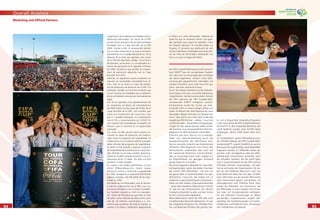
Angola 26/08 179.52 77.65
Argentina 26/08 178.00 73.78
Australia 28/06 184.30 80.57
Brazil 28/10 181.30 76.13
Costa Rica 27/11 179.17 76.04
Côte d’Ivoire 26/00 179.96 76.04
Croatia 28/00 184.30 78.30
Czech Republic 28/11 184.35 78.00
1966 England 89 32 2.78 England
1970 Mexico 95 32 2.97 Brazil
1974 Germany FR 97 38 2.55 Germany FR
1978 Argentina 102 38 2.68 Argentina
1982 Spain 146 52 2.81 Italy
1986 Mexico 132 52 2.54 Argentina
1990 Italy 115 52 2.21 Germany FR
1994 USA 141 52 2.71 Brazil
1998 France 171 64 2.67 France
2002 Korea/Japan 161 64 2.52 Brazil
2006 Germany 147 64 2.30 Italy
TOTAL 2063 708 2.91
GOALS IN 76TH
- 90TH
MINUTE INCL. EXTRA TIME
Goals for teams leading:
Nr. Match Result
1 Germany v. Costa Rica, 3-2, 87’ FRINGS 4-2
2 Poland v. Ecuador, 0-1, 80’ DELGADO 0-2
7 Mexico v. Iran, 2-1, 79’ ZINHA 3-1
9 Italy v. Ghana, 1-0, 83’ IAQUINTA 2-0
10 USA v. Czech Republic, 0-2, 76’ ROSICKY 0-3
15 Spain v. Ukraine, 3-0, 81’ TORRES 4-0
18 Ecuador v. Costa Rica, 2-0, 92’ KAVIEDES 3-0
19 England v. Trinidad & Tobago, 1-0, 91’ GERRARD 2-0
21 Argentina v. Serbia & Montenegro, 3-0,
78’ CRESPO, 84’ TEVEZ, 88’ MESSI 6-0
24 Portugal v. Iran, 1-0, 80’ CH. RONALDO 2-0
26 Czech Republic v. Ghana, 0-1, 82’ MUNTARI 0-2
27 Brazil v. Australia, 1-0, 90’ FRED 2-0
30 Togo v. Switzerland, 0-1, 88’ BARNETTA 0-2
32 Saudi Arabia v. Ukraine, 0-3, 84’ KALINICHENKO 0-4
36 Paraguay v. Trinidad & Tobago, 1-0, 86’ CUEVAS 2-0
41 Czech Republic v. Italy, 0-1, 87’ INZAGHI 0-2
43 Japan v. Brazil, 1-3, 81’ RONALDO 1-4
46 Switzerland v. Korea Republic, 1-0, 77’ FREI 2-0
55 Brazil v. Ghana, 2-0, 84’ ZE ROBERTO 3-0
63 Germany v. Portugal, 2-0, 78’ SCHWEINSTEIGER 3-0 3-1
Goals for teams trailing:
5 Argentina v. Côte d’Ivoire, 2-0, 82’ DROGBA 2-1
12 Australia v. Japan, 1-1, 84’ CAHILL; 2-1 89’ CAHILL;
3-1, 92’+ ALOISI 3-1
29 France v. Korea Republic, 1-0, 81’ PARK 1-1
35 Sweden v. England, 1-2, 90’ LARSSON 2-2
44 Croatia v. Australia, 2-1, 79’ KEWELL 2-2
57 Germany v. Argentina, 0-1, 80’ KLOSE 1-1, PSO 4-2
63 Germany v. Portugal, 3-0, 88’ NUNO GOMES 3-1
Teams tying:
16 Tunisia v. Saudi Arabia, 1-1, 84’ AL JABER 1-2, 92’ JAIDI 2-2
17 Germany v. Poland, 0-0, 91’+ 1-0 NEUVILLE 1-0
20 Sweden v. Paraguay, 0-0, 89’ 1-0 LJUNGBERG 1-0
31 Spain v. Tunisia, 1-1, 76’ TORRES, 2-1, 90’ TORRES (pen.) 3-1
35 England v. Sweden 1-1, 85' Gerrard 2-1 2-2
38 Côte d’Ivoire v. Serbia & Montenegro, 2-2, 86’ KALOU (pen.) 3-2
53 Italy v. Australia, 0-0, 95’+ 1-0 TOTTI (pen.) 1-0
56 Spain v. France, 1-1, 83’ VIEIRA 1-2, 92’ ZIDANE 1-3
61 Germany v. Italy, 0-0, 119’ GROSSO 0-1, 121’ DEL PIERO 0-2
TOP GOALSCORERS 1930-2002
Rank Player Country, No. Goals
1930 Uruguay
1 STABILE Guillermo (ARG) 8
2 CEA Pedro (URU) 5
3 SUBIABRE Guillermo (CHI) 4
1934 Italy
1 CONEN Edmund (GER) 4
NEJEDLY Oldrich (TCH) 4
SCHIAVIO Angelo (ITA) 4
1938 France
1 LEONIDAS (BRA) 8
2 ZSENGELLER Gyula (HUN) 6
3 PIOLA Silvio (ITA) 5
SAROSI Gyorgy (HUN) 5
1950 Brazil
1 ADEMIR (BRA) 9
2 BASORA Estanislao (ESP) 5
MIGUEZ Oscar (URU) 5
1954 Switzerland
1 KOCSIS Sandor (HUN, 8) 11
2 HUEGI Sepp (SUI, 18) 6
MORLOCK Max (GER, 13) 6
PROBST Erich (AUT, 10) 6
1958 Sweden
1 FONTAINE Just (FRA, 17) 13
2 PELE (BRA, 10) 6
RAHN Helmut (GER, 8) 6
1962 Chile
1 ALBERT Florian (HUN, 9) 4
GARRINCHA (BRA, 7) 4
IVANOV Valentin (URS, 14) 4
JERKOVIC Drazen (YUG, 9) 4
SANCHEZ Leonel (CHI, 11) 4
VAVA (BRA, 19) 4
1966 England
1 EUSEBIO (POR, 13) 9
2 HALLER Helmut (GER, 8) 6
3 BECKENBAUER Franz (GER, 4) 4
BENE Ferenc (HUN, 7) 4
HURST Geoff (ENG, 10) 4
PORKUJAN Valeriy (URS, 17) 4
1970 Mexico
1 MUELLER Gerd (GER, 13) 10
2 JAIRZINHO (BRA, 7) 7
3 CUBILLAS Teofilo (PER, 10) 5
1974 Germany FR
1 LATO Grzegorz (POL, 16) 7
2 NEESKENS Johan (NED, 13) 5
SZARMACH Andrzej (POL, 17) 5
Statistics and Team Data
128128 129129
1978 Argentina
1 KEMPES Mario (ARG, 10) 6
2 CUBILLAS Teofilo (PER, 10) 5
RENSENBRINK Rob (NED, 12) 5
1982 Spain
1 ROSSI Paolo (ITA, 20) 6
2 RUMMENIGGE Karl-Heinz (GER, 11) 5
3 BONIEK Zbigniew (POL, 20) 4
ZICO (BRA, 10) 4
1986 Mexico
1 LINEKER Gary (ENG, 10) 6
2 BUTRAGUENO (ESP, 9) 5
CARECA (BRA, 9) 5
MARADONA Diego (ARG, 10) 5
1990 Italy
1 SCHILLACI Salvatore (ITA, 19) 6
2 SKUHRAVY Tomas (CZE, 10) 5
3 LINEKER Gary (ENG, 10) 4
MATTHAEUS Lothar (GER, 10) 4
MICHEL (ESP, 21) 4
MILLA Roger (CMR, 9) 4
1994 USA
1 SALENKO Oleg (RUS, 9) 6
STOICHKOV Hristo (BUL, 8) 6
3 ANDERSSON Kennet (SWE, 19) 5
BAGGIO Roberto (ITA, 10) 5
KLINSMANN Juergen (GER, 18) 5
ROMARIO (BRA, 11) 5
1998 France
1 SUKER Davor (CRO, 9) 6
2 BATISTUTA Gabriel (ARG, 9) 5
VIERI Christian (ITA, 21) 5
2002 Korea/Japan
1 RONALDO (BRA, 9) 8
2 KLOSE Miroslav (GER, 11) 5
RIVALDO (BRA, 10) 5
2006 Germany
1 KLOSE Miroslav (GER, 11) 5
2 CRESPO Hernan (ARG, 9) 3
RONALDO (BRA, 9) 3
Angola (4)
FLAVIO: CWC 05
LAMA: WYC 01
MANTORRAS: WYC 01
MENDONCA: WYC 01
Argentina (21)
ABBONDANZIERI R.: U-16 WC 89
AIMAR Pablo: CC 05, WC 02, WYC 97, U-17 WC 95
AYALA Roberto: OFT 04, WC 02, WC 98, OFT 96, CC 95
BURDISSO Nicolas: OFT 04, WYC 01
CAMBIASSO Esteban: CC 05, WYC 99, WYC 97, U-17 WC 95
COLOCCINI Fabricio: CC 05, OFT 04, WYC 01
CRESPO Hernan: WC 02, WC 98, OFT 96, CC 95
CUFRE Leandro: WYC 97
FRANCO Leonardo: CC 05, WYC 97
GONZALEZ Luis: OFT 04
HEINZE Gabriel: CC 05, OFT 04
MASCHERANO Javier: OFT 04, WYC 03, U-17 WC 01
MESSI Lionel: WYC 05
MILITO Gabriel: CC 05, WYC 99, U-17 WC 97
RIQUELME Juan: CC 05, WYC 97
RODRIGUEZ Maxi: CC 05, WYC 01
SAVIOLA Javier: CC 05, OFT 04, WYC 01
SCALONI Lionel: WYC 97
SORIN Juan: CC 05, WC 02, OFT 96, WYC 95
TEVEZ Carlos: CC 05, OFT 04, WYC 03, U-17 WC 01
USTARI Oscar: WYC 05, U-17 WC 03
Australia (21)
ALOISI John: CC 05, OFT 04, CC 01, CC 97
BRESCIANO Marco: CC 01, OFT 2000, WYC 99
CAHILL Tim: CC 05, OFT 04
CHIPPERFIELD Scott: CC 05, CC 01
CULINA Jason: CC 05, OFT 2000, WYC 99
EMERTON Brett: CC 05, CC 01, OFT 2000, WYC 99, WYC 97, U-17 WC 95
GRELLA Vince: OFT 2000, WYC 99, WYC 97
KALAC Zeljko: CC 05, CC 01, CC 97, WYC 91, U-16 WC 89
KENNEDY Joshua: WYC 01, U-17 WC 99
KEWELL Harry: CWC 05, CC 97, U-17 WC 95
LAZARIDIS Stan: CC 01, OFT 2000, CC 97
MILLIGAN Mark: CWC 05, WYC 05
MOORE Craig: CC 05, OFT 04, CC 01, WYC 93, U-17 WC 91
NEILL Lucas: CC 05, OFT 2000, WYC 97
POPOVIC Tony: CC 05, CC 01, OFT 96, OFT 92, WYC 91, U-16 WC 89
SCHWARZER Mark: CC 05, CC 01, U-16 WC 89
SKOKO Josip: CC 05, CC 01, OFT 2000, CC 97, WYC 95
STERJOVSKI Mile: CC 05, CC 01, WYC 99
THOMPSON Archie: CC 05, CC 01
VIDUKA Mark: CC 05, OFT 2000, CC 97, OFT 96, WYC 95
WILKSHIRE Luke: CC 05, OFT 04, WYC 01
Brazil (21)
ADRIANO: CC 05, CC 03, WYC 01, U-17 WC 99
CAFU: WC 02, WC 98, CC 97, WC 94
CICINHO: CWC 05, CC 05
DIDA: CC 05, CC 03, WC 02, CC 01, CWC 2000, CC 99,
WC 98, CC 97, OFT 96, WYC 93
EMERSON: CC 05, CC 03, CC 99, WC 98
GILBERTO: CC 05, CC 03, CWC 2000
GILBERTO SILVA: CC 05, WC 02
Players who participated
in former FIFA competitions
JUAN: CC 05, CC 03, WYC 99, U-17 WC 95
JULIO CESAR: CC 03, WYC 99, U-17 WC 95
JUNINHO P.: CC 05, CWC 2000
KAKA: CC 05, WC 02, WYC 01
LUCIO: CC 05, CC 03, WC 02, CC 01, OFT 2000
LUISAO: CC 05, WYC 01
MINEIRO: CWC 05
RICARDINHO: CC 03, WC 02, CWC 2000
ROBERTO CARLOS: WC 02, CWC 2000, WC 98, CC 97, OFT 96, WYC 91
ROBINHO: CC 05
ROGERIO CENI : CWC 05, WC 02, CC 97, OFT 96
RONALDINHO: CC 05, CC 03, WC 02, OFT 2000, CC 99, WYC 99,
U-17 WC 97
RONALDO: WC 02, WC 98, CC 97, OFT 96, WC 94
ZE ROBERTO: CC 05, CC 99, WC 98, CC 97
Costa Rica (19)
AZOFEIFA Randall: CWC 05, U-17 WC 01
BADILLA Gabriel: CWC 05, U-17 WC 01
BOLANOS Cristian: CWC 05, U-17 WC 01
CENTENO Walter: CWC 05, WC 02
DRUMMOND Jervis: CWC 05, WC 02, WYC 95
FONSECA Danny: WYC 99
GOMEZ Ronald: CWC 05, WC 02
HERNANDEZ Carlos: OFT 04, WYC 01
MARIN Luis: WC 02
MARTINEZ Gilberto: WC 02, WYC 99
MESEN Alvaro: WC 02
PORRAS Jose: CWC 05, WYC 89
RODRIGUEZ Michael: OFT 04, WYC 01
SABORIO Alvaro: CWC 05, OFT 04
SEQUEIRA Douglas: WYC 97
SOLIS Mauricio: WC 02
UMANA Michael: OFT 04
WALLACE Harold: WC 02, WYC 95
WANCHOPE Paulo: WC 02, WYC 95
Cote d Ivoire (2)
KALOU Bonaventure: WYC 97
KONE Arouna: WYC 03
Croatia (13)
BALABAN Bosko: WC 02
BUTINA Tomislav: WC 02
KOVAC Niko: WC 02
KOVAC Robert: WC 02
KRANJCAR Niko: U-17 WC 01
OLIC Ivica: WC 02
PLETIKOSA Stipe: WC 02, WYC 99
SERIC Anthony: WC 02, WYC 99, WC 98
SIMIC Dario: WC 02, WC 98
SIMUNIC Josip: WC 02
TOMAS Stjepan: WC 02
TUDOR Igor: WC 98
VRANJES Jurica: WC 02, WYC 99
Czech Republic (11)
BAROS Milan: OFT 2000
CECH Petr: WYC 01
HEINZ Marek: OFT 2000
Statistics and Team Data
130130 131131
Statistics and Team Data
JANKULOVSKI Marek: OFT 2000, U-17 WC 93
KOVAC Radoslav: OFT 2000
LOKVENC Vratislav: CC 97
NEDVED Pavel: CC 97
POBORSKY Karel: CC 97
POLAK Jan: WYC 01, OFT 2000
SIONKO Libor: OFT 2000, U-17 WC 93
UJFALUSI Tomas: OFT 2000
Ecuador (13)
AYOVI Marlon: WC 02
BORJA Felix: WYC 01
CASTILLO Segundo: WYC 01
DE LA CRUZ Ulises: WC 02
DELGADO Agustin: WC 02, CWC 2000
ESPINOZA Giovanny: WC 02
GUAGUA Jorge: WYC 01
HURTADO Ivan: WC 02
KAVIEDES Ivan: WC 02
MENDEZ Edison: WC 02
TENORIO Carlos: WC 02
TENORIO Edwin: WC 02
VILLAFUERTE Edwin: U-17 WC 95
England (14)
BECKHAM David: WC 02, CWC 2000, WC 98
BRIDGE Wayne: WC 02
CAMPBELL Sol: WC 02, WC 98
CARRAGHER Jamie: CWC 05, WYC 97
CARSON Scott: CWC 05
COLE Ashley: WC 02, WYC 99
COLE Joe: WC 02
CROUCH Peter: CWC 05, WYC 99
FERDINAND Rio: WC 02, WC 98
GERRARD Steven: CWC 05
HARGREAVES Owen: WC 02
JAMES David: WC 02
NEVILLE Gary: CWC 2000, WC 98
OWEN Michael: WC 02, WC 98, WYC 97
France (18)
BARTHEZ Fabien: CC 03, WC 02, WC 98
BOUMSONG Jean-Alain:CC 03
COUPET Gregory: CC 03, WC 02, CC 01
DHORASOO Vikash: OFT 96
DIARRA Alou: WYC 01
GALLAS William: CC 03, WYC 97
GIVET Gael: WYC 01
GOVOU Sidney: CC 03
HENRY Thierry: CC 03, WC 02, WC 98, WYC 97
LANDREAU Mickael: CC 03, CC 01, WYC 97
MAKELELE Claude: WC 02, OFT 96
SAGNOL Willy: CC 03, WC 02, CC 01, WYC 97
SILVESTRE Mikael: CC 03, WC 02, CC 01, CWC 2000, WYC 97
THURAM Lilian: CC 03, WC 02, WC 98
TREZEGUET David: WC 02, WC 98, WYC 97
VIEIRA Patrick: WC 02, CC 01, WC 98, OFT 96
WILTORD Sylvain: CC 03, WC 02, CC 01, OFT 96
ZIDANE Zinedine: WC 02, WC 98
Germany (20)
ASAMOAH Gerald: CC 05, WC 02
BALLACK Michael: CC 05, WC 02, CC 99
BOROWSKI Tim: CC 05
FRIEDRICH Arne: CC 05
FRINGS Torsten: CC 05, WC 02
HANKE Mike: CC 05
HILDEBRAND Timo: CC 05, WYC 99
HITZLSPERGER Thomas: CC 05, U-17 WC 99
HUTH Robert: CC 05, WYC 03
JANSEN Marcell: WYC 05
KAHN Oliver: CC 05, WC 02, WC 98, WC 94
KEHL Sebastian: WC 02, U-17 WC 97
KLOSE Miroslav: WC 02
LEHMANN Jens: CC 05, WC 02, CC 99, WC 98
MERTESACKER Per: CC 05
METZELDER Christoph: WC 02
NEUVILLE Oliver: WC 02, CC 99
PODOLSKI Lukas: CC 05
SCHNEIDER Bernd: CC 05, WC 02, CC 99
SCHWEINSTEIGER B.: CC 05
Ghana (14)
ADJEI Sammy: WYC 99
APPIAH Stephen: OFT 04, WYC 99, WYC 97, U-17 WC 95
BOATENG Derek: WYC 01
ESSIEN Michael: WYC 01, U-17 WC 99
GYAN Asamoah: OFT 04
KINGSON Richard: OFT 96
KUFFOUR Samuel: OFT 96, U-17 WC 93, WYC 93, OFT 92, U-17 WC 91
MENSAH John: OFT 04, WYC 01
MUNTARI Sulley: WYC 01
OWU George: OFT 04, WYC 01
PANTSIL John: OFT 04, WYC 01
PAPPOE Emmanuel: OFT 04, WYC 01
PIMPONG Razak: OFT 04, WYC 01, U-17 WC 99
QUAYE Daniel: U-17 WC 97
Iran (5)
DAEI Ali: WC 98
KAABI Hossein: U-17 WC 01
KAZEMEIAN Javad: WYC 01
MADANCHI Mehrzad: WYC 01
MAHDAVIKIA Mehdi: WC 98,
Italy (15)
AMELIA Marco: OFT 04
BARZAGLI Andrea: OFT 04
BUFFON Gianluigi: WC 02, WC 98, OFT 96, U-17 WC 93
CANNAVARO Fabio: WC 02, WC 98, OFT 96
DE ROSSI Daniele: OFT 04
DEL PIERO Alessandro: WC 02, WC 98, U-17 WC 91
GATTUSO Gennaro: WC 02, OFT 2000
GILARDINO Alberto: OFT 04
INZAGHI Filippo: WC 02, WC 98
MATERAZZI Marco: WC 02
NESTA Alessandro: WC 02, WC 98, OFT 96
PERUZZI Angelo: OFT 92
PIRLO Andrea: OFT 04, OFT 2000
TOTTI Francesco: WC 02, U-17 WC 93
ZAMBROTTA Gianluca: WC 02, OFT 2000
Japan (22)
DOI Yoichi: CC 05, CC 03
ENDO Yasuhito: CC 05, CC 03, WYC 99
FUKUNISHI Takashi: CC 05, WC 02
INAMOTO Junichi: CC 05, CC 03, WC 02, CC 01, OFT 2000, WYC 99,
U-17 WC 95
Players who participated in former FIFA competitions
KAJI Akira: CC 05, WYC 99
KAWAGUCHI Yoshikatsu:CC 05, CC 03, WC 02, CC 01, WC 98, OFT 96
KOMANO Yuichi: OFT 04, WYC 01
MIYAMOTO Tsuneyasu: CC 05, CC 03, WC 02, OFT 2000, WYC 97, U-17 WC 93
MONIWA Teruyuki: CC 05, OFT 04
NAKAMURA Shunsuke: CC 05, CC 03, OFT 2000, WYC 97
NAKATA Hidetoshi: CC 05, CC 03, WC 02, CC 01, OFT 2000, WC 98, OFT 96,
WYC 95, U-17 WC 93
NAKATA Koji: CC 05, CC 03, WC 02, CC 01, OFT 2000, WYC 99
NAKAZAWA Yuji: OFT 2000
NARAZAKI Seigo: CC 05, CC 03, WC 02, CC 01, OFT 2000, WC 98
OGASAWARA Mitsuo: CC 05, CC 03, WC 02, WYC 99
OGURO Masashi: CC 05
ONO Shinji: OFT 04, WC 02, CC 01, WYC 99, WC 98, U-17 WC 95
SANTOS Alessandro: CC 05, CC 03, WC 02
TAKAHARA Naohiro: CC 03, CC 01, OFT 2000, WYC 99, U-17 WC 95
TAMADA Keiji: CC 05
TSUBOI Keisuke: CC 05, CC 03
YANAGISAWA Atsushi: CC 05, WC 02, OFT 2000, WYC 97
Korea Republic (22)
AHN Jung Hwan: WC 02
BAEK Ji Hoon: WYC 05
CHO Jae Jin: OFT 04
CHO Won Hee: WYC 03
CHOI Jin Cheul: WC 02
CHUNG Kyung Ho: OFT 04
KIM Do Heon: OFT 04
KIM Dong Jin: OFT 04
KIM Jin Kyu: WYC 05, WYC 03
KIM Nam Il: WC 02
KIM Sang Sik: OFT 2000
KIM Yong Dae: CC 01, OFT 2000, WYC 99
KIM Young Kwang: OFT 04, WYC 03
LEE Chun Soo: OFT 04, WC 02, OFT 2000
LEE Eul Yong: WC 02
LEE Ho: WYC 03
LEE Woon Jae: WC 02, CC 01, WC 94, OFT 92
LEE Young Pyo: WC 02, CC 01, OFT 2000
PARK Chu Young: WYC 05, WYC 03
PARK Ji Sung: WC 02, CC 01, OFT 2000
SEOL Ki Hyeon: WC 02, CC 01, WYC 99
SONG Chong Gug: WC 02, CC 01, OFT 2000, WYC 99
Mexico (20)
ARELLANO Jesus: WC 02, CC 01, CC 99, WC 98, OFT 96
BORGETTI Jared: CC 05, WC 02, CC 01
BRAVO Omar: CC 05, OFT 04
CORONA Jose: CC 05, OFT 04, U-17 WC 97
FONSECA Jose: CC 05
GARCIA Rafael: WC 02, CC 99, OFT 96, WYC 93, U-17 WC 91
MARQUEZ Rafael: CC 05, WC 02, CC 99, WYC 99
MENDEZ Mario: CC 05, WYC 99
MORALES Ramon: CC 05, WC 02
OCHOA Guillermo: OFT 04
OSORIO Ricardo: CC 05
PARDO Pavel: CC 05, CC 01, CC 99, WC 98, CC 97, OFT 96
PEREZ Luis: CC 05, OFT 04, CWC 2000, U-17 WC 97
PINEDA Gonzalo: CC 05, OFT 04
RODRIGUEZ Francisco: OFT 04
SALCIDO Carlos: CC 05
SANCHEZ Oswaldo: CC 05, WC 02, CC 01, WC 98, CC 97, OFT 96, WYC 93
SUAREZ Claudio: CC 01, CC 99, WC 98, CC 97, OFT 96, CC 95, WC 94
TORRADO Gerardo: CC 05, WC 02, CC 99, WYC 99
ZINHA: CC 05, OFT 04
Netherlands (11)
BABEL Ryan: WYC 05
COCU Phillip: WC 98
HEITINGA John: WYC 01
LANDZAAT Denny: WYC 95
MADURO Hedwiges: WYC 05
OOIJER Andre: WC 98
ROBBEN Arjen: WYC 01
STEKELENBURG Maarten: WYC 01
VAN BRONCKHORST G.:WC 98
VAN DER SAR Edwin: WC 98, WC 94,
VAN DER VAART Rafael: WYC 01
Paraguay (17)
ACUNA Roberto: WC 02, WC 98
BARRETO Edgar: OFT 04, WYC 03, U-17 WC 01
BONET Carlos: WC 02
CABANAS Salvador: WYC 99
CACERES Julio Cesar: WC 02
CANIZA Denis: WC 02, WC 98
CUEVAS Nelson: WC 02, WYC 99
DA SILVA Paulo: WYC 99, WYC 97
DOS SANTOS Julio: WYC 03
GAMARRA Carlos: OFT 04, WC 02, WC 98, OFT 92
GAVILAN Diego: WC 02
LOPEZ Dante: WYC 03
MANZUR Julio: OFT 04
PAREDES Carlos: WC 02, WC 98
SANTA CRUZ Roque: WC 02, WYC 99
VALDEZ Nelson: WYC 03
VILLAR Justo: WC 02, WYC 97
Poland (9)
BAK Jacek: WC 02
BROZEK Pawel: U-17 WC 99
KRZYNOWEK Jacek: WC 02
KUSZCZAK Tomasz: U-17 WC 99
MILA Sebastian: U-17 WC 99
RADOMSKI Arkadiusz: U-17 WC 93
SZYMKOWIAK Miroslav:U-17 WC 93
ZEWLAKOW Michal: WC 02
ZURAWSKI Maciej: WC 02
Portugal (14)
BOA MORTE: OFT 04
CANEIRA: WC 02, WYC 99, U-17 WC 95
CRISTIANO RONALDO: OFT 04
FERNANDO MEIRA: OFT 04
HUGO VIANA: OFT 04, WC 02
LUIS FIGO: WC 02, WYC 91, U-16 WC 89
NUNO GOMES: WC 02, OFT 96, WYC 95
PAULETA: WC 02
PAULO SANTOS: U-16 WC 89
PETIT: WC 02
QUIM: WYC 95
RICARDO: WC 02
RICARDO COSTA: OFT 04
SIMAO SABROSA: WYC 99
Saudi Arabia (16)
AL BAHRI Ahmed: WYC 99
AL DEAYEA Mohammed:WC 02, CC 99, WC 98, CC 97, CC 95, WC 94,
U-16 WC 89
Statistics and Team Data
132132 133133
AL GHAMDI Omar: WC 02
AL JABER Sami: WC 02, WC 98, CC 97, CC 95, WC 94
AL MONTASHARI Hamad: CWC 05
AL SHLHOUB Mohammad: WC 02
AL TEMYAT Nawaf: WC 02, CC 99, WC 98
AMEEN Mohammed: CWC 05
DOKHI Ahmed: CWC 05, WC 02, WC 98, CC 97
KARIRI Saud: CWC 05
KHATHRAN Abdulaziz: WC 02
MASSAD Mohammed: WYC 03
NOOR Mohammed: CWC 05, WC 02, CC 99
SULIMANI Hussein: WC 02, CC 99, WC 98, CC 97, OFT 96
TUKAR Redha: CWC 05, WC 02
ZAID Mabrouk: CWC 05, WC 02, WYC 99
Serbia and Montenegro (2)
MILOSEVIC Savo: WC 98
STANKOVIC Dejan: WC 98
Spain (16)
ALBELDA David: WC 02, OFT 2000, WYC 97
CANIZARES Santiago: WC 98, WC 94, OFT 92, WYC 89
CASILLAS Iker: WC 02, CWC 2000, WYC 99, U-17 WC 97
FABREGAS Cesc: WYC 05, U-17 WC 03
GARCIA Luis: CWC 05
INIESTA: WYC 03, U-17 WC 01
JOAQUIN: WC 02
MARCHENA Carlos: OFT 2000, WYC 99
MARCOS SENNA: CWC 2000
PUYOL Carlos: WC 02, OFT 2000
RAUL: WC 02, CWC 2000, WC 98, OFT 96, WYC 95
REINA Jose Manuel: CWC 05, U-17 WC 99
SALGADO Michel: CWC 2000, WYC 95
TORRES Fernando: U-17 WC 01
XABI ALONSO: CWC 05
XAVI: WC 02, OFT 2000, WYC 99, U-17 WC 97
Sweden (13)
ALEXANDERSSON N.: WC 02, OFT 92, WYC 91
ALLBACK Marcus: WC 02
ANDERSSON Daniel: WC 02
EDMAN Erik: WC 02
IBRAHIMOVIC Zlatan: WC 02
ISAKSSON Andreas: WC 02
JONSON Mattias: WC 02
LARSSON Henrik: WC 02, WC 94
LINDEROTH Tobias: WC 02
LJUNGBERG Fredrik: WC 02
LUCIC Teddy: WC 02
MELLBERG Olof: WC 02
SVENSSON Anders: WC 02
Switzerland (4)
BARNETTA Tranquillo: WYC 05
DJOUROU Johan: WYC 05
DZEMAILI Blerim: WYC 05
SENDEROS Philippe: WYC 05
Togo (1)
AGBOH Kuami: WYC 97
Trinidad and Tobago (3)
INCE Clayton: WYC 91
JONES Kenwyne: U-17 WC 01
YORKE Dwight: CWC 05, CWC 2000, WYC 91
Tunisia (19)
AYARI Anis: CC 05, OFT 04
BEN SAADA Chaouki: CC 05, U-17 WC 01
BOUAZIZI Riadh: WC 02, WC 98, OFT 96
BOUMNIJEL Ali: CC 05, WC 02, WC 98
CHEDLI Adel: CC 05
ESSEDIRI Karim: CC 05
GHODHBANE Kaies: CC 05, WC 02, WC 98, OFT 96
GUEMAMDIA Haykel: CC 05
HAGGUI Karim: OFT 04
JAIDI Radhi: CC 05, WC 02, OFT 96
JAZIRI Zied: CC 05, WC 02
KASRAOUI Hamdi: CC 05
MNARI Jaouhar: CC 05
NAFTI Mehdi: CC 05
NAMOUCHI Hamed: CC 05
SAIDI Karim: CC 05
SANTOS: CC 05
TRABELSI Hatem: CC 05, WC 02, WC 98
YAHIA Alaeddine: OFT 04
Ukraine (4)
BELIK Oleksiy: WYC 01
IATSENKO Oleksandr: WYC 05
MILEVSKIY Artem: WYC 05
SHUST Bohdan: WYC 05
USA (21)
ALBRIGHT Chris: OFT 2000, WYC 99
BEASLEY DaMarcus: CC 03, WC 02, WYC 01, U-17 WC 99
BERHALTER Gregg: CC 03, WC 02, CC 99, WYC 93
BOCANEGRA Carlos: CC 03, WYC 99
CHERUNDOLO Steve: CC 03, WC 02, WYC 99
CONVEY Bobby: WYC 03, CC 03, WYC 01, U-17 WC 99
DEMPSEY Clint: WYC 03
DONOVAN Landon: CC 03, WC 02, WYC 01, OFT 2000, U-17 WC 99
HAHNEMANN Marcus: CC 03
HOWARD Tim: CC 03, OFT 2000, WYC 99, U-17 WC 95
JOHNSON Eddie: WYC 03, U-17 WC 01
KELLER Kasey: WC 02, CC 99, WC 98, OFT 96, WC 90, WYC 89, WYC 87
LEWIS Eddie: CC 03, WC 02, CC 99
MASTROENI Pablo: CC 03, WC 02
MC BRIDE Brian: WC 02, CC 99, WC 98
O BRIEN John: WC 02, OFT 2000, WYC 97, U-17 WC 93
OLSEN Ben: OFT 2000, CC 99, WYC 97
ONYEWU Oguchi: WYC 01, U-17 WC 99
POPE Eddie: WC 02, WC 98, OFT 96
REYNA Claudio: WC 02, WC 98, OFT 96, WC 94, OFT 92, U-16 WC 89
WOLFF Josh: WC 02, OFT 2000, WYC 97
CC FIFA Confederations Cup
CWC FIFA Club World Cup
U-16 WC FIFA U-16 World Cup
U-17 WC FIFA U-17 World Cup
OFT Olympic Football Tournament
WC FIFA World Cup
WYC FIFA World Youth Cup
Tournament Facts and Rankings
THE MOST SUCCESSFUL GOALSCORERS
Goals
15 Ronaldo Brazil 1998 / 4 2002 / 8 2006 / 3
14 Gerd Müller Germany 1970 / 10 1974 / 4
13 Just Fontaine France 1958 / 13
12 Pelé Brazil 1958 / 6 1962 / 1 1966 / 1 1970 / 4
11 Sandor Kocsis Hungary 1954 / 11
Jürgen Klinsmann Germany 1990 / 3 1994 / 5 1998 / 3
10 Helmut Rahn Germany 1954 / 4 1958 / 6
Teofilo Cubillas Peru 1970 / 5 1978 / 5
Grzegorz Lato Poland 1974 / 4 1978 / 2 1982 / 1
Gary Lineker England 1986 / 6 1990 / 4
Gabriel Batistuta Argentina 1994 / 4 1998 / 5 2002 / 1
Miroslav Klose Germany 2002 / 5 2006 / 5
9 Leonidas Brazil 1934 / 1 1938 / 8
Ademir Brazil 1950 / 9
Vava Brazil 1958 / 5 1962 / 4
Uwe Seeler Germany 1958 / 2 1962 / 2 1966 / 2 1970 / 3
Eusebio Portugal 1966 / 9
Jairzinho Brazil 1970 / 7 1974 / 2
Paolo Rossi Italy 1978 / 3 1982 / 6
Karl-Heinz Rummenigge Germany 1978 / 3 1982 / 5 1986 / 1
Roberto Baggio Italy 1990 / 2 1994 / 5 1998 / 2
Christian Vieri Italy 1998 / 5 2002 / 4
8 Guillermo Stabile Argentina 1930 / 8
Oscar Miguez Uruguay 1950 / 5 1954 / 3
Diego Maradona Argentina 1982 / 2 1986 / 5 1994 / 1
Rudi Völler Germany 1986 / 3 1990 / 3 1994 /2
Rivaldo Brazil 1998 / 3 2002 / 5
7 Hans Schäfer Germany 1954 / 4 1958 / 3
Lajos Tichy Hungary 1958 / 4 1962 / 3
Johnny Rep Netherlands 1974 / 4 1978 / 3
Andrzej Szarmach Poland 1974 / 5 1978 / 1 1982 / 1
Careca Brazil 1986 / 5 1990 / 2
6 Oldrich Nejedly Czechoslovakia 1934 / 4 1938 / 2
Gyorgy Sarosi Hungary 1934 / 1 1938 / 5
Gyula Zsengeller Hungary 1938 / 6
Seppe Hügi II Switzerland 1954 / 6
Max Morlock Germany 1954 / 6
Erich Probst Austria 1954 / 6
Helmut Haller Germany 1966 / 6
Rivelino Brazil 1970 / 3 1974 / 3
Rob Rensenbrink Netherlands 1974 / 1 1978 / 5
Mario Kempes Argentina 1978 / 6
Zbigniev Boniek Poland 1978 / 2 1982 / 4
Lothar Matthäus Germany 1986 / 1 1990 / 4 1994 / 1
Salvatore Schillaci Italy 1990 / 6
Oleg Salenko Russia 1994 / 6
Hristo Stoichkov Bulgaria 1994 / 6
Bebeto Brazil 1994 / 3 1998 / 3
Dennis Bergkamp Netherlands 1994 / 3 1998 / 3
Thierry Henry France 1998 / 3 2006 / 3
Davor Suker Croatia 1998 / 6
Players who participated in former FIFA competitions
134134 135135
Statistics and Team Data
FINAL MATCHES 1930-2006
Championship No of participants Final Result Referee
1930 Uruguay 13 participants Uruguay v. Argentina 4-2 (1-2) John Langenus, Belgium
1934 Italy 16 participants Italy v. Czechoslovakia 2-1 a.e.t. (1-1, 0-0) Ivan Eklind, Sweden
1938 France 15 participants Italy v. Hungary 4-2 (3-1) Georges Capdeville, France
1950 Brazil 13 participants Brazil v. Uruguay 1-2 ( 0-0) George Reader, England
1954 Switzerland 16 participants Germany FR v. Hungary 3-2 (2-2) Willy H.E. Ling, England
1958 Sweden 16 participants Brazil v. Sweden 5-2 (2-1) Maurice Gigue, France
1962 Chile 16 participants Brazil v. Czechoslovakia 3-1 (1-1) Nikolaj Latychev, USSR
1966 England 16 participants England v. Germany FR 4-2 a.e.t. (2-2, 1-1) Gottfried Dienst, Switzerland
1970 Mexico 16 participants Brazil v. Italy 4-1 (1-1) Rudi Glöckner, GDR
1974 Germany FR 16 participants Germany FR v. Netherlands 2-1 (2-1) John Taylor, England
1978 Argentina 16 participants Argentina v. Netherlands 3-1 a.e.t. (1-1, 1-1) Sergio Gonella, Italy
1982 Spain 24 participants Italy v. Germany FR 3-1 (0-0) Arnaldo Coelho, Brazil
1986 Mexico 24 participants Argentina v. Germany FR 3-2 (1-0) Romualdo Arppi Filho, Brazil
1990 Italy 24 participants Argentina v. Germany FR 0-1 (0-0) E.E. Codesal Mendez, Mexico
1994 USA 24 participants Brazil v. Italy 0-0, 3-2 PSO Sándor Puhl, Hungary
1998 France 32 participants Brazil v. France 0-3 (0-2) Saïd Belqola, Morocco
2002 Korea/Japan 32 participants Germany v. Brazil 0-2 (0-0) Pierluigi Collina, Italy
2006 Germany 32 participants Italy v. France 1-1 a.e.t. (1-1, 1-1) 5-3 PSO Horacio Elizondo, Argentina
HISTORICAL GOALS SCORED IN WORLD CUP FINAL COMPETITIONS
Goalscorer Match Goal Result Venue
1st
Goal Laurent (FRA) France v. Mexico 1-0 4-1 Montevideo, 13.07.1930
100st
Goal Schiavio (ITA) Italy v. USA 5-1 7-1 Rome, 27.05.1934
200st
Goal Keller (SWE) Sweden v. Cuba 8-0 8-0 Antibes, 12.06.1938
300st
Goal Chico (BRA) Brazil v. Spain 3-0 6-1 Rio de Janeiro, 13.07.1950
400st
Goal Morlock (GER) Germany FR v. Turkey 5-1 7-2 Zurich, 23.06.1954
500st
Goal Collins (SCO) Paraguay v. Scotland 3-2 3-2 Norrköping, 11.06.1958
600st
Goal Jerkovic (YUG) Yugoslavia v. Uruguay 3-1 3-1 Arica, 02.06.1962
700st
Goal Pak Seung Zin (PKR) Chile v. Korea DPR 1-1 1-1 Middlesborough, 15.07.1966
800st
Goal Müller (GER) Germany FR v. Bulgaria 5-2 5-2 Leon, 07.06.1970
900st
Goal Yazalde (ARG) Argentina v. Haiti 1-0 4-1 Munich, 23.06.1974
1000st
Goal Rensenbrink (NED) Scotland v. Netherlands 0-1 3-2 Mendoza, 11.06.1978
1100st
Goal Baltacha (URS) USSR v. New Zealand 3-0 3-0 Malaga, 19.06.1982
1200st
Goal Papin (FRA) Canada v. France 0-1 0-1 Leon, 01.06.1986
1300st
Goal Lineker (ENG) England v. Paraguay 3-0 3-0 Mexico City, 18.06.1986
1400st
Goal Ekström (SWE) Sweden v. Costa Rica 1-0 1-2 Genoa, 20.06.1990
1500st
Goal Caniggia (ARG) Argentina v. Nigeria 1-1 2-1 Boston, 25.06.1994
1600st
Goal Issa (RSA) France v. South Africa own goal 2-0 3-0 Marseille, 12.06.1998
1700st
Goal Komljenovic (YUG) USA v. Yugoslavia 0-1 0-1 Saint Denis, 12.07.1998
1800st
Goal Beto (POR) USA v. Portugal 3-1 3-2 Suwon, 05.06.2002
1900st
Goal Vieri (ITA) Korea Republic v. Italy 0-1 2-1 a.e.t. Daejeon, 18.06.2002
2000th
Goal Allback (SWE) Sweden v. England 1-1 2-2 Nuremberg, 20.06.2006
2063rd
Goal Materazzi (ITA) Italy v. France 1-1 5-3 PSO Berlin, 09.07.2006
RANKING OF TEAMS OF THE DIFFERENT CONFEDERATIONS SINCE 1930
Tournament Facts and Rankings
ACTUAL STANDINGS PER CONFEDERATION
Matches Wins Draws Losses Goals Points**
AFC (10 Teams*) 73 10 15 48 55-162 45
CAF (13 Teams*) 90 19 26 45 84-147 83
CONCACAF (10 Teams*) 108 25 18 65 105-230 93
CONMEBOL (9 Teams*) 281 132 58 91 473-368 454
OFC (2 Teams*) 10 1 2 7 7-23 5
UEFA (32 Teams*) 884 375 200 309 1393-1178 1325
76 Teams 1446 562 319 565 2117-2108 2005
* Number of different teams witch participated for the relevant confederation so far.
** Since 1994 three points awarded for a win.
1930 1934 1938 1950 1954 1958 1962 1966 1970 1974 1978 1982 1986 1990 1994 1998 2002 2006
15 16 8 14 21 20 22 12 20 4 17
23 24 20 28 9 25
30 31 28
31 32 28
13 14 16 13 17 11 7 9 12 7 13
13 22 20 22 18 17 19
23 24 20 23
25 27 24
26 29 30
3 16 8 10 13 16 11 12 6 15 16 18 6 13 13 13 8 15
13 12 16 24 24 23 14 22 11 25
32 19 27
31
1 9 3 1 4 1 1 5 1 4 1 5 1 2 1 2 1 5
2 14 2 5 12 3 7 4 8 3 11 5 9 10 6 16 6
5 9 13 10 11 7 11 8 20 13 14 19 14 18 12
6 11 12 13 13 22 16 16 21 16 24 18
9 13 14 21 26
10
14 23 16
4 1 1 3 1 2 2 1 2 1 2 1 2 1 2 1 2 1
7 2 2 4 2 3 4 2 3 2 4 2 3 3 3 3 3 2
8 3 4 5 3 4 5 3 5 3 5 3 4 4 4 4 5 3
11 4 5 6 6 5 6 4 8 5 6 4 7 5 5 5 6 4
5 6 7 7 6 7 6 9 6 7 6 8 6 6 7 10 7
6 7 8 8 7 8 9 10 7 10 7 9 8 7 8 12 8
7 9 9 8 9 10 10 9 11 8 10 10 8 9 13 9
8 10 10 9 13 13 12 10 12 9 12 11 11 10 14 10
9 11 11 10 15 15 13 12 13 10 14 12 15 11 15 11
9 12 12 11 16 16 15 15 12 15 15 16 15 21 14
12 13 14 14 14 17 17 17 17 22 20
15 14 15 15 15 18 18 18 19 23 21
16 19 18 24 23 25 22
19 21 21 27 28 32
29 30
AFCCAFCONMEBOLCONCACAFOFCUEFA
Statistics and Team Data
136136 137137
FIFA WORLD CUP ALL-TIME RANKING
Tournament Facts and Rankings
Overall matches played 708
Overall goals scored 2063
Avg. goals per match 2.91
Legend:
MP Matches played
W Wins
D Draws
L Losses
GF Goals for
GA Goals against
Pts. Points
Avg. Pts. Average points per match
Part. Number of participations
in competition
1930Uruguay
1934Italy
1938France
1950Brazil
1954Switzerland
1958Sweden
1962Chile
1966England
1970Mexico
1974Germany
1978Argentina
1982Spain
1986Mexico
1990Italy
1994USA
1998France
2002Korea/Japan
2006Germany
Rank Team MP W D L GF GA Pts. Avg. Pts. Part.
1 Brazil 92 64 14 14 201 84 206 2.24 18
2 Germany 92 55 19 18 190 112 184 2 16
3 Italy 77 44 19 14 122 69 151 1.96 16
4 Argentina 65 33 13 19 113 74 112 1.72 14
5 England 55 25 17 13 74 47 92 1.67 12
6 France 51 25 10 16 95 64 85 1.67 12
7 Spain 49 22 12 15 80 57 78 1.59 12
8 Sweden 46 16 13 17 74 69 61 1.33 11
9 Netherlands 36 16 10 10 59 38 58 1.61 8
10 Russia 37 17 6 14 64 44 57 1.54 9
11 Serbia & Montenegro 40 16 8 16 62 56 56 1.4 10
12 Uruguay 40 15 10 15 65 57 55 1.38 10
13 Poland 31 15 5 11 44 40 50 1.61 7
14 Hungary 32 15 3 14 87 57 48 1.5 9
15 Mexico 45 11 12 22 48 84 45 1 13
16 Czech Republic 33 12 5 16 47 49 41 1.24 9
17 Austria 29 12 4 13 43 47 40 1.38 7
18 Belgium 36 10 9 17 46 63 39 1.08 11
19 Slovakia 30 11 5 14 44 45 38 1.27 8
20 Portugal 19 11 1 7 32 21 34 1.79 4
21 Romania 21 8 5 8 30 32 29 1.38 7
22 Switzerland 26 8 5 13 37 51 29 1.12 8
23 Chile 25 7 6 12 31 40 27 1.08 7
24 Paraguay 22 6 7 9 27 36 25 1.14 7
25 Denmark 13 7 2 4 24 18 23 1.77 3
26 USA 25 6 3 16 27 51 21 0.84 8
27 Croatia 13 6 2 5 15 11 20 1.54 3
28 Cameroon 17 4 7 6 15 29 19 1.12 5
29 Scotland 23 4 7 12 25 41 19 0.83 8
30 Korea Republic 24 4 7 13 22 53 19 0.79 7
31 Bulgaria 26 3 8 15 22 53 17 0.65 7
32 Turkey 10 5 1 4 20 17 16 1.6 2
33 Peru 15 4 3 8 19 31 15 1 4
34 Ireland Republic 13 2 8 3 10 10 14 1.08 3
35 Northern Ireland 13 3 5 5 13 23 14 1.08 3
36 Nigeria 11 4 1 6 14 16 13 1.18 3
37 Colombia 13 3 2 8 14 23 11 0.85 4
38 Costa Rica 10 3 1 6 12 21 10 1 3
39 Morocco 13 2 4 7 12 18 10 0.77 4
40 Ecuador 7 3 0 4 7 8 9 1.29 2
41 Norway 8 2 3 3 7 8 9 1.12 3
42 Senegal 5 2 2 1 7 6 8 1.6 1
43 German DR 6 2 2 2 5 5 8 1.33 1
44 Japan 10 2 2 6 8 14 8 0.8 3
45 Saudi Arabia 13 2 2 9 9 32 8 0.62 4
46 Ukraine 5 2 1 2 5 7 7 1.4 1
47 Algeria 6 2 1 3 6 10 7 1.17 2
48 Tunisia 12 1 4 7 8 17 7 0.58 4
49 Ghana 4 2 0 2 4 6 6 1.5 1
50 Wales 5 1 3 1 4 4 6 1.2 1
51 South Africa 6 1 3 2 8 11 6 1 2
52 Australia 7 1 2 4 5 11 5 0.71 2
53 Iran 9 1 2 6 6 18 5 0.56 3
54 Cuba 3 1 1 1 5 12 4 1.33 1
55 Korea DPR 4 1 1 2 5 9 4 1 1
56 Cote d’Ivoire 3 1 0 2 5 6 3 1 1
57 Jamaica 3 1 0 2 3 9 3 1 1
58 Honduras 3 0 2 1 2 3 2 0.67 1
59 Angola 3 0 2 1 1 2 2 0.67 1
60 Israel 3 0 2 1 1 3 2 0.67 1
61 Egypt 4 0 2 2 3 6 2 0.5 2
62 Kuwait 3 0 1 2 2 6 1 0.33 1
63 Trinidad & Tobago 3 0 1 2 0 4 1 0.33 1
64 Bolivia 6 0 1 5 1 20 1 0.17 3
65 Indonesia 1 0 0 1 0 6 0 0 1
66 Iraq 3 0 0 3 1 4 0 0 1
67 Slovenia 3 0 0 3 2 7 0 0 1
68 Togo 3 0 0 3 1 6 0 0 1
69 Canada 3 0 0 3 0 5 0 0 1
70 United Arab Emirates 3 0 0 3 2 11 0 0 1
71 China PR 3 0 0 3 0 9 0 0 1
72 New Zealand 3 0 0 3 2 12 0 0 1
73 Greece 3 0 0 3 0 10 0 0 1
74 Haiti 3 0 0 3 2 14 0 0 1
75 Congo DR 3 0 0 3 0 14 0 0 1
76 El Salvador 6 0 0 6 1 22 0 0 2
6 14 3 2 5 1 1 11 1 4 3 5 5 9 1 2 1 5
3 10 1 4 7 2 3 1 6 2 2 1 5 7 2 3
1 1 7 10 9 9 2 10 4 1 12 3 2 5 15 1
2 9 13 10 5 8 1 11 1 2 10 6 18 6
8 6 11 8 1 8 6 8 4 9 6 7
7 9 6 11 3 13 12 4 3 1 28 2
5 4 13 10 10 12 7 10 8 17 5 9
8 4 3 2 9 5 13 21 3 13 14
9 14 2 2 15 7 4 11
7 6 4 5 7 10 17 18 22
4 5 7 5 4 7 16 5 10 32
1 1 4 12 7 4 13 16 16 26
11 3 5 3 14 25 21
6 2 2 10 5 6 15 14 18
13 12 13 16 11 12 6 16 6 13 13 11 15
2 5 14 9 2 15 19 6 20
4 3 15 7 8 18 23
11 15 13 12 10 10 4 11 11 19 14
2 5 14 9 2 15 19 6
3 17 21 4
8 12 9 10 12 6 11
7 7 6 8 16 16 15 10
5 9 3 13 11 22 16
9 11 12 13 14 16 18
9 8 10
3 16 10 23 14 32 8 25
3 23 22
17 7 22 25 20
15 14 9 11 15 19 18 27
16 20 22 20 30 4 17
15 15 13 12 15 4 29
9 3
10 7 8 20
8 16 12
8 9 21
9 12 27
14 14 19 21
13 19 31
14 11 23 18
24 12
12 17 15
7
6
31 9 28
12 28 32 28
8
13 22
13 26 29 24
13
6
24 17
14 16
14 20 25
8
8
19
22
18
23
12
13 20
21
27
12 13 21
15
23
30
30
24
24
31
23
24
15
16
16 24
Statistics and Team Data
138138 139139
Referees and Assistant Referees
Referees
AFC AL GHAMDI Khalil 02.09.1970 KSA
AFC KAMIKAWA Toru 08.06.1963 JPN
AFC MAIDIN Shamsul 16.04.1966 SIN
AFC SHIELD Mark 02.09.1973 AUS
CAF ABD EL FATAH Essam 30.12.1965 EGY
CAF CODJIA Coffi 09.12.1967 BEN
CAF DAMON Jerome 04.04.1972 RSA
CAF GUEZZAZ Mohamed 01.10.1962 MAR
CONCACAF ARCHUNDIA Benito 21.03.1966 MEX
CONCACAF RODRIGUEZ Marco 10.11.1973 MEX
CONCACAF STOTT Kevin 09.07.1967 USA
CONMEBOL AMARILLA Carlos 26.10.1970 PAR
CONMEBOL CHANDIA Carlos 14.11.1964 CHI
CONMEBOL ELIZONDO Horacio 04.11.1963 ARG
CONMEBOL LARRIONDA Jorge 09.03.1968 URU
CONMEBOL RUIZ Oscar 01.11.1969 COL
CONMEBOL SIMON Carlos 03.09.1965 BRA
UEFA BUSACCA Massimo 06.02.1969 SUI
UEFA DE BLEECKERE Frank 01.07.1966 BEL
UEFA IVANOV Valentin 04.07.1961 RUS
UEFA MEDINA CANTALEJO Luis 01.03.1964 ESP
UEFA MERK Markus 15.03.1962 GER
UEFA MICHEL Lubos 16.05.1968 SVK
UEFA POLL Graham 29.07.1963 ENG
UEFA POULAT Eric 08.12.1963 FRA
UEFA ROSETTI Roberto 18.09.1967 ITA
Assistant Referees
AFC AL KADRI Hamdi 12.04.1965 SYR
AFC ARABATI Fathi 05.02.1964 JOR
AFC GHULOUM Eisa 01.03.1966 UAE
AFC GIBSON Nathan 17.08.1972 AUS
AFC HIROSHIMA Yoshikazu 22.05.1962 JPN
AFC KIM Dae Young 15.08.1962 KOR
AFC PERMPANICH Prachya 13.08.1962 THA
AFC WILSON Ben 26.06.1975 AUS
CAF ADERODJOU Aboudou 13.02.1961 BEN
CAF DANTE Dramane 09.12.1961 MLI
CAF DJEZZAR Brahim 23.01.1963 ALG
CAF ENDENG ZOGO Jean Marie 11.10.1962 CMR
CAF MOLEFE Enock 04.06.1968 RSA
CAF NDOYE Mamadou 27.12.1961 SEN
CAF NTAGUNGIRA Celestin 11.05.1966 RWA
CAF YEBOAH Justice 23.04.1961 GHA
CONCACAF BARKEY Gregory 20.08.1963 USA
CONCACAF CAMARGO Jose Luis 25.09.1972 MEX
CONCACAF LEAL Leonel 21.11.1976 CRC
CONCACAF RAMIREZ Jose 27.11.1962 MEX
CONCACAF STRICKLAND Chris 29.11.1966 USA
CONCACAF VERGARA Hector 15.12.1966 CAN
CONMEBOL ANDINO Amelio 24.12.1962 PAR
CONMEBOL BERNAL Manuel 17.06.1963 PAR
CONMEBOL CORONA Ednilson 04.02.1965 BRA
CONMEBOL FANDINO Pablo 11.10.1966 URU
CONMEBOL GARCIA Dario 29.10.1961 ARG
CONMEBOL GONZALEZ Rodrigo 21.12.1962 CHI
CONMEBOL JULIO Cristian 11.02.1964 CHI
CONMEBOL NAVIA Jose 05.12.1963 COL
CONMEBOL OTERO Rodolfo 14.12.1962 ARG
CONMEBOL RIAL Walter 09.01.1964 URU
CONMEBOL TAMAYO Fernando 17.12.1963 ECU
CONMEBOL TAVARES Aristeu 17.10.1962 BRA
UEFA ARNET Matthias 02.06.1968 SUI
UEFA BALKO Martin 08.03.1972 SVK
UEFA BURAGINA Francesco 07.01.1966 SUI
UEFA COPELLI Cristiano 14.06.1967 ITA
UEFA DAGORNE Lionel 09.07.1961 FRA
UEFA GIRALDEZ CARRASCO Victoriano 18.09.1964 ESP
UEFA GOLUBEV Nikolay 09.11.1970 RUS
UEFA HERMANS Peter 27.06.1966 BEL
UEFA MEDINA HERNANDEZ Pedro 17.12.1962 ESP
UEFA SALVER Jan-Hendrik 01.03.1969 GER
UEFA SCHRAER Christian 15.03.1962 GER
UEFA SHARP Philip 05.04.1964 ENG
UEFA SLYSKO Roman 04.08.1973 SVK
UEFA STAGNOLI Alessandro 02.02.1965 ITA
UEFA TEXIER Vincent 25.11.1962 FRA
UEFA TURNER Glenn 06.11.1964 ENG
UEFA VOLNIN Evgueni 27.06.1962 RUS
UEFA VROMANS Walter 21.04.1968 BEL
140140 141141
Preliminary Competitions
GROUP 3
18.02.04 India v. Singapore 1-0 (0-0)
18.02.04 Japan v. Oman 1-0 (0-0)
31.03.04 India v. Oman 1-5 (1-2)
31.03.04 Singapore v. Japan 1-2 (0-1)
09.06.04 Japan v. India 7-0 (3-0)
09.06.04 Oman v. Singapore 7-0 (4-0)
08.09.04 India v. Japan 0-4 (0-1)
08.09.04 Singapore v. Oman 0-2 (0-1)
13.10.04 Oman v. Japan 0-1 (0-0)
13.10.04 Singapore v. India 2-0 (0-0)
17.11.04 Oman v. India 0-0
17.11.04 Japan v. Singapore 1-0 (1-0)
P W D L Goals Points
1 Japan * 6 6 0 0 16-1 18
2 Oman 6 3 1 2 14-3 10
3 India 6 1 1 4 2-18 4
4 Singapore 6 1 0 5 3-13 3
GROUP 4
18.02.04 China PR v. Kuwait 1-0 (0-0)
18.02.04 Malaysia v. Hong Kong 1-3 (1-1)
31.03.04 Hong Kong v. China PR 0-1 (0-0)
31.03.04 Malaysia v. Kuwait 0-2 (0-0)
09.06.04 China PR v. Malaysia 4-0 (1-0)
09.06.04 Kuwait v. Hong Kong 4-0 (3-0)
08.09.04 Hong Kong v. Kuwait 0-2 (0-1)
08.09.04 Malaysia v. China PR 0-1 (0-0)
13.10.04 Kuwait v. China PR 1-0 (0-0)
13.10.04 Hong Kong v. Malaysia 2-0 (1-0)
17.11.04 Kuwait v. Malaysia 6-1 (1-1)
17.11.04 China PR v. Hong Kong 7-0 (3-0)
P W D L Goals Points
1 Kuwait * 6 5 0 1 15-2 15
2 China PR 6 5 0 1 14-1 15
3 Hong Kong 6 2 0 4 5-15 6
4 Malaysia 6 0 0 6 2-18 0
GROUP 5
18.02.04 Yemen v. Korea DPR 1-1 (0-0)
18.02.04 United Arab Emirates v. Thailand 1-0 (1-0)
31.03.04 Korea DPR v. United Arab Emirates 0-0
31.03.04 Yemen v. Thailand 0-3 (0-0)
09.06.04 Thailand v. Korea DPR 1-4 (0-1)
09.06.04 United Arab Emirates v. Yemen 3-0 (2-0)
08.09.04 Korea DPR v. Thailand 4-1 (0-0)
08.09.04 Yemen v. United Arab Emirates 3-1 (1-1)
13.10.04 Korea DPR v. Yemen 2-1 (1-0)
13.10.04 Thailand v. United Arab Emirates 3-0 (2-0)
17.11.04 United Arab Emirates v. Korea DPR 1-0 (0-0)
17.11.04 Thailand v. Yemen 1-1 (0-0)
P W D L Goals Points
1 Korea DPR * 6 3 2 1 11-5 11
2 United Arab Emirates 6 3 1 2 6-6 10
3 Thailand 6 2 1 3 9-10 7
4 Yemen 6 1 2 3 6-11 5
AFC
* = Qualified; ** = Play-off
FIRST ROUND - PLAY-OFFS
19.11.03 Turkmenistan v. Afghanistan 11-0 (6-0)
23.11.03 Afghanistan v. Turkmenistan 0-2 (0-0)
23.11.03 Chinese Taipei v. Macau 3-0 (1-0)
29.11.03 Macau v. Chinese Taipei 1-3 (0-1)
26.11.03 Bangladesh v. Tajikistan 0-2 (0-1)
30.11.03 Tajikistan v. Bangladesh 2-0 (1-0)
29.11.03 Mongolia v. Maldives 0-1 (0-1)
03.12.03 Maldives v. Mongolia 12-0 (4-0)
29.11.03 Pakistan v. Kyrgyzstan 0-2 (0-1)
03.12.03 Kyrgyzstan v. Pakistan 4-0 (2-0)
29.11.03 Laos v. Sri Lanka 0-0
03.12.03 Sri Lanka v. Laos 3-0 (1-0)
SECOND ROUND
GROUP 1
18.02.04 Jordan v. Laos 5-0 (2-0)
18.02.04 Iran v. Qatar 3-1 (2-0)
31.03.04 Laos v. Iran 0-7 (0-4)
31.03.04 Jordan v. Qatar 1-0 (0-0)
09.06.04 Iran v. Jordan 0-1 (0-0)
09.06.04 Qatar v. Laos 5-0 (2-0)
08.09.04 Laos v. Qatar 1-6 (0-2)
08.09.04 Jordan v. Iran 0-2 (0-0)
13.10.04 Laos v. Jordan 2-3 (1-1)
13.10.04 Qatar v. Iran 2-3 (1-1)
17.11.04 Qatar v. Jordan 2-0 (0-0)
17.11.04 Iran v. Laos 7-0 (3-0)
P W D L Goals Points
1 Iran * 6 5 0 1 22-4 15
2 Jordan 6 4 0 2 10-6 12
3 Qatar 6 3 0 3 16-8 9
4 Laos 6 0 0 6 3-33 0
GROUP 2
18.02.04 Uzbekistan v. Iraq 1-1 (0-0)
18.02.04 Palestine v. Chinese Taipei 8-0 (4-0)
31.03.04 Chinese Taipei v. Uzbekistan 0-1 (0-0)
31.03.04 Palestine v. Iraq 1-1 (0-1)
09.06.04 Iraq v. Chinese Taipei 6-1 (3-0)
09.06.04 Uzbekistan v. Palestine 3-0 (2-0)
08.09.04 Chinese Taipei v. Iraq 1-4 (0-2)
08.09.04 Palestine v. Uzbekistan 0-3 (0-2)
13.10.04 Iraq v. Uzbekistan 1-2 (1-2)
14.10.04 Chinese Taipei v. Palestine 0-1 (0-0)
16.11.04 Iraq v. Palestine 4-1 (0-0)
17.11.04 Uzbekistan v. Chinese Taipei 6-1 (5-0)
P W D L Goals Points
1 Uzbekistan * 6 5 1 0 16-3 16
2 Iraq 6 3 2 1 17-7 11
3 Palestine 6 2 1 3 11-11 7
4 Chinese Taipei 6 0 0 6 3-26 0
Statistics – Preliminary Competitions
GROUP 6
18.02.04 Kyrgyzstan v. Tajikistan 1-2 (1-1)
18.02.04 Bahrain v. Syria 2-1 (0-0)
31.03.04 Kyrgyzstan v. Syria 1-1 (0-0)
31.03.04 Tajikistan v. Bahrain 0-0
09.06.04 Bahrain v. Kyrgyzstan 5-0 (2-0)
10.06.04 Syria v. Tajikistan 2-1 (0-1)
08.09.04 Tajikistan v. Syria 0-1 (0-1)
08.09.04 Kyrgyzstan v. Bahrain 1-2 (0-1)
13.10.04 Tajikistan v. Kyrgyzstan 2-1 (2-0)
13.10.04 Syria v. Bahrain 2-2 (2-1)
17.11.04 Syria v. Kyrgyzstan 0-1 (0-0)
17.11.04 Bahrain v. Tajikistan 4-0 (3-0)
P W D L Goals Points
1 Bahrain * 6 4 2 0 15-4 14
2 Syria 6 2 2 2 7-7 8
3 Tajikistan 6 2 1 3 5-9 7
4 Kyrgyzstan 6 1 1 4 5-12 4
GROUP 7
18.02.04 Vietnam v. Maldives 4-0 (2-0)
18.02.04 Korea Republic v. Lebanon 2-0 (1-0)
31.03.04 Maldives v. Korea Republic 0-0
31.03.04 Vietnam v. Lebanon 0-2 (0-0)
09.06.04 Korea Republic v. Vietnam 2-0 (1-0)
09.06.04 Lebanon v. Maldives 3-0 (1-0)
08.09.04 Maldives v. Lebanon 2-5 (0-2)
08.09.04 Vietnam v. Korea Republic 1-2 (0-0)
13.10.04 Maldives v. Vietnam 3-0 (1-0)
13.10.04 Lebanon v. Korea Republic 1-1 (1-1)
17.11.04 Lebanon v. Vietnam 0-0
17.11.04 Korea Republic v. Maldives 2-0 (0-0)
P W D L Goals Points
1 Korea Republic * 6 4 2 0 9-2 14
2 Lebanon 6 3 2 1 11-5 11
3 Vietnam 6 1 1 4 5-9 4
4 Maldives 6 1 1 4 5-14 4
GROUP 8
18.02.04 Turkmenistan v. Sri Lanka 2-0 (1-0)
18.02.04 Saudi Arabia v. Indonesia 3-0 (3-0)
31.03.04 Sri Lanka v. Saudi Arabia 0-1 (0-0)
31.03.04 Turkmenistan v. Indonesia 3-1 (2-1)
09.06.04 Indonesia v. Sri Lanka 1-0 (1-0)
09.06.04 Saudi Arabia v. Turkmenistan 3-0 (3-0)
08.09.04 Sri Lanka v. Indonesia 2-2 (0-1)
08.09.04 Turkmenistan v. Saudi Arabia 0-1 (0-0)
09.10.04 Sri Lanka v. Turkmenistan 2-2 (0-1)
12.10.04 Indonesia v. Saudi Arabia 1-3 (0-2)
17.11.04 Indonesia v. Turkmenistan 3-1 (1-1)
17.11.04 Saudi Arabia v. Sri Lanka 3-0 (2-0)
P W D L Goals Points
1 Saudi Arabia * 6 6 0 0 14-1 18
2 Turkmenistan 6 2 1 3 8-10 7
3 Indonesia 6 2 1 3 8-12 7
4 Sri Lanka 6 0 2 4 4-11 2
THIRD ROUND
GROUP A
09.02.05 Uzbekistan v. Saudi Arabia 1-1 (0-0)
09.02.05 Korea Republic v. Kuwait 2-0 (1-0)
25.03.05 Saudi Arabia v. Korea Republic 2-0 (1-0)
25.03.05 Kuwait v. Uzbekistan 2-1 (1-0)
30.03.05 Kuwait v. Saudi Arabia 0-0
30.03.05 Korea Republic v. Uzbekistan 2-1 (0-0)
03.06.05 Uzbekistan v. Korea Republic 1-1 (0-0)
03.06.05 Saudi Arabia v. Kuwait 3-0 (1-0)
08.06.05 Kuwait v. Korea Republic 0-4 (0-2)
08.06.05 Saudi Arabia v. Uzbekistan 3-0 (1-0)
17.08.05 Uzbekistan v. Kuwait 3-2 (1-2)
17.08.05 Korea Republic v. Saudi Arabia 0-1 (0-1)
P W D L Goals Points
1 Saudi Arabia * 6 4 2 0 10-1 14
2 Korea Republic * 6 3 1 2 9-5 10
3 Uzbekistan ** 6 1 2 3 7-11 5
4 Kuwait 6 1 1 4 4-13 4
GROUP B
09.02.05 Bahrain v. Iran 0-0
09.02.05 Japan v. Korea DPR 2-1 (1-0)
25.03.05 Korea DPR v. Bahrain 1-2 (0-1)
25.03.05 Iran v. Japan 2-1 (1-1)
30.03.05 Korea DPR v. Iran 0-2 (0-1)
30.03.05 Japan v. Bahrain 1-0 (0-0)
03.06.05 Iran v. Korea DPR 1-0 (1-0)
03.06.05 Bahrain v. Japan 0-1 (0-1)
08.06.05 Korea DPR v. Japan 0-2 (0-0)
08.06.05 Iran v. Bahrain 1-0 (0-0)
17.08.05 Japan v. Iran 2-1 (1-0)
17.08.05 Bahrain v. Korea DPR 2-3 (0-2)
P W D L Goals Points
1 Japan * 6 5 0 1 9-4 15
2 Iran * 6 4 1 1 7-3 13
3 Bahrain ** 6 1 1 4 4-7 4
4 Korea DPR 6 1 0 5 5-11 3
PLAY-OFFS
08.10.05 Uzbekistan v. Bahrain 1-1 (1-1)
12.10.05 Bahrain ** v. Uzbekistan 0-0
Bahrain plays off against the 4th
placed team of CONCACAF.
AFC/CONCACAF PLAY-OFF
12.11.05 Trinidad & Tobago v. Bahrain 1-1 (0-0)
16.11.05 Bahrain v. Trinidad & Tobago * 0-1 (0-0)
Qualified for 2006 FIFA World Cup™:
Iran, Japan, Korea Republic, Saudi Arabia.
142142 143143
CAF
* = Qualified; ** = Play-off
FIRST ROUND
PLAY-OFFS
10.10.03 Guinea-Bissau v. Mali 1-2 (0-1)
14.11.03 Mali v. Guinea-Bissau 2-0 (1-0)
11.10.03 Madagascar v. Benin 1-1 (1-0)
16.11.03 Benin v. Madagascar 3-2 (1-2)
11.10.03 Botswana v. Lesotho 4-1 (2-0)
16.11.03 Lesotho v. Botswana 0-0
11.10.03 Seychelles v. Zambia 0-4 (0-2)
15.11.03 Zambia v. Seychelles 1-1 (1-0)
11.10.03 Equatorial Guinea v. Togo 1-0 (1-0)
16.11.03 Togo v. Equatorial Guinea 2-0 (1-0)
11.10.03 Niger v. Algeria 0-1 (0-0)
14.11.03 Algeria v. Niger 6-0 (4-0)
11.10.03 Sao Tome e Principe v. Libya 0-1 (0-0)
16.11.03 Libya v. Sao Tome e Principe 8-0 (4-0)
11.10.03 Tanzania v. Kenya 0-0
15.11.03 Kenya v. Tanzania 3-0 (3-0)
11.10.03 Uganda v. Mauritius 3-0 (0-0)
16.11.03 Mauritius v. Uganda 3-1 a.e.t.
12.10.03 Swaziland v. Cape Verde Islands 1-1 (0-0)
16.11.03 Cape Verde Islands v. Swaziland 3-0 (0-0)
12.10.03 Zimbabwe v. Mauritania 3-0 (1-0)
14.11.03 Mauritania v. Zimbabwe 2-1 (2-0)
12.10.03 Burundi v. Gabon 0-0
15.11.03 Gabon v. Burundi 4-1 (3-0)
12.10.03 Congo v. Sierra Leone 1-0 (0-0)
16.11.03 Sierra Leone v. Congo 1-1 (0-0)
12.10.03 Chad v. Angola 3-1 (0-0)
16.11.03 Angola v. Chad 2-0 (1-0)
12.10.03 Ethiopia v. Malawi 1-3 (0-1)
15.11.03 Malawi v. Ethiopia 0-0
12.10.03 Rwanda v. Namibia 3-0 (1-0)
15.11.03 Namibia v. Rwanda 1-1 (1-1)
12.10.03 Guinea v. Mozambique 1-0 (0-0)
16.11.03 Mozambique v. Guinea 3-4 (0-3)
12.10.03 Gambia v. Liberia 2-0 (0-0)
16.11.03 Liberia v. Gambia 3-0 (1-0)
12.10.03 Sudan v. Eritrea 3-0 (0-0)
16.11.03 Eritrea v. Sudan 0-0
16.11.03 Somalia v. Ghana 0-5 (0-1)
(3-0, 1-0)
19.11.03 Ghana v. Somalia 2-0 (1-0)
SECOND ROUND
GROUP 1
05.06.04 Zambia v. Togo 1-0 (1-0)
05.06.04 Senegal v. Congo 2-0 (0-0)
06.06.04 Liberia v. Mali 1-0 (0-0)
19.06.04 Mali v. Zambia 1-1 (0-1)
20.06.04 Congo v. Liberia 3-0 (0-0)
20.06.04 Togo v. Senegal 3-1 (1-0)
03.07.04 Senegal v. Zambia 1-0 (1-0)
04.07.04 Congo v. Mali 1-0 (1-0)
04.07.04 Liberia v. Togo 0-0
04.09.04 Zambia v. Liberia 1-0 (0-0)
05.09.04 Togo v. Congo 2-0 (1-0)
05.09.04 Mali v. Senegal 2-2 (1-1)
10.10.04 Congo v. Zambia 2-3 (0-2)
10.10.04 Liberia v. Senegal 0-3 (0-1)
10.10.04 Togo v. Mali 1-0 (1-0)
26.03.05 Zambia v. Congo 2-0 (2-0)
26.03.05 Senegal v. Liberia 6-1 (2-0)
27.03.05 Mali v. Togo 1-2 (1-0)
05.06.05 Congo v. Senegal 0-0
05.06.05 Togo v. Zambia 4-1 (2-1)
05.06.05 Mali v. Liberia 4-1 (2-0)
18.06.05 Zambia v. Mali 2-1 (1-0)
18.06.05 Senegal v. Togo 2-2 (2-1)
19.06.05 Liberia v. Congo 0-2 (0-1)
03.09.05 Zambia v. Senegal 0-1 (0-0)
03.09.05 Mali v. Congo 2-0 (0-0)
04.09.05 Togo v. Liberia 3-0 (0-0)
01.10.05 Liberia v. Zambia 0-5 (0-0)
08.10.05 Senegal v. Mali 3-0 (2-0)
08.10.05 Congo v. Togo 2-3 (1-1)
P W D L Goals Points
1 Togo * 10 7 2 1 20-8 23
2 Senegal 10 6 3 1 21-8 21
3 Zambia 10 6 1 3 16-10 19
4 Congo 10 3 1 6 10-14 10
5 Mali 10 2 2 6 11-14 8
6 Liberia 10 1 1 8 3-27 4
GROUP 2
05.06.04 South Africa v. Cape Verde Islands 2-1 (1-0)
05.06.04 Burkina Faso v. Ghana 1-0 (0-0)
06.06.04 Uganda v. Congo DR 1-0 (0-0)
19.06.04 Cape Verde Islands v. Uganda 1-0 (1-0)
20.06.04 Ghana v. South Africa 3-0 (1-0)
20.06.04 Congo DR v. Burkina Faso 3-2 (1-1)
03.07.04 South Africa v. Burkina Faso 2-0 (2-0)
03.07.04 Cape Verde Islands v. Congo DR 1-1 (1-1)
03.07.04 Uganda v. Ghana 1-1 (1-0)
04.09.04 Burkina Faso v. Uganda 2-0 (1-0)
05.09.04 Ghana v. Cape Verde Islands 2-0 (1-0)
05.09.04 Congo DR v. South Africa 1-0 (0-0)
09.10.04 Cape Verde Islands v. Burkina Faso 1-0 (1-0)
10.10.04 Ghana v. Congo DR 0-0
10.10.04 Uganda v. South Africa 0-1 (0-0)
26.03.05 South Africa v. Uganda 2-1 (1-0)
26.03.05 Burkina Faso v. Cape Verde Islands 1-2 (0-0)
27.03.05 Congo DR v. Ghana 1-1 (0-1)
04.06.05 Cape Verde Islands v. South Africa 1-2 (0-2)
05.06.05 Ghana v. Burkina Faso 2-1 (0-1)
05.06.05 Congo DR v. Uganda 4-0 (1-0)
18.06.05 South Africa v. Ghana 0-2 (0-0)
18.06.05 Uganda v. Cape Verde Islands 1-0 (1-0)
18.06.05 Burkina Faso v. Congo DR 2-0 (1-0)
03.09.05 Burkina Faso v. South Africa 3-1 (2-0)
04.09.05 Congo DR v. Cape Verde Islands 2-1 (1-1)
04.09.05 Ghana v. Uganda 2-0 (2-0)
08.10.05 Cape Verde Islands v. Ghana 0-4 (0-2)
08.10.05 South Africa v. Congo DR 2-2 (1-2)
08.10.05 Uganda v. Burkina Faso 2-2 (1-1)
Statistics – Preliminary Competitions
Preliminary Competitions
P W D L Goals Points
1 Ghana * 10 6 3 1 17-4 21
2 Congo DR 10 4 4 2 14-10 16
3 South Africa 10 5 1 4 12-14 16
4 Burkina Faso 10 4 1 5 14-13 13
5 Cape Verde Islands 10 3 1 6 8-15 10
6 Uganda 10 2 2 6 6-15 8
GROUP 3
06.06.04 Cameroon v. Benin 2-1 (2-1)
06.06.04 Côte d’Ivoire v. Libya 2-0 (1-0)
06.06.04 Sudan v. Egypt 0-3 (0-1)
18.06.04 Libya v. Cameroon 0-0
20.06.04 Benin v. Sudan 1-1 (1-1)
20.06.04 Egypt v. Côte d’Ivoire 1-2 (0-1)
03.07.04 Sudan v. Libya 0-1 (0-0)
04.07.04 Cameroon v. Côte d’Ivoire 2-0 (0-0)
04.07.04 Benin v. Egypt 3-3 (2-0)
03.09.04 Libya v. Benin 4-1 (1-1)
05.09.04 Côte d’Ivoire v. Sudan 5-0 (3-0)
05.09.04 Egypt v. Cameroon 3-2 (1-0)
08.10.04 Libya v. Egypt 2-1 (1-0)
09.10.04 Sudan v. Cameroon 1-1 (1-0)
10.10.04 Benin v. Côte d’Ivoire 0-1 (0-0)
27.03.05 Cameroon v. Sudan 2-1 (1-1)
27.03.05 Côte d’Ivoire v. Benin 3-0 (2-0)
27.03.05 Egypt v. Libya 4-1 (0-0)
03.06.05 Libya v. Côte d’Ivoire 0-0
04.06.05 Benin v. Cameroon 1-4 (0-1)
05.06.05 Egypt v. Sudan 6-1 (3-0)
19.06.05 Cameroon v. Libya 1-0 (1-0)
19.06.05 Côte d’Ivoire v. Egypt 2-0 (1-0)
17.08.05 Sudan v. Benin 1-0 (1-0)
02.09.05 Libya v. Sudan 0-0
04.09.05 Côte d’Ivoire v. Cameroon 2-3 (1-2)
04.09.05 Egypt v. Benin 4-1 (2-0)
08.10.05 Cameroon v. Egypt 1-1 (1-0)
08.10.05 Sudan v. Côte d’Ivoire 1-3 (0-1)
09.10.05 Benin v. Libya 1-0 (0-0)
P W D L Goals Points
1 Côte d’Ivoire * 10 7 1 2 20-7 22
2 Cameroon 10 6 3 1 18-10 21
3 Egypt 10 5 2 3 26-15 17
4 Libya 10 3 3 4 8-10 12
5 Sudan 10 1 3 6 6-22 6
6 Benin 10 1 2 7 9-23 5
GROUP 4
05.06.04 Gabon v. Zimbabwe 1-1 (0-0)
05.06.04 Algeria v. Angola 0-0
19.06.04 Rwanda v. Gabon 3-1 (2-1)
20.06.04 Zimbabwe v. Algeria 1-1 (0-1)
20.06.04 Angola v. Nigeria 1-0 (0-0)
03.07.04 Gabon v. Angola 2-2 (1-1)
03.07.04 Nigeria v. Algeria 1-0 (0-0)
03.07.04 Rwanda v. Zimbabwe 0-2 (0-1)
05.09.04 Zimbabwe v. Nigeria 0-3 (0-2)
05.09.04 Angola v. Rwanda 1-0 (0-0)
05.09.04 Algeria v. Gabon 0-3 (0-0)
09.10.04 Rwanda v. Algeria 1-1 (1-1)
09.10.04 Gabon v. Nigeria 1-1 (1-0)
10.10.04 Angola v. Zimbabwe 1-0 (0-0)
26.03.05 Nigeria v. Gabon 2-0 (0-0)
27.03.05 Zimbabwe v. Angola 2-0 (0-0)
27.03.05 Algeria v. Rwanda 1-0 (0-0)
05.06.05 Zimbabwe v. Gabon 1-0 (0-0)
05.06.05 Angola v. Algeria 2-1 (0-0)
05.06.05 Rwanda v. Nigeria 1-1 (0-0)
18.06.05 Gabon v. Rwanda 3-0 (1-0)
18.06.05 Nigeria v. Angola 1-1 (1-0)
19.06.05 Algeria v. Zimbabwe 2-2 (1-1)
04.09.05 Angola v. Gabon 3-0 (2-0)
04.09.05 Zimbabwe v. Rwanda 3-1 (2-1)
04.09.05 Algeria v. Nigeria 2-5 (0-2)
08.10.05 Nigeria v. Zimbabwe 5-1 (1-0)
08.10.05 Gabon v. Algeria 0-0
08.10.05 Rwanda v. Angola 0-1 (0-0)
05.06.04 Nigeria v. Rwanda 2-0 (0-0)
P W D L Goals Points
1 Angola * 10 6 3 1 12-6 21
2 Nigeria 10 6 3 1 21-7 21
3 Zimbabwe 10 4 3 3 13-14 15
4 Gabon 10 2 4 4 11-13 10
5 Algeria 10 1 5 4 8-15 8
6 Rwanda 10 1 2 7 6-16 5
GROUP 5
05.06.04 Malawi v. Morocco 1-1 (1-1)
05.06.04 Tunisia v. Botswana 4-1 (2-0)
19.06.04 Botswana v. Malawi 2-0 (2-0)
20.06.04 Guinea v. Tunisia 2-1 (1-0)
03.07.04 Botswana v. Morocco 0-1 (0-1)
03.07.04 Malawi v. Guinea 1-1 (0-0)
04.09.04 Kenya v. Malawi 3-2 (3-1)
04.09.04 Morocco v. Tunisia 1-1 (0-1)
05.09.04 Guinea v. Botswana 4-0 (1-0)
09.10.04 Malawi v. Tunisia 2-2 (2-0)
09.10.04 Botswana v. Kenya 2-1 (0-1)
10.10.04 Guinea v. Morocco 1-1 (0-1)
17.11.04 Kenya v. Guinea 2-1 (1-1)
09.02.05 Morocco v. Kenya 5-1 (2-0)
26.03.05 Kenya v. Botswana 1-0 (1-0)
26.03.05 Tunisia v. Malawi 7-0 (2-0)
26.03.05 Morocco v. Guinea 1-0 (0-0)
04.06.05 Botswana v. Tunisia 1-3 (1-2)
04.06.05 Morocco v. Malawi 4-1 (2-1)
05.06.05 Guinea v. Kenya 1-0 (0-0)
11.06.05 Tunisia v. Guinea 2-0 (1-0)
18.06.05 Malawi v. Botswana 1-3 (0-2)
18.06.05 Kenya v. Morocco 0-0
17.08.05 Tunisia v. Kenya 1-0 (1-0)
03.09.05 Kenya v. Tunisia 0-2 (0-1)
03.09.05 Morocco v. Botswana 1-0 (0-0)
04.09.05 Guinea v. Malawi 3-1 (2-1)
08.10.05 Malawi v. Kenya 3-0 (1-0)
08.10.05 Botswana v. Guinea 1-2 (1-0)
08.10.05 Tunisia v. Morocco 2-2 (1-2)
P W D L Goals Points
1 Tunisia * 10 6 3 1 25-9 21
2 Morocco 10 5 5 0 17-7 20
3 Guinea 10 5 2 3 15-10 17
4 Kenya 10 3 1 6 8-17 10
5 Botswana 10 3 0 7 10-18 9
6 Malawi 10 1 3 6 12-26 6
Qualified for 2006 FIFA World Cup™:
Togo, Ghana, Côte d’Ivoire, Angola, Tunisia.

Copa do Mundo 2006

  • 1.
    100 YEARS FIFA1904 - 2004 Fédération Internationale de Football Association Report and Statistics 2006 FIFA World Cup Germany™ 9 June – 9 July 2006 ReportandStatistics2006FIFAWorldCupGermany™
  • 2.
    11 FÉDÉRATION INTERNATIONALE DEFOOTBALL ASSOCIATION (FIFA) President BLATTER Joseph S., Switzerland General Secretary LINSI Urs, Switzerland Address Home of FIFA FIFA-Strasse 20 P.O. Box 8044 Zurich Switzerland Telephone +41-(0)43-222 7777 Telefax +41-(0)43-222 7878 Internet www.FIFA.com ORGANISING COMMITTEE FOR THE FIFA WORLD CUP™ Chairman JOHANSSON Lennart (Sweden) Deputy Chairman GRONDONA Julio H. (Argentina) Members WILL David H. (Scotland) HAYATOU Issa (Cameroon) WARNER Jack A. (Trinidad and Tobago) VILLAR LLONA Angel Maria (Spain) D’HOOGHE Michel, Dr (Belgium) TEIXEIRA Ricardo Terra (Brazil) ERZIK Senes (Turkey) BLAZER Chuck (USA) LEOZ Nicolás, Dr (Paraguay) MAYER-VORFELDER Gerhard (Germany) PLATINI Michel (France) CHIBOUB Slim (Tunisia) AL-DABAL Abdullah K. (Saudi Arabia) ABUMOHOR Ricardo (Chile) FIGUEREDO AGUERRE Eugenio (Uruguay) CARRARO Franco, Dr (Italy) SANDU Mircea (Romania) THOMPSON Geoffrey (England) VELAPPAN Peter, Dato’ (Malaysia) ZHANG Jilong (China PR) TEMARII Reynald (Tahiti) MADAIL Gilberto, Dr (Portugal) OLIPHANT Molefi (South Africa) ALUFURAI Martin (Solomon Islands) Korea/Japan 2002 CHUNG Mong Joon, Dr (Korea Republic) OKANO Shun-Ichiro (Japan) Germany 2006 BECKENBAUER Franz (Germany) SCHMIDT Horst R. (Germany) South Africa 2010 KHOZA Irvin (South Africa) JORDAAN Danny (South Africa) Honorary FIFA President HAVELANGE João (Brazil)
  • 3.
    9696 9797 98 Venuesand Stadiums 100 Results and Ranking 102 Match Telegrams 116 Official FIFA Awards 120 General Statistics 133 Tournament Facts and Rankings 138 Referees and Assistant Referees 140 Preliminary Competitions 152 Team Data and Analysis 280 FIFA Delegation Statistics and Team Data 10101010 11111111 12 General Organisation 16 Technical and Tactical Analysis 30 Story of the Championship 48 Comparison of the Semi-Finalists 54 Confederations‘ Analysis 68 Refereeing 74 Medical Report 80 Stadium and Security 86 Media Report 92 Marketing and Official Partners Overall Analysis 22 33 Technical Report and Statistics 2006 FIFA World Cup Germany™ Rapport technique et statistiques Informe técnico y estadísticas Technischer Bericht und Statistik Table of Contents GENERAL 4 OVERALL ANALYSIS 10 STATISTICS AND TEAM DATA 96 Foreword by the FIFA President 4 Foreword by the Chairman of the Organising Committee for the FIFA World Cup™ 6 Foreword by the Chairman of the Local Organising Committee 8 General Organisation 12 Technical and Tactical Analysis 16 Story of the Championship 30 Comparison of the Semi-Finalists 48 Confederations’ Analysis 54 Refereeing 68 Medical Report 74 Stadiums and Security 80 Media Report 86 Marketing and Official Partners 92 Venues and Stadiums 98 Results and Ranking 100 Match Telegrams 102 Official FIFA Awards 116 General Statistics 120 Tournament Facts and Rankings 133 Referees and Assistant Referees 138 Preliminary Competitions 140 Team Data and Analysis 152 FIFA Delegation 280 Contents
  • 4.
    44 Forewords 55 The 2006 FIFAWorld Cup Germany was a com- plete success; it was a festival of football. The organisation was faultless and there were no incidents of note outside the stadia. I would like to offer my thanks and express my respect to all those who made the event possible, in particular the German Local Organising Committee under the leadership of Franz Beckenbauer as well as its employees and, above all, the thousands of volunteers. The “old continent” teams, playing on their home continent, clearly had the upper hand in the World Cup. The final was a European classic. The Asian teams bid farewell in the group stage, followed by the representatives from Africa, CONCACAF and Oceania in the round of 16 and finally the South Americans in the quarterfinals. The reasons behind this outcome will of course be analysed in these parts of the world with the objective of doing better next time. As for the actual play, I expected to see more attacking football from the round of 16 on- wards, but the contrary was actually the case. Too many coaches set out not to lose and their players followed their instructions to the letter. I think that this was a shame because we never really witnessed a great spectacle even if we did glimpse some minor attempts at more attacking football. With regards to the refereeing, I think that the use of teams of three officials who are used to working together, as well as rigorous selec- tion and training since the start of 2005, led to progress in the quality of the officiating. We want referees to allow the game to flow while protecting players. Improvements are only pos- sible by taking on fully professional referees. On a more general note, my abiding memory is of a great festival. The 2006 World Cup reaf- firms that football is the most popular sport on the planet. Attendances at the stadia were near- ly 100% of capacity. The “Fan Fests” in the host and other cities, featuring giant screens, meant that everyone could be involved. The German people sent a positive image to the whole world by their display of immense enthusiasm. I hope that you find this detailed analysis of the 2006 FIFA World Cup Germany useful. Our flagship competition will be dissected during the major FIFA conference scheduled for the autumn in Berlin so that lessons can be learnt for the next World Cup in South Africa in 2010. The next World Cup will be a major test of an entire people, of the entire young generation and indeed of the entire continent. The aim will be for football and FIFA to win in Africa – and to win with Africa. Joseph S. Blatter, FIFA President La Coupe du Monde de la FIFA, Allemagne 2006 a été une réussite totale sur le plan de la fête du football, une organisation sans faille et dépour- vue d’incident notable en dehors des stades. J’adresse mes remerciements et mon respect à tous ceux qui ont œuvré pour la réalisation de cet événement, notamment le Comité Organi- sateur Local allemand sous la houlette de Franz Beckenbauer, ses employés et surtout aussi les milliers de bénévoles. Sur leurs terres, les équipes du Vieux continent ont clairement joué les premiers rôles. La finale fut un classique européen. L’Asie a fait ses adieux au premier tour, suivie par l’Afrique, la CONCACAF et l’Océanie en huitièmes de finale et, finalement, l’Amérique du Sud en quarts de finale. Les causes de cette situation seront bien sûr analysées dans le but de faire mieux la prochaine fois. Sur le plan du jeu, je pensais que l’on allait se di- riger vers un football plus offensif dès le deuxiè- me tour, c’est le contraire qui s’est produit. Trop d’entraîneurs ont d’abord fait jouer pour ne pas perdre et leurs joueurs ont suivi les consignes au pied de la lettre. Dommage, dirais-je, parce que le grand spectacle ne s’est jamais véritablement produit, même si l’on a pu entrevoir quelques petits essais de football plus offensif. Concernant l’arbitrage, je dirais que le choix de trios qui avaient l’habitude de fonctionner en- semble, la sélection rigoureuse et l’encadrement depuis début 2005 nous ont fait progresser dans la qualité de ce travail. Nous voulons des arbi- tres qui favorisent le jeu et protègent les joueurs. Maintenant, pour encore mieux s’organiser, il est nécessaire d’engager des arbitres totalement professionnels. D’un point de vue général, je retiens l’image d’une grande fête. Avec la Coupe du Monde 2006, on a constaté à nouveau que le football est le sport le plus populaire de la planète, avec un taux de remplissage des stades proche de 100%. Les « Fan Fest » dans les villes hôtes et d’autres villes, où des écrans géants étaient installés, ont permis à tous d’être de la partie. Le peuple allemand a renvoyé ainsi une image positive au monde entier, véhiculée par tant d’enthousiasme. Je vous souhaite à tous une bonne lecture de cette analyse détaillée de la Coupe du Monde de la FIFA, Allemagne 2006. Notre compétition- phare sera disséquée lors d’une grande confé- rence que la FIFA organisera en automne à Ber- lin, afin d’en tirer les leçons appropriées pour la prochaine édition, en 2010 en Afrique du Sud – qui sera une épreuve majeure pour tout un peuple, pour toute une jeunesse, pour tout un continent, afin que le football et la FIFA gagnent en Afrique avec l’Afrique. La Copa Mundial de la FIFA Alemania 2006 fue una exitosa fiesta del fútbol, con una perfec- ta organización y sin incidentes importantes fuera de los estadios. Me gustaría expresar mi agradecimiento y respeto a todos aquellos que participaron en la realización de este torneo, principalmente al Comité Organizador Local alemán bajo la batuta de Franz Beckenbauer, a sus colaboradores y especialmente a los miles de voluntarios. En casa, los equipos del Viejo Continente se impusieron claramente en estas lides, y así la fi- nal fue un clásico europeo. Asia se despidió del torneo en la primera fase, seguida de África, la CONCACAF y Oceanía en los octavos de final, y por último de Sudamérica en los cuartos de final. Las causas de este resultado serán analiza- das por las regiones respectivas a fin de mejorar su próxima actuación. En cuanto al estilo de juego, pensé que íbamos a presenciar un fútbol más de ataque desde la segunda fase, mas fue lo contrario. Demasiados entrenadores apostaron por jugar para no perder y sus jugadores siguieron sus órdenes al pie de la letra. Opino que eso fue una lástima, porque nos impidió ser testigos de un gran espectáculo, aun si pudimos apreciar unos cuantos intentos encaminados hacia un fútbol más ofensivo. Con respecto al arbitraje, estimo que la elección de los tríos que ya trabajaban bien juntos, la ri- gurosa selección y el respaldo continuo desde comienzos del 2005, ha hecho que mejoremos ostensiblemente la calidad de esta labor. Que- remos árbitros que contribuyan al desarrollo de nuestro deporte y que protejan a los jugadores. Debido a las circunstancias organizativas actua- les, es necesario que contemos con árbitros ab- solutamente profesionales. En general, queda grabada en mi memoria el grato recuerdo de una gran fiesta. Después de la Copa Mundial 2006, constatamos una vez más que el fútbol es el deporte más popular del planeta, como lo demuestra la nutridísima con- currencia a los estadios. Las “fiestas de los afi- cionados” en las ciudades sede y otras ciudades permitieron, gracias a la instalación de pantallas gigantes, que todos pudieran participar del gran espectáculo. El pueblo alemán también proyectó una imagen sumamente positiva al mundo, en la que se reflejó su gran entusiasmo. Espero que disfruten la lectura de este análisis detallado de la Copa Mundial de la FIFA Ale- mania 2006. Nuestra competición estrella será examinada hasta su más mínimo detalle durante una gran conferencia que la FIFA organizará en los próximos meses en Berlín, a fin de hacer un balance y evitar los mismos errores en el Mundial 2010 en Sudáfrica. Dicho torneo será todo un reto para el pueblo, la juventud y el continente africano para que el fútbol y la FIFA ganen en África con África. Die FIFA Fussball-Weltmeisterschaft Deutschland 2006™ war ein grandioses Fussballfest, das, perfekt organisiert, ohne nennenswerte Vorfälle ausserhalb der Stadien über die Bühne ging. Ich möchte deshalb all denjenigen herzlich danken, die diesen Erfolg möglich gemacht haben, ins- besondere dem lokalen Organisationskomitee unter der Leitung von Franz Beckenbauer, all seinen Mitarbeitenden und vor allem auch den Zigtausenden Freiwilligen. Vor heimischer Kulisse haben die Teams des alten Kontinents das Feld klar beherrscht. Das Endspiel war mit dem Klassiker Italien – Frank- reich eine rein europäische Angelegenheit. Während Asien bereits nach den Gruppenspie- len die Segel streichen musste, war für Afrika, die CONCACAF und Ozeanien das Achtelfinale, für Südamerika das Viertelfinale Endstation. Die Gründe für das frühe Aus werden von den Ver- antwortlichen sicherlich genau analysiert, damit den Fans beim nächsten Mal eine ähnliche Ent- täuschung erspart bleiben wird. Spielerisch erwartete ich ab dem Achtelfinale mehr Offensivfussball, doch das Gegenteil war der Fall. Zu viele Trainer predigten das Zu-null- Spiel, und die Spieler nahmen sie beim Wort – leider, weil so das grosse Spektakel ausblieb und die Teams ihre Offensivqualitäten nur ab und an aufblitzen liessen. Beim Schiedsrichterwesen haben sich das Auf- gebot eingespielter Trios, die strenge Selektion und das Training seit Anfang 2005 ausbezahlt. Wir wollen Schiedsrichter, die das Spiel laufen lassen und gleichzeitig die Spieler schützen. Im Sinne einer weiteren Verbesserung ist nun der Schritt hin zu Profischiedsrichtern gekommen. In Erinnerung wird zweifellos die Feststimmung bleiben. Die WM 2006 mit den nahezu voll be- setzten Stadien hat bewiesen, dass der Fussball der weltweit beliebteste Sport ist. Die Fanfeste in den Austragungsorten und die Übertragung der Spiele auf Grossleinwänden in zahlreichen anderen Städten haben die Weltmeisterschaft zu einem einzigartigen Gemeinschaftserlebnis gemacht. Die deutsche Bevölkerung hat sich der Welt als überaus freundlicher und enthusi- astischer Gastgeber präsentiert. Ich wünsche Ihnen allen viel Spass beim Lesen dieser detaillierten Analyse der FIFA Fussball- Weltmeisterschaft Deutschland 2006™. Unser bedeutendster Wettbewerb wird im Übrigen auch Gegenstand einer grossen Konferenz sein, die die FIFA im Herbst in Berlin durchführen wird, um erste Rückschlüsse für die Weltmeister- schaft 2010 in Südafrika zu ziehen. Diese ist für ein ganzes Volk, eine ganze Jugend und einen ganzen Kontinent eine grosse Herausforderung. Für den Fussball und die FIFA heisst es schon jetzt: in Afrika mit Afrika gewinnen.
  • 5.
    66 Forewords 77 On 6 July2000 the world held its breath as FIFA President Joseph S. Blatter announced the country selected to host the 2006 FIFA World Cup™. Momentarily turning its attention away from Korea and Japan, the football family looked to the following tournament, which would take place in the heart of Europe, in Germany. From the moment the host nation was revealed, the Germans showed exemplary diligence and team spirit in building twelve magnificent stadiums to ensure the teams, fans, VIPs and the media would enjoy excellent facilities. In doing so, they broke down old preconceptions, painting a wonderful picture under the motto “A Time to Make Friends”. Detailed statistics are provided elsewhere in this report, but I still wish to refer here to the protagonists of any football event, the teams. In 847 qualifying matches between September 2003 and November 2005, they spent just over two years preparing for their dream of lifting the FIFA World Cup™ trophy on 9 July 2006. As six teams were making their tournament debuts (Angola, Côte d’Ivoire, Ghana, Togo, Trinidad and Tobago and Ukraine), we witnessed a variety of experience and skill levels. The football in Germany was certainly very exciting. It was inspiring to see less experienced nations progress beyond the group stage (Australia and Ghana to the Second Round and Ukraine to the quarter-finals). The pace and style on display was impressive. We gasped in awe as we watched Portugal’s Ronaldo expertly side- stepping defenders, Beckham scoring a beautiful goal from a free-kick, Argentina’s Rodriguez netting possibly the best goal of the tournament against Mexico, Australia heaping pressure on Italy in the Round of 16 and many other moments of genius from established and emerging players. It was, of course, a pleasure to see the hosts secure third place, a finish that also represented a huge thank-you from the German team to their loyal fans for their magnificent support, despite the criticism of the players and coach Jurgen Klinsmann before the tournament began. The Final was played in front of a packed stadium and a television audience in the billions. France and Italy played some fine football before the final was decided on penalties for only the second time in World Cup history. Congratulations must go to Italy, who lifted the trophy for the fourth time. Our sincere thanks go to the LOC under Franz Beckenbauer and all the staff, who worked tirelessly across the country. Based on our experience in Germany, it is clear that the LOC delivered a smooth and well-organised FIFA World Cup™. They can be proud of their achievements. Lennart Johansson, Chairman of the Organising Committee for the FIFA World Cup™ Le 6 juillet 2000, le monde entier retenait son souffle au moment où le Président de la FIFA, Joseph S. Blatter, ouvrait l’enveloppe contenant le nom du pays qui allait accueillir la Coupe du Monde de la FIFA 2006 : l’Allemagne. Depuis cette annonce, les Allemands ont travaillé dur, vite et bien, construisant douze stades magnifiques afin d’offrir un tournoi parfait aux équipes, aux supporters, aux invités d’honneurs et aux médias. Ils ont ainsi pu gommer de vieilles idées reçues mais aussi et surtout faire honneur au slogan « Le rendez-vous de l’amitié ». Ce rapport offre de nombreuses statistiques détailléesparailleursmaisjesouhaiteraisnéanmoins parler des protagonistes de la compétition : les équipes. Avec 847 matches qualificatifs joués entre septembre 2003 et novembre 2005, les équipes se sont longuement préparées à réaliser leur rêve : soulever le trophée de la Coupe du Monde le 9 juillet 2006. Six équipes disputaient leur toute première Coupe du Monde (l’Angola, la Côte d’Ivoire, le Ghana, le Togo, Trinité-et-Tobago et l’Ukraine) et nous avons pu observer des matches très différents. Le football pratiquélorsdecetournoiétaitfortdivertissantetce fut plaisant de voir certaines des équipes les moins chevronnées atteindre le second tour (l’Australie et le Ghana en huitièmes, l’Ukraine en quarts). La vitessedejeuétaitégalementimpressionnante.Quel spectacle que de voir Cristiano Ronaldo prendre le dessus sur son défenseur, Beckham enrouler un splendide coup franc, Maxi Rodriguez marquer un but splendide depuis l’angle de la surface ou encore l’Australie pousser dans ses retranchements le futur champion du monde en huitièmes, sans parler des innombrables gestes techniques de footballeurs confirmés ou en devenir ! Voir l’Allemagne s’adjuger la troisième place devant son public était un plaisir ; c’était aussi un grand « merci » adressé à ses fans, malgré les critiques émises à l’encontre des joueurs et du sélectionneur alors que le tournoi n’avait pas encore débuté. La finale s’est disputée dans un stade comble, et devant des milliards de téléspectateurs. La France et l’Italie ont pratiqué un bon football avant d’en venir à la séance des tirs au but, la deuxième de l’histoire en finale de Coupe du Monde. Et c’est l’Italie qui a décroché sa quatrième étoile. En plus de féliciter le vainqueur, nos sincères remerciements vont à Franz Beckenbauer et à toute son équipe pour s’être démenés dans toute l’Allemagne pendant un mois. Ce que nous avons vécu nous permet d’affirmer que le COL a proposé une Coupe du Monde bien organisée et sans fausse note. Il peut en être fier. El 6 de junio del 2000, el mundo entero seguía en vilo el momento en el que el Presidente de la FIFA Joseph S. Blatter abría el sobre con el nombre del país anfitrión de la Copa Mundial de la FIFA 2006. La gran familia del fútbol proyectó su mirada más allá de los preparativos de Corea y Japón y se posó por un momento en el escenario de la siguiente Copa Mundial, Alemania. Desde ese momento, los alemanes trabajaron incansablemente en la construcción de 12 magníficos estadios para ofrecer a los equipos, la hinchada, los invitados especiales y los medios una magnífica infraestructura e hicieron realidad el sueño de desterrar viejos prejuicios y proyectar una imagen cordial bajo el lema: “El mundo entre amigos”. Con la ilusión de poder realizar su sueño de conquistar el Mundial 2006, los aspirantes se prepararon durante escasos 2 años y disputaron 847 partidos clasificatorios entre septiembre de 2003 y noviembre de 2005. Seis equipos debutaron en este campeonato: Angola, Costa de Marfil, Ghana, Togo, Ucrania y Trinidad y Tobago; tuvimos la oportunidad de disfrutar de un espectáculo de diferentes ritmos y una gran variedad de estilos. Fue muy alentador ver el avance de algunos de los equipos menos experimentados: Australia y Ghana llegaron a la segunda ronda y Ucrania a los cuartos de final. Sobrecogidos, vimos como Ronaldo de Portugal esquivó ágilmente a los defensas contrarios, fuimos testigos del hermoso tiro libre que convirtió Beckham, del gol de Rodríguez de Argentina contra México, tal vez el más hermoso del torneo, y de la asfixiante presión que los australianos ejercieron sobre los futuros campeones mundiales; disfrutamos momentos de auténtico genio futbolístico de nuevos y consagrados jugadores. Fue un gran placer ver cómo el equipo anfitrión conquistó el tercer lugar; un maravilloso gesto de gratitud hacia sus seguidores que le alentaron siempre a pesar de las críticas previas a los jugadores y a Jurgen Klinsmann. La final se disputó en un estadio repleto y frente a miles de millones de telespectadores. Francia e Italia desplegaron exquisitas acciones futbolísticas antes del segundo lanzamiento de penales que definiera la final mundialista. Felicitaciones al equipo italiano que conquistó el título mundial por cuarta vez. Felicitaciones también al COL bajo la égida de Franz Beckenbauer y a todos sus colaboradores que trabajaron incansablemente a lo largo y ancho del país. ¡Sin duda pueden estar orgullosos de sus logros! Die Welt hielt am 6. Juli 2000 den Atem an, als FIFA-Präsident Joseph S. Blatter den Ausrichter der FIFA Fussball-Weltmeisterschaft 2006™ bekannt gab. Während die Vorbereitung in Korea und Japan in vollem Gang war, freute sich die internationale Fussballfamilie bereits auf die übernächste WM, die also in Deutschland stattfinden würde. Die Deutschen arbeiteten von Anfang an mit vollem Engagement auf das Ereignis hin. Das Ergebnis ihrer Bemühungen waren zwölf herrliche Stadien und ausgezeichnete Einrichtungen für Teams, Fans, Ehrengäste und Medien. So wurden alte Vorurteile abgebaut und ein neues Image ganz nach dem Motto „Die Welt zu Gast bei Freunden™“ aufgebaut. Auf Zahlen und Statistiken wird in diesem Bericht an anderer Stelle eingegangen. Nur kurz ein Wort zu den Hauptdarstellern jedes Fussballturniers: den Mannschaften. Sie trugen von September 2003 bis November 2005 847 Vorrundenspiele aus und arbeiteten somit über zwei Jahre lang auf das grosse Finale am 9. Juli 2006 hin. Sechs Mannschaften nahmen erstmals an einer WM-Endrunde teil (Angola, Elfenbeinküste, Ghana, Togo, Trinidad und Tobago sowie die Ukraine). Insgesamt bot das Turnier grossartigen Fussball. Erfreulicherweise konnten auch einige der weniger erfahrenen Teams bis in die K.-o.-Runde vorstossen (Australien, Ghana und die Ukraine). Viel Freude bereiteten uns die Spieler, etwa der Portugiese Cristiano Ronaldo mit seinen Tricks, der Engländer Beckham mit seinem wunderschönen Freistosstor, der Argentinier Rodriguez gegen Mexiko mit dem wohl schönsten Treffer des Turniers, die kecken Australier im Achtelfinale gegen den späteren Weltmeister und viele weitere arrivierte Stars, aber auch Neulinge. Erfreulich war auch der dritte Platz des deutschen Teams, vor allem für die treuen Fans, die trotz der Kritik, die vor dem Turnier auf die deutschen Spieler und ihren Trainer Jürgen Klinsmann einprasselte, immer zu ihrem Team gehalten hatten. Das Endspiel fand vor ausverkauften Rängen und mehreren Milliarden Fernsehzuschauern statt. 120 Minuten lang lieferten sich Frankreich und Italien eine packende Partie, bevor sich die Italiener im erst zweiten Elfmeterschiessen in einem WM-Finale ihren vierten Titel sichern konnten. UnserDankgiltdemLOCunterderLeitungvonFranz Beckenbauer und allen Helferinnen und Helfern, die unermüdlich für dieses Turnier gearbeitet haben. Das LOC darf mit Stolz auf eine gut organisierte FIFA Fussball-WM™ zurückblicken.
  • 6.
    88 Forewords 99 “Siamo campioni delmondo!” (“We are the champions of the world!”) was the chant that rang out as the Italian team and their fans cele- brated themselves and their country after lifting the World Cup. The squadra azzurra owe their fourth World Cup triumph primarily to a nigh on impenetrable rearguard, personified by three superb individuals: the outstanding Fabio Cannavaro at the heart of the defence, the strategist Andrea Pirlo, who pulled the strings in midfield, and the excellent Gianluigi Buffon in goal. France, Italy’s opponents in the final, got off to a shaky start in the group stage. But after convincing victories over Spain, Brazil and Portugal in the knockout phase, as Zinedine Zidane gradually began to impose himself on the tournament, a second World Cup triumph seemed well within their grasp. In the end, however, France were defeated in a penalty shoot-out by the unflappable Italians. The tactical approach of both finalists – Italy and France began with just one striker – was indicative of the overall impression left by the tournament in footballing terms. Attacking play often suffered under overly strict tactical instructions, something this report by the FIFA Technical Study Group will no doubt illustrate in detail. The battle for the ball rather than artistry on it dominated the proceedings, with the holders Brazil, who were my hot favourites, too, looking strangely inhibited from the outset. All in all we are left with the realisation that the leading teams from Europe and South America contested the quarter-finals among themselves, dominating even more than they did at the 2002 World Cup in Korea and Japan and widening the gap to the teams of the other confederations once again. None of the Asian representatives managed to negotiate the group stage. The USA finished a disappointing last in their group. Africa at least saw debutants Ghana through to the second round and was able to take consolation from the host of compliments for Côte d’Ivoire, who were better than their group-stage elimination would suggest. As the host nation we were delighted to see the German team dazzle and delight not just their own fans with their bright attacking play, thus making a most decisive contribution to what was a wonderful atmosphere. Overall it was a memorable tournament which, immersed in the fantastic atmosphere created by good-natured and non-violent fans from across the globe, proved a marvellous festival of world football. I would like to thank everyone who played a part. Franz Beckenbauer President of the FIFA 2006 World Cup Local Organising Committee Germany « Siamo campioni del mondo! », tel est le refrain des joueurs italiens, de leurs fans et du pays tout entier célébrant la victoire finale en Coupe du Monde. Ce quatrième titre mondial, la Squadra Azzurra le doit en premier lieu à une arrière-garde infranchissable, symbolisée par trois solistes de premier ordre : Fabio Cannavaro, incontestable patron de la défense, Andrea Pirlo, nettoyeur mais aussi stratège de l’entrejeu, et Gianluigi Buffon, exceptionnel gardien de but. L’équipe de France qu’elle a affrontée en finale a connu une entame de tournoi difficile, mais des victoires convaincantes contre l’Espagne, le Brésil et le Portugal lors des matches à élimination directe ont permis aux Bleus d’un Zinedine Zidane retrouvé de sérieusement songer à reconquérir le trophée huit ans après 1998. Ce n’est finalement qu’aux tirs au but que la France s’est inclinée, cédant face au sang- froid des Italiens. La disposition tactique des deux finalistes – un seul attaquant pour l’Italie comme pour la France – était significative de l’impression générale du tournoi. Le jeu offensif a beaucoup souffert des trop strictes consignes défensives, ce que le Groupe d’Etude Technique de la FIFA ne manquera pas de détailler dans ce rapport. Récupérer le ballon était donc plus important que bien l’exploiter, et même les champions en titre brésiliens, mes grands favoris au début de la compétition, ont été étrangement peu inspirés. Cette tendance est aussi la constatation que les grandeséquipeseuropéennesetsud-américaines se sont retrouvées entre elles en quarts de finale, asseyant bien plus leur domination qu’il y quatre ans en Corée et au Japon, et creusant de nouveau un large fossé avec les sélections issues des autres confédérations. Aucune équipe asiatique n’a passé le premier tour. Les Etats- Unis ont déçu en terminant derniers de leur groupe. L’Afrique a certes emmené en huitièmes de finale un de ses nouveaux venus, le Ghana, et reçu des éloges pour la Côte d’Ivoire, éliminée avec les honneurs d’un groupe très relevé, mais ce ne sont là que des lots de consolation. Nous avons beaucoup apprécié le football dynamique et offensif que le pays hôte a pratiqué ; il a mis joie et sourire sur de nombreux visages – pas seulement allemands – et a réellement contribué à la merveilleuse ambiance qui a régné sur l’ensemble du tournoi. Cette Coupe du Monde restera un grand moment qui, emprunt de la fantastique atmosphère créée par les sympathiques supporters du monde entier, s’est transformé en festival du football mondial. Je souhaite remercier tous ceux et celles qui y ont contribué. “Siamo campioni del mondo!” Con este himno victorioso celebraron la escuadra italiana y sus hinchas su nuevo título mundial. LaSquadraAzzurraagradecesucuartotítuloante todo a su infranqueable defensa, conformada por tres grandiosos solistas: el extraordinario líder de la defensa Fabio Cannavaro, el estratega Andrea Pirlo en calidad de dirigente de la línea media, y el magnífico portero Gianluigi Buffon. Francia, el contrincante de la final, tuvo dificultades para encontrar su juego en los partidos de grupo. Tras victorias convincentes en la ronda eliminatoria contra España, Brasil y Portugal, con un Zidane en excelente forma, el segundo título mundial después de 1998 parecía más cerca que nunca. No obstante, los franceses sucumbieron en la tanda de penales ante una escuadra italiana de nervios de acero. El planteamiento táctico de ambas escuadras finalistas – Italia y Francia actuaron con un único punta de lanza – fue característico durante todo el torneo. No pocas veces el juego ofensivo fue dejado de lado debido a las estrictas instrucciones tácticas, un punto que seguramente será tratado en el presente informe del Grupo de Estudio Técnico de la FIFA. Las acciones no reflejaron tanto el arte con el balón sino una lucha por él, e incluso el antiguo poseedor del título y mi favorito Brasil actuó de manera sorprendentemente refrenada. En suma, las escuadras líderes de Europa y Sudamérica predominaron en los cuartos de final, aún más que en el Mundial de Corea y Japón 2002, lo cual aumentó ostensiblemente la brecha con las confederaciones restantes. Los equipos asiáticos fracasaron en los partidos de grupo; EE UU decepcionó con el último puesto de su grupo. África logró clasificarse con el debutante Ghana para octavos de final, pudiendo por lo menos llevarse como consuelo los numerosos elogios que recibió gracias a Costa de Marfil, equipo que, a pesar de su honrosa actuación, fue eliminado en su poderoso grupo. En calidad de organizadores nos ha alegrado especialmente que el equipo alemán generara espectáculo y entusiasmo – no sólo entre sus propios seguidores – con su refrescante juego ofensivo, contribuyendo así a la extraordinaria atmósfera de este Mundial. Fue un torneo memorable, una grandiosa fiesta del fútbol mundial, inmersa en el fantástico ambiente de alegres y pacíficos hinchas provenientes de todo el planeta. A todos los que lo hicieron posible: Mil gracias. „Siamo campioni del mondo!“ Mit diesem Schlachtruf feierten Italiens Team und seine Fans sich selbst und ihr Land als neuen Weltmeister. Ihren vierten WM-Titel verdankt die „Squadra azzurra“ in erster Linie ihrer schier unüberwindbaren Defensive, verkörpert durch drei grossartige Solisten: den herausragenden Abwehrchef Fabio Cannavaro, den Strategen Andrea Pirlo als Ordnungsfaktor im Mittelfeld sowie den herausragenden Torwart Gianluigi Buffon. Das Team des Endspielgegners Frankreich hatte einige Mühe, in der Gruppenphase ins Turnier zu finden. Nach überzeugenden Siegen in den K.o.-Runden gegen Spanien, Brasilien und Portugal mit einem immer dominanter aufspielenden Zinedine Zidane schien der zweite WM-Triumph nach 1998 durchaus in Reichweite. Letztlich scheiterten die Franzosen jedoch im Elfmeterschiessen gegen die nervenstarken Italiener. Die taktische Ausrichtung der beiden Endspiel- Teams – Italien und Frankreich begannen mit nur einer Sturmspitze – war bezeichnend für den sportlichen Gesamteindruck dieses Turniers. Das Offensivspiel litt oft unter zu strikten taktischen Vorgaben, was dieser Bericht der technischen Studiengruppe der FIFA sicherlich detailliert darstellen wird. Weniger die Kunst am Ball als vielmehr der Kampf um den Ball beherrschte das Geschehen, wobei der Titelverteidiger und auch mein Topfavorit Brasilien von Beginn an rätselhaft gehemmt wirkten. Unter dem Strich steht die Erkenntnis, dass die führenden Teams aus Europa und Südamerika im Viertelfinale unter sich waren, also noch dominanter auftraten als bei der WM 2002 in Korea und Japan und den Abstand zu den Verbänden der anderen Konföderationen wieder vergrösserten. Die asiatischen Verbände blieben alle schon in der Gruppenphase hängen. Die USA enttäuschten als Letzte ihrer Gruppe. Afrika brachte immerhin Neuling Ghana ins Achtelfinale und konnte die vielen Komplimente für die Elfenbeinküste, die in ihrer schweren Gruppe unter Wert ausschied, als Trostpreis mit auf den Schwarzen Kontinent nehmen. Als Ausrichter hat es uns gefreut, dass die deutsche Mannschaft mit ihrem engagierten Offensivspiel – nicht nur bei ihren eigenen Fans – Glanz und Begeisterung verbreiten und damit einen ganz entscheidenden Beitrag zu der wunderbaren Atmosphäre leisten konnte. Es war ein denkwürdiges Turnier, das – eingebettet in die fantastische Stimmung fröhlicher und friedlicher Fans aus aller Welt – ein insgesamt wunderschönes Festival des Weltfussballs gewesen ist. Ich danke allen, die ihren Teil hierzu beigetragen haben.
  • 7.
    10101010 11111111 12 GeneralOrganisation 16 Technical and Tactical Analysis 30 Story of the Championship 48 Comparison of the Semi-Finalists 54 Confederations‘ Analysis 68 Refereeing 74 Medical Report 80 Stadiums and Security 86 Media Report 92 Marketing and Official Partners Overall Analysis
  • 8.
    1212 Overall Analysis 1313 General Organisation Itis not far off the truth to say that the whole world has heard of the FIFA World Cup™. FIFA and the Local Organising Committee in Germany are therefore entrusted with the pressure of guaranteeing that the month- long event is run efficiently, effectively and professionally, as the world enjoys the world’s biggest and best football tournament. The organisation of such a wildly popu- lar event is very time-consuming and even though the FIFA World Cup™ lasts just 30 days, work for the tournament starts many years before. The LOC is responsible for de- livering stadiums, hotels, training sites, media centres, ticketing outlets, marketing facilities, transportation links and vehicles, hospitality villages, television infrastructure, locations for protocol events, public viewing areas, highly trained personnel, security infrastructure … the list is certainly impressive. FIFA and the LOC Germany 2006 worked hand in hand from the outset with the joint objective of organisational excellence. There were monthly working meetings between the two organisations to discuss concepts, project planning, timelines and the many other organisational aspects. There were also bi-annual inspection visits of the stadiums to meticulously ensure that the quality that FIFA expects for its prime tournament is achieved, that space management is optimised and that circulation flows within the stadium are as straightforward as possible. Thanks go to the highly organised and com- petent LOC and the countless volunteers who were always ready with help and a smile. Ger- many was certainly a perfect host, making its slogan “A Time to Make Friends” come alive. The LOC also assisted FIFA in organising a series of FIFA World Cup™-related events such as the preliminary draw in Frankfurt in December 2003, the final draw in Leipzig in December 2005 and the team workshop in Dusseldorf in March 2006. We would also like to express thanks to the 12 host cities for ensuring that the venues ran smoothly. It was thanks to them that the ‘fan fests’ thrived in becoming a huge party, with friendly, happy faces from all corners of the world joining together to celebrate football. The 12 stadiums of varying capacities and styles were a fantastic stage for this wonder- ful tournament and a great promotion of Germany’s football tradition. Within FIFA, a dedicated FIFA World Cup Office was set up to take care of project management, form the main interface with both the LOC and the teams, analyse con- cepts drawn up by the LOC, study related contracts, make the necessary arrangements for the FIFA delegation and devote their working days to making the tournament run smoothly according to FIFA guidelines and standards. Thanks also go to the numerous service pro- viders who contributed to ensuring organisa- tional success in ticketing, accommodation, technology and telecommunications. We must not, of course, forget the protago- nists in any football tournament: the teams. The focus on the teams certainly reached new levels in 2006. The team workshop held in Dusseldorf in March 2006 was attended by all 32 teams and was a great basis for going into detail on the organisational aspects of the 2006 FIFA World Cup Germany™. This year, the teams arrived in the host country after a longer rest period than in the past. Throughout Germany, each team selected its own team base camp with top quality ac- commodation and training facilities, allowing them to prepare thoroughly for their matches. Their performances on the pitch were equally high-class, with many exciting matches, lots of goals and memorable moments. Finally, our congratulations go to the partici- pating teams who made the 2006 FIFA World Cup Germany™ an exhilarating football ex- perience, and to the Italian team for succeed- ing in becoming World Champions. Il n’est pas exagéré d’affirmer que la Coupe du Monde de la FIFA est universellement connue. La FIFA et le Comité d’Organisation Local allemand ont donc eu la lourde tâche de veiller au bon déroulement de l’événement, d’assurer la gestion efficace et professionnelle de la plus grande compétition de football au monde, suivie pendant un mois par les sup- porters de la planète entière. Organiser un événement de cette envergure exige beaucoup de temps et bien que la Coupe du Monde de la FIFA ne dure que 30 jours, le travail en amont débute de nom- breuses années avant la compétition. Le COL est notamment chargé d’organiser la mise à disposition des stades, des hôtels, des sites d’entraînement, des centres des médias, de gérer les billetteries, les espaces marketing, les réseaux et moyens de transport, les zo- nes d’hospitalité, les installations de télévi- sion, les espaces réservés aux manifestations transformées en immenses fêtes, rassemblant autour de cette célébration du football des vi- sages souriants et amicaux, venus des quatre coins du globe. Les 12 stades, de capacité d’accueil variable et d’architecture différente, constituaient une scène fantastique pour cette magnifique compétition, qui a permis de promouvoir la tradition du football allemand. La FIFA, quant à elle, a spécialement mis en place un Bureau de la Coupe du Monde afin d’assurer la gestion du projet, de constituer l’interface principale pour le COL et les équi- pes, d’analyser les idées formulées par le COL, d’étudier les contrats, d’effectuer les préparatifs nécessaires pour la délégation de la FIFA et de faire quotidiennement en sorte que le déroulement du tournoi réponde aux directives et aux normes de la FIFA. Nous adressons aussi nos remerciements aux nombreux prestataires de services qui ont contribué au succès de l’organisation en ma- tière de billetterie, d’hébergement, de tech- nologie et de télécommunications. Evidemment, nous ne devons pas oublier les principaux protagonistes : les équipes, qui furent, plus que jamais, au centre de toutes les attentions. En mars 2006 s’est tenu à Düs- seldorf le séminaire des équipes auquel ont assisté les 32 sélections et qui a permis de considérer tous les détails de l’organisation de la Coupe du Monde de la FIFA, Allemagne 2006. Cette année, les équipes sont arrivées dans le pays hôte après une plus longue pé- riode de repos. Chaque équipe a choisi son propre camp de base, doté d’un héberge- protocolaires, les emplacements dédiés aux écrans géants, de recruter du personnel hau- tement qualifié, de mettre en place des dis- positifs de sécurité… La liste est réellement impressionnante ! Dès le début, la FIFA et le COL Allemagne 2006 ont travaillé main dans la main avec cette même volonté d’excellence. Au cours des réunions mensuelles, les deux organisa- tions ont échangé leurs idées, planifié les pro- jets, établi des échéances et abordé de nom- breux autres aspects liés à l’organisation. Les stades ont été également inspectés tous les semestres afin de s’assurer dans les moindres détails de la qualité exigée pour cette com- pétition phare, de l’optimisation de l’espace et de la fluidité de la circulation à l’intérieur des stades. Nous remercions le COL pour son grand pro- fessionnalisme et son talent d’organisateur, ainsi que les très nombreux bénévoles, qui ont toujours été disponibles, serviables et souriants. L’Allemagne a été un hôte parfait, ayant fait de son slogan « Le rendez-vous de l’amitié » une réalité. Le COL a également contribué à l’organisa- tion de plusieurs événements liés à la Coupe du Monde de la FIFA, dont le tirage au sort préliminaire à Francfort en décembre 2003, le tirage au sort final à Leipzig en décembre 2005 et le séminaire des équipes à Düsseldorf en mars 2006. Nous tenons également à exprimer nos re- merciements aux 12 villes hôtes qui ont veillé au bon déroulement des événements sur les sites. Grâce à elles, les Fan Fests se sont
  • 9.
    1414 Overall Analysis 1515 ment etd’une infrastructure d’entraînement de grande qualité qui leur ont permis de suivre une préparation approfondie. Leurs performances sur le terrain ont été tout aussi excellentes : ces équipes nous ont offert des matches passionnants, de nombreux buts et des moments inoubliables. Nous adressons toutes nos félicitations aux équipes participantes qui nous ont fait vibrer durant cette Coupe du Monde de la FIFA, Allemagne 2006, et à l’équipe italienne qui a remporté le titre de champion du monde. No resulta exagerado afirmar que el mundo entero ha oído hablar de la Copa Mundial de la FIFA. Sobre la FIFA y el Comité Organi- zador de Alemania recaía la responsabilidad de garantizar que este acontecimiento de un mes de duración fuese dirigido de manera efi- ciente y profesional, de tal manera que todo el planeta pudiese gozar del más grande y mejor torneo de fútbol del mundo. La organización de un acontecimiento tan popular requiere mucho tiempo y, pese a la corta duración de la Copa Mundial, la pre- paración de este certamen se inició muchos años antes. El COL se responsabilizó de es- tadios, hoteles, campos de entrenamiento, centros de los medios, puntos de venta de en- tradas, servicios de comercialización, servicio de transportes y vehículos, núcleos de hos- pitalidad, infraestructura televisiva, lugares para eventos protocolares, lugares públicos para seguir los partidos, personal altamente capacitado, infraestructura de seguridad… la lista es extensa. La FIFA y el COL Alemania 2006 trabajaron codo a codo desde el comienzo con el fin co- mún de alcanzar la excelencia organizativa. Se celebraron reuniones mensuales de traba- jo para discutir conceptos, la planificación de proyectos, plazos y muchos otros aspectos organizativos. Cada seis meses se realizaron visitas de inspección a los estadios para ga- rantizar el logro de la calidad requerida por la FIFA para su torneo emblemático, el óptimo manejo del espacio disponible, y una infraes- tructura que permitiera transitar lo más libre- mente posible en los estadios. Expresamos nuestro agradecimiento al COL, un organismo muy organizado y competen- te, y a los innumerables voluntarios siempre dispuestos a ayudar y a brindar una sonrisa. Alemania fue indudablemente un perfecto anfitrión que hizo realidad su lema: “El mun- do entre amigos”. El COL asistió a la FIFA, igualmente, en la organización de eventos relacionados con el Mundial como el sorteo preliminar realizado en diciembre de 2003 en Fráncfort, el sorteo final en diciembre de 2005 en Leipzig, y el seminario de los equipos en marzo de 2006 en Dusseldorf. Deseamos agradecer también a las 12 sedes anfitrionas por garantizar el óptimo desarrollo de todas las actividades. Gracias a ellas, las fiestas de los aficionados se convirtieron en una celebración, con rostros felices de todos los rincones del mundo unidos por el fútbol. Los 12 estadios de distinta capacidad y estilo constituyeron un grandioso escenario para este maravilloso torneo y un extraordinario reconoci- miento a la tradición futbolística de Alemania. En la FIFA propiamente dicha, se instaló una Oficina de la Copa Mundial que se encargó del manejo del proyecto, de mantener el contacto directo tanto con el COL como con los equi- pos, de analizar los conceptos aportados por el COL, de estudiar contratos relacionados con estos asuntos, de hacer los preparativos nece- sarios para la delegación de la FIFA, y, median- te su esfuerzo laboral cotidiano y continuo, de garantizar que el torneo se desarrollase acorde a las directivas y exigencias de la FIFA. No debemos olvidar a todos aquellos que con sus servicios contribuyeron al torneo: las oficinas encargadas de las entradas, el aloja- miento de los funcionarios y de las telecomu- nicaciones y por supuesto, a los principales protagonistas: los equipos. Los 32 participan- tes acudieron al seminario celebrado en Du- sseldorf en marzo de 2006, que constituyó la oportunidad más adecuada de dar a conocer detalladamente los aspectos organizativos de la Copa Mundial 2006. Este año, todas las escuadras arribaron al país organizador tras un periodo de descanso más prolongado que en otras ocasiones. Cada equipo eligió su se- de preferida en Alemania, con alojamientos e instalaciones de entrenamiento de primera categoría que les permitieron prepararse con- cienzudamente para sus partidos. En suma, felicitamos a los equipos participan- tes que convirtieron a la Copa Mundial de la FIFA Alemania 2006 en una excitante expe- riencia futbolística, y a la selección italiana por consagrarse Campeón Mundial. Die FIFA Fussball-Weltmeisterschaft™ ist ein Turnier, das man auf der ganzen Welt kennt. Die FIFA und das lokale Organisationskomitee übernahmen die verantwortungsvolle Aufga- be, für einen effizienten, professionellen und reibungslosen Ablauf des grössten und bes- ten Fussballturniers der Welt zu sorgen. Zwar dauert das Turnier selbst nur 30 Tage, doch die Vorbereitungen beginnen schon Jahre im Voraus. Zu den Aufgaben des LOC gehören die Bereitstellung von Stadien, Hotels, Trainings- anlagen, Medienzentren, Verkaufskanälen für Tickets, Marketingplattformen, Transportver- bindungen und Fahrzeugen, Hospitality-Ein- richtungen, der TV-Infrastruktur, Örtlichkeiten für offizielle Veranstaltungen, Public-Viewing- Bereichen, bestens ausgebildetem Personal, der sicherheitsrelevanten Infrastruktur … eine wahrlich beeindruckende Liste. Zur Erreichung ihres gemeinsamen Ziels, der optimalen Organisation der Endrunde, ar- beiteten die FIFA und das deutsche LOC von Anfang an eng zusammen. Bei monatlichen Arbeitssitzungen besprachen die beiden Or- ganisationen Konzepte, geplante Projekte, Termine und viele andere organisatorische Aspekte. Die Stadien wurden zweimal jährlich einer umfassenden Inspektion unterzogen, um sicherzustellen, dass die Qualitätsansprü- che der FIFA für ihr bedeutendstes Turnier erfüllt werden, dass der vorhandene Platz optimal genutzt wird und dass innerhalb der Stadien für möglichst kurze, einfache Wege für die Zuschauer gesorgt ist. Grosser Dank gebührt dem sehr gut organi- sierten und äusserst kompetenten LOC sowie den unzähligen freiwilligen Helfern, die alle Besucher hilfsbereit und mit einem Lächeln empfingen. Deutschland machte als perfekter Gastgeber dem WM-Slogan „Die Welt zu Gast bei Freunden™“ alle Ehre. Das LOC unterstützte die FIFA auch bei der Ausrichtung einiger Veranstaltungen im Vor- feld der WM, darunter die Auslosung der Vorrunde im Dezember 2003 in Frankfurt, die Endrundenauslosung im Dezember 2005 in Leipzig und der Teamworkshop im März 2006 in Düsseldorf. Unser Dank gilt auch den zwölf Spielorten, die ihre Aufgabe hervorragend erfüllten. Die Besucher aus aller Welt freuten sich über den herzlichen Empfang und machten die Fanfeste zu fröhlichen Partys im Zeichen des Fussballs. Die zwölf Stadien unterschiedlicher Bauart und Kapazität boten die perfekte Bühne für ein herrliches Turnier und bewiesen einmal mehr, dass Deutschland eine echte Fussball- nation ist. Auf der Seite der FIFA war die Abteilung FIFA Fussball-Weltmeisterschaften dafür zustän- dig, die Vorbereitungen zu überwachen, den Informationsaustausch mit dem LOC und den Mannschaften zu gewährleisten, Kon- zepte des LOC zu analysieren, entsprechende Verträge zu prüfen, die notwendigen Vorbe- reitungen für die FIFA-Delegation zu treffen, kurz: für einen reibungslosen Ablauf des Tur- niers gemäss den Richtlinien und Standards der FIFA zu sorgen. Weiterer Dank gebührt den zahlreichen Dienstleistern in den Bereichen Ticketing, Unterbringung, Technik und Telekommuni- kation, die einen grossen Beitrag zum orga- nisatorischen Erfolg leisteten. Die wichtigsten Akteure eines Fussballturniers sind natürlich die Spieler und ihre Teams, die noch nie zuvor so stark eingebunden worden waren. Der Teamworkshop im März 2006 in Düsseldorf, an dem alle 32 Mannschaften teilnahmen, bot eine ausgezeichnete Plattform, um organisatorische Aspekte der FIFA Fussball-Weltmeisterschaft Deutschland 2006™ zu besprechen. Vor dieser WM hatten die Spieler eine längere Erholungszeit als vor früheren Turnieren. Nach ihrer Ankunft bezo- gen die Teams in ganz Deutschland ihre eige- nen Quartiere mit erstklassigen Unterkünften und Trainingsanlagen, wo sie sich optimal auf ihre Spiele vorbereiten konnten. Von ebenso hoher Qualität war denn auch das Turnier, mit vielen spannenden Partien, schönen Toren und denkwürdigen Momenten. Wir danken allen Mannschaften, die die FIFA Fussball-Weltmeisterschaft Deutschland 2006™ zu einem so wunderbaren Ereignis gemacht haben, und gratulieren dem italie- nischen Team herzlich zum Weltmeistertitel. General Organisation
  • 10.
    1616 Overall Analysis 1717 Technical andTactical Analysis Playing systems Compared with the 2002 FIFA World Cup Korea/Japan, when 24 of the competing nations opted for a conventional 4-4-2 and eight went with a 3-5-2, in Germany there was a clear trend towards a back four, with 27 teams choosing this option and just five fielding a three-man rearguard. But even these teams often made a flexible transition to a four-man backline, as demonstrated by Croatia. Costa Rica and Japan turned this into a five-man defence by pushing back their wide midfield players. Japan eventually went over to a back four. Only Mexico employed a three- man defence throughout the tournament. Various formations were to be observed in midfield. Fourteen teams opted for the classical structure of two central midfielders in front of the defence and two men on the flanks. Advocates of this approach included England, Sweden, Brazil and Germany. Five teams went with a diamond configuration featuring a central holding midfielder, two men on the flanks and an attacking player behind the strikers, e.g. Spain, Argentina and, to begin with, Italy. Seven set up a five- man midfield in front of the back four at the expense of the attack. Just one striker was deployed up front, which often led to less penetration when going forward. No uniform five-man midfield was to be observed, however, with various configurations in evidence. Teams such as the Czech Republic put a defensive player in front of the backline and arranged a line of four in front, with two wide men and two attack-minded players (e.g. Rosicky and Nedved) in the inside central positions. As the tournament progressed England and Brazil also adopted this system. A formation with two holding midfielders in front of the defence and a line of three consisting of two men on the flanks and an attacking player behind a lone striker was selected by Poland, Côte d’Ivoire, France and Portugal. Italy and Switzerland elected to change their original 4-4-2 to this more compact alternative. The Netherlands placed their faith in their traditional 4-3-3, in which a finely tuned midfield triangle operated in front of the back four. In attack the Dutch went with two attacking wingers tasked with creating openings for the central striker. Mexico remained true to their own style, fielding a flexible five-man midfield in front of a three-man defence. The central line of three was bolstered on the flanks by two hard-working players who supported the attack and the defence in equal measure. The longer the tournament went on, the more cautious the play generally became, with teams opting for a compact defence to avoid going behind. Of the four teams who reached the semi-finals, Italy, France and Portugal played with one striker. Only Germany stuck by their 4-4-2 system. With the exception of Italy’s 3-0 win over Ukraine, the goal tally was low from the quarter-final stage on. Two quarter-finals were decided on penalties, while France’s winner against Brazil came from a free-kick. It was a similar case in the semi-finals, when Italy triumphed courtesy of two late extra-time goals and France won by a penalty. The two goals scored in the final which eventually went to penalties also resulted from set pieces, a penalty and a corner-kick. An exception with regard to the number of goals scored was the match for third and fourth place between Germany and Portugal (3-1), which produced some refreshing football. The defensive midfielder The main task of the player in this position is to support and stabilise the defence. Prima- rily, the role is defined in terms of defensive attributes. Strong-running, tough-tackling players with vision and the ability to read a game such as Makelele of France, Portugal’s Costinha and Mascherano of Argentina are outstanding examples of this breed of foot- baller. Once possession has been won it is usually the creative players such as Vieira or Zidane, Maniche or Deco and Riquelme who then dictate their team’s attacking play. At this World Cup players such as Pirlo, Essien and Xabi Alonso put a new face on this posi- tion. Pirlo, in particular, used this deeper-lying position to instigate moves. Almost all Italy’s attacks were channelled through him. With his technique and creativity he became a key factor in their attacking play. In today’s game the further teams advance inside the opposi- tion half, the less space and time they have, so this type of player can benefit from playing in a withdrawn position. It allows them to pull the strings, dictating their team’s play with ingenuity and ideas. Substitutions as a tactical measure This World Cup provided numerous examples of the effect substitutions can have on the course of the game and the eventual result. Tactical substitutions often added new impetus to matches in which the two sides had neutralised each other. Fresh players with the courage to dribble and ability to raise the tempo changed the face of games and often conjured up deciding goals. The typical substitute is a player who settles into the game immediately and is able to adapt. A prime example is Germany’s Neuville, who came on as a substitute in seven matches and was always capable of springing a surprise. As many as 23 of the 147 goals scored were contributed by substitutes (compared with 21 of 161 at the last World Cup). Many of these goals had a decisive impact. Substitutes were match-winners on five occasions and their goals turned round several others. They also made a number of goals. Examples of teams making successful substitutions were Australia, who turned a 1-0 deficit against Japan into a 3-1 victory by bringing on Cahill (two goals) and Aloisi, and Germany, who in Odonkor and Neuville introduced the maker and the scorer of the goal that gave them a 1-0 win over Poland and all but saw them through to the second round. Many substitutions were position-related and did not alter the structure of the team. One example of a structural change was provided by Italy in the semi-final against Germany. Having replaced one striker with another during regulation time (Gilardino for Toni), in extra-time they introduced two attacking players (Iaquinta and Del Piero) for two midfielders, a move that can certainly be seen as the key to Italy’s eventual victory. Youth against experience In the run-up to the tournament a number of talented young players had been expected to shine, though few were able to perform accordingly. Of the 41 candidates eligible for
  • 11.
    1818 Overall Analysis 1919 Technical andTactical Analysis the Gillette Best Young Player award (players born in 1985 or later), only a fraction made the step-up to their country’s first team. Players such as Argentina’s Messi or Fabregas of Spain, who had caught the eye at the FIFA U-20 World Cup and the UEFA Champions League, featured in the starting line-up only once or twice. Otherwise a brief appearance was the best they could manage. England’s Rooney, who had eventually been selected for the World Cup squad after a serious injury and a long spell on the sidelines, was never able to demonstrate his true ability. Fifteen players saw no action at all and 15 made just brief appearances. Only Podolski of Germany (seven matches in the starting line-up), Cristiano Ronaldo of Portugal (six matches), Valencia of Ecuador (four matches) and Barnetta of Switzerland (played all four matches from start to finish) can be considered genuine first-team regulars. Gyan of Ghana impressed with his tenacity and goal threat in three of his country’s four matches. The defenders Ramos of Spain, Kaabi of Iran and Senderos of Switzerland also merit a mention. Unfortunately, after some good performances the Swiss player was sidelined by a shoulder injury sustained in the third game. In conclusion, it is safe to say that there is a large number of very talented, promising young players. For a player to develop his skills, though, he needs match practice. In Germany it was apparent that more value was being placed on experience and dependability than on youthful abandon. However, the chance to be involved in a World Cup and become acquainted with the special atmosphere it offers, as well as make a brief appearance or two, can by all means have a positive effect on the development of talented young players. Late goals Forty-four of the 147 goals came in the last 15 minutes or in extra-time (compared with 34 out of 161 at the last World Cup). The ability to concentrate to the end, especially when temperatures are high, the mental strength never to give up, the use of extra attacking players, the added pressure and the willingness to take risks are certainly factors in the scoring of late goals. It is interesting to consider who scored such goals. Australia were the only team to turn a game around in this way when they scored three times in the closing stages against Japan. Late goals settled seven matches that had long been level, i.e. Germany v. Poland (1-0 Neuville 91’), Sweden v. Paraguay (1-0 Ljungberg 89’), Italy v. Australia (1-0 Totti 95’/penalty), Spain v. France (1-2 Vieira 83’ and 1-3 Zidane 92’) and Germany v. Italy (0-1 Grosso 119’ and 0-2 Del Piero 121’). In four cases late goals produced a draw or simply embellished the scoreline. In 25 cases teams who were already leading scored goals to increase their margin of victory. Teams who were striving to come from behind often lost their defensive shape. Once they lost possession their opponents were presented with lots of space in which to counter attack and score (e.g. Ronaldo’s goal for Brazil against Japan [4-1], Ze Roberto for Brazil against Ghana [3-0], Del Piero for Italy against Germany [2-0] and the goals by Crespo, Tevez and Messi in Argentina’s 6-0 win over Serbia and Montenegro). Charging forward in an attempt to claw back from a deficit does not always achieve the desired result. On the contrary, controlled attacking play put together with considerable effort and determination is the key, as demonstrated by Grosso’s goal that gave Italy the lead against Germany. The significance of a 1-0 lead In 41 of the 64 matches played at the 2006 FIFA World Cup™ the team that scored the opening goal went on to win the game. As there were also seven goalless draws and eight games in which the team that went 1-0 down managed to level the scores, there were only eight matches in which a team came from behind to win. This psychological aspect of a lead was doubtless the principal reason why teams were anxious not to go behind and thus generally operated with a solid defence. Taking the lead gave teams a sense of security and allowed them to maintain their rhythm, which in the heat was particularly important. As a result they did not face the additional pressure of having to chase the game. Besides Japan,whowentaheadintwomatchesbefore eventually succumbing 3-1 to Australia and 4-1 to Brazil, Tunisia also relinquished a 1-0 lead on two occasions. While they lost 3-1 to Spain, against Saudi Arabia they were at least able to salvage a point in a 2-2 draw. Côte d’Ivoire were the only team to come from two goals down to win when they overcame Serbia and Montenegro 3-2. Abuse of the fair play principle At this World Cup the deplorable habit that involves players staying down for no apparent reason after minor collisions, thus causing frequent breaks in play, was increasingly in evidence. The ensuing attacks by the team in possession were accompanied by wildly gesticulating coaches and assistants on the touchline, protests from the defending team, who often simply stayed where they were, and a reaction from the crowd until such time as the referee stopped the game. In some cases the player lying on the ground was treated for quite a while before being led off the pitch and was often ready to come back on before the game had been restarted. When play eventually continued the ball was played back to the team who had been in possession before the game was stopped, but in a place that put them at a clear disadvantage. Constant interruptions destroy the flow of the game and make it less attractive. What unquestionably began as a gesture of fair play is developing into a method of disrupting the other team’s play. In most cases, the associated loss of time is not adequately reflected in the time added on. It is time to put a stop to this abuse of fair play. Systèmes de jeu Par rapport à la Coupe du Monde de la FIFA, Corée/Japon 2002, où 24 des participants misaient sur un 4-4-2 classique et les huit autres sur un 3-5-2, la tendance de cette édi- tion était clairement à la défense à quatre. 27 sélections avaient opté pour cette variante. Cinq organisaient leur défense à trois, mais elles étaient souvent flexibles et passaient à quatre en fonction des phases de jeu, comme les Croates par exemple. Les milieux excen- trés du Costa Rica et du Japon descendaient pour former une défense à cinq. Le Japon a par la suite complètement adopté la dé- fense à quatre. Seul le Mexique a joué avec une défense à trois d’un bout à l’autre de la compétition. Au milieu de terrain, l’organisation était très variée. 14 équipes avaient une structure clas- sique avec deux joueurs dans l’axe devant la défense et deux sur les côtés (Angleterre, Suède, Brésil et Allemagne notamment). Cinq plaçaient leurs joueurs en losange, avec un défensif central, deux joueurs sur les côtés et un joueur offensif derrière l’attaquant de pointe (Espagne, Argentine et Italie en début de tournoi par exemple). Sept équipes orga- nisaient leur milieu de terrain à cinq joueurs, devant une défense à quatre. Cette forme n’encourageait pas le jeu offensif. Seul un at- taquant se trouvait aux avant-postes, ce qui a souvent entraîné un manque d’impact en at- taque. Cependant, le milieu à cinq n’était pas partout organisé de la même façon, et faisait apparaître différentes structures. La Républi- que tchèque, par exemple, plaçait un joueur devant la défense et organisaient devant une ligne défensive à quatre avec deux joueurs excentrés et deux joueurs offensifs dans l’axe (par ex. Rosicky et Nedved). Plus tard dans le tournoi, l’Angleterre et le Brésil ont adopté ces systèmes. La formation avec deux joueurs défensifs placés devant la défense et une ligne de trois dont deux joueurs excentrés et un joueur offensif derrière l’unique attaquant était celle de la Pologne, de la Côte d’Ivoire, de la France et du Portugal. L’Italie et la Suisse ont modifié leur 4-4-2 d’origine pour adopter cette variante plus compacte. Les Pays-Bas sont restés fidèles à leur traditionnel 4-3-3. Devant la défense à quatre se tenait un trian- gle homogène. L’attaque s’appuyait sur deux ailiers offensifs dont la mission était d’appro- visionner l’avant-centre. Le Mexique est resté fidèle à son style. Devant une défense à trois, se trouvait un milieu flexible à cinq. Les trois joueurs centraux étaient soutenus sur les cô- tés par deux joueurs rapides qui aidaient tant en phase défensive qu’offensive.
  • 12.
    2020 Overall Analysis 2121 lon, cesont ensuite les joueurs plus créatifs comme Vieira ou Zidane, Maniche ou Deco et Riquelme, qui dictent le jeu offensif de leur équipe. Lors de cette Coupe du Monde, des joueurs comme Pirlo, Essien ou Xabi Alonso ont donné une nouvelle dimension à ce pos- te. Pirlo notamment, profitait d’un placement bas pour construire le jeu. Presque toutes les offensives italiennes étaient amorcées par lui, décisif grâce à sa technique et sa créativité. Etant donné qu’aujourd’hui, les espaces pour attaquer sont plus réduits et que le temps de réaction est plus court, plus les joueurs s’avancent dans la moitié de terrain adverse, plus les milieux défensifs profitent de leur po- sition. De là, ils construisent avec créativité le jeu de leur équipe. Le coaching Cette Coupe du Monde a fourni de nom- breux exemples illustrant l’impact des rem- placements sur le cours du jeu et sur le résultat final. Les remplacements tactiques ont permis, dans des matches où les forces en présence se neutralisaient, de décanter le jeu. Des joueurs frais, prêts à dribbler et à accélérer, ont créé de nouvelles situations de jeu et ont souvent apporté des solutions décisives. Les véritables « jokers » étaient ceux qui pouvaient immédiatement trouver leurs repères et s’adapter au jeu. Excellent exemple : l’Allemand Neuville, entré en cours de jeu à sept reprises, a constamment créé la surprise. Au total, 23 des 147 buts inscrits l’ont été par des joueurs entrés en cours de match (21 sur 161 lors de la pré- cédente édition). Nombreux de ces buts ont été décisifs. Cinq fois, les « jokers » ont mar- qué le but de la victoire, ou ont retourné le match. Ils étaient aussi à l’origine des passes décisives. Deux exemples de remplacements réussis : l’Australie contre le Japon. Menée 1-0, elle fit entrer Cahill (deux buts) et Aloisi pour gagner 3-1. L’Allemagne, contre la Pologne dans un match important pour la qualification au 2e tour, choisit de faire jouer Neuville, buteur décisif, et Odonkor, passeur décisif. Souvent, les changement de joueurs ont eu lieu poste pour poste, ne modifiant donc rien à la structure de l’équipe. L’Italie en demi-finale contre l’Allemagne a procédé à un changement structurel. Durant le temps réglementaire, la rentrée de Gilardino pour Toni était un changement poste pour poste, mais dans les prolongations, Iaquinta et Del Piero ont apporté une force offensive double en remplacement de deux milieux de terrain, un changement qui a été décisif dans le suc- cès italien. Jeunesse contre expérience Rares ont été les talents tant attendus à l’approche de la compétition qui se sont effectivement révélés. Sur les 41 candidats (nés en 1985 ou après) au titre de Meilleur jeune Gillette, peu étaient titulaires dans leur équipe. Des joueurs comme l’Argentin Messi ou l’Espagnol Fabregas, qui avaient attiré l’at- tention en compétition internationale telle que le Championnat du Monde Juniors de la FIFA ou la Ligue des Champions de l’UEFA, n’ont fait partie du onze de départ qu’une ou deux fois. Autrement, ils n’ont fait que de courtes apparitions. L’Anglais Rooney, revenu dans l’équipe après une grave bles- sure, n’a jamais évolué à son niveau habi- tuel. 15 joueurs n’ont pas joué du tout, et 15 autres ne sont entrés que brièvement. Seuls l’Allemand Podolski (titulaire dans sept matches), le Portugais Cristiano Ronaldo (six matches), l’Equatorien Valencia (quatre mat- ches) et le Suisse Barnetta (quatre matches) peuvent être considérés comme véritables titulaires. Le Ghanéen Gyan a impressionné lors de trois de ses quatre matches par sa capacité à s’imposer et par sa détermina- tion devant les buts. Les défenseurs Ramos (Espagne), Kaabi (Iran) et Senderos (Suisse) doivent aussi être évoqués ici. Malheureu- sement, le Suisse s’est blessé à l’épaule lors du troisième match et sera absent pour un certain temps. Conclusion : les joueurs talentueux et pro- metteurs existent en nombre. Pour dévelop- per leurs capacités, il leur faut maintenant la pratique. Lors de ce tournoi, l’accent a da- vantage été mis sur l’expérience et le calcul que sur l’insouciance de la jeunesse. Mais la participation à une Coupe du Monde, la fa- miliarisation à l’environnement, et de courtes apparitions sur le terrain peuvent tout à fait avoir une influence positive sur l’évolution d’un joueur talentueux. Buts tardifs 44 des 147 buts ont été inscrits dans le der- nier quart d’heure ou lors des prolongations (34 sur 161 buts en 2002). Une concentra- tion sans faille, surtout dans des conditions caniculaires, la force mentale, la volonté de gagner, l’entrée en jeu de joueurs offensifs, un pressing accentué et la prise de risques sont des facteurs expliquant cette tendance. Il est intéressant d’observer quelles équipes ont inscrits ces buts tardifs. Seule l’Australie est parvenue, contre le Japon, à renverser la situation en marquant trois buts en fin de match. En sept matches dont le score est longtemps resté nul, les buts tardifs ont été décisifs (par ex. Allemagne vs Pologne, 1-0 par Neuville à la 91e minute ; Suède vs Pa- raguay, 1-0 par Ljungberg à la 89e minute ; Italie vs Australie, 1-0 par Totti sur penalty à la 95e minute ; Espagne vs France, 1-2 par Vieira à la 83e minute et 3-1 par Zidane à la 92e minute ; Allemagne vs Italie, 0-1 par Grosso à la 119e minute et 0-2 par Del Piero à la 121e minute). Dans quatre cas, les buts tardifs ont été des buts égalisateurs ou n’avaient plus aucune influence sur le résultat. Dans 25 cas, les équipes déjà devant au score ont aggravé le score. Les équipes qui tentaient d’amélio- rer le résultat se sont souvent désorganisées à l’arrière, offrant à l’adversaire beaucoup de place en cas de perte du ballon et ainsi des occasions de contres et de buts (par ex. Brésil vs Japon, 3-1 de Ronaldo et Brésil vs Ghana, 3-0 par Zé Roberto ; Italie vs Allemagne, 2-0 par Del Piero ; ou encore les buts de Crespo, Tevez et Messi lors du 6-0 de l’Argentine contre la Serbie et Monténégro). Une course désorganisée pour recoller au score n’apporte souvent pas le résultat es- compté. En revanche, un jeu offensif construit et volontaire aboutit plus souvent, comme l’a montrée l’ouverture du score par l’Italien Grosso contre l’Allemagne. L’importance du premier but Dans 41 des 64 matches de la Coupe du Monde de la FIFA, Allemagne 2006, l’équipe qui a ouvert le score a remporté le match. Sept matches se sont achevés sur le score de 0-0, huit matches ont vu l’équipe menée 1-0 revenir au score. Il n’y a eu que huit mat- ches lors desquels le retard a été refait pour ensuite s’imposer. Cet aspect psychologique explique aussi que l’objectif était d’empêcher de concéder un but et que les équipes organi- saient ainsi une défense solide. Mener au sco- re donnait confiance, permettait de maintenir le rythme, élément particulièrement impor- tant par temps très chaud. Ainsi disparaissait aussi la pression de ne pas vouloir concéder de but. Hormis le Japon, qui a mené dans deux matches avant de s’incliner, 1-3 contre l’Australien et 1-4 contre le Brésil, la Tunisie a aussi plié après avoir mené 1-0 (défaite 1-3 contre l’Espagne et, contre l’Arabie Saoudite, Technical and Tactical Analysis Plus le tournoi avançait, plus le style de jeu devint prudent, avec une défense compacte et l’objectif de ne pas concéder de but. Sur les quatre demi-finalistes, l’Italie, la France et le Portugal ne jouaient qu’avec un avant-centre. Seule l’Allemagne est restée fidèle à son 4-4-2. En quarts déjà, peu de buts avaient été inscrits, à l’exception des trois marqués par l’Italie contre l’Ukraine. Deux matches se sont joués aux tirs au but et la victoire de la France sur le Brésil a été décrochée à la suite d’un coup franc. En demi-finales, la tendance s’est poursui- vie : l’Italie a gagné en inscrivant deux buts en toute fin de prolongation, et la France s’est imposée en transformant un penalty. Exception à cette pénurie de buts, le match pour la troisième place entre l’Allemagne et le Portugal (3-1) qui proposa un football ra- fraîchissant. Le milieu défensif Les principaux rôles de ce poste sont le sou- tien et la stabilisation de la défense. Sa tâche se définit en fonction du comportement dé- fensif. Excellent à ce poste, des joueurs en- durants et solides dans les duels, disposant d’une bonne lecture du jeu et d’un bon sens de l’anticipation, comme le Français Make- lele, le Portugais Costinha ou encore l’Argen- tin Mascherano. Dès la récupération du bal-
  • 13.
    2222 Overall Analysis 2323 elle puttoutefois sauver un point, avec un 2-2). Seule la Côte d’Ivoire est parvenue à remonter un retard de deux buts. Menée 2-0 contre la Serbie et Monténégro, elle s’est imposée 3-2. Non-respect du fair-play Cette Coupe du Monde a mis au jour la mauvaise habitude qu’ont les joueurs de rester au sol au moindre petit contact, retardant ainsi la reprise du jeu. L’action était alors accompagnée de la touche par des sélectionneurs gesticulants, sur le ter- rain par des défenseurs qui s’arrêtaient de jouer, et dans les tribunes par les protes- tations des spectateurs, jusqu’à ce que l’arbitre n’arrête le jeu. Le joueur au sol était alors parfois longuement traité sur le terrain avant d’être accompagné sur la touche. Il était ensuite souvent remis avant même la reprise du jeu. Une fois le ballon remis en jeu, il était renvoyé à l’équipe qui l’avait avant l’interruption, mais à un en- droit clairement peu avantageux pour elle. Les interruptions constantes empêchent le déroulement fluide d’une partie, qui perd ainsi en intérêt. Ce qui fut jadis un geste de fair-play devient peu à peu une façon d’in- terrompre le jeu adverse. Le temps perdu dans ces actions n’est le plus souvent pas totalement rattrapé dans les arrêts de jeu. Il est grand temps de mettre un terme à ces actions qui vont à l’encontre du fair-play. Sistemas de juego En comparación con la Copa Mundial de la FIFA Corea/Japón 2002, en la cual 24 equi- pos plantearon un 4-4-2 convencional, y ocho un 3-5-2, la tendencia en el Mundial actual se inclinó claramente hacia el cuar- teto defensivo, variante que utilizaron 27 escuadras. Cinco selecciones jugaron con un trío de contención que frecuentemen- te cambiaron por una defensa de cuatro, como por ejemplo Croacia. Costa Rica y Japón rezagaban a los volantes externos, formando una línea defensiva de cinco hombres. Japón pasó más tarde definitiva- mente a una línea de cuatro. Únicamente Mexico jugó, sin excepción, con un trío defensivo. En la formación de la línea media se pudie- ron observar diferentes sistemas: 14 equi- pos optaron por una estructura clásica de dos volantes centrales delante de la defensa y dos en los flancos. Dicha variante fue utili- zada por Inglaterra, Suecia, Brasil y Alema- nia. Cinco equipos plantearon una formación romboidal, con un volante central de conten- ción delante de la defensa, dos centrocam- pistas en los extremos, y un volante ofensivo detrás de los delanteros, como por ejemplo, España, Argentina e Italia a inicios del torneo. Siete selecciones formaron una línea media de cinco hombres delante del cuarteto defen- sivo, lo cual conllevó una desventaja para el ataque, ya que en dichos casos se jugaba con un único punta de lanza, lo cual mermaba la potencia de penetración en la vanguardia. Dichas formaciones de cinco no eran pareci- das, sino que mostraban diversas estructuras. Por ejemplo, la República Checa colocaron un volante de contención delante de la defensa, al cual anteponían una línea de cuatro hom- bres (dos en los flancos y dos más ofensivos en el centro, p.ej. Rosicky y Nedved). Dicha variante también fue utilizada en el trans- curso del torneo por Inglaterra y Brasil. Las selecciones de Polonia, Costa de Marfil, Fran- cia y Portugal eligieron la alternativa con dos volantes de contención delante de la defensa y una línea de tres hombres, conformada por dos volantes laterales y uno avanzado detrás del único punta de lanza. Italia y Suiza opta- ron por romper su molde táctico original de 4-4-2 y modificarlo a la mencionada variante más compacta. Holanda confió en su tradi- cional 4-3-3. Delante del cuarteto defensivo operaba un coherente trío de centrocampis- tas y dos punteros en el ataque, encargados de habilitar al centrodelantero. México se atu- vo a su estilo individual. Delante del trío de contención, colocó una línea media flexible de cinco hombres. La línea central de tres vo- lantes fue completada en las bandas por dos veloces laterales que apoyaban a la defensa y participaban en el ataque. A medida que progresaba el torneo, tanto más cautelosa se tornaba la forma de jugar de las selecciones. Se pasó a una actitud de- fensiva compacta, con la intención fija de no conceder goles. De los cuatro equipos clasi- ficados para las semifinales, Italia, Francia y Portugal jugaron con un único atacante. Sólo Alemania se atuvo a su sistema habitual, el 4-4-2. A partir de los cuartos de final, todos los resultados fueron muy estrechos, con ex- cepción del 3 a 0 de Italia contra Ucrania. Dos choques de cuartos de final se decidie- ron únicamente en la tanda de penales, y la victoria de Francia sobre Brasil fue producto de un tiro libre. En las semifinales, el tenor siguió siendo el mismo. Italia ganó gracias a dos goles tardíos en el alargue, y Francia se alzó con la victoria mediante un penal. La final fue definida por penales, después de que en el tiempo reglamentario se anotara un gol de penal y uno de una situación a balón parado. En cuanto a la cosecha de go- les, la excepción fue el animado partido por el tercer puesto entre Alemania y Portugal (3 a 1). El volante central de contención La función principal del jugador en dicha posición es apoyar y estabilizar la defensa. El papel se define principalmente en base a la capacidad defensiva del jugador. Jugadores veloces y firmes en el mano a mano, dotados de visión de juego y lucidez para leer el par- tido, como por ejemplo, el francés Makelele, el portugués Costinha, o el argentino Mas- cherano, son ideales para esta posición. Tras la recuperación del balón, son los jugadores creativos como Vieira o Zidane, Maniche o Deco y Riquelme, quienes se encargan de dirigir el despliegue ofensivo de su escuadra. En el presente Mundial, figuras tales como Pirlo, Essien o Xabi Alonso le dieron otro sem- blante a esta posición del volante central de contención. Particularmente Pirlo aprovechó su posición rezagada para armar el juego de su escuadra. Prácticamente todos los ataques fueron iniciados por él, quien acabó por con- vertirse en la figura clave del sistema de juego ofensivo italiano, gracias a su fina técnica y creatividad. En vista de que en el fútbol ac- tual se dispone de cada vez menos espacio y tiempo para atacar cuanto más se adentre en la zona adversaria, tanto más se beneficia- rán los volantes centrales de contención de su posición retrasada, manejando las riendas desde dicha zona y determinando el juego de su equipo con ingenio y creatividad. Reemplazos como medida táctica En el presente Mundial se registraron nume- rosos ejemplos del efecto que tuvieron las sustituciones sobre el desarrollo y el resultado del juego. Por ejemplo, las sustituciones tácti- cas otorgaban nuevos impulsos a partidos en los cuales las dos escuadras se neutralizaban entre sí. Jugadores de recambio con talento gambeteador y capaces de incrementar el rit- mo del partido generaban distintas situaciones de juego que decidían frecuentemente un en- cuentro. Como comodines fungen jugadores protagonistas que de inmediato se integran y adaptan al accionar de su equipo. Un clásico ejemplo es el alemán Neuville, quien ingresó como suplente en siete ocasiones y deparó siempre situaciones sorpresivas. 23 de los 147 goles fueron anotados por suplentes (frente a 21 de 161 goles anotados en el Mundial pasado). Varios de estos tantos fueron decisi- vos. En cuatro ocasiones, los comodines defi- nieron un partido o volcaron el resultado del encuentro con sus goles. Además, destacaron como suministradores de pases de gol. Aus- tralia fue un elocuente ejemplo de este tipo de cambio exitoso y decisivo. Cuando perdía 1 a 0 contra Japón, hizo ingresar a los suplen- tes Cahill (dos goles) y Aloisi (un gol), quienes Technical and Tactical Analysis
  • 14.
    2424 Overall Analysis 2525 volcaron elencuentro a favor de Australia por 3 a 1. Otro ejemplo fue Alemania, que en el partido contra Polonia envió a la cancha a Neuville, autor del ulterior 1 a 0 de la vic- toria, y a Odonkor, el suministrador del pase de gol para Neuville. A menudo, el cambio fue únicamente de posición, sin alterar la es- tructura del equipo. Italia, en cambio, realizó una modificación estructural en la semifinal contra Alemania. Durante el tiempo regla- mentario, cambió a un ariete por otro (Gilar- dino por Toni), mientras que en la prórroga ingresaron Iaquinta y Del Piero, dos figuras de corte ofensivo, por dos centrocampistas defensivos. Dicha medida puede considerarse la clave del triunfo italiano. Juventud contra experiencia De todos los talentos que esperaban triunfar en este Mundial, solamente un puñado logró colocarse positivamente en escena. De los 41 candidatos (menores de 21 años) elegibles para el premio del “Mejor Jugador Juvenil” de Gillette, solamente un pequeño grupo consiguió integrar el plantel titular de su res- pectiva selección. Jugadores como el argentino Messi o el es- pañol Fabregás, quienes destacaron en com- peticiones internacionales como el Mundial Sub-20 de la FIFA o la Liga de Campeones de la UEFA, figuraron sólo una o dos veces en la formación inicial de su escuadra, o jugaron solamente durante breves minutos. El inglés Rooney, quien fuera integrado en el plantel mundialista pese a una larga lesión y ausen- cia, no pudo desarrollar todo su potencial. 15 jugadores no tuvieron la oportunidad de jugar, y 15 ingresaron solamente por algunos minutos. Únicamente Podolski de Alemania (siete partidos en el plantel titular), Cristiano Ronaldo de Portugal (seis partidos), Valencia de Ecuador (cuatro partidos) y el suizo Bar- netta (jugó los cuatro partidos) pueden con- siderarse como auténticos titulares. Gyan de Ghana destacó en tres de sus cuatro partidos por su facilidad para penetrar en la defensa rival y su peligrosidad a la hora de la defini- ción. Cabe mencionar igualmente a Ramos de España, Kaabi de Irán, así como a Sen- deros de Suiza. Lamentablemente, el suizo – quien tuviera un magnífico desempeño en sus primeros partidos – debió ausentarse a partir del tercer encuentro a causa de una le- sión del hombro. Resumen: existe indudablemente un gran nú- mero de jugadores talentosos y prometedo- res, pero para el desarrollo de las habilidades de un jugador se requiere normalmente prác- tica de juego. Sin embargo, en el presente torneo se dio aparentemente mayor impor- tancia a la experiencia y la previsibilidad que a la despreocupación juvenil. No obstante, el mero hecho de estar presente en un Mundial y conocer el ambiente especial, combinado con breves actuaciones, puede influenciar positivamente en el ulterior desarrollo de un joven talento. Goles tardíos 44 de los 147 goles anotados fueron rea- lizados en los últimos 15 minutos o en la prórroga (frente a 34 goles de 161 en el Mundial pasado). La concentración hasta el final del encuentro, particularmente en altas temperaturas, la fuerza moral de creer en el triunfo, la incorporación de figuras ofensivas adicionales, así como una mayor presión de ataque y la disposición al riesgo, fueron se- guramente factores que condujeron a dichos goles tardíos. Resulta interesante analizar qué equipos han marcado estos goles. Australia fue la única selección que logró remontar con tres goles de última hora una desventaja y convertirla en victoria (contra Japón). En siete partidos, en los cuales prevaleciera la paridad prácticamente hasta los últimos minutos, se modificó el marcador con goles tardíos (p.ej. Alemania – Polonia, min. 91, Neuville 1 a 0; Suecia – Paraguay, min. 89, Ljungberg 1 a 0; Italia – Australia, min. 95, Totti 1 a 0, mediante penal; España – Francia, min. 83, Vieira 1 a 2, así como min. 92, Zidane 1 a 3; Alemania – Italia, min.119, Grosso 0 a 1, así como min. 121, Del Piero 0 a 2). En cuatro ocasiones, dichos goles condujeron a una paridad o re- sultaron solamente mero maquillaje del resul- tado. En 25 casos, los equipos que iban ga- nando anotaron goles tardíos y aumentaron la ventaja. Varios equipos, en busca de una mejora del resultado al filo de la conclusión del partido, descuidaban frecuentemente el orden defensivo y ofrecían a los rivales dema- siado espacio y posibilidades de contraataque en el momento de la pérdida del balón (p.ej. en el 3 a 1 de Brasil contra Japón, con gol de Ronaldo, o el 3 a 0 de Brasil contra Ghana, Technical and Tactical Analysis con gol de Zé Roberto, o el gol de Del Piero en la victoria italiana por 2 a 0 contra Ale- mania, o los goles tardíos de Crespo, Tévez y Messi en el 6 a 0 de Argentina contra Serbia y Montenegro). Los ataques desenfrenados, con la intención de remontar un marcador adverso, general- mente no conducen al éxito deseado. Es más recomendable armar un juego de ataque pensado, con garra y voluntad, tal cual fuera el caso del gol de ventaja italiano de Grosso en el choque entre Italia y Alemania. La importancia del 1 a 0 En 41 de los 64 partidos de la Copa Mun- dial Alemania 2006, el equipo que marcara el 1 a 0 salió de la cancha como ganador. En siete encuentros se empató a cero; en ocho, el equipo que perdía 1 a 0 logró igualar el tanteador, y también en ocho choques, los equipos que iban perdiendo dieron vuelta al resultado, retirándose de la cancha como ga- nadores. Dicho aspecto psicológico de hallarse arriba en el marcador fue de seguro decisivo para tratar de evitar un revés, lo cual condujo a que se maniobrara desde una sólida y firme defensa. La ventaja otorgaba seguridad, se podía mantener el ritmo de juego deseado – lo cual resultaba muy importante en las calurosas condiciones climáticas. El hecho de no tener que remontar un resultado adverso evitaba una presión adicional. Además de Ja- pón, que se había adelantado en el marcador en dos partidos, que a la postre perdió por 3 a 1 contra Australia y 4 a 1 contra Brasil, también Túnez dejó escapar una ventaja de 1 a 0 en dos ocasiones, y perdió por 3 a 1 contra España y empató a dos con Arabia Saudita. Únicamente Costa de Marfil pudo descontar en dos ocasiones y ganar incluso 3 a 2 el cotejo contra Serbia y Montenegro, tras ir perdiendo por 2 a 0. Abuso del espíritu de la deportividad En el presente Mundial se pudo observar el creciente abuso de jugadores que permane- cían tirados en el césped por motivos insignifi- cantes o tras leves contactos físicos, causando así a menudo una interrupción del juego. De esta manera, el ataque en curso del equipo adversario era hostigado generalmente desde la línea de banda por entrenadores y dirigen- tes gesticulando violentamente y con voces de protesta de parte del equipo defensor, el cual solía quedarse simplemente parado, y
  • 15.
    2626 Overall Analysis 2727 por agresivasreacciones de los espectadores hasta que al árbitro no le quedaba otra op- ción que interrumpir el juego. El jugador en el suelo se dejaba tratar durante largo rato y luego era retirado de la cancha. Sin embar- go, antes de reanudar el juego, el jugador en cuestión se hallaba ya listo para reingresar a la cancha. Al proseguir el partido, la pelota era devuelta al equipo que la poseyera pre- viamente a la interrupción, pero en un lugar claramente desventajoso. Las constantes in- terrupciones destruyen la fluidez del juego y le restan atractivo. Lo que antiguamente era aún un gesto de deportividad, se está con- virtiendo crecientemente en un método para truncar el juego del adversario. La pérdida de tiempo relacionada con tales interrupciones se compensa tan sólo parcialmente con los minutos de descuento. Ha llegado la hora de tomar cartas en el asun- to respecto al abuso del espíritu de la depor- tividad. Spielsysteme Im Vergleich zum FIFA-Weltpokal Korea/Ja- pan 2002™, als 24 der Teilnehmer auf ein konventionelles 4-4-2 setzten und acht Mannschaften einem 3-5-2 vertrauten, ging der Trend bei dieser Weltmeisterschaft ein- deutig in Richtung Viererabwehr. 27 Teams entschieden sich für diese Variante. Fünf Mannschaften boten eine Dreierabwehr auf, wobei auch diese Teams oft flexibel zu einer Viererabwehr übergingen, beispielsweise die Kroaten. Bei den Teams aus Costa Rica und Japan wurde durch die Zurücknahme der äus- seren Mittelfeldspieler daraus eine Fünferab- wehrreihe. Japan wechselte später gänzlich zu einer Viererkette. Einzig Mexiko spielte durchgängig mit einer Dreierkette. Unterschiedliche Formationen gab es in der Mittelfeldanordnung zu beobachten. 14 Mannschaften warteten mit der klassischen Struktur mit zwei zentralen Mittelfeldspielern vor der Abwehr und zwei auf den Seiten auf. Vertreter dieser Variante waren u. a. England, Schweden, Brasilien und Deutschland. Fünf Teams hatten ihr Mittelfeld rautenförmig an- geordnet, mit einem zentralen Defensivspieler vor der Abwehr, zwei Spielern auf den Seiten und einem Offensivmann hinter den Spitzen, so z. B. Spanien, Argentinien und Italien zu Beginn des Turniers. Sieben Mannschaften hatten vor der Viererkette ein Fünfermittel- feld aufgebaut. Diese Form ging zu Lasten des Angriffs. Vorne wurde nur eine Spitze aufge- boten, was oft zu geringer Durchschlagskraft in der Offensive führte. Das Fünfermittelfeld bot jedoch kein einheitliches Bild, sondern wies unterschiedliche Strukturen auf. Teams wie die Tschechische Republik stellten einen Defensivspieler vor die Abwehr und ordneten davor eine Viererreihe mit zwei Spielern auf den Seiten und zwei offensiveren Spie- lern (z. B. Rosicky und Nedved) in der Mitte auf den Halbpositionen an. Dieser Variante schlossen sich im weiteren Turnierverlauf auch die Mannschaften von England und Bra- silien an. Die Formation mit zwei defensiven, vor der Abwehr aufgebotenen Spielern und einer Dreierreihe mit zwei Spielern auf den Seiten und einem Offensivmann hinter der einzigen Spitze wählten Polen, die Elfenbein- küste, Frankreich und Portugal. Italien und die Schweiz entschlossen sich, ihr ursprüng- liches 4-4-2 zu dieser kompakteren Variante umzuformen. Die Niederlande vertrauten ih- rem traditionellen 4-3-3. Vor der Viererkette spielte ein harmonierendes Mittelfelddreieck. Im Angriff setzte man auf zwei Flügelstürmer, die die zentrale Spitze einsetzen sollten. Mexi- ko blieb seinem individuellen Stil treu. Vor der Dreierabwehr wurde ein flexibles Fünfermit- telfeld aufgeboten. Die zentrale Dreierreihe wurde auf den Seiten durch zwei laufstarke, die Abwehr und den Angriff gleichermassen unterstützende Spieler ergänzt. Je weiter das Turnier voranschritt, desto vor- sichtiger wurde allgemein die Spielweise. Kom- paktes Defensivverhalten mit dem Ziel, nicht in Rückstand zu geraten, wurde praktiziert. Von den vier für das Halbfinale qualifizierten Teams spielten Italien, Frankreich und Portugal mit einer Spitze. Nur Deutschland veränderte sein 4-4-2-System nicht. Schon ab dem Vier- telfinale war die Torausbeute mit Ausnahme des 3:0 Italiens gegen die Ukraine gering. Zwei Viertelfinalspiele wurden im Elfmeterschiessen entschieden, und Frankreichs Sieg gegen Bra- silien entsprang aus einer Freistosssituation. Im Halbfinale war es ähnlich: Italien gewann durch sehr späte Tore in der Verlängerung, und Frankreich siegte per Foulelfmeter. Die beiden Tore im Endspiel, das letzlich durch ein Elfmeterschiessen entschieden wurde, fielen nach Standardsituationen, einem Foulelfmeter und einem Eckball. Eine Ausnahme in Bezug auf die Torausbeute war das Spiel um Platz 3 zwischen Deutschland und Portugal (3:1), das erfrischenden Fussball bot. Der defensive Mittelfeldspieler Die Hauptaufgaben des Spielers auf dieser Position sind in erster Linie Unterstützung und Stabilisierung der Abwehr. Die Rolle definiert sich vornehmlich über das Defensivverhalten. Lauf- und zweikampfstarke Spieler, die die Übersicht haben und Spielsituationen voraus- ahnen, wie der Franzose Makelele, der Portu- giese Costinha oder der Argentinier Maschera- no, sind hervorragend in dieser Position. Nach Balleroberung sind es dann meist die Kreativ- spieler wie Vieira oder Zidane, Maniche oder Deco und Riquelme, die das Angriffsspiel der eigenen Mannschaften bestimmen. Bei dieser Weltmeisterschaft haben Spieler wie Pirlo, Es- sien oder Xabi Alonso dieser Position ein neues Gesicht gegeben. Besonders Pirlo nutzte seine tiefere Position zum Spielaufbau. Fast sämtliche Angriffe wurden von ihm eingeleitet, der mit seiner Technik und Kreativität zum entschei- denden Spieler im italienischen Offensivspiel wurde. Da im heutigen Spiel der Angriffsraum enger und die Handlungszeit kürzer werden, je weiter man in die Hälfte des Gegners vordringt, können diese Spieler von der zurückgezogenen Position profitieren. Sie ziehen von hier aus die Fäden und bestimmen mit Einfallsreichtum und Ideen das Spiel ihrer Mannschaften. Einwechslungen als taktische Massnahme Diese Weltmeisterschaft lieferte zahlreiche Beispiele dafür, wie sehr sich Ein- und Aus- wechslungen auf den Spielverlauf und späteren Ausgang eines Spieles auswirken können. Taktische Einwechslungen gaben Spielen, in denen sich die Kräfteverhältnisse oft neutralisierten, neue Impulse. Frische Spieler mit Mut zum Dribbling und der Fä- higkeit, das Tempo zu steigern, schufen ver- änderte Spielsituationen und brachten häufig eine Entscheidung. Bei dem typischen Joker handelt es sich um Akteure, die sofort ins Spiel finden und sich anpassen können. Ein Paradebeispiel ist der Deutsche Neuville, der in sieben Spielen eingewechselt wurde und stets für Überraschungsmomente sorgte. 23 der insgesamt 147 Tore wurden durch Einwechselspieler erzielt (gegenüber 21 von 161 Toren bei der letzten Weltmeisterschaft). Viele Tore waren spielentscheidend. Fünf- mal waren die Joker Spielgewinner, oder sie drehten mit ihren Toren eine Partie. Darüber hinaus traten sie auch als Vorlagengeber auf. Beispiele für erfolgreiche Einwechslungen waren u. a. Australien, das beim 0:1-Rück- stand gegen Japan mit Cahill (zwei Tore) und Aloisi die Schützen der Tore zum 3:1 brachte, oder Deutschland, das im vorentscheidenden Technical and Tactical Analysis
  • 16.
    2828 Overall Analysis 2929 Gruppenspiel gegenPolen mit Neuville den Schützen des 1:0-Siegtreffers und den Vorbe- reiter Odonkor aufs Feld schickte. Häufig war der Austausch eines Spielers nur positions- bezogen, wodurch die Struktur einer Mann- schaft unverändert blieb. Ein Beispiel für eine strukturelle Änderung bot Italien im Halbfina- le gegen Deutschland. Hatte man während der regulären Spielzeit mit Gilardino für Toni noch Stürmer gegen Stürmer getauscht, so wurden in der Verlängerung mit Iaquinta und Del Piero zwei Offensivkräfte für zwei Mittelfeldspieler eingesetzt. Diese Massnah- me kann durchaus als Schlüssel zum späteren Erfolg Italiens angesehen werden. Jugend gegen Erfahrung Nur wenige der Talente, von denen vor dem Turnier viel versprechende Auftritte erwartet worden waren, konnten sich entsprechend in Szene setzen. Von den 41 Kandidaten (Jahr- gang 1985 und jünger), die für die Gillette- Auszeichnung „Bester junger Spieler“ wähl- bar waren, gelang nur einigen der Sprung in die Startelf ihres Landes. Spieler wie der Argentinier Messi oder der Spanier Fabregas, die bei internationalen Wettbewerben wie der FIFA U-20-Weltmeis- terschaft oder der UEFA Champions League auf sich aufmerksam machten, standen nur ein- bzw. zweimal in der Anfangsformation und kamen sonst maximal zu Kurzeinsät- zen. Der Engländer Rooney, der nach einer schweren Verletzung und längerer Pause doch noch in den Weltmeisterschaftskader aufge- nommen worden war, konnte nie seine echte Leistungsstärke beweisen. 15 Spieler kamen nie zum Einsatz und 15 nur zu Kurzeinsätzen. Als echte Stammspieler konnten nur Podolski aus Deutschland (sieben Spiele in der Start- formation), Cristiano Ronaldo aus Portugal (sechs Spiele), Valencia aus Ecuador (vier Spiele) sowie der Schweizer Barnetta (alle vier Spiele durchgespielt) gelten. Gyan aus Ghana beeindruckte in drei von vier Spielen mit sei- nem Durchsetzungsvermögen und seiner Tor- gefährlichkeit. Die Abwehrspieler Ramos aus Spanien, Kaabi aus Iran sowie Senderos aus der Schweiz sind ebenso zu erwähnen. Leider fiel der Schweizer im dritten Spiel nach guten Leistungen wegen einer Schulterverletzung langfristig aus. Das Fazit: Es gibt durchaus eine grosse Anzahl sehr talentierter und viel versprechender Spie- ler. Zur Entwicklung der Anlagen eines Spie- lers gehört die nötige Spielpraxis. In diesem Turnier wurde offensichtlich mehr Wert auf Erfahrung und Kalkulierbarkeit als auf jugend- liche Unbekümmertheit gelegt. Aber auch die Teilnahme an einer Weltmeisterschaft sowie das Kennenlernen der speziellen Atmosphä- re, verbunden mit Kurzeinsätzen, können die weitere Entwicklung eines Talentes durchaus positiv beeinflussen. Späte Tore 44 der 147 Tore fielen in den letzten 15 Mi- nuten oder in der Verlängerung eines Spieles (gegenüber 34 von 161 Toren bei der letz- ten Weltmeisterschaft). Konzentration bis zum Ende, vor allem bei hohen Tempera- turen, die psychische Stärke, stets an den Erfolg zu glauben, der Einsatz zusätzlicher Offensivkräfte sowie mehr Druck und Risiko- bereitschaft sind sicher Faktoren, die mit dem Erzielen später Tore zusammenhängen. Interessant zu betrachten ist, wer diese Tore erzielen konnte. Einzig Australien ist es ge- gen Japan gelungen, aus einem Rückstand durch drei Tore in der Schlussphase ein Spiel zu drehen. In sieben Spielen, die lange un- entschieden standen, führten späte Tore zur Entscheidung (z. B. Deutschland – Po- len, 91. Min. Neuville zum 1:0; Schweden – Paraguay, 89. Min. Ljungberg zum 1:0; Italien – Australien, 95. Min. Totti zum 1:0 mittels Elfmeter; Spanien – Frankreich, 83. Min. Vieira zum 1:2 sowie 92. Min. Zidane zum 1:3; Deutschland – Italien, 119. Min. Grosso zum 0:1 sowie 121. Min. Del Piero zum 0:2). In vier Fällen führten diese Tore zu einem Unentschieden oder trugen nur zur Ergebniskosmetik bei. In 25 Fällen erzielten Teams, die bereits in Führung lagen, Tore, die eine Erhöhung des Spielergebnisses brach- ten. Mannschaften, die um Resultatsverbes- serung bemüht waren, verloren häufig die Ordnung nach hinten. Bei Ballverlust boten sich dem Gegner viele Freiräume für Gegen- stösse und Tormöglichkeiten (z. B. beim 3:1 von Brasilien gegen Japan durch Ronaldo sowie beim 3:0 von Brasilien gegen Ghana durch Zé Roberto, bei Del Pieros 2:0 von Ita- lien gegen Deutschland oder bei den Toren von Crespo, Tevez und Messi zum Schluss- stand von 6:0 im Spiel Argentinien gegen Serbien und Montenegro). Ungestümes Anrennen gegen einen Rück- stand führt oft nicht zum gewünschten Erfolg, vielmehr ist es durchdachtes, mit grossem Einsatz und Willen vorgetragenes Angriffsspiel, wie Grossos Führungstor für Italien gegen Deutschland bewies. Die Bedeutung einer 1:0-Führung In 41 von 64 Spielen der FIFA Fussball-Welt- meisterschaft 2006™ ging die Mannschaft, die das 1:0-Führungstor erzielt hatte, auch als Sieger vom Platz. Da es dazu noch sieben 0:0-Spiele gab und in acht Partien die Mann- schaft, die einen 0:1-Rückstand hinnehmen musste, noch zum Ausgleich kam, gab es nur acht Spiele, in denen ein Rückstand noch in einen Sieg umgewandelt werden konnte. Dieser psychologische Aspekt einer Führung war sicher auch entscheidend dafür, dass man unbedingt einen Rückstand verhindern wollte und so generell aus einer gesicherten Defen- sive operierte. Eine Führung gab Sicherheit, und man konnte seinen Spielrhythmus beibe- halten, was besonders bei der Hitze wichtig war. Es entstand somit auch kein zusätzlicher Druck, weil man nicht gegen einen Rückstand anrennen musste. Neben Japan, das in zwei Spielen in Führung gegangen war und gegen Australien später mit 1:3 und Brasilien mit 1:4 verlor, verspielte auch Tunesien zweimal eine 1:0-Führung: Man verlor gegen Spanien mit 1:3 und konnte gegen Saudiarabien beim 2:2 wenigstens noch einen Punkt retten. Allein die Elfenbeinküste konnte einen Zweitore-Rück- stand aufholen. Gegen Serbien und Montene- gro gelang ein 3:2-Sieg nach einem 0:2. Missbrauch des Fairplay-Gedankens Bei dieser Weltmeisterschaft war zunehmend die Unsitte zu beobachten, dass Spieler aus geringfügigen Anlässen und nach kleineren Zusammenstössen am Boden liegen blieben und damit häufig Spielunterbrechungen her- vorriefen. Der folgende Angriff der sich im Ballbesitz befindenden Mannschaft wurde durch heftig an der Seitenlinie gestikulieren- de Trainer und Betreuer, durch Proteste der verteidigenden Mannschaft, die oft einfach stehen blieb, und durch Zuschauerreakti- onen begleitet, ehe der Schiedsrichter das Spiel letztlich unterbrach. Der am Boden lie- gende Spieler wurde manchmal länger auf dem Spielfeld behandelt und dann vom Platz geführt. Bevor das Spiel fortgesetzt wurde, stand der Betreffende jedoch oftmals wieder bereit. Bei der Spielfortsetzung wurde der Ball an die Mannschaft, die vor der Unterbre- chung in Ballbesitz war, zurückgegeben, aber an einer Stelle, wo sich eindeutig ein Nachteil für sie ergab. Ständige Unterbrechungen zerstören den Spielfluss und nehmen dem Spiel die Attrak- tivität. Was sicher einmal eine Fairplay-Geste war, entwickelt sich mehr und mehr zu einer Methode, das Spiel des Gegners zu unterbre- chen. Der mit den Unterbrechungen einher- gehende Zeitverlust wird in der Nachspielzeit meist nur unzureichend berücksichtigt. Es ist an der Zeit, gegen diesen Missbrauch des Fairplay anzugehen. Technical and Tactical Analysis
  • 17.
    3030 Overall Analysis 3131 sending-off. Inthe second round of matches the European sides again edged wins, Eng- land defeating Trinidad and Tobago 2-0 and Sweden overcoming Paraguay with a late goal, results that meant both teams were all but through to the next round. England and Sweden then fought out a lively 2-2 draw, which was enough to give England victory in the group, and Paraguay signed off with a comfortable 2-0 defeat of Trinidad and To- bago. GROUP C: Outcome resolved early Argentina and the Netherlands were the teams most fancied to win the group and both got off to a successful start. A 2-1 win over Côte d’Ivoire proved more difficult than Argentina might have expected, and the Netherlands did not have it easy either, over- coming Serbia and Montenegro 1-0. Argen- tina then put on a gala performance to beat Serbia and Montenegro 6-0, while the Dutch recorded a narrow 2-1 victory over Côte d’Ivoire, who again looked very strong. These results ended Group C as a contest. In the final games Argentina and the Netherlands drew 0-0, which gave the former victory in the group, and Côte d’Ivoire came from 2-0 down against Serbia and Montenegro to win 3-2, their first World Cup success. GROUP D: Portugal in control Mexico started the tournament on a positive note, beating Iran 3-1 after going 1-0 behind. Portugal also secured a win against a strong Angola side, albeit by a narrow 1-0 scoreline, and then booked their place in the next round with a 2-0 defeat of Iran. Angola put on an- other good performance to hold Mexico 0-0 and maintain their chance of progressing to the Round of 16. In the final group match against Iran the Angolans were unable to hang on to a 1-0 lead and had to settle for a 1-1 draw. This meant Mexico went through in second place, in spite of a 2-1 defeat against Portugal. GROUP E: Ghana spring a surprise Italy drew on all their experience to defeat Ghana 2-0 in an entertaining opener, while in the second game in the group the Czech Republic impressed with a comfortable 3-0 win over the USA. The clash between Italy and the USA was one of the hardest fought matches in the preliminary phase, with three players sent off. It ended 1-1, which suited the Italians more than it did the Americans. Ghana then registered a surprise, yet de- served 2-0 win over the Czechs, a result that left the group wide open. In the deciding match against a strong Italian side the Czech Republic went down 2-0 to exit the tourna- ment early after starting it so well. Elsewhere Ghana overcame the USA 2-1 and thus be- came the only African team to progress to the next round. GROUP F: Nine points for Brazil In an evenly balanced opener Brazil secured the desired three points with a 1-0 win over Croatia, while Australia showed great resolve to recover from 1-0 down to beat Japan 3-1. In Brazil’s second game a few moments of individual skill were again enough for them to keep Australia at bay 2-0. Japan and Croatia played out a scoreless draw, so it was left for the final games to decide who finished second in the group. Japan slipped to a 4-1 defeat after taking the lead against a Brazil side who produced their best performance of the tournament thus far, allowing Australia to claim second spot in the group and a place in the Round of 16 thanks to a 2-2 draw with Croatia in which they twice came from be- hind to level the scores. GROUP G: A points win for Europe In an opening match dominated by tactics, France and Switzerland played out a goalless draw. The second game saw Korea Republic emerge as 2-1 victors over Togo, who played very well in the first half, taking a 1-0 lead. In their next match France again only managed a draw, eventually conceding an equaliser against the tireless Koreans after taking an early lead. Switzerland went top of the group with a comfortable 2-0 win over Togo. A 2-0 defeat of Togo then gave France the points they needed to progress, while Switzerland produced a good performance to beat Korea Republic 2-0 to qualify for the next round as group winners. GROUP H: Impressive Spain Spain got off to a convincing start to the tournament with an outstanding and unex- pectedly comfortable 4-0 win over Ukraine, while Tunisia and Saudi Arabia contested a 2-2 draw that was open right until the end. Ukraine then played themselves back into the tournament with an impressive 4-0 defeat of Saudi Arabia, and Spain left no one in any doubt as to their ability in beating Tunisia 3-1. In the final round of matches Spain’s 1-0 win over Saudi Arabia was never in danger, even though they fielded their second string, while Ukraine progressed thanks to a penalty against Tunisia (1-0), who were forced to play the second half with ten men following a sending-off. SECOND PHASE Round of 16 Germany v. Sweden 2-0 (2-0) Hosts Germany overran Sweden with a strong display of attacking football after two early goals had given them the assurance they needed. A first-half sending-off and a penalty miss on the part of Sweden put Ger- many firmly on the road to victory, though the Germans never ceased their efforts to add to the scoreline. Argentina v. Mexico 2-1 a.e.t. (1-1, 1-1) In a top-class encounter contested with great passion by both teams Mexico took an early Story of the Championship GROUP PHASE GROUP A: A clear-cut affair Hosts Germany secured an important 4-2 win over Costa Rica in an entertaining FIFA World CupTM opener. And when Ecuador beat the more fancied Poles 2-0 in the second match in the group, the next round of matches be- tween the winners of the first games and the respective losers took on decisive importance. Once Germany had overcome Poland 1-0 and Ecuador had seen off Costa Rica 3-0, the only issue left to be settled was who would win the group. The honours went to Germany, who beat a revamped Ecuador side 3-0, while Poland finally tasted success in defeat- ing Costa Rica 2-1. GROUP B: Favourites go through The two European teams struggled in their opening matches. England laboured to a 1-0 win over Paraguay courtesy of an own goal, while Sweden could only manage a scoreless draw against Trinidad and Tobago despite the fact that the Caribbean side were forced to play for 45 minutes with ten men following a
  • 18.
    3232 Overall Analysis 3333 lead froma set piece, only for Argentina to re- store parity shortly afterwards. The Mexicans impressed with their flowing passing play and excellent movement, but Argentina looked slightly better organised and more composed. In extra-time, the outcome of which was long in doubt, Argentina scored the winning goal with a wonder strike. England v. Ecuador 1-0 (0-0) Favourites England laboured for much of the game against a very compact Ecuador rear- guard. The technically accomplished South Americans played a counterattacking game and England struggled to mount any effective attacks. As a logical consequence, England’s winning goal came straight from a free-kick. Portugal v. Netherlands 1-0 (1-0) After a scrappy opening Portugal took the lead in the 23rd minute and had slightly more of the game in the ensuing period. In first- half of stoppage time, however, they lost a player to a red card. With the man advantage, the Netherlands stepped up the pace in the second period in a bid to reverse the deficit. The game then became more aggressive and more disjointed when a Dutch defender was dismissed for a second bookable offence af- ter 63 minutes. Two more red cards – one for each team – provided an inglorious end to a match in which no further goals were scored. Italy v. Australia 1-0 (0-0) Operating with two strikers, Italy controlled the game against an accomplished, physically strong Australian side. The picture changed, however, when they had a defender sent off for a professional foul not long into the second half. Australia grew stronger as Italy switched their focus to their defence. A stop- page-time penalty eventually settled the con- test in favour of the Azzurri. Switzerland v. Ukraine 0-0 a.e.t., 0-3 PSO Neither defence was seriously tested in a scrappy affair devoid of highlights. Too many misplaced passes by both sides meant the game could never develop any genuine flow. Any threat that did arise resulted from set pieces. The game went to a penalty shoot-out after extra-time failed to produce any goals, with Ukraine winning 3-0. Brazil v. Ghana 3-0 (2-0) The 3-0 scoreline was not a true reflection of the game. Ghana had the majority of the play and impressed with their plucky, commit- ted attacking football, but failed to convert the chances that came their way. The World Cup holders showed more composure and made effective use of their opportunities on the break. Brazil’s efficiency in front of goal eventually made the difference. Spain v. France 1-3 (1-1) Spain, who had looked convincing in the group phase, initially had the better of things and took the lead in the 28th minute. But France restored parity before half-time and domi- nated the proceedings in the second period, thanks largely to their experienced midfield. Two goals in the final ten minutes gave them victory and a place in the quarter-finals. Quarter-finals Germany v. Argentina 1-1 a.e.t. (1-1, 0-0) PSO 4-2 In a game characterised by lots of tackling and little goalmouth action, Argentina looked the more composed and more accomplished passing side. But after taking the lead in the 49th minute they opted to try to dictate the pace of the game and protect their lead. Germany came back in the closing stages and levelled the score with ten minutes left. As that was the end of the scoring, despite the best efforts of both teams, and extra- time also remained goalless, it was left to a penalty shoot-out to resolve the issue. Ger- many safely converted all their penalties, but Argentina had two saved and thus exited the tournament. Italy v. Ukraine 3-0 (1-0) Italy advanced to the semi-finals with a con- vincing 3-0 win. An early opening goal gave them assurance and determined the rhythm of their play. As much as Ukraine tried, they were rarely able to pose a threat. A number of chances were defused by the excellent Italian goalkeeper. And when Italy deservedly extended their lead with two goals midway through the second half, the outcome of the game was in no doubt. Brazil v. France 0-1 (0-0) France impressed against the reigning world champions with a cohesive team perform- ance and tactical discipline. Despite enjoying the majority of possession, Brazil were unable to trouble the France defence. In contrast, the creative players in the French midfield became the factors that determined the outcome. After going behind in the 57th minute, Brazil attempted to turn things round with the introduction of two strikers for two midfielders. But a strong-tackling French team were not about to be caught unawares and progressed to the semi-finals on merit. England v. Portugal 0-0 a.e.t., 1-3 PSO In a very hard-fought 120 minutes neither team were able to score the decisive goal. England, in particular, impressed with their excellent team spirit and hard running. Portugal had more of the play, especially after England had had a man sent off in the 62nd minute. Yet they were unable to find a way to break down England’s compact and well- organised defence. In the decisive penalty shoot-out Portugal had the stronger nerves, their goalkeeper emerging as the match- winner by saving three spot-kicks. Semi-finals Germany v. Italy 0-2 a.e.t. (0-0) In a top-class and ultimately dramatic encounter, hosts Germany succumbed to a strong Italian side in the closing stages of extra-time. Both teams were extremely well organised and pushed each other right until the end. Enthralling duels and a very high tempo, in spite of the heat, were other outstanding aspects of the game. It was end-to-end play in extra-time, with Italy introducing two additional attacking players. And just as everyone had resigned themselves to a penalty shoot-out, Italy settled the contest with two very late goals. Portugal v. France 0-1 (0-1) In a match with few highlights, clear-cut opportunities remained a rarity as both teams cancelled each other out in midfield. Though Portugal had more of the possession, they never seriously threatened the solid French rearguard, and France had the game under control throughout. So France’s opener from the penalty spot remained the only goal, and in some way it came as no surprise that the contest was settled in this way. Third-place play-off Germany v. Portugal 3-1 (0-0) The match for third place was a highly entertaining affair. Although both coaches Story of the Championship
  • 19.
    3434 Overall Analysis 3535 made severalchanges to the teams that played in the semi-finals, it was a good, evenly balanced contest in the first half. Germany came more into the game in the second half and were able to convert their superiority into goals. With this deserved win Germany ended the tournament in a very creditable third place. Final Italy v. France 1-1 a.e.t. (1-1, 1-1) 5-3 PSO France took an early seventh-minute lead when Malouda (7) capitalised on a misun- derstanding in the Italian defence to burst through. After coming into contact with Materazzi (23) he went to ground in the penalty area and Zidane (10) converted the resulting penalty. Once Italy had equalised through Materazzi in the 19th minute after a Pirlo (21) corner, the two defences took hold. Both Italy and France went with a com- pact defensive unit that was usually made up of seven or eight players. As frequently only three to four men were involved in the attack, the match was essentially shaped by the two defences. Much of the build-up play consisted of a string of safe passes, with terminé le tournoi sur une victoire 2-0 sur les Caribéens. GROUPE C : bon début des favoris L’Argentine et les Pays-Bas étaient les favoris du groupe. Tous deux ont connu un début réussi. Lors de la victoire 2-1 contre la Côte d’Ivoire, les Sud-américains ont connu plus de difficultés que prévu, et les Néerlandais n’ont pas non plus eu la vie facile contre la Serbie et Monténégro (1-0). Contre celle-ci, l’Argentine a fait le spectacle, un véritable festival de buts (6-0) tandis que les Néerlandais s’imposaient 2-1 face à des Ivoiriens toujours aussi solides. Les qualifiés étaient alors déjà connus dans le groupe C. Dans le dernier match, l’Argentine et les Pays-Bas se sont quittés sur un score nul et vierge, ce qui a donné la première place à l’Argentine. La Côte d’Ivoire a décroché sa première victoire en Coupe du Monde, contre la Serbie et Monténégro, 3-2, après avoir été menée 2-0. GROUPE D : un Portugal souverain Après avoir été mené 1-0, le Mexique a battu l’Iran 3-1 pour commencer son tournoi. Le Portugal a aussi débuté par une victoire, même étriquée, 1-0, contre de solides Ango- lais. Grâce à une victoire 2-0 contre l’Iran, le Portugal a décroché sa qualification dès son second match. L’Angola a tenu en échec le Mexique et avait alors encore des chances de qualification pour les huitièmes. Dans le der- nier match, contre l’Iran, l’Angola n’est ce- pendant pas parvenu à maintenir son avance 1-0 et a dû concéder le nul, 1-1. Le Mexique s’est donc ainsi qualifié, deuxième du groupe, malgré une défaite 2-1 contre le Portugal. GROUPE E : surprenant Ghana Dans un match haletant, l’Italie a battu à l’ex- périence le Ghana 2-0. De son côté, la Répu- blique tchèque a puni les Etats-Unis 3-0. Le match entre l’Italie et les Etats-Unis restera comme l’un des plus disputés du premier tour, avec l’expulsion de trois joueurs. Le nul 1-1 a davantage profité aux Italiens qu’aux Américains. Le Ghana a surpris le monde entier en battant avec panache les Tchèques 2-0. Ainsi, l’issue du groupe semblait-elle très ouverte. Dans le dernier match, les Italiens ont battu les Tchèques 2-0, synonyme d’élimina- tion pour ces derniers malgré un bon début balls played forward to the strikers often getting caught up in the packed defensive lines. Occasional individual runs by players such as Henry (12) began promisingly, but fizzled out due to a lack of support. Most of the goalmouth action resulted from set pieces. There was no further scoring in nor- mal time, but in the 104th minute Buffon (1) produced a fantastic save to keep out Zidane’s header and ensure the scores re- mained level. Italy won the ensuing penalty shoot-out 5-3 to lift the World Cup for the fourth time in their history. PREMIER TOUR GROUPE A : une affaire claire L’Allemagne, pays hôte, a remporté une vic- toire importante lors d’un match d’ouver- ture divertissant contre le Costa Rica (4-2). Comme l’Equateur a pris le meilleur sur la Pologne (2-0) pourtant donnée favorite dans ce duel, la deuxième journée a pris une dimension essentielle en vue de la qua- lification pour le deuxième tour en mettant aux prises les deux vainqueurs contre les deux perdants. Après une nouvelle victoire des Allemands (1-0 contre la Pologne) et de l’Equateur (3-0 contre le Costa Rica), le troi- sième match n’a été joué que pour déter- miner le premier et le deuxième du groupe. L’Allemagne a décroché la première place en battant 3-0 une équipe équatorienne modifiée à plusieurs postes. En s’imposant 2-1 contre le Costa Rica, la Pologne a tout de même décroché une victoire. GROUPE B : les favoris passent Les deux équipes européennes ont eu un dé- but de tournoi plutôt difficile. L’Angleterre a laborieusement décroché un 1-0 (but contre son camp) contre le Paraguay. La Suède n’est pas parvenue à marquer contre Trinité-et- Tobago, pourtant réduit à dix dès le retour des vestiaires. Même lors de leur deuxième match, l’Angleterre (2-0 contre Trinité-et- Tobago) et la Suède (1-0 en fin de match contre le Paraguay) n’ont pas convaincu. Mais les deux équipes étaient ainsi prati- quement qualifiées. Lors du dernier match, Angleterre et Suède se sont séparées sur le score de 2-2, synonyme de première place du groupe pour l’Angleterre. Le Paraguay a Story of the Championship
  • 20.
    3636 Overall Analysis 3737 retard d’unbut. Pour leur deuxième match, les Brésiliens ont encore fait la différence sur quelques actions individuelles (2-0) pour bat- tre l’Australie et garder leurs distances. Le Ja- pon et la Croatie se sont séparés sur un score vierge, et c’est donc le dernier match qui de- vait déterminer le deuxième du groupe. Après avoir ouvert le score, le Japon a dû s’incliner devant le Brésil (4-1), auteur de son meilleur match jusque-là. Grâce à un nul 2-2 contre la Croatie, l’Australie, pourtant menée au score par deux fois, a décroché la deuxième place du groupe, qualificative pour les huitièmes. GROUPE G : l’Europe s’en sort Dans un match dicté par la tactique, la Fran- ce et la Suisse se sont séparées sur un score vierge. Pour sa part, la Corée a battu le Togo 2-1, solide en première mi-temps et auteur du premier but. Dans leur deuxième match, les Français n’ont pas non plus réussi à faire la différence. Après avoir marqué tôt, la France s’est fait rejoindre par la Corée, rapide et en- durante (1-1). La Suisse a remporté son match contre le Togo (2-0) avec maîtrise et ainsi pris la tête du groupe G. Sa victoire 2-0 sur le Togo a permis à la France d’engranger les points nécessaires à la qualification. La Suisse pour sa part a battu 2-0 la Corée du Sud après une performance solide, synonyme de première place du groupe. GROUPE H : l’Espagne convainc L’Espagne a convaincu dès son premier match en battant largement l’Ukraine, 4-0. La Tu- nisie et l’Arabie Saoudite se sont séparées sur un score nul (2-2) dans un match ouvert jusqu’à la fin. Dans son deuxième match, l’Ukraine s’est rattrapée en battant 4-0 l’Ara- bie Saoudite. Contre la Tunisie, l’Espagne n’a pas laissé planer de doute sur sa force (3-1). Pour conclure le premier tour, l’Espagne a aligné une équipe bis qui a assuré l’essentiel (1-0) contre l’Arabie Saoudite. L’Ukraine s’est qualifiée grâce à un penalty (1-0) contre la Tunisie, qui a dû jouer à dix en deuxième pé- riode. DEUXIEME TOUR Huitièmes de finale Allemagne vs Suède 2-0 (2-0) Très offensive, l’Allemagne a surclassé la Suè- de. Deux buts inscrits rapidement ont donné une certaine assurance à la Mannschaft. Une expulsion avant la pause et un penalty man- qué du côté des Suédois ont définitivement placé l’Allemagne sur la voie de la victoire. Elle a toutefois continué à attaquer. Argentine vs Mexique 2-1 a.p. (1-1, 1-1) Dans un match de haut niveau, mené avec passion par les deux équipes, le Mexique a ouvert le score sur coup de pied arrêté. L’Ar- gentine a répondu rapidement en marquant à son tour. Le Mexique a convaincu par la fluidité de son jeu de passes et son mouve- ment. L’Argentine a semblé plus structurée et posée. Dans les prolongations, l’Argentine a marqué un but magnifique synonyme de victoire. Angleterre vs Equateur 1-0 (0-0) Les Anglais, favoris, ont peiné contre un ad- versaire à la défense très compacte. Ils ne parvenaient pas à trouver la faille en attaque face à une équipe équatorienne technique et jouant en contre. Logiquement, les Britan- niques ont finalement marqué le but de la victoire, sur coup franc. Portugal vs Pays-Bas 1-0 (1-0) Malgré un début assez distrait, le Portugal a ouvert le score à la 22e minute, ce qui a dé- canté le jeu. Dans les arrêts de jeu de la pre- mière période, il a perdu un joueur. Les Pays- Bas, en supériorité numérique, tentaient alors d’accélérer le jeu pour revenir au score. Lors- qu’à la 63e minute, un défenseur néerlandais se vit expulsé pour un deuxième carton jaune, le jeu est devenu chaotique et agressif. Deux cartons rouges supplémentaires ont été distri- bués (un par équipe), apothéose malheureuse de cette rencontre, mais plus aucun but. Italie vs Australie 1-0 (0-0) Contre des Australiens physiques et solides, les Italiens ont contrôlé le jeu grâce à leurs deux attaquants placés en pointe. Lorsqu’un défenseur italien fut expulsé en début de seconde période, le visage de la rencontre changea. Les Autraliens ont alors gagné en assurance, et l’Italie se contentait de défen- dre. Un penalty accordé dans les arrêts de jeu a donné le but de la victoire aux Azzurri. Suisse vs Ukraine 0-0 a.p., 0-3 TAB Ce match restera comme une partie sans grands moments, dans laquelle les deux dé- fenses ont à peine été confrontées à des si- tuations délicates. De nombreux ballons per- dus des deux côtés ont empêché la rencontre de trouver son rythme. Seuls les coups de pied arrêtés pouvaient constituer un danger. Après des prolongations sans but, l’Ukraine s’est imposée aux tirs au but (3-0). Brasil vs Ghana 3-0 (2-0) Le score ne reflète pas la réalité du terrain. Le Ghana a bien participé au jeu et a impression- né par son engagement offensif. Cependant, il n’a pas converti ses occasions de but. Le champion sortant a joué de façon plus lucide et a su exploiter les occasions de contre qui se présentaient à lui. L’efficacité brésilienne devant les buts a fait la différence. Espagne vs France 1-3 (1-1) L’Espagne avait convaincu en groupe, et a dans un premier temps continué sur sa lan- cée, ce qui lui a permis de mener 1-0. La France a égalisé juste avant la pause. En deuxième période, les Français dictaient le jeu, grâce notamment à l’expérience de leur milieu de terrain. Deux buts inscrits dans les dix dernières minutes ont propulsé les Bleus en quarts. Quarts de finale Allemagne vs Argentine 1-1 (1-1, 0-0), 4-2 TAB Dans un match marqué par de nombreux duels et peu d’action dans la surface, l’Ar- gentine semblait plus lucide et mieux maî- triser son sujet. Après avoir ouvert le score à la 49e minute, elle s’est attachée à dicter le rythme et à gérer son avance. En fin de match, les Allemands étaient plus présents et ont égalisé à la 80e minute. Mais comme les prolongations sont restées vierges de but malgré les efforts offensifs des deux équipes, il a fallu avoir recours aux tirs au but. Les Al- lemands ont transformé avec assurance leurs tirs, tandis que l’Argentine a échoué deux fois devant le gardien allemand et a ainsi quitté le tournoi. Italie vs Ukraine 3-0 (1-0) L’Italie s’est qualifiée pour les demi-finales après un convaincant 3-0. Le jeu italien a ga- gné en assurance après le premier but et a ensuite dicté le rythme du match. L’Ukraine s’employait, mais n’avait pas les moyens de gêner les Italiens. Quelques occasions de but ont été anéanties par l’excellent gardien italien. Avec un deuxième, puis un troisième but, inscrits en deuxième mi-temps, il ne fai- sait plus de doute quant au vainqueur de ce match. Story of the Championship de compétition. Le Ghana s’est imposé 2-1 contre les Etats-Unis, ayant ainsi le privilège d’être la seule équipe africaine qualifiée pour le deuxième tour. GROUPE F : 9 points pour le Brésil Dans un match serré, le Brésil a battu la Croa- tie 1-0 pour décrocher les trois points visés. De son côté, l’Australie a dû s’employer pour prendre le dessus sur le Japon (3-1) après un
  • 21.
    3838 Overall Analysis 3939 Zidane (10)a transformé le penalty. L’Italie a égalisé à la 19e minute par Materazzi sur un corner de Pirlo (21). Puis les deux défenses se sont mises en place. L’Italie comme la France ont installé leurs blocs défensifs de sept ou huit joueurs. Comme seulement trois à quatre joueurs participaient aux offensives, le jeu a été pratiquement géré de la défense. Il a été construit par des passes prudentes. Les passes vers les attaquants finissaient souvent dans les pieds des défenseurs. Des actions isolées, d’Henry par exemple, étaient prometteuses, mais sont restées dans résultat par manque de soutien. La plupart des occasions de but avaient lieu sur des coups de pied arrêtés. A la fin du temps réglementaire, le score était toujours nul. A la 104e minute, Buffon (1) a détourné une tête de Zidane, maintenant ainsi le nul. Aux tirs au but, ce sont les Italiens qui se sont imposés, 5-3, décrochant ainsi le quatrième titre de champions du monde de leur his- toire. LOS PARTIDOS DE GRUPO GRUPO A: Una clara decisión En el animado partido de apertura de la Copa Mundial de la FIFA 2006, el anfitrión Alema- nia se adjudicó una importante victoria por 4 a 2 sobre Costa Rica. En vista de que en el segundo partido de este grupo la selección ecuatoriana derrotara por 2 a 0 a los polacos, considerados superiores, la segunda jornada – en la cual se enfrentaban los ganadores de la primera jornada contra los respectivos per- dedores – obtuvo una importancia decisiva. Después de que Alemania batiera a Polonia por 1 a 0 y Ecuador a Costa Rica por 3 a 0, en el último choque del grupo únicamente se tuvo que decidir cuál de las dos selecciones ganadoras ocuparía la primera plaza. Alema- nia se impuso 3 a 0 a una escuadra ecuato- riana modificada en varias posiciones. Polonia logró contabilizar una victoria al batir a Costa Rica por 2 a 1. GRUPO B: los favoritos se imponen Los dos equipos europeos arrancaron pe- nosamente en el torneo. Inglaterra derrotó a duras penas a Paraguay gracias a un au- togol, y Suecia alcanzó un mero empate a cero contra Trinidad y Tobago, pese a que los caribeños jugaran únicamente con diez vent le ballon, notamment après l’expulsion d’un Anglais à la 62e minute. Mais ils n’ont pas trouvé la faille dans la défense anglaise, compacte et solide. A la séance des tirs au but, les Portugais se sont montrés forts men- talement. Leur gardien, auteur de trois arrêts, est devenu le héros du match. Demi-finales Allemagne vs Italie 0-2 a.p. (0-0) Dans un grand match, à la dramatique in- tenable, l’Allemagne s’est inclinée en fin de prolongations devant les Italiens. Les deux équipes étaient très bien organisées et se sont défiées mutuellement jusqu’au bout. Duels et rythme élevé malgré la chaleur ont encore ajouté à la qualité du match. Dans les prolongations, les deux équipes se sont rendu coup pour coup. L’Italie a fait rentrer deux joueurs offensifs supplémentaires. Et alors que les tirs au but se profilaient, l’Italie a inscrit deux buts décisifs pour s’octroyer une place en finale. Portugal vs France 0-1 (0-1) Dans un match sans relief, peu d’occasions de but ont été enregistrées. Les deux équi- pes se sont neutralisées au milieu de terrain. Le Portugal avait une possession du ballon supérieure, mais ne pouvait pas percer la compacte défense française. Les Français ont contrôlé le match de bout en bout. Le penalty du 1-0 pour les Français restera le seul but du match, ce qui n’était pas étonnant au vu de la physionomie du match. Match pour la 3e place Allemagne vs Portugal 3-1 (0-0) Le match pour la troisième place a été très divertissant. Bien que les deux équipes aient procédé à plusieurs changements après les de- mi-finales, le match a été équilibré et agréable en première mi-temps. L’Allemagne a mieux entamé la deuxième période et a concrétisé sa supériorité sur le terrain en marquant. Grâce à cette victoire mérité, la Mannschaft a décroché une remarquable troisième place dans cette Coupe du Monde. Finale Italie vs France 1-1 a.p. (1-1, 1-1), 5-3 TAB La France a très tôt pris les devants. Exploitant une mésentente dans la défense italienne, Malouda (7) a percé, puis est tombé dans la surface après un contact avec Materazzi (23). Brésil vs France 0-1 (0-0) Contre les champions du monde en titre, les Français ont convaincu par leur unité et leur discipline tactique. Malgré une posses- sion du ballon supérieure, les Brésiliens ne sont pas parvenus à gêner la défense des Français, dont le milieu de terrain s’est en re- vanche avéré décisif par sa créativité. Après l’ouverture du score à la 57e minute, le Brésil a fait rentrer deux avant-centres à la place de deux milieux pour renverser la vapeur. Mais les Français, batailleurs, ne se sont pas laissé surprendre et se sont qualifiés pour les demi- finales, résultat mérité. Angleterre vs Portugal 0-0 a.p., 1-3 TAB Dans un match tendu pendant 120 minutes, aucune des deux équipes n’a inscrit de but. Les Anglais ont convaincu par leur combati- vité et leur vélocité. Le Portugal avait plus sou- Story of the Championship hombres durante todo el segundo tiempo. También en la segunda jornada, la selección inglesa evidenció dificultades para derrotar al conjunto de Trinidad y Tobago por 2 a 0 en los minutos finales del encuentro, al igual que Suecia que consiguió el 1 a 0 salvador con- tra Paraguay poco antes de la conclusión del partido. Pese a todo, con dichos resultados, ambos representantes europeos se hallaban prácticamente clasificados. En el choque di- recto, Inglaterra y Suecia empataron a dos en un encuentro emocionante y atrayente, que colocó a los ingleses a la cabeza del grupo. La escuadra guaraní finalizó el torneo con una clara victoria por 2 a 0 contra Trinidad y Tobago. GRUPO C: resultados prematuros Argentina y Holanda eran los grandes fa- voritos para ser punteros del grupo. Ambos abrieron en su primer partido la exitosa sen- da, aunque Argentina evidenciara mayores problemas de los esperados en el 2 a 1 con- tra Costa de Marfil, al igual que Holanda en su ajustada victoria por 1 a 0 contra Serbia y Montenegro. El elenco albiceleste hizo gala de un fútbol espectacular en la 2ª jornada al batir 6 a 0 a Serbia y Montenegro, mientras que Holanda volvía a manifestar dificultades en la apretada victoria por 2 a 1 contra la selección marfileña, la cual dio nuevamente prueba de gran espíritu de juego. Con tales resultados, ya estaban determinados los ga- nadores del grupo C. El 0 a 0 entre Argentina y Holanda dio el primer puesto del grupo a los sudamericanos. En un encuentro de alterna- tivas cambiantes, vibrante y atrayente, Costa de Marfil logró remontar un 2 a 0 contra Ser- bia y Montenegro y ganar incluso el choque por 3 a 2, adjudicándose así su primera victo- ria en una Copa Mundial. GRUPO D: un Portugal magistral Tras ir perdiendo por 1 a 0 contra Irán, México dio la vuelta al tanteador y ganó por 3 a 1 su encuentro inaugural. Portugal arrancó igual- mente con una victoria, aunque muy exigua (1 a 0) contra una poderosa escuadra angole- ña. El 2 a 0 contra Irán fue el pasaje de Portu- gal a la siguiente ronda. La potente selección de Angola consiguió un empate a cero contra México, con lo cual disponía igualmente de la posibilidad de clasificarse para octavos de final. Sin embargo, no supo mantener la ven- taja de 1 a 0 contra Irán, debiendo conceder el empate a uno. Con este resultado, México
  • 22.
    4040 Overall Analysis 4141 se clasificabacomo segundo del grupo, pese a perder por 2 a 1 contra Portugal. GRUPO E: Sorprendente Ghana En un emocionante encuentro, Italia derrotó por 2 a 0 a Ghana, gracias a su rutina. En el segundo partido del grupo, la República Che- ca convenció con una terminante victoria por 3 a 0 sobre EE UU. Con tres expulsiones, el choque entre italianos y estadounidenses fue uno de los partidos más luchados y aguerridos de esta primera fase. Finalmente, el empate a uno fue más beneficioso para la selección italiana que para el elenco norteamericano. Ghana se alzó con una sorprendente, pero merecida victoria por 2 a 0 frente a los che- cos. De este modo, todo seguía abierto en el grupo E. En el encuentro decisivo contra la potente escuadra italiana, los checos per- dieron por 2 a 0 y tuvieron que despedirse prematuramente del torneo pese a su pro- metedor inicio. Ghana se impuso por 2 a 1 a EE UU para clasificarse como única escuadra africana para la siguiente ronda. GRUPO F: nueve puntos para Brasil En un enfrentamiento muy parejo, Brasil de- rrotó por 1 a 0 a Croacia y obtuvo así los tres puntos anhelados. En el segundo encuentro del grupo, Australia pudo remontar la transi- toria ventaja de 1 a 0 de Japón, ganando con mucho corazón y garra el choque por 3 a 1. La selección brasileña requirió nuevamente algunas acciones individuales para ganar su segundo partido contra Australia por 2 a 0. Japón y Croacia empataron a cero, de modo que la tercera jornada decidiría sobre la se- gunda plaza del grupo. Tras ir ganando por 1 a 0, el conjunto nipón tuvo que doblegar- se por 4 a 1 ante un avasallador Brasil, que exhibió su mejor actuación en el torneo. Tras remontar el resultado en dos ocasiones y lo- grar un empate a dos contra Croacia, la se- lección australiana obtuvo el segundo puesto del grupo y la clasificación para octavos de final. GRUPO G: puntos para Europa Francia y Suiza empataron a cero en un parti- do dominado por la táctica. En el segundo en- cuentro, Corea derrotó a Togo por 2 a 1, pese a que el once africano jugara muy bien y se adelantara temporalmente en el marcador. En su segundo partido, los franceses volvieron a contabilizar otro empate, debiendo conceder el uno a uno ante una velocísima escuadra coreana, pese a su gol madrugador. Suiza de- rrotó claramente a Togo por 2 a 0 para asumir la cabeza del Grupo G. Un 2 a 0 contra Togo dio a los franceses los puntos necesarios para avanzar a la siguiente ronda. Suiza se clasificó primera, tras una convincente actuación con- tra la República de Corea (2 a 0). GRUPO H: España contundente España inició el torneo con una apabullante victoria por 4 a 0 contra Ucrania. Túnez y Arabia Saudita empataron a dos en un cho- que de alternativas cambiantes hasta el silba- to final. En la segunda jornada, la selección de Ucrania enderezó su rumbo con una clara victoria por 4 a 0 contra Arabia Saudita, y los íberos no dejaron dudas en cuanto a sus as- piraciones tras derrotar por 3 a 1 a Túnez. En su tercer partido de grupo, los españoles se presentaron con varios sustitutos, y, no obs- tante, derrotaron sin mayores inconvenientes por 1 a 0 a los árabes. Ucrania logró la cla- sificación gracias a un gol de penal contra Túnez (1 a 0), escuadra que tuvo sólo diez hombres en la segunda mitad debido a una tarjeta roja. SEGUNDA FASE Octavos de final Alemania – Suecia 2-0 (2-0) El dueño de casa arrolló a los suecos con un grandioso desempeño ofensivo. Dos goles madrugadores dieron a la selección germana la tranquilidad necesaria. Una expulsión antes de la pausa y un penal sueco fallado pusieron a Alemania definitivamente en la senda de la victoria. Cabe señalar además que el conjun- to alemán estuvo constantemente en busca de la red contraria. Argentina – México 2-1 t.s. (1-1, 1-1) En un cotejo de muchos quilates, disputado con corazón y garra por ambos bandos, Méxi- co se adelantó tempranamente con un tanto de tiro libre, aunque Argentina igualó pocos minutos después. El conjunto azteca desple- gó un dinámico juego de combinaciones y de gran velocidad y pujanza – Argentina era el juego estructurado, pensado, y sustentado en el control de la pelota. En el emocionan- te alargue, con posibilidades de victoria para ambos, Argentina se llevó el triunfo con un gol de película. Inglaterra – Ecuador 1-0 (0-0) El favorito Inglaterra evidenció grandes di- ficultades para desarrollar su juego ante un adversario con un hermético baluarte defen- sivo, gran calidad técnica y ágiles maniobras de contraataque. Como consecuencia lógica, el gol de la victoria inglesa fue producto de un tiro libre directo. Portugal – Holanda 1-0 (1-0) Tras un inicio muy confuso, Portugal pasó al frente por 1 a 0 en el minuto 23 y asumió el control del juego. En el descuento del primer tiempo, tuvo que prescindir de un jugador por expulsión. Holanda intentó sacar provecho de esta superioridad numérica en el segundo tiempo y apretó fuertemente el acelerador. Sin embargo, con la expulsión de un defen- sor holandés en el minuto 63, se planteó un juego de mucha pierna fuerte y agresiones mutuas. Dos tarjetas rojas adicionales – una para Portugal y una para Holanda – fueron la deshonrosa culminación de este encuentro que finalizó con el único gol lusitano. Italia – Australia 1-0 (0-0) Jugando con dos puntas de lanza, el conjunto italiano dominó el cotejo contra una escuadra australiana muy hábil y físicamente potente. Tras la expulsión de un defensa italiano al fi- lo del descanso, Australia asumió la batuta, mientras que los italianos se limitaron a de- fender durante todo el segundo tiempo. Un penal en el descuento aportó la victoria para la escuadra italiana. Suiza – Ucrania 0-0 t.s., 0-3 PEN Fue un partido insulso, carente de iniciativas, en el cual las defensas se hallaban práctica- mente sin trabajo; una lucha llena de impre- cisiones, de la cual jamás salió una pelota administrada correctamente. Los únicos mo- mentos de peligro se dieron en situaciones a balón parado. Tras finalizar igualmente el tiempo suplementario 0-0, se pasó a la tanda de penales, la que ganó Ucrania por 3 a 0. Brasil – Ghana 3-0 (2-0) El resultado contundente no refleja el ver- dadero desarrollo del juego. Ghana dominó durante largas fases del partido y desplegó un juego ofensivo pleno de entrega y fibra combativa. Su falta de acierto en los metros finales fue, en definitiva, su perdición. El de- fensor del título mundial jugó con serenidad y madurez, utilizando con eficacia letal sus contragolpes. Su precisión de tiro marcó, en definitiva, la diferencia. España – Francia 1-3 (1-1) España, que había destacado con una brillan- te actuación en los partidos de grupo, domi- nó el juego hasta la mitad del primer tiempo. Pasó al frente por 1-0 en el minuto 28, pero el elenco galo logró remontar la ventaja al bor- de del descanso. En el segundo tiempo, los franceses comenzaron a dominar el cotejo, gracias particularmente a sus experimentados centrocampistas. Dos goles en los últimos diez minutos sellaron su victoria y el pase a cuartos de final. Cuartos de final Alemania – Argentina 1-1 t.s. (1-1, 0-0), 4-2 PEN En un partido marcado por numerosos duelos y pocas escenas en las áreas de rigor, Argenti- na fue superior en razón de más presencia de equipo y mayor sentido de combinación. Tras abrir la cuenta en el minuto 49, los argentinos se limitaron a controlar el juego y a adminis- trar la ventaja. Alemania mejoró sensiblemen- te en los compases finales del encuentro y remontó el resultado en el minuto 80. Pese al esfuerzo de ambas escuadras, ninguna logró desempatar la paridad y tuvieron que pasar a la tanda de penales tras el alargue. Los ale- manes remataron con indiscutible precisión, mientras que Argentina falló dos veces ante el portero germano para ser eliminada del torneo. Story of the Championship
  • 23.
    4242 Overall Analysis 4343 Italia –Ucrania 3-0 (1-0) Italia se clasificó para las semifinales con una grandiosa actuación. El gol madrugador le dio seguridad y equilibrio, factores determinantes para el ritmo del partido. Ucrania intentó pre- sentar batalla, pero no pudo inquietar a los italianos, y las pocas oportunidades de gol fueron truncadas por el magnífico portero italiano. Al anotar la Squadra Azzurra sus primeros dos tantos en la mitad del segundo tiempo, quedó definitivamente determinado el merecido vencedor de este encuentro. Brasil – Francia 0-1 (0-0) Francia hizo gala de excelente andamiaje colectivo y disciplina táctica ante el defensor del título. Pese a poseer más la pelota, los brasileños no lograron inquietar a la defensa gala. Las figuras creativas en la línea media francesa se fueron convirtiendo en los fac- tores determinantes del partido. Tras el 1 a 0 de Francia en el minuto 57, Brasil procu- ró volcar el partido con la inclusión de dos delanteros por dos volantes, sin embargo, el firme y sólido conjunto francés no se tamba- leó y consiguió meritoriamente el pase a las semifinales. Inglaterra – Portugal 0-0 t.s., 1-3 PEN En un aguerrido encuentro de más de 120 minutos ninguna de las dos selecciones lo- gró anotar el gol decisivo. Particularmente Inglaterra destacó por su enorme espíritu de lucha y generoso despliegue físico. Portugal dominó más, principalmente tras la expulsión de un jugador inglés en el minuto 62, sin em- bargo no logró superar a la firme y compacta defensa sajona. En el lanzamiento de penales, los portugueses mostraron nervios más tem- plados. Con tres penales atajados, el portero lusitano se convirtió en el indiscutible héroe del partido. Semifinales Alemania – Italia 0-2 t.s. (0-0) En un partido de extraordinaria calidad y de gran dramatismo hasta el último minuto de juego, Alemania tuvo que doblegarse ante una poderosa Italia en los momentos finales del alargue. Ambas escuadras mostraron un orden perfecto y se combatieron sin cuartel. Pese al gran calor reinante, duelos emocio- nantes y un altísimo ritmo de juego fueron otros elementos dignos de mención en este grandioso encuentro. El alargue se convirtió en un auténtico toma y daca. Italia hizo in- gresar a dos jugadores ofensivos, y cuando todo el mundo se preparaba ya para la tanda de penales, la selección de la Bota liquidó el pleito con dos goles al filo del silbato final. Portugal – Francia 0-1 (0-1) Las oportunidades de gol escasearon en este choque insulso sin grandes momentos. Am- bas escuadras se neutralizaron en la zona de gestación. Portugal tuvo más la pelota, pe- ro no logró inquietar a la compacta defensa francesa. En todo momento el conjunto trico- lor fue dueño del partido. De tal forma, el gol de penal de Francia fue el único tanto del en- cuentro. En realidad, no es sorprendente que este encuentro se decidiese de tal manera. Partido por el 3er puesto Alemania – Portugal 3-1 (0-0) El encuentro por el tercer puesto fue muy en- tretenido. A pesar de que ambas escuadras modificaran su plantel con respecto a las se- mifinales, se desarrolló un juego extraordina- rio, muy equilibrado en el primer tiempo. En la segunda parte, Alemania apretó más y tra- dujo la superioridad óptica en goles. Gracias a esta merecida victoria, el conjunto alemán se alzó con el honroso tercer puesto final de la Copa Mundial. Final Italia – Francia 1-1 t.s. (1-1, 1-1), 5-3 PEN Francia abrió la cuenta ya en los instantes ini- ciales del encuentro. Malouda (7) aprovechó un desentendimiento de la defensa italiana para infiltrarse en el área penal y ser derri- bado por Materazzi (23) en la zona de rigor. Zidane (10) se encargó de anidar el penal en las redes. Tras el gol de empate de Materazzi en el minuto 19 sobre saque de esquina de Pirlo (21), ambas defensas se consolidaron, operando tanto Francia como Italia con un hermético bloque defensivo, formado gene- ralmente por siete u ocho jugadores. Puesto que en el área de enfrente participaban única- mente tres o cuatro jugadores en las acciones ofensivas, el juego estuvo claramente domi- nado por los defensores. El armado ofensivo de ambas escuadras se basó frecuentemente en un juego pensado de toques lentos y devo- luciones, ya que los pases largos a la punta se perdían generalmente en la telaraña defensi- va. Las ocasionales acciones individuales, co- mo los arranques de Henry (12), se iniciaban muy prometedores pero fracasaban por falta del apoyo necesario. La mayoría de las esce- nas críticas en el área penal fue producto de situaciones a balón parado. Es así que no se registraron más goles en el tiempo de juego reglamentario. En el minuto 104, Buffon (1) neutralizó con una increíble atajada el frenta- zo de Zidane y mantuvo el empate. Italia se impuso luego en la tanda de penales por 5 a 3 para adjudicarse su cuarto título en la historia de la Copa Mundial. GRUPPENPHASE GRUPPE A: Eine klare Entscheidung Gastgeber Deutschland kam im unterhalt- samen Eröffnungsspiel der FIFA Fussball-Welt- meisterschaft™ zu einem wichtigen 4:2-Sieg über Costa Rica. Da im zweiten Spiel dieser Gruppe Ecuador die besser eingeschätzten Polen 2:0 besiegen konnte, gewann der zweite Spieltag, an dem die Sieger des ersten Tages auf die jeweiligen Verlierer trafen, eine vorentscheidende Bedeutung. Nachdem sich auch hier Deutschland gegen Polen mit 1:0 und Ecuador gegen Costa Rica mit 3:0 be- haupteten, ging es zum Abschluss nur noch um den Gruppensieg, den sich Deutschland mit einem 3:0 gegen eine auf mehreren Positi- onen veränderte ecuadorianische Mannschaft sicherte. Mit einem 2:1 gegen Costa Rica kam Polen noch zu einem Erfolgserlebnis. GRUPPE B: Die Favoriten behaupten sich Die beiden Teams aus Europa taten sich bei ih- rem Start ins Turnier schwer. England gelang ein mühevoller 1:0-Sieg gegen Paraguay, der durch ein Eigentor Paraguays zustande kam. Schweden kam gegen Trinidad und Tobago nicht über ein torloses Unentschieden hinaus, obwohl der Gegner nach einem Platzverweis eine Halbzeit lang in Unterzahl spielen muss- te. Auch in der zweiten Runde konnten sich England mit 2:0 gegen Trinidad und Tobago und Schweden mit einem kurz vor Spielende erzielten Tor gegen Paraguay nur knapp durchsetzen. Damit waren beide Teams so gut wie qualifiziert. Im abschliessenden Spiel trennten sich England und Schweden in einer lebhaften Partie 2:2 unentschieden. Dieses Story of the Championship
  • 24.
    4444 Overall Analysis 4545 Ergebnis genügteEngland zum Gruppensieg. Paraguay beendete das Turnier mit einem si- cheren 2:0-Erfolg über Trinidad und Tobago. GRUPPE C: Frühe Klärung der Verhältnisse Argentinien und die Niederlande waren die höchstgehandelten Kandidaten für den Gruppensieg. Beiden gelang ein erfolgreicher Start in das Turnier. Bei dem 2:1 über die El- fenbeinküste hatte Argentinien mehr Mühe als erwartet, und auch die Niederlande hat- ten kein leichtes Spiel beim 1:0 über Serbien und Montenegro. Beim 6:0 über Serbien und Montenegro bot Argentinien eine Galavor- stellung, während die Niederländer zu einem knappen 2:1-Sieg über die erneut stark auf- spielende Elfenbeinküste kamen. Damit war die Entscheidung in der Gruppe C gefallen. Im abschliessenden Spiel trennten sich Ar- gentinien und die Niederlande 0:0, was den Argentiniern den Gruppensieg brachte. Die Elfenbeinküste konnte gegen Serbien und Montenegro einen 0:2-Rückstand aufholen und kam mit einem 3:2 zu ihrem ersten Erfolg bei einer Weltmeisterschaft. GRUPPE D: Souveränes Portugal Mexiko besiegte den Iran nach einem 0:1- Rückstand noch mit 3:1 und hatte einen positiven Einstieg in das Turnier. Portugal be- gann ebenfalls mit einem Sieg, der gegen die starken Angolaner mit 1:0 allerdings knapp ausfiel. Durch einen 2:0-Erfolg über den Iran sicherte sich Portugal vorzeitig den Ein- zug in die nächste Runde. Die erneut starke Mannschaft Angolas trotzte Mexiko ein 0:0 ab und hatte noch die Möglichkeit, sich für das Achtelfinale zu qualifizieren. Im abschlies- senden Gruppenspiel gegen den Iran konnte Angola den 1:0-Vorsprung nicht halten und musste den 1:1-Ausgleich hinnehmen. So qualifizierte sich Mexiko, obwohl es Portugal mit 1:2 unterlag, als Gruppenzweiter für die nächste Runde. GRUPPE E: Überraschendes Ghana In einem unterhaltsamen Spiel besiegte Ita- lien dank seiner Routine Ghana mit 2:0. Im zweiten Spiel dieser Gruppe überzeugte die Tschechische Republik mit einem klar heraus- gespielten 3:0 gegen die USA. Das Spiel Ita- liens gegen die USA war eines der meistum- kämpften Spiele der Vorrunde, bei dem auch drei Spieler des Feldes verwiesen worden wa- ren. Das 1:1 nützte schliesslich den Italienern mehr als den Amerikanern. Ghana kam ge- gen die Tschechen zu einem überraschenden, aber verdienten 2:0-Erfolg. Der Ausgang der Gruppe war somit wieder offen. Im entschei- denden Spiel gegen die starken Italiener un- terlagen die Tschechen mit 0:2 und schieden nach ihrem grandiosen Start frühzeitig aus dem Turnier aus. Ghana setzte sich mit 2:1 gegen die USA durch und qualifizierte sich als einzige afrikanische Mannschaft für die nächste Runde. GRUPPE F: Neun Punkte für Brasilien In einem ausgeglichenen Spiel besiegte Bra- silien die Auswahl Kroatiens mit 1:0 und sicherte sich die angestrebten drei Punkte. Im zweiten Spiel dieser Gruppe konnte Aus- tralien mit grossem Energieaufwand den 0:1-Rückstand gegen Japan aufholen und in einen 3:1-Sieg umwandeln. Auch in ihrem zweiten Spiel genügten den Brasilianern ei- nige individuelle Aktionen, um die Australi- er mit 2:0 auf Distanz zu halten. Japan und Kroatien trennten sich torlos unentschieden, und somit entschied das letzte Spiel über den zweiten Gruppenplatz. Nach einer 1:0-Füh- rung musste sich Japan Brasilien, das seine bisher beste Turnierleistung zeigte, mit 1:4 geschlagen geben. Dank einem 2:2 gegen Kroatien, bei dem Australien zweimal einen Rückstand ausgleichen konnte, sicherten sich die Australier den zweiten Gruppenplatz und die Qualifikation für das Achtelfinale. GRUPPE G: Punktesieg für Europa In einem von der Taktik bestimmten Spiel trennten sich Frankreich und die Schweiz tor- los unentschieden. Die zweite Partie sah das Team aus der Republik Korea als Sieger gegen Togo (2:1), das in der ersten Halbzeit stark spielte und mit 1:0 in Führung ging. Auch in ihrem nächsten Spiel kamen die Franzosen nicht über ein Unentschieden hinaus. Nach der frühen Führung mussten sie gegen die laufstarke koreanische Mannschaft noch den 1:1-Ausgleich hinnehmen. Die Schweiz gewann gegen Togo sicher mit 2:0 und über- nahm die Tabellenführung in der Gruppe G. Ein 2:0 gegen Togo brachte Frankreich die zur Qualifikation nötigen Punkte. Die Schweiz zog nach einer guten Leistung und einem 2:0 gegen die Republik Korea als Gruppenerster in die nächste Runde ein. GRUPPE H: Überzeugendes Spanien Spanien überzeugte bei seinem Turnierstart mit einem überragenden, in dieser Höhe uner- warteten 4:0-Sieg über die Ukraine. Tunesien und Saudiarabien trennten sich in einer bis zum Schluss offenen Partie 2:2 unentschie- den. Im zweiten Gruppenspiel schoss sich die Ukraine mit einem überzeugenden 4:0 gegen Saudiarabien wieder zurück ins Turnier. Spani- en liess beim 3:1 gegen Tunesien keine Zweifel an seiner Leistungsstärke aufkommen. Zum Abschluss der Gruppenspiele bot Spanien ei- ne Anzahl Spieler aus der zweiten Reihe auf, dennoch war das 1:0 gegen Saudiarabien nie in Gefahr. Die Ukraine qualifizierte sich dank einem Elfmetertor gegen Tunesien (1:0), das nach einer roten Karte die zweite Hälfte mit zehn Mann bestreiten musste. ZWEITE PHASE Achtelfinale Deutschland – Schweden 2:0 (2:0) Gastgeber Deutschland überrannte die schwedische Mannschaft mit einer starken Offensivleistung. Zwei frühe Tore gaben der Mannschaft Sicherheit. Ein Platzverweis vor der Halbzeit und ein verschossener Elfmeter auf schwedischer Seite brachten Deutschland endgültig auf die Siegerstrasse. Zudem war das deutsche Team stets bemüht, weitere Tore zu erzielen. Argentinien – Mexiko 2:1 n.V. (1:1, 1:1) In einer erstklassigen Partie, die von beiden Teams mit grosser Leidenschaft geführt wur- de, ging Mexiko nach einer Standardsituati- on früh in Führung. Argentinien glich jedoch kurze Zeit später aus. Mexiko überzeugte mit flüssigem Kombinationsspiel und viel Bewe- gung. Argentinien wirkte etwas strukturierter und abgeklärter. In der Verlängerung, deren Ausgang weitgehend offen war, erzielte Argentinien mit einem fabelhaften Tor den Siegtreffer. England – Ecuador 1:0 (0:0) Der Favorit England tat sich über weite Stre- cken des Spieles gegen einen Gegner, der in der Abwehr sehr kompakt stand, schwer. Ge- gen die technisch versierten und auf Konter Story of the Championship spielenden Ecuadorianer fanden die Englän- der kaum zu gelungenen Angriffsaktionen. Der Siegtreffer Englands fiel als logische Kon- sequenz durch einen direkt verwandelten Freistoss. Portugal – Niederlande 1:0 (1:0) Nach einer zerfahrenen Anfangsphase ging Portugal in der 23. Minute mit 1:0 in Füh- rung und hatte in der Folgezeit etwas mehr vom Spiel. In der Nachspielzeit der ersten Halbzeit verlor man dann einen Spieler durch Platzverweis. Die in Überzahl spielenden Nie- derländer versuchten im zweiten Durchgang mit erhöhtem Tempo das Spiel umzudrehen. Als in der 63. Minute ein niederländischer Ab- wehrspieler ebenfalls die gelb-rote Karte sah, wurde das Spiel aggressiver und zerrissener. Zwei weitere rote Karten – je eine für Portugal und die Niederlande – sorgten in einer Partie, in der keine weiteren Tore fielen, für einen unrühmlichen Höhepunkt in dieser Partie. Italien – Australien 1:0 (0:0) Gegen die spielerisch und physisch starken Australier kontrollierten die mit zwei Spitzen angetretenen Italiener das Spiel. Als kurz nach der Halbzeit einer ihrer Abwehrspieler wegen einer Notbremse vom Feld gestellt wurde, änderte sich das Bild. Australien wurde stär- ker, und Italien konzentrierte sich mehr auf die Verteidigung. Ein verwandelter Elfmeter in der Nachspielzeit brachte die Entscheidung zu Gunsten der Azzurri. Schweiz – Ukraine 0:0 n.V., 0:3 i.E. Es war eine zerfahrene, ohne grosse Höhe- punkte verlaufene Partie, in der beide Ab- wehrreihen kaum vor Probleme gestellt wur- den. Viele Fehlpässe auf beiden Seiten liessen nie einen echten Spielfluss aufkommen. Ge- fährlich wurde es meist nur bei Standardsi- tuationen. Nachdem auch die Verlängerung torlos blieb, musste die Entscheidung im Elf- meterschiessen fallen, das die Ukraine mit 3:0 gewinnen konnte. Brasilien – Ghana 3:0 (2:0) Das klare Ergebnis spiegelt nicht den ei- gentlichen Spielverlauf wider. Ghana hatte wesentliche Spielanteile und beeindruckte durch beherztes und engagiertes Angriffs- spiel. Allerdings wurden die sich bietenden Möglichkeiten nicht in Tore umgesetzt. Der amtierende Weltmeister spielte abgeklärter und nutzte seine Konterchancen effektiv. Bra- siliens Effizienz im Abschluss machte schliess- lich den Unterschied aus.
  • 25.
    4646 Overall Analysis 4747 Spanien –Frankreich 1:3 (1:1) Spanien, das in der Gruppenphase überzeugt hatte, behielt auch bis Mitte der ersten Halb- zeit ein Übergewicht, was in der 28. Minute zum 1:0 führte. Frankreich glich noch vor der Halbzeitpause aus. In der zweiten Halbzeit waren die Franzosen vor allem dank ihrer erfahrenen Mittelfeldspieler die spielbestim- mende Mannschaft. Zwei Tore in den letzten zehn Minuten sicherten ihnen den Sieg und das Vordringen in das Viertelfinale. Viertelfinale Deutschland – Argentinien 1:1 n.V. (1:1, 0:0), 4:2 i.E. In einem von vielen Zweikämpfen und we- nigen Torraumszenen geprägten Spiel wirkte Argentinien abgeklärter und kombinations- sicherer. Nach dem Führungstor in der 49. Minute verlegte sich Argentinien darauf, das Spieltempo zu kontrollieren und den Vor- sprung zu verwalten. Die Deutschen kamen in der Endphase zurück ins Spiel und erzielten in der 80. Minute den Ausgleich. Da trotz der Bemühungen beider Mannschaften keine weiteren Tore fielen und auch die Verlänge- rung torlos blieb, musste das fällige Elfme- terschiessen die Entscheidung bringen. Die Deutschen verwandelten ihre Elfmeter sicher, während Argentinien zweimal am deutschen Torhüter scheiterte und so aus dem Turnier ausschied. Italien – Ukraine 3:0 (1:0) Mit einem überzeugenden 3:0 qualifizierten sich die Italiener für das Halbfinale. Das frühe Führungstor gab ihrem Spiel Sicherheit und bestimmte ihren Spielrhythmus. Die Ukraine war sichtlich bemüht, konnte die Italiener aber selten in Verlegenheit bringen. Einige Torchancen wurden vom ausgezeichneten italienischen Torhüter zunichte gemacht. Als die Italiener dann Mitte der zweiten Halbzeit mit zwei Toren davonzogen, stand der ver- diente Sieger dieses Spieles fest. Brasilien – Frankreich 0:1 (0:0) Gegen den amtierenden Weltmeister über- zeugten die Franzosen mit mannschaftlicher Geschlossenheit und taktischer Disziplin. Trotz eines grösseren Anteils am Ballbesitz gelang es den Brasilianern nicht, die franzö- sische Abwehr in Verlegenheit zu bringen. Dagegen wurden die Kreativkräfte im Mit- telfeld der Franzosen zu den spielbestim- menden Faktoren. Nach dem 1:0 Frankreichs in der 57. Minute versuchte Brasilien durch die Einwechslung von zwei Stürmern für zwei Mittelfeldspieler dem Spiel eine Wende zu ge- ben. Die zweikampfstarken Franzosen liessen sich aber nicht mehr überraschen und zogen verdient ins Halbfinale ein. England – Portugal 0:0 n.V., 1:3 i.E. In einem über 120 Minuten von beiden Seiten verbissen geführten Kampf gelang es keiner Mannschaft, den entscheidenden Treffer zu er- zielen. Besonders die Engländer überzeugten mit grossem Kampfgeist und hoher Laufbereit- schaft. Portugal hatte mehr Spielanteile, vor allem nach dem Platzverweis eines Engländers in der 62. Minute. Dennoch fanden die Portu- giesen keine Mittel, die kompakte und sicher stehende Defensive Englands zu überwinden. Im entscheidenden Elfmeterschiessen bewie- sen die Portugiesen die grössere Nervenstärke. Mit drei gehaltenen Elfmetern avancierte ihr Torhüter zum Spielgewinner. Halbfinale Deutschland – Italien 0:2 n.V. (0:0) In einem hochklassigen und zum Ende drama- tischen Spiel unterlag Gastgeber Deutschland den starken Italienern in der letzten Phase der Verlängerung. Beide Mannschaften waren extrem gut geordnet und forderten einan- der bis zum Letzten. Packende Zweikämpfe und ein trotz grosser Hitze hohes Spieltempo waren zusätzliche herausragende Merkmale dieser Partie. Die Verlängerung bot einen of- fenen Schlagabtausch. Italien wechselte zwei zusätzliche Offensivspieler ein. Als sich alle schon auf das Elfmeterschiessen eingestellt hatten, entschied Italien das Spiel mit zwei sehr späten Toren. Portugal – Frankreich 0:1 (0:1) In einem Spiel mit wenigen Höhepunkten blieben klare Torchancen Mangelware. Beide Teams neutralisierten einander im Mittelfeld. Portugal hatte zwar mehr Ballbesitz, konnte die kompakte französische Abwehr letztlich aber nie in Verlegenheit bringen. Die Franzo- sen hatten das Spiel jederzeit unter Kontrol- le. Das Elfmetertor Frankreichs zum 1:0 blieb somit das einzige Tor, und irgendwie war es nicht verwunderlich, dass die Entscheidung des Spiels auf diese Art und Weise zustande kam. Spiel um Platz 3 Deutschland – Portugal 3:1 (0:0) Das Spiel um Platz 3 war von grossem Unter- haltungswert geprägt. Obwohl beide Mann- schaften gegenüber den Halbfinalpartien mehrere personelle Veränderungen vorge- nommen hatten, entwickelte sich ein gutes, in der ersten Halbzeit ausgeglichenes Spiel. In der zweiten Hälfte kam Deutschland besser ins Spiel und vermochte die optische Über- legenheit in Torerfolge umzusetzen. Durch diesen verdienten Sieg erreichte die deutsche Mannschaft bei dieser Weltmeisterschaft den beachtenswerten 3. Platz. Endspiel Italien – Frankreich 1:1 n.V. (1:1, 1:1), 5:3 i.E. Frankreich ging bereits früh mit 1:0 in Füh- rung. Malouda (7) nutzte einen Abstim- mungsfehler in der italienischen Abwehr zum Durchbruch. Nach einem Körperkon- takt mit Materazzi (23) kam er im Strafraum zu Fall. Der folgende Strafstoss wurde von Zidane (10) verwandelt. Nachdem Italien in der 19. Minute durch Materazzi im An- schluss an einen von Pirlo (21) getretenen Eckball zum Ausgleich gekommen war, kon- solidierten sich beide Abwehrreihen. Sowohl Italien als auch Frankreich setzte auf einen kompakten Abwehrblock, der meist aus sie- ben oder acht Spielern bestand. Da sich auf der anderen Seite oft nur drei bis vier Spieler am Angriffsspiel beteiligten, wurde das Spiel praktisch von der Defensive bestimmt. Das Aufbauspiel bestand oft aus sicheren Passfol- gen. Pässe in die Spitze verfingen sich in den vielbeinigen Abwehrreihen. Gelegentliche Einzelaktionen wie von Henry (12) begannen viel versprechend, verliefen aber aus Mangel an Unterstützung ergebnislos. Die meisten Torszenen ergaben sich aus Standardsitua- tionen. Bis zum regulären Spielende fielen keine weiteren Tore. In der 104. Minute hielt Buffon (1) mit einer phantastischen Parade einen Kopfball von Zidane und rettete so das Unentschieden. Das anschliessende Elfmeterschiessen konnte Italien mit 5:3 für sich entscheiden und sich damit den vierten Weltmeistertitel seiner Ge- schichte sichern. Story of the Championship 1 16 19 3 23 5 16 20 21 8 10 9 3 19 15 5 10 22 4 6 12 7
  • 26.
    4848 Overall Analysis 4949 Comparison ofthe Semi-Finalists Three of the four semi-finalists played with an almost identical system (Italy, France and Portugal), though there were some differ- ences among the many similarities. The de- fences comprised two excellent centre-backs and two fast, tactically adept full-backs and were very effective. In midfield these teams had a strong-tackling ball-winner (Gattuso, 8, ITA, Makelele, 6, FRA and Costinha, 6, POR) and a linkman between the midfield and attack (Pirlo, 21, ITA, Vieira, 4, FRA and Maniche, 18, POR). Germany’s back four was equally as stable. Frings (8) played the defensive role in midfield and Ballack (13) also supported the attack. On the flanks France and Portugal went with attacking wingers, whereas Italy nominated two hard-working midfielders. Germany had a player with good dribbling ability on the left and an accomplished technician on the right, with the latter frequently moving inside to provide a link between defence and attack. In contrast, the other three semi-finalists assigned the attacking role to a central midfielder. Zidane (10, FRA) and Deco (20, POR) were creative sources, dictating the play and looking to score themselves, while Totti (10, ITA) was more of a second striker. The forwards also showed different traits. With his pace and dribbling ability, Henry (12, FRA) was able to get past two or more defenders. Toni (9, ITA) also made frequent attempts to go it alone, whereas Pauleta (9, POR) relied on support from the flanks. The German strik- ers complemented each other well. Even when long balls were played from the back they were able to combine to threaten the opposition goal. When a lone striker was used it was evident that support was often lacking. The player concerned was faced with a solid block of defenders and made little headway. Help from midfield was too slow in coming, re- sulting in a loss of possession. As the attack lacked depth, many moves broke down in midfield, which was ultimately reflected in the small amount of chances created. Bien que l’Italie, la France et le Portugal, trois des quatre demi-finalistes, aient joué avec un système presque identique, chaque équipe avait ses particularités. Les défenses étaient aussi efficaces les unes que les autres, avec deux excellents défenseurs centraux et des latéraux rapides et tactiquement inté- ressants. Au milieu de terrain, les équipes disposaient d’un joueur fort dans les duels et à la récupération du ballon (Gattuso, 8, ITA, Makelele, 6, FRA et Costinha, 6, POR) et d’un relayeur entre le milieu et l’attaque (Pirlo, 21, ITA, Vieira, 4, FRA et Maniche, 18, POR). Chez les Allemands, la défense à quatre était tout aussi stable. Frings (8) prenait une position défensive au milieu de terrain, tandis que Ballack (13) épaulait en plus l’attaque. Sur les côtés, la France et le Portugal avaient des joueurs aux qualités d’ailiers tandis que l’Italie évoluait avec deux milieux de terrain excentrés plus défensifs. L’Allemagne avait à gauche un excellent dribbleur, et à droite un technicien polyva- lent, qui se replaçait souvent dans l’axe et assurait ainsi le lien entre la défense et l’at- taque. Les trois autres demi-finalistes en re- vanche avaient un joueur offensif dans l’axe. Zidane (10, FRA) et Deco (20, POR) étaient les esprits créatifs et dictaient le jeu, tout en tentant aussi de conclure, tandis que Totti (10, ITA), jouait plutôt en tant que deuxième attaquant de pointe. Les avant-centres étaient aussi différents selon les équipes. Henry (12, FRA) était ca- pable, grâce à sa rapidité et à ses dribbles, de s’imposer face à un nombre supérieur de défenseurs. Toni (9, ITA) a souvent tenté de s’imposer seul, tandis que Pauleta (9, POR) attendait le soutien des ailes. Les pointes allemandes se complétaient mu- tuellement. Même sur de longues passes de sa propre défense, l’Allemagne parve- nait à mener des actions offensives dan- gereuses. Avec un seul avant-centre en pointe, il a été observé que, souvent, le soutien manquait. L’attaquant se trouvait devant un bloc dé- fensif sur lequel il ne pouvait que buter. Les milieux de terrain ne venant pas assez vite en soutien, le ballon était perdu. Le jeu of- fensif manquait souvent de profondeur et de nombreuses actions ont échoué dès le milieu de terrain, expliquant le faible nom- bre d’occasions de but. A pesar de que tres de los cuatro semifina- listas (Italia, Francia y Portugal) plantearan un sistema de juego prácticamente idéntico, se pudieron observar determinadas caracte- rísticas individuales. Los bloques defensivos eran todos igualmente eficaces, con dos excelentes marcadores centrales y veloces zagueros laterales dotados de gran habili- dad táctica. En la zona de gestación opera- ba un dinámico volante, firme en el mano a mano (Gattuso, 8, ITA, Makelele, 6, FRA y Costinha, 6, POR), así como un jugador de enlace entre la línea media y el ataque (Pirlo, 21, ITA, Vieira, 4, FRA y Maniche, 18, POR). También la selección alemana operó con una línea central de cuatro muy sólida, asumiendo Frings (8) la labor defensiva en la media cancha, mientras que Ballack (13) apoyaba a su vez los despliegues ofensi- vos. En los flancos de la zona de gestación, Francia y Portugal dispusieron de dos hom- bres con cualidades de puntero, mientras que Italia optó por dos jugadores muy sacrificados y generosos en el despliegue físico. Alemania actuó con un volante de gran habilidad gambeteadora en la ban- da izquierda y, en la derecha, con uno de consumada calidad técnica, quien frecuen- temente se infiltraba por el medio para en- lazar la defensa con el ataque. Los demás tres semifinalistas dispusieron de un volan- te central ofensivo. Zidane (10, FRA) y De- co (20, POR) eran las figuras creativas que movían los hilos de su escuadra, mientras que Totti (10, ITA) actuaba más bien como segundo punta de lanza. Los atacantes ma- nifestaron igualmente diferentes caracte- rísticas. Gracias a su velocidad y capacidad gambeteadora, Henry (12, FRA) estaba en condición de imponerse a una defensa nu- méricamente superior. Toni (9, ITA) intenta- ba igualmente buscar la red contraria con acciones individuales, mientras que Pauleta (9, POR) prefería beneficiarse del apoyo de las puntas. Los atacantes alemanes com- binaban hábilmente entre ellos, e incluso en situaciones de largos balones desde la defensa fueron capaces de inquietar a las defensas contrarias con sus acciones ofen- sivas. En la variante táctica basada en un único delantero, se pudo observar frecuente- mente una cierta carencia de apoyo, con el ariete solo y desgastándose inútilmente frente a un sólido bloque defensivo. Debido a que la línea media no subía con la velo- cidad necesaria, se registraban numerosas pérdidas de balón en el ataque, y la falta de profundidad en los despliegues ofensi- vos condujo a que numerosas acciones de juego se perdieran en la media cancha, re- flejándose en definitiva tal situación en las escasas oportunidades de gol. Obwohl mit Italien, Frankreich und Por- tugal drei der vier Halbfinalisten mit fast identischem System antraten, gab es trotz einiger Übereinstimmungen individuelle Besonderheiten. Die Abwehrreihen waren gleichermassen effektiv mit zwei exzellenten zentralen Verteidigern und schnellen, tak- tisch klug agierenden Aussenverteidigern aufgestellt. Die Mittelfeldabstimmung sah einen kampfstarken und ballgewinnenden Spieler (Gattuso, 8, ITA, Makelele, 6, FRA, und Costinha, 6, POR) und einen Verbin- dungsspieler zwischen Mittelfeld und Angriff (Pirlo, 21, ITA, Vieira, 4, FRA, und Maniche, 18, POR) vor. Bei den Deutschen stand die Viererkette ebenso stabil. Frings (8) spielte den defensiven Part im Mittel- feld, während Ballack (13) zusätzlich auch die Offensive unterstützte. Auf den Seiten boten Frankreich und Por- tugal Spieler mit Flügelstürmerqualitäten auf, während Italien zwei hart arbeitende Mittelfeldspieler nominierte. Deutschland hatte links einen dribbelstarken Spieler und rechts einen versierten Techniker, der oft nach innen rückte und so als Anspielstation die Verbindung zwischen Abwehr und An- griff herstellte. Dagegen hatten die drei an- deren Halbfinalisten die offensive Rolle zen- tral besetzt. Zidane (10, FRA) und Deco (20, POR) waren die kreativen Ideengeber und spielbestimmenden Kräfte, die auch selber den Abschluss suchten, während Totti (10, ITA) sich mehr als zweite Spitze einbrachte. Die Spitzen wiesen ebenso unterschied- liche Merkmale auf. Henry (12, FRA) war mit seiner Schnelligkeit und Dribbelstärke in der Lage, sich gegen eine Überzahl von Abwehrspielern durchzusetzen. Auch Toni (9, ITA) versuchte oft, sich auf eigene Faust durchzusetzen, während Pauleta (9, POR) auf die Unterstützung von aussen hoffte. Die deutschen Spitzen ergänzten sich ge- genseitig. Auch bei langen Zuspielen aus der eigenen Abwehr konnte man vereint gefährliche Angriffsaktionen durchführen. Bei der Variante mit einer Spitze war zu beobachten, dass oft die Unterstützung fehlte. Dieser Spieler stand einem massiven Block von Abwehrspielern gegenüber und rieb sich dabei auf. Aus dem Mittelfeld wur- de nicht schnell genug nachgerückt, so dass Ballverluste die Folge waren. Da dem An- griffsspiel häufig die Tiefe fehlte, endeten viele Spielaktionen im Mittelfeld, was sich letztlich in der geringen Anzahl Tormöglich- keiten äusserte.
  • 27.
    5050 Overall Analysis 5151 Comparison ofthe Semi-Finalists Brief analysis of Italy - Buffon (1): outstanding goalkeeper - Cannavaro (5) and Materazzi (23): central defensive bulwark - Cannavaro: the tournament’s most effec- tive defender - Grosso (3) and Zambrotta (19): strong in the tackle, effective going forward - Gattuso (8) and Pirlo (21): full of running and fight - Pirlo: initiator of Italy’s attacks, set-piece specialist - Camoranesi (16) and Perrotta (20): tire- less battlers on the flanks, good defensive work - Totti (10): free role in attacking midfield behind the lone striker - Toni (9): most advanced striker, lone battler, physically robust Synthèse – Italie - Buffon (1) : excellent gardien - Cannavaro (5) et Materazzi (23) : bloc dé- fensif central - Cannavaro : meilleur défenseur du tour- noi - Grosso (3) et Zambrotta (19) : forts dans les duels, efficaces dans le jeu vers l’avant - Gattuso (8) et Pirlo (21) : véloces et forts dans les duels - Pirlo : initiateur des offensives italiennes, spécialiste des coups de pied arrêtés - Camoranesi (16) et Perrotta (20) : véloces et combatifs sur les ailes, bon travail défen- sif - Totti (10) : libre au milieu offensif derrière l’unique avant-centre - Toni (9) : attaquant de pointe, physique, forte individualité Análisis sumario - Italia - Buffon (1): portero extraordinario - Cannavaro (5) y Materazzi (23): bloque de- fensivo central - Cannavaro: el defensor más eficaz del tor- neo - Grosso (3) y Zambrotta (19): firmes mar- cadores, muy capaces en el juego hacia adelante - Gattuso (8) y Pirlo (21): veloces y firmes en los duelos directos - Pirlo: iniciador de los ataques italianos, es- pecialista en situaciones a balón parado - Camoranesi (16) y Perrotta (20): magnífico espíritu de combate e infatigables carreras por las bandas, buena labor defensiva - Totti (10): libertad de acción en la línea me- dia ofensiva, detrás del único delantero - Toni (9): punta de lanza, luchador solitario, muy robusto Kurzanalyse Italien - Buffon (1): herausragender Torhüter - Cannavaro (5) und Materazzi (23): zen- trales Abwehrbollwerk - Cannavaro: effektivster Abwehrspieler des Turniers - Grosso (3) und Zambrotta (19): zweikampf- stark, wirkungsvoll im Spiel nach vorne - Gattuso (8) und Pirlo (21): lauf- und kampf- stark - Pirlo: Initiator der italienischen Angriffe, Spezialist für Standardsituationen - Camoranesi (16) und Perrotta (20): hohe Lauf- und Kampfbereitschaft auf den Flü- geln, gute Defensivarbeit - Totti (10): frei im offensiven Mittelfeld hin- ter der alleinigen Spitze - Toni (9): vorderster Angreifer, Einzelkämp- fer, körperlich robust Brief analysis of France - Barthez (16): experienced, reflex goalkeeper - Compact defence, well-organised back four - Gallas (5) and Thuram (15): strong in the air and in the challenge - Abidal (3) and Sagnol (19): effective going forward as well as in defence (overlaps) - Makelele (6): holding midfielder, full of energy, combative - Vieira (4): link between defence and attack - Malouda (7) and Ribery (22): quick, strong dribblers who stabilise the defence and support the attack down the flanks - Zidane (10): creative source, principal outlet, excellent surprise passes, set-piece specialist - Henry (12): ability to beat more than one defender, individualist, goal threat Synthèse – France - Barthez (16) : gardien expérimenté, bon réflexes sur sa ligne - Défense compacte, défense à quatre bien organisée - Gallas (5) et Thuram (15) : forts dans les duels et de la tête - Abidal (3) et Sagnol (19) : efficaces tant en défense qu’en attaque (débordements) - Makelele (6) : verrou à l’arrière, véloce, fort dans les duels - Vieira (4) : lien entre la défense et l’atta- que - Malouda (7) et Ribéry (22) : rapides et bons dribbleurs, stabilisent la défense et soutien- nent l’attaque sur les ailes - Zidane (10) : créatif, plaque tournante du jeu français, passes excellentes et surpre- nantes, spécialiste des coups de pied arrê- tés - Henry (12) : bonne capacité à s’imposer, même en infériorité numérique, individua- liste, redoutable devant les buts Análisis sumario - Francia - Barthez (16): portero experimentado, de felinas reacciones - Defensa de cuatro hombres compacta y bien organizada - Gallas (5) y Thuram (15): hábiles rematado- res de cabeza y firmes en el mano a mano - Abidal (3) y Sagnol (19): defensores de cor- te ofensivo (funcionalmente yuxtapuestos) - Makelele (6): cobertura de retaguardia, ve- locidad y firmeza en los duelos directos - Vieira (4): enlace entre la defensa y el ata- que - Malouda (7) y Ribéry (22): veloces gambe- teadores, estabilizaban la defensa y apoya- ban el ataque por las bandas - Zidane (10): creador y eje de pivote de to- das las jugadas, pases sorprendentes de máxima precisión, especialista en situacio- nes a balón parado - Henry (12): gran capacidad para imponerse, también bajo superioridad numérica adver- saria, individualista, letal ante la meta Kurzanalyse Frankreich - Barthez (16): erfahrener, reaktionsschneller Torhüter - kompakte Abwehr, Viererkette gut organi- siert - Gallas (5) und Thuram (15): zweikampf- und kopfballstark - Abidal (3) und Sagnol (19): neben Defensi- ve auch effektiv im Spiel nach vorne (über- lappend) - Makelele (6): nach hinten absichernd, lauf- und kampfstark - Vieira (4): Verbindung zwischen Abwehr und Angriff - Malouda (7) und Ribéry (22): schnell und dribbelstark, stabilisieren die Defensive und unterstützen den Angriff über die Flügel - Zidane (10): Kreativspieler, Hauptanspiel- punkt, hervorragende, überraschende Päs- se, Spezialist für Standardsituationen - Henry (12): gutes Durchsetzungsvermö- gen, auch gegen Überzahl, Individualist, torgefährlich ITALY 1 5 23 3 21 16 10 8 19 20 9 FRANCE 16 19 15 5 3 22 4 6 7 12 10
  • 28.
    5252 Overall Analysis 5353 Comparison ofthe Semi-Finalists Brief analysis of Germany - Lehmann (1): assured, solid goalkeeper - Well-organised defence - Mertesacker (17) and Metzelder (21): strong-tackling, aerially adept central de- fenders - Lahm (16): likes to get forward - Friedrich (3): solid team player - Frings (8): effective sweeper in front of the defence - Ballack (13): central figure operating from a withdrawn position, stabilises the defence, creative passes to the front men - Schneider (19): good technician, link be- tween defence and attack - Schweinsteiger (7): lively element on the left, effective runs inside, good shot - Klose (11) and Podolski (20): dangerous front pairing, Klose with vision and experi- ence, Podolski with youthful élan Synthèse – Allemagne - Lehmann (1) : gardien sûr et solide - Défense bien organisée - Mertesacker (17) et Metzelder (21) : forts dans les duels et de la tête dans l’axe - Lahm (16): porté vers l’avant - Friedrich (3) : joueur collectif solide - Frings (8) : récupérateur efficace devant la défense - Ballack (13) : maître à jouer depuis une po- sition défensive, stabilise la défense, passes créatives vers l’avant - Schneider (19) : bon technicien, lien entre la défense et l’attaque - Schweinsteiger (7) : élément dynamique sur la gauche, bon dribbles vers l’intérieur, bonne frappe - Klose (11) et Podolski (20) : redoutable duo offensif, Klose avec la vision du jeu et l’expérience, Podolski avec la fougue de la jeunesse Análisis sumario - Alemania - Lehmann (1): portero sereno y seguro - Defensa perfectamente sincronizada - Mertesacker (17) y Metzelder (21): hábiles en el juego aéreo y firmes en el mano a mano en el centro - Lahm (16): tendencia ofensiva - Friedrich (3): jugador con sentido colectivo - Frings (8): hábil barredor delante de la de- fensa - Ballack (13): figura central que subía des- de una posición rezagada, estabilizaba la defensa, pases creativos a los puntas de lanza - Schneider (19): notable técnica, enlace en- tre la defensa y el ataque - Schweinsteiger (7): elemento dinámico en la banda izquierda, hábiles gambetas hacia adentro, buen remate - Klose (11) y Podolski (20): dúo ofensivo le- tal, Klose con visión panorámica y rutina, Podolski con ímpetu juvenil. Kurzanalyse Deutschland - Lehmann (1): sicherer, solider Torhüter - gut abgestimmte Abwehr - Mertesacker (17) und Metzelder (21): zwei- kampf- und kopfballstark im Zentrum - Lahm (16): Offensivdrang - Friedrich (3): solider Mannschaftsspieler - Frings (8): wirkungsvoller Abräumer vor der Abwehr - Ballack (13): zentrale Figur aus zurückge- zogener Position, stabilisiert die Defensive, kreative Pässe in die Spitze - Schneider (19): guter Techniker, Verbin- dung zwischen Abwehr und Angriff - Schweinsteiger (7): belebendes Element auf links, wirkungsvolle Dribblings nach innen, guter Schuss - Klose (11) und Podolski (20): torgefähr- liches Sturmduo, Klose mit Übersicht und Routine, Podolski mit jugendlichem Elan Brief analysis of Portugal - Ricardo (1): reflex goalkeeper who controls the penalty area well - Fernando Meira (5) and Ricardo Carvalho (16): stable and solid in central defence - Miguel (13) and Nuno Valente (14): strong defensively, like to get forward - Costinha (6): provides additional defensive cover, ball-winner - Maniche (18): full of running, great ability, link between defence and attack, good shot - Deco (20): attacking midfield playmaker, creative, good long-range shot - Figo (7) and Cristiano Ronaldo (17): pace and dribbling ability from the wing, striker qualities - Pauleta (9): lone striker, holds the ball up well, is reliant on support Synthèse – Portugal - Ricardo (1) : gardien aux bons réflexes, et maître de sa surface - Fernando Meira (5) et Ricardo Carvalho (16) : défense centrale stable et solide - Miguel (13) et Nuno Valente (14) : forts en défense, avec un esprit offensif - Costinha (6) : verrou supplémentaire à l’ar- rière, récupérateur - Maniche (18) : véloce et technique, lien en- tre la défense et l’attaque, bonne frappe - Deco (20) : meneur de jeu créatif, bonnes frappes de loin - Figo (7) et Cristiano Ronaldo (17) : rapides et bons dribbleurs depuis les ailes - Pauleta (9) : avant-centre, conserve les bal- lons, dépend du soutien apporté. Análisis sumario - Portugal - Ricardo (1): portero de extraordinarias reac- ciones y gran dominio del área de rigor - Fernando Meira (5) y Ricardo Carvalho (16): defensores centrales firmes y sólidos - Miguel (13) y Nuno Valente (14): defenso- res tenaces de corte ofensivo - Costinha (6): cobertura adicional en la reta- guardia, gran recuperador de balones - Maniche (18): enorme capacidad de traba- jo, engranaje entre la defensa y el ataque, potencia de remate - Deco (20): armador de juego en el medio campo ofensivo, creativo, buenos tiros pro- fundos - Figo (7) y Cristiano Ronaldo (17): escurri- dizos y hábiles gambeteadores desde las bandas, dotes de punteros - Pauleta (9): punta de lanza, retenía los ba- lones y buscaba el apoyo Kurzanalyse Portugal - Ricardo (1): reaktionsschneller Torhüter mit guter Strafraumbeherrschung - Fernando Meira (5) und Ricardo Carvalho (16): stabile und solide Abwehr im Zen- trum - Miguel (13) und Nuno Valente (14): defen- siv stark, mit Offensivdrang - Costinha (6): zusätzliche Sicherung nach hinten, Ballgewinner - Maniche (18): lauf- und spielstark, Ver- bindung zwischen Abwehr und Angriff, schussstark - 20 Deco (20): Spielmacher im offensiven Mittelfeld, kreativ, guter Distanzschütze - Figo (7) und Cristiano Ronaldo (17): Schnel- ligkeit und Dribbelstärke vom Flügel, Aus- senstürmerattribute - Pauleta (9): vordere Spitze, hält die Bälle, ist auf Unterstützung angewiesen GERMANY 1 3 PORTUGAL 1 13 162117 8 13 7 20 19 11 5 16 14 6 18 20 177 9
  • 29.
    5454 Overall Analysis 5555 Confederations‘ Analysis AFC Noneof the four Asian teams managed to qualify for the second round, despite the ef- forts made in the various countries to improve the game and its structures and gain interna- tional experience. Professional leagues have been established in Japan and South Korea for many years and numerous players from Japan, South Korea and Iran are under con- tract to top European clubs. But though vari- ous projects have been launched to develop more young talent, the Asian nations fell a long way short of repeating the successes of four years ago. Korea Republic had it in their own hands to qualify for the second round when they met Switzerland in the final group game. After failing to convert their chances into goals, however, they were eliminated. Japan were already under pressure after their opening match against Australia, when they surrendered a 1-0 lead in the final ten minutes to lose 3-1. A single point from the remaining games was not enough for them to progress. Iran never looked like qualifying for the sec- ond round in spite of some bright perform- ances. After holding their own against Por- tugal and Mexico for around 70 minutes, they were eventually forced to acknowledge the superiority of their opponents. Iran’s sole point came against Angola. Saudi Arabia experienced a repeat of four years ago. Shortly before the finals the coach who had steered them through qualifying was replaced. And while the team showed some good signs in their opening clash with Tunisia, they were left with little chance in the remaining games against Ukraine and Spain. CAF Expectations vis-à-vis the African representa- tives were rather modest in comparison with 2002, with only Tunisia boasting any previous World Cup finals experience. Whereas most of the Ghana, Tunisia and Côte d’Ivoire play- ers are contracted to top European clubs, the majority of the Togo and Angola squads play in their domestic leagues or for second and third-division clubs abroad. Angola were a positive surprise and a match for all their group opponents, two draws (against Mexico and Iran) contrasting with just one defeat (against Portugal). In the most favourable circumstances Angola could even have secured qualification for the sec- ond round in their final game. But to do so would have required more than just a draw against Iran. Togo’s preparations were hampered by inter- nal squabbling. Nevertheless, the team did not fall away in any of their three matches, showing good morale and individual techni- cal ability. Tunisia also had qualification for the last 16 in their own hands when they met Ukraine in their final group game. The sending-off of Jaziri just before the interval and a penalty award in the last few minutes put paid to their hopes, however. Côte d’Ivoire were drawn in one of the toughest groups alongside Argentina, the Netherlands and Serbia and Montenegro. At times they performed magnificently in both technical and tactical terms, but they were unable to fend off elimination at the group stage. The Ivorians ended on a conciliatory note, and deservedly so, with a 3-2 win over Serbia and Montenegro in the final game. Ghana were the only African team to sur- vive the group phase. After losing to Italy in the opening game they made a number of changes in defence and midfield and went on to beat both the highly fancied Czechs and the USA. Though Brazil proved too strong in the Round of 16, Ghana can be satisfied with their maiden appearance at a FIFA World Cup. Although the African nations failed to per- form as well as they did at the last World Cup, they did not disappoint. The fact that new teams emerged from the qualifying competi- tion ahead of Nigeria, Senegal, South Africa and Morocco shows that the level of competi- tion has increased. CONCACAF The CONCACAF representatives performed less successfully when compared with Ko- rea and Japan in 2002, with Mexico the only country to progress to the second round. The Mexican team pleased the eye with their balance, organisation and attractive brand of attacking football. Their second-round elimi- nation after extra-time against Argentina was by no means a foregone conclusion, as Mexi- co could easily have emerged victorious. Costa Rica and the USA were unable to emulate their performances of 2002. The Central Americans had eight players in their squad who had been involved four years previously and thus possessed the requisite experience. In Alex Guimaraes, they had also re-appointed the same coach. But for all their determination and team sprit they lost all three games. The USA squad contained players who are on the books of renowned European sides and Major League Soccer clubs. Having topped the CONCACAF qualifying competition, the Americans came to Germany with high hopes. But an opening defeat against the Czech Republic proved a very heavy burden, and a fine performance against Italy was not enough to turn things round.
  • 30.
    5656 Overall Analysis 5757 Confederations‘ Analysis Trinidadand Tobago caused a surprise on their debut appearance on the international football stage. Armed with a solid defence, an excellent goalkeeper and astute tactics suited to the players’ strengths, they went 170 minutes without conceding a goal against Sweden and England. CONMEBOL Despite the failure to retain the trophy the overall showing of the South American teams was an improvement on four years ago when, apart from Brazil, no other side managed to progress beyond the Round of 16. In Germa- ny both Brazil and Argentina advanced as far as the quarter-finals and Ecuador made the last 16. Nevertheless, the absence of South American teams in the semi-finals was disap- pointing, all the more so as Argentina and Brazil were two of the most fancied sides go- ing into the tournament. Paraguay built their system on a solid defence that restricted Eng- land and Sweden to a goal apiece. But with the attack lacking efficiency, they surrendered the points in both games. A win over Trinidad and Tobago in the final group match was not enough to see them through. Ecuador’s progression to the second round ahead of Poland and Costa Rica was a posi- tive surprise. The South Americans put in con- vincing performances in both matches and fully deserved their victories. Ecuador were not without their chances against England in the Round of 16 either. But a failure to take some decent chances effectively left them empty-handed. Argentina impressed in the group phase with two wins and a draw, the 6-0 triumph over Serbia and Montenegro, in particular, likely to remain etched in the memory. Their second- round match against Mexico was a knife-edge affair that either team could have won, but it was Argentina who claimed the spoils with a spectacular effort in extra-time. Against host nation Germany the Argentines had to make some enforced changes following an injury to their goalkeeper. They took the lead shortly after the interval, only for Germany to level the scores ten minutes before the end of normal time. Neither team found the net in extra-time and Argentina were eliminated after a penalty shoot-out. Brazil failed to live up to the high expectations. Despite some clear victories in the group phase and the Round of 16, the Brazilians were unable to reproduce the thrilling performances they had shown at the 2005 FIFA Confederations Cup. In the quarter-final against France they made a tactical adjustment in a bid for victory. But once the French had taken the lead on the hour, Brazil were unable to reverse the deficit and the holders made an unexpected early exit from the tournament. OFC Oceania were represented at the FIFA World Cup for the first time since 1982. Australia, who had last qualified for the finals in 1974, joined the Asian Football Confederation on 1st January 2006 but were still members of the Oceania Football Confederation when they contested the qualifying competition, in which they eventually defeated the fifth- placed South American team, Uruguay, on penalties in a two-legged play-off. The Australians were well organised and attack- minded and showed great determination and team spirit. With a little luck they could have progressed even further than the last 16. UEFA The semi-finals of the FIFA World Cup™ were contested by four European teams for the first time since 1982. France, Italy and Germany were all previous winners, while Portugal had had to wait 40 years before advancing to the semi-finals again. Of the 14 European teams to qualify, four (the Czech Republic, Poland, Serbia and Montenegro and Croatia) went home af- ter the group phase. Serbia and Montene- gro lost all three group matches, but were genuinely without a chance only against Ar- gentina. The Czechs, who got off to a great start but were dogged by injuries, and the ambitious Poles won just one of their group matches, not enough to see them through. Croatia, one of just four teams to employ a three-man defence, drew twice and lost by the narrowest of margins to Brazil. A further four European sides (Sweden, the Netherlands, Switzerland and Spain) were eliminated in the second round. The latter two won their respective groups and had high hopes of progressing further. But Swit- zerland went out on penalties after a score- less draw with Ukraine, while Spain surren- dered a one-goal lead against France and eventually lost 3-1. A well-organised Sweden bemoaned an early dismissal against Germa- ny, but were already 2-0 down at the time. And the Dutch, who impressed with their thrilling passing play and attacking football down the flanks, were eventually eliminated after a stormy encounter with Portugal. In the quarter-finals it was the turn of Ukraine and England to bow out of the tournament. Contesting their first World Cup finals, Ukraine’s outings were marked by highs and lows. They lost their first match (against Spain) and their last (against Italy) 4-0 and 3-0 respectively, but won three games in between, including a dramatic penalty shoot-out victory over Switzerland in the Round of 16. England eventually suc- cumbed to Portugal on penalties and went out of the tournament without losing a game. Both semi-finals were hard-fought affairs. Italy did not score the goals that gave them victory over Germany until just before the end of extra-time, while France overcame Portugal with a first-half penalty. Germany secured a bronze medal despite a number of changes thanks to a convincing 3-1 win over Portugal, a success that capped an impressive tournament showing by the host nation. In the final Italy and France cancelled each other out for long periods of the game in spite of two early goals. It therefore came as no surprise to see the two teams locked at 1-1 at the end of extra-time. Italy recorded a narrow penalty shoot-out victory to lift the World Cup for the fourth time following their successes in 1934, 1938 and 1982. AFC Aucune des quatre équipes asiatiques ne s’est qualifiée pour le deuxième tour, malgré d’importants efforts réalisés pour améliorer le football et les infrastructures dans les diffé- rents pays de la région, et pour gagner en expérience. Au Japon et en Corée du Sud, les championnats professionnels existent depuis des années. De nombreux joueurs japonais, coréens et iraniens sont sous contrat avec des clubs européens, le développement des jeunes talents a été intensifié au moyen de différents projets et, pourtant, les succès en- registrés il y a quatre ans n’ont pas pu être répétés. La Corée du Sud avait encore toutes les car- tes en main pour se qualifier lors du dernier match de groupe contre la Suisse. Mais par manque de réalisme, elle a échoué. Le Japon était sous pression dès le premier match, contre l’Australie, dans lequel il a me- né 1-0 avant de s’effondrer dans les dix der- nières minutes et de s’incliner 3-1. Avec un seul point engrangé dans les deux matches suivants, la qualification était déjà perdue. Malgré de bonnes performances, l’Iran n’a pas pu se qualifier pour le deuxième tour. Certes, l’équipe a bien tenu contre le Portugal et le Mexique pendant 70 minutes, mais a dû finalement reconnaître la supériorité adverse. C’est seulement contre l’Angola qu’elle est parvenue à obtenir un point. L’Arabie Saoudite a connu le même scénario qu’il y a quatre ans. Le sélectionneur national qui avait amené l’équipe à la qualification a été remplacé juste avant le début de la com-
  • 31.
    5858 Overall Analysis 5959 Confederations‘ Analysis pétition.L’équipe a fait preuve de volonté dès le premier match, contre la Tunisie, mais n’a eu aucune chance contre l’Ukraine et l’Espa- gne. CAF En comparaison avec 2002, les attentes étaient plus modérées pour les représentants africains. Seule la Tunisie avait déjà disputé une Coupe du Monde. Tandis que le Ghana, la Tunisie et la Côte d’Ivoire comptent dans leurs rangs de nombreux joueurs évoluant dans des clubs européens, les Togolais et les Angolais jouent majoritairement dans les championnats locaux ou dans des divisions inférieures à l’étranger. L’Angola a été la bonne surprise du tournoi en résistant bien à tous les adversaires de son groupe : deux matches nuls (contre le Mexi- que et l’Iran) et une défaite (contre le Portu- gal). Dans le dernier match, des circonstances plus favorables auraient pu lui permettre de se qualifier. Mais il lui aurait fallu mieux qu’un match nul. La préparation du Togo a été perturbée par diverses querelles. Pourtant, l’équipe n’a dé- mérité dans aucun de ses trois matches, a montré de la volonté et tout son talent tech- nique. Dans le dernier match, contre l’Ukraine, la Tu- nisie avait encore une chance de se qualifier pour les huitièmes. Mais l’exclusion de Jaziri juste avant la pause et un penalty concédé en fin de match ont anéanti ses chances de poursuivre sa route. La Côte d’Ivoire avait été placée dans l’un des groupes les plus difficiles de la compétition, avec l’Argentine, la Serbie et Monténégro et les Pays-Bas. Malgré d’excellentes performan- ces tant sur le plan tactique que technique, l’élimination dès le premier tour était inévi- table. La victoire 3-2 dans le dernier match, contre la Serbie et Monténégro, lui a toute- fois permis de finir sur une note positive. Le Ghana est la seule équipe africaine sortie des matches de groupes. Après une défaite lors du premier match, contre l’Italie, quel- ques modifications en défense et au milieu de terrain ont permis aux Ghanéens de s’im- poser face aux Tchèques et aux Américains. En huitièmes, le Brésil était trop fort, mais les Ghanéens peuvent être satisfaits de leur pre- mière Coupe du Monde. Malgré un bilan moins positif que lors de la dernière édition de la Coupe du Monde, les équipes africaines n’ont pas déçu. Le fait que de nouvelles équipes aient pu s’imposer face au Nigeria, au Sénégal, à l’Afrique du Sud et au Maroc en éliminatoires montre la densité de la compétition. CONCACAF Par rapport à Corée/Japon 2002, les équi- pes de la CONCACAF ont moins brillé. Seul le Mexique s’est qualifié pour le deuxième tour. L’équipe a convaincu par son équilibre, son organisation et son football offensif at- trayant. En huitièmes de finale contre l’Ar- gentine, dans les prolongations, la victoire aurait pu changer de côté, mais les Mexicains ont échoué. Le Costa Rica et les Etats-Unis n’ont pas pu réitérer leurs bonnes performances de 2002. Les Costaricains comptaient dans leurs rangs huit joueurs qui étaient présents lors de la dernière édition il y a quatre ans, et qui dispo- saient donc de l’expérience nécessaire. Alex Guimaraes avait été reconduit dans ses fonc- tions. Malgré engagement et esprit d’équipe, tous les matches se sont soldés par des défai- tes. Les Etats-Unis avaient des joueurs évo- luant dans de grands clubs européens et dans des clubs de la Major League Soccer (MLS). Premiers des éliminatoires de la CONCACAF, les Américains avaient de grandes ambitions en arrivant en Allemagne. Mais la défaite dans le premier match contre la République tchèque a représenté un premier handicap. Et la bonne performance contre l’Italie n’a pas suffi. Trinité-et-Tobago a été une bonne surprise pour sa première apparition sur la scène in- ternationale. Grâce à une défense solide, à une tactique intelligente mettant l’accent sur les points forts de l’équipe ainsi qu’à un excel- lent gardien, les Caribéens n’ont pas concédé de but durant 170 minutes, contre la Suède et l’Angleterre. CONMEBOL Bien que l’objectif de la défense du titre n’ait pas été atteint, le bilan global des équipes sud-américaines est meilleur qu’il y a quatre ans. En Corée et au Japon, seul le Brésil avait passé le cap des huitièmes de finale. En Al- lemagne, le Brésil et l’Argentine ont atteint les quarts et l’Equateur les huitièmes. Mais la déception est venue du fait qu’aucune équipe sud-américaine n’était en demi-fi- nales, d’autant que l’Argentine et le Brésil étaient les grands favoris de la compétition. Le Paraguay s’appuyait sur une défense so- lide qui n’a plié que deux fois, contre l’An- gleterre et la Suède. Mais comme l’attaque était bien moins efficace, il n’a pas pu décro- cher le moindre point lors de ces rencontres. La victoire dans le dernier match de groupe contre Trinité-et-Tobago n’a pas suffi pour la qualification. La qualification de l’Equateur pour le deuxiè- me tour, après des victoires sur la Pologne et le Costa Rica a été une surprise positive. Les Sud-américains ont convaincu lors de ces matches, et les succès obtenus étaient tout à fait mérités. En huitièmes contre l’Angleterre, l’Equateur a eu ses chances. Mais en man- quant de les convertir, il a été éliminé. L’Argentine s’est montrée solide dans les mat- ches de groupes avec deux victoires et un nul, le triomphe 6-0 contre la Serbie et Monté- négro restant particulièrement en mémoire. Le huitième de finale contre le Mexique était tendu. Les deux équipes se sont approchées de la victoire, mais c’est finalement l’Argen- tine qui s’est imposée sur une belle frappe dans les prolongations. En quarts contre l’Al- lemagne, elle s’est vu contrainte à des chan- gements imprévus en raison de la blessure du gardien. Après avoir marqué juste après la pause, l’Argentine s’est fait rejoindre par l’Allemagne à dix minutes de la fin du temps réglementaire. Après des prolongations qui n’ont vu tomber aucun but, les Albicelestes se sont inclinés aux tirs au but. Le Brésil n’a pas pu satisfaire les attentes. Malgré des victoires plutôt claires en matches de groupes et en huitièmes de finale, les Sud- américains n’ont pas pu répéter leur excellente performance de la Coupe des Confédérations de la FIFA, Allemagne 2005. En quarts contre la France, les Brésiliens ont tenté d’appliquer une tactique modifiée. Mais après l’ouverture du score par les Français à l’heure de jeu, ils ne sont pas parvenus à égaliser. Ainsi l’aven- ture des tenants du titre s’est-elle achevée. OFC Pour la première fois depuis 1982, l’Océanie était présente en Coupe du Monde de la FIFA. L’Australie, qualifiée pour la compétition en 1974 pour la dernière fois, est membre de la Confédération Asiatique de Football de- puis le 1er janvier 2006, mais a disputé les éliminatoires dans l’OFC, avant de décrocher son billet pour l’Allemagne dans un match de barrage contre l’Uruguay, cinquième des éliminatoires d’Amérique du Sud. L’équipe a produit un football offensif bien organisé et a fait preuve de beaucoup d’engagement et d’esprit d’équipe. Elle aurait pu se qualifier pour les quarts de finale avec un peu plus de chance. UEFA Pour la première fois depuis 1982, quatre équipes européennes composaient le dernier carré d’une Coupe du Monde de la FIFA. La France, l’Italie et l’Allemagne ont déjà été titrés, tandis que le Portugal a dû attendre 40 ans pour atteindre de nouveau ce niveau de la compétition. Sur les quatorze représentants européens, quatre (République tchèque, Pologne, Serbie et Monténégro et Croatie) ont été éliminés au premier tour. La Serbie et Monténégro a per-
  • 32.
    6060 Overall Analysis 6161 enthousiasmant surles ailes ont convaincu avant de s’incliner contre le Portugal dans un match physique des deux côtés. En quarts de finale, c’était au tour de l’Ukrai- ne et de l’Angleterre de quitter le tournoi. La performance des Ukrainiens, qui participaient là à leur première phase finale de Coupe du Monde, a connu des hauts et des bas. Leur premier (contre l’Espagne) et dernier match (contre l’Italie) ont été conclus par de larges défaites, respectivement 4-0 et 3-0 – entre les deux, trois victoires ont été enregistrées, dont le dramatique huitième de finale remporté aux tirs au but contre la Suisse. L’Angleterre a dû s’incliner devant le Portugal aux tirs au but. Elle a finalement été éliminée sans avoir perdu de match. Les deux demi-finales ont été très disputées. L’Italie a inscrit les buts de la victoire contre l’Allemagne à quelques secondes de la fin des prolongations et la France a battu le Portu- gal en transformant un penalty en première mi-temps. Malgré divers changements, l’Al- lemagne a décroché la médaille de bronze en s’imposant avec conviction devant le Por- tugal, 3-1. Ce succès souligne l’excellente performance des hôtes dans ce tournoi. En finale, l’Italie et la France se sont longtemps neutralisées. Les deux buts, inscrits tôt dans le match, n’ont pourtant pas décanté la rencon- tre. Il n’était donc pas étonnant que le vain- queur n’ait pas été déterminé à l’issue de 120 minutes de jeu. L’Italie a maintenu son avance aux tirs au but pour décrocher sa quatrième étoile après 1934, 1938 et 1982. AFC Ninguno de los cuatro equipos asiáticos logró clasificarse para octavos de final, no obstante los grandes esfuerzos realizados en distintos países del continente para mejorar el fútbol y acumular experiencia internacional. En Japón y la República de Corea existen desde hace años ligas profesionales, y numerosos jugado- res de ambos países y de Irán se hallan bajo contrato en clubes europeos de renombre. Igualmente, se ha reforzado la promoción del fútbol juvenil mediante el lanzamiento de diferentes proyectos pero, pese a todo, no fue posible emular ni de cerca los grandiosos triunfos alcanzados cuatro años antes en el Mundial en Asia. La República de Corea se hubiese podido clasificar para la siguiente ronda en el último partido de grupo contra la selección suiza, pero fracasó debido a su incapacidad golea- dora. Japón se vio constreñido a lograr una victo- ria, después de que en el primer partido de grupo dejara escapar una ventaja de 1 a 0 en los últimos diez minutos del partido contra Australia, perdiendo finalmente el desenlace por 3 a 1. Selló su eliminación al contabilizar solamente un punto en los siguientes dos en- cuentros. Pese a una convincente actuación, Irán tam- poco logró pasar a la segunda ronda. Contra Portugal y México fue capaz de jugar de igual a igual durante 70 minutos, pero finalmen- te debió doblegarse ante la superioridad de sus adversarios. El único punto obtenido fue contra Angola. Arabia Saudí vivió la misma experiencia de hace cuatro años. Poco antes del inicio de la competición final, se sustituyó al entrenador que había logrado clasificar a la escuadra en las eliminatorias del Mundial. El conjunto ára- be causó buena impresión en el primer parti- do contra Túnez, pero fue netamente inferior en los siguientes encuentros contra Ucrania y España. CAF Las expectativas con respecto a los represen- tantes africanos eran más bien moderadas en comparación con 2002. Únicamente Tú- nez disponía de experiencia mundialista. La mayoría de los jugadores de Ghana, Túnez y Costa de Marfil integran las planillas de clu- bes europeos de renombre, mientras que los integrantes de Togo y Angola suelen jugar en sus propias ligas locales o en equipos extran- jeros de segunda o tercera división. Angola sorprendió a los entendidos y pudo dar la batalla a sus adversarios de grupo, logrando contabilizar dos empates (contra México e Irán) y una derrota (contra Portu- gal). Bajo circunstancias favorables, incluso hubiese podido clasificarse para la siguiente ronda, pero el empate con Irán fue demasia- do magro. La preparación de la selección de Togo fue negativamente influenciada por diversas dis- cordias y, sin embargo, exhibió una actuación equilibrada en sus tres choques, jugando con mucho corazón y habilidad técnica. Túnez tuvo también la posibilidad de clasifi- carse a pulso para octavos de final en su últi- mo partido contra Ucrania, pero la expulsión de Jaziri poco antes de la pausa y un penal en los instantes finales del encuentro truncaron las ilusiones tunecinas. Costa de Marfil se encontró en uno de los grupos más difíciles con Argentina, Serbia y Montenegro, y Holanda. No obstante una ex- traordinaria actuación técnica y táctica en al- gunas fases de sus encuentros, no pudo evitar la eliminación en los partidos de grupo. Pese a todo, la victoria por 3 a 2 contra Serbia y Montenegro en el último enfrentamiento fue un resultado conciliador y meritorio. Ghana fue el único representativo africano que logró pasar a la siguiente ronda. Tras una derrota inicial contra Italia, pudo conquistar dos victorias contra la República Checa, con- siderada una de las favoritas, y EE UU, gracias a algunos cambios en la defensa y la línea media. En octavos de final, Brasil fue dema- siado equipo para los africanos; no obstante, los ghaneses pueden estar satisfechos con su debut en una Copa Mundial de la FIFA. A pesar de un balance general inferior al Mundial pasado, las selecciones africanas no han defraudado. El hecho de que nuevos equipos lograran imponerse en las eliminato- rias africanas contra potencias como Nigeria, Senegal, Sudáfrica y Marruecos, indica que el nivel de rendimiento se ha equilibrado en dicho continente. CONCACAF La actuación de las selecciones de la CONCA- CAF fue menos exitosa en el presente torneo que en el Mundial de Corea/Japón 2002. Úni- camente México logró clasificarse para la se- gunda ronda tras exhibir una actuación muy homogénea, una perfecta organización, y un fútbol ofensivo altamente atractivo. La elimina- ción en octavos de final contra Argentina en el alargue no fue contundente, por cuanto Méxi- co bien podría haberse alzado con la victoria. Confederations‘ Analysis du tous ses matches de groupes mais n’a vrai- ment été complètement dépassée que contre l’Argentine. Les Tchèques ont connu un dé- part en trombe mais les blessures à répétition les ont empêchés de gagné plus d’une fois, ce qui ne suffit pas – la même chose vaut pour les ambitieux Polonais. La Croatie, l’une des quatre seules équipes à jouer avec une dé- fense à trois, a obtenu deux nuls après s’être inclinée de justesse contre le Brésil. En huitièmes, quatre autres Européens ont dû faire leurs valises : la Suède, les Pays-Bas, la Suisse et l’Espagne. Ces deux derniers avaient terminé premiers de leurs groupes respectifs et ainsi éveillé de grands espoirs. Mais la Suisse s’est inclinée aux tirs au but contre l’Ukraine à l’issue d’un match vierge de buts et l’Espagne, après avoir mené 1-0 contre la France, a finalement laissé échapper la victoire, 3-1. La Suède, bien organisée, a dû évoluer avec une expulsion tôt dans le match contre l’Allemagne, mais elle était déjà me- née 2-0. Les Pays-Bas et leur football offensif
  • 33.
    6262 Overall Analysis 6363 Costa Ricay EE UU no pudieron emular sus buenas actuaciones de 2002. Los ticos con- taron con ocho integrantes experimentados que habían participado ya en el Mundial pa- sado y con el técnico Alex Guimaraes, quien había dirigido ya al conjunto cuatro años an- tes. Pese a jugar con un alto espíritu de com- bate y sentido colectivo, perdieron los tres encuentros. En el plantel de EE UU figuraron jugadores que actúan en renombrados clu- bes europeos, así como en clubes de la Major League Soccer (MLS). Los estadounidenses llegaron con grandes ambiciones a Alemania tras ganar la ronda clasificatoria de la CON- CACAF. Sin embargo, la derrota inicial contra la República Checa les restó posibilidades pa- ra seguir adelante, y la buena actuación en el empate contra Italia no fue suficiente para remontar la tabla de clasificaciones. Trinidad y Tobago sorprendió a todos en su primera aparición en el escenario futbolístico internacional. Gracias a una sólida defensa, una táctica perfectamente adaptada a la ca- pacidad de los jugadores y a un extraordinario portero, la escuadra caribeña mantuvo imba- tida su meta durante 170 minutos contra Suecia e Inglaterra. CONMEBOL Pese a no obtener la ansiada coronación, el rendimiento general de las escuadras sudame- ricanas fue superior al del Mundial pasado. En dicho torneo, el único elenco sudamericano que logró pasar a octavos de final fue Brasil. En Alemania 2006, Brasil y Argentina llegaron incluso a cuartos de final, y Ecuador a octa- vos. Pese a todo, resulta algo decepcionan- te que ningún representativo sudamericano consiguiera el pase a las semifinales, especial- mente porque que las selecciones de Argenti- na y Brasil figuraban entre los candidatos más firmes al título. Paraguay edificó su juego so- bre una sólida y firme defensa, concediendo únicamente un gol contra Inglaterra y contra Suecia. Sin embargo, la incapacidad goleado- ra de sus delanteros truncó la posibilidad de puntuar en dichos encuentros, y la victoria en el último partido de grupo contra Trinidad y Tobago no alcanzó para seguir adelante. La clasificación de Ecuador para la segunda ronda frente a Polonia y Costa Rica fue una gran sorpresa. En ambos choques, la escua- dra sudamericana exhibió una gran actua- ción, mereciendo claramente las victorias. En octavos de final contra Inglaterra, la selec- ción andina tuvo igualmente posibilidades de triunfar, pero el gran número de goles malo- grados propició su eliminación. Argentina convenció en los partidos de gru- po con dos victorias y un empate, luciéndose particularmente en el desenlace contra Serbia y Montenegro (6 a 0). El choque de octavos de final contra México fue un encuentro ab- solutamente parejo, con ambos equipos al fi- lo de la victoria, pero fue finalmente un gol de película en el alargue que inclinó la balanza a favor de los sudamericanos. En el partido contra Alemania, Argentina estuvo obligada a realizar algunos cambios involuntarios de- bido a la lesión de su portero. Después de que la escuadra albiceleste abriera la cuenta apenas iniciado el segundo tiempo, el once germano consiguió el gol de paridad a diez minutos del silbato final. Tras el alargue sin goles, Argentina falló en la tanda de penales, debiendo despedirse del torneo. Brasil no estuvo en condición de cumplir las grandes expectativas. No obstante las claras victorias en los partidos de grupo y en octa- vos de final, la selección auriverde no logró emular su impresionante desempeño en la Copa FIFA Confederaciones Alemania 2005. En cuartos de final contra Francia, el conjunto carioca intentó triunfar con una nueva táctica que no logró el objetivo deseado. Tras la ven- taja francesa por 1 a 0, el antiguo campeón mundial no supo enderezar su rumbo, y fue prematuramente eliminado del torneo, con- tra todo pronóstico. OFC Oceanía estuvo representada nuevamente en una Copa Mundial de la FIFA después de 1982. Australia – que se clasificó por última vez para el Mundial en 1974 – es miembro de la Confederación Asiática de Fútbol desde el 1º de enero de 2006, y sin embargo, disputó las eliminatorias todavía en la Confederación Oceánica, pudiendo imponerse en partidos de repechaje al quinto representante sud- americano, Uruguay, en los lanzamientos de penales. Australia se presentó en el Mundial de Alemania como un conjunto muy bien or- ganizado y ofensivo, con mucha garra y gran sentido colectivo. Con algo más de fortuna, hubiera podido incluso remontar los octavos de final. UEFA Por primera vez desde 1982, cuatro equipos europeos lograron clasificarse para las se- mifinales de una Copa Mundial de la FIFA. Mientras que Francia, Italia y Alemania ya se habían consagrado campeones mundiales, Portugal debió esperar 40 años para poder- se clasificar nuevamente para una semifinal mundialista. De las 14 selecciones europeas participan- tes, cuatro (República Checa, Polonia, Serbia y Montenegro, así como Croacia) debieron despedirse después de los partidos de grupo. Confederations‘ Analysis
  • 34.
    6464 Overall Analysis 6565 Serbia yMontenegro perdió sus tres partidos, siendo netamente inferior solamente en el encuentro contra Argentina. Tanto los che- cos, que habían arrancado con una promete- dora actuación, y que fueron diezmados por varias lesiones, como los ambiciosos polacos ganaron únicamente un partido de grupo, lo cual no fue suficiente para una clasificación. Croacia, una de las cuatro escuadras que ope- ró con tres hombres en la defensa, empató en dos ocasiones y perdió muy ajustadamente frente a Brasil. En octavos de final volvieron a ser eliminados cuatro conjuntos europeos: Suecia, Holanda, Suiza y España. Los dos últimos tenían jus- tificadas ilusiones de seguir triunfando, tras haberse clasificado primeros en sus respecti- vos grupos, sin embargo, Suiza perdió frente a Ucrania en la tanda de penales tras un cero a cero en el tiempo de juego reglamentario, y España dejó escapar de las manos una ven- taja de 1 a 0 contra Francia, perdiendo final- mente por 3 a 1. La homogénea escuadra sueca experimentó una prematura expulsión contra Alemania, además de ir perdiendo ya por 2 a 0 en dicho momento del encuentro. La selección holandesa, que destacó con un espectacular fútbol de combinaciones y ata- que por las puntas, perdió en definitiva contra Portugal en un partido de mucha pierna fuer- te y agresiones mutuas. En cuartos de final se despidieron Ucrania e Inglaterra. El debut de los europeos orienta- les en una Copa Mundial estuvo marcado por altibajos. Su primer partido (contra España) y su último choque (contra Italia) finalizaron 4 a 0 y 3 a 0 respectivamente, mientras que los demás tres enfrentamientos fueron victorias, incluyendo los octavos de final con la dramá- tica tanda de penales contra Suiza. Inglaterra fracasó contra Portugal en el lanzamiento de penales, siendo eliminada sin perder ni un partido. Ambas semifinales constituyeron encuentros sumamente luchados. Italia marcó los goles decisivos contra Alemania únicamente en los instantes finales del alargue, y Francia derro- tó a Portugal mediante un penal anotado en el primer tiempo. Pese a diversas sustitucio- nes, el dueño de casa conquistó la medalla de bronce frente a Portugal con una convin- cente victoria por 3 a 1, subrayando así su magnífico desempeño en este Mundial. Italia y Francia se neutralizaron constantemente en la final durante prácticamente todo el encuentro. La temprana paridad tampo- co contribuyó a aflojar la gran tensión, de modo que no sorprende que no se perfila- ra un ganador tras 120 minutos de juego. Italia evidenció nervios más templados en el lanzamiento de penales, adjudicándose así su cuarto título mundial después de 1934, 1938 y 1982. AFC Keines der vier asiatischen Teams schaffte den Einzug ins Achtelfinale. Dies obwohl zum Teil grosse Anstrengungen unternommen wur- den, den Fussball und dessen Strukturen in den verschiedenen Ländern zu verbessern und internationale Erfahrungen zu sammeln. In Japan und der Republik Korea sind die Pro- filigen seit Jahren etabliert. Zahlreiche Spie- ler aus Japan, Korea und dem Iran sind bei europäischen Spitzenklubs unter Vertrag, die Nachwuchsförderung wurde durch die Lan- cierung verschiedener Projekte intensiviert, und trotzdem gelang es nicht, die vor vier Jahren erzielten Erfolge nur annähernd zu wiederholen. Die Republik Korea hätte die Möglichkeit gehabt, im letzten Gruppenspiel gegen die Schweiz die Qualifikation für die zweite Run- de aus eigener Kraft zu schaffen. Das Team scheiterte jedoch an der ungenügenden Chancenauswertung. Japan war bereits nach dem ersten Gruppen- spiel unter Zugzwang, als ein 1:0-Vorsprung gegen Australien in den letzten zehn Minuten aus der Hand gegeben wurde und das Spiel noch 1:3 verloren ging. Mit nur einem Punkt aus den verbleibenden zwei Spielen war ein Weiterkommen nicht möglich. Trotz ansprechender Leistungen blieb der Iran ohne Aussichten auf die Qualifikation für die zweite Runde. Die Mannschaft konnte zwar gegen Portugal und Mexiko während rund 70 Minuten gut mithalten, musste dann aber die Überlegenheit ihrer Gegner anerkennen. Der einzige Punktgewinn gelang gegen Angola. Das gleiche Szenario wie vor vier Jahren er- lebte Saudiarabien. Kurz vor der Endrunde wurde der Nationaltrainer ersetzt, der die Mannschaft durch die Qualifikation geführt hatte. Das Team zeigte zwar im ersten Spiel gegen Tunesien gute Ansätze, war aber in den übrigen Partien gegen die Ukraine und Spanien chancenlos. CAF Die Erwartungshaltung gegenüber den afrika- nischen Vertretern war im Gegensatz zu 2002 eher zurückhaltend. Nur Tunesien hatte WM- Endrunden-Erfahrung. Während bei Ghana, Tunesien und der Elfenbeinküste die meisten Spieler bei europäischen Spitzenklubs unter Vertrag stehen, sind die Spieler von Togo und Angola mehrheitlich in den heimischen Ligen oder bei zweit- bis drittklassigen aus- ländischen Vereinen tätig. Angola überraschte positiv und konnte mit allen Gruppengegnern mithalten. Zwei Un- entschieden (gegen Mexiko und Iran) standen einer Niederlage (gegen Portugal) gegenüber. Im letzten Spiel wäre unter günstigsten Um- ständen sogar die Qualifikation für die zweite Runde möglich gewesen. Dazu hätte es aber mehr als nur ein Unentschieden gegen den Iran gebraucht. Togos Vorbereitung wurde durch verschie- dene Querelen negativ beeinflusst. Trotzdem fiel die Mannschaft in keinem der drei Spiele ab, zeigte eine gute Moral und individuelles technisches Können. Tunesien hatte im letzten Spiel gegen die Ukraine ebenfalls noch die Chance, sich aus eigener Kraft für das Achtelfinale zu qualifi- zieren. Der Ausschluss von Jaziri kurz vor der Pause und ein in den letzten Spielminuten verhängter Elfmeter machten diese Aus- sichten jedoch zunichte. Die Elfenbeinküste wurde einer der am schwersten eingestuften Gruppen mit Ar- gentinien, Serbien und Montenegro und den Niederlanden zugelost. Trotz zum Teil tech- nisch wie taktisch hervorragender Leistungen war das Ausscheiden nach den Gruppenspie- len nicht zu vermeiden. Der 3:2-Sieg in der letzten Partie gegen Serbien und Montenegro ergab verdientermassen einen versöhnlichen Abschluss. Als einzige Mannschaft Afrikas konnte sich Ghana über die Gruppenspiele hinaus im Wettbewerb halten. Nach einer Auftaktnie- derlage gegen Italien gelangen dank einiger Umstellungen in der Abwehr und im Mittel- feld gegen die hoch gehandelten Tschechen und die USA zwei Siege. Brasilien erwies sich zwar im Achtelfinale als zu stark, die Ghanaer können aber mit ihrem ersten Auftritt bei ei- ner FIFA-Weltmeisterschaft zufrieden sein. Trotz der gegenüber der letzten WM schlech- teren Gesamtbilanz haben die afrikanischen Teams nicht enttäuscht. Die Tatsache, dass sich neue Mannschaften in der Qualifikation gegen Nigeria, Senegal, Südafrika oder Ma- rokko durchsetzen konnten, zeigt, dass die Leistungsdichte grösser geworden ist. CONCACAF Im Vergleich mit Korea/Japan 2002 war das Abschneiden der Mannschaften aus der CONCACAF diesmal weniger erfolgreich. Einzig Mexiko konnte sich für die zweite Runde qualifizieren. Das Team gefiel durch seine Ausgeglichenheit, Organisation und attraktiven, offensiv ausgerichteten Fussball. Das Ausscheiden im Achtelfinale gegen Ar- gentinien nach Verlängerung war keineswegs zwingend. Der Sieger hätte auch Mexiko heis- sen können. Costa Rica und die USA konnten die guten Leistungen von 2002 nicht wiederholen. Die Confederations‘ Analysis
  • 35.
    6666 Overall Analysis 6767 Zentralamerikaner hattenacht Spieler in ih- rem Kader, die auch vor vier Jahren mit dabei gewesen waren und damit über die notwen- dige Erfahrung verfügten. Mit Alex Guima- raes wurde zudem derselbe Coach wieder verpflichtet. Trotz Einsatzbereitschaft und Teamgeist gingen jedoch alle drei Spiele ver- loren. Die USA hatten Spieler in ihrem Kader, die bei renommierten europäischen Klubs und Vereinen der Major League Soccer (MLS) unter Vertrag stehen. Als Qualifikations- sieger der CONCACAF kamen die USA mit Ambitionen auf ein gutes Abschneiden nach Deutschland. Die Niederlage im ersten Spiel gegen die Tschechische Republik erwies sich jedoch bereits als sehr grosse Hypothek. Die gute Leistung gegen Italien genügte nicht, um das Rad noch in die richtige Richtung zu drehen. Trinidad und Tobago überraschte bei seinem ersten Auftritt auf der internationalen Fuss- ballbühne. Mit einer soliden Defensive, einer klugen, auf die Stärken der Spieler ausgerich- teten Taktik sowie einem hervorragenden Tor- hüter musste gegen Schweden und England während 170 Minuten kein Gegentor hinge- nommen werden. CONMEBOL Obwohl die angestrebte Titelverteidigung nicht realisiert werden konnte, fällt die Ge- samtbilanz der südamerikanischen Mann- schaften besser aus als vor vier Jahren. Da- mals gab es neben Brasilien kein Team, das sich weiter als für das Achtelfinale qualifizie- ren konnte. In Deutschland kamen immerhin Brasilien und Argentinien ins Viertelfinale, und Ecuador erreichte das Achtelfinale. Trotzdem enttäuscht die Tatsache, dass kein südamerikanisches Team das Halbfinale er- reichte, umso mehr als Argentinien und Bra- silien zu den meistgenannten Titelanwärtern gehörten. Paraguay baute sein System auf einer soliden Abwehr auf, die gegen England und Schweden nur je einen Gegentreffer hinnehmen musste. Da sich aber die Offen- sive wenig effizient zeigte, blieb man in den beiden Partien ohne Punktgewinn. Der Sieg im letzten Gruppenspiel gegen Trinidad und Tobago reichte für ein Weiterkommen nicht. Ecuadors Qualifikation für die zweite Run- de gegen Polen und Costa Rica war eine positive Überraschung. Gegen beide Teams zeigten die Südamerikaner überzeugende Leistungen, und die erzielten Erfolge waren absolut verdient. Auch im Achtelfinale gegen England war Ecuador nicht chancenlos. Da gute Möglichkeiten aber ungenutzt blieben, ging man im Endeffekt leer aus. Argentinien überzeugte in den Gruppenspie- len mit zwei Siegen und einem Unentschie- den, wobei vor allem der Triumph gegen Serbien und Montenegro (6:0) in Erinnerung bleibt. Das Achtelfinale gegen Mexiko stand auf des Messers Schneide. Beide Teams waren dem Sieg nahe, jedoch war es Argentinien, das durch einen Kunstschuss in der Verlänge- rung das Spiel zu seinen Gunsten entschei- den konnte. In der Partie gegen Gastgeber Deutschland war man aufgrund der Verlet- zung des Torhüters zu unvorhergesehenen Wechseln gezwungen. Nachdem Argentinien kurz nach der Halbzeitpause in Führung ge- gangen war, gelang Deutschland rund zehn Minuten vor Ende der regulären Spielzeit der Ausgleich. Nach der torlosen Verlängerung verlor Argentinien das Elfmeterschiessen und musste sich vom Turnier verabschieden. Brasilien konnte die hohen Erwartungen nicht erfüllen. Trotz der zum Teil klaren Siege in den Gruppenspielen und im Achtelfinale konnten die Südamerikaner nicht an die begeisternden Leistungen des FIFA Konföderationen-Pokals Deutschland 2005 anknüpfen. Im Viertelfina- le gegen Frankreich versuchte man mit einer veränderten Taktik zum Erfolg zu kommen. Nachdem die Franzosen nach etwa einer Stunde mit 1:0 in Führung gegangen waren, konnte dieses Ergebnis in der Folgezeit nicht mehr korrigiert werden. Somit war der Titel- verteidiger unerwartet früh aus dem Turnier ausgeschieden. OFC Erstmals seit 1982 war Ozeanien wieder an einer FIFA-Weltmeisterschaft vertreten. Aus- tralien, das sich 1974 das letzte Mal qualifi- ziert hatte, ist seit dem 1. Januar 2006 Mit- glied der asiatischen Konföderation, bestritt aber die Qualifikationsphase noch innerhalb der Ozeanischen Fussballkonföderation und konnte sich in Hin- und Rückspielen gegen den fünften der Südamerika-Ausscheidung, Uruguay, im Elfmeterschiessen durchsetzen. Die Mannschaft zeigte einen gut organisier- ten und vorwärts orientierten Fussball mit hoher Einsatzbereitschaft und viel Teamgeist. Mit etwas Glück wäre sogar mehr als nur die Qualifikation für das Achtelfinale drin gele- gen. UEFA Erstmals seit 1982 konnten sich wieder vier europäische Mannschaften für das Halbfinale einer FIFA Fussball-Weltmeisterschaft™ qua- lifizieren. Frankreich, Italien und Deutschland waren bereits zu Titelehren gekommen, wäh- rend Portugal 40 Jahre warten musste, bis es sich wieder für ein WM-Halbfinale qualifizie- ren konnte. Von den 14 qualifizierten europäischen Teams mussten vier (Tschechische Republik, Polen, Serbien und Montenegro sowie Kroa- tien) nach den Gruppenspielen die Heimreise antreten. Serbien und Montenegro verlor al- le drei Gruppenspiele, war aber lediglich im Spiel gegen Argentinien wirklich chancenlos. Die grossartig gestarteten, aber aufgrund von Verletzungen beeinträchtigten Tschechen und die ambitionierten Polen konnten nur eines ihrer Gruppenspiele gewinnen, was nicht zum Weiterkommen reichte. Kroatien, das als eine von nur vier Mannschaften mit einer Dreierabwehrkette agierte, spielte zweimal Unentschieden und verlor mit dem knappsten aller Resultate gegen Brasilien. Im Achtelfinale schieden wiederum vier Eu- ropäer aus: Schweden, die Niederlande, die Schweiz und Spanien. Die beiden letztge- nannten hegten als Gruppensieger grosse Hoffnungen auf ein weiteres Vordringen. Die Schweiz verlor jedoch gegen die Ukraine nach torlosem Spiel und Elfmeterschiessen, und Spanien gab einen 1:0-Vorsprung ge- gen Frankreich aus der Hand und unterlag schliesslich mit 1:3. Die gut organisierten Schweden hatten gegen Deutschland ei- nen frühen Platzverweis zu beklagen, lagen jedoch zu diesem Zeitpunkt bereits mit 0:2 im Rückstand. Die mit ihrem begeisternden Kombinations- und Angriffsfussball über die Flügel überzeugenden Niederländer schliess- lich verloren in einer von beiden Seiten hart geführten Partie gegen Portugal. Im Viertelfinale war es an der Ukraine und an England, sich aus dem Turnier zu verab- schieden. Der Auftritt der erstmals an einer Finalrunde teilnehmenden Osteuropäer war von Hochs und Tiefs geprägt. Ihre erste (ge- gen Spanien) und ihre letzte Partie (gegen Italien) gingen 4:0 respektive 3:0 verloren – dazwischen wurden drei Spiele gewon- nen, darunter das dramatische Achtelfinale im Elfmeterschiessen gegen die Schweiz. Für England war Portugal im Elfmeterschiessen Endstation. Die Mannschaft schied aus, ohne ein Spiel verloren zu haben. Beide Halbfinalpartien waren hart umkämpft. Italien gelangen die siegbringenden Tore ge- gen Deutschland erst kurz vor Schluss der Verlängerung, und Frankreich bezwang Portugal durch einen in der ersten Halbzeit verwandelten Foulelfmeter. Deutschland si- cherte sich trotz verschiedener Umstellungen dank einem überzeugenden 3:1-Sieg gegen Portugal die Bronzemedaille. Mit diesem Er- folg unterstrich der Gastgeber seine überzeu- gende Turnierleistung. Italien und Frankreich neutralisierten sich im Finale lange Zeit ge- genseitig. Auch die beiden frühen Tore brach- ten keine Lockerung. Es verwunderte daher nicht, dass nach 120 Minuten noch kein Sieger feststand. Italien behielt im Elfmeter- schiessen knapp die Oberhand und gewann damit nach 1934, 1938 und 1982 den vierten Weltmeistertitel. Confederations‘ Analysis
  • 36.
    6868 Overall Analysis 6969 Refereeing The triosselected for the 2006 FIFA World Cup Germany™ by the FIFA Referees’ Committee (RefCo) in March 2006 gathered in Frankfurt before the competition began. Theoretical and practical courses to give final instructions and fitness tests to ensure everyone was fit took place on arrival of the referees. Twenty-one trios (2 from AFC, 2 from CAF, 2 from CONCACAF, 5 from CONMEBOL, 1 from OFC and 9 from UEFA) officiated the tournament. Five trios (1 from AFC, 2 from CAF, 1 from CONCACAF, and 1 from CON- MEBOL) were appointed in development and support roles. The referees and assistant referees worked in trios from the same country or confedera- tion. All referees were appointed for at least one match. Eight referees were appointed for three matches, five referees officiated four matches, four referees two matches and two referees handled five matches. Technical preparation The referees and assistant referees attended daily training sessions. Four instructors led these sessions under the supervision of the FIFA referees department. A local junior football team participated in these technical training sessions to provide a more practical approach during the exercises. Daily debriefing sessions analysed each match and highlighted the main incidents from matches just played. Fitness The referees and assistant referees at the 2006 FIFA World Cup Germany™ enjoyed the best ever preparation for a tournament. All underwentacomprehensivefitnessprogramme in the build-up to the competition. Daily training sessions were scientifically moni- tored and special pre- and post-match sessions were also organised for team officials. Full medical, massage and physiotherapy services were provided. Mental preparation For the first time at a FIFA tournament the mental preparation of the referees and assistant referees was part of the overall preparation. Two psychologists who are experts in mental preparation supported the referees teams throughout the tournament. Special pre- and post-match sessions were organised for team officials. FIFA refereeing website For this tournament the FIFA referees website had the special task of informing the referees, referees’ committee members, instructors and assessors about the technical instruc- tions and daily activities. The forums played an important role in providing fast and safe communication. Meetings with the teams The FIFA instructors and RefCo members had 32 meetings with all the teams participat- ing in the 2006 FIFA World Cup Germany™, starting on June 4 and finishing on June 11. Taking into consideration the feedback from the instructors and RefCo members, the eval- uation was very positive. We base this statement on the following cri- teria: • Attendance of the players and coaches • Attitude, interest and involvement of the players and coaches during the meetings • Response to and reception of the informa- tion given • Quality of the instructors • Quality of the materials used Before the quarter-final matches a second meeting took place with the relevant teams to remind them of the targets and analyse the previous part of the tournament. These meetings were very useful and produc- tive for a better understanding by the players and coaches of the refereeing targets and led to improved behaviour and manners on the field of play. Performance The overall performance of the referees and assistant referees was satisfactory. A significant improvement in the performances of the assistant referees was observed at this tournament. Excellent tight decisions allowed several crucial goals. The control of serious foul play and elbowing exercised by the referees helped to prevent injuries, which were significantly down from previous tournaments. The delaying of the restart of play was strictly controlled by the referees, allowing more actual playing time. Referees are human and it is in all our natures to make mistakes, whether we are players, coaches or referees. This is not to dismiss the need for the highest standards of refereeing but to put the errors committed during the tournament into some perspective, considering that most of them came to light only when the all-seeing eyes of the 25 television cameras and television replays showed them. The professional preparation of referees is the right way to improve. The performances of the referees and assistant referees improved significantly under this system, which is based on professionals taking care of all aspects of training. Technical, physical and psychological exercises and debriefings, scientifically prepared, and the support provided by doctors, masseurs and physiotherapists will help us achieve the highest standards of refereeing. Les trios sélectionnés pour la Coupe du Monde de la FIFA par la Commission des Ar- bitres de la FIFA en mars 2006 se sont réunis à Francfort avant le début de la compétition. A leur arrivée, ils ont reçu lors de cours théo- riques et pratiques des instructions finales et ont passé des tests physiques afin de s’assurer que tous étaient en forme. Vingt-et-un trios (2 de l’AFC, 2 de la CAF, 2 de la CONCACAF, 5 de la CONMEBOL, 1 de l’OFC et 9 de l’UEFA) ont officié durant le tournoi. Cinq trios (1 de l’AFC, 2 de la CAF, 1 de la CONCACAF, et 1 de la CONMEBOL) ont été désignés dans des rôles de soutien et de développement. Les arbitres et leurs assistants ont fonction- né en trios du même pays ou de la même confédération. Tous les arbitres ont officié lors d’un match au moins. Huit ont participé à trois matches, cinq à quatre matches, qua- tre à deux matches et deux ont arbitré cinq matches. Préparation technique Les arbitres et arbitres assistants se sont en- traînés tous les jours. Quatre instructeurs di- rigeaient ces séances sous la supervision du département de l’arbitrage de la FIFA. Une équipe de football junior locale a participé à ces séances techniques afin de donner un aspect plus réel aux exercices. De plus, des séances d’analyses quotidiennes ont eu lieu après chaque match pour mettre en lumière les principaux incidents. Condition physique Les arbitres et assistants présents à la Coupe du Monde de la FIFA, Allemagne 2006 ont joui d’une préparation sans précédent. Tous ont suivi un programme complet de mise en forme dans la perspective du tournoi. Les séances quotidiennes étaient supervisées scientifiquement et des séances d’avant et d’après-match avaient également été organi- sées pour les officiels. Services médicaux complets, massage et kiné- sithérapie étaient proposés. Préparation mentale Pour la première fois dans une compétition de la FIFA, la préparation mentale des arbitres et de leurs assistants faisait partie de la prépara- tion générale. Deux psychologues spécialisés dans la préparation mentale ont soutenu les équipes d’arbitres durant toute la compéti- tion. Avant et après les matches, des séances étaient organisées pour les officiels. Site Internet pour les arbitres FIFA Pour le tournoi, le site Internet pour les arbi- tres FIFA avait l’objectif d’informer les arbitres, les membres de la Commission des Arbitres, les instructeurs et les inspecteurs sur les ins- tructions techniques et activités quotidiennes.
  • 37.
    7070 Overall Analysis 7171 Refereeing Les forumsétaient important pour assurer une communication rapide et sécurisée. Réunions avec les équipes Les instructeurs FIFA et les membres de la Commission des Arbitres ont tenu des réu- nions avec les 32 équipes participant à la Coupe du Monde de la FIFA, Allemagne 2006, du 4 au 11 juin. Selon le feedback reçu des instructeurs et des membres de la Commission des Arbitres, l’évaluation a été très positive, d’après les cri- tères suivants : • Participation des joueurs et sélectionneurs • Attitude, intérêt et participation active des joueurs et sélectionneurs aux réunions • Réponse à l’information donnée et bonne réception • Qualité des instructeurs • Qualité du matériel utilisé Avant les quarts de finale, une deuxième réu- nion a eu lieu avec les équipes encore en lice afin de leur rappeler les objectifs et d’analyser la première partie du tournoi. Ces séances ont été très utiles et productives afin que joueurs et sélectionneurs compren- nent mieux les objectifs des arbitres et afin d’atteindre un meilleur comportement sur le terrain. Performance La performance globale des arbitres a été satisfaisant. Une amélioration sensible des assistants a pu être observée durant la com- pétition. Certaines décisions très délicates ont permis des buts décisifs. En contrôlant de près les fautes graves et les coups de coudes, les arbitres ont permis d’éviter les blessures, dont le nombre a considérablement chuté. Le retardement de la reprise du jeu a aussi été suivi de près, permettant un temps de jeu réel en hausse. Les arbitres sont humains et l’erreur est hu- maine, qu’elle vienne des joueurs, des sé- lectionneurs ou des arbitres. Cela ne signifie pas qu’il faut renoncer à chercher le meilleur niveau possible mais il convient de mettre en perspective les erreurs commises durant la compétition étant donné que la plupart d’entre elles n’étaient visibles que par les yeux omniprésents des 25 caméras de télévision et de leurs ralentis. La préparation professionnelle des arbitres est sur la bonne voie. Les performances des arbitres et de leurs assistants ont considéra- blement bénéficié de ce système, basé sur l’approche professionnelle de tous les aspects de l’entraînement. Exercices techniques, phy- siques et psychologiques, débriefings pré- parés scientifiquement et soutien fourni par les médecins, masseurs et kinés nous per- mettront d’atteindre le plus haut niveau de l’arbitrage. Los tríos escogidos por la Comisión de Árbi- tros de la FIFA para la Copa Mundial de la FIFA Alemania 2006 se reunieron en Fráncfort antes del inicio de la competición. Se impar- tieron cursos prácticos y teóricos con instruc- ciones finales y se llevaron a cabo exámenes de condición física para garantizar el buen estado de los árbitros. Veintiún tríos oficiaron los partidos (2 de la AFC, 2 de la CAF, 2 de la CONCACAF, 5 de la CONMEBOL y 9 de la UEFA). Se designaron cinco tríos a labores de desarrollo y apoyo (1 de la AFC, 2 de la CAF, 1 de la CONCACAF y 1 de la CONMEBOL). Los árbitros y árbitros asistentes trabajaron en tríos del mismo país o de la misma con- federación. A cada uno de los árbitros le fue asignado por lo menos un partido. A ocho árbitros se les asignaron tres partidos, cinco oficiaron cuatro partidos, cuatro oficiaron dos partidos y dos tuvieron a su cargo cinco partidos. Preparación técnica Los árbitros y los árbitros asistentes partici- paron en sesiones diarias de entrenamiento que estuvieron a cargo de cuatro instructores y bajo la supervisión del departamento de arbitraje de la FIFA. Gracias a la participación de un equipo juvenil de fútbol local se pudo dar un mejor enfoque a dichas sesiones. Se realizaron análisis diarios de cada partido y se analizaron los incidentes más importan- tes. Condición física Se brindó a los árbitros y los árbitros asisten- tes de la Copa Mundial de la FIFA Alemania 2006 la preparación ideal para el torneo. Todos fueron sometidos a un programa de condición física en la etapa preparatoria de la competición. Se hizo un seguimiento científico de las sesio- nes diarias de entrenamiento y también se or- ganizaron sesiones previas y posteriores a los partidos dirigidas a los oficiales de equipo. También se suministró un programa completo de servicio médico, fisioterapia y masajes. Preparación psicológica Por primera vez, la preparación psicológica de los árbitros y árbitros asistentes fue parte in- tegral de la preparación de una competición de la FIFA. Durante el Mundial, los árbitros contaron con la asistencia permanente de dos psicólogos especializados. Se organiza- ron sesiones especiales previas y posteriores a los partidos dirigidas a los oficiales de los equipos. Página oficial del arbitraje de la FIFA En este torneo se recurrió a la página de in- ternet oficial de los árbitros de la FIFA para informar a los árbitros, los miembros de la Comisión de Árbitros, los instructores y los asesores sobre las disposiciones técnicas y las actividades diarias. Estos foros jugaron un pa- pel clave en la distribución rápida y segura de información. Reuniones con los equipos Los instructores de la FIFA y los miembros de la Comisión de Árbitros celebraron 32 reunio- nes con los equipos participantes en el perio- do del 4 al 11 de junio. Considerando las opiniones de los instruc- tores y de los miembros de la Comisión de Árbitros, las reuniones tuvieron una excelente acogida. Los siguientes son los criterios en los que se sustenta esta afirmación: • Asistencia de los jugadores y los entrena- dores. • Actitud, interés y grado de participación de los jugadores y los entrenadores. • Receptividad y respuesta frente a la infor- mación dada. • Calidad de los instructores. • Calidad del material utilizado. Antes de los cuartos de final se celebró una segunda reunión con los oficiales responsa- bles del equipo para reiterar los objetivos y analizar la primera parte del campeonato. Estas reuniones resultaron muy útiles y pro- ductivas, ya que los jugadores y los entrena- dores entendieron mejor las tareas arbitrales, lo cual ayudó a mejorar el trato y la conducta en la cancha. Rendimiento El desempeño general de los árbitros y los árbitros asistentes fue satisfactorio. Durante este campeonato se observó un mejoramien- to en el desempeño de los árbitros asistentes. Acertadas decisiones en momentos difíciles permitieron que se convirtieran goles clave. El estrecho control de los árbitros con respecto al juego brusco y los codazos ayudó a prevenir lesiones que se redujeron considerablemente con respecto a torneos previos. Los árbitros también controlaron muy estrictamente la reanudación del juego, lo que incrementó el tiempo real de juego. Errar es humano, y nadie está exento de erro- res, trátese de jugadores, entrenadores o árbi- tros. Al afirmarlo, no restamos importancia a la necesidad de mejorar los estándares de ar- bitraje, pero tratamos de dar una justa dimen- sión a los errores cometidos, ya que muchos de ellos se hicieron patentes solamente cuando las omnipresentes cámaras de televisión repi- tieron las secuencias que los evidenciaban.
  • 38.
    7272 Overall Analysis 7373 Refereeing Sin duda,la preparación profesional de los árbitros constituye el camino a seguir. El desempeño de árbitros y árbitros asisten- tes mejoró significativamente gracias a la aplicación del sistema concebido a partir de la profesionalización del personal encarga- do del entrenamiento. Ejercicios técnicos, físicos y psicológicos e informes científica- mente preparados y el apoyo brindado por médicos, masajistas y fisioterapeutas nos ayudarán a alcanzar estándares más altos de arbitraje. Die Spielleiter-Trios, die im März 2006 von der FIFA-Schiedsrichterkommission für die FIFA Fussball-Weltmeisterschaft Deutschland 2006™ nominiert wurden, trafen sich vor Beginn des Turniers in Frankfurt, wo sie letz- te Anweisungen erhielten und sich einem Fitnesstest unterzogen. Bei dieser WM standen 21 Trios aus allen Konföderationen im Einsatz (AFC 2, CAF 2, CONCACAF 2, CONMEBOL 5, OFC 1 und UEFA 9). Fünf weitere Trios (AFC 1, CAF 2, CONCACAF 1 und CONMEBOL 1) bildeten die Förderungs-/Supportgruppe. Die Schiedsrichter und Schiedsrichterassis- tenten eines Trios stammten jeweils aus dem gleichen Land oder zumindest der gleichen Konföderation. Alle Schiedsrichter leiteten mindestens eine Partie. Acht Schiedsrichter hatten je drei Einsätze, fünf Schiedsrichter je vier, vier Schiedsrichter je zwei, und zwei Schiedsrichter pfiffen je fünf Spiele. Technische Vorbereitung Auf dem Programm der Schiedsrichter und Schiedsrichterassistenten standen jeden Tag technische Übungen, die von vier Instruktoren unter der Aufsicht der Abteilung Schiedsrich- terwesen der FIFA geleitet wurden. Die Mit- wirkung einer lokalen Juniorenmannschaft half, die Übungen realistisch zu gestalten. Täglich fanden zudem Spielbesprechungen statt, bei denen die Schlüsselszenen jeder Partie analysiert wurden. Fitness In konditioneller Hinsicht waren die Schieds- richter und Schiedsrichterassistenten der FIFA Fussball-Weltmeisterschaft Deutschland 2006™ so gut vorbereitet wie nie zuvor. Alle absolvierten im Vorfeld der WM ein intensives Fitnessprogramm. Die Trainingseinheiten wurden wissenschaft- lich überwacht und fanden täglich statt, wobei für die Spielleiter vor und nach ihren Einsätzen ein Spezialprogramm vorgesehen war. Für die medizinische Betreuung, einschliess- lich Massage und Physiotherapie, war eben- falls gesorgt. Mentale Vorbereitung Erstmals war bei einem FIFA-Turnier der mentale Bereich ein fester Bestandteil der Vorbereitung der Schiedsrichter und Schiedsrichterassistenten. Während des gesamten Turniers wurden die Spielleiter von zwei Psychologen bei der mentalen Vor- und Nachbereitung ihrer Einsätze un- terstützt. Schiedsrichter-Website Auf der Schiedsrichter-Website der FIFA konnten sich Schiedsrichter, Mitglieder der Schiedsrichterkommission, Instrukteure und Schiedsrichterexperten während des Turniers über Anweisungen und Tagesprogramme informieren. Dies erwies sich als nützliches Hilfsmittel für schnelle und sichere Kommu- nikation. Sitzungen mit den Mannschaften Vom 4. bis 11. Juni trafen sich die FIFA-In- strukteure und die Mitglieder der Schiedsrich- terkommission mit allen 32 Endrundenteams der FIFA Fussball-Weltmeisterschaft Deutsch- land 2006™. Die Bilanz dieser Sitzungen fiel sehr erfreulich aus, wofür folgende Faktoren verantwortlich waren: • hohe Anwesenheitsquote der Spieler und Trainer; • Aufmerksamkeit, Interesse und Engage- ment der Spieler und Trainer bei den Sit- zungen; • gute Aufnahme der Informationen; • Qualität der Instrukteure; • Qualität des Lehrmaterials. Vor den Viertelfinalspielen fanden mit den ver- bliebenen Mannschaften weitere Sitzungen statt, bei denen der bisherige Turnierverlauf analysiert und an die angestrebten Ziele er- innert wurde. Durch diese Sitzungen wuchs das Verständ- nis der Spieler und Trainer für die Ziele der Schiedsrichter, was einen positiven Effekt auf ihr Verhalten auf dem Spielfeld hatte. Leistungsniveau Die Leistungen der Schiedsrichter und Schiedsrichterassistenten waren insgesamt befriedigend. Deutlich verbessert zeigten sichbeidiesemTurnierdieSchiedsrichterassis- tenten. Einige ausgezeichnete, knappe Ent- scheidungen ermöglichten mehrere wichtige Tore. Die klare Linie der Schiedsrichter in Be- zug auf schwere Fouls und Ellbogenstösse trug dazu bei, dass es zu deutlich weniger Verletzungen als bei früheren Turnieren kam. Auch Spielverzögerungen wurden konse- quent geahndet, wodurch sich die effektive Spielzeit erhöhte. Irren ist menschlich, und die Schiedsrichter sind genau wie Spieler und Trainer nicht vor Fehlern gefeit. Damit sollen Fehlentschei- dungen nicht entschuldigt, aber zumindest relativiert werden, zumal diese Fehler in den meisten Fällen nur durch die Aufnahmen von 25 Fernsehkameras und mit Hilfe von Wiederholungen in Zeitlupe belegt werden konnten. Ein Grund für die deutlich verbesserten Leistungen der Schiedsrichter und Schieds- richterassistenten war sicherlich die professi- onelle, umfassende Vorbereitung unter fach- kundiger Anleitung. Technische, körperliche und psychologische Übungen, die auf wissen- schaftlichen Erkenntnissen beruhen, sowie die Unterstützung durch Ärzte, Masseure und Physiotherapeuten werden auch in Zukunft wichtige Bausteine für gute Leistungen der Spielleiter sein.
  • 39.
    7474 Overall Analysis 7575 Medical Report Atall twelve venues for the 2006 FIFA World Cup Germany™, Sports Medical Committee chairman Michel D’Hooghe, MD allocated a FIFA Medical Officer who worked closely with the LOC medical officers. All but one were committee members with many years of FIFA tournament experience. In accordance with the FIFA strategy, all were doctors with special training in doping matters. Prof. Toni Graf-Baumann, MD, chairman of the FIFA Doping Control Sub-Committee, oversaw the cooperation with the German health authorities and local facilities. Col- laboration with Prof. Wilfried Kindermann, MD, the head of the LOC medical team, was efficient and professional. Health care of the FIFA delegation The LOC medical officers offered regular con- sultation hours for FIFA delegation members at each venue. Among the FIFA and LOC dele- gation, 130 complaints were reported to the doctors (90% FIFA, 10% LOC!), covering the spectrum of general practice. Admittance to hospital was needed in two cases. In the VIP lounges there were four to five occurrences per match, most of them minor complaints, though there were a small number of more serious situations involving suspected heart attacks. Collaboration with local hospitals was coordinated by the LOC medical officers. The German colleagues managed all health issues with high professionalism and compe- tence and provided a dedicated service. Players’ health For the first time at a FIFA World Cup™, every single player underwent a pre-compe- tition assessment, including a comprehensive cardiac check, as had been proposed by the FIFA Sports Medical Committee. Each player gave his written consent and the results of the investigations were documented on special forms. All but two team doctors handed the reports on their respective squads to the FIFA medical officers, who guaranteed absolute confidentiality. The reports will be anonymised and analysed in a study conducted by F-MARC with the aim of further improving prevention of the injuries. Slightly fewer injuries than 2002 Another premiere at the 2006 FIFA World Cup™ was the video coverage of all on-pitch treatment. While injury reports have been collected from team doctors after every match since 1998, it is now possible to compare them with the video footage, which was reviewed immediately after the game. Interestingly enough, only 42% of the documented cases in which an injury was treated on the pitch were subsequently reported as injuries by team doctors. This leaves room for discussion on the reasons for this discrepancy. The reports by the team doctors were treated in the strictest confidence and analysed in detail by Astrid Junge, PhD, F-MARC. In total, 145 injuries were reported during the 64 matches of the 2006 FIFA World Cup™ at an average of 2.3 injuries per match. This is a slightly lower incidence rate than in 2002, when 2.7 injuries per match occurred. Most injuries resulted from contact with opponents or team mates, but a considerable number of players (26%) hurt themselves without contact with others. Studies by F-MARC have concluded that the most dangerous injury pattern in head injuries is that of elbow against head. This prompted a modification in the Laws of the Game by the International Football Association Board (IFAB) and the instruction to referees to be strict in penalising elbowing with a red card. During the 64 matches of the 2006 FIFA World Cup Germany™, 13 head injuries occurred, which accounts for 9% of all injuries as compared with 15% during the 2002 FIFA World Cup™. This constitutes a promising downward trend, suggesting that F-MARC is heading in the right direction. A significant impact on the frequency of injuries can be scientifically proven only after analysing higher numbers. Of importance for the further course of the tournament, and as an indication of the severity of an injury, is the time loss incurred. Less than a third of injuries (29%) were minor, with the result that the player was able to participate in training or a match the day after sustaining the injury. Some 65% of the recorded injuries caused a time loss of one to 28 days until the player was fit to play again. Seven injuries (5%) were so severe that the player was expected to be sidelined for at least four weeks. No doping at FIFA’s flagship competition At each of the 64 games, two players per team were drawn by lot and subjected to a doping test. As at the 1998 FIFA World Cup France™ and the 2002 FIFA World Cup Korea/Japan™, none of the 256 urine samples given by the players showed any traces of forbidden substances. This also applied to the 64 samples that were randomly tested for erythropoietin and the 224 samples collected after friendly matches and at training camps before the 2006 FIFA World Cup™. Under this approach, each team underwent twelve doping tests during the group stage, with the four teams that contested the final and the 3rd /4th place play-off subjected to as many as 20 to 22. The number of tests increased from 472 at the 2002 FIFA World Cup™ to 844 in 2006. These results support the strategy of the Sports Medical Committee, which is based on prevention and education, and clearly indicate that more doping controls in football will not lead to more positive tests. The collaboration with the two accredited laboratories in Cologne and Kreischa was outstanding. They both ran additional shifts, allowing them to report all analysis results within 24 hours. Their work was most efficient and deserves credit. Once again it demonstrated the importance of the laboratories as partners in the fight against doping. Thanks to the collective efforts of the FIFA Sports Medical Committee, team doctors, players and laboratories, this is the third consecutive doping-free FIFA World Cup™. All footballers should take this as an example and resist the temptation to use forbidden substances or methods. There is no place for doping in football. Le Dr Michel D’Hooghe, président de la Com- mission de Médecine Sportive de la FIFA, a envoyé sur chacun des douze sites de la Cou- pe du Monde de la FIFA, Allemagne 2006 un officiel médical, qui a travaillé en étroite collaboration avec ses homologues du COL. Tous les officiels médicaux, sauf un, étaient membres de la commission et jouissaient d’une longue expérience des compétitions de la FIFA. Tous étaient des médecins disposant d’une formation spécialisée en matière de do- page, comme le souhaitait la FIFA. Le Prof. Toni Graf-Baumann, président de la Sous-commission du Contrôle de Dopage de la FIFA, a supervisé la coordination avec les autorités sanitaires allemandes et les in- frastructures locales. La collaboration avec le Prof. Wilfried Kindermann, médecin en chef du COL, a été efficace et professionnelle. L’encadrement médical de la délégation de la FIFA Le personnel médical du COL se tenait sur chaque site à disposition des membres de la délégation de la FIFA. Au total, les délé- gations de la FIFA et du COL ont nécessité 130 interventions (FIFA : 90%, COL : 10% !) relevant de la médecine générale. Deux pa- tients ont dû être hospitalisés. Dans les loges VIP, une moyenne de quatre à cinq malaises par match a été enregistrée, pour la plupart sans gravité, excepté quelques cas plus sé- rieux impliquant des menaces d’infarctus. Les officiels médicaux du COL ont coordonné la collaboration avec les hôpitaux locaux. Les officiels médicaux allemands, qui ont géré les questions sanitaires avec compétence et professionnalisme, se sont montrés très engagés et ont offert un excellent encadre- ment médical. La santé des joueurs Pour la première fois de l’histoire de la Coupe du Monde de la FIFA et à l’instigation de la Commission de Médecine Sportive de la FIFA, les joueurs ont tous passé un examen médical approfondi avant la compétition, dont un test cardiaque complet. Les joueurs ont donné leur consentement par écrit et les résultats des tests ont été annotés dans des formulaires spécifiques. Tous les médecins des équipes, à l’exception de deux d’entre eux, ont remis leurs rapports médicaux aux officiels médi- caux de la FIFA, garants d’une confidentialité absolue. Ces rapports, qui sont anonymes,
  • 40.
    7676 Overall Analysis 7777 Medical Report ontété analysés dans le cadre d’une étude menée par le F-MARC, destinée à améliorer la prévention. Léger recul du nombre de blessures par rapport à 2002 L’autre grande nouveauté de cette Coupe du Monde de la FIFA a été l’enregistrement vidéo de tous les soins prodigués sur le terrain. Les rapports de blessure, qui depuis 1998 doivent être remplis par les médecins des équipes après chaque match, ont été confrontés pour la première fois aux enregistrements vidéo et visionnés dès la fin de la rencontre en ques- tion. Seules 42% des blessures traitées sur le terrain ont été qualifiées comme telles par les médecins des équipes. Il reste désormais à examiner les raisons d’une telle divergence. Les rapports strictement confidentiels, établis par les médecins des équipes, ont été ana- lysés en détail par le Dr Astrid Junge, du F- MARC. Au total, 145 blessures ont été réper- toriées durant les 64 matches de la Coupe du Monde de la FIFA 2006, soit une moyenne de 2,3 blessures par match. Ce chiffre est légère- ment inférieur à celui de 2002 (2,7 blessures par match à l’époque). La majorité des bles- sures sont dues à des contacts avec les autres joueurs, adversaires ou coéquipiers, mais le nombre de joueurs se blessant tous seuls est considérable (26%). Les études menées par le F-MARC ont révélé que les blessures à la tête les plus graves étaient causées par des coups de coude. Ces conclusions ont incité l’International Foot- ball Association Board (IFAB) à modifier les Lois du Jeu. Les arbitres ont également reçu pour instruction de sanctionner les coups de coude par un carton rouge. Au cours des 64 matches de la Coupe du Monde de la FIFA, Allemagne 2006, on a dénombré 13 blessu- res à la tête, ce qui représente 9% de toutes les blessures recensées, contre un total de 15% en 2002. Cette tendance à la baisse, qui pourrait se confirmer, conforte le travail du F-MARC. Mais seule l’analyse d’un plus grand nombre de cas pourra démontrer scientifiquement si l’impact est réel sur la fréquence des blessures. Le temps de convalescence, crucial pour la suite du tournoi, permet aussi de mesurer la gravité de la blessure. Moins d’un tiers (29%) des blessures étaient mineures : les joueurs ont pu s’entraîner ou disputer un match le lendemain. 65% des blessures enregistrées ont nécessité un repos de 1 à 28 jours. En revanche, sept blessures (5%) ont été si sévè- res que les joueurs concernés auront certaine- ment dû attendre au moins quatre semaines avant de revenir sur un terrain. Une Coupe du Monde sans dopage Lors de chacun des 64 matches, deux joueurs par équipe ont été tirés au sort et ont été sou- mis à un contrôle de dopage. Les excellents résultats de la Coupe du Monde de la FIFA, France 1998 et de la Coupe du Monde de la FIFA, Corée/Japon 2002 se sont confirmés, puisque aucun des 256 échantillons d’urine n’ont révélé la présence de substances inter- dites. Il en a été de même pour les 64 pré- lèvements effectués au hasard pour détecter toute présence d’érythropoïétine, ou pour les 224 prélèvements réalisés au terme de mat- ches amicaux ou lors des séances d’entraîne- ment organisés avant la compétition. Chaque équipe a donc subi douze contrôles de dopage lors des matches de groupes, et les quatre équipes qui ont disputé les demi- finales en auront subi 20 à 22 jusqu’à la fin de la compétition. Le nombre de contrôles est passé de 472 lors de la Coupe du Monde de la FIFA 2002 à 844 en 2006. Ces résultats, qui confortent la stratégie de la Commission de Médecine Sportive de la FIFA basée sur la pré- vention et l’éducation, indiquent clairement que l’augmentation du nombre de contrôles n’a pas modifié la donne. La coopération avec les deux laboratoires accrédités, à Cologne et à Kreischa, a été remarquable. Les deux laboratoires ont tra- vaillé d’arrache-pied pour délivrer les résultats d’analyse en moins de 24 heures. Leur travail a été des plus efficaces et mérite les félicita- tions. Une fois encore, le rôle primordial des laboratoires dans la lutte contre le dopage a été démontré. Les efforts conjugués de la Commission de Médecine Sportive, des médecins des équi- pes, des joueurs et des laboratoires, ont per- mis de réaliser, pour la troisième fois consé- cutive, une Coupe du Monde de la FIFA sans dopage. Tous les footballeurs devraient suivre cet exemple et résister à la tentation d’avoir recours à des pratiques ou des substances illi- cites, car rappelons que le dopage n’a pas sa place dans le football. En las doce sedes de la Copa Mundial de la FIFA Alemania 2006, la Comisión de Me- dicina Deportiva de la FIFA, con su Presi- dente el Dr. Michel D’Hooghe, nombró a un médico de la FIFA para trabajar en estrecha colaboración con los médicos del COL. Con excepción de uno de ellos, todos eran miem- bros de la Comisión con varios años de expe- riencia en torneos de la FIFA. De acuerdo con la estrategia de la FIFA, todos eran médicos con una formación especial en asuntos de dopaje. El Dr. Toni Graf-Baumann, Presidente de la Subcomisión de Control de Dopaje de la FIFA, supervisó la cooperación con las autoridades alemanas médicas y las instalaciones locales. La colaboración con el jefe del equipo médico local, el Prof. Wilfried Kindermann, fue efi- ciente y profesional. Asistencia médica para la delegación de la FIFA Los médicos del COL dispusieron un horario regular de consulta para la delegación de la FIFA en todas las sedes. En las delegaciones de la FIFA y del COL se registraron 130 dolencias (¡90% FIFA, 10% COL!), cubriéndose todo el espectro de la práctica médica general. Dos casos debieron ser tratados en un hospital, y en las salas VIP se presentaron de 4 a 5 ca- sos de problemas de salud por partido, la ma- yoría de ellos de menor importancia, aunque hubo algunos casos aislados de situaciones graves con presuntos ataques cardíacos. La colaboración con los hospitales locales fue coordinada por los médicos del COL. Los co- legas alemanes gestionaron todos los asun- tos de salud con absoluto profesionalismo y competencia, proporcionando un grandioso servicio. La salud de los jugadores Por primera vez en una Copa Mundial de la FIFA, todos los jugadores fueron sometidos a un examen previo a la competición, incluidos amplios exámenes cardíacos, de conformidad con la Comisión de Medicina Deportiva de la FIFA. Los resultados de las investigaciones fueron documentados en formularios espe- ciales. Con excepción de dos médicos de equi- pos, todos los demás entregaron los informes de sus respectivas escuadras a los médicos de la FIFA, quienes garantizaron absoluta discre- ción. Los informes serán tratados en forma anónima y analizados en un estudio dirigido por F-MARC, con la finalidad de incrementar aún más las tareas de la prevención. Ligeramente menos lesiones que en 2002 Otro estreno en la Copa Mundial de la FIFA 2006 fue la grabación de todos los tratamien- tos efectuados en la cancha. A partir de 1998, los médicos de los equipos entregan después de cada partido un informe sobre las lesiones registradas en dicho encuentro, siendo ahora posible compararlos con las secuencias de vídeos inmediatamente después de partido. Cabe señalar que únicamente el 42% de los casos documentados de lesiones tratadas en la cancha fueron efectivamente registrados luego como lesiones por los médicos de los equipos. Los informes de los médicos de los equipos fueron tratados con la máxima discreción, y analizados en detalle por la Dra. Astrid Junge del F-MARC. En total, se registraron 145 le- siones en los 64 partidos de la Copa Mundial de la FIFA 2006, lo cual equivale a un prome- dio de 2,3 lesiones por partido, representan- do una tasa de incidencia ligeramente inferior a la de 2002 con 2,7 lesiones por encuentro. La mayoría de las lesiones fue producto de contactos con el adversario o un compañero, aunque hubo igualmente un considerable número de jugadores (26%) que se lesionó sin tener contacto con otros. En los últimos años, los estudios del F-MARC han revelado que la lesión más peligrosa en la zona craneana corresponde a codazos contra la cabeza. Ello indujo a que el International
  • 41.
    7878 Overall Analysis 7979 Medical Report FootballAssociation Board (IFAB) modificara las Reglas de Juego para sancionar estricta- mente los codazos con tarjeta roja. En los 64 partidos del Mundial 2006 se presentaron 13 lesiones en la cabeza, lo cual equivale al 9% de todas las lesiones (15% durante el Mundial 2002) y demuestra una tendencia de reduc- ción de lesiones muy prometedora que pone de relieve el éxito de la labor del F-MARC. El periodo de baja ocasionado por una lesión constituye un aspecto importante del de- sarrollo de un torneo y es un indicador de la gravedad de la lesión. Menos de un ter- cio de las lesiones (29%) fueron de menor gravedad, lo cual condujo a que el jugador en cuestión pudiese participar en el entre- namiento o en el partido al día siguiente de la lesión. Aproximadamente un 65% de las lesiones registradas causaron un periodo de baja de 1 a 28 días hasta que el jugador se hallase en condición de jugar de nuevo. Siete lesiones (5%) fueron tan graves que el juga- dor debió asumir una baja de un mínimo de cuatro semanas. No hubo casos de dopaje en el torneo En los 64 partidos se eligieron por sorteo a dos jugadores por equipo para el control de dopaje. Al igual que en Francia 98 y Corea/ Japón 2002, ninguna de las 256 muestras de orina evidenció rastros de sustancias prohibi- das. Lo mismo ocurrió con las 64 muestras examinadas al azar en busca de eritropeyina y las 224 muestras recolectadas en partidos amistosos y campos de entrenamiento antes del Mundial. El número de controles aumentó de 472 en el Mundial 2002 a 844 en 2006. Los resulta- dos de este torneo confirman la estrategia de la Comisión de Medicina Deportiva de la FIFA, basada en la prevención y educación, y demuestran claramente que más controles de dopaje en el fútbol no conducen a más pruebas positivas. La colaboración con los dos laboratorios acreditados en Colonia y Kreischa fue ex- traordinaria. Ambos organizaron turnos adi- cionales para poder tener listos los resultados en 24 horas. Su trabajo fue muy eficiente y merece una mención especial. Gracias a los esfuerzos mancomunados de la Comisión de Medicina Deportiva de la FIFA, los médicos de los equipos, los jugadores y los laboratorios, esta fue la tercera Copa Mundial exenta de casos de dopaje. Jedem der zwölf Spielorte der FIFA Fussball- Weltmeisterschaft Deutschland 2006™ wur- de von der Sportmedizinischen Kommission der FIFA (Vorsitzender Dr. Michel D’Hooghe) ein medizinischer Koordinator zugeteilt, der eng mit dem medizinischen Personal des LOC zusammenarbeitete. Mit einer Ausnah- me waren die Koordinatoren Mitglieder der Kommission mit langjähriger Erfahrung bei FIFA-Turnieren. Gemäss der Strategie der FIFA wurden für diese Aufgabe nur Ärzte mit spezieller Ausbildung im Dopingbereich aus- gewählt. Prof. Toni Graf-Baumann, Vorsitzender des FIFA-Dopingkontroll-Ausschusses, über- wachte die Koordination mit den deutschen Gesundheitsbehörden und den lokalen Ein- richtungen. Die Zusammenarbeit mit Prof. Wilfried Kindermann, dem Chefarzt des LOC, war effizient und professionell. Medizinische Betreuung der Delegation An allen Spielorten stand den Mitgliedern der FIFA-Delegation medizinisches Personal des LOC zur Verfügung. Insgesamt meldeten FIFA und LOC 130 Fälle (90 % FIFA, 10 % LOC!) aus dem gesamten Bereich der Allgemeinme- dizin. Zwei Patienten mussten im Kranken- haus behandelt werden. In den VIP-Logen kam es zu vier bis fünf Vorfällen pro Spiel, meist kleineren medizinischen Problemen, aber auch einigen wenigen kritischeren Situ- ationen (Verdacht auf Herzanfall). Die Zusam- menarbeit mit den lokalen Krankenhäusern wurde von den medizinischen Beauftragten des LOC koordiniert. Die deutschen Kollegen waren professionell, kompetent und enga- giert und sorgten für eine ausgezeichnete medizinische Betreuung. Untersuchung der Spieler Auf Initiative der Sportmedizinischen Kom- mission wurden zum ersten Mal vor einer WM alle Spieler einer gründlichen medizinischen Untersuchung mit umfassenden kardiolo- gischen Tests unterzogen. Die Ergebnisse der Untersuchungen, zu denen jeder Spieler sein schriftliches Einverständnis gab, wurden auf speziellen Formularen festgehalten. Mit zwei Ausnahmen übergaben alle Mannschaftsärzte ihre Berichte den medizinischen Koordina- toren der FIFA, die für absolute Vertraulichkeit bürgten. Die anonymisierten Berichte werden in eine Studie von F-MARC zur weiteren Ver- besserung der Prävention einfliessen. Leichter Rückgang der Verletzungen Eine weitere Premiere bei dieser WM war die Videoaufzeichnung aller Behandlungen auf dem Feld. Diese Bilder, die unmittelbar nach dem Spiel gesichtet wurden, erlaubten erst- mals einen Vergleich der vorgenommenen Behandlungen mit den Verletzungsberich- ten, die die Mannschaftsärzte seit 1998 nach jedem Spiel ausfüllen müssen. Nur 42 % der auf dem Feld behandelten Fälle wurden später von den Mannschaftsärzten als Verlet- zungen gemeldet. Woran dies liegt, lässt sich noch nicht sagen. Die Berichte der Mannschaftsärzte wurden streng vertraulich behandelt und durch PD Dr. Astrid Junge von F-MARC eingehend analy- siert. Insgesamt wurden bei den 64 Spielen der Endrunde 145 Verletzungen verzeichnet, was einem Schnitt von 2,3 Verletzungen pro Spiel entspricht. Diese Quote liegt leicht tie- fer als 2002 (2,7 Verletzungen pro Spiel). Die meisten Verletzungen entstanden im Kontakt mit Gegnern oder Mitspielern, aber auch die Verletzungen ohne Fremdeinwirkung bildeten einen beträchtlichen Anteil (26 %). Studien von F-MARC haben ergeben, dass Ellbogenstösse das gefährlichste Verletzungs- muster für Kopfverletzungen darstellen. Die- se Erkenntnis führte zu einer Anpassung der Spielregeln durch den International Football Association Board (IFAB) und zur Anwei- sung an die Schiedsrichter, Ellbogenstösse konsequent mit der roten Karte zu ahnden. Bei den 64 Spielen des Turniers kam es zu 13 Kopfverletzungen, was 9 % aller Verlet- zungen entspricht (WM 2002: 15 %). Dieser Abwärtstrend ist erfreulich und zeigt, dass F-MARC auf dem richtigen Weg ist. Der wis- senschaftliche Beweis für einen bedeutenden Einfluss auf die Häufigkeit von Verletzungen wird erst durch die Analyse einer grösseren Zahl von Fällen möglich sein. Wichtig für den weiteren Turnierverlauf und ein Indiz für die Schwere der Verletzung ist die Dauer, für die ein Spieler ausfällt. Knapp ein Drittel der Verletzungen (29 %) waren geringfügig, so dass der Spieler schon am nächsten Tag wieder trainieren oder spielen konnte. In rund 65 % der gemeldeten Fälle war der Spieler nach einem bis 28 Tagen wie- der einsatzfähig. Sieben Verletzungen (5 %) waren so schwer, dass der Spieler für voraus- sichtlich mindestens vier Wochen ausfiel. Erneut dopingfreie WM Bei jeder der 64 Partien wurden zwei Spieler pro Mannschaft ausgelost und einer Doping- kontrolle unterzogen. Wie 1998 in Frankreich und 2002 in Korea/Japan wies keine der 256 untersuchten Urinproben irgendwelche Spuren verbotener Substanzen auf. Dies gilt auch für die 64 zufällig ausgewählten Proben, die auf Erythropoetin getestet wurden, sowie die 224 Proben, die im Vorfeld der WM bei Freundschaftsspielen und in Trainingslagern abgenommen wurden. Bei jeder Mannschaft, die die Gruppenspiele bestritt, wurden somit mindestens zwölf Dopingtests durchgeführt, bei den vier Halb- finalisten bis zum Turnierende 20 bis 22. Im Vergleich zu 2002 stieg die Zahl der Kontrol- len von 472 auf 844. Diese Ergebnisse unter- stützen die Strategie der Sportmedizinischen Kommission, die auf Prävention und Aufklärung setzt, und belegen, dass mehr Dopingkontrollen im Fussball nicht automa- tisch zu mehr positiven Tests führen. Die Zusammenarbeit mit den beiden akkredi- tierten Laboratorien in Köln and Kreischa war hervorragend. Beide legten Sonderschichten ein, um alle Proben innerhalb von 24 Stunden analysieren zu können. Ihre Arbeit war sehr effizient und verdient höchstes Lob. Einmal mehr zeigte sich, wie wichtig die Laboratorien als Partner im Kampf gegen Doping sind. Dank der gemeinsamen Anstrengungen der Sportmedizinischen Kommission sowie der Mannschaftsärzte, Spieler und Laboratorien war dies die dritte dopingfreie FIFA Fussball- Weltmeisterschaft™ in Folge. Alle Fussballer sollten sich daran ein Beispiel nehmen und der Versuchung widerstehen, sich verbotener Substanzen oder Methoden zu bedienen. Doping darf im Fussball keinen Platz haben.
  • 42.
    8080 Overall Analysis 8181 Stadiums andSecurity Once Germany had been chosen to host the 2006 FIFA World Cup™ on 6 July 2000, several working groups were formed to oversee the project on stadiums and security. FIFA, the LOC and the German government did their utmost to raise the safety and security standards established in Korea and Japan in 2002 to an even higher level. When the stadiums in Germany were being built or modernised, the nature of today’s world called for heightened awareness in the area of safety and security. In addition, the fact that the FIFA World Cup™ was being staged in the centre of Europe made it even more important to prepare against hooligans and troublemakers. These two risk factors were omnipresent in our minds and were tackled from an early stage by identifying the corresponding solutions. The German Ministry of Interior (BMI) mobilised all the necessary resources and offered every guarantee for a smooth event. To prevent persons with football-related criminal records or links to terrorism from entering the country, Germany decided to suspend the provisions of the Schengen Agreement for the duration of the 2006 FIFA World Cup™. This measure proved vital, with strict and global controls in force throughout the tournament. In addition, the LOC and the German Government decided to personalise match tickets, which meant that ticket holders had to provide full identity details before being granted access to the stadium. Germany’s determination to stage a festive event in a common spirit of fun, friendship and celebration and bringing together supporters from all over the world proved a total success. All 64 matches were played in front of sell-out crowds. In addition, the public viewing areas in towns and cities throughout Germany, not just at the match venues, were a huge success. In Berlin over 500,000 spectators were able to visit the Brandenburg Gate ‘fan mile’ for each match. Germany was awash with colour, and the melting-pot of fans from all over the world that many had predicted became a reality. Apart from a small number of arrests for excessive alcohol consumption, all the public viewing areas provided an unforgettable atmosphere. The twelve stadiums and cities hosted all 64 matches without a single serious incident. The security concept was implemented competently and the outer perimeter was some distance away from the stadium. In most cases the gates opened three hours before kick-off and all supporters were searched, as were their personal belongings. Any object capable of being used as a missile was confiscated for subsequent retrieval after the match. Waste containers were available in sufficient numbers at the outer perimeter. Everything went very smoothly. A large number of pyrotechnic devices were discovered and hardly any case of their use inside the stadiums was reported. For the first time in World Cup history, FIFA decided to appoint one dedicated security officer per venue (Walter Gagg in Berlin, Gerhard Kapl in Munich, Alan Hutchings in Leipzig, Cornelis de Bruin in Dortmund, Will van Rhee in Cologne, Adnan El Guindy in Nuremberg, Ted Howard in Hamburg, Indran Rasasingam in Frankfurt, Ahmad Noaimi in Hanover, Abel Mbengue in Stuttgart, Bolaji Ojo-Oba in Kaiserslautern and Hermann Selbherr in Gelsenkirchen). They were all well supported centrally by the FIFA administration. The new role of the FIFA security officer was highly appreciated by the FIFA general coordinators and the LOC security officers on site. A wide range of activities and duties was covered by this group, with the emphasis on matchsafetyandsecurityandliaisingwiththeir LOC counterparts and the local authorities at all levels. The Berlin-based FIFA headquarters gave all the necessary support and filtered the reports compiled by the security officers at the venues to forward the instructions and recommendations in between matches and to the venues concerned. All in all, the 2006 FIFA World Cup Germany™ proved to be a festive event, where people from all over the world spent four weeks enjoying the football, not only at the stadiums but also in the public areas. The atmosphere was one of a celebration of football and at no time did any visitor feel unsafe in Germany. There were no incidents to speak of and the Final of 9 July 2006 closed the curtain on a memorable month of football. Après que l’annonce du pays organisateur de la Coupe du Monde de la FIFA 2006 a été faite le 6 juillet 2000, différents groupes de travail ont été créés afin de superviser les projets concernant les stades et la sécurité. La FIFA, le Comité Organisateur Local et le gouvernement allemand ont tout fait pour encore améliorer le niveau de sûreté et de sé- curité atteint en 2002 en Corée et au Japon. Au moment de construire ou moderniser ses stades, l’Allemagne avait bien à l’esprit la nature du monde actuel et la question sé- curitaire. En outre, la Coupe du Monde de la FIFA allait avoir lieu au cœur de l’Europe et il était d’autant plus important de se pré- parer et de se prémunir contre les fauteurs de trouble et les hooligans. Ces deux risques potentiels étaient pour nous omniprésents et ont été pris en compte très tôt ce qui a permis d’apporter les solutions adéquates. Le minis- tère allemand de l’Intérieur (BMI) a mobilisé toutes les ressources nécessaires et a fourni les garanties pour une compétition sûre. Afin d’empêcher les individus ayant un casier judiciaire relatif au football ou étant liés au terrorisme de pénétrer sur le territoire alle- mand, l’Allemagne avait décidé de suspen- dre les dispositions des accords de Schengen pour la durée de la Coupe du Monde de la FIFA 2006. Cette mesure s’est avérée essen- tielle et des contrôles strictes et généralisés ont pu être pratiqués durant toute la com- pétition. De plus, le COL et le gouvernement allemand avaient décidé de personnaliser les billets, ce qui impliquait que les spectateurs devaient pouvoir justifier de leur identité à l’entrée au stade. La volonté de l’Allemagne d’organiser un événement festif dans un esprit convivial et fraternel fut une totale réussite, et la com- munion entre les fans du monde entier fut parfaite. Les 64 rencontres se sont disputées à guichets fermés. Mais le succès fut aussi total avec des écrans géants dans tout le pays et pas seulement dans les villes hôtes. A Berlin par exemple, chaque match était regardé par plus de 500 000 personnes sur le « fan mile » de la Porte de Brandebourg. L’Allemagne a été submergée de couleurs et de nationalités, et le melting-pot attendu a bien eu lieu. Mis à part un petit nombre d’arrestations pour état d’ébriété, tous les endroits publics où l’on pouvait regarder les matches ont offert une atmosphère inoubliable. Les douze stades et villes hôtes ont accueilli les 64 matches sans incident majeur. Un périmè- tre de sécurité avait été établi à bonne distan- ce du stade et la sécurité a été garantie avec toute la compétence nécessaire. Dans la plu- part des cas, les portes ont été ouvertes trois heures avant le coup d’envoi, et tous les spec- tateurs ont été fouillés, ainsi que leurs sacs. Tout objet susceptible d’être utilisé comme projectile était systématiquement confisqué et restitué après le match le cas échéant. Des containers en nombre suffisant étaient à dis- position autour du périmètre de sécurité. Tout s’est passé dans le calme. Un grand nombre
  • 43.
    8282 Overall Analysis 8383 Stadiums andSecurity d’engins pyrotechniques ont été confisqués, et presque tous ceux qui ont été allumés dans les stades ont fait l’objet d’un rapport. Pour la première fois dans l’histoire de la Coupe du Monde, la FIFA avait dépêché un responsable de la sécurité sur chaque site (Walter Gagg à Berlin, Gerhard Kapl à Mu- nich, Alan Hutchings à Leipzig, Cornelis de Bruin à Dortmund, Will van Rhee à Cologne, Adnan El Guindy à Nuremberg, Ted Howard à Hambourg, Indran Rasasingam à Francfort, Ahmad Noaimi à Hanovre, Abel Mbengue à Stuttgart, Bolaji Ojo-Oba à Kaiserslautern et Hermann Selbherr à Gelsenkirchen). Tous recevaient par ailleurs l’aide centralisée de l’administration de la FIFA. Le nouveau rôle du responsable sécurité de la FIFA était gran- dement apprécié des coordinateurs généraux de la FIFA et des officiers de sécurité du COL que et le rideau est tombé le 9 juillet 2006 sur un exceptionnel mois de football. Tras la elección de Alemania como anfitrión del Mundial el 6 de julio de 2000, se crearon grupos de trabajo para supervisar el proyecto sobre los estadios y la seguridad. La FIFA, el COL y el Gobierno alemán hicieron todo lo que estuvo a su alcance para elevar aún más los estándares de seguridad de Corea y Japón en 2002. Al mismo tiempo que los estadios en Alema- nia fueron construidos o modernizados, el mundo exigió un aumento de la seguridad. Además, debido a que el Mundial se llevaría a cabo en el centro de Europa, era imprescin- dible estar preparados contra los hooligans y los revoltosos. Estos dos riesgos estuvieron presentes en todos nuestros pensamientos y fueron abordados desde un comienzo a fin de buscar las soluciones apropiadas. El Minis- terio de Interior alemán (BMI) puso a dispo- sición los recursos necesarios y ofreció todas las garantías para la celebración de un torneo sin contratiempos. Para impedir el ingreso al país de personas con antecedentes policiales relacionados con el fútbol o el terrorismo, Alemania decidió suspender las disposiciones del Acuerdo de Schengen durante el Mundial 2006. Esta me- dida fue muy acertada y se realizaron estrictos controles generales durante todo el torneo. Asimismo, el COL y el Gobierno alemán de- cidieron personalizar las entradas para los partidos y así los portadores de las entradas debían proporcionar sus datos personales pa- ra poder ingresar al estadio. La firme intención de Alemania de organizar una competición en la que debía predomi- nar el ambiente festivo, la amistad y la unión entre los aficionados de todo el mundo fue todo un éxito. Para los 64 partidos se agota- ron las entradas. Por otro lado, las áreas pú- blicas en las que se retransmitió el Mundial en pueblos y ciudades, y no sólo en las sedes, causaron furor. En Berlín y para cada partido, más de 500,000 espectadores pudieron visi- tar el paseo de los aficionados en la Puerta de Brandenburgo. Alemania era una fiesta de colores, y el crisol de culturas y orígenes de los aficionados del mundo entero que muchos habían pronosticado se volvió realidad. A excepción de algunas detenciones debido al consumo excesivo de alcohol, todas las áreas públicas fueron el escenario de un espectá- culo inolvidable. Sin ningún incidente serio, los doce estadios y ciudades albergaron los 64 encuentros. El concepto de seguridad fue implementado de manera competente y el perímetro exterior se encontraba a cierta distancia del estadio. Por lo general, las puertas se abrieron tres horas antes del partido y todos los aficionados y sus pertenencias personales fueron controlados al ingreso. Cualquier objeto que pudiera cau- sar daños fue confiscado, y podía recuperarse después del partido. En el perímetro exterior se encontraban suficientes contenedores de desechos. Se descubrieron muchos artículos pirotécnicos y casi no se reportó ningún caso de su uso dentro de los estadios. Por primera vez en la historia de la Copa Mun- dial, la FIFA decidió nombrar a un oficial de seguridad por sede (Walter Gagg en Berlín, Gerhard Kapl en Múnich, Alan Hutchings en Leipzig, Cornelis de Bruin en Dortmund, Will van Rhee en Colonia, Adnan El Guindy en Nú- remberg, Ted Howard en Hamburgo, Indran Rasasingam en Fráncfort, Ahmad Noaimi en Hanóver, Abel Mbengue en Stuttgart, Bolaji Ojo-Oba en Kaiserslautern y Hermann Sel- bherr en Gelsenkirchen). Todos contaron con el gran apoyo central de la administración de la FIFA. La nueva función del oficial de segu- ridad de la FIFA fue recibida con beneplácito por los coordinadores generales de la FIFA y los oficiales de seguridad del COL en el lugar. Este grupo se encargó de una amplia gama de actividades, todas destinadas a garantizar la seguridad y la comunicación en las sedes con sus homólogos del COL y de las autoridades présents sur les sites. Les membres de ce groupe avaient un grand nombre d’activités et de tâches à effectuer, principalement lors des matches et pour la coordination avec leurs homologues du COL ou des autorités locales à tous les niveaux. Le quartier général de la FIFA basé à Berlin offrait tout le soutien nécessaire, consignait les rapports effectués par les responsables sécurité, et répercutait les instructions et recommandations d’un match à l’autre et d’un site à l’autre. Dans l’ensemble, la Coupe du Monde de la FIFA, Allemagne 2006 a été un événement festif où des fans du monde entier ont passé quatre semaines à profiter du football, à vivre le football, dans les stades comme en dehors. L’ambiance était mémorable en Allemagne et jamais les visiteurs ne s’y sont sentis en insé- curité. Aucun incident n’a défrayé la chroni-
  • 44.
    8484 Overall Analysis 8585 Stadiums andSecurity locales a todo nivel. El centro operativo de la FIFA en Berlín brindó todo el apoyo necesario y seleccionó los informes elaborados por las oficinas de seguridad en las sedes para remitir las recomendaciones entre los partidos y a las sedes correspondientes. En suma, la Copa Mundial de la FIFA Alema- nia 2006 fue una gran fiesta futbolística, todo el mundo vivió cuatro semanas de gran fútbol en los estadios y las áreas públicas, y ningún visitante se sintió en peligro en Alemania. Sin ningún incidente digno de mención, la final del 9 de julio fue el broche de oro de un inol- vidable mes de fútbol. Nach der Vergabe der FIFA Fussball-Weltmeis- terschaft 2006™ an Deutschland am 6. Juli 2000 wurden für den Bereich Stadien und Sicherheit mehrere Arbeitsgruppen gebildet. Die FIFA, das LOC und die deutsche Regie- rung unternahmen alles, um den hohen Si- cherheitsstandard der WM 2002 in Korea und Japan sogar noch zu übertreffen. Beim Bau und der Modernisierung der deut- schen Stadien musste der Sicherheit auch in Bezug auf die Gefahr terroristischer Anschlä- ge besondere Beachtung geschenkt werden. Zudem stellten sich aufgrund der zentralen geografischen Lage Deutschlands erhöhte Anforderungen im Kampf gegen Hooligans und Randalierer. Diese beiden Risikofaktoren und die entsprechenden Massnahmen wur- den von Anfang an in der Planung berück- sichtigt. Das Bundesministerium des Innern (BMI) mobilisierte alle notwendigen Ressour- cen, um einen reibungslosen Ablauf der Ver- anstaltung garantieren zu können. Um die Einreise von Personen zu verhindern, die sich bereits im Umfeld von Fussballspielen straffällig gemacht hatten oder terroristischer Verbindungen verdächtigt wurden, setzte Deutschland die Bestimmungen des Schen- gen-Abkommens für die Dauer der FIFA Fuss- ball-Weltmeisterschaft 2006™ ausser Kraft. Dies ermöglichte strenge Grenzkontrollen während des Turniers, was sich als wirkungs- volle Massnahme erwies. Zusätzlich beschlos- sen das LOC und die deutsche Regierung, die Tickets für die Spiele zu personalisieren. Dies bedeutete, dass sich die Karteninhaber auf Verlangen ausweisen mussten, um Zutritt zum Stadion zu erhalten. Deutschland wollte sich als Gastgeber eines fröhlichen, freundschaftlichen Fussballfestes für Fans aus aller Welt präsentieren und er- reichte dieses Ziel mit Bravour. Alle 64 Spiele fanden vor ausverkauften Rängen statt, und auch die Grossleinwände in vielen Städten im ganzen Land – nicht nur an den Spielorten – wurden zu einem riesigen Erfolg. In Berlin bot die Fanmeile vor dem Brandenburger Tor bei jedem Spiel über 500 000 Zuschauern Platz. Deutschland wurde zu einem Farbenmeer und einem Schmelztiegel von Fussballanhän- gern aus aller Welt. Abgesehen von einigen wenigen Festnahmen wegen übermässigen Alkoholkonsums blieb alles ruhig, und vor den Grossleinwänden herrschte eine unver- gessliche Atmosphäre. Das Sicherheitskonzept wurde kompetent umgesetzt, so dass an den zwölf Spielorten während der 64 Partien kein einziger ernst- hafter Vorfall verzeichnet wurde. Die Eingän- ge wurden meistens drei Stunden vor dem Anpfiff geöffnet. Alle Zuschauer mussten ei- nen äusseren Sicherheitsring in einiger Entfer- nung vom Stadion passieren, wo sie und alle mitgebrachten Taschen durchsucht wurden. Gegenstände, die sich als Wurfgeschosse eigneten, mussten entweder in die ausrei- chend vorhandenen Abfallbehälter geworfen werden oder wurden konfisziert und konn- ten nach dem Spiel wieder abgeholt werden. Alles in allem liefen diese Zugangskontrollen reibungslos ab. Bei den Durchsuchungen wurden viele Petarden und Leuchtraketen beschlagnahmt, weshalb ihre Verwendung in den Stadien fast ausblieb. Erstmals bei einer WM ernannte die FIFA für jeden einzelnen Spielort einen Sicherheitsver- antwortlichen (Walter Gagg in Berlin, Gerhard Kapl in München, Alan Hutchings in Leipzig, Cornelis de Bruin in Dortmund, Will van Rhee in Köln, Adnan El Guindy in Nürnberg, Ted Howard in Hamburg, Indran Rasasingam in Frankfurt, Ahmad Noaimi in Hannover, Abel Mbengue in Stuttgart, Bolaji Ojo-Oba in Kai- serslautern und Hermann Selbherr in Gelsen- kirchen). Zentrale Unterstützung erhielten sie von der FIFA-Administration. Diese Sicherheits- verantwortlichen, deren Arbeit von den FIFA- Koordinatoren und den Sicherheitsverantwort- lichen des LOC vor Ort sehr geschätzt wurde, übernahmen eine ganze Reihe von Aufgaben, insbesondere in Bezug auf die Sicherheit bei den Spielen sowie auf die Koordination mit dem LOC und den lokalen Behörden auf al- len Ebenen. Das FIFA-Hauptquartier in Berlin unterstützte die Sicherheitsverantwortlichen, wertete ihre Berichte aus und gab daraus resul- tierende Anweisungen und Empfehlungen ab. Die FIFA Fussball-Weltmeisterschaft Deutsch- land 2006™ war ein echtes Fussballfest. Die Besucher aus aller Welt erlebten vier wun- derbare Wochen, sowohl in den Stadien als auch auf den Fanmeilen, und fühlten sich in Deutschland zu jedem Zeitpunkt sicher und willkommen. Mit dem Finale am 9. Juli 2006 ging das denkwürdige Turnier ohne nennens- werte Zwischenfälle zu Ende.
  • 45.
    8686 Overall Analysis 8787 Media Report Inlight of the media echo those of us in the media organisation are entitled to draw a very positive conclusion. For more than four years FIFA, the Local Organising Committee (LOC) and the television production company HBS (Host Broadcasting Services) worked together with the following goals: to create the best- possible working conditions for the media, to provide the appropriate infrastructure and services, and to process and relay information on time and in the required form. The needs of the media formed the focus of our considerations at all times. Guided by these principles and working from a critical analysis of the 2002 FIFA World Cup Korea/Japan™, we made a number of successful changes. Instead of having a central international media centre, the twelve stadium media centres were upgraded and offered the same working conditions, services and infrastructure. In addition, the almost 15,000 accreditations were processed online, the first time this has been accomplished. A password- protected internal media channel served as a source of media-relevant information, such as the times and locations of team training sessions, access to these sessions, forthcoming events and logistical details such as transport for the journalists. This medium was a major success. We also improved the quality of the mixed zone by restricting access to it and reintroducing an official media conference in return, a move that gave more journalists access to first-hand information. More than 50 FIFA media officials were deployed in total, with at least four overseeing ticketing arrangements, seat allocations, information handouts and post- match interviews at every game. For the first time in World Cup history FIFA also allocated a media official to the debutants among the finalists to assist the association with its media work, an offer that was readily taken up and proved very successful. Referees were also supported by a FIFA media official tasked with finding the right balance between the optimum preparation for match officials and the legitimate needs of the media when it comes to information and interviews. At the international television centre in Munich a FIFA representative was responsible for matters pertaining to television and radio. On the information side the daily media conferences staged by FIFA and the LOC were a success. The media representatives in Berlin were provided with on-the-spot information at 11 am each day, with the remainder able to follow the briefings live on the media channel. The media conferences also offered an opportunity to put questions to FIFA and the LOC. Issues such as doping and medical work, referees, the work of the Technical Study Group, the fan fests, etc. were able to be explained in more detail and discussed with journalists in this forum. Besides team sheets and match analyses, our data management team also produced detailed statistics on this and previous World Cups that found extensive use in the media. The competition website www.FIFAworldcup.com also provided a wealth of information, analyses, interviews and reports prepared by more than 80 people. The total of 4.2 billion page impressions was more than twice that of 2002. Television posted record viewing figures once again, providing an extended offering of pictures and features for the some 500 rights holders. Building on the success of 2002, the World Cup was also produced in high- definition technology (HDTV) for the first time by the Infront subsidiary HBS and set new standards in the broadcasting of international sporting events. Even though it is and will always remain difficult to strike a balance between the sporting interests of the teams and the needs of the media, we can conclude that all worked well together and the teams were very cooperative. Our working relationship with the LOC, HBS and additional partners such as Delta Tre was excellent and characterised by mutual respect and exceptional team spirit at all times. The IT managers are also deserving of great praise, as the media would not have been able to do their job properly without smooth- functioning information systems. Finally, very special thanks go out to all the volunteers in the stadiums, press boxes, TV areas and media centres. You were great. Les réactions des médias ont été telles que nous ne pouvons tirer qu’un bilan très positif de l’organisation des médias pendant la Cou- pe du Monde. Pendant plus de quatre ans, la FIFA, le Comité Organisateur Local (COL) et l’entreprise de production télévisée HBS (Host Broadcasting Services) ont travaillé de concert afin d’atteindre les objectifs suivants : créer les meilleures conditions de travail pos- sibles pour les médias, mettre à disposition une infrastructure et des services appropriés, préparer et présenter les informations en res- pectant les délais. Les exigences des médias ont toujours été au centre de toutes les pré- occupations. Ces objectifs et l’analyse critique de la Coupe du Monde de la FIFA Corée/Japon 2002 ont engendré plusieurs innovations qui se sont avérées efficaces. L’idée d’un centre interna- tional des médias unique a été abandonnée. A la place, les douze centres des médias installés dans les différents stades ont été revalorisés : ils ont été agencés et équipés de manière uni- forme et dans l’objectif d’optimiser les condi- tions de travail, les services proposés ainsi que l’infrastructure. Près de 15 000 accréditations ont été éditées en ligne – une première. Un canal des médias, protégé par un mot de pas- se, a été mis en place sur Internet à l’attention des médias pour lesquels il représentait une source d’informations essentielle, indiquant notamment les horaires et lieux des entraîne- ments des équipes, l’accès aux entraînements et à diverses manifestations ou proposant des informations logistiques comme le transport des journalistes. Cette plate-forme a connu un véritable succès. La zone mixte a égale- ment été remodelée : l’accès y a été limité et l’organisation de conférences de presse officielles a permis d’en améliorer la qualité. Les journalistes ont ainsi pu avoir accès aux informations à la source. La Coupe du Monde a occupé au total plus de 50 responsables des médias de la FIFA. Au moins quatre d’entre eux se chargeaient, pour chaque match, de la billetterie, de la réparti- tion des places assises, de la distribution des informations et des interviews après les mat-
  • 46.
    8888 Overall Analysis 8989 Media Report ches.Pour la première fois dans l’histoire de la Coupe du Monde, la FIFA avait en outre mis à la disposition des nouveaux venus en Coupe du Monde un responsable des médias dont le rôle était d’assister l’association concernée sur le plan médiatique. Un service qui a sou- vent été très apprécié et qui s’est avéré très efficace. Un responsable des médias de la FIFA se tenait également à la disposition des arbi- tres. Son rôle consistait à trouver un équilibre entre une préparation optimale recherchée par les arbitres et les besoins légitimes des médias avides d’informations et d’interviews. Un représentant de la FIFA était également chargé, au centre international de la télévi- sion à Munich, des questions de télévision et de radiophonie. Côté information, la conférence de presse organisée quotidiennement par la FIFA et le COL a également fait ses preuves. Les repré- sentants des médias présents à Berlin étaient informés tous les jours à 11h00. Les journalis- tes n’étant pas sur place pouvaient suivre les conférences de presse en direct via le canal des médias. Ces réunions étaient également l’occasion pour les journalistes de poser des questions à la FIFA et au COL, notamment sur des thèmes tels que le dopage et le travail des médecins, les arbitres, les activités du Groupe d’Etude Technique, les Fan Fests… Les spécia- listes de la gestion des données se sont char- gés d’élaborer, outre les listes de joueurs et les évaluations des matches, des statistiques approfondies sur la Coupe du Monde en Al- lemagne et sur les compétitions précédentes, lesquelles ont souvent été utilisées par les mé- dias. Le site Internet de la compétition www. FIFAworldcup.com représentait une impor- tante source d’informations, d’analyses, d’in- terviews et de rapports préparés par plus de 80 personnes. Avec plus de 4,2 milliards de pages visitées en 2006, l’on peut dire que le résultat de la CM 2002 a plus que doublé. Les chaînes de télévision ont aussi enregistré des records d’audience. Davantage de photos et d’informations ont été mises à disposition des quelque 500 détenteurs de droits TV. Au vu du succès de 2002, la filiale d’Infront, HBS, s’est aussi appuyée pour la première fois sur de nouveaux critères de retransmission d’événements sportifs internationaux élabo- rés pour la CM dans une technologie de très haute résolution. Bien qu’il soit toujours difficile de trouver le juste équilibre entre l’intérêt sportif des équi- pes et les besoins des médias, nous avons constaté que la collaboration avait bien fonc- tionné et que les équipes avaient toujours été très coopératives. La collaboration avec le COL, HBS et d’autres partenaires tels que Delta Tre a été excellente et toujours marquée par le respect mutuel et un magnifique esprit d’équipe. Nous tenons par ailleurs à remercier les responsables des technologies de l’information car les mé- dias n’auraient jamais pu travailler dans des conditions optimales sans le parfait fonction- nement des installations informatiques. Enfin, nous adressons nos remerciements tout parti- culièrement aux nombreux bénévoles qui ont travaillé d’arrache-pied tant dans les stades et les tribunes de presse, que dans la zone réser- vée aux télévisions et les centres des médias : vous avez tous été fantastiques ! Gracias a la buena organización de los me- dios de comunicación, podemos hacer un balance realmente positivo de su labor. Más de cuatro años trabajaron juntos la FIFA, el Comité Organizador Local (COL) y la emisora de televisión HBS (Host Broadcasting Services) a fin de poner a disposición de los medios, con rapidez y gran eficacia, las mejores con- diciones de trabajo, la infraestructura y los servicios más adecuados, y por supuesto, la información. En todo momento, nuestra ma- yor preocupación giró en torno a las exigen- cias de los medios de comunicación. Guiados por estos principios y después de realizar un balance crítico de la Copa Mun- dial de la FIFA Corea/Japón 2002, se realiza- ron algunos cambios que demostraron ser sumamente valiosos en la práctica. Así, en lugar de un solo centro internacional de los medios, se dispuso un centro de los medios de características casi idénticas en cada uno de los doce estadios, con evidentes mejoras en la infraestructura, condiciones de trabajo y servicios. Además, en primicia, se realiza- ron las casi 15,000 acreditaciones por inter- net. Gracias a un canal de los medios al que sólo podían ingresar previa contraseña en internet, los medios de comunicación obtu- vieron mucha información interesante como horarios y lugares de entrenamiento de los equipos, modo de acceso a los entrenamien- tos, calendarios de eventos y datos logís- ticos como el transporte de los periodistas. Esta herramienta tuvo gran éxito. También se mejoró la calidad de las zonas mixtas al limitar la entrada y se volvió a instituir una conferencia de prensa oficial en la que los periodistas pudieron acceder a información de primera mano. En total, más de 50 representantes de los me- dios de la FIFA estuvieron en acción, aunque en cada partido al menos cuatro se ocuparon de las entradas, la distribución de los asientos y la información después del encuentro. Por primera vez en la historia del Mundial, la FIFA puso a disposición de los equipos debutantes un responsable de los medios que les apo- yaba en los asuntos de comunicación de sus respectivas asociaciones. Una oferta que fue aceptada con mucho agrado y obtuvo bue- nos resultados. También se puso a disposición de los árbitros un responsable de los medios de la FIFA, cuya labor consistía en encontrar un equilibrio entre la preparación óptima de los colegiados y la necesidad legítima de los medios de comunicación de obtener informa- ciones y entrevistas. En el centro internacional de los medios en Múnich se encontraba un responsable de la FIFA encargado de los asun- tos relacionados con la transmisión televisiva y radial. La parte informativa fue cubierta en la con- ferencia de prensa diaria organizada por la FIFA y el LOC. Cada día a las 11.00 h se brin- daba información directamente a los repre- sentantes de los medios presentes en Berlín. Todos los demás podían seguir la rueda de prensa en simultáneo a través del canal de los medios. En estos foros, los medios podían comentar, discutir con otros periodistas y for- mular preguntas a la FIFA y al COL, acerca de diversos temas como el dopaje y la labor mé- dica, los árbitros, las funciones del Grupo de
  • 47.
    9090 Overall Analysis 9191 Media Report EstudioTécnico, las fiestas de los aficionados, entre otros. Nuestro equipo encargado de la gestión de la información produjo listas de jugadores y evaluaciones de los partidos y es- tadísticas del Mundial actual y de torneos pa- sados, que fueron utilizados frecuentemente por los medios. Y por supuesto, en el portal del torneo www.FIFAworldcup.com se publi- có vasta información, análisis, entrevistas e informes, preparados especialmente por más de 80 personas. Con más de 4,2 millardos de páginas vistas, se duplicó con creces el resul- tado obtenido en el Mundial de 2002. Asimismo, la televisión obtuvo récords de audiencia y presentó un nuevo concepto de imágenes y cuotas para los casi 500 titulares de derechos. Tras el éxito obtenido en 2002, la filial de Infront, HBS, marcó un hito en la transmisión deportiva internacional al difun- dir la Copa Mundial de la FIFA Alemania 2006 por primera vez con la tecnología de alta de- finición HDTV. A pesar de lo difícil que es y será siempre encontrar un equilibrio entre los intereses deportivos de los equipos y las necesidades de los medios de comunicación, pudimos constatar que el trabajo conjunto funcionó satisfactoriamente y que los equipos se mos- traron muy colaboradores en todas las tareas asignadas. La labor mancomunada del COL, HBS y otros socios como Delta Tre fue excelente, y se caracterizó por un respeto mutuo y gran espíritu de equipo. Asimismo, los respon- sables de las tecnologías de la información merecen no pocos elogios, pues sin la infra- estructura informática adecuada los medios de comunicación no hubieran podido trabajar tan eficientemente como lo hicieron en este torneo. Y por último, un agradecimiento de corazón a todas las voluntarias y voluntarios en los estadios, en las tribunas de prensa, en la sección televisiva y en los centros de los medios: ¡ustedes fueron fenomenales! Aufgrund der Resonanz in den Medien dür- fen wir von der Medienorganisation eine sehr positive Bilanz ziehen. Mehr als vier Jahre arbeiteten die FIFA, das lokale Organi- sationskomitee (LOC) sowie die TV-Produk- tionsfirma HBS (Host Broadcasting Services) mit folgenden Zielen zusammen: Wir wollen für die Medien möglichst optimale Arbeitsbe- dingungen schaffen, geeignete Infrastruktur und Dienstleistungen zur Verfügung stellen sowie die Informationen zeit- und formge- recht aufbereiten und vermitteln. Im Zentrum aller Überlegungen standen stets die Anfor- derungen der Medien. Geleitet von diesen Grundsätzen und aufgrund der kritischen Analyse des FIFA- Weltpokals Korea/Japan 2002™, ergaben sich einige Neuerungen, die sich durch- wegs bewährt haben. So wurde auf ein zentrales internationales Medienzentrum verzichtet, stattdessen wurden die zwölf Stadionmedienzentren etwas aufgewer- tet und hinsichtlich Arbeitsbedingungen, Dienstleistungen und Infrastruktur gleich gestaltet und ausgerüstet. Zudem wurden erstmals sämtliche fast 15 000 Akkreditie- rungen vollumfänglich online abgewickelt. Ein eigens für die Medien installierter und passwortgeschützter Medienkanal auf dem Internet diente als Quelle für medienrele- vante Informationen wie Zeiten und Orte der Trainings der Teams, Zugang zu den Trainings, Veranstaltungstermine oder lo- gistische Angaben wie Transport der Jour- nalisten. Dieses Medium erwies sich als grosser Erfolg. Weiter wurde die Qualität der gemischten Zone verbessert, indem der Zugang eingeschränkt, dafür aber wieder eine offizielle Medienkonferenz eingeführt wurde, was mehr Journalisten Zugang zu Informationen aus erster Hand bot. Insgesamt waren über 50 Medienbeauf- tragte der FIFA im Einsatz, wobei bei jedem Spiel mindestens vier das Ticketing, die Sitz- platzzuteilung, Informationsverteilung sowie die Interviews nach dem Spiel sicherstellten. Erstmals in der Geschichte der WM stellte die FIFA den Neulingen unter den WM-Finalisten zudem einen FIFA-Medienverantwortlichen zur Verfügung, der den Verband in seiner Medienarbeit unterstützen sollte. Ein Ange- bot, das gerne angenommen wurde und sich sehr bewährt hat. Für die Schiedsrichter stand ebenfalls ein FIFA-Medienverantwortlicher im Einsatz, der die Aufgabe hatte, die richtige Balance zwischen einer optimalen Vorberei- tung der Spielleiter und den legitimen Bedürf- nissen der Medien nach Informationen und Interviews zu finden. Im internationalen Fern- sehzentrum in München war ein Vertreter der FIFA für fernseh- und rundfunkspezifische Be- lange zuständig. Auf der Informationsseite bewährte sich die täglich von der FIFA und dem LOC durchge- führte Medienkonferenz. Jeden Tag um 11.00 Uhr wurden die in Berlin anwesenden Medi- envertreter vor Ort informiert. Alle anderen konnten die Briefings über den Medienkanal live mitverfolgen. Gleichzeitig boten diese Gelegenheit für Fragen an die FIFA und das LOC. Themen wie Doping und medizinische Arbeit, Schiedsrichter, die Tätigkeit der tech- nischen Studiengruppe, die Fanfeste usw. lies- sen sich in diesem Forum etwas eingehender erläutern und mit den Journalisten diskutie- ren. Unser Datenmanagement produzierte neben den Spielerlisten und Auswertungen der Spiele umfassende Statistiken zur aktu- ellen WM und zu vergangenen Turnieren, die in den Medien zahlreich verwendet wurden. Und natürlich bot die Wettbewerbs-Website www.FIFAworldcup.com einen reichen Fun- dus an Informationen, Analysen, Interviews und Berichten, die von über 80 Personen be- reitgestellt wurden. Mit 4,2 Milliarden Seiten- aufrufen wurde das Resultat der WM 2002 mehr als verdoppelt. Das Fernsehen konnte neue Rekordeinschalt- quoten verzeichnen und präsentierte zudem ein erneut ausgebautes Angebot an Bildern und Beiträgen für die rund 500 Rechteinha- ber. Aufbauend auf dem Erfolg von 2002, setzte die von der Infront-Tochter HBS erst- mals auch in hochauflösender Technologie (HDTV) produzierte WM neue Massstäbe bei der Übertragung internationaler Sportereig- nisse. Selbst wenn es immer schwierig ist und blei- ben wird, ein Gleichgewicht zwischen den sportlichen Interessen der Teams und den Bedürfnissen der Medien zu finden, durften wir feststellen, dass die Zusammenarbeit gut geklappt hat und sich die Teams sehr koope- rativ verhalten haben. Die Zusammenarbeit mit dem LOC, HBS und weiteren Partnern wie Delta Tre war ausgezeichnet und stets von gegenseitigem Respekt und hervorragendem Teamgeist ge- prägt. Auch den Verantwortlichen für die Informationstechnologie gebührt ein grosses Lob, denn ohne reibungslos funktionierende Informatikeinrichtungen hätten die Medien nicht optimal arbeiten können. Und zum Schluss ein ganz spezielles Dankeschön an alle freiwilligen Helferinnen und Helfer in den Stadien, auf den Pressetribünen, im TV- Bereich und in den Medienzentren: Ihr wart grossartig.
  • 48.
    9292 Overall Analysis 9393 Marketing andOfficial Partners The 2006 FIFA World Cup Germany™ offered a multitude of new ways to feel and celebrate the passion for the game. As a consequence the ‘main stage of football’ attracted increasing interest outside of its traditional fan base and beyond all geographical, cultural and social barriers – this was especially evident with regard to the ever growing number of female fans. In terms of marketing this ongoing social and emotional pluralisation opens up platforms for additional innovative marketing activities. During the 2006 FIFA World Cup™, FIFA’s commercial partners made active and successful use of these opportunities. Accordingly, from the commercial point of view the tournament in Germany was a huge success, setting new benchmarks in the field of World Cup sponsorship. Shortly after the final, for example, three longstanding FIFA partners, adidas, Coca-Cola and McDonald’s, announced considerable profit increases for the second quarter of 2006, increases they significantly ascribed to their sponsorship engagement at the FIFA World Cup. Moreover, few major ambush marketing activities of the main competitors of the FIFA partners were registered. This can be credited to FIFA’s efficient Rights Protection Programme, but also to the perception that there is no longer much to be gained from traditional, unsophisticated ambush activities. Prime examples of new marketing activities in 2006 were the two tours with the original FIFA World Cup Trophy – one around the world in collaboration with FIFA partner Coca-Cola and one through 21 cities in Germany in association with the Local Organising Committee – and the interactive mascot, GOLEO VI, which was developed by the renowned Jim Henson Company and represented the values of the event as a passionate entertainer. But FIFA also set new milestones in traditional sponsorship areas such as hospitality: the Official Partner and Supplier hospitality programme was the biggest and most popular hospitality programme in FIFA World Cup history, delivered at the highest quality ever. Approx. 53,000 guests visited the partner villages at the 12 venues, with 5,300 guests counted at the Final alone. As far as online media are concerned, FIFAworldcup.com, the official website of the FIFA World Cup™, set new standards for content and consumption in 2006. The website registered a total of 4.2 billion page views, more than twice the amount of 2002. Spectacular dimensions were also reached at the official ‘Fan Fests’, which were staged in all 12 host cities in association with FIFA and four of the Official Partners. Pre-event estimates tentatively hoped for seven to eight million visitors. In fact, more than 18 million turned up. All over the world masses of people joined the party and joyfully celebrated football away from home with like-minded others. In addition to those who gathered across the globe to watch the matches on giant screens, billions tuned in to the 2006 FIFA World Cup at home. However, the lasting impression of a great football summer will be the hundreds of thousands of passionate and peaceful fans who enjoyed watching football together. La Coupe du Monde de la FIFA, Allemagne 2006 a offert de nombreux moyens de res- sentir et de célébrer la passion du football. Ainsi, le « plus grand terrain de football du monde » a suscité l’intérêt des fans bien au delà de ses fiefs traditionnels, qu’ils soient géographiques, culturels ou sociaux – et l’on peut citer tout particulièrement le nombre croissant d’amatrices de football. En termes de marketing, cette pluralisation sociale et émotionnelle ouvre de nouvelles voies. Durant la Coupe du Monde de la FIFA, Allemagne 2006, les partenaires commer- ciaux de la FIFA ont activement et efficace- ment profité de ces opportunités. La compé- tition a donc été un grand succès du point de vue commercial, établissant de nouvelles références dans le sponsoring de la Coupe du Monde. Peu après la finale, trois partenai- res de longue date de la FIFA, adidas, Coca- Cola et McDonald’s, ont en effet annoncé de considéables augmentations de recettes pour le deuxième trimestre 2006, augmentations qu’ils ont nettement rattachées à leur enga- gement dans la Coupe du Monde de la FIFA. En outre, peu de marketing sauvage a été constaté chez les principaux concurrents des partenaires de la FIFA. C’est là la preuve de l’efficacité du programme de protection des droits mis en place par la FIFA. Mais cela laisse aussi penser que les activités de marketing sauvage traditionnelles et peu sophistiquées n’ont plus grand intérêt. Parmi les activités marketing qui ont vu le jour en 2006 figurent d’une part les deux tournées du trophée de la Coupe du Monde – une à travers le globe en collaboration avec Coca-Cola, et une à travers vingt-et-une villes d’Allemagne en association avec le COL – et d’autre part la mascotte interactive, GOLEO VI, qui a été développée par la Jim Henson Company et dont l’enthousiasme représen- tait les valeurs de la compétition. Mais la FIFA a également posé de nouveau jalons dans des domaines de sponsoring tra- ditionnel comme l’hospitalité : le programme d’hospitalité des partenaires et fournisseurs officiels a été le plus grand et le plus popu- laire programme d’hospitalité de l’histoire de la Coupe du Monde de la FIFA, le tout pour un qualité inégalée. Environ 53 000 invités ont visité les villages partenaires sur les douze sites, et 5300 rien que pour la finale. Concernant les médias en ligne, FIFAworld- cup.com, site officiel de la compétition, a établi de nouveaux records en termes de contenu et de fréquentation : ce sont au total 4,2 milliards de pages qui ont été visitées, soit près de deux fois plus qu’en 2002. Les Fan-Fests, organisées par la FIFA et qua- tre des partenaires officiels dans chacune des douze villes hôtes, ont aussi atteint des sommets de popularité. Avant le tournoi, les estimations tablaient sur sept à huit millions de visiteurs, mais ce sont au final plus de 18 millions de personnes qui les ont fréquentées. Dans le monde entier, des foules se sont ras- semblées, préférant faire la fête et commu- nier dans la joie avec d’autres amateurs de football. En plus de ceux qui ont regardé la Coupe du Monde de la FIFA 2006 sur écran géant, plusieurs milliards l’ont également sui- vie sur leur poste de télévision. L’impression d’avoir passé un extraordinaire été de football prédominera quoi qu’il en soit, comme en té- moigne l’harmonie et la bonne ambiance qui régnaient parmi ces centaines de milliers de passionnés de football. La Copa Mundial de la FIFA Alemania 2006 ofreció muchas maneras de disfrutar la pa- sión por el fútbol. Esto se vio reflejado en el creciente interés que despertó la plataforma futbolística más importante del mundo entre sectores ajenos a la hinchada tradicional, y por encima de las barreras geográficas, culturales y sociales y fue especialmente evidente en el creciente número de aficionadas al balón. En el ámbito mercadotécnico esta populari- zación abre nuevos horizontes y estimula el
  • 49.
    9494 Overall Analysis 9595 surgimiento denovedosas actividades merca- dotécnicas adicionales. Los socios de la FIFA sacaron buen provecho de las oportunidades brindadas por la Copa Mundial de la FIFA 2006. Gracias a ello, el campeonato alemán fue un éxito comercial en el cual se sentaron precedentes en el campo del patrocino. Poco después de la final, por ejemplo, tres socios de la FIFA de vieja data: adidas, Coca-Cola y McDonalds, anunciaron un considerable au- mento de ganancias en el segundo trimestre de 2006, beneficios que remiten al compro- miso de patrocinio adquirido con la Copa Mundial de la FIFA. Además, se registraron pocos incidentes en relación con actividades mercadotécnicas ilí- citas. Esto es sin duda un logro del progra- ma de protección de derechos de la FIFA. Sin embargo, también se ha hecho evidente que no son muchas las utilidades que se obtienen de las actividades comunes de mercadotecnia ilegal. Dos de los ejemplos más representativos de las novedosas iniciativas de mercadotecnia de 2006 fueron las dos giras del Trofeo de la Copa Mundial de la FIFA, una mundial, que contó con el patrocinio de Coca-Cola y otra por 21 ciudades alemanas, en coordinación con el COL y conjuntamente con GOLEO VI, una creación de la prestigiosa Compañía Jim Henson, que se convirtió en un apasionado animador. Con todo, la FIFA apuntó hacia nuevos ho- rizontes en áreas de patrocinio tan tradicio- nales como el programa de hospitalidad. En colaboración con los patrocinadores y provee- dores oficiales del programa de hospitalidad, se lanzó el más grande y popular programa de hospitalidad de la historia de la Copa Mun- dial, ofrecido con la mejor calidad. Aproxima- damente 53,000 invitados asistieron a las ins- talaciones de las 12 sedes. Tan sólo a la final asistieron 5,300 invitados. En cuanto a los medios electrónicos, el sitio oficial, FIFAworldcup.com, marcó nuevas pautas en cuanto a contenido y popularidad en 2006. Se registró un total de 4,200,000 de páginas visitadas, más del doble de las regis- tradas en 2002. Las fiestas de los aficionados, que se llevaron a cabo en colaboración con la FIFA y sus cua- tro socios oficiales en las 12 sedes mundialis- tas, también tuvieron un éxito sin preceden- tes. Antes del Mundial se esperaba la visita de siete u ocho millones de aficionados, pero más de 18 millones concurrieron a la cita. Gentes que acudieron de todo el mundo se unieron a la fiesta y celebraron alegremente el fútbol con otros aficionados. Además de todos los que se reunieron frente a las gran- des pantallas para seguir los partidos, miles de millones siguieron el mundial desde sus hogares. El recuerdo que perdurará de este verano futbolístico inolvidable será el de cien- tos de miles de aficionados celebrando con furor y en paz la magia del fútbol. Die FIFA Fussball-Weltmeisterschaft Deutsch- land 2006™ war ein wunderbares Fussball- fest, das nicht nur die langjährigen Anhänger des Spiels begeisterte, sondern unter Über- windung aller geografischen, kulturellen und sozialen Schranken auch viele neue Fans ge- wann, darunter zahlreiche Frauen. Durch die stetige Verbreiterung des Zielpubli- kums bieten sich neue, innovative Marketing- möglichkeiten, die die kommerziellen Partner der FIFA während der FIFA Fussball-Welt- meisterschaft 2006™ erfolgreich nutzten. Entsprechend wurde das Turnier aus kom- merzieller Sicht zu einem riesigen Erfolg und setzte im Bereich des WM-Sponsorings neue Massstäbe. Belegt wird dies zum Beispiel da- durch, dass schon kurz nach dem Finale drei langjährige FIFA-Partner – adidas, Coca-Cola und McDonald’s – beträchtliche Ertragssteige- rungen für das zweite Quartal 2006 vermel- den konnten, was sie hauptsächlich ihrem En- gagement als WM-Sponsoren zuschrieben. Erfreulich war auch, dass es nur zu wenigen Fällen von Ambush-Marketing durch die Hauptkonkurrenten der FIFA-Partner kam. Dies ist einerseits sicherlich das Verdienst des effizienten FIFA-Programms zum Schutz der Markenrechte, andererseits aber auch auf die wachsende Erkenntnis zurückzuführen, dass es heutzutage kaum noch möglich ist, als Trittbrettfahrer mit geringem Aufwand grosse Gewinne zu erzielen. Die herausragenden Beispiele für neue Mar- ketingaktivitäten waren die beiden Tourneen des echten FIFA WM-Pokals – die eine um die ganze Welt in Zusammenarbeit mit dem FIFA-Partner Coca-Cola, die andere mit 21 Stationen in ganz Deutschland in Zusammen- arbeit mit dem lokalen Organisationskomitee – sowie das interaktive Maskottchen GOLEO VI, das von der renommierten Jim Henson Company entwickelt wurde und das Turnier als Fan und Animator begleitete. Neue Meilensteine setzte die FIFA aber auch in traditionellen Sponsoringbereichen. So war das Hospitality-Programm für Offizielle Part- ner und Nationale Förderer das grösste, bes- te und erfolgreichste Hospitality-Programm in der Geschichte der FIFA Fussball-Weltmeis- terschaft™. In den Hospitality-Bereichen der zwölf Spielorte wurden etwa 53 000 Gäste empfangen, alleine 5300 davon beim End- spiel. Im Onlinebereich setzte FIFAworldcup.com, die offizielle Website der FIFA Fussball-Welt- meisterschaft™, sowohl inhaltlich als auch in Bezug auf die Zugriffszahlen neue Massstäbe. Insgesamt wurden 4,2 Milliarden Seiten ab- gerufen, mehr als doppelt so viele wie 2002. Spektakuläre Dimensionen erreichten auch die offiziellen Fanfeste, die die zwölf Spiel- orte in Zusammenarbeit mit der FIFA und vier Offiziellen Partnern veranstalteten. Vor dem Turnier rechneten die Organisatoren mit sie- ben bis acht Millionen Besuchern, doch am Ende belief sich diese Zahl auf über 18 Milli- onen. Menschen aus der ganzen Welt waren nach Deutschland gereist und feierten mit Gleichgesinnten eine fröhliche Party. Dazu kamen die Milliarden von Zuschauern, die die WM-Spiele in ihren Ländern am Fernse- hen oder auf Grossleinwänden verfolgten. Für die schönsten Erinnerungen an diesen grossartigen Fussballsommer sorgten aber zweifellos die Hunderttausenden von leiden- schaftlichen und friedlichen Fans, die gemein- sam mitfieberten und feierten. Marketing and Official Partners
  • 50.
    9696 9797 98 Venuesand Stadiums 100 Results and Ranking 102 Match Telegrams 116 Official FIFA Awards 120 General Statistics 133 Tournament Facts and Rankings 138 Referees and Assistant Referees 140 Preliminary Competitions 152 Team Data and Analysis 280 FIFA Delegation Statistics and Team Data
  • 51.
    Hamburg Hanover Dortmund Gelsenkirchen Cologne Frankfurt Kaiserslautern Stuttgart Berlin Leipzig Nuremberg Munich 9898 9999 Venues andStadiums FIFA World Cup Stadium Gelsenkirchen Capacity: 52,000 4 group matches 1 quarter-final Average per match: 52,000 FIFA World Cup Stadium Frankfurt Capacity: 48,000 4 group matches 1 quarter-final Average per match: 48,000 FIFA World Cup Stadium Dortmund Capacity: 65,000 4 group matches 1 match in round of 16 1 semi-final Average per match: 64,660 FIFA World Cup Stadium Cologne Capacity: 45,000 4 group matches 1 match in round of 16 Average per match: 45,000 Olympiastadion Berlin Capacity: 72,000 (Final 69,000) 4 group matches 1 quarter-final 1 final match Average per match: 71,500 GERMANY FIFA World Cup Stadium Hamburg Capacity: 50,000 4 group matches 1 quarter-final Average per match: 49,896 Statistics Gottlieb-Daimler-Stadion Stuttgart Capacity: 52,000 4 group matches 1 match in round of 16 1 match for third place Average per match: 52,000 Fritz-Walter-Stadion Kaiserslautern Capacity: 46,000 4 group matches 1 match in round of 16 Average per match: 46,000 Franken-Stadion Nuremberg Capacity: 41,000 4 group matches 1 match in round of 16 Average per match: 41,000 FIFA World Cup Stadium Munich Capacity: 66,000 4 group matches 1 match in round of 16 1 semi-final Average per match: 66,000 Zentralstadion Leipzig Capacity: 43,000 4 group matches 1 match in round of 16 Average per match: 42,000 FIFA World Cup Stadium Hanover Capacity: 43,000 4 group matches 1 match in the round of 16 Average per match: 43,000
  • 52.
    Statistics and TeamData 100100 101101 Results and Rankings A B 1. England 3 2 1 0 5-2 7 2. Sweden 3 1 2 0 3-2 5 3. Paraguay 3 1 0 2 2-2 3 4. Trinidad & Tobago 3 0 1 2 0-4 1 1. Germany 3 3 0 0 8-2 9 2. Ecuador 3 2 0 1 5-3 6 3. Poland 3 1 0 2 2-4 3 4. Costa Rica 3 0 0 3 3-9 0 GROUP A GERMANY, COSTA RICA, POLAND, ECUADOR 09.06. Munich Germany v. Costa Rica 4-2 (2-1) 09.06. Gelsenkirchen Poland v. Ecuador 0-2 (0-1) 14.06. Dortmund Germany v. Poland 1-0 (0-0) 15.06. Hamburg Ecuador v. Costa Rica 3-0 (1-0) 20.06. Berlin Ecuador v. Germany 0-3 (0-2) 20.06. Hanover Costa Rica v. Poland 1-2 (1-1) GROUP B ENGLAND, PARAGUAY, TRINIDAD & TOBAGO, SWEDEN 10.06. Frankfurt England v. Paraguay 1-0 (1-0) 10.06. Dortmund Trinidad & Tobago v. Sweden 0-0 15.06. Nuremberg England v. Trinidad & Tobago 2-0 (0-0) 15.06. Berlin Sweden v. Paraguay 1-0 (0-0) 20.06. Cologne Sweden v. England 2-2 (0-1) 20.06. Kaiserslautern Paraguay v. Trinidad & Tobago 2-0 (1-0) DC 1. Portugal 3 3 0 0 5-1 9 2. Mexico 3 1 1 1 4-3 4 3. Angola 3 0 2 1 1-2 2 4. Iran 3 0 1 2 2-6 1 1. Argentina 3 2 1 0 8-1 7 2. Netherlands 3 2 1 0 3-1 7 3. Côte d’Ivoire 3 1 0 2 5-6 3 4. Serbia & Montenegro 3 0 0 3 2-10 0 GROUP C ARGENTINA, CÔTE D’IVOIRE, SERBIA & MONTENEGRO, NETHERLANDS 10.06. Hamburg Argentina v. Côte d’Ivoire 2-1 (2-0) 11.06. Leipzig Serbia & Montenegro v. Netherlands 0-1 (0-1) 16.06. Gelsenkirchen Argentina v. Serbia & Montenegro 6-0 (3-0) 16.06. Stuttgart Netherlands v. Côte d’Ivoire 2-1 (2-1) 21.06. Frankfurt Netherlands v. Argentina 0-0 21.06. Munich Côte d’Ivoire v. Serbia & Montenegro 3-2 (1-2) GROUP D MEXICO, IRAN, ANGOLA, PORTUGAL 11.06. Nuremberg Mexico v. Iran 3-1 (1-1) 11.06. Cologne Angola v. Portugal 0-1 (0-1) 16.06. Hanover Mexico v. Angola 0-0 17.06. Frankfurt Portugal v. Iran 2-0 (0-0) 21.06. Gelsenkirchen Portugal v. Mexico 2-1 (2-1) 21.06. Leipzig Iran v. Angola 1-1 (0-0) First RoundFirst Round E F 1. Brazil 3 3 0 0 7-1 9 2. Australia 3 1 1 1 5-5 4 3. Croatia 3 0 2 1 2-3 2 4. Japan 3 0 1 2 2-7 1 1. Italy 3 2 1 0 5-1 7 2. Ghana 3 2 0 1 4-3 6 3. Czech Republic 3 1 0 2 3-4 3 4. USA 3 0 1 2 2-6 1 GROUP E ITALY, GHANA, USA, CZECH REPUBLIC 12.06. Hanover Italy v. Ghana 2-0 (1-0) 12.06. Gelsenkirchen USA v. Czech Republic 0-3 (0-2) 17.06. Kaiserslautern Italy v. USA 1-1 (1-1) 17.06. Cologne Czech Republic v. Ghana 0-2 (0-1) 22.06. Hamburg Czech Republic v. Italy 0-2 (0-1) 22.06. Nuremberg Ghana v. USA 2-1 (2-1) GROUP F BRAZIL, CROATIA, AUSTRALIA, JAPAN 13.06. Berlin Brazil v. Croatia 1-0 (1-0) 12.06. Kaiserslautern Australia v. Japan 3-1 (0-1) 18.06. Munich Brazil v. Australia 2-0 (0-0) 18.06. Nuremberg Japan v. Croatia 0-0 22.06. Dortmund Japan v. Brazil 1-4 (1-1) 22.06. Stuttgart Croatia v. Australia 2-2 (1-1) HG 1. Spain 3 3 0 0 8-1 9 2. Ukraine 3 2 0 1 5-4 6 3. Tunisia 3 0 1 2 3-6 1 4. Saudi Arabia 3 0 1 2 2-7 1 1. Switzerland 3 2 1 0 4-0 7 2. France 3 1 2 0 3-1 5 3. Korea Republic 3 1 1 1 3-4 4 4. Togo 3 0 0 3 1-6 0 GROUP G FRANCE, SWITZERLAND, KOREA REPUBLIC, TOGO 13.06. Stuttgart France v. Switzerland 0-0 13.06. Frankfurt Korea Republic v. Togo 2-1 (0-1) 18.06. Leipzig France v. Korea Republic 1-1 (1-0) 19.06. Dortmund Togo v. Switzerland 0-2 (0-1) 23.06. Cologne Togo v. France 0-2 (0-0) 23.06. Hanover Switzerland v. Korea Republic 2-0 (1-0) GROUP H SPAIN, UKRAINE, TUNISIA, SAUDI ARABIA 14.06. Leipzig Spain v. Ukraine 4-0 (2-0) 14.06. Munich Tunisia v. Saudi Arabia 2-2 (1-0) 19.06. Stuttgart Spain v. Tunisia 3-1 (0-1) 19.06. Hamburg Saudi Arabia v. Ukraine 0-4 (0-2) 23.06. Kaiserslautern Saudi Arabia v. Spain 0-1 (0-1) 23.06. Berlin Ukraine v. Tunisia 1-0 (0-0) 1. 2. 3. 4. 5. 6. 7. 8. 9. 10. 11. 12. 13. 14. 15. 16. 17. 18. 19. 20. 21. 22. 23. 24. 25. 27. 28. 30. 31. 32. Second RoundSecond Round Ranking ROUND OF 16 24.06. Munich Germany v. Sweden 2-0 (2-0) 24.06. Leipzig Argentina v. Mexico 2-1 a.e.t. (1-1, 1-1) 25.06. Stuttgart England v. Ecuador 1-0 (0-0) 25.06. Nuremberg Portugal v. Netherlands 1-0 (1-0) 26.06. Kaiserslautern Italy v. Australia 1-0 (0-0) 26.06. Cologne Switzerland v. Ukraine 0-0 a.e.t., 0-3 PSO 27.06. Dortmund Brazil v. Ghana 3-0 (2-0) 27.06. Hanover Spain v. France 1-3 (1-1) QUARTER-FINAL 30.06. Berlin Germany v. Argentina 1-1 a.e.t. (1-1, 0-0) 4-2 PSO 30.06. Hamburg Italy v. Ukraine 3-0 (1-0) 01.07. Gelsenkirchen England v. Portugal 0-0 a.e.t., 1-3 PSO 01.07. Frankfurt Brazil v. France 0-1 (0-0) SEMI-FINAL 04.07. Dortmund Germany v. Italy 0-2 a.e.t. (0-0) 05.07. Munich Portugal v. France 0-1 (0-1) MATCH FOR THIRD PLACE 08.07. Stuttgart Germany v. Portugal 3-1 (0-0) FINAL 09.07. Berlin Italy v. France 1-1 a.e.t. (1-1, 1-1) 5-3 PSO Italy France Germany Portugal Brazil Argentina England Ukraine Spain Switzerland Netherlands Ecuador Ghana Sweden Mexico Australia Korea Republic Paraguay Côte d’Ivoire Czech Republic Poland Croatia Angola Tunisia Iran USA Trinidad & Tobago Japan Saudi Arabia Togo Costa Rica Serbia & Montenegro
  • 53.
    102102 103103 AGERMANY, COSTARICA, POLAND, ECUADOR GROUP GERMANY v. COSTA RICA 4-2 (2-1) 1 09.06.2006 18:00 MUNICH 66,000 GER: 1 LEHMANN; 3 FRIEDRICH, 7 SCHWEINSTEIGER, 8 FRINGS, 11 KLOSE, 16 LAHM, 17 MERTESACKER, 18 BOROWSKI, 19 SCHNEIDER (C), 20 PODOLSKI, 21 METZELDER CRC: 18 PORRAS; 3 MARIN (C), 4 UMANA, 5 MARTINEZ, 6 FONSECA, 8 SOLIS, 9 WANCHOPE, 10 CENTENO, 11 GOMEZ, 12 GONZALEZ, 20 SEQUEIRA Scorers: 1-0 6’ LAHM (16), 1-1 12’ WANCHOPE (9), 2-1 17’ KLOSE (11), 3-1 61’ KLOSE (11), 3-2 73’ WANCHOPE (9), 4-2 87’ FRINGS (8) Referee: ELIZONDO Horacio (ARG) Assistant Referees: GARCIA Dario (ARG), OTERO Rodolfo (ARG) 4th and 5th Official: CHANDIA Carlos (CHI), JULIO Cristian (CHI) Substitutions: GER: 72’ out BOROWSKI (18), in KEHL (5) 79’ out KLOSE (11), in NEUVILLE (10) 91’ out SCHNEIDER (19), in ODONKOR (22) CRC: 66’ out MARTINEZ (5), in DRUMMOND (2) 78’ out SOLIS (8), in BOLANOS (7) 91’ out GOMEZ (11), in AZOFEIFA (14) Cautions: CRC: 30’ FONSECA (6) Expulsions: – POLAND v. ECUADOR 0-2 (0-1) 2 09.06.2006 21:00 GELSENKIRCHEN 52,000 POL: 1 BORUC; 2 JOP, 4 BASZCZYNSKI, 6 BAK (C), 7 SOBOLEWSKI, 8 KRZYNOWEK, 9 ZURAWSKI, 10 SZYMKOWIAK, 14 ZEWLAKOW, 15 SMOLAREK, 16 RADOMSKI ECU: 12 MORA; 3 HURTADO (C), 4 DE LA CRUZ, 8 MENDEZ, 11 DELGADO, 14 CASTILLO, 16 VALENCIA, 17 ESPINOZA, 18 REASCO, 20 TENORIO Edwin, 21 TENORIO Carlos Scorers: 0-1 24’ TENORIO Carlos (21), 0-2 80’ DELGADO (11) Referee: KAMIKAWA Toru (JPN) Assistant Referees: HIROSHIMA Yoshikazu (JPN), KIM Dae Young (KOR) 4th and 5th Official: MICHEL Lubos (SVK), SLYSKO Roman (SVK) Substitutions: POL: 67’ out SOBOLEWSKI (7), in JELEN (21) 78’ out KRZYNOWEK (8), in KOSOWSKI (5) 83’ out ZURAWSKI (9), in BROZEK (23) ECU: 65’ out TENORIO Carlos (21), in KAVIEDES (10) 69’ out HURTADO (3), in GUAGUA (2) 83’ out DELGADO (11), in URRUTIA (6) Cautions: POL: 37’ SMOLAREK (15) ECU: 31’ HURTADO (3), 70’ MENDEZ (8) Expulsions: – ECUADOR v. GERMANY 0-3 (0-2) 33 20.06.2006 16:00 BERLIN 72,000 ECU: 12 MORA; 2 GUAGUA, 4 DE LA CRUZ, 8 MENDEZ, 9 BORJA, 10 KAVIEDES, 13 AMBROSI, 15 AYOVI (C), 16 VALENCIA, 17 ESPINOZA, 20 TENORIO Edwin GER: 1 LEHMANN; 3 FRIEDRICH, 4 HUTH, 7 SCHWEINSTEIGER, 8 FRINGS, 11 KLOSE, 13 BALLACK (C), 16 LAHM, 17 MERTESACKER, 19 SCHNEIDER, 20 PODOLSKI Scorers: 0-1 4’ KLOSE (11), 0-2 44’ KLOSE (11), 0-3 57’ PODOLSKI (20) Referee: IVANOV Valentin (RUS) Assistant Referees: GOLUBEV Nikolay (RUS), VOLNIN Evgueni (RUS) 4th and 5th Official: STOTT Kevin (USA), STRICKLAND Chris (USA) Substitutions: ECU: 46’ out BORJA (9), in BENITEZ (23) 63’ out VALENCIA (16), in LARA (7) 68’ out AYOVI (15), in URRUTIA Patricio (6) GER: 66’ out FRINGS (8), in BOROWSKI (18) 66’ out KLOSE (11), in NEUVILLE (10) 73’ out SCHNEIDER (19), in ASAMOAH (14) Cautions: ECU: 52’ VALENCIA (16) GER: 75’ BOROWSKI (18) Expulsions: – COSTA RICA v. POLAND 1-2 (1-1) 34 20.06.2006 16:00 HANOVER 43,000 CRC: 18 PORRAS; 2 DRUMMOND, 3 MARIN (C), 4 UMANA, 7 BOLANOS, 8 SOLIS, 9 WANCHOPE, 10 CENTENO, 11 GOMEZ, 12 GONZALEZ, 17 BADILLA POL: 1 BORUC; 4 BASZCZYNSKI, 6 BAK (C), 8 KRZYNOWEK, 9 ZURAWSKI, 10 SZYMKOWIAK, 14 ZEWLAKOW, 15 SMOLAREK, 16 RADOMSKI, 19 BOSACKI, 21 JELEN Scorers: 1-0 25’ GOMEZ (11), 1-1 33’ BOSACKI (19), 1-2 66’ BOSACKI (19) Referee: MAIDIN Shamsul (SIN) Assistant Referees: PERMPANICH Prachya (THA), GHULOUM Eisa (UAE) 4th and 5th Official: DAMON Jerome (RSA), YEBOAH Justice (GHA) Substitutions: CRC: 70’ out DRUMMOND (2), in WALLACE (15) 78’ out BOLANOS (7), in HERNANDEZ (16) 82’ out GOMEZ (11), in SABORIO (19) POL: 46’ out ZURAWSKI (9), in BROZEK (23) 64’ out RADOMSKI (16), in LEWANDOWSKI (18) 85’ out SMOLAREK (15), in RASIAK (11) Cautions: CRC: 17’ UMANA (4), 47’+ MARIN (3), 47’+ GOMEZ (11), 56’ BADILLA (17), 76’ GONZALEZ (12) POL: 18’ RADOMSKI (16), 24’ BAK (6), 29’ ZEWLAKOW (14), 60’ BASZCZYNSKI (4), 91’ BORUC (1) Expulsions: – GERMANY v. POLAND 1-0 (0-0) 17 14.06.2006 21:00 DORTMUND 65,000 GER: 1 LEHMANN; 3 FRIEDRICH, 7 SCHWEINSTEIGER, 8 FRINGS, 11 KLOSE, 13 BALLACK (C), 16 LAHM, 17 MERTESACKER, 19 SCHNEIDER, 20 PODOLSKI, 21 METZELDER POL: 1 BORUC; 4 BASZCZYNSKI, 6 BAK (C), 7 SOBOLEWSKI, 8 KRZYNOWEK, 9 ZURAWSKI, 14 ZEWLAKOW, 15 SMOLAREK, 16 RADOMSKI, 19 BOSACKI, 21 JELEN Scorers: 1-0 91’ NEUVILLE (10) Referee: MEDINA CANTALEJO Luis (ESP) Assistant Referees: GIRALDEZ CARRASCO Victoriano (ESP), MEDINA HERNANDEZ Pedro (ESP) 4th and 5th Official: AL GHAMDI Khalil (KSA), ARABATI Fathi (JOR) Substitutions: GER: 64’ out FRIEDRICH (3), in ODONKOR (22) 71’ out PODOLSKI (20), in NEUVILLE (10) 77’ out SCHWEINSTEIGER (7), in BOROWSKI (18) POL: 77’ out KRZYNOWEK (8), in LEWANDOWSKI (18) 83’ out ZEWLAKOW (14), in DUDKA (17) 91’ out JELEN (21), in BROZEK (23) Cautions: GER: 58’ BALLACK (13), 68’ ODONKOR (22), 70’ METZELDER (21) POL: 3’ KRZYNOWEK (8), 28’ SOBOLEWSKI (7), 89’ BORUC (1) Expulsions: POL: 75’ SOBOLEWSKI (7, 2nd Y) ECUADOR v. COSTA RICA 3-0 (1-0) 18 15.06.2006 15:00 HAMBURG 50,000 ECU: 12 MORA; 3 HURTADO (C), 4 DE LA CRUZ, 8 MENDEZ, 11 DELGADO, 14 CASTILLO, 16 VALENCIA, 17 ESPINOZA, 18 REASCO, 20 TENORIO Edwin, 21 TENORIO Carlos CRC: 18 PORRAS; 3 MARIN (C), 4 UMANA, 6 FONSECA, 8 SOLIS, 9 WANCHOPE, 10 CENTENO, 11 GOMEZ, 12 GONZALEZ, 15 WALLACE, 20 SEQUEIRA Scorers: 1-0 8’ TENORIO Carlos (21), 2-0 54’ DELGADO (11), 3-0 92’ KAVIEDES (10) Referee: CODJIA Coffi (BEN) Assistant Referees: NTAGUNGIRA Celestin (RWA), ADERODJOU Aboudou (BEN) 4th and 5th Official: GUEZZAZ Mohamed (MAR), DJEZZAR Brahim (ALG) Substitutions: ECU: 46’ out TENORIO Carlos (21), in KAVIEDES (10) 69’ out ESPINOZA (17), in GUAGUA (2) 73’ out VALENCIA (16), in URRUTIA (6) CRC: 29’ out FONSECA (6), in SABORIO (19) 56’ out GONZALEZ (12), 56’ in HERNANDEZ (16) 84’ out CENTENO (10), in BERNARD (13) Cautions: ECU: 44’ CASTILLO (14), 54’ DE LA CRUZ (4), 60’ MORA (12) CRC: 10’ MARIN (3), 28’ SOLIS (8) Expulsions: – Statistics – Match Telegrams BGROUP ENGLAND, PARAGUAY, TRINIDAD & TOBAGO, SWEDEN ENGLAND v. PARAGUAY 1-0 (1-0) 3 10.06.2006 15:00 FRANKFURT/MAIN 48,000 ENG: 1 ROBINSON; 2 NEVILLE, 3 COLE Ashley, 4 GERRARD, 5 FERDINAND, 6 TERRY, 7 BECKHAM (C), 8 LAMPARD, 10 OWEN, 11 COLE Joe, 21 CROUCH PAR: 1 VILLAR; 3 TOLEDO, 4 GAMARRA (C), 5 CACERES, 6 BONET, 9 SANTA CRUZ, 10 ACUNA, 13 PAREDES, 16 RIVEROS, 18 VALDEZ, 21 CANIZA Scorers: 1-0 4’ GAMARRA (4, own goal) Referee: RODRIGUEZ Marco (MEX) Assistant Referees: CAMARGO Jose Luis (MEX), LEAL Leonel (CRC) 4th and 5th Official: CODJIA Coffi (BEN), NTAGUNGIRA Celestin (RWA) Substitutions: ENG: 56’ out OWEN (10), in DOWNING (20) 83’ out COLE Joe (11), in HARGREAVES (16) PAR: 8’ out VILLAR (1), in BOBADILLA (22) 68’ out BONET (6), in CUEVAS (23) 82’ out TOLEDO (3), in NUNEZ (2) Cautions: ENG: 19’ GERRARD (4), 63’ CROUCH (21) PAR: 22’ VALDEZ (18) Expulsions: – TRINIDAD & TOBAGO v. SWEDEN 0-0 4 10.06.2006 18:00 DORTMUND 62,959 TRI: 1 HISLOP; 3 JOHN Avery, 5 SANCHO, 6 LAWRENCE, 7 BIRCHALL, 8 GRAY, 11 EDWARDS, 12 SAMUEL, 14 JOHN Stern, 18 THEOBALD, 19 YORKE (C) SWE: 23 SHAABAN; 3 MELLBERG (C), 4 LUCIC, 5 EDMAN, 6 LINDEROTH, 7 ALEXANDERSSON, 8 SVENSSON Anders, 9 LJUNGBERG, 10 IBRAHIMOVIC, 11 LARSSON, 21 WILHELMSSON Scorers: – Referee: MAIDIN Shamsul (SIN) Assistant Referees: PERMPANICH Prachya (THA), GHULOUM Eisa (UAE) 4th and 5th Official: RUIZ Oscar (COL), TAMAYO Fernando (ECU) Substitutions: TRI: 52’ out SAMUEL (12), in GLEN (13) 66’ out THEOBALD (18), in WHITLEY (9) SWE: 62’ out SVENSSON Anders (8), in ALLBACK (20) 78’ out LINDEROTH (6), in KALLSTROM (16) 78’ out WILHELMSSON (21), in JONSON (18) Cautions: TRI: 15’ JOHN Avery (3), 74’ YORKE (19) SWE: 90’ LARSSON (11) Expulsions: TRI: 46’ JOHN Avery (3, 2nd Y) SWEDEN v. ENGLAND 2-2 (0-1) 35 20.06.2006 21:00 COLOGNE 45,000 SWE: 1 ISAKSSON; 3 MELLBERG (C), 4 LUCIC, 5 EDMAN, 6 LINDEROTH, 7 ALEXANDERSSON, 9 LJUNGBERG, 11 LARSSON, 16 KALLSTROM, 18 JONSON, 20 ALLBACK ENG: 1 ROBINSON; 3 COLE Ashley, 5 FERDINAND, 6 TERRY, 7 BECKHAM (C), 8 LAMPARD, 9 ROONEY, 10 OWEN, 11 COLE Joe, 15 CARRAGHER, 16 HARGREAVES Scorers: 0-1 34’ COLE Joe (11), 1-1 51’ ALLBACK (20), 1-2 85’ GERRARD (4), 2-2 90’ LARSSON (11) Referee: BUSACCA Massimo (SUI) Assistant Referees: BURAGINA Francesco (SUI), ARNET Matthias (SUI) 4th and 5th Official: AL GHAMDI Khalil (KSA), ARABATI Fathi (JOR) Substitutions: SWE: 54’ out JONSON (18), in WILHELMSSON (21) 75’ out ALLBACK (20), in ELMANDER (17) 91’ out LINDEROTH (6), in ANDERSSON (19) ENG: 4’ out OWEN (10), in CROUCH (21) 56’ out FERDINAND (5), in CAMPBELL (12) 69’ out ROONEY (9), in GERRARD (4) Cautions: SWE: 83’ ALEXANDERSSON (7), 87’ LJUNGBERG (9) ENG: 76’ HARGREAVES 16) Expulsions: – PARAGUAY v. TRINIDAD & TOBAGO 2-0 (1-0) 36 20.06.2006 21:00 KAISERSLAUTERN 46,000 PAR: 22 BOBADILLA; 2 NUNEZ, 4 GAMARRA (C), 5 CACERES, 8 BARRETO, 9 SANTA CRUZ, 10 ACUNA, 13 PAREDES, 18 VALDEZ, 19 DOS SANTOS, 21 CANIZA TRI: 21 JACK; 3 JOHN Avery, 5 SANCHO, 6 LAWRENCE, 7 BIRCHALL, 9 WHITLEY, 11 EDWARDS, 13 GLEN, 14 JOHN Stern, 18 THEOBALD, 19 YORKE (C) Scorers: 1-0 25’ SANCHO (5, own goal), 2-0 86’ CUEVAS (23) Referee: ROSETTI Roberto (ITA) Assistant Referees: COPELLI Cristiano (ITA), STAGNOLI Alessandro (ITA) 4th and 5th Official: DE BLEECKERE Frank (BEL), HERMANS Peter (BEL) Substitutions: PAR: 66’ out VALDEZ (18), in CUEVAS (23) 77’ out CACERES (5), in MANZUR (15) 89’ out CANIZA (21), in DA SILVA (14) TRI: 31’ out JOHN Avery (3), in JONES (15) 41’ out GLEN (13), in WISE (16) 67’ out WHITLEY (9), in LATAPY (10) Cautions: PAR: 30’ PAREDES (13), 54’ DOS SANTOS (19) TRI: 45’ SANCHO (5), 48’ WHITLEY (9) Expulsions: – ENGLAND v. TRINIDAD & TOBAGO 2-0 (0-0) 19 15.06.2006 18:00 NUREMBERG 41,000 ENG: 1 ROBINSON; 3 COLE Ashley, 4 GERRARD, 5 FERDINAND, 6 TERRY, 7 BECKHAM (C), 8 LAMPARD, 10 OWEN, 11 COLE Joe, 15 CARRAGHER, 21 CROUCH TRI: 1 HISLOP; 5 SANCHO, 6 LAWRENCE, 7 BIRCHALL, 8 GRAY, 9 WHITLEY, 11 EDWARDS, 14 JOHN Stern, 15 JONES, 18 THEOBALD, 19 YORKE (C) Scorers: 1-0 83’ CROUCH (21), 2-0 91’ GERRARD (4) Referee: KAMIKAWA Toru (JPN) Assistant Referees: HIROSHIMA Yoshikazu (JPN), KIM Dae Young (KOR) 4th and 5th Official: STOTT Kevin (USA), STRICKLAND Chris (USA) Substitutions: ENG: 58’ out OWEN (10), in ROONEY (9) 58’ out CARRAGHER (15), in LENNON (19) 75’ out COLE Joe (11), in DOWNING (20) TRI: 70’ out JONES (15), in GLEN (13) 85’ out THEOBALD (18), in WISE (16) Cautions: ENG: 64’ LAMPARD (8) TRI: 18’ THEOBALD (18), 19’ WHITLEY (9), 46’+ JONES (15), 47’ HISLOP (1), 56’ GRAY (8) Expulsions: – SWEDEN v. PARAGUAY 1-0 (0-0) 20 15.06.2006 21:00 BERLIN 72,000 SWE: 1 ISAKSSON; 3 MELLBERG (C), 4 LUCIC, 5 EDMAN, 6 LINDEROTH, 7 ALEXANDERSSON, 9 LJUNGBERG, 10 IBRAHIMOVIC, 11 LARSSON, 16 KALLSTROM, 21 WILHELMSSON PAR: 22 BOBADILLA; 2 NUNEZ, 4 GAMARRA (C), 5 CACERES, 6 BONET, 9 SANTA CRUZ, 10 ACUNA, 13 PAREDES, 16 RIVEROS, 18 VALDEZ, 21 CANIZA Scorers: 1-0 89’ LJUNGBERG (9) Referee: MICHEL Lubos (SVK) Assistant Referees: SLYSKO Roman (SVK), BALKO Martin (SVK) 4th and 5th Official: DAMON Jerome (RSA), MOLEFE Enock (RSA) Substitutions: SWE: 46’ out IBRAHIMOVIC (10), in ALLBACK (20) 68’ out WILHELMSSON (21), in JONSON (18) 86’ out KALLSTROM (16), in ELMANDER (17) PAR: 62’ out RIVEROS (16), in DOS SANTOS (19) 63’ out SANTA CRUZ (9), in LOPEZ (20) 81’ out BONET (6), 81’ in BARRETO (8) Cautions: SWE: 14’ LINDEROTH (6), 48’ LUCIC (4), 60’ ALLBACK (20) PAR: 3’ CANIZA (21), 51’ ACUNA (10), 54’ NUNEZ (2), 74’ PAREDES (13), 85’ BARRETO (8) Expulsions: –
  • 54.
    104104 105105 CARGENTINA, CÔTED’IVOIRE, SERBIA & MONTENEGRO, NETHERLANDS GROUP ARGENTINA v. CÔTE D’IVOIRE 2-1 (2-0) 5 10.06.2006 21:00 HAMBURG 49,480 ARG: 1 ABBONDANZIERI; 2 AYALA, 3 SORIN (C), 5 CAMBIASSO, 6 HEINZE, 7 SAVIOLA, 8 MASCHERANO, 9 CRESPO, 10 RIQUELME, 18 RODRIGUEZ, 21 BURDISSO CIV: 1 TIZIE; 2 AKALE, 3 BOKA, 4 TOURE Kolo, 5 ZOKORA, 8 KALOU, 11 DROGBA (C), 12 MEITE, 18 KEITA, 19 TOURE Yaya, 21 EBOUE Scorers: 1-0 24’ CRESPO (9), 2-0 38’ SAVIOLA (7), 2-1 82’ DROGBA (11) Referee: DE BLEECKERE Frank (BEL) Assistant Referees: HERMANS Peter (BEL), VROMANS Walter (BEL) 4th and 5th Official: POULAT Eric (FRA), TEXIER Vincent (FRA) Substitutions: ARG: 64’ out CRESPO (9), in PALACIO (14) 75’ out SAVIOLA (7), in GONZALEZ (22) 93’ out RIQUELME (10), in AIMAR (16) CIV: 55’ out KALOU (8), in DINDANE (15) 62’ out AKALE (2), in KONE Bakary (14) 77’ out KEITA (18), in KONE Arouna (9) Cautions: ARG: 41’ SAVIOLA (7), 48’ HEINZE (6), 81’ GONZALEZ (22) CIV: 62’ EBOUE (21), 91’ DROGBA (11) Expulsions: – SERBIA & MONTENEGRO v. NETHERLANDS 0-1 (0-1) 6 11.06.2006 15:00 LEIPZIG 37,216 SCG: 1 JEVRIC; 3 DRAGUTINOVIC, 4 DULJAJ, 6 GAVRANCIC, 8 KEZMAN, 9 MILOSEVIC (C), 10 STANKOVIC, 11 DJORDJEVIC Predrag, 14 DJORDJEVIC Nenad, 17 NADJ, 20 KRSTAJIC NED: 1 VAN DER SAR (C); 4 MATHIJSEN, 5 VAN BRONCKHORST, 8 COCU, 9 VAN NISTELROOY, 11 ROBBEN, 13 OOIJER, 14 HEITINGA, 17 VAN PERSIE, 18 VAN BOMMEL, 20 SNEIJDER Scorers: 0-1 18’ ROBBEN (11) Referee: MERK Markus (GER) Assistant Referees: SCHRAER Christian (GER), SALVER Jan-Hendrik (GER) 4th and 5th Official: GUEZZAZ Mohamed (MAR), DJEZZAR Brahim (ALG) Substitutions: SCG: 43’ out DJORDJEVIC (14), in KOROMAN (7) 46’ out MILOSEVIC (9), in ZIGIC (19) 67’ out KEZMAN (8), in LJUBOJA (21) NED: 60’ out VAN BOMMEL (18), in LANDZAAT (6) 69’ out VAN NISTELROOY (9), in KUYT (7) 86’ out MATHIJSEN (4), in BOULAHROUZ (3) Cautions: SCG: 34’ STANKOVIC (10), 64’ KOROMAN (7), 81’ DRAGUTINOVIC (3), 90’ GAVRANCIC (6) NED: 56’ VAN BRONCKHORST (5), 85’ HEITINGA (14) Expulsions: – NETHERLANDS v. ARGENTINA 0-0 37 21.06.2006 21:00 FRANKFURT/MAIN 48,000 NED: 1 VAN DER SAR (C); 2 JALIENS, 3 BOULAHROUZ, 7 KUYT, 8 COCU, 9 VAN NISTELROOY, 10 VAN DER VAART, 13 OOIJER, 15 DE CLER, 17 VAN PERSIE, 20 SNEIJDER ARG: 1 ABBONDANZIERI; 2 AYALA (C), 5 CAMBIASSO, 8 MASCHERANO, 10 RIQUELME, 11 TEVEZ, 15 MILITO, 17 CUFRE, 18 RODRIGUEZ, 19 MESSI, 21 BURDISSO Scorers: – Referee: MEDINA CANTALEJO Luis (ESP) Assistant Referees: GIRALDEZ CARRASCO Victoriano (ESP), MEDINA HERNANDEZ Pedro (ESP) 4th and 5th Official: CHANDIA Carlos (CHI), GONZALEZ Rodrigo (CHI) Substitutions: NED: 56’ out VAN NISTELROOY (9), in BABEL (21) 67’ out VAN PERSIE (17), in LANDZAAT (6) 86’ out SNEIJDER (20), in MADURO (16) ARG: 24’ out BURDISSO (21), in COLOCCINI (4) 70’ out MESSI (19), in CRUZ (20) 80’ out RIQUELME (10), in AIMAR (16) Cautions: NED: 28’ KUYT (7), 42’ OOIJER (13), 48’ DE CLER (15) ARG: 57’ CAMBIASSO (5), 90’ MASCHERANO (8) Expulsions: – CÔTE D’IVOIRE v. SERBIA & MONTENEGRO 3-2 (1-2) 38 21.06.2006 21:00 MUNICH 66,000 CIV: 23 BARRY; 2 AKALE, 3 BOKA, 5 ZOKORA, 6 KOUASSI, 9 KONE Arouna, 15 DINDANE, 17 DOMORAUD (C), 18 KEITA, 19 TOURE Yaya, 21 EBOUE SCG: 1 JEVRIC; 2 ERGIC, 4 DULJAJ, 6 GAVRANCIC, 10 STANKOVIC (C), 11 DJORDJEVIC Predrag, 14 DJORDJEVIC Nenad, 15 DUDIC, 19 ZIGIC, 20 KRSTAJIC, 22 ILIC Scorers: 0-1 10’ ZIGIC (19), 0-2 20’ ILIC (22), 1-2 37’ DINDANE (15, pen.), 2-2 67’ DINDANE (15), 3-2 86’ KALOU (8, pen.) Referee: RODRIGUEZ Marco (MEX) Assistant Referees: CAMARGO Jose Luis (MEX), LEAL Leonel (CRC) 4th and 5th Official: GUEZZAZ Mohamed (MAR), DJEZZAR Brahim (ALG) Substitutions: CIV: 60’ out AKALE (2), in KONE Bakary (14) 73’ out KEITA (18), in KALOU (8) SCG: 16’ out KRSTAJIC (20), in NADJ (17) 67’ out ZIGIC (19), in MILOSEVIC (9) Cautions: CIV: 33’ KEITA (18), 41’ DOMORAUD (17), 43’ DINDANE (15) SCG: 17’ NADJ (17), 35’ DUDIC (15), 37’ DULJAJ (4), 57’ GAVRANCIC (6) Expulsions: CIV: 92’ DOMORAUD (17, 2nd Y) SCG: 46’+ NADJ (17, 2nd Y) ARGENTINA v. SERBIA & MONTENEGRO 6-0 (3-0) 21 16.06.2006 15:00 GELSENKIRCHEN 52,000 ARG: 1 ABBONDANZIERI; 2 AYALA, 3 SORIN (C), 6 HEINZE, 7 SAVIOLA, 8 MASCHERANO, 9 CRESPO, 10 RIQUELME, 18 RODRIGUEZ, 21 BURDISSO, 22 GONZALEZ SCG: 1 JEVRIC; 4 DULJAJ, 6 GAVRANCIC, 7 KOROMAN, 8 KEZMAN, 9 MILOSEVIC (C), 10 STANKOVIC, 11 DJORDJEVIC Predrag, 15 DUDIC, 17 NADJ, 20 KRSTAJIC Scorers: 1-0 6’ RODRIGUEZ (18), 2-0 31’ CAMBIASSO (5), 3-0 41’ RODRIGUEZ (18), 4-0 78’ CRESPO (9), 5-0 84’ TEVEZ (11), 6-0 88’ MESSI (19) Referee: ROSETTI Roberto (ITA) Assistant Referees: COPELLI Cristiano (ITA), STAGNOLI Alessandro (ITA) 4th and 5th Official: ABD EL FATAH Essam (EGY), DANTE Dramane (MLI) Substitutions: ARG: 17’ out GONZALEZ (22), in CAMBIASSO (5) 59’ out SAVIOLA (7), in TEVEZ (11) 75’ out RODRIGUEZ (18), in MESSI (19) SCG: 46’ out NADJ (17), in ERGIC (2) 50’ out KOROMAN (7), in LJUBOJA (21) 70’ out MILOSEVIC (9), in VUKIC (18) Cautions: ARG: 36’ CRESPO (9) SCG: 7’ KOROMAN (7), 27’ NADJ (17), 42’ KRSTAJIC (20) Expulsions: SCG: 65’ KEZMAN (8) NETHERLANDS v. CÔTE D’IVOIRE 2-1 (2-1) 22 16.06.2006 18:00 STUTTGART 52,000 NED: 1 VAN DER SAR (C); 4 MATHIJSEN, 5 VAN BRONCKHORST, 8 COCU, 9 VAN NISTELROOY, 11 ROBBEN, 13 OOIJER, 14 HEITINGA, 17 VAN PERSIE, 18 VAN BOMMEL, 20 SNEIJDER CIV: 1 TIZIE; 3 BOKA, 4 TOURE Kolo, 5 ZOKORA, 9 KONE Arouna, 11 DROGBA (C), 12 MEITE, 14 KONE Bakary, 19 TOURE Yaya, 21 EBOUE, 22 ROMARIC Scorers: 1-0 23’ VAN PERSIE (17), 2-0 27’ VAN NISTELROOY (9), 2-1 38’ KONE Bakary (14) Referee: RUIZ Oscar (COL) Assistant Referees: TAMAYO Fernando (ECU), NAVIA Jose (COL) 4th and 5th Official: RODRIGUEZ Marco (MEX), CAMARGO Jose Luis (MEX) Substitutions: NED: 46’ out HEITINGA (14), in BOULAHROUZ (3) 50’ out SNEIJDER (20), in VAN DER VAART (10) 73’ out VAN NISTELROOY (9), in LANDZAAT (6) CIV: 62’ out ROMARIC (22), in YAPI YAPO (10) 62’ out KONE Bakary (14), in DINDANE (15) 73’ out KONE Arouna (9), in AKALE (2) Cautions: NED: 34’ ROBBEN (11), 35’ MATHIJSEN (4), 58’ VAN BOMMEL (18), 94’ BOULAHROUZ (3) CIV: 25’ ZOKORA (5), 41’ DROGBA (11), 66’ BOKA (3) Expulsions: – Statistics – Match Telegrams DGROUP MEXICO, IRAN, ANGOLA, PORTUGAL MEXICO v. IRAN 3-1 (1-1) 7 11.06.2006 18:00 NUREMBERG 41,000 MEX: 1 SANCHEZ; 3 SALCIDO, 4 MARQUEZ (C), 5 OSORIO, 6 TORRADO, 8 PARDO, 9 BORGETTI, 10 FRANCO, 14 PINEDA, 16 MENDEZ, 19 BRAVO IRN: 1 MIRZAPOUR; 2 MAHDAVIKIA, 4 GOLMOHAMMADI, 5 REZAEI, 6 NEKOUNAM, 8 KARIMI, 9 HASHEMIAN, 10 DAEI (C), 13 KAABI, 14 TEYMOURIAN, 20 NOSRATI Scorers: 1-0 28’ BRAVO (19), 1-1 36’ GOLMOHAMMADI (4), 2-1 76’ BRAVO (19), 3-1 79’ ZINHA (7) Referee: ROSETTI Roberto (ITA) Assistant Referees: COPELLI Cristiano (ITA), STAGNOLI Alessandro (ITA) 4th and 5th Official: DAMON Jerome (RSA), MOLEFE Enock (RSA) Substitutions: MEX: 46’ out TORRADO (6), in PEREZ (23) 46’ out FRANCO (10), in ZINHA (7) 52’ out BORGETTI (9), in FONSECA (17) IRN: 63’ out KARIMI (8), in MADANCHI (21) 81’ out NOSRATI (20), in BORHANI (15) Cautions: MEX: 18’ TORRADO (6), 91’ SALCIDO (3) IRN: 55’ NEKOUNAM (6) Expulsions: – ANGOLA v. PORTUGAL 0-1 (0-1) 8 11.06.2006 21:00 COLOGNE 45,000 ANG: 1 JOAO RICARDO; 3 JAMBA, 5 KALI, 7 FIGUEIREDO, 8 ANDRE, 10 AKWA (C), 11 MATEUS, 14 MENDONCA, 17 ZE KALANGA, 20 LOCO, 21 DELGADO POR: 1 RICARDO; 5 FERNANDO MEIRA, 7 LUIS FIGO (C), 8 PETIT, 9 PAULETA, 11 SIMAO SABROSA, 13 MIGUEL, 14 NUNO VALENTE, 16 RICARDO CARVALHO, 17 CRISTIANO RONALDO, 19 TIAGO Scorers: 0-1 4’ PAULETA (9) Referee: LARRIONDA Jorge (URU) Assistant Referees: RIAL Walter (URU), FANDINO Pablo (URU) 4th and 5th Official: STOTT Kevin (USA), STRICKLAND Chris (USA) Substitutions: ANG: 60’ out AKWA (10), in MANTORRAS (9) 70’ out ZE KALANGA (17), in EDSON (13) 80’ out FIGUEIREDO (7), in MILOY (6) POR: 60’ out CRISTIANO RONALDO (17), in COSTINHA (6) 72’ out PETIT (8), in MANICHE (18) 83’ out TIAGO (19), in HUGO VIANA (10) Cautions: ANG: 28’ JAMBA (3), 48’+ LOCO (20), 52’ ANDRE (8) POR: 26’ CRISTIANO RONALDO (17), 79’ NUNO VALENTE (14) Expulsions: – PORTUGAL v. MEXICO 2-1 (2-1) 39 21.06.2006 16:00 GELSENKIRCHEN 52,000 POR: 1 RICARDO; 3 CANEIRA, 5 FERNANDO MEIRA, 7 LUIS FIGO (C), 8 PETIT, 11 SIMAO SABROSA, 13 MIGUEL, 16 RICARDO CARVALHO, 18 MANICHE, 19 TIAGO, 23 HELDER POSTIGA MEX: 1 SANCHEZ; 3 SALCIDO, 4 MARQUEZ (C), 5 OSORIO, 8 PARDO, 14 PINEDA, 16 MENDEZ, 17 FONSECA, 19 BRAVO, 22 RODRIGUEZ, 23 PEREZ Scorers: 1-0 6’ MANICHE (18), 2-0 24’ SIMAO SABROSA (11, pen.), 2-1 29’ FONSECA (17) Referee: MICHEL Lubos (SVK) Assistant Referees: SLYSKO Roman (SVK), BALKO Martin (SVK) 4th and 5th Official: ABD EL FATAH Essam (EGY), NDOYE Mamadou (SEN) Substitutions: POR: 61’ out MIGUEL (13), in PAULO FERREIRA (2) 69’ out HELDER POSTIGA (23), in NUNO GOMES (21) 80’ out LUIS FIGO (7), in BOA MORTE (15) MEX: 46’ out RODRIGUEZ (22), in ZINHA (7) 69’ out PINEDA (14), in CASTRO (15) 80’ out MENDEZ (16), in FRANCO (10) Cautions: POR: 26’ MIGUEL (13); 69’ MANICHE (18), 88’ BOA MORTE (15), 91’ NUNO GOMES (21) MEX: 22’ RODRIGUEZ (22), 27’ PEREZ (23), 65’ MARQUEZ (4), 87’ ZINHA (7) Expulsions: MEX: 61’ PEREZ (23, 2nd Y) Remarks: MEX: 58’ BRAVO (19, misses pen.) IRAN v. ANGOLA 1-1 (0-0) 40 21.06.2006 16:00 LEIPZIG 38,000 IRN: 1 MIRZAPOUR; 2 MAHDAVIKIA, 3 BAKHTIARIZADEH, 5 REZAEI, 7 ZANDI, 9 HASHEMIAN, 10 DAEI (C), 13 KAABI, 14 TEYMOURIAN, 20 NOSRATI, 21 MADANCHI ANG: 1 JOAO RICARDO; 3 JAMBA, 5 KALI, 6 MILOY, 7 FIGUEIREDO, 10 AKWA (C), 11 MATEUS, 14 MENDONCA, 17 ZE KALANGA, 20 LOCO, 21 DELGADO Scorers: 0-1 60’ FLAVIO (16), 1-1 75’ BAKHTIARIZADEH (3) Referee: SHIELD Mark (AUS) Assistant Referees: GIBSON Nathan (AUS), WILSON Ben (AUS) 4th and 5th Official: SIMON Carlos (BRA), TAVARES Aristeu (BRA) Substitutions: IRN: 13’ out NOSRATI (20), in SHOJAEI (23) 39’ out HASHEMIAN (9), in KHATIBI (11) 67’ out KAABI (13), 67’ in BORHANI (15) ANG: 23’ out MATEUS (11), in LOVE (18) 51’ out AKWA (10), in FLAVIO (16) 73’ out FIGUEIREDO (7), in RUI MARQUES (15) Cautions: IRN: 37’ MADANCHI (21); 55’ TEYMOURIAN (14), 91’ ZANDI (7) ANG: 22’ LOCO (20), 46’+ MENDONCA (14); 67’ ZE KALANGA (17) Expulsions: – MEXICO v. ANGOLA 0-0 23 16.06.2006 21:00 HANOVER 43,000 MEX: 1 SANCHEZ; 3 SALCIDO, 4 MARQUEZ (C), 5 OSORIO, 6 TORRADO, 7 ZINHA, 8 PARDO, 10 FRANCO, 14 PINEDA, 16 MENDEZ, 19 BRAVO ANG: 1 JOAO RICARDO; 3 JAMBA, 5 KALI, 7 FIGUEIREDO, 8 ANDRE, 10 AKWA (C), 11 MATEUS, 14 MENDONCA, 17 ZE KALANGA, 20 LOCO, 21 DELGADO Scorers: – Referee: MAIDIN Shamsul (SIN) Assistant Referees: PERMPANICH Prachya (THA), GHULOUM Eisa (UAE) 4th and 5th Official: CHANDIA Carlos (CHI), GONZALEZ Rodrigo (CHI) Substitutions: MEX: 52’ out ZINHA (7), in ARELLANO (21) 74’ out FRANCO (10), in FONSECA (17) 78’ out PINEDA (14), in MORALES (11) ANG: 68’ out MATEUS (11), in MANTORRAS (9) 73’ out FIGUEIREDO (7), in RUI MARQUES (15) 83’ out ZE KALANGA (17), in MILOY (6) Cautions: MEX: 59’ PINEDA (14) ANG: 13’ DELGADO (21), 44’ ANDRE (8), 50’ ZE KALANGA (17), 86’ JOAO RICARDO (1) Expulsions: ANG: 79’ ANDRE (8, 2nd Y) PORTUGAL v. IRAN 2-0 (0-0) 24 17.06.2006 15:00 FRANKFURT/MAIN 48,000 POR: 1 RICARDO; 5 FERNANDO MEIRA, 6 COSTINHA, 7 LUIS FIGO (C), 9 PAULETA, 13 MIGUEL, 14 NUNO VALENTE, 16 RICARDO CARVALHO, 17 CRISTIANO RONALDO, 18 MANICHE, 20 DECO IRN: 1 MIRZAPOUR; 2 MAHDAVIKIA, 4 GOLMOHAMMADI (C), 5 REZAEI, 6 NEKOUNAM, 8 KARIMI, 9 HASHEMIAN, 13 KAABI, 14 TEYMOURIAN, 20 NOSRATI, 21 MADANCHI Scorers: 1-0 63’ DECO (20), 2-0 80’ CRISTIANO RONALDO (17, pen.) Referee: POULAT Eric (FRA) Assistant Referees: DAGORNE Lionel (FRA), TEXIER Vincent (FRA) 4th and 5th Official: GUEZZAZ Mohamed (MAR), DJEZZAR Brahim (ALG) Substitutions: POR: 67’ out MANICHE (18), in PETIT (8) 80’ out DECO (20), in TIAGO (19) 88’ out LUIS FIGO (7), in SIMAO SABROSA (11) IRN: 65’ out KARIMI (8), in ZANDI (7) 66’ out MADANCHI (21), in KHATIBI (11) 88’ out GOLMOHAMMADI (4), in BAKHTIARIZADEH (3) Cautions: POR: 46’+ PAULETA (9), 48’ DECO (20), 61’ COSTINHA (6) IRN: 20’ NEKOUNAM (6), 32’ MADANCHI (21), 73’ KAABI (13) 88’ GOLMOHAMMADI (4) Expulsions: –
  • 55.
    106106 107107 EITALY, GHANA,USA, CZECH REPUBLIC GROUP ITALY v. GHANA 2-0 (1-0) 9 12.06.2006 21:00 HANOVER 43,000 ITA: 1 BUFFON; 2 ZACCARDO, 3 GROSSO, 4 DE ROSSI, 5 CANNAVARO (C), 9 TONI, 10 TOTTI, 11 GILARDINO, 13 NESTA, 20 PERROTTA, 21 PIRLO GHA: 22 KINGSON; 3 GYAN, 4 KUFFOUR, 5 MENSAH, 6 PAPPOE, 8 ESSIEN, 10 APPIAH (C), 11 MUNTARI, 14 AMOAH, 15 PANTSIL, 18 ADDO Eric Scorers: 1-0 40’ PIRLO (21), 2-0 83’ IAQUINTA (15) Referee: SIMON Carlos (BRA) Assistant Referees: TAVARES Aristeu (BRA), CORONA Ednilson (BRA) 4th and 5th Official: AL GHAMDI Khalil (KSA), AL KADRI Hamdi (SYR) Substitutions: ITA: 56’ out TOTTI (10), in CAMORANESI (16) 64’ out GILARDINO (11), in IAQUINTA (15) 82’ out TONI (9), in DEL PIERO (7) GHA: 46’ out PAPPOE (6), in SHILLA (7) 68’ out AMOAH (14), in PIMPONG (19) 89’ out GYAN (3), in TACHIE-MENSAH (12) Cautions: ITA: 10’ DE ROSSI (4), 62’ CAMORANESI (16), 88’ IAQUINTA (15) GHA: 41’ MUNTARI (11), 65’ GYAN (3) Expulsions: – USA v. CZECH REPUBLIC 0-3 (0-2) 10 12.06.2006 18:00 GELSENKIRCHEN 52,000 USA: 18 KELLER; 4 MASTROENI, 6 CHERUNDOLO, 7 LEWIS, 10 REYNA (C), 15 CONVEY, 17 BEASLEY, 20 MC BRIDE, 21 DONOVAN, 22 ONYEWU, 23 POPE CZE: 1 CECH; 2 GRYGERA, 4 GALASEK (C), 6 JANKULOVSKI, 8 POBORSKY, 9 KOLLER, 10 ROSICKY, 11 NEDVED, 20 PLASIL, 21 UJFALUSI, 22 ROZEHNAL Scorers: 0-1 5’ KOLLER (9), 0-2 36’ ROSICKY (10), 0-3 76’ ROSICKY (10) Referee: AMARILLA Carlos (PAR) Assistant Referees: ANDINO Amelio (PAR), BERNAL Manuel (PAR) 4th and 5th Official: CHANDIA Carlos (CHI), GONZALEZ Rodrigo (CHI) Substitutions: USA: 46’ out MASTROENI (4), in O BRIEN (5) 46’ out CHERUNDOLO (6), in JOHNSON (9) 77’ out MC BRIDE (20), in WOLFF (16) CZE: 45’ out KOLLER (9), in LOKVENC (12) 82’ out POBORSKY (8), in POLAK (19) 86’ out ROSICKY (10), in STAJNER (17) Cautions: USA: 5’ ONYEWU (22), 60’ REYNA (10) CZE: 16’ ROZEHNAL (22), 59’ LOKVENC (12), 81’ ROSICKY (10), 88’ GRYGERA (2) Expulsions: – CZECH REPUBLIC v. ITALY 0-2 (0-1) 41 22.06.2006 16:00 HAMBURG 50,000 CZE: 1 CECH; 2 GRYGERA, 5 KOVAC, 6 JANKULOVSKI, 8 POBORSKY, 10 ROSICKY, 11 NEDVED (C), 15 BAROS, 19 POLAK, 20 PLASIL, 22 ROZEHNAL ITA: 1 BUFFON; 3 GROSSO, 5 CANNAVARO (C), 8 GATTUSO, 10 TOTTI, 11 GILARDINO, 13 NESTA, 16 CAMORANESI, 19 ZAMBROTTA, 20 PERROTTA, 21 PIRLO Scorers: 0-1 26’ MATERAZZI (23), 0-2 87’ INZAGHI (18) Referee: ARCHUNDIA Benito (MEX) Assistant Referees: RAMIREZ Jose (MEX), VERGARA Hector (CAN) 4th and 5th Official: RUIZ Oscar (COL), NAVIA Jose (COL) Substitutions: CZE: 46’ out POBORSKY (8), in STAJNER (17) 64’ out BAROS (15), in JAROLIM (14) 78’ out KOVAC (5), in HEINZ (18) ITA: 17’ out NESTA (13), in MATERAZZI (23) 60’ out GILARDINO (11), in INZAGHI (18) 74’ out CAMORANESI (16), in BARONE (17) Cautions: CZE: 35’ POLAK (19) ITA: 31’ GATTUSO (8) Expulsions: CZE: 47’+ POLAK (19, 2nd Y) GHANA v. USA 2-1 (2-1) 42 22.06.2006 16:00 NUREMBERG 41,000 GHA: 22 KINGSON; 5 MENSAH, 7 SHILLA, 8 ESSIEN, 9 BOATENG, 10 APPIAH (C), 13 MOHAMED, 14 AMOAH, 15 PANTSIL, 19 PIMPONG, 23 DRAMAN USA: 18 KELLER; 3 BOCANEGRA, 6 CHERUNDOLO, 7 LEWIS, 8 DEMPSEY, 10 REYNA (C), 13 CONRAD, 17 BEASLEY, 20 MC BRIDE, 21 DONOVAN, 22 ONYEWU Scorers: 1-0 22’ DRAMAN (23), 1-1 43’ DEMPSEY (8), 2-1 47’+ APPIAH (10, pen.) Referee: MERK Markus (GER) Assistant Referees: SCHRAER Christian (GER), SALVER Jan-Hendrik (GER) 4th and 5th Official: KAMIKAWA Toru (JPN), HIROSHIMA Yoshikazu (JPN) Substitutions: GHA: 46’ out BOATENG (9), in ADDO Otto (20) 59’ out AMOAH (14), in ADDO Eric (18) 80’ out DRAMAN (23), in TACHIE-MENSAH (12) USA: 40’ out REYNA (10), in OLSEN (14) 61’ out CHERUNDOLO (6), in JOHNSON (9) 74’ out LEWIS (7), in CONVEY (15) Cautions: GHA: 5’ ESSIEN (8), 32’ SHILLA (7), 81’ MENSAH (5), 91’ APPIAH (10) USA: 7’ LEWIS (7) Expulsions: – ITALY v. USA 1-1 (1-1) 25 17.06.2006 21:00 KAISERSLAUTERN 46,000 ITA: 1 BUFFON; 2 ZACCARDO, 4 DE ROSSI, 5 CANNAVARO (C), 9 TONI, 10 TOTTI, 11 GILARDINO, 13 NESTA, 19 ZAMBROTTA, 20 PERROTTA, 21 PIRLO USA: 18 KELLER; 3 BOCANEGRA, 4 MASTROENI, 6 CHERUNDOLO, 8 DEMPSEY, 10 REYNA (C), 15 CONVEY, 20 MC BRIDE, 21 DONOVAN, 22 ONYEWU, 23 POPE Scorers: 1-0 22’ GILARDINO (11), 1-1 27’ ZACCARDO (2, own goal) Referee: LARRIONDA Jorge (URU) Assistant Referees: RIAL Walter (URU), FANDINO Pablo (URU) 4th and 5th Official: AL GHAMDI Khalil (KSA), AL KADRI Hamdi (SYR) Substitutions: ITA: 35’ out TOTTI (10), in GATTUSO (8) 54’ out ZACCARDO (2), in DEL PIERO (7) 61’ out TONI (9), in IAQUINTA (15) USA: 52’ out CONVEY (15), in CONRAD (13) 62’ out DEMPSEY (8), in BEASLEY (17) Cautions: ITA: 5’ TOTTI (10), 70’ ZAMBROTTA (19) USA: 23’ POPE (23) Expulsions: ITA: 28’ DE ROSSI (4) USA: 45’ MASTROENI (4), 47’ POPE (23, 2nd Y) CZECH REPUBLIC v. GHANA 0-2 (0-1) 26 17.06.2006 18:00 COLOGNE 45,000 CZE: 1 CECH; 2 GRYGERA, 4 GALASEK (C), 6 JANKULOVSKI, 8 POBORSKY, 10 ROSICKY, 11 NEDVED, 12 LOKVENC, 20 PLASIL, 21 UJFALUSI, 22 ROZEHNAL GHA: 22 KINGSON; 3 GYAN, 5 MENSAH, 7 SHILLA, 8 ESSIEN, 10 APPIAH (C), 11 MUNTARI, 13 MOHAMED, 14 AMOAH, 15 PANTSIL, 20 ADDO Otto Scorers: 0-1 2’ GYAN (3), 0-2 82’ MUNTARI (11) Referee: ELIZONDO Horacio (ARG) Assistant Referees: GARCIA Dario (ARG), OTERO Rodolfo (ARG) 4th and 5th Official: DAMON Jerome (RSA), MOLEFE Enock (RSA) Substitutions: CZE: 46’ out GALASEK (4), in POLAK (19) 56’ out POBORSKY (8), in STAJNER (17) 68’ out PLASIL (20), in SIONKO (7) GHA: 46’ out ADDO Otto (20), in BOATENG (9) 80’ out AMOAH (14), in ADDO Eric (18) 85’ out GYAN (3), in PIMPONG (19) Cautions: CZE: 49’ LOKVENC (12) GHA: 18’ ADDO Otto (20), 37’ ESSIEN (8), 66’ GYAN (3), 75’ BOATENG (9), 84’ MUNTARI (11), 93’ MOHAMED (13) Expulsions: CZE: 65’ UJFALUSI (21) Remarks: GHA: 67’ GYAN (3, misses pen.) Statistics – Match Telegrams FGROUP BRAZIL, CROATIA, AUSTRALIA, JAPAN BRAZIL v. CROATIA 1-0 (1-0) 11 13.06.2006 21:00 BERLIN 72,000 BRA: 1 DIDA; 2 CAFU (C), 3 LUCIO, 4 JUAN, 5 EMERSON, 6 ROBERTO CARLOS, 7 ADRIANO, 8 KAKA, 9 RONALDO, 10 RONALDINHO, 11 ZE ROBERTO CRO: 1 PLETIKOSA; 2 SRNA, 3 SIMUNIC, 4 KOVAC Robert, 5 TUDOR, 7 SIMIC, 8 BABIC, 9 PRSO, 10 KOVAC Niko (C), 17 KLASNIC, 19 KRANJCAR Scorers: 1-0 44’ KAKA (8) Referee: ARCHUNDIA Benito (MEX) Assistant Referees: RAMIREZ Jose (MEX), VERGARA Hector (CAN) 4th and 5th Official: GUEZZAZ Mohamed (MAR), DJEZZAR Brahim (ALG) Substitutions: BRA: 69’ out RONALDO (9), in ROBINHO (23) CRO: 41’ out KOVAC Niko (10), in LEKO Jerko (16) 56’ out KLASNIC (17), in OLIC (18) Cautions: BRA: 42’ EMERSON (5) CRO: 32’ KOVAC Niko (10); 67’ KOVAC Robert (4), 90’ TUDOR (5) Expulsions: – AUSTRALIA v. JAPAN 3-1 (0-1) 12 12.06.2006 15:00 KAISERSLAUTERN 46,000 AUS: 1 SCHWARZER; 2 NEILL, 3 MOORE, 5 CULINA, 7 EMERTON, 9 VIDUKA (C), 10 KEWELL, 13 GRELLA, 14 CHIPPERFIELD, 20 WILKSHIRE, 23 BRESCIANO JPN: 23 KAWAGUCHI; 3 KOMANO, 5 MIYAMOTO (C), 7 NAKATA Hidetoshi, 9 TAKAHARA, 10 NAKAMURA, 13 YANAGISAWA, 14 SANTOS, 15 FUKUNISHI, 19 TSUBOI, 22 NAKAZAWA Scorers: 0-1 26’ NAKAMURA (10), 1-1 84’ CAHILL (4), 2-1 89’ CAHILL (4), 3-1 92’ ALOISI (15) Referee: ABD EL FATAH Essam (EGY) Assistant Referees: DANTE Dramane (MLI), NDOYE Mamadou (SEN) 4th and 5th Official: POULAT Eric (FRA), TEXIER Vincent (FRA) Substitutions: AUS: 53’ out BRESCIANO (23), in CAHILL (4) 61’ out MOORE (3), in KENNEDY (19) 75’ out WILKSHIRE (20), in ALOISI (15) JPN: 56’ out TSUBOI (19), in MONIWA (2) 79’ out YANAGISAWA (13), in ONO (18) 91’ out MONIWA (2), in OGURO (16) Cautions: AUS: 33’ GRELLA (13); 58’ MOORE (3), 69’ CAHILL (4), 78’ ALOISI (15) JPN: 31’ MIYAMOTO (5), 40’ TAKAHARA (9); 68’ MONIWA (2) Expulsions: – JAPAN v. BRAZIL 1-4 (1-1) 43 22.06.2006 21:00 DORTMUND 65,000 JPN: 23 KAWAGUCHI; 7 NAKATA Hidetoshi, 8 OGASAWARA, 10 NAKAMURA, 11 MAKI, 14 SANTOS, 17 INAMOTO, 19 TSUBOI, 20 TAMADA, 21 KAJI, 22 NAKAZAWA (C) BRA: 1 DIDA (C); 3 LUCIO, 4 JUAN, 8 KAKA, 9 RONALDO, 10 RONALDINHO, 13 CICINHO, 16 GILBERTO, 17 GILBERTO SILVA, 19 JUNINHO PERNAMBUCANO, 23 ROBINHO Scorers: 1-0 34’ TAMADA (20), 1-1 46’+ RONALDO (9), 1-2 53’ JUNINHO PERNAMBUCANO (19), 1-3 59’ GILBERTO (16), 1-4 81’ RONALDO (9) Referee: POULAT Eric (FRA) Assistant Referees: DAGORNE Lionel (FRA), TEXIER Vincent (FRA) 4th and 5th Official: DAMON Jerome (RSA), MOLEFE Enock (RSA) Substitutions: JPN: 56’ out OGASAWARA (8), in NAKATA Koji (6) 60’ out MAKI (11), in TAKAHARA (9) 66’ out TAKAHARA (9), in OGURO (16) BRA: 71’ out KAKA (8), in ZE ROBERTO (11) 71’ out RONALDINHO (10), in RICARDINHO (20) 82’ out DIDA (1), in ROGERIO (12) Cautions: JPN: 40’ KAJI (21) BRA: 44’ GILBERTO (16) Expulsions: – CROATIA v. AUSTRALIA 2-2 (1-1) 44 22.06.2006 21:00 STUTTGART 52,000 CRO: 1 PLETIKOSA; 2 SRNA; 3 SIMUNIC, 5 TUDOR, 7 SIMIC, 8 BABIC, 9 PRSO, 10 KOVAC Niko (C), 13 TOMAS, 18 OLIC, 19 KRANJCAR AUS: 18 KALAC; 2 NEILL, 3 MOORE, 4 CAHILL, 5 CULINA, 7 EMERTON, 9 VIDUKA (C), 10 KEWELL, 13 GRELLA, 14 CHIPPERFIELD, 21 STERJOVSKI Scorers: 1-0 2’ SRNA (2), 1-1 38’ MOORE (3, pen.), 2-1 56’ KOVAC Niko (10), 2-2 79’ KEWELL (10) Referee: POLL Graham (ENG) Assistant Referees: SHARP Philip (ENG), TURNER Glenn (ENG) 4th and 5th Official: STOTT Kevin (USA), BARKEY Gregory (USA) Substitutions: CRO: 65’ out KRANJCAR (19), in LEKO Jerko (16) 74’ out OLIC (18), in MODRIC (14) 83’ out TOMAS (13), in KLASNIC (17) AUS: 63’ out GRELLA (13), in ALOISI (15) 71’ out STERJOVSKI (21), in BRESCIANO (23) 75’ out CHIPPERFIELD (14), in KENNEDY (19) Cautions: CRO: 32’ SIMIC (7), 38’ TUDOR (5), 61’ SIMUNIC (3), 70’ PLETIKOSA (1) AUS: 81’ EMERTON (7) Expulsions: CRO: 85’ SIMIC (7, 2nd Y), 93’ SIMUNIC (3, 2nd Y) AUS: 87’ EMERTON (7, 2nd Y) BRAZIL v. AUSTRALIA 2-0 (0-0) 27 18.06.2006 18:00 MUNICH 66,000 BRA: 1 DIDA; 2 CAFU (C), 3 LUCIO, 4 JUAN, 5 EMERSON, 6 ROBERTO CARLOS, 7 ADRIANO, 8 KAKA, 9 RONALDO, 10 RONALDINHO, 11 ZE ROBERTO AUS: 1 SCHWARZER; 2 NEILL, 3 MOORE, 4 CAHILL, 5 CULINA, 6 POPOVIC, 7 EMERTON, 9 VIDUKA (C), 13 GRELLA, 14 CHIPPERFIELD, 21 STERJOVSKI Scorers: 1-0 49’ ADRIANO (7), 2-0 90’ FRED (21) Referee: MERK Markus (GER) Assistant Referees: SCHRAER Christian (GER), SALVER Jan-Hendrik (GER) 4th and 5th Official: RODRIGUEZ Marco (MEX), LEAL Leonel (CRC) Substitutions: BRA: 72’ out EMERSON (5), in GILBERTO SILVA (17) 72’ out RONALDO (9), in ROBINHO (23) 88’ out ADRIANO (7), in FRED (21) AUS: 41’ out POPOVIC (6), in BRESCIANO (23) 56’ out CAHILL (4), in KEWELL (10) 69’ out MOORE (3), in ALOISI John (15) Cautions: BRA: 29’ CAFU (2), 31’ RONALDO (9), 83’ ROBINHO (23) AUS: 13’ EMERTON (7), 39’ CULINA (5) Expulsions: – JAPAN v. CROATIA 0-0 28 18.06.2006 15:00 NUREMBERG 41,000 JPN: 23 KAWAGUCHI; 5 MIYAMOTO (C), 7 NAKATA Hidetoshi, 8 OGASAWARA, 9 TAKAHARA, 10 NAKAMURA, 13 YANAGISAWA, 14 SANTOS, 15 FUKUNISHI, 21 KAJI, 22 NAKAZAWA CRO: 1 PLETIKOSA; 2 SRNA, 3 SIMUNIC, 4 KOVAC Robert, 5 TUDOR, 7 SIMIC, 8 BABIC, 9 PRSO, 10 KOVAC Niko (C), 17 KLASNIC, 19 KRANJCAR Scorers: – Referee: DE BLEECKERE Frank (BEL) Assistant Referees: HERMANS Peter (BEL), VROMANS Walter (BEL) 4th and 5th Official: STOTT Kevin (USA), BARKEY Gregory (USA) Substitutions: JPN: 46’ out FUKUNISHI (15), in INAMOTO (17) 61’ out YANAGISAWA (13), in TAMADA (20) 85’ out TAKAHARA (9), in OGURO (16) CRO: 70’ out TUDOR (5), in OLIC (18) 78’ out KRANJCAR (19), in MODRIC (14) 87’ out SRNA (2), in BOSNJAK (22) Cautions: JPN: 21’ MIYAMOTO (5), 42’ KAWAGUCHI (23), 72’ SANTOS (14) CRO: 32’ KOVAC (4), 69’ SRNA (2) Expulsions: – Remarks: CRO: 22’ SRNA (2, misses pen.)
  • 56.
    108108 109109 GFRANCE, SWITZERLAND,KOREA REPUBLIC, TOGO GROUP FRANCE v. SWITZERLAND 0-0 13 13.06.2006 18:00 STUTTGART 52,000 FRA: 16 BARTHEZ; 3 ABIDAL, 4 VIEIRA, 5 GALLAS, 6 MAKELELE, 10 ZIDANE (C), 11 WILTORD, 12 HENRY, 15 THURAM, 19 SAGNOL, 22 RIBERY SUI: 1 ZUBERBUEHLER; 3 MAGNIN, 4 SENDEROS, 6 VOGEL (C), 7 CABANAS, 8 WICKY, 9 FREI, 11 STRELLER, 16 BARNETTA, 20 MUELLER, 23 DEGEN Philipp Scorers: – Referee: IVANOV Valentin (RUS) Assistant Referees: GOLUBEV Nikolay (RUS), VOLNIN Evgueni (RUS) 4th and 5th Official: STOTT Kevin (USA), BARKEY Gregory (USA) Substitutions: FRA: 70’ out RIBERY (22), in SAHA (14) 84’ out WILTORD (11), in DHORASOO (8) SUI: 56’ out STRELLER (11), in GYGAX (10) 75’ out MUELLER (20), in DJOUROU (2) 82’ out WICKY (8), in MARGAIRAZ (5) Cautions: FRA: 64’ ABIDAL (3), 72’ ZIDANE (10), 93’ SAGNOL (19) SUI: 42’ MAGNIN (3), 45’ STRELLER (11), 56’ DEGEN Philipp (23), 72’ CABANAS (7), 93’ FREI (9) Expulsions: – KOREA REPUBLIC v. TOGO 2-1 (0-1) 14 13.06.2006 15:00 FRANKFURT/MAIN 48,000 KOR: 1 LEE Woon Jae (C); 2 KIM Young Chul, 4 CHOI, 6 KIM Jin Kyu, 7 PARK Ji Sung, 12 LEE Young Pyo, 13 LEE Eul Yong, 14 LEE Chun Soo, 17 LEE Ho, 19 CHO Jae Jin, 22 SONG TOG: 16 AGASSA; 2 NIBOMBE, 3 ABALO (C), 4 ADEBAYOR, 5 TCHANGAI, 7 SALIFOU, 10 MAMAM, 15 ROMAO, 17 MOHAMED KADER, 18 SENAYA, 19 ASSEMOASSA Scorers: 0-1 31’ MOHAMED KADER (17), 1-1 54’ LEE Chun Soo (14), 2-1 72’ AHN (9) Referee: POLL Graham (ENG) Assistant Referees: SHARP Philip (ENG), TURNER Glenn (ENG) 4th and 5th Official: DAMON Jerome (RSA), YEBOAH Justice (GHA) Substitutions: KOR: 46’ out KIM Jin Kyu (6), in AHN (9) 68’ out LEE Eul Yong (13), in KIM Nam Il (5) 83’ out CHO Jae Jin (19), in KIM Sang Sik (18) TOG: 55’ out SENAYA (18), in TOURE (23) 62’ out ASSEMOASSA (19), in FORSON (13) 86’ out SALIFOU (7), in AZIAWONOU (6) Cautions: KOR: 41’ KIM Young Chul (2), 51’ LEE Chun Soo (14) TOG: 23’ ABALO (3), 24’ ROMAO (15), 92’ TCHANGAI (5) Expulsions: TOG: 53’ ABALO (3, 2nd Y) TOGO v. FRANCE 0-2 (0-0) 45 23.06.2006 21:00 COLOGNE 45,000 TOG: 16 AGASSA; 2 NIBOMBE, 3 ABALO (C), 4 ADEBAYOR, 5 TCHANGAI, 6 AZIAWONOU, 7 SALIFOU, 10 MAMAM, 13 FORSON, 17 MOHAMED KADER, 18 SENAYA FRA: 16 BARTHEZ; 4 VIEIRA (C), 5 GALLAS, 6 MAKELELE, 7 MALOUDA, 12 HENRY, 13 SILVESTRE, 15 THURAM, 19 SAGNOL, 20 TREZEGUET, 22 RIBERY Scorers: 0-1 55’ VIEIRA (4), 0-2 61’ HENRY (12) Referee: LARRIONDA Jorge (URU) Assistant Referees: RIAL Walter (URU), FANDINO Pablo (URU) 4th and 5th Official: CHANDIA Carlos (CHI), GONZALEZ Rodrigo (CHI) Substitutions: TOG: 59’ out MAMAM (10), in OLUFADE (14) 75’ out ADEBAYOR (4), in DOSSEVI (9) FRA: 74’ out MALOUDA (7), 74’ in WILTORD (11) 77’ out RIBERY (22), 77’ in GOVOU (9) 81’ out VIEIRA, (4), 81’ in DIARRA (18) Cautions: TOG: 38’ AZIAWONOU (6), 44’ MAMAM (10), 88’ SALIFOU (7) FRA: 30’ MAKELELE (6) Expulsions: – SWITZERLAND v. KOREA REPUBLIC 2-0 (1-0) 46 23.06.2006 21:00 HANOVER 43,000 SUI: 1 ZUBERBUEHLER; 4 SENDEROS, 6 VOGEL (C), 7 CABANAS, 8 WICKY, 9 FREI, 16 BARNETTA, 17 SPYCHER, 20 MUELLER, 22 YAKIN, 23 DEGEN Philipp KOR: 1 LEE Woon Jae (C); 3 KIM Dong Jin, 4 CHOI, 5 KIM Nam Il, 6 KIM Jin Kyu, 7 PARK Ji Sung, 10 PARK Chu Young, 12 LEE Young Pyo, 14 LEE Chun Soo, 17 LEE Ho, 19 CHO Jae Jin Scorers: 1-0 23‘ SENDEROS (4), 2-0 77‘ FREI (9) Referee: ELIZONDO Horacio (ARG) Assistant Referees: GARCIA Dario (ARG) OTERO Rodolfo (ARG) 4th and 5th Official: ABD EL FATAH Essam (EGY), DANTE Dramane (MLI) Substitutions: SUI: 53‘ out SENDEROS (4), in DJOUROU (2) 71‘ out YAKIN (22), in MARGAIRAZ (5) 88‘ out WICKY (8), in BEHRAMI (19) KOR: 63‘ out LEE Young Pyo (12), in AHN (9) 66‘ out PARK Chu Young (10), in SEOL (11) Cautions: SUI: 43‘ SENDEROS (4), 55‘ YAKIN (22), 69‘ WICKY (8), 82‘ SPYCHER (17), 90‘ DJOUROU (2) KOR: 23‘ PARK Chu Young (10), 37‘ KIM Jin Kyu (6), 78‘ CHOI (4), 78‘ AHN (9), 80‘ LEE Chun Soo (14) Expulsions: – FRANCE v. KOREA REPUBLIC 1-1 (1-0) 29 18.06.2006 21:00 LEIPZIG 43,000 FRA: 16 BARTHEZ; 3 ABIDAL, 4 VIEIRA, 5 GALLAS, 6 MAKELELE, 7 MALOUDA, 10 ZIDANE (C), 11 WILTORD, 12 HENRY, 15 THURAM, 19 SAGNOL KOR: 1 LEE Woon Jae (C); 2 KIM Young Chul, 3 KIM Dong Jin, 4 CHOI, 5 KIM Nam Il, 7 PARK Ji Sung, 12 LEE Young Pyo, 13 LEE Eul Yong, 14 LEE Chun Soo, 17 LEE Ho, 19 CHO Jae Jin Scorers: 1-0 9’ HENRY (12), 1-1 81’ PARK (7) Referee: ARCHUNDIA Benito (MEX) Assistant Referees: RAMIREZ Jose (MEX), VERGARA Hector (CAN) 4th and 5th Official: ABD EL FATAH Essam (EGY), NDOYE Mamadou (SEN) Substitutions: FRA: 60’ out WILTORD (11), in RIBERY (22) 88’ out MALOUDA (7), in DHORASOO (8) 91’ out ZIDANE (10), in TREZEGUET (20) KOR: 46’ out LEE Eul Yong (13), in SEOL (11) 69’ out LEE Ho (17), in KIM Sang Sik (18) 72’ out LEE Chun Soo (14), in AHN (9) Cautions: FRA: 79’ ABIDAL (3), 85’ ZIDANE (10) KOR: 11’ LEE Ho (17), 29’ KIM Dong Jin (3) Expulsions: – TOGO v. SWITZERLAND 0-2 (0-1) 30 19.06.2006 15:00 DORTMUND 65,000 TOG: 16 AGASSA; 2 NIBOMBE, 4 ADEBAYOR, 5 TCHANGAI (C), 8 AGBOH, 9 DOSSEVI, 10 MAMAM, 13 FORSON, 15 ROMAO, 17 MOHAMED KADER, 23 TOURE SUI: 1 ZUBERBUEHLER; 3 MAGNIN, 4 SENDEROS, 6 VOGEL (C), 7 CABANAS, 8 WICKY, 9 FREI, 10 GYGAX, 16 BARNETTA, 20 MUELLER, 23 DEGEN Philipp Scorers: 0-1 16’ FREI (9), 0-2 88’ BARNETTA (16) Referee: AMARILLA Carlos (PAR) Assistant Referees: ANDINO Amelio (PAR), BERNAL Manuel (PAR) 4th and 5th Official: GUEZZAZ Mohamed (MAR), DJEZZAR Brahim (ALG) Substitutions: TOG: 25’ out AGBOH (8), in SALIFOU (7) 69’ out DOSSEVI (9), in SENAYA (18) 87’ out MAMAM (10), in MALM (11) SUI: 46’ out GYGAX (10), in YAKIN (22) 77’ out CABANAS (7), in STRELLER (11) 87’ out FREI (9), in LUSTRINELLI (18) Cautions: TOG: 45’ SALIFOU (7), 47’ ADEBAYOR (4), 53’ ROMAO (15) SUI: 92’ VOGEL (6) Expulsions: – Statistics – Match Telegrams HGROUP SPAIN, UKRAINE, TUNISIA, SAUDI ARABIA SAUDI ARABIA v. SPAIN 0-1 (0-1) 47 23.06.2006 16:00 KAISERSLAUTERN 46,000 KSA: 21 ZAID; 2 DOKHI, 3 TUKAR, 4 AL MONTASHARI, 8 NOOR, 9 AL JABER (C), 11 AL HARTHI, 12 KHATHRAN, 13 SULIMANI, 14 KARIRI, 16 AZIZ ESP: 19 CANIZARES; 2 SALGADO, 4 MARCHENA, 6 ALBELDA, 7 RAUL (C), 10 REYES, 12 LOPEZ, 13 INIESTA, 17 JOAQUIN, 18 FABREGAS, 20 JUANITO Scorers: 0-1 36‘ JUANITO (20) Referee: CODJIA Coffi (BEN) Assistant Referees: NTAGUNGIRA Celestin (RWA), ADERODJOU Aboudou (BEN) 4th and 5th Official: GUEZZAZ Mohamed (MAR), DJEZZAR Brahim (ALG) Substitutions: KSA: 13‘ out AZIZ (16), in AL TEMYAT (18) 68‘ out AL JABER (9), in AL HAWSAWI (23) 81‘ out SULIMANI (13), in MASSAD (19) ESP: 46‘ out RAUL (7), 46‘ in VILLA (21) 66‘ out FABREGAS (18), in XAVI (8) 70‘ out REYES (10), in TORRES (9) Cautions: KSA: 27‘ AL JABER (9), 77‘ AL TEMYAT (18) ESP: 30‘ ALBELDA (6), 35‘ REYES (10), 75‘ MARCHENA (4) Expulsions: – UKRAINE v. TUNISIA 1-0 (0-0) 48 23.06.2006 16:00 BERLIN 72,000 UKR: 1 SHOVKOVSKYI; 2 NESMACHNYI, 4 TYMOSCHUK, 6 RUSOL, 7 SHEVCHENKO (C), 8 SHELAYEV, 9 GUSEV, 10 VORONIN, 11 REBROV, 19 KALINICHENKO, 22 SVIDERSKYI TUN: 1 BOUMNIJEL; 3 HAGGUI, 5 JAZIRI, 6 TRABELSI, 8 NAFTI, 12 MNARI, 13 BOUAZIZI (C), 14 CHEDLI, 15 JAIDI, 19 AYARI, 20 NAMOUCHI Scorers: 1-0 70‘ SHEVCHENKO (7, pen.) Referee: AMARILLA Carlos (PAR) Assistant Referees: ANDINO Amelio (PAR), BERNAL Manuel (PAR) 4th and 5th Official: RODRIGUEZ Marco (MEX), AL KADRI Hamdi (SYR) Substitutions: UKR: 55‘ out REBROV (11), in VOROBEY (16) 75‘ out KALINICHENKO (19), in GUSIN (14) 88‘ out SHEVCHENKO (7), in MILEVSKIY (15) TUN: 79‘ out BOUAZIZI (13), in BEN SAADA (17) 79‘ out CHEDLI (14), in SANTOS (11) 91‘ out NAFTI (8), in GHODHBANE (10) Cautions: UKR: 18‘ SVIDERSKYI (22), 47‘ SHELAYEV (8), 61‘ TYMOSCHUK (4), 65‘ RUSOL (6) TUN: 9‘ JAZIRI (5), 43‘ BOUAZIZI (13), 90‘ JAIDI (15) Expulsions: TUN: 46‘+ JAZIRI (5, 2nd Y) SPAIN v. TUNISIA 3-1 (0-1) 31 19.06.2006 21:00 STUTTGART 52,000 ESP: 1 CASILLAS (C); 3 PERNIA, 5 PUYOL, 8 XAVI, 9 TORRES, 11 GARCIA, 14 XABI ALONSO, 15 RAMOS, 16 MARCOS SENNA, 21 VILLA, 22 PABLO TUN: 1 BOUMNIJEL; 3 HAGGUI, 5 JAZIRI, 6 TRABELSI, 8 NAFTI, 12 MNARI, 13 BOUAZIZI (C), 14 CHEDLI, 15 JAIDI, 19 AYARI, 20 NAMOUCHI Scorers: 0-1 8’ MNARI (12), 1-1 71’ RAUL (7), 2-1 76’ TORRES (9), 3-1 90’ TORRES (9, pen.) Referee: SIMON Carlos (BRA) Assistant Referees: TAVARES Aristeu (BRA), CORONA Ednilson (BRA) 4th and 5th Official: CHANDIA Carlos (CHI), JULIO Cristian (CHI) Substitutions: ESP: 46’ out GARCIA (11), in RAUL (7) 46’ out MARCOS SENNA (16), in FABREGAS (18) 57’ out VILLA (21), in JOAQUIN (17) TUN: 57’ out BOUAZIZI (13), in GHODHBANE (10) 57’ out AYARI (19), in YAHIA (4) 80’ out CHEDLI (14), in GUEMAMDIA (7) Cautions: ESP: 30’ PUYOL (5), 89’ FABREGAS (18) TUN: 32’ AYARI (19), 40’ TRABELSI (6), 70’ JAIDI (15), 80’ GUEMAMDIA (7), 85’ JAZIRI (5), 93’ MNARI (12) Expulsions: – SAUDI ARABIA v. UKRAINE 0-4 (0-2) 32 19.06.2006 18:00 HAMBURG 50,000 KSA: 21 ZAID; 2 DOKHI, 3 TUKAR, 4 AL MONTASHARI, 6 AL GHAMDI, 7 AMEEN, 8 NOOR, 13 SULIMANI (C), 14 KARIRI, 16 AZIZ, 20 AL KAHTANI UKR: 1 SHOVKOVSKYI; 2 NESMACHNYI, 4 TYMOSCHUK, 6 RUSOL, 7 SHEVCHENKO (C), 8 SHELAYEV, 9 GUSEV, 10 VORONIN, 11 REBROV, 19 KALINICHENKO, 22 SVIDERSKYI Scorers: 0-1 4’ RUSOL (6), 0-2 36’ REBROV (11), 0-3 46’ SHEVCHENKO (7), 0-4 84’ KALINICHENKO (19) Referee: POLL Graham (ENG) Assistant Referees: SHARP Philip (ENG), TURNER Glenn (ENG) 4th and 5th Official: KAMIKAWA Toru (JPN), HIROSHIMA Yoshikazu (JPN) Substitutions: KSA: 55’ out DOKHI (2), in KHATHRAN (12) 55’ out AMEEN (7), in AL HAWSAWI (23) 77’ out NOOR (8), in AL JABER (9) UKR: 71’ out REBROV (11), in ROTAN (21) 79’ out VORONIN (10), in GUSIN (14) 86’ out SHEVCHENKO (7), in MILEVSKIY (15) Cautions: KSA: 41’ DOKHI (2), 57’ AL GHAMDI (6), 73’ KARIRI (14) UKR: 22’ NESMACHNYI (2), 77’ KALINICHENKO (19), 89’ SVIDERSKYI (22) Expulsions: – TUNISIA v. SAUDI ARABIA 2-2 (1-0) 16 14.06.2006 18:00 MUNICH 66,000 TUN: 1 BOUMNIJEL; 3 HAGGUI, 5 JAZIRI, 6 TRABELSI, 9 CHIKHAOUI, 12 MNARI, 13 BOUAZIZI (C), 14 CHEDLI, 15 JAIDI, 18 JEMMALI, 20 NAMOUCHI KSA: 21 ZAID; 2 DOKHI, 3 TUKAR, 4 AL MONTASHARI, 6 AL GHAMDI, 8 NOOR, 13 SULIMANI (C), 14 KARIRI, 16 AZIZ, 18 AL TEMYAT, 20 AL KAHTANI Scorers: 1-0 23’ JAZIRI (5), 1-1 57’ AL KAHTANI (20), 1-2 84’ AL JABER (9), 2-2 92’ JAIDI (15) Referee: SHIELD Mark (AUS) Assistant Referees: GIBSON Nathan (AUS), WILSON Ben (AUS) 4th and 5th Official: CHANDIA Carlos (CHI), JULIO Cristian (CHI) Substitutions: TUN: 55’ out BOUAZIZI (13), in NAFTI (8) 69’ out CHEDLI (14), in GHODHBANE (10) 82’ out CHIKHAOUI (9), in ESSEDIRI (2) KSA: 67’ out AL TEMYAT (18), in AL HAWSAWI (23) 75’ out NOOR (8), in AMEEN (7) 82’ out AL KAHTANI (20), in AL JABER (9) Cautions: TUN: 35’ HAGGUI (3), 36’ BOUAZIZI (13), 65’ CHEDLI (14), 79’ CHIKHAOUI (9) Expulsions: – SPAIN v. UKRAINE 4-0 (2-0) 15 14.06.2006 15:00 LEIPZIG 43,000 ESP: 1 CASILLAS (C); 3 PERNIA, 5 PUYOL, 8 XAVI, 9 TORRES, 11 GARCIA, 14 XABI ALONSO, 15 RAMOS, 16 MARCOS SENNA, 21 VILLA, 22 PABLO UKR: 1 SHOVKOVSKYI; 2 NESMACHNYI, 4 TYMOSCHUK, 5 YEZERSKYI, 6 RUSOL, 7 SHEVCHENKO (C), 9 GUSEV, 10 VORONIN, 14 GUSIN, 17 VASHCHUK, 21 ROTAN Scorers: 1-0 13’ XABI ALONSO (14), 2-0 17’ VILLA (21), 3-0 48’ VILLA (21, pen.), 4-0 81’ TORRES (9) Referee: BUSACCA Massimo (SUI) Assistant Referees: BURAGINA Francesco (SUI), ARNET Matthias (SUI) 4th and 5th Official: ROSETTI Roberto (ITA), COPELLI Cristiano (ITA) Substitutions: ESP: 55’ out XABI ALONSO (14), in ALBELDA (6) 55’ out VILLA (21), in RAUL (7) 77’ out GARCIA (11), in FABREGAS (18) UKR: 46’ out GUSEV (9), in VOROBEY (16) 46’ out GUSIN (14), in SHELAYEV (8) 64’ out ROTAN (21), in REBROV (11) Cautions: UKR: 17’ RUSOL (6), 53’ YEZERSKYI (5) Expulsions: UKR: 47’ VASHCHUK (17)
  • 57.
    Statistics and TeamData 110110 111111 Standing after Group Matches A 1. Germany 3 3 0 0 8-2 9 2. Ecuador 3 2 0 1 5-3 6 3. Poland 3 1 0 2 2-4 3 4. Costa Rica 3 0 0 3 3-9 0 Goals scored 18 Cautions 27 Expulsions (Y/R) 1 Expulsions (direct) 0 B 1. England 3 2 1 0 5-2 7 2. Sweden 3 1 2 0 3-2 5 3. Paraguay 3 1 0 2 2-2 3 4. Trinidad & Tobago 3 0 1 2 0-4 1 Goals scored 10 Cautions 27 Expulsions (Y/R) 1 Expulsions (direct) 0 G 1. Switzerland 3 2 1 0 4-0 7 2. France 3 1 2 0 3-1 5 3. Korea Republic 3 1 1 1 3-4 4 4. Togo 3 0 0 3 1-6 0 Goals scored 11 Cautions 35 Expulsions (Y/R) 1 Expulsions (direct) 0 H 1. Spain 3 3 0 0 8-1 9 2. Ukraine 3 2 0 1 5-4 6 3. Tunisia 3 0 1 2 3-6 1 4. Saudi Arabia 3 0 1 2 2-7 1 Goals scored 18 Cautions 32 Expulsions (Y/R) 1 Expulsions (direct) 1 E 1. Italy 3 2 1 0 5-1 7 2. Ghana 3 2 0 1 4-3 6 3. Czech Republic 3 1 0 2 3-4 3 4. USA 3 0 1 2 2-6 1 Goals scored 14 Cautions 28 Expulsions (Y/R) 2 Expulsions (direct) 3 F 1. Brazil 3 3 0 0 7-1 9 2. Australia 3 1 1 1 5-5 4 3. Croatia 3 0 2 1 2-3 2 4. Japan 3 0 1 2 2-7 1 Goals scored 16 Cautions 28 Expulsions (Y/R) 3 Expulsions (direct) 0 C 1. Argentina 3 2 1 0 8-1 7 2. Netherlands 3 2 1 0 3-1 7 3. Côte d’Ivoire 3 1 0 2 5-6 3 4. Serbia & Montenegro 3 0 0 3 2-10 0 Goals scored 18 Cautions 34 Expulsions (Y/R) 2 Expulsions (direct) 1 D 1. Portugal 3 3 0 0 5-1 9 2. Mexico 3 1 1 1 4-3 4 3. Angola 3 0 2 1 1-2 2 4. Iran 3 0 1 2 2-6 1 Goals scored 12 Cautions 34 Expulsions (Y/R) 2 Expulsions (direct) 0
  • 58.
    112112 113113 Round of16Round of 16 GERMANY v. SWEDEN 2-0 (2-0) 49 24.06.2006 17:00 MUNICH 66,000 GER: 1 LEHMANN; 3 FRIEDRICH, 7 SCHWEINSTEIGER, 8 FRINGS, 11 KLOSE, 13 BALLACK (C), 16 LAHM, 17 MERTESACKER, 19 SCHNEIDER, 20 PODOLSKI, 21 METZELDER SWE: 1 ISAKSSON; 3 MELLBERG (C), 4 LUCIC, 5 EDMAN, 6 LINDEROTH, 7 ALEXANDERSSON, 9 LJUNGBERG, 10 IBRAHIMOVIC, 11 LARSSON, 16 KALLSTROM, 18 JONSON Scorers: 1-0 4’ PODOLSKI (20), 2-0 12’ PODOLSKI (20) Referee: SIMON Carlos (BRA) Assistant Referees: TAVARES Aristeu (BRA), CORONA Ednilson (BRA) 4th and 5th Official: MAIDIN Shamsul (SIN), PERMPANICH Prachya (THA) Substitutions: GER: 72’ out SCHWEINSTEIGER (7), in BOROWSKI (18) 74’ out PODOLSKI (20), in NEUVILLE (10) 85’ out FRINGS (8), in KEHL (5) SWE: 39’ out KALLSTROM (16), in HANSSON (13) 52’ out JONSON (18), in WILHELMSSON (21) 72’ out IBRAHIMOVIC (10), 72’ in ALLBACK (20) Cautions: GER: 27’ FRINGS (8) SWE: 28’ LUCIC (4), 48’ JONSON (18), 78’ ALLBACK (20) Expulsions: SWE: 35’ LUCIC (4, 2nd Y) Remarks: SWE: 53’ LARSSON (11, misses pen.) ARGENTINA v. MEXICO 2-1 a.e.t. (1-1 , 1-1) 50 24.06.2006 21:00 LEIPZIG 43,000 ARG: 1 ABBONDANZIERI; 2 AYALA, 3 SORIN (C), 5 CAMBIASSO, 6 HEINZE, 7 SAVIOLA, 8 MASCHERANO, 9 CRESPO, 10 RIQUELME, 13 SCALONI, 18 RODRIGUEZ MEX: 1 SANCHEZ; 3 SALCIDO, 4 MARQUEZ (C), 5 OSORIO, 8 PARDO, 9 BORGETTI, 11 MORALES, 15 CASTRO, 16 MENDEZ, 17 FONSECA, 18 GUARDADO Scorers: 0-1 6’ MARQUEZ (4), 1-1 10’ CRESPO (9), 2-1 98’ RODRIGUEZ (18) Referee: BUSACCA Massimo (SUI) Assistant Referees: BURAGINA Francesco (SUI), ARNET Matthias (SUI) 4th and 5th Official: AL GHAMDI Khalil (KSA), ARABATI Fathi (JOR) Substitutions: ARG: 75’ out CRESPO (9), in TEVEZ (11) 76’ out CAMBIASSO (5), in AIMAR (16) 84’ out SAVIOLA (7), in MESSI (19) MEX: 38’ out PARDO (8), in TORRADO (6) 66’ out GUARDADO (18), in PINEDA (14) 74’ out MORALES (11), in ZINHA (7) Cautions: ARG: 46’+ HEINZE (6), 112’ SORIN (3) MEX: 70’ MARQUEZ (4), 82’ CASTRO (15), 118’ TORRADO (6), 119’ FONSECA (17) Expulsions: – ENGLAND v. ECUADOR 1-0 (0-0) 51 25.06.2006 17:00 STUTTGART 52,000 ENG: 1 ROBINSON; 3 COLE Ashley 4 GERRARD, 5 FERDINAND, 6 TERRY, 7 BECKHAM (C), 8 LAMPARD, 9 ROONEY, 11 COLE Joe 16 HARGREAVES, 18 CARRICK ECU: 12 MORA; 3 HURTADO (C), 4 DE LA CRUZ, 8 MENDEZ, 11 DELGADO, 14 CASTILLO, 16 VALENCIA, 17 ESPINOZA, 18 REASCO, 20 TENORIO Edwin, 21 TENORIO Carlos Scorers: 1-0 60’ BECKHAM (7) Referee: DE BLEECKERE Frank (BEL) Assistant Referees: HERMANS Peter (BEL) VROMANS Walter (BEL) 4th and 5th Official: RUIZ Oscar (COL), NAVIA Jose (COL) Substitutions: ENG: 77’ out COLE Joe (11), in CARRAGHER (15) 87’ out BECKHAM (7), in LENNON (19) 92’ out GERRARD (4), in DOWNING (20) ECU: 69’ out TENORIO Edwin (20), in LARA (7) 72’ out TENORIO Carlos (21), in KAVIEDES (10) Cautions: ENG: 18’ TERRY (6), 78’ ROBINSON (1), 82’ CARRAGHER (15) ECU: 24’ VALENCIA (16), 37’ TENORIO Carlos (21), 67’ DE LA CRUZ (4) Expulsions: – PORTUGAL v. NETHERLANDS 1-0 (1-0) 52 25.06.2006 21:00 NUREMBERG 41,000 POR: 1 RICARDO; 5 FERNANDO MEIRA, 6 COSTINHA, 7 LUIS FIGO (C), 9 PAULETA, 13 MIGUEL, 14 NUNO VALENTE, 16 RICARDO CARVALHO, 17 CRISTIANO RONALDO, 18 MANICHE, 20 DECO NED: 1 VAN DER SAR (C); 3 BOULAHROUZ, 4 MATHIJSEN, 5 VAN BRONCKHORST, 7 KUYT, 8 COCU, 11 ROBBEN, 13 OOIJER, 17 VAN PERSIE, 18 VAN BOMMEL, 20 SNEIJDER Scorers: 1-0 23’ MANICHE (18) Referee: IVANOV Valentin (RUS) Assistant Referees: GOLUBEV Nikolay (RUS), VOLNIN Evgueni (RUS) 4th and 5th Official: RODRIGUEZ (MEX), CAMARGO (MEX) Substitutions: POR: 34’ out CRISTIANO RONALDO (17), in SIMAO SABROSA (11) 46’ out PAULETA (9), in PETIT (8) 84’ out LUIS FIGO (7), in TIAGO (19) NED: 56’ out MATHIJSEN (4), in VAN DER VAART (10) 67’ out VAN BOMMEL, (18), in HEITINGA (14) 84’ out COCU (8), in VENNEGOOR OF HESSELINK (19) Cautions: POR: 20’ MANICHE (18), 31’ COSTINHA (6), 50’ PETIT (8), 60’ LUIS FIGO (7), 73’ DECO (20), 76’ NUNO VALENTE (14), 76’ RICARDO (1) NED: 2’ VAN BOMMEL (18), 7’ BOULAHROUZ (3), 59’ VAN BRONCKHORST (5), 73’ SNEIJDER (20), 74’ VAN DER VAART (10) Expulsions: POR: 46’+ COSTINHA (6, 2nd Y), 78’ DECO (20, 2nd Y) NED: 63’ BOULAHROUZ (3, 2nd Y), 95’ VAN BRONCKHORST (5, 2nd Y) Statistics – Match Telegrams Round of 16Round of 16 ITALY v. AUSTRALIA 1-0 (0-0) 53 26.06.2006 17:00 KAISERSLAUTERN 46,000 ITA: 1 BUFFON; 3 GROSSO, 5 CANNAVARO (C), 7 DEL PIERO, 8 GATTUSO, 9 TONI, 11 GILARDINO, 19 ZAMBROTTA, 20 PERROTTA, 21 PIRLO, 23 MATERAZZI AUS: 1 SCHWARZER; 2 NEILL, 3 MOORE, 4 CAHILL, 5 CULINA, 9 VIDUKA (C), 13 GRELLA, 14 CHIPPERFIELD, 20 WILKSHIRE, 21 STERJOVSKI, 23 BRESCIANO Scorers: 1-0 95’ TOTTI (10, pen.) Referee: MEDINA CANTALEJO Luis (ESP) Assistant Referees: GIRALDEZ CARRASCO Victoriano, (ESP) MEDINA HERNANDEZ Pedro (ESP) 4th and 5th Official: POULAT Eric (FRA), DAGORNE Lionel (FRA) Substitutions: ITA: 46’ out GILARDINO (11), in IAQUINTA (15) 56’ out TONI (9), in BARZAGLI (6) 75’ out DEL PIERO (7), in TOTTI (10) AUS: 81’ out STERJOVSKI (21), in ALOISI (15) Cautions: ITA: 29’ GROSSO (3), 89’ GATTUSO (8), 91’ ZAMBROTTA (19) AUS: 23’ GRELLA (13), 49’ CAHILL (4), 61’ WILKSHIRE (20) Expulsions: ITA: 50’ MATERAZZI (23) SWITZERLAND v. UKRAINE 0-0 a.e.t., 0-3 PSO 54 26.06.2006 21:00 COLOGNE 45,000 SUI: 1 ZUBERBUEHLER; 2 DJOUROU, 3 MAGNIN, 6 VOGEL (C), 7 CABANAS, 8 WICKY, 9 FREI, 16 BARNETTA, 20 MUELLER, 22 YAKIN, 23 DEGEN Philipp UKR: 1 SHOVKOVSKYI; 2 NESMACHNYI, 4 TYMOSCHUK, 7 SHEVCHENKO (C), 8 SHELAYEV, 9 GUSEV, 10 VORONIN, 14 GUSIN, 16 VOROBEY, 17 VASHCHUK, 19 KALINICHENKO Scorers: – Penalty Shoot-out: 0-0 SHEVCHENKO (7, saved), 0-0 STRELLER (11, saved), 0-1 MILEVSKIY (15), 0-1 BARNETTA (16, missed), 0-2 REBROV (11), 0-2 CABANAS (7, saved), 0-3 GUSEV (9) Referee: ARCHUNDIA Benito (MEX) Assistant Referees: RAMIREZ Jose (MEX), VERGARA Hector (CAN) 4th and 5th Official: DAMON (RSA), YEBOAH (GHA) Substitutions: SUI: 34’ out DJOUROU (2), in GRICHTING (13) 64’ out YAKIN (22), in STRELLER (11) 117’ out FREI (9), in LUSTRINELLI (18) UKR: 75’ out KALINICHENKO (19), in ROTAN (21) 94’ out VOROBEY (16), in REBROV (11) 111’ out VORONIN (10), in MILEVSKIY (15) Cautions: SUI: 59’ BARNETTA (16) Expulsions: – BRAZIL v. GHANA 3-0 (2-0) 55 27.06.2006 17:00 DORTMUND 65,000 BRA: 1 DIDA; 2 CAFU (C), 3 LUCIO, 4 JUAN, 5 EMERSON, 6 ROBERTO CARLOS, 7 ADRIANO, 8 KAKA, 9 RONALDO, 10 RONALDINHO, 11 ZE ROBERTO GHA: 22 KINGSON; 3 GYAN, 5 MENSAH, 6 PAPPOE, 7 SHILLA, 10 APPIAH (C), 11 MUNTARI, 14 AMOAH, 15 PANTSIL, 18 ADDO Eric, 23 DRAMAN Scorers: 1-0 5’ RONALDO (9), 2-0 46’+ ADRIANO (7), 3-0 84’ ZE ROBERTO (11) Referee: MICHEL Lubos (SVK) Assistant Referees: SLYSKO Roman (SVK), BALKO Martin (SVK) 4th and 5th Official: SHIELD Mark (AUS), GIBSON Nathan (AUS) Substitutions: BRA: 46’ out EMERSON (5), in GILBERTO SILVA (17) 61’ out ADRIANO (7), in JUNINHO PERNAMBUCANO (19) 83’ out KAKA (8), in RICARDINHO (20) GHA: 60’ out ADDO Eric (18), in BOATENG (9) 70’ out AMOAH (14), in TACHIE-MENSAH (12) Cautions: BRA: 13’ ADRIANO (7), 44’ JUAN (4) GHA: 7’ APPIAH (10), 11’ MUNTARI (11), 29’ PANTSIL (15), 38’ ADDO Eric (18), 48’ GYAN (3) Expulsions: GHA: 81’ GYAN (3, 2nd Y) SPAIN v. FRANCE 1-3 (1-1) 56 27.06.2006 21:00 HANOVER 43,000 ESP: 1 CASILLAS; 3 PERNIA, 5 PUYOL, 7 RAUL (C), 8 XAVI, 9 TORRES, 14 XABI ALONSO, 15 RAMOS, 18 FABREGAS, 21 VILLA, 22 PABLO FRA: 16 BARTHEZ; 3 ABIDAL, 4 VIEIRA, 5 GALLAS, 6 MAKELELE, 7 MALOUDA, 10 ZIDANE (C), 12 HENRY, 15 THURAM, 19 SAGNOL, 22 RIBERY Scorers: 1-0 28‘ VILLA (21, pen.), 1-1 41‘ RIBERY (22), 1-2 83‘ VIEIRA (4), 1-3 92‘ ZIDANE (10) Referee: ROSETTI Roberto (ITA) Assistant Referees: COPELLI Cristiano (ITA), STAGNOLI Alessandro (ITA) 4th and 5th Official: MERK Markus (GER), SCHRAER Christian (GER) Substitutions: ESP: 54‘ out VILLA (21), in JOAQUIN (17) 54‘ out RAUL (7), in GARCIA (11) 72‘ out XAVI (8), in MARCOS SENNA (16) FRA: 74‘ out MALOUDA (7), in GOVOU (9) 88‘ out HENRY (12), in WILTORD (11) Cautions: ESP: 82‘ PUYOL (5) FRA: 68‘ VIEIRA (4), 87‘ RIBERY (22), 91‘ ZIDANE (10) Expulsions: –
  • 59.
    114114 115115 Quarter-FinalsQuarter-Finals GERMANY v.ARGENTINA 1-1 a.e.t. (1-1, 0-0) 4-2 PSO 57 30.06.2006 17:00 BERLIN 72,000 GER: 1 LEHMANN; 3 FRIEDRICH, 7 SCHWEINSTEIGER, 8 FRINGS, 11 KLOSE, 13 BALLACK (C), 16 LAHM, 17 MERTESACKER, 19 SCHNEIDER, 20 PODOLSKI, 21 METZELDER ARG: 1 ABBONDANZIERI; 2 AYALA, 3 SORIN (C), 4 COLOCCINI, 6 HEINZE, 8 MASCHERANO, 9 CRESPO, 10 RIQUELME, 11 TEVEZ, 18 RODRIGUEZ, 22 GONZALEZ Scorers: 0-1 49’ AYALA (2), 1-1 80’ KLOSE (11) Penalty Shoot-out: 1-0 NEUVILLE (10), 1-1 CRUZ (20), 2-1 BALLACK (13), 2-1 AYALA (2, saved), 3-1 PODOLSKI (20), 3-2 RODRIGUEZ (18), 4-2 BOROWSKI (18), 4-2 CAMBIASSO (5, saved) Referee: MICHEL Lubos (SVK) Assistant Referees: SLYSKO Roman (SVK), BALKO Martin (SVK) 4th and 5th Official: BUSACCA Massimo (SUI), BURAGINA Francesco (SUI) Substitutions: GER: 62’ out SCHNEIDER (19), in ODONKOR (22) 74’ out SCHWEINSTEIGER (7), in BOROWSKI (18) 86’ out KLOSE (11), in NEUVILLE (10) ARG: 71’ out ABBONDANZIERI (1), in FRANCO (12) 72’ out RIQUELME (10), in CAMBIASSO (5) 79’ out CRESPO (9), in CRUZ (20) Cautions: GER: 3’ PODOLSKI (20), 94’+ ODONKOR (22), 114’ FRIEDRICH (3) ARG: 46’ SORIN (3), 60’ MASCHERANO (8), 88’ RODRIGUEZ (18), 95’ CRUZ (20) Expulsions: ARG: CUFRE (17) after PSO ITALY v. UKRAINE 3-0 (1-0) 58 30.06.2006 21:00 HAMBURG 50,000 ITA: 1 BUFFON; 3 GROSSO, 5 CANNAVARO (C), 6 BARZAGLI, 8 GATTUSO, 9 TONI, 10 TOTTI, 16 CAMORANESI, 19 ZAMBROTTA, 20 PERROTTA, 21 PIRLO UKR: 1 SHOVKOVSKYI; 2 NESMACHNYI, 4 TYMOSCHUK, 6 RUSOL, 7 SHEVCHENKO (C), 8 SHELAYEV, 9 GUSEV, 14 GUSIN, 15 MILEVSKIY, 19 KALINICHENKO, 22 SVIDERSKYI Scorers: 1-0 6’ ZAMBROTTA (19), 2-0 59’ TONI (9), 3-0 69’ TONI (9) Referee: DE BLEECKERE Frank (BEL) Assistant Referees: HERMANS Peter (BEL), VROMANS Walter (BEL) 4th and 5th Official: KAMIKAWA Toru (JPN), HIROSHIMA Yoshikazu (JPN) Substitutions: ITA: 68’ out PIRLO (21), in BARONE (17) 68’ out CAMORANESI (16), in ODDO (22) 77’ out GATTUSO (8), in ZACCARDO (2) UKR: 20’ out SVIDERSKYI (22), in VOROBEY (16) 47’+ out RUSOL (6), in VASHCHUK (17) 72’ out MILEVSKIY (15), in BELIK (20) Cautions: UKR: 16’ SVIDERSKYI (22), 21’ KALINICHENKO (19), 67’ MILEVSKIY (15) Expulsions: – BRAZIL v. FRANCE 0-1 (0-0) 60 01.07.2006 21:00 FRANKFURT/MAIN 48,000 BRA: 1 DIDA; 2 CAFU (C), 3 LUCIO, 4 JUAN, 6 ROBERTO CARLOS, 8 KAKA, 9 RONALDO, 10 RONALDINHO, 11 ZE ROBERTO, 17 GILBERTO SILVA, 19 JUNINHO PERNAMBUCANO FRA: 16 BARTHEZ; 3 ABIDAL, 4 VIEIRA, 5 GALLAS, 6 MAKELELE, 7 MALOUDA, 10 ZIDANE (C), 12 HENRY, 15 THURAM, 19 SAGNOL, 22 RIBERY Scorers: 0-1 57’ HENRY (12) Referee: MEDINA CANTALEJO Luis (ESP) Assistant Referees: GIRALDEZ CARRASCO Victoriano (ESP), MEDINA HERNANDEZ Pedro (ESP) 4th and 5th Official: SHIELD Mark (AUS), WILSON Ben (AUS) Substitutions: BRA: 63’ out JUNINHO PERNAMBUCANO (19) , in ADRIANO (7) 76’ out CAFU (2), in CICINHO (13) 79’ out KAKA (8), in ROBINHO (23) FRA: 77’ out RIBERY (22), in GOVOU (9) 81’ out MALOUDA (7), in WILTORD (11) 86’ out HENRY (12), in SAHA (14) Cautions: BRA: 25’ CAFU (2), 45’ JUAN (4), 47’+ RONALDO (9), 75’ LUCIO (3) FRA: 74’ SAGNOL (19), 87’ SAHA (14), 88’ THURAM (15) Expulsions: – ENGLAND v. PORTUGAL 0-0 a.e.t., 1-3 PSO 59 01.07.2006 17:00 GELSENKIRCHEN 52,000 ENG: 1 ROBINSON; 2 NEVILLE, 3 COLE Ashley, 4 GERRARD, 5 FERDINAND, 6 TERRY, 7 BECKHAM (C), 8 LAMPARD, 9 ROONEY, 11 COLE Joe, 16 HARGREAVES POR: 1 RICARDO; 5 FERNANDO MEIRA, 7 LUIS FIGO (C), 8 PETIT, 9 PAULETA, 13 MIGUEL, 14 NUNO VALENTE, 16 RICARDO CARVALHO, 17 CRISTIANO RONALDO, 18 MANICHE, 19 TIAGO Scorers: – Penalty Shoot-out: 0-1 SIMAO SABROSA (11), 0-1 LAMPARD (8, saved), 0-1 HUGO VIANA (10, missed), 1-1 HARGREAVES (16), 1-1 PETIT (8, missed), 1-1 GERRARD (4, saved), 1-2 HELDER POSTIGA (23), 1-2 CARRAGHER (15, missed), 1-3, CRISTIANO RONALDO (17) Referee: ELIZONDO Horacio (ARG) Assistant Referees: GARCIA Dario (ARG), OTERO Rodolfo (ARG) 4th and 5th Official: CODJIA Coffi (BEN), ADERODJOU Aboudou (BEN) Substitutions: ENG: 52’ out BECKHAM (7), in LENNON (19) 65’ out COLE Joe (11), in CROUCH (21) 119’ out LENNON (19), in CARRAGHER (15) POR: 63’ out PAULETA (9), in SIMAO SABROSA (11) 74’ out TIAGO (19), in HUGO VIANA (10) 86’ out LUIS FIGO (7), in HELDER POSTIGA (23) Cautions: ENG: 30’ TERRY (6), 107’ HARGREAVES (16) POR: 44’ PETIT (8), 111’ RICARDO CARVALHO (16) Expulsions: ENG: 62’ ROONEY (9) Statistics – Match Telegrams Semi-Finals and FinalsSemi-Finals and Finals GERMANY v. ITALY 0-2 a.e.t. (0-0) 61 04.07.2006 21:00 DORTMUND 65,000 GER: 1 LEHMANN; 3 FRIEDRICH, 5 KEHL, 11 KLOSE, 13 BALLACK (C), 16 LAHM, 17 MERTESACKER, 18 BOROWSKI, 19 SCHNEIDER, 20 PODOLSKI, 21 METZELDER ITA: 1 BUFFON; 3 GROSSO, 5 CANNAVARO (C), 8 GATTUSO, 9 TONI, 10 TOTTI, 16 CAMORANESI, 19 ZAMBROTTA, 20 PERROTTA, 21 PIRLO, 23 MATERAZZI Scorers: 0-1 119‘ GROSSO (3), 0-2 121‘ DEL PIERO (7) Referee: ARCHUNDIA Benito (MEX) Assistant Referees: RAMIREZ Jose (MEX), VERGARA Hector (CAN) 4th and 5th Official: KAMIKAWA Toru (JPN), HIROSHIMA Yoshikazu (JPN) Substitutions: GER: 73‘ out BOROWSKI (18), in SCHWEINSTEIGER (7) 83‘ out SCHNEIDER (19), in ODONKOR (22) 111‘ out KLOSE (11), in NEUVILLE (10) ITA: 74‘ out TONI (9), in GILARDINO (11) 91‘ out CAMORANESI (16), in IAQUINTA (15) 104‘ out PERROTTA (20), in DEL PIERO (7) Cautions: GER: 40‘ BOROWSKI (18), 56‘ METZELDER (21) ITA: 90‘ CAMORANESI (16) Expulsions: – PORTUGAL v. FRANCE 0-1 (0-1) 62 05.07.2006 21:00 MUNICH 66,000 POR: 1 RICARDO; 5 FERNANDO MEIRA, 6 COSTINHA, 7 LUIS FIGO (C), 9 PAULETA, 13 MIGUEL, 14 NUNO VALENTE, 16 RICARDO CARVALHO, 17 CRISTIANO RONALDO, 18 MANICHE, 20 DECO FRA: 16 BARTHEZ; 3 ABIDAL, 4 VIEIRA, 5 GALLAS, 6 MAKELELE, 7 MALOUDA, 10 ZIDANE (C), 12 HENRY, 15 THURAM, 19 SAGNOL, 22 RIBERY Scorers: 0-1 33’ ZIDANE (10, pen.) Referee: LARRIONDA Jorge (URU) Assistant Referees: RIAL Walter (URU), FANDINO Pablo (URU) 4th and 5th Official: SHIELD Mark (AUS), GIBSON Nathan (AUS) Substitutions: POR: 62’ out MIGUEL (13), in PAULO FERREIRA (2) 68’ out PAULETA (9), in SIMAO SABROSA (11) 75’ out COSTINHA (6), in HELDER POSTIGA (23) FRA: 69’ out MALOUDA (7), in WILTORD (11) 72’ out RIBERY (22), in GOVOU (9) 85’ out HENRY (12), in SAHA (14) Cautions: POR: 83’ RICARDO CARVALHO (16) FRA: 87’ SAHA (14) Expulsions: – ITALY v. FRANCE 1-1 a.e.t. (1-1, 1-1) 5-3 PSO 64 09.07.2006 20:00 BERLIN 69,000 ITA: 1 BUFFON; 3 GROSSO, 5 CANNAVARO (C), 8 GATTUSO, 9 TONI, 10 TOTTI, 16 CAMORANESI, 19 ZAMBROTTA, 20 PERROTTA, 21 PIRLO, 23 MATERAZZI FRA: 16 BARTHEZ; 3 ABIDAL, 4 VIEIRA, 5 GALLAS, 6 MAKELELE, 7 MALOUDA, 10 ZIDANE (C), 12 HENRY, 15 THURAM, 19 SAGNOL, 22 RIBERY Scorers: 0-1 7’ ZIDANE (10, pen.), 1-1 19’ MATERAZZI (23) Penalty Shoot-out: 1-0 PIRLO (21), 1-1 WILTORD (11), 2-1 MATERAZZI (23), 2-1 TREZEGUET (20, missed), 3-1 DE ROSSI (4), 3-2 ABIDAL (3), 4-2 DEL PIERO (7), 4-3 SAGNOL (19), 5-3 GROSSO (3) Referee: ELIZONDO Horacio (ARG) Assistant Referees: GARCIA Dario (ARG), OTERO Rodolfo (ARG) 4th and 5th Official: MEDINA CANTALEJO Luis (ESP), GIRALDEZ CARRASCO Victoriano (ESP) Substitutions: ITA: 61’ out PERROTTA (20), in IAQUINTA (15) 61’ out TOTTI (10), in DE ROSSI (4) 86’ out CAMORANESI (16), in DEL PIERO (7) FRA: 56’ out VIEIRA (4), in DIARRA (18) 100’ out RIBERY (22), in TREZEGUET (20) 107’ out HENRY (12), in WILTORD (11) Cautions: ITA: 5’ ZAMBROTTA (19) FRA: 12’ SAGNOL (19), 76’ MAKELELE (6), 111’ MALOUDA (7) Expulsions: FRA: 110’ ZIDANE (10) GERMANY v. PORTUGAL 3-1 (0-0) 63 08.07.2006 21:00 STUTTGART 52,000 GER: 12 KAHN (C); 2 JANSEN, 5 KEHL, 6 NOWOTNY, 7 SCHWEINSTEIGER, 8 FRINGS, 11 KLOSE, 16 LAHM, 19 SCHNEIDER, 20 PODOLSKI, 21 METZELDER POR: 1 RICARDO; 2 PAULO FERREIRA, 4 RICARDO COSTA, 5 FERNANDO MEIRA, 6 COSTINHA, 9 PAULETA (C), 11 SIMAO SABROSA, 14 NUNO VALENTE, 17 CRISTIANO RONALDO, 18 MANICHE, 20 DECO Scorers: 1-0 56’ SCHWEINSTEIGER (7), 2-0 60’ PETIT (8, own goal), 3-0 78’ SCHWEINSTEIGER (7), 3-1 88’ NUNO GOMES (21) Referee: KAMIKAWA Toru (JPN) Assistant Referees: HIROSHIMA Yoshikazu (JPN), KIM Dae Young (KOR) 4th and 5th Official: CODJIA Coffi (BEN), NTAGUNGIRA Celestin (RWA) Substitutions: GER: 65’ out KLOSE (11), in NEUVILLE (10) 71’ out PODOLSKI (20), in HANKE (9) 79’ out SCHWEINSTEIGER (7), in HITZLSPERGER (15) POR: 46’ HT out COSTINHA (6), in PETIT (8) 69’ out NUNO VALENTE (14), in NUNO GOMES (21) 77’ out PAULETA (9), in LUIS FIGO (7) Cautions: GER: 7’ FRINGS (8), 78’ SCHWEINSTEIGER (7) POR: 24’ RICARDO COSTA (4), 33’ COSTINHA (6), 60’ PAULO FERREIRA (2) Expulsions: – Semi-Final2 Semi-Final1MatchforThirdPlace Final
  • 60.
    116116 117117 Official FIFAAwards Statistics – Awards ADIDAS GOLDEN BALL 1. Zinedine Zidane (FRA) 2. Fabio Cannavaro (ITA) 3. Andrea Pirlo (ITA) BEST YOUNG PLAYER Lukas Podolski (GER) ADIDAS GOLDEN SHOE 1. Miroslav Klose (GER) 2. Hernan Crespo (ARG) 3. Ronaldo (BRA) FIFA FAIR PLAY AWARD 1. Brazil Spain 3. Germany YASHIN AWARD FOR BEST GOALKEEPER Gianluigi Buffon (ITA) MOST ENTERTAINING TEAM Portugal
  • 61.
    Statistics and TeamData 118118 119119 MAN OF THE MATCH 09.06. Germany v. Costa Rica KLOSE Miroslav (GER) 09.06. Poland v. Ecuador DELGADO Agustin (ECU) 10.06. England v. Paraguay LAMPARD Frank (ENG) 10.06. Trinidad & Tobago v. Sweden YORKE Dwight (TRI) 10.06. Argentina v. Côte d‘Ivoire SAVIOLA Javier (ARG) 11.06. Serbia & Montenegro v. Netherlands ROBBEN Arjen (NED) 11.06. Mexico v. Iran BRAVO Omar (MEX) 11.06. Angola v. Portugal LUIS FIGO (POR) 12.06. Australia v. Japan CAHILL Tim (AUS) 12.06. USA v. Czech Republic ROSICKY Tomas (CZE) 12.06. Italy v. Ghana PIRLO Andrea (ITA) 13.06. Korea Republic v. Togo AHN Jung Hwan (KOR) 13.06. France v. Switzerland MAKELELE Claude (FRA) 13.06. Brazil v. Croatia KAKA (BRA) 14.06. Spain v. Ukraine XAVI (ESP) 14.06. Tunisia v. Saudi Arabia JAZIRI Zied (TUN) 14.06. Germany v. Poland LAHM Philipp (GER) 15.06. Ecuador v. Costa Rica DELGADO Agustin (ECU) 15.06. England v. Trinidad & Tobago BECKHAM David (ENG) 15.06. Sweden v. Paraguay LJUNGBERG Fredrik (SWE) 16.06. Argentina v. Serbia & Montenegro RIQUELME Juan (ARG) 16.06. Netherlands v. Côte d‘Ivoire ROBBEN Arjen (NED) 16.06. Mexico v. Angola JOAO RICARDO (ANG) 17.06. Portugal v. Iran DECO (POR) 17.06. Czech Republic v. Ghana ESSIEN Michael (GHA) 17.06. Italy v. USA KELLER Kasey (USA) 18.06. Japan v. Croatia NAKATA Hidetoshi (JPN) 18.06. Brazil v. Australia ZE ROBERTO (BRA) 18.06. France v. Korea Republic PARK Ji Sung (KOR) 19.06. Togo v. Switzerland FREI Alexander (SUI) 19.06. Saudi Arabia v. Ukraine KALINICHENKO Maksym (UKR) 19.06. Spain v. Tunisia XABI ALONSO (ESP) 20.06. Ecuador v. Germany BALLACK Michael (GER) 20.06. Costa Rica v. Poland BOSACKI Bartosz (POL) 20.06. Sweden v. England COLE Joe (ENG) 20.06. Paraguay v. Trinidad & Tobago DOS SANTOS Julio (PAR) 21.06. Portugal v. Mexico FONSECA Jose (MEX) 21.06. Iran v. Angola ZE KALANGA (ANG) 21.06. Netherlands v. Argentina TEVEZ Carlos (ARG) 21.06. Côte d‘Ivoire v. Serbia & Montenegro DINDANE Aruna (CIV) 22.06. Czech Republic v. Italy MATERAZZI Marco (ITA) 22.06. Ghana v. USA APPIAH Stephen (GHA) 22.06. Japan v. Brazil RONALDO (BRA) 22.06. Croatia v. Australia KEWELL Harry (AUS) 23.06. Saudi Arabia v. Spain JUANITO (ESP) 23.06. Ukraine v. Tunisia TYMOSCHUK Anatoliy (UKR) 23.06. Togo v. France VIEIRA Patrick (FRA) 23.06. Switzerland v. Korea Republic FREI Alexander (SUI) Round of 16 24.06. Germany v. Sweden KLOSE Miroslav (GER) 24.06. Argentina v. Mexico RODRIGUEZ Maxi (ARG) 25.06. England v. Ecuador TERRY John (ENG) 25.06. Portugal v. Netherlands MANICHE (POR) 26.06. Italy v. Australia BUFFON Gianluigi (ITA) 26.06. Switzerland v. Ukraine SHOVKOVSKYI Oleksandr (UKR) 27.06. Brazil v. Ghana ZE ROBERTO (BRA) 27.06. Spain v. France VIEIRA Patrick (FRA) Quarter-finals 30.06. Germany v. Argentina BALLACK Michael (GER) 30.06. Italy v. Ukraine GATTUSO Gennaro (ITA) 01.07. England v. Portugal HARGREAVES Owen (ENG) 01.07. Brazil v. France ZIDANE Zinedine (FRA) Semi-finals 04.07. Germany v. Italy PIRLO Andrea (ITA) 05.07. Portugal v. France THURAM Lilian (FRA) Match for Third Place 08.07. Germany v. Portugal SCHWEINSTEIGER Bastian (GER) Final 09.07. Italy v. France PIRLO Andrea (ITA) Goalkeeper Gianluigi Buffon Italy Jens Lehmann Germany Ricardo Portugal Defence Roberto Ayala Argentina John Terry England Lilian Thuram France Philipp Lahm Germany Fabio Cannavaro Italy Gianluca Zambrotta Italy Ricardo Carvalho Portugal Midfield Ze Roberto Brazil Patrick Vieira France Zinedine Zidane France Michael Ballack Germany Andrea Pirlo Italy Gennaro Gattuso Italy Luis Figo Portugal Maniche Portugal Attack Hernan Crespo Argentina Thierry Henry France Miroslav Klose Germany Francesco Totti Italy Luca Toni Italy ALL-STAR TEAM Official FIFA Awards
  • 62.
    Statistics and TeamData 120120 121121 GOALSCORERS AND ASSISTS 2006 Rank Player Goals Assists 1 KLOSE Miroslav (GER, 11) 5 1 2 CRESPO Hernan (ARG, 9) 3 1 RONALDO (BRA, 9) 3 1 4 ZIDANE Zinedine (FRA, 10) 3 1 5 HENRY Thierry (FRA, 12) 3 0 PODOLSKI Lukas (GER, 20) 3 0 RODRIGUEZ Maxi (ARG, 18) 3 0 TORRES Fernando (ESP, 9) 3 0 VILLA David (ESP, 21) 3 0 10 SCHWEINSTEIGER Bastian (GER, 7) 2 3 11 VIEIRA Patrick (FRA, 4) 2 2 12 DELGADO Agustin (ECU, 11) 2 1 SHEVCHENKO Andriy (UKR, 7) 2 1 14 ADRIANO (BRA, 7) 2 0 BOSACKI Bartosz (POL, 19) 2 0 BRAVO Omar (MEX, 19) 2 0 CAHILL Tim (AUS, 4) 2 0 DINDANE Aruna (CIV, 15) 2 0 FREI Alexander (SUI, 9) 2 0 GERRARD Steven (ENG, 4) 2 0 MANICHE (POR, 18) 2 0 MATERAZZI Marco (ITA, 23) 2 0 ROSICKY Tomas (CZE, 10) 2 0 TENORIO Carlos (ECU, 21) 2 0 TONI Luca (ITA, 9) 2 0 WANCHOPE Paulo (CRC, 9) 2 0 27 PIRLO Andrea (ITA, 21) 1 3 TOTTI Francesco (ITA, 10) 1 3 29 ALOISI John (AUS, 15) 1 2 BECKHAM David (ENG, 7) 1 2 KALINICHENKO Maksym (UKR, 19) 1 2 SAVIOLA Javier (ARG, 7) 1 2 33 ALLBACK Marcus (SWE, 20) 1 1 APPIAH Stephen (GHA, 10) 1 1 BARNETTA Tranquillo (SUI, 16) 1 1 COLE Joe (ENG, 11) 1 1 GILARDINO Alberto (ITA, 11) 1 1 GOMEZ Ronald (CRC, 11) 1 1 GYAN Asamoah (GHA, 3) 1 1 JAZIRI Zied (TUN, 5) 1 1 KAKA (BRA, 8) 1 1 KAVIEDES Ivan (ECU, 10) 1 1 MESSI Lionel (ARG, 19) 1 1 PAULETA (POR, 9) 1 1 RIBERY Frank (FRA, 22) 1 1 ROBBEN Arjen (NED, 11) 1 1 SIMAO SABROSA (POR, 11) 1 1 TEVEZ Carlos (ARG, 11) 1 1 VAN PERSIE Robin (NED, 17) 1 1 ZAMBROTTA Gianluca (ITA, 19) 1 1 ZINHA (MEX, 7) 1 1 52 AHN Jung Hwan (KOR, 9) 1 0 AL JABER Sami (KSA, 9) 1 0 AL KAHTANI Yasser (KSA, 20) 1 0 AYALA Roberto (ARG, 2) 1 0 BAKHTIARIZADEH Sohrab (IRN, 3) 1 0 CAMBIASSO Esteban (ARG, 5) 1 0 CRISTIANO RONALDO (POR, 17) 1 0 CROUCH Peter (ENG, 21) 1 0 CUEVAS Nelson (PAR, 23) 1 0 DECO (POR, 20) 1 0 DEL PIERO Alessandro (ITA, 7) 1 0 DEMPSEY Clint (USA, 8) 1 0 DRAMAN Haminu (GHA, 23) 1 0 DROGBA Didier (CIV, 11) 1 0 FLAVIO (ANG, 16) 1 0 FONSECA Jose (MEX, 17) 1 0 FRED (BRA, 21) 1 0 FRINGS Torsten (GER, 8) 1 0 GILBERTO (BRA, 16) 1 0 GOLMOHAMMADI Yahya (IRN, 4) 1 0 GROSSO Fabio (ITA, 3) 1 0 IAQUINTA Vincenzo (ITA, 15) 1 0 ILIC Sasa (SCG, 22) 1 0 INZAGHI Filippo (ITA, 18) 1 0 JAIDI Radhi (TUN, 15) 1 0 JUANITO (ESP, 20) 1 0 JUNINHO PERNAMBUCANO (BRA, 19) 1 0 KALOU Bonaventure (CIV, 8) 1 0 KEWELL Harry (AUS, 10) 1 0 KOLLER Jan (CZE, 9) 1 0 KONE Bakary (CIV, 14) 1 0 KOVAC Niko (CRO, 10) 1 0 LAHM Philipp (GER, 16) 1 0 LARSSON Henrik (SWE, 11) 1 0 LEE Chun Soo (KOR, 14) 1 0 LJUNGBERG Fredrik (SWE, 9) 1 0 MARQUEZ Rafael (MEX, 4) 1 0 MNARI Jaouhar (TUN, 12) 1 0 MOHAMED KADER (TOG, 17) 1 0 MOORE Craig (AUS, 3) 1 0 MUNTARI Sulley (GHA, 11) 1 0 NAKAMURA Shunsuke (JPN, 10) 1 0 NEUVILLE Oliver (GER, 10) 1 0 NUNO GOMES (POR, 21) 1 0 PARK Ji Sung (KOR, 7) 1 0 RAUL (ESP, 7) 1 0 REBROV Serhiy (UKR, 11) 1 0 RUSOL Andriy (UKR, 6) 1 0 SENDEROS Philippe (SUI, 4) 1 0 SRNA Darijo (CRO, 2) 1 0 TAMADA Keiji (JPN, 20) 1 0 VAN NISTELROOY Ruud (NED, 9) 1 0 XABI ALONSO (ESP, 14) 1 0 ZE ROBERTO (BRA, 11) 1 0 ZIGIC Nikola (SCG, 19) 1 0 107 RIQUELME Juan (ARG, 10) 0 4 108 LUIS FIGO (POR, 7) 0 3 109 CAFU (BRA, 2) 0 2 MENDEZ Edison (ECU, 8) 0 2 MENDEZ Mario (MEX, 16) 0 2 112 AL HAWSAWI Malek (KSA, 23) 0 1 BALLACK Michael (GER, 13) 0 1 BEASLEY DaMarcus (USA, 17) 0 1 BOKA Arthur (CIV, 3) 0 1 BOROWSKI Tim (GER, 18) 0 1 CENTENO Walter (CRC, 10) 0 1 CHO Jae Jin (KOR, 19) 0 1 CICINHO (BRA, 13) 0 1 EDMAN Erik (SWE, 5) 0 1 FABREGAS Cesc (ESP, 18) 0 1 FRANCO Guillermo (MEX, 10) 0 1 Shots 84 86 Headers 21 29 Penalties 9 12 Own goals 3 3 Round of 16 (8 matches) (8 matches) Total number of goals 15 17 From open play 9 12 Combination play 1 Wing play 0 – on left side – on right side Defense-splitting pass 4 Diagonal ball into penalty area 1 Solo effort 1 Exceptional finish 0 Defensive error 0 Rebound 1 Counter attack 1 From set pieces 6 5 After a corner kick 1 – left side (0) – right side (1) Direct from a free kick 1 Following a free kick 2 Penalty 2 Throw-in 0 Shots 12 9 Headers 1 7 Penalties 2 1 Own goals 0 0 Quarter-finals (4 matches) (4 matches) Total number of goals 6 5 From open play 3 3 Combination play 0 Wing play 2 – on left side (2) – on right side (0) Defense-splitting pass 0 Diagonal ball into penalty area 0 Solo effort 1 Exceptional finish 0 Defensive error 0 Rebound 0 Counter attack 0 From set pieces 3 2 After a corner kick 2 – left side (1) – right side (1) Direct from a free kick 0 Following a free kick 1 Penalty 0 Throw-in 0 Shots 3 4 Headers 3 1 Penalties 0 0 Own goals 0 0 GATTUSO Gennaro (ITA, 8) 0 1 GRYGERA Zdenek (CZE, 2) 0 1 JUAN (BRA, 4) 0 1 KEITA Kader (CIV, 18) 0 1 KRZYNOWEK Jacek (POL, 8) 0 1 LINDEROTH Tobias (SWE, 6) 0 1 LUSTRINELLI Mauro (SUI, 18) 0 1 MAHDAVIKIA Mehdi (IRN, 2) 0 1 NEDVED Pavel (CZE, 11) 0 1 NOOR Mohammed (KSA, 8) 0 1 ODONKOR David (GER, 22) 0 1 PARDO Pavel (MEX, 8) 0 1 PUYOL Carlos (ESP, 5) 0 1 REYES Jose Antonio (ESP, 10) 0 1 RICARDINHO (BRA, 20) 0 1 ROMAO Alaixys (TOG, 15) 0 1 RONALDINHO (BRA, 10) 0 1 SANTA CRUZ Roque (PAR, 9) 0 1 SANTOS Alessandro (JPN, 14) 0 1 SCHNEIDER Bernd (GER, 19) 0 1 SORIN Juan (ARG, 3) 0 1 STANKOVIC Dejan (SCG, 10) 0 1 VALENCIA Luis (ECU, 16) 0 1 WILTORD Sylvain (FRA, 11) 0 1 XAVI (ESP, 8) 0 1 YAKIN Hakan (SUI, 22) 0 1 ZE KALANGA (ANG, 17) 0 1 ZURAWSKI Maciej (POL, 9) 0 1 Own Goals: 4 Total goals scored 147 Average goals per match 2.3 HOW THE GOALS WERE SCORED Germany 06 Korea/Japan 02 Group matches (48 matches) (48 matches) Total number of goals 117 130 From open play 84 93 Combination play 15 Wing play 17 – on left side (2) – on right side (15) Defense-splitting pass 13 Diagonal ball into penalty area 6 Solo effort 12 Exceptional finish 10 Defensive error 3 Rebound 7 Counter attack 1 From set pieces 33 37 After a corner kick 8 – left side (4) – right side (4) Direct from a free kick 5 Following a free kick 9 Penalty 9 Throw-in 2
  • 63.
    Statistics and TeamData 122122 123123 Semi-finals and Finals (4 matches) (4 matches) Total number of goals 9 9 From open play 5 8 Combination play 0 Wing play 1 – on left side (0) – on right side (1) Defense-splitting pass 1 Diagonal ball into penalty area 0 Solo effort 2 Exceptional finish 1 Defensive error 0 Rebound 0 Counter attack 0 From set pieces 4 1 After a corner kick 1 – left side (0) – right side (1) Direct from a free kick 0 Following a free kick 1 Penalty 2 Throw-in 0 Shots 4 9 Headers 2 0 Penalties 2 0 Own goals 1 0 Overall (64 matches) (64 matches) Total number of goals 147 161 From open play 101 116 Combination play 16 Wing play 20 – on left side (4) – on right side (16) Defense-splitting pass 18 Diagonal ball into penalty area 7 Solo effort 16 Exceptional finish 11 Defensive error 3 Rebound 8 Counter attack 2 From set pieces 46 45 After a corner kick 12 – left side (5) – right side (7) Direct from a free kick 6 Following a free kick 13 Penalty 13 Throw-in 2 Shots 103 108 Headers 27 37 Penalties 13 13 Own goals 4 3 TOTAL number of goals 147 161 WHEN THE GOALS WERE SCORED Germany 06 Korea/Japan 02 Group matches (48 matches) (48 matches) Total goals scored: 117 130 – 1st and 15th minute: 16 17 – 16th and 30th minute: 21 16 – 31st and 45th minute: 20 20 – 46th and 60th minute: 13 26 – 61st and 75th minute: 10 26 – 76th and 90th minute: 37 25 Number of goals scored in additional time: – 1st half (after 45 min.) 2 4 – 2nd half (after 90 min.) 6 2 Round of 16 Total goals scored: 15 17 – 1st and 15th minute: 5 5 – 16th and 30th minute: 2 2 – 31st and 45th minute: 2 2 – 46th and 60th minute: 1 0 – 61st and 75th minute: 0 2 – 76th and 90th minute: 4 4 – 91st and 105th minute: 1 1 – 106th and 120th minute: 0 1 Number of goals scored in additional time: – 1st half (after 45 min.) 1 0 – 2nd half (after 90 min.) 2 0 Quarter-finals Total goals scored: 6 5 – 1st and 15th minute: 1 0 – 16th and 30th minute: 0 1 – 31st and 45th minute: 0 2 – 46th and 60th minute: 3 1 – 61st and 75th minute: 1 0 – 76th and 90th minute: 1 0 – 91st and 105th minute: 0 1 – 106th and 120th minute: 0 0 Number of goals scored in additional time: – 1st half (after 45 min.) 0 1 – 2nd half (after 90 min.) 0 0 Semi-finals and Finals Total goals scored: 9 9 – 1st and 15th minute: 1 3 – 16th and 30th minute: 1 0 – 31st and 45th minute: 1 1 – 46th and 60th minute: 2 1 – 61st and 75th minute: 0 2 – 76th and 90th minute: 2 2 – 91st and 105th minute: 0 0 – 106th and 120th minute: 2 0 Number of goals scored in additional time: – 1st half (after 45 min.) 0 0 – 2nd half (after 90 min.) 0 1 – 1st half extra time: 0 0 – 2nd half extra time: 2 0 Overall Total goals scored: 147 161 – 1st and 15th minute: 23 25 – 16th and 30th minute: 24 19 – 31st and 45th minute: 23 25 – 46th and 60th minute: 19 28 – 61st and 75th minute: 11 30 – 76th and 90th minute: 44 31 – 91st and 105th minute: 1 2 – 106th and 120th minute: 2 1 Number of goals scored in additional time: 10 – 1st half (after 45 min.) 3 5 – 2nd half (after 90 min.) 8 3 – 1st half extra time: 1 1 – 2nd half extra time: 2 1 WHO SCORED THE GOALS Germany 06 Korea/Japan 02 Group matches (48 matches) (48 matches) Total goals scored: 117 130 – Strikers: 67 67 – Midfielders: 35 44 – Defenders: 12 16 – Own goals: 3 3 Round of 16 Total goals scored: 15 17 – Strikers: 6 12 – Midfielders: 8 4 – Defenders: 1 1 – Own goals: 0 0 Quarter-finals Total goals scored: 6 5 – Strikers: 4 3 – Midfielders: 0 2 – Defenders: 2 0 – Own goals: 0 0 Semi-finals and Finals Total goals scored: 9 9 – Strikers: 2 6 – Midfielders: 4 3 – Defenders: 2 0 – Own goals: 1 0 Overall Total goals scored: 147 161 – Strikers: 79 88 – Midfielders: 47 53 – Defenders: 17 17 – Own goals: 4 3 FROM WHAT DISTANCE THE GOALS WERE SCORED Germany 06 Korea/Japan 02 Group matches (48 matches) (48 matches) Total number of goals 117 130 – Inside the goal area 26 32 – Inside the penalty area 61 67 – Outside the penalty area 21 19 – Penalties 9 12 Round of 16 Total number of goals 15 17 – Inside the goal area 5 6 – Inside the penalty area 6 7 – Outside the penalty area 2 3 – Penalties 2 1 Quarter-finals Total number of goals 6 5 – Inside the goal area 3 0 – Inside the penalty area 2 4 – Outside the penalty area 1 1 – Penalties 0 0 Semi-finals and Finals Total number of goals 9 9 – Inside the goal area 1 1 – Inside the penalty area 4 6 – Outside the penalty area 2 2 – Penalties 2 0 Overall Total number of goals 147 161 – Inside the goal area 35 39 – Inside the penalty area 73 84 – Outside the penalty area 26 25 – Penalties 13 13 PENALTIES Date Match No. Name 14.06. ESP v. UKR 15 VILLA (ESP, 21) scored 17.06. POR v. IRN 24 CRISTIANO RONALDO (POR, 17) scored 17.06. CZE v. GHA 26 GYAN (GHA, 3) missed 18.06. JPN v. CRO 28 SRNA (CRO, 2) saved 19.06. ESP v. TUN 31 TORRES (ESP, 9) scored 21.06. CIV v. SCG 38 DINDANE (CIV, 15) scored 21.06. CIV v. SCG 38 KALOU (CIV, 8) scored 21.06. POR v. MEX 39 SIMAO SABROSA (POR, 11) scored 21.06. POR v. MEX 39 BRAVO (MEX, 19) missed 22.06. GHA v. USA 42 APPIAH (GHA, 10) scored 22.06. CRO v. AUS 44 MOORE (AUS, 3) scored 23.06. UKR v. TUN 48 SHEVCHENKO (UKR, 7) scored 24.06. GER v. SWE 49 LARSSON (SWE, 11) missed 26.06. ITA v. AUS 53 TOTTI (ITA, 10) scored 27.06. ESP v. FRA 56 VILLA (ESP, 21) scored 05.07. POR v. FRA 62 ZIDANE (FRA, 10) scored 09.07. ITA v. FRA 64 ZIDANE (FRA, 10) scored Number of penalties awarded 17 – converted 13 – missed 3 – saved by goalkeeper 1
  • 64.
    Statistics and TeamData 124124 125125 GOALS SCORED BY SUBSTITUTES Match No. Res Player Came on Scored Score min. min. MEX-IRN 7 3-1 ZINHA (7) 46’ 79’ 3-1 AUS-JPN 12 3-1 CAHILL (4) 53’ 84’ 1-1 AUS-JPN 12 3-1 CAHILL (4) 53’ 89’ 2-1 AUS-JPN 12 3-1 ALOISI (15) 75’ 92’ 3-1 ITA-GHA 9 2-0 IAQUINTA (15) 64’ 83’ 2-0 KOR-TOG 14 2-1 AHN (9) 46’ 72’ 2-1 TUN-KSA 16 2-2 AL JABER (9) 82’ 84’ 1-2 GER-POL 17 1-0 NEUVILLE (10) 71’ 91’ 1-0 ECU-CRC 18 3-0 KAVIEDES (10) 46’ 92’ 3-0 ARG-SCG 21 6-0 CAMBIASSO (5) 17’ 31’ 2-0 ARG-SCG 21 6-0 TEVEZ (11) 59’ 84’ 5-0 ARG-SCG 21 6-0 MESSI (19) 75’ 88’ 6-0 BRA-AUS 27 2-0 FRED (21) 72’ 90’ 2-0 ESP-TUN 31 3-1 RAUL (7) 46’ 71’ 1-1 SWE-ENG 35 2-2 GERRARD (4) 69’ 85’ 1-2 PAR-TRI 36 2-0 CUEVAS (23) 66’ 86’ 2-0 CIV-SCG 38 3-2 KALOU (8) 73’ 86’ 3-2 IRN-ANG 40 1-1 FLAVIO (16) 51’ 60’ 0-1 CZE-ITA 41 0-2 MATERAZZI (23) 17’ 26’ 0-1 CZE-ITA 41 0-2 INZAGHI (18) 60’ 87’ 0-2 ITA-AUS 53 1-0 TOTTI (10) 75’ 95’ 1-0 GER-ITA 61 0-2 DEL PIERO (7) 104’ 121’ 0-2 GER-POR 63 3-1 NUNO GOMES (21) 69’ 88’ 3-1 TOTAL 23 goals scored by substitutes YELLOW AND RED CARDS Germany 06 Korea/Japan 02 Yellow cards First round 245 203 Second round 81 63 Red cards (indirect) First round 13 5 Second round 6 1 Red cards (direct) First round 5 8 Second round 4 3 Overall Yellow cards 326 266 Red cards (indirect) 19 6 Red cards (direct) 9 11 ACTUAL PLAYING TIME Date Venue Match Actual playing time Group matches 09.06. Munich Germany v. Costa Rica 54:00 09.06. Gelsenkirchen Poland v. Ecuador 54:00 10.06. Frankfurt/Main England v. Paraguay 53:00 10.06. Dortmund Trinidad & Tobago v. Sweden 57:00 10.06. Hamburg Argentina v. Côte d‘Ivoire 57:00 11.06. Leipzig Serbia & Montenegro v. Netherlands 56:00 11.06. Nuremberg Mexico v. Iran 51:00 11.06. Cologne Angola v. Portugal 59:00 12.06. Kaiserslautern Australia v. Japan 69:00 12.06. Gelsenkirchen USA v. Czech Republic 58:00 12.06. Hanover Italy v. Ghana 53:00 13.06. Frankfurt/Main Korea Republic v. Togo 50:00 13.06. Stuttgart France v. Switzerland 61:00 13.06. Berlin Brazil v. Croatia 64:00 14.06. Leipzig Spain v. Ukraine 56:00 14.06. Munich Tunisia v. Saudi Arabia 51:00 14.06. Dortmund Germany v. Poland 50:00 15.06. Hamburg Ecuador v. Costa Rica 59:00 15.06. Nuremberg England v. Trinidad & Tobago 53:00 15.06. Berlin Sweden v. Paraguay 49:00 16.06. Gelsenkirchen Argentina v. Serbia & Montenegro 52:00 16.06. Stuttgart Netherlands v. Côte d‘Ivoire 59:00 16.06. Hanover Mexico v. Angola 56:00 17.06. Frankfurt/Main Portugal v. Iran 51:00 17.06. Cologne Czech Republic v. Ghana 50:00 17.06. Kaiserslautern Italy v. USA 54:00 18.06. Nuremberg Japan v. Croatia 52:00 18.06. Munich Brazil v. Australia 56:00 18.06. Leipzig France v. Korea Republic 56:00 19.06. Dortmund Togo v. Switzerland 56:00 19.06. Hamburg Saudi Arabia v. Ukraine 56:00 19.06. Stuttgart Spain v. Tunisia 58:00 20.06. Berlin Ecuador v. Germany 54:00 20.06. Hanover Costa Rica v. Poland 57:00 20.06. Cologne Sweden v. England 56:00 20.06. Kaiserslautern Paraguay v. Trinidad & Tobago 51:00 21.06. Gelsenkirchen Portugal v. Mexico 56:00 21.06. Leipzig Iran v. Angola 53:00 21.06. Frankfurt/Main Netherlands v. Argentina 51:00 21.06. Munich Côte d‘Ivoire v. Serbia & Montenegro 47:00 22.06. Hamburg Czech Republic v. Italy 64:00 22.06. Nuremberg Ghana v. USA 50:00 22.06. Dortmund Japan v. Brazil 63:00 22.06. Stuttgart Croatia v. Australia 55:00 23.06. Kaiserslautern Saudi Arabia v. Spain 50:00 23.06. Berlin Ukraine v. Tunisia 58:00 23.06. Cologne Togo v. France 62:00 23.06. Hanover Switzerland v. Korea Republic 50:00 Round of 16 24.06. Munich Germany v. Sweden 56:00 24.06. Leipzig Argentina v. Mexico *57:00 25.06. Stuttgart England v. Ecuador 55:00 25.06. Nuremberg Portugal v. Netherlands 52:00 26.06. Kaiserslautern Italy v. Australia 63:00 26.06. Cologne Switzerland v. Ukraine *55:00 27.06. Dortmund Brazil v. Ghana 56:00 27.06. Hanover Spain v. France 49:00 Quarter-finals 30.06. Berlin Germany v. Argentina 48:00 30.06. Hamburg Italy v. Ukraine 51:00 01.07. Gelsenkirchen England v. Portugal *58:00 01.07. Frankfurt/Main Brazil v. France 55:00 Semi-finals 04.07. Dortmund Germany v. Italy *52:00 05.07. Munich Portugal v. France 59:00 Match for Third Place 08.07. Stuttgart Germany v. Portugal 63:00 Final 09.07. Berlin Italy v. France *53:00 Average actual playing time – First Round 55:00 Comparison with Korea/Japan 02 52:47 Average actual playing time – Second Round 55:12 Comparison with Korea/Japan 02 56:07 Average actual playing time – Matches 1 to 64 55:03 Comparison with Korea/Japan 02 54:28 * = excl. extra-time ATTENDANCES Date Venue Match Attendance 09.06. Munich Germany v. Costa Rica 66,000 09.06. Gelsenkirchen Poland v. Ecuador 52,000 10.06. Frankfurt/Main England v. Paraguay 48,000 10.06. Dortmund Trinidad & Tobago v. Sweden 62,959 10.06. Hamburg Argentina v. Côte d‘Ivoire 49,480 11.06. Leipzig Serbia & Montenegro v. Netherlands 37,216 11.06. Nuremberg Mexico v. Iran 41,000 11.06. Cologne Angola v. Portugal 45,000 12.06. Kaiserslautern Australia v. Japan 46,000 12.06. Gelsenkirchen USA v. Czech Republic 52,000 12.06. Hanover Italy v. Ghana 43,000 13.06. Frankfurt/Main Korea Republic v. Togo 48,000 13.06. Stuttgart France v. Switzerland 52,000 13.06. Berlin Brazil v. Croatia 72,000 14.06. Leipzig Spain v. Ukraine 43,000 14.06. Munich Tunisia v. Saudi Arabia 66,000 14.06. Dortmund Germany v. Poland 65,000 15.06. Hamburg Ecuador v. Costa Rica 50,000 15.06. Nuremberg England v. Trinidad & Tobago 41,000 15.06. Berlin Sweden v. Paraguay 72,000 16.06. Gelsenkirchen Argentina v. Serbia & Montenegro 52,000 16.06. Stuttgart Netherlands v. Côte d‘Ivoire 52,000 16.06. Hanover Mexico v. Angola 43,000 17.06. Frankfurt/Main Portugal v. Iran 48,000 17.06. Cologne Czech Republic v. Ghana 45,000 17.06. Kaiserslautern Italy v. USA 46,000 18.06. Nuremberg Japan v. Croatia 41,000 18.06. Munich Brazil v. Australia 66,000 18.06. Leipzig France v. Korea Republic 43,000 19.06. Dortmund Togo v. Switzerland 65,000 19.06. Hamburg Saudi Arabia v. Ukraine 50,000 19.06. Stuttgart Spain v. Tunisia 52,000 20.06. Berlin Ecuador v. Germany 72,000 20.06. Hanover Costa Rica v. Poland 43,000 20.06. Cologne Sweden v. England 45,000 20.06. Kaiserslautern Paraguay v. Trinidad & Tobago 46,000 21.06. Gelsenkirchen Portugal v. Mexico 52,000 21.06. Leipzig Iran v. Angola 38,000 21.06. Frankfurt/Main Netherlands v. Argentina 48,000 21.06. Munich Côte d‘Ivoire v. Serbia & Montenegro 66,000 22.06. Hamburg Czech Republic v. Italy 50,000 22.06. Nuremberg Ghana v. USA 41,000 22.06. Dortmund Japan v. Brazil 65,000 22.06. Stuttgart Croatia v. Australia 52,000 23.06. Kaiserslautern Saudi Arabia v. Spain 46,000 23.06. Berlin Ukraine v. Tunisia 72,000 23.06. Cologne Togo v. France 45,000 23.06. Hanover Switzerland v. Korea Republic 43,000 Round of 16 24.06. Munich Germany v. Sweden 66,000 24.06. Leipzig Argentina v. Mexico 43,000 25.06. Stuttgart England v. Ecuador 43,000 25.06. Nuremberg Portugal v. Netherlands 41,000 26.06. Kaiserslautern Italy v. Australia 46,000 26.06. Cologne Switzerland v. Ukraine 45,000 27.06. Dortmund Brazil v. Ghana 65,000 27.06. Hanover Spain v. France 43,000 Quarter-finals 30.06. Berlin Germany v. Argentina 72,000 30.06. Hamburg Italy v. Ukraine 50,000 01.07. Gelsenkirchen England v. Portugal 52,000 01.07. Frankfurt/Main Brazil v. France 48,000 Semi-finals 04.07. Dortmund Germany v. Italy 65,000 05.07. Munich Portugal v. France 66,000 Match for Third Place 08.07. Stuttgart Germany v. Portugal 52,000 Final 09.07. Berlin Italy v. France 69,000 Average attendance – First Round 51,759 Comparison with Korea/Japan 02 41,035 Average attendance – Second Round 54,688 Comparison with Korea/Japan 02 45,966 Total attendance – Matches 1 to 64 3,359,439 Comparison with Korea/Japan 02 2,705,134 Average attendance – Matches 1 to 64 52,491 Comparison Korea/Japan 02 42,268 ATTENDANCES PER VENUE/STADIUM Stadium/Venue Total Total Average games spectators spectators Olympiastadion Berlin 6 429,000 71,500 FIFA World Cup Stadium Cologne 5 225,000 45,000 FIFA World Cup Stadium Dortmund 6 387,959 64,660 FIFA World Cup Stadium Frankfurt 5 240,000 48,000 FIFA World Cup Stadium Gelsenkirchen 5 260,000 52,000 FIFA World Cup Stadium Hamburg 5 249,480 49,896 FIFA World Cup Stadium Hanover 5 215,000 43,000 Fritz-Walter-Stadion Kaiserslautern 5 230,000 46,000 Zentralstadion Leipzig 5 210,000 42,000 FIFA World Cup Stadium Munich 6 396,000 66,000 Franken-Stadion Nuremberg 5 205,000 41,000 Gottlieb-Daimler-Stadion Stuttgart 6 312,000 52,000 TOTAL 64 3,359,439 52,491
  • 65.
    Statistics and TeamData 126126 127127 Ecuador 27/00 178.83 73.87 England 25/10 181.57 75.09 France 29/02 181.96 76.65 Germany 26/11 184.04 79.48 Ghana 25/02 180.09 74.78 Iran 26/10 180.13 75.22 Italy 28/09 182.91 77.96 Japan 27/10 178.57 73.22 Korea Republic 26/06 180.35 72.83 Mexico 27/11 176.78 70.78 Netherlands 27/00 184.00 77.78 Paraguay 27/03 180.26 79.70 Poland 27/02 183.65 76.83 Portugal 28/05 181.00 76.09 Saudi Arabia 27/00 177.26 70.00 Serbia & Montenegro 28/04 184.87 79.22 Spain 26/03 178.70 73.48 Sweden 28/01 183.43 79.35 Switzerland 25/08 183.39 77.65 Togo 25/09 183.04 78.26 Trinidad & Tobago 29/05 182.87 78.61 Tunisia 27/06 182.43 77.52 Ukraine 26/06 182.52 75.30 USA 28/08 181.22 77.35 Youngest player WALCOTT Theo (ENG, 23) 16.03.1989 Oldest player BOUMNIJEL Ali (TUN, 1) 13.04.1966 Average age 27/05 Lightest AL SHLHOUB Mohammed (KSA, 10) 59 kg Heaviest KOLLER Jan (CZE, 9) 100 kg Smallest LARA Christian (ECU, 7) 162 cm Tallest KALAC Zeljko (AUS, 18), KOLLER Jan (CZE, 9), ZIGIC Nikola (SCG, 19) 202 cm COMPARISON KOREA/JAPAN 2002 AND GERMANY 2006 Germany 06 Korea/Japan 02 Number of goals scored 147 161 Average per match 2.3 2.52 Number of wins (after 90 minutes) 47 45 Number of draws (after 90 minutes) 17 19 Number of wins in extra time 2 3 Number of wins by penalty shootout 4 2 Number of penalties awarded 17 18 Number of matches ending 1-0 13 15 Number of matches ending 0-0 (after 90 minutes) 7 3 Highest score 6-0 8-0 (ARG v. SCG) (GER v. KSA) Number of goals scored by substitutes 23 21 GOALS SCORED IN FIFA WORLD CUPS 1930-2006 Total Total Av. per Winners Year Country goals matches match 1930 Uruguay 70 18 3.89 Uruguay 1934 Italy 70 17 4.12 Italy 1938 France 84 18 4.67 Italy 1950 Brazil 88 22 4.00 Uruguay 1954 Switzerland 140 26 5.38 Germany FR 1958 Sweden 126 35 3.60 Brazil 1962 Chile 89 32 2.78 Brazil SPECTATORS IN WORLD CUPS 1930-2006 Year Country Total number Number Average of spectators of matches per match 1930 Uruguay 434,500 18 24,139 1934 Italy 395,000 17 23,235 1938 France 483,000 18 26,833 1950 Brazil 1,337,000 22 60,773 1954 Switzerland 943,000 26 36,269 1958 Sweden 868,000 35 24,800 1962 Chile 776,000 32 24,250 1966 England 1,614,677 32 50,459 1970 Mexico 1,673,975 32 52,312 1974 Germany 1,774,022 38 46,685 1978 Argentina 1,610,215 38 42,374 1982 Spain 1,856,277 52 35,698 1986 Mexico 2,407,431 52 46,297 1990 Italy 2,517,348 52 48,411 1994 USA 3,587,538 52 68,991 1998 France 2,785,100 64 43,517 2002 Korea/Japan 2,705,134 64 42,268 2006 Germany 3,359,439 64 52,491 HIGHEST ATTENDANCES IN WORLD CUP HISTORY Att. Date Match/Result Competition 174,000 16.07.1950 Uruguay v. Brazil 2-1 Brazil 153,000 13.07.1950 Brazil v. Spain 6-1 Brazil 142,000 01.07.1950 Brazil v. Yugoslavia 2-0 Brazil 139,000 09.07.1950 Brazil v. Sweden 7-1 Brazil 114,600 07.06.1986 Mexico v. Paraguay 1-1 Mexico 114,600 29.06.1986 Argentina v. Germany FR 3-2 Mexico 114,580 15.06.1986 Mexico v. Bulgaria 2-0 Mexico 114,580 22.06.1986 Argentina v. England 2-1 Mexico 114,500 25.06.1986 Argentina v. Belgium 2-0 Mexico 110,000 03.06.1986 Belgium v. Mexico 1-2 Mexico 108,192 11.06.1970 Mexico v. Belgium 1-0 Mexico 107,412 21.06.1970 Brazil v. Italy 4-1 Mexico 107,160 31.05.1970 Mexico v. Soviet Union 0-0 Mexico 104,403 20.06.1970 Germany FR v. Uruguay 1-0 Mexico 103,763 11.06.1986 Iraq v. Mexico 0-1 Mexico 103,058 07.06.1970 Mexico v. El Salvador 4-0 Mexico 102,444 17.06.1970 Italy v. Germany FR 4-3 Mexico 98,728 18.06.1986 England v. Paraguay 3-0 Mexico 98,000 20.07.1966 England v. France 2-0 England 95,261 06.06.1970 Soviet Union v. Belgium 4-1 Mexico TEAMS AND PLAYERS Team Average Average Average age height weight (years/months) (cm) (kg) Angola 26/08 179.52 77.65 Argentina 26/08 178.00 73.78 Australia 28/06 184.30 80.57 Brazil 28/10 181.30 76.13 Costa Rica 27/11 179.17 76.04 Côte d’Ivoire 26/00 179.96 76.04 Croatia 28/00 184.30 78.30 Czech Republic 28/11 184.35 78.00 1966 England 89 32 2.78 England 1970 Mexico 95 32 2.97 Brazil 1974 Germany FR 97 38 2.55 Germany FR 1978 Argentina 102 38 2.68 Argentina 1982 Spain 146 52 2.81 Italy 1986 Mexico 132 52 2.54 Argentina 1990 Italy 115 52 2.21 Germany FR 1994 USA 141 52 2.71 Brazil 1998 France 171 64 2.67 France 2002 Korea/Japan 161 64 2.52 Brazil 2006 Germany 147 64 2.30 Italy TOTAL 2063 708 2.91 GOALS IN 76TH - 90TH MINUTE INCL. EXTRA TIME Goals for teams leading: Nr. Match Result 1 Germany v. Costa Rica, 3-2, 87’ FRINGS 4-2 2 Poland v. Ecuador, 0-1, 80’ DELGADO 0-2 7 Mexico v. Iran, 2-1, 79’ ZINHA 3-1 9 Italy v. Ghana, 1-0, 83’ IAQUINTA 2-0 10 USA v. Czech Republic, 0-2, 76’ ROSICKY 0-3 15 Spain v. Ukraine, 3-0, 81’ TORRES 4-0 18 Ecuador v. Costa Rica, 2-0, 92’ KAVIEDES 3-0 19 England v. Trinidad & Tobago, 1-0, 91’ GERRARD 2-0 21 Argentina v. Serbia & Montenegro, 3-0, 78’ CRESPO, 84’ TEVEZ, 88’ MESSI 6-0 24 Portugal v. Iran, 1-0, 80’ CH. RONALDO 2-0 26 Czech Republic v. Ghana, 0-1, 82’ MUNTARI 0-2 27 Brazil v. Australia, 1-0, 90’ FRED 2-0 30 Togo v. Switzerland, 0-1, 88’ BARNETTA 0-2 32 Saudi Arabia v. Ukraine, 0-3, 84’ KALINICHENKO 0-4 36 Paraguay v. Trinidad & Tobago, 1-0, 86’ CUEVAS 2-0 41 Czech Republic v. Italy, 0-1, 87’ INZAGHI 0-2 43 Japan v. Brazil, 1-3, 81’ RONALDO 1-4 46 Switzerland v. Korea Republic, 1-0, 77’ FREI 2-0 55 Brazil v. Ghana, 2-0, 84’ ZE ROBERTO 3-0 63 Germany v. Portugal, 2-0, 78’ SCHWEINSTEIGER 3-0 3-1 Goals for teams trailing: 5 Argentina v. Côte d’Ivoire, 2-0, 82’ DROGBA 2-1 12 Australia v. Japan, 1-1, 84’ CAHILL; 2-1 89’ CAHILL; 3-1, 92’+ ALOISI 3-1 29 France v. Korea Republic, 1-0, 81’ PARK 1-1 35 Sweden v. England, 1-2, 90’ LARSSON 2-2 44 Croatia v. Australia, 2-1, 79’ KEWELL 2-2 57 Germany v. Argentina, 0-1, 80’ KLOSE 1-1, PSO 4-2 63 Germany v. Portugal, 3-0, 88’ NUNO GOMES 3-1 Teams tying: 16 Tunisia v. Saudi Arabia, 1-1, 84’ AL JABER 1-2, 92’ JAIDI 2-2 17 Germany v. Poland, 0-0, 91’+ 1-0 NEUVILLE 1-0 20 Sweden v. Paraguay, 0-0, 89’ 1-0 LJUNGBERG 1-0 31 Spain v. Tunisia, 1-1, 76’ TORRES, 2-1, 90’ TORRES (pen.) 3-1 35 England v. Sweden 1-1, 85' Gerrard 2-1 2-2 38 Côte d’Ivoire v. Serbia & Montenegro, 2-2, 86’ KALOU (pen.) 3-2 53 Italy v. Australia, 0-0, 95’+ 1-0 TOTTI (pen.) 1-0 56 Spain v. France, 1-1, 83’ VIEIRA 1-2, 92’ ZIDANE 1-3 61 Germany v. Italy, 0-0, 119’ GROSSO 0-1, 121’ DEL PIERO 0-2 TOP GOALSCORERS 1930-2002 Rank Player Country, No. Goals 1930 Uruguay 1 STABILE Guillermo (ARG) 8 2 CEA Pedro (URU) 5 3 SUBIABRE Guillermo (CHI) 4 1934 Italy 1 CONEN Edmund (GER) 4 NEJEDLY Oldrich (TCH) 4 SCHIAVIO Angelo (ITA) 4 1938 France 1 LEONIDAS (BRA) 8 2 ZSENGELLER Gyula (HUN) 6 3 PIOLA Silvio (ITA) 5 SAROSI Gyorgy (HUN) 5 1950 Brazil 1 ADEMIR (BRA) 9 2 BASORA Estanislao (ESP) 5 MIGUEZ Oscar (URU) 5 1954 Switzerland 1 KOCSIS Sandor (HUN, 8) 11 2 HUEGI Sepp (SUI, 18) 6 MORLOCK Max (GER, 13) 6 PROBST Erich (AUT, 10) 6 1958 Sweden 1 FONTAINE Just (FRA, 17) 13 2 PELE (BRA, 10) 6 RAHN Helmut (GER, 8) 6 1962 Chile 1 ALBERT Florian (HUN, 9) 4 GARRINCHA (BRA, 7) 4 IVANOV Valentin (URS, 14) 4 JERKOVIC Drazen (YUG, 9) 4 SANCHEZ Leonel (CHI, 11) 4 VAVA (BRA, 19) 4 1966 England 1 EUSEBIO (POR, 13) 9 2 HALLER Helmut (GER, 8) 6 3 BECKENBAUER Franz (GER, 4) 4 BENE Ferenc (HUN, 7) 4 HURST Geoff (ENG, 10) 4 PORKUJAN Valeriy (URS, 17) 4 1970 Mexico 1 MUELLER Gerd (GER, 13) 10 2 JAIRZINHO (BRA, 7) 7 3 CUBILLAS Teofilo (PER, 10) 5 1974 Germany FR 1 LATO Grzegorz (POL, 16) 7 2 NEESKENS Johan (NED, 13) 5 SZARMACH Andrzej (POL, 17) 5
  • 66.
    Statistics and TeamData 128128 129129 1978 Argentina 1 KEMPES Mario (ARG, 10) 6 2 CUBILLAS Teofilo (PER, 10) 5 RENSENBRINK Rob (NED, 12) 5 1982 Spain 1 ROSSI Paolo (ITA, 20) 6 2 RUMMENIGGE Karl-Heinz (GER, 11) 5 3 BONIEK Zbigniew (POL, 20) 4 ZICO (BRA, 10) 4 1986 Mexico 1 LINEKER Gary (ENG, 10) 6 2 BUTRAGUENO (ESP, 9) 5 CARECA (BRA, 9) 5 MARADONA Diego (ARG, 10) 5 1990 Italy 1 SCHILLACI Salvatore (ITA, 19) 6 2 SKUHRAVY Tomas (CZE, 10) 5 3 LINEKER Gary (ENG, 10) 4 MATTHAEUS Lothar (GER, 10) 4 MICHEL (ESP, 21) 4 MILLA Roger (CMR, 9) 4 1994 USA 1 SALENKO Oleg (RUS, 9) 6 STOICHKOV Hristo (BUL, 8) 6 3 ANDERSSON Kennet (SWE, 19) 5 BAGGIO Roberto (ITA, 10) 5 KLINSMANN Juergen (GER, 18) 5 ROMARIO (BRA, 11) 5 1998 France 1 SUKER Davor (CRO, 9) 6 2 BATISTUTA Gabriel (ARG, 9) 5 VIERI Christian (ITA, 21) 5 2002 Korea/Japan 1 RONALDO (BRA, 9) 8 2 KLOSE Miroslav (GER, 11) 5 RIVALDO (BRA, 10) 5 2006 Germany 1 KLOSE Miroslav (GER, 11) 5 2 CRESPO Hernan (ARG, 9) 3 RONALDO (BRA, 9) 3 Angola (4) FLAVIO: CWC 05 LAMA: WYC 01 MANTORRAS: WYC 01 MENDONCA: WYC 01 Argentina (21) ABBONDANZIERI R.: U-16 WC 89 AIMAR Pablo: CC 05, WC 02, WYC 97, U-17 WC 95 AYALA Roberto: OFT 04, WC 02, WC 98, OFT 96, CC 95 BURDISSO Nicolas: OFT 04, WYC 01 CAMBIASSO Esteban: CC 05, WYC 99, WYC 97, U-17 WC 95 COLOCCINI Fabricio: CC 05, OFT 04, WYC 01 CRESPO Hernan: WC 02, WC 98, OFT 96, CC 95 CUFRE Leandro: WYC 97 FRANCO Leonardo: CC 05, WYC 97 GONZALEZ Luis: OFT 04 HEINZE Gabriel: CC 05, OFT 04 MASCHERANO Javier: OFT 04, WYC 03, U-17 WC 01 MESSI Lionel: WYC 05 MILITO Gabriel: CC 05, WYC 99, U-17 WC 97 RIQUELME Juan: CC 05, WYC 97 RODRIGUEZ Maxi: CC 05, WYC 01 SAVIOLA Javier: CC 05, OFT 04, WYC 01 SCALONI Lionel: WYC 97 SORIN Juan: CC 05, WC 02, OFT 96, WYC 95 TEVEZ Carlos: CC 05, OFT 04, WYC 03, U-17 WC 01 USTARI Oscar: WYC 05, U-17 WC 03 Australia (21) ALOISI John: CC 05, OFT 04, CC 01, CC 97 BRESCIANO Marco: CC 01, OFT 2000, WYC 99 CAHILL Tim: CC 05, OFT 04 CHIPPERFIELD Scott: CC 05, CC 01 CULINA Jason: CC 05, OFT 2000, WYC 99 EMERTON Brett: CC 05, CC 01, OFT 2000, WYC 99, WYC 97, U-17 WC 95 GRELLA Vince: OFT 2000, WYC 99, WYC 97 KALAC Zeljko: CC 05, CC 01, CC 97, WYC 91, U-16 WC 89 KENNEDY Joshua: WYC 01, U-17 WC 99 KEWELL Harry: CWC 05, CC 97, U-17 WC 95 LAZARIDIS Stan: CC 01, OFT 2000, CC 97 MILLIGAN Mark: CWC 05, WYC 05 MOORE Craig: CC 05, OFT 04, CC 01, WYC 93, U-17 WC 91 NEILL Lucas: CC 05, OFT 2000, WYC 97 POPOVIC Tony: CC 05, CC 01, OFT 96, OFT 92, WYC 91, U-16 WC 89 SCHWARZER Mark: CC 05, CC 01, U-16 WC 89 SKOKO Josip: CC 05, CC 01, OFT 2000, CC 97, WYC 95 STERJOVSKI Mile: CC 05, CC 01, WYC 99 THOMPSON Archie: CC 05, CC 01 VIDUKA Mark: CC 05, OFT 2000, CC 97, OFT 96, WYC 95 WILKSHIRE Luke: CC 05, OFT 04, WYC 01 Brazil (21) ADRIANO: CC 05, CC 03, WYC 01, U-17 WC 99 CAFU: WC 02, WC 98, CC 97, WC 94 CICINHO: CWC 05, CC 05 DIDA: CC 05, CC 03, WC 02, CC 01, CWC 2000, CC 99, WC 98, CC 97, OFT 96, WYC 93 EMERSON: CC 05, CC 03, CC 99, WC 98 GILBERTO: CC 05, CC 03, CWC 2000 GILBERTO SILVA: CC 05, WC 02 Players who participated in former FIFA competitions JUAN: CC 05, CC 03, WYC 99, U-17 WC 95 JULIO CESAR: CC 03, WYC 99, U-17 WC 95 JUNINHO P.: CC 05, CWC 2000 KAKA: CC 05, WC 02, WYC 01 LUCIO: CC 05, CC 03, WC 02, CC 01, OFT 2000 LUISAO: CC 05, WYC 01 MINEIRO: CWC 05 RICARDINHO: CC 03, WC 02, CWC 2000 ROBERTO CARLOS: WC 02, CWC 2000, WC 98, CC 97, OFT 96, WYC 91 ROBINHO: CC 05 ROGERIO CENI : CWC 05, WC 02, CC 97, OFT 96 RONALDINHO: CC 05, CC 03, WC 02, OFT 2000, CC 99, WYC 99, U-17 WC 97 RONALDO: WC 02, WC 98, CC 97, OFT 96, WC 94 ZE ROBERTO: CC 05, CC 99, WC 98, CC 97 Costa Rica (19) AZOFEIFA Randall: CWC 05, U-17 WC 01 BADILLA Gabriel: CWC 05, U-17 WC 01 BOLANOS Cristian: CWC 05, U-17 WC 01 CENTENO Walter: CWC 05, WC 02 DRUMMOND Jervis: CWC 05, WC 02, WYC 95 FONSECA Danny: WYC 99 GOMEZ Ronald: CWC 05, WC 02 HERNANDEZ Carlos: OFT 04, WYC 01 MARIN Luis: WC 02 MARTINEZ Gilberto: WC 02, WYC 99 MESEN Alvaro: WC 02 PORRAS Jose: CWC 05, WYC 89 RODRIGUEZ Michael: OFT 04, WYC 01 SABORIO Alvaro: CWC 05, OFT 04 SEQUEIRA Douglas: WYC 97 SOLIS Mauricio: WC 02 UMANA Michael: OFT 04 WALLACE Harold: WC 02, WYC 95 WANCHOPE Paulo: WC 02, WYC 95 Cote d Ivoire (2) KALOU Bonaventure: WYC 97 KONE Arouna: WYC 03 Croatia (13) BALABAN Bosko: WC 02 BUTINA Tomislav: WC 02 KOVAC Niko: WC 02 KOVAC Robert: WC 02 KRANJCAR Niko: U-17 WC 01 OLIC Ivica: WC 02 PLETIKOSA Stipe: WC 02, WYC 99 SERIC Anthony: WC 02, WYC 99, WC 98 SIMIC Dario: WC 02, WC 98 SIMUNIC Josip: WC 02 TOMAS Stjepan: WC 02 TUDOR Igor: WC 98 VRANJES Jurica: WC 02, WYC 99 Czech Republic (11) BAROS Milan: OFT 2000 CECH Petr: WYC 01 HEINZ Marek: OFT 2000
  • 67.
    Statistics and TeamData 130130 131131 Statistics and Team Data JANKULOVSKI Marek: OFT 2000, U-17 WC 93 KOVAC Radoslav: OFT 2000 LOKVENC Vratislav: CC 97 NEDVED Pavel: CC 97 POBORSKY Karel: CC 97 POLAK Jan: WYC 01, OFT 2000 SIONKO Libor: OFT 2000, U-17 WC 93 UJFALUSI Tomas: OFT 2000 Ecuador (13) AYOVI Marlon: WC 02 BORJA Felix: WYC 01 CASTILLO Segundo: WYC 01 DE LA CRUZ Ulises: WC 02 DELGADO Agustin: WC 02, CWC 2000 ESPINOZA Giovanny: WC 02 GUAGUA Jorge: WYC 01 HURTADO Ivan: WC 02 KAVIEDES Ivan: WC 02 MENDEZ Edison: WC 02 TENORIO Carlos: WC 02 TENORIO Edwin: WC 02 VILLAFUERTE Edwin: U-17 WC 95 England (14) BECKHAM David: WC 02, CWC 2000, WC 98 BRIDGE Wayne: WC 02 CAMPBELL Sol: WC 02, WC 98 CARRAGHER Jamie: CWC 05, WYC 97 CARSON Scott: CWC 05 COLE Ashley: WC 02, WYC 99 COLE Joe: WC 02 CROUCH Peter: CWC 05, WYC 99 FERDINAND Rio: WC 02, WC 98 GERRARD Steven: CWC 05 HARGREAVES Owen: WC 02 JAMES David: WC 02 NEVILLE Gary: CWC 2000, WC 98 OWEN Michael: WC 02, WC 98, WYC 97 France (18) BARTHEZ Fabien: CC 03, WC 02, WC 98 BOUMSONG Jean-Alain:CC 03 COUPET Gregory: CC 03, WC 02, CC 01 DHORASOO Vikash: OFT 96 DIARRA Alou: WYC 01 GALLAS William: CC 03, WYC 97 GIVET Gael: WYC 01 GOVOU Sidney: CC 03 HENRY Thierry: CC 03, WC 02, WC 98, WYC 97 LANDREAU Mickael: CC 03, CC 01, WYC 97 MAKELELE Claude: WC 02, OFT 96 SAGNOL Willy: CC 03, WC 02, CC 01, WYC 97 SILVESTRE Mikael: CC 03, WC 02, CC 01, CWC 2000, WYC 97 THURAM Lilian: CC 03, WC 02, WC 98 TREZEGUET David: WC 02, WC 98, WYC 97 VIEIRA Patrick: WC 02, CC 01, WC 98, OFT 96 WILTORD Sylvain: CC 03, WC 02, CC 01, OFT 96 ZIDANE Zinedine: WC 02, WC 98 Germany (20) ASAMOAH Gerald: CC 05, WC 02 BALLACK Michael: CC 05, WC 02, CC 99 BOROWSKI Tim: CC 05 FRIEDRICH Arne: CC 05 FRINGS Torsten: CC 05, WC 02 HANKE Mike: CC 05 HILDEBRAND Timo: CC 05, WYC 99 HITZLSPERGER Thomas: CC 05, U-17 WC 99 HUTH Robert: CC 05, WYC 03 JANSEN Marcell: WYC 05 KAHN Oliver: CC 05, WC 02, WC 98, WC 94 KEHL Sebastian: WC 02, U-17 WC 97 KLOSE Miroslav: WC 02 LEHMANN Jens: CC 05, WC 02, CC 99, WC 98 MERTESACKER Per: CC 05 METZELDER Christoph: WC 02 NEUVILLE Oliver: WC 02, CC 99 PODOLSKI Lukas: CC 05 SCHNEIDER Bernd: CC 05, WC 02, CC 99 SCHWEINSTEIGER B.: CC 05 Ghana (14) ADJEI Sammy: WYC 99 APPIAH Stephen: OFT 04, WYC 99, WYC 97, U-17 WC 95 BOATENG Derek: WYC 01 ESSIEN Michael: WYC 01, U-17 WC 99 GYAN Asamoah: OFT 04 KINGSON Richard: OFT 96 KUFFOUR Samuel: OFT 96, U-17 WC 93, WYC 93, OFT 92, U-17 WC 91 MENSAH John: OFT 04, WYC 01 MUNTARI Sulley: WYC 01 OWU George: OFT 04, WYC 01 PANTSIL John: OFT 04, WYC 01 PAPPOE Emmanuel: OFT 04, WYC 01 PIMPONG Razak: OFT 04, WYC 01, U-17 WC 99 QUAYE Daniel: U-17 WC 97 Iran (5) DAEI Ali: WC 98 KAABI Hossein: U-17 WC 01 KAZEMEIAN Javad: WYC 01 MADANCHI Mehrzad: WYC 01 MAHDAVIKIA Mehdi: WC 98, Italy (15) AMELIA Marco: OFT 04 BARZAGLI Andrea: OFT 04 BUFFON Gianluigi: WC 02, WC 98, OFT 96, U-17 WC 93 CANNAVARO Fabio: WC 02, WC 98, OFT 96 DE ROSSI Daniele: OFT 04 DEL PIERO Alessandro: WC 02, WC 98, U-17 WC 91 GATTUSO Gennaro: WC 02, OFT 2000 GILARDINO Alberto: OFT 04 INZAGHI Filippo: WC 02, WC 98 MATERAZZI Marco: WC 02 NESTA Alessandro: WC 02, WC 98, OFT 96 PERUZZI Angelo: OFT 92 PIRLO Andrea: OFT 04, OFT 2000 TOTTI Francesco: WC 02, U-17 WC 93 ZAMBROTTA Gianluca: WC 02, OFT 2000 Japan (22) DOI Yoichi: CC 05, CC 03 ENDO Yasuhito: CC 05, CC 03, WYC 99 FUKUNISHI Takashi: CC 05, WC 02 INAMOTO Junichi: CC 05, CC 03, WC 02, CC 01, OFT 2000, WYC 99, U-17 WC 95 Players who participated in former FIFA competitions KAJI Akira: CC 05, WYC 99 KAWAGUCHI Yoshikatsu:CC 05, CC 03, WC 02, CC 01, WC 98, OFT 96 KOMANO Yuichi: OFT 04, WYC 01 MIYAMOTO Tsuneyasu: CC 05, CC 03, WC 02, OFT 2000, WYC 97, U-17 WC 93 MONIWA Teruyuki: CC 05, OFT 04 NAKAMURA Shunsuke: CC 05, CC 03, OFT 2000, WYC 97 NAKATA Hidetoshi: CC 05, CC 03, WC 02, CC 01, OFT 2000, WC 98, OFT 96, WYC 95, U-17 WC 93 NAKATA Koji: CC 05, CC 03, WC 02, CC 01, OFT 2000, WYC 99 NAKAZAWA Yuji: OFT 2000 NARAZAKI Seigo: CC 05, CC 03, WC 02, CC 01, OFT 2000, WC 98 OGASAWARA Mitsuo: CC 05, CC 03, WC 02, WYC 99 OGURO Masashi: CC 05 ONO Shinji: OFT 04, WC 02, CC 01, WYC 99, WC 98, U-17 WC 95 SANTOS Alessandro: CC 05, CC 03, WC 02 TAKAHARA Naohiro: CC 03, CC 01, OFT 2000, WYC 99, U-17 WC 95 TAMADA Keiji: CC 05 TSUBOI Keisuke: CC 05, CC 03 YANAGISAWA Atsushi: CC 05, WC 02, OFT 2000, WYC 97 Korea Republic (22) AHN Jung Hwan: WC 02 BAEK Ji Hoon: WYC 05 CHO Jae Jin: OFT 04 CHO Won Hee: WYC 03 CHOI Jin Cheul: WC 02 CHUNG Kyung Ho: OFT 04 KIM Do Heon: OFT 04 KIM Dong Jin: OFT 04 KIM Jin Kyu: WYC 05, WYC 03 KIM Nam Il: WC 02 KIM Sang Sik: OFT 2000 KIM Yong Dae: CC 01, OFT 2000, WYC 99 KIM Young Kwang: OFT 04, WYC 03 LEE Chun Soo: OFT 04, WC 02, OFT 2000 LEE Eul Yong: WC 02 LEE Ho: WYC 03 LEE Woon Jae: WC 02, CC 01, WC 94, OFT 92 LEE Young Pyo: WC 02, CC 01, OFT 2000 PARK Chu Young: WYC 05, WYC 03 PARK Ji Sung: WC 02, CC 01, OFT 2000 SEOL Ki Hyeon: WC 02, CC 01, WYC 99 SONG Chong Gug: WC 02, CC 01, OFT 2000, WYC 99 Mexico (20) ARELLANO Jesus: WC 02, CC 01, CC 99, WC 98, OFT 96 BORGETTI Jared: CC 05, WC 02, CC 01 BRAVO Omar: CC 05, OFT 04 CORONA Jose: CC 05, OFT 04, U-17 WC 97 FONSECA Jose: CC 05 GARCIA Rafael: WC 02, CC 99, OFT 96, WYC 93, U-17 WC 91 MARQUEZ Rafael: CC 05, WC 02, CC 99, WYC 99 MENDEZ Mario: CC 05, WYC 99 MORALES Ramon: CC 05, WC 02 OCHOA Guillermo: OFT 04 OSORIO Ricardo: CC 05 PARDO Pavel: CC 05, CC 01, CC 99, WC 98, CC 97, OFT 96 PEREZ Luis: CC 05, OFT 04, CWC 2000, U-17 WC 97 PINEDA Gonzalo: CC 05, OFT 04 RODRIGUEZ Francisco: OFT 04 SALCIDO Carlos: CC 05 SANCHEZ Oswaldo: CC 05, WC 02, CC 01, WC 98, CC 97, OFT 96, WYC 93 SUAREZ Claudio: CC 01, CC 99, WC 98, CC 97, OFT 96, CC 95, WC 94 TORRADO Gerardo: CC 05, WC 02, CC 99, WYC 99 ZINHA: CC 05, OFT 04 Netherlands (11) BABEL Ryan: WYC 05 COCU Phillip: WC 98 HEITINGA John: WYC 01 LANDZAAT Denny: WYC 95 MADURO Hedwiges: WYC 05 OOIJER Andre: WC 98 ROBBEN Arjen: WYC 01 STEKELENBURG Maarten: WYC 01 VAN BRONCKHORST G.:WC 98 VAN DER SAR Edwin: WC 98, WC 94, VAN DER VAART Rafael: WYC 01 Paraguay (17) ACUNA Roberto: WC 02, WC 98 BARRETO Edgar: OFT 04, WYC 03, U-17 WC 01 BONET Carlos: WC 02 CABANAS Salvador: WYC 99 CACERES Julio Cesar: WC 02 CANIZA Denis: WC 02, WC 98 CUEVAS Nelson: WC 02, WYC 99 DA SILVA Paulo: WYC 99, WYC 97 DOS SANTOS Julio: WYC 03 GAMARRA Carlos: OFT 04, WC 02, WC 98, OFT 92 GAVILAN Diego: WC 02 LOPEZ Dante: WYC 03 MANZUR Julio: OFT 04 PAREDES Carlos: WC 02, WC 98 SANTA CRUZ Roque: WC 02, WYC 99 VALDEZ Nelson: WYC 03 VILLAR Justo: WC 02, WYC 97 Poland (9) BAK Jacek: WC 02 BROZEK Pawel: U-17 WC 99 KRZYNOWEK Jacek: WC 02 KUSZCZAK Tomasz: U-17 WC 99 MILA Sebastian: U-17 WC 99 RADOMSKI Arkadiusz: U-17 WC 93 SZYMKOWIAK Miroslav:U-17 WC 93 ZEWLAKOW Michal: WC 02 ZURAWSKI Maciej: WC 02 Portugal (14) BOA MORTE: OFT 04 CANEIRA: WC 02, WYC 99, U-17 WC 95 CRISTIANO RONALDO: OFT 04 FERNANDO MEIRA: OFT 04 HUGO VIANA: OFT 04, WC 02 LUIS FIGO: WC 02, WYC 91, U-16 WC 89 NUNO GOMES: WC 02, OFT 96, WYC 95 PAULETA: WC 02 PAULO SANTOS: U-16 WC 89 PETIT: WC 02 QUIM: WYC 95 RICARDO: WC 02 RICARDO COSTA: OFT 04 SIMAO SABROSA: WYC 99 Saudi Arabia (16) AL BAHRI Ahmed: WYC 99 AL DEAYEA Mohammed:WC 02, CC 99, WC 98, CC 97, CC 95, WC 94, U-16 WC 89
  • 68.
    Statistics and TeamData 132132 133133 AL GHAMDI Omar: WC 02 AL JABER Sami: WC 02, WC 98, CC 97, CC 95, WC 94 AL MONTASHARI Hamad: CWC 05 AL SHLHOUB Mohammad: WC 02 AL TEMYAT Nawaf: WC 02, CC 99, WC 98 AMEEN Mohammed: CWC 05 DOKHI Ahmed: CWC 05, WC 02, WC 98, CC 97 KARIRI Saud: CWC 05 KHATHRAN Abdulaziz: WC 02 MASSAD Mohammed: WYC 03 NOOR Mohammed: CWC 05, WC 02, CC 99 SULIMANI Hussein: WC 02, CC 99, WC 98, CC 97, OFT 96 TUKAR Redha: CWC 05, WC 02 ZAID Mabrouk: CWC 05, WC 02, WYC 99 Serbia and Montenegro (2) MILOSEVIC Savo: WC 98 STANKOVIC Dejan: WC 98 Spain (16) ALBELDA David: WC 02, OFT 2000, WYC 97 CANIZARES Santiago: WC 98, WC 94, OFT 92, WYC 89 CASILLAS Iker: WC 02, CWC 2000, WYC 99, U-17 WC 97 FABREGAS Cesc: WYC 05, U-17 WC 03 GARCIA Luis: CWC 05 INIESTA: WYC 03, U-17 WC 01 JOAQUIN: WC 02 MARCHENA Carlos: OFT 2000, WYC 99 MARCOS SENNA: CWC 2000 PUYOL Carlos: WC 02, OFT 2000 RAUL: WC 02, CWC 2000, WC 98, OFT 96, WYC 95 REINA Jose Manuel: CWC 05, U-17 WC 99 SALGADO Michel: CWC 2000, WYC 95 TORRES Fernando: U-17 WC 01 XABI ALONSO: CWC 05 XAVI: WC 02, OFT 2000, WYC 99, U-17 WC 97 Sweden (13) ALEXANDERSSON N.: WC 02, OFT 92, WYC 91 ALLBACK Marcus: WC 02 ANDERSSON Daniel: WC 02 EDMAN Erik: WC 02 IBRAHIMOVIC Zlatan: WC 02 ISAKSSON Andreas: WC 02 JONSON Mattias: WC 02 LARSSON Henrik: WC 02, WC 94 LINDEROTH Tobias: WC 02 LJUNGBERG Fredrik: WC 02 LUCIC Teddy: WC 02 MELLBERG Olof: WC 02 SVENSSON Anders: WC 02 Switzerland (4) BARNETTA Tranquillo: WYC 05 DJOUROU Johan: WYC 05 DZEMAILI Blerim: WYC 05 SENDEROS Philippe: WYC 05 Togo (1) AGBOH Kuami: WYC 97 Trinidad and Tobago (3) INCE Clayton: WYC 91 JONES Kenwyne: U-17 WC 01 YORKE Dwight: CWC 05, CWC 2000, WYC 91 Tunisia (19) AYARI Anis: CC 05, OFT 04 BEN SAADA Chaouki: CC 05, U-17 WC 01 BOUAZIZI Riadh: WC 02, WC 98, OFT 96 BOUMNIJEL Ali: CC 05, WC 02, WC 98 CHEDLI Adel: CC 05 ESSEDIRI Karim: CC 05 GHODHBANE Kaies: CC 05, WC 02, WC 98, OFT 96 GUEMAMDIA Haykel: CC 05 HAGGUI Karim: OFT 04 JAIDI Radhi: CC 05, WC 02, OFT 96 JAZIRI Zied: CC 05, WC 02 KASRAOUI Hamdi: CC 05 MNARI Jaouhar: CC 05 NAFTI Mehdi: CC 05 NAMOUCHI Hamed: CC 05 SAIDI Karim: CC 05 SANTOS: CC 05 TRABELSI Hatem: CC 05, WC 02, WC 98 YAHIA Alaeddine: OFT 04 Ukraine (4) BELIK Oleksiy: WYC 01 IATSENKO Oleksandr: WYC 05 MILEVSKIY Artem: WYC 05 SHUST Bohdan: WYC 05 USA (21) ALBRIGHT Chris: OFT 2000, WYC 99 BEASLEY DaMarcus: CC 03, WC 02, WYC 01, U-17 WC 99 BERHALTER Gregg: CC 03, WC 02, CC 99, WYC 93 BOCANEGRA Carlos: CC 03, WYC 99 CHERUNDOLO Steve: CC 03, WC 02, WYC 99 CONVEY Bobby: WYC 03, CC 03, WYC 01, U-17 WC 99 DEMPSEY Clint: WYC 03 DONOVAN Landon: CC 03, WC 02, WYC 01, OFT 2000, U-17 WC 99 HAHNEMANN Marcus: CC 03 HOWARD Tim: CC 03, OFT 2000, WYC 99, U-17 WC 95 JOHNSON Eddie: WYC 03, U-17 WC 01 KELLER Kasey: WC 02, CC 99, WC 98, OFT 96, WC 90, WYC 89, WYC 87 LEWIS Eddie: CC 03, WC 02, CC 99 MASTROENI Pablo: CC 03, WC 02 MC BRIDE Brian: WC 02, CC 99, WC 98 O BRIEN John: WC 02, OFT 2000, WYC 97, U-17 WC 93 OLSEN Ben: OFT 2000, CC 99, WYC 97 ONYEWU Oguchi: WYC 01, U-17 WC 99 POPE Eddie: WC 02, WC 98, OFT 96 REYNA Claudio: WC 02, WC 98, OFT 96, WC 94, OFT 92, U-16 WC 89 WOLFF Josh: WC 02, OFT 2000, WYC 97 CC FIFA Confederations Cup CWC FIFA Club World Cup U-16 WC FIFA U-16 World Cup U-17 WC FIFA U-17 World Cup OFT Olympic Football Tournament WC FIFA World Cup WYC FIFA World Youth Cup Tournament Facts and Rankings THE MOST SUCCESSFUL GOALSCORERS Goals 15 Ronaldo Brazil 1998 / 4 2002 / 8 2006 / 3 14 Gerd Müller Germany 1970 / 10 1974 / 4 13 Just Fontaine France 1958 / 13 12 Pelé Brazil 1958 / 6 1962 / 1 1966 / 1 1970 / 4 11 Sandor Kocsis Hungary 1954 / 11 Jürgen Klinsmann Germany 1990 / 3 1994 / 5 1998 / 3 10 Helmut Rahn Germany 1954 / 4 1958 / 6 Teofilo Cubillas Peru 1970 / 5 1978 / 5 Grzegorz Lato Poland 1974 / 4 1978 / 2 1982 / 1 Gary Lineker England 1986 / 6 1990 / 4 Gabriel Batistuta Argentina 1994 / 4 1998 / 5 2002 / 1 Miroslav Klose Germany 2002 / 5 2006 / 5 9 Leonidas Brazil 1934 / 1 1938 / 8 Ademir Brazil 1950 / 9 Vava Brazil 1958 / 5 1962 / 4 Uwe Seeler Germany 1958 / 2 1962 / 2 1966 / 2 1970 / 3 Eusebio Portugal 1966 / 9 Jairzinho Brazil 1970 / 7 1974 / 2 Paolo Rossi Italy 1978 / 3 1982 / 6 Karl-Heinz Rummenigge Germany 1978 / 3 1982 / 5 1986 / 1 Roberto Baggio Italy 1990 / 2 1994 / 5 1998 / 2 Christian Vieri Italy 1998 / 5 2002 / 4 8 Guillermo Stabile Argentina 1930 / 8 Oscar Miguez Uruguay 1950 / 5 1954 / 3 Diego Maradona Argentina 1982 / 2 1986 / 5 1994 / 1 Rudi Völler Germany 1986 / 3 1990 / 3 1994 /2 Rivaldo Brazil 1998 / 3 2002 / 5 7 Hans Schäfer Germany 1954 / 4 1958 / 3 Lajos Tichy Hungary 1958 / 4 1962 / 3 Johnny Rep Netherlands 1974 / 4 1978 / 3 Andrzej Szarmach Poland 1974 / 5 1978 / 1 1982 / 1 Careca Brazil 1986 / 5 1990 / 2 6 Oldrich Nejedly Czechoslovakia 1934 / 4 1938 / 2 Gyorgy Sarosi Hungary 1934 / 1 1938 / 5 Gyula Zsengeller Hungary 1938 / 6 Seppe Hügi II Switzerland 1954 / 6 Max Morlock Germany 1954 / 6 Erich Probst Austria 1954 / 6 Helmut Haller Germany 1966 / 6 Rivelino Brazil 1970 / 3 1974 / 3 Rob Rensenbrink Netherlands 1974 / 1 1978 / 5 Mario Kempes Argentina 1978 / 6 Zbigniev Boniek Poland 1978 / 2 1982 / 4 Lothar Matthäus Germany 1986 / 1 1990 / 4 1994 / 1 Salvatore Schillaci Italy 1990 / 6 Oleg Salenko Russia 1994 / 6 Hristo Stoichkov Bulgaria 1994 / 6 Bebeto Brazil 1994 / 3 1998 / 3 Dennis Bergkamp Netherlands 1994 / 3 1998 / 3 Thierry Henry France 1998 / 3 2006 / 3 Davor Suker Croatia 1998 / 6 Players who participated in former FIFA competitions
  • 69.
    134134 135135 Statistics andTeam Data FINAL MATCHES 1930-2006 Championship No of participants Final Result Referee 1930 Uruguay 13 participants Uruguay v. Argentina 4-2 (1-2) John Langenus, Belgium 1934 Italy 16 participants Italy v. Czechoslovakia 2-1 a.e.t. (1-1, 0-0) Ivan Eklind, Sweden 1938 France 15 participants Italy v. Hungary 4-2 (3-1) Georges Capdeville, France 1950 Brazil 13 participants Brazil v. Uruguay 1-2 ( 0-0) George Reader, England 1954 Switzerland 16 participants Germany FR v. Hungary 3-2 (2-2) Willy H.E. Ling, England 1958 Sweden 16 participants Brazil v. Sweden 5-2 (2-1) Maurice Gigue, France 1962 Chile 16 participants Brazil v. Czechoslovakia 3-1 (1-1) Nikolaj Latychev, USSR 1966 England 16 participants England v. Germany FR 4-2 a.e.t. (2-2, 1-1) Gottfried Dienst, Switzerland 1970 Mexico 16 participants Brazil v. Italy 4-1 (1-1) Rudi Glöckner, GDR 1974 Germany FR 16 participants Germany FR v. Netherlands 2-1 (2-1) John Taylor, England 1978 Argentina 16 participants Argentina v. Netherlands 3-1 a.e.t. (1-1, 1-1) Sergio Gonella, Italy 1982 Spain 24 participants Italy v. Germany FR 3-1 (0-0) Arnaldo Coelho, Brazil 1986 Mexico 24 participants Argentina v. Germany FR 3-2 (1-0) Romualdo Arppi Filho, Brazil 1990 Italy 24 participants Argentina v. Germany FR 0-1 (0-0) E.E. Codesal Mendez, Mexico 1994 USA 24 participants Brazil v. Italy 0-0, 3-2 PSO Sándor Puhl, Hungary 1998 France 32 participants Brazil v. France 0-3 (0-2) Saïd Belqola, Morocco 2002 Korea/Japan 32 participants Germany v. Brazil 0-2 (0-0) Pierluigi Collina, Italy 2006 Germany 32 participants Italy v. France 1-1 a.e.t. (1-1, 1-1) 5-3 PSO Horacio Elizondo, Argentina HISTORICAL GOALS SCORED IN WORLD CUP FINAL COMPETITIONS Goalscorer Match Goal Result Venue 1st Goal Laurent (FRA) France v. Mexico 1-0 4-1 Montevideo, 13.07.1930 100st Goal Schiavio (ITA) Italy v. USA 5-1 7-1 Rome, 27.05.1934 200st Goal Keller (SWE) Sweden v. Cuba 8-0 8-0 Antibes, 12.06.1938 300st Goal Chico (BRA) Brazil v. Spain 3-0 6-1 Rio de Janeiro, 13.07.1950 400st Goal Morlock (GER) Germany FR v. Turkey 5-1 7-2 Zurich, 23.06.1954 500st Goal Collins (SCO) Paraguay v. Scotland 3-2 3-2 Norrköping, 11.06.1958 600st Goal Jerkovic (YUG) Yugoslavia v. Uruguay 3-1 3-1 Arica, 02.06.1962 700st Goal Pak Seung Zin (PKR) Chile v. Korea DPR 1-1 1-1 Middlesborough, 15.07.1966 800st Goal Müller (GER) Germany FR v. Bulgaria 5-2 5-2 Leon, 07.06.1970 900st Goal Yazalde (ARG) Argentina v. Haiti 1-0 4-1 Munich, 23.06.1974 1000st Goal Rensenbrink (NED) Scotland v. Netherlands 0-1 3-2 Mendoza, 11.06.1978 1100st Goal Baltacha (URS) USSR v. New Zealand 3-0 3-0 Malaga, 19.06.1982 1200st Goal Papin (FRA) Canada v. France 0-1 0-1 Leon, 01.06.1986 1300st Goal Lineker (ENG) England v. Paraguay 3-0 3-0 Mexico City, 18.06.1986 1400st Goal Ekström (SWE) Sweden v. Costa Rica 1-0 1-2 Genoa, 20.06.1990 1500st Goal Caniggia (ARG) Argentina v. Nigeria 1-1 2-1 Boston, 25.06.1994 1600st Goal Issa (RSA) France v. South Africa own goal 2-0 3-0 Marseille, 12.06.1998 1700st Goal Komljenovic (YUG) USA v. Yugoslavia 0-1 0-1 Saint Denis, 12.07.1998 1800st Goal Beto (POR) USA v. Portugal 3-1 3-2 Suwon, 05.06.2002 1900st Goal Vieri (ITA) Korea Republic v. Italy 0-1 2-1 a.e.t. Daejeon, 18.06.2002 2000th Goal Allback (SWE) Sweden v. England 1-1 2-2 Nuremberg, 20.06.2006 2063rd Goal Materazzi (ITA) Italy v. France 1-1 5-3 PSO Berlin, 09.07.2006 RANKING OF TEAMS OF THE DIFFERENT CONFEDERATIONS SINCE 1930 Tournament Facts and Rankings ACTUAL STANDINGS PER CONFEDERATION Matches Wins Draws Losses Goals Points** AFC (10 Teams*) 73 10 15 48 55-162 45 CAF (13 Teams*) 90 19 26 45 84-147 83 CONCACAF (10 Teams*) 108 25 18 65 105-230 93 CONMEBOL (9 Teams*) 281 132 58 91 473-368 454 OFC (2 Teams*) 10 1 2 7 7-23 5 UEFA (32 Teams*) 884 375 200 309 1393-1178 1325 76 Teams 1446 562 319 565 2117-2108 2005 * Number of different teams witch participated for the relevant confederation so far. ** Since 1994 three points awarded for a win. 1930 1934 1938 1950 1954 1958 1962 1966 1970 1974 1978 1982 1986 1990 1994 1998 2002 2006 15 16 8 14 21 20 22 12 20 4 17 23 24 20 28 9 25 30 31 28 31 32 28 13 14 16 13 17 11 7 9 12 7 13 13 22 20 22 18 17 19 23 24 20 23 25 27 24 26 29 30 3 16 8 10 13 16 11 12 6 15 16 18 6 13 13 13 8 15 13 12 16 24 24 23 14 22 11 25 32 19 27 31 1 9 3 1 4 1 1 5 1 4 1 5 1 2 1 2 1 5 2 14 2 5 12 3 7 4 8 3 11 5 9 10 6 16 6 5 9 13 10 11 7 11 8 20 13 14 19 14 18 12 6 11 12 13 13 22 16 16 21 16 24 18 9 13 14 21 26 10 14 23 16 4 1 1 3 1 2 2 1 2 1 2 1 2 1 2 1 2 1 7 2 2 4 2 3 4 2 3 2 4 2 3 3 3 3 3 2 8 3 4 5 3 4 5 3 5 3 5 3 4 4 4 4 5 3 11 4 5 6 6 5 6 4 8 5 6 4 7 5 5 5 6 4 5 6 7 7 6 7 6 9 6 7 6 8 6 6 7 10 7 6 7 8 8 7 8 9 10 7 10 7 9 8 7 8 12 8 7 9 9 8 9 10 10 9 11 8 10 10 8 9 13 9 8 10 10 9 13 13 12 10 12 9 12 11 11 10 14 10 9 11 11 10 15 15 13 12 13 10 14 12 15 11 15 11 9 12 12 11 16 16 15 15 12 15 15 16 15 21 14 12 13 14 14 14 17 17 17 17 22 20 15 14 15 15 15 18 18 18 19 23 21 16 19 18 24 23 25 22 19 21 21 27 28 32 29 30 AFCCAFCONMEBOLCONCACAFOFCUEFA
  • 70.
    Statistics and TeamData 136136 137137 FIFA WORLD CUP ALL-TIME RANKING Tournament Facts and Rankings Overall matches played 708 Overall goals scored 2063 Avg. goals per match 2.91 Legend: MP Matches played W Wins D Draws L Losses GF Goals for GA Goals against Pts. Points Avg. Pts. Average points per match Part. Number of participations in competition 1930Uruguay 1934Italy 1938France 1950Brazil 1954Switzerland 1958Sweden 1962Chile 1966England 1970Mexico 1974Germany 1978Argentina 1982Spain 1986Mexico 1990Italy 1994USA 1998France 2002Korea/Japan 2006Germany Rank Team MP W D L GF GA Pts. Avg. Pts. Part. 1 Brazil 92 64 14 14 201 84 206 2.24 18 2 Germany 92 55 19 18 190 112 184 2 16 3 Italy 77 44 19 14 122 69 151 1.96 16 4 Argentina 65 33 13 19 113 74 112 1.72 14 5 England 55 25 17 13 74 47 92 1.67 12 6 France 51 25 10 16 95 64 85 1.67 12 7 Spain 49 22 12 15 80 57 78 1.59 12 8 Sweden 46 16 13 17 74 69 61 1.33 11 9 Netherlands 36 16 10 10 59 38 58 1.61 8 10 Russia 37 17 6 14 64 44 57 1.54 9 11 Serbia & Montenegro 40 16 8 16 62 56 56 1.4 10 12 Uruguay 40 15 10 15 65 57 55 1.38 10 13 Poland 31 15 5 11 44 40 50 1.61 7 14 Hungary 32 15 3 14 87 57 48 1.5 9 15 Mexico 45 11 12 22 48 84 45 1 13 16 Czech Republic 33 12 5 16 47 49 41 1.24 9 17 Austria 29 12 4 13 43 47 40 1.38 7 18 Belgium 36 10 9 17 46 63 39 1.08 11 19 Slovakia 30 11 5 14 44 45 38 1.27 8 20 Portugal 19 11 1 7 32 21 34 1.79 4 21 Romania 21 8 5 8 30 32 29 1.38 7 22 Switzerland 26 8 5 13 37 51 29 1.12 8 23 Chile 25 7 6 12 31 40 27 1.08 7 24 Paraguay 22 6 7 9 27 36 25 1.14 7 25 Denmark 13 7 2 4 24 18 23 1.77 3 26 USA 25 6 3 16 27 51 21 0.84 8 27 Croatia 13 6 2 5 15 11 20 1.54 3 28 Cameroon 17 4 7 6 15 29 19 1.12 5 29 Scotland 23 4 7 12 25 41 19 0.83 8 30 Korea Republic 24 4 7 13 22 53 19 0.79 7 31 Bulgaria 26 3 8 15 22 53 17 0.65 7 32 Turkey 10 5 1 4 20 17 16 1.6 2 33 Peru 15 4 3 8 19 31 15 1 4 34 Ireland Republic 13 2 8 3 10 10 14 1.08 3 35 Northern Ireland 13 3 5 5 13 23 14 1.08 3 36 Nigeria 11 4 1 6 14 16 13 1.18 3 37 Colombia 13 3 2 8 14 23 11 0.85 4 38 Costa Rica 10 3 1 6 12 21 10 1 3 39 Morocco 13 2 4 7 12 18 10 0.77 4 40 Ecuador 7 3 0 4 7 8 9 1.29 2 41 Norway 8 2 3 3 7 8 9 1.12 3 42 Senegal 5 2 2 1 7 6 8 1.6 1 43 German DR 6 2 2 2 5 5 8 1.33 1 44 Japan 10 2 2 6 8 14 8 0.8 3 45 Saudi Arabia 13 2 2 9 9 32 8 0.62 4 46 Ukraine 5 2 1 2 5 7 7 1.4 1 47 Algeria 6 2 1 3 6 10 7 1.17 2 48 Tunisia 12 1 4 7 8 17 7 0.58 4 49 Ghana 4 2 0 2 4 6 6 1.5 1 50 Wales 5 1 3 1 4 4 6 1.2 1 51 South Africa 6 1 3 2 8 11 6 1 2 52 Australia 7 1 2 4 5 11 5 0.71 2 53 Iran 9 1 2 6 6 18 5 0.56 3 54 Cuba 3 1 1 1 5 12 4 1.33 1 55 Korea DPR 4 1 1 2 5 9 4 1 1 56 Cote d’Ivoire 3 1 0 2 5 6 3 1 1 57 Jamaica 3 1 0 2 3 9 3 1 1 58 Honduras 3 0 2 1 2 3 2 0.67 1 59 Angola 3 0 2 1 1 2 2 0.67 1 60 Israel 3 0 2 1 1 3 2 0.67 1 61 Egypt 4 0 2 2 3 6 2 0.5 2 62 Kuwait 3 0 1 2 2 6 1 0.33 1 63 Trinidad & Tobago 3 0 1 2 0 4 1 0.33 1 64 Bolivia 6 0 1 5 1 20 1 0.17 3 65 Indonesia 1 0 0 1 0 6 0 0 1 66 Iraq 3 0 0 3 1 4 0 0 1 67 Slovenia 3 0 0 3 2 7 0 0 1 68 Togo 3 0 0 3 1 6 0 0 1 69 Canada 3 0 0 3 0 5 0 0 1 70 United Arab Emirates 3 0 0 3 2 11 0 0 1 71 China PR 3 0 0 3 0 9 0 0 1 72 New Zealand 3 0 0 3 2 12 0 0 1 73 Greece 3 0 0 3 0 10 0 0 1 74 Haiti 3 0 0 3 2 14 0 0 1 75 Congo DR 3 0 0 3 0 14 0 0 1 76 El Salvador 6 0 0 6 1 22 0 0 2 6 14 3 2 5 1 1 11 1 4 3 5 5 9 1 2 1 5 3 10 1 4 7 2 3 1 6 2 2 1 5 7 2 3 1 1 7 10 9 9 2 10 4 1 12 3 2 5 15 1 2 9 13 10 5 8 1 11 1 2 10 6 18 6 8 6 11 8 1 8 6 8 4 9 6 7 7 9 6 11 3 13 12 4 3 1 28 2 5 4 13 10 10 12 7 10 8 17 5 9 8 4 3 2 9 5 13 21 3 13 14 9 14 2 2 15 7 4 11 7 6 4 5 7 10 17 18 22 4 5 7 5 4 7 16 5 10 32 1 1 4 12 7 4 13 16 16 26 11 3 5 3 14 25 21 6 2 2 10 5 6 15 14 18 13 12 13 16 11 12 6 16 6 13 13 11 15 2 5 14 9 2 15 19 6 20 4 3 15 7 8 18 23 11 15 13 12 10 10 4 11 11 19 14 2 5 14 9 2 15 19 6 3 17 21 4 8 12 9 10 12 6 11 7 7 6 8 16 16 15 10 5 9 3 13 11 22 16 9 11 12 13 14 16 18 9 8 10 3 16 10 23 14 32 8 25 3 23 22 17 7 22 25 20 15 14 9 11 15 19 18 27 16 20 22 20 30 4 17 15 15 13 12 15 4 29 9 3 10 7 8 20 8 16 12 8 9 21 9 12 27 14 14 19 21 13 19 31 14 11 23 18 24 12 12 17 15 7 6 31 9 28 12 28 32 28 8 13 22 13 26 29 24 13 6 24 17 14 16 14 20 25 8 8 19 22 18 23 12 13 20 21 27 12 13 21 15 23 30 30 24 24 31 23 24 15 16 16 24
  • 71.
    Statistics and TeamData 138138 139139 Referees and Assistant Referees Referees AFC AL GHAMDI Khalil 02.09.1970 KSA AFC KAMIKAWA Toru 08.06.1963 JPN AFC MAIDIN Shamsul 16.04.1966 SIN AFC SHIELD Mark 02.09.1973 AUS CAF ABD EL FATAH Essam 30.12.1965 EGY CAF CODJIA Coffi 09.12.1967 BEN CAF DAMON Jerome 04.04.1972 RSA CAF GUEZZAZ Mohamed 01.10.1962 MAR CONCACAF ARCHUNDIA Benito 21.03.1966 MEX CONCACAF RODRIGUEZ Marco 10.11.1973 MEX CONCACAF STOTT Kevin 09.07.1967 USA CONMEBOL AMARILLA Carlos 26.10.1970 PAR CONMEBOL CHANDIA Carlos 14.11.1964 CHI CONMEBOL ELIZONDO Horacio 04.11.1963 ARG CONMEBOL LARRIONDA Jorge 09.03.1968 URU CONMEBOL RUIZ Oscar 01.11.1969 COL CONMEBOL SIMON Carlos 03.09.1965 BRA UEFA BUSACCA Massimo 06.02.1969 SUI UEFA DE BLEECKERE Frank 01.07.1966 BEL UEFA IVANOV Valentin 04.07.1961 RUS UEFA MEDINA CANTALEJO Luis 01.03.1964 ESP UEFA MERK Markus 15.03.1962 GER UEFA MICHEL Lubos 16.05.1968 SVK UEFA POLL Graham 29.07.1963 ENG UEFA POULAT Eric 08.12.1963 FRA UEFA ROSETTI Roberto 18.09.1967 ITA Assistant Referees AFC AL KADRI Hamdi 12.04.1965 SYR AFC ARABATI Fathi 05.02.1964 JOR AFC GHULOUM Eisa 01.03.1966 UAE AFC GIBSON Nathan 17.08.1972 AUS AFC HIROSHIMA Yoshikazu 22.05.1962 JPN AFC KIM Dae Young 15.08.1962 KOR AFC PERMPANICH Prachya 13.08.1962 THA AFC WILSON Ben 26.06.1975 AUS CAF ADERODJOU Aboudou 13.02.1961 BEN CAF DANTE Dramane 09.12.1961 MLI CAF DJEZZAR Brahim 23.01.1963 ALG CAF ENDENG ZOGO Jean Marie 11.10.1962 CMR CAF MOLEFE Enock 04.06.1968 RSA CAF NDOYE Mamadou 27.12.1961 SEN CAF NTAGUNGIRA Celestin 11.05.1966 RWA CAF YEBOAH Justice 23.04.1961 GHA CONCACAF BARKEY Gregory 20.08.1963 USA CONCACAF CAMARGO Jose Luis 25.09.1972 MEX CONCACAF LEAL Leonel 21.11.1976 CRC CONCACAF RAMIREZ Jose 27.11.1962 MEX CONCACAF STRICKLAND Chris 29.11.1966 USA CONCACAF VERGARA Hector 15.12.1966 CAN CONMEBOL ANDINO Amelio 24.12.1962 PAR CONMEBOL BERNAL Manuel 17.06.1963 PAR CONMEBOL CORONA Ednilson 04.02.1965 BRA CONMEBOL FANDINO Pablo 11.10.1966 URU CONMEBOL GARCIA Dario 29.10.1961 ARG CONMEBOL GONZALEZ Rodrigo 21.12.1962 CHI CONMEBOL JULIO Cristian 11.02.1964 CHI CONMEBOL NAVIA Jose 05.12.1963 COL CONMEBOL OTERO Rodolfo 14.12.1962 ARG CONMEBOL RIAL Walter 09.01.1964 URU CONMEBOL TAMAYO Fernando 17.12.1963 ECU CONMEBOL TAVARES Aristeu 17.10.1962 BRA UEFA ARNET Matthias 02.06.1968 SUI UEFA BALKO Martin 08.03.1972 SVK UEFA BURAGINA Francesco 07.01.1966 SUI UEFA COPELLI Cristiano 14.06.1967 ITA UEFA DAGORNE Lionel 09.07.1961 FRA UEFA GIRALDEZ CARRASCO Victoriano 18.09.1964 ESP UEFA GOLUBEV Nikolay 09.11.1970 RUS UEFA HERMANS Peter 27.06.1966 BEL UEFA MEDINA HERNANDEZ Pedro 17.12.1962 ESP UEFA SALVER Jan-Hendrik 01.03.1969 GER UEFA SCHRAER Christian 15.03.1962 GER UEFA SHARP Philip 05.04.1964 ENG UEFA SLYSKO Roman 04.08.1973 SVK UEFA STAGNOLI Alessandro 02.02.1965 ITA UEFA TEXIER Vincent 25.11.1962 FRA UEFA TURNER Glenn 06.11.1964 ENG UEFA VOLNIN Evgueni 27.06.1962 RUS UEFA VROMANS Walter 21.04.1968 BEL
  • 72.
    140140 141141 Preliminary Competitions GROUP3 18.02.04 India v. Singapore 1-0 (0-0) 18.02.04 Japan v. Oman 1-0 (0-0) 31.03.04 India v. Oman 1-5 (1-2) 31.03.04 Singapore v. Japan 1-2 (0-1) 09.06.04 Japan v. India 7-0 (3-0) 09.06.04 Oman v. Singapore 7-0 (4-0) 08.09.04 India v. Japan 0-4 (0-1) 08.09.04 Singapore v. Oman 0-2 (0-1) 13.10.04 Oman v. Japan 0-1 (0-0) 13.10.04 Singapore v. India 2-0 (0-0) 17.11.04 Oman v. India 0-0 17.11.04 Japan v. Singapore 1-0 (1-0) P W D L Goals Points 1 Japan * 6 6 0 0 16-1 18 2 Oman 6 3 1 2 14-3 10 3 India 6 1 1 4 2-18 4 4 Singapore 6 1 0 5 3-13 3 GROUP 4 18.02.04 China PR v. Kuwait 1-0 (0-0) 18.02.04 Malaysia v. Hong Kong 1-3 (1-1) 31.03.04 Hong Kong v. China PR 0-1 (0-0) 31.03.04 Malaysia v. Kuwait 0-2 (0-0) 09.06.04 China PR v. Malaysia 4-0 (1-0) 09.06.04 Kuwait v. Hong Kong 4-0 (3-0) 08.09.04 Hong Kong v. Kuwait 0-2 (0-1) 08.09.04 Malaysia v. China PR 0-1 (0-0) 13.10.04 Kuwait v. China PR 1-0 (0-0) 13.10.04 Hong Kong v. Malaysia 2-0 (1-0) 17.11.04 Kuwait v. Malaysia 6-1 (1-1) 17.11.04 China PR v. Hong Kong 7-0 (3-0) P W D L Goals Points 1 Kuwait * 6 5 0 1 15-2 15 2 China PR 6 5 0 1 14-1 15 3 Hong Kong 6 2 0 4 5-15 6 4 Malaysia 6 0 0 6 2-18 0 GROUP 5 18.02.04 Yemen v. Korea DPR 1-1 (0-0) 18.02.04 United Arab Emirates v. Thailand 1-0 (1-0) 31.03.04 Korea DPR v. United Arab Emirates 0-0 31.03.04 Yemen v. Thailand 0-3 (0-0) 09.06.04 Thailand v. Korea DPR 1-4 (0-1) 09.06.04 United Arab Emirates v. Yemen 3-0 (2-0) 08.09.04 Korea DPR v. Thailand 4-1 (0-0) 08.09.04 Yemen v. United Arab Emirates 3-1 (1-1) 13.10.04 Korea DPR v. Yemen 2-1 (1-0) 13.10.04 Thailand v. United Arab Emirates 3-0 (2-0) 17.11.04 United Arab Emirates v. Korea DPR 1-0 (0-0) 17.11.04 Thailand v. Yemen 1-1 (0-0) P W D L Goals Points 1 Korea DPR * 6 3 2 1 11-5 11 2 United Arab Emirates 6 3 1 2 6-6 10 3 Thailand 6 2 1 3 9-10 7 4 Yemen 6 1 2 3 6-11 5 AFC * = Qualified; ** = Play-off FIRST ROUND - PLAY-OFFS 19.11.03 Turkmenistan v. Afghanistan 11-0 (6-0) 23.11.03 Afghanistan v. Turkmenistan 0-2 (0-0) 23.11.03 Chinese Taipei v. Macau 3-0 (1-0) 29.11.03 Macau v. Chinese Taipei 1-3 (0-1) 26.11.03 Bangladesh v. Tajikistan 0-2 (0-1) 30.11.03 Tajikistan v. Bangladesh 2-0 (1-0) 29.11.03 Mongolia v. Maldives 0-1 (0-1) 03.12.03 Maldives v. Mongolia 12-0 (4-0) 29.11.03 Pakistan v. Kyrgyzstan 0-2 (0-1) 03.12.03 Kyrgyzstan v. Pakistan 4-0 (2-0) 29.11.03 Laos v. Sri Lanka 0-0 03.12.03 Sri Lanka v. Laos 3-0 (1-0) SECOND ROUND GROUP 1 18.02.04 Jordan v. Laos 5-0 (2-0) 18.02.04 Iran v. Qatar 3-1 (2-0) 31.03.04 Laos v. Iran 0-7 (0-4) 31.03.04 Jordan v. Qatar 1-0 (0-0) 09.06.04 Iran v. Jordan 0-1 (0-0) 09.06.04 Qatar v. Laos 5-0 (2-0) 08.09.04 Laos v. Qatar 1-6 (0-2) 08.09.04 Jordan v. Iran 0-2 (0-0) 13.10.04 Laos v. Jordan 2-3 (1-1) 13.10.04 Qatar v. Iran 2-3 (1-1) 17.11.04 Qatar v. Jordan 2-0 (0-0) 17.11.04 Iran v. Laos 7-0 (3-0) P W D L Goals Points 1 Iran * 6 5 0 1 22-4 15 2 Jordan 6 4 0 2 10-6 12 3 Qatar 6 3 0 3 16-8 9 4 Laos 6 0 0 6 3-33 0 GROUP 2 18.02.04 Uzbekistan v. Iraq 1-1 (0-0) 18.02.04 Palestine v. Chinese Taipei 8-0 (4-0) 31.03.04 Chinese Taipei v. Uzbekistan 0-1 (0-0) 31.03.04 Palestine v. Iraq 1-1 (0-1) 09.06.04 Iraq v. Chinese Taipei 6-1 (3-0) 09.06.04 Uzbekistan v. Palestine 3-0 (2-0) 08.09.04 Chinese Taipei v. Iraq 1-4 (0-2) 08.09.04 Palestine v. Uzbekistan 0-3 (0-2) 13.10.04 Iraq v. Uzbekistan 1-2 (1-2) 14.10.04 Chinese Taipei v. Palestine 0-1 (0-0) 16.11.04 Iraq v. Palestine 4-1 (0-0) 17.11.04 Uzbekistan v. Chinese Taipei 6-1 (5-0) P W D L Goals Points 1 Uzbekistan * 6 5 1 0 16-3 16 2 Iraq 6 3 2 1 17-7 11 3 Palestine 6 2 1 3 11-11 7 4 Chinese Taipei 6 0 0 6 3-26 0 Statistics – Preliminary Competitions GROUP 6 18.02.04 Kyrgyzstan v. Tajikistan 1-2 (1-1) 18.02.04 Bahrain v. Syria 2-1 (0-0) 31.03.04 Kyrgyzstan v. Syria 1-1 (0-0) 31.03.04 Tajikistan v. Bahrain 0-0 09.06.04 Bahrain v. Kyrgyzstan 5-0 (2-0) 10.06.04 Syria v. Tajikistan 2-1 (0-1) 08.09.04 Tajikistan v. Syria 0-1 (0-1) 08.09.04 Kyrgyzstan v. Bahrain 1-2 (0-1) 13.10.04 Tajikistan v. Kyrgyzstan 2-1 (2-0) 13.10.04 Syria v. Bahrain 2-2 (2-1) 17.11.04 Syria v. Kyrgyzstan 0-1 (0-0) 17.11.04 Bahrain v. Tajikistan 4-0 (3-0) P W D L Goals Points 1 Bahrain * 6 4 2 0 15-4 14 2 Syria 6 2 2 2 7-7 8 3 Tajikistan 6 2 1 3 5-9 7 4 Kyrgyzstan 6 1 1 4 5-12 4 GROUP 7 18.02.04 Vietnam v. Maldives 4-0 (2-0) 18.02.04 Korea Republic v. Lebanon 2-0 (1-0) 31.03.04 Maldives v. Korea Republic 0-0 31.03.04 Vietnam v. Lebanon 0-2 (0-0) 09.06.04 Korea Republic v. Vietnam 2-0 (1-0) 09.06.04 Lebanon v. Maldives 3-0 (1-0) 08.09.04 Maldives v. Lebanon 2-5 (0-2) 08.09.04 Vietnam v. Korea Republic 1-2 (0-0) 13.10.04 Maldives v. Vietnam 3-0 (1-0) 13.10.04 Lebanon v. Korea Republic 1-1 (1-1) 17.11.04 Lebanon v. Vietnam 0-0 17.11.04 Korea Republic v. Maldives 2-0 (0-0) P W D L Goals Points 1 Korea Republic * 6 4 2 0 9-2 14 2 Lebanon 6 3 2 1 11-5 11 3 Vietnam 6 1 1 4 5-9 4 4 Maldives 6 1 1 4 5-14 4 GROUP 8 18.02.04 Turkmenistan v. Sri Lanka 2-0 (1-0) 18.02.04 Saudi Arabia v. Indonesia 3-0 (3-0) 31.03.04 Sri Lanka v. Saudi Arabia 0-1 (0-0) 31.03.04 Turkmenistan v. Indonesia 3-1 (2-1) 09.06.04 Indonesia v. Sri Lanka 1-0 (1-0) 09.06.04 Saudi Arabia v. Turkmenistan 3-0 (3-0) 08.09.04 Sri Lanka v. Indonesia 2-2 (0-1) 08.09.04 Turkmenistan v. Saudi Arabia 0-1 (0-0) 09.10.04 Sri Lanka v. Turkmenistan 2-2 (0-1) 12.10.04 Indonesia v. Saudi Arabia 1-3 (0-2) 17.11.04 Indonesia v. Turkmenistan 3-1 (1-1) 17.11.04 Saudi Arabia v. Sri Lanka 3-0 (2-0) P W D L Goals Points 1 Saudi Arabia * 6 6 0 0 14-1 18 2 Turkmenistan 6 2 1 3 8-10 7 3 Indonesia 6 2 1 3 8-12 7 4 Sri Lanka 6 0 2 4 4-11 2 THIRD ROUND GROUP A 09.02.05 Uzbekistan v. Saudi Arabia 1-1 (0-0) 09.02.05 Korea Republic v. Kuwait 2-0 (1-0) 25.03.05 Saudi Arabia v. Korea Republic 2-0 (1-0) 25.03.05 Kuwait v. Uzbekistan 2-1 (1-0) 30.03.05 Kuwait v. Saudi Arabia 0-0 30.03.05 Korea Republic v. Uzbekistan 2-1 (0-0) 03.06.05 Uzbekistan v. Korea Republic 1-1 (0-0) 03.06.05 Saudi Arabia v. Kuwait 3-0 (1-0) 08.06.05 Kuwait v. Korea Republic 0-4 (0-2) 08.06.05 Saudi Arabia v. Uzbekistan 3-0 (1-0) 17.08.05 Uzbekistan v. Kuwait 3-2 (1-2) 17.08.05 Korea Republic v. Saudi Arabia 0-1 (0-1) P W D L Goals Points 1 Saudi Arabia * 6 4 2 0 10-1 14 2 Korea Republic * 6 3 1 2 9-5 10 3 Uzbekistan ** 6 1 2 3 7-11 5 4 Kuwait 6 1 1 4 4-13 4 GROUP B 09.02.05 Bahrain v. Iran 0-0 09.02.05 Japan v. Korea DPR 2-1 (1-0) 25.03.05 Korea DPR v. Bahrain 1-2 (0-1) 25.03.05 Iran v. Japan 2-1 (1-1) 30.03.05 Korea DPR v. Iran 0-2 (0-1) 30.03.05 Japan v. Bahrain 1-0 (0-0) 03.06.05 Iran v. Korea DPR 1-0 (1-0) 03.06.05 Bahrain v. Japan 0-1 (0-1) 08.06.05 Korea DPR v. Japan 0-2 (0-0) 08.06.05 Iran v. Bahrain 1-0 (0-0) 17.08.05 Japan v. Iran 2-1 (1-0) 17.08.05 Bahrain v. Korea DPR 2-3 (0-2) P W D L Goals Points 1 Japan * 6 5 0 1 9-4 15 2 Iran * 6 4 1 1 7-3 13 3 Bahrain ** 6 1 1 4 4-7 4 4 Korea DPR 6 1 0 5 5-11 3 PLAY-OFFS 08.10.05 Uzbekistan v. Bahrain 1-1 (1-1) 12.10.05 Bahrain ** v. Uzbekistan 0-0 Bahrain plays off against the 4th placed team of CONCACAF. AFC/CONCACAF PLAY-OFF 12.11.05 Trinidad & Tobago v. Bahrain 1-1 (0-0) 16.11.05 Bahrain v. Trinidad & Tobago * 0-1 (0-0) Qualified for 2006 FIFA World Cup™: Iran, Japan, Korea Republic, Saudi Arabia.
  • 73.
    142142 143143 CAF * =Qualified; ** = Play-off FIRST ROUND PLAY-OFFS 10.10.03 Guinea-Bissau v. Mali 1-2 (0-1) 14.11.03 Mali v. Guinea-Bissau 2-0 (1-0) 11.10.03 Madagascar v. Benin 1-1 (1-0) 16.11.03 Benin v. Madagascar 3-2 (1-2) 11.10.03 Botswana v. Lesotho 4-1 (2-0) 16.11.03 Lesotho v. Botswana 0-0 11.10.03 Seychelles v. Zambia 0-4 (0-2) 15.11.03 Zambia v. Seychelles 1-1 (1-0) 11.10.03 Equatorial Guinea v. Togo 1-0 (1-0) 16.11.03 Togo v. Equatorial Guinea 2-0 (1-0) 11.10.03 Niger v. Algeria 0-1 (0-0) 14.11.03 Algeria v. Niger 6-0 (4-0) 11.10.03 Sao Tome e Principe v. Libya 0-1 (0-0) 16.11.03 Libya v. Sao Tome e Principe 8-0 (4-0) 11.10.03 Tanzania v. Kenya 0-0 15.11.03 Kenya v. Tanzania 3-0 (3-0) 11.10.03 Uganda v. Mauritius 3-0 (0-0) 16.11.03 Mauritius v. Uganda 3-1 a.e.t. 12.10.03 Swaziland v. Cape Verde Islands 1-1 (0-0) 16.11.03 Cape Verde Islands v. Swaziland 3-0 (0-0) 12.10.03 Zimbabwe v. Mauritania 3-0 (1-0) 14.11.03 Mauritania v. Zimbabwe 2-1 (2-0) 12.10.03 Burundi v. Gabon 0-0 15.11.03 Gabon v. Burundi 4-1 (3-0) 12.10.03 Congo v. Sierra Leone 1-0 (0-0) 16.11.03 Sierra Leone v. Congo 1-1 (0-0) 12.10.03 Chad v. Angola 3-1 (0-0) 16.11.03 Angola v. Chad 2-0 (1-0) 12.10.03 Ethiopia v. Malawi 1-3 (0-1) 15.11.03 Malawi v. Ethiopia 0-0 12.10.03 Rwanda v. Namibia 3-0 (1-0) 15.11.03 Namibia v. Rwanda 1-1 (1-1) 12.10.03 Guinea v. Mozambique 1-0 (0-0) 16.11.03 Mozambique v. Guinea 3-4 (0-3) 12.10.03 Gambia v. Liberia 2-0 (0-0) 16.11.03 Liberia v. Gambia 3-0 (1-0) 12.10.03 Sudan v. Eritrea 3-0 (0-0) 16.11.03 Eritrea v. Sudan 0-0 16.11.03 Somalia v. Ghana 0-5 (0-1) (3-0, 1-0) 19.11.03 Ghana v. Somalia 2-0 (1-0) SECOND ROUND GROUP 1 05.06.04 Zambia v. Togo 1-0 (1-0) 05.06.04 Senegal v. Congo 2-0 (0-0) 06.06.04 Liberia v. Mali 1-0 (0-0) 19.06.04 Mali v. Zambia 1-1 (0-1) 20.06.04 Congo v. Liberia 3-0 (0-0) 20.06.04 Togo v. Senegal 3-1 (1-0) 03.07.04 Senegal v. Zambia 1-0 (1-0) 04.07.04 Congo v. Mali 1-0 (1-0) 04.07.04 Liberia v. Togo 0-0 04.09.04 Zambia v. Liberia 1-0 (0-0) 05.09.04 Togo v. Congo 2-0 (1-0) 05.09.04 Mali v. Senegal 2-2 (1-1) 10.10.04 Congo v. Zambia 2-3 (0-2) 10.10.04 Liberia v. Senegal 0-3 (0-1) 10.10.04 Togo v. Mali 1-0 (1-0) 26.03.05 Zambia v. Congo 2-0 (2-0) 26.03.05 Senegal v. Liberia 6-1 (2-0) 27.03.05 Mali v. Togo 1-2 (1-0) 05.06.05 Congo v. Senegal 0-0 05.06.05 Togo v. Zambia 4-1 (2-1) 05.06.05 Mali v. Liberia 4-1 (2-0) 18.06.05 Zambia v. Mali 2-1 (1-0) 18.06.05 Senegal v. Togo 2-2 (2-1) 19.06.05 Liberia v. Congo 0-2 (0-1) 03.09.05 Zambia v. Senegal 0-1 (0-0) 03.09.05 Mali v. Congo 2-0 (0-0) 04.09.05 Togo v. Liberia 3-0 (0-0) 01.10.05 Liberia v. Zambia 0-5 (0-0) 08.10.05 Senegal v. Mali 3-0 (2-0) 08.10.05 Congo v. Togo 2-3 (1-1) P W D L Goals Points 1 Togo * 10 7 2 1 20-8 23 2 Senegal 10 6 3 1 21-8 21 3 Zambia 10 6 1 3 16-10 19 4 Congo 10 3 1 6 10-14 10 5 Mali 10 2 2 6 11-14 8 6 Liberia 10 1 1 8 3-27 4 GROUP 2 05.06.04 South Africa v. Cape Verde Islands 2-1 (1-0) 05.06.04 Burkina Faso v. Ghana 1-0 (0-0) 06.06.04 Uganda v. Congo DR 1-0 (0-0) 19.06.04 Cape Verde Islands v. Uganda 1-0 (1-0) 20.06.04 Ghana v. South Africa 3-0 (1-0) 20.06.04 Congo DR v. Burkina Faso 3-2 (1-1) 03.07.04 South Africa v. Burkina Faso 2-0 (2-0) 03.07.04 Cape Verde Islands v. Congo DR 1-1 (1-1) 03.07.04 Uganda v. Ghana 1-1 (1-0) 04.09.04 Burkina Faso v. Uganda 2-0 (1-0) 05.09.04 Ghana v. Cape Verde Islands 2-0 (1-0) 05.09.04 Congo DR v. South Africa 1-0 (0-0) 09.10.04 Cape Verde Islands v. Burkina Faso 1-0 (1-0) 10.10.04 Ghana v. Congo DR 0-0 10.10.04 Uganda v. South Africa 0-1 (0-0) 26.03.05 South Africa v. Uganda 2-1 (1-0) 26.03.05 Burkina Faso v. Cape Verde Islands 1-2 (0-0) 27.03.05 Congo DR v. Ghana 1-1 (0-1) 04.06.05 Cape Verde Islands v. South Africa 1-2 (0-2) 05.06.05 Ghana v. Burkina Faso 2-1 (0-1) 05.06.05 Congo DR v. Uganda 4-0 (1-0) 18.06.05 South Africa v. Ghana 0-2 (0-0) 18.06.05 Uganda v. Cape Verde Islands 1-0 (1-0) 18.06.05 Burkina Faso v. Congo DR 2-0 (1-0) 03.09.05 Burkina Faso v. South Africa 3-1 (2-0) 04.09.05 Congo DR v. Cape Verde Islands 2-1 (1-1) 04.09.05 Ghana v. Uganda 2-0 (2-0) 08.10.05 Cape Verde Islands v. Ghana 0-4 (0-2) 08.10.05 South Africa v. Congo DR 2-2 (1-2) 08.10.05 Uganda v. Burkina Faso 2-2 (1-1) Statistics – Preliminary Competitions Preliminary Competitions P W D L Goals Points 1 Ghana * 10 6 3 1 17-4 21 2 Congo DR 10 4 4 2 14-10 16 3 South Africa 10 5 1 4 12-14 16 4 Burkina Faso 10 4 1 5 14-13 13 5 Cape Verde Islands 10 3 1 6 8-15 10 6 Uganda 10 2 2 6 6-15 8 GROUP 3 06.06.04 Cameroon v. Benin 2-1 (2-1) 06.06.04 Côte d’Ivoire v. Libya 2-0 (1-0) 06.06.04 Sudan v. Egypt 0-3 (0-1) 18.06.04 Libya v. Cameroon 0-0 20.06.04 Benin v. Sudan 1-1 (1-1) 20.06.04 Egypt v. Côte d’Ivoire 1-2 (0-1) 03.07.04 Sudan v. Libya 0-1 (0-0) 04.07.04 Cameroon v. Côte d’Ivoire 2-0 (0-0) 04.07.04 Benin v. Egypt 3-3 (2-0) 03.09.04 Libya v. Benin 4-1 (1-1) 05.09.04 Côte d’Ivoire v. Sudan 5-0 (3-0) 05.09.04 Egypt v. Cameroon 3-2 (1-0) 08.10.04 Libya v. Egypt 2-1 (1-0) 09.10.04 Sudan v. Cameroon 1-1 (1-0) 10.10.04 Benin v. Côte d’Ivoire 0-1 (0-0) 27.03.05 Cameroon v. Sudan 2-1 (1-1) 27.03.05 Côte d’Ivoire v. Benin 3-0 (2-0) 27.03.05 Egypt v. Libya 4-1 (0-0) 03.06.05 Libya v. Côte d’Ivoire 0-0 04.06.05 Benin v. Cameroon 1-4 (0-1) 05.06.05 Egypt v. Sudan 6-1 (3-0) 19.06.05 Cameroon v. Libya 1-0 (1-0) 19.06.05 Côte d’Ivoire v. Egypt 2-0 (1-0) 17.08.05 Sudan v. Benin 1-0 (1-0) 02.09.05 Libya v. Sudan 0-0 04.09.05 Côte d’Ivoire v. Cameroon 2-3 (1-2) 04.09.05 Egypt v. Benin 4-1 (2-0) 08.10.05 Cameroon v. Egypt 1-1 (1-0) 08.10.05 Sudan v. Côte d’Ivoire 1-3 (0-1) 09.10.05 Benin v. Libya 1-0 (0-0) P W D L Goals Points 1 Côte d’Ivoire * 10 7 1 2 20-7 22 2 Cameroon 10 6 3 1 18-10 21 3 Egypt 10 5 2 3 26-15 17 4 Libya 10 3 3 4 8-10 12 5 Sudan 10 1 3 6 6-22 6 6 Benin 10 1 2 7 9-23 5 GROUP 4 05.06.04 Gabon v. Zimbabwe 1-1 (0-0) 05.06.04 Algeria v. Angola 0-0 19.06.04 Rwanda v. Gabon 3-1 (2-1) 20.06.04 Zimbabwe v. Algeria 1-1 (0-1) 20.06.04 Angola v. Nigeria 1-0 (0-0) 03.07.04 Gabon v. Angola 2-2 (1-1) 03.07.04 Nigeria v. Algeria 1-0 (0-0) 03.07.04 Rwanda v. Zimbabwe 0-2 (0-1) 05.09.04 Zimbabwe v. Nigeria 0-3 (0-2) 05.09.04 Angola v. Rwanda 1-0 (0-0) 05.09.04 Algeria v. Gabon 0-3 (0-0) 09.10.04 Rwanda v. Algeria 1-1 (1-1) 09.10.04 Gabon v. Nigeria 1-1 (1-0) 10.10.04 Angola v. Zimbabwe 1-0 (0-0) 26.03.05 Nigeria v. Gabon 2-0 (0-0) 27.03.05 Zimbabwe v. Angola 2-0 (0-0) 27.03.05 Algeria v. Rwanda 1-0 (0-0) 05.06.05 Zimbabwe v. Gabon 1-0 (0-0) 05.06.05 Angola v. Algeria 2-1 (0-0) 05.06.05 Rwanda v. Nigeria 1-1 (0-0) 18.06.05 Gabon v. Rwanda 3-0 (1-0) 18.06.05 Nigeria v. Angola 1-1 (1-0) 19.06.05 Algeria v. Zimbabwe 2-2 (1-1) 04.09.05 Angola v. Gabon 3-0 (2-0) 04.09.05 Zimbabwe v. Rwanda 3-1 (2-1) 04.09.05 Algeria v. Nigeria 2-5 (0-2) 08.10.05 Nigeria v. Zimbabwe 5-1 (1-0) 08.10.05 Gabon v. Algeria 0-0 08.10.05 Rwanda v. Angola 0-1 (0-0) 05.06.04 Nigeria v. Rwanda 2-0 (0-0) P W D L Goals Points 1 Angola * 10 6 3 1 12-6 21 2 Nigeria 10 6 3 1 21-7 21 3 Zimbabwe 10 4 3 3 13-14 15 4 Gabon 10 2 4 4 11-13 10 5 Algeria 10 1 5 4 8-15 8 6 Rwanda 10 1 2 7 6-16 5 GROUP 5 05.06.04 Malawi v. Morocco 1-1 (1-1) 05.06.04 Tunisia v. Botswana 4-1 (2-0) 19.06.04 Botswana v. Malawi 2-0 (2-0) 20.06.04 Guinea v. Tunisia 2-1 (1-0) 03.07.04 Botswana v. Morocco 0-1 (0-1) 03.07.04 Malawi v. Guinea 1-1 (0-0) 04.09.04 Kenya v. Malawi 3-2 (3-1) 04.09.04 Morocco v. Tunisia 1-1 (0-1) 05.09.04 Guinea v. Botswana 4-0 (1-0) 09.10.04 Malawi v. Tunisia 2-2 (2-0) 09.10.04 Botswana v. Kenya 2-1 (0-1) 10.10.04 Guinea v. Morocco 1-1 (0-1) 17.11.04 Kenya v. Guinea 2-1 (1-1) 09.02.05 Morocco v. Kenya 5-1 (2-0) 26.03.05 Kenya v. Botswana 1-0 (1-0) 26.03.05 Tunisia v. Malawi 7-0 (2-0) 26.03.05 Morocco v. Guinea 1-0 (0-0) 04.06.05 Botswana v. Tunisia 1-3 (1-2) 04.06.05 Morocco v. Malawi 4-1 (2-1) 05.06.05 Guinea v. Kenya 1-0 (0-0) 11.06.05 Tunisia v. Guinea 2-0 (1-0) 18.06.05 Malawi v. Botswana 1-3 (0-2) 18.06.05 Kenya v. Morocco 0-0 17.08.05 Tunisia v. Kenya 1-0 (1-0) 03.09.05 Kenya v. Tunisia 0-2 (0-1) 03.09.05 Morocco v. Botswana 1-0 (0-0) 04.09.05 Guinea v. Malawi 3-1 (2-1) 08.10.05 Malawi v. Kenya 3-0 (1-0) 08.10.05 Botswana v. Guinea 1-2 (1-0) 08.10.05 Tunisia v. Morocco 2-2 (1-2) P W D L Goals Points 1 Tunisia * 10 6 3 1 25-9 21 2 Morocco 10 5 5 0 17-7 20 3 Guinea 10 5 2 3 15-10 17 4 Kenya 10 3 1 6 8-17 10 5 Botswana 10 3 0 7 10-18 9 6 Malawi 10 1 3 6 12-26 6 Qualified for 2006 FIFA World Cup™: Togo, Ghana, Côte d’Ivoire, Angola, Tunisia.