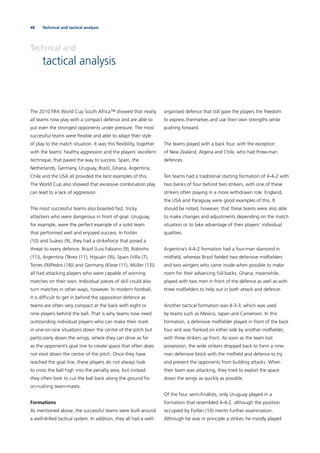
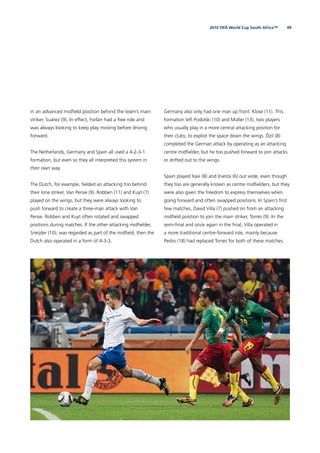
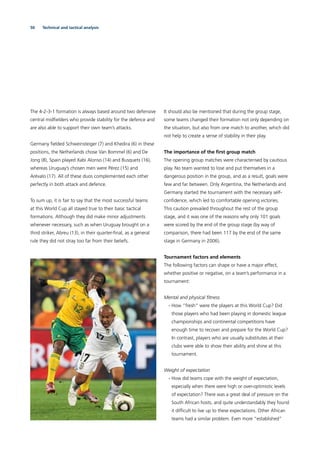
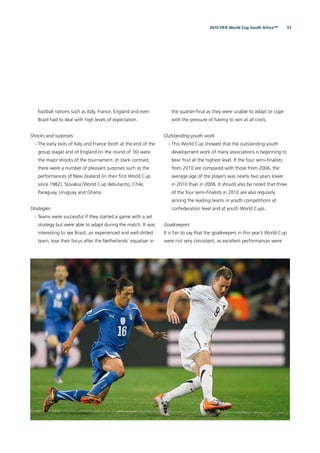
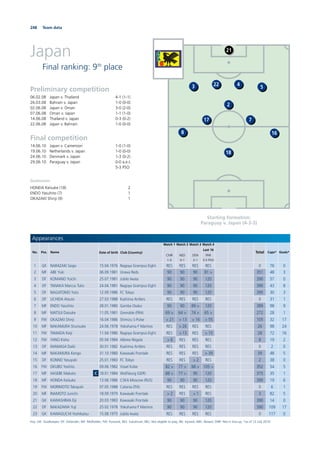
Fédération Internationale de Football Association
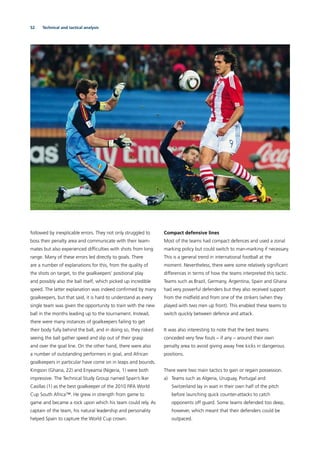
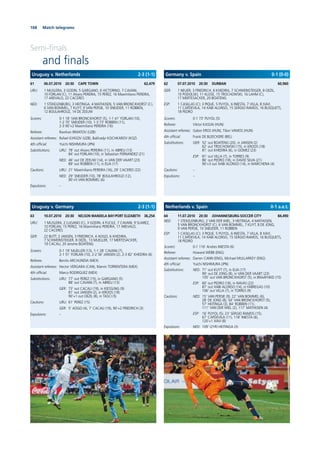
FIFA-Strasse 20 P.O. Box 8044 Zurich Switzerland
Tel.: +41-(0)43-222 7777 Fax: +41-(0)43-222 7878 www.FIFA.com
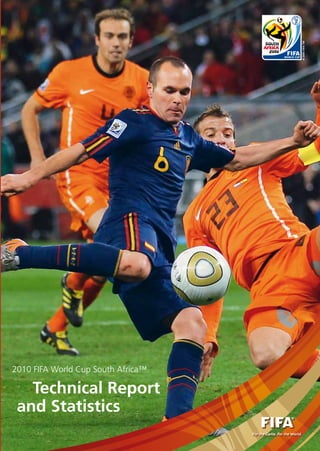
TechnicalReportandStatistics2010FIFAWorldCupSouthAfrica™
2010 FIFA World Cup South Africa™
Technical Report
and Statistics
2010 FIFA World Cup
South Africa™
Technical Report
and Statistics
Rapport technique et statistiques
Informe técnico y estadísticas
Technischer Bericht und Statistik
2
32010 FIFA World Cup South Africa™
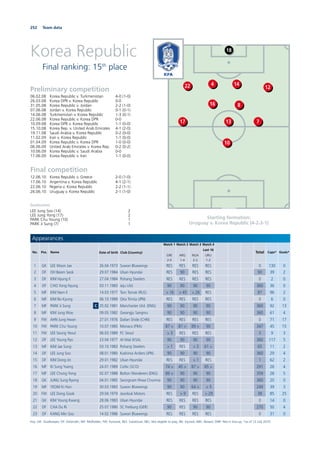
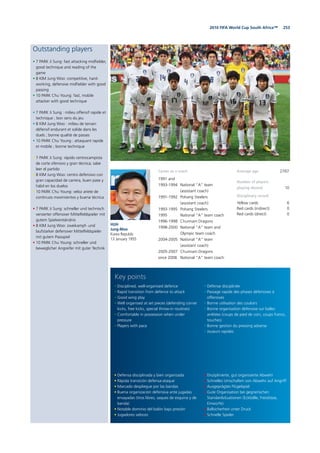
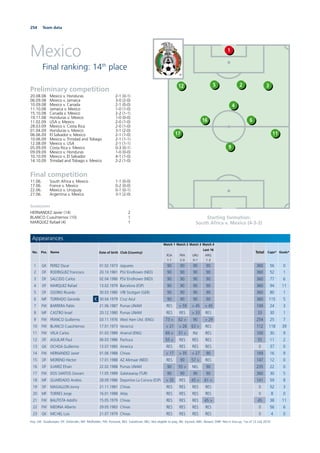
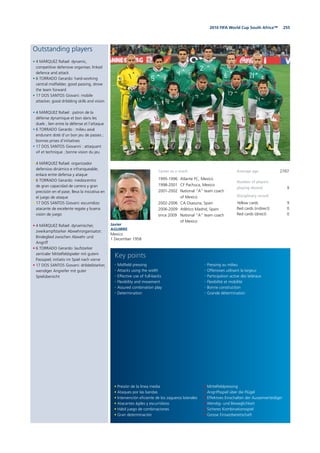
Table of
contents
Foreword 4
Story of the tournament 9
Technical and tactical analysis 47
Trends 75
Key to success 85
Confederation analysis 95
Refereeing report 119
Medical report 135
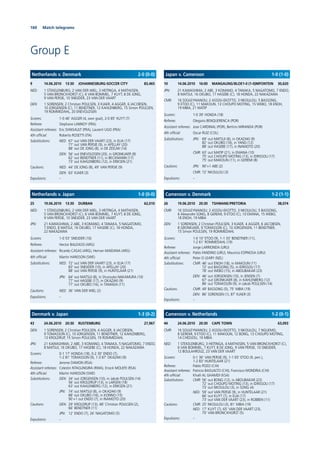
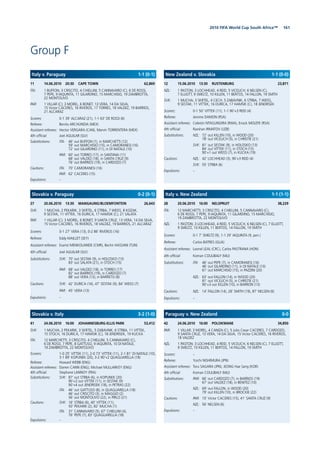
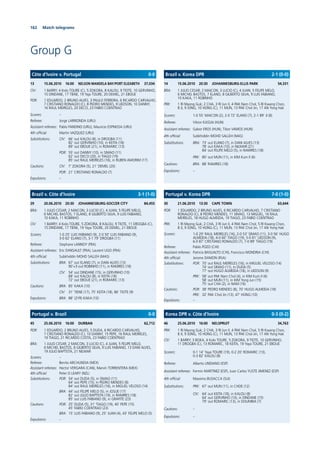
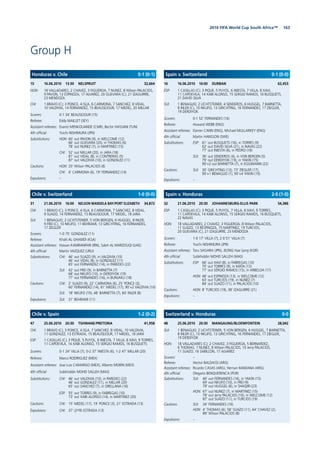
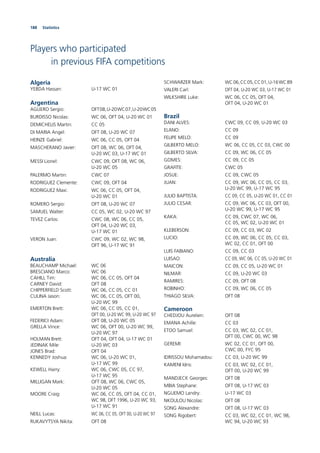
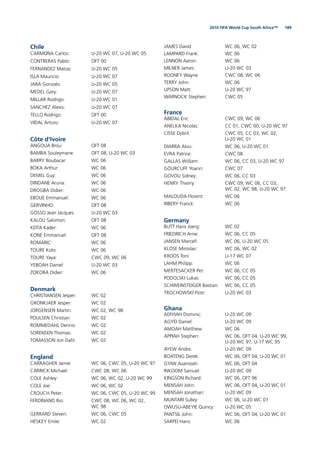
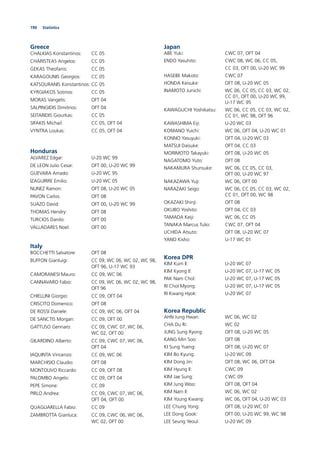
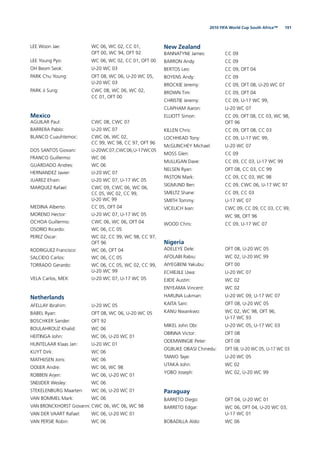
Statistics and team data 151
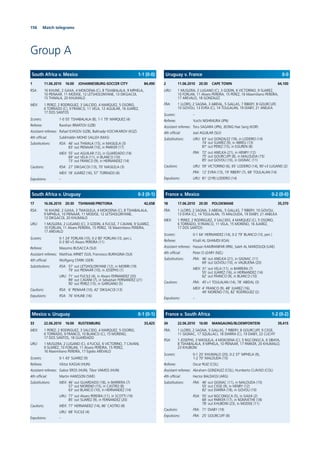
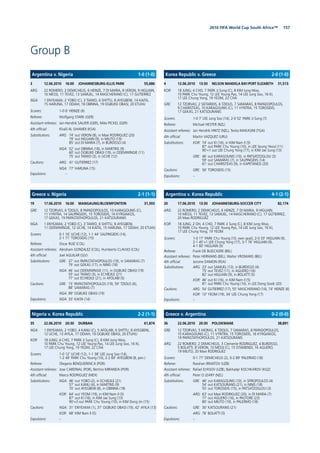
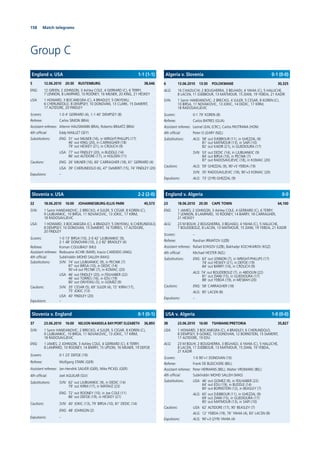
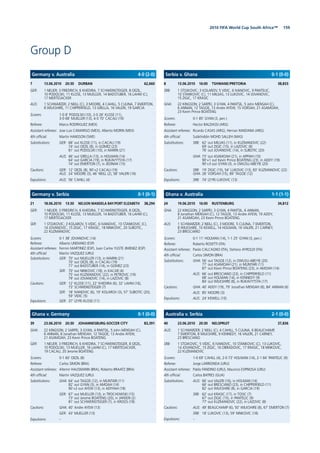
Results and ranking 152
Venues and stadiums 154
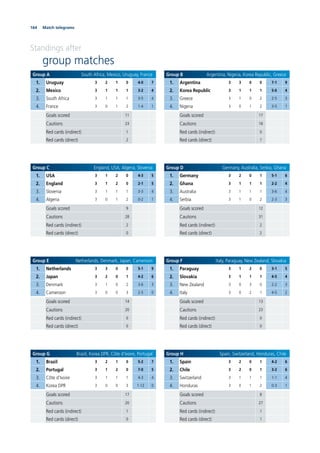
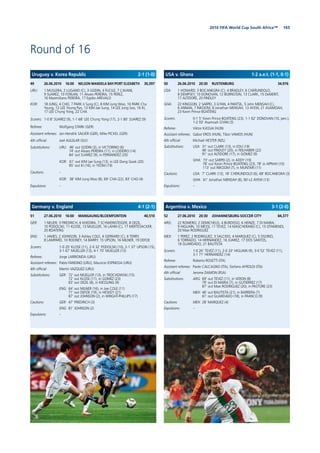
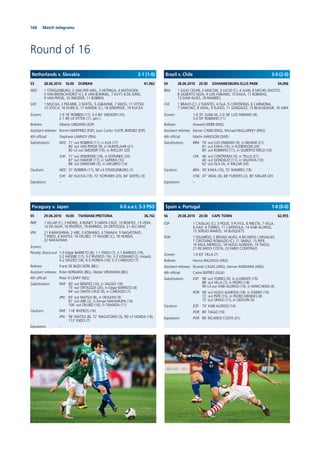
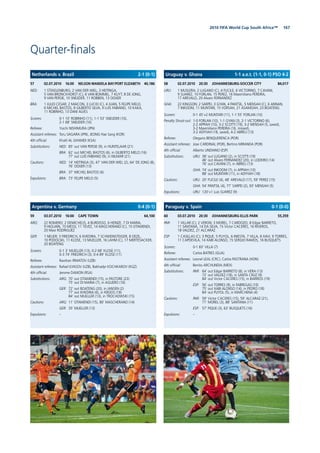
Match telegrams 156
Official FIFA awards 170
General statistics 174
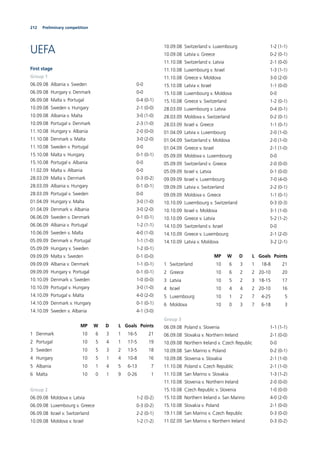
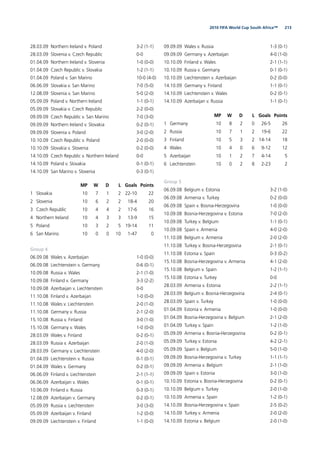
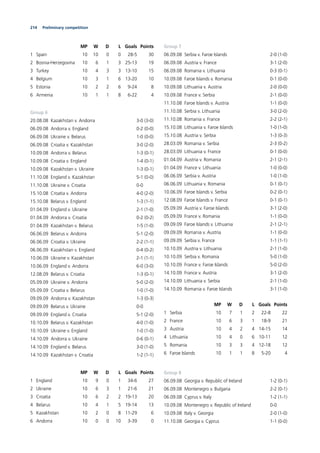
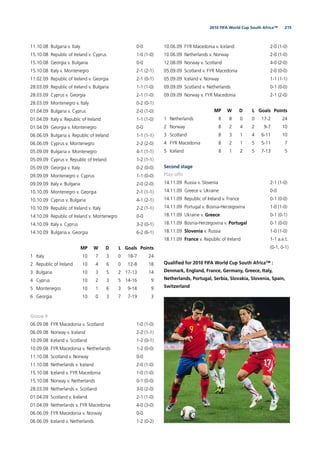
Preliminary competition 200
Referees and assistant referees 216
Team data 218
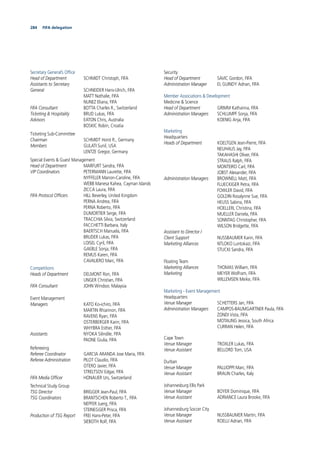
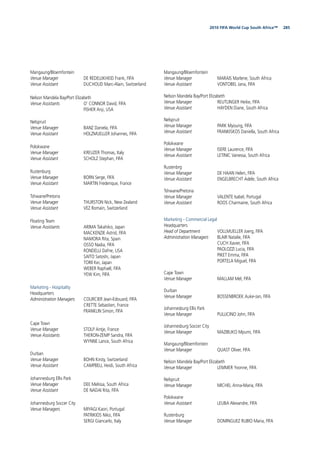
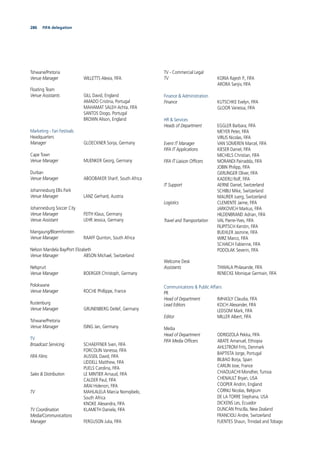
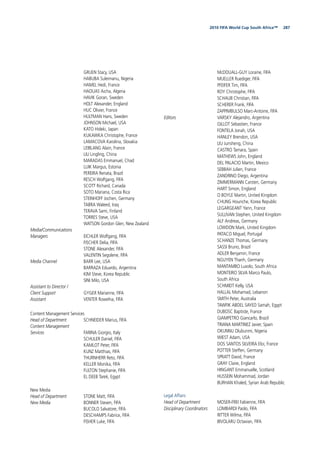
FIFA delegation 282
Technical Study Group/Editorial 288
4 Foreword
The first FIFA World Cup™ on African soil saw a new
winner lift the famous trophy at Johannesburg’s majestic Soccer
City stadium when Vicente del Bosque’s Spain overcame the
challenge of the Netherlands with a goal in the 116th
minute of
the final.
Six years after the 2010 FIFA World Cup™ was awarded
to South Africa, the country with the Cape of Good Hope
showed all of its rich diversity with a month-long competition
that was full of unforgettable moments.
Bafana Bafana opened the tournament against a young
Mexico side, and the reverberations could have been felt for
miles around when midfielder Siphiwe Tshabalala arrowed his
strike into the top corner of the net to open the scoring in the
competition.
One of the most common beliefs amongst top
international football coaches these days is that there are no
easy games in international football anymore, and the 2010 FIFA
World Cup™ certainly proved that to be true.
European heavyweights such as France and Italy failed to
progress from the group stage, along with much-fancied African
giants such as Cameroon, Côte d’Ivoire and Nigeria. Reigning
European champions Spain did not live up to their tag as one
of the pre-tournament favourites either when they lost their
opening group game to Switzerland, and both Germany and
Brazil, despite some flowing football at times, were not all-
conquering in the group stage.
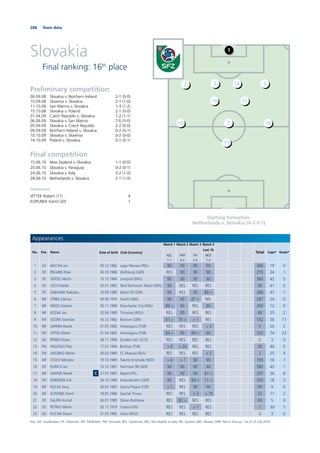
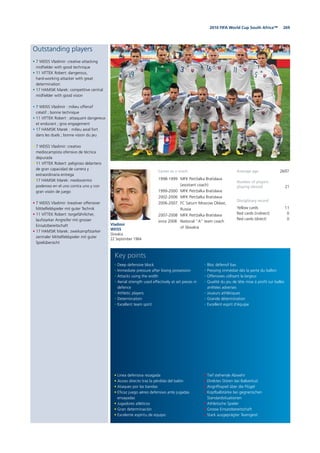
Instead, New Zealand, who did not lose any of their
games, Slovakia and the USA provided some early headlines,
with the latter topping a group containing England thanks to a
last-gasp goal from Landon Donovan in their final group game
against Algeria. Japan and Korea Republic made it through
the group stage, which represents a pleasing development
and also a first, as never before have Asian teams qualified
for the round of 16 at World Cups held outside of their home
continent.
The South Americans all went through, with an attack-
minded Argentina, a Diego Forlán-inspired Uruguay, as well
as Chile and Paraguay all joining Brazil in advancing to the
knockout stages, whilst pan-African backing switched to the
Black Stars of Ghana.
African hopes were ultimately dashed in a nail-biting
quarter-final when Asamoah Gyan missed a last-minute penalty
in extra time before Ghana lost on penalties to Uruguay. The
Uruguayans themselves were ousted 3-2 in a semi-final featuring
spectacular strikes from Giovanni van Bronckhorst and Forlán,
whilst Germany, after wowing fans around the world with
successive demolitions of England and Argentina, finally met
their match against the Spanish in a tight, chess-like semi-final.
In the end, the final was talked about because of the large
number of cautions shown in a hugely competitive match, and
perhaps such a combative game was always going to be settled
by a little bit of magic. Andrés Iniesta, Spain’s goalscoring hero,
has proven to be one of the most technically adept players at
club and international level now for the last two or three years,
and in 2010, it was he and Spain who earned the crown of
“champions of the world”.
We are already looking forward to 2014 and to seeing
whether Spain can defend their title, or whether a new set of
stars will set the tournament in Brazil alight.
Finally, we would like to thank everyone who was
involved in the action, whether they were players, coaches,
referees or organisers, for their role in making South Africa 2010
such a special, unique, thrilling and truly unforgettable World
Cup.
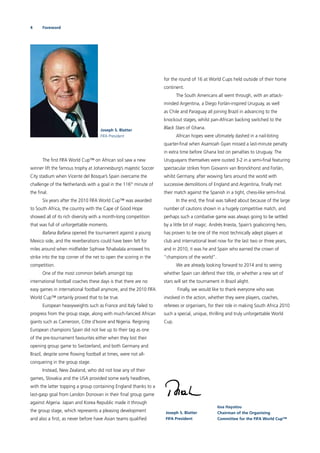
Joseph S. Blatter
FIFA President
Joseph S. Blatter
FIFA President
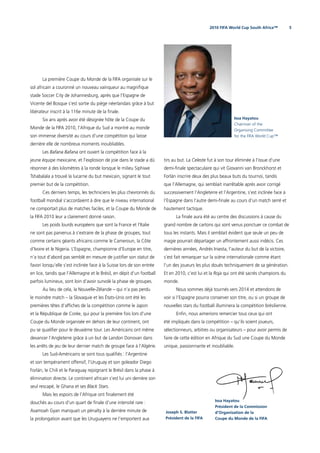
Issa Hayatou
Chairman of the Organising
Committee for the FIFA World Cup™
52010 FIFA World Cup South Africa™
La première Coupe du Monde de la FIFA organisée sur le
sol africain a couronné un nouveau vainqueur au magnifique
stade Soccer City de Johannesburg, après que l’Espagne de
Vicente del Bosque s’est sortie du piège néerlandais grâce à but
libérateur inscrit à la 116e minute de la finale.
Six ans après avoir été désignée hôte de la Coupe du
Monde de la FIFA 2010, l’Afrique du Sud a montré au monde
son immense diversité au cours d’une compétition qui laisse
derrière elle de nombreux moments inoubliables.
Les Bafana Bafana ont ouvert la compétition face à la
jeune équipe mexicaine, et l’explosion de joie dans le stade a dû
résonner à des kilomètres à la ronde lorsque le milieu Siphiwe
Tshabalala a trouvé la lucarne du but mexicain, signant le tout
premier but de la compétition.
Ces derniers temps, les techniciens les plus chevronnés du
football mondial s’accordaient à dire que le niveau international
ne comportait plus de matches faciles, et la Coupe du Monde de
la FIFA 2010 leur a clairement donné raison.
Les poids lourds européens que sont la France et l’Italie
ne sont pas parvenus à s’extraire de la phase de groupes, tout
comme certains géants africains comme le Cameroun, la Côte
d’Ivoire et le Nigeria. L’Espagne, championne d’Europe en titre,
n’a tout d’abord pas semblé en mesure de justifier son statut de
favori lorsqu’elle s’est inclinée face à la Suisse lors de son entrée
en lice, tandis que l’Allemagne et le Brésil, en dépit d’un football
parfois lumineux, sont loin d’avoir survolé la phase de groupes.
Au lieu de cela, la Nouvelle-Zélande – qui n’a pas perdu
le moindre match – la Slovaquie et les États-Unis ont été les
premières têtes d’affiches de la compétition comme le Japon
et la République de Corée, qui pour la première fois lors d'une
Coupe du Monde organisée en dehors de leur continent, ont
pu se qualifier pour le deuxième tour. Les Américains ont même
devancer l’Angleterre grâce à un but de Landon Donovan dans
les arrêts de jeu de leur dernier match de groupe face à l’Algérie.
Les Sud-Américains se sont tous qualifiés : l’Argentine
et son tempérament offensif, l’Uruguay et son goleador Diego
Forlán, le Chili et le Paraguay rejoignant le Brésil dans la phase à
élimination directe. Le continent africain s’est lui uni derrière son
seul rescapé, le Ghana et ses Black Stars.
Mais les espoirs de l’Afrique ont finalement été
douchés au cours d’un quart de finale d’une intensité rare :
Asamoah Gyan manquait un pénalty à la derrière minute de
la prolongation avant que les Uruguayens ne l’emportent aux
tirs au but. La Celeste fut à son tour éliminée à l’issue d’une
demi-finale spectaculaire qui vit Giovanni van Bronckhorst et
Forlán inscrire deux des plus beaux buts du tournoi, tandis
que l’Allemagne, qui semblait inarrêtable après avoir corrigé
successivement l’Angleterre et l’Argentine, s’est inclinée face à
l’Espagne dans l’autre demi-finale au cours d’un match serré et
hautement tactique.
La finale aura été au centre des discussions à cause du
grand nombre de cartons qui sont venus ponctuer ce combat de
tous les instants. Mais il semblait évident que seule un peu de
magie pourrait départager un affrontement aussi indécis. Ces
dernières années, Andrés Iniesta, l’auteur du but de la victoire,
s’est fait remarquer sur la scène internationale comme étant
l’un des joueurs les plus doués techniquement de sa génération.
Et en 2010, c’est lui et la Roja qui ont été sacrés champions du
monde.
Nous sommes déjà tournés vers 2014 et attendons de
voir si l’Espagne pourra conserver son titre, ou si un groupe de
nouvelles stars du football illuminera la compétition brésilienne.
Enfin, nous aimerions remercier tous ceux qui ont
été impliqués dans la compétition – qu’ils soient joueurs,
sélectionneurs, arbitres ou organisateurs – pour avoir permis de
faire de cette édition en Afrique du Sud une Coupe du Monde
unique, passionnante et inoubliable.
Joseph S. Blatter
Président de la FIFA
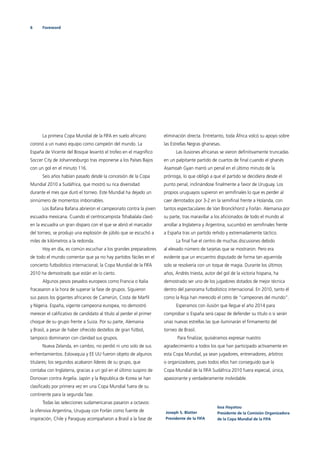
Issa Hayatou
Chairman of the
Organising Committee
for the FIFA World Cup™
Issa Hayatou
Président de la Commission
d’Organisation de la
Coupe du Monde de la FIFA
6 Foreword
La primera Copa Mundial de la FIFA en suelo africano
coronó a un nuevo equipo como campeón del mundo. La
España de Vicente del Bosque levantó el trofeo en el magnífico
Soccer City de Johannesburgo tras imponerse a los Países Bajos
con un gol en el minuto 116.
Seis años habían pasado desde la concesión de la Copa
Mundial 2010 a Sudáfrica, que mostró su rica diversidad
durante el mes que duró el torneo. Este Mundial ha dejado un
sinnúmero de momentos imborrables.
Los Bafana Bafana abrieron el campeonato contra la joven
escuadra mexicana. Cuando el centrocampista Tshabalala clavó
en la escuadra un gran disparo con el que se abrió el marcador
del torneo, se produjo una explosión de júbilo que se escuchó a
miles de kilómetros a la redonda.
Hoy en día, es común escuchar a los grandes preparadores
de todo el mundo comentar que ya no hay partidos fáciles en el
concierto futbolístico internacional; la Copa Mundial de la FIFA
2010 ha demostrado que están en lo cierto.
Algunos pesos pesados europeos como Francia o Italia
fracasaron a la hora de superar la fase de grupos. Siguieron
sus pasos los gigantes africanos de Camerún, Costa de Marfil
y Nigeria. España, vigente campeona europea, no demostró
merecer el calificativo de candidato al título al perder el primer
choque de su grupo frente a Suiza. Por su parte, Alemania
y Brasil, a pesar de haber ofrecido destellos de gran fútbol,
tampoco dominaron con claridad sus grupos.
Nueva Zelanda, en cambio, no perdió ni uno solo de sus
enfrentamientos. Eslovaquia y EE UU fueron objeto de algunos
titulares; los segundos acabaron líderes de su grupo, que
contaba con Inglaterra, gracias a un gol en el último suspiro de
Donovan contra Argelia. Japón y la Republica de Korea se han
clasificado por primera vez en una Copa Mundial fuera de su
continente para la segunda fase.
Todas las selecciones sudamericanas pasaron a octavos:
la ofensiva Argentina, Uruguay con Forlán como fuente de
inspiración, Chile y Paraguay acompañaron a Brasil a la fase de
eliminación directa. Entretanto, toda África volcó su apoyo sobre
las Estrellas Negras ghanesas.
Las ilusiones africanas se vieron definitivamente truncadas
en un palpitante partido de cuartos de final cuando el ghanés
Asamoah Gyan marró un penal en el último minuto de la
prórroga, lo que obligó a que el partido se decidiera desde el
punto penal, inclinándose finalmente a favor de Uruguay. Los
propios uruguayos supieron en semifinales lo que es perder al
caer derrotados por 3-2 en la semifinal frente a Holanda, con
tantos espectaculares de Van Bronckhorst y Forlán. Alemania por
su parte, tras maravillar a los aficionados de todo el mundo al
arrollar a Inglaterra y Argentina, sucumbió en semifinales frente
a España tras un partido reñido y extremadamente táctico.
La final fue el centro de muchas discusiones debido
al elevado número de tarjetas que se mostraron. Pero era
evidente que un encuentro disputado de forma tan aguerrida
solo se resolvería con un toque de magia. Durante los últimos
años, Andrés Iniesta, autor del gol de la victoria hispana, ha
demostrado ser uno de los jugadores dotados de mejor técnica
dentro del panorama futbolístico internacional. En 2010, tanto él
como la Roja han merecido el cetro de “campeones del mundo”.
Esperamos con ilusión que llegue el año 2014 para
comprobar si España será capaz de defender su título o si serán
unas nuevas estrellas las que iluminarán el firmamento del
torneo de Brasil.
Para finalizar, quisiéramos expresar nuestro
agradecimiento a todos los que han participado activamente en
esta Copa Mundial, ya sean jugadores, entrenadores, árbitros
o organizadores, pues todos ellos han conseguido que la
Copa Mundial de la FIFA Sudáfrica 2010 fuera especial, única,
apasionante y verdaderamente inolvidable.
Joseph S. Blatter
Presidente de la FIFA
Issa Hayatou
Presidente de la Comisión Organizadora
de la Copa Mundial de la FIFA
72010 FIFA World Cup South Africa™
Die erste FIFA Fussball-Weltmeisterschaft™ auf afrikani-
schem Boden endete mit einem neuen Weltmeister. Dank einem
Tor in der 116. Minute gewann das spanische Team von Vicente
del Bosque im grandiosen Soccer-City-Stadion in Johannesburg
gegen die Niederlande erstmals den WM-Titel.
Sechs Jahre nach der Vergabe der FIFA Fussball-
Weltmeisterschaft 2010™ an Südafrika bot das Land am Kap
der Guten Hoffnung während vier Wochen ein überaus vielfälti-
ges Turnier mit vielen unvergesslichen Momenten.
Im Eröffnungsspiel traf die Bafana Bafana auf das junge
Team aus Mexiko. Als der Mittelfeldspieler Siphiwe Tshabalala
den Gastgeber mit einem satten Schuss in die obere Ecke in
Führung brachte, war der Jubel im Stadion grenzenlos.
Die FIFA Fussball-Weltmeisterschaft™ bewies einmal mehr,
dass es im internationalen Fussball keine einfachen Spiele gibt,
wie es die Toptrainer ebenfalls stets betonen.
Europäische Grössen wie Frankreich und Italien schieden
bereits in der Gruppenphase aus, ebenso die hoch gehandelten
afrikanischen Teams aus Kamerun, der Elfenbeinküste und
Nigeria. Auch der amtierende Europameister Spanien geriet zu
Beginn ins Straucheln, als er überraschend der Schweiz unterlag.
Und selbst die spielerisch starken Teams aus Deutschland und
Brasilien vermochten in ihren Gruppenspielen nicht restlos zu
überzeugen.
Für Furore sorgten stattdessen die Neuseeländer mit
drei Unentschieden, die Slowakei und die USA, die sich dank
einem späten Tor von Landon Donovan im abschliessenden
Gruppenspiel gegen Algerien gar vor England setzten, sowie
Japan und die Republik Korea, die sich erstmals bei einer
FIFA-WM ausserhalb ihres Kontinents für die zweite Runde
qualifizieren konnten.
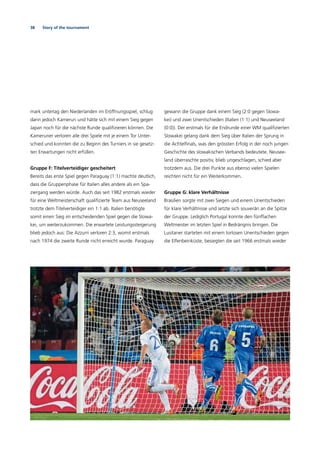
Keine Blösse gaben sich die Südamerikaner. Die
offensiv starken Argentinier, Uruguay, angeführt von Diego
Forlán, Chile, Paraguay und Brasilien erreichten allesamt das
Achtelfinale. Vom afrikanischen Sextett gelang dies derweil nur
Ghana.
Im Viertelfinale war der Traum für Afrika dann endgültig
ausgeträumt, als Asamoah Gyan in der letzten Minute der
Verlängerung gegen Uruguay einen Strafstoss an die Latte
setzte und Ghana anschliessend das Elfmeterschiessen verlor.
Der Höhenflug der Uruguayer endete im Halbfinale gegen die
Niederlande, das 2:3 ausging und zwei herrliche Distanztreffer
durch Giovanni van Bronckhorst und Forlán bot. Ebenfalls
im Halbfinale fanden die Deutschen, die zuvor England und
Argentinien regelrecht demontiert hatten, ihren Meister. In
einer hart umkämpften, taktisch geprägten Partie behielten die
Spanier die Oberhand.
Hart zur Sache ging es auch im Finale, das angesichts
der vielen Verwarnungen für reichlich Gesprächsstoff sorgte.
Letztlich war es wohl kein Zufall, dass eine so erbittert geführte
Partie durch einen Geniestreich entschieden wurde. Andrés
Iniesta, der mit seiner überragenden Technik seit zwei bis drei
Jahren sowohl bei seinem Klub als auch im Nationalteam zu den
besten Spielern gehört, sicherte Spanien mit seinem Tor verdient
die Weltmeisterkrone.
Bereits blicken wir gespannt auf 2014. Wird Spanien in
Brasilien seinen Titel verteidigen können, oder wird sich ein
neues Starensemble zum Weltmeister krönen? Wir werden es
sehen.
Zum Schluss möchten wir allen Beteiligten – Spielern,
Trainern, Schiedsrichtern und Organisatoren – dafür danken,
dass sie die Weltmeisterschaft in Südafrika zu einem einzigarti-
gen, packenden und wahrlich unvergesslichen Erlebnis gemacht
haben.
Joseph S. Blatter
FIFA-Präsident
Issa Hayatou
Vorsitzender der Organisationskommission
für die FIFA Fussball-Weltmeisterschaft™
Story of the
tournament
10 Story of the tournament
Story of the
tournament
Group stage
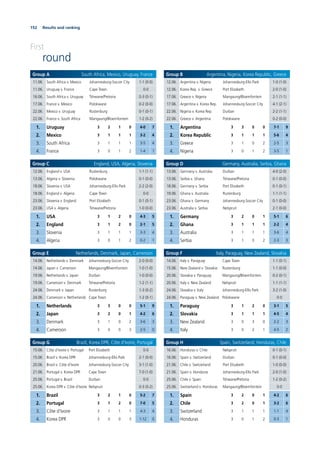
Group A: hosts fail to reach round of 16
In the opening match, South Africa did not only have
Mexico to contend with but also the burden of expectation.
In the end, a 1-1 draw on the back of a good performance,
particularly in the second half, left the door to the round of
16 wide open for the hosts. A 3-0 defeat to Uruguay in their
second match put them in a significantly worse position,
however, and despite a fully deserved 2-1 win over France
in their last match, South Africa could not seal their place
in the next round. As a result, the South Africans became
the first FIFA World Cup™ hosts to exit the competition at
the end of the group stage. Uruguay, meanwhile, coasted
to first place in the group. A goalless draw with France in
their opening match was followed by two victories, 3-0 over
South Africa and 1-0 against Mexico. The Mexicans also
qualified for the next round thanks to a win over France
and by virtue of having a better goal difference than South
Africa. France’s disappointing performances ensured that
they finished bottom of the table with only one point and
one goal from three matches.
Group B: no problems for Argentina
Argentina, who were the favourites to top the group, lived
up to their billing with three comfortable wins, scoring
seven goals and conceding only one in the process. Second
place was claimed by Korea Republic, mainly thanks to
their opening 2-0 win over Greece, who also harboured
hopes of progressing thanks to their 2-1 victory over
112010 FIFA World Cup South Africa™
Nigeria in their second game. In the final round of group
matches, however, the Koreans drew 2-2 with Nigeria
while the Greeks succumbed to a 2-0 defeat at the hands
of Argentina, which signalled an early departure for the
2004 European champions. Nigeria were left to rue their
profligacy in front of goal as they finished at the foot of
Group B.
Group C: Americans spring a surprise
Group C was closer than many had expected. The USA
sprang a surprise in the opening match by holding England
to a 1-1 draw. Slovenia overcame Algeria in the other match
in Group C, and as the second round of matches ended
in two draws after some dramatic action, there was still
everything to play for on the final day. England finally found
their feet and lived up to their favourites tag by defeating
Slovenia 1-0, but they were powerless to prevent the USA
claiming top spot as the Americans struck in the last minute
to defeat Algeria by the same scoreline. Algeria therefore
became the next African team to leave the tournament.
Their main failing was their lack of a goalscorer to convert
the chances that came their way.
Group D: drama from start to finish
Group D was tense until the very last minute. Germany
came flying out of the blocks, brushing Australia aside
4-0, but in their second game against Serbia, they had to
play with only ten men for around an hour after losing
Klose to a red card. They also missed a penalty, which was
another factor in their narrow 1-0 defeat at the hands of
Serbia. Ghana, meanwhile, had four points to their name
thanks to two goals from the penalty spot (in a 1-0 victory
over Serbia and a 1-1 draw with Australia). Going into the
last round of games in Group D, all four teams still had a
chance of qualifying for the next round. As the last two
matches entered the closing stages, those places were still
up for grabs. In the end, it was Germany and Ghana who
finished as the top two. Germany defeated Ghana 1-0
to secure top spot, but the Africans pipped Australia to
second place due to their superior goal difference. Serbia
missed out on a place in the round of 16 after losing 2-1 to
Australia.
Group E: Dutch cruise to top spot
Group E was dominated by the Netherlands, who claimed
top spot with maximum points. Japan overcame Cameroon
1-0 in their first match, but lost to the Dutch by the same
scoreline in their second game despite playing well, and they
also impressed in their third game, a comfortable 3-1 victory
over Denmark. This secured second spot for the Japanese,
which meant a place in the round of 16. Denmark lost to the
Netherlands in their opening match but defeated Cameroon
in the next game, and they would have qualified if they had
beaten Japan in their final match. Cameroon, however, lost
all three of their matches by a single goal and were unable
to live up to pre-tournament expectations.
12 Story of the tournament
Group F: champions’ reign brought to an end
A 1-1 draw with Paraguay in their opening match
indicated that the group stage would be far from easy for
Italy. Then, New Zealand, who were playing in their first
World Cup since 1982, also held the reigning champions
to a 1-1 draw. That left Italy needing to win their final
game against Slovakia to guarantee their place in the
next round. The Azzurri were unable to raise their game,
however, and a 3-2 defeat meant that the Italians departed
a World Cup without making it to the second round for
the first time since 1974. In the end, it was Paraguay who
topped the group thanks to a 2-0 victory over Slovakia and
draws with Italy (1-1) and New Zealand (0-0). Slovakia,
who were making their World Cup debut, claimed a place
in the round of 16 on the back of their victory over Italy,
the best-ever performance in the relatively short history of
the association. New Zealand were the surprise package,
but despite remaining unbeaten, their three points from
three games were not enough for a place in the next
round.
Group G: all clear at the top
Brazil comfortably claimed top spot by winning two of their
matches and drawing the other. Only Portugal were able to
test the Brazilians in the final group match. The Portuguese
started their campaign with a goalless draw against Côte
d’Ivoire before going onto to crush Korea DPR, who were
playing in their first World Cup since 1966, 7-0. Another
goalless draw in Portugal’s final game against Brazil was
enough to secure a place in the round of 16. Côte d’Ivoire,
meanwhile, impressed in their opening game against
Portugal, but they showed Brazil too much respect in their
second game and slipped to a 3-1 defeat. A 3-0 victory over
Korea DPR was a satisfying end to the Ivoirians’ campaign
but it was not enough for a place in the round of 16. Korea
DPR impressed many in their opening match against Brazil,
but that performance seemed to take a lot out of them as
they were unable to reach such heights against Portugal and
Côte d’Ivoire.
Group H: favourites come through
Favourites Spain opened their World Cup campaign with a
shock 1-0 defeat at the hands of Switzerland, the first time
the Swiss had ever overcome the Spanish. Victories over
Honduras (2-0) and Chile (2-1), however, meant that Spain
did indeed secure top spot, as expected. Chile, meanwhile,
were in an excellent position going into their last match
against Spain thanks to two 1-0 victories over Honduras
and Switzerland. And, although they lost 2-1 to Spain after
playing for nearly an hour with ten men due to a red card,
the South Americans still went through to the round of 16
level on points with the Spanish. Switzerland, however, were
unable to build on their defeat of Spain and did not reach
the same heights again. They needed to defeat Honduras
in their last match, but victory – and with it a place in the
round of 16 – was just out of reach. Honduras worked hard
in all three matches but their lack of experience on the
international stage saw them come up short against strong
opposition.
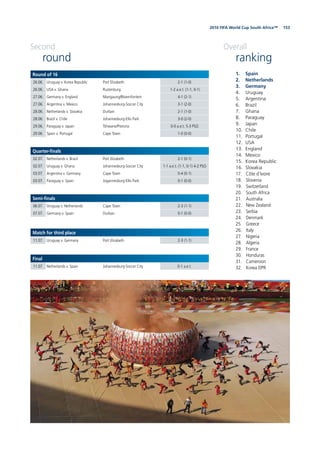
Round of 16
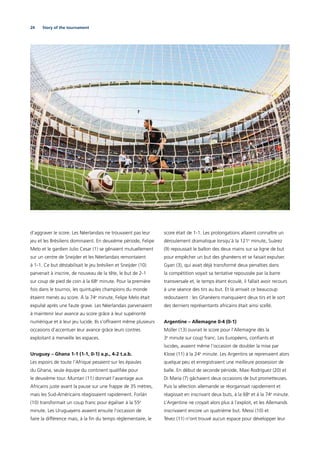
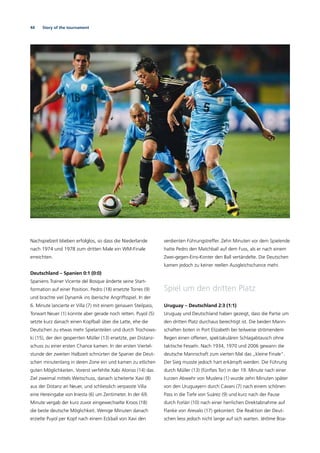
Uruguay v. Korea Rep. 2-1 (1-0)
Uruguay got off to a dream start, with Suárez (9) firing
them into the lead just eight minutes into the game after
Forlán (10) chased down a stray pass to feed Suárez, who
capitalised on some poor positional play in the Korean
defence to slot home. The Koreans then put the Uruguayan
defence under pressure by aggressively closing down the
man in possession in their search for an equaliser. Their
tactic paid off around the 70-minute mark when Lee Chung
Young (17) headed home from a free kick. The Koreans
were then happy to sit back again and wait before launching
counter-attacks. Their plan did not work though as Uruguay
turned the screw and went all out for the winning goal. In
the end, it was Suárez again who scored the crucial goal
with just ten minutes left on the clock, leaving the Asians
virtually no time to recover.
132010 FIFA World Cup South Africa™
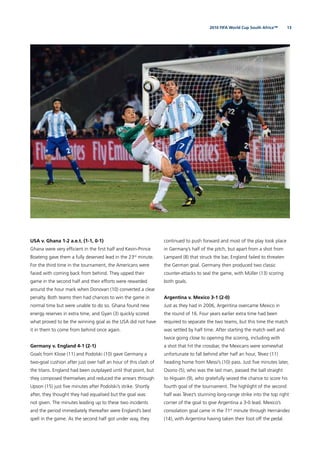
USA v. Ghana 1-2 a.e.t. (1-1, 0-1)
Ghana were very efficient in the first half and Kevin-Prince
Boateng gave them a fully deserved lead in the 23rd
minute.
For the third time in the tournament, the Americans were
faced with coming back from behind. They upped their
game in the second half and their efforts were rewarded
around the hour mark when Donovan (10) converted a clear
penalty. Both teams then had chances to win the game in
normal time but were unable to do so. Ghana found new
energy reserves in extra time, and Gyan (3) quickly scored
what proved to be the winning goal as the USA did not have
it in them to come from behind once again.
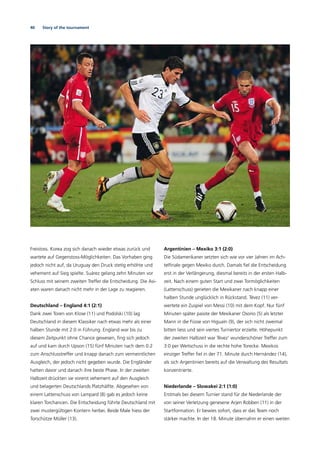
Germany v. England 4-1 (2-1)
Goals from Klose (11) and Podolski (10) gave Germany a
two-goal cushion after just over half an hour of this clash of
the titans. England had been outplayed until that point, but
they composed themselves and reduced the arrears through
Upson (15) just five minutes after Podolski’s strike. Shortly
after, they thought they had equalised but the goal was
not given. The minutes leading up to these two incidents
and the period immediately thereafter were England’s best
spell in the game. As the second half got under way, they
continued to push forward and most of the play took place
in Germany’s half of the pitch, but apart from a shot from
Lampard (8) that struck the bar, England failed to threaten
the German goal. Germany then produced two classic
counter-attacks to seal the game, with Müller (13) scoring
both goals.
Argentina v. Mexico 3-1 (2-0)
Just as they had in 2006, Argentina overcame Mexico in
the round of 16. Four years earlier extra time had been
required to separate the two teams, but this time the match
was settled by half time. After starting the match well and
twice going close to opening the scoring, including with
a shot that hit the crossbar, the Mexicans were somewhat
unfortunate to fall behind after half an hour, Tévez (11)
heading home from Messi’s (10) pass. Just five minutes later,
Osorio (5), who was the last man, passed the ball straight
to Higuaín (9), who gratefully seized the chance to score his
fourth goal of the tournament. The highlight of the second
half was Tévez’s stunning long-range strike into the top right
corner of the goal to give Argentina a 3-0 lead. Mexico’s
consolation goal came in the 71st
minute through Hernández
(14), with Argentina having taken their foot off the pedal.
14 Story of the tournament
Netherlands v. Slovakia 2-1 (1-0)
The Netherlands’ Arjen Robben (11) made a return to the
starting XI after recovering from injury, and he did not
take long to prove that the Dutch were a better team with
him in it. In the 18th
minute, he ran on to a throughball
from Sneijder (10), cut inside from the right-hand side and
fired an accurate low shot into the bottom corner despite
the attention of the Slovakian defence. The Oranje then
had a number of chances to increase their lead, and they
eventually did so through Sneijder in the 84th
minute. The
Slovakians looked jaded in comparison to their previous
game against Italy. They only really found their stride in
the middle of the second half, and both Stoch (15) and
Vittek (11) had clear chances but failed to convert. Vittek did
score from the penalty spot in the 94th
minute, but it was
too little, too late.
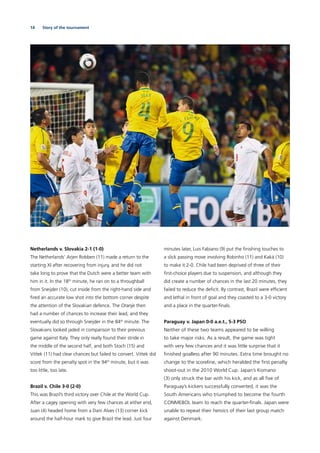
Brazil v. Chile 3-0 (2-0)
This was Brazil’s third victory over Chile at the World Cup.
After a cagey opening with very few chances at either end,
Juan (4) headed home from a Dani Alves (13) corner kick
around the half-hour mark to give Brazil the lead. Just four
minutes later, Luis Fabiano (9) put the finishing touches to
a slick passing move involving Robinho (11) and Kaká (10)
to make it 2-0. Chile had been deprived of three of their
first-choice players due to suspension, and although they
did create a number of chances in the last 20 minutes, they
failed to reduce the deficit. By contrast, Brazil were efficient
and lethal in front of goal and they coasted to a 3-0 victory
and a place in the quarter-finals.
Paraguay v. Japan 0-0 a.e.t., 5-3 PSO
Neither of these two teams appeared to be willing
to take major risks. As a result, the game was tight
with very few chances and it was little surprise that it
finished goalless after 90 minutes. Extra time brought no
change to the scoreline, which heralded the first penalty
shoot-out in the 2010 World Cup. Japan’s Komano
(3) only struck the bar with his kick, and as all five of
Paraguay’s kickers successfully converted, it was the
South Americans who triumphed to become the fourth
CONMEBOL team to reach the quarter-finals. Japan were
unable to repeat their heroics of their last group match
against Denmark.
152010 FIFA World Cup South Africa™
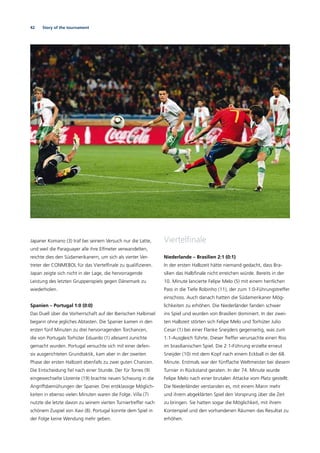
Spain v. Portugal 1-0 (0-0)
This match, which would decide Iberian World Cup bragging
rights, started at a frenetic pace with Spain carving out three
clear-cut chances in the first five minutes, only for Eduardo
(1) in the Portugal goal to be equal to them all. Portugal
were set up rather defensively, but they still had two good
chances to open the scoring late in the first half. The only
goal of the game came after an hour, with Llorente (19)
bringing fresh energy to the Spanish attack in place of the
substituted Torres (9). Spain immediately had three excellent
opportunities in just as many minutes. David Villa (7)
capitalised on the last of those chances to score his fourth
goal of the tournament after a beautiful lay-off from Xavi
(8). Portugal were unable to find a way back into the game
in the time that remained.
Quarter-finals
Netherlands v. Brazil 2-1 (0-1)
At the end of the first half, nobody would have believed that
Brazil would fail to reach the semi-finals. They had taken the
lead as early as the tenth minute, Felipe Melo (5) releasing
Robinho (11) on goal with a wonderful throughball. The South
Americans then had a number of chances to increase the lead
as the Dutch found it hard to find a foothold in the game
against the dominant Brazilians. Then, in the second half,
Felipe Melo and goalkeeper Julio Cesar (1) got in each other’s
way as they tried to a clear a cross from Sneijder (10), but they
failed as they saw the ball nestle in the net. It was a goal that
knocked Brazil out of their stride, and Sneijder capitalised by
heading home from a corner kick in the 68th
minute to give the
Dutch a 2-1 lead. The five-time world champions were now
behind for the first time in the tournament, and it got worse in
the 74th
minute when Felipe Melo was sent off for serious foul
play. Now that they had the advantage of the extra man, the
Dutch were able to keep hold of possession and see out time.
They could even have made the scoreline more emphatic if
they had exploited the space on the counter-attack.
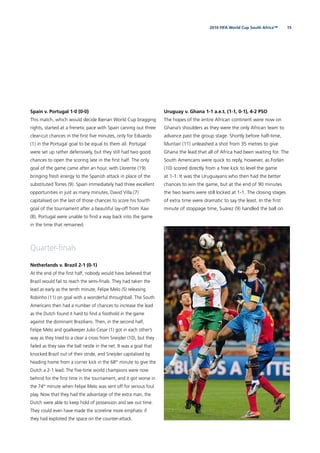
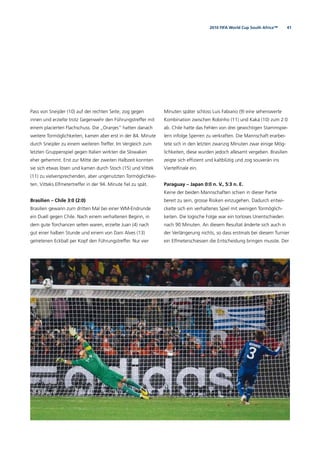
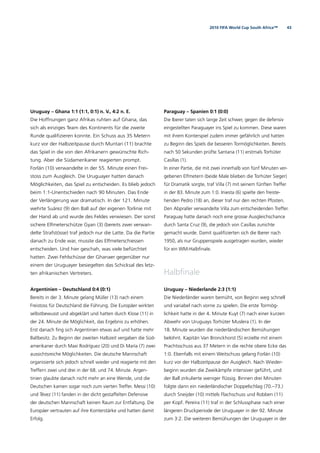
Uruguay v. Ghana 1-1 a.e.t. (1-1, 0-1), 4-2 PSO
The hopes of the entire African continent were now on
Ghana’s shoulders as they were the only African team to
advance past the group stage. Shortly before half-time,
Muntari (11) unleashed a shot from 35 metres to give
Ghana the lead that all of Africa had been waiting for. The
South Americans were quick to reply, however, as Forlán
(10) scored directly from a free kick to level the game
at 1-1. It was the Uruguayans who then had the better
chances to win the game, but at the end of 90 minutes
the two teams were still locked at 1-1. The closing stages
of extra time were dramatic to say the least. In the first
minute of stoppage time, Suárez (9) handled the ball on
16 Story of the tournament
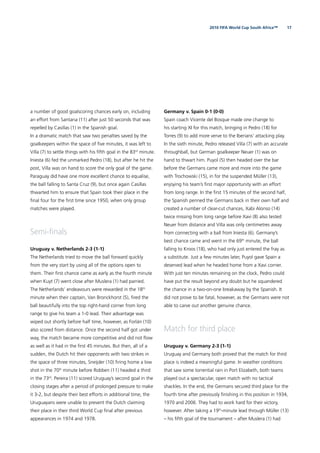
the line and was sent off. Gyan (3), who had been so
reliable from the penalty spot up until that point, stepped
up but could only hit the bar. As there was no time to
restart the match, a penalty shoot-out was required to
separate the teams. In the end, the hopes of so many
Africans were dashed when Ghana missed two penalties
to Uruguay’s one, thereby sealing the fate of Ghana as
Africa’s last team standing.
Argentina v. Germany 0-4 (0-1)
Müller (13) gave the confident and composed Germans
an early third-minute lead from a free kick. Klose (11) then
came close to doubling their advantage in the 24th
minute,
which served as the signal for Argentina to find their way
back into the game and enjoy more possession. Early in
the second half, Maxi Rodríguez (20) and Di María (7) both
had excellent chances to equalise, but the Germans quickly
reorganised and hit Argentina with a double blow by scoring
in the 68th
and 74th
minutes. The belief appeared to drain
from Argentina, and there was even time for Germany to
add a fourth goal. Messi (10) and Tévez (11) had simply not
found any space in which to play because of the compact
German defence. The Europeans were happy to play on
the counter-attack, and it was a tactic that brought them
success.
Paraguay v. Spain 0-1 (0-0)
For long periods, the Spanish found it hard to break down
the Paraguayans, who were solid defensively and were
becoming ever more dangerous on the counter-attack after
172010 FIFA World Cup South Africa™
a number of good goalscoring chances early on, including
an effort from Santana (11) after just 50 seconds that was
repelled by Casillas (1) in the Spanish goal.
In a dramatic match that saw two penalties saved by the
goalkeepers within the space of five minutes, it was left to
Villa (7) to settle things with his fifth goal in the 83rd
minute.
Iniesta (6) fed the unmarked Pedro (18), but after he hit the
post, Villa was on hand to score the only goal of the game.
Paraguay did have one more excellent chance to equalise,
the ball falling to Santa Cruz (9), but once again Casillas
thwarted him to ensure that Spain took their place in the
final four for the first time since 1950, when only group
matches were played.
Semi-finals
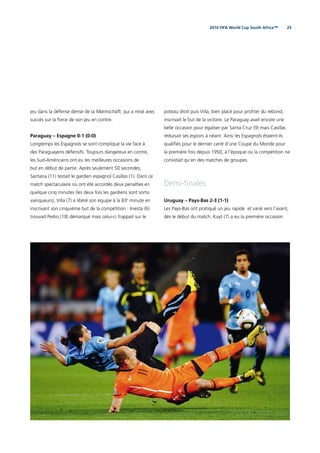
Uruguay v. Netherlands 2-3 (1-1)
The Netherlands tried to move the ball forward quickly
from the very start by using all of the options open to
them. Their first chance came as early as the fourth minute
when Kuyt (7) went close after Muslera (1) had parried.
The Netherlands’ endeavours were rewarded in the 18th
minute when their captain, Van Bronckhorst (5), fired the
ball beautifully into the top right-hand corner from long
range to give his team a 1-0 lead. Their advantage was
wiped out shortly before half time, however, as Forlán (10)
also scored from distance. Once the second half got under
way, the match became more competitive and did not flow
as well as it had in the first 45 minutes. But then, all of a
sudden, the Dutch hit their opponents with two strikes in
the space of three minutes, Sneijder (10) firing home a low
shot in the 70th
minute before Robben (11) headed a third
in the 73rd
. Pereira (11) scored Uruguay’s second goal in the
closing stages after a period of prolonged pressure to make
it 3-2, but despite their best efforts in additional time, the
Uruguayans were unable to prevent the Dutch claiming
their place in their third World Cup final after previous
appearances in 1974 and 1978.
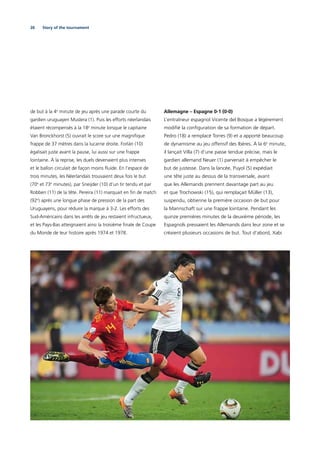
Germany v. Spain 0-1 (0-0)
Spain coach Vicente del Bosque made one change to
his starting XI for this match, bringing in Pedro (18) for
Torres (9) to add more verve to the Iberians’ attacking play.
In the sixth minute, Pedro released Villa (7) with an accurate
throughball, but German goalkeeper Neuer (1) was on
hand to thwart him. Puyol (5) then headed over the bar
before the Germans came more and more into the game
with Trochowski (15), in for the suspended Müller (13),
enjoying his team’s first major opportunity with an effort
from long range. In the first 15 minutes of the second half,
the Spanish penned the Germans back in their own half and
created a number of clear-cut chances, Xabi Alonso (14)
twice missing from long range before Xavi (8) also tested
Neuer from distance and Villa was only centimetres away
from connecting with a ball from Iniesta (6). Germany’s
best chance came and went in the 69th
minute, the ball
falling to Kroos (18), who had only just entered the fray as
a substitute. Just a few minutes later, Puyol gave Spain a
deserved lead when he headed home from a Xavi corner.
With just ten minutes remaining on the clock, Pedro could
have put the result beyond any doubt but he squandered
the chance in a two-on-one breakaway by the Spanish. It
did not prove to be fatal, however, as the Germans were not
able to carve out another genuine chance.
Match for third place
Uruguay v. Germany 2-3 (1-1)
Uruguay and Germany both proved that the match for third
place is indeed a meaningful game. In weather conditions
that saw some torrential rain in Port Elizabeth, both teams
played out a spectacular, open match with no tactical
shackles. In the end, the Germans secured third place for the
fourth time after previously finishing in this position in 1934,
1970 and 2006. They had to work hard for their victory,
however. After taking a 19th
-minute lead through Müller (13)
– his fifth goal of the tournament – after Muslera (1) had
18 Story of the tournament
only parried the ball, they saw their advantage wiped out just
ten minutes later by Cavani (7) after a wonderful throughball
from Suárez (9). Shortly after the restart, the Uruguayans
took the lead thanks to a wonderful Forlán (10) volley from
an Arevalo (17) cross. The Germans were not behind for long
though as Boateng crossed from the right for Jansen (2) to
head home and level the score. The game was decided in
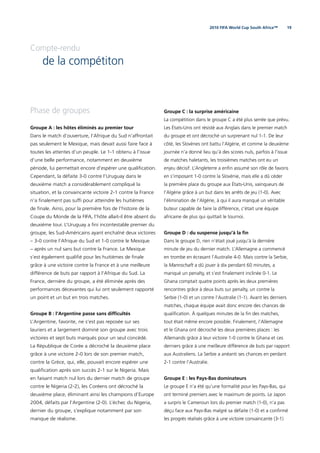
the 82nd
minute, Khedira (6) heading home from an Özil (8)
corner kick to seal victory. Fate was not on Uruguay’s side,
however, as Forlán struck the bar from a free kick in the
closing stages of the game.
Final
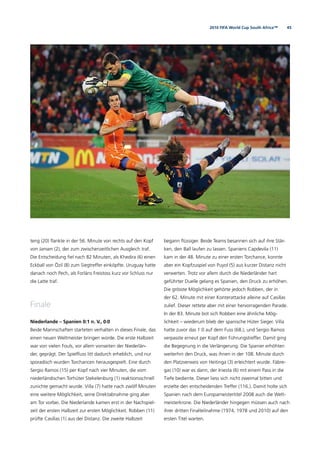
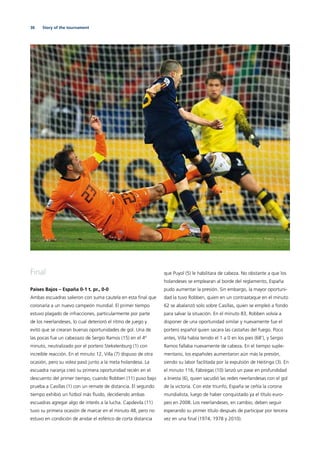
Netherlands v. Spain 0-1 a.e.t., (0-0)
Both teams took their time to find their feet in this World
Cup final, at the end of which there would be a new name
on the World Cup Trophy. The first half was littered with
fouls, mainly by the Dutch, and as a result the game did not
flow and there were only a handful of goalscoring chances,
including one for Sergio Ramos (15) in the fourth minute,
but his header was saved by Stekelenburg (1), who showed
excellent reflexes. Villa (7) had another chance in the
12th
 minute, but his first-time shot went wide. The Dutch,
however, had to wait until stoppage time in the first half for
their first real chance, with Robben (11) testing Casillas (1)
from long range. There was more flow to the game as the
second half got under way as both teams relied on their
ability to let the ball do the work. Spain’s Capdevila (11) had
the first chance of the second half in the 48th
minute but
was unable to turn home from close range after a header
from Puyol (5). The Spanish kept turning the screw despite
some robust tackles and challenges from the Dutch, who
actually had the best chance of all in the 62nd
minute when
Robben broke clear of the defence to advance on Casillas,
who pulled off an outstanding save. Robben was presented
with another similar opportunity in the 83rd
minute, but
once again the Spanish goalkeeper came out on top. Prior
to that, Villa had also gone close to giving Spain the lead,
and Sergio Ramos also nearly scored with another header.
The game remained goalless, however, and went into
extra time. Spain continued to put their opponents under
pressure, and their task become easier when Heitinga (3)
was sent off. Then, in the 116th
minute, Fàbregas (10)
released Iniesta (6) with a ball in behind the defence. Iniesta
was quick to seize his opportunity and fire home the only
goal of the game to make sure that Spain added the World
Cup crown to their European Championship title of 2008.
Meanwhile, the Netherlands’ wait for their first World Cup
title goes on after their third defeat in a World Cup final
(1974, 1978, 2010).
192010 FIFA World Cup South Africa™
Compte-rendu
de la compétiton
Phase de groupes
Groupe A : les hôtes éliminés au premier tour
Dans le match d’ouverture, l’Afrique du Sud n’affrontait
pas seulement le Mexique, mais devait aussi faire face à
toutes les attentes d’un peuple. Le 1-1 obtenu à l’issue
d’une belle performance, notamment en deuxième
période, lui permettait encore d’espérer une qualification.
Cependant, la défaite 3-0 contre l’Uruguay dans le
deuxième match a considérablement compliqué la
situation, et la convaincante victoire 2-1 contre la France
n’a finalement pas suffi pour atteindre les huitièmes
de finale. Ainsi, pour la première fois de l’histoire de la
Coupe du Monde de la FIFA, l’hôte allait-il être absent du
deuxième tour. L’Uruguay a fini incontestable premier du
groupe, les Sud-Américains ayant enchaîné deux victoires
– 3-0 contre l’Afrique du Sud et 1-0 contre le Mexique
– après un nul sans but contre la France. Le Mexique
s’est également qualifié pour les huitièmes de finale
grâce à une victoire contre la France et à une meilleure
différence de buts par rapport à l’Afrique du Sud. La
France, dernière du groupe, a été éliminée après des
performances décevantes qui lui ont seulement rapporté
un point et un but en trois matches.
Groupe B : l’Argentine passe sans difficultés
L’Argentine, favorite, ne s’est pas reposée sur ses
lauriers et a largement dominé son groupe avec trois
victoires et sept buts marqués pour un seul concédé.
La République de Corée a décroché la deuxième place
grâce à une victoire 2-0 lors de son premier match,
contre la Grèce, qui, elle, pouvait encore espérer une
qualification après son succès 2-1 sur le Nigeria. Mais
en faisant match nul lors du dernier match de groupe
contre le Nigeria (2-2), les Coréens ont décroché la
deuxième place, éliminant ainsi les champions d’Europe
2004, défaits par l’Argentine (2-0). L’échec du Nigeria,
dernier du groupe, s’explique notamment par son
manque de réalisme.
Groupe C : la surprise américaine
La compétition dans le groupe C a été plus serrée que prévu.
Les États-Unis ont résisté aux Anglais dans le premier match
du groupe et ont décroché un surprenant nul 1-1. De leur
côté, les Slovènes ont battu l’Algérie, et comme la deuxième
journée n’a donné lieu qu’à des scores nuls, parfois à l’issue
de matches haletants, les troisièmes matches ont eu un
enjeu décisif. L’Angleterre a enfin assumé son rôle de favoris
en s’imposant 1-0 contre la Slovénie, mais elle a dû céder
la première place du groupe aux États-Unis, vainqueurs de
l’Algérie grâce à un but dans les arrêts de jeu (1-0). Avec
l’élimination de l’Algérie, à qui il aura manqué un véritable
buteur capable de faire la différence, c’était une équipe
africaine de plus qui quittait le tournoi.
Groupe D : du suspense jusqu’à la fin
Dans le groupe D, rien n’était joué jusqu’à la dernière
minute de jeu du dernier match. L’Allemagne a commencé
en trombe en écrasant l’Australie 4-0. Mais contre la Serbie,
la Mannschaft a dû jouer à dix pendant 60 minutes, a
manqué un penalty, et s’est finalement inclinée 0-1. Le
Ghana comptait quatre points après les deux premières
rencontres grâce à deux buts sur penalty, un contre la
Serbie (1-0) et un contre l’Australie (1-1). Avant les derniers
matches, chaque équipe avait donc encore des chances de
qualification. À quelques minutes de la fin des matches,
tout était même encore possible. Finalement, l’Allemagne
et le Ghana ont décroché les deux premières places : les
Allemands grâce à leur victoire 1-0 contre le Ghana et ces
derniers grâce à une meilleure différence de buts par rapport
aux Australiens. La Serbie a anéanti ses chances en perdant
2-1 contre l’Australie.
Groupe E : les Pays-Bas dominateurs
Le groupe E n’a été qu’une formalité pour les Pays-Bas, qui
ont terminé premiers avec le maximum de points. Le Japon
a surpris le Cameroun lors du premier match (1-0), n’a pas
déçu face aux Pays-Bas malgré sa défaite (1-0) et a confirmé
les progrès réalisés grâce à une victoire convaincante (3-1)
20 Story of the tournament
sur le Danemark. Ainsi a-t-il décroché la deuxième place du
groupe, synonyme de qualification en huitièmes de finale.
Le Danemark s’est incliné lors de son premier match contre
les Néerlandais, avant de battre le Cameroun. Il aurait donc
pu se qualifier pour le tour suivant avec une victoire sur le
Japon. Les Camerounais ont perdu leurs trois matches avec
à chaque fois un but de différence et ne sont pas parvenus
à être à la hauteur des attentes placées en eux au début du
tournoi.
Groupe F : échec des tenants du titre
Dès le premier match contre le Paraguay (1-1), il était
clair que les matches de groupes n’auraient rien d’une
promenade de santé pour les Italiens. Même la Nouvelle-
Zélande, qualifiée pour la première fois depuis 1982 pour
une phase finale, a tenu tête aux champions sortants (1-1).
L’Italie devait donc s’imposer dans le match décisif contre
la Slovaquie pour se qualifier. Mais, incapables d’élever leur
niveau de jeu, les Azzurri se sont inclinés 3-2, échouant
avant le deuxième tour pour la première fois depuis 1974. Le
Paraguay a terminé en tête du groupe grâce à une victoire
2-0 contre la Slovaquie et deux matches nuls (1-1 contre
l’Italie et 0-0 contre la Nouvelle-Zélande). La Slovaquie a
réussi à se qualifier pour le deuxième tour lors de sa toute
première participation à une Coupe du Monde grâce à
sa victoire sur l’Italie, un énorme succès dans la courte
histoire de la fédération. La Nouvelle-Zélande a créé une
belle surprise, malgré son élimination, trois points en trois
matches n’ayant pas suffi.
Groupe G : pas de surprise
Le Brésil a évité toute mauvaise surprise en s’imposant à
deux reprises et en faisant match nul, pour prendre la tête
du groupe. Seul le Portugal est parvenu à gêner le quintuple
champion du monde. Les Lusitaniens ont débuté leur
campagne par un match nul sans but contre la Côte d’Ivoire,
puis ont battu 7-0 la RDP Corée – présente pour la première
fois en Coupe du Monde depuis 1966 –, avant de décrocher
leur qualification grâce à un 0-0 contre le Brésil. La Côte
d’Ivoire a bien débuté contre le Portugal, mais a peut-être
trop respecté le Brésil, s’inclinant 3-1. La victoire 3-0 contre
la RDP Corée lui a permis de terminer sur une note positive,
mais n’a pas suffi pour une qualification en huitièmes de
finale. La RDP Corée s’est bien battue contre le Brésil, mais y
a laissé trop de forces pour de nouveau résister au Portugal et
à la Côte d’Ivoire.
Groupe H : les favoris à l’honneur
L’Espagne, favorite, a dû concéder une défaite surprenante
(1-0) lors de son entrée en lice contre la Suisse, la première
de son histoire face à cette équipe. Mais avec des victoires
contre le Honduras (2-0) et le Chili (2-1), les Ibères ont
logiquement décroché la première place du groupe. Le Chili
s’est créé une bonne situation en gagnant contre le Honduras
212010 FIFA World Cup South Africa™
et la Suisse (les deux fois 1-0) avant d’affronter l’Espagne en
dernier match de groupe. Malgré la défaite 2-1 (les Chiliens
ayant évolué à dix pendant près d’une heure après une
expulsion dès la 37e
minute de jeu), les Sud-Américains se
sont qualifiés pour le tour suivant avec autant de points que
les Espagnols. Après le succès contre l’Espagne, d’autres
excellentes performances étaient attendues de la part de
l’équipe suisse. Mais la victoire nécessaire lors du dernier
match contre le Honduras n’a pas eu lieu et la Suisse a été
éliminée. Le Honduras s’est battu corps et âme lors de ses
trois matches. Il a manqué d’expérience internationale pour
pouvoir tenir tête à des adversaires plus forts.
Huitièmes de finale
Uruguay – République de Corée 2-1 (1-0)
L’Uruguay débutait idéalement le match en marquant dès la
8e
minute par Suárez (9) après une récupération de Forlán (10)
qui profitait d’une erreur de placement de la défense sud-
coréenne. Les Asiatiques tentaient alors de presser plus
haut et de façon plus agressive la défense uruguayenne afin
d’égaliser. Ce que réussissait Lee Chung Yong (17) de la tête,
sur un coup franc à la 70e
minute. La République de Corée
est ensuite légèrement redescendue, attendant une occasion
de contre. Cette tactique n’a cependant pas fonctionné face
à des Sud-Américains combattifs et déterminés à décrocher
la victoire. Suárez faisait la différence à dix minutes de la fin
grâce à son second but du match. Les Asiatiques n’étaient
alors plus en mesure de réagir.
États-Unis – Ghana 1-2 (1-1, 0-1) a.p.
Le Ghana s’est montré très efficace en première période et a
ouvert le score par Kevin Prince Boateng (23). Les Américains
ont été menés au score pour la troisième fois du tournoi.
Leurs efforts ont payé en deuxième période et ils ont
nettement élevé leur niveau de jeu. Donovan (10) a converti
un penalty justement accordé après l’heure de jeu. Malgré
de nombreuses occasions de but des deux côtés, aucune
des deux équipes n’est parvenue à faire la différence dans le
temps réglementaire. Le Ghana a retrouvé des forces pour
marquer en début de prolongations grâce à Gyan (3) le but
d’une victoire méritée. Les Américains ont manqué de forces
pour renverser une nouvelle fois la situation.
Allemagne – Angleterre 4-1 (2-1)
Grâce à deux buts, de Klose (11) et de Podolski (10),
l’Allemagne menait déjà 2-0 dans ce duel classique après
une demi-heure de jeu. Jusque-là, l’Angleterre n’avait eu
aucune chance, mais elle a relevé la tête et, cinq minutes
22 Story of the tournament
plus tard, Upson (15) marquait avant qu’un second but
soit refusé. Les Anglais montraient alors leur meilleur
jeu. En deuxième période, ils se montraient tout d’abord
très déterminés et offensifs, s’installant dans la moitié
de terrain allemande. Hormis un tir sur la transversale
de Lampard (8), il n’y a pas eu d’occasion de but nette.
L’Allemagne a finalement fait la différence grâce à deux
contres menés de façon exemplaire, tous deux conclus par
le jeune Müller (13).
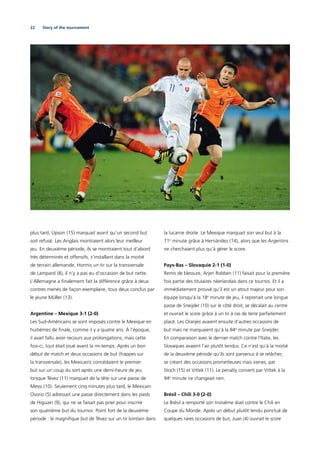
Argentine – Mexique 3-1 (2-0)
Les Sud-Américains se sont imposés contre le Mexique en
huitièmes de finale, comme il y a quatre ans. À l’époque,
il avait fallu avoir recours aux prolongations, mais cette
fois-ci, tout était joué avant la mi-temps. Après un bon
début de match et deux occasions de but (frappes sur
la transversale), les Mexicains concédaient le premier
but sur un coup du sort après une demi-heure de jeu
lorsque Tévez (11) marquait de la tête sur une passe de
Messi (10). Seulement cinq minutes plus tard, le Mexicain
Osorio (5) adressait une passe directement dans les pieds
de Higuaín (9), qui ne se faisait pas prier pour inscrire
son quatrième but du tournoi. Point fort de la deuxième
période : le magnifique but de Tévez sur un tir lointain dans
la lucarne droite. Le Mexique marquait son seul but à la
71e
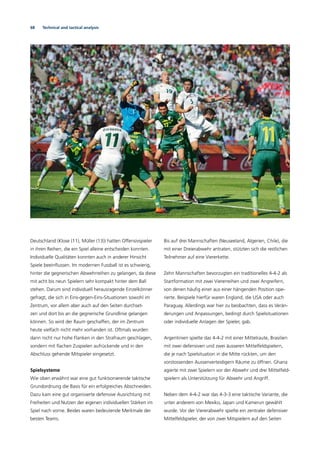
 minute grâce à Hernández (14), alors que les Argentins
ne cherchaient plus qu’à gérer le score.
Pays-Bas – Slovaquie 2-1 (1-0)
Remis de blessure, Arjen Robben (11) faisait pour la première
fois partie des titulaires néerlandais dans ce tournoi. Et il a
immédiatement prouvé qu’il est un atout majeur pour son
équipe lorsqu’à la 18e
minute de jeu, il reprenait une longue
passe de Sneijder (10) sur le côté droit, se décalait au centre
et ouvrait le score grâce à un tir à ras de terre parfaitement
placé. Les Oranjes avaient ensuite d’autres occasions de
but mais ne marquaient qu’à la 84e
minute par Sneijder.
En comparaison avec le dernier match contre l’Italie, les
Slovaques avaient l’air plutôt tendus. Ce n’est qu’à la moitié
de la deuxième période qu’ils sont parvenus à se relâcher,
se créant des occasions prometteuses mais vaines, par
Stoch (15) et Vittek (11). Le penalty converti par Vittek à la
94e
 minute ne changeait rien.
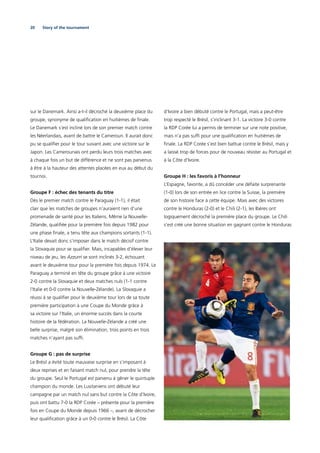
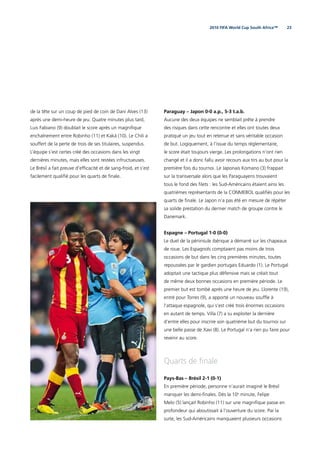
Brésil – Chili 3-0 (2-0)
Le Brésil a remporté son troisième duel contre le Chili en
Coupe du Monde. Après un début plutôt tendu ponctué de
quelques rares occasions de but, Juan (4) ouvrait le score
232010 FIFA World Cup South Africa™
de la tête sur un coup de pied de coin de Dani Alves (13)
après une demi-heure de jeu. Quatre minutes plus tard,
Luis Fabiano (9) doublait le score après un magnifique
enchaînement entre Robinho (11) et Kaká (10). Le Chili a
souffert de la perte de trois de ses titulaires, suspendus.
L’équipe s’est certes créé des occasions dans les vingt
dernières minutes, mais elles sont restées infructueuses.
Le Brésil a fait preuve d’efficacité et de sang-froid, et s’est
facilement qualifié pour les quarts de finale.
Paraguay – Japon 0-0 a.p., 5-3 t.a.b.
Aucune des deux équipes ne semblait prête à prendre
des risques dans cette rencontre et elles ont toutes deux
pratiqué un jeu tout en retenue et sans véritable occasion
de but. Logiquement, à l’issue du temps réglementaire,
le score était toujours vierge. Les prolongations n’ont rien
changé et il a donc fallu avoir recours aux tirs au but pour la
première fois du tournoi. Le Japonais Komano (3) frappait
sur la transversale alors que les Paraguayens trouvaient
tous le fond des filets : les Sud-Américains étaient ainsi les
quatrièmes représentants de la CONMEBOL qualifiés pour les
quarts de finale. Le Japon n’a pas été en mesure de répéter
sa solide prestation du dernier match de groupe contre le
Danemark.
Espagne – Portugal 1-0 (0-0)
Le duel de la péninsule ibérique a démarré sur les chapeaux
de roue. Les Espagnols comptaient pas moins de trois
occasions de but dans les cinq premières minutes, toutes
repoussées par le gardien portugais Eduardo (1). Le Portugal
adoptait une tactique plus défensive mais se créait tout
de même deux bonnes occasions en première période. Le
premier but est tombé après une heure de jeu. Llorente (19),
entré pour Torres (9), a apporté un nouveau souffle à
l’attaque espagnole, qui s’est créé trois énormes occasions
en autant de temps. Villa (7) a su exploiter la dernière
d’entre elles pour inscrire son quatrième but du tournoi sur
une belle passe de Xavi (8). Le Portugal n’a rien pu faire pour
revenir au score.
Quarts de finale
Pays-Bas – Brésil 2-1 (0-1)
En première période, personne n’aurait imaginé le Brésil
manquer les demi-finales. Dès la 10e
minute, Felipe
Melo (5) lançait Robinho (11) sur une magnifique passe en
profondeur qui aboutissait à l’ouverture du score. Par la
suite, les Sud-Américains manquaient plusieurs occasions
24 Story of the tournament
d’aggraver le score. Les Néerlandais ne trouvaient pas leur
jeu et les Brésiliens dominaient. En deuxième période, Felipe
Melo et le gardien Julio Cesar (1) se gênaient mutuellement
sur un centre de Sneijder et les Néerlandais remontaient
à 1-1. Ce but déstabilisait le jeu brésilien et Sneijder (10)
parvenait à inscrire, de nouveau de la tête, le but de 2-1
sur coup de pied de coin à la 68e
minute. Pour la première
fois dans le tournoi, les quintuples champions du monde
étaient menés au score. À la 74e
minute, Felipe Melo était
expulsé après une faute grave. Les Néerlandais parvenaient
à maintenir leur avance au score grâce à leur supériorité
numérique et à leur jeu lucide. Ils s’offraient même plusieurs
occasions d’accentuer leur avance grâce leurs contres
exploitant à merveille les espaces.
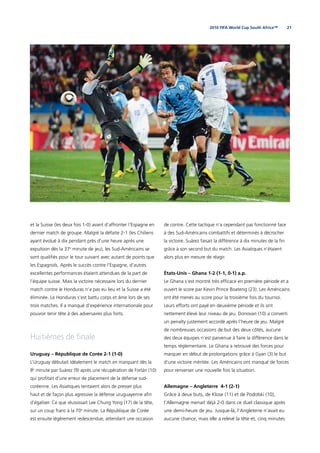
Uruguay – Ghana 1-1 (1-1, 0-1) a.p., 4-2 t.a.b.
Les espoirs de toute l’Afrique pesaient sur les épaules
du Ghana, seule équipe du continent qualifiée pour
le deuxième tour. Muntari (11) donnait l’avantage aux
Africains juste avant la pause sur une frappe de 35 mètres,
mais les Sud-Américains réagissaient rapidement. Forlán
(10) transformait un coup franc pour égaliser à la 55e
minute. Les Uruguayens avaient ensuite l’occasion de
faire la différence mais, à la fin du temps réglementaire, le
score était de 1-1. Les prolongations allaient connaître un
déroulement dramatique lorsqu’à la 121e
minute, Suárez
(9) repoussait le ballon des deux mains sur sa ligne de but
pour empêcher un but des ghanéens et se faisait expulser.
Gyan (3), qui avait déjà transformé deux penalties dans
la compétition voyait sa tentative repoussée par la barre
transversale et, le temps étant écoulé, il fallait avoir recours
à une séance des tirs au but. Et là arrivait ce beaucoup
redoutaient : les Ghanéens manquaient deux tirs et le sort
des derniers représentants africains était ainsi scellé.
Argentine – Allemagne 0-4 (0-1)
Müller (13) ouvrait le score pour l’Allemagne dès la
3e
 minute sur coup franc. Les Européens, confiants et
lucides, avaient même l’occasion de doubler la mise par
Klose (11) à la 24e
minute. Les Argentins se reprenaient alors
quelque peu et enregistraient une meilleure possession de
balle. En début de seconde période, Maxi Rodríguez (20) et
Di María (7) gâchaient deux occasions de but prometteuses.
Puis la sélection allemande se réorganisait rapidement et
réagissait en inscrivant deux buts, à la 68e
et à la 74e
 minute.
L’Argentine ne croyait alors plus à l’exploit, et les Allemands
inscrivaient encore un quatrième but. Messi (10) et
Tévez (11) n’ont trouvé aucun espace pour développer leur
252010 FIFA World Cup South Africa™
jeu dans la défense dense de la Mannschaft, qui a misé avec
succès sur la force de son jeu en contre.
Paraguay – Espagne 0-1 (0-0)
Longtemps les Espagnols se sont compliqué la vie face à
des Paraguayens défensifs. Toujours dangereux en contre,
les Sud-Américains ont eu les meilleures occasions de
but en début de partie. Après seulement 50 secondes,
Santana (11) testait le gardien espagnol Casillas (1). Dans ce
match spectaculaire où ont été accordés deux penalties en
quelque cinq minutes (les deux fois les gardiens sont sortis
vainqueurs), Villa (7) a libéré son équipe à la 83e
minute en
inscrivant son cinquième but de la compétition : Iniesta (6)
trouvait Pedro (18) démarqué mais celui-ci frappait sur le
poteau droit puis Villa, bien placé pour profiter du rebond,
inscrivait le but de la victoire. Le Paraguay avait encore une
belle occasion pour égaliser par Santa Cruz (9) mais Casillas
réduisait ses espoirs à néant. Ainsi les Espagnols étaient-ils
qualifiés pour le dernier carré d’une Coupe du Monde pour
la première fois depuis 1950, à l’époque où la compétition ne
consistait qu’en des matches de groupes.
Demi-finales
Uruguay – Pays-Bas 2-3 (1-1)
Les Pays-Bas ont pratiqué un jeu rapide et varié vers l’avant,
dès le début du match. Kuyt (7) a eu la première occasion
26 Story of the tournament
de but à la 4e
minute de jeu après une parade courte du
gardien uruguayen Muslera (1). Puis les efforts néerlandais
étaient récompensés à la 18e
minute lorsque le capitaine
Van Bronckhorst (5) ouvrait le score sur une magnifique
frappe de 37 mètres dans la lucarne droite. Forlán (10)
égalisait juste avant la pause, lui aussi sur une frappe
lointaine. À la reprise, les duels devenaient plus intenses
et le ballon circulait de façon moins fluide. En l’espace de
trois minutes, les Néerlandais trouvaient deux fois le but
(70e
et 73e
 minutes), par Sneijder (10) d’un tir tendu et par
Robben (11) de la tête. Pereira (11) marquait en fin de match
(92e
) après une longue phase de pression de la part des
Uruguayens, pour réduire la marque à 3-2. Les efforts des
Sud-Américains dans les arrêts de jeu restaient infructueux,
et les Pays-Bas atteignaient ainsi la troisième finale de Coupe
du Monde de leur histoire après 1974 et 1978.
Allemagne – Espagne 0-1 (0-0)
L’entraîneur espagnol Vicente del Bosque a légèrement
modifié la configuration de sa formation de départ.
Pedro (18) a remplacé Torres (9) et a apporté beaucoup
de dynamisme au jeu offensif des Ibères. À la 6e
minute,
il lançait Villa (7) d’une passe tendue précise, mais le
gardien allemand Neuer (1) parvenait à empêcher le
but de justesse. Dans la lancée, Puyol (5) expédiait
une tête juste au dessus de la transversale, avant
que les Allemands prennent davantage part au jeu
et que Trochowski (15), qui remplaçait Müller (13),
suspendu, obtienne la première occasion de but pour
la Mannschaft sur une frappe lointaine. Pendant les
quinze premières minutes de la deuxième période, les
Espagnols pressaient les Allemands dans leur zone et se
créaient plusieurs occasions de but. Tout d’abord, Xabi
272010 FIFA World Cup South Africa™
Alonso (14) manquait sa cible à deux reprises sur des tirs
lointains, puis Xavi (8) échouait face à Neuer, et enfin Villa
manquait le but de quelques centimètres sur une remise
d’Iniesta (6). À la 69e
minute, Kroos (18), tout juste entré
en jeu, gâchait la meilleure occasion allemande. Puis,
quelques minutes plus tard, Puyol inscrivait de la tête son
premier but bien mérité, sur un coup de pied de coin de
Xavi. Dix minutes avant la fin du temps réglementaire,
Pedro avait l’occasion de tuer le match mais il perdait
le ballon en un-contre-un. Les Allemands ne parvenait
toutefois pas à revenir au score.
Match pour la troisième place
Uruguay – Allemagne 2-3 (1-1)
L’Uruguay et l’Allemagne ont montré que l’existence du
match pour la troisième place est tout à fait justifiée.
Les deux équipes se sont livré, sous la forte pluie de
Port Elizabeth, une lutte acharnée sans contrainte
tactique. Après 1934, 1970 et 2006, la sélection
allemande a remporté pour la quatrième fois de son
histoire la « petite finale ». Mais la victoire n’a pas été
facile à décrocher. L’ouverture du score par Müller (13)
(son cinquième but de la compétition) à la 19e
minute
après une parade de Muslera (1) était anéantie dix
minutes plus tard par Cavani (7) après une belle passe
en profondeur de Suárez (9). Et juste avant la pause, les
Uruguayens prenaient les devants grâce à Forlán (10)
sur une incroyable reprise de volée sur un centre
d’Arevalo (17). La réaction ne s’est cependant pas laissé
attendre. À la 56e
minute, Jérôme Boateng (20) centrait
du côté droit sur la tête de Jansen (2) qui permettait à
son équipe de revenir dans la course à 2-2. Finalement,
après 82 minutes de jeu, Khedira (6) marquait de la tête
le but de la victoire allemande sur un coup de pied de
coin d’Özil (8). L’Uruguay jouait ensuite de malchance
lorsqu’un coup franc de Forlán frappait la barre
transversale en fin de rencontre.
Finale
Pays-Bas – Espagne 0-1 a.p., 0-0
Les deux équipes ont abordé avec retenue cette finale
qui allait sacrer un nouveau champion du monde. La
première période a été marquée par de nombreuses fautes,
principalement de la part des Néerlandais. Le cours du match
en a été largement affecté, et les occasions de but n’ont
été que sporadiques. L’une, créée par Sergio Ramos (15) de
la tête après quatre minutes de jeu, était repoussée par un
extraordinaire réflexe du gardien néerlandais Stekelenburg (1).
Villa (7) avait lui aussi sa chance, à la 12e
 minute, mais
sa reprise de volée passait à côté du but. Les Oranjes
n’enregistraient leur première véritable occasion de but
qu’en fin de première période, lorsque Robben (11) testait
Casillas (1) de loin. Après la pause, le jeu était plus fluide, les
deux équipes se concentrant sur leur aptitude à faire circuler
le ballon. L’Espagnol Capdevila (11) obtenait une première
occasion à la 48e
minute, mais ne parvenait pas à conclure
sur une courte passe de la tête de Puyol (5). Malgré la dureté
des duels, notamment côté néerlandais, l’Espagne parvenait
à accentuer encore sa pression. C’est pourtant Robben qui,
à la 62e
minute, se procurait la plus franche occasion de but
lorsqu’il partait en contre, seul face à Casillas qui réalisait
une parade exceptionnelle. À la 83e
minute, Robben se créait
une nouvelle occasion similaire – mais le portier espagnol
en sortait encore vainqueur. Quelques minutes plus tôt, Villa
avait frisé le 1-0 (68e
), et Sergio Ramos avait de nouveau
manqué d’ouvrir le score de la tête. Ainsi la finale a-t-elle dû
se décider aux prolongations. Les Espagnols exerçaient une
pression croissante, qui leur a été facilitée par l’expulsion de
Heitinga (3) à la 108e
minute. C’est alors que Fàbregas (10)
servait Iniesta (6) d’une passe en profondeur. Celui-ci ne se
faisait pas prier et inscrivait le but décisif (à la 116e
minute).
Ainsi l’Espagne, déjà sacrée championne d’Europe en 2008,
décrochait-elle le titre de championne du monde. Les Pays-Bas
quant à eux attendent toujours leur premier sacre mondial
après trois participations à la finale de la Coupe du Monde de
la FIFA (1974, 1978 et 2010).
28 Story of the tournament
Reseña del
torneo
Fase de grupos
Grupo A: el anfitrión no pasa a la segunda fase
En el partido inaugural, Sudáfrica no sólo debió enfren-
tarse a México, sino igualmente a las elevadas expecta-
tivas depositadas en ella. El empate a 1, particularmente
luego de un segundo tiempo muy prometedor, dejaba
todas las opciones abiertas para acceder a la segunda
ronda. Sin embargo, la derrota por 3 a 0 contra Uruguay
prácticamente truncó toda posibilidad de seguir adelante,
no resultando suficiente la convincente victoria por 2 a 1
contra Francia para clasificarse. Con ello, se dio por primera
vez en la historia de una Copa Mundial que el país anfitrión
no estuviera representado en la segunda ronda. Uruguay
encabezó indiscutiblemente su grupo. Luego del empate
a 0 con Francia, el conjunto sudamericano contabilizó
dos victorias contra Sudáfrica (3-0) y contra México (1-0).
México se clasificó para octavos de final gracias a la victoria
contra Francia y la mejor diferencia de goles frente a Sudá-
frica. Francia fue eliminada como último del grupo con una
decepcionante actuación, contabilizando un punto y un gol
en tres partidos.
Grupo B: Argentina sin problemas
El favorito Argentina convenció desde el inicio y pasó a liderar
su grupo con tres victorias y una diferencia de goles de 7:1.
La República de Corea agradece el segundo puesto ante todo
a la victoria por 2 a 0 en el primer partido de grupo contra
Grecia, la cual volvió a alimentar sus ilusiones de una clasifica-
ción luego del 2 a 1 contra Nigeria en el segundo choque. Sin
embargo, como Corea lograra empatar únicamente (2-2) con
Nigeria en el último partido del grupo y Grecia sucumbiera
ante Argentina (2-0), el campeón europeo de 2004 quedó eli-
minado, mientras que Nigeria fracasó debido a su incapacidad
goleadora, finalizando en el último lugar del grupo.
Grupo C: EE UU sorprende
Los resultados en el grupo C fueron más ajustados de
lo esperado. EE UU resistió a los ingleses en el primer
encuentro y consiguió un sorprendente empate a 1. Al
mismo tiempo, Eslovenia derrotó a Argelia, y como los dos
segundos encuentros finalizaran empatados tras dramáticas
acciones, la suerte de los equipos se decidiría en sus últi-
mos choques. Inglaterra, que logró finalmente justificar su
rol de favorito derrotando a Eslovenia por 1 a 0, debió sin
embargo ceder el primer puesto del grupo a EE UU, el cual
consiguió anotar el 1 a 0 de la victoria en el alargue contra
Argelia, otra escuadra africana que quedaba eliminada del
torneo. Le faltó claramente un goleador que supiera mate-
rializar las numerosas oportunidades de gol creadas por el
equipo.
Grupo D: suspenso hasta el final
El grupo D estuvo marcado por un gran suspenso hasta el
último minuto de juego. Alemania había arrancado con
una victoria fulminante, arrasando a Australia por 4 a 0.
Contra Serbia, debió jugar en inferioridad numérica durante
60 minutos a causa de una expulsión; además, se dio el
lujo de errar un penal, siendo ambos aspectos el motivo de
la apretada derrota por 1 a 0. Gracias a dos goles de penal
contra Serbia (1-0) y Australia (1-1), Ghana contabilizaba
cuatro puntos después de dos encuentros. Es así que antes
de los últimos partidos de grupo, los cuatros equipos tenían
posibilidades de clasificarse. Incluso poco antes de la conclu-
sión de los dos encuentros, la situación seguía aún abierta.
Finalmente, se impusieron Alemania y Ghana en los primeros
lugares. Alemania, gracias al 1 a 0 contra Ghana y los africa-
nos merced a la mejor diferencia de goles frente a Australia.
Serbia fracasó al perder 2 a 1 contra Australia.
Grupo E: grandiosos holandeses
El grupo E fue prácticamente un ”paseo“ para la escuadra
naranja, que encabezó el grupo con el máximo puntaje.
Japón, que sorprendió a Camerún en el primer partido de
grupo (1-0), no decepcionó tampoco contra los Países Bajos
a pesar de la derrota por 1 a 0, y confirmó el progreso reali-
zado con una neta victoria por 3 a 1 contra Dinamarca, que
significaba el segundo puesto y la clasificación para octavos
292010 FIFA World Cup South Africa™
de final. En el partido inaugural, Dinamarca perdió contra los
Países Bajos, sin embargo derrotó luego a Camerún, con lo
cual podría seguir adelante si lograba derrotar a Japón. Los
cameruneses perdieron cada uno de sus tres encuentros con
un gol de diferencia, no pudiendo así cumplir las expectati-
vas depositadas en ellos.
Grupo F: fracasa el defensor del título
Ya el primer encuentro de Italia contra Paraguay (1-1) dejó
entrever que los partidos de grupo no serían una fácil labor
para los italianos. Incluso el equipo de Nueva Zelanda,
clasificado de nuevo para la Copa Mundial después de
1982, consiguió empatar a uno su choque con el campeón
saliente. De modo que Italia requería una victoria en el
encuentro decisivo contra Eslovaquia para continuar en la
competición. Sin embargo, los Azzurri no supieron crecer y
perdieron por 3 a 2, con lo cual quedaban eliminados por
segunda vez después de 1974. Paraguay ganó el grupo
gracias a una victoria (2-0 contra Eslovaquia) y dos empates
(Italia (1-1) y Nueva Zelanda (0-0)). Eslovaquia, que partici-
paba por primera vez en una Copa Mundial, consiguió el
pase para octavos de final merced a su victoria contra Italia.
Dicha clasificación representa el máximo triunfo en la his-
toria de la joven asociación. Nueva Zelanda constituyó una
gran sorpresa, pero fue eliminada pese a no perder ningún
encuentro. Los tres puntos en tres partidos no bastaron para
pasar a la segunda ronda.
Grupo G: clara situación
Brasil dejó bien clara su intención con dos victorias y un
empate, colocándose a la cabeza del grupo G. Únicamente
Portugal pudo poner en apuros al pentacampeón mundial
en el último encuentro. La escuadra lusitana arrancó con un
empate contra Costa de Marfil, derrotó a la RDP de Corea
–que participaba por primera vez después de 1966– por
7 a 0 y consiguió el pase a la siguiente ronda gracias al
empate con Brasil. Costa de Marfil disputó un encuentro
prometedor con Portugal en su primer partido; sin embargo,
contra Brasil mostró un desmesurado respeto, lo cual con-
dujo a una derrota por 3 a 1. El 3 a 0 final contra la RDP
de Corea constituyó únicamente una corrección cosmética,
pero no fue suficiente para proseguir en el torneo. La RDP
de Corea desplegó un juego sumamente atractivo contra
Brasil; sin embargo, aparentemente dicho encuentro le costó
demasiada energía, no pudiendo a continuación imponerse
a Portugal y Costa de Marfil.
30 Story of the tournament
Grupo H: se imponen los favoritos
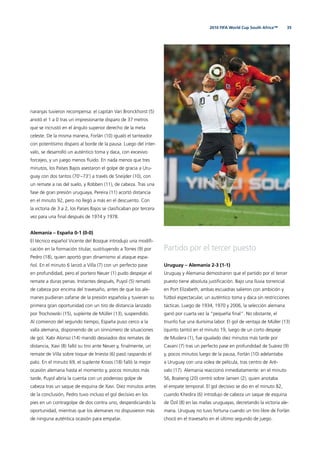
El favorito España sufrió una sorprendente derrota por
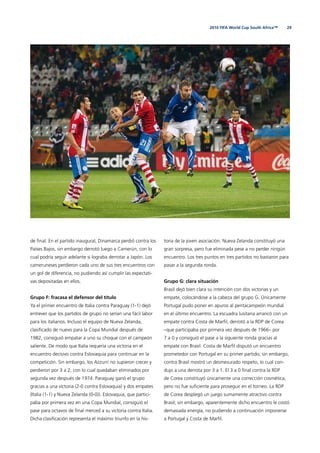
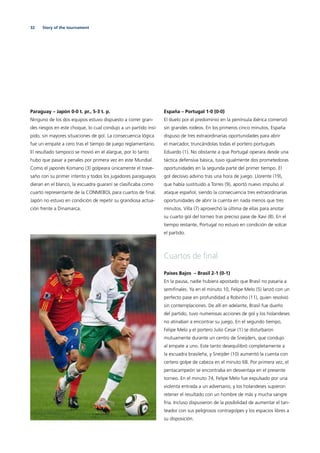
1 a 0 contra Suiza en el partido inicial, el primer revés jamás
sufrido contra este contrincante. No obstante, gracias a las
victorias contra Honduras (2-0) y Chile (2-1), los íberos ocu-
paron, como esperado, el primer puesto del grupo. Merced
a victorias contra Honduras y Suiza (ambas por 1-0), Chile
se colocó en una prometedora situación antes del último
choque contra España. No obstante a la derrota por 2 a 1 (el
conjunto chileno jugó cerca de una hora con diez hombres
por expulsión), se clasificó con el mismo puntaje que España
para la segunda ronda. Luego de su triunfo contra España,
Suiza bajó mucho su rendimiento en los siguientes encuen-
tros. La victoria necesaria para continuar a octavos de final
en el último partido contra Honduras fue totalmente des-
perdiciada. Los hondureños se esforzaron en todos sus tres
encuentros, pero les faltó la experiencia internacional para
imponerse a equipos más fuertes.
Octavos de final
Uruguay – República de Corea 2-1 (1-0)
Uruguay arrancó tal como deseado y se adelantó ya en el
minuto 8 por intermedio de Suárez (9). La recuperación
por Forlán (10) de un balón que parecía perdido y una falla
defensiva de Corea condujeron a este gol madrugador. A
continuación, el conjunto coreano intentó someter a presión
a la defensa sudamericana mediante un agresivo y tem-
prano acoso, buscando la paridad, la cual consiguió en el
minuto 70 con potente cabezazo de Lee Chung Yong (17)
luego de un tiro libre. Acto seguido, la selección coreana se
rezagó ligeramente, en espera de oportunidades de contra-
ataque, táctica que no rindió frutos, por cuanto la celeste
aumentó progresivamente la presión en busca de la victoria.
Diez minutos antes de la conclusión, Suárez anotaba su
segundo tanto decisivo, dejando a los asiáticos sin poder de
reacción.
EE UU – Ghana 1-2 (1-1, 0-1) t. pr.
Ghana jugó con gran eficacia en la primera mitad y se
adelantó en el tanteador mediante gol de Kevin Prince
Boateng (23). De tal modo, los estadounideses se hallaban
obligados a remontar por tercera vez un revés en el presente
torneo, encontrando premio sus esfuerzos en el segundo
tiempo gracias a un enorme incremento de rendimiento.
Donovan (10) anidó un penal luego de una hora de juego,
pero a pesar de existir oportunidades para ambos bandos,
ninguno logró desempatar el cotejo. En el alargue, Ghana
enderezó su rumbo y poco después de iniciado el tiempo
suplementario, Gyan (3) marcó el merecido gol de la victoria.
EE UU careció de la fuerza necesaria para nuevamente poder
dar vuelta al tanteador.
Alemania – Inglaterra 4-1 (2-1)
Gracias a goles de Klose (11) y Podolski (10), Alemania
ganaba ya este clásico por 2 a 0 tras apenas media hora de
juego. Hasta ese momento, Inglaterra careció de oportunida-
des, aunque logró levantarse de la lona y acortar distancias
con gol de Upson (15) cinco minutos más tarde. Instantes
después, caía incluso el empate, el cual, no obstante, fue
invalidado. En el segundo tiempo, los ingleses apretaron
el acelerador y pusieron bajo sitio el área alemana. Sin
embargo, no lograron crear auténticas oportunidades de
gol, a excepción de un remate de Lampard (8) contra el
travesaño germano. Alemania liquidó el pleito con dos
contraataques ejemplares. En ambas situaciones, el goleador
fue Müller (13).
Argentina – México 3-1 (2-0)
Al igual que cuatro años antes, los sudamericanos se impu-
sieron a México en octavos de final. En aquel entonces,
la contienda fue definida únicamente en el alargue; esta
vez, en el primer tiempo. No obstante un arranque pro-
metedor y dos buenas oportunidades de gol (un remate
en el travesaño), los mexicanos debieron conceder un gol
desafortunado tras media hora de juego. Tévez (11) anidó
312010 FIFA World Cup South Africa™
el esférico con preciso cabezazo, tras pase de Messi (10).
Apenas cinco minutos más tarde, el defensa mexicano
Osorio (5) dejó involuntariamente un balón muerto en los
pies de Higuaín (9), quien no se hizo rogar dos veces y
anotó su cuarto tanto en el torneo. El punto culminante de
la segunda parte fue el extraordinario cañonazo de Tévez
al ángulo superior derecho de la meta contraria, signifi-
cando el 3 a 0 para Argentina. El gol mexicano advino en
el minuto 71 por intermedio de Hernández (14), cuando
los argentinos optaron por atenuar el ritmo y mantener el
resultado.
Países Bajos – Eslovaquia 2-1 (1-0)
Por primera vez en este torneo, los Países Bajos pudieron
alinear en el equipo titular a Arjen Robben (11), tras su larga
lesión. En pocos minutos demostró que era un pilar del
once holandés; así, en el minuto 18 recibió un pase largo de
Sneijder (10) en el extremo derecho, quebró hacia adentro
y anotó el gol de ventaja de la escuadra naranja con un tiro
bajo y seco. El conjunto neerlandés dispuso de numerosas
oportunidades para incrementar el resultado, pero fue recién
en el minuto 84 que Sneijder subiera el segundo al marca-
dor. En comparación con su choque contra Italia, los eslova-
cos actuaron con cierta inseguridad, efectuando algo más de
acopio de coraje desde mediados del segundo tiempo con
algunas buenas oportunidades por intermedio de Stoch (15)
y Vittek (11). El gol de penal de Vittek en el minuto 94 lle-
gaba demasiado tarde para volcar el resultado.
Brasil – Chile 3-0 (2-0)
Brasil ganó por tercera vez un duelo contra Chile en un
Mundial. Tras un inicio cauteloso por ambas partes, sin
grandes situaciones de gol, en el minuto 35 Juan (4) ade-
lantaba de cabeza a la Canarinha tras un saque de meta
de Dani Alves (13). Apenas cuatro minutos más tarde,
Luis Fabiano (9) definió una grandiosa combinación entre
Robinho (11) y Kaká (10), anotando así el 2 a 0 para Brasil.
Chile sintió la ausencia de tres importantes titulares por
suspensión, y no obstante hilvanar algunas prometedoras
acciones, no fue capaz de materializar sus acciones. Brasil se
mostró seguro de sí, con mucha sangre fría, y pasó mereci-
damente a cuartos de final.
32 Story of the tournament
Paraguay – Japón 0-0 t. pr., 5-3 t. p.
Ninguno de los dos equipos estuvo dispuesto a correr gran-
des riesgos en este choque, lo cual condujo a un partido insí-
pido, sin mayores situaciones de gol. La consecuencia lógica
fue un empate a cero tras el tiempo de juego reglamentario.
El resultado tampoco se movió en el alargue, por lo tanto
hubo que pasar a penales por primera vez en este Mundial.
Como el japonés Komano (3) golpeara únicamente el trave-
saño con su primer intento y todos los jugadores paraguayos
dieran en el blanco, la escuadra guaraní se clasificaba como
cuarto representante de la CONMEBOL para cuartos de final.
Japón no estuvo en condición de repetir su grandiosa actua-
ción frente a Dinamarca.
España – Portugal 1-0 (0-0)
El duelo por el predominio en la península ibérica comenzó
sin grandes rodeos. En los primeros cinco minutos, España
dispuso de tres extraordinarias oportunidades para abrir
el marcador, truncándolas todas el portero portugués
Eduardo (1). No obstante a que Portugal operara desde una
táctica defensiva básica, tuvo igualmente dos prometedoras
oportunidades en la segunda parte del primer tiempo. El
gol decisivo advino tras una hora de juego. Llorente (19),
que había sustituido a Torres (9), aportó nuevo impulso al
ataque español, siendo la consecuencia tres extraordinarias
oportunidades de abrir la cuenta en nada menos que tres
minutos. Villa (7) aprovechó la última de ellas para anotar
su cuarto gol del torneo tras preciso pase de Xavi (8). En el
tiempo restante, Portugal no estuvo en condición de volcar
el partido.
Cuartos de final
Países Bajos – Brasil 2-1 (0-1)
En la pausa, nadie hubiera apostado que Brasil no pasaría a
semifinales. Ya en el minuto 10, Felipe Melo (5) lanzó con un
perfecto pase en profundidad a Robinho (11), quien resolvió
sin contemplaciones. De allí en adelante, Brasil fue dueño
del partido, tuvo numerosas acciones de gol y los holandeses
no atinaban a encontrar su juego. En el segundo tiempo,
Felipe Melo y el portero Julio Cesar (1) se disturbaron
mutuamente durante un centro de Sneijders, que condujo
al empate a uno. Este tanto desequilibró completamente a
la escuadra brasileña, y Sneijder (10) aumentó la cuenta con
certero golpe de cabeza en el minuto 68. Por primera vez, el
pentacampeón se encontraba en desventaja en el presente
torneo. En el minuto 74, Felipe Melo fue expulsado por una
violenta entrada a un adversario, y los holandeses supieron
retener el resultado con un hombre de más y mucha sangre
fría. Incluso dispusieron de la posibilidad de aumentar el tan-
teador con sus peligrosos contragolpes y los espacios libres a
su disposición.
332010 FIFA World Cup South Africa™
Uruguay – Ghana 1-1 (1-1, 0-1) tr. p. 4-2
La esperanza de toda África residía en la actuación de Ghana,
el único equipo del continente africano que logró clasificarse
para cuartos de final. Un potentísimo remate de Muntari (11)
de 35 metros a pocos minutos de la pausa encaminó a los
africanos en el sendero deseado. No obstante, Uruguay reac-
cionó inmediatamente, convirtiendo Forlán (10) un penal en
el minuto 55. En los siguientes minutos, la celeste dispuso de
varias posibilidades para definir el encuentro; sin embargo, el
tanteador no se alteró en los primeros 90 minutos. El último
segundo del alargue fue el momento más emocionante y
electrizante de todo el cotejo: en el minuto 121, Suárez (9)
sacó con las manos la pelota de la propia línea de meta,
siendo expulsado acto seguido. El experto en penales Gyan
(3) (dos penales anotados en el torneo) desvió el tiro de rigor
contra el travesaño y el partido se dio por finalizado. Se tuvo
que pasar a la tanda de penales, la cual concluyó con dos tiros
fallados por los africanos y uno por los uruguayos, sellando
así Uruguay el destino del último representante africano.
Argentina – Alemania 0-4 (0-1)
A los tres minutos de juego, Müller (13) adelantaba ya a
Alemania tras un un preciso tiro libre. La escuadra europea
hizo gala de un apabullante juego ofensivo y mucha garra,
y en el minuto 24 Klose (11) estuvo a punto de subir el
segundo tanto al marcador. Recién entonces comenzó a
reaccionar Argentina y asumir la batuta. A comienzos del
segundo tiempo, los sudamericanos fallaron dos grandes
oportunidades, desviadas por Maxi Rodríguez (20) y Di
María (7). Alemania halló pronto su compostura y reac-
cionó con el segundo y el tercer tanto en los minutos 68
y 74. Argentina se derrumbó, bajando definitivamente
los brazos. Los alemanes subieron incluso un cuarto gol
prácticamente sobre la hora. Messi (10) y Tévez (11) nunca
34 Story of the tournament
hallaron la forma de superar la sólida defensa germana,
mientras que los alemanes apostaron exitosamente a sus
vertiginosos contragolpes.
Paraguay – España 0-1 (0-0)
A España le costó establecer su juego de toques contra un
Paraguay bien pertrechado en defensa. Además, la escua-
dra guaraní lanzaba constantes contragolpes peligrosos,
teniendo mejores cartas al inicio del partido. Ya a los 50
segundos de juego, Santana (11) puso por primera vez bajo
prueba a Casillas (1). En un encuentro pleno de emociones
y dramatismo, en el cual se fallaron dos penales en nada
menos que cinco minutos (atajados ambos por los respec-
tivos porteros), fue finalmente Villa (7) quien rompiera la
paridad con su quinto tanto mundialista en el minuto 83.
Iniesta (6) sirvió un pase a Pedro (18), totalmente libre, pero
éste pegó solamente en el poste. El rebote cayó a los pies de
Villa, quien marcó el gol decisivo del encuentro. A continua-
ción, Paraguay dispuso incluso de una gran oportunidad de
empate por intermedio de Santa Cruz (9), la cual fue salvada
por Casillas. Es así que los íberos lograban clasificarse para
semifinales luego de 1950, época en la cual aún se disputa-
ban únicamente partidos de grupo.
Semifinales
Uruguay – Países Bajos 2-3 (1-1)
Los Países Bajos salieron con un juego variable y veloz,
teniendo ya la primera oportunidad en el minuto 4 a través
de Kuyt (7), cuyo remate fue desviado por el portero uru-
guayo Muslera (1). No obstante, en el minuto 18 los esfuerzos
352010 FIFA World Cup South Africa™
naranjas tuvieron recompensa: el capitán Van Bronckhorst (5)
anotó el 1 a 0 tras un impresionante disparo de 37 metros
que se incrustó en el ángulo superior derecho de la meta
celeste. De la misma manera, Forlán (10) igualó el tanteador
con potentísimo disparo al borde de la pausa. Luego del inter-
valo, se desarrolló un auténtico toma y daca, con excesivo
forcejeo, y un juego menos fluido. En nada menos que tres
minutos, los Países Bajos asestaron el golpe de gracia a Uru-
guay con dos tantos (70’–73’) a través de Sneijder (10), con
un remate a ras del suelo, y Robben (11), de cabeza. Tras una
fase de gran presión uruguaya, Pereira (11) acortó distancia
en el minuto 92, pero no llegó a más en el descuento. Con
la victoria de 3 a 2, los Países Bajos se clasificaban por tercera
vez para una final después de 1974 y 1978.
Alemania – España 0-1 (0-0)
El técnico español Vicente del Bosque introdujo una modifi-
cación en la formación titular, sustituyendo a Torres (9) por
Pedro (18), quien aportó gran dinamismo al ataque espa-
ñol. En el minuto 6 lanzó a Villa (7) con un perfecto pase
en profundidad, pero el portero Neuer (1) pudo despejar el
remate a duras penas. Instantes después, Puyol (5) remató
de cabeza por encima del travesaño, antes de que los ale-
manes pudieran zafarse de la presión española y tuvieran su
primera gran oportunidad con un tiro de distancia lanzado
por Trochowski (15), suplente de Müller (13), suspendido.
Al comienzo del segundo tiempo, España puso cerco a la
valla alemana, disponiendo de un sinnúmero de situaciones
de gol. Xabi Alonso (14) mandó desviados dos remates de
distancia, Xavi (8) falló su tiro ante Neuer y, finalmente, un
remate de Villa sobre toque de Iniesta (6) pasó raspando el
palo. En el minuto 69, el suplente Kroos (18) falló la mejor
ocasión alemana hasta el momento y, pocos minutos más
tarde, Puyol abría la cuenta con un poderoso golpe de
cabeza tras un saque de esquina de Xavi. Diez minutos antes
de la conclusión, Pedro tuvo incluso el gol decisivo en los
pies en un contragolpe de dos contra uno, desperdiciando la
oportunidad, mientras que los alemanes no dispusieron más
de ninguna auténtica ocasión para empatar.
Partido por el tercer puesto
Uruguay – Alemania 2-3 (1-1)
Uruguay y Alemania demostraron que el partido por el tercer
puesto tiene absoluta justificación. Bajo una lluvia torrencial
en Port Elizabeth, ambas escuadras salieron con ambición y
fútbol espectacular, un auténtico toma y daca sin restricciones
tácticas. Luego de 1934, 1970 y 2006, la selección alemana
ganó por cuarta vez la “pequeña final“. No obstante, el
triunfo fue una durísima labor. El gol de ventaja de Müller (13)
(quinto tanto) en el minuto 19, luego de un corto despeje
de Muslera (1), fue igualado diez minutos más tarde por
Cavani (7) tras un perfecto pase en profundidad de Suárez (9)
y, pocos minutos luego de la pausa, Forlán (10) adelantaba
a Uruguay con una volea de película, tras centro de Aré-
valo (17). Alemania reaccionó inmediatamente: en el minuto
56, Boateng (20) centró sobre Jansen (2), quien anotaba
el empate temporal. El gol decisivo se dio en el minuto 82,
cuando Khedira (6) introdujo de cabeza un saque de esquina
de Özil (8) en las mallas uruguayas, decretando la victoria ale-
mana. Uruguay no tuvo fortuna cuando un tiro libre de Forlán
chocó en el travesaño en el último segundo de juego.
36 Story of the tournament
Final
Países Bajos – España 0-1 t. pr., 0-0
Ambas escuadras salieron con suma cautela en esta final que
coronaría a un nuevo campeón mundial. El primer tiempo
estuvo plagado de infracciones, particularmente por parte
de los neerlandeses, lo cual deterioró el ritmo de juego y
evitó que se crearan buenas oportunidades de gol. Una de
las pocas fue un cabezazo de Sergio Ramos (15) en el 4º
minuto, neutralizado por el portero Stekelenburg (1) con
increíble reacción. En el minuto 12, Villa (7) dispuso de otra
ocasión, pero su volea pasó junto a la meta holandesa. La
escuadra naranja creó su primera oportunidad recién en el
descuento del primer tiempo, cuando Robben (11) puso bajo
prueba a Casillas (1) con un remate de distancia. El segundo
tiempo exhibió un fútbol más fluido, decidiendo ambas
escuadras agregar algo de interés a la lucha. Capdevila (11)
tuvo su primera ocasión de marcar en el minuto 48, pero no
estuvo en condición de anidar el esférico de corta distancia
que Puyol (5) le habilitara de cabeza. No obstante a que los
holandeses se emplearan al borde del reglamento, España
pudo aumentar la presión. Sin embargo, la mayor oportuni-
dad la tuvo Robben, quien en un contraataque en el minuto
62 se abalanzó solo sobre Casillas, quien se empleó a fondo
para salvar la situación. En el minuto 83, Robben volvía a
disponer de una oportunidad similar y nuevamente fue el
portero español quien sacara las castañas del fuego. Poco
antes, Villa había tenido el 1 a 0 en los pies (68’), y Sergio
Ramos fallaba nuevamente de cabeza. En el tiempo suple-
mentario, los españoles aumentaron aún más la presión,
siendo su labor facilitada por la expulsión de Heitinga (3). En
el minuto 116, Fàbregas (10) lanzó un pase en profundidad
a Iniesta (6), quien sacudió las redes neerlandesas con el gol
de la victoria. Con este triunfo, España se ceñía la corona
mundialista, luego de haber conquistado ya el título euro-
peo en 2008. Los neerlandeses, en cambio, deben seguir
esperando su primer título después de participar por tercera
vez en una final (1974, 1978 y 2010).
372010 FIFA World Cup South Africa™
Turnier-
verlauf
Gruppenphase
Gruppe A: Gastgeber nicht in der zweiten Runde
Südafrika hatte im Eröffnungsspiel nicht nur gegen Mexiko,
sondern auch gegen die hohe Erwartungshaltung zu kämp-
fen. Das 1:1 nach einer vor allem in der zweiten Halbzeit
guten Leistung liess alle Optionen auf ein Weiterkommen
offen. Die 0:3-Niederlage im zweiten Spiel gegen Uruguay
verschlechterte die Ausgangslage dann jedoch erheblich,
und trotz eines überzeugenden 2:1-Siegs gegen Frankreich
konnte die Qualifikation für die zweite Runde nicht erreicht
werden. Damit war zum ersten Mal in der Geschichte
einer FIFA Fussball-Weltmeisterschaft™ der Gastgeber in
der zweiten Runde nicht mehr vertreten. Uruguay gewann
die Gruppe unangefochten. Dem torlosen Unentschieden
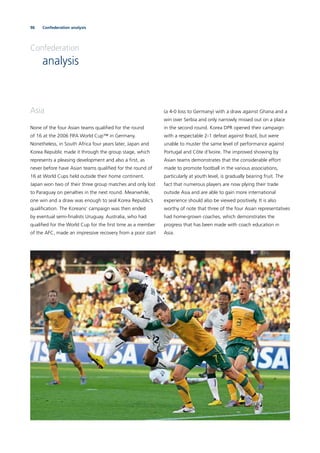
gegen Frankreich folgten zwei Siege gegen Südafrika (3:0)
und Mexiko (1:0). Mexiko qualifizierte sich dank einem Sieg
gegen Frankreich und der gegenüber Südafrika besseren
Tordifferenz für das Achtelfinale. Frankreich schied als Grup-
penletzter nach enttäuschenden Leistungen mit nur je einem
Punkt und Tor aus drei Spielen aus.
Gruppe B: Argentinien ohne Probleme
Favorit Argentinien gab sich keine Blösse und gewann die
Gruppe mit drei Siegen und einem Torverhältnis von 7:1
unangefochten. Den zweiten Gruppenrang verdankte die
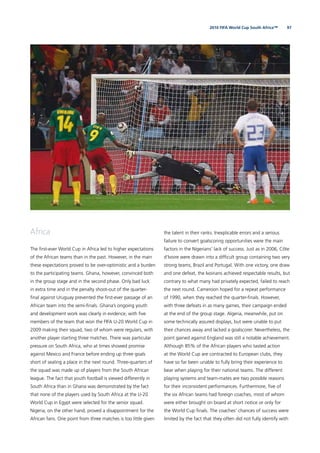
Republik Korea in erster Linie dem 2:0-Erfolg im ersten
Gruppenspiel gegen Griechenland, das durch den 2:1-Sieg
über Nigeria in der zweiten Partie nochmals auf ein Weiter-
kommen hoffen durfte. Da Korea im abschliessenden Spiel
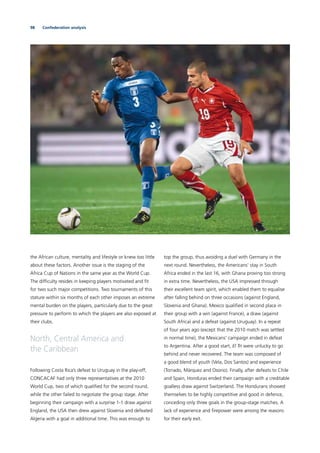
gegen Nigeria jedoch ein Unentschieden erreichte (2:2)
und die Griechen gleichzeitig Argentinien unterlagen (0:2),
schied der Europameister von 2004 aus. Nigeria scheiterte
unter anderem an der ungenügenden Chancenauswertung
und beendete die Gruppenphase auf dem letzten Platz.
Gruppe C: überraschende Amerikaner
Knapper als erwartet fiel die Entscheidung in der Gruppe
C aus. Die USA widerstanden den Engländern in der Eröff-
nungspartie und erreichten ein überraschendes 1:1. Gleich-
zeitig schlug Slowenien Algerien, und da die zweiten Partien
nach teilweise dramatischem Verlauf jeweils unentschieden
endeten, mussten in den letzten Spielen alle Entscheidungen
fallen. Die Engländer wurden ihrer Favoritenrolle endlich
gerecht und setzten sich gegen Slowenien mit 1:0 durch.
Den Gruppensieg mussten sie jedoch den USA überlassen,
denen in der Nachspielzeit gegen Algerien der Siegtreffer
zum 1:0 gelang. Mit Algerien schied eine weitere afrikani-
sche Mannschaft aus. Ihr fehlte ein Torjäger, der die heraus-
gespielten Möglichkeiten hätte verwerten können.
Gruppe D: Spannung bis zum Schluss
Spannung bis zur letzten Spielminute prägte das Gesche-
hen in der Gruppe D. Deutschland startete fulminant und
überrannte Australien mit 4:0. Gegen Serbien musste die
Mannschaft während rund 60 Minuten infolge eines Platz-
verweises in Unterzahl agieren. Zudem vergab sie einen
Elfmeter. Beides war mit ein Grund für die knappe 0:1-Nie-
derlage. Ghana hatte dank zwei Elfmetertoren gegen Ser-
bien (1:0) und Australien (1:1) nach den ersten zwei Partien
vier Punkte auf dem Konto. Vor den letzten Gruppenspielen
konnten somit noch alle vier Teams auf ein Weiterkommen
hoffen. Sogar kurz vor Schluss der beiden Partien war noch
nichts entschieden. Schliesslich setzten sich Deutschland und
Ghana auf die ersten beiden Plätze. Die Deutschen dank
dem 1:0-Erfolg gegen Ghana und die Afrikaner dank der
gegenüber Australien besseren Tordifferenz. Serbien ver-
spielte ein mögliches Weiterkommen durch eine 1:2-Nieder-
lage gegen Australien.
Gruppe E: souveräne Niederlande
Die Gruppe E wurde eine klare Angelegenheit der Niederlän-
der, die sich mit dem Punktemaximum an die Spitze setzten.
Japan überraschte Kamerun im ersten Gruppenspiel (1:0),
enttäuschte auch gegen die Niederlande trotz der 0:1-Nie-
derlage nicht und bestätigte die gemachten Fortschritte mit
einem klaren 3:1-Sieg über Dänemark. Dies bedeutete Platz
zwei und damit die Qualifikation für das Achtelfinale. Däne-
38 Story of the tournament
mark unterlag den Niederlanden im Eröffnungsspiel, schlug
dann jedoch Kamerun und hätte sich mit einem Sieg gegen
Japan noch für die nächste Runde qualifizieren können. Die
Kameruner verloren alle drei Spiele mit je einem Tor Unter-
schied und konnten die zu Beginn des Turniers in sie gesetz-
ten Erwartungen nicht erfüllen.
Gruppe F: Titelverteidiger gescheitert
Bereits das erste Spiel gegen Paraguay (1:1) machte deutlich,
dass die Gruppenphase für Italien alles andere als ein Spa-
ziergang werden würde. Auch das seit 1982 erstmals wieder
für eine Weltmeisterschaft qualifizierte Team aus Neuseeland
trotzte dem Titelverteidiger ein 1:1 ab. Italien benötigte
somit einen Sieg im entscheidenden Spiel gegen die Slowa-
kei, um weiterzukommen. Die erwartete Leistungssteigerung
blieb jedoch aus: Die Azzurri verloren 2:3, womit erstmals
nach 1974 die zweite Runde nicht erreicht wurde. Paraguay
gewann die Gruppe dank einem Sieg (2:0 gegen Slowa-
kei) und zwei Unentschieden (Italien (1:1) und Neuseeland
(0:0)). Der erstmals für die Endrunde einer WM qualifizierten
Slowakei gelang dank dem Sieg über Italien der Sprung in
die Achtelfinals, was den grössten Erfolg in der noch jungen
Geschichte des slowakischen Verbands bedeutete. Neusee-
land überraschte positiv, blieb ungeschlagen, schied aber
trotzdem aus. Die drei Punkte aus ebenso vielen Spielen
reichten nicht für ein Weiterkommen.
Gruppe G: klare Verhältnisse
Brasilien sorgte mit zwei Siegen und einem Unentschieden
für klare Verhältnisse und setzte sich souverän an die Spitze
der Gruppe. Lediglich Portugal konnte den fünffachen
Weltmeister im letzten Spiel in Bedrängnis bringen. Die
Lusitaner starteten mit einem torlosen Unentschieden gegen
die Elfenbeinküste, besiegten die seit 1966 erstmals wieder
392010 FIFA World Cup South Africa™
qualifizierte DVR Korea mit 7:0 und schaffte dank dem 0:0
gegen Brasilien die Qualifikation fürs Achtelfinale. Der Elfen-
beinküste gelang gegen Portugal ein gutes Auftaktspiel,
sie zeigte dann vor Brasilien jedoch zu lange übertriebenen
Respekt, was zu einer 1:3-Niederlage führte. Das 3:0 gegen
Nordkorea war zwar ein versöhnlicher Abschluss, reichte
aber nicht für die angestrebte Qualifikation für die zweite
Runde. Nordkorea zeigte gegen Brasilien einen ansprechen-
den Einstand, schien jedoch in diesem Spiel zu viele Kräfte
verbraucht zu haben, um gegen Portugal und die Elfenbein-
küste noch bestehen zu können.
Gruppe H: Favoriten setzen sich durch
Favorit Spanien musste in seinem ersten Gruppenspiel eine
überraschende 0:1-Niederlage gegen die Schweiz hinneh-
men, die erste überhaupt gegen diesen Gegner. Mit Siegen
gegen Honduras (2:0) und Chile (2:1) belegten die Iberer
aber dennoch standesgemäss den ersten Gruppenrang.
Chile verschaffte sich mit Erfolgen gegen Honduras und die
Schweiz (jeweils 1:0) vor dem letzten Gruppenspiel gegen
Spanien eine gute Ausgangslage. Trotz der 1:2-Niederlage
(wegen eines Platzverweises spielte das Team während fast
einer Stunde in Unterzahl) qualifizierten sich die Südameri-
kaner punktgleich mit Spanien für die nächste Runde. Der
Schweiz blieben nach dem Erfolg gegen Spanien weitere
herausragende Leistungen versagt. Der im letzten Spiel
notwendige Sieg gegen Honduras konnte nicht eingespielt
werden. Die Qualifikation für das Achtelfinale wurde damit
verpasst. Honduras kämpfte in allen drei Spielen aufopfernd.
Es fehlte der Mannschaft jedoch die internationale Erfahrung,
um gegen die starke Gegnerschaft bestehen zu können.
Achtelfinale
USA – Ghana 1:2 (1:1, 0:1) n. V.
Ghana spielte in der ersten Halbzeit sehr effizient und ging
durch Kevin Prince Boateng (23) verdient in Führung. Die
Amerikaner mussten somit zum dritten Mal bei diesem Tur-
nier einen Rückstand aufholen. Ihre Anstrengungen wurden
in der zweiten Halbzeit dank einer Leistungssteigerung
belohnt. Donovan (10) verwandelte den zu Recht verhäng-
ten Elfmeter nach rund einer Stunde zum Ausgleich. Trotz
Möglichkeiten auf beiden Seiten gelang keiner Mannschaft
bis zum Ende der regulären Spielzeit die Entscheidung.
Ghana fand neue Kräfte und erzielte kurz nach dem Beginn
der Verlängerung durch Gyan (3) den schliesslich verdienten
Siegtreffer. Den USA fehlte danach die Kraft, um nochmals
eine Wende herbeizuführen.
Uruguay – Rep. Korea 2:1 (1:0)
Uruguay gelang der Start ideal und ging durch Suárez (9)
bereits in der 8. Minute in Führung. Die Eroberung eines
bereits verloren geglaubten Balles durch Forlán (10) sowie
ein Stellungsfehler in der koreanischen Abwehr führten zu
diesem frühen Treffer. Die Republik Korea versuchte in der
Folge, durch aggressiveres und frühes Stören die südame-
rikanische Abwehr unter Druck zu setzen und den Aus-
gleichstreffer zu erzielen. Dies gelang Lee Chung Yong (17)
per Kopf nach knapp 70 Minuten im Anschluss an einen
40 Story of the tournament
Freistoss. Korea zog sich danach wieder etwas zurück und
wartete auf Gegenstoss-Möglichkeiten. Das Vorhaben ging
jedoch nicht auf, da Uruguay den Druck stetig erhöhte und
vehement auf Sieg spielte. Suárez gelang zehn Minuten vor
Schluss mit seinem zweiten Treffer die Entscheidung. Die Asi-
aten waren danach nicht mehr in der Lage zu reagieren.
Deutschland – England 4:1 (2:1)
Dank zwei Toren von Klose (11) und Podolski (10) lag
Deutschland in diesem Klassiker nach etwas mehr als einer
halben Stunde mit 2:0 in Führung. England war bis zu
diesem Zeitpunkt ohne Chance gewesen, fing sich jedoch
auf und kam durch Upson (15) fünf Minuten nach dem 0:2
zum Anschlusstreffer und knapp danach zum vermeintlichen
Ausgleich, der jedoch nicht gegeben wurde. Die Engländer
hatten davor und danach ihre beste Phase. In der zweiten
Halbzeit drückten sie vorerst vehement auf den Ausgleich
und belagerten Deutschlands Platzhälfte. Abgesehen von
einem Lattenschuss von Lampard (8) gab es jedoch keine
klaren Torchancen. Die Entscheidung führte Deutschland mit
zwei mustergültigen Kontern herbei. Beide Male hiess der
Torschütze Müller (13).
Argentinien – Mexiko 3:1 (2:0)
Die Südamerikaner setzten sich wie vor vier Jahren im Ach-
telfinale gegen Mexiko durch. Damals fiel die Entscheidung
erst in der Verlängerung, diesmal bereits in der ersten Halb-
zeit. Nach einem guten Start und zwei Tormöglichkeiten
(Lattenschuss) gerieten die Mexikaner nach knapp einer
halben Stunde unglücklich in Rückstand. Tévez (11) ver-
wertete ein Zuspiel von Messi (10) mit dem Kopf. Nur fünf
Minuten später passte der Mexikaner Osorio (5) als letzter
Mann in die Füsse von Higuaín (9), der sich nicht zweimal
bitten liess und sein viertes Turniertor erzielte. Höhepunkt
der zweiten Halbzeit war Tévez’ wunderschöner Treffer zum
3:0 per Weitschuss in die rechte hohe Torecke. Mexikos
einziger Treffer fiel in der 71. Minute durch Hernández (14),
als sich Argentinien bereits auf die Verwaltung des Resultats
konzentrierte.
Niederlande – Slowakei 2:1 (1:0)
Erstmals bei diesem Turnier stand für die Niederlande der
von seiner Verletzung genesene Arjen Robben (11) in der
Startformation. Er bewies sofort, dass er das Team noch
stärker machte. In der 18. Minute übernahm er einen weiten
412010 FIFA World Cup South Africa™
Pass von Sneijder (10) auf der rechten Seite, zog gegen
innen und erzielte trotz Gegenwehr den Führungstreffer mit
einem placierten Flachschuss. Die „Oranjes“ hatten danach
weitere Tormöglichkeiten, kamen aber erst in der 84. Minute
durch Sneijder zu einem weiteren Treffer. Im Vergleich zum
letzten Gruppenspiel gegen Italien wirkten die Slowaken
eher gehemmt. Erst zur Mitte der zweiten Halbzeit konnten
sie sich etwas lösen und kamen durch Stoch (15) und Vittek
(11) zu vielversprechenden, aber ungenutzten Tormöglichkei-
ten. Vitteks Elfmetertreffer in der 94. Minute fiel zu spät.
Brasilien – Chile 3:0 (2:0)
Brasilien gewann zum dritten Mal bei einer WM-Endrunde
ein Duell gegen Chile. Nach einem verhaltenen Beginn, in
dem gute Torchancen selten waren, erzielte Juan (4) nach
gut einer halben Stunde und einem von Dani Alves (13)
getretenen Eckball per Kopf den Führungstreffer. Nur vier
Minuten später schloss Luis Fabiano (9) eine sehenswerte
Kombination zwischen Robinho (11) und Kaká (10) zum 2:0
ab. Chile hatte das Fehlen von drei gewichtigen Stammspie-
lern infolge Sperren zu verkraften. Die Mannschaft erarbei-
tete sich in den letzten zwanzig Minuten zwar einige Mög-
lichkeiten, diese wurden jedoch allesamt vergeben. Brasilien
zeigte sich effizient und kaltblütig und zog souverän ins
Viertelfinale ein.
Paraguay – Japan 0:0 n. V., 5:3 n. E.
Keine der beiden Mannschaften schien in dieser Partie
bereit zu sein, grosse Risiken einzugehen. Dadurch entwi-
ckelte sich ein verhaltenes Spiel mit wenigen Tormöglich-
keiten. Die logische Folge war ein torloses Unentschieden
nach 90 Minuten. An diesem Resultat änderte sich auch in
der Verlängerung nichts, so dass erstmals bei diesem Turnier
ein Elfmeterschiessen die Entscheidung bringen musste. Der
42 Story of the tournament
Japaner Komano (3) traf bei seinem Versuch nur die Latte,
und weil die Paraguayer alle ihre Elfmeter verwandelten,
reichte dies den Südamerikanern, um sich als vierter Ver-
treter der CONMEBOL für das Viertelfinale zu qualifizieren.
Japan zeigte sich nicht in der Lage, die hervorragende
Leistung des letzten Gruppenspiels gegen Dänemark zu
wiederholen.
Spanien – Portugal 1:0 (0:0)
Das Duell über die Vorherrschaft auf der Iberischen Halbinsel
begann ohne jegliches Abtasten. Die Spanier kamen in den
ersten fünf Minuten zu drei hervorragenden Torchancen,
die von Portugals Torhüter Eduardo (1) allesamt zunichte
gemacht wurden. Portugal versuchte sich mit einer defen-
siv ausgerichteten Grundtaktik, kam aber in der zweiten
Phase der ersten Halbzeit ebenfalls zu zwei guten Chancen.
Die Entscheidung fiel nach einer Stunde. Der für Torres (9)
eingewechselte Llorente (19) brachte neuen Schwung in die
Angriffsbemühungen der Spanier. Drei erstklassige Möglich-
keiten in ebenso vielen Minuten waren die Folge. Villa (7)
nutzte die letzte davon zu seinem vierten Turniertreffer nach
schönem Zuspiel von Xavi (8). Portugal konnte dem Spiel in
der Folge keine Wendung mehr geben.
Viertelfinale
Niederlande – Brasilien 2:1 (0:1)
In der ersten Halbzeit hätte niemand gedacht, dass Bra-
silien das Halbfinale nicht erreichen würde. Bereits in der
10. Minute lancierte Felipe Melo (5) mit einem herrlichen
Pass in die Tiefe Robinho (11), der zum 1:0-Führungstreffer
einschoss. Auch danach hatten die Südamerikaner Mög-
lichkeiten zu erhöhen. Die Niederländer fanden schwer
ins Spiel und wurden von Brasilien dominiert. In der zwei-
ten Halbzeit störten sich Felipe Melo und Torhüter Julio
Cesar (1) bei einer Flanke Sneijders gegenseitig, was zum
1:1-Ausgleich führte. Dieser Treffer verursachte einen Riss
im brasilianischen Spiel. Die 2:1-Führung erzielte erneut
Sneijder (10) mit dem Kopf nach einem Eckball in der 68.
Minute. Erstmals war der fünffache Weltmeister bei diesem
Turnier in Rückstand geraten. In der 74. Minute wurde
Felipe Melo nach einer brutalen Attacke vom Platz gestellt.
Die Niederländer verstanden es, mit einem Mann mehr
und ihrem abgeklärten Spiel den Vorsprung über die Zeit
zu bringen. Sie hatten sogar die Möglichkeit, mit ihrem
Konterspiel und den vorhandenen Räumen das Resultat zu
erhöhen.
432010 FIFA World Cup South Africa™
Uruguay – Ghana 1:1 (1:1, 0:1) n. V., 4:2 n. E.
Die Hoffnungen ganz Afrikas ruhten auf Ghana, das
sich als einziges Team des Kontinents für die zweite
Runde qualifizieren konnte. Ein Schuss aus 35 Metern
kurz vor der Halbzeitpause durch Muntari (11) brachte
das Spiel in die von den Afrikanern gewünschte Rich-
tung. Aber die Südamerikaner reagierten prompt.
Forlán (10) verwandelte in der 55. Minute einen Frei-
stoss zum Ausgleich. Die Uruguayer hatten danach
Möglichkeiten, das Spiel zu entscheiden. Es blieb jedoch
beim 1:1-Unentschieden nach 90 Minuten. Das Ende
der Verlängerung war dramatisch. In der 121. Minute
wehrte Suárez (9) den Ball auf der eigenen Torlinie mit
der Hand ab und wurde des Feldes verwiesen. Der sonst
sichere Elfmeterschütze Gyan (3) (bereits zwei verwan-
delte Strafstösse) traf jedoch nur die Latte. Da die Partie
danach zu Ende war, musste das Elfmeterschiessen
entscheiden. Und hier geschah, was viele befürchtet
hatten. Zwei Fehlschüsse der Ghanaer gegenüber nur
einem der Uruguayer besiegelten das Schicksal des letz-
ten afrikanischen Vertreters.
Argentinien – Deutschland 0:4 (0:1)
Bereits in der 3. Minute gelang Müller (13) nach einem
Freistoss für Deutschland die Führung. Die Europäer wirkten
selbstbewusst und abgeklärt und hatten durch Klose (11) in
der 24. Minute die Möglichkeit, das Ergebnis zu erhöhen.
Erst danach fing sich Argentinien etwas auf und hatte mehr
Ballbesitz. Zu Beginn der zweiten Halbzeit vergaben die Süd-
amerikaner durch Maxi Rodríguez (20) und Di María (7) zwei
aussichtsreiche Möglichkeiten. Die deutsche Mannschaft
organisierte sich jedoch schnell wieder und reagierte mit den
Treffern zwei und drei in der 68. und 74. Minute. Argen-
tinien glaubte danach nicht mehr an eine Wende, und die
Deutschen kamen sogar noch zum vierten Treffer. Messi (10)
und Tévez (11) fanden in der dicht gestaffelten Defensive
der deutschen Mannschaft keinen Raum zur Entfaltung. Die
Europäer vertrauten auf ihre Konterstärke und hatten damit
Erfolg.
Paraguay – Spanien 0:1 (0:0)
Die Iberer taten sich lange Zeit schwer, gegen die defensiv
eingestellten Paraguayer ins Spiel zu kommen. Diese waren
mit ihrem Konterspiel zudem immer gefährlich und hatten
zu Beginn des Spiels die besseren Tormöglichkeiten. Bereits
nach 50 Sekunden prüfte Santana (11) erstmals Torhüter
Casillas (1).
In einer Partie, die mit zwei innerhalb von fünf Minuten ver-
gebenen Elfmetern (beide Male blieben die Torhüter Sieger)
für Dramatik sorgte, traf Villa (7) mit seinem fünften Treffer
in der 83. Minute zum 1:0. Iniesta (6) spielte den freiste-
henden Pedro (18) an, dieser traf nur den rechten Pfosten.
Den Abpraller verwandelte Villa zum entscheidenden Treffer.
Paraguay hatte danach noch eine grosse Ausgleichschance
durch Santa Cruz (9), die jedoch von Casillas zunichte
gemacht wurde. Damit qualifizierten sich die Iberer nach
1950, als nur Gruppenspiele ausgetragen wurden, wieder
für ein WM-Halbfinale.
Halbfinale
Uruguay – Niederlande 2:3 (1:1)
Die Niederländer waren bemüht, von Beginn weg schnell
und variabel nach vorne zu spielen. Die erste Tormög-
lichkeit hatte in der 4. Minute Kuyt (7) nach einer kurzen
Abwehr von Uruguays Torhüter Muslera (1). In der
18. Minute wurden die niederländischen Bemühungen
belohnt. Kapitän Van Bronckhorst (5) erzielte mit einem
Prachtsschuss aus 37 Metern in die rechte obere Ecke das
1:0. Ebenfalls mit einem Weitschuss gelang Forlán (10)
kurz vor der Halbzeitpause der Ausgleich. Nach Wieder-
beginn wurden die Zweikämpfe intensiver geführt, und
der Ball zirkulierte weniger flüssig. Binnen drei Minuten
folgte dann ein niederländischer Doppelschlag (70.–73.)
durch Sneijder (10) mittels Flachschuss und Robben (11)
per Kopf. Pereira (11) traf in der Schlussphase nach einer
längeren Druckperiode der Uruguayer in der 92. Minute
zum 3:2. Die weiteren Bemühungen der Uruguayer in der
44 Story of the tournament
Nachspielzeit blieben erfolglos, so dass die Niederlande
nach 1974 und 1978 zum dritten Male ein WM-Finale
erreichten.
Deutschland – Spanien 0:1 (0:0)
Spaniens Trainer Vicente del Bosque änderte seine Start-
formation auf einer Position. Pedro (18) ersetzte Torres (9)
und brachte viel Dynamik ins iberische Angriffsspiel. In der
6. Minute lancierte er Villa (7) mit einem genauen Steilpass,
Torwart Neuer (1) konnte aber gerade noch retten. Puyol (5)
setzte kurz danach einen Kopfball über die Latte, ehe die
Deutschen zu etwas mehr Spielanteilen und durch Trochows-
ki (15), der den gesperrten Müller (13) ersetzte, per Distanz-
schuss zu einer ersten Chance kamen. In der ersten Viertel-
stunde der zweiten Halbzeit schnürten die Spanier die Deut-
schen minutenlang in deren Zone ein und kamen zu etlichen
guten Möglichkeiten. Vorerst verfehlte Xabi Alonso (14) das
Ziel zweimal mittels Weitschuss, danach scheiterte Xavi (8)
aus der Distanz an Neuer, und schliesslich verpasste Villa
eine Hereingabe von Iniesta (6) um Zentimeter. In der 69.
Minute vergab der kurz zuvor eingewechselte Kroos (18)
die beste deutsche Möglichkeit. Wenige Minuten danach
erzielte Puyol per Kopf nach einem Eckball von Xavi den
verdienten Führungstreffer. Zehn Minuten vor dem Spielende
hatte Pedro den Matchball auf dem Fuss, als er nach einem
Zwei-gegen-Eins-Konter den Ball vertändelte. Die Deutschen
kamen jedoch zu keiner reellen Ausgleichschance mehr.
Spiel um den dritten Platz
Uruguay – Deutschland 2:3 (1:1)
Uruguay und Deutschland haben gezeigt, dass die Partie um
den dritten Platz durchaus berechtigt ist. Die beiden Mann-
schaften boten in Port Elizabeth bei teilweise strömendem
Regen einen offenen, spektakulären Schlagabtausch ohne
taktische Fesseln. Nach 1934, 1970 und 2006 gewann die
deutsche Mannschaft zum vierten Mal das „kleine Finale“.
Der Sieg musste jedoch hart erkämpft werden. Die Führung
durch Müller (13) (fünftes Tor) in der 19. Minute nach einer
kurzen Abwehr von Muslera (1) wurde zehn Minuten später
von den Uruguayern durch Cavani (7) nach einem schönen
Pass in die Tiefe von Suárez (9) und kurz nach der Pause
durch Forlán (10) nach einer herrlichen Direktabnahme auf
Flanke von Arevalo (17) gekontert. Die Reaktion der Deut-
schen liess jedoch nicht lange auf sich warten. Jérôme Boa-
452010 FIFA World Cup South Africa™
teng (20) flankte in der 56. Minute von rechts auf den Kopf
von Jansen (2), der zum zwischenzeitlichen Ausgleich traf.
Die Entscheidung fiel nach 82 Minuten, als Khedira (6) einen
Eckball von Özil (8) zum Siegtreffer einköpfte. Uruguay hatte
danach noch Pech, als Forláns Freistoss kurz vor Schluss nur
die Latte traf.
Finale
Niederlande – Spanien 0:1 n. V., 0:0
Beide Mannschaften starteten verhalten in dieses Finale, das
einen neuen Weltmeister bringen würde. Die erste Halbzeit
war von vielen Fouls, vor allem vonseiten der Niederlän-
der, geprägt. Der Spielfluss litt dadurch erheblich, und nur
sporadisch wurden Torchancen herausgespielt. Eine durch
Sergio Ramos (15) per Kopf nach vier Minuten, die vom
niederländischen Torhüter Stekelenburg (1) reaktionsschnell
zunichte gemacht wurde. Villa (7) hatte nach zwölf Minuten
eine weitere Möglichkeit, seine Direktabnahme ging aber
am Tor vorbei. Die Niederlande kamen erst in der Nachspiel-
zeit der ersten Halbzeit zur ersten Möglichkeit. Robben (11)
prüfte Casillas (1) aus der Distanz. Die zweite Halbzeit
begann flüssiger. Beide Teams besannen sich auf ihre Stär-
ken, den Ball laufen zu lassen. Spaniens Capdevila (11)
kam in der 48. Minute zu einer ersten Torchance, konnte
aber ein Kopfzuspiel von Puyol (5) aus kurzer Distanz nicht
verwerten. Trotz vor allem durch die Niederländer hart
geführter Duelle gelang es Spanien, den Druck zu erhöhen.
Die grösste Möglichkeit gehörte jedoch Robben, der in
der 62. Minute mit einer Konterattacke alleine auf Casillas
zulief. Dieser rettete aber mit einer hervorragenden Parade.
In der 83. Minute bot sich Robben eine ähnliche Mög-
lichkeit – wiederum blieb der spanische Hüter Sieger. Villa
hatte zuvor das 1:0 auf dem Fuss (68.), und Sergio Ramos
verpasste erneut per Kopf den Führungstreffer. Damit ging
die Begegnung in die Verlängerung. Die Spanier erhöhten
weiterhin den Druck, was ihnen in der 108. Minute durch
den Platzverweis von Heitinga (3) erleichtert wurde. Fàbre-
gas (10) war es dann, der Iniesta (6) mit einem Pass in die
Tiefe bediente. Dieser liess sich nicht zweimal bitten und
erzielte den entscheidenden Treffer (116.). Damit holte sich
Spanien nach dem Europameistertitel 2008 auch die Welt-
meisterkrone. Die Niederländer hingegen müssen auch nach
ihrer dritten Finalteilnahme (1974, 1978 und 2010) auf den
ersten Titel warten.
Technical
and tactical analysis
48 Technical and tactical analysis
Technical and
tactical analysis
The 2010 FIFA World Cup South Africa™ showed that nearly
all teams now play with a compact defence and are able to
put even the strongest opponents under pressure. The most
successful teams were flexible and able to adapt their style
of play to the match situation. It was this flexibility, together
with the teams’ healthy aggression and the players’ excellent
technique, that paved the way to success. Spain, the
Netherlands, Germany, Uruguay, Brazil, Ghana, Argentina,
Chile and the USA all provided the best examples of this.
The World Cup also showed that excessive combination play
can lead to a lack of aggression.
The most successful teams also boasted fast, tricky
attackers who were dangerous in front of goal. Uruguay,
for example, were the perfect example of a solid team
that performed well and enjoyed success. In Forlán
(10) and Suárez (9), they had a strikeforce that posed a
threat to every defence. Brazil (Luis Fabiano (9), Robinho
(11)), Argentina (Tévez (11), Higuaín (9)), Spain (Villa (7),
Torres (9)/Pedro (18)) and Germany (Klose (11), Müller (13))
all had attacking players who were capable of winning
matches on their own. Individual pieces of skill could also
turn matches in other ways, however. In modern football,
it is difficult to get in behind the opposition defence as
teams are often very compact at the back with eight or
nine players behind the ball. That is why teams now need
outstanding individual players who can make their mark
in one-on-one situations down the centre of the pitch but
particularly down the wings, where they can drive as far
as the opponent’s goal line to create space that often does
not exist down the centre of the pitch. Once they have
reached the goal line, these players do not always look
to cross the ball high into the penalty area, but instead
they often look to cut the ball back along the ground for
on-rushing team-mates.
Formations
As mentioned above, the successful teams were built around
a well-drilled tactical system. In addition, they all had a well-
organised defence that still gave the players the freedom
to express themselves and use their own strengths while
pushing forward.
The teams played with a back four, with the exception
of New Zealand, Algeria and Chile, who had three-man
defences.
Ten teams had a traditional starting formation of 4-4-2 with
two banks of four behind two strikers, with one of these
strikers often playing in a more withdrawn role. England,
the USA and Paraguay were good examples of this. It
should be noted, however, that these teams were also able
to make changes and adjustments depending on the match
situation or to take advantage of their players’ individual
qualities.
Argentina’s 4-4-2 formation had a four-man diamond in
midfield, whereas Brazil fielded two defensive midfielders
and two wingers who came inside when possible to make
room for their advancing full-backs. Ghana, meanwhile,
played with two men in front of the defence as well as with
three midfielders to help out in both attack and defence.
Another tactical formation was 4-3-3, which was used
by teams such as Mexico, Japan and Cameroon. In this
formation, a defensive midfielder played in front of the back
four and was flanked on either side by another midfielder,
with three strikers up front. As soon as the team lost
possession, the wide strikers dropped back to form a nine-
man defensive block with the midfield and defence to try
and prevent the opponents from building attacks. When
their team was attacking, they tried to exploit the space
down the wings as quickly as possible.
Of the four semi-finalists, only Uruguay played in a
formation that resembled 4-4-2, although the position
occupied by Forlán (10) merits further examination.
Although he was in principle a striker, he mostly played
492010 FIFA World Cup South Africa™
in an advanced midfield position behind the team’s main
striker, Suárez (9). In effect, Forlán had a free role and
was always looking to keep play moving before driving
forward.
The Netherlands, Germany and Spain all used a 4-2-3-1
formation, but even so they all interpreted this system in
their own way.
The Dutch, for example, fielded an attacking trio behind
their lone striker, Van Persie (9). Robben (11) and Kuyt (7)
played on the wings, but they were always looking to
push forward to create a three-man attack with Van
Persie. Robben and Kuyt often rotated and swapped
positions during matches. If the other attacking midfielder,
Sneijder (10), was regarded as part of the midfield, then the
Dutch also operated in a form of 4-3-3.
Germany also only had one man up front: Klose (11). This
formation left Podolski (10) and Müller (13), two players
who usually play in a more central attacking position for
their clubs, to exploit the space down the wings. Özil (8)
completed the German attack by operating as an attacking
centre midfielder, but he too pushed forward to join attacks
or drifted out to the wings.
Spain played Xavi (8) and Iniesta (6) out wide, even though
they too are generally known as centre midfielders, but they
were also given the freedom to express themselves when
going forward and often swapped positions. In Spain’s first
few matches, David Villa (7) pushed on from an attacking
midfield position to join the main striker, Torres (9). In the
semi-final and once again in the final, Villa operated in
a more traditional centre-forward role, mainly because
Pedro (18) had replaced Torres for both of these matches.
50 Technical and tactical analysis
The 4-2-3-1 formation is always based around two defensive
central midfielders who provide stability for the defence and
are also able to support their own team’s attacks.
Germany fielded Schweinsteiger (7) and Khedira (6) in these
positions, the Netherlands chose Van Bommel (6) and De
Jong (8), Spain played Xabi Alonso (14) and Busquets (16),
whereas Uruguay’s chosen men were Pérez (15) and
Arévalo (17). All of these duos complemented each other
perfectly in both attack and defence.
To sum up, it is fair to say that the most successful teams
at this World Cup all stayed true to their basic tactical
formations. Although they did make minor adjustments
whenever necessary, such as when Uruguay brought on a
third striker, Abreu (13), in their quarter-final, as a general
rule they did not stray too far from their beliefs.
It should also be mentioned that during the group stage,
some teams changed their formation not only depending on
the situation, but also from one match to another, which did
not help to create a sense of stability in their play.
The importance of the first group match
The opening group matches were characterised by cautious
play. No team wanted to lose and put themselves in a
dangerous position in the group, and as a result, goals were
few and far between. Only Argentina, the Netherlands and
Germany started the tournament with the necessary self-
confidence, which led to comfortable opening victories.
This caution prevailed throughout the rest of the group
stage, and it was one of the reasons why only 101 goals
were scored by the end of the group stage (by way of
comparison, there had been 117 by the end of the same
stage in Germany in 2006).
Tournament factors and elements
The following factors can shape or have a major effect,
whether positive or negative, on a team’s performance in a
tournament:
Mental and physical fitness
- How “fresh” were the players at this World Cup? Did
those players who had been playing in domestic league
championships and continental competitions have
enough time to recover and prepare for the World Cup?
In contrast, players who are usually substitutes at their
clubs were able to show their ability and shine at this
tournament.
Weight of expectation
- How did teams cope with the weight of expectation,
especially when there were high or over-optimistic levels
of expectation? There was a great deal of pressure on the
South African hosts, and quite understandably they found
it difficult to live up to these expectations. Other African
teams had a similar problem. Even more “established”
512010 FIFA World Cup South Africa™
football nations such as Italy, France, England and even
Brazil had to deal with high levels of expectation.
Shocks and surprises
- The early exits of Italy and France (both at the end of the
group stage) and of England (in the round of 16) were
the major shocks of the tournament. In stark contrast,
there were a number of pleasant surprises such as the
performances of New Zealand (in their first World Cup
since 1982), Slovakia (World Cup debutants), Chile,
Paraguay, Uruguay and Ghana.
Strategies
- Teams were successful if they started a game with a set
strategy but were able to adapt during the match. It was
interesting to see Brazil, an experienced and well-drilled
team, lose their focus after the Netherlands’ equaliser in
the quarter-final as they were unable to adapt or cope
with the pressure of having to win at all costs.
Outstanding youth work
- This World Cup showed that the outstanding youth
development work of many associations is beginning to
bear fruit at the highest level. If the four semi-finalists
from 2010 are compared with those from 2006, the
average age of the players was nearly two years lower
in 2010 than in 2006. It should also be noted that three
of the four semi-finalists in 2010 are also regularly
among the leading teams in youth competitions at
confederation level and at youth World Cups.
Goalkeepers
It is fair to say that the goalkeepers in this year’s World Cup
were not very consistent, as excellent performances were
52 Technical and tactical analysis
followed by inexplicable errors. They not only struggled to
boss their penalty area and communicate with their team-
mates but also experienced difficulties with shots from long
range. Many of these errors led directly to goals. There
are a number of explanations for this, from the quality of
the shots on target, to the goalkeepers’ positional play
and possibly also the ball itself, which picked up incredible
speed. The latter explanation was indeed confirmed by many
goalkeepers, but that said, it is hard to understand as every
single team was given the opportunity to train with the new
ball in the months leading up to the tournament. Instead,
there were many instances of goalkeepers failing to get
their body fully behind the ball, and in doing so, they risked
seeing the ball gather speed and slip out of their grasp
and over the goal line. On the other hand, there were also
a number of outstanding performers in goal, and African
goalkeepers in particular have come on in leaps and bounds.
Kingson (Ghana, 22) and Enyeama (Nigeria, 1) were both
impressive. The Technical Study Group named Spain’s Iker
Casillas (1) as the best goalkeeper of the 2010 FIFA World
Cup South Africa™. He grew in strength from game to
game and became a rock upon which his team could rely. As
captain of the team, his natural leadership and personality
helped Spain to capture the World Cup crown.
Compact defensive lines
Most of the teams had compact defences and used a zonal
marking policy but could switch to man-marking if necessary.
This is a general trend in international football at the
moment. Nevertheless, there were some relatively significant
differences in terms of how the teams interpreted this tactic.
Teams such as Brazil, Germany, Argentina, Spain and Ghana
had very powerful defenders but they also received support
from the midfield and from one of the strikers (when they
played with two men up front). This enabled these teams to
switch quickly between defence and attack.
It was also interesting to note that the best teams
conceded very few fouls – if any – around their own
penalty area to avoid giving away free kicks in dangerous
positions.
There were two main tactics to gain or regain possession.
a) Teams such as Algeria, Uruguay, Portugal and
Switzerland lay in wait in their own half of the pitch
before launching quick counter-attacks to catch
opponents off guard. Some teams defended too deep,
however, which meant that their defenders could be
outpaced.
532010 FIFA World Cup South Africa™
b) Other teams such as Spain, Argentina, Brazil, Paraguay
and Chile aggressively tried to win the ball back in the
opponent’s half of the pitch or close to the halfway
line at the latest. This tactic prevented opponents from
building attacks as they were not given time to construct
moves.
Some teams (Argentina, Germany, Ghana) used a mixture of
the two types of tactics.
Successful attacking play
Balls played in behind the defence from the centre created
a significant number of goals (31) and chances, mainly
because the “weaker” teams did not stagger their defence,
which meant that they were easier to bypass. Creative
wing play was another way to create space and goalscoring
opportunities. Teams who used this latter tactic needed
good dribblers who were able to get to the goal line before
cutting the ball back for advancing team-mates. Congested
penalty areas meant that traditional, high crosses were less
successful. Long diagonal passes were another option for
pulling opposition defences out of position.
Effective transition from defence to attack
Successful teams were also able to switch quickly between
defence and attack. Counter-attacks were successful if
teams could bypass the midfield quickly and make accurate,
well-timed final passes. Teams such as Germany, Spain, the
Netherlands, Brazil, Ghana, Argentina and Japan were all
specialists in this regard. These teams passed the ball around
quickly, trying to take as few passes as possible before taking
out the opposition defence. If they lost the ball, they put
immediate pressure on the man in possession. By doing so,
they hoped to force their opponents into losing possession,
which they could then exploit as the opponents would still
be on the front foot. It was interesting to note that in the
second and third phases of the tournament, far more goals
were scored on the counter-attack, which was due to the
teams being more attack-minded.
The importance of the first goal
In 46 of the 64 games, the team that opened the scoring
also went on to win the match. As there were also six
goalless draws and another eight matches in which the team
that conceded first came back to equalise, this meant that
there were only four matches in which a team came back to
win after conceding the first goal. The psychological effect
of a lead was undoubtedly why teams wanted to avoid
falling behind at all costs, and why they generally played it
safe by making sure their defence was solid. Taking the lead
gives a team security and allows them to play their natural
game. Denmark (v. Cameroon), Greece (v. Nigeria), the
Netherlands (v. Brazil) and Uruguay (v. Ghana, on penalties)
were all able to come from behind and win after falling 1-0
down. Both the USA (v. England and v. Slovenia, the latter
from 2-0 down) and Italy (v. Paraguay and v. New Zealand)
secured two draws after conceding the first goal.
54 Technical and tactical analysis
Analyse
technique et tactique
La Coupe du Monde de la FIFA, Afrique du Sud 2010 a
montré que presque toutes les équipes disposent d’une
défense compacte et peuvent ainsi gêner même les
sélections jugées plus fortes. La plupart des équipes qui ont
réalisé un bon parcours ont montré capacité à agir avec
flexibilité en fonction de la situation plutôt que de s’entêter
à appliquer leur système de jeu. Cette flexibilité, ajoutée à
une saine dose d’agressivité et à la qualité technique des
joueurs, a été l’une des clés du succès. L’Espagne, les Pays-
Bas, l’Allemagne, l’Uruguay, le Brésil, le Ghana, l’Argentine,
le Chili et les États-Unis en sont les meilleurs exemples.
Il est aussi apparu clairement qu’un jeu basé sur trop
d’enchaînements pouvait entraîner une perte d’agressivité.
Autre facteur essentiel du succès : des attaquants rapides,
habiles et décisifs à la finition. Prenons l’exemple de
l’Uruguay, une équipe solide qui a réalisé un bon parcours.
Forlán (10) et Suárez (9) formaient un duo offensif redoutable
pour n’importe quelle défense. Le Brésil (Luis Fabiano (9)
et Robinho (11)), l’Argentine (Tévez (11) et Higuaín (9)),
l’Espagne (Villa (7), Torres (9)/Pedro (18)) et l’Allemagne
(Klose (11) et Müller (13)) comptaient dans leurs rangs
des attaquants capables de faire la différence à eux seuls.
Les qualités individuelles ont aussi influencé les matches à
plusieurs niveaux. Dans le football moderne, il est difficile de
percer les rangs défensifs parce qu’ils se tiennent de façon
très compacte ; huit ou neuf joueurs se tenant derrière le
ballon. Aussi il convient de posséder capables de s’imposer
dans les duels, que ce soit dans l’axe ou surtout sur les côtés,
pour parvenir à s’approcher de la ligne de but adverse.
De cette façon se créent des espaces qui, dans le football
moderne, n’existent plus dans l’axe. Le plus souvent, dans
cette situation, le joueur tente un centre aérien ou la passe au
sol pour un coéquipier arrivant lancé pour tenter de conclure.
Systèmes de jeu
Comme indiqué plus haut, une organisation tactique
fonctionnelle était la base du succès. À cela s’ajoute une
défense bien organisée permettant aux joueurs d’exprimer
leurs qualités individuelles dans le jeu offensif. Ces deux
éléments étaient des caractéristiques présentes chez les
meilleures équipes.
Hormis trois sélections (Nouvelle-Zélande, Algérie et Chili),
qui ont joué avec une ligne défensive à trois joueurs, toutes
les équipes disposaient d’une défense à quatre.
Dix équipes ont privilégié une formation traditionnelle en
4-4-2 avec deux lignes de quatre et deux attaquants, dont
l’un évoluait à une position légèrement en retrait. C’était
le cas par exemple de l’Angleterre, des États-Unis et du
Paraguay. Cependant, le système était adapté ou modifié en
fonction des situations de jeu ou de la forme des joueurs.
L’Argentine jouait en 4-4-2 avec un milieu organisé en
losange, le Brésil avec deux milieux défensifs et deux milieux
latéraux, qui se recentraient dans l’axe en fonction des
situations pour ouvrir des espaces aux arrière latéraux qui
montaient. Le Ghana plaçait deux joueurs devant la défense
et trois milieux de terrain en soutien de la défense et de
l’attaque.
Hormis le 4-4-2, le 4-3-3 était une autre variante technique,
notamment appliquée par le Mexique, le Japon et le
Cameroun. Devant la défense à quatre se tenait un milieu
défensif axial soutenu sur les côtés par deux joueurs. Lors
de la perte du ballon, les latéraux rejoignaient les milieux de
terrains et ainsi les milieux de terrain et la défense formaient-
ils un bloc défensif compact de neuf joueurs dont l’objectif
était d’empêcher l’adversaire de construire son jeu offensif.
En attaque, ces équipes utilisaient leur vitesse dans les
couloirs.
Parmi les quatre demi-finalistes, seul l’Uruguay jouait en
principe en 4-4-2. Mais il convient de s’intéresser au rôle
particulier de Forlán (10). Bien que qualifié d’attaquant,
il a le plus souvent joué à un poste de milieu de terrain
derrière Suárez (9), placé en pointe. Il avait une position
très libre, distribuant les ballons et montant souvent en
pointe.
552010 FIFA World Cup South Africa™
Les Pays-Bas, l’Allemagne et l’Espagne, s’appuyaient sur une
formation 4-2-3-1, mais là aussi, plusieurs interprétations
ont été possibles.
Dans l’équipe des Pays-Bas, une ligne offensive de trois
joueurs était placée derrière Van Persie (9), seul en pointe.
Sur les côtés, Robben (11) et Kuyt (7) n’hésitaient pas
montaient souvent pour former une ligne de trois avec Van
Persie. Tous deux ont souvent inversé leurs positions en cours
de jeu. Si l’on compte l’électron libre Sneijder (10) comme
un milieu de terrain, on peut alors parler d’un 4-3-3.
L’Allemagne avait en Klose (11) un attaquant de pointe
attitré. Podolski (10) et Müller (13), qui évoluent davantage
dans l’axe en club, exploitaient les espaces sur les côtés. Le
milieu offensif central Özil (8) complétait la ligne offensive.
Lui aussi pouvait soit monter en pointe, soit se déplacer sur
les côtés.
L’Espagne a placé Xavi (8) et Iniesta (6), plutôt habitués à l’axe,
au poste de milieu excentré. Eux aussi orientaient librement
leur jeu vers l’avant et échangeaient souvent de positions. Lors
des premiers matches, Villa (7) montait du milieu offensif pour
rejoindre Torres (9) en pointe. En demi-finales et en finale, il se
trouvait davantage en pointe, notamment parce que Torres a
été remplacé par Pedro (18) dans ces matches.
Le cœur du système en 4-2-3-1 était le milieu défensif axial.
Les deux joueurs évoluant à ces postes garantissaient la
stabilité de la défense et le soutien en attaque, en fonction
des situations de jeu.
Pour l’Allemagne, c’était Schweinsteiger (7) et Khedira (6),
pour les Pays-Bas Van Bommel (6) et De Jong (8), pour
l’Espagne Xabi Alonso (14) et Busquets (16), pour l’Uruguay
Pérez (15) et Arevalo (17), qui se complétaient parfaitement
dans le travail défensif et dans le jeu offensif.
56 Technical and tactical analysis
Pour résumer, il convient de constater que les équipes qui ont
connu le succès lors de cette Coupe du Monde sont restées
fidèles à leur orientation technique. Certes, des adaptations
ont eu lieu en fonction des situations, comme par exemple
l’Uruguay, qui a fait entrer un troisième attaquant, Abreu (13)
en quarts de finale contre le Ghana. Mais en principe, la
tactique décidée au départ est restée inchangée.
Il convient aussi d’évoquer que certaines équipes ont modifié
leur formation lors des matches de groupes pas seulement
en fonction des situations, mais aussi d’un match à l’autre, ce
qui n’a pas forcément apporté un maximum de confiance.
L’importance du premier match de poule
Les premiers matches de groupes ont été marqués par la
retenue. Aucune équipe ne voulait perdre et se retrouver
d’emblée dans une situation délicate. Par conséquent, très
peu de buts ont été inscrits. Seules les équipes qui ont
évolué dès le début avec une grande confiance ont remporté
leur match d’ouverture avec aisance (Argentine, Pays-Bas,
Allemagne). Le jeu tout en retenue s’est aussi imposé dans
les autres matches de groupes et explique que seulement
101 buts (contre 117 en Allemagne en 2006) aient été
marqués lors du premier tour.
Facteurs décisifs du tournoi
Les facteurs suivants ont défini le déroulement du
tournoi ou les ont influencées, positivement ou
négativement :
Fraîcheur mentale et physique
- Dans quelle état de fraicheur physique les joueurs
sont-ils arrivés dans cette Coupe du Monde ? La
phase de récupération a-t-elle été suffisante pour
les acteurs qui ont participé aux compétitions
nationales et continentales ? En revanche, les joueurs
sont souvent remplaçants en club avaient à cœur
et étaient en mesure de montrer ce dont ils sont
capables.
La pression
- Comment les équipes allaient-elles gérer les
attentes élevées – voire exagérées – placées en
elles ? L’Afrique du Sud, pays hôte, a naturellement
été soumise à énormément de pression, il était
impossible d’y résister. D’autres équipes africaines ont
connu les mêmes difficultés. Des nations réputées
comme l’Italie, la France, l’Angleterre et le Brésil ont
également dû faire face à des attentes très élevées.
572010 FIFA World Cup South Africa™
Les surprises
- Les éliminations prématurées de l’Italie, de la France
(toutes deux au premier tour), et de l’Angleterre (huitièmes
de finale) sont les principales mauvaises surprises de la
compétition. Les performances d’autres équipes réputées
plus faibles sont en revanche source de satisfaction : la
Nouvelle-Zélande (qualifiée pour la phase finale d’une
Coupe du Monde de la FIFA pour la première fois depuis
1982), la Slovaquie (première participation à la Coupe du
Monde), le Chili, le Paraguay, l’Uruguay et le Ghana.
Les stratégies
- Il était indispensable qu’une équipe entre sur le terrain
avec une stratégie claire et la capacité à réagir en
fonction de la situation. Il était intéressant de voir une
équipe aussi expérimentée que le Brésil perdre le fil du
match après l’égalisation des Néerlandais en quarts
de finale. Confrontés à une situation inhabituelle, les
Brésiliens n’ont pas trouvé de solution et n’ont donc pas
su gérer la pression générée par une certaine obligation
de gagner.
L’excellent travail auprès des jeunes
- Cette Coupe du Monde a montré que l’excellent
travail réalisé auprès des jeunes dans de nombreuses
fédérations porte ses fruits au plus haut niveau. Si l’on
compare les quatre demi-finalistes de 2010 et ceux de
2006, on constate que leur moyenne d’âge est plus
jeune de deux ans. Il convient aussi de noter que trois
de ces quatre équipes figurent régulièrement parmi les
meilleures équipes des compétitions continentales et des
Coupes du Monde dans les différentes catégories d’âge.
58 Technical and tactical analysis
Gardiens de but
Les gardiens de but ont été assez irréguliers lors de cette
compétition, alternant performances exceptionnelles et
erreurs incompréhensibles. Des problèmes dans la maîtrise
de la surface de réparation, dans la compréhension avec
les autres joueurs et sur les tirs lointains ont été constatés.
De nombreuses erreurs ont entraîné des buts adverses. Les
raisons sont diverses, mais elles sont certainement liées à la
qualité des frappes, au placement des gardiens et peut-être
aussi au ballon, qui prenait beaucoup de vitesse. Ce fait a
souvent été confirmé par les gardiens – mais cette théorie
n’est pas vraiment fondée puisque toutes les équipes ont
eu l’occasion de s’entraîner avec le nouveau ballon pendant
plusieurs mois. Il a souvent été constaté que les gardiens
ne plaçaient pas correctement leur corps derrière le ballon,
risquant ainsi que le ballon, en raison de sa vitesse, glisse
au-delà de la ligne de but si le gardien ne le captait pas
parfaitement. Mais certains portiers ont aussi fait montre
d’excellentes performances. Les gardiens africains en
particulier ont réalisé de gros progrès. Kingson (Ghana, 22)
ou Enyema (Nigeria, 1) ont été impressionnants. Le Groupe
d’étude technique a élu l’Espagnol Iker Casillas (1) meilleur
gardien de la Coupe du Monde de la FIFA, Afrique du Sud
2010. Il a constamment élevé son niveau de jeu au fil des
matches et a été le garant du succès de son équipe. De
plus, il s’est distingué en tant que capitaine de la sélection
espagnole par sa personnalité exceptionnelle et ses qualités
de leader – deux éléments qui ont contribué au sacre
mondial de son équipe.
Lignes défensives compactes
Presque toutes les lignes défensives étaient compactes, avec
une stratégie orientée sur un marquage de zone modifié
en marquage individuel en fonction des situations de jeu.
Cette tendance caractérise les compétitions internationales
en général. Des équipes comme le Brésil, l’Allemagne,
l’Argentine, l’Espagne ou encore le Ghana ne comptaient
pas seulement d’excellents défenseurs dans leurs rangs, elles
ont aussi été soutenues en défense par les milieux de terrain
et par l’une des pointes (lorsqu’il y en avait deux). Ainsi les
transitions rapides de la défense à l’attaque sont devenues
possibles.
592010 FIFA World Cup South Africa™
Il a été particulièrement marquant de voir que les bonnes
équipes ont fait peu ou pas de fautes à proximité de leur
propre surface de réparation, n’autorisant ainsi aucun coup
franc dangereux à cette distance.
Deux variantes sont ressorties lors de la récupération du
ballon.
a) En attendant dans sa propre moitié de terrain, utilisant
l’effet de surprise sur des contre-attaques rapides,
comme pratiqué par l’Algérie, l’Uruguay, le Portugal et la
Suisse. Mais chez certaines équipes, les rangs défensifs
étaient positionnés trop bas et les adversaires, en arrivant
lancés, ont pu déborder les défenseurs.
b) Récupération agressive du ballon dans la moitié de
terrain adverse, ou au plus tard à hauteur de la ligne
médiane, comme pratiqué par l’Espagne, l’Argentine,
le Brésil, le Paraguay ou encore le Chili. Cela a eu pour
conséquence de gêner l’adversaire très tôt lors de la
construction des ses attaques, et n’avait donc pas le
temps de s’organiser.
Certaines équipes ont pratiqué les deux variantes, en
fonction des situations de jeu (Argentine, Allemagne,
Ghana, etc.)
Jeu offensif efficace
De nombreux buts (31) et occasions de buts ont été générés
par des passes dans l’intervalle, jouées depuis le milieu du
terrain. Cela s’explique notamment par le fait que les lignes
défensives des équipes plus faibles ne se décalaient pas assez
et étaient donc plus faciles à percer. La créativité du jeu sur
les flancs était un autre moyen précieux de créer des espaces
et donc des occasions de but. Encore fallait-il disposer
de joueurs capables de s’imposer en dribblant jusqu’à la
ligne de but pour centrer en retrait sur un joueur arrivant
en pleine course. En raison du nombre élevé de joueurs
présents dans la surface de réparation, les centres n’ont pas
souvent abouti. Les longues transversales étaient une autre
solution pour étirer les lignes défensives adverses.
Transitions efficaces défense-attaque
La transition rapide de la défense à l’attaque était
une clé du succès. Le passage rapide du milieu du
terrain et le timing ainsi que la précision de la dernière
passe étaient décisifs concrétiser une contre-attaque.
L’Allemagne, l’Espagne, les Pays-Bas, le Brésil, le
Ghana, l’Argentine et le Japon étaient notamment des
spécialistes dans ce domaine. Ils étaient capables, au
moyen d’enchaînements fluides, de déjouer la défense
adverse. Dès la perte du ballon, ils effectuaient un
pressing sur le porteur du ballon, provoquant la perte
du ballon par l’adversaire, qui s’est retrouvé surpris au
moment de lancer une offensive. Il était intéressant de
constater qu’à partir du deuxième tour de la compétition,
le nombre des buts inscrits à l’issue de contre-attaques a
considérablement augmenté, ce qui était lié au style plus
offensif des équipes.
L’importance du premier but
Dans 46 des 64 matches, l’équipe qui a ouvert le score
est sortie vainqueur de la rencontre. En prenant en
compte les six matches qui se sont terminée sur un
score nul et vierge, et que dans huit rencontres, l’équipe
menée 0-1 a réussi à revenir au score, seulement quatre
matches ont vu une équipe menée au score remporter
la victoire au final. Cet aspect psychologique du premier
but explique certainement aussi pourquoi les équipes
s’efforçaient avant tout d’éviter de concéder un but en
pratiquant un jeu essentiellement défensif. Les équipe
menant au score se sont senties en confiance et capable
de maintenir le rythme du jeu. Le Danemark (contre le
Cameroun), la Grèce (contre le Nigeria), les Pays-Bas
(contre le Brésil) et l’Uruguay (contre le Ghana, aux
tirs au but) sont parvenus à remonter un retard d’un
but pour finalement s’imposer. Les États-Unis (qui ont
remonté un but à l’Angleterre et deux à la Slovénie)
et l’Italie (contre le Paraguay et la Nouvelle-Zélande)
ont décroché le match nul à deux reprises après avoir
concédé l’ouverture du score.
60 Technical and tactical analysis
Análisis técnico
y táctico
La Copa Mundial de la FIFA Sudáfrica 2010 reveló que
casi todos los equipos jugaron con una defensa com-
pacta que causó dificultades a selecciones consideradas
superiores. Los conjuntos exitosos destacaron por no
mantener un sistema rígido, sino que se adaptaron
flexiblemente a las circunstancias del juego. Dicha
flexibilidad, combinada con cierta agresividad y una fina
técnica de sus jugadores constituyó la llave del éxito.
Como ejemplo cabe citar a España, Holanda, Alemania,
Uruguay, Brasil, Ghana, Argentina, Chile y EE UU. Asi-
mismo, se pudo observar que un exagerado juego de
toques puede conducir a la pérdida de agresividad en el
juego.
Otro factor importante para el éxito fueron los atacantes
veloces, hábiles en la gambeta y dotados de precisión
definidora. Tomando a Uruguay como ejemplo, cabe
demostrar cómo una sólida escuadra puede convertirse
igualmente en un equipo de gran éxito. Forlán (10) y
Suárez (9) conformaron un dúo letal para toda defensa,
al igual que Luis Fabiano (9) y Robinho (11) de Brasil,
Tévez (11) e Higuaín (9)de Argentina, Villa (7) y Torres (9)/
Pedro (18) de España y Klose (11) y Müller (13) de Ale-
mania, todos protagonistas ofensivos capaces de definir
un encuentro por sí mismos. Las cualidades individuales
podían influir en el juego también desde otro punto de
vista. En el fútbol moderno, resulta muy difícil irrumpir a
espaldas del adversario, por cuanto se halla firmemente
apostado con ocho o nueve jugadores detrás de la pelota.
Por ello, jugadores con cualidades individuales son muy
apreciados debido a su habilidad de imponerse en situa-
ciones de uno contra uno, tanto en el centro como parti-
cularmente por las bandas, llegando así con peligro hasta
la línea de fondo contraria. De esta manera se genera
espacio en el medio, prácticamente inexistente en el
fútbol actual. Generalmente no sólo lanzaban peligrosos
centros al área penal, sino que habilitaban con toques a
ras del suelo a sus compañeros que subían desde atrás
para definir.
Sistemas de juego
Tal como se mencionara, el planteamiento básico táctico
representó en general la llave del éxito. A ello se sumaba
una defensa perfectamente organizada con muchas
libertades y la capacidad de aprovechar las cualidades
individuales en el despliegue ofensivo. Estos dos últimos
factores constituyeron las características de los mejores
equipos.
Con excepción de tres equipos (Nueva Zelanda, Argelia y
Chile), que plantearon una línea defensiva de tres hombres,
todas las demás selecciones se basaron en una defensa de
cuatro hombres en línea.
Diez equipos optaron por el tradicional 4-4-2 como forma-
ción inicial, con dos líneas de cuatro hombres y dos delan-
teros, de los cuales uno actuaba ligeramente rezagado. En
este caso podemos citar a Inglaterra, EE UU y Paraguay. No
obstante, pudimos observar adaptaciones y modificaciones
según las circunstancias de juego o el desempeño individual
de los jugadores.
Argentina planteó el sistema 4-4-2, utilizando la forma
romboidal en el medio, mientras que Brasil operaba con dos
centrocampistas defensivos centrales y dos laterales, que se
desplazaban, según la situación de juego, hacia el medio
para abrir espacio a los zagueros laterales que desbordaban
por los flancos. Ghana actuó con dos jugadores delante de
la defensa, y tres volantes que apoyaban a la defensa y en el
ataque.
Además del 4-4-2, el sistema 4-3-3 fue otra variante
táctica utilizada, ante todo, por México, Japón y Came-
rún. Delante de la línea de contención de cuatro hombres
actuaba un volante central defensivo, apoyado por dos
compañeros en ambos flancos. Tres jugadores confor-
maban la primera línea ofensiva. En caso de pérdida de
balón, los laterales se replegaban y formaban una sólida y
compacta defensa de nueve hombres junto con la defensa
612010 FIFA World Cup South Africa™
y la línea media, dificultando así el armado contrario.
En sus propios ataques, arremetían velozmente por las
puntas.
De los semifinalistas, únicamente Uruguay planteó un 4-4-2.
No obstante, hay que considerar el papel especial que des-
empeñaba Forlán (10). Si bien actuaba como atacante, habi-
tualmente operaba desde una posición ligeramente reza-
gada en la línea media detrás del punta de lanza Suárez (9),
disponiendo de todas las libertades para distribuir balones y
arremeter personalmente el área contraria.
Holanda, Alemania y España maniobraron mediante un
4-2-3-1, aunque también en este caso se observaron dife-
rentes interpretaciones del sistema.
Los holandeses actuaron con una línea ofensiva de tres
hombres detrás del ariete Van Persie (9). En las bandas
se desempeñaban dos punteros netos –Robben (11) y
Kuyt (7)–, quienes solían adelantarse, formando así un trío
ofensivo con Van Persie. Ambos giraban e intercambiaban
posiciones varias veces durante el transcurso de un partido.
Si se incluye al volante ofensivo Sneijder (10) en la línea
media, entonces se puede hablar claramente de un sistema
4-3-3.
Alemania dispuso con Klose (11) de un auténtico artillero en
la delantera. Podolski (10) y Müller (13), quienes operan en
posiciones ofensivas más centrales en sus respectivos clubes,
utilizaban las bandas para atacar. En la línea media central
ofensiva, Özil (8) completaba el sistema de ataque alemán,
62 Technical and tactical analysis
irrumpiendo a veces directamente en la delantera o abrién-
dose a los costados.
España colocó a Xavi (8) e Iniesta (6) –quienes en sus clubes
juegan normalmente en la línea media central– en las
bandas. También ellos interpretaron libremente su papel
hacia adelante e intercambiaron permanentemente posi-
ciones. En los primeros partidos, Villa (7) solía adelantarse
desde la línea media ofensiva para apoyar al ariete Torres (9).
En la semifinal y la final, jugó más bien en la primera línea
de ataque, particularmente porque Torres fue sustituido por
Pedro (18) en dichos encuentros.
La línea media defensiva central fue la parte principal del
sistema 4-2-3-1. Los dos integrantes de esta zona ofrecie-
ron enorme estabilidad a la defensa y apoyaron, según las
circunstancias, el juego ofensivo de su respectiva escuadra.
En Alemania, fueron Schweinsteiger (7) y Khedira (6), en
Holanda Van Bommel (6) y De Jong (8), en España Xabi
Alonso (14) y Busquets (16), y en Uruguay Pérez (15) y Aré-
valo (17), quienes se complementaban perfectamente en las
labores defensivas y ofensivas.
En resumen, se debe constatar que los equipos victoriosos
de este Mundial se atuvieron fielmente a su planteamiento
táctico básico. Si bien hubo algunas adaptaciones, como por
ejemplo, en Uruguay, que en cuartos de final contra Ghana
incluyó un tercer atacante con Abreu (13), por regla general
se mantuvo el sistema elegido.
Cabe señalar que algunos equipos no sólo modificaban sus
formaciones según las circunstancias, sino igualmente de
partido en partido, lo cual no resultó muy beneficioso en
términos de mayor seguridad para el sistema de juego.
La importancia del primer partido de grupo
Los primeros partidos de grupo estuvieron marcados por un
juego sumamente cauteloso. Ningún equipo quería perder
y colocarse así en una situación desventajosa; en conse-
cuencia, la cosecha de goles fue muy magra. Únicamente
equipos que salieron a jugar con la necesaria confianza
en sí mismos lograron ganar claramente sus encuentros
inaugurales (Argentina, Alemania, Holanda). Este juego
cauteloso se impuso en el resto de los partidos de grupo,
conduciendo a un promedio de tan sólo 101 goles (117 en
Alemania 2006).
632010 FIFA World Cup South Africa™
Factores y elementos del torneo
Los siguientes factores influyeron positiva o negativamente
en el desempeño de un equipo durante el torneo:
Actitud mental y estado físico
- ¿Cuán frescos se encontraban los jugadores en el presente
Mundial? ¿Fue suficiente la fase de reposo para los prot-
agonistas que participaron en campeonatos nacionales y
competiciones continentales en comparación con aquellos
jugadores que estuvieron más bien sentados en el banco
de reserva de sus respectivos clubes y tenían ahora la opor-
tunidad de demostrar sus verdaderas cualidades?
La presión de las expectativas
- ¿Cómo podían encarar ciertos equipos las elevadas expec-
tativas, a veces incluso exageradas? Por ejemplo, el anfitrión
Sudáfrica se halló expuesto naturalmente a una enorme
presión muy difícil de superar y otros equipos africanos
tuvieron un problema similar. Incluso equipos de fama
como Italia, Francia e Inglaterra, al igual que Brasil, debieron
luchar en ocasiones con expectativas demasiado altas.
Sorpresas
- Las tempranas eliminaciones de Italia, Francia (ambas en
los partidos de grupo) e Inglaterra (en octavos de final)
fueron las sorpresas negativas del torneo. Por otra parte,
sorprendieron positivamente equipos nuevos como
Nueva Zelanda (de nuevo en un Mundial después de
1982) y Eslovaquia (¡su debut!), así como Chile, Para-
guay, Uruguay y Ghana, entre otros.
Estrategias
- Resultó decisivo que un equipo saliera a jugar con una
estrategia determinada y estuviera en condición de reac-
64 Technical and tactical analysis
cionar según las circunstancias del juego. Fue interesante
observar cómo una selección con tanta experiencia como
Brasil perdiera completamente el control luego del gol de
empate de Holanda y no lograra superar la confrontación
con una nueva situación y la presión de estar obligado a
ganar a toda costa.
Magnífico trabajo en el fútbol de cantera
- El presente Mundial demostró que la magnífica labor
que se viene realizando en las selecciones juveniles de
distintas asociaciones puede rendir frutos incluso en
el fútbol de máximo nivel. Si se comparan los cuatro
semifinalistas de 2010 con los de 2006, se constatará
que el promedio de edad en la presente Copa Mundial
equivale a casi dos años menos que en 2006. Cabe
señalar igualmente que tres de los cuatro equipos
semifinalistas figuran generalmente entre las mejores
selecciones en competiciones continentales y en mun-
diales juveniles.
Porteros
La actuación de los porteros en el torneo no fue muy cons-
tante. A actuaciones extraordinarias, seguían desempeños
con errores incomprensibles. Se observaron dificultades
en el dominio del área penal, en la comunicación con los
compañeros, y en los remates de distancia, lo cual condujo
a numerosos errores y a goles. Los motivos son múltiples:
seguramente la calidad de los rematadores, la ubicación
del portero y posiblemente también el balón, que solía
cobrar una velocidad increíble. Este último punto fue
varias veces confirmado por los guardametas; no obstante,
resulta incomprensible, ya que todos los equipos dispu-
sieron de la posibilidad de practicar durante meses con el
nuevo esférico. En numerosas ocasiones se constató que
los porteros no colocaban correctamente su cuerpo detrás
de la pelota, con lo cual corrían el riesgo de que el esférico
se escabullera a la meta debido a su velocidad en caso de
un bloqueo mediocre. Por otra parte, se observaron ataja-
das de gran calibre, prueba de un enorme progreso parti-
cularmente de los porteros africanos. Por ejemplo, Kingson
(Ghana, 22) o Enyema (Nigeria, 1) impresionaron con su
grandiosa actuación. El Grupo de Estudio Técnico eligió al
español Iker Casillas (1) como mejor portero de la Copa
Mundial de la FIFA Sudáfrica 2010. Casillas fue mejorando
su actuación en el transcurso del torneo, convirtiéndose así
en la garantía de éxito de su escuadra. Además, destacó
como capitán de la selección española por su extraordi-
naria personalidad y capacidad de liderazgo. Dos factores
que contribuyeron a que su selección se alzara con el título
mundial.
Compactas líneas defensivas
Casi todas las líneas defensivas operaron con gran solidez
conforme a una marcación zonal, la cual se modificaba
652010 FIFA World Cup South Africa™
según la situación de juego en marcación individual, la ten-
dencia que se manifiesta en competiciones internacionales.
No obstante, se observaron grandes diferencias en la forma
de interpretar las labores defensivas. Equipos como Brasil,
Alemania, Argentina, España o Ghana no sólo disponían de
sólidos defensores en su equipo, sino que contaban igual-
mente con el apoyo defensivo de centrocampistas y uno
de los delanteros (cuando jugaban con dos atacantes). Tal
esquema condujo igualmente a una rápida transición de la
defensa al ataque.
Fue llamativo que los mejores equipos cometieran pocas o
ninguna infracción cerca de su área penal, con lo cual evita-
ban tiros libres desde distancias peligrosas.
En el quite del balón se pudieron observar particularmente
dos variantes:
a) Esperar al adversario en la propia mitad de campo y
sorprenderlo luego con vertiginosos contraataques,
tal como lo practicaron Argelia, Uruguay, Portugal o
Suiza. No obstante, a veces se constató que las líneas de
contención de algunas escuadras defendían demasiado
en profundidad, lo cual permitía a adversarios veloces
superar a los defensores.
b) Quite agresivo del balón en la mitad de campo del
adversario o, a más tardar, en la línea media. Era la
táctica empleada por España, Argentina, Brasil, Paraguay
y Chile. Con ello se podía romper de inmediato el
armado de juego del rival y no se da suficiente tiempo
para lanzar un ataque ordenado.
Algunos equipos utilizaron ambas variantes, acorde a las
circunstancias del juego (p. ej. Argentina, Alemania, Ghana,
etc.).
66 Technical and tactical analysis
Exitoso juego ofensivo
Se anotaron o se crearon numerosas posibilidades de gol
(31) mediante pases en profundidad por el medio. Ello se
debió particularmente al hecho de que las líneas defensivas
de equipos más débiles no escalonaban adecuadamente a
sus defensores, permitiendo así que fuesen superadas con
facilidad. Otro medio de ataque muy efectivo fue el juego
creativo por las bandas para abrir espacios y crear oportuni-
dades de gol. Para ello, era importante disponer de jugadores
con habilidad dribleadora y que irrumpieran hasta la línea de
fondo contraria para habilitar luego con un pase atrasado a
un compañero que subía desde atrás. Debido a que las áreas
de rigor estaban siempre abarrotadas, los centros tradiciona-
les no resultaban muy prometedores. Otra medida para abrir
a las defensas contrarias eran los largos pases en diagonales.
Transición efectiva de la defensa al ataque
Un factor decisivo para el éxito fue la rápida transición de
la defensa al ataque. La rápida superación de la zona de
gestación y el cálculo preciso, así como la exactitud del pase
decisivo resultaron determinantes para la definición de un
exitoso contraataque. Alemania, España, Holanda, Brasil,
Ghana, Argentina y Japón evidenciaron ser especialistas en
este tipo de juego. Con pocos toques fluidos, superaban las
líneas de contención contrarias. En caso de perder el balón,
ejercían inmediatamente presión sobre el contrario que
lo llevara para provocar la pérdida del mismo, con lo cual
sorprendían y superaban al adversario en pleno despliegue
ofensivo. Fue interesante observar que en la segunda y ter-
cera fase del torneo se incrementó enormemente el número
de goles de contragolpe, lo cual refleja un sistema de juego
más ofensivo por parte de todos los equipos.
La importancia del primer gol
En 46 de los 64 encuentros disputados, el equipo que mar-
cara el 1 a 0 terminaba ganando la contienda. Considerando
que hubo seis empates a 0 y ocho partidos en que el equipo
que iba perdiendo 1 a 0 lograra igualar el encuentro, se
puede constatar que hubo solamente cuatro encuentros en
los que la derrota inicial fue transformada en victoria. Dicho
aspecto psicológico del gol de ventaja fue seguramente deci-
sivo para intentar evitar una desventaja, de modo que todos
los equipos optaron por armar generalmente desde una
sólida y segura defensa. El gol de ventaja ofrecía seguridad
y se podía mantener el ritmo de juego dictado. Dinamarca
(contra Camerún), Grecia (contra Nigeria), Holanda (contra
Brasil) y Uruguay (contra Ghana, luego de penales) estuvie-
ron en condición de transformar una desventaja inicial de
1 a 0 en una victoria. EE UU (contra Inglaterra y Eslovenia
(incluso estando 2 a 0 en desventaja), así como Italia (contra
Paraguay y Nueva Zelanda) lograron empatar dos veces
luego de ir perdiendo por 1 a 0.
672010 FIFA World Cup South Africa™
Technisch-taktische
Analyse
Die FIFA Fussball-Weltmeisterschaft Südafrika 2010™ hat
gezeigt, dass praktisch alle Mannschaften mit einer kom-
pakten Abwehr spielen und höher eingeschätzte Teams in
Schwierigkeiten bringen können. Die erfolgreichen Teams
zeichneten sich dadurch aus, dass sie in ihrem System
nicht starr verharrten, sondern je nach Spielsituation
flexibel agieren konnten. Diese Flexibilität, gepaart mit
einer gesunden Aggressivität und ausgefeilter Technik
der Spieler, führte unter anderem zum Erfolg. Spanien,
die Niederlande, Deutschland, Uruguay, Brasilien, Ghana,
Argentinien, Chile und die USA waren unter anderen die
besten Beispiele. Es hat sich auch gezeigt, dass übermäs-
siges Kombinationsspiel zum Verlust der Aggressivität
führen kann.
Ein weiterer Faktor zum Erfolg waren schnelle, trickreiche
und abschlusssichere Angreifer. Am Beispiel Uruguays zeigt
sich, wie eine solide Mannschaft zu einer sehr guten und
erfolgreichen wird. Forlán (10) und Suárez (9) bildeten ein
Tandem, das für jede Abwehr gefährlich wurde. Brasilien
(Luis Fabiano (9), Robinho (11)), Argentinien (Tévez (11),
Higuaín (9)), Spanien (Villa (7) und Torres (9)/Pedro (18)) und
68 Technical and tactical analysis
Deutschland (Klose (11), Müller (13)) hatten Offensivspieler
in ihren Reihen, die ein Spiel alleine entscheiden konnten.
Individuelle Qualitäten konnten auch in anderer Hinsicht
Spiele beeinflussen. Im modernen Fussball ist es schwierig,
hinter die gegnerischen Abwehrreihen zu gelangen, da diese
mit acht bis neun Spielern sehr kompakt hinter dem Ball
stehen. Darum sind individuell herausragende Einzelkönner
gefragt, die sich in Eins-gegen-Eins-Situationen sowohl im
Zentrum, vor allem aber auch auf den Seiten durchset-
zen und dort bis an die gegnerische Grundlinie gelangen
können. So wird der Raum geschaffen, der im Zentrum
heute vielfach nicht mehr vorhanden ist. Oftmals wurden
dann nicht nur hohe Flanken in den Strafraum geschlagen,
sondern mit flachen Zuspielen aufrückende und in den
Abschluss gehende Mitspieler eingesetzt.
Spielsysteme
Wie oben erwähnt war eine gut funktionierende taktische
Grundordnung die Basis für ein erfolgreiches Abschneiden.
Dazu kam eine gut organisierte defensive Ausrichtung mit
Freiheiten und Nutzen der eigenen individuellen Stärken im
Spiel nach vorne. Beides waren bedeutende Merkmale der
besten Teams.
Bis auf drei Mannschaften (Neuseeland, Algerien, Chile), die
mit einer Dreierabwehr antraten, stützten sich die restlichen
Teilnehmer auf eine Viererkette.
Zehn Mannschaften bevorzugten ein traditionelles 4-4-2 als
Startformation mit zwei Viererreihen und zwei Angreifern,
von denen häufig einer aus einer hängenden Position ope-
rierte. Beispiele hierfür waren England, die USA oder auch
Paraguay. Allerdings war hier zu beobachten, dass es Verän-
derungen und Anpassungen, bedingt durch Spielsituationen
oder individuelle Anlagen der Spieler, gab.
Argentinien spielte das 4-4-2 mit einer Mittelraute, Brasilien
mit zwei defensiven und zwei äusseren Mittelfeldspielern,
die je nach Spielsituation in die Mitte rückten, um den
vorstossenden Aussenverteidigern Räume zu öffnen. Ghana
agierte mit zwei Spielern vor der Abwehr und drei Mittelfeld-
spielern als Unterstützung für Abwehr und Angriff.
Neben dem 4-4-2 war das 4-3-3 eine taktische Variante, die
unter anderem von Mexiko, Japan und Kamerun gewählt
wurde. Vor der Viererabwehr spielte ein zentraler defensiver
Mittelfeldspieler, der von zwei Mitspielern auf den Seiten
692010 FIFA World Cup South Africa™
flankiert wurde. Drei Spieler bildeten die vordere Angriffs-
reihe. Bei Ballverlust orientierten sich die Aussenspieler nach
hinten und bildeten so mit Mittelfeld und Abwehr einen
kompakten Neun-Mann-Defensivblock, der dem Gegner das
Aufbauspiel erschweren sollte. Bei eigenen Angriffen wollte
man schnell den Angriffsraum über die Flügel nutzen.
Von den vier Halbfinalisten spielte im Prinzip nur Uruguay
in einer 4-4-2-Formation. Dabei muss jedoch die besondere
Rolle von Forlán (10) gesehen werden. Obwohl nominell ein
Stürmer, spielte er meist aus einer hängenden Mittelfeld-
position hinter der vorderen Spitze Suárez (9). Er hatte alle
Freiheiten, verteilte die Bälle und stiess immer wieder in die
Spitze mit vor.
Die Niederlande, Deutschland und Spanien stützten sich auf
eine 4-2-3-1-Formation, aber auch hier waren unterschiedli-
che Interpretationen deutlich zu erkennen.
Bei den Niederlanden agierte eine offensive Dreierreihe hinter
der vorderen Spitze Van Persie (9). Auf den Seiten spielten
mit Robben (11) und Kuyt (7) zwei Flügelstürmer, die sich
aber weiter nach vorne schoben und im Prinzip mit Van
Persie einen Dreierangriff bildeten. Beide rochierten viel und
wechselten im Spiel mehrmals ihre Positionen. Ordnet man
den offensiven Mittelfeldspieler Sneijder (10) dem Mittelfeld
zu, könnte man durchaus von einem 4-3-3-System sprechen.
Deutschland hatte mit Klose (11) einen nominellen Angrei-
fer in der Spitze. Podolski (10) und Müller (13), die in ihren
Klubs mehr auf zentralen Angriffspositionen spielen, nutzten
den Raum auf den Flügeln. Im zentralen offensiven Mittel-
feld komplettierte Özil (8) die Offensivreihe. Auch er ging in
die Spitze oder wich auf die Seiten aus.
Spanien postierte Xavi (8) und Iniesta (6), die eigentlich im
zentralen Mittelfeld zu Hause sind, auf den Aussenpositionen.
70 Technical and tactical analysis
Auch sie interpretierten ihre Rolle im Spiel nach vorne frei und
wechselten permanent ihre Positionen. David Villa (7) rückte
in den ersten Spielen aus dem offensiven Mittelfeld zur vorde-
ren Spitze Torres (9) auf. Im Halbfinale und Finale war er dann
mehr in der Spitze anzutreffen, vor allem auch weil Torres in
diesen Spielen durch Pedro (18) ersetzt wurde.
Das Herzstück des 4-2-3-1-Systems war das zentrale
defensive Mittelfeld. Die beiden hier angeordneten Spie-
ler sorgten für Stabilität in der Abwehr und unterstütz-
ten je nach Spielsituation das Angriffsspiel der eigenen
Mannschaft.
Bei Deutschland waren es Schweinsteiger (7) und Khe-
dira (6), bei den Niederlanden Van Bommel (6) und De
Jong (8), bei Spanien Xabi Alonso (14) und Busquets
(16), bei Uruguay Pérez (15) und Arevalo (17), die sich
bei der Abwehrarbeit und im Offensivspiel hervorragend
ergänzten.
Zusammenfassend ist festzustellen, dass die erfolgreichen
Mannschaften dieser Weltmeisterschaft ihrer taktischen
Grundausrichtung treu blieben. Es gab zwar situative
Anpassungen wie z. B. bei Uruguay, das im Viertelfinalspiel
gegen Ghana mit Abreu (13) einen dritten Stürmer ein-
wechselte, aber prinzipiell blieb die einmal gewählte Ord-
nung bestehen.
Zu erwähnen ist noch, dass einige Teams in der Vorrunde
ihre Formation nicht nur je nach Situation, sondern auch von
Spiel zu Spiel änderten, was nicht unbedingt zu mehr Sicher-
heit in der Spielanlage führte.
Die Bedeutung des ersten Gruppenspiels
Die ersten Gruppenspiele waren von Vorsicht geprägt.
Keine Mannschaft wollte verlieren und sich dadurch in eine
unvorteilhafte Position bringen. Die Folge davon waren
sehr wenige Tore. Nur Teams, die von Beginn weg mit dem
notwendigen Selbstvertrauen antraten, gewannen ihre
Auftaktspiele souverän (Argentinien, Niederlande, Deutsch-
land). Die vorsichtige Spielweise setzte sich auch im weiteren
Verlauf der Gruppenspiele durch und war ein Grund dafür,
warum nach der ersten Phase nur gerade 101 Treffer (117 in
Deutschland 2006) erzielt wurden.
Turnierfaktoren und -elemente
Folgende Faktoren bestimmten oder konnten den Tur-
nierverlauf einer Mannschaft positiv oder negativ beein-
flussen:
Mentale und physische Fitness
- Wie frisch waren die Spieler bei dieser WM? War die
Erholungsphase lange genug für Akteure, die an natio-
nalen Meisterschaften und kontinentalen Wettbewerben
teilgenommen hatten? Im Gegensatz dazu die Spieler,
die in ihren Klubs mehrheitlich auf der Reservebank
gesessen hatten und nun beweisen wollten/konnten,
was wirklich in ihnen steckt.
Erwartungsdruck
- Wie konnten die Mannschaften mit den zum Teil
hohen oder sogar übersteigerten Erwartungen umge-
hen? Auf Gastgeber Südafrika lastete verständlicher-
weise grosser Druck, dem nicht einfach standzuhalten
war. Andere afrikanische Mannschaften hatten ein
ähnliches Problem. Sogar arrivierte Fussballnationen
wie Italien, Frankreich und England, aber auch Brasilien
hatten teilweise mit den hohen Erwartungshaltungen
zu kämpfen.
Überraschungen
- Das frühe Scheitern von Italien, Frankreich (beide in
den Gruppenspielen) und England (Achtelfinale) waren
die negativen Überraschungen des Turniers. Hingegen
konnte man sich an den Leistungen neuer Teams wie
Neuseeland (erstmals seit 1982 wieder an einer WM),
der Slowakei (WM-Debüt), Chile, Paraguay, Uruguay
oder Ghana erfreuen.
712010 FIFA World Cup South Africa™
Strategien
- Es war entscheidend, dass eine Mannschaft mit einer
klaren Strategie auf den Platz ging und je nach Spiel-
situation reagieren konnte. Interessant war, wie eine
gereifte und abgeklärte Mannschaft wie Brasilien nach
dem Ausgleichstreffer der Niederländer im Viertelfinale
völlig aus dem Tritt geriet und der Konfrontation mit
einer neuen Situation und dem Druck des unbedingt
Gewinnen-Müssens nicht standhielt.
Hervorragende Jugendarbeit
- Diese Weltmeisterschaft hat gezeigt, dass die hervorra-
gende Jugendarbeit, die in vielen Verbänden betrieben
wird, auch auf höchstem Niveau Früchte trägt. Vergleicht
man die vier Halbfinalisten von 2010 mit denjenigen von
2006, lässt sich feststellen, dass deren Durchschnittsal-
ter in diesem Jahr um fast zwei Jahre tiefer ist als 2006.
Dazu ist anzumerken, dass drei der vier Teams regel-
mässig unter den besten Mannschaften kontinentaler
Wettbewerbe und Weltmeisterschaften mit Alterslimiten
figurieren.
Torhüter
Die Torhüter waren bei diesem Turnier wenig beständig.
Hervorragende Leistungen wechselten sich mit unver-
ständlichen Fehlern ab. Probleme in der Strafraumbeherr-
schung, bei der Verständigung mit den Mitspielern und
bei Weitschüssen waren festzustellen. Zahlreiche Fehler
führten direkt zu Gegentreffern. Gründe dafür sind auf
verschiedenen Ebenen zu suchen, sicherlich bei der Qualität
der Schützen, im Stellungsspiel der Torhüter und möglicher-
weise auch beim Ball, der unglaublich Fahrt aufnahm und
schnell wurde. Letztere Aussage wurde von den Torstehern
vielfach bestätigt – sie ist jedoch schwerlich nachvollzieh-
bar, da sämtliche Teams die Möglichkeit hatten, während
Monaten mit dem neuen Ball zu trainieren. Vielfach war
festzustellen, dass die Torhüter ihren Körper nicht sauber
hinter den Ball brachten und damit riskierten, dass der
Ball durch seine Geschwindigkeit bei einem Fangfehler
hinter die Torlinie glitt. Andererseits waren auch wieder
hervorragende Leistungen zu beobachten. Vor allem die
afrikanischen Torhüter haben grosse Fortschritte gemacht.
Beispielsweise Kingson (Ghana, 22) oder Enyema (Nige-
72 Technical and tactical analysis
ria, 1) waren beeindruckend. Die technische Studiengruppe
wählte den Spanier Iker Casillas (1) zum besten Torhüter
der FIFA Fussball-Weltmeisterschaft Südafrika 2010™. Er
steigerte sich im Verlaufe des Turniers stetig und wurde zu
einem Erfolgsgaranten für sein Team. Zudem zeichnet er
sich als Kapitän der spanischen Mannschaft durch seine
aussergewöhnliche Persönlichkeit und Führungsfähigkeit
aus – beides Faktoren, die seinem Team beim Erringen des
WM-Titels geholfen haben.
Kompakte Abwehrreihen
Die Abwehrreihen standen fast allesamt sehr kompakt
mit einer auf Raumdeckung ausgerichteten Strategie,
die je nach Spielsituation auch in eine Deckung auf den
Mann gewechselt werden konnte. Dies ist der Trend in
internationalen Wettbewerben allgemein. Allerdings
waren relativ grosse Unterschiede in der Interpretation
festzustellen. Mannschaften wie Brasilien, Deutschland,
Argentinien, Spanien oder auch Ghana hatten nicht
nur sehr starke Abwehrspieler in ihren Reihen, sondern
wurden defensiv auch vom Mittelfeld sowie von einer
der Sturmspitzen (wenn mit zwei agierend) unterstützt.
Dadurch war ein schnelles Umschalten von Abwehr auf
Angriff möglich.
Auffallend war, dass die guten Mannschaften wenig bis
keine Fouls in unmittelbarer Nähe des eigenen Strafraums
begingen und somit keine Freistösse aus gefährlicher Distanz
zuliessen.
Vor allem zwei Varianten waren bei der Ball-(Rück)Eroberung
auszumachen.
a) In der eigenen Platzhälfte abwartend und mit schnellen
Gegenstössen den Überraschungseffekt nutzend, wie
von Algerien, Uruguay, Portugal oder der Schweiz
praktiziert. Allerdings war oftmals festzustellen, dass bei
einigen Teams die Abwehrreihen zu tief standen und
Gegner mit Tempo die Verteidiger überlaufen konnten.
b) Aggressives Zurückgewinnen der Bälle noch in der
gegnerischen Hälfte oder spätestens auf der Höhe der
Mittellinie. So praktiziert von Spanien, Argentinien,
Brasilien, Paraguay oder Chile. Dies hatte zur Folge,
dass der Gegner bei der eigenen Angriffsauslösung
früh gestört wurde und keine Zeit für einen geordneten
Aufbau hatte.
Einige Mannschaften praktizierten beide Varianten, je nach
Spielsituation (Argentinien, Deutschland, Ghana etc.).
732010 FIFA World Cup South Africa™
Erfolgreiches Angriffsspiel
Viele Tore (31) und Möglichkeiten wurden durch Pässe in
die Tiefe durch die Mitte erzielt bzw. geschaffen. Dies vor
allem weil die Abwehrreihen schwächerer Teams nicht
genug staffelten und aus diesem Grund einfacher zu über-
winden waren. Das kreative Flügelspiel war ein weiteres
bewährtes Mittel, sich Raum zu verschaffen und Tormög-
lichkeiten herauszuspielen. Dabei war es wichtig, über
Spieler zu verfügen, die sich im Dribbling durchsetzten und
bis an die Grundlinie vorstiessen, um mit einem Rückpass
die aufschliessenden Mitspieler zu lancieren. Infolge des
bepackten Strafraums waren herkömmliche Flanken vielfach
wenig erfolgversprechend. Lange Diagonalpässe waren ein
weiteres Mittel, die gegnerischen Abwehrreihen auseinan-
derzureissen.
Effektives Umschalten von Abwehr auf Angriff
Schnelles Umschalten von Abwehr auf Angriff war ein
entscheidender Erfolgsfaktor. Die schnelle Überbrückung des
Mittelfelds und das Timing respektive die Genauigkeit des
letzten Passes waren für erfolgreich abgeschlossene Gegen-
angriffe entscheidend. Deutschland, Spanien, die Nieder-
lande, Brasilien, Ghana, Argentinien und Japan waren unter
anderem Spezialisten in dieser Beziehung. Mit wenigen
flüssigen Passfolgen wurden die gegnerischen Abwehrreihen
überspielt. Bei Ballverlusten wurde sofort Druck auf den Ball
führenden gegnerischen Spieler ausgeübt. So wurden Ball-
verluste provoziert und der Gegner, noch in der Vorwärtsbe-
wegung, überrascht und ausgespielt. Interessant war, dass
in der zweiten und dritten Phase des Turniers die Zahl der
durch Gegenangriffe erzielten Tore stark anstieg, was mit der
offensiveren Spielweise der Mannschaften zusammenhing.
Die Bedeutung des ersten Tores
In 46 von 64 Spielen ging die Mannschaft, die das 1:0
erzielte, auch als Sieger vom Platz. Da es dazu noch sechs
0:0-Spiele gab und in acht Partien die Mannschaft, die einen
0:1-Rückstand hinnehmen musste, noch zum Ausgleich
kam, gab es nur vier Spiele, in denen ein Rückstand noch in
einen Sieg umgewandelt werden konnte. Dieser psycholo-
gische Aspekt einer Führung war sicher auch entscheidend
dafür, dass man unbedingt einen Rückstand verhindern
wollte und so generell aus einer gesicherten Defensive ope-
rierte. Eine Führung gab Sicherheit, und man konnte seinen
Spielrhythmus beibehalten. Dänemark (gegen Kamerun),
Griechenland (gegen Nigeria), die Niederlande (gegen Bra-
silien) und Uruguay (gegen Ghana, nach Elfmeterschiessen)
konnten einen 0:1-Rückstand noch in einen Sieg umwan-
deln. Die USA (gegen England und Slowenien (sogar mit 0:2
zurückliegend) und Italien (gegen Paraguay und Neuseeland)
kamen zweimal nach dem Einkassieren des ersten Treffers
noch zu einem Unentschieden.
Trends
76 Trends
Trends
1) A “new” generation of players
Thanks to FIFA’s development programmes, which were
launched by then FIFA Technical Director Joseph S. Blatter in
1975 before being expanded upon by the confederations
and associations, there are no longer any “small” or “weak”
national teams.
The success and the breakthrough of young players has
been clear for all to see. Altogether, there were 123 players
under the age of 23 (born on or after 1 January 1987) at this
World Cup, and 99 of these players were actually fielded.
Many teams had a number of U-23 players in their ranks.
Germany used nine such players, whereas Ghana fielded
eight, Argentina used seven, Spain, Serbia, Cameroon and
Mexico all had six, and Chile boasted five such players. All
of these teams played a successful, refreshing brand of
attacking football. This “new” generation of footballers are
technically excellent, they have a good understanding of
tactics and they are mentally well prepared.
2) Creativity
To break down compact defences in modern football,
teams are increasingly turning to players who:
• can dribble
• can catch opponents off guard and sell dummies
• excel in one-on-one situations
• can dribble their way into the opposition penalty area
before shooting (e.g. David Villa v. Honduras in the group
stage)
• can read the game well to make a darting run or to
play a quick pass to bring their team-mates into play.
Take Brazil’s Felipe Melo in the quarter-final against the
Netherlands when he released Robinho, for example,
or Germany’s Schweinsteiger in the quarter-final
against Argentina when he set up a goal for Friedrich.
Such players have football brains, are quick to
read the game and can outfox the opposition
defence with an outstanding piece of individual
skill.
772010 FIFA World Cup South Africa™
3) Intelligent defending around the team’s own
penalty area
Successful teams try to defend close to their own penalty
area without conceding “stupid” or “unnecessary” fouls.
This has become a particularly important tactic as every
single team now has at least one free-kick specialist. Japan’s
Endo and Honda, for example, both scored spectacular free
kicks in their team’s last group match against Denmark.
Korea Republic also scored an important goal against Nigeria
through a free kick, and Germany’s Müller gave his team an
early third-minute lead against Argentina by converting a
free kick from Schweinsteiger that was curling towards goal.
A pre-World Cup quote from Joachim Löw underlines this
perfectly: “In the next few weeks, we will train hard to try
and make sure we don’t give away any unnecessary fouls
around our penalty area. Intelligent tackling will therefore
be an important part of our training as we prepare for the
World Cup.”
The same holds true for corner kicks as teams now have a
whole range of intricate corner-kick routines. The Dutch,
for instance, scored their second goal in their quarter-final
against Brazil from a well-rehearsed corner kick, Kuyt flicking
the ball on for Sneijder to head home from deep in the
penalty area.
No sliding in
Players who slide in only put their own team at risk.
Defenders need to stay on their feet and try to win the ball
back with controlled aggression without clattering into
opponents.
4) Early pressing and quick transitions to prevent
counter-attacks – in other words, “countering counter-
attacks” (usually with two lines of players).
5) Active defending and flexibility between the various
defensive lines (defence and midfield), variety in defensive
play, sometimes with zonal marking and sometimes with
man-to-man marking in the defensive lines.
6) Positive passing/possession
Successful teams try to move the ball forwards and not
sideways or backwards whenever the opportunity presents
itself. Teams that played this way included Spain, Germany,
Brazil and the Netherlands.
7) Quick transitions are a key factor in modern
football. As soon as they have regained possession, teams
try to play the ball forward as quickly as they can as they
know that their opponents are still on the front foot and
they could be disorganised at the back. Accurate and
precisely timed passes can therefore catch opponents off
guard.
8) Successful teams operate as a “unit” all over
the pitch. The team works together when on the
attack, but they try to stay compact and defend as a
unit too. Playing in this manner means that players
have to have high levels of fitness and stamina. It
should also be mentioned that full-backs have an
extremely important role to play in this regard. Not
only do they have to operate well in defence, they also
have to be able to switch quickly into attacking mode.
This position is extremely important in modern football
as all successful teams have excellent full-backs or
wing-backs.
9) An increasing number of teams are now able to
adapt their tactics according to the state of play
and the scoreline. In doing so, they stay in control and
never lose their composure. Good examples of this were
provided by Argentina, Brazil, Chile, Germany, Ghana, the
Netherlands, Spain, Uruguay and the USA. To play in this
manner, teams require intelligent and highly perceptive
players who are able to play in a variety of ways. This trend
will probably become even more pronounced in the years
to come as it will ensure that successful coaches have a
“new” tactical weapon up their sleeves depending on how
the match is progressing.
78 Trends
Tendances
1) Jeunesse
C’est notamment grâce aux programmes de développement
de la FIFA – créés en 1975 par le directeur technique
de l’époque, Sepp Blatter, puis mis en œuvre par les
confédérations et associations membres – qu’il n’existe plus
de petites équipes.
La prise de pouvoir de la jeunesse a par ailleurs clairement
pu être constatée. Au total, 123 joueurs de moins de 23
ans (nés après le 1er janvier 1987) étaient présents en
Afrique du Sud. Parmi eux, 99 ont pris part à la compétition.
L’Allemagne en a fait jouer neuf, le Ghana huit, l’Argentine
sept, l’Espagne, la Serbie, le Cameroun et le Mexique six,
et le Chili cinq, toutes ces équipes proposant un football
offensif des plus rafraîchissants. Cette nouvelle génération
a fait montre d’une formation technique, tactique et
athlétique exceptionnelle.
2) Créativité
Pour tromper les défenses compactes du football moderne, il
est indispensable de compter des joueurs capables de :
• dribbler ;
• surprendre et feinter l’adversaire ;
• remporter des un-contre-un ;
• rentrer dans la surface après un dribble réussi et ensuite
chercher à conclure (David Villa contre le Honduras) ;
• lire le jeu rapidement et porter le danger – d’une passe
ou bien balle au pied – comme par exemple l’ouverture
du Brésilien Felipe Melo pour Robinho en quarts de finale
contre les Pays-Bas, ou encore la percée suivie du centre en
retrait de l’Allemand Schweinsteiger pour Friedrich contre
l’Argentine en quarts de finale. Ces joueurs peuvent
faire basculer une rencontre en prenant à défaut la
défense adverse grâce à leur intelligence de jeu.
3) Intelligence en défense
Les équipes les plus performantes ont toujours essayé
d’éviter les fautes « bêtes » ou « inutiles » aux abords
de leur surface de réparation, et ce, d’autant que toutes
les équipes possédaient un spécialiste des balles arrêtées.
Dans leur dernier match de groupe contre le Danemark, les
Japonais Endo et Honda ont signé deux belles réalisations
sur coup franc direct. Les Sud-Coréens ont également inscrit
un but important sur coup franc contre le Nigeria. Contre
l’Argentine, Müller a également inscrit un but décisif après
trois minutes de jeu en reprenant de la tête un coup franc
plongeant de Schweinsteiger. Avant la compétition, Joachim
Löw insistait d’ailleurs particulièrement sur ce point : « Les
semaines qui viennent, à l’entraînement, nous allons tout
particulièrement nous attacher à ne pas commettre de fautes
bêtes aux abords de notre surface. Disputer nos duels avec
intelligence sera un élément central de notre préparation. »
Et il en est de même pour les coups de pied de coin, car
nombreuses sont les variantes tactiques. Lors du quart de
finale contre le Brésil, les Pays-Bas l’ont montré sur le but de
Sneijder, ce dernier reprenant victorieusement de la tête un
ballon prolongé par Kuyt.
Interdiction de tacle
Effectuer des tacles met l’équipe en danger.
Les défenseurs doivent rester sur leurs appuis et faire preuve
de toute l’agressivité nécessaire pour récupérer le ballon
sans se jeter déraisonnablement dans les jambes de leurs
adversaires.
4) Pressing haut
Gêner le plus tôt possible la construction (d’habitude avec
deux lignes) permet de contrer l’offensive adverse et de
prendre à revers la défense.
5) Défense active et flexibilité des lignes de défense
Les deux lignes défendent tantôt en zone, tantôt en
individuel ; elles coulissent et sont mobiles.
6) Jeu vers l’avant
En possession du ballon, les meilleures équipes ont joué
vers l’avant – et non pas latéralement ou en retrait – dès
qu’elles en avaient la possibilité. C’était notamment le cas de
l’Espagne, de l’Allemagne, du Brésil et des Pays-Bas.
792010 FIFA World Cup South Africa™
7) La transition rapide : la clef du football moderne
Dès que le ballon est récupéré, les équipes cherchent à jouer
devant le plus vite possible car les adversaires sont encore en
mouvement vers l’avant et la défense n’est pas organisée.
Des passes effectuées dans un bon timing peuvent ainsi
prendre une défense à revers.
8) D’une surface à l’autre : unité du bloc-équipe
Les meilleures équipes parviennent à rester unies : en
apportant du soutien en attaque ainsi qu’en défendant de
manière compacte et solidaire. Jouer de la sorte exige une
excellente endurance. L’importance du rôle des arrières
latéraux est aussi à souligner : ils doivent en effet être
performants défensivement et ensuite se projeter vers
l’avant très rapidement. Ils sont d’une importance capitale
de nos jours et toutes les bonnes équipes disposent de
latéraux de qualité – agissant souvent comme de « faux
ailiers ».
9) Flexibilité tactique selon le cours du jeu
S’adaptant à la situation, de plus en plus d’équipes
changent de système pour mieux maîtriser le jeu, c’est
notamment le cas de l’Argentine, du Brésil, du Chili, de
l’Allemagne, du Ghana, des Pays-Bas, de l’Espagne, de
l’Uruguay et des États-Unis. Cette approche nécessite
des joueurs polyvalents, tactiquement doués, et dotés
d’une grande capacité d’adaptation. Cette tendance va
vraisemblablement se généraliser dans les années qui
viennent. L’entraîneur peut en effet ainsi disposer de
nombreux atouts, armes tactiques, etc.
80 Trends
Tendencias
1) Una ”nueva“ generación de jugadores
Gracias a los programas de desarrollo de la FIFA, iniciados
bajo el otrora Director Técnico Joseph S. Blatter en 1975, y
continuados y ampliados luego por las confederaciones y
asociaciones miembro, ya no existen más los denominados
”equipos chicos/más débiles”.
El éxito y la irrupción de la juventud en el escenario mun-
dial son evidentes. En total, figuraron 123 jugadores
menores de 23 años (nacidos el 1º de enero de 1987 o
después de esta fecha) en la lista de varios equipos. ¡En
este Mundial de la FIFA jugaron 99 menores de 23 años!
Diversos equipos dispusieron de jugadores de esta catego-
ría de edad en sus planteles: Alemania utilizó a 9 jugadores
de esta categoría de edad, Ghana 8, Argentina 7, España,
Serbia, Camerún y México 6 cada uno y Chile 5; todos
ellos desplegaron un juego ofensivo muy exitoso y atrac-
tivo. Esta “nueva” generación de futbolistas está perfecta-
mente formada desde el punto de vista técnico, táctico y
mental.
2) Creatividad
Para que en el fútbol moderno se puedan superar las firmes
y compactas defensas, se requieren cada vez más jugadores
que sepan:
• driblear
• sorprender al contrario y eludir a un adversario con
fintas
• imponerse en el uno contra uno
• infiltrarse en el área penal contraria tras un exitoso regate
y buscar luego la definición (David Villa en el partido de
grupo contra Honduras)
• interceptar exitosamente un pase mediante una
rápida comprensión de la situación de juego y lanzar
inmediatamente un veloz ataque o un perfecto pase
a un compañero. Ejemplo: el brasileño Ramires en
cuartos de final contra Holanda luego de un pase de
Robinho, o Schweinsteiger en cuartos de final contra
Argentina, que le sirvió a Friedrich el balón sobre la
marcha. Este tipo de jugadores posee la capacidad
de desequilibrar a toda la defensa contraria en un
alarde de genialidad individual o en una rápida
acción mediante una jugada personal, merced a
una rápida comprensión de la situación de juego.
3) Defensa inteligente en las cercanías de la propia
área penal
Los equipos exitosos intentan defender en las cercanías de
su área de rigor sin cometer infracciones “tontas e innece-
sarias“, lo cual representa una solución táctica importante al
disponer todos los equipos de especialistas en tiros libres. En
el último partido de grupo de Japón contra Dinamarca, Endo
y Honda anotaron dos extraordinarios goles de tiro libre.
Los coreanos marcaron igualmente un importante tanto
de tiro libre contra Nigeria. En el choque entre Argentina y
Alemania, Müller anidó el determinante gol de ventaja tras 3
minutos de juego, luego de un tiro libre lanzado con mucho
efecto por Schweinsteiger. Una declaración de Joachim
Löw antes del Mundial recalca esta teoría: “En las próximas
semanas entrenaremos minuciosamente para no cometer
‘faltas innecesarias’ en las cercanías de nuestra área penal.
Duelos inteligentes serán, por lo tanto, uno de los puntos
principales en la fase de preparación del Mundial“.
Lo mismo vale para los saques de esquina. ¡En la actualidad,
las variantes sofisticadas de saques de esquina pertenecen al
repertorio de cada equipo! En cuartos de final entre Brasil y
Holanda, el equipo naranja anotó su segundo gol producto
de una variante de saque de esquina perfectamente conce-
bida: Kuyt alargó el centro con la parte trasera de la cabeza
hacia Sneijder, quien acechaba cerca del segundo palo.
Prohibición de entrar con deslizamiento
Las entradas con carretilla o plantilla ponen en peligro al
propio equipo.
Los defensores deben marcar parados y tratar de despojar al
adversario del balón con juego robusto, pero sin entrarles a
las piernas.
812010 FIFA World Cup South Africa™
4) Acoso/presión adelantada y rápida transición, con
la finalidad de neutralizar inmediatamente un contragolpe
– ¡contraatacar un contraataque! (generalmente con dos
líneas defensivas).
5) Defensa activa - flexibilidad entre las diferentes
líneas defensivas (defensa y medio campo), defensa
mixta – en parte marcación en zona, en parte directamente
al hombre en las líneas de contención.
6) Juego positivo de pases / juego de posesión
Los equipos exitosos juegan hacia adelante cuando se pre-
senta la oportunidad y no hacia los costados o hacia atrás.
Equipos como España, Alemania, Brasil y Holanda aplicaron
este sistema de juego.
7) La rápida transición es un factor clave en el fútbol
moderno.
Cuando se recupera la pelota, los equipos intentan atacar
con la mayor rapidez posible, ya que el contrario se halla aún
en la fase de avance y carece de solidez y se puede sorpren-
derlo mediante jugadas o pases perfectamente calculados.
8) Los equipos exitosos se desplazan de un área penal
a la otra como “unidad“.
Todo el equipo apoya colectivamente el juego de ataque. Se
ataca como “unidad”, y el equipo contrario se defiende como
“unidad”. Esta táctica de juego exige a los jugadores una
resistencia física descomunal. Cabe señalar que en este sis-
tema los zagueros laterales juegan un papel muy importante.
Deben desempeñarse exitosamente en la defensa y, al mismo
tiempo, estar en condición de conmutar inmediatamente a un
juego ofensivo. Esta posición resulta determinante en el fútbol
moderno y todos los equipos exitosos disponen de zagueros
laterales o “carrilistas“ extraordinarios en dicha función.
9) Cada vez más equipos de la actualidad pueden
modificar su sistema de juego según las circunstan-
cias o el resultado, sin perder la visión ni el control del
juego. Como ejemplo, cabe citar a Argentina, Brasil, Chile,
Alemania, Ghana, Holanda, España, Uruguay y EE UU. Esta
variante de juego requiere jugadores inteligentes y versátiles,
que se destaquen por una rápida facultad de compresión de
la situación. Sin duda alguna, esta tendencia aumentará en
los próximos años, con lo cual el técnico exitoso dispondrá
de una “nueva” arma o variante táctica, acorde a las cir-
cunstancias de juego.
82 Trends
Trends
1) Eine „neue“ Generation von Spielern
Dank den Entwicklungsprogrammen der FIFA, die 1975 vom
damaligen technischen Direktor Joseph S. Blatter lanciert
und später durch die Konföderationen und die Verbände
ausgebaut wurden, gibt es keine sogenannt kleinen/schwä-
cheren Mannschaften mehr.
Der Erfolg und der Durchbruch der Jugend sind klar ersicht-
lich. Insgesamt waren 123 Spieler unter 23 Jahre (geboren
am oder nach dem 1. Januar 1987) in den Kadern. Während
der Weltmeisterschaft wurden 99 Spieler unter 23 Jahre ein-
gesetzt! Viele Teams hatten mehrere Spieler dieser Kategorie
in ihren Reihen! Deutschland setzte neun solche Spieler ein,
Ghana acht, Argentinien sieben, Spanien, Serbien, Kamerun
und Mexiko sechs und Chile fünf und boten allesamt erfolg-
reichen und erfrischenden Angriffsfussball. Diese „neue“
Generation an Fussballern ist technisch, taktisch und mental
hervorragend ausgebildet.
2) Kreativität
Damit im modernen Fussball eine kompakt stehende
Abwehr überwunden werden kann, braucht man immer
mehr Spieler, die;
• dribbeln können,
• den Gegner überraschen und ihn mit Finten verladen
können,
• sich eins gegen eins durchsetzen,
• nach einem erfolgreichen Dribbling in den gegnerischen
Strafraum eindringen und dann noch den Abschluss
suchen (David Villa im Gruppenspiel gegen Honduras),
• dank einer schnellen Spielauffassung einen Pass erfolg-
reich unterbinden und sofort durch einen Antritt oder Pass
ihre Mitspieler einbinden können! Beispiel: Der Brasilianer
Felipe Melo im Viertelfinale gegen die Niederlande beim
Zuspiel auf Robinho oder Schweinsteiger im Viertelfi-
nalspiel gegen Argentinien, als er für Friedrich auflegte.
Solche Spieler können dank ihrer Spielintelligenz
oder ihrer schnellen Spielauffassung mit einer Einzel-
leistung/Einzelaktion die gegnerische Verteidigung
aus dem Gleichgewicht bringen!
3) Intelligentes Verteidigen um den eigenen Strafraum
Die erfolgreichen Teams versuchen, ohne „dumme oder über-
flüssige“ Fouls in der Nähe des eigenen Strafraums zu vertei-
digen. Da alle Mannschaften sogenannte Freistossspezialisten
haben, ist dies ein wichtiges taktisches Mittel. Im letzten Grup-
penspiel gegen Dänemark erzielten die Japaner Endo und Honda
zwei sehenswerte Freistosstore. Die Koreaner erzielten gegen
Nigeria auch ein wichtiges Tor per Freistoss. Gegen Argentinien
erzielte Müller nach einem mit viel Drall gespielten Freistoss von
Schweinsteiger nach drei Minuten das wichtige Führungstor. Ein
Zitat von Joachim Löw vor der Weltmeisterschaft unterstreicht
diese These. „Wir werden in den nächsten Wochen vehement
darauf trainieren, dass wir gezielt um den eigenen Strafraum
keine unnötigen Fouls begehen. Kluges Zweikampfverhalten
wird daher ein Trainingsschwerpunkt in der WM-Vorbereitung
bilden“. Dasselbe gilt auch für Eckbälle. Raffinierte Eckballvari-
anten sind heute an der Tagesordnung! Im Viertelfinale gegen
Brasilien erzielten die Niederlande nach einer einstudierten Eck-
ballvariante so das zweite Tor. Kuyt verlängerte mit dem Hinter-
kopf auf den am zweiten Pfosten lauernden Sneijder.
Grätschverbot
Grätschen bringt die eigene Mannschaft in Gefahr.
Die Abwehrspieler müssen auf den Beinen bleiben! Sie
müssen hoch aggressiv den Ball erobern wollen, ohne
unkontrolliert dem Gegner in die Beine zu laufen.
4) Frühes Pressing/Stören und schnelles Umschalten,
damit ein Gegenangriff sofort unterbunden werden kann –
Konter des Gegenangriffs! (gewöhnlich mit zwei Linien)
5) Aktives Verteidigen, Flexibilität zwischen den ver-
schiedenen Verteidigungslinien (Verteidigung und Mittel-
feld), gemischt Verteidigen, teilweise Zonen- und teilweise
Manndeckung in den Abwehrreihen.
6) Positives Passspiel/Ballbesitz
Die erfolgreichen Teams spielen nach vorne, wenn sich die
Gelegenheit bietet, und nicht quer oder rückwärts. Mann-
832010 FIFA World Cup South Africa™
schaften wie Spanien, Deutschland, Brasilien und die Nieder-
lande spielten so.
7) Schnelles Umschalten ist ein Schlüsselfaktor im
modernen Fussball!
Wenn der Ball zurückerobert wird, versuchen die Teams,
so schnell wie möglich nach vorne zu spielen, weil sich der
Gegner noch in der Vorwärtsbewegung befindet und somit
nicht kompakt organisiert ist. Durch genau getimte Zuspiele
kann somit der Gegner überrascht werden.
8) Die erfolgreichen Teams spielen von einem
Strafraum zum anderen als „Einheit“.
Zusammen unterstützen sie das Angriffsspiel. Somit wird
als Einheit der Angriff unterstützt, und auf der Gegen-
seite versucht man, kompakt als „Einheit“ zu verteidi-
gen! Diese Spieltaktik verlangt von den Spielern eine
überdurchschnittliche physische Ausdauer. Zu erwähnen
ist auch, dass in diesem Zusammenhang die Aussenver-
teidiger eine enorm wichtige Rolle ausüben. Sie müssen
in der Abwehr erfolgreich und geschickt mitarbeiten,
um dann sofort umschalten zu können. Im modernen
Fussball sind diese Positionen enorm wichtig. Alle erfolg-
reichen Mannschaften haben überdurchschnittliche
Aussenverteidiger oder „falsche Flügelspieler“ auf diesen
Positionen.
9) Mehr und mehr Teams können heute ihr Spielsys-
tem je nach Spielsituation oder Resultat anpassen
und wechseln. Sie verlieren dadurch weder die Übersicht
noch die Spielkontrolle. Beispiele sind Argentinien, Brasilien,
Chile, Deutschland, Ghana, Niederlande, Spanien, Uruguay
und die USA. Diese Variante verlangt intelligente und varia-
ble Spielertypen, die sich durch eine schnelle Auffassungs-
gabe auszeichnen. Dieser Trend wird sich in den nächsten
Jahren wahrscheinlich akzentuieren. Dadurch hat der erfolg-
reiche Trainer je nach Spielverlauf eine „neue“ taktische
Waffe oder Variante.
Key
to success
86 Key to success
1) Technique and aggression – flow of play and healthy
aggression
The teams that were particularly successful were those with
excellent technique and passing. They also worked hard
to regain possession after losing the ball, showing a high
level of aggression. Argentina did not do this during their
quarter-final against Germany, for example. Good technique
and a healthy level of aggression are therefore key factors.
2) Excellent passers are a key commodity in modern
football
All successful teams have one or two excellent passers in
their ranks. Their role is to provide their attackers or team-
mates with perfectly timed passes. Outstanding players
such as Sneijder, Xavi, Iniesta, Schweinsteiger and Özil are
all capable of this, but they are also able to play balls in
behind opposition defences.
Key to
success
872010 FIFA World Cup South Africa™
3) Ability to create and exploit depth
Modern football is about finding space and gaps and then
playing successful balls into these areas. Top-class attackers
such as Villa, Messi and Özil all possess this skill.
4) Goalscorers
All successful teams have excellent strikers who are
capable of converting goalscoring opportunities that
come their way. Villa (Spain), Klose and Müller (Germany),
Van Persie and Robben (Netherlands), Gyan (Ghana),
and Forlán and Suárez (Uruguay) are all outstanding
goalscorers.
5) Passing while on the move and making perfectly
timed passes
This ensures that team-mates are faced with a one-on-one
situation instead of being outnumbered three to one. One
such example is a diagonal ball that reaches a team-mate at
the perfect time so as to give him a one-on-one situation.
If this diagonal pass is not played at precisely the right
moment, the team-mate will be put under pressure and
outnumbered by opponents.
6) Teams are successful if they have a clear attacking
strategy and if they are able to launch quick, explosive
and controlled counter-attacks.
7) Another key factor is a strong substitutes’ bench
Previously
In 1970, Anatoli Puzach became the first substitute in
World Cup history when he came on for the USSR in their
match against the Mexican hosts. Teams were allowed to
make two substitutions due to the extreme heat and high
altitude. As implausible as it may now seem, before 1970,
teams were not allowed to replace injured players. Then,
in 1995, FIFA (International Football Association Board)
decided that teams should be allowed to make up to three
substitutions per match. This rule was first used at the
World Cup at France 1998.
Now
The best and most successful teams have a number of
excellent substitutes who are the equal of their team-mates
on the pitch. This means that coaches now have a “new”
tactical weapon as they can bring on fresh legs depending
on the state of play and the scoreline to try and surprise
the opposition. Examples of such players included Torres,
Fàbregas, Llorente, David Silva and Navas (Spain), Van
der Vaart, Elia and Huntelaar (Netherlands), Butt, Jansen,
Cacau and Aogo (Germany), and Milito, Agüero and Verón
(Argentina).
88 Key to success
Les clefs
du succès
1) Technique et agressivité
Les équipes qui ont réussi en Afrique du Sud sont
principalement celles qui ont brillé par leur technique et leur
jeu de passes, mais aussi par l’intensité physique de leur jeu,
notamment dans la reconquête du ballon après une perte de
balle. C’est notamment ce que l’Argentine n’a par exemple
pas été capable de faire contre l’Allemagne en quarts de
finale. Technique et agressivité positive auront été des
éléments essentiels durant ce tournoi.
2) La qualité du passeur
Toutes les meilleures équipes comptaient dans leurs rangs un
ou deux passeurs d’exception, capables de distiller les bons
ballons au bon moment. Des joueurs comme Sneijder, Xavi,
Iniesta, Schweinsteiger ou Özil possèdent notamment cette
qualité. Ils sont également capables d’adresser leurs passes
dans le dos de la défense adverse.
3) Le jeu dans la profondeur
Prendre la profondeur et les espaces est une qualité
essentielle et y adresser de bons ballons peut s’avérer décisif,
comme ont notamment pu le montrer Villa, Messi et Özil.
4) L’instinct du buteur
Chacune des équipes qui sont allées loin dans la compétition
a pu compter sur un véritable buteur, capable de
transformer en but la moindre occasion. Il convient ici de
citer Villa (Espagne), Klose et Müller (Allemagne), Van Persie
892010 FIFA World Cup South Africa™
et Robben (Pays-Bas), Gyan (Ghana) ainsi que Forlán et
Suárez (Uruguay).
5) Le bon timing
Le timing de la passe est capital pour ne pas être mis
sous pression par plusieurs adversaires. Une transversale
adressée au bon moment va ainsi permettre au joueur qui
reçoit le ballon de disputer un un-contre-un, alors que si
elle n’est pas adressée au bon moment, le joueur risque
de se retrouver en infériorité numérique face à plusieurs
adversaires.
6) L’esprit offensif
Pour l’emporter, les équipes devaient faire preuve d’un
état d’esprit offensif et d’une capacité à déclencher des
contre-attaques rapides et maîtrisées.
7) La profondeur du banc
Auparavant
Anatoli Puzach (URSS) était lors de Mexique 1970 le
premier joueur de l’histoire de la Coupe du Monde à
entrer en cours de jeu. Notamment en raison de la chaleur
et de l’altitude, il était en effet possible pour chaque
équipe de remplacer deux joueurs durant le match – ce
qui auparavant n’était pas autorisé, même si un joueur
était blessé. En 1995 la FIFA (International Football
Association Board) a établi que trois changements seraient
dorénavant possibles, mesure qui a été appliquée pour la
première fois en Coupe du Monde en 1998.
Aujourd’hui
La qualité des grandes équipes se mesure également
à la qualité de leur banc, qui est souvent occupé par
des joueurs de niveau égal à celui des titulaires. Et les
sélectionneurs ne se privent pas de faire entrer ces
joueurs à la place de joueurs fatigués ou de modifier
leur formation en raison du score. Le coaching s’est
notamment avéré payant avec par exemple Torres,
Fabregas, Llorente, David Silva, Navas (Espagne), Van der
Vaart, Elia, Huntelaar (Pays-Bas), Butt, Jansen, Cacau,
Aogo (Allemagne) ou encore Milito, Agüero et Verón
(Argentine).
90 Key to success
La llave
del éxito
1) Técnica y agresividad – juego fluido y moderada
agresividad
Los equipos más exitosos son aquellos que destacan
gracias a su habilidad técnica y juego de pases, y procuran
recuperar el balón perdido merced a una elevada agresi-
vidad. Por ejemplo, Argentina careció de esta cualidad en
cuartos de final contra Alemania, lo cual confirma que la
técnica y una moderada agresividad son dos aspectos de
suma importancia.
2) En el fútbol moderno se requiere un excelente
”suministrador de pases“.
Todas las escuadras orientadas hacia el triunfo disponen de
uno o dos excelentes suministradores de pases, responsa-
bles de habilitar con pases precisos a sus delanteros o a sus
compañeros inmediatos. Jugadores fuera de serie tales como
Sneijder, Xavi, Iniesta, Schweinsteiger y Özil, entre otros,
ostentan tal cualidad técnica y son igualmente capaces de
efectuar un pase preciso a espaldas de la defensa contraria.
3) La habilidad de crear “profundidad“ y aprovechar la
misma
En el fútbol moderno se debe hallar la profundidad y el
espacio necesarios para jugar luego exitosamente la pelota
a dicha zona. Arietes de categoría como Villa, Messi y Özil
ostentan tal cualidad.
4) Goleadores
Los equipos orientados hacia el éxito disponen de extraor-
dinarios delanteros, capaces de anotar tantos en todas
las oportunidades que se les presentan. Goleadores de
categoría: Villa (España), Klose y Müller (Alemania), Van
912010 FIFA World Cup South Africa™
Persie y Robben (Holanda), Gyan (Ghana), así como Forlán
y Suárez (Uruguay).
5) Juego de toques en movimiento y pases
perfectamente calculados
¡para que el compañero se halle en una situación de uno
contra uno y no en una situación de 1 contra 3! Por ejem-
plo, para que el pase en diagonal llegue en el momento
oportuno a los pies del compañero y éste pueda imponerse
en el uno contra uno. Si el pase en diagonal no llega en
el momento preciso, el compañero se hallará en dificulta-
des y deberá enfrentarse a un adversario en superioridad
numérica.
6) Los equipos que se imponen son aquellos que
maniobran con un juego ofensivo perfectamente
concebido y poseen igualmente la capacidad de lanzar
vertiginosos contraataques controlados.
7) Otra llave del éxito es el “banco de reservas“ de
calidad equivalente a los jugadores titulares.
En otros tiempos
Anatoli Puzach (de la URSS) fue el primer suplente jamás susti-
tuido en una Copa Mundial de la FIFA en 1970 en México en el
choque entre la URSS y el anfitrión. Debido a la extrema altitud
y calor, cada equipo pudo cambiar a dos jugadores. Resulta
casi insólito, pero hasta dicha fecha en los Mundiales no estaba
permitido sustituir ni siquiera a jugadores lesionados. En 1995,
la FIFA (International Football Association Board) decidió que
el técnico podía realizar tres cambios por encuentro, lo cual se
introdujo por primera vez en un Mundial en 1998.
En la actualidad
Los mejores equipos y de mayor éxito disponen hoy día de
suplentes de máxima calidad y de igual clase que los titu-
lares. En el fútbol moderno, el entrenador dispone de esta
nueva “arma“ y puede utilizarla según el estado físico de
sus titulares o del resultado, pudiendo con ello sorprender
al adversario. Algunos ejemplos: Torres, Fábregas, Llorente,
David Silva, Navas (España). Van der Vaart, Elia, Huntelaar
(Holanda). Butt, Jansen, Cacau, Aogo (Alemania). Milito,
Agüero, Verón (Argentina).
92 Key to success
Schlüssel
zum Erfolg
1) Technik und Aggressivität – Spielfluss und gesunde
Aggressivität
Erfolgreich sind insbesondere diejenigen Teams, die sowohl
durch Technik als auch beim Passspiel glänzen. Diese Teams
wollen zudem mit hoher Intensität sofort den verlorenen Ball
zurückerobern (hohe Aggressivität). Argentinien hat diese
Qualität im Viertelfinalspiel gegen Deutschland vermissen
lassen. Technik und gesunde Aggressivität sind wichtige
Faktoren.
2) Gefragt im modernen Spiel ist ein hervorragender
„Passgeber“.
Alle erfolgreichen Mannschaften haben einen oder zwei
herausragende Passspieler in ihren Reihen. Ihre Auf-
gabe ist es, die eigenen Angreifer oder Mitspieler mit
gut getimten Pässen anzuspielen. Ausnahmespieler wie
Sneijder, Xavi, Iniesta, Schweinsteiger oder Özil haben
diese technischen Fähigkeiten. Sie sind auch fähig,
solche Pässe in den Rücken der gegnerischen Abwehr zu
spielen.
3) Fähigkeit, „Tiefe“ zu schaffen und auszunützen
Im modernen Fussball gilt es, die Tiefe und Lücken zu finden
und dann den Ball erfolgreich in diesen Raum zu spielen.
Erstklassige Angreifer wie Villa, Messi und Özil sind dazu
fähig.
4) Torjäger
Die erfolgsorientierten Teams haben alle ausserordentliche
Angreifer, die aus jeder sich bietenden Chance Tore erzie-
len können (Torjäger). Herausragend sind Villa (Spanien),
Klose und Müller (Deutschland), Van Persie und Robben
(Niederlande), Gyan (Ghana) sowie Forlán und Suárez
(Uruguay).
5) Passspiel in Bewegung und getimtes Zuspiel
damit der Mitspieler in eine Eins-gegen-Eins-Situation
kommt, statt in eine Eins-gegen-Drei-Situation zu geraten!
Zum Beispiel, dass der diagonal gespielte Ball genau im
richtigen Moment den Mitspieler erreicht und er sich somit
Mann gegen Mann durchsetzen kann. Wenn der diagonale
Pass nicht im richtigen Moment gespielt wird, gerät der
Mitspieler unter Druck und sieht sich einer gegnerischen
Übermacht gegenüber.
6) Teams setzen sich durch, die offensiv durchdacht
und gezielt agieren und die Fähigkeit besitzen,
schnelle, explosive und kontrollierte Gegenangriffe zu
starten.
932010 FIFA World Cup South Africa™
7) Ein Schlüsselfaktor ist auch die gleichwertige
„Ersatzbank“!
Früher
Anatoli Puzach (UdSSR) war bei der Weltmeisterschaft
1970 in Mexiko im Spiel gegen den Gastgeber der erste
Spieler, der bei einer WM eingewechselt wurde. Wegen
der extremen Hitze und der grossen Höhe durfte jede
Mannschaft zweimal einen Spieler auswechseln. Kaum
zu glauben, aber bis dahin waren bei einer WM Aus-
wechslungen von verletzten Spielern nicht gestattet. 1995
entschied die FIFA (International Football Association
Board), dass der Trainer drei Auswechslungen pro Spiel
vornehmen darf. Bei einer WM kam diese Regel erstmals
1998 zur Anwendung.
Heute
Die besten und erfolgreichsten Mannschaften haben qualitativ
hochwertige und ebenbürtige Auswechselspieler! Im modernen
Fussball hat der Trainer eine „neue“ Waffe und kann je nach
Formstand oder Resultat frische Spieler einsetzen und dadurch
den Gegner eventuell überraschen. Zu diesen Spielern gehören
Torres, Fàbregas, Llorente, David Silva, Navas (Spanien), Van der
Vaart, Elia, Huntelaar (Niederlande), Butt, Jansen, Cacau, Aogo
(Deutschland) sowie Milito, Agüero und Verón (Argentinien).
Confederation
analysis
96 Confederation analysis
Confederation
analysis
Asia
None of the four Asian teams qualified for the round
of 16 at the 2006 FIFA World Cup™ in Germany.
Nonetheless, in South Africa four years later, Japan and
Korea Republic made it through the group stage, which
represents a pleasing development and also a first, as
never before have Asian teams qualified for the round of
16 at World Cups held outside their home continent.
Japan won two of their three group matches and only lost
to Paraguay on penalties in the next round. Meanwhile,
one win and a draw was enough to seal Korea Republic’s
qualification. The Koreans’ campaign was then ended
by eventual semi-finalists Uruguay. Australia, who had
qualified for the World Cup for the first time as a member
of the AFC, made an impressive recovery from a poor start
(a 4-0 loss to Germany) with a draw against Ghana and a
win over Serbia and only narrowly missed out on a place
in the second round. Korea DPR opened their campaign
with a respectable 2-1 defeat against Brazil, but were
unable to muster the same level of performance against
Portugal and Côte d’Ivoire. The improved showing by
Asian teams demonstrates that the considerable effort
made to promote football in the various associations,
particularly at youth level, is gradually bearing fruit. The
fact that numerous players are now plying their trade
outside Asia and are able to gain more international
experience should also be viewed positively. It is also
worthy of note that three of the four Asian representatives
had home-grown coaches, which demonstrates the
progress that has been made with coach education in
Asia.
972010 FIFA World Cup South Africa™
Africa
The first-ever World Cup in Africa led to higher expectations
of the African teams than in the past. However, in the main
these expectations proved to be over-optimistic and a burden
to the participating teams. Ghana, however, convinced both
in the group stage and in the second phase. Only bad luck
in extra time and in the penalty shoot-out of the quarter-
final against Uruguay prevented the first-ever passage of an
African team into the semi-finals. Ghana’s ongoing youth
and development work was clearly in evidence, with five
members of the team that won the FIFA U-20 World Cup in
2009 making their squad, two of whom were regulars, with
another player starting three matches. There was particular
pressure on South Africa, who at times showed promise
against Mexico and France before ending up three goals
short of sealing a place in the next round. Three-quarters of
the squad was made up of players from the South African
league. The fact that youth football is viewed differently in
South Africa than in Ghana was demonstrated by the fact
that none of the players used by South Africa at the U-20
World Cup in Egypt were selected for the senior squad.
Nigeria, on the other hand, proved a disappointment for the
African fans. One point from three matches is too little given
the talent in their ranks. Inexplicable errors and a serious
failure to convert goalscoring opportunities were the main
factors in the Nigerians’ lack of success. Just as in 2006, Côte
d’Ivoire were drawn into a difficult group containing two very
strong teams, Brazil and Portugal. With one victory, one draw
and one defeat, the Ivoirians achieved respectable results, but
contrary to what many had privately expected, failed to reach
the next round. Cameroon hoped for a repeat performance
of 1990, when they reached the quarter-finals. However,
with three defeats in as many games, their campaign ended
at the end of the group stage. Algeria, meanwhile, put on
some technically assured displays, but were unable to put
their chances away and lacked a goalscorer. Nevertheless, the
point gained against England was still a notable achievement.
Although 85% of the African players who tasted action
at the World Cup are contracted to European clubs, they
have so far been unable to fully bring their experience to
bear when playing for their national teams. The different
playing systems and team-mates are two possible reasons
for their inconsistent performances. Furthermore, five of
the six African teams had foreign coaches, most of whom
were either brought on board at short notice or only for
the World Cup finals. The coaches’ chances of success were
limited by the fact that they often did not fully identify with
98 Confederation analysis
the African culture, mentality and lifestyle or knew too little
about these factors. Another issue is the staging of the
Africa Cup of Nations in the same year as the World Cup.
The difficulty resides in keeping players motivated and fit
for two such major competitions. Two tournaments of this
stature within six months of each other imposes an extreme
mental burden on the players, particularly due to the great
pressure to perform to which the players are also exposed at
their clubs.
North, Central America and
the Caribbean
Following Costa Rica’s defeat to Uruguay in the play-off,
CONCACAF had only three representatives at the 2010
World Cup, two of which qualified for the second round,
while the other failed to negotiate the group stage. After
beginning their campaign with a surprise 1-1 draw against
England, the USA then drew against Slovenia and defeated
Algeria with a goal in additional time. This was enough to
top the group, thus avoiding a duel with Germany in the
next round. Nevertheless, the Americans’ stay in South
Africa ended in the last 16, with Ghana proving too strong
in extra time. Nevertheless, the USA impressed through
their excellent team spirit, which enabled them to equalise
after falling behind on three occasions (against England,
Slovenia and Ghana). Mexico qualified in second place in
their group with a win (against France), a draw (against
South Africa) and a defeat (against Uruguay). In a repeat
of four years ago (except that the 2010 match was settled
in normal time), the Mexicans’ campaign ended in defeat
to Argentina. After a good start, El Tri were unlucky to go
behind and never recovered. The team was composed of
a good blend of youth (Vela, Dos Santos) and experience
(Torrado, Márquez and Osorio). Finally, after defeats to Chile
and Spain, Honduras ended their campaign with a creditable
goalless draw against Switzerland. The Hondurans showed
themselves to be highly competitive and good in defence,
conceding only three goals in the group-stage matches. A
lack of experience and firepower were among the reasons
for their early exit.
992010 FIFA World Cup South Africa™
South America
For the first time, all five South American teams qualified
for the second round, thus evidencing the progress that
the smaller associations in particular have made through
their development work. Brazil and Argentina did not
encounter any problems in the group stage and negotiated
the round of 16 (against Chile and Mexico, respectively)
without any serious difficulty. Surprisingly, however, both
teams were knocked out in the quarter-finals. Brazil let slip
a half-time lead against the Netherlands, while Argentina
were dominated by Germany from the outset. Paraguay
topped their group with one win and two draws. They then
overcame Japan on penalties in the round of 16 before
succumbing to Spain, but not without showing some
dogged resistance. Chile qualified from an evenly balanced
group with two victories and one defeat before having the
misfortune of coming up against Brazil, their conquerors
in two previous World Cups. Uruguay, who only qualified
for the World Cup finals after a play-off against Costa Rica,
made it to the semi-finals. The Celeste won their group
before disposing of Korea Republic in the round of 16. In the
quarter-finals, the Charrúas defeated Ghana in a dramatic
contest that ended in a penalty shootout. They then ended
their campaign with two 3-2 defeats, the first against the
Netherlands in the semi-finals and the second against
Germany in the match for third place. All South American
teams displayed the individual technical skills, good aerial
play and excellent athleticism of their players. They also
impressed through the speed at which they recovered
possession.
Oceania
After Australia flew the flag for this confederation in 2006
before moving to the AFC, in 2010 Oceania were represented
by New Zealand. After defeating Bahrain in their play-off
match, the All Whites secured a place in the World Cup for the
100 Confederation analysis
first time since 1982. Despite being placed in a tough group
alongside Italy, Paraguay and Slovakia, the New Zealanders gave
a more than respectable account of themselves. With three
draws, the Kiwis failed to qualify for the next round but were
still a good advertisement for their confederation, for which
qualifying for the finals and performing well at them is of great
importance. Ricki Herbert’s team particularly impressed through
their good organisation, competitiveness and compact defence.
Europe
At the 2006 World Cup in Germany, all four semi-finalists
were from Europe, a feat that did not quite repeat itself in
2010, partly because some of the top teams had already
exited the tournament at the end of the group stage.
Furthermore, three of the round-of-16 ties were all-European
affairs, automatically leading to further eliminations.
The winners of these three matches then made it to the
semi-finals, however, which can be viewed as a successful
showing. The group stage saw seven European teams fail
to qualify for the next round, including the 2006 finalists,
Italy and France. With one draw and two defeats, the French
failed to fulfil their potential. Italy, on the other hand, had
suffered injuries to key players (Buffon, Pirlo) and were in a
period of transition. Denmark, Serbia and Greece managed
one win and two defeats apiece, which was not enough
to earn them a place in the next round. Switzerland and
Slovenia only narrowly missed out on qualification, while
England only secured their place in the last group match.
As with Portugal and Slovakia, however, they were knocked
out in the round of 16. England were unable to fulfil the
potential they had shown in qualifying and lost heavily
to an extremely well-organised German team. Slovakia’s
qualification came as a surprise to many, but the Netherlands
proved too strong in the next round. Portugal, who had
earlier defeated Korea DPR 7-0 in the same stadium, bowed
out to Spain. Europe’s three remaining teams then took on
opponents from South America in the quarter-finals. With
a focused, counter-attacking performance, Germany beat
Argentina comfortably before losing in the semi-finals to
Spain in a repeat of the EURO 2008 final and eventually
defeating Uruguay to take third place, the position in which
they also finished in 1934, 1970 and 2006. By keeping
their concentration and their composure despite going
behind in the first half, the Netherlands overcame five-
time world champions Brazil, eliminated South America’s
remaining representative, Uruguay, in the semi-finals and
qualified for their third World Cup final, thus emulating their
campaigns of 1974 and 1978. After overcoming Portugal,
Spain knocked out Paraguay in the quarter-finals before
highlighting Germany’s limitations in the semi-finals. All
three matches were settled by the narrowest of scorelines.
For the first time since 1974, when West Germany were
victorious, the reigning European champions went on to
win the World Cup two years later. However, France was
also both world and European champions at the same time
(1998 and 2000 respectively) – but in the reversed order.
Spain, famous for their attractive, modern combination play,
are also the first European team to win the World Cup on
another continent. Having produced both finalists and the
third-placed team, Germany, Europe can look back on a
successful World Cup.
1012010 FIFA World Cup South Africa™
Analyse
des confédérations
Asie
Lors de la Coupe du Monde de la FIFA 2006 en Allemagne,
aucune des quatre équipes asiatiques n’était parvenue à
se qualifier pour le second tour. Quatre ans plus tard en
revanche, en Afrique du Sud, le Japon et la République de
Corée ont disputé les huitièmes de finale, une première
puisque jamais des équipes asiatiques n’étaient parvenues
à sortir de la phase de poule lors de Coupes du Monde
organisées hors de leur continent.
Le Japon a gagné deux de ses trois matches de poule et ne
s’est incliné en huitièmes de finale qu’aux tirs au but contre
le Paraguay. La République de Corée n’a eu besoin que
d’une victoire et d’un match nul pour se qualifier pour le
second tour où l’y attendait l’Uruguay, futur demi-finaliste.
L’Australie, représentant pour la première fois l’AFC lors
d’une Coupe du Monde, a mal débuté (défaite 0-4 contre
l’Allemagne), mais s’est reprise de manière spectaculaire
avec un match nul (face au Ghana) et une victoire (face
la Serbie), qui n’ont cependant pas suffi pour emmener
les Socceroos en huitièmes de finale. La RDP Corée a bien
débuté son tournoi face au Brésil (défaite 1-2), mais n’a pas
réussi à maintenir le même niveau de performance face au
Portugal et à la Côte d’Ivoire. La progression de la majorité
des équipes asiatiques montre que les efforts réalisés en
matière de développement du football dans les différents
pays, et notamment au niveau des jeunes, portent peu à
peu leurs fruits. En outre, le fait que beaucoup de joueurs
évoluent aujourd’hui hors d’Asie est également positif
puisque cela leur permet de profiter d’une expérience
internationale. Enfin, il convient de noter que trois des
quatre représentants asiatiques étaient dirigés par des
entraîneurs locaux, ce qui prouve les progrès réalisés dans le
domaine de la formation des entraîneurs en Asie.
102 Confederation analysis
Afrique
Avec l’organisation de la première Coupe du Monde de
la FIFA sur le sol africain, les attentes du continent africain
envers ses représentants ont passablement grandi. Mais
elles se sont révélées bien trop élevées et pesantes pour
les équipes africaines. Le Ghana a su convaincre tant dans
sa poule qu’en huitièmes de finale, mais a été frappé
de malchance en quarts de finale contre l’Uruguay et a
manqué d’un rien d’être la première équipe africaine à se
qualifier pour les demi-finales d’une Coupe du Monde. Le
travail de développement des jeunes s’est fait sentir. Cinq
champions du monde juniors de 2009 étaient présents dans
la sélection, deux d’entre eux faisaient parti des cadres et un
autre a débuté trois rencontres. L’Afrique du Sud a dû faire
face à une énorme pression. Elle est cependant parvenue à
réaliser des performances prometteuses contre le Mexique
et la France. Trois buts lui ont finalement manqué pour
se qualifier pour le second tour. Deux tiers de la sélection
évoluaient au sein du championnat local. Le travail auprès
des jeunes fonctionne différemment qu’au Ghana, ce
qu’illustre le fait qu’aucun des joueurs sud-africains de la
Coupe du Monde de la FIFA U-20 en Égypte ne figurait
dans le groupe. Le Nigeria a déçu les supporters africains ;
un point en trois matches étant bien insuffisant pour des
joueurs de ce talent. Des erreurs incompréhensibles et un
manque criant de réalisme ont causé leur échec. La Côte
d’Ivoire a manqué de chance au tirage au sort, comme
il y a quatre ans. Placée dans le groupe du Brésil et du
Portugal, elle a dû affronter d’entrée deux grosses cylindrées.
Une victoire, un match nul et une défaite – des résultats
respectables mais insuffisants pour atteindre l’objectif des
huitièmes de finale.
Le Cameroun rêvait de répéter sa performance de 1990 en
atteignant les quarts de finale, mais les Lions Indomptables
ont subi ses trois défaites en autant de matches. L’Algérie a
montré un football technique mais a manqué de réalisme.
Le point décroché contre l’Angleterre a tout de même
constitué une excellente performance, certes honorifique.
Bien que 85% des joueurs africains alignés en Afrique du
Sud évoluent dans des clubs européens, ils ne sont pas
(encore) en mesure de faire profiter leur équipe nationale
de leur expérience gagnée en club. Des coéquipiers
et des systèmes de jeu différents peuvent expliquer
l’inconstance de leurs performances. Par ailleurs, cinq
des six représentants africains étaient dirigés par des
1032010 FIFA World Cup South Africa™
Amérique du Nord, centrale,
et Caraïbes
En raison de la défaite du Costa Rica contre l’Uruguay en
match de barrage des éliminatoires, la CONCACAF n’était
représentée que par trois sélections en 2010. Deux d’entre
elles se sont qualifiées pour le deuxième tour, l’autre a
échoué à l’issue des matches de poule. Les États-Unis
ont débuté leur campagne par un surprenant 1-1 contre
l’Angleterre, ont décroché le nul contre la Slovénie et ont
gagné contre l’Algérie grâce à un but inscrit dans les arrêts
de jeu. Cela leur a suffi pour terminer premiers du groupe,
évitant ainsi un duel avec l’Allemagne en huitièmes de
sélectionneurs étrangers, certains d’entre eux n’étant arrivés
que juste avant la compétition finale. Ceux-ci, incapables de
s’identifier totalement à la culture, à la mentalité et au style
de vie des Africains ou ignorant les coutumes locales, ne
pouvaient espérer avoir de grandes perspectives de succès.
Autre point de discussion : l’organisation de la Coupe
d’Afrique des Nations les années de Coupe du Monde de
la FIFA et la difficulté pour les joueurs de rester assez frais
mentalement et physiquement pour deux gros événements
la même année. Deux tournois de cette envergure en
l’espace de six mois représentent une fatigue mentale
énorme pour les joueurs, surtout en raison de la pression à
laquelle ils sont soumis dans leurs clubs.
104 Confederation analysis
finale. Pourtant, ils ne sont pas allés plus loin, le Ghana
se montrant plus fort en prolongations. Les joueurs
américains ont fait preuve d’un mental à toute épreuve. À
trois reprises, ils sont parvenus à revenir au score (contre
l’Angleterre, la Slovénie et le Ghana). Le Mexique s’est
qualifié pour les huitièmes de finale deuxième de son
groupe après une victoire (contre la France), un match nul
(contre l’Afrique du Sud) et une défaite (contre l’Uruguay).
Comme il y a quatre ans, l’Argentine l’a éliminé – cette
fois-ci dans le temps réglementaire. Après un bon début,
les Aztèques ont joué de malchance et ne s’en sont jamais
remis. Le Mexique disposait d’un mélange de jeunes
joueurs (Vela, Dos Santos) et de joueurs d’expérience
comme Torrado, Márquez et Osorio. Enfin, le Honduras a
sauvé l’honneur contre la Suisse avec un match nul sans
but après deux défaites contre le Chili et l’Espagne. Les
Honduriens ont fait preuve de combativité et de solides
qualités défensives en ne concédant que trois buts en trois
matches de poule. Le manque d’expérience et les lacunes
à la finition expliquent cependant en partie leur élimination
prématurée.
Amérique du Sud
Les cinq sélections d’Amérique du Sud se sont qualifiées
pour le deuxième tour, une première qui témoigne des
progrès réalisés notamment par les petites associations
au niveau de leur travail de développement. Le Brésil
et l’Argentine n’ont connu aucune difficulté dans leurs
groupes respectifs. En huitièmes de finale, ils se sont là
encore imposés sans problème (le Brésil contre le Chili et
l’Argentine contre le Mexique). Mais en quarts de finale, ils
ont été éliminés à la surprise générale. Menant au score à la
1052010 FIFA World Cup South Africa™
mi-temps, le Brésil a laissé les Pays-Bas revenir dans le match,
et l’Argentine a été dominée par l’Allemagne d’un bout à
l’autre du match. Avec une victoire et deux matches nuls, le
Paraguay a terminé premier de son groupe puis a arraché sa
qualification pour les quarts aux tirs au but contre le Japon,
avant de s’incliner face à l’Espagne, non sans une belle
résistance. Le Chili est sorti d’un groupe homogène grâce à
deux victoires et une défaite. Mais il a eu la malchance de
devoir affronter le Brésil en huitièmes de finale, synonyme
d’élimination, comme déjà deux fois auparavant. L’Uruguay,
qui ne s’était qualifié pour la Coupe du Monde qu’à l’issue
de matches de barrage contre le Costa Rica, a atteint les
demi-finales. La Celeste a terminé première de son groupe
et a battu la République de Corée en huitièmes de finale.
Sur la route des demi-finales, les Uruguayens se sont
imposés face au Ghana lors d’un match spectaculaire et à
l’issue d’une séance de tirs aux but mémorable. Ensuite, ils
se sont inclinés 2-3 à deux reprises, contre les Pays-Bas en
demi-finales et contre l’Allemagne dans le match pour la
troisième place. Toutes les équipes sud-américaines ont fait
preuve d’une excellente technique individuelle, d’un bon
jeu de tête et d’un excellent physique. Par ailleurs, elles ont
impressionné par leur faculté à récupérer immédiatement
des ballons perdus.
Océanie
Après 2006, et bien que l’Australie ait rejoint la
Confédération Asiatique de Football, l’Océanie était une
nouvelle fois présente lors d’une Coupe du Monde de la
FIFA, cette fois grâce à la Nouvelle-Zélande. Les All Whites
ne s’étaient plus qualifiés pour une phase finale depuis
1982. Pour se qualifier pour l’édition 2010, il leur aura fallu
gagner un match de barrages contre Bahreïn. Avec comme
adversaires l’Italie, le Paraguay et la Slovaquie, la Nouvelle-
Zélande avait pourtant un groupe difficile, mais a très bien
défendu son honneur dans les trois matches. Aucune défaite,
trois matches nuls, les Kiwis ont été certes éliminés à l’issue
des matches de poule, mais ont parfaitement représenté leur
confédération, pour laquelle non seulement la qualification
pour la phase finale mais aussi la performance réalisée
sont de grande importance. Les hommes de Ricki Herbert
ont avant tout convaincu par leur bonne organisation, leur
combativité et une défense compacte.
Europe
Lors de la Coupe du Monde de la FIFA, Allemagne 2006,
les quatre demi-finalistes étaient européens. Le succès n’a
106 Confederation analysis
pas été total pour le Vieux Continent en Afrique du Sud en
2010. Cela s’explique par le fait que certaines des équipes
qualifiées ont été éliminées dès le premier tour. De plus,
trois duels 100% européens étaient à l’affiche des huitièmes
de finale, entraînant inévitablement des éliminations
supplémentaires. Les trois qualifiés restants étaient ensuite
présents en demi-finales. Sept équipes européennes ne sont
pas sorties de la phase de poules, dont notamment des deux
finalistes de 2006, l’Italie et la France. Avec un match nul
et deux défaites, les Français étaient loin de leur potentiel.
L’Italie, en pleine transition générationnelle, a souffert des
blessures de joueurs clé (Buffon, Pirlo). Le Danemark, la
Serbie et la Grèce ont tous remporté une victoire mais se
sont inclinés par deux fois, ce qui n’a pas suffi pour atteindre
le deuxième tour. La Suisse et la Slovénie ne sont pas passées
loin de la qualification. L’Angleterre n’a décroché son billet
pour le tour suivant que lors du dernier match de groupe.
Mais comme pour le Portugal et la Slovaquie, les huitièmes
de finale ont marqué la fin de l’aventure. Les Anglais ne
sont jamais parvenus à exploiter le potentiel démontré
en éliminatoires et ont été clairement dominés par une
sélection allemande parfaitement préparée. La qualification
des Slovaques était pour beaucoup une surprise. Mais les
Pays-Bas se sont montrés trop forts pour eux. Le Portugal,
pourtant victorieux 7-0 de la RDP Corée en poule, a dû
s’incliner contre l’Espagne. Les trois sélections européennes
restantes ont toutes affronté des adversaires sud-américains
en quarts de finale. L’Allemagne a nettement battu
l’Argentine grâce à une performance solide et un jeu basé
sur le contre, mais s’est inclinée contre l’Espagne, comme
lors de la finale du championnat d’Europe 2008, avant de
décrocher la troisième place pour la quatrième fois de son
histoire, après 1934, 1970 et 2006. Concentrés et détendus
bien que menés au score à la mi-temps, les Néerlandais
ont pris le meilleur sur les quintuples champions du monde
brésiliens, avant d’éliminer en demi-finales l’Uruguay, dernier
représentant de l’Amérique du Sud, pour se qualifier pour la
troisième fois pour une finale de Coupe du Monde de la FIFA
après 1974 et 1978. Après le Portugal, l’Espagne a battu le
Paraguay en quarts avant de faire apparaître les limites des
Allemands en demi-finales. Ses trois matches ont été décidés
par la plus petite des marges. Pour la première fois depuis
1974, année du sacre de l’Allemagne, le champion d’Europe
en titre s’est imposé lors de la Coupe du Monde suivante
(la France a également cumulé ces deux titres mais dans
l’ordre inverse, en 1998 et 2000). Connue pour son football
attrayant et moderne, l’Espagne est aussi la première nation
européenne vainqueur d’une Coupe du Monde sur un autre
continent. Avec deux représentants en finale et la troisième
place de l’Allemagne, l’Europe reste sur le toit du monde.
1072010 FIFA World Cup South Africa™
Análisis de
las Confederaciones
Asia
En la Copa Mundial de la FIFA Alemania 2006, ninguno de
los cuatro representantes asiáticos logró clasificarse para la
segunda ronda. Sin embargo, en el presente torneo, Japón y
la República de Corea figuraron en octavos de final, lo cual
resulta positivo, además de constituir una primicia. Nunca
antes lograron equipos asiáticos superar los partidos de
grupo en Mundiales fuera de su continente.
Japón ganó dos de los tres partidos de grupo y fue elimi-
nado únicamente en la tanda de penales en octavos de
final contra Paraguay. Corea pudo clasificarse incluso con
una victoria y un empate, debiendo despedirse en octavos
de final tras la derrota contra el futuro semifinalista Uru-
guay. Australia, que se había clasificado para el Mundial por
primera vez como miembro de la AFC, arrancó mal (der-
rota de 4 a 0 contra Alemania), sin embargo, enderezó su
rumbo con un empate (Ghana) y una victoria (Serbia), pero
el puntaje no fue suficiente para continuar en el torneo. La
RDP de Corea tuvo un inicio prometedor contra Brasil (1-2),
pero luego no estuvo en condición de mantener su rendi-
miento contra Portugal y Costa de Marfil. El mejor desem-
peño de las escuadras asiáticas demuestra que los grandes
esfuerzos en el desarrollo del fútbol, particularmente en el
ámbito de los juveniles en las diversas asociaciones, lenta-
mente está rindiendo frutos. Resulta igualmente positivo que
muchos jugadores asiáticos se desempeñen en el extranjero,
pudiendo así acumular una mayor experiencia internacional.
Asimismo, es notable que tres de los cuatro representantes
asiáticos se presentaron con entrenadores de su respectivo
país, lo cual demuestra igualmente el progreso que se viene
realizando en la formación de entrenadores en Asia.
África
La primera organización de una Copa Mundial en suelo
africano creó mayores expectativas respecto a un rendimi-
ento exitoso de los representantes del continente que en
previos Mundiales. Lamentablemente, tales expectativas
resultaron ser demasiado ambiciosas y constituyeron igual-
mente una carga adicional para los equipos participantes.
Ghana logró convencer en los partidos de grupo y en la
segunda ronda, y fue únicamente mala suerte en el tiempo
suplementario y en la tanda de penales en cuartos de final
contra Uruguay lo que impidiera que una escuadra africana
pasase por primera vez a semifinales. La continua labor en
el sector juvenil y en el desarrollo del fútbol se evidenció
claramente en el presente Mundial. Cinco integrantes del
campeón mundial sub-20 de 2009 figuraron en la escuadra
ghanesa, tres como titulares. El cuadro de Sudáfrica estuvo
108 Confederation analysis
expuesto a la presión generada por la enorme expectativa
en ella depositada. Contra México y Francia evidenció un
desempeño prometedor, pero al final le faltaron tres goles
para poder clasificarse para la siguiente ronda. El elenco
estuvo conformado por dos tercios de jugadores de la liga
nacional. Sin embargo, el hecho de que se otorgara otra
importancia al trabajo juvenil respecto a Ghana, por ejem-
plo, se evidenció en que ninguno de los jugadores que par-
ticiparan en el Mundial Sub-20 de la FIFA figuró en la lista
de jugadores del seleccionado sudafricano. Nigeria decep-
cionó a los hinchas africanos. Un punto en tres partidos es
demasiado poco, tanto más si se considera el talento que
caracteriza a la mayoría de sus jugadores. Errores garrafales
y una gran incapacidad goleadora fueron los principales
motivos de la eliminación. Costa de Marfil tuvo nueva-
mente –como hace cuatro años– mala suerte en el sorteo.
Con Brasil y Portugal se debió enfrentar a dos potencias
de gran calibre. No obstante, pudo alcanzar un respetable
resultado con una victoria, un empate y una derrota, el
cual, sin embargo, no alcanzó para la tan deseada clasifica-
ción. Camerún quiso repetir su hazaña de 1990, cuando
avanzó hasta cuartos de final. No obstante debió hacer las
valijas después de los partidos de grupo tras tres derrotas
en tres encuentros. Argelia hizo gala de un fútbol atractivo,
pero fracasó debido a su insuficiente capacidad definidora.
Al equipo le faltó claramente un auténtico goleador, consi-
derándose sin embargo el empate contra Inglaterra como
un resultado respetable. Si bien el 85% de los jugadores
africanos que actuaron en el torneo de Sudáfrica se desem-
peñan en equipos europeos, no logran (aún) integrar las
experiencias acumuladas afuera en sus respectivas selec-
ciones nacionales. Posiblemente, los diferentes sistemas de
juego y los diversos compañeros sean dos motivos para el
mediocre rendimiento de las selecciones africanas. Asi-
1092010 FIFA World Cup South Africa™
mismo, cinco de los seis equipos africanos fueron dirigidos
por entrenadores extranjeros, contratados en parte a última
hora, es decir, para el Mundial propiamente dicho. Por el
hecho de frecuentemente no conocer a fondo la cultura, la
mentalidad y el estilo de vida de los africanos, las posibilida-
des de éxito eran relativamente modestas desde un inicio.
Otro aspecto que merece atención es la realización de la
Copa Africana de Naciones en el mismo año que la Copa
Mundial. La dificultad reside en deber motivar y mantener
en forma a los jugadores para dos competiciones de enver-
gadura. Dos torneos de tal calibre en el curso de seis meses
significan para los jugadores una enorme presión mental,
particularmente también por el hecho de la enorme presión
de rendimiento a la que se hallan expuestos en sus respec-
tivos clubes.
América del Norte, Central
y el Caribe
Debido a la derrota de Costa Rica contra Uruguay en el
repechaje, la CONCACAF estuvo representada únicamente
por tres escuadras en el Mundial. Dos de ellas consiguieron
el pase para la segunda ronda y una fue eliminada en los
partidos de grupo. EE UU arrancó con un sorprendente
empate a uno contra Inglaterra, empató igualmente con
Eslovenia y ganó contra Argelia, gracias a un gol en el
descuento. Este balance fue suficiente para alzarse con
el primer puesto del grupo, con lo cual se pudo evitar un
duelo con Alemania en octavos de final. No obstante, EE
UU debió despedirse del torneo luego de la segunda ronda,
siendo Ghana demasiado equipo para los norteamerica-
nos en el tiempo suplementario. Los jugadores de EE UU
destacaron particularmente por su extraordinaria actitud.
En tres ocasiones lograron remontar una desventaja (Inglat-
erra, Eslovenia y Ghana). México se clasificó segundo en su
grupo tras una victoria (contra Francia), un empate (contra
Sudáfrica) y una derrota (contra Uruguay). Al igual que
cuatro años antes, Argentina fue el verdugo de México en
octavos de final, esta vez en el tiempo reglamentario. Tras
un arranque muy prometedor, la escuadra azteca debió
conceder un gol desafortunado y de allí en adelante no
volvió a encontrar su juego. México destacó por una ade-
cuada combinación de jugadores jóvenes (p. ej. Vela, Dos
Santos) y experimentados como Torrado, Márquez y Osorio.
Luego de dos derrotas contra Chile y España, Honduras
obtuvo un respetable empate contra Suiza. El conjunto
hondureño hizo gala de mucha garra y de una sólida
defensa, la cual concedió únicamente tres goles en los tres
partidos de grupo. La falta de experiencia internacional y
110 Confederation analysis
la enorme incapacidad definidora fueron los motivos de su
prematura eliminación.
Sudamérica
Los cinco representativos sudamericanos se clasificaron para
la segunda ronda. Ello equivale a una primicia y es testimo-
nio de los progresos que se vienen realizando en los trabajos
de desarrollo futbolístico, particularmente en las asociacio-
nes más pequeñas. Brasil y Argentina no evidenciaron difi-
cultades en sus respectivos grupos y también en octavos de
final se impusieron con relativa facilidad (Brasil contra Chile
y Argentina contra México). Sin embargo, ambos fueron sor-
prendentemente eliminados en cuartos de final. Brasil dejó
escapar su ventaja del primer tiempo contra los Países Bajos,
y Argentina fue totalmente dominada por Alemania desde
el inicio del encuentro. Paraguay se colocó a la cabeza de
su grupo con una victoria y dos empates. Logró superar los
octavos de final gracias a la victoria en la tanda de penales
contra Japón, y fracasó finalmente contra España, luego de
un partido muy parejo. Chile se impuso en un grupo muy
equilibrado con dos victorias y una derrota. Su mala suerte
fue toparse con Brasil en octavos de final, quien ya había
batido a Chile en dos Mundiales precedentes. Uruguay,
que se había clasificado para el Mundial recién después del
repechaje contra Costa Rica, llegó incluso a semifinales.
La Celeste encabezó su grupo y derrotó a la República de
Corea en octavos de final. En su marcha a semifinales, la
garra charrúa se impuso también a Ghana en una tanda de
penales de intenso dramatismo. A continuación, siguieron
dos derrotas por 3 a 2 contra los Países Bajos en semifinales
y contra Alemania por el tercer puesto. Todas las escuadras
sudamericanas destacaron por su habilidad individual, peli-
groso juego de cabeza y extraordinaria condición física. Asi-
mismo, se lucieron en la recuperación inmediata del balón.
Oceanía
En el Mundial de 2006, Oceanía estuvo representada por
Australia, la cual se adhirió luego a la confederación asiática,
siendo ahora Nueva Zelanda la representante de esta con-
federación en el torneo de 2010. Los All Whites no habían
logrado clasificarse para un Mundial desde 1982, logrando
esta hazaña gracias a una victoria en los repechajes contra
Bahréin. Nueva Zelanda se encontró en un grupo muy
combativo con Italia, Paraguay y Eslovaquia; sin embargo, se
1112010 FIFA World Cup South Africa™
desempeñó con gran entrega y corazón. Si bien los “Kiwis”
fueran eliminados sin conocer derrota alguna y con tres
empates, efectuaron gran publicidad para su confederación,
la cual no sólo consideró un éxito el hecho de haberse clasi-
ficado para el Mundial, sino igualmente la buena actuación
de su selección. El conjunto de Ricki Herbert supo agradar
particularmente por su sólida organización, espíritu de lucha
y compacta defensa.
Europa
En el Mundial de Alemania 2006, los cuatro semifinalistas
provinieron de Europa, lo cual no se repitió enteramente en
el torneo de 2010. Un motivo fue que algunas renombradas
selecciones fueron eliminadas ya en los partidos de grupo.
Además, los enfrentamientos de octavos de final tuvieron
tres emparejamientos puramente europeos, lo cual condu-
ciría automáticamente a eliminaciones europeas adicionales.
No obstante, los tres ganadores de dichos emparejamientos
pasaron incluso a semifinales, lo cual se puede considerar
un gran éxito. En la fase de grupos, siete selecciones euro-
peas fueron eliminadas, entre ellas sorprendentemente los
finalistas de 2006, Italia y Francia. Los franceses no lograron
sacar provecho de su gran potencial con únicamente un
empate y dos derrotas. Italia, por su parte, debió apañar
con las lesiones de jugadores titulares (Buffon, Pirlo), así
como un recambio generacional en la escuadra. Dinamarca,
Serbia y Grecia contabilizaron una victoria y dos derrotas
respectivamente, lo cual no alcanzó para continuar en el
torneo. Suiza y Eslovenia estaban a punto de clasificarse, e
112 Confederation analysis
Inglaterra logró el pase únicamente en su último partido de
grupo. Al igual que para Portugal y Eslovenia, los octavos de
final representaron también para los ingleses el final de la
aventura mundialista. Inglaterra nunca estuvo a la altura de
su potencial exhibido durante la competición clasificatoria
para el Mundial, y fue arrasada por una Alemania perfecta-
mente organizada y ofensiva. La clasificación de Eslovaquia
fue una gran sorpresa para muchos, sin embargo, los Países
Bajos resultaron demasiado para los novatos. Portugal,
que había apabullado a la RDP de Corea en los partidos de
grupo por 7 a 0, debió doblegarse en el mismo estadio ante
España. Los restantes tres representantes europeos debieron
enfrentarse a adversarios de Sudamérica en cuartos de final.
Alemania batió claramente a Argentina con un juego alta-
mente concentrado, basado en contragolpes, pero perdió
luego contra España, al igual que en la final del Campeo-
nato Europeo 2008, antes de volver a alzarse por cuarta vez
con un tercer puesto mundialista contra Uruguay, luego de
1934, 1970 y 2006. Concentrados y sin perder la compo-
stura no obstante a ir perdiendo en el primer tiempo, los
neerlandeses batieron al pentacampeón mundial Brasil,
eliminaron a Uruguay en semifinales y se clasificaron por
tercera vez para la final de un Mundial luego de 1974 y
1978. Tras eliminar a Portugal, España batió a Paraguay en
cuartos de final y detuvo la marcha triunfal de Alemania en
semifinales, ganando los tres encuentros con un resultado
ajustadísimo. Por primera vez después de 1974, cuando
Alemania se alzó con el título de campeón mundial, volvía
el campeón europeo a ceñirse la corona mundialista.
Francia lo consiguió igualmente en los años 1998 y 2000,
pero en el orden inverso. España, que destacó con un juego
atractivo y moderno de combinaciones, es igualmente el
primer equipo europeo en conquistar un título mundial en
otro continente. Con los dos finalistas, así como Alemania
en tercer puesto, Europa puede jactarse de una exitosa
Copa Mundial.
1132010 FIFA World Cup South Africa™
Asien
Bei der FIFA Fussball-Weltmeisterschaft 2006™ in Deutsch-
land konnte sich keine der vier asiatischen Mannschaften
für die zweite Runde qualifizieren. Demgegenüber standen
vier Jahre später in Südafrika Japan und die Republik Korea
im Achtelfinale, was erfreulich ist und einer Premiere gleich-
kommt. Noch nie konnten sich nämlich asiatische Teams bei
Fussball-Weltmeisterschaften ausserhalb ihres Kontinents bis
über die Gruppenspiele hinaus im Turnier halten.
Japan gewann zwei der drei Gruppenspiele und schied
erst im Elfmeterschiessen im Achtelfinale gegen Paraguay
aus. Korea reichte ein Sieg und ein Unentschieden, um sich
für das Achtelfinale zu qualifizieren. Dort war der spätere
Halbfinalist Uruguay Endstation. Australien, das sich erstmals
als Mitglied der AFC für die WM qualifizieren konnte, hatte
einen schlechten Start (0:4 gegen Deutschland), fing sich
jedoch mit je einem Unentschieden (Ghana) und einem Sieg
(Serbien) beeindruckend auf und verpasste nur knapp den
Einzug in die zweite Runde. Die DVR Korea begann gegen
Brasilien beachtenswert (1:2), war dann jedoch nicht mehr in
der Lage, gegen Portugal und die Elfenbeinküste die gleiche
Leistung abzurufen. Das bessere Abschneiden der asiatischen
Mannschaften hat gezeigt, dass die grossen Anstrengungen
zur Förderung des Fussballs vor allem im Jugendbereich in
den verschiedenen Verbänden langsam fruchten. Positiv
ist ebenfalls zu werten, dass etliche Spieler nun ausserhalb
Asiens tätig sind und damit vermehrt internationale Erfah-
rungen sammeln können. Schliesslich ist beachtenswert,
dass drei der vier asiatischen Vertreter mit einheimischen
Trainern angetreten sind, was beweist, welche Fortschritte in
der Trainerausbildung in Asien gemacht wurden.
Konföderationen-
analyse
114 Confederation analysis
Afrika
Die erstmalige Organisation einer WM-Endrunde auf afrika-
nischem Boden liess die Erwartungen für ein erfolgreiches
Abschneiden der afrikanischen Vertreter gegenüber früher
steigen. Sie erwiesen sich teilweise jedoch als zu ambitioniert
und belastend für die teilnehmenden Teams. Ghana über-
zeugte sowohl in den Gruppenspielen als auch in der zwei-
ten Runde. Pech in der Verlängerung und im Elfmeterschies-
sen des Viertelfinals gegen Uruguay verhinderte das erstma-
lige Vorstossen einer afrikanischen Mannschaft ins Halbfi-
nale. Die kontinuierliche Jugend- und Aufbauarbeit machte
sich bemerkbar. Fünf der U-20-Weltmeister von 2009 waren
im WM-Kader, zwei davon Stammspieler und einer in drei
Partien von Anfang an. Südafrika hatte mit dem grossen
Erwartungsdruck zu kämpfen. Gegen Mexiko und Frankreich
gelangen teilweise vielversprechende Leistungen. Trotzdem
fehlten am Schluss drei Tore, um in die zweite Runde vorzu-
stossen. Zwei Drittel des Kaders wurde aus Spielern aus der
heimischen Liga gebildet. Dass hier die Jugendarbeit anders
gewichtet wird als beispielsweise in Ghana beweist die Tatsa-
che, dass keiner der bei der FIFA U-20-WM in Ägypten ein-
gesetzten Spieler im Kader war. Nigeria enttäuschte die afri-
kanischen Anhänger. Ein Punkt aus drei Spielen ist zu wenig,
wenn man bedenkt, welches Talent in den einzelnen Spie-
lern steckt. Unverständliche Fehler und grosse Schwächen im
Verwerten von Torchancen verhinderten unter anderem ein
erfolgreicheres Abschneiden. Die Elfenbeinküste hatte wie
bereits vor vier Jahren Lospech. Mit Brasilien und Portugal
bekam sie es mit zwei ausgesprochen starken Mannschaften
zu tun. Mit je einem Sieg, einem Unentschieden und einer
Niederlage gelangen zwar achtbare Resultate, die insgeheim
erwartete Qualifikation für die zweite Runde wurde jedoch
nicht geschafft. Kamerun wollte an die Leistungen von 1990
anknüpfen, als das Team bis ins Viertelfinale vorstiess. Die
Mannschaft schied jedoch mit drei Niederlagen aus ebenso
vielen Spielen bereits nach der Gruppenphase aus. Algerien
zeigte technisch gefälligen Fussball, scheiterte aber an der
ungenügenden Chancenauswertung. Der Mannschaft fehlte
ein Vollstrecker. Mit dem Punktegewinn gegen England
gelang immerhin ein Achtungserfolg.
Obwohl 85 % der afrikanischen Spieler, die in Südafrika
zum Einsatz gelangten, bei europäischen Klubs unter Ver-
trag stehen, können sie die gewonnenen Erfahrungen
(noch) nicht vollumfänglich in die Nationalmannschaft
einbringen. Die unterschiedlichen Spielsysteme und Mitspie-
1152010 FIFA World Cup South Africa™
ler sind möglicherweise zwei Gründe für die unbeständigen
Leistungen. Weiter wurden fünf der sechs afrikanischen
Vertreter von ausländischen Trainern betreut, die zum
Teil kurzfristig, sprich nur für die Endrunde, unter Vertrag
genommen wurden. Da sie sich vielfach nicht vollumfäng-
lich mit Kultur, Mentalität und Lebensstil der Afrikaner
identifizierten oder darüber Bescheid wussten, waren die
Erfolgsaussichten relativ beschränkt. Ein anderer Diskus-
sionspunkt ist die Durchführung der Afrikameisterschaft
(Afrikanischer Nationen-Pokal) im gleichen Jahr wie die
WM. Die Schwierigkeit besteht darin, die Spieler für zwei
derart grosse Wettbewerbe zu motivieren und fit zu halten.
Zwei so wichtige Turniere innerhalb von sechs Monaten
bedeuten für die Spieler eine enorme mentale Belastung,
vor allem auch angesichts des grossen Leistungsdrucks, dem
die Spieler in ihren Klubs ausgesetzt sind.
Nord-, Mittelamerika und Karibik
Durch die Niederlage Costa Ricas gegen Uruguay in den
Entscheidungsspielen war die CONCACAF 2010 mit nur
drei Mannschaften vertreten. Zwei davon qualifizierten sich
für die zweite Runde, eine schied nach den Gruppenspie-
len aus. Die USA starteten mit einem überraschenden 1:1
gegen England, spielten Unentschieden gegen Slowenien
und gewannen dank einem Tor in der Nachspielzeit gegen
Algerien. Diese Bilanz reichte zum Gruppensieg, womit ein
Duell mit Deutschland im Achtelfinale vermieden wurde.
Trotzdem war die WM für die Amerikaner nach dem Spiel
der letzten 16 zu Ende. Ghana erwies sich in der Verlänge-
rung als zu stark. Die US-Spieler zeichneten sich vor allem
durch eine hervorragende Moral aus. Dreimal gelang es
ihnen, einen Rückstand aufzuholen (England, Slowenien
116 Confederation analysis
und Ghana). Mexiko qualifizierte sich mit einem Sieg (gegen
Frankreich), einem Unentschieden (gegen Südafrika) und
einer Niederlage (gegen Uruguay) als Gruppenzweiter für
die zweite Runde. Wie vor vier Jahren war Argentinien
Endstation – diesmal bereits nach der regulären Spielzeit.
Nach einem guten Beginn gerieten die Azteken unglück-
lich in Rückstand und erholten sich davon nicht mehr. Die
Mannschaft zeichnete sich durch eine gute Mischung junger
(z. B. Vela, Dos Santos) und erfahrener Spieler wie Torrado,
Márquez und Osorio aus. Honduras schliesslich gelang nach
zwei Niederlagen gegen Chile und Spanien mit dem torlo-
sen Unentschieden gegen die Schweiz ein Achtungserfolg.
Die Mannschaft zeigte einen unbändigen Kampfgeist und
eine gute Defensive, die in den drei Gruppenspielen nur
drei Gegentreffer zuliess. Mangelnde Erfahrung und grosse
Defizite im Abschluss waren jedoch mit ein Grund für das
frühzeitige Ausscheiden.
Südamerika
Alle fünf südamerikanischen Mannschaften qualifizierten
sich für die zweite Runde. Dies ist eine Premiere und zeugt
von den Fortschritten, die vor allem die kleineren Verbände
in ihrer Entwicklungsarbeit gemacht haben. Brasilien und
Argentinien kannten in ihren Gruppen keine Probleme.
Beide Teams setzten sich auch im Achtelfinale relativ prob-
lemlos durch (Brasilien gegen Chile und Argentinien gegen
Mexiko). Im Viertelfinale kam jedoch das überraschende Aus.
Brasilien gab einen zur Pause herausgespielten Vorsprung
gegen die Niederlande aus der Hand, und Argentinien
wurde von Deutschland von Beginn weg dominiert. Para-
guay setzte sich mit einem Erfolg und zwei Unentschieden
an die Spitze seiner Gruppe. Das Achtelfinale wurde dank
einem Sieg im Elfmeterschiessen gegen Japan überstanden,
bevor Spanien dann Endstation bedeutete, dies jedoch erst
nach harter Gegenwehr. Chile setzte sich mit zwei Siegen
und einer Niederlage in einer ausgeglichenen Gruppe durch.
Sein Pech war es, im Achtelfinale auf Brasilien zu stossen,
das wie bereits zweimal bei einer Weltmeisterschaft Endsta-
tion bedeutete. Uruguay, erst nach den Entscheidungsspie-
len gegen Costa Rica für die Endrunde qualifiziert, kam bis
ins Halbfinale. Die Celeste holte sich den Gruppensieg und
besiegte im Achtelfinale die Republik Korea. Auf ihrem Weg
ins Halbfinale setzten sich die „Urus“ nach dramatischem
Spielverlauf und Elfmeterschiessen auch gegen Ghana durch.
Was dann folgte, waren zwei 2:3-Niederlagen gegen die
Niederlande im Halbfinale und Deutschland im Spiel um den
dritten Platz. Sämtliche südamerikanischen Teams zeichneten
ihre individuellen technischen Fähigkeiten, ihr gutes Kopf-
ballspiel und die hervorragende Athletik ihrer Spieler aus.
Zudem überzeugten sie durch die sofortige Rückeroberung
verlorener Bälle.
Ozeanien
Nach 2006 durch Australien, das sich danach der Asiati-
schen Konföderation anschloss, war Ozeanien auch bei der
Endrunde 2010 vertreten, diesmal durch Neuseeland. Die
All Whites konnten sich seit 1982 nie mehr für eine WM
qualifizieren. Diesmal gelang es dank einem Erfolg in den
beiden Entscheidungsspielen gegen Bahrain. Die Mannschaft
hatte mit Italien, Paraguay und der Slowakei starke Grup-
pengegner, schlug sich aber gegen alle drei mehr als beacht-
lich. Ohne Niederlage und mit drei Unentschieden schieden
die Kiwis zwar aus, machten aber gute Werbung für ihre
Konföderation, für die nicht nur die Qualifikation für diese
Endrunde, sondern auch die erbrachte Leistung von grosser
Bedeutung ist. Die Mannschaft von Ricki Herbert überzeugte
vor allem durch ihre gute Organisation, den Kampfgeist und
eine kompakte Deckung.
Europa
Bei der WM in Deutschland 2006 kamen alle vier Halbfi-
nalisten aus Europa. Dieser Erfolg wiederholte sich bei der
WM 2010 in Südafrika nicht ganz. Dies auch darum, weil
1172010 FIFA World Cup South Africa™
einige der arrivierten Mannschaften bereits in den Gruppen-
spielen ausschieden. Zudem brachten die Achtelfinals drei
rein europäische Paarungen, was automatisch zu weiteren
Eliminierungen führte. Die drei Gewinner aus diesen Paa-
rungen kamen dann aber bis ins Halbfinale, was als Erfolg
bezeichnet werden kann. Die Gruppenphase sah das Aus-
scheiden von sieben europäischen Nationalmannschaften,
darunter überraschenderweise auch die Finalisten von 2006,
Italien und Frankreich. Mit einem Unentschieden und zwei
Niederlagen schöpften die Franzosen ihr Potenzial in keiner
Weise aus. Italien hatte mit Verletzungen von Schlüsselspie-
lern (Buffon, Pirlo) sowie einem Generationenwechsel zu
kämpfen. Dänemark, Serbien und Griechenland hatten je
einen Sieg und zwei Niederlagen auf dem Konto, was nicht
reichte, um die zweite Runde zu erreichen. Die Schweiz und
Slowenien waren nahe an einem Weiterkommen. England
qualifizierte sich erst im letzten Gruppenspiel für die nächste
Runde. Wie für Portugal und die Slowakei war das Achtel-
finale jedoch das Ende des WM-Abenteuers. Die Engländer
konnten ihr in der Qualifikation gezeigtes Potenzial nie
ausschöpfen und wurden von einer hervorragend eingestell-
ten deutschen Mannschaft klar besiegt. Das Vorstossen der
Slowaken war für viele eine Überraschung. Die Niederlande
waren dann aber auch für sie zu stark. Portugal, das im
gleichen Stadion in den Gruppenspielen Nordkorea noch
mit 7:0 besiegt hatte, musste sich den Spaniern beugen.
Europas drei übrig gebliebene Mannschaften erwarteten im
Viertelfinale allesamt Gegner aus Südamerika. Deutschland
schlug mit einer konzentrierten, auf Konterspiel ausgerich-
teten Leistung Argentinien klar, verlor dann jedoch wie im
Europameisterschaftsfinale 2008 gegen Spanien, bevor im
kleinen Finale gegen Uruguay nach 1934, 1970 und 2006
zum vierten Male ein dritter Platz herausschaute. Konzen-
triert und auch nach dem Rückstand in der ersten Halbzeit
gelassen, schlugen die Niederlande den fünffachen Welt-
meister Brasilien, schalteten im Halbfinale mit Uruguay auch
den letzten im Wettbewerb verbliebenen südamerikanischen
Vertreter aus und qualifizierten sich zum dritten Male nach
1974 und 1978 für ein WM-Finale. Spanien eliminierte nach
Portugal im Viertelfinale Paraguay und zeigte im Halbfinale
die Grenzen der deutschen Mannschaft auf. Alle drei Partien
wurden mit dem knappsten aller Resultate entschieden. Zum
ersten Mal seit 1974, als Deutschland gewann, siegte der
amtierende Europameister auch bei der darauffolgenden
Weltmeisterschaft (Frankreich hatte dies in den Jahren 1998
und 2000 in umgekehrter Reihenfolge geschafft). Spanien,
bekannt für seinen attraktiven, modernen Kombinationsfuss-
ball, ist auch die erste europäische Mannschaft, die einen
Weltmeistertitel auf einem anderen Kontinent gewonnen
hat. Mit den beiden Finalisten sowie Deutschland auf dem
dritten Platz kann Europa auf eine erfolgreiche Weltmeister-
schaft zurückblicken.
Refereeing
report
120 Refereeing report
Refereeing
report
Author: José María García-Aranda Encinar
The FIFA Referees Committee selected 24 refereeing trios
for this competition: three trios from the AFC, three from
CAF, three from CONCACAF, five from CONMEBOL, one
from the OFC and nine from UEFA. It also selected five
reserve trios: one from the AFC, one from CONCACAF,
one from CONMEBOL, one from the OFC and one from
UEFA.
The instruction and monitoring of these officials began in
2007 with the FIFA preparation programme for referees
and assistant referees for the 2010 FIFA World Cup South
Africa™, which included a team of FIFA instructors with
expertise in a range of areas.
All of these referees and assistant referees had taken part in
the regular preparation and monitoring workshops, as well
as FIFA competitions. Furthermore, a virtual platform was
launched that enabled permanent communication to take
place with the referees, as well as continuous control and
monitoring.
In addition to the technical, physical and psychological
activities, a thorough medical examination was carried out in
February 2010.
The members of the Referees Committee and the FIFA
referee instructors met all of the participating teams prior
to the start of the tournament to brief them on technical
matters. The players and technical staff showed great
1212010 FIFA World Cup South Africa™
interest and took an active part in the preparations. These
meetings were the continuation of the meetings held in
South Africa in February 2010 with representatives of
the participating teams, at which multimedia materials
were distributed containing information pertaining to the
interpretation of the Laws of the Game.
Upon their arrival in South Africa, all the referees and
assistant referees took part in various theoretical and
practical activities on a daily basis, which had been
developed with a high level of professionalism and the latest
technology.
A virtual platform enabled the 64 matches to be recorded
and incidents to be selected and immediately analysed by
instructors and viewed by the referees.
During the practical training, a virtual refereeing programme
enabled the referees and assistant referees to analyse their
decisions immediately after they had taken them on the field
of play by viewing them on a monitor providing replays at
different speeds.
The experts on technical matters, fitness, psychology, energy
and medicine prepared extensive theoretical and practical
preparation programmes. The training sessions took place
with the assistance of a team of footballers in order to carry
out exercises using match situations.
The Director of the FIFA Technical Study Group, Jean-Paul
Brigger, also helped to familiarise the referees with the
teams and players taking part in the tournament.
After the matches, meetings were held to analyse the
major incidents. All the matches were recorded and the
instructors selected all the incidents that were to be
analysed with the referees. The aim was to analyse these
situations with a view to improving performance in the next
matches.
Other scientific studies were carried out during the
World Cup matches, including a detailed biomechanical
study in which the referees’ positions on the field of
122 Refereeing report
play and their decisions were analysed, as well as the
distances run by the referees and assistant referees at
different speeds.
Other highly valuable scientific data from a physical
and medical standpoint was also gathered, which, once
analysed, will enable the control and training systems for
referees to be improved and the findings to be shared
worldwide, all of which will benefit refereeing.
Members of the FIFA Referees Committee, the FIFA
Refereeing Department and the instructors carefully
monitored the performances of the referees at the
venues.
Despite the demands of modern football, the number of
matches held, the travel and the weather conditions, the
referees’ physical performance was excellent.
1232010 FIFA World Cup South Africa™
0
1
2
3
4
5
South Africa
2010
Germany
2006
4.80
0.44
3.82
0.27
Cards per match – comparison
The good disciplinary control, among other factors, proved
decisive in ensuring that the number of injured players was
much lower than at other FIFA competitions, for example
the 2006 FIFA World Cup Germany™.
It should also be mentioned that despite the tremendous
difficulty experienced, the vast majority of the decisions
taken in the 64 matches were correct.
Of the 145 goals awarded, 142 were correctly given.
Furthermore, 13 goals were correctly disallowed for offside
(100% accuracy) and two more goals should have been
allowed, meaning that 96.88% of the decisions were correct
overall.
Of the 663 shots at goal, only five were goal-line
incidents. Of these, four were correctly judged and one
incorrectly.
There were 65 incidents inside the penalty area in the 64
matches. In 45 of them, it was correctly decided not to
award a penalty and in five of them a penalty would have
been the correct decision. 15 penalties were given, all of
them correct decisions (100% accuracy).
The number of yellow (3.82 per match) and red (0.27 per
match) cards was lower than at the 2006 FIFA World Cup
Germany™.
It is clear that errors – some of them serious – did occur in
the hundreds of often very difficult decisions taken over the
64 matches. These errors are neither covered up nor justified
but are meticulously analysed to learn from them and
improve future training plans.
The challenge is to work towards improvements.
Another cause for satisfaction from a refereeing standpoint
was the emergence of young talent at this competition,
who officiated some very difficult matches.
This is the fruit of the FIFA programme for preparing World
Cup referees. For example, the young Uzbek referee Irmatov
did a brilliant job in the opening match, surprising many, but
not FIFA, as he began his training with us in 2003.
Several other officials from various parts of the world
further demonstrated the effectiveness of these preparation
programmes for the referees taking part in the World Cup.
124 Refereeing report
Rapport sur
l’arbitrage
Auteur : José María Garcia-Aranda Encinar
La Commission des Arbitres de la FIFA a désigné vingt-quatre
trios d’arbitres et arbitres assistants pour cette compétition –
trois de l’AFC, trois de la CAF, trois de la CONCACAF, cinq de
la CONMEBOL, un de l’OFC et neuf de l’UEFA – ainsi que cinq
trios de réserve – un de l’AFC, un de la CONCACAF, un de la
CONMEBOL, un de l’OFC et un de l’UEFA.
Dans le cadre du programme de préparation des arbitres et
arbitres assistants pour la Coupe du Monde de la FIFA, Afrique
du Sud 2010, ces officiels ont été formés et suivis depuis 2007
par une équipe d’instructeurs de la FIFA spécialisés dans divers
domaines.
Tous les arbitres et leurs assistants ont pris part à des
séminaires de préparation et de suivi organisés à intervalles
réguliers, ainsi qu’à des compétitions de la FIFA. Une
plateforme virtuelle a par ailleurs été mise en ligne
pour permettre la communication, le contrôle et le suivi
permanents de ces officiels.
En plus de ces activités techniques, physiques et
psychologiques, un contrôle médical approfondi a également
été effectué en février 2010.
Les membres de la Commission des Arbitres de la FIFA
et les instructeurs FIFA ont organisé, avant le début de
la compétition, une réunion technique avec les équipes
1252010 FIFA World Cup South Africa™
participantes pour les informer des questions arbitrales.
Joueurs et entraîneurs se sont montrés très intéressés et
impliqués.Ces réunions ont donné suite à celles organisées
en Afrique du Sud en 2010 avec les représentants des
équipes participantes, lors desquelles ont été distribués des
supports multimédia présentant des informations sur des
questions liées à l’interprétation des Lois du Jeu.
Dès leur arrivée en Afrique du Sud, tous les trios arbitraux
ont chaque jour pris part à diverses activités théoriques et
pratiques conçues avec le plus grand professionnalisme et
mettant à profit une technologie dernier cri.
Une plateforme virtuelle a permis d’enregistrer les
soixante-quatre matches et de sélectionner et analyser
immédiatement des actions choisies par les instructeurs, que
les arbitres ont ainsi pu visionner.
Pendant les entraînements pratiques, un programme
« d’arbitrage virtuel » a permis aux arbitres et aux assistants
d’analyser leurs décisions immédiatement après les avoir
prises sur le terrain en les visualisant plusieurs fois sur un
écran à différentes vitesses.
Des instructeurs spécialisés dans la technique, le physique,
le psychologique, l’énergie et le médical ont préparé des
programmes approfondis de préparation théorique et
pratique. Les entraînements ont été organisés en collaboration
avec une équipe de footballeurs afin de réaliser sur le terrain
des exercices portant sur diverses situations de jeu.
Le directeur du Groupe d’étude technique de la FIFA,
Jean-Paul Brigger, a par ailleurs contribué à informer
les arbitres sur les équipes et les joueurs participant à la
compétition.
À l’issue des rencontres, des réunions ont permis
d’analyser les situations les plus importantes. Tous
126 Refereeing report
les matches ont été enregistrés et les instructeurs ont
sélectionné des actions à soumettre à l’étude des arbitres
afin qu’ils les analysent et améliorent leurs interventions
lors des rencontres suivantes.
D’autres recherches scientifiques ont été menées pendant la
Coupe du Monde, dont une minutieuse étude biomécanique
qui a permis d’analyser le positionnement des arbitres sur
le terrain, les décisions prises et les distances parcourues à
divers rythmes par les officiels.
Les spécialistes ont également relevé d’autres données
scientifiques de grande valeur d’un point de vue physique
et médical dont l’analyse permettra d’améliorer la gestion
des matches et l’entraînement des arbitres, ce qui profitera
ensuite à l’ensemble du corps arbitral.
Les membres de la Commission des Arbitres et du
département de l’Arbitrage de la FIFA ainsi que les
instructeurs ont minutieusement supervisé le comportement
des arbitres.
En dépit des exigences du football moderne, du nombre
de matches disputés, des voyages et des conditions
météorologiques, le rendement physique s’est avéré
excellent.
Une bonne gestion sur le plan disciplinaire a été un des
facteurs déterminants pour que le nombre de joueurs blessés
reste nettement inférieur à celui des autres compétitions
de la FIFA, et notamment la Coupe du Monde de la FIFA,
Allemagne 2006.
Quant aux décisions prises dans les soixante-quatre
matches, il convient de mentionner qu’en dépit des
grandes difficultés constatées, leur immense majorité a été
judicieuse.
Sur les 145 buts de la compétition, 142 ont été correctement
inscrits. Treize ont été correctement annulés et deux auraient
dû être validés, ce qui signifie que 96,88% des décisions ont
été correctes.
Les treize annulations de but pour hors-jeu ont toutes été
correctes (100% de bonnes décisions).
Sur les 663 frappes cadrées, seules cinq ont posé la question
de l’éventuel franchissement de la ligne de but, dont quatre
ont été correctement jugées et une a fait l’objet d’une
mauvaise décision.
Sur les soixante-cinq situations litigieuses survenues dans
la surface de réparation sur l’ensemble de la compétition,
quarante-cinq n’ont légitimement pas été sanctionnées d’un
coup de pied de réparation et cinq auraient dû l’être. Les
quinze penalties accordés ont été correctement jugés (100%
de bonnes décisions).
Le nombre de cartons jaunes (3,82 par match en moyenne)
et rouges (0,27) est plus faible que lors de la Coupe du
Monde de la FIFA, Allemagne 2006.
0
1
2
3
4
5
Afrique du Sud
2010
Allemagne
2006
4.80
0.44
3.82
0.27
Cartons par match – comparaison
1272010 FIFA World Cup South Africa™
Il est évident que sur les soixante-quatre rencontres
disputées et les centaines de décisions prises – dont bon
nombre présentaient une grande difficulté –, des erreurs
ont été commises, dont certaines ont été importantes.
Celles-ci n’ont aucunement été ignorées ni justifiées
mais elles ont été soigneusement étudiées pour en
tirer des leçons et améliorer les futurs programmes
d’entraînement.
Autre motif de satisfaction d’un point de vue arbitral : de
jeunes officiels talentueux ont fait leur apparition dans cette
Coupe du Monde et ont notamment brillé lors de matches
très difficiles à diriger.
Il s’agit là du fruit du programme de préparation de la FIFA
pour les arbitres de la Coupe du Monde. Le jeune Ouzbèke
Ravshan Irmatov par exemple, qui a dirigé avec brio le match
d’ouverture, a été une surprise pour plus d’un, mais pas pour
la FIFA puisqu’elle s’est chargée de sa formation depuis 2003.
Plusieurs autres jeunes officiels provenant de diverses
régions du monde ont démontré la grande efficacité des
ces programmes de préparation pour les arbitres de la
Coupe du Monde.
128 Refereeing report
Informe
de Arbitraje
Autor: José María García-Aranda Encinar
La Comisión de Árbitros de la FIFA nombró 24 tríos de
árbitros y árbitros asistentes para esta competición. 3 tríos
de AFC, 3 de CAF, 3 de CONCACAF, 5 de CONMEBOL, 1 de
OFC y 9 de UEFA. Asimismo nombró 5 tríos de apoyo: 1 de
AFC, 1 de CONCACAF, 1 de CONMEBOL, 1 de OFC y 1 de
UEFA.
La instrucción y seguimiento de estos colegiados comenzó
en 2007 mediante el programa de la FIFA de preparación de
los árbitros y árbitros asistentes para la Copa Mundial de la
FIFA Sudáfrica 2010 que contó con un equipo de instructo-
res de la FIFA expertos en diversas áreas de conocimiento.
Todos estos árbitros y árbitros asistentes habían participado
en los seminarios de preparación y seguimiento organizados
regularmente, así como en las competiciones de la FIFA.
Además, se puso en marcha una plataforma virtual que per-
mitió la comunicación, el control y el seguimiento de estos
árbitros de manera permanente.
Las actividades técnicas, físicas y psicológicas se complemen-
taron con un exhaustivo control médico realizado en febrero
de 2010.
Los miembros de la Comisión de Árbitros de la FIFA y los
instructores de árbitros de la FIFA se reunieron con todos
los equipos participantes antes del comienzo del torneo
1292010 FIFA World Cup South Africa™
para informarles de asuntos técnicos arbitrales. Los jugado-
res y los técnicos se mostraron muy interesados y participa-
tivos.Estas reuniones fueron la continuación de las reunio-
nes celebradas en febrero de 2010 en Sudáfrica con los
representantes de los equipos participantes, en las cuales
se distribuyó material multimedia con información sobre
asuntos relacionados con la interpretación de las Reglas de
Juego.
Desde su llegada a Sudáfrica, todos los árbitros y árbitros
asistentes participaron a diario en diversas actividades teóri-
cas y prácticas, desarrolladas con alto nivel de profesionali-
dad y la más moderna tecnología.
Una plataforma virtual permitió la grabación de los 64
partidos, así como la selección y el análisis inmediato de
las jugadas seleccionadas por parte de los instructores y su
visionado por parte de los árbitros.
Durante los entrenamientos prácticos, un programa “virtual
refereeing” permitió a los árbitros asistentes y a los árbi-
tros analizar sus decisiones inmediatamente tras tomar la
decisión sobre el terreno de juego, viéndolas a través de un
monitor y repetidas a distintas velocidades.
Los instructores de las áreas técnica, física, psicológica, de
energía y médica, prepararon extensos programas de pre-
paración teórica y práctica. Los entrenamientos se llevaron
a cabo en colaboración con un equipo de futbolistas para
realizar ejercicios sobre situaciones de juego.
El director del GET de la FIFA Jean-Paul Brigger contribuyó
con su intervención a que hubiese un mejor conocimiento
de los equipos y jugadores del torneo.
Después de los partidos se celebraron reuniones en
las que se analizaron las situaciones más importantes.
Se grabaron todos los partidos y los instructores selec-
cionaron todas las jugadas que debían ser estudiadas
con los árbitros. El objetivo era el análisis de estas
situaciones para mejorar la actuación en los siguientes
partidos.
Otros estudios científicos se emprendieron durante los par-
tidos de la Copa Mundial, entre ellos, un minucioso estudio
biomecánico con el que se analizaron las posiciones de los
árbitros en el terreno de juego y las decisiones tomadas,
así como las distancias que recorrían los árbitros y árbitros
asistentes a distintas velocidades.
Se han recogido otros datos científicos de gran valor desde
el punto de vista físico y médico, lo que permitirá, tras su
análisis, mejorar los sistemas de control y entrenamiento
130 Refereeing report
de los árbitros y su difusión universal, lo cual redundara en
beneficio del arbitraje.
Miembros de la Comisión de Árbitros de la FIFA, del Depar-
tamento de Arbitraje de la FIFA e instructores supervisaron
minuciosamente la actuación de los árbitros en las sedes.
A pesar de las exigencias que impone el fútbol moderno, el
número de partidos celebrados, los viajes y las condiciones
meteorológicas, el rendimiento físico fue excelente.
El buen control disciplinario, entre otros factores, resultó
decisivo para que el número de jugadores lesionados haya
sido muy inferior al registrado en otras competiciones de la
FIFA, por ejemplo en la Copa Mundial de la FIFA de Alema-
nia en 2006.
En cuanto a las decisiones tomadas en los 64 partidos, hay
que mencionar que a pesar de la enorme dificultad consta-
tada, la inmensa mayoría de ellas ha sido acertada.
De los 145 goles conseguidos, 142 fueron correctamente
anotados. 13 se anularon correctamente y se debieron haber
concedido 2 goles más, es decir, el 96.88% de las decisiones
fue correcto.
13 goles se anularon por fuera de juego todos ellos correc-
tos (100% de acierto).
De los 663 tiros a puerta, sólo 5 fueron situaciones sobre
la línea de gol. De ellas, 4 se decidieron con acierto y en 1
ocasión la decisión fue incorrecta.
Se produjeron 65 situaciones dentro del área penal en los 64
partidos. En 45 de ellas no se concedió penalti de manera
correcta y en 5 se debió haber señalado. Se señalaron 15
penaltis todos ellos correctos (100% de acierto).
El número de tarjetas amarillas (3.82 por partido) y rojas
(0.27 por partido) ha sido menor en comparación con la
Copa Mundial de la FIFA de Alemania en 2006.
Es evidente que en 64 partidos y entre cientos de decisiones,
muchas de ellas de gran dificultad, ha habido errores, algu-
nos de ellos importantes. No se ocultan, ni se justifican sin
más, se estudian todos minuciosamente para aprender de
ellos y para mejorar futuros planes de entrenamiento.
Mejorar a través del trabajo es el desafío.
Otro de los motivos de satisfacción desde el punto de vista
arbitral ha sido la aparición de nuevos jóvenes valores que
han brillado en esta competición, arbitrando partidos de
gran dificultad.
Este es el fruto del programa de preparación de la FIFA para
los árbitros de la Copa Mundial. Como ejemplo, el que un
joven árbitro de Uzbekistán, Irmatov, dirigiera brillantemente
el partido inaugural, fue una sorpresa para muchos, pero no
para la FIFA, ya que este árbitro comenzó su formación con la
FIFA en 2003.
Varios otros jóvenes provenientes de diversas partes del
mundo han mostrado la efectividad de estos programas
de preparación para los árbitros participantes en la Copa
Mundial.
0
1
2
3
4
5
Sudáfrica
2010
Alemania
2006
4.80
0.44
3.82
0.27
Tarjetas por partido - Comparación
1312010 FIFA World Cup South Africa™
Schiedsrichter-
bericht
Autor: José María García-Aranda Encinar
Die FIFA-Schiedsrichterkommission bot für die WM-End-
runde 24 Schiedsrichtertrios auf: je drei der AFC, CAF und
CONCACAF, fünf der CONMEBOL, eines der OFC und neun
der UEFA. Hinzu kamen fünf Ersatztrios (je ein Trio der AFC,
CONCACAF, CONMEBOL, OFC und UEFA).
Die Aus- und Weiterbildung der WM-Unparteiischen
begann 2007 im Rahmen des FIFA-Programms zur Vorbe-
reitung der Schiedsrichter und Schiedsrichterassistenten für
die FIFA Fussball-Weltmeisterschaft Südafrika 2010™, das
in verschiedenen Fachbereichen auf eine Reihe von FIFA-
Instrukteuren zurückgreifen konnte.
Sämtliche Schiedsrichter und Schiedsrichterassistenten
nahmen an den Vorbereitungsseminaren und Folgekur-
sen teil, die von der FIFA regelmässig organisiert wurden.
Ferner kamen sie bei verschiedenen FIFA-Wettbewerben
zum Einsatz. Dank einer virtuellen Plattform waren
zudem eine fortwährende Kommunikation, Kontrolle
und Betreuung der Unparteiischen gewährleistet.
132 Refereeing report
Die technischen, physischen und psychologischen Teile des
Programms wurden im Februar 2010 durch eine umfassende
medizinische Untersuchung abgerundet.
Vor Beginn des Turniers trafen sich die Mitglieder der
FIFA-Schiedsrichterkommission und die FIFA-Schiedsrichter-
instrukteure mit allen teilnehmenden Mannschaften, um sie
über technische Aspekte der Spielleitung zu informieren.
Die Spieler und Trainer waren sehr interessiert. Diese Treffen
schlossen an die Sitzungen im Februar 2010 in Südafrika
mit Vertretern der teilnehmenden Teams an, bei denen
Multimedia-Material mit Informationen zur Auslegung der
Spielregeln abgegeben worden war.
Nach ihrer Ankunft in Südafrika nahmen alle Schiedsrichter
und Schiedsrichterassistenten täglich an mehreren Theo-
rie- und Praxiseinheiten teil, die überaus professionell und
mithilfe modernster Technologie durchgeführt wurden.
Dank einer virtuellen Plattform konnten sämtliche 64 Partien
aufgezeichnet werden, so dass die Instrukteure einzelne
Spielszenen mit den Schiedsrichtern sofort auswerten konn-
ten. Während der Trainings konnten die Schiedsrichter und
Schiedsrichterassistenten die auf dem Spielfeld getroffenen
Entscheide mithilfe eines speziellen Programms (Virtual Refe-
reeing) auf einem Monitor in verschiedenen Zeitlupeneinstel-
lungen gleich überprüfen.
Wesentlicher Bestandteil waren verschiedene Programme
zur theoretischen und praktischen Vorbereitung, die von
den technischen, physischen, mentalen, energetischen und
medizinischen Instrukteuren erarbeitet worden waren.
Für die praktischen Übungen auf dem Feld stand zudem ein
Fussballteam bereit.
Der Direktor der technischen Studiengruppe der FIFA (TSG),
Jean-Paul Brigger, stellte den Spielleitern zudem die einzel-
nen Teams und Spieler vor.
Nach sämtlichen Spielen wurden mit den Unparteiischen
jeweils die Situationen ausgewertet, die von den Instrukteu-
ren als wichtig erachtet wurden. Ziel war es, für die nächsten
Partien die erforderlichen Lehren zu ziehen.
Bei den WM-Spielen wurden weitere wissenschaftliche
Studien durchgeführt, u. a. eine detaillierte biomechanische
Studie, bei der die Positionen der Schiedsrichter auf dem
Spielfeld und ihre Entscheide sowie die von den Schieds-
richtern und Schiedsrichterassistenten in verschiedenen
Geschwindigkeiten zurückgelegten Distanzen analysiert
wurden.
1332010 FIFA World Cup South Africa™
Auch wichtige physische und medizinische Daten wurden
aufgezeichnet und ausgewertet. Sie sollen dabei helfen, die
Kontrollsysteme und das Training der Schiedsrichter weltweit
zu verbessern.
Die Mitglieder der FIFA-Schiedsrichterkommission, die FIFA-
Schiedsrichterabteilung und die Instrukteure überwachten
an sämtlichen Spielorten sorgsam die Einsätze der Schieds-
richter.
Trotz der hohen Anforderungen im modernen Fussball,
der zahlreichen Partien, der Reisen und der meteorolo-
gischen Bedingungen waren die physischen Leistungen
hervorragend.
Nicht zuletzt dank strikten disziplinarischen Massnahmen
lag die Zahl der Verletzungen bei den Spielern im Vergleich
mit anderen FIFA-Wettbewerben und insbesondere der
FIFA Fussball-Weltmeisterschaft 2006™ in Deutschland
markant tiefer.
Trotz schwieriger Bedingungen lagen die Schiedsrichter bei
den 64 Spielen mit ihren Entscheiden in den allermeisten
Fällen richtig. Von den 145 gegebenen Treffern wurden 142
korrekt erzielt. 13 Tore wurden zu Recht aberkannt, wäh-
rend zwei hätten gegeben werden müssen. Damit waren die
Torentscheide zu 96,88 % richtig.
13 Tore wurden wegen Abseits zu Recht nicht gegeben
(Erfolgsquote von 100 %).
Bei 663 Torschüssen gab es nur 5 Torlinienszenen. Vier
davon wurden korrekt entschieden. Ein Entscheid war falsch.
Bei den 64 Spielen gab es 65 Strafraumszenen. In 45 Fällen
wurde zu Recht kein Strafstoss gegeben, fünfmal hätte
ein Elfmeter gepfiffen werden sollen. 15 Elfmeter wurden
korrekt verhängt (Erfolgsquote von 100 %). Im Vergleich
mit der WM 2006 in Deutschland wurden weniger Verwar-
nungen (3,82 pro Spiel) und Feldverweise (0,27 pro Spiel)
ausgesprochen.
Es versteht sich von selbst, dass bei Hunderten von zum
Teil schwierigen Entscheiden in 64 Spielen Fehler passieren,
mit bisweilen gravierenden Folgen. Diese sollen nicht ver-
schwiegen oder heruntergespielt werden, sondern werden
sorgfältig studiert, damit für die weitere Trainingsarbeit die
erforderlichen Schlüsse gezogen werden können. Ziel ist es,
sich dank kontinuierlicher Arbeit weiter zu verbessern.
Erfreulich bei dieser WM waren insbesondere die Leistungen
der jungen Schiedsrichter, die sehr schwierige Partien zu
leiten hatten. Zu verdanken ist dies dem FIFA-Programm zur
WM-Vorbereitung der Schiedsrichter. Paradebeispiel ist der
junge Usbeke Irmatov, der das Eröffnungsspiel so brillant lei-
tete. Für viele war es eine Überraschung, nicht jedoch für die
FIFA. Schon seit 2003 figuriert er im Ausbildungsprogramm
der FIFA.
Weitere junge Schiedsrichter aus anderen Teilen der Welt
haben die Wirkung des Programms zur WM-Vorbereitung
der Schiedsrichter ebenfalls eindrucksvoll unter Beweis
gestellt.
0
1
2
3
4
5
Südafrika
2010
Deutschland
2006
4,80
0,44
3,82
0,27
Karten pro Spiel – Vergleich
Medical
report
136 Medical report
Medical
report
Authors: Prof. Jiri Dvorak, Dr Astrid Junge, Dr Katharina Grimm
Impressive success of prevention
After careful preparations and the establishment of
intense and close cooperation with the LOC Venue
Medical Officers, the FIFA Medical Committee and FIFA
Medical Office enjoyed an excellent and fruitful working
relationship with the colleagues in the eight peripheral
venues and the two venues at the headquarters in
Johannesburg. Prof. Jiri Dvorak, FIFA Chief Medical Officer,
was based at the headquarters in Johannesburg, where
intense activities in the delivery of medical services not
only for teams, but also for the FIFA delegation and staff
took place throughout the competition. Nationwide,
the support provided by the Netcare Group has to be
particularly mentioned as they delivered outstanding
medical, logistical and organisational services to FIFA and
all FIFA World Cup™ visitors.
Pre-competition medical assessment
As agreed at the team workshop in Sun City in February, all
teams examined all of their players according to the F-MARC
recommendation for a comprehensive pre-competition
medical assessment, demonstrating the shared determined
strategy of football physicians in the prevention of sudden
cardiac arrest.
Injury-recording study
For the first time at a FIFA World Cup™, daily medical
reports on injuries and illnesses were collected from all
1372010 FIFA World Cup South Africa™
teams from the day of their arrival. Dr Astrid Junge, Head
of Research at F-MARC, analysed the data submitted daily
by the team physicians. Thanks to intense communication
with the team physicians, a response rate of 96% was
achieved. Overall, the results demonstrated the success of
FIFA’s and F-MARC’s preventive efforts: the overall injury
rate of 1.9 injuries per match was the lowest observed
at a men’s World Cup since 1998, when injury recording
started.
The vast majority of injuries were of minor to moderate
severity, with no-time-loss injuries accounting for 31%,
and almost half of the injuries (46%) causing an absence
from play of only 1-3 days. This means that not only the
frequency, but also the severity of injuries was considerably
lower than in previous years (see figure 2). Severe injuries
with time loss of more than four weeks have been
remarkably reduced.
Another important and positive observation was made
with regard to the causes of injuries. Foul play as a cause
of injury was reduced by more than half as compared to
the previous two World Cups, while non-contact injuries
increased. There are several possible explanations for this
observation, including a generally higher appreciation of fair
play by players, stricter implementation of the Laws of the
Game, changes in playing style and better preparation for
the competition.
Out-of-competition doping control
All teams participating in the 2010 FIFA World Cup™ had to
submit their whereabouts for the two months prior to the
start of the competition and were subject to no-advance-
notice controls at their respective location during this
period. Following FIFA’s plan for out-of-competition controls
within the pre-competition testing pool 2010, eight players
were drawn by lots and had to provide urine and/or
blood samples. All of the 256 samples tested negative for
prohibited substances.
In-competition doping control
Following the routine in-competition procedure as
described in the FIFA Anti-Doping Regulations 2010,
two players per team were randomly selected for doping
control after each of the 64 matches to provide urine
and/or blood samples. Altogether, 256 samples were
collected and analysed at the WADA-accredited laboratory
0
1
2
3
2010200620021998
2.4
2.7
1.7
2.3
1.5
1.9
1.3
Fig. 1 Injuries at the FIFA World Cup™ from 1998 to 2010 (red = total injuries
per match; orange = injuries with absence from training or matches)
2002 2006 2010
No absence 33% 30% 31%
1-3 days 37% 33% 46%
4-7 days 17% 15% 8%
8-28 days 11% 18% 3%
> 28 days 2% 5% 1%
Fig. 2 Injury severity at the FIFA World Cup™ from 2002 to 2010
2002 2006 2010
No contact 27% 27% 37%
Contact, no foul 37% 33% 46%
Foul play 17% 15% 8%
Fig. 3 Injury mechanisms at the FIFA World Cup™ between 2002 and 2010
138 Medical report
in Bloemfontein. None of these tests returned a positive
result, once more confirming the success of FIFA’s anti-
doping strategy to keep the game clean. Collaboration
with the laboratory was excellent, with all routine reports
received within 24 hours.
This means that since 1994, 7,460 doping tests have been
performed during the final rounds of FIFA competitions.
Of these, only four samples have tested positive: one each
for ephedrine and cannabis, and two for nandrolone,
accounting for an incidence of 0.05%.
Football Emergency Medicine Manual
To mark the 2010 FIFA World Cup™, a new FIFA medical
publication was published. The venue medical officers in
Johannesburg together with the FIFA Medical Centre of
Excellence and the Emergency Department at the University
of Witwatersrand summarised their experiences and lessons
learnt from the preparation of the event in a manual
on “Football Emergency Medicine”. For the first time,
this unique publication gives an overview of the medical
preparations from the emergency perspective, including
mass gathering aspects and life-threatening incidents on the
pitch. This manual will serve as a basis for all current and
future organisers of football events at different levels of play
to ensure spectator and player safety at their matches and
competitions. It is also an important part of the FIFA medical
legacy for Africa.
Football for Health
The main and most valuable legacy for Africa, however –
the two programmes “The 11+ – a complete warm-up to
prevent injuries” and “The 11 for Health” – were promoted
on the giant LED screens during the event at all matches
as well as at media events. Both F-MARC initiatives have
been proven to contribute considerably towards protecting
the health of players and communities and will be broadly
implemented on the continent in 2011. “The 11 for Health”
aims to educate children on the prevention of the most
important diseases in a football environment. It improved
the knowledge and attitude of children in scientific studies
in three African countries. Eleven prominent football players
agreed to support the programme by producing educational
material, i.e. video clips. It is this contribution to the most
vital aspect of development and growth of countries,
the health of the population, which constitutes the most
important legacy to Africa.
1392010 FIFA World Cup South Africa™
Rapport
médical
Auteurs : Prof. Jiri Dvorak, Dr Astrid Junge, Dr Katharina Grimm
L’impressionnant succès de la prévention
Après des préparatifs minutieux et la mise en place d’une
coopération étroite et intense avec les officiels médicaux du
COL sur site, la Commission Médicale de la FIFA et le Bureau
médical de la FIFA ont entretenu d’excellentes relations
professionnelles avec leurs collègues présents sur les dix
sites de la compétition. Le Prof. Jiri Dvorak, médecin en chef
de la FIFA, était basé au quartier général à Johannesburg,
où ont été organisées de nombreuses activités permettant
la prestation de services médicaux destinés non seulement
aux équipes, mais aussi à la délégation de la FIFA, pendant
toute la durée de la compétition. Il convient de mentionner
particulièrement Nationwide, soutien fourni par le groupe
Netcare, qui a permis de dispenser d’excellents services
médicaux, logistiques et organisationnels à la FIFA et à tous
les visiteurs de la Coupe du Monde de la FIFA.
Examen médical d’avant-compétition
Comme convenu lors du séminaire des équipes à Sun City
en février dernier, toutes les équipes ont fait examiner leurs
joueurs, conformément aux recommandations du F-MARC,
à l’occasion d’un examen médical d’avant-compétition
complet, illustrant la stratégie déterminée par les médecins
du football en matière de prévention contre la mort subite
par arrêt cardiaque.
Étude sur le recensement des blessures
Pour la première fois lors d’une Coupe du Monde de la
FIFA, des rapport médicaux quotidiens répertoriant toutes
les blessures et maladies ont été collectés auprès des
équipes à compter du jour de leur arrivée. Le Dr Astrid
Junge, responsable de recherche au F-MARC, a analysé
les données collectées quotidiennement par les médecins
des équipes. Grâce à l’excellente communication avec les
médecins des équipes, un taux de réponse de 96% a pu
140 Medical report
être atteint. En règle générale, les résultats ont illustré le
succès des efforts préventifs de la FIFA et du F-MARC : le
taux moyen de 1,9 blessures par match a été le plus faible
observé lors d’une Coupe du Monde masculine depuis
1998, date à laquelle le recensement des blessures a
commencé.
La grande majorité des blessures étaient d’une gravité
mineure ou modérée, les blessures n’entraînant pas de perte
de temps représentant 31% du total tandis que presque
la moitié des blessures (46%) n’ont entraîné une absence
que de un à trois jours. Cela signifie que la fréquence et la
gravité des blessures sont considérablement plus faibles que
lors des éditions précédentes (voir figure 2). Les blessures
graves entraînant une absence supérieure à quatre semaines
ont été significativement réduites.
L’origine des blessures est un autre point positif qu’il est
important de souligner. En comparaison avec les deux
dernières Coupes du Monde, les blessures provoquées
par des fautes ont été réduites de plus de moitié, tandis
que les blessures contractées en l’absence de contact ont
augmenté. On peut expliquer ces observations de plusieurs
façons : un fair-play accru de la part des joueurs, une
application plus rigoureuse des Lois du Jeu, une évolution
des styles de jeu et une meilleure préparation pour la
compétition.
Contrôle de dopage hors-compétition
Toutes les équipes participant à la Coupe du Monde de
la FIFA 2010 ont dû fournir des informations détaillées
concernant leur localisation géographique pendant les deux
mois précédant le coup d’envoi de la compétition, et ont été
1412010 FIFA World Cup South Africa™
0
1
2
3
2010200620021998
2.4
2.7
1.7
2.3
1.5
1.9
1.3
Fig. 1 Blessures contractées lors de la Coupe du Monde de la FIFA de 1998 à
2010 (en rouge : nombre total de blessures par match / en orange : blessures
entraînant une absence en match ou à l’entraînement)
2002 2006 2010
Pas d’absence 33% 30% 31%
1-3 jours 37% 33% 46%
4-7 jours 17% 15% 8%
8-28 jours 11% 18% 3%
> 28 jours 2% 5% 1%
Fig. 2 Gravité des blessures en Coupe du Monde de la FIFA entre 2002 et 2010
2002 2006 2010
Pas de contact 27% 27% 37%
Contact sans faute 37% 33% 46%
Faute 17% 15% 8%
Fig. 3 Mécanisme des blessures en Coupe du Monde de la FIFA entre 2002 et 2010
soumises à des contrôles de dopage inopinés pendant cette
période. Conformément au plan de contrôle de dopage
hors-compétition du groupe cible pré-compétition 2010 de
la FIFA, huit joueurs ont été tirés au sort et ont dû fournir
des échantillons d’urine et/ou de sang. Les 256 contrôles
effectués se sont révélés négatifs.
Contrôles de dopage durant la compétition
Dans le cadre de la procédure de routine effectuée
pendant la compétition telle que définie dans le Règlement
antidopage 2010 de la FIFA, deux joueurs par équipe ont été
tirés au sort à l’issue de chacun des 64 matches pour fournir
des échantillons d’urine/et ou de sang et ont été soumis à
un contrôle de dopage. Les 256 échantillons ont été analysés
par le laboratoire accrédité par l’AMA de Bloemfontein.
Aucun d’entre eux ne s’est avéré positif, confirmant à
nouveau le succès de la stratégie de la FIFA pour lutter
contre le dopage et s’assurer que le football reste un sport
propre. La collaboration avec le laboratoire a été excellente
et tous les rapports de routine ont été délivrés dans les 24
heures suivant le contrôle.
142 Medical report
Depuis 1994, 7 460 tests de dopage ont été effectués lors
des phases finales des compétitions de la FIFA. Parmi les
échantillons prélevés, seulement quatre se sont révélés
positifs : un à l’éphédrine, un au cannabis et deux à la
nandrolone, soit une incidence de 0,05%.
Manuel de médecine d’urgence du football
À l’occasion de la Coupe du Monde de la FIFA 2010, un
nouvel ouvrage médical de la FIFA a été publié. Les officiels
médicaux sur site à Johannesburg et le département des
urgences du Centre médical d’Excellence de la FIFA de
l’Université de Witwatersrand ont résumé leurs expériences et
leçons tirées des préparatifs de la compétition dans un manuel
sur la « médecine d’urgence du football ». Pour la première
fois, cette publication unique donne une vue d’ensemble
des préparatifs en matière de médecine d’urgence, traitant
notamment les situations relatives au rassemblements de
foules et les incidents sur le terrain pouvant engager le
pronostic vital. Ce manuel servira de base pour tous les
événements footballistiques à venir, quel que soit le niveau de
jeu, afin de garantir la sécurité des joueurs et des spectateurs.
Cette publication est également une part importante de
l’héritage médical laissé par la FIFA au continent africain.
Le football au service de la santé
Cependant, l’héritage le plus précieux laissé à l’Afrique
sont les deux programmes « Le 11+, programme
d’échauffement complet en prévention des blessures »
et le « 11 pour la santé », qui ont été promus sur des
écrans géants lors de chaque match et chaque événement
médiatique de la compétition. Ces deux initiatives du
F-MARC ont prouvé leur efficacité en contribuant à
protéger la santé des joueurs et des communautés, et
seront mises en œuvre dans l’ensemble du continent en
2011. Le « 11 pour la santé » utilise un environnement
footballistique pour sensibiliser les jeunes à la
prévention contre certaines maladies graves. Des études
scientifiques menés dans trois pays africains montrent
que cette initiative a amélioré significativement les
connaissances et l’attitude des enfants. Onze footballeurs
célèbres ont accepté de soutenir ce programme en
apparaissant dans des clips vidéos qui servent de support
pédagogique. Cette contribution à l’aspect le plus
vital du développement des pays, et particulièrement
l’amélioration de la santé de la population, constitue sans
aucun doute l’héritage le plus précieux laissé au continent
africain.
1432010 FIFA World Cup South Africa™
Informe
médico
Autores: Prof. Jiri Dvorak, Dr Astrid Junge, Dr Katharina Grimm
Éxito apabullante de la prevención
Tras haber preparado cuidadosamente el evento y una vez
sentadas las bases de una cooperación intensa y cercana
con los oficiales médicos del COL en la sede, la Comisión de
Medicina de la FIFA y la Oficina Médica de la FIFA disfrutaron
de una excelente relación con los colegas de los ocho esta-
dios de las sedes y los dos estadios del centro operativo de
Johannesburgo. El Dr. Jiri Dvorak, Médico en jefe de la FIFA,
estaba destacado en el centro operativo, donde durante
toda la competición bulló la actividad médica, no sólo para
los equipos, sino también para la delegación y el personal
de la FIFA. Cabe destacar el apoyo que procuró el Grupo
Netcare en todo el país, que ofreció extraordinarios servicios
médicos, logísticos y organizativos a la FIFA y a todos visitan-
tes de la Copa Mundial de la FIFA.
Evaluaciones médicas previas a la competición
Tal y como se acordó en el seminario para los equipos de
Sun City en febrero, todos los equipos examinaron a sus
jugadores según la recomendación del F-MARC sobre eva-
luaciones médicas previas a la competición, demostrando así
que los médicos expertos en fútbol comparten una estrate-
gia concreta para evitar la muerte súbita cardiaca.
Estudio sobre el registro de lesiones
Por primera vez en la Copa Mundial de la FIFA, se recogieron
a diario informes médicos sobre lesiones y enfermedades
de todos los equipos desde el día de su llegada. La Dra.
Astrid Junge, Jefa de Investigación del F-MARC, analizó los
datos que enviaban cada día los médicos de equipo. Gra-
cias a la continua comunicación con estos médicos se logró
una respuesta por parte del 96% de ellos. En general, los
resultados muestran el éxito de los esfuerzos por la preven-
ción realizados por la FIFA y el F-MARC: la tasa total de 1.9
lesiones por partido fue la más baja observada en una Copa
Mundial masculina desde 1998, cuando comenzó el registro
de lesiones.
La gran mayoría de lesiones fue de pronóstico leve o mode-
rado, con un 31% que no requirió recuperación; casi la
mitad de lesiones (46%) requirió en total una recuperación
de sólo 1 a 3 días. Esto significa que, en comparación con
años anteriores, no sólo la frecuencia de las lesiones, sino
también su gravedad, han sido considerablemente más
bajas (v. figura 2). Las lesiones graves que requieren un
periodo de recuperación de más de cuatro semanas se
redujeron claramente.
0
1
2
3
2010200620021998
2.4
2.7
1.7
2.3
1.5
1.9
1.3
Fig. 1 Lesiones en la Copa Mundial de la FIFA de 1998 a 2010 (en rojo el total
de lesiones por partido; en naranja las lesiones que impiden entrenarse o jugar)
2002 2006 2010
No absence 33% 30% 31%
1-3 days 37% 33% 46%
4-7 days 17% 15% 8%
8-28 days 11% 18% 3%
> 28 days 2% 5% 1%
Fig. 2 Gravedad de las lesiones en la Copa Mundial de la FIFA de 2002 a 2010
2002 2006 2010
No contact 27% 27% 37%
Contact, no foul 37% 33% 46%
Foul play 17% 15% 8%
Fig. 3 Causas de lesión en la Copa Mundial de la FIFA de 2002 a 2010
144 Medical report
Otra observación importante y alentadora tiene que ver con
las causas de las lesiones. Se redujeron a más de la mitad
las lesiones causadas por juego brusco, en comparación con
las últimas dos copas mundiales, mientras que las lesiones
sin contacto físico aumentaron. Existen varias explicaciones
plausibles para ello: los jugadores valoran más la deportivi-
dad, en general, se aplican las Reglas de Juego con mayor
rigor, el estilo de juego ha cambiado y la preparación para la
competición es mejor.
Control de dopaje fuera de competición
Todos los equipos participantes en la Copa Mundial de la
FIFA 2010 debían informar de su paradero durante los dos
meses previos al inicio de la competición, y estuvieron sujetos
a controles sin previo aviso en el lugar donde se encontraban
durante este periodo. De acuerdo con el plan de la FIFA de
controles fuera de competición dentro del grupo de control
de precompetición de 2010, se seleccionó por sorteo a ocho
jugadores que entregaron muestras de orina y/o sangre. Las
256 muestras dieron negativo en sustancias prohibidas.
Control de dopaje en competición
De acuerdo con la rutina del procedimiento en competi-
ción, descrita en el Reglamento Antidopaje de la FIFA 2010,
se seleccionó aleatoriamente a dos jugadores por equipo
para el control de dopaje después de cada uno de los 64
partidos, quienes entregaron muestras de orina y/o sangre.
En suma, se tomaron y analizaron 256 muestras en el labo-
ratorio acreditado por la AMA en Bloemfontein. Ningún
análisis arrojó resultados positivos, confirmando una vez
más el éxito de la estrategia de la FIFA para mantener el
juego libre de dopaje. La colaboración con el laboratorio
fue excelente, y todos los informes de rutina se recibieron
en 24 horas.
Esto significa que, desde 1994, se han realizado 7,460
controles de dopaje durante las competiciones finales de
la FIFA. En estos controles sólo cuatro muestras arrojaron
un resultado positivo: una por efedrina, una por canna-
bis y dos por nandrolona, lo cual supone un índice del
0.05%.
1452010 FIFA World Cup South Africa™
Manual de Medicina de Urgencia en el Fútbol
Con motivo de la Copa Mundial de la FIFA 2010, se editó
una nueva publicación médica de la FIFA. Los oficiales
médicos en la sede de Johannesburgo, junto con el Centro
Médico de Excelencia de la FIFA y el Departamento de
Urgencias de la Universidad de Witwatersrand, reunieron
su experiencia y las lecciones aprendidas durante los pre-
parativos del evento en un manual sobre medicina urgente
en el fútbol. Por primera vez, esta publicación única pro-
porciona una panorámica sobre los preparativos médicos
desde el punto de vista de las urgencias, incluyendo lo
que suponen los acontecimientos que reúnen a masas y
los incidentes con peligro de muerte en el campo. Este
manual será la base para que los organizadores presentes y
futuros de eventos relacionados con el fútbol en todos los
niveles de juego garanticen la seguridad de espectadores
y jugadores en sus partidos y competiciones. Asimismo, es
una parte importante del legado médico que la FIFA deja
en África.
Fútbol para la salud
No obstante, el legado principal y más importante para África
son los dos programas “Los 11+, un calentamiento completo
para evitar lesiones” y “Los 11 para la salud”, que se emi-
tieron en las pantallas gigantes durante todos los partidos
del Mundial, así como en los eventos para los medios. Las
dos iniciativas del F-MARC han demostrado que contribuyen
considerablemente a proteger la salud de los jugadores y
la población, y se aplicarán en todo el continente en 2011.
“Los 11 para la salud” pretende enseñar a los niños cómo
prevenir el contagio de las enfermedades más graves, dentro
de un contexto futbolístico. Ha aumentado el conocimiento
y ha mejorado la actitud de los pequeños según estudios
científicos realizados en tres países africanos. Once futbolistas
célebres accedieron a apoyar el programa colaborando en la
elaboración de material didáctico, como por ejemplo vídeos.
Esta contribución al aspecto fundamental del desarrollo y el
crecimiento de los países, es decir, la salud de su población,
constituye el legado más importante para África.
146 Medical report
Medizinischer
Bericht
Autoren: Prof. Jiri Dvorak, Dr. Astrid Junge, Dr. Katharina Grimm
Erfolgreiche Prävention
Dank einer sorgfältigen Vorbereitung und dem Aufbau einer
intensiven und engen Partnerschaft mit den medizinischen
Koordinatoren des LOC arbeiteten die Medizinische Kommis-
sion der FIFA und die FIFA-Abteilung Medizin mit den Kol-
legen an den acht Spielorten und in den beiden Stadien in
Johannesburg hervorragend zusammen. FIFA-Chefarzt Prof.
Jiri Dvorak war im FIFA-Hauptquartier in Johannesburg tätig,
das während des Wettbewerbs für die Koordination der
zahlreichen medizinischen Dienstleistungen nicht nur für die
Teams, sondern auch für die FIFA-Delegation und das übrige
Personal verantwortlich zeichnete. Besondere Erwähnung
verdient an dieser Stelle die Unterstützung durch die Netcare
Group, die für die FIFA und alle WM-Besucher hervorra-
gende medizinische, logistische und organisatorische Dienst-
leistungen erbrachte.
Medizinische Untersuchung vor der Weltmeisterschaft
Wie beim Teamseminar im Februar in Sun City abgespro-
chen, unterzogen auf Empfehlung von F-MARC alle Teams
ihre Spieler vor der Weltmeisterschaft einer umfassenden
medizinischen Untersuchung und bekräftigten damit die
gemeinsame Strategie der Fussballärzte zur Prävention von
Fällen des plötzlichen Herztods.
Verletzungserhebung
Zum ersten Mal bei einer FIFA Fussball-Weltmeisterschaft™
wurden bei allen Teams ab Ankunft täglich medizinische
1472010 FIFA World Cup South Africa™
0
1
2
3
2010200620021998
2,4
2,7
1,7
2,3
1,5
1,9
1,3
Abb. 1 Verletzungen bei FIFA Fussball-Weltmeisterschaften™ von 1998 bis
2010 (rot = alle Verletzungen pro Spiel; orange = Verletzungen mit Trainings-
oder Spielausfall).
2002 2006 2010
Kein Ausfall 33 % 30 % 31 %
1–3 Tage 37 % 33 % 46 %
4–7 Tage 17 % 15 % 8 %
8–28 Tage 11 % 18 % 3 %
> 28 Tage 2 % 5 % 1 %
Abb. 2 Schwere der Verletzungen bei FIFA Fussball-Weltmeisterschaften™ von
2002 bis 2010.
2002 2006 2010
Kein Kontakt 27 % 27 % 37 %
Kontakt, kein Foul 37 % 33 % 46 %
Foulspiel 17 % 15 % 8 %
Abb. 3 Verletzungsmechanismus bei FIFA Fussball-Weltmeisterschaften™ von
2002 bis 2010.
Daten zu Verletzungen und Erkrankungen erhoben. Dr.
Astrid Junge, F-MARC-Forschungsleiterin, wertete die von
den Teamärzten gemeldeten Daten täglich aus. Dank der
intensiven Kommunikation mit den Teamärzten konnte eine
Rücklaufquote von 96 % erreicht werden. Die Ergebnisse
belegten insgesamt die Erfolge der Prävention der FIFA und
von F-MARC: Seit Beginn der Erhebung bei der Weltmeis-
terschaft 1998 lag die Quote mit 1,9 Verletzungen pro Spiel
noch nie so tief.
Die allermeisten Verletzungen waren leicht oder mittel-
schwer. 31 % der Verletzungen führten zu keinem Ausfall,
etwas weniger als die Hälfte (46 %) zu einem Ausfall von
höchstens drei Tagen. Somit waren Verletzungen nicht
nur deutlich seltener, sondern auch weniger schwerwie-
gend als in den vergangenen Jahren (siehe Abbildung 2).
Schwere Verletzungen, die zu einem Ausfall von mehr als
vier Wochen führten, waren damit weit weniger zu ver-
zeichnen.
Ebenso bemerkenswert und erfreulich waren die Ursachen
der Verletzungen. Im Vergleich mit den beiden letzten
Weltmeisterschaften waren Verletzungen nur noch halb
so oft Folge von Fouls. Viel häufiger geschahen sie ohne
Fremdeinwirkung. Dafür gibt es mehrere Gründe, etwa die
grössere Fairness der Spieler, die striktere Durchsetzung
der Spielregeln, Änderungen beim Spielverhalten und eine
bessere Turniervorbereitung.
Dopingkontrollen ausserhalb von Wettbewerben
Alle Teams, die sich für die FIFA Fussball-Weltmeister-
schaft 2010™ qualifiziert hatten, mussten für die zwei
Monate vor Turnierbeginn Angaben zu ihrem Aufent-
haltsort machen und sich während dieser Zeit am jewei-
ligen Ort für unangekündigte Dopingkontrollen bereit-
halten. Gemäss Kontrollverteilungsplan für die Kontrollen
ausserhalb von Wettbewerben für den Vorwettbewerbs-
Testpool wurden acht Spieler für Urin- und/oder Bluttests
ausgelost. Alle 256 Proben ergaben einen negativen
Befund.
Dopingkontrollen bei Wettbewerben
Gemäss Standardverfahren des FIFA-Anti-Doping-Regle-
ments wurden bei jedem der 64 Spiele zwei Spieler je Team
für Urin- und/oder Bluttests ausgelost. Insgesamt wurden
148 Medical report
im von der WADA akkreditierten Labor in Bloemfontein 256
Proben ausgewertet, allesamt mit einem negativen Befund,
womit die Strategie der FIFA im Kampf gegen Doping einmal
mehr bestätigt wurde. Die Zusammenarbeit mit dem Labor
klappte hervorragend. Alle Routineberichte wurden der FIFA
binnen 24 Stunden zugestellt.
Seit 1994 wurden bei Endrunden von FIFA-Wettbewerben
7460 Dopingkontrollen durchgeführt. Nur deren vier fielen
positiv aus: je einmal auf Ephedrin und Cannabis und zwei
auf Nandrolon. Das entspricht gerade einmal einer Quote
von 0,05 %.
Handbuch für Fussball-Notfallmedizin
Aus Anlass der FIFA Fussball-Weltmeisterschaft 2010™
wurde ein neues Medizinhandbuch der FIFA veröffentlicht.
Die medizinischen Koordinatoren in Johannesburg, das
1492010 FIFA World Cup South Africa™
medizinische FIFA-Zentrum und die Notfallabteilung der Uni-
versität Witwatersrand fassten ihre Erfahrungen und Lehren
aus der Turniervorbereitung in einem Handbuch mit dem
Titel „Fussball-Notfallmedizin“ zusammen. Dieses Handbuch
gibt aus Sicht der Notfallmedizin erstmals einen Einblick in
die Turniervorbereitung, beispielsweise mit Blick auf Massen-
aufläufe oder lebensbedrohliche Vorfälle auf dem Spielfeld.
Das Handbuch dient den Organisatoren von Fussballver-
anstaltungen jeder Art als Massstab für die Sicherheit von
Zuschauern und Spielern bei Spielen und Wettbewerben.
Darüber hinaus ist es Teil des medizinischen Vermächtnisses
der FIFA an Afrika.
Fussball für Gesundheit
Das wichtigste und wertvollste Vermächtnis an Afrika
sind aber die beiden Programme „Die 11+“ und „Die 11
für Gesundheit“, die bei allen Spielen und Medienveran-
staltungen jeweils auf LED-Grossbildschirmen präsentiert
wurden. Beide F-MARC-Initiativen haben wesentlich zum
Schutz der Gesundheit der Spieler und der übrigen Bevöl-
kerungsgruppen beigetragen und werden 2011 auf dem
Kontinent flächendeckend lanciert. „Die 11 für Gesund-
heit“ zeigt Kindern beim Fussball, wie sie sich vor den
wichtigsten Krankheiten schützen können. Wie wissen-
schaftliche Studien in drei afrikanischen Ländern gezeigt
haben, haben sich das Wissen und das Verhalten dank der
Initiative verbessert. Elf prominente Fussballer unterstützen
das Programm, indem sie an der Produktion von Lehrmate-
rial, u. a. Videoclips, mitgewirkt haben. Die Initiative leistet
einen wertvollen Beitrag zur Entwicklung und zum Wachs-
tum der Länder sowie zur Volksgesundheit und ist damit
das wohl wichtigste Vermächtnis an Afrika.
Statistics and
team data
152 Results and ranking
First
round
Group A South Africa, Mexico, Uruguay, France
11.06. South Africa v. Mexico Johannesburg-Soccer City 1-1 (0-0)
11.06. Uruguay v. France Cape Town 0-0
16.06. South Africa v. Uruguay Tshwane/Pretoria 0-3 (0-1)
17.06. France v. Mexico Polokwane 0-2 (0-0)
22.06. Mexico v. Uruguay Rustenburg 0-1 (0-1)
22.06. France v. South Africa Mangaung/Bloemfontein 1-2 (0-2)
Group B Argentina, Nigeria, Korea Republic, Greece
12.06. Argentina v. Nigeria Johannesburg-Ellis Park 1-0 (1-0)
12.06. Korea Rep. v. Greece Port Elizabeth 2-0 (1-0)
17.06. Greece v. Nigeria Mangaung/Bloemfontein 2-1 (1-1)
17.06. Argentina v. Korea Rep. Johannesburg-Soccer City 4-1 (2-1)
22.06. Nigeria v. Korea Rep. Durban 2-2 (1-1)
22.06. Greece v. Argentina Polokwane 0-2 (0-0)
1. Uruguay 3 2 1 0 4-0 7
2. Mexico 3 1 1 1 3-2 4
3. South Africa 3 1 1 1 3-5 4
4. France 3 0 1 2 1-4 1
1. Argentina 3 3 0 0 7-1 9
2. Korea Republic 3 1 1 1 5-6 4
3. Greece 3 1 0 2 2-5 3
4. Nigeria 3 0 1 2 3-5 1
Group C England, USA, Algeria, Slovenia
12.06. England v. USA Rustenburg 1-1 (1-1)
13.06. Algeria v. Slovenia Polokwane 0-1 (0-0)
18.06. Slovenia v. USA Johannesburg-Ellis Park 2-2 (2-0)
18.06. England v. Algeria Cape Town 0-0
23.06. Slovenia v. England Port Elizabeth 0-1 (0-1)
23.06. USA v. Algeria Tshwane/Pretoria 1-0 (0-0)
Group D Germany, Australia, Serbia, Ghana
13.06. Germany v. Australia Durban 4-0 (2-0)
13.06. Serbia v. Ghana Tshwane/Pretoria 0-1 (0-0)
18.06. Germany v. Serbia Port Elizabeth 0-1 (0-1)
19.06. Ghana v. Australia Rustenburg 1-1 (1-1)
23.06. Ghana v. Germany Johannesburg-Soccer City 0-1 (0-0)
23.06. Australia v. Serbia Nelspruit 2-1 (0-0)
1. USA 3 1 2 0 4-3 5
2. England 3 1 2 0 2-1 5
3. Slovenia 3 1 1 1 3-3 4
4. Algeria 3 0 1 2 0-2 1
1. Germany 3 2 0 1 5-1 6
2. Ghana 3 1 1 1 2-2 4
3. Australia 3 1 1 1 3-6 4
4. Serbia 3 1 0 2 2-3 3
Group E Netherlands, Denmark, Japan, Cameroon
14.06. Netherlands v. Denmark Johannesburg-Soccer City 2-0 (0-0)
14.06. Japan v. Cameroon Mangaung/Bloemfontein 1-0 (1-0)
19.06. Netherlands v. Japan Durban 1-0 (0-0)
19.06. Cameroon v. Denmark Tshwane/Pretoria 1-2 (1-1)
24.06. Denmark v. Japan Rustenburg 1-3 (0-2)
24.06. Cameroon v. Netherlands Cape Town 1-2 (0-1)
Group F Italy, Paraguay, New Zealand, Slovakia
14.06. Italy v. Paraguay Cape Town 1-1 (0-1)
15.06. New Zealand v. Slovakia Rustenburg 1-1 (0-0)
20.06. Slovakia v. Paraguay Mangaung/Bloemfontein 0-2 (0-1)
20.06. Italy v. New Zealand Nelspruit 1-1 (1-1)
24.06. Slovakia v. Italy Johannesburg-Ellis Park 3-2 (1-0)
24.06. Paraguay v. New Zealand Polokwane 0-0
1. Netherlands 3 3 0 0 5-1 9
2. Japan 3 2 0 1 4-2 6
3. Denmark 3 1 0 2 3-6 3
4. Cameroon 3 0 0 3 2-5 0
1. Paraguay 3 1 2 0 3-1 5
2. Slovakia 3 1 1 1 4-5 4
3. New Zealand 3 0 3 0 2-2 3
4. Italy 3 0 2 1 4-5 2
Group G Brazil, Korea DPR, Côte d’Ivoire, Portugal
15.06. Côte d’Ivoire v. Portugal Port Elizabeth 0-0
15.06. Brazil v. Korea DPR Johannesburg-Ellis Park 2-1 (0-0)
20.06. Brazil v. Côte d’Ivoire Johannesburg-Soccer City 3-1 (1-0)
21.06. Portugal v. Korea DPR Cape Town 7-0 (1-0)
25.06. Portugal v. Brazil Durban 0-0
25.06. Korea DPR v. Côte d’Ivoire Nelspruit 0-3 (0-2)
Group H Spain, Switzerland, Honduras, Chile
16.06. Honduras v. Chile Nelspruit 0-1 (0-1)
16.06. Spain v. Switzerland Durban 0-1 (0-0)
21.06. Chile v. Switzerland Port Elizabeth 1-0 (0-0)
21.06. Spain v. Honduras Johannesburg-Ellis Park 2-0 (1-0)
25.06. Chile v. Spain Tshwane/Pretoria 1-2 (0-2)
25.06. Switzerland v. Honduras Mangaung/Bloemfontein 0-0
1. Brazil 3 2 1 0 5-2 7
2. Portugal 3 1 2 0 7-0 5
3. Côte d’Ivoire 3 1 1 1 4-3 4
4. Korea DPR 3 0 0 3 1-12 0
1. Spain 3 2 0 1 4-2 6
2. Chile 3 2 0 1 3-2 6
3. Switzerland 3 1 1 1 1-1 4
4. Honduras 3 0 1 2 0-3 1
1532010 FIFA World Cup South Africa™
Second
round
Overall
ranking
Round of 16
26.06. Uruguay v. Korea Republic Port Elizabeth 2-1 (1-0)
26.06. USA v. Ghana Rustenburg 1-2 a.e.t. (1-1, 0-1)
27.06. Germany v. England Mangaung/Bloemfontein 4-1 (2-1)
27.06. Argentina v. Mexico Johannesburg-Soccer City 3-1 (2-0)
28.06. Netherlands v. Slovakia Durban 2-1 (1-0)
28.06. Brazil v. Chile Johannesburg-Ellis Park 3-0 (2-0)
29.06. Paraguay v. Japan Tshwane/Pretoria 0-0 a.e.t. 5-3 PSO
29.06. Spain v. Portugal Cape Town 1-0 (0-0)
Quarter-finals
02.07. Netherlands v. Brazil Port Elizabeth 2-1 (0-1)
02.07. Uruguay v. Ghana Johannesburg-Soccer City 1-1 a.e.t. (1-1, 0-1) 4-2 PSO
03.07. Argentina v. Germany Cape Town 0-4 (0-1)
03.07. Paraguay v. Spain Jogannesburg-Ellis Park 0-1 (0-0)
Semi-finals
06.07. Uruguay v. Netherlands Cape Town 2-3 (1-1)
07.07. Germany v. Spain Durban 0-1 (0-0)
Match for third place
11.07. Uruguay v. Germany Port Elizabeth 2-3 (1-1)
Final
11.07. Netherlands v. Spain Johannesburg-Soccer City 0-1 a.e.t.
1. Spain
2. Netherlands
3. Germany
4. Uruguay
5. Argentina
6. Brazil
7. Ghana
8. Paraguay
9. Japan
10. Chile
11. Portugal
12. USA
13. England
14. Mexico
15. Korea Republic
16. Slovakia
17. Côte d’Ivoire
18. Slovenia
19. Switzerland
20. South Africa
21. Australia
22. New Zealand
23. Serbia
24. Denmark
25. Greece
26. Italy
27. Nigeria
28. Algeria
29. France
30. Honduras
31. Cameroon
32. Korea DPR
154
Venues and
stadiums
Venues and stadiums
Rustenburg: Royal Bafokeng Stadium
Capacity 45,000
Matches 6
Johannesburg: Ellis Park
Capacity 62,500
Matches 7
Nelspruit: Mbombela Stadium
Capacity 46,000
Matches 4
Johannesburg: Soccer City
Capacity 95,000
Matches 8
South Africa
Lesotho
Namibia
Botswana
Mozambique
Swaziland
Nelspruit
Polokwane
Rustenburg
Johannesburg
Bloemfontein
Pretoria
Durban
Port Elizabeth
Cape Town
1552010 FIFA World Cup South Africa™
Mangaung/Bloemfontein: Free State Stadium
Capacity 45,000
Matches 6
Cape Town: Green Point Stadium
Capacity 70,000
Matches 8
Durban: Durban Stadium
Capacity 70,000
Matches 7
Polokwane: Peter Mokaba Stadium
Capacity 45,000
Matches 4
Port Elizabeth: Nelson Mandela Bay Stadium
Capacity 48,000
Matches 8
Tshwane/Pretoria: Loftus Versfeld Stadium
Capacity 50,000
Matches 6
156 Match telegrams
Group A
2 11.06.2010 20:30 CAPE TOWN 64,100
URU: 1 MUSLERA; 2 LUGANO (C), 3 GODIN, 6 VICTORINO, 9 SUAREZ,
10 FORLAN, 11 Alvaro PEREIRA, 15 PEREZ, 16 Maximiliano PEREIRA,
17 AREVALO, 18 GONZALEZ
FRA: 1 LLORIS; 2 SAGNA, 3 ABIDAL, 5 GALLAS, 7 RIBERY, 8 GOURCUFF,
10 GOVOU, 13 EVRA (C), 14 TOULALAN, 19 DIABY, 21 ANELKA
Scorers: –
Referee: Yuichi NISHIMURA (JPN)
Assistant referees: Toru SAGARA (JPN), JEONG Hae Sang (KOR)
4th official: Joel AGUILAR (SLV)
Substitutions: URU: 63’ out GONZALEZ (18), in LODEIRO (14)
74’ out SUAREZ (9), in ABREU (13)
87’ out PEREZ (15), in EGUREN (8)
FRA: 72’ out ANELKA (21), in HENRY (12)
75’ out GOURCUFF (8), in MALOUDA (15)
85’ out GOVOU (10), in GIGNAC (11)
Cautions: URU: 59’ VICTORINO (6), 65’ LODEIRO (14), 90’+3 LUGANO (2)
FRA: 12’ EVRA (13), 19’ RIBERY (7), 68’ TOULALAN (14)
Expulsions: URU: 81’ (2YR) LODEIRO (14)
Uruguay v. France 0-0
1 11.06.2010 16:00 JOHANNESBURG-SOCCER CITY 84,490
RSA: 16 KHUNE; 2 GAXA, 4 MOKOENA (C), 8 TSHABALALA, 9 MPHELA,
10 PIENAAR, 11 MODISE, 12 LETSHOLONYANE, 13 DIKGACOI,
15 THWALA, 20 KHUMALO
MEX: 1 PEREZ; 2 RODRIGUEZ, 3 SALCIDO, 4 MARQUEZ, 5 OSORIO,
6 TORRADO (C), 9 FRANCO, 11 VELA, 12 AGUILAR, 16 JUAREZ,
17 DOS SANTOS
Scorers: 1-0 55’ TSHABALALA (8), 1-1 79’ MARQUEZ (4)
Referee: Ravshan IRMATOV (UZB)
Assistant referees: Rafael ILYASOV (UZB), Bakhadyr KOCHKAROV (KGZ)
4th official: Subkhiddin MOHD SALLEH (MAS)
Substitutions: RSA: 46’ out THWALA (15), in MASILELA (3)
83’ out PIENAAR (10), in PARKER (17)
MEX: 55’ out AGUILAR (12), in GUARDADO (18)
69’ out VELA (11), in BLANCO (10)
73’ out FRANCO (9), in HERNANDEZ (14)
Cautions: RSA: 27’ DIKGACOI (13), 70’ MASILELA (3)
MEX: 18’ JUAREZ (16), 57’ TORRADO (6)
Expulsions: –
South Africa v. Mexico 1-1 (0-0)
18 17.06.2010 20:30 POLOKWANE 35,370
FRA: 1 LLORIS; 2 SAGNA, 3 ABIDAL, 5 GALLAS, 7 RIBERY, 10 GOVOU,
13 EVRA (C), 14 TOULALAN, 15 MALOUDA, 19 DIABY, 21 ANELKA
MEX: 1 PEREZ; 2 RODRIGUEZ, 3 SALCIDO, 4 MARQUEZ (C), 5 OSORIO,
6 TORRADO, 9 FRANCO, 11 VELA, 15 MORENO, 16 JUAREZ,
17 DOS SANTOS
Scorers: 0-1 64’ HERNANDEZ (14), 0-2 79’ BLANCO (10, pen.)
Referee: Khalil AL GHAMDI (KSA)
Assistant referees: Hassan KAMRANIFAR (IRN), Saleh AL MARZOUQI (UAE)
4th official: Peter O LEARY (NZL)
Substitutions: FRA: 46’ out ANELKA (21), in GIGNAC (11)
69’ out GOVOU (10), in VALBUENA (20)
MEX: 31’ out VELA (11), in BARRERA (7)
55’ out JUAREZ (16), in HERNANDEZ (14)
62’ out FRANCO (9), in BLANCO (10)
Cautions: FRA: 45’+1 TOULALAN (14), 78’ ABIDAL (3)
MEX: 4’ FRANCO (9), 48’ JUAREZ (16),
49’ MORENO (15), 82’ RODRIGUEZ (2)
Expulsions: –
France v. Mexico 0-2 (0-0)
17 16.06.2010 20:30 TSHWANE/PRETORIA 42,658
RSA: 16 KHUNE; 2 GAXA, 3 TMASILELA, 4 MOKOENA (C), 8 TSHABALALA,
9 MPHELA, 10 PIENAAR, 11 MODISE, 12 LETSHOLONYANE,
13 DIKGACOI, 20 KHUMALO
URU: 1 MUSLERA; 2 LUGANO (C), 3 GODIN, 4 FUCILE, 7 CAVANI, 9 SUAREZ,
10 FORLAN, 11 Alvaro PEREIRA, 15 PEREZ, 16 Maximiliano PEREIRA,
17 AREVALO
Scorers: 0-1 24’ FORLAN (10), 0-2 80’ FORLAN (10, pen.),
0-3 90’+5 Alvaro PEREIRA (11)
Referee: Massimo BUSACCA (SUI)
Assistant referees: Matthias ARNET (SUI), Francesco BURAGINA (SUI)
4th official: Wolfgang STARK (GER)
Substitutions: RSA: 57’ out LETSHOLONYANE (12), in MORIRI (19)
79’ out PIENAAR (10), in JOSEPHS (1)
URU: 71’ out FUCILE (4), in Alvaro FERNANDEZ (20)
89’ out CAVANI (7), in Sebastian FERNANDEZ (21)
90’ out PEREZ (15), in GARGANO (5)
Cautions: RSA: 6’ PIENAAR (10), 42’ DIKGACOI (13)
Expulsions: RSA: 76’ KHUNE (16)
South Africa v. Uruguay 0-3 (0-1)
34 22.06.2010 16:00 MANGAUNG/BLOEMFONTEIN 39,415
FRA: 1 LLORIS; 2 SAGNA, 5 GALLAS, 7 RIBERY, 8 GOURCUFF, 9 CISSE,
11 GIGNAC, 17 SQUILLACI, 18 DIARRA (C), 19 DIABY, 22 CLICHY
RSA: 1 JOSEPHS; 3 MASILELA, 4 MOKOENA (C), 5 NGCONGCA, 6 SIBAYA,
8 TSHABALALA, 9 MPHELA, 10 PIENAAR, 17 PARKER, 20 KHUMALO,
23 KHUBONI
Scorers: 0-1 20’ KHUMALO (20), 0-2 37’ MPHELA (9),
1-2 70’ MALOUDA (15)
Referee: Oscar RUIZ (COL)
Assistant referees: Abraham GONZALEZ (COL), Humberto CLAVIJO (COL)
4th official: Hector BALDASSI (ARG)
Substitutions: FRA: 46’ out GIGNAC (11), in MALOUDA (15)
55’ out CISSE (9), in HENRY (12)
82’ out DIARRA (18), in GOVOU (10)
RSA: 55’ out NGCONGCA (5), in GAXA (2)
68’ out PARKER (17), in NOMVETHE (18)
78’ out KHUBONI (23), in MODISE (11)
Cautions: FRA: 71’ DIABY (19)
Expulsions: FRA: 25’ GOURCUFF (8)
France v. South Africa 1-2 (0-2)
33 22.06.2010 16:00 RUSTENBURG 33,425
MEX: 1 PEREZ; 2 RODRIGUEZ, 3 SALCIDO, 4 MARQUEZ, 5 OSORIO,
6 TORRADO, 9 FRANCO, 10 BLANCO (C), 15 MORENO,
17 DOS SANTOS, 18 GUARDADO
URU: 1 MUSLERA; 2 LUGANO (C), 4 FUCILE, 6 VICTORINO, 7 CAVANI,
9 SUAREZ, 10 FORLAN, 11 Alvaro PEREIRA, 15 PEREZ,
16 Maximiliano PEREIRA, 17 Egidio AREVALO
Scorers: 0-1 43’ SUAREZ (9)
Referee: Viktor KASSAI (HUN)
Assistant referees: Gabor EROS (HUN), Tibor VAMOS (HUN)
4th official: Martin HANSSON (SWE)
Substitutions: MEX: 46’ out GUARDADO (18), in BARRERA (7)
57’ out MORENO (15), in CASTRO (8)
63’ out BLANCO (10), in HERNANDEZ (14)
URU: 77’ out Alvaro PEREIRA (11), in SCOTTI (19)
85’ out SUAREZ (9), in FERNANDEZ (20)
Cautions: MEX: 77’ HERNANDEZ (14), 86’ CASTRO (8)
URU: 68’ FUCILE (4)
Expulsions: –
Mexico v. Uruguay 0-1 (0-1)
1572010 FIFA World Cup South Africa™
Group B
4 12.06.2010 13:30 NELSON MANDELA BAY/PORT ELIZABETH 31,513
KOR: 18 JUNG; 4 CHO, 7 PARK Ji Sung (C), 8 KIM Jung Woo,
10 PARK Chu Young, 12 LEE Young Pyo, 14 LEE Jung Soo, 16 KI,
17 LEE Chung Yong, 19 YEOM, 22 CHA
GRE: 12 TZORVAS; 2 SEITARIDIS, 6 TZIOLIS, 7 SAMARAS, 8 PAPADOPOULOS,
9 CHARISTEAS, 10 KARAGOUNIS (C), 11 VYNTRA, 15 TOROSIDIS,
17 GEKAS, 21 KATSOURANIS
Scorers: 1-0 7’ LEE Jung Soo (14), 2-0 52’ PARK Ji Sung (7)
Referee: Michael HESTER (NZL)
Assistant referees: Jan Hendrik HINTZ (NZL), Tevita MAKASINI (TGA)
4th official: Martin VAZQUEZ (URU)
Substitutions: KOR: 74’ out KI (16), in KIM Nam Il (5)
87’ out PARK Chu Young (10), in LEE Seung Yeoul (11)
90’+1 out LEE Chung Yong (17), in KIM Jae Sung (13)
GRE: 46’ out KARAGOUNIS (10), in PATSATZOGLOU (3)
59’ out SAMARAS (7), in SALPINGIDIS (14)
61’ out CHARISTEAS (9), in KAPETANOS (20)
Cautions: GRE: 56’ TOROSIDIS (15)
Expulsions: –
Korea Republic v. Greece 2-0 (1-0)
3 12.06.2010 16:00 JOHANNESBURG-ELLIS PARK 55,686
ARG: 22 ROMERO; 2 DEMICHELIS, 6 HEINZE, 7 DI MARIA, 8 VERON, 9 HIGUAIN,
10 MESSI, 11 TEVEZ, 13 SAMUEL, 14 MASCHERANO (C), 17 GUTIERREZ
NGA: 1 ENYEAMA; 2 YOBO (C), 3 TAIWO, 6 SHITTU, 8 AYEGBENI, 14 KAITA,
15 HARUNA, 17 ODIAH, 18 OBINNA, 19 OGBUKE OBASI, 20 ETUHU
Scorers: 1-0 6’ HEINZE (6)
Referee: Wolfgang STARK (GER)
Assistant referees: Jan-Hendrik SALVER (GER), Mike PICKEL (GER)
4th official: Khalil AL GHAMDI (KSA)
Substitutions: ARG: 74’ out VERON (8), in Maxi RODRIGUEZ (20)
79’ out HIGUAIN (9), in MILITO (19)
85’ out DI MARIA (7), in BURDISSO (4)
NGA: 52’ out OBINNA (18), in MARTINS (9)
60’ out OGBUKE OBASI (19), in ODEMWINGIE (11)
75’ out TAIWO (3), in UCHE (12)
Cautions: ARG: 41’ GUTIERREZ (17)
NGA: 77’ HARUNA (15)
Expulsions: –
Argentina v. Nigeria 1-0 (1-0)
20 17.06.2010 13:30 JOHANNESBURG-SOCCER CITY 82,174
ARG: 22 ROMERO; 2 DEMICHELIS, 6 HEINZE, 7 DI MARIA, 9 HIGUAIN,
10 MESSI, 11 TEVEZ, 13 SAMUEL, 14 MASCHERANO (C), 17 GUTIERREZ,
20 Maxi RODRIGUEZ
KOR: 18 JUNG; 2 OH, 4 CHO, 7 PARK Ji Sung (C), 8 KIM Jung Woo,
10 PARK Chu Young, 12 LEE Young Pyo, 14 LEE Jung Soo, 16 KI,
17 LEE Chung Yong, 19 YEOM
Scorers: 1-0 17’ PARK Chu Young (10, own goal), 2-0 33’ HIGUAIN (9),
2-1 45’+1 LEE Chung Yong (17), 3-1 76’ HIGUAIN (9),
4-1 80’ HIGUAIN (9)
Referee: Frank DE BLEECKERE (BEL)
Assistant referees: Peter HERMANS (BEL), Walter VROMANS (BEL)
4th official: Jerome DAMON (RSA)
Substitutions: ARG: 23’ out SAMUEL (13), in BURDISSO (4)
75’ out TEVEZ (11), in AGUERO (16)
82’ out HIGUAIN (9), in BOLATTI (5)
KOR: 46’ out KI (16), in KIM Nam Il (5)
81’ out PARK Chu Young (10), in LEE Dong Gook (20)
Cautions: ARG: 54’ GUTIERREZ (17), 55’ MASCHERANO (14), 74’ HEINZE (6)
KOR: 10’ YEOM (19), 34’ LEE Chung Yong (17)
Expulsions: –
Argentina v. Korea Republic 4-1 (2-1)
19 17.06.2010 16:00 MANGAUNG/BLOEMFONTEIN 31,593
GRE: 12 TZORVAS; 6 TZIOLIS, 8 PAPADOPOULOS, 10 KARAGOUNIS (C),
11 VYNTRA, 14 SALPINGIDIS, 15 TOROSIDIS, 16 KYRGIAKOS,
17 GEKAS, 19 PAPASTATHOPOULOS, 21 KATSOURANIS
NGA: 1 ENYEAMA; 2 YOBO (C), 3 TAIWO, 6 SHITTU, 8 AYEGBENI,
11 ODEMWINGIE, 12 UCHE, 14 KAITA, 15 HARUNA, 17 ODIAH, 20 ETUHU
Scorers: 0-1 16’ UCHE (12), 1-1 44’ SALPINGIDIS (14),
2-1 71’ TOROSIDIS (15)
Referee: Oscar RUIZ (COL)
Assistant referees: Abraham GONZALEZ (COL), Humberto CLAVIJO (COL)
4th official: Joel AGUILAR (SLV)
Substitutions: GRE: 37’ out PAPASTATHOPOULOS (19), in SAMARAS (7)
79’ out GEKAS (17), in NINIS (18)
NGA: 46’ out ODEMWINGIE (11), in OGBUKE OBASI (19)
55’ out TAIWO (3), in ECHIEJILE (21)
77’ out ECHIEJILE (21), in AFOLABI (5)
Cautions: GRE: 15’ PAPASTATHOPOULOS (19), 59’ TZIOLIS (6),
88’ SAMARAS (7)
NGA: 89’ OGBUKE OBASI (19)
Expulsions: NGA: 33’ KAITA (14)
Greece v. Nigeria 2-1 (1-1)
36 22.06.2010 20:30 POLOKWANE 38,891
GRE: 12 TZORVAS; 5 MORAS, 6 TZIOLIS, 7 SAMARAS, 8 PAPADOPOULOS,
10 KARAGOUNIS (C), 11 VYNTRA, 15 TOROSIDIS, 16 KYRGIAKOS,
19 PAPASTATHOPOULOS, 21 KATSOURANIS
ARG: 22 ROMERO; 2 DEMICHELIS, 3 Clemente RODRIGUEZ, 4 BURDISSO,
5 BOLATTI, 8 VERON, 10 MESSI (C), 15 OTAMENDI, 16 AGUERO,
19 MILITO, 20 Maxi RODRIGUEZ
Scorers: 0-1 77’ DEMICHELIS (2), 0-2 89’ PALERMO (18)
Referee: Ravshan IRMATOV (UZB)
Assistant referees: Rafael ILYASOV (UZB), Bakhadyr KOCHKAROV (KGZ)
4th official: Peter O LEARY (NZL)
Substitutions: GRE: 46’ out KARAGOUNIS (10), in SPIROPOULOS (4)
54’ out KATSOURANIS (21), in NINIS (18)
55’ out TOROSIDIS (15), in PATSATZOGLOU (3)
ARG: 63’ out Maxi RODRIGUEZ (20), in DI MARIA (7)
77’ out AGUERO (16), in PASTORE (23)
80’ out MILITO (19), in PALERMO (18)
Cautions: GRE: 30’ KATSOURANIS (21)
ARG: 76’ BOLATTI (5)
Expulsions: –
Greece v. Argentina 0-2 (0-0)
35 22.06.2010 20:30 DURBAN 61,874
NGA: 1 ENYEAMA; 2 YOBO, 4 KANU (C), 5 AFOLABI, 6 SHITTU, 8 AYEGBENI,
12 UCHE, 13 AYILA, 17 ODIAH, 19 OGBUKE OBASI, 20 ETUHU
KOR: 18 JUNG; 4 CHO, 7 PARK Ji Sung (C), 8 KIM Jung Woo,
10 PARK Chu Young, 12 LEE Young Pyo, 14 LEE Jung Soo, 16 KI,
17 LEE Chung Yong, 19 YEOM, 22 CHA
Scorers: 1-0 12’ UCHE (12), 1-1 38’ LEE Jung Soo (14),
1-2 49’ PARK Chu Young (10), 2-2 69’ AYEGBENI (8, pen.)
Referee: Olegario BENQUERENCA (POR)
Assistant referees: Jose CARDINAL (POR), Bertino MIRANDA (POR)
4th official: Marco RODRIGUEZ (MEX)
Substitutions: NGA: 46’ out YOBO (2), in ECHIEJILE (21)
57’ out KANU (4), in MARTINS (9)
70’ out AYEGBENI (8), in OBINNA (18)
KOR: 64’ out YEOM (19), in KIM Nam Il (5)
87’ out KI (16), in KIM Jae Sung (13)
90’+3 out PARK Chu Young (10), in KIM Dong Jin (15)
Cautions: NGA: 31’ ENYEAMA (1), 37’ OGBUKE OBASI (19), 42’ AYILA (13)
KOR: 68’ KIM Nam Il (5)
Expulsions: –
Nigeria v. Korea Republic 2-2 (1-1)
158
Group C
Match telegrams
Algeria v. Slovenia 0-1 (0-0)
6 13.06.2010 13:30 POLOKWANE 30,325
ALG: 16 CHAOUCHI; 2 BOUGHERRA, 3 BELHADJ, 4 YAHIA (C), 5 HALLICHE,
8 LACEN, 11 DJEBBOUR, 13 MATMOUR, 15 ZIANI, 19 YEBDA, 21 KADIR
SVN: 1 Samir HANDANOVIC; 2 BRECKO, 4 SULER, 5 CESAR, 8 KOREN (C),
10 BIRSA, 11 NOVAKOVIC, 13 JOKIC, 14 DEDIC, 17 KIRM,
18 RADOSAVLJEVIC
Scorers: 0-1 79’ KOREN (8)
Referee: Carlos BATRES (GUA)
Assistant referees: Leonel LEAL (CRC), Carlos PASTRANA (HON)
4th official: Peter O LEARY (NZL)
Substitutions: ALG: 58’ out DJEBBOUR (11), in GHEZZAL (9)
81’ out MATMOUR (13), in SAIFI (10)
82’ out KADIR (21), in GUEDIOURA (17)
SVN: 53’ out DEDIC (14), in LJUBIJANKIC (9)
84’ out BIRSA (10), in PECNIK (7)
87’ out RADOSAVLJEVIC (18), in KOMAC (20)
Cautions: ALG: 59’ GHEZZAL (9), 90’+5 YEBDA (19)
SVN: 35’ RADOSAVLJEVIC (18), 90’+3 KOMAC (20)
Expulsions: ALG: 73’ (2YR) GHEZZAL (9)
5 12.06.2010 20:30 RUSTENBURG 38,646
ENG: 12 GREEN; 2 JOHNSON, 3 Ashley COLE, 4 GERRARD (C), 6 TERRY,
7 LENNON, 8 LAMPARD, 10 ROONEY, 16 MILNER, 20 KING, 21 HESKEY
USA: 1 HOWARD; 3 BOCANEGRA (C), 4 BRADLEY, 5 ONYEWU,
6 CHERUNDOLO, 8 DEMPSEY, 10 DONOVAN, 13 CLARK, 15 DeMERIT,
17 ALTIDORE, 20 FINDLEY
Scorers: 1-0 4’ GERRARD (4), 1-1 40’ DEMPSEY (8)
Referee: Carlos SIMON (BRA)
Assistant referees: Altemir HAUSMANN (BRA), Roberto BRAATZ (BRA)
4th official: Eddy MAILLET (SEY)
Substitutions: ENG: 31’ out MILNER (16), in WRIGHT-PHILLIPS (17)
46’ out KING (20), in CARRAGHER (18)
79’ out HESKEY (21), in CROUCH (9)
USA: 77’ out FINDLEY (20), in BUDDLE (14)
86’ out ALTIDORE (17), in HOLDEN (11)
Cautions: ENG: 26’ MILNER (16), 60’ CARRAGHER (18), 61’ GERRARD (4)
USA: 39’ CHERUNDOLO (6), 47’ DeMERIT (15), 74’ FINDLEY (20)
Expulsions: –
England v. USA 1-1 (1-1)
23 18.06.2010 20:30 CAPE TOWN 64,100
ENG: 1 JAMES; 2 JOHNSON, 3 Ashley COLE, 4 GERRARD (C), 6 TERRY,
7 LENNON, 8 LAMPARD, 10 ROONEY, 14 BARRY, 18 CARRAGHER,
21 HESKEY
ALG: 23 M BOLHI; 2 BOUGHERRA, 3 BELHADJ, 4 YAHIA (C), 5 HALLICHE,
7 BOUDEBOUZ, 8 LACEN, 13 MATMOUR, 15 ZIANI, 19 YEBDA, 21 KADIR
Scorers: –
Referee: Ravshan IRMATOV (UZB)
Assistant referees: Rafael ILYASOV (UZB), Bakhadyr KOCHKAROV (KGZ)
4th official: Michael HESTER (NZL)
Substitutions: ENG: 63’ out LENNON (7), in WRIGHT-PHILLIPS (17)
74’ out HESKEY (21), in DEFOE (19)
84’ out BARRY (14), in CROUCH (9)
ALG: 74’ out BOUDEBOUZ (7), in ABDOUN (22)
81’ out ZIANI (15), in GUEDIOURA (17)
88’ out YEBDA (19), in MESBAH (20)
Cautions: ENG: 58’ CARRAGHER (18)
ALG: 85’ LACEN (8)
Expulsions: –
England v. Algeria 0-0
22 18.06.2010 16:00 JOHANNESBURG-ELLIS PARK 45,573
SVN: 1 Samir HANDANOVIC; 2 BRECKO, 4 SULER, 5 CESAR, 8 KOREN (C),
9 LJUBIJANKIC, 10 BIRSA, 11 NOVAKOVIC, 13 JOKIC, 17 KIRM,
18 RADOSAVLJEVIC
USA: 1 HOWARD; 3 BOCANEGRA (C), 4 BRADLEY, 5 ONYEWU, 6 CHERUNDOLO,
8 DEMPSEY, 10 DONOVAN, 15 DeMERIT, 16 TORRES, 17 ALTIDORE,
20 FINDLEY
Scorers: 1-0 13’ BIRSA (10), 2-0 42’ LJUBIJANKIC (9),
2-1 48’ DONOVAN (10), 2-2 82’ BRADLEY (4)
Referee: Koman COULIBALY (MLI)
Assistant referees: Redouane ACHIK (MAR), Inacio CANDIDO (ANG)
4th official: Subkhiddin MOHD SALLEH (MAS)
Substitutions: SVN: 74’ out LJUBIJANKIC (9), in PECNIK (7)
87’ out BIRSA (10), in DEDIC (14)
90’+4 out PECNIK (7), in KOMAC (20)
USA: 46’ out FINDLEY (20), in FEILHABER (22)
46’ out TORRES (16), in EDU (19)
80’ out ONYEWU (5), in GOMEZ (9)
Cautions: SVN: 35’ CESAR (5), 69’ SULER (4), 72’ KIRM (17),
75’ JOKIC (13)
USA: 40’ FINDLEY (20)
Expulsions: –
Slovenia v. USA 2-2 (2-0)
38 23.06.2010 16:00 TSHWANE/PRETORIA 35,827
USA: 1 HOWARD; 3 BOCANEGRA (C), 4 BRADLEY, 6 CHERUNDOLO,
8 DEMPSEY, 9 GOMEZ, 10 DONOVAN, 12 BORNSTEIN, 15 DeMERIT,
17 ALTIDORE, 19 EDU
ALG: 23 M BOLHI; 2 BOUGHERRA, 3 BELHADJ, 4 YAHIA (C), 5 HALLICHE,
8 LACEN, 11 DJEBBOUR, 13 MATMOUR, 15 ZIANI, 19 YEBDA,
21 KADIR
Scorers: 1-0 90’+1 DONOVAN (10)
Referee: Frank DE BLEECKERE (BEL)
Assistant referees: Peter HERMANS (BEL), Walter VROMANS (BEL)
4th official: Subkhiddin MOHD SALLEH (MAS)
Substitutions: USA: 46’ out GOMEZ (9), in FEILHABER (22)
64’ out EDU (19), in BUDDLE (14)
80’ out BORNSTEIN (12), in BEASLEY (7)
ALG: 65’ out DJEBBOUR (11), in GHEZZAL (9)
69’ out ZIANI (15), in GUEDIOURA (17)
85’ out MATMOUR (13), in SAIFI (10)
Cautions: USA: 62’ ALTIDORE (17), 90’ BEASLEY (7)
ALG: 12’ YEBDA (19), 76’ YAHIA (4), 83’ LACEN (8)
Expulsions: ALG: 90’+3 (2YR) YAHIA (4)
USA v. Algeria 1-0 (0-0)
37 23.06.2010 16:00 NELSON MANDELA BAY/PORT ELIZABETH 36,893
SVN: 1 Samir HANDANOVIC; 2 BRECKO, 4 SULER, 5 CESAR, 8 KOREN (C),
9 LJUBIJANKIC, 10 BIRSA, 11 NOVAKOVIC, 13 JOKIC, 17 KIRM,
18 RADOSAVLJEVIC
ENG: 1 JAMES; 2 JOHNSON, 3 Ashley COLE, 4 GERRARD (C), 6 TERRY,
8 LAMPARD, 10 ROONEY, 14 BARRY, 15 UPSON, 16 MILNER, 19 DEFOE
Scorers: 0-1 23’ DEFOE (19)
Referee: Wolfgang STARK (GER)
Assistant referees: Jan-Hendrik SALVER (GER), Mike PICKEL (GER)
4th official: Joel AGUILAR (SLV)
Substitutions: SVN: 62’ out LJUBIJANKIC (9), in DEDIC (14)
79’ out KIRM (17), in MATAVZ (23)
ENG: 72’ out ROONEY (10), in Joe COLE (11)
86’ out DEFOE (19), in HESKEY (21)
Cautions: SVN: 40’ JOKIC (13), 79’ BIRSA (10), 81’ DEDIC (14)
ENG: 48’ JOHNSON (2)
Expulsions: –
Slovenia v. England 0-1 (0-1)
1592010 FIFA World Cup South Africa™
Group D
8 13.06.2010 16:00 TSHWANE/PRETORIA 38,833
SRB: 1 STOJKOVIC; 3 KOLAROV, 5 VIDIC, 6 IVANOVIC, 9 PANTELIC,
10 STANKOVIC (C), 11 MILIJAS, 13 LUKOVIC, 14 JOVANOVIC,
15 ZIGIC, 17 KRASIC
GHA: 22 KINGSON; 2 SARPEI, 3 GYAN, 4 PANTSIL, 5 John MENSAH (C),
6 ANNAN, 12 TAGOE, 13 Andre AYEW, 15 VORSAH, 21 ASAMOAH,
23 Kevin Prince BOATENG
Scorers: 0-1 85’ GYAN (3, pen.)
Referee: Hector BALDASSI (ARG)
Assistant referees: Ricardo CASAS (ARG), Hernan MAIDANA (ARG)
4th official: Subkhiddin MOHD SALLEH (MAS)
Substitutions: SRB: 62’ out MILIJAS (11), in KUZMANOVIC (22)
69’ out ZIGIC (15), in LAZOVIC (8)
76’ out JOVANOVIC (14), in SUBOTIC (20)
GHA: 73’ out ASAMOAH (21), in APPIAH (10)
90’+1 out Kevin Prince BOATENG (23), in ADDY (19)
90’+3 out GYAN (3), in OWUSU-ABEYIE (20)
Cautions: SRB: 19’ ZIGIC (15), 54’ LUKOVIC (13), 83’ KUZMANOVIC (22)
GHA: 26’ VORSAH (15), 89’ TAGOE (12)
Expulsions: SRB: 74’ (2YR) LUKOVIC (13)
Serbia v. Ghana 0-1 (0-0)
7 13.06.2010 20:30 DURBAN 62,660
GER: 1 NEUER; 3 FRIEDRICH, 6 KHEDIRA, 7 SCHWEINSTEIGER, 8 OEZIL,
10 PODOLSKI, 11 KLOSE, 13 MUELLER, 14 BADSTUBER, 16 LAHM (C),
17 MERTESACKER
AUS: 1 SCHWARZER; 2 NEILL (C), 3 MOORE, 4 CAHILL, 5 CULINA, 7 EMERTON,
8 WILKSHIRE, 11 CHIPPERFIELD, 13 GRELLA, 16 VALERI, 19 GARCIA
Scorers: 1-0 8’ PODOLSKI (10), 2-0 26’ KLOSE (11),
3-0 68’ MUELLER (13), 4-0 70’ CACAU (19)
Referee: Marco RODRIGUEZ (MEX)
Assistant referees: Jose Luis CAMARGO (MEX), Alberto MORIN (MEX)
4th official: Martin HANSSON (SWE)
Substitutions: GER: 68’ out KLOSE (11), in CACAU (19)
74’ out OEZIL (8), in GOMEZ (23)
81’ out PODOLSKI (10), in MARIN (21)
AUS: 46’ out GRELLA (13), in HOLMAN (14)
64’ out GARCIA (19), in RUKAVYTSYA (17)
74’ out EMERTON (7), in JEDINAK (15)
Cautions: GER: 12’ OEZIL (8), 90’+2 CACAU (19)
AUS: 24’ MOORE (3), 46’ NEILL (2), 58’ VALERI (16)
Expulsions: AUS: 56’ CAHILL (4)
Germany v. Australia 4-0 (2-0)
24 19.06.2010 16:00 RUSTENBURG 34,812
GHA: 22 KINGSON; 2 SARPEI, 3 GYAN, 4 PANTSIL, 6 ANNAN,
8 Jonathan MENSAH (C), 12 TAGOE, 13 Andre AYEW, 19 ADDY,
21 ASAMOAH, 23 Kevin Prince BOATENG
AUS: 1 SCHWARZER; 2 NEILL (C), 3 MOORE, 5 CULINA, 7 EMERTON,
8 WILKSHIRE, 10 KEWELL, 14 HOLMAN, 16 VALERI, 21 CARNEY,
23 BRESCIANO
Scorers: 0-1 11’ HOLMAN (14), 1-1 25’ GYAN (3, pen.)
Referee: Roberto ROSETTI (ITA)
Assistant referees: Paolo CALCAGNO (ITA), Stefano AYROLDI (ITA)
4th official: Carlos SIMON (BRA)
Substitutions: GHA: 56’ out TAGOE (12), in OWUSU-ABEYIE (20)
77’ out ASAMOAH (21), in MUNTARI (11)
87’ out Kevin Prince BOATENG (23), in AMOAH (14)
AUS: 66’ out BRESCIANO (23), in CHIPPERFIELD (11)
68’ out HOLMAN (14), in KENNEDY (9)
84’ out WILKSHIRE (8), in RUKAVYTSYA (17)
Cautions: GHA: 40’ ADDY (19), 79’ Jonathan MENSAH (8), 84’ ANNAN (6)
AUS: 85’ MOORE (3)
Expulsions: AUS: 24’ KEWELL (10)
Ghana v. Australia 1-1 (1-1)
21 18.06.2010 13:30 NELSON MANDELA BAY/PORT ELIZABETH 38,294
GER: 1 NEUER; 3 FRIEDRICH, 6 KHEDIRA, 7 SCHWEINSTEIGER, 8 OEZIL,
10 PODOLSKI, 11 KLOSE, 13 MUELLER, 14 BADSTUBER, 16 LAHM (C),
17 MERTESACKER
SER: 1 STOJKOVIC; 3 KOLAROV, 5 VIDIC, 6 IVANOVIC, 10 STANKOVIC (C),
14 JOVANOVIC, 15 ZIGIC, 17 KRASIC, 18 NINKOVIC, 20 SUBOTIC,
22 KUZMANOVIC
Scorers: 0-1 38’ JOVANOVIC (14)
Referee: Alberto UNDIANO (ESP)
Assistant referees: Fermin MARTINEZ (ESP), Juan Carlos YUSTE JIMENEZ (ESP)
4th official: Martin VAZQUEZ (URU)
Substitutions: GER: 70’ out MUELLER (13), in MARIN (21)
70’ out OEZIL (8), in CACAU (19)
77’ out BADSTUBER (14), in GOMEZ (23)
SER: 70’ out NINKOVIC (18), in KACAR (4)
75’ out KUZMANOVIC (22), in PETROVIC (19)
79’ out JOVANOVIC (14), in LAZOVIC (8)
Cautions: GER: 12’ KLOSE (11), 22’ KHEDIRA (6), 32’ LAHM (16),
73’ SCHWEINSTEIGER (7)
SER: 18’ IVANOVIC (6), 19’ KOLAROV (3), 57’ SUBOTIC (20),
59’ VIDIC (5)
Expulsions: GER: 37’ (2YR) KLOSE (11)
Germany v. Serbia 0-1 (0-1)
40 23.06.2010 20:30 NELSPRUIT 37,836
AUS: 1 SCHWARZER; 2 NEILL (C), 4 CAHILL, 5 CULINA, 6 BEAUCHAMP,
7 EMERTON, 8 WILKSHIRE, 9 KENNEDY, 16 VALERI, 21 CARNEY,
23 BRESCIANO
SRB: 1 STOJKOVIC; 5 VIDIC, 6 IVANOVIC, 10 STANKOVIC (C), 13 LUKOVIC,
14 JOVANOVIC, 15 ZIGIC, 16 OBRADOVIC, 17 KRASIC, 18 NINKOVIC,
22 KUZMANOVIC
Scorers: 1-0 69’ CAHILL (4), 2-0 73’ HOLMAN (14), 2-1 84’ PANTELIC (9)
Referee: Jorge LARRIONDA (URU)
Assistant referees: Pablo FANDINO (URU), Mauricio ESPINOSA (URU)
4th official: Carlos BATRES (GUA)
Substitutions: AUS: 66’ out VALERI (16), in HOLMAN (14)
66’ out BRESCIANO (23), in CHIPPERFIELD (11)
82’ out WILKSHIRE (8), in GARCIA (19)
SRB: 62’ out KRASIC (17), in TOSIC (7)
67’ out ZIGIC (15), in PANTELIC (9)
77’ out KUZMANOVIC (22), in LAZOVIC (8)
Cautions: AUS: 49’ BEAUCHAMP (6), 50’ WILKSHIRE (8), 67’ EMERTON (7)
SRB: 18’ LUKOVIC (13), 59’ NINKOVIC (18)
Expulsions: –
Australia v. Serbia 2-1 (0-0)
39 23.06.2010 20:30 JOHANNESBURG-SOCCER CITY 83,391
GHA: 22 KINGSON; 2 SARPEI, 3 GYAN, 4 PANTSIL, 5 John MENSAH (C),
6 ANNAN, 8 Jonathan MENSAH, 12 TAGOE, 13 Andre AYEW,
21 ASAMOAH, 23 Kevin Prince BOATENG
GER: 1 NEUER; 3 FRIEDRICH, 6 KHEDIRA, 7 SCHWEINSTEIGER, 8 OEZIL,
10 PODOLSKI, 13 MUELLER, 16 LAHM (C), 17 MERTESACKER,
19 CACAU, 20 Jerome BOATENG
Scorers: 0-1 60’ OEZIL (8)
Referee: Carlos SIMON (BRA)
Assistant referees: Altemir HAUSMANN (BRA), Roberto BRAATZ (BRA)
4th official: Martin VAZQUEZ (URU)
Substitutions: GHA: 64’ out TAGOE (12), in MUNTARI (11)
82’ out GYAN (3), in AMOAH (14)
90’+2 out AYEW (13), in ADIYIAH (18)
GER: 67’ out MUELLER (13), in TROCHOWSKI (15)
73’ out Jerome BOATENG (20), in JANSEN (2)
81’ out SCHWEINSTEIGER (7), in KROOS (18)
Cautions: GHA: 40’ Andre AYEW (13)
GER: 43’ MUELLER (13)
Expulsions: –
Ghana v. Germany 0-1 (0-0)
160
Group E
Match telegrams
10 14.06.2010 16:00 MANGAUNG/BLOE1-0 (1-0)MFONTEIN 30,620
JPN: 21 KAWASHIMA; 2 ABE, 3 KOMANO, 4 TANAKA, 5 NAGATOMO, 7 ENDO,
8 MATSUI, 16 OKUBO, 17 HASEBE (C), 18 HONDA, 22 NAKAZAWA
CMR: 16 SOULEYMANOU; 2 ASSOU-EKOTTO, 3 NKOULOU, 5 BASSONG,
9 ETOO (C), 11 MAKOUN, 13 CHOUPO MOTING, 15 WEBO, 18 ENOH,
19 MBIA, 21 MATIP
Scorers: 1-0 39’ HONDA (18)
Referee: Olegario BENQUERENCA (POR)
Assistant referees: Jose CARDINAL (POR), Bertino MIRANDA (POR)
4th official: Oscar RUIZ (COL)
Substitutions: JPN: 69’ out MATSUI (8), in OKAZAKI (9)
82’ out OKUBO (16), in YANO (12)
88’ out HASEBE (17), in INAMOTO (20)
CMR: 63’ out MATIP (21), in EMANA (10)
75’ out CHOUPO MOTING (13), in IDRISSOU (17)
75’ out MAKOUN (11), in GEREMI (8)
Cautions: JPN: 90’+1 ABE (2)
CMR: 72’ NKOULOU (3)
Expulsions: –
Japan v. Cameroon 1-0 (1-0)
9 14.06.2010 13:30 JOHANNESBURG-SOCCER CITY 83,465
NED: 1 STEKELENBURG; 2 VAN DER WIEL, 3 HEITINGA, 4 MATHIJSEN,
5 VAN BRONCKHORST (C), 6 VAN BOMMEL, 7 KUYT, 8 DE JONG,
9 VAN PERSIE, 10 SNEIJDER, 23 VAN DER VAART
DEN: 1 SORENSEN; 2 Christian POULSEN, 3 KJAER, 4 AGGER, 6 JACOBSEN,
10 JORGENSEN (C), 11 BENDTNER, 12 KAHLENBERG, 15 Simon POULSEN,
19 ROMMEDAHL, 20 ENEVOLDSEN
Scorers: 1-0 46’ AGGER (4, own goal), 2-0 85’ KUYT (7)
Referee: Stephane LANNOY (FRA)
Assistant referees: Eric DANSAULT (FRA), Laurent UGO (FRA)
4th official: Roberto ROSETTI (ITA)
Substitutions: NED: 67’ out VAN DER VAART (23), in ELIA (17)
77’ out VAN PERSIE (9), in AFELLAY (20)
88’ out DE JONG (8), in DE ZEEUW (14)
DEN: 56’ out ENEVOLDSEN (20), in GRONKJAER (8)
62’ out BENDTNER (11), in BECKMANN (17)
73’ out KAHLENBERG (12), in ERIKSEN (21)
Cautions: NED: 44’ DE JONG (8), 49’ VAN PERSIE (9)
DEN: 63’ KJAER (3)
Expulsions: –
Netherlands v. Denmark 2-0 (0-0)
26 19.06.2010 20:30 TSHWANE/PRETORIA 38,074
CMR: 16 SOULEYMANOU; 2 ASSOU-EKOTTO, 3 NKOULOU, 5 BASSONG,
6 Alexandre SONG, 8 GEREMI, 9 ETOO (C), 10 EMANA, 15 WEBO,
18 ENOH, 19 MBIA
DEN: 1 SORENSEN; 2 Christian POULSEN, 3 KJAER, 4 AGGER, 6 JACOBSEN,
8 GRONKJAER, 9 TOMASSON (C), 10 JORGENSEN, 11 BENDTNER,
15 Simon POULSEN, 19 ROMMEDAHL
Scorers: 1-0 10’ ETOO (9), 1-1 33’ BENDTNER (11),
1-2 61’ ROMMEDAHL (19)
Referee: Jorge LARRIONDA (URU)
Assistant referees: Pablo FANDINO (URU), Mauricio ESPINOSA (URU)
4th official: Peter O LEARY (NZL)
Substitutions: CMR: 46’ out ENOH (18), in MAKOUN (11)
72’ out BASSONG (5), in IDRISSOU (17)
78’ out WEBO (15), in ABOUBAKAR (23)
DEN: 46’ out JORGENSEN (10), in JENSEN (7)
67’ out GRONKJAER (8), in KAHLENBERG (12)
86’ out TOMASSON (9), in Jakob POULSEN (14)
Cautions: CMR: 49’ BASSONG (5), 75’ MBIA (19)
DEN: 86’ SORENSEN (1), 87’ KJAER (3)
Expulsions: –
Cameroon v. Denmark 1-2 (1-1)
25 19.06.2010 13:30 DURBAN 62,010
NED: 1 STEKELENBURG; 2 VAN DER WIEL, 3 HEITINGA, 4 MATHIJSEN,
5 VAN BRONCKHORST (C), 6 VAN BOMMEL, 7 KUYT, 8 DE JONG,
9 VAN PERSIE, 10 SNEIJDER, 23 VAN DER VAART
JPN: 21 KAWASHIMA; 2 ABE, 3 KOMANO, 4 TANAKA, 5 NAGATOMO,
7 ENDO, 8 MATSUI, 16 OKUBO, 17 HASEBE (C), 18 HONDA,
22 NAKAZAWA
Scorers: 1-0 53’ SNEIJDER (10)
Referee: Hector BALDASSI (ARG)
Assistant referees: Ricardo CASAS (ARG), Hernan MAIDANA (ARG)
4th official: Martin HANSSON (SWE)
Substitutions: NED: 72’ out VAN DER VAART (23), in ELIA (17)
83’ out SNEIJDER (10), in AFELLAY (20)
88’ out VAN PERSIE (9), in HUNTELAAR (21)
JPN: 64’ out MATSUI (8), in Shunsuke NAKAMURA (10)
77’ out HASEBE (17), in OKAZAKI (9)
77’ out OKUBO (16), in TAMADA (11)
Cautions: NED: 36’ VAN DER WIEL (2)
Expulsions: –
Netherlands v. Japan 1-0 (0-0)
44 24.06.2010 20:30 CAPE TOWN 63,093
CMR: 16 SOULEYMANOU; 2 ASSOU-EKOTTO, 3 NKOULOU, 7 NGUEMO,
8 GEREMI, 9 ETOO (C), 11 MAKOUN, 12 BONG, 13 CHOUPO MOTING,
14 CHEDJOU, 19 MBIA
NED: 1 STEKELENBURG; 3 HEITINGA, 4 MATHIJSEN, 5 VAN BRONCKHORST (C),
6 VAN BOMMEL, 7 KUYT, 8 DE JONG, 9 VAN PERSIE, 10 SNEIJDER,
12 BOULAHROUZ, 23 VAN DER VAART
Scorers: 0-1 36’ VAN PERSIE (9), 1-1 65’ ETOO (9, pen.),
1-2 83’ HUNTELAAR (21)
Referee: Pablo POZO (CHI)
Assistant referees: Patricio BASUALTO (CHI), Francisco MONDRIA (CHI)
4th official: Khalil AL GHAMDI (KSA)
Substitutions: CMR: 56’ out BONG (12), in ABOUBAKAR (23)
72’ out CHOUPO MOTING (13), in IDRISSOU (17)
73’ out NKOULOU (3), in SONG (4)
NED: 59’ out VAN PERSIE (9), in HUNTELAAR (21)
66’ out KUYT (7), in ELIA (17)
73’ out VAN DER VAART (23), in ROBBEN (11)
Cautions: CMR: 25’ NKOULOU (3), 81’ MBIA (19)
NED: 17’ KUYT (7), 65’ VAN DER VAART (23),
70’ VAN BRONCKHORST (5)
Expulsions: –
Cameroon v. Netherlands 1-2 (0-1)
43 24.06.2010 20:30 RUSTENBURG 27,967
DEN: 1 SORENSEN; 2 Christian POULSEN, 4 AGGER, 6 JACOBSEN,
9 TOMASSON (C), 10 JORGENSEN, 11 BENDTNER, 12 KAHLENBERG,
13 KROLDRUP, 15 Simon POULSEN, 19 ROMMEDAHL
JPN: 21 KAWASHIMA; 2 ABE, 3 KOMANO, 4 TANAKA, 5 NAGATOMO, 7 ENDO,
8 MATSUI, 16 OKUBO, 17 HASEBE (C), 18 HONDA, 22 NAKAZAWA
Scorers: 0-1 17’ HONDA (18), 0-2 30’ ENDO (7),
1-2 81’ TOMASSON (9), 1-3 87’ OKAZAKI (9)
Referee: Jerome DAMON (RSA)
Assistant referees: Celestin NTAGUNGIRA (RWA), Enock MOLEFE (RSA)
4th official: Martin HANSSON (SWE)
Substitutions: DEN: 34’ out JORGENSEN (10), in Jakob POULSEN (14)
56’ out KROLDRUP (13), in LARSEN (18)
63’ out KAHLENBERG (12), in ERIKSEN (21)
JPN: 74’ out MATSUI (8), in OKAZAKI (9)
88’ out OKUBO (16), in KONNO (15)
90’+1 out ENDO (7), in INAMOTO (20)
Cautions: DEN: 29’ KROLDRUP (13), 48’ Christian POULSEN (2),
66’ BENDTNER (11)
JPN: 12’ ENDO (7), 26’ NAGATOMO (5)
Expulsions: –
Denmark v. Japan 1-3 (0-2)
1612010 FIFA World Cup South Africa™
Group F
12 15.06.2010 13:30 RUSTENBURG 23,871
NZL: 1 PASTON; 3 LOCHHEAD, 4 REID, 5 VICELICH, 6 NELSEN (C),
7 ELLIOTT, 9 SMELTZ, 10 KILLEN, 11 BERTOS, 14 FALLON, 19 SMITH
SVK: 1 MUCHA; 3 SKRTEL, 4 CECH, 5 ZABAVNIK, 6 STRBA, 7 WEISS,
9 SESTAK, 11 VITTEK, 16 DURICA, 17 HAMSIK (C), 18 JENDRISEK
Scorers: 0-1 50’ VITTEK (11), 1-1 90’+3 REID (4)
Referee: Jerome DAMON (RSA)
Assistant referees: Celestin NTAGUNGIRA (RWA), Enock MOLEFE (RSA)
4th official: Ravshan IRMATOV (UZB)
Substitutions: NZL: 72’ out KILLEN (10), in WOOD (20)
78’ out VICELICH (5), in CHRISTIE (21)
SVK: 81’ out SESTAK (9), in HOLOSKO (13)
84’ out VITTEK (11), in STOCH (15)
90’+1 out WEISS (7), in KUCKA (19)
Cautions: NZL: 42’ LOCHHEAD (3), 90’+3 REID (4)
SVK: 55’ STRBA (6)
Expulsions: –
New Zealand v. Slovakia 1-1 (0-0)
11 14.06.2010 20:30 CAPE TOWN 62,869
ITA: 1 BUFFON; 3 CRISCITO, 4 CHIELLINI, 5 CANNAVARO (C), 6 DE ROSSI,
7 PEPE, 9 IAQUINTA, 11 GILARDINO, 15 MARCHISIO, 19 ZAMBROTTA,
22 MONTOLIVO
PAR: 1 VILLAR (C); 3 MOREL, 6 BONET, 13 VERA, 14 DA SILVA,
15 Victor CACERES, 16 RIVEROS, 17 TORRES, 18 VALDEZ, 19 BARRIOS,
21 ALCARAZ
Scorers: 0-1 39’ ALCARAZ (21), 1-1 63’ DE ROSSI (6)
Referee: Benito ARCHUNDIA (MEX)
Assistant referees: Hector VERGARA (CAN), Marvin TORRENTERA (MEX)
4th official: Joel AGUILAR (SLV)
Substitutions: ITA: 46’ out BUFFON (1), in MARCHETTI (12)
59’ out MARCHISIO (15), in CAMORANESI (16)
72’ out GILARDINO (11), in DI NATALE (10)
PAR: 60’ out TORRES (17), in SANTANA (11)
68’ out VALDEZ (18), in SANTA CRUZ (9)
76’ out BARRIOS (19), in CARDOZO (7)
Cautions: ITA: 70’ CAMORANESI (16)
PAR: 62’ CACERES (15)
Expulsions: –
Italy v. Paraguay 1-1 (0-1)
28 20.06.2010 16:00 NELSPRUIT 38,229
ITA: 12 MARCHETTI; 3 CRISCITO, 4 CHIELLINI, 5 CANNAVARO (C),
6 DE ROSSI, 7 PEPE, 9 IAQUINTA, 11 GILARDINO, 15 MARCHISIO,
19 ZAMBROTTA, 22 MONTOLIVO
NZL: 1 PASTON; 3 LOCHHEAD, 4 REID, 5 VICELICH, 6 NELSEN (C), 7 ELLIOTT,
9 SMELTZ, 10 KILLEN, 11 BERTOS, 14 FALLON, 19 SMITH
Scorers: 0-1 7’ SMELTZ (9), 1-1 29’ IAQUINTA (9, pen.)
Referee: Carlos BATRES (GUA)
Assistant referees: Leonel LEAL (CRC), Carlos PASTRANA (HON)
4th official: Koman COULIBALY (MLI)
Substitutions: ITA: 46’ out PEPE (7), in CAMORANESI (16)
46’ out GILARDINO (11), in DI NATALE (10)
61’ out MARCHISIO (15), in PAZZINI (20)
NZL: 63’ out FALLON (14), in WOOD (20)
81’ out VICELICH (5), in CHRISTIE (21)
90’+3 out KILLEN (10), in BARRON (13)
Cautions: NZL: 14’ FALLON (14), 28’ SMITH (19), 87’ NELSEN (6)
Expulsions: –
Italy v. New Zealand 1-1 (1-1)
27 20.06.2010 13:30 MANGAUNG/BLOEMFONTEIN 26,643
SVK: 1 MUCHA; 2 PEKARIK, 3 SKRTEL, 6 STRBA, 7 WEISS, 8 KOZAK,
9 SESTAK, 11 VITTEK, 16 DURICA, 17 HAMSIK (C), 21 SALATA
PAR: 1 VILLAR (C); 3 MOREL, 6 BONET, 9 SANTA CRUZ, 13 VERA, 14 DA SILVA,
15 Victor CACERES, 16 RIVEROS, 18 VALDEZ, 19 BARRIOS, 21 ALCARAZ
Scorers: 0-1 27’ VERA (13), 0-2 86’ RIVEROS (16)
Referee: Eddy MAILLET (SEY)
Assistant referees: Evarist MENKOUANDE (CMR), Bechir HASSANI (TUN)
4th official: Joel AGUILAR (SLV)
Substitutions: SVK: 70’ out SESTAK (9), in HOLOSKO (13)
83’ out SALATA (21), in STOCH (15)
PAR: 68’ out VALDEZ (18), in TORRES (17)
82’ out BARRIOS (19), in CARDOZO (7)
88’ out VERA (13), in BARRETO (8)
Cautions: SVK: 42’ DURICA (16), 47’ SESTAK (9), 84’ WEISS (7)
PAR: 45’ VERA (13)
Expulsions: –
Slovakia v. Paraguay 0-2 (0-1)
42 24.06.2010 16:00 POLOKWANE 34,850
PAR: 1 VILLAR; 3 MOREL, 4 CANIZA (C), 5 Julio Cesar CACERES, 7 CARDOZO,
9 SANTA CRUZ, 13 VERA, 14 DA SILVA, 15 Victor CACERES, 16 RIVEROS,
18 VALDEZ
NZL: 1 PASTON; 3 LOCHHEAD, 4 REID, 5 VICELICH, 6 NELSEN (C), 7 ELLIOTT,
9 SMELTZ, 10 KILLEN, 11 BERTOS, 14 FALLON, 19 SMITH
Scorers: –
Referee: Yuichi NISHIMURA (JPN)
Assistant referees: Toru SAGARA (JPN), JEONG Hae Sang (KOR)
4th official: Koman COULIBALY (MLI)
Substitutions: PAR: 66’ out CARDOZO (7), in BARRIOS (19)
67’ out VALDEZ (18), in BENITEZ (10)
NZL: 69’ out FALLON, in WOOD (20)
79’ out KILLEN (10), in BROCKIE (22)
Cautions: PAR: 10’ Victor CACERES (15), 41’ SANTA CRUZ (9)
NZL: 56’ NELSEN (6)
Expulsions: –
Paraguay v. New Zealand 0-0
41 24.06.2010 16:00 JOHANNESBURG-ELLIS PARK 53,412
SVK: 1 MUCHA; 2 PEKARIK, 3 SKRTEL, 5 ZABAVNIK, 6 STRBA, 11 VITTEK,
15 STOCH, 16 DURICA, 17 HAMSIK (C), 18 JENDRISEK, 19 KUCKA
ITA: 12 MARCHETTI; 3 CRISCITO, 4 CHIELLINI, 5 CANNAVARO (C),
6 DE ROSSI, 7 PEPE, 8 GATTUSO, 9 IAQUINTA, 10 DI NATALE,
19 ZAMBROTTA, 22 MONTOLIVO
Scorers: 1-0 25’ VITTEK (11), 2-0 73’ VITTEK (11), 2-1 81’ DI NATALE (10),
3-1 89’ KOPUNEK (20), 3-2 90’+2 QUAGLIARELLA (18)
Referee: Howard WEBB (ENG)
Assistant referees: Darren CANN (ENG), Michael MULLARKEY (ENG)
4th official: Stephane LANNOY (FRA)
Substitutions: SVK: 87’ out STRBA (6), in KOPUNEK (20)
90’+2 out VITTEK (11), in SESTAK (9)
90’+4 out JENDRISEK (18), in PETRAS (22)
ITA: 46’ out GATTUSO (8), in QUAGLIARELLA (18)
46’ out CRISCITO (3), in MAGGIO (2)
56’ out MONTOLIVO (22), in PIRLO (21)
Cautions: SVK: 16’ STRBA (6), 40’ VITTEK (11),
50’ PEKARIK (2), 82’ MUCHA (1)
ITA: 31’ CANNAVARO (5), 67’ CHIELLINI (4),
76’ PEPE (7), 83’ QUAGLIARELLA (18)
Expulsions: –
Slovakia v. Italy 3-2 (1-0)
162 Match telegrams
Group G
14 15.06.2010 20:30 JOHANNESBURG-ELLIS PARK 54,331
BRA: 1 JULIO CESAR; 2 MAICON, 3 LUCIO (C), 4 JUAN, 5 FELIPE MELO,
6 MICHEL BASTOS, 7 ELANO, 8 GILBERTO SILVA, 9 LUIS FABIANO,
10 KAKA, 11 ROBINHO
PRK: 1 RI Myong Guk; 2 CHA, 3 RI Jun Il, 4 PAK Nam Chol, 5 RI Kwang Chon,
8 JI, 9 JONG, 10 HONG (C), 11 MUN, 13 PAK Chol Jin, 17 AN Yong Hak
Scorers: 1-0 55’ MAICON (2), 2-0 72’ ELANO (7), 2-1 89’ JI (8)
Referee: Viktor KASSAI (HUN)
Assistant referees: Gabor EROS (HUN), Tibor VAMOS (HUN)
4th official: Subkhiddin MOHD SALLEH (MAS)
Substitutions: BRA: 73’ out ELANO (7), in DANI ALVES (13)
78’ out KAKA (10), in NILMAR (21)
84’ out FELIPE MELO (5), in RAMIRES (18)
PRK: 80’ out MUN (11), in KIM Kum Il (6)
Cautions: BRA: 88’ RAMIRES (18)
Expulsions: –
Brazil v. Korea DPR 2-1 (0-0)
13 15.06.2010 16:00 NELSON MANDELA BAY/PORT ELIZABETH 37,034
CIV: 1 BARRY; 4 Kolo TOURE (C), 5 ZOKORA, 8 KALOU, 9 TIOTE, 10 GERVINHO,
15 DINDANE, 17 TIENE, 19 Yaja TOURE, 20 DEMEL, 21 EBOUE
POR: 1 EDUARDO; 2 BRUNO ALVES, 3 PAULO FERREIRA, 6 RICARDO CARVALHO,
7 CRISTIANO RONALDO (C), 8 PEDRO MENDES, 9 LIEDSON, 10 DANNY,
16 RAUL MEIRELES, 20 DECO, 23 FABIO COENTRAO
Scorers: –
Referee: Jorge LARRIONDA (URU)
Assistant referees: Pablo FANDINO (URU), Mauricio ESPINOSA (URU)
4th official: Martin VAZQUEZ (URU)
Substitutions: CIV: 66’ out KALOU (8), in DROGBA (11)
82’ out GERVINHO (10), in KEITA (18)
89’ out EBOUE (21), in ROMARIC (13)
POR: 55’ out DANNY (10), in SIMAO (11)
62’ out DECO (20), in TIAGO (19)
85’ out RAUL MEIRELES (16), in RUBEN AMORIM (17)
Cautions: CIV: 7’ ZOKORA (5), 21’ DEMEL (20)
POR: 21’ CRISTIANO RONALDO (7)
Expulsions: –
Côte d’Ivoire v. Portugal 0-0
30 21.06.2010 13:30 CAPE TOWN 63,644
POR: 1 EDUARDO; 2 BRUNO ALVES, 6 RICARDO CARVALHO, 7 CRISTIANO
RONALDO (C), 8 PEDRO MENDES, 11 SIMAO, 13 MIGUEL, 16 RAUL
MEIRELES, 18 HUGO ALMEIDA, 19 TIAGO, 23 FABIO COENTRAO
PRK: 1 RI Myong Guk; 2 CHA, 3 RI Jun Il, 4 PAK Nam Chol, 5 RI Kwang Chon,
8 JI, 9 JONG, 10 HONG (C), 11 MUN, 13 PAK Chol Jin, 17 AN Yong Hak
Scorers: 1-0 29’ RAUL MEIRELES (16), 2-0 53’ SIMAO (11), 3-0 56’ HUGO
ALMEIDA (18), 4-0 60’ TIAGO (19), 5-0 81’ LIEDSON (9),
6-0 87’ CRISTIANO RONALDO (7), 7-0 89’ TIAGO (19)
Referee: Pablo POZO (CHI)
Assistant referees: Patricio BASUALTO (CHI), Francisco MONDRIA (CHI)
4th official: Jerome DAMON (RSA)
Substitutions: POR: 70’ out RAUL MEIRELES (16), in MIGUEL VELOSO (14)
74’ out SIMAO (11), in DUDA (5)
77’ out HUGO ALMEIDA (18), in LIEDSON (9)
PRK: 58’ out PAK Nam Chol (4), in KIM Kum Il (6)
58’ out MUN (11), in KIM Yong Jun (15)
75’ out CHA (2), in NAM (16)
Cautions: POR: 38’ PEDRO MENDES (8), 70’ HUGO ALMEIDA (18)
PRK: 32’ PAK Chol Jin (13), 47’ HONG (10)
Expulsions: –
Portugal v. Korea DPR 7-0 (1-0)
29 20.06.2010 20:30 JOHANNESBURG-SOCCER CITY 84,455
BRA: 1 JULIO CESAR; 2 MAICON, 3 LUCIO (C), 4 JUAN, 5 FELIPE MELO,
6 MICHEL BASTOS, 7 ELANO, 8 GILBERTO SILVA, 9 LUIS FABIANO,
10 KAKA, 11 ROBINHO
CIV: 1 BARRY; 4 Kolo TOURE, 5 ZOKORA, 8 KALOU, 9 TIOTE, 11 DROGBA (C),
15 DINDANE, 17 TIENE, 19 Yaya TOURE, 20 DEMEL, 21 EBOUE
Scorers: 1-0 25’ LUIS FABIANO (9), 2-0 50’ LUIS FABIANO (9),
3-0 62’ ELANO (7), 3-1 79’ DROGBA (11)
Referee: Stephane LANNOY (FRA)
Assistant referees: Eric DANSAULT (FRA), Laurent UGO (FRA)
4th official: Subkhiddin MOHD SALLEH (MAS)
Substitutions: BRA: 67’ out ELANO (7), in DANI ALVES (13)
90’+3 out ROBINHO (11), in RAMIRES (18)
CIV: 54’ out DINDANE (15), in GERVINHO (10)
68’ out KALOU (8), in KEITA (18)
72’ out EBOUE (21), in ROMARIC (13)
Cautions: BRA: 85’ KAKA (10)
CIV: 31’ TIENE (17), 75’ KEITA (18), 86’ TIOTE (9)
Expulsions: BRA: 88’ (2YR) KAKA (10)
Brazil v. Côte d’Ivoire 3-1 (1-0)
46 25.06.2010 16:00 NELSPRUIT 34,763
PRK: 1 RI Myong Guk; 2 CHA, 3 RI Jun Il, 4 PAK Nam Chol, 5 RI Kwang Chon,
8 JI, 9 JONG, 10 HONG (C), 11 MUN, 13 PAK Chol Jin, 17 AN Yong Hak
CIV: 1 BARRY; 3 BOKA, 4 Kolo TOURE, 5 ZOKORA, 9 TIOTE, 10 GERVINHO,
11 DROGBA (C), 13 ROMARIC, 18 KEITA, 19 Yaya TOURE, 21 EBOUE
Scorers: 0-1 14’ Yaya TOURE (19), 0-2 20’ ROMARIC (13),
0-3 82’ KALOU (8)
Referee: Alberto UNDIANO (ESP)
Assistant referees: Fermin MARTINEZ (ESP), Juan Carlos YUSTE JIMENEZ (ESP)
4th official: Massimo BUSACCA (SUI)
Substitutions: PRK: 67’ out MUN (11), in CHOE (12)
CIV: 64’ out KEITA (18), in KALOU (8)
64’ out GERVINHO (10), in DINDANE (15)
79’ out ROMARIC (13), in DOUMBIA (7)
Cautions: –
Expulsions: –
Korea DPR v. Côte d’Ivoire 0-3 (0-2)
45 25.06.2010 16:00 DURBAN 62,712
POR: 1 EDUARDO; 2 BRUNO ALVES, 5 DUDA, 6 RICARDO CARVALHO,
7 CRISTIANO RONALDO (C), 10 DANNY, 15 PEPE, 16 RAUL MEIRELES,
19 TIAGO, 21 RICARDO COSTA, 23 FABIO COENTRAO
BRA: 1 JULIO CESAR; 2 MAICON, 3 LUCIO (C), 4 JUAN, 5 FELIPE MELO,
6 MICHEL BASTOS, 8 GILBERTO SILVA, 9 LUIS FABIANO, 13 DANI ALVES,
19 JULIO BAPTISTA, 21 NILMAR
Scorers: –
Referee: Benito ARCHUNDIA (MEX)
Assistant referees: Hector VERGARA (CAN), Marvin TORRENTERA (MEX)
4th official: Peter O LEARY (NZL)
Substitutions: POR: 54’ out DUDA (5), in SIMAO (11)
64’ out PEPE (15), in PEDRO MENDES (8)
84’ out RAUL MEIRELES (16), in MIGUEL VELOSO (14)
BRA: 44’ out FELIPE MELO (5), in JOSUE (17)
82’ out JULIO BAPTISTA (19), in RAMIRES (18)
85’ out LUIS FABIANO (9), in GRAFITE (23)
Cautions: POR: 25’ DUDA (5), 31’ TIAGO (19), 40’ PEPE (15)
45’ FABIO COENTRAO (23)
BRA: 15’ LUIS FABIANO (9), 25’ JUAN (4), 43’ FELIPE MELO (5)
Expulsions: –
Portugal v. Brazil 0-0
1632010 FIFA World Cup South Africa™
Group H
16 16.06.2010 16:00 DURBAN 62,453
ESP: 1 CASILLAS (C); 3 PIQUE, 5 PUYOL, 6 INIESTA, 7 VILLA, 8 XAVI,
11 CAPDEVILA, 14 XABI ALONSO, 15 SERGIO RAMOS, 16 BUSQUETS,
21 DAVID SILVA
SUI: 1 BENAGLIO; 2 LICHTSTEINER, 4 SENDEROS, 6 HUGGEL, 7 BARNETTA,
8 INLER (C), 10 NKUFO, 13 GRICHTING, 16 FERNANDES, 17 ZIEGLER,
19 DERDIYOK
Scorers: 0-1 52’ FERNANDES (16)
Referee: Howard WEBB (ENG)
Assistant referees: Darren CANN (ENG), Michael MULLARKEY (ENG)
4th official: Martin HANSSON (SWE)
Substitutions: ESP: 61’ out BUSQUETS (16), in TORRES (9)
62’ out DAVID SILVA (21), in NAVAS (22)
77’ out INIESTA (6), in PEDRO (18)
SUI: 36’ out SENDEROS (4), in VON BERGEN (5)
79’ out DERDIYOK (19), in YAKIN (15)
90’+2 out BARNETTA (7), in EGGIMANN (22)
Cautions: SUI: 30’ GRICHTING (13), 73’ ZIEGLER (17),
90’+1 BENAGLIO (1), 90’+4 YAKIN (15)
Expulsions: –
Spain v. Switzerland 0-1 (0-0)
15 16.06.2010 13:30 NELSPRUIT 32,664
HON: 18 VALLADARES; 2 CHAVEZ, 3 FIGUEROA, 7 NUNEZ, 8 Wilson PALACIOS,
9 PAVON, 13 ESPINOZA, 17 ALVAREZ, 20 GUEVARA (C), 21 IZAGUIRRE,
23 MENDOZA
CHI: 1 BRAVO (C); 3 PONCE, 4 ISLA, 6 CARMONA, 7 SANCHEZ, 8 VIDAL,
10 VALDIVIA, 14 FERNANDEZ, 15 BEAUSEJOUR, 17 MEDEL, 20 MILLAR
Scorers: 0-1 34’ BEAUSEJOUR (15)
Referee: Eddy MAILLET (SEY)
Assistant referees: Evarist MENKOUANDE (CMR), Bechir HASSANI (TUN)
4th official: Yuichi NISHIMURA (JPN)
Substitutions: HON: 60’ out PAVON (9), in WELCOME (12)
66’ out GUEVARA (20), in THOMAS (6)
78’ out NUNEZ (7), in MARTINEZ (15)
CHI: 52’ out MILLAR (20), in JARA (18)
81’ out VIDAL (8), in CONTRERAS (5)
87’ out VALDIVIA (10), in GONZALEZ (11)
Cautions: HON: 33’ Wilson PALACIOS (8)
CHI: 4’ CARMONA (6), 19’ FERNANDEZ (14)
Expulsions: –
Honduras v. Chile 0-1 (0-1)
32 21.06.2010 20:30 JOHANNESBURG-ELLIS PARK 54,386
ESP: 1 CASILLAS (C); 3 PIQUE, 5 PUYOL, 7 VILLA, 8 XAVI, 9 TORRES,
11 CAPDEVILA, 14 XABI ALONSO, 15 SERGIO RAMOS, 16 BUSQUETS,
22 NAVAS
HON: 18 VALLADARES; 2 CHAVEZ, 3 FIGUEROA, 8 Wilson PALACIOS,
11 SUAZO, 13 RESPINOZA, 15 MARTINEZ, 19 TURCIOS,
20 GUEVARA (C), 21 IZAGUIRRE, 23 MENDOZA
Scorers: 1-0 17’ VILLA (7), 2-0 51’ VILLA (7)
Referee: Yuichi NISHIMURA (JPN)
Assistant referees: Toru SAGARA (JPN), JEONG Hae Sang (KOR)
4th official: Subkhiddin MOHD SALLEH (MAS)
Substitutions: ESP: 66’ out XAVI (8), in FABREGAS (10)
70’ out TORRES (9), in MATA (13)
77’ out SERGIO RAMOS (15), in ARBELOA (17)
HON: 46’ out ESPINOZA (13), in WELCOME (12)
63’ out TURCIOS (19), in NUNEZ (7)
84’ out SUAZO (11), in PALACIOS (10)
Cautions: HON: 8’ TURCIOS (19), 38’ IZAGUIRRE (21)
Expulsions: –
Spain v. Honduras 2-0 (1-0)
31 21.06.2010 16:00 NELSON MANDELA BAY/PORT ELIZABETH 34,872
CHI: 1 BRAVO (C); 3 PONCE, 4 ISLA, 6 CARMONA, 7 SANCHEZ, 8 VIDAL,
9 SUAZO, 14 FERNANDEZ, 15 BEAUSEJOUR, 17 MEDEL, 18 JARA
SUI: 1 BENAGLIO; 2 LICHTSTEINER, 5 VON BERGEN, 6 HUGGEL, 8 INLER,
9 FREI (C), 10 NKUFO, 11 BEHRAMI, 13 GRICHTING, 16 FERNANDES,
17 ZIEGLER
Scorers: 1-0 75’ GONZALEZ (11)
Referee: Khalil AL GHAMDI (KSA)
Assistant referees: Hassan KAMRANIFAR (IRN), Saleh AL MARZOUQI (UAE)
4th official: Martin VAZQUEZ (URU)
Substitutions: CHI: 46’ out SUAZO (9), in VALDIVIA (10)
46’ out VIDAL (8), in GONZALEZ (11)
65’ out FERNANDEZ (14), in PAREDES (22)
SUI: 42’ out FREI (9), in BARNETTA (7)
68’ out NKUFO (10), in DERDIYOK (19)
77’ out FERNANDES (16), in BUNJAKU (18)
Cautions: CHI: 2’ SUAZO (9), 22’ CARMONA (6), 25’ PONCE (3),
60’ FERNANDEZ (14), 61’ MEDEL (17), 90’+2 VALDIVIA (10)
SUI: 18’ NKUFO (10), 48’ BARNETTA (7), 60’ INLER (8)
Expulsions: SUI: 31’ BEHRAMI (11)
Chile v. Switzerland 1-0 (0-0)
48 25.06.2010 20:30 MANGAUNG/BLOEMFONTEIN 28,042
SUI: 1 BENAGLIO; 2 LICHTSTEINER, 5 VON BERGEN, 6 HUGGEL, 7 BARNETTA,
8 INLER (C), 10 NKUFO, 13 GRICHTING, 16 FERNANDES, 17 ZIEGLER,
19 DERDIYOK
HON: 18 VALLADARES (C); 2 CHAVEZ, 3 FIGUEROA, 5 BERNARDEZ,
6 THOMAS, 7 NUNEZ, 8 Wilson PALACIOS, 10 Jerry PALACIOS,
11 SUAZO, 16 SABILLON, 17 ALVAREZ
Scorers: –
Referee: Hector BALDASSI (ARG)
Assistant referees: Ricardo CASAS (ARG), Hernan MAIDANA (ARG)
4th official: Olegario BENQUERENCA (POR)
Substitutions: SUI: 46’ out FERNANDES (16), in YAKIN (15)
69’ out NKUFO (10), in FREI (9)
78’ out HUGGEL (6), in SHAQIRI (23)
HON: 67’ out NUNEZ (7), in MARTINEZ (15)
78’ out Jerry PALACIOS (10), in WELCOME (12)
87’ out SUAZO (11), in TURCIOS (19)
Cautions: SUI: 34’ FERNANDES (16)
HON: 4’ THOMAS (6), 58’ SUAZO (11), 64’ CHAVEZ (2),
89’ Wilson PALACIOS (8)
Expulsions: –
Switzerland v. Honduras 0-0
47 25.06.2010 20:30 TSHWANE/PRETORIA 41,958
CHI: 1 BRAVO (C); 3 PONCE, 4 ISLA, 7 SANCHEZ, 8 VIDAL, 10 VALDIVIA,
11 GONZALEZ, 13 ESTRADA, 15 BEAUSEJOUR, 17 MEDEL, 18 JARA
ESP: 1 CASILLAS (C); 3 PIQUE, 5 PUYOL, 6 INIESTA, 7 VILLA, 8 XAVI, 9 TORRES,
11 CAPDEVILA, 14 XABI ALONSO, 15 SERGIO RAMOS, 16 BUSQUETS
Scorers: 0-1 24’ VILLA (7), 0-2 37’ INIESTA (6), 1-2 47’ MILLAR (20)
Referee: Marco RODRIGUEZ (MEX)
Assistant referees: Jose Luis CAMARGO (MEX), Alberto MORIN (MEX)
4th official: Subkhiddin MOHD SALLEH (MAS)
Substitutions: CHI: 46’ out VALDIVIA (10), in PAREDES (22)
46’ out GONZALEZ (11), in MILLAR (20)
65’ out SANCHEZ (7), in ORELLANA (16)
ESP: 55’ out TORRES (9), in FABREGAS (10)
73’ out XABI ALONSO (14), in MARTINEZ (20)
Cautions: CHI: 15’ MEDEL (17), 19’ PONCE (3), 21’ ESTRADA (13)
Expulsions: CHI: 37’ (2YR) ESTRADA (13)
Chile v. Spain 1-2 (0-2)
164 Match telegrams
Goals scored 11
Cautions 23
Red cards (indirect) 1
Red cards (direct) 2
Goals scored 17
Cautions 18
Red cards (indirect) 0
Red cards (direct) 1
Group A South Africa, Mexico, Uruguay, France
1. Uruguay 3 2 1 0 4-0 7
2. Mexico 3 1 1 1 3-2 4
3. South Africa 3 1 1 1 3-5 4
4. France 3 0 1 2 1-4 1
Group B Argentina, Nigeria, Korea Republic, Greece
1. Argentina 3 3 0 0 7-1 9
2. Korea Republic 3 1 1 1 5-6 4
3. Greece 3 1 0 2 2-5 3
4. Nigeria 3 0 1 2 3-5 1
Goals scored 9
Cautions 28
Red cards (indirect) 2
Red cards (direct) 0
Goals scored 12
Cautions 31
Red cards (indirect) 2
Red cards (direct) 2
Group C England, USA, Algeria, Slovenia
1. USA 3 1 2 0 4-3 5
2. England 3 1 2 0 2-1 5
3. Slovenia 3 1 1 1 3-3 4
4. Algeria 3 0 1 2 0-2 1
Group D Germany, Australia, Serbia, Ghana
1. Germany 3 2 0 1 5-1 6
2. Ghana 3 1 1 1 2-2 4
3. Australia 3 1 1 1 3-6 4
4. Serbia 3 1 0 2 2-3 3
Goals scored 14
Cautions 20
Red cards (indirect) 0
Red cards (direct) 0
Goals scored 13
Cautions 23
Red cards (indirect) 0
Red cards (direct) 0
Group E Netherlands, Denmark, Japan, Cameroon
1. Netherlands 3 3 0 0 5-1 9
2. Japan 3 2 0 1 4-2 6
3. Denmark 3 1 0 2 3-6 3
4. Cameroon 3 0 0 3 2-5 0
Group F Italy, Paraguay, New Zealand, Slovakia
1. Paraguay 3 1 2 0 3-1 5
2. Slovakia 3 1 1 1 4-5 4
3. New Zealand 3 0 3 0 2-2 3
4. Italy 3 0 2 1 4-5 2
Goals scored 17
Cautions 20
Red cards (indirect) 1
Red cards (direct) 0
Goals scored 8
Cautions 27
Red cards (indirect) 1
Red cards (direct) 1
Group G Brazil, Korea DPR, Côte d’Ivoire, Portugal
1. Brazil 3 2 1 0 5-2 7
2. Portugal 3 1 2 0 7-0 5
3. Côte d’Ivoire 3 1 1 1 4-3 4
4. Korea DPR 3 0 0 3 1-12 0
Group H Spain, Switzerland, Honduras, Chile
1. Spain 3 2 0 1 4-2 6
2. Chile 3 2 0 1 3-2 6
3. Switzerland 3 1 1 1 1-1 4
4. Honduras 3 0 1 2 0-3 1
Standings after
group matches
1652010 FIFA World Cup South Africa™
Round of 16
49 26.06.2010 16:00 NELSON MANDELA BAY/PORT ELIZABETH 30,597
URU: 1 MUSLERA; 2 LUGANO (C), 3 GODIN, 4 FUCILE, 7 CAVANI,
9 SUAREZ, 10 FORLAN, 11 Alvaro PEREIRA, 15 PEREZ,
16 Maximiliano PEREIRA, 17 Egidio AREVALO
KOR: 18 JUNG; 4 CHO, 7 PARK Ji Sung (C), 8 KIM Jung Woo, 10 PARK Chu
Young, 12 LEE Young Pyo, 13 KIM Jae Sung, 14 LEE Jung Soo, 16 KI,
17 LEE Chung Yong, 22 CHA
Scorers: 1-0 8’ SUAREZ (9), 1-1 68’ LEE Chung Yong (17), 2-1 80’ SUAREZ (9)
Referee: Wolfgang STARK (GER)
Assistant referees: Jan-Hendrik SALVER (GER), Mike PICKEL (GER)
4th official: Joel AGUILAR (SLV)
Substitutions: URU: 46’ out GODIN (3), in VICTORINO (6)
74’ out Alvaro PEREIRA (11), in LODEIRO (14)
84’ out SUAREZ (9), in FERNANDEZ (20)
KOR: 61’ out KIM Jae Sung (13), in LEE Dong Gook (20)
85’ out KI (16), in YEOM (19)
Cautions: –
KOR: 38’ KIM Jung Woo (8), 69’ CHA (22), 83’ CHO (4)
Expulsions: –
51 27.06.2010 16:00 MANGAUNG/BLOEMFONTEIN 40,510
GER: 1 NEUER; 3 FRIEDRICH, 6 KHEDIRA, 7 SCHWEINSTEIGER, 8 OEZIL,
10 PODOLSKI, 11 KLOSE, 13 MUELLER, 16 LAHM (C), 17 MERTESACKER,
20 BOATENG
ENG: 1 JAMES; 2 JOHNSON, 3 Ashley COLE, 4 GERRARD (C), 6 TERRY,
8 LAMPARD, 10 ROONEY, 14 BARRY, 15 UPSON, 16 MILNER, 19 DEFOE
Scorers: 1-0 20’ KLOSE (11), 2-0 32’ PODOLSKI (10), 2-1 37’ UPSON (15),
3-1 67’ MUELLER (13), 4-1 70’ MUELLER (13)
Referee: Jorge LARRIONDA (URU)
Assistant referees: Pablo FANDINO (URU), Mauricio ESPINOSA (URU)
4th official: Martin VAZQUEZ (URU)
Substitutions: GER: 72’ out MUELLER (13), in TROCHOWSKI (15)
72’ out KLOSE (11), in GOMEZ (23)
83’ out OEZIL (8), in KIESSLING (9)
ENG: 64’ out MILNER (16), in Joe COLE (11)
71’ out DEFOE (19), in HESKEY (21)
87’ out JOHNSON (2), in WRIGHT-PHILLIPS (17)
Cautions: GER: 47’ FRIEDRICH (3)
ENG: 81’ JOHNSON (2)
Expulsions: –
50 26.06.2010 20:30 RUSTENBURG 34,976
USA: 1 HOWARD; 3 BOCANEGRA (C), 4 BRADLEY, 6 CHERUNDOLO,
8 DEMPSEY, 10 DONOVAN, 12 BORNSTEIN, 13 CLARK, 15 DeMERIT,
17 ALTIDORE, 20 FINDLEY
GHA: 22 KINGSON; 2 SARPEI, 3 GYAN, 4 PANTSIL, 5 John MENSAH (C),
6 ANNAN, 7 INKOOM, 8 Jonathan MENSAH, 13 AYEW, 21 ASAMOAH,
23 Kevin Prince BOATENG
Scorers: 0-1 5’ Kevin Prince BOATENG (23), 1-1 62’ DONOVAN (10, pen.),
1-2 93’ Asamoah GYAN (3)
Referee: Viktor KASSAI (HUN)
Assistant referees: Gabor EROS (HUN), Tibor VAMOS (HUN)
4th official: Michael HESTER (NZL)
Substitutions: USA: 31’ out CLARK (13), in EDU (19)
46’ out FINDLEY (20), in FEILHABER (22)
91’ out ALTIDORE (17), in GOMEZ (9)
GHA: 73’ out SARPEI (2), in ADDY (19)
78’ out Kevin Prince BOATENG (23), 78’ in APPIAH (10)
113’ out INKOOM (7), in MUNTARI (11)
Cautions: USA: 7’ CLARK (13), 18’ CHERUNDOLO (6), 68’ BOCANEGRA (3)
GHA: 61’ Jonathan MENSAH (8), 90’+2 AYEW (13)
Expulsions: –
52 27.06.2010 20:30 JOHANNESBURG-SOCCER CITY 84,377
ARG: 22 ROMERO; 2 DEMICHELIS, 4 BURDISSO, 6 HEINZE, 7 DI MARIA,
9 HIGUAIN, 10 MESSI, 11 TEVEZ, 14 MASCHERANO (C), 15 OTAMENDI,
20 Maxi RODRIGUEZ
MEX: 1 PEREZ; 2 RODRIGUEZ, 3 SALCIDO, 4 MARQUEZ (C), 5 OSORIO,
6 TORRADO, 14 HERNANDEZ, 16 JUAREZ, 17 DOS SANTOS,
18 GUARDADO, 21 BAUTISTA
Scorers: 1-0 26’ TEVEZ (11), 2-0 33’ HIGUAIN (9), 3-0 52’ TEVEZ (11),
3-1 71’ HERNANDEZ (14)
Referee: Roberto ROSETTI (ITA)
Assistant referees: Paolo CALCAGNO (ITA), Stefano AYROLDI (ITA)
4th official: Jerome DAMON (RSA)
Substitutions: ARG: 69’ out TEVEZ (11), in VERON (8)
79’ out DI MARIA (7), in GUTIERREZ (17)
87’ out Maxi RODRIGUEZ (20), in PASTORE (23)
MEX: 46’ out BAUTISTA (21), in BARRERA (7)
61’ out GUARDADO (18), in FRANCO (9)
Cautions: MEX: 28’ MARQUEZ (4)
Expulsions: –
Uruguay v. Korea Republic 2-1 (1-0)
Germany v. England 4-1 (2-1)
USA v. Ghana 1-2 a.e.t. (1-1, 0-1)
Argentina v. Mexico 3-1 (2-0)
166
Round of 16
Match telegrams
53 28.06.2010 16:00 DURBAN 61,962
NED: 1 STEKELENBURG; 2 VAN DER WIEL, 3 HEITINGA, 4 MATHIJSEN,
5 VAN BRONCKHORST (C), 6 VAN BOMMEL, 7 KUYT, 8 DE JONG,
9 VAN PERSIE, 10 SNEIJDER, 11 ROBBEN
SVK: 1 MUCHA; 2 PEKARIK, 3 SKRTEL, 5 ZABAVNIK, 7 WEISS, 11 VITTEK,
15 STOCH, 16 DURICA, 17 HAMSIK (C), 18 JENDRISEK, 19 KUCKA
Scorers: 1-0 18’ ROBBEN (11), 2-0 84’ SNEIJDER (10),
2-1 90’+4 VITTEK (11, pen.)
Referee: Alberto UNDIANO (ESP)
Assistant referees: Fermin MARTINEZ (ESP), Juan Carlos YUSTE JIMENEZ (ESP)
4th official: Stephane LANNOY (FRA)
Substitutions: NED: 71’ out ROBBEN (11), in ELIA (17)
80’ out VAN PERSIE (9), in HUNTELAAR (21)
90’+2 out SNEIJDER (10), in AFELLAY (20)
SVK: 71’ out JENDRISEK (18), in KOPUNEK (20)
87’ out HAMSIK (17), in SAPARA (10)
88’ out ZABAVNIK (5), in JAKUBKO (14)
Cautions: NED: 31’ ROBBEN (11), 90’+3 STEKELENBURG (1)
SVK: 40’ KUCKA (19), 72’ KOPUNEK (20), 84’ SKRTEL (3)
Expulsions: –
55 29.06.2010 16:00 TSHWANE/PRETORIA 36,742
PAR: 1 VILLAR (C); 3 MOREL, 6 BONET, 9 SANTA CRUZ, 10 BENITEZ, 13 VERA,
14 DA SILVA, 16 RIVEROS, 19 BARRIOS, 20 ORTIGOZA, 21 ALCARAZ
JPN: 21 KAWASHIMA; 2 ABE, 3 KOMANO, 4 TANAKA, 5 NAGATOMO,
7 ENDO, 8 MATSUI, 16 OKUBO, 17 HASEBE (C), 18 HONDA,
22 NAKAZAWA
Scorers: –
Penalty Shoot-out: 1-0 Edgar BARRETO (8), 1-1 ENDO (7), 2-1 BARRIOS (19),
2-2 HASEBE (17), 3-2 RIVEROS (16), 3-2 KOMANO (3, missed),
4-2 VALDEZ (18), 4-3 HONDA (18), 5-3 CARDOZO (7)
Referee: Frank DE BLEECKERE (BEL)
Assistant referees: Peter HERMANS (BEL), Walter VROMANS (BEL)
4th official: Peter O LEARY (NZL)
Substitutions: PAR: 60’ out BENITEZ (10), in VALDEZ (18)
75’ out ORTIGOZA (20), in Edgar BARRETO (8)
94’ out SANTA CRUZ (9), in CARDOZO (7)
JPN: 65’ out MATSUI (8), in OKAZAKI (9)
81’ out ABE (2), in Kengo NAKAMURA (14)
106’ out OKUBO (16), in TAMADA (11)
Cautions: PAR: 118’ RIVEROS (16)
JPN: 58’ MATSUI (8), 72’ NAGATOMO (5), 90’+3 HONDA (18),
113’ ENDO (7)
Expulsions: –
54 28.06.2010 20:30 JOHANNESBURG-ELLIS PARK 54,096
BRA: 1 JULIO CESAR; 2 MAICON, 3 LUCIO (C), 4 JUAN, 6 MICHEL BASTOS,
8 GILBERTO SILVA, 9 LUIS FABIANO, 10 KAKA, 11 ROBINHO,
13 DANI ALVES, 18 RAMIRES
CHI: 1 BRAVO (C); 2 FUENTES, 4 ISLA, 5 CONTRERAS, 6 CARMONA,
7 SANCHEZ, 8 VIDAL, 9 SUAZO, 11 GONZALEZ, 15 BEAUSEJOUR, 18 JARA
Scorers: 1-0 35’ JUAN (4), 2-0 38’ LUIS FABIANO (9),
3-0 59’ ROBINHO (11)
Referee: Howard WEBB (ENG)
Assistant referees: Darren CANN (ENG), Michael MULLARKEY (ENG)
4th official: Martin HANSSON (SWE)
Substitutions: BRA: 76’ out LUIS FABIANO (9), in NILMAR (21)
81’ out KAKA (10), in KLEBERSON (20)
85’ out ROBINHO (11), in GILBERTO MELO (16)
CHI: 46’ out CONTRERAS (5), in TELLO (21)
46’ out GONZALEZ (11), in VALDIVIA (10)
62’ out ISLA (4), in MILLAR (20)
Cautions: BRA: 30’ KAKA (10), 72’ RAMIRES (18)
CHIL: 47’ VIDAL (8), 68’ FUENTES (2), 80’ MILLAR (20)
Expulsions: –
56 29.06.2010 20:30 CAPE TOWN 62,955
ESP: 1 CASILLAS (C); 3 PIQUE, 5 PUYOL, 6 INIESTA, 7 VILLA,
8 XAVI, 9 TORRES, 11 CAPDEVILA, 14 XABI ALONSO,
15 SERGIO RAMOS, 16 BUSQUETS
POR: 1 EDUARDO; 2 BRUNO ALVES, 6 RICARDO CARVALHO,
7 CRISTIANO RONALDO (C), 11 SIMAO, 15 PEPE,
16 RAUL MEIRELES, 18 HUGO ALMEIDA, 19 TIAGO,
21 RICARDO COSTA, 23 FABIO COENTRAO
Scorers: 1-0 63’ VILLA (7)
Referee: Hector BALDASSI (ARG)
Assistant referees: Ricardo CASAS (ARG), Hernan MAIDANA (ARG)
4th official: Carlos BATRES (GUA)
Substitutions: ESP: 58’ out TORRES (9), in LLORENTE (19)
88’ out VILLA (7), in PEDRO (18)
90’+3 out XABI ALONSO (14), in MARCHENA (4)
POR: 58’ out HUGO ALMEIDA (18), in DANNY (10)
72’ out PEPE (15), in PEDRO MENDES (8)
72’ out SIMAO (11), in LIEDSON (9)
Cautions: ESP: 74’ XABI ALONSO (14)
POR: 80’ TIAGO (19)
Expulsions: POR: 89’ RICARDO COSTA (21)
Netherlands v. Slovakia 2-1 (1-0)
Paraguay v. Japan 0-0 a.e.t. 5-3 PSO
Brazil v. Chile 3-0 (2-0)
Spain v. Portugal 1-0 (0-0)
1672010 FIFA World Cup South Africa™
Quarter-finals
57 02.07.2010 16:00 NELSON MANDELA BAY/PORT ELIZABETH 40,186
NED: 1 STEKELENBURG; 2 VAN DER WIEL, 3 HEITINGA,
5 VAN BRONCKHORST (C), 6 VAN BOMMEL, 7 KUYT, 8 DE JONG,
9 VAN PERSIE, 10 SNEIJDER, 11 ROBBEN, 13 OOIJER
BRA: 1 JULIO CESAR; 2 MAICON, 3 LUCIO (C), 4 JUAN, 5 FELIPE MELO,
6 MICHEL BASTOS, 8 GILBERTO SILVA, 9 LUIS FABIANO, 10 KAKA,
11 ROBINHO, 13 DANI ALVES
Scorers: 0-1 10’ ROBINHO (11), 1-1 53’ SNEIJDER (10),
2-1 68’ SNEIJDER (10)
Referee: Yuichi NISHIMURA (JPN)
Assistant referees: Toru SAGARA (JPN), JEONG Hae Sang (KOR)
4th official: Khalil AL GHAMDI (KSA)
Substitutions: NED: 85’ out VAN PERSIE (9), in HUNTELAAR (21)
BRA: 62’ out MICHEL BASTOS (6), in GILBERTO MELO (16)
77’ out LUIS FABIANO (9), in NILMAR (21)
Cautions: NED: 14’ HEITINGA (3), 47’ VAN DER WIEL (2), 64’ DE JONG (8),
76’ OOIJER (13)
BRA: 37’ MICHEL BASTOS (6)
Expulsions: BRA: 73’ FELIPE MELO (5)
59 03.07.2010 16:00 CAPE TOWN 64,100
ARG: 22 ROMERO; 2 DEMICHELIS, 4 BURDISSO, 6 HEINZE, 7 DI MARIA,
9 HIGUAIN, 10 MESSI, 11 TEVEZ, 14 MASCHERANO (C), 15 OTAMENDI,
20 Maxi RODRIGUEZ
GER: 1 NEUER; 3 FRIEDRICH, 6 KHEDIRA, 7 SCHWEINSTEIGER, 8 OEZIL,
10 PODOLSKI, 11 KLOSE, 13 MUELLER, 16 LAHM (C), 17 MERTESACKER,
20 BOATENG
Scorers: 0-1 3’ MUELLER (13), 0-2 68’ KLOSE (11),
0-3 74’ FRIEDRICH (3), 0-4 89’ KLOSE (11)
Referee: Ravshan IRMATOV (UZB)
Assistant referees: Rafael ILYASOV (UZB), Bakhadyr KOCHKAROV (KGZ)
4th official: Jerome DAMON (RSA)
Substitutions: ARG: 70’ out OTAMENDI (15), in PASTORE (23)
75’ out DI MARIA (7), in AGUERO (16)
GER: 72’ out BOATENG (20), in JANSEN (2)
77’ out KHEDIRA (6), in KROOS (18)
84’ out MUELLER (13), in TROCHOWSKI (15)
Cautions: ARG: 11’ OTAMENDI (15), 80’ MASCHERANO (14)
GER: 35’ MUELLER (13)
Expulsions: –
58 02.07.2010 20:30 JOHANNESBURG-SOCCER CITY 84,017
URU: 1 MUSLERA; 2 LUGANO (C), 4 FUCILE, 6 VICTORINO, 7 CAVANI,
9 SUAREZ, 10 FORLAN, 15 PEREZ, 16 Maximiliano PEREIRA,
17 AREVALO, 20 Alvaro FERNANDEZ
GHA: 22 KINGSON; 2 SARPEI, 3 GYAN, 4 PANTSIL, 5 MENSAH (C), 6 ANNAN,
7 INKOOM, 11 MUNTARI, 15 VORSAH, 21 ASAMOAH, 23 BOATENG
Scorers: 0-1 45’+2 MUNTARI (11), 1-1 55’ FORLAN (10)
Penalty Shoot-out: 1-0 FORLAN (10), 1-1 GYAN (3), 2-1 VICTORINO (6),
2-2 APPIAH (10), 3-2 SCOTTI (19), 3-2 MENSAH (5, saved),
3-2 Maximiliano PEREIRA (16, missed),
3-2 ADIYIAH (18, saved), 4-2 ABREU (13)
Referee: Olegario BENQUERENCA (POR)
Assistant referees: Jose CARDINAL (POR), Bertino MIRANDA (POR)
4th official: Alberto UNDIANO (ESP)
Substitutions: URU: 38’ out LUGANO (2), in SCOTTI (19)
46’ out Alvaro FERNANDEZ (20), in LODEIRO (14)
76’ out CAVANI (7), in ABREU (13)
GHA: 74’ out INKOOM (7), in APPIAH (10)
88’ out MUNTARI (11), in ADIYIAH (18)
Cautions: URU: 20’ FUCILE (4), 48’ AREVALO (17), 59’ PEREZ (15)
GHA: 54’ PANTSIL (4), 77’ SARPEI (2), 93’ MENSAH (5)
Expulsions: URU: 120’+1 Luis SUAREZ (9)
60 03.07.2010 20:30 JOHANNESBURG-ELLIS PARK 55,359
PAR: 1 VILLAR (C); 2 VERON; 3 MOREL, 7 CARDOZO, 8 Edgar BARRETO,
11 SANTANA, 14 DA SILVA, 15 Victor CACERES, 16 RIVEROS,
18 VALDEZ, 21 ALCARAZ
ESP: 1 CASILLAS (C); 3 PIQUE, 5 PUYOL, 6 INIESTA, 7 VILLA, 8 XAVI, 9 TORRES,
11 CAPDEVILA, 14 XABI ALONSO, 15 SERGIO RAMOS, 16 BUSQUETS
Scorers: 0-1 83’ VILLA (7)
Referee: Carlos BATRES (GUA)
Assistant referees: Leonel LEAL (CRC), Carlos PASTRANA (HON)
4th official: Benito ARCHUNDIA (MEX)
Substitutions: PAR: 64’ out Edgar BARRETO (8), in VERA (13)
72’ out VALDEZ (18), in SANTA CRUZ (9)
84’ out Victor CACERES (15), in BARRIOS (19)
ESP: 56’ out TORRES (9), in FABREGAS (10)
75’ out XABI ALONSO (14), in PEDRO (18)
84’ out PUYOL (5), in MARCHENA (4)
Cautions: PAR: 59’ Victor CACERES (15), 59’ ALCARAZ (21),
71’ MOREL (3), 88’ SANTANA (11)
ESP: 57’ PIQUE (3), 63’ BUSQUETS (16)
Expulsions: –
Netherlands v. Brazil 2-1 (0-1)
Argentina v. Germany 0-4 (0-1)
Uruguay v. Ghana 1-1 a.e.t. (1-1, 0-1) PSO 4-2
Paraguay v. Spain 0-1 (0-0)
168
Semi-finals
and finals
Match telegrams
61 06.07.2010 20:30 CAPE TOWN 62,479
URU: 1 MUSLERA; 3 GODIN, 5 GARGANO, 6 VICTORINO, 7 CAVANI,
10 FORLAN (C), 11 Alvaro PEREIRA, 15 PEREZ, 16 Maximiliano PEREIRA,
17 AREVALO, 22 CACERES
NED: 1 STEKELENBURG; 3 HEITINGA, 4 MATHIJSEN, 5 VAN BRONCKHORST (C),
6 VAN BOMMEL, 7 KUYT, 9 VAN PERSIE, 10 SNEIJDER, 11 ROBBEN,
12 BOULAHROUZ, 14 DE ZEEUW
Scorers: 0-1 18’ VAN BRONCKHORST (5), 1-1 41’ FORLAN (10),
1-2 70’ SNEIJDER (10), 1-3 73’ ROBBEN (11),
2-3 90’+2 Maximiliano PEREIRA (16)
Referee: Ravshan IRMATOV (UZB)
Assistant referees: Rafael ILYASOV (UZB), Bakhadyr KOCHKAROV (KGZ)
4th official: Yuichi NISHIMURA (JPN)
Substitutions: URU: 78’ out Alvaro PEREIRA (11), in ABREU (13)
84’ out FORLAN (10), in Sebastian FERNANDEZ (21)
NED: 46’ out DE ZEEUW (14), in VAN DER VAART (23)
89’ out ROBBEN (11), in ELIA (17)
Cautions: URU: 21’ Maximiliano PEREIRA (16), 29’ CACERES (22)
NED: 29’ SNEIJDER (10), 78’ BOULAHROUZ (12),
90’+5 VAN BOMMEL (6)
Expulsions: –
63 10.07.2010 20:30 NELSON MANDELA BAY/PORT ELIZABETH 36,254
URU: 1 MUSLERA; 2 LUGANO (C), 3 GODIN, 4 FUCILE, 7 CAVANI, 9 SUAREZ,
10 FORLAN, 15 PEREZ, 16 Maximiliano PEREIRA, 17 AREVALO,
22 CACERES
GER: 22 BUTT; 2 JANSEN, 3 FRIEDRICH, 4 AOGO, 6 KHEDIRA,
7 SCHWEINSTEIGER, 8 OEZIL, 13 MUELLER, 17 MERTESACKER,
19 CACAU, 20 Jerome BOATENG
Scorers: 0-1 19’ MUELLER (13), 1-1 28’ CAVANI (7),
2-1 51’ FORLAN (10), 2-2 56’ JANSEN (2), 2-3 82’ KHEDIRA (6)
Referee: Benito ARCHUNDIA (MEX)
Assistant referees: Hector VERGARA (CAN), Marvin TORRENTERA (MEX)
4th official: Marco RODRIGUEZ (MEX)
Substitutions: URU: 77’ out PEREZ (15), in GARGANO (5)
88’ out CAVANI (7), in ABREU (13)
GER: 73’ out CACAU (19), in KIESSLING (9)
81’ out JANSEN (2), in KROOS (18)
90’+1 out OEZIL (8), in TASCI (5)
Cautions: URU: 61’ PEREZ (15)
GER: 5’ AOGO (4), 7’ CACAU (19), 90’+2 FRIEDRICH (3)
Expulsions: –
62 07.07.2010 20:30 DURBAN 60,960
GER: 1 NEUER; 3 FRIEDRICH, 6 KHEDIRA, 7 SCHWEINSTEIGER, 8 OEZIL,
10 PODOLSKI, 11 KLOSE, 15 TROCHOWSKI, 16 LAHM (C),
17 MERTESACKER, 20 BOATENG
ESP: 1 CASILLAS (C); 3 PIQUE, 5 PUYOL, 6 INIESTA, 7 VILLA, 8 XAVI,
11 CAPDEVILA, 14 XABI ALONSO, 15 SERGIO RAMOS, 16 BUSQUETS,
18 PEDRO
Scorers: 0-1 73’ PUYOL (5)
Referee: Viktor KASSAI (HUN)
Assistant referees: Gabor EROS (HUN), Tibor VAMOS (HUN)
4th official: Frank DE BLEECKERE (BEL)
Substitutions: GER: 52’ out BOATENG (20), in JANSEN (2)
62’ out TROCHOWSKI (15), in KROOS (18)
81’ out KHEDIRA (6), in GOMEZ (23)
ESP: 81’ out VILLA (7), in TORRES (9)
86’ out PEDRO (18), in DAVID SILVA (21)
90’+3 out XABI ALONSO (14), in MARCHENA (4)
Cautions: –
Expulsions: –
64 11.07.2010 20:30 JOHANNESBURG-SOCCER CITY 84,490
NED: 1 STEKELENBURG; 2 VAN DER WIEL, 3 HEITINGA, 4 MATHIJSEN,
5 VAN BRONCKHORST (C), 6 VAN BOMMEL, 7 KUYT, 8 DE JONG,
9 VAN PERSIE, 10 SNEIJDER, 11 ROBBEN
ESP: 1 CASILLAS (C); 3 PIQUE, 5 PUYOL, 6 INIESTA, 7 VILLA, 8 XAVI,
11 CAPDEVILA, 14 XABI ALONSO, 15 SERGIO RAMOS, 16 BUSQUETS,
18 PEDRO
Scorers: 0-1 116’ Andres INIESTA (6)
Referee: Howard WEBB (ENG)
Assistant referees: Darren CANN (ENG), Michael MULLARKEY (ENG)
4th official: Yuichi NISHIMURA (JPN)
Substitutions: NED: 71’ out KUYT (7), in ELIA (17)
99’ out DE JONG (8), in VAN DER VAART (23)
105’ out VAN BRONCKHORST (5), in BRAAFHEID (15)
ESP: 60’ out PEDRO (18), in NAVAS (22)
87’ out XABI ALONSO (14), in FABREGAS (10)
106’ out VILLA (7), in TORRES (9)
Cautions: NED: 15’ VAN PERSIE (9), 22’ VAN BOMMEL (6),
28’ DE JONG (8), 54’ VAN BRONCKHORST (5),
57’ HEITINGA (3), 84’ ROBBEN (11),
111’ VAN DER WIEL (2), 117’ MATHIJSEN (4)
ESP: 16’ PUYOL (5), 23’ SERGIO RAMOS (15),
67’ CAPDEVILA (11), 118’ INIESTA (6),
120’+1 XAVI (8)
Expulsions: NED: 109’ (2YR) HEITINGA (3)
Uruguay v. Netherlands 2-3 (1-1)
Uruguay v. Germany 2-3 (1-1)
Germany v. Spain 0-1 (0-0)
Netherlands v. Spain 0-1 a.e.t.
1692010 FIFA World Cup South Africa™
170
adidas Golden Glove
1. Iker Casillas (ESP, 1)
The top goalkeeper award at
the 2010 FIFA World Cup South
Africa™ is given by the
FIFA Technical Study Group based
on the performances throughout
the final competition.
adidas Golden Ball
1. Diego Forlán (URU, 10)
2. Wesley Sneijder (NED, 10)
3. David Villa (ESP, 7)
This award goes to the outstanding player of the competition, as voted for by the media at the 2010 FIFA World Cup South Africa™.
Official FIFA awards
1712010 FIFA World Cup South Africa™
Hyundai Best Young Player Award
1. Thomas Müller (GER, 13)
The FIFA Fair Play Award is given to the team with the best fair
play record, according to a points system and criteria specified
by the competition regulations.
The Hyundai Best Young Player Award is awarded by
the FIFA Technical Study Group.
adidas Golden Boot
1. Thomas Müller (GER, 13)
2. David Villa (ESP, 7)
3. Wesley Sneijder (NED, 10)
This award goes to the top goalscorer of the
2010 FIFA World Cup South Africa™.
Assists are included if two or more players are
equal on goals scored.
The FIFA Technical Study Group, which was
represented at each match, decides whether
an assist is to be counted. If two or more
players remain equal, the player
who had played fewer minutes
in the final competition is ranked first.
FIFA Fair Play Award
1. Spain
2. Korea Republic
3. Argentina
172 Official FIFA awards
1732010 FIFA World Cup South Africa™
MAN OF THE MATCH
11.06. RSA v. MEX TSHABALALA Siphiwe (RSA, 8)
11.06. URU v. FRA FORLAN Diego (URU, 10)
12.06. ARG v. NGA ENYEAMA Vincent (NGA, 1)
12.06. KOR v. GRE PARK Ji Sung (KOR, 7)
12.06. ENG v. USA HOWARD Tim (USA, 1)
13.06. ALG v. SVN KOREN Robert (SVN, 8)
13.06. GER v. AUS PODOLSKI Lukas (GER, 10)
13.06. SRB v. GHA GYAN Asamoah (GHA, 3)
14.06. NED v. DEN SNEIJDER Wesley (NED, 10)
14.06. JPN v. CMR HONDA Keisuke (JPN, 18)
14.06. ITA v. PAR ALCARAZ Antolin (PAR, 21)
15.06. NZL v. SVK VITTEK Robert (SVK, 11)
15.06. CIV v. POR CRISTIANO RONALDO (POR, 7)
15.06. BRA v. PRK MAICON (BRA, 2)
16.06. HON v. CHI BEAUSEJOUR Jean (CHI, 15)
16.06. ESP v. SUI FERNANDES Gelson (SUI, 16)
16.06. RSA v. URU FORLAN Diego (URU, 10)
17.06. FRA v. MEX HERNANDEZ Javier (MEX, 14)
17.06. GRE v. NGA ENYEAMA Vincent (NGA, 1)
17.06. ARG v. KOR HIGUAIN Gonzalo (ARG, 9)
18.06. GER v. SRB STOJKOVIC Vladimir (SRB, 1)
18.06. SVN v. USA DONOVAN Landon (USA, 10)
18.06. ENG v. ALG COLE Ashley (ENG, 3)
19.06. GHA v. AUS GYAN Asamoah (GHA, 3)
19.06. NED v. JPN SNEIJDER Wesley (NED, 10)
19.06. CMR v. DEN AGGER Daniel (DEN, 4)
20.06. SVK v. PAR VERA Enrique (PAR, 13)
20.06. ITA v. NZL De ROSSI Daniele (ITA, 6)
20.06. BRA v. CIV LUIS FABIANO (BRA, 9)
21.06. POR v. PRK CRISTIANO RONALDO (POR, 7)
21.06. CHI v. SUI GONZALEZ Mark (CHI, 11)
21.06. ESP v. HON VILLA David (ESP, 7)
22.06. MEX v. URU SUAREZ Luis (URU, 9)
22.06. FRA v. RSA MPHELA Katlego (RSA, 9)
22.06. NGA v. KOR PARK Ji Sung (KOR, 7)
22.06. GRE v. ARG MESSI Lionel (ARG, 10)
23.06. SVN v. ENG DEFOE Jermain (ENG, 19)
23.06. USA v. ALG DONOVAN Landon (USA, 10)
23.06. GHA v. GER OEZIL Mesut (GER, 8)
23.06. AUS v. SRB CAHILL Tim (AUS, 4)
24.06. SVK v. ITA VITTEK Robert (SVK, 11)
24.06. PAR v. NZL SANTA CRUZ Roque (PAR, 9)
24.06. DEN v. JPN HONDA Keisuke (JPN, 18)
24.06. CMR v. NED VAN PERSIE Robin (NED, 9)
25.06. POR v. BRA CRISTIANO RONALDO (POR, 7)
25.06. PRK v. CIV DROGBA Didier (CIV, 11)
25.06. CHI v. ESP INIESTA Andres (ESP, 6)
25.06. SUI v. HON VALLADARES Noel (HON, 18)
Round of 16
26.06. URU v. KOR SUAREZ Luis (URU, 9)
26.06. USA v. GHA AYEW Andre (GHA, 13)
27.06. GER v. ENG MUELLER Thomas (GER, 13)
27.06. ARG v. MEX TEVEZ Carlos (ARG, 11)
28.06. NED v. SVK ROBBEN Arjen (NED, 11)
28.06. BRA v. CHI ROBINHO (BRA, 11)
29.06. PAR v. JPN HONDA Keisuke (JPN, 18)
29.06. ESP v. POR XAVI (ESP, 8)
Quarter-finals
02.07. NED v. BRA SNEIJDER Wesley (NED, 10)
02.07. URU v. GHA FORLAN Diego (URU, 10)
03.07. ARG v. GER SCHWEINSTEIGER Bastian (GER, 7)
03.07. PAR v. ESP INIESTA Andres (ESP, 6)
Semi-finals
06.07. URU v. NED SNEIJDER Wesley (NED, 10)
07.07. GER v. ESP XAVI (ESP, 8)
Match for third place
10.07. URU v. GER MUELLER Thomas (GER, 13)
Final
11.07. NED v. ESP INIESTA Andres (ESP, 6)
174 Statistics
Comparison Germany ‘06
and South Africa ‘10
RSA ’10 GER ’06
Number of goals scored 145 147
Average per match 2.27 2.3
Number of wins 47 47
Number of draws 14 17
Number of wins in extra-time 1 2
Number of wins by penalty shoot-out 2 4
Number of penalties awarded 15 17
Number of penalties converted 9 13
Number of matches ending 1-0 17 13
Number of matches ending 0-0 7 7
Highest score 7-0 6-0
POR v. PRK ARG v. SCG
Number of goals scored by substitutes 15 23
Number of matches won by
numerically inferior teams 1 1
Number of wins after conceding 1st
goal 4 10
List of goalscorers and assists
Player Goals Assists
1 MUELLER Thomas (GER, 13) 5 3
2 VILLA David (ESP, 7) 5 1
3 SNEIJDER Wesley (NED, 10) 5 1
4 FORLAN Diego (URU, 10) 5 1
5 HIGUAIN Gonzalo (ARG, 9) 4 0
KLOSE Miroslav (GER, 11) 4 0
VITTEK Robert (SVK, 11) 4 0
8 SUAREZ Luis (URU, 9) 3 2
9 DONOVAN Landon (USA, 10) 3 0
GYAN Asamoah (GHA, 3) 3 0
LUIS FABIANO (BRA, 9) 3 0
12 PODOLSKI Lukas (GER, 10) 2 2
13 ELANO (BRA, 7) 2 1
HONDA Keisuke (JPN, 18) 2 1
ROBBEN Arjen (NED, 11) 2 1
ROBINHO (BRA, 11) 2 1
TIAGO (POR, 19) 2 1
18 ETOO Samuel (CMR, 9) 2 0
HERNANDEZ Javier (MEX, 14) 2 0
HOLMAN Brett (AUS, 14) 2 0
INIESTA Andres (ESP, 6) 2 0
LEE Chung Yong (KOR, 17) 2 0
LEE Jung Soo (KOR, 14) 2 0
TEVEZ Carlos (ARG, 11) 2 0
UCHE Kalu (NGA, 12) 2 0
26 KUYT Dirk (NED, 7) 1 3
OEZIL Mesut (GER, 8) 1 3
28 VAN PERSIE Robin (NED, 9) 1 2
29 BENDTNER Nicklas (DEN, 11) 1 1
BIRSA Valter (SVN, 10) 1 1
CAVANI Edinson (URU, 7) 1 1
CRISTIANO RONALDO (POR, 7) 1 1
DE ROSSI Daniele (ITA, 6) 1 1
GERRARD Steven (ENG, 4) 1 1
LIEDSON (POR, 9) 1 1
MAICON (BRA, 2) 1 1
MARQUEZ Rafael (MEX, 4) 1 1
RAUL MEIRELES (POR, 16) 1 1
ROMMEDAHL Dennis (DEN, 19) 1 1
SMELTZ Shane (NZL, 9) 1 1
TOURE Yaya (CIV, 19) 1 1
TSHABALALA Siphiwe (RSA, 8) 1 1
43 ALCARAZ Antolin (PAR, 21) 1 0
AYEGBENI Yakubu (NGA, 8) 1 0
BEAUSEJOUR Jean (CHI, 15) 1 0
BLANCO Cuauhtemoc (MEX, 10) 1 0
BOATENG Kevin Prince (GHA, 23) 1 0
BRADLEY Michael (USA, 4) 1 0
CACAU (GER, 19) 1 0
CAHILL Tim (AUS, 4) 1 0
DEFOE Jermain (ENG, 19) 1 0
DEMICHELIS Martin (ARG, 2) 1 0
DEMPSEY Clint (USA, 8) 1 0
DI NATALE Antonio (ITA, 10) 1 0
DROGBA Didier (CIV, 11) 1 0
ENDO Yasuhito (JPN, 7) 1 0
FERNANDES Gelson (SUI, 16) 1 0
FRIEDRICH Arne (GER, 3) 1 0
GONZALEZ Mark (CHI, 11) 1 0
HEINZE Gabriel (ARG, 6) 1 0
HUGO ALMEIDA (POR, 18) 1 0
HUNTELAAR Klaas Jan (NED, 21) 1 0
IAQUINTA Vincenzo (ITA, 9) 1 0
JANSEN Marcell (GER, 2) 1 0
1752010 FIFA World Cup South Africa™
JI Yun Nam (PRK, 8) 1 0
JOVANOVIC Milan (SRB, 14) 1 0
JUAN (BRA, 4) 1 0
KALOU Salomon (CIV, 8) 1 0
KHEDIRA Sami (GER, 6) 1 0
KHUMALO Bongani (RSA, 20) 1 0
KOPUNEK Kamil (SVK, 20) 1 0
KOREN Robert (SVN, 8) 1 0
LJUBIJANKIC Zlatan (SVN, 9) 1 0
MALOUDA Florent (FRA, 15) 1 0
MILLAR Rodrigo (CHI, 20) 1 0
MPHELA Katlego (RSA, 9) 1 0
MUNTARI Sulley (GHA, 11) 1 0
OKAZAKI Shinji (JPN, 9) 1 0
PALERMO Martin (ARG, 18) 1 0
PANTELIC Marko (SRB, 9) 1 0
PARK Chu Young (KOR, 10) 1 0
PARK Ji Sung (KOR, 7) 1 0
PEREIRA Alvaro (URU, 11) 1 0
PEREIRA Maximiliano (URU, 16) 1 0
PUYOL Carles (ESP, 5) 1 0
QUAGLIARELLA Fabio (ITA, 18) 1 0
REID Winston (NZL, 4) 1 0
RIVEROS Cristian (PAR, 16) 1 0
ROMARIC (CIV, 13) 1 0
SALPINGIDIS Dimitrios (GRE, 14) 1 0
SIMAO (POR, 11) 1 0
TOMASSON Jon Dahl (DEN, 9) 1 0
TOROSIDIS Vasileios (GRE, 15) 1 0
UPSON Matt (ENG, 15) 1 0
VAN BRONCKHORST Giovanni (NED, 5) 1 0
VERA Enrique (PAR, 13) 1 0
97 KAKA (BRA, 10) 0 3
SCHWEINSTEIGER Bastian (GER, 7) 0 3
99 BOKA Arthur (CIV, 3) 0 2
GARGANO Walter (URU, 5) 0 2
KI Sung Yueng (KOR, 16) 0 2
XAVI (ESP, 8) 0 2
103 AGUERO Sergio (ARG, 16) 0 1
ALTIDORE Jozy (USA, 17) 0 1
AREVALO Egidio (URU, 17) 0 1
AYEW Andre (GHA, 13) 0 1
BARRIOS Lucas (PAR, 19) 0 1
BOATENG Jerome (GER, 20) 0 1
BURDISSO Nicolas (ARG, 4) 0 1
CHERUNDOLO Steve (USA, 6) 0 1
DA SILVA Paulo (PAR, 14) 0 1
DE ZEEUW Demy (NED, 14) 0 1
DIKGACOI Kagisho (RSA, 13) 0 1
DUDA (POR, 5) 0 1
ELIA Eljero (NED, 17) 0 1
FABIO COENTRAO (POR, 23) 0 1
FABREGAS Cesc (ESP, 10) 0 1
FELIPE MELO (BRA, 5) 0 1
GUARDADO Andres (MEX, 18) 0 1
HAMSIK Marek (SVK, 17) 0 1
HESKEY Emile (ENG, 21) 0 1
ISLA Mauricio (CHI, 4) 0 1
JENDRISEK Erik (SVK, 18) 0 1
JONG Tae Se (PRK, 9) 0 1
KUCKA Juraj (SVK, 19) 0 1
LAHM Philipp (GER, 16) 0 1
LODEIRO Nicolas (URU, 14) 0 1
MASILELA Tsepo (RSA, 3) 0 1
MATSUI Daisuke (JPN, 8) 0 1
MESSI Lionel (ARG, 10) 0 1
MIGUEL VELOSO (POR, 14) 0 1
MILNER James (ENG, 16) 0 1
NAVAS Jesus (ESP, 22) 0 1
NEUER Manuel (GER, 1) 0 1
NOVAKOVIC Milivoje (SVN, 11) 0 1
ODIAH Chidi (NGA, 17) 0 1
PAREDES Esteban (CHI, 22) 0 1
PEPE Simone (ITA, 7) 0 1
RADOSAVLJEVIC Aleksandar (SVN, 18) 0 1
RAMIRES (BRA, 18) 0 1
RIBERY Franck (FRA, 7) 0 1
SANCHEZ Alexis (CHI, 7) 0 1
SESTAK Stanislav (SVK, 9) 0 1
TORRADO Gerardo (MEX, 6) 0 1
TORRES Aureliano (PAR, 17) 0 1
VAN DER VAART Rafael (NED, 23) 0 1
VERON Juan (ARG, 8) 0 1
WILKSHIRE Luke (AUS, 8) 0 1
ZIGIC Nikola (SRB, 15) 0 1
Own goals: 2
Total goals scored: 145
average per match: 2.27
176 Statistics
How the goals were scored
Group matches (48 matches) 101
From open play 78
Combination play 20
Wing play 21
– on left side (9)
– on right side (12)
Defence-splitting pass 7
Diagonal ball into penalty area 5
Solo effort 4
Exceptional finish 3
Defensive error 3
Rebound 13
Own goal 2
From set pieces 23
After a corner kick 4
– left side (2)
– right side (2)
Direct from a free kick 4
Following a free kick 7
Penalty 7
Throw-in 1
Shots 76
Headers 16
Penalties 7
Own goals 2
Round of 16 (8 matches) 22
From open play 16
Combination play 5
Wing play 3
– on left side (3)
– on right side (0)
Defence-splitting pass 3
Diagonal ball into penalty area 1
Solo effort 1
Exceptional finish 2
Defensive error 1
Rebound 0
Own goal 0
From set pieces 6
After a corner kick 3
– left side (0)
– right side (3)
Direct from a free kick 0
Following a free kick 1
Penalty 2
Throw-in 0
Shots 16
Headers 4
Penalties 2
Own goals 0
Quarter-finals (4 matches) 10
From open play 7
Combination play 1
Wing play 2
– on left side (2)
– on right side (0)
Defence-splitting pass 1
Diagonal ball into penalty area 0
Solo effort 2
Exceptional finish 0
Defensive error 0
Rebound 1
Own goal 0
From set pieces 3
After a corner kick 1
– left side (0)
– right side (1)
Direct from a free kick 1
Following a free kick 1
Penalty 0
Throw-in 0
Shots 8
Headers 2
Penalties 0
Own goals 0
Semi-finals, match for third place
and final (4 matches) 12
From open play 9
Combination play 3
Wing play 3
– on left side (1)
– on right side (2)
Defence-splitting pass 0
Diagonal ball into penalty area 0
Solo effort 0
1772010 FIFA World Cup South Africa™
Exceptional finish 2
Defensive error 0
Rebound 1
Own goal 0
From set pieces 3
After a corner kick 2
– left side (1)
– right side (1)
Direct from a free kick 0
Following a free kick 1
Penalty 0
Throw-in 0
Shots 8
Headers 4
Penalties 0
Own goals 0
Overall (64 matches) 145
From open play 110
Combination play 29
Wing play 29
– on left side (15)
– on right side (14)
Defence-splitting pass 11
Diagonal ball into penalty area 6
Solo effort 7
Exceptional finish 7
Defensive error 4
Rebound 15
Own goal 2
From set pieces 35
After a corner kick 10
– left side (3)
– right side (7)
Direct from a free kick 5
Following a free kick 10
Penalty 9
Throw-in 1
Shots 108
Headers 26
Penalties 9
Own goals 2
Who scored the goals
Group matches (48 matches) 101
– Strikers 56
– Midfielders 33
– Defenders 10
– Own goals 2
Round of 16 (8 matches) 22
– Strikers 13
– Midfielders 7
– Defenders 2
– Own goals 0
Quarter-finals (4 matches) 10
– Strikers 5
– Midfielders 4
– Defenders 1
– Own goals 0
Semi-finals, match for third place
and final (4 matches) 12
– Strikers 3
– Midfielders 6
– Defenders 3
– Own goals 0
Overall (64 matches) 145
– Strikers 77
– Midfielders 50
– Defenders 16
– Own goals 2
When the goals were scored
Group matches (48 matches) 101
– 1st
to 15th
minute: 10
– 16th
to 30th
minute: 17
– 31st
to 45th
minute: 15
– 46th
to 60th
minute: 16
– 61st
to 75th
minute: 15
– 76th
to 90th
minute: 28
Number of goals scored in additional time:
– 1st
half (after 45 minutes): 1
– 2nd
half (after 90 minutes): 4
178 Statistics
Round of 16 (8 matches) 22
– 1st
to 15th
minute: 2
– 16th
to 30th
minute: 3
– 31st
to 45th
minute: 5
– 46th
to 60th
minute: 2
– 61st
to 75th
minute: 6
– 76th
to 90th
minute: 3
– 91st
to 105th
minute: 1
– 106th
to 120th
minute: 0
Number of goals scored in additional time:
– 1st
half (after 45 minutes): 0
– 2nd
half (after 90 minutes): 1
– 1st
half extra time: 1
– 2nd
half extra time: 0
Quarter-finals (4 matches) 10
– 1st
to 15th
minute: 2
– 16th
to 30th
minute: 0
– 31st
to 45th
minute: 1
– 46th
to 60th
minute: 2
– 61st
to 75th
minute: 3
– 76th
to 90th
minute: 2
– 91st
to 105th
minute: 0
– 106th
to 120th
minute: 0
Number of goals scored in additional time:
– 1st
half (after 45 minutes): 3
– 2nd
half (after 90 minutes): 7
– 1st
half extra time: 0
– 2nd
half extra time: 0
Semi-finals, match for third place
and final (4 matches) 12
– 1st
to 15th
minute: 0
– 16th
to 30th
minute: 3
– 31st
to 45th
minute: 1
– 46th
to 60th
minute: 2
– 61st
to 75th
minute: 3
– 76th
to 90th
minute: 2
– 91st
to 105th
minute: 0
– 106th
to 120th
minute: 1
Number of goals scored in additional time:
– 1st
half (after 45 minutes): 0
– 2nd
half (after 90 minutes): 1
– 1st
half extra time: 0
– 2nd
half extra time: 0
Overall (64 matches) 145
– 1st
to 15th
minute: 14
– 16th
to 30th
minute: 23
– 31st
to 45th
minute: 22
– 46th
to 60th
minute: 22
– 61st
to 75th
minute: 27
– 76th
to 90th
minute: 35
– 91st
to 105th
minute: 1
– 106th
to 120th
minute: 1
Number of goals scored in additional time:
– 1st
half (after 45 minutes): 2
– 2nd
half (after 90 minutes): 6
– 1st
half extra time: 0
– 2nd
half extra time: 0
Where the goals
were scored from
Group matches (48 matches) 101
– Inside the goal area 22
– Inside the penalty area 56
– Outside the penalty area 16
– Penalties 7
Round of 16 (8 matches) 22
– Inside the goal area 5
– Inside the penalty area 12
– Outside the penalty area 3
– Penalties 2
Quarter-finals (4 matches) 10
– Inside the goal area 3
– Inside the penalty area 3
– Outside the penalty area 4
– Penalties 0
Semi-finals, match for third place
and final (4 matches) 12
– Inside the goal area 1
– Inside the penalty area 8
– Outside the penalty area 3
– Penalties 0
Overall (64 matches) 145
– Inside the goal area 31
– Inside the penalty area 79
– Outside the penalty area 26
– Penalties 9
1792010 FIFA World Cup South Africa™
How the goals were created
Wing play
Match Score
1 RSA v. MEX 1-1
7 GER v. AUS 1-0
7 GER v. AUS 2-0
7 GER v. AUS 4-0
9 NED v. DEN 1-0
10 JAP v. CAM 1-0
12 NZL v. SVK 0-1
12 NZL v. SVK 1-1
14 BRA v. PRK 1-0
15 HON v. CHI 0-1
17 RSA v. URU 0-3
20 ARG v. KOR 2-0
20 ARG v. KOR 4-1
21 GER v. SRB 0-1
22 SVN v. USA 2-1
26 CMR v. DEN 1-1
29 BRA v. CIV 3-0
29 BRA v. CIV 3-1
30 POR v. PRK 3-0
30 POR v. PRK 4-0
30 POR v. PRK 7-0
33 MEX v. URU 0-1
34 FRA v. RSA 0-2
35 NGA v. KOR 1-0
37 SVN v. ENG 0-1
40 AUS v. SRB 1-0
41 SVK v. ITA 2-0
46 PRK v. CIV 0-1
46 PRK v. CIV 0-2
46 PRK v. CIV 0-3
47 CHI v. ESP 0-2
49 URU v. KOR 1-0
51 GER v. ENG 2-1
57 NED v. BRA 1-1
59 ARG v. GER 0-3
61 URU v. NED 1-3
63 URU v. GER 2-1
63 URU v. GER 2-2
Fast transition from defence to attack
Match Score
1 RSA v. MEX 1-0
38 USA v. ALG 1-0
44 CMR v. NED 1-2
50 USA v. GHA 1-2
51 GER v. ENG 3-1
51 GER v. ENG 4-1
53 NED v. SVK 1-0
54 BRA v. CHI 2-0
59 ARG v. GER 0-4
63 URU v. GER 1-1
Shots from long range
Match Score
5 ENG v. USA 1-1
6 ALG v. SVN 0-1
17 RSA v. URU 0-1
19 GRE v. NGA 2-1
22 SVN v. USA 1-0
24 GHA v. AUS 0-1
25 NED v. JAP 1-0
27 SVK v. PAR 0-2
32 ESP v. HON 2-0
36 GRE v. ARG 0-2
39 GHA v. GER 0-1
40 AUS v. SRB 2-0
40 AUS v. SRB 2-1
41 SVK v. ITA 3-2
47 CHI v. ESP 0-1
52 ARG v. MEX 3-0
58 URU v. GHA 0-1
61 URU v. NED 0-1
61 URU v. NED 1-1
63 URU v. GER 0-1
Set pieces
Match Score
3 ARG v. NGA 1-0
4 KOR v. GRE 1-0
8 SRB v. GHA 0-1
11 ITA v. PAR 0-1
11 ITA v. PAR 1-1
17 RSA v. URU 0-2
18 FRA v. MEX 0-2
19 GRE v. NGA 0-1
20 ARG v. KOR 1-0
24 GHA v. AUS 1-1
28 ITA v. NZL 0-1
28 ITA v. NZL 1-1
34 FRA v. RSA 0-1
35 NGA v. KOR 1-1
35 NGA v. KOR 1-2
35 NGA v. KOR 2-2
36 GRE v. ARG 0-1
41 SVK v. ITA 3-1
43 DEN v. JPN 0-1
43 DEN v. JPN 0-2
43 DEN v. JPN 1-2
44 CMR v. NED 1-1
49 URU v. KOR 1-1
50 USA v. GHA 1-1
53 NED v. SVK 2-0
53 NED v. SVK 2-1
54 BRA v. CHI 1-0
57 NED v. BRA 2-1
58 URU v. GHA 1-1
59 ARG v. GER 0-1
61 URU v. NED 2-3
62 GER v. ESP 0-1
63 URU v. GER 2-3
180 Statistics
Combination play – through
centre/final pass/defence-splitting pass
Match Score
5 ENG v. USA 1-0
7 GER v. AUS 3-0
9 NED v. DEN 2-0
14 BRA v. PRK 2-0
14 BRA v. PRK 2-1
16 ESP v. SUI 0-1
18 FRA v. MEX 0-1
19 GRE v. NGA 1-1
20 ARG v. KOR 3-1
22 SVN v. USA 2-0
22 SVN v. USA 2-2
27 SVK v. PAR 0-1
29 BRA v. CIV 1-0
30 POR v. PRK 1-0
30 POR v. PRK 2-0
31 CHI v. SUI 1-0
34 FRA v. RSA 1-2
41 SVK v. ITA 1-0
41 SVK v. ITA 2-1
43 DEN v. JPN 1-3
44 CMR v. NED 0-1
47 CHI v. ESP 1-2
51 GER v. ENG 1-0
51 GER v. ENG 2-0
52 ARG v. MEX 1-0
52 ARG v. MEX 3-1
54 BRA v. CHI 3-0
56 ESP v. POR 1-0
57 NED v. BRA 0-1
59 ARG v. GER 0-2
60 PAR v. ESP 0-1
61 URU v. NED 1-2
64 NED v. ESP 0-1
Winning ball close to opponent‘s goal
Match Score
4 KOR v. GRE 2-0
20 ARG v. KOR 2-1
30 POR v. PRK 6-0
Defensive error
Match Score
26 CMR v. DEN 1-0
30 POR v. PRK 5-0
52 ARG v. MEX 2-0
Solo effort
Match Score
26 CMR v. DEN 1-2
29 BRA v. CIV 2-0
32 ESP v. HON 1-0
49 URU v. KOR 2-1
50 USA v. GHA 0-1
Goals scored by substitutes
Match Player Came on Scored Score
min. min.
GER v. AUS CACAU (GER, 19) 68‘ 70‘ 4-0
FRA v. MEX HERNANDEZ (MEX, 14) 55‘ 64‘ 0-1
FRA v. MEX BLANCO (MEX, 10) 62‘ 79‘ 0-2
POR v. PRK LIEDSON (POR, 9) 77‘ 81‘ 5-0
CHI v. SUI GONZALEZ (CHI, 11) 46‘ 75‘ 1-0
FRA v. RSA MALOUDA (FRA, 15) 46‘ 70‘ 1-2
GRE v. ARG PALERMO (ARG, 18) 80‘ 89‘ 0-2
AUS v. SRB HOLMAN (AUS, 14) 66‘ 73‘ 2-0
PANTELIC (SRB, 9) 67‘ 84‘ 2-1
SVK v. ITA KOPUNEK (SVK, 20) 87‘ 89‘ 3-1
QUAGLIARELLA (ITA, 18) 46‘ 90‘+2 3-2
DEN v. JPN OKAZAKI (JPN, 9) 74‘ 87‘ 1-3
CMR v. NED HUNTELAAR (NED, 21) 59‘ 83‘ 1-2
PRK v. CIV KALOU (CIV, 8) 64‘ 82‘ 0-3
CHI v. ESP MILLAR (CHI, 20) 46‘ 47‘ 1-2
Penalties
Date Match No. Name
13.06. SRB v. GHA 8 GYAN (GHA, 3) scored
16.06. RSA v. URU 17 FORLAN (URU, 10) scored
17.06. FRA v. MEX 18 BLANCO (MEX, 10) scored
18.06. GER v. SRB 21 PODOLSKI (GER, 10) saved
19.06. GHA v. AUS 24 GYAN (GHA, 3) scored
20.06. ITA v. NZL 28 IAQUINTA (ITA, 9) scored
21.06. ESP v. HON 32 VILLA (ESP, 7) missed
22.06. NGA v. KOR 35 AYEGBENI (NGA, 8) scored
24.06. DEN v. JPN 43 TOMASSON (DEN, 9) saved*
24.06. CMR v. NED 44 ETOO (CMR, 9) scored
26.06. USA v. GHA 50 DONOVAN (USA, 10) scored
28.06. NED v. SVK 53 VITTEK (SVK, 11) scored
02.07. URU v. GHA 58 GYAN (GHA, 3) missed
03.07. PAR v. ESP 60 CARDOZO (PAR, 7) saved
03.07. PAR v. ESP 60 XABI ALONSO (ESP, 14) saved
Number of penalties awarded 15
– converted 9
– missed 2
– saved by goalkeeper 4
* Rebound converted
1812010 FIFA World Cup South Africa™
Goals scored in FIFA
World CupsTM
1930-2010
Total Total Av. per Winners
goals matches match
1930 Uruguay 70 18 3.89 Uruguay
1934 Italy 70 17 4.12 Italy
1938 France 84 18 4.67 Italy
1950 Brazil 88 22 4.00 Uruguay
1954 Switzerland 140 26 5.38 Germany FR
1958 Sweden 126 35 3.60 Brazil
1962 Chile 89 32 2.78 Brazil
1966 England 89 32 2.78 England
1970 Mexico 95 32 2.97 Brazil
1974 Germany FR 97 38 2.55 Germany FR
1978 Argentina 102 38 2.68 Argentina
1982 Spain 146 52 2.81 Italy
1986 Mexico 132 52 2.54 Argentina
1990 Italy 115 52 2.21 Germany FR
1994 USA 141 52 2.71 Brazil
1998 France 171 64 2.67 France
2002 Korea/Japan 161 64 2.52 Brazil
2006 Germany 147 64 2.30 Italy
2010 South Africa 145 64 2.27 Spain
Top goalscorers
1930-2010
1930 Uruguay
1 STABILE Guillermo (ARG) 8
2 CEA Pedro (URU) 5
3 PATENAUDE Bert (USA) 4
1934 Italy
1 NEJEDLY Oldrich (TCH) 5
2 CONEN Edmund (GER) 4
SCHIAVIO Angelo (ITA) 4
1938 France
1 LEONIDAS (BRA) 7
2 PIOLA Silvio (ITA) 5
SAROSI Gyorgy (HUN) 5
ZSENGELLER Gyula (HUN) 6
1950 Brazil
1 ADEMIR (BRA) 8
2 MIGUEZ Oscar (URU) 5
3 BASORA Estanislao (ESP) 4
CHICO (BRA) 4
FHIFFI lxiswa (URU) 4
ZARRA (ESP) 4
1954 Switzerland
1 KOCSIS Sandor (HUN, 8) 11
2 HUEGI Sepp (SUI, 18) 6
MORLOCK Max (GER, 13) 6
PROBST Erich (AUT, 10) 6
1958 Sweden
1 FONTAINE Just (FRA, 17) 13
2 PELE (BRA, 10) 6
RAHN Helmut (GER, 8) 6
1962 Chile
1 ALBERT Florian (HUN, 9) 4
GARRINCHA (BRA, 7) 4
IVANOV Valentin (URS, 14) 4
JERKOVIC Drazen (YUG, 9) 4
SANCHEZ Leonel (CHI, 11) 4
VAVA (BRA, 19) 4
1966 England
1 EUSEBIO (POR, 13) 9
2 HALLER Helmut (GER, 8) 6
3 BECKENBAUER Franz (GER, 4) 4
BENE Ferenc (HUN, 7) 4
HURST Geoff (ENG, 10) 4
PORKUJAN Valeriy (URS, 17) 4
1970 Mexico
1 MUELLER Gerd (GER, 13) 10
2 JAIRZINHO (BRA, 7) 7
3 CUBILLAS Teofilo (PER, 10) 5
1974 Germany FR
1 LATO Grzegorz (POL, 16) 7
2 NEESKENS Johan (NED, 13) 5
SZARMACH Andrzej (POL, 17) 5
1978 Argentina
1 KEMPES Mario (ARG, 10) 6
2 CUBILLAS Teofilo (PER, 10) 5
RENSENBRINK Rob (NED, 12) 5
182 Statistics
1982 Spain
1 ROSSI Paolo (ITA, 20) 6
2 RUMMENIGGE Karl-H. (GER, 11) 5
3 BONIEK Zbigniew (POL, 20) 4
ZICO (BRA, 10) 4
1986 Mexico
1 LINEKER Gary (ENG, 10) 6
2 BUTRAGUENO (ESP, 9) 5
CARECA (BRA, 9) 5
MARADONA Diego (ARG, 10) 5
1990 Italy
1 SCHILLACI Salvatore (ITA, 19) 6
2 SKUHRAVY Tomas (CZE, 10) 5
3 LINEKER Gary (ENG, 10) 4
MATTHAEUS Lothar (GER, 10) 4
MICHEL (ESP, 21) 4
MILLA Roger (CMR, 9) 4
1994 USA
1 SALENKO Oleg (RUS, 9) 6
STOICHKOV Hristo (BUL, 8) 6
3 ANDERSSON Kennet (SWE, 19) 5
BAGGIO Roberto (ITA, 10) 5
KLINSMANN Juergen (GER, 18) 5
ROMARIO (BRA, 11) 5
1998 France
1 SUKER Davor (CRO, 9) 6
2 BATISTUTA Gabriel (ARG, 9) 5
VIERI Christian (ITA, 21) 5
2002 Korea/Japan
1 RONALDO (BRA, 9) 8
2 KLOSE Miroslav (GER, 11) 5
RIVALDO (BRA, 10) 5
2006 Germany
1 KLOSE Miroslav (GER, 11) 5
2 CRESPO Hernan (ARG, 9) 3
HENRY Thierry (FRA, 12) 3
PODOLSKI Lukas (GER, 20) 3
RODRIGUEZ Maxi (ARG, 18) 3
RONALDO (BRA, 9) 3
TORRES Fernando (ESP, 9) 3
VILLA David (ESP, 21) 3
ZIDANE Zinedine (FRA, 10) 3
2010 South Africa
1 MUELLER Thomas (GER, 13) 5
VILLA David (ESP, 7) 5
SNEIJDER Wesley (NED, 10) 5
Teams and players
Average age Average height
Team (years/months) (cm)
Algeria 26/09 182
Argentina 27/08 178
Australia 29/01 183
Brazil 29/03 183
Cameroon 25/04 183
Chile 26/05 176
Côte d‘Ivoire 27/01 181
Denmark 28/04 185
England 29/00 182
France 28/01 182
Germany 25/05 184
Ghana 24/07 178
Greece 28/02 185
Honduras 27/05 187
Italy 28/09 181
Japan 28/03 179
Korea DPR 25/04 178
Korea Republic 27/07 182
Mexico 27/07 178
Netherlands 28/02 181
New Zealand 27/11 185
Nigeria 26/04 184
Paraguay 28/09 181
Portugal 28/02 181
Serbia 26/06 186
Slovakia 26/07 184
Slovenia 27/03 184
South Africa 27/04 178
Spain 26/05 181
Switzerland 27/02 183
Uruguay 27/01 181
USA 27/04 181
Average of all the teams 27/05 182
Youngest player: ERIKSEN Christian (DEN) 14.02.1992
Oldest player: JAMES David (ENG) 01.08.1970
Tallest player: ZIGIC Nikola (SRB) 2.02 m
Smallest player: LENNON Aaron (ENG) 1.65 m
Overview of U-23 players
(born on or after 1st
January 1987)
did
No. Association Total U-23 players played not played
Algeria 1 1 0
Argentina 7 7 0
Australia 2 1 1
1832010 FIFA World Cup South Africa™
Brazil 1 1 0
Cameroon 7 6 1
Chile 5 5 0
Côte d’Ivoire 2 2 0
Denmark 4 4 0
England 2 1 1
France 0 0 0
Germany 9 9 2
Ghana 11 8 3
Greece 2 2 0
Honduras 0 0 0
Italy 1 0 1
Japan 2 0 2
Korea DPR 9 3 6
Korea Republic 4 3 1
Mexico 7 6 1
Netherlands 2 2 0
New Zealand 6 4 2
Nigeria 5 3 2
Paraguay 2 1 1
Portugal 1 1 0
Serbia 6 6 0
Slovakia 4 4 0
Slovenia 2 1 1
South Africa 3 3 0
Spain 6 6 0
Switzerland 3 2 1
Uruguay 4 4 0
USA 3 3 0
TOTAL 123 99 26
Yellow and red cards
Yellow cards Group stage 190
Knockout stage 71
Red cards (indirect) Group stage 7
Knockout stage 1
Red cards (direct) Group stage 6
Knockout stage 3
Overall Yellow cards 261
Red cards (indirect) 8
Red cards (direct) 9
Actual playing time
Group matches
Date Venue Match Actual playing time
11.06. Johannesburg-SC South Africa v. Mexico 56:25
11.06. Cape Town Uruguay v. France 50:50
12.06. Johannesburg-EP Argentina v. Nigeria 50:09
12.06. Port Elizabeth Korea Rep. v. Greece 54:41
12.06. Rustenburg England v. USA 49:54
13.06. Polokwane Algeria v. Slovenia 57:59
13.06. Durban Germany v. Australia 62:46
13.06. Pretoria Serbia v. Ghana 51:04
14.06. Johannesburg-SC Netherlands v. Denmark 52:33
14.06. Bloemfontein Japan v. Cameroon 52:10
14.06. Cape Town Italy v. Paraguay 59:21
15.06. Rustenburg New Zealand v. Slovakia 56:06
15.06. Port Elizabeth Côte d’Ivoire v. Portugal 57:17
15.06. Johannesburg-EP Brazil v. Korea DPR 58:33
16.06. Nelspruit Honduras v. Chile 50:37
16.06. Durban Spain v. Switzerland 58:50
16.06. Pretoria South Africa v. Uruguay 52:39
17.06. Polokwane France v. Mexico 49:32
17.06. Bloemfontein Greece v. Nigeria 50:19
17.06. Johannesburg-SC Argentina v. Korea Rep. 48:07
18.06. Port Elizabeth Germany v. Serbia 58:36
18.06. Johannesburg-EP Slovenia v. USA 47:54
18.06. Cape Town England v. Algeria 58:19
19.06. Rustenburg Ghana v. Australia 49:52
19.06. Durban Netherlands v. Japan 56:13
19.06. Pretoria Cameroon v. Denmark 55:57
20.06. Bloemfontein Slovakia v. Paraguay 52:56
20.06. Nelspruit Italy v. New Zealand 50:35
20.06. Johannesburg-SC Brazil v. Côte d’Ivoire 50:41
21.06. Cape Town Portugal v. Korea DPR 55:40
21.06. Port Elizabeth Chile v. Switzerland 47:28
21.06. Johannesburg-EP Spain v. Honduras 54:54
22.06. Rustenburg Mexico v. Uruguay 51:35
22.06. Bloemfontein France v. South Africa 51:31
22.06. Durban Nigeria v. Korea Rep. 49:46
22.06. Polokwane Greece v. Argentina 58:47
23.06. Port Elizabeth Slovenia v. England 54:13
23.06. Pretoria USA v. Algeria 52:48
23.06. Johannesburg-SC Ghana v. Germany 59:41
184 Statistics
23.06. Nelspruit Australia v. Serbia 57:58
24.06. Johannesburg-EP Slovakia v. Italy 47:37
24.06. Polokwane Paraguay v. New Zealand 48:44
24.06. Rustenburg Denmark v. Japan 50:37
24.06. Cape Town Cameroon v. Netherlands 58:23
25.06. Durban Portugal v. Brazil 59:22
25.06. Nelspruit Korea DPR v. Côte d’Ivoire 59:34
25.06. Pretoria Chile v. Spain 58:08
25.06. Bloemfontein Switzerland v. Honduras 56:01
Round of 16
26.06. Port Elizabeth Uruguay v. Korea Rep. 54:56
26.06. Rustenburg USA v. Ghana *72:22
27.06. Bloemfontein Germany v. England 56:57
27.06. Johannesburg-SC Argentina v. Mexico 55:37
28.06. Durban Netherlands v. Slovakia 54:39
28.06. Johannesburg-EP Brazil v. Chile 52:16
29.06. Pretoria Paraguay v. Japan *61:50
29.06. Cape Town Spain v. Portugal 61:51
Quarter-finals
02.07. Port Elizabeth Netherlands v. Brazil 47:55
02.07. Johannesburg-SC Uruguay v. Ghana *65:53
03.07. Cape Town Argentina v. Germany 56:37
03.07. Johannesburg-EP Paraguay v. Spain 49:32
Semi-finals
06.07. Cape Town Uruguay v. Netherlands 56:25
07.07. Durban Germany v. Spain 64:52
Match for third place
10.07. Port Elizabeth Uruguay v. Germany 55:06
Final
11.07. Johannesburg-SC Netherlands v. Spain 49:50
* = excluding extra time
Average actual playing time – first round 54:02
Average actual playing time – second round 54:08
Average actual playing time – matches 1 to 64 54:04
Comparison with Germany 2006 – matches 1 to 64 55:03
Ball possession
Match Percentage Result
1 South Africa v. Mexico 36% - 64% 1-1
2 Uruguay v. France 43% - 57% 0-0
3 Argentina v. Nigeria 61% - 39% 1-0
4 Korea Republic v. Greece 50% - 50% 2-0
5 England v. USA 55% - 45% 1-1
6 Algeria v. Slovenia 51% - 49% 0-1
7 Germany v. Australia 55% - 45% 4-0
8 Serbia v. Ghana 52% - 48% 0-1
9 Netherlands v. Denmark 60% - 40% 2-0
10 Japan v. Cameroon 44% - 56% 1-0
11 Italy v. Paraguay 52% - 48% 1-1
12 New Zealand v. Slovakia 50% - 50% 1-1
13 Côte d‘Ivoire v. Portugal 48% - 52% 0-0
14 Brazil v. Korea DPR 67% - 33% 2-1
15 Honduras v. Chile 37% - 63% 0-1
16 Spain v. Switzerland 69% - 31% 0-1
17 South Africa v. Uruguay 53% - 47% 0-3
18 France v. Mexico 52% - 48% 0-2
19 Greece v. Nigeria 57% - 43% 2-1
20 Argentina v. Korea Republic 58% - 42% 4-1
21 Germany v. Serbia 56% - 44% 0-1
22 Slovenia v. USA 52% - 48% 2-2
23 England v. Algeria 51% - 49% 0-0
24 Ghana v. Australia 52% - 48% 1-1
25 Netherlands v. Japan 63% - 37% 1-0
26 Cameroon v. Denmark 55% - 45% 1-2
27 Slovakia v. Paraguay 52% - 48% 0-2
28 Italy v. New Zealand 63% - 37% 1-1
29 Brazil v. Côte d‘Ivoire 57% - 43% 3-1
30 Portugal v. Korea DPR 54% - 46% 7-0
31 Chile v. Switzerland 65% - 35% 1-0
32 Spain v. Honduras 57% - 43% 2-0
33 Mexico v. Uruguay 64% - 36% 0-1
34 France v. South Africa 49% - 51% 1-2
35 Nigeria v. Korea Republic 46% - 54% 2-2
36 Greece v. Argentina 30% - 70% 0-2
37 Slovenia v. England 43% - 57% 0-1
38 USA v. Algeria 50% - 50% 1-0
39 Ghana v. Germany 42% - 58% 0-1
40 Australia v. Serbia 44% - 56% 2-1
41 Slovakia v. Italy 50% - 50% 3-2
1852010 FIFA World Cup South Africa™
42 Paraguay v. New Zealand 63% - 37% 0-0
43 Denmark v. Japan 62% - 38% 1-3
44 Cameroon v. Netherlands 53% - 47% 1-2
45 Portugal v. Brazil 34% - 66% 0-0
46 Korea DPR v. Côte d‘Ivoire 38% - 62% 0-3
47 Chile v. Spain 39% - 61% 1-2
48 Switzerland v. Honduras 60% - 40% 0-0
Round of 16
49 Uruguay v. Korea Republic 43% - 57% 2-1
50 USA v. Ghana 49% - 51% 1-2 a.e.t.
51 Germany v. England 48% - 52% 4-1
52 Argentina v. Mexico 48% - 52% 3-1
53 Netherlands v. Slovakia 51% - 49% 2-1
54 Brazil v. Chile 48% - 52% 3-0
55 Paraguay v. Japan 60% - 40% 5-3 PSO
56 Spain v. Portugal 63% - 37% 1-0
Quarter-finals
57 Netherlands v. Brazil 49% - 51% 2-1
58 Uruguay v. Ghana 45% - 55% 4-2 PSO
59 Argentina v. Germany 56% - 44% 0 - 4
60 Paraguay v. Spain 34% - 66% 0-1
Semi-finals
61 Uruguay v. Netherlands 45% - 55% 2-3
62 Germany v. Spain 45% - 55% 0-1
Match for third place
63 Uruguay v. Germany 47% - 53% 2-3
Final
64 Netherlands v. Spain 43% - 57% 0-1 a.e.t.
Attendances
Group matches
Date Venue Match Attendance
11.06. Johannesburg-SC South Africa v. Mexico 84,490
11.06. Cape Town Uruguay v. France 64,100
12.06. Johannesburg-EP Argentina v. Nigeria 55,686
12.06. Port Elizabeth Korea Rep. v. Greece 31,513
12.06. Rustenburg England v. USA 38,646
13.06. Polokwane Algeria v. Slovenia 30,325
13.06. Durban Germany v. Australia 62,660
13.06. Pretoria Serbia v. Ghana 38,833
14.06. Johannesburg-SC Netherlands v. Denmark 83,465
14.06. Bloemfontein Japan v. Cameroon 30,620
14.06. Cape Town Italy v. Paraguay 62,869
15.06. Rustenburg New Zealand v. Slovakia 23,871
15.06. Port Elizabeth Côte d’Ivoire v. Portugal 37,034
15.06. Johannesburg-EP Brazil v. Korea DPR 54,331
16.06. Nelspruit Honduras v. Chile 32,664
16.06. Durban Spain v. Switzerland 62,453
16.06. Pretoria South Africa v. Uruguay 42,658
17.06. Polokwane France v. Mexico 35,370
17.06. Bloemfontein Greece v. Nigeria 31,593
17.06. Johannesburg-SC Argentina v. Korea Rep. 82,174
18.06. Port Elizabeth Germany v. Serbia 38,294
18.06. Johannesburg-EP Slovenia v. USA 45,573
18.06. Cape Town England v. Algeria 64,100
19.06. Rustenburg Ghana v. Australia 34,812
19.06. Durban Netherlands v. Japan 62,010
19.06. Pretoria Cameroon v. Denmark 38,074
20.06. Bloemfontein Slovakia v. Paraguay 26,643
20.06. Nelspruit Italy v. New Zealand 38,229
20.06. Johannesburg-SC Brazil v. Côte d’Ivoire 84,455
21.06. Cape Town Portugal v. Korea DPR 63,644
21.06. Port Elizabeth Chile v. Switzerland 34,872
21.06. Johannesburg-EP Spain v. Honduras 54,386
22.06. Rustenburg Mexico v. Uruguay 33,425
22.06. Bloemfontein France v. South Africa 39,415
22.06. Durban Nigeria v. Korea Rep. 61,874
22.06. Polokwane Greece v. Argentina 38,891
23.06. Port Elizabeth Slovenia v. England 36,893
23.06. Pretoria USA v. Algeria 35,827
23.06. Johannesburg-SC Ghana v. Germany 83,391
23.06. Nelspruit Australia v. Serbia 37,836
186 Statistics
24.06. Johannesburg-EP Slovakia v. Italy 53,412
24.06. Polokwane Paraguay v. New Zealand 34,850
24.06. Rustenburg Denmark v. Japan 27,967
24.06. Cape Town Cameroon v. Netherlands 63,093
25.06. Durban Portugal v. Brazil 62,712
25.06. Nelspruit Korea DPR v. Côte d’Ivoire 34,763
25.06. Pretoria Chile v. Spain 41,958
25.06. Bloemfontein Switzerland v. Honduras 28,042
Round of 16
26.06. Port Elizabeth Uruguay v. Korea Rep. 30,597
26.06. Rustenburg USA v. Ghana 34,976
27.06. Bloemfontein Germany v. England 40,510
27.06. Johannesburg-SC Argentina v. Mexico 84,377
28.06. Durban Netherlands v. Slovakia 61,962
28.06. Johannesburg-EP Brazil v. Chile 54,096
29.06. Pretoria Paraguay v. Japan 36,742
29.06. Cape Town Spain v. Portugal 62,955
Quarter-finals
02.07. Port Elizabeth Netherlands v. Brazil 40,186
02.07. Johannesburg-SC Uruguay v. Ghana 84,017
03.07. Cape Town Argentina v. Germany 64,100
03.07. Johannesburg-EP Paraguay v. Spain 55,359
Semi-finals
06.07. Cape Town Uruguay v. Netherlands 62,479
07.07. Durban Germany v. Spain 60,960
Match for third place
10.07. Port Elizabeth Uruguay v. Germany 36,254
Final
11.07. Johannesburg-SC Netherlands v. Spain 84,490
Total attendance – group matches (1 to 48) 2,001,868
Average attendance 41,706
Total attendance – second round (49 to 64) 894,060
Average attendance 55,879
Total attendance – matches 1 to 64 3,178,856
Comparison with Germany 3,359,439
Average attendance – matches 1 to 64 49,670
Comparison with Germany 52,491
Attendance per venue/stadium
Venue/Stadium Total Total Average
matches attendance attendance
Durban Stadium,
Durban 7 434,631 62,090
Ellis Park Stadium,
Johannesburg 7 372,843 53263
Free State Stadium,
Bloemfontein 6 196,823 32,804
Green Point Stadium,
Cape Town 8 507,340 63,418
Loftus Versfeld Stadium,
Pretoria 6 197,350 39,470
Mbombela Stadium,
Nelspruit 4 143,492 35,873
Peter Mokaba Stadium,
Polokwane 4 139,436 34,859
Port Elizabeth Stadium,
Port Elizabeth 8 285,643 35,705
Royal Bafokeng Stadium,
Rustenburg 6 193,697 32,283
Soccer City Stadium,
Johannesburg 8 670,859 83,857
Total 64 3,178,856 49,670
Attendances 1930-2010
Total Total Ave. per
matches spectators match
1930 Uruguay 18 434,500 24,139
1934 Italy 17 395,000 23,235
1938 France 18 483,000 26,833
1950 Brazil 22 1,337,000 60,773
1954 Switzerland 26 943,000 36,269
1958 Sweden 35 868,000 24,800
1962 Chile 32 776,000 24,250
1966 England 32 1,614,677 50,459
1970 Mexico 32 1,673,975 52,312
1974 Germany 38 1,774,022 46,685
1978 Argentina 38 1,610,215 42,374
1982 Spain 52 1,856,277 35,698
1986 Mexico 52 2,407,431 46,297
1990 Italy 52 2,517,348 48,411
1994 USA 52 3,587,538 68,991
1998 France 64 2,785,100 43,517
2002 Korea/Japan 64 2,705,134 42,268
2006 Germany 64 3,359,439 52,491
2010 South Africa 64 3,178,856 49,670
1872010 FIFA World Cup South Africa™
Highest attendances in
FIFA World CupTM
history
Att. Date Match and result Tournament
173,850 16.07.50 Uruguay v. Brazil 2-1 Brazil
152,772 13.07.50 Brazil v. Spain 6-1 Brazil
142,429 01.07.50 Brazil v. Yugoslavia 2-0 Brazil
138,886 09.07.50 Brazil v. Sweden 7-1 Brazil
114,600 07.06.86 Mexico v. Paraguay 1-1 Mexico
114,600 29.06.86 Argentina v. Germany FR Mexico
114,580 15.06.86 Mexico v. Bulgaria 2-0 Mexico
114,580 22.06.86 Argentina v. England 2-1 Mexico
114,500 25.06.86 Argentina v. Belgium 2-0 Mexico
110,000 03.06.86 Belgium v. Mexico 1-2 Mexico
108,192 11.06.70 Mexico v. Belgium 1-0 Mexico
107,412 21.06.70 Brazil v. Italy 4-1 Mexico
107,160 31.05.70 Mexico v. Soviet Union 0-0 Mexico
104,403 20.06.70 Germany FR v. Uruguay 1-0 Mexico
103,763 11.06.86 Iraq v. Mexico 0-1 Mexico
103,058 07.06.70 Mexico v. El Salvador 4-0 Mexico
102,444 17.06.70 Italy v. Germany FR 4-3 Mexico
98,728 18.06.86 England v. Paraguay 3-0 Mexico
98,270 20.07.66 England v. France 2-0 England
96,924 30.07.66 England v. Germany FR 4-2 England
96,000 31.05.86 Bulgaria v. Italy 1-1 Mexico
95,261 06.06.70 Soviet Union v. Belgium 4-1 Mexico
95,000 13.06.82 Argentina v. Belgium 0-1 Spain
94,493 26.07.66 England v. Portugal 2-1 England
94,194 17.07.94 Brazil v. Italy 0-0 USA
93,869 22.06.94 USA v. Colombia 2-1 USA
93,869 26.06.94 USA v. Romania 0-1 USA
93,194 19.06.94 Cameroon v. Sweden 2-2 USA
92,570 16.07.66 England v. Mexico 2-0 England
92,205 03.06.70 Belgium v. El Salvador 3-0 Mexico
91,856 18.06.94 Colombia v. Romania 1-3 Mexico
91,856 13.07.94 Sweden v. Brazil 0-1 USA
91,500 16.07.94 Sweden v. Bulgaria 4-0 USA
90,584 23.07.66 England v. Argentina 1-0 England
90,469 03.07.94 Romania v. Argentina 3-2 USA
90,089 02.07.82 Germany FR v. Spain 2-1 Spain
90,000 11.07.82 Italy v. Germany FR 3-1 Spain
89,979 10.06.70 Soviet Union v. El Salvador 2-0 Mexico
87,696 28.07.66 Portugal v. Soviet Union 2-1 England
87,148 11.07.66 England v. Uruguay 0-0 England
188 Statistics
Players who participated
in previous FIFA competitions
Algeria
YEBDA Hassan: U-17 WC 01
Argentina
AGUERO Sergio: OFT08,U-20WC07,U-20WC05
BURDISSO Nicolas: WC 06, OFT 04, U-20 WC 01
DEMICHELIS Martin: CC 05
DI MARIA Angel: OFT 08, U-20 WC 07
HEINZE Gabriel: WC 06, CC 05, OFT 04
MASCHERANO Javier: OFT 08, WC 06, OFT 04,
U-20 WC 03, U-17 WC 01
MESSI Lionel: CWC 09, OFT 08, WC 06,
U-20 WC 05
PALERMO Martin: CWC 07
RODRIGUEZ Clemente: CWC 09, OFT 04
RODRIGUEZ Maxi: WC 06, CC 05, OFT 04,
U-20 WC 01
ROMERO Sergio: OFT 08, U-20 WC 07
SAMUEL Walter: CC 05, WC 02, U-20 WC 97
TEVEZ Carlos: CWC 08, WC 06, CC 05,
OFT 04, U-20 WC 03,
U-17 WC 01
VERON Juan: CWC 09, WC 02, WC 98,
OFT 96, U-17 WC 91
Australia
BEAUCHAMP Michael: WC 06
BRESCIANO Marco: WC 06
CAHILL Tim: WC 06, CC 05, OFT 04
CARNEY David: OFT 08
CHIPPERFIELD Scott: WC 06, CC 05, CC 01
CULINA Jason: WC 06, CC 05, OFT 00,
U-20 WC 99
EMERTON Brett: WC 06, CC 05, CC 01,
OFT 00, U-20 WC 99, U-20 WC 97
FEDERICI Adam: OFT 08, U-20 WC 05
GRELLA Vince: WC 06, OFT 00, U-20 WC 99,
U-20 WC 97
HOLMAN Brett: OFT 04, OFT 04, U-17 WC 01
JEDINAK Mile: U-20 WC 03
JONES Brad: OFT 04
KENNEDY Joshua: WC 06, U-20 WC 01,
U-17 WC 99
KEWELL Harry: WC 06, CWC 05, CC 97,
U-17 WC 95
MILLIGAN Mark: OFT 08, WC 06, CWC 05,
U-20 WC 05
MOORE Craig: WC 06, CC 05, OFT 04, CC 01,
WC 98, OFT 1996, U-20 WC 93,
U-17 WC 91
NEILL Lucas: WC 06, CC 05, OFT 00, U-20 WC 97
RUKAVYTSYA Nikita: OFT 08
SCHWARZER Mark: WC06,CC05,CC01,U-16WC89
VALERI Carl: OFT 04, U-20 WC 03, U-17 WC 01
WILKSHIRE Luke: WC 06, CC 05, OFT 04,
OFT 04, U-20 WC 01
Brazil
DANI ALVES: CWC 09, CC 09, U-20 WC 03
ELANO: CC 09
FELIPE MELO: CC 09
GILBERTO MELO: WC 06, CC 05, CC 03, CWC 00
GILBERTO SILVA: CC 09, WC 06, CC 05
GOMES: CC 09, CC 05
GRAFITE: CWC 05
JOSUE: CC 09, CWC 05
JUAN: CC 09, WC 06, CC 05, CC 03,
U-20 WC 99, U-17 WC 95
JULIO BAPTISTA: CC 09, CC 05, U-20 WC 01, CC 01
JULIO CESAR: CC 09, WC 06, CC 03, OFT 00,
U-20 WC 99, U-17 WC 95
KAKA: CC 09, CWC 07, WC 06,
CC 05, WC 02, U-20 WC 01
KLEBERSON: CC 09, CC 03, WC 02
LUCIO: CC 09, WC 06, CC 05, CC 03,
WC 02, CC 01, OFT 00
LUIS FABIANO: CC 09, CC 03
LUISAO: CC 09, WC 06, CC 05, U-20 WC 01
MAICON: CC 09, CC 05, U-20 WC 01
NILMAR: CC 09, U-20 WC 03
RAMIRES: CC 09, OFT 08
ROBINHO: CC 09, WC 06, CC 05
THIAGO SILVA: OFT 08
Cameroon
CHEDJOU Aurelien: OFT 08
EMANA Achille: CC 03
ETOO Samuel: CC 03, WC 02, CC 01,
OFT 00, CWC 00, WC 98
GEREMI: WC 02, CC 01, OFT 00,
CWC 00, FYC 95
IDRISSOU Mohamadou: CC 03, U-20 WC 99
KAMENI Idris: CC 03, WC 02, CC 01,
OFT 00, U-20 WC 99
MANDJECK Georges: OFT 08
MBIA Stephane: OFT 08, U-17 WC 03
NGUEMO Landry: U-17 WC 03
NKOULOU Nicolas: OFT 08
SONG Alexandre: OFT 08, U-17 WC 03
SONG Rigobert: CC 03, WC 02, CC 01, WC 98,
WC 94, U-20 WC 93
1892010 FIFA World Cup South Africa™
Chile
CARMONA Carlos: U-20 WC 07, U-20 WC 05
CONTRERAS Pablo: OFT 00
FERNANDEZ Matias: U-20 WC 05
ISLA Mauricio: U-20 WC 07
JARA Gonzalo: U-20 WC 05
MEDEL Gary: U-20 WC 07
MILLAR Rodrigo: U-20 WC 01
SANCHEZ Alexis: U-20 WC 07
TELLO Rodrigo: OFT 00
VIDAL Arturo: U-20 WC 07
Côte d‘Ivoire
ANGOUA Brou: OFT 08
BAMBA Souleymane: OFT 08, U-20 WC 03
BARRY Boubacar: WC 06
BOKA Arthur: WC 06
DEMEL Guy: WC 06
DINDANE Aruna: WC 06
DROGBA Didier: WC 06
EBOUE Emmanuel: WC 06
GERVINHO: OFT 08
GOSSO Jean Jacques: U-20 WC 03
KALOU Salomon: OFT 08
KEITA Kader: WC 06
KONE Emmanuel: OFT 08
ROMARIC: WC 06
TOURE Kolo: WC 06
TOURE Yaya: CWC 09, WC 06
YEBOAH Daniel: U-20 WC 03
ZOKORA Didier: WC 06
Denmark
CHRISTIANSEN Jesper: WC 02
GRONKJAER Jesper: WC 02
JORGENSEN Martin: WC 02, WC 98
POULSEN Christian: WC 02
ROMMEDAHL Dennis: WC 02
SORENSEN Thomas: WC 02
TOMASSON Jon Dahl: WC 02
England
CARRAGHER Jamie: WC 06, CWC 05, U-20 WC 97
CARRICK Michael: CWC 08, WC 06
COLE Ashley: WC 06, WC 02, U-20 WC 99
COLE Joe: WC 06, WC 02
CROUCH Peter: WC 06, CWC 05, U-20 WC 99
FERDINAND Rio: CWC 08, WC 06, WC 02,
WC 98
GERRARD Steven: WC 06, CWC 05
HESKEY Emile: WC 02
JAMES David: WC 06, WC 02
LAMPARD Frank: WC 06
LENNON Aaron: WC 06
MILNER James: U-20 WC 03
ROONEY Wayne: CWC 08, WC 06
TERRY John: WC 06
UPSON Matt: U-20 WC 97
WARNOCK Stephen: CWC 05
France
ABIDAL Eric: CWC 09, WC 06
ANELKA Nicolas: CC 01, CWC 00, U-20 WC 97
CISSE Djibril: CWC 05, CC 03, WC 02,
U-20 WC 01
DIARRA Alou: WC 06, U-20 WC 01
EVRA Patrice: CWC 08
GALLAS William: WC 06, CC 03, U-20 WC 97
GOURCUFF Yoann: CWC 07
GOVOU Sidney: WC 06, CC 03
HENRY Thierry: CWC 09, WC 06, CC 03,
WC 02, WC 98, U-20 WC 97
MALOUDA Florent: WC 06
RIBERY Franck: WC 06
Germany
BUTT Hans Joerg: WC 02
FRIEDRICH Arne: WC 06, CC 05
JANSEN Marcell: WC 06, U-20 WC 05
KLOSE Miroslav: WC 06, WC 02
KROOS Toni: U-17 WC 07
LAHM Philipp: WC 06
MERTESACKER Per: WC 06, CC 05
PODOLSKI Lukas: WC 06, CC 05
SCHWEINSTEIGER Bastian: WC 06, CC 05
TROCHOWSKI Piotr: U-20 WC 03
Ghana
ADIYIAH Dominic: U-20 WC 09
AGYEI Daniel: U-20 WC 09
AMOAH Matthew: WC 06
APPIAH Stephen: WC 06, OFT 04, U-20 WC 99,
U-20 WC 97, U-17 WC 95
AYEW Andre: U-20 WC 09
BOATENG Derek: WC 06, OFT 04, U-20 WC 01
GYAN Asamoah: WC 06, OFT 04
INKOOM Samuel: U-20 WC 09
KINGSON Richard: WC 06, OFT 96
MENSAH John: WC 06, OFT 04, U-20 WC 01
MENSAH Jonathan: U-20 WC 09
MUNTARI Sulley: WC 06, U-20 WC 01
OWUSU-ABEYIE Quincy: U-20 WC 05
PANTSIL John: WC 06, OFT 04, U-20 WC 01
SARPEI Hans: WC 06
190 Statistics
Greece
CHALKIAS Konstantinos: CC 05
CHARISTEAS Angelos: CC 05
GEKAS Theofanis: CC 05
KARAGOUNIS Georgios: CC 05
KATSOURANIS Konstantinos: CC 05
KYRGIAKOS Sotirios: CC 05
MORAS Vangelis: OFT 04
SALPINGIDIS Dimitrios: OFT 04
SEITARIDIS Giourkas: CC 05
SIFAKIS Michail: CC 05, OFT 04
VYNTRA Loukas: CC 05, OFT 04
Honduras
ALVAREZ Edgar: U-20 WC 99
DE LEON Julio Cesar: OFT 00, U-20 WC 99
GUEVARA Amado: U-20 WC 95
IZAGUIRRE Emilio: U-20 WC 05
NUNEZ Ramon: OFT 08, U-20 WC 05
PAVON Carlos: OFT 08
SUAZO David: OFT 00, U-20 WC 99
THOMAS Hendry: OFT 08
TURCIOS Danilo: OFT 00
VALLADARES Noel: OFT 00
Italy
BOCCHETTI Salvatore: OFT 08
BUFFON Gianluigi: CC 09, WC 06, WC 02, WC 98,
OFT 96, U-17 WC 93
CAMORANESI Mauro: CC 09, WC 06
CANNAVARO Fabio: CC 09, WC 06, WC 02, WC 98,
OFT 96
CHIELLINI Giorgio: CC 09, OFT 04
CRISCITO Domenico: OFT 08
DE ROSSI Daniele: CC 09, WC 06, OFT 04
DE SANCTIS Morgan: CC 09, OFT 00
GATTUSO Gennaro: CC 09, CWC 07, WC 06,
WC 02, OFT 00
GILARDINO Alberto: CC 09, CWC 07, WC 06,
OFT 04
IAQUINTA Vincenzo: CC 09, WC 06
MARCHISIO Claudio: OFT 08
MONTOLIVO Riccardo: CC 09, OFT 08
PALOMBO Angelo: CC 09, OFT 04
PEPE Simone: CC 09
PIRLO Andrea: CC 09, CWC 07, WC 06,
OFT 04, OFT 00
QUAGLIARELLA Fabio: CC 09
ZAMBROTTA Gianluca: CC 09, CWC 06, WC 06,
WC 02, OFT 00
Japan
ABE Yuki: CWC 07, OFT 04
ENDO Yasuhito: CWC 08, WC 06, CC 05,
CC 03, OFT 00, U-20 WC 99
HASEBE Makoto: CWC 07
HONDA Keisuke: OFT 08, U-20 WC 05
INAMOTO Junichi: WC 06, CC 05, CC 03, WC 02,
CC 01, OFT 00, U-20 WC 99,
U-17 WC 95
KAWAGUCHI Yoshikatsu: WC 06, CC 05, CC 03, WC 02,
CC 01, WC 98, OFT 96
KAWASHIMA Eiji: U-20 WC 03
KOMANO Yuichi: WC 06, OFT 04, U-20 WC 01
KONNO Yasuyuki: OFT 04, U-20 WC 03
MATSUI Daisuke: OFT 04, CC 03
MORIMOTO Takayuki: OFT 08, U-20 WC 05
NAGATOMO Yuto: OFT 08
NAKAMURA Shunsuke: WC 06, CC 05, CC 03,
OFT 00, U-20 WC 97
NAKAZAWA Yuji: WC 06, OFT 00
NARAZAKI Seigo: WC 06, CC 05, CC 03, WC 02,
CC 01, OFT 00, WC 98
OKAZAKI Shinji: OFT 08
OKUBO Yoshito: OFT 04, CC 03
TAMADA Keiji: WC 06, CC 05
TANAKA Marcus Tulio: CWC 07, OFT 04
UCHIDA Atsuto: OFT 08, U-20 WC 07
YANO Kisho: U-17 WC 01
Korea DPR
KIM Kum Il: U-20 WC 07
KIM Kyong Il: U-20 WC 07, U-17 WC 05
PAK Nam Chol: U-20 WC 07, U-17 WC 05
RI Chol Myong: U-20 WC 07, U-17 WC 05
RI Kwang Hyok: U-20 WC 07
Korea Republic
AHN Jung Hwan: WC 06, WC 02
CHA Du Ri: WC 02
JUNG Sung Ryong: OFT 08, U-20 WC 05
KANG Min Soo: OFT 08
KI Sung Yueng: OFT 08, U-20 WC 07
KIM Bo Kyung: U-20 WC 09
KIM Dong Jin: OFT 08, WC 06, OFT 04
KIM Hyung Il: CWC 09
KIM Jae Sung: CWC 09
KIM Jung Woo: OFT 08, OFT 04
KIM Nam Il: WC 06, WC 02
KIM Young Kwang: WC 06, OFT 04, U-20 WC 03
LEE Chung Yong: OFT 08, U-20 WC 07
LEE Dong Gook: OFT 00, U-20 WC 99, WC 98
LEE Seung Yeoul: U-20 WC 09
1912010 FIFA World Cup South Africa™
LEE Woon Jae: WC 06, WC 02, CC 01,
OFT 00, WC 94, OFT 92
LEE Young Pyo: WC 06, WC 02, CC 01, OFT 00
OH Beom Seok: U-20 WC 03
PARK Chu Young: OFT 08, WC 06, U-20 WC 05,
U-20 WC 03
PARK Ji Sung: CWC 08, WC 06, WC 02,
CC 01, OFT 00
Mexico
AGUILAR Paul: CWC 08, CWC 07
BARRERA Pablo: U-20 WC 07
BLANCO Cuauhtemoc: CWC 06, WC 02,
CC 99, WC 98, CC 97, OFT 96
DOS SANTOS Giovani: U-20WC07,CWC06,U-17WC05
FRANCO Guillermo: WC 06
GUARDADO Andres: WC 06
HERNANDEZ Javier: U-20 WC 07
JUAREZ Efrain: U-20 WC 07, U-17 WC 05
MARQUEZ Rafael: CWC 09, CWC 06, WC 06,
CC 05, WC 02, CC 99,
U-20 WC 99
MEDINA Alberto: CC 05, OFT 04
MORENO Hector: U-20 WC 07, U-17 WC 05
OCHOA Guillermo: CWC 06, WC 06, OFT 04
OSORIO Ricardo: WC 06, CC 05
PEREZ Oscar: WC 02, CC 99, WC 98, CC 97,
OFT 96
RODRIGUEZ Francisco: WC 06, OFT 04
SALCIDO Carlos: WC 06, CC 05
TORRADO Gerardo: WC 06, CC 05, WC 02, CC 99,
U-20 WC 99
VELA Carlos, MEX: U-20 WC 07, U-17 WC 05
Netherlands
AFELLAY Ibrahim: U-20 WC 05
BABEL Ryan: OFT 08, WC 06, U-20 WC 05
BOSCHKER Sander: OFT 92
BOULAHROUZ Khalid: WC 06
HEITINGA John: WC 06, U-20 WC 01
HUNTELAAR Klaas Jan: U-20 WC 01
KUYT Dirk: WC 06
MATHIJSEN Joris: WC 06
OOIJER Andre: WC 06, WC 98
ROBBEN Arjen: WC 06, U-20 WC 01
SNEIJDER Wesley: WC 06
STEKELENBURG Maarten: WC 06, U-20 WC 01
VAN BOMMEL Mark: WC 06
VAN BRONCKHORST Giovanni: CWC 06, WC 06, WC 98
VAN DER VAART Rafael: WC 06, U-20 WC 01
VAN PERSIE Robin: WC 06
New Zealand
BANNATYNE James: CC 09
BARRON Andy: CC 09
BERTOS Leo: CC 09, OFT 04
BOYENS Andy: CC 09
BROCKIE Jeremy: CC 09, OFT 08, U-20 WC 07
BROWN Tim: CC 09, OFT 04
CHRISTIE Jeremy: CC 09, U-17 WC 99,
CLAPHAM Aaron: U-20 WC 07
ELLIOTT Simon: CC 09, OFT 08, CC 03, WC 98,
OFT 96
KILLEN Chris: CC 09, OFT 08, CC 03
LOCHHEAD Tony: CC 09, U-17 WC 99,
McGLINCHEY Michael: U-20 WC 07
MOSS Glen: CC 09
MULLIGAN Dave: CC 09, CC 03, U-17 WC 99
NELSEN Ryan: OFT 08, CC 03, CC 99
PASTON Mark: CC 09, CC 03, WC 98
SIGMUND Ben: CC 09, CWC 06, U-17 WC 97
SMELTZ Shane: CC 09, CC 03
SMITH Tommy: U-17 WC 07
VICELICH Ivan: CWC 09, CC 09, CC 03, CC 99,
WC 98, OFT 96
WOOD Chris: CC 09, U-17 WC 07
Nigeria
ADELEYE Dele: OFT 08, U-20 WC 05
AFOLABI Rabiu: WC 02, U-20 WC 99
AIYEGBENI Yakubu: OFT 00
ECHIEJILE Uwa: U-20 WC 07
EJIDE Austin: WC 02
ENYEAMA Vincent: WC 02
HARUNA Lukman: U-20 WC 09, U-17 WC 07
KAITA Sani: OFT 08, U-20 WC 05
KANU Nwankwo: WC 02, WC 98, OFT 96,
U-17 WC 93
MIKEL John Obi: U-20 WC 05, U-17 WC 03
OBINNA Victor: OFT 08
ODEMWINGIE Peter: OFT 08
OGBUKE OBASI Chinedu: OFT 08, U-20 WC 05, U-17 WC 03
TAIWO Taye: U-20 WC 05
UTAKA John: WC 02
YOBO Joseph: WC 02, U-20 WC 99
Paraguay
BARRETO Diego: OFT 04, U-20 WC 01
BARRETO Edgar: WC 06, OFT 04, U-20 WC 03,
U-17 WC 01
BOBADILLA Aldo: WC 06
192 Statistics
BONET Carlos: WC 06, WC 02
CACERES Julio Cesar: WC 06, WC 02
CANIZA Denis: WC 06, WC 02, WC 98
DA SILVA Paulo: WC 06, U-20 WC 99,
U-20 WC 97
MOREL Claudio: CWC 07
RIVEROS Cristian: WC 06
SANTA CRUZ Roque: WC 06, OFT 04, WC 02,
U-20 WC 99
TORRES Aureliano: OFT 04
VALDEZ Nelson: WC 06, OFT 04, U-20 WC 03
VILLAR Justo: WC 06, WC 02, U-20 WC 97
Portugal
BETO: OFT 04
BRUNO ALVES: OFT 04
CRISTIANO RONALDO: CWC 08, WC 06, OFT 04
DANNY: OFT 04
DECO: CWC 06, WC 06
FABIO COENTRAO: U-20 WC 07
HUGO ALMEIDA: OFT 04
MIGUEL: WC 06
MIGUEL VELOSO: U-17 WC 03
NANI: CWC 08
PAULO FERREIRA: WC 06
RAUL MEIRELES: OFT 04
RICARDO CARVALHO: WC 06
RICARDO COSTA: WC 06, OFT 04
SIMAO: WC 06, U-20 WC 99
TIAGO: WC 06
Serbia
KACAR Gojko: OFT 08
KOLAROV Aleksandar: OFT 08
KRASIC Milos: OFT 04
STANKOVIC Dejan: WC 06, WC 98
STOJKOVIC Vladimir: OFT 08, WC 06
SUBOTIC Neven: U-17 WC 05
TOSIC Zoran: OFT 08
VIDIC Nemanja: CWC 08, WC 06
ZIGIC Nikola: WC 06
Slovakia
CECH Marek: U-20 WC 03
HOLOSKO Filip: U-20 WC 03
KOPUNEK Kamil: U-20 WC 03
PERNIS Dusan: U-20 WC 03
PETRAS Martin: OFT 00
Slovenia
–
South Africa
BOOTH Matthew: CC 09, OFT 00, U-20 WC 97
DAVIDS Lance: CC 09
DIKGACOI Kagisho: CC 09
GAXA Siboniso: CC 09
KHUMALO Bongani: CC 09
KHUNE Itumeleng: CC 09
MASILELA Tsepo: CC 09
MODISE Teko: CC 09
MOKOENA Aaron: CC 09, WC 02, OFT 00
MPHELA Katlego: CC 09
NOMVETHE Siyabonga: WC 02, OFT 00
PARKER Bernard: CC 09
PIENAAR Steven: CC 09, WC 02
SIBAYA MacBeth: CC 09, WC 02
TSHABALALA Siphiwe: CC 09
Spain
ALBIOL Raul: CC 09, U-20 WC 05
ARBELOA Alvaro: CC 09
BUSQUETS Sergio: CWC 09, CC 09
CAPDEVILA Joan: CC 09, OFT 00
CASILLAS Iker: CC 09, WC 06, WC 02, CWC 00,
U-20 WC 99, U-17, WC 97
DAVID SILVA: CC 09, U-20 WC 05,
U-17 WC 03
FABREGAS Cesc: CC 09, WC 06, U-20 WC 05,
U-17 WC 03
INIESTA Andres: CWC 09, CWC 06, WC 06,
U-20 WC 03, U-17 WC 01
LLORENTE Fernando: CC 09, U-20 WC 05
MARCHENA Carlos: CC 09, WC 06, OFT 00,
U-20 WC 99
MATA Juan Manuel: CC 09, U-20 WC 07
PEDRO: CWC 09
PIQUE Gerard: CWC 09, CC 09, U-20 WC 07
PUYOL Carles: CWC 09, CC 09, CWC 06,
WC 06, WC 02, OFT 00
REINA Pepe: CC 09, WC 06, CWC 05,
U-17 WC 99
SERGIO RAMOS: CC 09, WC 06
TORRES Fernando: CC 09, WC 06, U-17 WC 01
VALDES Victor: CWC 09, CWC 06
VILLA David: CC 09, WC 06
XABI ALONSO: CC 09, WC 06, CWC 05
XAVI: CWC 09, CC 09, CWC 06,
WC 06, WC 02, OFT 00,
U-20 WC 99, U-17 WC 97
Switzerland
BARNETTA Tranquillo: WC 06, U-20 WC 05
BEHRAMI Valon: WC 06
1932010 FIFA World Cup South Africa™
BENAGLIO Diego: WC 06
FREI Alexander: WC 06
GRICHTING Stephane: WC 06
MAGNIN Ludovic: WC 06
SCHWEGLER Pirmin: U-20 WC 05
SENDEROS Philippe: WC 06, U-20 WC 05
YAKIN Hakan: WC 06
ZIEGLER Reto: U-20 WC 05
Uruguay
ABREU Sebastian: WC 02
CACERES Martin: U-20 WC 07
CAVANI Edinson: U-20 WC 07
FORLAN Diego: WC 02, U-20 WC 99
LODEIRO Nicolas: U-20 WC 09
LUGANO Diego: CWC 05
PEREZ Diego: U-20 WC 99
SCOTTI Andres: CWC 00
SILVA Martin: U-17 WC 99
SUAREZ Luis: U-20 WC 07
USA
ALTIDORE Jozy: CC 09, OFT 08, U-20 WC 07,
U-17 WC 05
BEASLEY DaMarcus: CC 09, WC 06, CC 03,
WC 02, U-20 WC 01, OFT 00,
U-17 WC 99
BOCANEGRA Carlos: CC 09, WC 06, CC 03,
U-20 WC 99
BORNSTEIN Jonathan: CC 09
BRADLEY Michael: CC 09, OFT 08, U-20 WC 07
BUDDLE Edson: U-20 WC 01
CHERUNDOLO Steve: WC 06, CC 03, WC 02,
U-20 WC 99
CLARK Ricardo: CC 09, U-20 WC 03
DeMERIT Jay: CC 09
DEMPSEY Clint: CC 09, WC 06, U-20 WC 03
DONOVAN Landon: CC 09, WC 06, CC 03,
WC 02, U-20 WC 01, OFT 00,
U-17 WC 99
EDU Maurice: OFT 08
FEILHABER Benny: CC 09. OFT 08, U-20 WC 05
GUZAN Brad: CC 09, OFT 08
HAHNEMANN Marcus: WC 06, CC 03
HOLDEN Stuart: OFT 08
HOWARD Tim: CC 09, WC 06, CC 03, OFT 00,
U-20 WC 99, U-17 WC 95
ONYEWU Oguchi: CC 09, WC 06, U-20 WC 01,
U-17 WC 99
SPECTOR Jonathan: CC 09, U-20 WC 05, U-17 WC 03
TORRES Francisco: CC 09, CWC 08
Key:
CC FIFA Confederations Cup
CWC FIFA Club World Cup
U-16 WC FIFA U-16 World Cup
U-17 WC FIFA U-17 World Cup
OFT Olympic Football Tournament
WC FIFA World Cup™
U-20 WC FIFA U-20 World Cup
194 Statistics
15 goals Ronaldo Brazil 1998: 4 2002: 8 2006: 3
14 goals Miroslav Klose Germany 2002: 5 2006: 5 2010: 4
Gerd Müller Germany 1970: 10 1974: 4
13 goals Just Fontaine France 1958: 13
12 goals Pelé Brazil 1958: 6 1962: 1 1966: 1 1970: 4
11 goals Jürgen Klinsmann Germany 1990: 3 1994: 5 1998: 3
Sandor Kocsis Hungary 1954: 11
10 goals Gabriel Batistuta Argentina 1994: 4 1998: 5 2002: 1
Teofilo Cubillas Peru 1970: 5 1978: 5
Grzegorz Lato Poland 1974: 4 1978: 2 1982: 1
Gary Lineker England 1986: 6 1990: 4
Helmut Rahn Germany 1954: 4 1958: 6
9 goals Roberto Baggio Italy 1990: 2 1994: 5 1998: 2
Eusebio Portugal 1966: 9
Jairzinho Brazil 1970: 7 1974: 2
Paolo Rossi Italy 1978: 3 1982: 6
Karl-Heinz Rummenigge Germany 1978: 3 1982: 5 1986: 1
Uwe Seeler Germany 1958: 2 1962: 2 1966: 2 1970: 3
Vava Brazil 1958: 5 1962: 4
Christian Vieri Italy 1998: 5 2002: 4
8 goals Ademir Brazil 1950: 8
Leonidas Brazil 1934: 1 1938: 7
Diego Maradona Argentina 1982: 2 1986: 5 1994: 1
Oscar Miguez Uruguay 1950: 5 1954: 3
Rivaldo Brazil 1998: 3 2002: 5
Guillermo Stabile Argentina 1930: 8
David Villa Spain 2006: 3 2010: 5
Rudi Völler Germany 1986: 3 1990: 3 1994 /2
7 goals Careca Brazil 1986: 5 1990: 2
Oldrich Nejedly Czechoslovakia 1934: 5 1938: 2
Johnny Rep Netherlands 1974: 4 1978: 3
Hans Schäfer Germany 1954: 4 1958: 3
Andrzej Szarmach Poland 1974: 5 1978: 1 1982: 1
Lajos Tichy Hungary 1958: 4 1962: 3
6 goals Bebeto Brazil 1994: 3 1998: 3
Dennis Bergkamp Netherlands 1994: 3 1998: 3
Zbigniev Boniek Poland 1978: 2 1982: 4
Diego Forlán Uruguay 2002: 1 2010: 5
Helmut Haller Germany 1966: 6
Thierry Henry France 1998: 3 2006: 3
Seppe Hügi II Switzerland 1954: 6
Mario Kempes Argentina 1978: 6
Lothar Matthäus Germany 1986: 1 1990: 4 1994: 1
Max Morlock Germany 1954: 6
Erich Probst Austria 1954: 6
Rob Rensenbrink Netherlands 1974: 1 1978: 5
Rivelino Brazil 1970: 3 1974: 3
Oleg Salenko Russia 1994: 6
Gyorgy Sarosi Hungary 1934: 1 1938: 5
Salvatore Schillaci Italy 1990: 6
Hristo Stoichkov Bulgaria 1994: 6
Davor Suker Croatia 1998: 6
Gyula Zsengeller Hungary 1938: 6
The most successful goalscorers
1952010 FIFA World Cup South Africa™
Finals 1930-2010
Championship No. of teams Final Result Referee
1930 Uruguay 13 Uruguay v. Argentina 4-2 (1-2) John Langenus, Belgium
1934 Italy 16 Italy v. Czechoslovakia 2-1 a.e.t. (1-1, 0-0) Ivan Eklind, Sweden
1938 France 15 Italy v. Hungary 4-2 (3-1) Georges Capdeville, France
1950 Brazil 13 Brazil v. Uruguay 1-2 ( 0-0) George Reader, England
1954 Switzerland 16 Germany FR v. Hungary 3-2 (2-2) Willy H.E. Ling, England
1958 Sweden 16 Brazil v. Sweden 5-2 (2-1) Maurice Gigue, France
1962 Chile 16 Brazil v. Czechoslovakia 3-1 (1-1) Nikolaj Latychev, USSR
1966 England 16 England v. Germany FR 4-2 a.e.t. (2-2, 1-1) Gottfried Dienst, Switzerland
1970 Mexico 16 Brazil v. Italy 4-1 (1-1) Rudi Glöckner, GDR
1974 Germany FR 16 Germany FR v. Netherlands 2-1 (2-1) John Taylor, England
1978 Argentina 16 Argentina v. Netherlands 3-1 a.e.t. (1-1, 1-1) Sergio Gonella, Italy
1982 Spain 24 Italy v. Germany FR 3-1 (0-0) Arnaldo Coelho, Brazil
1986 Mexico 24 Argentina v. Germany FR 3-2 (1-0) Romualdo Arppi Filho, Brazil
1990 Italy 24 Argentina v. Germany FR 0-1 (0-0) E.E. Codesal Mendez, Mexico
1994 USA 24 Brazil v. Italy 0-0, 3-2 PSO Sándor Puhl, Hungary
1998 France 32 Brazil v. France 0-3 (0-2) Saïd Belqola, Morocco
2002 Korea/Japan 32 Germany v. Brazil 0-2 (0-0) Pierluigi Collina, Italy
2006 Germany 32 Italy v. France 1-1 a.e.t. (1-1, 1-1) 5-3 PSO Horacio Elizondo, Argentina
2010 South Africa 32 Netherlands v. Spain 0-1 a.e.t. (0-0) Howard Webb, England
Milestone goals in World Cup final competitions
Goal no. Goalscorer Match Goal Result Venue
1 Laurent (FRA) France v. Mexico 1-0 4-1 Montevideo, 13.07.1930
100 Schiavio (ITA) Italy v. USA 5-1 7-1 Rome, 27.05.1934
200 Keller (SWE) Sweden v. Cuba 8-0 8-0 Antibes, 12.06.1938
300 Chico (BRA) Brazil v. Spain 3-0 6-1 Rio de Janeiro, 13.07.1950
400 Morlock (GER) Germany FR v. Turkey 5-1 7-2 Zurich, 23.06.1954
500 Collins (SCO) Paraguay v. Scotland 3-2 3-2 Norrköping, 11.06.1958
600 Jerkovic (YUG) Yugoslavia v. Uruguay 3-1 3-1 Arica, 02.06.1962
700 Pak Seung Zin (PKR) Chile v. Korea DPR 1-1 1-1 Middlesborough, 15.07.1966
800 Müller (GER) Germany FR v. Bulgaria 5-2 5-2 Leon, 07.06.1970
900 Yazalde (ARG) Argentina v. Haiti 1-0 4-1 Munich, 23.06.1974
1,000 Rensenbrink (NED) Scotland v. Netherlands 0-1 3-2 Mendoza, 11.06.1978
1,100 Baltacha (URS) USSR v. New Zealand 3-0 3-0 Malaga, 19.06.1982
1,200 Papin (FRA) Canada v. France 0-1 0-1 Leon, 01.06.1986
1,300 Lineker (ENG) England v. Paraguay 3-0 3-0 Mexico City, 18.06.1986
1,400 Ekström (SWE) Sweden v. Costa Rica 1-0 1-2 Genoa, 20.06.1990
1,500 Caniggia (ARG) Argentina v. Nigeria 1-1 2-1 Boston, 25.06.1994
1,600 Issa (RSA) France v. South Africa own goal 2-0 3-0 Marseille, 12.06.1998
1,700 Komljenovic (YUG) USA v. Yugoslavia 0-1 0-1 Saint Denis, 12.07.1998
1,800 Beto (POR) USA v. Portugal 3-1 3-2 Suwon, 05.06.2002
1,900 Vieri (ITA) Korea Republic v. Italy 0-1 2-1 a.e.t. Daejeon, 18.06.2002
2,000 Allback (SWE) Sweden v. England 1-1 2-2 Nuremberg, 20.06.2006
2,100 Hernandez (MEX) France v. Mexico 0-1 0-2 Polokwane, 17.06.2010
2,200 Robben (NED) Uruguay v. Netherlands 1-3 2-3 Cape Town, 06.07.2010
2,208 Iniesta (ESP) Netherlands v. Spain 0-1 0-1 a.e.t. Johannesburg, 11.07.2010
196 Statistics
1930 1934 1938 1950 1954 1958 1962 1966 1970 1974 1978 1982 1986 1990 1994 1998 2002 2006 2010
15 16 8 14 21 20 22 12 20 4 17 9
23 24 20 28 9 25 15
30 31 28 21
31 32 28 32
13 14 16 13 17 11 7 9 12 7 13 7
13 22 20 22 18 17 19 17
23 24 20 23 20
25 27 24 27
26 29 30 28
31
3 16 8 10 13 16 11 12 6 15 16 18 6 13 13 13 8 15 12
13 12 16 24 24 23 14 22 11 25 14
32 19 27 30
31
1 9 3 1 4 1 1 5 1 4 1 5 1 2 1 2 1 5 4
2 14 2 5 12 3 7 4 8 3 11 5 9 10 6 16 6 5
5 9 13 10 11 7 11 8 20 13 14 19 14 18 12 6
6 11 12 13 13 22 16 16 21 16 24 18 8
9 13 14 21 26 10
10
14 23 16 22
4 1 1 3 1 2 2 1 2 1 2 1 2 1 2 1 2 1 1
7 2 2 4 2 3 4 2 3 2 4 2 3 3 3 3 3 2 2
8 3 4 5 3 4 5 3 5 3 5 3 4 4 4 4 5 3 3
11 4 5 6 6 5 6 4 8 5 6 4 7 5 5 5 6 4 11
5 6 7 7 6 7 6 9 6 7 6 8 6 6 7 10 7 13
6 7 8 8 7 8 9 10 7 10 7 9 8 7 8 12 8 16
7 9 9 8 9 10 10 9 11 8 10 10 8 9 13 9 18
8 10 10 9 13 13 12 10 12 9 12 11 11 10 14 10 19
9 11 11 10 15 15 13 12 13 10 14 12 15 11 15 11 23
9 12 12 11 16 16 15 15 12 15 15 16 15 21 14 24
12 13 14 14 14 17 17 17 17 22 20 25
15 14 15 15 15 18 18 18 19 23 21 26
16 19 18 24 23 25 22 29
19 21 21 27 28 32
29 30
AFCCAFCONMEBOLCONCACAFOFCUEFA
Ranking of teams by confederation
1972010 FIFA World Cup South Africa™
198 Statistics
All-time ranking
South Africa 2010
Germany 2006
Korea/Japan 2002
France 1998
USA 1994
Italy 1990
Mexico 1986
Spain 1982
Argentina 1978
Germany FR 1974
Mexico 1970
England 1966
Chile 1962
Sweden 1958
Switzerland 1954
Brazil 1950
France 1938
Italy 1934
Uruguay 1930
RankTeamMPWDLGFGAPts.Avg.Pts.Part.
1Brazil97671515210882162.2319614325111114355912156
2Germany996019202061171992.0117310147231622157233
3Italy80442115126741531.91171171099210411232515126
4Argentina70371320123801241.771529131058111121061865
5England592619147752971.6413861181868496713
6Spain562812168859961.71135413101012710817591
7France542511189668861.5913796113131243128229
8Netherlands432210117144761.779914221574112
9Uruguay471812177665661.4111141274131616264
10Sweden461613177469611.3311843295132131314
11Serbia43178186459591.3711457547165103223
12Russia37176146444571.5497645710171822
13Poland31155114440501.61711353142521
14Mexico4912132452894911413121316111261661313111514
15Hungary32153148757481.596221056151418
16CzechRepublic33125164749411.2492514921519620
17Austria29124134347401.3874315781823
18Portugal2312383922391.7531721411
19Belgium36109174663391.0811111513121010411111914
20Chile2996143445331.1485931311221610
21Switzerland2996143852331.14977681616151019
22Paraguay27710103038311.15891112131416188
23Romania218583032291.38781291012611
24Denmark168262724261.624981024
25USA2975173256260.993161023143282512
26KoreaRepublic2858152861230.828162022203041715
27Croatia136251511201.54332322
28Cameroon204791734190.95617722252031
29Scotland2347122541190.838151491115191827
30Bulgaria2638152253170.6571515131215429
31Turkey105142017161.6293
32Japan144371216151.074319289
33Peru1543819311514107820
34Ghana9423910141.562137
35RepublicofIreland132831010141.08381612
36NorthernIreland133551323141.0838921
37Nigeria14428172114149122727
1992010 FIFA World Cup South Africa™
Overallmatchesplayed764
Overallgoalsscored2,186
Avg.goalspermatch2.86
Key:
MPMatchesplayed
WWins
DDraws
LLosses
GFGoalsfor
GAGoalsagainst
Pts.Points
Avg.Pts.Averagepointspermatch
Part.Numberofparticipationsincompetition
38Colombia133281423110.85414141921
39SouthAfrica92431116101.113241720
40CostaRica1031612211013131931
41Morocco132471218100.77414112318
42Ecuador73047891.2922412
43Norway82337891.123121715
44Australia1023581790.93141621
45Senegal52217681.617
46GermanDR62225581.3316
47Algeria922561280.893132228
48SaudiArabia1322993280.62412283228
49Ukraine52125771.418
50Coted’Ivoire62139971.1721917
51Tunisia1214781770.58413262924
52Wales51314461.216
53Iran912661850.563142025
54Cuba311151241.3318
55Slovakia41125741116
56Slovenia611451040.6723018
57KoreaDPR711562140.572832
58Jamaica31023931122
59Honduras60332630.521830
60NewZealand603341430.522322
61Greece610521530.522425
62Angola30211220.67123
63Israel30211320.67112
64Egypt40223620.521320
65Kuwait30122610.33121
66TrinidadandTobago30120410.33127
67Bolivia601512010.173121321
68DutchEastIndies10010600115
69Iraq30031400123
70Togo30031600130
71Canada30030500124
72UnitedArabEmirates300321100124
73ChinaPR30030900131
74Haiti300321400115
75CongoDR300301400116
76ElSalvador60061220021624
200 Preliminary competition
Preliminary
competition
AFC
First stage - play-offs
08.10.07 Bangladesh v. Tajikistan 1-1 (0-0)
08.10.07 Thailand v. Macau 6-1 (2-1)
08.10.07 Vietnam v. United Arab Emirates 0-1 (0-0)
08.10.07 Lebanon v. India 4-1 (1-1)
08.10.07 Palestine v. Singapore 0-4 (0-1)
08.10.07 Syria v. Afghanistan 3-0 (0-0)
08.10.07 Oman v. Nepal 2-0 (2-0)
08.10.07 Yemen v. Maldives 3-0 (1-0)
11.10.07 Cambodia v. Turkmenistan 0-1 (0-0)
13.10.07 Uzbekistan v. Chinese Taipei 9-0 (5-0)
15.10.07 Macau v. Thailand 1-7 (0-3)
18.10.07 Kyrgyzstan v. Jordan 2-0 (1-0)
21.10.07 Mongolia v. Korea DPR 1-4 (0-3)
21.10.07 Timor-Leste v. Hong Kong 2-3 (1-2)
21.10.07 Sri Lanka v. Qatar 0-1 (0-0)
21.10.07 Bahrain v. Malaysia 4-1 (2-1)
21.10.07 China PR v. Myanmar 7-0 (2-0)
22.10.07 Pakistan v. Iraq 0-7 (0-2)
26.10.07 Afghanistan v. Syria 1-2 (1-1)
28.10.07 Iraq v. Pakistan 0-0
28.10.07 Tajikistan v. Bangladesh 5-0 (0-0)
28.10.07 Nepal v. Oman 0-2 (0-1)
28.10.07 Hong Kong v. Timor-Leste 8-1 (2-0)
28.10.07 Maldives v. Yemen 2-0 (1-0)
28.10.07 Myanmar v. China PR 0-4 (0-4)
28.10.07 Korea DPR v. Mongolia 5-1 (3-1)
28.10.07 Singapore v. Palestine 3-0
28.10.07 Turkmenistan v. Cambodia 4-1 (1-1)
28.10.07 Chinese Taipei v. Uzbekistan 0-2 (0-0)
28.10.07 Jordan v. Kyrgyzstan 2-0 a.e.t.
(2-0, 1-0)
PSO 6-5
28.10.07 United Arab Emirates v. Vietnam 5-0 (2-0)
28.10.07 Qatar v. Sri Lanka 5-0 (2-0)
28.10.07 Malaysia v. Bahrain 0-0
30.10.07 India v. Lebanon 2-2 (1-0)
Second stage - play-offs
09.11.07 Yemen v. Thailand 1-1 (1-1)
09.11.07 Indonesia v. Syria 1-4 (1-3)
09.11.07 Singapore v. Tajikistan 2-0 (2-0)
10.11.07 Hong Kong v. Turkmenistan 0-0
18.11.07 Tajikistan v. Singapore 1-1 (1-1)
18.11.07 Syria v. Indonesia 7-0 (2-0)
18.11.07 Thailand v. Yemen 1-0 (1-0)
18.11.07 Turkmenistan v. Hong Kong 3-0 (1-0)
Third stage
Group 1
06.02.08 Iraq v. China PR 1-1 (0-0)
06.02.08 Australia v. Qatar 3-0 (3-0)
26.03.08 China PR v. Australia 0-0
26.03.08 Qatar v. Iraq 2-0 (1-0)
01.06.08 Australia v. Iraq 1-0 (0-0)
02.06.08 Qatar v. China PR 0-0
07.06.08 China PR v. Qatar 0-1 (0-1)
07.06.08 Iraq v. Australia 1-0 (1-0)
14.06.08 Qatar v. Australia 1-3 (0-1)
14.06.08 China PR v. Iraq 1-2 (1-1)
22.06.08 Australia v. China PR 0-1 (0-1)
22.06.08 Iraq v. Qatar 0-1 (0-0)
MP W D L Goals Points
1 Australia* 6 3 1 2 7-3 10
2 Qatar* 6 3 1 2 5-6 10
3 Iraq 6 2 1 3 4-6 7
4 China PR 6 1 3 2 3-4 6
Group 2
06.02.08 Oman v. Bahrain 0-1 (0-1)
06.02.08 Japan v. Thailand 4-1 (1-1)
26.03.08 Bahrain v. Japan 1-0 (0-0)
26.03.08 Thailand v. Oman 0-1 (0-1)
02.06.08 Thailand v. Bahrain 2-3 (2-2)
02.06.08 Japan v. Oman 3-0 (2-0)
07.06.08 Oman v. Japan 1-1 (1-0)
07.06.08 Bahrain v. Thailand 1-1 (0-0)
14.06.08 Thailand v. Japan 0-3 (0-2)
14.06.08 Bahrain v. Oman 1-1 (1-0)
22.06.08 Oman v. Thailand 2-1 (0-1)
22.06.08 Japan v. Bahrain 1-0 (0-0)
MP W D L Goals Points
1 Japan* 6 4 1 1 12-3 13
2 Bahrain* 6 3 2 1 7-5 11
3 Oman 6 2 2 2 5-7 8
4 Thailand 6 0 1 5 5-14 1
2012010 FIFA World Cup South Africa™
Group 3
06.02.08 Jordan v. Korea DPR 0-1 (0-1)
06.02.08 Korea Republic v. Turkmenistan 4-0 (1-0)
26.03.08 Turkmenistan v. Jordan 0-2 (0-1)
26.03.08 Korea DPR v. Korea Republic 0-0
31.05.08 Korea Republic v. Jordan 2-2 (1-0)
02.06.08 Turkmenistan v. Korea DPR 0-0
07.06.08 Korea DPR v. Turkmenistan 1-0 (0-0)
07.06.08 Jordan v. Korea Republic 0-1 (0-1)
14.06.08 Korea DPR v. Jordan 2-0 (1-0)
14.06.08 Turkmenistan v. Korea Republic 1-3 (0-1)
22.06.08 Jordan v. Turkmenistan 2-0 (0-0)
22.06.08 Korea Republic v. Korea DPR 0-0
MP W D L Goals Points
1 Korea Republic* 6 3 3 0 10-3 12
2 Korea DPR* 6 3 3 0 4-0 12
3 Jordan 6 2 1 3 6-6 7
4 Turkmenistan 6 0 1 5 1-12 1
Group 4
06.02.08 Lebanon v. Uzbekistan 0-1 (0-1)
06.02.08 Saudi Arabia v. Singapore 2-0 (1-0)
26.03.08 Uzbekistan v. Saudi Arabia 3-0 (1-0)
26.03.08 Singapore v. Lebanon 2-0 (2-0)
02.06.08 Singapore v. Uzbekistan 3-7 (2-5)
02.06.08 Saudi Arabia v. Lebanon 4-1 (1-1)
07.06.08 Uzbekistan v. Singapore 3-0 (3-0)
07.06.08 Lebanon v. Saudi Arabia 1-2 (0-1)
14.06.08 Uzbekistan v. Lebanon 3-0 (0-0)
14.06.08 Singapore v. Saudi Arabia 0-3 (0-3)
22.06.08 Lebanon v. Singapore 1-2 (0-0)
22.06.08 Saudi Arabia v. Uzbekistan 4-0 (2-0)
MP W D L Goals Points
1 Uzbekistan* 6 5 0 1 17-7 15
2 Saudi Arabia* 6 5 0 1 15-5 15
3 Singapore 6 2 0 4 7-16 6
4 Lebanon 6 0 0 6 3-14 0
Group 5
06.02.08 Iran v. Syria 0-0
06.02.08 United Arab Emirates v. Kuwait 2-0 (1-0)
26.03.08 Syria v. United Arab Emirates 1-1 (1-0)
26.03.08 Kuwait v. Iran 2-2 (1-2)
02.06.08 Iran v. United Arab Emirates 0-0
02.06.08 Syria v. Kuwait 1-0 (0-0)
07.06.08 United Arab Emirates v. Iran 0-1 (0-1)
08.06.08 Kuwait v. Syria 4-2 (2-2)
14.06.08 Syria v. Iran 0-2 (0-0)
14.06.08 Kuwait v. United Arab Emirates 2-3 (0-2)
22.06.08 United Arab Emirates v. Syria 1-3 (0-1)
22.06.08 Iran v. Kuwait 2-0 (1-0)
MP W D L Goals Points
1 Iran* 6 3 3 0 7-2 12
2 UAE* 6 2 2 2 7-7 8
3 Syria 6 2 2 2 7-8 8
4 Kuwait 6 1 1 4 8-12 4
Fourth stage
Group 1
06.09.08 Bahrain v. Japan 2-3 (0-2)
06.09.08 Qatar v. Uzbekistan 3-0 (1-0)
10.09.08 Uzbekistan v. Australia 0-1 (0-1)
10.09.08 Qatar v. Bahrain 1-1 (1-0)
15.10.08 Australia v. Qatar 4-0 (2-0)
15.10.08 Japan v. Uzbekistan 1-1 (1-1)
19.11.08 Bahrain v. Australia 0-1 (0-0)
19.11.08 Qatar v. Japan 0-3 (0-1)
11.02.09 Uzbekistan v. Bahrain 0-1 (0-0)
11.02.09 Japan v. Australia 0-0
28.03.09 Uzbekistan v. Qatar 4-0 (2-0)
28.03.09 Japan v. Bahrain 1-0 (0-0)
01.04.09 Bahrain v. Qatar 1-0 (0-0)
01.04.09 Australia v. Uzbekistan 2-0 (0-0)
06.06.09 Qatar v. Australia 0-0
06.06.09 Uzbekistan v. Japan 0-1 (0-1)
10.06.09 Japan v. Qatar 1-1 (1-0)
10.06.09 Australia v. Bahrain 2-0 (0-0)
17.06.09 Bahrain v. Uzbekistan 1-0 (0-0)
17.06.09 Australia v. Japan 2-1 (0-1)
MP W D L Goals Points
1 Australia 8 6 2 0 12-1 20
2 Japan 8 4 3 1 11-6 15
3 Bahrain 8 3 1 4 6-8 10
4 Qatar 8 1 3 4 5-14 6
5 Uzbekistan 8 1 1 6 5-10 4
Group 2
06.09.08 Saudi Arabia v. Iran 1-1 (1-0)
06.09.08 United Arab Emirates v. Korea DPR 1-2 (0-0)
10.09.08 Korea DPR v. Korea Republic 1-1 (0-0)
10.09.08 United Arab Emirates v. Saudi Arabia 1-2 (1-0)
15.10.08 Iran v. Korea DPR 2-1 (1-0)
202 Preliminary competition
15.10.08 Korea Republic v. United Arab Emirates 4-1 (2-0)
19.11.08 United Arab Emirates v. Iran 1-1 (1-0)
19.11.08 Saudi Arabia v. Korea Republic 0-2 (0-0)
11.02.09 Iran v. Korea Republic 1-1 (0-0)
11.02.09 Korea DPR v. Saudi Arabia 1-0 (1-0)
28.03.09 Korea DPR v. United Arab Emirates 2-0 (0-0)
28.03.09 Iran v. Saudi Arabia 1-2 (0-0)
01.04.09 Korea Republic v. Korea DPR 1-0 (0-0)
01.04.09 Saudi Arabia v. United Arab Emirates 3-2 (1-2)
06.06.09 Korea DPR v. Iran 0-0
06.06.09 United Arab Emirates v. Korea Republic 0-2 (0-2)
10.06.09 Iran v. United Arab Emirates 1-0 (0-0)
10.06.09 Korea Republic v. Saudi Arabia 0-0
17.06.09 Korea Republic v. Iran 1-1 (0-0)
17.06.09 Saudi Arabia v. Korea DPR 0-0
MP W D L Goals Points
1 Korea Republic 8 4 4 0 12-4 16
2 Korea DPR 8 3 3 2 7-5 12
3 Saudi Arabia 8 3 3 2 8-8 12
4 Iran 8 2 5 1 8-7 11
5 United Arab Emirates 8 0 1 7 6-17 1
Fifth stage
Play-offs
05.09.09 Bahrain v. Saudi Arabia 0-0
09.09.09 Saudi Arabia v. Bahrain 2-2 (1-1)
Play-off AFC/OFC
10.10.09 Bahrain v. New Zealand 0-0
14.11.09 New Zealand v. Bahrain 1-0 (1-0)
Qualified for 2010 FIFA World Cup South Africa™:
Australia, Japan, Korea DPR, Korea Republic
CAF
First stage
Play-offs
14.10.07 Madagascar v. Comoros 6-2 (2-1)
17.10.07 Sierra Leone v. Guinea-Bissau 1-0 (1-0)
16.11.07 Djibouti v. Somalia 1-0 (0-0)
17.11.07 Comoros v. Madagascar 0-4 (0-1)
17.11.07 Guinea-Bissau v. Sierra Leone 0-0
Second stage
Group 1
31.05.08 Cameroon v. Cape Verde Islands 2-0 (1-0)
31.05.08 Tanzania v. Mauritius 1-1 (0-1)
07.06.08 Cape Verde Islands v. Tanzania 1-0 (0-0)
08.06.08 Mauritius v. Cameroon 0-3 (0-2)
14.06.08 Tanzania v. Cameroon 0-0
15.06.08 Mauritius v. Cape Verde Islands 0-1 (0-1)
21.06.08 Cameroon v. Tanzania 2-1 (0-0)
22.06.08 Cape Verde Islands v. Mauritius 3-1 (1-0)
06.09.08 Mauritius v. Tanzania 1-4 (1-4)
06.09.08 Cape Verde Islands v. Cameroon 1-2 (1-0)
11.10.08 Cameroon v. Mauritius 5-0 (1-0)
11.10.08 Tanzania v. Cape Verde Islands 3-1 (2-1)
MP W D L Goals Points
1 Cameroon* 6 5 1 0 14-2 16
2 Cape Verde Islands 6 3 0 3 7-8 9
3 Tanzania 6 2 2 2 9-6 8
4 Mauritius 6 0 1 5 3-17 1
Group 2
31.05.08 Namibia v. Kenya 2-1 (1-1)
01.06.08 Guinea v. Zimbabwe 0-0
2032010 FIFA World Cup South Africa™
07.06.08 Kenya v. Guinea 2-0 (1-0)
08.06.08 Zimbabwe v. Namibia 2-0 (1-0)
14.06.08 Namibia v. Guinea 1-2 (1-2)
14.06.08 Kenya v. Zimbabwe 2-0 (1-0)
22.06.08 Zimbabwe v. Kenya 0-0
22.06.08 Guinea v. Namibia 4-0 (2-0)
06.09.08 Kenya v. Namibia 1-0 (1-0)
07.09.08 Zimbabwe v. Guinea 0-0
11.10.08 Namibia v. Zimbabwe 4-2 (3-0)
12.10.08 Guinea v. Kenya 3-2 (1-0)
MP W D L Goals Points
1 Guinea* 6 3 2 1 9-5 11
2 Kenya* 6 3 1 2 8-5 10
3 Zimbabwe 6 1 3 2 4-6 6
4 Namibia 6 2 0 4 7-12 6
Group 3
31.05.08 Uganda v. Niger 1-0 (0-0)
01.06.08 Angola v. Benin 3-0 (0-0)
08.06.08 Benin v. Uganda 4-1 (2-1)
08.06.08 Niger v. Angola 1-2 (1-1)
14.06.08 Niger v. Benin 0-2 (0-0)
14.06.08 Uganda v. Angola 3-1 (2-0)
22.06.08 Benin v. Niger 2-0 (1-0)
23.06.08 Angola v. Uganda 0-0
07.09.08 Benin v. Angola 3-2 (1-1)
07.09.08 Niger v. Uganda 3-1 (0-1)
12.10.08 Angola v. Niger 3-1 (0-1)
12.10.08 Uganda v. Benin 2-1 (0-1)
MP W D L Goals Points
1 Benin* 6 4 0 2 12-8 12
2 Angola 6 3 1 2 11-8 10
3 Uganda 6 3 1 2 8-9 10
4 Niger 6 1 0 5 5-11 3
Group 4
01.06.08 Equatorial Guinea v. Sierra Leone 2-0 (0-0)
01.06.08 Nigeria v. South Africa 2-0 (2-0)
07.06.08 South Africa v. Equatorial Guinea 4-1 (2-0)
07.06.08 Sierra Leone v. Nigeria 0-1 (0-0)
14.06.08 Sierra Leone v. South Africa 1-0 (1-0)
15.06.08 Equatorial Guinea v. Nigeria 0-1 (0-1)
21.06.08 South Africa v. Sierra Leone 0-0
21.06.08 Nigeria v. Equatorial Guinea 2-0 (1-0)
06.09.08 South Africa v. Nigeria 0-1 (0-0)
06.09.08 Sierra Leone v. Equatorial Guinea 2-1 (1-0)
11.10.08 Equatorial Guinea v. South Africa 0-1 (0-1)
11.10.08 Nigeria v. Sierra Leone 4-1 (3-1)
MP W D L Goals Points
1 Nigeria* 6 6 0 0 11-1 18
2 South Africa 6 2 1 3 5-5 7
3 Sierra Leone 6 2 1 3 4-8 7
4 Equatorial Guinea 6 1 0 5 4-10 3
Group 5
01.06.08 Ghana v. Libya 3-0 (1-0)
07.06.08 Libya v. Gabon 1-0 (1-0)
08.06.08 Lesotho v. Ghana 2-3 (0-2)
14.06.08 Gabon v. Ghana 2-0 (1-0)
15.06.08 Lesotho v. Libya 0-1 (0-0)
20.06.08 Libya v. Lesotho 4-0 (1-0)
22.06.08 Ghana v. Gabon 2-0 (1-0)
28.06.08 Gabon v. Lesotho 2-0 (1-0)
05.09.08 Libya v. Ghana 1-0 (0-0)
07.09.08 Lesotho v. Gabon 0-3 (0-0)
11.10.08 Ghana v. Lesotho 3-0 (2-0)
11.10.08 Gabon v. Libya 1-0 (0-0)
MP W D L Goals Points
1 Ghana* 6 4 0 2 11-5 12
2 Gabon* 6 4 0 2 8-3 12
3 Libya 6 4 0 2 7-4 12
4 Lesotho 6 0 0 6 2-16 0
Group 6
31.05.08 Senegal v. Algeria 1-0 (0-0)
01.06.08 Liberia v. Gambia 1-1 (0-1)
06.06.08 Algeria v. Liberia 3-0 (2-0)
08.06.08 Gambia v. Senegal 0-0
14.06.08 Gambia v. Algeria 1-0 (1-0)
15.06.08 Liberia v. Senegal 2-2 (0-0)
20.06.08 Algeria v. Gambia 1-0 (1-0)
21.06.08 Senegal v. Liberia 3-1 (2-0)
05.09.08 Algeria v. Senegal 3-2 (0-0)
06.09.08 Gambia v. Liberia 3-0 (2-0)
11.10.08 Liberia v. Algeria 0-0
11.10.08 Senegal v. Gambia 1-1 (0-0)
MP W D L Goals Points
1 Algeria* 6 3 1 2 7-4 10
2 Gambia 6 2 3 1 6-3 9
3 Senegal 6 2 3 1 9-7 9
4 Liberia 6 0 3 3 4-12 3
204 Preliminary competition
Group 7
31.05.08 Botswana v. Madagascar 0-0
01.06.08 Côte d’Ivoire v. Mozambique 1-0 (0-0)
08.06.08 Madagascar v. Côte d’Ivoire 0-0
08.06.08 Mozambique v. Botswana 1-2 (0-1)
14.06.08 Botswana v. Côte d’Ivoire 1-1 (1-0)
15.06.08 Madagascar v. Mozambique 1-1 (0-1)
22.06.08 Mozambique v. Madagascar 3-0 (1-0)
22.06.08 Côte d’Ivoire v. Botswana 4-0 (2-0)
07.09.08 Madagascar v. Botswana 1-0 (1-0)
07.09.08 Mozambique v. Côte d’Ivoire 1-1 (0-0)
11.10.08 Côte d’Ivoire v. Madagascar 3-0 (1-0)
11.10.08 Botswana v. Mozambique 0-1 (0-1)
MP W D L Goals Points
1 Côte d’Ivoire* 6 3 3 0 10-2 12
2 Mozambique* 6 2 2 2 7-5 8
3 Madagascar 6 1 3 2 2-7 6
4 Botswana 6 1 2 3 3-8 5
Group 8
31.05.08 Rwanda v. Mauritania 3-0 (1-0)
31.05.08 Morocco v. Ethiopia 3-0 (2-0)
07.06.08 Mauritania v. Morocco 1-4 (0-2)
08.06.08 Ethiopia v. Rwanda 1-2 (1-0)
13.06.08 Mauritania v. Ethiopia 0-1 (0-0)
14.06.08 Rwanda v. Morocco 3-1 (1-0)
21.06.08 Morocco v. Rwanda 2-0 (1-0)
22.06.08 Ethiopia v. Mauritania 6-1 (1-1)
06.09.08 Mauritania v. Rwanda 0-1 (0-0)
11.10.08 Morocco v. Mauritania 4-1 (1-0)
MP W D L Goals Points
1 Morocco* 4 3 0 1 11-5 9
2 Rwanda* 4 3 0 1 7-3 9
3 Ethiopia 0 0 0 0 0-0 0
4 Mauritania 4 0 0 4 2-12 0
Group 9
01.06.08 Burundi v. Seychelles 1-0 (0-0)
01.06.08 Tunisia v. Burkina Faso 1-2 (1-0)
07.06.08 Seychelles v. Tunisia 0-2 (0-2)
07.06.08 Burkina Faso v. Burundi 2-0 (2-0)
14.06.08 Seychelles v. Burkina Faso 2-3 (0-1)
15.06.08 Burundi v. Tunisia 0-1 (0-0)
21.06.08 Burkina Faso v. Seychelles 4-1 (2-1)
21.06.08 Tunisia v. Burundi 2-1 (2-1)
06.09.08 Seychelles v. Burundi 1-2 (0-1)
06.09.08 Burkina Faso v. Tunisia 0-0
11.10.08 Tunisia v. Seychelles 5-0 (4-0)
12.10.08 Burundi v. Burkina Faso 1-3 (1-1)
MP W D L Goals Points
1 Burkina Faso* 6 5 1 0 14-5 16
2 Tunisia* 6 4 1 1 11-3 13
3 Burundi 6 2 0 4 5-9 6
4 Seychelles 6 0 0 6 4-17 0
Group 10
01.06.08 Mali v. Congo 4-2 (3-1)
07.06.08 Chad v. Mali 1-2 (1-2)
08.06.08 Congo v. Sudan 1-0 (0-0)
14.06.08 Chad v. Congo 2-1 (1-1)
14.06.08 Sudan v. Mali 3-2 (1-0)
22.06.08 Congo v. Chad 2-0 (1-0)
22.06.08 Mali v. Sudan 3-0 (1-0)
06.09.08 Sudan v. Chad 1-2 (0-1)
07.09.08 Congo v. Mali 1-0 (0-0)
10.09.08 Chad v. Sudan 1-3 (1-1)
11.10.08 Mali v. Chad 2-1 (1-0)
11.10.08 Sudan v. Congo 2-0 (1-0)
MP W D L Goals Points
1 Mali* 6 4 0 2 13-8 12
2 Sudan* 6 3 0 3 9-9 9
3 Congo 6 3 0 3 7-8 9
4 Chad 6 2 0 4 7-11 6
Group 11
31.05.08 Togo v. Zambia 1-0 (1-0)
08.06.08 Swaziland v. Togo 2-1 (0-0)
15.06.08 Swaziland v. Zambia 0-0
21.06.08 Zambia v. Swaziland 1-0 (0-0)
10.09.08 Zambia v. Togo 1-0 (1-0)
11.10.08 Togo v. Swaziland 6-0 (3-0)
MP W D L Goals Points
1 Zambia* 4 2 1 1 2-1 7
2 Togo* 4 2 0 2 8-3 6
3 Swaziland 4 1 1 2 2-8 4
Group 12
31.05.08 Malawi v. Djibouti 8-1 (2-1)
01.06.08 Egypt v. Congo DR 2-1 (0-1)
06.06.08 Djibouti v. Egypt 0-4 (0-1)
08.06.08 Congo DR v. Malawi 1-0 (0-0)
13.06.08 Djibouti v. Congo DR 0-6 (0-3)
2052010 FIFA World Cup South Africa™
14.06.08 Malawi v. Egypt 1-0 (0-0)
22.06.08 Congo DR v. Djibouti 5-1 (2-0)
22.06.08 Egypt v. Malawi 2-0 (1-0)
05.09.08 Djibouti v. Malawi 0-3 (0-1)
07.09.08 Congo DR v. Egypt 0-1 (0-1)
11.10.08 Malawi v. Congo DR 2-1 (0-1)
12.10.08 Egypt v. Djibouti 4-0 (1-0)
MP W D L Goals Points
1 Egypt* 6 5 0 1 13-2 15
2 Malawi* 6 4 0 2 14-5 12
3 Congo DR 6 3 0 3 14-6 9
4 Djibouti 6 0 0 6 2-30 0
Third stage
Group A
28.03.09 Togo v. Cameroon 1-0 (1-0)
28.03.09 Morocco v. Gabon 1-2 (0-2)
06.06.09 Gabon v. Togo 3-0 (1-0)
07.06.09 Cameroon v. Morocco 0-0
20.06.09 Morocco v. Togo 0-0
05.09.09 Gabon v. Cameroon 0-2 (0-0)
06.09.09 Togo v. Morocco 1-1 (1-0)
09.09.09 Cameroon v. Gabon 2-1 (1-0)
10.10.09 Cameroon v. Togo 3-0 (1-0)
10.10.09 Gabon v. Morocco 3-1 (1-0)
14.11.09 Morocco v. Cameroon 0-2 (0-1)
14.11.09 Togo v. Gabon 1-0 (0-0)
MP W D L Goals Points
1 Cameroon 6 4 1 1 9-2 13
2 Gabon 6 3 0 3 9-7 9
3 Togo 6 2 2 2 3-7 8
4 Morocco 6 0 3 3 3-8 3
Group B
28.03.09 Kenya v. Tunisia 1-2 (0-1)
29.03.09 Mozambique v. Nigeria 0-0
06.06.09 Tunisia v. Mozambique 2-0 (1-0)
07.06.09 Nigeria v. Kenya 3-0 (1-0)
20.06.09 Kenya v. Mozambique 2-1 (1-0)
20.06.09 Tunisia v. Nigeria 0-0
06.09.09 Mozambique v. Kenya 1-0 (0-0)
06.09.09 Nigeria v. Tunisia 2-2 (1-1)
11.10.09 Nigeria v. Mozambique 1-0 (0-0)
11.10.09 Tunisia v. Kenya 1-0 (1-0)
14.11.09 Mozambique v. Tunisia 1-0 (0-0)
14.11.09 Kenya v. Nigeria 2-3 (1-0)
MP W D L Goals Points
1 Nigeria 6 3 3 0 9-4 12
2 Tunisia 6 3 2 1 7-4 11
3 Mozambique 6 2 1 3 3-5 7
4 Kenya 6 1 0 5 5-11 3
Group C
28.03.09 Rwanda v. Algeria 0-0
29.03.09 Egypt v. Zambia 1-1 (1-0)
06.06.09 Zambia v. Rwanda 1-0 (0-0)
07.06.09 Algeria v. Egypt 3-1 (0-0)
20.06.09 Zambia v. Algeria 0-2 (0-1)
05.07.09 Egypt v. Rwanda 3-0 (0-0)
05.09.09 Rwanda v. Egypt 0-1 (0-0)
06.09.09 Algeria v. Zambia 1-0 (0-0)
10.10.09 Zambia v. Egypt 0-1 (0-0)
11.10.09 Algeria v. Rwanda 3-1 (2-1)
14.11.09 Rwanda v. Zambia 0-0
14.11.09 Egypt v. Algeria 2-0 (1-0)
MP W D L Goals Points
1 Algeria 6 4 1 1 9-4 13
1 Egypt 6 4 1 1 9-4 13
3 Zambia 6 1 2 3 2-5 5
4 Rwanda 6 0 2 4 1-8 2
Group C - Play-off
18.11.09 Algeria v. Egypt 1-0 (1-0)
Group D
28.03.09 Sudan v. Mali 1-1 (1-1)
29.03.09 Ghana v. Benin 1-0 (1-0)
07.06.09 Benin v. Sudan 1-0 (1-0)
07.06.09 Mali v. Ghana 0-2 (0-0)
20.06.09 Sudan v. Ghana 0-2 (0-1)
21.06.09 Mali v. Benin 3-1 (1-1)
06.09.09 Benin v. Mali 1-1 (0-0)
06.09.09 Ghana v. Sudan 2-0 (1-0)
11.10.09 Benin v. Ghana 1-0 (0-0)
11.10.09 Mali v. Sudan 1-0 (0-0)
14.11.09 Sudan v. Benin 1-2 (1-1)
15.11.09 Ghana v. Mali 2-2 (0-1)
MP W D L Goals Points
1 Ghana 6 4 1 1 9-3 13
2 Benin 6 3 1 2 6-6 10
3 Mali 6 2 3 1 8-7 9
4 Sudan 6 0 1 5 2-9 1
206 Preliminary competition
Group E
28.03.09 Burkina Faso v. Guinea 4-2 (2-0)
29.03.09 Côte d’Ivoire v. Malawi 5-0 (3-0)
06.06.09 Malawi v. Burkina Faso 0-1 (0-0)
07.06.09 Guinea v. Côte d’Ivoire 1-2 (0-1)
20.06.09 Burkina Faso v. Côte d’Ivoire 2-3 (1-1)
21.06.09 Guinea v. Malawi 2-1 (2-0)
05.09.09 Malawi v. Guinea 2-1 (0-1)
05.09.09 Côte d’Ivoire v. Burkina Faso 5-0 (1-0)
10.10.09 Malawi v. Côte d’Ivoire 1-1 (0-0)
11.10.09 Guinea v. Burkina Faso 1-2 (0-1)
14.11.09 Burkina Faso v. Malawi 1-0 (0-0)
14.11.09 Côte d’Ivoire v. Guinea 3-0 (2-0)
MP W D L Goals Points
1 Côte d’Ivoire 6 5 1 0 19-4 16
2 Burkina Faso 6 4 0 2 10-11 12
3 Malawi 6 1 1 4 4-11 4
4 Guinea 6 1 0 5 7-14 3
Qualified for 2010 FIFA World Cup South Africa™ :
Algeria, Cameroon, Côte d’Ivoire, Ghana, Nigeria,
South Africa (hosts)
CONCACAF
First stage
Group 1 - Play-off
06.02.08 Dominica v. Barbados 1-1 (1-1)
26.03.08 Barbados v. Dominica 1-0 (0-0)
Group 2 - Play-off
06.02.08 Turks and Caicos Islands v. St. Lucia 2-1 (1-0)
26.03.08 St. Lucia v. Turks and Caicos Islands 2-0 (1-0)
Group 3 - Play-off
03.02.08 Bermuda v. Cayman Islands 1-1 (1-0)
30.03.08 Cayman Islands v. Bermuda 1-3 (0-2)
Group 4 - Play-off
06.02.08 Aruba v. Antigua and Barbuda 0-3 (0-3)
26.03.08 Antigua and Barbuda v. Aruba 1-0 (0-0)
Group 5 - Play-off
06.02.08 Belize v. St. Kitts and Nevis 3-1 (3-1)
26.03.08 St. Kitts and Nevis v. Belize 1-1 (0-1)
2072010 FIFA World Cup South Africa™
Group 6 - Play-off
26.03.08 Bahamas v. British Virgin Islands 1-1 (0-0)
30.03.08 British Virgin Islands v. Bahamas 2-2 (0-1)
Group 7 - Play-off
26.03.08 Puerto Rico v. Dominican Republic 1-0 a.e.t.
Group 8 - Play-off
26.03.08 Grenada v. US Virgin Islands 10-0 (5-0)
Group 9 - Play-off
26.03.08 Montserrat v. Suriname 1-7 (0-2)
Group 10 - Play-off
06.02.08 El Salvador v. Anguilla 12-0 (4-0)
26.03.08 Anguilla v. El Salvador 0-4 (0-4)
Group 11 - Play-off
06.02.08 Nicaragua v. Netherlands Antilles 0-1 (0-1)
26.03.08 Netherlands Antilles v. Nicaragua 2-0 (1-0)
Second stage
Group 1 - Play-off
15.06.08 USA v. Barbados 8-0 (3-0)
22.06.08 Barbados v. USA 0-1 (0-1)
Group 2 - Play-off
14.06.08 Guatemala v. St. Lucia 6-0 (3-0)
21.06.08 St. Lucia v. Guatemala 1-3 (1-2)
Group 3 - Play-off
15.06.08 Trinidad and Tobago v. Bermuda 1-2 (1-2)
22.06.08 Bermuda v. Trinidad and Tobago 0-2 (0-1)
Group 4 - Play-off
17.06.08 Antigua and Barbuda v. Cuba 3-4 (2-2)
22.06.08 Cuba v. Antigua and Barbuda 4-0 (2-0)
Group 5 - Play-off
15.06.08 Belize v. Mexico 0-2 (0-0)
21.06.08 Mexico v. Belize 7-0 (4-0)
Group 6 - Play-off
15.06.08 Jamaica v. Bahamas 7-0 (3-0)
18.06.08 Bahamas v. Jamaica 0-6 (0-5)
Group 7 - Play-off
04.06.08 Honduras v. Puerto Rico 4-0 (1-0)
14.06.08 Puerto Rico v. Honduras 2-2 (2-1)
Group 8 - Play-off
14.06.08 Grenada v. Costa Rica 2-2 (2-1)
21.06.08 Costa Rica v. Grenada 3-0 (2-0)
Group 9 - Play-off
14.06.08 Suriname v. Guyana 1-0 (0-0)
22.06.08 Guyana v. Suriname 1-2 (0-2)
Group 10 - Play-off
15.06.08 Panama v. El Salvador 1-0 (1-0)
22.06.08 El Salvador v. Panama 3-1 (0-1)
Group 11 - Play-off
15.06.08 Haiti v. Netherlands Antilles 0-0
22.06.08 Netherlands Antilles v. Haiti 0-1 (0-0)
Group 12 - Play-off
15.06.08 St. Vincent/Grenadines v. Canada 0-3 (0-2)
20.06.08 Canada v. St. Vincent/Grenadines 4-1 (2-0)
Third stage
Group 1
20.08.08 Cuba v. Trinidad and Tobago 1-3 (0-1)
20.08.08 Guatemala v. USA 0-1 (0-0)
06.09.08 Trinidad and Tobago v. Guatemala 1-1 (0-0)
06.09.08 Cuba v. USA 0-1 (0-1)
10.09.08 USA v. Trinidad and Tobago 3-0 (2-0)
10.09.08 Guatemala v. Cuba 4-1 (1-1)
11.10.08 USA v. Cuba 6-1 (2-1)
11.10.08 Guatemala v. Trinidad and Tobago 0-0
15.10.08 Cuba v. Guatemala 2-1 (1-0)
15.10.08 Trinidad and Tobago v. USA 2-1 (0-0)
19.11.08 USA v. Guatemala 2-0 (0-0)
19.11.08 Trinidad and Tobago v. Cuba 3-0 (0-0)
MP W D L Goals Points
1 USA 6 5 0 1 14-3 15
2 Trinidad and Tobago 6 3 2 1 9-6 11
3 Guatemala 6 1 2 3 6-7 5
4 Cuba 6 1 0 5 5-18 3
Group 2
20.08.08 Canada v. Jamaica 1-1 (0-0)
20.08.08 Mexico v. Honduras 2-1 (0-1)
06.09.08 Mexico v. Jamaica 3-0 (2-0)
06.09.08 Canada v. Honduras 1-2 (1-0)
10.09.08 Honduras v. Jamaica 2-0 (0-0)
10.09.08 Mexico v. Canada 2-1 (0-0)
11.10.08 Jamaica v. Mexico 1-0 (1-0)
208 Preliminary competition
11.10.08 Honduras v. Canada 3-1 (1-0)
15.10.08 Canada v. Mexico 2-2 (1-1)
15.10.08 Jamaica v. Honduras 1-0 (1-0)
19.11.08 Honduras v. Mexico 1-0 (0-0)
19.11.08 Jamaica v. Canada 3-0 (1-0)
MP W D L Goals Points
1 Honduras 6 4 0 2 9-5 12
2 Mexico 6 3 1 2 9-6 10
3 Jamaica 6 3 1 2 6-6 10
4 Canada 6 0 2 4 6-13 2
Group 3
20.08.08 Haiti v. Suriname 2-2 (0-2)
20.08.08 Costa Rica v. El Salvador 1-0 (0-0)
06.09.08 Costa Rica v. Suriname 7-0 (2-0)
06.09.08 El Salvador v. Haiti 5-0 (2-0)
10.09.08 Suriname v. El Salvador 0-2 (0-2)
10.09.08 Haiti v. Costa Rica 1-3 (1-1)
11.10.08 Suriname v. Costa Rica 1-4 (0-2)
11.10.08 Haiti v. El Salvador 0-0
15.10.08 Costa Rica v. Haiti 2-0 (1-0)
15.10.08 El Salvador v. Suriname 3-0 (2-0)
19.11.08 Suriname v. Haiti 1-1 (1-1)
19.11.08 El Salvador v. Costa Rica 1-3 (1-2)
MP W D L Goals Points
1 Costa Rica 6 6 0 0 20-3 18
2 El Salvador 6 3 1 2 11-4 10
3 Haiti 6 0 3 3 4-13 3
4 Suriname 6 0 2 4 4-19 2
Fourth stage
League Round
11.02.09 El Salvador v. Trinidad and Tobago 2-2 (0-2)
11.02.09 USA v. Mexico 2-0 (1-0)
11.02.09 Costa Rica v. Honduras 2-0 (0-0)
28.03.09 Mexico v. Costa Rica 2-0 (1-0)
28.03.09 Trinidad and Tobago v. Honduras 1-1 (0-0)
28.03.09 El Salvador v. USA 2-2 (1-0)
01.04.09 USA v. Trinidad and Tobago 3-0 (1-0)
01.04.09 Honduras v. Mexico 3-1 (2-0)
01.04.09 Costa Rica v. El Salvador 1-0 (0-0)
03.06.09 Costa Rica v. USA 3-1 (2-0)
06.06.09 Trinidad and Tobago v. Costa Rica 2-3 (1-1)
06.06.09 El Salvador v. Mexico 2-1 (1-0)
06.06.09 USA v. Honduras 2-1 (1-1)
10.06.09 Honduras v. El Salvador 1-0 (1-0)
10.06.09 Mexico v. Trinidad and Tobago 2-1 (1-1)
12.08.09 Mexico v. USA 2-1 (1-1)
12.08.09 Honduras v. Costa Rica 4-0 (1-0)
12.08.09 Trinidad and Tobago v. El Salvador 1-0 (1-0)
05.09.09 USA v. El Salvador 2-1 (2-1)
05.09.09 Honduras v. Trinidad and Tobago 4-1 (2-0)
05.09.09 Costa Rica v. Mexico 0-3 (0-1)
09.09.09 El Salvador v. Costa Rica 1-0 (0-0)
09.09.09 Trinidad and Tobago v. USA 0-1 (0-0)
09.09.09 Mexico v. Honduras 1-0 (0-0)
10.10.09 Mexico v. El Salvador 4-1 (1-0)
10.10.09 Costa Rica v. Trinidad and Tobago 4-0 (1-0)
10.10.09 Honduras v. USA 2-3 (0-0)
14.10.09 El Salvador v. Honduras 0-1 (0-0)
14.10.09 Trinidad and Tobago v. Mexico 2-2 (1-0)
14.10.09 USA v. Costa Rica 2-2 (0-2)
MP W D L Goals Points
1 USA 10 6 2 2 19-13 20
2 Mexico 10 6 1 3 18-12 19
3 Honduras 10 5 1 4 17-11 16
4 Costa Rica 10 5 1 4 15-15 16
5 El Salvador 10 2 2 6 9-15 8
6 Trinidad and Tobago 10 1 3 6 10-22 6
Play-off CONCACAF/CONMEBOL
14.11.09 Costa Rica v. Uruguay 0-1 (0-1)
18.11.09 Uruguay v. Costa Rica 1-1 (0-0)
Qualified for 2010 FIFA World Cup South Africa™:
Honduras, Mexico, USA
Preliminary competition
2092010 FIFA World Cup South Africa™
CONMEBOL
League round
13.10.07 Uruguay v. Bolivia 5-0 (2-0)
13.10.07 Argentina v. Chile 2-0 (2-0)
13.10.07 Ecuador v. Venezuela 0-1 (0-0)
13.10.07 Peru v. Paraguay 0-0
14.10.07 Colombia v. Brazil 0-0
16.10.07 Venezuela v. Argentina 0-2 (0-2)
17.10.07 Bolivia v. Colombia 0-0
17.10.07 Paraguay v. Uruguay 1-0 (1-0)
17.10.07 Chile v. Peru 2-0 (1-0)
17.10.07 Brazil v. Ecuador 5-0 (1-0)
17.11.07 Argentina v. Bolivia 3-0 (1-0)
17.11.07 Colombia v. Venezuela 1-0 (0-0)
17.11.07 Paraguay v. Ecuador 5-1 (2-0)
18.11.07 Peru v. Brazil 1-1 (0-1)
18.11.07 Uruguay v. Chile 2-2 (1-0)
20.11.07 Venezuela v. Bolivia 5-3 (2-2)
20.11.07 Colombia v. Argentina 2-1 (0-1)
21.11.07 Ecuador v. Peru 5-1 (3-0)
21.11.07 Brazil v. Uruguay 2-1 (1-1)
21.11.07 Chile v. Paraguay 0-3 (0-2)
14.06.08 Uruguay v. Venezuela 1-1 (1-0)
14.06.08 Peru v. Colombia 1-1 (1-1)
15.06.08 Paraguay v. Brazil 2-0 (1-0)
15.06.08 Argentina v. Ecuador 1-1 (0-0)
15.06.08 Bolivia v. Chile 0-2 (0-1)
17.06.08 Uruguay v. Peru 6-0 (2-0)
18.06.08 Bolivia v. Paraguay 4-2 (2-0)
18.06.08 Ecuador v. Colombia 0-0
18.06.08 Brazil v. Argentina 0-0
19.06.08 Venezuela v. Chile 2-3 (0-0)
06.09.08 Argentina v. Paraguay 1-1 (0-1)
06.09.08 Ecuador v. Bolivia 3-1 (1-1)
06.09.08 Colombia v. Uruguay 0-1 (0-1)
06.09.08 Peru v. Venezuela 1-0 (1-0)
07.09.08 Chile v. Brazil 0-3 (0-2)
09.09.08 Paraguay v. Venezuela 2-0 (2-0)
10.09.08 Uruguay v. Ecuador 0-0
10.09.08 Chile v. Colombia 4-0 (2-0)
10.09.08 Peru v. Argentina 1-1 (0-0)
10.09.08 Brazil v. Bolivia 0-0
11.10.08 Bolivia v. Peru 3-0 (2-0)
11.10.08 Argentina v. Uruguay 2-1 (2-1)
11.10.08 Colombia v. Paraguay 0-1 (0-1)
12.10.08 Venezuela v. Brazil 0-4 (0-3)
12.10.08 Ecuador v. Chile 1-0 (0-0)
14.10.08 Bolivia v. Uruguay 2-2 (2-0)
15.10.08 Paraguay v. Peru 1-0 (0-0)
15.10.08 Chile v. Argentina 1-0 (1-0)
15.10.08 Venezuela v. Ecuador 3-1 (0-1)
15.10.08 Brazil v. Colombia 0-0
28.03.09 Uruguay v. Paraguay 2-0 (1-0)
28.03.09 Argentina v. Venezuela 4-0 (1-0)
28.03.09 Colombia v. Bolivia 2-0 (1-0)
29.03.09 Ecuador v. Brazil 1-1 (0-0)
29.03.09 Peru v. Chile 1-3 (1-2)
31.03.09 Venezuela v. Colombia 2-0 (0-0)
01.04.09 Bolivia v. Argentina 6-1 (3-1)
01.04.09 Ecuador v. Paraguay 1-1 (0-0)
01.04.09 Chile v. Uruguay 0-0
01.04.09 Brazil v. Peru 3-0 (2-0)
06.06.09 Uruguay v. Brazil 0-4 (0-2)
06.06.09 Bolivia v. Venezuela 0-1 (0-1)
06.06.09 Argentina v. Colombia 1-0 (0-0)
06.06.09 Paraguay v. Chile 0-2 (0-1)
07.06.09 Peru v. Ecuador 1-2 (0-1)
10.06.09 Ecuador v. Argentina 2-0 (0-0)
10.06.09 Colombia v. Peru 1-0 (1-0)
10.06.09 Venezuela v. Uruguay 2-2 (1-0)
10.06.09 Chile v. Bolivia 4-0 (1-0)
10.06.09 Brazil v. Paraguay 2-1 (1-1)
05.09.09 Colombia v. Ecuador 2-0 (0-0)
05.09.09 Peru v. Uruguay 1-0 (0-0)
05.09.09 Paraguay v. Bolivia 1-0 (1-0)
05.09.09 Argentina v. Brazil 1-3 (0-2)
05.09.09 Chile v. Venezuela 2-2 (1-2)
09.09.09 Bolivia v. Ecuador 1-3 (0-1)
09.09.09 Uruguay v. Colombia 3-1 (1-0)
09.09.09 Paraguay v. Argentina 1-0 (1-0)
09.09.09 Venezuela v. Peru 3-1 (1-1)
09.09.09 Brazil v. Chile 4-2 (2-1)
10.10.09 Colombia v. Chile 2-4 (1-2)
10.10.09 Ecuador v. Uruguay 1-2 (0-0)
10.10.09 Venezuela v. Paraguay 1-2 (0-0)
10.10.09 Argentina v. Peru 2-1 (0-0)
11.10.09 Bolivia v. Brazil 2-1 (2-0)
14.10.09 Peru v. Bolivia 1-0 (0-0)
14.10.09 Brazil v. Venezuela 0-0
14.10.09 Chile v. Ecuador 1-0 (0-0)
14.10.09 Paraguay v. Colombia 0-2 (0-0)
14.10.09 Uruguay v. Argentina 0-1 (0-0)
210 Preliminary competition
MP W D L Goals Points
1 Brazil 18 9 7 2 33-11 34
2 Chile 18 10 3 5 32-22 33
3 Paraguay 18 10 3 5 24-16 33
4 Argentina 18 8 4 6 23-20 28
5 Uruguay 18 6 6 6 28-20 24
6 Ecuador 18 6 5 7 22-26 23
7 Colombia 18 6 5 7 14-18 23
8 Venezuela 18 6 4 8 23-29 22
9 Bolivia 18 4 3 11 22-36 15
10 Peru 18 3 4 11 11-34 13
Play-off CONCACAF/CONMEBOL
14.11.09 Costa Rica v. Uruguay 0-1 (0-1)
18.11.09 Uruguay v. Costa Rica 1-1 (0-0)
Qualified for 2010 FIFA World Cup South Africa™:
Argentina, Brazil, Chile, Paraguay, Uruguay
OFC
First stage
Group A
25.08.07 Tahiti v. New Caledonia 0-1 (0-1)
25.08.07 Fiji v. Tuvalu 16-0 (10-0)
27.08.07 Tuvalu v. New Caledonia 0-1 (0-0)
27.08.07 Fiji v. Cook Islands 4-0 (2-0)
29.08.07 Tuvalu v. Tahiti 1-1 (0-1)
29.08.07 New Caledonia v. Cook Islands 3-0 (1-0)
01.09.07 Cook Islands v. Tuvalu 4-1 (1-0)
01.09.07 Tahiti v. Fiji 0-4 (0-2)
03.09.07 Cook Islands v. Tahiti 0-1 (0-0)
03.09.07 New Caledonia v. Fiji 1-1 (1-0)
2112010 FIFA World Cup South Africa™
MP W D L Goals Points
1 Fiji* 4 3 1 0 25-1 10
2 New Caledonia* 4 3 1 0 6-1 10
3 Tahiti 4 1 1 2 2-6 4
4 Cook Islands 4 1 0 3 4-9 3
5 Tuvalu 4 0 1 3 2-22 1
Group B
25.08.07 Solomon Islands v. American Samoa 12-1 (5-0)
25.08.07 Vanuatu v. Samoa 4-0 (2-0)
27.08.07 Solomon Islands v. Tonga 4-0 (2-0)
27.08.07 American Samoa v. Samoa 0-7 (0-3)
29.08.07 American Samoa v. Vanuatu 0-15 (0-5)
29.08.07 Samoa v. Tonga 2-1 (1-0)
01.09.07 Tonga v. American Samoa 4-0 (1-0)
01.09.07 Vanuatu v. Solomon Islands 0-2 (0-0)
03.09.07 Samoa v. Solomon Islands 0-3 (0-2)
03.09.07 Tonga v. Vanuatu 1-4 (0-3)
MP W D L Goals Points
1 Solomon Islands* 4 4 0 0 21-1 12
2 Vanuatu* 4 3 0 1 23-3 9
3 Samoa 4 2 0 2 9-8 6
4 Tonga 4 1 0 3 6-10 3
5 American Samoa 4 0 0 4 1-38 0
Semi-final
05.09.07 Solomon Islands v. New Caledonia 2-3 (1-1)
05.09.07 Fiji v. Vanuatu 3-0 (1-0)
Match for third place
07.09.07 Solomon Islands v. Vanuatu 0-2 (0-1)
Final
07.09.07 New Caledonia v. Fiji 1-0 (0-0)
Second stage
League round
17.10.07 Fiji v. New Zealand 0-2 (0-1)
17.11.07 Vanuatu v. New Zealand 1-2 (1-0)
17.11.07 Fiji v. New Caledonia 3-3 (2-0)
21.11.07 New Caledonia v. Fiji 4-0 (2-0)
21.11.07 New Zealand v. Vanuatu 4-1 (3-0)
14.06.08 Vanuatu v. New Caledonia 1-1 (0-0)
21.06.08 New Caledonia v. Vanuatu 3-0 (1-0)
06.09.08 Fiji v. Vanuatu 2-0 (1-0)
06.09.08 New Caledonia v. New Zealand 1-3 (0-1)
10.09.08 Vanuatu v. Fiji 2-1 (0-0)
10.09.08 New Zealand v. New Caledonia 3-0 (0-0)
19.11.08 New Zealand v. Fiji 0-2 (0-0)
MP W D L Goals Points
1 New Zealand* 6 5 0 1 14-5 15
2 New Caledonia 6 2 2 2 12-10 8
3 Fiji 6 2 1 3 8-11 7
4 Vanuatu 6 1 1 4 5-13 4
Play-off AFC/OFC
10.10.09 Bahrain v. New Zealand 0-0
14.11.09 New Zealand v. Bahrain 1-0 (1-0)
Qualified for 2010 FIFA World Cup South Africa™:
New Zealand
212 Preliminary competition
UEFA
First stage
Group 1
06.09.08 Albania v. Sweden 0-0
06.09.08 Hungary v. Denmark 0-0
06.09.08 Malta v. Portugal 0-4 (0-1)
10.09.08 Sweden v. Hungary 2-1 (0-0)
10.09.08 Albania v. Malta 3-0 (1-0)
10.09.08 Portugal v. Denmark 2-3 (1-0)
11.10.08 Hungary v. Albania 2-0 (0-0)
11.10.08 Denmark v. Malta 3-0 (2-0)
11.10.08 Sweden v. Portugal 0-0
15.10.08 Malta v. Hungary 0-1 (0-1)
15.10.08 Portugal v. Albania 0-0
11.02.09 Malta v. Albania 0-0
28.03.09 Malta v. Denmark 0-3 (0-2)
28.03.09 Albania v. Hungary 0-1 (0-1)
28.03.09 Portugal v. Sweden 0-0
01.04.09 Hungary v. Malta 3-0 (1-0)
01.04.09 Denmark v. Albania 3-0 (2-0)
06.06.09 Sweden v. Denmark 0-1 (0-1)
06.06.09 Albania v. Portugal 1-2 (1-1)
10.06.09 Sweden v. Malta 4-0 (1-0)
05.09.09 Denmark v. Portugal 1-1 (1-0)
05.09.09 Hungary v. Sweden 1-2 (0-1)
09.09.09 Malta v. Sweden 0-1 (0-0)
09.09.09 Albania v. Denmark 1-1 (0-1)
09.09.09 Hungary v. Portugal 0-1 (0-1)
10.10.09 Denmark v. Sweden 1-0 (0-0)
10.10.09 Portugal v. Hungary 3-0 (1-0)
14.10.09 Portugal v. Malta 4-0 (2-0)
14.10.09 Denmark v. Hungary 0-1 (0-1)
14.10.09 Sweden v. Albania 4-1 (3-0)
MP W D L Goals Points
1 Denmark 10 6 3 1 16-5 21
2 Portugal 10 5 4 1 17-5 19
3 Sweden 10 5 3 2 13-5 18
4 Hungary 10 5 1 4 10-8 16
5 Albania 10 1 4 5 6-13 7
6 Malta 10 0 1 9 0-26 1
Group 2
06.09.08 Moldova v. Latvia 1-2 (0-2)
06.09.08 Luxembourg v. Greece 0-3 (0-2)
06.09.08 Israel v. Switzerland 2-2 (0-1)
10.09.08 Moldova v. Israel 1-2 (1-2)
10.09.08 Switzerland v. Luxembourg 1-2 (1-1)
10.09.08 Latvia v. Greece 0-2 (0-1)
11.10.08 Switzerland v. Latvia 2-1 (0-0)
11.10.08 Luxembourg v. Israel 1-3 (1-1)
11.10.08 Greece v. Moldova 3-0 (2-0)
15.10.08 Latvia v. Israel 1-1 (0-0)
15.10.08 Luxembourg v. Moldova 0-0
15.10.08 Greece v. Switzerland 1-2 (0-1)
28.03.09 Luxembourg v. Latvia 0-4 (0-1)
28.03.09 Moldova v. Switzerland 0-2 (0-1)
28.03.09 Israel v. Greece 1-1 (0-1)
01.04.09 Latvia v. Luxembourg 2-0 (1-0)
01.04.09 Switzerland v. Moldova 2-0 (1-0)
01.04.09 Greece v. Israel 2-1 (1-0)
05.09.09 Moldova v. Luxembourg 0-0
05.09.09 Switzerland v. Greece 2-0 (0-0)
05.09.09 Israel v. Latvia 0-1 (0-0)
09.09.09 Israel v. Luxembourg 7-0 (4-0)
09.09.09 Latvia v. Switzerland 2-2 (0-1)
09.09.09 Moldova v. Greece 1-1 (0-1)
10.10.09 Luxembourg v. Switzerland 0-3 (0-3)
10.10.09 Israel v. Moldova 3-1 (1-0)
10.10.09 Greece v. Latvia 5-2 (1-2)
14.10.09 Switzerland v. Israel 0-0
14.10.09 Greece v. Luxembourg 2-1 (2-0)
14.10.09 Latvia v. Moldova 3-2 (2-1)
MP W D L Goals Points
1 Switzerland 10 6 3 1 18-8 21
2 Greece 10 6 2 2 20-10 20
3 Latvia 10 5 2 3 18-15 17
4 Israel 10 4 4 2 20-10 16
5 Luxembourg 10 1 2 7 4-25 5
6 Moldova 10 0 3 7 6-18 3
Group 3
06.09.08 Poland v. Slovenia 1-1 (1-1)
06.09.08 Slovakia v. Northern Ireland 2-1 (0-0)
10.09.08 Northern Ireland v. Czech Republic 0-0
10.09.08 San Marino v. Poland 0-2 (0-1)
10.09.08 Slovenia v. Slovakia 2-1 (1-0)
11.10.08 Poland v. Czech Republic 2-1 (1-0)
11.10.08 San Marino v. Slovakia 1-3 (1-2)
11.10.08 Slovenia v. Northern Ireland 2-0 (0-0)
15.10.08 Czech Republic v. Slovenia 1-0 (0-0)
15.10.08 Northern Ireland v. San Marino 4-0 (2-0)
15.10.08 Slovakia v. Poland 2-1 (0-0)
19.11.08 San Marino v. Czech Republic 0-3 (0-0)
11.02.09 San Marino v. Northern Ireland 0-3 (0-2)
2132010 FIFA World Cup South Africa™
28.03.09 Northern Ireland v. Poland 3-2 (1-1)
28.03.09 Slovenia v. Czech Republic 0-0
01.04.09 Northern Ireland v. Slovenia 1-0 (0-0)
01.04.09 Czech Republic v. Slovakia 1-2 (1-1)
01.04.09 Poland v. San Marino 10-0 (4-0)
06.06.09 Slovakia v. San Marino 7-0 (5-0)
12.08.09 Slovenia v. San Marino 5-0 (2-0)
05.09.09 Poland v. Northern Ireland 1-1 (0-1)
05.09.09 Slovakia v. Czech Republic 2-2 (0-0)
09.09.09 Czech Republic v. San Marino 7-0 (3-0)
09.09.09 Northern Ireland v. Slovakia 0-2 (0-1)
09.09.09 Slovenia v. Poland 3-0 (2-0)
10.10.09 Czech Republic v. Poland 2-0 (0-0)
10.10.09 Slovakia v. Slovenia 0-2 (0-0)
14.10.09 Czech Republic v. Northern Ireland 0-0
14.10.09 Poland v. Slovakia 0-1 (0-1)
14.10.09 San Marino v. Slovenia 0-3 (0-1)
MP W D L Goals Points
1 Slovakia 10 7 1 2 22-10 22
2 Slovenia 10 6 2 2 18-4 20
3 Czech Republic 10 4 4 2 17-6 16
4 Northern Ireland 10 4 3 3 13-9 15
5 Poland 10 3 2 5 19-14 11
6 San Marino 10 0 0 10 1-47 0
Group 4
06.09.08 Wales v. Azerbaijan 1-0 (0-0)
06.09.08 Liechtenstein v. Germany 0-6 (0-1)
10.09.08 Russia v. Wales 2-1 (1-0)
10.09.08 Finland v. Germany 3-3 (2-2)
10.09.08 Azerbaijan v. Liechtenstein 0-0
11.10.08 Finland v. Azerbaijan 1-0 (0-0)
11.10.08 Wales v. Liechtenstein 2-0 (1-0)
11.10.08 Germany v. Russia 2-1 (2-0)
15.10.08 Russia v. Finland 3-0 (1-0)
15.10.08 Germany v. Wales 1-0 (0-0)
28.03.09 Wales v. Finland 0-2 (0-1)
28.03.09 Russia v. Azerbaijan 2-0 (1-0)
28.03.09 Germany v. Liechtenstein 4-0 (2-0)
01.04.09 Liechtenstein v. Russia 0-1 (0-1)
01.04.09 Wales v. Germany 0-2 (0-1)
06.06.09 Finland v. Liechtenstein 2-1 (1-1)
06.06.09 Azerbaijan v. Wales 0-1 (0-1)
10.06.09 Finland v. Russia 0-3 (0-1)
12.08.09 Azerbaijan v. Germany 0-2 (0-1)
05.09.09 Russia v. Liechtenstein 3-0 (3-0)
05.09.09 Azerbaijan v. Finland 1-2 (0-0)
09.09.09 Liechtenstein v. Finland 1-1 (0-0)
09.09.09 Wales v. Russia 1-3 (0-1)
09.09.09 Germany v. Azerbaijan 4-0 (1-0)
10.10.09 Finland v. Wales 2-1 (1-1)
10.10.09 Russia v. Germany 0-1 (0-1)
10.10.09 Liechtenstein v. Azerbaijan 0-2 (0-0)
14.10.09 Germany v. Finland 1-1 (0-1)
14.10.09 Liechtenstein v. Wales 0-2 (0-1)
14.10.09 Azerbaijan v. Russia 1-1 (0-1)
MP W D L Goals Points
1 Germany 10 8 2 0 26-5 26
2 Russia 10 7 1 2 19-6 22
3 Finland 10 5 3 2 14-14 18
4 Wales 10 4 0 6 9-12 12
5 Azerbaijan 10 1 2 7 4-14 5
6 Liechtenstein 10 0 2 8 2-23 2
Group 5
06.09.08 Belgium v. Estonia 3-2 (1-0)
06.09.08 Armenia v. Turkey 0-2 (0-0)
06.09.08 Spain v. Bosnia-Herzegovina 1-0 (0-0)
10.09.08 Bosnia-Herzegovina v. Estonia 7-0 (2-0)
10.09.08 Turkey v. Belgium 1-1 (0-1)
10.09.08 Spain v. Armenia 4-0 (2-0)
11.10.08 Belgium v. Armenia 2-0 (2-0)
11.10.08 Turkey v. Bosnia-Herzegovina 2-1 (0-1)
11.10.08 Estonia v. Spain 0-3 (0-2)
15.10.08 Bosnia-Herzegovina v. Armenia 4-1 (2-0)
15.10.08 Belgium v. Spain 1-2 (1-1)
15.10.08 Estonia v. Turkey 0-0
28.03.09 Armenia v. Estonia 2-2 (1-1)
28.03.09 Belgium v. Bosnia-Herzegovina 2-4 (0-1)
28.03.09 Spain v. Turkey 1-0 (0-0)
01.04.09 Estonia v. Armenia 1-0 (0-0)
01.04.09 Bosnia-Herzegovina v. Belgium 2-1 (2-0)
01.04.09 Turkey v. Spain 1-2 (1-0)
05.09.09 Armenia v. Bosnia-Herzegovina 0-2 (0-1)
05.09.09 Turkey v. Estonia 4-2 (2-1)
05.09.09 Spain v. Belgium 5-0 (1-0)
09.09.09 Bosnia-Herzegovina v. Turkey 1-1 (1-1)
09.09.09 Armenia v. Belgium 2-1 (1-0)
09.09.09 Spain v. Estonia 3-0 (1-0)
10.10.09 Estonia v. Bosnia-Herzegovina 0-2 (0-1)
10.10.09 Belgium v. Turkey 2-0 (1-0)
10.10.09 Armenia v. Spain 1-2 (0-1)
14.10.09 Bosnia-Herzegovina v. Spain 2-5 (0-2)
14.10.09 Turkey v. Armenia 2-0 (2-0)
14.10.09 Estonia v. Belgium 2-0 (1-0)
214 Preliminary competition
MP W D L Goals Points
1 Spain 10 10 0 0 28-5 30
2 Bosnia-Herzegovina 10 6 1 3 25-13 19
3 Turkey 10 4 3 3 13-10 15
4 Belgium 10 3 1 6 13-20 10
5 Estonia 10 2 2 6 9-24 8
6 Armenia 10 1 1 8 6-22 4
Group 6
20.08.08 Kazakhstan v. Andorra 3-0 (3-0)
06.09.08 Andorra v. England 0-2 (0-0)
06.09.08 Ukraine v. Belarus 1-0 (0-0)
06.09.08 Croatia v. Kazakhstan 3-0 (2-0)
10.09.08 Andorra v. Belarus 1-3 (0-1)
10.09.08 Croatia v. England 1-4 (0-1)
10.09.08 Kazakhstan v. Ukraine 1-3 (0-1)
11.10.08 England v. Kazakhstan 5-1 (0-0)
11.10.08 Ukraine v. Croatia 0-0
15.10.08 Croatia v. Andorra 4-0 (2-0)
15.10.08 Belarus v. England 1-3 (1-1)
01.04.09 England v. Ukraine 2-1 (1-0)
01.04.09 Andorra v. Croatia 0-2 (0-2)
01.04.09 Kazakhstan v. Belarus 1-5 (1-0)
06.06.09 Belarus v. Andorra 5-1 (2-0)
06.06.09 Croatia v. Ukraine 2-2 (1-1)
06.06.09 Kazakhstan v. England 0-4 (0-2)
10.06.09 Ukraine v. Kazakhstan 2-1 (1-1)
10.06.09 England v. Andorra 6-0 (3-0)
12.08.09 Belarus v. Croatia 1-3 (0-1)
05.09.09 Ukraine v. Andorra 5-0 (2-0)
05.09.09 Croatia v. Belarus 1-0 (1-0)
09.09.09 Andorra v. Kazakhstan 1-3 (0-3)
09.09.09 Belarus v. Ukraine 0-0
09.09.09 England v. Croatia 5-1 (2-0)
10.10.09 Belarus v. Kazakhstan 4-0 (1-0)
10.10.09 Ukraine v. England 1-0 (1-0)
14.10.09 Andorra v. Ukraine 0-6 (0-1)
14.10.09 England v. Belarus 3-0 (1-0)
14.10.09 Kazakhstan v. Croatia 1-2 (1-1)
MP W D L Goals Points
1 England 10 9 0 1 34-6 27
2 Ukraine 10 6 3 1 21-6 21
3 Croatia 10 6 2 2 19-13 20
4 Belarus 10 4 1 5 19-14 13
5 Kazakhstan 10 2 0 8 11-29 6
6 Andorra 10 0 0 10 3-39 0
Group 7
06.09.08 Serbia v. Faroe Islands 2-0 (1-0)
06.09.08 Austria v. France 3-1 (2-0)
06.09.08 Romania v. Lithuania 0-3 (0-1)
10.09.08 Faroe Islands v. Romania 0-1 (0-0)
10.09.08 Lithuania v. Austria 2-0 (0-0)
10.09.08 France v. Serbia 2-1 (0-0)
11.10.08 Faroe Islands v. Austria 1-1 (0-0)
11.10.08 Serbia v. Lithuania 3-0 (2-0)
11.10.08 Romania v. France 2-2 (2-1)
15.10.08 Lithuania v. Faroe Islands 1-0 (1-0)
15.10.08 Austria v. Serbia 1-3 (0-3)
28.03.09 Romania v. Serbia 2-3 (0-2)
28.03.09 Lithuania v. France 0-1 (0-0)
01.04.09 Austria v. Romania 2-1 (2-1)
01.04.09 France v. Lithuania 1-0 (0-0)
06.06.09 Serbia v. Austria 1-0 (1-0)
06.06.09 Lithuania v. Romania 0-1 (0-1)
10.06.09 Faroe Islands v. Serbia 0-2 (0-1)
12.08.09 Faroe Islands v. France 0-1 (0-1)
05.09.09 Austria v. Faroe Islands 3-1 (2-0)
05.09.09 France v. Romania 1-1 (0-0)
09.09.09 Faroe Islands v. Lithuania 2-1 (2-1)
09.09.09 Romania v. Austria 1-1 (0-0)
09.09.09 Serbia v. France 1-1 (1-1)
10.10.09 Austria v. Lithuania 2-1 (1-0)
10.10.09 Serbia v. Romania 5-0 (1-0)
10.10.09 France v. Faroe Islands 5-0 (2-0)
14.10.09 France v. Austria 3-1 (2-0)
14.10.09 Lithuania v. Serbia 2-1 (1-0)
14.10.09 Romania v. Faroe Islands 3-1 (1-0)
MP W D L Goals Points
1 Serbia 10 7 1 2 22-8 22
2 France 10 6 3 1 18-9 21
3 Austria 10 4 2 4 14-15 14
4 Lithuania 10 4 0 6 10-11 12
5 Romania 10 3 3 4 12-18 12
6 Faroe Islands 10 1 1 8 5-20 4
Group 8
06.09.08 Georgia v. Republic of Ireland 1-2 (0-1)
06.09.08 Montenegro v. Bulgaria 2-2 (0-1)
06.09.08 Cyprus v. Italy 1-2 (1-1)
10.09.08 Montenegro v. Republic of Ireland 0-0
10.09.08 Italy v. Georgia 2-0 (1-0)
11.10.08 Georgia v. Cyprus 1-1 (0-0)
2152010 FIFA World Cup South Africa™
11.10.08 Bulgaria v. Italy 0-0
15.10.08 Republic of Ireland v. Cyprus 1-0 (1-0)
15.10.08 Georgia v. Bulgaria 0-0
15.10.08 Italy v. Montenegro 2-1 (2-1)
11.02.09 Republic of Ireland v. Georgia 2-1 (0-1)
28.03.09 Republic of Ireland v. Bulgaria 1-1 (1-0)
28.03.09 Cyprus v. Georgia 2-1 (1-0)
28.03.09 Montenegro v. Italy 0-2 (0-1)
01.04.09 Bulgaria v. Cyprus 2-0 (1-0)
01.04.09 Italy v. Republic of Ireland 1-1 (1-0)
01.04.09 Georgia v. Montenegro 0-0
06.06.09 Bulgaria v. Republic of Ireland 1-1 (1-1)
06.06.09 Cyprus v. Montenegro 2-2 (2-0)
05.09.09 Bulgaria v. Montenegro 4-1 (1-1)
05.09.09 Cyprus v. Republic of Ireland 1-2 (1-1)
05.09.09 Georgia v. Italy 0-2 (0-0)
09.09.09 Montenegro v. Cyprus 1-1 (0-0)
09.09.09 Italy v. Bulgaria 2-0 (2-0)
10.10.09 Montenegro v. Georgia 2-1 (1-1)
10.10.09 Cyprus v. Bulgaria 4-1 (2-1)
10.10.09 Republic of Ireland v. Italy 2-2 (1-1)
14.10.09 Republic of Ireland v. Montenegro 0-0
14.10.09 Italy v. Cyprus 3-2 (0-1)
14.10.09 Bulgaria v. Georgia 6-2 (6-1)
MP W D L Goals Points
1 Italy 10 7 3 0 18-7 24
2 Republic of Ireland 10 4 6 0 12-8 18
3 Bulgaria 10 3 5 2 17-13 14
4 Cyprus 10 2 3 5 14-16 9
5 Montenegro 10 1 6 3 9-14 9
6 Georgia 10 0 3 7 7-19 3
Group 9
06.09.08 FYR Macedonia v. Scotland 1-0 (1-0)
06.09.08 Norway v. Iceland 2-2 (1-1)
10.09.08 Iceland v. Scotland 1-2 (0-1)
10.09.08 FYR Macedonia v. Netherlands 1-2 (0-0)
11.10.08 Scotland v. Norway 0-0
11.10.08 Netherlands v. Iceland 2-0 (1-0)
15.10.08 Iceland v. FYR Macedonia 1-0 (1-0)
15.10.08 Norway v. Netherlands 0-1 (0-0)
28.03.09 Netherlands v. Scotland 3-0 (2-0)
01.04.09 Scotland v. Iceland 2-1 (1-0)
01.04.09 Netherlands v. FYR Macedonia 4-0 (3-0)
06.06.09 FYR Macedonia v. Norway 0-0
06.06.09 Iceland v. Netherlands 1-2 (0-2)
10.06.09 FYR Macedonia v. Iceland 2-0 (1-0)
10.06.09 Netherlands v. Norway 2-0 (1-0)
12.08.09 Norway v. Scotland 4-0 (2-0)
05.09.09 Scotland v. FYR Macedonia 2-0 (0-0)
05.09.09 Iceland v. Norway 1-1 (1-1)
09.09.09 Scotland v. Netherlands 0-1 (0-0)
09.09.09 Norway v. FYR Macedonia 2-1 (2-0)
MP W D L Goals Points
1 Netherlands 8 8 0 0 17-2 24
2 Norway 8 2 4 2 9-7 10
3 Scotland 8 3 1 4 6-11 10
4 FYR Macedonia 8 2 1 5 5-11 7
5 Iceland 8 1 2 5 7-13 5
Second stage
Play-offs
14.11.09 Russia v. Slovenia 2-1 (1-0)
14.11.09 Greece v. Ukraine 0-0
14.11.09 Republic of Ireland v. France 0-1 (0-0)
14.11.09 Portugal v. Bosnia-Herzegovina 1-0 (1-0)
18.11.09 Ukraine v. Greece 0-1 (0-1)
18.11.09 Bosnia-Herzegovina v. Portugal 0-1 (0-0)
18.11.09 Slovenia v. Russia 1-0 (1-0)
18.11.09 France v. Republic of Ireland 1-1 a.e.t.
(0-1, 0-1)
Qualified for 2010 FIFA World Cup South Africa™ :
Denmark, England, France, Germany, Greece, Italy,
Netherlands, Portugal, Serbia, Slovakia, Slovenia, Spain,
Switzerland
216
Referees and assistant referees
AFC (12)
Referee AL GHAMDI Khalil Ibrahim, KSA 02.09.1970
Assistant 1 KAMRANIFAR Hassan, IRN 19.04.1972
Assistant 2 AL MARZOUQI Saleh, UAE 02.12.1970
Referee IRMATOV Ravshan, UZB 09.08.1977
Assistant 1 ILYASOV Rafael, UZB 20.12.1973
Assistant 2 KOCHKAROV Bahadyr, KGZ 13.05.1970
Referee MOHD SALLEH Subkhiddin, MAS 17.11.1966
Assistant 1 MU Yuxin, CHN 09.05.1970
Assistant 2 GEK PHENG Jeffrey Goh, SIN 15.12.1971
Referee NISHIMURA Yuichi, JPN 17.04.1972
Assistant 1 SAGARA Toru, JPN 25.06.1976
Assistant 2 JEONG Hae Sang, KOR 01.06.1971
CAF (9)
Referee COULIBALY Koman, MLI 04.07.1970
Assistant 1 ACHIK Redouane, MAR 21.04.1972
Assistant 2 CANDIDO Inacio Manuel, ANG 27.01.1971
Referee DAMON Jerome, RSA 04.04.1972
Assistant 1 NTAGUNGIRA Célestin, RWA 11.05.1966
Assistant 2 MOLEFE Enock, RSA 04.06.1968
Referee MAILLET Eddy Allen, SEY 19.10.1967
Assistant 1 MENKOUANDE Evarist, CMR 14.11.1974
Assistant 2 HASSANI Bechir, TUN 22.09.1969
CONCACAF (12)
Referee AGUILAR CHICAS Joel Antonio, SLV 02.07.1979
Assistant 1 TORRES William, SLV 22.02.1975
Assistant 2 ZUMBA Francisco, SLV 19.09.1982
Referee ARCHUNDIA TELLEZ Benito, MEX 21.03.1966
Assistant 1 VERGARA Hector, CAN 15.12.1966
Assistant 2 TORRENTERA RIVERA Marvin, MEX 25.02.1971
Referee BATRES GONZALEZ Carlos, GUA 02.04.1968
Assistant 1 LEAL Leonel, CRC 21.11.1976
Assistant 2 PASTRANA Carlos, HON 27.11.1968
Referee RODRIGUEZ MORENO Marco, MEX 10.11.1973
Assistant 1 CAMARGO CALLADO José Luis, MEX 25.09.1972
Assistant 2 MORIN MENDEZ Alberto, MEX 10.08.1980
CONMEBOL (18)
Referee BALDASSI Hector Walter, ARG 05.01.1966
Assistant 1 CASAS Ricardo, ARG 17.04.1967
Assistant 2 MAIDANA Hernan, ARG 14.02.1972
Referee LARRIONDA Jorge, URU 09.03.1968
Assistant 1 FANDINO Pablo, URU 11.10.1966
Assistant 2 ESPINOSA Mauricio, URU 06.05.1972
Referee POZO QUINTEROS Pablo, CHI 27.03.1973
Assistant 1 BASUALTO Patricio, CHI 02.09.1972
Assistant 2 MONDRIA Francisco, CHI 22.07.1972
Referee RUIZ ACOSTA Oscar Julian, COL 01.11.1969
Assistant 1 GONZALEZ Abraham, COL 07.12.1970
Assistant 2 CLAVIJO Humberto, COL 18.07.1973
Referee SIMON Carlos, BRA 03.09.1965
Assistant 1 HAUSMANN Altemir, BRA 05.12.1968
Assistant 2 BRAATZ Roberto, BRA 03.10.1967
Referee VAZQUEZ BROQUETAS Martin, URU 14.01.1969
Assistant 1 PASTORINO Carlos, URU 11.11.1973
Assistant 2 NIEVAS Miguel, URU 16.12.1974
OFC (6)
Referee HESTER Michael, NZL 02.05.1972
Assistant 1 HINTZ Jan-Hendrik, NZL 24.06.1976
Assistant 2 MAKASINI Tevita, TGA 26.11.1976
Referee O’LEARY Peter, NZL 03.03.1972
Assistant 1 BEST Brent, NZL 12.02.1968
Assistant 2 TARO Matthew, SOL 16.06.1967
2172010 FIFA World Cup South Africa™
Referee LANNOY Stephane, FRA 18.09.1969
Assistant 1 DANSAULT Eric, FRA 14.09.1968
Assistant 2 UGO Laurent, FRA 07.06.1973
Referee ROSETTI Roberto, ITA 18.09.1967
Assistant 1 CALCAGNO Paolo, ITA 29.01.1966
Assistant 2 AYROLDI Stefano, ITA 25.04.1967
Referee STARK Wolfgang, GER 20.11.1969
Assistant 1 SALVER Jan, GER 01.03.1969
Assistant 2 PICKEL Mike, GER 08.04.1975
Referee UNDIANO MALLENCO Alberto, ESP 08.10.1973
Assistant 1 MARTINEZ IBANEZ Fermin, ESP 04.07.1966
Assistant 2 YUSTE JIMENEZ Juan Carlos, ESP 25.09.1975
Referee WEBB Howard, ENG 14.07.1971
Assistant 1 CANN Darren, ENG 22.01.1969
Assistant 2 MULLARKEY Michael, ENG 03.05.1970
UEFA (30)
Referee BENQUERENCA Olegário, POR 18.10.1969
Assistant 1 SILVA CARDINAL Jose Manuel, POR 19.01.1967
Assistant 2 MIRANDA Bertino, POR 18.05.1972
Referee BUSACCA Massimo, SUI 06.02.1969
Assistant 1 ARNET Matthias, SUI 02.06.1968
Assistant 2 BURAGINA Francesco, SUI 07.01.1966
Referee DE BLEECKERE Frank, BEL 01.07.1966
Assistant 1 HERMANS Peter, BEL 27.06.1966
Assistant 2 VROMANS Walter, BEL 21.04.1968
Referee HANSSON Martin, SWE 06.04.1971
Assistant 1 ANDREN Henrik, SWE 21.07.1968
Assistant 2 WITTBERG Stefan, SWE 02.09.1968
Referee KASSAI Viktor, HUN 10.09.1975
Assistant 1 EROS Gabor, HUN 05.09.1971
Assistant 2 VAMOS Tibor, HUN 16.01.1967
218 Team data
Algeria
Final ranking: 28th
place
Preliminary competition
31.05.08 Senegal v. Algeria 1-0 (0-0)
06.06.08 Algeria v. Liberia 3-0 (2-0)
14.06.08 Gambia v. Algeria 1-0 (1-0)
20.06.08 Algeria v. Gambia 1-0 (1-0)
05.09.08 Algeria v. Senegal 3-2 (0-0)
11.10.08 Liberia v. Algeria 0-0
28.03.09 Rwanda v. Algeria 0-0
07.06.09 Algeria v. Egypt 3-1 (0-0)
20.06.09 Zambia v. Algeria 0-2 (0-1)
06.09.09 Algeria v. Zambia 1-0 (0-0)
11.10.09 Algeria v. Rwanda 3-1 (2-1)
14.11.09 Egypt v. Algeria 2-0 (1-0)
18.11.09 Algeria v. Egypt 1-0 (1-0)
Final competition
13.06.10 Algeria v. Slovenia 0-1 (0-0)
18.06.10 England v. Algeria 0-0
23.06.10 USA v. Algeria 1-0 (0-0)
Goalscorers 0
Starting formation:
Algeria v. Slovenia (3-4-2-1)
Appearances
No. Pos. Name Date of birth Club (Country)
Match 1
SVN
0-1
Match 2
ENG
0-0
Match 3
USA
0-1
Total Caps* Goals*
1 GK GAOUAOUI Lounes 28.09.1977 Chlef RES RES RES 0 48 0
2 DF BOUGHERRA Madjid 07.10.1982 Rangers (SCO) 90 90 90 270 44 3
3 DF BELHADJ Nadir 18.06.1982 Portsmouth (ENG) 90 90 90 270 48 4
4 DF YAHIA Anther C 21.03.1982 Bochum (GER) 90 90 89 exp. 269 47 5
5 DF HALLICHE Rafik 02.09.1986 Nacional Madeira (POR) 90 90 90 270 20 1
6 MF MANSOURI Yazid 25.02.1978 Lorient (FRA) RES RES RES 0 67 0
7 MF BOUDEBOUZ Ryad 19.02.1990 Sochaux (FRA) RES 74 > RES 74 3 0
8 MF LACEN Medhi 15.03.1984 Racing Santander (ESP) 90 90 90 270 6 0
9 FW GHEZZAL Abdelkader 05.12.1984 Siena (ITA) > 15 exp. NEL > 25 40 21 3
10 FW SAIFI Rafik 07.02.1975 Istres (FRA) > 9 RES > 5 14 62 18
11 FW DJEBBOUR Rafik 08.03.1984 AEK Athens (GRE) 58 > RES 65 > 123 18 3
12 DF BELLAID Habib 28.03.1986 Boulogne (FRA) RES RES RES 0 1 0
13 MF MATMOUR Karim 25.06.1985 Bor. Mönchengladbach (GER) 81 > 90 85 > 256 26 2
14 DF LAIFAOUI Abdelkader 29.07.1981 Setif RES RES RES 0 7 0
15 MF ZIANI Karim 17.08.1982 Wolfsburg (GER) 90 81 > 69 > 240 58 5
16 GK CHAOUCHI Faouzi 05.12.1984 Setif 90 RES RES 90 11 0
17 MF GUEDIOURA Adlane 12.11.1985 Wolverhampton (ENG) > 8 > 9 > 21 38 5 0
18 DF MEDJANI Carl 15.05.1985 Ajaccio (FRA) RES RES RES 0 0 0
19 MF YEBDA Hassan 14.05.1984 Portsmouth (ENG) 90 88 > 90 268 12 0
20 DF MESBAH Djamel 09.10.1984 Lecce (ITA) RES > 2 RES 2 2 0
21 MF KADIR Foued 05.12.1983 Valenciennes (FRA) 82 > 90 90 262 5 0
22 MF ABDOUN Djamal 14.02.1986 Nantes (FRA) RES > 16 RES 16 8 0
23 GK M BOLHI Rais 25.04.1986 Slavia Sofia (BUL) RES 90 90 180 3 0
Key: GK: Goalkeeper; DF: Defender; MF: Midfielder; FW: Forward; RES: Substitute; NEL: Not eligible to play; INJ: Injured; ABS: Absent; DNP: Not in line-up; *as of 12 July 2010
16
2 5 4
11
1921 8 3
1513
2192010 FIFA World Cup South Africa™
Outstanding players
• 3 BELHADJ Nadir: hard-working,
competitive left-back, good attacking
runs and passing
• 15 ZIANI Karim: skilful attacking
midfielder, always on the move and
available for a pass
• 3 BELHADJ Nadir : arrière latéral gauche
très actif et bon dans les duels ; jeu
offensif et bonne technique de passes
• 15 ZIANI Karim : milieu de terrain très
technique et toujours en mouvement ;
grande disponibilité
• 3 BELHADJ Nadir: defensa izquierdo de
corte ofensivo, con gran capacidad de
carrera, fuerte en el uno contra uno y de
buen pase
• 15 ZIANI Karim: medio atacante
de excelente técnica; siempre en
movimiento y libre para recibir pases
• 3 BELHADJ Nadir: lauf- und
zweikampfstarker linker Verteidiger mit
Offensivdrang und gutem Passspiel
• 15 ZIANI Karim: technisch versierter
offensiver Mittelfeldspieler; immer in
Bewegung und anspielbar
Rabah
SAADANE
Algeria
3 May 1946
Average age 26/09
Number of players
playing abroad 20
Disciplinary record
Yellow cards 6
Red cards (indirect) 2
Red cards (direct) 0
• Línea defensiva rezagada
• Intervención eficiente de los zagueros laterales
• Excelente técnica individual
• Impresionante capacidad de carrera de
algunos jugadores
• Deep defensive block
• Effective use of full-backs
• Good individual technique
• Strong, hard-working players
• Tief stehende Abwehr
• Effektives Einschalten der Aussenverteidiger
• Gute individuelle Technik
• Grosse Lauf- und Einsatzbereitschaft der
Spieler
• Bloc défensif bas
• Participation active des latéraux
• Bonne technique individuelle
• Joueurs endurants et volontaires
Key points
Career as a coach
1981-1982 and
1985-1986 National “A” team coach
of Algeria
1988-1990 Raja Casablanca, Morocco
1993-1994 Étoile Sportive du Sahel,
Tunisia
1999 and
2003-2004 National “A” team coach
of Algeria
2004 National “A” team coach
of Yemen
2004 USM Alger
2004-2007 ES du Sétif
since 2007 National “A” team coach
of Algeria
220 Team data
Argentina
Final ranking: 5th
place
Starting formation:
Argentina v. Mexico (4-4-2)
Preliminary competition
13.10.07 Argentina v. Chile 2-0 (2-0)
16.10.07 Venezuela v. Argentina 0-2 (0-2)
17.11.07 Argentina v. Bolivia 3-0 (1-0)
20.11.07 Colombia v. Argentina 2-1 (0-1)
15.06.08 Argentina v. Ecuador 1-1 (0-0)
18.06.08 Brazil v. Argentina 0-0
06.09.08 Argentina v. Paraguay 1-1 (0-1)
10.09.08 Peru v. Argentina 1-1 (0-0)
11.10.08 Argentina v. Uruguay 2-1 (2-1)
15.10.08 Chile v. Argentina 1-0 (1-0)
28.03.09 Argentina v. Venezuela 4-0 (1-0)
01.04.09 Bolivia v. Argentina 6-1 (3-1)
06.06.09 Argentina v. Colombia 1-0 (0-0)
10.06.09 Ecuador v. Argentina 2-0 (0-0)
05.09.09 Argentina v. Brazil 1-3 (0-2)
09.09.09 Paraguay v. Argentina 1-0 (1-0)
10.10.09 Argentina v. Peru 2-1 (0-0)
14.10.09 Uruguay v. Argentina 0-1 (0-0)
Final competition
12.06.10 Argentina v. Nigeria 1-0 (1-0)
17.06.10 Argentina v. Korea Republic 4-1 (2-1)
22.06.10 Greece v. Argentina 0-2 (0-0)
27.06.10 Argentina v. Mexico 3-1 (2-0)
03.07.10 Argentina v. Germany 0-4 (0-1)
22
15 2 4 6
14
20 7
10
119
Appearances
No. Pos. Name Date of birth Club (Country)
Match 1
NGA
1-0
Match 2
KOR
4-1
Match 3
GRE
2-0
Match 4
Last 16
MEX
3-1
Match 5
¼-Final
GER
0-4
Total Caps* Goals*
1 GK POZO Diego 16.02.1978 Atletico Colon RES RES RES RES RES 0 3 0
2 DF DEMICHELIS Martin 20.12.1980 Bayern Munich (GER) 90 90 90 90 90 450 30 2
3 DF RODRIGUEZ Clemente 31.07.1981 Estudiantes La Plata RES RES 90 RES RES 90 13 0
4 DF BURDISSO Nicolas 12.04.1981 AS Roma (ITA) > 5 > 67 90 90 90 342 34 2
5 MF BOLATTI Mario 17.02.1985 Fiorentina (ITA) RES > 8 90 RES RES 98 7 1
6 DF HEINZE Gabriel 19.04.1978 Marseille (FRA) 90 90 RES 90 90 360 68 3
7 MF DI MARIA Angel 14.02.1988 Benfica (POR) 85 > 90 > 27 79 > 75 > 356 13 1
8 MF VERON Juan 09.03.1975 Estudiantes La Plata 74 > RES 90 > 21 RES 185 73 9
9 FW HIGUAIN Gonzalo 10.12.1987 Real Madrid (ESP) 79 > 82 > RES 90 90 341 9 6
10 FW MESSI Lionel 24.06.1987 Barcelona (ESP) 90 90 90 90 90 450 50 13
11 FW TEVEZ Carlos 05.02.1984 Manchester City (ENG) 90 75 > RES 69 > 90 324 58 11
12 DF GARCE Ariel 14.07.1979 Atletico Colon RES RES RES RES RES 0 4 0
13 DF SAMUEL Walter 23.03.1978 Inter (ITA) 90 23 > RES RES RES 113 56 4
14 MF MASCHERANO Javier C 08.06.1984 Liverpool (ENG) 90 90 RES 90 90 360 61 2
15 DF OTAMENDI Nicolas 12.02.1988 Velez Sarsfield RES RES 90 90 70 > 250 10 0
16 FW AGUERO Sergio 02.06.1988 Atletico Madrid (ESP) RES > 15 77 > RES > 15 107 25 8
17 MF GUTIERREZ Jonas 05.07.1983 Newcastle Utd. (ENG) 90 90 NEL > 11 RES 191 19 1
18 FW PALERMO Martin 07.11.1973 Boca Juniors RES RES > 10 RES RES 10 15 9
19 FW MILITO Diego 12.06.1979 Inter (ITA) > 11 RES 80 > RES RES 91 23 4
20 MF RODRIGUEZ Maxi 02.01.1981 Liverpool (ENG) > 16 90 63 > 87 > 90 346 41 12
21 GK ANDUJAR Mariano 30.07.1983 Catania (ITA) RES RES RES RES RES 0 4 0
22 GK ROMERO Sergio 22.02.1987 AZ Alkmaar (NED) 90 90 90 90 90 450 11 0
23 MF PASTORE Javier 20.06.1989 Palermo (ITA) RES RES > 13 > 3 > 20 36 4 0
Key: GK: Goalkeeper; DF: Defender; MF: Midfielder; FW: Forward; RES: Substitute; NEL: Not eligible to play; INJ: Injured; ABS: Absent; DNP: Not in line-up; *as of 12 July 2010
Goalscorers
HIGUAIN Gonzalo (9) 4
TEVEZ Carlos (11) 2
DEMICHELIS Martin (2) 1
HEINZE Gabriel (6) 1
PALERMO Martin (18) 1
own goal (KOR) 1
2212010 FIFA World Cup South Africa™
Outstanding players
• 7 DI MARÍA Ángel: fast, mobile
attacking midfielder with good
technique
• 9 HIGUAÍN Gonzalo: dangerous striker,
dominant in the air, good technique
• 10 MESSI Lionel: mobile attacker with
good dribbling skills and excellent
technique, strong on the ball
• 11 TÉVEZ Carlos: tireless attacker,
powerful shots and excellent technique
• 7 DI MARÍA Ángel : milieu offensif vif et
rapide ; bonne technique
• 9 HIGUAÍN Gonzalo : attaquant
dangereux et technique ; bon jeu de tête
• 10 MESSI Lionel : attaquant rapide, vif et
très technique ; excellent dribbleur
• 11 TÉVEZ Carlos : attaquant technique
et infatigable ; excellente frappe de balle
• 7 DI MARÍA Ángel: veloz mediocampista
ofensivo, ágil y de excelente técnica
• 9 HIGUAÍN Gonzalo: atacante peligroso
ante la meta, de excelente cabeceo y
con buena técnica
• 10 MESSI Lionel: atacante escurridizo de
regate extraordinario, técnica depurada
y un gran dominio del balón
• 11 TÉVEZ Carlos: infatigable delantero
de potente disparo y técnica depurada
• 7 DI MARÍA Ángel: technisch versierter,
schneller und wendiger offensiver
Mittelfeldspieler
• 9 HIGUAÍN Gonzalo: torgefährlicher
und kopfballstarker Angreifer mit guter
Technik
• 10 MESSI Lionel: wendiger und
dribbelstarker Angreifer mit
überragender Technik; stark am Ball
• 11 TÉVEZ Carlos: unermüdlicher
und schussstarker Angreifer mit
hervorragender Technik
Diego Armando
MARADONA
Argentina
30 October 1960
Average age 27/08
Number of players
playing abroad 17
Disciplinary record
Yellow cards 7
Red cards (indirect) 0
Red cards (direct) 0
Career as a coach
1994 Mandiyú de Corrientes
1995 Racing Club
since 2008 National “A” team coach
• Excelente juego de combinaciones, apoyo al
portador del balón
• Solistas capaces de definir un partido:
MESSI (10)
• Buena recepción y conducción del balón
• Excelente espíritu de equipo
• Mentalidad ganadora
• Defensa disciplinada y bien organizada
• Armado equilibrado
• Buena combinación de pases entre el punta y
el mediapunta
• Excellent passing game – good options for the
player in possession
• Influential individual players: MESSI (10)
• Good control, good ability to run with the ball
• Excellent team spirit
• Winning mentality
• Disciplined, well-organised defence
• Constructive build-up play
• Effective combination play between target
striker and deep-lying striker
• Hervorragendes Kombinationsspiel, viele
Anspielstationen
• Spielbestimmende Einzelkönner: MESSI (10)
• Gute Ballannahme und Ballmitnahme
• Stark ausgeprägter Teamgeist
• Siegermentalität
• Disziplinierte, gut organisierte Abwehr
• Überlegter Spielaufbau
• Gutes Zusammenspiel zwischen Sturmspitze
und hängender Spitze
• Excellent jeu de passes et de soutien au
porteur
• Individualités capables de faire la différence:
MESSI (10)
• Bon contrôle, bonne conduite de balle
• Excellent esprit d’équipe
• Volonté de gagner
• Défense disciplinée
• Jeu posé et construit
• Bonne entente entre l’avant-centre et le
second attaquant
Key points
222 Team data
Australia
Final ranking: 21st
place
Starting formation:
Germany v. Australia (4-4-2)
Preliminary competition
06.02.08 Australia v. Qatar 3-0 (3-0)
26.03.08 China PR v. Australia 0-0
01.06.08 Australia v. Iraq 1-0 (0-0)
07.06.08 Iraq v. Australia 1-0 (1-0)
14.06.08 Qatar v. Australia 1-3 (0-1)
22.06.08 Australia v. China PR 0-1 (0-1)
10.09.08 Uzbekistan v. Australia 0-1 (0-1)
15.10.08 Australia v. Qatar 4-0 (2-0)
19.11.08 Bahrain v. Australia 0-1 (0-0)
11.02.09 Japan v. Australia 0-0
01.04.09 Australia v. Uzbekistan 2-0 (0-0)
06.06.09 Qatar v. Australia 0-0
10.06.09 Australia v. Bahrain 2-0 (0-0)
17.06.09 Australia v. Japan 2-1 (0-1)
Final competition
13.06.10 Germany v. Australia 4-0 (2-0)
19.06.10 Ghana v. Australia 1-1 (1-1)
23.06.10 Australia v. Serbia 2-1 (0-0)
Goalscorers
HOLMAN Brett (14) 2
CAHILL Tim (4) 1
1
32
11
167
8
13 5
419
Appearances
No. Pos. Name Date of birth Club (Country)
Match 1
GER
0-4
Match 2
GHA
1-1
Match 3
SRB
2-1
Total Caps* Goals*
1 GK SCHWARZER Mark 06.10.1972 Fulham (ENG) 90 90 90 270 78 0
2 DF NEILL Lucas C 09.03.1978 Galatasaray (TUR) 90 90 90 270 59 0
3 DF MOORE Craig 12.12.1975 no club affiliation 90 90 NEL 180 52 3
4 FW CAHILL Tim 06.12.1979 Everton (ENG) 56 exp. NEL 90 146 42 21
5 MF CULINA Jason 05.08.1980 Gold Coast United 90 90 90 270 52 1
6 DF BEAUCHAMP Michael 08.03.1981 Al Jazira (UAE) RES RES 90 90 22 1
7 MF EMERTON Brett 22.02.1979 Blackburn Rovers (ENG) 74 > 90 90 254 75 17
8 DF WILKSHIRE Luke 02.10.1981 Dynamo Moscow (RUS) 90 84 > 82 > 256 45 2
9 FW KENNEDY Joshua 20.08.1982 Nagoya Grampus Eight (JPN) RES > 22 90 112 22 7
10 FW KEWELL Harry 22.09.1978 Galatasaray (TUR) RES 24 exp. NEL 24 46 13
11 DF CHIPPERFIELD Scott 30.12.1975 Basel (SUI) 90 > 24 > 24 138 68 12
12 GK FEDERICI Adam 31.01.1985 Reading (ENG) RES RES RES 0 1 0
13 MF GRELLA Vince 05.10.1979 Blackburn Rovers (ENG) 45 > INJ INJ 45 46 0
14 FW HOLMAN Brett 27.03.1984 AZ Alkmaar (NED) > 45 68 > > 24 137 34 4
15 MF JEDINAK Mile 03.08.1984 Antalyaspor (TUR) > 16 RES RES 16 12 0
16 MF VALERI Carl 14.08.1984 Sassuolo (ITA) 90 90 66 > 246 25 0
17 FW RUKAVYTSYA Nikita 22.06.1987 Twente Enschede (NED) > 26 > 6 RES 32 6 0
18 GK GALEKOVIC Eugene 12.06.1981 Adelaide Utd. RES RES RES 0 4 0
19 FW GARCIA Richard 04.09.1981 Hull City (ENG) 64 > RES > 8 72 9 0
20 DF MILLIGAN Mark 04.08.1985 JEF United Ichihara (JPN) RES RES RES 0 10 1
21 DF CARNEY David 30.11.1983 Twente Enschede (NED) RES 90 90 180 28 3
22 MF VIDOSIC Dario 08.04.1987 MSV Duisburg (GER) RES RES RES 0 7 1
23 FW BRESCIANO Marco 11.02.1980 Palermo (ITA) RES 66 > 66 > 132 57 11
Key: GK: Goalkeeper; DF: Defender; MF: Midfielder; FW: Forward; RES: Substitute; NEL: Not eligible to play; INJ: Injured; ABS: Absent; DNP: Not in line-up; *as of 12 July 2010
2232010 FIFA World Cup South Africa™
Outstanding players
• 5 CULINA Jason: competitive, hard-
working, dynamic defensive midfielder
with good passing
• 14 HOLMAN Brett: agile attacker, quick
off the mark, dangerous in front of goal,
good shooting technique
• 5 CULINA Jason : milieu de terrain
défensif endurant et solide dans les
duels ; bonne qualité de passes
• 14 HOLMAN Brett : attaquant vif,
dynamique et bon finisseur ; bonne
première touche de balle
• 5 CULINA Jason: dinámico
mediocampista defensivo, con gran
capacidad de carrera, buen pase y hábil
en los duelos
• 14 HOLMAN Brett: ágil delantero de
intervenciones rápidas, excelente remate
y buen disparo
• 5 CULINA Jason: zweikampf- und
laufstarker, dynamischer defensiver
Mittelfeldspieler mit gutem Passspiel
• 14 HOLMAN Brett: abschlussstarker,
wendiger und antrittsschneller Angreifer
mit guter Schusstechnik
Pim
VERBEEK
Netherlands
12 March 1956
Average age 29/01
Number of players
playing abroad 20
Disciplinary record
Yellow cards 7
Red cards (indirect) 0
Red cards (direct) 2
• Impresionante capacidad de carrera de
algunos jugadores
• Gran determinación
• Línea defensiva rezagada
• Ataques por las bandas
• Acoso directo tras la pérdida del balón
• Strong, hard-working players
• Determination
• Deep defensive block
• Attacks using the width
• Immediate pressure after losing possession
• Grosse Lauf- und Einsatzbereitschaft der
Spieler
• Stark ausgeprägter Teamgeist
• Tief stehende Abwehr
• Angriffsspiel über die Flügel
• Direktes Stören bei Ballverlust
• Joueurs endurants et volontaires
• Grande détermination
• Bloc défensif bas
• Offensives utilisant la largeur
• Pressing immédiat dès la perte du ballon
Key points
Career as a coach
1981-1984 Dordrecht
1984-1987 Unitas Gorinchem
1987-1989 De Graafschap
1989-1991 Feyenoord Rotterdam
1991-1992 FC Wageningen
1992-1993 FC Groningen
1994-1997 Fortuna Sittard
1998-1999 Omiya Ardija, Japan
2000-2002 National “A“ team (assistant
coach) of Korea Republic
2002-2003 PSV Eindhoven (staff coach)
2003 Kyoto Purple Sanga, Japan
2004 National “A” team coach of
Netherlands Antilles
2004 Borussia Mönchengladbach,
Germany (assistant coach)
2005 National “A“ team
(assistant coach) of UAE
2005-2006 National “A“ team (assistant
coach) of Korea Republic
2006-2007 National “A“ team coach
of Korea Republic
since 2007 National “A” team coach
of Australia
224 Team data
Brazil
Final ranking: 6th
place
Starting formation:
Brazil v. Côte d’Iviore (4-2-3-1)
Preliminary competition
14.10.07 Colombia v. Brazil 0-0
17.10.07 Brazil v. Ecuador 5-0 (1-0)
18.11.07 Peru v. Brazil 1-1 (0-1)
21.11.07 Brazil v. Uruguay 2-1 (1-1)
15.06.08 Paraguay v. Brazil 2-0 (1-0)
18.06.08 Brazil v. Argentina 0-0
07.09.08 Chile v. Brazil 0-3 (0-2)
10.09.08 Brazil v. Bolivia 0-0
12.10.08 Venezuela v. Brazil 0-4 (0-3)
15.10.08 Brazil v. Colombia 0-0
29.03.09 Ecuador v. Brazil 1-1 (0-0)
01.04.09 Brazil v. Peru 3-0 (2-0)
06.06.09 Uruguay v. Brazil 0-4 (0-2)
10.06.09 Brazil v. Paraguay 2-1 (1-1)
05.09.09 Argentina v. Brazil 1-3 (0-2)
09.09.09 Brazil v. Chile 4-2 (2-1)
11.10.09 Bolivia v. Brazil 2-1 (2-0)
14.10.09 Brazil v. Venezuela 0-0
Final competition
15.06.10 Brazil v. Korea DPR 2-1 (0-0)
20.06.10 Brazil v. Côte d’Ivoire 3-1 (1-0)
25.06.10 Portugal v. Brazil 0-0
28.06.10 Brazil v. Chile 3-0 (2-0)
02.07.10 Netherlands v. Brazil 2-1 (0-1)
1
432 6
8
7
5
10 11
9
Appearances
No. Pos. Name Date of birth Club (Country)
Match 1
PRK
2-1
Match 2
CIV
3-1
Match 3
POR
0-0
Match 4
Last 16
CHI
3-0
Match 5
¼-Final
NED
1-2
Total Caps* Goals*
1 GK JULIO CESAR 03.09.1979 Inter (ITA) 90 90 90 90 90 450 53 0
2 DF MAICON 26.07.1981 Inter (ITA) 90 90 90 90 90 450 63 6
3 DF LUCIO C 08.05.1978 Inter (ITA) 90 90 90 90 90 450 96 4
4 DF JUAN 01.02.1979 AS Roma (ITA) 90 90 90 90 90 450 79 7
5 MF FELIPE MELO 26.06.1983 Juventus (ITA) 84 > 90 44 > INJ 73 exp. 291 22 2
6 DF MICHEL BASTOS 02.08.1983 Lyon (FRA) 90 90 90 90 62 > 422 10 1
7 MF ELANO 14.06.1981 Galatasaray (TUR) 73 > 67 > INJ INJ INJ 140 45 9
8 MF GILBERTO SILVA 07.10.1976 Panathinaikos (GRE) 90 90 90 90 90 450 93 3
9 FW LUIS FABIANO 08.11.1980 Sevilla FC (ESP) 90 90 85 > 76 > 77 > 418 43 28
10 MF KAKA 22.04.1982 Real Madrid (ESP) 78 > 88 exp. NEL 81 > 90 337 82 27
11 FW ROBINHO 25.01.1984 Santos 90 89 > RES 85 > 90 354 79 25
12 GK GOMES 15.02.1981 Tottenham Hotspur (ENG) RES RES RES RES RES 0 11 0
13 DF DANI ALVES 06.05.1983 Barcelona (ESP) > 17 > 23 90 90 90 310 40 3
14 DF LUISAO 13.02.1981 Benfica (POR) RES RES RES RES RES 0 42 3
15 DF THIAGO SILVA 22.09.1984 AC Milan (ITA) RES RES RES RES RES 0 7 0
16 DF GILBERTO MELO 25.04.1976 Cruzeiro RES RES RES > 5 > 28 33 35 1
17 MF JOSUE 19.07.1979 Wolfsburg (GER) RES RES > 46 RES RES 46 28 1
18 MF RAMIRES 24.03.1987 Benfica (POR) > 6 > 1 > 8 90 NEL 105 16 2
19 MF JULIO BAPTISTA 01.10.1981 AS Roma (ITA) RES RES 82 > INJ RES 82 47 5
20 MF KLEBERSON 19.06.1979 Flamengo RES RES RES > 9 RES 9 32 2
21 FW NILMAR 14.07.1984 Villarreal (ESP) > 12 RES 90 > 14 > 13 129 21 8
22 GK DONI 22.10.1979 AS Roma (ITA) RES RES RES RES RES 0 10 0
23 FW GRAFITE 02.04.1979 Wolfsburg (GER) RES RES > 5 RES RES 5 4 1
Key: GK: Goalkeeper; DF: Defender; MF: Midfielder; FW: Forward; RES: Substitute; NEL: Not eligible to play; INJ: Injured; ABS: Absent; DNP: Not in line-up; *as of 12 July 2010
Goalscorers
LUIS FABIANO (9) 3
ELANO (7) 2
ROBINHO (11) 2
JUAN (4) 1
MAICON (2) 1
2252010 FIFA World Cup South Africa™
Outstanding players
• 2 MAICON: competitive right back,
strong in the air, made forceful attacking
runs
• 4 JUAN: competitive central defender,
strong in the air, good vision
• 9 FABIANO: dangerous striker, good
technique
• 11 ROBINHO: dangerous attacker with
good dribbling skills, good passing,
excellent technique
• 2 MAICON : arrière droit au
tempérament très offensif et solide dans
les duels ; bon jeu de tête
• 4 JUAN : arrière central bon dans les
duels, au sol comme dans les airs ;
bonne vision du jeu
• 9 FABIANO : attaquant technique et
redoutable devant le but
• 11 ROBINHO : attaquant dangereux et
technique ; excellent dribbleur et bon
jeu de passes
• 2 MAICON: zaguero derecho de corte
ofensivo, fuerte en el uno contra uno
• 4 JUAN: zaguero central, potente en el
uno contra uno y el juego aéreo, con
buena visión del juego
• 9 FABIANO: atacante muy peligroso ante
la portería, con buena técnica
• 11 ROBINHO: ariete de excelente regate
y peligroso de cara a la puerta, con buen
pase y técnica depurada
• 2 MAICON: zweikampf- und
kopfballstarker rechter Verteidiger mit
Offensivdrang
• 4 JUAN: zweikampf- und kopfballstarker
zentraler Verteidiger mit guter
Spielübersicht
• 9 FABIANO: torgefährlicher Angreifer
mit guter Technik
• 11 ROBINHO: torgefährlicher und
dribbelstarker Angreifer mit gutem
Passspiel und ausgezeichneter Technik
Carlos
DUNGA
Brazil
31 October 1963
Average age 29/03
Number of players
playing abroad 20
Disciplinary record
Yellow cards 8
Red cards (indirect) 1
Red cards (direct) 1
• Defensa disciplinada y bien organizada
• Paciente armado de juego desde la
retaguardia, pasando por el medio campo
• Solistas capaces de definir un partido:
ROBINHO (11), JUAN (4), MAICON (2)
• Ataques por las bandas
• Excelentes enlaces entre delanteros
• Excelente juego de combinaciones, apoyo al
portador del balon
• Buena recepción y conducción del balón
• Pases precisos en profundidad
• Disciplined, well-organised defence
• Patient build-up play from the back through
the midfield
• Influential individual players: ROBINHO (11),
JUAN (4), MAICON (2)
• Attacks using the width
• Excellent link-up play between strikers when
in possession
• Excellent link-up play between strikers when
in possession
• Good control, good ability to run with the ball
• Defence-splitting passes
• Disziplinierte, gut organisierte Abwehr
• Geduldiger Spielaufbau aus der Verteidigung
über das Mittelfeld
• Spielbestimmende Einzelkönner: ROBINHO
(11), JUAN (4), MAICON (2)
• Angriffsspiel über die Flügel
• Hervorragendes Zusammenspiel der
Angriffsspieler in Ballbesitz
• Hervorragendes Kombinationsspiel, viele
Anspielstationen
• Gute Ballannahme und Ballmitnahme
• Präzise Pässe in die Tiefe
• Défense disciplinée
• Construction patiente depuis l’arrière et
passant par le milieu
• Individualités capables de faire la différence:
ROBINHO (11), JUAN (4), MAICON (2)
• Offensives utilisant la largeur
• Bons enchaînements entre les attaquants
• Excellent jeu de passes et de soutien au
porteur
• Bon contrôle, bonne conduite de balle
• Passes précises en profondeur
Key points
Career as a coach
since 2006 National “A” team coach
226 Team data
Cameroon
Final ranking: 31st
place
Starting formation:
Japan v. Cameroon (4-3-3)
Preliminary competition
31.05.08 Cameroon v. Cape Verde Islands 2-0 (1-0)
08.06.08 Mauritius v. Cameroon 0-3 (0-2)
14.06.08 Tanzania v. Cameroon 0-0
21.06.08 Cameroon v. Tanzania 2-1 (0-0)
28.03.09 Togo v. Cameroon 1-0 (1-0)
07.06.09 Cameroon v. Morocco 0-0
05.09.09 Gabon v. Cameroon 0-2 (0-0)
09.09.09 Cameroon v. Gabon 2-1 (1-0)
10.10.09 Cameroon v. Togo 3-0 (1-0)
14.11.09 Morocco v. Cameroon 0-2 (0-1)
Final competition
14.06.10 Japan v. Cameroon 1-0 (1-0)
19.06.10 Cameroon v. Denmark 1-2 (1-1)
24.06.10 Cameroon v. Netherlands 1-2 (0-1)
Goalscorers
ETOO Samuel (9) 2
16
19 3 5 2
10
21 18
15
13
9
Appearances
No. Pos. Name Date of birth Club (Country)
Match 1
JPN
0-1
Match 2
DEN
1-2
Match 3
NED
1-2
Total Caps* Goals*
1 GK KAMENI Idris 18.02.1984 Espanyol (ESP) RES RES RES 0 55 0
2 DF ASSOU-EKOTTO Benoit 24.03.1984 Tottenham Hotspur (ENG) 90 90 90 270 12 0
3 DF NKOULOU Nicolas 27.03.1990 Monaco (FRA) 90 90 73 > 253 20 0
4 DF SONG Rigobert 01.07.1976 Trabzonspor (TUR) RES RES > 17 17 137 4
5 DF BASSONG Sebastien 09.07.1986 Tottenham Hotspur (ENG) 90 72 > RES 162 9 0
6 MF SONG Alexandre 09.09.1987 Arsenal (ENG) RES 90 INJ 90 24 0
7 MF NGUEMO Landry 28.11.1985 Celtic (SCO) RES RES 90 90 21 2
8 DF GEREMI 20.12.1978 Ankaragucu (TUR) > 15 90 90 195 118 13
9 FW ETOO Samuel C 10.03.1981 Inter (ITA) 90 90 90 270 95 44
10 FW EMANA Achille 05.06.1982 Betis Sevilla (ESP) > 27 90 RES 117 37 5
11 MF MAKOUN Jean 29.05.1983 Lyon (FRA) 75 > > 45 90 210 54 3
12 DF BONG Gaetan 25.04.1988 Valenciennes (FRA) RES RES 56 > 56 3 0
13 FW CHOUPO MOTING Eric 23.03.1989 Nuremberg (GER) 75 > RES 72 > 147 4 1
14 DF CHEDJOU Aurelien 20.06.1985 Lille (FRA) RES RES 90 90 10 0
15 FW WEBO Pierre 20.01.1982 Mallorca (ESP) 90 78 > RES 168 44 17
16 GK SOULEYMANOU Hamidou 22.11.1973 Kayserispor (TUR) 90 90 90 270 25 0
17 FW IDRISSOU Mohamadou 08.03.1980 SC Freiburg (GER) > 15 > 18 > 18 51 34 6
18 MF ENOH Eyong 23.03.1986 Ajax (NED) 90 45 > INJ 135 14 1
19 DF MBIA Stephane 20.05.1986 Marseille (FRA) 90 90 90 270 34 3
20 MF MANDJECK Georges 09.12.1988 Kaiserslautern (GER) RES RES INJ 0 7 0
21 MF MATIP Joel 08.08.1991 Schalke 04 (GER) 63 > RES RES 63 5 0
22 GK NDY Guy 28.02.1986 Valenciennes (FRA) RES RES RES 0 1 0
23 FW ABOUBAKAR Vincent 22.01.1992 Coton Sport RES > 12 > 34 46 4 0
Key: GK: Goalkeeper; DF: Defender; MF: Midfielder; FW: Forward; RES: Substitute; NEL: Not eligible to play; INJ: Injured; ABS: Absent; DNP: Not in line-up; *as of 12 July 2010
2272010 FIFA World Cup South Africa™
Outstanding players
• 9 ETO’O Samuel: dangerous, mobile
striker with good dribbling skills and
excellent technique
• 19 MBIA Stéphane: competitive right-
back, good in the air, good shooting
technique
• 9 ETO’O Samuel : attaquant vif, très
technique, rapide et bon dribbleur ; bon
finisseur
• 19 MBIA Stéphane : arrière latéral droit
bon dans les duels, au sol comme dans
les airs ; bonne frappe de balle
• 9 ETO’O Samuel: veloz y escurridizo
delantero, peligroso ante la meta, de
excelente gambeta y técnica depurada
• 19 MBIA Stéphane: defensa derecho,
sabe imponerse en el uno contra uno,
buen cabeceo y buen disparo
• 9 ETO’O Samuel: torgefährlicher,
wendiger und dribbelstarker Angreifer
mit ausgezeichneter Technik
• 19 MBIA Stéphane: zweikampf- und
kopfballstarker rechter Verteidiger mit
guter Schusstechnik
Paul
LE GUEN
France
1 March 1964
Average age 25/04
Number of players
playing abroad 22
Disciplinary record
Yellow cards 5
Red cards (indirect) 0
Red cards (direct) 0
• Solista capaz de definir un partido: ETO’O (9)
• Defensa compacta
• Paciente armado de juego desde la
retaguardia, pasando por el medio campo
• Ataques por el centro
• Influential individual player: ETO’O (9)
• Compact defence
• Patient build-up play from the back through
the midfield
• Attacks through the middle
• Spielbestimmender Einzelkönner: ETO’O (9)
• Kompaktes Defensivverhalten
• Geduldiger Spielaufbau aus der Verteidigung
über das Mittelfeld
• Angriffsspiel durch die Mitte
• Individualité capable de faire la différence:
ETO’O (9)
• Défense compacte
• Construction patiente depuis l’arrière et
passant par le milieu
• Bonnes attaques axiales
Key points
Career as a coach
1998-2001 Stade Rennais FC, France
2002-2005 Olympique Lyonnais, France
2006-2007 Glasgow Rangers, Scotland
2007-2009 Paris Saint-Germain,
France
since 2009 National “A” team coach
of Cameroon
228 Team data
Chile
Final ranking: 10th
place
Starting formation:
Chile v. Switzerland (3-4-3)
Preliminary competition
13.10.07 Argentina v. Chile 2-0 (2-0)
17.10.07 Chile v. Peru 2-0 (1-0)
18.11.07 Uruguay v. Chile 2-2 (1-0)
21.11.07 Chile v. Paraguay 0-3 (0-2)
15.06.08 Bolivia v. Chile 0-2 (0-1)
19.06.08 Venezuela v. Chile 2-3 (0-0)
07.09.08 Chile v. Brazil 0-3 (0-2)
10.09.08 Chile v. Colombia 4-0 (2-0)
12.10.08 Ecuador v. Chile 1-0 (0-0)
15.10.08 Chile v. Argentina 1-0 (1-0)
29.03.09 Peru v. Chile 1-3 (1-2)
01.04.09 Chile v. Uruguay 0-0
06.06.09 Paraguay v. Chile 0-2 (0-1)
10.06.09 Chile v. Bolivia 4-0 (1-0)
05.09.09 Chile v. Venezuela 2-2 (1-2)
09.09.09 Brazil v. Chile 4-2 (2-1)
10.10.09 Colombia v. Chile 2-4 (1-2)
14.10.09 Chile v. Ecuador 1-0 (0-0)
Final competition
16.06.10 Honduras v. Chile 0-1 (0-1)
21.06.10 Chile v. Switzerland 1-0 (0-0)
25.06.10 Chile v. Spain 1-2 (0-2)
28.06.10 Brazil v. Chile 3-0 (2-0)
Goalscorers
BEAUSEJOUR Jean (15) 1
GONZALEZ Mark (11) 1
MILLAR Rodrigo (20) 1
1
17 3 18
6
14
4 8
7 15
9
Appearances
No. Pos. Name Date of birth Club (Country)
Match 1
HON
1-0
Match 2
SUI
1-0
Match 3
ESP
1-2
Match 4
Last 16
BRA
0-3
Total Caps* Goals*
1 GK BRAVO Claudio C 13.04.1983 Real Sociedad (ESP) 90 90 90 90 360 47 0
2 DF FUENTES Ismael 04.08.1981 Univ. Catolica RES RES RES 90 90 30 1
3 DF PONCE Waldo 04.12.1982 Univ. Catolica 90 90 90 NEL 270 28 2
4 DF ISLA Mauricio 12.06.1988 Udinese (ITA) 90 90 90 62 > 332 16 0
5 DF CONTRERAS Pablo 11.09.1978 PAOK (GRE) > 9 RES RES 45 > 54 53 1
6 MF CARMONA Carlos 21.02.1987 Reggina (ITA) 90 90 NEL 90 270 23 0
7 FW SANCHEZ Alexis 19.12.1988 Udinese (ITA) 90 90 65 > 90 335 33 11
8 MF VIDAL Arturo 22.05.1987 Bayer Leverkusen (GER) 81 > 45 > 90 90 306 27 1
9 FW SUAZO Humberto 10.05.1981 Zaragoza (ESP) RES 45 > RES 90 135 44 18
10 MF VALDIVIA Jorge 19.10.1983 Al Ain (UAE) 87 > > 45 45 > > 45 222 43 4
11 FW GONZALEZ Mark 10.07.1984 CSKA Moscow (RUS) > 3 > 45 45 > 45 > 138 43 4
12 GK PINTO Miguel 04.07.1983 Univ. de Chile RES RES RES RES 0 14 0
13 MF ESTRADA Marco 28.05.1983 Univ. de Chile RES RES 37 exp. NEL 37 23 1
14 MF FERNANDEZ Matias 15.05.1986 Sporting Lisbon (POR) 90 65 > NEL RES 155 39 7
15 FW BEAUSEJOUR Jean 01.06.1984 America (MEX) 90 90 90 90 360 31 2
16 FW ORELLANA Fabian 27.01.1986 Xerez (ESP) RES RES > 25 RES 25 17 2
17 DF MEDEL Gary 03.08.1987 Boca Juniors (ARG) 90 90 90 NEL 270 27 3
18 DF JARA Gonzalo 29.08.1985 West Bromwich Albion (ENG) > 38 90 90 90 308 38 3
19 MF FIERRO Gonzalo 21.03.1983 Flamengo (BRA) RES RES RES RES 0 18 1
20 MF MILLAR Rodrigo 03.11.1981 Colo Colo 52 > RES > 45 > 28 125 24 2
21 MF TELLO Rodrigo 14.10.1979 Besiktas (TUR) RES RES RES > 45 45 35 3
22 FW PAREDES Esteban 01.08.1980 Colo Colo RES > 25 > 45 RES 70 16 6
23 GK MARIN Luis 18.05.1983 Union Espanola RES RES RES RES 0 3 0
Key: GK: Goalkeeper; DF: Defender; MF: Midfielder; FW: Forward; RES: Substitute; NEL: Not eligible to play; INJ: Injured; ABS: Absent; DNP: Not in line-up; *as of 12 July 2010
2292010 FIFA World Cup South Africa™
Outstanding players
• 3 PONCE Waldo: competitive central
defender, strong in the air, defensive
leader with good vision
• 10 VALDIVIA Jorge: fast, mobile
attacking midfielder with good
technique
• 17 MEDEL Gary: hard-working,
competitive right-back with good
technique
• 3 PONCE Waldo : arrière central bon
dans les duels, au sol comme dans les
airs ; patron de la défense et bonne
vision du jeu
• 10 VALDIVIA Jorge : milieu offensif vif et
rapide ; bonne technique
• 17 MEDEL Gary : arrière latéral droit
très actif et bon dans les duels ; bonne
technique
• 3 PONCE Waldo: central que domina el
uno contra uno y el juego aéreo; manda
en defensa y posee buena visión del
juego
• 10 VALDIVIA Jorge: mediocampista
ofensivo de grandes dotes técnicas,
rápido y hábil
• 17 MEDEL Gary: defensa derecho de
carrera infatigable, bueno en el uno
contra uno y de buena técnica
• 3 PONCE Waldo: zweikampf- und
kopfballstarker zentraler Verteidiger;
Abwehrchef mit guter Spielübersicht
• 10 VALDIVIA Jorge: technisch versierter,
schneller und wendiger offensiver
Mittelfeldspieler
• 17 MEDEL Gary: lauf- und
zweikampfstarker rechter Verteidiger mit
guter Technik
Marcelo
BIELSA
Argentina
21 July 1955
Average age 26/05
Number of players
playing abroad 16
Disciplinary record
Yellow cards 14
Red cards (indirect) 1
Red cards (direct) 0
• Presión de la línea media
• Rápida transición defensa-ataque
• Excelente juego de combinaciones, apoyo al
portador del balón
• Buen engranaje entre las líneas
• Intervención eficiente de los zagueros laterales
• Gran determinación
• Solistas capaces de definir un partido:
PONCE (3), VALDIVIA (10)
• Midfield pressing
• Rapid transition from defence to attack
• Excellent passing game – good options for the
player in possession
• Good links between the team lines
• Effective use of full-backs
• Determination
• Influential individual players: PONCE (3),
VALDIVIA (10)
• Mittelfeldpressing
• Schnelles Umschalten von Abwehr auf Angriff
• Hervorragendes Kombinationsspiel, viele
Anspielstationen
• Gute Abstimmung zwischen den
Mannschaftsteilen
• Effektives Einschalten der Aussenverteidiger
• Grosse Einsatzbereitschaft
• Spielbestimmende Einzelkönner: PONCE (3),
VALDIVIA (10)
• Pressing au milieu
• Passage rapide des phases défensives à
offensives
• Excellent jeu de passes et de soutien au
porteur
• Bonne entente entre les lignes
• Participation active des latéraux
• Grande détermination
• Individualités capables de faire la différence:
PONCE (3), VALDIVIA (10)
Key points
Career as a coach
1990-1992 Newell’s Old Boys,
Argentina
1992-1994 Club Atlas, Mexico
1995-1996 Club América, Mexico
1997-1998 Vélez Sársfield, Argentina
1998 RCD Espanyol, Spain
1998-2004 National “A” team coach
of Argentina
since 2007 National “A” team coach
of Chile
230 Team data
Côte d’Ivoire
Final ranking: 17th
place
Starting formation:
Côte d’Ivoire v. Brazil (4-3-3)
Preliminary competition
01.06.08 Côte d’Ivoire v. Mozambique 1-0 (0-0)
08.06.08 Madagascar v. Côte d’Ivoire 0-0
14.06.08 Botswana v. Côte d’Ivoire 1-1 (1-0)
22.06.08 Côte d’Ivoire v. Botswana 4-0 (2-0)
07.09.08 Mozambique v. Côte d’Ivoire 1-1 (0-0)
11.10.08 Côte d’Ivoire v. Madagascar 3-0 (1-0)
29.03.09 Côte d’Ivoire v. Malawi 5-0 (3-0)
07.06.09 Guinea v. Côte d’Ivoire 1-2 (0-1)
20.06.09 Burkina Faso v. Côte d’Ivoire 2-3 (1-1)
05.09.09 Côte d’Ivoire v. Burkina Faso 5-0 (1-0)
10.10.09 Malawi v. Côte d’Ivoire 1-1 (0-0)
14.11.09 Côte d’Ivoire v. Guinea 3-0 (2-0)
Final competition
15.06.10 Côte d’Ivoire v. Portugal 0-0
20.06.10 Brazil v. Côte d’Ivoire 3-1 (1-0)
25.06.10 Korea DPR v. Côte d’Ivoire 0-3 (0-2)
Goalscorers
DROGBA Didier (11) 1
KALOU Salomon (8) 1
ROMARIC (13) 1
TOURE Yaya (19) 1
5 17420
21
19
9
15 8
11
1
Appearances
No. Pos. Name Date of birth Club (Country)
Match 1
POR
0-0
Match 2
BRA
1-3
Match 3
PRK
3-0
Total Caps* Goals*
1 GK BARRY Boubacar 30.12.1979 Lokeren (BEL) 90 90 90 270 48 0
2 DF ANGOUA Brou 28.11.1986 Valenciennes (FRA) RES RES RES 0 7 1
3 DF BOKA Arthur 02.04.1983 VfB Stuttgart (GER) INJ RES 90 90 55 1
4 DF TOURE Kolo C 19.03.1981 Manchester City (ENG) 90 90 90 270 84 3
5 MF ZOKORA Didier 14.12.1980 Sevilla FC (ESP) 90 90 90 270 89 1
6 DF GOHOURI Steve 08.02.1981 Wigan (ENG) RES RES RES 0 8 3
7 FW DOUMBIA Seydou 31.12.1987 Young Boys (SUI) RES RES > 11 11 8 1
8 FW KALOU Salomon 05.08.1985 Chelsea (ENG) 66 > 68 > > 26 160 35 11
9 MF TIOTE Ismael 21.06.1986 Twente Enschede (NED) 90 90 90 270 13 0
10 FW GERVINHO 27.05.1987 Lille (FRA) 82 > > 36 64 > 182 19 3
11 FW DROGBA Didier 11.03.1978 Chelsea (ENG) > 24 90 90 204 71 42
12 MF GOSSO Jean Jacques 15.03.1983 Monaco (FRA) RES RES RES 0 4 0
13 MF ROMARIC 04.06.1983 Sevilla FC (ESP) > 1 > 18 79 > 98 32 3
14 MF KONE Emmanuel 31.12.1986 International (ROU) RES RES RES 0 12 0
15 FW DINDANE Aruna 26.11.1980 Portsmouth (ENG) 90 54 > > 26 170 61 18
16 GK ZOGBO Aristide 30.12.1981 Maccabi Netanya (ISR) RES RES RES 0 6 0
17 DF TIENE Siaka 22.02.1982 Valenciennes (FRA) 90 90 RES 180 59 2
18 FW KEITA Kader 06.08.1981 Galatasaray (TUR) > 8 > 22 64 > 94 58 11
19 MF TOURE Yaya 13.05.1983 Barcelona (ESP) 90 90 90 270 53 6
20 DF DEMEL Guy 13.06.1981 Hamburger SV (GER) 90 90 INJ 180 27 0
21 DF EBOUE Emmanuel 04.06.1983 Arsenal (ENG) 89 > 72 > 90 251 45 1
22 DF BAMBA Souleymane 13.01.1985 Hibernian (SCO) RES RES RES 0 16 2
23 GK YEBOAH Daniel 13.11.1984 ASEC Mimosas RES RES RES 0 4 0
Key: GK: Goalkeeper; DF: Defender; MF: Midfielder; FW: Forward; RES: Substitute; NEL: Not eligible to play; INJ: Injured; ABS: Absent; DNP: Not in line-up; *as of 12 July 2010
2312010 FIFA World Cup South Africa™
Outstanding players
• 10 GERVINHO: agile attacker, good
dribbling skills and shooting technique
• 11 DROGBA Didier: attacker with good
dribbling skills, good in the air, excellent
technique, dynamic captain and team
leader
• 19 TOURÉ Yaya: central midfielder, good
in the air, good technique, reads the
game well
• 10 GERVINHO : attaquant vif et
technique ; bonne frappe de balle
• 11 DROGBA Didier : attaquant très
technique, bon dribbleur et bon de la
tête ; capitaine et leader de l’équipe
• 19 TOURÉ Yaya : milieu de terrain
technique et bon de la tête ; bonne
lecture du jeu
• 10 GERVINHO: versátil atacante de
excelente regate y buen disparo
• 11 DROGBA Didier: delantero de
buen regate y cabeceo y con técnica
depurada; dinámico capitán y líder del
equipo
• 19 TOURÉ Yaya: mediocampista central
de excelente juego aéreo y buena
técnica; sabe leer el juego
• 10 GERVINHO: dribbelstarker und
wendiger Angreifer mit guter
Schusstechnik
• 11 DROGBA Didier: dribbel- und
kopfballstarker Angreifer mit
ausgezeichneter Technik; dynamischer
Kapitän und Leader seines Teams
• 19 TOURÉ Yaya: kopfballstarker
zentraler Mittelfeldspieler mit guter
Technik; kann das Spiel lesen
Sven-Göran
ERIKSSON
Sweden
5 February 1948
Average age 27/01
Number of players
playing abroad 22
Disciplinary record
Yellow cards 5
Red cards (indirect) 0
Red cards (direct) 0
• Buen engranaje entre las líneas
• Hábil juego de combinaciones
• Ataques por las bandas
• Excelente técnica individual
• Impresionante capacidad de carrera de
algunos jugadores
• Good links between the team lines
• Assured combination play
• Attacks using the width
• Good individual technique
• Strong, hard-working players
• Gute Abstimmung zwischen den
Mannschaftsteilen
• Sicheres Kombinationsspiel
• Angriffsspiel über die Flügel
• Gute individuelle Technik
• Grosse Lauf- und Einsatzbereitschaft der
Spieler
• Bonne entente entre les lignes
• Bonne construction
• Offensives utilisant la largeur
• Bonne technique individuelle
• Joueurs endurants et volontaires
Key points
Career as a coach
1976 Degerfors (assistant coach),
Sweden
1977-1978 Degerfors, Sweden
1979-1982 IFK Gothenburg, Sweden
1982-1984 Benfica Lissabon, Portugal
1984-1987 AS Roma, Italy
1987-1989 Fiorentina, Italy
1989-1992 Benfica Lissabon, Portugal
1992-1997 Sampdoria, Italy
1997-2001 Lazio Roma, Italy
2001-2006 National “A” team coach
of England
2007-2008 Manchester City, England
2008-2009 National “A” team coach
of Mexico
since 2010 National “A” team coach
of Côte d’Ivoire
232 Team data
Denmark
Final ranking: 24th
place
Starting formation:
Cameroon v. Denmark (4-2-3-1)
Preliminary competition
06.09.08 Hungary v. Denmark 0-0
10.09.08 Portugal v. Denmark 2-3 (1-0)
11.10.08 Denmark v. Malta 3-0 (2-0)
28.03.09 Malta v. Denmark 0-3 (0-2)
01.04.09 Denmark v. Albania 3-0 (2-0)
06.06.09 Sweden v. Denmark 0-1 (0-1)
05.09.09 Denmark v. Portugal 1-1 (1-0)
09.09.09 Albania v. Denmark 1-1 (0-1)
10.10.09 Denmark v. Sweden 1-0 (0-0)
14.10.09 Denmark v. Hungary 0-1 (0-1)
Final competition
14.06.10 Netherlands v. Denmark 2-0 (0-0)
19.06.10 Cameroon v. Denmark 1-2 (1-1)
24.06.10 Denmark v. Japan 1-3 (0-2)
Goalscorers
BENDTNER Nicklas (11) 1
ROMMEDAHL Dennis (19) 1
TOMASSON Jon Dahl (9) 1
1
6 4 3 15
10 2
819
11
9
Appearances
No. Pos. Name Date of birth Club (Country)
Match 1
NED
0-2
Match 2
CMR
2-1
Match 3
JPN
1-3
Total Caps* Goals*
1 GK SORENSEN Thomas 12.06.1976 Stoke City (ENG) 90 90 90 270 89 0
2 MF POULSEN Christian 28.02.1980 Juventus (ITA) 90 90 90 270 77 6
3 DF KJAER Simon 26.03.1989 Palermo (ITA) 90 90 NEL 180 11 0
4 DF AGGER Daniel 12.12.1984 Liverpool (ENG) 90 90 90 270 35 3
5 MF KVIST William 24.02.1985 Copenhagen RES RES RES 0 14 0
6 DF JACOBSEN Lars 20.09.1979 Blackburn Rovers (ENG) 90 90 90 270 34 0
7 MF JENSEN Daniel 25.06.1979 Werder Bremen (GER) RES > 45 RES 45 50 3
8 FW GRONKJAER Jesper 12.08.1977 Copenhagen > 34 67 > RES 101 80 5
9 FW TOMASSON Jon Dahl 29.08.1976 Feyenoord (NED) RES 86 > 90 176 112 52
10 MF JORGENSEN Martin C 06.10.1975 AGF Aarhus 90 45 > 34 > 169 99 12
11 FW BENDTNER Nicklas 16.01.1988 Arsenal (ENG) 62 > 90 90 242 35 12
12 MF KAHLENBERG Thomas 20.03.1983 Wolfsburg (GER) 73 > > 23 63 > 159 34 3
13 DF KROLDRUP Per 31.07.1979 Fiorentina (ITA) RES RES 56 > 56 31 0
14 MF POULSEN Jakob 07.07.1983 AGF Aarhus RES > 4 > 56 60 15 1
15 DF POULSEN Simon 07.04.1984 AZ Alkmaar (NED) 90 90 90 270 8 0
16 GK ANDERSEN Stephan 26.11.1981 Brondby RES RES RES 0 7 0
17 FW BECKMANN Mikkel 24.10.1983 Randers > 28 RES RES 28 6 0
18 FW LARSEN Soren 06.09.1981 MSV Duisburg (GER) RES RES > 34 34 20 11
19 FW ROMMEDAHL Dennis 22.07.1978 Ajax (NED) 90 90 90 270 99 17
20 MF ENEVOLDSEN Thomas 27.07.1987 Groningen (NED) 56 > RES RES 56 7 1
21 MF ERIKSEN Christian 14.02.1992 Ajax (NED) > 17 RES > 27 44 5 0
22 GK CHRISTIANSEN Jesper 24.04.1978 Copenhagen RES RES RES 0 11 0
23 DF MTILIGA Patrick 28.01.1981 Malaga (ESP) RES RES RES 0 4 0
Key: GK: Goalkeeper; DF: Defender; MF: Midfielder; FW: Forward; RES: Substitute; NEL: Not eligible to play; INJ: Injured; ABS: Absent; DNP: Not in line-up; *as of 12 July 2010
2332010 FIFA World Cup South Africa™
Outstanding players
• 2 POULSEN Christian: defensive
midfielder who reads the game well and
links defence and attack
• 19 ROMMEDAHL Dennis: dangerous
and fast right-sided attacker with good
technique
• 2 POULSEN Christian : solide milieu de
terrain défensif ; bonne vision du jeu et
bon relais entre la défense et l’attaque
• 19 ROMMEDAHL Dennis : ailier droit
rapide, technique et dangereux
• 2 POULSEN Christian: medio defensivo
que sabe leer el juego; pieza de
engranaje entre las líneas ofensiva y
defensiva
• 19 ROMMEDAHL Dennis: veloz ala
derecho, peligroso ante la meta y de
excelente técnica
• 2 POULSEN Christian: defensiver
Mittelfeldspieler mit gutem Auge für das
Spiel; Bindeglied zwischen Abwehr und
Angriff
• 19 ROMMEDAHL Dennis:
torgefährlicher, schneller und technisch
versierter, rechter Angreifer
Morten
OLSEN
Denmark
14 August 1949
Average age 28/04
Number of players
playing abroad 16
Disciplinary record
Yellow cards 6
Red cards (indirect) 0
Red cards (direct) 0
• Defensa compacta
• Armado equilibrado
• Ataques por las bandas
• Intervención eficiente de los zagueros laterales
• Buena recepción y conducción del balón
• Compact defence
• Constructive build-up play
• Attacks using the width
• Effective use of full-backs
• Good control, good ability to run with the ball
• Kompaktes Defensivverhalten
• Überlegter Spielaufbau
• Angriffsspiel über die Flügel
• Effektives Einschalten der Aussenverteidiger
• Gute Ballannahme und Ballmitnahme
• Défense compacte
• Jeu posé et construit
• Offensives utilisant la largeur
• Participation active des latéraux
• Bon contrôle, bonne conduite de balle
Key points
Career as a coach
1990-1992 Brøndby IF, Denmark
1993-1995 Cologne, Germany
1997-1999 Ajax Amsterdam,
Netherlands
since 2000 National “A” team coach
of Denmark
234 Team data
England
Final ranking: 13th
place
Starting formation:
Germany v. England (4-4-2)
Preliminary competition
06.09.08 Andorra v. England 0-2 (0-0)
10.09.08 Croatia v. England 1-4 (0-1)
11.10.08 England v. Kazakhstan 5-1 (0-0)
15.10.08 Belarus v. England 1-3 (1-1)
01.04.09 England v. Ukraine 2-1 (1-0)
06.06.09 Kazakhstan v. England 0-4 (0-2)
10.06.09 England v. Andorra 6-0 (3-0)
09.09.09 England v. Croatia 5-1 (2-0)
10.10.09 Ukraine v. England 1-0 (1-0)
14.10.09 England v. Belarus 3-0 (1-0)
Final competition
12.06.10 England v. USA 1-1 (1-1)
18.06.10 England v. Algeria 0-0
23.06.10 Slovenia v. England 0-1 (0-1)
27.06.10 Germany v. England 4-1 (2-1)
Goalscorers
DEFOE Jermain (19) 1
GERRARD Steven (4) 1
UPSON Matt (15) 1
1
6 15 32
8
16
14
4
19 10
Appearances
No. Pos. Name Date of birth Club (Country)
Match 1
USA
1-1
Match 2
ALG
0-0
Match 3
SVN
1-0
Match 4
Last 16
GER
1-4
Total Caps* Goals*
1 GK JAMES David 01.08.1970 Portsmouth RES 90 90 90 270 53 0
2 DF JOHNSON Glen 23.08.1984 Liverpool 90 90 90 87 > 357 26 1
3 DF COLE Ashley 20.12.1980 Chelsea 90 90 90 90 360 82 0
4 MF GERRARD Steven C 30.05.1980 Liverpool 90 90 90 90 360 84 17
5 DF DAWSON Michael 18.11.1983 Tottenham Hotspur RES RES RES RES 0 0 0
6 DF TERRY John 07.12.1980 Chelsea 90 90 90 90 360 64 6
7 MF LENNON Aaron 16.04.1987 Tottenham Hotspur 90 63 > RES RES 153 19 0
8 MF LAMPARD Frank 20.06.1978 Chelsea 90 90 90 90 360 82 20
9 FW CROUCH Peter 30.01.1981 Tottenham Hotspur > 11 > 6 RES RES 17 40 21
10 FW ROONEY Wayne 24.10.1985 Manchester Utd. 90 90 72 > 90 342 64 25
11 MF COLE Joe 08.11.1981 Chelsea RES RES > 18 > 26 44 56 10
12 GK GREEN Robert 18.01.1980 West Ham Utd. 90 RES RES RES 90 11 0
13 DF WARNOCK Stephen 12.12.1981 Aston Villa RES RES RES RES 0 1 0
14 MF BARRY Gareth 23.02.1981 Manchester City RES 84 > 90 90 264 39 2
15 DF UPSON Matt 18.04.1979 West Ham Utd. RES RES 90 90 180 21 2
16 MF MILNER James 04.01.1986 Aston Villa 31 > RES 90 64 > 185 11 0
17 MF WRIGHT-PHILLIPS Shaun 25.10.1981 Manchester City > 59 > 27 RES > 3 89 34 6
18 DF CARRAGHER Jamie 28.01.1978 Liverpool > 45 90 NEL RES 135 38 0
19 FW DEFOE Jermain 07.10.1982 Tottenham Hotspur RES > 16 86 > 71 > 173 43 12
20 DF KING Ledley 12.10.1980 Tottenham Hotspur 45 > INJ INJ RES 45 21 2
21 FW HESKEY Emile 11.01.1978 Aston Villa 79 > 74 > > 4 > 19 176 62 7
22 MF CARRICK Michael 28.07.1981 Manchester Utd. RES RES RES RES 0 22 0
23 GK HART Joe 19.04.1987 Birmingham City RES RES RES RES 0 3 0
Key: GK: Goalkeeper; DF: Defender; MF: Midfielder; FW: Forward; RES: Substitute; NEL: Not eligible to play; INJ: Injured; ABS: Absent; DNP: Not in line-up; *as of 12 July 2010
2352010 FIFA World Cup South Africa™
Outstanding players
• 3 COLE Ashley: competitive left-back
with good technique, made forceful
attacking runs
• 4 GERRARD Steven: dynamic midfielder
with good vision and technique, linked
defence and attack
• 10 ROONEY Wayne: hard-working,
energetic striker, worked hard for team,
good technique
• 3 COLE Ashley : arrière gauche au
tempérament offensif, solide dans les
duels ; bonne technique
• 4 GERRARD Steven : milieu relayeur
dynamique et technique ; excellente
vision du jeu
• 10 ROONEY Wayne : attaquant
rapide, technique et travailleur ; grosse
abnégation
• 3 COLE Ashley: veloz defensa izquierdo,
con gran técnica, hábil en el uno contra
uno y de corte ofensivo
• 4 GERRARD Steven: centrocampista
dinámico con gran visión de juego y
versado técnicamente; engranaje entre
defensa y ataque
• 10 ROONEY Wayne: ariete de carrera
infatigable, gran pundonor, excelente
técnica al servicio del equipo
• 3 COLE Ashley: technisch versierter,
zweikampfstarker linker Verteidiger mit
Offensivdrang
• 4 GERRARD Steven: dynamischer
Mittelfeldspieler mit guter Spielübersicht
und Technik; Bindeglied zwischen
Abwehr und Angriff
• 10 ROONEY Wayne: lauf- und
einsatzstarker, mannschaftsdienlicher
Angreifer mit guter Technik
Fabio
CAPELLO
Italy
18 June 1946
Average age 29
Number of players
playing abroad 0
Disciplinary record
Yellow cards 6
Red cards (indirect) 0
Red cards (direct) 0
• Impresionante capacidad de carrera de
algunos jugadores
• Rápida transición defensa-ataque
• Ataques por las bandas
• Intervención eficiente de los zagueros laterales
• Eficaz juego aéreo defensivo ante jugadas
ensayadas
• Solista capaz de definir un partido:
GERRARD (4)
• Strong, hard-working players
• Rapid transition from defence to attack
• Attacks using the width
• Effective use of full-backs
• Aerial strength used effectively at set pieces in
defence
• Influential individual player: GERRARD (4)
• Grosse Lauf- und Einsatzbereitschaft der
Spieler
• Schnelles Umschalten von Abwehr auf Angriff
• Angriffsspiel über die Flügel
• Effektives Einschalten der Aussenverteidiger
• Kopfballstärke bei gegnerischen
Standardsituationen
• Spielbestimmender Einzelkönner: GERRARD (4)
• Joueurs endurants et volontaires
• Passage rapide des phases défensives à
offensives
• Offensives utilisant la largeur
• Participation active des latéraux
• Qualité du jeu de tête mise à profit sur balles
arrêtées adverses
• Individualité capable de faire la différence :
GERRARD (4)
Key points
Career as a coach
1991-1996 AC Milan, Italy
1996-1997 Real Madrid, Spain
1997-1998 AC Milan, Italy
1999-2004 AS Roma, Italy
2004-2006 Juventus, Italy
2006-2007 Real Madrid, Spain
since 2007 National “A” team coach
of England
236 Team data
France
Final ranking: 29th
place
Starting formation:
Uruguay v. France (4-2-3-1)
Preliminary competition
06.09.08 Austria v. France 3-1 (2-0)
10.09.08 France v. Serbia 2-1 (0-0)
11.10.08 Romania v. France 2-2 (2-1)
28.03.09 Lithuania v. France 0-1 (0-0)
01.04.09 France v. Lithuania 1-0 (0-0)
12.08.09 Faroe Islands v. France 0-1 (0-1)
05.09.09 France v. Romania 1-1 (0-0)
09.09.09 Serbia v. France 1-1 (1-1)
10.10.09 France v. Faroe Islands 5-0 (2-0)
14.10.09 France v. Austria 3-1 (2-0)
14.11.09 Republic of Ireland v. France 0-1 (0-0)
18.11.09 France v. Republic of Ireland 1-1 a.e.t. (0-1, 0-1)
Final competition
11.06.10 Uruguay v. France 0-0
17.06.10 France v. Mexico 0-2 (0-0)
22.06.10 France v. South Africa 1-2 (0-2)
Goalscorers
MALOUDA Florent (15) 1
1
5 3
132
1914
710 8
21
Appearances
No. Pos. Name Date of birth Club (Country)
Match 1
URU
0-0
Match 2
MEX
0-2
Match 3
RSA
1-2
Total Caps* Goals*
1 GK LLORIS Hugo 26.12.1986 Lyon 90 90 90 270 14 0
2 DF SAGNA Bakari 14.02.1983 Arsenal (ENG) 90 90 90 270 23 0
3 DF ABIDAL Eric 11.09.1979 Barcelona (ESP) 90 90 RES 180 50 0
4 DF REVEILLERE Anthony 10.11.1979 Lyon RES RES RES 0 6 0
5 DF GALLAS William 17.08.1977 Arsenal (ENG) 90 90 90 270 84 5
6 DF PLANUS Marc 07.03.1982 Bordeaux RES RES RES 0 1 0
7 FW RIBERY Franck 07.04.1983 Bayern Munich (GER) 90 90 90 270 48 7
8 MF GOURCUFF Yoann 11.07.1986 Bordeaux 75 > RES 25 exp. 100 22 1
9 FW CISSE Djibril 12.08.1981 Panathinaikos (GRE) RES RES 55 > 55 40 9
10 FW GOVOU Sidney 27.07.1979 Lyon 85 > 69 > > 8 162 49 10
11 FW GIGNAC Andre Pierre 05.12.1985 Toulouse > 5 > 45 45 > 95 16 4
12 FW HENRY Thierry 17.08.1977 Barcelona (ESP) > 18 RES > 35 53 123 51
13 DF EVRA Patrice C 15.05.1981 Manchester Utd. (ENG) 90 90 RES 180 32 0
14 MF TOULALAN Jeremy 10.09.1983 Lyon 90 90 NEL 180 36 0
15 MF MALOUDA Florent 13.06.1980 Chelsea (ENG) > 15 90 > 45 150 57 4
16 GK MANDANDA Steve 28.03.1985 Marseille RES RES RES 0 13 0
17 DF SQUILLACI Sebastien 11.08.1980 Sevilla FC (ESP) RES RES 90 90 21 0
18 MF DIARRA Alou 15.07.1981 Bordeaux RES RES 82 > 82 26 0
19 MF DIABY Abou 11.05.1986 Arsenal (ENG) 90 90 90 270 8 0
20 FW VALBUENA Mathieu 28.09.1984 Marseille RES > 21 RES 21 3 1
21 FW ANELKA Nicolas 14.03.1979 Chelsea (ENG) 72 > 45 > ABS 117 69 14
22 DF CLICHY Gael 26.07.1985 Arsenal (ENG) RES RES 90 90 5 0
23 GK CARRASSO Cedric 30.12.1981 Bordeaux RES ABS INJ 0 0 0
Key: GK: Goalkeeper; DF: Defender; MF: Midfielder; FW: Forward; RES: Substitute; NEL: Not eligible to play; INJ: Injured; ABS: Absent; DNP: Not in line-up; *as of 12 July 2010
2372010 FIFA World Cup South Africa™
Outstanding players
• 1 LLORIS Hugo: excellent goalkeeper
with good reflexes and positional play,
excelled in the air
• 1 LLORIS Hugo : gardien de but vif doté
d’excellents réflexes et à l’aise dans les
airs; bon placement
• 1 LLORIS Hugo: guardameta de gran
movilidad y excelentes reflejos, siempre
bien colocado; seguro por alto
• 1 LLORIS Hugo: reaktionsschneller
und beweglicher Torhüter mit gutem
Stellungsspiel; stark bei hohen Bällen
Raymond
DOMENECH
France
24 January 1952
Average age 28/01
Number of players
playing abroad 12
Disciplinary record
Yellow cards 6
Red cards (indirect) 0
Red cards (direct) 1
• Defensa adelantada, el guardameta cubre bien
los espacios en su zona
• Armado equilibrado
• Ataques por las bandas
• Juego que aprovecha todo el campo –
extremos que incursionan en el centro, buenos
en el uno contra uno
• High defensive line, goalkeeper covered the
space behind the defence well
• Constructive build-up play
• Attacks using the width
• Width of the pitch used well – wingers attack
the goal, are able to cut in, good in one-on-
one situations
• Aufrückende Verteidigung, Absicherung durch
den Torhüter
• Überlegter Spielaufbau
• Angriffsspiel über die Flügel
• Spiel über die ganze Spielfeldbreite,
zweikampfstarke und bei Bedarf nach innen
ziehende Flügelspieler
• Défense jouant haut, avec bonne couverture
du gardien
• Jeu posé et construit
• Offensives utilisant la largeur
• Jeu bien déployé sur la largeur – les ailiers,
bons en un contre un, repiquent dans l’axe
Key points
Career as a coach
1984-1988 FC Mulhouse, France
1988-1993 Olympique Lyonnais, France
1993-2004 U-21 national team
of France
since 2004 National “A” team coach
of France
238 Team data
Germany
Final ranking: 3rd
place
Starting formation:
Argentina v. Germany (4-2-3-1)
Preliminary competition
06.09.08 Liechtenstein v. Germany 0-6 (0-1)
10.09.08 Finland v. Germany 3-3 (2-2)
11.10.08 Germany v. Russia 2-1 (2-0)
15.10.08 Germany v. Wales 1-0 (0-0)
28.03.09 Germany v. Liechtenstein 4-0 (2-0)
01.04.09 Wales v. Germany 0-2 (0-1)
12.08.09 Azerbaijan v. Germany 0-2 (0-1)
09.09.09 Germany v. Azerbaijan 4-0 (1-0)
10.10.09 Russia v. Germany 0-1 (0-1)
14.10.09 Germany v. Finland 1-1 (0-1)
Final competition
13.06.10 Germany v. Australia 4-0 (2-0)
18.06.10 Germany v. Serbia 0-1 (0-1)
23.06.10 Ghana v. Germany 0-1 (0-0)
27.06.10 Germany v. England 4-1 (2-1)
03.07.10 Argentina v. Germany 0-4 (0-1)
07.07.10 Germany v. Spain 0-1 (0-0)
10.07.10 Uruguay v. Germany 2-3 (1-1)
1
317 2016
13
7 6
10
11
8
Appearances
No. Pos. Name Date of birth Club (Country)
Match 1
AUS
4-0
Match 2
SRB
0-1
Match 3
GHA
1-0
Match 4
Last 16
ENG
4-1
Match 5
¼-Final
ARG
4-0
Match 6
½-Final
ESP
0-1
Match 7
3rd
Place
URU
3-2
Total Caps* Goals*
1 GK NEUER Manuel 27.03.1986 Schalke 04 90 90 90 90 90 90 RES 540 11 0
2 MF JANSEN Marcell 04.11.1985 Hamburger SV RES RES > 17 RES > 18 > 38 81 > 154 35 3
3 DF FRIEDRICH Arne 29.05.1979 Hertha Berlin 90 90 90 90 90 90 90 630 79 1
4 DF AOGO Dennis 14.01.1987 Hamburger SV RES RES RES RES RES RES 90 90 3 0
5 DF TASCI Serdar 24.04.1987 VfB Stuttgart RES RES RES RES RES RES > 1 1 13 0
6 MF KHEDIRA Sami 04.04.1987 VfB Stuttgart 90 90 90 90 77 > 81 > 90 608 12 1
7 MF SCHWEINSTEIGER Bastian C 01.08.1984 Bayern Munich 90 90 81 > 90 90 90 90 621 81 21
8 MF OEZIL Mesut 15.10.1988 Werder Bremen 74 > 70 > 90 83 > 90 90 89 > 586 17 2
9 FW KIESSLING Stefan 25.01.1984 Bayer Leverkusen RES RES RES > 7 RES RES > 17 24 6 0
10 FW PODOLSKI Lukas 04.06.1985 FC Cologne 81 > 90 90 90 90 90 RES 531 79 40
11 FW KLOSE Miroslav 09.06.1978 Bayern Munich 68 > 37 exp. NEL 72 > 90 90 RES 357 101 52
12 GK WIESE Tim 17.12.1981 Werder Bremen RES RES RES RES RES RES INJ 0 2 0
13 MF MUELLER Thomas 13.09.1989 Bayern Munich 90 70 > 67 > 72 > 84 > NEL 90 473 8 5
14 DF BADSTUBER Holger 13.03.1989 Bayern Munich 90 77 > RES RES RES RES RES 167 4 0
15 MF TROCHOWSKI Piotr 22.03.1984 Hamburger SV RES RES > 23 > 18 > 6 62 > RES 109 35 2
16 DF LAHM Philipp C 11.11.1983 Bayern Munich 90 90 90 90 90 90 INJ 540 71 4
17 DF MERTESACKER Per 29.09.1984 Werder Bremen 90 90 90 90 90 90 90 630 69 1
18 MF KROOS Toni 04.01.1990 Bayer Leverkusen RES RES > 9 RES > 13 > 28 > 9 59 8 0
19 FW CACAU 27.03.1981 VfB Stuttgart > 22 > 20 90 INJ RES RES 73 > 205 12 4
20 DF BOATENG Jerome 03.09.1988 Hamburger SV RES RES 73 > 90 72 > 52 > 90 377 10 0
21 MF MARIN Marko 13.03.1989 Werder Bremen > 9 > 20 RES RES RES RES RES 29 11 1
22 GK BUTT Hans Joerg 28.05.1974 Bayern Munich RES RES RES RES RES RES 90 90 4 0
23 FW GOMEZ Mario 10.07.1985 Bayern Munich > 16 > 13 RES > 18 RES > 9 RES 56 38 12
Key: GK: Goalkeeper; DF: Defender; MF: Midfielder; FW: Forward; RES: Substitute; NEL: Not eligible to play; INJ: Injured; ABS: Absent; DNP: Not in line-up; *as of 12 July 2010
Goalscorers
MUELLER Thomas (13) 5
KLOSE Miroslav (11) 4
PODOLSKI Lukas (10) 2
CACAU (19) 1
FRIEDERICH Arne (3) 1
JANSEN Marcell (2) 1
KHEDIRA Sami (6) 1
OEZIL Mesut (8) 1
2392010 FIFA World Cup South Africa™
Outstanding players
• 1 NEUER Manuel: reliable and composed
goalkeeper with good reflexes, excelled in
one-on-ones
• 7 SCHWEINSTEIGER Bastian: hard-working
and competitive defensive midfielder with
good passing
• 8 ÖZIL Mesut: creative attacking midfielder
with excellent technique and good passes
in behind the defence
• 11 KLOSE Miroslav: dynamic and hard-
working striker, dominant in the air, good
technique, dangerous in front of goal
• 13 MÜLLER Thomas: dynamic and hard-
working right midfielder, dangerous in
front of goal, good technique and passing
• 16 LAHM Philipp: competitive and agile
right back, good technique, made forceful
attacking runs, good vision
• 1 NEUER Manuel : gardien de but rapide,
sûr et efficace ; grande efficacité en un-
contre-un
• 7 SCHWEINSTEIGER Bastian : milieu de
terrain défensif endurant et solide dans les
duels ; bon jeu de passes
• 8 ÖZIL Mesut : milieu de terrain offensif
très créatif ; technique exceptionnelle et
bon jeu de passes en profondeur
• 11 KLOSE Miroslav : dangereux attaquant
dynamique, endurant et technique ; bon
jeu de tête
• 13 MÜLLER Thomas : dangereux milieu
droit dynamique, technique et endurant ;
bon jeu de passes
• 16 LAHM Philipp : arrière latéral
droit expérimenté, vif et technique ;
tempérament offensif et bonne lecture
du jeu
• 1 NEUER Manuel: arquero seguro, de
grandes reflejos y expeditivo; infranqueable
en el uno contra uno
• 7 SCHWEINSTEIGER Bastian:
centrocampista defensivo con buen pase,
hábil en el uno contra uno y de carrera
infatigable
• 8 ÖZIL Mesut: centrocampista de corte
ofensivo, creativo con el balón, con una
técnica excelente y gran precisión en los
pases en profundidad
• 11 KLOSE Miroslav: peligroso atacante,
muy dinámico, excelente remate de cabeza,
infatigable y de gran técnica
• 13 MÜLLER Thomas: extremo derecho
peligroso de cara a puerta, dinámico e
incombustible; buena técnica y precisión
en el pase
• 16 LAHM Philipp: veloz lateral derecho,
muy técnico e infranqueable en el uno
contra uno; suele sumarse al ataque y
posee muy buena visión de juego
• 1 NEUER Manuel: reaktionsschneller,
sicherer und sachlicher Torhüter; stark in
Eins-gegen-Eins-Situationen
• 7 SCHWEINSTEIGER Bastian: lauf-
und zweikampfstarker defensiver
Mittelfeldspieler mit gutem Passspiel
• 8 ÖZIL Mesut: kreativer offensiver
Mittelfeldspieler mit ausgezeichneter
Technik und gutem Passspiel in die Tiefe
• 11 KLOSE Miroslav: dynamischer, lauf- und
kopfballstarker Angreifer mit guter Technik,
torgefährlich
• 13 MÜLLER Thomas: torgefährlicher,
dynamischer und laufstarker rechter
Mittelfeldspieler mit guter Technik und
gutem Passspiel
• 16 LAHM Philipp: technisch versierter,
zweikampfstarker, wendiger rechter
Verteidiger mit Offensivdrang und guter
Spielübersicht
Joachim
LÖW
Germany
3 February 1960
Average age 25/05
Number of players
playing abroad 0
Disciplinary record
Yellow cards 12
Red cards (indirect) 1
Red cards (direct) 0
• Paciente armado de juego desde la
retaguardia, pasando por el medio campo
• Excelente juego de combinaciones, apoyo al
portador del balón
• Ataques por las bandas
• Defensa disciplinada y bien organizada
• Rápida transición ataque-defensa
• Excelente espíritu de equipo
• Intervención eficiente de los zagueros laterales
• Mentalidad ganadora
• Solistas capaces de definir un partido:
SCHWEINSTEIGER (7), ÖZIL (8), MÜLLER (13)
• Patient build-up play from the back through
the midfield
• Excellent passing game – good options for the
player in possession
• Attacks using the width
• Disciplined, well-organised defence
• Rapid transition from defence to attack
• Excellent team spirit
• Effective use of full-backs
• Winning mentality
• Influential individual players:
SCHWEINSTEIGER (7), ÖZIL (8), MÜLLER (13)
• Geduldiger Spielaufbau aus der Verteidigung
über das Mittelfeld
• Hervorragendes Kombinationsspiel, viele
Anspielstationen
• Angriffsspiel über die Flügel
• Disziplinierte, gut organisierte Abwehr
• Schnelles Umschalten von Angriff auf Abwehr
• Stark ausgeprägter Teamgeist
• Effektives Einschalten der Aussenverteidiger
• Siegermentalität
• Spielbestimmende Einzelkönner:
SCHWEINSTEIGER (7), ÖZIL (8), MÜLLER (13)
• Construction patiente depuis l’arrière et
passant par le milieu
• Excellent jeu de passes et de soutien au
porteur
• Offensives utilisant la largeur
• Défense disciplinée
• Passage rapide des phases défensives à
offensives
• Excellent esprit d’équipe
• Participation active des latéraux
• Volonté de gagner
• Individualités capables de faire la différence :
SCHWEINSTEIGER (7), ÖZIL (8), MÜLLER (13)
Key points
Career as a coach
1994-1995 FC Frauenfeld, Switzerland
1995-1996 VfB Stuttgart (assistant coach)
1996-1998 VfB Stuttgart
1998-1999 Fenerbahçe Istanbul, Turkey
1999-2000 Karlsruher SC
2001 Adanaspor, Turkey
2001-2002 FC Tirol Innsbruck, Austria
2003-2004 FK Austria Vienna, Austria
2004-2006 National “A“ team
(assistant coach)
since 2006 National “A” team coach
240 Team data
Ghana
Final ranking: 7th
place
Starting formation:
USA v. Ghana (4-2-3-1)
Preliminary competition
01.06.08 Ghana v. Libya 3-0 (1-0)
08.06.08 Lesotho v. Ghana 2-3 (0-2)
14.06.08 Gabon v. Ghana 2-0 (1-0)
22.06.08 Ghana v. Gabon 2-0 (1-0)
05.09.08 Libya v. Ghana 1-0 (0-0)
11.10.08 Ghana v. Lesotho 3-0 (2-0)
29.03.09 Ghana v. Benin 1-0 (1-0)
07.06.09 Mali v. Ghana 0-2 (0-0)
20.06.09 Sudan v. Ghana 0-2 (0-1)
06.09.09 Ghana v. Sudan 2-0 (1-0)
11.10.09 Benin v. Ghana 1-0 (0-0)
Final competition
13.06.10 Serbia v. Ghana 0-1 (0-0)
19.06.10 Ghana v. Australia 1-1 (1-1)
23.06.10 Ghana v. Germany 0-1 (0-0)
26.06.10 USA v. Ghana 1-2 a.e.t. (1-1, 0-1)
02.07.10 Uruguay v. Ghana 1-1 a.e.t. (1-1, 0-1)
4-2 PSO
22
584 2
6 23
137
21
3
Appearances
No. Pos. Name Date of birth Club (Country)
Match 1
SRB
1-0
Match 2
AUS
1-1
Match 3
GER
0-1
Match 4
Last 16
USA
2-1 a.e.t.
Match 5
¼-Final
URU
2-4 PSO
Total Caps* Goals*
1 GK AGYEI Daniel 10.11.1989 Liberty RES RES RES RES RES 0 3 0
2 DF SARPEI Hans 28.06.1976 Bayer Leverkusen (GER) 90 90 90 73 > 120 463 34 0
3 FW GYAN Asamoah 22.11.1985 Rennes (FRA) 89 > 90 82 > 120 120 501 44 22
4 DF PANTSIL John 15.06.1981 Fulham (ENG) 90 90 90 120 120 510 60 0
5 DF MENSAH John C 29.11.1982 Sunderland (ENG) 90 RES 90 120 120 420 67 0
6 MF ANNAN Anthony 21.07.1986 Rosenborg (NOR) 90 90 90 120 120 510 37 0
7 DF INKOOM Samuel 01.06.1989 Basel (SUI) RES RES RES 113 > 74 > 187 18 0
8 DF MENSAH Jonathan C 13.07.1990 Free State Stars (RSA) RES 90 90 120 NEL 300 8 0
9 MF BOATENG Derek 02.05.1983 Getafe (ESP) RES RES RES RES RES 0 22 3
10 MF APPIAH Stephen 24.12.1980 Bologna (ITA) > 17 RES RES > 42 > 46 105 68 16
11 MF MUNTARI Sulley 27.08.1984 Inter (ITA) RES > 13 > 26 > 7 88 > 134 56 17
12 FW TAGOE Prince 09.11.1986 Hoffenheim (GER) 90 56 > 64 > RES RES 210 21 3
13 MF AYEW Andre 17.12.1989 Arles-Avignon (FRA) 90 90 89 > 120 NEL 389 25 1
14 FW AMOAH Matthew 24.10.1980 NAC Breda (NED) RES > 3 > 8 RES RES 11 44 11
15 DF VORSAH Isaac 21.06.1988 Hoffenheim (GER) 90 INJ INJ INJ 120 210 16 0
16 GK AHORLU Stephen 05.09.1988 Heart of Lions RES RES RES RES RES 0 0 0
17 DF AYEW Ibrahim 16.04.1988 Zamalek (EGY) RES RES RES RES RES 0 6 0
18 FW ADIYIAH Dominic 29.11.1989 AC Milan (ITA) RES RES > 1 RES > 32 33 8 0
19 DF ADDY Lee 07.07.1990 Bechem Chelsea > 1 90 RES > 47 RES 138 13 0
20 FW OWUSU-ABEYIE Quincy 15.04.1986 Al Sadd (QAT) > 1 > 34 RES RES RES 35 15 1
21 MF ASAMOAH Kwadwo 09.12.1988 Udinese (ITA) 73 > 77 > 90 120 120 480 20 1
22 GK KINGSON Richard 13.06.1978 Wigan (ENG) 90 90 90 120 120 510 83 1
23 FW BOATENG Kevin Prince 06.03.1987 Portsmouth (ENG) 89 > 87 > 90 78 > 120 464 6 1
Key: GK: Goalkeeper; DF: Defender; MF: Midfielder; FW: Forward; RES: Substitute; NEL: Not eligible to play; INJ: Injured; ABS: Absent; DNP: Not in line-up; *as of 12 July 2010
Goalscorers
GYAN Asamoah (3) 3
BOATENG Kevin Prince (23) 1
MUNTARI Sulley (11) 1
2412010 FIFA World Cup South Africa™
Outstanding players
• 3 GYAN Asamoah: dangerous attacker,
fast, strong in the air, made good runs
• 6 ANNAN Anthony: defensive midfielder
with good vision and passing
• 13 AYEW André: unpredictable
attacking midfielder, good passing and
technique
• 23 BOATENG Kevin Prince: competitive,
dynamic defensive midfielder who drove
the team forward, good passing
• 3 GYAN Asamoah : attaquant rapide,
dangereux et fort de la tête ; bons
déplacements
• 6 ANNAN Anthony : milieu défensif
doté d’une bonne vision du jeu ; jeu de
passes sûr
• 13 AYEW André : milieu offensif
technique et imprévisible ; bon jeu de
passes
• 23 BOATENG Kevin Prince : milieu
défensif dynamique et solide dans les
duels ; mène le jeu de son équipe grâce
à son bon jeu de passes
• 3 GYAN Asamoah: veloz delantero
peligroso ante la meta, de potente
cabeceo y gran capacidad de carrera
• 6 ANNAN Anthony: medio defensivo
con buena visión de juego y pase
medido
• 13 AYEW André: impredecible medio
ofensivo, con buen pase y técnica
• 23 BOATENG Kevin Prince: dínamo del
colectivo en el ataque desde la zaga,
potente en el uno contra uno y con
buen pase
• 3 GYAN Asamoah: torgefährlicher,
kopfballstarker und schneller Angreifer
mit grossen Laufwegen
• 6 ANNAN Anthony: defensiver
Mittelfeldspieler mit guter Spielübersicht
und sicherem Passspiel
• 13 AYEW André: unberechenbarer
offensiver Mittelfeldspieler mit gutem
Passspiel und guter Technik
• 23 BOATENG Kevin Prince:
zweikampfstarker, dynamischer
Antreiber aus dem defensiven Mittelfeld
mit gutem Passspiel
Milovan
RAJEVAC
Serbia
2 January 1954
Average age 24/07
Number of players
playing abroad 20
Disciplinary record
Yellow cards 11
Red cards (indirect) 0
Red cards (direct) 0
• Acoso directo tras la pérdida del balón
• Ataques por las bandas
• Habilidad en el regate
• Excelente espíritu de equipo
• Buen engranaje entre las líneas
• Defensa disciplinada y bien organizada
• Hábil en el uno contra uno (ofensivo)
• Solistas capaces de definir un partido:
GYAN (3), AYEW (13)
• Immediate pressure after losing possession
• Attacks using the width
• Strong dribbling skills
• Excellent team spirit
• Good links between the team lines
• Disciplined, well-organised defence
• Attacking power in one-on-one situations
• Influential individual players: GYAN (3),
AYEW (13)
• Direktes Stören bei Ballverlust
• Angriffsspiel über die Flügel
• Dribbelstärke
• Stark ausgeprägter Teamgeist
• Gute Abstimmung zwischen den
Mannschaftsteilen
• Disziplinierte, gut organisierte Abwehr
• Zweikampfstärke (offensiv)
• Spielbestimmende Einzelkönner: GYAN (3),
AYEW (13)
• Pressing immédiat dès la perte du ballon
• Offensives utilisant la largeur
• Dribbles efficaces
• Excellent esprit d’équipe
• Bonne entente entre les lignes
• Défense disciplinée
• Présence dans les duels offensifs
• Individualités capables de faire la différence :
GYAN (3), AYEW (13)
Key points
Career as a coach
1996 Sloboda Užice
2004 Crvena Zvezda (Red Star)
Belgrade
2006-2007 FK Vojvodina
2008 FK Borac Čačak
since 2008 National “A” team coach
of Ghana
242 Team data
Greece
Final ranking: 25th
place
Starting formation:
Korea Republic v. Greece (4-2-3-1)
Preliminary competition
06.09.08 Luxembourg v. Greece 0-3 (0-2)
10.09.08 Latvia v. Greece 0-2 (0-1)
11.10.08 Greece v. Moldova 3-0 (2-0)
15.10.08 Greece v. Switzerland 1-2 (0-1)
28.03.09 Israel v. Greece 1-1 (0-1)
01.04.09 Greece v. Israel 2-1 (1-0)
05.09.09 Switzerland v. Greece 2-0 (0-0)
09.09.09 Moldova v. Greece 1-1 (0-1)
10.10.09 Greece v. Latvia 5-2 (1-2)
14.10.09 Greece v. Luxembourg 2-1 (2-0)
14.11.09 Greece v. Ukraine 0-0
18.11.09 Ukraine v. Greece 0-1 (0-1)
Final competition
12.06.10 Korea Rep. v. Greece 2-0 (1-0)
17.06.10 Greece v. Nigeria 2-1 (1-1)
22.06.10 Greece v. Argentina 0-2 (0-0)
Goalscorers
SALPINGIDIS Dimitrios (14) 1
TOROSIDIS Vasileios (15) 1
12
8112 15
21 6
79 10
17
Appearances
No. Pos. Name Date of birth Club (Country)
Match 1
KOR
0-2
Match 2
NGA
2-1
Match 3
ARG
0-2
Total Caps* Goals*
1 GK CHALKIAS Konstantinos 30.05.1974 PAOK RES RES RES 0 26 0
2 DF SEITARIDIS Giourkas 04.06.1981 Panathinaikos 90 RES RES 90 70 1
3 DF PATSATZOGLOU Christos 19.03.1979 Omonia (CYP) > 45 RES > 35 80 44 1
4 DF SPIROPOULOS Nikos 10.10.1983 Panathinaikos RES RES > 45 45 19 0
5 DF MORAS Vangelis 26.08.1981 Bologna (ITA) INJ RES 90 90 12 0
6 MF TZIOLIS Alexandros 13.02.1985 Siena (ITA) 90 90 90 270 21 0
7 FW SAMARAS Georgios 21.02.1985 Celtic (SCO) 59 > > 53 90 202 36 5
8 DF PAPADOPOULOS Avraam 03.12.1984 Olympiacos 90 90 90 270 16 0
9 FW CHARISTEAS Angelos 09.02.1980 Nuremberg (GER) 61 > RES RES 61 85 24
10 MF KARAGOUNIS Georgios C 06.03.1977 Panathinaikos 45 > 90 45 > 180 96 6
11 DF VYNTRA Loukas 05.02.1981 Panathinaikos 90 90 90 270 31 0
12 GK TZORVAS Alexandros 12.08.1982 Panathinaikos 90 90 90 270 11 0
13 GK SIFAKIS Michail 09.09.1984 Aris Thessaloniki RES RES RES 0 2 0
14 FW SALPINGIDIS Dimitrios 18.08.1981 Panathinaikos > 31 90 RES 121 37 3
15 DF TOROSIDIS Vasileios 10.06.1985 Olympiacos 90 90 55 > 235 29 3
16 DF KYRGIAKOS Sotirios 23.07.1979 Liverpool (ENG) RES 90 90 180 60 4
17 FW GEKAS Theofanis 23.05.1980 Hertha Berlin (GER) 90 79 > RES 169 49 20
18 MF NINIS Sotiris 03.04.1990 Panathinaikos RES > 11 > 36 47 6 1
19 DF PAPASTATHOPOULOS Sokratis 09.06.1988 Genoa (ITA) RES 37 > 90 127 11 0
20 FW KAPETANOS Pantelis 08.06.1983 Steaua (ROU) > 29 RES RES 29 4 0
21 MF KATSOURANIS Konstantinos 21.06.1979 Panathinaikos 90 90 54 > 234 72 8
22 DF MALEZAS Stelios 11.03.1985 PAOK RES RES RES 0 0 0
23 MF PRITTAS Athanasios 09.01.1979 Aris Thessaloniki RES INJ INJ 0 0 0
Key: GK: Goalkeeper; DF: Defender; MF: Midfielder; FW: Forward; RES: Substitute; NEL: Not eligible to play; INJ: Injured; ABS: Absent; DNP: Not in line-up; *as of 12 July 2010
2432010 FIFA World Cup South Africa™
Outstanding players
• 10 KARAGOUNIS Georgios: attacking
midfielder with good technique and
passing
• 12 TZORVAS Alexandros: goalkeeper
with impressive reactions and good
positional sense
• 10 KARAGOUNIS Georgios : milieu
offensif technique ; bon passeur
• 12 TZORVAS Alexandros : gardien
toujours bien placé, bons réflexes
• 10 KARAGOUNIS Georgios: medio
defensivo con buenos pases y técnica
• 12 TZORVAS Alexandros: portero de
reflejos rápidos y buena colocación
• 10 KARAGOUNIS Georgios: offensiver
Mittelfeldspieler mit guter Technik und
gutem Passspiel
• 12 TZORVAS Alexandros:
reaktionsschneller Torhüter mit gutem
Stellungsspiel
Otto
REHHAGEL
Germany
9 August 1938
Average age 28/02
Number of players
playing abroad 9
Disciplinary record
Yellow cards 5
Red cards (indirect) 0
Red cards (direct) 0
• Línea defensiva rezagada
• Paciente armado de juego desde la
retaguardia, pasando por el medio campo
• Impresionante capacidad de carrera de
algunos jugadores
• Gran determinación
• Excelente espíritu de equipo
• Deep defensive block
• Patient build-up play from the back through
the midfield
• Strong, hard-working players
• Determination
• Excellent team spirit
• Tief stehende Abwehr
• Geduldiger Spielaufbau aus der Verteidigung
über das Mittelfeld
• Grosse Lauf- und Einsatzbereitschaft der
Spieler
• Grosse Einsatzbereitschaft
• Stark ausgeprägter Teamgeist
• Bloc défensif bas
• Construction patiente depuis l’arrière et
passant par le milieu
• Joueurs endurants et volontaires
• Grande détermination
• Excellent esprit d’équipe
Key points
Career as a coach
1974-1975 Kickers Offenbach,
1976 Werder Bremen
1977-1978 Borussia Dortmund
1978-1979 Arminia Bielefeld
1979-1980 Fortuna Düsseldorf
1981-1995 Werder Bremen
1995-1996 Bayern Munich
1996-2000 1. FC Kaiserslautern
since 2001 National “A” team coach
of Greece
244 Team data
Honduras
Final ranking: 30th
place
Starting formation:
Honduras v. Chile (4-2-3-1)
Preliminary competition
20.08.08 Mexico v. Honduras 2-1 (0-1)
06.09.08 Canada v. Honduras 1-2 (1-0)
10.09.08 Honduras v. Jamaica 2-0 (0-0)
11.10.08 Honduras v. Canada 3-1 (1-0)
15.10.08 Jamaica v. Honduras 1-0 (1-0)
19.11.08 Honduras v. Mexico 1-0 (0-0)
Final competition
16.06.10 Honduras v. Chile 0-1 (0-1)
21.06.10 Spain v. Honduras 2-0 (1-0)
25.06.10 Switzerland v. Honduras 0-0
Goalscorers 0
18
3223 21
20
17 7
8
13
9
Appearances
No. Pos. Name Date of birth Club (Country)
Match 1
CHI
0-1
Match 2
ESP
0-2
Match 3
SUI
0-0
Total Caps* Goals*
1 GK CANALES Ricardo 30.05.1982 Motagua RES RES RES 0 3 0
2 DF CHAVEZ Osman 29.07.1984 Platense 90 90 90 270 31 0
3 DF FIGUEROA Maynor 02.05.1983 Wigan (ENG) 90 90 90 270 72 2
4 DF PALACIOS Jhony 20.12.1986 Olimpia Tegucigalpa RES RES RES 0 6 0
5 DF BERNARDEZ Victor 24.05.1982 Anderlecht (BEL) RES RES 90 90 42 1
6 MF THOMAS Hendry 23.02.1985 Wigan (ENG) > 24 RES 90 114 43 2
7 MF NUNEZ Ramon 14.11.1985 Olimpia Tegucigalpa 78 > > 27 67 > 172 32 3
8 MF PALACIOS Wilson 29.07.1984 Tottenham Hotspur (ENG) 90 90 90 270 73 4
9 FW PAVON Carlos 09.10.1973 Real Espana 60 > RES RES 60 101 56
10 MF PALACIOS Jerry 13.05.1982 Hangzhou Greentown (CHN) ABS > 6 78 > 84 14 4
11 FW SUAZO David 05.11.1979 Genoa (ITA) RES 84 > 87 > 171 54 16
12 FW WELCOME Georgie 09.03.1985 Motagua > 30 > 45 > 12 87 16 2
13 FW ESPINOZA Roger 25.10.1986 Kansas City Wizards (USA) 90 45 > RES 135 14 3
14 DF GARCIA Oscar 04.09.1984 Olimpia Tegucigalpa RES RES RES 0 43 0
15 FW MARTINEZ Walter 24.03.1982 Marathon > 12 90 > 23 125 40 9
16 DF SABILLON Mauricio 11.11.1978 Hangzhou Greentown (CHN) RES RES 90 90 26 0
17 MF ALVAREZ Edgar 18.01.1980 Bari (ITA) 90 RES 90 180 48 3
18 GK VALLADARES Noel 03.05.1977 Olimpia Tegucigalpa 90 90 90 270 75 0
19 MF TURCIOS Danilo 08.05.1978 Olimpia Tegucigalpa RES 63 > > 3 66 86 7
20 MF GUEVARA Amado C 02.05.1976 Motagua 66 > 90 RES 156 137 27
21 DF IZAGUIRRE Emilio 10.05.1986 Motagua 90 90 RES 180 42 1
22 GK ESCOBER Donis 03.02.1981 Olimpia Tegucigalpa RES RES RES 0 12 0
23 DF MENDOZA Sergio 23.05.1981 Motagua 90 90 RES 180 50 1
Key: GK: Goalkeeper; DF: Defender; MF: Midfielder; FW: Forward; RES: Substitute; NEL: Not eligible to play; INJ: Injured; ABS: Absent; DNP: Not in line-up; *as of 12 July 2010
2452010 FIFA World Cup South Africa™
Outstanding players
• 8 PALACIOS Wilson: hard-working and
competitive defensive midfielder with
good passing
• 18 VALLADARES Noel: agile goalkeeper
with impressive reactions and good
positional play
• 8 PALACIOS Wilson : milieu de terrain
défensif endurant et solide dans les
duels ; bon jeu de passes
• 18 VALLADARES Noel : gardien vif et
toujours bien placé ; bons réflexes
• 8 PALACIOS Wilson: centrocampista
defensivo con buen pase, hábil en el
uno contra uno y de carrera infatigable
• 18 VALLADARES Noel: ágil portero de
reflejos rápidos y buena colocación
• 8 PALACIOS Wilson: lauf- und
zweikampfstarker defensiver
Mittelfeldspieler mit gutem Passspiel
• 18 VALLADARES Noel: beweglicher
und reflexstarker Torhüter mit gutem
Stellungsspiel
Reynaldo
RUEDA
Colombia
16 April 1957
Average age 27/05
Number of players
playing abroad 9
Disciplinary record
Yellow cards 7
Red cards (indirect) 0
Red cards (direct) 0
• Línea defensiva rezagada
• Armado equilibrado
• Excelente técnica individual
• Impresionante capacidad de carrera de
algunos jugadores
• Deep defensive block
• Constructive build-up play
• Good individual technique
• Strong, hard-working players
• Tief stehende Abwehr
• Überlegter Spielaufbau
• Gute individuelle Technik
• Grosse Lauf- und Einsatzbereitschaft der
Spieler
• Bloc défensif bas
• Jeu posé et construit
• Bonne technique individuelle
• Joueurs endurants et volontaires
Key points
Career as a coach
1994-1997 Cortuluá, Colombia
1997-1998 Deportivo Cali, Colombia
2002 Independiente Medellín,
Colombia
2002-2004 U-20 national team coach
of Colombia
2004-2006 National “A” team coach
of Colombia
since 2007 National “A” team coach
of Honduras
246 Team data
Italy
Final ranking: 26th
place
Starting formation:
Italy v. Paraguay (4-2-3-1)
Preliminary competition
06.09.08 Cyprus v. Italy 1-2 (1-1)
10.09.08 Italy v. Georgia 2-0 (1-0)
11.10.08 Bulgaria v. Italy 0-0
15.10.08 Italy v. Montenegro 2-1 (2-1)
28.03.09 Montenegro v. Italy 0-2 (0-1)
01.04.09 Italy v. Republic of Ireland 1-1 (1-0)
05.09.09 Georgia v. Italy 0-2 (0-0)
09.09.09 Italy v. Bulgaria 2-0 (2-0)
10.10.09 Republic of Ireland v. Italy 2-2 (1-1)
14.10.09 Italy v. Cyprus 3-2 (0-1)
Final competition
14.06.10 Italy v. Paraguay 1-1 (0-1)
20.06.10 Italy v. New Zealand 1-1 (1-1)
24.06.10 Slovakia v. Italy 3-2 (1-0)
Goalscorers
DE ROSSI Daniele (6) 1
DI NATALE Antonio (10) 1
IAQUINTA Vincenzo (9) 1
QUAGLIARELLA Fabio (18) 1
1
5 3419
7
6
9
22
11
15
Appearances
No. Pos. Name Date of birth Club (Country)
Match 1
PAR
1-1
Match 2
NZL
1-1
Match 3
SVK
2-3
Total Caps* Goals*
1 GK BUFFON Gianluigi 28.01.1978 Juventus 45 > INJ RES 45 102 0
2 DF MAGGIO Christian 11.02.1982 Napoli RES RES > 45 45 6 0
3 DF CRISCITO Domenico 30.12.1986 Genoa 90 90 45 > 225 10 0
4 DF CHIELLINI Giorgio 14.08.1984 Juventus 90 90 90 270 32 2
5 DF CANNAVARO Fabio C 13.09.1973 Juventus 90 90 90 270 136 2
6 MF DE ROSSI Daniele 24.07.1983 AS Roma 90 90 90 270 57 9
7 MF PEPE Simone 30.08.1983 Udinese 90 45 > 90 225 18 0
8 MF GATTUSO Gennaro 09.01.1978 AC Milan RES RES 45 > 45 73 1
9 FW IAQUINTA Vincenzo 21.11.1979 Juventus 90 90 90 270 40 6
10 FW DI NATALE Antonio 13.10.1977 Udinese > 18 > 45 90 153 36 10
11 FW GILARDINO Alberto 05.07.1982 Fiorentina 72 > 45 > RES 117 43 16
12 GK MARCHETTI Federico 07.02.1983 Cagliari > 45 90 90 225 8 0
13 DF BOCCHETTI Salvatore 30.11.1986 Genoa RES RES RES 0 5 0
14 GK DE SANCTIS Morgan 26.03.1977 Napoli RES RES RES 0 3 0
15 MF MARCHISIO Claudio 19.01.1986 Juventus 59 > 61 > RES 120 6 0
16 MF CAMORANESI Mauro 04.10.1976 Juventus > 31 > 45 RES 76 55 4
17 MF PALOMBO Angelo 25.09.1981 Sampdoria RES RES RES 0 17 0
18 FW QUAGLIARELLA Fabio 31.01.1983 Napoli RES RES > 45 45 21 5
19 DF ZAMBROTTA Gianluca 19.02.1977 AC Milan 90 90 90 270 97 2
20 FW PAZZINI Giampaolo 02.08.1984 Sampdoria RES > 29 RES 29 9 1
21 MF PIRLO Andrea 19.05.1979 AC Milan INJ RES > 34 34 67 8
22 MF MONTOLIVO Riccardo 18.01.1985 Fiorentina 90 90 56 > 236 16 0
23 DF BONUCCI Leonardo 01.05.1987 Bari RES RES RES 0 2 1
Key: GK: Goalkeeper; DF: Defender; MF: Midfielder; FW: Forward; RES: Substitute; NEL: Not eligible to play; INJ: Injured; ABS: Absent; DNP: Not in line-up; *as of 12 July 2010
2472010 FIFA World Cup South Africa™
Outstanding players
• 6 DE ROSSI Daniele: hard-working
defensive midfielder with good passing,
acts as link between defence and attack
• 6 DE ROSSI Daniele : milieu de terrain
défensif endurant ; bon relais entre
défense et attaque ; bon passeur
• 6 DE ROSSI Daniele: centrocampista
defensivo, pieza de engranaje entre la
defensa y el ataque, de buen pase y con
gran capacidad de carrera
• 6 DE ROSSI Daniele: laufstarker
defensiver Mittelfeldspieler mit gutem
Passspiel; Bindeglied zwischen Abwehr
und Angriff
Marcello
LIPPI
Italy
11 April 1948
Average age 28/09
Number of players
playing abroad 0
Disciplinary record
Yellow cards 5
Red cards (indirect) 0
Red cards (direct) 0
• Defensa disciplinada y bien organizada
• Ataques por las bandas
• Excelente técnica individual
• Remates de distancia
• Disciplined, well-organised defence
• Attacks using the width
• Good individual technique
• Long-range shots
• Disziplinierte, gut organisierte Abwehr
• Angriffsspiel über die Flügel
• Gute individuelle Technik
• Distanzschüsse
• Défense disciplinée
• Offensives utilisant la largeur
• Bonne technique individuelle
• Tirs de loin
Key points
Career as a coach
1985-1986 Pontedera
1986-1987 Siena
1987-1988 Pistoiese
1988-1989 Carrarese
1989-1991 Cesena
1991-1992 Lucchese
1992-1993 Atalanta
1993-1994 Napoli
1994-1999 Juventus
1999-2000 Internazionale
2001-2004 Juventus
2004-2006 and
since 2008 National “A” team coach
248 Team data
Japan
Final ranking: 9th
place
Starting formation:
Paraguay v. Japan (4-3-3)
Preliminary competition
06.02.08 Japan v. Thailand 4-1 (1-1)
26.03.08 Bahrain v. Japan 1-0 (0-0)
02.06.08 Japan v. Oman 3-0 (2-0)
07.06.08 Oman v. Japan 1-1 (1-0)
14.06.08 Thailand v. Japan 0-3 (0-2)
22.06.08 Japan v. Bahrain 1-0 (0-0)
Final competition
14.06.10 Japan v. Cameroon 1-0 (1-0)
19.06.10 Netherlands v. Japan 1-0 (0-0)
24.06.10 Denmark v. Japan 1-3 (0-2)
29.06.10 Paraguay v. Japan 0-0 a.e.t.
5-3 PSO
Goalscorers
HONDA Keisuke (18) 2
ENDO Yasuhito (7) 1
OKAZAKI Shinji (9) 1
21
422 5
2
8
3
7
16
18
17
Appearances
No. Pos. Name Date of birth Club (Country)
Match 1
CMR
1-0
Match 2
NED
0-1
Match 3
DEN
3-1
Match 4
Last 16
PAR
3-5 PSO
Total Caps* Goals*
1 GK NARAZAKI Seigo 15.04.1976 Nagoya Grampus Eight RES RES RES RES 0 76 0
2 MF ABE Yuki 06.09.1981 Urawa Reds 90 90 90 81 > 351 48 3
3 DF KOMANO Yuichi 25.07.1981 Jubilo Iwata 90 90 90 120 390 57 0
4 DF TANAKA Marcus Tulio 24.04.1981 Nagoya Grampus Eight 90 90 90 120 390 43 8
5 DF NAGATOMO Yuto 12.09.1986 FC Tokyo 90 90 90 120 390 30 3
6 DF UCHIDA Atsuto 27.03.1988 Kashima Antlers RES RES RES RES 0 31 1
7 MF ENDO Yasuhito 28.01.1980 Gamba Osaka 90 90 89 > 120 389 98 9
8 MF MATSUI Daisuke 11.05.1981 Grenoble (FRA) 69 > 64 > 74 > 65 > 272 28 1
9 FW OKAZAKI Shinji 16.04.1986 Shimizu S-Pulse > 21 > 13 > 16 > 55 105 32 17
10 MF NAKAMURA Shunsuke 24.06.1978 Yokohama F Marinos RES > 26 RES RES 26 98 24
11 FW TAMADA Keiji 11.04.1980 Nagoya Grampus Eight RES > 13 RES > 15 28 72 16
12 FW YANO Kisho 05.04.1984 Albirex Niigata > 8 RES RES RES 8 19 2
13 DF IWAMASA Daiki 30.01.1982 Kashima Antlers RES RES RES RES 0 2 0
14 MF NAKAMURA Kengo 31.10.1980 Kawasaki Frontale RES RES RES > 39 39 48 5
15 DF KONNO Yasuyuki 25.01.1983 FC Tokyo RES RES > 2 RES 2 38 0
16 FW OKUBO Yoshito 09.06.1982 Vissel Kobe 82 > 77 > 88 > 105 > 352 54 5
17 MF HASEBE Makoto C 18.01.1984 Wolfsburg (GER) 88 > 77 > 90 120 375 35 1
18 MF HONDA Keisuke 13.06.1986 CSKA Moscow (RUS) 90 90 90 120 390 19 6
19 FW MORIMOTO Takayuki 07.05.1988 Catania (ITA) RES RES RES RES 0 6 1
20 MF INAMOTO Junichi 18.09.1979 Kawasaki Frontale > 2 RES > 1 RES 3 82 5
21 GK KAWASHIMA Eiji 20.03.1983 Kawasaki Frontale 90 90 90 120 390 14 0
22 DF NAKAZAWA Yuji 25.02.1978 Yokohama F Marinos 90 90 90 120 390 109 17
23 GK KAWAGUCHI Yoshikatsu 15.08.1975 Jubilo Iwata RES RES RES RES 0 117 0
Key: GK: Goalkeeper; DF: Defender; MF: Midfielder; FW: Forward; RES: Substitute; NEL: Not eligible to play; INJ: Injured; ABS: Absent; DNP: Not in line-up; *as of 12 July 2010
2492010 FIFA World Cup South Africa™
Outstanding players
• 8 MATSUI Daisuke: mobile and fast
attacker, good dribbling skills, attacked
from both wings
• 18 HONDA Keisuke: dangerous attacker
with good dribbling skills and technique
• 22 NAKAZAWA Yuji: competitive central
defender, strong in the air, good vision
• 8 MATSUI Daisuke : ailier rapide, mobile
et bon dribbleur ; capacité à jouer sur les
deux côtés
• 18 HONDA Keisuke : milieu offensif
dangereux, rapide et bon dribbleur
• 22 NAKAZAWA Yuji : arrière central bon
dans les duels, au sol comme dans les
airs ; bonne vision du jeu
• 8 MATSUI Daisuke: delantero de veloces
movimientos y excelente regate; puede
ocupar ambas bandas
• 18 HONDA Keisuke: atacante peligroso
ante la meta, de excelente regate y con
buena técnica
• 22 NAKAZAWA Yuji: zaguero central,
potente en el uno contra uno y el juego
aéreo, con buena visión de juego
• 8 MATSUI Daisuke: dribbelstarker,
beweglicher und schneller Angreifer;
kommt über beide Seiten
• 18 HONDA Keisuke: torgefährlicher und
dribbelstarker Offensivspieler mit guter
Technik
• 22 NAKAZAWA Yuji: zweikampf- und
kopfballstarker zentraler Verteidiger mit
guter Spielübersicht
Takeshi
OKADA
Japan
25 August 1956
Average age 28/03
Number of players
playing abroad 4
Disciplinary record
Yellow cards 7
Red cards (indirect) 0
Red cards (direct) 0
• Buen engranaje entre las líneas
• Defensa disciplinada y bien organizada
• Rápida transición ataque-defensa
• Notable dominio del balón bajo presión
• Jugadores veloces
• Excelente espíritu de equipo
• Especialistas en tiros libres
• Good links between the team lines
• Disciplined, well-organised defence
• Rapid transition from attack to defence
• Comfortable in possession when under
pressure
• Players with pace
• Excellent team spirit
• Free-kick specialists
• Gute Abstimmung zwischen den
Mannschaftsteilen
• Disziplinierte, gut organisierte Abwehr
• Schnelles Umschalten von Angriff auf Abwehr
• Ballsicherheit unter Druck
• Schnelle Spieler
• Stark ausgeprägter Teamgeist
• Freistossspezialisten
• Bonne entente entre les lignes
• Défense disciplinée
• Passage rapide des phases défensives à
offensives
• Bonne gestion du pressing adverse
• Joueurs rapides
• Excellent esprit d’équipe
• Spécialistes des coups francs
Key points
Career as a coach
1990-1994 Furukawa Electric SC /
JEF United Ichihara
(assistant coach)
1994-1997 National “A” team
(assistant coach)
1997-1998 National “A” team coach
1999-2001 Consadole Sapporo
2003-2006 Yokohama F. Marinos
since 2007 National “A” team coach
250 Team data
Korea DPR
Final ranking: 32nd
place
Starting formation:
Brazil v. Korea DPR (5-3-2)
Preliminary competition
21.10.07 Mongolia v. Korea DPR 1-4 (0-3)
28.10.07 Korea DPR v. Mongolia 5-1 (3-1)
06.02.08 Jordan v. Korea DPR 0-1 (0-1)
26.03.08 Korea DPR v. Korea Republic 0-0
02.06.08 Turkmenistan v. Korea DPR 0-0
07.06.08 Korea DPR v. Turkmenistan 1-0 (0-0)
14.06.08 Korea DPR v. Jordan 2-0 (1-0)
22.06.08 Korea Republic v. Korea DPR 0-0
06.09.08 United Arab Emirates v. Korea DPR 1-2 (0-0)
10.09.08 Korea DPR v. Korea Republic 1-1 (0-0)
11.02.09 Korea DPR v. Saudi Arabia 1-0 (1-0)
28.03.09 Korea DPR v. United Arab Emirates 2-0 (0-0)
01.04.09 Korea Republic v. Korea DPR 1-0 (0-0)
06.06.09 Korea DPR v. Iran 0-0
17.06.09 Saudi Arabia v. Korea DPR 0-0
Final competition
15.06.10 Brazil v. Korea DPR 2-1 (0-0)
21.06.10 Portugal v. Korea DPR 7-0 (1-0)
25.06.10 Korea DPR v. Côte d’Ivoire 0-3 (0-2)
Goalscorers
JI Yun Nam (8) 1
1
3132 5
17
4
8
11
10
9
Appearances
No. Pos. Name Date of birth Club (Country)
Match 1
BRA
1-2
Match 2
POR
0-7
Match 3
CIV
0-3
Total Caps* Goals*
1 GK RI Myong Guk 09.09.1986 Pyongyang City 90 90 90 270 37 0
2 DF CHA Jong Hyok 25.09.1985 Amrokgang 90 75 > 90 255 37 0
3 DF RI Jun Il 24.08.1987 Sobaeksu 90 90 90 270 30 0
4 MF PAK Nam Chol 02.07.1985 April 25 90 58 > 90 238 35 10
5 DF RI Kwang Chon 04.09.1985 April 25 90 90 90 270 41 0
6 MF KIM Kum Il 10.10.1987 April 25 > 10 > 32 RES 42 14 2
7 FW AN Chol Hyok 27.06.1987 Rimyongsu ABS RES RES 0 38 7
8 DF JI Yun Nam 20.11.1976 April 25 90 90 90 270 32 4
9 FW JONG Tae Se 02.03.1984 Kawasaki Frontale (JPN) 90 90 90 270 27 16
10 FW HONG Yong Jo C 22.05.1982 FK Rostov (RUS) 90 90 90 270 69 22
11 MF MUN In Guk 29.09.1978 April 25 80 > 58 > 67 > 205 45 10
12 FW CHOE Kum Chol 09.02.1987 April 25 RES RES > 23 23 23 3
13 DF PAK Chol Jin 05.09.1985 Amrokgang 90 90 90 270 36 0
14 DF PAK Nam Chol 03.10.1988 Amrokgang RES RES RES 0 6 0
15 MF KIM Yong Jun 19.07.1983 Pyongyang City NEL > 32 RES 32 86 11
16 DF NAM Song Chol 07.05.1982 April 25 RES > 15 RES 15 53 2
17 MF AN Yong Hak 25.10.1978 Omiya Ardija (JPN) 90 90 90 270 30 2
18 GK KIM Myong Gil 16.10.1984 Amrokgang RES RES RES 0 31 0
19 MF RI Chol Myong 18.02.1988 Pyongyang City RES RES RES 0 5 0
20 GK KIM Myong Won 15.07.1983 Amrokgang ABS RES RES 0 10 0
21 DF RI Kwang Hyok 17.08.1987 Kyonggongop RES RES RES 0 5 0
22 MF KIM Kyong Il 11.12.1988 Rimyongsu ABS RES RES 0 3 0
23 MF PAK Sung Hyok 30.05.1990 Sobaeksu ABS RES RES 0 3 0
Key: GK: Goalkeeper; DF: Defender; MF: Midfielder; FW: Forward; RES: Substitute; NEL: Not eligible to play; INJ: Injured; ABS: Absent; DNP: Not in line-up; *as of 12 July 2010
2512010 FIFA World Cup South Africa™
Outstanding players
• 9 JONG Tae Se: hard-working attacker
with good technique and shooting
abilities
• 9 JONG Tae Se : attaquant endurant,
technique et volontaire ; bonne frappe
de balle
• 9 JONG Tae Se: delantero con gran
capacidad de carrera, excelente técnica y
buen disparo
• 9 JONG Tae Se: laufstarker und
technisch versierter Angreifer mit guter
Schusstechnik
KIM
Jong-Hun
Korea DPR
1 September 1956
Average age 25/04
Number of players
playing abroad 3
Disciplinary record
Yellow cards 2
Red cards (indirect) 0
Red cards (direct) 0
• Línea defensiva rezagada
• Impresionante capacidad de carrera de
algunos jugadores
• Rápida transición ataque-defensa
• Deep defensive block
• Strong, hard-working players
• Rapid transition from attack to defence
• Tief stehende Abwehr
• Grosse Lauf- und Einsatzbereitschaft der
Spieler
• Schnelles Umschalten von Angriff auf Abwehr
• Bloc défensif bas
• Joueurs endurants et volontaires
• Bon repli défensif
Key points
Career as a coach
since 2007 National “A” team coach
252 Team data
Korea Republic
Final ranking: 15th
place
Starting formation:
Uruguay v. Korea Republic (4-2-3-1)
Preliminary competition
06.02.08 Korea Republic v. Turkmenistan 4-0 (1-0)
26.03.08 Korea DPR v. Korea Republic 0-0
31.05.08 Korea Republic v. Jordan 2-2 (1-0)
07.06.08 Jordan v. Korea Republic 0-1 (0-1)
14.06.08 Turkmenistan v. Korea Republic 1-3 (0-1)
22.06.08 Korea Republic v. Korea DPR 0-0
10.09.08 Korea DPR v. Korea Republic 1-1 (0-0)
15.10.08 Korea Rep. v. United Arab Emirates 4-1 (2-0)
19.11.08 Saudi Arabia v. Korea Republic 0-2 (0-0)
11.02.09 Iran v. Korea Republic 1-1 (0-0)
01.04.09 Korea Republic v. Korea DPR 1-0 (0-0)
06.06.09 United Arab Emirates v. Korea Rep. 0-2 (0-2)
10.06.09 Korea Republic v. Saudi Arabia 0-0
17.06.09 Korea Republic v. Iran 1-1 (0-0)
Final competition
12.06.10 Korea Republic v. Greece 2-0 (1-0)
17.06.10 Argentina v. Korea Republic 4-1 (2-1)
22.06.10 Nigeria v. Korea Republic 2-2 (1-1)
26.06.10 Uruguay v. Korea Republic 2-1 (1-0)
Goalscorers
LEE Jung Soo (14) 2
LEE Jung Yong (17) 2
PARK Chu Young (10) 1
PARK Ji Sung (7) 1
18
14422 12
8
17 13
16
10
7
Appearances
No. Pos. Name Date of birth Club (Country)
Match 1
GRE
2-0
Match 2
ARG
1-4
Match 3
NGA
2-2
Match 4
Last 16
URU
1-2
Total Caps* Goals*
1 GK LEE Woon Jae 26.04.1973 Suwon Bluewings RES RES RES RES 0 130 0
2 DF OH Beom Seok 29.07.1984 Ulsan Hyundai RES 90 RES RES 90 39 2
3 DF KIM Hyung Il 27.04.1984 Pohang Steelers RES RES RES RES 0 2 0
4 DF CHO Yong Hyung 03.11.1983 Jeju Utd. 90 90 90 90 360 36 0
5 MF KIM Nam Il 14.03.1977 Tom Tomsk (RUS) > 16 > 45 > 26 RES 87 96 2
6 MF KIM Bo Kyung 06.10.1989 Oita Trinita (JPN) RES RES RES RES 0 6 0
7 MF PARK Ji Sung C 25.02.1981 Manchester Utd. (ENG) 90 90 90 90 360 92 13
8 MF KIM Jung Woo 09.05.1982 Gwangju Sangmu 90 90 90 90 360 61 4
9 FW AHN Jung Hwan 27.01.1976 Dalian Shide (CHN) RES RES RES RES 0 71 17
10 FW PARK Chu Young 10.07.1985 Monaco (FRA) 87 > 81 > 89 > 90 347 45 15
11 FW LEE Seung Yeoul 06.03.1989 FC Seoul > 3 RES RES RES 3 9 3
12 DF LEE Young Pyo 23.04.1977 Al Hilal (KSA) 90 90 90 90 360 117 5
13 MF KIM Jae Sung 03.10.1983 Pohang Steelers > 1 RES > 3 61 > 65 11 2
14 DF LEE Jung Soo 08.01.1980 Kashima Antlers (JPN) 90 90 90 90 360 29 4
15 DF KIM Dong Jin 29.01.1982 Ulsan Hyundai RES RES > 1 RES 1 62 2
16 MF KI Sung Yueng 24.01.1989 Celtic (SCO) 74 > 45 > 87 > 85 > 291 26 4
17 MF LEE Chung Yong 02.07.1988 Bolton Wanderers (ENG) 89 > 90 90 90 359 28 5
18 GK JUNG Sung Ryong 04.01.1985 Seongnam Ilhwa Chunma 90 90 90 90 360 20 0
19 MF YEOM Ki Hun 30.03.1983 Suwon Bluewings 90 90 64 > > 5 249 39 3
20 FW LEE Dong Gook 29.04.1979 Jeonbuk Motors RES > 9 RES > 29 38 85 25
21 GK KIM Young Kwang 28.06.1983 Ulsan Hyundai RES RES RES RES 0 14 0
22 DF CHA Du Ri 25.07.1980 SC Freiburg (GER) 90 RES 90 90 270 50 4
23 DF KANG Min Soo 14.02.1986 Suwon Bluewings RES RES RES RES 0 31 0
Key: GK: Goalkeeper; DF: Defender; MF: Midfielder; FW: Forward; RES: Substitute; NEL: Not eligible to play; INJ: Injured; ABS: Absent; DNP: Not in line-up; *as of 12 July 2010
2532010 FIFA World Cup South Africa™
Outstanding players
• 7 PARK Ji Sung: fast attacking midfielder,
good technique and reading of the
game
• 8 KIM Jung Woo: competitive, hard-
working, defensive midfielder with good
passing
• 10 PARK Chu Young: fast, mobile
attacker with good technique
• 7 PARK Ji Sung : milieu offensif rapide et
technique ; bon sens du jeu
• 8 KIM Jung Woo : milieu de terrain
défensif endurant et solide dans les
duels ; bonne qualité de passes
• 10 PARK Chu Young : attaquant rapide
et mobile ; bonne technique
• 7 PARK Ji Sung: rápido centrocampista
de corte ofensivo y gran técnica; sabe
leer el partido
• 8 KIM Jung Woo: centro defensivo con
gran capacidad de carrera, buen pase y
hábil en los duelos
• 10 PARK Chu Young: veloz ariete de
continuos movimientos y buena técnica
• 7 PARK Ji Sung: schneller und technisch
versierter offensiver Mittelfeldspieler mit
gutem Spielverständnis
• 8 KIM Jung Woo: zweikampf- und
laufstarker defensiver Mittelfeldspieler
mit gutem Passspiel
• 10 PARK Chu Young: schneller und
beweglicher Angreifer mit guter Technik
HUH
Jung-Moo
Korea Republic
13 January 1955
Average age 27/07
Number of players
playing abroad 10
Disciplinary record
Yellow cards 6
Red cards (indirect) 0
Red cards (direct) 0
• Defensa disciplinada y bien organizada
• Rápida transición defensa-ataque
• Marcado despliegue por las bandas
• Buena organización defensiva ante jugadas
ensayadas (tiros libres, saques de esquina y de
banda)
• Notable dominio del balón bajo presión
• Jugadores veloces
• Disciplined, well-organised defence
• Rapid transition from defence to attack
• Good wing play
• Well organised at set pieces (defending corner
kicks, free kicks, special throw-in routines)
• Comfortable in possession when under
pressure
• Players with pace
• Disziplinierte, gut organisierte Abwehr
• Schnelles Umschalten von Abwehr auf Angriff
• Ausgeprägtes Flügelspiel
• Gute Organisation bei gegnerischen
Standardsituationen (Eckbälle, Freistösse,
Einwürfe)
• Ballsicherheit unter Druck
• Schnelle Spieler
• Défense disciplinée
• Passage rapide des phases défensives à
offensives
• Bonne utilisation des couloirs
• Bonne organisation défensive sur balles
arrêtées (coups de pied de coin, coups francs,
touches)
• Bonne gestion du pressing adverse
• Joueurs rapides
Key points
Career as a coach
1991 and
1993-1994 National “A” team
(assistant coach)
1991-1992 Pohang Steelers
(assistant coach)
1993-1995 Pohang Steelers
1995 National “A” team coach
1996-1998 Chunnam Dragons
1998-2000 National “A” team and
Olympic team coach
2004-2005 National “A” team
(assistant coach)
2005-2007 Chunnam Dragons
since 2008 National “A” team coach
254 Team data
Mexico
Final ranking: 14th
place
Starting formation:
South Africa v. Mexico (4-3-3)
Preliminary competition
20.08.08 Mexico v. Honduras 2-1 (0-1)
06.09.08 Mexico v. Jamaica 3-0 (2-0)
10.09.08 Mexico v. Canada 2-1 (0-0)
11.10.08 Jamaica v. Mexico 1-0 (1-0)
15.10.08 Canada v. Mexico 2-2 (1-1)
19.11.08 Honduras v. Mexico 1-0 (0-0)
11.02.09 USA v. Mexico 2-0 (1-0)
28.03.09 Mexico v. Costa Rica 2-0 (1-0)
01.04.09 Honduras v. Mexico 3-1 (2-0)
06.06.09 El Salvador v. Mexico 2-1 (1-0)
10.06.09 Mexico v. Trinidad and Tobago 2-1 (1-1)
12.08.09 Mexico v. USA 2-1 (1-1)
05.09.09 Costa Rica v. Mexico 0-3 (0-1)
09.09.09 Mexico v. Honduras 1-0 (0-0)
10.10.09 Mexico v. El Salvador 4-1 (1-0)
14.10.09 Trinidad and Tobago v. Mexico 2-2 (1-0)
Final competition
11.06. South Africa v. Mexico 1-1 (0-0)
17.06. France v. Mexico 0-2 (0-0)
22.06. Mexico v. Uruguay 0-1 (0-1)
27.06. Argentina v. Mexico 3-1 (2-0)
Goalscorers
HERNANDEZ Javier (14) 2
BLANCO Cuauhtemoc (10) 1
MARQUEZ Rafael (4) 1
1
512 2
4
17
3
11
6
9
16
Appearances
No. Pos. Name Date of birth Club (Country)
Match 1
RSA
1-1
Match 2
FRA
2-0
Match 3
URU
0-1
Match 4
Last 16
ARG
1-3
Total Caps* Goals*
1 GK PEREZ Oscar 01.02.1973 Jaguares 90 90 90 90 360 56 0
2 DF RODRIGUEZ Francisco 20.10.1981 PSV Eindhoven (NED) 90 90 90 90 360 52 1
3 DF SALCIDO Carlos 02.04.1980 PSV Eindhoven (NED) 90 90 90 90 360 77 6
4 DF MARQUEZ Rafael 13.02.1979 Barcelona (ESP) 90 90 90 90 360 94 11
5 DF OSORIO Ricardo 30.03.1980 VfB Stuttgart (GER) 90 90 90 90 360 80 1
6 MF TORRADO Gerardo C 30.04.1979 Cruz Azul 90 90 90 90 360 115 5
7 FW BARRERA Pablo 21.06.1987 Pumas UNAM RES > 59 > 45 > 45 149 24 3
8 MF CASTRO Israel 20.12.1980 Pumas UNAM RES RES > 33 RES 33 30 1
9 FW FRANCO Guillermo 03.11.1976 West Ham Utd. (ENG) 73 > 62 > 90 > 29 254 25 7
10 FW BLANCO Cuauhtemoc 17.01.1973 Veracruz > 21 > 28 63 > RES 112 118 39
11 FW VELA Carlos 01.03.1989 Arsenal (ENG) 69 > 31 > INJ RES 100 30 9
12 DF AGUILAR Paul 06.03.1986 Pachuca 55 > RES RES RES 55 11 2
13 GK OCHOA Guillermo 13.07.1985 America RES RES RES RES 0 37 0
14 FW HERNANDEZ Javier 01.06.1988 Chivas > 17 > 35 > 27 90 169 16 9
15 DF MORENO Hector 17.01.1988 AZ Alkmaar (NED) RES 90 57 > RES 147 12 0
16 DF JUAREZ Efrain 22.02.1988 Pumas UNAM 90 55 > NEL 90 235 22 0
17 FW DOS SANTOS Giovani 11.05.1989 Galatasaray (TUR) 90 90 90 90 360 30 5
18 MF GUARDADO Andres 28.09.1986 Deportivo La Coruna (ESP) > 35 RES 45 > 61 > 141 59 8
19 DF MAGALLON Jonny 21.11.1981 Chivas RES RES RES RES 0 52 3
20 MF TORRES Jorge 16.01.1988 Atlas RES RES RES RES 0 8 0
21 FW BAUTISTA Adolfo 15.05.1979 Chivas RES RES RES 45 > 45 38 11
22 FW MEDINA Alberto 29.05.1983 Chivas RES RES RES RES 0 56 6
23 GK MICHEL Luis 21.07.1979 Chivas RES RES RES RES 0 4 0
Key: GK: Goalkeeper; DF: Defender; MF: Midfielder; FW: Forward; RES: Substitute; NEL: Not eligible to play; INJ: Injured; ABS: Absent; DNP: Not in line-up; *as of 12 July 2010
2552010 FIFA World Cup South Africa™
Outstanding players
• 4 MÁRQUEZ Rafael: dynamic,
competitive defensive organiser, linked
defence and attack
• 6 TORRADO Gerardo: hard-working
central midfielder, good passing, drove
the team forward
• 17 DOS SANTOS Giovani: mobile
attacker, good dribbling skills and vision
• 4 MÁRQUEZ Rafael : patron de la
défense dynamique et bon dans les
duels ; lien entre la défense et l’attaque
• 6 TORRADO Gerardo : milieu axial
endurant doté d’un bon jeu de passes ;
bonnes prises d’initiatives
• 17 DOS SANTOS Giovanni : attaquant
vif et technique ; bonne vision du jeu
• 4 MÁRQUEZ Rafael: organizador
defensivo dinámico e infranqueable;
enlace entre defensa y ataque
• 6 TORRADO Gerardo: mediocentro
de gran capacidad de carrera y gran
precisión en el pase; lleva la iniciativa en
el juego de ataque
• 17 DOS SANTOS Giovani: escurridizo
atacante de excelente regate y buena
visión de juego
• 4 MÁRQUEZ Rafael: dynamischer,
zweikampfstarker Abwehrorganisator;
Bindeglied zwischen Abwehr und
Angriff
• 6 TORRADO Gerardo: laufstarker
zentraler Mittelfeldspieler mit gutem
Passspiel; initiativ im Spiel nach vorne
• 17 DOS SANTOS Giovani: dribbelstarker,
wendiger Angreifer mit guter
Spielübersicht
Javier
AGUIRRE
Mexico
1 December 1958
Average age 27/07
Number of players
playing abroad 9
Disciplinary record
Yellow cards 9
Red cards (indirect) 0
Red cards (direct) 0
• Presión de la línea media
• Ataques por las bandas
• Intervención eficiente de los zagueros laterales
• Atacantes ágiles y escurridizos
• Hábil juego de combinaciones
• Gran determinación
• Midfield pressing
• Attacks using the width
• Effective use of full-backs
• Flexibility and movement
• Assured combination play
• Determination
• Mittelfeldpressing
• Angriffsspiel über die Flügel
• Effektives Einschalten der Aussenverteidiger
• Wendig- und Beweglichkeit
• Sicheres Kombinationsspiel
• Grosse Einsatzbereitschaft
• Pressing au milieu
• Offensives utilisant la largeur
• Participation active des latéraux
• Flexibilité et mobilité
• Bonne construction
• Grande détermination
Key points
Career as a coach
1995-1996 Atlante FC, Mexico
1998-2001 CF Pachuca, Mexico
2001-2002 National “A” team coach
of Mexico
2002-2006 CA Osasuna, Spain
2006-2009 Atlético Madrid, Spain
since 2009 National “A” team coach
of Mexico
256 Team data
Netherlands
Final ranking: 2nd
place
256
Preliminary competition
10.09.08 FYR Macedonia v. Netherlands 1-2 (0-0)
11.10.08 Netherlands v. Iceland 2-0 (1-0)
15.10.08 Norway v. Netherlands 0-1 (0-0)
28.03.09 Netherlands v. Scotland 3-0 (2-0)
01.04.09 Netherlands v. FYR Macedonia 4-0 (3-0)
06.06.09 Iceland v. Netherlands 1-2 (0-2)
10.06.09 Netherlands v. Norway 2-0 (1-0)
09.09.09 Scotland v. Netherlands 0-1 (0-0)
Final competition
14.06.10 Netherlands v. Denmark 2-0 (0-0)
19.06.10 Netherlands v. Japan 1-0 (0-0)
24.06.10 Cameroon v. Netherlands 1-2 (0-1)
28.06.10 Netherlands v. Slovakia 2-1 (1-0)
02.07.10 Netherlands v. Brazil 2-1 (0-1)
06.07.10 Uruguay v. Netherlands 2-3 (1-1)
11.07.10 Netherlands v. Spain 0-1 a.e.t. (0-0)
Starting formation:
Netherlands v. Spain (4-2-3-1)
1
432 5
10
68
9
11 7
Appearances
No. Pos. Name Date of birth Club (Country)
Match 1
DEN
2-0
Match 2
JPN
1-0
Match 3
CMR
2-1
Match 4
Last 16
SVK
2-1
Match 5
¼-Final
BRA
2-1
Match 6
½-Final
URU
3-2
Match 7
Final
ESP
0-1 a.e.t.
Total Caps* Goals*
1 GK STEKELENBURG Maarten 22.09.1982 Ajax 90 90 90 90 90 90 120 660 34 0
2 DF VAN DER WIEL Gregory 03.02.1988 Ajax 90 90 RES 90 90 NEL 120 480 15 0
3 DF HEITINGA John 15.11.1983 Everton (ENG) 90 90 90 90 90 90 109 exp. 649 61 6
4 DF MATHIJSEN Joris 05.04.1980 Hamburger SV (GER) 90 90 90 90 INJ 90 120 570 62 3
5 DF VAN BRONCKHORST Giovanni C 05.02.1975 Feyenoord 90 90 90 90 90 90 104 > 644 106 6
6 MF VAN BOMMEL Mark 22.04.1977 Bayern Munich (GER) 90 90 90 90 90 90 120 660 63 10
7 FW KUYT Dirk 22.07.1980 Liverpool (ENG) 90 90 66 > 90 90 90 71 > 587 70 16
8 MF DE JONG Nigel 30.11.1984 Manchester City (ENG) 88 > 90 90 90 90 NEL 99 > 547 48 1
9 FW VAN PERSIE Robin 06.08.1983 Arsenal (ENG) 77 > 88 > 59 > 80 > 85 > 90 120 599 51 19
10 MF SNEIJDER Wesley 09.06.1984 Inter (ITA) 90 83 > 90 89 > 90 90 120 652 68 19
11 FW ROBBEN Arjen 23.01.1984 Bayern Munich (GER) RES RES > 17 71 > 90 89 > 120 387 52 15
12 DF BOULAHROUZ Khalid 28.12.1981 VfB Stuttgart (GER) RES RES 90 RES RES 90 RES 180 31 0
13 DF OOIJER Andre 11.07.1974 PSV Eindhoven RES RES RES RES 90 RES RES 90 55 3
14 MF DE ZEEUW Demy 26.05.1983 Ajax > 2 RES RES RES RES 45 > RES 47 27 0
15 DF BRAAFHEID Edson 08.04.1983 Celtic (SCO) RES RES RES RES RES RES > 16 16 8 0
16 GK VORM Michel 20.10.1983 Utrecht RES RES RES RES RES RES RES 0 4 0
17 FW ELIA Eljero 13.02.1987 Hamburger SV (GER) > 23 > 18 > 24 > 19 RES > 1 > 49 134 15 2
18 MF SCHAARS Stijn 11.01.1984 AZ Alkmaar RES RES RES RES RES RES RES 0 12 0
19 FW BABEL Ryan 19.12.1986 Liverpool (ENG) RES RES RES RES RES RES RES 0 39 5
20 MF AFELLAY Ibrahim 02.04.1986 PSV Eindhoven > 13 > 7 RES > 1 RES RES RES 21 26 0
21 FW HUNTELAAR Klaas Jan 12.08.1983 AC Milan (ITA) RES > 2 > 31 > 10 > 5 RES RES 48 36 16
22 GK BOSCHKER Sander 20.10.1970 Twente Enschede RES RES RES RES RES RES RES 0 1 0
23 MF VAN DER VAART Rafael 11.02.1983 Real Madrid (ESP) 67 > 72 > 73 > RES RES > 45 > 21 278 83 16
Key: GK: Goalkeeper; DF: Defender; MF: Midfielder; FW: Forward; RES: Substitute; NEL: Not eligible to play; INJ: Injured; ABS: Absent; DNP: Not in line-up; *as of 12 July 2010
Goalscorers
SNEIJDER Wesley (10) 5
ROBBEN Arjen (11) 2
HUNTELAAR Klaas Jan (21) 1
KUYT Dirk (7) 1
VAN BRONCKHORST Giovanni (5) 1
VAN PERSIE Robin (9) 1
own goal (DEN) 1
2572010 FIFA World Cup South Africa™
Outstanding players
• 1 STEKELENBURG Maarten: reliable
goalkeeper with good reflexes
• 2 VAN DER WIEL Gregory: competitive and
dynamic right back with good vision
• 6 VAN BOMMEL Mark: competitive
defensive midfielder with good
understanding of tactics, linked defence
and attack
• 7 KUYT Dirk: team-minded, extremely
hard-working left-sided attacker with good
dribbling skills
• 10 SNEIJDER Wesley: creative attacking
playmaker, dangerous in front of goal,
excellent technique and vision, good
passing
• 11 ROBBEN Arjen: right-sided attacker,
quick off the mark, good dribbling skills,
shooting and passing
• 1 STEKELENBURG Maarten : gardien de but
fiable ; excellents réflexes
• 2 VAN DER WIEL Gregory : arrière latéral
droit dynamique et bon dans les duels ;
bonne lecture du jeu
• 6 VAN BOMMEL Mark : milieu défensif
expérimenté, tactique et bon dans les
duels ; relais entre la défense et l’attaque
• 7 KUYT Dirk : ailier gauche plein
d’abnégation, endurant et bon dribbleur ;
énorme volume de jeu
• 10 SNEIJDER Wesley : meneur de jeu
offensif, créatif et dangereux ; excellente
technique, bonne lecture du jeu et bon jeu
de passes
• 11 ROBBEN Arjen : ailier droit vif, bon
dribbleur et doté d’une bonne frappe ;
bonne technique et bon jeu de passes
• 1 STEKELENBURG Maarten: guardameta
seguro y con grandes reflejos
• 2 VAN DER WIEL Gregory: lateral derecho
difícil de superar, dinámico y con buena
visión de juego
• 6 VAN BOMMEL Mark: mediocentro
defensivo técnicamente versado y de gran
fortaleza en el uno contra uno; engranaje
entre la defensa y el ataque
• 7 KUYT Dirk: extremo izquierdo con gran
espíritu de equipo, de gran rendimiento,
infatigable y de excelente regate
• 10 SNEIJDER Wesley: creativo orquestador
del ataque con gran olfato goleador,
técnica depurada, visión de juego y
precisión en el pase
• 11 ROBBEN Arjen: extremo derecho veloz,
con un gran regate y potente disparo;
buena técnica y precisión en el pase
• 1 STEKELENBURG Maarten: sicherer und
reaktionsschneller Torhüter
• 2 VAN DER WIEL Gregory:
zweikampfstarker, dynamischer rechter
Verteidiger mit guter Spielübersicht
• 6 VAN BOMMEL Mark: taktisch
versierter, zweikampfstarker defensiver
Mittelfeldspieler; Bindeglied zwischen
Abwehr und Angriff
• 7 KUYT Dirk: mannschaftsdienlicher, lauf-
und dribbelstarker linker Angreifer mit
enormem Arbeitspensum
• 10 SNEIJDER Wesley: torgefährlicher,
kreativer offensiver Spielmacher mit
überragender Technik und Übersicht sowie
gutem Passspiel
• 11 ROBBEN Arjen: antrittsschneller, dribbel-
und schussstarker rechter Angreifer mit
guter Technik und gutem Passspiel
Bert
VAN MARWIJK
Netherlands
19 May 1952
Average age 28/02
Number of players
playing abroad 14
Disciplinary record
Yellow cards 23
Red cards (indirect) 1
Red cards (direct) 0
• Presión de la línea media
• Excelente juego de combinaciones, apoyo al
portador del balón
• Solistas capaces de definir un partido:
SNEIJDER (10), ROBBEN (11)
• Buen engranaje entre las líneas
• Paciente armado de juego desde la
retaguardia, pasando por el medio campo
• Ataques por las bandas
• Peligrosas jugadas ensayadas (tiros libres
saques de esquina y de banda)
• Defensa disciplinada y bien organizada
• Mentalidad ganadora
• Juego que aprovecha todo el campo –
extremos que incursionan en el centro, buenos
en el uno contra uno
• Midfield pressing
• Excellent passing game – good options for the
player in possession
• Influential individual players: SNEIJDER (10),
ROBBEN (11)
• Good links between the team lines
• Patient build-up play from the back through
the midfield
• Attacks using the width
• Dangerous at set pieces (attacking corner
kicks, free kicks, special throw-in routines)
• Disciplined, well-organised defence
• Winning mentality
• Width of the pitch used well – wingers attack
the goal, are able to cut in, good in one-on-
one situations
• Mittelfeldpressing
• Hervorragendes Kombinationsspiel, viele
Anspielstationen
• Spielbestimmende Einzelkönner: SNEIJDER (10),
ROBBEN (11)
• Gute Abstimmung zwischen den
Mannschaftsteilen
• Geduldiger Spielaufbau aus der Verteidigung
über das Mittelfeld
• Angriffsspiel über die Flügel
• Gefährlich bei eigenen Standardsituationen
(Eckbälle, Freistösse, Einwürfe)
• Disziplinierte, gut organisierte Abwehr
• Siegermentalität
• Spiel über die ganze Spielfeldbreite,
zweikampfstarke und bei Bedarf nach innen
ziehende Flügelspieler
• Pressing au milieu
• Excellent jeu de passes et de soutien au
porteur
• Individualités capables de faire la différence:
SNEIJDER (10), ROBBEN (11)
• Bonne entente entre les lignes
• Construction patiente depuis l’arrière et
passant par le milieu
• Offensives utilisant la largeur
• Dangereux sur balles arrêtées (coups de pied
de coin, coups francs, touches)
• Défense disciplinée
• Volonté de gagner
• Jeu bien déployé sur la largeur – les ailiers,
bons en un contre un, repiquent dans l’axe
Key points
Career as a coach
1989-1991 FC Herderen
1991-1995 RKVCL Limmel
1995-1997 SV Meerssen
1997-2000 Fortuna Sittard
2000-2004 Feyenoord Rotterdam
2004-2007 Borussia Dortmund,
Germany
2007-2008 Feyenoord Rotterdam
since 2008 National “A” team coach
258 Team data
New Zealand
Final ranking: 22nd
place
Starting formation:
New Zealand v. Italy (3-4-3)
Preliminary competition
17.10.07 Fiji v. New Zealand 0-2 (0-1)
17.11.07 Vanuatu v. New Zealand 1-2 (1-0)
21.11.07 New Zealand v. Vanuatu 4-1 (3-0)
06.09.08 New Caledonia v. New Zealand 1-3 (0-1)
10.09.08 New Zealand v. New Caledonia 3-0 (0-0)
19.11.08 New Zealand v. Fiji 0-2 (0-0)
10.10.09 Bahrain v. New Zealand 0-0
14.11.09 New Zealand v. Bahrain 1-0 (1-0)
Final competition
15.06.10 New Zealand v. Slovakia 1-1 (0-0)
20.06.10 Italy v. New Zealand 1-1 (1-1)
24.06.10 Paraguay v. New Zealand 0-0
Goalscorers
REID Winston (4) 1
SMELTZ Shane (9) 1
1
64
11
19
7
3
10
5
14
9
Appearances
No. Pos. Name Date of birth Club (Country)
Match 1
SVK
1-1
Match 2
ITA
1-1
Match 3
PAR
0-0
Total Caps* Goals*
1 GK PASTON Mark 13.12.1976 Wellington Phoenix 90 90 90 270 26 0
2 DF SIGMUND Ben 03.02.1981 Wellington Phoenix RES RES RES 0 14 1
3 DF LOCHHEAD Tony 12.01.1982 Wellington Phoenix 90 90 90 270 33 0
4 DF REID Winston 03.07.1988 Midtjylland (DEN) 90 90 90 270 6 1
5 DF VICELICH Ivan 03.09.1976 Auckland City 78 > 81 > 90 249 69 6
6 DF NELSEN Ryan C 18.10.1977 Blackburn Rovers (ENG) 90 90 90 270 44 6
7 MF ELLIOTT Simon 10.06.1974 no club affiliation 90 90 90 270 66 6
8 MF BROWN Tim 06.03.1981 Wellington Phoenix RES RES RES 0 25 0
9 FW SMELTZ Shane 29.09.1981 Gold Coast United (AUS) 90 90 90 270 33 17
10 FW KILLEN Chris 08.10.1981 Middlesbrough (ENG) 72 > 89 > 79 > 240 34 11
11 MF BERTOS Leo 20.12.1981 Wellington Phoenix 90 90 90 270 37 0
12 GK MOSS Glen 19.01.1983 Melbourne Victory (AUS) NEL NEL RES 0 15 0
13 MF BARRON Andy 24.12.1980 Team Wellington RES > 1 RES 1 12 1
14 FW FALLON Rory 20.03.1982 Plymouth Argyle (ENG) 90 63 > 69 > 222 10 3
15 MF McGLINCHEY Michael 07.01.1987 Motherwell (SCO) RES RES RES 0 5 0
16 MF CLAPHAM Aaron 15.01.1987 Canterbury Utd. RES RES RES 0 0 0
17 MF MULLIGAN Dave 24.03.1982 no club affiliation RES RES RES 0 25 3
18 DF BOYENS Andy 18.09.1983 New York Red Bulls (USA) RES RES RES 0 15 0
19 DF SMITH Tommy 31.03.1990 Ipswich Town (ENG) 90 90 90 270 7 0
20 FW WOOD Chris 07.12.1991 West Bromwich Albion (ENG) > 18 > 27 > 21 66 12 0
21 MF CHRISTIE Jeremy 22.05.1983 Tampa Bay (USA) > 12 > 9 RES 21 24 1
22 FW BROCKIE Jeremy 07.10.1987 North Queensland Fury (AUS) RES RES > 11 11 19 0
23 GK BANNATYNE James 30.06.1975 Team Wellington RES RES RES 0 3 0
Key: GK: Goalkeeper; DF: Defender; MF: Midfielder; FW: Forward; RES: Substitute; NEL: Not eligible to play; INJ: Injured; ABS: Absent; DNP: Not in line-up; *as of 12 July 2010
2592010 FIFA World Cup South Africa™
Outstanding players
• 1 PASTON Mark: goalkeeper with good
reflexes and quick distribution, excellent
in the air
• 6 NELSEN Ryan: competitive central
defender, good in the air, defensive
organiser
• 1 PASTON Mark : gardien doté de bons
réflexes et à l’aise dans les airs ; relance
rapide
• 6 NELSEN Ryan : défenseur central fort
dans les duels et de la tête ; patron de
la défense
• 1 PASTON Mark: portero de buenos
reflejos y veloz distribución del balón;
seguro en los balones altos
• 6 NELSEN Ryan: defensa central hábil en
el uno contra uno y en el juego aéreo,
organizador de la defensa
• 1 PASTON Mark: Torhüter mit guten
Reflexen und rascher Ballverteilung;
stark bei hohen Bällen
• 6 NELSEN Ryan: zweikampf- und
kopfballstarker zentraler Verteidiger;
Abwehrorganisator
Ricki
HERBERT
New Zealand
10 April 1961
Average age 27/11
Number of players
playing abroad 12
Disciplinary record
Yellow cards 6
Red cards (indirect) 0
Red cards (direct) 0
• Defensa disciplinada y bien organizada
• Línea defensiva rezagada
• Potencia aérea en la defensa
• Contraataque
• Excelente espíritu de equipo
• Disciplined, well-organised defence
• Deep defensive block
• Aerial dominance in defence
• Counter-attacks
• Excellent team spirit
• Disziplinierte, gut organisierte Abwehr
• Tief stehende Abwehr
• Kopfballstärke in der Defensive
• Konterspiel
• Stark ausgeprägter Teamgeist
• Défense disciplinée
• Bloc défensif bas
• Bon jeu de tête défensif
• Bon jeu en contre
• Excellent esprit d’équipe
Key points
Career as a coach
since 2005 National “A” team coach
2006-2007 New Zealand Knights
since 2007 Wellington Phoenix
260 Team data
Nigeria
Final ranking: 27th
place
Starting formation:
Argentina v. Nigeria (4-4-2)
Preliminary competition
01.06.08 Nigeria v. South Africa 2-0 (2-0)
07.06.08 Sierra Leone v. Nigeria 0-1 (0-0)
15.06.08 Equatorial Guinea v. Nigeria 0-1 (0-1)
21.06.08 Nigeria v. Equatorial Guinea 2-0 (1-0)
06.09.08 South Africa v. Nigeria 0-1 (0-0)
11.10.08 Nigeria v. Sierra Leone 4-1 (3-1)
29.03.09 Mozambique v. Nigeria 0-0
07.06.09 Nigeria v. Kenya 3-0 (1-0)
20.06.09 Tunisia v. Nigeria 0-0
06.09.09 Nigeria v. Tunisia 2-2 (1-1)
11.10.09 Nigeria v. Mozambique 1-0 (0-0)
14.11.09 Kenya v. Nigeria 2-3 (1-0)
Final competition
12.06.10 Argentina v. Nigeria 1-0 (0-0)
17.06.10 Greece v. Nigeria 2-1 (1-1)
22.06.10 Nigeria v. Korea Republic 2-2 (1-1)
Goalscorers
UCHE Kalu (12) 2
AYEGBENI Yakubu (8) 1
1
6217 3
2015 1214
11 8
Appearances
No. Pos. Name Date of birth Club (Country)
Match 1
ARG
0-1
Match 2
GRE
1-2
Match 3
KOR
2-2
Total Caps* Goals*
1 GK ENYEAMA Vincent 29.08.1982 Hapoel Tel-Aviv (ISR) 90 90 90 270 58 0
2 DF YOBO Joseph C 06.09.1980 Everton (ENG) 90 90 45 > 225 70 3
3 DF TAIWO Taye 16.04.1985 Marseille (FRA) 75 > 55 > RES 130 44 4
4 MF KANU Nwankwo 01.08.1976 Portsmouth (ENG) RES RES 57 > 57 86 13
5 DF AFOLABI Rabiu 18.04.1980 Red Bull Salzburg (AUT) RES > 13 90 103 18 0
6 DF SHITTU Danny 02.09.1980 Bolton Wanderers (ENG) 90 90 90 270 30 0
7 FW UTAKA John 08.01.1982 Portsmouth (ENG) RES RES RES 0 44 5
8 FW AYEGBENI Yakubu 22.11.1982 Everton (ENG) 90 90 70 > 250 53 21
9 FW MARTINS Obafemi 28.10.1984 Wolfsburg (GER) > 38 RES > 33 71 36 17
10 FW IDEYE Brown 10.10.1988 Sochaux (FRA) RES RES RES 0 0 0
11 FW ODEMWINGIE Peter 15.07.1981 Lokomotiv Moscow (RUS) > 30 45 > RES 75 51 8
12 MF UCHE Kalu 15.11.1982 Almeria (ESP) > 15 90 90 195 26 4
13 MF AYILA Yussuf 04.11.1984 Dynamo Kyiv (UKR) RES RES 90 90 28 2
14 MF KAITA Sani 02.05.1986 Alania Vladikavkaz (RUS) 90 33 exp. NEL 123 24 0
15 MF HARUNA Lukman 04.12.1990 Monaco (FRA) 90 90 RES 180 7 1
16 GK EJIDE Austin 08.04.1984 Hapoel Petah Tikva (ISR) RES RES RES 0 19 0
17 DF ODIAH Chidi 17.12.1983 CSKA Moscow (RUS) 90 90 90 270 29 1
18 FW OBINNA Victor 25.03.1987 Malaga (ESP) 52 > RES > 20 72 35 9
19 FW OGBUKE OBASI Chinedu 01.06.1986 Hoffenheim (GER) 60 > > 45 90 195 16 1
20 MF ETUHU Dickson 08.06.1982 Fulham (ENG) 90 90 90 270 17 0
21 DF ECHIEJILE Uwa 20.01.1988 Rennes (FRA) RES > 22 > > 45 67 14 0
22 DF ADELEYE Dele 25.12.1988 Sparta Rotterdam (NED) RES RES RES 0 6 0
23 GK AIYENUGBA Dele 20.11.1983 Bnei Yehuda (ISR) RES RES RES 0 8 0
Key: GK: Goalkeeper; DF: Defender; MF: Midfielder; FW: Forward; RES: Substitute; NEL: Not eligible to play; INJ: Injured; ABS: Absent; DNP: Not in line-up; *as of 12 July 2010
2612010 FIFA World Cup South Africa™
Outstanding players
• 1 ENYEAMA Vincent: agile goalkeeper,
powerful jumps, excellent reflexes
• 12 UCHE Kalu: hard-working and
competitive left-sided midfielder with
good technique
• 1 ENYEAMA Vincent : gardien vif et
dynamique ; bonne détente, excellents
réflexes
• 12 UCHE Kalu : milieu gauche
technique, endurant et fort dans les
duels
• 1 ENYEAMA Vincent: ágil portero de
gran salto y reflejos extraordinarios
• 12 UCHE Kalu: centrocampista
izquierdo, hábil en los duelos, de buena
técnica y con gran capacidad de carrera
• 1 ENYEAMA Vincent: beweglicher
und sprunggewaltiger Torhüter mit
hervorragenden Reflexen
• 12 UCHE Kalu: lauf- und
zweikampfstarker linker Mittelfeldspieler
mit guter Technik
Lars
LAGERBÄCK
Sweden
16 July 1948
Average age 26/04
Number of players
playing abroad 23
Disciplinary record
Yellow cards 5
Red cards (indirect) 0
Red cards (direct) 1
• Paciente armado de juego desde la
retaguardia, pasando por el medio campo
• Defensa compacta
• Ataques por las bandas
• Impresionante capacidad de carrera de
algunos jugadores
• Patient build-up play from the back through
the midfield
• Compact defence
• Attacks using the width
• Strong, hard-working players
• Geduldiger Spielaufbau aus der Verteidigung
über das Mittelfeld
• Kompaktes Defensivverhalten
• Angriffsspiel über die Flügel
• Grosse Lauf- und Einsatzbereitschaft der
Spieler
• Construction patiente depuis l’arrière et
passant par le milieu
• Défense compacte
• Offensives utilisant la largeur
• Joueurs endurants et volontaires
Key points
Career as a coach
1977-1982 Kilafors IF, Sweden
1983-1985 Arbrå BK, Sweden
1987-1989 Hudiksvalls ABK, Sweden
1990-1995 U-21 national team coach
of Sweden
1996-1997 National “B” team coach
of Sweden
1998-1999 National “A” team
of Sweden (assistant coach)
2000-2009 National “A” team coach
of Sweden
since 2010 National “A” team coach
of Nigeria
262 Team data
Paraguay
Final ranking: 8th
place
Starting formation:
Spain v. Paraguay (4-4-2)
Preliminary competition
13.10.07 Peru v. Paraguay 0-0
17.10.07 Paraguay v. Uruguay 1-0 (1-0)
17.11.07 Paraguay v. Ecuador 5-1 (2-0)
21.11.07 Chile v. Paraguay 0-3 (0-2)
15.06.08 Paraguay v. Brazil 2-0 (1-0)
18.06.08 Bolivia v. Paraguay 4-2 (2-0)
06.09.08 Argentina v. Paraguay 1-1 (0-1)
09.09.08 Paraguay v. Venezuela 2-0 (2-0)
11.10.08 Colombia v. Paraguay 0-1 (0-1)
15.10.08 Paraguay v. Peru 1-0 (0-0)
28.03.09 Uruguay v. Paraguay 2-0 (1-0)
01.04.09 Ecuador v. Paraguay 1-1 (0-0)
06.06.09 Paraguay v. Chile 0-2 (0-1)
10.06.09 Brazil v. Paraguay 2-1 (1-1)
05.09.09 Paraguay v. Bolivia 1-0 (1-0)
09.09.09 Paraguay v. Argentina 1-0 (1-0)
10.10.09 Venezuela v. Paraguay 1-2 (0-0)
14.10.09 Paraguay v. Colombia 0-2 (0-0)
Final competition
14.06.10 Italy v. Paraguay 1-1 (0-1)
20.06.10 Slovakia v. Paraguay 0-2 (0-1)
24.06.10 Paraguay v. New Zealand 0-0
29.06.10 Paraguay v. Japan 0-0 a.e.t.
5-3 PSO
03.07.10 Paraguay v. Spain 0-1 (0-0)
1
14 212 3
15
8
16
18
11
7
Appearances
No. Pos. Name Date of birth Club (Country)
Match 1
ITA
1-1
Match 2
SVK
2-0
Match 3
NZL
0-0
Match 4
Last 16
JPN
5-3 PSO
Match 5
¼-Final
ESP
0-1
Total Caps* Goals*
1 GK VILLAR Justo C 30.06.1977 Valladolid (ESP) 90 90 90 120 90 480 78 0
2 DF VERON Dario 26.07.1979 Pumas UNAM (MEX) RES RES RES RES 90 90 30 0
3 DF MOREL Claudio 02.02.1978 Boca Juniors (ARG) 90 90 90 120 90 480 33 0
4 DF CANIZA Denis 29.08.1974 Leon (MEX) RES RES 90 RES RES 90 99 1
5 DF CACERES Julio Cesar 05.10.1979 Atletico Mineiro (BRA) RES RES 90 RES RES 90 63 2
6 MF BONET Carlos 02.10.1977 Olimpia Asuncion 90 90 RES 120 RES 300 67 1
7 FW CARDOZO Oscar 20.05.1983 Benfica (POR) > 14 > 8 66 > > 26 90 204 34 4
8 MF BARRETO Edgar 15.07.1984 Atalanta (ITA) RES > 2 RES > 45 64 > 111 51 2
9 FW SANTA CRUZ Roque 16.08.1981 Manchester City (ENG) > 22 90 90 94 > > 18 314 75 21
10 FW BENITEZ Edgar 08.11.1987 Pachuca (MEX) RES RES > 23 60 > RES 83 15 1
11 MF SANTANA Jonathan 19.10.1981 Wolfsburg (GER) > 30 INJ RES RES 90 120 24 0
12 GK BARRETO Diego 16.07.1981 Cerro Porteno RES RES RES RES RES 0 4 0
13 MF VERA Enrique 10.03.1979 Liga de Quito (ECU) 90 88 > 90 120 > 26 414 34 3
14 DF DA SILVA Paulo 01.02.1980 Sunderland (ENG) 90 90 90 120 90 480 76 2
15 MF CACERES Victor 25.03.1985 Libertad 90 90 90 NEL 84 > 354 31 0
16 MF RIVEROS Cristian 16.10.1982 Cruz Azul (MEX) 90 90 90 120 90 480 54 9
17 DF TORRES Aureliano 16.06.1982 San Lorenzo (ARG) 60 > > 22 RES RES RES 82 30 2
18 FW VALDEZ Nelson 28.11.1983 Borussia Dortmund (GER) 68 > 68 > 67 > > 60 72 > 335 43 9
19 FW BARRIOS Lucas 13.11.1984 Borussia Dortmund (GER) 76 > 82 > > 24 120 > 6 308 8 3
20 MF ORTIGOZA Nestor 07.10.1984 Argentinos Juniors (ARG) RES RES RES 75 > RES 75 7 0
21 DF ALCARAZ Antolin 30.07.1982 Club Brugge (BEL) 90 90 RES 120 90 390 10 1
22 GK BOBADILLA Aldo 20.04.1976 Independiente Medellin (COL) RES RES RES RES RES 0 19 0
23 FW GAMARRA Rodolfo 10.12.1988 Libertad RES RES RES RES RES 0 3 0
Key: GK: Goalkeeper; DF: Defender; MF: Midfielder; FW: Forward; RES: Substitute; NEL: Not eligible to play; INJ: Injured; ABS: Absent; DNP: Not in line-up; *as of 12 July 2010
Goalscorers
ALCARAZ Antolin (21) 1
RIVEROS Cristian (16) 1
VERA Enrique (13) 1
2632010 FIFA World Cup South Africa™
Outstanding players
• 1 VILLAR Justo: reliable goalkeeper with
good reflexes and anticipation behind
the defence
• 13 VERA Enrique: fast and competitive
midfielder with good technique, very
versatile
• 21 ALCARAZ Antolín: fast and
competitive central defender, strong in
the air, adept at launching attacks
• 1 VILLAR Justo : gardien de but sûr
et doté de bons réflexes ; bon sens
de l’anticipation et bonne couverture
derrière la défense
• 13 VERA Enrique : milieu de terrain
rapide et bon dans les duels ; bonne
technique et grande polyvalence
• 21 ALCARAZ Antolín : arrière central
rapide et bon dans les duels, au sol
comme dans les airs ; construction
efficace
• 1 VILLAR Justo: guardameta seguro, de
grandes reflejos y buena anticipación;
una garantía para la defensa
• 13 VERA Enrique: polivalente
centrocampista de buena técnica, rápido
y poderoso en el uno contra uno
• 21 ALCARAZ Antolín: veloz zaguero
central, potente en el uno contra uno y
el juego aéreo; arma bien el ataque
• 1 VILLAR Justo: reaktionsstarker und
sicherer Torhüter mit guter Antizipation
und Absicherung hinter der Abwehr
• 13 VERA Enrique: schneller und
zweikampfstarker Mittelfeldspieler mit
guter Technik; vielseitig einsetzbar
• 21 ALCARAZ Antolín: schneller,
zweikampf- und kopfballstarker
zentraler Verteidiger mit guter
Angriffsauslösung
Gerardo
MARTINO
Argentina
20 November 1962
Average age 28/09
Number of players
playing abroad 19
Disciplinary record
Yellow cards 9
Red cards (indirect) 0
Red cards (direct) 0
• Defensa disciplinada y bien organizada
• Buen engranaje entre las líneas
• Excelente técnica individual
• Presión de la linea media
• Paciente armado de juego desde la
retaguardia, pasando por el medio campo
• Jugadores atléticos
• Gran fuerza mental
• Disciplined, well-organised defence
• Good links between the team lines
• Good individual technique
• Midfield pressing
• Patient build-up play from the back through
the midfield
• Athletic players
• Mental strength/attitude
• Disziplinierte, gut organisierte Abwehr
• Gute Abstimmung zwischen den
Mannschaftsteilen
• Gute individuelle Technik
• Mittelfeldpressing
• Geduldiger Spielaufbau aus der Verteidigung
über das Mittelfeld
• Athletische Spieler
• Mentale Stärke
• Défense disciplinée
• Bonne entente entre les lignes
• Bonne technique individuelle
• Pressing au milieu
• Construction patiente depuis l’arrière et
passant par le milieu
• Joueurs athlétiques
• Grande force mentale
Key points
Career as a coach
1998 Almirante Brown, Argentina
1999 Platense, Argentina
2000-2001 Instituto de Córdoba,
Argentina
2002-2003 Club Libertad, Paraguay
2004 Cerro Porteño, Paraguay
2005 Colón de Santa Fe,
Argentina
2005-2006 Club Libertad, Paraguay
since 2007 National “A” team coach
of Paraguay
264 Team data
Portugal
Final ranking: 11th
place
Starting formation:
Spain v. Portugal (4-3-3)
Preliminary competition
06.09.08 Malta v. Portugal 0-4 (0-1)
10.09.08 Portugal v. Denmark 2-3 (1-0)
11.10.08 Sweden v. Portugal 0-0
15.10.08 Portugal v. Albania 0-0
28.03.09 Portugal v. Sweden 0-0
06.06.09 Albania v. Portugal 1-2 (1-1)
05.09.09 Denmark v. Portugal 1-1 (1-0)
09.09.09 Hungary v. Portugal 0-1 (0-1)
10.10.09 Portugal v. Hungary 3-0 (1-0)
14.10.09 Portugal v. Malta 4-0 (2-0)
14.11.09 Portugal v. Bosnia-Herzegovina 1-0 (1-0)
18.11.09 Bosnia-Herzegovina v. Portugal 0-1 (0-0)
Final competition
15.06.10 Côte d’Ivoire v. Portugal 0-0
21.06.10 Portugal v. Korea DPR 7-0 (1-0)
25.06.10 Portugal v. Brazil 0-0
29.06.10 Spain v. Portugal 1-0 (0-0)
Goalscorers
TIAGO (19) 2
CRISTIANO RONALDO (7) 1
HUGO ALMEIDA (18) 1
LIEDSON (9) 1
RAUL MEIRELES (16) 1
SIMAO (11) 1
Appearances
No. Pos. Name Date of birth Club (Country)
Match 1
CIV
0-0
Match 2
PRK
7-0
Match 3
BRA
0-0
Match 4
Last 16
ESP
0-1
Total Caps* Goals*
1 GK EDUARDO 19.09.1982 Braga 90 90 90 90 360 19 0
2 DF BRUNO ALVES 27.11.1981 Porto 90 90 90 90 360 35 5
3 DF PAULO FERREIRA 18.01.1979 Chelsea (ENG) 90 RES RES RES 90 62 0
4 DF ROLANDO 31.08.1985 Porto RES RES RES RES 0 8 0
5 DF DUDA 27.06.1980 Malaga (ESP) RES > 16 54 > INJ 70 18 1
6 DF RICARDO CARVALHO 18.05.1978 Chelsea (ENG) 90 90 90 90 360 67 4
7 FW CRISTIANO RONALDO C 05.02.1985 Real Madrid (ESP) 90 90 90 90 360 76 23
8 MF PEDRO MENDES 26.02.1979 Sporting Lisbon 90 90 > 26 > 18 224 12 0
9 FW LIEDSON 17.12.1977 Sporting Lisbon 90 > 13 RES > 18 121 13 4
10 FW DANNY 07.08.1983 Zenit St Petersburg (RUS) 55 > RES 90 > 32 177 14 2
11 FW SIMAO 31.10.1979 Atletico Madrid (ESP) > 35 74 > > 36 72 > 217 85 22
12 GK BETO 01.05.1982 Porto RES RES RES RES 0 1 0
13 DF MIGUEL 04.01.1980 Valencia (ESP) RES 90 RES RES 90 58 1
14 MF MIGUEL VELOSO 11.05.1986 Sporting Lisbon RES > 20 > 6 RES 26 14 1
15 MF PEPE 26.02.1983 Real Madrid (ESP) RES RES 64 > 72 > 136 27 2
16 MF RAUL MEIRELES 17.03.1983 Porto 85 > 70 > 84 > 90 329 38 6
17 MF RUBEN AMORIM 27.01.1985 Benfica > 5 INJ INJ INJ 5 1 0
18 FW HUGO ALMEIDA 23.05.1984 Werder Bremen (GER) RES 77 > RES 58 > 135 28 10
19 MF TIAGO 02.05.1981 Atletico Madrid (ESP) > 28 90 90 90 298 55 3
20 MF DECO 27.08.1977 Chelsea (ENG) 62 > INJ INJ RES 62 75 5
21 DF RICARDO COSTA 16.05.1981 Lille (FRA) RES RES 90 89 exp. 179 10 0
22 GK DANIEL FERNANDES 25.09.1983 Iraklis (GRE) RES RES RES RES 0 2 0
23 DF FABIO COENTRAO 11.03.1988 Benfica 90 90 90 90 360 8 0
Key: GK: Goalkeeper; DF: Defender; MF: Midfielder; FW: Forward; RES: Substitute; NEL: Not eligible to play; INJ: Injured; ABS: Absent; DNP: Not in line-up; *as of 12 July 2010
1
6 221 23
19
7
16
11
15
18
2652010 FIFA World Cup South Africa™
Outstanding players
• 1 EDUARDO: agile goalkeeper with
good reflexes and positional play,
excelled in the air
• 7 CRISTIANO RONALDO: tricky attacker,
quick off the mark, excellent technique,
free-kick specialist
• 19 TIAGO: central midfielder with good
technique and passing
• 1 EDUARDO : gardien de but vif doté
d’excellents reflexes et à l’aise dans les
airs ; bon placement
• 7 CRISTIANO RONALDO : attaquant
créatif, rapide et doté d’une excellente
technique ; spécialiste des coups de pied
arrêtés
• 19 TIAGO : milieu axial technique ;
bonne qualité de passe
• 1 EDUARDO: guardameta de gran
movilidad y excelentes reflejos, siempre
bien colocado; seguro por alto
• 7 CRISTIANO RONALDO: ariete veloz
y habilidoso, de técnica depurada;
especialista en tiros libres
• 19 TIAGO: mediocampista central de
excelente técnica y pases medidos
• 1 EDUARDO: reaktionsschneller und
beweglicher Torhüter mit gutem
Stellungsspiel; stark bei hohen Bällen
• 7 CRISTIANO RONALDO:
antrittsschneller und trickreicher
Angreifer mit überragender Technik;
Freistossspezialist
• 19 TIAGO: technisch versierter zentraler
Mittelfeldspieler mit gutem Passspiel
Carlos
QUEIROZ
Portugal
1 March 1953
Average age 28/02
Number of players
playing abroad 13
Disciplinary record
Yellow cards 8
Red cards (indirect) 0
Red cards (direct) 1
• Defensa disciplinada y bien organizada
• Solistas capaces de definir un partido:
CRISTIANO RONALDO (7)
• Paciente armado de juego desde la
retaguardia, pasando por el medio campo
• Ataques por las bandas
• Remates de distancia
• Jugadores veloces
• Especialistas en tiros libres
• Intervenciones decisivas del guardameta:
EDUARDO (1)
• Disciplined, well-organised defence
• Influential individual players: CRISTIANO
RONALDO (7)
• Patient build-up play from the back through
the midfield
• Attacks using the width
• Long-range shots
• Players with pace
• Free-kick specialists
• Influential goalkeeper: EDUARDO (1)
• Disziplinierte, gut organisierte Abwehr
• Spielbestimmende Einzelkönner: CRISTIANO
RONALDO (7)
• Geduldiger Spielaufbau aus der Verteidigung
über das Mittelfeld
• Angriffsspiel über die Flügel
• Distanzschüsse
• Schnelle Spieler
• Freistossspezialisten
• Einflussreicher Torhüter: EDUARDO (1)
• Défense disciplinée
• Individualités capables de faire la différence:
CRISTIANO RONALDO (7)
• Construction patiente depuis l’arrière et
passant par le milieu
• Offensives utilisant la largeur
• Tirs de loin
• Joueurs rapides
• Spécialistes des coups francs
• Gardien de but décisif: EDUARDO (1)
Key points
Career as a coach
1989-1991 U-20 national team coach
of Portugal
1991-1993 National “A” team coach
of Portugal
1994-1996 Sporting CP Lissabon
1996 New York/New Jersey
MetroStars, USA
1996-1997 Nagoya Grampus Eight, Japan
1999 National “A” team
of the UAE
2000-2002 National “A” team
of South Africa
2002-2003 Manchester United, England
(assistant coach)
2003-2004 Real Madrid, Spain
2004-2008 Manchester United, England
(assistant coach)
since 2008 National “A” team coach
of Portugal
266 Team data
Serbia
Final ranking: 23rd
place
Starting formation:
Serbia v. Ghana (4-4-2)
Preliminary competition
06.09.08 Serbia v. Faroe Islands 2-0 (1-0)
10.09.08 France v. Serbia 2-1 (0-0)
11.10.08 Serbia v. Lithuania 3-0 (2-0)
15.10.08 Austria v. Serbia 1-3 (0-3)
28.03.09 Romania v. Serbia 2-3 (0-2)
06.06.09 Serbia v. Austria 1-0 (1-0)
10.06.09 Faroe Islands v. Serbia 0-2 (0-1)
09.09.09 Serbia v. France 1-1 (1-1)
10.10.09 Serbia v. Romania 5-0 (1-0)
14.10.09 Lithuania v. Serbia 2-1 (1-0)
Final competition
13.06.10 Serbia v. Ghana 0-1 (0-0)
18.06.10 Germany v. Serbia 0-1 (0-1)
23.06.10 Australia v. Serbia 2-1 (0-0)
Goalscorers
JOVANOVIC Milan (14) 1
PANTELIC Marko (9) 1
1
1356 3
10 11
1417
9 15
Appearances
No. Pos. Name Date of birth Club (Country)
Match 1
GHA
0-1
Match 2
GER
1-0
Match 3
AUS
1-2
Total Caps* Goals*
1 GK STOJKOVIC Vladimir 28.07.1983 Wigan (ENG) 90 90 90 270 36 0
2 DF RUKAVINA Antonio 26.01.1984 Munich 1860 (GER) RES RES RES 0 20 0
3 DF KOLAROV Aleksandar 10.11.1985 Lazio (ITA) 90 90 RES 180 15 0
4 MF KACAR Gojko 26.01.1987 Hertha Berlin (GER) RES > 20 RES 20 18 0
5 DF VIDIC Nemanja 21.10.1981 Manchester Utd. (ENG) 90 90 90 270 48 2
6 DF IVANOVIC Branislav 22.02.1984 Chelsea (ENG) 90 90 90 270 34 4
7 MF TOSIC Zoran 28.04.1987 FC Cologne (GER) RES RES > 28 28 22 3
8 FW LAZOVIC Danko 17.05.1983 Zenit St Petersburg (RUS) > 21 > 11 > 13 45 40 10
9 FW PANTELIC Marko 15.09.1978 Ajax (NED) 90 RES > 23 113 34 7
10 MF STANKOVIC Dejan C 11.09.1978 Inter (ITA) 90 90 90 270 91 14
11 MF MILIJAS Nenad 30.04.1983 Wolverhampton (ENG) 62 > RES RES 62 18 4
12 GK ISAILOVIC Bojan 25.03.1980 Zaglebie Lubin (POL) RES RES RES 0 4 0
13 DF LUKOVIC Aleksandar 23.10.1982 Udinese (ITA) 74 exp. NEL 90 164 23 0
14 MF JOVANOVIC Milan 18.04.1981 Standard Liege (BEL) 76 > 79 > 90 245 29 10
15 FW ZIGIC Nikola 25.09.1980 Valencia (ESP) 69 > 90 67 > 226 48 16
16 DF OBRADOVIC Ivan 25.07.1988 Zaragoza (ESP) RES RES 90 90 13 1
17 MF KRASIC Milos 01.11.1984 CSKA Moscow (RUS) 90 90 62 > 242 34 3
18 MF NINKOVIC Milos 25.12.1984 Dynamo Kyiv (UKR) RES 70 > 90 160 11 0
19 MF PETROVIC Radosav 08.03.1989 Partizan RES > 15 RES 15 10 0
20 DF SUBOTIC Neven 10.12.1988 Borussia Dortmund (GER) > 14 90 RES 104 15 1
21 FW MRDJA Dragan 23.01.1984 Vojvodina Novi Sad RES RES RES 0 6 2
22 MF KUZMANOVIC Zdravko 22.09.1987 VfB Stuttgart (GER) > 28 75 > 77 > 180 30 4
23 GK DJURICIC Andjelko 21.11.1980 Leiria (POR) RES RES RES 0 1 0
Key: GK: Goalkeeper; DF: Defender; MF: Midfielder; FW: Forward; RES: Substitute; NEL: Not eligible to play; INJ: Injured; ABS: Absent; DNP: Not in line-up; *as of 12 July 2010
2672010 FIFA World Cup South Africa™
Outstanding players
• 5 VIDIC Nemanja: competitive central
defender, good in the air, defensive
organiser
• 10 STANKOVIC Dejan: defensive
midfielder with good technique and
vision
• 5 VIDIC Nemanja : défenseur central fort
dans les duels et de la tête ; patron de
la défense
• 10 STANKOVIC Dejan : milieu axial
technique doté d’une bonne vision du
jeu
• 5 VIDIC Nemanja: defensa central hábil
en el uno contra uno y en el juego
aéreo, organizador de la defensa
• 10 STANKOVIC Dejan: medio defensivo
de excelente técnica; sabe leer el juego
• 5 VIDIC Nemanja: zweikampf- und
kopfballstarker zentraler Verteidiger und
Abwehrorganisator
• 10 STANKOVIC Dejan: technisch
versierter defensiver Mittelfeldspieler mit
guter Spielübersicht
Radomir
ANTIC
Serbia
22 November 1948
Average age 26/06
Number of players
playing abroad 21
Disciplinary record
Yellow cards 9
Red cards (indirect) 1
Red cards (direct) 0
• Buen engranaje entre las líneas
• Paciente armado de juego desde la
retaguardia, pasando por el medio campo
• Excelente técnica individual
• Defensa compacta
• Good links between the team lines
• Patient build-up play from the back through
the midfield
• Good individual technique
• Compact defence
• Gute Abstimmung zwischen den
Mannschaftsteilen
• Geduldiger Spielaufbau aus der Verteidigung
über das Mittelfeld
• Gute individuelle Technik
• Kompaktes Defensivverhalten
• Bonne entente entre les lignes
• Construction patiente depuis l’arrière et
passant par le milieu
• Bonne technique individuelle
• Défense compacte
Key points
Career as a coach
1988-1990 Real Zaragoza, Spain
1991-1992 Real Madrid, Spain
1992-1998 Real Oviedo, Spain
1999-2000 Atlético Madrid, Spain
2000-2001 Real Oviedo, Spain
2003 FC Barcelona, Spain
2004 Celta Vigo, Spain
since 2008 National “A” team coach
of Serbia
268 Team data
Slovakia
Final ranking: 16th
place
Starting formation:
Netherlands v. Slovakia (4-2-3-1)
Preliminary competition
06.09.08 Slovakia v. Northern Ireland 2-1 (0-0)
10.09.08 Slovenia v. Slovakia 2-1 (1-0)
11.10.08 San Marino v. Slovakia 1-3 (1-2)
15.10.08 Slovakia v. Poland 2-1 (0-0)
01.04.09 Czech Republic v. Slovakia 1-2 (1-1)
06.06.09 Slovakia v. San Marino 7-0 (5-0)
05.09.09 Slovakia v. Czech Republic 2-2 (0-0)
09.09.09 Northern Ireland v. Slovakia 0-2 (0-1)
10.10.09 Slovakia v. Slovenia 0-2 (0-0)
14.10.09 Poland v. Slovakia 0-1 (0-1)
Final competition
15.06.10 New Zealand v. Slovakia 1-1 (0-0)
20.06.10 Slovakia v. Paraguay 0-2 (0-1)
24.06.10 Slovakia v. Italy 3-2 (1-0)
28.06.10 Netherlands v. Slovakia 2-1 (1-0)
Goalscorers
VITTEK Robert (11) 4
KOPUNEK Kamil (20) 1
1
1632 5
19 17
1815 7
11
Appearances
No. Pos. Name Date of birth Club (Country)
Match 1
NZL
1-1
Match 2
PAR
0-2
Match 3
ITA
3-2
Match 4
Last 16
NED
1-2
Total Caps* Goals*
1 GK MUCHA Jan 05.12.1982 Legia Warsaw (POL) 90 90 90 90 360 19 0
2 DF PEKARIK Peter 30.10.1986 Wolfsburg (GER) RES 90 90 90 270 24 1
3 DF SKRTEL Martin 15.12.1984 Liverpool (ENG) 90 90 90 90 360 43 5
4 DF CECH Marek 26.01.1983 West Bromwich Albion (ENG) 90 RES RES RES 90 41 5
5 DF ZABAVNIK Radoslav 16.09.1980 Mainz 05 (GER) 90 RES 90 88 > 268 47 1
6 MF STRBA Zdenko 09.06.1976 Xanthi (GRE) 90 90 87 > NEL 267 24 0
7 MF WEISS Vladimir 30.11.1989 Manchester City (ENG) 89 > 90 RES 90 269 12 0
8 MF KOZAK Jan 22.04.1980 Timisoara (ROU) RES 90 RES RES 90 25 2
9 FW SESTAK Stanislav 16.12.1982 Bochum (GER) 81 > 70 > > 1 RES 152 36 11
10 MF SAPARA Marek 31.07.1982 Ankaragucu (TUR) RES RES RES > 3 3 26 2
11 FW VITTEK Robert 01.04.1982 Ankaragucu (TUR) 84 > 90 89 > 90 353 74 23
12 GK PERNIS Dusan 28.11.1984 Dundee Utd. (SCO) RES RES RES RES 0 3 0
13 FW HOLOSKO Filip 17.01.1984 Besiktas (TUR) > 9 > 20 RES RES 29 40 5
14 FW JAKUBKO Martin 26.02.1980 FC Moscow (RUS) RES RES RES > 2 2 25 4
15 MF STOCH Miroslav 19.10.1989 Twente Enschede (NED) > 6 > 7 90 90 193 16 1
16 DF DURICA Jan 10.12.1981 Hannover 96 (GER) 90 90 90 90 360 43 1
17 MF HAMSIK Marek C 27.07.1987 Napoli (ITA) 90 90 90 87 > 357 36 8
18 FW JENDRISEK Erik 26.10.1986 Kaiserslautern (GER) 90 RES 89 > 71 > 250 18 2
19 MF KUCKA Juraj 26.02.1987 Sparta Prague (CZE) > 1 RES 90 90 181 9 0
20 MF KOPUNEK Kamil 18.05.1984 Spartak Trnava RES RES > 3 > 19 22 11 2
21 DF SALATA Kornel 24.01.1985 Slovan Bratislava RES 83 > RES RES 83 5 0
22 DF PETRAS Martin 02.11.1979 Cesena (ITA) RES RES > 1 RES 1 39 1
23 GK KUCIAK Dusan 21.05.1985 Vaslui (ROU) RES RES RES RES 0 3 0
Key: GK: Goalkeeper; DF: Defender; MF: Midfielder; FW: Forward; RES: Substitute; NEL: Not eligible to play; INJ: Injured; ABS: Absent; DNP: Not in line-up; *as of 12 July 2010
2692010 FIFA World Cup South Africa™
Outstanding players
• 7 WEISS Vladimir: creative attacking
midfielder with good technique
• 11 VITTEK Robert: dangerous,
hard-working attacker with great
determination
• 17 HAMSIK Marek: competitive central
midfielder with good vision
• 7 WEISS Vladimir : milieu offensif
créatif ; bonne technique
• 11 VITTEK Robert : attaquant dangereux
et endurant ; gros engagement
• 17 HAMSIK Marek : milieu axial fort
dans les duels ; bonne vision du jeu
• 7 WEISS Vladimir: creativo
mediocampista ofensivo de técnica
depurada
• 11 VITTEK Robert: peligroso delantero
de gran capacidad de carrera y
extraordinaria entrega
• 17 HAMSIK Marek: mediocentro
poderoso en el uno contra uno y con
gran visión de juego
• 7 WEISS Vladimir: kreativer offensiver
Mittelfeldspieler mit guter Technik
• 11 VITTEK Robert: torgefährlicher,
laufstarker Angreifer mit grosser
Einsatzbereitschaft
• 17 HAMSIK Marek: zweikampfstarker
zentraler Mittelfeldspieler mit guter
Spielübersicht
Vladimir
WEISS
Slovakia
22 September 1964
Average age 26/07
Number of players
playing abroad 21
Disciplinary record
Yellow cards 11
Red cards (indirect) 0
Red cards (direct) 0
• Línea defensiva rezagada
• Acoso directo tras la pérdida del balón
• Ataques por las bandas
• Eficaz juego aéreo defensivo ante jugadas
ensayadas
• Jugadores atléticos
• Gran determinación
• Excelente espíritu de equipo
• Deep defensive block
• Immediate pressure after losing possession
• Attacks using the width
• Aerial strength used effectively at set pieces in
defence
• Athletic players
• Determination
• Excellent team spirit
• Tief stehende Abwehr
• Direktes Stören bei Ballverlust
• Angriffsspiel über die Flügel
• Kopfballstärke bei gegnerischen
Standardsituationen
• Athletische Spieler
• Grosse Einsatzbereitschaft
• Stark ausgeprägter Teamgeist
• Bloc défensif bas
• Pressing immédiat dès la perte du ballon
• Offensives utilisant la largeur
• Qualité du jeu de tête mise à profit sur balles
arrêtées adverses
• Joueurs athlétiques
• Grande détermination
• Excellent esprit d’équipe
Key points
Career as a coach
1998-1999 MFK Petržalka Bratislava
(assistant coach)
1999-2000 MFK Petržalka Bratislava
2002-2006 MFK Petržalka Bratislava
2006-2007 FC Saturn Moscow Oblast,
Russia
2007-2008 MFK Petržalka Bratislava
since 2008 National “A” team coach
of Slovakia
270 Team data
Slovenia
Final ranking: 18th
place
Starting formation:
Algeria v. Slovenia (4-4-2)
Preliminary competition
06.09.08 Poland v. Slovenia 1-1 (1-1)
10.09.08 Slovenia v. Slovakia 2-1 (1-0)
11.10.08 Slovenia v. Northern Ireland 2-0 (0-0)
15.10.08 Czech Republic v. Slovenia 1-0 (0-0)
28.03.09 Slovenia v. Czech Republic 0-0
01.04.09 Northern Ireland v. Slovenia 1-0 (0-0)
12.08.09 Slovenia v. San Marino 5-0 (2-0)
09.09.09 Slovenia v. Poland 3-0 (2-0)
10.10.09 Slovakia v. Slovenia 0-2 (0-0)
14.10.09 San Marino v. Slovenia 0-3 (0-1)
14.11.09 Russia v. Slovenia 2-1 (1-0)
18.11.09 Slovenia v. Russia 1-0 (1-0)
Final competition
13.06.10 Algeria v. Slovenia 0-1 (0-0)
18.06.10 Slovenia v. USA 2-2 (2-0)
23.06.10 Slovenia v. England 0-1 (0-1)
Goalscorers
BIRSA Valter (10) 1
KOREN Robert (8) 1
LJUBIJANKIC Zlatan (9) 1
1
542 13
18 8 1017
11
14
Appearances
No. Pos. Name Date of birth Club (Country)
Match 1
ALG
1-0
Match 2
USA
2-2
Match 3
ENG
0-1
Total Caps* Goals*
1 GK HANDANOVIC Samir 14.07.1984 Udinese (ITA) 90 90 90 270 42 0
2 DF BRECKO Miso 01.05.1984 FC Cologne (GER) 90 90 90 270 34 0
3 DF DZINIC Elvedin 25.08.1985 Maribor RES RES RES 0 0 0
4 DF SULER Marko 09.03.1983 Gent (BEL) 90 90 90 270 20 2
5 DF CESAR Bostjan 09.07.1982 Grenoble (FRA) 90 90 90 270 45 3
6 DF ILIC Branko 06.02.1983 Lokomotiv Moscow (RUS) RES RES RES 0 37 0
7 FW PECNIK Nejc 03.01.1986 Nacional Madeira (POR) > 6 > 15 > ABS 21 10 2
8 MF KOREN Robert C 20.09.1980 West Bromwich Albion (ENG) 90 90 90 270 49 5
9 FW LJUBIJANKIC Zlatan 15.12.1983 Gent (BEL) > 37 74 > 62 > 173 20 5
10 MF BIRSA Valter 07.08.1986 Auxerre (FRA) 84 > 87 > 90 261 37 3
11 FW NOVAKOVIC Milivoje 18.05.1979 FC Cologne (GER) 90 90 90 270 41 16
12 GK HANDANOVIC Jasmin 28.01.1978 Mantova (ITA) RES RES RES 0 3 0
13 DF JOKIC Bojan 17.05.1986 Chievo (ITA) 90 90 90 270 37 1
14 FW DEDIC Zlatko 05.10.1984 Bochum (GER) 53 > > 3 > 28 84 27 3
15 MF KRHIN Rene 21.05.1990 Inter (ITA) RES RES RES 0 4 0
16 GK SELIGA Aleksander 01.02.1980 Sparta Rotterdam (NED) RES RES RES 0 1 0
17 MF KIRM Andraz 06.09.1984 Wisla Krakow (POL) 90 90 79 > 259 29 3
18 MF RADOSAVLJEVIC Aleksandar 25.04.1979 Larissa (GRE) 87 > 90 90 267 18 1
19 DF FILEKOVIC Suad 16.09.1978 Maribor RES RES RES 0 13 0
20 MF KOMAC Andrej 04.12.1979 Maccabi Tel-Aviv (ISR) > 3 > 1 RES 4 43 0
21 MF STEVANOVIC Dalibor 27.09.1984 Vitesse Arnhem (NED) RES RES RES 0 15 1
22 DF MAVRIC Matej 29.01.1979 TuS Koblenz (GER) RES RES RES 0 32 1
23 FW MATAVZ Tim 13.01.1989 Groningen (NED) RES RES > 11 11 2 0
Key: GK: Goalkeeper; DF: Defender; MF: Midfielder; FW: Forward; RES: Substitute; NEL: Not eligible to play; INJ: Injured; ABS: Absent; DNP: Not in line-up; *as of 12 July 2010
2712010 FIFA World Cup South Africa™
Outstanding players
• 1 HANDANOVIC Samir: alert, agile
goalkeeper with excellent reflexes
• 10 BIRSA Valter: attacking midfielder
with good shots and vision
• 1 HANDANOVIC Samir : gardien mobile
et vigilant doté d’excellents réflexes
• 10 BIRSA Valter : milieu de terrain
offensif doté d’une bonne frappe de
balle ; bonne lecture du jeu
• 1 HANDANOVIC Samir: portero
siempre alerta y ágil, y con reflejos
extraordinarios
• 10 BIRSA Valter: centrocampista
ofensivo de potente disparo y con buena
visión de juego
• 1 HANDANOVIC Samir: wachsamer,
beweglicher Torhüter mit
hervorragenden Reflexen
• 10 BIRSA Valter: schussstarker offensiver
Mittelfeldspieler mit guter Spielübersicht
Matiaž
KEK
Slovenia
9 September 1961
Average age 27/03
Number of players
playing abroad 21
Disciplinary record
Yellow cards 9
Red cards (indirect) 0
Red cards (direct) 0
• Defensa disciplinada y bien organizada
• Buena organización defensiva ante jugadas
ensayadas (tiros libres, saques de esquina y de
banda)
• Eficaz juego aéreo defensivo ante jugadas
ensayadas
• Intervenciones decisivas del guardameta: Samir
HANDANOVIC (1)
• Gran determinación
• Disciplined, well-organised defence
• Well organised at set pieces (defending corner
kicks, free kicks, special throw-in routines)
• Aerial strength used effectively at set pieces in
defence
• Influential goalkeeper: Samir HANDANOVIC (1)
• Determination
• Disziplinierte, gut organisierte Abwehr
• Gute Organisation bei gegnerischen
Standardsituationen (Eckbälle, Freistösse,
Einwürfe)
• Kopfballstärke bei gegnerischen
Standardsituationen
• Einflussreicher Torhüter:
Samir HANDANOVIC (1)
• Grosse Einsatzbereitschaft
• Défense disciplinée
• Bonne organisation défensive sur balles
arrêtées (coups de pied de coin, coups francs,
touches)
• Qualité du jeu de tête mise à profit sur balles
arrêtées adverses
• Gardien de but décisif : Samir HANDANOVIC
(1)
• Grande détermination
Key points
Career as a coach
2000-2006 NK Maribor
2006 U-15 and U-16 national
team coach
since 2007 National “A” team coach
272 Team data
South Africa
Final ranking: 20th
place
Starting formation:
South Africa v. Mexico (4-4-2)
Preliminary competition
Qualified automatically as hosts
Final competition
11.06.10 South Africa v. Mexico 1-1 (0-0)
16.06.10 South Africa v. Uruguay 0-3 (0-1)
22.06.10 France v. South Africa 1-2 (0-2)
Goalscorers
KHUMALO Bongai 1
MPHELA Katlego 1
TSHABALALA Siphiwe (8) 1
16
2042 15
12 13
811
10 9
Appearances
No. Pos. Name Date of birth Club (Country)
Match 1
MEX
1-1
Match 2
URU
0-3
Match 3
FRA
2-1
Total Caps* Goals*
1 GK JOSEPHS Moneeb 19.05.1980 Orlando Pirates RES > 11 90 101 19 0
2 DF GAXA Siboniso 06.04.1984 Mamelodi Sundowns 90 90 > 35 215 40 0
3 DF MASILELA Tsepo 05.05.1985 Maccabi Haifa (ISR) > 45 90 90 225 34 0
4 DF MOKOENA Aaron C 25.11.1980 Portsmouth (ENG) 90 90 90 270 104 1
5 DF NGCONGCA Anele 20.10.1987 Racing Genk (BEL) RES RES 55 > 55 6 0
6 MF SIBAYA MacBeth 25.11.1977 Rubin Kazan (RUS) RES RES 90 90 59 0
7 MF DAVIDS Lance 11.04.1985 Ajax Cape Town RES RES RES 0 22 0
8 MF TSHABALALA Siphiwe 25.09.1984 Kaizer Chiefs 90 90 90 270 52 6
9 FW MPHELA Katlego 29.11.1984 Mamelodi Sundowns 90 90 90 270 34 14
10 MF PIENAAR Steven 17.03.1982 Everton (ENG) 83 > 79 > 90 252 53 2
11 MF MODISE Teko 22.12.1982 Orlando Pirates 90 90 > 12 192 55 10
12 MF LETSHOLONYANE Reneilwe 09.06.1982 Kaizer Chiefs 90 57 > RES 147 15 1
13 MF DIKGACOI Kagisho 24.11.1984 Fulham (ENG) 90 90 NEL 180 39 2
14 DF BOOTH Matthew 14.03.1977 Mamelodi Sundowns RES RES RES 0 27 1
15 DF THWALA Lucas 19.10.1981 Orlando Pirates 45 > RES RES 45 25 1
16 GK KHUNE Itumeleng 20.06.1987 Kaizer Chiefs 90 76 exp. NEL 166 29 0
17 FW PARKER Bernard 16.03.1986 Twente Enschede (NED) > 7 RES 68 > 75 30 8
18 FW NOMVETHE Siyabonga 02.12.1977 Moroka Swallows RES RES > 22 22 77 16
19 MF MORIRI Surprise 20.03.1980 Mamelodi Sundowns RES > 33 RES 33 35 5
20 DF KHUMALO Bongani 06.01.1987 SuperSport Utd. 90 90 90 270 17 1
21 DF SANGWENI Siyabonga 29.09.1981 Golden Arrows RES RES RES 0 8 1
22 GK WALTERS Shu-Aib 26.12.1981 Maritzburg Utd. RES RES RES 0 0 0
23 MF KHUBONI Thanduyise 23.05.1986 Golden Arrows RES RES 78 > 78 10 0
Key: GK: Goalkeeper; DF: Defender; MF: Midfielder; FW: Forward; RES: Substitute; NEL: Not eligible to play; INJ: Injured; ABS: Absent; DNP: Not in line-up; *as of 12 July 2010
2732010 FIFA World Cup South Africa™
Outstanding players
• 8 TSHABALALA Siphiwe: mobile, left-
sided midfielder with good technique
and dribbling skills
• 9 MPHELA Katlego: mobile attacker with
powerful shot and good technique
• 20 KHUMALO Bongani: competitive
central defender, good in the air,
especially at corner kicks
• 8 TSHABALALA Siphiwe : milieu gauche
technique, rapide et bon dribbleur
• 9 MPHELA Katlego : attaquant
technique et puissant ; excellente frappe
de balle
• 20 KHUMALO Bongani : défenseur
central fort dans les duels, au sol ou
dans les airs ; dangereux sur balles
arrêtées offensives
• 8 TSHABALALA Siphiwe: medio
izquierdo de excelente técnica,
desplazamiento e impresionante regate
• 9 MPHELA Katlego: versátil atacante de
potente disparo y buena técnica
• 20 KHUMALO Bongani: defensa central,
hábil en el uno contra uno y en el juego
aéreo, excelente cabeceo en tiros de
esquina
• 8 TSHABALALA Siphiwe: technisch
versierter, mobiler und dribbelstarker
linker Mittelfeldspieler
• 9 MPHELA Katlego: wendiger und
schussstarker Angreifer mit guter
Technik
• 20 KHUMALO Bongani: zweikampf- und
kopfballstarker zentraler Verteidiger;
kopfballstark bei Eckbällen
Carlos Alberto
PARREIRA
Brazil
27 February 1943
Average age 27/04
Number of players
playing abroad 7
Disciplinary record
Yellow cards 4
Red cards (indirect) 0
Red cards (direct) 1
• Hábil juego de combinaciones
• Defensa compacta
• Ataques por las bandas
• Excelente técnica individual
• Impresionante capacidad de carrera de
algunos jugadores
• Assured combination play
• Compact defence
• Attacks using the width
• Good individual technique
• Strong, hard-working players
• Sicheres Kombinationsspiel
• Kompaktes Defensivverhalten
• Angriffsspiel über die Flügel
• Gute individuelle Technik
• Grosse Lauf- und Einsatzbereitschaft der
Spieler
• Bonne construction
• Défense compacte
• Offensives utilisant la largeur
• Bonne technique individuelle
• Joueurs endurants et volontaires
Key points
Career as a coach
1968-1975 National “A” team coach
of Ghana
1978-1983 National “A” team coach
of Kuwait
1983-1984 National “A” team coach
of Brazil
1985-1988 National “A” team coach
of the United Arab Emirates
1988-1990 National “A” team coach
of Saudi Arabia
1990-1991 National “A” team coach
of the United Arab Emirates
1991-1994 National “A” team coach
of Brazil
1998-1999 National “A” team coach
of Saudi Arabia
2003-2006 National “A” team coach
of Brazil
2007-2008 National “A” team coach
of South Africa
since 2009 National “A” team coach
of South Africa
274 Team data
Spain
Final ranking: 1st
place
Starting formation:
Spain v. Netherlands (4-2-3-1)
Preliminary competition
06.09.08 Spain v. Bosnia-Herzegovina 1-0 (0-0)
10.09.08 Spain v. Armenia 4-0 (2-0)
11.10.08 Estonia v. Spain 0-3 (0-2)
15.10.08 Belgium v. Spain 1-2 (1-1)
28.03.09 Spain v. Turkey 1-0 (0-0)
01.04.09 Turkey v. Spain 1-2 (1-0)
05.09.09 Spain v. Belgium 5-0 (1-0)
09.09.09 Spain v. Estonia 3-0 (1-0)
10.10.09 Armenia v. Spain 1-2 (0-1)
14.10.09 Bosnia-Herzegovina v. Spain 2-5 (0-2)
Final competition
16.06. Spain v. Switzerland 0-1 (0-0)
21.06. Spain v. Honduras 2-0 (1-0)
25.06. Chile v. Spain 1-2 (0-2)
29.06. Spain v. Portugal 1-0 (0-0)
03.07. Paraguay v. Spain 0-1 (0-0)
07.07. Germany v. Spain 0-1 (0-0)
11.07. Netherlands v. Spain 0-1 a.e.t. (0-0)
Goalscorers
VILLA David (7) 5
INIESTA Andres (6) 2
PUYOL Carles (5) 1
1
5315 11
16
818
14
6
7
Appearances
No. Pos. Name Date of birth Club (Country)
Match 1
SUI
0-1
Match 2
HON
2-0
Match 3
CHI
2-1
Match 4
Last 16
POR
1-0
Match 5
¼-Final
PAR
1-0
Match 6
½-Final
GER
1-0
Match 7
Final
NED
1-0 a.e.t.
Total Caps* Goals*
1 GK CASILLAS Iker C 20.05.1981 Real Madrid 90 90 90 90 90 90 120 660 111 0
2 DF ALBIOL Raul 04.09.1985 Real Madrid RES RES RES RES RES RES RES 0 23 0
3 DF PIQUE Gerard 02.02.1987 Barcelona 90 90 90 90 90 90 120 660 23 4
4 DF MARCHENA Carlos 31.07.1979 Valencia RES RES RES > 1 > 6 > 1 RES 8 62 2
5 DF PUYOL Carles 13.04.1978 Barcelona 90 90 90 90 84 > 90 120 654 90 3
6 MF INIESTA Andres 11.05.1984 Barcelona 77 > RES 90 90 90 90 120 557 49 8
7 FW VILLA David 03.12.1981 Valencia 90 90 90 88 > 90 81 > 105 > 634 65 43
8 MF XAVI 25.01.1980 Barcelona 90 66 > 90 90 90 90 120 636 94 8
9 FW TORRES Fernando 20.03.1984 Liverpool (ENG) > 29 70 > 55 > 58 > 56 > > 9 > 15 292 80 24
10 MF FABREGAS Cesc 04.05.1987 Arsenal (ENG) RES > 24 > 35 RES > 34 RES > 33 126 54 6
11 DF CAPDEVILA Joan 03.02.1978 Villarreal 90 90 90 90 90 90 120 660 52 4
12 GK VALDES Victor 14.01.1982 Barcelona RES RES RES RES RES RES RES 0 1 0
13 FW MATA Juan Manuel 28.04.1988 Valencia RES > 20 RES RES RES RES RES 20 9 3
14 MF XABI ALONSO 25.11.1981 Real Madrid 90 90 73 > 89 > 75 > 89 > 87 > 593 76 9
15 DF SERGIO RAMOS 30.03.1986 Real Madrid 90 77 > 90 90 90 90 120 647 67 5
16 MF BUSQUETS Sergio 16.07.1988 Barcelona 61 > 90 90 90 90 90 120 631 20 0
17 DF ARBELOA Alvaro 17.01.1983 Real Madrid RES > 13 RES RES RES RES RES 13 16 0
18 FW PEDRO 28.07.1987 Barcelona > 13 RES RES > 2 > 15 86 > 60 > 176 8 1
19 FW LLORENTE Fernando 26.02.1985 Athletic Bilbao RES RES RES > 32 RES RES RES 32 8 3
20 MF MARTINEZ Javier 02.09.1988 Athletic Bilbao RES RES > 17 RES RES RES RES 17 3 0
21 MF DAVID SILVA 08.01.1986 Valencia 62 > RES RES RES RES > 4 RES 66 38 7
22 FW NAVAS Jesus 21.11.1985 Sevilla FC > 28 90 RES RES RES RES > 60 178 9 1
23 GK REINA Pepe 31.08.1982 Liverpool (ENG) RES RES RES RES RES RES RES 0 20 0
Key: GK: Goalkeeper; DF: Defender; MF: Midfielder; FW: Forward; RES: Substitute; NEL: Not eligible to play; INJ: Injured; ABS: Absent; DNP: Not in line-up; *as of 12 July 2010
2752010 FIFA World Cup South Africa™
Outstanding players
• 1 CASILLAS Íker: very reliable goalkeeper
with good reflexes and excellent
composure, excelled in one-on-ones
• 3 PIQUÉ Gerard: competitive central
defender, dominant in the air, good
technique
• 5 PUYOL Carles: competitive captain and
defensive leader, dominant in the air, made
dangerous runs to join attacks
• 6 INIESTA Andrés: agile, hard-working
right-sided midfielder with good technique,
excelled in one-on-ones
• 7 VILLA David: agile attacker, dangerous in
front of goal, good dribbling skills, made
intelligent runs
• 8 XAVI: tireless playmaker with impressive
vision and excellent passing
• 1 CASILLAS Íker : gardien de but rapide
et très fiable ; grand charisme et grande
efficacité en un-contre-un
• 3 PIQUÉ Gerard : défenseur central bon
dans les duels et le jeu aérien ; bonne
technique
• 5 PUYOL Carles : patron de la défense et
capitaine solide dans les duels et doté d’un
bon jeu de tête ; participe activement aux
offensives
• 6 INIESTA Andrés : milieu droit habile,
endurant et bon en un-contre-un ; bonne
technique
• 7 VILLA David : dangereux attaquant habile
et bon dribbleur ; très bons déplacements
• 8 XAVI Hernández : meneur de jeu
infatigable ; bonne lecture du jeu et jeu de
passes remarquable
• 1 CASILLAS Íker: guardameta muy sólido,
de grandes reflejos y enorme carisma; muy
seguro en el uno contra uno
• 3 PIQUÉ Gerard: líbero de gran juego
aéreo, difícil de franquear y con buena
técnica
• 5 PUYOL Carles: capitán y organizador de
la defensa; sabe imponerse en balones por
alto y los duelos y se incorpora con rapidez
al ataque
• 6 INIESTA Andrés: versátil e inagotable
extremo derecho, de buena técnica y fuerte
en el uno contra uno
• 7 VILLA David: veloz artillero, muy peligroso
de cara a puerta y gran regate, que sabe
correr en busca del balón
• 8 XAVI Hernández: infatigable organizador
con excelente visión de juego y un pase
extremadamente preciso
• 1 CASILLAS Íker: reaktionsschneller und
sehr zuverlässiger Torhüter mit grosser
Ausstrahlung, stark in Eins-gegen-Eins-
Situationen
• 3 PIQUÉ Gerard: kopfball- und
zweikampfstarker zentraler Verteidiger mit
guter Technik
• 5 PUYOL Carles: kopfball- und
zweikampfstarker Kapitän und Abwehrchef
mit dynamischen Vorstössen in die
Offensive
• 6 INIESTA Andrés: wendiger, laufstarker
rechter Mittelfeldspieler mit guter Technik;
stark in Eins-gegen-Eins-Situationen
• 7 VILLA David: torgefährlicher,
dribbelstarker und wendiger Angreifer mit
sehr guten Laufwegen
• 8 XAVI: unermüdlicher Spielmacher mit
grosser Spielübersicht und hervorragendem
Passspiel
Vicente
DEL BOSQUE
Spain
23 December 1950
Average age 26/05
Number of players
playing abroad 3
Disciplinary record
Yellow cards 8
Red cards (indirect) 0
Red cards (direct) 0
• Paciente armado de juego desde la
retaguardia, pasando por el medio campo
• Excelente juego de combinaciones, apoyo al
portador del balón
• Solistas capaces de definir un partido: INIESTA
(6), VILLA (7), XAVI (8)
• Notable dominio del balón bajo presión
• Defensa disciplinada y bien organizada
• Acoso directo tras la pérdida del balón
• Mentalidad ganadora
• Buen engranaje entre las líneas
• Juego que aprovecha todo el campo –
extremos que incursionan en el centro, buenos
en el uno contra uno
• Patient build-up play from the back through
the midfield
• Excellent passing game – good options for the
player in possession
• Influential individual players: INIESTA (6), VILLA
(7), XAVI (8),
• Comfortable in possession when under
pressure
• Disciplined, well-organised defence
• Immediate pressure after losing possession
• Winning mentality
• Good links between the team lines
• Width of the pitch used well – wingers attack
the goal, are able to cut in, good in one-on-
one situations
• Geduldiger Spielaufbau aus der Verteidigung
über das Mittelfeld
• Hervorragendes Kombinationsspiel, viele
Anspielstationen
• Spielbestimmende Einzelkönner: INIESTA (6),
VILLA (7), XAVI (8)
• Ballsicherheit unter Druck
• Disziplinierte, gut organisierte Abwehr
• Direktes Stören bei Ballverlust
• Siegermentalität
• Gute Abstimmung zwischen den
Mannschaftsteilen
• Spiel über die ganze Spielfeldbreite,
zweikampfstarke und bei Bedarf nach innen
ziehende Flügelspieler
• Construction patiente depuis l’arrière et
passant par le milieu
• Excellent jeu de passes et de soutien au
porteur
• Individualités capables de faire la différence:
INIESTA (6), VILLA (7), XAVI (8)
• Bonne gestion du pressing adverse
• Défense disciplinée
• Pressing immédiat dès la perte du ballon
• Volonté de gagner
• Bonne entente entre les lignes
• Jeu bien déployé sur la largeur – les ailiers,
bons en un contre un, repiquent dans l’axe
Key points
Career as a coach
1985-1990 Real Madrid Castilla
1994 Real Madrid
1996 Real Madrid
1999-2003 Real Madrid
2004-2005 Beşiktaş J.K., Turkey
since 2008 National “A” team coach
276 Team data
Switzerland
Final ranking: 19th
place
Starting formation:
Spain v. Switzerland (4-4-2)
Preliminary competition
06.09.08 Israel v. Switzerland 2-2 (0-1)
10.09.08 Switzerland v. Luxembourg 1-2 (1-1)
11.10.08 Switzerland v. Latvia 2-1 (0-0)
15.10.08 Greece v. Switzerland 1-2 (0-1)
28.03.09 Moldova v. Switzerland 0-2 (0-1)
01.04.09 Switzerland v. Moldova 2-0 (1-0)
05.09.09 Switzerland v. Greece 2-0 (0-0)
09.09.09 Latvia v. Switzerland 2-2 (0-1)
10.10.09 Luxembourg v. Switzerland 0-3 (0-3)
14.10.09 Switzerland v. Israel 0-0
Final competition
16.06.10 Spain v. Switzerland 0-1 (0-0)
21.06.10 Chile v. Switzerland 1-0 (0-0)
25.06.10 Switzerland v. Honduras 0-0
Goalscorers
FERNANDES Gelson (16) 1
1
13 4 217
68
10
167
19
Appearances
No. Pos. Name Date of birth Club (Country)
Match 1
ESP
1-0
Match 2
CHI
0-1
Match 3
HON
0-0
Total Caps* Goals*
1 GK BENAGLIO Diego 08.09.1983 Wolfsburg (GER) 90 90 90 270 30 0
2 DF LICHTSTEINER Stephan 16.01.1984 Lazio (ITA) 90 90 90 270 31 0
3 DF MAGNIN Ludovic 20.04.1979 FC Zurich RES RES RES 0 62 3
4 DF SENDEROS Philippe 14.02.1985 Everton (ENG) 36 > INJ INJ 36 41 5
5 DF VON BERGEN Steve 10.06.1983 Hertha Berlin (GER) > 54 90 90 234 14 0
6 MF HUGGEL Benjamin 07.07.1977 Basel 90 90 78 > 258 41 2
7 MF BARNETTA Tranquillo 22.05.1985 Bayer Leverkusen (GER) 89 > > 48 90 227 55 6
8 MF INLER Gokhan C 27.06.1984 Udinese (ITA) 90 90 90 270 39 3
9 FW FREI Alexander C 15.07.1979 Basel INJ 42 > > 21 63 77 40
10 FW NKUFO Blaise 25.05.1975 Twente Enschede (NED) 90 68 > 69 > 227 34 7
11 MF BEHRAMI Valon 19.04.1985 West Ham Utd. (ENG) INJ 31 exp. NEL 31 28 2
12 GK WOELFLI Marco 22.08.1982 Young Boys RES RES RES 0 5 0
13 DF GRICHTING Stephane 30.03.1979 Auxerre (FRA) 90 90 90 270 38 1
14 MF PADALINO Marco 08.12.1983 Sampdoria (ITA) RES RES RES 0 8 1
15 MF YAKIN Hakan 22.02.1977 Lucerne > 11 RES > 45 56 83 20
16 MF FERNANDES Gelson 02.09.1986 Saint-Etienne (FRA) 90 77 > 45 > 212 27 2
17 DF ZIEGLER Reto 16.01.1986 Sampdoria (ITA) 90 90 90 270 15 1
18 FW BUNJAKU Albert 29.11.1983 Nuremberg (GER) RES > 13 RES 13 4 0
19 FW DERDIYOK Eren 12.06.1988 Bayer Leverkusen (GER) 79 > > 22 90 191 24 2
20 MF SCHWEGLER Pirmin 09.03.1987 Eintracht Frankfurt (GER) RES RES RES 0 4 0
21 GK LEONI Johnny 30.06.1984 FC Zurich RES RES RES 0 0 0
22 DF EGGIMANN Mario 24.01.1981 Hannover 96 (GER) > 1 RES RES 1 9 0
23 MF SHAQIRI Xherdan 10.10.1991 Basel RES RES > 12 12 4 0
Key: GK: Goalkeeper; DF: Defender; MF: Midfielder; FW: Forward; RES: Substitute; NEL: Not eligible to play; INJ: Injured; ABS: Absent; DNP: Not in line-up; *as of 12 July 2010
2772010 FIFA World Cup South Africa™
Outstanding players
• 1 BENAGLIO Diego: alert and reliable
goalkeeper with excellent reflexes, good
in the air
• 13 GRICHTING Stéphane: competitive
central defender, good in the air
• 1 BENAGLIO Diego : gardien sûr et
vigilant doté d’excellents réflexes et à
l’aise dans les airs
• 13 GRICHTING Stéphane : défenseur
central fort dans les duels, au sol et dans
les airs
• 1 BENAGLIO Diego: portero de reflejos
extraordinarios, siempre alerta y seguro
con el balón; muy seguro en los balones
altos
• 13 GRICHTING Stéphane: defensa
central hábil en el uno contra uno y en
el juego aéreo
• 1 BENAGLIO Diego: wachsamer und
sicherer Torhüter mit hervorragenden
Reflexen; stark bei hohen Bällen
• 13 GRICHTING Stéphane: zweikampf-
und kopfballstarker zentraler Verteidiger
Ottmar
HITZFELD
Germany
12 January 1949
Average age 27/02
Number of players
playing abroad 16
Disciplinary record
Yellow cards 8
Red cards (indirect) 0
Red cards (direct) 1
• Defensa disciplinada y bien organizada
• Paciente armado de juego desde la
retaguardia, pasando por el medio campo
• Intervenciones decisivas del guardameta:
BENAGLIO (1)
• Potencia aérea en la defensa
• Excelente espíritu de equipo
• Disciplined, well-organised defence
• Patient build-up play from the back through
the midfield
• Influential goalkeeper: BENAGLIO (1)
• Aerial dominance in defence
• Excellent team spirit
• Disziplinierte, gut organisierte Abwehr
• Geduldiger Spielaufbau aus der Verteidigung
über das Mittelfeld
• Einflussreicher Torhüter: BENAGLIO (1)
• Kopfballstärke in der Defensive
• Stark ausgeprägter Teamgeist
• Défense disciplinée
• Construction patiente depuis l’arrière et
passant par le milieu
• Gardien de but décisif: BENAGLIO (1)
• Bon jeu de tête défensif
• Excellent esprit d’équipe
Key points
Career as a coach
1983-1984 SC Zug, Switzerland
1984-1988 FC Aarau, Switzerland
1988-1991 Grasshopper Club Zurich,
Switzerland
1991-1997 Borussia Dortmund,
Germany
1998-2004 and
2007-2008 Bayern Munich, Germany
since 2008 National “A” team coach
of Switzerland
278 Team data
Uruguay
Final ranking: 4th
place
Starting formation:
Uruguay v. Ghana (4-4-2)
Preliminary competition
13.10.07 Uruguay v. Bolivia 5-0 (2-0)
17.10.07 Paraguay v. Uruguay 1-0 (1-0)
18.11.07 Uruguay v. Chile 2-2 (1-0)
21.11.07 Brazil v. Uruguay 2-1 (1-1)
14.06.08 Uruguay v. Venezuela 1-1 (1-0)
17.06.08 Uruguay v. Peru 6-0 (2-0)
06.09.08 Colombia v. Uruguay 0-1 (0-1)
10.09.08 Uruguay v. Ecuador 0-0
11.10.08 Argentina v. Uruguay 2-1 (2-1)
14.10.08 Bolivia v. Uruguay 2-2 (2-0)
28.03.09 Uruguay v. Paraguay 2-0 (1-0)
01.04.09 Chile v. Uruguay 0-0
06.06.09 Uruguay v. Brazil 0-4 (0-2)
10.06.09 Venezuela v. Uruguay 2-2 (1-0)
05.09.09 Peru v. Uruguay 1-0 (0-0)
09.09.09 Uruguay v. Colombia 3-1 (1-0)
10.10.09 Ecuador v. Uruguay 1-2 (0-0)
14.10.09 Uruguay v. Argentina 0-1 (0-0)
14.11.09 Costa Rica v. Uruguay 0-1 (0-1)
18.11.09 Uruguay v. Costa Rica 1-1 (0-0)
Final competition
11.06.10 Uruguay v. France 0-0
16.06.10 South Africa v. Uruguay 0-3 (0-1)
22.06.10 Mexico v. Uruguay 0-1 (0-1)
26.06.10 Uruguay v. Korea Republic 2-1 (1-0)
02.07.10 Uruguay v. Ghana 1-1a.e.t. (1-1, 0-1)
4-2 PSO
06.07.10 Uruguay v. Netherlands 2-3 (1-1)
10.07.10 Uruguay v. Germany 2-3 (1-1)
1
16 2 6 4
17
20
15
7
9
10
Appearances
No. Pos. Name Date of birth Club (Country)
Match 1
FRA
0-0
Match 2
RSA
3-0
Match 3
MEX
1-0
Match 4
Last 16
KOR
2-1
Match 5
¼-Final
GHA
4-2 PSO
Match 6
½-Final
NED
2-3
Match 7
3rd
Place
GER
2-3
Total Caps* Goals*
1 GK MUSLERA Fernando 16.06.1986 Lazio (ITA) 90 90 90 90 120 90 90 660 13 0
2 DF LUGANO Diego C 02.11.1980 Fenerbahce (TUR) 90 90 90 90 38 > RES 90 488 48 4
3 DF GODIN Diego 16.02.1986 Villarreal (ESP) 90 90 INJ 45 > RES 90 90 405 43 3
4 DF FUCILE Jorge 19.11.1984 Porto (POR) RES 71 > 90 90 120 NEL 90 461 29 0
5 MF GARGANO Walter 23.07.1984 Napoli (ITA) RES > 1 RES RES RES 90 > 13 104 31 0
6 DF VICTORINO Mauricio 11.10.1982 Univ. de Chile (CHI) 90 RES 90 > 45 120 90 RES 435 9 0
7 FW CAVANI Edinson 14.02.1987 Palermo (ITA) RES 89 > 90 90 76 > 90 88 > 523 20 3
8 MF EGUREN Sebastian 08.01.1981 AIK Stockholm (SWE) > 3 RES RES RES RES RES RES 3 28 5
9 FW SUAREZ Luis 24.01.1987 Ajax (NED) 74 > 90 85 > 84 > 119 exp. NEL 90 542 36 13
10 FW FORLAN Diego 19.05.1979 Atletico Madrid (ESP) 90 90 90 90 120 84 > 90 654 69 29
11 MF PEREIRA Alvaro 28.11.1985 Porto (POR) 90 90 77 > 74 > RES 78 > RES 409 20 3
12 GK CASTILLO Juan 17.04.1978 Deportivo Cali (COL) RES RES RES RES RES RES RES 0 11 0
13 FW ABREU Sebastian 17.10.1976 Botafogo (BRA) > 16 RES RES RES > 44 > 12 > 2 74 60 26
14 MF LODEIRO Nicolas 21.03.1989 Ajax (NED) > 18 exp. NEL RES > 16 > 75 INJ INJ 109 7 0
15 MF PEREZ Diego 18.05.1980 Monaco (FRA) 87 > 89 > 90 90 120 90 77 > 643 57 0
16 DF PEREIRA Maximiliano 08.06.1984 Benfica (POR) 90 90 90 90 120 90 90 660 44 1
17 MF AREVALO Egidio 01.01.1982 Penarol 90 90 90 90 120 90 90 660 13 0
18 MF GONZALEZ Ignacio 14.05.1982 Valencia (ESP) 63 > RES RES RES RES RES RES 63 18 1
19 DF SCOTTI Andres 14.12.1975 Colo Colo (CHI) RES RES > 13 RES > 82 RES RES 95 28 1
20 MF FERNANDEZ Alvaro 11.10.1985 Univ. de Chile (CHI) RES > 19 > 5 > 6 45 > RES RES 75 11 0
21 FW FERNANDEZ Sebastian 23.05.1985 Banfield (ARG) RES > 1 RES RES RES > 6 RES 7 8 0
22 DF CACERES Martin 07.04.1987 Juventus (ITA) RES RES RES RES RES 90 90 180 21 0
23 GK SILVA Martin 25.03.1983 Defensor Sporting RES RES RES RES RES RES RES 0 1 0
Key: GK: Goalkeeper; DF: Defender; MF: Midfielder; FW: Forward; RES: Substitute; NEL: Not eligible to play; INJ: Injured; ABS: Absent; DNP: Not in line-up; *as of 12 July 2010
Goalscorers
FORLAN Diego (10) 5
SUAREZ Luis (9) 3
CAVANI Edinson (7) 1
PEREIRA Alvaro (11) 1
PEREIRA Maximiliano (16) 1
2792010 FIFA World Cup South Africa™
Outstanding players
• 2 LUGANO Diego: competitive captain
and defensive leader, dominant in the
air, good vision
• 9 SUÁREZ Luis: dynamic and agile
striker, dangerous in front of goal, good
technique
• 10 FORLÁN Diego: dominant striker,
dangerous in front of goal, good vision,
dangerous at set pieces and from long
range
• 17 ARÉVALO Egidio: competitive and
hard-working defensive midfielder with
good vision
• 2 LUGANO Diego : patron de la défense
et capitaine bon dans les duels aériens
et au sol ; bonne lecture du jeu
• 9 SUÁREZ Luis : dangereux attaquant
mobile et dynamique ; bonne technique
• 10 FORLÁN Diego : dangereux attaquant
doté d’une excellente frappe ; gros
volume de jeu et bonne lecture du jeu
• 17 ARÉVALO Egidio : milieu de terrain
défensif endurant et solide dans les
duels ; bonne lecture du jeu
• 2 LUGANO Diego: capitán y líder de la
defensa, de buen juego aéreo, poderoso
en el uno contra uno y con buena visión
de juego
• 9 SUÁREZ Luis: atacante peligroso ante
la meta, rápido, dinámico y con buena
técnica
• 10 FORLÁN Diego: delantero con
excelente visión de juego, muy incisivo y
peligroso, sobre todo en jugadas a balón
parado y tiros de larga distancia
• 17 ARÉVALO Egidio: incansable
mediocentro defensivo, fuerte en el uno
contra uno y con excelente visión de
juego
• 2 LUGANO Diego: kopfball- und
zweikampfstarker Kapitän und
Abwehrchef mit guter Spielübersicht
• 9 SUÁREZ Luis: torgefährlicher,
beweglicher und dynamischer Angreifer
mit guter Technik
• 10 FORLÁN Diego: dominierender
und torgefährlicher Angreifer mit
guter Spielübersicht; gefährlich
bei Standardsituationen und
Distanzschüssen
• 17 ARÉVALO Egidio: zweikampf- und
laufstarker defensiver Mittelfeldspieler
mit guter Spielübersicht
Oscar Washington
TABAREZ
Uruguay
3 March 1947
Average age 27/01
Number of players
playing abroad 21
Disciplinary record
Yellow cards 10
Red cards (indirect) 1
Red cards (direct) 1
• Defensa compacta
• Presión de la línea media
• Excelente espíritu de equipo
• Armado equilibrado
• Excelente defensa (emplazamiento, uno contra
uno)
• Rápida transición ataque-defensa
• Solistas capaces de definir un partido:
FORLÁN (10)
• Flexibilidad táctica (adaptación a la situación)
• Compact defence
• Midfield pressing
• Excellent team spirit
• Constructive build-up play
• Excellent defensive play (positional play, one-
on-one situations)
• Rapid transition from attack to defence
• Influential individual players: FORLÁN (10)
• Tactical flexibility (adapting to the state of play)
• Kompaktes Defensivverhalten
• Mittelfeldpressing
• Stark ausgeprägter Teamgeist
• Überlegter Spielaufbau
• Ausgezeichnetes Abwehrverhalten
(Stellungsspiel, Zweikämpfe)
• Schnelles Umschalten von Angriff auf Abwehr
• Spielbestimmender Einzelkönner: FORLÁN (10)
• Taktische Flexibilität (situative Anpassung)
• Défense compacte
• Pressing au milieu
• Excellent esprit d’équipe
• Jeu posé et construit
• Excellente défense (placement, un contre un)
• Bon repli défensif
• Individualités capables de faire la différence:
FORLÁN (10)
• Flexibilité tactique (adaptation à la situation)
Key points
Career as a coach
1980-1982 Bella Vista (youth team)
1983 National “A” team
(assistant coach)
1984 Danubio
1985-1986 Montevideo Wanderers
1986-1987 U-20 national team
1987 Peñarol Montevideo
1988 Deportivo Cali, Colombia
1988-1990 National “A” team coach
1991-1993 Boca Juniors, Argentina
1994-1995 Cagliari, Italy
1996-1997 AC Milan, Italy
1997-1998 Real Oviedo, Spain
1998 Cagliari, Italy
2000-2001 Vélez Sársfield, Argentina
2003 Boca Juniors, Argentina
since 2006 National “A” team coach
280 Team data
USA
Final ranking: 12th
place
Starting formation:
USA v. Ghana (4-4-2)
Preliminary competition
15.06.08 USA v. Barbados 8-0 (3-0)
22.06.08 Barbados v. USA 0-1 (0-1)
20.08.08 Guatemala v. USA 0-1 (0-0)
06.09.08 Cuba v. USA 0-1 (0-1)
10.09.08 USA v. Trinidad and Tobago 3-0 (2-0)
11.10.08 USA v. Cuba 6-1 (2-1)
15.10.08 Trinidad and Tobago v. USA 2-1 (0-0)
19.11.08 USA v. Guatemala 2-0 (0-0)
11.02.09 USA v. Mexico 2-0 (1-0)
28.03.09 El Salvador v. USA 2-2 (1-0)
01.04.09 USA v. Trinidad and Tobago 3-0 (1-0)
03.06.09 Costa Rica v. USA 3-1 (2-0)
06.06.09 USA v. Honduras 2-1 (1-1)
12.08.09 Mexico v. USA 2-1 (1-1)
05.09.09 USA v. El Salvador 2-1 (2-1)
09.09.09 Trinidad and Tobago v. USA 0-1 (0-0)
10.10.09 Honduras v. USA 2-3 (0-0)
14.10.09 USA v. Costa Rica 2-2 (0-2)
Final competition
12.06.10 England v. USA 1-1 (1-1)
18.06.10 Slovenia v. USA 2-2 (2-0)
23.06.10 USA v. Algeria 1-0 (0-0)
26.06.10 USA v. Ghana 1-2 a.e.t. (1-1, 0-1)
Goalscorers
DONOVAN Landon (10) 3
BRADLEY Michael (4) 1
DEMPSEY Clint (8) 1
1
3156 12
20
4 13
10 8
17
Appearances
No. Pos. Name Date of birth Club (Country)
Match 1
ENG
1-1
Match 2
SVN
2-2
Match 3
ALG
1-0
Match 4
Last 16
GHA
1-2 a.e.t.
Total Caps* Goals*
1 GK HOWARD Tim 06.03.1979 Everton (ENG) 90 90 90 120 390 55 0
2 DF SPECTOR Jonathan 01.03.1986 West Ham Utd. (ENG) RES RES RES RES 0 25 0
3 DF BOCANEGRA Carlos C 25.05.1979 Rennes (FRA) 90 90 90 120 390 83 12
4 MF BRADLEY Michael 31.07.1987 Bor. Moenchengladbach (GER) 90 90 90 120 390 47 8
5 DF ONYEWU Oguchi 13.05.1982 AC Milan (ITA) 90 80 > RES RES 170 56 5
6 DF CHERUNDOLO Steve 19.02.1979 Hannover 96 (GER) 90 90 90 120 390 64 2
7 MF BEASLEY DaMarcus 24.05.1982 Rangers (SCO) RES RES > 10 RES 10 93 17
8 MF DEMPSEY Clint 09.03.1983 Fulham (ENG) 90 90 90 120 390 66 19
9 FW GOMEZ Herculez 06.04.1982 Puebla (MEX) RES > 10 45 > > 29 84 7 2
10 MF DONOVAN Landon 04.03.1982 Los Angeles Galaxy 90 90 90 120 390 127 45
11 MF HOLDEN Stuart 01.08.1985 Bolton Wanderers (ENG) > 4 RES RES RES 4 15 2
12 DF BORNSTEIN Jonathan 07.11.1984 Chivas USA RES RES 80 > 120 200 34 2
13 MF CLARK Ricardo 10.02.1983 Eintracht Frankfurt (GER) 90 RES RES 31 > 121 31 2
14 FW BUDDLE Edson 21.05.1981 Los Angeles Galaxy > 13 RES > 26 RES 39 5 2
15 DF DeMERIT Jay 04.12.1979 Watford (ENG) 90 90 90 120 390 23 0
16 MF TORRES Francisco 29.10.1987 Pachuca (MEX) RES 45 > RES RES 45 11 0
17 FW ALTIDORE Jozy 06.11.1989 Villarreal (ESP) 86 > 90 90 91 > 357 29 9
18 GK GUZAN Brad 09.09.1984 Aston Villa (ENG) RES RES RES RES 0 16 0
19 MF EDU Maurice 18.04.1986 Rangers (SCO) RES > 45 64 > > 89 198 16 1
20 FW FINDLEY Robbie 04.08.1985 Real Salt Lake 77 > 45 > NEL 45 > 167 9 0
21 DF GOODSON Clarence 17.05.1982 IK Start (NOR) RES RES RES RES 0 14 2
22 MF FEILHABER Benny 19.01.1985 AGF Aarhus (DEN) RES > 45 > 45 > 75 165 35 2
23 GK HAHNEMANN Marcus 15.06.1972 Wolverhampton (ENG) RES RES RES RES 0 8 0
Key: GK: Goalkeeper; DF: Defender; MF: Midfielder; FW: Forward; RES: Substitute; NEL: Not eligible to play; INJ: Injured; ABS: Absent; DNP: Not in line-up; *as of 12 July 2010
2812010 FIFA World Cup South Africa™
Outstanding players
• 1 HOWARD Tim: reliable goalkeeper
with excellent reflexes on the goal line
• 4 BRADLEY Michael: hard-working and
competitive defensive midfielder with
great determination
• 8 DEMPSEY Clint: hard-working
attacking midfielder, drove the team
forward tirelessly
• 10 DONOVAN Landon: dangerous
attacking midfielder, quick off the mark,
good technique and vision
• 1 HOWARD Tim : gardien de but sûr ;
excellents réflexes sur la ligne de but
• 4 BRADLEY Michael : milieu de terrain
défensif endurant et solide dans les
duels ; gros engagement
• 8 DEMPSEY Clint : milieu offensif créatif
et endurant ; mène inlassablement le jeu
de son équipe
• 10 DONOVAN Landon : milieu offensif
rapide et dangereux ; excellente
technique et bonne vision du jeu
• 1 HOWARD Tim: portero muy seguro y
de excelentes reflejos bajo los palos
• 4 BRADLEY Michael: centrocampista
defensivo fuerte en el uno contra uno,
de carrera infatigable y que se entrega
al máximo
• 8 DEMPSEY Clint: infatigable
centrocampista de corte ofensivo y de
carrera interminable que empuja a todo
el equipo
• 10 DONOVAN Landon: centrocampista
ofensivo peligroso de cara a puerta,
veloz en las acciones, con buena técnica
y visión de juego
• 1 HOWARD Tim: sicherer Torhüter mit
hervorragenden Reflexen auf der Linie
• 4 BRADLEY Michael: lauf- und
zweikampfstarker defensiver
Mittelfeldspieler mit grosser
Einsatzbereitschaft
• 8 DEMPSEY Clint: laufstarker offensiver
Mittelfeldspieler; unermüdlicher
Antreiber seines Teams
• 10 DONOVAN Landon: torgefährlicher
und antrittsschneller offensiver
Mittelfeldspieler mit guter Technik und
Spielübersicht
Bob
BRADLEY
USA
3 March 1958
Average age 27/04
Number of players
playing abroad 19
Disciplinary record
Yellow cards 9
Red cards (indirect) 0
Red cards (direct) 0
• Impresionante capacidad de carrera de
algunos jugadores
• Gran fuerza mental
• Defensa compacta
• Acoso directo tras la pérdida del balón
• Ataques por las bandas
• Fuerza mental en caso de desventaja
• Solistas capaces de definir un partido:
DONOVAN (10)
• Strong, hard-working players
• Mental strength/attitude
• Compact defence
• Immediate pressure after losing possession
• Attacks using the width
• Ability to stay focused after falling behind
• Influential individual players: DONOVAN (10)
• Grosse Lauf- und Einsatzbereitschaft der Spieler
• Mentale Stärke
• Kompaktes Defensivverhalten
• Direktes Stören bei Ballverlust
• Angriffsspiel über die Flügel
• Mentale Stärke bei Rückstand
• Spielbestimmender Einzelkönner:
DONOVAN (10)
• Joueurs endurants et volontaires
• Grande force mentale
• Défense compacte
• Pressing immédiat dès la perte du ballon
• Offensives utilisant la largeur
• Force mentale lorsque menés au score
• Individualités capables de faire la différence:
DONOVAN (10)
Key points
Career as a coach
1981-1982 Ohio University
1983-1984 University of Virginia
(assistant coach)
1984-1995 Princeton University
1996 U-23 national team
(assistant coach)
1996-1997 D.C. United (assistant coach)
1998-2002 Chicago Fire
2003-2005 MetroStars
2006 Chivas USA
since 2006 National “A” team coach
282 FIFA delegation
The FIFA
delegation
FIFA President
President BLATTER Joseph S., FIFA
Executive Committee
Senior Vice-President GRONDONA Julio H., Argentina
Vice-Presidents HAYATOU Issa, Cameroon
CHUNG Mong Joon, Korea Republic
WARNER Jack A., Trinidad and Tobago
VILLAR LLONA Angel Maria, Spain
PLATINI Michel, France
TEMARII Reynald, Tahiti
THOMPSON Geoff, England
Members D HOOGHE Michel, Belgium
TEIXEIRA Ricardo Terra, Brazil
BIN HAMMAM Mohamed, Qatar
ERZIK Senes, Turkey
BLAZER Chuck, USA
MAKUDI Worawi, Thailand
LEOZ Nicolas, Paraguay
OGURA Junji, Japan
ADAMU Amos, Nigeria
LEFKARITIS Marios, Cyprus
ANOUMA Jacques, Côte d’Ivoire
BECKENBAUER Franz, Germany
SALGUERO Rafael, Guatemala
ABO RIDA Hany, Egypt
MUTKO Vitaly, Russia
FIFA Secretary General
Secretary General VALCKE Jérôme, FIFA
Organising Committee
Members ZHANG Jilong, China
CHIRIBOGA Luis, Ecuador
DE JONG Fred, New Zealand
MADAIL Gilberto, Portugal
OLIPHANT Molefi, South Africa
ALMEDLEJ Hafez, Saudi Arabia
FRANCISCA Rignaal, Netherlands Antilles
RAOURAOUA Mohamed, Algeria
ZWANZIGER Theo, Germany
LOWY Frank, Australia
ABETE Giancarlo, Italy
NEMATANDANI Kirsten, South Africa
KHOZA Irvin, South Africa
JORDAAN Danny, South Africa
FIFA Honorary President
Honorary President HAVELANGE Joao, Brazil
Confederations
AFC Confederation
General Secretary SOOSAY Alex, Malaysia
CONMEBOL Confederation
General Secretary DELUCA Eduardo, Argentina
OFC Confederation
General Secretary NICHOLAS Tai, New Zealand
UEFA Confederation
General Secretary INFANTINO Gianni, Italy
Referees Committee
Members DIAKITE Amadou, Mali
JASSIM Ahmed Mohammed, Bahrain
LISTKIEWICZ Michal, Poland
AUSTIN Lisle, Barbados
MIKKELSEN Peter, Denmark
LACARNE Belaid, Algeria
SENE Badara, Senegal
ALARCON Carlos, Paraguay
KAMIKAWA Toru, Japan
TAVERGEUX Gilles, New Caledonia
ATISSON Harry, Vanuatu
Disciplinary Committee
Chairman MATHIER Marcel, Switzerland
Deputy Chairmen ESQUIVEL Rafael, Venezuela
SAHU KHAN Muhammad, Fiji
Members BURRELL Horace, Jamaica
LAGRELL Lars-Ake, Sweden
HAWIT BANEGAS Alfredo, Honduras
NAPOUT Juan Angel, Paraguay
OMARI Selemani, Congo,
Democratic Republic
HADJI-RISTESKI Haralampie,
Macedonia, FYR
KENNEDY Raymond, Northern Ireland
WALSER Reinhard, Liechtenstein
HAYAT Makhdoom Syed Saleh, Pakistan
HACK Raymond, South Africa
PRITCHARD Philip Charles, Wales
HONG Martin, Hong Kong
SEMEDO Mario, Cape Verde
HADDADJ Hamid, Algeria
EDWARDS Mike, USA
GLADING Michael, New Zealand
LUMPUR Horst, Austria
Appeal Committee
Chairman MUSSENDEN Larry, Bermuda
Deputy Chairmen AHMAD, Madagascar
ASHLEY Charles, Solomon Islands
Members VARA DE REY Fernando, Spain
PENA GUTIERREZ Edgar, Bolivia
DE GAUDIO Carlo, Italy
ILESIC Marko, Slovenia
CHIMILIO Bertie, Belize
ACOSTA Francisco, Ecuador
LAKSHMANAN P. P., India
ANJORIN Moucharafou, Benin
PARKER Allen, Cook Islands
LUZON Avi, Israel
CUNLIFFE Randall, Guam
LOOTHA Abdul Rahman,
United Arab Emirates
SENGHOR Augustin, Senegal
2832010 FIFA World Cup South Africa™
General Coordinators
FIFA General Coordinators DE LUISA Yon, Mexico
FAHMY Mustapha, Egypt
MONTOPOLI Peter, Canada
NOHRA Carlo, Lebanon
PETRIASHVILI David, Georgia
PUCCI Stefano, Italy
SALCEDO Hugo, USA
SANDROCK Helmut, Germany
TINOCO Rafael, Guatemala
WANGEL Lennart, Finland
Assistant General Coordinators
FIFA Assistant General
Coordinators ADAMU Samson, Nigeria
BAFFOE Anthony, Ghana
BERDIKULOV Avazbek, Uzbekistan
BROOKE Adam, FIFA
FRACISCO Jill, USA
LYNCH Mark, England
RESTREPO OROZCO Felipe, Colombia
RIZZELLO Joe, Italy
SHIN Man Gil, Korea Republic
SULTAN AL-HARAMI Ahmed Mohamed,
Qatar
TAN Tiong Meng Benjamin, Singapore
THAPA Gaurav, Nepal
TRADE Ricardo, Brazil
VALCKE Sebastien, France
Technical Study Group
TSG Members BWALYA Kalusha, Zambia
CALDERON Gabriel, Argentina
CORNEAL Alvin, Trinidad and Tobago
CUBILLAS Teofilo, Peru
GRONDONA Humberto, Argentina
GUIMARAES Alexandre, Costa Rica
HOULLIER Gerard, France
HUSSEIN Abdel Moneim, Sudan
KAREMBEU Christian, France
KWOK Ka-Ming, Hong Kong
OSIECK Holger, Germany
ROXBURGH Andy, Scotland
SELBY Jim, Australia
SONO Jomo, South Africa
TENGA Leodegar, Tanzania
Video specialist DIAZ Marco, Germany
Medical Officers
FIFA Chief Medical Officer DVORAK Jiri, FIFA
FIFA Medical Officers AHMED Hosny Abdelrahman, Egypt
AL-RIYAMI Masoud, Oman
BABWAH Terence, Trinidad and Tobago
EDWARDS Tony, New Zealand
MADERO Raul, Argentina
PALAVICINI Carlos, Costa Rica
PETERSON Lars, Sweden
SINGH Gurcharan, Malaysia
ZERGUINI Abdelmadjid Yacine, Algeria
MUELLER Alfred, Switzerland
Security Officers
FIFA Security Officers AHMED Essam El-Din, Egypt
GRZELLA Ulrich, Germany
HOWARD Ted, USA
KAPL Gerhard, Austria
KHAN Dell Akbar, Malaysia
KUCHENBECKER Michael, Germany
LARDI Pierino, Switzerland
MAGASSOUBA Souleymane, Mali
SABIR David, Bermuda
VAN RHEE Will, Netherlands
Special Duties
Special duties ADOUM Djibrine, Chad
ALAMEH Rahif, Lebanon
ALOULOU Slim, Tunisia
ARIIOTIMA Henri Thierry, Tahiti
ASFURA Alfredo, Chile
BOUZO Farouk, Syria
CAMARA Almamy Kabele, Guinea
CHUNG David, Papua New Guinea
KAMACH Thierry, Central African Rep.
MEMENE Seyi, Togo
MUSABYIMANA Celestin, Rwanda
OSUNA Romer, Bolivia
PATEL Suketu, Seychelles
ROCHA LOPEZ Julio, Nicaragua
SHAMS EL DIN Magdi, Sudan
Executive Office of the President
Director BOTTA Christine Maria, FIFA
Executive Office of
the President GAGG Walter, FIFA
MATHIEU Guy-Philippe, FIFA
LEEB Daniela, FIFA
MULERO Marta, FIFA
SCHAEFER Ahmed, FIFA
BURTSCHER Claudia, FIFA
Office of the Honorary President
Assistants CITHERLET Marcel, FIFA
URLACHER Marie-Madeleine,
Switzerland
Office of the Chairman of the Organising Committee
Assistant NGANGUE Appolinaire, Cameroon
Chairman’s Secretariat ARAFA Shereen, Egypt
FIFA Directors
Executive Director of
Competitions BROWN Jim, FIFA
Deputy Secretary General KATTNER Markus, FIFA
Director of Legal Affairs VILLIGER Marco, FIFA
Director of Communications
& Public Affairs a.i. MAINGOT Nicolas, FIFA
Director of Member Associations
and Development REGENASS Thierry, FIFA
Director of Marketing WEIL Thierry, FIFA
Director of TV ERICSON Niclas, FIFA
284 FIFA delegation
Secretary General’s Office
Head of Department SCHMIDT Christoph, FIFA
Assistants to Secretary
General SCHNEIDER Hans-Ulrich, FIFA
MATT Nathalie, FIFA
NUNEZ Eliana, FIFA
FIFA Consultant BOTTA Charles R., Switzerland
Ticketing & Hospitality BRUD Lukas, FIFA
Advisors EATON Chris, Australia
BOSKIC Robin, Croatia
Ticketing Sub-Committee
Chairman SCHMIDT Horst R., Germany
Members GULATI Sunil, USA
LENTZE Gregor, Germany
Special Events & Guest Management
Head of Department MARFURT Sandra, FIFA
VIP Coordinators PETERMANN Laurette, FIFA
NYFFELER Manon-Caroline, FIFA
WEBB Manesa Kahea, Cayman Islands
ZICCA Laura, FIFA
FIFA Protocol Officers HILL Beverley, United Kingdom
PERNA Andrea, FIFA
PERNA Roberto, FIFA
DUMORTIER Serge, FIFA
TRACCHIA Silvia, Switzerland
FACCHETTI Barbara, Italy
BAERTSCH Manuela, FIFA
BRUDER Lukas, FIFA
LOISEL Cyril, FIFA
GAEBLE Sonja, FIFA
REMUS Karen, FIFA
CAVALIERO Marc, FIFA
Competitions
Heads of Department DELMONT Ron, FIFA
UNGER Christian, FIFA
FIFA Consultant JOHN Windsor, Malaysia
Event Management
Managers KATO Ko-ichiro, FIFA
MARTIN Rhiannon, FIFA
RAVENS Ryan, FIFA
OSTERBERGER Karin, FIFA
WHYBRA Esther, FIFA
Assistants NYOKA Silindile, FIFA
PAONE Giulia, FIFA
Refereeing
Referee Coordinator GARCIA ARANDA Jose Maria, FIFA
Referee Administration PILOT Claudio, FIFA
OTERO Javier, FIFA
STRELTSOV Edgar, FIFA
FIFA Media Officer HONAUER Urs, Switzerland
Technical Study Group
TSG Director BRIGGER Jean-Paul, FIFA
TSG Coordinators BRANTSCHEN Roberto T., FIFA
NEPFER Juerg, FIFA
STEINEGGER Prisca, FIFA
Production of TSG Report FREI Hans-Peter, FIFA
SIEBOTH Rolf, FIFA
Security
Head of Department SAVIC Gordon, FIFA
Administration Manager EL GUINDY Adnan, FIFA
Member Associations & Development
Medicine & Science
Head of Department GRIMM Katharina, FIFA
Administration Managers SCHLUMPF Sonja, FIFA
KOENIG Anja, FIFA
Marketing
Headquarters
Heads of Department KOELTGEN Jean-Pierre, FIFA
NEUHAUS Jay, FIFA
TAKAHASHI Oliver, FIFA
STRAUS Ralph, FIFA
MONTEIRO Carl, FIFA
JOBST Alexander, FIFA
Administration Managers BROWNELL Matt, FIFA
FLUECKIGER Petra, FIFA
FOWLER David, FIFA
GOLDIN Rosalynne Sue, FIFA
HEUSS Sabina, FIFA
HOELLERL Christina, FIFA
MUELLER Daniela, FIFA
SONNTAG Christopher, FIFA
WILSON Bridgette, FIFA
Assistant to Director /
Client Support NUSSBAUMER Karin, FIFA
Marketing Alliances NTLOKO Luntokazi, FIFA
STUCKI Sandra, FIFA
Floating Team
Marketing Alliances THOMAS William, FIFA
Marketing MEYER Wolfram, FIFA
WILLEMSEN Meike, FIFA
Marketing - Event Management
Headquarters
Venue Manager SCHETTERS Jan, FIFA
Administration Managers CAMPOS-BAUMGARTNER Paula, FIFA
ZONDI Vista, FIFA
MOTAUNG Jessica, South Africa
CURRAN Helen, FIFA
Cape Town
Venue Manager TROXLER Lukas, FIFA
Venue Assistant BELLORD Tom, USA
Durban
Venue Manager PALLIOPPI Marc, FIFA
Venue Assistant BRAUN Charles, Italy
Johannesburg Ellis Park
Venue Manager BOYER Dominique, FIFA
Venue Assistant ADRIANCE Laura Brooke, FIFA
Johannesburg Soccer City
Venue Manager NUSSBAUMER Martin, FIFA
Venue Assistant ROELLI Adrian, FIFA
2852010 FIFA World Cup South Africa™
Mangaung/Bloemfontein
Venue Manager DE REDELIJKHEID Frank, FIFA
Venue Assistant DUCHOUD Marc-Alain, Switzerland
Nelson Mandela Bay/Port Elizabeth
Venue Assistants O’ CONNOR David, FIFA
FISHER Anji, USA
Nelspruit
Venue Manager BANZ Daniela, FIFA
Venue Assistant HOLZMUELLER Johannes, FIFA
Polokwane
Venue Manager KREUZER Thomas, Italy
Venue Assistant SCHOLZ Stephan, FIFA
Rustenburg
Venue Manager BORN Serge, FIFA
Venue Assistant MARTIN Frederique, France
Tshwane/Pretoria
Venue Manager THURSTON Nick, New Zealand
Venue Assistant VEZ Romain, Switzerland
Floating Team
Venue Assistants ARIMA Takahiko, Japan
MACKENZIE Astrid, FIFA
NAMORA Rita, Spain
OSSO Nadia, FIFA
RONDELLI Dafne, USA
SAITO Satoshi, Japan
TORII Kei, Japan
WEBER Raphaël, FIFA
YEW Kim, FIFA
Marketing - Hospitality
Headquarters
Administration Managers COURCIER Jean-Edouard, FIFA
CRETTE Sebastien, France
FRANKLIN Simon, FIFA
Cape Town
Venue Manager STOLP Antje, France
Venue Assistants THERON-ZEMP Sandra, FIFA
WYNNE Lance, South Africa
Durban
Venue Manager BOHN Kirsty, Switzerland
Venue Assistant CAMPBELL Heidi, South Africa
Johannesburg Ellis Park
Venue Manager DEE Melissa, South Africa
Venue Assistant DE NADAI Rita, FIFA
Johannesburg Soccer City
Venue Managers MIYAGI Kaori, Portugal
PATRIKIOS Niko, FIFA
SERGI Giancarlo, Italy
Mangaung/Bloemfontein
Venue Manager MARAIS Marlene, South Africa
Venue Assistant VONTOBEL Jana, FIFA
Nelson Mandela Bay/Port Elizabeth
Venue Manager REUTLINGER Heike, FIFA
Venue Assistant HAYDEN Diane, South Africa
Nelspruit
Venue Manager PARK Myoung, FIFA
Venue Assistant FRANKISKOS Daniella, South Africa
Polokwane
Venue Manager ISERE Laurence, FIFA
Venue Assistant LETINIC Vanessa, South Africa
Rustenbrg
Venue Manager DE HAAN Helen, FIFA
Venue Assistant ENGELBRECHT Adele, South Africa
Tshwane/Pretoria
Venue Manager VALENTE Isabel, Portugal
Venue Assistant ROOS Charmaine, South Africa
Marketing - Commercial Legal
Headquarters
Head of Department VOLLMUELLER Joerg, FIFA
Administration Managers BLAIR Natalie, FIFA
CUCH Xavier, FIFA
PAOLOZZI Lucia, FIFA
PIKET Emma, FIFA
PORTELA Miguel, FIFA
Cape Town
Venue Manager MALLAM Mel, FIFA
Durban
Venue Manager BOSSENBROEK Auke-Jan, FIFA
Johannesburg Ellis Park
Venue Manager PULLICINO John, FIFA
Johannesburg Soccer City
Venue Manager MAZIBUKO Mpumi, FIFA
Mangaung/Bloemfontein
Venue Manager QUAST Oliver, FIFA
Nelson Mandela Bay/Port Elizabeth
Venue Manager LEMMER Yvonne, FIFA
Nelspruit
Venue Manager MICHEL Anna-Maria, FIFA
Polokwane
Venue Assistant LEUBA Alexandre, FIFA
Rustenburg
Venue Manager DOMINGUEZ RUBIO Maria, FIFA
286 FIFA delegation286
Tshwane/Pretoria
Venue Manager WILLETTS Alexia, FIFA
Floating Team
Venue Assistants GILL David, England
AMADO Cristina, Portugal
MAHAMAT SALEH Achta, FIFA
SANTOS Diogo, Portugal
BROWN Alison, England
Marketing - Fan Festivals
Headquarters
Manager GLOECKNER Sonja, Germany
Cape Town
Venue Manager MUENKER Georg, Germany
Durban
Venue Manager ABOOBAKER Sharif, South Africa
Johannesburg Ellis Park
Venue Manager LANZ Gerhard, Austria
Johannesburg Soccer City
Venue Manager FEITH Klaus, Germany
Venue Assistant LEHR Jessica, Germany
Mangaung/Bloemfontein
Venue Manager RAAFF Quinton, South Africa
Nelson Mandela Bay/Port Elizabeth
Venue Manager ABSON Michael, Switzerland
Nelspruit
Venue Manager BOERGER Christoph, Germany
Polokwane
Venue Manager ROCHE Phillippe, France
Rustenburg
Venue Manager GRUNENBERG Detlef, Germany
Tshwane/Pretoria
Venue Manager ISING Jan, Germany
TV
Broadcast Servicing SCHAEFFNER Sven, FIFA
FORCOLIN Vanessa, FIFA
FIFA Films AUSSEIL David, FIFA
LIDDELL Matthew, FIFA
PUELS Carolina, FIFA
Sales & Distribution LE MINTIER Arnaud, FIFA
CALDER Paul, FIFA
ARAI Hidenori, FIFA
TV MAHLALELA Marcia Nomqibelo,
South Africa
KNOKE Alexandra, FIFA
TV Coordination KLAMETH Daniela, FIFA
Media/Communications
Manager FERGUSON Julia, FIFA
TV - Commercial Legal
TV KORIA Rajesh P., FIFA
ARORA Sanjiv, FIFA
Finance & Administration
Finance KUTSCHKE Evelyn, FIFA
GLOOR Vanessa, FIFA
HR & Services
Heads of Department EGGLER Barbara, FIFA
MEYER Peter, FIFA
VIRLIS Nicolas, FIFA
Event IT Manager VAN SOMEREN Marcel, FIFA
FIFA IT Applications KIESER Daniel, FIFA
MICHELS Christian, FIFA
FIFA IT Liaison Officers MORANDI Painadda, FIFA
JOBIN Philipp, FIFA
GERLINGER Oliver, FIFA
KADERLI Rolf, FIFA
IT Support AERNE Daniel, Switzerland
SCHIBLI Mike, Switzerland
MAURER Juerg, Switzerland
Logistics CLEMENTE Jaime, FIFA
JARKOVICH Markus, FIFA
HILDENBRAND Adrian, FIFA
Travel and Transportation VAL Pierre-Yves, FIFA
FILIPITSCH Kerstin, FIFA
BUEHLER Jasmine, FIFA
WIRZ Marco, FIFA
SCHAICH Fabienne, FIFA
PODOLAK Severin, FIFA
Welcome Desk
Assistants THWALA Philasande, FIFA
RENECKE Monique Germain, FIFA
Communications & Public Affairs
PR
Head of Department IMHASLY Claudia, FIFA
Lead Editors KOCH Alexander, FIFA
LEDSOM Mark, FIFA
Editor MILLER Albert, FIFA
Media
Head of Department ODRIOZOLA Pekka, FIFA
FIFA Media Officers ABATE Amanuel, Ethiopia
AHLSTROM Frits, Denmark
BAPTISTA Jorge, Portugal
BILBAO Borja, Spain
CARLIN Jose, France
CHAOUACHI Mondher, Tunisia
CHENAULT Bryan, USA
COOPER Andrin, England
CORNU Nicolas, Belgium
DE LA TORRE Stephana, USA
DICKENS Les, Ecuador
DUNCAN Priscilla, New Zealand
FRANCIOLI Andre, Switzerland
FUENTES Shaun, Trinidad and Tobago
2872010 FIFA World Cup South Africa™
GRUEN Stacy, USA
HABUBA Suleimanu, Nigeria
HAMEL Hedi, France
HAOUAS Aicha, Algeria
HAVIK Goran, Sweden
HOLT Alexander, England
HUC Olivier, France
HULTMAN Hans, Sweden
JOHNSON Michael, USA
KATO Hideki, Japan
KUKAWKA Christophe, France
LAMACOVA Karolina, Slovakia
LEIBLANG Alain, France
LIU Lingling, China
MARADAS Emmanuel, Chad
LUIK Margus, Estonia
PEREIRA Renata, Brazil
RESCH Wolfgang, FIFA
SCOTT Richard, Canada
SOTO Mariana, Costa Rica
STEINHOFF Jochen, Germany
TABRA Waleed, Iraq
TERAVA Sami, Finland
TORRES Steve, USA
WATSON Gordon Glen, New Zealand
Media/Communications
Managers EICHLER Wolfgang, FIFA
FISCHER Delia, FIFA
STONE Alexander, FIFA
VALENTIN Segolene, FIFA
Media Channel BARR Lee, USA
BARRAZA Eduardo, Argentina
KIM Steve, Korea Republic
SINI Milo, USA
Assistant to Director /
Client Support GYGER Marianne, FIFA
Assistant VENTER Rowelna, FIFA
Content Management Services
Head of Department SCHNEIDER Marius, FIFA
Content Management
Services FARINA Giorgio, Italy
SCHULER Daniel, FIFA
KAMLOT Peter, FIFA
KUNZ Matthias, FIFA
THURNHERR Reto, FIFA
KELLER Monika, FIFA
FULTON Stephanie, FIFA
EL DEEB Tarek, Egypt
New Media
Head of Department STONE Matt, FIFA
New Media BONNER Steven, FIFA
BUCOLO Salvatore, FIFA
DESCHAMPS Fabrice, FIFA
FISHER Luke, FIFA
McDOUALL-GUY Loraine, FIFA
MUELLER Ruediger, FIFA
PFEIFER Tim, FIFA
ROY Christophe, FIFA
SCHAUB Christian, FIFA
SCHERER Frank, FIFA
ZAPPIMBULSO Marc-Antoine, FIFA
Editors VARSKY Alejandro, Argentina
GILLOT Sebastien, France
FONTELA Jonah, USA
HANLEY Brendon, USA
LIU Junsheng, China
CASTRO Tamara, Spain
MATHEWS John, England
DEL PALACIO Martin, Mexico
SEBBAH Julien, France
ZANDRINO Diego, Argentina
ZIMMERMANN Carsten, Germany
HART Simon, England
O BOYLE Martin, United Kingdom
CHUNG Hounche, Korea Republic
LEGARGEANT Yann, France
SULLIVAN Stephen, United Kingdom
ALF Andreas, Germany
LOWDON Mark, United Kingdom
PATACO Miguel, Portugal
SCHANZE Thomas, Germany
SASSI Bruno, Brazil
ADLER Benjamin, France
NGUYEN Thanh, Germany
MANTAMBO Luxolo, South Africa
MONTEIRO SILVA Marco Paulo,
South Africa
SCHMIDT Kelly, USA
HALLAL Mohamad, Lebanon
SMITH Peter, Australia
TAWFIK ABDEL SAYED Samah, Egypt
DUBOSC Baptiste, France
GIAMPETRO Giancarlo, Brazil
TRIANA MARTINEZ Javier, Spain
OKUNNU Olubunmi, Nigeria
WIEST Adam, USA
DOS SANTOS SILVEIRA Eloi, France
POTTER Steffen, Germany
SPRATT David, France
GRAY Claire, England
HINGANT Emmanuelle, Scotland
HUSSEIN Mohammad, Jordan
BURHAN Khaled, Syrian Arab Republic
Legal Affairs
Head of Department MOSER-FREI Fabienne, FIFA
Disciplinary Coordinators LOMBARDI Paolo, FIFA
RITTER Wilma, FIFA
BIVOLARU Octavian, FIFA
288 Technical Study Group/Editorial288
Editorial
Editors
Technical Study Group
Translations
Gabriela Straube (Head)
English: Stuart Makin, Edward Brown
French: Alexandre Károlyi, Maxime Ferréol, Nicolas Samier
Spanish: José Ibarra, Juan López, Thomas von Ubrizsy
German: Sandra Locher
Data management
Marius Schneider (Head), Matthias Kunz, Peter Kamlot,
Monika Keller, Stephanie Fulton
Production and layout
Hans-Peter Frei (Head), Rolf Sieboth
Pictures
Getty Images, Action Images
Lithography
Repro Studio B, Zurich, Switzerland
Printing
RVA Druck und Medien AG, Altstätten SG, Switzerland
The Technical
Study Group
1st
row (f.l.t.r.):
Gabriel Calderón
Jean-Paul Brigger
Marco Diaz
Alvin Corneal
Teófilo Cubillas
Jim Selby
Abdel M. Hussein
Kwok Ka Ming
Andy Roxburgh
Jürg Nepfer
Christian Karembeu
2nd
row:
Walter Gagg
Gérard Houllier
Hans-Peter Frei
Jomo Sono
Humberto Grondona
Issa Hayatou
Joseph S. Blatter
Holger Osieck
Prisca Steinegger
Roberto T. Brantschen
Rolf Sieboth
Alexandre Guimarães
Leodegar Tenga
Kalusha Bwalya

Copa do Mundo 2010

  • 1.
    Fédération Internationale deFootball Association FIFA-Strasse 20 P.O. Box 8044 Zurich Switzerland Tel.: +41-(0)43-222 7777 Fax: +41-(0)43-222 7878 www.FIFA.com TechnicalReportandStatistics2010FIFAWorldCupSouthAfrica™ 2010 FIFA World Cup South Africa™ Technical Report and Statistics
  • 2.
    2010 FIFA WorldCup South Africa™ Technical Report and Statistics Rapport technique et statistiques Informe técnico y estadísticas Technischer Bericht und Statistik
  • 3.
  • 4.
    32010 FIFA WorldCup South Africa™ Table of contents Foreword 4 Story of the tournament 9 Technical and tactical analysis 47 Trends 75 Key to success 85 Confederation analysis 95 Refereeing report 119 Medical report 135 Statistics and team data 151 Results and ranking 152 Venues and stadiums 154 Match telegrams 156 Official FIFA awards 170 General statistics 174 Preliminary competition 200 Referees and assistant referees 216 Team data 218 FIFA delegation 282 Technical Study Group/Editorial 288
  • 5.
    4 Foreword The firstFIFA World Cup™ on African soil saw a new winner lift the famous trophy at Johannesburg’s majestic Soccer City stadium when Vicente del Bosque’s Spain overcame the challenge of the Netherlands with a goal in the 116th minute of the final. Six years after the 2010 FIFA World Cup™ was awarded to South Africa, the country with the Cape of Good Hope showed all of its rich diversity with a month-long competition that was full of unforgettable moments. Bafana Bafana opened the tournament against a young Mexico side, and the reverberations could have been felt for miles around when midfielder Siphiwe Tshabalala arrowed his strike into the top corner of the net to open the scoring in the competition. One of the most common beliefs amongst top international football coaches these days is that there are no easy games in international football anymore, and the 2010 FIFA World Cup™ certainly proved that to be true. European heavyweights such as France and Italy failed to progress from the group stage, along with much-fancied African giants such as Cameroon, Côte d’Ivoire and Nigeria. Reigning European champions Spain did not live up to their tag as one of the pre-tournament favourites either when they lost their opening group game to Switzerland, and both Germany and Brazil, despite some flowing football at times, were not all- conquering in the group stage. Instead, New Zealand, who did not lose any of their games, Slovakia and the USA provided some early headlines, with the latter topping a group containing England thanks to a last-gasp goal from Landon Donovan in their final group game against Algeria. Japan and Korea Republic made it through the group stage, which represents a pleasing development and also a first, as never before have Asian teams qualified for the round of 16 at World Cups held outside of their home continent. The South Americans all went through, with an attack- minded Argentina, a Diego Forlán-inspired Uruguay, as well as Chile and Paraguay all joining Brazil in advancing to the knockout stages, whilst pan-African backing switched to the Black Stars of Ghana. African hopes were ultimately dashed in a nail-biting quarter-final when Asamoah Gyan missed a last-minute penalty in extra time before Ghana lost on penalties to Uruguay. The Uruguayans themselves were ousted 3-2 in a semi-final featuring spectacular strikes from Giovanni van Bronckhorst and Forlán, whilst Germany, after wowing fans around the world with successive demolitions of England and Argentina, finally met their match against the Spanish in a tight, chess-like semi-final. In the end, the final was talked about because of the large number of cautions shown in a hugely competitive match, and perhaps such a combative game was always going to be settled by a little bit of magic. Andrés Iniesta, Spain’s goalscoring hero, has proven to be one of the most technically adept players at club and international level now for the last two or three years, and in 2010, it was he and Spain who earned the crown of “champions of the world”. We are already looking forward to 2014 and to seeing whether Spain can defend their title, or whether a new set of stars will set the tournament in Brazil alight. Finally, we would like to thank everyone who was involved in the action, whether they were players, coaches, referees or organisers, for their role in making South Africa 2010 such a special, unique, thrilling and truly unforgettable World Cup. Joseph S. Blatter FIFA President Joseph S. Blatter FIFA President Issa Hayatou Chairman of the Organising Committee for the FIFA World Cup™
  • 6.
    52010 FIFA WorldCup South Africa™ La première Coupe du Monde de la FIFA organisée sur le sol africain a couronné un nouveau vainqueur au magnifique stade Soccer City de Johannesburg, après que l’Espagne de Vicente del Bosque s’est sortie du piège néerlandais grâce à but libérateur inscrit à la 116e minute de la finale. Six ans après avoir été désignée hôte de la Coupe du Monde de la FIFA 2010, l’Afrique du Sud a montré au monde son immense diversité au cours d’une compétition qui laisse derrière elle de nombreux moments inoubliables. Les Bafana Bafana ont ouvert la compétition face à la jeune équipe mexicaine, et l’explosion de joie dans le stade a dû résonner à des kilomètres à la ronde lorsque le milieu Siphiwe Tshabalala a trouvé la lucarne du but mexicain, signant le tout premier but de la compétition. Ces derniers temps, les techniciens les plus chevronnés du football mondial s’accordaient à dire que le niveau international ne comportait plus de matches faciles, et la Coupe du Monde de la FIFA 2010 leur a clairement donné raison. Les poids lourds européens que sont la France et l’Italie ne sont pas parvenus à s’extraire de la phase de groupes, tout comme certains géants africains comme le Cameroun, la Côte d’Ivoire et le Nigeria. L’Espagne, championne d’Europe en titre, n’a tout d’abord pas semblé en mesure de justifier son statut de favori lorsqu’elle s’est inclinée face à la Suisse lors de son entrée en lice, tandis que l’Allemagne et le Brésil, en dépit d’un football parfois lumineux, sont loin d’avoir survolé la phase de groupes. Au lieu de cela, la Nouvelle-Zélande – qui n’a pas perdu le moindre match – la Slovaquie et les États-Unis ont été les premières têtes d’affiches de la compétition comme le Japon et la République de Corée, qui pour la première fois lors d'une Coupe du Monde organisée en dehors de leur continent, ont pu se qualifier pour le deuxième tour. Les Américains ont même devancer l’Angleterre grâce à un but de Landon Donovan dans les arrêts de jeu de leur dernier match de groupe face à l’Algérie. Les Sud-Américains se sont tous qualifiés : l’Argentine et son tempérament offensif, l’Uruguay et son goleador Diego Forlán, le Chili et le Paraguay rejoignant le Brésil dans la phase à élimination directe. Le continent africain s’est lui uni derrière son seul rescapé, le Ghana et ses Black Stars. Mais les espoirs de l’Afrique ont finalement été douchés au cours d’un quart de finale d’une intensité rare : Asamoah Gyan manquait un pénalty à la derrière minute de la prolongation avant que les Uruguayens ne l’emportent aux tirs au but. La Celeste fut à son tour éliminée à l’issue d’une demi-finale spectaculaire qui vit Giovanni van Bronckhorst et Forlán inscrire deux des plus beaux buts du tournoi, tandis que l’Allemagne, qui semblait inarrêtable après avoir corrigé successivement l’Angleterre et l’Argentine, s’est inclinée face à l’Espagne dans l’autre demi-finale au cours d’un match serré et hautement tactique. La finale aura été au centre des discussions à cause du grand nombre de cartons qui sont venus ponctuer ce combat de tous les instants. Mais il semblait évident que seule un peu de magie pourrait départager un affrontement aussi indécis. Ces dernières années, Andrés Iniesta, l’auteur du but de la victoire, s’est fait remarquer sur la scène internationale comme étant l’un des joueurs les plus doués techniquement de sa génération. Et en 2010, c’est lui et la Roja qui ont été sacrés champions du monde. Nous sommes déjà tournés vers 2014 et attendons de voir si l’Espagne pourra conserver son titre, ou si un groupe de nouvelles stars du football illuminera la compétition brésilienne. Enfin, nous aimerions remercier tous ceux qui ont été impliqués dans la compétition – qu’ils soient joueurs, sélectionneurs, arbitres ou organisateurs – pour avoir permis de faire de cette édition en Afrique du Sud une Coupe du Monde unique, passionnante et inoubliable. Joseph S. Blatter Président de la FIFA Issa Hayatou Chairman of the Organising Committee for the FIFA World Cup™ Issa Hayatou Président de la Commission d’Organisation de la Coupe du Monde de la FIFA
  • 7.
    6 Foreword La primeraCopa Mundial de la FIFA en suelo africano coronó a un nuevo equipo como campeón del mundo. La España de Vicente del Bosque levantó el trofeo en el magnífico Soccer City de Johannesburgo tras imponerse a los Países Bajos con un gol en el minuto 116. Seis años habían pasado desde la concesión de la Copa Mundial 2010 a Sudáfrica, que mostró su rica diversidad durante el mes que duró el torneo. Este Mundial ha dejado un sinnúmero de momentos imborrables. Los Bafana Bafana abrieron el campeonato contra la joven escuadra mexicana. Cuando el centrocampista Tshabalala clavó en la escuadra un gran disparo con el que se abrió el marcador del torneo, se produjo una explosión de júbilo que se escuchó a miles de kilómetros a la redonda. Hoy en día, es común escuchar a los grandes preparadores de todo el mundo comentar que ya no hay partidos fáciles en el concierto futbolístico internacional; la Copa Mundial de la FIFA 2010 ha demostrado que están en lo cierto. Algunos pesos pesados europeos como Francia o Italia fracasaron a la hora de superar la fase de grupos. Siguieron sus pasos los gigantes africanos de Camerún, Costa de Marfil y Nigeria. España, vigente campeona europea, no demostró merecer el calificativo de candidato al título al perder el primer choque de su grupo frente a Suiza. Por su parte, Alemania y Brasil, a pesar de haber ofrecido destellos de gran fútbol, tampoco dominaron con claridad sus grupos. Nueva Zelanda, en cambio, no perdió ni uno solo de sus enfrentamientos. Eslovaquia y EE UU fueron objeto de algunos titulares; los segundos acabaron líderes de su grupo, que contaba con Inglaterra, gracias a un gol en el último suspiro de Donovan contra Argelia. Japón y la Republica de Korea se han clasificado por primera vez en una Copa Mundial fuera de su continente para la segunda fase. Todas las selecciones sudamericanas pasaron a octavos: la ofensiva Argentina, Uruguay con Forlán como fuente de inspiración, Chile y Paraguay acompañaron a Brasil a la fase de eliminación directa. Entretanto, toda África volcó su apoyo sobre las Estrellas Negras ghanesas. Las ilusiones africanas se vieron definitivamente truncadas en un palpitante partido de cuartos de final cuando el ghanés Asamoah Gyan marró un penal en el último minuto de la prórroga, lo que obligó a que el partido se decidiera desde el punto penal, inclinándose finalmente a favor de Uruguay. Los propios uruguayos supieron en semifinales lo que es perder al caer derrotados por 3-2 en la semifinal frente a Holanda, con tantos espectaculares de Van Bronckhorst y Forlán. Alemania por su parte, tras maravillar a los aficionados de todo el mundo al arrollar a Inglaterra y Argentina, sucumbió en semifinales frente a España tras un partido reñido y extremadamente táctico. La final fue el centro de muchas discusiones debido al elevado número de tarjetas que se mostraron. Pero era evidente que un encuentro disputado de forma tan aguerrida solo se resolvería con un toque de magia. Durante los últimos años, Andrés Iniesta, autor del gol de la victoria hispana, ha demostrado ser uno de los jugadores dotados de mejor técnica dentro del panorama futbolístico internacional. En 2010, tanto él como la Roja han merecido el cetro de “campeones del mundo”. Esperamos con ilusión que llegue el año 2014 para comprobar si España será capaz de defender su título o si serán unas nuevas estrellas las que iluminarán el firmamento del torneo de Brasil. Para finalizar, quisiéramos expresar nuestro agradecimiento a todos los que han participado activamente en esta Copa Mundial, ya sean jugadores, entrenadores, árbitros o organizadores, pues todos ellos han conseguido que la Copa Mundial de la FIFA Sudáfrica 2010 fuera especial, única, apasionante y verdaderamente inolvidable. Joseph S. Blatter Presidente de la FIFA Issa Hayatou Presidente de la Comisión Organizadora de la Copa Mundial de la FIFA
  • 8.
    72010 FIFA WorldCup South Africa™ Die erste FIFA Fussball-Weltmeisterschaft™ auf afrikani- schem Boden endete mit einem neuen Weltmeister. Dank einem Tor in der 116. Minute gewann das spanische Team von Vicente del Bosque im grandiosen Soccer-City-Stadion in Johannesburg gegen die Niederlande erstmals den WM-Titel. Sechs Jahre nach der Vergabe der FIFA Fussball- Weltmeisterschaft 2010™ an Südafrika bot das Land am Kap der Guten Hoffnung während vier Wochen ein überaus vielfälti- ges Turnier mit vielen unvergesslichen Momenten. Im Eröffnungsspiel traf die Bafana Bafana auf das junge Team aus Mexiko. Als der Mittelfeldspieler Siphiwe Tshabalala den Gastgeber mit einem satten Schuss in die obere Ecke in Führung brachte, war der Jubel im Stadion grenzenlos. Die FIFA Fussball-Weltmeisterschaft™ bewies einmal mehr, dass es im internationalen Fussball keine einfachen Spiele gibt, wie es die Toptrainer ebenfalls stets betonen. Europäische Grössen wie Frankreich und Italien schieden bereits in der Gruppenphase aus, ebenso die hoch gehandelten afrikanischen Teams aus Kamerun, der Elfenbeinküste und Nigeria. Auch der amtierende Europameister Spanien geriet zu Beginn ins Straucheln, als er überraschend der Schweiz unterlag. Und selbst die spielerisch starken Teams aus Deutschland und Brasilien vermochten in ihren Gruppenspielen nicht restlos zu überzeugen. Für Furore sorgten stattdessen die Neuseeländer mit drei Unentschieden, die Slowakei und die USA, die sich dank einem späten Tor von Landon Donovan im abschliessenden Gruppenspiel gegen Algerien gar vor England setzten, sowie Japan und die Republik Korea, die sich erstmals bei einer FIFA-WM ausserhalb ihres Kontinents für die zweite Runde qualifizieren konnten. Keine Blösse gaben sich die Südamerikaner. Die offensiv starken Argentinier, Uruguay, angeführt von Diego Forlán, Chile, Paraguay und Brasilien erreichten allesamt das Achtelfinale. Vom afrikanischen Sextett gelang dies derweil nur Ghana. Im Viertelfinale war der Traum für Afrika dann endgültig ausgeträumt, als Asamoah Gyan in der letzten Minute der Verlängerung gegen Uruguay einen Strafstoss an die Latte setzte und Ghana anschliessend das Elfmeterschiessen verlor. Der Höhenflug der Uruguayer endete im Halbfinale gegen die Niederlande, das 2:3 ausging und zwei herrliche Distanztreffer durch Giovanni van Bronckhorst und Forlán bot. Ebenfalls im Halbfinale fanden die Deutschen, die zuvor England und Argentinien regelrecht demontiert hatten, ihren Meister. In einer hart umkämpften, taktisch geprägten Partie behielten die Spanier die Oberhand. Hart zur Sache ging es auch im Finale, das angesichts der vielen Verwarnungen für reichlich Gesprächsstoff sorgte. Letztlich war es wohl kein Zufall, dass eine so erbittert geführte Partie durch einen Geniestreich entschieden wurde. Andrés Iniesta, der mit seiner überragenden Technik seit zwei bis drei Jahren sowohl bei seinem Klub als auch im Nationalteam zu den besten Spielern gehört, sicherte Spanien mit seinem Tor verdient die Weltmeisterkrone. Bereits blicken wir gespannt auf 2014. Wird Spanien in Brasilien seinen Titel verteidigen können, oder wird sich ein neues Starensemble zum Weltmeister krönen? Wir werden es sehen. Zum Schluss möchten wir allen Beteiligten – Spielern, Trainern, Schiedsrichtern und Organisatoren – dafür danken, dass sie die Weltmeisterschaft in Südafrika zu einem einzigarti- gen, packenden und wahrlich unvergesslichen Erlebnis gemacht haben. Joseph S. Blatter FIFA-Präsident Issa Hayatou Vorsitzender der Organisationskommission für die FIFA Fussball-Weltmeisterschaft™
  • 10.
  • 11.
    10 Story ofthe tournament Story of the tournament Group stage Group A: hosts fail to reach round of 16 In the opening match, South Africa did not only have Mexico to contend with but also the burden of expectation. In the end, a 1-1 draw on the back of a good performance, particularly in the second half, left the door to the round of 16 wide open for the hosts. A 3-0 defeat to Uruguay in their second match put them in a significantly worse position, however, and despite a fully deserved 2-1 win over France in their last match, South Africa could not seal their place in the next round. As a result, the South Africans became the first FIFA World Cup™ hosts to exit the competition at the end of the group stage. Uruguay, meanwhile, coasted to first place in the group. A goalless draw with France in their opening match was followed by two victories, 3-0 over South Africa and 1-0 against Mexico. The Mexicans also qualified for the next round thanks to a win over France and by virtue of having a better goal difference than South Africa. France’s disappointing performances ensured that they finished bottom of the table with only one point and one goal from three matches. Group B: no problems for Argentina Argentina, who were the favourites to top the group, lived up to their billing with three comfortable wins, scoring seven goals and conceding only one in the process. Second place was claimed by Korea Republic, mainly thanks to their opening 2-0 win over Greece, who also harboured hopes of progressing thanks to their 2-1 victory over
  • 12.
    112010 FIFA WorldCup South Africa™ Nigeria in their second game. In the final round of group matches, however, the Koreans drew 2-2 with Nigeria while the Greeks succumbed to a 2-0 defeat at the hands of Argentina, which signalled an early departure for the 2004 European champions. Nigeria were left to rue their profligacy in front of goal as they finished at the foot of Group B. Group C: Americans spring a surprise Group C was closer than many had expected. The USA sprang a surprise in the opening match by holding England to a 1-1 draw. Slovenia overcame Algeria in the other match in Group C, and as the second round of matches ended in two draws after some dramatic action, there was still everything to play for on the final day. England finally found their feet and lived up to their favourites tag by defeating Slovenia 1-0, but they were powerless to prevent the USA claiming top spot as the Americans struck in the last minute to defeat Algeria by the same scoreline. Algeria therefore became the next African team to leave the tournament. Their main failing was their lack of a goalscorer to convert the chances that came their way. Group D: drama from start to finish Group D was tense until the very last minute. Germany came flying out of the blocks, brushing Australia aside 4-0, but in their second game against Serbia, they had to play with only ten men for around an hour after losing Klose to a red card. They also missed a penalty, which was another factor in their narrow 1-0 defeat at the hands of Serbia. Ghana, meanwhile, had four points to their name thanks to two goals from the penalty spot (in a 1-0 victory over Serbia and a 1-1 draw with Australia). Going into the last round of games in Group D, all four teams still had a chance of qualifying for the next round. As the last two matches entered the closing stages, those places were still up for grabs. In the end, it was Germany and Ghana who finished as the top two. Germany defeated Ghana 1-0 to secure top spot, but the Africans pipped Australia to second place due to their superior goal difference. Serbia missed out on a place in the round of 16 after losing 2-1 to Australia. Group E: Dutch cruise to top spot Group E was dominated by the Netherlands, who claimed top spot with maximum points. Japan overcame Cameroon 1-0 in their first match, but lost to the Dutch by the same scoreline in their second game despite playing well, and they also impressed in their third game, a comfortable 3-1 victory over Denmark. This secured second spot for the Japanese, which meant a place in the round of 16. Denmark lost to the Netherlands in their opening match but defeated Cameroon in the next game, and they would have qualified if they had beaten Japan in their final match. Cameroon, however, lost all three of their matches by a single goal and were unable to live up to pre-tournament expectations.
  • 13.
    12 Story ofthe tournament Group F: champions’ reign brought to an end A 1-1 draw with Paraguay in their opening match indicated that the group stage would be far from easy for Italy. Then, New Zealand, who were playing in their first World Cup since 1982, also held the reigning champions to a 1-1 draw. That left Italy needing to win their final game against Slovakia to guarantee their place in the next round. The Azzurri were unable to raise their game, however, and a 3-2 defeat meant that the Italians departed a World Cup without making it to the second round for the first time since 1974. In the end, it was Paraguay who topped the group thanks to a 2-0 victory over Slovakia and draws with Italy (1-1) and New Zealand (0-0). Slovakia, who were making their World Cup debut, claimed a place in the round of 16 on the back of their victory over Italy, the best-ever performance in the relatively short history of the association. New Zealand were the surprise package, but despite remaining unbeaten, their three points from three games were not enough for a place in the next round. Group G: all clear at the top Brazil comfortably claimed top spot by winning two of their matches and drawing the other. Only Portugal were able to test the Brazilians in the final group match. The Portuguese started their campaign with a goalless draw against Côte d’Ivoire before going onto to crush Korea DPR, who were playing in their first World Cup since 1966, 7-0. Another goalless draw in Portugal’s final game against Brazil was enough to secure a place in the round of 16. Côte d’Ivoire, meanwhile, impressed in their opening game against Portugal, but they showed Brazil too much respect in their second game and slipped to a 3-1 defeat. A 3-0 victory over Korea DPR was a satisfying end to the Ivoirians’ campaign but it was not enough for a place in the round of 16. Korea DPR impressed many in their opening match against Brazil, but that performance seemed to take a lot out of them as they were unable to reach such heights against Portugal and Côte d’Ivoire. Group H: favourites come through Favourites Spain opened their World Cup campaign with a shock 1-0 defeat at the hands of Switzerland, the first time the Swiss had ever overcome the Spanish. Victories over Honduras (2-0) and Chile (2-1), however, meant that Spain did indeed secure top spot, as expected. Chile, meanwhile, were in an excellent position going into their last match against Spain thanks to two 1-0 victories over Honduras and Switzerland. And, although they lost 2-1 to Spain after playing for nearly an hour with ten men due to a red card, the South Americans still went through to the round of 16 level on points with the Spanish. Switzerland, however, were unable to build on their defeat of Spain and did not reach the same heights again. They needed to defeat Honduras in their last match, but victory – and with it a place in the round of 16 – was just out of reach. Honduras worked hard in all three matches but their lack of experience on the international stage saw them come up short against strong opposition. Round of 16 Uruguay v. Korea Rep. 2-1 (1-0) Uruguay got off to a dream start, with Suárez (9) firing them into the lead just eight minutes into the game after Forlán (10) chased down a stray pass to feed Suárez, who capitalised on some poor positional play in the Korean defence to slot home. The Koreans then put the Uruguayan defence under pressure by aggressively closing down the man in possession in their search for an equaliser. Their tactic paid off around the 70-minute mark when Lee Chung Young (17) headed home from a free kick. The Koreans were then happy to sit back again and wait before launching counter-attacks. Their plan did not work though as Uruguay turned the screw and went all out for the winning goal. In the end, it was Suárez again who scored the crucial goal with just ten minutes left on the clock, leaving the Asians virtually no time to recover.
  • 14.
    132010 FIFA WorldCup South Africa™ USA v. Ghana 1-2 a.e.t. (1-1, 0-1) Ghana were very efficient in the first half and Kevin-Prince Boateng gave them a fully deserved lead in the 23rd minute. For the third time in the tournament, the Americans were faced with coming back from behind. They upped their game in the second half and their efforts were rewarded around the hour mark when Donovan (10) converted a clear penalty. Both teams then had chances to win the game in normal time but were unable to do so. Ghana found new energy reserves in extra time, and Gyan (3) quickly scored what proved to be the winning goal as the USA did not have it in them to come from behind once again. Germany v. England 4-1 (2-1) Goals from Klose (11) and Podolski (10) gave Germany a two-goal cushion after just over half an hour of this clash of the titans. England had been outplayed until that point, but they composed themselves and reduced the arrears through Upson (15) just five minutes after Podolski’s strike. Shortly after, they thought they had equalised but the goal was not given. The minutes leading up to these two incidents and the period immediately thereafter were England’s best spell in the game. As the second half got under way, they continued to push forward and most of the play took place in Germany’s half of the pitch, but apart from a shot from Lampard (8) that struck the bar, England failed to threaten the German goal. Germany then produced two classic counter-attacks to seal the game, with Müller (13) scoring both goals. Argentina v. Mexico 3-1 (2-0) Just as they had in 2006, Argentina overcame Mexico in the round of 16. Four years earlier extra time had been required to separate the two teams, but this time the match was settled by half time. After starting the match well and twice going close to opening the scoring, including with a shot that hit the crossbar, the Mexicans were somewhat unfortunate to fall behind after half an hour, Tévez (11) heading home from Messi’s (10) pass. Just five minutes later, Osorio (5), who was the last man, passed the ball straight to Higuaín (9), who gratefully seized the chance to score his fourth goal of the tournament. The highlight of the second half was Tévez’s stunning long-range strike into the top right corner of the goal to give Argentina a 3-0 lead. Mexico’s consolation goal came in the 71st minute through Hernández (14), with Argentina having taken their foot off the pedal.
  • 15.
    14 Story ofthe tournament Netherlands v. Slovakia 2-1 (1-0) The Netherlands’ Arjen Robben (11) made a return to the starting XI after recovering from injury, and he did not take long to prove that the Dutch were a better team with him in it. In the 18th minute, he ran on to a throughball from Sneijder (10), cut inside from the right-hand side and fired an accurate low shot into the bottom corner despite the attention of the Slovakian defence. The Oranje then had a number of chances to increase their lead, and they eventually did so through Sneijder in the 84th minute. The Slovakians looked jaded in comparison to their previous game against Italy. They only really found their stride in the middle of the second half, and both Stoch (15) and Vittek (11) had clear chances but failed to convert. Vittek did score from the penalty spot in the 94th minute, but it was too little, too late. Brazil v. Chile 3-0 (2-0) This was Brazil’s third victory over Chile at the World Cup. After a cagey opening with very few chances at either end, Juan (4) headed home from a Dani Alves (13) corner kick around the half-hour mark to give Brazil the lead. Just four minutes later, Luis Fabiano (9) put the finishing touches to a slick passing move involving Robinho (11) and Kaká (10) to make it 2-0. Chile had been deprived of three of their first-choice players due to suspension, and although they did create a number of chances in the last 20 minutes, they failed to reduce the deficit. By contrast, Brazil were efficient and lethal in front of goal and they coasted to a 3-0 victory and a place in the quarter-finals. Paraguay v. Japan 0-0 a.e.t., 5-3 PSO Neither of these two teams appeared to be willing to take major risks. As a result, the game was tight with very few chances and it was little surprise that it finished goalless after 90 minutes. Extra time brought no change to the scoreline, which heralded the first penalty shoot-out in the 2010 World Cup. Japan’s Komano (3) only struck the bar with his kick, and as all five of Paraguay’s kickers successfully converted, it was the South Americans who triumphed to become the fourth CONMEBOL team to reach the quarter-finals. Japan were unable to repeat their heroics of their last group match against Denmark.
  • 16.
    152010 FIFA WorldCup South Africa™ Spain v. Portugal 1-0 (0-0) This match, which would decide Iberian World Cup bragging rights, started at a frenetic pace with Spain carving out three clear-cut chances in the first five minutes, only for Eduardo (1) in the Portugal goal to be equal to them all. Portugal were set up rather defensively, but they still had two good chances to open the scoring late in the first half. The only goal of the game came after an hour, with Llorente (19) bringing fresh energy to the Spanish attack in place of the substituted Torres (9). Spain immediately had three excellent opportunities in just as many minutes. David Villa (7) capitalised on the last of those chances to score his fourth goal of the tournament after a beautiful lay-off from Xavi (8). Portugal were unable to find a way back into the game in the time that remained. Quarter-finals Netherlands v. Brazil 2-1 (0-1) At the end of the first half, nobody would have believed that Brazil would fail to reach the semi-finals. They had taken the lead as early as the tenth minute, Felipe Melo (5) releasing Robinho (11) on goal with a wonderful throughball. The South Americans then had a number of chances to increase the lead as the Dutch found it hard to find a foothold in the game against the dominant Brazilians. Then, in the second half, Felipe Melo and goalkeeper Julio Cesar (1) got in each other’s way as they tried to a clear a cross from Sneijder (10), but they failed as they saw the ball nestle in the net. It was a goal that knocked Brazil out of their stride, and Sneijder capitalised by heading home from a corner kick in the 68th minute to give the Dutch a 2-1 lead. The five-time world champions were now behind for the first time in the tournament, and it got worse in the 74th minute when Felipe Melo was sent off for serious foul play. Now that they had the advantage of the extra man, the Dutch were able to keep hold of possession and see out time. They could even have made the scoreline more emphatic if they had exploited the space on the counter-attack. Uruguay v. Ghana 1-1 a.e.t. (1-1, 0-1), 4-2 PSO The hopes of the entire African continent were now on Ghana’s shoulders as they were the only African team to advance past the group stage. Shortly before half-time, Muntari (11) unleashed a shot from 35 metres to give Ghana the lead that all of Africa had been waiting for. The South Americans were quick to reply, however, as Forlán (10) scored directly from a free kick to level the game at 1-1. It was the Uruguayans who then had the better chances to win the game, but at the end of 90 minutes the two teams were still locked at 1-1. The closing stages of extra time were dramatic to say the least. In the first minute of stoppage time, Suárez (9) handled the ball on
  • 17.
    16 Story ofthe tournament the line and was sent off. Gyan (3), who had been so reliable from the penalty spot up until that point, stepped up but could only hit the bar. As there was no time to restart the match, a penalty shoot-out was required to separate the teams. In the end, the hopes of so many Africans were dashed when Ghana missed two penalties to Uruguay’s one, thereby sealing the fate of Ghana as Africa’s last team standing. Argentina v. Germany 0-4 (0-1) Müller (13) gave the confident and composed Germans an early third-minute lead from a free kick. Klose (11) then came close to doubling their advantage in the 24th minute, which served as the signal for Argentina to find their way back into the game and enjoy more possession. Early in the second half, Maxi Rodríguez (20) and Di María (7) both had excellent chances to equalise, but the Germans quickly reorganised and hit Argentina with a double blow by scoring in the 68th and 74th minutes. The belief appeared to drain from Argentina, and there was even time for Germany to add a fourth goal. Messi (10) and Tévez (11) had simply not found any space in which to play because of the compact German defence. The Europeans were happy to play on the counter-attack, and it was a tactic that brought them success. Paraguay v. Spain 0-1 (0-0) For long periods, the Spanish found it hard to break down the Paraguayans, who were solid defensively and were becoming ever more dangerous on the counter-attack after
  • 18.
    172010 FIFA WorldCup South Africa™ a number of good goalscoring chances early on, including an effort from Santana (11) after just 50 seconds that was repelled by Casillas (1) in the Spanish goal. In a dramatic match that saw two penalties saved by the goalkeepers within the space of five minutes, it was left to Villa (7) to settle things with his fifth goal in the 83rd minute. Iniesta (6) fed the unmarked Pedro (18), but after he hit the post, Villa was on hand to score the only goal of the game. Paraguay did have one more excellent chance to equalise, the ball falling to Santa Cruz (9), but once again Casillas thwarted him to ensure that Spain took their place in the final four for the first time since 1950, when only group matches were played. Semi-finals Uruguay v. Netherlands 2-3 (1-1) The Netherlands tried to move the ball forward quickly from the very start by using all of the options open to them. Their first chance came as early as the fourth minute when Kuyt (7) went close after Muslera (1) had parried. The Netherlands’ endeavours were rewarded in the 18th minute when their captain, Van Bronckhorst (5), fired the ball beautifully into the top right-hand corner from long range to give his team a 1-0 lead. Their advantage was wiped out shortly before half time, however, as Forlán (10) also scored from distance. Once the second half got under way, the match became more competitive and did not flow as well as it had in the first 45 minutes. But then, all of a sudden, the Dutch hit their opponents with two strikes in the space of three minutes, Sneijder (10) firing home a low shot in the 70th minute before Robben (11) headed a third in the 73rd . Pereira (11) scored Uruguay’s second goal in the closing stages after a period of prolonged pressure to make it 3-2, but despite their best efforts in additional time, the Uruguayans were unable to prevent the Dutch claiming their place in their third World Cup final after previous appearances in 1974 and 1978. Germany v. Spain 0-1 (0-0) Spain coach Vicente del Bosque made one change to his starting XI for this match, bringing in Pedro (18) for Torres (9) to add more verve to the Iberians’ attacking play. In the sixth minute, Pedro released Villa (7) with an accurate throughball, but German goalkeeper Neuer (1) was on hand to thwart him. Puyol (5) then headed over the bar before the Germans came more and more into the game with Trochowski (15), in for the suspended Müller (13), enjoying his team’s first major opportunity with an effort from long range. In the first 15 minutes of the second half, the Spanish penned the Germans back in their own half and created a number of clear-cut chances, Xabi Alonso (14) twice missing from long range before Xavi (8) also tested Neuer from distance and Villa was only centimetres away from connecting with a ball from Iniesta (6). Germany’s best chance came and went in the 69th minute, the ball falling to Kroos (18), who had only just entered the fray as a substitute. Just a few minutes later, Puyol gave Spain a deserved lead when he headed home from a Xavi corner. With just ten minutes remaining on the clock, Pedro could have put the result beyond any doubt but he squandered the chance in a two-on-one breakaway by the Spanish. It did not prove to be fatal, however, as the Germans were not able to carve out another genuine chance. Match for third place Uruguay v. Germany 2-3 (1-1) Uruguay and Germany both proved that the match for third place is indeed a meaningful game. In weather conditions that saw some torrential rain in Port Elizabeth, both teams played out a spectacular, open match with no tactical shackles. In the end, the Germans secured third place for the fourth time after previously finishing in this position in 1934, 1970 and 2006. They had to work hard for their victory, however. After taking a 19th -minute lead through Müller (13) – his fifth goal of the tournament – after Muslera (1) had
  • 19.
    18 Story ofthe tournament only parried the ball, they saw their advantage wiped out just ten minutes later by Cavani (7) after a wonderful throughball from Suárez (9). Shortly after the restart, the Uruguayans took the lead thanks to a wonderful Forlán (10) volley from an Arevalo (17) cross. The Germans were not behind for long though as Boateng crossed from the right for Jansen (2) to head home and level the score. The game was decided in the 82nd minute, Khedira (6) heading home from an Özil (8) corner kick to seal victory. Fate was not on Uruguay’s side, however, as Forlán struck the bar from a free kick in the closing stages of the game. Final Netherlands v. Spain 0-1 a.e.t., (0-0) Both teams took their time to find their feet in this World Cup final, at the end of which there would be a new name on the World Cup Trophy. The first half was littered with fouls, mainly by the Dutch, and as a result the game did not flow and there were only a handful of goalscoring chances, including one for Sergio Ramos (15) in the fourth minute, but his header was saved by Stekelenburg (1), who showed excellent reflexes. Villa (7) had another chance in the 12th  minute, but his first-time shot went wide. The Dutch, however, had to wait until stoppage time in the first half for their first real chance, with Robben (11) testing Casillas (1) from long range. There was more flow to the game as the second half got under way as both teams relied on their ability to let the ball do the work. Spain’s Capdevila (11) had the first chance of the second half in the 48th minute but was unable to turn home from close range after a header from Puyol (5). The Spanish kept turning the screw despite some robust tackles and challenges from the Dutch, who actually had the best chance of all in the 62nd minute when Robben broke clear of the defence to advance on Casillas, who pulled off an outstanding save. Robben was presented with another similar opportunity in the 83rd minute, but once again the Spanish goalkeeper came out on top. Prior to that, Villa had also gone close to giving Spain the lead, and Sergio Ramos also nearly scored with another header. The game remained goalless, however, and went into extra time. Spain continued to put their opponents under pressure, and their task become easier when Heitinga (3) was sent off. Then, in the 116th minute, Fàbregas (10) released Iniesta (6) with a ball in behind the defence. Iniesta was quick to seize his opportunity and fire home the only goal of the game to make sure that Spain added the World Cup crown to their European Championship title of 2008. Meanwhile, the Netherlands’ wait for their first World Cup title goes on after their third defeat in a World Cup final (1974, 1978, 2010).
  • 20.
    192010 FIFA WorldCup South Africa™ Compte-rendu de la compétiton Phase de groupes Groupe A : les hôtes éliminés au premier tour Dans le match d’ouverture, l’Afrique du Sud n’affrontait pas seulement le Mexique, mais devait aussi faire face à toutes les attentes d’un peuple. Le 1-1 obtenu à l’issue d’une belle performance, notamment en deuxième période, lui permettait encore d’espérer une qualification. Cependant, la défaite 3-0 contre l’Uruguay dans le deuxième match a considérablement compliqué la situation, et la convaincante victoire 2-1 contre la France n’a finalement pas suffi pour atteindre les huitièmes de finale. Ainsi, pour la première fois de l’histoire de la Coupe du Monde de la FIFA, l’hôte allait-il être absent du deuxième tour. L’Uruguay a fini incontestable premier du groupe, les Sud-Américains ayant enchaîné deux victoires – 3-0 contre l’Afrique du Sud et 1-0 contre le Mexique – après un nul sans but contre la France. Le Mexique s’est également qualifié pour les huitièmes de finale grâce à une victoire contre la France et à une meilleure différence de buts par rapport à l’Afrique du Sud. La France, dernière du groupe, a été éliminée après des performances décevantes qui lui ont seulement rapporté un point et un but en trois matches. Groupe B : l’Argentine passe sans difficultés L’Argentine, favorite, ne s’est pas reposée sur ses lauriers et a largement dominé son groupe avec trois victoires et sept buts marqués pour un seul concédé. La République de Corée a décroché la deuxième place grâce à une victoire 2-0 lors de son premier match, contre la Grèce, qui, elle, pouvait encore espérer une qualification après son succès 2-1 sur le Nigeria. Mais en faisant match nul lors du dernier match de groupe contre le Nigeria (2-2), les Coréens ont décroché la deuxième place, éliminant ainsi les champions d’Europe 2004, défaits par l’Argentine (2-0). L’échec du Nigeria, dernier du groupe, s’explique notamment par son manque de réalisme. Groupe C : la surprise américaine La compétition dans le groupe C a été plus serrée que prévu. Les États-Unis ont résisté aux Anglais dans le premier match du groupe et ont décroché un surprenant nul 1-1. De leur côté, les Slovènes ont battu l’Algérie, et comme la deuxième journée n’a donné lieu qu’à des scores nuls, parfois à l’issue de matches haletants, les troisièmes matches ont eu un enjeu décisif. L’Angleterre a enfin assumé son rôle de favoris en s’imposant 1-0 contre la Slovénie, mais elle a dû céder la première place du groupe aux États-Unis, vainqueurs de l’Algérie grâce à un but dans les arrêts de jeu (1-0). Avec l’élimination de l’Algérie, à qui il aura manqué un véritable buteur capable de faire la différence, c’était une équipe africaine de plus qui quittait le tournoi. Groupe D : du suspense jusqu’à la fin Dans le groupe D, rien n’était joué jusqu’à la dernière minute de jeu du dernier match. L’Allemagne a commencé en trombe en écrasant l’Australie 4-0. Mais contre la Serbie, la Mannschaft a dû jouer à dix pendant 60 minutes, a manqué un penalty, et s’est finalement inclinée 0-1. Le Ghana comptait quatre points après les deux premières rencontres grâce à deux buts sur penalty, un contre la Serbie (1-0) et un contre l’Australie (1-1). Avant les derniers matches, chaque équipe avait donc encore des chances de qualification. À quelques minutes de la fin des matches, tout était même encore possible. Finalement, l’Allemagne et le Ghana ont décroché les deux premières places : les Allemands grâce à leur victoire 1-0 contre le Ghana et ces derniers grâce à une meilleure différence de buts par rapport aux Australiens. La Serbie a anéanti ses chances en perdant 2-1 contre l’Australie. Groupe E : les Pays-Bas dominateurs Le groupe E n’a été qu’une formalité pour les Pays-Bas, qui ont terminé premiers avec le maximum de points. Le Japon a surpris le Cameroun lors du premier match (1-0), n’a pas déçu face aux Pays-Bas malgré sa défaite (1-0) et a confirmé les progrès réalisés grâce à une victoire convaincante (3-1)
  • 21.
    20 Story ofthe tournament sur le Danemark. Ainsi a-t-il décroché la deuxième place du groupe, synonyme de qualification en huitièmes de finale. Le Danemark s’est incliné lors de son premier match contre les Néerlandais, avant de battre le Cameroun. Il aurait donc pu se qualifier pour le tour suivant avec une victoire sur le Japon. Les Camerounais ont perdu leurs trois matches avec à chaque fois un but de différence et ne sont pas parvenus à être à la hauteur des attentes placées en eux au début du tournoi. Groupe F : échec des tenants du titre Dès le premier match contre le Paraguay (1-1), il était clair que les matches de groupes n’auraient rien d’une promenade de santé pour les Italiens. Même la Nouvelle- Zélande, qualifiée pour la première fois depuis 1982 pour une phase finale, a tenu tête aux champions sortants (1-1). L’Italie devait donc s’imposer dans le match décisif contre la Slovaquie pour se qualifier. Mais, incapables d’élever leur niveau de jeu, les Azzurri se sont inclinés 3-2, échouant avant le deuxième tour pour la première fois depuis 1974. Le Paraguay a terminé en tête du groupe grâce à une victoire 2-0 contre la Slovaquie et deux matches nuls (1-1 contre l’Italie et 0-0 contre la Nouvelle-Zélande). La Slovaquie a réussi à se qualifier pour le deuxième tour lors de sa toute première participation à une Coupe du Monde grâce à sa victoire sur l’Italie, un énorme succès dans la courte histoire de la fédération. La Nouvelle-Zélande a créé une belle surprise, malgré son élimination, trois points en trois matches n’ayant pas suffi. Groupe G : pas de surprise Le Brésil a évité toute mauvaise surprise en s’imposant à deux reprises et en faisant match nul, pour prendre la tête du groupe. Seul le Portugal est parvenu à gêner le quintuple champion du monde. Les Lusitaniens ont débuté leur campagne par un match nul sans but contre la Côte d’Ivoire, puis ont battu 7-0 la RDP Corée – présente pour la première fois en Coupe du Monde depuis 1966 –, avant de décrocher leur qualification grâce à un 0-0 contre le Brésil. La Côte d’Ivoire a bien débuté contre le Portugal, mais a peut-être trop respecté le Brésil, s’inclinant 3-1. La victoire 3-0 contre la RDP Corée lui a permis de terminer sur une note positive, mais n’a pas suffi pour une qualification en huitièmes de finale. La RDP Corée s’est bien battue contre le Brésil, mais y a laissé trop de forces pour de nouveau résister au Portugal et à la Côte d’Ivoire. Groupe H : les favoris à l’honneur L’Espagne, favorite, a dû concéder une défaite surprenante (1-0) lors de son entrée en lice contre la Suisse, la première de son histoire face à cette équipe. Mais avec des victoires contre le Honduras (2-0) et le Chili (2-1), les Ibères ont logiquement décroché la première place du groupe. Le Chili s’est créé une bonne situation en gagnant contre le Honduras
  • 22.
    212010 FIFA WorldCup South Africa™ et la Suisse (les deux fois 1-0) avant d’affronter l’Espagne en dernier match de groupe. Malgré la défaite 2-1 (les Chiliens ayant évolué à dix pendant près d’une heure après une expulsion dès la 37e minute de jeu), les Sud-Américains se sont qualifiés pour le tour suivant avec autant de points que les Espagnols. Après le succès contre l’Espagne, d’autres excellentes performances étaient attendues de la part de l’équipe suisse. Mais la victoire nécessaire lors du dernier match contre le Honduras n’a pas eu lieu et la Suisse a été éliminée. Le Honduras s’est battu corps et âme lors de ses trois matches. Il a manqué d’expérience internationale pour pouvoir tenir tête à des adversaires plus forts. Huitièmes de finale Uruguay – République de Corée 2-1 (1-0) L’Uruguay débutait idéalement le match en marquant dès la 8e minute par Suárez (9) après une récupération de Forlán (10) qui profitait d’une erreur de placement de la défense sud- coréenne. Les Asiatiques tentaient alors de presser plus haut et de façon plus agressive la défense uruguayenne afin d’égaliser. Ce que réussissait Lee Chung Yong (17) de la tête, sur un coup franc à la 70e minute. La République de Corée est ensuite légèrement redescendue, attendant une occasion de contre. Cette tactique n’a cependant pas fonctionné face à des Sud-Américains combattifs et déterminés à décrocher la victoire. Suárez faisait la différence à dix minutes de la fin grâce à son second but du match. Les Asiatiques n’étaient alors plus en mesure de réagir. États-Unis – Ghana 1-2 (1-1, 0-1) a.p. Le Ghana s’est montré très efficace en première période et a ouvert le score par Kevin Prince Boateng (23). Les Américains ont été menés au score pour la troisième fois du tournoi. Leurs efforts ont payé en deuxième période et ils ont nettement élevé leur niveau de jeu. Donovan (10) a converti un penalty justement accordé après l’heure de jeu. Malgré de nombreuses occasions de but des deux côtés, aucune des deux équipes n’est parvenue à faire la différence dans le temps réglementaire. Le Ghana a retrouvé des forces pour marquer en début de prolongations grâce à Gyan (3) le but d’une victoire méritée. Les Américains ont manqué de forces pour renverser une nouvelle fois la situation. Allemagne – Angleterre 4-1 (2-1) Grâce à deux buts, de Klose (11) et de Podolski (10), l’Allemagne menait déjà 2-0 dans ce duel classique après une demi-heure de jeu. Jusque-là, l’Angleterre n’avait eu aucune chance, mais elle a relevé la tête et, cinq minutes
  • 23.
    22 Story ofthe tournament plus tard, Upson (15) marquait avant qu’un second but soit refusé. Les Anglais montraient alors leur meilleur jeu. En deuxième période, ils se montraient tout d’abord très déterminés et offensifs, s’installant dans la moitié de terrain allemande. Hormis un tir sur la transversale de Lampard (8), il n’y a pas eu d’occasion de but nette. L’Allemagne a finalement fait la différence grâce à deux contres menés de façon exemplaire, tous deux conclus par le jeune Müller (13). Argentine – Mexique 3-1 (2-0) Les Sud-Américains se sont imposés contre le Mexique en huitièmes de finale, comme il y a quatre ans. À l’époque, il avait fallu avoir recours aux prolongations, mais cette fois-ci, tout était joué avant la mi-temps. Après un bon début de match et deux occasions de but (frappes sur la transversale), les Mexicains concédaient le premier but sur un coup du sort après une demi-heure de jeu lorsque Tévez (11) marquait de la tête sur une passe de Messi (10). Seulement cinq minutes plus tard, le Mexicain Osorio (5) adressait une passe directement dans les pieds de Higuaín (9), qui ne se faisait pas prier pour inscrire son quatrième but du tournoi. Point fort de la deuxième période : le magnifique but de Tévez sur un tir lointain dans la lucarne droite. Le Mexique marquait son seul but à la 71e  minute grâce à Hernández (14), alors que les Argentins ne cherchaient plus qu’à gérer le score. Pays-Bas – Slovaquie 2-1 (1-0) Remis de blessure, Arjen Robben (11) faisait pour la première fois partie des titulaires néerlandais dans ce tournoi. Et il a immédiatement prouvé qu’il est un atout majeur pour son équipe lorsqu’à la 18e minute de jeu, il reprenait une longue passe de Sneijder (10) sur le côté droit, se décalait au centre et ouvrait le score grâce à un tir à ras de terre parfaitement placé. Les Oranjes avaient ensuite d’autres occasions de but mais ne marquaient qu’à la 84e minute par Sneijder. En comparaison avec le dernier match contre l’Italie, les Slovaques avaient l’air plutôt tendus. Ce n’est qu’à la moitié de la deuxième période qu’ils sont parvenus à se relâcher, se créant des occasions prometteuses mais vaines, par Stoch (15) et Vittek (11). Le penalty converti par Vittek à la 94e  minute ne changeait rien. Brésil – Chili 3-0 (2-0) Le Brésil a remporté son troisième duel contre le Chili en Coupe du Monde. Après un début plutôt tendu ponctué de quelques rares occasions de but, Juan (4) ouvrait le score
  • 24.
    232010 FIFA WorldCup South Africa™ de la tête sur un coup de pied de coin de Dani Alves (13) après une demi-heure de jeu. Quatre minutes plus tard, Luis Fabiano (9) doublait le score après un magnifique enchaînement entre Robinho (11) et Kaká (10). Le Chili a souffert de la perte de trois de ses titulaires, suspendus. L’équipe s’est certes créé des occasions dans les vingt dernières minutes, mais elles sont restées infructueuses. Le Brésil a fait preuve d’efficacité et de sang-froid, et s’est facilement qualifié pour les quarts de finale. Paraguay – Japon 0-0 a.p., 5-3 t.a.b. Aucune des deux équipes ne semblait prête à prendre des risques dans cette rencontre et elles ont toutes deux pratiqué un jeu tout en retenue et sans véritable occasion de but. Logiquement, à l’issue du temps réglementaire, le score était toujours vierge. Les prolongations n’ont rien changé et il a donc fallu avoir recours aux tirs au but pour la première fois du tournoi. Le Japonais Komano (3) frappait sur la transversale alors que les Paraguayens trouvaient tous le fond des filets : les Sud-Américains étaient ainsi les quatrièmes représentants de la CONMEBOL qualifiés pour les quarts de finale. Le Japon n’a pas été en mesure de répéter sa solide prestation du dernier match de groupe contre le Danemark. Espagne – Portugal 1-0 (0-0) Le duel de la péninsule ibérique a démarré sur les chapeaux de roue. Les Espagnols comptaient pas moins de trois occasions de but dans les cinq premières minutes, toutes repoussées par le gardien portugais Eduardo (1). Le Portugal adoptait une tactique plus défensive mais se créait tout de même deux bonnes occasions en première période. Le premier but est tombé après une heure de jeu. Llorente (19), entré pour Torres (9), a apporté un nouveau souffle à l’attaque espagnole, qui s’est créé trois énormes occasions en autant de temps. Villa (7) a su exploiter la dernière d’entre elles pour inscrire son quatrième but du tournoi sur une belle passe de Xavi (8). Le Portugal n’a rien pu faire pour revenir au score. Quarts de finale Pays-Bas – Brésil 2-1 (0-1) En première période, personne n’aurait imaginé le Brésil manquer les demi-finales. Dès la 10e minute, Felipe Melo (5) lançait Robinho (11) sur une magnifique passe en profondeur qui aboutissait à l’ouverture du score. Par la suite, les Sud-Américains manquaient plusieurs occasions
  • 25.
    24 Story ofthe tournament d’aggraver le score. Les Néerlandais ne trouvaient pas leur jeu et les Brésiliens dominaient. En deuxième période, Felipe Melo et le gardien Julio Cesar (1) se gênaient mutuellement sur un centre de Sneijder et les Néerlandais remontaient à 1-1. Ce but déstabilisait le jeu brésilien et Sneijder (10) parvenait à inscrire, de nouveau de la tête, le but de 2-1 sur coup de pied de coin à la 68e minute. Pour la première fois dans le tournoi, les quintuples champions du monde étaient menés au score. À la 74e minute, Felipe Melo était expulsé après une faute grave. Les Néerlandais parvenaient à maintenir leur avance au score grâce à leur supériorité numérique et à leur jeu lucide. Ils s’offraient même plusieurs occasions d’accentuer leur avance grâce leurs contres exploitant à merveille les espaces. Uruguay – Ghana 1-1 (1-1, 0-1) a.p., 4-2 t.a.b. Les espoirs de toute l’Afrique pesaient sur les épaules du Ghana, seule équipe du continent qualifiée pour le deuxième tour. Muntari (11) donnait l’avantage aux Africains juste avant la pause sur une frappe de 35 mètres, mais les Sud-Américains réagissaient rapidement. Forlán (10) transformait un coup franc pour égaliser à la 55e minute. Les Uruguayens avaient ensuite l’occasion de faire la différence mais, à la fin du temps réglementaire, le score était de 1-1. Les prolongations allaient connaître un déroulement dramatique lorsqu’à la 121e minute, Suárez (9) repoussait le ballon des deux mains sur sa ligne de but pour empêcher un but des ghanéens et se faisait expulser. Gyan (3), qui avait déjà transformé deux penalties dans la compétition voyait sa tentative repoussée par la barre transversale et, le temps étant écoulé, il fallait avoir recours à une séance des tirs au but. Et là arrivait ce beaucoup redoutaient : les Ghanéens manquaient deux tirs et le sort des derniers représentants africains était ainsi scellé. Argentine – Allemagne 0-4 (0-1) Müller (13) ouvrait le score pour l’Allemagne dès la 3e  minute sur coup franc. Les Européens, confiants et lucides, avaient même l’occasion de doubler la mise par Klose (11) à la 24e minute. Les Argentins se reprenaient alors quelque peu et enregistraient une meilleure possession de balle. En début de seconde période, Maxi Rodríguez (20) et Di María (7) gâchaient deux occasions de but prometteuses. Puis la sélection allemande se réorganisait rapidement et réagissait en inscrivant deux buts, à la 68e et à la 74e  minute. L’Argentine ne croyait alors plus à l’exploit, et les Allemands inscrivaient encore un quatrième but. Messi (10) et Tévez (11) n’ont trouvé aucun espace pour développer leur
  • 26.
    252010 FIFA WorldCup South Africa™ jeu dans la défense dense de la Mannschaft, qui a misé avec succès sur la force de son jeu en contre. Paraguay – Espagne 0-1 (0-0) Longtemps les Espagnols se sont compliqué la vie face à des Paraguayens défensifs. Toujours dangereux en contre, les Sud-Américains ont eu les meilleures occasions de but en début de partie. Après seulement 50 secondes, Santana (11) testait le gardien espagnol Casillas (1). Dans ce match spectaculaire où ont été accordés deux penalties en quelque cinq minutes (les deux fois les gardiens sont sortis vainqueurs), Villa (7) a libéré son équipe à la 83e minute en inscrivant son cinquième but de la compétition : Iniesta (6) trouvait Pedro (18) démarqué mais celui-ci frappait sur le poteau droit puis Villa, bien placé pour profiter du rebond, inscrivait le but de la victoire. Le Paraguay avait encore une belle occasion pour égaliser par Santa Cruz (9) mais Casillas réduisait ses espoirs à néant. Ainsi les Espagnols étaient-ils qualifiés pour le dernier carré d’une Coupe du Monde pour la première fois depuis 1950, à l’époque où la compétition ne consistait qu’en des matches de groupes. Demi-finales Uruguay – Pays-Bas 2-3 (1-1) Les Pays-Bas ont pratiqué un jeu rapide et varié vers l’avant, dès le début du match. Kuyt (7) a eu la première occasion
  • 27.
    26 Story ofthe tournament de but à la 4e minute de jeu après une parade courte du gardien uruguayen Muslera (1). Puis les efforts néerlandais étaient récompensés à la 18e minute lorsque le capitaine Van Bronckhorst (5) ouvrait le score sur une magnifique frappe de 37 mètres dans la lucarne droite. Forlán (10) égalisait juste avant la pause, lui aussi sur une frappe lointaine. À la reprise, les duels devenaient plus intenses et le ballon circulait de façon moins fluide. En l’espace de trois minutes, les Néerlandais trouvaient deux fois le but (70e et 73e  minutes), par Sneijder (10) d’un tir tendu et par Robben (11) de la tête. Pereira (11) marquait en fin de match (92e ) après une longue phase de pression de la part des Uruguayens, pour réduire la marque à 3-2. Les efforts des Sud-Américains dans les arrêts de jeu restaient infructueux, et les Pays-Bas atteignaient ainsi la troisième finale de Coupe du Monde de leur histoire après 1974 et 1978. Allemagne – Espagne 0-1 (0-0) L’entraîneur espagnol Vicente del Bosque a légèrement modifié la configuration de sa formation de départ. Pedro (18) a remplacé Torres (9) et a apporté beaucoup de dynamisme au jeu offensif des Ibères. À la 6e minute, il lançait Villa (7) d’une passe tendue précise, mais le gardien allemand Neuer (1) parvenait à empêcher le but de justesse. Dans la lancée, Puyol (5) expédiait une tête juste au dessus de la transversale, avant que les Allemands prennent davantage part au jeu et que Trochowski (15), qui remplaçait Müller (13), suspendu, obtienne la première occasion de but pour la Mannschaft sur une frappe lointaine. Pendant les quinze premières minutes de la deuxième période, les Espagnols pressaient les Allemands dans leur zone et se créaient plusieurs occasions de but. Tout d’abord, Xabi
  • 28.
    272010 FIFA WorldCup South Africa™ Alonso (14) manquait sa cible à deux reprises sur des tirs lointains, puis Xavi (8) échouait face à Neuer, et enfin Villa manquait le but de quelques centimètres sur une remise d’Iniesta (6). À la 69e minute, Kroos (18), tout juste entré en jeu, gâchait la meilleure occasion allemande. Puis, quelques minutes plus tard, Puyol inscrivait de la tête son premier but bien mérité, sur un coup de pied de coin de Xavi. Dix minutes avant la fin du temps réglementaire, Pedro avait l’occasion de tuer le match mais il perdait le ballon en un-contre-un. Les Allemands ne parvenait toutefois pas à revenir au score. Match pour la troisième place Uruguay – Allemagne 2-3 (1-1) L’Uruguay et l’Allemagne ont montré que l’existence du match pour la troisième place est tout à fait justifiée. Les deux équipes se sont livré, sous la forte pluie de Port Elizabeth, une lutte acharnée sans contrainte tactique. Après 1934, 1970 et 2006, la sélection allemande a remporté pour la quatrième fois de son histoire la « petite finale ». Mais la victoire n’a pas été facile à décrocher. L’ouverture du score par Müller (13) (son cinquième but de la compétition) à la 19e minute après une parade de Muslera (1) était anéantie dix minutes plus tard par Cavani (7) après une belle passe en profondeur de Suárez (9). Et juste avant la pause, les Uruguayens prenaient les devants grâce à Forlán (10) sur une incroyable reprise de volée sur un centre d’Arevalo (17). La réaction ne s’est cependant pas laissé attendre. À la 56e minute, Jérôme Boateng (20) centrait du côté droit sur la tête de Jansen (2) qui permettait à son équipe de revenir dans la course à 2-2. Finalement, après 82 minutes de jeu, Khedira (6) marquait de la tête le but de la victoire allemande sur un coup de pied de coin d’Özil (8). L’Uruguay jouait ensuite de malchance lorsqu’un coup franc de Forlán frappait la barre transversale en fin de rencontre. Finale Pays-Bas – Espagne 0-1 a.p., 0-0 Les deux équipes ont abordé avec retenue cette finale qui allait sacrer un nouveau champion du monde. La première période a été marquée par de nombreuses fautes, principalement de la part des Néerlandais. Le cours du match en a été largement affecté, et les occasions de but n’ont été que sporadiques. L’une, créée par Sergio Ramos (15) de la tête après quatre minutes de jeu, était repoussée par un extraordinaire réflexe du gardien néerlandais Stekelenburg (1). Villa (7) avait lui aussi sa chance, à la 12e  minute, mais sa reprise de volée passait à côté du but. Les Oranjes n’enregistraient leur première véritable occasion de but qu’en fin de première période, lorsque Robben (11) testait Casillas (1) de loin. Après la pause, le jeu était plus fluide, les deux équipes se concentrant sur leur aptitude à faire circuler le ballon. L’Espagnol Capdevila (11) obtenait une première occasion à la 48e minute, mais ne parvenait pas à conclure sur une courte passe de la tête de Puyol (5). Malgré la dureté des duels, notamment côté néerlandais, l’Espagne parvenait à accentuer encore sa pression. C’est pourtant Robben qui, à la 62e minute, se procurait la plus franche occasion de but lorsqu’il partait en contre, seul face à Casillas qui réalisait une parade exceptionnelle. À la 83e minute, Robben se créait une nouvelle occasion similaire – mais le portier espagnol en sortait encore vainqueur. Quelques minutes plus tôt, Villa avait frisé le 1-0 (68e ), et Sergio Ramos avait de nouveau manqué d’ouvrir le score de la tête. Ainsi la finale a-t-elle dû se décider aux prolongations. Les Espagnols exerçaient une pression croissante, qui leur a été facilitée par l’expulsion de Heitinga (3) à la 108e minute. C’est alors que Fàbregas (10) servait Iniesta (6) d’une passe en profondeur. Celui-ci ne se faisait pas prier et inscrivait le but décisif (à la 116e minute). Ainsi l’Espagne, déjà sacrée championne d’Europe en 2008, décrochait-elle le titre de championne du monde. Les Pays-Bas quant à eux attendent toujours leur premier sacre mondial après trois participations à la finale de la Coupe du Monde de la FIFA (1974, 1978 et 2010).
  • 29.
    28 Story ofthe tournament Reseña del torneo Fase de grupos Grupo A: el anfitrión no pasa a la segunda fase En el partido inaugural, Sudáfrica no sólo debió enfren- tarse a México, sino igualmente a las elevadas expecta- tivas depositadas en ella. El empate a 1, particularmente luego de un segundo tiempo muy prometedor, dejaba todas las opciones abiertas para acceder a la segunda ronda. Sin embargo, la derrota por 3 a 0 contra Uruguay prácticamente truncó toda posibilidad de seguir adelante, no resultando suficiente la convincente victoria por 2 a 1 contra Francia para clasificarse. Con ello, se dio por primera vez en la historia de una Copa Mundial que el país anfitrión no estuviera representado en la segunda ronda. Uruguay encabezó indiscutiblemente su grupo. Luego del empate a 0 con Francia, el conjunto sudamericano contabilizó dos victorias contra Sudáfrica (3-0) y contra México (1-0). México se clasificó para octavos de final gracias a la victoria contra Francia y la mejor diferencia de goles frente a Sudá- frica. Francia fue eliminada como último del grupo con una decepcionante actuación, contabilizando un punto y un gol en tres partidos. Grupo B: Argentina sin problemas El favorito Argentina convenció desde el inicio y pasó a liderar su grupo con tres victorias y una diferencia de goles de 7:1. La República de Corea agradece el segundo puesto ante todo a la victoria por 2 a 0 en el primer partido de grupo contra Grecia, la cual volvió a alimentar sus ilusiones de una clasifica- ción luego del 2 a 1 contra Nigeria en el segundo choque. Sin embargo, como Corea lograra empatar únicamente (2-2) con Nigeria en el último partido del grupo y Grecia sucumbiera ante Argentina (2-0), el campeón europeo de 2004 quedó eli- minado, mientras que Nigeria fracasó debido a su incapacidad goleadora, finalizando en el último lugar del grupo. Grupo C: EE UU sorprende Los resultados en el grupo C fueron más ajustados de lo esperado. EE UU resistió a los ingleses en el primer encuentro y consiguió un sorprendente empate a 1. Al mismo tiempo, Eslovenia derrotó a Argelia, y como los dos segundos encuentros finalizaran empatados tras dramáticas acciones, la suerte de los equipos se decidiría en sus últi- mos choques. Inglaterra, que logró finalmente justificar su rol de favorito derrotando a Eslovenia por 1 a 0, debió sin embargo ceder el primer puesto del grupo a EE UU, el cual consiguió anotar el 1 a 0 de la victoria en el alargue contra Argelia, otra escuadra africana que quedaba eliminada del torneo. Le faltó claramente un goleador que supiera mate- rializar las numerosas oportunidades de gol creadas por el equipo. Grupo D: suspenso hasta el final El grupo D estuvo marcado por un gran suspenso hasta el último minuto de juego. Alemania había arrancado con una victoria fulminante, arrasando a Australia por 4 a 0. Contra Serbia, debió jugar en inferioridad numérica durante 60 minutos a causa de una expulsión; además, se dio el lujo de errar un penal, siendo ambos aspectos el motivo de la apretada derrota por 1 a 0. Gracias a dos goles de penal contra Serbia (1-0) y Australia (1-1), Ghana contabilizaba cuatro puntos después de dos encuentros. Es así que antes de los últimos partidos de grupo, los cuatros equipos tenían posibilidades de clasificarse. Incluso poco antes de la conclu- sión de los dos encuentros, la situación seguía aún abierta. Finalmente, se impusieron Alemania y Ghana en los primeros lugares. Alemania, gracias al 1 a 0 contra Ghana y los africa- nos merced a la mejor diferencia de goles frente a Australia. Serbia fracasó al perder 2 a 1 contra Australia. Grupo E: grandiosos holandeses El grupo E fue prácticamente un ”paseo“ para la escuadra naranja, que encabezó el grupo con el máximo puntaje. Japón, que sorprendió a Camerún en el primer partido de grupo (1-0), no decepcionó tampoco contra los Países Bajos a pesar de la derrota por 1 a 0, y confirmó el progreso reali- zado con una neta victoria por 3 a 1 contra Dinamarca, que significaba el segundo puesto y la clasificación para octavos
  • 30.
    292010 FIFA WorldCup South Africa™ de final. En el partido inaugural, Dinamarca perdió contra los Países Bajos, sin embargo derrotó luego a Camerún, con lo cual podría seguir adelante si lograba derrotar a Japón. Los cameruneses perdieron cada uno de sus tres encuentros con un gol de diferencia, no pudiendo así cumplir las expectati- vas depositadas en ellos. Grupo F: fracasa el defensor del título Ya el primer encuentro de Italia contra Paraguay (1-1) dejó entrever que los partidos de grupo no serían una fácil labor para los italianos. Incluso el equipo de Nueva Zelanda, clasificado de nuevo para la Copa Mundial después de 1982, consiguió empatar a uno su choque con el campeón saliente. De modo que Italia requería una victoria en el encuentro decisivo contra Eslovaquia para continuar en la competición. Sin embargo, los Azzurri no supieron crecer y perdieron por 3 a 2, con lo cual quedaban eliminados por segunda vez después de 1974. Paraguay ganó el grupo gracias a una victoria (2-0 contra Eslovaquia) y dos empates (Italia (1-1) y Nueva Zelanda (0-0)). Eslovaquia, que partici- paba por primera vez en una Copa Mundial, consiguió el pase para octavos de final merced a su victoria contra Italia. Dicha clasificación representa el máximo triunfo en la his- toria de la joven asociación. Nueva Zelanda constituyó una gran sorpresa, pero fue eliminada pese a no perder ningún encuentro. Los tres puntos en tres partidos no bastaron para pasar a la segunda ronda. Grupo G: clara situación Brasil dejó bien clara su intención con dos victorias y un empate, colocándose a la cabeza del grupo G. Únicamente Portugal pudo poner en apuros al pentacampeón mundial en el último encuentro. La escuadra lusitana arrancó con un empate contra Costa de Marfil, derrotó a la RDP de Corea –que participaba por primera vez después de 1966– por 7 a 0 y consiguió el pase a la siguiente ronda gracias al empate con Brasil. Costa de Marfil disputó un encuentro prometedor con Portugal en su primer partido; sin embargo, contra Brasil mostró un desmesurado respeto, lo cual con- dujo a una derrota por 3 a 1. El 3 a 0 final contra la RDP de Corea constituyó únicamente una corrección cosmética, pero no fue suficiente para proseguir en el torneo. La RDP de Corea desplegó un juego sumamente atractivo contra Brasil; sin embargo, aparentemente dicho encuentro le costó demasiada energía, no pudiendo a continuación imponerse a Portugal y Costa de Marfil.
  • 31.
    30 Story ofthe tournament Grupo H: se imponen los favoritos El favorito España sufrió una sorprendente derrota por 1 a 0 contra Suiza en el partido inicial, el primer revés jamás sufrido contra este contrincante. No obstante, gracias a las victorias contra Honduras (2-0) y Chile (2-1), los íberos ocu- paron, como esperado, el primer puesto del grupo. Merced a victorias contra Honduras y Suiza (ambas por 1-0), Chile se colocó en una prometedora situación antes del último choque contra España. No obstante a la derrota por 2 a 1 (el conjunto chileno jugó cerca de una hora con diez hombres por expulsión), se clasificó con el mismo puntaje que España para la segunda ronda. Luego de su triunfo contra España, Suiza bajó mucho su rendimiento en los siguientes encuen- tros. La victoria necesaria para continuar a octavos de final en el último partido contra Honduras fue totalmente des- perdiciada. Los hondureños se esforzaron en todos sus tres encuentros, pero les faltó la experiencia internacional para imponerse a equipos más fuertes. Octavos de final Uruguay – República de Corea 2-1 (1-0) Uruguay arrancó tal como deseado y se adelantó ya en el minuto 8 por intermedio de Suárez (9). La recuperación por Forlán (10) de un balón que parecía perdido y una falla defensiva de Corea condujeron a este gol madrugador. A continuación, el conjunto coreano intentó someter a presión a la defensa sudamericana mediante un agresivo y tem- prano acoso, buscando la paridad, la cual consiguió en el minuto 70 con potente cabezazo de Lee Chung Yong (17) luego de un tiro libre. Acto seguido, la selección coreana se rezagó ligeramente, en espera de oportunidades de contra- ataque, táctica que no rindió frutos, por cuanto la celeste aumentó progresivamente la presión en busca de la victoria. Diez minutos antes de la conclusión, Suárez anotaba su segundo tanto decisivo, dejando a los asiáticos sin poder de reacción. EE UU – Ghana 1-2 (1-1, 0-1) t. pr. Ghana jugó con gran eficacia en la primera mitad y se adelantó en el tanteador mediante gol de Kevin Prince Boateng (23). De tal modo, los estadounideses se hallaban obligados a remontar por tercera vez un revés en el presente torneo, encontrando premio sus esfuerzos en el segundo tiempo gracias a un enorme incremento de rendimiento. Donovan (10) anidó un penal luego de una hora de juego, pero a pesar de existir oportunidades para ambos bandos, ninguno logró desempatar el cotejo. En el alargue, Ghana enderezó su rumbo y poco después de iniciado el tiempo suplementario, Gyan (3) marcó el merecido gol de la victoria. EE UU careció de la fuerza necesaria para nuevamente poder dar vuelta al tanteador. Alemania – Inglaterra 4-1 (2-1) Gracias a goles de Klose (11) y Podolski (10), Alemania ganaba ya este clásico por 2 a 0 tras apenas media hora de juego. Hasta ese momento, Inglaterra careció de oportunida- des, aunque logró levantarse de la lona y acortar distancias con gol de Upson (15) cinco minutos más tarde. Instantes después, caía incluso el empate, el cual, no obstante, fue invalidado. En el segundo tiempo, los ingleses apretaron el acelerador y pusieron bajo sitio el área alemana. Sin embargo, no lograron crear auténticas oportunidades de gol, a excepción de un remate de Lampard (8) contra el travesaño germano. Alemania liquidó el pleito con dos contraataques ejemplares. En ambas situaciones, el goleador fue Müller (13). Argentina – México 3-1 (2-0) Al igual que cuatro años antes, los sudamericanos se impu- sieron a México en octavos de final. En aquel entonces, la contienda fue definida únicamente en el alargue; esta vez, en el primer tiempo. No obstante un arranque pro- metedor y dos buenas oportunidades de gol (un remate en el travesaño), los mexicanos debieron conceder un gol desafortunado tras media hora de juego. Tévez (11) anidó
  • 32.
    312010 FIFA WorldCup South Africa™ el esférico con preciso cabezazo, tras pase de Messi (10). Apenas cinco minutos más tarde, el defensa mexicano Osorio (5) dejó involuntariamente un balón muerto en los pies de Higuaín (9), quien no se hizo rogar dos veces y anotó su cuarto tanto en el torneo. El punto culminante de la segunda parte fue el extraordinario cañonazo de Tévez al ángulo superior derecho de la meta contraria, signifi- cando el 3 a 0 para Argentina. El gol mexicano advino en el minuto 71 por intermedio de Hernández (14), cuando los argentinos optaron por atenuar el ritmo y mantener el resultado. Países Bajos – Eslovaquia 2-1 (1-0) Por primera vez en este torneo, los Países Bajos pudieron alinear en el equipo titular a Arjen Robben (11), tras su larga lesión. En pocos minutos demostró que era un pilar del once holandés; así, en el minuto 18 recibió un pase largo de Sneijder (10) en el extremo derecho, quebró hacia adentro y anotó el gol de ventaja de la escuadra naranja con un tiro bajo y seco. El conjunto neerlandés dispuso de numerosas oportunidades para incrementar el resultado, pero fue recién en el minuto 84 que Sneijder subiera el segundo al marca- dor. En comparación con su choque contra Italia, los eslova- cos actuaron con cierta inseguridad, efectuando algo más de acopio de coraje desde mediados del segundo tiempo con algunas buenas oportunidades por intermedio de Stoch (15) y Vittek (11). El gol de penal de Vittek en el minuto 94 lle- gaba demasiado tarde para volcar el resultado. Brasil – Chile 3-0 (2-0) Brasil ganó por tercera vez un duelo contra Chile en un Mundial. Tras un inicio cauteloso por ambas partes, sin grandes situaciones de gol, en el minuto 35 Juan (4) ade- lantaba de cabeza a la Canarinha tras un saque de meta de Dani Alves (13). Apenas cuatro minutos más tarde, Luis Fabiano (9) definió una grandiosa combinación entre Robinho (11) y Kaká (10), anotando así el 2 a 0 para Brasil. Chile sintió la ausencia de tres importantes titulares por suspensión, y no obstante hilvanar algunas prometedoras acciones, no fue capaz de materializar sus acciones. Brasil se mostró seguro de sí, con mucha sangre fría, y pasó mereci- damente a cuartos de final.
  • 33.
    32 Story ofthe tournament Paraguay – Japón 0-0 t. pr., 5-3 t. p. Ninguno de los dos equipos estuvo dispuesto a correr gran- des riesgos en este choque, lo cual condujo a un partido insí- pido, sin mayores situaciones de gol. La consecuencia lógica fue un empate a cero tras el tiempo de juego reglamentario. El resultado tampoco se movió en el alargue, por lo tanto hubo que pasar a penales por primera vez en este Mundial. Como el japonés Komano (3) golpeara únicamente el trave- saño con su primer intento y todos los jugadores paraguayos dieran en el blanco, la escuadra guaraní se clasificaba como cuarto representante de la CONMEBOL para cuartos de final. Japón no estuvo en condición de repetir su grandiosa actua- ción frente a Dinamarca. España – Portugal 1-0 (0-0) El duelo por el predominio en la península ibérica comenzó sin grandes rodeos. En los primeros cinco minutos, España dispuso de tres extraordinarias oportunidades para abrir el marcador, truncándolas todas el portero portugués Eduardo (1). No obstante a que Portugal operara desde una táctica defensiva básica, tuvo igualmente dos prometedoras oportunidades en la segunda parte del primer tiempo. El gol decisivo advino tras una hora de juego. Llorente (19), que había sustituido a Torres (9), aportó nuevo impulso al ataque español, siendo la consecuencia tres extraordinarias oportunidades de abrir la cuenta en nada menos que tres minutos. Villa (7) aprovechó la última de ellas para anotar su cuarto gol del torneo tras preciso pase de Xavi (8). En el tiempo restante, Portugal no estuvo en condición de volcar el partido. Cuartos de final Países Bajos – Brasil 2-1 (0-1) En la pausa, nadie hubiera apostado que Brasil no pasaría a semifinales. Ya en el minuto 10, Felipe Melo (5) lanzó con un perfecto pase en profundidad a Robinho (11), quien resolvió sin contemplaciones. De allí en adelante, Brasil fue dueño del partido, tuvo numerosas acciones de gol y los holandeses no atinaban a encontrar su juego. En el segundo tiempo, Felipe Melo y el portero Julio Cesar (1) se disturbaron mutuamente durante un centro de Sneijders, que condujo al empate a uno. Este tanto desequilibró completamente a la escuadra brasileña, y Sneijder (10) aumentó la cuenta con certero golpe de cabeza en el minuto 68. Por primera vez, el pentacampeón se encontraba en desventaja en el presente torneo. En el minuto 74, Felipe Melo fue expulsado por una violenta entrada a un adversario, y los holandeses supieron retener el resultado con un hombre de más y mucha sangre fría. Incluso dispusieron de la posibilidad de aumentar el tan- teador con sus peligrosos contragolpes y los espacios libres a su disposición.
  • 34.
    332010 FIFA WorldCup South Africa™ Uruguay – Ghana 1-1 (1-1, 0-1) tr. p. 4-2 La esperanza de toda África residía en la actuación de Ghana, el único equipo del continente africano que logró clasificarse para cuartos de final. Un potentísimo remate de Muntari (11) de 35 metros a pocos minutos de la pausa encaminó a los africanos en el sendero deseado. No obstante, Uruguay reac- cionó inmediatamente, convirtiendo Forlán (10) un penal en el minuto 55. En los siguientes minutos, la celeste dispuso de varias posibilidades para definir el encuentro; sin embargo, el tanteador no se alteró en los primeros 90 minutos. El último segundo del alargue fue el momento más emocionante y electrizante de todo el cotejo: en el minuto 121, Suárez (9) sacó con las manos la pelota de la propia línea de meta, siendo expulsado acto seguido. El experto en penales Gyan (3) (dos penales anotados en el torneo) desvió el tiro de rigor contra el travesaño y el partido se dio por finalizado. Se tuvo que pasar a la tanda de penales, la cual concluyó con dos tiros fallados por los africanos y uno por los uruguayos, sellando así Uruguay el destino del último representante africano. Argentina – Alemania 0-4 (0-1) A los tres minutos de juego, Müller (13) adelantaba ya a Alemania tras un un preciso tiro libre. La escuadra europea hizo gala de un apabullante juego ofensivo y mucha garra, y en el minuto 24 Klose (11) estuvo a punto de subir el segundo tanto al marcador. Recién entonces comenzó a reaccionar Argentina y asumir la batuta. A comienzos del segundo tiempo, los sudamericanos fallaron dos grandes oportunidades, desviadas por Maxi Rodríguez (20) y Di María (7). Alemania halló pronto su compostura y reac- cionó con el segundo y el tercer tanto en los minutos 68 y 74. Argentina se derrumbó, bajando definitivamente los brazos. Los alemanes subieron incluso un cuarto gol prácticamente sobre la hora. Messi (10) y Tévez (11) nunca
  • 35.
    34 Story ofthe tournament hallaron la forma de superar la sólida defensa germana, mientras que los alemanes apostaron exitosamente a sus vertiginosos contragolpes. Paraguay – España 0-1 (0-0) A España le costó establecer su juego de toques contra un Paraguay bien pertrechado en defensa. Además, la escua- dra guaraní lanzaba constantes contragolpes peligrosos, teniendo mejores cartas al inicio del partido. Ya a los 50 segundos de juego, Santana (11) puso por primera vez bajo prueba a Casillas (1). En un encuentro pleno de emociones y dramatismo, en el cual se fallaron dos penales en nada menos que cinco minutos (atajados ambos por los respec- tivos porteros), fue finalmente Villa (7) quien rompiera la paridad con su quinto tanto mundialista en el minuto 83. Iniesta (6) sirvió un pase a Pedro (18), totalmente libre, pero éste pegó solamente en el poste. El rebote cayó a los pies de Villa, quien marcó el gol decisivo del encuentro. A continua- ción, Paraguay dispuso incluso de una gran oportunidad de empate por intermedio de Santa Cruz (9), la cual fue salvada por Casillas. Es así que los íberos lograban clasificarse para semifinales luego de 1950, época en la cual aún se disputa- ban únicamente partidos de grupo. Semifinales Uruguay – Países Bajos 2-3 (1-1) Los Países Bajos salieron con un juego variable y veloz, teniendo ya la primera oportunidad en el minuto 4 a través de Kuyt (7), cuyo remate fue desviado por el portero uru- guayo Muslera (1). No obstante, en el minuto 18 los esfuerzos
  • 36.
    352010 FIFA WorldCup South Africa™ naranjas tuvieron recompensa: el capitán Van Bronckhorst (5) anotó el 1 a 0 tras un impresionante disparo de 37 metros que se incrustó en el ángulo superior derecho de la meta celeste. De la misma manera, Forlán (10) igualó el tanteador con potentísimo disparo al borde de la pausa. Luego del inter- valo, se desarrolló un auténtico toma y daca, con excesivo forcejeo, y un juego menos fluido. En nada menos que tres minutos, los Países Bajos asestaron el golpe de gracia a Uru- guay con dos tantos (70’–73’) a través de Sneijder (10), con un remate a ras del suelo, y Robben (11), de cabeza. Tras una fase de gran presión uruguaya, Pereira (11) acortó distancia en el minuto 92, pero no llegó a más en el descuento. Con la victoria de 3 a 2, los Países Bajos se clasificaban por tercera vez para una final después de 1974 y 1978. Alemania – España 0-1 (0-0) El técnico español Vicente del Bosque introdujo una modifi- cación en la formación titular, sustituyendo a Torres (9) por Pedro (18), quien aportó gran dinamismo al ataque espa- ñol. En el minuto 6 lanzó a Villa (7) con un perfecto pase en profundidad, pero el portero Neuer (1) pudo despejar el remate a duras penas. Instantes después, Puyol (5) remató de cabeza por encima del travesaño, antes de que los ale- manes pudieran zafarse de la presión española y tuvieran su primera gran oportunidad con un tiro de distancia lanzado por Trochowski (15), suplente de Müller (13), suspendido. Al comienzo del segundo tiempo, España puso cerco a la valla alemana, disponiendo de un sinnúmero de situaciones de gol. Xabi Alonso (14) mandó desviados dos remates de distancia, Xavi (8) falló su tiro ante Neuer y, finalmente, un remate de Villa sobre toque de Iniesta (6) pasó raspando el palo. En el minuto 69, el suplente Kroos (18) falló la mejor ocasión alemana hasta el momento y, pocos minutos más tarde, Puyol abría la cuenta con un poderoso golpe de cabeza tras un saque de esquina de Xavi. Diez minutos antes de la conclusión, Pedro tuvo incluso el gol decisivo en los pies en un contragolpe de dos contra uno, desperdiciando la oportunidad, mientras que los alemanes no dispusieron más de ninguna auténtica ocasión para empatar. Partido por el tercer puesto Uruguay – Alemania 2-3 (1-1) Uruguay y Alemania demostraron que el partido por el tercer puesto tiene absoluta justificación. Bajo una lluvia torrencial en Port Elizabeth, ambas escuadras salieron con ambición y fútbol espectacular, un auténtico toma y daca sin restricciones tácticas. Luego de 1934, 1970 y 2006, la selección alemana ganó por cuarta vez la “pequeña final“. No obstante, el triunfo fue una durísima labor. El gol de ventaja de Müller (13) (quinto tanto) en el minuto 19, luego de un corto despeje de Muslera (1), fue igualado diez minutos más tarde por Cavani (7) tras un perfecto pase en profundidad de Suárez (9) y, pocos minutos luego de la pausa, Forlán (10) adelantaba a Uruguay con una volea de película, tras centro de Aré- valo (17). Alemania reaccionó inmediatamente: en el minuto 56, Boateng (20) centró sobre Jansen (2), quien anotaba el empate temporal. El gol decisivo se dio en el minuto 82, cuando Khedira (6) introdujo de cabeza un saque de esquina de Özil (8) en las mallas uruguayas, decretando la victoria ale- mana. Uruguay no tuvo fortuna cuando un tiro libre de Forlán chocó en el travesaño en el último segundo de juego.
  • 37.
    36 Story ofthe tournament Final Países Bajos – España 0-1 t. pr., 0-0 Ambas escuadras salieron con suma cautela en esta final que coronaría a un nuevo campeón mundial. El primer tiempo estuvo plagado de infracciones, particularmente por parte de los neerlandeses, lo cual deterioró el ritmo de juego y evitó que se crearan buenas oportunidades de gol. Una de las pocas fue un cabezazo de Sergio Ramos (15) en el 4º minuto, neutralizado por el portero Stekelenburg (1) con increíble reacción. En el minuto 12, Villa (7) dispuso de otra ocasión, pero su volea pasó junto a la meta holandesa. La escuadra naranja creó su primera oportunidad recién en el descuento del primer tiempo, cuando Robben (11) puso bajo prueba a Casillas (1) con un remate de distancia. El segundo tiempo exhibió un fútbol más fluido, decidiendo ambas escuadras agregar algo de interés a la lucha. Capdevila (11) tuvo su primera ocasión de marcar en el minuto 48, pero no estuvo en condición de anidar el esférico de corta distancia que Puyol (5) le habilitara de cabeza. No obstante a que los holandeses se emplearan al borde del reglamento, España pudo aumentar la presión. Sin embargo, la mayor oportuni- dad la tuvo Robben, quien en un contraataque en el minuto 62 se abalanzó solo sobre Casillas, quien se empleó a fondo para salvar la situación. En el minuto 83, Robben volvía a disponer de una oportunidad similar y nuevamente fue el portero español quien sacara las castañas del fuego. Poco antes, Villa había tenido el 1 a 0 en los pies (68’), y Sergio Ramos fallaba nuevamente de cabeza. En el tiempo suple- mentario, los españoles aumentaron aún más la presión, siendo su labor facilitada por la expulsión de Heitinga (3). En el minuto 116, Fàbregas (10) lanzó un pase en profundidad a Iniesta (6), quien sacudió las redes neerlandesas con el gol de la victoria. Con este triunfo, España se ceñía la corona mundialista, luego de haber conquistado ya el título euro- peo en 2008. Los neerlandeses, en cambio, deben seguir esperando su primer título después de participar por tercera vez en una final (1974, 1978 y 2010).
  • 38.
    372010 FIFA WorldCup South Africa™ Turnier- verlauf Gruppenphase Gruppe A: Gastgeber nicht in der zweiten Runde Südafrika hatte im Eröffnungsspiel nicht nur gegen Mexiko, sondern auch gegen die hohe Erwartungshaltung zu kämp- fen. Das 1:1 nach einer vor allem in der zweiten Halbzeit guten Leistung liess alle Optionen auf ein Weiterkommen offen. Die 0:3-Niederlage im zweiten Spiel gegen Uruguay verschlechterte die Ausgangslage dann jedoch erheblich, und trotz eines überzeugenden 2:1-Siegs gegen Frankreich konnte die Qualifikation für die zweite Runde nicht erreicht werden. Damit war zum ersten Mal in der Geschichte einer FIFA Fussball-Weltmeisterschaft™ der Gastgeber in der zweiten Runde nicht mehr vertreten. Uruguay gewann die Gruppe unangefochten. Dem torlosen Unentschieden gegen Frankreich folgten zwei Siege gegen Südafrika (3:0) und Mexiko (1:0). Mexiko qualifizierte sich dank einem Sieg gegen Frankreich und der gegenüber Südafrika besseren Tordifferenz für das Achtelfinale. Frankreich schied als Grup- penletzter nach enttäuschenden Leistungen mit nur je einem Punkt und Tor aus drei Spielen aus. Gruppe B: Argentinien ohne Probleme Favorit Argentinien gab sich keine Blösse und gewann die Gruppe mit drei Siegen und einem Torverhältnis von 7:1 unangefochten. Den zweiten Gruppenrang verdankte die Republik Korea in erster Linie dem 2:0-Erfolg im ersten Gruppenspiel gegen Griechenland, das durch den 2:1-Sieg über Nigeria in der zweiten Partie nochmals auf ein Weiter- kommen hoffen durfte. Da Korea im abschliessenden Spiel gegen Nigeria jedoch ein Unentschieden erreichte (2:2) und die Griechen gleichzeitig Argentinien unterlagen (0:2), schied der Europameister von 2004 aus. Nigeria scheiterte unter anderem an der ungenügenden Chancenauswertung und beendete die Gruppenphase auf dem letzten Platz. Gruppe C: überraschende Amerikaner Knapper als erwartet fiel die Entscheidung in der Gruppe C aus. Die USA widerstanden den Engländern in der Eröff- nungspartie und erreichten ein überraschendes 1:1. Gleich- zeitig schlug Slowenien Algerien, und da die zweiten Partien nach teilweise dramatischem Verlauf jeweils unentschieden endeten, mussten in den letzten Spielen alle Entscheidungen fallen. Die Engländer wurden ihrer Favoritenrolle endlich gerecht und setzten sich gegen Slowenien mit 1:0 durch. Den Gruppensieg mussten sie jedoch den USA überlassen, denen in der Nachspielzeit gegen Algerien der Siegtreffer zum 1:0 gelang. Mit Algerien schied eine weitere afrikani- sche Mannschaft aus. Ihr fehlte ein Torjäger, der die heraus- gespielten Möglichkeiten hätte verwerten können. Gruppe D: Spannung bis zum Schluss Spannung bis zur letzten Spielminute prägte das Gesche- hen in der Gruppe D. Deutschland startete fulminant und überrannte Australien mit 4:0. Gegen Serbien musste die Mannschaft während rund 60 Minuten infolge eines Platz- verweises in Unterzahl agieren. Zudem vergab sie einen Elfmeter. Beides war mit ein Grund für die knappe 0:1-Nie- derlage. Ghana hatte dank zwei Elfmetertoren gegen Ser- bien (1:0) und Australien (1:1) nach den ersten zwei Partien vier Punkte auf dem Konto. Vor den letzten Gruppenspielen konnten somit noch alle vier Teams auf ein Weiterkommen hoffen. Sogar kurz vor Schluss der beiden Partien war noch nichts entschieden. Schliesslich setzten sich Deutschland und Ghana auf die ersten beiden Plätze. Die Deutschen dank dem 1:0-Erfolg gegen Ghana und die Afrikaner dank der gegenüber Australien besseren Tordifferenz. Serbien ver- spielte ein mögliches Weiterkommen durch eine 1:2-Nieder- lage gegen Australien. Gruppe E: souveräne Niederlande Die Gruppe E wurde eine klare Angelegenheit der Niederlän- der, die sich mit dem Punktemaximum an die Spitze setzten. Japan überraschte Kamerun im ersten Gruppenspiel (1:0), enttäuschte auch gegen die Niederlande trotz der 0:1-Nie- derlage nicht und bestätigte die gemachten Fortschritte mit einem klaren 3:1-Sieg über Dänemark. Dies bedeutete Platz zwei und damit die Qualifikation für das Achtelfinale. Däne-
  • 39.
    38 Story ofthe tournament mark unterlag den Niederlanden im Eröffnungsspiel, schlug dann jedoch Kamerun und hätte sich mit einem Sieg gegen Japan noch für die nächste Runde qualifizieren können. Die Kameruner verloren alle drei Spiele mit je einem Tor Unter- schied und konnten die zu Beginn des Turniers in sie gesetz- ten Erwartungen nicht erfüllen. Gruppe F: Titelverteidiger gescheitert Bereits das erste Spiel gegen Paraguay (1:1) machte deutlich, dass die Gruppenphase für Italien alles andere als ein Spa- ziergang werden würde. Auch das seit 1982 erstmals wieder für eine Weltmeisterschaft qualifizierte Team aus Neuseeland trotzte dem Titelverteidiger ein 1:1 ab. Italien benötigte somit einen Sieg im entscheidenden Spiel gegen die Slowa- kei, um weiterzukommen. Die erwartete Leistungssteigerung blieb jedoch aus: Die Azzurri verloren 2:3, womit erstmals nach 1974 die zweite Runde nicht erreicht wurde. Paraguay gewann die Gruppe dank einem Sieg (2:0 gegen Slowa- kei) und zwei Unentschieden (Italien (1:1) und Neuseeland (0:0)). Der erstmals für die Endrunde einer WM qualifizierten Slowakei gelang dank dem Sieg über Italien der Sprung in die Achtelfinals, was den grössten Erfolg in der noch jungen Geschichte des slowakischen Verbands bedeutete. Neusee- land überraschte positiv, blieb ungeschlagen, schied aber trotzdem aus. Die drei Punkte aus ebenso vielen Spielen reichten nicht für ein Weiterkommen. Gruppe G: klare Verhältnisse Brasilien sorgte mit zwei Siegen und einem Unentschieden für klare Verhältnisse und setzte sich souverän an die Spitze der Gruppe. Lediglich Portugal konnte den fünffachen Weltmeister im letzten Spiel in Bedrängnis bringen. Die Lusitaner starteten mit einem torlosen Unentschieden gegen die Elfenbeinküste, besiegten die seit 1966 erstmals wieder
  • 40.
    392010 FIFA WorldCup South Africa™ qualifizierte DVR Korea mit 7:0 und schaffte dank dem 0:0 gegen Brasilien die Qualifikation fürs Achtelfinale. Der Elfen- beinküste gelang gegen Portugal ein gutes Auftaktspiel, sie zeigte dann vor Brasilien jedoch zu lange übertriebenen Respekt, was zu einer 1:3-Niederlage führte. Das 3:0 gegen Nordkorea war zwar ein versöhnlicher Abschluss, reichte aber nicht für die angestrebte Qualifikation für die zweite Runde. Nordkorea zeigte gegen Brasilien einen ansprechen- den Einstand, schien jedoch in diesem Spiel zu viele Kräfte verbraucht zu haben, um gegen Portugal und die Elfenbein- küste noch bestehen zu können. Gruppe H: Favoriten setzen sich durch Favorit Spanien musste in seinem ersten Gruppenspiel eine überraschende 0:1-Niederlage gegen die Schweiz hinneh- men, die erste überhaupt gegen diesen Gegner. Mit Siegen gegen Honduras (2:0) und Chile (2:1) belegten die Iberer aber dennoch standesgemäss den ersten Gruppenrang. Chile verschaffte sich mit Erfolgen gegen Honduras und die Schweiz (jeweils 1:0) vor dem letzten Gruppenspiel gegen Spanien eine gute Ausgangslage. Trotz der 1:2-Niederlage (wegen eines Platzverweises spielte das Team während fast einer Stunde in Unterzahl) qualifizierten sich die Südameri- kaner punktgleich mit Spanien für die nächste Runde. Der Schweiz blieben nach dem Erfolg gegen Spanien weitere herausragende Leistungen versagt. Der im letzten Spiel notwendige Sieg gegen Honduras konnte nicht eingespielt werden. Die Qualifikation für das Achtelfinale wurde damit verpasst. Honduras kämpfte in allen drei Spielen aufopfernd. Es fehlte der Mannschaft jedoch die internationale Erfahrung, um gegen die starke Gegnerschaft bestehen zu können. Achtelfinale USA – Ghana 1:2 (1:1, 0:1) n. V. Ghana spielte in der ersten Halbzeit sehr effizient und ging durch Kevin Prince Boateng (23) verdient in Führung. Die Amerikaner mussten somit zum dritten Mal bei diesem Tur- nier einen Rückstand aufholen. Ihre Anstrengungen wurden in der zweiten Halbzeit dank einer Leistungssteigerung belohnt. Donovan (10) verwandelte den zu Recht verhäng- ten Elfmeter nach rund einer Stunde zum Ausgleich. Trotz Möglichkeiten auf beiden Seiten gelang keiner Mannschaft bis zum Ende der regulären Spielzeit die Entscheidung. Ghana fand neue Kräfte und erzielte kurz nach dem Beginn der Verlängerung durch Gyan (3) den schliesslich verdienten Siegtreffer. Den USA fehlte danach die Kraft, um nochmals eine Wende herbeizuführen. Uruguay – Rep. Korea 2:1 (1:0) Uruguay gelang der Start ideal und ging durch Suárez (9) bereits in der 8. Minute in Führung. Die Eroberung eines bereits verloren geglaubten Balles durch Forlán (10) sowie ein Stellungsfehler in der koreanischen Abwehr führten zu diesem frühen Treffer. Die Republik Korea versuchte in der Folge, durch aggressiveres und frühes Stören die südame- rikanische Abwehr unter Druck zu setzen und den Aus- gleichstreffer zu erzielen. Dies gelang Lee Chung Yong (17) per Kopf nach knapp 70 Minuten im Anschluss an einen
  • 41.
    40 Story ofthe tournament Freistoss. Korea zog sich danach wieder etwas zurück und wartete auf Gegenstoss-Möglichkeiten. Das Vorhaben ging jedoch nicht auf, da Uruguay den Druck stetig erhöhte und vehement auf Sieg spielte. Suárez gelang zehn Minuten vor Schluss mit seinem zweiten Treffer die Entscheidung. Die Asi- aten waren danach nicht mehr in der Lage zu reagieren. Deutschland – England 4:1 (2:1) Dank zwei Toren von Klose (11) und Podolski (10) lag Deutschland in diesem Klassiker nach etwas mehr als einer halben Stunde mit 2:0 in Führung. England war bis zu diesem Zeitpunkt ohne Chance gewesen, fing sich jedoch auf und kam durch Upson (15) fünf Minuten nach dem 0:2 zum Anschlusstreffer und knapp danach zum vermeintlichen Ausgleich, der jedoch nicht gegeben wurde. Die Engländer hatten davor und danach ihre beste Phase. In der zweiten Halbzeit drückten sie vorerst vehement auf den Ausgleich und belagerten Deutschlands Platzhälfte. Abgesehen von einem Lattenschuss von Lampard (8) gab es jedoch keine klaren Torchancen. Die Entscheidung führte Deutschland mit zwei mustergültigen Kontern herbei. Beide Male hiess der Torschütze Müller (13). Argentinien – Mexiko 3:1 (2:0) Die Südamerikaner setzten sich wie vor vier Jahren im Ach- telfinale gegen Mexiko durch. Damals fiel die Entscheidung erst in der Verlängerung, diesmal bereits in der ersten Halb- zeit. Nach einem guten Start und zwei Tormöglichkeiten (Lattenschuss) gerieten die Mexikaner nach knapp einer halben Stunde unglücklich in Rückstand. Tévez (11) ver- wertete ein Zuspiel von Messi (10) mit dem Kopf. Nur fünf Minuten später passte der Mexikaner Osorio (5) als letzter Mann in die Füsse von Higuaín (9), der sich nicht zweimal bitten liess und sein viertes Turniertor erzielte. Höhepunkt der zweiten Halbzeit war Tévez’ wunderschöner Treffer zum 3:0 per Weitschuss in die rechte hohe Torecke. Mexikos einziger Treffer fiel in der 71. Minute durch Hernández (14), als sich Argentinien bereits auf die Verwaltung des Resultats konzentrierte. Niederlande – Slowakei 2:1 (1:0) Erstmals bei diesem Turnier stand für die Niederlande der von seiner Verletzung genesene Arjen Robben (11) in der Startformation. Er bewies sofort, dass er das Team noch stärker machte. In der 18. Minute übernahm er einen weiten
  • 42.
    412010 FIFA WorldCup South Africa™ Pass von Sneijder (10) auf der rechten Seite, zog gegen innen und erzielte trotz Gegenwehr den Führungstreffer mit einem placierten Flachschuss. Die „Oranjes“ hatten danach weitere Tormöglichkeiten, kamen aber erst in der 84. Minute durch Sneijder zu einem weiteren Treffer. Im Vergleich zum letzten Gruppenspiel gegen Italien wirkten die Slowaken eher gehemmt. Erst zur Mitte der zweiten Halbzeit konnten sie sich etwas lösen und kamen durch Stoch (15) und Vittek (11) zu vielversprechenden, aber ungenutzten Tormöglichkei- ten. Vitteks Elfmetertreffer in der 94. Minute fiel zu spät. Brasilien – Chile 3:0 (2:0) Brasilien gewann zum dritten Mal bei einer WM-Endrunde ein Duell gegen Chile. Nach einem verhaltenen Beginn, in dem gute Torchancen selten waren, erzielte Juan (4) nach gut einer halben Stunde und einem von Dani Alves (13) getretenen Eckball per Kopf den Führungstreffer. Nur vier Minuten später schloss Luis Fabiano (9) eine sehenswerte Kombination zwischen Robinho (11) und Kaká (10) zum 2:0 ab. Chile hatte das Fehlen von drei gewichtigen Stammspie- lern infolge Sperren zu verkraften. Die Mannschaft erarbei- tete sich in den letzten zwanzig Minuten zwar einige Mög- lichkeiten, diese wurden jedoch allesamt vergeben. Brasilien zeigte sich effizient und kaltblütig und zog souverän ins Viertelfinale ein. Paraguay – Japan 0:0 n. V., 5:3 n. E. Keine der beiden Mannschaften schien in dieser Partie bereit zu sein, grosse Risiken einzugehen. Dadurch entwi- ckelte sich ein verhaltenes Spiel mit wenigen Tormöglich- keiten. Die logische Folge war ein torloses Unentschieden nach 90 Minuten. An diesem Resultat änderte sich auch in der Verlängerung nichts, so dass erstmals bei diesem Turnier ein Elfmeterschiessen die Entscheidung bringen musste. Der
  • 43.
    42 Story ofthe tournament Japaner Komano (3) traf bei seinem Versuch nur die Latte, und weil die Paraguayer alle ihre Elfmeter verwandelten, reichte dies den Südamerikanern, um sich als vierter Ver- treter der CONMEBOL für das Viertelfinale zu qualifizieren. Japan zeigte sich nicht in der Lage, die hervorragende Leistung des letzten Gruppenspiels gegen Dänemark zu wiederholen. Spanien – Portugal 1:0 (0:0) Das Duell über die Vorherrschaft auf der Iberischen Halbinsel begann ohne jegliches Abtasten. Die Spanier kamen in den ersten fünf Minuten zu drei hervorragenden Torchancen, die von Portugals Torhüter Eduardo (1) allesamt zunichte gemacht wurden. Portugal versuchte sich mit einer defen- siv ausgerichteten Grundtaktik, kam aber in der zweiten Phase der ersten Halbzeit ebenfalls zu zwei guten Chancen. Die Entscheidung fiel nach einer Stunde. Der für Torres (9) eingewechselte Llorente (19) brachte neuen Schwung in die Angriffsbemühungen der Spanier. Drei erstklassige Möglich- keiten in ebenso vielen Minuten waren die Folge. Villa (7) nutzte die letzte davon zu seinem vierten Turniertreffer nach schönem Zuspiel von Xavi (8). Portugal konnte dem Spiel in der Folge keine Wendung mehr geben. Viertelfinale Niederlande – Brasilien 2:1 (0:1) In der ersten Halbzeit hätte niemand gedacht, dass Bra- silien das Halbfinale nicht erreichen würde. Bereits in der 10. Minute lancierte Felipe Melo (5) mit einem herrlichen Pass in die Tiefe Robinho (11), der zum 1:0-Führungstreffer einschoss. Auch danach hatten die Südamerikaner Mög- lichkeiten zu erhöhen. Die Niederländer fanden schwer ins Spiel und wurden von Brasilien dominiert. In der zwei- ten Halbzeit störten sich Felipe Melo und Torhüter Julio Cesar (1) bei einer Flanke Sneijders gegenseitig, was zum 1:1-Ausgleich führte. Dieser Treffer verursachte einen Riss im brasilianischen Spiel. Die 2:1-Führung erzielte erneut Sneijder (10) mit dem Kopf nach einem Eckball in der 68. Minute. Erstmals war der fünffache Weltmeister bei diesem Turnier in Rückstand geraten. In der 74. Minute wurde Felipe Melo nach einer brutalen Attacke vom Platz gestellt. Die Niederländer verstanden es, mit einem Mann mehr und ihrem abgeklärten Spiel den Vorsprung über die Zeit zu bringen. Sie hatten sogar die Möglichkeit, mit ihrem Konterspiel und den vorhandenen Räumen das Resultat zu erhöhen.
  • 44.
    432010 FIFA WorldCup South Africa™ Uruguay – Ghana 1:1 (1:1, 0:1) n. V., 4:2 n. E. Die Hoffnungen ganz Afrikas ruhten auf Ghana, das sich als einziges Team des Kontinents für die zweite Runde qualifizieren konnte. Ein Schuss aus 35 Metern kurz vor der Halbzeitpause durch Muntari (11) brachte das Spiel in die von den Afrikanern gewünschte Rich- tung. Aber die Südamerikaner reagierten prompt. Forlán (10) verwandelte in der 55. Minute einen Frei- stoss zum Ausgleich. Die Uruguayer hatten danach Möglichkeiten, das Spiel zu entscheiden. Es blieb jedoch beim 1:1-Unentschieden nach 90 Minuten. Das Ende der Verlängerung war dramatisch. In der 121. Minute wehrte Suárez (9) den Ball auf der eigenen Torlinie mit der Hand ab und wurde des Feldes verwiesen. Der sonst sichere Elfmeterschütze Gyan (3) (bereits zwei verwan- delte Strafstösse) traf jedoch nur die Latte. Da die Partie danach zu Ende war, musste das Elfmeterschiessen entscheiden. Und hier geschah, was viele befürchtet hatten. Zwei Fehlschüsse der Ghanaer gegenüber nur einem der Uruguayer besiegelten das Schicksal des letz- ten afrikanischen Vertreters. Argentinien – Deutschland 0:4 (0:1) Bereits in der 3. Minute gelang Müller (13) nach einem Freistoss für Deutschland die Führung. Die Europäer wirkten selbstbewusst und abgeklärt und hatten durch Klose (11) in der 24. Minute die Möglichkeit, das Ergebnis zu erhöhen. Erst danach fing sich Argentinien etwas auf und hatte mehr Ballbesitz. Zu Beginn der zweiten Halbzeit vergaben die Süd- amerikaner durch Maxi Rodríguez (20) und Di María (7) zwei aussichtsreiche Möglichkeiten. Die deutsche Mannschaft organisierte sich jedoch schnell wieder und reagierte mit den Treffern zwei und drei in der 68. und 74. Minute. Argen- tinien glaubte danach nicht mehr an eine Wende, und die Deutschen kamen sogar noch zum vierten Treffer. Messi (10) und Tévez (11) fanden in der dicht gestaffelten Defensive der deutschen Mannschaft keinen Raum zur Entfaltung. Die Europäer vertrauten auf ihre Konterstärke und hatten damit Erfolg. Paraguay – Spanien 0:1 (0:0) Die Iberer taten sich lange Zeit schwer, gegen die defensiv eingestellten Paraguayer ins Spiel zu kommen. Diese waren mit ihrem Konterspiel zudem immer gefährlich und hatten zu Beginn des Spiels die besseren Tormöglichkeiten. Bereits nach 50 Sekunden prüfte Santana (11) erstmals Torhüter Casillas (1). In einer Partie, die mit zwei innerhalb von fünf Minuten ver- gebenen Elfmetern (beide Male blieben die Torhüter Sieger) für Dramatik sorgte, traf Villa (7) mit seinem fünften Treffer in der 83. Minute zum 1:0. Iniesta (6) spielte den freiste- henden Pedro (18) an, dieser traf nur den rechten Pfosten. Den Abpraller verwandelte Villa zum entscheidenden Treffer. Paraguay hatte danach noch eine grosse Ausgleichschance durch Santa Cruz (9), die jedoch von Casillas zunichte gemacht wurde. Damit qualifizierten sich die Iberer nach 1950, als nur Gruppenspiele ausgetragen wurden, wieder für ein WM-Halbfinale. Halbfinale Uruguay – Niederlande 2:3 (1:1) Die Niederländer waren bemüht, von Beginn weg schnell und variabel nach vorne zu spielen. Die erste Tormög- lichkeit hatte in der 4. Minute Kuyt (7) nach einer kurzen Abwehr von Uruguays Torhüter Muslera (1). In der 18. Minute wurden die niederländischen Bemühungen belohnt. Kapitän Van Bronckhorst (5) erzielte mit einem Prachtsschuss aus 37 Metern in die rechte obere Ecke das 1:0. Ebenfalls mit einem Weitschuss gelang Forlán (10) kurz vor der Halbzeitpause der Ausgleich. Nach Wieder- beginn wurden die Zweikämpfe intensiver geführt, und der Ball zirkulierte weniger flüssig. Binnen drei Minuten folgte dann ein niederländischer Doppelschlag (70.–73.) durch Sneijder (10) mittels Flachschuss und Robben (11) per Kopf. Pereira (11) traf in der Schlussphase nach einer längeren Druckperiode der Uruguayer in der 92. Minute zum 3:2. Die weiteren Bemühungen der Uruguayer in der
  • 45.
    44 Story ofthe tournament Nachspielzeit blieben erfolglos, so dass die Niederlande nach 1974 und 1978 zum dritten Male ein WM-Finale erreichten. Deutschland – Spanien 0:1 (0:0) Spaniens Trainer Vicente del Bosque änderte seine Start- formation auf einer Position. Pedro (18) ersetzte Torres (9) und brachte viel Dynamik ins iberische Angriffsspiel. In der 6. Minute lancierte er Villa (7) mit einem genauen Steilpass, Torwart Neuer (1) konnte aber gerade noch retten. Puyol (5) setzte kurz danach einen Kopfball über die Latte, ehe die Deutschen zu etwas mehr Spielanteilen und durch Trochows- ki (15), der den gesperrten Müller (13) ersetzte, per Distanz- schuss zu einer ersten Chance kamen. In der ersten Viertel- stunde der zweiten Halbzeit schnürten die Spanier die Deut- schen minutenlang in deren Zone ein und kamen zu etlichen guten Möglichkeiten. Vorerst verfehlte Xabi Alonso (14) das Ziel zweimal mittels Weitschuss, danach scheiterte Xavi (8) aus der Distanz an Neuer, und schliesslich verpasste Villa eine Hereingabe von Iniesta (6) um Zentimeter. In der 69. Minute vergab der kurz zuvor eingewechselte Kroos (18) die beste deutsche Möglichkeit. Wenige Minuten danach erzielte Puyol per Kopf nach einem Eckball von Xavi den verdienten Führungstreffer. Zehn Minuten vor dem Spielende hatte Pedro den Matchball auf dem Fuss, als er nach einem Zwei-gegen-Eins-Konter den Ball vertändelte. Die Deutschen kamen jedoch zu keiner reellen Ausgleichschance mehr. Spiel um den dritten Platz Uruguay – Deutschland 2:3 (1:1) Uruguay und Deutschland haben gezeigt, dass die Partie um den dritten Platz durchaus berechtigt ist. Die beiden Mann- schaften boten in Port Elizabeth bei teilweise strömendem Regen einen offenen, spektakulären Schlagabtausch ohne taktische Fesseln. Nach 1934, 1970 und 2006 gewann die deutsche Mannschaft zum vierten Mal das „kleine Finale“. Der Sieg musste jedoch hart erkämpft werden. Die Führung durch Müller (13) (fünftes Tor) in der 19. Minute nach einer kurzen Abwehr von Muslera (1) wurde zehn Minuten später von den Uruguayern durch Cavani (7) nach einem schönen Pass in die Tiefe von Suárez (9) und kurz nach der Pause durch Forlán (10) nach einer herrlichen Direktabnahme auf Flanke von Arevalo (17) gekontert. Die Reaktion der Deut- schen liess jedoch nicht lange auf sich warten. Jérôme Boa-
  • 46.
    452010 FIFA WorldCup South Africa™ teng (20) flankte in der 56. Minute von rechts auf den Kopf von Jansen (2), der zum zwischenzeitlichen Ausgleich traf. Die Entscheidung fiel nach 82 Minuten, als Khedira (6) einen Eckball von Özil (8) zum Siegtreffer einköpfte. Uruguay hatte danach noch Pech, als Forláns Freistoss kurz vor Schluss nur die Latte traf. Finale Niederlande – Spanien 0:1 n. V., 0:0 Beide Mannschaften starteten verhalten in dieses Finale, das einen neuen Weltmeister bringen würde. Die erste Halbzeit war von vielen Fouls, vor allem vonseiten der Niederlän- der, geprägt. Der Spielfluss litt dadurch erheblich, und nur sporadisch wurden Torchancen herausgespielt. Eine durch Sergio Ramos (15) per Kopf nach vier Minuten, die vom niederländischen Torhüter Stekelenburg (1) reaktionsschnell zunichte gemacht wurde. Villa (7) hatte nach zwölf Minuten eine weitere Möglichkeit, seine Direktabnahme ging aber am Tor vorbei. Die Niederlande kamen erst in der Nachspiel- zeit der ersten Halbzeit zur ersten Möglichkeit. Robben (11) prüfte Casillas (1) aus der Distanz. Die zweite Halbzeit begann flüssiger. Beide Teams besannen sich auf ihre Stär- ken, den Ball laufen zu lassen. Spaniens Capdevila (11) kam in der 48. Minute zu einer ersten Torchance, konnte aber ein Kopfzuspiel von Puyol (5) aus kurzer Distanz nicht verwerten. Trotz vor allem durch die Niederländer hart geführter Duelle gelang es Spanien, den Druck zu erhöhen. Die grösste Möglichkeit gehörte jedoch Robben, der in der 62. Minute mit einer Konterattacke alleine auf Casillas zulief. Dieser rettete aber mit einer hervorragenden Parade. In der 83. Minute bot sich Robben eine ähnliche Mög- lichkeit – wiederum blieb der spanische Hüter Sieger. Villa hatte zuvor das 1:0 auf dem Fuss (68.), und Sergio Ramos verpasste erneut per Kopf den Führungstreffer. Damit ging die Begegnung in die Verlängerung. Die Spanier erhöhten weiterhin den Druck, was ihnen in der 108. Minute durch den Platzverweis von Heitinga (3) erleichtert wurde. Fàbre- gas (10) war es dann, der Iniesta (6) mit einem Pass in die Tiefe bediente. Dieser liess sich nicht zweimal bitten und erzielte den entscheidenden Treffer (116.). Damit holte sich Spanien nach dem Europameistertitel 2008 auch die Welt- meisterkrone. Die Niederländer hingegen müssen auch nach ihrer dritten Finalteilnahme (1974, 1978 und 2010) auf den ersten Titel warten.
  • 48.
  • 49.
    48 Technical andtactical analysis Technical and tactical analysis The 2010 FIFA World Cup South Africa™ showed that nearly all teams now play with a compact defence and are able to put even the strongest opponents under pressure. The most successful teams were flexible and able to adapt their style of play to the match situation. It was this flexibility, together with the teams’ healthy aggression and the players’ excellent technique, that paved the way to success. Spain, the Netherlands, Germany, Uruguay, Brazil, Ghana, Argentina, Chile and the USA all provided the best examples of this. The World Cup also showed that excessive combination play can lead to a lack of aggression. The most successful teams also boasted fast, tricky attackers who were dangerous in front of goal. Uruguay, for example, were the perfect example of a solid team that performed well and enjoyed success. In Forlán (10) and Suárez (9), they had a strikeforce that posed a threat to every defence. Brazil (Luis Fabiano (9), Robinho (11)), Argentina (Tévez (11), Higuaín (9)), Spain (Villa (7), Torres (9)/Pedro (18)) and Germany (Klose (11), Müller (13)) all had attacking players who were capable of winning matches on their own. Individual pieces of skill could also turn matches in other ways, however. In modern football, it is difficult to get in behind the opposition defence as teams are often very compact at the back with eight or nine players behind the ball. That is why teams now need outstanding individual players who can make their mark in one-on-one situations down the centre of the pitch but particularly down the wings, where they can drive as far as the opponent’s goal line to create space that often does not exist down the centre of the pitch. Once they have reached the goal line, these players do not always look to cross the ball high into the penalty area, but instead they often look to cut the ball back along the ground for on-rushing team-mates. Formations As mentioned above, the successful teams were built around a well-drilled tactical system. In addition, they all had a well- organised defence that still gave the players the freedom to express themselves and use their own strengths while pushing forward. The teams played with a back four, with the exception of New Zealand, Algeria and Chile, who had three-man defences. Ten teams had a traditional starting formation of 4-4-2 with two banks of four behind two strikers, with one of these strikers often playing in a more withdrawn role. England, the USA and Paraguay were good examples of this. It should be noted, however, that these teams were also able to make changes and adjustments depending on the match situation or to take advantage of their players’ individual qualities. Argentina’s 4-4-2 formation had a four-man diamond in midfield, whereas Brazil fielded two defensive midfielders and two wingers who came inside when possible to make room for their advancing full-backs. Ghana, meanwhile, played with two men in front of the defence as well as with three midfielders to help out in both attack and defence. Another tactical formation was 4-3-3, which was used by teams such as Mexico, Japan and Cameroon. In this formation, a defensive midfielder played in front of the back four and was flanked on either side by another midfielder, with three strikers up front. As soon as the team lost possession, the wide strikers dropped back to form a nine- man defensive block with the midfield and defence to try and prevent the opponents from building attacks. When their team was attacking, they tried to exploit the space down the wings as quickly as possible. Of the four semi-finalists, only Uruguay played in a formation that resembled 4-4-2, although the position occupied by Forlán (10) merits further examination. Although he was in principle a striker, he mostly played
  • 50.
    492010 FIFA WorldCup South Africa™ in an advanced midfield position behind the team’s main striker, Suárez (9). In effect, Forlán had a free role and was always looking to keep play moving before driving forward. The Netherlands, Germany and Spain all used a 4-2-3-1 formation, but even so they all interpreted this system in their own way. The Dutch, for example, fielded an attacking trio behind their lone striker, Van Persie (9). Robben (11) and Kuyt (7) played on the wings, but they were always looking to push forward to create a three-man attack with Van Persie. Robben and Kuyt often rotated and swapped positions during matches. If the other attacking midfielder, Sneijder (10), was regarded as part of the midfield, then the Dutch also operated in a form of 4-3-3. Germany also only had one man up front: Klose (11). This formation left Podolski (10) and Müller (13), two players who usually play in a more central attacking position for their clubs, to exploit the space down the wings. Özil (8) completed the German attack by operating as an attacking centre midfielder, but he too pushed forward to join attacks or drifted out to the wings. Spain played Xavi (8) and Iniesta (6) out wide, even though they too are generally known as centre midfielders, but they were also given the freedom to express themselves when going forward and often swapped positions. In Spain’s first few matches, David Villa (7) pushed on from an attacking midfield position to join the main striker, Torres (9). In the semi-final and once again in the final, Villa operated in a more traditional centre-forward role, mainly because Pedro (18) had replaced Torres for both of these matches.
  • 51.
    50 Technical andtactical analysis The 4-2-3-1 formation is always based around two defensive central midfielders who provide stability for the defence and are also able to support their own team’s attacks. Germany fielded Schweinsteiger (7) and Khedira (6) in these positions, the Netherlands chose Van Bommel (6) and De Jong (8), Spain played Xabi Alonso (14) and Busquets (16), whereas Uruguay’s chosen men were Pérez (15) and Arévalo (17). All of these duos complemented each other perfectly in both attack and defence. To sum up, it is fair to say that the most successful teams at this World Cup all stayed true to their basic tactical formations. Although they did make minor adjustments whenever necessary, such as when Uruguay brought on a third striker, Abreu (13), in their quarter-final, as a general rule they did not stray too far from their beliefs. It should also be mentioned that during the group stage, some teams changed their formation not only depending on the situation, but also from one match to another, which did not help to create a sense of stability in their play. The importance of the first group match The opening group matches were characterised by cautious play. No team wanted to lose and put themselves in a dangerous position in the group, and as a result, goals were few and far between. Only Argentina, the Netherlands and Germany started the tournament with the necessary self- confidence, which led to comfortable opening victories. This caution prevailed throughout the rest of the group stage, and it was one of the reasons why only 101 goals were scored by the end of the group stage (by way of comparison, there had been 117 by the end of the same stage in Germany in 2006). Tournament factors and elements The following factors can shape or have a major effect, whether positive or negative, on a team’s performance in a tournament: Mental and physical fitness - How “fresh” were the players at this World Cup? Did those players who had been playing in domestic league championships and continental competitions have enough time to recover and prepare for the World Cup? In contrast, players who are usually substitutes at their clubs were able to show their ability and shine at this tournament. Weight of expectation - How did teams cope with the weight of expectation, especially when there were high or over-optimistic levels of expectation? There was a great deal of pressure on the South African hosts, and quite understandably they found it difficult to live up to these expectations. Other African teams had a similar problem. Even more “established”
  • 52.
    512010 FIFA WorldCup South Africa™ football nations such as Italy, France, England and even Brazil had to deal with high levels of expectation. Shocks and surprises - The early exits of Italy and France (both at the end of the group stage) and of England (in the round of 16) were the major shocks of the tournament. In stark contrast, there were a number of pleasant surprises such as the performances of New Zealand (in their first World Cup since 1982), Slovakia (World Cup debutants), Chile, Paraguay, Uruguay and Ghana. Strategies - Teams were successful if they started a game with a set strategy but were able to adapt during the match. It was interesting to see Brazil, an experienced and well-drilled team, lose their focus after the Netherlands’ equaliser in the quarter-final as they were unable to adapt or cope with the pressure of having to win at all costs. Outstanding youth work - This World Cup showed that the outstanding youth development work of many associations is beginning to bear fruit at the highest level. If the four semi-finalists from 2010 are compared with those from 2006, the average age of the players was nearly two years lower in 2010 than in 2006. It should also be noted that three of the four semi-finalists in 2010 are also regularly among the leading teams in youth competitions at confederation level and at youth World Cups. Goalkeepers It is fair to say that the goalkeepers in this year’s World Cup were not very consistent, as excellent performances were
  • 53.
    52 Technical andtactical analysis followed by inexplicable errors. They not only struggled to boss their penalty area and communicate with their team- mates but also experienced difficulties with shots from long range. Many of these errors led directly to goals. There are a number of explanations for this, from the quality of the shots on target, to the goalkeepers’ positional play and possibly also the ball itself, which picked up incredible speed. The latter explanation was indeed confirmed by many goalkeepers, but that said, it is hard to understand as every single team was given the opportunity to train with the new ball in the months leading up to the tournament. Instead, there were many instances of goalkeepers failing to get their body fully behind the ball, and in doing so, they risked seeing the ball gather speed and slip out of their grasp and over the goal line. On the other hand, there were also a number of outstanding performers in goal, and African goalkeepers in particular have come on in leaps and bounds. Kingson (Ghana, 22) and Enyeama (Nigeria, 1) were both impressive. The Technical Study Group named Spain’s Iker Casillas (1) as the best goalkeeper of the 2010 FIFA World Cup South Africa™. He grew in strength from game to game and became a rock upon which his team could rely. As captain of the team, his natural leadership and personality helped Spain to capture the World Cup crown. Compact defensive lines Most of the teams had compact defences and used a zonal marking policy but could switch to man-marking if necessary. This is a general trend in international football at the moment. Nevertheless, there were some relatively significant differences in terms of how the teams interpreted this tactic. Teams such as Brazil, Germany, Argentina, Spain and Ghana had very powerful defenders but they also received support from the midfield and from one of the strikers (when they played with two men up front). This enabled these teams to switch quickly between defence and attack. It was also interesting to note that the best teams conceded very few fouls – if any – around their own penalty area to avoid giving away free kicks in dangerous positions. There were two main tactics to gain or regain possession. a) Teams such as Algeria, Uruguay, Portugal and Switzerland lay in wait in their own half of the pitch before launching quick counter-attacks to catch opponents off guard. Some teams defended too deep, however, which meant that their defenders could be outpaced.
  • 54.
    532010 FIFA WorldCup South Africa™ b) Other teams such as Spain, Argentina, Brazil, Paraguay and Chile aggressively tried to win the ball back in the opponent’s half of the pitch or close to the halfway line at the latest. This tactic prevented opponents from building attacks as they were not given time to construct moves. Some teams (Argentina, Germany, Ghana) used a mixture of the two types of tactics. Successful attacking play Balls played in behind the defence from the centre created a significant number of goals (31) and chances, mainly because the “weaker” teams did not stagger their defence, which meant that they were easier to bypass. Creative wing play was another way to create space and goalscoring opportunities. Teams who used this latter tactic needed good dribblers who were able to get to the goal line before cutting the ball back for advancing team-mates. Congested penalty areas meant that traditional, high crosses were less successful. Long diagonal passes were another option for pulling opposition defences out of position. Effective transition from defence to attack Successful teams were also able to switch quickly between defence and attack. Counter-attacks were successful if teams could bypass the midfield quickly and make accurate, well-timed final passes. Teams such as Germany, Spain, the Netherlands, Brazil, Ghana, Argentina and Japan were all specialists in this regard. These teams passed the ball around quickly, trying to take as few passes as possible before taking out the opposition defence. If they lost the ball, they put immediate pressure on the man in possession. By doing so, they hoped to force their opponents into losing possession, which they could then exploit as the opponents would still be on the front foot. It was interesting to note that in the second and third phases of the tournament, far more goals were scored on the counter-attack, which was due to the teams being more attack-minded. The importance of the first goal In 46 of the 64 games, the team that opened the scoring also went on to win the match. As there were also six goalless draws and another eight matches in which the team that conceded first came back to equalise, this meant that there were only four matches in which a team came back to win after conceding the first goal. The psychological effect of a lead was undoubtedly why teams wanted to avoid falling behind at all costs, and why they generally played it safe by making sure their defence was solid. Taking the lead gives a team security and allows them to play their natural game. Denmark (v. Cameroon), Greece (v. Nigeria), the Netherlands (v. Brazil) and Uruguay (v. Ghana, on penalties) were all able to come from behind and win after falling 1-0 down. Both the USA (v. England and v. Slovenia, the latter from 2-0 down) and Italy (v. Paraguay and v. New Zealand) secured two draws after conceding the first goal.
  • 55.
    54 Technical andtactical analysis Analyse technique et tactique La Coupe du Monde de la FIFA, Afrique du Sud 2010 a montré que presque toutes les équipes disposent d’une défense compacte et peuvent ainsi gêner même les sélections jugées plus fortes. La plupart des équipes qui ont réalisé un bon parcours ont montré capacité à agir avec flexibilité en fonction de la situation plutôt que de s’entêter à appliquer leur système de jeu. Cette flexibilité, ajoutée à une saine dose d’agressivité et à la qualité technique des joueurs, a été l’une des clés du succès. L’Espagne, les Pays- Bas, l’Allemagne, l’Uruguay, le Brésil, le Ghana, l’Argentine, le Chili et les États-Unis en sont les meilleurs exemples. Il est aussi apparu clairement qu’un jeu basé sur trop d’enchaînements pouvait entraîner une perte d’agressivité. Autre facteur essentiel du succès : des attaquants rapides, habiles et décisifs à la finition. Prenons l’exemple de l’Uruguay, une équipe solide qui a réalisé un bon parcours. Forlán (10) et Suárez (9) formaient un duo offensif redoutable pour n’importe quelle défense. Le Brésil (Luis Fabiano (9) et Robinho (11)), l’Argentine (Tévez (11) et Higuaín (9)), l’Espagne (Villa (7), Torres (9)/Pedro (18)) et l’Allemagne (Klose (11) et Müller (13)) comptaient dans leurs rangs des attaquants capables de faire la différence à eux seuls. Les qualités individuelles ont aussi influencé les matches à plusieurs niveaux. Dans le football moderne, il est difficile de percer les rangs défensifs parce qu’ils se tiennent de façon très compacte ; huit ou neuf joueurs se tenant derrière le ballon. Aussi il convient de posséder capables de s’imposer dans les duels, que ce soit dans l’axe ou surtout sur les côtés, pour parvenir à s’approcher de la ligne de but adverse. De cette façon se créent des espaces qui, dans le football moderne, n’existent plus dans l’axe. Le plus souvent, dans cette situation, le joueur tente un centre aérien ou la passe au sol pour un coéquipier arrivant lancé pour tenter de conclure. Systèmes de jeu Comme indiqué plus haut, une organisation tactique fonctionnelle était la base du succès. À cela s’ajoute une défense bien organisée permettant aux joueurs d’exprimer leurs qualités individuelles dans le jeu offensif. Ces deux éléments étaient des caractéristiques présentes chez les meilleures équipes. Hormis trois sélections (Nouvelle-Zélande, Algérie et Chili), qui ont joué avec une ligne défensive à trois joueurs, toutes les équipes disposaient d’une défense à quatre. Dix équipes ont privilégié une formation traditionnelle en 4-4-2 avec deux lignes de quatre et deux attaquants, dont l’un évoluait à une position légèrement en retrait. C’était le cas par exemple de l’Angleterre, des États-Unis et du Paraguay. Cependant, le système était adapté ou modifié en fonction des situations de jeu ou de la forme des joueurs. L’Argentine jouait en 4-4-2 avec un milieu organisé en losange, le Brésil avec deux milieux défensifs et deux milieux latéraux, qui se recentraient dans l’axe en fonction des situations pour ouvrir des espaces aux arrière latéraux qui montaient. Le Ghana plaçait deux joueurs devant la défense et trois milieux de terrain en soutien de la défense et de l’attaque. Hormis le 4-4-2, le 4-3-3 était une autre variante technique, notamment appliquée par le Mexique, le Japon et le Cameroun. Devant la défense à quatre se tenait un milieu défensif axial soutenu sur les côtés par deux joueurs. Lors de la perte du ballon, les latéraux rejoignaient les milieux de terrains et ainsi les milieux de terrain et la défense formaient- ils un bloc défensif compact de neuf joueurs dont l’objectif était d’empêcher l’adversaire de construire son jeu offensif. En attaque, ces équipes utilisaient leur vitesse dans les couloirs. Parmi les quatre demi-finalistes, seul l’Uruguay jouait en principe en 4-4-2. Mais il convient de s’intéresser au rôle particulier de Forlán (10). Bien que qualifié d’attaquant, il a le plus souvent joué à un poste de milieu de terrain derrière Suárez (9), placé en pointe. Il avait une position très libre, distribuant les ballons et montant souvent en pointe.
  • 56.
    552010 FIFA WorldCup South Africa™ Les Pays-Bas, l’Allemagne et l’Espagne, s’appuyaient sur une formation 4-2-3-1, mais là aussi, plusieurs interprétations ont été possibles. Dans l’équipe des Pays-Bas, une ligne offensive de trois joueurs était placée derrière Van Persie (9), seul en pointe. Sur les côtés, Robben (11) et Kuyt (7) n’hésitaient pas montaient souvent pour former une ligne de trois avec Van Persie. Tous deux ont souvent inversé leurs positions en cours de jeu. Si l’on compte l’électron libre Sneijder (10) comme un milieu de terrain, on peut alors parler d’un 4-3-3. L’Allemagne avait en Klose (11) un attaquant de pointe attitré. Podolski (10) et Müller (13), qui évoluent davantage dans l’axe en club, exploitaient les espaces sur les côtés. Le milieu offensif central Özil (8) complétait la ligne offensive. Lui aussi pouvait soit monter en pointe, soit se déplacer sur les côtés. L’Espagne a placé Xavi (8) et Iniesta (6), plutôt habitués à l’axe, au poste de milieu excentré. Eux aussi orientaient librement leur jeu vers l’avant et échangeaient souvent de positions. Lors des premiers matches, Villa (7) montait du milieu offensif pour rejoindre Torres (9) en pointe. En demi-finales et en finale, il se trouvait davantage en pointe, notamment parce que Torres a été remplacé par Pedro (18) dans ces matches. Le cœur du système en 4-2-3-1 était le milieu défensif axial. Les deux joueurs évoluant à ces postes garantissaient la stabilité de la défense et le soutien en attaque, en fonction des situations de jeu. Pour l’Allemagne, c’était Schweinsteiger (7) et Khedira (6), pour les Pays-Bas Van Bommel (6) et De Jong (8), pour l’Espagne Xabi Alonso (14) et Busquets (16), pour l’Uruguay Pérez (15) et Arevalo (17), qui se complétaient parfaitement dans le travail défensif et dans le jeu offensif.
  • 57.
    56 Technical andtactical analysis Pour résumer, il convient de constater que les équipes qui ont connu le succès lors de cette Coupe du Monde sont restées fidèles à leur orientation technique. Certes, des adaptations ont eu lieu en fonction des situations, comme par exemple l’Uruguay, qui a fait entrer un troisième attaquant, Abreu (13) en quarts de finale contre le Ghana. Mais en principe, la tactique décidée au départ est restée inchangée. Il convient aussi d’évoquer que certaines équipes ont modifié leur formation lors des matches de groupes pas seulement en fonction des situations, mais aussi d’un match à l’autre, ce qui n’a pas forcément apporté un maximum de confiance. L’importance du premier match de poule Les premiers matches de groupes ont été marqués par la retenue. Aucune équipe ne voulait perdre et se retrouver d’emblée dans une situation délicate. Par conséquent, très peu de buts ont été inscrits. Seules les équipes qui ont évolué dès le début avec une grande confiance ont remporté leur match d’ouverture avec aisance (Argentine, Pays-Bas, Allemagne). Le jeu tout en retenue s’est aussi imposé dans les autres matches de groupes et explique que seulement 101 buts (contre 117 en Allemagne en 2006) aient été marqués lors du premier tour. Facteurs décisifs du tournoi Les facteurs suivants ont défini le déroulement du tournoi ou les ont influencées, positivement ou négativement : Fraîcheur mentale et physique - Dans quelle état de fraicheur physique les joueurs sont-ils arrivés dans cette Coupe du Monde ? La phase de récupération a-t-elle été suffisante pour les acteurs qui ont participé aux compétitions nationales et continentales ? En revanche, les joueurs sont souvent remplaçants en club avaient à cœur et étaient en mesure de montrer ce dont ils sont capables. La pression - Comment les équipes allaient-elles gérer les attentes élevées – voire exagérées – placées en elles ? L’Afrique du Sud, pays hôte, a naturellement été soumise à énormément de pression, il était impossible d’y résister. D’autres équipes africaines ont connu les mêmes difficultés. Des nations réputées comme l’Italie, la France, l’Angleterre et le Brésil ont également dû faire face à des attentes très élevées.
  • 58.
    572010 FIFA WorldCup South Africa™ Les surprises - Les éliminations prématurées de l’Italie, de la France (toutes deux au premier tour), et de l’Angleterre (huitièmes de finale) sont les principales mauvaises surprises de la compétition. Les performances d’autres équipes réputées plus faibles sont en revanche source de satisfaction : la Nouvelle-Zélande (qualifiée pour la phase finale d’une Coupe du Monde de la FIFA pour la première fois depuis 1982), la Slovaquie (première participation à la Coupe du Monde), le Chili, le Paraguay, l’Uruguay et le Ghana. Les stratégies - Il était indispensable qu’une équipe entre sur le terrain avec une stratégie claire et la capacité à réagir en fonction de la situation. Il était intéressant de voir une équipe aussi expérimentée que le Brésil perdre le fil du match après l’égalisation des Néerlandais en quarts de finale. Confrontés à une situation inhabituelle, les Brésiliens n’ont pas trouvé de solution et n’ont donc pas su gérer la pression générée par une certaine obligation de gagner. L’excellent travail auprès des jeunes - Cette Coupe du Monde a montré que l’excellent travail réalisé auprès des jeunes dans de nombreuses fédérations porte ses fruits au plus haut niveau. Si l’on compare les quatre demi-finalistes de 2010 et ceux de 2006, on constate que leur moyenne d’âge est plus jeune de deux ans. Il convient aussi de noter que trois de ces quatre équipes figurent régulièrement parmi les meilleures équipes des compétitions continentales et des Coupes du Monde dans les différentes catégories d’âge.
  • 59.
    58 Technical andtactical analysis Gardiens de but Les gardiens de but ont été assez irréguliers lors de cette compétition, alternant performances exceptionnelles et erreurs incompréhensibles. Des problèmes dans la maîtrise de la surface de réparation, dans la compréhension avec les autres joueurs et sur les tirs lointains ont été constatés. De nombreuses erreurs ont entraîné des buts adverses. Les raisons sont diverses, mais elles sont certainement liées à la qualité des frappes, au placement des gardiens et peut-être aussi au ballon, qui prenait beaucoup de vitesse. Ce fait a souvent été confirmé par les gardiens – mais cette théorie n’est pas vraiment fondée puisque toutes les équipes ont eu l’occasion de s’entraîner avec le nouveau ballon pendant plusieurs mois. Il a souvent été constaté que les gardiens ne plaçaient pas correctement leur corps derrière le ballon, risquant ainsi que le ballon, en raison de sa vitesse, glisse au-delà de la ligne de but si le gardien ne le captait pas parfaitement. Mais certains portiers ont aussi fait montre d’excellentes performances. Les gardiens africains en particulier ont réalisé de gros progrès. Kingson (Ghana, 22) ou Enyema (Nigeria, 1) ont été impressionnants. Le Groupe d’étude technique a élu l’Espagnol Iker Casillas (1) meilleur gardien de la Coupe du Monde de la FIFA, Afrique du Sud 2010. Il a constamment élevé son niveau de jeu au fil des matches et a été le garant du succès de son équipe. De plus, il s’est distingué en tant que capitaine de la sélection espagnole par sa personnalité exceptionnelle et ses qualités de leader – deux éléments qui ont contribué au sacre mondial de son équipe. Lignes défensives compactes Presque toutes les lignes défensives étaient compactes, avec une stratégie orientée sur un marquage de zone modifié en marquage individuel en fonction des situations de jeu. Cette tendance caractérise les compétitions internationales en général. Des équipes comme le Brésil, l’Allemagne, l’Argentine, l’Espagne ou encore le Ghana ne comptaient pas seulement d’excellents défenseurs dans leurs rangs, elles ont aussi été soutenues en défense par les milieux de terrain et par l’une des pointes (lorsqu’il y en avait deux). Ainsi les transitions rapides de la défense à l’attaque sont devenues possibles.
  • 60.
    592010 FIFA WorldCup South Africa™ Il a été particulièrement marquant de voir que les bonnes équipes ont fait peu ou pas de fautes à proximité de leur propre surface de réparation, n’autorisant ainsi aucun coup franc dangereux à cette distance. Deux variantes sont ressorties lors de la récupération du ballon. a) En attendant dans sa propre moitié de terrain, utilisant l’effet de surprise sur des contre-attaques rapides, comme pratiqué par l’Algérie, l’Uruguay, le Portugal et la Suisse. Mais chez certaines équipes, les rangs défensifs étaient positionnés trop bas et les adversaires, en arrivant lancés, ont pu déborder les défenseurs. b) Récupération agressive du ballon dans la moitié de terrain adverse, ou au plus tard à hauteur de la ligne médiane, comme pratiqué par l’Espagne, l’Argentine, le Brésil, le Paraguay ou encore le Chili. Cela a eu pour conséquence de gêner l’adversaire très tôt lors de la construction des ses attaques, et n’avait donc pas le temps de s’organiser. Certaines équipes ont pratiqué les deux variantes, en fonction des situations de jeu (Argentine, Allemagne, Ghana, etc.) Jeu offensif efficace De nombreux buts (31) et occasions de buts ont été générés par des passes dans l’intervalle, jouées depuis le milieu du terrain. Cela s’explique notamment par le fait que les lignes défensives des équipes plus faibles ne se décalaient pas assez et étaient donc plus faciles à percer. La créativité du jeu sur les flancs était un autre moyen précieux de créer des espaces et donc des occasions de but. Encore fallait-il disposer de joueurs capables de s’imposer en dribblant jusqu’à la ligne de but pour centrer en retrait sur un joueur arrivant en pleine course. En raison du nombre élevé de joueurs présents dans la surface de réparation, les centres n’ont pas souvent abouti. Les longues transversales étaient une autre solution pour étirer les lignes défensives adverses. Transitions efficaces défense-attaque La transition rapide de la défense à l’attaque était une clé du succès. Le passage rapide du milieu du terrain et le timing ainsi que la précision de la dernière passe étaient décisifs concrétiser une contre-attaque. L’Allemagne, l’Espagne, les Pays-Bas, le Brésil, le Ghana, l’Argentine et le Japon étaient notamment des spécialistes dans ce domaine. Ils étaient capables, au moyen d’enchaînements fluides, de déjouer la défense adverse. Dès la perte du ballon, ils effectuaient un pressing sur le porteur du ballon, provoquant la perte du ballon par l’adversaire, qui s’est retrouvé surpris au moment de lancer une offensive. Il était intéressant de constater qu’à partir du deuxième tour de la compétition, le nombre des buts inscrits à l’issue de contre-attaques a considérablement augmenté, ce qui était lié au style plus offensif des équipes. L’importance du premier but Dans 46 des 64 matches, l’équipe qui a ouvert le score est sortie vainqueur de la rencontre. En prenant en compte les six matches qui se sont terminée sur un score nul et vierge, et que dans huit rencontres, l’équipe menée 0-1 a réussi à revenir au score, seulement quatre matches ont vu une équipe menée au score remporter la victoire au final. Cet aspect psychologique du premier but explique certainement aussi pourquoi les équipes s’efforçaient avant tout d’éviter de concéder un but en pratiquant un jeu essentiellement défensif. Les équipe menant au score se sont senties en confiance et capable de maintenir le rythme du jeu. Le Danemark (contre le Cameroun), la Grèce (contre le Nigeria), les Pays-Bas (contre le Brésil) et l’Uruguay (contre le Ghana, aux tirs au but) sont parvenus à remonter un retard d’un but pour finalement s’imposer. Les États-Unis (qui ont remonté un but à l’Angleterre et deux à la Slovénie) et l’Italie (contre le Paraguay et la Nouvelle-Zélande) ont décroché le match nul à deux reprises après avoir concédé l’ouverture du score.
  • 61.
    60 Technical andtactical analysis Análisis técnico y táctico La Copa Mundial de la FIFA Sudáfrica 2010 reveló que casi todos los equipos jugaron con una defensa com- pacta que causó dificultades a selecciones consideradas superiores. Los conjuntos exitosos destacaron por no mantener un sistema rígido, sino que se adaptaron flexiblemente a las circunstancias del juego. Dicha flexibilidad, combinada con cierta agresividad y una fina técnica de sus jugadores constituyó la llave del éxito. Como ejemplo cabe citar a España, Holanda, Alemania, Uruguay, Brasil, Ghana, Argentina, Chile y EE UU. Asi- mismo, se pudo observar que un exagerado juego de toques puede conducir a la pérdida de agresividad en el juego. Otro factor importante para el éxito fueron los atacantes veloces, hábiles en la gambeta y dotados de precisión definidora. Tomando a Uruguay como ejemplo, cabe demostrar cómo una sólida escuadra puede convertirse igualmente en un equipo de gran éxito. Forlán (10) y Suárez (9) conformaron un dúo letal para toda defensa, al igual que Luis Fabiano (9) y Robinho (11) de Brasil, Tévez (11) e Higuaín (9)de Argentina, Villa (7) y Torres (9)/ Pedro (18) de España y Klose (11) y Müller (13) de Ale- mania, todos protagonistas ofensivos capaces de definir un encuentro por sí mismos. Las cualidades individuales podían influir en el juego también desde otro punto de vista. En el fútbol moderno, resulta muy difícil irrumpir a espaldas del adversario, por cuanto se halla firmemente apostado con ocho o nueve jugadores detrás de la pelota. Por ello, jugadores con cualidades individuales son muy apreciados debido a su habilidad de imponerse en situa- ciones de uno contra uno, tanto en el centro como parti- cularmente por las bandas, llegando así con peligro hasta la línea de fondo contraria. De esta manera se genera espacio en el medio, prácticamente inexistente en el fútbol actual. Generalmente no sólo lanzaban peligrosos centros al área penal, sino que habilitaban con toques a ras del suelo a sus compañeros que subían desde atrás para definir. Sistemas de juego Tal como se mencionara, el planteamiento básico táctico representó en general la llave del éxito. A ello se sumaba una defensa perfectamente organizada con muchas libertades y la capacidad de aprovechar las cualidades individuales en el despliegue ofensivo. Estos dos últimos factores constituyeron las características de los mejores equipos. Con excepción de tres equipos (Nueva Zelanda, Argelia y Chile), que plantearon una línea defensiva de tres hombres, todas las demás selecciones se basaron en una defensa de cuatro hombres en línea. Diez equipos optaron por el tradicional 4-4-2 como forma- ción inicial, con dos líneas de cuatro hombres y dos delan- teros, de los cuales uno actuaba ligeramente rezagado. En este caso podemos citar a Inglaterra, EE UU y Paraguay. No obstante, pudimos observar adaptaciones y modificaciones según las circunstancias de juego o el desempeño individual de los jugadores. Argentina planteó el sistema 4-4-2, utilizando la forma romboidal en el medio, mientras que Brasil operaba con dos centrocampistas defensivos centrales y dos laterales, que se desplazaban, según la situación de juego, hacia el medio para abrir espacio a los zagueros laterales que desbordaban por los flancos. Ghana actuó con dos jugadores delante de la defensa, y tres volantes que apoyaban a la defensa y en el ataque. Además del 4-4-2, el sistema 4-3-3 fue otra variante táctica utilizada, ante todo, por México, Japón y Came- rún. Delante de la línea de contención de cuatro hombres actuaba un volante central defensivo, apoyado por dos compañeros en ambos flancos. Tres jugadores confor- maban la primera línea ofensiva. En caso de pérdida de balón, los laterales se replegaban y formaban una sólida y compacta defensa de nueve hombres junto con la defensa
  • 62.
    612010 FIFA WorldCup South Africa™ y la línea media, dificultando así el armado contrario. En sus propios ataques, arremetían velozmente por las puntas. De los semifinalistas, únicamente Uruguay planteó un 4-4-2. No obstante, hay que considerar el papel especial que des- empeñaba Forlán (10). Si bien actuaba como atacante, habi- tualmente operaba desde una posición ligeramente reza- gada en la línea media detrás del punta de lanza Suárez (9), disponiendo de todas las libertades para distribuir balones y arremeter personalmente el área contraria. Holanda, Alemania y España maniobraron mediante un 4-2-3-1, aunque también en este caso se observaron dife- rentes interpretaciones del sistema. Los holandeses actuaron con una línea ofensiva de tres hombres detrás del ariete Van Persie (9). En las bandas se desempeñaban dos punteros netos –Robben (11) y Kuyt (7)–, quienes solían adelantarse, formando así un trío ofensivo con Van Persie. Ambos giraban e intercambiaban posiciones varias veces durante el transcurso de un partido. Si se incluye al volante ofensivo Sneijder (10) en la línea media, entonces se puede hablar claramente de un sistema 4-3-3. Alemania dispuso con Klose (11) de un auténtico artillero en la delantera. Podolski (10) y Müller (13), quienes operan en posiciones ofensivas más centrales en sus respectivos clubes, utilizaban las bandas para atacar. En la línea media central ofensiva, Özil (8) completaba el sistema de ataque alemán,
  • 63.
    62 Technical andtactical analysis irrumpiendo a veces directamente en la delantera o abrién- dose a los costados. España colocó a Xavi (8) e Iniesta (6) –quienes en sus clubes juegan normalmente en la línea media central– en las bandas. También ellos interpretaron libremente su papel hacia adelante e intercambiaron permanentemente posi- ciones. En los primeros partidos, Villa (7) solía adelantarse desde la línea media ofensiva para apoyar al ariete Torres (9). En la semifinal y la final, jugó más bien en la primera línea de ataque, particularmente porque Torres fue sustituido por Pedro (18) en dichos encuentros. La línea media defensiva central fue la parte principal del sistema 4-2-3-1. Los dos integrantes de esta zona ofrecie- ron enorme estabilidad a la defensa y apoyaron, según las circunstancias, el juego ofensivo de su respectiva escuadra. En Alemania, fueron Schweinsteiger (7) y Khedira (6), en Holanda Van Bommel (6) y De Jong (8), en España Xabi Alonso (14) y Busquets (16), y en Uruguay Pérez (15) y Aré- valo (17), quienes se complementaban perfectamente en las labores defensivas y ofensivas. En resumen, se debe constatar que los equipos victoriosos de este Mundial se atuvieron fielmente a su planteamiento táctico básico. Si bien hubo algunas adaptaciones, como por ejemplo, en Uruguay, que en cuartos de final contra Ghana incluyó un tercer atacante con Abreu (13), por regla general se mantuvo el sistema elegido. Cabe señalar que algunos equipos no sólo modificaban sus formaciones según las circunstancias, sino igualmente de partido en partido, lo cual no resultó muy beneficioso en términos de mayor seguridad para el sistema de juego. La importancia del primer partido de grupo Los primeros partidos de grupo estuvieron marcados por un juego sumamente cauteloso. Ningún equipo quería perder y colocarse así en una situación desventajosa; en conse- cuencia, la cosecha de goles fue muy magra. Únicamente equipos que salieron a jugar con la necesaria confianza en sí mismos lograron ganar claramente sus encuentros inaugurales (Argentina, Alemania, Holanda). Este juego cauteloso se impuso en el resto de los partidos de grupo, conduciendo a un promedio de tan sólo 101 goles (117 en Alemania 2006).
  • 64.
    632010 FIFA WorldCup South Africa™ Factores y elementos del torneo Los siguientes factores influyeron positiva o negativamente en el desempeño de un equipo durante el torneo: Actitud mental y estado físico - ¿Cuán frescos se encontraban los jugadores en el presente Mundial? ¿Fue suficiente la fase de reposo para los prot- agonistas que participaron en campeonatos nacionales y competiciones continentales en comparación con aquellos jugadores que estuvieron más bien sentados en el banco de reserva de sus respectivos clubes y tenían ahora la opor- tunidad de demostrar sus verdaderas cualidades? La presión de las expectativas - ¿Cómo podían encarar ciertos equipos las elevadas expec- tativas, a veces incluso exageradas? Por ejemplo, el anfitrión Sudáfrica se halló expuesto naturalmente a una enorme presión muy difícil de superar y otros equipos africanos tuvieron un problema similar. Incluso equipos de fama como Italia, Francia e Inglaterra, al igual que Brasil, debieron luchar en ocasiones con expectativas demasiado altas. Sorpresas - Las tempranas eliminaciones de Italia, Francia (ambas en los partidos de grupo) e Inglaterra (en octavos de final) fueron las sorpresas negativas del torneo. Por otra parte, sorprendieron positivamente equipos nuevos como Nueva Zelanda (de nuevo en un Mundial después de 1982) y Eslovaquia (¡su debut!), así como Chile, Para- guay, Uruguay y Ghana, entre otros. Estrategias - Resultó decisivo que un equipo saliera a jugar con una estrategia determinada y estuviera en condición de reac-
  • 65.
    64 Technical andtactical analysis cionar según las circunstancias del juego. Fue interesante observar cómo una selección con tanta experiencia como Brasil perdiera completamente el control luego del gol de empate de Holanda y no lograra superar la confrontación con una nueva situación y la presión de estar obligado a ganar a toda costa. Magnífico trabajo en el fútbol de cantera - El presente Mundial demostró que la magnífica labor que se viene realizando en las selecciones juveniles de distintas asociaciones puede rendir frutos incluso en el fútbol de máximo nivel. Si se comparan los cuatro semifinalistas de 2010 con los de 2006, se constatará que el promedio de edad en la presente Copa Mundial equivale a casi dos años menos que en 2006. Cabe señalar igualmente que tres de los cuatro equipos semifinalistas figuran generalmente entre las mejores selecciones en competiciones continentales y en mun- diales juveniles. Porteros La actuación de los porteros en el torneo no fue muy cons- tante. A actuaciones extraordinarias, seguían desempeños con errores incomprensibles. Se observaron dificultades en el dominio del área penal, en la comunicación con los compañeros, y en los remates de distancia, lo cual condujo a numerosos errores y a goles. Los motivos son múltiples: seguramente la calidad de los rematadores, la ubicación del portero y posiblemente también el balón, que solía cobrar una velocidad increíble. Este último punto fue varias veces confirmado por los guardametas; no obstante, resulta incomprensible, ya que todos los equipos dispu- sieron de la posibilidad de practicar durante meses con el nuevo esférico. En numerosas ocasiones se constató que los porteros no colocaban correctamente su cuerpo detrás de la pelota, con lo cual corrían el riesgo de que el esférico se escabullera a la meta debido a su velocidad en caso de un bloqueo mediocre. Por otra parte, se observaron ataja- das de gran calibre, prueba de un enorme progreso parti- cularmente de los porteros africanos. Por ejemplo, Kingson (Ghana, 22) o Enyema (Nigeria, 1) impresionaron con su grandiosa actuación. El Grupo de Estudio Técnico eligió al español Iker Casillas (1) como mejor portero de la Copa Mundial de la FIFA Sudáfrica 2010. Casillas fue mejorando su actuación en el transcurso del torneo, convirtiéndose así en la garantía de éxito de su escuadra. Además, destacó como capitán de la selección española por su extraordi- naria personalidad y capacidad de liderazgo. Dos factores que contribuyeron a que su selección se alzara con el título mundial. Compactas líneas defensivas Casi todas las líneas defensivas operaron con gran solidez conforme a una marcación zonal, la cual se modificaba
  • 66.
    652010 FIFA WorldCup South Africa™ según la situación de juego en marcación individual, la ten- dencia que se manifiesta en competiciones internacionales. No obstante, se observaron grandes diferencias en la forma de interpretar las labores defensivas. Equipos como Brasil, Alemania, Argentina, España o Ghana no sólo disponían de sólidos defensores en su equipo, sino que contaban igual- mente con el apoyo defensivo de centrocampistas y uno de los delanteros (cuando jugaban con dos atacantes). Tal esquema condujo igualmente a una rápida transición de la defensa al ataque. Fue llamativo que los mejores equipos cometieran pocas o ninguna infracción cerca de su área penal, con lo cual evita- ban tiros libres desde distancias peligrosas. En el quite del balón se pudieron observar particularmente dos variantes: a) Esperar al adversario en la propia mitad de campo y sorprenderlo luego con vertiginosos contraataques, tal como lo practicaron Argelia, Uruguay, Portugal o Suiza. No obstante, a veces se constató que las líneas de contención de algunas escuadras defendían demasiado en profundidad, lo cual permitía a adversarios veloces superar a los defensores. b) Quite agresivo del balón en la mitad de campo del adversario o, a más tardar, en la línea media. Era la táctica empleada por España, Argentina, Brasil, Paraguay y Chile. Con ello se podía romper de inmediato el armado de juego del rival y no se da suficiente tiempo para lanzar un ataque ordenado. Algunos equipos utilizaron ambas variantes, acorde a las circunstancias del juego (p. ej. Argentina, Alemania, Ghana, etc.).
  • 67.
    66 Technical andtactical analysis Exitoso juego ofensivo Se anotaron o se crearon numerosas posibilidades de gol (31) mediante pases en profundidad por el medio. Ello se debió particularmente al hecho de que las líneas defensivas de equipos más débiles no escalonaban adecuadamente a sus defensores, permitiendo así que fuesen superadas con facilidad. Otro medio de ataque muy efectivo fue el juego creativo por las bandas para abrir espacios y crear oportuni- dades de gol. Para ello, era importante disponer de jugadores con habilidad dribleadora y que irrumpieran hasta la línea de fondo contraria para habilitar luego con un pase atrasado a un compañero que subía desde atrás. Debido a que las áreas de rigor estaban siempre abarrotadas, los centros tradiciona- les no resultaban muy prometedores. Otra medida para abrir a las defensas contrarias eran los largos pases en diagonales. Transición efectiva de la defensa al ataque Un factor decisivo para el éxito fue la rápida transición de la defensa al ataque. La rápida superación de la zona de gestación y el cálculo preciso, así como la exactitud del pase decisivo resultaron determinantes para la definición de un exitoso contraataque. Alemania, España, Holanda, Brasil, Ghana, Argentina y Japón evidenciaron ser especialistas en este tipo de juego. Con pocos toques fluidos, superaban las líneas de contención contrarias. En caso de perder el balón, ejercían inmediatamente presión sobre el contrario que lo llevara para provocar la pérdida del mismo, con lo cual sorprendían y superaban al adversario en pleno despliegue ofensivo. Fue interesante observar que en la segunda y ter- cera fase del torneo se incrementó enormemente el número de goles de contragolpe, lo cual refleja un sistema de juego más ofensivo por parte de todos los equipos. La importancia del primer gol En 46 de los 64 encuentros disputados, el equipo que mar- cara el 1 a 0 terminaba ganando la contienda. Considerando que hubo seis empates a 0 y ocho partidos en que el equipo que iba perdiendo 1 a 0 lograra igualar el encuentro, se puede constatar que hubo solamente cuatro encuentros en los que la derrota inicial fue transformada en victoria. Dicho aspecto psicológico del gol de ventaja fue seguramente deci- sivo para intentar evitar una desventaja, de modo que todos los equipos optaron por armar generalmente desde una sólida y segura defensa. El gol de ventaja ofrecía seguridad y se podía mantener el ritmo de juego dictado. Dinamarca (contra Camerún), Grecia (contra Nigeria), Holanda (contra Brasil) y Uruguay (contra Ghana, luego de penales) estuvie- ron en condición de transformar una desventaja inicial de 1 a 0 en una victoria. EE UU (contra Inglaterra y Eslovenia (incluso estando 2 a 0 en desventaja), así como Italia (contra Paraguay y Nueva Zelanda) lograron empatar dos veces luego de ir perdiendo por 1 a 0.
  • 68.
    672010 FIFA WorldCup South Africa™ Technisch-taktische Analyse Die FIFA Fussball-Weltmeisterschaft Südafrika 2010™ hat gezeigt, dass praktisch alle Mannschaften mit einer kom- pakten Abwehr spielen und höher eingeschätzte Teams in Schwierigkeiten bringen können. Die erfolgreichen Teams zeichneten sich dadurch aus, dass sie in ihrem System nicht starr verharrten, sondern je nach Spielsituation flexibel agieren konnten. Diese Flexibilität, gepaart mit einer gesunden Aggressivität und ausgefeilter Technik der Spieler, führte unter anderem zum Erfolg. Spanien, die Niederlande, Deutschland, Uruguay, Brasilien, Ghana, Argentinien, Chile und die USA waren unter anderen die besten Beispiele. Es hat sich auch gezeigt, dass übermäs- siges Kombinationsspiel zum Verlust der Aggressivität führen kann. Ein weiterer Faktor zum Erfolg waren schnelle, trickreiche und abschlusssichere Angreifer. Am Beispiel Uruguays zeigt sich, wie eine solide Mannschaft zu einer sehr guten und erfolgreichen wird. Forlán (10) und Suárez (9) bildeten ein Tandem, das für jede Abwehr gefährlich wurde. Brasilien (Luis Fabiano (9), Robinho (11)), Argentinien (Tévez (11), Higuaín (9)), Spanien (Villa (7) und Torres (9)/Pedro (18)) und
  • 69.
    68 Technical andtactical analysis Deutschland (Klose (11), Müller (13)) hatten Offensivspieler in ihren Reihen, die ein Spiel alleine entscheiden konnten. Individuelle Qualitäten konnten auch in anderer Hinsicht Spiele beeinflussen. Im modernen Fussball ist es schwierig, hinter die gegnerischen Abwehrreihen zu gelangen, da diese mit acht bis neun Spielern sehr kompakt hinter dem Ball stehen. Darum sind individuell herausragende Einzelkönner gefragt, die sich in Eins-gegen-Eins-Situationen sowohl im Zentrum, vor allem aber auch auf den Seiten durchset- zen und dort bis an die gegnerische Grundlinie gelangen können. So wird der Raum geschaffen, der im Zentrum heute vielfach nicht mehr vorhanden ist. Oftmals wurden dann nicht nur hohe Flanken in den Strafraum geschlagen, sondern mit flachen Zuspielen aufrückende und in den Abschluss gehende Mitspieler eingesetzt. Spielsysteme Wie oben erwähnt war eine gut funktionierende taktische Grundordnung die Basis für ein erfolgreiches Abschneiden. Dazu kam eine gut organisierte defensive Ausrichtung mit Freiheiten und Nutzen der eigenen individuellen Stärken im Spiel nach vorne. Beides waren bedeutende Merkmale der besten Teams. Bis auf drei Mannschaften (Neuseeland, Algerien, Chile), die mit einer Dreierabwehr antraten, stützten sich die restlichen Teilnehmer auf eine Viererkette. Zehn Mannschaften bevorzugten ein traditionelles 4-4-2 als Startformation mit zwei Viererreihen und zwei Angreifern, von denen häufig einer aus einer hängenden Position ope- rierte. Beispiele hierfür waren England, die USA oder auch Paraguay. Allerdings war hier zu beobachten, dass es Verän- derungen und Anpassungen, bedingt durch Spielsituationen oder individuelle Anlagen der Spieler, gab. Argentinien spielte das 4-4-2 mit einer Mittelraute, Brasilien mit zwei defensiven und zwei äusseren Mittelfeldspielern, die je nach Spielsituation in die Mitte rückten, um den vorstossenden Aussenverteidigern Räume zu öffnen. Ghana agierte mit zwei Spielern vor der Abwehr und drei Mittelfeld- spielern als Unterstützung für Abwehr und Angriff. Neben dem 4-4-2 war das 4-3-3 eine taktische Variante, die unter anderem von Mexiko, Japan und Kamerun gewählt wurde. Vor der Viererabwehr spielte ein zentraler defensiver Mittelfeldspieler, der von zwei Mitspielern auf den Seiten
  • 70.
    692010 FIFA WorldCup South Africa™ flankiert wurde. Drei Spieler bildeten die vordere Angriffs- reihe. Bei Ballverlust orientierten sich die Aussenspieler nach hinten und bildeten so mit Mittelfeld und Abwehr einen kompakten Neun-Mann-Defensivblock, der dem Gegner das Aufbauspiel erschweren sollte. Bei eigenen Angriffen wollte man schnell den Angriffsraum über die Flügel nutzen. Von den vier Halbfinalisten spielte im Prinzip nur Uruguay in einer 4-4-2-Formation. Dabei muss jedoch die besondere Rolle von Forlán (10) gesehen werden. Obwohl nominell ein Stürmer, spielte er meist aus einer hängenden Mittelfeld- position hinter der vorderen Spitze Suárez (9). Er hatte alle Freiheiten, verteilte die Bälle und stiess immer wieder in die Spitze mit vor. Die Niederlande, Deutschland und Spanien stützten sich auf eine 4-2-3-1-Formation, aber auch hier waren unterschiedli- che Interpretationen deutlich zu erkennen. Bei den Niederlanden agierte eine offensive Dreierreihe hinter der vorderen Spitze Van Persie (9). Auf den Seiten spielten mit Robben (11) und Kuyt (7) zwei Flügelstürmer, die sich aber weiter nach vorne schoben und im Prinzip mit Van Persie einen Dreierangriff bildeten. Beide rochierten viel und wechselten im Spiel mehrmals ihre Positionen. Ordnet man den offensiven Mittelfeldspieler Sneijder (10) dem Mittelfeld zu, könnte man durchaus von einem 4-3-3-System sprechen. Deutschland hatte mit Klose (11) einen nominellen Angrei- fer in der Spitze. Podolski (10) und Müller (13), die in ihren Klubs mehr auf zentralen Angriffspositionen spielen, nutzten den Raum auf den Flügeln. Im zentralen offensiven Mittel- feld komplettierte Özil (8) die Offensivreihe. Auch er ging in die Spitze oder wich auf die Seiten aus. Spanien postierte Xavi (8) und Iniesta (6), die eigentlich im zentralen Mittelfeld zu Hause sind, auf den Aussenpositionen.
  • 71.
    70 Technical andtactical analysis Auch sie interpretierten ihre Rolle im Spiel nach vorne frei und wechselten permanent ihre Positionen. David Villa (7) rückte in den ersten Spielen aus dem offensiven Mittelfeld zur vorde- ren Spitze Torres (9) auf. Im Halbfinale und Finale war er dann mehr in der Spitze anzutreffen, vor allem auch weil Torres in diesen Spielen durch Pedro (18) ersetzt wurde. Das Herzstück des 4-2-3-1-Systems war das zentrale defensive Mittelfeld. Die beiden hier angeordneten Spie- ler sorgten für Stabilität in der Abwehr und unterstütz- ten je nach Spielsituation das Angriffsspiel der eigenen Mannschaft. Bei Deutschland waren es Schweinsteiger (7) und Khe- dira (6), bei den Niederlanden Van Bommel (6) und De Jong (8), bei Spanien Xabi Alonso (14) und Busquets (16), bei Uruguay Pérez (15) und Arevalo (17), die sich bei der Abwehrarbeit und im Offensivspiel hervorragend ergänzten. Zusammenfassend ist festzustellen, dass die erfolgreichen Mannschaften dieser Weltmeisterschaft ihrer taktischen Grundausrichtung treu blieben. Es gab zwar situative Anpassungen wie z. B. bei Uruguay, das im Viertelfinalspiel gegen Ghana mit Abreu (13) einen dritten Stürmer ein- wechselte, aber prinzipiell blieb die einmal gewählte Ord- nung bestehen. Zu erwähnen ist noch, dass einige Teams in der Vorrunde ihre Formation nicht nur je nach Situation, sondern auch von Spiel zu Spiel änderten, was nicht unbedingt zu mehr Sicher- heit in der Spielanlage führte. Die Bedeutung des ersten Gruppenspiels Die ersten Gruppenspiele waren von Vorsicht geprägt. Keine Mannschaft wollte verlieren und sich dadurch in eine unvorteilhafte Position bringen. Die Folge davon waren sehr wenige Tore. Nur Teams, die von Beginn weg mit dem notwendigen Selbstvertrauen antraten, gewannen ihre Auftaktspiele souverän (Argentinien, Niederlande, Deutsch- land). Die vorsichtige Spielweise setzte sich auch im weiteren Verlauf der Gruppenspiele durch und war ein Grund dafür, warum nach der ersten Phase nur gerade 101 Treffer (117 in Deutschland 2006) erzielt wurden. Turnierfaktoren und -elemente Folgende Faktoren bestimmten oder konnten den Tur- nierverlauf einer Mannschaft positiv oder negativ beein- flussen: Mentale und physische Fitness - Wie frisch waren die Spieler bei dieser WM? War die Erholungsphase lange genug für Akteure, die an natio- nalen Meisterschaften und kontinentalen Wettbewerben teilgenommen hatten? Im Gegensatz dazu die Spieler, die in ihren Klubs mehrheitlich auf der Reservebank gesessen hatten und nun beweisen wollten/konnten, was wirklich in ihnen steckt. Erwartungsdruck - Wie konnten die Mannschaften mit den zum Teil hohen oder sogar übersteigerten Erwartungen umge- hen? Auf Gastgeber Südafrika lastete verständlicher- weise grosser Druck, dem nicht einfach standzuhalten war. Andere afrikanische Mannschaften hatten ein ähnliches Problem. Sogar arrivierte Fussballnationen wie Italien, Frankreich und England, aber auch Brasilien hatten teilweise mit den hohen Erwartungshaltungen zu kämpfen. Überraschungen - Das frühe Scheitern von Italien, Frankreich (beide in den Gruppenspielen) und England (Achtelfinale) waren die negativen Überraschungen des Turniers. Hingegen konnte man sich an den Leistungen neuer Teams wie Neuseeland (erstmals seit 1982 wieder an einer WM), der Slowakei (WM-Debüt), Chile, Paraguay, Uruguay oder Ghana erfreuen.
  • 72.
    712010 FIFA WorldCup South Africa™ Strategien - Es war entscheidend, dass eine Mannschaft mit einer klaren Strategie auf den Platz ging und je nach Spiel- situation reagieren konnte. Interessant war, wie eine gereifte und abgeklärte Mannschaft wie Brasilien nach dem Ausgleichstreffer der Niederländer im Viertelfinale völlig aus dem Tritt geriet und der Konfrontation mit einer neuen Situation und dem Druck des unbedingt Gewinnen-Müssens nicht standhielt. Hervorragende Jugendarbeit - Diese Weltmeisterschaft hat gezeigt, dass die hervorra- gende Jugendarbeit, die in vielen Verbänden betrieben wird, auch auf höchstem Niveau Früchte trägt. Vergleicht man die vier Halbfinalisten von 2010 mit denjenigen von 2006, lässt sich feststellen, dass deren Durchschnittsal- ter in diesem Jahr um fast zwei Jahre tiefer ist als 2006. Dazu ist anzumerken, dass drei der vier Teams regel- mässig unter den besten Mannschaften kontinentaler Wettbewerbe und Weltmeisterschaften mit Alterslimiten figurieren. Torhüter Die Torhüter waren bei diesem Turnier wenig beständig. Hervorragende Leistungen wechselten sich mit unver- ständlichen Fehlern ab. Probleme in der Strafraumbeherr- schung, bei der Verständigung mit den Mitspielern und bei Weitschüssen waren festzustellen. Zahlreiche Fehler führten direkt zu Gegentreffern. Gründe dafür sind auf verschiedenen Ebenen zu suchen, sicherlich bei der Qualität der Schützen, im Stellungsspiel der Torhüter und möglicher- weise auch beim Ball, der unglaublich Fahrt aufnahm und schnell wurde. Letztere Aussage wurde von den Torstehern vielfach bestätigt – sie ist jedoch schwerlich nachvollzieh- bar, da sämtliche Teams die Möglichkeit hatten, während Monaten mit dem neuen Ball zu trainieren. Vielfach war festzustellen, dass die Torhüter ihren Körper nicht sauber hinter den Ball brachten und damit riskierten, dass der Ball durch seine Geschwindigkeit bei einem Fangfehler hinter die Torlinie glitt. Andererseits waren auch wieder hervorragende Leistungen zu beobachten. Vor allem die afrikanischen Torhüter haben grosse Fortschritte gemacht. Beispielsweise Kingson (Ghana, 22) oder Enyema (Nige-
  • 73.
    72 Technical andtactical analysis ria, 1) waren beeindruckend. Die technische Studiengruppe wählte den Spanier Iker Casillas (1) zum besten Torhüter der FIFA Fussball-Weltmeisterschaft Südafrika 2010™. Er steigerte sich im Verlaufe des Turniers stetig und wurde zu einem Erfolgsgaranten für sein Team. Zudem zeichnet er sich als Kapitän der spanischen Mannschaft durch seine aussergewöhnliche Persönlichkeit und Führungsfähigkeit aus – beides Faktoren, die seinem Team beim Erringen des WM-Titels geholfen haben. Kompakte Abwehrreihen Die Abwehrreihen standen fast allesamt sehr kompakt mit einer auf Raumdeckung ausgerichteten Strategie, die je nach Spielsituation auch in eine Deckung auf den Mann gewechselt werden konnte. Dies ist der Trend in internationalen Wettbewerben allgemein. Allerdings waren relativ grosse Unterschiede in der Interpretation festzustellen. Mannschaften wie Brasilien, Deutschland, Argentinien, Spanien oder auch Ghana hatten nicht nur sehr starke Abwehrspieler in ihren Reihen, sondern wurden defensiv auch vom Mittelfeld sowie von einer der Sturmspitzen (wenn mit zwei agierend) unterstützt. Dadurch war ein schnelles Umschalten von Abwehr auf Angriff möglich. Auffallend war, dass die guten Mannschaften wenig bis keine Fouls in unmittelbarer Nähe des eigenen Strafraums begingen und somit keine Freistösse aus gefährlicher Distanz zuliessen. Vor allem zwei Varianten waren bei der Ball-(Rück)Eroberung auszumachen. a) In der eigenen Platzhälfte abwartend und mit schnellen Gegenstössen den Überraschungseffekt nutzend, wie von Algerien, Uruguay, Portugal oder der Schweiz praktiziert. Allerdings war oftmals festzustellen, dass bei einigen Teams die Abwehrreihen zu tief standen und Gegner mit Tempo die Verteidiger überlaufen konnten. b) Aggressives Zurückgewinnen der Bälle noch in der gegnerischen Hälfte oder spätestens auf der Höhe der Mittellinie. So praktiziert von Spanien, Argentinien, Brasilien, Paraguay oder Chile. Dies hatte zur Folge, dass der Gegner bei der eigenen Angriffsauslösung früh gestört wurde und keine Zeit für einen geordneten Aufbau hatte. Einige Mannschaften praktizierten beide Varianten, je nach Spielsituation (Argentinien, Deutschland, Ghana etc.).
  • 74.
    732010 FIFA WorldCup South Africa™ Erfolgreiches Angriffsspiel Viele Tore (31) und Möglichkeiten wurden durch Pässe in die Tiefe durch die Mitte erzielt bzw. geschaffen. Dies vor allem weil die Abwehrreihen schwächerer Teams nicht genug staffelten und aus diesem Grund einfacher zu über- winden waren. Das kreative Flügelspiel war ein weiteres bewährtes Mittel, sich Raum zu verschaffen und Tormög- lichkeiten herauszuspielen. Dabei war es wichtig, über Spieler zu verfügen, die sich im Dribbling durchsetzten und bis an die Grundlinie vorstiessen, um mit einem Rückpass die aufschliessenden Mitspieler zu lancieren. Infolge des bepackten Strafraums waren herkömmliche Flanken vielfach wenig erfolgversprechend. Lange Diagonalpässe waren ein weiteres Mittel, die gegnerischen Abwehrreihen auseinan- derzureissen. Effektives Umschalten von Abwehr auf Angriff Schnelles Umschalten von Abwehr auf Angriff war ein entscheidender Erfolgsfaktor. Die schnelle Überbrückung des Mittelfelds und das Timing respektive die Genauigkeit des letzten Passes waren für erfolgreich abgeschlossene Gegen- angriffe entscheidend. Deutschland, Spanien, die Nieder- lande, Brasilien, Ghana, Argentinien und Japan waren unter anderem Spezialisten in dieser Beziehung. Mit wenigen flüssigen Passfolgen wurden die gegnerischen Abwehrreihen überspielt. Bei Ballverlusten wurde sofort Druck auf den Ball führenden gegnerischen Spieler ausgeübt. So wurden Ball- verluste provoziert und der Gegner, noch in der Vorwärtsbe- wegung, überrascht und ausgespielt. Interessant war, dass in der zweiten und dritten Phase des Turniers die Zahl der durch Gegenangriffe erzielten Tore stark anstieg, was mit der offensiveren Spielweise der Mannschaften zusammenhing. Die Bedeutung des ersten Tores In 46 von 64 Spielen ging die Mannschaft, die das 1:0 erzielte, auch als Sieger vom Platz. Da es dazu noch sechs 0:0-Spiele gab und in acht Partien die Mannschaft, die einen 0:1-Rückstand hinnehmen musste, noch zum Ausgleich kam, gab es nur vier Spiele, in denen ein Rückstand noch in einen Sieg umgewandelt werden konnte. Dieser psycholo- gische Aspekt einer Führung war sicher auch entscheidend dafür, dass man unbedingt einen Rückstand verhindern wollte und so generell aus einer gesicherten Defensive ope- rierte. Eine Führung gab Sicherheit, und man konnte seinen Spielrhythmus beibehalten. Dänemark (gegen Kamerun), Griechenland (gegen Nigeria), die Niederlande (gegen Bra- silien) und Uruguay (gegen Ghana, nach Elfmeterschiessen) konnten einen 0:1-Rückstand noch in einen Sieg umwan- deln. Die USA (gegen England und Slowenien (sogar mit 0:2 zurückliegend) und Italien (gegen Paraguay und Neuseeland) kamen zweimal nach dem Einkassieren des ersten Treffers noch zu einem Unentschieden.
  • 76.
  • 77.
    76 Trends Trends 1) A“new” generation of players Thanks to FIFA’s development programmes, which were launched by then FIFA Technical Director Joseph S. Blatter in 1975 before being expanded upon by the confederations and associations, there are no longer any “small” or “weak” national teams. The success and the breakthrough of young players has been clear for all to see. Altogether, there were 123 players under the age of 23 (born on or after 1 January 1987) at this World Cup, and 99 of these players were actually fielded. Many teams had a number of U-23 players in their ranks. Germany used nine such players, whereas Ghana fielded eight, Argentina used seven, Spain, Serbia, Cameroon and Mexico all had six, and Chile boasted five such players. All of these teams played a successful, refreshing brand of attacking football. This “new” generation of footballers are technically excellent, they have a good understanding of tactics and they are mentally well prepared. 2) Creativity To break down compact defences in modern football, teams are increasingly turning to players who: • can dribble • can catch opponents off guard and sell dummies • excel in one-on-one situations • can dribble their way into the opposition penalty area before shooting (e.g. David Villa v. Honduras in the group stage) • can read the game well to make a darting run or to play a quick pass to bring their team-mates into play. Take Brazil’s Felipe Melo in the quarter-final against the Netherlands when he released Robinho, for example, or Germany’s Schweinsteiger in the quarter-final against Argentina when he set up a goal for Friedrich. Such players have football brains, are quick to read the game and can outfox the opposition defence with an outstanding piece of individual skill.
  • 78.
    772010 FIFA WorldCup South Africa™ 3) Intelligent defending around the team’s own penalty area Successful teams try to defend close to their own penalty area without conceding “stupid” or “unnecessary” fouls. This has become a particularly important tactic as every single team now has at least one free-kick specialist. Japan’s Endo and Honda, for example, both scored spectacular free kicks in their team’s last group match against Denmark. Korea Republic also scored an important goal against Nigeria through a free kick, and Germany’s Müller gave his team an early third-minute lead against Argentina by converting a free kick from Schweinsteiger that was curling towards goal. A pre-World Cup quote from Joachim Löw underlines this perfectly: “In the next few weeks, we will train hard to try and make sure we don’t give away any unnecessary fouls around our penalty area. Intelligent tackling will therefore be an important part of our training as we prepare for the World Cup.” The same holds true for corner kicks as teams now have a whole range of intricate corner-kick routines. The Dutch, for instance, scored their second goal in their quarter-final against Brazil from a well-rehearsed corner kick, Kuyt flicking the ball on for Sneijder to head home from deep in the penalty area. No sliding in Players who slide in only put their own team at risk. Defenders need to stay on their feet and try to win the ball back with controlled aggression without clattering into opponents. 4) Early pressing and quick transitions to prevent counter-attacks – in other words, “countering counter- attacks” (usually with two lines of players). 5) Active defending and flexibility between the various defensive lines (defence and midfield), variety in defensive play, sometimes with zonal marking and sometimes with man-to-man marking in the defensive lines. 6) Positive passing/possession Successful teams try to move the ball forwards and not sideways or backwards whenever the opportunity presents itself. Teams that played this way included Spain, Germany, Brazil and the Netherlands. 7) Quick transitions are a key factor in modern football. As soon as they have regained possession, teams try to play the ball forward as quickly as they can as they know that their opponents are still on the front foot and they could be disorganised at the back. Accurate and precisely timed passes can therefore catch opponents off guard. 8) Successful teams operate as a “unit” all over the pitch. The team works together when on the attack, but they try to stay compact and defend as a unit too. Playing in this manner means that players have to have high levels of fitness and stamina. It should also be mentioned that full-backs have an extremely important role to play in this regard. Not only do they have to operate well in defence, they also have to be able to switch quickly into attacking mode. This position is extremely important in modern football as all successful teams have excellent full-backs or wing-backs. 9) An increasing number of teams are now able to adapt their tactics according to the state of play and the scoreline. In doing so, they stay in control and never lose their composure. Good examples of this were provided by Argentina, Brazil, Chile, Germany, Ghana, the Netherlands, Spain, Uruguay and the USA. To play in this manner, teams require intelligent and highly perceptive players who are able to play in a variety of ways. This trend will probably become even more pronounced in the years to come as it will ensure that successful coaches have a “new” tactical weapon up their sleeves depending on how the match is progressing.
  • 79.
    78 Trends Tendances 1) Jeunesse C’estnotamment grâce aux programmes de développement de la FIFA – créés en 1975 par le directeur technique de l’époque, Sepp Blatter, puis mis en œuvre par les confédérations et associations membres – qu’il n’existe plus de petites équipes. La prise de pouvoir de la jeunesse a par ailleurs clairement pu être constatée. Au total, 123 joueurs de moins de 23 ans (nés après le 1er janvier 1987) étaient présents en Afrique du Sud. Parmi eux, 99 ont pris part à la compétition. L’Allemagne en a fait jouer neuf, le Ghana huit, l’Argentine sept, l’Espagne, la Serbie, le Cameroun et le Mexique six, et le Chili cinq, toutes ces équipes proposant un football offensif des plus rafraîchissants. Cette nouvelle génération a fait montre d’une formation technique, tactique et athlétique exceptionnelle. 2) Créativité Pour tromper les défenses compactes du football moderne, il est indispensable de compter des joueurs capables de : • dribbler ; • surprendre et feinter l’adversaire ; • remporter des un-contre-un ; • rentrer dans la surface après un dribble réussi et ensuite chercher à conclure (David Villa contre le Honduras) ; • lire le jeu rapidement et porter le danger – d’une passe ou bien balle au pied – comme par exemple l’ouverture du Brésilien Felipe Melo pour Robinho en quarts de finale contre les Pays-Bas, ou encore la percée suivie du centre en retrait de l’Allemand Schweinsteiger pour Friedrich contre l’Argentine en quarts de finale. Ces joueurs peuvent faire basculer une rencontre en prenant à défaut la défense adverse grâce à leur intelligence de jeu. 3) Intelligence en défense Les équipes les plus performantes ont toujours essayé d’éviter les fautes « bêtes » ou « inutiles » aux abords de leur surface de réparation, et ce, d’autant que toutes les équipes possédaient un spécialiste des balles arrêtées. Dans leur dernier match de groupe contre le Danemark, les Japonais Endo et Honda ont signé deux belles réalisations sur coup franc direct. Les Sud-Coréens ont également inscrit un but important sur coup franc contre le Nigeria. Contre l’Argentine, Müller a également inscrit un but décisif après trois minutes de jeu en reprenant de la tête un coup franc plongeant de Schweinsteiger. Avant la compétition, Joachim Löw insistait d’ailleurs particulièrement sur ce point : « Les semaines qui viennent, à l’entraînement, nous allons tout particulièrement nous attacher à ne pas commettre de fautes bêtes aux abords de notre surface. Disputer nos duels avec intelligence sera un élément central de notre préparation. » Et il en est de même pour les coups de pied de coin, car nombreuses sont les variantes tactiques. Lors du quart de finale contre le Brésil, les Pays-Bas l’ont montré sur le but de Sneijder, ce dernier reprenant victorieusement de la tête un ballon prolongé par Kuyt. Interdiction de tacle Effectuer des tacles met l’équipe en danger. Les défenseurs doivent rester sur leurs appuis et faire preuve de toute l’agressivité nécessaire pour récupérer le ballon sans se jeter déraisonnablement dans les jambes de leurs adversaires. 4) Pressing haut Gêner le plus tôt possible la construction (d’habitude avec deux lignes) permet de contrer l’offensive adverse et de prendre à revers la défense. 5) Défense active et flexibilité des lignes de défense Les deux lignes défendent tantôt en zone, tantôt en individuel ; elles coulissent et sont mobiles. 6) Jeu vers l’avant En possession du ballon, les meilleures équipes ont joué vers l’avant – et non pas latéralement ou en retrait – dès qu’elles en avaient la possibilité. C’était notamment le cas de l’Espagne, de l’Allemagne, du Brésil et des Pays-Bas.
  • 80.
    792010 FIFA WorldCup South Africa™ 7) La transition rapide : la clef du football moderne Dès que le ballon est récupéré, les équipes cherchent à jouer devant le plus vite possible car les adversaires sont encore en mouvement vers l’avant et la défense n’est pas organisée. Des passes effectuées dans un bon timing peuvent ainsi prendre une défense à revers. 8) D’une surface à l’autre : unité du bloc-équipe Les meilleures équipes parviennent à rester unies : en apportant du soutien en attaque ainsi qu’en défendant de manière compacte et solidaire. Jouer de la sorte exige une excellente endurance. L’importance du rôle des arrières latéraux est aussi à souligner : ils doivent en effet être performants défensivement et ensuite se projeter vers l’avant très rapidement. Ils sont d’une importance capitale de nos jours et toutes les bonnes équipes disposent de latéraux de qualité – agissant souvent comme de « faux ailiers ». 9) Flexibilité tactique selon le cours du jeu S’adaptant à la situation, de plus en plus d’équipes changent de système pour mieux maîtriser le jeu, c’est notamment le cas de l’Argentine, du Brésil, du Chili, de l’Allemagne, du Ghana, des Pays-Bas, de l’Espagne, de l’Uruguay et des États-Unis. Cette approche nécessite des joueurs polyvalents, tactiquement doués, et dotés d’une grande capacité d’adaptation. Cette tendance va vraisemblablement se généraliser dans les années qui viennent. L’entraîneur peut en effet ainsi disposer de nombreux atouts, armes tactiques, etc.
  • 81.
    80 Trends Tendencias 1) Una”nueva“ generación de jugadores Gracias a los programas de desarrollo de la FIFA, iniciados bajo el otrora Director Técnico Joseph S. Blatter en 1975, y continuados y ampliados luego por las confederaciones y asociaciones miembro, ya no existen más los denominados ”equipos chicos/más débiles”. El éxito y la irrupción de la juventud en el escenario mun- dial son evidentes. En total, figuraron 123 jugadores menores de 23 años (nacidos el 1º de enero de 1987 o después de esta fecha) en la lista de varios equipos. ¡En este Mundial de la FIFA jugaron 99 menores de 23 años! Diversos equipos dispusieron de jugadores de esta catego- ría de edad en sus planteles: Alemania utilizó a 9 jugadores de esta categoría de edad, Ghana 8, Argentina 7, España, Serbia, Camerún y México 6 cada uno y Chile 5; todos ellos desplegaron un juego ofensivo muy exitoso y atrac- tivo. Esta “nueva” generación de futbolistas está perfecta- mente formada desde el punto de vista técnico, táctico y mental. 2) Creatividad Para que en el fútbol moderno se puedan superar las firmes y compactas defensas, se requieren cada vez más jugadores que sepan: • driblear • sorprender al contrario y eludir a un adversario con fintas • imponerse en el uno contra uno • infiltrarse en el área penal contraria tras un exitoso regate y buscar luego la definición (David Villa en el partido de grupo contra Honduras) • interceptar exitosamente un pase mediante una rápida comprensión de la situación de juego y lanzar inmediatamente un veloz ataque o un perfecto pase a un compañero. Ejemplo: el brasileño Ramires en cuartos de final contra Holanda luego de un pase de Robinho, o Schweinsteiger en cuartos de final contra Argentina, que le sirvió a Friedrich el balón sobre la marcha. Este tipo de jugadores posee la capacidad de desequilibrar a toda la defensa contraria en un alarde de genialidad individual o en una rápida acción mediante una jugada personal, merced a una rápida comprensión de la situación de juego. 3) Defensa inteligente en las cercanías de la propia área penal Los equipos exitosos intentan defender en las cercanías de su área de rigor sin cometer infracciones “tontas e innece- sarias“, lo cual representa una solución táctica importante al disponer todos los equipos de especialistas en tiros libres. En el último partido de grupo de Japón contra Dinamarca, Endo y Honda anotaron dos extraordinarios goles de tiro libre. Los coreanos marcaron igualmente un importante tanto de tiro libre contra Nigeria. En el choque entre Argentina y Alemania, Müller anidó el determinante gol de ventaja tras 3 minutos de juego, luego de un tiro libre lanzado con mucho efecto por Schweinsteiger. Una declaración de Joachim Löw antes del Mundial recalca esta teoría: “En las próximas semanas entrenaremos minuciosamente para no cometer ‘faltas innecesarias’ en las cercanías de nuestra área penal. Duelos inteligentes serán, por lo tanto, uno de los puntos principales en la fase de preparación del Mundial“. Lo mismo vale para los saques de esquina. ¡En la actualidad, las variantes sofisticadas de saques de esquina pertenecen al repertorio de cada equipo! En cuartos de final entre Brasil y Holanda, el equipo naranja anotó su segundo gol producto de una variante de saque de esquina perfectamente conce- bida: Kuyt alargó el centro con la parte trasera de la cabeza hacia Sneijder, quien acechaba cerca del segundo palo. Prohibición de entrar con deslizamiento Las entradas con carretilla o plantilla ponen en peligro al propio equipo. Los defensores deben marcar parados y tratar de despojar al adversario del balón con juego robusto, pero sin entrarles a las piernas.
  • 82.
    812010 FIFA WorldCup South Africa™ 4) Acoso/presión adelantada y rápida transición, con la finalidad de neutralizar inmediatamente un contragolpe – ¡contraatacar un contraataque! (generalmente con dos líneas defensivas). 5) Defensa activa - flexibilidad entre las diferentes líneas defensivas (defensa y medio campo), defensa mixta – en parte marcación en zona, en parte directamente al hombre en las líneas de contención. 6) Juego positivo de pases / juego de posesión Los equipos exitosos juegan hacia adelante cuando se pre- senta la oportunidad y no hacia los costados o hacia atrás. Equipos como España, Alemania, Brasil y Holanda aplicaron este sistema de juego. 7) La rápida transición es un factor clave en el fútbol moderno. Cuando se recupera la pelota, los equipos intentan atacar con la mayor rapidez posible, ya que el contrario se halla aún en la fase de avance y carece de solidez y se puede sorpren- derlo mediante jugadas o pases perfectamente calculados. 8) Los equipos exitosos se desplazan de un área penal a la otra como “unidad“. Todo el equipo apoya colectivamente el juego de ataque. Se ataca como “unidad”, y el equipo contrario se defiende como “unidad”. Esta táctica de juego exige a los jugadores una resistencia física descomunal. Cabe señalar que en este sis- tema los zagueros laterales juegan un papel muy importante. Deben desempeñarse exitosamente en la defensa y, al mismo tiempo, estar en condición de conmutar inmediatamente a un juego ofensivo. Esta posición resulta determinante en el fútbol moderno y todos los equipos exitosos disponen de zagueros laterales o “carrilistas“ extraordinarios en dicha función. 9) Cada vez más equipos de la actualidad pueden modificar su sistema de juego según las circunstan- cias o el resultado, sin perder la visión ni el control del juego. Como ejemplo, cabe citar a Argentina, Brasil, Chile, Alemania, Ghana, Holanda, España, Uruguay y EE UU. Esta variante de juego requiere jugadores inteligentes y versátiles, que se destaquen por una rápida facultad de compresión de la situación. Sin duda alguna, esta tendencia aumentará en los próximos años, con lo cual el técnico exitoso dispondrá de una “nueva” arma o variante táctica, acorde a las cir- cunstancias de juego.
  • 83.
    82 Trends Trends 1) Eine„neue“ Generation von Spielern Dank den Entwicklungsprogrammen der FIFA, die 1975 vom damaligen technischen Direktor Joseph S. Blatter lanciert und später durch die Konföderationen und die Verbände ausgebaut wurden, gibt es keine sogenannt kleinen/schwä- cheren Mannschaften mehr. Der Erfolg und der Durchbruch der Jugend sind klar ersicht- lich. Insgesamt waren 123 Spieler unter 23 Jahre (geboren am oder nach dem 1. Januar 1987) in den Kadern. Während der Weltmeisterschaft wurden 99 Spieler unter 23 Jahre ein- gesetzt! Viele Teams hatten mehrere Spieler dieser Kategorie in ihren Reihen! Deutschland setzte neun solche Spieler ein, Ghana acht, Argentinien sieben, Spanien, Serbien, Kamerun und Mexiko sechs und Chile fünf und boten allesamt erfolg- reichen und erfrischenden Angriffsfussball. Diese „neue“ Generation an Fussballern ist technisch, taktisch und mental hervorragend ausgebildet. 2) Kreativität Damit im modernen Fussball eine kompakt stehende Abwehr überwunden werden kann, braucht man immer mehr Spieler, die; • dribbeln können, • den Gegner überraschen und ihn mit Finten verladen können, • sich eins gegen eins durchsetzen, • nach einem erfolgreichen Dribbling in den gegnerischen Strafraum eindringen und dann noch den Abschluss suchen (David Villa im Gruppenspiel gegen Honduras), • dank einer schnellen Spielauffassung einen Pass erfolg- reich unterbinden und sofort durch einen Antritt oder Pass ihre Mitspieler einbinden können! Beispiel: Der Brasilianer Felipe Melo im Viertelfinale gegen die Niederlande beim Zuspiel auf Robinho oder Schweinsteiger im Viertelfi- nalspiel gegen Argentinien, als er für Friedrich auflegte. Solche Spieler können dank ihrer Spielintelligenz oder ihrer schnellen Spielauffassung mit einer Einzel- leistung/Einzelaktion die gegnerische Verteidigung aus dem Gleichgewicht bringen! 3) Intelligentes Verteidigen um den eigenen Strafraum Die erfolgreichen Teams versuchen, ohne „dumme oder über- flüssige“ Fouls in der Nähe des eigenen Strafraums zu vertei- digen. Da alle Mannschaften sogenannte Freistossspezialisten haben, ist dies ein wichtiges taktisches Mittel. Im letzten Grup- penspiel gegen Dänemark erzielten die Japaner Endo und Honda zwei sehenswerte Freistosstore. Die Koreaner erzielten gegen Nigeria auch ein wichtiges Tor per Freistoss. Gegen Argentinien erzielte Müller nach einem mit viel Drall gespielten Freistoss von Schweinsteiger nach drei Minuten das wichtige Führungstor. Ein Zitat von Joachim Löw vor der Weltmeisterschaft unterstreicht diese These. „Wir werden in den nächsten Wochen vehement darauf trainieren, dass wir gezielt um den eigenen Strafraum keine unnötigen Fouls begehen. Kluges Zweikampfverhalten wird daher ein Trainingsschwerpunkt in der WM-Vorbereitung bilden“. Dasselbe gilt auch für Eckbälle. Raffinierte Eckballvari- anten sind heute an der Tagesordnung! Im Viertelfinale gegen Brasilien erzielten die Niederlande nach einer einstudierten Eck- ballvariante so das zweite Tor. Kuyt verlängerte mit dem Hinter- kopf auf den am zweiten Pfosten lauernden Sneijder. Grätschverbot Grätschen bringt die eigene Mannschaft in Gefahr. Die Abwehrspieler müssen auf den Beinen bleiben! Sie müssen hoch aggressiv den Ball erobern wollen, ohne unkontrolliert dem Gegner in die Beine zu laufen. 4) Frühes Pressing/Stören und schnelles Umschalten, damit ein Gegenangriff sofort unterbunden werden kann – Konter des Gegenangriffs! (gewöhnlich mit zwei Linien) 5) Aktives Verteidigen, Flexibilität zwischen den ver- schiedenen Verteidigungslinien (Verteidigung und Mittel- feld), gemischt Verteidigen, teilweise Zonen- und teilweise Manndeckung in den Abwehrreihen. 6) Positives Passspiel/Ballbesitz Die erfolgreichen Teams spielen nach vorne, wenn sich die Gelegenheit bietet, und nicht quer oder rückwärts. Mann-
  • 84.
    832010 FIFA WorldCup South Africa™ schaften wie Spanien, Deutschland, Brasilien und die Nieder- lande spielten so. 7) Schnelles Umschalten ist ein Schlüsselfaktor im modernen Fussball! Wenn der Ball zurückerobert wird, versuchen die Teams, so schnell wie möglich nach vorne zu spielen, weil sich der Gegner noch in der Vorwärtsbewegung befindet und somit nicht kompakt organisiert ist. Durch genau getimte Zuspiele kann somit der Gegner überrascht werden. 8) Die erfolgreichen Teams spielen von einem Strafraum zum anderen als „Einheit“. Zusammen unterstützen sie das Angriffsspiel. Somit wird als Einheit der Angriff unterstützt, und auf der Gegen- seite versucht man, kompakt als „Einheit“ zu verteidi- gen! Diese Spieltaktik verlangt von den Spielern eine überdurchschnittliche physische Ausdauer. Zu erwähnen ist auch, dass in diesem Zusammenhang die Aussenver- teidiger eine enorm wichtige Rolle ausüben. Sie müssen in der Abwehr erfolgreich und geschickt mitarbeiten, um dann sofort umschalten zu können. Im modernen Fussball sind diese Positionen enorm wichtig. Alle erfolg- reichen Mannschaften haben überdurchschnittliche Aussenverteidiger oder „falsche Flügelspieler“ auf diesen Positionen. 9) Mehr und mehr Teams können heute ihr Spielsys- tem je nach Spielsituation oder Resultat anpassen und wechseln. Sie verlieren dadurch weder die Übersicht noch die Spielkontrolle. Beispiele sind Argentinien, Brasilien, Chile, Deutschland, Ghana, Niederlande, Spanien, Uruguay und die USA. Diese Variante verlangt intelligente und varia- ble Spielertypen, die sich durch eine schnelle Auffassungs- gabe auszeichnen. Dieser Trend wird sich in den nächsten Jahren wahrscheinlich akzentuieren. Dadurch hat der erfolg- reiche Trainer je nach Spielverlauf eine „neue“ taktische Waffe oder Variante.
  • 86.
  • 87.
    86 Key tosuccess 1) Technique and aggression – flow of play and healthy aggression The teams that were particularly successful were those with excellent technique and passing. They also worked hard to regain possession after losing the ball, showing a high level of aggression. Argentina did not do this during their quarter-final against Germany, for example. Good technique and a healthy level of aggression are therefore key factors. 2) Excellent passers are a key commodity in modern football All successful teams have one or two excellent passers in their ranks. Their role is to provide their attackers or team- mates with perfectly timed passes. Outstanding players such as Sneijder, Xavi, Iniesta, Schweinsteiger and Özil are all capable of this, but they are also able to play balls in behind opposition defences. Key to success
  • 88.
    872010 FIFA WorldCup South Africa™ 3) Ability to create and exploit depth Modern football is about finding space and gaps and then playing successful balls into these areas. Top-class attackers such as Villa, Messi and Özil all possess this skill. 4) Goalscorers All successful teams have excellent strikers who are capable of converting goalscoring opportunities that come their way. Villa (Spain), Klose and Müller (Germany), Van Persie and Robben (Netherlands), Gyan (Ghana), and Forlán and Suárez (Uruguay) are all outstanding goalscorers. 5) Passing while on the move and making perfectly timed passes This ensures that team-mates are faced with a one-on-one situation instead of being outnumbered three to one. One such example is a diagonal ball that reaches a team-mate at the perfect time so as to give him a one-on-one situation. If this diagonal pass is not played at precisely the right moment, the team-mate will be put under pressure and outnumbered by opponents. 6) Teams are successful if they have a clear attacking strategy and if they are able to launch quick, explosive and controlled counter-attacks. 7) Another key factor is a strong substitutes’ bench Previously In 1970, Anatoli Puzach became the first substitute in World Cup history when he came on for the USSR in their match against the Mexican hosts. Teams were allowed to make two substitutions due to the extreme heat and high altitude. As implausible as it may now seem, before 1970, teams were not allowed to replace injured players. Then, in 1995, FIFA (International Football Association Board) decided that teams should be allowed to make up to three substitutions per match. This rule was first used at the World Cup at France 1998. Now The best and most successful teams have a number of excellent substitutes who are the equal of their team-mates on the pitch. This means that coaches now have a “new” tactical weapon as they can bring on fresh legs depending on the state of play and the scoreline to try and surprise the opposition. Examples of such players included Torres, Fàbregas, Llorente, David Silva and Navas (Spain), Van der Vaart, Elia and Huntelaar (Netherlands), Butt, Jansen, Cacau and Aogo (Germany), and Milito, Agüero and Verón (Argentina).
  • 89.
    88 Key tosuccess Les clefs du succès 1) Technique et agressivité Les équipes qui ont réussi en Afrique du Sud sont principalement celles qui ont brillé par leur technique et leur jeu de passes, mais aussi par l’intensité physique de leur jeu, notamment dans la reconquête du ballon après une perte de balle. C’est notamment ce que l’Argentine n’a par exemple pas été capable de faire contre l’Allemagne en quarts de finale. Technique et agressivité positive auront été des éléments essentiels durant ce tournoi. 2) La qualité du passeur Toutes les meilleures équipes comptaient dans leurs rangs un ou deux passeurs d’exception, capables de distiller les bons ballons au bon moment. Des joueurs comme Sneijder, Xavi, Iniesta, Schweinsteiger ou Özil possèdent notamment cette qualité. Ils sont également capables d’adresser leurs passes dans le dos de la défense adverse. 3) Le jeu dans la profondeur Prendre la profondeur et les espaces est une qualité essentielle et y adresser de bons ballons peut s’avérer décisif, comme ont notamment pu le montrer Villa, Messi et Özil. 4) L’instinct du buteur Chacune des équipes qui sont allées loin dans la compétition a pu compter sur un véritable buteur, capable de transformer en but la moindre occasion. Il convient ici de citer Villa (Espagne), Klose et Müller (Allemagne), Van Persie
  • 90.
    892010 FIFA WorldCup South Africa™ et Robben (Pays-Bas), Gyan (Ghana) ainsi que Forlán et Suárez (Uruguay). 5) Le bon timing Le timing de la passe est capital pour ne pas être mis sous pression par plusieurs adversaires. Une transversale adressée au bon moment va ainsi permettre au joueur qui reçoit le ballon de disputer un un-contre-un, alors que si elle n’est pas adressée au bon moment, le joueur risque de se retrouver en infériorité numérique face à plusieurs adversaires. 6) L’esprit offensif Pour l’emporter, les équipes devaient faire preuve d’un état d’esprit offensif et d’une capacité à déclencher des contre-attaques rapides et maîtrisées. 7) La profondeur du banc Auparavant Anatoli Puzach (URSS) était lors de Mexique 1970 le premier joueur de l’histoire de la Coupe du Monde à entrer en cours de jeu. Notamment en raison de la chaleur et de l’altitude, il était en effet possible pour chaque équipe de remplacer deux joueurs durant le match – ce qui auparavant n’était pas autorisé, même si un joueur était blessé. En 1995 la FIFA (International Football Association Board) a établi que trois changements seraient dorénavant possibles, mesure qui a été appliquée pour la première fois en Coupe du Monde en 1998. Aujourd’hui La qualité des grandes équipes se mesure également à la qualité de leur banc, qui est souvent occupé par des joueurs de niveau égal à celui des titulaires. Et les sélectionneurs ne se privent pas de faire entrer ces joueurs à la place de joueurs fatigués ou de modifier leur formation en raison du score. Le coaching s’est notamment avéré payant avec par exemple Torres, Fabregas, Llorente, David Silva, Navas (Espagne), Van der Vaart, Elia, Huntelaar (Pays-Bas), Butt, Jansen, Cacau, Aogo (Allemagne) ou encore Milito, Agüero et Verón (Argentine).
  • 91.
    90 Key tosuccess La llave del éxito 1) Técnica y agresividad – juego fluido y moderada agresividad Los equipos más exitosos son aquellos que destacan gracias a su habilidad técnica y juego de pases, y procuran recuperar el balón perdido merced a una elevada agresi- vidad. Por ejemplo, Argentina careció de esta cualidad en cuartos de final contra Alemania, lo cual confirma que la técnica y una moderada agresividad son dos aspectos de suma importancia. 2) En el fútbol moderno se requiere un excelente ”suministrador de pases“. Todas las escuadras orientadas hacia el triunfo disponen de uno o dos excelentes suministradores de pases, responsa- bles de habilitar con pases precisos a sus delanteros o a sus compañeros inmediatos. Jugadores fuera de serie tales como Sneijder, Xavi, Iniesta, Schweinsteiger y Özil, entre otros, ostentan tal cualidad técnica y son igualmente capaces de efectuar un pase preciso a espaldas de la defensa contraria. 3) La habilidad de crear “profundidad“ y aprovechar la misma En el fútbol moderno se debe hallar la profundidad y el espacio necesarios para jugar luego exitosamente la pelota a dicha zona. Arietes de categoría como Villa, Messi y Özil ostentan tal cualidad. 4) Goleadores Los equipos orientados hacia el éxito disponen de extraor- dinarios delanteros, capaces de anotar tantos en todas las oportunidades que se les presentan. Goleadores de categoría: Villa (España), Klose y Müller (Alemania), Van
  • 92.
    912010 FIFA WorldCup South Africa™ Persie y Robben (Holanda), Gyan (Ghana), así como Forlán y Suárez (Uruguay). 5) Juego de toques en movimiento y pases perfectamente calculados ¡para que el compañero se halle en una situación de uno contra uno y no en una situación de 1 contra 3! Por ejem- plo, para que el pase en diagonal llegue en el momento oportuno a los pies del compañero y éste pueda imponerse en el uno contra uno. Si el pase en diagonal no llega en el momento preciso, el compañero se hallará en dificulta- des y deberá enfrentarse a un adversario en superioridad numérica. 6) Los equipos que se imponen son aquellos que maniobran con un juego ofensivo perfectamente concebido y poseen igualmente la capacidad de lanzar vertiginosos contraataques controlados. 7) Otra llave del éxito es el “banco de reservas“ de calidad equivalente a los jugadores titulares. En otros tiempos Anatoli Puzach (de la URSS) fue el primer suplente jamás susti- tuido en una Copa Mundial de la FIFA en 1970 en México en el choque entre la URSS y el anfitrión. Debido a la extrema altitud y calor, cada equipo pudo cambiar a dos jugadores. Resulta casi insólito, pero hasta dicha fecha en los Mundiales no estaba permitido sustituir ni siquiera a jugadores lesionados. En 1995, la FIFA (International Football Association Board) decidió que el técnico podía realizar tres cambios por encuentro, lo cual se introdujo por primera vez en un Mundial en 1998. En la actualidad Los mejores equipos y de mayor éxito disponen hoy día de suplentes de máxima calidad y de igual clase que los titu- lares. En el fútbol moderno, el entrenador dispone de esta nueva “arma“ y puede utilizarla según el estado físico de sus titulares o del resultado, pudiendo con ello sorprender al adversario. Algunos ejemplos: Torres, Fábregas, Llorente, David Silva, Navas (España). Van der Vaart, Elia, Huntelaar (Holanda). Butt, Jansen, Cacau, Aogo (Alemania). Milito, Agüero, Verón (Argentina).
  • 93.
    92 Key tosuccess Schlüssel zum Erfolg 1) Technik und Aggressivität – Spielfluss und gesunde Aggressivität Erfolgreich sind insbesondere diejenigen Teams, die sowohl durch Technik als auch beim Passspiel glänzen. Diese Teams wollen zudem mit hoher Intensität sofort den verlorenen Ball zurückerobern (hohe Aggressivität). Argentinien hat diese Qualität im Viertelfinalspiel gegen Deutschland vermissen lassen. Technik und gesunde Aggressivität sind wichtige Faktoren. 2) Gefragt im modernen Spiel ist ein hervorragender „Passgeber“. Alle erfolgreichen Mannschaften haben einen oder zwei herausragende Passspieler in ihren Reihen. Ihre Auf- gabe ist es, die eigenen Angreifer oder Mitspieler mit gut getimten Pässen anzuspielen. Ausnahmespieler wie Sneijder, Xavi, Iniesta, Schweinsteiger oder Özil haben diese technischen Fähigkeiten. Sie sind auch fähig, solche Pässe in den Rücken der gegnerischen Abwehr zu spielen. 3) Fähigkeit, „Tiefe“ zu schaffen und auszunützen Im modernen Fussball gilt es, die Tiefe und Lücken zu finden und dann den Ball erfolgreich in diesen Raum zu spielen. Erstklassige Angreifer wie Villa, Messi und Özil sind dazu fähig. 4) Torjäger Die erfolgsorientierten Teams haben alle ausserordentliche Angreifer, die aus jeder sich bietenden Chance Tore erzie- len können (Torjäger). Herausragend sind Villa (Spanien), Klose und Müller (Deutschland), Van Persie und Robben (Niederlande), Gyan (Ghana) sowie Forlán und Suárez (Uruguay). 5) Passspiel in Bewegung und getimtes Zuspiel damit der Mitspieler in eine Eins-gegen-Eins-Situation kommt, statt in eine Eins-gegen-Drei-Situation zu geraten! Zum Beispiel, dass der diagonal gespielte Ball genau im richtigen Moment den Mitspieler erreicht und er sich somit Mann gegen Mann durchsetzen kann. Wenn der diagonale Pass nicht im richtigen Moment gespielt wird, gerät der Mitspieler unter Druck und sieht sich einer gegnerischen Übermacht gegenüber. 6) Teams setzen sich durch, die offensiv durchdacht und gezielt agieren und die Fähigkeit besitzen, schnelle, explosive und kontrollierte Gegenangriffe zu starten.
  • 94.
    932010 FIFA WorldCup South Africa™ 7) Ein Schlüsselfaktor ist auch die gleichwertige „Ersatzbank“! Früher Anatoli Puzach (UdSSR) war bei der Weltmeisterschaft 1970 in Mexiko im Spiel gegen den Gastgeber der erste Spieler, der bei einer WM eingewechselt wurde. Wegen der extremen Hitze und der grossen Höhe durfte jede Mannschaft zweimal einen Spieler auswechseln. Kaum zu glauben, aber bis dahin waren bei einer WM Aus- wechslungen von verletzten Spielern nicht gestattet. 1995 entschied die FIFA (International Football Association Board), dass der Trainer drei Auswechslungen pro Spiel vornehmen darf. Bei einer WM kam diese Regel erstmals 1998 zur Anwendung. Heute Die besten und erfolgreichsten Mannschaften haben qualitativ hochwertige und ebenbürtige Auswechselspieler! Im modernen Fussball hat der Trainer eine „neue“ Waffe und kann je nach Formstand oder Resultat frische Spieler einsetzen und dadurch den Gegner eventuell überraschen. Zu diesen Spielern gehören Torres, Fàbregas, Llorente, David Silva, Navas (Spanien), Van der Vaart, Elia, Huntelaar (Niederlande), Butt, Jansen, Cacau, Aogo (Deutschland) sowie Milito, Agüero und Verón (Argentinien).
  • 96.
  • 97.
    96 Confederation analysis Confederation analysis Asia Noneof the four Asian teams qualified for the round of 16 at the 2006 FIFA World Cup™ in Germany. Nonetheless, in South Africa four years later, Japan and Korea Republic made it through the group stage, which represents a pleasing development and also a first, as never before have Asian teams qualified for the round of 16 at World Cups held outside their home continent. Japan won two of their three group matches and only lost to Paraguay on penalties in the next round. Meanwhile, one win and a draw was enough to seal Korea Republic’s qualification. The Koreans’ campaign was then ended by eventual semi-finalists Uruguay. Australia, who had qualified for the World Cup for the first time as a member of the AFC, made an impressive recovery from a poor start (a 4-0 loss to Germany) with a draw against Ghana and a win over Serbia and only narrowly missed out on a place in the second round. Korea DPR opened their campaign with a respectable 2-1 defeat against Brazil, but were unable to muster the same level of performance against Portugal and Côte d’Ivoire. The improved showing by Asian teams demonstrates that the considerable effort made to promote football in the various associations, particularly at youth level, is gradually bearing fruit. The fact that numerous players are now plying their trade outside Asia and are able to gain more international experience should also be viewed positively. It is also worthy of note that three of the four Asian representatives had home-grown coaches, which demonstrates the progress that has been made with coach education in Asia.
  • 98.
    972010 FIFA WorldCup South Africa™ Africa The first-ever World Cup in Africa led to higher expectations of the African teams than in the past. However, in the main these expectations proved to be over-optimistic and a burden to the participating teams. Ghana, however, convinced both in the group stage and in the second phase. Only bad luck in extra time and in the penalty shoot-out of the quarter- final against Uruguay prevented the first-ever passage of an African team into the semi-finals. Ghana’s ongoing youth and development work was clearly in evidence, with five members of the team that won the FIFA U-20 World Cup in 2009 making their squad, two of whom were regulars, with another player starting three matches. There was particular pressure on South Africa, who at times showed promise against Mexico and France before ending up three goals short of sealing a place in the next round. Three-quarters of the squad was made up of players from the South African league. The fact that youth football is viewed differently in South Africa than in Ghana was demonstrated by the fact that none of the players used by South Africa at the U-20 World Cup in Egypt were selected for the senior squad. Nigeria, on the other hand, proved a disappointment for the African fans. One point from three matches is too little given the talent in their ranks. Inexplicable errors and a serious failure to convert goalscoring opportunities were the main factors in the Nigerians’ lack of success. Just as in 2006, Côte d’Ivoire were drawn into a difficult group containing two very strong teams, Brazil and Portugal. With one victory, one draw and one defeat, the Ivoirians achieved respectable results, but contrary to what many had privately expected, failed to reach the next round. Cameroon hoped for a repeat performance of 1990, when they reached the quarter-finals. However, with three defeats in as many games, their campaign ended at the end of the group stage. Algeria, meanwhile, put on some technically assured displays, but were unable to put their chances away and lacked a goalscorer. Nevertheless, the point gained against England was still a notable achievement. Although 85% of the African players who tasted action at the World Cup are contracted to European clubs, they have so far been unable to fully bring their experience to bear when playing for their national teams. The different playing systems and team-mates are two possible reasons for their inconsistent performances. Furthermore, five of the six African teams had foreign coaches, most of whom were either brought on board at short notice or only for the World Cup finals. The coaches’ chances of success were limited by the fact that they often did not fully identify with
  • 99.
    98 Confederation analysis theAfrican culture, mentality and lifestyle or knew too little about these factors. Another issue is the staging of the Africa Cup of Nations in the same year as the World Cup. The difficulty resides in keeping players motivated and fit for two such major competitions. Two tournaments of this stature within six months of each other imposes an extreme mental burden on the players, particularly due to the great pressure to perform to which the players are also exposed at their clubs. North, Central America and the Caribbean Following Costa Rica’s defeat to Uruguay in the play-off, CONCACAF had only three representatives at the 2010 World Cup, two of which qualified for the second round, while the other failed to negotiate the group stage. After beginning their campaign with a surprise 1-1 draw against England, the USA then drew against Slovenia and defeated Algeria with a goal in additional time. This was enough to top the group, thus avoiding a duel with Germany in the next round. Nevertheless, the Americans’ stay in South Africa ended in the last 16, with Ghana proving too strong in extra time. Nevertheless, the USA impressed through their excellent team spirit, which enabled them to equalise after falling behind on three occasions (against England, Slovenia and Ghana). Mexico qualified in second place in their group with a win (against France), a draw (against South Africa) and a defeat (against Uruguay). In a repeat of four years ago (except that the 2010 match was settled in normal time), the Mexicans’ campaign ended in defeat to Argentina. After a good start, El Tri were unlucky to go behind and never recovered. The team was composed of a good blend of youth (Vela, Dos Santos) and experience (Torrado, Márquez and Osorio). Finally, after defeats to Chile and Spain, Honduras ended their campaign with a creditable goalless draw against Switzerland. The Hondurans showed themselves to be highly competitive and good in defence, conceding only three goals in the group-stage matches. A lack of experience and firepower were among the reasons for their early exit.
  • 100.
    992010 FIFA WorldCup South Africa™ South America For the first time, all five South American teams qualified for the second round, thus evidencing the progress that the smaller associations in particular have made through their development work. Brazil and Argentina did not encounter any problems in the group stage and negotiated the round of 16 (against Chile and Mexico, respectively) without any serious difficulty. Surprisingly, however, both teams were knocked out in the quarter-finals. Brazil let slip a half-time lead against the Netherlands, while Argentina were dominated by Germany from the outset. Paraguay topped their group with one win and two draws. They then overcame Japan on penalties in the round of 16 before succumbing to Spain, but not without showing some dogged resistance. Chile qualified from an evenly balanced group with two victories and one defeat before having the misfortune of coming up against Brazil, their conquerors in two previous World Cups. Uruguay, who only qualified for the World Cup finals after a play-off against Costa Rica, made it to the semi-finals. The Celeste won their group before disposing of Korea Republic in the round of 16. In the quarter-finals, the Charrúas defeated Ghana in a dramatic contest that ended in a penalty shootout. They then ended their campaign with two 3-2 defeats, the first against the Netherlands in the semi-finals and the second against Germany in the match for third place. All South American teams displayed the individual technical skills, good aerial play and excellent athleticism of their players. They also impressed through the speed at which they recovered possession. Oceania After Australia flew the flag for this confederation in 2006 before moving to the AFC, in 2010 Oceania were represented by New Zealand. After defeating Bahrain in their play-off match, the All Whites secured a place in the World Cup for the
  • 101.
    100 Confederation analysis firsttime since 1982. Despite being placed in a tough group alongside Italy, Paraguay and Slovakia, the New Zealanders gave a more than respectable account of themselves. With three draws, the Kiwis failed to qualify for the next round but were still a good advertisement for their confederation, for which qualifying for the finals and performing well at them is of great importance. Ricki Herbert’s team particularly impressed through their good organisation, competitiveness and compact defence. Europe At the 2006 World Cup in Germany, all four semi-finalists were from Europe, a feat that did not quite repeat itself in 2010, partly because some of the top teams had already exited the tournament at the end of the group stage. Furthermore, three of the round-of-16 ties were all-European affairs, automatically leading to further eliminations. The winners of these three matches then made it to the semi-finals, however, which can be viewed as a successful showing. The group stage saw seven European teams fail to qualify for the next round, including the 2006 finalists, Italy and France. With one draw and two defeats, the French failed to fulfil their potential. Italy, on the other hand, had suffered injuries to key players (Buffon, Pirlo) and were in a period of transition. Denmark, Serbia and Greece managed one win and two defeats apiece, which was not enough to earn them a place in the next round. Switzerland and Slovenia only narrowly missed out on qualification, while England only secured their place in the last group match. As with Portugal and Slovakia, however, they were knocked out in the round of 16. England were unable to fulfil the potential they had shown in qualifying and lost heavily to an extremely well-organised German team. Slovakia’s qualification came as a surprise to many, but the Netherlands proved too strong in the next round. Portugal, who had earlier defeated Korea DPR 7-0 in the same stadium, bowed out to Spain. Europe’s three remaining teams then took on opponents from South America in the quarter-finals. With a focused, counter-attacking performance, Germany beat Argentina comfortably before losing in the semi-finals to Spain in a repeat of the EURO 2008 final and eventually defeating Uruguay to take third place, the position in which they also finished in 1934, 1970 and 2006. By keeping their concentration and their composure despite going behind in the first half, the Netherlands overcame five- time world champions Brazil, eliminated South America’s remaining representative, Uruguay, in the semi-finals and qualified for their third World Cup final, thus emulating their campaigns of 1974 and 1978. After overcoming Portugal, Spain knocked out Paraguay in the quarter-finals before highlighting Germany’s limitations in the semi-finals. All three matches were settled by the narrowest of scorelines. For the first time since 1974, when West Germany were victorious, the reigning European champions went on to win the World Cup two years later. However, France was also both world and European champions at the same time (1998 and 2000 respectively) – but in the reversed order. Spain, famous for their attractive, modern combination play, are also the first European team to win the World Cup on another continent. Having produced both finalists and the third-placed team, Germany, Europe can look back on a successful World Cup.
  • 102.
    1012010 FIFA WorldCup South Africa™ Analyse des confédérations Asie Lors de la Coupe du Monde de la FIFA 2006 en Allemagne, aucune des quatre équipes asiatiques n’était parvenue à se qualifier pour le second tour. Quatre ans plus tard en revanche, en Afrique du Sud, le Japon et la République de Corée ont disputé les huitièmes de finale, une première puisque jamais des équipes asiatiques n’étaient parvenues à sortir de la phase de poule lors de Coupes du Monde organisées hors de leur continent. Le Japon a gagné deux de ses trois matches de poule et ne s’est incliné en huitièmes de finale qu’aux tirs au but contre le Paraguay. La République de Corée n’a eu besoin que d’une victoire et d’un match nul pour se qualifier pour le second tour où l’y attendait l’Uruguay, futur demi-finaliste. L’Australie, représentant pour la première fois l’AFC lors d’une Coupe du Monde, a mal débuté (défaite 0-4 contre l’Allemagne), mais s’est reprise de manière spectaculaire avec un match nul (face au Ghana) et une victoire (face la Serbie), qui n’ont cependant pas suffi pour emmener les Socceroos en huitièmes de finale. La RDP Corée a bien débuté son tournoi face au Brésil (défaite 1-2), mais n’a pas réussi à maintenir le même niveau de performance face au Portugal et à la Côte d’Ivoire. La progression de la majorité des équipes asiatiques montre que les efforts réalisés en matière de développement du football dans les différents pays, et notamment au niveau des jeunes, portent peu à peu leurs fruits. En outre, le fait que beaucoup de joueurs évoluent aujourd’hui hors d’Asie est également positif puisque cela leur permet de profiter d’une expérience internationale. Enfin, il convient de noter que trois des quatre représentants asiatiques étaient dirigés par des entraîneurs locaux, ce qui prouve les progrès réalisés dans le domaine de la formation des entraîneurs en Asie.
  • 103.
    102 Confederation analysis Afrique Avecl’organisation de la première Coupe du Monde de la FIFA sur le sol africain, les attentes du continent africain envers ses représentants ont passablement grandi. Mais elles se sont révélées bien trop élevées et pesantes pour les équipes africaines. Le Ghana a su convaincre tant dans sa poule qu’en huitièmes de finale, mais a été frappé de malchance en quarts de finale contre l’Uruguay et a manqué d’un rien d’être la première équipe africaine à se qualifier pour les demi-finales d’une Coupe du Monde. Le travail de développement des jeunes s’est fait sentir. Cinq champions du monde juniors de 2009 étaient présents dans la sélection, deux d’entre eux faisaient parti des cadres et un autre a débuté trois rencontres. L’Afrique du Sud a dû faire face à une énorme pression. Elle est cependant parvenue à réaliser des performances prometteuses contre le Mexique et la France. Trois buts lui ont finalement manqué pour se qualifier pour le second tour. Deux tiers de la sélection évoluaient au sein du championnat local. Le travail auprès des jeunes fonctionne différemment qu’au Ghana, ce qu’illustre le fait qu’aucun des joueurs sud-africains de la Coupe du Monde de la FIFA U-20 en Égypte ne figurait dans le groupe. Le Nigeria a déçu les supporters africains ; un point en trois matches étant bien insuffisant pour des joueurs de ce talent. Des erreurs incompréhensibles et un manque criant de réalisme ont causé leur échec. La Côte d’Ivoire a manqué de chance au tirage au sort, comme il y a quatre ans. Placée dans le groupe du Brésil et du Portugal, elle a dû affronter d’entrée deux grosses cylindrées. Une victoire, un match nul et une défaite – des résultats respectables mais insuffisants pour atteindre l’objectif des huitièmes de finale. Le Cameroun rêvait de répéter sa performance de 1990 en atteignant les quarts de finale, mais les Lions Indomptables ont subi ses trois défaites en autant de matches. L’Algérie a montré un football technique mais a manqué de réalisme. Le point décroché contre l’Angleterre a tout de même constitué une excellente performance, certes honorifique. Bien que 85% des joueurs africains alignés en Afrique du Sud évoluent dans des clubs européens, ils ne sont pas (encore) en mesure de faire profiter leur équipe nationale de leur expérience gagnée en club. Des coéquipiers et des systèmes de jeu différents peuvent expliquer l’inconstance de leurs performances. Par ailleurs, cinq des six représentants africains étaient dirigés par des
  • 104.
    1032010 FIFA WorldCup South Africa™ Amérique du Nord, centrale, et Caraïbes En raison de la défaite du Costa Rica contre l’Uruguay en match de barrage des éliminatoires, la CONCACAF n’était représentée que par trois sélections en 2010. Deux d’entre elles se sont qualifiées pour le deuxième tour, l’autre a échoué à l’issue des matches de poule. Les États-Unis ont débuté leur campagne par un surprenant 1-1 contre l’Angleterre, ont décroché le nul contre la Slovénie et ont gagné contre l’Algérie grâce à un but inscrit dans les arrêts de jeu. Cela leur a suffi pour terminer premiers du groupe, évitant ainsi un duel avec l’Allemagne en huitièmes de sélectionneurs étrangers, certains d’entre eux n’étant arrivés que juste avant la compétition finale. Ceux-ci, incapables de s’identifier totalement à la culture, à la mentalité et au style de vie des Africains ou ignorant les coutumes locales, ne pouvaient espérer avoir de grandes perspectives de succès. Autre point de discussion : l’organisation de la Coupe d’Afrique des Nations les années de Coupe du Monde de la FIFA et la difficulté pour les joueurs de rester assez frais mentalement et physiquement pour deux gros événements la même année. Deux tournois de cette envergure en l’espace de six mois représentent une fatigue mentale énorme pour les joueurs, surtout en raison de la pression à laquelle ils sont soumis dans leurs clubs.
  • 105.
    104 Confederation analysis finale.Pourtant, ils ne sont pas allés plus loin, le Ghana se montrant plus fort en prolongations. Les joueurs américains ont fait preuve d’un mental à toute épreuve. À trois reprises, ils sont parvenus à revenir au score (contre l’Angleterre, la Slovénie et le Ghana). Le Mexique s’est qualifié pour les huitièmes de finale deuxième de son groupe après une victoire (contre la France), un match nul (contre l’Afrique du Sud) et une défaite (contre l’Uruguay). Comme il y a quatre ans, l’Argentine l’a éliminé – cette fois-ci dans le temps réglementaire. Après un bon début, les Aztèques ont joué de malchance et ne s’en sont jamais remis. Le Mexique disposait d’un mélange de jeunes joueurs (Vela, Dos Santos) et de joueurs d’expérience comme Torrado, Márquez et Osorio. Enfin, le Honduras a sauvé l’honneur contre la Suisse avec un match nul sans but après deux défaites contre le Chili et l’Espagne. Les Honduriens ont fait preuve de combativité et de solides qualités défensives en ne concédant que trois buts en trois matches de poule. Le manque d’expérience et les lacunes à la finition expliquent cependant en partie leur élimination prématurée. Amérique du Sud Les cinq sélections d’Amérique du Sud se sont qualifiées pour le deuxième tour, une première qui témoigne des progrès réalisés notamment par les petites associations au niveau de leur travail de développement. Le Brésil et l’Argentine n’ont connu aucune difficulté dans leurs groupes respectifs. En huitièmes de finale, ils se sont là encore imposés sans problème (le Brésil contre le Chili et l’Argentine contre le Mexique). Mais en quarts de finale, ils ont été éliminés à la surprise générale. Menant au score à la
  • 106.
    1052010 FIFA WorldCup South Africa™ mi-temps, le Brésil a laissé les Pays-Bas revenir dans le match, et l’Argentine a été dominée par l’Allemagne d’un bout à l’autre du match. Avec une victoire et deux matches nuls, le Paraguay a terminé premier de son groupe puis a arraché sa qualification pour les quarts aux tirs au but contre le Japon, avant de s’incliner face à l’Espagne, non sans une belle résistance. Le Chili est sorti d’un groupe homogène grâce à deux victoires et une défaite. Mais il a eu la malchance de devoir affronter le Brésil en huitièmes de finale, synonyme d’élimination, comme déjà deux fois auparavant. L’Uruguay, qui ne s’était qualifié pour la Coupe du Monde qu’à l’issue de matches de barrage contre le Costa Rica, a atteint les demi-finales. La Celeste a terminé première de son groupe et a battu la République de Corée en huitièmes de finale. Sur la route des demi-finales, les Uruguayens se sont imposés face au Ghana lors d’un match spectaculaire et à l’issue d’une séance de tirs aux but mémorable. Ensuite, ils se sont inclinés 2-3 à deux reprises, contre les Pays-Bas en demi-finales et contre l’Allemagne dans le match pour la troisième place. Toutes les équipes sud-américaines ont fait preuve d’une excellente technique individuelle, d’un bon jeu de tête et d’un excellent physique. Par ailleurs, elles ont impressionné par leur faculté à récupérer immédiatement des ballons perdus. Océanie Après 2006, et bien que l’Australie ait rejoint la Confédération Asiatique de Football, l’Océanie était une nouvelle fois présente lors d’une Coupe du Monde de la FIFA, cette fois grâce à la Nouvelle-Zélande. Les All Whites ne s’étaient plus qualifiés pour une phase finale depuis 1982. Pour se qualifier pour l’édition 2010, il leur aura fallu gagner un match de barrages contre Bahreïn. Avec comme adversaires l’Italie, le Paraguay et la Slovaquie, la Nouvelle- Zélande avait pourtant un groupe difficile, mais a très bien défendu son honneur dans les trois matches. Aucune défaite, trois matches nuls, les Kiwis ont été certes éliminés à l’issue des matches de poule, mais ont parfaitement représenté leur confédération, pour laquelle non seulement la qualification pour la phase finale mais aussi la performance réalisée sont de grande importance. Les hommes de Ricki Herbert ont avant tout convaincu par leur bonne organisation, leur combativité et une défense compacte. Europe Lors de la Coupe du Monde de la FIFA, Allemagne 2006, les quatre demi-finalistes étaient européens. Le succès n’a
  • 107.
    106 Confederation analysis pasété total pour le Vieux Continent en Afrique du Sud en 2010. Cela s’explique par le fait que certaines des équipes qualifiées ont été éliminées dès le premier tour. De plus, trois duels 100% européens étaient à l’affiche des huitièmes de finale, entraînant inévitablement des éliminations supplémentaires. Les trois qualifiés restants étaient ensuite présents en demi-finales. Sept équipes européennes ne sont pas sorties de la phase de poules, dont notamment des deux finalistes de 2006, l’Italie et la France. Avec un match nul et deux défaites, les Français étaient loin de leur potentiel. L’Italie, en pleine transition générationnelle, a souffert des blessures de joueurs clé (Buffon, Pirlo). Le Danemark, la Serbie et la Grèce ont tous remporté une victoire mais se sont inclinés par deux fois, ce qui n’a pas suffi pour atteindre le deuxième tour. La Suisse et la Slovénie ne sont pas passées loin de la qualification. L’Angleterre n’a décroché son billet pour le tour suivant que lors du dernier match de groupe. Mais comme pour le Portugal et la Slovaquie, les huitièmes de finale ont marqué la fin de l’aventure. Les Anglais ne sont jamais parvenus à exploiter le potentiel démontré en éliminatoires et ont été clairement dominés par une sélection allemande parfaitement préparée. La qualification des Slovaques était pour beaucoup une surprise. Mais les Pays-Bas se sont montrés trop forts pour eux. Le Portugal, pourtant victorieux 7-0 de la RDP Corée en poule, a dû s’incliner contre l’Espagne. Les trois sélections européennes restantes ont toutes affronté des adversaires sud-américains en quarts de finale. L’Allemagne a nettement battu l’Argentine grâce à une performance solide et un jeu basé sur le contre, mais s’est inclinée contre l’Espagne, comme lors de la finale du championnat d’Europe 2008, avant de décrocher la troisième place pour la quatrième fois de son histoire, après 1934, 1970 et 2006. Concentrés et détendus bien que menés au score à la mi-temps, les Néerlandais ont pris le meilleur sur les quintuples champions du monde brésiliens, avant d’éliminer en demi-finales l’Uruguay, dernier représentant de l’Amérique du Sud, pour se qualifier pour la troisième fois pour une finale de Coupe du Monde de la FIFA après 1974 et 1978. Après le Portugal, l’Espagne a battu le Paraguay en quarts avant de faire apparaître les limites des Allemands en demi-finales. Ses trois matches ont été décidés par la plus petite des marges. Pour la première fois depuis 1974, année du sacre de l’Allemagne, le champion d’Europe en titre s’est imposé lors de la Coupe du Monde suivante (la France a également cumulé ces deux titres mais dans l’ordre inverse, en 1998 et 2000). Connue pour son football attrayant et moderne, l’Espagne est aussi la première nation européenne vainqueur d’une Coupe du Monde sur un autre continent. Avec deux représentants en finale et la troisième place de l’Allemagne, l’Europe reste sur le toit du monde.
  • 108.
    1072010 FIFA WorldCup South Africa™ Análisis de las Confederaciones Asia En la Copa Mundial de la FIFA Alemania 2006, ninguno de los cuatro representantes asiáticos logró clasificarse para la segunda ronda. Sin embargo, en el presente torneo, Japón y la República de Corea figuraron en octavos de final, lo cual resulta positivo, además de constituir una primicia. Nunca antes lograron equipos asiáticos superar los partidos de grupo en Mundiales fuera de su continente. Japón ganó dos de los tres partidos de grupo y fue elimi- nado únicamente en la tanda de penales en octavos de final contra Paraguay. Corea pudo clasificarse incluso con una victoria y un empate, debiendo despedirse en octavos de final tras la derrota contra el futuro semifinalista Uru- guay. Australia, que se había clasificado para el Mundial por primera vez como miembro de la AFC, arrancó mal (der- rota de 4 a 0 contra Alemania), sin embargo, enderezó su rumbo con un empate (Ghana) y una victoria (Serbia), pero el puntaje no fue suficiente para continuar en el torneo. La RDP de Corea tuvo un inicio prometedor contra Brasil (1-2), pero luego no estuvo en condición de mantener su rendi- miento contra Portugal y Costa de Marfil. El mejor desem- peño de las escuadras asiáticas demuestra que los grandes esfuerzos en el desarrollo del fútbol, particularmente en el ámbito de los juveniles en las diversas asociaciones, lenta- mente está rindiendo frutos. Resulta igualmente positivo que muchos jugadores asiáticos se desempeñen en el extranjero, pudiendo así acumular una mayor experiencia internacional. Asimismo, es notable que tres de los cuatro representantes asiáticos se presentaron con entrenadores de su respectivo país, lo cual demuestra igualmente el progreso que se viene realizando en la formación de entrenadores en Asia. África La primera organización de una Copa Mundial en suelo africano creó mayores expectativas respecto a un rendimi- ento exitoso de los representantes del continente que en previos Mundiales. Lamentablemente, tales expectativas resultaron ser demasiado ambiciosas y constituyeron igual- mente una carga adicional para los equipos participantes. Ghana logró convencer en los partidos de grupo y en la segunda ronda, y fue únicamente mala suerte en el tiempo suplementario y en la tanda de penales en cuartos de final contra Uruguay lo que impidiera que una escuadra africana pasase por primera vez a semifinales. La continua labor en el sector juvenil y en el desarrollo del fútbol se evidenció claramente en el presente Mundial. Cinco integrantes del campeón mundial sub-20 de 2009 figuraron en la escuadra ghanesa, tres como titulares. El cuadro de Sudáfrica estuvo
  • 109.
    108 Confederation analysis expuestoa la presión generada por la enorme expectativa en ella depositada. Contra México y Francia evidenció un desempeño prometedor, pero al final le faltaron tres goles para poder clasificarse para la siguiente ronda. El elenco estuvo conformado por dos tercios de jugadores de la liga nacional. Sin embargo, el hecho de que se otorgara otra importancia al trabajo juvenil respecto a Ghana, por ejem- plo, se evidenció en que ninguno de los jugadores que par- ticiparan en el Mundial Sub-20 de la FIFA figuró en la lista de jugadores del seleccionado sudafricano. Nigeria decep- cionó a los hinchas africanos. Un punto en tres partidos es demasiado poco, tanto más si se considera el talento que caracteriza a la mayoría de sus jugadores. Errores garrafales y una gran incapacidad goleadora fueron los principales motivos de la eliminación. Costa de Marfil tuvo nueva- mente –como hace cuatro años– mala suerte en el sorteo. Con Brasil y Portugal se debió enfrentar a dos potencias de gran calibre. No obstante, pudo alcanzar un respetable resultado con una victoria, un empate y una derrota, el cual, sin embargo, no alcanzó para la tan deseada clasifica- ción. Camerún quiso repetir su hazaña de 1990, cuando avanzó hasta cuartos de final. No obstante debió hacer las valijas después de los partidos de grupo tras tres derrotas en tres encuentros. Argelia hizo gala de un fútbol atractivo, pero fracasó debido a su insuficiente capacidad definidora. Al equipo le faltó claramente un auténtico goleador, consi- derándose sin embargo el empate contra Inglaterra como un resultado respetable. Si bien el 85% de los jugadores africanos que actuaron en el torneo de Sudáfrica se desem- peñan en equipos europeos, no logran (aún) integrar las experiencias acumuladas afuera en sus respectivas selec- ciones nacionales. Posiblemente, los diferentes sistemas de juego y los diversos compañeros sean dos motivos para el mediocre rendimiento de las selecciones africanas. Asi-
  • 110.
    1092010 FIFA WorldCup South Africa™ mismo, cinco de los seis equipos africanos fueron dirigidos por entrenadores extranjeros, contratados en parte a última hora, es decir, para el Mundial propiamente dicho. Por el hecho de frecuentemente no conocer a fondo la cultura, la mentalidad y el estilo de vida de los africanos, las posibilida- des de éxito eran relativamente modestas desde un inicio. Otro aspecto que merece atención es la realización de la Copa Africana de Naciones en el mismo año que la Copa Mundial. La dificultad reside en deber motivar y mantener en forma a los jugadores para dos competiciones de enver- gadura. Dos torneos de tal calibre en el curso de seis meses significan para los jugadores una enorme presión mental, particularmente también por el hecho de la enorme presión de rendimiento a la que se hallan expuestos en sus respec- tivos clubes. América del Norte, Central y el Caribe Debido a la derrota de Costa Rica contra Uruguay en el repechaje, la CONCACAF estuvo representada únicamente por tres escuadras en el Mundial. Dos de ellas consiguieron el pase para la segunda ronda y una fue eliminada en los partidos de grupo. EE UU arrancó con un sorprendente empate a uno contra Inglaterra, empató igualmente con Eslovenia y ganó contra Argelia, gracias a un gol en el descuento. Este balance fue suficiente para alzarse con el primer puesto del grupo, con lo cual se pudo evitar un duelo con Alemania en octavos de final. No obstante, EE UU debió despedirse del torneo luego de la segunda ronda, siendo Ghana demasiado equipo para los norteamerica- nos en el tiempo suplementario. Los jugadores de EE UU destacaron particularmente por su extraordinaria actitud. En tres ocasiones lograron remontar una desventaja (Inglat- erra, Eslovenia y Ghana). México se clasificó segundo en su grupo tras una victoria (contra Francia), un empate (contra Sudáfrica) y una derrota (contra Uruguay). Al igual que cuatro años antes, Argentina fue el verdugo de México en octavos de final, esta vez en el tiempo reglamentario. Tras un arranque muy prometedor, la escuadra azteca debió conceder un gol desafortunado y de allí en adelante no volvió a encontrar su juego. México destacó por una ade- cuada combinación de jugadores jóvenes (p. ej. Vela, Dos Santos) y experimentados como Torrado, Márquez y Osorio. Luego de dos derrotas contra Chile y España, Honduras obtuvo un respetable empate contra Suiza. El conjunto hondureño hizo gala de mucha garra y de una sólida defensa, la cual concedió únicamente tres goles en los tres partidos de grupo. La falta de experiencia internacional y
  • 111.
    110 Confederation analysis laenorme incapacidad definidora fueron los motivos de su prematura eliminación. Sudamérica Los cinco representativos sudamericanos se clasificaron para la segunda ronda. Ello equivale a una primicia y es testimo- nio de los progresos que se vienen realizando en los trabajos de desarrollo futbolístico, particularmente en las asociacio- nes más pequeñas. Brasil y Argentina no evidenciaron difi- cultades en sus respectivos grupos y también en octavos de final se impusieron con relativa facilidad (Brasil contra Chile y Argentina contra México). Sin embargo, ambos fueron sor- prendentemente eliminados en cuartos de final. Brasil dejó escapar su ventaja del primer tiempo contra los Países Bajos, y Argentina fue totalmente dominada por Alemania desde el inicio del encuentro. Paraguay se colocó a la cabeza de su grupo con una victoria y dos empates. Logró superar los octavos de final gracias a la victoria en la tanda de penales contra Japón, y fracasó finalmente contra España, luego de un partido muy parejo. Chile se impuso en un grupo muy equilibrado con dos victorias y una derrota. Su mala suerte fue toparse con Brasil en octavos de final, quien ya había batido a Chile en dos Mundiales precedentes. Uruguay, que se había clasificado para el Mundial recién después del repechaje contra Costa Rica, llegó incluso a semifinales. La Celeste encabezó su grupo y derrotó a la República de Corea en octavos de final. En su marcha a semifinales, la garra charrúa se impuso también a Ghana en una tanda de penales de intenso dramatismo. A continuación, siguieron dos derrotas por 3 a 2 contra los Países Bajos en semifinales y contra Alemania por el tercer puesto. Todas las escuadras sudamericanas destacaron por su habilidad individual, peli- groso juego de cabeza y extraordinaria condición física. Asi- mismo, se lucieron en la recuperación inmediata del balón. Oceanía En el Mundial de 2006, Oceanía estuvo representada por Australia, la cual se adhirió luego a la confederación asiática, siendo ahora Nueva Zelanda la representante de esta con- federación en el torneo de 2010. Los All Whites no habían logrado clasificarse para un Mundial desde 1982, logrando esta hazaña gracias a una victoria en los repechajes contra Bahréin. Nueva Zelanda se encontró en un grupo muy combativo con Italia, Paraguay y Eslovaquia; sin embargo, se
  • 112.
    1112010 FIFA WorldCup South Africa™ desempeñó con gran entrega y corazón. Si bien los “Kiwis” fueran eliminados sin conocer derrota alguna y con tres empates, efectuaron gran publicidad para su confederación, la cual no sólo consideró un éxito el hecho de haberse clasi- ficado para el Mundial, sino igualmente la buena actuación de su selección. El conjunto de Ricki Herbert supo agradar particularmente por su sólida organización, espíritu de lucha y compacta defensa. Europa En el Mundial de Alemania 2006, los cuatro semifinalistas provinieron de Europa, lo cual no se repitió enteramente en el torneo de 2010. Un motivo fue que algunas renombradas selecciones fueron eliminadas ya en los partidos de grupo. Además, los enfrentamientos de octavos de final tuvieron tres emparejamientos puramente europeos, lo cual condu- ciría automáticamente a eliminaciones europeas adicionales. No obstante, los tres ganadores de dichos emparejamientos pasaron incluso a semifinales, lo cual se puede considerar un gran éxito. En la fase de grupos, siete selecciones euro- peas fueron eliminadas, entre ellas sorprendentemente los finalistas de 2006, Italia y Francia. Los franceses no lograron sacar provecho de su gran potencial con únicamente un empate y dos derrotas. Italia, por su parte, debió apañar con las lesiones de jugadores titulares (Buffon, Pirlo), así como un recambio generacional en la escuadra. Dinamarca, Serbia y Grecia contabilizaron una victoria y dos derrotas respectivamente, lo cual no alcanzó para continuar en el torneo. Suiza y Eslovenia estaban a punto de clasificarse, e
  • 113.
    112 Confederation analysis Inglaterralogró el pase únicamente en su último partido de grupo. Al igual que para Portugal y Eslovenia, los octavos de final representaron también para los ingleses el final de la aventura mundialista. Inglaterra nunca estuvo a la altura de su potencial exhibido durante la competición clasificatoria para el Mundial, y fue arrasada por una Alemania perfecta- mente organizada y ofensiva. La clasificación de Eslovaquia fue una gran sorpresa para muchos, sin embargo, los Países Bajos resultaron demasiado para los novatos. Portugal, que había apabullado a la RDP de Corea en los partidos de grupo por 7 a 0, debió doblegarse en el mismo estadio ante España. Los restantes tres representantes europeos debieron enfrentarse a adversarios de Sudamérica en cuartos de final. Alemania batió claramente a Argentina con un juego alta- mente concentrado, basado en contragolpes, pero perdió luego contra España, al igual que en la final del Campeo- nato Europeo 2008, antes de volver a alzarse por cuarta vez con un tercer puesto mundialista contra Uruguay, luego de 1934, 1970 y 2006. Concentrados y sin perder la compo- stura no obstante a ir perdiendo en el primer tiempo, los neerlandeses batieron al pentacampeón mundial Brasil, eliminaron a Uruguay en semifinales y se clasificaron por tercera vez para la final de un Mundial luego de 1974 y 1978. Tras eliminar a Portugal, España batió a Paraguay en cuartos de final y detuvo la marcha triunfal de Alemania en semifinales, ganando los tres encuentros con un resultado ajustadísimo. Por primera vez después de 1974, cuando Alemania se alzó con el título de campeón mundial, volvía el campeón europeo a ceñirse la corona mundialista. Francia lo consiguió igualmente en los años 1998 y 2000, pero en el orden inverso. España, que destacó con un juego atractivo y moderno de combinaciones, es igualmente el primer equipo europeo en conquistar un título mundial en otro continente. Con los dos finalistas, así como Alemania en tercer puesto, Europa puede jactarse de una exitosa Copa Mundial.
  • 114.
    1132010 FIFA WorldCup South Africa™ Asien Bei der FIFA Fussball-Weltmeisterschaft 2006™ in Deutsch- land konnte sich keine der vier asiatischen Mannschaften für die zweite Runde qualifizieren. Demgegenüber standen vier Jahre später in Südafrika Japan und die Republik Korea im Achtelfinale, was erfreulich ist und einer Premiere gleich- kommt. Noch nie konnten sich nämlich asiatische Teams bei Fussball-Weltmeisterschaften ausserhalb ihres Kontinents bis über die Gruppenspiele hinaus im Turnier halten. Japan gewann zwei der drei Gruppenspiele und schied erst im Elfmeterschiessen im Achtelfinale gegen Paraguay aus. Korea reichte ein Sieg und ein Unentschieden, um sich für das Achtelfinale zu qualifizieren. Dort war der spätere Halbfinalist Uruguay Endstation. Australien, das sich erstmals als Mitglied der AFC für die WM qualifizieren konnte, hatte einen schlechten Start (0:4 gegen Deutschland), fing sich jedoch mit je einem Unentschieden (Ghana) und einem Sieg (Serbien) beeindruckend auf und verpasste nur knapp den Einzug in die zweite Runde. Die DVR Korea begann gegen Brasilien beachtenswert (1:2), war dann jedoch nicht mehr in der Lage, gegen Portugal und die Elfenbeinküste die gleiche Leistung abzurufen. Das bessere Abschneiden der asiatischen Mannschaften hat gezeigt, dass die grossen Anstrengungen zur Förderung des Fussballs vor allem im Jugendbereich in den verschiedenen Verbänden langsam fruchten. Positiv ist ebenfalls zu werten, dass etliche Spieler nun ausserhalb Asiens tätig sind und damit vermehrt internationale Erfah- rungen sammeln können. Schliesslich ist beachtenswert, dass drei der vier asiatischen Vertreter mit einheimischen Trainern angetreten sind, was beweist, welche Fortschritte in der Trainerausbildung in Asien gemacht wurden. Konföderationen- analyse
  • 115.
    114 Confederation analysis Afrika Dieerstmalige Organisation einer WM-Endrunde auf afrika- nischem Boden liess die Erwartungen für ein erfolgreiches Abschneiden der afrikanischen Vertreter gegenüber früher steigen. Sie erwiesen sich teilweise jedoch als zu ambitioniert und belastend für die teilnehmenden Teams. Ghana über- zeugte sowohl in den Gruppenspielen als auch in der zwei- ten Runde. Pech in der Verlängerung und im Elfmeterschies- sen des Viertelfinals gegen Uruguay verhinderte das erstma- lige Vorstossen einer afrikanischen Mannschaft ins Halbfi- nale. Die kontinuierliche Jugend- und Aufbauarbeit machte sich bemerkbar. Fünf der U-20-Weltmeister von 2009 waren im WM-Kader, zwei davon Stammspieler und einer in drei Partien von Anfang an. Südafrika hatte mit dem grossen Erwartungsdruck zu kämpfen. Gegen Mexiko und Frankreich gelangen teilweise vielversprechende Leistungen. Trotzdem fehlten am Schluss drei Tore, um in die zweite Runde vorzu- stossen. Zwei Drittel des Kaders wurde aus Spielern aus der heimischen Liga gebildet. Dass hier die Jugendarbeit anders gewichtet wird als beispielsweise in Ghana beweist die Tatsa- che, dass keiner der bei der FIFA U-20-WM in Ägypten ein- gesetzten Spieler im Kader war. Nigeria enttäuschte die afri- kanischen Anhänger. Ein Punkt aus drei Spielen ist zu wenig, wenn man bedenkt, welches Talent in den einzelnen Spie- lern steckt. Unverständliche Fehler und grosse Schwächen im Verwerten von Torchancen verhinderten unter anderem ein erfolgreicheres Abschneiden. Die Elfenbeinküste hatte wie bereits vor vier Jahren Lospech. Mit Brasilien und Portugal bekam sie es mit zwei ausgesprochen starken Mannschaften zu tun. Mit je einem Sieg, einem Unentschieden und einer Niederlage gelangen zwar achtbare Resultate, die insgeheim erwartete Qualifikation für die zweite Runde wurde jedoch nicht geschafft. Kamerun wollte an die Leistungen von 1990 anknüpfen, als das Team bis ins Viertelfinale vorstiess. Die Mannschaft schied jedoch mit drei Niederlagen aus ebenso vielen Spielen bereits nach der Gruppenphase aus. Algerien zeigte technisch gefälligen Fussball, scheiterte aber an der ungenügenden Chancenauswertung. Der Mannschaft fehlte ein Vollstrecker. Mit dem Punktegewinn gegen England gelang immerhin ein Achtungserfolg. Obwohl 85 % der afrikanischen Spieler, die in Südafrika zum Einsatz gelangten, bei europäischen Klubs unter Ver- trag stehen, können sie die gewonnenen Erfahrungen (noch) nicht vollumfänglich in die Nationalmannschaft einbringen. Die unterschiedlichen Spielsysteme und Mitspie-
  • 116.
    1152010 FIFA WorldCup South Africa™ ler sind möglicherweise zwei Gründe für die unbeständigen Leistungen. Weiter wurden fünf der sechs afrikanischen Vertreter von ausländischen Trainern betreut, die zum Teil kurzfristig, sprich nur für die Endrunde, unter Vertrag genommen wurden. Da sie sich vielfach nicht vollumfäng- lich mit Kultur, Mentalität und Lebensstil der Afrikaner identifizierten oder darüber Bescheid wussten, waren die Erfolgsaussichten relativ beschränkt. Ein anderer Diskus- sionspunkt ist die Durchführung der Afrikameisterschaft (Afrikanischer Nationen-Pokal) im gleichen Jahr wie die WM. Die Schwierigkeit besteht darin, die Spieler für zwei derart grosse Wettbewerbe zu motivieren und fit zu halten. Zwei so wichtige Turniere innerhalb von sechs Monaten bedeuten für die Spieler eine enorme mentale Belastung, vor allem auch angesichts des grossen Leistungsdrucks, dem die Spieler in ihren Klubs ausgesetzt sind. Nord-, Mittelamerika und Karibik Durch die Niederlage Costa Ricas gegen Uruguay in den Entscheidungsspielen war die CONCACAF 2010 mit nur drei Mannschaften vertreten. Zwei davon qualifizierten sich für die zweite Runde, eine schied nach den Gruppenspie- len aus. Die USA starteten mit einem überraschenden 1:1 gegen England, spielten Unentschieden gegen Slowenien und gewannen dank einem Tor in der Nachspielzeit gegen Algerien. Diese Bilanz reichte zum Gruppensieg, womit ein Duell mit Deutschland im Achtelfinale vermieden wurde. Trotzdem war die WM für die Amerikaner nach dem Spiel der letzten 16 zu Ende. Ghana erwies sich in der Verlänge- rung als zu stark. Die US-Spieler zeichneten sich vor allem durch eine hervorragende Moral aus. Dreimal gelang es ihnen, einen Rückstand aufzuholen (England, Slowenien
  • 117.
    116 Confederation analysis undGhana). Mexiko qualifizierte sich mit einem Sieg (gegen Frankreich), einem Unentschieden (gegen Südafrika) und einer Niederlage (gegen Uruguay) als Gruppenzweiter für die zweite Runde. Wie vor vier Jahren war Argentinien Endstation – diesmal bereits nach der regulären Spielzeit. Nach einem guten Beginn gerieten die Azteken unglück- lich in Rückstand und erholten sich davon nicht mehr. Die Mannschaft zeichnete sich durch eine gute Mischung junger (z. B. Vela, Dos Santos) und erfahrener Spieler wie Torrado, Márquez und Osorio aus. Honduras schliesslich gelang nach zwei Niederlagen gegen Chile und Spanien mit dem torlo- sen Unentschieden gegen die Schweiz ein Achtungserfolg. Die Mannschaft zeigte einen unbändigen Kampfgeist und eine gute Defensive, die in den drei Gruppenspielen nur drei Gegentreffer zuliess. Mangelnde Erfahrung und grosse Defizite im Abschluss waren jedoch mit ein Grund für das frühzeitige Ausscheiden. Südamerika Alle fünf südamerikanischen Mannschaften qualifizierten sich für die zweite Runde. Dies ist eine Premiere und zeugt von den Fortschritten, die vor allem die kleineren Verbände in ihrer Entwicklungsarbeit gemacht haben. Brasilien und Argentinien kannten in ihren Gruppen keine Probleme. Beide Teams setzten sich auch im Achtelfinale relativ prob- lemlos durch (Brasilien gegen Chile und Argentinien gegen Mexiko). Im Viertelfinale kam jedoch das überraschende Aus. Brasilien gab einen zur Pause herausgespielten Vorsprung gegen die Niederlande aus der Hand, und Argentinien wurde von Deutschland von Beginn weg dominiert. Para- guay setzte sich mit einem Erfolg und zwei Unentschieden an die Spitze seiner Gruppe. Das Achtelfinale wurde dank einem Sieg im Elfmeterschiessen gegen Japan überstanden, bevor Spanien dann Endstation bedeutete, dies jedoch erst nach harter Gegenwehr. Chile setzte sich mit zwei Siegen und einer Niederlage in einer ausgeglichenen Gruppe durch. Sein Pech war es, im Achtelfinale auf Brasilien zu stossen, das wie bereits zweimal bei einer Weltmeisterschaft Endsta- tion bedeutete. Uruguay, erst nach den Entscheidungsspie- len gegen Costa Rica für die Endrunde qualifiziert, kam bis ins Halbfinale. Die Celeste holte sich den Gruppensieg und besiegte im Achtelfinale die Republik Korea. Auf ihrem Weg ins Halbfinale setzten sich die „Urus“ nach dramatischem Spielverlauf und Elfmeterschiessen auch gegen Ghana durch. Was dann folgte, waren zwei 2:3-Niederlagen gegen die Niederlande im Halbfinale und Deutschland im Spiel um den dritten Platz. Sämtliche südamerikanischen Teams zeichneten ihre individuellen technischen Fähigkeiten, ihr gutes Kopf- ballspiel und die hervorragende Athletik ihrer Spieler aus. Zudem überzeugten sie durch die sofortige Rückeroberung verlorener Bälle. Ozeanien Nach 2006 durch Australien, das sich danach der Asiati- schen Konföderation anschloss, war Ozeanien auch bei der Endrunde 2010 vertreten, diesmal durch Neuseeland. Die All Whites konnten sich seit 1982 nie mehr für eine WM qualifizieren. Diesmal gelang es dank einem Erfolg in den beiden Entscheidungsspielen gegen Bahrain. Die Mannschaft hatte mit Italien, Paraguay und der Slowakei starke Grup- pengegner, schlug sich aber gegen alle drei mehr als beacht- lich. Ohne Niederlage und mit drei Unentschieden schieden die Kiwis zwar aus, machten aber gute Werbung für ihre Konföderation, für die nicht nur die Qualifikation für diese Endrunde, sondern auch die erbrachte Leistung von grosser Bedeutung ist. Die Mannschaft von Ricki Herbert überzeugte vor allem durch ihre gute Organisation, den Kampfgeist und eine kompakte Deckung. Europa Bei der WM in Deutschland 2006 kamen alle vier Halbfi- nalisten aus Europa. Dieser Erfolg wiederholte sich bei der WM 2010 in Südafrika nicht ganz. Dies auch darum, weil
  • 118.
    1172010 FIFA WorldCup South Africa™ einige der arrivierten Mannschaften bereits in den Gruppen- spielen ausschieden. Zudem brachten die Achtelfinals drei rein europäische Paarungen, was automatisch zu weiteren Eliminierungen führte. Die drei Gewinner aus diesen Paa- rungen kamen dann aber bis ins Halbfinale, was als Erfolg bezeichnet werden kann. Die Gruppenphase sah das Aus- scheiden von sieben europäischen Nationalmannschaften, darunter überraschenderweise auch die Finalisten von 2006, Italien und Frankreich. Mit einem Unentschieden und zwei Niederlagen schöpften die Franzosen ihr Potenzial in keiner Weise aus. Italien hatte mit Verletzungen von Schlüsselspie- lern (Buffon, Pirlo) sowie einem Generationenwechsel zu kämpfen. Dänemark, Serbien und Griechenland hatten je einen Sieg und zwei Niederlagen auf dem Konto, was nicht reichte, um die zweite Runde zu erreichen. Die Schweiz und Slowenien waren nahe an einem Weiterkommen. England qualifizierte sich erst im letzten Gruppenspiel für die nächste Runde. Wie für Portugal und die Slowakei war das Achtel- finale jedoch das Ende des WM-Abenteuers. Die Engländer konnten ihr in der Qualifikation gezeigtes Potenzial nie ausschöpfen und wurden von einer hervorragend eingestell- ten deutschen Mannschaft klar besiegt. Das Vorstossen der Slowaken war für viele eine Überraschung. Die Niederlande waren dann aber auch für sie zu stark. Portugal, das im gleichen Stadion in den Gruppenspielen Nordkorea noch mit 7:0 besiegt hatte, musste sich den Spaniern beugen. Europas drei übrig gebliebene Mannschaften erwarteten im Viertelfinale allesamt Gegner aus Südamerika. Deutschland schlug mit einer konzentrierten, auf Konterspiel ausgerich- teten Leistung Argentinien klar, verlor dann jedoch wie im Europameisterschaftsfinale 2008 gegen Spanien, bevor im kleinen Finale gegen Uruguay nach 1934, 1970 und 2006 zum vierten Male ein dritter Platz herausschaute. Konzen- triert und auch nach dem Rückstand in der ersten Halbzeit gelassen, schlugen die Niederlande den fünffachen Welt- meister Brasilien, schalteten im Halbfinale mit Uruguay auch den letzten im Wettbewerb verbliebenen südamerikanischen Vertreter aus und qualifizierten sich zum dritten Male nach 1974 und 1978 für ein WM-Finale. Spanien eliminierte nach Portugal im Viertelfinale Paraguay und zeigte im Halbfinale die Grenzen der deutschen Mannschaft auf. Alle drei Partien wurden mit dem knappsten aller Resultate entschieden. Zum ersten Mal seit 1974, als Deutschland gewann, siegte der amtierende Europameister auch bei der darauffolgenden Weltmeisterschaft (Frankreich hatte dies in den Jahren 1998 und 2000 in umgekehrter Reihenfolge geschafft). Spanien, bekannt für seinen attraktiven, modernen Kombinationsfuss- ball, ist auch die erste europäische Mannschaft, die einen Weltmeistertitel auf einem anderen Kontinent gewonnen hat. Mit den beiden Finalisten sowie Deutschland auf dem dritten Platz kann Europa auf eine erfolgreiche Weltmeister- schaft zurückblicken.
  • 120.
  • 121.
    120 Refereeing report Refereeing report Author:José María García-Aranda Encinar The FIFA Referees Committee selected 24 refereeing trios for this competition: three trios from the AFC, three from CAF, three from CONCACAF, five from CONMEBOL, one from the OFC and nine from UEFA. It also selected five reserve trios: one from the AFC, one from CONCACAF, one from CONMEBOL, one from the OFC and one from UEFA. The instruction and monitoring of these officials began in 2007 with the FIFA preparation programme for referees and assistant referees for the 2010 FIFA World Cup South Africa™, which included a team of FIFA instructors with expertise in a range of areas. All of these referees and assistant referees had taken part in the regular preparation and monitoring workshops, as well as FIFA competitions. Furthermore, a virtual platform was launched that enabled permanent communication to take place with the referees, as well as continuous control and monitoring. In addition to the technical, physical and psychological activities, a thorough medical examination was carried out in February 2010. The members of the Referees Committee and the FIFA referee instructors met all of the participating teams prior to the start of the tournament to brief them on technical matters. The players and technical staff showed great
  • 122.
    1212010 FIFA WorldCup South Africa™ interest and took an active part in the preparations. These meetings were the continuation of the meetings held in South Africa in February 2010 with representatives of the participating teams, at which multimedia materials were distributed containing information pertaining to the interpretation of the Laws of the Game. Upon their arrival in South Africa, all the referees and assistant referees took part in various theoretical and practical activities on a daily basis, which had been developed with a high level of professionalism and the latest technology. A virtual platform enabled the 64 matches to be recorded and incidents to be selected and immediately analysed by instructors and viewed by the referees. During the practical training, a virtual refereeing programme enabled the referees and assistant referees to analyse their decisions immediately after they had taken them on the field of play by viewing them on a monitor providing replays at different speeds. The experts on technical matters, fitness, psychology, energy and medicine prepared extensive theoretical and practical preparation programmes. The training sessions took place with the assistance of a team of footballers in order to carry out exercises using match situations. The Director of the FIFA Technical Study Group, Jean-Paul Brigger, also helped to familiarise the referees with the teams and players taking part in the tournament. After the matches, meetings were held to analyse the major incidents. All the matches were recorded and the instructors selected all the incidents that were to be analysed with the referees. The aim was to analyse these situations with a view to improving performance in the next matches. Other scientific studies were carried out during the World Cup matches, including a detailed biomechanical study in which the referees’ positions on the field of
  • 123.
    122 Refereeing report playand their decisions were analysed, as well as the distances run by the referees and assistant referees at different speeds. Other highly valuable scientific data from a physical and medical standpoint was also gathered, which, once analysed, will enable the control and training systems for referees to be improved and the findings to be shared worldwide, all of which will benefit refereeing. Members of the FIFA Referees Committee, the FIFA Refereeing Department and the instructors carefully monitored the performances of the referees at the venues. Despite the demands of modern football, the number of matches held, the travel and the weather conditions, the referees’ physical performance was excellent.
  • 124.
    1232010 FIFA WorldCup South Africa™ 0 1 2 3 4 5 South Africa 2010 Germany 2006 4.80 0.44 3.82 0.27 Cards per match – comparison The good disciplinary control, among other factors, proved decisive in ensuring that the number of injured players was much lower than at other FIFA competitions, for example the 2006 FIFA World Cup Germany™. It should also be mentioned that despite the tremendous difficulty experienced, the vast majority of the decisions taken in the 64 matches were correct. Of the 145 goals awarded, 142 were correctly given. Furthermore, 13 goals were correctly disallowed for offside (100% accuracy) and two more goals should have been allowed, meaning that 96.88% of the decisions were correct overall. Of the 663 shots at goal, only five were goal-line incidents. Of these, four were correctly judged and one incorrectly. There were 65 incidents inside the penalty area in the 64 matches. In 45 of them, it was correctly decided not to award a penalty and in five of them a penalty would have been the correct decision. 15 penalties were given, all of them correct decisions (100% accuracy). The number of yellow (3.82 per match) and red (0.27 per match) cards was lower than at the 2006 FIFA World Cup Germany™. It is clear that errors – some of them serious – did occur in the hundreds of often very difficult decisions taken over the 64 matches. These errors are neither covered up nor justified but are meticulously analysed to learn from them and improve future training plans. The challenge is to work towards improvements. Another cause for satisfaction from a refereeing standpoint was the emergence of young talent at this competition, who officiated some very difficult matches. This is the fruit of the FIFA programme for preparing World Cup referees. For example, the young Uzbek referee Irmatov did a brilliant job in the opening match, surprising many, but not FIFA, as he began his training with us in 2003. Several other officials from various parts of the world further demonstrated the effectiveness of these preparation programmes for the referees taking part in the World Cup.
  • 125.
    124 Refereeing report Rapportsur l’arbitrage Auteur : José María Garcia-Aranda Encinar La Commission des Arbitres de la FIFA a désigné vingt-quatre trios d’arbitres et arbitres assistants pour cette compétition – trois de l’AFC, trois de la CAF, trois de la CONCACAF, cinq de la CONMEBOL, un de l’OFC et neuf de l’UEFA – ainsi que cinq trios de réserve – un de l’AFC, un de la CONCACAF, un de la CONMEBOL, un de l’OFC et un de l’UEFA. Dans le cadre du programme de préparation des arbitres et arbitres assistants pour la Coupe du Monde de la FIFA, Afrique du Sud 2010, ces officiels ont été formés et suivis depuis 2007 par une équipe d’instructeurs de la FIFA spécialisés dans divers domaines. Tous les arbitres et leurs assistants ont pris part à des séminaires de préparation et de suivi organisés à intervalles réguliers, ainsi qu’à des compétitions de la FIFA. Une plateforme virtuelle a par ailleurs été mise en ligne pour permettre la communication, le contrôle et le suivi permanents de ces officiels. En plus de ces activités techniques, physiques et psychologiques, un contrôle médical approfondi a également été effectué en février 2010. Les membres de la Commission des Arbitres de la FIFA et les instructeurs FIFA ont organisé, avant le début de la compétition, une réunion technique avec les équipes
  • 126.
    1252010 FIFA WorldCup South Africa™ participantes pour les informer des questions arbitrales. Joueurs et entraîneurs se sont montrés très intéressés et impliqués.Ces réunions ont donné suite à celles organisées en Afrique du Sud en 2010 avec les représentants des équipes participantes, lors desquelles ont été distribués des supports multimédia présentant des informations sur des questions liées à l’interprétation des Lois du Jeu. Dès leur arrivée en Afrique du Sud, tous les trios arbitraux ont chaque jour pris part à diverses activités théoriques et pratiques conçues avec le plus grand professionnalisme et mettant à profit une technologie dernier cri. Une plateforme virtuelle a permis d’enregistrer les soixante-quatre matches et de sélectionner et analyser immédiatement des actions choisies par les instructeurs, que les arbitres ont ainsi pu visionner. Pendant les entraînements pratiques, un programme « d’arbitrage virtuel » a permis aux arbitres et aux assistants d’analyser leurs décisions immédiatement après les avoir prises sur le terrain en les visualisant plusieurs fois sur un écran à différentes vitesses. Des instructeurs spécialisés dans la technique, le physique, le psychologique, l’énergie et le médical ont préparé des programmes approfondis de préparation théorique et pratique. Les entraînements ont été organisés en collaboration avec une équipe de footballeurs afin de réaliser sur le terrain des exercices portant sur diverses situations de jeu. Le directeur du Groupe d’étude technique de la FIFA, Jean-Paul Brigger, a par ailleurs contribué à informer les arbitres sur les équipes et les joueurs participant à la compétition. À l’issue des rencontres, des réunions ont permis d’analyser les situations les plus importantes. Tous
  • 127.
    126 Refereeing report lesmatches ont été enregistrés et les instructeurs ont sélectionné des actions à soumettre à l’étude des arbitres afin qu’ils les analysent et améliorent leurs interventions lors des rencontres suivantes. D’autres recherches scientifiques ont été menées pendant la Coupe du Monde, dont une minutieuse étude biomécanique qui a permis d’analyser le positionnement des arbitres sur le terrain, les décisions prises et les distances parcourues à divers rythmes par les officiels. Les spécialistes ont également relevé d’autres données scientifiques de grande valeur d’un point de vue physique et médical dont l’analyse permettra d’améliorer la gestion des matches et l’entraînement des arbitres, ce qui profitera ensuite à l’ensemble du corps arbitral. Les membres de la Commission des Arbitres et du département de l’Arbitrage de la FIFA ainsi que les instructeurs ont minutieusement supervisé le comportement des arbitres. En dépit des exigences du football moderne, du nombre de matches disputés, des voyages et des conditions météorologiques, le rendement physique s’est avéré excellent. Une bonne gestion sur le plan disciplinaire a été un des facteurs déterminants pour que le nombre de joueurs blessés reste nettement inférieur à celui des autres compétitions de la FIFA, et notamment la Coupe du Monde de la FIFA, Allemagne 2006. Quant aux décisions prises dans les soixante-quatre matches, il convient de mentionner qu’en dépit des grandes difficultés constatées, leur immense majorité a été judicieuse. Sur les 145 buts de la compétition, 142 ont été correctement inscrits. Treize ont été correctement annulés et deux auraient dû être validés, ce qui signifie que 96,88% des décisions ont été correctes. Les treize annulations de but pour hors-jeu ont toutes été correctes (100% de bonnes décisions). Sur les 663 frappes cadrées, seules cinq ont posé la question de l’éventuel franchissement de la ligne de but, dont quatre ont été correctement jugées et une a fait l’objet d’une mauvaise décision. Sur les soixante-cinq situations litigieuses survenues dans la surface de réparation sur l’ensemble de la compétition, quarante-cinq n’ont légitimement pas été sanctionnées d’un coup de pied de réparation et cinq auraient dû l’être. Les quinze penalties accordés ont été correctement jugés (100% de bonnes décisions). Le nombre de cartons jaunes (3,82 par match en moyenne) et rouges (0,27) est plus faible que lors de la Coupe du Monde de la FIFA, Allemagne 2006. 0 1 2 3 4 5 Afrique du Sud 2010 Allemagne 2006 4.80 0.44 3.82 0.27 Cartons par match – comparaison
  • 128.
    1272010 FIFA WorldCup South Africa™ Il est évident que sur les soixante-quatre rencontres disputées et les centaines de décisions prises – dont bon nombre présentaient une grande difficulté –, des erreurs ont été commises, dont certaines ont été importantes. Celles-ci n’ont aucunement été ignorées ni justifiées mais elles ont été soigneusement étudiées pour en tirer des leçons et améliorer les futurs programmes d’entraînement. Autre motif de satisfaction d’un point de vue arbitral : de jeunes officiels talentueux ont fait leur apparition dans cette Coupe du Monde et ont notamment brillé lors de matches très difficiles à diriger. Il s’agit là du fruit du programme de préparation de la FIFA pour les arbitres de la Coupe du Monde. Le jeune Ouzbèke Ravshan Irmatov par exemple, qui a dirigé avec brio le match d’ouverture, a été une surprise pour plus d’un, mais pas pour la FIFA puisqu’elle s’est chargée de sa formation depuis 2003. Plusieurs autres jeunes officiels provenant de diverses régions du monde ont démontré la grande efficacité des ces programmes de préparation pour les arbitres de la Coupe du Monde.
  • 129.
    128 Refereeing report Informe deArbitraje Autor: José María García-Aranda Encinar La Comisión de Árbitros de la FIFA nombró 24 tríos de árbitros y árbitros asistentes para esta competición. 3 tríos de AFC, 3 de CAF, 3 de CONCACAF, 5 de CONMEBOL, 1 de OFC y 9 de UEFA. Asimismo nombró 5 tríos de apoyo: 1 de AFC, 1 de CONCACAF, 1 de CONMEBOL, 1 de OFC y 1 de UEFA. La instrucción y seguimiento de estos colegiados comenzó en 2007 mediante el programa de la FIFA de preparación de los árbitros y árbitros asistentes para la Copa Mundial de la FIFA Sudáfrica 2010 que contó con un equipo de instructo- res de la FIFA expertos en diversas áreas de conocimiento. Todos estos árbitros y árbitros asistentes habían participado en los seminarios de preparación y seguimiento organizados regularmente, así como en las competiciones de la FIFA. Además, se puso en marcha una plataforma virtual que per- mitió la comunicación, el control y el seguimiento de estos árbitros de manera permanente. Las actividades técnicas, físicas y psicológicas se complemen- taron con un exhaustivo control médico realizado en febrero de 2010. Los miembros de la Comisión de Árbitros de la FIFA y los instructores de árbitros de la FIFA se reunieron con todos los equipos participantes antes del comienzo del torneo
  • 130.
    1292010 FIFA WorldCup South Africa™ para informarles de asuntos técnicos arbitrales. Los jugado- res y los técnicos se mostraron muy interesados y participa- tivos.Estas reuniones fueron la continuación de las reunio- nes celebradas en febrero de 2010 en Sudáfrica con los representantes de los equipos participantes, en las cuales se distribuyó material multimedia con información sobre asuntos relacionados con la interpretación de las Reglas de Juego. Desde su llegada a Sudáfrica, todos los árbitros y árbitros asistentes participaron a diario en diversas actividades teóri- cas y prácticas, desarrolladas con alto nivel de profesionali- dad y la más moderna tecnología. Una plataforma virtual permitió la grabación de los 64 partidos, así como la selección y el análisis inmediato de las jugadas seleccionadas por parte de los instructores y su visionado por parte de los árbitros. Durante los entrenamientos prácticos, un programa “virtual refereeing” permitió a los árbitros asistentes y a los árbi- tros analizar sus decisiones inmediatamente tras tomar la decisión sobre el terreno de juego, viéndolas a través de un monitor y repetidas a distintas velocidades. Los instructores de las áreas técnica, física, psicológica, de energía y médica, prepararon extensos programas de pre- paración teórica y práctica. Los entrenamientos se llevaron a cabo en colaboración con un equipo de futbolistas para realizar ejercicios sobre situaciones de juego. El director del GET de la FIFA Jean-Paul Brigger contribuyó con su intervención a que hubiese un mejor conocimiento de los equipos y jugadores del torneo. Después de los partidos se celebraron reuniones en las que se analizaron las situaciones más importantes. Se grabaron todos los partidos y los instructores selec- cionaron todas las jugadas que debían ser estudiadas con los árbitros. El objetivo era el análisis de estas situaciones para mejorar la actuación en los siguientes partidos. Otros estudios científicos se emprendieron durante los par- tidos de la Copa Mundial, entre ellos, un minucioso estudio biomecánico con el que se analizaron las posiciones de los árbitros en el terreno de juego y las decisiones tomadas, así como las distancias que recorrían los árbitros y árbitros asistentes a distintas velocidades. Se han recogido otros datos científicos de gran valor desde el punto de vista físico y médico, lo que permitirá, tras su análisis, mejorar los sistemas de control y entrenamiento
  • 131.
    130 Refereeing report delos árbitros y su difusión universal, lo cual redundara en beneficio del arbitraje. Miembros de la Comisión de Árbitros de la FIFA, del Depar- tamento de Arbitraje de la FIFA e instructores supervisaron minuciosamente la actuación de los árbitros en las sedes. A pesar de las exigencias que impone el fútbol moderno, el número de partidos celebrados, los viajes y las condiciones meteorológicas, el rendimiento físico fue excelente. El buen control disciplinario, entre otros factores, resultó decisivo para que el número de jugadores lesionados haya sido muy inferior al registrado en otras competiciones de la FIFA, por ejemplo en la Copa Mundial de la FIFA de Alema- nia en 2006. En cuanto a las decisiones tomadas en los 64 partidos, hay que mencionar que a pesar de la enorme dificultad consta- tada, la inmensa mayoría de ellas ha sido acertada. De los 145 goles conseguidos, 142 fueron correctamente anotados. 13 se anularon correctamente y se debieron haber concedido 2 goles más, es decir, el 96.88% de las decisiones fue correcto. 13 goles se anularon por fuera de juego todos ellos correc- tos (100% de acierto). De los 663 tiros a puerta, sólo 5 fueron situaciones sobre la línea de gol. De ellas, 4 se decidieron con acierto y en 1 ocasión la decisión fue incorrecta. Se produjeron 65 situaciones dentro del área penal en los 64 partidos. En 45 de ellas no se concedió penalti de manera correcta y en 5 se debió haber señalado. Se señalaron 15 penaltis todos ellos correctos (100% de acierto). El número de tarjetas amarillas (3.82 por partido) y rojas (0.27 por partido) ha sido menor en comparación con la Copa Mundial de la FIFA de Alemania en 2006. Es evidente que en 64 partidos y entre cientos de decisiones, muchas de ellas de gran dificultad, ha habido errores, algu- nos de ellos importantes. No se ocultan, ni se justifican sin más, se estudian todos minuciosamente para aprender de ellos y para mejorar futuros planes de entrenamiento. Mejorar a través del trabajo es el desafío. Otro de los motivos de satisfacción desde el punto de vista arbitral ha sido la aparición de nuevos jóvenes valores que han brillado en esta competición, arbitrando partidos de gran dificultad. Este es el fruto del programa de preparación de la FIFA para los árbitros de la Copa Mundial. Como ejemplo, el que un joven árbitro de Uzbekistán, Irmatov, dirigiera brillantemente el partido inaugural, fue una sorpresa para muchos, pero no para la FIFA, ya que este árbitro comenzó su formación con la FIFA en 2003. Varios otros jóvenes provenientes de diversas partes del mundo han mostrado la efectividad de estos programas de preparación para los árbitros participantes en la Copa Mundial. 0 1 2 3 4 5 Sudáfrica 2010 Alemania 2006 4.80 0.44 3.82 0.27 Tarjetas por partido - Comparación
  • 132.
    1312010 FIFA WorldCup South Africa™ Schiedsrichter- bericht Autor: José María García-Aranda Encinar Die FIFA-Schiedsrichterkommission bot für die WM-End- runde 24 Schiedsrichtertrios auf: je drei der AFC, CAF und CONCACAF, fünf der CONMEBOL, eines der OFC und neun der UEFA. Hinzu kamen fünf Ersatztrios (je ein Trio der AFC, CONCACAF, CONMEBOL, OFC und UEFA). Die Aus- und Weiterbildung der WM-Unparteiischen begann 2007 im Rahmen des FIFA-Programms zur Vorbe- reitung der Schiedsrichter und Schiedsrichterassistenten für die FIFA Fussball-Weltmeisterschaft Südafrika 2010™, das in verschiedenen Fachbereichen auf eine Reihe von FIFA- Instrukteuren zurückgreifen konnte. Sämtliche Schiedsrichter und Schiedsrichterassistenten nahmen an den Vorbereitungsseminaren und Folgekur- sen teil, die von der FIFA regelmässig organisiert wurden. Ferner kamen sie bei verschiedenen FIFA-Wettbewerben zum Einsatz. Dank einer virtuellen Plattform waren zudem eine fortwährende Kommunikation, Kontrolle und Betreuung der Unparteiischen gewährleistet.
  • 133.
    132 Refereeing report Dietechnischen, physischen und psychologischen Teile des Programms wurden im Februar 2010 durch eine umfassende medizinische Untersuchung abgerundet. Vor Beginn des Turniers trafen sich die Mitglieder der FIFA-Schiedsrichterkommission und die FIFA-Schiedsrichter- instrukteure mit allen teilnehmenden Mannschaften, um sie über technische Aspekte der Spielleitung zu informieren. Die Spieler und Trainer waren sehr interessiert. Diese Treffen schlossen an die Sitzungen im Februar 2010 in Südafrika mit Vertretern der teilnehmenden Teams an, bei denen Multimedia-Material mit Informationen zur Auslegung der Spielregeln abgegeben worden war. Nach ihrer Ankunft in Südafrika nahmen alle Schiedsrichter und Schiedsrichterassistenten täglich an mehreren Theo- rie- und Praxiseinheiten teil, die überaus professionell und mithilfe modernster Technologie durchgeführt wurden. Dank einer virtuellen Plattform konnten sämtliche 64 Partien aufgezeichnet werden, so dass die Instrukteure einzelne Spielszenen mit den Schiedsrichtern sofort auswerten konn- ten. Während der Trainings konnten die Schiedsrichter und Schiedsrichterassistenten die auf dem Spielfeld getroffenen Entscheide mithilfe eines speziellen Programms (Virtual Refe- reeing) auf einem Monitor in verschiedenen Zeitlupeneinstel- lungen gleich überprüfen. Wesentlicher Bestandteil waren verschiedene Programme zur theoretischen und praktischen Vorbereitung, die von den technischen, physischen, mentalen, energetischen und medizinischen Instrukteuren erarbeitet worden waren. Für die praktischen Übungen auf dem Feld stand zudem ein Fussballteam bereit. Der Direktor der technischen Studiengruppe der FIFA (TSG), Jean-Paul Brigger, stellte den Spielleitern zudem die einzel- nen Teams und Spieler vor. Nach sämtlichen Spielen wurden mit den Unparteiischen jeweils die Situationen ausgewertet, die von den Instrukteu- ren als wichtig erachtet wurden. Ziel war es, für die nächsten Partien die erforderlichen Lehren zu ziehen. Bei den WM-Spielen wurden weitere wissenschaftliche Studien durchgeführt, u. a. eine detaillierte biomechanische Studie, bei der die Positionen der Schiedsrichter auf dem Spielfeld und ihre Entscheide sowie die von den Schieds- richtern und Schiedsrichterassistenten in verschiedenen Geschwindigkeiten zurückgelegten Distanzen analysiert wurden.
  • 134.
    1332010 FIFA WorldCup South Africa™ Auch wichtige physische und medizinische Daten wurden aufgezeichnet und ausgewertet. Sie sollen dabei helfen, die Kontrollsysteme und das Training der Schiedsrichter weltweit zu verbessern. Die Mitglieder der FIFA-Schiedsrichterkommission, die FIFA- Schiedsrichterabteilung und die Instrukteure überwachten an sämtlichen Spielorten sorgsam die Einsätze der Schieds- richter. Trotz der hohen Anforderungen im modernen Fussball, der zahlreichen Partien, der Reisen und der meteorolo- gischen Bedingungen waren die physischen Leistungen hervorragend. Nicht zuletzt dank strikten disziplinarischen Massnahmen lag die Zahl der Verletzungen bei den Spielern im Vergleich mit anderen FIFA-Wettbewerben und insbesondere der FIFA Fussball-Weltmeisterschaft 2006™ in Deutschland markant tiefer. Trotz schwieriger Bedingungen lagen die Schiedsrichter bei den 64 Spielen mit ihren Entscheiden in den allermeisten Fällen richtig. Von den 145 gegebenen Treffern wurden 142 korrekt erzielt. 13 Tore wurden zu Recht aberkannt, wäh- rend zwei hätten gegeben werden müssen. Damit waren die Torentscheide zu 96,88 % richtig. 13 Tore wurden wegen Abseits zu Recht nicht gegeben (Erfolgsquote von 100 %). Bei 663 Torschüssen gab es nur 5 Torlinienszenen. Vier davon wurden korrekt entschieden. Ein Entscheid war falsch. Bei den 64 Spielen gab es 65 Strafraumszenen. In 45 Fällen wurde zu Recht kein Strafstoss gegeben, fünfmal hätte ein Elfmeter gepfiffen werden sollen. 15 Elfmeter wurden korrekt verhängt (Erfolgsquote von 100 %). Im Vergleich mit der WM 2006 in Deutschland wurden weniger Verwar- nungen (3,82 pro Spiel) und Feldverweise (0,27 pro Spiel) ausgesprochen. Es versteht sich von selbst, dass bei Hunderten von zum Teil schwierigen Entscheiden in 64 Spielen Fehler passieren, mit bisweilen gravierenden Folgen. Diese sollen nicht ver- schwiegen oder heruntergespielt werden, sondern werden sorgfältig studiert, damit für die weitere Trainingsarbeit die erforderlichen Schlüsse gezogen werden können. Ziel ist es, sich dank kontinuierlicher Arbeit weiter zu verbessern. Erfreulich bei dieser WM waren insbesondere die Leistungen der jungen Schiedsrichter, die sehr schwierige Partien zu leiten hatten. Zu verdanken ist dies dem FIFA-Programm zur WM-Vorbereitung der Schiedsrichter. Paradebeispiel ist der junge Usbeke Irmatov, der das Eröffnungsspiel so brillant lei- tete. Für viele war es eine Überraschung, nicht jedoch für die FIFA. Schon seit 2003 figuriert er im Ausbildungsprogramm der FIFA. Weitere junge Schiedsrichter aus anderen Teilen der Welt haben die Wirkung des Programms zur WM-Vorbereitung der Schiedsrichter ebenfalls eindrucksvoll unter Beweis gestellt. 0 1 2 3 4 5 Südafrika 2010 Deutschland 2006 4,80 0,44 3,82 0,27 Karten pro Spiel – Vergleich
  • 136.
  • 137.
    136 Medical report Medical report Authors:Prof. Jiri Dvorak, Dr Astrid Junge, Dr Katharina Grimm Impressive success of prevention After careful preparations and the establishment of intense and close cooperation with the LOC Venue Medical Officers, the FIFA Medical Committee and FIFA Medical Office enjoyed an excellent and fruitful working relationship with the colleagues in the eight peripheral venues and the two venues at the headquarters in Johannesburg. Prof. Jiri Dvorak, FIFA Chief Medical Officer, was based at the headquarters in Johannesburg, where intense activities in the delivery of medical services not only for teams, but also for the FIFA delegation and staff took place throughout the competition. Nationwide, the support provided by the Netcare Group has to be particularly mentioned as they delivered outstanding medical, logistical and organisational services to FIFA and all FIFA World Cup™ visitors. Pre-competition medical assessment As agreed at the team workshop in Sun City in February, all teams examined all of their players according to the F-MARC recommendation for a comprehensive pre-competition medical assessment, demonstrating the shared determined strategy of football physicians in the prevention of sudden cardiac arrest. Injury-recording study For the first time at a FIFA World Cup™, daily medical reports on injuries and illnesses were collected from all
  • 138.
    1372010 FIFA WorldCup South Africa™ teams from the day of their arrival. Dr Astrid Junge, Head of Research at F-MARC, analysed the data submitted daily by the team physicians. Thanks to intense communication with the team physicians, a response rate of 96% was achieved. Overall, the results demonstrated the success of FIFA’s and F-MARC’s preventive efforts: the overall injury rate of 1.9 injuries per match was the lowest observed at a men’s World Cup since 1998, when injury recording started. The vast majority of injuries were of minor to moderate severity, with no-time-loss injuries accounting for 31%, and almost half of the injuries (46%) causing an absence from play of only 1-3 days. This means that not only the frequency, but also the severity of injuries was considerably lower than in previous years (see figure 2). Severe injuries with time loss of more than four weeks have been remarkably reduced. Another important and positive observation was made with regard to the causes of injuries. Foul play as a cause of injury was reduced by more than half as compared to the previous two World Cups, while non-contact injuries increased. There are several possible explanations for this observation, including a generally higher appreciation of fair play by players, stricter implementation of the Laws of the Game, changes in playing style and better preparation for the competition. Out-of-competition doping control All teams participating in the 2010 FIFA World Cup™ had to submit their whereabouts for the two months prior to the start of the competition and were subject to no-advance- notice controls at their respective location during this period. Following FIFA’s plan for out-of-competition controls within the pre-competition testing pool 2010, eight players were drawn by lots and had to provide urine and/or blood samples. All of the 256 samples tested negative for prohibited substances. In-competition doping control Following the routine in-competition procedure as described in the FIFA Anti-Doping Regulations 2010, two players per team were randomly selected for doping control after each of the 64 matches to provide urine and/or blood samples. Altogether, 256 samples were collected and analysed at the WADA-accredited laboratory 0 1 2 3 2010200620021998 2.4 2.7 1.7 2.3 1.5 1.9 1.3 Fig. 1 Injuries at the FIFA World Cup™ from 1998 to 2010 (red = total injuries per match; orange = injuries with absence from training or matches) 2002 2006 2010 No absence 33% 30% 31% 1-3 days 37% 33% 46% 4-7 days 17% 15% 8% 8-28 days 11% 18% 3% > 28 days 2% 5% 1% Fig. 2 Injury severity at the FIFA World Cup™ from 2002 to 2010 2002 2006 2010 No contact 27% 27% 37% Contact, no foul 37% 33% 46% Foul play 17% 15% 8% Fig. 3 Injury mechanisms at the FIFA World Cup™ between 2002 and 2010
  • 139.
    138 Medical report inBloemfontein. None of these tests returned a positive result, once more confirming the success of FIFA’s anti- doping strategy to keep the game clean. Collaboration with the laboratory was excellent, with all routine reports received within 24 hours. This means that since 1994, 7,460 doping tests have been performed during the final rounds of FIFA competitions. Of these, only four samples have tested positive: one each for ephedrine and cannabis, and two for nandrolone, accounting for an incidence of 0.05%. Football Emergency Medicine Manual To mark the 2010 FIFA World Cup™, a new FIFA medical publication was published. The venue medical officers in Johannesburg together with the FIFA Medical Centre of Excellence and the Emergency Department at the University of Witwatersrand summarised their experiences and lessons learnt from the preparation of the event in a manual on “Football Emergency Medicine”. For the first time, this unique publication gives an overview of the medical preparations from the emergency perspective, including mass gathering aspects and life-threatening incidents on the pitch. This manual will serve as a basis for all current and future organisers of football events at different levels of play to ensure spectator and player safety at their matches and competitions. It is also an important part of the FIFA medical legacy for Africa. Football for Health The main and most valuable legacy for Africa, however – the two programmes “The 11+ – a complete warm-up to prevent injuries” and “The 11 for Health” – were promoted on the giant LED screens during the event at all matches as well as at media events. Both F-MARC initiatives have been proven to contribute considerably towards protecting the health of players and communities and will be broadly implemented on the continent in 2011. “The 11 for Health” aims to educate children on the prevention of the most important diseases in a football environment. It improved the knowledge and attitude of children in scientific studies in three African countries. Eleven prominent football players agreed to support the programme by producing educational material, i.e. video clips. It is this contribution to the most vital aspect of development and growth of countries, the health of the population, which constitutes the most important legacy to Africa.
  • 140.
    1392010 FIFA WorldCup South Africa™ Rapport médical Auteurs : Prof. Jiri Dvorak, Dr Astrid Junge, Dr Katharina Grimm L’impressionnant succès de la prévention Après des préparatifs minutieux et la mise en place d’une coopération étroite et intense avec les officiels médicaux du COL sur site, la Commission Médicale de la FIFA et le Bureau médical de la FIFA ont entretenu d’excellentes relations professionnelles avec leurs collègues présents sur les dix sites de la compétition. Le Prof. Jiri Dvorak, médecin en chef de la FIFA, était basé au quartier général à Johannesburg, où ont été organisées de nombreuses activités permettant la prestation de services médicaux destinés non seulement aux équipes, mais aussi à la délégation de la FIFA, pendant toute la durée de la compétition. Il convient de mentionner particulièrement Nationwide, soutien fourni par le groupe Netcare, qui a permis de dispenser d’excellents services médicaux, logistiques et organisationnels à la FIFA et à tous les visiteurs de la Coupe du Monde de la FIFA. Examen médical d’avant-compétition Comme convenu lors du séminaire des équipes à Sun City en février dernier, toutes les équipes ont fait examiner leurs joueurs, conformément aux recommandations du F-MARC, à l’occasion d’un examen médical d’avant-compétition complet, illustrant la stratégie déterminée par les médecins du football en matière de prévention contre la mort subite par arrêt cardiaque. Étude sur le recensement des blessures Pour la première fois lors d’une Coupe du Monde de la FIFA, des rapport médicaux quotidiens répertoriant toutes les blessures et maladies ont été collectés auprès des équipes à compter du jour de leur arrivée. Le Dr Astrid Junge, responsable de recherche au F-MARC, a analysé les données collectées quotidiennement par les médecins des équipes. Grâce à l’excellente communication avec les médecins des équipes, un taux de réponse de 96% a pu
  • 141.
    140 Medical report êtreatteint. En règle générale, les résultats ont illustré le succès des efforts préventifs de la FIFA et du F-MARC : le taux moyen de 1,9 blessures par match a été le plus faible observé lors d’une Coupe du Monde masculine depuis 1998, date à laquelle le recensement des blessures a commencé. La grande majorité des blessures étaient d’une gravité mineure ou modérée, les blessures n’entraînant pas de perte de temps représentant 31% du total tandis que presque la moitié des blessures (46%) n’ont entraîné une absence que de un à trois jours. Cela signifie que la fréquence et la gravité des blessures sont considérablement plus faibles que lors des éditions précédentes (voir figure 2). Les blessures graves entraînant une absence supérieure à quatre semaines ont été significativement réduites. L’origine des blessures est un autre point positif qu’il est important de souligner. En comparaison avec les deux dernières Coupes du Monde, les blessures provoquées par des fautes ont été réduites de plus de moitié, tandis que les blessures contractées en l’absence de contact ont augmenté. On peut expliquer ces observations de plusieurs façons : un fair-play accru de la part des joueurs, une application plus rigoureuse des Lois du Jeu, une évolution des styles de jeu et une meilleure préparation pour la compétition. Contrôle de dopage hors-compétition Toutes les équipes participant à la Coupe du Monde de la FIFA 2010 ont dû fournir des informations détaillées concernant leur localisation géographique pendant les deux mois précédant le coup d’envoi de la compétition, et ont été
  • 142.
    1412010 FIFA WorldCup South Africa™ 0 1 2 3 2010200620021998 2.4 2.7 1.7 2.3 1.5 1.9 1.3 Fig. 1 Blessures contractées lors de la Coupe du Monde de la FIFA de 1998 à 2010 (en rouge : nombre total de blessures par match / en orange : blessures entraînant une absence en match ou à l’entraînement) 2002 2006 2010 Pas d’absence 33% 30% 31% 1-3 jours 37% 33% 46% 4-7 jours 17% 15% 8% 8-28 jours 11% 18% 3% > 28 jours 2% 5% 1% Fig. 2 Gravité des blessures en Coupe du Monde de la FIFA entre 2002 et 2010 2002 2006 2010 Pas de contact 27% 27% 37% Contact sans faute 37% 33% 46% Faute 17% 15% 8% Fig. 3 Mécanisme des blessures en Coupe du Monde de la FIFA entre 2002 et 2010 soumises à des contrôles de dopage inopinés pendant cette période. Conformément au plan de contrôle de dopage hors-compétition du groupe cible pré-compétition 2010 de la FIFA, huit joueurs ont été tirés au sort et ont dû fournir des échantillons d’urine et/ou de sang. Les 256 contrôles effectués se sont révélés négatifs. Contrôles de dopage durant la compétition Dans le cadre de la procédure de routine effectuée pendant la compétition telle que définie dans le Règlement antidopage 2010 de la FIFA, deux joueurs par équipe ont été tirés au sort à l’issue de chacun des 64 matches pour fournir des échantillons d’urine/et ou de sang et ont été soumis à un contrôle de dopage. Les 256 échantillons ont été analysés par le laboratoire accrédité par l’AMA de Bloemfontein. Aucun d’entre eux ne s’est avéré positif, confirmant à nouveau le succès de la stratégie de la FIFA pour lutter contre le dopage et s’assurer que le football reste un sport propre. La collaboration avec le laboratoire a été excellente et tous les rapports de routine ont été délivrés dans les 24 heures suivant le contrôle.
  • 143.
    142 Medical report Depuis1994, 7 460 tests de dopage ont été effectués lors des phases finales des compétitions de la FIFA. Parmi les échantillons prélevés, seulement quatre se sont révélés positifs : un à l’éphédrine, un au cannabis et deux à la nandrolone, soit une incidence de 0,05%. Manuel de médecine d’urgence du football À l’occasion de la Coupe du Monde de la FIFA 2010, un nouvel ouvrage médical de la FIFA a été publié. Les officiels médicaux sur site à Johannesburg et le département des urgences du Centre médical d’Excellence de la FIFA de l’Université de Witwatersrand ont résumé leurs expériences et leçons tirées des préparatifs de la compétition dans un manuel sur la « médecine d’urgence du football ». Pour la première fois, cette publication unique donne une vue d’ensemble des préparatifs en matière de médecine d’urgence, traitant notamment les situations relatives au rassemblements de foules et les incidents sur le terrain pouvant engager le pronostic vital. Ce manuel servira de base pour tous les événements footballistiques à venir, quel que soit le niveau de jeu, afin de garantir la sécurité des joueurs et des spectateurs. Cette publication est également une part importante de l’héritage médical laissé par la FIFA au continent africain. Le football au service de la santé Cependant, l’héritage le plus précieux laissé à l’Afrique sont les deux programmes « Le 11+, programme d’échauffement complet en prévention des blessures » et le « 11 pour la santé », qui ont été promus sur des écrans géants lors de chaque match et chaque événement médiatique de la compétition. Ces deux initiatives du F-MARC ont prouvé leur efficacité en contribuant à protéger la santé des joueurs et des communautés, et seront mises en œuvre dans l’ensemble du continent en 2011. Le « 11 pour la santé » utilise un environnement footballistique pour sensibiliser les jeunes à la prévention contre certaines maladies graves. Des études scientifiques menés dans trois pays africains montrent que cette initiative a amélioré significativement les connaissances et l’attitude des enfants. Onze footballeurs célèbres ont accepté de soutenir ce programme en apparaissant dans des clips vidéos qui servent de support pédagogique. Cette contribution à l’aspect le plus vital du développement des pays, et particulièrement l’amélioration de la santé de la population, constitue sans aucun doute l’héritage le plus précieux laissé au continent africain.
  • 144.
    1432010 FIFA WorldCup South Africa™ Informe médico Autores: Prof. Jiri Dvorak, Dr Astrid Junge, Dr Katharina Grimm Éxito apabullante de la prevención Tras haber preparado cuidadosamente el evento y una vez sentadas las bases de una cooperación intensa y cercana con los oficiales médicos del COL en la sede, la Comisión de Medicina de la FIFA y la Oficina Médica de la FIFA disfrutaron de una excelente relación con los colegas de los ocho esta- dios de las sedes y los dos estadios del centro operativo de Johannesburgo. El Dr. Jiri Dvorak, Médico en jefe de la FIFA, estaba destacado en el centro operativo, donde durante toda la competición bulló la actividad médica, no sólo para los equipos, sino también para la delegación y el personal de la FIFA. Cabe destacar el apoyo que procuró el Grupo Netcare en todo el país, que ofreció extraordinarios servicios médicos, logísticos y organizativos a la FIFA y a todos visitan- tes de la Copa Mundial de la FIFA. Evaluaciones médicas previas a la competición Tal y como se acordó en el seminario para los equipos de Sun City en febrero, todos los equipos examinaron a sus jugadores según la recomendación del F-MARC sobre eva- luaciones médicas previas a la competición, demostrando así que los médicos expertos en fútbol comparten una estrate- gia concreta para evitar la muerte súbita cardiaca. Estudio sobre el registro de lesiones Por primera vez en la Copa Mundial de la FIFA, se recogieron a diario informes médicos sobre lesiones y enfermedades de todos los equipos desde el día de su llegada. La Dra. Astrid Junge, Jefa de Investigación del F-MARC, analizó los datos que enviaban cada día los médicos de equipo. Gra- cias a la continua comunicación con estos médicos se logró una respuesta por parte del 96% de ellos. En general, los resultados muestran el éxito de los esfuerzos por la preven- ción realizados por la FIFA y el F-MARC: la tasa total de 1.9 lesiones por partido fue la más baja observada en una Copa Mundial masculina desde 1998, cuando comenzó el registro de lesiones. La gran mayoría de lesiones fue de pronóstico leve o mode- rado, con un 31% que no requirió recuperación; casi la mitad de lesiones (46%) requirió en total una recuperación de sólo 1 a 3 días. Esto significa que, en comparación con años anteriores, no sólo la frecuencia de las lesiones, sino también su gravedad, han sido considerablemente más bajas (v. figura 2). Las lesiones graves que requieren un periodo de recuperación de más de cuatro semanas se redujeron claramente. 0 1 2 3 2010200620021998 2.4 2.7 1.7 2.3 1.5 1.9 1.3 Fig. 1 Lesiones en la Copa Mundial de la FIFA de 1998 a 2010 (en rojo el total de lesiones por partido; en naranja las lesiones que impiden entrenarse o jugar) 2002 2006 2010 No absence 33% 30% 31% 1-3 days 37% 33% 46% 4-7 days 17% 15% 8% 8-28 days 11% 18% 3% > 28 days 2% 5% 1% Fig. 2 Gravedad de las lesiones en la Copa Mundial de la FIFA de 2002 a 2010 2002 2006 2010 No contact 27% 27% 37% Contact, no foul 37% 33% 46% Foul play 17% 15% 8% Fig. 3 Causas de lesión en la Copa Mundial de la FIFA de 2002 a 2010
  • 145.
    144 Medical report Otraobservación importante y alentadora tiene que ver con las causas de las lesiones. Se redujeron a más de la mitad las lesiones causadas por juego brusco, en comparación con las últimas dos copas mundiales, mientras que las lesiones sin contacto físico aumentaron. Existen varias explicaciones plausibles para ello: los jugadores valoran más la deportivi- dad, en general, se aplican las Reglas de Juego con mayor rigor, el estilo de juego ha cambiado y la preparación para la competición es mejor. Control de dopaje fuera de competición Todos los equipos participantes en la Copa Mundial de la FIFA 2010 debían informar de su paradero durante los dos meses previos al inicio de la competición, y estuvieron sujetos a controles sin previo aviso en el lugar donde se encontraban durante este periodo. De acuerdo con el plan de la FIFA de controles fuera de competición dentro del grupo de control de precompetición de 2010, se seleccionó por sorteo a ocho jugadores que entregaron muestras de orina y/o sangre. Las 256 muestras dieron negativo en sustancias prohibidas. Control de dopaje en competición De acuerdo con la rutina del procedimiento en competi- ción, descrita en el Reglamento Antidopaje de la FIFA 2010, se seleccionó aleatoriamente a dos jugadores por equipo para el control de dopaje después de cada uno de los 64 partidos, quienes entregaron muestras de orina y/o sangre. En suma, se tomaron y analizaron 256 muestras en el labo- ratorio acreditado por la AMA en Bloemfontein. Ningún análisis arrojó resultados positivos, confirmando una vez más el éxito de la estrategia de la FIFA para mantener el juego libre de dopaje. La colaboración con el laboratorio fue excelente, y todos los informes de rutina se recibieron en 24 horas. Esto significa que, desde 1994, se han realizado 7,460 controles de dopaje durante las competiciones finales de la FIFA. En estos controles sólo cuatro muestras arrojaron un resultado positivo: una por efedrina, una por canna- bis y dos por nandrolona, lo cual supone un índice del 0.05%.
  • 146.
    1452010 FIFA WorldCup South Africa™ Manual de Medicina de Urgencia en el Fútbol Con motivo de la Copa Mundial de la FIFA 2010, se editó una nueva publicación médica de la FIFA. Los oficiales médicos en la sede de Johannesburgo, junto con el Centro Médico de Excelencia de la FIFA y el Departamento de Urgencias de la Universidad de Witwatersrand, reunieron su experiencia y las lecciones aprendidas durante los pre- parativos del evento en un manual sobre medicina urgente en el fútbol. Por primera vez, esta publicación única pro- porciona una panorámica sobre los preparativos médicos desde el punto de vista de las urgencias, incluyendo lo que suponen los acontecimientos que reúnen a masas y los incidentes con peligro de muerte en el campo. Este manual será la base para que los organizadores presentes y futuros de eventos relacionados con el fútbol en todos los niveles de juego garanticen la seguridad de espectadores y jugadores en sus partidos y competiciones. Asimismo, es una parte importante del legado médico que la FIFA deja en África. Fútbol para la salud No obstante, el legado principal y más importante para África son los dos programas “Los 11+, un calentamiento completo para evitar lesiones” y “Los 11 para la salud”, que se emi- tieron en las pantallas gigantes durante todos los partidos del Mundial, así como en los eventos para los medios. Las dos iniciativas del F-MARC han demostrado que contribuyen considerablemente a proteger la salud de los jugadores y la población, y se aplicarán en todo el continente en 2011. “Los 11 para la salud” pretende enseñar a los niños cómo prevenir el contagio de las enfermedades más graves, dentro de un contexto futbolístico. Ha aumentado el conocimiento y ha mejorado la actitud de los pequeños según estudios científicos realizados en tres países africanos. Once futbolistas célebres accedieron a apoyar el programa colaborando en la elaboración de material didáctico, como por ejemplo vídeos. Esta contribución al aspecto fundamental del desarrollo y el crecimiento de los países, es decir, la salud de su población, constituye el legado más importante para África.
  • 147.
    146 Medical report Medizinischer Bericht Autoren:Prof. Jiri Dvorak, Dr. Astrid Junge, Dr. Katharina Grimm Erfolgreiche Prävention Dank einer sorgfältigen Vorbereitung und dem Aufbau einer intensiven und engen Partnerschaft mit den medizinischen Koordinatoren des LOC arbeiteten die Medizinische Kommis- sion der FIFA und die FIFA-Abteilung Medizin mit den Kol- legen an den acht Spielorten und in den beiden Stadien in Johannesburg hervorragend zusammen. FIFA-Chefarzt Prof. Jiri Dvorak war im FIFA-Hauptquartier in Johannesburg tätig, das während des Wettbewerbs für die Koordination der zahlreichen medizinischen Dienstleistungen nicht nur für die Teams, sondern auch für die FIFA-Delegation und das übrige Personal verantwortlich zeichnete. Besondere Erwähnung verdient an dieser Stelle die Unterstützung durch die Netcare Group, die für die FIFA und alle WM-Besucher hervorra- gende medizinische, logistische und organisatorische Dienst- leistungen erbrachte. Medizinische Untersuchung vor der Weltmeisterschaft Wie beim Teamseminar im Februar in Sun City abgespro- chen, unterzogen auf Empfehlung von F-MARC alle Teams ihre Spieler vor der Weltmeisterschaft einer umfassenden medizinischen Untersuchung und bekräftigten damit die gemeinsame Strategie der Fussballärzte zur Prävention von Fällen des plötzlichen Herztods. Verletzungserhebung Zum ersten Mal bei einer FIFA Fussball-Weltmeisterschaft™ wurden bei allen Teams ab Ankunft täglich medizinische
  • 148.
    1472010 FIFA WorldCup South Africa™ 0 1 2 3 2010200620021998 2,4 2,7 1,7 2,3 1,5 1,9 1,3 Abb. 1 Verletzungen bei FIFA Fussball-Weltmeisterschaften™ von 1998 bis 2010 (rot = alle Verletzungen pro Spiel; orange = Verletzungen mit Trainings- oder Spielausfall). 2002 2006 2010 Kein Ausfall 33 % 30 % 31 % 1–3 Tage 37 % 33 % 46 % 4–7 Tage 17 % 15 % 8 % 8–28 Tage 11 % 18 % 3 % > 28 Tage 2 % 5 % 1 % Abb. 2 Schwere der Verletzungen bei FIFA Fussball-Weltmeisterschaften™ von 2002 bis 2010. 2002 2006 2010 Kein Kontakt 27 % 27 % 37 % Kontakt, kein Foul 37 % 33 % 46 % Foulspiel 17 % 15 % 8 % Abb. 3 Verletzungsmechanismus bei FIFA Fussball-Weltmeisterschaften™ von 2002 bis 2010. Daten zu Verletzungen und Erkrankungen erhoben. Dr. Astrid Junge, F-MARC-Forschungsleiterin, wertete die von den Teamärzten gemeldeten Daten täglich aus. Dank der intensiven Kommunikation mit den Teamärzten konnte eine Rücklaufquote von 96 % erreicht werden. Die Ergebnisse belegten insgesamt die Erfolge der Prävention der FIFA und von F-MARC: Seit Beginn der Erhebung bei der Weltmeis- terschaft 1998 lag die Quote mit 1,9 Verletzungen pro Spiel noch nie so tief. Die allermeisten Verletzungen waren leicht oder mittel- schwer. 31 % der Verletzungen führten zu keinem Ausfall, etwas weniger als die Hälfte (46 %) zu einem Ausfall von höchstens drei Tagen. Somit waren Verletzungen nicht nur deutlich seltener, sondern auch weniger schwerwie- gend als in den vergangenen Jahren (siehe Abbildung 2). Schwere Verletzungen, die zu einem Ausfall von mehr als vier Wochen führten, waren damit weit weniger zu ver- zeichnen. Ebenso bemerkenswert und erfreulich waren die Ursachen der Verletzungen. Im Vergleich mit den beiden letzten Weltmeisterschaften waren Verletzungen nur noch halb so oft Folge von Fouls. Viel häufiger geschahen sie ohne Fremdeinwirkung. Dafür gibt es mehrere Gründe, etwa die grössere Fairness der Spieler, die striktere Durchsetzung der Spielregeln, Änderungen beim Spielverhalten und eine bessere Turniervorbereitung. Dopingkontrollen ausserhalb von Wettbewerben Alle Teams, die sich für die FIFA Fussball-Weltmeister- schaft 2010™ qualifiziert hatten, mussten für die zwei Monate vor Turnierbeginn Angaben zu ihrem Aufent- haltsort machen und sich während dieser Zeit am jewei- ligen Ort für unangekündigte Dopingkontrollen bereit- halten. Gemäss Kontrollverteilungsplan für die Kontrollen ausserhalb von Wettbewerben für den Vorwettbewerbs- Testpool wurden acht Spieler für Urin- und/oder Bluttests ausgelost. Alle 256 Proben ergaben einen negativen Befund. Dopingkontrollen bei Wettbewerben Gemäss Standardverfahren des FIFA-Anti-Doping-Regle- ments wurden bei jedem der 64 Spiele zwei Spieler je Team für Urin- und/oder Bluttests ausgelost. Insgesamt wurden
  • 149.
    148 Medical report imvon der WADA akkreditierten Labor in Bloemfontein 256 Proben ausgewertet, allesamt mit einem negativen Befund, womit die Strategie der FIFA im Kampf gegen Doping einmal mehr bestätigt wurde. Die Zusammenarbeit mit dem Labor klappte hervorragend. Alle Routineberichte wurden der FIFA binnen 24 Stunden zugestellt. Seit 1994 wurden bei Endrunden von FIFA-Wettbewerben 7460 Dopingkontrollen durchgeführt. Nur deren vier fielen positiv aus: je einmal auf Ephedrin und Cannabis und zwei auf Nandrolon. Das entspricht gerade einmal einer Quote von 0,05 %. Handbuch für Fussball-Notfallmedizin Aus Anlass der FIFA Fussball-Weltmeisterschaft 2010™ wurde ein neues Medizinhandbuch der FIFA veröffentlicht. Die medizinischen Koordinatoren in Johannesburg, das
  • 150.
    1492010 FIFA WorldCup South Africa™ medizinische FIFA-Zentrum und die Notfallabteilung der Uni- versität Witwatersrand fassten ihre Erfahrungen und Lehren aus der Turniervorbereitung in einem Handbuch mit dem Titel „Fussball-Notfallmedizin“ zusammen. Dieses Handbuch gibt aus Sicht der Notfallmedizin erstmals einen Einblick in die Turniervorbereitung, beispielsweise mit Blick auf Massen- aufläufe oder lebensbedrohliche Vorfälle auf dem Spielfeld. Das Handbuch dient den Organisatoren von Fussballver- anstaltungen jeder Art als Massstab für die Sicherheit von Zuschauern und Spielern bei Spielen und Wettbewerben. Darüber hinaus ist es Teil des medizinischen Vermächtnisses der FIFA an Afrika. Fussball für Gesundheit Das wichtigste und wertvollste Vermächtnis an Afrika sind aber die beiden Programme „Die 11+“ und „Die 11 für Gesundheit“, die bei allen Spielen und Medienveran- staltungen jeweils auf LED-Grossbildschirmen präsentiert wurden. Beide F-MARC-Initiativen haben wesentlich zum Schutz der Gesundheit der Spieler und der übrigen Bevöl- kerungsgruppen beigetragen und werden 2011 auf dem Kontinent flächendeckend lanciert. „Die 11 für Gesund- heit“ zeigt Kindern beim Fussball, wie sie sich vor den wichtigsten Krankheiten schützen können. Wie wissen- schaftliche Studien in drei afrikanischen Ländern gezeigt haben, haben sich das Wissen und das Verhalten dank der Initiative verbessert. Elf prominente Fussballer unterstützen das Programm, indem sie an der Produktion von Lehrmate- rial, u. a. Videoclips, mitgewirkt haben. Die Initiative leistet einen wertvollen Beitrag zur Entwicklung und zum Wachs- tum der Länder sowie zur Volksgesundheit und ist damit das wohl wichtigste Vermächtnis an Afrika.
  • 152.
  • 153.
    152 Results andranking First round Group A South Africa, Mexico, Uruguay, France 11.06. South Africa v. Mexico Johannesburg-Soccer City 1-1 (0-0) 11.06. Uruguay v. France Cape Town 0-0 16.06. South Africa v. Uruguay Tshwane/Pretoria 0-3 (0-1) 17.06. France v. Mexico Polokwane 0-2 (0-0) 22.06. Mexico v. Uruguay Rustenburg 0-1 (0-1) 22.06. France v. South Africa Mangaung/Bloemfontein 1-2 (0-2) Group B Argentina, Nigeria, Korea Republic, Greece 12.06. Argentina v. Nigeria Johannesburg-Ellis Park 1-0 (1-0) 12.06. Korea Rep. v. Greece Port Elizabeth 2-0 (1-0) 17.06. Greece v. Nigeria Mangaung/Bloemfontein 2-1 (1-1) 17.06. Argentina v. Korea Rep. Johannesburg-Soccer City 4-1 (2-1) 22.06. Nigeria v. Korea Rep. Durban 2-2 (1-1) 22.06. Greece v. Argentina Polokwane 0-2 (0-0) 1. Uruguay 3 2 1 0 4-0 7 2. Mexico 3 1 1 1 3-2 4 3. South Africa 3 1 1 1 3-5 4 4. France 3 0 1 2 1-4 1 1. Argentina 3 3 0 0 7-1 9 2. Korea Republic 3 1 1 1 5-6 4 3. Greece 3 1 0 2 2-5 3 4. Nigeria 3 0 1 2 3-5 1 Group C England, USA, Algeria, Slovenia 12.06. England v. USA Rustenburg 1-1 (1-1) 13.06. Algeria v. Slovenia Polokwane 0-1 (0-0) 18.06. Slovenia v. USA Johannesburg-Ellis Park 2-2 (2-0) 18.06. England v. Algeria Cape Town 0-0 23.06. Slovenia v. England Port Elizabeth 0-1 (0-1) 23.06. USA v. Algeria Tshwane/Pretoria 1-0 (0-0) Group D Germany, Australia, Serbia, Ghana 13.06. Germany v. Australia Durban 4-0 (2-0) 13.06. Serbia v. Ghana Tshwane/Pretoria 0-1 (0-0) 18.06. Germany v. Serbia Port Elizabeth 0-1 (0-1) 19.06. Ghana v. Australia Rustenburg 1-1 (1-1) 23.06. Ghana v. Germany Johannesburg-Soccer City 0-1 (0-0) 23.06. Australia v. Serbia Nelspruit 2-1 (0-0) 1. USA 3 1 2 0 4-3 5 2. England 3 1 2 0 2-1 5 3. Slovenia 3 1 1 1 3-3 4 4. Algeria 3 0 1 2 0-2 1 1. Germany 3 2 0 1 5-1 6 2. Ghana 3 1 1 1 2-2 4 3. Australia 3 1 1 1 3-6 4 4. Serbia 3 1 0 2 2-3 3 Group E Netherlands, Denmark, Japan, Cameroon 14.06. Netherlands v. Denmark Johannesburg-Soccer City 2-0 (0-0) 14.06. Japan v. Cameroon Mangaung/Bloemfontein 1-0 (1-0) 19.06. Netherlands v. Japan Durban 1-0 (0-0) 19.06. Cameroon v. Denmark Tshwane/Pretoria 1-2 (1-1) 24.06. Denmark v. Japan Rustenburg 1-3 (0-2) 24.06. Cameroon v. Netherlands Cape Town 1-2 (0-1) Group F Italy, Paraguay, New Zealand, Slovakia 14.06. Italy v. Paraguay Cape Town 1-1 (0-1) 15.06. New Zealand v. Slovakia Rustenburg 1-1 (0-0) 20.06. Slovakia v. Paraguay Mangaung/Bloemfontein 0-2 (0-1) 20.06. Italy v. New Zealand Nelspruit 1-1 (1-1) 24.06. Slovakia v. Italy Johannesburg-Ellis Park 3-2 (1-0) 24.06. Paraguay v. New Zealand Polokwane 0-0 1. Netherlands 3 3 0 0 5-1 9 2. Japan 3 2 0 1 4-2 6 3. Denmark 3 1 0 2 3-6 3 4. Cameroon 3 0 0 3 2-5 0 1. Paraguay 3 1 2 0 3-1 5 2. Slovakia 3 1 1 1 4-5 4 3. New Zealand 3 0 3 0 2-2 3 4. Italy 3 0 2 1 4-5 2 Group G Brazil, Korea DPR, Côte d’Ivoire, Portugal 15.06. Côte d’Ivoire v. Portugal Port Elizabeth 0-0 15.06. Brazil v. Korea DPR Johannesburg-Ellis Park 2-1 (0-0) 20.06. Brazil v. Côte d’Ivoire Johannesburg-Soccer City 3-1 (1-0) 21.06. Portugal v. Korea DPR Cape Town 7-0 (1-0) 25.06. Portugal v. Brazil Durban 0-0 25.06. Korea DPR v. Côte d’Ivoire Nelspruit 0-3 (0-2) Group H Spain, Switzerland, Honduras, Chile 16.06. Honduras v. Chile Nelspruit 0-1 (0-1) 16.06. Spain v. Switzerland Durban 0-1 (0-0) 21.06. Chile v. Switzerland Port Elizabeth 1-0 (0-0) 21.06. Spain v. Honduras Johannesburg-Ellis Park 2-0 (1-0) 25.06. Chile v. Spain Tshwane/Pretoria 1-2 (0-2) 25.06. Switzerland v. Honduras Mangaung/Bloemfontein 0-0 1. Brazil 3 2 1 0 5-2 7 2. Portugal 3 1 2 0 7-0 5 3. Côte d’Ivoire 3 1 1 1 4-3 4 4. Korea DPR 3 0 0 3 1-12 0 1. Spain 3 2 0 1 4-2 6 2. Chile 3 2 0 1 3-2 6 3. Switzerland 3 1 1 1 1-1 4 4. Honduras 3 0 1 2 0-3 1
  • 154.
    1532010 FIFA WorldCup South Africa™ Second round Overall ranking Round of 16 26.06. Uruguay v. Korea Republic Port Elizabeth 2-1 (1-0) 26.06. USA v. Ghana Rustenburg 1-2 a.e.t. (1-1, 0-1) 27.06. Germany v. England Mangaung/Bloemfontein 4-1 (2-1) 27.06. Argentina v. Mexico Johannesburg-Soccer City 3-1 (2-0) 28.06. Netherlands v. Slovakia Durban 2-1 (1-0) 28.06. Brazil v. Chile Johannesburg-Ellis Park 3-0 (2-0) 29.06. Paraguay v. Japan Tshwane/Pretoria 0-0 a.e.t. 5-3 PSO 29.06. Spain v. Portugal Cape Town 1-0 (0-0) Quarter-finals 02.07. Netherlands v. Brazil Port Elizabeth 2-1 (0-1) 02.07. Uruguay v. Ghana Johannesburg-Soccer City 1-1 a.e.t. (1-1, 0-1) 4-2 PSO 03.07. Argentina v. Germany Cape Town 0-4 (0-1) 03.07. Paraguay v. Spain Jogannesburg-Ellis Park 0-1 (0-0) Semi-finals 06.07. Uruguay v. Netherlands Cape Town 2-3 (1-1) 07.07. Germany v. Spain Durban 0-1 (0-0) Match for third place 11.07. Uruguay v. Germany Port Elizabeth 2-3 (1-1) Final 11.07. Netherlands v. Spain Johannesburg-Soccer City 0-1 a.e.t. 1. Spain 2. Netherlands 3. Germany 4. Uruguay 5. Argentina 6. Brazil 7. Ghana 8. Paraguay 9. Japan 10. Chile 11. Portugal 12. USA 13. England 14. Mexico 15. Korea Republic 16. Slovakia 17. Côte d’Ivoire 18. Slovenia 19. Switzerland 20. South Africa 21. Australia 22. New Zealand 23. Serbia 24. Denmark 25. Greece 26. Italy 27. Nigeria 28. Algeria 29. France 30. Honduras 31. Cameroon 32. Korea DPR
  • 155.
    154 Venues and stadiums Venues andstadiums Rustenburg: Royal Bafokeng Stadium Capacity 45,000 Matches 6 Johannesburg: Ellis Park Capacity 62,500 Matches 7 Nelspruit: Mbombela Stadium Capacity 46,000 Matches 4 Johannesburg: Soccer City Capacity 95,000 Matches 8 South Africa Lesotho Namibia Botswana Mozambique Swaziland Nelspruit Polokwane Rustenburg Johannesburg Bloemfontein Pretoria Durban Port Elizabeth Cape Town
  • 156.
    1552010 FIFA WorldCup South Africa™ Mangaung/Bloemfontein: Free State Stadium Capacity 45,000 Matches 6 Cape Town: Green Point Stadium Capacity 70,000 Matches 8 Durban: Durban Stadium Capacity 70,000 Matches 7 Polokwane: Peter Mokaba Stadium Capacity 45,000 Matches 4 Port Elizabeth: Nelson Mandela Bay Stadium Capacity 48,000 Matches 8 Tshwane/Pretoria: Loftus Versfeld Stadium Capacity 50,000 Matches 6
  • 157.
    156 Match telegrams GroupA 2 11.06.2010 20:30 CAPE TOWN 64,100 URU: 1 MUSLERA; 2 LUGANO (C), 3 GODIN, 6 VICTORINO, 9 SUAREZ, 10 FORLAN, 11 Alvaro PEREIRA, 15 PEREZ, 16 Maximiliano PEREIRA, 17 AREVALO, 18 GONZALEZ FRA: 1 LLORIS; 2 SAGNA, 3 ABIDAL, 5 GALLAS, 7 RIBERY, 8 GOURCUFF, 10 GOVOU, 13 EVRA (C), 14 TOULALAN, 19 DIABY, 21 ANELKA Scorers: – Referee: Yuichi NISHIMURA (JPN) Assistant referees: Toru SAGARA (JPN), JEONG Hae Sang (KOR) 4th official: Joel AGUILAR (SLV) Substitutions: URU: 63’ out GONZALEZ (18), in LODEIRO (14) 74’ out SUAREZ (9), in ABREU (13) 87’ out PEREZ (15), in EGUREN (8) FRA: 72’ out ANELKA (21), in HENRY (12) 75’ out GOURCUFF (8), in MALOUDA (15) 85’ out GOVOU (10), in GIGNAC (11) Cautions: URU: 59’ VICTORINO (6), 65’ LODEIRO (14), 90’+3 LUGANO (2) FRA: 12’ EVRA (13), 19’ RIBERY (7), 68’ TOULALAN (14) Expulsions: URU: 81’ (2YR) LODEIRO (14) Uruguay v. France 0-0 1 11.06.2010 16:00 JOHANNESBURG-SOCCER CITY 84,490 RSA: 16 KHUNE; 2 GAXA, 4 MOKOENA (C), 8 TSHABALALA, 9 MPHELA, 10 PIENAAR, 11 MODISE, 12 LETSHOLONYANE, 13 DIKGACOI, 15 THWALA, 20 KHUMALO MEX: 1 PEREZ; 2 RODRIGUEZ, 3 SALCIDO, 4 MARQUEZ, 5 OSORIO, 6 TORRADO (C), 9 FRANCO, 11 VELA, 12 AGUILAR, 16 JUAREZ, 17 DOS SANTOS Scorers: 1-0 55’ TSHABALALA (8), 1-1 79’ MARQUEZ (4) Referee: Ravshan IRMATOV (UZB) Assistant referees: Rafael ILYASOV (UZB), Bakhadyr KOCHKAROV (KGZ) 4th official: Subkhiddin MOHD SALLEH (MAS) Substitutions: RSA: 46’ out THWALA (15), in MASILELA (3) 83’ out PIENAAR (10), in PARKER (17) MEX: 55’ out AGUILAR (12), in GUARDADO (18) 69’ out VELA (11), in BLANCO (10) 73’ out FRANCO (9), in HERNANDEZ (14) Cautions: RSA: 27’ DIKGACOI (13), 70’ MASILELA (3) MEX: 18’ JUAREZ (16), 57’ TORRADO (6) Expulsions: – South Africa v. Mexico 1-1 (0-0) 18 17.06.2010 20:30 POLOKWANE 35,370 FRA: 1 LLORIS; 2 SAGNA, 3 ABIDAL, 5 GALLAS, 7 RIBERY, 10 GOVOU, 13 EVRA (C), 14 TOULALAN, 15 MALOUDA, 19 DIABY, 21 ANELKA MEX: 1 PEREZ; 2 RODRIGUEZ, 3 SALCIDO, 4 MARQUEZ (C), 5 OSORIO, 6 TORRADO, 9 FRANCO, 11 VELA, 15 MORENO, 16 JUAREZ, 17 DOS SANTOS Scorers: 0-1 64’ HERNANDEZ (14), 0-2 79’ BLANCO (10, pen.) Referee: Khalil AL GHAMDI (KSA) Assistant referees: Hassan KAMRANIFAR (IRN), Saleh AL MARZOUQI (UAE) 4th official: Peter O LEARY (NZL) Substitutions: FRA: 46’ out ANELKA (21), in GIGNAC (11) 69’ out GOVOU (10), in VALBUENA (20) MEX: 31’ out VELA (11), in BARRERA (7) 55’ out JUAREZ (16), in HERNANDEZ (14) 62’ out FRANCO (9), in BLANCO (10) Cautions: FRA: 45’+1 TOULALAN (14), 78’ ABIDAL (3) MEX: 4’ FRANCO (9), 48’ JUAREZ (16), 49’ MORENO (15), 82’ RODRIGUEZ (2) Expulsions: – France v. Mexico 0-2 (0-0) 17 16.06.2010 20:30 TSHWANE/PRETORIA 42,658 RSA: 16 KHUNE; 2 GAXA, 3 TMASILELA, 4 MOKOENA (C), 8 TSHABALALA, 9 MPHELA, 10 PIENAAR, 11 MODISE, 12 LETSHOLONYANE, 13 DIKGACOI, 20 KHUMALO URU: 1 MUSLERA; 2 LUGANO (C), 3 GODIN, 4 FUCILE, 7 CAVANI, 9 SUAREZ, 10 FORLAN, 11 Alvaro PEREIRA, 15 PEREZ, 16 Maximiliano PEREIRA, 17 AREVALO Scorers: 0-1 24’ FORLAN (10), 0-2 80’ FORLAN (10, pen.), 0-3 90’+5 Alvaro PEREIRA (11) Referee: Massimo BUSACCA (SUI) Assistant referees: Matthias ARNET (SUI), Francesco BURAGINA (SUI) 4th official: Wolfgang STARK (GER) Substitutions: RSA: 57’ out LETSHOLONYANE (12), in MORIRI (19) 79’ out PIENAAR (10), in JOSEPHS (1) URU: 71’ out FUCILE (4), in Alvaro FERNANDEZ (20) 89’ out CAVANI (7), in Sebastian FERNANDEZ (21) 90’ out PEREZ (15), in GARGANO (5) Cautions: RSA: 6’ PIENAAR (10), 42’ DIKGACOI (13) Expulsions: RSA: 76’ KHUNE (16) South Africa v. Uruguay 0-3 (0-1) 34 22.06.2010 16:00 MANGAUNG/BLOEMFONTEIN 39,415 FRA: 1 LLORIS; 2 SAGNA, 5 GALLAS, 7 RIBERY, 8 GOURCUFF, 9 CISSE, 11 GIGNAC, 17 SQUILLACI, 18 DIARRA (C), 19 DIABY, 22 CLICHY RSA: 1 JOSEPHS; 3 MASILELA, 4 MOKOENA (C), 5 NGCONGCA, 6 SIBAYA, 8 TSHABALALA, 9 MPHELA, 10 PIENAAR, 17 PARKER, 20 KHUMALO, 23 KHUBONI Scorers: 0-1 20’ KHUMALO (20), 0-2 37’ MPHELA (9), 1-2 70’ MALOUDA (15) Referee: Oscar RUIZ (COL) Assistant referees: Abraham GONZALEZ (COL), Humberto CLAVIJO (COL) 4th official: Hector BALDASSI (ARG) Substitutions: FRA: 46’ out GIGNAC (11), in MALOUDA (15) 55’ out CISSE (9), in HENRY (12) 82’ out DIARRA (18), in GOVOU (10) RSA: 55’ out NGCONGCA (5), in GAXA (2) 68’ out PARKER (17), in NOMVETHE (18) 78’ out KHUBONI (23), in MODISE (11) Cautions: FRA: 71’ DIABY (19) Expulsions: FRA: 25’ GOURCUFF (8) France v. South Africa 1-2 (0-2) 33 22.06.2010 16:00 RUSTENBURG 33,425 MEX: 1 PEREZ; 2 RODRIGUEZ, 3 SALCIDO, 4 MARQUEZ, 5 OSORIO, 6 TORRADO, 9 FRANCO, 10 BLANCO (C), 15 MORENO, 17 DOS SANTOS, 18 GUARDADO URU: 1 MUSLERA; 2 LUGANO (C), 4 FUCILE, 6 VICTORINO, 7 CAVANI, 9 SUAREZ, 10 FORLAN, 11 Alvaro PEREIRA, 15 PEREZ, 16 Maximiliano PEREIRA, 17 Egidio AREVALO Scorers: 0-1 43’ SUAREZ (9) Referee: Viktor KASSAI (HUN) Assistant referees: Gabor EROS (HUN), Tibor VAMOS (HUN) 4th official: Martin HANSSON (SWE) Substitutions: MEX: 46’ out GUARDADO (18), in BARRERA (7) 57’ out MORENO (15), in CASTRO (8) 63’ out BLANCO (10), in HERNANDEZ (14) URU: 77’ out Alvaro PEREIRA (11), in SCOTTI (19) 85’ out SUAREZ (9), in FERNANDEZ (20) Cautions: MEX: 77’ HERNANDEZ (14), 86’ CASTRO (8) URU: 68’ FUCILE (4) Expulsions: – Mexico v. Uruguay 0-1 (0-1)
  • 158.
    1572010 FIFA WorldCup South Africa™ Group B 4 12.06.2010 13:30 NELSON MANDELA BAY/PORT ELIZABETH 31,513 KOR: 18 JUNG; 4 CHO, 7 PARK Ji Sung (C), 8 KIM Jung Woo, 10 PARK Chu Young, 12 LEE Young Pyo, 14 LEE Jung Soo, 16 KI, 17 LEE Chung Yong, 19 YEOM, 22 CHA GRE: 12 TZORVAS; 2 SEITARIDIS, 6 TZIOLIS, 7 SAMARAS, 8 PAPADOPOULOS, 9 CHARISTEAS, 10 KARAGOUNIS (C), 11 VYNTRA, 15 TOROSIDIS, 17 GEKAS, 21 KATSOURANIS Scorers: 1-0 7’ LEE Jung Soo (14), 2-0 52’ PARK Ji Sung (7) Referee: Michael HESTER (NZL) Assistant referees: Jan Hendrik HINTZ (NZL), Tevita MAKASINI (TGA) 4th official: Martin VAZQUEZ (URU) Substitutions: KOR: 74’ out KI (16), in KIM Nam Il (5) 87’ out PARK Chu Young (10), in LEE Seung Yeoul (11) 90’+1 out LEE Chung Yong (17), in KIM Jae Sung (13) GRE: 46’ out KARAGOUNIS (10), in PATSATZOGLOU (3) 59’ out SAMARAS (7), in SALPINGIDIS (14) 61’ out CHARISTEAS (9), in KAPETANOS (20) Cautions: GRE: 56’ TOROSIDIS (15) Expulsions: – Korea Republic v. Greece 2-0 (1-0) 3 12.06.2010 16:00 JOHANNESBURG-ELLIS PARK 55,686 ARG: 22 ROMERO; 2 DEMICHELIS, 6 HEINZE, 7 DI MARIA, 8 VERON, 9 HIGUAIN, 10 MESSI, 11 TEVEZ, 13 SAMUEL, 14 MASCHERANO (C), 17 GUTIERREZ NGA: 1 ENYEAMA; 2 YOBO (C), 3 TAIWO, 6 SHITTU, 8 AYEGBENI, 14 KAITA, 15 HARUNA, 17 ODIAH, 18 OBINNA, 19 OGBUKE OBASI, 20 ETUHU Scorers: 1-0 6’ HEINZE (6) Referee: Wolfgang STARK (GER) Assistant referees: Jan-Hendrik SALVER (GER), Mike PICKEL (GER) 4th official: Khalil AL GHAMDI (KSA) Substitutions: ARG: 74’ out VERON (8), in Maxi RODRIGUEZ (20) 79’ out HIGUAIN (9), in MILITO (19) 85’ out DI MARIA (7), in BURDISSO (4) NGA: 52’ out OBINNA (18), in MARTINS (9) 60’ out OGBUKE OBASI (19), in ODEMWINGIE (11) 75’ out TAIWO (3), in UCHE (12) Cautions: ARG: 41’ GUTIERREZ (17) NGA: 77’ HARUNA (15) Expulsions: – Argentina v. Nigeria 1-0 (1-0) 20 17.06.2010 13:30 JOHANNESBURG-SOCCER CITY 82,174 ARG: 22 ROMERO; 2 DEMICHELIS, 6 HEINZE, 7 DI MARIA, 9 HIGUAIN, 10 MESSI, 11 TEVEZ, 13 SAMUEL, 14 MASCHERANO (C), 17 GUTIERREZ, 20 Maxi RODRIGUEZ KOR: 18 JUNG; 2 OH, 4 CHO, 7 PARK Ji Sung (C), 8 KIM Jung Woo, 10 PARK Chu Young, 12 LEE Young Pyo, 14 LEE Jung Soo, 16 KI, 17 LEE Chung Yong, 19 YEOM Scorers: 1-0 17’ PARK Chu Young (10, own goal), 2-0 33’ HIGUAIN (9), 2-1 45’+1 LEE Chung Yong (17), 3-1 76’ HIGUAIN (9), 4-1 80’ HIGUAIN (9) Referee: Frank DE BLEECKERE (BEL) Assistant referees: Peter HERMANS (BEL), Walter VROMANS (BEL) 4th official: Jerome DAMON (RSA) Substitutions: ARG: 23’ out SAMUEL (13), in BURDISSO (4) 75’ out TEVEZ (11), in AGUERO (16) 82’ out HIGUAIN (9), in BOLATTI (5) KOR: 46’ out KI (16), in KIM Nam Il (5) 81’ out PARK Chu Young (10), in LEE Dong Gook (20) Cautions: ARG: 54’ GUTIERREZ (17), 55’ MASCHERANO (14), 74’ HEINZE (6) KOR: 10’ YEOM (19), 34’ LEE Chung Yong (17) Expulsions: – Argentina v. Korea Republic 4-1 (2-1) 19 17.06.2010 16:00 MANGAUNG/BLOEMFONTEIN 31,593 GRE: 12 TZORVAS; 6 TZIOLIS, 8 PAPADOPOULOS, 10 KARAGOUNIS (C), 11 VYNTRA, 14 SALPINGIDIS, 15 TOROSIDIS, 16 KYRGIAKOS, 17 GEKAS, 19 PAPASTATHOPOULOS, 21 KATSOURANIS NGA: 1 ENYEAMA; 2 YOBO (C), 3 TAIWO, 6 SHITTU, 8 AYEGBENI, 11 ODEMWINGIE, 12 UCHE, 14 KAITA, 15 HARUNA, 17 ODIAH, 20 ETUHU Scorers: 0-1 16’ UCHE (12), 1-1 44’ SALPINGIDIS (14), 2-1 71’ TOROSIDIS (15) Referee: Oscar RUIZ (COL) Assistant referees: Abraham GONZALEZ (COL), Humberto CLAVIJO (COL) 4th official: Joel AGUILAR (SLV) Substitutions: GRE: 37’ out PAPASTATHOPOULOS (19), in SAMARAS (7) 79’ out GEKAS (17), in NINIS (18) NGA: 46’ out ODEMWINGIE (11), in OGBUKE OBASI (19) 55’ out TAIWO (3), in ECHIEJILE (21) 77’ out ECHIEJILE (21), in AFOLABI (5) Cautions: GRE: 15’ PAPASTATHOPOULOS (19), 59’ TZIOLIS (6), 88’ SAMARAS (7) NGA: 89’ OGBUKE OBASI (19) Expulsions: NGA: 33’ KAITA (14) Greece v. Nigeria 2-1 (1-1) 36 22.06.2010 20:30 POLOKWANE 38,891 GRE: 12 TZORVAS; 5 MORAS, 6 TZIOLIS, 7 SAMARAS, 8 PAPADOPOULOS, 10 KARAGOUNIS (C), 11 VYNTRA, 15 TOROSIDIS, 16 KYRGIAKOS, 19 PAPASTATHOPOULOS, 21 KATSOURANIS ARG: 22 ROMERO; 2 DEMICHELIS, 3 Clemente RODRIGUEZ, 4 BURDISSO, 5 BOLATTI, 8 VERON, 10 MESSI (C), 15 OTAMENDI, 16 AGUERO, 19 MILITO, 20 Maxi RODRIGUEZ Scorers: 0-1 77’ DEMICHELIS (2), 0-2 89’ PALERMO (18) Referee: Ravshan IRMATOV (UZB) Assistant referees: Rafael ILYASOV (UZB), Bakhadyr KOCHKAROV (KGZ) 4th official: Peter O LEARY (NZL) Substitutions: GRE: 46’ out KARAGOUNIS (10), in SPIROPOULOS (4) 54’ out KATSOURANIS (21), in NINIS (18) 55’ out TOROSIDIS (15), in PATSATZOGLOU (3) ARG: 63’ out Maxi RODRIGUEZ (20), in DI MARIA (7) 77’ out AGUERO (16), in PASTORE (23) 80’ out MILITO (19), in PALERMO (18) Cautions: GRE: 30’ KATSOURANIS (21) ARG: 76’ BOLATTI (5) Expulsions: – Greece v. Argentina 0-2 (0-0) 35 22.06.2010 20:30 DURBAN 61,874 NGA: 1 ENYEAMA; 2 YOBO, 4 KANU (C), 5 AFOLABI, 6 SHITTU, 8 AYEGBENI, 12 UCHE, 13 AYILA, 17 ODIAH, 19 OGBUKE OBASI, 20 ETUHU KOR: 18 JUNG; 4 CHO, 7 PARK Ji Sung (C), 8 KIM Jung Woo, 10 PARK Chu Young, 12 LEE Young Pyo, 14 LEE Jung Soo, 16 KI, 17 LEE Chung Yong, 19 YEOM, 22 CHA Scorers: 1-0 12’ UCHE (12), 1-1 38’ LEE Jung Soo (14), 1-2 49’ PARK Chu Young (10), 2-2 69’ AYEGBENI (8, pen.) Referee: Olegario BENQUERENCA (POR) Assistant referees: Jose CARDINAL (POR), Bertino MIRANDA (POR) 4th official: Marco RODRIGUEZ (MEX) Substitutions: NGA: 46’ out YOBO (2), in ECHIEJILE (21) 57’ out KANU (4), in MARTINS (9) 70’ out AYEGBENI (8), in OBINNA (18) KOR: 64’ out YEOM (19), in KIM Nam Il (5) 87’ out KI (16), in KIM Jae Sung (13) 90’+3 out PARK Chu Young (10), in KIM Dong Jin (15) Cautions: NGA: 31’ ENYEAMA (1), 37’ OGBUKE OBASI (19), 42’ AYILA (13) KOR: 68’ KIM Nam Il (5) Expulsions: – Nigeria v. Korea Republic 2-2 (1-1)
  • 159.
    158 Group C Match telegrams Algeriav. Slovenia 0-1 (0-0) 6 13.06.2010 13:30 POLOKWANE 30,325 ALG: 16 CHAOUCHI; 2 BOUGHERRA, 3 BELHADJ, 4 YAHIA (C), 5 HALLICHE, 8 LACEN, 11 DJEBBOUR, 13 MATMOUR, 15 ZIANI, 19 YEBDA, 21 KADIR SVN: 1 Samir HANDANOVIC; 2 BRECKO, 4 SULER, 5 CESAR, 8 KOREN (C), 10 BIRSA, 11 NOVAKOVIC, 13 JOKIC, 14 DEDIC, 17 KIRM, 18 RADOSAVLJEVIC Scorers: 0-1 79’ KOREN (8) Referee: Carlos BATRES (GUA) Assistant referees: Leonel LEAL (CRC), Carlos PASTRANA (HON) 4th official: Peter O LEARY (NZL) Substitutions: ALG: 58’ out DJEBBOUR (11), in GHEZZAL (9) 81’ out MATMOUR (13), in SAIFI (10) 82’ out KADIR (21), in GUEDIOURA (17) SVN: 53’ out DEDIC (14), in LJUBIJANKIC (9) 84’ out BIRSA (10), in PECNIK (7) 87’ out RADOSAVLJEVIC (18), in KOMAC (20) Cautions: ALG: 59’ GHEZZAL (9), 90’+5 YEBDA (19) SVN: 35’ RADOSAVLJEVIC (18), 90’+3 KOMAC (20) Expulsions: ALG: 73’ (2YR) GHEZZAL (9) 5 12.06.2010 20:30 RUSTENBURG 38,646 ENG: 12 GREEN; 2 JOHNSON, 3 Ashley COLE, 4 GERRARD (C), 6 TERRY, 7 LENNON, 8 LAMPARD, 10 ROONEY, 16 MILNER, 20 KING, 21 HESKEY USA: 1 HOWARD; 3 BOCANEGRA (C), 4 BRADLEY, 5 ONYEWU, 6 CHERUNDOLO, 8 DEMPSEY, 10 DONOVAN, 13 CLARK, 15 DeMERIT, 17 ALTIDORE, 20 FINDLEY Scorers: 1-0 4’ GERRARD (4), 1-1 40’ DEMPSEY (8) Referee: Carlos SIMON (BRA) Assistant referees: Altemir HAUSMANN (BRA), Roberto BRAATZ (BRA) 4th official: Eddy MAILLET (SEY) Substitutions: ENG: 31’ out MILNER (16), in WRIGHT-PHILLIPS (17) 46’ out KING (20), in CARRAGHER (18) 79’ out HESKEY (21), in CROUCH (9) USA: 77’ out FINDLEY (20), in BUDDLE (14) 86’ out ALTIDORE (17), in HOLDEN (11) Cautions: ENG: 26’ MILNER (16), 60’ CARRAGHER (18), 61’ GERRARD (4) USA: 39’ CHERUNDOLO (6), 47’ DeMERIT (15), 74’ FINDLEY (20) Expulsions: – England v. USA 1-1 (1-1) 23 18.06.2010 20:30 CAPE TOWN 64,100 ENG: 1 JAMES; 2 JOHNSON, 3 Ashley COLE, 4 GERRARD (C), 6 TERRY, 7 LENNON, 8 LAMPARD, 10 ROONEY, 14 BARRY, 18 CARRAGHER, 21 HESKEY ALG: 23 M BOLHI; 2 BOUGHERRA, 3 BELHADJ, 4 YAHIA (C), 5 HALLICHE, 7 BOUDEBOUZ, 8 LACEN, 13 MATMOUR, 15 ZIANI, 19 YEBDA, 21 KADIR Scorers: – Referee: Ravshan IRMATOV (UZB) Assistant referees: Rafael ILYASOV (UZB), Bakhadyr KOCHKAROV (KGZ) 4th official: Michael HESTER (NZL) Substitutions: ENG: 63’ out LENNON (7), in WRIGHT-PHILLIPS (17) 74’ out HESKEY (21), in DEFOE (19) 84’ out BARRY (14), in CROUCH (9) ALG: 74’ out BOUDEBOUZ (7), in ABDOUN (22) 81’ out ZIANI (15), in GUEDIOURA (17) 88’ out YEBDA (19), in MESBAH (20) Cautions: ENG: 58’ CARRAGHER (18) ALG: 85’ LACEN (8) Expulsions: – England v. Algeria 0-0 22 18.06.2010 16:00 JOHANNESBURG-ELLIS PARK 45,573 SVN: 1 Samir HANDANOVIC; 2 BRECKO, 4 SULER, 5 CESAR, 8 KOREN (C), 9 LJUBIJANKIC, 10 BIRSA, 11 NOVAKOVIC, 13 JOKIC, 17 KIRM, 18 RADOSAVLJEVIC USA: 1 HOWARD; 3 BOCANEGRA (C), 4 BRADLEY, 5 ONYEWU, 6 CHERUNDOLO, 8 DEMPSEY, 10 DONOVAN, 15 DeMERIT, 16 TORRES, 17 ALTIDORE, 20 FINDLEY Scorers: 1-0 13’ BIRSA (10), 2-0 42’ LJUBIJANKIC (9), 2-1 48’ DONOVAN (10), 2-2 82’ BRADLEY (4) Referee: Koman COULIBALY (MLI) Assistant referees: Redouane ACHIK (MAR), Inacio CANDIDO (ANG) 4th official: Subkhiddin MOHD SALLEH (MAS) Substitutions: SVN: 74’ out LJUBIJANKIC (9), in PECNIK (7) 87’ out BIRSA (10), in DEDIC (14) 90’+4 out PECNIK (7), in KOMAC (20) USA: 46’ out FINDLEY (20), in FEILHABER (22) 46’ out TORRES (16), in EDU (19) 80’ out ONYEWU (5), in GOMEZ (9) Cautions: SVN: 35’ CESAR (5), 69’ SULER (4), 72’ KIRM (17), 75’ JOKIC (13) USA: 40’ FINDLEY (20) Expulsions: – Slovenia v. USA 2-2 (2-0) 38 23.06.2010 16:00 TSHWANE/PRETORIA 35,827 USA: 1 HOWARD; 3 BOCANEGRA (C), 4 BRADLEY, 6 CHERUNDOLO, 8 DEMPSEY, 9 GOMEZ, 10 DONOVAN, 12 BORNSTEIN, 15 DeMERIT, 17 ALTIDORE, 19 EDU ALG: 23 M BOLHI; 2 BOUGHERRA, 3 BELHADJ, 4 YAHIA (C), 5 HALLICHE, 8 LACEN, 11 DJEBBOUR, 13 MATMOUR, 15 ZIANI, 19 YEBDA, 21 KADIR Scorers: 1-0 90’+1 DONOVAN (10) Referee: Frank DE BLEECKERE (BEL) Assistant referees: Peter HERMANS (BEL), Walter VROMANS (BEL) 4th official: Subkhiddin MOHD SALLEH (MAS) Substitutions: USA: 46’ out GOMEZ (9), in FEILHABER (22) 64’ out EDU (19), in BUDDLE (14) 80’ out BORNSTEIN (12), in BEASLEY (7) ALG: 65’ out DJEBBOUR (11), in GHEZZAL (9) 69’ out ZIANI (15), in GUEDIOURA (17) 85’ out MATMOUR (13), in SAIFI (10) Cautions: USA: 62’ ALTIDORE (17), 90’ BEASLEY (7) ALG: 12’ YEBDA (19), 76’ YAHIA (4), 83’ LACEN (8) Expulsions: ALG: 90’+3 (2YR) YAHIA (4) USA v. Algeria 1-0 (0-0) 37 23.06.2010 16:00 NELSON MANDELA BAY/PORT ELIZABETH 36,893 SVN: 1 Samir HANDANOVIC; 2 BRECKO, 4 SULER, 5 CESAR, 8 KOREN (C), 9 LJUBIJANKIC, 10 BIRSA, 11 NOVAKOVIC, 13 JOKIC, 17 KIRM, 18 RADOSAVLJEVIC ENG: 1 JAMES; 2 JOHNSON, 3 Ashley COLE, 4 GERRARD (C), 6 TERRY, 8 LAMPARD, 10 ROONEY, 14 BARRY, 15 UPSON, 16 MILNER, 19 DEFOE Scorers: 0-1 23’ DEFOE (19) Referee: Wolfgang STARK (GER) Assistant referees: Jan-Hendrik SALVER (GER), Mike PICKEL (GER) 4th official: Joel AGUILAR (SLV) Substitutions: SVN: 62’ out LJUBIJANKIC (9), in DEDIC (14) 79’ out KIRM (17), in MATAVZ (23) ENG: 72’ out ROONEY (10), in Joe COLE (11) 86’ out DEFOE (19), in HESKEY (21) Cautions: SVN: 40’ JOKIC (13), 79’ BIRSA (10), 81’ DEDIC (14) ENG: 48’ JOHNSON (2) Expulsions: – Slovenia v. England 0-1 (0-1)
  • 160.
    1592010 FIFA WorldCup South Africa™ Group D 8 13.06.2010 16:00 TSHWANE/PRETORIA 38,833 SRB: 1 STOJKOVIC; 3 KOLAROV, 5 VIDIC, 6 IVANOVIC, 9 PANTELIC, 10 STANKOVIC (C), 11 MILIJAS, 13 LUKOVIC, 14 JOVANOVIC, 15 ZIGIC, 17 KRASIC GHA: 22 KINGSON; 2 SARPEI, 3 GYAN, 4 PANTSIL, 5 John MENSAH (C), 6 ANNAN, 12 TAGOE, 13 Andre AYEW, 15 VORSAH, 21 ASAMOAH, 23 Kevin Prince BOATENG Scorers: 0-1 85’ GYAN (3, pen.) Referee: Hector BALDASSI (ARG) Assistant referees: Ricardo CASAS (ARG), Hernan MAIDANA (ARG) 4th official: Subkhiddin MOHD SALLEH (MAS) Substitutions: SRB: 62’ out MILIJAS (11), in KUZMANOVIC (22) 69’ out ZIGIC (15), in LAZOVIC (8) 76’ out JOVANOVIC (14), in SUBOTIC (20) GHA: 73’ out ASAMOAH (21), in APPIAH (10) 90’+1 out Kevin Prince BOATENG (23), in ADDY (19) 90’+3 out GYAN (3), in OWUSU-ABEYIE (20) Cautions: SRB: 19’ ZIGIC (15), 54’ LUKOVIC (13), 83’ KUZMANOVIC (22) GHA: 26’ VORSAH (15), 89’ TAGOE (12) Expulsions: SRB: 74’ (2YR) LUKOVIC (13) Serbia v. Ghana 0-1 (0-0) 7 13.06.2010 20:30 DURBAN 62,660 GER: 1 NEUER; 3 FRIEDRICH, 6 KHEDIRA, 7 SCHWEINSTEIGER, 8 OEZIL, 10 PODOLSKI, 11 KLOSE, 13 MUELLER, 14 BADSTUBER, 16 LAHM (C), 17 MERTESACKER AUS: 1 SCHWARZER; 2 NEILL (C), 3 MOORE, 4 CAHILL, 5 CULINA, 7 EMERTON, 8 WILKSHIRE, 11 CHIPPERFIELD, 13 GRELLA, 16 VALERI, 19 GARCIA Scorers: 1-0 8’ PODOLSKI (10), 2-0 26’ KLOSE (11), 3-0 68’ MUELLER (13), 4-0 70’ CACAU (19) Referee: Marco RODRIGUEZ (MEX) Assistant referees: Jose Luis CAMARGO (MEX), Alberto MORIN (MEX) 4th official: Martin HANSSON (SWE) Substitutions: GER: 68’ out KLOSE (11), in CACAU (19) 74’ out OEZIL (8), in GOMEZ (23) 81’ out PODOLSKI (10), in MARIN (21) AUS: 46’ out GRELLA (13), in HOLMAN (14) 64’ out GARCIA (19), in RUKAVYTSYA (17) 74’ out EMERTON (7), in JEDINAK (15) Cautions: GER: 12’ OEZIL (8), 90’+2 CACAU (19) AUS: 24’ MOORE (3), 46’ NEILL (2), 58’ VALERI (16) Expulsions: AUS: 56’ CAHILL (4) Germany v. Australia 4-0 (2-0) 24 19.06.2010 16:00 RUSTENBURG 34,812 GHA: 22 KINGSON; 2 SARPEI, 3 GYAN, 4 PANTSIL, 6 ANNAN, 8 Jonathan MENSAH (C), 12 TAGOE, 13 Andre AYEW, 19 ADDY, 21 ASAMOAH, 23 Kevin Prince BOATENG AUS: 1 SCHWARZER; 2 NEILL (C), 3 MOORE, 5 CULINA, 7 EMERTON, 8 WILKSHIRE, 10 KEWELL, 14 HOLMAN, 16 VALERI, 21 CARNEY, 23 BRESCIANO Scorers: 0-1 11’ HOLMAN (14), 1-1 25’ GYAN (3, pen.) Referee: Roberto ROSETTI (ITA) Assistant referees: Paolo CALCAGNO (ITA), Stefano AYROLDI (ITA) 4th official: Carlos SIMON (BRA) Substitutions: GHA: 56’ out TAGOE (12), in OWUSU-ABEYIE (20) 77’ out ASAMOAH (21), in MUNTARI (11) 87’ out Kevin Prince BOATENG (23), in AMOAH (14) AUS: 66’ out BRESCIANO (23), in CHIPPERFIELD (11) 68’ out HOLMAN (14), in KENNEDY (9) 84’ out WILKSHIRE (8), in RUKAVYTSYA (17) Cautions: GHA: 40’ ADDY (19), 79’ Jonathan MENSAH (8), 84’ ANNAN (6) AUS: 85’ MOORE (3) Expulsions: AUS: 24’ KEWELL (10) Ghana v. Australia 1-1 (1-1) 21 18.06.2010 13:30 NELSON MANDELA BAY/PORT ELIZABETH 38,294 GER: 1 NEUER; 3 FRIEDRICH, 6 KHEDIRA, 7 SCHWEINSTEIGER, 8 OEZIL, 10 PODOLSKI, 11 KLOSE, 13 MUELLER, 14 BADSTUBER, 16 LAHM (C), 17 MERTESACKER SER: 1 STOJKOVIC; 3 KOLAROV, 5 VIDIC, 6 IVANOVIC, 10 STANKOVIC (C), 14 JOVANOVIC, 15 ZIGIC, 17 KRASIC, 18 NINKOVIC, 20 SUBOTIC, 22 KUZMANOVIC Scorers: 0-1 38’ JOVANOVIC (14) Referee: Alberto UNDIANO (ESP) Assistant referees: Fermin MARTINEZ (ESP), Juan Carlos YUSTE JIMENEZ (ESP) 4th official: Martin VAZQUEZ (URU) Substitutions: GER: 70’ out MUELLER (13), in MARIN (21) 70’ out OEZIL (8), in CACAU (19) 77’ out BADSTUBER (14), in GOMEZ (23) SER: 70’ out NINKOVIC (18), in KACAR (4) 75’ out KUZMANOVIC (22), in PETROVIC (19) 79’ out JOVANOVIC (14), in LAZOVIC (8) Cautions: GER: 12’ KLOSE (11), 22’ KHEDIRA (6), 32’ LAHM (16), 73’ SCHWEINSTEIGER (7) SER: 18’ IVANOVIC (6), 19’ KOLAROV (3), 57’ SUBOTIC (20), 59’ VIDIC (5) Expulsions: GER: 37’ (2YR) KLOSE (11) Germany v. Serbia 0-1 (0-1) 40 23.06.2010 20:30 NELSPRUIT 37,836 AUS: 1 SCHWARZER; 2 NEILL (C), 4 CAHILL, 5 CULINA, 6 BEAUCHAMP, 7 EMERTON, 8 WILKSHIRE, 9 KENNEDY, 16 VALERI, 21 CARNEY, 23 BRESCIANO SRB: 1 STOJKOVIC; 5 VIDIC, 6 IVANOVIC, 10 STANKOVIC (C), 13 LUKOVIC, 14 JOVANOVIC, 15 ZIGIC, 16 OBRADOVIC, 17 KRASIC, 18 NINKOVIC, 22 KUZMANOVIC Scorers: 1-0 69’ CAHILL (4), 2-0 73’ HOLMAN (14), 2-1 84’ PANTELIC (9) Referee: Jorge LARRIONDA (URU) Assistant referees: Pablo FANDINO (URU), Mauricio ESPINOSA (URU) 4th official: Carlos BATRES (GUA) Substitutions: AUS: 66’ out VALERI (16), in HOLMAN (14) 66’ out BRESCIANO (23), in CHIPPERFIELD (11) 82’ out WILKSHIRE (8), in GARCIA (19) SRB: 62’ out KRASIC (17), in TOSIC (7) 67’ out ZIGIC (15), in PANTELIC (9) 77’ out KUZMANOVIC (22), in LAZOVIC (8) Cautions: AUS: 49’ BEAUCHAMP (6), 50’ WILKSHIRE (8), 67’ EMERTON (7) SRB: 18’ LUKOVIC (13), 59’ NINKOVIC (18) Expulsions: – Australia v. Serbia 2-1 (0-0) 39 23.06.2010 20:30 JOHANNESBURG-SOCCER CITY 83,391 GHA: 22 KINGSON; 2 SARPEI, 3 GYAN, 4 PANTSIL, 5 John MENSAH (C), 6 ANNAN, 8 Jonathan MENSAH, 12 TAGOE, 13 Andre AYEW, 21 ASAMOAH, 23 Kevin Prince BOATENG GER: 1 NEUER; 3 FRIEDRICH, 6 KHEDIRA, 7 SCHWEINSTEIGER, 8 OEZIL, 10 PODOLSKI, 13 MUELLER, 16 LAHM (C), 17 MERTESACKER, 19 CACAU, 20 Jerome BOATENG Scorers: 0-1 60’ OEZIL (8) Referee: Carlos SIMON (BRA) Assistant referees: Altemir HAUSMANN (BRA), Roberto BRAATZ (BRA) 4th official: Martin VAZQUEZ (URU) Substitutions: GHA: 64’ out TAGOE (12), in MUNTARI (11) 82’ out GYAN (3), in AMOAH (14) 90’+2 out AYEW (13), in ADIYIAH (18) GER: 67’ out MUELLER (13), in TROCHOWSKI (15) 73’ out Jerome BOATENG (20), in JANSEN (2) 81’ out SCHWEINSTEIGER (7), in KROOS (18) Cautions: GHA: 40’ Andre AYEW (13) GER: 43’ MUELLER (13) Expulsions: – Ghana v. Germany 0-1 (0-0)
  • 161.
    160 Group E Match telegrams 1014.06.2010 16:00 MANGAUNG/BLOE1-0 (1-0)MFONTEIN 30,620 JPN: 21 KAWASHIMA; 2 ABE, 3 KOMANO, 4 TANAKA, 5 NAGATOMO, 7 ENDO, 8 MATSUI, 16 OKUBO, 17 HASEBE (C), 18 HONDA, 22 NAKAZAWA CMR: 16 SOULEYMANOU; 2 ASSOU-EKOTTO, 3 NKOULOU, 5 BASSONG, 9 ETOO (C), 11 MAKOUN, 13 CHOUPO MOTING, 15 WEBO, 18 ENOH, 19 MBIA, 21 MATIP Scorers: 1-0 39’ HONDA (18) Referee: Olegario BENQUERENCA (POR) Assistant referees: Jose CARDINAL (POR), Bertino MIRANDA (POR) 4th official: Oscar RUIZ (COL) Substitutions: JPN: 69’ out MATSUI (8), in OKAZAKI (9) 82’ out OKUBO (16), in YANO (12) 88’ out HASEBE (17), in INAMOTO (20) CMR: 63’ out MATIP (21), in EMANA (10) 75’ out CHOUPO MOTING (13), in IDRISSOU (17) 75’ out MAKOUN (11), in GEREMI (8) Cautions: JPN: 90’+1 ABE (2) CMR: 72’ NKOULOU (3) Expulsions: – Japan v. Cameroon 1-0 (1-0) 9 14.06.2010 13:30 JOHANNESBURG-SOCCER CITY 83,465 NED: 1 STEKELENBURG; 2 VAN DER WIEL, 3 HEITINGA, 4 MATHIJSEN, 5 VAN BRONCKHORST (C), 6 VAN BOMMEL, 7 KUYT, 8 DE JONG, 9 VAN PERSIE, 10 SNEIJDER, 23 VAN DER VAART DEN: 1 SORENSEN; 2 Christian POULSEN, 3 KJAER, 4 AGGER, 6 JACOBSEN, 10 JORGENSEN (C), 11 BENDTNER, 12 KAHLENBERG, 15 Simon POULSEN, 19 ROMMEDAHL, 20 ENEVOLDSEN Scorers: 1-0 46’ AGGER (4, own goal), 2-0 85’ KUYT (7) Referee: Stephane LANNOY (FRA) Assistant referees: Eric DANSAULT (FRA), Laurent UGO (FRA) 4th official: Roberto ROSETTI (ITA) Substitutions: NED: 67’ out VAN DER VAART (23), in ELIA (17) 77’ out VAN PERSIE (9), in AFELLAY (20) 88’ out DE JONG (8), in DE ZEEUW (14) DEN: 56’ out ENEVOLDSEN (20), in GRONKJAER (8) 62’ out BENDTNER (11), in BECKMANN (17) 73’ out KAHLENBERG (12), in ERIKSEN (21) Cautions: NED: 44’ DE JONG (8), 49’ VAN PERSIE (9) DEN: 63’ KJAER (3) Expulsions: – Netherlands v. Denmark 2-0 (0-0) 26 19.06.2010 20:30 TSHWANE/PRETORIA 38,074 CMR: 16 SOULEYMANOU; 2 ASSOU-EKOTTO, 3 NKOULOU, 5 BASSONG, 6 Alexandre SONG, 8 GEREMI, 9 ETOO (C), 10 EMANA, 15 WEBO, 18 ENOH, 19 MBIA DEN: 1 SORENSEN; 2 Christian POULSEN, 3 KJAER, 4 AGGER, 6 JACOBSEN, 8 GRONKJAER, 9 TOMASSON (C), 10 JORGENSEN, 11 BENDTNER, 15 Simon POULSEN, 19 ROMMEDAHL Scorers: 1-0 10’ ETOO (9), 1-1 33’ BENDTNER (11), 1-2 61’ ROMMEDAHL (19) Referee: Jorge LARRIONDA (URU) Assistant referees: Pablo FANDINO (URU), Mauricio ESPINOSA (URU) 4th official: Peter O LEARY (NZL) Substitutions: CMR: 46’ out ENOH (18), in MAKOUN (11) 72’ out BASSONG (5), in IDRISSOU (17) 78’ out WEBO (15), in ABOUBAKAR (23) DEN: 46’ out JORGENSEN (10), in JENSEN (7) 67’ out GRONKJAER (8), in KAHLENBERG (12) 86’ out TOMASSON (9), in Jakob POULSEN (14) Cautions: CMR: 49’ BASSONG (5), 75’ MBIA (19) DEN: 86’ SORENSEN (1), 87’ KJAER (3) Expulsions: – Cameroon v. Denmark 1-2 (1-1) 25 19.06.2010 13:30 DURBAN 62,010 NED: 1 STEKELENBURG; 2 VAN DER WIEL, 3 HEITINGA, 4 MATHIJSEN, 5 VAN BRONCKHORST (C), 6 VAN BOMMEL, 7 KUYT, 8 DE JONG, 9 VAN PERSIE, 10 SNEIJDER, 23 VAN DER VAART JPN: 21 KAWASHIMA; 2 ABE, 3 KOMANO, 4 TANAKA, 5 NAGATOMO, 7 ENDO, 8 MATSUI, 16 OKUBO, 17 HASEBE (C), 18 HONDA, 22 NAKAZAWA Scorers: 1-0 53’ SNEIJDER (10) Referee: Hector BALDASSI (ARG) Assistant referees: Ricardo CASAS (ARG), Hernan MAIDANA (ARG) 4th official: Martin HANSSON (SWE) Substitutions: NED: 72’ out VAN DER VAART (23), in ELIA (17) 83’ out SNEIJDER (10), in AFELLAY (20) 88’ out VAN PERSIE (9), in HUNTELAAR (21) JPN: 64’ out MATSUI (8), in Shunsuke NAKAMURA (10) 77’ out HASEBE (17), in OKAZAKI (9) 77’ out OKUBO (16), in TAMADA (11) Cautions: NED: 36’ VAN DER WIEL (2) Expulsions: – Netherlands v. Japan 1-0 (0-0) 44 24.06.2010 20:30 CAPE TOWN 63,093 CMR: 16 SOULEYMANOU; 2 ASSOU-EKOTTO, 3 NKOULOU, 7 NGUEMO, 8 GEREMI, 9 ETOO (C), 11 MAKOUN, 12 BONG, 13 CHOUPO MOTING, 14 CHEDJOU, 19 MBIA NED: 1 STEKELENBURG; 3 HEITINGA, 4 MATHIJSEN, 5 VAN BRONCKHORST (C), 6 VAN BOMMEL, 7 KUYT, 8 DE JONG, 9 VAN PERSIE, 10 SNEIJDER, 12 BOULAHROUZ, 23 VAN DER VAART Scorers: 0-1 36’ VAN PERSIE (9), 1-1 65’ ETOO (9, pen.), 1-2 83’ HUNTELAAR (21) Referee: Pablo POZO (CHI) Assistant referees: Patricio BASUALTO (CHI), Francisco MONDRIA (CHI) 4th official: Khalil AL GHAMDI (KSA) Substitutions: CMR: 56’ out BONG (12), in ABOUBAKAR (23) 72’ out CHOUPO MOTING (13), in IDRISSOU (17) 73’ out NKOULOU (3), in SONG (4) NED: 59’ out VAN PERSIE (9), in HUNTELAAR (21) 66’ out KUYT (7), in ELIA (17) 73’ out VAN DER VAART (23), in ROBBEN (11) Cautions: CMR: 25’ NKOULOU (3), 81’ MBIA (19) NED: 17’ KUYT (7), 65’ VAN DER VAART (23), 70’ VAN BRONCKHORST (5) Expulsions: – Cameroon v. Netherlands 1-2 (0-1) 43 24.06.2010 20:30 RUSTENBURG 27,967 DEN: 1 SORENSEN; 2 Christian POULSEN, 4 AGGER, 6 JACOBSEN, 9 TOMASSON (C), 10 JORGENSEN, 11 BENDTNER, 12 KAHLENBERG, 13 KROLDRUP, 15 Simon POULSEN, 19 ROMMEDAHL JPN: 21 KAWASHIMA; 2 ABE, 3 KOMANO, 4 TANAKA, 5 NAGATOMO, 7 ENDO, 8 MATSUI, 16 OKUBO, 17 HASEBE (C), 18 HONDA, 22 NAKAZAWA Scorers: 0-1 17’ HONDA (18), 0-2 30’ ENDO (7), 1-2 81’ TOMASSON (9), 1-3 87’ OKAZAKI (9) Referee: Jerome DAMON (RSA) Assistant referees: Celestin NTAGUNGIRA (RWA), Enock MOLEFE (RSA) 4th official: Martin HANSSON (SWE) Substitutions: DEN: 34’ out JORGENSEN (10), in Jakob POULSEN (14) 56’ out KROLDRUP (13), in LARSEN (18) 63’ out KAHLENBERG (12), in ERIKSEN (21) JPN: 74’ out MATSUI (8), in OKAZAKI (9) 88’ out OKUBO (16), in KONNO (15) 90’+1 out ENDO (7), in INAMOTO (20) Cautions: DEN: 29’ KROLDRUP (13), 48’ Christian POULSEN (2), 66’ BENDTNER (11) JPN: 12’ ENDO (7), 26’ NAGATOMO (5) Expulsions: – Denmark v. Japan 1-3 (0-2)
  • 162.
    1612010 FIFA WorldCup South Africa™ Group F 12 15.06.2010 13:30 RUSTENBURG 23,871 NZL: 1 PASTON; 3 LOCHHEAD, 4 REID, 5 VICELICH, 6 NELSEN (C), 7 ELLIOTT, 9 SMELTZ, 10 KILLEN, 11 BERTOS, 14 FALLON, 19 SMITH SVK: 1 MUCHA; 3 SKRTEL, 4 CECH, 5 ZABAVNIK, 6 STRBA, 7 WEISS, 9 SESTAK, 11 VITTEK, 16 DURICA, 17 HAMSIK (C), 18 JENDRISEK Scorers: 0-1 50’ VITTEK (11), 1-1 90’+3 REID (4) Referee: Jerome DAMON (RSA) Assistant referees: Celestin NTAGUNGIRA (RWA), Enock MOLEFE (RSA) 4th official: Ravshan IRMATOV (UZB) Substitutions: NZL: 72’ out KILLEN (10), in WOOD (20) 78’ out VICELICH (5), in CHRISTIE (21) SVK: 81’ out SESTAK (9), in HOLOSKO (13) 84’ out VITTEK (11), in STOCH (15) 90’+1 out WEISS (7), in KUCKA (19) Cautions: NZL: 42’ LOCHHEAD (3), 90’+3 REID (4) SVK: 55’ STRBA (6) Expulsions: – New Zealand v. Slovakia 1-1 (0-0) 11 14.06.2010 20:30 CAPE TOWN 62,869 ITA: 1 BUFFON; 3 CRISCITO, 4 CHIELLINI, 5 CANNAVARO (C), 6 DE ROSSI, 7 PEPE, 9 IAQUINTA, 11 GILARDINO, 15 MARCHISIO, 19 ZAMBROTTA, 22 MONTOLIVO PAR: 1 VILLAR (C); 3 MOREL, 6 BONET, 13 VERA, 14 DA SILVA, 15 Victor CACERES, 16 RIVEROS, 17 TORRES, 18 VALDEZ, 19 BARRIOS, 21 ALCARAZ Scorers: 0-1 39’ ALCARAZ (21), 1-1 63’ DE ROSSI (6) Referee: Benito ARCHUNDIA (MEX) Assistant referees: Hector VERGARA (CAN), Marvin TORRENTERA (MEX) 4th official: Joel AGUILAR (SLV) Substitutions: ITA: 46’ out BUFFON (1), in MARCHETTI (12) 59’ out MARCHISIO (15), in CAMORANESI (16) 72’ out GILARDINO (11), in DI NATALE (10) PAR: 60’ out TORRES (17), in SANTANA (11) 68’ out VALDEZ (18), in SANTA CRUZ (9) 76’ out BARRIOS (19), in CARDOZO (7) Cautions: ITA: 70’ CAMORANESI (16) PAR: 62’ CACERES (15) Expulsions: – Italy v. Paraguay 1-1 (0-1) 28 20.06.2010 16:00 NELSPRUIT 38,229 ITA: 12 MARCHETTI; 3 CRISCITO, 4 CHIELLINI, 5 CANNAVARO (C), 6 DE ROSSI, 7 PEPE, 9 IAQUINTA, 11 GILARDINO, 15 MARCHISIO, 19 ZAMBROTTA, 22 MONTOLIVO NZL: 1 PASTON; 3 LOCHHEAD, 4 REID, 5 VICELICH, 6 NELSEN (C), 7 ELLIOTT, 9 SMELTZ, 10 KILLEN, 11 BERTOS, 14 FALLON, 19 SMITH Scorers: 0-1 7’ SMELTZ (9), 1-1 29’ IAQUINTA (9, pen.) Referee: Carlos BATRES (GUA) Assistant referees: Leonel LEAL (CRC), Carlos PASTRANA (HON) 4th official: Koman COULIBALY (MLI) Substitutions: ITA: 46’ out PEPE (7), in CAMORANESI (16) 46’ out GILARDINO (11), in DI NATALE (10) 61’ out MARCHISIO (15), in PAZZINI (20) NZL: 63’ out FALLON (14), in WOOD (20) 81’ out VICELICH (5), in CHRISTIE (21) 90’+3 out KILLEN (10), in BARRON (13) Cautions: NZL: 14’ FALLON (14), 28’ SMITH (19), 87’ NELSEN (6) Expulsions: – Italy v. New Zealand 1-1 (1-1) 27 20.06.2010 13:30 MANGAUNG/BLOEMFONTEIN 26,643 SVK: 1 MUCHA; 2 PEKARIK, 3 SKRTEL, 6 STRBA, 7 WEISS, 8 KOZAK, 9 SESTAK, 11 VITTEK, 16 DURICA, 17 HAMSIK (C), 21 SALATA PAR: 1 VILLAR (C); 3 MOREL, 6 BONET, 9 SANTA CRUZ, 13 VERA, 14 DA SILVA, 15 Victor CACERES, 16 RIVEROS, 18 VALDEZ, 19 BARRIOS, 21 ALCARAZ Scorers: 0-1 27’ VERA (13), 0-2 86’ RIVEROS (16) Referee: Eddy MAILLET (SEY) Assistant referees: Evarist MENKOUANDE (CMR), Bechir HASSANI (TUN) 4th official: Joel AGUILAR (SLV) Substitutions: SVK: 70’ out SESTAK (9), in HOLOSKO (13) 83’ out SALATA (21), in STOCH (15) PAR: 68’ out VALDEZ (18), in TORRES (17) 82’ out BARRIOS (19), in CARDOZO (7) 88’ out VERA (13), in BARRETO (8) Cautions: SVK: 42’ DURICA (16), 47’ SESTAK (9), 84’ WEISS (7) PAR: 45’ VERA (13) Expulsions: – Slovakia v. Paraguay 0-2 (0-1) 42 24.06.2010 16:00 POLOKWANE 34,850 PAR: 1 VILLAR; 3 MOREL, 4 CANIZA (C), 5 Julio Cesar CACERES, 7 CARDOZO, 9 SANTA CRUZ, 13 VERA, 14 DA SILVA, 15 Victor CACERES, 16 RIVEROS, 18 VALDEZ NZL: 1 PASTON; 3 LOCHHEAD, 4 REID, 5 VICELICH, 6 NELSEN (C), 7 ELLIOTT, 9 SMELTZ, 10 KILLEN, 11 BERTOS, 14 FALLON, 19 SMITH Scorers: – Referee: Yuichi NISHIMURA (JPN) Assistant referees: Toru SAGARA (JPN), JEONG Hae Sang (KOR) 4th official: Koman COULIBALY (MLI) Substitutions: PAR: 66’ out CARDOZO (7), in BARRIOS (19) 67’ out VALDEZ (18), in BENITEZ (10) NZL: 69’ out FALLON, in WOOD (20) 79’ out KILLEN (10), in BROCKIE (22) Cautions: PAR: 10’ Victor CACERES (15), 41’ SANTA CRUZ (9) NZL: 56’ NELSEN (6) Expulsions: – Paraguay v. New Zealand 0-0 41 24.06.2010 16:00 JOHANNESBURG-ELLIS PARK 53,412 SVK: 1 MUCHA; 2 PEKARIK, 3 SKRTEL, 5 ZABAVNIK, 6 STRBA, 11 VITTEK, 15 STOCH, 16 DURICA, 17 HAMSIK (C), 18 JENDRISEK, 19 KUCKA ITA: 12 MARCHETTI; 3 CRISCITO, 4 CHIELLINI, 5 CANNAVARO (C), 6 DE ROSSI, 7 PEPE, 8 GATTUSO, 9 IAQUINTA, 10 DI NATALE, 19 ZAMBROTTA, 22 MONTOLIVO Scorers: 1-0 25’ VITTEK (11), 2-0 73’ VITTEK (11), 2-1 81’ DI NATALE (10), 3-1 89’ KOPUNEK (20), 3-2 90’+2 QUAGLIARELLA (18) Referee: Howard WEBB (ENG) Assistant referees: Darren CANN (ENG), Michael MULLARKEY (ENG) 4th official: Stephane LANNOY (FRA) Substitutions: SVK: 87’ out STRBA (6), in KOPUNEK (20) 90’+2 out VITTEK (11), in SESTAK (9) 90’+4 out JENDRISEK (18), in PETRAS (22) ITA: 46’ out GATTUSO (8), in QUAGLIARELLA (18) 46’ out CRISCITO (3), in MAGGIO (2) 56’ out MONTOLIVO (22), in PIRLO (21) Cautions: SVK: 16’ STRBA (6), 40’ VITTEK (11), 50’ PEKARIK (2), 82’ MUCHA (1) ITA: 31’ CANNAVARO (5), 67’ CHIELLINI (4), 76’ PEPE (7), 83’ QUAGLIARELLA (18) Expulsions: – Slovakia v. Italy 3-2 (1-0)
  • 163.
    162 Match telegrams GroupG 14 15.06.2010 20:30 JOHANNESBURG-ELLIS PARK 54,331 BRA: 1 JULIO CESAR; 2 MAICON, 3 LUCIO (C), 4 JUAN, 5 FELIPE MELO, 6 MICHEL BASTOS, 7 ELANO, 8 GILBERTO SILVA, 9 LUIS FABIANO, 10 KAKA, 11 ROBINHO PRK: 1 RI Myong Guk; 2 CHA, 3 RI Jun Il, 4 PAK Nam Chol, 5 RI Kwang Chon, 8 JI, 9 JONG, 10 HONG (C), 11 MUN, 13 PAK Chol Jin, 17 AN Yong Hak Scorers: 1-0 55’ MAICON (2), 2-0 72’ ELANO (7), 2-1 89’ JI (8) Referee: Viktor KASSAI (HUN) Assistant referees: Gabor EROS (HUN), Tibor VAMOS (HUN) 4th official: Subkhiddin MOHD SALLEH (MAS) Substitutions: BRA: 73’ out ELANO (7), in DANI ALVES (13) 78’ out KAKA (10), in NILMAR (21) 84’ out FELIPE MELO (5), in RAMIRES (18) PRK: 80’ out MUN (11), in KIM Kum Il (6) Cautions: BRA: 88’ RAMIRES (18) Expulsions: – Brazil v. Korea DPR 2-1 (0-0) 13 15.06.2010 16:00 NELSON MANDELA BAY/PORT ELIZABETH 37,034 CIV: 1 BARRY; 4 Kolo TOURE (C), 5 ZOKORA, 8 KALOU, 9 TIOTE, 10 GERVINHO, 15 DINDANE, 17 TIENE, 19 Yaja TOURE, 20 DEMEL, 21 EBOUE POR: 1 EDUARDO; 2 BRUNO ALVES, 3 PAULO FERREIRA, 6 RICARDO CARVALHO, 7 CRISTIANO RONALDO (C), 8 PEDRO MENDES, 9 LIEDSON, 10 DANNY, 16 RAUL MEIRELES, 20 DECO, 23 FABIO COENTRAO Scorers: – Referee: Jorge LARRIONDA (URU) Assistant referees: Pablo FANDINO (URU), Mauricio ESPINOSA (URU) 4th official: Martin VAZQUEZ (URU) Substitutions: CIV: 66’ out KALOU (8), in DROGBA (11) 82’ out GERVINHO (10), in KEITA (18) 89’ out EBOUE (21), in ROMARIC (13) POR: 55’ out DANNY (10), in SIMAO (11) 62’ out DECO (20), in TIAGO (19) 85’ out RAUL MEIRELES (16), in RUBEN AMORIM (17) Cautions: CIV: 7’ ZOKORA (5), 21’ DEMEL (20) POR: 21’ CRISTIANO RONALDO (7) Expulsions: – Côte d’Ivoire v. Portugal 0-0 30 21.06.2010 13:30 CAPE TOWN 63,644 POR: 1 EDUARDO; 2 BRUNO ALVES, 6 RICARDO CARVALHO, 7 CRISTIANO RONALDO (C), 8 PEDRO MENDES, 11 SIMAO, 13 MIGUEL, 16 RAUL MEIRELES, 18 HUGO ALMEIDA, 19 TIAGO, 23 FABIO COENTRAO PRK: 1 RI Myong Guk; 2 CHA, 3 RI Jun Il, 4 PAK Nam Chol, 5 RI Kwang Chon, 8 JI, 9 JONG, 10 HONG (C), 11 MUN, 13 PAK Chol Jin, 17 AN Yong Hak Scorers: 1-0 29’ RAUL MEIRELES (16), 2-0 53’ SIMAO (11), 3-0 56’ HUGO ALMEIDA (18), 4-0 60’ TIAGO (19), 5-0 81’ LIEDSON (9), 6-0 87’ CRISTIANO RONALDO (7), 7-0 89’ TIAGO (19) Referee: Pablo POZO (CHI) Assistant referees: Patricio BASUALTO (CHI), Francisco MONDRIA (CHI) 4th official: Jerome DAMON (RSA) Substitutions: POR: 70’ out RAUL MEIRELES (16), in MIGUEL VELOSO (14) 74’ out SIMAO (11), in DUDA (5) 77’ out HUGO ALMEIDA (18), in LIEDSON (9) PRK: 58’ out PAK Nam Chol (4), in KIM Kum Il (6) 58’ out MUN (11), in KIM Yong Jun (15) 75’ out CHA (2), in NAM (16) Cautions: POR: 38’ PEDRO MENDES (8), 70’ HUGO ALMEIDA (18) PRK: 32’ PAK Chol Jin (13), 47’ HONG (10) Expulsions: – Portugal v. Korea DPR 7-0 (1-0) 29 20.06.2010 20:30 JOHANNESBURG-SOCCER CITY 84,455 BRA: 1 JULIO CESAR; 2 MAICON, 3 LUCIO (C), 4 JUAN, 5 FELIPE MELO, 6 MICHEL BASTOS, 7 ELANO, 8 GILBERTO SILVA, 9 LUIS FABIANO, 10 KAKA, 11 ROBINHO CIV: 1 BARRY; 4 Kolo TOURE, 5 ZOKORA, 8 KALOU, 9 TIOTE, 11 DROGBA (C), 15 DINDANE, 17 TIENE, 19 Yaya TOURE, 20 DEMEL, 21 EBOUE Scorers: 1-0 25’ LUIS FABIANO (9), 2-0 50’ LUIS FABIANO (9), 3-0 62’ ELANO (7), 3-1 79’ DROGBA (11) Referee: Stephane LANNOY (FRA) Assistant referees: Eric DANSAULT (FRA), Laurent UGO (FRA) 4th official: Subkhiddin MOHD SALLEH (MAS) Substitutions: BRA: 67’ out ELANO (7), in DANI ALVES (13) 90’+3 out ROBINHO (11), in RAMIRES (18) CIV: 54’ out DINDANE (15), in GERVINHO (10) 68’ out KALOU (8), in KEITA (18) 72’ out EBOUE (21), in ROMARIC (13) Cautions: BRA: 85’ KAKA (10) CIV: 31’ TIENE (17), 75’ KEITA (18), 86’ TIOTE (9) Expulsions: BRA: 88’ (2YR) KAKA (10) Brazil v. Côte d’Ivoire 3-1 (1-0) 46 25.06.2010 16:00 NELSPRUIT 34,763 PRK: 1 RI Myong Guk; 2 CHA, 3 RI Jun Il, 4 PAK Nam Chol, 5 RI Kwang Chon, 8 JI, 9 JONG, 10 HONG (C), 11 MUN, 13 PAK Chol Jin, 17 AN Yong Hak CIV: 1 BARRY; 3 BOKA, 4 Kolo TOURE, 5 ZOKORA, 9 TIOTE, 10 GERVINHO, 11 DROGBA (C), 13 ROMARIC, 18 KEITA, 19 Yaya TOURE, 21 EBOUE Scorers: 0-1 14’ Yaya TOURE (19), 0-2 20’ ROMARIC (13), 0-3 82’ KALOU (8) Referee: Alberto UNDIANO (ESP) Assistant referees: Fermin MARTINEZ (ESP), Juan Carlos YUSTE JIMENEZ (ESP) 4th official: Massimo BUSACCA (SUI) Substitutions: PRK: 67’ out MUN (11), in CHOE (12) CIV: 64’ out KEITA (18), in KALOU (8) 64’ out GERVINHO (10), in DINDANE (15) 79’ out ROMARIC (13), in DOUMBIA (7) Cautions: – Expulsions: – Korea DPR v. Côte d’Ivoire 0-3 (0-2) 45 25.06.2010 16:00 DURBAN 62,712 POR: 1 EDUARDO; 2 BRUNO ALVES, 5 DUDA, 6 RICARDO CARVALHO, 7 CRISTIANO RONALDO (C), 10 DANNY, 15 PEPE, 16 RAUL MEIRELES, 19 TIAGO, 21 RICARDO COSTA, 23 FABIO COENTRAO BRA: 1 JULIO CESAR; 2 MAICON, 3 LUCIO (C), 4 JUAN, 5 FELIPE MELO, 6 MICHEL BASTOS, 8 GILBERTO SILVA, 9 LUIS FABIANO, 13 DANI ALVES, 19 JULIO BAPTISTA, 21 NILMAR Scorers: – Referee: Benito ARCHUNDIA (MEX) Assistant referees: Hector VERGARA (CAN), Marvin TORRENTERA (MEX) 4th official: Peter O LEARY (NZL) Substitutions: POR: 54’ out DUDA (5), in SIMAO (11) 64’ out PEPE (15), in PEDRO MENDES (8) 84’ out RAUL MEIRELES (16), in MIGUEL VELOSO (14) BRA: 44’ out FELIPE MELO (5), in JOSUE (17) 82’ out JULIO BAPTISTA (19), in RAMIRES (18) 85’ out LUIS FABIANO (9), in GRAFITE (23) Cautions: POR: 25’ DUDA (5), 31’ TIAGO (19), 40’ PEPE (15) 45’ FABIO COENTRAO (23) BRA: 15’ LUIS FABIANO (9), 25’ JUAN (4), 43’ FELIPE MELO (5) Expulsions: – Portugal v. Brazil 0-0
  • 164.
    1632010 FIFA WorldCup South Africa™ Group H 16 16.06.2010 16:00 DURBAN 62,453 ESP: 1 CASILLAS (C); 3 PIQUE, 5 PUYOL, 6 INIESTA, 7 VILLA, 8 XAVI, 11 CAPDEVILA, 14 XABI ALONSO, 15 SERGIO RAMOS, 16 BUSQUETS, 21 DAVID SILVA SUI: 1 BENAGLIO; 2 LICHTSTEINER, 4 SENDEROS, 6 HUGGEL, 7 BARNETTA, 8 INLER (C), 10 NKUFO, 13 GRICHTING, 16 FERNANDES, 17 ZIEGLER, 19 DERDIYOK Scorers: 0-1 52’ FERNANDES (16) Referee: Howard WEBB (ENG) Assistant referees: Darren CANN (ENG), Michael MULLARKEY (ENG) 4th official: Martin HANSSON (SWE) Substitutions: ESP: 61’ out BUSQUETS (16), in TORRES (9) 62’ out DAVID SILVA (21), in NAVAS (22) 77’ out INIESTA (6), in PEDRO (18) SUI: 36’ out SENDEROS (4), in VON BERGEN (5) 79’ out DERDIYOK (19), in YAKIN (15) 90’+2 out BARNETTA (7), in EGGIMANN (22) Cautions: SUI: 30’ GRICHTING (13), 73’ ZIEGLER (17), 90’+1 BENAGLIO (1), 90’+4 YAKIN (15) Expulsions: – Spain v. Switzerland 0-1 (0-0) 15 16.06.2010 13:30 NELSPRUIT 32,664 HON: 18 VALLADARES; 2 CHAVEZ, 3 FIGUEROA, 7 NUNEZ, 8 Wilson PALACIOS, 9 PAVON, 13 ESPINOZA, 17 ALVAREZ, 20 GUEVARA (C), 21 IZAGUIRRE, 23 MENDOZA CHI: 1 BRAVO (C); 3 PONCE, 4 ISLA, 6 CARMONA, 7 SANCHEZ, 8 VIDAL, 10 VALDIVIA, 14 FERNANDEZ, 15 BEAUSEJOUR, 17 MEDEL, 20 MILLAR Scorers: 0-1 34’ BEAUSEJOUR (15) Referee: Eddy MAILLET (SEY) Assistant referees: Evarist MENKOUANDE (CMR), Bechir HASSANI (TUN) 4th official: Yuichi NISHIMURA (JPN) Substitutions: HON: 60’ out PAVON (9), in WELCOME (12) 66’ out GUEVARA (20), in THOMAS (6) 78’ out NUNEZ (7), in MARTINEZ (15) CHI: 52’ out MILLAR (20), in JARA (18) 81’ out VIDAL (8), in CONTRERAS (5) 87’ out VALDIVIA (10), in GONZALEZ (11) Cautions: HON: 33’ Wilson PALACIOS (8) CHI: 4’ CARMONA (6), 19’ FERNANDEZ (14) Expulsions: – Honduras v. Chile 0-1 (0-1) 32 21.06.2010 20:30 JOHANNESBURG-ELLIS PARK 54,386 ESP: 1 CASILLAS (C); 3 PIQUE, 5 PUYOL, 7 VILLA, 8 XAVI, 9 TORRES, 11 CAPDEVILA, 14 XABI ALONSO, 15 SERGIO RAMOS, 16 BUSQUETS, 22 NAVAS HON: 18 VALLADARES; 2 CHAVEZ, 3 FIGUEROA, 8 Wilson PALACIOS, 11 SUAZO, 13 RESPINOZA, 15 MARTINEZ, 19 TURCIOS, 20 GUEVARA (C), 21 IZAGUIRRE, 23 MENDOZA Scorers: 1-0 17’ VILLA (7), 2-0 51’ VILLA (7) Referee: Yuichi NISHIMURA (JPN) Assistant referees: Toru SAGARA (JPN), JEONG Hae Sang (KOR) 4th official: Subkhiddin MOHD SALLEH (MAS) Substitutions: ESP: 66’ out XAVI (8), in FABREGAS (10) 70’ out TORRES (9), in MATA (13) 77’ out SERGIO RAMOS (15), in ARBELOA (17) HON: 46’ out ESPINOZA (13), in WELCOME (12) 63’ out TURCIOS (19), in NUNEZ (7) 84’ out SUAZO (11), in PALACIOS (10) Cautions: HON: 8’ TURCIOS (19), 38’ IZAGUIRRE (21) Expulsions: – Spain v. Honduras 2-0 (1-0) 31 21.06.2010 16:00 NELSON MANDELA BAY/PORT ELIZABETH 34,872 CHI: 1 BRAVO (C); 3 PONCE, 4 ISLA, 6 CARMONA, 7 SANCHEZ, 8 VIDAL, 9 SUAZO, 14 FERNANDEZ, 15 BEAUSEJOUR, 17 MEDEL, 18 JARA SUI: 1 BENAGLIO; 2 LICHTSTEINER, 5 VON BERGEN, 6 HUGGEL, 8 INLER, 9 FREI (C), 10 NKUFO, 11 BEHRAMI, 13 GRICHTING, 16 FERNANDES, 17 ZIEGLER Scorers: 1-0 75’ GONZALEZ (11) Referee: Khalil AL GHAMDI (KSA) Assistant referees: Hassan KAMRANIFAR (IRN), Saleh AL MARZOUQI (UAE) 4th official: Martin VAZQUEZ (URU) Substitutions: CHI: 46’ out SUAZO (9), in VALDIVIA (10) 46’ out VIDAL (8), in GONZALEZ (11) 65’ out FERNANDEZ (14), in PAREDES (22) SUI: 42’ out FREI (9), in BARNETTA (7) 68’ out NKUFO (10), in DERDIYOK (19) 77’ out FERNANDES (16), in BUNJAKU (18) Cautions: CHI: 2’ SUAZO (9), 22’ CARMONA (6), 25’ PONCE (3), 60’ FERNANDEZ (14), 61’ MEDEL (17), 90’+2 VALDIVIA (10) SUI: 18’ NKUFO (10), 48’ BARNETTA (7), 60’ INLER (8) Expulsions: SUI: 31’ BEHRAMI (11) Chile v. Switzerland 1-0 (0-0) 48 25.06.2010 20:30 MANGAUNG/BLOEMFONTEIN 28,042 SUI: 1 BENAGLIO; 2 LICHTSTEINER, 5 VON BERGEN, 6 HUGGEL, 7 BARNETTA, 8 INLER (C), 10 NKUFO, 13 GRICHTING, 16 FERNANDES, 17 ZIEGLER, 19 DERDIYOK HON: 18 VALLADARES (C); 2 CHAVEZ, 3 FIGUEROA, 5 BERNARDEZ, 6 THOMAS, 7 NUNEZ, 8 Wilson PALACIOS, 10 Jerry PALACIOS, 11 SUAZO, 16 SABILLON, 17 ALVAREZ Scorers: – Referee: Hector BALDASSI (ARG) Assistant referees: Ricardo CASAS (ARG), Hernan MAIDANA (ARG) 4th official: Olegario BENQUERENCA (POR) Substitutions: SUI: 46’ out FERNANDES (16), in YAKIN (15) 69’ out NKUFO (10), in FREI (9) 78’ out HUGGEL (6), in SHAQIRI (23) HON: 67’ out NUNEZ (7), in MARTINEZ (15) 78’ out Jerry PALACIOS (10), in WELCOME (12) 87’ out SUAZO (11), in TURCIOS (19) Cautions: SUI: 34’ FERNANDES (16) HON: 4’ THOMAS (6), 58’ SUAZO (11), 64’ CHAVEZ (2), 89’ Wilson PALACIOS (8) Expulsions: – Switzerland v. Honduras 0-0 47 25.06.2010 20:30 TSHWANE/PRETORIA 41,958 CHI: 1 BRAVO (C); 3 PONCE, 4 ISLA, 7 SANCHEZ, 8 VIDAL, 10 VALDIVIA, 11 GONZALEZ, 13 ESTRADA, 15 BEAUSEJOUR, 17 MEDEL, 18 JARA ESP: 1 CASILLAS (C); 3 PIQUE, 5 PUYOL, 6 INIESTA, 7 VILLA, 8 XAVI, 9 TORRES, 11 CAPDEVILA, 14 XABI ALONSO, 15 SERGIO RAMOS, 16 BUSQUETS Scorers: 0-1 24’ VILLA (7), 0-2 37’ INIESTA (6), 1-2 47’ MILLAR (20) Referee: Marco RODRIGUEZ (MEX) Assistant referees: Jose Luis CAMARGO (MEX), Alberto MORIN (MEX) 4th official: Subkhiddin MOHD SALLEH (MAS) Substitutions: CHI: 46’ out VALDIVIA (10), in PAREDES (22) 46’ out GONZALEZ (11), in MILLAR (20) 65’ out SANCHEZ (7), in ORELLANA (16) ESP: 55’ out TORRES (9), in FABREGAS (10) 73’ out XABI ALONSO (14), in MARTINEZ (20) Cautions: CHI: 15’ MEDEL (17), 19’ PONCE (3), 21’ ESTRADA (13) Expulsions: CHI: 37’ (2YR) ESTRADA (13) Chile v. Spain 1-2 (0-2)
  • 165.
    164 Match telegrams Goalsscored 11 Cautions 23 Red cards (indirect) 1 Red cards (direct) 2 Goals scored 17 Cautions 18 Red cards (indirect) 0 Red cards (direct) 1 Group A South Africa, Mexico, Uruguay, France 1. Uruguay 3 2 1 0 4-0 7 2. Mexico 3 1 1 1 3-2 4 3. South Africa 3 1 1 1 3-5 4 4. France 3 0 1 2 1-4 1 Group B Argentina, Nigeria, Korea Republic, Greece 1. Argentina 3 3 0 0 7-1 9 2. Korea Republic 3 1 1 1 5-6 4 3. Greece 3 1 0 2 2-5 3 4. Nigeria 3 0 1 2 3-5 1 Goals scored 9 Cautions 28 Red cards (indirect) 2 Red cards (direct) 0 Goals scored 12 Cautions 31 Red cards (indirect) 2 Red cards (direct) 2 Group C England, USA, Algeria, Slovenia 1. USA 3 1 2 0 4-3 5 2. England 3 1 2 0 2-1 5 3. Slovenia 3 1 1 1 3-3 4 4. Algeria 3 0 1 2 0-2 1 Group D Germany, Australia, Serbia, Ghana 1. Germany 3 2 0 1 5-1 6 2. Ghana 3 1 1 1 2-2 4 3. Australia 3 1 1 1 3-6 4 4. Serbia 3 1 0 2 2-3 3 Goals scored 14 Cautions 20 Red cards (indirect) 0 Red cards (direct) 0 Goals scored 13 Cautions 23 Red cards (indirect) 0 Red cards (direct) 0 Group E Netherlands, Denmark, Japan, Cameroon 1. Netherlands 3 3 0 0 5-1 9 2. Japan 3 2 0 1 4-2 6 3. Denmark 3 1 0 2 3-6 3 4. Cameroon 3 0 0 3 2-5 0 Group F Italy, Paraguay, New Zealand, Slovakia 1. Paraguay 3 1 2 0 3-1 5 2. Slovakia 3 1 1 1 4-5 4 3. New Zealand 3 0 3 0 2-2 3 4. Italy 3 0 2 1 4-5 2 Goals scored 17 Cautions 20 Red cards (indirect) 1 Red cards (direct) 0 Goals scored 8 Cautions 27 Red cards (indirect) 1 Red cards (direct) 1 Group G Brazil, Korea DPR, Côte d’Ivoire, Portugal 1. Brazil 3 2 1 0 5-2 7 2. Portugal 3 1 2 0 7-0 5 3. Côte d’Ivoire 3 1 1 1 4-3 4 4. Korea DPR 3 0 0 3 1-12 0 Group H Spain, Switzerland, Honduras, Chile 1. Spain 3 2 0 1 4-2 6 2. Chile 3 2 0 1 3-2 6 3. Switzerland 3 1 1 1 1-1 4 4. Honduras 3 0 1 2 0-3 1 Standings after group matches
  • 166.
    1652010 FIFA WorldCup South Africa™ Round of 16 49 26.06.2010 16:00 NELSON MANDELA BAY/PORT ELIZABETH 30,597 URU: 1 MUSLERA; 2 LUGANO (C), 3 GODIN, 4 FUCILE, 7 CAVANI, 9 SUAREZ, 10 FORLAN, 11 Alvaro PEREIRA, 15 PEREZ, 16 Maximiliano PEREIRA, 17 Egidio AREVALO KOR: 18 JUNG; 4 CHO, 7 PARK Ji Sung (C), 8 KIM Jung Woo, 10 PARK Chu Young, 12 LEE Young Pyo, 13 KIM Jae Sung, 14 LEE Jung Soo, 16 KI, 17 LEE Chung Yong, 22 CHA Scorers: 1-0 8’ SUAREZ (9), 1-1 68’ LEE Chung Yong (17), 2-1 80’ SUAREZ (9) Referee: Wolfgang STARK (GER) Assistant referees: Jan-Hendrik SALVER (GER), Mike PICKEL (GER) 4th official: Joel AGUILAR (SLV) Substitutions: URU: 46’ out GODIN (3), in VICTORINO (6) 74’ out Alvaro PEREIRA (11), in LODEIRO (14) 84’ out SUAREZ (9), in FERNANDEZ (20) KOR: 61’ out KIM Jae Sung (13), in LEE Dong Gook (20) 85’ out KI (16), in YEOM (19) Cautions: – KOR: 38’ KIM Jung Woo (8), 69’ CHA (22), 83’ CHO (4) Expulsions: – 51 27.06.2010 16:00 MANGAUNG/BLOEMFONTEIN 40,510 GER: 1 NEUER; 3 FRIEDRICH, 6 KHEDIRA, 7 SCHWEINSTEIGER, 8 OEZIL, 10 PODOLSKI, 11 KLOSE, 13 MUELLER, 16 LAHM (C), 17 MERTESACKER, 20 BOATENG ENG: 1 JAMES; 2 JOHNSON, 3 Ashley COLE, 4 GERRARD (C), 6 TERRY, 8 LAMPARD, 10 ROONEY, 14 BARRY, 15 UPSON, 16 MILNER, 19 DEFOE Scorers: 1-0 20’ KLOSE (11), 2-0 32’ PODOLSKI (10), 2-1 37’ UPSON (15), 3-1 67’ MUELLER (13), 4-1 70’ MUELLER (13) Referee: Jorge LARRIONDA (URU) Assistant referees: Pablo FANDINO (URU), Mauricio ESPINOSA (URU) 4th official: Martin VAZQUEZ (URU) Substitutions: GER: 72’ out MUELLER (13), in TROCHOWSKI (15) 72’ out KLOSE (11), in GOMEZ (23) 83’ out OEZIL (8), in KIESSLING (9) ENG: 64’ out MILNER (16), in Joe COLE (11) 71’ out DEFOE (19), in HESKEY (21) 87’ out JOHNSON (2), in WRIGHT-PHILLIPS (17) Cautions: GER: 47’ FRIEDRICH (3) ENG: 81’ JOHNSON (2) Expulsions: – 50 26.06.2010 20:30 RUSTENBURG 34,976 USA: 1 HOWARD; 3 BOCANEGRA (C), 4 BRADLEY, 6 CHERUNDOLO, 8 DEMPSEY, 10 DONOVAN, 12 BORNSTEIN, 13 CLARK, 15 DeMERIT, 17 ALTIDORE, 20 FINDLEY GHA: 22 KINGSON; 2 SARPEI, 3 GYAN, 4 PANTSIL, 5 John MENSAH (C), 6 ANNAN, 7 INKOOM, 8 Jonathan MENSAH, 13 AYEW, 21 ASAMOAH, 23 Kevin Prince BOATENG Scorers: 0-1 5’ Kevin Prince BOATENG (23), 1-1 62’ DONOVAN (10, pen.), 1-2 93’ Asamoah GYAN (3) Referee: Viktor KASSAI (HUN) Assistant referees: Gabor EROS (HUN), Tibor VAMOS (HUN) 4th official: Michael HESTER (NZL) Substitutions: USA: 31’ out CLARK (13), in EDU (19) 46’ out FINDLEY (20), in FEILHABER (22) 91’ out ALTIDORE (17), in GOMEZ (9) GHA: 73’ out SARPEI (2), in ADDY (19) 78’ out Kevin Prince BOATENG (23), 78’ in APPIAH (10) 113’ out INKOOM (7), in MUNTARI (11) Cautions: USA: 7’ CLARK (13), 18’ CHERUNDOLO (6), 68’ BOCANEGRA (3) GHA: 61’ Jonathan MENSAH (8), 90’+2 AYEW (13) Expulsions: – 52 27.06.2010 20:30 JOHANNESBURG-SOCCER CITY 84,377 ARG: 22 ROMERO; 2 DEMICHELIS, 4 BURDISSO, 6 HEINZE, 7 DI MARIA, 9 HIGUAIN, 10 MESSI, 11 TEVEZ, 14 MASCHERANO (C), 15 OTAMENDI, 20 Maxi RODRIGUEZ MEX: 1 PEREZ; 2 RODRIGUEZ, 3 SALCIDO, 4 MARQUEZ (C), 5 OSORIO, 6 TORRADO, 14 HERNANDEZ, 16 JUAREZ, 17 DOS SANTOS, 18 GUARDADO, 21 BAUTISTA Scorers: 1-0 26’ TEVEZ (11), 2-0 33’ HIGUAIN (9), 3-0 52’ TEVEZ (11), 3-1 71’ HERNANDEZ (14) Referee: Roberto ROSETTI (ITA) Assistant referees: Paolo CALCAGNO (ITA), Stefano AYROLDI (ITA) 4th official: Jerome DAMON (RSA) Substitutions: ARG: 69’ out TEVEZ (11), in VERON (8) 79’ out DI MARIA (7), in GUTIERREZ (17) 87’ out Maxi RODRIGUEZ (20), in PASTORE (23) MEX: 46’ out BAUTISTA (21), in BARRERA (7) 61’ out GUARDADO (18), in FRANCO (9) Cautions: MEX: 28’ MARQUEZ (4) Expulsions: – Uruguay v. Korea Republic 2-1 (1-0) Germany v. England 4-1 (2-1) USA v. Ghana 1-2 a.e.t. (1-1, 0-1) Argentina v. Mexico 3-1 (2-0)
  • 167.
    166 Round of 16 Matchtelegrams 53 28.06.2010 16:00 DURBAN 61,962 NED: 1 STEKELENBURG; 2 VAN DER WIEL, 3 HEITINGA, 4 MATHIJSEN, 5 VAN BRONCKHORST (C), 6 VAN BOMMEL, 7 KUYT, 8 DE JONG, 9 VAN PERSIE, 10 SNEIJDER, 11 ROBBEN SVK: 1 MUCHA; 2 PEKARIK, 3 SKRTEL, 5 ZABAVNIK, 7 WEISS, 11 VITTEK, 15 STOCH, 16 DURICA, 17 HAMSIK (C), 18 JENDRISEK, 19 KUCKA Scorers: 1-0 18’ ROBBEN (11), 2-0 84’ SNEIJDER (10), 2-1 90’+4 VITTEK (11, pen.) Referee: Alberto UNDIANO (ESP) Assistant referees: Fermin MARTINEZ (ESP), Juan Carlos YUSTE JIMENEZ (ESP) 4th official: Stephane LANNOY (FRA) Substitutions: NED: 71’ out ROBBEN (11), in ELIA (17) 80’ out VAN PERSIE (9), in HUNTELAAR (21) 90’+2 out SNEIJDER (10), in AFELLAY (20) SVK: 71’ out JENDRISEK (18), in KOPUNEK (20) 87’ out HAMSIK (17), in SAPARA (10) 88’ out ZABAVNIK (5), in JAKUBKO (14) Cautions: NED: 31’ ROBBEN (11), 90’+3 STEKELENBURG (1) SVK: 40’ KUCKA (19), 72’ KOPUNEK (20), 84’ SKRTEL (3) Expulsions: – 55 29.06.2010 16:00 TSHWANE/PRETORIA 36,742 PAR: 1 VILLAR (C); 3 MOREL, 6 BONET, 9 SANTA CRUZ, 10 BENITEZ, 13 VERA, 14 DA SILVA, 16 RIVEROS, 19 BARRIOS, 20 ORTIGOZA, 21 ALCARAZ JPN: 21 KAWASHIMA; 2 ABE, 3 KOMANO, 4 TANAKA, 5 NAGATOMO, 7 ENDO, 8 MATSUI, 16 OKUBO, 17 HASEBE (C), 18 HONDA, 22 NAKAZAWA Scorers: – Penalty Shoot-out: 1-0 Edgar BARRETO (8), 1-1 ENDO (7), 2-1 BARRIOS (19), 2-2 HASEBE (17), 3-2 RIVEROS (16), 3-2 KOMANO (3, missed), 4-2 VALDEZ (18), 4-3 HONDA (18), 5-3 CARDOZO (7) Referee: Frank DE BLEECKERE (BEL) Assistant referees: Peter HERMANS (BEL), Walter VROMANS (BEL) 4th official: Peter O LEARY (NZL) Substitutions: PAR: 60’ out BENITEZ (10), in VALDEZ (18) 75’ out ORTIGOZA (20), in Edgar BARRETO (8) 94’ out SANTA CRUZ (9), in CARDOZO (7) JPN: 65’ out MATSUI (8), in OKAZAKI (9) 81’ out ABE (2), in Kengo NAKAMURA (14) 106’ out OKUBO (16), in TAMADA (11) Cautions: PAR: 118’ RIVEROS (16) JPN: 58’ MATSUI (8), 72’ NAGATOMO (5), 90’+3 HONDA (18), 113’ ENDO (7) Expulsions: – 54 28.06.2010 20:30 JOHANNESBURG-ELLIS PARK 54,096 BRA: 1 JULIO CESAR; 2 MAICON, 3 LUCIO (C), 4 JUAN, 6 MICHEL BASTOS, 8 GILBERTO SILVA, 9 LUIS FABIANO, 10 KAKA, 11 ROBINHO, 13 DANI ALVES, 18 RAMIRES CHI: 1 BRAVO (C); 2 FUENTES, 4 ISLA, 5 CONTRERAS, 6 CARMONA, 7 SANCHEZ, 8 VIDAL, 9 SUAZO, 11 GONZALEZ, 15 BEAUSEJOUR, 18 JARA Scorers: 1-0 35’ JUAN (4), 2-0 38’ LUIS FABIANO (9), 3-0 59’ ROBINHO (11) Referee: Howard WEBB (ENG) Assistant referees: Darren CANN (ENG), Michael MULLARKEY (ENG) 4th official: Martin HANSSON (SWE) Substitutions: BRA: 76’ out LUIS FABIANO (9), in NILMAR (21) 81’ out KAKA (10), in KLEBERSON (20) 85’ out ROBINHO (11), in GILBERTO MELO (16) CHI: 46’ out CONTRERAS (5), in TELLO (21) 46’ out GONZALEZ (11), in VALDIVIA (10) 62’ out ISLA (4), in MILLAR (20) Cautions: BRA: 30’ KAKA (10), 72’ RAMIRES (18) CHIL: 47’ VIDAL (8), 68’ FUENTES (2), 80’ MILLAR (20) Expulsions: – 56 29.06.2010 20:30 CAPE TOWN 62,955 ESP: 1 CASILLAS (C); 3 PIQUE, 5 PUYOL, 6 INIESTA, 7 VILLA, 8 XAVI, 9 TORRES, 11 CAPDEVILA, 14 XABI ALONSO, 15 SERGIO RAMOS, 16 BUSQUETS POR: 1 EDUARDO; 2 BRUNO ALVES, 6 RICARDO CARVALHO, 7 CRISTIANO RONALDO (C), 11 SIMAO, 15 PEPE, 16 RAUL MEIRELES, 18 HUGO ALMEIDA, 19 TIAGO, 21 RICARDO COSTA, 23 FABIO COENTRAO Scorers: 1-0 63’ VILLA (7) Referee: Hector BALDASSI (ARG) Assistant referees: Ricardo CASAS (ARG), Hernan MAIDANA (ARG) 4th official: Carlos BATRES (GUA) Substitutions: ESP: 58’ out TORRES (9), in LLORENTE (19) 88’ out VILLA (7), in PEDRO (18) 90’+3 out XABI ALONSO (14), in MARCHENA (4) POR: 58’ out HUGO ALMEIDA (18), in DANNY (10) 72’ out PEPE (15), in PEDRO MENDES (8) 72’ out SIMAO (11), in LIEDSON (9) Cautions: ESP: 74’ XABI ALONSO (14) POR: 80’ TIAGO (19) Expulsions: POR: 89’ RICARDO COSTA (21) Netherlands v. Slovakia 2-1 (1-0) Paraguay v. Japan 0-0 a.e.t. 5-3 PSO Brazil v. Chile 3-0 (2-0) Spain v. Portugal 1-0 (0-0)
  • 168.
    1672010 FIFA WorldCup South Africa™ Quarter-finals 57 02.07.2010 16:00 NELSON MANDELA BAY/PORT ELIZABETH 40,186 NED: 1 STEKELENBURG; 2 VAN DER WIEL, 3 HEITINGA, 5 VAN BRONCKHORST (C), 6 VAN BOMMEL, 7 KUYT, 8 DE JONG, 9 VAN PERSIE, 10 SNEIJDER, 11 ROBBEN, 13 OOIJER BRA: 1 JULIO CESAR; 2 MAICON, 3 LUCIO (C), 4 JUAN, 5 FELIPE MELO, 6 MICHEL BASTOS, 8 GILBERTO SILVA, 9 LUIS FABIANO, 10 KAKA, 11 ROBINHO, 13 DANI ALVES Scorers: 0-1 10’ ROBINHO (11), 1-1 53’ SNEIJDER (10), 2-1 68’ SNEIJDER (10) Referee: Yuichi NISHIMURA (JPN) Assistant referees: Toru SAGARA (JPN), JEONG Hae Sang (KOR) 4th official: Khalil AL GHAMDI (KSA) Substitutions: NED: 85’ out VAN PERSIE (9), in HUNTELAAR (21) BRA: 62’ out MICHEL BASTOS (6), in GILBERTO MELO (16) 77’ out LUIS FABIANO (9), in NILMAR (21) Cautions: NED: 14’ HEITINGA (3), 47’ VAN DER WIEL (2), 64’ DE JONG (8), 76’ OOIJER (13) BRA: 37’ MICHEL BASTOS (6) Expulsions: BRA: 73’ FELIPE MELO (5) 59 03.07.2010 16:00 CAPE TOWN 64,100 ARG: 22 ROMERO; 2 DEMICHELIS, 4 BURDISSO, 6 HEINZE, 7 DI MARIA, 9 HIGUAIN, 10 MESSI, 11 TEVEZ, 14 MASCHERANO (C), 15 OTAMENDI, 20 Maxi RODRIGUEZ GER: 1 NEUER; 3 FRIEDRICH, 6 KHEDIRA, 7 SCHWEINSTEIGER, 8 OEZIL, 10 PODOLSKI, 11 KLOSE, 13 MUELLER, 16 LAHM (C), 17 MERTESACKER, 20 BOATENG Scorers: 0-1 3’ MUELLER (13), 0-2 68’ KLOSE (11), 0-3 74’ FRIEDRICH (3), 0-4 89’ KLOSE (11) Referee: Ravshan IRMATOV (UZB) Assistant referees: Rafael ILYASOV (UZB), Bakhadyr KOCHKAROV (KGZ) 4th official: Jerome DAMON (RSA) Substitutions: ARG: 70’ out OTAMENDI (15), in PASTORE (23) 75’ out DI MARIA (7), in AGUERO (16) GER: 72’ out BOATENG (20), in JANSEN (2) 77’ out KHEDIRA (6), in KROOS (18) 84’ out MUELLER (13), in TROCHOWSKI (15) Cautions: ARG: 11’ OTAMENDI (15), 80’ MASCHERANO (14) GER: 35’ MUELLER (13) Expulsions: – 58 02.07.2010 20:30 JOHANNESBURG-SOCCER CITY 84,017 URU: 1 MUSLERA; 2 LUGANO (C), 4 FUCILE, 6 VICTORINO, 7 CAVANI, 9 SUAREZ, 10 FORLAN, 15 PEREZ, 16 Maximiliano PEREIRA, 17 AREVALO, 20 Alvaro FERNANDEZ GHA: 22 KINGSON; 2 SARPEI, 3 GYAN, 4 PANTSIL, 5 MENSAH (C), 6 ANNAN, 7 INKOOM, 11 MUNTARI, 15 VORSAH, 21 ASAMOAH, 23 BOATENG Scorers: 0-1 45’+2 MUNTARI (11), 1-1 55’ FORLAN (10) Penalty Shoot-out: 1-0 FORLAN (10), 1-1 GYAN (3), 2-1 VICTORINO (6), 2-2 APPIAH (10), 3-2 SCOTTI (19), 3-2 MENSAH (5, saved), 3-2 Maximiliano PEREIRA (16, missed), 3-2 ADIYIAH (18, saved), 4-2 ABREU (13) Referee: Olegario BENQUERENCA (POR) Assistant referees: Jose CARDINAL (POR), Bertino MIRANDA (POR) 4th official: Alberto UNDIANO (ESP) Substitutions: URU: 38’ out LUGANO (2), in SCOTTI (19) 46’ out Alvaro FERNANDEZ (20), in LODEIRO (14) 76’ out CAVANI (7), in ABREU (13) GHA: 74’ out INKOOM (7), in APPIAH (10) 88’ out MUNTARI (11), in ADIYIAH (18) Cautions: URU: 20’ FUCILE (4), 48’ AREVALO (17), 59’ PEREZ (15) GHA: 54’ PANTSIL (4), 77’ SARPEI (2), 93’ MENSAH (5) Expulsions: URU: 120’+1 Luis SUAREZ (9) 60 03.07.2010 20:30 JOHANNESBURG-ELLIS PARK 55,359 PAR: 1 VILLAR (C); 2 VERON; 3 MOREL, 7 CARDOZO, 8 Edgar BARRETO, 11 SANTANA, 14 DA SILVA, 15 Victor CACERES, 16 RIVEROS, 18 VALDEZ, 21 ALCARAZ ESP: 1 CASILLAS (C); 3 PIQUE, 5 PUYOL, 6 INIESTA, 7 VILLA, 8 XAVI, 9 TORRES, 11 CAPDEVILA, 14 XABI ALONSO, 15 SERGIO RAMOS, 16 BUSQUETS Scorers: 0-1 83’ VILLA (7) Referee: Carlos BATRES (GUA) Assistant referees: Leonel LEAL (CRC), Carlos PASTRANA (HON) 4th official: Benito ARCHUNDIA (MEX) Substitutions: PAR: 64’ out Edgar BARRETO (8), in VERA (13) 72’ out VALDEZ (18), in SANTA CRUZ (9) 84’ out Victor CACERES (15), in BARRIOS (19) ESP: 56’ out TORRES (9), in FABREGAS (10) 75’ out XABI ALONSO (14), in PEDRO (18) 84’ out PUYOL (5), in MARCHENA (4) Cautions: PAR: 59’ Victor CACERES (15), 59’ ALCARAZ (21), 71’ MOREL (3), 88’ SANTANA (11) ESP: 57’ PIQUE (3), 63’ BUSQUETS (16) Expulsions: – Netherlands v. Brazil 2-1 (0-1) Argentina v. Germany 0-4 (0-1) Uruguay v. Ghana 1-1 a.e.t. (1-1, 0-1) PSO 4-2 Paraguay v. Spain 0-1 (0-0)
  • 169.
    168 Semi-finals and finals Match telegrams 6106.07.2010 20:30 CAPE TOWN 62,479 URU: 1 MUSLERA; 3 GODIN, 5 GARGANO, 6 VICTORINO, 7 CAVANI, 10 FORLAN (C), 11 Alvaro PEREIRA, 15 PEREZ, 16 Maximiliano PEREIRA, 17 AREVALO, 22 CACERES NED: 1 STEKELENBURG; 3 HEITINGA, 4 MATHIJSEN, 5 VAN BRONCKHORST (C), 6 VAN BOMMEL, 7 KUYT, 9 VAN PERSIE, 10 SNEIJDER, 11 ROBBEN, 12 BOULAHROUZ, 14 DE ZEEUW Scorers: 0-1 18’ VAN BRONCKHORST (5), 1-1 41’ FORLAN (10), 1-2 70’ SNEIJDER (10), 1-3 73’ ROBBEN (11), 2-3 90’+2 Maximiliano PEREIRA (16) Referee: Ravshan IRMATOV (UZB) Assistant referees: Rafael ILYASOV (UZB), Bakhadyr KOCHKAROV (KGZ) 4th official: Yuichi NISHIMURA (JPN) Substitutions: URU: 78’ out Alvaro PEREIRA (11), in ABREU (13) 84’ out FORLAN (10), in Sebastian FERNANDEZ (21) NED: 46’ out DE ZEEUW (14), in VAN DER VAART (23) 89’ out ROBBEN (11), in ELIA (17) Cautions: URU: 21’ Maximiliano PEREIRA (16), 29’ CACERES (22) NED: 29’ SNEIJDER (10), 78’ BOULAHROUZ (12), 90’+5 VAN BOMMEL (6) Expulsions: – 63 10.07.2010 20:30 NELSON MANDELA BAY/PORT ELIZABETH 36,254 URU: 1 MUSLERA; 2 LUGANO (C), 3 GODIN, 4 FUCILE, 7 CAVANI, 9 SUAREZ, 10 FORLAN, 15 PEREZ, 16 Maximiliano PEREIRA, 17 AREVALO, 22 CACERES GER: 22 BUTT; 2 JANSEN, 3 FRIEDRICH, 4 AOGO, 6 KHEDIRA, 7 SCHWEINSTEIGER, 8 OEZIL, 13 MUELLER, 17 MERTESACKER, 19 CACAU, 20 Jerome BOATENG Scorers: 0-1 19’ MUELLER (13), 1-1 28’ CAVANI (7), 2-1 51’ FORLAN (10), 2-2 56’ JANSEN (2), 2-3 82’ KHEDIRA (6) Referee: Benito ARCHUNDIA (MEX) Assistant referees: Hector VERGARA (CAN), Marvin TORRENTERA (MEX) 4th official: Marco RODRIGUEZ (MEX) Substitutions: URU: 77’ out PEREZ (15), in GARGANO (5) 88’ out CAVANI (7), in ABREU (13) GER: 73’ out CACAU (19), in KIESSLING (9) 81’ out JANSEN (2), in KROOS (18) 90’+1 out OEZIL (8), in TASCI (5) Cautions: URU: 61’ PEREZ (15) GER: 5’ AOGO (4), 7’ CACAU (19), 90’+2 FRIEDRICH (3) Expulsions: – 62 07.07.2010 20:30 DURBAN 60,960 GER: 1 NEUER; 3 FRIEDRICH, 6 KHEDIRA, 7 SCHWEINSTEIGER, 8 OEZIL, 10 PODOLSKI, 11 KLOSE, 15 TROCHOWSKI, 16 LAHM (C), 17 MERTESACKER, 20 BOATENG ESP: 1 CASILLAS (C); 3 PIQUE, 5 PUYOL, 6 INIESTA, 7 VILLA, 8 XAVI, 11 CAPDEVILA, 14 XABI ALONSO, 15 SERGIO RAMOS, 16 BUSQUETS, 18 PEDRO Scorers: 0-1 73’ PUYOL (5) Referee: Viktor KASSAI (HUN) Assistant referees: Gabor EROS (HUN), Tibor VAMOS (HUN) 4th official: Frank DE BLEECKERE (BEL) Substitutions: GER: 52’ out BOATENG (20), in JANSEN (2) 62’ out TROCHOWSKI (15), in KROOS (18) 81’ out KHEDIRA (6), in GOMEZ (23) ESP: 81’ out VILLA (7), in TORRES (9) 86’ out PEDRO (18), in DAVID SILVA (21) 90’+3 out XABI ALONSO (14), in MARCHENA (4) Cautions: – Expulsions: – 64 11.07.2010 20:30 JOHANNESBURG-SOCCER CITY 84,490 NED: 1 STEKELENBURG; 2 VAN DER WIEL, 3 HEITINGA, 4 MATHIJSEN, 5 VAN BRONCKHORST (C), 6 VAN BOMMEL, 7 KUYT, 8 DE JONG, 9 VAN PERSIE, 10 SNEIJDER, 11 ROBBEN ESP: 1 CASILLAS (C); 3 PIQUE, 5 PUYOL, 6 INIESTA, 7 VILLA, 8 XAVI, 11 CAPDEVILA, 14 XABI ALONSO, 15 SERGIO RAMOS, 16 BUSQUETS, 18 PEDRO Scorers: 0-1 116’ Andres INIESTA (6) Referee: Howard WEBB (ENG) Assistant referees: Darren CANN (ENG), Michael MULLARKEY (ENG) 4th official: Yuichi NISHIMURA (JPN) Substitutions: NED: 71’ out KUYT (7), in ELIA (17) 99’ out DE JONG (8), in VAN DER VAART (23) 105’ out VAN BRONCKHORST (5), in BRAAFHEID (15) ESP: 60’ out PEDRO (18), in NAVAS (22) 87’ out XABI ALONSO (14), in FABREGAS (10) 106’ out VILLA (7), in TORRES (9) Cautions: NED: 15’ VAN PERSIE (9), 22’ VAN BOMMEL (6), 28’ DE JONG (8), 54’ VAN BRONCKHORST (5), 57’ HEITINGA (3), 84’ ROBBEN (11), 111’ VAN DER WIEL (2), 117’ MATHIJSEN (4) ESP: 16’ PUYOL (5), 23’ SERGIO RAMOS (15), 67’ CAPDEVILA (11), 118’ INIESTA (6), 120’+1 XAVI (8) Expulsions: NED: 109’ (2YR) HEITINGA (3) Uruguay v. Netherlands 2-3 (1-1) Uruguay v. Germany 2-3 (1-1) Germany v. Spain 0-1 (0-0) Netherlands v. Spain 0-1 a.e.t.
  • 170.
    1692010 FIFA WorldCup South Africa™
  • 171.
    170 adidas Golden Glove 1.Iker Casillas (ESP, 1) The top goalkeeper award at the 2010 FIFA World Cup South Africa™ is given by the FIFA Technical Study Group based on the performances throughout the final competition. adidas Golden Ball 1. Diego Forlán (URU, 10) 2. Wesley Sneijder (NED, 10) 3. David Villa (ESP, 7) This award goes to the outstanding player of the competition, as voted for by the media at the 2010 FIFA World Cup South Africa™. Official FIFA awards
  • 172.
    1712010 FIFA WorldCup South Africa™ Hyundai Best Young Player Award 1. Thomas Müller (GER, 13) The FIFA Fair Play Award is given to the team with the best fair play record, according to a points system and criteria specified by the competition regulations. The Hyundai Best Young Player Award is awarded by the FIFA Technical Study Group. adidas Golden Boot 1. Thomas Müller (GER, 13) 2. David Villa (ESP, 7) 3. Wesley Sneijder (NED, 10) This award goes to the top goalscorer of the 2010 FIFA World Cup South Africa™. Assists are included if two or more players are equal on goals scored. The FIFA Technical Study Group, which was represented at each match, decides whether an assist is to be counted. If two or more players remain equal, the player who had played fewer minutes in the final competition is ranked first. FIFA Fair Play Award 1. Spain 2. Korea Republic 3. Argentina
  • 173.
  • 174.
    1732010 FIFA WorldCup South Africa™ MAN OF THE MATCH 11.06. RSA v. MEX TSHABALALA Siphiwe (RSA, 8) 11.06. URU v. FRA FORLAN Diego (URU, 10) 12.06. ARG v. NGA ENYEAMA Vincent (NGA, 1) 12.06. KOR v. GRE PARK Ji Sung (KOR, 7) 12.06. ENG v. USA HOWARD Tim (USA, 1) 13.06. ALG v. SVN KOREN Robert (SVN, 8) 13.06. GER v. AUS PODOLSKI Lukas (GER, 10) 13.06. SRB v. GHA GYAN Asamoah (GHA, 3) 14.06. NED v. DEN SNEIJDER Wesley (NED, 10) 14.06. JPN v. CMR HONDA Keisuke (JPN, 18) 14.06. ITA v. PAR ALCARAZ Antolin (PAR, 21) 15.06. NZL v. SVK VITTEK Robert (SVK, 11) 15.06. CIV v. POR CRISTIANO RONALDO (POR, 7) 15.06. BRA v. PRK MAICON (BRA, 2) 16.06. HON v. CHI BEAUSEJOUR Jean (CHI, 15) 16.06. ESP v. SUI FERNANDES Gelson (SUI, 16) 16.06. RSA v. URU FORLAN Diego (URU, 10) 17.06. FRA v. MEX HERNANDEZ Javier (MEX, 14) 17.06. GRE v. NGA ENYEAMA Vincent (NGA, 1) 17.06. ARG v. KOR HIGUAIN Gonzalo (ARG, 9) 18.06. GER v. SRB STOJKOVIC Vladimir (SRB, 1) 18.06. SVN v. USA DONOVAN Landon (USA, 10) 18.06. ENG v. ALG COLE Ashley (ENG, 3) 19.06. GHA v. AUS GYAN Asamoah (GHA, 3) 19.06. NED v. JPN SNEIJDER Wesley (NED, 10) 19.06. CMR v. DEN AGGER Daniel (DEN, 4) 20.06. SVK v. PAR VERA Enrique (PAR, 13) 20.06. ITA v. NZL De ROSSI Daniele (ITA, 6) 20.06. BRA v. CIV LUIS FABIANO (BRA, 9) 21.06. POR v. PRK CRISTIANO RONALDO (POR, 7) 21.06. CHI v. SUI GONZALEZ Mark (CHI, 11) 21.06. ESP v. HON VILLA David (ESP, 7) 22.06. MEX v. URU SUAREZ Luis (URU, 9) 22.06. FRA v. RSA MPHELA Katlego (RSA, 9) 22.06. NGA v. KOR PARK Ji Sung (KOR, 7) 22.06. GRE v. ARG MESSI Lionel (ARG, 10) 23.06. SVN v. ENG DEFOE Jermain (ENG, 19) 23.06. USA v. ALG DONOVAN Landon (USA, 10) 23.06. GHA v. GER OEZIL Mesut (GER, 8) 23.06. AUS v. SRB CAHILL Tim (AUS, 4) 24.06. SVK v. ITA VITTEK Robert (SVK, 11) 24.06. PAR v. NZL SANTA CRUZ Roque (PAR, 9) 24.06. DEN v. JPN HONDA Keisuke (JPN, 18) 24.06. CMR v. NED VAN PERSIE Robin (NED, 9) 25.06. POR v. BRA CRISTIANO RONALDO (POR, 7) 25.06. PRK v. CIV DROGBA Didier (CIV, 11) 25.06. CHI v. ESP INIESTA Andres (ESP, 6) 25.06. SUI v. HON VALLADARES Noel (HON, 18) Round of 16 26.06. URU v. KOR SUAREZ Luis (URU, 9) 26.06. USA v. GHA AYEW Andre (GHA, 13) 27.06. GER v. ENG MUELLER Thomas (GER, 13) 27.06. ARG v. MEX TEVEZ Carlos (ARG, 11) 28.06. NED v. SVK ROBBEN Arjen (NED, 11) 28.06. BRA v. CHI ROBINHO (BRA, 11) 29.06. PAR v. JPN HONDA Keisuke (JPN, 18) 29.06. ESP v. POR XAVI (ESP, 8) Quarter-finals 02.07. NED v. BRA SNEIJDER Wesley (NED, 10) 02.07. URU v. GHA FORLAN Diego (URU, 10) 03.07. ARG v. GER SCHWEINSTEIGER Bastian (GER, 7) 03.07. PAR v. ESP INIESTA Andres (ESP, 6) Semi-finals 06.07. URU v. NED SNEIJDER Wesley (NED, 10) 07.07. GER v. ESP XAVI (ESP, 8) Match for third place 10.07. URU v. GER MUELLER Thomas (GER, 13) Final 11.07. NED v. ESP INIESTA Andres (ESP, 6)
  • 175.
    174 Statistics Comparison Germany‘06 and South Africa ‘10 RSA ’10 GER ’06 Number of goals scored 145 147 Average per match 2.27 2.3 Number of wins 47 47 Number of draws 14 17 Number of wins in extra-time 1 2 Number of wins by penalty shoot-out 2 4 Number of penalties awarded 15 17 Number of penalties converted 9 13 Number of matches ending 1-0 17 13 Number of matches ending 0-0 7 7 Highest score 7-0 6-0 POR v. PRK ARG v. SCG Number of goals scored by substitutes 15 23 Number of matches won by numerically inferior teams 1 1 Number of wins after conceding 1st goal 4 10 List of goalscorers and assists Player Goals Assists 1 MUELLER Thomas (GER, 13) 5 3 2 VILLA David (ESP, 7) 5 1 3 SNEIJDER Wesley (NED, 10) 5 1 4 FORLAN Diego (URU, 10) 5 1 5 HIGUAIN Gonzalo (ARG, 9) 4 0 KLOSE Miroslav (GER, 11) 4 0 VITTEK Robert (SVK, 11) 4 0 8 SUAREZ Luis (URU, 9) 3 2 9 DONOVAN Landon (USA, 10) 3 0 GYAN Asamoah (GHA, 3) 3 0 LUIS FABIANO (BRA, 9) 3 0 12 PODOLSKI Lukas (GER, 10) 2 2 13 ELANO (BRA, 7) 2 1 HONDA Keisuke (JPN, 18) 2 1 ROBBEN Arjen (NED, 11) 2 1 ROBINHO (BRA, 11) 2 1 TIAGO (POR, 19) 2 1 18 ETOO Samuel (CMR, 9) 2 0 HERNANDEZ Javier (MEX, 14) 2 0 HOLMAN Brett (AUS, 14) 2 0 INIESTA Andres (ESP, 6) 2 0 LEE Chung Yong (KOR, 17) 2 0 LEE Jung Soo (KOR, 14) 2 0 TEVEZ Carlos (ARG, 11) 2 0 UCHE Kalu (NGA, 12) 2 0 26 KUYT Dirk (NED, 7) 1 3 OEZIL Mesut (GER, 8) 1 3 28 VAN PERSIE Robin (NED, 9) 1 2 29 BENDTNER Nicklas (DEN, 11) 1 1 BIRSA Valter (SVN, 10) 1 1 CAVANI Edinson (URU, 7) 1 1 CRISTIANO RONALDO (POR, 7) 1 1 DE ROSSI Daniele (ITA, 6) 1 1 GERRARD Steven (ENG, 4) 1 1 LIEDSON (POR, 9) 1 1 MAICON (BRA, 2) 1 1 MARQUEZ Rafael (MEX, 4) 1 1 RAUL MEIRELES (POR, 16) 1 1 ROMMEDAHL Dennis (DEN, 19) 1 1 SMELTZ Shane (NZL, 9) 1 1 TOURE Yaya (CIV, 19) 1 1 TSHABALALA Siphiwe (RSA, 8) 1 1 43 ALCARAZ Antolin (PAR, 21) 1 0 AYEGBENI Yakubu (NGA, 8) 1 0 BEAUSEJOUR Jean (CHI, 15) 1 0 BLANCO Cuauhtemoc (MEX, 10) 1 0 BOATENG Kevin Prince (GHA, 23) 1 0 BRADLEY Michael (USA, 4) 1 0 CACAU (GER, 19) 1 0 CAHILL Tim (AUS, 4) 1 0 DEFOE Jermain (ENG, 19) 1 0 DEMICHELIS Martin (ARG, 2) 1 0 DEMPSEY Clint (USA, 8) 1 0 DI NATALE Antonio (ITA, 10) 1 0 DROGBA Didier (CIV, 11) 1 0 ENDO Yasuhito (JPN, 7) 1 0 FERNANDES Gelson (SUI, 16) 1 0 FRIEDRICH Arne (GER, 3) 1 0 GONZALEZ Mark (CHI, 11) 1 0 HEINZE Gabriel (ARG, 6) 1 0 HUGO ALMEIDA (POR, 18) 1 0 HUNTELAAR Klaas Jan (NED, 21) 1 0 IAQUINTA Vincenzo (ITA, 9) 1 0 JANSEN Marcell (GER, 2) 1 0
  • 176.
    1752010 FIFA WorldCup South Africa™ JI Yun Nam (PRK, 8) 1 0 JOVANOVIC Milan (SRB, 14) 1 0 JUAN (BRA, 4) 1 0 KALOU Salomon (CIV, 8) 1 0 KHEDIRA Sami (GER, 6) 1 0 KHUMALO Bongani (RSA, 20) 1 0 KOPUNEK Kamil (SVK, 20) 1 0 KOREN Robert (SVN, 8) 1 0 LJUBIJANKIC Zlatan (SVN, 9) 1 0 MALOUDA Florent (FRA, 15) 1 0 MILLAR Rodrigo (CHI, 20) 1 0 MPHELA Katlego (RSA, 9) 1 0 MUNTARI Sulley (GHA, 11) 1 0 OKAZAKI Shinji (JPN, 9) 1 0 PALERMO Martin (ARG, 18) 1 0 PANTELIC Marko (SRB, 9) 1 0 PARK Chu Young (KOR, 10) 1 0 PARK Ji Sung (KOR, 7) 1 0 PEREIRA Alvaro (URU, 11) 1 0 PEREIRA Maximiliano (URU, 16) 1 0 PUYOL Carles (ESP, 5) 1 0 QUAGLIARELLA Fabio (ITA, 18) 1 0 REID Winston (NZL, 4) 1 0 RIVEROS Cristian (PAR, 16) 1 0 ROMARIC (CIV, 13) 1 0 SALPINGIDIS Dimitrios (GRE, 14) 1 0 SIMAO (POR, 11) 1 0 TOMASSON Jon Dahl (DEN, 9) 1 0 TOROSIDIS Vasileios (GRE, 15) 1 0 UPSON Matt (ENG, 15) 1 0 VAN BRONCKHORST Giovanni (NED, 5) 1 0 VERA Enrique (PAR, 13) 1 0 97 KAKA (BRA, 10) 0 3 SCHWEINSTEIGER Bastian (GER, 7) 0 3 99 BOKA Arthur (CIV, 3) 0 2 GARGANO Walter (URU, 5) 0 2 KI Sung Yueng (KOR, 16) 0 2 XAVI (ESP, 8) 0 2 103 AGUERO Sergio (ARG, 16) 0 1 ALTIDORE Jozy (USA, 17) 0 1 AREVALO Egidio (URU, 17) 0 1 AYEW Andre (GHA, 13) 0 1 BARRIOS Lucas (PAR, 19) 0 1 BOATENG Jerome (GER, 20) 0 1 BURDISSO Nicolas (ARG, 4) 0 1 CHERUNDOLO Steve (USA, 6) 0 1 DA SILVA Paulo (PAR, 14) 0 1 DE ZEEUW Demy (NED, 14) 0 1 DIKGACOI Kagisho (RSA, 13) 0 1 DUDA (POR, 5) 0 1 ELIA Eljero (NED, 17) 0 1 FABIO COENTRAO (POR, 23) 0 1 FABREGAS Cesc (ESP, 10) 0 1 FELIPE MELO (BRA, 5) 0 1 GUARDADO Andres (MEX, 18) 0 1 HAMSIK Marek (SVK, 17) 0 1 HESKEY Emile (ENG, 21) 0 1 ISLA Mauricio (CHI, 4) 0 1 JENDRISEK Erik (SVK, 18) 0 1 JONG Tae Se (PRK, 9) 0 1 KUCKA Juraj (SVK, 19) 0 1 LAHM Philipp (GER, 16) 0 1 LODEIRO Nicolas (URU, 14) 0 1 MASILELA Tsepo (RSA, 3) 0 1 MATSUI Daisuke (JPN, 8) 0 1 MESSI Lionel (ARG, 10) 0 1 MIGUEL VELOSO (POR, 14) 0 1 MILNER James (ENG, 16) 0 1 NAVAS Jesus (ESP, 22) 0 1 NEUER Manuel (GER, 1) 0 1 NOVAKOVIC Milivoje (SVN, 11) 0 1 ODIAH Chidi (NGA, 17) 0 1 PAREDES Esteban (CHI, 22) 0 1 PEPE Simone (ITA, 7) 0 1 RADOSAVLJEVIC Aleksandar (SVN, 18) 0 1 RAMIRES (BRA, 18) 0 1 RIBERY Franck (FRA, 7) 0 1 SANCHEZ Alexis (CHI, 7) 0 1 SESTAK Stanislav (SVK, 9) 0 1 TORRADO Gerardo (MEX, 6) 0 1 TORRES Aureliano (PAR, 17) 0 1 VAN DER VAART Rafael (NED, 23) 0 1 VERON Juan (ARG, 8) 0 1 WILKSHIRE Luke (AUS, 8) 0 1 ZIGIC Nikola (SRB, 15) 0 1 Own goals: 2 Total goals scored: 145 average per match: 2.27
  • 177.
    176 Statistics How thegoals were scored Group matches (48 matches) 101 From open play 78 Combination play 20 Wing play 21 – on left side (9) – on right side (12) Defence-splitting pass 7 Diagonal ball into penalty area 5 Solo effort 4 Exceptional finish 3 Defensive error 3 Rebound 13 Own goal 2 From set pieces 23 After a corner kick 4 – left side (2) – right side (2) Direct from a free kick 4 Following a free kick 7 Penalty 7 Throw-in 1 Shots 76 Headers 16 Penalties 7 Own goals 2 Round of 16 (8 matches) 22 From open play 16 Combination play 5 Wing play 3 – on left side (3) – on right side (0) Defence-splitting pass 3 Diagonal ball into penalty area 1 Solo effort 1 Exceptional finish 2 Defensive error 1 Rebound 0 Own goal 0 From set pieces 6 After a corner kick 3 – left side (0) – right side (3) Direct from a free kick 0 Following a free kick 1 Penalty 2 Throw-in 0 Shots 16 Headers 4 Penalties 2 Own goals 0 Quarter-finals (4 matches) 10 From open play 7 Combination play 1 Wing play 2 – on left side (2) – on right side (0) Defence-splitting pass 1 Diagonal ball into penalty area 0 Solo effort 2 Exceptional finish 0 Defensive error 0 Rebound 1 Own goal 0 From set pieces 3 After a corner kick 1 – left side (0) – right side (1) Direct from a free kick 1 Following a free kick 1 Penalty 0 Throw-in 0 Shots 8 Headers 2 Penalties 0 Own goals 0 Semi-finals, match for third place and final (4 matches) 12 From open play 9 Combination play 3 Wing play 3 – on left side (1) – on right side (2) Defence-splitting pass 0 Diagonal ball into penalty area 0 Solo effort 0
  • 178.
    1772010 FIFA WorldCup South Africa™ Exceptional finish 2 Defensive error 0 Rebound 1 Own goal 0 From set pieces 3 After a corner kick 2 – left side (1) – right side (1) Direct from a free kick 0 Following a free kick 1 Penalty 0 Throw-in 0 Shots 8 Headers 4 Penalties 0 Own goals 0 Overall (64 matches) 145 From open play 110 Combination play 29 Wing play 29 – on left side (15) – on right side (14) Defence-splitting pass 11 Diagonal ball into penalty area 6 Solo effort 7 Exceptional finish 7 Defensive error 4 Rebound 15 Own goal 2 From set pieces 35 After a corner kick 10 – left side (3) – right side (7) Direct from a free kick 5 Following a free kick 10 Penalty 9 Throw-in 1 Shots 108 Headers 26 Penalties 9 Own goals 2 Who scored the goals Group matches (48 matches) 101 – Strikers 56 – Midfielders 33 – Defenders 10 – Own goals 2 Round of 16 (8 matches) 22 – Strikers 13 – Midfielders 7 – Defenders 2 – Own goals 0 Quarter-finals (4 matches) 10 – Strikers 5 – Midfielders 4 – Defenders 1 – Own goals 0 Semi-finals, match for third place and final (4 matches) 12 – Strikers 3 – Midfielders 6 – Defenders 3 – Own goals 0 Overall (64 matches) 145 – Strikers 77 – Midfielders 50 – Defenders 16 – Own goals 2 When the goals were scored Group matches (48 matches) 101 – 1st to 15th minute: 10 – 16th to 30th minute: 17 – 31st to 45th minute: 15 – 46th to 60th minute: 16 – 61st to 75th minute: 15 – 76th to 90th minute: 28 Number of goals scored in additional time: – 1st half (after 45 minutes): 1 – 2nd half (after 90 minutes): 4
  • 179.
    178 Statistics Round of16 (8 matches) 22 – 1st to 15th minute: 2 – 16th to 30th minute: 3 – 31st to 45th minute: 5 – 46th to 60th minute: 2 – 61st to 75th minute: 6 – 76th to 90th minute: 3 – 91st to 105th minute: 1 – 106th to 120th minute: 0 Number of goals scored in additional time: – 1st half (after 45 minutes): 0 – 2nd half (after 90 minutes): 1 – 1st half extra time: 1 – 2nd half extra time: 0 Quarter-finals (4 matches) 10 – 1st to 15th minute: 2 – 16th to 30th minute: 0 – 31st to 45th minute: 1 – 46th to 60th minute: 2 – 61st to 75th minute: 3 – 76th to 90th minute: 2 – 91st to 105th minute: 0 – 106th to 120th minute: 0 Number of goals scored in additional time: – 1st half (after 45 minutes): 3 – 2nd half (after 90 minutes): 7 – 1st half extra time: 0 – 2nd half extra time: 0 Semi-finals, match for third place and final (4 matches) 12 – 1st to 15th minute: 0 – 16th to 30th minute: 3 – 31st to 45th minute: 1 – 46th to 60th minute: 2 – 61st to 75th minute: 3 – 76th to 90th minute: 2 – 91st to 105th minute: 0 – 106th to 120th minute: 1 Number of goals scored in additional time: – 1st half (after 45 minutes): 0 – 2nd half (after 90 minutes): 1 – 1st half extra time: 0 – 2nd half extra time: 0 Overall (64 matches) 145 – 1st to 15th minute: 14 – 16th to 30th minute: 23 – 31st to 45th minute: 22 – 46th to 60th minute: 22 – 61st to 75th minute: 27 – 76th to 90th minute: 35 – 91st to 105th minute: 1 – 106th to 120th minute: 1 Number of goals scored in additional time: – 1st half (after 45 minutes): 2 – 2nd half (after 90 minutes): 6 – 1st half extra time: 0 – 2nd half extra time: 0 Where the goals were scored from Group matches (48 matches) 101 – Inside the goal area 22 – Inside the penalty area 56 – Outside the penalty area 16 – Penalties 7 Round of 16 (8 matches) 22 – Inside the goal area 5 – Inside the penalty area 12 – Outside the penalty area 3 – Penalties 2 Quarter-finals (4 matches) 10 – Inside the goal area 3 – Inside the penalty area 3 – Outside the penalty area 4 – Penalties 0 Semi-finals, match for third place and final (4 matches) 12 – Inside the goal area 1 – Inside the penalty area 8 – Outside the penalty area 3 – Penalties 0 Overall (64 matches) 145 – Inside the goal area 31 – Inside the penalty area 79 – Outside the penalty area 26 – Penalties 9
  • 180.
    1792010 FIFA WorldCup South Africa™ How the goals were created Wing play Match Score 1 RSA v. MEX 1-1 7 GER v. AUS 1-0 7 GER v. AUS 2-0 7 GER v. AUS 4-0 9 NED v. DEN 1-0 10 JAP v. CAM 1-0 12 NZL v. SVK 0-1 12 NZL v. SVK 1-1 14 BRA v. PRK 1-0 15 HON v. CHI 0-1 17 RSA v. URU 0-3 20 ARG v. KOR 2-0 20 ARG v. KOR 4-1 21 GER v. SRB 0-1 22 SVN v. USA 2-1 26 CMR v. DEN 1-1 29 BRA v. CIV 3-0 29 BRA v. CIV 3-1 30 POR v. PRK 3-0 30 POR v. PRK 4-0 30 POR v. PRK 7-0 33 MEX v. URU 0-1 34 FRA v. RSA 0-2 35 NGA v. KOR 1-0 37 SVN v. ENG 0-1 40 AUS v. SRB 1-0 41 SVK v. ITA 2-0 46 PRK v. CIV 0-1 46 PRK v. CIV 0-2 46 PRK v. CIV 0-3 47 CHI v. ESP 0-2 49 URU v. KOR 1-0 51 GER v. ENG 2-1 57 NED v. BRA 1-1 59 ARG v. GER 0-3 61 URU v. NED 1-3 63 URU v. GER 2-1 63 URU v. GER 2-2 Fast transition from defence to attack Match Score 1 RSA v. MEX 1-0 38 USA v. ALG 1-0 44 CMR v. NED 1-2 50 USA v. GHA 1-2 51 GER v. ENG 3-1 51 GER v. ENG 4-1 53 NED v. SVK 1-0 54 BRA v. CHI 2-0 59 ARG v. GER 0-4 63 URU v. GER 1-1 Shots from long range Match Score 5 ENG v. USA 1-1 6 ALG v. SVN 0-1 17 RSA v. URU 0-1 19 GRE v. NGA 2-1 22 SVN v. USA 1-0 24 GHA v. AUS 0-1 25 NED v. JAP 1-0 27 SVK v. PAR 0-2 32 ESP v. HON 2-0 36 GRE v. ARG 0-2 39 GHA v. GER 0-1 40 AUS v. SRB 2-0 40 AUS v. SRB 2-1 41 SVK v. ITA 3-2 47 CHI v. ESP 0-1 52 ARG v. MEX 3-0 58 URU v. GHA 0-1 61 URU v. NED 0-1 61 URU v. NED 1-1 63 URU v. GER 0-1 Set pieces Match Score 3 ARG v. NGA 1-0 4 KOR v. GRE 1-0 8 SRB v. GHA 0-1 11 ITA v. PAR 0-1 11 ITA v. PAR 1-1 17 RSA v. URU 0-2 18 FRA v. MEX 0-2 19 GRE v. NGA 0-1 20 ARG v. KOR 1-0 24 GHA v. AUS 1-1 28 ITA v. NZL 0-1 28 ITA v. NZL 1-1 34 FRA v. RSA 0-1 35 NGA v. KOR 1-1 35 NGA v. KOR 1-2 35 NGA v. KOR 2-2 36 GRE v. ARG 0-1 41 SVK v. ITA 3-1 43 DEN v. JPN 0-1 43 DEN v. JPN 0-2 43 DEN v. JPN 1-2 44 CMR v. NED 1-1 49 URU v. KOR 1-1 50 USA v. GHA 1-1 53 NED v. SVK 2-0 53 NED v. SVK 2-1 54 BRA v. CHI 1-0 57 NED v. BRA 2-1 58 URU v. GHA 1-1 59 ARG v. GER 0-1 61 URU v. NED 2-3 62 GER v. ESP 0-1 63 URU v. GER 2-3
  • 181.
    180 Statistics Combination play– through centre/final pass/defence-splitting pass Match Score 5 ENG v. USA 1-0 7 GER v. AUS 3-0 9 NED v. DEN 2-0 14 BRA v. PRK 2-0 14 BRA v. PRK 2-1 16 ESP v. SUI 0-1 18 FRA v. MEX 0-1 19 GRE v. NGA 1-1 20 ARG v. KOR 3-1 22 SVN v. USA 2-0 22 SVN v. USA 2-2 27 SVK v. PAR 0-1 29 BRA v. CIV 1-0 30 POR v. PRK 1-0 30 POR v. PRK 2-0 31 CHI v. SUI 1-0 34 FRA v. RSA 1-2 41 SVK v. ITA 1-0 41 SVK v. ITA 2-1 43 DEN v. JPN 1-3 44 CMR v. NED 0-1 47 CHI v. ESP 1-2 51 GER v. ENG 1-0 51 GER v. ENG 2-0 52 ARG v. MEX 1-0 52 ARG v. MEX 3-1 54 BRA v. CHI 3-0 56 ESP v. POR 1-0 57 NED v. BRA 0-1 59 ARG v. GER 0-2 60 PAR v. ESP 0-1 61 URU v. NED 1-2 64 NED v. ESP 0-1 Winning ball close to opponent‘s goal Match Score 4 KOR v. GRE 2-0 20 ARG v. KOR 2-1 30 POR v. PRK 6-0 Defensive error Match Score 26 CMR v. DEN 1-0 30 POR v. PRK 5-0 52 ARG v. MEX 2-0 Solo effort Match Score 26 CMR v. DEN 1-2 29 BRA v. CIV 2-0 32 ESP v. HON 1-0 49 URU v. KOR 2-1 50 USA v. GHA 0-1 Goals scored by substitutes Match Player Came on Scored Score min. min. GER v. AUS CACAU (GER, 19) 68‘ 70‘ 4-0 FRA v. MEX HERNANDEZ (MEX, 14) 55‘ 64‘ 0-1 FRA v. MEX BLANCO (MEX, 10) 62‘ 79‘ 0-2 POR v. PRK LIEDSON (POR, 9) 77‘ 81‘ 5-0 CHI v. SUI GONZALEZ (CHI, 11) 46‘ 75‘ 1-0 FRA v. RSA MALOUDA (FRA, 15) 46‘ 70‘ 1-2 GRE v. ARG PALERMO (ARG, 18) 80‘ 89‘ 0-2 AUS v. SRB HOLMAN (AUS, 14) 66‘ 73‘ 2-0 PANTELIC (SRB, 9) 67‘ 84‘ 2-1 SVK v. ITA KOPUNEK (SVK, 20) 87‘ 89‘ 3-1 QUAGLIARELLA (ITA, 18) 46‘ 90‘+2 3-2 DEN v. JPN OKAZAKI (JPN, 9) 74‘ 87‘ 1-3 CMR v. NED HUNTELAAR (NED, 21) 59‘ 83‘ 1-2 PRK v. CIV KALOU (CIV, 8) 64‘ 82‘ 0-3 CHI v. ESP MILLAR (CHI, 20) 46‘ 47‘ 1-2 Penalties Date Match No. Name 13.06. SRB v. GHA 8 GYAN (GHA, 3) scored 16.06. RSA v. URU 17 FORLAN (URU, 10) scored 17.06. FRA v. MEX 18 BLANCO (MEX, 10) scored 18.06. GER v. SRB 21 PODOLSKI (GER, 10) saved 19.06. GHA v. AUS 24 GYAN (GHA, 3) scored 20.06. ITA v. NZL 28 IAQUINTA (ITA, 9) scored 21.06. ESP v. HON 32 VILLA (ESP, 7) missed 22.06. NGA v. KOR 35 AYEGBENI (NGA, 8) scored 24.06. DEN v. JPN 43 TOMASSON (DEN, 9) saved* 24.06. CMR v. NED 44 ETOO (CMR, 9) scored 26.06. USA v. GHA 50 DONOVAN (USA, 10) scored 28.06. NED v. SVK 53 VITTEK (SVK, 11) scored 02.07. URU v. GHA 58 GYAN (GHA, 3) missed 03.07. PAR v. ESP 60 CARDOZO (PAR, 7) saved 03.07. PAR v. ESP 60 XABI ALONSO (ESP, 14) saved Number of penalties awarded 15 – converted 9 – missed 2 – saved by goalkeeper 4 * Rebound converted
  • 182.
    1812010 FIFA WorldCup South Africa™ Goals scored in FIFA World CupsTM 1930-2010 Total Total Av. per Winners goals matches match 1930 Uruguay 70 18 3.89 Uruguay 1934 Italy 70 17 4.12 Italy 1938 France 84 18 4.67 Italy 1950 Brazil 88 22 4.00 Uruguay 1954 Switzerland 140 26 5.38 Germany FR 1958 Sweden 126 35 3.60 Brazil 1962 Chile 89 32 2.78 Brazil 1966 England 89 32 2.78 England 1970 Mexico 95 32 2.97 Brazil 1974 Germany FR 97 38 2.55 Germany FR 1978 Argentina 102 38 2.68 Argentina 1982 Spain 146 52 2.81 Italy 1986 Mexico 132 52 2.54 Argentina 1990 Italy 115 52 2.21 Germany FR 1994 USA 141 52 2.71 Brazil 1998 France 171 64 2.67 France 2002 Korea/Japan 161 64 2.52 Brazil 2006 Germany 147 64 2.30 Italy 2010 South Africa 145 64 2.27 Spain Top goalscorers 1930-2010 1930 Uruguay 1 STABILE Guillermo (ARG) 8 2 CEA Pedro (URU) 5 3 PATENAUDE Bert (USA) 4 1934 Italy 1 NEJEDLY Oldrich (TCH) 5 2 CONEN Edmund (GER) 4 SCHIAVIO Angelo (ITA) 4 1938 France 1 LEONIDAS (BRA) 7 2 PIOLA Silvio (ITA) 5 SAROSI Gyorgy (HUN) 5 ZSENGELLER Gyula (HUN) 6 1950 Brazil 1 ADEMIR (BRA) 8 2 MIGUEZ Oscar (URU) 5 3 BASORA Estanislao (ESP) 4 CHICO (BRA) 4 FHIFFI lxiswa (URU) 4 ZARRA (ESP) 4 1954 Switzerland 1 KOCSIS Sandor (HUN, 8) 11 2 HUEGI Sepp (SUI, 18) 6 MORLOCK Max (GER, 13) 6 PROBST Erich (AUT, 10) 6 1958 Sweden 1 FONTAINE Just (FRA, 17) 13 2 PELE (BRA, 10) 6 RAHN Helmut (GER, 8) 6 1962 Chile 1 ALBERT Florian (HUN, 9) 4 GARRINCHA (BRA, 7) 4 IVANOV Valentin (URS, 14) 4 JERKOVIC Drazen (YUG, 9) 4 SANCHEZ Leonel (CHI, 11) 4 VAVA (BRA, 19) 4 1966 England 1 EUSEBIO (POR, 13) 9 2 HALLER Helmut (GER, 8) 6 3 BECKENBAUER Franz (GER, 4) 4 BENE Ferenc (HUN, 7) 4 HURST Geoff (ENG, 10) 4 PORKUJAN Valeriy (URS, 17) 4 1970 Mexico 1 MUELLER Gerd (GER, 13) 10 2 JAIRZINHO (BRA, 7) 7 3 CUBILLAS Teofilo (PER, 10) 5 1974 Germany FR 1 LATO Grzegorz (POL, 16) 7 2 NEESKENS Johan (NED, 13) 5 SZARMACH Andrzej (POL, 17) 5 1978 Argentina 1 KEMPES Mario (ARG, 10) 6 2 CUBILLAS Teofilo (PER, 10) 5 RENSENBRINK Rob (NED, 12) 5
  • 183.
    182 Statistics 1982 Spain 1ROSSI Paolo (ITA, 20) 6 2 RUMMENIGGE Karl-H. (GER, 11) 5 3 BONIEK Zbigniew (POL, 20) 4 ZICO (BRA, 10) 4 1986 Mexico 1 LINEKER Gary (ENG, 10) 6 2 BUTRAGUENO (ESP, 9) 5 CARECA (BRA, 9) 5 MARADONA Diego (ARG, 10) 5 1990 Italy 1 SCHILLACI Salvatore (ITA, 19) 6 2 SKUHRAVY Tomas (CZE, 10) 5 3 LINEKER Gary (ENG, 10) 4 MATTHAEUS Lothar (GER, 10) 4 MICHEL (ESP, 21) 4 MILLA Roger (CMR, 9) 4 1994 USA 1 SALENKO Oleg (RUS, 9) 6 STOICHKOV Hristo (BUL, 8) 6 3 ANDERSSON Kennet (SWE, 19) 5 BAGGIO Roberto (ITA, 10) 5 KLINSMANN Juergen (GER, 18) 5 ROMARIO (BRA, 11) 5 1998 France 1 SUKER Davor (CRO, 9) 6 2 BATISTUTA Gabriel (ARG, 9) 5 VIERI Christian (ITA, 21) 5 2002 Korea/Japan 1 RONALDO (BRA, 9) 8 2 KLOSE Miroslav (GER, 11) 5 RIVALDO (BRA, 10) 5 2006 Germany 1 KLOSE Miroslav (GER, 11) 5 2 CRESPO Hernan (ARG, 9) 3 HENRY Thierry (FRA, 12) 3 PODOLSKI Lukas (GER, 20) 3 RODRIGUEZ Maxi (ARG, 18) 3 RONALDO (BRA, 9) 3 TORRES Fernando (ESP, 9) 3 VILLA David (ESP, 21) 3 ZIDANE Zinedine (FRA, 10) 3 2010 South Africa 1 MUELLER Thomas (GER, 13) 5 VILLA David (ESP, 7) 5 SNEIJDER Wesley (NED, 10) 5 Teams and players Average age Average height Team (years/months) (cm) Algeria 26/09 182 Argentina 27/08 178 Australia 29/01 183 Brazil 29/03 183 Cameroon 25/04 183 Chile 26/05 176 Côte d‘Ivoire 27/01 181 Denmark 28/04 185 England 29/00 182 France 28/01 182 Germany 25/05 184 Ghana 24/07 178 Greece 28/02 185 Honduras 27/05 187 Italy 28/09 181 Japan 28/03 179 Korea DPR 25/04 178 Korea Republic 27/07 182 Mexico 27/07 178 Netherlands 28/02 181 New Zealand 27/11 185 Nigeria 26/04 184 Paraguay 28/09 181 Portugal 28/02 181 Serbia 26/06 186 Slovakia 26/07 184 Slovenia 27/03 184 South Africa 27/04 178 Spain 26/05 181 Switzerland 27/02 183 Uruguay 27/01 181 USA 27/04 181 Average of all the teams 27/05 182 Youngest player: ERIKSEN Christian (DEN) 14.02.1992 Oldest player: JAMES David (ENG) 01.08.1970 Tallest player: ZIGIC Nikola (SRB) 2.02 m Smallest player: LENNON Aaron (ENG) 1.65 m Overview of U-23 players (born on or after 1st January 1987) did No. Association Total U-23 players played not played Algeria 1 1 0 Argentina 7 7 0 Australia 2 1 1
  • 184.
    1832010 FIFA WorldCup South Africa™ Brazil 1 1 0 Cameroon 7 6 1 Chile 5 5 0 Côte d’Ivoire 2 2 0 Denmark 4 4 0 England 2 1 1 France 0 0 0 Germany 9 9 2 Ghana 11 8 3 Greece 2 2 0 Honduras 0 0 0 Italy 1 0 1 Japan 2 0 2 Korea DPR 9 3 6 Korea Republic 4 3 1 Mexico 7 6 1 Netherlands 2 2 0 New Zealand 6 4 2 Nigeria 5 3 2 Paraguay 2 1 1 Portugal 1 1 0 Serbia 6 6 0 Slovakia 4 4 0 Slovenia 2 1 1 South Africa 3 3 0 Spain 6 6 0 Switzerland 3 2 1 Uruguay 4 4 0 USA 3 3 0 TOTAL 123 99 26 Yellow and red cards Yellow cards Group stage 190 Knockout stage 71 Red cards (indirect) Group stage 7 Knockout stage 1 Red cards (direct) Group stage 6 Knockout stage 3 Overall Yellow cards 261 Red cards (indirect) 8 Red cards (direct) 9 Actual playing time Group matches Date Venue Match Actual playing time 11.06. Johannesburg-SC South Africa v. Mexico 56:25 11.06. Cape Town Uruguay v. France 50:50 12.06. Johannesburg-EP Argentina v. Nigeria 50:09 12.06. Port Elizabeth Korea Rep. v. Greece 54:41 12.06. Rustenburg England v. USA 49:54 13.06. Polokwane Algeria v. Slovenia 57:59 13.06. Durban Germany v. Australia 62:46 13.06. Pretoria Serbia v. Ghana 51:04 14.06. Johannesburg-SC Netherlands v. Denmark 52:33 14.06. Bloemfontein Japan v. Cameroon 52:10 14.06. Cape Town Italy v. Paraguay 59:21 15.06. Rustenburg New Zealand v. Slovakia 56:06 15.06. Port Elizabeth Côte d’Ivoire v. Portugal 57:17 15.06. Johannesburg-EP Brazil v. Korea DPR 58:33 16.06. Nelspruit Honduras v. Chile 50:37 16.06. Durban Spain v. Switzerland 58:50 16.06. Pretoria South Africa v. Uruguay 52:39 17.06. Polokwane France v. Mexico 49:32 17.06. Bloemfontein Greece v. Nigeria 50:19 17.06. Johannesburg-SC Argentina v. Korea Rep. 48:07 18.06. Port Elizabeth Germany v. Serbia 58:36 18.06. Johannesburg-EP Slovenia v. USA 47:54 18.06. Cape Town England v. Algeria 58:19 19.06. Rustenburg Ghana v. Australia 49:52 19.06. Durban Netherlands v. Japan 56:13 19.06. Pretoria Cameroon v. Denmark 55:57 20.06. Bloemfontein Slovakia v. Paraguay 52:56 20.06. Nelspruit Italy v. New Zealand 50:35 20.06. Johannesburg-SC Brazil v. Côte d’Ivoire 50:41 21.06. Cape Town Portugal v. Korea DPR 55:40 21.06. Port Elizabeth Chile v. Switzerland 47:28 21.06. Johannesburg-EP Spain v. Honduras 54:54 22.06. Rustenburg Mexico v. Uruguay 51:35 22.06. Bloemfontein France v. South Africa 51:31 22.06. Durban Nigeria v. Korea Rep. 49:46 22.06. Polokwane Greece v. Argentina 58:47 23.06. Port Elizabeth Slovenia v. England 54:13 23.06. Pretoria USA v. Algeria 52:48 23.06. Johannesburg-SC Ghana v. Germany 59:41
  • 185.
    184 Statistics 23.06. NelspruitAustralia v. Serbia 57:58 24.06. Johannesburg-EP Slovakia v. Italy 47:37 24.06. Polokwane Paraguay v. New Zealand 48:44 24.06. Rustenburg Denmark v. Japan 50:37 24.06. Cape Town Cameroon v. Netherlands 58:23 25.06. Durban Portugal v. Brazil 59:22 25.06. Nelspruit Korea DPR v. Côte d’Ivoire 59:34 25.06. Pretoria Chile v. Spain 58:08 25.06. Bloemfontein Switzerland v. Honduras 56:01 Round of 16 26.06. Port Elizabeth Uruguay v. Korea Rep. 54:56 26.06. Rustenburg USA v. Ghana *72:22 27.06. Bloemfontein Germany v. England 56:57 27.06. Johannesburg-SC Argentina v. Mexico 55:37 28.06. Durban Netherlands v. Slovakia 54:39 28.06. Johannesburg-EP Brazil v. Chile 52:16 29.06. Pretoria Paraguay v. Japan *61:50 29.06. Cape Town Spain v. Portugal 61:51 Quarter-finals 02.07. Port Elizabeth Netherlands v. Brazil 47:55 02.07. Johannesburg-SC Uruguay v. Ghana *65:53 03.07. Cape Town Argentina v. Germany 56:37 03.07. Johannesburg-EP Paraguay v. Spain 49:32 Semi-finals 06.07. Cape Town Uruguay v. Netherlands 56:25 07.07. Durban Germany v. Spain 64:52 Match for third place 10.07. Port Elizabeth Uruguay v. Germany 55:06 Final 11.07. Johannesburg-SC Netherlands v. Spain 49:50 * = excluding extra time Average actual playing time – first round 54:02 Average actual playing time – second round 54:08 Average actual playing time – matches 1 to 64 54:04 Comparison with Germany 2006 – matches 1 to 64 55:03 Ball possession Match Percentage Result 1 South Africa v. Mexico 36% - 64% 1-1 2 Uruguay v. France 43% - 57% 0-0 3 Argentina v. Nigeria 61% - 39% 1-0 4 Korea Republic v. Greece 50% - 50% 2-0 5 England v. USA 55% - 45% 1-1 6 Algeria v. Slovenia 51% - 49% 0-1 7 Germany v. Australia 55% - 45% 4-0 8 Serbia v. Ghana 52% - 48% 0-1 9 Netherlands v. Denmark 60% - 40% 2-0 10 Japan v. Cameroon 44% - 56% 1-0 11 Italy v. Paraguay 52% - 48% 1-1 12 New Zealand v. Slovakia 50% - 50% 1-1 13 Côte d‘Ivoire v. Portugal 48% - 52% 0-0 14 Brazil v. Korea DPR 67% - 33% 2-1 15 Honduras v. Chile 37% - 63% 0-1 16 Spain v. Switzerland 69% - 31% 0-1 17 South Africa v. Uruguay 53% - 47% 0-3 18 France v. Mexico 52% - 48% 0-2 19 Greece v. Nigeria 57% - 43% 2-1 20 Argentina v. Korea Republic 58% - 42% 4-1 21 Germany v. Serbia 56% - 44% 0-1 22 Slovenia v. USA 52% - 48% 2-2 23 England v. Algeria 51% - 49% 0-0 24 Ghana v. Australia 52% - 48% 1-1 25 Netherlands v. Japan 63% - 37% 1-0 26 Cameroon v. Denmark 55% - 45% 1-2 27 Slovakia v. Paraguay 52% - 48% 0-2 28 Italy v. New Zealand 63% - 37% 1-1 29 Brazil v. Côte d‘Ivoire 57% - 43% 3-1 30 Portugal v. Korea DPR 54% - 46% 7-0 31 Chile v. Switzerland 65% - 35% 1-0 32 Spain v. Honduras 57% - 43% 2-0 33 Mexico v. Uruguay 64% - 36% 0-1 34 France v. South Africa 49% - 51% 1-2 35 Nigeria v. Korea Republic 46% - 54% 2-2 36 Greece v. Argentina 30% - 70% 0-2 37 Slovenia v. England 43% - 57% 0-1 38 USA v. Algeria 50% - 50% 1-0 39 Ghana v. Germany 42% - 58% 0-1 40 Australia v. Serbia 44% - 56% 2-1 41 Slovakia v. Italy 50% - 50% 3-2
  • 186.
    1852010 FIFA WorldCup South Africa™ 42 Paraguay v. New Zealand 63% - 37% 0-0 43 Denmark v. Japan 62% - 38% 1-3 44 Cameroon v. Netherlands 53% - 47% 1-2 45 Portugal v. Brazil 34% - 66% 0-0 46 Korea DPR v. Côte d‘Ivoire 38% - 62% 0-3 47 Chile v. Spain 39% - 61% 1-2 48 Switzerland v. Honduras 60% - 40% 0-0 Round of 16 49 Uruguay v. Korea Republic 43% - 57% 2-1 50 USA v. Ghana 49% - 51% 1-2 a.e.t. 51 Germany v. England 48% - 52% 4-1 52 Argentina v. Mexico 48% - 52% 3-1 53 Netherlands v. Slovakia 51% - 49% 2-1 54 Brazil v. Chile 48% - 52% 3-0 55 Paraguay v. Japan 60% - 40% 5-3 PSO 56 Spain v. Portugal 63% - 37% 1-0 Quarter-finals 57 Netherlands v. Brazil 49% - 51% 2-1 58 Uruguay v. Ghana 45% - 55% 4-2 PSO 59 Argentina v. Germany 56% - 44% 0 - 4 60 Paraguay v. Spain 34% - 66% 0-1 Semi-finals 61 Uruguay v. Netherlands 45% - 55% 2-3 62 Germany v. Spain 45% - 55% 0-1 Match for third place 63 Uruguay v. Germany 47% - 53% 2-3 Final 64 Netherlands v. Spain 43% - 57% 0-1 a.e.t. Attendances Group matches Date Venue Match Attendance 11.06. Johannesburg-SC South Africa v. Mexico 84,490 11.06. Cape Town Uruguay v. France 64,100 12.06. Johannesburg-EP Argentina v. Nigeria 55,686 12.06. Port Elizabeth Korea Rep. v. Greece 31,513 12.06. Rustenburg England v. USA 38,646 13.06. Polokwane Algeria v. Slovenia 30,325 13.06. Durban Germany v. Australia 62,660 13.06. Pretoria Serbia v. Ghana 38,833 14.06. Johannesburg-SC Netherlands v. Denmark 83,465 14.06. Bloemfontein Japan v. Cameroon 30,620 14.06. Cape Town Italy v. Paraguay 62,869 15.06. Rustenburg New Zealand v. Slovakia 23,871 15.06. Port Elizabeth Côte d’Ivoire v. Portugal 37,034 15.06. Johannesburg-EP Brazil v. Korea DPR 54,331 16.06. Nelspruit Honduras v. Chile 32,664 16.06. Durban Spain v. Switzerland 62,453 16.06. Pretoria South Africa v. Uruguay 42,658 17.06. Polokwane France v. Mexico 35,370 17.06. Bloemfontein Greece v. Nigeria 31,593 17.06. Johannesburg-SC Argentina v. Korea Rep. 82,174 18.06. Port Elizabeth Germany v. Serbia 38,294 18.06. Johannesburg-EP Slovenia v. USA 45,573 18.06. Cape Town England v. Algeria 64,100 19.06. Rustenburg Ghana v. Australia 34,812 19.06. Durban Netherlands v. Japan 62,010 19.06. Pretoria Cameroon v. Denmark 38,074 20.06. Bloemfontein Slovakia v. Paraguay 26,643 20.06. Nelspruit Italy v. New Zealand 38,229 20.06. Johannesburg-SC Brazil v. Côte d’Ivoire 84,455 21.06. Cape Town Portugal v. Korea DPR 63,644 21.06. Port Elizabeth Chile v. Switzerland 34,872 21.06. Johannesburg-EP Spain v. Honduras 54,386 22.06. Rustenburg Mexico v. Uruguay 33,425 22.06. Bloemfontein France v. South Africa 39,415 22.06. Durban Nigeria v. Korea Rep. 61,874 22.06. Polokwane Greece v. Argentina 38,891 23.06. Port Elizabeth Slovenia v. England 36,893 23.06. Pretoria USA v. Algeria 35,827 23.06. Johannesburg-SC Ghana v. Germany 83,391 23.06. Nelspruit Australia v. Serbia 37,836
  • 187.
    186 Statistics 24.06. Johannesburg-EPSlovakia v. Italy 53,412 24.06. Polokwane Paraguay v. New Zealand 34,850 24.06. Rustenburg Denmark v. Japan 27,967 24.06. Cape Town Cameroon v. Netherlands 63,093 25.06. Durban Portugal v. Brazil 62,712 25.06. Nelspruit Korea DPR v. Côte d’Ivoire 34,763 25.06. Pretoria Chile v. Spain 41,958 25.06. Bloemfontein Switzerland v. Honduras 28,042 Round of 16 26.06. Port Elizabeth Uruguay v. Korea Rep. 30,597 26.06. Rustenburg USA v. Ghana 34,976 27.06. Bloemfontein Germany v. England 40,510 27.06. Johannesburg-SC Argentina v. Mexico 84,377 28.06. Durban Netherlands v. Slovakia 61,962 28.06. Johannesburg-EP Brazil v. Chile 54,096 29.06. Pretoria Paraguay v. Japan 36,742 29.06. Cape Town Spain v. Portugal 62,955 Quarter-finals 02.07. Port Elizabeth Netherlands v. Brazil 40,186 02.07. Johannesburg-SC Uruguay v. Ghana 84,017 03.07. Cape Town Argentina v. Germany 64,100 03.07. Johannesburg-EP Paraguay v. Spain 55,359 Semi-finals 06.07. Cape Town Uruguay v. Netherlands 62,479 07.07. Durban Germany v. Spain 60,960 Match for third place 10.07. Port Elizabeth Uruguay v. Germany 36,254 Final 11.07. Johannesburg-SC Netherlands v. Spain 84,490 Total attendance – group matches (1 to 48) 2,001,868 Average attendance 41,706 Total attendance – second round (49 to 64) 894,060 Average attendance 55,879 Total attendance – matches 1 to 64 3,178,856 Comparison with Germany 3,359,439 Average attendance – matches 1 to 64 49,670 Comparison with Germany 52,491 Attendance per venue/stadium Venue/Stadium Total Total Average matches attendance attendance Durban Stadium, Durban 7 434,631 62,090 Ellis Park Stadium, Johannesburg 7 372,843 53263 Free State Stadium, Bloemfontein 6 196,823 32,804 Green Point Stadium, Cape Town 8 507,340 63,418 Loftus Versfeld Stadium, Pretoria 6 197,350 39,470 Mbombela Stadium, Nelspruit 4 143,492 35,873 Peter Mokaba Stadium, Polokwane 4 139,436 34,859 Port Elizabeth Stadium, Port Elizabeth 8 285,643 35,705 Royal Bafokeng Stadium, Rustenburg 6 193,697 32,283 Soccer City Stadium, Johannesburg 8 670,859 83,857 Total 64 3,178,856 49,670 Attendances 1930-2010 Total Total Ave. per matches spectators match 1930 Uruguay 18 434,500 24,139 1934 Italy 17 395,000 23,235 1938 France 18 483,000 26,833 1950 Brazil 22 1,337,000 60,773 1954 Switzerland 26 943,000 36,269 1958 Sweden 35 868,000 24,800 1962 Chile 32 776,000 24,250 1966 England 32 1,614,677 50,459 1970 Mexico 32 1,673,975 52,312 1974 Germany 38 1,774,022 46,685 1978 Argentina 38 1,610,215 42,374 1982 Spain 52 1,856,277 35,698 1986 Mexico 52 2,407,431 46,297 1990 Italy 52 2,517,348 48,411 1994 USA 52 3,587,538 68,991 1998 France 64 2,785,100 43,517 2002 Korea/Japan 64 2,705,134 42,268 2006 Germany 64 3,359,439 52,491 2010 South Africa 64 3,178,856 49,670
  • 188.
    1872010 FIFA WorldCup South Africa™ Highest attendances in FIFA World CupTM history Att. Date Match and result Tournament 173,850 16.07.50 Uruguay v. Brazil 2-1 Brazil 152,772 13.07.50 Brazil v. Spain 6-1 Brazil 142,429 01.07.50 Brazil v. Yugoslavia 2-0 Brazil 138,886 09.07.50 Brazil v. Sweden 7-1 Brazil 114,600 07.06.86 Mexico v. Paraguay 1-1 Mexico 114,600 29.06.86 Argentina v. Germany FR Mexico 114,580 15.06.86 Mexico v. Bulgaria 2-0 Mexico 114,580 22.06.86 Argentina v. England 2-1 Mexico 114,500 25.06.86 Argentina v. Belgium 2-0 Mexico 110,000 03.06.86 Belgium v. Mexico 1-2 Mexico 108,192 11.06.70 Mexico v. Belgium 1-0 Mexico 107,412 21.06.70 Brazil v. Italy 4-1 Mexico 107,160 31.05.70 Mexico v. Soviet Union 0-0 Mexico 104,403 20.06.70 Germany FR v. Uruguay 1-0 Mexico 103,763 11.06.86 Iraq v. Mexico 0-1 Mexico 103,058 07.06.70 Mexico v. El Salvador 4-0 Mexico 102,444 17.06.70 Italy v. Germany FR 4-3 Mexico 98,728 18.06.86 England v. Paraguay 3-0 Mexico 98,270 20.07.66 England v. France 2-0 England 96,924 30.07.66 England v. Germany FR 4-2 England 96,000 31.05.86 Bulgaria v. Italy 1-1 Mexico 95,261 06.06.70 Soviet Union v. Belgium 4-1 Mexico 95,000 13.06.82 Argentina v. Belgium 0-1 Spain 94,493 26.07.66 England v. Portugal 2-1 England 94,194 17.07.94 Brazil v. Italy 0-0 USA 93,869 22.06.94 USA v. Colombia 2-1 USA 93,869 26.06.94 USA v. Romania 0-1 USA 93,194 19.06.94 Cameroon v. Sweden 2-2 USA 92,570 16.07.66 England v. Mexico 2-0 England 92,205 03.06.70 Belgium v. El Salvador 3-0 Mexico 91,856 18.06.94 Colombia v. Romania 1-3 Mexico 91,856 13.07.94 Sweden v. Brazil 0-1 USA 91,500 16.07.94 Sweden v. Bulgaria 4-0 USA 90,584 23.07.66 England v. Argentina 1-0 England 90,469 03.07.94 Romania v. Argentina 3-2 USA 90,089 02.07.82 Germany FR v. Spain 2-1 Spain 90,000 11.07.82 Italy v. Germany FR 3-1 Spain 89,979 10.06.70 Soviet Union v. El Salvador 2-0 Mexico 87,696 28.07.66 Portugal v. Soviet Union 2-1 England 87,148 11.07.66 England v. Uruguay 0-0 England
  • 189.
    188 Statistics Players whoparticipated in previous FIFA competitions Algeria YEBDA Hassan: U-17 WC 01 Argentina AGUERO Sergio: OFT08,U-20WC07,U-20WC05 BURDISSO Nicolas: WC 06, OFT 04, U-20 WC 01 DEMICHELIS Martin: CC 05 DI MARIA Angel: OFT 08, U-20 WC 07 HEINZE Gabriel: WC 06, CC 05, OFT 04 MASCHERANO Javier: OFT 08, WC 06, OFT 04, U-20 WC 03, U-17 WC 01 MESSI Lionel: CWC 09, OFT 08, WC 06, U-20 WC 05 PALERMO Martin: CWC 07 RODRIGUEZ Clemente: CWC 09, OFT 04 RODRIGUEZ Maxi: WC 06, CC 05, OFT 04, U-20 WC 01 ROMERO Sergio: OFT 08, U-20 WC 07 SAMUEL Walter: CC 05, WC 02, U-20 WC 97 TEVEZ Carlos: CWC 08, WC 06, CC 05, OFT 04, U-20 WC 03, U-17 WC 01 VERON Juan: CWC 09, WC 02, WC 98, OFT 96, U-17 WC 91 Australia BEAUCHAMP Michael: WC 06 BRESCIANO Marco: WC 06 CAHILL Tim: WC 06, CC 05, OFT 04 CARNEY David: OFT 08 CHIPPERFIELD Scott: WC 06, CC 05, CC 01 CULINA Jason: WC 06, CC 05, OFT 00, U-20 WC 99 EMERTON Brett: WC 06, CC 05, CC 01, OFT 00, U-20 WC 99, U-20 WC 97 FEDERICI Adam: OFT 08, U-20 WC 05 GRELLA Vince: WC 06, OFT 00, U-20 WC 99, U-20 WC 97 HOLMAN Brett: OFT 04, OFT 04, U-17 WC 01 JEDINAK Mile: U-20 WC 03 JONES Brad: OFT 04 KENNEDY Joshua: WC 06, U-20 WC 01, U-17 WC 99 KEWELL Harry: WC 06, CWC 05, CC 97, U-17 WC 95 MILLIGAN Mark: OFT 08, WC 06, CWC 05, U-20 WC 05 MOORE Craig: WC 06, CC 05, OFT 04, CC 01, WC 98, OFT 1996, U-20 WC 93, U-17 WC 91 NEILL Lucas: WC 06, CC 05, OFT 00, U-20 WC 97 RUKAVYTSYA Nikita: OFT 08 SCHWARZER Mark: WC06,CC05,CC01,U-16WC89 VALERI Carl: OFT 04, U-20 WC 03, U-17 WC 01 WILKSHIRE Luke: WC 06, CC 05, OFT 04, OFT 04, U-20 WC 01 Brazil DANI ALVES: CWC 09, CC 09, U-20 WC 03 ELANO: CC 09 FELIPE MELO: CC 09 GILBERTO MELO: WC 06, CC 05, CC 03, CWC 00 GILBERTO SILVA: CC 09, WC 06, CC 05 GOMES: CC 09, CC 05 GRAFITE: CWC 05 JOSUE: CC 09, CWC 05 JUAN: CC 09, WC 06, CC 05, CC 03, U-20 WC 99, U-17 WC 95 JULIO BAPTISTA: CC 09, CC 05, U-20 WC 01, CC 01 JULIO CESAR: CC 09, WC 06, CC 03, OFT 00, U-20 WC 99, U-17 WC 95 KAKA: CC 09, CWC 07, WC 06, CC 05, WC 02, U-20 WC 01 KLEBERSON: CC 09, CC 03, WC 02 LUCIO: CC 09, WC 06, CC 05, CC 03, WC 02, CC 01, OFT 00 LUIS FABIANO: CC 09, CC 03 LUISAO: CC 09, WC 06, CC 05, U-20 WC 01 MAICON: CC 09, CC 05, U-20 WC 01 NILMAR: CC 09, U-20 WC 03 RAMIRES: CC 09, OFT 08 ROBINHO: CC 09, WC 06, CC 05 THIAGO SILVA: OFT 08 Cameroon CHEDJOU Aurelien: OFT 08 EMANA Achille: CC 03 ETOO Samuel: CC 03, WC 02, CC 01, OFT 00, CWC 00, WC 98 GEREMI: WC 02, CC 01, OFT 00, CWC 00, FYC 95 IDRISSOU Mohamadou: CC 03, U-20 WC 99 KAMENI Idris: CC 03, WC 02, CC 01, OFT 00, U-20 WC 99 MANDJECK Georges: OFT 08 MBIA Stephane: OFT 08, U-17 WC 03 NGUEMO Landry: U-17 WC 03 NKOULOU Nicolas: OFT 08 SONG Alexandre: OFT 08, U-17 WC 03 SONG Rigobert: CC 03, WC 02, CC 01, WC 98, WC 94, U-20 WC 93
  • 190.
    1892010 FIFA WorldCup South Africa™ Chile CARMONA Carlos: U-20 WC 07, U-20 WC 05 CONTRERAS Pablo: OFT 00 FERNANDEZ Matias: U-20 WC 05 ISLA Mauricio: U-20 WC 07 JARA Gonzalo: U-20 WC 05 MEDEL Gary: U-20 WC 07 MILLAR Rodrigo: U-20 WC 01 SANCHEZ Alexis: U-20 WC 07 TELLO Rodrigo: OFT 00 VIDAL Arturo: U-20 WC 07 Côte d‘Ivoire ANGOUA Brou: OFT 08 BAMBA Souleymane: OFT 08, U-20 WC 03 BARRY Boubacar: WC 06 BOKA Arthur: WC 06 DEMEL Guy: WC 06 DINDANE Aruna: WC 06 DROGBA Didier: WC 06 EBOUE Emmanuel: WC 06 GERVINHO: OFT 08 GOSSO Jean Jacques: U-20 WC 03 KALOU Salomon: OFT 08 KEITA Kader: WC 06 KONE Emmanuel: OFT 08 ROMARIC: WC 06 TOURE Kolo: WC 06 TOURE Yaya: CWC 09, WC 06 YEBOAH Daniel: U-20 WC 03 ZOKORA Didier: WC 06 Denmark CHRISTIANSEN Jesper: WC 02 GRONKJAER Jesper: WC 02 JORGENSEN Martin: WC 02, WC 98 POULSEN Christian: WC 02 ROMMEDAHL Dennis: WC 02 SORENSEN Thomas: WC 02 TOMASSON Jon Dahl: WC 02 England CARRAGHER Jamie: WC 06, CWC 05, U-20 WC 97 CARRICK Michael: CWC 08, WC 06 COLE Ashley: WC 06, WC 02, U-20 WC 99 COLE Joe: WC 06, WC 02 CROUCH Peter: WC 06, CWC 05, U-20 WC 99 FERDINAND Rio: CWC 08, WC 06, WC 02, WC 98 GERRARD Steven: WC 06, CWC 05 HESKEY Emile: WC 02 JAMES David: WC 06, WC 02 LAMPARD Frank: WC 06 LENNON Aaron: WC 06 MILNER James: U-20 WC 03 ROONEY Wayne: CWC 08, WC 06 TERRY John: WC 06 UPSON Matt: U-20 WC 97 WARNOCK Stephen: CWC 05 France ABIDAL Eric: CWC 09, WC 06 ANELKA Nicolas: CC 01, CWC 00, U-20 WC 97 CISSE Djibril: CWC 05, CC 03, WC 02, U-20 WC 01 DIARRA Alou: WC 06, U-20 WC 01 EVRA Patrice: CWC 08 GALLAS William: WC 06, CC 03, U-20 WC 97 GOURCUFF Yoann: CWC 07 GOVOU Sidney: WC 06, CC 03 HENRY Thierry: CWC 09, WC 06, CC 03, WC 02, WC 98, U-20 WC 97 MALOUDA Florent: WC 06 RIBERY Franck: WC 06 Germany BUTT Hans Joerg: WC 02 FRIEDRICH Arne: WC 06, CC 05 JANSEN Marcell: WC 06, U-20 WC 05 KLOSE Miroslav: WC 06, WC 02 KROOS Toni: U-17 WC 07 LAHM Philipp: WC 06 MERTESACKER Per: WC 06, CC 05 PODOLSKI Lukas: WC 06, CC 05 SCHWEINSTEIGER Bastian: WC 06, CC 05 TROCHOWSKI Piotr: U-20 WC 03 Ghana ADIYIAH Dominic: U-20 WC 09 AGYEI Daniel: U-20 WC 09 AMOAH Matthew: WC 06 APPIAH Stephen: WC 06, OFT 04, U-20 WC 99, U-20 WC 97, U-17 WC 95 AYEW Andre: U-20 WC 09 BOATENG Derek: WC 06, OFT 04, U-20 WC 01 GYAN Asamoah: WC 06, OFT 04 INKOOM Samuel: U-20 WC 09 KINGSON Richard: WC 06, OFT 96 MENSAH John: WC 06, OFT 04, U-20 WC 01 MENSAH Jonathan: U-20 WC 09 MUNTARI Sulley: WC 06, U-20 WC 01 OWUSU-ABEYIE Quincy: U-20 WC 05 PANTSIL John: WC 06, OFT 04, U-20 WC 01 SARPEI Hans: WC 06
  • 191.
    190 Statistics Greece CHALKIAS Konstantinos:CC 05 CHARISTEAS Angelos: CC 05 GEKAS Theofanis: CC 05 KARAGOUNIS Georgios: CC 05 KATSOURANIS Konstantinos: CC 05 KYRGIAKOS Sotirios: CC 05 MORAS Vangelis: OFT 04 SALPINGIDIS Dimitrios: OFT 04 SEITARIDIS Giourkas: CC 05 SIFAKIS Michail: CC 05, OFT 04 VYNTRA Loukas: CC 05, OFT 04 Honduras ALVAREZ Edgar: U-20 WC 99 DE LEON Julio Cesar: OFT 00, U-20 WC 99 GUEVARA Amado: U-20 WC 95 IZAGUIRRE Emilio: U-20 WC 05 NUNEZ Ramon: OFT 08, U-20 WC 05 PAVON Carlos: OFT 08 SUAZO David: OFT 00, U-20 WC 99 THOMAS Hendry: OFT 08 TURCIOS Danilo: OFT 00 VALLADARES Noel: OFT 00 Italy BOCCHETTI Salvatore: OFT 08 BUFFON Gianluigi: CC 09, WC 06, WC 02, WC 98, OFT 96, U-17 WC 93 CAMORANESI Mauro: CC 09, WC 06 CANNAVARO Fabio: CC 09, WC 06, WC 02, WC 98, OFT 96 CHIELLINI Giorgio: CC 09, OFT 04 CRISCITO Domenico: OFT 08 DE ROSSI Daniele: CC 09, WC 06, OFT 04 DE SANCTIS Morgan: CC 09, OFT 00 GATTUSO Gennaro: CC 09, CWC 07, WC 06, WC 02, OFT 00 GILARDINO Alberto: CC 09, CWC 07, WC 06, OFT 04 IAQUINTA Vincenzo: CC 09, WC 06 MARCHISIO Claudio: OFT 08 MONTOLIVO Riccardo: CC 09, OFT 08 PALOMBO Angelo: CC 09, OFT 04 PEPE Simone: CC 09 PIRLO Andrea: CC 09, CWC 07, WC 06, OFT 04, OFT 00 QUAGLIARELLA Fabio: CC 09 ZAMBROTTA Gianluca: CC 09, CWC 06, WC 06, WC 02, OFT 00 Japan ABE Yuki: CWC 07, OFT 04 ENDO Yasuhito: CWC 08, WC 06, CC 05, CC 03, OFT 00, U-20 WC 99 HASEBE Makoto: CWC 07 HONDA Keisuke: OFT 08, U-20 WC 05 INAMOTO Junichi: WC 06, CC 05, CC 03, WC 02, CC 01, OFT 00, U-20 WC 99, U-17 WC 95 KAWAGUCHI Yoshikatsu: WC 06, CC 05, CC 03, WC 02, CC 01, WC 98, OFT 96 KAWASHIMA Eiji: U-20 WC 03 KOMANO Yuichi: WC 06, OFT 04, U-20 WC 01 KONNO Yasuyuki: OFT 04, U-20 WC 03 MATSUI Daisuke: OFT 04, CC 03 MORIMOTO Takayuki: OFT 08, U-20 WC 05 NAGATOMO Yuto: OFT 08 NAKAMURA Shunsuke: WC 06, CC 05, CC 03, OFT 00, U-20 WC 97 NAKAZAWA Yuji: WC 06, OFT 00 NARAZAKI Seigo: WC 06, CC 05, CC 03, WC 02, CC 01, OFT 00, WC 98 OKAZAKI Shinji: OFT 08 OKUBO Yoshito: OFT 04, CC 03 TAMADA Keiji: WC 06, CC 05 TANAKA Marcus Tulio: CWC 07, OFT 04 UCHIDA Atsuto: OFT 08, U-20 WC 07 YANO Kisho: U-17 WC 01 Korea DPR KIM Kum Il: U-20 WC 07 KIM Kyong Il: U-20 WC 07, U-17 WC 05 PAK Nam Chol: U-20 WC 07, U-17 WC 05 RI Chol Myong: U-20 WC 07, U-17 WC 05 RI Kwang Hyok: U-20 WC 07 Korea Republic AHN Jung Hwan: WC 06, WC 02 CHA Du Ri: WC 02 JUNG Sung Ryong: OFT 08, U-20 WC 05 KANG Min Soo: OFT 08 KI Sung Yueng: OFT 08, U-20 WC 07 KIM Bo Kyung: U-20 WC 09 KIM Dong Jin: OFT 08, WC 06, OFT 04 KIM Hyung Il: CWC 09 KIM Jae Sung: CWC 09 KIM Jung Woo: OFT 08, OFT 04 KIM Nam Il: WC 06, WC 02 KIM Young Kwang: WC 06, OFT 04, U-20 WC 03 LEE Chung Yong: OFT 08, U-20 WC 07 LEE Dong Gook: OFT 00, U-20 WC 99, WC 98 LEE Seung Yeoul: U-20 WC 09
  • 192.
    1912010 FIFA WorldCup South Africa™ LEE Woon Jae: WC 06, WC 02, CC 01, OFT 00, WC 94, OFT 92 LEE Young Pyo: WC 06, WC 02, CC 01, OFT 00 OH Beom Seok: U-20 WC 03 PARK Chu Young: OFT 08, WC 06, U-20 WC 05, U-20 WC 03 PARK Ji Sung: CWC 08, WC 06, WC 02, CC 01, OFT 00 Mexico AGUILAR Paul: CWC 08, CWC 07 BARRERA Pablo: U-20 WC 07 BLANCO Cuauhtemoc: CWC 06, WC 02, CC 99, WC 98, CC 97, OFT 96 DOS SANTOS Giovani: U-20WC07,CWC06,U-17WC05 FRANCO Guillermo: WC 06 GUARDADO Andres: WC 06 HERNANDEZ Javier: U-20 WC 07 JUAREZ Efrain: U-20 WC 07, U-17 WC 05 MARQUEZ Rafael: CWC 09, CWC 06, WC 06, CC 05, WC 02, CC 99, U-20 WC 99 MEDINA Alberto: CC 05, OFT 04 MORENO Hector: U-20 WC 07, U-17 WC 05 OCHOA Guillermo: CWC 06, WC 06, OFT 04 OSORIO Ricardo: WC 06, CC 05 PEREZ Oscar: WC 02, CC 99, WC 98, CC 97, OFT 96 RODRIGUEZ Francisco: WC 06, OFT 04 SALCIDO Carlos: WC 06, CC 05 TORRADO Gerardo: WC 06, CC 05, WC 02, CC 99, U-20 WC 99 VELA Carlos, MEX: U-20 WC 07, U-17 WC 05 Netherlands AFELLAY Ibrahim: U-20 WC 05 BABEL Ryan: OFT 08, WC 06, U-20 WC 05 BOSCHKER Sander: OFT 92 BOULAHROUZ Khalid: WC 06 HEITINGA John: WC 06, U-20 WC 01 HUNTELAAR Klaas Jan: U-20 WC 01 KUYT Dirk: WC 06 MATHIJSEN Joris: WC 06 OOIJER Andre: WC 06, WC 98 ROBBEN Arjen: WC 06, U-20 WC 01 SNEIJDER Wesley: WC 06 STEKELENBURG Maarten: WC 06, U-20 WC 01 VAN BOMMEL Mark: WC 06 VAN BRONCKHORST Giovanni: CWC 06, WC 06, WC 98 VAN DER VAART Rafael: WC 06, U-20 WC 01 VAN PERSIE Robin: WC 06 New Zealand BANNATYNE James: CC 09 BARRON Andy: CC 09 BERTOS Leo: CC 09, OFT 04 BOYENS Andy: CC 09 BROCKIE Jeremy: CC 09, OFT 08, U-20 WC 07 BROWN Tim: CC 09, OFT 04 CHRISTIE Jeremy: CC 09, U-17 WC 99, CLAPHAM Aaron: U-20 WC 07 ELLIOTT Simon: CC 09, OFT 08, CC 03, WC 98, OFT 96 KILLEN Chris: CC 09, OFT 08, CC 03 LOCHHEAD Tony: CC 09, U-17 WC 99, McGLINCHEY Michael: U-20 WC 07 MOSS Glen: CC 09 MULLIGAN Dave: CC 09, CC 03, U-17 WC 99 NELSEN Ryan: OFT 08, CC 03, CC 99 PASTON Mark: CC 09, CC 03, WC 98 SIGMUND Ben: CC 09, CWC 06, U-17 WC 97 SMELTZ Shane: CC 09, CC 03 SMITH Tommy: U-17 WC 07 VICELICH Ivan: CWC 09, CC 09, CC 03, CC 99, WC 98, OFT 96 WOOD Chris: CC 09, U-17 WC 07 Nigeria ADELEYE Dele: OFT 08, U-20 WC 05 AFOLABI Rabiu: WC 02, U-20 WC 99 AIYEGBENI Yakubu: OFT 00 ECHIEJILE Uwa: U-20 WC 07 EJIDE Austin: WC 02 ENYEAMA Vincent: WC 02 HARUNA Lukman: U-20 WC 09, U-17 WC 07 KAITA Sani: OFT 08, U-20 WC 05 KANU Nwankwo: WC 02, WC 98, OFT 96, U-17 WC 93 MIKEL John Obi: U-20 WC 05, U-17 WC 03 OBINNA Victor: OFT 08 ODEMWINGIE Peter: OFT 08 OGBUKE OBASI Chinedu: OFT 08, U-20 WC 05, U-17 WC 03 TAIWO Taye: U-20 WC 05 UTAKA John: WC 02 YOBO Joseph: WC 02, U-20 WC 99 Paraguay BARRETO Diego: OFT 04, U-20 WC 01 BARRETO Edgar: WC 06, OFT 04, U-20 WC 03, U-17 WC 01 BOBADILLA Aldo: WC 06
  • 193.
    192 Statistics BONET Carlos:WC 06, WC 02 CACERES Julio Cesar: WC 06, WC 02 CANIZA Denis: WC 06, WC 02, WC 98 DA SILVA Paulo: WC 06, U-20 WC 99, U-20 WC 97 MOREL Claudio: CWC 07 RIVEROS Cristian: WC 06 SANTA CRUZ Roque: WC 06, OFT 04, WC 02, U-20 WC 99 TORRES Aureliano: OFT 04 VALDEZ Nelson: WC 06, OFT 04, U-20 WC 03 VILLAR Justo: WC 06, WC 02, U-20 WC 97 Portugal BETO: OFT 04 BRUNO ALVES: OFT 04 CRISTIANO RONALDO: CWC 08, WC 06, OFT 04 DANNY: OFT 04 DECO: CWC 06, WC 06 FABIO COENTRAO: U-20 WC 07 HUGO ALMEIDA: OFT 04 MIGUEL: WC 06 MIGUEL VELOSO: U-17 WC 03 NANI: CWC 08 PAULO FERREIRA: WC 06 RAUL MEIRELES: OFT 04 RICARDO CARVALHO: WC 06 RICARDO COSTA: WC 06, OFT 04 SIMAO: WC 06, U-20 WC 99 TIAGO: WC 06 Serbia KACAR Gojko: OFT 08 KOLAROV Aleksandar: OFT 08 KRASIC Milos: OFT 04 STANKOVIC Dejan: WC 06, WC 98 STOJKOVIC Vladimir: OFT 08, WC 06 SUBOTIC Neven: U-17 WC 05 TOSIC Zoran: OFT 08 VIDIC Nemanja: CWC 08, WC 06 ZIGIC Nikola: WC 06 Slovakia CECH Marek: U-20 WC 03 HOLOSKO Filip: U-20 WC 03 KOPUNEK Kamil: U-20 WC 03 PERNIS Dusan: U-20 WC 03 PETRAS Martin: OFT 00 Slovenia – South Africa BOOTH Matthew: CC 09, OFT 00, U-20 WC 97 DAVIDS Lance: CC 09 DIKGACOI Kagisho: CC 09 GAXA Siboniso: CC 09 KHUMALO Bongani: CC 09 KHUNE Itumeleng: CC 09 MASILELA Tsepo: CC 09 MODISE Teko: CC 09 MOKOENA Aaron: CC 09, WC 02, OFT 00 MPHELA Katlego: CC 09 NOMVETHE Siyabonga: WC 02, OFT 00 PARKER Bernard: CC 09 PIENAAR Steven: CC 09, WC 02 SIBAYA MacBeth: CC 09, WC 02 TSHABALALA Siphiwe: CC 09 Spain ALBIOL Raul: CC 09, U-20 WC 05 ARBELOA Alvaro: CC 09 BUSQUETS Sergio: CWC 09, CC 09 CAPDEVILA Joan: CC 09, OFT 00 CASILLAS Iker: CC 09, WC 06, WC 02, CWC 00, U-20 WC 99, U-17, WC 97 DAVID SILVA: CC 09, U-20 WC 05, U-17 WC 03 FABREGAS Cesc: CC 09, WC 06, U-20 WC 05, U-17 WC 03 INIESTA Andres: CWC 09, CWC 06, WC 06, U-20 WC 03, U-17 WC 01 LLORENTE Fernando: CC 09, U-20 WC 05 MARCHENA Carlos: CC 09, WC 06, OFT 00, U-20 WC 99 MATA Juan Manuel: CC 09, U-20 WC 07 PEDRO: CWC 09 PIQUE Gerard: CWC 09, CC 09, U-20 WC 07 PUYOL Carles: CWC 09, CC 09, CWC 06, WC 06, WC 02, OFT 00 REINA Pepe: CC 09, WC 06, CWC 05, U-17 WC 99 SERGIO RAMOS: CC 09, WC 06 TORRES Fernando: CC 09, WC 06, U-17 WC 01 VALDES Victor: CWC 09, CWC 06 VILLA David: CC 09, WC 06 XABI ALONSO: CC 09, WC 06, CWC 05 XAVI: CWC 09, CC 09, CWC 06, WC 06, WC 02, OFT 00, U-20 WC 99, U-17 WC 97 Switzerland BARNETTA Tranquillo: WC 06, U-20 WC 05 BEHRAMI Valon: WC 06
  • 194.
    1932010 FIFA WorldCup South Africa™ BENAGLIO Diego: WC 06 FREI Alexander: WC 06 GRICHTING Stephane: WC 06 MAGNIN Ludovic: WC 06 SCHWEGLER Pirmin: U-20 WC 05 SENDEROS Philippe: WC 06, U-20 WC 05 YAKIN Hakan: WC 06 ZIEGLER Reto: U-20 WC 05 Uruguay ABREU Sebastian: WC 02 CACERES Martin: U-20 WC 07 CAVANI Edinson: U-20 WC 07 FORLAN Diego: WC 02, U-20 WC 99 LODEIRO Nicolas: U-20 WC 09 LUGANO Diego: CWC 05 PEREZ Diego: U-20 WC 99 SCOTTI Andres: CWC 00 SILVA Martin: U-17 WC 99 SUAREZ Luis: U-20 WC 07 USA ALTIDORE Jozy: CC 09, OFT 08, U-20 WC 07, U-17 WC 05 BEASLEY DaMarcus: CC 09, WC 06, CC 03, WC 02, U-20 WC 01, OFT 00, U-17 WC 99 BOCANEGRA Carlos: CC 09, WC 06, CC 03, U-20 WC 99 BORNSTEIN Jonathan: CC 09 BRADLEY Michael: CC 09, OFT 08, U-20 WC 07 BUDDLE Edson: U-20 WC 01 CHERUNDOLO Steve: WC 06, CC 03, WC 02, U-20 WC 99 CLARK Ricardo: CC 09, U-20 WC 03 DeMERIT Jay: CC 09 DEMPSEY Clint: CC 09, WC 06, U-20 WC 03 DONOVAN Landon: CC 09, WC 06, CC 03, WC 02, U-20 WC 01, OFT 00, U-17 WC 99 EDU Maurice: OFT 08 FEILHABER Benny: CC 09. OFT 08, U-20 WC 05 GUZAN Brad: CC 09, OFT 08 HAHNEMANN Marcus: WC 06, CC 03 HOLDEN Stuart: OFT 08 HOWARD Tim: CC 09, WC 06, CC 03, OFT 00, U-20 WC 99, U-17 WC 95 ONYEWU Oguchi: CC 09, WC 06, U-20 WC 01, U-17 WC 99 SPECTOR Jonathan: CC 09, U-20 WC 05, U-17 WC 03 TORRES Francisco: CC 09, CWC 08 Key: CC FIFA Confederations Cup CWC FIFA Club World Cup U-16 WC FIFA U-16 World Cup U-17 WC FIFA U-17 World Cup OFT Olympic Football Tournament WC FIFA World Cup™ U-20 WC FIFA U-20 World Cup
  • 195.
    194 Statistics 15 goalsRonaldo Brazil 1998: 4 2002: 8 2006: 3 14 goals Miroslav Klose Germany 2002: 5 2006: 5 2010: 4 Gerd Müller Germany 1970: 10 1974: 4 13 goals Just Fontaine France 1958: 13 12 goals Pelé Brazil 1958: 6 1962: 1 1966: 1 1970: 4 11 goals Jürgen Klinsmann Germany 1990: 3 1994: 5 1998: 3 Sandor Kocsis Hungary 1954: 11 10 goals Gabriel Batistuta Argentina 1994: 4 1998: 5 2002: 1 Teofilo Cubillas Peru 1970: 5 1978: 5 Grzegorz Lato Poland 1974: 4 1978: 2 1982: 1 Gary Lineker England 1986: 6 1990: 4 Helmut Rahn Germany 1954: 4 1958: 6 9 goals Roberto Baggio Italy 1990: 2 1994: 5 1998: 2 Eusebio Portugal 1966: 9 Jairzinho Brazil 1970: 7 1974: 2 Paolo Rossi Italy 1978: 3 1982: 6 Karl-Heinz Rummenigge Germany 1978: 3 1982: 5 1986: 1 Uwe Seeler Germany 1958: 2 1962: 2 1966: 2 1970: 3 Vava Brazil 1958: 5 1962: 4 Christian Vieri Italy 1998: 5 2002: 4 8 goals Ademir Brazil 1950: 8 Leonidas Brazil 1934: 1 1938: 7 Diego Maradona Argentina 1982: 2 1986: 5 1994: 1 Oscar Miguez Uruguay 1950: 5 1954: 3 Rivaldo Brazil 1998: 3 2002: 5 Guillermo Stabile Argentina 1930: 8 David Villa Spain 2006: 3 2010: 5 Rudi Völler Germany 1986: 3 1990: 3 1994 /2 7 goals Careca Brazil 1986: 5 1990: 2 Oldrich Nejedly Czechoslovakia 1934: 5 1938: 2 Johnny Rep Netherlands 1974: 4 1978: 3 Hans Schäfer Germany 1954: 4 1958: 3 Andrzej Szarmach Poland 1974: 5 1978: 1 1982: 1 Lajos Tichy Hungary 1958: 4 1962: 3 6 goals Bebeto Brazil 1994: 3 1998: 3 Dennis Bergkamp Netherlands 1994: 3 1998: 3 Zbigniev Boniek Poland 1978: 2 1982: 4 Diego Forlán Uruguay 2002: 1 2010: 5 Helmut Haller Germany 1966: 6 Thierry Henry France 1998: 3 2006: 3 Seppe Hügi II Switzerland 1954: 6 Mario Kempes Argentina 1978: 6 Lothar Matthäus Germany 1986: 1 1990: 4 1994: 1 Max Morlock Germany 1954: 6 Erich Probst Austria 1954: 6 Rob Rensenbrink Netherlands 1974: 1 1978: 5 Rivelino Brazil 1970: 3 1974: 3 Oleg Salenko Russia 1994: 6 Gyorgy Sarosi Hungary 1934: 1 1938: 5 Salvatore Schillaci Italy 1990: 6 Hristo Stoichkov Bulgaria 1994: 6 Davor Suker Croatia 1998: 6 Gyula Zsengeller Hungary 1938: 6 The most successful goalscorers
  • 196.
    1952010 FIFA WorldCup South Africa™ Finals 1930-2010 Championship No. of teams Final Result Referee 1930 Uruguay 13 Uruguay v. Argentina 4-2 (1-2) John Langenus, Belgium 1934 Italy 16 Italy v. Czechoslovakia 2-1 a.e.t. (1-1, 0-0) Ivan Eklind, Sweden 1938 France 15 Italy v. Hungary 4-2 (3-1) Georges Capdeville, France 1950 Brazil 13 Brazil v. Uruguay 1-2 ( 0-0) George Reader, England 1954 Switzerland 16 Germany FR v. Hungary 3-2 (2-2) Willy H.E. Ling, England 1958 Sweden 16 Brazil v. Sweden 5-2 (2-1) Maurice Gigue, France 1962 Chile 16 Brazil v. Czechoslovakia 3-1 (1-1) Nikolaj Latychev, USSR 1966 England 16 England v. Germany FR 4-2 a.e.t. (2-2, 1-1) Gottfried Dienst, Switzerland 1970 Mexico 16 Brazil v. Italy 4-1 (1-1) Rudi Glöckner, GDR 1974 Germany FR 16 Germany FR v. Netherlands 2-1 (2-1) John Taylor, England 1978 Argentina 16 Argentina v. Netherlands 3-1 a.e.t. (1-1, 1-1) Sergio Gonella, Italy 1982 Spain 24 Italy v. Germany FR 3-1 (0-0) Arnaldo Coelho, Brazil 1986 Mexico 24 Argentina v. Germany FR 3-2 (1-0) Romualdo Arppi Filho, Brazil 1990 Italy 24 Argentina v. Germany FR 0-1 (0-0) E.E. Codesal Mendez, Mexico 1994 USA 24 Brazil v. Italy 0-0, 3-2 PSO Sándor Puhl, Hungary 1998 France 32 Brazil v. France 0-3 (0-2) Saïd Belqola, Morocco 2002 Korea/Japan 32 Germany v. Brazil 0-2 (0-0) Pierluigi Collina, Italy 2006 Germany 32 Italy v. France 1-1 a.e.t. (1-1, 1-1) 5-3 PSO Horacio Elizondo, Argentina 2010 South Africa 32 Netherlands v. Spain 0-1 a.e.t. (0-0) Howard Webb, England Milestone goals in World Cup final competitions Goal no. Goalscorer Match Goal Result Venue 1 Laurent (FRA) France v. Mexico 1-0 4-1 Montevideo, 13.07.1930 100 Schiavio (ITA) Italy v. USA 5-1 7-1 Rome, 27.05.1934 200 Keller (SWE) Sweden v. Cuba 8-0 8-0 Antibes, 12.06.1938 300 Chico (BRA) Brazil v. Spain 3-0 6-1 Rio de Janeiro, 13.07.1950 400 Morlock (GER) Germany FR v. Turkey 5-1 7-2 Zurich, 23.06.1954 500 Collins (SCO) Paraguay v. Scotland 3-2 3-2 Norrköping, 11.06.1958 600 Jerkovic (YUG) Yugoslavia v. Uruguay 3-1 3-1 Arica, 02.06.1962 700 Pak Seung Zin (PKR) Chile v. Korea DPR 1-1 1-1 Middlesborough, 15.07.1966 800 Müller (GER) Germany FR v. Bulgaria 5-2 5-2 Leon, 07.06.1970 900 Yazalde (ARG) Argentina v. Haiti 1-0 4-1 Munich, 23.06.1974 1,000 Rensenbrink (NED) Scotland v. Netherlands 0-1 3-2 Mendoza, 11.06.1978 1,100 Baltacha (URS) USSR v. New Zealand 3-0 3-0 Malaga, 19.06.1982 1,200 Papin (FRA) Canada v. France 0-1 0-1 Leon, 01.06.1986 1,300 Lineker (ENG) England v. Paraguay 3-0 3-0 Mexico City, 18.06.1986 1,400 Ekström (SWE) Sweden v. Costa Rica 1-0 1-2 Genoa, 20.06.1990 1,500 Caniggia (ARG) Argentina v. Nigeria 1-1 2-1 Boston, 25.06.1994 1,600 Issa (RSA) France v. South Africa own goal 2-0 3-0 Marseille, 12.06.1998 1,700 Komljenovic (YUG) USA v. Yugoslavia 0-1 0-1 Saint Denis, 12.07.1998 1,800 Beto (POR) USA v. Portugal 3-1 3-2 Suwon, 05.06.2002 1,900 Vieri (ITA) Korea Republic v. Italy 0-1 2-1 a.e.t. Daejeon, 18.06.2002 2,000 Allback (SWE) Sweden v. England 1-1 2-2 Nuremberg, 20.06.2006 2,100 Hernandez (MEX) France v. Mexico 0-1 0-2 Polokwane, 17.06.2010 2,200 Robben (NED) Uruguay v. Netherlands 1-3 2-3 Cape Town, 06.07.2010 2,208 Iniesta (ESP) Netherlands v. Spain 0-1 0-1 a.e.t. Johannesburg, 11.07.2010
  • 197.
    196 Statistics 1930 19341938 1950 1954 1958 1962 1966 1970 1974 1978 1982 1986 1990 1994 1998 2002 2006 2010 15 16 8 14 21 20 22 12 20 4 17 9 23 24 20 28 9 25 15 30 31 28 21 31 32 28 32 13 14 16 13 17 11 7 9 12 7 13 7 13 22 20 22 18 17 19 17 23 24 20 23 20 25 27 24 27 26 29 30 28 31 3 16 8 10 13 16 11 12 6 15 16 18 6 13 13 13 8 15 12 13 12 16 24 24 23 14 22 11 25 14 32 19 27 30 31 1 9 3 1 4 1 1 5 1 4 1 5 1 2 1 2 1 5 4 2 14 2 5 12 3 7 4 8 3 11 5 9 10 6 16 6 5 5 9 13 10 11 7 11 8 20 13 14 19 14 18 12 6 6 11 12 13 13 22 16 16 21 16 24 18 8 9 13 14 21 26 10 10 14 23 16 22 4 1 1 3 1 2 2 1 2 1 2 1 2 1 2 1 2 1 1 7 2 2 4 2 3 4 2 3 2 4 2 3 3 3 3 3 2 2 8 3 4 5 3 4 5 3 5 3 5 3 4 4 4 4 5 3 3 11 4 5 6 6 5 6 4 8 5 6 4 7 5 5 5 6 4 11 5 6 7 7 6 7 6 9 6 7 6 8 6 6 7 10 7 13 6 7 8 8 7 8 9 10 7 10 7 9 8 7 8 12 8 16 7 9 9 8 9 10 10 9 11 8 10 10 8 9 13 9 18 8 10 10 9 13 13 12 10 12 9 12 11 11 10 14 10 19 9 11 11 10 15 15 13 12 13 10 14 12 15 11 15 11 23 9 12 12 11 16 16 15 15 12 15 15 16 15 21 14 24 12 13 14 14 14 17 17 17 17 22 20 25 15 14 15 15 15 18 18 18 19 23 21 26 16 19 18 24 23 25 22 29 19 21 21 27 28 32 29 30 AFCCAFCONMEBOLCONCACAFOFCUEFA Ranking of teams by confederation
  • 198.
    1972010 FIFA WorldCup South Africa™
  • 199.
    198 Statistics All-time ranking SouthAfrica 2010 Germany 2006 Korea/Japan 2002 France 1998 USA 1994 Italy 1990 Mexico 1986 Spain 1982 Argentina 1978 Germany FR 1974 Mexico 1970 England 1966 Chile 1962 Sweden 1958 Switzerland 1954 Brazil 1950 France 1938 Italy 1934 Uruguay 1930 RankTeamMPWDLGFGAPts.Avg.Pts.Part. 1Brazil97671515210882162.2319614325111114355912156 2Germany996019202061171992.0117310147231622157233 3Italy80442115126741531.91171171099210411232515126 4Argentina70371320123801241.771529131058111121061865 5England592619147752971.6413861181868496713 6Spain562812168859961.71135413101012710817591 7France542511189668861.5913796113131243128229 8Netherlands432210117144761.779914221574112 9Uruguay471812177665661.4111141274131616264 10Sweden461613177469611.3311843295132131314 11Serbia43178186459591.3711457547165103223 12Russia37176146444571.5497645710171822 13Poland31155114440501.61711353142521 14Mexico4912132452894911413121316111261661313111514 15Hungary32153148757481.596221056151418 16CzechRepublic33125164749411.2492514921519620 17Austria29124134347401.3874315781823 18Portugal2312383922391.7531721411 19Belgium36109174663391.0811111513121010411111914 20Chile2996143445331.1485931311221610 21Switzerland2996143852331.14977681616151019 22Paraguay27710103038311.15891112131416188 23Romania218583032291.38781291012611 24Denmark168262724261.624981024 25USA2975173256260.993161023143282512 26KoreaRepublic2858152861230.828162022203041715 27Croatia136251511201.54332322 28Cameroon204791734190.95617722252031 29Scotland2347122541190.838151491115191827 30Bulgaria2638152253170.6571515131215429 31Turkey105142017161.6293 32Japan144371216151.074319289 33Peru1543819311514107820 34Ghana9423910141.562137 35RepublicofIreland132831010141.08381612 36NorthernIreland133551323141.0838921 37Nigeria14428172114149122727
  • 200.
    1992010 FIFA WorldCup South Africa™ Overallmatchesplayed764 Overallgoalsscored2,186 Avg.goalspermatch2.86 Key: MPMatchesplayed WWins DDraws LLosses GFGoalsfor GAGoalsagainst Pts.Points Avg.Pts.Averagepointspermatch Part.Numberofparticipationsincompetition 38Colombia133281423110.85414141921 39SouthAfrica92431116101.113241720 40CostaRica1031612211013131931 41Morocco132471218100.77414112318 42Ecuador73047891.2922412 43Norway82337891.123121715 44Australia1023581790.93141621 45Senegal52217681.617 46GermanDR62225581.3316 47Algeria922561280.893132228 48SaudiArabia1322993280.62412283228 49Ukraine52125771.418 50Coted’Ivoire62139971.1721917 51Tunisia1214781770.58413262924 52Wales51314461.216 53Iran912661850.563142025 54Cuba311151241.3318 55Slovakia41125741116 56Slovenia611451040.6723018 57KoreaDPR711562140.572832 58Jamaica31023931122 59Honduras60332630.521830 60NewZealand603341430.522322 61Greece610521530.522425 62Angola30211220.67123 63Israel30211320.67112 64Egypt40223620.521320 65Kuwait30122610.33121 66TrinidadandTobago30120410.33127 67Bolivia601512010.173121321 68DutchEastIndies10010600115 69Iraq30031400123 70Togo30031600130 71Canada30030500124 72UnitedArabEmirates300321100124 73ChinaPR30030900131 74Haiti300321400115 75CongoDR300301400116 76ElSalvador60061220021624
  • 201.
    200 Preliminary competition Preliminary competition AFC Firststage - play-offs 08.10.07 Bangladesh v. Tajikistan 1-1 (0-0) 08.10.07 Thailand v. Macau 6-1 (2-1) 08.10.07 Vietnam v. United Arab Emirates 0-1 (0-0) 08.10.07 Lebanon v. India 4-1 (1-1) 08.10.07 Palestine v. Singapore 0-4 (0-1) 08.10.07 Syria v. Afghanistan 3-0 (0-0) 08.10.07 Oman v. Nepal 2-0 (2-0) 08.10.07 Yemen v. Maldives 3-0 (1-0) 11.10.07 Cambodia v. Turkmenistan 0-1 (0-0) 13.10.07 Uzbekistan v. Chinese Taipei 9-0 (5-0) 15.10.07 Macau v. Thailand 1-7 (0-3) 18.10.07 Kyrgyzstan v. Jordan 2-0 (1-0) 21.10.07 Mongolia v. Korea DPR 1-4 (0-3) 21.10.07 Timor-Leste v. Hong Kong 2-3 (1-2) 21.10.07 Sri Lanka v. Qatar 0-1 (0-0) 21.10.07 Bahrain v. Malaysia 4-1 (2-1) 21.10.07 China PR v. Myanmar 7-0 (2-0) 22.10.07 Pakistan v. Iraq 0-7 (0-2) 26.10.07 Afghanistan v. Syria 1-2 (1-1) 28.10.07 Iraq v. Pakistan 0-0 28.10.07 Tajikistan v. Bangladesh 5-0 (0-0) 28.10.07 Nepal v. Oman 0-2 (0-1) 28.10.07 Hong Kong v. Timor-Leste 8-1 (2-0) 28.10.07 Maldives v. Yemen 2-0 (1-0) 28.10.07 Myanmar v. China PR 0-4 (0-4) 28.10.07 Korea DPR v. Mongolia 5-1 (3-1) 28.10.07 Singapore v. Palestine 3-0 28.10.07 Turkmenistan v. Cambodia 4-1 (1-1) 28.10.07 Chinese Taipei v. Uzbekistan 0-2 (0-0) 28.10.07 Jordan v. Kyrgyzstan 2-0 a.e.t. (2-0, 1-0) PSO 6-5 28.10.07 United Arab Emirates v. Vietnam 5-0 (2-0) 28.10.07 Qatar v. Sri Lanka 5-0 (2-0) 28.10.07 Malaysia v. Bahrain 0-0 30.10.07 India v. Lebanon 2-2 (1-0) Second stage - play-offs 09.11.07 Yemen v. Thailand 1-1 (1-1) 09.11.07 Indonesia v. Syria 1-4 (1-3) 09.11.07 Singapore v. Tajikistan 2-0 (2-0) 10.11.07 Hong Kong v. Turkmenistan 0-0 18.11.07 Tajikistan v. Singapore 1-1 (1-1) 18.11.07 Syria v. Indonesia 7-0 (2-0) 18.11.07 Thailand v. Yemen 1-0 (1-0) 18.11.07 Turkmenistan v. Hong Kong 3-0 (1-0) Third stage Group 1 06.02.08 Iraq v. China PR 1-1 (0-0) 06.02.08 Australia v. Qatar 3-0 (3-0) 26.03.08 China PR v. Australia 0-0 26.03.08 Qatar v. Iraq 2-0 (1-0) 01.06.08 Australia v. Iraq 1-0 (0-0) 02.06.08 Qatar v. China PR 0-0 07.06.08 China PR v. Qatar 0-1 (0-1) 07.06.08 Iraq v. Australia 1-0 (1-0) 14.06.08 Qatar v. Australia 1-3 (0-1) 14.06.08 China PR v. Iraq 1-2 (1-1) 22.06.08 Australia v. China PR 0-1 (0-1) 22.06.08 Iraq v. Qatar 0-1 (0-0) MP W D L Goals Points 1 Australia* 6 3 1 2 7-3 10 2 Qatar* 6 3 1 2 5-6 10 3 Iraq 6 2 1 3 4-6 7 4 China PR 6 1 3 2 3-4 6 Group 2 06.02.08 Oman v. Bahrain 0-1 (0-1) 06.02.08 Japan v. Thailand 4-1 (1-1) 26.03.08 Bahrain v. Japan 1-0 (0-0) 26.03.08 Thailand v. Oman 0-1 (0-1) 02.06.08 Thailand v. Bahrain 2-3 (2-2) 02.06.08 Japan v. Oman 3-0 (2-0) 07.06.08 Oman v. Japan 1-1 (1-0) 07.06.08 Bahrain v. Thailand 1-1 (0-0) 14.06.08 Thailand v. Japan 0-3 (0-2) 14.06.08 Bahrain v. Oman 1-1 (1-0) 22.06.08 Oman v. Thailand 2-1 (0-1) 22.06.08 Japan v. Bahrain 1-0 (0-0) MP W D L Goals Points 1 Japan* 6 4 1 1 12-3 13 2 Bahrain* 6 3 2 1 7-5 11 3 Oman 6 2 2 2 5-7 8 4 Thailand 6 0 1 5 5-14 1
  • 202.
    2012010 FIFA WorldCup South Africa™ Group 3 06.02.08 Jordan v. Korea DPR 0-1 (0-1) 06.02.08 Korea Republic v. Turkmenistan 4-0 (1-0) 26.03.08 Turkmenistan v. Jordan 0-2 (0-1) 26.03.08 Korea DPR v. Korea Republic 0-0 31.05.08 Korea Republic v. Jordan 2-2 (1-0) 02.06.08 Turkmenistan v. Korea DPR 0-0 07.06.08 Korea DPR v. Turkmenistan 1-0 (0-0) 07.06.08 Jordan v. Korea Republic 0-1 (0-1) 14.06.08 Korea DPR v. Jordan 2-0 (1-0) 14.06.08 Turkmenistan v. Korea Republic 1-3 (0-1) 22.06.08 Jordan v. Turkmenistan 2-0 (0-0) 22.06.08 Korea Republic v. Korea DPR 0-0 MP W D L Goals Points 1 Korea Republic* 6 3 3 0 10-3 12 2 Korea DPR* 6 3 3 0 4-0 12 3 Jordan 6 2 1 3 6-6 7 4 Turkmenistan 6 0 1 5 1-12 1 Group 4 06.02.08 Lebanon v. Uzbekistan 0-1 (0-1) 06.02.08 Saudi Arabia v. Singapore 2-0 (1-0) 26.03.08 Uzbekistan v. Saudi Arabia 3-0 (1-0) 26.03.08 Singapore v. Lebanon 2-0 (2-0) 02.06.08 Singapore v. Uzbekistan 3-7 (2-5) 02.06.08 Saudi Arabia v. Lebanon 4-1 (1-1) 07.06.08 Uzbekistan v. Singapore 3-0 (3-0) 07.06.08 Lebanon v. Saudi Arabia 1-2 (0-1) 14.06.08 Uzbekistan v. Lebanon 3-0 (0-0) 14.06.08 Singapore v. Saudi Arabia 0-3 (0-3) 22.06.08 Lebanon v. Singapore 1-2 (0-0) 22.06.08 Saudi Arabia v. Uzbekistan 4-0 (2-0) MP W D L Goals Points 1 Uzbekistan* 6 5 0 1 17-7 15 2 Saudi Arabia* 6 5 0 1 15-5 15 3 Singapore 6 2 0 4 7-16 6 4 Lebanon 6 0 0 6 3-14 0 Group 5 06.02.08 Iran v. Syria 0-0 06.02.08 United Arab Emirates v. Kuwait 2-0 (1-0) 26.03.08 Syria v. United Arab Emirates 1-1 (1-0) 26.03.08 Kuwait v. Iran 2-2 (1-2) 02.06.08 Iran v. United Arab Emirates 0-0 02.06.08 Syria v. Kuwait 1-0 (0-0) 07.06.08 United Arab Emirates v. Iran 0-1 (0-1) 08.06.08 Kuwait v. Syria 4-2 (2-2) 14.06.08 Syria v. Iran 0-2 (0-0) 14.06.08 Kuwait v. United Arab Emirates 2-3 (0-2) 22.06.08 United Arab Emirates v. Syria 1-3 (0-1) 22.06.08 Iran v. Kuwait 2-0 (1-0) MP W D L Goals Points 1 Iran* 6 3 3 0 7-2 12 2 UAE* 6 2 2 2 7-7 8 3 Syria 6 2 2 2 7-8 8 4 Kuwait 6 1 1 4 8-12 4 Fourth stage Group 1 06.09.08 Bahrain v. Japan 2-3 (0-2) 06.09.08 Qatar v. Uzbekistan 3-0 (1-0) 10.09.08 Uzbekistan v. Australia 0-1 (0-1) 10.09.08 Qatar v. Bahrain 1-1 (1-0) 15.10.08 Australia v. Qatar 4-0 (2-0) 15.10.08 Japan v. Uzbekistan 1-1 (1-1) 19.11.08 Bahrain v. Australia 0-1 (0-0) 19.11.08 Qatar v. Japan 0-3 (0-1) 11.02.09 Uzbekistan v. Bahrain 0-1 (0-0) 11.02.09 Japan v. Australia 0-0 28.03.09 Uzbekistan v. Qatar 4-0 (2-0) 28.03.09 Japan v. Bahrain 1-0 (0-0) 01.04.09 Bahrain v. Qatar 1-0 (0-0) 01.04.09 Australia v. Uzbekistan 2-0 (0-0) 06.06.09 Qatar v. Australia 0-0 06.06.09 Uzbekistan v. Japan 0-1 (0-1) 10.06.09 Japan v. Qatar 1-1 (1-0) 10.06.09 Australia v. Bahrain 2-0 (0-0) 17.06.09 Bahrain v. Uzbekistan 1-0 (0-0) 17.06.09 Australia v. Japan 2-1 (0-1) MP W D L Goals Points 1 Australia 8 6 2 0 12-1 20 2 Japan 8 4 3 1 11-6 15 3 Bahrain 8 3 1 4 6-8 10 4 Qatar 8 1 3 4 5-14 6 5 Uzbekistan 8 1 1 6 5-10 4 Group 2 06.09.08 Saudi Arabia v. Iran 1-1 (1-0) 06.09.08 United Arab Emirates v. Korea DPR 1-2 (0-0) 10.09.08 Korea DPR v. Korea Republic 1-1 (0-0) 10.09.08 United Arab Emirates v. Saudi Arabia 1-2 (1-0) 15.10.08 Iran v. Korea DPR 2-1 (1-0)
  • 203.
    202 Preliminary competition 15.10.08Korea Republic v. United Arab Emirates 4-1 (2-0) 19.11.08 United Arab Emirates v. Iran 1-1 (1-0) 19.11.08 Saudi Arabia v. Korea Republic 0-2 (0-0) 11.02.09 Iran v. Korea Republic 1-1 (0-0) 11.02.09 Korea DPR v. Saudi Arabia 1-0 (1-0) 28.03.09 Korea DPR v. United Arab Emirates 2-0 (0-0) 28.03.09 Iran v. Saudi Arabia 1-2 (0-0) 01.04.09 Korea Republic v. Korea DPR 1-0 (0-0) 01.04.09 Saudi Arabia v. United Arab Emirates 3-2 (1-2) 06.06.09 Korea DPR v. Iran 0-0 06.06.09 United Arab Emirates v. Korea Republic 0-2 (0-2) 10.06.09 Iran v. United Arab Emirates 1-0 (0-0) 10.06.09 Korea Republic v. Saudi Arabia 0-0 17.06.09 Korea Republic v. Iran 1-1 (0-0) 17.06.09 Saudi Arabia v. Korea DPR 0-0 MP W D L Goals Points 1 Korea Republic 8 4 4 0 12-4 16 2 Korea DPR 8 3 3 2 7-5 12 3 Saudi Arabia 8 3 3 2 8-8 12 4 Iran 8 2 5 1 8-7 11 5 United Arab Emirates 8 0 1 7 6-17 1 Fifth stage Play-offs 05.09.09 Bahrain v. Saudi Arabia 0-0 09.09.09 Saudi Arabia v. Bahrain 2-2 (1-1) Play-off AFC/OFC 10.10.09 Bahrain v. New Zealand 0-0 14.11.09 New Zealand v. Bahrain 1-0 (1-0) Qualified for 2010 FIFA World Cup South Africa™: Australia, Japan, Korea DPR, Korea Republic CAF First stage Play-offs 14.10.07 Madagascar v. Comoros 6-2 (2-1) 17.10.07 Sierra Leone v. Guinea-Bissau 1-0 (1-0) 16.11.07 Djibouti v. Somalia 1-0 (0-0) 17.11.07 Comoros v. Madagascar 0-4 (0-1) 17.11.07 Guinea-Bissau v. Sierra Leone 0-0 Second stage Group 1 31.05.08 Cameroon v. Cape Verde Islands 2-0 (1-0) 31.05.08 Tanzania v. Mauritius 1-1 (0-1) 07.06.08 Cape Verde Islands v. Tanzania 1-0 (0-0) 08.06.08 Mauritius v. Cameroon 0-3 (0-2) 14.06.08 Tanzania v. Cameroon 0-0 15.06.08 Mauritius v. Cape Verde Islands 0-1 (0-1) 21.06.08 Cameroon v. Tanzania 2-1 (0-0) 22.06.08 Cape Verde Islands v. Mauritius 3-1 (1-0) 06.09.08 Mauritius v. Tanzania 1-4 (1-4) 06.09.08 Cape Verde Islands v. Cameroon 1-2 (1-0) 11.10.08 Cameroon v. Mauritius 5-0 (1-0) 11.10.08 Tanzania v. Cape Verde Islands 3-1 (2-1) MP W D L Goals Points 1 Cameroon* 6 5 1 0 14-2 16 2 Cape Verde Islands 6 3 0 3 7-8 9 3 Tanzania 6 2 2 2 9-6 8 4 Mauritius 6 0 1 5 3-17 1 Group 2 31.05.08 Namibia v. Kenya 2-1 (1-1) 01.06.08 Guinea v. Zimbabwe 0-0
  • 204.
    2032010 FIFA WorldCup South Africa™ 07.06.08 Kenya v. Guinea 2-0 (1-0) 08.06.08 Zimbabwe v. Namibia 2-0 (1-0) 14.06.08 Namibia v. Guinea 1-2 (1-2) 14.06.08 Kenya v. Zimbabwe 2-0 (1-0) 22.06.08 Zimbabwe v. Kenya 0-0 22.06.08 Guinea v. Namibia 4-0 (2-0) 06.09.08 Kenya v. Namibia 1-0 (1-0) 07.09.08 Zimbabwe v. Guinea 0-0 11.10.08 Namibia v. Zimbabwe 4-2 (3-0) 12.10.08 Guinea v. Kenya 3-2 (1-0) MP W D L Goals Points 1 Guinea* 6 3 2 1 9-5 11 2 Kenya* 6 3 1 2 8-5 10 3 Zimbabwe 6 1 3 2 4-6 6 4 Namibia 6 2 0 4 7-12 6 Group 3 31.05.08 Uganda v. Niger 1-0 (0-0) 01.06.08 Angola v. Benin 3-0 (0-0) 08.06.08 Benin v. Uganda 4-1 (2-1) 08.06.08 Niger v. Angola 1-2 (1-1) 14.06.08 Niger v. Benin 0-2 (0-0) 14.06.08 Uganda v. Angola 3-1 (2-0) 22.06.08 Benin v. Niger 2-0 (1-0) 23.06.08 Angola v. Uganda 0-0 07.09.08 Benin v. Angola 3-2 (1-1) 07.09.08 Niger v. Uganda 3-1 (0-1) 12.10.08 Angola v. Niger 3-1 (0-1) 12.10.08 Uganda v. Benin 2-1 (0-1) MP W D L Goals Points 1 Benin* 6 4 0 2 12-8 12 2 Angola 6 3 1 2 11-8 10 3 Uganda 6 3 1 2 8-9 10 4 Niger 6 1 0 5 5-11 3 Group 4 01.06.08 Equatorial Guinea v. Sierra Leone 2-0 (0-0) 01.06.08 Nigeria v. South Africa 2-0 (2-0) 07.06.08 South Africa v. Equatorial Guinea 4-1 (2-0) 07.06.08 Sierra Leone v. Nigeria 0-1 (0-0) 14.06.08 Sierra Leone v. South Africa 1-0 (1-0) 15.06.08 Equatorial Guinea v. Nigeria 0-1 (0-1) 21.06.08 South Africa v. Sierra Leone 0-0 21.06.08 Nigeria v. Equatorial Guinea 2-0 (1-0) 06.09.08 South Africa v. Nigeria 0-1 (0-0) 06.09.08 Sierra Leone v. Equatorial Guinea 2-1 (1-0) 11.10.08 Equatorial Guinea v. South Africa 0-1 (0-1) 11.10.08 Nigeria v. Sierra Leone 4-1 (3-1) MP W D L Goals Points 1 Nigeria* 6 6 0 0 11-1 18 2 South Africa 6 2 1 3 5-5 7 3 Sierra Leone 6 2 1 3 4-8 7 4 Equatorial Guinea 6 1 0 5 4-10 3 Group 5 01.06.08 Ghana v. Libya 3-0 (1-0) 07.06.08 Libya v. Gabon 1-0 (1-0) 08.06.08 Lesotho v. Ghana 2-3 (0-2) 14.06.08 Gabon v. Ghana 2-0 (1-0) 15.06.08 Lesotho v. Libya 0-1 (0-0) 20.06.08 Libya v. Lesotho 4-0 (1-0) 22.06.08 Ghana v. Gabon 2-0 (1-0) 28.06.08 Gabon v. Lesotho 2-0 (1-0) 05.09.08 Libya v. Ghana 1-0 (0-0) 07.09.08 Lesotho v. Gabon 0-3 (0-0) 11.10.08 Ghana v. Lesotho 3-0 (2-0) 11.10.08 Gabon v. Libya 1-0 (0-0) MP W D L Goals Points 1 Ghana* 6 4 0 2 11-5 12 2 Gabon* 6 4 0 2 8-3 12 3 Libya 6 4 0 2 7-4 12 4 Lesotho 6 0 0 6 2-16 0 Group 6 31.05.08 Senegal v. Algeria 1-0 (0-0) 01.06.08 Liberia v. Gambia 1-1 (0-1) 06.06.08 Algeria v. Liberia 3-0 (2-0) 08.06.08 Gambia v. Senegal 0-0 14.06.08 Gambia v. Algeria 1-0 (1-0) 15.06.08 Liberia v. Senegal 2-2 (0-0) 20.06.08 Algeria v. Gambia 1-0 (1-0) 21.06.08 Senegal v. Liberia 3-1 (2-0) 05.09.08 Algeria v. Senegal 3-2 (0-0) 06.09.08 Gambia v. Liberia 3-0 (2-0) 11.10.08 Liberia v. Algeria 0-0 11.10.08 Senegal v. Gambia 1-1 (0-0) MP W D L Goals Points 1 Algeria* 6 3 1 2 7-4 10 2 Gambia 6 2 3 1 6-3 9 3 Senegal 6 2 3 1 9-7 9 4 Liberia 6 0 3 3 4-12 3
  • 205.
    204 Preliminary competition Group7 31.05.08 Botswana v. Madagascar 0-0 01.06.08 Côte d’Ivoire v. Mozambique 1-0 (0-0) 08.06.08 Madagascar v. Côte d’Ivoire 0-0 08.06.08 Mozambique v. Botswana 1-2 (0-1) 14.06.08 Botswana v. Côte d’Ivoire 1-1 (1-0) 15.06.08 Madagascar v. Mozambique 1-1 (0-1) 22.06.08 Mozambique v. Madagascar 3-0 (1-0) 22.06.08 Côte d’Ivoire v. Botswana 4-0 (2-0) 07.09.08 Madagascar v. Botswana 1-0 (1-0) 07.09.08 Mozambique v. Côte d’Ivoire 1-1 (0-0) 11.10.08 Côte d’Ivoire v. Madagascar 3-0 (1-0) 11.10.08 Botswana v. Mozambique 0-1 (0-1) MP W D L Goals Points 1 Côte d’Ivoire* 6 3 3 0 10-2 12 2 Mozambique* 6 2 2 2 7-5 8 3 Madagascar 6 1 3 2 2-7 6 4 Botswana 6 1 2 3 3-8 5 Group 8 31.05.08 Rwanda v. Mauritania 3-0 (1-0) 31.05.08 Morocco v. Ethiopia 3-0 (2-0) 07.06.08 Mauritania v. Morocco 1-4 (0-2) 08.06.08 Ethiopia v. Rwanda 1-2 (1-0) 13.06.08 Mauritania v. Ethiopia 0-1 (0-0) 14.06.08 Rwanda v. Morocco 3-1 (1-0) 21.06.08 Morocco v. Rwanda 2-0 (1-0) 22.06.08 Ethiopia v. Mauritania 6-1 (1-1) 06.09.08 Mauritania v. Rwanda 0-1 (0-0) 11.10.08 Morocco v. Mauritania 4-1 (1-0) MP W D L Goals Points 1 Morocco* 4 3 0 1 11-5 9 2 Rwanda* 4 3 0 1 7-3 9 3 Ethiopia 0 0 0 0 0-0 0 4 Mauritania 4 0 0 4 2-12 0 Group 9 01.06.08 Burundi v. Seychelles 1-0 (0-0) 01.06.08 Tunisia v. Burkina Faso 1-2 (1-0) 07.06.08 Seychelles v. Tunisia 0-2 (0-2) 07.06.08 Burkina Faso v. Burundi 2-0 (2-0) 14.06.08 Seychelles v. Burkina Faso 2-3 (0-1) 15.06.08 Burundi v. Tunisia 0-1 (0-0) 21.06.08 Burkina Faso v. Seychelles 4-1 (2-1) 21.06.08 Tunisia v. Burundi 2-1 (2-1) 06.09.08 Seychelles v. Burundi 1-2 (0-1) 06.09.08 Burkina Faso v. Tunisia 0-0 11.10.08 Tunisia v. Seychelles 5-0 (4-0) 12.10.08 Burundi v. Burkina Faso 1-3 (1-1) MP W D L Goals Points 1 Burkina Faso* 6 5 1 0 14-5 16 2 Tunisia* 6 4 1 1 11-3 13 3 Burundi 6 2 0 4 5-9 6 4 Seychelles 6 0 0 6 4-17 0 Group 10 01.06.08 Mali v. Congo 4-2 (3-1) 07.06.08 Chad v. Mali 1-2 (1-2) 08.06.08 Congo v. Sudan 1-0 (0-0) 14.06.08 Chad v. Congo 2-1 (1-1) 14.06.08 Sudan v. Mali 3-2 (1-0) 22.06.08 Congo v. Chad 2-0 (1-0) 22.06.08 Mali v. Sudan 3-0 (1-0) 06.09.08 Sudan v. Chad 1-2 (0-1) 07.09.08 Congo v. Mali 1-0 (0-0) 10.09.08 Chad v. Sudan 1-3 (1-1) 11.10.08 Mali v. Chad 2-1 (1-0) 11.10.08 Sudan v. Congo 2-0 (1-0) MP W D L Goals Points 1 Mali* 6 4 0 2 13-8 12 2 Sudan* 6 3 0 3 9-9 9 3 Congo 6 3 0 3 7-8 9 4 Chad 6 2 0 4 7-11 6 Group 11 31.05.08 Togo v. Zambia 1-0 (1-0) 08.06.08 Swaziland v. Togo 2-1 (0-0) 15.06.08 Swaziland v. Zambia 0-0 21.06.08 Zambia v. Swaziland 1-0 (0-0) 10.09.08 Zambia v. Togo 1-0 (1-0) 11.10.08 Togo v. Swaziland 6-0 (3-0) MP W D L Goals Points 1 Zambia* 4 2 1 1 2-1 7 2 Togo* 4 2 0 2 8-3 6 3 Swaziland 4 1 1 2 2-8 4 Group 12 31.05.08 Malawi v. Djibouti 8-1 (2-1) 01.06.08 Egypt v. Congo DR 2-1 (0-1) 06.06.08 Djibouti v. Egypt 0-4 (0-1) 08.06.08 Congo DR v. Malawi 1-0 (0-0) 13.06.08 Djibouti v. Congo DR 0-6 (0-3)
  • 206.
    2052010 FIFA WorldCup South Africa™ 14.06.08 Malawi v. Egypt 1-0 (0-0) 22.06.08 Congo DR v. Djibouti 5-1 (2-0) 22.06.08 Egypt v. Malawi 2-0 (1-0) 05.09.08 Djibouti v. Malawi 0-3 (0-1) 07.09.08 Congo DR v. Egypt 0-1 (0-1) 11.10.08 Malawi v. Congo DR 2-1 (0-1) 12.10.08 Egypt v. Djibouti 4-0 (1-0) MP W D L Goals Points 1 Egypt* 6 5 0 1 13-2 15 2 Malawi* 6 4 0 2 14-5 12 3 Congo DR 6 3 0 3 14-6 9 4 Djibouti 6 0 0 6 2-30 0 Third stage Group A 28.03.09 Togo v. Cameroon 1-0 (1-0) 28.03.09 Morocco v. Gabon 1-2 (0-2) 06.06.09 Gabon v. Togo 3-0 (1-0) 07.06.09 Cameroon v. Morocco 0-0 20.06.09 Morocco v. Togo 0-0 05.09.09 Gabon v. Cameroon 0-2 (0-0) 06.09.09 Togo v. Morocco 1-1 (1-0) 09.09.09 Cameroon v. Gabon 2-1 (1-0) 10.10.09 Cameroon v. Togo 3-0 (1-0) 10.10.09 Gabon v. Morocco 3-1 (1-0) 14.11.09 Morocco v. Cameroon 0-2 (0-1) 14.11.09 Togo v. Gabon 1-0 (0-0) MP W D L Goals Points 1 Cameroon 6 4 1 1 9-2 13 2 Gabon 6 3 0 3 9-7 9 3 Togo 6 2 2 2 3-7 8 4 Morocco 6 0 3 3 3-8 3 Group B 28.03.09 Kenya v. Tunisia 1-2 (0-1) 29.03.09 Mozambique v. Nigeria 0-0 06.06.09 Tunisia v. Mozambique 2-0 (1-0) 07.06.09 Nigeria v. Kenya 3-0 (1-0) 20.06.09 Kenya v. Mozambique 2-1 (1-0) 20.06.09 Tunisia v. Nigeria 0-0 06.09.09 Mozambique v. Kenya 1-0 (0-0) 06.09.09 Nigeria v. Tunisia 2-2 (1-1) 11.10.09 Nigeria v. Mozambique 1-0 (0-0) 11.10.09 Tunisia v. Kenya 1-0 (1-0) 14.11.09 Mozambique v. Tunisia 1-0 (0-0) 14.11.09 Kenya v. Nigeria 2-3 (1-0) MP W D L Goals Points 1 Nigeria 6 3 3 0 9-4 12 2 Tunisia 6 3 2 1 7-4 11 3 Mozambique 6 2 1 3 3-5 7 4 Kenya 6 1 0 5 5-11 3 Group C 28.03.09 Rwanda v. Algeria 0-0 29.03.09 Egypt v. Zambia 1-1 (1-0) 06.06.09 Zambia v. Rwanda 1-0 (0-0) 07.06.09 Algeria v. Egypt 3-1 (0-0) 20.06.09 Zambia v. Algeria 0-2 (0-1) 05.07.09 Egypt v. Rwanda 3-0 (0-0) 05.09.09 Rwanda v. Egypt 0-1 (0-0) 06.09.09 Algeria v. Zambia 1-0 (0-0) 10.10.09 Zambia v. Egypt 0-1 (0-0) 11.10.09 Algeria v. Rwanda 3-1 (2-1) 14.11.09 Rwanda v. Zambia 0-0 14.11.09 Egypt v. Algeria 2-0 (1-0) MP W D L Goals Points 1 Algeria 6 4 1 1 9-4 13 1 Egypt 6 4 1 1 9-4 13 3 Zambia 6 1 2 3 2-5 5 4 Rwanda 6 0 2 4 1-8 2 Group C - Play-off 18.11.09 Algeria v. Egypt 1-0 (1-0) Group D 28.03.09 Sudan v. Mali 1-1 (1-1) 29.03.09 Ghana v. Benin 1-0 (1-0) 07.06.09 Benin v. Sudan 1-0 (1-0) 07.06.09 Mali v. Ghana 0-2 (0-0) 20.06.09 Sudan v. Ghana 0-2 (0-1) 21.06.09 Mali v. Benin 3-1 (1-1) 06.09.09 Benin v. Mali 1-1 (0-0) 06.09.09 Ghana v. Sudan 2-0 (1-0) 11.10.09 Benin v. Ghana 1-0 (0-0) 11.10.09 Mali v. Sudan 1-0 (0-0) 14.11.09 Sudan v. Benin 1-2 (1-1) 15.11.09 Ghana v. Mali 2-2 (0-1) MP W D L Goals Points 1 Ghana 6 4 1 1 9-3 13 2 Benin 6 3 1 2 6-6 10 3 Mali 6 2 3 1 8-7 9 4 Sudan 6 0 1 5 2-9 1
  • 207.
    206 Preliminary competition GroupE 28.03.09 Burkina Faso v. Guinea 4-2 (2-0) 29.03.09 Côte d’Ivoire v. Malawi 5-0 (3-0) 06.06.09 Malawi v. Burkina Faso 0-1 (0-0) 07.06.09 Guinea v. Côte d’Ivoire 1-2 (0-1) 20.06.09 Burkina Faso v. Côte d’Ivoire 2-3 (1-1) 21.06.09 Guinea v. Malawi 2-1 (2-0) 05.09.09 Malawi v. Guinea 2-1 (0-1) 05.09.09 Côte d’Ivoire v. Burkina Faso 5-0 (1-0) 10.10.09 Malawi v. Côte d’Ivoire 1-1 (0-0) 11.10.09 Guinea v. Burkina Faso 1-2 (0-1) 14.11.09 Burkina Faso v. Malawi 1-0 (0-0) 14.11.09 Côte d’Ivoire v. Guinea 3-0 (2-0) MP W D L Goals Points 1 Côte d’Ivoire 6 5 1 0 19-4 16 2 Burkina Faso 6 4 0 2 10-11 12 3 Malawi 6 1 1 4 4-11 4 4 Guinea 6 1 0 5 7-14 3 Qualified for 2010 FIFA World Cup South Africa™ : Algeria, Cameroon, Côte d’Ivoire, Ghana, Nigeria, South Africa (hosts) CONCACAF First stage Group 1 - Play-off 06.02.08 Dominica v. Barbados 1-1 (1-1) 26.03.08 Barbados v. Dominica 1-0 (0-0) Group 2 - Play-off 06.02.08 Turks and Caicos Islands v. St. Lucia 2-1 (1-0) 26.03.08 St. Lucia v. Turks and Caicos Islands 2-0 (1-0) Group 3 - Play-off 03.02.08 Bermuda v. Cayman Islands 1-1 (1-0) 30.03.08 Cayman Islands v. Bermuda 1-3 (0-2) Group 4 - Play-off 06.02.08 Aruba v. Antigua and Barbuda 0-3 (0-3) 26.03.08 Antigua and Barbuda v. Aruba 1-0 (0-0) Group 5 - Play-off 06.02.08 Belize v. St. Kitts and Nevis 3-1 (3-1) 26.03.08 St. Kitts and Nevis v. Belize 1-1 (0-1)
  • 208.
    2072010 FIFA WorldCup South Africa™ Group 6 - Play-off 26.03.08 Bahamas v. British Virgin Islands 1-1 (0-0) 30.03.08 British Virgin Islands v. Bahamas 2-2 (0-1) Group 7 - Play-off 26.03.08 Puerto Rico v. Dominican Republic 1-0 a.e.t. Group 8 - Play-off 26.03.08 Grenada v. US Virgin Islands 10-0 (5-0) Group 9 - Play-off 26.03.08 Montserrat v. Suriname 1-7 (0-2) Group 10 - Play-off 06.02.08 El Salvador v. Anguilla 12-0 (4-0) 26.03.08 Anguilla v. El Salvador 0-4 (0-4) Group 11 - Play-off 06.02.08 Nicaragua v. Netherlands Antilles 0-1 (0-1) 26.03.08 Netherlands Antilles v. Nicaragua 2-0 (1-0) Second stage Group 1 - Play-off 15.06.08 USA v. Barbados 8-0 (3-0) 22.06.08 Barbados v. USA 0-1 (0-1) Group 2 - Play-off 14.06.08 Guatemala v. St. Lucia 6-0 (3-0) 21.06.08 St. Lucia v. Guatemala 1-3 (1-2) Group 3 - Play-off 15.06.08 Trinidad and Tobago v. Bermuda 1-2 (1-2) 22.06.08 Bermuda v. Trinidad and Tobago 0-2 (0-1) Group 4 - Play-off 17.06.08 Antigua and Barbuda v. Cuba 3-4 (2-2) 22.06.08 Cuba v. Antigua and Barbuda 4-0 (2-0) Group 5 - Play-off 15.06.08 Belize v. Mexico 0-2 (0-0) 21.06.08 Mexico v. Belize 7-0 (4-0) Group 6 - Play-off 15.06.08 Jamaica v. Bahamas 7-0 (3-0) 18.06.08 Bahamas v. Jamaica 0-6 (0-5) Group 7 - Play-off 04.06.08 Honduras v. Puerto Rico 4-0 (1-0) 14.06.08 Puerto Rico v. Honduras 2-2 (2-1) Group 8 - Play-off 14.06.08 Grenada v. Costa Rica 2-2 (2-1) 21.06.08 Costa Rica v. Grenada 3-0 (2-0) Group 9 - Play-off 14.06.08 Suriname v. Guyana 1-0 (0-0) 22.06.08 Guyana v. Suriname 1-2 (0-2) Group 10 - Play-off 15.06.08 Panama v. El Salvador 1-0 (1-0) 22.06.08 El Salvador v. Panama 3-1 (0-1) Group 11 - Play-off 15.06.08 Haiti v. Netherlands Antilles 0-0 22.06.08 Netherlands Antilles v. Haiti 0-1 (0-0) Group 12 - Play-off 15.06.08 St. Vincent/Grenadines v. Canada 0-3 (0-2) 20.06.08 Canada v. St. Vincent/Grenadines 4-1 (2-0) Third stage Group 1 20.08.08 Cuba v. Trinidad and Tobago 1-3 (0-1) 20.08.08 Guatemala v. USA 0-1 (0-0) 06.09.08 Trinidad and Tobago v. Guatemala 1-1 (0-0) 06.09.08 Cuba v. USA 0-1 (0-1) 10.09.08 USA v. Trinidad and Tobago 3-0 (2-0) 10.09.08 Guatemala v. Cuba 4-1 (1-1) 11.10.08 USA v. Cuba 6-1 (2-1) 11.10.08 Guatemala v. Trinidad and Tobago 0-0 15.10.08 Cuba v. Guatemala 2-1 (1-0) 15.10.08 Trinidad and Tobago v. USA 2-1 (0-0) 19.11.08 USA v. Guatemala 2-0 (0-0) 19.11.08 Trinidad and Tobago v. Cuba 3-0 (0-0) MP W D L Goals Points 1 USA 6 5 0 1 14-3 15 2 Trinidad and Tobago 6 3 2 1 9-6 11 3 Guatemala 6 1 2 3 6-7 5 4 Cuba 6 1 0 5 5-18 3 Group 2 20.08.08 Canada v. Jamaica 1-1 (0-0) 20.08.08 Mexico v. Honduras 2-1 (0-1) 06.09.08 Mexico v. Jamaica 3-0 (2-0) 06.09.08 Canada v. Honduras 1-2 (1-0) 10.09.08 Honduras v. Jamaica 2-0 (0-0) 10.09.08 Mexico v. Canada 2-1 (0-0) 11.10.08 Jamaica v. Mexico 1-0 (1-0)
  • 209.
    208 Preliminary competition 11.10.08Honduras v. Canada 3-1 (1-0) 15.10.08 Canada v. Mexico 2-2 (1-1) 15.10.08 Jamaica v. Honduras 1-0 (1-0) 19.11.08 Honduras v. Mexico 1-0 (0-0) 19.11.08 Jamaica v. Canada 3-0 (1-0) MP W D L Goals Points 1 Honduras 6 4 0 2 9-5 12 2 Mexico 6 3 1 2 9-6 10 3 Jamaica 6 3 1 2 6-6 10 4 Canada 6 0 2 4 6-13 2 Group 3 20.08.08 Haiti v. Suriname 2-2 (0-2) 20.08.08 Costa Rica v. El Salvador 1-0 (0-0) 06.09.08 Costa Rica v. Suriname 7-0 (2-0) 06.09.08 El Salvador v. Haiti 5-0 (2-0) 10.09.08 Suriname v. El Salvador 0-2 (0-2) 10.09.08 Haiti v. Costa Rica 1-3 (1-1) 11.10.08 Suriname v. Costa Rica 1-4 (0-2) 11.10.08 Haiti v. El Salvador 0-0 15.10.08 Costa Rica v. Haiti 2-0 (1-0) 15.10.08 El Salvador v. Suriname 3-0 (2-0) 19.11.08 Suriname v. Haiti 1-1 (1-1) 19.11.08 El Salvador v. Costa Rica 1-3 (1-2) MP W D L Goals Points 1 Costa Rica 6 6 0 0 20-3 18 2 El Salvador 6 3 1 2 11-4 10 3 Haiti 6 0 3 3 4-13 3 4 Suriname 6 0 2 4 4-19 2 Fourth stage League Round 11.02.09 El Salvador v. Trinidad and Tobago 2-2 (0-2) 11.02.09 USA v. Mexico 2-0 (1-0) 11.02.09 Costa Rica v. Honduras 2-0 (0-0) 28.03.09 Mexico v. Costa Rica 2-0 (1-0) 28.03.09 Trinidad and Tobago v. Honduras 1-1 (0-0) 28.03.09 El Salvador v. USA 2-2 (1-0) 01.04.09 USA v. Trinidad and Tobago 3-0 (1-0) 01.04.09 Honduras v. Mexico 3-1 (2-0) 01.04.09 Costa Rica v. El Salvador 1-0 (0-0) 03.06.09 Costa Rica v. USA 3-1 (2-0) 06.06.09 Trinidad and Tobago v. Costa Rica 2-3 (1-1) 06.06.09 El Salvador v. Mexico 2-1 (1-0) 06.06.09 USA v. Honduras 2-1 (1-1) 10.06.09 Honduras v. El Salvador 1-0 (1-0) 10.06.09 Mexico v. Trinidad and Tobago 2-1 (1-1) 12.08.09 Mexico v. USA 2-1 (1-1) 12.08.09 Honduras v. Costa Rica 4-0 (1-0) 12.08.09 Trinidad and Tobago v. El Salvador 1-0 (1-0) 05.09.09 USA v. El Salvador 2-1 (2-1) 05.09.09 Honduras v. Trinidad and Tobago 4-1 (2-0) 05.09.09 Costa Rica v. Mexico 0-3 (0-1) 09.09.09 El Salvador v. Costa Rica 1-0 (0-0) 09.09.09 Trinidad and Tobago v. USA 0-1 (0-0) 09.09.09 Mexico v. Honduras 1-0 (0-0) 10.10.09 Mexico v. El Salvador 4-1 (1-0) 10.10.09 Costa Rica v. Trinidad and Tobago 4-0 (1-0) 10.10.09 Honduras v. USA 2-3 (0-0) 14.10.09 El Salvador v. Honduras 0-1 (0-0) 14.10.09 Trinidad and Tobago v. Mexico 2-2 (1-0) 14.10.09 USA v. Costa Rica 2-2 (0-2) MP W D L Goals Points 1 USA 10 6 2 2 19-13 20 2 Mexico 10 6 1 3 18-12 19 3 Honduras 10 5 1 4 17-11 16 4 Costa Rica 10 5 1 4 15-15 16 5 El Salvador 10 2 2 6 9-15 8 6 Trinidad and Tobago 10 1 3 6 10-22 6 Play-off CONCACAF/CONMEBOL 14.11.09 Costa Rica v. Uruguay 0-1 (0-1) 18.11.09 Uruguay v. Costa Rica 1-1 (0-0) Qualified for 2010 FIFA World Cup South Africa™: Honduras, Mexico, USA Preliminary competition
  • 210.
    2092010 FIFA WorldCup South Africa™ CONMEBOL League round 13.10.07 Uruguay v. Bolivia 5-0 (2-0) 13.10.07 Argentina v. Chile 2-0 (2-0) 13.10.07 Ecuador v. Venezuela 0-1 (0-0) 13.10.07 Peru v. Paraguay 0-0 14.10.07 Colombia v. Brazil 0-0 16.10.07 Venezuela v. Argentina 0-2 (0-2) 17.10.07 Bolivia v. Colombia 0-0 17.10.07 Paraguay v. Uruguay 1-0 (1-0) 17.10.07 Chile v. Peru 2-0 (1-0) 17.10.07 Brazil v. Ecuador 5-0 (1-0) 17.11.07 Argentina v. Bolivia 3-0 (1-0) 17.11.07 Colombia v. Venezuela 1-0 (0-0) 17.11.07 Paraguay v. Ecuador 5-1 (2-0) 18.11.07 Peru v. Brazil 1-1 (0-1) 18.11.07 Uruguay v. Chile 2-2 (1-0) 20.11.07 Venezuela v. Bolivia 5-3 (2-2) 20.11.07 Colombia v. Argentina 2-1 (0-1) 21.11.07 Ecuador v. Peru 5-1 (3-0) 21.11.07 Brazil v. Uruguay 2-1 (1-1) 21.11.07 Chile v. Paraguay 0-3 (0-2) 14.06.08 Uruguay v. Venezuela 1-1 (1-0) 14.06.08 Peru v. Colombia 1-1 (1-1) 15.06.08 Paraguay v. Brazil 2-0 (1-0) 15.06.08 Argentina v. Ecuador 1-1 (0-0) 15.06.08 Bolivia v. Chile 0-2 (0-1) 17.06.08 Uruguay v. Peru 6-0 (2-0) 18.06.08 Bolivia v. Paraguay 4-2 (2-0) 18.06.08 Ecuador v. Colombia 0-0 18.06.08 Brazil v. Argentina 0-0 19.06.08 Venezuela v. Chile 2-3 (0-0) 06.09.08 Argentina v. Paraguay 1-1 (0-1) 06.09.08 Ecuador v. Bolivia 3-1 (1-1) 06.09.08 Colombia v. Uruguay 0-1 (0-1) 06.09.08 Peru v. Venezuela 1-0 (1-0) 07.09.08 Chile v. Brazil 0-3 (0-2) 09.09.08 Paraguay v. Venezuela 2-0 (2-0) 10.09.08 Uruguay v. Ecuador 0-0 10.09.08 Chile v. Colombia 4-0 (2-0) 10.09.08 Peru v. Argentina 1-1 (0-0) 10.09.08 Brazil v. Bolivia 0-0 11.10.08 Bolivia v. Peru 3-0 (2-0) 11.10.08 Argentina v. Uruguay 2-1 (2-1) 11.10.08 Colombia v. Paraguay 0-1 (0-1) 12.10.08 Venezuela v. Brazil 0-4 (0-3) 12.10.08 Ecuador v. Chile 1-0 (0-0) 14.10.08 Bolivia v. Uruguay 2-2 (2-0) 15.10.08 Paraguay v. Peru 1-0 (0-0) 15.10.08 Chile v. Argentina 1-0 (1-0) 15.10.08 Venezuela v. Ecuador 3-1 (0-1) 15.10.08 Brazil v. Colombia 0-0 28.03.09 Uruguay v. Paraguay 2-0 (1-0) 28.03.09 Argentina v. Venezuela 4-0 (1-0) 28.03.09 Colombia v. Bolivia 2-0 (1-0) 29.03.09 Ecuador v. Brazil 1-1 (0-0) 29.03.09 Peru v. Chile 1-3 (1-2) 31.03.09 Venezuela v. Colombia 2-0 (0-0) 01.04.09 Bolivia v. Argentina 6-1 (3-1) 01.04.09 Ecuador v. Paraguay 1-1 (0-0) 01.04.09 Chile v. Uruguay 0-0 01.04.09 Brazil v. Peru 3-0 (2-0) 06.06.09 Uruguay v. Brazil 0-4 (0-2) 06.06.09 Bolivia v. Venezuela 0-1 (0-1) 06.06.09 Argentina v. Colombia 1-0 (0-0) 06.06.09 Paraguay v. Chile 0-2 (0-1) 07.06.09 Peru v. Ecuador 1-2 (0-1) 10.06.09 Ecuador v. Argentina 2-0 (0-0) 10.06.09 Colombia v. Peru 1-0 (1-0) 10.06.09 Venezuela v. Uruguay 2-2 (1-0) 10.06.09 Chile v. Bolivia 4-0 (1-0) 10.06.09 Brazil v. Paraguay 2-1 (1-1) 05.09.09 Colombia v. Ecuador 2-0 (0-0) 05.09.09 Peru v. Uruguay 1-0 (0-0) 05.09.09 Paraguay v. Bolivia 1-0 (1-0) 05.09.09 Argentina v. Brazil 1-3 (0-2) 05.09.09 Chile v. Venezuela 2-2 (1-2) 09.09.09 Bolivia v. Ecuador 1-3 (0-1) 09.09.09 Uruguay v. Colombia 3-1 (1-0) 09.09.09 Paraguay v. Argentina 1-0 (1-0) 09.09.09 Venezuela v. Peru 3-1 (1-1) 09.09.09 Brazil v. Chile 4-2 (2-1) 10.10.09 Colombia v. Chile 2-4 (1-2) 10.10.09 Ecuador v. Uruguay 1-2 (0-0) 10.10.09 Venezuela v. Paraguay 1-2 (0-0) 10.10.09 Argentina v. Peru 2-1 (0-0) 11.10.09 Bolivia v. Brazil 2-1 (2-0) 14.10.09 Peru v. Bolivia 1-0 (0-0) 14.10.09 Brazil v. Venezuela 0-0 14.10.09 Chile v. Ecuador 1-0 (0-0) 14.10.09 Paraguay v. Colombia 0-2 (0-0) 14.10.09 Uruguay v. Argentina 0-1 (0-0)
  • 211.
    210 Preliminary competition MPW D L Goals Points 1 Brazil 18 9 7 2 33-11 34 2 Chile 18 10 3 5 32-22 33 3 Paraguay 18 10 3 5 24-16 33 4 Argentina 18 8 4 6 23-20 28 5 Uruguay 18 6 6 6 28-20 24 6 Ecuador 18 6 5 7 22-26 23 7 Colombia 18 6 5 7 14-18 23 8 Venezuela 18 6 4 8 23-29 22 9 Bolivia 18 4 3 11 22-36 15 10 Peru 18 3 4 11 11-34 13 Play-off CONCACAF/CONMEBOL 14.11.09 Costa Rica v. Uruguay 0-1 (0-1) 18.11.09 Uruguay v. Costa Rica 1-1 (0-0) Qualified for 2010 FIFA World Cup South Africa™: Argentina, Brazil, Chile, Paraguay, Uruguay OFC First stage Group A 25.08.07 Tahiti v. New Caledonia 0-1 (0-1) 25.08.07 Fiji v. Tuvalu 16-0 (10-0) 27.08.07 Tuvalu v. New Caledonia 0-1 (0-0) 27.08.07 Fiji v. Cook Islands 4-0 (2-0) 29.08.07 Tuvalu v. Tahiti 1-1 (0-1) 29.08.07 New Caledonia v. Cook Islands 3-0 (1-0) 01.09.07 Cook Islands v. Tuvalu 4-1 (1-0) 01.09.07 Tahiti v. Fiji 0-4 (0-2) 03.09.07 Cook Islands v. Tahiti 0-1 (0-0) 03.09.07 New Caledonia v. Fiji 1-1 (1-0)
  • 212.
    2112010 FIFA WorldCup South Africa™ MP W D L Goals Points 1 Fiji* 4 3 1 0 25-1 10 2 New Caledonia* 4 3 1 0 6-1 10 3 Tahiti 4 1 1 2 2-6 4 4 Cook Islands 4 1 0 3 4-9 3 5 Tuvalu 4 0 1 3 2-22 1 Group B 25.08.07 Solomon Islands v. American Samoa 12-1 (5-0) 25.08.07 Vanuatu v. Samoa 4-0 (2-0) 27.08.07 Solomon Islands v. Tonga 4-0 (2-0) 27.08.07 American Samoa v. Samoa 0-7 (0-3) 29.08.07 American Samoa v. Vanuatu 0-15 (0-5) 29.08.07 Samoa v. Tonga 2-1 (1-0) 01.09.07 Tonga v. American Samoa 4-0 (1-0) 01.09.07 Vanuatu v. Solomon Islands 0-2 (0-0) 03.09.07 Samoa v. Solomon Islands 0-3 (0-2) 03.09.07 Tonga v. Vanuatu 1-4 (0-3) MP W D L Goals Points 1 Solomon Islands* 4 4 0 0 21-1 12 2 Vanuatu* 4 3 0 1 23-3 9 3 Samoa 4 2 0 2 9-8 6 4 Tonga 4 1 0 3 6-10 3 5 American Samoa 4 0 0 4 1-38 0 Semi-final 05.09.07 Solomon Islands v. New Caledonia 2-3 (1-1) 05.09.07 Fiji v. Vanuatu 3-0 (1-0) Match for third place 07.09.07 Solomon Islands v. Vanuatu 0-2 (0-1) Final 07.09.07 New Caledonia v. Fiji 1-0 (0-0) Second stage League round 17.10.07 Fiji v. New Zealand 0-2 (0-1) 17.11.07 Vanuatu v. New Zealand 1-2 (1-0) 17.11.07 Fiji v. New Caledonia 3-3 (2-0) 21.11.07 New Caledonia v. Fiji 4-0 (2-0) 21.11.07 New Zealand v. Vanuatu 4-1 (3-0) 14.06.08 Vanuatu v. New Caledonia 1-1 (0-0) 21.06.08 New Caledonia v. Vanuatu 3-0 (1-0) 06.09.08 Fiji v. Vanuatu 2-0 (1-0) 06.09.08 New Caledonia v. New Zealand 1-3 (0-1) 10.09.08 Vanuatu v. Fiji 2-1 (0-0) 10.09.08 New Zealand v. New Caledonia 3-0 (0-0) 19.11.08 New Zealand v. Fiji 0-2 (0-0) MP W D L Goals Points 1 New Zealand* 6 5 0 1 14-5 15 2 New Caledonia 6 2 2 2 12-10 8 3 Fiji 6 2 1 3 8-11 7 4 Vanuatu 6 1 1 4 5-13 4 Play-off AFC/OFC 10.10.09 Bahrain v. New Zealand 0-0 14.11.09 New Zealand v. Bahrain 1-0 (1-0) Qualified for 2010 FIFA World Cup South Africa™: New Zealand
  • 213.
    212 Preliminary competition UEFA Firststage Group 1 06.09.08 Albania v. Sweden 0-0 06.09.08 Hungary v. Denmark 0-0 06.09.08 Malta v. Portugal 0-4 (0-1) 10.09.08 Sweden v. Hungary 2-1 (0-0) 10.09.08 Albania v. Malta 3-0 (1-0) 10.09.08 Portugal v. Denmark 2-3 (1-0) 11.10.08 Hungary v. Albania 2-0 (0-0) 11.10.08 Denmark v. Malta 3-0 (2-0) 11.10.08 Sweden v. Portugal 0-0 15.10.08 Malta v. Hungary 0-1 (0-1) 15.10.08 Portugal v. Albania 0-0 11.02.09 Malta v. Albania 0-0 28.03.09 Malta v. Denmark 0-3 (0-2) 28.03.09 Albania v. Hungary 0-1 (0-1) 28.03.09 Portugal v. Sweden 0-0 01.04.09 Hungary v. Malta 3-0 (1-0) 01.04.09 Denmark v. Albania 3-0 (2-0) 06.06.09 Sweden v. Denmark 0-1 (0-1) 06.06.09 Albania v. Portugal 1-2 (1-1) 10.06.09 Sweden v. Malta 4-0 (1-0) 05.09.09 Denmark v. Portugal 1-1 (1-0) 05.09.09 Hungary v. Sweden 1-2 (0-1) 09.09.09 Malta v. Sweden 0-1 (0-0) 09.09.09 Albania v. Denmark 1-1 (0-1) 09.09.09 Hungary v. Portugal 0-1 (0-1) 10.10.09 Denmark v. Sweden 1-0 (0-0) 10.10.09 Portugal v. Hungary 3-0 (1-0) 14.10.09 Portugal v. Malta 4-0 (2-0) 14.10.09 Denmark v. Hungary 0-1 (0-1) 14.10.09 Sweden v. Albania 4-1 (3-0) MP W D L Goals Points 1 Denmark 10 6 3 1 16-5 21 2 Portugal 10 5 4 1 17-5 19 3 Sweden 10 5 3 2 13-5 18 4 Hungary 10 5 1 4 10-8 16 5 Albania 10 1 4 5 6-13 7 6 Malta 10 0 1 9 0-26 1 Group 2 06.09.08 Moldova v. Latvia 1-2 (0-2) 06.09.08 Luxembourg v. Greece 0-3 (0-2) 06.09.08 Israel v. Switzerland 2-2 (0-1) 10.09.08 Moldova v. Israel 1-2 (1-2) 10.09.08 Switzerland v. Luxembourg 1-2 (1-1) 10.09.08 Latvia v. Greece 0-2 (0-1) 11.10.08 Switzerland v. Latvia 2-1 (0-0) 11.10.08 Luxembourg v. Israel 1-3 (1-1) 11.10.08 Greece v. Moldova 3-0 (2-0) 15.10.08 Latvia v. Israel 1-1 (0-0) 15.10.08 Luxembourg v. Moldova 0-0 15.10.08 Greece v. Switzerland 1-2 (0-1) 28.03.09 Luxembourg v. Latvia 0-4 (0-1) 28.03.09 Moldova v. Switzerland 0-2 (0-1) 28.03.09 Israel v. Greece 1-1 (0-1) 01.04.09 Latvia v. Luxembourg 2-0 (1-0) 01.04.09 Switzerland v. Moldova 2-0 (1-0) 01.04.09 Greece v. Israel 2-1 (1-0) 05.09.09 Moldova v. Luxembourg 0-0 05.09.09 Switzerland v. Greece 2-0 (0-0) 05.09.09 Israel v. Latvia 0-1 (0-0) 09.09.09 Israel v. Luxembourg 7-0 (4-0) 09.09.09 Latvia v. Switzerland 2-2 (0-1) 09.09.09 Moldova v. Greece 1-1 (0-1) 10.10.09 Luxembourg v. Switzerland 0-3 (0-3) 10.10.09 Israel v. Moldova 3-1 (1-0) 10.10.09 Greece v. Latvia 5-2 (1-2) 14.10.09 Switzerland v. Israel 0-0 14.10.09 Greece v. Luxembourg 2-1 (2-0) 14.10.09 Latvia v. Moldova 3-2 (2-1) MP W D L Goals Points 1 Switzerland 10 6 3 1 18-8 21 2 Greece 10 6 2 2 20-10 20 3 Latvia 10 5 2 3 18-15 17 4 Israel 10 4 4 2 20-10 16 5 Luxembourg 10 1 2 7 4-25 5 6 Moldova 10 0 3 7 6-18 3 Group 3 06.09.08 Poland v. Slovenia 1-1 (1-1) 06.09.08 Slovakia v. Northern Ireland 2-1 (0-0) 10.09.08 Northern Ireland v. Czech Republic 0-0 10.09.08 San Marino v. Poland 0-2 (0-1) 10.09.08 Slovenia v. Slovakia 2-1 (1-0) 11.10.08 Poland v. Czech Republic 2-1 (1-0) 11.10.08 San Marino v. Slovakia 1-3 (1-2) 11.10.08 Slovenia v. Northern Ireland 2-0 (0-0) 15.10.08 Czech Republic v. Slovenia 1-0 (0-0) 15.10.08 Northern Ireland v. San Marino 4-0 (2-0) 15.10.08 Slovakia v. Poland 2-1 (0-0) 19.11.08 San Marino v. Czech Republic 0-3 (0-0) 11.02.09 San Marino v. Northern Ireland 0-3 (0-2)
  • 214.
    2132010 FIFA WorldCup South Africa™ 28.03.09 Northern Ireland v. Poland 3-2 (1-1) 28.03.09 Slovenia v. Czech Republic 0-0 01.04.09 Northern Ireland v. Slovenia 1-0 (0-0) 01.04.09 Czech Republic v. Slovakia 1-2 (1-1) 01.04.09 Poland v. San Marino 10-0 (4-0) 06.06.09 Slovakia v. San Marino 7-0 (5-0) 12.08.09 Slovenia v. San Marino 5-0 (2-0) 05.09.09 Poland v. Northern Ireland 1-1 (0-1) 05.09.09 Slovakia v. Czech Republic 2-2 (0-0) 09.09.09 Czech Republic v. San Marino 7-0 (3-0) 09.09.09 Northern Ireland v. Slovakia 0-2 (0-1) 09.09.09 Slovenia v. Poland 3-0 (2-0) 10.10.09 Czech Republic v. Poland 2-0 (0-0) 10.10.09 Slovakia v. Slovenia 0-2 (0-0) 14.10.09 Czech Republic v. Northern Ireland 0-0 14.10.09 Poland v. Slovakia 0-1 (0-1) 14.10.09 San Marino v. Slovenia 0-3 (0-1) MP W D L Goals Points 1 Slovakia 10 7 1 2 22-10 22 2 Slovenia 10 6 2 2 18-4 20 3 Czech Republic 10 4 4 2 17-6 16 4 Northern Ireland 10 4 3 3 13-9 15 5 Poland 10 3 2 5 19-14 11 6 San Marino 10 0 0 10 1-47 0 Group 4 06.09.08 Wales v. Azerbaijan 1-0 (0-0) 06.09.08 Liechtenstein v. Germany 0-6 (0-1) 10.09.08 Russia v. Wales 2-1 (1-0) 10.09.08 Finland v. Germany 3-3 (2-2) 10.09.08 Azerbaijan v. Liechtenstein 0-0 11.10.08 Finland v. Azerbaijan 1-0 (0-0) 11.10.08 Wales v. Liechtenstein 2-0 (1-0) 11.10.08 Germany v. Russia 2-1 (2-0) 15.10.08 Russia v. Finland 3-0 (1-0) 15.10.08 Germany v. Wales 1-0 (0-0) 28.03.09 Wales v. Finland 0-2 (0-1) 28.03.09 Russia v. Azerbaijan 2-0 (1-0) 28.03.09 Germany v. Liechtenstein 4-0 (2-0) 01.04.09 Liechtenstein v. Russia 0-1 (0-1) 01.04.09 Wales v. Germany 0-2 (0-1) 06.06.09 Finland v. Liechtenstein 2-1 (1-1) 06.06.09 Azerbaijan v. Wales 0-1 (0-1) 10.06.09 Finland v. Russia 0-3 (0-1) 12.08.09 Azerbaijan v. Germany 0-2 (0-1) 05.09.09 Russia v. Liechtenstein 3-0 (3-0) 05.09.09 Azerbaijan v. Finland 1-2 (0-0) 09.09.09 Liechtenstein v. Finland 1-1 (0-0) 09.09.09 Wales v. Russia 1-3 (0-1) 09.09.09 Germany v. Azerbaijan 4-0 (1-0) 10.10.09 Finland v. Wales 2-1 (1-1) 10.10.09 Russia v. Germany 0-1 (0-1) 10.10.09 Liechtenstein v. Azerbaijan 0-2 (0-0) 14.10.09 Germany v. Finland 1-1 (0-1) 14.10.09 Liechtenstein v. Wales 0-2 (0-1) 14.10.09 Azerbaijan v. Russia 1-1 (0-1) MP W D L Goals Points 1 Germany 10 8 2 0 26-5 26 2 Russia 10 7 1 2 19-6 22 3 Finland 10 5 3 2 14-14 18 4 Wales 10 4 0 6 9-12 12 5 Azerbaijan 10 1 2 7 4-14 5 6 Liechtenstein 10 0 2 8 2-23 2 Group 5 06.09.08 Belgium v. Estonia 3-2 (1-0) 06.09.08 Armenia v. Turkey 0-2 (0-0) 06.09.08 Spain v. Bosnia-Herzegovina 1-0 (0-0) 10.09.08 Bosnia-Herzegovina v. Estonia 7-0 (2-0) 10.09.08 Turkey v. Belgium 1-1 (0-1) 10.09.08 Spain v. Armenia 4-0 (2-0) 11.10.08 Belgium v. Armenia 2-0 (2-0) 11.10.08 Turkey v. Bosnia-Herzegovina 2-1 (0-1) 11.10.08 Estonia v. Spain 0-3 (0-2) 15.10.08 Bosnia-Herzegovina v. Armenia 4-1 (2-0) 15.10.08 Belgium v. Spain 1-2 (1-1) 15.10.08 Estonia v. Turkey 0-0 28.03.09 Armenia v. Estonia 2-2 (1-1) 28.03.09 Belgium v. Bosnia-Herzegovina 2-4 (0-1) 28.03.09 Spain v. Turkey 1-0 (0-0) 01.04.09 Estonia v. Armenia 1-0 (0-0) 01.04.09 Bosnia-Herzegovina v. Belgium 2-1 (2-0) 01.04.09 Turkey v. Spain 1-2 (1-0) 05.09.09 Armenia v. Bosnia-Herzegovina 0-2 (0-1) 05.09.09 Turkey v. Estonia 4-2 (2-1) 05.09.09 Spain v. Belgium 5-0 (1-0) 09.09.09 Bosnia-Herzegovina v. Turkey 1-1 (1-1) 09.09.09 Armenia v. Belgium 2-1 (1-0) 09.09.09 Spain v. Estonia 3-0 (1-0) 10.10.09 Estonia v. Bosnia-Herzegovina 0-2 (0-1) 10.10.09 Belgium v. Turkey 2-0 (1-0) 10.10.09 Armenia v. Spain 1-2 (0-1) 14.10.09 Bosnia-Herzegovina v. Spain 2-5 (0-2) 14.10.09 Turkey v. Armenia 2-0 (2-0) 14.10.09 Estonia v. Belgium 2-0 (1-0)
  • 215.
    214 Preliminary competition MPW D L Goals Points 1 Spain 10 10 0 0 28-5 30 2 Bosnia-Herzegovina 10 6 1 3 25-13 19 3 Turkey 10 4 3 3 13-10 15 4 Belgium 10 3 1 6 13-20 10 5 Estonia 10 2 2 6 9-24 8 6 Armenia 10 1 1 8 6-22 4 Group 6 20.08.08 Kazakhstan v. Andorra 3-0 (3-0) 06.09.08 Andorra v. England 0-2 (0-0) 06.09.08 Ukraine v. Belarus 1-0 (0-0) 06.09.08 Croatia v. Kazakhstan 3-0 (2-0) 10.09.08 Andorra v. Belarus 1-3 (0-1) 10.09.08 Croatia v. England 1-4 (0-1) 10.09.08 Kazakhstan v. Ukraine 1-3 (0-1) 11.10.08 England v. Kazakhstan 5-1 (0-0) 11.10.08 Ukraine v. Croatia 0-0 15.10.08 Croatia v. Andorra 4-0 (2-0) 15.10.08 Belarus v. England 1-3 (1-1) 01.04.09 England v. Ukraine 2-1 (1-0) 01.04.09 Andorra v. Croatia 0-2 (0-2) 01.04.09 Kazakhstan v. Belarus 1-5 (1-0) 06.06.09 Belarus v. Andorra 5-1 (2-0) 06.06.09 Croatia v. Ukraine 2-2 (1-1) 06.06.09 Kazakhstan v. England 0-4 (0-2) 10.06.09 Ukraine v. Kazakhstan 2-1 (1-1) 10.06.09 England v. Andorra 6-0 (3-0) 12.08.09 Belarus v. Croatia 1-3 (0-1) 05.09.09 Ukraine v. Andorra 5-0 (2-0) 05.09.09 Croatia v. Belarus 1-0 (1-0) 09.09.09 Andorra v. Kazakhstan 1-3 (0-3) 09.09.09 Belarus v. Ukraine 0-0 09.09.09 England v. Croatia 5-1 (2-0) 10.10.09 Belarus v. Kazakhstan 4-0 (1-0) 10.10.09 Ukraine v. England 1-0 (1-0) 14.10.09 Andorra v. Ukraine 0-6 (0-1) 14.10.09 England v. Belarus 3-0 (1-0) 14.10.09 Kazakhstan v. Croatia 1-2 (1-1) MP W D L Goals Points 1 England 10 9 0 1 34-6 27 2 Ukraine 10 6 3 1 21-6 21 3 Croatia 10 6 2 2 19-13 20 4 Belarus 10 4 1 5 19-14 13 5 Kazakhstan 10 2 0 8 11-29 6 6 Andorra 10 0 0 10 3-39 0 Group 7 06.09.08 Serbia v. Faroe Islands 2-0 (1-0) 06.09.08 Austria v. France 3-1 (2-0) 06.09.08 Romania v. Lithuania 0-3 (0-1) 10.09.08 Faroe Islands v. Romania 0-1 (0-0) 10.09.08 Lithuania v. Austria 2-0 (0-0) 10.09.08 France v. Serbia 2-1 (0-0) 11.10.08 Faroe Islands v. Austria 1-1 (0-0) 11.10.08 Serbia v. Lithuania 3-0 (2-0) 11.10.08 Romania v. France 2-2 (2-1) 15.10.08 Lithuania v. Faroe Islands 1-0 (1-0) 15.10.08 Austria v. Serbia 1-3 (0-3) 28.03.09 Romania v. Serbia 2-3 (0-2) 28.03.09 Lithuania v. France 0-1 (0-0) 01.04.09 Austria v. Romania 2-1 (2-1) 01.04.09 France v. Lithuania 1-0 (0-0) 06.06.09 Serbia v. Austria 1-0 (1-0) 06.06.09 Lithuania v. Romania 0-1 (0-1) 10.06.09 Faroe Islands v. Serbia 0-2 (0-1) 12.08.09 Faroe Islands v. France 0-1 (0-1) 05.09.09 Austria v. Faroe Islands 3-1 (2-0) 05.09.09 France v. Romania 1-1 (0-0) 09.09.09 Faroe Islands v. Lithuania 2-1 (2-1) 09.09.09 Romania v. Austria 1-1 (0-0) 09.09.09 Serbia v. France 1-1 (1-1) 10.10.09 Austria v. Lithuania 2-1 (1-0) 10.10.09 Serbia v. Romania 5-0 (1-0) 10.10.09 France v. Faroe Islands 5-0 (2-0) 14.10.09 France v. Austria 3-1 (2-0) 14.10.09 Lithuania v. Serbia 2-1 (1-0) 14.10.09 Romania v. Faroe Islands 3-1 (1-0) MP W D L Goals Points 1 Serbia 10 7 1 2 22-8 22 2 France 10 6 3 1 18-9 21 3 Austria 10 4 2 4 14-15 14 4 Lithuania 10 4 0 6 10-11 12 5 Romania 10 3 3 4 12-18 12 6 Faroe Islands 10 1 1 8 5-20 4 Group 8 06.09.08 Georgia v. Republic of Ireland 1-2 (0-1) 06.09.08 Montenegro v. Bulgaria 2-2 (0-1) 06.09.08 Cyprus v. Italy 1-2 (1-1) 10.09.08 Montenegro v. Republic of Ireland 0-0 10.09.08 Italy v. Georgia 2-0 (1-0) 11.10.08 Georgia v. Cyprus 1-1 (0-0)
  • 216.
    2152010 FIFA WorldCup South Africa™ 11.10.08 Bulgaria v. Italy 0-0 15.10.08 Republic of Ireland v. Cyprus 1-0 (1-0) 15.10.08 Georgia v. Bulgaria 0-0 15.10.08 Italy v. Montenegro 2-1 (2-1) 11.02.09 Republic of Ireland v. Georgia 2-1 (0-1) 28.03.09 Republic of Ireland v. Bulgaria 1-1 (1-0) 28.03.09 Cyprus v. Georgia 2-1 (1-0) 28.03.09 Montenegro v. Italy 0-2 (0-1) 01.04.09 Bulgaria v. Cyprus 2-0 (1-0) 01.04.09 Italy v. Republic of Ireland 1-1 (1-0) 01.04.09 Georgia v. Montenegro 0-0 06.06.09 Bulgaria v. Republic of Ireland 1-1 (1-1) 06.06.09 Cyprus v. Montenegro 2-2 (2-0) 05.09.09 Bulgaria v. Montenegro 4-1 (1-1) 05.09.09 Cyprus v. Republic of Ireland 1-2 (1-1) 05.09.09 Georgia v. Italy 0-2 (0-0) 09.09.09 Montenegro v. Cyprus 1-1 (0-0) 09.09.09 Italy v. Bulgaria 2-0 (2-0) 10.10.09 Montenegro v. Georgia 2-1 (1-1) 10.10.09 Cyprus v. Bulgaria 4-1 (2-1) 10.10.09 Republic of Ireland v. Italy 2-2 (1-1) 14.10.09 Republic of Ireland v. Montenegro 0-0 14.10.09 Italy v. Cyprus 3-2 (0-1) 14.10.09 Bulgaria v. Georgia 6-2 (6-1) MP W D L Goals Points 1 Italy 10 7 3 0 18-7 24 2 Republic of Ireland 10 4 6 0 12-8 18 3 Bulgaria 10 3 5 2 17-13 14 4 Cyprus 10 2 3 5 14-16 9 5 Montenegro 10 1 6 3 9-14 9 6 Georgia 10 0 3 7 7-19 3 Group 9 06.09.08 FYR Macedonia v. Scotland 1-0 (1-0) 06.09.08 Norway v. Iceland 2-2 (1-1) 10.09.08 Iceland v. Scotland 1-2 (0-1) 10.09.08 FYR Macedonia v. Netherlands 1-2 (0-0) 11.10.08 Scotland v. Norway 0-0 11.10.08 Netherlands v. Iceland 2-0 (1-0) 15.10.08 Iceland v. FYR Macedonia 1-0 (1-0) 15.10.08 Norway v. Netherlands 0-1 (0-0) 28.03.09 Netherlands v. Scotland 3-0 (2-0) 01.04.09 Scotland v. Iceland 2-1 (1-0) 01.04.09 Netherlands v. FYR Macedonia 4-0 (3-0) 06.06.09 FYR Macedonia v. Norway 0-0 06.06.09 Iceland v. Netherlands 1-2 (0-2) 10.06.09 FYR Macedonia v. Iceland 2-0 (1-0) 10.06.09 Netherlands v. Norway 2-0 (1-0) 12.08.09 Norway v. Scotland 4-0 (2-0) 05.09.09 Scotland v. FYR Macedonia 2-0 (0-0) 05.09.09 Iceland v. Norway 1-1 (1-1) 09.09.09 Scotland v. Netherlands 0-1 (0-0) 09.09.09 Norway v. FYR Macedonia 2-1 (2-0) MP W D L Goals Points 1 Netherlands 8 8 0 0 17-2 24 2 Norway 8 2 4 2 9-7 10 3 Scotland 8 3 1 4 6-11 10 4 FYR Macedonia 8 2 1 5 5-11 7 5 Iceland 8 1 2 5 7-13 5 Second stage Play-offs 14.11.09 Russia v. Slovenia 2-1 (1-0) 14.11.09 Greece v. Ukraine 0-0 14.11.09 Republic of Ireland v. France 0-1 (0-0) 14.11.09 Portugal v. Bosnia-Herzegovina 1-0 (1-0) 18.11.09 Ukraine v. Greece 0-1 (0-1) 18.11.09 Bosnia-Herzegovina v. Portugal 0-1 (0-0) 18.11.09 Slovenia v. Russia 1-0 (1-0) 18.11.09 France v. Republic of Ireland 1-1 a.e.t. (0-1, 0-1) Qualified for 2010 FIFA World Cup South Africa™ : Denmark, England, France, Germany, Greece, Italy, Netherlands, Portugal, Serbia, Slovakia, Slovenia, Spain, Switzerland
  • 217.
    216 Referees and assistantreferees Referees and assistant referees AFC (12) Referee AL GHAMDI Khalil Ibrahim, KSA 02.09.1970 Assistant 1 KAMRANIFAR Hassan, IRN 19.04.1972 Assistant 2 AL MARZOUQI Saleh, UAE 02.12.1970 Referee IRMATOV Ravshan, UZB 09.08.1977 Assistant 1 ILYASOV Rafael, UZB 20.12.1973 Assistant 2 KOCHKAROV Bahadyr, KGZ 13.05.1970 Referee MOHD SALLEH Subkhiddin, MAS 17.11.1966 Assistant 1 MU Yuxin, CHN 09.05.1970 Assistant 2 GEK PHENG Jeffrey Goh, SIN 15.12.1971 Referee NISHIMURA Yuichi, JPN 17.04.1972 Assistant 1 SAGARA Toru, JPN 25.06.1976 Assistant 2 JEONG Hae Sang, KOR 01.06.1971 CAF (9) Referee COULIBALY Koman, MLI 04.07.1970 Assistant 1 ACHIK Redouane, MAR 21.04.1972 Assistant 2 CANDIDO Inacio Manuel, ANG 27.01.1971 Referee DAMON Jerome, RSA 04.04.1972 Assistant 1 NTAGUNGIRA Célestin, RWA 11.05.1966 Assistant 2 MOLEFE Enock, RSA 04.06.1968 Referee MAILLET Eddy Allen, SEY 19.10.1967 Assistant 1 MENKOUANDE Evarist, CMR 14.11.1974 Assistant 2 HASSANI Bechir, TUN 22.09.1969 CONCACAF (12) Referee AGUILAR CHICAS Joel Antonio, SLV 02.07.1979 Assistant 1 TORRES William, SLV 22.02.1975 Assistant 2 ZUMBA Francisco, SLV 19.09.1982 Referee ARCHUNDIA TELLEZ Benito, MEX 21.03.1966 Assistant 1 VERGARA Hector, CAN 15.12.1966 Assistant 2 TORRENTERA RIVERA Marvin, MEX 25.02.1971 Referee BATRES GONZALEZ Carlos, GUA 02.04.1968 Assistant 1 LEAL Leonel, CRC 21.11.1976 Assistant 2 PASTRANA Carlos, HON 27.11.1968 Referee RODRIGUEZ MORENO Marco, MEX 10.11.1973 Assistant 1 CAMARGO CALLADO José Luis, MEX 25.09.1972 Assistant 2 MORIN MENDEZ Alberto, MEX 10.08.1980 CONMEBOL (18) Referee BALDASSI Hector Walter, ARG 05.01.1966 Assistant 1 CASAS Ricardo, ARG 17.04.1967 Assistant 2 MAIDANA Hernan, ARG 14.02.1972 Referee LARRIONDA Jorge, URU 09.03.1968 Assistant 1 FANDINO Pablo, URU 11.10.1966 Assistant 2 ESPINOSA Mauricio, URU 06.05.1972 Referee POZO QUINTEROS Pablo, CHI 27.03.1973 Assistant 1 BASUALTO Patricio, CHI 02.09.1972 Assistant 2 MONDRIA Francisco, CHI 22.07.1972 Referee RUIZ ACOSTA Oscar Julian, COL 01.11.1969 Assistant 1 GONZALEZ Abraham, COL 07.12.1970 Assistant 2 CLAVIJO Humberto, COL 18.07.1973 Referee SIMON Carlos, BRA 03.09.1965 Assistant 1 HAUSMANN Altemir, BRA 05.12.1968 Assistant 2 BRAATZ Roberto, BRA 03.10.1967 Referee VAZQUEZ BROQUETAS Martin, URU 14.01.1969 Assistant 1 PASTORINO Carlos, URU 11.11.1973 Assistant 2 NIEVAS Miguel, URU 16.12.1974 OFC (6) Referee HESTER Michael, NZL 02.05.1972 Assistant 1 HINTZ Jan-Hendrik, NZL 24.06.1976 Assistant 2 MAKASINI Tevita, TGA 26.11.1976 Referee O’LEARY Peter, NZL 03.03.1972 Assistant 1 BEST Brent, NZL 12.02.1968 Assistant 2 TARO Matthew, SOL 16.06.1967
  • 218.
    2172010 FIFA WorldCup South Africa™ Referee LANNOY Stephane, FRA 18.09.1969 Assistant 1 DANSAULT Eric, FRA 14.09.1968 Assistant 2 UGO Laurent, FRA 07.06.1973 Referee ROSETTI Roberto, ITA 18.09.1967 Assistant 1 CALCAGNO Paolo, ITA 29.01.1966 Assistant 2 AYROLDI Stefano, ITA 25.04.1967 Referee STARK Wolfgang, GER 20.11.1969 Assistant 1 SALVER Jan, GER 01.03.1969 Assistant 2 PICKEL Mike, GER 08.04.1975 Referee UNDIANO MALLENCO Alberto, ESP 08.10.1973 Assistant 1 MARTINEZ IBANEZ Fermin, ESP 04.07.1966 Assistant 2 YUSTE JIMENEZ Juan Carlos, ESP 25.09.1975 Referee WEBB Howard, ENG 14.07.1971 Assistant 1 CANN Darren, ENG 22.01.1969 Assistant 2 MULLARKEY Michael, ENG 03.05.1970 UEFA (30) Referee BENQUERENCA Olegário, POR 18.10.1969 Assistant 1 SILVA CARDINAL Jose Manuel, POR 19.01.1967 Assistant 2 MIRANDA Bertino, POR 18.05.1972 Referee BUSACCA Massimo, SUI 06.02.1969 Assistant 1 ARNET Matthias, SUI 02.06.1968 Assistant 2 BURAGINA Francesco, SUI 07.01.1966 Referee DE BLEECKERE Frank, BEL 01.07.1966 Assistant 1 HERMANS Peter, BEL 27.06.1966 Assistant 2 VROMANS Walter, BEL 21.04.1968 Referee HANSSON Martin, SWE 06.04.1971 Assistant 1 ANDREN Henrik, SWE 21.07.1968 Assistant 2 WITTBERG Stefan, SWE 02.09.1968 Referee KASSAI Viktor, HUN 10.09.1975 Assistant 1 EROS Gabor, HUN 05.09.1971 Assistant 2 VAMOS Tibor, HUN 16.01.1967
  • 219.
    218 Team data Algeria Finalranking: 28th place Preliminary competition 31.05.08 Senegal v. Algeria 1-0 (0-0) 06.06.08 Algeria v. Liberia 3-0 (2-0) 14.06.08 Gambia v. Algeria 1-0 (1-0) 20.06.08 Algeria v. Gambia 1-0 (1-0) 05.09.08 Algeria v. Senegal 3-2 (0-0) 11.10.08 Liberia v. Algeria 0-0 28.03.09 Rwanda v. Algeria 0-0 07.06.09 Algeria v. Egypt 3-1 (0-0) 20.06.09 Zambia v. Algeria 0-2 (0-1) 06.09.09 Algeria v. Zambia 1-0 (0-0) 11.10.09 Algeria v. Rwanda 3-1 (2-1) 14.11.09 Egypt v. Algeria 2-0 (1-0) 18.11.09 Algeria v. Egypt 1-0 (1-0) Final competition 13.06.10 Algeria v. Slovenia 0-1 (0-0) 18.06.10 England v. Algeria 0-0 23.06.10 USA v. Algeria 1-0 (0-0) Goalscorers 0 Starting formation: Algeria v. Slovenia (3-4-2-1) Appearances No. Pos. Name Date of birth Club (Country) Match 1 SVN 0-1 Match 2 ENG 0-0 Match 3 USA 0-1 Total Caps* Goals* 1 GK GAOUAOUI Lounes 28.09.1977 Chlef RES RES RES 0 48 0 2 DF BOUGHERRA Madjid 07.10.1982 Rangers (SCO) 90 90 90 270 44 3 3 DF BELHADJ Nadir 18.06.1982 Portsmouth (ENG) 90 90 90 270 48 4 4 DF YAHIA Anther C 21.03.1982 Bochum (GER) 90 90 89 exp. 269 47 5 5 DF HALLICHE Rafik 02.09.1986 Nacional Madeira (POR) 90 90 90 270 20 1 6 MF MANSOURI Yazid 25.02.1978 Lorient (FRA) RES RES RES 0 67 0 7 MF BOUDEBOUZ Ryad 19.02.1990 Sochaux (FRA) RES 74 > RES 74 3 0 8 MF LACEN Medhi 15.03.1984 Racing Santander (ESP) 90 90 90 270 6 0 9 FW GHEZZAL Abdelkader 05.12.1984 Siena (ITA) > 15 exp. NEL > 25 40 21 3 10 FW SAIFI Rafik 07.02.1975 Istres (FRA) > 9 RES > 5 14 62 18 11 FW DJEBBOUR Rafik 08.03.1984 AEK Athens (GRE) 58 > RES 65 > 123 18 3 12 DF BELLAID Habib 28.03.1986 Boulogne (FRA) RES RES RES 0 1 0 13 MF MATMOUR Karim 25.06.1985 Bor. Mönchengladbach (GER) 81 > 90 85 > 256 26 2 14 DF LAIFAOUI Abdelkader 29.07.1981 Setif RES RES RES 0 7 0 15 MF ZIANI Karim 17.08.1982 Wolfsburg (GER) 90 81 > 69 > 240 58 5 16 GK CHAOUCHI Faouzi 05.12.1984 Setif 90 RES RES 90 11 0 17 MF GUEDIOURA Adlane 12.11.1985 Wolverhampton (ENG) > 8 > 9 > 21 38 5 0 18 DF MEDJANI Carl 15.05.1985 Ajaccio (FRA) RES RES RES 0 0 0 19 MF YEBDA Hassan 14.05.1984 Portsmouth (ENG) 90 88 > 90 268 12 0 20 DF MESBAH Djamel 09.10.1984 Lecce (ITA) RES > 2 RES 2 2 0 21 MF KADIR Foued 05.12.1983 Valenciennes (FRA) 82 > 90 90 262 5 0 22 MF ABDOUN Djamal 14.02.1986 Nantes (FRA) RES > 16 RES 16 8 0 23 GK M BOLHI Rais 25.04.1986 Slavia Sofia (BUL) RES 90 90 180 3 0 Key: GK: Goalkeeper; DF: Defender; MF: Midfielder; FW: Forward; RES: Substitute; NEL: Not eligible to play; INJ: Injured; ABS: Absent; DNP: Not in line-up; *as of 12 July 2010 16 2 5 4 11 1921 8 3 1513
  • 220.
    2192010 FIFA WorldCup South Africa™ Outstanding players • 3 BELHADJ Nadir: hard-working, competitive left-back, good attacking runs and passing • 15 ZIANI Karim: skilful attacking midfielder, always on the move and available for a pass • 3 BELHADJ Nadir : arrière latéral gauche très actif et bon dans les duels ; jeu offensif et bonne technique de passes • 15 ZIANI Karim : milieu de terrain très technique et toujours en mouvement ; grande disponibilité • 3 BELHADJ Nadir: defensa izquierdo de corte ofensivo, con gran capacidad de carrera, fuerte en el uno contra uno y de buen pase • 15 ZIANI Karim: medio atacante de excelente técnica; siempre en movimiento y libre para recibir pases • 3 BELHADJ Nadir: lauf- und zweikampfstarker linker Verteidiger mit Offensivdrang und gutem Passspiel • 15 ZIANI Karim: technisch versierter offensiver Mittelfeldspieler; immer in Bewegung und anspielbar Rabah SAADANE Algeria 3 May 1946 Average age 26/09 Number of players playing abroad 20 Disciplinary record Yellow cards 6 Red cards (indirect) 2 Red cards (direct) 0 • Línea defensiva rezagada • Intervención eficiente de los zagueros laterales • Excelente técnica individual • Impresionante capacidad de carrera de algunos jugadores • Deep defensive block • Effective use of full-backs • Good individual technique • Strong, hard-working players • Tief stehende Abwehr • Effektives Einschalten der Aussenverteidiger • Gute individuelle Technik • Grosse Lauf- und Einsatzbereitschaft der Spieler • Bloc défensif bas • Participation active des latéraux • Bonne technique individuelle • Joueurs endurants et volontaires Key points Career as a coach 1981-1982 and 1985-1986 National “A” team coach of Algeria 1988-1990 Raja Casablanca, Morocco 1993-1994 Étoile Sportive du Sahel, Tunisia 1999 and 2003-2004 National “A” team coach of Algeria 2004 National “A” team coach of Yemen 2004 USM Alger 2004-2007 ES du Sétif since 2007 National “A” team coach of Algeria
  • 221.
    220 Team data Argentina Finalranking: 5th place Starting formation: Argentina v. Mexico (4-4-2) Preliminary competition 13.10.07 Argentina v. Chile 2-0 (2-0) 16.10.07 Venezuela v. Argentina 0-2 (0-2) 17.11.07 Argentina v. Bolivia 3-0 (1-0) 20.11.07 Colombia v. Argentina 2-1 (0-1) 15.06.08 Argentina v. Ecuador 1-1 (0-0) 18.06.08 Brazil v. Argentina 0-0 06.09.08 Argentina v. Paraguay 1-1 (0-1) 10.09.08 Peru v. Argentina 1-1 (0-0) 11.10.08 Argentina v. Uruguay 2-1 (2-1) 15.10.08 Chile v. Argentina 1-0 (1-0) 28.03.09 Argentina v. Venezuela 4-0 (1-0) 01.04.09 Bolivia v. Argentina 6-1 (3-1) 06.06.09 Argentina v. Colombia 1-0 (0-0) 10.06.09 Ecuador v. Argentina 2-0 (0-0) 05.09.09 Argentina v. Brazil 1-3 (0-2) 09.09.09 Paraguay v. Argentina 1-0 (1-0) 10.10.09 Argentina v. Peru 2-1 (0-0) 14.10.09 Uruguay v. Argentina 0-1 (0-0) Final competition 12.06.10 Argentina v. Nigeria 1-0 (1-0) 17.06.10 Argentina v. Korea Republic 4-1 (2-1) 22.06.10 Greece v. Argentina 0-2 (0-0) 27.06.10 Argentina v. Mexico 3-1 (2-0) 03.07.10 Argentina v. Germany 0-4 (0-1) 22 15 2 4 6 14 20 7 10 119 Appearances No. Pos. Name Date of birth Club (Country) Match 1 NGA 1-0 Match 2 KOR 4-1 Match 3 GRE 2-0 Match 4 Last 16 MEX 3-1 Match 5 ¼-Final GER 0-4 Total Caps* Goals* 1 GK POZO Diego 16.02.1978 Atletico Colon RES RES RES RES RES 0 3 0 2 DF DEMICHELIS Martin 20.12.1980 Bayern Munich (GER) 90 90 90 90 90 450 30 2 3 DF RODRIGUEZ Clemente 31.07.1981 Estudiantes La Plata RES RES 90 RES RES 90 13 0 4 DF BURDISSO Nicolas 12.04.1981 AS Roma (ITA) > 5 > 67 90 90 90 342 34 2 5 MF BOLATTI Mario 17.02.1985 Fiorentina (ITA) RES > 8 90 RES RES 98 7 1 6 DF HEINZE Gabriel 19.04.1978 Marseille (FRA) 90 90 RES 90 90 360 68 3 7 MF DI MARIA Angel 14.02.1988 Benfica (POR) 85 > 90 > 27 79 > 75 > 356 13 1 8 MF VERON Juan 09.03.1975 Estudiantes La Plata 74 > RES 90 > 21 RES 185 73 9 9 FW HIGUAIN Gonzalo 10.12.1987 Real Madrid (ESP) 79 > 82 > RES 90 90 341 9 6 10 FW MESSI Lionel 24.06.1987 Barcelona (ESP) 90 90 90 90 90 450 50 13 11 FW TEVEZ Carlos 05.02.1984 Manchester City (ENG) 90 75 > RES 69 > 90 324 58 11 12 DF GARCE Ariel 14.07.1979 Atletico Colon RES RES RES RES RES 0 4 0 13 DF SAMUEL Walter 23.03.1978 Inter (ITA) 90 23 > RES RES RES 113 56 4 14 MF MASCHERANO Javier C 08.06.1984 Liverpool (ENG) 90 90 RES 90 90 360 61 2 15 DF OTAMENDI Nicolas 12.02.1988 Velez Sarsfield RES RES 90 90 70 > 250 10 0 16 FW AGUERO Sergio 02.06.1988 Atletico Madrid (ESP) RES > 15 77 > RES > 15 107 25 8 17 MF GUTIERREZ Jonas 05.07.1983 Newcastle Utd. (ENG) 90 90 NEL > 11 RES 191 19 1 18 FW PALERMO Martin 07.11.1973 Boca Juniors RES RES > 10 RES RES 10 15 9 19 FW MILITO Diego 12.06.1979 Inter (ITA) > 11 RES 80 > RES RES 91 23 4 20 MF RODRIGUEZ Maxi 02.01.1981 Liverpool (ENG) > 16 90 63 > 87 > 90 346 41 12 21 GK ANDUJAR Mariano 30.07.1983 Catania (ITA) RES RES RES RES RES 0 4 0 22 GK ROMERO Sergio 22.02.1987 AZ Alkmaar (NED) 90 90 90 90 90 450 11 0 23 MF PASTORE Javier 20.06.1989 Palermo (ITA) RES RES > 13 > 3 > 20 36 4 0 Key: GK: Goalkeeper; DF: Defender; MF: Midfielder; FW: Forward; RES: Substitute; NEL: Not eligible to play; INJ: Injured; ABS: Absent; DNP: Not in line-up; *as of 12 July 2010 Goalscorers HIGUAIN Gonzalo (9) 4 TEVEZ Carlos (11) 2 DEMICHELIS Martin (2) 1 HEINZE Gabriel (6) 1 PALERMO Martin (18) 1 own goal (KOR) 1
  • 222.
    2212010 FIFA WorldCup South Africa™ Outstanding players • 7 DI MARÍA Ángel: fast, mobile attacking midfielder with good technique • 9 HIGUAÍN Gonzalo: dangerous striker, dominant in the air, good technique • 10 MESSI Lionel: mobile attacker with good dribbling skills and excellent technique, strong on the ball • 11 TÉVEZ Carlos: tireless attacker, powerful shots and excellent technique • 7 DI MARÍA Ángel : milieu offensif vif et rapide ; bonne technique • 9 HIGUAÍN Gonzalo : attaquant dangereux et technique ; bon jeu de tête • 10 MESSI Lionel : attaquant rapide, vif et très technique ; excellent dribbleur • 11 TÉVEZ Carlos : attaquant technique et infatigable ; excellente frappe de balle • 7 DI MARÍA Ángel: veloz mediocampista ofensivo, ágil y de excelente técnica • 9 HIGUAÍN Gonzalo: atacante peligroso ante la meta, de excelente cabeceo y con buena técnica • 10 MESSI Lionel: atacante escurridizo de regate extraordinario, técnica depurada y un gran dominio del balón • 11 TÉVEZ Carlos: infatigable delantero de potente disparo y técnica depurada • 7 DI MARÍA Ángel: technisch versierter, schneller und wendiger offensiver Mittelfeldspieler • 9 HIGUAÍN Gonzalo: torgefährlicher und kopfballstarker Angreifer mit guter Technik • 10 MESSI Lionel: wendiger und dribbelstarker Angreifer mit überragender Technik; stark am Ball • 11 TÉVEZ Carlos: unermüdlicher und schussstarker Angreifer mit hervorragender Technik Diego Armando MARADONA Argentina 30 October 1960 Average age 27/08 Number of players playing abroad 17 Disciplinary record Yellow cards 7 Red cards (indirect) 0 Red cards (direct) 0 Career as a coach 1994 Mandiyú de Corrientes 1995 Racing Club since 2008 National “A” team coach • Excelente juego de combinaciones, apoyo al portador del balón • Solistas capaces de definir un partido: MESSI (10) • Buena recepción y conducción del balón • Excelente espíritu de equipo • Mentalidad ganadora • Defensa disciplinada y bien organizada • Armado equilibrado • Buena combinación de pases entre el punta y el mediapunta • Excellent passing game – good options for the player in possession • Influential individual players: MESSI (10) • Good control, good ability to run with the ball • Excellent team spirit • Winning mentality • Disciplined, well-organised defence • Constructive build-up play • Effective combination play between target striker and deep-lying striker • Hervorragendes Kombinationsspiel, viele Anspielstationen • Spielbestimmende Einzelkönner: MESSI (10) • Gute Ballannahme und Ballmitnahme • Stark ausgeprägter Teamgeist • Siegermentalität • Disziplinierte, gut organisierte Abwehr • Überlegter Spielaufbau • Gutes Zusammenspiel zwischen Sturmspitze und hängender Spitze • Excellent jeu de passes et de soutien au porteur • Individualités capables de faire la différence: MESSI (10) • Bon contrôle, bonne conduite de balle • Excellent esprit d’équipe • Volonté de gagner • Défense disciplinée • Jeu posé et construit • Bonne entente entre l’avant-centre et le second attaquant Key points
  • 223.
    222 Team data Australia Finalranking: 21st place Starting formation: Germany v. Australia (4-4-2) Preliminary competition 06.02.08 Australia v. Qatar 3-0 (3-0) 26.03.08 China PR v. Australia 0-0 01.06.08 Australia v. Iraq 1-0 (0-0) 07.06.08 Iraq v. Australia 1-0 (1-0) 14.06.08 Qatar v. Australia 1-3 (0-1) 22.06.08 Australia v. China PR 0-1 (0-1) 10.09.08 Uzbekistan v. Australia 0-1 (0-1) 15.10.08 Australia v. Qatar 4-0 (2-0) 19.11.08 Bahrain v. Australia 0-1 (0-0) 11.02.09 Japan v. Australia 0-0 01.04.09 Australia v. Uzbekistan 2-0 (0-0) 06.06.09 Qatar v. Australia 0-0 10.06.09 Australia v. Bahrain 2-0 (0-0) 17.06.09 Australia v. Japan 2-1 (0-1) Final competition 13.06.10 Germany v. Australia 4-0 (2-0) 19.06.10 Ghana v. Australia 1-1 (1-1) 23.06.10 Australia v. Serbia 2-1 (0-0) Goalscorers HOLMAN Brett (14) 2 CAHILL Tim (4) 1 1 32 11 167 8 13 5 419 Appearances No. Pos. Name Date of birth Club (Country) Match 1 GER 0-4 Match 2 GHA 1-1 Match 3 SRB 2-1 Total Caps* Goals* 1 GK SCHWARZER Mark 06.10.1972 Fulham (ENG) 90 90 90 270 78 0 2 DF NEILL Lucas C 09.03.1978 Galatasaray (TUR) 90 90 90 270 59 0 3 DF MOORE Craig 12.12.1975 no club affiliation 90 90 NEL 180 52 3 4 FW CAHILL Tim 06.12.1979 Everton (ENG) 56 exp. NEL 90 146 42 21 5 MF CULINA Jason 05.08.1980 Gold Coast United 90 90 90 270 52 1 6 DF BEAUCHAMP Michael 08.03.1981 Al Jazira (UAE) RES RES 90 90 22 1 7 MF EMERTON Brett 22.02.1979 Blackburn Rovers (ENG) 74 > 90 90 254 75 17 8 DF WILKSHIRE Luke 02.10.1981 Dynamo Moscow (RUS) 90 84 > 82 > 256 45 2 9 FW KENNEDY Joshua 20.08.1982 Nagoya Grampus Eight (JPN) RES > 22 90 112 22 7 10 FW KEWELL Harry 22.09.1978 Galatasaray (TUR) RES 24 exp. NEL 24 46 13 11 DF CHIPPERFIELD Scott 30.12.1975 Basel (SUI) 90 > 24 > 24 138 68 12 12 GK FEDERICI Adam 31.01.1985 Reading (ENG) RES RES RES 0 1 0 13 MF GRELLA Vince 05.10.1979 Blackburn Rovers (ENG) 45 > INJ INJ 45 46 0 14 FW HOLMAN Brett 27.03.1984 AZ Alkmaar (NED) > 45 68 > > 24 137 34 4 15 MF JEDINAK Mile 03.08.1984 Antalyaspor (TUR) > 16 RES RES 16 12 0 16 MF VALERI Carl 14.08.1984 Sassuolo (ITA) 90 90 66 > 246 25 0 17 FW RUKAVYTSYA Nikita 22.06.1987 Twente Enschede (NED) > 26 > 6 RES 32 6 0 18 GK GALEKOVIC Eugene 12.06.1981 Adelaide Utd. RES RES RES 0 4 0 19 FW GARCIA Richard 04.09.1981 Hull City (ENG) 64 > RES > 8 72 9 0 20 DF MILLIGAN Mark 04.08.1985 JEF United Ichihara (JPN) RES RES RES 0 10 1 21 DF CARNEY David 30.11.1983 Twente Enschede (NED) RES 90 90 180 28 3 22 MF VIDOSIC Dario 08.04.1987 MSV Duisburg (GER) RES RES RES 0 7 1 23 FW BRESCIANO Marco 11.02.1980 Palermo (ITA) RES 66 > 66 > 132 57 11 Key: GK: Goalkeeper; DF: Defender; MF: Midfielder; FW: Forward; RES: Substitute; NEL: Not eligible to play; INJ: Injured; ABS: Absent; DNP: Not in line-up; *as of 12 July 2010
  • 224.
    2232010 FIFA WorldCup South Africa™ Outstanding players • 5 CULINA Jason: competitive, hard- working, dynamic defensive midfielder with good passing • 14 HOLMAN Brett: agile attacker, quick off the mark, dangerous in front of goal, good shooting technique • 5 CULINA Jason : milieu de terrain défensif endurant et solide dans les duels ; bonne qualité de passes • 14 HOLMAN Brett : attaquant vif, dynamique et bon finisseur ; bonne première touche de balle • 5 CULINA Jason: dinámico mediocampista defensivo, con gran capacidad de carrera, buen pase y hábil en los duelos • 14 HOLMAN Brett: ágil delantero de intervenciones rápidas, excelente remate y buen disparo • 5 CULINA Jason: zweikampf- und laufstarker, dynamischer defensiver Mittelfeldspieler mit gutem Passspiel • 14 HOLMAN Brett: abschlussstarker, wendiger und antrittsschneller Angreifer mit guter Schusstechnik Pim VERBEEK Netherlands 12 March 1956 Average age 29/01 Number of players playing abroad 20 Disciplinary record Yellow cards 7 Red cards (indirect) 0 Red cards (direct) 2 • Impresionante capacidad de carrera de algunos jugadores • Gran determinación • Línea defensiva rezagada • Ataques por las bandas • Acoso directo tras la pérdida del balón • Strong, hard-working players • Determination • Deep defensive block • Attacks using the width • Immediate pressure after losing possession • Grosse Lauf- und Einsatzbereitschaft der Spieler • Stark ausgeprägter Teamgeist • Tief stehende Abwehr • Angriffsspiel über die Flügel • Direktes Stören bei Ballverlust • Joueurs endurants et volontaires • Grande détermination • Bloc défensif bas • Offensives utilisant la largeur • Pressing immédiat dès la perte du ballon Key points Career as a coach 1981-1984 Dordrecht 1984-1987 Unitas Gorinchem 1987-1989 De Graafschap 1989-1991 Feyenoord Rotterdam 1991-1992 FC Wageningen 1992-1993 FC Groningen 1994-1997 Fortuna Sittard 1998-1999 Omiya Ardija, Japan 2000-2002 National “A“ team (assistant coach) of Korea Republic 2002-2003 PSV Eindhoven (staff coach) 2003 Kyoto Purple Sanga, Japan 2004 National “A” team coach of Netherlands Antilles 2004 Borussia Mönchengladbach, Germany (assistant coach) 2005 National “A“ team (assistant coach) of UAE 2005-2006 National “A“ team (assistant coach) of Korea Republic 2006-2007 National “A“ team coach of Korea Republic since 2007 National “A” team coach of Australia
  • 225.
    224 Team data Brazil Finalranking: 6th place Starting formation: Brazil v. Côte d’Iviore (4-2-3-1) Preliminary competition 14.10.07 Colombia v. Brazil 0-0 17.10.07 Brazil v. Ecuador 5-0 (1-0) 18.11.07 Peru v. Brazil 1-1 (0-1) 21.11.07 Brazil v. Uruguay 2-1 (1-1) 15.06.08 Paraguay v. Brazil 2-0 (1-0) 18.06.08 Brazil v. Argentina 0-0 07.09.08 Chile v. Brazil 0-3 (0-2) 10.09.08 Brazil v. Bolivia 0-0 12.10.08 Venezuela v. Brazil 0-4 (0-3) 15.10.08 Brazil v. Colombia 0-0 29.03.09 Ecuador v. Brazil 1-1 (0-0) 01.04.09 Brazil v. Peru 3-0 (2-0) 06.06.09 Uruguay v. Brazil 0-4 (0-2) 10.06.09 Brazil v. Paraguay 2-1 (1-1) 05.09.09 Argentina v. Brazil 1-3 (0-2) 09.09.09 Brazil v. Chile 4-2 (2-1) 11.10.09 Bolivia v. Brazil 2-1 (2-0) 14.10.09 Brazil v. Venezuela 0-0 Final competition 15.06.10 Brazil v. Korea DPR 2-1 (0-0) 20.06.10 Brazil v. Côte d’Ivoire 3-1 (1-0) 25.06.10 Portugal v. Brazil 0-0 28.06.10 Brazil v. Chile 3-0 (2-0) 02.07.10 Netherlands v. Brazil 2-1 (0-1) 1 432 6 8 7 5 10 11 9 Appearances No. Pos. Name Date of birth Club (Country) Match 1 PRK 2-1 Match 2 CIV 3-1 Match 3 POR 0-0 Match 4 Last 16 CHI 3-0 Match 5 ¼-Final NED 1-2 Total Caps* Goals* 1 GK JULIO CESAR 03.09.1979 Inter (ITA) 90 90 90 90 90 450 53 0 2 DF MAICON 26.07.1981 Inter (ITA) 90 90 90 90 90 450 63 6 3 DF LUCIO C 08.05.1978 Inter (ITA) 90 90 90 90 90 450 96 4 4 DF JUAN 01.02.1979 AS Roma (ITA) 90 90 90 90 90 450 79 7 5 MF FELIPE MELO 26.06.1983 Juventus (ITA) 84 > 90 44 > INJ 73 exp. 291 22 2 6 DF MICHEL BASTOS 02.08.1983 Lyon (FRA) 90 90 90 90 62 > 422 10 1 7 MF ELANO 14.06.1981 Galatasaray (TUR) 73 > 67 > INJ INJ INJ 140 45 9 8 MF GILBERTO SILVA 07.10.1976 Panathinaikos (GRE) 90 90 90 90 90 450 93 3 9 FW LUIS FABIANO 08.11.1980 Sevilla FC (ESP) 90 90 85 > 76 > 77 > 418 43 28 10 MF KAKA 22.04.1982 Real Madrid (ESP) 78 > 88 exp. NEL 81 > 90 337 82 27 11 FW ROBINHO 25.01.1984 Santos 90 89 > RES 85 > 90 354 79 25 12 GK GOMES 15.02.1981 Tottenham Hotspur (ENG) RES RES RES RES RES 0 11 0 13 DF DANI ALVES 06.05.1983 Barcelona (ESP) > 17 > 23 90 90 90 310 40 3 14 DF LUISAO 13.02.1981 Benfica (POR) RES RES RES RES RES 0 42 3 15 DF THIAGO SILVA 22.09.1984 AC Milan (ITA) RES RES RES RES RES 0 7 0 16 DF GILBERTO MELO 25.04.1976 Cruzeiro RES RES RES > 5 > 28 33 35 1 17 MF JOSUE 19.07.1979 Wolfsburg (GER) RES RES > 46 RES RES 46 28 1 18 MF RAMIRES 24.03.1987 Benfica (POR) > 6 > 1 > 8 90 NEL 105 16 2 19 MF JULIO BAPTISTA 01.10.1981 AS Roma (ITA) RES RES 82 > INJ RES 82 47 5 20 MF KLEBERSON 19.06.1979 Flamengo RES RES RES > 9 RES 9 32 2 21 FW NILMAR 14.07.1984 Villarreal (ESP) > 12 RES 90 > 14 > 13 129 21 8 22 GK DONI 22.10.1979 AS Roma (ITA) RES RES RES RES RES 0 10 0 23 FW GRAFITE 02.04.1979 Wolfsburg (GER) RES RES > 5 RES RES 5 4 1 Key: GK: Goalkeeper; DF: Defender; MF: Midfielder; FW: Forward; RES: Substitute; NEL: Not eligible to play; INJ: Injured; ABS: Absent; DNP: Not in line-up; *as of 12 July 2010 Goalscorers LUIS FABIANO (9) 3 ELANO (7) 2 ROBINHO (11) 2 JUAN (4) 1 MAICON (2) 1
  • 226.
    2252010 FIFA WorldCup South Africa™ Outstanding players • 2 MAICON: competitive right back, strong in the air, made forceful attacking runs • 4 JUAN: competitive central defender, strong in the air, good vision • 9 FABIANO: dangerous striker, good technique • 11 ROBINHO: dangerous attacker with good dribbling skills, good passing, excellent technique • 2 MAICON : arrière droit au tempérament très offensif et solide dans les duels ; bon jeu de tête • 4 JUAN : arrière central bon dans les duels, au sol comme dans les airs ; bonne vision du jeu • 9 FABIANO : attaquant technique et redoutable devant le but • 11 ROBINHO : attaquant dangereux et technique ; excellent dribbleur et bon jeu de passes • 2 MAICON: zaguero derecho de corte ofensivo, fuerte en el uno contra uno • 4 JUAN: zaguero central, potente en el uno contra uno y el juego aéreo, con buena visión del juego • 9 FABIANO: atacante muy peligroso ante la portería, con buena técnica • 11 ROBINHO: ariete de excelente regate y peligroso de cara a la puerta, con buen pase y técnica depurada • 2 MAICON: zweikampf- und kopfballstarker rechter Verteidiger mit Offensivdrang • 4 JUAN: zweikampf- und kopfballstarker zentraler Verteidiger mit guter Spielübersicht • 9 FABIANO: torgefährlicher Angreifer mit guter Technik • 11 ROBINHO: torgefährlicher und dribbelstarker Angreifer mit gutem Passspiel und ausgezeichneter Technik Carlos DUNGA Brazil 31 October 1963 Average age 29/03 Number of players playing abroad 20 Disciplinary record Yellow cards 8 Red cards (indirect) 1 Red cards (direct) 1 • Defensa disciplinada y bien organizada • Paciente armado de juego desde la retaguardia, pasando por el medio campo • Solistas capaces de definir un partido: ROBINHO (11), JUAN (4), MAICON (2) • Ataques por las bandas • Excelentes enlaces entre delanteros • Excelente juego de combinaciones, apoyo al portador del balon • Buena recepción y conducción del balón • Pases precisos en profundidad • Disciplined, well-organised defence • Patient build-up play from the back through the midfield • Influential individual players: ROBINHO (11), JUAN (4), MAICON (2) • Attacks using the width • Excellent link-up play between strikers when in possession • Excellent link-up play between strikers when in possession • Good control, good ability to run with the ball • Defence-splitting passes • Disziplinierte, gut organisierte Abwehr • Geduldiger Spielaufbau aus der Verteidigung über das Mittelfeld • Spielbestimmende Einzelkönner: ROBINHO (11), JUAN (4), MAICON (2) • Angriffsspiel über die Flügel • Hervorragendes Zusammenspiel der Angriffsspieler in Ballbesitz • Hervorragendes Kombinationsspiel, viele Anspielstationen • Gute Ballannahme und Ballmitnahme • Präzise Pässe in die Tiefe • Défense disciplinée • Construction patiente depuis l’arrière et passant par le milieu • Individualités capables de faire la différence: ROBINHO (11), JUAN (4), MAICON (2) • Offensives utilisant la largeur • Bons enchaînements entre les attaquants • Excellent jeu de passes et de soutien au porteur • Bon contrôle, bonne conduite de balle • Passes précises en profondeur Key points Career as a coach since 2006 National “A” team coach
  • 227.
    226 Team data Cameroon Finalranking: 31st place Starting formation: Japan v. Cameroon (4-3-3) Preliminary competition 31.05.08 Cameroon v. Cape Verde Islands 2-0 (1-0) 08.06.08 Mauritius v. Cameroon 0-3 (0-2) 14.06.08 Tanzania v. Cameroon 0-0 21.06.08 Cameroon v. Tanzania 2-1 (0-0) 28.03.09 Togo v. Cameroon 1-0 (1-0) 07.06.09 Cameroon v. Morocco 0-0 05.09.09 Gabon v. Cameroon 0-2 (0-0) 09.09.09 Cameroon v. Gabon 2-1 (1-0) 10.10.09 Cameroon v. Togo 3-0 (1-0) 14.11.09 Morocco v. Cameroon 0-2 (0-1) Final competition 14.06.10 Japan v. Cameroon 1-0 (1-0) 19.06.10 Cameroon v. Denmark 1-2 (1-1) 24.06.10 Cameroon v. Netherlands 1-2 (0-1) Goalscorers ETOO Samuel (9) 2 16 19 3 5 2 10 21 18 15 13 9 Appearances No. Pos. Name Date of birth Club (Country) Match 1 JPN 0-1 Match 2 DEN 1-2 Match 3 NED 1-2 Total Caps* Goals* 1 GK KAMENI Idris 18.02.1984 Espanyol (ESP) RES RES RES 0 55 0 2 DF ASSOU-EKOTTO Benoit 24.03.1984 Tottenham Hotspur (ENG) 90 90 90 270 12 0 3 DF NKOULOU Nicolas 27.03.1990 Monaco (FRA) 90 90 73 > 253 20 0 4 DF SONG Rigobert 01.07.1976 Trabzonspor (TUR) RES RES > 17 17 137 4 5 DF BASSONG Sebastien 09.07.1986 Tottenham Hotspur (ENG) 90 72 > RES 162 9 0 6 MF SONG Alexandre 09.09.1987 Arsenal (ENG) RES 90 INJ 90 24 0 7 MF NGUEMO Landry 28.11.1985 Celtic (SCO) RES RES 90 90 21 2 8 DF GEREMI 20.12.1978 Ankaragucu (TUR) > 15 90 90 195 118 13 9 FW ETOO Samuel C 10.03.1981 Inter (ITA) 90 90 90 270 95 44 10 FW EMANA Achille 05.06.1982 Betis Sevilla (ESP) > 27 90 RES 117 37 5 11 MF MAKOUN Jean 29.05.1983 Lyon (FRA) 75 > > 45 90 210 54 3 12 DF BONG Gaetan 25.04.1988 Valenciennes (FRA) RES RES 56 > 56 3 0 13 FW CHOUPO MOTING Eric 23.03.1989 Nuremberg (GER) 75 > RES 72 > 147 4 1 14 DF CHEDJOU Aurelien 20.06.1985 Lille (FRA) RES RES 90 90 10 0 15 FW WEBO Pierre 20.01.1982 Mallorca (ESP) 90 78 > RES 168 44 17 16 GK SOULEYMANOU Hamidou 22.11.1973 Kayserispor (TUR) 90 90 90 270 25 0 17 FW IDRISSOU Mohamadou 08.03.1980 SC Freiburg (GER) > 15 > 18 > 18 51 34 6 18 MF ENOH Eyong 23.03.1986 Ajax (NED) 90 45 > INJ 135 14 1 19 DF MBIA Stephane 20.05.1986 Marseille (FRA) 90 90 90 270 34 3 20 MF MANDJECK Georges 09.12.1988 Kaiserslautern (GER) RES RES INJ 0 7 0 21 MF MATIP Joel 08.08.1991 Schalke 04 (GER) 63 > RES RES 63 5 0 22 GK NDY Guy 28.02.1986 Valenciennes (FRA) RES RES RES 0 1 0 23 FW ABOUBAKAR Vincent 22.01.1992 Coton Sport RES > 12 > 34 46 4 0 Key: GK: Goalkeeper; DF: Defender; MF: Midfielder; FW: Forward; RES: Substitute; NEL: Not eligible to play; INJ: Injured; ABS: Absent; DNP: Not in line-up; *as of 12 July 2010
  • 228.
    2272010 FIFA WorldCup South Africa™ Outstanding players • 9 ETO’O Samuel: dangerous, mobile striker with good dribbling skills and excellent technique • 19 MBIA Stéphane: competitive right- back, good in the air, good shooting technique • 9 ETO’O Samuel : attaquant vif, très technique, rapide et bon dribbleur ; bon finisseur • 19 MBIA Stéphane : arrière latéral droit bon dans les duels, au sol comme dans les airs ; bonne frappe de balle • 9 ETO’O Samuel: veloz y escurridizo delantero, peligroso ante la meta, de excelente gambeta y técnica depurada • 19 MBIA Stéphane: defensa derecho, sabe imponerse en el uno contra uno, buen cabeceo y buen disparo • 9 ETO’O Samuel: torgefährlicher, wendiger und dribbelstarker Angreifer mit ausgezeichneter Technik • 19 MBIA Stéphane: zweikampf- und kopfballstarker rechter Verteidiger mit guter Schusstechnik Paul LE GUEN France 1 March 1964 Average age 25/04 Number of players playing abroad 22 Disciplinary record Yellow cards 5 Red cards (indirect) 0 Red cards (direct) 0 • Solista capaz de definir un partido: ETO’O (9) • Defensa compacta • Paciente armado de juego desde la retaguardia, pasando por el medio campo • Ataques por el centro • Influential individual player: ETO’O (9) • Compact defence • Patient build-up play from the back through the midfield • Attacks through the middle • Spielbestimmender Einzelkönner: ETO’O (9) • Kompaktes Defensivverhalten • Geduldiger Spielaufbau aus der Verteidigung über das Mittelfeld • Angriffsspiel durch die Mitte • Individualité capable de faire la différence: ETO’O (9) • Défense compacte • Construction patiente depuis l’arrière et passant par le milieu • Bonnes attaques axiales Key points Career as a coach 1998-2001 Stade Rennais FC, France 2002-2005 Olympique Lyonnais, France 2006-2007 Glasgow Rangers, Scotland 2007-2009 Paris Saint-Germain, France since 2009 National “A” team coach of Cameroon
  • 229.
    228 Team data Chile Finalranking: 10th place Starting formation: Chile v. Switzerland (3-4-3) Preliminary competition 13.10.07 Argentina v. Chile 2-0 (2-0) 17.10.07 Chile v. Peru 2-0 (1-0) 18.11.07 Uruguay v. Chile 2-2 (1-0) 21.11.07 Chile v. Paraguay 0-3 (0-2) 15.06.08 Bolivia v. Chile 0-2 (0-1) 19.06.08 Venezuela v. Chile 2-3 (0-0) 07.09.08 Chile v. Brazil 0-3 (0-2) 10.09.08 Chile v. Colombia 4-0 (2-0) 12.10.08 Ecuador v. Chile 1-0 (0-0) 15.10.08 Chile v. Argentina 1-0 (1-0) 29.03.09 Peru v. Chile 1-3 (1-2) 01.04.09 Chile v. Uruguay 0-0 06.06.09 Paraguay v. Chile 0-2 (0-1) 10.06.09 Chile v. Bolivia 4-0 (1-0) 05.09.09 Chile v. Venezuela 2-2 (1-2) 09.09.09 Brazil v. Chile 4-2 (2-1) 10.10.09 Colombia v. Chile 2-4 (1-2) 14.10.09 Chile v. Ecuador 1-0 (0-0) Final competition 16.06.10 Honduras v. Chile 0-1 (0-1) 21.06.10 Chile v. Switzerland 1-0 (0-0) 25.06.10 Chile v. Spain 1-2 (0-2) 28.06.10 Brazil v. Chile 3-0 (2-0) Goalscorers BEAUSEJOUR Jean (15) 1 GONZALEZ Mark (11) 1 MILLAR Rodrigo (20) 1 1 17 3 18 6 14 4 8 7 15 9 Appearances No. Pos. Name Date of birth Club (Country) Match 1 HON 1-0 Match 2 SUI 1-0 Match 3 ESP 1-2 Match 4 Last 16 BRA 0-3 Total Caps* Goals* 1 GK BRAVO Claudio C 13.04.1983 Real Sociedad (ESP) 90 90 90 90 360 47 0 2 DF FUENTES Ismael 04.08.1981 Univ. Catolica RES RES RES 90 90 30 1 3 DF PONCE Waldo 04.12.1982 Univ. Catolica 90 90 90 NEL 270 28 2 4 DF ISLA Mauricio 12.06.1988 Udinese (ITA) 90 90 90 62 > 332 16 0 5 DF CONTRERAS Pablo 11.09.1978 PAOK (GRE) > 9 RES RES 45 > 54 53 1 6 MF CARMONA Carlos 21.02.1987 Reggina (ITA) 90 90 NEL 90 270 23 0 7 FW SANCHEZ Alexis 19.12.1988 Udinese (ITA) 90 90 65 > 90 335 33 11 8 MF VIDAL Arturo 22.05.1987 Bayer Leverkusen (GER) 81 > 45 > 90 90 306 27 1 9 FW SUAZO Humberto 10.05.1981 Zaragoza (ESP) RES 45 > RES 90 135 44 18 10 MF VALDIVIA Jorge 19.10.1983 Al Ain (UAE) 87 > > 45 45 > > 45 222 43 4 11 FW GONZALEZ Mark 10.07.1984 CSKA Moscow (RUS) > 3 > 45 45 > 45 > 138 43 4 12 GK PINTO Miguel 04.07.1983 Univ. de Chile RES RES RES RES 0 14 0 13 MF ESTRADA Marco 28.05.1983 Univ. de Chile RES RES 37 exp. NEL 37 23 1 14 MF FERNANDEZ Matias 15.05.1986 Sporting Lisbon (POR) 90 65 > NEL RES 155 39 7 15 FW BEAUSEJOUR Jean 01.06.1984 America (MEX) 90 90 90 90 360 31 2 16 FW ORELLANA Fabian 27.01.1986 Xerez (ESP) RES RES > 25 RES 25 17 2 17 DF MEDEL Gary 03.08.1987 Boca Juniors (ARG) 90 90 90 NEL 270 27 3 18 DF JARA Gonzalo 29.08.1985 West Bromwich Albion (ENG) > 38 90 90 90 308 38 3 19 MF FIERRO Gonzalo 21.03.1983 Flamengo (BRA) RES RES RES RES 0 18 1 20 MF MILLAR Rodrigo 03.11.1981 Colo Colo 52 > RES > 45 > 28 125 24 2 21 MF TELLO Rodrigo 14.10.1979 Besiktas (TUR) RES RES RES > 45 45 35 3 22 FW PAREDES Esteban 01.08.1980 Colo Colo RES > 25 > 45 RES 70 16 6 23 GK MARIN Luis 18.05.1983 Union Espanola RES RES RES RES 0 3 0 Key: GK: Goalkeeper; DF: Defender; MF: Midfielder; FW: Forward; RES: Substitute; NEL: Not eligible to play; INJ: Injured; ABS: Absent; DNP: Not in line-up; *as of 12 July 2010
  • 230.
    2292010 FIFA WorldCup South Africa™ Outstanding players • 3 PONCE Waldo: competitive central defender, strong in the air, defensive leader with good vision • 10 VALDIVIA Jorge: fast, mobile attacking midfielder with good technique • 17 MEDEL Gary: hard-working, competitive right-back with good technique • 3 PONCE Waldo : arrière central bon dans les duels, au sol comme dans les airs ; patron de la défense et bonne vision du jeu • 10 VALDIVIA Jorge : milieu offensif vif et rapide ; bonne technique • 17 MEDEL Gary : arrière latéral droit très actif et bon dans les duels ; bonne technique • 3 PONCE Waldo: central que domina el uno contra uno y el juego aéreo; manda en defensa y posee buena visión del juego • 10 VALDIVIA Jorge: mediocampista ofensivo de grandes dotes técnicas, rápido y hábil • 17 MEDEL Gary: defensa derecho de carrera infatigable, bueno en el uno contra uno y de buena técnica • 3 PONCE Waldo: zweikampf- und kopfballstarker zentraler Verteidiger; Abwehrchef mit guter Spielübersicht • 10 VALDIVIA Jorge: technisch versierter, schneller und wendiger offensiver Mittelfeldspieler • 17 MEDEL Gary: lauf- und zweikampfstarker rechter Verteidiger mit guter Technik Marcelo BIELSA Argentina 21 July 1955 Average age 26/05 Number of players playing abroad 16 Disciplinary record Yellow cards 14 Red cards (indirect) 1 Red cards (direct) 0 • Presión de la línea media • Rápida transición defensa-ataque • Excelente juego de combinaciones, apoyo al portador del balón • Buen engranaje entre las líneas • Intervención eficiente de los zagueros laterales • Gran determinación • Solistas capaces de definir un partido: PONCE (3), VALDIVIA (10) • Midfield pressing • Rapid transition from defence to attack • Excellent passing game – good options for the player in possession • Good links between the team lines • Effective use of full-backs • Determination • Influential individual players: PONCE (3), VALDIVIA (10) • Mittelfeldpressing • Schnelles Umschalten von Abwehr auf Angriff • Hervorragendes Kombinationsspiel, viele Anspielstationen • Gute Abstimmung zwischen den Mannschaftsteilen • Effektives Einschalten der Aussenverteidiger • Grosse Einsatzbereitschaft • Spielbestimmende Einzelkönner: PONCE (3), VALDIVIA (10) • Pressing au milieu • Passage rapide des phases défensives à offensives • Excellent jeu de passes et de soutien au porteur • Bonne entente entre les lignes • Participation active des latéraux • Grande détermination • Individualités capables de faire la différence: PONCE (3), VALDIVIA (10) Key points Career as a coach 1990-1992 Newell’s Old Boys, Argentina 1992-1994 Club Atlas, Mexico 1995-1996 Club América, Mexico 1997-1998 Vélez Sársfield, Argentina 1998 RCD Espanyol, Spain 1998-2004 National “A” team coach of Argentina since 2007 National “A” team coach of Chile
  • 231.
    230 Team data Côted’Ivoire Final ranking: 17th place Starting formation: Côte d’Ivoire v. Brazil (4-3-3) Preliminary competition 01.06.08 Côte d’Ivoire v. Mozambique 1-0 (0-0) 08.06.08 Madagascar v. Côte d’Ivoire 0-0 14.06.08 Botswana v. Côte d’Ivoire 1-1 (1-0) 22.06.08 Côte d’Ivoire v. Botswana 4-0 (2-0) 07.09.08 Mozambique v. Côte d’Ivoire 1-1 (0-0) 11.10.08 Côte d’Ivoire v. Madagascar 3-0 (1-0) 29.03.09 Côte d’Ivoire v. Malawi 5-0 (3-0) 07.06.09 Guinea v. Côte d’Ivoire 1-2 (0-1) 20.06.09 Burkina Faso v. Côte d’Ivoire 2-3 (1-1) 05.09.09 Côte d’Ivoire v. Burkina Faso 5-0 (1-0) 10.10.09 Malawi v. Côte d’Ivoire 1-1 (0-0) 14.11.09 Côte d’Ivoire v. Guinea 3-0 (2-0) Final competition 15.06.10 Côte d’Ivoire v. Portugal 0-0 20.06.10 Brazil v. Côte d’Ivoire 3-1 (1-0) 25.06.10 Korea DPR v. Côte d’Ivoire 0-3 (0-2) Goalscorers DROGBA Didier (11) 1 KALOU Salomon (8) 1 ROMARIC (13) 1 TOURE Yaya (19) 1 5 17420 21 19 9 15 8 11 1 Appearances No. Pos. Name Date of birth Club (Country) Match 1 POR 0-0 Match 2 BRA 1-3 Match 3 PRK 3-0 Total Caps* Goals* 1 GK BARRY Boubacar 30.12.1979 Lokeren (BEL) 90 90 90 270 48 0 2 DF ANGOUA Brou 28.11.1986 Valenciennes (FRA) RES RES RES 0 7 1 3 DF BOKA Arthur 02.04.1983 VfB Stuttgart (GER) INJ RES 90 90 55 1 4 DF TOURE Kolo C 19.03.1981 Manchester City (ENG) 90 90 90 270 84 3 5 MF ZOKORA Didier 14.12.1980 Sevilla FC (ESP) 90 90 90 270 89 1 6 DF GOHOURI Steve 08.02.1981 Wigan (ENG) RES RES RES 0 8 3 7 FW DOUMBIA Seydou 31.12.1987 Young Boys (SUI) RES RES > 11 11 8 1 8 FW KALOU Salomon 05.08.1985 Chelsea (ENG) 66 > 68 > > 26 160 35 11 9 MF TIOTE Ismael 21.06.1986 Twente Enschede (NED) 90 90 90 270 13 0 10 FW GERVINHO 27.05.1987 Lille (FRA) 82 > > 36 64 > 182 19 3 11 FW DROGBA Didier 11.03.1978 Chelsea (ENG) > 24 90 90 204 71 42 12 MF GOSSO Jean Jacques 15.03.1983 Monaco (FRA) RES RES RES 0 4 0 13 MF ROMARIC 04.06.1983 Sevilla FC (ESP) > 1 > 18 79 > 98 32 3 14 MF KONE Emmanuel 31.12.1986 International (ROU) RES RES RES 0 12 0 15 FW DINDANE Aruna 26.11.1980 Portsmouth (ENG) 90 54 > > 26 170 61 18 16 GK ZOGBO Aristide 30.12.1981 Maccabi Netanya (ISR) RES RES RES 0 6 0 17 DF TIENE Siaka 22.02.1982 Valenciennes (FRA) 90 90 RES 180 59 2 18 FW KEITA Kader 06.08.1981 Galatasaray (TUR) > 8 > 22 64 > 94 58 11 19 MF TOURE Yaya 13.05.1983 Barcelona (ESP) 90 90 90 270 53 6 20 DF DEMEL Guy 13.06.1981 Hamburger SV (GER) 90 90 INJ 180 27 0 21 DF EBOUE Emmanuel 04.06.1983 Arsenal (ENG) 89 > 72 > 90 251 45 1 22 DF BAMBA Souleymane 13.01.1985 Hibernian (SCO) RES RES RES 0 16 2 23 GK YEBOAH Daniel 13.11.1984 ASEC Mimosas RES RES RES 0 4 0 Key: GK: Goalkeeper; DF: Defender; MF: Midfielder; FW: Forward; RES: Substitute; NEL: Not eligible to play; INJ: Injured; ABS: Absent; DNP: Not in line-up; *as of 12 July 2010
  • 232.
    2312010 FIFA WorldCup South Africa™ Outstanding players • 10 GERVINHO: agile attacker, good dribbling skills and shooting technique • 11 DROGBA Didier: attacker with good dribbling skills, good in the air, excellent technique, dynamic captain and team leader • 19 TOURÉ Yaya: central midfielder, good in the air, good technique, reads the game well • 10 GERVINHO : attaquant vif et technique ; bonne frappe de balle • 11 DROGBA Didier : attaquant très technique, bon dribbleur et bon de la tête ; capitaine et leader de l’équipe • 19 TOURÉ Yaya : milieu de terrain technique et bon de la tête ; bonne lecture du jeu • 10 GERVINHO: versátil atacante de excelente regate y buen disparo • 11 DROGBA Didier: delantero de buen regate y cabeceo y con técnica depurada; dinámico capitán y líder del equipo • 19 TOURÉ Yaya: mediocampista central de excelente juego aéreo y buena técnica; sabe leer el juego • 10 GERVINHO: dribbelstarker und wendiger Angreifer mit guter Schusstechnik • 11 DROGBA Didier: dribbel- und kopfballstarker Angreifer mit ausgezeichneter Technik; dynamischer Kapitän und Leader seines Teams • 19 TOURÉ Yaya: kopfballstarker zentraler Mittelfeldspieler mit guter Technik; kann das Spiel lesen Sven-Göran ERIKSSON Sweden 5 February 1948 Average age 27/01 Number of players playing abroad 22 Disciplinary record Yellow cards 5 Red cards (indirect) 0 Red cards (direct) 0 • Buen engranaje entre las líneas • Hábil juego de combinaciones • Ataques por las bandas • Excelente técnica individual • Impresionante capacidad de carrera de algunos jugadores • Good links between the team lines • Assured combination play • Attacks using the width • Good individual technique • Strong, hard-working players • Gute Abstimmung zwischen den Mannschaftsteilen • Sicheres Kombinationsspiel • Angriffsspiel über die Flügel • Gute individuelle Technik • Grosse Lauf- und Einsatzbereitschaft der Spieler • Bonne entente entre les lignes • Bonne construction • Offensives utilisant la largeur • Bonne technique individuelle • Joueurs endurants et volontaires Key points Career as a coach 1976 Degerfors (assistant coach), Sweden 1977-1978 Degerfors, Sweden 1979-1982 IFK Gothenburg, Sweden 1982-1984 Benfica Lissabon, Portugal 1984-1987 AS Roma, Italy 1987-1989 Fiorentina, Italy 1989-1992 Benfica Lissabon, Portugal 1992-1997 Sampdoria, Italy 1997-2001 Lazio Roma, Italy 2001-2006 National “A” team coach of England 2007-2008 Manchester City, England 2008-2009 National “A” team coach of Mexico since 2010 National “A” team coach of Côte d’Ivoire
  • 233.
    232 Team data Denmark Finalranking: 24th place Starting formation: Cameroon v. Denmark (4-2-3-1) Preliminary competition 06.09.08 Hungary v. Denmark 0-0 10.09.08 Portugal v. Denmark 2-3 (1-0) 11.10.08 Denmark v. Malta 3-0 (2-0) 28.03.09 Malta v. Denmark 0-3 (0-2) 01.04.09 Denmark v. Albania 3-0 (2-0) 06.06.09 Sweden v. Denmark 0-1 (0-1) 05.09.09 Denmark v. Portugal 1-1 (1-0) 09.09.09 Albania v. Denmark 1-1 (0-1) 10.10.09 Denmark v. Sweden 1-0 (0-0) 14.10.09 Denmark v. Hungary 0-1 (0-1) Final competition 14.06.10 Netherlands v. Denmark 2-0 (0-0) 19.06.10 Cameroon v. Denmark 1-2 (1-1) 24.06.10 Denmark v. Japan 1-3 (0-2) Goalscorers BENDTNER Nicklas (11) 1 ROMMEDAHL Dennis (19) 1 TOMASSON Jon Dahl (9) 1 1 6 4 3 15 10 2 819 11 9 Appearances No. Pos. Name Date of birth Club (Country) Match 1 NED 0-2 Match 2 CMR 2-1 Match 3 JPN 1-3 Total Caps* Goals* 1 GK SORENSEN Thomas 12.06.1976 Stoke City (ENG) 90 90 90 270 89 0 2 MF POULSEN Christian 28.02.1980 Juventus (ITA) 90 90 90 270 77 6 3 DF KJAER Simon 26.03.1989 Palermo (ITA) 90 90 NEL 180 11 0 4 DF AGGER Daniel 12.12.1984 Liverpool (ENG) 90 90 90 270 35 3 5 MF KVIST William 24.02.1985 Copenhagen RES RES RES 0 14 0 6 DF JACOBSEN Lars 20.09.1979 Blackburn Rovers (ENG) 90 90 90 270 34 0 7 MF JENSEN Daniel 25.06.1979 Werder Bremen (GER) RES > 45 RES 45 50 3 8 FW GRONKJAER Jesper 12.08.1977 Copenhagen > 34 67 > RES 101 80 5 9 FW TOMASSON Jon Dahl 29.08.1976 Feyenoord (NED) RES 86 > 90 176 112 52 10 MF JORGENSEN Martin C 06.10.1975 AGF Aarhus 90 45 > 34 > 169 99 12 11 FW BENDTNER Nicklas 16.01.1988 Arsenal (ENG) 62 > 90 90 242 35 12 12 MF KAHLENBERG Thomas 20.03.1983 Wolfsburg (GER) 73 > > 23 63 > 159 34 3 13 DF KROLDRUP Per 31.07.1979 Fiorentina (ITA) RES RES 56 > 56 31 0 14 MF POULSEN Jakob 07.07.1983 AGF Aarhus RES > 4 > 56 60 15 1 15 DF POULSEN Simon 07.04.1984 AZ Alkmaar (NED) 90 90 90 270 8 0 16 GK ANDERSEN Stephan 26.11.1981 Brondby RES RES RES 0 7 0 17 FW BECKMANN Mikkel 24.10.1983 Randers > 28 RES RES 28 6 0 18 FW LARSEN Soren 06.09.1981 MSV Duisburg (GER) RES RES > 34 34 20 11 19 FW ROMMEDAHL Dennis 22.07.1978 Ajax (NED) 90 90 90 270 99 17 20 MF ENEVOLDSEN Thomas 27.07.1987 Groningen (NED) 56 > RES RES 56 7 1 21 MF ERIKSEN Christian 14.02.1992 Ajax (NED) > 17 RES > 27 44 5 0 22 GK CHRISTIANSEN Jesper 24.04.1978 Copenhagen RES RES RES 0 11 0 23 DF MTILIGA Patrick 28.01.1981 Malaga (ESP) RES RES RES 0 4 0 Key: GK: Goalkeeper; DF: Defender; MF: Midfielder; FW: Forward; RES: Substitute; NEL: Not eligible to play; INJ: Injured; ABS: Absent; DNP: Not in line-up; *as of 12 July 2010
  • 234.
    2332010 FIFA WorldCup South Africa™ Outstanding players • 2 POULSEN Christian: defensive midfielder who reads the game well and links defence and attack • 19 ROMMEDAHL Dennis: dangerous and fast right-sided attacker with good technique • 2 POULSEN Christian : solide milieu de terrain défensif ; bonne vision du jeu et bon relais entre la défense et l’attaque • 19 ROMMEDAHL Dennis : ailier droit rapide, technique et dangereux • 2 POULSEN Christian: medio defensivo que sabe leer el juego; pieza de engranaje entre las líneas ofensiva y defensiva • 19 ROMMEDAHL Dennis: veloz ala derecho, peligroso ante la meta y de excelente técnica • 2 POULSEN Christian: defensiver Mittelfeldspieler mit gutem Auge für das Spiel; Bindeglied zwischen Abwehr und Angriff • 19 ROMMEDAHL Dennis: torgefährlicher, schneller und technisch versierter, rechter Angreifer Morten OLSEN Denmark 14 August 1949 Average age 28/04 Number of players playing abroad 16 Disciplinary record Yellow cards 6 Red cards (indirect) 0 Red cards (direct) 0 • Defensa compacta • Armado equilibrado • Ataques por las bandas • Intervención eficiente de los zagueros laterales • Buena recepción y conducción del balón • Compact defence • Constructive build-up play • Attacks using the width • Effective use of full-backs • Good control, good ability to run with the ball • Kompaktes Defensivverhalten • Überlegter Spielaufbau • Angriffsspiel über die Flügel • Effektives Einschalten der Aussenverteidiger • Gute Ballannahme und Ballmitnahme • Défense compacte • Jeu posé et construit • Offensives utilisant la largeur • Participation active des latéraux • Bon contrôle, bonne conduite de balle Key points Career as a coach 1990-1992 Brøndby IF, Denmark 1993-1995 Cologne, Germany 1997-1999 Ajax Amsterdam, Netherlands since 2000 National “A” team coach of Denmark
  • 235.
    234 Team data England Finalranking: 13th place Starting formation: Germany v. England (4-4-2) Preliminary competition 06.09.08 Andorra v. England 0-2 (0-0) 10.09.08 Croatia v. England 1-4 (0-1) 11.10.08 England v. Kazakhstan 5-1 (0-0) 15.10.08 Belarus v. England 1-3 (1-1) 01.04.09 England v. Ukraine 2-1 (1-0) 06.06.09 Kazakhstan v. England 0-4 (0-2) 10.06.09 England v. Andorra 6-0 (3-0) 09.09.09 England v. Croatia 5-1 (2-0) 10.10.09 Ukraine v. England 1-0 (1-0) 14.10.09 England v. Belarus 3-0 (1-0) Final competition 12.06.10 England v. USA 1-1 (1-1) 18.06.10 England v. Algeria 0-0 23.06.10 Slovenia v. England 0-1 (0-1) 27.06.10 Germany v. England 4-1 (2-1) Goalscorers DEFOE Jermain (19) 1 GERRARD Steven (4) 1 UPSON Matt (15) 1 1 6 15 32 8 16 14 4 19 10 Appearances No. Pos. Name Date of birth Club (Country) Match 1 USA 1-1 Match 2 ALG 0-0 Match 3 SVN 1-0 Match 4 Last 16 GER 1-4 Total Caps* Goals* 1 GK JAMES David 01.08.1970 Portsmouth RES 90 90 90 270 53 0 2 DF JOHNSON Glen 23.08.1984 Liverpool 90 90 90 87 > 357 26 1 3 DF COLE Ashley 20.12.1980 Chelsea 90 90 90 90 360 82 0 4 MF GERRARD Steven C 30.05.1980 Liverpool 90 90 90 90 360 84 17 5 DF DAWSON Michael 18.11.1983 Tottenham Hotspur RES RES RES RES 0 0 0 6 DF TERRY John 07.12.1980 Chelsea 90 90 90 90 360 64 6 7 MF LENNON Aaron 16.04.1987 Tottenham Hotspur 90 63 > RES RES 153 19 0 8 MF LAMPARD Frank 20.06.1978 Chelsea 90 90 90 90 360 82 20 9 FW CROUCH Peter 30.01.1981 Tottenham Hotspur > 11 > 6 RES RES 17 40 21 10 FW ROONEY Wayne 24.10.1985 Manchester Utd. 90 90 72 > 90 342 64 25 11 MF COLE Joe 08.11.1981 Chelsea RES RES > 18 > 26 44 56 10 12 GK GREEN Robert 18.01.1980 West Ham Utd. 90 RES RES RES 90 11 0 13 DF WARNOCK Stephen 12.12.1981 Aston Villa RES RES RES RES 0 1 0 14 MF BARRY Gareth 23.02.1981 Manchester City RES 84 > 90 90 264 39 2 15 DF UPSON Matt 18.04.1979 West Ham Utd. RES RES 90 90 180 21 2 16 MF MILNER James 04.01.1986 Aston Villa 31 > RES 90 64 > 185 11 0 17 MF WRIGHT-PHILLIPS Shaun 25.10.1981 Manchester City > 59 > 27 RES > 3 89 34 6 18 DF CARRAGHER Jamie 28.01.1978 Liverpool > 45 90 NEL RES 135 38 0 19 FW DEFOE Jermain 07.10.1982 Tottenham Hotspur RES > 16 86 > 71 > 173 43 12 20 DF KING Ledley 12.10.1980 Tottenham Hotspur 45 > INJ INJ RES 45 21 2 21 FW HESKEY Emile 11.01.1978 Aston Villa 79 > 74 > > 4 > 19 176 62 7 22 MF CARRICK Michael 28.07.1981 Manchester Utd. RES RES RES RES 0 22 0 23 GK HART Joe 19.04.1987 Birmingham City RES RES RES RES 0 3 0 Key: GK: Goalkeeper; DF: Defender; MF: Midfielder; FW: Forward; RES: Substitute; NEL: Not eligible to play; INJ: Injured; ABS: Absent; DNP: Not in line-up; *as of 12 July 2010
  • 236.
    2352010 FIFA WorldCup South Africa™ Outstanding players • 3 COLE Ashley: competitive left-back with good technique, made forceful attacking runs • 4 GERRARD Steven: dynamic midfielder with good vision and technique, linked defence and attack • 10 ROONEY Wayne: hard-working, energetic striker, worked hard for team, good technique • 3 COLE Ashley : arrière gauche au tempérament offensif, solide dans les duels ; bonne technique • 4 GERRARD Steven : milieu relayeur dynamique et technique ; excellente vision du jeu • 10 ROONEY Wayne : attaquant rapide, technique et travailleur ; grosse abnégation • 3 COLE Ashley: veloz defensa izquierdo, con gran técnica, hábil en el uno contra uno y de corte ofensivo • 4 GERRARD Steven: centrocampista dinámico con gran visión de juego y versado técnicamente; engranaje entre defensa y ataque • 10 ROONEY Wayne: ariete de carrera infatigable, gran pundonor, excelente técnica al servicio del equipo • 3 COLE Ashley: technisch versierter, zweikampfstarker linker Verteidiger mit Offensivdrang • 4 GERRARD Steven: dynamischer Mittelfeldspieler mit guter Spielübersicht und Technik; Bindeglied zwischen Abwehr und Angriff • 10 ROONEY Wayne: lauf- und einsatzstarker, mannschaftsdienlicher Angreifer mit guter Technik Fabio CAPELLO Italy 18 June 1946 Average age 29 Number of players playing abroad 0 Disciplinary record Yellow cards 6 Red cards (indirect) 0 Red cards (direct) 0 • Impresionante capacidad de carrera de algunos jugadores • Rápida transición defensa-ataque • Ataques por las bandas • Intervención eficiente de los zagueros laterales • Eficaz juego aéreo defensivo ante jugadas ensayadas • Solista capaz de definir un partido: GERRARD (4) • Strong, hard-working players • Rapid transition from defence to attack • Attacks using the width • Effective use of full-backs • Aerial strength used effectively at set pieces in defence • Influential individual player: GERRARD (4) • Grosse Lauf- und Einsatzbereitschaft der Spieler • Schnelles Umschalten von Abwehr auf Angriff • Angriffsspiel über die Flügel • Effektives Einschalten der Aussenverteidiger • Kopfballstärke bei gegnerischen Standardsituationen • Spielbestimmender Einzelkönner: GERRARD (4) • Joueurs endurants et volontaires • Passage rapide des phases défensives à offensives • Offensives utilisant la largeur • Participation active des latéraux • Qualité du jeu de tête mise à profit sur balles arrêtées adverses • Individualité capable de faire la différence : GERRARD (4) Key points Career as a coach 1991-1996 AC Milan, Italy 1996-1997 Real Madrid, Spain 1997-1998 AC Milan, Italy 1999-2004 AS Roma, Italy 2004-2006 Juventus, Italy 2006-2007 Real Madrid, Spain since 2007 National “A” team coach of England
  • 237.
    236 Team data France Finalranking: 29th place Starting formation: Uruguay v. France (4-2-3-1) Preliminary competition 06.09.08 Austria v. France 3-1 (2-0) 10.09.08 France v. Serbia 2-1 (0-0) 11.10.08 Romania v. France 2-2 (2-1) 28.03.09 Lithuania v. France 0-1 (0-0) 01.04.09 France v. Lithuania 1-0 (0-0) 12.08.09 Faroe Islands v. France 0-1 (0-1) 05.09.09 France v. Romania 1-1 (0-0) 09.09.09 Serbia v. France 1-1 (1-1) 10.10.09 France v. Faroe Islands 5-0 (2-0) 14.10.09 France v. Austria 3-1 (2-0) 14.11.09 Republic of Ireland v. France 0-1 (0-0) 18.11.09 France v. Republic of Ireland 1-1 a.e.t. (0-1, 0-1) Final competition 11.06.10 Uruguay v. France 0-0 17.06.10 France v. Mexico 0-2 (0-0) 22.06.10 France v. South Africa 1-2 (0-2) Goalscorers MALOUDA Florent (15) 1 1 5 3 132 1914 710 8 21 Appearances No. Pos. Name Date of birth Club (Country) Match 1 URU 0-0 Match 2 MEX 0-2 Match 3 RSA 1-2 Total Caps* Goals* 1 GK LLORIS Hugo 26.12.1986 Lyon 90 90 90 270 14 0 2 DF SAGNA Bakari 14.02.1983 Arsenal (ENG) 90 90 90 270 23 0 3 DF ABIDAL Eric 11.09.1979 Barcelona (ESP) 90 90 RES 180 50 0 4 DF REVEILLERE Anthony 10.11.1979 Lyon RES RES RES 0 6 0 5 DF GALLAS William 17.08.1977 Arsenal (ENG) 90 90 90 270 84 5 6 DF PLANUS Marc 07.03.1982 Bordeaux RES RES RES 0 1 0 7 FW RIBERY Franck 07.04.1983 Bayern Munich (GER) 90 90 90 270 48 7 8 MF GOURCUFF Yoann 11.07.1986 Bordeaux 75 > RES 25 exp. 100 22 1 9 FW CISSE Djibril 12.08.1981 Panathinaikos (GRE) RES RES 55 > 55 40 9 10 FW GOVOU Sidney 27.07.1979 Lyon 85 > 69 > > 8 162 49 10 11 FW GIGNAC Andre Pierre 05.12.1985 Toulouse > 5 > 45 45 > 95 16 4 12 FW HENRY Thierry 17.08.1977 Barcelona (ESP) > 18 RES > 35 53 123 51 13 DF EVRA Patrice C 15.05.1981 Manchester Utd. (ENG) 90 90 RES 180 32 0 14 MF TOULALAN Jeremy 10.09.1983 Lyon 90 90 NEL 180 36 0 15 MF MALOUDA Florent 13.06.1980 Chelsea (ENG) > 15 90 > 45 150 57 4 16 GK MANDANDA Steve 28.03.1985 Marseille RES RES RES 0 13 0 17 DF SQUILLACI Sebastien 11.08.1980 Sevilla FC (ESP) RES RES 90 90 21 0 18 MF DIARRA Alou 15.07.1981 Bordeaux RES RES 82 > 82 26 0 19 MF DIABY Abou 11.05.1986 Arsenal (ENG) 90 90 90 270 8 0 20 FW VALBUENA Mathieu 28.09.1984 Marseille RES > 21 RES 21 3 1 21 FW ANELKA Nicolas 14.03.1979 Chelsea (ENG) 72 > 45 > ABS 117 69 14 22 DF CLICHY Gael 26.07.1985 Arsenal (ENG) RES RES 90 90 5 0 23 GK CARRASSO Cedric 30.12.1981 Bordeaux RES ABS INJ 0 0 0 Key: GK: Goalkeeper; DF: Defender; MF: Midfielder; FW: Forward; RES: Substitute; NEL: Not eligible to play; INJ: Injured; ABS: Absent; DNP: Not in line-up; *as of 12 July 2010
  • 238.
    2372010 FIFA WorldCup South Africa™ Outstanding players • 1 LLORIS Hugo: excellent goalkeeper with good reflexes and positional play, excelled in the air • 1 LLORIS Hugo : gardien de but vif doté d’excellents réflexes et à l’aise dans les airs; bon placement • 1 LLORIS Hugo: guardameta de gran movilidad y excelentes reflejos, siempre bien colocado; seguro por alto • 1 LLORIS Hugo: reaktionsschneller und beweglicher Torhüter mit gutem Stellungsspiel; stark bei hohen Bällen Raymond DOMENECH France 24 January 1952 Average age 28/01 Number of players playing abroad 12 Disciplinary record Yellow cards 6 Red cards (indirect) 0 Red cards (direct) 1 • Defensa adelantada, el guardameta cubre bien los espacios en su zona • Armado equilibrado • Ataques por las bandas • Juego que aprovecha todo el campo – extremos que incursionan en el centro, buenos en el uno contra uno • High defensive line, goalkeeper covered the space behind the defence well • Constructive build-up play • Attacks using the width • Width of the pitch used well – wingers attack the goal, are able to cut in, good in one-on- one situations • Aufrückende Verteidigung, Absicherung durch den Torhüter • Überlegter Spielaufbau • Angriffsspiel über die Flügel • Spiel über die ganze Spielfeldbreite, zweikampfstarke und bei Bedarf nach innen ziehende Flügelspieler • Défense jouant haut, avec bonne couverture du gardien • Jeu posé et construit • Offensives utilisant la largeur • Jeu bien déployé sur la largeur – les ailiers, bons en un contre un, repiquent dans l’axe Key points Career as a coach 1984-1988 FC Mulhouse, France 1988-1993 Olympique Lyonnais, France 1993-2004 U-21 national team of France since 2004 National “A” team coach of France
  • 239.
    238 Team data Germany Finalranking: 3rd place Starting formation: Argentina v. Germany (4-2-3-1) Preliminary competition 06.09.08 Liechtenstein v. Germany 0-6 (0-1) 10.09.08 Finland v. Germany 3-3 (2-2) 11.10.08 Germany v. Russia 2-1 (2-0) 15.10.08 Germany v. Wales 1-0 (0-0) 28.03.09 Germany v. Liechtenstein 4-0 (2-0) 01.04.09 Wales v. Germany 0-2 (0-1) 12.08.09 Azerbaijan v. Germany 0-2 (0-1) 09.09.09 Germany v. Azerbaijan 4-0 (1-0) 10.10.09 Russia v. Germany 0-1 (0-1) 14.10.09 Germany v. Finland 1-1 (0-1) Final competition 13.06.10 Germany v. Australia 4-0 (2-0) 18.06.10 Germany v. Serbia 0-1 (0-1) 23.06.10 Ghana v. Germany 0-1 (0-0) 27.06.10 Germany v. England 4-1 (2-1) 03.07.10 Argentina v. Germany 0-4 (0-1) 07.07.10 Germany v. Spain 0-1 (0-0) 10.07.10 Uruguay v. Germany 2-3 (1-1) 1 317 2016 13 7 6 10 11 8 Appearances No. Pos. Name Date of birth Club (Country) Match 1 AUS 4-0 Match 2 SRB 0-1 Match 3 GHA 1-0 Match 4 Last 16 ENG 4-1 Match 5 ¼-Final ARG 4-0 Match 6 ½-Final ESP 0-1 Match 7 3rd Place URU 3-2 Total Caps* Goals* 1 GK NEUER Manuel 27.03.1986 Schalke 04 90 90 90 90 90 90 RES 540 11 0 2 MF JANSEN Marcell 04.11.1985 Hamburger SV RES RES > 17 RES > 18 > 38 81 > 154 35 3 3 DF FRIEDRICH Arne 29.05.1979 Hertha Berlin 90 90 90 90 90 90 90 630 79 1 4 DF AOGO Dennis 14.01.1987 Hamburger SV RES RES RES RES RES RES 90 90 3 0 5 DF TASCI Serdar 24.04.1987 VfB Stuttgart RES RES RES RES RES RES > 1 1 13 0 6 MF KHEDIRA Sami 04.04.1987 VfB Stuttgart 90 90 90 90 77 > 81 > 90 608 12 1 7 MF SCHWEINSTEIGER Bastian C 01.08.1984 Bayern Munich 90 90 81 > 90 90 90 90 621 81 21 8 MF OEZIL Mesut 15.10.1988 Werder Bremen 74 > 70 > 90 83 > 90 90 89 > 586 17 2 9 FW KIESSLING Stefan 25.01.1984 Bayer Leverkusen RES RES RES > 7 RES RES > 17 24 6 0 10 FW PODOLSKI Lukas 04.06.1985 FC Cologne 81 > 90 90 90 90 90 RES 531 79 40 11 FW KLOSE Miroslav 09.06.1978 Bayern Munich 68 > 37 exp. NEL 72 > 90 90 RES 357 101 52 12 GK WIESE Tim 17.12.1981 Werder Bremen RES RES RES RES RES RES INJ 0 2 0 13 MF MUELLER Thomas 13.09.1989 Bayern Munich 90 70 > 67 > 72 > 84 > NEL 90 473 8 5 14 DF BADSTUBER Holger 13.03.1989 Bayern Munich 90 77 > RES RES RES RES RES 167 4 0 15 MF TROCHOWSKI Piotr 22.03.1984 Hamburger SV RES RES > 23 > 18 > 6 62 > RES 109 35 2 16 DF LAHM Philipp C 11.11.1983 Bayern Munich 90 90 90 90 90 90 INJ 540 71 4 17 DF MERTESACKER Per 29.09.1984 Werder Bremen 90 90 90 90 90 90 90 630 69 1 18 MF KROOS Toni 04.01.1990 Bayer Leverkusen RES RES > 9 RES > 13 > 28 > 9 59 8 0 19 FW CACAU 27.03.1981 VfB Stuttgart > 22 > 20 90 INJ RES RES 73 > 205 12 4 20 DF BOATENG Jerome 03.09.1988 Hamburger SV RES RES 73 > 90 72 > 52 > 90 377 10 0 21 MF MARIN Marko 13.03.1989 Werder Bremen > 9 > 20 RES RES RES RES RES 29 11 1 22 GK BUTT Hans Joerg 28.05.1974 Bayern Munich RES RES RES RES RES RES 90 90 4 0 23 FW GOMEZ Mario 10.07.1985 Bayern Munich > 16 > 13 RES > 18 RES > 9 RES 56 38 12 Key: GK: Goalkeeper; DF: Defender; MF: Midfielder; FW: Forward; RES: Substitute; NEL: Not eligible to play; INJ: Injured; ABS: Absent; DNP: Not in line-up; *as of 12 July 2010 Goalscorers MUELLER Thomas (13) 5 KLOSE Miroslav (11) 4 PODOLSKI Lukas (10) 2 CACAU (19) 1 FRIEDERICH Arne (3) 1 JANSEN Marcell (2) 1 KHEDIRA Sami (6) 1 OEZIL Mesut (8) 1
  • 240.
    2392010 FIFA WorldCup South Africa™ Outstanding players • 1 NEUER Manuel: reliable and composed goalkeeper with good reflexes, excelled in one-on-ones • 7 SCHWEINSTEIGER Bastian: hard-working and competitive defensive midfielder with good passing • 8 ÖZIL Mesut: creative attacking midfielder with excellent technique and good passes in behind the defence • 11 KLOSE Miroslav: dynamic and hard- working striker, dominant in the air, good technique, dangerous in front of goal • 13 MÜLLER Thomas: dynamic and hard- working right midfielder, dangerous in front of goal, good technique and passing • 16 LAHM Philipp: competitive and agile right back, good technique, made forceful attacking runs, good vision • 1 NEUER Manuel : gardien de but rapide, sûr et efficace ; grande efficacité en un- contre-un • 7 SCHWEINSTEIGER Bastian : milieu de terrain défensif endurant et solide dans les duels ; bon jeu de passes • 8 ÖZIL Mesut : milieu de terrain offensif très créatif ; technique exceptionnelle et bon jeu de passes en profondeur • 11 KLOSE Miroslav : dangereux attaquant dynamique, endurant et technique ; bon jeu de tête • 13 MÜLLER Thomas : dangereux milieu droit dynamique, technique et endurant ; bon jeu de passes • 16 LAHM Philipp : arrière latéral droit expérimenté, vif et technique ; tempérament offensif et bonne lecture du jeu • 1 NEUER Manuel: arquero seguro, de grandes reflejos y expeditivo; infranqueable en el uno contra uno • 7 SCHWEINSTEIGER Bastian: centrocampista defensivo con buen pase, hábil en el uno contra uno y de carrera infatigable • 8 ÖZIL Mesut: centrocampista de corte ofensivo, creativo con el balón, con una técnica excelente y gran precisión en los pases en profundidad • 11 KLOSE Miroslav: peligroso atacante, muy dinámico, excelente remate de cabeza, infatigable y de gran técnica • 13 MÜLLER Thomas: extremo derecho peligroso de cara a puerta, dinámico e incombustible; buena técnica y precisión en el pase • 16 LAHM Philipp: veloz lateral derecho, muy técnico e infranqueable en el uno contra uno; suele sumarse al ataque y posee muy buena visión de juego • 1 NEUER Manuel: reaktionsschneller, sicherer und sachlicher Torhüter; stark in Eins-gegen-Eins-Situationen • 7 SCHWEINSTEIGER Bastian: lauf- und zweikampfstarker defensiver Mittelfeldspieler mit gutem Passspiel • 8 ÖZIL Mesut: kreativer offensiver Mittelfeldspieler mit ausgezeichneter Technik und gutem Passspiel in die Tiefe • 11 KLOSE Miroslav: dynamischer, lauf- und kopfballstarker Angreifer mit guter Technik, torgefährlich • 13 MÜLLER Thomas: torgefährlicher, dynamischer und laufstarker rechter Mittelfeldspieler mit guter Technik und gutem Passspiel • 16 LAHM Philipp: technisch versierter, zweikampfstarker, wendiger rechter Verteidiger mit Offensivdrang und guter Spielübersicht Joachim LÖW Germany 3 February 1960 Average age 25/05 Number of players playing abroad 0 Disciplinary record Yellow cards 12 Red cards (indirect) 1 Red cards (direct) 0 • Paciente armado de juego desde la retaguardia, pasando por el medio campo • Excelente juego de combinaciones, apoyo al portador del balón • Ataques por las bandas • Defensa disciplinada y bien organizada • Rápida transición ataque-defensa • Excelente espíritu de equipo • Intervención eficiente de los zagueros laterales • Mentalidad ganadora • Solistas capaces de definir un partido: SCHWEINSTEIGER (7), ÖZIL (8), MÜLLER (13) • Patient build-up play from the back through the midfield • Excellent passing game – good options for the player in possession • Attacks using the width • Disciplined, well-organised defence • Rapid transition from defence to attack • Excellent team spirit • Effective use of full-backs • Winning mentality • Influential individual players: SCHWEINSTEIGER (7), ÖZIL (8), MÜLLER (13) • Geduldiger Spielaufbau aus der Verteidigung über das Mittelfeld • Hervorragendes Kombinationsspiel, viele Anspielstationen • Angriffsspiel über die Flügel • Disziplinierte, gut organisierte Abwehr • Schnelles Umschalten von Angriff auf Abwehr • Stark ausgeprägter Teamgeist • Effektives Einschalten der Aussenverteidiger • Siegermentalität • Spielbestimmende Einzelkönner: SCHWEINSTEIGER (7), ÖZIL (8), MÜLLER (13) • Construction patiente depuis l’arrière et passant par le milieu • Excellent jeu de passes et de soutien au porteur • Offensives utilisant la largeur • Défense disciplinée • Passage rapide des phases défensives à offensives • Excellent esprit d’équipe • Participation active des latéraux • Volonté de gagner • Individualités capables de faire la différence : SCHWEINSTEIGER (7), ÖZIL (8), MÜLLER (13) Key points Career as a coach 1994-1995 FC Frauenfeld, Switzerland 1995-1996 VfB Stuttgart (assistant coach) 1996-1998 VfB Stuttgart 1998-1999 Fenerbahçe Istanbul, Turkey 1999-2000 Karlsruher SC 2001 Adanaspor, Turkey 2001-2002 FC Tirol Innsbruck, Austria 2003-2004 FK Austria Vienna, Austria 2004-2006 National “A“ team (assistant coach) since 2006 National “A” team coach
  • 241.
    240 Team data Ghana Finalranking: 7th place Starting formation: USA v. Ghana (4-2-3-1) Preliminary competition 01.06.08 Ghana v. Libya 3-0 (1-0) 08.06.08 Lesotho v. Ghana 2-3 (0-2) 14.06.08 Gabon v. Ghana 2-0 (1-0) 22.06.08 Ghana v. Gabon 2-0 (1-0) 05.09.08 Libya v. Ghana 1-0 (0-0) 11.10.08 Ghana v. Lesotho 3-0 (2-0) 29.03.09 Ghana v. Benin 1-0 (1-0) 07.06.09 Mali v. Ghana 0-2 (0-0) 20.06.09 Sudan v. Ghana 0-2 (0-1) 06.09.09 Ghana v. Sudan 2-0 (1-0) 11.10.09 Benin v. Ghana 1-0 (0-0) Final competition 13.06.10 Serbia v. Ghana 0-1 (0-0) 19.06.10 Ghana v. Australia 1-1 (1-1) 23.06.10 Ghana v. Germany 0-1 (0-0) 26.06.10 USA v. Ghana 1-2 a.e.t. (1-1, 0-1) 02.07.10 Uruguay v. Ghana 1-1 a.e.t. (1-1, 0-1) 4-2 PSO 22 584 2 6 23 137 21 3 Appearances No. Pos. Name Date of birth Club (Country) Match 1 SRB 1-0 Match 2 AUS 1-1 Match 3 GER 0-1 Match 4 Last 16 USA 2-1 a.e.t. Match 5 ¼-Final URU 2-4 PSO Total Caps* Goals* 1 GK AGYEI Daniel 10.11.1989 Liberty RES RES RES RES RES 0 3 0 2 DF SARPEI Hans 28.06.1976 Bayer Leverkusen (GER) 90 90 90 73 > 120 463 34 0 3 FW GYAN Asamoah 22.11.1985 Rennes (FRA) 89 > 90 82 > 120 120 501 44 22 4 DF PANTSIL John 15.06.1981 Fulham (ENG) 90 90 90 120 120 510 60 0 5 DF MENSAH John C 29.11.1982 Sunderland (ENG) 90 RES 90 120 120 420 67 0 6 MF ANNAN Anthony 21.07.1986 Rosenborg (NOR) 90 90 90 120 120 510 37 0 7 DF INKOOM Samuel 01.06.1989 Basel (SUI) RES RES RES 113 > 74 > 187 18 0 8 DF MENSAH Jonathan C 13.07.1990 Free State Stars (RSA) RES 90 90 120 NEL 300 8 0 9 MF BOATENG Derek 02.05.1983 Getafe (ESP) RES RES RES RES RES 0 22 3 10 MF APPIAH Stephen 24.12.1980 Bologna (ITA) > 17 RES RES > 42 > 46 105 68 16 11 MF MUNTARI Sulley 27.08.1984 Inter (ITA) RES > 13 > 26 > 7 88 > 134 56 17 12 FW TAGOE Prince 09.11.1986 Hoffenheim (GER) 90 56 > 64 > RES RES 210 21 3 13 MF AYEW Andre 17.12.1989 Arles-Avignon (FRA) 90 90 89 > 120 NEL 389 25 1 14 FW AMOAH Matthew 24.10.1980 NAC Breda (NED) RES > 3 > 8 RES RES 11 44 11 15 DF VORSAH Isaac 21.06.1988 Hoffenheim (GER) 90 INJ INJ INJ 120 210 16 0 16 GK AHORLU Stephen 05.09.1988 Heart of Lions RES RES RES RES RES 0 0 0 17 DF AYEW Ibrahim 16.04.1988 Zamalek (EGY) RES RES RES RES RES 0 6 0 18 FW ADIYIAH Dominic 29.11.1989 AC Milan (ITA) RES RES > 1 RES > 32 33 8 0 19 DF ADDY Lee 07.07.1990 Bechem Chelsea > 1 90 RES > 47 RES 138 13 0 20 FW OWUSU-ABEYIE Quincy 15.04.1986 Al Sadd (QAT) > 1 > 34 RES RES RES 35 15 1 21 MF ASAMOAH Kwadwo 09.12.1988 Udinese (ITA) 73 > 77 > 90 120 120 480 20 1 22 GK KINGSON Richard 13.06.1978 Wigan (ENG) 90 90 90 120 120 510 83 1 23 FW BOATENG Kevin Prince 06.03.1987 Portsmouth (ENG) 89 > 87 > 90 78 > 120 464 6 1 Key: GK: Goalkeeper; DF: Defender; MF: Midfielder; FW: Forward; RES: Substitute; NEL: Not eligible to play; INJ: Injured; ABS: Absent; DNP: Not in line-up; *as of 12 July 2010 Goalscorers GYAN Asamoah (3) 3 BOATENG Kevin Prince (23) 1 MUNTARI Sulley (11) 1
  • 242.
    2412010 FIFA WorldCup South Africa™ Outstanding players • 3 GYAN Asamoah: dangerous attacker, fast, strong in the air, made good runs • 6 ANNAN Anthony: defensive midfielder with good vision and passing • 13 AYEW André: unpredictable attacking midfielder, good passing and technique • 23 BOATENG Kevin Prince: competitive, dynamic defensive midfielder who drove the team forward, good passing • 3 GYAN Asamoah : attaquant rapide, dangereux et fort de la tête ; bons déplacements • 6 ANNAN Anthony : milieu défensif doté d’une bonne vision du jeu ; jeu de passes sûr • 13 AYEW André : milieu offensif technique et imprévisible ; bon jeu de passes • 23 BOATENG Kevin Prince : milieu défensif dynamique et solide dans les duels ; mène le jeu de son équipe grâce à son bon jeu de passes • 3 GYAN Asamoah: veloz delantero peligroso ante la meta, de potente cabeceo y gran capacidad de carrera • 6 ANNAN Anthony: medio defensivo con buena visión de juego y pase medido • 13 AYEW André: impredecible medio ofensivo, con buen pase y técnica • 23 BOATENG Kevin Prince: dínamo del colectivo en el ataque desde la zaga, potente en el uno contra uno y con buen pase • 3 GYAN Asamoah: torgefährlicher, kopfballstarker und schneller Angreifer mit grossen Laufwegen • 6 ANNAN Anthony: defensiver Mittelfeldspieler mit guter Spielübersicht und sicherem Passspiel • 13 AYEW André: unberechenbarer offensiver Mittelfeldspieler mit gutem Passspiel und guter Technik • 23 BOATENG Kevin Prince: zweikampfstarker, dynamischer Antreiber aus dem defensiven Mittelfeld mit gutem Passspiel Milovan RAJEVAC Serbia 2 January 1954 Average age 24/07 Number of players playing abroad 20 Disciplinary record Yellow cards 11 Red cards (indirect) 0 Red cards (direct) 0 • Acoso directo tras la pérdida del balón • Ataques por las bandas • Habilidad en el regate • Excelente espíritu de equipo • Buen engranaje entre las líneas • Defensa disciplinada y bien organizada • Hábil en el uno contra uno (ofensivo) • Solistas capaces de definir un partido: GYAN (3), AYEW (13) • Immediate pressure after losing possession • Attacks using the width • Strong dribbling skills • Excellent team spirit • Good links between the team lines • Disciplined, well-organised defence • Attacking power in one-on-one situations • Influential individual players: GYAN (3), AYEW (13) • Direktes Stören bei Ballverlust • Angriffsspiel über die Flügel • Dribbelstärke • Stark ausgeprägter Teamgeist • Gute Abstimmung zwischen den Mannschaftsteilen • Disziplinierte, gut organisierte Abwehr • Zweikampfstärke (offensiv) • Spielbestimmende Einzelkönner: GYAN (3), AYEW (13) • Pressing immédiat dès la perte du ballon • Offensives utilisant la largeur • Dribbles efficaces • Excellent esprit d’équipe • Bonne entente entre les lignes • Défense disciplinée • Présence dans les duels offensifs • Individualités capables de faire la différence : GYAN (3), AYEW (13) Key points Career as a coach 1996 Sloboda Užice 2004 Crvena Zvezda (Red Star) Belgrade 2006-2007 FK Vojvodina 2008 FK Borac Čačak since 2008 National “A” team coach of Ghana
  • 243.
    242 Team data Greece Finalranking: 25th place Starting formation: Korea Republic v. Greece (4-2-3-1) Preliminary competition 06.09.08 Luxembourg v. Greece 0-3 (0-2) 10.09.08 Latvia v. Greece 0-2 (0-1) 11.10.08 Greece v. Moldova 3-0 (2-0) 15.10.08 Greece v. Switzerland 1-2 (0-1) 28.03.09 Israel v. Greece 1-1 (0-1) 01.04.09 Greece v. Israel 2-1 (1-0) 05.09.09 Switzerland v. Greece 2-0 (0-0) 09.09.09 Moldova v. Greece 1-1 (0-1) 10.10.09 Greece v. Latvia 5-2 (1-2) 14.10.09 Greece v. Luxembourg 2-1 (2-0) 14.11.09 Greece v. Ukraine 0-0 18.11.09 Ukraine v. Greece 0-1 (0-1) Final competition 12.06.10 Korea Rep. v. Greece 2-0 (1-0) 17.06.10 Greece v. Nigeria 2-1 (1-1) 22.06.10 Greece v. Argentina 0-2 (0-0) Goalscorers SALPINGIDIS Dimitrios (14) 1 TOROSIDIS Vasileios (15) 1 12 8112 15 21 6 79 10 17 Appearances No. Pos. Name Date of birth Club (Country) Match 1 KOR 0-2 Match 2 NGA 2-1 Match 3 ARG 0-2 Total Caps* Goals* 1 GK CHALKIAS Konstantinos 30.05.1974 PAOK RES RES RES 0 26 0 2 DF SEITARIDIS Giourkas 04.06.1981 Panathinaikos 90 RES RES 90 70 1 3 DF PATSATZOGLOU Christos 19.03.1979 Omonia (CYP) > 45 RES > 35 80 44 1 4 DF SPIROPOULOS Nikos 10.10.1983 Panathinaikos RES RES > 45 45 19 0 5 DF MORAS Vangelis 26.08.1981 Bologna (ITA) INJ RES 90 90 12 0 6 MF TZIOLIS Alexandros 13.02.1985 Siena (ITA) 90 90 90 270 21 0 7 FW SAMARAS Georgios 21.02.1985 Celtic (SCO) 59 > > 53 90 202 36 5 8 DF PAPADOPOULOS Avraam 03.12.1984 Olympiacos 90 90 90 270 16 0 9 FW CHARISTEAS Angelos 09.02.1980 Nuremberg (GER) 61 > RES RES 61 85 24 10 MF KARAGOUNIS Georgios C 06.03.1977 Panathinaikos 45 > 90 45 > 180 96 6 11 DF VYNTRA Loukas 05.02.1981 Panathinaikos 90 90 90 270 31 0 12 GK TZORVAS Alexandros 12.08.1982 Panathinaikos 90 90 90 270 11 0 13 GK SIFAKIS Michail 09.09.1984 Aris Thessaloniki RES RES RES 0 2 0 14 FW SALPINGIDIS Dimitrios 18.08.1981 Panathinaikos > 31 90 RES 121 37 3 15 DF TOROSIDIS Vasileios 10.06.1985 Olympiacos 90 90 55 > 235 29 3 16 DF KYRGIAKOS Sotirios 23.07.1979 Liverpool (ENG) RES 90 90 180 60 4 17 FW GEKAS Theofanis 23.05.1980 Hertha Berlin (GER) 90 79 > RES 169 49 20 18 MF NINIS Sotiris 03.04.1990 Panathinaikos RES > 11 > 36 47 6 1 19 DF PAPASTATHOPOULOS Sokratis 09.06.1988 Genoa (ITA) RES 37 > 90 127 11 0 20 FW KAPETANOS Pantelis 08.06.1983 Steaua (ROU) > 29 RES RES 29 4 0 21 MF KATSOURANIS Konstantinos 21.06.1979 Panathinaikos 90 90 54 > 234 72 8 22 DF MALEZAS Stelios 11.03.1985 PAOK RES RES RES 0 0 0 23 MF PRITTAS Athanasios 09.01.1979 Aris Thessaloniki RES INJ INJ 0 0 0 Key: GK: Goalkeeper; DF: Defender; MF: Midfielder; FW: Forward; RES: Substitute; NEL: Not eligible to play; INJ: Injured; ABS: Absent; DNP: Not in line-up; *as of 12 July 2010
  • 244.
    2432010 FIFA WorldCup South Africa™ Outstanding players • 10 KARAGOUNIS Georgios: attacking midfielder with good technique and passing • 12 TZORVAS Alexandros: goalkeeper with impressive reactions and good positional sense • 10 KARAGOUNIS Georgios : milieu offensif technique ; bon passeur • 12 TZORVAS Alexandros : gardien toujours bien placé, bons réflexes • 10 KARAGOUNIS Georgios: medio defensivo con buenos pases y técnica • 12 TZORVAS Alexandros: portero de reflejos rápidos y buena colocación • 10 KARAGOUNIS Georgios: offensiver Mittelfeldspieler mit guter Technik und gutem Passspiel • 12 TZORVAS Alexandros: reaktionsschneller Torhüter mit gutem Stellungsspiel Otto REHHAGEL Germany 9 August 1938 Average age 28/02 Number of players playing abroad 9 Disciplinary record Yellow cards 5 Red cards (indirect) 0 Red cards (direct) 0 • Línea defensiva rezagada • Paciente armado de juego desde la retaguardia, pasando por el medio campo • Impresionante capacidad de carrera de algunos jugadores • Gran determinación • Excelente espíritu de equipo • Deep defensive block • Patient build-up play from the back through the midfield • Strong, hard-working players • Determination • Excellent team spirit • Tief stehende Abwehr • Geduldiger Spielaufbau aus der Verteidigung über das Mittelfeld • Grosse Lauf- und Einsatzbereitschaft der Spieler • Grosse Einsatzbereitschaft • Stark ausgeprägter Teamgeist • Bloc défensif bas • Construction patiente depuis l’arrière et passant par le milieu • Joueurs endurants et volontaires • Grande détermination • Excellent esprit d’équipe Key points Career as a coach 1974-1975 Kickers Offenbach, 1976 Werder Bremen 1977-1978 Borussia Dortmund 1978-1979 Arminia Bielefeld 1979-1980 Fortuna Düsseldorf 1981-1995 Werder Bremen 1995-1996 Bayern Munich 1996-2000 1. FC Kaiserslautern since 2001 National “A” team coach of Greece
  • 245.
    244 Team data Honduras Finalranking: 30th place Starting formation: Honduras v. Chile (4-2-3-1) Preliminary competition 20.08.08 Mexico v. Honduras 2-1 (0-1) 06.09.08 Canada v. Honduras 1-2 (1-0) 10.09.08 Honduras v. Jamaica 2-0 (0-0) 11.10.08 Honduras v. Canada 3-1 (1-0) 15.10.08 Jamaica v. Honduras 1-0 (1-0) 19.11.08 Honduras v. Mexico 1-0 (0-0) Final competition 16.06.10 Honduras v. Chile 0-1 (0-1) 21.06.10 Spain v. Honduras 2-0 (1-0) 25.06.10 Switzerland v. Honduras 0-0 Goalscorers 0 18 3223 21 20 17 7 8 13 9 Appearances No. Pos. Name Date of birth Club (Country) Match 1 CHI 0-1 Match 2 ESP 0-2 Match 3 SUI 0-0 Total Caps* Goals* 1 GK CANALES Ricardo 30.05.1982 Motagua RES RES RES 0 3 0 2 DF CHAVEZ Osman 29.07.1984 Platense 90 90 90 270 31 0 3 DF FIGUEROA Maynor 02.05.1983 Wigan (ENG) 90 90 90 270 72 2 4 DF PALACIOS Jhony 20.12.1986 Olimpia Tegucigalpa RES RES RES 0 6 0 5 DF BERNARDEZ Victor 24.05.1982 Anderlecht (BEL) RES RES 90 90 42 1 6 MF THOMAS Hendry 23.02.1985 Wigan (ENG) > 24 RES 90 114 43 2 7 MF NUNEZ Ramon 14.11.1985 Olimpia Tegucigalpa 78 > > 27 67 > 172 32 3 8 MF PALACIOS Wilson 29.07.1984 Tottenham Hotspur (ENG) 90 90 90 270 73 4 9 FW PAVON Carlos 09.10.1973 Real Espana 60 > RES RES 60 101 56 10 MF PALACIOS Jerry 13.05.1982 Hangzhou Greentown (CHN) ABS > 6 78 > 84 14 4 11 FW SUAZO David 05.11.1979 Genoa (ITA) RES 84 > 87 > 171 54 16 12 FW WELCOME Georgie 09.03.1985 Motagua > 30 > 45 > 12 87 16 2 13 FW ESPINOZA Roger 25.10.1986 Kansas City Wizards (USA) 90 45 > RES 135 14 3 14 DF GARCIA Oscar 04.09.1984 Olimpia Tegucigalpa RES RES RES 0 43 0 15 FW MARTINEZ Walter 24.03.1982 Marathon > 12 90 > 23 125 40 9 16 DF SABILLON Mauricio 11.11.1978 Hangzhou Greentown (CHN) RES RES 90 90 26 0 17 MF ALVAREZ Edgar 18.01.1980 Bari (ITA) 90 RES 90 180 48 3 18 GK VALLADARES Noel 03.05.1977 Olimpia Tegucigalpa 90 90 90 270 75 0 19 MF TURCIOS Danilo 08.05.1978 Olimpia Tegucigalpa RES 63 > > 3 66 86 7 20 MF GUEVARA Amado C 02.05.1976 Motagua 66 > 90 RES 156 137 27 21 DF IZAGUIRRE Emilio 10.05.1986 Motagua 90 90 RES 180 42 1 22 GK ESCOBER Donis 03.02.1981 Olimpia Tegucigalpa RES RES RES 0 12 0 23 DF MENDOZA Sergio 23.05.1981 Motagua 90 90 RES 180 50 1 Key: GK: Goalkeeper; DF: Defender; MF: Midfielder; FW: Forward; RES: Substitute; NEL: Not eligible to play; INJ: Injured; ABS: Absent; DNP: Not in line-up; *as of 12 July 2010
  • 246.
    2452010 FIFA WorldCup South Africa™ Outstanding players • 8 PALACIOS Wilson: hard-working and competitive defensive midfielder with good passing • 18 VALLADARES Noel: agile goalkeeper with impressive reactions and good positional play • 8 PALACIOS Wilson : milieu de terrain défensif endurant et solide dans les duels ; bon jeu de passes • 18 VALLADARES Noel : gardien vif et toujours bien placé ; bons réflexes • 8 PALACIOS Wilson: centrocampista defensivo con buen pase, hábil en el uno contra uno y de carrera infatigable • 18 VALLADARES Noel: ágil portero de reflejos rápidos y buena colocación • 8 PALACIOS Wilson: lauf- und zweikampfstarker defensiver Mittelfeldspieler mit gutem Passspiel • 18 VALLADARES Noel: beweglicher und reflexstarker Torhüter mit gutem Stellungsspiel Reynaldo RUEDA Colombia 16 April 1957 Average age 27/05 Number of players playing abroad 9 Disciplinary record Yellow cards 7 Red cards (indirect) 0 Red cards (direct) 0 • Línea defensiva rezagada • Armado equilibrado • Excelente técnica individual • Impresionante capacidad de carrera de algunos jugadores • Deep defensive block • Constructive build-up play • Good individual technique • Strong, hard-working players • Tief stehende Abwehr • Überlegter Spielaufbau • Gute individuelle Technik • Grosse Lauf- und Einsatzbereitschaft der Spieler • Bloc défensif bas • Jeu posé et construit • Bonne technique individuelle • Joueurs endurants et volontaires Key points Career as a coach 1994-1997 Cortuluá, Colombia 1997-1998 Deportivo Cali, Colombia 2002 Independiente Medellín, Colombia 2002-2004 U-20 national team coach of Colombia 2004-2006 National “A” team coach of Colombia since 2007 National “A” team coach of Honduras
  • 247.
    246 Team data Italy Finalranking: 26th place Starting formation: Italy v. Paraguay (4-2-3-1) Preliminary competition 06.09.08 Cyprus v. Italy 1-2 (1-1) 10.09.08 Italy v. Georgia 2-0 (1-0) 11.10.08 Bulgaria v. Italy 0-0 15.10.08 Italy v. Montenegro 2-1 (2-1) 28.03.09 Montenegro v. Italy 0-2 (0-1) 01.04.09 Italy v. Republic of Ireland 1-1 (1-0) 05.09.09 Georgia v. Italy 0-2 (0-0) 09.09.09 Italy v. Bulgaria 2-0 (2-0) 10.10.09 Republic of Ireland v. Italy 2-2 (1-1) 14.10.09 Italy v. Cyprus 3-2 (0-1) Final competition 14.06.10 Italy v. Paraguay 1-1 (0-1) 20.06.10 Italy v. New Zealand 1-1 (1-1) 24.06.10 Slovakia v. Italy 3-2 (1-0) Goalscorers DE ROSSI Daniele (6) 1 DI NATALE Antonio (10) 1 IAQUINTA Vincenzo (9) 1 QUAGLIARELLA Fabio (18) 1 1 5 3419 7 6 9 22 11 15 Appearances No. Pos. Name Date of birth Club (Country) Match 1 PAR 1-1 Match 2 NZL 1-1 Match 3 SVK 2-3 Total Caps* Goals* 1 GK BUFFON Gianluigi 28.01.1978 Juventus 45 > INJ RES 45 102 0 2 DF MAGGIO Christian 11.02.1982 Napoli RES RES > 45 45 6 0 3 DF CRISCITO Domenico 30.12.1986 Genoa 90 90 45 > 225 10 0 4 DF CHIELLINI Giorgio 14.08.1984 Juventus 90 90 90 270 32 2 5 DF CANNAVARO Fabio C 13.09.1973 Juventus 90 90 90 270 136 2 6 MF DE ROSSI Daniele 24.07.1983 AS Roma 90 90 90 270 57 9 7 MF PEPE Simone 30.08.1983 Udinese 90 45 > 90 225 18 0 8 MF GATTUSO Gennaro 09.01.1978 AC Milan RES RES 45 > 45 73 1 9 FW IAQUINTA Vincenzo 21.11.1979 Juventus 90 90 90 270 40 6 10 FW DI NATALE Antonio 13.10.1977 Udinese > 18 > 45 90 153 36 10 11 FW GILARDINO Alberto 05.07.1982 Fiorentina 72 > 45 > RES 117 43 16 12 GK MARCHETTI Federico 07.02.1983 Cagliari > 45 90 90 225 8 0 13 DF BOCCHETTI Salvatore 30.11.1986 Genoa RES RES RES 0 5 0 14 GK DE SANCTIS Morgan 26.03.1977 Napoli RES RES RES 0 3 0 15 MF MARCHISIO Claudio 19.01.1986 Juventus 59 > 61 > RES 120 6 0 16 MF CAMORANESI Mauro 04.10.1976 Juventus > 31 > 45 RES 76 55 4 17 MF PALOMBO Angelo 25.09.1981 Sampdoria RES RES RES 0 17 0 18 FW QUAGLIARELLA Fabio 31.01.1983 Napoli RES RES > 45 45 21 5 19 DF ZAMBROTTA Gianluca 19.02.1977 AC Milan 90 90 90 270 97 2 20 FW PAZZINI Giampaolo 02.08.1984 Sampdoria RES > 29 RES 29 9 1 21 MF PIRLO Andrea 19.05.1979 AC Milan INJ RES > 34 34 67 8 22 MF MONTOLIVO Riccardo 18.01.1985 Fiorentina 90 90 56 > 236 16 0 23 DF BONUCCI Leonardo 01.05.1987 Bari RES RES RES 0 2 1 Key: GK: Goalkeeper; DF: Defender; MF: Midfielder; FW: Forward; RES: Substitute; NEL: Not eligible to play; INJ: Injured; ABS: Absent; DNP: Not in line-up; *as of 12 July 2010
  • 248.
    2472010 FIFA WorldCup South Africa™ Outstanding players • 6 DE ROSSI Daniele: hard-working defensive midfielder with good passing, acts as link between defence and attack • 6 DE ROSSI Daniele : milieu de terrain défensif endurant ; bon relais entre défense et attaque ; bon passeur • 6 DE ROSSI Daniele: centrocampista defensivo, pieza de engranaje entre la defensa y el ataque, de buen pase y con gran capacidad de carrera • 6 DE ROSSI Daniele: laufstarker defensiver Mittelfeldspieler mit gutem Passspiel; Bindeglied zwischen Abwehr und Angriff Marcello LIPPI Italy 11 April 1948 Average age 28/09 Number of players playing abroad 0 Disciplinary record Yellow cards 5 Red cards (indirect) 0 Red cards (direct) 0 • Defensa disciplinada y bien organizada • Ataques por las bandas • Excelente técnica individual • Remates de distancia • Disciplined, well-organised defence • Attacks using the width • Good individual technique • Long-range shots • Disziplinierte, gut organisierte Abwehr • Angriffsspiel über die Flügel • Gute individuelle Technik • Distanzschüsse • Défense disciplinée • Offensives utilisant la largeur • Bonne technique individuelle • Tirs de loin Key points Career as a coach 1985-1986 Pontedera 1986-1987 Siena 1987-1988 Pistoiese 1988-1989 Carrarese 1989-1991 Cesena 1991-1992 Lucchese 1992-1993 Atalanta 1993-1994 Napoli 1994-1999 Juventus 1999-2000 Internazionale 2001-2004 Juventus 2004-2006 and since 2008 National “A” team coach
  • 249.
    248 Team data Japan Finalranking: 9th place Starting formation: Paraguay v. Japan (4-3-3) Preliminary competition 06.02.08 Japan v. Thailand 4-1 (1-1) 26.03.08 Bahrain v. Japan 1-0 (0-0) 02.06.08 Japan v. Oman 3-0 (2-0) 07.06.08 Oman v. Japan 1-1 (1-0) 14.06.08 Thailand v. Japan 0-3 (0-2) 22.06.08 Japan v. Bahrain 1-0 (0-0) Final competition 14.06.10 Japan v. Cameroon 1-0 (1-0) 19.06.10 Netherlands v. Japan 1-0 (0-0) 24.06.10 Denmark v. Japan 1-3 (0-2) 29.06.10 Paraguay v. Japan 0-0 a.e.t. 5-3 PSO Goalscorers HONDA Keisuke (18) 2 ENDO Yasuhito (7) 1 OKAZAKI Shinji (9) 1 21 422 5 2 8 3 7 16 18 17 Appearances No. Pos. Name Date of birth Club (Country) Match 1 CMR 1-0 Match 2 NED 0-1 Match 3 DEN 3-1 Match 4 Last 16 PAR 3-5 PSO Total Caps* Goals* 1 GK NARAZAKI Seigo 15.04.1976 Nagoya Grampus Eight RES RES RES RES 0 76 0 2 MF ABE Yuki 06.09.1981 Urawa Reds 90 90 90 81 > 351 48 3 3 DF KOMANO Yuichi 25.07.1981 Jubilo Iwata 90 90 90 120 390 57 0 4 DF TANAKA Marcus Tulio 24.04.1981 Nagoya Grampus Eight 90 90 90 120 390 43 8 5 DF NAGATOMO Yuto 12.09.1986 FC Tokyo 90 90 90 120 390 30 3 6 DF UCHIDA Atsuto 27.03.1988 Kashima Antlers RES RES RES RES 0 31 1 7 MF ENDO Yasuhito 28.01.1980 Gamba Osaka 90 90 89 > 120 389 98 9 8 MF MATSUI Daisuke 11.05.1981 Grenoble (FRA) 69 > 64 > 74 > 65 > 272 28 1 9 FW OKAZAKI Shinji 16.04.1986 Shimizu S-Pulse > 21 > 13 > 16 > 55 105 32 17 10 MF NAKAMURA Shunsuke 24.06.1978 Yokohama F Marinos RES > 26 RES RES 26 98 24 11 FW TAMADA Keiji 11.04.1980 Nagoya Grampus Eight RES > 13 RES > 15 28 72 16 12 FW YANO Kisho 05.04.1984 Albirex Niigata > 8 RES RES RES 8 19 2 13 DF IWAMASA Daiki 30.01.1982 Kashima Antlers RES RES RES RES 0 2 0 14 MF NAKAMURA Kengo 31.10.1980 Kawasaki Frontale RES RES RES > 39 39 48 5 15 DF KONNO Yasuyuki 25.01.1983 FC Tokyo RES RES > 2 RES 2 38 0 16 FW OKUBO Yoshito 09.06.1982 Vissel Kobe 82 > 77 > 88 > 105 > 352 54 5 17 MF HASEBE Makoto C 18.01.1984 Wolfsburg (GER) 88 > 77 > 90 120 375 35 1 18 MF HONDA Keisuke 13.06.1986 CSKA Moscow (RUS) 90 90 90 120 390 19 6 19 FW MORIMOTO Takayuki 07.05.1988 Catania (ITA) RES RES RES RES 0 6 1 20 MF INAMOTO Junichi 18.09.1979 Kawasaki Frontale > 2 RES > 1 RES 3 82 5 21 GK KAWASHIMA Eiji 20.03.1983 Kawasaki Frontale 90 90 90 120 390 14 0 22 DF NAKAZAWA Yuji 25.02.1978 Yokohama F Marinos 90 90 90 120 390 109 17 23 GK KAWAGUCHI Yoshikatsu 15.08.1975 Jubilo Iwata RES RES RES RES 0 117 0 Key: GK: Goalkeeper; DF: Defender; MF: Midfielder; FW: Forward; RES: Substitute; NEL: Not eligible to play; INJ: Injured; ABS: Absent; DNP: Not in line-up; *as of 12 July 2010
  • 250.
    2492010 FIFA WorldCup South Africa™ Outstanding players • 8 MATSUI Daisuke: mobile and fast attacker, good dribbling skills, attacked from both wings • 18 HONDA Keisuke: dangerous attacker with good dribbling skills and technique • 22 NAKAZAWA Yuji: competitive central defender, strong in the air, good vision • 8 MATSUI Daisuke : ailier rapide, mobile et bon dribbleur ; capacité à jouer sur les deux côtés • 18 HONDA Keisuke : milieu offensif dangereux, rapide et bon dribbleur • 22 NAKAZAWA Yuji : arrière central bon dans les duels, au sol comme dans les airs ; bonne vision du jeu • 8 MATSUI Daisuke: delantero de veloces movimientos y excelente regate; puede ocupar ambas bandas • 18 HONDA Keisuke: atacante peligroso ante la meta, de excelente regate y con buena técnica • 22 NAKAZAWA Yuji: zaguero central, potente en el uno contra uno y el juego aéreo, con buena visión de juego • 8 MATSUI Daisuke: dribbelstarker, beweglicher und schneller Angreifer; kommt über beide Seiten • 18 HONDA Keisuke: torgefährlicher und dribbelstarker Offensivspieler mit guter Technik • 22 NAKAZAWA Yuji: zweikampf- und kopfballstarker zentraler Verteidiger mit guter Spielübersicht Takeshi OKADA Japan 25 August 1956 Average age 28/03 Number of players playing abroad 4 Disciplinary record Yellow cards 7 Red cards (indirect) 0 Red cards (direct) 0 • Buen engranaje entre las líneas • Defensa disciplinada y bien organizada • Rápida transición ataque-defensa • Notable dominio del balón bajo presión • Jugadores veloces • Excelente espíritu de equipo • Especialistas en tiros libres • Good links between the team lines • Disciplined, well-organised defence • Rapid transition from attack to defence • Comfortable in possession when under pressure • Players with pace • Excellent team spirit • Free-kick specialists • Gute Abstimmung zwischen den Mannschaftsteilen • Disziplinierte, gut organisierte Abwehr • Schnelles Umschalten von Angriff auf Abwehr • Ballsicherheit unter Druck • Schnelle Spieler • Stark ausgeprägter Teamgeist • Freistossspezialisten • Bonne entente entre les lignes • Défense disciplinée • Passage rapide des phases défensives à offensives • Bonne gestion du pressing adverse • Joueurs rapides • Excellent esprit d’équipe • Spécialistes des coups francs Key points Career as a coach 1990-1994 Furukawa Electric SC / JEF United Ichihara (assistant coach) 1994-1997 National “A” team (assistant coach) 1997-1998 National “A” team coach 1999-2001 Consadole Sapporo 2003-2006 Yokohama F. Marinos since 2007 National “A” team coach
  • 251.
    250 Team data KoreaDPR Final ranking: 32nd place Starting formation: Brazil v. Korea DPR (5-3-2) Preliminary competition 21.10.07 Mongolia v. Korea DPR 1-4 (0-3) 28.10.07 Korea DPR v. Mongolia 5-1 (3-1) 06.02.08 Jordan v. Korea DPR 0-1 (0-1) 26.03.08 Korea DPR v. Korea Republic 0-0 02.06.08 Turkmenistan v. Korea DPR 0-0 07.06.08 Korea DPR v. Turkmenistan 1-0 (0-0) 14.06.08 Korea DPR v. Jordan 2-0 (1-0) 22.06.08 Korea Republic v. Korea DPR 0-0 06.09.08 United Arab Emirates v. Korea DPR 1-2 (0-0) 10.09.08 Korea DPR v. Korea Republic 1-1 (0-0) 11.02.09 Korea DPR v. Saudi Arabia 1-0 (1-0) 28.03.09 Korea DPR v. United Arab Emirates 2-0 (0-0) 01.04.09 Korea Republic v. Korea DPR 1-0 (0-0) 06.06.09 Korea DPR v. Iran 0-0 17.06.09 Saudi Arabia v. Korea DPR 0-0 Final competition 15.06.10 Brazil v. Korea DPR 2-1 (0-0) 21.06.10 Portugal v. Korea DPR 7-0 (1-0) 25.06.10 Korea DPR v. Côte d’Ivoire 0-3 (0-2) Goalscorers JI Yun Nam (8) 1 1 3132 5 17 4 8 11 10 9 Appearances No. Pos. Name Date of birth Club (Country) Match 1 BRA 1-2 Match 2 POR 0-7 Match 3 CIV 0-3 Total Caps* Goals* 1 GK RI Myong Guk 09.09.1986 Pyongyang City 90 90 90 270 37 0 2 DF CHA Jong Hyok 25.09.1985 Amrokgang 90 75 > 90 255 37 0 3 DF RI Jun Il 24.08.1987 Sobaeksu 90 90 90 270 30 0 4 MF PAK Nam Chol 02.07.1985 April 25 90 58 > 90 238 35 10 5 DF RI Kwang Chon 04.09.1985 April 25 90 90 90 270 41 0 6 MF KIM Kum Il 10.10.1987 April 25 > 10 > 32 RES 42 14 2 7 FW AN Chol Hyok 27.06.1987 Rimyongsu ABS RES RES 0 38 7 8 DF JI Yun Nam 20.11.1976 April 25 90 90 90 270 32 4 9 FW JONG Tae Se 02.03.1984 Kawasaki Frontale (JPN) 90 90 90 270 27 16 10 FW HONG Yong Jo C 22.05.1982 FK Rostov (RUS) 90 90 90 270 69 22 11 MF MUN In Guk 29.09.1978 April 25 80 > 58 > 67 > 205 45 10 12 FW CHOE Kum Chol 09.02.1987 April 25 RES RES > 23 23 23 3 13 DF PAK Chol Jin 05.09.1985 Amrokgang 90 90 90 270 36 0 14 DF PAK Nam Chol 03.10.1988 Amrokgang RES RES RES 0 6 0 15 MF KIM Yong Jun 19.07.1983 Pyongyang City NEL > 32 RES 32 86 11 16 DF NAM Song Chol 07.05.1982 April 25 RES > 15 RES 15 53 2 17 MF AN Yong Hak 25.10.1978 Omiya Ardija (JPN) 90 90 90 270 30 2 18 GK KIM Myong Gil 16.10.1984 Amrokgang RES RES RES 0 31 0 19 MF RI Chol Myong 18.02.1988 Pyongyang City RES RES RES 0 5 0 20 GK KIM Myong Won 15.07.1983 Amrokgang ABS RES RES 0 10 0 21 DF RI Kwang Hyok 17.08.1987 Kyonggongop RES RES RES 0 5 0 22 MF KIM Kyong Il 11.12.1988 Rimyongsu ABS RES RES 0 3 0 23 MF PAK Sung Hyok 30.05.1990 Sobaeksu ABS RES RES 0 3 0 Key: GK: Goalkeeper; DF: Defender; MF: Midfielder; FW: Forward; RES: Substitute; NEL: Not eligible to play; INJ: Injured; ABS: Absent; DNP: Not in line-up; *as of 12 July 2010
  • 252.
    2512010 FIFA WorldCup South Africa™ Outstanding players • 9 JONG Tae Se: hard-working attacker with good technique and shooting abilities • 9 JONG Tae Se : attaquant endurant, technique et volontaire ; bonne frappe de balle • 9 JONG Tae Se: delantero con gran capacidad de carrera, excelente técnica y buen disparo • 9 JONG Tae Se: laufstarker und technisch versierter Angreifer mit guter Schusstechnik KIM Jong-Hun Korea DPR 1 September 1956 Average age 25/04 Number of players playing abroad 3 Disciplinary record Yellow cards 2 Red cards (indirect) 0 Red cards (direct) 0 • Línea defensiva rezagada • Impresionante capacidad de carrera de algunos jugadores • Rápida transición ataque-defensa • Deep defensive block • Strong, hard-working players • Rapid transition from attack to defence • Tief stehende Abwehr • Grosse Lauf- und Einsatzbereitschaft der Spieler • Schnelles Umschalten von Angriff auf Abwehr • Bloc défensif bas • Joueurs endurants et volontaires • Bon repli défensif Key points Career as a coach since 2007 National “A” team coach
  • 253.
    252 Team data KoreaRepublic Final ranking: 15th place Starting formation: Uruguay v. Korea Republic (4-2-3-1) Preliminary competition 06.02.08 Korea Republic v. Turkmenistan 4-0 (1-0) 26.03.08 Korea DPR v. Korea Republic 0-0 31.05.08 Korea Republic v. Jordan 2-2 (1-0) 07.06.08 Jordan v. Korea Republic 0-1 (0-1) 14.06.08 Turkmenistan v. Korea Republic 1-3 (0-1) 22.06.08 Korea Republic v. Korea DPR 0-0 10.09.08 Korea DPR v. Korea Republic 1-1 (0-0) 15.10.08 Korea Rep. v. United Arab Emirates 4-1 (2-0) 19.11.08 Saudi Arabia v. Korea Republic 0-2 (0-0) 11.02.09 Iran v. Korea Republic 1-1 (0-0) 01.04.09 Korea Republic v. Korea DPR 1-0 (0-0) 06.06.09 United Arab Emirates v. Korea Rep. 0-2 (0-2) 10.06.09 Korea Republic v. Saudi Arabia 0-0 17.06.09 Korea Republic v. Iran 1-1 (0-0) Final competition 12.06.10 Korea Republic v. Greece 2-0 (1-0) 17.06.10 Argentina v. Korea Republic 4-1 (2-1) 22.06.10 Nigeria v. Korea Republic 2-2 (1-1) 26.06.10 Uruguay v. Korea Republic 2-1 (1-0) Goalscorers LEE Jung Soo (14) 2 LEE Jung Yong (17) 2 PARK Chu Young (10) 1 PARK Ji Sung (7) 1 18 14422 12 8 17 13 16 10 7 Appearances No. Pos. Name Date of birth Club (Country) Match 1 GRE 2-0 Match 2 ARG 1-4 Match 3 NGA 2-2 Match 4 Last 16 URU 1-2 Total Caps* Goals* 1 GK LEE Woon Jae 26.04.1973 Suwon Bluewings RES RES RES RES 0 130 0 2 DF OH Beom Seok 29.07.1984 Ulsan Hyundai RES 90 RES RES 90 39 2 3 DF KIM Hyung Il 27.04.1984 Pohang Steelers RES RES RES RES 0 2 0 4 DF CHO Yong Hyung 03.11.1983 Jeju Utd. 90 90 90 90 360 36 0 5 MF KIM Nam Il 14.03.1977 Tom Tomsk (RUS) > 16 > 45 > 26 RES 87 96 2 6 MF KIM Bo Kyung 06.10.1989 Oita Trinita (JPN) RES RES RES RES 0 6 0 7 MF PARK Ji Sung C 25.02.1981 Manchester Utd. (ENG) 90 90 90 90 360 92 13 8 MF KIM Jung Woo 09.05.1982 Gwangju Sangmu 90 90 90 90 360 61 4 9 FW AHN Jung Hwan 27.01.1976 Dalian Shide (CHN) RES RES RES RES 0 71 17 10 FW PARK Chu Young 10.07.1985 Monaco (FRA) 87 > 81 > 89 > 90 347 45 15 11 FW LEE Seung Yeoul 06.03.1989 FC Seoul > 3 RES RES RES 3 9 3 12 DF LEE Young Pyo 23.04.1977 Al Hilal (KSA) 90 90 90 90 360 117 5 13 MF KIM Jae Sung 03.10.1983 Pohang Steelers > 1 RES > 3 61 > 65 11 2 14 DF LEE Jung Soo 08.01.1980 Kashima Antlers (JPN) 90 90 90 90 360 29 4 15 DF KIM Dong Jin 29.01.1982 Ulsan Hyundai RES RES > 1 RES 1 62 2 16 MF KI Sung Yueng 24.01.1989 Celtic (SCO) 74 > 45 > 87 > 85 > 291 26 4 17 MF LEE Chung Yong 02.07.1988 Bolton Wanderers (ENG) 89 > 90 90 90 359 28 5 18 GK JUNG Sung Ryong 04.01.1985 Seongnam Ilhwa Chunma 90 90 90 90 360 20 0 19 MF YEOM Ki Hun 30.03.1983 Suwon Bluewings 90 90 64 > > 5 249 39 3 20 FW LEE Dong Gook 29.04.1979 Jeonbuk Motors RES > 9 RES > 29 38 85 25 21 GK KIM Young Kwang 28.06.1983 Ulsan Hyundai RES RES RES RES 0 14 0 22 DF CHA Du Ri 25.07.1980 SC Freiburg (GER) 90 RES 90 90 270 50 4 23 DF KANG Min Soo 14.02.1986 Suwon Bluewings RES RES RES RES 0 31 0 Key: GK: Goalkeeper; DF: Defender; MF: Midfielder; FW: Forward; RES: Substitute; NEL: Not eligible to play; INJ: Injured; ABS: Absent; DNP: Not in line-up; *as of 12 July 2010
  • 254.
    2532010 FIFA WorldCup South Africa™ Outstanding players • 7 PARK Ji Sung: fast attacking midfielder, good technique and reading of the game • 8 KIM Jung Woo: competitive, hard- working, defensive midfielder with good passing • 10 PARK Chu Young: fast, mobile attacker with good technique • 7 PARK Ji Sung : milieu offensif rapide et technique ; bon sens du jeu • 8 KIM Jung Woo : milieu de terrain défensif endurant et solide dans les duels ; bonne qualité de passes • 10 PARK Chu Young : attaquant rapide et mobile ; bonne technique • 7 PARK Ji Sung: rápido centrocampista de corte ofensivo y gran técnica; sabe leer el partido • 8 KIM Jung Woo: centro defensivo con gran capacidad de carrera, buen pase y hábil en los duelos • 10 PARK Chu Young: veloz ariete de continuos movimientos y buena técnica • 7 PARK Ji Sung: schneller und technisch versierter offensiver Mittelfeldspieler mit gutem Spielverständnis • 8 KIM Jung Woo: zweikampf- und laufstarker defensiver Mittelfeldspieler mit gutem Passspiel • 10 PARK Chu Young: schneller und beweglicher Angreifer mit guter Technik HUH Jung-Moo Korea Republic 13 January 1955 Average age 27/07 Number of players playing abroad 10 Disciplinary record Yellow cards 6 Red cards (indirect) 0 Red cards (direct) 0 • Defensa disciplinada y bien organizada • Rápida transición defensa-ataque • Marcado despliegue por las bandas • Buena organización defensiva ante jugadas ensayadas (tiros libres, saques de esquina y de banda) • Notable dominio del balón bajo presión • Jugadores veloces • Disciplined, well-organised defence • Rapid transition from defence to attack • Good wing play • Well organised at set pieces (defending corner kicks, free kicks, special throw-in routines) • Comfortable in possession when under pressure • Players with pace • Disziplinierte, gut organisierte Abwehr • Schnelles Umschalten von Abwehr auf Angriff • Ausgeprägtes Flügelspiel • Gute Organisation bei gegnerischen Standardsituationen (Eckbälle, Freistösse, Einwürfe) • Ballsicherheit unter Druck • Schnelle Spieler • Défense disciplinée • Passage rapide des phases défensives à offensives • Bonne utilisation des couloirs • Bonne organisation défensive sur balles arrêtées (coups de pied de coin, coups francs, touches) • Bonne gestion du pressing adverse • Joueurs rapides Key points Career as a coach 1991 and 1993-1994 National “A” team (assistant coach) 1991-1992 Pohang Steelers (assistant coach) 1993-1995 Pohang Steelers 1995 National “A” team coach 1996-1998 Chunnam Dragons 1998-2000 National “A” team and Olympic team coach 2004-2005 National “A” team (assistant coach) 2005-2007 Chunnam Dragons since 2008 National “A” team coach
  • 255.
    254 Team data Mexico Finalranking: 14th place Starting formation: South Africa v. Mexico (4-3-3) Preliminary competition 20.08.08 Mexico v. Honduras 2-1 (0-1) 06.09.08 Mexico v. Jamaica 3-0 (2-0) 10.09.08 Mexico v. Canada 2-1 (0-0) 11.10.08 Jamaica v. Mexico 1-0 (1-0) 15.10.08 Canada v. Mexico 2-2 (1-1) 19.11.08 Honduras v. Mexico 1-0 (0-0) 11.02.09 USA v. Mexico 2-0 (1-0) 28.03.09 Mexico v. Costa Rica 2-0 (1-0) 01.04.09 Honduras v. Mexico 3-1 (2-0) 06.06.09 El Salvador v. Mexico 2-1 (1-0) 10.06.09 Mexico v. Trinidad and Tobago 2-1 (1-1) 12.08.09 Mexico v. USA 2-1 (1-1) 05.09.09 Costa Rica v. Mexico 0-3 (0-1) 09.09.09 Mexico v. Honduras 1-0 (0-0) 10.10.09 Mexico v. El Salvador 4-1 (1-0) 14.10.09 Trinidad and Tobago v. Mexico 2-2 (1-0) Final competition 11.06. South Africa v. Mexico 1-1 (0-0) 17.06. France v. Mexico 0-2 (0-0) 22.06. Mexico v. Uruguay 0-1 (0-1) 27.06. Argentina v. Mexico 3-1 (2-0) Goalscorers HERNANDEZ Javier (14) 2 BLANCO Cuauhtemoc (10) 1 MARQUEZ Rafael (4) 1 1 512 2 4 17 3 11 6 9 16 Appearances No. Pos. Name Date of birth Club (Country) Match 1 RSA 1-1 Match 2 FRA 2-0 Match 3 URU 0-1 Match 4 Last 16 ARG 1-3 Total Caps* Goals* 1 GK PEREZ Oscar 01.02.1973 Jaguares 90 90 90 90 360 56 0 2 DF RODRIGUEZ Francisco 20.10.1981 PSV Eindhoven (NED) 90 90 90 90 360 52 1 3 DF SALCIDO Carlos 02.04.1980 PSV Eindhoven (NED) 90 90 90 90 360 77 6 4 DF MARQUEZ Rafael 13.02.1979 Barcelona (ESP) 90 90 90 90 360 94 11 5 DF OSORIO Ricardo 30.03.1980 VfB Stuttgart (GER) 90 90 90 90 360 80 1 6 MF TORRADO Gerardo C 30.04.1979 Cruz Azul 90 90 90 90 360 115 5 7 FW BARRERA Pablo 21.06.1987 Pumas UNAM RES > 59 > 45 > 45 149 24 3 8 MF CASTRO Israel 20.12.1980 Pumas UNAM RES RES > 33 RES 33 30 1 9 FW FRANCO Guillermo 03.11.1976 West Ham Utd. (ENG) 73 > 62 > 90 > 29 254 25 7 10 FW BLANCO Cuauhtemoc 17.01.1973 Veracruz > 21 > 28 63 > RES 112 118 39 11 FW VELA Carlos 01.03.1989 Arsenal (ENG) 69 > 31 > INJ RES 100 30 9 12 DF AGUILAR Paul 06.03.1986 Pachuca 55 > RES RES RES 55 11 2 13 GK OCHOA Guillermo 13.07.1985 America RES RES RES RES 0 37 0 14 FW HERNANDEZ Javier 01.06.1988 Chivas > 17 > 35 > 27 90 169 16 9 15 DF MORENO Hector 17.01.1988 AZ Alkmaar (NED) RES 90 57 > RES 147 12 0 16 DF JUAREZ Efrain 22.02.1988 Pumas UNAM 90 55 > NEL 90 235 22 0 17 FW DOS SANTOS Giovani 11.05.1989 Galatasaray (TUR) 90 90 90 90 360 30 5 18 MF GUARDADO Andres 28.09.1986 Deportivo La Coruna (ESP) > 35 RES 45 > 61 > 141 59 8 19 DF MAGALLON Jonny 21.11.1981 Chivas RES RES RES RES 0 52 3 20 MF TORRES Jorge 16.01.1988 Atlas RES RES RES RES 0 8 0 21 FW BAUTISTA Adolfo 15.05.1979 Chivas RES RES RES 45 > 45 38 11 22 FW MEDINA Alberto 29.05.1983 Chivas RES RES RES RES 0 56 6 23 GK MICHEL Luis 21.07.1979 Chivas RES RES RES RES 0 4 0 Key: GK: Goalkeeper; DF: Defender; MF: Midfielder; FW: Forward; RES: Substitute; NEL: Not eligible to play; INJ: Injured; ABS: Absent; DNP: Not in line-up; *as of 12 July 2010
  • 256.
    2552010 FIFA WorldCup South Africa™ Outstanding players • 4 MÁRQUEZ Rafael: dynamic, competitive defensive organiser, linked defence and attack • 6 TORRADO Gerardo: hard-working central midfielder, good passing, drove the team forward • 17 DOS SANTOS Giovani: mobile attacker, good dribbling skills and vision • 4 MÁRQUEZ Rafael : patron de la défense dynamique et bon dans les duels ; lien entre la défense et l’attaque • 6 TORRADO Gerardo : milieu axial endurant doté d’un bon jeu de passes ; bonnes prises d’initiatives • 17 DOS SANTOS Giovanni : attaquant vif et technique ; bonne vision du jeu • 4 MÁRQUEZ Rafael: organizador defensivo dinámico e infranqueable; enlace entre defensa y ataque • 6 TORRADO Gerardo: mediocentro de gran capacidad de carrera y gran precisión en el pase; lleva la iniciativa en el juego de ataque • 17 DOS SANTOS Giovani: escurridizo atacante de excelente regate y buena visión de juego • 4 MÁRQUEZ Rafael: dynamischer, zweikampfstarker Abwehrorganisator; Bindeglied zwischen Abwehr und Angriff • 6 TORRADO Gerardo: laufstarker zentraler Mittelfeldspieler mit gutem Passspiel; initiativ im Spiel nach vorne • 17 DOS SANTOS Giovani: dribbelstarker, wendiger Angreifer mit guter Spielübersicht Javier AGUIRRE Mexico 1 December 1958 Average age 27/07 Number of players playing abroad 9 Disciplinary record Yellow cards 9 Red cards (indirect) 0 Red cards (direct) 0 • Presión de la línea media • Ataques por las bandas • Intervención eficiente de los zagueros laterales • Atacantes ágiles y escurridizos • Hábil juego de combinaciones • Gran determinación • Midfield pressing • Attacks using the width • Effective use of full-backs • Flexibility and movement • Assured combination play • Determination • Mittelfeldpressing • Angriffsspiel über die Flügel • Effektives Einschalten der Aussenverteidiger • Wendig- und Beweglichkeit • Sicheres Kombinationsspiel • Grosse Einsatzbereitschaft • Pressing au milieu • Offensives utilisant la largeur • Participation active des latéraux • Flexibilité et mobilité • Bonne construction • Grande détermination Key points Career as a coach 1995-1996 Atlante FC, Mexico 1998-2001 CF Pachuca, Mexico 2001-2002 National “A” team coach of Mexico 2002-2006 CA Osasuna, Spain 2006-2009 Atlético Madrid, Spain since 2009 National “A” team coach of Mexico
  • 257.
    256 Team data Netherlands Finalranking: 2nd place 256 Preliminary competition 10.09.08 FYR Macedonia v. Netherlands 1-2 (0-0) 11.10.08 Netherlands v. Iceland 2-0 (1-0) 15.10.08 Norway v. Netherlands 0-1 (0-0) 28.03.09 Netherlands v. Scotland 3-0 (2-0) 01.04.09 Netherlands v. FYR Macedonia 4-0 (3-0) 06.06.09 Iceland v. Netherlands 1-2 (0-2) 10.06.09 Netherlands v. Norway 2-0 (1-0) 09.09.09 Scotland v. Netherlands 0-1 (0-0) Final competition 14.06.10 Netherlands v. Denmark 2-0 (0-0) 19.06.10 Netherlands v. Japan 1-0 (0-0) 24.06.10 Cameroon v. Netherlands 1-2 (0-1) 28.06.10 Netherlands v. Slovakia 2-1 (1-0) 02.07.10 Netherlands v. Brazil 2-1 (0-1) 06.07.10 Uruguay v. Netherlands 2-3 (1-1) 11.07.10 Netherlands v. Spain 0-1 a.e.t. (0-0) Starting formation: Netherlands v. Spain (4-2-3-1) 1 432 5 10 68 9 11 7 Appearances No. Pos. Name Date of birth Club (Country) Match 1 DEN 2-0 Match 2 JPN 1-0 Match 3 CMR 2-1 Match 4 Last 16 SVK 2-1 Match 5 ¼-Final BRA 2-1 Match 6 ½-Final URU 3-2 Match 7 Final ESP 0-1 a.e.t. Total Caps* Goals* 1 GK STEKELENBURG Maarten 22.09.1982 Ajax 90 90 90 90 90 90 120 660 34 0 2 DF VAN DER WIEL Gregory 03.02.1988 Ajax 90 90 RES 90 90 NEL 120 480 15 0 3 DF HEITINGA John 15.11.1983 Everton (ENG) 90 90 90 90 90 90 109 exp. 649 61 6 4 DF MATHIJSEN Joris 05.04.1980 Hamburger SV (GER) 90 90 90 90 INJ 90 120 570 62 3 5 DF VAN BRONCKHORST Giovanni C 05.02.1975 Feyenoord 90 90 90 90 90 90 104 > 644 106 6 6 MF VAN BOMMEL Mark 22.04.1977 Bayern Munich (GER) 90 90 90 90 90 90 120 660 63 10 7 FW KUYT Dirk 22.07.1980 Liverpool (ENG) 90 90 66 > 90 90 90 71 > 587 70 16 8 MF DE JONG Nigel 30.11.1984 Manchester City (ENG) 88 > 90 90 90 90 NEL 99 > 547 48 1 9 FW VAN PERSIE Robin 06.08.1983 Arsenal (ENG) 77 > 88 > 59 > 80 > 85 > 90 120 599 51 19 10 MF SNEIJDER Wesley 09.06.1984 Inter (ITA) 90 83 > 90 89 > 90 90 120 652 68 19 11 FW ROBBEN Arjen 23.01.1984 Bayern Munich (GER) RES RES > 17 71 > 90 89 > 120 387 52 15 12 DF BOULAHROUZ Khalid 28.12.1981 VfB Stuttgart (GER) RES RES 90 RES RES 90 RES 180 31 0 13 DF OOIJER Andre 11.07.1974 PSV Eindhoven RES RES RES RES 90 RES RES 90 55 3 14 MF DE ZEEUW Demy 26.05.1983 Ajax > 2 RES RES RES RES 45 > RES 47 27 0 15 DF BRAAFHEID Edson 08.04.1983 Celtic (SCO) RES RES RES RES RES RES > 16 16 8 0 16 GK VORM Michel 20.10.1983 Utrecht RES RES RES RES RES RES RES 0 4 0 17 FW ELIA Eljero 13.02.1987 Hamburger SV (GER) > 23 > 18 > 24 > 19 RES > 1 > 49 134 15 2 18 MF SCHAARS Stijn 11.01.1984 AZ Alkmaar RES RES RES RES RES RES RES 0 12 0 19 FW BABEL Ryan 19.12.1986 Liverpool (ENG) RES RES RES RES RES RES RES 0 39 5 20 MF AFELLAY Ibrahim 02.04.1986 PSV Eindhoven > 13 > 7 RES > 1 RES RES RES 21 26 0 21 FW HUNTELAAR Klaas Jan 12.08.1983 AC Milan (ITA) RES > 2 > 31 > 10 > 5 RES RES 48 36 16 22 GK BOSCHKER Sander 20.10.1970 Twente Enschede RES RES RES RES RES RES RES 0 1 0 23 MF VAN DER VAART Rafael 11.02.1983 Real Madrid (ESP) 67 > 72 > 73 > RES RES > 45 > 21 278 83 16 Key: GK: Goalkeeper; DF: Defender; MF: Midfielder; FW: Forward; RES: Substitute; NEL: Not eligible to play; INJ: Injured; ABS: Absent; DNP: Not in line-up; *as of 12 July 2010 Goalscorers SNEIJDER Wesley (10) 5 ROBBEN Arjen (11) 2 HUNTELAAR Klaas Jan (21) 1 KUYT Dirk (7) 1 VAN BRONCKHORST Giovanni (5) 1 VAN PERSIE Robin (9) 1 own goal (DEN) 1
  • 258.
    2572010 FIFA WorldCup South Africa™ Outstanding players • 1 STEKELENBURG Maarten: reliable goalkeeper with good reflexes • 2 VAN DER WIEL Gregory: competitive and dynamic right back with good vision • 6 VAN BOMMEL Mark: competitive defensive midfielder with good understanding of tactics, linked defence and attack • 7 KUYT Dirk: team-minded, extremely hard-working left-sided attacker with good dribbling skills • 10 SNEIJDER Wesley: creative attacking playmaker, dangerous in front of goal, excellent technique and vision, good passing • 11 ROBBEN Arjen: right-sided attacker, quick off the mark, good dribbling skills, shooting and passing • 1 STEKELENBURG Maarten : gardien de but fiable ; excellents réflexes • 2 VAN DER WIEL Gregory : arrière latéral droit dynamique et bon dans les duels ; bonne lecture du jeu • 6 VAN BOMMEL Mark : milieu défensif expérimenté, tactique et bon dans les duels ; relais entre la défense et l’attaque • 7 KUYT Dirk : ailier gauche plein d’abnégation, endurant et bon dribbleur ; énorme volume de jeu • 10 SNEIJDER Wesley : meneur de jeu offensif, créatif et dangereux ; excellente technique, bonne lecture du jeu et bon jeu de passes • 11 ROBBEN Arjen : ailier droit vif, bon dribbleur et doté d’une bonne frappe ; bonne technique et bon jeu de passes • 1 STEKELENBURG Maarten: guardameta seguro y con grandes reflejos • 2 VAN DER WIEL Gregory: lateral derecho difícil de superar, dinámico y con buena visión de juego • 6 VAN BOMMEL Mark: mediocentro defensivo técnicamente versado y de gran fortaleza en el uno contra uno; engranaje entre la defensa y el ataque • 7 KUYT Dirk: extremo izquierdo con gran espíritu de equipo, de gran rendimiento, infatigable y de excelente regate • 10 SNEIJDER Wesley: creativo orquestador del ataque con gran olfato goleador, técnica depurada, visión de juego y precisión en el pase • 11 ROBBEN Arjen: extremo derecho veloz, con un gran regate y potente disparo; buena técnica y precisión en el pase • 1 STEKELENBURG Maarten: sicherer und reaktionsschneller Torhüter • 2 VAN DER WIEL Gregory: zweikampfstarker, dynamischer rechter Verteidiger mit guter Spielübersicht • 6 VAN BOMMEL Mark: taktisch versierter, zweikampfstarker defensiver Mittelfeldspieler; Bindeglied zwischen Abwehr und Angriff • 7 KUYT Dirk: mannschaftsdienlicher, lauf- und dribbelstarker linker Angreifer mit enormem Arbeitspensum • 10 SNEIJDER Wesley: torgefährlicher, kreativer offensiver Spielmacher mit überragender Technik und Übersicht sowie gutem Passspiel • 11 ROBBEN Arjen: antrittsschneller, dribbel- und schussstarker rechter Angreifer mit guter Technik und gutem Passspiel Bert VAN MARWIJK Netherlands 19 May 1952 Average age 28/02 Number of players playing abroad 14 Disciplinary record Yellow cards 23 Red cards (indirect) 1 Red cards (direct) 0 • Presión de la línea media • Excelente juego de combinaciones, apoyo al portador del balón • Solistas capaces de definir un partido: SNEIJDER (10), ROBBEN (11) • Buen engranaje entre las líneas • Paciente armado de juego desde la retaguardia, pasando por el medio campo • Ataques por las bandas • Peligrosas jugadas ensayadas (tiros libres saques de esquina y de banda) • Defensa disciplinada y bien organizada • Mentalidad ganadora • Juego que aprovecha todo el campo – extremos que incursionan en el centro, buenos en el uno contra uno • Midfield pressing • Excellent passing game – good options for the player in possession • Influential individual players: SNEIJDER (10), ROBBEN (11) • Good links between the team lines • Patient build-up play from the back through the midfield • Attacks using the width • Dangerous at set pieces (attacking corner kicks, free kicks, special throw-in routines) • Disciplined, well-organised defence • Winning mentality • Width of the pitch used well – wingers attack the goal, are able to cut in, good in one-on- one situations • Mittelfeldpressing • Hervorragendes Kombinationsspiel, viele Anspielstationen • Spielbestimmende Einzelkönner: SNEIJDER (10), ROBBEN (11) • Gute Abstimmung zwischen den Mannschaftsteilen • Geduldiger Spielaufbau aus der Verteidigung über das Mittelfeld • Angriffsspiel über die Flügel • Gefährlich bei eigenen Standardsituationen (Eckbälle, Freistösse, Einwürfe) • Disziplinierte, gut organisierte Abwehr • Siegermentalität • Spiel über die ganze Spielfeldbreite, zweikampfstarke und bei Bedarf nach innen ziehende Flügelspieler • Pressing au milieu • Excellent jeu de passes et de soutien au porteur • Individualités capables de faire la différence: SNEIJDER (10), ROBBEN (11) • Bonne entente entre les lignes • Construction patiente depuis l’arrière et passant par le milieu • Offensives utilisant la largeur • Dangereux sur balles arrêtées (coups de pied de coin, coups francs, touches) • Défense disciplinée • Volonté de gagner • Jeu bien déployé sur la largeur – les ailiers, bons en un contre un, repiquent dans l’axe Key points Career as a coach 1989-1991 FC Herderen 1991-1995 RKVCL Limmel 1995-1997 SV Meerssen 1997-2000 Fortuna Sittard 2000-2004 Feyenoord Rotterdam 2004-2007 Borussia Dortmund, Germany 2007-2008 Feyenoord Rotterdam since 2008 National “A” team coach
  • 259.
    258 Team data NewZealand Final ranking: 22nd place Starting formation: New Zealand v. Italy (3-4-3) Preliminary competition 17.10.07 Fiji v. New Zealand 0-2 (0-1) 17.11.07 Vanuatu v. New Zealand 1-2 (1-0) 21.11.07 New Zealand v. Vanuatu 4-1 (3-0) 06.09.08 New Caledonia v. New Zealand 1-3 (0-1) 10.09.08 New Zealand v. New Caledonia 3-0 (0-0) 19.11.08 New Zealand v. Fiji 0-2 (0-0) 10.10.09 Bahrain v. New Zealand 0-0 14.11.09 New Zealand v. Bahrain 1-0 (1-0) Final competition 15.06.10 New Zealand v. Slovakia 1-1 (0-0) 20.06.10 Italy v. New Zealand 1-1 (1-1) 24.06.10 Paraguay v. New Zealand 0-0 Goalscorers REID Winston (4) 1 SMELTZ Shane (9) 1 1 64 11 19 7 3 10 5 14 9 Appearances No. Pos. Name Date of birth Club (Country) Match 1 SVK 1-1 Match 2 ITA 1-1 Match 3 PAR 0-0 Total Caps* Goals* 1 GK PASTON Mark 13.12.1976 Wellington Phoenix 90 90 90 270 26 0 2 DF SIGMUND Ben 03.02.1981 Wellington Phoenix RES RES RES 0 14 1 3 DF LOCHHEAD Tony 12.01.1982 Wellington Phoenix 90 90 90 270 33 0 4 DF REID Winston 03.07.1988 Midtjylland (DEN) 90 90 90 270 6 1 5 DF VICELICH Ivan 03.09.1976 Auckland City 78 > 81 > 90 249 69 6 6 DF NELSEN Ryan C 18.10.1977 Blackburn Rovers (ENG) 90 90 90 270 44 6 7 MF ELLIOTT Simon 10.06.1974 no club affiliation 90 90 90 270 66 6 8 MF BROWN Tim 06.03.1981 Wellington Phoenix RES RES RES 0 25 0 9 FW SMELTZ Shane 29.09.1981 Gold Coast United (AUS) 90 90 90 270 33 17 10 FW KILLEN Chris 08.10.1981 Middlesbrough (ENG) 72 > 89 > 79 > 240 34 11 11 MF BERTOS Leo 20.12.1981 Wellington Phoenix 90 90 90 270 37 0 12 GK MOSS Glen 19.01.1983 Melbourne Victory (AUS) NEL NEL RES 0 15 0 13 MF BARRON Andy 24.12.1980 Team Wellington RES > 1 RES 1 12 1 14 FW FALLON Rory 20.03.1982 Plymouth Argyle (ENG) 90 63 > 69 > 222 10 3 15 MF McGLINCHEY Michael 07.01.1987 Motherwell (SCO) RES RES RES 0 5 0 16 MF CLAPHAM Aaron 15.01.1987 Canterbury Utd. RES RES RES 0 0 0 17 MF MULLIGAN Dave 24.03.1982 no club affiliation RES RES RES 0 25 3 18 DF BOYENS Andy 18.09.1983 New York Red Bulls (USA) RES RES RES 0 15 0 19 DF SMITH Tommy 31.03.1990 Ipswich Town (ENG) 90 90 90 270 7 0 20 FW WOOD Chris 07.12.1991 West Bromwich Albion (ENG) > 18 > 27 > 21 66 12 0 21 MF CHRISTIE Jeremy 22.05.1983 Tampa Bay (USA) > 12 > 9 RES 21 24 1 22 FW BROCKIE Jeremy 07.10.1987 North Queensland Fury (AUS) RES RES > 11 11 19 0 23 GK BANNATYNE James 30.06.1975 Team Wellington RES RES RES 0 3 0 Key: GK: Goalkeeper; DF: Defender; MF: Midfielder; FW: Forward; RES: Substitute; NEL: Not eligible to play; INJ: Injured; ABS: Absent; DNP: Not in line-up; *as of 12 July 2010
  • 260.
    2592010 FIFA WorldCup South Africa™ Outstanding players • 1 PASTON Mark: goalkeeper with good reflexes and quick distribution, excellent in the air • 6 NELSEN Ryan: competitive central defender, good in the air, defensive organiser • 1 PASTON Mark : gardien doté de bons réflexes et à l’aise dans les airs ; relance rapide • 6 NELSEN Ryan : défenseur central fort dans les duels et de la tête ; patron de la défense • 1 PASTON Mark: portero de buenos reflejos y veloz distribución del balón; seguro en los balones altos • 6 NELSEN Ryan: defensa central hábil en el uno contra uno y en el juego aéreo, organizador de la defensa • 1 PASTON Mark: Torhüter mit guten Reflexen und rascher Ballverteilung; stark bei hohen Bällen • 6 NELSEN Ryan: zweikampf- und kopfballstarker zentraler Verteidiger; Abwehrorganisator Ricki HERBERT New Zealand 10 April 1961 Average age 27/11 Number of players playing abroad 12 Disciplinary record Yellow cards 6 Red cards (indirect) 0 Red cards (direct) 0 • Defensa disciplinada y bien organizada • Línea defensiva rezagada • Potencia aérea en la defensa • Contraataque • Excelente espíritu de equipo • Disciplined, well-organised defence • Deep defensive block • Aerial dominance in defence • Counter-attacks • Excellent team spirit • Disziplinierte, gut organisierte Abwehr • Tief stehende Abwehr • Kopfballstärke in der Defensive • Konterspiel • Stark ausgeprägter Teamgeist • Défense disciplinée • Bloc défensif bas • Bon jeu de tête défensif • Bon jeu en contre • Excellent esprit d’équipe Key points Career as a coach since 2005 National “A” team coach 2006-2007 New Zealand Knights since 2007 Wellington Phoenix
  • 261.
    260 Team data Nigeria Finalranking: 27th place Starting formation: Argentina v. Nigeria (4-4-2) Preliminary competition 01.06.08 Nigeria v. South Africa 2-0 (2-0) 07.06.08 Sierra Leone v. Nigeria 0-1 (0-0) 15.06.08 Equatorial Guinea v. Nigeria 0-1 (0-1) 21.06.08 Nigeria v. Equatorial Guinea 2-0 (1-0) 06.09.08 South Africa v. Nigeria 0-1 (0-0) 11.10.08 Nigeria v. Sierra Leone 4-1 (3-1) 29.03.09 Mozambique v. Nigeria 0-0 07.06.09 Nigeria v. Kenya 3-0 (1-0) 20.06.09 Tunisia v. Nigeria 0-0 06.09.09 Nigeria v. Tunisia 2-2 (1-1) 11.10.09 Nigeria v. Mozambique 1-0 (0-0) 14.11.09 Kenya v. Nigeria 2-3 (1-0) Final competition 12.06.10 Argentina v. Nigeria 1-0 (0-0) 17.06.10 Greece v. Nigeria 2-1 (1-1) 22.06.10 Nigeria v. Korea Republic 2-2 (1-1) Goalscorers UCHE Kalu (12) 2 AYEGBENI Yakubu (8) 1 1 6217 3 2015 1214 11 8 Appearances No. Pos. Name Date of birth Club (Country) Match 1 ARG 0-1 Match 2 GRE 1-2 Match 3 KOR 2-2 Total Caps* Goals* 1 GK ENYEAMA Vincent 29.08.1982 Hapoel Tel-Aviv (ISR) 90 90 90 270 58 0 2 DF YOBO Joseph C 06.09.1980 Everton (ENG) 90 90 45 > 225 70 3 3 DF TAIWO Taye 16.04.1985 Marseille (FRA) 75 > 55 > RES 130 44 4 4 MF KANU Nwankwo 01.08.1976 Portsmouth (ENG) RES RES 57 > 57 86 13 5 DF AFOLABI Rabiu 18.04.1980 Red Bull Salzburg (AUT) RES > 13 90 103 18 0 6 DF SHITTU Danny 02.09.1980 Bolton Wanderers (ENG) 90 90 90 270 30 0 7 FW UTAKA John 08.01.1982 Portsmouth (ENG) RES RES RES 0 44 5 8 FW AYEGBENI Yakubu 22.11.1982 Everton (ENG) 90 90 70 > 250 53 21 9 FW MARTINS Obafemi 28.10.1984 Wolfsburg (GER) > 38 RES > 33 71 36 17 10 FW IDEYE Brown 10.10.1988 Sochaux (FRA) RES RES RES 0 0 0 11 FW ODEMWINGIE Peter 15.07.1981 Lokomotiv Moscow (RUS) > 30 45 > RES 75 51 8 12 MF UCHE Kalu 15.11.1982 Almeria (ESP) > 15 90 90 195 26 4 13 MF AYILA Yussuf 04.11.1984 Dynamo Kyiv (UKR) RES RES 90 90 28 2 14 MF KAITA Sani 02.05.1986 Alania Vladikavkaz (RUS) 90 33 exp. NEL 123 24 0 15 MF HARUNA Lukman 04.12.1990 Monaco (FRA) 90 90 RES 180 7 1 16 GK EJIDE Austin 08.04.1984 Hapoel Petah Tikva (ISR) RES RES RES 0 19 0 17 DF ODIAH Chidi 17.12.1983 CSKA Moscow (RUS) 90 90 90 270 29 1 18 FW OBINNA Victor 25.03.1987 Malaga (ESP) 52 > RES > 20 72 35 9 19 FW OGBUKE OBASI Chinedu 01.06.1986 Hoffenheim (GER) 60 > > 45 90 195 16 1 20 MF ETUHU Dickson 08.06.1982 Fulham (ENG) 90 90 90 270 17 0 21 DF ECHIEJILE Uwa 20.01.1988 Rennes (FRA) RES > 22 > > 45 67 14 0 22 DF ADELEYE Dele 25.12.1988 Sparta Rotterdam (NED) RES RES RES 0 6 0 23 GK AIYENUGBA Dele 20.11.1983 Bnei Yehuda (ISR) RES RES RES 0 8 0 Key: GK: Goalkeeper; DF: Defender; MF: Midfielder; FW: Forward; RES: Substitute; NEL: Not eligible to play; INJ: Injured; ABS: Absent; DNP: Not in line-up; *as of 12 July 2010
  • 262.
    2612010 FIFA WorldCup South Africa™ Outstanding players • 1 ENYEAMA Vincent: agile goalkeeper, powerful jumps, excellent reflexes • 12 UCHE Kalu: hard-working and competitive left-sided midfielder with good technique • 1 ENYEAMA Vincent : gardien vif et dynamique ; bonne détente, excellents réflexes • 12 UCHE Kalu : milieu gauche technique, endurant et fort dans les duels • 1 ENYEAMA Vincent: ágil portero de gran salto y reflejos extraordinarios • 12 UCHE Kalu: centrocampista izquierdo, hábil en los duelos, de buena técnica y con gran capacidad de carrera • 1 ENYEAMA Vincent: beweglicher und sprunggewaltiger Torhüter mit hervorragenden Reflexen • 12 UCHE Kalu: lauf- und zweikampfstarker linker Mittelfeldspieler mit guter Technik Lars LAGERBÄCK Sweden 16 July 1948 Average age 26/04 Number of players playing abroad 23 Disciplinary record Yellow cards 5 Red cards (indirect) 0 Red cards (direct) 1 • Paciente armado de juego desde la retaguardia, pasando por el medio campo • Defensa compacta • Ataques por las bandas • Impresionante capacidad de carrera de algunos jugadores • Patient build-up play from the back through the midfield • Compact defence • Attacks using the width • Strong, hard-working players • Geduldiger Spielaufbau aus der Verteidigung über das Mittelfeld • Kompaktes Defensivverhalten • Angriffsspiel über die Flügel • Grosse Lauf- und Einsatzbereitschaft der Spieler • Construction patiente depuis l’arrière et passant par le milieu • Défense compacte • Offensives utilisant la largeur • Joueurs endurants et volontaires Key points Career as a coach 1977-1982 Kilafors IF, Sweden 1983-1985 Arbrå BK, Sweden 1987-1989 Hudiksvalls ABK, Sweden 1990-1995 U-21 national team coach of Sweden 1996-1997 National “B” team coach of Sweden 1998-1999 National “A” team of Sweden (assistant coach) 2000-2009 National “A” team coach of Sweden since 2010 National “A” team coach of Nigeria
  • 263.
    262 Team data Paraguay Finalranking: 8th place Starting formation: Spain v. Paraguay (4-4-2) Preliminary competition 13.10.07 Peru v. Paraguay 0-0 17.10.07 Paraguay v. Uruguay 1-0 (1-0) 17.11.07 Paraguay v. Ecuador 5-1 (2-0) 21.11.07 Chile v. Paraguay 0-3 (0-2) 15.06.08 Paraguay v. Brazil 2-0 (1-0) 18.06.08 Bolivia v. Paraguay 4-2 (2-0) 06.09.08 Argentina v. Paraguay 1-1 (0-1) 09.09.08 Paraguay v. Venezuela 2-0 (2-0) 11.10.08 Colombia v. Paraguay 0-1 (0-1) 15.10.08 Paraguay v. Peru 1-0 (0-0) 28.03.09 Uruguay v. Paraguay 2-0 (1-0) 01.04.09 Ecuador v. Paraguay 1-1 (0-0) 06.06.09 Paraguay v. Chile 0-2 (0-1) 10.06.09 Brazil v. Paraguay 2-1 (1-1) 05.09.09 Paraguay v. Bolivia 1-0 (1-0) 09.09.09 Paraguay v. Argentina 1-0 (1-0) 10.10.09 Venezuela v. Paraguay 1-2 (0-0) 14.10.09 Paraguay v. Colombia 0-2 (0-0) Final competition 14.06.10 Italy v. Paraguay 1-1 (0-1) 20.06.10 Slovakia v. Paraguay 0-2 (0-1) 24.06.10 Paraguay v. New Zealand 0-0 29.06.10 Paraguay v. Japan 0-0 a.e.t. 5-3 PSO 03.07.10 Paraguay v. Spain 0-1 (0-0) 1 14 212 3 15 8 16 18 11 7 Appearances No. Pos. Name Date of birth Club (Country) Match 1 ITA 1-1 Match 2 SVK 2-0 Match 3 NZL 0-0 Match 4 Last 16 JPN 5-3 PSO Match 5 ¼-Final ESP 0-1 Total Caps* Goals* 1 GK VILLAR Justo C 30.06.1977 Valladolid (ESP) 90 90 90 120 90 480 78 0 2 DF VERON Dario 26.07.1979 Pumas UNAM (MEX) RES RES RES RES 90 90 30 0 3 DF MOREL Claudio 02.02.1978 Boca Juniors (ARG) 90 90 90 120 90 480 33 0 4 DF CANIZA Denis 29.08.1974 Leon (MEX) RES RES 90 RES RES 90 99 1 5 DF CACERES Julio Cesar 05.10.1979 Atletico Mineiro (BRA) RES RES 90 RES RES 90 63 2 6 MF BONET Carlos 02.10.1977 Olimpia Asuncion 90 90 RES 120 RES 300 67 1 7 FW CARDOZO Oscar 20.05.1983 Benfica (POR) > 14 > 8 66 > > 26 90 204 34 4 8 MF BARRETO Edgar 15.07.1984 Atalanta (ITA) RES > 2 RES > 45 64 > 111 51 2 9 FW SANTA CRUZ Roque 16.08.1981 Manchester City (ENG) > 22 90 90 94 > > 18 314 75 21 10 FW BENITEZ Edgar 08.11.1987 Pachuca (MEX) RES RES > 23 60 > RES 83 15 1 11 MF SANTANA Jonathan 19.10.1981 Wolfsburg (GER) > 30 INJ RES RES 90 120 24 0 12 GK BARRETO Diego 16.07.1981 Cerro Porteno RES RES RES RES RES 0 4 0 13 MF VERA Enrique 10.03.1979 Liga de Quito (ECU) 90 88 > 90 120 > 26 414 34 3 14 DF DA SILVA Paulo 01.02.1980 Sunderland (ENG) 90 90 90 120 90 480 76 2 15 MF CACERES Victor 25.03.1985 Libertad 90 90 90 NEL 84 > 354 31 0 16 MF RIVEROS Cristian 16.10.1982 Cruz Azul (MEX) 90 90 90 120 90 480 54 9 17 DF TORRES Aureliano 16.06.1982 San Lorenzo (ARG) 60 > > 22 RES RES RES 82 30 2 18 FW VALDEZ Nelson 28.11.1983 Borussia Dortmund (GER) 68 > 68 > 67 > > 60 72 > 335 43 9 19 FW BARRIOS Lucas 13.11.1984 Borussia Dortmund (GER) 76 > 82 > > 24 120 > 6 308 8 3 20 MF ORTIGOZA Nestor 07.10.1984 Argentinos Juniors (ARG) RES RES RES 75 > RES 75 7 0 21 DF ALCARAZ Antolin 30.07.1982 Club Brugge (BEL) 90 90 RES 120 90 390 10 1 22 GK BOBADILLA Aldo 20.04.1976 Independiente Medellin (COL) RES RES RES RES RES 0 19 0 23 FW GAMARRA Rodolfo 10.12.1988 Libertad RES RES RES RES RES 0 3 0 Key: GK: Goalkeeper; DF: Defender; MF: Midfielder; FW: Forward; RES: Substitute; NEL: Not eligible to play; INJ: Injured; ABS: Absent; DNP: Not in line-up; *as of 12 July 2010 Goalscorers ALCARAZ Antolin (21) 1 RIVEROS Cristian (16) 1 VERA Enrique (13) 1
  • 264.
    2632010 FIFA WorldCup South Africa™ Outstanding players • 1 VILLAR Justo: reliable goalkeeper with good reflexes and anticipation behind the defence • 13 VERA Enrique: fast and competitive midfielder with good technique, very versatile • 21 ALCARAZ Antolín: fast and competitive central defender, strong in the air, adept at launching attacks • 1 VILLAR Justo : gardien de but sûr et doté de bons réflexes ; bon sens de l’anticipation et bonne couverture derrière la défense • 13 VERA Enrique : milieu de terrain rapide et bon dans les duels ; bonne technique et grande polyvalence • 21 ALCARAZ Antolín : arrière central rapide et bon dans les duels, au sol comme dans les airs ; construction efficace • 1 VILLAR Justo: guardameta seguro, de grandes reflejos y buena anticipación; una garantía para la defensa • 13 VERA Enrique: polivalente centrocampista de buena técnica, rápido y poderoso en el uno contra uno • 21 ALCARAZ Antolín: veloz zaguero central, potente en el uno contra uno y el juego aéreo; arma bien el ataque • 1 VILLAR Justo: reaktionsstarker und sicherer Torhüter mit guter Antizipation und Absicherung hinter der Abwehr • 13 VERA Enrique: schneller und zweikampfstarker Mittelfeldspieler mit guter Technik; vielseitig einsetzbar • 21 ALCARAZ Antolín: schneller, zweikampf- und kopfballstarker zentraler Verteidiger mit guter Angriffsauslösung Gerardo MARTINO Argentina 20 November 1962 Average age 28/09 Number of players playing abroad 19 Disciplinary record Yellow cards 9 Red cards (indirect) 0 Red cards (direct) 0 • Defensa disciplinada y bien organizada • Buen engranaje entre las líneas • Excelente técnica individual • Presión de la linea media • Paciente armado de juego desde la retaguardia, pasando por el medio campo • Jugadores atléticos • Gran fuerza mental • Disciplined, well-organised defence • Good links between the team lines • Good individual technique • Midfield pressing • Patient build-up play from the back through the midfield • Athletic players • Mental strength/attitude • Disziplinierte, gut organisierte Abwehr • Gute Abstimmung zwischen den Mannschaftsteilen • Gute individuelle Technik • Mittelfeldpressing • Geduldiger Spielaufbau aus der Verteidigung über das Mittelfeld • Athletische Spieler • Mentale Stärke • Défense disciplinée • Bonne entente entre les lignes • Bonne technique individuelle • Pressing au milieu • Construction patiente depuis l’arrière et passant par le milieu • Joueurs athlétiques • Grande force mentale Key points Career as a coach 1998 Almirante Brown, Argentina 1999 Platense, Argentina 2000-2001 Instituto de Córdoba, Argentina 2002-2003 Club Libertad, Paraguay 2004 Cerro Porteño, Paraguay 2005 Colón de Santa Fe, Argentina 2005-2006 Club Libertad, Paraguay since 2007 National “A” team coach of Paraguay
  • 265.
    264 Team data Portugal Finalranking: 11th place Starting formation: Spain v. Portugal (4-3-3) Preliminary competition 06.09.08 Malta v. Portugal 0-4 (0-1) 10.09.08 Portugal v. Denmark 2-3 (1-0) 11.10.08 Sweden v. Portugal 0-0 15.10.08 Portugal v. Albania 0-0 28.03.09 Portugal v. Sweden 0-0 06.06.09 Albania v. Portugal 1-2 (1-1) 05.09.09 Denmark v. Portugal 1-1 (1-0) 09.09.09 Hungary v. Portugal 0-1 (0-1) 10.10.09 Portugal v. Hungary 3-0 (1-0) 14.10.09 Portugal v. Malta 4-0 (2-0) 14.11.09 Portugal v. Bosnia-Herzegovina 1-0 (1-0) 18.11.09 Bosnia-Herzegovina v. Portugal 0-1 (0-0) Final competition 15.06.10 Côte d’Ivoire v. Portugal 0-0 21.06.10 Portugal v. Korea DPR 7-0 (1-0) 25.06.10 Portugal v. Brazil 0-0 29.06.10 Spain v. Portugal 1-0 (0-0) Goalscorers TIAGO (19) 2 CRISTIANO RONALDO (7) 1 HUGO ALMEIDA (18) 1 LIEDSON (9) 1 RAUL MEIRELES (16) 1 SIMAO (11) 1 Appearances No. Pos. Name Date of birth Club (Country) Match 1 CIV 0-0 Match 2 PRK 7-0 Match 3 BRA 0-0 Match 4 Last 16 ESP 0-1 Total Caps* Goals* 1 GK EDUARDO 19.09.1982 Braga 90 90 90 90 360 19 0 2 DF BRUNO ALVES 27.11.1981 Porto 90 90 90 90 360 35 5 3 DF PAULO FERREIRA 18.01.1979 Chelsea (ENG) 90 RES RES RES 90 62 0 4 DF ROLANDO 31.08.1985 Porto RES RES RES RES 0 8 0 5 DF DUDA 27.06.1980 Malaga (ESP) RES > 16 54 > INJ 70 18 1 6 DF RICARDO CARVALHO 18.05.1978 Chelsea (ENG) 90 90 90 90 360 67 4 7 FW CRISTIANO RONALDO C 05.02.1985 Real Madrid (ESP) 90 90 90 90 360 76 23 8 MF PEDRO MENDES 26.02.1979 Sporting Lisbon 90 90 > 26 > 18 224 12 0 9 FW LIEDSON 17.12.1977 Sporting Lisbon 90 > 13 RES > 18 121 13 4 10 FW DANNY 07.08.1983 Zenit St Petersburg (RUS) 55 > RES 90 > 32 177 14 2 11 FW SIMAO 31.10.1979 Atletico Madrid (ESP) > 35 74 > > 36 72 > 217 85 22 12 GK BETO 01.05.1982 Porto RES RES RES RES 0 1 0 13 DF MIGUEL 04.01.1980 Valencia (ESP) RES 90 RES RES 90 58 1 14 MF MIGUEL VELOSO 11.05.1986 Sporting Lisbon RES > 20 > 6 RES 26 14 1 15 MF PEPE 26.02.1983 Real Madrid (ESP) RES RES 64 > 72 > 136 27 2 16 MF RAUL MEIRELES 17.03.1983 Porto 85 > 70 > 84 > 90 329 38 6 17 MF RUBEN AMORIM 27.01.1985 Benfica > 5 INJ INJ INJ 5 1 0 18 FW HUGO ALMEIDA 23.05.1984 Werder Bremen (GER) RES 77 > RES 58 > 135 28 10 19 MF TIAGO 02.05.1981 Atletico Madrid (ESP) > 28 90 90 90 298 55 3 20 MF DECO 27.08.1977 Chelsea (ENG) 62 > INJ INJ RES 62 75 5 21 DF RICARDO COSTA 16.05.1981 Lille (FRA) RES RES 90 89 exp. 179 10 0 22 GK DANIEL FERNANDES 25.09.1983 Iraklis (GRE) RES RES RES RES 0 2 0 23 DF FABIO COENTRAO 11.03.1988 Benfica 90 90 90 90 360 8 0 Key: GK: Goalkeeper; DF: Defender; MF: Midfielder; FW: Forward; RES: Substitute; NEL: Not eligible to play; INJ: Injured; ABS: Absent; DNP: Not in line-up; *as of 12 July 2010 1 6 221 23 19 7 16 11 15 18
  • 266.
    2652010 FIFA WorldCup South Africa™ Outstanding players • 1 EDUARDO: agile goalkeeper with good reflexes and positional play, excelled in the air • 7 CRISTIANO RONALDO: tricky attacker, quick off the mark, excellent technique, free-kick specialist • 19 TIAGO: central midfielder with good technique and passing • 1 EDUARDO : gardien de but vif doté d’excellents reflexes et à l’aise dans les airs ; bon placement • 7 CRISTIANO RONALDO : attaquant créatif, rapide et doté d’une excellente technique ; spécialiste des coups de pied arrêtés • 19 TIAGO : milieu axial technique ; bonne qualité de passe • 1 EDUARDO: guardameta de gran movilidad y excelentes reflejos, siempre bien colocado; seguro por alto • 7 CRISTIANO RONALDO: ariete veloz y habilidoso, de técnica depurada; especialista en tiros libres • 19 TIAGO: mediocampista central de excelente técnica y pases medidos • 1 EDUARDO: reaktionsschneller und beweglicher Torhüter mit gutem Stellungsspiel; stark bei hohen Bällen • 7 CRISTIANO RONALDO: antrittsschneller und trickreicher Angreifer mit überragender Technik; Freistossspezialist • 19 TIAGO: technisch versierter zentraler Mittelfeldspieler mit gutem Passspiel Carlos QUEIROZ Portugal 1 March 1953 Average age 28/02 Number of players playing abroad 13 Disciplinary record Yellow cards 8 Red cards (indirect) 0 Red cards (direct) 1 • Defensa disciplinada y bien organizada • Solistas capaces de definir un partido: CRISTIANO RONALDO (7) • Paciente armado de juego desde la retaguardia, pasando por el medio campo • Ataques por las bandas • Remates de distancia • Jugadores veloces • Especialistas en tiros libres • Intervenciones decisivas del guardameta: EDUARDO (1) • Disciplined, well-organised defence • Influential individual players: CRISTIANO RONALDO (7) • Patient build-up play from the back through the midfield • Attacks using the width • Long-range shots • Players with pace • Free-kick specialists • Influential goalkeeper: EDUARDO (1) • Disziplinierte, gut organisierte Abwehr • Spielbestimmende Einzelkönner: CRISTIANO RONALDO (7) • Geduldiger Spielaufbau aus der Verteidigung über das Mittelfeld • Angriffsspiel über die Flügel • Distanzschüsse • Schnelle Spieler • Freistossspezialisten • Einflussreicher Torhüter: EDUARDO (1) • Défense disciplinée • Individualités capables de faire la différence: CRISTIANO RONALDO (7) • Construction patiente depuis l’arrière et passant par le milieu • Offensives utilisant la largeur • Tirs de loin • Joueurs rapides • Spécialistes des coups francs • Gardien de but décisif: EDUARDO (1) Key points Career as a coach 1989-1991 U-20 national team coach of Portugal 1991-1993 National “A” team coach of Portugal 1994-1996 Sporting CP Lissabon 1996 New York/New Jersey MetroStars, USA 1996-1997 Nagoya Grampus Eight, Japan 1999 National “A” team of the UAE 2000-2002 National “A” team of South Africa 2002-2003 Manchester United, England (assistant coach) 2003-2004 Real Madrid, Spain 2004-2008 Manchester United, England (assistant coach) since 2008 National “A” team coach of Portugal
  • 267.
    266 Team data Serbia Finalranking: 23rd place Starting formation: Serbia v. Ghana (4-4-2) Preliminary competition 06.09.08 Serbia v. Faroe Islands 2-0 (1-0) 10.09.08 France v. Serbia 2-1 (0-0) 11.10.08 Serbia v. Lithuania 3-0 (2-0) 15.10.08 Austria v. Serbia 1-3 (0-3) 28.03.09 Romania v. Serbia 2-3 (0-2) 06.06.09 Serbia v. Austria 1-0 (1-0) 10.06.09 Faroe Islands v. Serbia 0-2 (0-1) 09.09.09 Serbia v. France 1-1 (1-1) 10.10.09 Serbia v. Romania 5-0 (1-0) 14.10.09 Lithuania v. Serbia 2-1 (1-0) Final competition 13.06.10 Serbia v. Ghana 0-1 (0-0) 18.06.10 Germany v. Serbia 0-1 (0-1) 23.06.10 Australia v. Serbia 2-1 (0-0) Goalscorers JOVANOVIC Milan (14) 1 PANTELIC Marko (9) 1 1 1356 3 10 11 1417 9 15 Appearances No. Pos. Name Date of birth Club (Country) Match 1 GHA 0-1 Match 2 GER 1-0 Match 3 AUS 1-2 Total Caps* Goals* 1 GK STOJKOVIC Vladimir 28.07.1983 Wigan (ENG) 90 90 90 270 36 0 2 DF RUKAVINA Antonio 26.01.1984 Munich 1860 (GER) RES RES RES 0 20 0 3 DF KOLAROV Aleksandar 10.11.1985 Lazio (ITA) 90 90 RES 180 15 0 4 MF KACAR Gojko 26.01.1987 Hertha Berlin (GER) RES > 20 RES 20 18 0 5 DF VIDIC Nemanja 21.10.1981 Manchester Utd. (ENG) 90 90 90 270 48 2 6 DF IVANOVIC Branislav 22.02.1984 Chelsea (ENG) 90 90 90 270 34 4 7 MF TOSIC Zoran 28.04.1987 FC Cologne (GER) RES RES > 28 28 22 3 8 FW LAZOVIC Danko 17.05.1983 Zenit St Petersburg (RUS) > 21 > 11 > 13 45 40 10 9 FW PANTELIC Marko 15.09.1978 Ajax (NED) 90 RES > 23 113 34 7 10 MF STANKOVIC Dejan C 11.09.1978 Inter (ITA) 90 90 90 270 91 14 11 MF MILIJAS Nenad 30.04.1983 Wolverhampton (ENG) 62 > RES RES 62 18 4 12 GK ISAILOVIC Bojan 25.03.1980 Zaglebie Lubin (POL) RES RES RES 0 4 0 13 DF LUKOVIC Aleksandar 23.10.1982 Udinese (ITA) 74 exp. NEL 90 164 23 0 14 MF JOVANOVIC Milan 18.04.1981 Standard Liege (BEL) 76 > 79 > 90 245 29 10 15 FW ZIGIC Nikola 25.09.1980 Valencia (ESP) 69 > 90 67 > 226 48 16 16 DF OBRADOVIC Ivan 25.07.1988 Zaragoza (ESP) RES RES 90 90 13 1 17 MF KRASIC Milos 01.11.1984 CSKA Moscow (RUS) 90 90 62 > 242 34 3 18 MF NINKOVIC Milos 25.12.1984 Dynamo Kyiv (UKR) RES 70 > 90 160 11 0 19 MF PETROVIC Radosav 08.03.1989 Partizan RES > 15 RES 15 10 0 20 DF SUBOTIC Neven 10.12.1988 Borussia Dortmund (GER) > 14 90 RES 104 15 1 21 FW MRDJA Dragan 23.01.1984 Vojvodina Novi Sad RES RES RES 0 6 2 22 MF KUZMANOVIC Zdravko 22.09.1987 VfB Stuttgart (GER) > 28 75 > 77 > 180 30 4 23 GK DJURICIC Andjelko 21.11.1980 Leiria (POR) RES RES RES 0 1 0 Key: GK: Goalkeeper; DF: Defender; MF: Midfielder; FW: Forward; RES: Substitute; NEL: Not eligible to play; INJ: Injured; ABS: Absent; DNP: Not in line-up; *as of 12 July 2010
  • 268.
    2672010 FIFA WorldCup South Africa™ Outstanding players • 5 VIDIC Nemanja: competitive central defender, good in the air, defensive organiser • 10 STANKOVIC Dejan: defensive midfielder with good technique and vision • 5 VIDIC Nemanja : défenseur central fort dans les duels et de la tête ; patron de la défense • 10 STANKOVIC Dejan : milieu axial technique doté d’une bonne vision du jeu • 5 VIDIC Nemanja: defensa central hábil en el uno contra uno y en el juego aéreo, organizador de la defensa • 10 STANKOVIC Dejan: medio defensivo de excelente técnica; sabe leer el juego • 5 VIDIC Nemanja: zweikampf- und kopfballstarker zentraler Verteidiger und Abwehrorganisator • 10 STANKOVIC Dejan: technisch versierter defensiver Mittelfeldspieler mit guter Spielübersicht Radomir ANTIC Serbia 22 November 1948 Average age 26/06 Number of players playing abroad 21 Disciplinary record Yellow cards 9 Red cards (indirect) 1 Red cards (direct) 0 • Buen engranaje entre las líneas • Paciente armado de juego desde la retaguardia, pasando por el medio campo • Excelente técnica individual • Defensa compacta • Good links between the team lines • Patient build-up play from the back through the midfield • Good individual technique • Compact defence • Gute Abstimmung zwischen den Mannschaftsteilen • Geduldiger Spielaufbau aus der Verteidigung über das Mittelfeld • Gute individuelle Technik • Kompaktes Defensivverhalten • Bonne entente entre les lignes • Construction patiente depuis l’arrière et passant par le milieu • Bonne technique individuelle • Défense compacte Key points Career as a coach 1988-1990 Real Zaragoza, Spain 1991-1992 Real Madrid, Spain 1992-1998 Real Oviedo, Spain 1999-2000 Atlético Madrid, Spain 2000-2001 Real Oviedo, Spain 2003 FC Barcelona, Spain 2004 Celta Vigo, Spain since 2008 National “A” team coach of Serbia
  • 269.
    268 Team data Slovakia Finalranking: 16th place Starting formation: Netherlands v. Slovakia (4-2-3-1) Preliminary competition 06.09.08 Slovakia v. Northern Ireland 2-1 (0-0) 10.09.08 Slovenia v. Slovakia 2-1 (1-0) 11.10.08 San Marino v. Slovakia 1-3 (1-2) 15.10.08 Slovakia v. Poland 2-1 (0-0) 01.04.09 Czech Republic v. Slovakia 1-2 (1-1) 06.06.09 Slovakia v. San Marino 7-0 (5-0) 05.09.09 Slovakia v. Czech Republic 2-2 (0-0) 09.09.09 Northern Ireland v. Slovakia 0-2 (0-1) 10.10.09 Slovakia v. Slovenia 0-2 (0-0) 14.10.09 Poland v. Slovakia 0-1 (0-1) Final competition 15.06.10 New Zealand v. Slovakia 1-1 (0-0) 20.06.10 Slovakia v. Paraguay 0-2 (0-1) 24.06.10 Slovakia v. Italy 3-2 (1-0) 28.06.10 Netherlands v. Slovakia 2-1 (1-0) Goalscorers VITTEK Robert (11) 4 KOPUNEK Kamil (20) 1 1 1632 5 19 17 1815 7 11 Appearances No. Pos. Name Date of birth Club (Country) Match 1 NZL 1-1 Match 2 PAR 0-2 Match 3 ITA 3-2 Match 4 Last 16 NED 1-2 Total Caps* Goals* 1 GK MUCHA Jan 05.12.1982 Legia Warsaw (POL) 90 90 90 90 360 19 0 2 DF PEKARIK Peter 30.10.1986 Wolfsburg (GER) RES 90 90 90 270 24 1 3 DF SKRTEL Martin 15.12.1984 Liverpool (ENG) 90 90 90 90 360 43 5 4 DF CECH Marek 26.01.1983 West Bromwich Albion (ENG) 90 RES RES RES 90 41 5 5 DF ZABAVNIK Radoslav 16.09.1980 Mainz 05 (GER) 90 RES 90 88 > 268 47 1 6 MF STRBA Zdenko 09.06.1976 Xanthi (GRE) 90 90 87 > NEL 267 24 0 7 MF WEISS Vladimir 30.11.1989 Manchester City (ENG) 89 > 90 RES 90 269 12 0 8 MF KOZAK Jan 22.04.1980 Timisoara (ROU) RES 90 RES RES 90 25 2 9 FW SESTAK Stanislav 16.12.1982 Bochum (GER) 81 > 70 > > 1 RES 152 36 11 10 MF SAPARA Marek 31.07.1982 Ankaragucu (TUR) RES RES RES > 3 3 26 2 11 FW VITTEK Robert 01.04.1982 Ankaragucu (TUR) 84 > 90 89 > 90 353 74 23 12 GK PERNIS Dusan 28.11.1984 Dundee Utd. (SCO) RES RES RES RES 0 3 0 13 FW HOLOSKO Filip 17.01.1984 Besiktas (TUR) > 9 > 20 RES RES 29 40 5 14 FW JAKUBKO Martin 26.02.1980 FC Moscow (RUS) RES RES RES > 2 2 25 4 15 MF STOCH Miroslav 19.10.1989 Twente Enschede (NED) > 6 > 7 90 90 193 16 1 16 DF DURICA Jan 10.12.1981 Hannover 96 (GER) 90 90 90 90 360 43 1 17 MF HAMSIK Marek C 27.07.1987 Napoli (ITA) 90 90 90 87 > 357 36 8 18 FW JENDRISEK Erik 26.10.1986 Kaiserslautern (GER) 90 RES 89 > 71 > 250 18 2 19 MF KUCKA Juraj 26.02.1987 Sparta Prague (CZE) > 1 RES 90 90 181 9 0 20 MF KOPUNEK Kamil 18.05.1984 Spartak Trnava RES RES > 3 > 19 22 11 2 21 DF SALATA Kornel 24.01.1985 Slovan Bratislava RES 83 > RES RES 83 5 0 22 DF PETRAS Martin 02.11.1979 Cesena (ITA) RES RES > 1 RES 1 39 1 23 GK KUCIAK Dusan 21.05.1985 Vaslui (ROU) RES RES RES RES 0 3 0 Key: GK: Goalkeeper; DF: Defender; MF: Midfielder; FW: Forward; RES: Substitute; NEL: Not eligible to play; INJ: Injured; ABS: Absent; DNP: Not in line-up; *as of 12 July 2010
  • 270.
    2692010 FIFA WorldCup South Africa™ Outstanding players • 7 WEISS Vladimir: creative attacking midfielder with good technique • 11 VITTEK Robert: dangerous, hard-working attacker with great determination • 17 HAMSIK Marek: competitive central midfielder with good vision • 7 WEISS Vladimir : milieu offensif créatif ; bonne technique • 11 VITTEK Robert : attaquant dangereux et endurant ; gros engagement • 17 HAMSIK Marek : milieu axial fort dans les duels ; bonne vision du jeu • 7 WEISS Vladimir: creativo mediocampista ofensivo de técnica depurada • 11 VITTEK Robert: peligroso delantero de gran capacidad de carrera y extraordinaria entrega • 17 HAMSIK Marek: mediocentro poderoso en el uno contra uno y con gran visión de juego • 7 WEISS Vladimir: kreativer offensiver Mittelfeldspieler mit guter Technik • 11 VITTEK Robert: torgefährlicher, laufstarker Angreifer mit grosser Einsatzbereitschaft • 17 HAMSIK Marek: zweikampfstarker zentraler Mittelfeldspieler mit guter Spielübersicht Vladimir WEISS Slovakia 22 September 1964 Average age 26/07 Number of players playing abroad 21 Disciplinary record Yellow cards 11 Red cards (indirect) 0 Red cards (direct) 0 • Línea defensiva rezagada • Acoso directo tras la pérdida del balón • Ataques por las bandas • Eficaz juego aéreo defensivo ante jugadas ensayadas • Jugadores atléticos • Gran determinación • Excelente espíritu de equipo • Deep defensive block • Immediate pressure after losing possession • Attacks using the width • Aerial strength used effectively at set pieces in defence • Athletic players • Determination • Excellent team spirit • Tief stehende Abwehr • Direktes Stören bei Ballverlust • Angriffsspiel über die Flügel • Kopfballstärke bei gegnerischen Standardsituationen • Athletische Spieler • Grosse Einsatzbereitschaft • Stark ausgeprägter Teamgeist • Bloc défensif bas • Pressing immédiat dès la perte du ballon • Offensives utilisant la largeur • Qualité du jeu de tête mise à profit sur balles arrêtées adverses • Joueurs athlétiques • Grande détermination • Excellent esprit d’équipe Key points Career as a coach 1998-1999 MFK Petržalka Bratislava (assistant coach) 1999-2000 MFK Petržalka Bratislava 2002-2006 MFK Petržalka Bratislava 2006-2007 FC Saturn Moscow Oblast, Russia 2007-2008 MFK Petržalka Bratislava since 2008 National “A” team coach of Slovakia
  • 271.
    270 Team data Slovenia Finalranking: 18th place Starting formation: Algeria v. Slovenia (4-4-2) Preliminary competition 06.09.08 Poland v. Slovenia 1-1 (1-1) 10.09.08 Slovenia v. Slovakia 2-1 (1-0) 11.10.08 Slovenia v. Northern Ireland 2-0 (0-0) 15.10.08 Czech Republic v. Slovenia 1-0 (0-0) 28.03.09 Slovenia v. Czech Republic 0-0 01.04.09 Northern Ireland v. Slovenia 1-0 (0-0) 12.08.09 Slovenia v. San Marino 5-0 (2-0) 09.09.09 Slovenia v. Poland 3-0 (2-0) 10.10.09 Slovakia v. Slovenia 0-2 (0-0) 14.10.09 San Marino v. Slovenia 0-3 (0-1) 14.11.09 Russia v. Slovenia 2-1 (1-0) 18.11.09 Slovenia v. Russia 1-0 (1-0) Final competition 13.06.10 Algeria v. Slovenia 0-1 (0-0) 18.06.10 Slovenia v. USA 2-2 (2-0) 23.06.10 Slovenia v. England 0-1 (0-1) Goalscorers BIRSA Valter (10) 1 KOREN Robert (8) 1 LJUBIJANKIC Zlatan (9) 1 1 542 13 18 8 1017 11 14 Appearances No. Pos. Name Date of birth Club (Country) Match 1 ALG 1-0 Match 2 USA 2-2 Match 3 ENG 0-1 Total Caps* Goals* 1 GK HANDANOVIC Samir 14.07.1984 Udinese (ITA) 90 90 90 270 42 0 2 DF BRECKO Miso 01.05.1984 FC Cologne (GER) 90 90 90 270 34 0 3 DF DZINIC Elvedin 25.08.1985 Maribor RES RES RES 0 0 0 4 DF SULER Marko 09.03.1983 Gent (BEL) 90 90 90 270 20 2 5 DF CESAR Bostjan 09.07.1982 Grenoble (FRA) 90 90 90 270 45 3 6 DF ILIC Branko 06.02.1983 Lokomotiv Moscow (RUS) RES RES RES 0 37 0 7 FW PECNIK Nejc 03.01.1986 Nacional Madeira (POR) > 6 > 15 > ABS 21 10 2 8 MF KOREN Robert C 20.09.1980 West Bromwich Albion (ENG) 90 90 90 270 49 5 9 FW LJUBIJANKIC Zlatan 15.12.1983 Gent (BEL) > 37 74 > 62 > 173 20 5 10 MF BIRSA Valter 07.08.1986 Auxerre (FRA) 84 > 87 > 90 261 37 3 11 FW NOVAKOVIC Milivoje 18.05.1979 FC Cologne (GER) 90 90 90 270 41 16 12 GK HANDANOVIC Jasmin 28.01.1978 Mantova (ITA) RES RES RES 0 3 0 13 DF JOKIC Bojan 17.05.1986 Chievo (ITA) 90 90 90 270 37 1 14 FW DEDIC Zlatko 05.10.1984 Bochum (GER) 53 > > 3 > 28 84 27 3 15 MF KRHIN Rene 21.05.1990 Inter (ITA) RES RES RES 0 4 0 16 GK SELIGA Aleksander 01.02.1980 Sparta Rotterdam (NED) RES RES RES 0 1 0 17 MF KIRM Andraz 06.09.1984 Wisla Krakow (POL) 90 90 79 > 259 29 3 18 MF RADOSAVLJEVIC Aleksandar 25.04.1979 Larissa (GRE) 87 > 90 90 267 18 1 19 DF FILEKOVIC Suad 16.09.1978 Maribor RES RES RES 0 13 0 20 MF KOMAC Andrej 04.12.1979 Maccabi Tel-Aviv (ISR) > 3 > 1 RES 4 43 0 21 MF STEVANOVIC Dalibor 27.09.1984 Vitesse Arnhem (NED) RES RES RES 0 15 1 22 DF MAVRIC Matej 29.01.1979 TuS Koblenz (GER) RES RES RES 0 32 1 23 FW MATAVZ Tim 13.01.1989 Groningen (NED) RES RES > 11 11 2 0 Key: GK: Goalkeeper; DF: Defender; MF: Midfielder; FW: Forward; RES: Substitute; NEL: Not eligible to play; INJ: Injured; ABS: Absent; DNP: Not in line-up; *as of 12 July 2010
  • 272.
    2712010 FIFA WorldCup South Africa™ Outstanding players • 1 HANDANOVIC Samir: alert, agile goalkeeper with excellent reflexes • 10 BIRSA Valter: attacking midfielder with good shots and vision • 1 HANDANOVIC Samir : gardien mobile et vigilant doté d’excellents réflexes • 10 BIRSA Valter : milieu de terrain offensif doté d’une bonne frappe de balle ; bonne lecture du jeu • 1 HANDANOVIC Samir: portero siempre alerta y ágil, y con reflejos extraordinarios • 10 BIRSA Valter: centrocampista ofensivo de potente disparo y con buena visión de juego • 1 HANDANOVIC Samir: wachsamer, beweglicher Torhüter mit hervorragenden Reflexen • 10 BIRSA Valter: schussstarker offensiver Mittelfeldspieler mit guter Spielübersicht Matiaž KEK Slovenia 9 September 1961 Average age 27/03 Number of players playing abroad 21 Disciplinary record Yellow cards 9 Red cards (indirect) 0 Red cards (direct) 0 • Defensa disciplinada y bien organizada • Buena organización defensiva ante jugadas ensayadas (tiros libres, saques de esquina y de banda) • Eficaz juego aéreo defensivo ante jugadas ensayadas • Intervenciones decisivas del guardameta: Samir HANDANOVIC (1) • Gran determinación • Disciplined, well-organised defence • Well organised at set pieces (defending corner kicks, free kicks, special throw-in routines) • Aerial strength used effectively at set pieces in defence • Influential goalkeeper: Samir HANDANOVIC (1) • Determination • Disziplinierte, gut organisierte Abwehr • Gute Organisation bei gegnerischen Standardsituationen (Eckbälle, Freistösse, Einwürfe) • Kopfballstärke bei gegnerischen Standardsituationen • Einflussreicher Torhüter: Samir HANDANOVIC (1) • Grosse Einsatzbereitschaft • Défense disciplinée • Bonne organisation défensive sur balles arrêtées (coups de pied de coin, coups francs, touches) • Qualité du jeu de tête mise à profit sur balles arrêtées adverses • Gardien de but décisif : Samir HANDANOVIC (1) • Grande détermination Key points Career as a coach 2000-2006 NK Maribor 2006 U-15 and U-16 national team coach since 2007 National “A” team coach
  • 273.
    272 Team data SouthAfrica Final ranking: 20th place Starting formation: South Africa v. Mexico (4-4-2) Preliminary competition Qualified automatically as hosts Final competition 11.06.10 South Africa v. Mexico 1-1 (0-0) 16.06.10 South Africa v. Uruguay 0-3 (0-1) 22.06.10 France v. South Africa 1-2 (0-2) Goalscorers KHUMALO Bongai 1 MPHELA Katlego 1 TSHABALALA Siphiwe (8) 1 16 2042 15 12 13 811 10 9 Appearances No. Pos. Name Date of birth Club (Country) Match 1 MEX 1-1 Match 2 URU 0-3 Match 3 FRA 2-1 Total Caps* Goals* 1 GK JOSEPHS Moneeb 19.05.1980 Orlando Pirates RES > 11 90 101 19 0 2 DF GAXA Siboniso 06.04.1984 Mamelodi Sundowns 90 90 > 35 215 40 0 3 DF MASILELA Tsepo 05.05.1985 Maccabi Haifa (ISR) > 45 90 90 225 34 0 4 DF MOKOENA Aaron C 25.11.1980 Portsmouth (ENG) 90 90 90 270 104 1 5 DF NGCONGCA Anele 20.10.1987 Racing Genk (BEL) RES RES 55 > 55 6 0 6 MF SIBAYA MacBeth 25.11.1977 Rubin Kazan (RUS) RES RES 90 90 59 0 7 MF DAVIDS Lance 11.04.1985 Ajax Cape Town RES RES RES 0 22 0 8 MF TSHABALALA Siphiwe 25.09.1984 Kaizer Chiefs 90 90 90 270 52 6 9 FW MPHELA Katlego 29.11.1984 Mamelodi Sundowns 90 90 90 270 34 14 10 MF PIENAAR Steven 17.03.1982 Everton (ENG) 83 > 79 > 90 252 53 2 11 MF MODISE Teko 22.12.1982 Orlando Pirates 90 90 > 12 192 55 10 12 MF LETSHOLONYANE Reneilwe 09.06.1982 Kaizer Chiefs 90 57 > RES 147 15 1 13 MF DIKGACOI Kagisho 24.11.1984 Fulham (ENG) 90 90 NEL 180 39 2 14 DF BOOTH Matthew 14.03.1977 Mamelodi Sundowns RES RES RES 0 27 1 15 DF THWALA Lucas 19.10.1981 Orlando Pirates 45 > RES RES 45 25 1 16 GK KHUNE Itumeleng 20.06.1987 Kaizer Chiefs 90 76 exp. NEL 166 29 0 17 FW PARKER Bernard 16.03.1986 Twente Enschede (NED) > 7 RES 68 > 75 30 8 18 FW NOMVETHE Siyabonga 02.12.1977 Moroka Swallows RES RES > 22 22 77 16 19 MF MORIRI Surprise 20.03.1980 Mamelodi Sundowns RES > 33 RES 33 35 5 20 DF KHUMALO Bongani 06.01.1987 SuperSport Utd. 90 90 90 270 17 1 21 DF SANGWENI Siyabonga 29.09.1981 Golden Arrows RES RES RES 0 8 1 22 GK WALTERS Shu-Aib 26.12.1981 Maritzburg Utd. RES RES RES 0 0 0 23 MF KHUBONI Thanduyise 23.05.1986 Golden Arrows RES RES 78 > 78 10 0 Key: GK: Goalkeeper; DF: Defender; MF: Midfielder; FW: Forward; RES: Substitute; NEL: Not eligible to play; INJ: Injured; ABS: Absent; DNP: Not in line-up; *as of 12 July 2010
  • 274.
    2732010 FIFA WorldCup South Africa™ Outstanding players • 8 TSHABALALA Siphiwe: mobile, left- sided midfielder with good technique and dribbling skills • 9 MPHELA Katlego: mobile attacker with powerful shot and good technique • 20 KHUMALO Bongani: competitive central defender, good in the air, especially at corner kicks • 8 TSHABALALA Siphiwe : milieu gauche technique, rapide et bon dribbleur • 9 MPHELA Katlego : attaquant technique et puissant ; excellente frappe de balle • 20 KHUMALO Bongani : défenseur central fort dans les duels, au sol ou dans les airs ; dangereux sur balles arrêtées offensives • 8 TSHABALALA Siphiwe: medio izquierdo de excelente técnica, desplazamiento e impresionante regate • 9 MPHELA Katlego: versátil atacante de potente disparo y buena técnica • 20 KHUMALO Bongani: defensa central, hábil en el uno contra uno y en el juego aéreo, excelente cabeceo en tiros de esquina • 8 TSHABALALA Siphiwe: technisch versierter, mobiler und dribbelstarker linker Mittelfeldspieler • 9 MPHELA Katlego: wendiger und schussstarker Angreifer mit guter Technik • 20 KHUMALO Bongani: zweikampf- und kopfballstarker zentraler Verteidiger; kopfballstark bei Eckbällen Carlos Alberto PARREIRA Brazil 27 February 1943 Average age 27/04 Number of players playing abroad 7 Disciplinary record Yellow cards 4 Red cards (indirect) 0 Red cards (direct) 1 • Hábil juego de combinaciones • Defensa compacta • Ataques por las bandas • Excelente técnica individual • Impresionante capacidad de carrera de algunos jugadores • Assured combination play • Compact defence • Attacks using the width • Good individual technique • Strong, hard-working players • Sicheres Kombinationsspiel • Kompaktes Defensivverhalten • Angriffsspiel über die Flügel • Gute individuelle Technik • Grosse Lauf- und Einsatzbereitschaft der Spieler • Bonne construction • Défense compacte • Offensives utilisant la largeur • Bonne technique individuelle • Joueurs endurants et volontaires Key points Career as a coach 1968-1975 National “A” team coach of Ghana 1978-1983 National “A” team coach of Kuwait 1983-1984 National “A” team coach of Brazil 1985-1988 National “A” team coach of the United Arab Emirates 1988-1990 National “A” team coach of Saudi Arabia 1990-1991 National “A” team coach of the United Arab Emirates 1991-1994 National “A” team coach of Brazil 1998-1999 National “A” team coach of Saudi Arabia 2003-2006 National “A” team coach of Brazil 2007-2008 National “A” team coach of South Africa since 2009 National “A” team coach of South Africa
  • 275.
    274 Team data Spain Finalranking: 1st place Starting formation: Spain v. Netherlands (4-2-3-1) Preliminary competition 06.09.08 Spain v. Bosnia-Herzegovina 1-0 (0-0) 10.09.08 Spain v. Armenia 4-0 (2-0) 11.10.08 Estonia v. Spain 0-3 (0-2) 15.10.08 Belgium v. Spain 1-2 (1-1) 28.03.09 Spain v. Turkey 1-0 (0-0) 01.04.09 Turkey v. Spain 1-2 (1-0) 05.09.09 Spain v. Belgium 5-0 (1-0) 09.09.09 Spain v. Estonia 3-0 (1-0) 10.10.09 Armenia v. Spain 1-2 (0-1) 14.10.09 Bosnia-Herzegovina v. Spain 2-5 (0-2) Final competition 16.06. Spain v. Switzerland 0-1 (0-0) 21.06. Spain v. Honduras 2-0 (1-0) 25.06. Chile v. Spain 1-2 (0-2) 29.06. Spain v. Portugal 1-0 (0-0) 03.07. Paraguay v. Spain 0-1 (0-0) 07.07. Germany v. Spain 0-1 (0-0) 11.07. Netherlands v. Spain 0-1 a.e.t. (0-0) Goalscorers VILLA David (7) 5 INIESTA Andres (6) 2 PUYOL Carles (5) 1 1 5315 11 16 818 14 6 7 Appearances No. Pos. Name Date of birth Club (Country) Match 1 SUI 0-1 Match 2 HON 2-0 Match 3 CHI 2-1 Match 4 Last 16 POR 1-0 Match 5 ¼-Final PAR 1-0 Match 6 ½-Final GER 1-0 Match 7 Final NED 1-0 a.e.t. Total Caps* Goals* 1 GK CASILLAS Iker C 20.05.1981 Real Madrid 90 90 90 90 90 90 120 660 111 0 2 DF ALBIOL Raul 04.09.1985 Real Madrid RES RES RES RES RES RES RES 0 23 0 3 DF PIQUE Gerard 02.02.1987 Barcelona 90 90 90 90 90 90 120 660 23 4 4 DF MARCHENA Carlos 31.07.1979 Valencia RES RES RES > 1 > 6 > 1 RES 8 62 2 5 DF PUYOL Carles 13.04.1978 Barcelona 90 90 90 90 84 > 90 120 654 90 3 6 MF INIESTA Andres 11.05.1984 Barcelona 77 > RES 90 90 90 90 120 557 49 8 7 FW VILLA David 03.12.1981 Valencia 90 90 90 88 > 90 81 > 105 > 634 65 43 8 MF XAVI 25.01.1980 Barcelona 90 66 > 90 90 90 90 120 636 94 8 9 FW TORRES Fernando 20.03.1984 Liverpool (ENG) > 29 70 > 55 > 58 > 56 > > 9 > 15 292 80 24 10 MF FABREGAS Cesc 04.05.1987 Arsenal (ENG) RES > 24 > 35 RES > 34 RES > 33 126 54 6 11 DF CAPDEVILA Joan 03.02.1978 Villarreal 90 90 90 90 90 90 120 660 52 4 12 GK VALDES Victor 14.01.1982 Barcelona RES RES RES RES RES RES RES 0 1 0 13 FW MATA Juan Manuel 28.04.1988 Valencia RES > 20 RES RES RES RES RES 20 9 3 14 MF XABI ALONSO 25.11.1981 Real Madrid 90 90 73 > 89 > 75 > 89 > 87 > 593 76 9 15 DF SERGIO RAMOS 30.03.1986 Real Madrid 90 77 > 90 90 90 90 120 647 67 5 16 MF BUSQUETS Sergio 16.07.1988 Barcelona 61 > 90 90 90 90 90 120 631 20 0 17 DF ARBELOA Alvaro 17.01.1983 Real Madrid RES > 13 RES RES RES RES RES 13 16 0 18 FW PEDRO 28.07.1987 Barcelona > 13 RES RES > 2 > 15 86 > 60 > 176 8 1 19 FW LLORENTE Fernando 26.02.1985 Athletic Bilbao RES RES RES > 32 RES RES RES 32 8 3 20 MF MARTINEZ Javier 02.09.1988 Athletic Bilbao RES RES > 17 RES RES RES RES 17 3 0 21 MF DAVID SILVA 08.01.1986 Valencia 62 > RES RES RES RES > 4 RES 66 38 7 22 FW NAVAS Jesus 21.11.1985 Sevilla FC > 28 90 RES RES RES RES > 60 178 9 1 23 GK REINA Pepe 31.08.1982 Liverpool (ENG) RES RES RES RES RES RES RES 0 20 0 Key: GK: Goalkeeper; DF: Defender; MF: Midfielder; FW: Forward; RES: Substitute; NEL: Not eligible to play; INJ: Injured; ABS: Absent; DNP: Not in line-up; *as of 12 July 2010
  • 276.
    2752010 FIFA WorldCup South Africa™ Outstanding players • 1 CASILLAS Íker: very reliable goalkeeper with good reflexes and excellent composure, excelled in one-on-ones • 3 PIQUÉ Gerard: competitive central defender, dominant in the air, good technique • 5 PUYOL Carles: competitive captain and defensive leader, dominant in the air, made dangerous runs to join attacks • 6 INIESTA Andrés: agile, hard-working right-sided midfielder with good technique, excelled in one-on-ones • 7 VILLA David: agile attacker, dangerous in front of goal, good dribbling skills, made intelligent runs • 8 XAVI: tireless playmaker with impressive vision and excellent passing • 1 CASILLAS Íker : gardien de but rapide et très fiable ; grand charisme et grande efficacité en un-contre-un • 3 PIQUÉ Gerard : défenseur central bon dans les duels et le jeu aérien ; bonne technique • 5 PUYOL Carles : patron de la défense et capitaine solide dans les duels et doté d’un bon jeu de tête ; participe activement aux offensives • 6 INIESTA Andrés : milieu droit habile, endurant et bon en un-contre-un ; bonne technique • 7 VILLA David : dangereux attaquant habile et bon dribbleur ; très bons déplacements • 8 XAVI Hernández : meneur de jeu infatigable ; bonne lecture du jeu et jeu de passes remarquable • 1 CASILLAS Íker: guardameta muy sólido, de grandes reflejos y enorme carisma; muy seguro en el uno contra uno • 3 PIQUÉ Gerard: líbero de gran juego aéreo, difícil de franquear y con buena técnica • 5 PUYOL Carles: capitán y organizador de la defensa; sabe imponerse en balones por alto y los duelos y se incorpora con rapidez al ataque • 6 INIESTA Andrés: versátil e inagotable extremo derecho, de buena técnica y fuerte en el uno contra uno • 7 VILLA David: veloz artillero, muy peligroso de cara a puerta y gran regate, que sabe correr en busca del balón • 8 XAVI Hernández: infatigable organizador con excelente visión de juego y un pase extremadamente preciso • 1 CASILLAS Íker: reaktionsschneller und sehr zuverlässiger Torhüter mit grosser Ausstrahlung, stark in Eins-gegen-Eins- Situationen • 3 PIQUÉ Gerard: kopfball- und zweikampfstarker zentraler Verteidiger mit guter Technik • 5 PUYOL Carles: kopfball- und zweikampfstarker Kapitän und Abwehrchef mit dynamischen Vorstössen in die Offensive • 6 INIESTA Andrés: wendiger, laufstarker rechter Mittelfeldspieler mit guter Technik; stark in Eins-gegen-Eins-Situationen • 7 VILLA David: torgefährlicher, dribbelstarker und wendiger Angreifer mit sehr guten Laufwegen • 8 XAVI: unermüdlicher Spielmacher mit grosser Spielübersicht und hervorragendem Passspiel Vicente DEL BOSQUE Spain 23 December 1950 Average age 26/05 Number of players playing abroad 3 Disciplinary record Yellow cards 8 Red cards (indirect) 0 Red cards (direct) 0 • Paciente armado de juego desde la retaguardia, pasando por el medio campo • Excelente juego de combinaciones, apoyo al portador del balón • Solistas capaces de definir un partido: INIESTA (6), VILLA (7), XAVI (8) • Notable dominio del balón bajo presión • Defensa disciplinada y bien organizada • Acoso directo tras la pérdida del balón • Mentalidad ganadora • Buen engranaje entre las líneas • Juego que aprovecha todo el campo – extremos que incursionan en el centro, buenos en el uno contra uno • Patient build-up play from the back through the midfield • Excellent passing game – good options for the player in possession • Influential individual players: INIESTA (6), VILLA (7), XAVI (8), • Comfortable in possession when under pressure • Disciplined, well-organised defence • Immediate pressure after losing possession • Winning mentality • Good links between the team lines • Width of the pitch used well – wingers attack the goal, are able to cut in, good in one-on- one situations • Geduldiger Spielaufbau aus der Verteidigung über das Mittelfeld • Hervorragendes Kombinationsspiel, viele Anspielstationen • Spielbestimmende Einzelkönner: INIESTA (6), VILLA (7), XAVI (8) • Ballsicherheit unter Druck • Disziplinierte, gut organisierte Abwehr • Direktes Stören bei Ballverlust • Siegermentalität • Gute Abstimmung zwischen den Mannschaftsteilen • Spiel über die ganze Spielfeldbreite, zweikampfstarke und bei Bedarf nach innen ziehende Flügelspieler • Construction patiente depuis l’arrière et passant par le milieu • Excellent jeu de passes et de soutien au porteur • Individualités capables de faire la différence: INIESTA (6), VILLA (7), XAVI (8) • Bonne gestion du pressing adverse • Défense disciplinée • Pressing immédiat dès la perte du ballon • Volonté de gagner • Bonne entente entre les lignes • Jeu bien déployé sur la largeur – les ailiers, bons en un contre un, repiquent dans l’axe Key points Career as a coach 1985-1990 Real Madrid Castilla 1994 Real Madrid 1996 Real Madrid 1999-2003 Real Madrid 2004-2005 Beşiktaş J.K., Turkey since 2008 National “A” team coach
  • 277.
    276 Team data Switzerland Finalranking: 19th place Starting formation: Spain v. Switzerland (4-4-2) Preliminary competition 06.09.08 Israel v. Switzerland 2-2 (0-1) 10.09.08 Switzerland v. Luxembourg 1-2 (1-1) 11.10.08 Switzerland v. Latvia 2-1 (0-0) 15.10.08 Greece v. Switzerland 1-2 (0-1) 28.03.09 Moldova v. Switzerland 0-2 (0-1) 01.04.09 Switzerland v. Moldova 2-0 (1-0) 05.09.09 Switzerland v. Greece 2-0 (0-0) 09.09.09 Latvia v. Switzerland 2-2 (0-1) 10.10.09 Luxembourg v. Switzerland 0-3 (0-3) 14.10.09 Switzerland v. Israel 0-0 Final competition 16.06.10 Spain v. Switzerland 0-1 (0-0) 21.06.10 Chile v. Switzerland 1-0 (0-0) 25.06.10 Switzerland v. Honduras 0-0 Goalscorers FERNANDES Gelson (16) 1 1 13 4 217 68 10 167 19 Appearances No. Pos. Name Date of birth Club (Country) Match 1 ESP 1-0 Match 2 CHI 0-1 Match 3 HON 0-0 Total Caps* Goals* 1 GK BENAGLIO Diego 08.09.1983 Wolfsburg (GER) 90 90 90 270 30 0 2 DF LICHTSTEINER Stephan 16.01.1984 Lazio (ITA) 90 90 90 270 31 0 3 DF MAGNIN Ludovic 20.04.1979 FC Zurich RES RES RES 0 62 3 4 DF SENDEROS Philippe 14.02.1985 Everton (ENG) 36 > INJ INJ 36 41 5 5 DF VON BERGEN Steve 10.06.1983 Hertha Berlin (GER) > 54 90 90 234 14 0 6 MF HUGGEL Benjamin 07.07.1977 Basel 90 90 78 > 258 41 2 7 MF BARNETTA Tranquillo 22.05.1985 Bayer Leverkusen (GER) 89 > > 48 90 227 55 6 8 MF INLER Gokhan C 27.06.1984 Udinese (ITA) 90 90 90 270 39 3 9 FW FREI Alexander C 15.07.1979 Basel INJ 42 > > 21 63 77 40 10 FW NKUFO Blaise 25.05.1975 Twente Enschede (NED) 90 68 > 69 > 227 34 7 11 MF BEHRAMI Valon 19.04.1985 West Ham Utd. (ENG) INJ 31 exp. NEL 31 28 2 12 GK WOELFLI Marco 22.08.1982 Young Boys RES RES RES 0 5 0 13 DF GRICHTING Stephane 30.03.1979 Auxerre (FRA) 90 90 90 270 38 1 14 MF PADALINO Marco 08.12.1983 Sampdoria (ITA) RES RES RES 0 8 1 15 MF YAKIN Hakan 22.02.1977 Lucerne > 11 RES > 45 56 83 20 16 MF FERNANDES Gelson 02.09.1986 Saint-Etienne (FRA) 90 77 > 45 > 212 27 2 17 DF ZIEGLER Reto 16.01.1986 Sampdoria (ITA) 90 90 90 270 15 1 18 FW BUNJAKU Albert 29.11.1983 Nuremberg (GER) RES > 13 RES 13 4 0 19 FW DERDIYOK Eren 12.06.1988 Bayer Leverkusen (GER) 79 > > 22 90 191 24 2 20 MF SCHWEGLER Pirmin 09.03.1987 Eintracht Frankfurt (GER) RES RES RES 0 4 0 21 GK LEONI Johnny 30.06.1984 FC Zurich RES RES RES 0 0 0 22 DF EGGIMANN Mario 24.01.1981 Hannover 96 (GER) > 1 RES RES 1 9 0 23 MF SHAQIRI Xherdan 10.10.1991 Basel RES RES > 12 12 4 0 Key: GK: Goalkeeper; DF: Defender; MF: Midfielder; FW: Forward; RES: Substitute; NEL: Not eligible to play; INJ: Injured; ABS: Absent; DNP: Not in line-up; *as of 12 July 2010
  • 278.
    2772010 FIFA WorldCup South Africa™ Outstanding players • 1 BENAGLIO Diego: alert and reliable goalkeeper with excellent reflexes, good in the air • 13 GRICHTING Stéphane: competitive central defender, good in the air • 1 BENAGLIO Diego : gardien sûr et vigilant doté d’excellents réflexes et à l’aise dans les airs • 13 GRICHTING Stéphane : défenseur central fort dans les duels, au sol et dans les airs • 1 BENAGLIO Diego: portero de reflejos extraordinarios, siempre alerta y seguro con el balón; muy seguro en los balones altos • 13 GRICHTING Stéphane: defensa central hábil en el uno contra uno y en el juego aéreo • 1 BENAGLIO Diego: wachsamer und sicherer Torhüter mit hervorragenden Reflexen; stark bei hohen Bällen • 13 GRICHTING Stéphane: zweikampf- und kopfballstarker zentraler Verteidiger Ottmar HITZFELD Germany 12 January 1949 Average age 27/02 Number of players playing abroad 16 Disciplinary record Yellow cards 8 Red cards (indirect) 0 Red cards (direct) 1 • Defensa disciplinada y bien organizada • Paciente armado de juego desde la retaguardia, pasando por el medio campo • Intervenciones decisivas del guardameta: BENAGLIO (1) • Potencia aérea en la defensa • Excelente espíritu de equipo • Disciplined, well-organised defence • Patient build-up play from the back through the midfield • Influential goalkeeper: BENAGLIO (1) • Aerial dominance in defence • Excellent team spirit • Disziplinierte, gut organisierte Abwehr • Geduldiger Spielaufbau aus der Verteidigung über das Mittelfeld • Einflussreicher Torhüter: BENAGLIO (1) • Kopfballstärke in der Defensive • Stark ausgeprägter Teamgeist • Défense disciplinée • Construction patiente depuis l’arrière et passant par le milieu • Gardien de but décisif: BENAGLIO (1) • Bon jeu de tête défensif • Excellent esprit d’équipe Key points Career as a coach 1983-1984 SC Zug, Switzerland 1984-1988 FC Aarau, Switzerland 1988-1991 Grasshopper Club Zurich, Switzerland 1991-1997 Borussia Dortmund, Germany 1998-2004 and 2007-2008 Bayern Munich, Germany since 2008 National “A” team coach of Switzerland
  • 279.
    278 Team data Uruguay Finalranking: 4th place Starting formation: Uruguay v. Ghana (4-4-2) Preliminary competition 13.10.07 Uruguay v. Bolivia 5-0 (2-0) 17.10.07 Paraguay v. Uruguay 1-0 (1-0) 18.11.07 Uruguay v. Chile 2-2 (1-0) 21.11.07 Brazil v. Uruguay 2-1 (1-1) 14.06.08 Uruguay v. Venezuela 1-1 (1-0) 17.06.08 Uruguay v. Peru 6-0 (2-0) 06.09.08 Colombia v. Uruguay 0-1 (0-1) 10.09.08 Uruguay v. Ecuador 0-0 11.10.08 Argentina v. Uruguay 2-1 (2-1) 14.10.08 Bolivia v. Uruguay 2-2 (2-0) 28.03.09 Uruguay v. Paraguay 2-0 (1-0) 01.04.09 Chile v. Uruguay 0-0 06.06.09 Uruguay v. Brazil 0-4 (0-2) 10.06.09 Venezuela v. Uruguay 2-2 (1-0) 05.09.09 Peru v. Uruguay 1-0 (0-0) 09.09.09 Uruguay v. Colombia 3-1 (1-0) 10.10.09 Ecuador v. Uruguay 1-2 (0-0) 14.10.09 Uruguay v. Argentina 0-1 (0-0) 14.11.09 Costa Rica v. Uruguay 0-1 (0-1) 18.11.09 Uruguay v. Costa Rica 1-1 (0-0) Final competition 11.06.10 Uruguay v. France 0-0 16.06.10 South Africa v. Uruguay 0-3 (0-1) 22.06.10 Mexico v. Uruguay 0-1 (0-1) 26.06.10 Uruguay v. Korea Republic 2-1 (1-0) 02.07.10 Uruguay v. Ghana 1-1a.e.t. (1-1, 0-1) 4-2 PSO 06.07.10 Uruguay v. Netherlands 2-3 (1-1) 10.07.10 Uruguay v. Germany 2-3 (1-1) 1 16 2 6 4 17 20 15 7 9 10 Appearances No. Pos. Name Date of birth Club (Country) Match 1 FRA 0-0 Match 2 RSA 3-0 Match 3 MEX 1-0 Match 4 Last 16 KOR 2-1 Match 5 ¼-Final GHA 4-2 PSO Match 6 ½-Final NED 2-3 Match 7 3rd Place GER 2-3 Total Caps* Goals* 1 GK MUSLERA Fernando 16.06.1986 Lazio (ITA) 90 90 90 90 120 90 90 660 13 0 2 DF LUGANO Diego C 02.11.1980 Fenerbahce (TUR) 90 90 90 90 38 > RES 90 488 48 4 3 DF GODIN Diego 16.02.1986 Villarreal (ESP) 90 90 INJ 45 > RES 90 90 405 43 3 4 DF FUCILE Jorge 19.11.1984 Porto (POR) RES 71 > 90 90 120 NEL 90 461 29 0 5 MF GARGANO Walter 23.07.1984 Napoli (ITA) RES > 1 RES RES RES 90 > 13 104 31 0 6 DF VICTORINO Mauricio 11.10.1982 Univ. de Chile (CHI) 90 RES 90 > 45 120 90 RES 435 9 0 7 FW CAVANI Edinson 14.02.1987 Palermo (ITA) RES 89 > 90 90 76 > 90 88 > 523 20 3 8 MF EGUREN Sebastian 08.01.1981 AIK Stockholm (SWE) > 3 RES RES RES RES RES RES 3 28 5 9 FW SUAREZ Luis 24.01.1987 Ajax (NED) 74 > 90 85 > 84 > 119 exp. NEL 90 542 36 13 10 FW FORLAN Diego 19.05.1979 Atletico Madrid (ESP) 90 90 90 90 120 84 > 90 654 69 29 11 MF PEREIRA Alvaro 28.11.1985 Porto (POR) 90 90 77 > 74 > RES 78 > RES 409 20 3 12 GK CASTILLO Juan 17.04.1978 Deportivo Cali (COL) RES RES RES RES RES RES RES 0 11 0 13 FW ABREU Sebastian 17.10.1976 Botafogo (BRA) > 16 RES RES RES > 44 > 12 > 2 74 60 26 14 MF LODEIRO Nicolas 21.03.1989 Ajax (NED) > 18 exp. NEL RES > 16 > 75 INJ INJ 109 7 0 15 MF PEREZ Diego 18.05.1980 Monaco (FRA) 87 > 89 > 90 90 120 90 77 > 643 57 0 16 DF PEREIRA Maximiliano 08.06.1984 Benfica (POR) 90 90 90 90 120 90 90 660 44 1 17 MF AREVALO Egidio 01.01.1982 Penarol 90 90 90 90 120 90 90 660 13 0 18 MF GONZALEZ Ignacio 14.05.1982 Valencia (ESP) 63 > RES RES RES RES RES RES 63 18 1 19 DF SCOTTI Andres 14.12.1975 Colo Colo (CHI) RES RES > 13 RES > 82 RES RES 95 28 1 20 MF FERNANDEZ Alvaro 11.10.1985 Univ. de Chile (CHI) RES > 19 > 5 > 6 45 > RES RES 75 11 0 21 FW FERNANDEZ Sebastian 23.05.1985 Banfield (ARG) RES > 1 RES RES RES > 6 RES 7 8 0 22 DF CACERES Martin 07.04.1987 Juventus (ITA) RES RES RES RES RES 90 90 180 21 0 23 GK SILVA Martin 25.03.1983 Defensor Sporting RES RES RES RES RES RES RES 0 1 0 Key: GK: Goalkeeper; DF: Defender; MF: Midfielder; FW: Forward; RES: Substitute; NEL: Not eligible to play; INJ: Injured; ABS: Absent; DNP: Not in line-up; *as of 12 July 2010 Goalscorers FORLAN Diego (10) 5 SUAREZ Luis (9) 3 CAVANI Edinson (7) 1 PEREIRA Alvaro (11) 1 PEREIRA Maximiliano (16) 1
  • 280.
    2792010 FIFA WorldCup South Africa™ Outstanding players • 2 LUGANO Diego: competitive captain and defensive leader, dominant in the air, good vision • 9 SUÁREZ Luis: dynamic and agile striker, dangerous in front of goal, good technique • 10 FORLÁN Diego: dominant striker, dangerous in front of goal, good vision, dangerous at set pieces and from long range • 17 ARÉVALO Egidio: competitive and hard-working defensive midfielder with good vision • 2 LUGANO Diego : patron de la défense et capitaine bon dans les duels aériens et au sol ; bonne lecture du jeu • 9 SUÁREZ Luis : dangereux attaquant mobile et dynamique ; bonne technique • 10 FORLÁN Diego : dangereux attaquant doté d’une excellente frappe ; gros volume de jeu et bonne lecture du jeu • 17 ARÉVALO Egidio : milieu de terrain défensif endurant et solide dans les duels ; bonne lecture du jeu • 2 LUGANO Diego: capitán y líder de la defensa, de buen juego aéreo, poderoso en el uno contra uno y con buena visión de juego • 9 SUÁREZ Luis: atacante peligroso ante la meta, rápido, dinámico y con buena técnica • 10 FORLÁN Diego: delantero con excelente visión de juego, muy incisivo y peligroso, sobre todo en jugadas a balón parado y tiros de larga distancia • 17 ARÉVALO Egidio: incansable mediocentro defensivo, fuerte en el uno contra uno y con excelente visión de juego • 2 LUGANO Diego: kopfball- und zweikampfstarker Kapitän und Abwehrchef mit guter Spielübersicht • 9 SUÁREZ Luis: torgefährlicher, beweglicher und dynamischer Angreifer mit guter Technik • 10 FORLÁN Diego: dominierender und torgefährlicher Angreifer mit guter Spielübersicht; gefährlich bei Standardsituationen und Distanzschüssen • 17 ARÉVALO Egidio: zweikampf- und laufstarker defensiver Mittelfeldspieler mit guter Spielübersicht Oscar Washington TABAREZ Uruguay 3 March 1947 Average age 27/01 Number of players playing abroad 21 Disciplinary record Yellow cards 10 Red cards (indirect) 1 Red cards (direct) 1 • Defensa compacta • Presión de la línea media • Excelente espíritu de equipo • Armado equilibrado • Excelente defensa (emplazamiento, uno contra uno) • Rápida transición ataque-defensa • Solistas capaces de definir un partido: FORLÁN (10) • Flexibilidad táctica (adaptación a la situación) • Compact defence • Midfield pressing • Excellent team spirit • Constructive build-up play • Excellent defensive play (positional play, one- on-one situations) • Rapid transition from attack to defence • Influential individual players: FORLÁN (10) • Tactical flexibility (adapting to the state of play) • Kompaktes Defensivverhalten • Mittelfeldpressing • Stark ausgeprägter Teamgeist • Überlegter Spielaufbau • Ausgezeichnetes Abwehrverhalten (Stellungsspiel, Zweikämpfe) • Schnelles Umschalten von Angriff auf Abwehr • Spielbestimmender Einzelkönner: FORLÁN (10) • Taktische Flexibilität (situative Anpassung) • Défense compacte • Pressing au milieu • Excellent esprit d’équipe • Jeu posé et construit • Excellente défense (placement, un contre un) • Bon repli défensif • Individualités capables de faire la différence: FORLÁN (10) • Flexibilité tactique (adaptation à la situation) Key points Career as a coach 1980-1982 Bella Vista (youth team) 1983 National “A” team (assistant coach) 1984 Danubio 1985-1986 Montevideo Wanderers 1986-1987 U-20 national team 1987 Peñarol Montevideo 1988 Deportivo Cali, Colombia 1988-1990 National “A” team coach 1991-1993 Boca Juniors, Argentina 1994-1995 Cagliari, Italy 1996-1997 AC Milan, Italy 1997-1998 Real Oviedo, Spain 1998 Cagliari, Italy 2000-2001 Vélez Sársfield, Argentina 2003 Boca Juniors, Argentina since 2006 National “A” team coach
  • 281.
    280 Team data USA Finalranking: 12th place Starting formation: USA v. Ghana (4-4-2) Preliminary competition 15.06.08 USA v. Barbados 8-0 (3-0) 22.06.08 Barbados v. USA 0-1 (0-1) 20.08.08 Guatemala v. USA 0-1 (0-0) 06.09.08 Cuba v. USA 0-1 (0-1) 10.09.08 USA v. Trinidad and Tobago 3-0 (2-0) 11.10.08 USA v. Cuba 6-1 (2-1) 15.10.08 Trinidad and Tobago v. USA 2-1 (0-0) 19.11.08 USA v. Guatemala 2-0 (0-0) 11.02.09 USA v. Mexico 2-0 (1-0) 28.03.09 El Salvador v. USA 2-2 (1-0) 01.04.09 USA v. Trinidad and Tobago 3-0 (1-0) 03.06.09 Costa Rica v. USA 3-1 (2-0) 06.06.09 USA v. Honduras 2-1 (1-1) 12.08.09 Mexico v. USA 2-1 (1-1) 05.09.09 USA v. El Salvador 2-1 (2-1) 09.09.09 Trinidad and Tobago v. USA 0-1 (0-0) 10.10.09 Honduras v. USA 2-3 (0-0) 14.10.09 USA v. Costa Rica 2-2 (0-2) Final competition 12.06.10 England v. USA 1-1 (1-1) 18.06.10 Slovenia v. USA 2-2 (2-0) 23.06.10 USA v. Algeria 1-0 (0-0) 26.06.10 USA v. Ghana 1-2 a.e.t. (1-1, 0-1) Goalscorers DONOVAN Landon (10) 3 BRADLEY Michael (4) 1 DEMPSEY Clint (8) 1 1 3156 12 20 4 13 10 8 17 Appearances No. Pos. Name Date of birth Club (Country) Match 1 ENG 1-1 Match 2 SVN 2-2 Match 3 ALG 1-0 Match 4 Last 16 GHA 1-2 a.e.t. Total Caps* Goals* 1 GK HOWARD Tim 06.03.1979 Everton (ENG) 90 90 90 120 390 55 0 2 DF SPECTOR Jonathan 01.03.1986 West Ham Utd. (ENG) RES RES RES RES 0 25 0 3 DF BOCANEGRA Carlos C 25.05.1979 Rennes (FRA) 90 90 90 120 390 83 12 4 MF BRADLEY Michael 31.07.1987 Bor. Moenchengladbach (GER) 90 90 90 120 390 47 8 5 DF ONYEWU Oguchi 13.05.1982 AC Milan (ITA) 90 80 > RES RES 170 56 5 6 DF CHERUNDOLO Steve 19.02.1979 Hannover 96 (GER) 90 90 90 120 390 64 2 7 MF BEASLEY DaMarcus 24.05.1982 Rangers (SCO) RES RES > 10 RES 10 93 17 8 MF DEMPSEY Clint 09.03.1983 Fulham (ENG) 90 90 90 120 390 66 19 9 FW GOMEZ Herculez 06.04.1982 Puebla (MEX) RES > 10 45 > > 29 84 7 2 10 MF DONOVAN Landon 04.03.1982 Los Angeles Galaxy 90 90 90 120 390 127 45 11 MF HOLDEN Stuart 01.08.1985 Bolton Wanderers (ENG) > 4 RES RES RES 4 15 2 12 DF BORNSTEIN Jonathan 07.11.1984 Chivas USA RES RES 80 > 120 200 34 2 13 MF CLARK Ricardo 10.02.1983 Eintracht Frankfurt (GER) 90 RES RES 31 > 121 31 2 14 FW BUDDLE Edson 21.05.1981 Los Angeles Galaxy > 13 RES > 26 RES 39 5 2 15 DF DeMERIT Jay 04.12.1979 Watford (ENG) 90 90 90 120 390 23 0 16 MF TORRES Francisco 29.10.1987 Pachuca (MEX) RES 45 > RES RES 45 11 0 17 FW ALTIDORE Jozy 06.11.1989 Villarreal (ESP) 86 > 90 90 91 > 357 29 9 18 GK GUZAN Brad 09.09.1984 Aston Villa (ENG) RES RES RES RES 0 16 0 19 MF EDU Maurice 18.04.1986 Rangers (SCO) RES > 45 64 > > 89 198 16 1 20 FW FINDLEY Robbie 04.08.1985 Real Salt Lake 77 > 45 > NEL 45 > 167 9 0 21 DF GOODSON Clarence 17.05.1982 IK Start (NOR) RES RES RES RES 0 14 2 22 MF FEILHABER Benny 19.01.1985 AGF Aarhus (DEN) RES > 45 > 45 > 75 165 35 2 23 GK HAHNEMANN Marcus 15.06.1972 Wolverhampton (ENG) RES RES RES RES 0 8 0 Key: GK: Goalkeeper; DF: Defender; MF: Midfielder; FW: Forward; RES: Substitute; NEL: Not eligible to play; INJ: Injured; ABS: Absent; DNP: Not in line-up; *as of 12 July 2010
  • 282.
    2812010 FIFA WorldCup South Africa™ Outstanding players • 1 HOWARD Tim: reliable goalkeeper with excellent reflexes on the goal line • 4 BRADLEY Michael: hard-working and competitive defensive midfielder with great determination • 8 DEMPSEY Clint: hard-working attacking midfielder, drove the team forward tirelessly • 10 DONOVAN Landon: dangerous attacking midfielder, quick off the mark, good technique and vision • 1 HOWARD Tim : gardien de but sûr ; excellents réflexes sur la ligne de but • 4 BRADLEY Michael : milieu de terrain défensif endurant et solide dans les duels ; gros engagement • 8 DEMPSEY Clint : milieu offensif créatif et endurant ; mène inlassablement le jeu de son équipe • 10 DONOVAN Landon : milieu offensif rapide et dangereux ; excellente technique et bonne vision du jeu • 1 HOWARD Tim: portero muy seguro y de excelentes reflejos bajo los palos • 4 BRADLEY Michael: centrocampista defensivo fuerte en el uno contra uno, de carrera infatigable y que se entrega al máximo • 8 DEMPSEY Clint: infatigable centrocampista de corte ofensivo y de carrera interminable que empuja a todo el equipo • 10 DONOVAN Landon: centrocampista ofensivo peligroso de cara a puerta, veloz en las acciones, con buena técnica y visión de juego • 1 HOWARD Tim: sicherer Torhüter mit hervorragenden Reflexen auf der Linie • 4 BRADLEY Michael: lauf- und zweikampfstarker defensiver Mittelfeldspieler mit grosser Einsatzbereitschaft • 8 DEMPSEY Clint: laufstarker offensiver Mittelfeldspieler; unermüdlicher Antreiber seines Teams • 10 DONOVAN Landon: torgefährlicher und antrittsschneller offensiver Mittelfeldspieler mit guter Technik und Spielübersicht Bob BRADLEY USA 3 March 1958 Average age 27/04 Number of players playing abroad 19 Disciplinary record Yellow cards 9 Red cards (indirect) 0 Red cards (direct) 0 • Impresionante capacidad de carrera de algunos jugadores • Gran fuerza mental • Defensa compacta • Acoso directo tras la pérdida del balón • Ataques por las bandas • Fuerza mental en caso de desventaja • Solistas capaces de definir un partido: DONOVAN (10) • Strong, hard-working players • Mental strength/attitude • Compact defence • Immediate pressure after losing possession • Attacks using the width • Ability to stay focused after falling behind • Influential individual players: DONOVAN (10) • Grosse Lauf- und Einsatzbereitschaft der Spieler • Mentale Stärke • Kompaktes Defensivverhalten • Direktes Stören bei Ballverlust • Angriffsspiel über die Flügel • Mentale Stärke bei Rückstand • Spielbestimmender Einzelkönner: DONOVAN (10) • Joueurs endurants et volontaires • Grande force mentale • Défense compacte • Pressing immédiat dès la perte du ballon • Offensives utilisant la largeur • Force mentale lorsque menés au score • Individualités capables de faire la différence: DONOVAN (10) Key points Career as a coach 1981-1982 Ohio University 1983-1984 University of Virginia (assistant coach) 1984-1995 Princeton University 1996 U-23 national team (assistant coach) 1996-1997 D.C. United (assistant coach) 1998-2002 Chicago Fire 2003-2005 MetroStars 2006 Chivas USA since 2006 National “A” team coach
  • 283.
    282 FIFA delegation TheFIFA delegation FIFA President President BLATTER Joseph S., FIFA Executive Committee Senior Vice-President GRONDONA Julio H., Argentina Vice-Presidents HAYATOU Issa, Cameroon CHUNG Mong Joon, Korea Republic WARNER Jack A., Trinidad and Tobago VILLAR LLONA Angel Maria, Spain PLATINI Michel, France TEMARII Reynald, Tahiti THOMPSON Geoff, England Members D HOOGHE Michel, Belgium TEIXEIRA Ricardo Terra, Brazil BIN HAMMAM Mohamed, Qatar ERZIK Senes, Turkey BLAZER Chuck, USA MAKUDI Worawi, Thailand LEOZ Nicolas, Paraguay OGURA Junji, Japan ADAMU Amos, Nigeria LEFKARITIS Marios, Cyprus ANOUMA Jacques, Côte d’Ivoire BECKENBAUER Franz, Germany SALGUERO Rafael, Guatemala ABO RIDA Hany, Egypt MUTKO Vitaly, Russia FIFA Secretary General Secretary General VALCKE Jérôme, FIFA Organising Committee Members ZHANG Jilong, China CHIRIBOGA Luis, Ecuador DE JONG Fred, New Zealand MADAIL Gilberto, Portugal OLIPHANT Molefi, South Africa ALMEDLEJ Hafez, Saudi Arabia FRANCISCA Rignaal, Netherlands Antilles RAOURAOUA Mohamed, Algeria ZWANZIGER Theo, Germany LOWY Frank, Australia ABETE Giancarlo, Italy NEMATANDANI Kirsten, South Africa KHOZA Irvin, South Africa JORDAAN Danny, South Africa FIFA Honorary President Honorary President HAVELANGE Joao, Brazil Confederations AFC Confederation General Secretary SOOSAY Alex, Malaysia CONMEBOL Confederation General Secretary DELUCA Eduardo, Argentina OFC Confederation General Secretary NICHOLAS Tai, New Zealand UEFA Confederation General Secretary INFANTINO Gianni, Italy Referees Committee Members DIAKITE Amadou, Mali JASSIM Ahmed Mohammed, Bahrain LISTKIEWICZ Michal, Poland AUSTIN Lisle, Barbados MIKKELSEN Peter, Denmark LACARNE Belaid, Algeria SENE Badara, Senegal ALARCON Carlos, Paraguay KAMIKAWA Toru, Japan TAVERGEUX Gilles, New Caledonia ATISSON Harry, Vanuatu Disciplinary Committee Chairman MATHIER Marcel, Switzerland Deputy Chairmen ESQUIVEL Rafael, Venezuela SAHU KHAN Muhammad, Fiji Members BURRELL Horace, Jamaica LAGRELL Lars-Ake, Sweden HAWIT BANEGAS Alfredo, Honduras NAPOUT Juan Angel, Paraguay OMARI Selemani, Congo, Democratic Republic HADJI-RISTESKI Haralampie, Macedonia, FYR KENNEDY Raymond, Northern Ireland WALSER Reinhard, Liechtenstein HAYAT Makhdoom Syed Saleh, Pakistan HACK Raymond, South Africa PRITCHARD Philip Charles, Wales HONG Martin, Hong Kong SEMEDO Mario, Cape Verde HADDADJ Hamid, Algeria EDWARDS Mike, USA GLADING Michael, New Zealand LUMPUR Horst, Austria Appeal Committee Chairman MUSSENDEN Larry, Bermuda Deputy Chairmen AHMAD, Madagascar ASHLEY Charles, Solomon Islands Members VARA DE REY Fernando, Spain PENA GUTIERREZ Edgar, Bolivia DE GAUDIO Carlo, Italy ILESIC Marko, Slovenia CHIMILIO Bertie, Belize ACOSTA Francisco, Ecuador LAKSHMANAN P. P., India ANJORIN Moucharafou, Benin PARKER Allen, Cook Islands LUZON Avi, Israel CUNLIFFE Randall, Guam LOOTHA Abdul Rahman, United Arab Emirates SENGHOR Augustin, Senegal
  • 284.
    2832010 FIFA WorldCup South Africa™ General Coordinators FIFA General Coordinators DE LUISA Yon, Mexico FAHMY Mustapha, Egypt MONTOPOLI Peter, Canada NOHRA Carlo, Lebanon PETRIASHVILI David, Georgia PUCCI Stefano, Italy SALCEDO Hugo, USA SANDROCK Helmut, Germany TINOCO Rafael, Guatemala WANGEL Lennart, Finland Assistant General Coordinators FIFA Assistant General Coordinators ADAMU Samson, Nigeria BAFFOE Anthony, Ghana BERDIKULOV Avazbek, Uzbekistan BROOKE Adam, FIFA FRACISCO Jill, USA LYNCH Mark, England RESTREPO OROZCO Felipe, Colombia RIZZELLO Joe, Italy SHIN Man Gil, Korea Republic SULTAN AL-HARAMI Ahmed Mohamed, Qatar TAN Tiong Meng Benjamin, Singapore THAPA Gaurav, Nepal TRADE Ricardo, Brazil VALCKE Sebastien, France Technical Study Group TSG Members BWALYA Kalusha, Zambia CALDERON Gabriel, Argentina CORNEAL Alvin, Trinidad and Tobago CUBILLAS Teofilo, Peru GRONDONA Humberto, Argentina GUIMARAES Alexandre, Costa Rica HOULLIER Gerard, France HUSSEIN Abdel Moneim, Sudan KAREMBEU Christian, France KWOK Ka-Ming, Hong Kong OSIECK Holger, Germany ROXBURGH Andy, Scotland SELBY Jim, Australia SONO Jomo, South Africa TENGA Leodegar, Tanzania Video specialist DIAZ Marco, Germany Medical Officers FIFA Chief Medical Officer DVORAK Jiri, FIFA FIFA Medical Officers AHMED Hosny Abdelrahman, Egypt AL-RIYAMI Masoud, Oman BABWAH Terence, Trinidad and Tobago EDWARDS Tony, New Zealand MADERO Raul, Argentina PALAVICINI Carlos, Costa Rica PETERSON Lars, Sweden SINGH Gurcharan, Malaysia ZERGUINI Abdelmadjid Yacine, Algeria MUELLER Alfred, Switzerland Security Officers FIFA Security Officers AHMED Essam El-Din, Egypt GRZELLA Ulrich, Germany HOWARD Ted, USA KAPL Gerhard, Austria KHAN Dell Akbar, Malaysia KUCHENBECKER Michael, Germany LARDI Pierino, Switzerland MAGASSOUBA Souleymane, Mali SABIR David, Bermuda VAN RHEE Will, Netherlands Special Duties Special duties ADOUM Djibrine, Chad ALAMEH Rahif, Lebanon ALOULOU Slim, Tunisia ARIIOTIMA Henri Thierry, Tahiti ASFURA Alfredo, Chile BOUZO Farouk, Syria CAMARA Almamy Kabele, Guinea CHUNG David, Papua New Guinea KAMACH Thierry, Central African Rep. MEMENE Seyi, Togo MUSABYIMANA Celestin, Rwanda OSUNA Romer, Bolivia PATEL Suketu, Seychelles ROCHA LOPEZ Julio, Nicaragua SHAMS EL DIN Magdi, Sudan Executive Office of the President Director BOTTA Christine Maria, FIFA Executive Office of the President GAGG Walter, FIFA MATHIEU Guy-Philippe, FIFA LEEB Daniela, FIFA MULERO Marta, FIFA SCHAEFER Ahmed, FIFA BURTSCHER Claudia, FIFA Office of the Honorary President Assistants CITHERLET Marcel, FIFA URLACHER Marie-Madeleine, Switzerland Office of the Chairman of the Organising Committee Assistant NGANGUE Appolinaire, Cameroon Chairman’s Secretariat ARAFA Shereen, Egypt FIFA Directors Executive Director of Competitions BROWN Jim, FIFA Deputy Secretary General KATTNER Markus, FIFA Director of Legal Affairs VILLIGER Marco, FIFA Director of Communications & Public Affairs a.i. MAINGOT Nicolas, FIFA Director of Member Associations and Development REGENASS Thierry, FIFA Director of Marketing WEIL Thierry, FIFA Director of TV ERICSON Niclas, FIFA
  • 285.
    284 FIFA delegation SecretaryGeneral’s Office Head of Department SCHMIDT Christoph, FIFA Assistants to Secretary General SCHNEIDER Hans-Ulrich, FIFA MATT Nathalie, FIFA NUNEZ Eliana, FIFA FIFA Consultant BOTTA Charles R., Switzerland Ticketing & Hospitality BRUD Lukas, FIFA Advisors EATON Chris, Australia BOSKIC Robin, Croatia Ticketing Sub-Committee Chairman SCHMIDT Horst R., Germany Members GULATI Sunil, USA LENTZE Gregor, Germany Special Events & Guest Management Head of Department MARFURT Sandra, FIFA VIP Coordinators PETERMANN Laurette, FIFA NYFFELER Manon-Caroline, FIFA WEBB Manesa Kahea, Cayman Islands ZICCA Laura, FIFA FIFA Protocol Officers HILL Beverley, United Kingdom PERNA Andrea, FIFA PERNA Roberto, FIFA DUMORTIER Serge, FIFA TRACCHIA Silvia, Switzerland FACCHETTI Barbara, Italy BAERTSCH Manuela, FIFA BRUDER Lukas, FIFA LOISEL Cyril, FIFA GAEBLE Sonja, FIFA REMUS Karen, FIFA CAVALIERO Marc, FIFA Competitions Heads of Department DELMONT Ron, FIFA UNGER Christian, FIFA FIFA Consultant JOHN Windsor, Malaysia Event Management Managers KATO Ko-ichiro, FIFA MARTIN Rhiannon, FIFA RAVENS Ryan, FIFA OSTERBERGER Karin, FIFA WHYBRA Esther, FIFA Assistants NYOKA Silindile, FIFA PAONE Giulia, FIFA Refereeing Referee Coordinator GARCIA ARANDA Jose Maria, FIFA Referee Administration PILOT Claudio, FIFA OTERO Javier, FIFA STRELTSOV Edgar, FIFA FIFA Media Officer HONAUER Urs, Switzerland Technical Study Group TSG Director BRIGGER Jean-Paul, FIFA TSG Coordinators BRANTSCHEN Roberto T., FIFA NEPFER Juerg, FIFA STEINEGGER Prisca, FIFA Production of TSG Report FREI Hans-Peter, FIFA SIEBOTH Rolf, FIFA Security Head of Department SAVIC Gordon, FIFA Administration Manager EL GUINDY Adnan, FIFA Member Associations & Development Medicine & Science Head of Department GRIMM Katharina, FIFA Administration Managers SCHLUMPF Sonja, FIFA KOENIG Anja, FIFA Marketing Headquarters Heads of Department KOELTGEN Jean-Pierre, FIFA NEUHAUS Jay, FIFA TAKAHASHI Oliver, FIFA STRAUS Ralph, FIFA MONTEIRO Carl, FIFA JOBST Alexander, FIFA Administration Managers BROWNELL Matt, FIFA FLUECKIGER Petra, FIFA FOWLER David, FIFA GOLDIN Rosalynne Sue, FIFA HEUSS Sabina, FIFA HOELLERL Christina, FIFA MUELLER Daniela, FIFA SONNTAG Christopher, FIFA WILSON Bridgette, FIFA Assistant to Director / Client Support NUSSBAUMER Karin, FIFA Marketing Alliances NTLOKO Luntokazi, FIFA STUCKI Sandra, FIFA Floating Team Marketing Alliances THOMAS William, FIFA Marketing MEYER Wolfram, FIFA WILLEMSEN Meike, FIFA Marketing - Event Management Headquarters Venue Manager SCHETTERS Jan, FIFA Administration Managers CAMPOS-BAUMGARTNER Paula, FIFA ZONDI Vista, FIFA MOTAUNG Jessica, South Africa CURRAN Helen, FIFA Cape Town Venue Manager TROXLER Lukas, FIFA Venue Assistant BELLORD Tom, USA Durban Venue Manager PALLIOPPI Marc, FIFA Venue Assistant BRAUN Charles, Italy Johannesburg Ellis Park Venue Manager BOYER Dominique, FIFA Venue Assistant ADRIANCE Laura Brooke, FIFA Johannesburg Soccer City Venue Manager NUSSBAUMER Martin, FIFA Venue Assistant ROELLI Adrian, FIFA
  • 286.
    2852010 FIFA WorldCup South Africa™ Mangaung/Bloemfontein Venue Manager DE REDELIJKHEID Frank, FIFA Venue Assistant DUCHOUD Marc-Alain, Switzerland Nelson Mandela Bay/Port Elizabeth Venue Assistants O’ CONNOR David, FIFA FISHER Anji, USA Nelspruit Venue Manager BANZ Daniela, FIFA Venue Assistant HOLZMUELLER Johannes, FIFA Polokwane Venue Manager KREUZER Thomas, Italy Venue Assistant SCHOLZ Stephan, FIFA Rustenburg Venue Manager BORN Serge, FIFA Venue Assistant MARTIN Frederique, France Tshwane/Pretoria Venue Manager THURSTON Nick, New Zealand Venue Assistant VEZ Romain, Switzerland Floating Team Venue Assistants ARIMA Takahiko, Japan MACKENZIE Astrid, FIFA NAMORA Rita, Spain OSSO Nadia, FIFA RONDELLI Dafne, USA SAITO Satoshi, Japan TORII Kei, Japan WEBER Raphaël, FIFA YEW Kim, FIFA Marketing - Hospitality Headquarters Administration Managers COURCIER Jean-Edouard, FIFA CRETTE Sebastien, France FRANKLIN Simon, FIFA Cape Town Venue Manager STOLP Antje, France Venue Assistants THERON-ZEMP Sandra, FIFA WYNNE Lance, South Africa Durban Venue Manager BOHN Kirsty, Switzerland Venue Assistant CAMPBELL Heidi, South Africa Johannesburg Ellis Park Venue Manager DEE Melissa, South Africa Venue Assistant DE NADAI Rita, FIFA Johannesburg Soccer City Venue Managers MIYAGI Kaori, Portugal PATRIKIOS Niko, FIFA SERGI Giancarlo, Italy Mangaung/Bloemfontein Venue Manager MARAIS Marlene, South Africa Venue Assistant VONTOBEL Jana, FIFA Nelson Mandela Bay/Port Elizabeth Venue Manager REUTLINGER Heike, FIFA Venue Assistant HAYDEN Diane, South Africa Nelspruit Venue Manager PARK Myoung, FIFA Venue Assistant FRANKISKOS Daniella, South Africa Polokwane Venue Manager ISERE Laurence, FIFA Venue Assistant LETINIC Vanessa, South Africa Rustenbrg Venue Manager DE HAAN Helen, FIFA Venue Assistant ENGELBRECHT Adele, South Africa Tshwane/Pretoria Venue Manager VALENTE Isabel, Portugal Venue Assistant ROOS Charmaine, South Africa Marketing - Commercial Legal Headquarters Head of Department VOLLMUELLER Joerg, FIFA Administration Managers BLAIR Natalie, FIFA CUCH Xavier, FIFA PAOLOZZI Lucia, FIFA PIKET Emma, FIFA PORTELA Miguel, FIFA Cape Town Venue Manager MALLAM Mel, FIFA Durban Venue Manager BOSSENBROEK Auke-Jan, FIFA Johannesburg Ellis Park Venue Manager PULLICINO John, FIFA Johannesburg Soccer City Venue Manager MAZIBUKO Mpumi, FIFA Mangaung/Bloemfontein Venue Manager QUAST Oliver, FIFA Nelson Mandela Bay/Port Elizabeth Venue Manager LEMMER Yvonne, FIFA Nelspruit Venue Manager MICHEL Anna-Maria, FIFA Polokwane Venue Assistant LEUBA Alexandre, FIFA Rustenburg Venue Manager DOMINGUEZ RUBIO Maria, FIFA
  • 287.
    286 FIFA delegation286 Tshwane/Pretoria VenueManager WILLETTS Alexia, FIFA Floating Team Venue Assistants GILL David, England AMADO Cristina, Portugal MAHAMAT SALEH Achta, FIFA SANTOS Diogo, Portugal BROWN Alison, England Marketing - Fan Festivals Headquarters Manager GLOECKNER Sonja, Germany Cape Town Venue Manager MUENKER Georg, Germany Durban Venue Manager ABOOBAKER Sharif, South Africa Johannesburg Ellis Park Venue Manager LANZ Gerhard, Austria Johannesburg Soccer City Venue Manager FEITH Klaus, Germany Venue Assistant LEHR Jessica, Germany Mangaung/Bloemfontein Venue Manager RAAFF Quinton, South Africa Nelson Mandela Bay/Port Elizabeth Venue Manager ABSON Michael, Switzerland Nelspruit Venue Manager BOERGER Christoph, Germany Polokwane Venue Manager ROCHE Phillippe, France Rustenburg Venue Manager GRUNENBERG Detlef, Germany Tshwane/Pretoria Venue Manager ISING Jan, Germany TV Broadcast Servicing SCHAEFFNER Sven, FIFA FORCOLIN Vanessa, FIFA FIFA Films AUSSEIL David, FIFA LIDDELL Matthew, FIFA PUELS Carolina, FIFA Sales & Distribution LE MINTIER Arnaud, FIFA CALDER Paul, FIFA ARAI Hidenori, FIFA TV MAHLALELA Marcia Nomqibelo, South Africa KNOKE Alexandra, FIFA TV Coordination KLAMETH Daniela, FIFA Media/Communications Manager FERGUSON Julia, FIFA TV - Commercial Legal TV KORIA Rajesh P., FIFA ARORA Sanjiv, FIFA Finance & Administration Finance KUTSCHKE Evelyn, FIFA GLOOR Vanessa, FIFA HR & Services Heads of Department EGGLER Barbara, FIFA MEYER Peter, FIFA VIRLIS Nicolas, FIFA Event IT Manager VAN SOMEREN Marcel, FIFA FIFA IT Applications KIESER Daniel, FIFA MICHELS Christian, FIFA FIFA IT Liaison Officers MORANDI Painadda, FIFA JOBIN Philipp, FIFA GERLINGER Oliver, FIFA KADERLI Rolf, FIFA IT Support AERNE Daniel, Switzerland SCHIBLI Mike, Switzerland MAURER Juerg, Switzerland Logistics CLEMENTE Jaime, FIFA JARKOVICH Markus, FIFA HILDENBRAND Adrian, FIFA Travel and Transportation VAL Pierre-Yves, FIFA FILIPITSCH Kerstin, FIFA BUEHLER Jasmine, FIFA WIRZ Marco, FIFA SCHAICH Fabienne, FIFA PODOLAK Severin, FIFA Welcome Desk Assistants THWALA Philasande, FIFA RENECKE Monique Germain, FIFA Communications & Public Affairs PR Head of Department IMHASLY Claudia, FIFA Lead Editors KOCH Alexander, FIFA LEDSOM Mark, FIFA Editor MILLER Albert, FIFA Media Head of Department ODRIOZOLA Pekka, FIFA FIFA Media Officers ABATE Amanuel, Ethiopia AHLSTROM Frits, Denmark BAPTISTA Jorge, Portugal BILBAO Borja, Spain CARLIN Jose, France CHAOUACHI Mondher, Tunisia CHENAULT Bryan, USA COOPER Andrin, England CORNU Nicolas, Belgium DE LA TORRE Stephana, USA DICKENS Les, Ecuador DUNCAN Priscilla, New Zealand FRANCIOLI Andre, Switzerland FUENTES Shaun, Trinidad and Tobago
  • 288.
    2872010 FIFA WorldCup South Africa™ GRUEN Stacy, USA HABUBA Suleimanu, Nigeria HAMEL Hedi, France HAOUAS Aicha, Algeria HAVIK Goran, Sweden HOLT Alexander, England HUC Olivier, France HULTMAN Hans, Sweden JOHNSON Michael, USA KATO Hideki, Japan KUKAWKA Christophe, France LAMACOVA Karolina, Slovakia LEIBLANG Alain, France LIU Lingling, China MARADAS Emmanuel, Chad LUIK Margus, Estonia PEREIRA Renata, Brazil RESCH Wolfgang, FIFA SCOTT Richard, Canada SOTO Mariana, Costa Rica STEINHOFF Jochen, Germany TABRA Waleed, Iraq TERAVA Sami, Finland TORRES Steve, USA WATSON Gordon Glen, New Zealand Media/Communications Managers EICHLER Wolfgang, FIFA FISCHER Delia, FIFA STONE Alexander, FIFA VALENTIN Segolene, FIFA Media Channel BARR Lee, USA BARRAZA Eduardo, Argentina KIM Steve, Korea Republic SINI Milo, USA Assistant to Director / Client Support GYGER Marianne, FIFA Assistant VENTER Rowelna, FIFA Content Management Services Head of Department SCHNEIDER Marius, FIFA Content Management Services FARINA Giorgio, Italy SCHULER Daniel, FIFA KAMLOT Peter, FIFA KUNZ Matthias, FIFA THURNHERR Reto, FIFA KELLER Monika, FIFA FULTON Stephanie, FIFA EL DEEB Tarek, Egypt New Media Head of Department STONE Matt, FIFA New Media BONNER Steven, FIFA BUCOLO Salvatore, FIFA DESCHAMPS Fabrice, FIFA FISHER Luke, FIFA McDOUALL-GUY Loraine, FIFA MUELLER Ruediger, FIFA PFEIFER Tim, FIFA ROY Christophe, FIFA SCHAUB Christian, FIFA SCHERER Frank, FIFA ZAPPIMBULSO Marc-Antoine, FIFA Editors VARSKY Alejandro, Argentina GILLOT Sebastien, France FONTELA Jonah, USA HANLEY Brendon, USA LIU Junsheng, China CASTRO Tamara, Spain MATHEWS John, England DEL PALACIO Martin, Mexico SEBBAH Julien, France ZANDRINO Diego, Argentina ZIMMERMANN Carsten, Germany HART Simon, England O BOYLE Martin, United Kingdom CHUNG Hounche, Korea Republic LEGARGEANT Yann, France SULLIVAN Stephen, United Kingdom ALF Andreas, Germany LOWDON Mark, United Kingdom PATACO Miguel, Portugal SCHANZE Thomas, Germany SASSI Bruno, Brazil ADLER Benjamin, France NGUYEN Thanh, Germany MANTAMBO Luxolo, South Africa MONTEIRO SILVA Marco Paulo, South Africa SCHMIDT Kelly, USA HALLAL Mohamad, Lebanon SMITH Peter, Australia TAWFIK ABDEL SAYED Samah, Egypt DUBOSC Baptiste, France GIAMPETRO Giancarlo, Brazil TRIANA MARTINEZ Javier, Spain OKUNNU Olubunmi, Nigeria WIEST Adam, USA DOS SANTOS SILVEIRA Eloi, France POTTER Steffen, Germany SPRATT David, France GRAY Claire, England HINGANT Emmanuelle, Scotland HUSSEIN Mohammad, Jordan BURHAN Khaled, Syrian Arab Republic Legal Affairs Head of Department MOSER-FREI Fabienne, FIFA Disciplinary Coordinators LOMBARDI Paolo, FIFA RITTER Wilma, FIFA BIVOLARU Octavian, FIFA
  • 289.
    288 Technical StudyGroup/Editorial288 Editorial Editors Technical Study Group Translations Gabriela Straube (Head) English: Stuart Makin, Edward Brown French: Alexandre Károlyi, Maxime Ferréol, Nicolas Samier Spanish: José Ibarra, Juan López, Thomas von Ubrizsy German: Sandra Locher Data management Marius Schneider (Head), Matthias Kunz, Peter Kamlot, Monika Keller, Stephanie Fulton Production and layout Hans-Peter Frei (Head), Rolf Sieboth Pictures Getty Images, Action Images Lithography Repro Studio B, Zurich, Switzerland Printing RVA Druck und Medien AG, Altstätten SG, Switzerland The Technical Study Group 1st row (f.l.t.r.): Gabriel Calderón Jean-Paul Brigger Marco Diaz Alvin Corneal Teófilo Cubillas Jim Selby Abdel M. Hussein Kwok Ka Ming Andy Roxburgh Jürg Nepfer Christian Karembeu 2nd row: Walter Gagg Gérard Houllier Hans-Peter Frei Jomo Sono Humberto Grondona Issa Hayatou Joseph S. Blatter Holger Osieck Prisca Steinegger Roberto T. Brantschen Rolf Sieboth Alexandre Guimarães Leodegar Tenga Kalusha Bwalya