Die Anatomie eines Angriffs
Wolfgang Kandek, Qualys
wkandek@qualys.com
@wkandek
23. September 2015 Hamburg
Verizon Data Breach Investigation Report
2122 Data Breaches
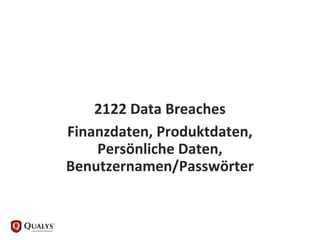
2122 Data Breaches
Finanzdaten, Produktdaten,
Persönliche Daten,
Benutzernamen/Passwörter
Schwachstellen
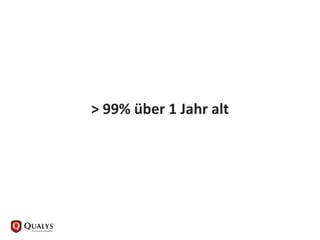
> 99% über 1 Jahr alt
> 99%
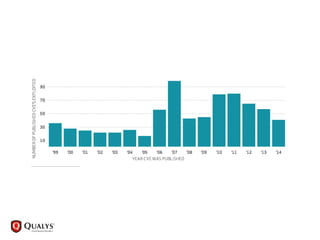
Aber 40 in 2014
Aber 40 in 2014
Und 50% innerhalb von 2 Wochen
> 99%
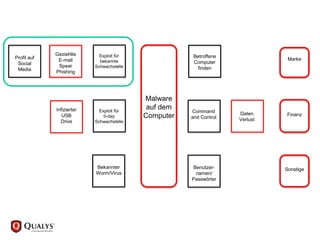
Malware
auf dem
Computer
Exploit für
bekannte
Schwachstelle
Geziehlte
E-mail
Spear
Phishing
Profil auf
Social
Media
Exploit für
0-day
Schwachstelle
Bekannter
Worm/Virus
Infizierter
USB
Drive
Betroffene
Computer
finden
Command
and Control
Benutzer-
namen/
Passwörter
Daten
Verlust
Marke
Finanz
Sonstige
Demo
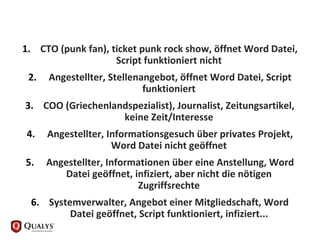
1. CTO (punk fan), ticket punk rock show, öffnet Word Datei,
Script funktioniert nicht
2. Angestellter, Stellenangebot, öffnet Word Datei, Script
funktioniert
3. COO (Griechenlandspezialist), Journalist, Zeitungsartikel,
keine Zeit/Interesse
4. Angestellter, Informationsgesuch über privates Projekt,
Word Datei nicht geöffnet
5. Angestellter, Informationen über eine Anstellung, Word
Datei geöffnet, infiziert, aber nicht die nötigen
Zugriffsrechte
6. Systemverwalter, Angebot einer Mitgliedschaft, Word
Datei geöffnet, Script funktioniert, infiziert...
Demo
Demo
Phishing
Training
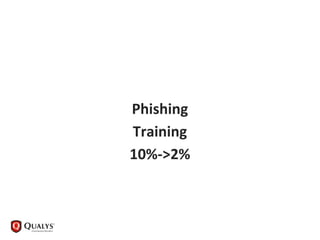
Phishing
Training
10%->2%
Schwachstellen
Patch
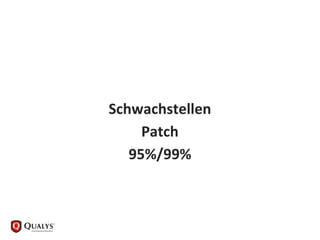
Schwachstellen
Patch
95%/99%
> 99%
> 99%
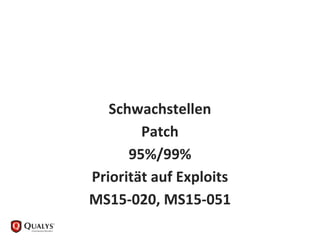
Schwachstellen
Patch
95%/99%
Priorität auf Exploits
MS15-020, MS15-051
0-days
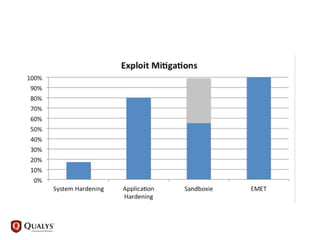
Härten
> 99%
Dann:
Passwörter
Schliesslich:
Breach Detection
Danke
Wolfgang Kandek
wkandek@qualys.com
@wkandek
http://www.qualys.com
Referenzen
• Mr Robot – bei iTunes und Amazon
https://de.wikipedia.org/wiki/Mr._Robot(Fernsehserie)
• Verizon DBIR 2015
http://www.verizonenterprise.com/DBIR/
• Chevron
https://www.rsaconference.com/events/us15/agenda/sessions/1983/
building-a-next-generation-security-architecture
• BSI
https://www.bsi.bund.de/SharedDocs/Downloads/DE/BSI/Publikatio
nen/Lageberichte/Lagebericht2014.pdf
• Härten
https://www.virusbtn.com/pdf/conference_slides/2013/Niemela-
VB2013.pdf

Anatomie eines Angriffs

Hinweis der Redaktion

  • #3 PCI Compliance: A secure connection between the customer’s browser and the web server Validation that the Website operators are a legitimate, legally accountable organization Use strong cryptography and security protocols such as SSL/TLS or IPSEC to safeguard sensitive cardholder data during transmission over open, public networks. Verify the use of encryption (for example, SSL/TLS or IPSEC) wherever cardholder data is transmitted or received over open, public networks Verify that strong encryption is used during data transmission For SSL implementations: - Verify that the server supports the latest patched versions. - Verify that HTTPS appears as a part of the browser Universal Record Locator (URL). - Verify that no cardholder data is required when HTTPS does not appear in the URL. Select a sample of transactions as they are received and observe transactions as they occur to verify that cardholder data is encrypted during transit. Verify that only trusted SSL/TLS keys/certificates are accepted. Verify that the proper encryption strength is implemented for the encryption methodology in use. (Check vendor recommendations/best practices.) Typically, compliant entities have a year grace period to meet the new requirement. Transmission confidentiality and Integrity (SC-8) The information system protects the [FedRAMP Assignment: confidentiality AND integrity] of transmitted information.
  • #4 PCI Compliance: A secure connection between the customer’s browser and the web server Validation that the Website operators are a legitimate, legally accountable organization Use strong cryptography and security protocols such as SSL/TLS or IPSEC to safeguard sensitive cardholder data during transmission over open, public networks. Verify the use of encryption (for example, SSL/TLS or IPSEC) wherever cardholder data is transmitted or received over open, public networks Verify that strong encryption is used during data transmission For SSL implementations: - Verify that the server supports the latest patched versions. - Verify that HTTPS appears as a part of the browser Universal Record Locator (URL). - Verify that no cardholder data is required when HTTPS does not appear in the URL. Select a sample of transactions as they are received and observe transactions as they occur to verify that cardholder data is encrypted during transit. Verify that only trusted SSL/TLS keys/certificates are accepted. Verify that the proper encryption strength is implemented for the encryption methodology in use. (Check vendor recommendations/best practices.) Typically, compliant entities have a year grace period to meet the new requirement. Transmission confidentiality and Integrity (SC-8) The information system protects the [FedRAMP Assignment: confidentiality AND integrity] of transmitted information.
  • #5 PCI Compliance: A secure connection between the customer’s browser and the web server Validation that the Website operators are a legitimate, legally accountable organization Use strong cryptography and security protocols such as SSL/TLS or IPSEC to safeguard sensitive cardholder data during transmission over open, public networks. Verify the use of encryption (for example, SSL/TLS or IPSEC) wherever cardholder data is transmitted or received over open, public networks Verify that strong encryption is used during data transmission For SSL implementations: - Verify that the server supports the latest patched versions. - Verify that HTTPS appears as a part of the browser Universal Record Locator (URL). - Verify that no cardholder data is required when HTTPS does not appear in the URL. Select a sample of transactions as they are received and observe transactions as they occur to verify that cardholder data is encrypted during transit. Verify that only trusted SSL/TLS keys/certificates are accepted. Verify that the proper encryption strength is implemented for the encryption methodology in use. (Check vendor recommendations/best practices.) Typically, compliant entities have a year grace period to meet the new requirement. Transmission confidentiality and Integrity (SC-8) The information system protects the [FedRAMP Assignment: confidentiality AND integrity] of transmitted information.
  • #6 PCI Compliance: A secure connection between the customer’s browser and the web server Validation that the Website operators are a legitimate, legally accountable organization Use strong cryptography and security protocols such as SSL/TLS or IPSEC to safeguard sensitive cardholder data during transmission over open, public networks. Verify the use of encryption (for example, SSL/TLS or IPSEC) wherever cardholder data is transmitted or received over open, public networks Verify that strong encryption is used during data transmission For SSL implementations: - Verify that the server supports the latest patched versions. - Verify that HTTPS appears as a part of the browser Universal Record Locator (URL). - Verify that no cardholder data is required when HTTPS does not appear in the URL. Select a sample of transactions as they are received and observe transactions as they occur to verify that cardholder data is encrypted during transit. Verify that only trusted SSL/TLS keys/certificates are accepted. Verify that the proper encryption strength is implemented for the encryption methodology in use. (Check vendor recommendations/best practices.) Typically, compliant entities have a year grace period to meet the new requirement. Transmission confidentiality and Integrity (SC-8) The information system protects the [FedRAMP Assignment: confidentiality AND integrity] of transmitted information.
  • #7 PCI Compliance: A secure connection between the customer’s browser and the web server Validation that the Website operators are a legitimate, legally accountable organization Use strong cryptography and security protocols such as SSL/TLS or IPSEC to safeguard sensitive cardholder data during transmission over open, public networks. Verify the use of encryption (for example, SSL/TLS or IPSEC) wherever cardholder data is transmitted or received over open, public networks Verify that strong encryption is used during data transmission For SSL implementations: - Verify that the server supports the latest patched versions. - Verify that HTTPS appears as a part of the browser Universal Record Locator (URL). - Verify that no cardholder data is required when HTTPS does not appear in the URL. Select a sample of transactions as they are received and observe transactions as they occur to verify that cardholder data is encrypted during transit. Verify that only trusted SSL/TLS keys/certificates are accepted. Verify that the proper encryption strength is implemented for the encryption methodology in use. (Check vendor recommendations/best practices.) Typically, compliant entities have a year grace period to meet the new requirement. Transmission confidentiality and Integrity (SC-8) The information system protects the [FedRAMP Assignment: confidentiality AND integrity] of transmitted information.
  • #8 PCI Compliance: A secure connection between the customer’s browser and the web server Validation that the Website operators are a legitimate, legally accountable organization Use strong cryptography and security protocols such as SSL/TLS or IPSEC to safeguard sensitive cardholder data during transmission over open, public networks. Verify the use of encryption (for example, SSL/TLS or IPSEC) wherever cardholder data is transmitted or received over open, public networks Verify that strong encryption is used during data transmission For SSL implementations: - Verify that the server supports the latest patched versions. - Verify that HTTPS appears as a part of the browser Universal Record Locator (URL). - Verify that no cardholder data is required when HTTPS does not appear in the URL. Select a sample of transactions as they are received and observe transactions as they occur to verify that cardholder data is encrypted during transit. Verify that only trusted SSL/TLS keys/certificates are accepted. Verify that the proper encryption strength is implemented for the encryption methodology in use. (Check vendor recommendations/best practices.) Typically, compliant entities have a year grace period to meet the new requirement. Transmission confidentiality and Integrity (SC-8) The information system protects the [FedRAMP Assignment: confidentiality AND integrity] of transmitted information.
  • #9 PCI Compliance: A secure connection between the customer’s browser and the web server Validation that the Website operators are a legitimate, legally accountable organization Use strong cryptography and security protocols such as SSL/TLS or IPSEC to safeguard sensitive cardholder data during transmission over open, public networks. Verify the use of encryption (for example, SSL/TLS or IPSEC) wherever cardholder data is transmitted or received over open, public networks Verify that strong encryption is used during data transmission For SSL implementations: - Verify that the server supports the latest patched versions. - Verify that HTTPS appears as a part of the browser Universal Record Locator (URL). - Verify that no cardholder data is required when HTTPS does not appear in the URL. Select a sample of transactions as they are received and observe transactions as they occur to verify that cardholder data is encrypted during transit. Verify that only trusted SSL/TLS keys/certificates are accepted. Verify that the proper encryption strength is implemented for the encryption methodology in use. (Check vendor recommendations/best practices.) Typically, compliant entities have a year grace period to meet the new requirement. Transmission confidentiality and Integrity (SC-8) The information system protects the [FedRAMP Assignment: confidentiality AND integrity] of transmitted information.
  • #10 PCI Compliance: A secure connection between the customer’s browser and the web server Validation that the Website operators are a legitimate, legally accountable organization Use strong cryptography and security protocols such as SSL/TLS or IPSEC to safeguard sensitive cardholder data during transmission over open, public networks. Verify the use of encryption (for example, SSL/TLS or IPSEC) wherever cardholder data is transmitted or received over open, public networks Verify that strong encryption is used during data transmission For SSL implementations: - Verify that the server supports the latest patched versions. - Verify that HTTPS appears as a part of the browser Universal Record Locator (URL). - Verify that no cardholder data is required when HTTPS does not appear in the URL. Select a sample of transactions as they are received and observe transactions as they occur to verify that cardholder data is encrypted during transit. Verify that only trusted SSL/TLS keys/certificates are accepted. Verify that the proper encryption strength is implemented for the encryption methodology in use. (Check vendor recommendations/best practices.) Typically, compliant entities have a year grace period to meet the new requirement. Transmission confidentiality and Integrity (SC-8) The information system protects the [FedRAMP Assignment: confidentiality AND integrity] of transmitted information.
  • #11 PCI Compliance: A secure connection between the customer’s browser and the web server Validation that the Website operators are a legitimate, legally accountable organization Use strong cryptography and security protocols such as SSL/TLS or IPSEC to safeguard sensitive cardholder data during transmission over open, public networks. Verify the use of encryption (for example, SSL/TLS or IPSEC) wherever cardholder data is transmitted or received over open, public networks Verify that strong encryption is used during data transmission For SSL implementations: - Verify that the server supports the latest patched versions. - Verify that HTTPS appears as a part of the browser Universal Record Locator (URL). - Verify that no cardholder data is required when HTTPS does not appear in the URL. Select a sample of transactions as they are received and observe transactions as they occur to verify that cardholder data is encrypted during transit. Verify that only trusted SSL/TLS keys/certificates are accepted. Verify that the proper encryption strength is implemented for the encryption methodology in use. (Check vendor recommendations/best practices.) Typically, compliant entities have a year grace period to meet the new requirement. Transmission confidentiality and Integrity (SC-8) The information system protects the [FedRAMP Assignment: confidentiality AND integrity] of transmitted information.
  • #12 PCI Compliance: A secure connection between the customer’s browser and the web server Validation that the Website operators are a legitimate, legally accountable organization Use strong cryptography and security protocols such as SSL/TLS or IPSEC to safeguard sensitive cardholder data during transmission over open, public networks. Verify the use of encryption (for example, SSL/TLS or IPSEC) wherever cardholder data is transmitted or received over open, public networks Verify that strong encryption is used during data transmission For SSL implementations: - Verify that the server supports the latest patched versions. - Verify that HTTPS appears as a part of the browser Universal Record Locator (URL). - Verify that no cardholder data is required when HTTPS does not appear in the URL. Select a sample of transactions as they are received and observe transactions as they occur to verify that cardholder data is encrypted during transit. Verify that only trusted SSL/TLS keys/certificates are accepted. Verify that the proper encryption strength is implemented for the encryption methodology in use. (Check vendor recommendations/best practices.) Typically, compliant entities have a year grace period to meet the new requirement. Transmission confidentiality and Integrity (SC-8) The information system protects the [FedRAMP Assignment: confidentiality AND integrity] of transmitted information.
  • #13 PCI Compliance: A secure connection between the customer’s browser and the web server Validation that the Website operators are a legitimate, legally accountable organization Use strong cryptography and security protocols such as SSL/TLS or IPSEC to safeguard sensitive cardholder data during transmission over open, public networks. Verify the use of encryption (for example, SSL/TLS or IPSEC) wherever cardholder data is transmitted or received over open, public networks Verify that strong encryption is used during data transmission For SSL implementations: - Verify that the server supports the latest patched versions. - Verify that HTTPS appears as a part of the browser Universal Record Locator (URL). - Verify that no cardholder data is required when HTTPS does not appear in the URL. Select a sample of transactions as they are received and observe transactions as they occur to verify that cardholder data is encrypted during transit. Verify that only trusted SSL/TLS keys/certificates are accepted. Verify that the proper encryption strength is implemented for the encryption methodology in use. (Check vendor recommendations/best practices.) Typically, compliant entities have a year grace period to meet the new requirement. Transmission confidentiality and Integrity (SC-8) The information system protects the [FedRAMP Assignment: confidentiality AND integrity] of transmitted information.
  • #14 PCI Compliance: A secure connection between the customer’s browser and the web server Validation that the Website operators are a legitimate, legally accountable organization Use strong cryptography and security protocols such as SSL/TLS or IPSEC to safeguard sensitive cardholder data during transmission over open, public networks. Verify the use of encryption (for example, SSL/TLS or IPSEC) wherever cardholder data is transmitted or received over open, public networks Verify that strong encryption is used during data transmission For SSL implementations: - Verify that the server supports the latest patched versions. - Verify that HTTPS appears as a part of the browser Universal Record Locator (URL). - Verify that no cardholder data is required when HTTPS does not appear in the URL. Select a sample of transactions as they are received and observe transactions as they occur to verify that cardholder data is encrypted during transit. Verify that only trusted SSL/TLS keys/certificates are accepted. Verify that the proper encryption strength is implemented for the encryption methodology in use. (Check vendor recommendations/best practices.) Typically, compliant entities have a year grace period to meet the new requirement. Transmission confidentiality and Integrity (SC-8) The information system protects the [FedRAMP Assignment: confidentiality AND integrity] of transmitted information.
  • #15 PCI Compliance: A secure connection between the customer’s browser and the web server Validation that the Website operators are a legitimate, legally accountable organization Use strong cryptography and security protocols such as SSL/TLS or IPSEC to safeguard sensitive cardholder data during transmission over open, public networks. Verify the use of encryption (for example, SSL/TLS or IPSEC) wherever cardholder data is transmitted or received over open, public networks Verify that strong encryption is used during data transmission For SSL implementations: - Verify that the server supports the latest patched versions. - Verify that HTTPS appears as a part of the browser Universal Record Locator (URL). - Verify that no cardholder data is required when HTTPS does not appear in the URL. Select a sample of transactions as they are received and observe transactions as they occur to verify that cardholder data is encrypted during transit. Verify that only trusted SSL/TLS keys/certificates are accepted. Verify that the proper encryption strength is implemented for the encryption methodology in use. (Check vendor recommendations/best practices.) Typically, compliant entities have a year grace period to meet the new requirement. Transmission confidentiality and Integrity (SC-8) The information system protects the [FedRAMP Assignment: confidentiality AND integrity] of transmitted information.
  • #16 PCI Compliance: A secure connection between the customer’s browser and the web server Validation that the Website operators are a legitimate, legally accountable organization Use strong cryptography and security protocols such as SSL/TLS or IPSEC to safeguard sensitive cardholder data during transmission over open, public networks. Verify the use of encryption (for example, SSL/TLS or IPSEC) wherever cardholder data is transmitted or received over open, public networks Verify that strong encryption is used during data transmission For SSL implementations: - Verify that the server supports the latest patched versions. - Verify that HTTPS appears as a part of the browser Universal Record Locator (URL). - Verify that no cardholder data is required when HTTPS does not appear in the URL. Select a sample of transactions as they are received and observe transactions as they occur to verify that cardholder data is encrypted during transit. Verify that only trusted SSL/TLS keys/certificates are accepted. Verify that the proper encryption strength is implemented for the encryption methodology in use. (Check vendor recommendations/best practices.) Typically, compliant entities have a year grace period to meet the new requirement. Transmission confidentiality and Integrity (SC-8) The information system protects the [FedRAMP Assignment: confidentiality AND integrity] of transmitted information.
  • #17 PCI Compliance: A secure connection between the customer’s browser and the web server Validation that the Website operators are a legitimate, legally accountable organization Use strong cryptography and security protocols such as SSL/TLS or IPSEC to safeguard sensitive cardholder data during transmission over open, public networks. Verify the use of encryption (for example, SSL/TLS or IPSEC) wherever cardholder data is transmitted or received over open, public networks Verify that strong encryption is used during data transmission For SSL implementations: - Verify that the server supports the latest patched versions. - Verify that HTTPS appears as a part of the browser Universal Record Locator (URL). - Verify that no cardholder data is required when HTTPS does not appear in the URL. Select a sample of transactions as they are received and observe transactions as they occur to verify that cardholder data is encrypted during transit. Verify that only trusted SSL/TLS keys/certificates are accepted. Verify that the proper encryption strength is implemented for the encryption methodology in use. (Check vendor recommendations/best practices.) Typically, compliant entities have a year grace period to meet the new requirement. Transmission confidentiality and Integrity (SC-8) The information system protects the [FedRAMP Assignment: confidentiality AND integrity] of transmitted information.
  • #18 PCI Compliance: A secure connection between the customer’s browser and the web server Validation that the Website operators are a legitimate, legally accountable organization Use strong cryptography and security protocols such as SSL/TLS or IPSEC to safeguard sensitive cardholder data during transmission over open, public networks. Verify the use of encryption (for example, SSL/TLS or IPSEC) wherever cardholder data is transmitted or received over open, public networks Verify that strong encryption is used during data transmission For SSL implementations: - Verify that the server supports the latest patched versions. - Verify that HTTPS appears as a part of the browser Universal Record Locator (URL). - Verify that no cardholder data is required when HTTPS does not appear in the URL. Select a sample of transactions as they are received and observe transactions as they occur to verify that cardholder data is encrypted during transit. Verify that only trusted SSL/TLS keys/certificates are accepted. Verify that the proper encryption strength is implemented for the encryption methodology in use. (Check vendor recommendations/best practices.) Typically, compliant entities have a year grace period to meet the new requirement. Transmission confidentiality and Integrity (SC-8) The information system protects the [FedRAMP Assignment: confidentiality AND integrity] of transmitted information.
  • #19 PCI Compliance: A secure connection between the customer’s browser and the web server Validation that the Website operators are a legitimate, legally accountable organization Use strong cryptography and security protocols such as SSL/TLS or IPSEC to safeguard sensitive cardholder data during transmission over open, public networks. Verify the use of encryption (for example, SSL/TLS or IPSEC) wherever cardholder data is transmitted or received over open, public networks Verify that strong encryption is used during data transmission For SSL implementations: - Verify that the server supports the latest patched versions. - Verify that HTTPS appears as a part of the browser Universal Record Locator (URL). - Verify that no cardholder data is required when HTTPS does not appear in the URL. Select a sample of transactions as they are received and observe transactions as they occur to verify that cardholder data is encrypted during transit. Verify that only trusted SSL/TLS keys/certificates are accepted. Verify that the proper encryption strength is implemented for the encryption methodology in use. (Check vendor recommendations/best practices.) Typically, compliant entities have a year grace period to meet the new requirement. Transmission confidentiality and Integrity (SC-8) The information system protects the [FedRAMP Assignment: confidentiality AND integrity] of transmitted information.
  • #20 PCI Compliance: A secure connection between the customer’s browser and the web server Validation that the Website operators are a legitimate, legally accountable organization Use strong cryptography and security protocols such as SSL/TLS or IPSEC to safeguard sensitive cardholder data during transmission over open, public networks. Verify the use of encryption (for example, SSL/TLS or IPSEC) wherever cardholder data is transmitted or received over open, public networks Verify that strong encryption is used during data transmission For SSL implementations: - Verify that the server supports the latest patched versions. - Verify that HTTPS appears as a part of the browser Universal Record Locator (URL). - Verify that no cardholder data is required when HTTPS does not appear in the URL. Select a sample of transactions as they are received and observe transactions as they occur to verify that cardholder data is encrypted during transit. Verify that only trusted SSL/TLS keys/certificates are accepted. Verify that the proper encryption strength is implemented for the encryption methodology in use. (Check vendor recommendations/best practices.) Typically, compliant entities have a year grace period to meet the new requirement. Transmission confidentiality and Integrity (SC-8) The information system protects the [FedRAMP Assignment: confidentiality AND integrity] of transmitted information.
  • #21 PCI Compliance: A secure connection between the customer’s browser and the web server Validation that the Website operators are a legitimate, legally accountable organization Use strong cryptography and security protocols such as SSL/TLS or IPSEC to safeguard sensitive cardholder data during transmission over open, public networks. Verify the use of encryption (for example, SSL/TLS or IPSEC) wherever cardholder data is transmitted or received over open, public networks Verify that strong encryption is used during data transmission For SSL implementations: - Verify that the server supports the latest patched versions. - Verify that HTTPS appears as a part of the browser Universal Record Locator (URL). - Verify that no cardholder data is required when HTTPS does not appear in the URL. Select a sample of transactions as they are received and observe transactions as they occur to verify that cardholder data is encrypted during transit. Verify that only trusted SSL/TLS keys/certificates are accepted. Verify that the proper encryption strength is implemented for the encryption methodology in use. (Check vendor recommendations/best practices.) Typically, compliant entities have a year grace period to meet the new requirement. Transmission confidentiality and Integrity (SC-8) The information system protects the [FedRAMP Assignment: confidentiality AND integrity] of transmitted information.
  • #22 PCI Compliance: A secure connection between the customer’s browser and the web server Validation that the Website operators are a legitimate, legally accountable organization Use strong cryptography and security protocols such as SSL/TLS or IPSEC to safeguard sensitive cardholder data during transmission over open, public networks. Verify the use of encryption (for example, SSL/TLS or IPSEC) wherever cardholder data is transmitted or received over open, public networks Verify that strong encryption is used during data transmission For SSL implementations: - Verify that the server supports the latest patched versions. - Verify that HTTPS appears as a part of the browser Universal Record Locator (URL). - Verify that no cardholder data is required when HTTPS does not appear in the URL. Select a sample of transactions as they are received and observe transactions as they occur to verify that cardholder data is encrypted during transit. Verify that only trusted SSL/TLS keys/certificates are accepted. Verify that the proper encryption strength is implemented for the encryption methodology in use. (Check vendor recommendations/best practices.) Typically, compliant entities have a year grace period to meet the new requirement. Transmission confidentiality and Integrity (SC-8) The information system protects the [FedRAMP Assignment: confidentiality AND integrity] of transmitted information.
  • #23 PCI Compliance: A secure connection between the customer’s browser and the web server Validation that the Website operators are a legitimate, legally accountable organization Use strong cryptography and security protocols such as SSL/TLS or IPSEC to safeguard sensitive cardholder data during transmission over open, public networks. Verify the use of encryption (for example, SSL/TLS or IPSEC) wherever cardholder data is transmitted or received over open, public networks Verify that strong encryption is used during data transmission For SSL implementations: - Verify that the server supports the latest patched versions. - Verify that HTTPS appears as a part of the browser Universal Record Locator (URL). - Verify that no cardholder data is required when HTTPS does not appear in the URL. Select a sample of transactions as they are received and observe transactions as they occur to verify that cardholder data is encrypted during transit. Verify that only trusted SSL/TLS keys/certificates are accepted. Verify that the proper encryption strength is implemented for the encryption methodology in use. (Check vendor recommendations/best practices.) Typically, compliant entities have a year grace period to meet the new requirement. Transmission confidentiality and Integrity (SC-8) The information system protects the [FedRAMP Assignment: confidentiality AND integrity] of transmitted information.
  • #24 PCI Compliance: A secure connection between the customer’s browser and the web server Validation that the Website operators are a legitimate, legally accountable organization Use strong cryptography and security protocols such as SSL/TLS or IPSEC to safeguard sensitive cardholder data during transmission over open, public networks. Verify the use of encryption (for example, SSL/TLS or IPSEC) wherever cardholder data is transmitted or received over open, public networks Verify that strong encryption is used during data transmission For SSL implementations: - Verify that the server supports the latest patched versions. - Verify that HTTPS appears as a part of the browser Universal Record Locator (URL). - Verify that no cardholder data is required when HTTPS does not appear in the URL. Select a sample of transactions as they are received and observe transactions as they occur to verify that cardholder data is encrypted during transit. Verify that only trusted SSL/TLS keys/certificates are accepted. Verify that the proper encryption strength is implemented for the encryption methodology in use. (Check vendor recommendations/best practices.) Typically, compliant entities have a year grace period to meet the new requirement. Transmission confidentiality and Integrity (SC-8) The information system protects the [FedRAMP Assignment: confidentiality AND integrity] of transmitted information.
  • #25 PCI Compliance: A secure connection between the customer’s browser and the web server Validation that the Website operators are a legitimate, legally accountable organization Use strong cryptography and security protocols such as SSL/TLS or IPSEC to safeguard sensitive cardholder data during transmission over open, public networks. Verify the use of encryption (for example, SSL/TLS or IPSEC) wherever cardholder data is transmitted or received over open, public networks Verify that strong encryption is used during data transmission For SSL implementations: - Verify that the server supports the latest patched versions. - Verify that HTTPS appears as a part of the browser Universal Record Locator (URL). - Verify that no cardholder data is required when HTTPS does not appear in the URL. Select a sample of transactions as they are received and observe transactions as they occur to verify that cardholder data is encrypted during transit. Verify that only trusted SSL/TLS keys/certificates are accepted. Verify that the proper encryption strength is implemented for the encryption methodology in use. (Check vendor recommendations/best practices.) Typically, compliant entities have a year grace period to meet the new requirement. Transmission confidentiality and Integrity (SC-8) The information system protects the [FedRAMP Assignment: confidentiality AND integrity] of transmitted information.
  • #26 PCI Compliance: A secure connection between the customer’s browser and the web server Validation that the Website operators are a legitimate, legally accountable organization Use strong cryptography and security protocols such as SSL/TLS or IPSEC to safeguard sensitive cardholder data during transmission over open, public networks. Verify the use of encryption (for example, SSL/TLS or IPSEC) wherever cardholder data is transmitted or received over open, public networks Verify that strong encryption is used during data transmission For SSL implementations: - Verify that the server supports the latest patched versions. - Verify that HTTPS appears as a part of the browser Universal Record Locator (URL). - Verify that no cardholder data is required when HTTPS does not appear in the URL. Select a sample of transactions as they are received and observe transactions as they occur to verify that cardholder data is encrypted during transit. Verify that only trusted SSL/TLS keys/certificates are accepted. Verify that the proper encryption strength is implemented for the encryption methodology in use. (Check vendor recommendations/best practices.) Typically, compliant entities have a year grace period to meet the new requirement. Transmission confidentiality and Integrity (SC-8) The information system protects the [FedRAMP Assignment: confidentiality AND integrity] of transmitted information.
  • #27 PCI Compliance: A secure connection between the customer’s browser and the web server Validation that the Website operators are a legitimate, legally accountable organization Use strong cryptography and security protocols such as SSL/TLS or IPSEC to safeguard sensitive cardholder data during transmission over open, public networks. Verify the use of encryption (for example, SSL/TLS or IPSEC) wherever cardholder data is transmitted or received over open, public networks Verify that strong encryption is used during data transmission For SSL implementations: - Verify that the server supports the latest patched versions. - Verify that HTTPS appears as a part of the browser Universal Record Locator (URL). - Verify that no cardholder data is required when HTTPS does not appear in the URL. Select a sample of transactions as they are received and observe transactions as they occur to verify that cardholder data is encrypted during transit. Verify that only trusted SSL/TLS keys/certificates are accepted. Verify that the proper encryption strength is implemented for the encryption methodology in use. (Check vendor recommendations/best practices.) Typically, compliant entities have a year grace period to meet the new requirement. Transmission confidentiality and Integrity (SC-8) The information system protects the [FedRAMP Assignment: confidentiality AND integrity] of transmitted information.
  • #28 PCI Compliance: A secure connection between the customer’s browser and the web server Validation that the Website operators are a legitimate, legally accountable organization Use strong cryptography and security protocols such as SSL/TLS or IPSEC to safeguard sensitive cardholder data during transmission over open, public networks. Verify the use of encryption (for example, SSL/TLS or IPSEC) wherever cardholder data is transmitted or received over open, public networks Verify that strong encryption is used during data transmission For SSL implementations: - Verify that the server supports the latest patched versions. - Verify that HTTPS appears as a part of the browser Universal Record Locator (URL). - Verify that no cardholder data is required when HTTPS does not appear in the URL. Select a sample of transactions as they are received and observe transactions as they occur to verify that cardholder data is encrypted during transit. Verify that only trusted SSL/TLS keys/certificates are accepted. Verify that the proper encryption strength is implemented for the encryption methodology in use. (Check vendor recommendations/best practices.) Typically, compliant entities have a year grace period to meet the new requirement. Transmission confidentiality and Integrity (SC-8) The information system protects the [FedRAMP Assignment: confidentiality AND integrity] of transmitted information.
  • #29 PCI Compliance: A secure connection between the customer’s browser and the web server Validation that the Website operators are a legitimate, legally accountable organization Use strong cryptography and security protocols such as SSL/TLS or IPSEC to safeguard sensitive cardholder data during transmission over open, public networks. Verify the use of encryption (for example, SSL/TLS or IPSEC) wherever cardholder data is transmitted or received over open, public networks Verify that strong encryption is used during data transmission For SSL implementations: - Verify that the server supports the latest patched versions. - Verify that HTTPS appears as a part of the browser Universal Record Locator (URL). - Verify that no cardholder data is required when HTTPS does not appear in the URL. Select a sample of transactions as they are received and observe transactions as they occur to verify that cardholder data is encrypted during transit. Verify that only trusted SSL/TLS keys/certificates are accepted. Verify that the proper encryption strength is implemented for the encryption methodology in use. (Check vendor recommendations/best practices.) Typically, compliant entities have a year grace period to meet the new requirement. Transmission confidentiality and Integrity (SC-8) The information system protects the [FedRAMP Assignment: confidentiality AND integrity] of transmitted information.
  • #30 PCI Compliance: A secure connection between the customer’s browser and the web server Validation that the Website operators are a legitimate, legally accountable organization Use strong cryptography and security protocols such as SSL/TLS or IPSEC to safeguard sensitive cardholder data during transmission over open, public networks. Verify the use of encryption (for example, SSL/TLS or IPSEC) wherever cardholder data is transmitted or received over open, public networks Verify that strong encryption is used during data transmission For SSL implementations: - Verify that the server supports the latest patched versions. - Verify that HTTPS appears as a part of the browser Universal Record Locator (URL). - Verify that no cardholder data is required when HTTPS does not appear in the URL. Select a sample of transactions as they are received and observe transactions as they occur to verify that cardholder data is encrypted during transit. Verify that only trusted SSL/TLS keys/certificates are accepted. Verify that the proper encryption strength is implemented for the encryption methodology in use. (Check vendor recommendations/best practices.) Typically, compliant entities have a year grace period to meet the new requirement. Transmission confidentiality and Integrity (SC-8) The information system protects the [FedRAMP Assignment: confidentiality AND integrity] of transmitted information.