State-Space Models vs
Transformers for Ultra Low-
Power Edge AI
Tony Lewis
Chief Technology Officer
Jon Tapson
Chief Development Officer
BrainChip, Inc.
About BrainChip – Founded 2013
Design & license machine learning accelerators for ultra low-power AI
Business Model: IP Licensing
15+ years of AI architecture research & technologies
65+ data science, hardware & software engineers
Publicly traded Australian Stock Exchange (BRN:ASX)
2
© 2025 BrainChip Inc.
Goals of This Presentation
• Analysis of computation and bandwidth in state-space models and transformers
• Establish energy and costs savings measures that are available ONLY to SSM
• Efficient off-line processing of context information
• Use of read only memory, e.g., flash to dramatically reduce power
• Conclusion
© 2025 BrainChip Inc. 3
Problem Statement
4
© 2025 BrainChip Inc.
• Goal:
• Achieve < 0.5 W system power
• Sub-100 ms latency for edge AI such as RAG
• Low SRAM < 1 MB and SoTA performance
• Why? Unlocks new cost and power sensitive markets
• Key challenges:
• Transformer based LLMs dominate today
• Transformers KV cache expands blows up chip cache
• RAG uses long context length (> 1024 tokens)
• Opportunity:
• State-Space Models address power, size issues
State-Space Model Overview (1/2)
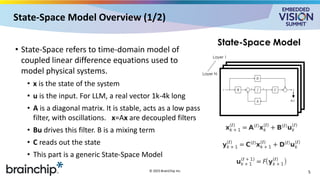
• State-Space refers to time-domain model of
coupled linear difference equations used to
model physical systems.
• x is the state of the system
• u is the input. For LLM, a real vector 1k-4k long
• A is a diagonal matrix. It is stable, acts as a low pass
filter, with oscillations. x=Ax are decoupled filters
• Bu drives this filter. B is a mixing term
• C reads out the state
• This part is a generic State-Space Model
5
© 2025 BrainChip Inc.
Layer 1
f(y)
Layer N
State-Space Model
State-Space Model Overview (2/2)
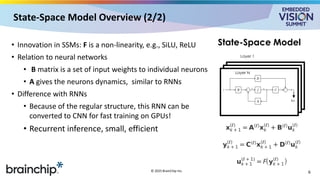
• Innovation in SSMs: F is a non-linearity, e.g., SiLU, ReLU
• Relation to neural networks
• B matrix is a set of input weights to individual neurons
• A gives the neurons dynamics, similar to RNNs
• Difference with RNNs
• Because of the regular structure, this RNN can be
converted to CNN for fast training on GPUs!
• Recurrent inference, small, efficient
6
© 2025 BrainChip Inc.
Layer 1
f(y)
Layer N
State-Space Model
Training
• Can train SSM as convolutional networks exploiting parallelism in
GPUs
• Distillation pathway from transformers to state space model
• Distillation is a popular way of training smaller LLMs
• Start with large LLM an use it as a teacher for the small SMM.
• Cross-architecture distillations for transformers -> State-Space
Models are being developed (Mohawk)
©2025 BrainChip Inc. 7
State-Space Model Cache Is Tiny
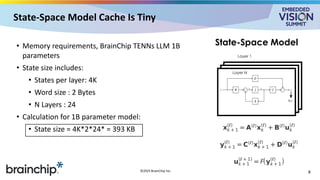
• Memory requirements, BrainChip TENNs LLM 1B
parameters
• State size includes:
• States per layer: 4K
• Word size : 2 Bytes
• N Layers : 24
• Calculation for 1B parameter model:
• State size = 4K*2*24* = 393 KB
8
©2025 BrainChip Inc.
Layer 1
f(y)
Layer N
State-Space Model
State-Space Machine Are Markov
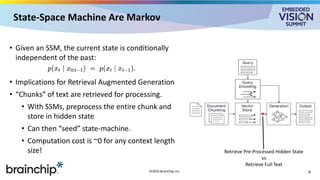
• Given an SSM, the current state is conditionally
independent of the past:
• Implications for Retrieval Augmented Generation
• “Chunks” of text are retrieved for processing.
• With SSMs, preprocess the entire chunk and
store in hidden state
• Can then “seed” state-machine.
• Computation cost is ~0 for any context length
size!
9
©2025 BrainChip Inc.
Retrieve Pre-Processed Hidden State
vs
Retrieve Full Text
State-Space Models: Hardware Benefit
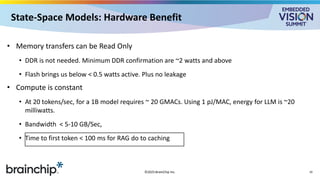
• Memory transfers can be Read Only
• DDR is not needed. Minimum DDR confirmation are ~2 watts and above
• Flash brings us below < 0.5 watts active. Plus no leakage
• Compute is constant
• At 20 tokens/sec, for a 1B model requires ~ 20 GMACs. Using 1 pJ/MAC, energy for LLM is ~20
milliwatts.
• Bandwidth < 5-10 GB/Sec,
• Time to first token < 100 ms for RAG do to caching
©2025 BrainChip Inc. 10
How Do Transformers Compare?
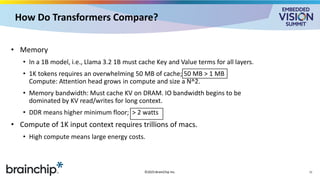
• Memory
• In a 1B model, i.e., Llama 3.2 1B must cache Key and Value terms for all layers.
• 1K tokens requires an overwhelming 50 MB of cache; 50 MB > 1 MB
Compute: Attention head grows in compute and size a N^2.
• Memory bandwidth: Must cache KV on DRAM. IO bandwidth begins to be
dominated by KV read/writes for long context.
• DDR means higher minimum floor; > 2 watts
• Compute of 1K input context requires trillions of macs.
• High compute means large energy costs.
©2025 BrainChip Inc. 11
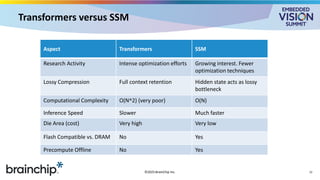
Transformers versus SSM
©2025 BrainChip Inc. 12
Aspect Transformers SSM
Research Activity Intense optimization efforts Growing interest. Fewer
optimization techniques
Lossy Compression Full context retention Hidden state acts as lossy
bottleneck
Computational Complexity O(N^2) (very poor) O(N)
Inference Speed Slower Much faster
Die Area (cost) Very high Very low
Flash Compatible vs. DRAM No Yes
Precompute Offline No Yes
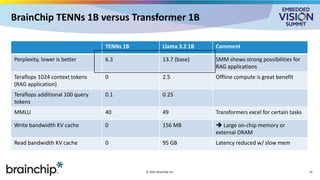
BrainChip TENNs 1B versus Transformer 1B
TENNs 1B Llama 3.2 1B Comment
Perplexity, lower is better 6.3 13.7 (base) SMM shows strong possibilities for
RAG applications
Teraflops 1024 context tokens
(RAG application)
0 2.5 Offline compute is great benefit
Teraflops additional 100 query
tokens
0.1 0.25
MMLU 40 49 Transformers excel for certain tasks
Write bandwidth KV cache 0 156 MB  Large on-chip memory or
external DRAM
Read bandwidth KV cache 0 95 GB Latency reduced w/ slow mem
© 2025 BrainChip Inc. 13
Summary
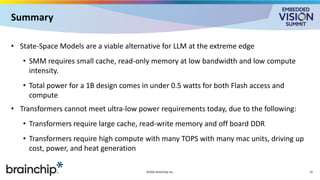
• State-Space Models are a viable alternative for LLM at the extreme edge
• SMM requires small cache, read-only memory at low bandwidth and low compute
intensity.
• Total power for a 1B design comes in under 0.5 watts for both Flash access and
compute
• Transformers cannot meet ultra-low power requirements today, due to the following:
• Transformers require large cache, read-write memory and off board DDR
• Transformers require high compute with many TOPS with many mac units, driving up
cost, power, and heat generation
©2025 BrainChip Inc. 14
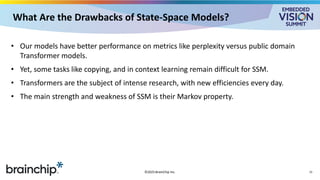
What Are the Drawbacks of State-Space Models?
• Our models have better performance on metrics like perplexity versus public domain
Transformer models.
• Yet, some tasks like copying, and in context learning remain difficult for SSM.
• Transformers are the subject of intense research, with new efficiencies every day.
• The main strength and weakness of SSM is their Markov property.
©2025 BrainChip Inc. 15
Resources
• State-Space Models: https://en.wikipedia.org/wiki/State-space_representation
• Mohawk: https://goombalab.github.io/blog/2024/distillation-part1-mohawk/
• Transformer Compute Requirements: Kaplan et al., https://arxiv.org/pdf/2001.08361
©2025 BrainChip Inc. 16
17
©2025 BrainChip Inc.
Thank You
See our demonstration in booth # 716

“State-space Models vs. Transformers for Ultra-low-power Edge AI,” a Presentation from BrainChip

  • 1.
    State-Space Models vs Transformersfor Ultra Low- Power Edge AI Tony Lewis Chief Technology Officer Jon Tapson Chief Development Officer BrainChip, Inc.
  • 2.
    About BrainChip –Founded 2013 Design & license machine learning accelerators for ultra low-power AI Business Model: IP Licensing 15+ years of AI architecture research & technologies 65+ data science, hardware & software engineers Publicly traded Australian Stock Exchange (BRN:ASX) 2 © 2025 BrainChip Inc.
  • 3.
    Goals of ThisPresentation • Analysis of computation and bandwidth in state-space models and transformers • Establish energy and costs savings measures that are available ONLY to SSM • Efficient off-line processing of context information • Use of read only memory, e.g., flash to dramatically reduce power • Conclusion © 2025 BrainChip Inc. 3
  • 4.
    Problem Statement 4 © 2025BrainChip Inc. • Goal: • Achieve < 0.5 W system power • Sub-100 ms latency for edge AI such as RAG • Low SRAM < 1 MB and SoTA performance • Why? Unlocks new cost and power sensitive markets • Key challenges: • Transformer based LLMs dominate today • Transformers KV cache expands blows up chip cache • RAG uses long context length (> 1024 tokens) • Opportunity: • State-Space Models address power, size issues
  • 5.
    State-Space Model Overview(1/2) • State-Space refers to time-domain model of coupled linear difference equations used to model physical systems. • x is the state of the system • u is the input. For LLM, a real vector 1k-4k long • A is a diagonal matrix. It is stable, acts as a low pass filter, with oscillations. x=Ax are decoupled filters • Bu drives this filter. B is a mixing term • C reads out the state • This part is a generic State-Space Model 5 © 2025 BrainChip Inc. Layer 1 f(y) Layer N State-Space Model
  • 6.
    State-Space Model Overview(2/2) • Innovation in SSMs: F is a non-linearity, e.g., SiLU, ReLU • Relation to neural networks • B matrix is a set of input weights to individual neurons • A gives the neurons dynamics, similar to RNNs • Difference with RNNs • Because of the regular structure, this RNN can be converted to CNN for fast training on GPUs! • Recurrent inference, small, efficient 6 © 2025 BrainChip Inc. Layer 1 f(y) Layer N State-Space Model
  • 7.
    Training • Can trainSSM as convolutional networks exploiting parallelism in GPUs • Distillation pathway from transformers to state space model • Distillation is a popular way of training smaller LLMs • Start with large LLM an use it as a teacher for the small SMM. • Cross-architecture distillations for transformers -> State-Space Models are being developed (Mohawk) ©2025 BrainChip Inc. 7
  • 8.
    State-Space Model CacheIs Tiny • Memory requirements, BrainChip TENNs LLM 1B parameters • State size includes: • States per layer: 4K • Word size : 2 Bytes • N Layers : 24 • Calculation for 1B parameter model: • State size = 4K*2*24* = 393 KB 8 ©2025 BrainChip Inc. Layer 1 f(y) Layer N State-Space Model
  • 9.
    State-Space Machine AreMarkov • Given an SSM, the current state is conditionally independent of the past: • Implications for Retrieval Augmented Generation • “Chunks” of text are retrieved for processing. • With SSMs, preprocess the entire chunk and store in hidden state • Can then “seed” state-machine. • Computation cost is ~0 for any context length size! 9 ©2025 BrainChip Inc. Retrieve Pre-Processed Hidden State vs Retrieve Full Text
  • 10.
    State-Space Models: HardwareBenefit • Memory transfers can be Read Only • DDR is not needed. Minimum DDR confirmation are ~2 watts and above • Flash brings us below < 0.5 watts active. Plus no leakage • Compute is constant • At 20 tokens/sec, for a 1B model requires ~ 20 GMACs. Using 1 pJ/MAC, energy for LLM is ~20 milliwatts. • Bandwidth < 5-10 GB/Sec, • Time to first token < 100 ms for RAG do to caching ©2025 BrainChip Inc. 10
  • 11.
    How Do TransformersCompare? • Memory • In a 1B model, i.e., Llama 3.2 1B must cache Key and Value terms for all layers. • 1K tokens requires an overwhelming 50 MB of cache; 50 MB > 1 MB Compute: Attention head grows in compute and size a N^2. • Memory bandwidth: Must cache KV on DRAM. IO bandwidth begins to be dominated by KV read/writes for long context. • DDR means higher minimum floor; > 2 watts • Compute of 1K input context requires trillions of macs. • High compute means large energy costs. ©2025 BrainChip Inc. 11
  • 12.
    Transformers versus SSM ©2025BrainChip Inc. 12 Aspect Transformers SSM Research Activity Intense optimization efforts Growing interest. Fewer optimization techniques Lossy Compression Full context retention Hidden state acts as lossy bottleneck Computational Complexity O(N^2) (very poor) O(N) Inference Speed Slower Much faster Die Area (cost) Very high Very low Flash Compatible vs. DRAM No Yes Precompute Offline No Yes
  • 13.
    BrainChip TENNs 1Bversus Transformer 1B TENNs 1B Llama 3.2 1B Comment Perplexity, lower is better 6.3 13.7 (base) SMM shows strong possibilities for RAG applications Teraflops 1024 context tokens (RAG application) 0 2.5 Offline compute is great benefit Teraflops additional 100 query tokens 0.1 0.25 MMLU 40 49 Transformers excel for certain tasks Write bandwidth KV cache 0 156 MB  Large on-chip memory or external DRAM Read bandwidth KV cache 0 95 GB Latency reduced w/ slow mem © 2025 BrainChip Inc. 13
  • 14.
    Summary • State-Space Modelsare a viable alternative for LLM at the extreme edge • SMM requires small cache, read-only memory at low bandwidth and low compute intensity. • Total power for a 1B design comes in under 0.5 watts for both Flash access and compute • Transformers cannot meet ultra-low power requirements today, due to the following: • Transformers require large cache, read-write memory and off board DDR • Transformers require high compute with many TOPS with many mac units, driving up cost, power, and heat generation ©2025 BrainChip Inc. 14
  • 15.
    What Are theDrawbacks of State-Space Models? • Our models have better performance on metrics like perplexity versus public domain Transformer models. • Yet, some tasks like copying, and in context learning remain difficult for SSM. • Transformers are the subject of intense research, with new efficiencies every day. • The main strength and weakness of SSM is their Markov property. ©2025 BrainChip Inc. 15
  • 16.
    Resources • State-Space Models:https://en.wikipedia.org/wiki/State-space_representation • Mohawk: https://goombalab.github.io/blog/2024/distillation-part1-mohawk/ • Transformer Compute Requirements: Kaplan et al., https://arxiv.org/pdf/2001.08361 ©2025 BrainChip Inc. 16
  • 17.
    17 ©2025 BrainChip Inc. ThankYou See our demonstration in booth # 716