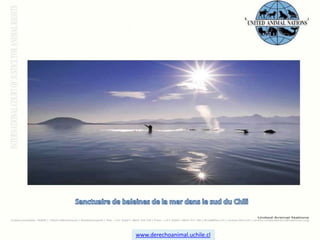
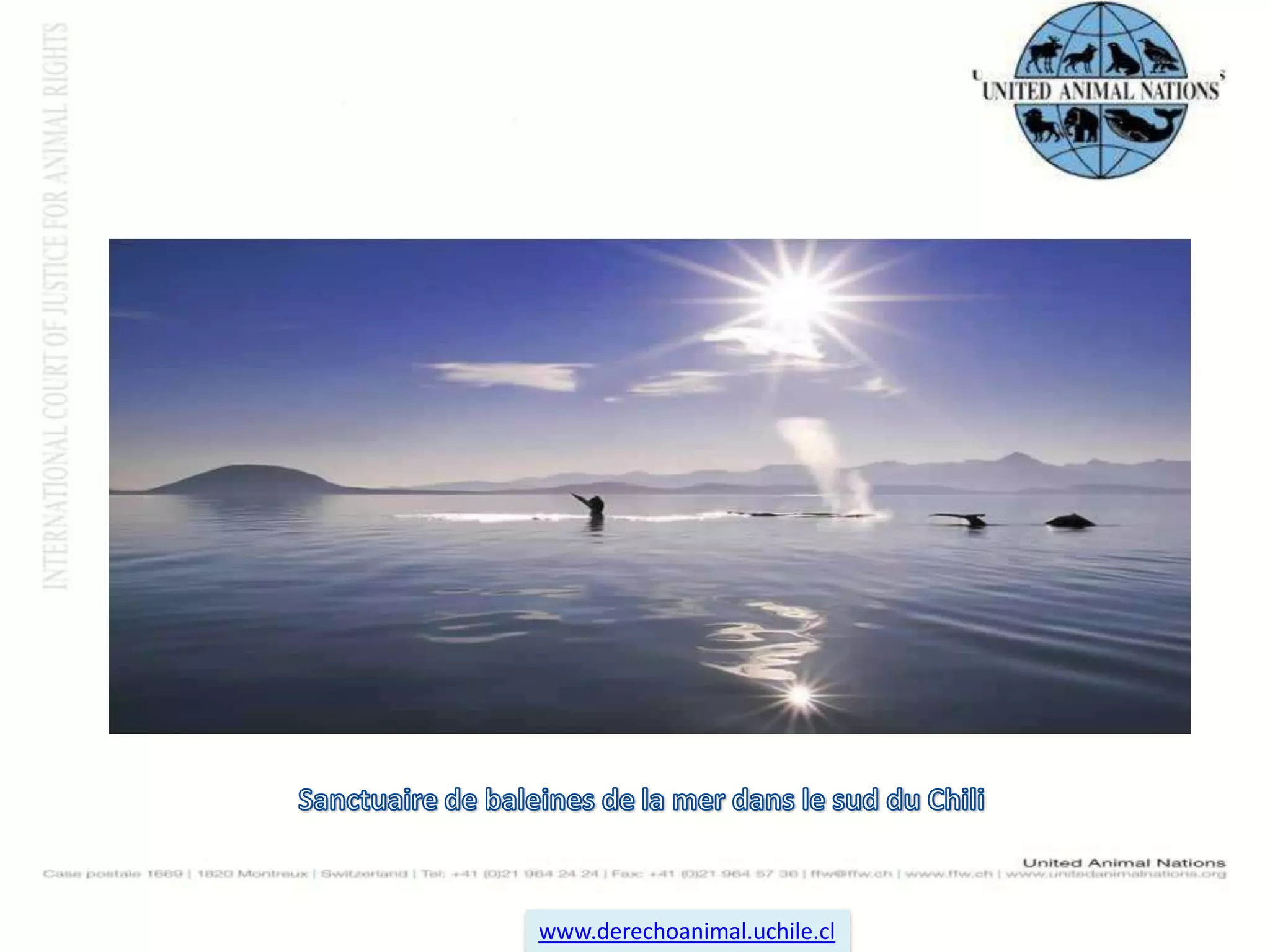
Sanctuaire de baleines de la mer dans le sud du Chiliwww.derechoanimal.uchile.cl
Procès des massacres de Baleines et de Dauphins
1Whale and DolphinSlaugtheron Trial Prozessgegen die Wal- undDelphinmassakerProcès des massacres de Baleines et de Dauphins Proceso por Matanza de Ballenas y Delfines VERDICT of THE INTERNATIONAL COURT OF JUSTICE FOR ANIMAL English: page 2 URTEILDES RIGHTS INTERNATIONALEN GERICHTSHOFS FÜR TIERRECHTE Deutsch: Seite 5 VERDICT de la COUR INTERNATIONALE DE JUSTICE DES DROITS DE L’ANIMAL Français : page 7 VEREDICTO de la CORTE INTERNACIONAL DE JUSTICIA PARA EL DERECHO ANIMAL Español: página 11
2THE INTERNATIONAL COURT OF JUSTICE FOR ANIMAL RIGHTSVERDICT of the 22nd February 2010 in the case of the slaughter of whales and dolphins practiced by Japan, Norway, Iceland, Greenland and the Faroe Islands versus the ministers of the ministries of fisheries of the incriminated countries : M. HirotakaAkamatsu, JaponMme. Lisbeth Berg-Hansen, NorvègeM. JónBjarnason, IslandeMme. Ane Hansen, GroenlandM. Jacob Vestergaard, Iles FéroésTHE COURT FINDS Wide areas of the oceans, whose riches were not so long ago considered to be inexhaustible, are dead spaces today, while the last of the oceans’ large mammals –– whales and dolphins continue to be systematically hunted and bestially killed despite the moratorium put into place by the International Whaling Commission (IWC) and in force since 1986. involved in the whale and dolphin hunt is beyond imagination. As whales have no natural enemies, their nervous system is not structured to respond to an assault or to severe pain by fainting or going into shock. They will endure their own slaughtering fully conscious up to their last breath. Thousands of dolphins are brutally captured and ill treated with the purpose of stocking and restocking dolphin fun parks which are becoming more popular and numerous every day. While most countries have never hunted whales, or have respected the IWC moratorium, Japan, Norway, Iceland and Greenland continue to hunt whales despite the moratorium. In addition, Japan and the Faroe Islands hunt dolphins intensively. But dolphins and whales are threatened and decimated by a great many other perils such as contamination by heavy metals and other pollutants, over-fishing and over use of the oceans by man. Their food is becoming scarce through over-fishing while thousands of kilometers of nets drifting in the seas cause an enormous amount of additional victims. Every year innumerable dolphins and whales lose their sense of orientation and get stranded on beaches or cliffs. Scientists believe this phenomenon to be a result of the increasing sound pollution in the oceans and of physiological damage caused by chemical pollutants. Notwithstanding the high toxicity of whale meat, responsible authorities of the indicted countries continue to permit and even promote its consumption, thus putting the health and physical integrity of their citizens at risk. Having become rare, the great whales have more and more difficulty in finding partners for procreation. The same destiny awaits the dolphins. The climate change added to all the other perils will have devastating effects on all whale and dolphin populations.
3THE JUDGEMENT The accused having been duly convened, the Prosecutor having presented his case and the appointed attorney for the defence having made his plea, the International Court of Justice for Animal Rights composed of a jury of seven members and three judges, based on today’s hearings and the testimonies and evidence brought, accede to the plaintiffs in their petitions and declare the accused guilty - of violation of international laws - of complicity in and of encouragement of the slaughter of whales and dolphins - of plundering a natural living heritage which belongs to the whole world - of major responsibility and complicity in the torture and the destruction of tens of thousands of whales and dolphins per year - of acts of cruelty committed on wild animals of species protected on a world wide level - of non application of the principle of precaution with regard to the preservation of ocean life - of deliberately endangering marine ecosystems already severely weakened by human activities - of deliberately endangering the lives of others by distributing food products issued from whales and dolphins whose flesh is impregnated with toxic substances, without informing the public of the dangers incurred In addition The Court is appealing to the International Whaling Commission (IWC) to extend the moratorium in force for large whales to all cetaceans (dolphins, porpoises and orcas). - The Court requires that all costal nations declare sanctuar y their exclusive economic zone (up to 200 miles) where all hunting and capture of cetaceans (whales, dolphins, porpoises and orcas) be banned. The Court requests that the World Health Organisation (WHO) issue a recommendation to ban the sale of all products derived from cetaceans destined for human consumption (for food or any other use) and to officially inform governments and public opinion of the dangers these products involve for human health. - The Court appeals to all governments to support Australia in her planned legal action with the International Court of Justice of The Hague against the Japanese who blatantly violate international law by their whaling expeditions in the international waters of the Antarctic should Japan not stop these expeditions by November 2010. The complete verdict will be notified to the International Court of Justice of The Hague and to the parties found guilty. It will also be sent to the President of the European Parliament, the President of the Council of Europe, the Presidency of the Council of Ministers, the President of the European Commission, the UN, UNESCO, the World Health Organisation and the International Whaling Commission. Geneva, 22 February 2010 THE INTERNATIONAL COURT OF JUSTICE FOR ANIMAL RIGHTS
4International Convention for the Regulation of Whaling of 2 12/1946 completed by the protocol 19/11/1956 / • Convention on Biological Diversity in Rio of 5/6/1992 • Convention on International Trade in Endangered Species of Fauna and Flora in Washington D.C. of 3/3/1973 • Convention on Migratory Species of Wild Animals in Bonn of 23/6/1979 • Convention on the Conservation of European Wildlife and Natural Habitats in Berne of 19/9/1979 • Convention on International Trade in Endangered Species of Fauna and Flora in Washingt on D.C. of 3/3/1973 Plaintiffs Sylvia Frey, dipl. sc. nat. ETH , OceanCare (CH), (influence of whale hunting) Dr Sandra Altherr, Pro Wildlife (DE) (high toxicity of whale and dolphin meat for humane consumption) Peter Mollerup, Dyrenes Venner (DK) ( animal welfare issues) Sakae Hemmy, ELSA Nature Conservancy, Japan ( cruel dolphin drive hunting, Japan) Main eye witness: Ric O’Barry (USA), Marine Mammal Specialist for Earth Island Institute and protagonist of the film „The Cove“, that just won the OSCAR in the category best documentary.  Experts : Dr Philippe Roch (CH) , former Swiss Secretary of State for the Environment, Dr Andrew Butterworth (UK), Vetenarian. Live from Taiji in Japan, place of dolphin slaughter, Hans Peter Roth (CH), author of the book „Die Bucht“ (The Cove). President of the Court: Swiss environmentalist Franz Weber. Prosecution: Barrister Caroline Lanty (FR)
5DES INTERNATIONALEN GERICHTSHOFS FÜR TIERRECHTE URTEIL vom 22. Februar 2010 in der Strafsache der Wal- und Delfinmassaker in Japan, Norwegen, Island, Grönland und an den Färöer Inseln gerichtet an die Vertreter der Fischereiministerien der inkriminierten Länder : Hirotaka Akamatsu, Japan Lisbeth Berg-Hansen, Norwegen Jón Bjarnason, Island Ane Hansen, Grönland Jacob Vestergaard, Färöer-Inseln DAS GERICHT STELLT FEST Weite Teile der Weltmeere, deren Reichtum noch bis vor kurzem für unerschöpflich gehalten wurden, sind heute leer gefischt, und trotz dem weltweiten Walfangmoratorium der Internationalen Walfang-Kommission (IWC), das seit 1986 in Kraft ist, werden Verfolgung und Vernichtung der letzten grossen Meeressäuger – Wale und Delfine – systematisch und mit äusserster Grausamkeit fortgesetzt. Jährlich werden über 2000 Grosswale gejagt und zusätzlich Zehntausende Kleinwale und Delfine getötet. Die Jagd auf Gross- und Kleinwale ist an Grausamkeit nicht mehr zu überbieten. Da Wale kaum natürliche Feinde haben, ist ihr Nervensystem nicht darauf eingerichtet, auf einen Angriff mit Schock oder Bewusstlosigkeit zu reagieren. Sie erleben deshalb ihre Tötung bewusst bis zum letzten Atemzug. Delfine werden zu Tausenden brutal eingefangen und gequält, unter anderem um die immer zahlreicher werdenden Delfinarien zu bestocken. Die meisten Länder dieser Erde haben nie Walfang betrieben oder halten das Walfangmoratorium von 1986 der Internationalen Walfangkommission ein. Einzig Japan, Norwegen, Island und Grönland betreiben ungeachtet des Moratoriums aktiven Grosswalfang. Die Japaner und die Färöer-Inseln betreiben zudem intensive Jagd auf Delfine. Sowohl Delfine als auch Wale werden in den Weltmeeren von zahllosen weiteren Gefahren bedroht und dezimiert, sei es durch Schwermetalle und andere Schadstoffe, sei es durch die Überfischung der Meere: einerseits wird ihnen die Nahrung vom Menschen weggefischt, andererseits werden sie zu Tausenden Opfer von Fischernetzen. Zunehmend verlieren Delfine und Wale ihren Orientierungssinn und stranden. Wissenschafter vermuten, dass sie aufgrund des künstlichen Lärms in den Meeren in Verwirrung geraten oder infolge physiologischer Schäden durch die Verschmutzung krank und orientierungslos werden. Grosswale sind selten geworden und haben immer grössere Schwierigkeiten, einen Geschlechtspartner für ihre Fortpflanzung zu finden. Sie sind im Aussterben begriffen. Das gleiche Schicksal droht den Delfinen. Und zu allen übrigen Bedrohungen gesellt sich die Klimaerwärmung, die für Wale und Delfine verheerende Folgen haben wird.
6SCHULDSPRUCHNach ordnungsgemässer Vorladung der Angeklagten, Anhörung der Anträge des Staatsanwalts und Anhörung des Plädoyers des Pflichtverteidigers hat der aus einer siebenköpfigen Jury und drei Richtern zusammengesetzte Internationale Gerichtshof für Tierrechte auf Grund der heutigen Anhörungen, der Zeugenaussagen und der beigebrachten Beweise den Anträgen der Kläger stattgegeben und die Angeklagten wegen folgender Vergehen für schuldig erklärt: - Verletzung internationaler Gesetze
- Beihilfe und Anstiftung zu Massakern von Walen und Delfinen –
- Plünderung natürlicher Lebensräume, die der ganzen Welt gehören
- Hauptverantwortung und Beihilfe zu Tierquälerei und Vernichtung von jährlich Zehntausenden von Walen und Delfinen
- Misshandlung von Tieren, die zu den weltweit geschützten Wildtierarten gehören
- Verstoss gegen das Vorsorgegebot im Rahmen der Erhaltung des ozeanischen Lebens
- vorsätzliche Gefährdung der ozeanischen Ökosysteme, die durch menschliche Aktivitäten bereits stark geschwächt sind
- wegen vorsätzlicher Gefährdung des Lebens Dritter durch Verbreitung von Lebensmitteln aus mit Giftstoffen durchsetztem Wal -  und Delfinfleisch, ohne die Öffentlichkeit über die damit verbundenen Risiken zu informieren Zudem ruft- der Gerichtshof die Internationale Walfangkommission (IWC) dazu auf, das geltende Moratorium für Grosswale auf alle Walarten (Delfine, Tümmler und Schwertwale) auszuweiten.
- Der Gerichtshof fordert alle Küstenstaaten auf, ihre exklusive Wirtschaftszone (bis zu 200 Seemeilen) zur Schutzzone zu erklären und die Jagd und den Fang aller Walarten (Wale, Delfine, Tümmler, Schwertwale) zu verbieten.

Procès des massacres de Baleines et de Dauphins (Audio: Chant des Baleines)

  • 1.
    Sanctuaire de baleinesde la mer dans le sud du Chiliwww.derechoanimal.uchile.cl
  • 2.
    Procès des massacresde Baleines et de Dauphins
  • 3.
    1Whale and DolphinSlaugtheronTrial Prozessgegen die Wal- undDelphinmassakerProcès des massacres de Baleines et de Dauphins Proceso por Matanza de Ballenas y Delfines VERDICT of THE INTERNATIONAL COURT OF JUSTICE FOR ANIMAL English: page 2 URTEILDES RIGHTS INTERNATIONALEN GERICHTSHOFS FÜR TIERRECHTE Deutsch: Seite 5 VERDICT de la COUR INTERNATIONALE DE JUSTICE DES DROITS DE L’ANIMAL Français : page 7 VEREDICTO de la CORTE INTERNACIONAL DE JUSTICIA PARA EL DERECHO ANIMAL Español: página 11
  • 4.
    2THE INTERNATIONAL COURTOF JUSTICE FOR ANIMAL RIGHTSVERDICT of the 22nd February 2010 in the case of the slaughter of whales and dolphins practiced by Japan, Norway, Iceland, Greenland and the Faroe Islands versus the ministers of the ministries of fisheries of the incriminated countries : M. HirotakaAkamatsu, JaponMme. Lisbeth Berg-Hansen, NorvègeM. JónBjarnason, IslandeMme. Ane Hansen, GroenlandM. Jacob Vestergaard, Iles FéroésTHE COURT FINDS Wide areas of the oceans, whose riches were not so long ago considered to be inexhaustible, are dead spaces today, while the last of the oceans’ large mammals –– whales and dolphins continue to be systematically hunted and bestially killed despite the moratorium put into place by the International Whaling Commission (IWC) and in force since 1986. involved in the whale and dolphin hunt is beyond imagination. As whales have no natural enemies, their nervous system is not structured to respond to an assault or to severe pain by fainting or going into shock. They will endure their own slaughtering fully conscious up to their last breath. Thousands of dolphins are brutally captured and ill treated with the purpose of stocking and restocking dolphin fun parks which are becoming more popular and numerous every day. While most countries have never hunted whales, or have respected the IWC moratorium, Japan, Norway, Iceland and Greenland continue to hunt whales despite the moratorium. In addition, Japan and the Faroe Islands hunt dolphins intensively. But dolphins and whales are threatened and decimated by a great many other perils such as contamination by heavy metals and other pollutants, over-fishing and over use of the oceans by man. Their food is becoming scarce through over-fishing while thousands of kilometers of nets drifting in the seas cause an enormous amount of additional victims. Every year innumerable dolphins and whales lose their sense of orientation and get stranded on beaches or cliffs. Scientists believe this phenomenon to be a result of the increasing sound pollution in the oceans and of physiological damage caused by chemical pollutants. Notwithstanding the high toxicity of whale meat, responsible authorities of the indicted countries continue to permit and even promote its consumption, thus putting the health and physical integrity of their citizens at risk. Having become rare, the great whales have more and more difficulty in finding partners for procreation. The same destiny awaits the dolphins. The climate change added to all the other perils will have devastating effects on all whale and dolphin populations.
  • 5.
    3THE JUDGEMENT Theaccused having been duly convened, the Prosecutor having presented his case and the appointed attorney for the defence having made his plea, the International Court of Justice for Animal Rights composed of a jury of seven members and three judges, based on today’s hearings and the testimonies and evidence brought, accede to the plaintiffs in their petitions and declare the accused guilty - of violation of international laws - of complicity in and of encouragement of the slaughter of whales and dolphins - of plundering a natural living heritage which belongs to the whole world - of major responsibility and complicity in the torture and the destruction of tens of thousands of whales and dolphins per year - of acts of cruelty committed on wild animals of species protected on a world wide level - of non application of the principle of precaution with regard to the preservation of ocean life - of deliberately endangering marine ecosystems already severely weakened by human activities - of deliberately endangering the lives of others by distributing food products issued from whales and dolphins whose flesh is impregnated with toxic substances, without informing the public of the dangers incurred In addition The Court is appealing to the International Whaling Commission (IWC) to extend the moratorium in force for large whales to all cetaceans (dolphins, porpoises and orcas). - The Court requires that all costal nations declare sanctuar y their exclusive economic zone (up to 200 miles) where all hunting and capture of cetaceans (whales, dolphins, porpoises and orcas) be banned. The Court requests that the World Health Organisation (WHO) issue a recommendation to ban the sale of all products derived from cetaceans destined for human consumption (for food or any other use) and to officially inform governments and public opinion of the dangers these products involve for human health. - The Court appeals to all governments to support Australia in her planned legal action with the International Court of Justice of The Hague against the Japanese who blatantly violate international law by their whaling expeditions in the international waters of the Antarctic should Japan not stop these expeditions by November 2010. The complete verdict will be notified to the International Court of Justice of The Hague and to the parties found guilty. It will also be sent to the President of the European Parliament, the President of the Council of Europe, the Presidency of the Council of Ministers, the President of the European Commission, the UN, UNESCO, the World Health Organisation and the International Whaling Commission. Geneva, 22 February 2010 THE INTERNATIONAL COURT OF JUSTICE FOR ANIMAL RIGHTS
  • 6.
    4International Convention forthe Regulation of Whaling of 2 12/1946 completed by the protocol 19/11/1956 / • Convention on Biological Diversity in Rio of 5/6/1992 • Convention on International Trade in Endangered Species of Fauna and Flora in Washington D.C. of 3/3/1973 • Convention on Migratory Species of Wild Animals in Bonn of 23/6/1979 • Convention on the Conservation of European Wildlife and Natural Habitats in Berne of 19/9/1979 • Convention on International Trade in Endangered Species of Fauna and Flora in Washingt on D.C. of 3/3/1973 Plaintiffs Sylvia Frey, dipl. sc. nat. ETH , OceanCare (CH), (influence of whale hunting) Dr Sandra Altherr, Pro Wildlife (DE) (high toxicity of whale and dolphin meat for humane consumption) Peter Mollerup, Dyrenes Venner (DK) ( animal welfare issues) Sakae Hemmy, ELSA Nature Conservancy, Japan ( cruel dolphin drive hunting, Japan) Main eye witness: Ric O’Barry (USA), Marine Mammal Specialist for Earth Island Institute and protagonist of the film „The Cove“, that just won the OSCAR in the category best documentary. Experts : Dr Philippe Roch (CH) , former Swiss Secretary of State for the Environment, Dr Andrew Butterworth (UK), Vetenarian. Live from Taiji in Japan, place of dolphin slaughter, Hans Peter Roth (CH), author of the book „Die Bucht“ (The Cove). President of the Court: Swiss environmentalist Franz Weber. Prosecution: Barrister Caroline Lanty (FR)
  • 7.
    5DES INTERNATIONALEN GERICHTSHOFSFÜR TIERRECHTE URTEIL vom 22. Februar 2010 in der Strafsache der Wal- und Delfinmassaker in Japan, Norwegen, Island, Grönland und an den Färöer Inseln gerichtet an die Vertreter der Fischereiministerien der inkriminierten Länder : Hirotaka Akamatsu, Japan Lisbeth Berg-Hansen, Norwegen Jón Bjarnason, Island Ane Hansen, Grönland Jacob Vestergaard, Färöer-Inseln DAS GERICHT STELLT FEST Weite Teile der Weltmeere, deren Reichtum noch bis vor kurzem für unerschöpflich gehalten wurden, sind heute leer gefischt, und trotz dem weltweiten Walfangmoratorium der Internationalen Walfang-Kommission (IWC), das seit 1986 in Kraft ist, werden Verfolgung und Vernichtung der letzten grossen Meeressäuger – Wale und Delfine – systematisch und mit äusserster Grausamkeit fortgesetzt. Jährlich werden über 2000 Grosswale gejagt und zusätzlich Zehntausende Kleinwale und Delfine getötet. Die Jagd auf Gross- und Kleinwale ist an Grausamkeit nicht mehr zu überbieten. Da Wale kaum natürliche Feinde haben, ist ihr Nervensystem nicht darauf eingerichtet, auf einen Angriff mit Schock oder Bewusstlosigkeit zu reagieren. Sie erleben deshalb ihre Tötung bewusst bis zum letzten Atemzug. Delfine werden zu Tausenden brutal eingefangen und gequält, unter anderem um die immer zahlreicher werdenden Delfinarien zu bestocken. Die meisten Länder dieser Erde haben nie Walfang betrieben oder halten das Walfangmoratorium von 1986 der Internationalen Walfangkommission ein. Einzig Japan, Norwegen, Island und Grönland betreiben ungeachtet des Moratoriums aktiven Grosswalfang. Die Japaner und die Färöer-Inseln betreiben zudem intensive Jagd auf Delfine. Sowohl Delfine als auch Wale werden in den Weltmeeren von zahllosen weiteren Gefahren bedroht und dezimiert, sei es durch Schwermetalle und andere Schadstoffe, sei es durch die Überfischung der Meere: einerseits wird ihnen die Nahrung vom Menschen weggefischt, andererseits werden sie zu Tausenden Opfer von Fischernetzen. Zunehmend verlieren Delfine und Wale ihren Orientierungssinn und stranden. Wissenschafter vermuten, dass sie aufgrund des künstlichen Lärms in den Meeren in Verwirrung geraten oder infolge physiologischer Schäden durch die Verschmutzung krank und orientierungslos werden. Grosswale sind selten geworden und haben immer grössere Schwierigkeiten, einen Geschlechtspartner für ihre Fortpflanzung zu finden. Sie sind im Aussterben begriffen. Das gleiche Schicksal droht den Delfinen. Und zu allen übrigen Bedrohungen gesellt sich die Klimaerwärmung, die für Wale und Delfine verheerende Folgen haben wird.
  • 8.
    6SCHULDSPRUCHNach ordnungsgemässer Vorladungder Angeklagten, Anhörung der Anträge des Staatsanwalts und Anhörung des Plädoyers des Pflichtverteidigers hat der aus einer siebenköpfigen Jury und drei Richtern zusammengesetzte Internationale Gerichtshof für Tierrechte auf Grund der heutigen Anhörungen, der Zeugenaussagen und der beigebrachten Beweise den Anträgen der Kläger stattgegeben und die Angeklagten wegen folgender Vergehen für schuldig erklärt: - Verletzung internationaler Gesetze
  • 9.
    - Beihilfe undAnstiftung zu Massakern von Walen und Delfinen –
  • 10.
    - Plünderung natürlicherLebensräume, die der ganzen Welt gehören
  • 11.
    - Hauptverantwortung undBeihilfe zu Tierquälerei und Vernichtung von jährlich Zehntausenden von Walen und Delfinen
  • 12.
    - Misshandlung vonTieren, die zu den weltweit geschützten Wildtierarten gehören
  • 13.
    - Verstoss gegendas Vorsorgegebot im Rahmen der Erhaltung des ozeanischen Lebens
  • 14.
    - vorsätzliche Gefährdungder ozeanischen Ökosysteme, die durch menschliche Aktivitäten bereits stark geschwächt sind
  • 15.
    - wegen vorsätzlicherGefährdung des Lebens Dritter durch Verbreitung von Lebensmitteln aus mit Giftstoffen durchsetztem Wal - und Delfinfleisch, ohne die Öffentlichkeit über die damit verbundenen Risiken zu informieren Zudem ruft- der Gerichtshof die Internationale Walfangkommission (IWC) dazu auf, das geltende Moratorium für Grosswale auf alle Walarten (Delfine, Tümmler und Schwertwale) auszuweiten.
  • 16.
    - Der Gerichtshoffordert alle Küstenstaaten auf, ihre exklusive Wirtschaftszone (bis zu 200 Seemeilen) zur Schutzzone zu erklären und die Jagd und den Fang aller Walarten (Wale, Delfine, Tümmler, Schwertwale) zu verbieten.