E4M 4.0
WP2. Curriculum of migrant
entrepreneur
T2.6 Need analysis and comparison with EU
situation
2023-1-EL01-KA220-ADU-000159147
INDEX
Introduction 3
National reports on the results of the migrants surveys 3
SPAIN 3
ITALY 21
TÜRKIYE 34
GREECE 48
Conclusion of surveys conducted 60
Comparison with EU situation on skills and needs of migrants 61
Bibliography 64
Funded by the European Union. Views and opinions expressed are however those of the
author(s) only and do not necessarily reflect those of the European Union or the European
Education and Culture Executive Agency (EACEA). Neither the European Union nor EACEA can be
held responsible for them.
2
Introduction
The European project ‘Entrepreneurship competences in I4.0 and A.I lead migrants to inclusion’
or E4M 4.0, has social inclusion as its theme and it focuses on migrants. The aim is to help these
people to find a proper job in the country they have arrived in, all this through various means.
One of them is by providing them with educational material developed by migrants from the
same country of origin, through which they will be able to learn how to perform various
functions or create products with new technologies such as the use of 3D printers or laser
cutting, in order to reduce migrant unemployment by giving them jobs or offering subcontracts
to their social enterprises, as well as making migrants feel more included in the local society
through connections between employers and migrants.
All this didactic material will also be accompanied by more personal videos of people with the
same profile as the target group, in which they tell their personal experience of migration, their
life in the new country of residence, and their aspirations for the future. The videos will be
uploaded on a platform that everyone can access and where they will also find job offers for
migrants/outsourcing for their social enterprise, posted by local entrepreneurs on the platform.
Ultimately, what we hope to achieve at the end of this project is to have more skilled migrants
in entrepreneurship in innovative sectors (such as industry 4.0 or artificial intelligence) by
providing them with educational materials made by migrants from the same country of origin.
National reports on the results of the migrants
surveys
SPAIN
1. Implementation of the survey.
The survey was carried out by a total of 20 participants from different countries and who are
currently resident in Spain. The countries are the following: Ecuador, Nigeria, Ucrania,
Argentina, Morocco, Argelia, Senegal and Rumania. Below we will see the results of the survey
3
through different tables and graphs on which we will be able to comment and draw different
conclusions. The different graphs and images found in this document are as follows:
1. Gender
2. Social status
3. Age
4. Mother country
5. Skills and expertise of the respondents.
6. Number of people living in the household
7. Number of people with whom you live that are employed.
8. Rating of the total money coming into the household by summing up all wages.
9. Current employment status of the respondent.
10. Description of the size of the company in which the respondent works.
11. Sector in which the respondent works.
12. Training received for the job the respondent currently holds.
13. Sector in which the respondent aspires to work in the future.
14. Training that the respondent has about the job he/she aspires to.
15. Participation in employee mentoring meaning increasing company performance.
16. Member of a social cooperative.
17. Desire of the respondent like to be part of a social co-operative.
18. How important AI is according to the respondent.
19. Training received in some form of AI.
20. Belief that AI will increase business performance.
21. Importance of Industry 4.0 according to the respondent.
22. Training received on Industry 4.0
23. Belief that I4.0 training will increase business performance.
24. Importance of entrepreneurship training according to the respondent.
25. Entrepreneurship training received.
26. Level of knowledge of the entrepreneurial world.
4
27. Willingness to participate in the creation of a video for the platform of this project.
28. Participation in training and mentoring programmes.
29. Willingness to participate in the videos on personal storytelling.
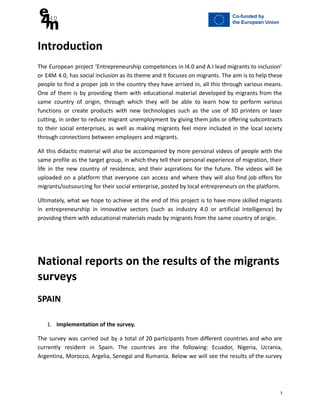
The first thing we can observe is that the respondents who have collaborated in the survey have
turned out to be an equal number of men and women, which can provide us with more
balanced information regarding gender differences in relation to employability.
Graph 1: Gender
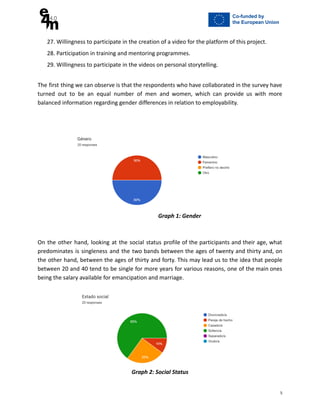
On the other hand, looking at the social status profile of the participants and their age, what
predominates is singleness and the two bands between the ages of twenty and thirty and, on
the other hand, between the ages of thirty and forty. This may lead us to the idea that people
between 20 and 40 tend to be single for more years for various reasons, one of the main ones
being the salary available for emancipation and marriage.
Graph 2: Social Status
5
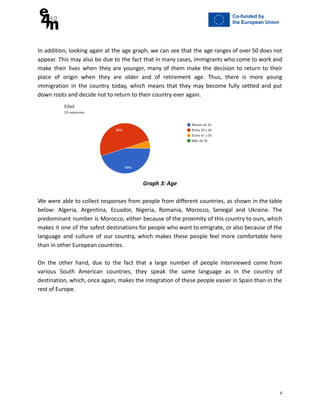
In addition, looking again at the age graph, we can see that the age ranges of over 50 does not
appear. This may also be due to the fact that in many cases, immigrants who come to work and
make their lives when they are younger, many of them make the decision to return to their
place of origin when they are older and of retirement age. Thus, there is more young
immigration in the country today, which means that they may become fully settled and put
down roots and decide not to return to their country ever again.
Graph 3: Age
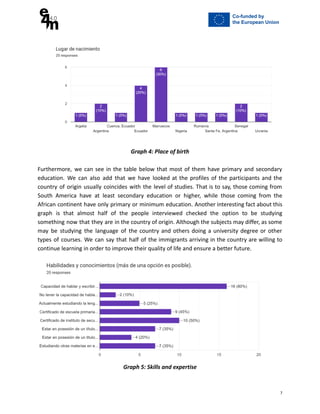
We were able to collect responses from people from different countries, as shown in the table
below: Algeria, Argentina, Ecuador, Nigeria, Romania, Morocco, Senegal and Ukraine. The
predominant number is Morocco, either because of the proximity of this country to ours, which
makes it one of the safest destinations for people who want to emigrate, or also because of the
language and culture of our country, which makes these people feel more comfortable here
than in other European countries.
On the other hand, due to the fact that a large number of people interviewed come from
various South American countries, they speak the same language as in the country of
destination, which, once again, makes the integration of these people easier in Spain than in the
rest of Europe.
6
Graph 4: Place of birth
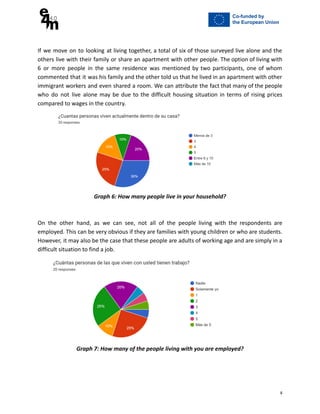
Furthermore, we can see in the table below that most of them have primary and secondary
education. We can also add that we have looked at the profiles of the participants and the
country of origin usually coincides with the level of studies. That is to say, those coming from
South America have at least secondary education or higher, while those coming from the
African continent have only primary or minimum education. Another interesting fact about this
graph is that almost half of the people interviewed checked the option to be studying
something now that they are in the country of origin. Although the subjects may differ, as some
may be studying the language of the country and others doing a university degree or other
types of courses. We can say that half of the immigrants arriving in the country are willing to
continue learning in order to improve their quality of life and ensure a better future.
Graph 5: Skills and expertise
7
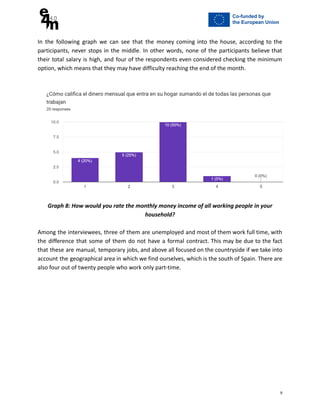
If we move on to looking at living together, a total of six of those surveyed live alone and the
others live with their family or share an apartment with other people. The option of living with
6 or more people in the same residence was mentioned by two participants, one of whom
commented that it was his family and the other told us that he lived in an apartment with other
immigrant workers and even shared a room. We can attribute the fact that many of the people
who do not live alone may be due to the difficult housing situation in terms of rising prices
compared to wages in the country.
Graph 6: How many people live in your household?
On the other hand, as we can see, not all of the people living with the respondents are
employed. This can be very obvious if they are families with young children or who are students.
However, it may also be the case that these people are adults of working age and are simply in a
difficult situation to find a job.
Graph 7: How many of the people living with you are employed?
8
In the following graph we can see that the money coming into the house, according to the
participants, never stops in the middle. In other words, none of the participants believe that
their total salary is high, and four of the respondents even considered checking the minimum
option, which means that they may have difficulty reaching the end of the month.
Graph 8: How would you rate the monthly money income of all working people in your
household?
Among the interviewees, three of them are unemployed and most of them work full time, with
the difference that some of them do not have a formal contract. This may be due to the fact
that these are manual, temporary jobs, and above all focused on the countryside if we take into
account the geographical area in which we find ourselves, which is the south of Spain. There are
also four out of twenty people who work only part-time.
9
Graph 9: What is your current employment situation?
If we turn to the characteristics of the interviewees' workplace, we can observe that 80 percent
of them work in small companies, compared to two who work remotely and two others whose
companies belong to the medium-sized ones. In this case, none of the interviewees belong to
large companies with more than 100 employees.
Graph 10: How would you describe your workplace?
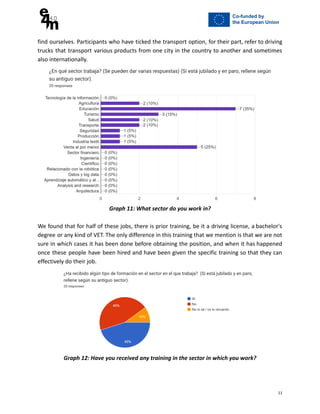
If we look at the majority of respondents, most of them are employed in education and retail. If
we think about it, immigrants who settle in urban centers where there are more immigrants of
the same nationality often decide to set up a business based on the food of their culture or
even with products imported from their country and sell them at retail. As for those who work
in the tourism sector, which includes catering and agriculture, we can agree that in most cases,
these are fields in which there is a greater propensity to work without a contract or for longer
hours than the legal ones, all of this for some of the lowest salaries in the country in which we
10
find ourselves. Participants who have ticked the transport option, for their part, refer to driving
trucks that transport various products from one city in the country to another and sometimes
also internationally.
Graph 11: What sector do you work in?
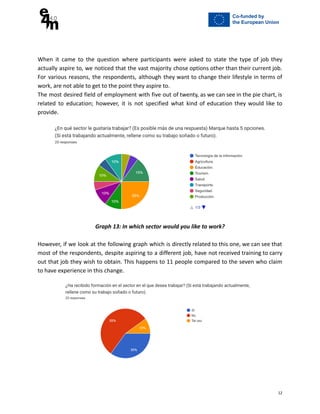
We found that for half of these jobs, there is prior training, be it a driving license, a bachelor's
degree or any kind of VET. The only difference in this training that we mention is that we are not
sure in which cases it has been done before obtaining the position, and when it has happened
once these people have been hired and have been given the specific training so that they can
effectively do their job.
Graph 12: Have you received any training in the sector in which you work?
11
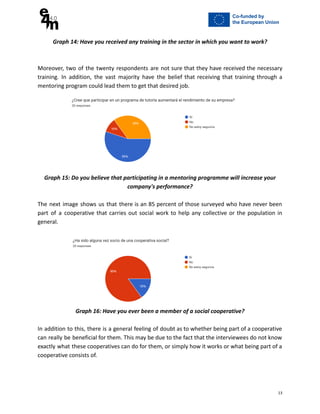
When it came to the question where participants were asked to state the type of job they
actually aspire to, we noticed that the vast majority chose options other than their current job.
For various reasons, the respondents, although they want to change their lifestyle in terms of
work, are not able to get to the point they aspire to.
The most desired field of employment with five out of twenty, as we can see in the pie chart, is
related to education; however, it is not specified what kind of education they would like to
provide.
Graph 13: In which sector would you like to work?
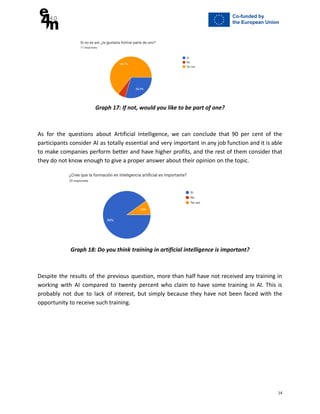
However, if we look at the following graph which is directly related to this one, we can see that
most of the respondents, despite aspiring to a different job, have not received training to carry
out that job they wish to obtain. This happens to 11 people compared to the seven who claim
to have experience in this change.
12
Graph 14: Have you received any training in the sector in which you want to work?
Moreover, two of the twenty respondents are not sure that they have received the necessary
training. In addition, the vast majority have the belief that receiving that training through a
mentoring program could lead them to get that desired job.
Graph 15: Do you believe that participating in a mentoring programme will increase your
company's performance?
The next image shows us that there is an 85 percent of those surveyed who have never been
part of a cooperative that carries out social work to help any collective or the population in
general.
Graph 16: Have you ever been a member of a social cooperative?
In addition to this, there is a general feeling of doubt as to whether being part of a cooperative
can really be beneficial for them. This may be due to the fact that the interviewees do not know
exactly what these cooperatives can do for them, or simply how it works or what being part of a
cooperative consists of.
13
Graph 17: If not, would you like to be part of one?
As for the questions about Artificial Intelligence, we can conclude that 90 per cent of the
participants consider AI as totally essential and very important in any job function and it is able
to make companies perform better and have higher profits, and the rest of them consider that
they do not know enough to give a proper answer about their opinion on the topic.
Graph 18: Do you think training in artificial intelligence is important?
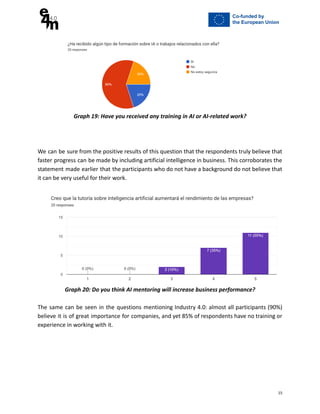
Despite the results of the previous question, more than half have not received any training in
working with AI compared to twenty percent who claim to have some training in AI. This is
probably not due to lack of interest, but simply because they have not been faced with the
opportunity to receive such training.
14
Graph 19: Have you received any training in AI or AI-related work?
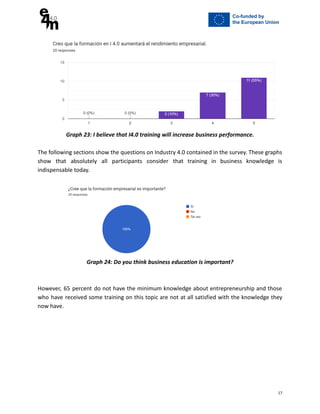
We can be sure from the positive results of this question that the respondents truly believe that
faster progress can be made by including artificial intelligence in business. This corroborates the
statement made earlier that the participants who do not have a background do not believe that
it can be very useful for their work.
Graph 20: Do you think AI mentoring will increase business performance?
The same can be seen in the questions mentioning Industry 4.0: almost all participants (90%)
believe it is of great importance for companies, and yet 85% of respondents have no training or
experience in working with it.
15
Graph 21: Do you think training in Industry 4.0 is important?
This information in the image below confirms that the participants are aware of the advances
that technology and, therefore, companies are undergoing, but that to this day companies do
not offer the advantage of workers learning about how to use those new options to work in the
company and make a profit from this.
Graph 22: Have you received any training or work related to I4.0?
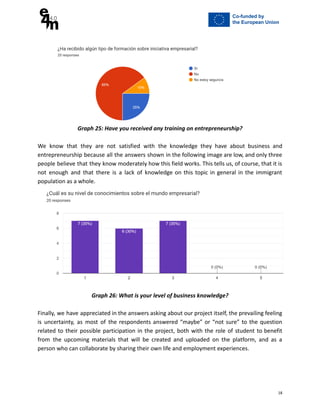
Just as the question on artificial intelligence showed us, respondents believe that Industry 4.0 is
a great advantage for companies to move forward and produce even more benefits than those
that remain unchanged in this type of technology.
16
Graph 23: I believe that I4.0 training will increase business performance.
The following sections show the questions on Industry 4.0 contained in the survey. These graphs
show that absolutely all participants consider that training in business knowledge is
indispensable today.
Graph 24: Do you think business education is important?
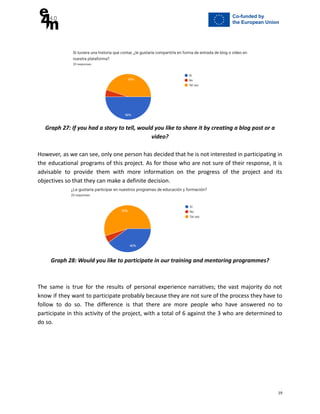
However, 65 percent do not have the minimum knowledge about entrepreneurship and those
who have received some training on this topic are not at all satisfied with the knowledge they
now have.
17
Graph 25: Have you received any training on entrepreneurship?
We know that they are not satisfied with the knowledge they have about business and
entrepreneurship because all the answers shown in the following image are low, and only three
people believe that they know moderately how this field works. This tells us, of course, that it is
not enough and that there is a lack of knowledge on this topic in general in the immigrant
population as a whole.
Graph 26: What is your level of business knowledge?
Finally, we have appreciated in the answers asking about our project itself, the prevailing feeling
is uncertainty, as most of the respondents answered “maybe” or “not sure” to the question
related to their possible participation in the project, both with the role of student to benefit
from the upcoming materials that will be created and uploaded on the platform, and as a
person who can collaborate by sharing their own life and employment experiences.
18
Graph 27: If you had a story to tell, would you like to share it by creating a blog post or a
video?
However, as we can see, only one person has decided that he is not interested in participating in
the educational programs of this project. As for those who are not sure of their response, it is
advisable to provide them with more information on the progress of the project and its
objectives so that they can make a definite decision.
Graph 28: Would you like to participate in our training and mentoring programmes?
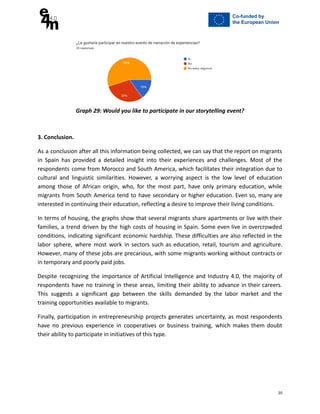
The same is true for the results of personal experience narratives; the vast majority do not
know if they want to participate probably because they are not sure of the process they have to
follow to do so. The difference is that there are more people who have answered no to
participate in this activity of the project, with a total of 6 against the 3 who are determined to
do so.
19
Graph 29: Would you like to participate in our storytelling event?
3. Conclusion.
As a conclusion after all this information being collected, we can say that the report on migrants
in Spain has provided a detailed insight into their experiences and challenges. Most of the
respondents come from Morocco and South America, which facilitates their integration due to
cultural and linguistic similarities. However, a worrying aspect is the low level of education
among those of African origin, who, for the most part, have only primary education, while
migrants from South America tend to have secondary or higher education. Even so, many are
interested in continuing their education, reflecting a desire to improve their living conditions.
In terms of housing, the graphs show that several migrants share apartments or live with their
families, a trend driven by the high costs of housing in Spain. Some even live in overcrowded
conditions, indicating significant economic hardship. These difficulties are also reflected in the
labor sphere, where most work in sectors such as education, retail, tourism and agriculture.
However, many of these jobs are precarious, with some migrants working without contracts or
in temporary and poorly paid jobs.
Despite recognizing the importance of Artificial Intelligence and Industry 4.0, the majority of
respondents have no training in these areas, limiting their ability to advance in their careers.
This suggests a significant gap between the skills demanded by the labor market and the
training opportunities available to migrants.
Finally, participation in entrepreneurship projects generates uncertainty, as most respondents
have no previous experience in cooperatives or business training, which makes them doubt
their ability to participate in initiatives of this type.
20
ITALY
Migration has become an integral part of many societies, bringing diverse cultures, skills, and
perspectives. However, migrants often face unique challenges and barriers that can hinder their
integration and overall well-being. To better understand the needs, competences and migrants’
skills, we conducted a comprehensive survey targeting migrants in our community.
This study was conducted in Italy on 34 persons with diverse migratory background, from
September 2024 till October 2024. Data has been anonymized.
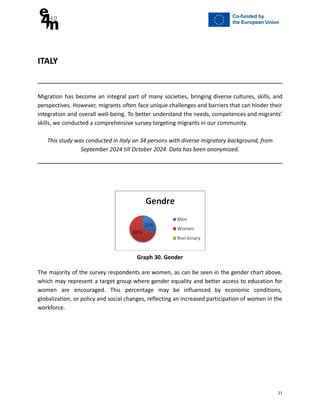
Graph 30. Gender
The majority of the survey respondents are women, as can be seen in the gender chart above,
which may represent a target group where gender equality and better access to education for
women are encouraged. This percentage may be influenced by economic conditions,
globalization, or policy and social changes, reflecting an increased participation of women in the
workforce.
21
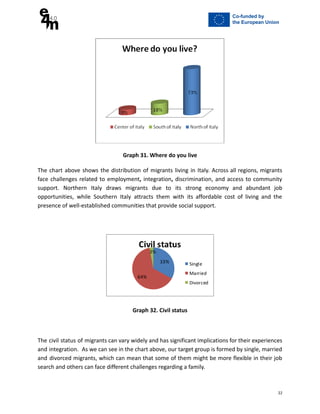
Graph 31. Where do you live
The chart above shows the distribution of migrants living in Italy. Across all regions, migrants
face challenges related to employment, integration, discrimination, and access to community
support. Northern Italy draws migrants due to its strong economy and abundant job
opportunities, while Southern Italy attracts them with its affordable cost of living and the
presence of well-established communities that provide social support.
Graph 32. Civil status
The civil status of migrants can vary widely and has significant implications for their experiences
and integration. As we can see in the chart above, our target group is formed by single, married
and divorced migrants, which can mean that some of them might be more flexible in their job
search and others can face different challenges regarding a family.
22
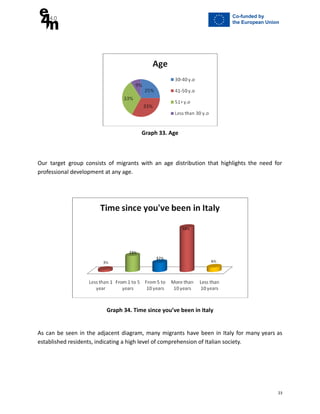
Graph 33. Age
Our target group consists of migrants with an age distribution that highlights the need for
professional development at any age.
Graph 34. Time since you’ve been in Italy
As can be seen in the adjacent diagram, many migrants have been in Italy for many years as
established residents, indicating a high level of comprehension of Italian society.
23
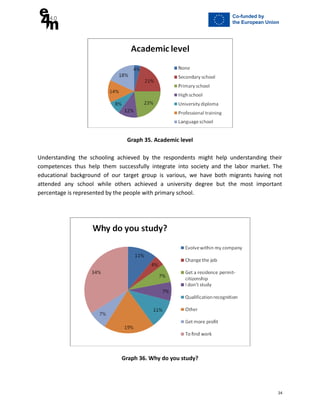
Graph 35. Academic level
Understanding the schooling achieved by the respondents might help understanding their
competences thus help them successfully integrate into society and the labor market. The
educational background of our target group is various, we have both migrants having not
attended any school while others achieved a university degree but the most important
percentage is represented by the people with primary school.
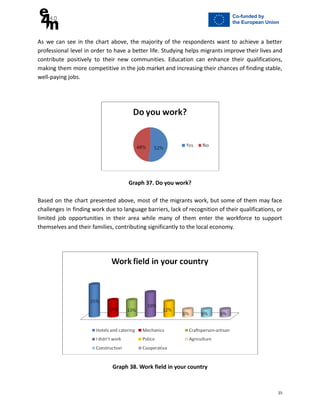
Graph 36. Why do you study?
24
As we can see in the chart above, the majority of the respondents want to achieve a better
professional level in order to have a better life. Studying helps migrants improve their lives and
contribute positively to their new communities. Education can enhance their qualifications,
making them more competitive in the job market and increasing their chances of finding stable,
well-paying jobs.
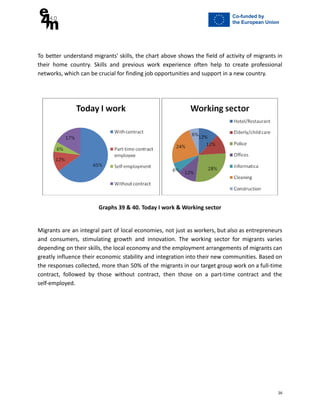
Graph 37. Do you work?
Based on the chart presented above, most of the migrants work, but some of them may face
challenges in finding work due to language barriers, lack of recognition of their qualifications, or
limited job opportunities in their area while many of them enter the workforce to support
themselves and their families, contributing significantly to the local economy.
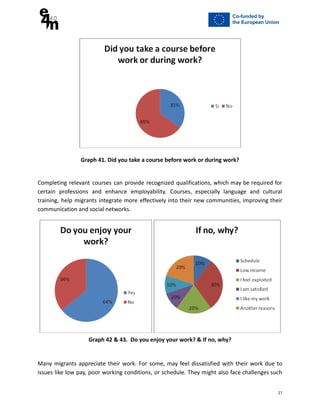
Graph 38. Work field in your country
25
To better understand migrants' skills, the chart above shows the field of activity of migrants in
their home country. Skills and previous work experience often help to create professional
networks, which can be crucial for finding job opportunities and support in a new country.
Graphs 39 & 40. Today I work & Working sector
Migrants are an integral part of local economies, not just as workers, but also as entrepreneurs
and consumers, stimulating growth and innovation. The working sector for migrants varies
depending on their skills, the local economy and the employment arrangements of migrants can
greatly influence their economic stability and integration into their new communities. Based on
the responses collected, more than 50% of the migrants in our target group work on a full-time
contract, followed by those without contract, then those on a part-time contract and the
self-employed.
26
Graph 41. Did you take a course before work or during work?
Completing relevant courses can provide recognized qualifications, which may be required for
certain professions and enhance employability. Courses, especially language and cultural
training, help migrants integrate more effectively into their new communities, improving their
communication and social networks.
Graph 42 & 43. Do you enjoy your work? & If no, why?
Many migrants appreciate their work. For some, may feel dissatisfied with their work due to
issues like low pay, poor working conditions, or schedule. They might also face challenges such
27
as discrimination or difficulties integrating into the local culture, which can further impact their
job satisfaction.
Graph 44. What industry would you like to work in?
This chart highlights the varied preferences of migrants in the workforce. By identifying and
pursuing work in industries that align with their values and needs, migrants can enhance their
overall well-being, contribute positively to their communities, and create a fulfilling life in their
new surroundings. This positive engagement in their job often leads to higher levels of
motivation and productivity, which can result in completing tasks more efficiently.
Graph 45. I think I would work better if I had more training
28
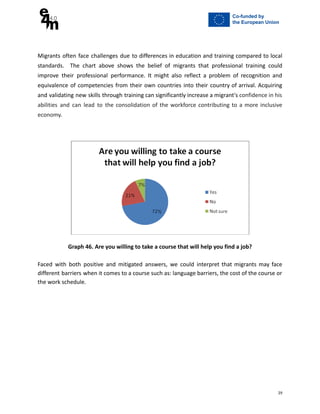
Migrants often face challenges due to differences in education and training compared to local
standards. The chart above shows the belief of migrants that professional training could
improve their professional performance. It might also reflect a problem of recognition and
equivalence of competencies from their own countries into their country of arrival. Acquiring
and validating new skills through training can significantly increase a migrant's confidence in his
abilities and can lead to the consolidation of the workforce contributing to a more inclusive
economy.
Graph 46. Are you willing to take a course that will help you find a job?
Faced with both positive and mitigated answers, we could interpret that migrants may face
different barriers when it comes to a course such as: language barriers, the cost of the course or
the work schedule.
29
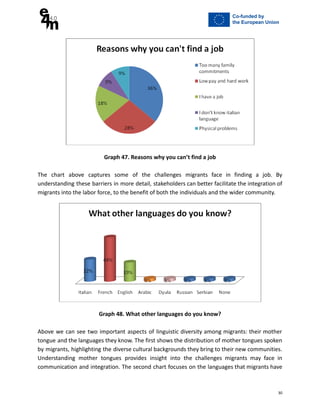
Graph 47. Reasons why you can’t find a job
The chart above captures some of the challenges migrants face in finding a job. By
understanding these barriers in more detail, stakeholders can better facilitate the integration of
migrants into the labor force, to the benefit of both the individuals and the wider community.
Graph 48. What other languages do you know?
Above we can see two important aspects of linguistic diversity among migrants: their mother
tongue and the languages they know. The first shows the distribution of mother tongues spoken
by migrants, highlighting the diverse cultural backgrounds they bring to their new communities.
Understanding mother tongues provides insight into the challenges migrants may face in
communication and integration. The second chart focuses on the languages that migrants have
30
learned, highlighting their adaptability and their efforts to integrate into the host society. These
not only increase employability and social interactions, but also enable migrants to enter their
new life with more confidence.
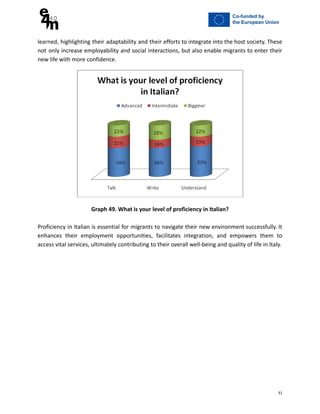
Graph 49. What is your level of proficiency in Italian?
Proficiency in Italian is essential for migrants to navigate their new environment successfully. It
enhances their employment opportunities, facilitates integration, and empowers them to
access vital services, ultimately contributing to their overall well-being and quality of life in Italy.
31
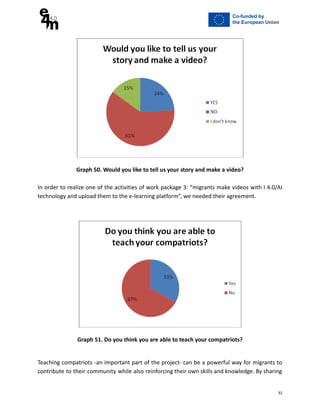
Graph 50. Would you like to tell us your story and make a video?
In order to realize one of the activities of work package 3: “migrants make videos with I 4.0/AI
technology and upload them to the e-learning platform”, we needed their agreement.
Graph 51. Do you think you are able to teach your compatriots?
Teaching compatriots -an important part of the project- can be a powerful way for migrants to
contribute to their community while also reinforcing their own skills and knowledge. By sharing
32
language, cultural insights, and practical skills, they can play a vital role in helping fellow
migrants thrive in their new environment, fostering a sense of solidarity within the community.
Graph 52. Would you like to participate in our education and training programs?
The chart above emphasizes a significant interest in education and training programs,
suggesting that there is a strong desire among migrants to enhance their skills and improve
their employability.
Tell us something about yourself and your goals or dreams.
● I am 26 years old; I have been living in Italy for 19 years and my future goals are to grow
personally and professionally.Going back to Ukraine
● I am a courageous and ambitious person.
● Better quality of life
● I dream to work in the trades sector
● I would like to study again, change jobs as well and I would like to get a truck license for
a change of situation.
● My dream is to work for myself, open my own store because I had the experience in this
area. I took the drawing course, pattern making and tailoring academy.
● Thank you for the opportunity to express my thoughts. At the moment, I don't have a
clear dream, but I often think about the past and the future. Therefore, I intend to
return to my favorite job.
● I like to work.
33
TÜRKIYE
Implementation of the survey.
The survey was carried out by a total of 35 participants from different countries and who are
currently resident in Turkey. The countries are various but mostly Syria.
Below we will see the results of the survey through different tables and graphs on which we will
be able to comment and draw different conclusions. The different graphs and images found in
this document are as follows:
1. Gender
2. Region of residence in Turkey
3. Social status
4. Age
5. Mother country
6. Time spent in Turkey
7. Skills and expertise of the respondents.
7.1. Academic level in homeland
7.2. School or education in Turkey
8. The reason to study
9. Current employment status of the respondent.
10. Old occupation in the homeland
11. Occupation in Turkey
12. Sector in which the respondent works.
13. Training received for the job the respondent currently holds.
14. The degree to which the respondent likes his/her job
14.1. Liking job
14.2.The reason of not to like the job
15. Sector in which the respondent aspires to work in the future.
16. Training that the respondent has about the job he/she aspires to.
16.1. Better job if educated or trained more.
16.2. The sector that the respondent wants to work
16.3. Willingness to join a course to find a job
17. The reason for not finding a job.
34
18. Languages
18.1.The mother tongue
18.2.Other languages
18.3.Turkish knowledge
19. Willingness to participate in the videos on personal storytelling.
20. Capability to train other citizens from your homeland
21. Willingness to participate our education and training programmes
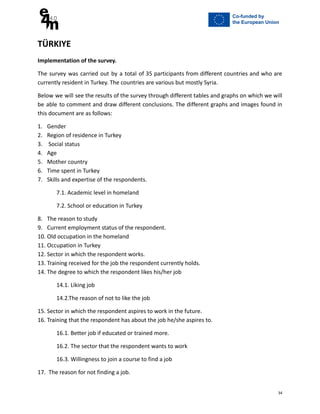
1. Gender
Graph 53. Gender
The majority of the survey respondents are men, as can be seen in the gender chart above,
which may represent a target group where women are underrepresented. This unbalanced
percentage may be influenced by economic factors, social conditions or cultural norms.
35
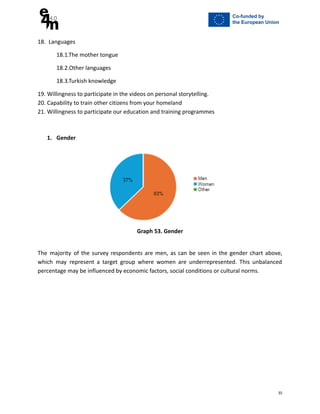
2. Region of residence in Turkey
Graph 54. Region of residence in Türkiye
It can be interpreted from the diagram that most of the respondents are living in the east of
Turkey, which is because of the fact that the organization is founded in the east of Turkey.
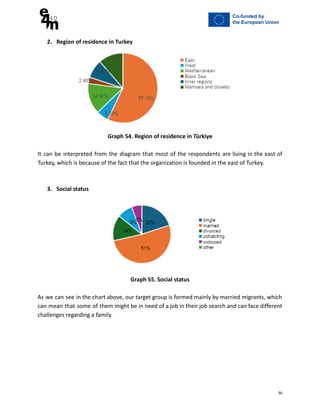
3. Social status
Graph 55. Social status
As we can see in the chart above, our target group is formed mainly by married migrants, which
can mean that some of them might be in need of a job in their job search and can face different
challenges regarding a family.
36
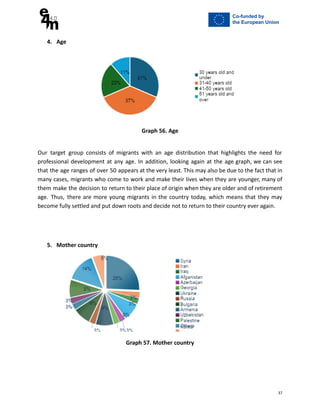
4. Age
Graph 56. Age
Our target group consists of migrants with an age distribution that highlights the need for
professional development at any age. In addition, looking again at the age graph, we can see
that the age ranges of over 50 appears at the very least. This may also be due to the fact that in
many cases, migrants who come to work and make their lives when they are younger, many of
them make the decision to return to their place of origin when they are older and of retirement
age. Thus, there are more young migrants in the country today, which means that they may
become fully settled and put down roots and decide not to return to their country ever again.
5. Mother country
Graph 57. Mother country
37
We were able to collect responses from people from different countries, as shown in the table
above: Syria, Iran, Iraq, Afghanistan, Azerbaijan, Georgia,Russia, Bulgaria, Armenia, Uzbekistan,
Palestine, Korea, Ukraine and many other countries. The predominant number is Syria, because
of the migration after the Syrian war.
On the other hand, due to the fact that a large number of people interviewed come from
various Asian, Turki and Muslim countries, they speak the same language as in the country of
destination, and they have the same religion which, once again, makes the integration of these
people easier in Turkey than in the rest of Europe.
6. Time spent in Turkey
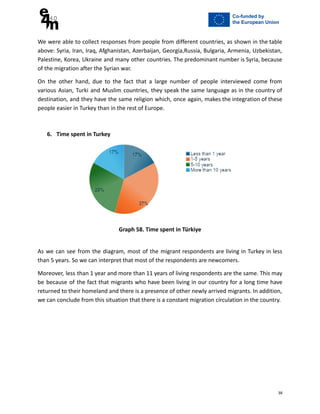
Graph 58. Time spent in Türkiye
As we can see from the diagram, most of the migrant respondents are living in Turkey in less
than 5 years. So we can interpret that most of the respondents are newcomers.
Moreover, less than 1 year and more than 11 years of living respondents are the same. This may
be because of the fact that migrants who have been living in our country for a long time have
returned to their homeland and there is a presence of other newly arrived migrants. In addition,
we can conclude from this situation that there is a constant migration circulation in the country.
38
7. Skills and expertise of the respondents.
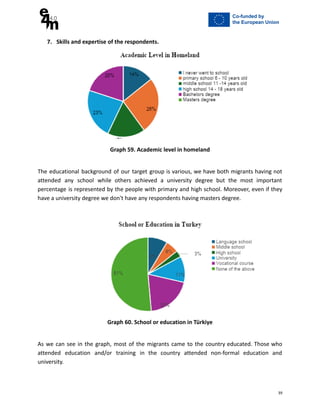
Graph 59. Academic level in homeland
The educational background of our target group is various, we have both migrants having not
attended any school while others achieved a university degree but the most important
percentage is represented by the people with primary and high school. Moreover, even if they
have a university degree we don't have any respondents having masters degree.
Graph 60. School or education in Türkiye
As we can see in the graph, most of the migrants came to the country educated. Those who
attended education and/or training in the country attended non-formal education and
university.
39
8. The reason to study
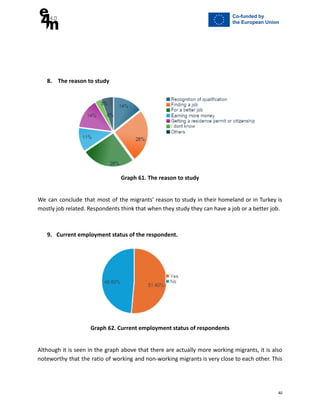
Graph 61. The reason to study
We can conclude that most of the migrants’ reason to study in their homeland or in Turkey is
mostly job related. Respondents think that when they study they can have a job or a better job.
9. Current employment status of the respondent.
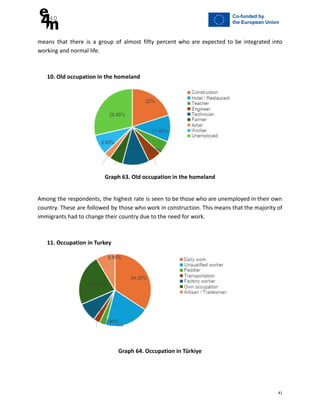
Graph 62. Current employment status of respondents
Although it is seen in the graph above that there are actually more working migrants, it is also
noteworthy that the ratio of working and non-working migrants is very close to each other. This
40
means that there is a group of almost fifty percent who are expected to be integrated into
working and normal life.
10. Old occupation in the homeland
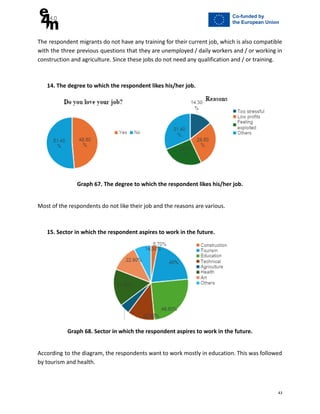
Graph 63. Old occupation in the homeland
Among the respondents, the highest rate is seen to be those who are unemployed in their own
country. These are followed by those who work in construction. This means that the majority of
immigrants had to change their country due to the need for work.
11. Occupation in Turkey
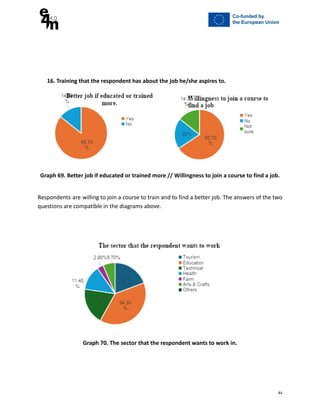
Graph 64. Occupation in Türkiye
41
Most of the migrants are working as a daily or unqualified worker in the country, which can be
because of the fact that they do not have any training or qualifications. If they are given any
training or education in the country after the Project activities they may probably have better
jobs. Since it seems that there are no educated migrants who have been working better and / or
qualified jobs.
12. Sector in which the respondent works.
Graph 65. Sector in which the respondents work
The respondents are mostly working in the fields of agriculture and construction, which is also
compatible with the two previous questions that they are unemployed / daily workers and / or
working in construction and agriculture.
13. Training received for the job the respondent currently holds.
Graph 66. Training received for the job the respondent currently holds.
42
The respondent migrants do not have any training for their current job, which is also compatible
with the three previous questions that they are unemployed / daily workers and / or working in
construction and agriculture. Since these jobs do not need any qualification and / or training.
14. The degree to which the respondent likes his/her job.
Graph 67. The degree to which the respondent likes his/her job.
Most of the respondents do not like their job and the reasons are various.
15. Sector in which the respondent aspires to work in the future.
Graph 68. Sector in which the respondent aspires to work in the future.
According to the diagram, the respondents want to work mostly in education. This was followed
by tourism and health.
43
16. Training that the respondent has about the job he/she aspires to.
Graph 69. Better job if educated or trained more // Willingness to join a course to find a job.
Respondents are willing to join a course to train and to find a better job. The answers of the two
questions are compatible in the diagrams above.
Graph 70. The sector that the respondent wants to work in.
44
According to the diagram, the respondents want to work mostly in education. This was followed
by tourism, technical and health. This is also compatible with question number 15.
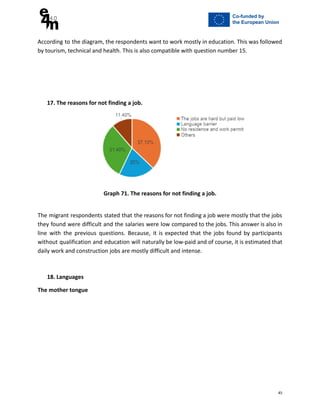
17. The reasons for not finding a job.
Graph 71. The reasons for not finding a job.
The migrant respondents stated that the reasons for not finding a job were mostly that the jobs
they found were difficult and the salaries were low compared to the jobs. This answer is also in
line with the previous questions. Because, it is expected that the jobs found by participants
without qualification and education will naturally be low-paid and of course, it is estimated that
daily work and construction jobs are mostly difficult and intense.
18. Languages
The mother tongue
45
Graph 72. Languages as mother tongue
When we look at the graph, we see that the native language of the respondents is mostly
Arabic. Considering that we have the most Syrian participants, we have reached the expected
answer.
Other languages
Graph 73. Other lamguages
When we look at the graph, we see that the respondents speak Turkish and English as their
second languages.
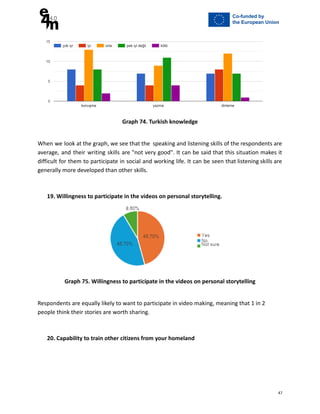
Turkish knowledge
46
Graph 74. Turkish knowledge
When we look at the graph, we see that the speaking and listening skills of the respondents are
average, and their writing skills are "not very good". It can be said that this situation makes it
difficult for them to participate in social and working life. It can be seen that listening skills are
generally more developed than other skills.
19. Willingness to participate in the videos on personal storytelling.
Graph 75. Willingness to participate in the videos on personal storytelling
Respondents are equally likely to want to participate in video making, meaning that 1 in 2
people think their stories are worth sharing.
20. Capability to train other citizens from your homeland
47
Graph 76. Capability to train other citizens from your homeland
More than half of the respondents were not sure about their competence in training others.
Only twenty percent of our respondents stated that they could train other citizens.
21. Willingness to participate our education and training programmes
Graph 77. Willingness to participate our education and training programmes
Almost half of the respondents were not sure about attending the training. Fortunately, only
twenty percent said no and the other respondents will be contacted again when the training
starts and included in the programmes.
48
GREECE
As a gateway to Europe, Greece has been at the forefront of migration flows, particularly since
the early 1990s and during the more recent refugee crisis. These waves of migration have
brought diverse populations seeking safety, stability, and opportunity, while also presenting
challenges for their inclusion in Greek society.
The aim of the project is to help immigrants to find a proper job in the host country. Through
this report we want to gather information about the background of immigrants (how much time
they are in the host country, education, if they are working or not, etc.) to better understand
the difficulties they may have and how willing they are to learn new methods in order to gain
more skills in entrepreneurship.
The following study conducted in Greece on 32 persons with immigrant past from October 2024
till November 2024.
Graph 78. Gender
Αs we can see in the graph above, the highest percentage of respondents to the questionnaire
were men. Τhis can be explained in many ways, such as for example men coming to the country
to work and support their family back in their country of origin, as we encountered many such
cases in our questionnaires.
49
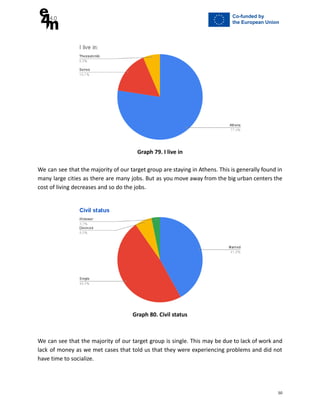
Graph 79. I live in
We can see that the majority of our target group are staying in Athens. This is generally found in
many large cities as there are many jobs. But as you move away from the big urban centers the
cost of living decreases and so do the jobs.
Graph 80. Civil status
We can see that the majority of our target group is single. This may be due to lack of work and
lack of money as we met cases that told us that they were experiencing problems and did not
have time to socialize.
50
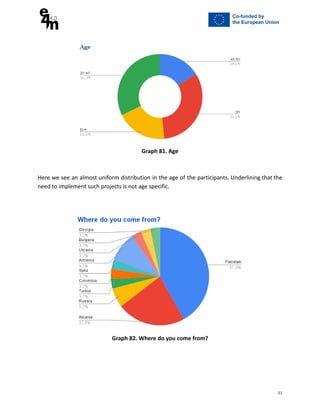
Graph 81. Age
Here we see an almost uniform distribution in the age of the participants. Underlining that the
need to implement such projects is not age specific.
Graph 82. Where do you come from?
51
To the question of where you come from we find different answers but the majority come from
the country of Albania as the country borders with Greece and from the country of Pakistan
where in recent years the need of the people for a better tomorrow makes them change
continents.
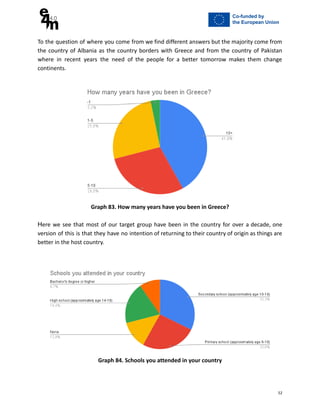
Graph 83. How many years have you been in Greece?
Ηere we see that most of our target group have been in the country for over a decade, one
version of this is that they have no intention of returning to their country of origin as things are
better in the host country.
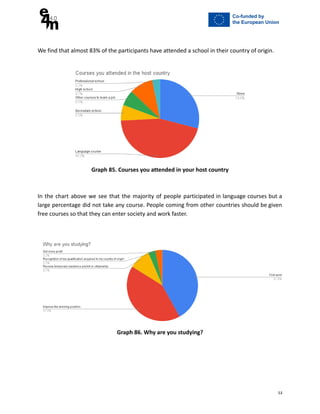
Graph 84. Schools you attended in your country
52
We find that almost 83% of the participants have attended a school in their country of origin.
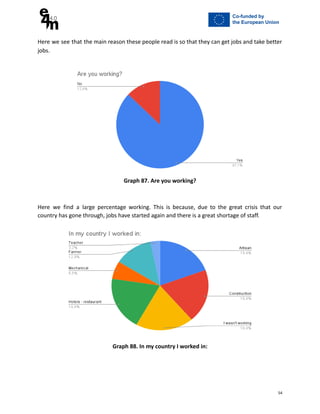
Graph 85. Courses you attended in your host country
In the chart above we see that the majority of people participated in language courses but a
large percentage did not take any course. People coming from other countries should be given
free courses so that they can enter society and work faster.
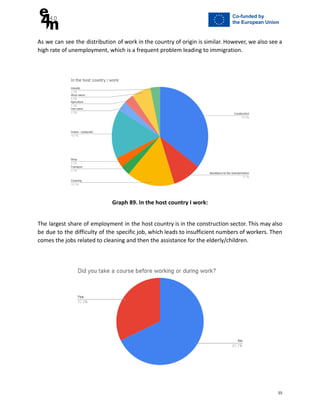
Graph 86. Why are you studying?
53
Here we see that the main reason these people read is so that they can get jobs and take better
jobs.
Graph 87. Are you working?
Here we find a large percentage working. This is because, due to the great crisis that our
country has gone through, jobs have started again and there is a great shortage of staff.
Graph 88. In my country I worked in:
54
As we can see the distribution of work in the country of origin is similar. However, we also see a
high rate of unemployment, which is a frequent problem leading to immigration.
Graph 89. In the host country I work:
The largest share of employment in the host country is in the construction sector. This may also
be due to the difficulty of the specific job, which leads to insufficient numbers of workers. Then
comes the jobs related to cleaning and then the assistance for the elderly/children.
55
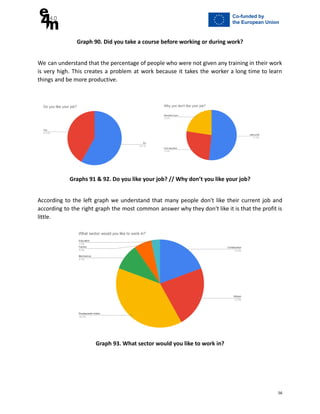
Graph 90. Did you take a course before working or during work?
We can understand that the percentage of people who were not given any training in their work
is very high. This creates a problem at work because it takes the worker a long time to learn
things and be more productive.
Graphs 91 & 92. Do you like your job? // Why don’t you like your job?
According to the left graph we understand that many people don't like their current job and
according to the right graph the most common answer why they don't like it is that the profit is
little.
Graph 93. What sector would you like to work in?
56
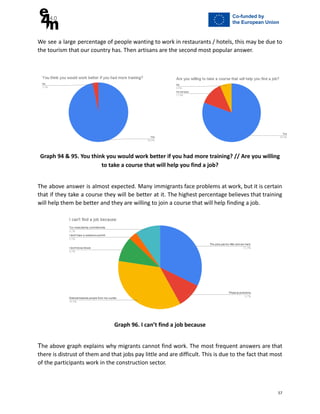
We see a large percentage of people wanting to work in restaurants / hotels, this may be due to
the tourism that our country has. Then artisans are the second most popular answer.
Graph 94 & 95. You think you would work better if you had more training? // Are you willing
to take a course that will help you find a job?
The above answer is almost expected. Many immigrants face problems at work, but it is certain
that if they take a course they will be better at it. The highest percentage believes that training
will help them be better and they are willing to join a course that will help finding a job.
Graph 96. I can’t find a job because
Τhe above graph explains why migrants cannot find work. The most frequent answers are that
there is distrust of them and that jobs pay little and are difficult. This is due to the fact that most
of the participants work in the construction sector.
57
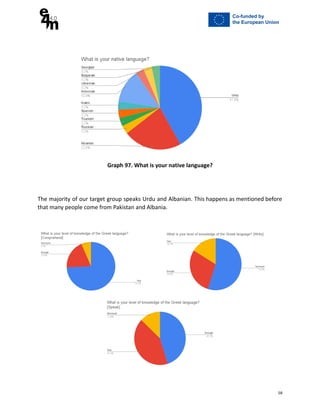
Graph 97. What is your native language?
The majority of our target group speaks Urdu and Albanian. This happens as mentioned before
that many people come from Pakistan and Albania.
58
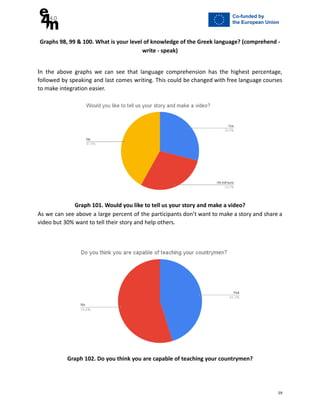
Graphs 98, 99 & 100. What is your level of knowledge of the Greek language? (comprehend -
write - speak)
Ιn the above graphs we can see that language comprehension has the highest percentage,
followed by speaking and last comes writing. This could be changed with free language courses
to make integration easier.
Graph 101. Would you like to tell us your story and make a video?
As we can see above a large percent of the participants don’t want to make a story and share a
video but 30% want to tell their story and help others.
Graph 102. Do you think you are capable of teaching your countrymen?
59
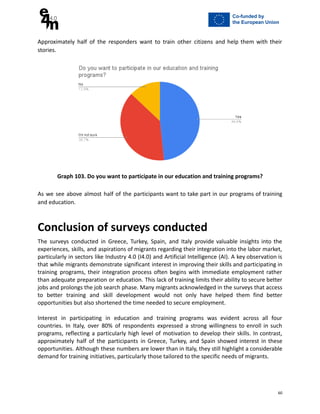
Approximately half of the responders want to train other citizens and help them with their
stories.
Graph 103. Do you want to participate in our education and training programs?
As we see above almost half of the participants want to take part in our programs of training
and education.
Conclusion of surveys conducted
The surveys conducted in Greece, Turkey, Spain, and Italy provide valuable insights into the
experiences, skills, and aspirations of migrants regarding their integration into the labor market,
particularly in sectors like Industry 4.0 (I4.0) and Artificial Intelligence (AI). A key observation is
that while migrants demonstrate significant interest in improving their skills and participating in
training programs, their integration process often begins with immediate employment rather
than adequate preparation or education. This lack of training limits their ability to secure better
jobs and prolongs the job search phase. Many migrants acknowledged in the surveys that access
to better training and skill development would not only have helped them find better
opportunities but also shortened the time needed to secure employment.
Interest in participating in education and training programs was evident across all four
countries. In Italy, over 80% of respondents expressed a strong willingness to enroll in such
programs, reflecting a particularly high level of motivation to develop their skills. In contrast,
approximately half of the participants in Greece, Turkey, and Spain showed interest in these
opportunities. Although these numbers are lower than in Italy, they still highlight a considerable
demand for training initiatives, particularly those tailored to the specific needs of migrants.
60
When asked about their potential to teach their compatriots, responses varied across the
countries but revealed an encouraging level of willingness. In Greece, 45% of the respondents
felt confident about teaching others from their country of origin, while in Turkey, 20% of
participants shared this sentiment. In Italy, the figure was 33%, and in Spain, where a slightly
different version of the question was asked, 15% expressed interest. These results suggest that
while not all migrants feel prepared to take on a teaching role, there is a subset in every country
with the confidence and capability to share their knowledge, which could be leveraged to create
peer-to-peer training programs.
Another aspect explored in the surveys was the willingness to share personal stories of
migration and integration through video storytelling. In Turkey, 45% of participants expressed
interest in sharing their stories, reflecting the highest level of enthusiasm among the four
countries. Spain followed closely, with 40% of participants open to the idea, while Greece and
Italy reported lower levels of interest, at 29% and 24% respectively. Despite the variations,
these responses underline the importance of creating platforms for migrants to voice their
experiences, which can help foster understanding and inclusion in their host societies.
One recurring theme across all countries was the lack of sufficient training upon arrival in the
host country. Migrants often begin working immediately, even in sectors unrelated to their
skills, without receiving adequate preparation. This approach not only limits their opportunities
to advance professionally but also restricts their ability to transition into roles in innovative
sectors such as I4.0 and AI. There is strong evidence from the surveys that migrants believe
enhanced training and skill development would significantly improve their employment
prospects and facilitate faster integration into the job market. This highlights a critical gap that
the E4M 4.0 project seeks to address by providing accessible, tailored training and resources.
In summary, the findings from the four countries demonstrate a shared interest among migrants
in improving their skills and a recognition of the need for better training. While there are
differences in willingness to participate in teaching or storytelling, these variations present
opportunities to design targeted initiatives that cater to specific contexts. Importantly, the
results underscore the urgent need to shift from a reactive approach to migrant employment
toward proactive skill-building and empowerment, aligning with the goals of the E4M 4.0
project.
Comparison with EU situation on skills and
needs of migrants
In this section, we compare the results of the needs analysis from Greece, Italy, Turkey, and
Spain with the broader EU situation regarding the skills and needs of migrants in the context of
Industry 4.0 (I4.0) and Artificial Intelligence (AI).
61
According to the latest reports by the European Commission, there has been a growing
emphasis on the integration of migrants into innovative sectors, particularly I4.0 and AI. The EU
has identified several key trends and challenges:
● Digital Skills Gap: Across the EU, a significant skills gap persists among migrants,
particularly in the digital and technological fields. Many migrants lack formal education
or training in I4.0 technologies (e.g., robotics, automation, data analytics) and AI, which
limits their employability in these sectors.
● Barriers to Employment: Common barriers identified at the EU level include language
difficulties, lack of recognition of qualifications, limited access to vocational training, and
insufficient support for entrepreneurship. These challenges hinder the full participation
of migrants in the digital economy.
● Growing Demand for I4.0 and AI Skills: The EU labor market is increasingly demanding
skills in advanced manufacturing, AI, and digital literacy. The EU’s Digital Education
Action Plan and initiatives like the "Skills Agenda for Europe" highlight the need for
upskilling and reskilling programs tailored to migrants.
The national reports from Greece, Italy, Turkey, and Spain reveal several similarities and
differences when compared to the EU-wide situation:
In regard to the Skills Gaps Alignment, the identified skills gaps in the national reports align with
EU trends. Migrants in all participating countries show a significant lack of digital and technical
skills required for I4.0 and AI roles. Notably, while basic digital literacy (e.g., use of smartphones,
basic software) is relatively common among migrants, advanced skills (e.g., data analysis, AI
programming, 3D printing) are rare, mirroring EU-wide findings.
On the same hand, language remains a major barrier across all countries. Migrants reported
difficulty accessing training materials in their native languages, an issue that is highlighted in EU
reports as well. This supports the project’s focus on creating educational content in migrants'
native languages to enhance accessibility. Cultural differences and a lack of understanding of
the local business environment also limit the ability of migrants to start or join entrepreneurial
ventures in I4.0 and AI sectors.
Besides, the EU’s emphasis on fostering entrepreneurship among migrants is reflected in the
national findings. However, the reports suggest that local initiatives are often insufficiently
tailored to the specific needs of migrant populations, particularly regarding access to funding
and mentoring in innovative sectors. In comparison with the EU strategy, there is a noticeable
lack of structured support in the national contexts for promoting migrant-led social
cooperatives, which the E4M 4.0 project aims to address.
62
Last but not least, while the demand for I4.0 and AI skills is rising across the EU, the specific
needs vary by region. For example, in Italy and Spain, there is a greater emphasis on skills
related to digital marketing and e-commerce, whereas Greece and Turkey show a stronger need
for skills in manufacturing technologies and automation.
There is evidence that highly-skilled migrant labour has the potential to raise competitiveness
significantly and in theory this may feed into productivity (Huber, P., Landesmann, M., Robinson,
C., & Stehrer, R., 2010), this is one of the main reasons why we should put all our efforts on
their training within the E4M 4.0 Erasmus+ project..
The comparison highlights several gaps between national realities and EU-level strategies:
There is a need for more targeted training programs that address the specific technical skills
gaps identified in each country while aligning with EU digital skills frameworks. Moreover,
EU-level support for the recognition of migrants’ informal and non-formal learning could help
bridge the qualification gaps observed in the national reports. Hence, greater efforts are
required to enhance language support and provide culturally relevant training materials, as
emphasized by both national findings and EU-wide recommendations.
In conclusion, the national findings broadly align with the EU situation, but they also reveal
specific regional needs and barriers that must be addressed to effectively upskill migrants and
integrate them into the I4.0 and AI sectors. The E4M 4.0 project’s focus on tailored educational
content and support for social enterprises is well-positioned to bridge these gaps and enhance
migrant inclusion across the partner countries. Several studies indicate that highly-educated
migrants positively impact innovation in European industries, with stronger effects in those with
low overeducation, high FDIs, and openness to trade, and higher ethnic diversity (Fassio, C.,
Montobbio, F., & Venturini, A., 2019) .
63
Bibliography
Antonazzo, L., Stroud, D., & Weinel, M. (2021). Institutional complementarities and
technological transformation: IVET responsiveness to Industry 4.0 – meeting emerging skill
needs in the European steel industry. Economic and Industrial Democracy, 44, 25 - 46.
https://doi.org/10.1177/0143831X211059227.
Fassio, C., Montobbio, F., & Venturini, A. (2019). Skilled migration and innovation in European
industries. Research Policy. https://doi.org/10.1016/j.respol.2018.11.002.
Huber, P., Landesmann, M., Robinson, C., & Stehrer, R. (2010). Migrants' Skills and Productivity:
A European Perspective. National Institute Economic Review, 213, R20 - R34.
https://doi.org/10.1177/0027950113803222.
Svobodová, L., Hedvicaková, M., & Kuznetsova, A. (2019). Education Needs in Context of
Migration and Industry 4.0 in Selected EU Countries. , 89-98.
https://doi.org/10.1007/978-3-030-38778-5_12.
Tountopoulou, M., Vlachaki, F., & Triantafillopoulou, M. (2021). Universal Skills Framework for
Migrants, Asylum Seekers and Refugees – A Mapping on the Required Skills While Entering the
European Labour Market. International journal of social science studies, 9, 34.
https://doi.org/10.11114/IJSSS.V9I3.5181.
64
65

Need analysis and comparison with EU situation

  • 1.
    E4M 4.0 WP2. Curriculumof migrant entrepreneur T2.6 Need analysis and comparison with EU situation 2023-1-EL01-KA220-ADU-000159147
  • 2.
    INDEX Introduction 3 National reportson the results of the migrants surveys 3 SPAIN 3 ITALY 21 TÜRKIYE 34 GREECE 48 Conclusion of surveys conducted 60 Comparison with EU situation on skills and needs of migrants 61 Bibliography 64 Funded by the European Union. Views and opinions expressed are however those of the author(s) only and do not necessarily reflect those of the European Union or the European Education and Culture Executive Agency (EACEA). Neither the European Union nor EACEA can be held responsible for them. 2
  • 3.
    Introduction The European project‘Entrepreneurship competences in I4.0 and A.I lead migrants to inclusion’ or E4M 4.0, has social inclusion as its theme and it focuses on migrants. The aim is to help these people to find a proper job in the country they have arrived in, all this through various means. One of them is by providing them with educational material developed by migrants from the same country of origin, through which they will be able to learn how to perform various functions or create products with new technologies such as the use of 3D printers or laser cutting, in order to reduce migrant unemployment by giving them jobs or offering subcontracts to their social enterprises, as well as making migrants feel more included in the local society through connections between employers and migrants. All this didactic material will also be accompanied by more personal videos of people with the same profile as the target group, in which they tell their personal experience of migration, their life in the new country of residence, and their aspirations for the future. The videos will be uploaded on a platform that everyone can access and where they will also find job offers for migrants/outsourcing for their social enterprise, posted by local entrepreneurs on the platform. Ultimately, what we hope to achieve at the end of this project is to have more skilled migrants in entrepreneurship in innovative sectors (such as industry 4.0 or artificial intelligence) by providing them with educational materials made by migrants from the same country of origin. National reports on the results of the migrants surveys SPAIN 1. Implementation of the survey. The survey was carried out by a total of 20 participants from different countries and who are currently resident in Spain. The countries are the following: Ecuador, Nigeria, Ucrania, Argentina, Morocco, Argelia, Senegal and Rumania. Below we will see the results of the survey 3
  • 4.
    through different tablesand graphs on which we will be able to comment and draw different conclusions. The different graphs and images found in this document are as follows: 1. Gender 2. Social status 3. Age 4. Mother country 5. Skills and expertise of the respondents. 6. Number of people living in the household 7. Number of people with whom you live that are employed. 8. Rating of the total money coming into the household by summing up all wages. 9. Current employment status of the respondent. 10. Description of the size of the company in which the respondent works. 11. Sector in which the respondent works. 12. Training received for the job the respondent currently holds. 13. Sector in which the respondent aspires to work in the future. 14. Training that the respondent has about the job he/she aspires to. 15. Participation in employee mentoring meaning increasing company performance. 16. Member of a social cooperative. 17. Desire of the respondent like to be part of a social co-operative. 18. How important AI is according to the respondent. 19. Training received in some form of AI. 20. Belief that AI will increase business performance. 21. Importance of Industry 4.0 according to the respondent. 22. Training received on Industry 4.0 23. Belief that I4.0 training will increase business performance. 24. Importance of entrepreneurship training according to the respondent. 25. Entrepreneurship training received. 26. Level of knowledge of the entrepreneurial world. 4
  • 5.
    27. Willingness toparticipate in the creation of a video for the platform of this project. 28. Participation in training and mentoring programmes. 29. Willingness to participate in the videos on personal storytelling. The first thing we can observe is that the respondents who have collaborated in the survey have turned out to be an equal number of men and women, which can provide us with more balanced information regarding gender differences in relation to employability. Graph 1: Gender On the other hand, looking at the social status profile of the participants and their age, what predominates is singleness and the two bands between the ages of twenty and thirty and, on the other hand, between the ages of thirty and forty. This may lead us to the idea that people between 20 and 40 tend to be single for more years for various reasons, one of the main ones being the salary available for emancipation and marriage. Graph 2: Social Status 5
  • 6.
    In addition, lookingagain at the age graph, we can see that the age ranges of over 50 does not appear. This may also be due to the fact that in many cases, immigrants who come to work and make their lives when they are younger, many of them make the decision to return to their place of origin when they are older and of retirement age. Thus, there is more young immigration in the country today, which means that they may become fully settled and put down roots and decide not to return to their country ever again. Graph 3: Age We were able to collect responses from people from different countries, as shown in the table below: Algeria, Argentina, Ecuador, Nigeria, Romania, Morocco, Senegal and Ukraine. The predominant number is Morocco, either because of the proximity of this country to ours, which makes it one of the safest destinations for people who want to emigrate, or also because of the language and culture of our country, which makes these people feel more comfortable here than in other European countries. On the other hand, due to the fact that a large number of people interviewed come from various South American countries, they speak the same language as in the country of destination, which, once again, makes the integration of these people easier in Spain than in the rest of Europe. 6
  • 7.
    Graph 4: Placeof birth Furthermore, we can see in the table below that most of them have primary and secondary education. We can also add that we have looked at the profiles of the participants and the country of origin usually coincides with the level of studies. That is to say, those coming from South America have at least secondary education or higher, while those coming from the African continent have only primary or minimum education. Another interesting fact about this graph is that almost half of the people interviewed checked the option to be studying something now that they are in the country of origin. Although the subjects may differ, as some may be studying the language of the country and others doing a university degree or other types of courses. We can say that half of the immigrants arriving in the country are willing to continue learning in order to improve their quality of life and ensure a better future. Graph 5: Skills and expertise 7
  • 8.
    If we moveon to looking at living together, a total of six of those surveyed live alone and the others live with their family or share an apartment with other people. The option of living with 6 or more people in the same residence was mentioned by two participants, one of whom commented that it was his family and the other told us that he lived in an apartment with other immigrant workers and even shared a room. We can attribute the fact that many of the people who do not live alone may be due to the difficult housing situation in terms of rising prices compared to wages in the country. Graph 6: How many people live in your household? On the other hand, as we can see, not all of the people living with the respondents are employed. This can be very obvious if they are families with young children or who are students. However, it may also be the case that these people are adults of working age and are simply in a difficult situation to find a job. Graph 7: How many of the people living with you are employed? 8
  • 9.
    In the followinggraph we can see that the money coming into the house, according to the participants, never stops in the middle. In other words, none of the participants believe that their total salary is high, and four of the respondents even considered checking the minimum option, which means that they may have difficulty reaching the end of the month. Graph 8: How would you rate the monthly money income of all working people in your household? Among the interviewees, three of them are unemployed and most of them work full time, with the difference that some of them do not have a formal contract. This may be due to the fact that these are manual, temporary jobs, and above all focused on the countryside if we take into account the geographical area in which we find ourselves, which is the south of Spain. There are also four out of twenty people who work only part-time. 9
  • 10.
    Graph 9: Whatis your current employment situation? If we turn to the characteristics of the interviewees' workplace, we can observe that 80 percent of them work in small companies, compared to two who work remotely and two others whose companies belong to the medium-sized ones. In this case, none of the interviewees belong to large companies with more than 100 employees. Graph 10: How would you describe your workplace? If we look at the majority of respondents, most of them are employed in education and retail. If we think about it, immigrants who settle in urban centers where there are more immigrants of the same nationality often decide to set up a business based on the food of their culture or even with products imported from their country and sell them at retail. As for those who work in the tourism sector, which includes catering and agriculture, we can agree that in most cases, these are fields in which there is a greater propensity to work without a contract or for longer hours than the legal ones, all of this for some of the lowest salaries in the country in which we 10
  • 11.
    find ourselves. Participantswho have ticked the transport option, for their part, refer to driving trucks that transport various products from one city in the country to another and sometimes also internationally. Graph 11: What sector do you work in? We found that for half of these jobs, there is prior training, be it a driving license, a bachelor's degree or any kind of VET. The only difference in this training that we mention is that we are not sure in which cases it has been done before obtaining the position, and when it has happened once these people have been hired and have been given the specific training so that they can effectively do their job. Graph 12: Have you received any training in the sector in which you work? 11
  • 12.
    When it cameto the question where participants were asked to state the type of job they actually aspire to, we noticed that the vast majority chose options other than their current job. For various reasons, the respondents, although they want to change their lifestyle in terms of work, are not able to get to the point they aspire to. The most desired field of employment with five out of twenty, as we can see in the pie chart, is related to education; however, it is not specified what kind of education they would like to provide. Graph 13: In which sector would you like to work? However, if we look at the following graph which is directly related to this one, we can see that most of the respondents, despite aspiring to a different job, have not received training to carry out that job they wish to obtain. This happens to 11 people compared to the seven who claim to have experience in this change. 12
  • 13.
    Graph 14: Haveyou received any training in the sector in which you want to work? Moreover, two of the twenty respondents are not sure that they have received the necessary training. In addition, the vast majority have the belief that receiving that training through a mentoring program could lead them to get that desired job. Graph 15: Do you believe that participating in a mentoring programme will increase your company's performance? The next image shows us that there is an 85 percent of those surveyed who have never been part of a cooperative that carries out social work to help any collective or the population in general. Graph 16: Have you ever been a member of a social cooperative? In addition to this, there is a general feeling of doubt as to whether being part of a cooperative can really be beneficial for them. This may be due to the fact that the interviewees do not know exactly what these cooperatives can do for them, or simply how it works or what being part of a cooperative consists of. 13
  • 14.
    Graph 17: Ifnot, would you like to be part of one? As for the questions about Artificial Intelligence, we can conclude that 90 per cent of the participants consider AI as totally essential and very important in any job function and it is able to make companies perform better and have higher profits, and the rest of them consider that they do not know enough to give a proper answer about their opinion on the topic. Graph 18: Do you think training in artificial intelligence is important? Despite the results of the previous question, more than half have not received any training in working with AI compared to twenty percent who claim to have some training in AI. This is probably not due to lack of interest, but simply because they have not been faced with the opportunity to receive such training. 14
  • 15.
    Graph 19: Haveyou received any training in AI or AI-related work? We can be sure from the positive results of this question that the respondents truly believe that faster progress can be made by including artificial intelligence in business. This corroborates the statement made earlier that the participants who do not have a background do not believe that it can be very useful for their work. Graph 20: Do you think AI mentoring will increase business performance? The same can be seen in the questions mentioning Industry 4.0: almost all participants (90%) believe it is of great importance for companies, and yet 85% of respondents have no training or experience in working with it. 15
  • 16.
    Graph 21: Doyou think training in Industry 4.0 is important? This information in the image below confirms that the participants are aware of the advances that technology and, therefore, companies are undergoing, but that to this day companies do not offer the advantage of workers learning about how to use those new options to work in the company and make a profit from this. Graph 22: Have you received any training or work related to I4.0? Just as the question on artificial intelligence showed us, respondents believe that Industry 4.0 is a great advantage for companies to move forward and produce even more benefits than those that remain unchanged in this type of technology. 16
  • 17.
    Graph 23: Ibelieve that I4.0 training will increase business performance. The following sections show the questions on Industry 4.0 contained in the survey. These graphs show that absolutely all participants consider that training in business knowledge is indispensable today. Graph 24: Do you think business education is important? However, 65 percent do not have the minimum knowledge about entrepreneurship and those who have received some training on this topic are not at all satisfied with the knowledge they now have. 17
  • 18.
    Graph 25: Haveyou received any training on entrepreneurship? We know that they are not satisfied with the knowledge they have about business and entrepreneurship because all the answers shown in the following image are low, and only three people believe that they know moderately how this field works. This tells us, of course, that it is not enough and that there is a lack of knowledge on this topic in general in the immigrant population as a whole. Graph 26: What is your level of business knowledge? Finally, we have appreciated in the answers asking about our project itself, the prevailing feeling is uncertainty, as most of the respondents answered “maybe” or “not sure” to the question related to their possible participation in the project, both with the role of student to benefit from the upcoming materials that will be created and uploaded on the platform, and as a person who can collaborate by sharing their own life and employment experiences. 18
  • 19.
    Graph 27: Ifyou had a story to tell, would you like to share it by creating a blog post or a video? However, as we can see, only one person has decided that he is not interested in participating in the educational programs of this project. As for those who are not sure of their response, it is advisable to provide them with more information on the progress of the project and its objectives so that they can make a definite decision. Graph 28: Would you like to participate in our training and mentoring programmes? The same is true for the results of personal experience narratives; the vast majority do not know if they want to participate probably because they are not sure of the process they have to follow to do so. The difference is that there are more people who have answered no to participate in this activity of the project, with a total of 6 against the 3 who are determined to do so. 19
  • 20.
    Graph 29: Wouldyou like to participate in our storytelling event? 3. Conclusion. As a conclusion after all this information being collected, we can say that the report on migrants in Spain has provided a detailed insight into their experiences and challenges. Most of the respondents come from Morocco and South America, which facilitates their integration due to cultural and linguistic similarities. However, a worrying aspect is the low level of education among those of African origin, who, for the most part, have only primary education, while migrants from South America tend to have secondary or higher education. Even so, many are interested in continuing their education, reflecting a desire to improve their living conditions. In terms of housing, the graphs show that several migrants share apartments or live with their families, a trend driven by the high costs of housing in Spain. Some even live in overcrowded conditions, indicating significant economic hardship. These difficulties are also reflected in the labor sphere, where most work in sectors such as education, retail, tourism and agriculture. However, many of these jobs are precarious, with some migrants working without contracts or in temporary and poorly paid jobs. Despite recognizing the importance of Artificial Intelligence and Industry 4.0, the majority of respondents have no training in these areas, limiting their ability to advance in their careers. This suggests a significant gap between the skills demanded by the labor market and the training opportunities available to migrants. Finally, participation in entrepreneurship projects generates uncertainty, as most respondents have no previous experience in cooperatives or business training, which makes them doubt their ability to participate in initiatives of this type. 20
  • 21.
    ITALY Migration has becomean integral part of many societies, bringing diverse cultures, skills, and perspectives. However, migrants often face unique challenges and barriers that can hinder their integration and overall well-being. To better understand the needs, competences and migrants’ skills, we conducted a comprehensive survey targeting migrants in our community. This study was conducted in Italy on 34 persons with diverse migratory background, from September 2024 till October 2024. Data has been anonymized. Graph 30. Gender The majority of the survey respondents are women, as can be seen in the gender chart above, which may represent a target group where gender equality and better access to education for women are encouraged. This percentage may be influenced by economic conditions, globalization, or policy and social changes, reflecting an increased participation of women in the workforce. 21
  • 22.
    Graph 31. Wheredo you live The chart above shows the distribution of migrants living in Italy. Across all regions, migrants face challenges related to employment, integration, discrimination, and access to community support. Northern Italy draws migrants due to its strong economy and abundant job opportunities, while Southern Italy attracts them with its affordable cost of living and the presence of well-established communities that provide social support. Graph 32. Civil status The civil status of migrants can vary widely and has significant implications for their experiences and integration. As we can see in the chart above, our target group is formed by single, married and divorced migrants, which can mean that some of them might be more flexible in their job search and others can face different challenges regarding a family. 22
  • 23.
    Graph 33. Age Ourtarget group consists of migrants with an age distribution that highlights the need for professional development at any age. Graph 34. Time since you’ve been in Italy As can be seen in the adjacent diagram, many migrants have been in Italy for many years as established residents, indicating a high level of comprehension of Italian society. 23
  • 24.
    Graph 35. Academiclevel Understanding the schooling achieved by the respondents might help understanding their competences thus help them successfully integrate into society and the labor market. The educational background of our target group is various, we have both migrants having not attended any school while others achieved a university degree but the most important percentage is represented by the people with primary school. Graph 36. Why do you study? 24
  • 25.
    As we cansee in the chart above, the majority of the respondents want to achieve a better professional level in order to have a better life. Studying helps migrants improve their lives and contribute positively to their new communities. Education can enhance their qualifications, making them more competitive in the job market and increasing their chances of finding stable, well-paying jobs. Graph 37. Do you work? Based on the chart presented above, most of the migrants work, but some of them may face challenges in finding work due to language barriers, lack of recognition of their qualifications, or limited job opportunities in their area while many of them enter the workforce to support themselves and their families, contributing significantly to the local economy. Graph 38. Work field in your country 25
  • 26.
    To better understandmigrants' skills, the chart above shows the field of activity of migrants in their home country. Skills and previous work experience often help to create professional networks, which can be crucial for finding job opportunities and support in a new country. Graphs 39 & 40. Today I work & Working sector Migrants are an integral part of local economies, not just as workers, but also as entrepreneurs and consumers, stimulating growth and innovation. The working sector for migrants varies depending on their skills, the local economy and the employment arrangements of migrants can greatly influence their economic stability and integration into their new communities. Based on the responses collected, more than 50% of the migrants in our target group work on a full-time contract, followed by those without contract, then those on a part-time contract and the self-employed. 26
  • 27.
    Graph 41. Didyou take a course before work or during work? Completing relevant courses can provide recognized qualifications, which may be required for certain professions and enhance employability. Courses, especially language and cultural training, help migrants integrate more effectively into their new communities, improving their communication and social networks. Graph 42 & 43. Do you enjoy your work? & If no, why? Many migrants appreciate their work. For some, may feel dissatisfied with their work due to issues like low pay, poor working conditions, or schedule. They might also face challenges such 27
  • 28.
    as discrimination ordifficulties integrating into the local culture, which can further impact their job satisfaction. Graph 44. What industry would you like to work in? This chart highlights the varied preferences of migrants in the workforce. By identifying and pursuing work in industries that align with their values and needs, migrants can enhance their overall well-being, contribute positively to their communities, and create a fulfilling life in their new surroundings. This positive engagement in their job often leads to higher levels of motivation and productivity, which can result in completing tasks more efficiently. Graph 45. I think I would work better if I had more training 28
  • 29.
    Migrants often facechallenges due to differences in education and training compared to local standards. The chart above shows the belief of migrants that professional training could improve their professional performance. It might also reflect a problem of recognition and equivalence of competencies from their own countries into their country of arrival. Acquiring and validating new skills through training can significantly increase a migrant's confidence in his abilities and can lead to the consolidation of the workforce contributing to a more inclusive economy. Graph 46. Are you willing to take a course that will help you find a job? Faced with both positive and mitigated answers, we could interpret that migrants may face different barriers when it comes to a course such as: language barriers, the cost of the course or the work schedule. 29
  • 30.
    Graph 47. Reasonswhy you can’t find a job The chart above captures some of the challenges migrants face in finding a job. By understanding these barriers in more detail, stakeholders can better facilitate the integration of migrants into the labor force, to the benefit of both the individuals and the wider community. Graph 48. What other languages do you know? Above we can see two important aspects of linguistic diversity among migrants: their mother tongue and the languages they know. The first shows the distribution of mother tongues spoken by migrants, highlighting the diverse cultural backgrounds they bring to their new communities. Understanding mother tongues provides insight into the challenges migrants may face in communication and integration. The second chart focuses on the languages that migrants have 30
  • 31.
    learned, highlighting theiradaptability and their efforts to integrate into the host society. These not only increase employability and social interactions, but also enable migrants to enter their new life with more confidence. Graph 49. What is your level of proficiency in Italian? Proficiency in Italian is essential for migrants to navigate their new environment successfully. It enhances their employment opportunities, facilitates integration, and empowers them to access vital services, ultimately contributing to their overall well-being and quality of life in Italy. 31
  • 32.
    Graph 50. Wouldyou like to tell us your story and make a video? In order to realize one of the activities of work package 3: “migrants make videos with I 4.0/AI technology and upload them to the e-learning platform”, we needed their agreement. Graph 51. Do you think you are able to teach your compatriots? Teaching compatriots -an important part of the project- can be a powerful way for migrants to contribute to their community while also reinforcing their own skills and knowledge. By sharing 32
  • 33.
    language, cultural insights,and practical skills, they can play a vital role in helping fellow migrants thrive in their new environment, fostering a sense of solidarity within the community. Graph 52. Would you like to participate in our education and training programs? The chart above emphasizes a significant interest in education and training programs, suggesting that there is a strong desire among migrants to enhance their skills and improve their employability. Tell us something about yourself and your goals or dreams. ● I am 26 years old; I have been living in Italy for 19 years and my future goals are to grow personally and professionally.Going back to Ukraine ● I am a courageous and ambitious person. ● Better quality of life ● I dream to work in the trades sector ● I would like to study again, change jobs as well and I would like to get a truck license for a change of situation. ● My dream is to work for myself, open my own store because I had the experience in this area. I took the drawing course, pattern making and tailoring academy. ● Thank you for the opportunity to express my thoughts. At the moment, I don't have a clear dream, but I often think about the past and the future. Therefore, I intend to return to my favorite job. ● I like to work. 33
  • 34.
    TÜRKIYE Implementation of thesurvey. The survey was carried out by a total of 35 participants from different countries and who are currently resident in Turkey. The countries are various but mostly Syria. Below we will see the results of the survey through different tables and graphs on which we will be able to comment and draw different conclusions. The different graphs and images found in this document are as follows: 1. Gender 2. Region of residence in Turkey 3. Social status 4. Age 5. Mother country 6. Time spent in Turkey 7. Skills and expertise of the respondents. 7.1. Academic level in homeland 7.2. School or education in Turkey 8. The reason to study 9. Current employment status of the respondent. 10. Old occupation in the homeland 11. Occupation in Turkey 12. Sector in which the respondent works. 13. Training received for the job the respondent currently holds. 14. The degree to which the respondent likes his/her job 14.1. Liking job 14.2.The reason of not to like the job 15. Sector in which the respondent aspires to work in the future. 16. Training that the respondent has about the job he/she aspires to. 16.1. Better job if educated or trained more. 16.2. The sector that the respondent wants to work 16.3. Willingness to join a course to find a job 17. The reason for not finding a job. 34
  • 35.
    18. Languages 18.1.The mothertongue 18.2.Other languages 18.3.Turkish knowledge 19. Willingness to participate in the videos on personal storytelling. 20. Capability to train other citizens from your homeland 21. Willingness to participate our education and training programmes 1. Gender Graph 53. Gender The majority of the survey respondents are men, as can be seen in the gender chart above, which may represent a target group where women are underrepresented. This unbalanced percentage may be influenced by economic factors, social conditions or cultural norms. 35
  • 36.
    2. Region ofresidence in Turkey Graph 54. Region of residence in Türkiye It can be interpreted from the diagram that most of the respondents are living in the east of Turkey, which is because of the fact that the organization is founded in the east of Turkey. 3. Social status Graph 55. Social status As we can see in the chart above, our target group is formed mainly by married migrants, which can mean that some of them might be in need of a job in their job search and can face different challenges regarding a family. 36
  • 37.
    4. Age Graph 56.Age Our target group consists of migrants with an age distribution that highlights the need for professional development at any age. In addition, looking again at the age graph, we can see that the age ranges of over 50 appears at the very least. This may also be due to the fact that in many cases, migrants who come to work and make their lives when they are younger, many of them make the decision to return to their place of origin when they are older and of retirement age. Thus, there are more young migrants in the country today, which means that they may become fully settled and put down roots and decide not to return to their country ever again. 5. Mother country Graph 57. Mother country 37
  • 38.
    We were ableto collect responses from people from different countries, as shown in the table above: Syria, Iran, Iraq, Afghanistan, Azerbaijan, Georgia,Russia, Bulgaria, Armenia, Uzbekistan, Palestine, Korea, Ukraine and many other countries. The predominant number is Syria, because of the migration after the Syrian war. On the other hand, due to the fact that a large number of people interviewed come from various Asian, Turki and Muslim countries, they speak the same language as in the country of destination, and they have the same religion which, once again, makes the integration of these people easier in Turkey than in the rest of Europe. 6. Time spent in Turkey Graph 58. Time spent in Türkiye As we can see from the diagram, most of the migrant respondents are living in Turkey in less than 5 years. So we can interpret that most of the respondents are newcomers. Moreover, less than 1 year and more than 11 years of living respondents are the same. This may be because of the fact that migrants who have been living in our country for a long time have returned to their homeland and there is a presence of other newly arrived migrants. In addition, we can conclude from this situation that there is a constant migration circulation in the country. 38
  • 39.
    7. Skills andexpertise of the respondents. Graph 59. Academic level in homeland The educational background of our target group is various, we have both migrants having not attended any school while others achieved a university degree but the most important percentage is represented by the people with primary and high school. Moreover, even if they have a university degree we don't have any respondents having masters degree. Graph 60. School or education in Türkiye As we can see in the graph, most of the migrants came to the country educated. Those who attended education and/or training in the country attended non-formal education and university. 39
  • 40.
    8. The reasonto study Graph 61. The reason to study We can conclude that most of the migrants’ reason to study in their homeland or in Turkey is mostly job related. Respondents think that when they study they can have a job or a better job. 9. Current employment status of the respondent. Graph 62. Current employment status of respondents Although it is seen in the graph above that there are actually more working migrants, it is also noteworthy that the ratio of working and non-working migrants is very close to each other. This 40
  • 41.
    means that thereis a group of almost fifty percent who are expected to be integrated into working and normal life. 10. Old occupation in the homeland Graph 63. Old occupation in the homeland Among the respondents, the highest rate is seen to be those who are unemployed in their own country. These are followed by those who work in construction. This means that the majority of immigrants had to change their country due to the need for work. 11. Occupation in Turkey Graph 64. Occupation in Türkiye 41
  • 42.
    Most of themigrants are working as a daily or unqualified worker in the country, which can be because of the fact that they do not have any training or qualifications. If they are given any training or education in the country after the Project activities they may probably have better jobs. Since it seems that there are no educated migrants who have been working better and / or qualified jobs. 12. Sector in which the respondent works. Graph 65. Sector in which the respondents work The respondents are mostly working in the fields of agriculture and construction, which is also compatible with the two previous questions that they are unemployed / daily workers and / or working in construction and agriculture. 13. Training received for the job the respondent currently holds. Graph 66. Training received for the job the respondent currently holds. 42
  • 43.
    The respondent migrantsdo not have any training for their current job, which is also compatible with the three previous questions that they are unemployed / daily workers and / or working in construction and agriculture. Since these jobs do not need any qualification and / or training. 14. The degree to which the respondent likes his/her job. Graph 67. The degree to which the respondent likes his/her job. Most of the respondents do not like their job and the reasons are various. 15. Sector in which the respondent aspires to work in the future. Graph 68. Sector in which the respondent aspires to work in the future. According to the diagram, the respondents want to work mostly in education. This was followed by tourism and health. 43
  • 44.
    16. Training thatthe respondent has about the job he/she aspires to. Graph 69. Better job if educated or trained more // Willingness to join a course to find a job. Respondents are willing to join a course to train and to find a better job. The answers of the two questions are compatible in the diagrams above. Graph 70. The sector that the respondent wants to work in. 44
  • 45.
    According to thediagram, the respondents want to work mostly in education. This was followed by tourism, technical and health. This is also compatible with question number 15. 17. The reasons for not finding a job. Graph 71. The reasons for not finding a job. The migrant respondents stated that the reasons for not finding a job were mostly that the jobs they found were difficult and the salaries were low compared to the jobs. This answer is also in line with the previous questions. Because, it is expected that the jobs found by participants without qualification and education will naturally be low-paid and of course, it is estimated that daily work and construction jobs are mostly difficult and intense. 18. Languages The mother tongue 45
  • 46.
    Graph 72. Languagesas mother tongue When we look at the graph, we see that the native language of the respondents is mostly Arabic. Considering that we have the most Syrian participants, we have reached the expected answer. Other languages Graph 73. Other lamguages When we look at the graph, we see that the respondents speak Turkish and English as their second languages. Turkish knowledge 46
  • 47.
    Graph 74. Turkishknowledge When we look at the graph, we see that the speaking and listening skills of the respondents are average, and their writing skills are "not very good". It can be said that this situation makes it difficult for them to participate in social and working life. It can be seen that listening skills are generally more developed than other skills. 19. Willingness to participate in the videos on personal storytelling. Graph 75. Willingness to participate in the videos on personal storytelling Respondents are equally likely to want to participate in video making, meaning that 1 in 2 people think their stories are worth sharing. 20. Capability to train other citizens from your homeland 47
  • 48.
    Graph 76. Capabilityto train other citizens from your homeland More than half of the respondents were not sure about their competence in training others. Only twenty percent of our respondents stated that they could train other citizens. 21. Willingness to participate our education and training programmes Graph 77. Willingness to participate our education and training programmes Almost half of the respondents were not sure about attending the training. Fortunately, only twenty percent said no and the other respondents will be contacted again when the training starts and included in the programmes. 48
  • 49.
    GREECE As a gatewayto Europe, Greece has been at the forefront of migration flows, particularly since the early 1990s and during the more recent refugee crisis. These waves of migration have brought diverse populations seeking safety, stability, and opportunity, while also presenting challenges for their inclusion in Greek society. The aim of the project is to help immigrants to find a proper job in the host country. Through this report we want to gather information about the background of immigrants (how much time they are in the host country, education, if they are working or not, etc.) to better understand the difficulties they may have and how willing they are to learn new methods in order to gain more skills in entrepreneurship. The following study conducted in Greece on 32 persons with immigrant past from October 2024 till November 2024. Graph 78. Gender Αs we can see in the graph above, the highest percentage of respondents to the questionnaire were men. Τhis can be explained in many ways, such as for example men coming to the country to work and support their family back in their country of origin, as we encountered many such cases in our questionnaires. 49
  • 50.
    Graph 79. Ilive in We can see that the majority of our target group are staying in Athens. This is generally found in many large cities as there are many jobs. But as you move away from the big urban centers the cost of living decreases and so do the jobs. Graph 80. Civil status We can see that the majority of our target group is single. This may be due to lack of work and lack of money as we met cases that told us that they were experiencing problems and did not have time to socialize. 50
  • 51.
    Graph 81. Age Herewe see an almost uniform distribution in the age of the participants. Underlining that the need to implement such projects is not age specific. Graph 82. Where do you come from? 51
  • 52.
    To the questionof where you come from we find different answers but the majority come from the country of Albania as the country borders with Greece and from the country of Pakistan where in recent years the need of the people for a better tomorrow makes them change continents. Graph 83. How many years have you been in Greece? Ηere we see that most of our target group have been in the country for over a decade, one version of this is that they have no intention of returning to their country of origin as things are better in the host country. Graph 84. Schools you attended in your country 52
  • 53.
    We find thatalmost 83% of the participants have attended a school in their country of origin. Graph 85. Courses you attended in your host country In the chart above we see that the majority of people participated in language courses but a large percentage did not take any course. People coming from other countries should be given free courses so that they can enter society and work faster. Graph 86. Why are you studying? 53
  • 54.
    Here we seethat the main reason these people read is so that they can get jobs and take better jobs. Graph 87. Are you working? Here we find a large percentage working. This is because, due to the great crisis that our country has gone through, jobs have started again and there is a great shortage of staff. Graph 88. In my country I worked in: 54
  • 55.
    As we cansee the distribution of work in the country of origin is similar. However, we also see a high rate of unemployment, which is a frequent problem leading to immigration. Graph 89. In the host country I work: The largest share of employment in the host country is in the construction sector. This may also be due to the difficulty of the specific job, which leads to insufficient numbers of workers. Then comes the jobs related to cleaning and then the assistance for the elderly/children. 55
  • 56.
    Graph 90. Didyou take a course before working or during work? We can understand that the percentage of people who were not given any training in their work is very high. This creates a problem at work because it takes the worker a long time to learn things and be more productive. Graphs 91 & 92. Do you like your job? // Why don’t you like your job? According to the left graph we understand that many people don't like their current job and according to the right graph the most common answer why they don't like it is that the profit is little. Graph 93. What sector would you like to work in? 56
  • 57.
    We see alarge percentage of people wanting to work in restaurants / hotels, this may be due to the tourism that our country has. Then artisans are the second most popular answer. Graph 94 & 95. You think you would work better if you had more training? // Are you willing to take a course that will help you find a job? The above answer is almost expected. Many immigrants face problems at work, but it is certain that if they take a course they will be better at it. The highest percentage believes that training will help them be better and they are willing to join a course that will help finding a job. Graph 96. I can’t find a job because Τhe above graph explains why migrants cannot find work. The most frequent answers are that there is distrust of them and that jobs pay little and are difficult. This is due to the fact that most of the participants work in the construction sector. 57
  • 58.
    Graph 97. Whatis your native language? The majority of our target group speaks Urdu and Albanian. This happens as mentioned before that many people come from Pakistan and Albania. 58
  • 59.
    Graphs 98, 99& 100. What is your level of knowledge of the Greek language? (comprehend - write - speak) Ιn the above graphs we can see that language comprehension has the highest percentage, followed by speaking and last comes writing. This could be changed with free language courses to make integration easier. Graph 101. Would you like to tell us your story and make a video? As we can see above a large percent of the participants don’t want to make a story and share a video but 30% want to tell their story and help others. Graph 102. Do you think you are capable of teaching your countrymen? 59
  • 60.
    Approximately half ofthe responders want to train other citizens and help them with their stories. Graph 103. Do you want to participate in our education and training programs? As we see above almost half of the participants want to take part in our programs of training and education. Conclusion of surveys conducted The surveys conducted in Greece, Turkey, Spain, and Italy provide valuable insights into the experiences, skills, and aspirations of migrants regarding their integration into the labor market, particularly in sectors like Industry 4.0 (I4.0) and Artificial Intelligence (AI). A key observation is that while migrants demonstrate significant interest in improving their skills and participating in training programs, their integration process often begins with immediate employment rather than adequate preparation or education. This lack of training limits their ability to secure better jobs and prolongs the job search phase. Many migrants acknowledged in the surveys that access to better training and skill development would not only have helped them find better opportunities but also shortened the time needed to secure employment. Interest in participating in education and training programs was evident across all four countries. In Italy, over 80% of respondents expressed a strong willingness to enroll in such programs, reflecting a particularly high level of motivation to develop their skills. In contrast, approximately half of the participants in Greece, Turkey, and Spain showed interest in these opportunities. Although these numbers are lower than in Italy, they still highlight a considerable demand for training initiatives, particularly those tailored to the specific needs of migrants. 60
  • 61.
    When asked abouttheir potential to teach their compatriots, responses varied across the countries but revealed an encouraging level of willingness. In Greece, 45% of the respondents felt confident about teaching others from their country of origin, while in Turkey, 20% of participants shared this sentiment. In Italy, the figure was 33%, and in Spain, where a slightly different version of the question was asked, 15% expressed interest. These results suggest that while not all migrants feel prepared to take on a teaching role, there is a subset in every country with the confidence and capability to share their knowledge, which could be leveraged to create peer-to-peer training programs. Another aspect explored in the surveys was the willingness to share personal stories of migration and integration through video storytelling. In Turkey, 45% of participants expressed interest in sharing their stories, reflecting the highest level of enthusiasm among the four countries. Spain followed closely, with 40% of participants open to the idea, while Greece and Italy reported lower levels of interest, at 29% and 24% respectively. Despite the variations, these responses underline the importance of creating platforms for migrants to voice their experiences, which can help foster understanding and inclusion in their host societies. One recurring theme across all countries was the lack of sufficient training upon arrival in the host country. Migrants often begin working immediately, even in sectors unrelated to their skills, without receiving adequate preparation. This approach not only limits their opportunities to advance professionally but also restricts their ability to transition into roles in innovative sectors such as I4.0 and AI. There is strong evidence from the surveys that migrants believe enhanced training and skill development would significantly improve their employment prospects and facilitate faster integration into the job market. This highlights a critical gap that the E4M 4.0 project seeks to address by providing accessible, tailored training and resources. In summary, the findings from the four countries demonstrate a shared interest among migrants in improving their skills and a recognition of the need for better training. While there are differences in willingness to participate in teaching or storytelling, these variations present opportunities to design targeted initiatives that cater to specific contexts. Importantly, the results underscore the urgent need to shift from a reactive approach to migrant employment toward proactive skill-building and empowerment, aligning with the goals of the E4M 4.0 project. Comparison with EU situation on skills and needs of migrants In this section, we compare the results of the needs analysis from Greece, Italy, Turkey, and Spain with the broader EU situation regarding the skills and needs of migrants in the context of Industry 4.0 (I4.0) and Artificial Intelligence (AI). 61
  • 62.
    According to thelatest reports by the European Commission, there has been a growing emphasis on the integration of migrants into innovative sectors, particularly I4.0 and AI. The EU has identified several key trends and challenges: ● Digital Skills Gap: Across the EU, a significant skills gap persists among migrants, particularly in the digital and technological fields. Many migrants lack formal education or training in I4.0 technologies (e.g., robotics, automation, data analytics) and AI, which limits their employability in these sectors. ● Barriers to Employment: Common barriers identified at the EU level include language difficulties, lack of recognition of qualifications, limited access to vocational training, and insufficient support for entrepreneurship. These challenges hinder the full participation of migrants in the digital economy. ● Growing Demand for I4.0 and AI Skills: The EU labor market is increasingly demanding skills in advanced manufacturing, AI, and digital literacy. The EU’s Digital Education Action Plan and initiatives like the "Skills Agenda for Europe" highlight the need for upskilling and reskilling programs tailored to migrants. The national reports from Greece, Italy, Turkey, and Spain reveal several similarities and differences when compared to the EU-wide situation: In regard to the Skills Gaps Alignment, the identified skills gaps in the national reports align with EU trends. Migrants in all participating countries show a significant lack of digital and technical skills required for I4.0 and AI roles. Notably, while basic digital literacy (e.g., use of smartphones, basic software) is relatively common among migrants, advanced skills (e.g., data analysis, AI programming, 3D printing) are rare, mirroring EU-wide findings. On the same hand, language remains a major barrier across all countries. Migrants reported difficulty accessing training materials in their native languages, an issue that is highlighted in EU reports as well. This supports the project’s focus on creating educational content in migrants' native languages to enhance accessibility. Cultural differences and a lack of understanding of the local business environment also limit the ability of migrants to start or join entrepreneurial ventures in I4.0 and AI sectors. Besides, the EU’s emphasis on fostering entrepreneurship among migrants is reflected in the national findings. However, the reports suggest that local initiatives are often insufficiently tailored to the specific needs of migrant populations, particularly regarding access to funding and mentoring in innovative sectors. In comparison with the EU strategy, there is a noticeable lack of structured support in the national contexts for promoting migrant-led social cooperatives, which the E4M 4.0 project aims to address. 62
  • 63.
    Last but notleast, while the demand for I4.0 and AI skills is rising across the EU, the specific needs vary by region. For example, in Italy and Spain, there is a greater emphasis on skills related to digital marketing and e-commerce, whereas Greece and Turkey show a stronger need for skills in manufacturing technologies and automation. There is evidence that highly-skilled migrant labour has the potential to raise competitiveness significantly and in theory this may feed into productivity (Huber, P., Landesmann, M., Robinson, C., & Stehrer, R., 2010), this is one of the main reasons why we should put all our efforts on their training within the E4M 4.0 Erasmus+ project.. The comparison highlights several gaps between national realities and EU-level strategies: There is a need for more targeted training programs that address the specific technical skills gaps identified in each country while aligning with EU digital skills frameworks. Moreover, EU-level support for the recognition of migrants’ informal and non-formal learning could help bridge the qualification gaps observed in the national reports. Hence, greater efforts are required to enhance language support and provide culturally relevant training materials, as emphasized by both national findings and EU-wide recommendations. In conclusion, the national findings broadly align with the EU situation, but they also reveal specific regional needs and barriers that must be addressed to effectively upskill migrants and integrate them into the I4.0 and AI sectors. The E4M 4.0 project’s focus on tailored educational content and support for social enterprises is well-positioned to bridge these gaps and enhance migrant inclusion across the partner countries. Several studies indicate that highly-educated migrants positively impact innovation in European industries, with stronger effects in those with low overeducation, high FDIs, and openness to trade, and higher ethnic diversity (Fassio, C., Montobbio, F., & Venturini, A., 2019) . 63
  • 64.
    Bibliography Antonazzo, L., Stroud,D., & Weinel, M. (2021). Institutional complementarities and technological transformation: IVET responsiveness to Industry 4.0 – meeting emerging skill needs in the European steel industry. Economic and Industrial Democracy, 44, 25 - 46. https://doi.org/10.1177/0143831X211059227. Fassio, C., Montobbio, F., & Venturini, A. (2019). Skilled migration and innovation in European industries. Research Policy. https://doi.org/10.1016/j.respol.2018.11.002. Huber, P., Landesmann, M., Robinson, C., & Stehrer, R. (2010). Migrants' Skills and Productivity: A European Perspective. National Institute Economic Review, 213, R20 - R34. https://doi.org/10.1177/0027950113803222. Svobodová, L., Hedvicaková, M., & Kuznetsova, A. (2019). Education Needs in Context of Migration and Industry 4.0 in Selected EU Countries. , 89-98. https://doi.org/10.1007/978-3-030-38778-5_12. Tountopoulou, M., Vlachaki, F., & Triantafillopoulou, M. (2021). Universal Skills Framework for Migrants, Asylum Seekers and Refugees – A Mapping on the Required Skills While Entering the European Labour Market. International journal of social science studies, 9, 34. https://doi.org/10.11114/IJSSS.V9I3.5181. 64
  • 65.