Microformats
Schemantische Objekte in Webseiten
Was sind Microformats?
Microformats sind Metadaten.
Crawler von Suchmaschinen und anderen Diensten
können durch Microformats Real-World Objekte wie z.B.
Personen und ihre Verbindung zueinander klar erkennen.
Bsp. Mitarbeiter einer Firma, Schauspieler eines Filmes
Anwendungsfälle
Microformats / Daten machen Sinn bei
● Blogs (Atom, Readability)
● Events / Locations
● Kontaktinfos
Anwendungsfälle
Google unterstützt Microformats für diese
Anwendungsfälle:
● Reviews
● People
● Products
● Businesses and organizations
● Recipes
● Events
● Music
Wie sieht es aus?
Es gibt mehrere konkurrierende Standards:
● Microformats (h-card, h-calendar, …)
● RDFa
● Schema.org / Microdata (Google, Bing, Yahoo, Yandex)
● WAI-ARIA (Barrierefreiheit, W3 Reccomendation)
● Open Graph
Microformats (v2)
● Benutzt festgelegte Vokabular zur
Identifizierung.
● Community-Generiert.
● Neues Vokabular muss erst von der
Community akzeptiert werden.
● HTML4 Transitional und HTML5
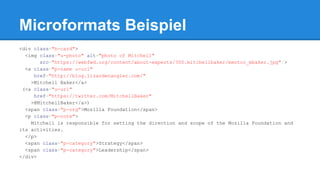
Microformats Beispiel
<div class="h-card">
<img class="u-photo" alt="photo of Mitchell"
src="https://webfwd.org/content/about-experts/300.mitchellbaker/mentor_mbaker.jpg"/>
<a class="p-name u-url"
href="http://blog.lizardwrangler.com/"
>Mitchell Baker</a>
(<a class="u-url"
href="https://twitter.com/MitchellBaker"
>@MitchellBaker</a>)
<span class="p-org">Mozilla Foundation</span>
<p class="p-note">
Mitchell is responsible for setting the direction and scope of the Mozilla Foundation and
its activities.
</p>
<span class="p-category">Strategy</span>
<span class="p-category">Leadership</span>
</div>
Microdata (Schema.org / RDFa)
● Benutzt URIs zur klassifizierung.
● Von Google, Yahoo und Bing initiiert.
● Vokabular kann beliebig erweitert werden
● Nur HTML5 (schema.org)
● HTML4, XML, HTML5 (RDFa)
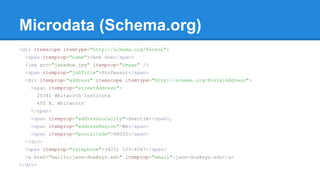
Microdata (Schema.org)
<div itemscope itemtype="http://schema.org/Person">
<span itemprop="name">Jane Doe</span>
<img src="janedoe.jpg" itemprop="image" />
<span itemprop="jobTitle">Professor</span>
<div itemprop="address" itemscope itemtype="http://schema.org/PostalAddress">
<span itemprop="streetAddress">
20341 Whitworth Institute
405 N. Whitworth
</span>
<span itemprop="addressLocality">Seattle</span>,
<span itemprop="addressRegion">WA</span>
<span itemprop="postalCode">98052</span>
</div>
<span itemprop="telephone">(425) 123-4567</span>
<a href="mailto:jane-doe@xyz.edu" itemprop="email">jane-doe@xyz.edu</a>
</div>
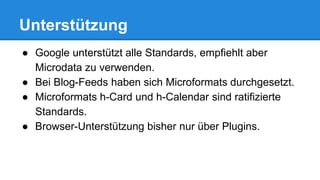
Unterstützung
● Google unterstützt alle Standards, empfiehlt aber
Microdata zu verwenden.
● Bei Blog-Feeds haben sich Microformats durchgesetzt.
● Microformats h-Card und h-Calendar sind ratifizierte
Standards.
● Browser-Unterstützung bisher nur über Plugins.
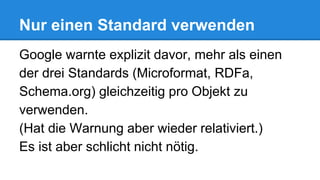
Nur einen Standard verwenden
Google warnte explizit davor, mehr als einen
der drei Standards (Microformat, RDFa,
Schema.org) gleichzeitig pro Objekt zu
verwenden.
(Hat die Warnung aber wieder relativiert.)
Es ist aber schlicht nicht nötig.
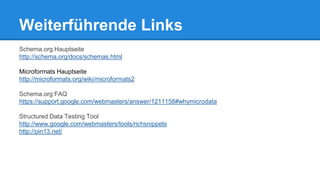
Weiterführende Links
Schema.org Hauptseite
http://schema.org/docs/schemas.html
Microformats Hauptseite
http://microformats.org/wiki/microformats2
Schema.org FAQ
https://support.google.com/webmasters/answer/1211158#whymicrodata
Structured Data Testing Tool
http://www.google.com/webmasters/tools/richsnippets
http://pin13.net/

Microformats

  • 1.
  • 2.
    Was sind Microformats? Microformatssind Metadaten. Crawler von Suchmaschinen und anderen Diensten können durch Microformats Real-World Objekte wie z.B. Personen und ihre Verbindung zueinander klar erkennen. Bsp. Mitarbeiter einer Firma, Schauspieler eines Filmes
  • 3.
    Anwendungsfälle Microformats / Datenmachen Sinn bei ● Blogs (Atom, Readability) ● Events / Locations ● Kontaktinfos
  • 4.
    Anwendungsfälle Google unterstützt Microformatsfür diese Anwendungsfälle: ● Reviews ● People ● Products ● Businesses and organizations ● Recipes ● Events ● Music
  • 5.
    Wie sieht esaus? Es gibt mehrere konkurrierende Standards: ● Microformats (h-card, h-calendar, …) ● RDFa ● Schema.org / Microdata (Google, Bing, Yahoo, Yandex) ● WAI-ARIA (Barrierefreiheit, W3 Reccomendation) ● Open Graph
  • 6.
    Microformats (v2) ● Benutztfestgelegte Vokabular zur Identifizierung. ● Community-Generiert. ● Neues Vokabular muss erst von der Community akzeptiert werden. ● HTML4 Transitional und HTML5
  • 7.
    Microformats Beispiel <div class="h-card"> <imgclass="u-photo" alt="photo of Mitchell" src="https://webfwd.org/content/about-experts/300.mitchellbaker/mentor_mbaker.jpg"/> <a class="p-name u-url" href="http://blog.lizardwrangler.com/" >Mitchell Baker</a> (<a class="u-url" href="https://twitter.com/MitchellBaker" >@MitchellBaker</a>) <span class="p-org">Mozilla Foundation</span> <p class="p-note"> Mitchell is responsible for setting the direction and scope of the Mozilla Foundation and its activities. </p> <span class="p-category">Strategy</span> <span class="p-category">Leadership</span> </div>
  • 8.
    Microdata (Schema.org /RDFa) ● Benutzt URIs zur klassifizierung. ● Von Google, Yahoo und Bing initiiert. ● Vokabular kann beliebig erweitert werden ● Nur HTML5 (schema.org) ● HTML4, XML, HTML5 (RDFa)
  • 9.
    Microdata (Schema.org) <div itemscopeitemtype="http://schema.org/Person"> <span itemprop="name">Jane Doe</span> <img src="janedoe.jpg" itemprop="image" /> <span itemprop="jobTitle">Professor</span> <div itemprop="address" itemscope itemtype="http://schema.org/PostalAddress"> <span itemprop="streetAddress"> 20341 Whitworth Institute 405 N. Whitworth </span> <span itemprop="addressLocality">Seattle</span>, <span itemprop="addressRegion">WA</span> <span itemprop="postalCode">98052</span> </div> <span itemprop="telephone">(425) 123-4567</span> <a href="mailto:jane-doe@xyz.edu" itemprop="email">jane-doe@xyz.edu</a> </div>
  • 10.
    Unterstützung ● Google unterstütztalle Standards, empfiehlt aber Microdata zu verwenden. ● Bei Blog-Feeds haben sich Microformats durchgesetzt. ● Microformats h-Card und h-Calendar sind ratifizierte Standards. ● Browser-Unterstützung bisher nur über Plugins.
  • 11.
    Nur einen Standardverwenden Google warnte explizit davor, mehr als einen der drei Standards (Microformat, RDFa, Schema.org) gleichzeitig pro Objekt zu verwenden. (Hat die Warnung aber wieder relativiert.) Es ist aber schlicht nicht nötig.
  • 12.
    Weiterführende Links Schema.org Hauptseite http://schema.org/docs/schemas.html MicroformatsHauptseite http://microformats.org/wiki/microformats2 Schema.org FAQ https://support.google.com/webmasters/answer/1211158#whymicrodata Structured Data Testing Tool http://www.google.com/webmasters/tools/richsnippets http://pin13.net/