Jews in the Great War
1914-1918
Richard Goldenberg
Jewish War Veterans of the U.S.A.
 Jews with the Central Powers
 Jewish sentiment, 1914-1917
 Jews serving with the Allies
 The Jewish Legion
 American Jewish Support
 American Jews enter the War
 The Jewish Welfare Board
 The Fighting Rabbi of WWI
 Do Jews Fight?
“Moses, from whose loins I sprung,
Lit by a lamp in his blood
Ten immutable rules, a moon
For mutable lampless men.
“The blonde, the bronze, the ruddy,
With the same heaving blood,
Keep tide to the moon of Moses.
Then why do they sneer at me?”
-- Isaac Rosenberg
KIA, 1918
"May God be with You! Be brave and strong. Fight until your dying
breath for the just cause of the state's father and our dear homeland."
A picture of Emperor Franz Joseph hangs in the background, and a concerned
mother stands beside the father.
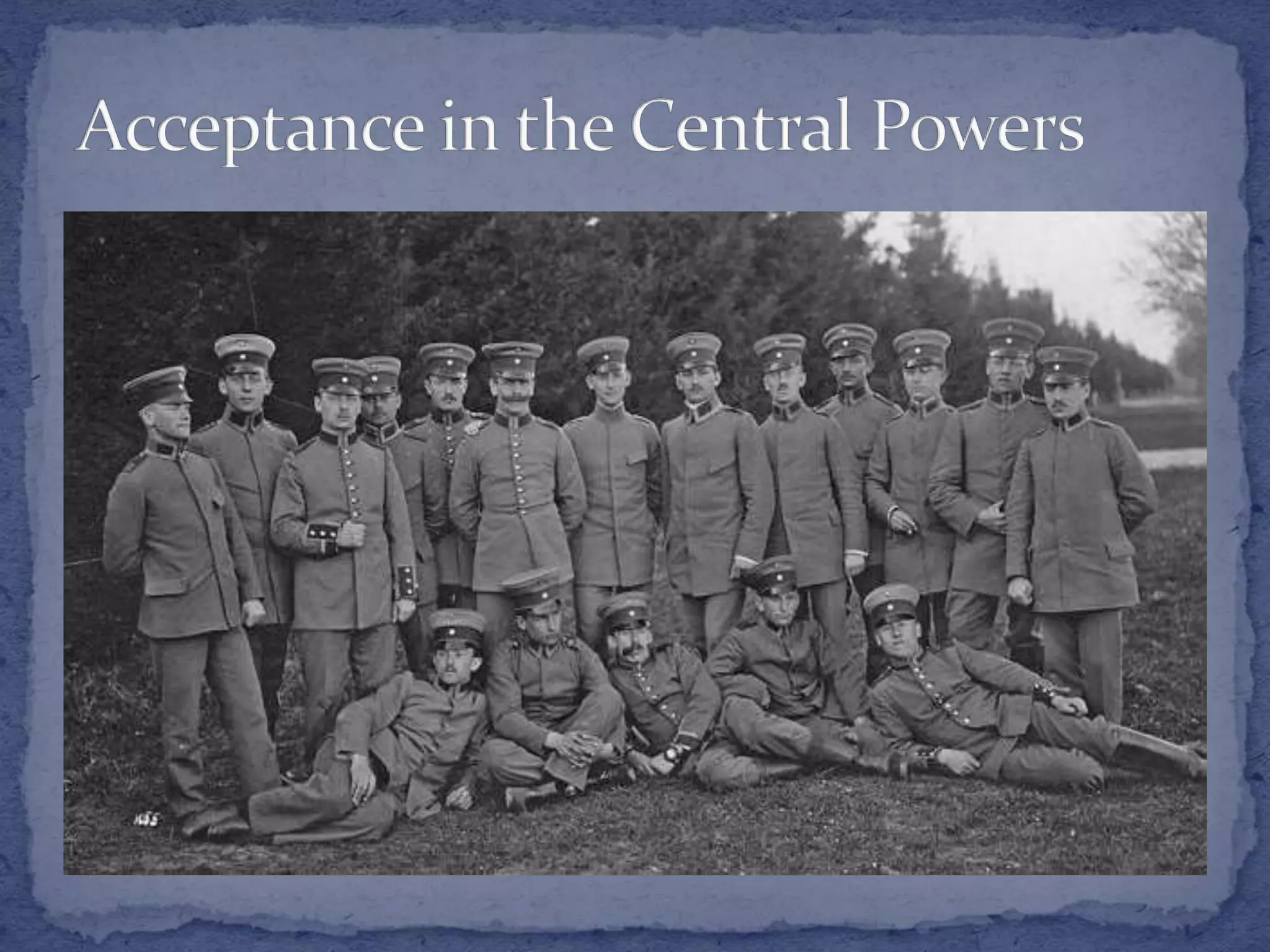
 320,000 served in the forces of
Austro-Hungary
 About 40,000 killed
 100,000 in the German army
 Some 12,000 killed
 Capt. Ernst Hess and Lt. Hugo
Gutmann award the Iron Cross
to a 29-year-old corporal
named Adolf Hitler.
 20,000 in the Ottoman Empire
 Jews lived in large concentrations in the principal areas
of the war
 4 million Jews along Eastern Front (Russia and Poland)
 Germany seen as most progressive European nation
 Kaiser lifts legal restrictions for Jews in service
 “We are all Germans.”
 Russian Pogroms continued into the war years with
massive expulsions from the front line regions
 International Jewry claims neutrality, but many clearly
wanted to see the fall of the czarist regime
 Surge of Zionist sentiment worldwide
1SG Samuel Littman, Brooklyn’s 47th Regiment,
denied officer’s commission from his commander
 “The governor's well known policy on this question should
be understood by all officers of the National Guard, no
matter what their rank, to forbid absolutely any
consideration of the fact of a soldier's race, creed or
religion as a qualification for membership or promotion in
the land and naval forces of this state.”
-- New York State Adjutant General Hamilton, March 1913
 “I am really only interested in seeing the bars of race
prejudice are lowered in the National Guard. My fight is
not for myself, but for others.”
-- Sam Littman, March 1913
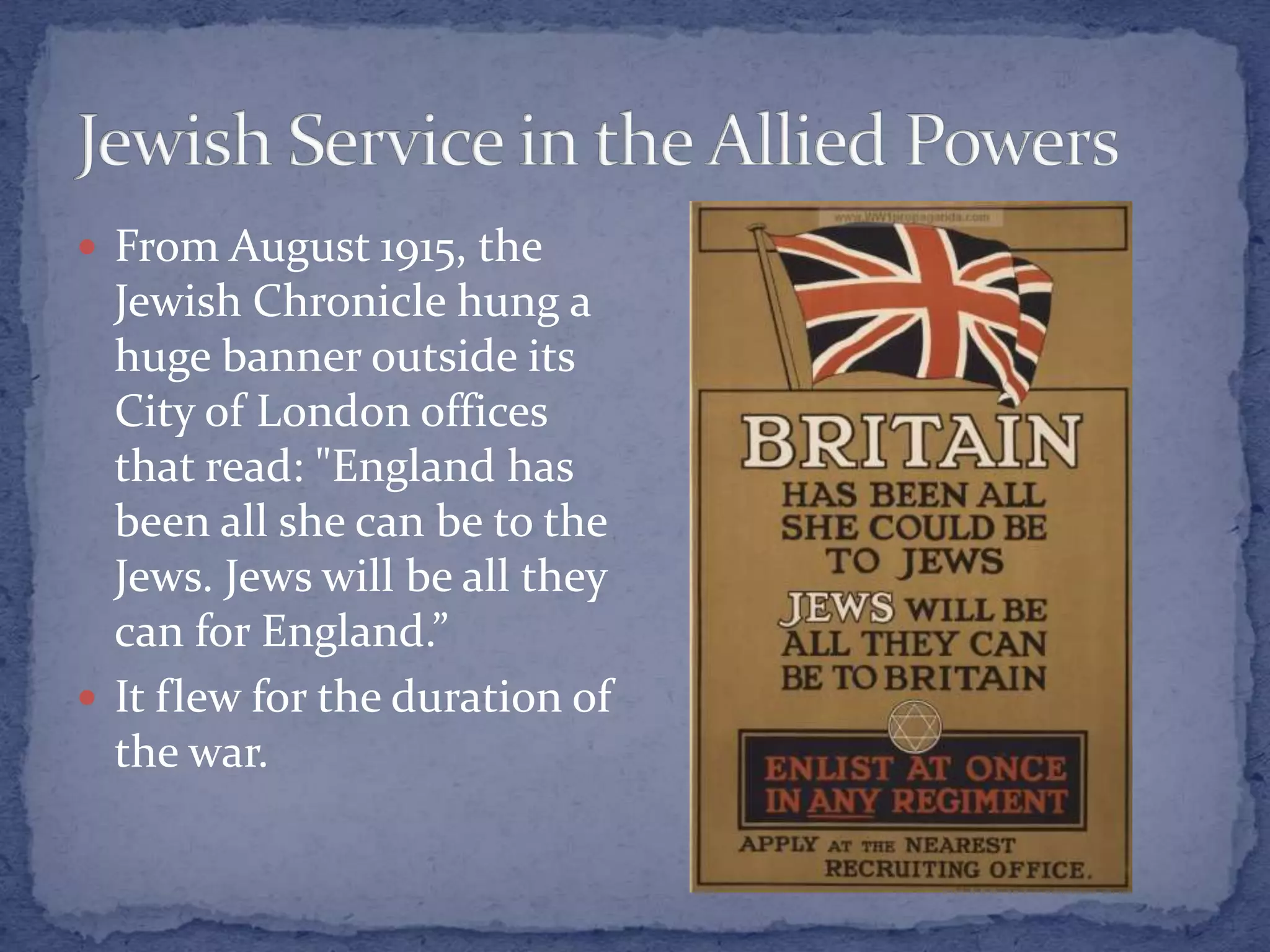
 From August 1915, the
Jewish Chronicle hung a
huge banner outside its
City of London offices
that read: "England has
been all she can be to the
Jews. Jews will be all they
can for England.”
 It flew for the duration of
the war.
 British Jews had a very high per capita rate of
participation, with 41,000 serving out of a total
population of only 280,000.
 “In the British forces, casualties included the names of
8,600 Jews, and in the French forces, out of less than a
hundred thousand Jewish population in the nation,
2,200 were killed in the service.”
Rabbi Lee J. Levinger, A Jewish Chaplain in France, 1921
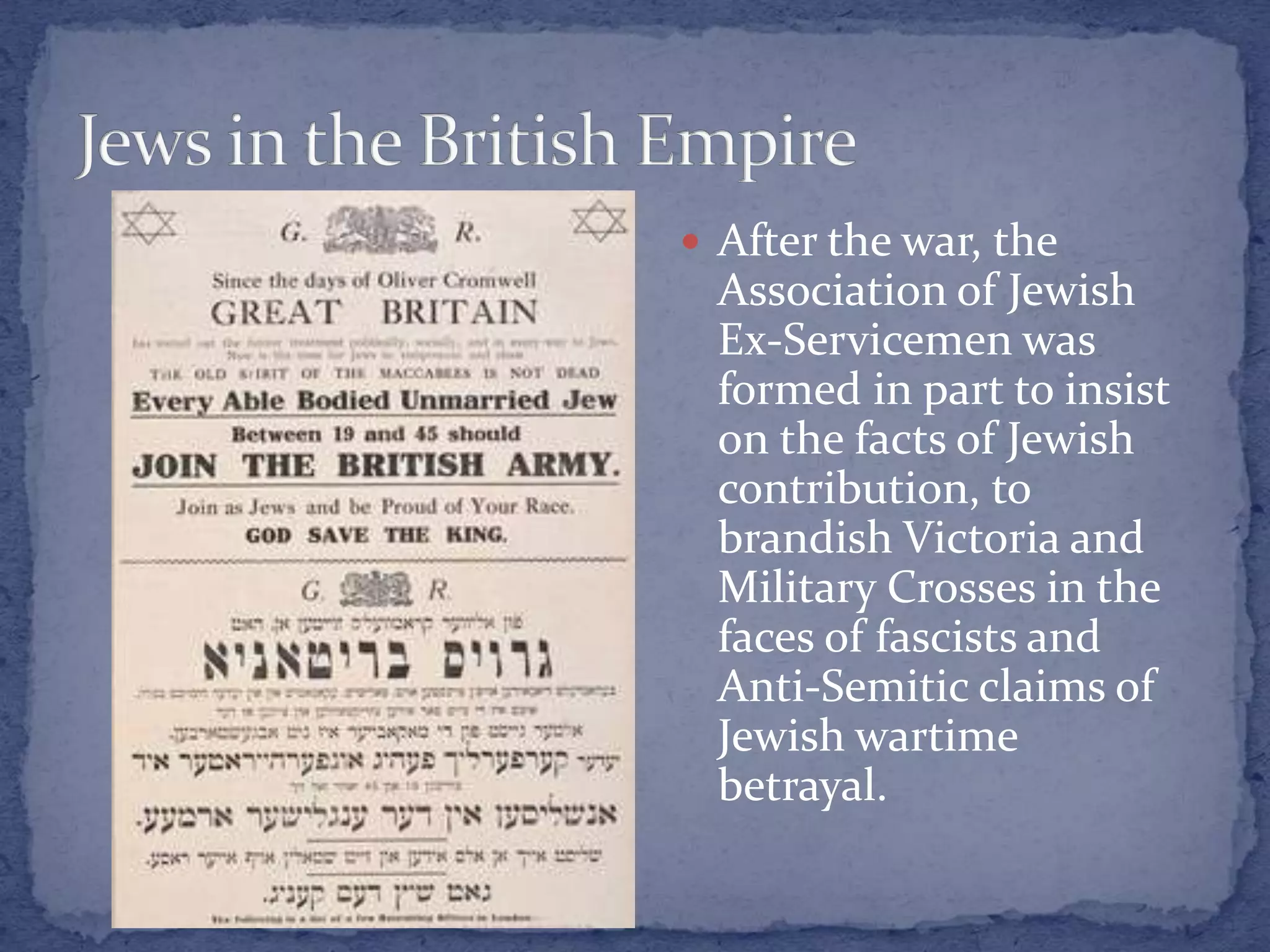
 After the war, the
Association of Jewish
Ex-Servicemen was
formed in part to insist
on the facts of Jewish
contribution, to
brandish Victoria and
Military Crosses in the
faces of fascists and
Anti-Semitic claims of
Jewish wartime
betrayal.
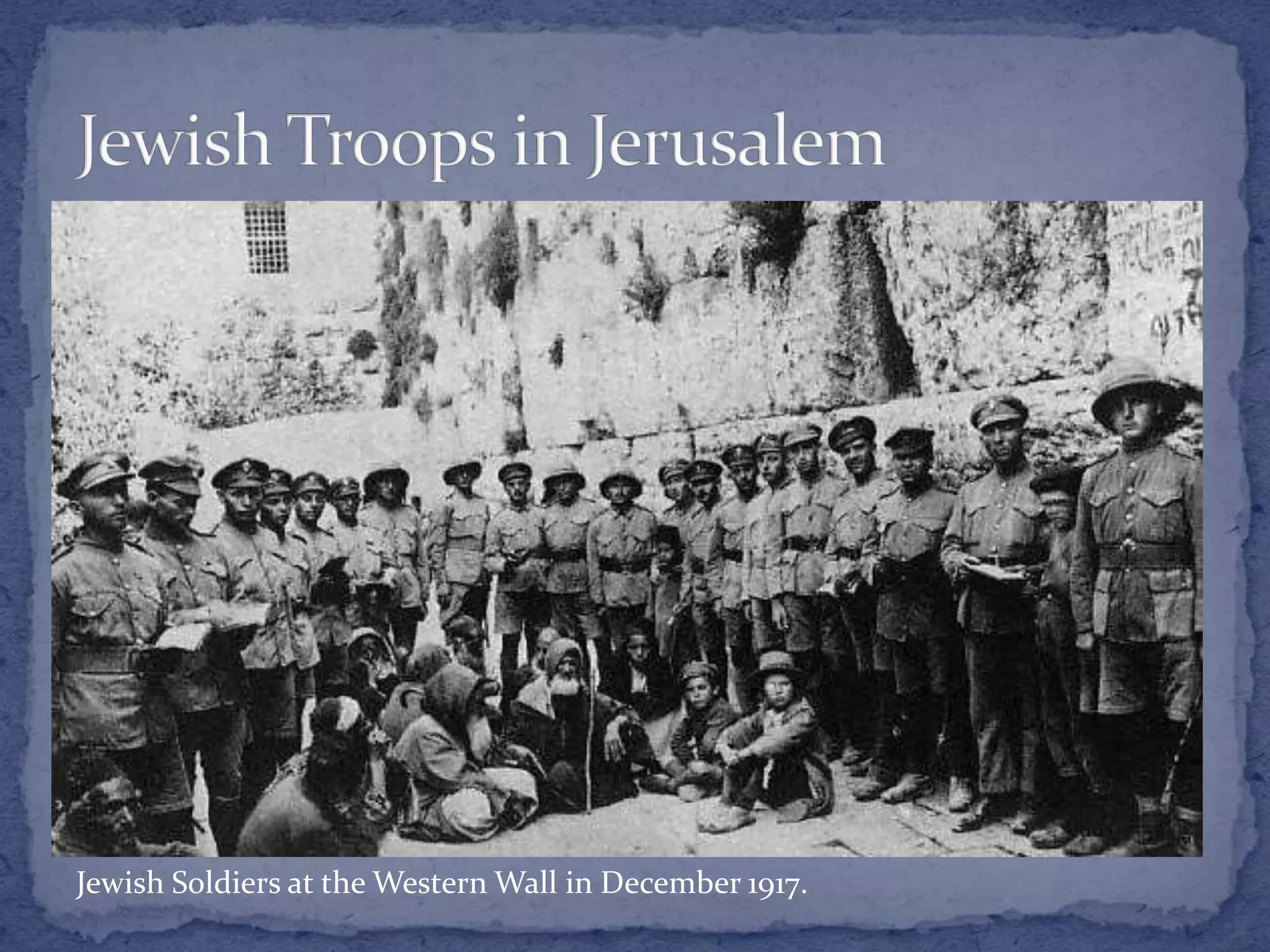
Jewish Soldiers at the Western Wall in December 1917.
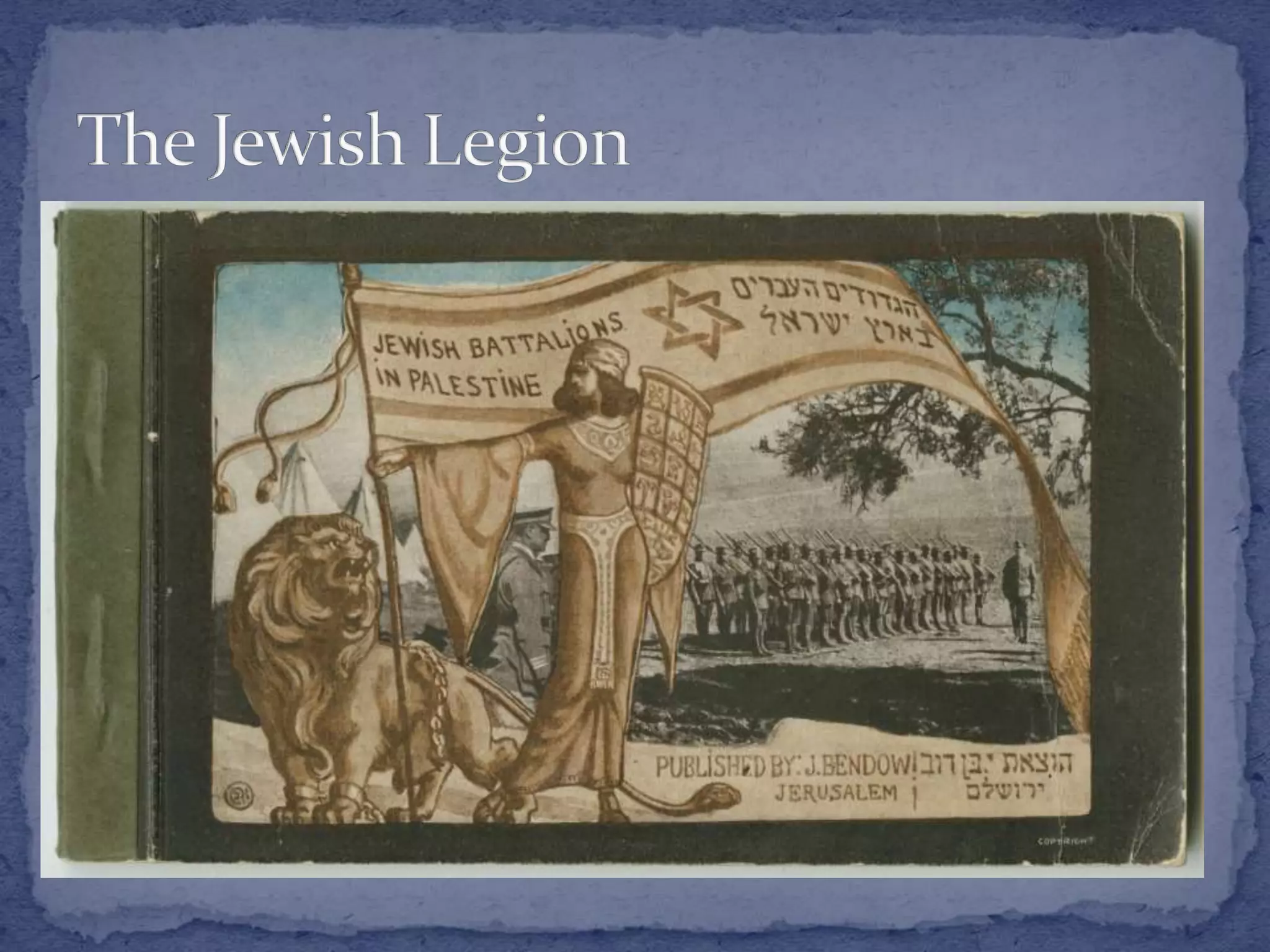
'Your Old New Land must have
you! Join the Jewish regiment.'
Joseph Trumpeldor
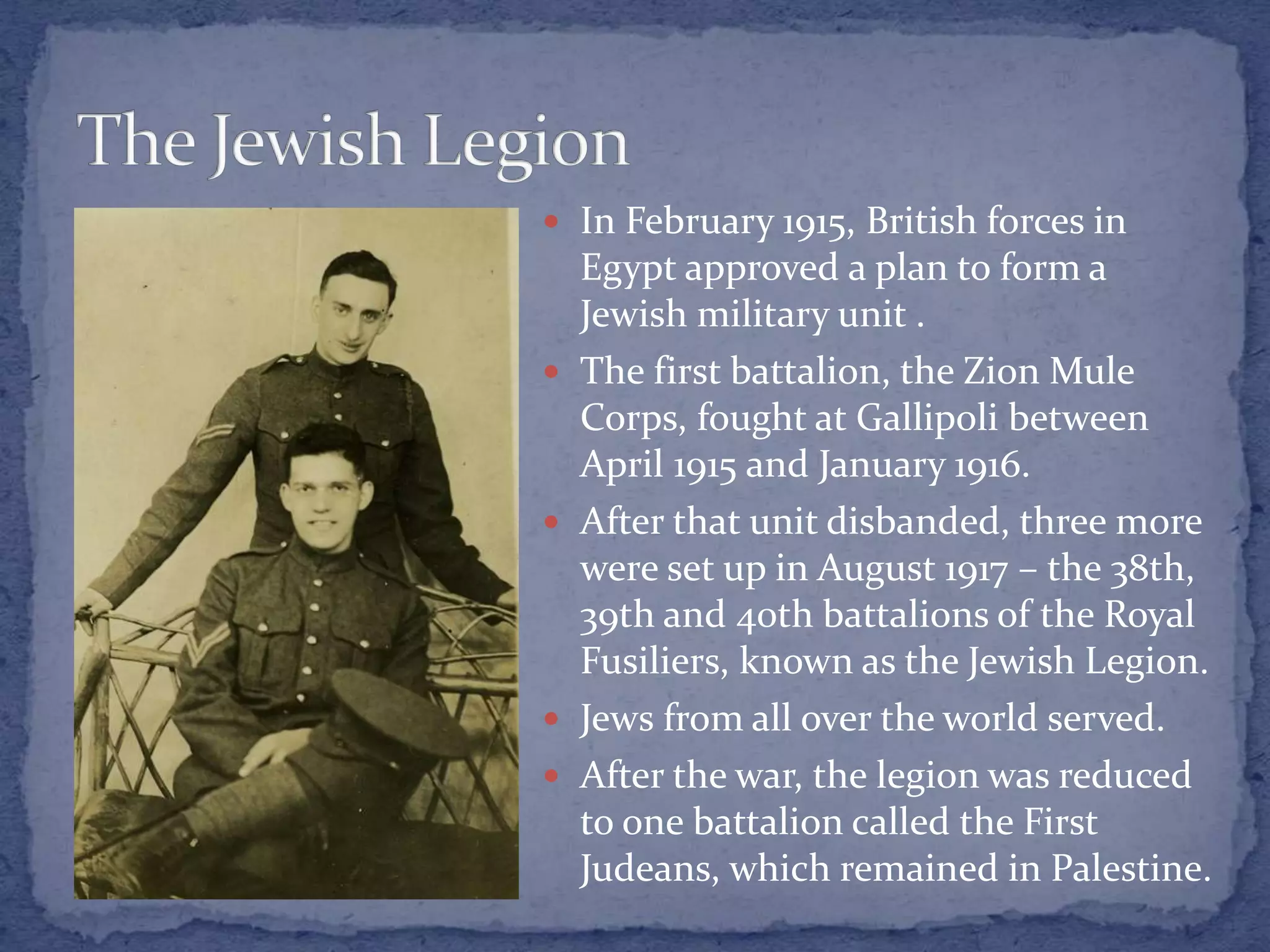
 In February 1915, British forces in
Egypt approved a plan to form a
Jewish military unit .
 The first battalion, the Zion Mule
Corps, fought at Gallipoli between
April 1915 and January 1916.
 After that unit disbanded, three more
were set up in August 1917 – the 38th,
39th and 40th battalions of the Royal
Fusiliers, known as the Jewish Legion.
 Jews from all over the world served.
 After the war, the legion was reduced
to one battalion called the First
Judeans, which remained in Palestine.
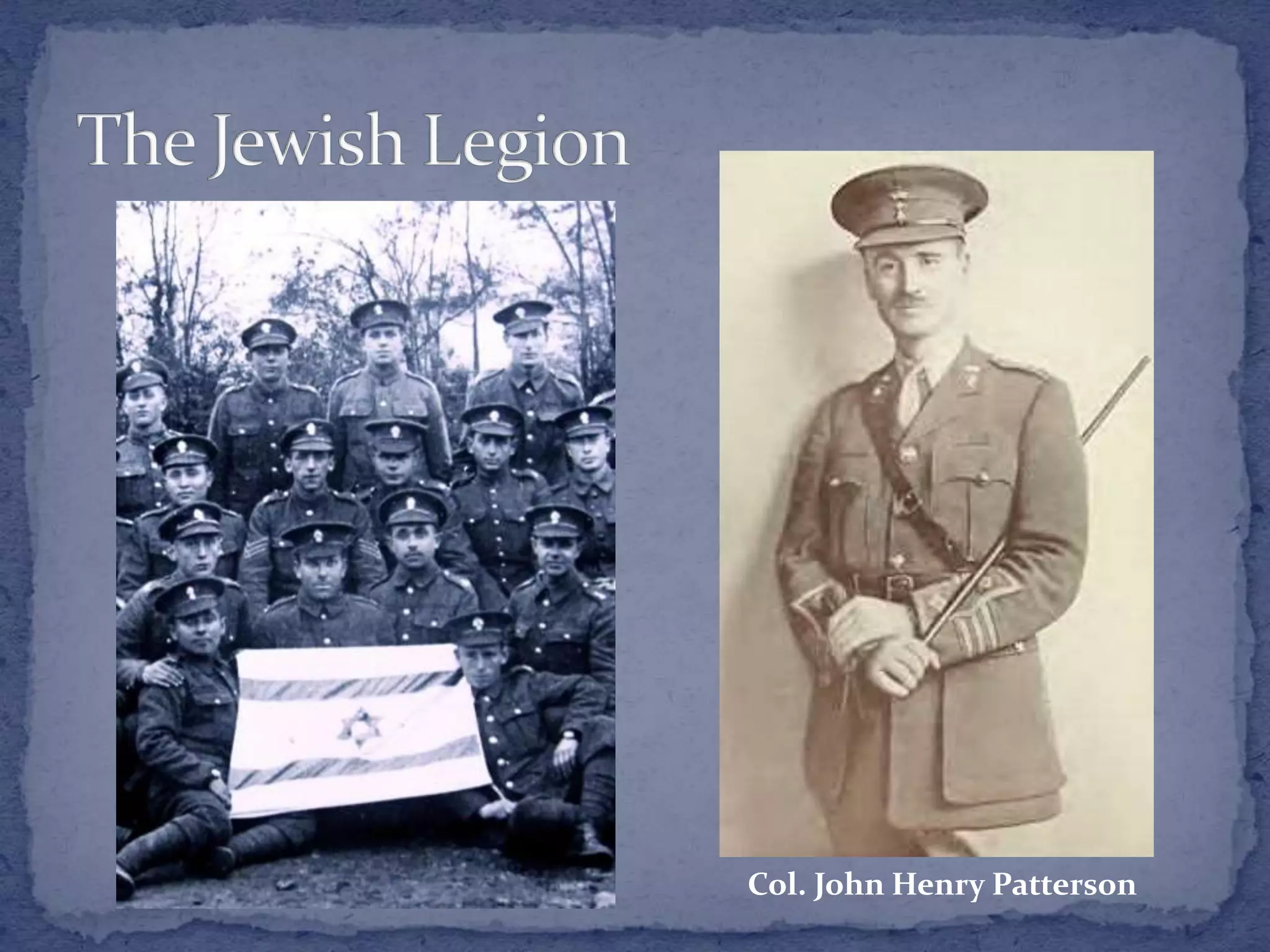
Col. John Henry Patterson
American and Canadian Jewish volunteers of the 39th Battalion in Windsor,
Nova Scotia prepare to sail for Palestine to serve in the Jewish Legion, April 1918
Zeev Jabotinsky David Ben Gurion (r.) and Yitzhak
Ben Zwi
 The war unites the many different strands of the
American Jewish community — Germans, Eastern
Europeans, Orthodox, Reform and socialists — around
the single issue of helping their brethren in war-torn
Europe and in Palestine.
 Creates American Jewish Joint Distribution
Committee, collecting $63 Million.
 American Jews were now seen as international
philanthropists, with wealth and initiative to help.
 The war also elevated philanthropy to a central tenet of
American Judaism.
During and after World War I, those wanting to send money to family
and friends overseas, line up at a JDC Transmission Bureau. c. 1917 (The
American Jewish Joint Distribution Committee)
• About 250,000 Jewish
soldiers served in the
United States.
• Conscription and a true
national army.
• Some 40,000 were
volunteers.
• About 10,000 officers
• About 3,500 Jews were
killed in action or died of
wounds.
• An estimated 12,000 Jewish
personnel wounded.
Sgt. William Shemin, Bayonne, NJ
 Regional makeup of troops
persist in National Guard, early
units drafted from like areas.
 69th New York, the famed Irish
Brigade, adopts its Jewish
officers and soldiers.
 77th Infantry, composed of
draftees from NYC region.
 “What you're up against major,
is a bunch of Mick, Pollack,
Dago, and Jew boy gangsters
from New York City. They'll
never surrender. Never.”
The Lost Battalion, 2001
 Capt. Bencin Riseman, 26th
Yankee Division,
Massachusetts National
Guard and sons Jay and
Joseph.
 “Whatever may have been
said about the Jewish soldier,
I am willing to back him
against all others for sobriety,
loyalty, bravery and
intelligence. There is no
better soldier, when well
trained, than the Jew.”
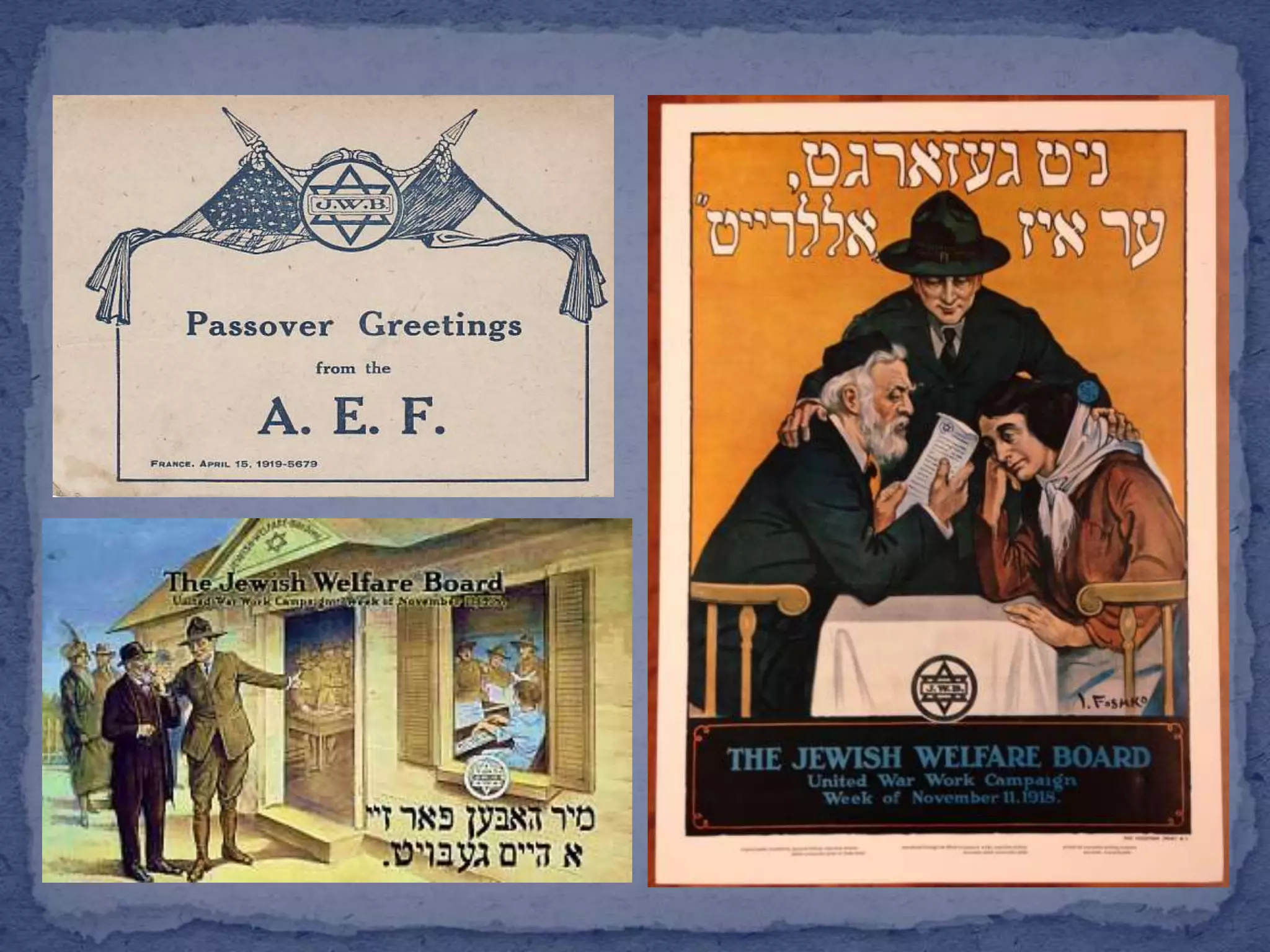
 Formed April 9, 1917, three
days after U.S. declares war.
 Supports Jewish soldiers
and recruits and trains
rabbis for the military
chaplaincy.
 Provides support materials
to chaplains and lay leaders
and maintains a presence at
military installations .
 A link between the soldier
and the Jewish homefront .
 Elkan Voorsanger resigns as assistant
rabbi of Congregation Shaare Emeth in
St. Louis to enlist as a private in May, 1917.
 He was with the first American soldiers to
go overseas to France and quickly rose up
the ranks to sergeant, lieutenant,
chaplain, captain and senior chaplain of
the 77th Division.
 Voorsanger came in contact with the JWB
as a soldier-recipient when the
organization supplied him with an
automobile, making it possible for him to
visit Jewish fighting men.
 Voorsanger always went over the top
with his men. He was the division
burial officer, school and
entertainment officer, and the Jewish
Welfare Board adviser to the 77th
Division.
 Captain Voorsanger had the highest
praise for the men in the 77th, quoted
as saying that the "Jewish men in this
division were good soldiers, brave,
fearless, and resourceful. They fought,
knew how to fight and were glad to do
it."
 “Wherever it will not interfere with military operations soldiers
of Jewish Faith will be excused from all duty and where
practicable granted passes to enable them to observe Jewish
Holidays as follows: from noon Sept. 6th to morning of Sept. 9th
and from noon Sept. 15th to morning of Sept. 17th. If military
necessity prevents granting passes on days mentioned provision
should be made to hold divine services wherever possible."”
AEF Field Order, September, 1918
A group of Jewish welfare workers at Le Mans,
France, in March 1919. From left to right, George
Rooby, Julius Halperin, Frank M. Dart, Chaplain
Lee J. Levinger, Adele Winston, Charles S.
Rivitz, David Rosenthal and Esther Levy.
“But the shadow of war was dark upon us all. We were in the
uncertainty, the danger, the horror of it. We felt a personal
thrill at the words of the prayers,—"Who are to live and
who to die; who by the sword and who by fire."
We recited with personal fervor the memorial prayer for our
fallen comrades. Many among us were eager to give thanks
at recovery from wounds. Therefore, the desire for a
religious observance of our solemn days was all the greater.
Men came in from a hundred miles, often walking ten
miles to a train before they could ride the rest.”
Rabbi Lee J. Levinger, A Jewish Chaplain in France, 1921
 “The Jewish soldier demands no defense and needs no
tribute. His deeds are written large in the history of
every unit in the AEF; they are preserved in the
memory of his comrades of other races and other
faiths.”
 “Ignorance, suspicion, ripening with knowledge into
understanding and admiration—that was the usual
course of events.”
Rabbi Lee J. Levinger, A Jewish Chaplain in France, 1921
 Jews, who made up 3 per cent of the U.S. population,
contributed 5% to the losses of the U.S. Army
 1,100 valor citations, 150 Distinguished Service Crosses,
Three Medals of Honor
 Four French Medaille Militaire and 174 Croix de Guerre
 Corporal Abel J. Levine, Company A, 107th Infantry.
 For extraordinary heroism in action near Bony, France, Sept.
29, 1918. After his platoon had suffered heavy casualties and all
the sergeants had been wounded, Corporal Levine collected
the remaining effectives in his own and other units, formed a
platoon and continued the advance. When his rifle was
rendered useless he killed several of the enemy with his pistol.
He was wounded shortly afterward, but he refused assistance
until his men had been cared for and evacuated.“
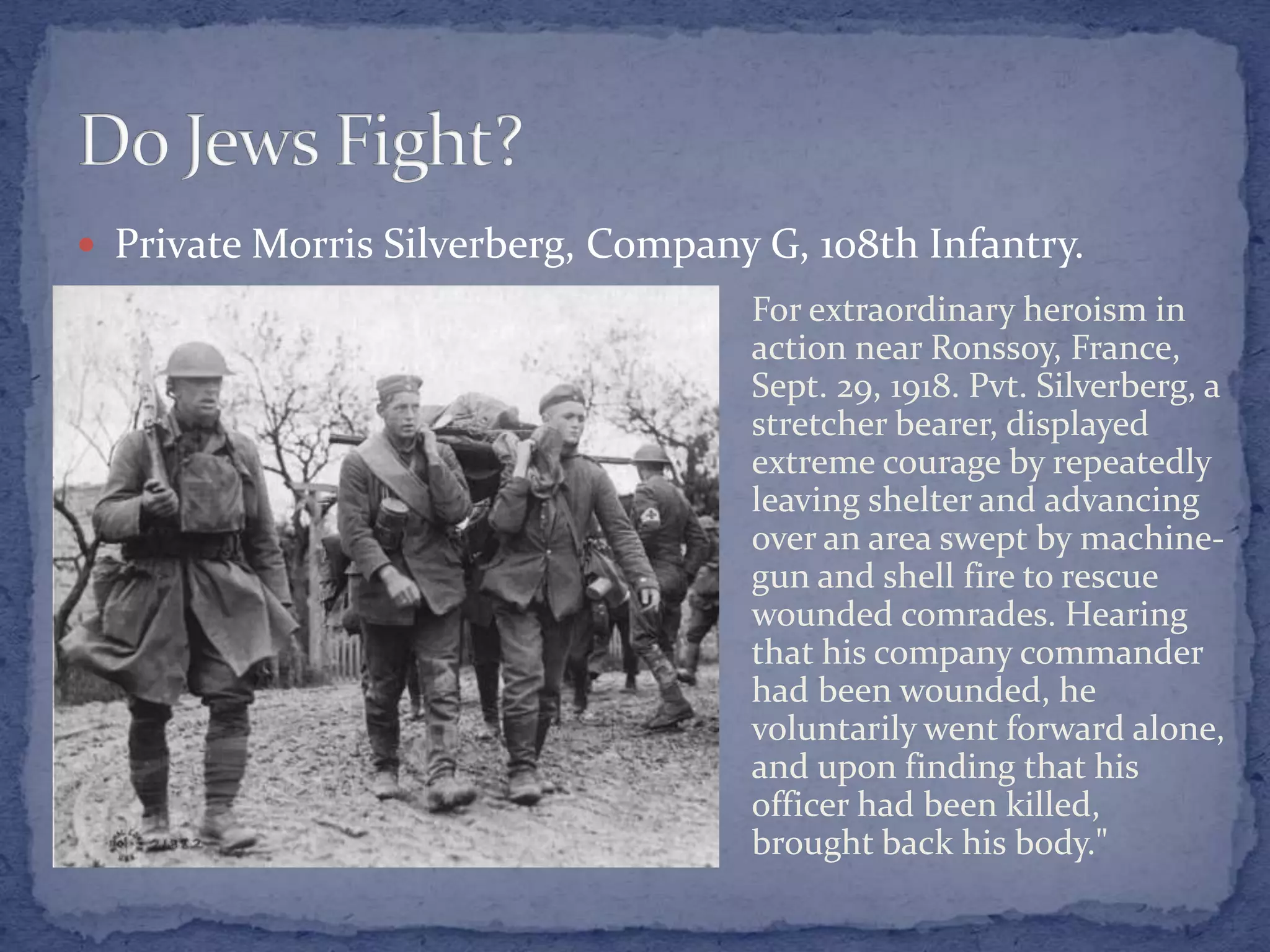
 Private Morris Silverberg, Company G, 108th Infantry.
For extraordinary heroism in
action near Ronssoy, France,
Sept. 29, 1918. Pvt. Silverberg, a
stretcher bearer, displayed
extreme courage by repeatedly
leaving shelter and advancing
over an area swept by machine-
gun and shell fire to rescue
wounded comrades. Hearing
that his company commander
had been wounded, he
voluntarily went forward alone,
and upon finding that his
officer had been killed,
brought back his body."
Sydney Gumpertz Ben Kaufman Phillip Katz
 Of the 124 Medals awarded, seven were to Jews
 97 years later, President Obama presents Medal of
Honor for Sgt. William Shemin to his daughters
 Shemin ran into
no-man’s land
three times to
carry wounded
soldiers back to
shelter. At 19-
years-old,
Shemin took
over his platoon,
leading his
soldiers to safety
and suffering a
bullet wound to
the head
“This is not just about my father,” Elsie Shemin Roth said.
“It’s really a thank you for the Jewish people.”
 Born 1878, emigrates from Russia in 1898.
 Enlists 1899.
 When aunt cries, "Sammy, you’re crazy! Don't
you know soldiers get killed?” he replies,
"Maybe, but they don’t charge you anything to
eat.”
 Serves in Philippines, China, Texas
 Central American Soldier of Fortune
 Mexican Revolution with Pancho Villa
 US scout for Pershing in 1916 in Mexico
 At 39, enlists in 141st Infantry, 36th Division.
 At St. Etienne Dreben captured a machine-gun nest,
killing forty Germans, receiving the Distinguished
Service Cross
 Pallbearer to Unknown Soldier, 1921.
 Dies in 1925 of accidental medical injection.
Now whenever I read articles
That breathe of racial hate,
Or hear arguments that hold his kind to scorn,
I always see that photo
With the cap upon his pate
And the nose the size of Bugler Dugan's horn.
I see upon his breast
The D.S.C.,
The Croix de Guerre, the Militaire
-- These, too.
And I think, Thank God Almighty
We have more than a few
Like Dreben,
A Jew!
There's a story in that paper
I just tossed upon the floor
That speaks of prejudice against the Jews;
There's a photo on the table
That's a memory of the war
And a man who never figured in the news.
There's a cross upon his breast --
That's the D.S.C.
The Croix de Guerre, the Millitaire,
-- These, too.
And there's a heart beneath the medals
That beats loyal, brave and true --
That's Dreben,
A Jew!
Damon Runyon, “Hail Dreben”, 1942
 Confronts KKK attempts to join American Legion in El
Paso, Texas, introducing prohibitions against it:
 "These men, oath-bound to secrecy, hide behind their
masks and say that because I am a foreign-born Jew I am
not good enough to be an American. Every time America
has called for volunteers, I have put on the uniform.
They did not ask me at the recruiting office if I was a
Jew, and they did not ask me on the battlefield what my
race or religion was. . . The soldiers didn't wear masks in
France, other than gas masks, and they don't need them
now."
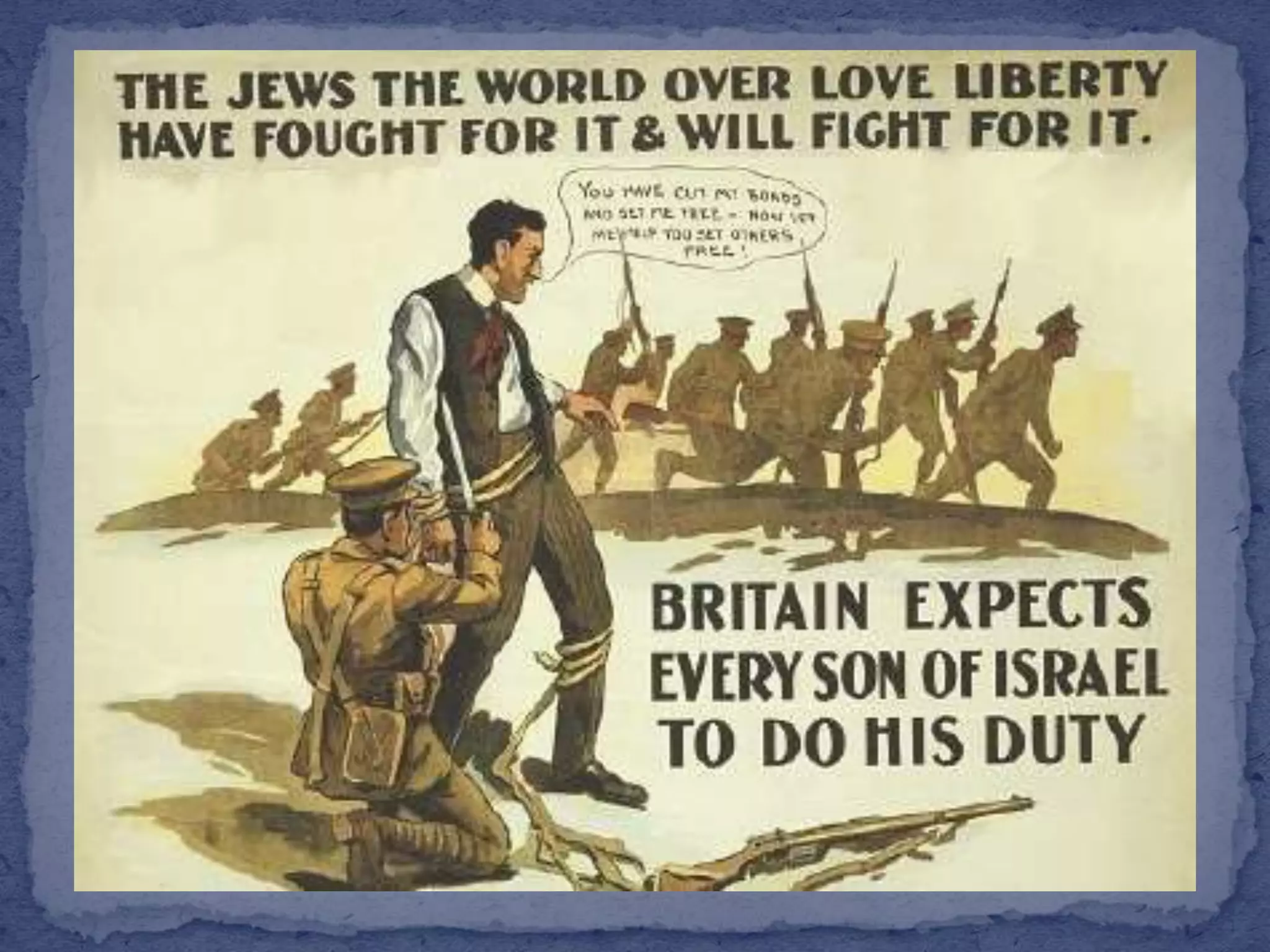
WILSON: "Here's your olive branch. Now get busy."
DOVE OF PEACE: "Of course, I want to please everybody,
but isn't this a bit thick?"
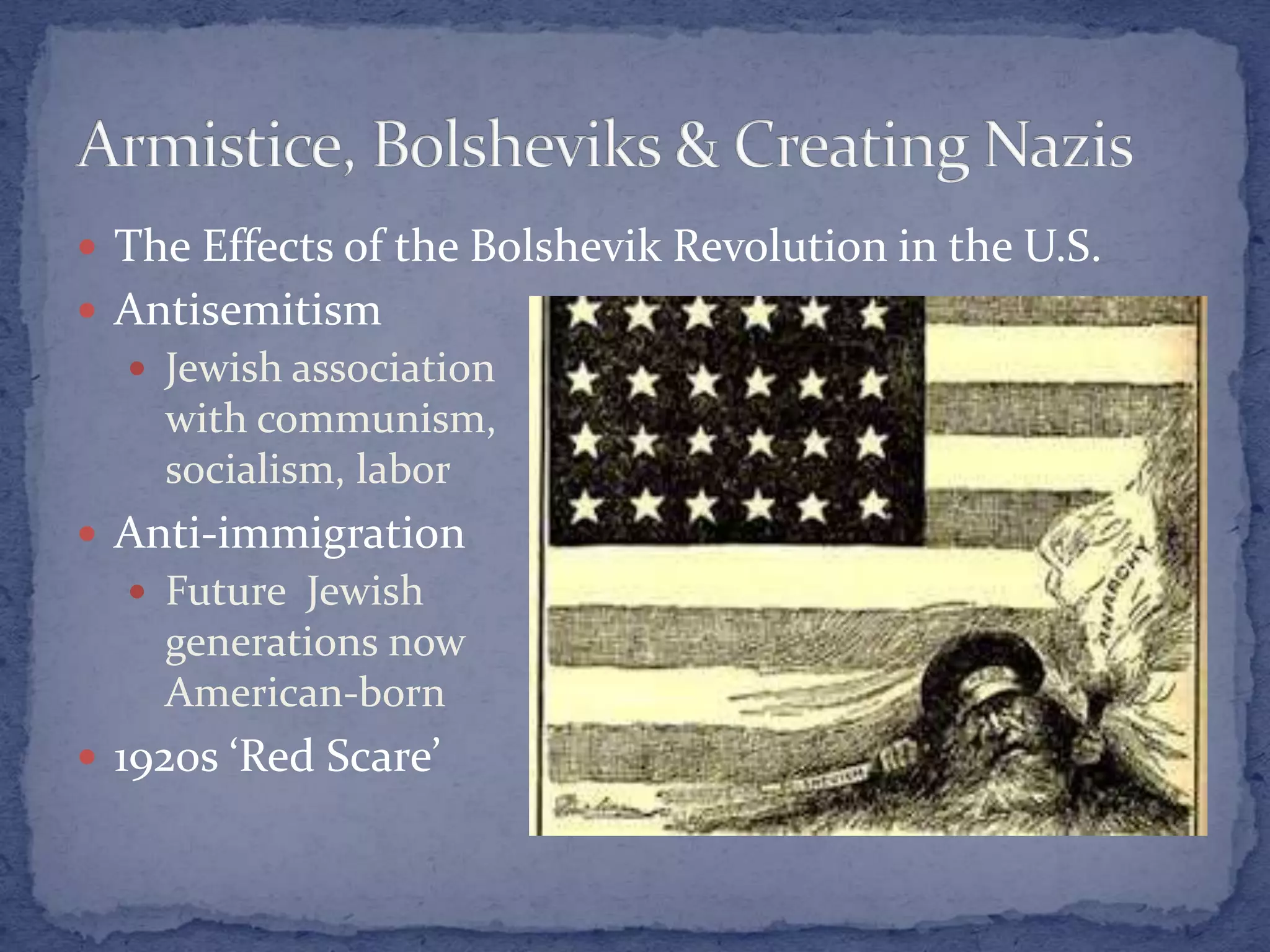
 The Effects of the Bolshevik Revolution in the U.S.
 Antisemitism
 Jewish association
with communism,
socialism, labor
 Anti-immigration
 Future Jewish
generations now
American-born
 1920s ‘Red Scare’
 “In the American forces during the World
War, the Jew has proved himself a
devoted patriot and a heroic soldier, and
this time he has done so in broad
daylight, before the eyes of all the world.
 “When I asked a boy from one of our
machine gun battalions why he led a
group of volunteers in bringing some
wounded men of another regiment, an
act in which the only other Jew in the
company had been killed and for which
my friend was later decorated:
 "Well, chaplain," he answered me, “There
were only two Jewish boys in the company
and we'd been kidded about it a little. We
just wanted to show those fellows what a
Jew could do."
David Ben Gurion
Jews in the great war

Jews in the great war

  • 2.
    Jews in theGreat War 1914-1918 Richard Goldenberg Jewish War Veterans of the U.S.A.
  • 3.
     Jews withthe Central Powers  Jewish sentiment, 1914-1917  Jews serving with the Allies  The Jewish Legion  American Jewish Support  American Jews enter the War  The Jewish Welfare Board  The Fighting Rabbi of WWI  Do Jews Fight?
  • 4.
    “Moses, from whoseloins I sprung, Lit by a lamp in his blood Ten immutable rules, a moon For mutable lampless men. “The blonde, the bronze, the ruddy, With the same heaving blood, Keep tide to the moon of Moses. Then why do they sneer at me?” -- Isaac Rosenberg KIA, 1918
  • 5.
    "May God bewith You! Be brave and strong. Fight until your dying breath for the just cause of the state's father and our dear homeland." A picture of Emperor Franz Joseph hangs in the background, and a concerned mother stands beside the father.
  • 6.
     320,000 servedin the forces of Austro-Hungary  About 40,000 killed  100,000 in the German army  Some 12,000 killed  Capt. Ernst Hess and Lt. Hugo Gutmann award the Iron Cross to a 29-year-old corporal named Adolf Hitler.  20,000 in the Ottoman Empire
  • 8.
     Jews livedin large concentrations in the principal areas of the war  4 million Jews along Eastern Front (Russia and Poland)  Germany seen as most progressive European nation  Kaiser lifts legal restrictions for Jews in service  “We are all Germans.”  Russian Pogroms continued into the war years with massive expulsions from the front line regions  International Jewry claims neutrality, but many clearly wanted to see the fall of the czarist regime  Surge of Zionist sentiment worldwide
  • 11.
    1SG Samuel Littman,Brooklyn’s 47th Regiment, denied officer’s commission from his commander  “The governor's well known policy on this question should be understood by all officers of the National Guard, no matter what their rank, to forbid absolutely any consideration of the fact of a soldier's race, creed or religion as a qualification for membership or promotion in the land and naval forces of this state.” -- New York State Adjutant General Hamilton, March 1913  “I am really only interested in seeing the bars of race prejudice are lowered in the National Guard. My fight is not for myself, but for others.” -- Sam Littman, March 1913
  • 13.
     From August1915, the Jewish Chronicle hung a huge banner outside its City of London offices that read: "England has been all she can be to the Jews. Jews will be all they can for England.”  It flew for the duration of the war.
  • 14.
     British Jewshad a very high per capita rate of participation, with 41,000 serving out of a total population of only 280,000.  “In the British forces, casualties included the names of 8,600 Jews, and in the French forces, out of less than a hundred thousand Jewish population in the nation, 2,200 were killed in the service.” Rabbi Lee J. Levinger, A Jewish Chaplain in France, 1921
  • 15.
     After thewar, the Association of Jewish Ex-Servicemen was formed in part to insist on the facts of Jewish contribution, to brandish Victoria and Military Crosses in the faces of fascists and Anti-Semitic claims of Jewish wartime betrayal.
  • 16.
    Jewish Soldiers atthe Western Wall in December 1917.
  • 17.
    'Your Old NewLand must have you! Join the Jewish regiment.' Joseph Trumpeldor
  • 18.
     In February1915, British forces in Egypt approved a plan to form a Jewish military unit .  The first battalion, the Zion Mule Corps, fought at Gallipoli between April 1915 and January 1916.  After that unit disbanded, three more were set up in August 1917 – the 38th, 39th and 40th battalions of the Royal Fusiliers, known as the Jewish Legion.  Jews from all over the world served.  After the war, the legion was reduced to one battalion called the First Judeans, which remained in Palestine.
  • 19.
    Col. John HenryPatterson
  • 20.
    American and CanadianJewish volunteers of the 39th Battalion in Windsor, Nova Scotia prepare to sail for Palestine to serve in the Jewish Legion, April 1918
  • 23.
    Zeev Jabotinsky DavidBen Gurion (r.) and Yitzhak Ben Zwi
  • 25.
     The warunites the many different strands of the American Jewish community — Germans, Eastern Europeans, Orthodox, Reform and socialists — around the single issue of helping their brethren in war-torn Europe and in Palestine.  Creates American Jewish Joint Distribution Committee, collecting $63 Million.  American Jews were now seen as international philanthropists, with wealth and initiative to help.  The war also elevated philanthropy to a central tenet of American Judaism.
  • 27.
    During and afterWorld War I, those wanting to send money to family and friends overseas, line up at a JDC Transmission Bureau. c. 1917 (The American Jewish Joint Distribution Committee)
  • 29.
    • About 250,000Jewish soldiers served in the United States. • Conscription and a true national army. • Some 40,000 were volunteers. • About 10,000 officers • About 3,500 Jews were killed in action or died of wounds. • An estimated 12,000 Jewish personnel wounded. Sgt. William Shemin, Bayonne, NJ
  • 30.
     Regional makeupof troops persist in National Guard, early units drafted from like areas.  69th New York, the famed Irish Brigade, adopts its Jewish officers and soldiers.  77th Infantry, composed of draftees from NYC region.  “What you're up against major, is a bunch of Mick, Pollack, Dago, and Jew boy gangsters from New York City. They'll never surrender. Never.” The Lost Battalion, 2001
  • 31.
     Capt. BencinRiseman, 26th Yankee Division, Massachusetts National Guard and sons Jay and Joseph.  “Whatever may have been said about the Jewish soldier, I am willing to back him against all others for sobriety, loyalty, bravery and intelligence. There is no better soldier, when well trained, than the Jew.”
  • 33.
     Formed April9, 1917, three days after U.S. declares war.  Supports Jewish soldiers and recruits and trains rabbis for the military chaplaincy.  Provides support materials to chaplains and lay leaders and maintains a presence at military installations .  A link between the soldier and the Jewish homefront .
  • 37.
     Elkan Voorsangerresigns as assistant rabbi of Congregation Shaare Emeth in St. Louis to enlist as a private in May, 1917.  He was with the first American soldiers to go overseas to France and quickly rose up the ranks to sergeant, lieutenant, chaplain, captain and senior chaplain of the 77th Division.  Voorsanger came in contact with the JWB as a soldier-recipient when the organization supplied him with an automobile, making it possible for him to visit Jewish fighting men.
  • 38.
     Voorsanger alwayswent over the top with his men. He was the division burial officer, school and entertainment officer, and the Jewish Welfare Board adviser to the 77th Division.  Captain Voorsanger had the highest praise for the men in the 77th, quoted as saying that the "Jewish men in this division were good soldiers, brave, fearless, and resourceful. They fought, knew how to fight and were glad to do it."
  • 39.
     “Wherever itwill not interfere with military operations soldiers of Jewish Faith will be excused from all duty and where practicable granted passes to enable them to observe Jewish Holidays as follows: from noon Sept. 6th to morning of Sept. 9th and from noon Sept. 15th to morning of Sept. 17th. If military necessity prevents granting passes on days mentioned provision should be made to hold divine services wherever possible."” AEF Field Order, September, 1918 A group of Jewish welfare workers at Le Mans, France, in March 1919. From left to right, George Rooby, Julius Halperin, Frank M. Dart, Chaplain Lee J. Levinger, Adele Winston, Charles S. Rivitz, David Rosenthal and Esther Levy.
  • 40.
    “But the shadowof war was dark upon us all. We were in the uncertainty, the danger, the horror of it. We felt a personal thrill at the words of the prayers,—"Who are to live and who to die; who by the sword and who by fire." We recited with personal fervor the memorial prayer for our fallen comrades. Many among us were eager to give thanks at recovery from wounds. Therefore, the desire for a religious observance of our solemn days was all the greater. Men came in from a hundred miles, often walking ten miles to a train before they could ride the rest.” Rabbi Lee J. Levinger, A Jewish Chaplain in France, 1921
  • 41.
     “The Jewishsoldier demands no defense and needs no tribute. His deeds are written large in the history of every unit in the AEF; they are preserved in the memory of his comrades of other races and other faiths.”  “Ignorance, suspicion, ripening with knowledge into understanding and admiration—that was the usual course of events.” Rabbi Lee J. Levinger, A Jewish Chaplain in France, 1921  Jews, who made up 3 per cent of the U.S. population, contributed 5% to the losses of the U.S. Army
  • 42.
     1,100 valorcitations, 150 Distinguished Service Crosses, Three Medals of Honor  Four French Medaille Militaire and 174 Croix de Guerre  Corporal Abel J. Levine, Company A, 107th Infantry.  For extraordinary heroism in action near Bony, France, Sept. 29, 1918. After his platoon had suffered heavy casualties and all the sergeants had been wounded, Corporal Levine collected the remaining effectives in his own and other units, formed a platoon and continued the advance. When his rifle was rendered useless he killed several of the enemy with his pistol. He was wounded shortly afterward, but he refused assistance until his men had been cared for and evacuated.“
  • 43.
     Private MorrisSilverberg, Company G, 108th Infantry. For extraordinary heroism in action near Ronssoy, France, Sept. 29, 1918. Pvt. Silverberg, a stretcher bearer, displayed extreme courage by repeatedly leaving shelter and advancing over an area swept by machine- gun and shell fire to rescue wounded comrades. Hearing that his company commander had been wounded, he voluntarily went forward alone, and upon finding that his officer had been killed, brought back his body."
  • 44.
    Sydney Gumpertz BenKaufman Phillip Katz  Of the 124 Medals awarded, seven were to Jews
  • 45.
     97 yearslater, President Obama presents Medal of Honor for Sgt. William Shemin to his daughters  Shemin ran into no-man’s land three times to carry wounded soldiers back to shelter. At 19- years-old, Shemin took over his platoon, leading his soldiers to safety and suffering a bullet wound to the head
  • 46.
    “This is notjust about my father,” Elsie Shemin Roth said. “It’s really a thank you for the Jewish people.”
  • 47.
     Born 1878,emigrates from Russia in 1898.  Enlists 1899.  When aunt cries, "Sammy, you’re crazy! Don't you know soldiers get killed?” he replies, "Maybe, but they don’t charge you anything to eat.”  Serves in Philippines, China, Texas  Central American Soldier of Fortune  Mexican Revolution with Pancho Villa  US scout for Pershing in 1916 in Mexico  At 39, enlists in 141st Infantry, 36th Division.  At St. Etienne Dreben captured a machine-gun nest, killing forty Germans, receiving the Distinguished Service Cross  Pallbearer to Unknown Soldier, 1921.  Dies in 1925 of accidental medical injection.
  • 48.
    Now whenever Iread articles That breathe of racial hate, Or hear arguments that hold his kind to scorn, I always see that photo With the cap upon his pate And the nose the size of Bugler Dugan's horn. I see upon his breast The D.S.C., The Croix de Guerre, the Militaire -- These, too. And I think, Thank God Almighty We have more than a few Like Dreben, A Jew! There's a story in that paper I just tossed upon the floor That speaks of prejudice against the Jews; There's a photo on the table That's a memory of the war And a man who never figured in the news. There's a cross upon his breast -- That's the D.S.C. The Croix de Guerre, the Millitaire, -- These, too. And there's a heart beneath the medals That beats loyal, brave and true -- That's Dreben, A Jew! Damon Runyon, “Hail Dreben”, 1942
  • 49.
     Confronts KKKattempts to join American Legion in El Paso, Texas, introducing prohibitions against it:  "These men, oath-bound to secrecy, hide behind their masks and say that because I am a foreign-born Jew I am not good enough to be an American. Every time America has called for volunteers, I have put on the uniform. They did not ask me at the recruiting office if I was a Jew, and they did not ask me on the battlefield what my race or religion was. . . The soldiers didn't wear masks in France, other than gas masks, and they don't need them now."
  • 50.
    WILSON: "Here's yourolive branch. Now get busy." DOVE OF PEACE: "Of course, I want to please everybody, but isn't this a bit thick?"
  • 51.
     The Effectsof the Bolshevik Revolution in the U.S.  Antisemitism  Jewish association with communism, socialism, labor  Anti-immigration  Future Jewish generations now American-born  1920s ‘Red Scare’
  • 53.
     “In theAmerican forces during the World War, the Jew has proved himself a devoted patriot and a heroic soldier, and this time he has done so in broad daylight, before the eyes of all the world.  “When I asked a boy from one of our machine gun battalions why he led a group of volunteers in bringing some wounded men of another regiment, an act in which the only other Jew in the company had been killed and for which my friend was later decorated:  "Well, chaplain," he answered me, “There were only two Jewish boys in the company and we'd been kidded about it a little. We just wanted to show those fellows what a Jew could do." David Ben Gurion

Hinweis der Redaktion

  • #3 Quote from a Jewish recruitment poster in Britain. The War to End all Wars ushered in more than the modern technology of warfare – the machine guns, tanks, planes or submarines we associate from our history readings that led to such slaughter. It swept away the imperial governments of the 19th Century, gave rise to Communism and changed the lives of Jews around the world.
  • #5 His Poems from the Trenches are recognised as some of the most outstanding written during the First World War. Poet and painter, Isaac Rosenberg, of the 12th Suffolk Regiment, was finding no such friendliness or solidarity: “I have just joined the Bantams and am down here amongst a horrible rabble – Falstaff's scarecrows were nothing to these … my being a Jew makes it bad amongst these wretches.” A bantam battalion was for men under the usual minimum height of 5'3". After turning down an offer to become a lance corporal, Private Rosenberg was later transferred to another bantam battalion, the 11th (Service) Battalion of The King's Own Royal Lancaster Regiment. In June 1916, he was sent with his Battalion to serve on the Western Front in France. He continued to write poetry while serving in the trenches, including Break of Day in the Trenches, Returning we Hear the Larks, and Dead Man's Dump. Having just finished night patrol, he was killed at dawn on 1 April 1918;
  • #6 Russia, Austria Hungary and America were the centers of Jewish populations Why didn’t the first Zionist congress come to New York? They preferred Munich and had to settle for Basel, Switzerland.
  • #7 For Jews in Germany, the war was an opportunity to prove their worth as Germans. Initially, limitations on Jews kept them from the armed forces officer corps. That lifted after the first year of war.
  • #9 For the Jews in Eastern Europe, the war brought unmitigated tragedy. A quarter million died in battle, and over a million became refugees because the Czar accused them of being German collaborators, forced them to leave their homes, and settle in inland Russia. Because of the Czar’s behavior towards the Jews, many actually welcomed the conquering Germans and Austrians as liberators and benefactors. The Jewish infrastructure in Eastern Europe, socially, economically, culturally and religiously, was almost completely destroyed by the war.ca in particular, large German immigrant population and the most recent Eastern European Jews had strong animosity to Czarist Russia. After the Russian army was overrun by Germany, in 1915, the Russians began a retreat across the Pale of Settlement. Russian authorities saw Jews living in the Pale as a liability. As many as 350,000 Jews were either expelled or deported to the East under suspicion of providing intelligence to the enemy. The expulsions and deportations were accompanied by a wave of pogroms, characterized by rape and murder. Winter estimated that during the war between 30,000 and 100,000 Jews were killed.
  • #12 From the New York Sun of March 17, 1913 Albany March 16 -- Warning has been given the national guard officers by Adjutant General Hamilton that Governor Sulzer forbids absolutely any consideration of the fact of a soldier's race creed or religion as a qualification for membership or promotion in the land and naval forces of this state. This edict by the governor was issued following an investigation by Adjutant General Hamilton of the complaint filed with the governor by Samuel Littman formerly a first sergeant in the 47th regiment Brooklyn that a chance of promotion to second lieutenant was denied to him because he was a Jew. Littman complained to Governor Sulzer that Colonel Henry C Barthman commander of the 47th regiment denied him promotion. Sustaining the complaint of Littman, Edward Lauterbach of New York city sent a letter to the governor and asked for an investigation. Governor Sulzer immediately instructed the adjutant general to investigate the charge. In a letter sent to Mr. Lauterbach today advising him of the findings of Adjutant General Hamilton it is pointed out that Colonel Barthman made the following defense: “Sergeant Littman was a self proclaimed candidate having asked the captain for the promotion There has been no company caucus on a candidate which is the custom in this company. There was no request for an order for election which paragraph 56R provides for. His military record did not warrant his promotion to a commissioned officer. For the above reasons I used my discretion which paragraph 57 of the regulations gives me and told both him and his captain that I did not consider it for the best interests of the organization that he be a commissioned officer. The above were the determining factors which led to my conclusion concerning this man and had he been of any other race or profession or any other religion the result would have been the same.” In his letter to Mr. Lauterbach, Adjutant General Hamilton says “I am inclined to advise the governor that while the commanding officer of the 47th regiment was undoubtedly within his lawful rights in declining to order an election, yet the governor's well known policy on this question should be understood by all officers of the national guard no matter what their rank to forbid absolutely any consideration of the fact of a soldier's race, creed or religion as a qualification for membership or promotion in the land and naval forces of this state. “The governor will doubtless direct me to send a letter to the commanding officer in question setting forth this ruling in unmistakable terms. “It is believed that the action taken in this case will prevent any discrimination in the future on the grounds alleged in the case in question.” Jewish lynching of Leo Frank in August 1915 in Georgia for a crime many say he did not commit. No one was charged. Charges made by Max J. Klein that, because he was a Jew, he was barred from the 2nd Field Artillery, NYNG, by Captain Howard E. Sullivan of Battery D in May 1916
  • #13 The question of the emerging 20th Century was whether Jews would truly take on the identify of their adopted nation or continue as the nation of Israel, separate from the society in which they live. Would Jews be fully British or German citizens? What was their loyalty?
  • #14 The rise of nationalism made no accommodation for Jews. The response of established Jewish communities in Britain and Germany to this new predicament had throughout the 19th century been assimilation. Reform Judaism in particular encouraged the idea that no longer would there be English Jews and German Jews, but Englishmen and Germans of the Mosaic faith. The United Synagogue, the main Ashkenazi organization in London, was comparable to the Church of England, the ministers being called 'Reverend' and they wore clerical collars
  • #15 We’ll hear more from Rabbi Levinger later in our discussion.
  • #16 Claims of Jews not fighting persisted in every nation. France and England were no different than Germany, claiming that Jews on the homefront shirked military service and of those who did join, few saw combat. This sentiment was the predominant drive to form the Jewish War Veterans of the US from the American Civil War. The Hebrew Union Veterans formed in 1896, some 30 years after the Civil War, to validate their service to the nation. In 1900, the Hebrew Veterans of the War with Spain organized with Teddy Roosevelt as an honorary member. In 1912 the two merged to form Hebrew Veterans of the Wars of the Republic, becoming JWV in 1924. The British Jewry Book of Honour (1922): It contained essays, lists of the dead, names of those who had received gallantry and other awards, lists of those who had served in the various units, including those in Imperial forces, and a large number of photographs, of men who had served, of those who had died, and of memorial plaques in synagogues and other Jewish buildings. It amounted to some 1,000 pages.
  • #18 When World War I broke out, being an enemy national, he went to Egypt, where together with Ze'ev Jabotinsky he developed the idea of the Jewish Legion to fight with the British against common enemies and, the Zion Mule Corps was formed in 1915, considered to be the first all-Jewish military unit organized in close to two thousand years, and the ideological beginning of the Israel Defense Forces. He saw action in the Battle of Gallipoli with the Zion Mule Corps, where he was wounded in the shoulder. The Zion Mule Corps remained in Gallipoli through the entire campaign and was disbanded shortly after being transferred to Britain. Initially, Jews offered their military service to the Turks in Jerusalem. They were turned down and foreign Jews sent to Egypt.
  • #19 The Legion claimed some 5,000 Soldiers "thirty-four per cent from the United States, thirty per cent from Palestine, twenty-eight per cent from England, six per cent from Canada, one per cent Ottoman war prisoners, one per cent from Argentina.“ 91 KIAs in combat actions in the Jordan Valley in 1918.
  • #20 Patterson was close friends with many Zionist supporters and leaders, among them Ze'ev Jabotinsky and the late Benzion Netanyahu (father of current Israeli Prime Minister Benjamin Netanyahu). He was also the namesake[7] of and Godfather to Benzion's elder son, Lieutenant-Colonel Yonatan Netanyahu, who was the commander of the elite Israeli army commando unit Sayeret Matkal. Lieutenant Colonel John H. Patterson, a regular officer of the British army's Royal Engineers, and veteran of the Boer War. An Irish Protestant from Dublin, he had a deep knowledge of the Old Testament and drew spiritual sustenance from historical parallels with the deeds of early Jewish heroes. From the first, he was favorably inclined towards Jews -- in fact, he became an ardent Zionist and a close friend of Jabotinsky's. When the Zion Mule Corps (ZMC) was activated in Egypt on 23 March 1915, he was appointed commanding officer with Trumpeldor as his second in command. The unit was 650 men strong, mostly Palestinian Zionists, with five British and eight Jewish officers. Opposed to the Zion Mule Corps at first, Jabotinsky went to Rome, Paris, and London to plead with Allied statesman for their support for the formation of a full-fledged Jewish Legion, but to no avail. Almost all the members of the Jewish regiments were discharged immediately after the end of World War I in November 1918. Some of them returned to their respective countries, others settled in Palestine to realize their Zionist aspirations. In late 1919, the Jewish Legion was reduced to one battalion titled First Judeans, and awarded a distinctive cap badge, a menorah with the Hebrew word קדימה Kadima (forward) at the base. Former members of the Legion took part in the defence of Jewish communities during the Riots in Palestine of 1920, which resulted in the arrest of Jabotinsky. Two former members of the Legion were killed with Trumpeldor at Tel Hai. Before he died, his last words were "Ein davar, tov lamut be'ad arzenu [Never mind; it is good to die for our country]. Trumpeldor remains a folk hero to Zionists and Israelis to this day. An activist Zionist youth movement formed in Riga, Latvia in 1923 was called "BETAR," an abbreviation of Berit Trumpeldor [The Covenant of Trumpeldor] . Its aims were based on what were perceived as the military and nationalistic aspects of his ideals and activities. By 1938, its worldwide membership numbered 90,000.
  • #21 Unfortunately, things did not go all that well in the unit. There were severe disciplinary problems, which required such punishment as public flogging to be meted out. There were also great differences between the idealists and those who had joined only to escape the misery of the refugee camps in Egypt, and this resulted in a number of clashes between "Trumpeldor, the 'Russian,' and the Sephardi Jews."
  • #24 Zeev Jabotinsky In 1915, together with Joseph Trumpeldor, a one-armed veteran of the Russo-Japanese War, he created the Zion Mule Corps, which consisted of several hundred Jewish men, mainly Russians, who had been exiled from Palestine by the Turks and had settled in Egypt. The unit served with distinction in the Battle of Gallipoli. When the Zion Mule Corps was disbanded, Jabotinsky traveled to London, where he continued his efforts to establish Jewish units to fight in Palestine as part of the British Army. Although Jabotinsky did not serve with the Zion Mule Corps, Trumpeldor, Jabotinsky and 120 V.M.C. members did serve in Platoon 16/20th Battalion of the London Regiment. In 1917, the government agreed to establish three Jewish Battalions, initiating the Jewish Legion. As a lieutenant in the 38th Royal Fusiliers, Jabotinsky saw action in Palestine in 1918.[7] His battalion was one of the first to enter Transjordan.[7] In August 1919, soon after he complained to Field Marshal Allenby about the British Army's attitude towards Zionism and the Jewish Legion, he was compulsorily demobilised.[8] His appeals to the British government failed to reverse the decision, but in 1920 he was awarded an MBE for his service.[9]
  • #25 America was at odds with its Jewish population. Immigration provided the principal fuel behind this extraordinary American Jewish population boom. And this did not sit well with the assimilated German Jews of the past 100 years. In 1900, more than 40 percent of America's Jews were newcomers, with ten years or less in the country, and the largest immigration wave still lay ahead. Between 1900 and 1924, another 1.75 million Jews would immigrate to America's shores, the bulk from Eastern Europe. Where before 1900, American Jews never amounted even to 1 percent of America's total population, by 1930 Jews formed about 3½ percent. There were more Jews in America by then than there were Episcopalians or Presbyterians.
  • #26 All factions of the American Jewish community—native-born and immigrant, Reform, Orthodox, secular, and socialist—coalesced to form what eventually became known as the American Jewish Joint Distribution Committee. All told, American Jews raised 63 million dollars in relief funds during the war years and became more immersed in European Jewish affairs than ever before. They even joined in representing Jewish interests at the Paris Peace Conference after the war. Also, American Jews continued their intense involvement in Zionism—the movement to create a Jewish state in the Middle East (now Israel)—which further reflected their burgeoning sense of responsibility for the fate of Jews around the world.
  • #28 The war’s most significant legacy was to unite disparate strands of the American Jewish community — Germans, Eastern Europeans, Orthodox, Reform and socialists — around the single issue of helping their brethren in war-torn Europe and in Palestine. That unity was personified by the formation of a group that would become synonymous with international Jewish relief work over the next 100 years: the American Jewish Joint Distribution Committee. The creation of the Joint also signaled that a period of German Jewish dominance of communal institutions in America had come to an end. Before World War I, leaders like Louis Marshall — who was born in America to German Jewish parents — and philanthropist Jacob Schiff dominated American Jewish life. During the war, the German Jewish elite was forced to share leadership and responsibility with Eastern Europeans, even with socialists. Jeffrey Gurock, a professor of Jewish history at Yeshiva University, said, “One could argue it is the beginning of the end of German hegemony and the beginning of East European hegemony in terms of Jewish communal leadership.”
  • #30 William Shemin
  • #32 A good example of that is the story of Bencin Riseman who joined the Massachusetts National Guard and after service on the Mexican Border in 1916 saw the storm clouds of war on the horizon and recruited fellow Jews for his unit, Company H, Fifth Massachusetts Infantry, in Boston. “Whatever may have been said about the Jewish soldier, I am willing to back him against all others for sobriety, loyalty, bravery and intelligence,” Captain Riseman said after the war. “I acted as rabbi for more than a thousand Jewish soldiers on the Mexican border, and therefore I know what they were able to do and how they responded to discipline. When they were given three days off for Passover, I was proud to see them all return at the end of the time as sober and in good shape as when they left. There is no better soldier, when well trained, than the Jew.” Riseman could be the standard bearer of Americanism of his time. He served in the 26th Infantry “Yankee” Division along with his son Joseph while another son Jay would receive an officer’s commission from the Harvard ROTC program. Daughter Rita served as a Red Cross nurse. The Risemans became the bedrock upon JWV’s service to American Jewry and veterans in the 1920s and 1930s, facing down the rise of anti-Semitism during the Red Scare and protesting fascism in Nazi Germany. They were all too familiar with the sacrifice required but knew that the voice of the American Jewish veteran was an important one.
  • #37 Members of the Jewish Welfare Board in Paris, France; Rose Lutzky, 3rd from right. The Jewish Welfare Board was one of only six civilian organizations officially attached to the army, was able to see to the needs of the American Jewish soldiers. 
  • #45 1SG Sydney Gumpertz, Chicago, IL, 132d Infantry, 33d Division, Sept 1918 "Gumpertz left the platoon of which he was in command and started with 2 other soldiers through a heavy barrage toward the machinegun nest. His 2 companions soon became casualties from bursting shells, but 1st Sgt. Gumpertz continued on alone in the face of direct fire from the machinegun, jumped into the nest and silenced the gun, capturing 9 of the crew.“ 1SG Benjamin Kaufman, Brooklyn, NY, 308th Infantry, 77th ID, Argonne, Oct 1918 "He took out a patrol for the purpose of attacking an enemy machinegun which had checked the advance of his company. Before reaching the gun he became separated from his patrol and a machinegun bullet shattered his right arm. Without hesitation he advanced on the gun alone, throwing grenades with his left hand and charging with an empty pistol, taking one prisoner and scattering the crew, bringing the gun and prisoner back to the first-aid station.“ He served as a national commander of the Jewish War Veterans of the United States from 1941 through 1942. His credentials grew during World War II, when he served as the director of the War Manpower Commission (WMC) in New Jersey. The WMC balanced the labor needs of agriculture, industry and the armed forces during the World War. During this time he also served as commander of the New Jersey Council of the Disabled American Veterans of the World War and national vice commander of the National Legion of Valor. From 1945 thru 1959 Kaufman was the executive director of the Jewish War Veterans of the United States. Sgt. Phillip Katz, San Francisco, Calif., 363rd Infantry, 91st Division “After his company had withdrawn for a distance of 200 yards on a line with the units on its flanks, Sgt. Katz learned that one of his comrades had been left wounded in an exposed position at the point from which the withdrawal had taken place. Voluntarily crossing an area swept by heavy machine gun fire, he advanced to where the wounded soldier lay and carried him to a place of safety.”
  • #46 William Shemin, Bayonne, NJ, Plt Sgt, 47th Infantry, 4th Infantry Division Receiving the Distinguished Service Cross for his actions in 1918, Shemin ran into no-man’s land three times to carry wounded soldiers back to shelter. At 19-years-old, Shemin took over his platoon, leading his soldiers to safety and suffering a bullet wound to the head.
  • #47  “This is not just about my father,” Elsie Shemin Roth said. “It’s really a thank you for the Jewish people.” “Well, Elsie,” the president said, turning to the daughter who made it all happen, “as much as America meant to your father, he means even more to America. Sergeant Shemin served at a time when the contributions of Jewish Americans in uniform were too often overlooked. It is my privilege on behalf of the American people to make this right and finally award the Medal of Honor to William Shemin.” With that, Obama summoned Shemin Roth and her sister Ina Bass to the podium, and the three of them beamed as they gripped the medal case. “Discrimination hurts. A wrong has been made right. All is forgiven. This true story could happen only in America. Peace be with each and every one of you. Shalom.”
  • #49 There's a story in that paper I just tossed upon the floor That speaks of prejudice against the Jews; There's a photo on the table That's a memory of the war And a man who never figured in the news. There's a cross upon his breast -- That's the D.S.C. (distinguished Service Cross) The Croix de Guerre, the Millitaire, -- These, too. And there's a heart beneath the medals That beats loyal, brave and true -- That's Dreben, A Jew! Now whenever I read articles That breathe of racial hate, Or hear arguments that hold his kind to scorn, I always see that photo With the cap upon his pate And the nose the size of Bugler dugan's horn. I see upon his breast The D.S.C., The Croix de Guerre, the Militaire -- These, too. And I think, Thank God Almighty We have more than a few Like Dreben, A Jew!
  • #52 The war may have given Jews a sense of their Americanness, but patriotism and xenophobia, whipped up by the war effort and by suspicion of the Russian Revolution, led to a backlash against Jews. The fears were not without basis. Many left-leaning Jews were sympathetic toward, if not outright supporters of, the Russian Revolution. Tony Michels, a professor of American Jewish history at the University of Wisconsin-Madison, said that Soviet suppression of pogroms and anti-Semitism was attractive to Jews, as was the Soviet commitment to giving Jews equal civil, political and national rights. With the notable exception of Lenin (Vladimir Ulyanov), most of the leading Communists who took control of Russia in 1917-20 were Jews. Leon Trotsky (Lev Bronstein) headed the Red Army and, for a time, was chief of Soviet foreign affairs. Yakov Sverdlov (Solomon) was both the Bolshevik party's executive secretary and -- as chairman of the Central Executive Committee -- head of the Soviet government. Grigori Zinoviev (Radomyslsky) headed the Communist International (Comintern), the central agency for spreading revolution in foreign countries. Other prominent Jews included press commissar Karl Radek (Sobelsohn), foreign affairs commissar Maxim Litvinov (Wallach), Lev Kamenev (Rosenfeld) and Moisei Uritsky.6 Lenin himself was of mostly Russian and Kalmuck ancestry, but he was also one-quarter Jewish. His maternal grandfather, Israel (Alexander) Blank, was a Ukrainian Jew who was later baptized into the Russian Orthodox Church.7 A thorough-going internationalist, Lenin viewed ethnic or cultural loyalties with contempt. He had little regard for his own countrymen. "An intelligent Russian," he once remarked, "is almost always a Jew or someone with Jewish blood in his veins."8 In the Soviet institutions the predominance of Jews is even more astonishing. And the prominent, if not indeed the principal, part in the system of terrorism applied by the Extraordinary Commissions for Combatting Counter-Revolution [the Cheka] has been taken by Jews, and in some notable cases by Jewesses. -- Winston Churchill, February 8, 1920, issue of the London Illustrated Sunday Herald This climate of fear led to a series of U.S. government measures that closed America’s doors to immigration. The great wave of 2 million Jews who had flooded into America from the 1880s onward was brought to an end. The mold was set for what we regard as the demography of American Jewry today.
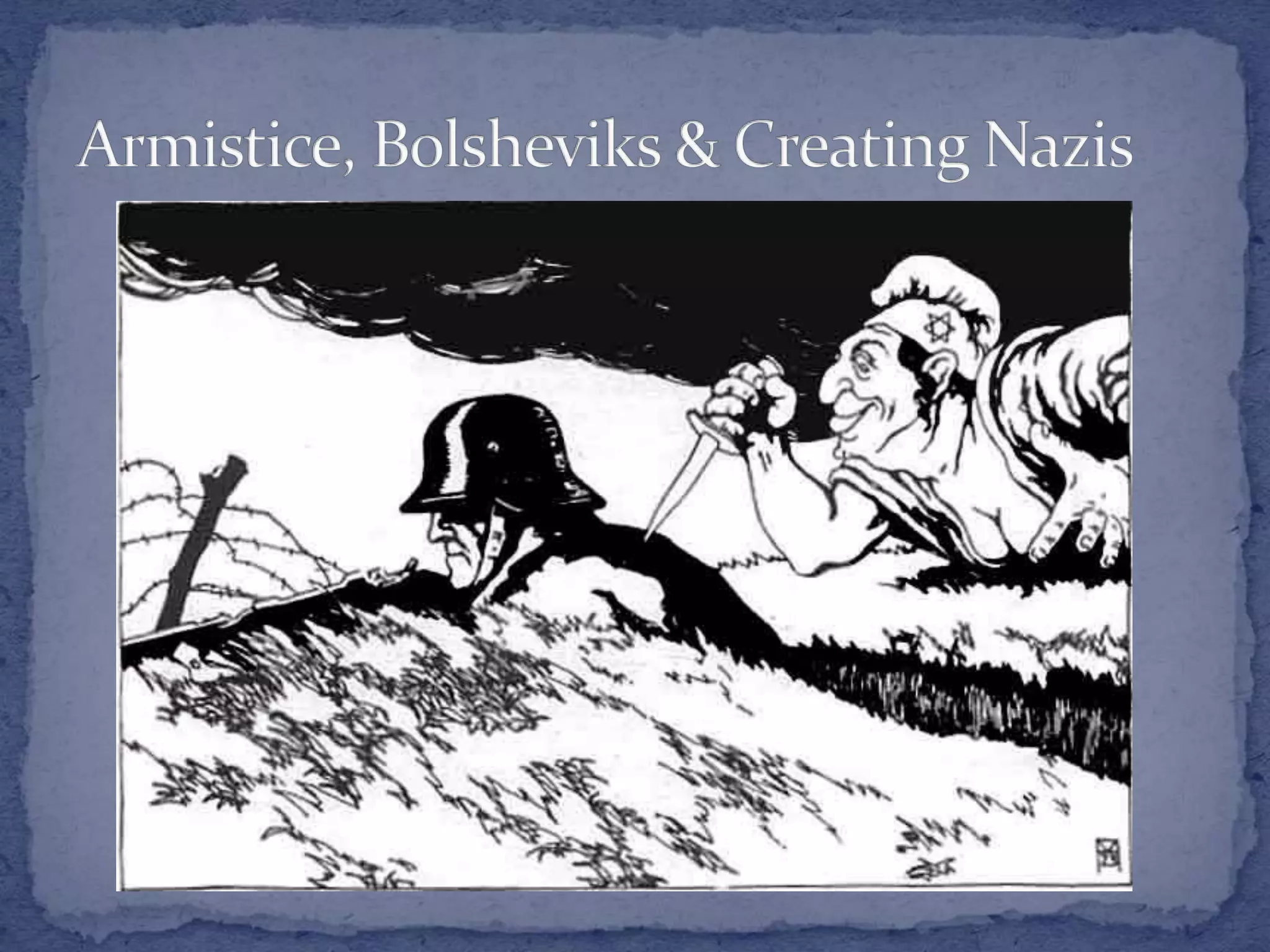
  • #53 1919 postcard The notion, widely believed in right-wing circles in Germany after 1918, that the German Army did not lose World War I on the battlefield but was instead betrayed by the civilians on the home front, especially the republicans who overthrew the monarchy in the German Revolution of 1918–19. Advocates denounced the German government leaders who signed the Armistice on November 11, 1918, as the "November Criminals“ Nevertheless, the idea of domestic betrayal resonated among its audience, and its claims would provide some basis for public support for the emerging National Socialist Party, under an autocratic and chauvinistic form of nationalism. Anti-Jewish sentiment was intensified by the Bavarian Soviet Republic, a Communist government which ruled the city of Munich for two weeks before being crushed by the Freikorps militia. Many of the Bavarian Soviet Republic's leaders were Jewish, allowing anti-Jewish propagandists to connect Jews with Communism (and thus treason).
  • #54 "12,000 Jewish soldiers died on the field of honor for the fatherland." A leaflet published in 1920 by German Jewish veterans in response to accusations of the lack of patriotism