Course Design
and Exam
Preparation
IB LANGUAGE B
HIGHER LEVEL 2013
Barbara Giegerich
Berlin Brandenburg International School
AGIS January 28th 2012
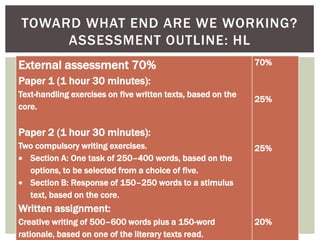
External assessment 70%
Paper 1 (1 hour 30 minutes):
Text-handling exercises on five written texts, based on the
core.
Paper 2 (1 hour 30 minutes):
Two compulsory writing exercises.
Section A: One task of 250–400 words, based on the
options, to be selected from a choice of five.
Section B: Response of 150–250 words to a stimulus
text, based on the core.
Written assignment:
Creative writing of 500–600 words plus a 150-word
rationale, based on one of the literary texts read.
70%
25%
25%
20%
TOWARD WHAT END ARE WE WORKING?
ASSESSMENT OUTLINE: HL
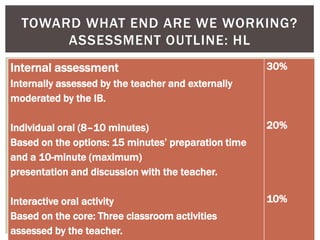
Internal assessment
Internally assessed by the teacher and externally
moderated by the IB.
Individual oral (8–10 minutes)
Based on the options: 15 minutes’ preparation time
and a 10-minute (maximum)
presentation and discussion with the teacher.
Interactive oral activity
Based on the core: Three classroom activities
assessed by the teacher.
30%
20%
10%
TOWARD WHAT END ARE WE WORKING?
ASSESSMENT OUTLINE: HL
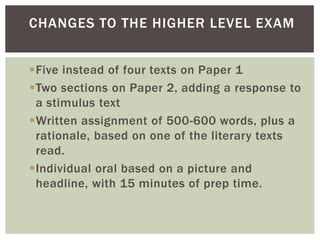
Five instead of four texts on Paper 1
Two sections on Paper 2, adding a response to
a stimulus text
Written assignment of 500-600 words, plus a
rationale, based on one of the literary texts
read.
Individual oral based on a picture and
headline, with 15 minutes of prep time.
CHANGES TO THE HIGHER LEVEL EXAM
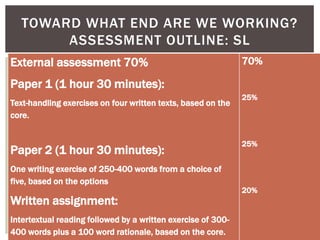
External assessment 70%
Paper 1 (1 hour 30 minutes):
Text-handling exercises on four written texts, based on the
core.
Paper 2 (1 hour 30 minutes):
One writing exercise of 250-400 words from a choice of
five, based on the options
Written assignment:
Intertextual reading followed by a written exercise of 300-
400 words plus a 100 word rationale, based on the core.
70%
25%
25%
20%
TOWARD WHAT END ARE WE WORKING?
ASSESSMENT OUTLINE: SL
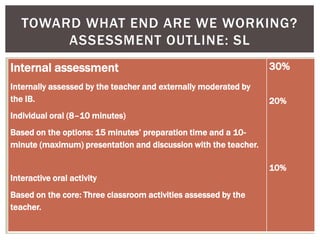
Internal assessment
Internally assessed by the teacher and externally moderated by
the IB.
Individual oral (8–10 minutes)
Based on the options: 15 minutes’ preparation time and a 10-
minute (maximum) presentation and discussion with the teacher.
Interactive oral activity
Based on the core: Three classroom activities assessed by the
teacher.
30%
20%
10%
TOWARD WHAT END ARE WE WORKING?
ASSESSMENT OUTLINE: SL
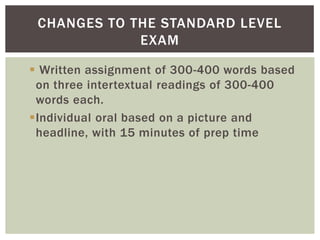
 Written assignment of 300-400 words based
on three intertextual readings of 300-400
words each.
Individual oral based on a picture and
headline, with 15 minutes of prep time
CHANGES TO THE STANDARD LEVEL
EXAM
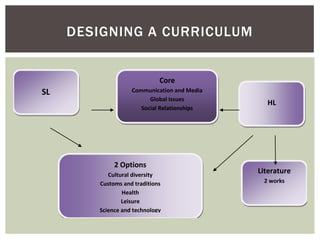
DESIGNING A CURRICULUM
SL
HL
Core
Communication and Media
Global Issues
Social Relationships
Literature
2 works
2 Options
Cultural diversity
Customs and traditions
Health
Leisure
Science and technology
CHOOSING TOPICS
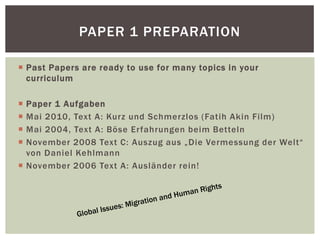
 Past Papers are ready to use for many topics in your
curriculum
 Paper 1 Aufgaben
 Mai 2010, Text A: Kurz und Schmerzlos (Fatih Akin Film)
 Mai 2004, Text A: Böse Erfahrungen beim Betteln
 November 2008 Text C: Auszug aus „Die Vermessung der Welt“
von Daniel Kehlmann
 November 2006 Text A: Ausländer rein!
PAPER 1 PREPARATION
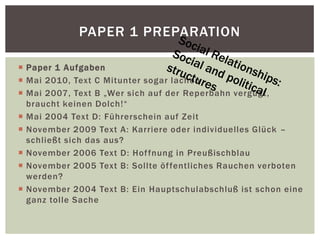
 Paper 1 Aufgaben
 Mai 2010, Text C Mitunter sogar lachen
 Mai 2007, Text B „Wer sich auf der Reperbahn vergügt,
braucht keinen Dolch!“
 Mai 2004 Text D: Führerschein auf Zeit
 November 2009 Text A: Karriere oder individuelles Glück –
schließt sich das aus?
 November 2006 Text D: Hoffnung in Preußischblau
 November 2005 Text B: Sollte öffentliches Rauchen verboten
werden?
 November 2004 Text B: Ein Hauptschulabschluß ist schon eine
ganz tolle Sache
PAPER 1 PREPARATION
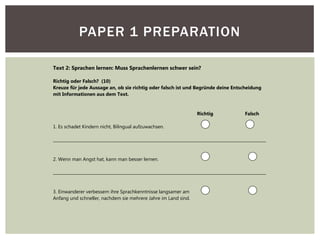
PAPER 1 PREPARATION
Text 2: Sprachen lernen: Muss Sprachenlernen schwer sein?
Richtig oder Falsch? (10)
Kreuze für jede Aussage an, ob sie richtig oder falsch ist und Begründe deine Entscheidung
mit Informationen aus dem Text.
Richtig Falsch
1. Es schadet Kindern nicht, Bilingual aufzuwachsen.
_________________________________________________________________________________________________________
2. Wenn man Angst hat, kann man besser lernen.
_________________________________________________________________________________________________________
3. Einwanderer verbessern ihre Sprachkenntnisse langsamer am
Anfang und schneller, nachdem sie mehrere Jahre im Land sind.
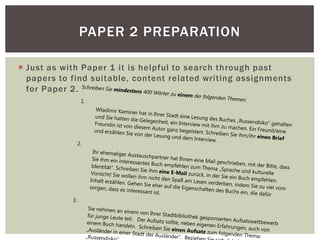
 Just as with Paper 1 it is helpful to search through past
papers to find suitable, content related writing assignments
for Paper 2.
PAPER 2 PREPARATION
Schreiben Sie mindestens 400 Wörter zu einem der folgenden Themen.1.
Wladimir Kaminer hat in Ihrer Stadt eine Lesung des Buches „Russendisko“ gehalten
und Sie hatten die Gelegenheit, ein Interview mit ihm zu machen. Ein Freund/eine
Freundin ist von diesem Autor ganz begeistert. Schreiben Sie ihm/ihr einen Brief
und erzählen Sie von der Lesung und dem Interview.
2.
Ihr ehemaliger Austauschpartner hat Ihnen eine Mail geschrieben, mit der Bitte, dass
Sie ihm ein interessantes Buch empfehlen zum Thema „Sprache und kulturelle
Identität“. Schreiben Sie ihm eine E-Mail zurück, in der Sie ein Buch empfehlen.
Vorsicht! Sie wollen ihm nicht den Spaß am Lesen verderben, indem Sie zu viel vom
Inhalt erzählen. Gehen Sie eher auf die Eigenschaften des Buchs ein, die dafür
sorgen, dass es interessant ist.
3.
Sie nehmen an einem von Ihrer Stadtbibliothek gesponserten Aufsatzwettbewerb
für junge Leute teil. Der Aufsatz sollte, neben eigenen Erfahrungen, auch von
einem Buch handeln. Schreiben Sie einen Aufsatz zum folgenden Thema:
„Ausländer in einer Stadt der Ausländer“. Bezie„Russend
 Internal deadlines:
 For the first semester, students write three Paper 2 texts
outside of class. These include:
 an essay
 a letter
 a speech
 a police report
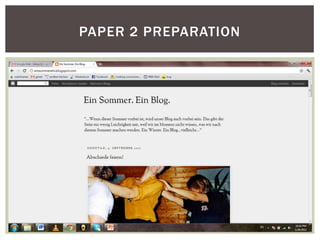
PAPER 2 PREPARATION
PAPER 2 PREPARATION
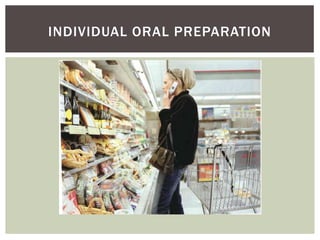
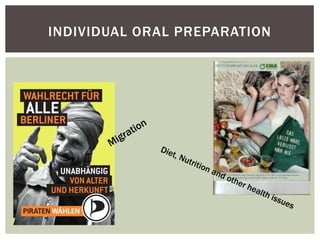
 Giving students the structure and tools to move from the
image to a larger context:
 Step 1: Make a LIST of all the objects, people, etc. you can identify
in the pictures. Next, write down all the adjectives and verbs you
associate with what you see.
 Step 2: Do you recognize any FAMOUS people, places or events?
If so, why are they relevant to the picture?
 Step 3: How does the picture relate to the TOPICS we have
studied? What do you remember from class that will help you talk
about this picture?
 Step 4: How does the TITLE affect what you see? Does it present
the picture in a different light? Do you recognize any idioms or plays
on words in the title?
 Step 5: In what kind of PLACE might you see this picture?
INDIVIDUAL ORAL PREPARATION
WORKING WITH A VARIETY OF TEXTS

IBDP German B course overview

  • 1.
    Course Design and Exam Preparation IBLANGUAGE B HIGHER LEVEL 2013 Barbara Giegerich Berlin Brandenburg International School AGIS January 28th 2012
  • 2.
    External assessment 70% Paper1 (1 hour 30 minutes): Text-handling exercises on five written texts, based on the core. Paper 2 (1 hour 30 minutes): Two compulsory writing exercises. Section A: One task of 250–400 words, based on the options, to be selected from a choice of five. Section B: Response of 150–250 words to a stimulus text, based on the core. Written assignment: Creative writing of 500–600 words plus a 150-word rationale, based on one of the literary texts read. 70% 25% 25% 20% TOWARD WHAT END ARE WE WORKING? ASSESSMENT OUTLINE: HL
  • 3.
    Internal assessment Internally assessedby the teacher and externally moderated by the IB. Individual oral (8–10 minutes) Based on the options: 15 minutes’ preparation time and a 10-minute (maximum) presentation and discussion with the teacher. Interactive oral activity Based on the core: Three classroom activities assessed by the teacher. 30% 20% 10% TOWARD WHAT END ARE WE WORKING? ASSESSMENT OUTLINE: HL
  • 4.
    Five instead offour texts on Paper 1 Two sections on Paper 2, adding a response to a stimulus text Written assignment of 500-600 words, plus a rationale, based on one of the literary texts read. Individual oral based on a picture and headline, with 15 minutes of prep time. CHANGES TO THE HIGHER LEVEL EXAM
  • 5.
    External assessment 70% Paper1 (1 hour 30 minutes): Text-handling exercises on four written texts, based on the core. Paper 2 (1 hour 30 minutes): One writing exercise of 250-400 words from a choice of five, based on the options Written assignment: Intertextual reading followed by a written exercise of 300- 400 words plus a 100 word rationale, based on the core. 70% 25% 25% 20% TOWARD WHAT END ARE WE WORKING? ASSESSMENT OUTLINE: SL
  • 6.
    Internal assessment Internally assessedby the teacher and externally moderated by the IB. Individual oral (8–10 minutes) Based on the options: 15 minutes’ preparation time and a 10- minute (maximum) presentation and discussion with the teacher. Interactive oral activity Based on the core: Three classroom activities assessed by the teacher. 30% 20% 10% TOWARD WHAT END ARE WE WORKING? ASSESSMENT OUTLINE: SL
  • 7.
     Written assignmentof 300-400 words based on three intertextual readings of 300-400 words each. Individual oral based on a picture and headline, with 15 minutes of prep time CHANGES TO THE STANDARD LEVEL EXAM
  • 8.
    DESIGNING A CURRICULUM SL HL Core Communicationand Media Global Issues Social Relationships Literature 2 works 2 Options Cultural diversity Customs and traditions Health Leisure Science and technology
  • 9.
  • 10.
     Past Papersare ready to use for many topics in your curriculum  Paper 1 Aufgaben  Mai 2010, Text A: Kurz und Schmerzlos (Fatih Akin Film)  Mai 2004, Text A: Böse Erfahrungen beim Betteln  November 2008 Text C: Auszug aus „Die Vermessung der Welt“ von Daniel Kehlmann  November 2006 Text A: Ausländer rein! PAPER 1 PREPARATION
  • 11.
     Paper 1Aufgaben  Mai 2010, Text C Mitunter sogar lachen  Mai 2007, Text B „Wer sich auf der Reperbahn vergügt, braucht keinen Dolch!“  Mai 2004 Text D: Führerschein auf Zeit  November 2009 Text A: Karriere oder individuelles Glück – schließt sich das aus?  November 2006 Text D: Hoffnung in Preußischblau  November 2005 Text B: Sollte öffentliches Rauchen verboten werden?  November 2004 Text B: Ein Hauptschulabschluß ist schon eine ganz tolle Sache PAPER 1 PREPARATION
  • 12.
    PAPER 1 PREPARATION Text2: Sprachen lernen: Muss Sprachenlernen schwer sein? Richtig oder Falsch? (10) Kreuze für jede Aussage an, ob sie richtig oder falsch ist und Begründe deine Entscheidung mit Informationen aus dem Text. Richtig Falsch 1. Es schadet Kindern nicht, Bilingual aufzuwachsen. _________________________________________________________________________________________________________ 2. Wenn man Angst hat, kann man besser lernen. _________________________________________________________________________________________________________ 3. Einwanderer verbessern ihre Sprachkenntnisse langsamer am Anfang und schneller, nachdem sie mehrere Jahre im Land sind.
  • 13.
     Just aswith Paper 1 it is helpful to search through past papers to find suitable, content related writing assignments for Paper 2. PAPER 2 PREPARATION Schreiben Sie mindestens 400 Wörter zu einem der folgenden Themen.1. Wladimir Kaminer hat in Ihrer Stadt eine Lesung des Buches „Russendisko“ gehalten und Sie hatten die Gelegenheit, ein Interview mit ihm zu machen. Ein Freund/eine Freundin ist von diesem Autor ganz begeistert. Schreiben Sie ihm/ihr einen Brief und erzählen Sie von der Lesung und dem Interview. 2. Ihr ehemaliger Austauschpartner hat Ihnen eine Mail geschrieben, mit der Bitte, dass Sie ihm ein interessantes Buch empfehlen zum Thema „Sprache und kulturelle Identität“. Schreiben Sie ihm eine E-Mail zurück, in der Sie ein Buch empfehlen. Vorsicht! Sie wollen ihm nicht den Spaß am Lesen verderben, indem Sie zu viel vom Inhalt erzählen. Gehen Sie eher auf die Eigenschaften des Buchs ein, die dafür sorgen, dass es interessant ist. 3. Sie nehmen an einem von Ihrer Stadtbibliothek gesponserten Aufsatzwettbewerb für junge Leute teil. Der Aufsatz sollte, neben eigenen Erfahrungen, auch von einem Buch handeln. Schreiben Sie einen Aufsatz zum folgenden Thema: „Ausländer in einer Stadt der Ausländer“. Bezie„Russend
  • 14.
     Internal deadlines: For the first semester, students write three Paper 2 texts outside of class. These include:  an essay  a letter  a speech  a police report PAPER 2 PREPARATION
  • 15.
  • 16.
     Giving studentsthe structure and tools to move from the image to a larger context:  Step 1: Make a LIST of all the objects, people, etc. you can identify in the pictures. Next, write down all the adjectives and verbs you associate with what you see.  Step 2: Do you recognize any FAMOUS people, places or events? If so, why are they relevant to the picture?  Step 3: How does the picture relate to the TOPICS we have studied? What do you remember from class that will help you talk about this picture?  Step 4: How does the TITLE affect what you see? Does it present the picture in a different light? Do you recognize any idioms or plays on words in the title?  Step 5: In what kind of PLACE might you see this picture? INDIVIDUAL ORAL PREPARATION
  • 17.
  • 18.
  • 19.
    WORKING WITH AVARIETY OF TEXTS