Macoun
⌘
Data Model Mal anders
Maxim Zaks
@iceX33
Ablauf
•Philosophie
•Vorstellung von Entitas-Kit
•Ausblick
Worum geht es beim
Programmieren?
EDV
=
Elektronische Datenverarbeitung
Zwei Arten
von Datenverarbeitung?!
Reine Berechnung
=
Datentransformation/Erzeugung
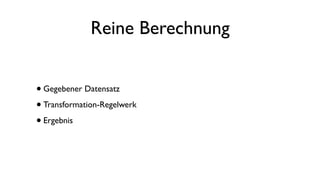
Reine Berechnung
•Gegebener Datensatz
•Transformation-Regelwerk
•Ergebnis
Compiler
Zustandslose WebServices
Funktionale Programmierung
Was ist mit
Web Browser und Apps?
HTML, CSS & JS rein
Pixelwolke raus
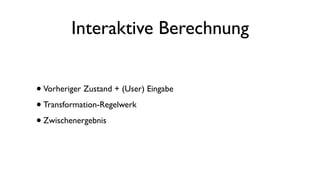
Interaktive Berechnung
•Vorheriger Zustand + (User) Eingabe
•Transformation-Regelwerk
•Zwischenergebnis
Die Berechnung wird in einer
Schleife durchgeführt
Apps
Spiele
Simulationen
Die Zwischenergebnisse werden
in Datenmodell gespeichert
Welche Art von
Daten gibt es?
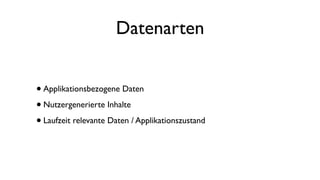
Datenarten
•Applikationsbezogene Daten
•Nutzergenerierte Inhalte
•Laufzeit relevante Daten / Applikationszustand
Applikationszustand
mit
OOP
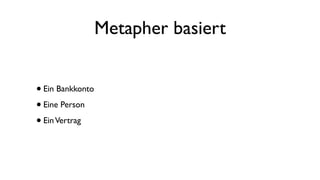
Metapher basiert
•Ein Bankkonto
•Eine Person
•EinVertrag
Geht es auch
mehr
Datenorientiert?
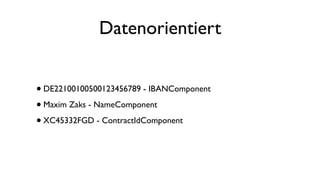
Datenorientiert
•DE22100100500123456789 - IBANComponent
•Maxim Zaks - NameComponent
•XC45332FGD - ContractIdComponent
Class
vs.
Entity
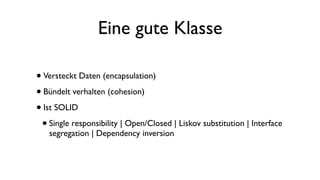
Eine gute Klasse
•Versteckt Daten (encapsulation)
•Bündelt verhalten (cohesion)
•Ist SOLID
•Single responsibility | Open/Closed | Liskov substitution | Interface
segregation | Dependency inversion
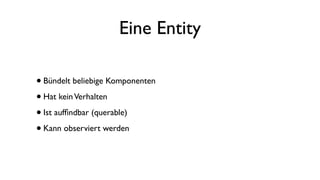
Eine Entity
•Bündelt beliebige Komponenten
•Hat keinVerhalten
•Ist auffindbar (querable)
•Kann observiert werden
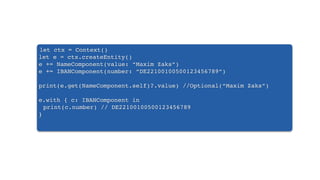
let ctx = Context()
let e = ctx.createEntity()
e += NameComponent(value: “Maxim Zaks”)
e += IBANComponent(number: “DE22100100500123456789”)
print(e.get(NameComponent.self)?.value) //Optional(“Maxim Zaks”)
e.with { c: IBANComponent in
print(c.number) // DE22100100500123456789
}
Context
verwaltet
Entities
Komponente ist ein Struct,
der `Component` oder
`UniqueComponent`
implementiert
Entity ist ein Wrapper um
[CID: Component]
Eine Entity ist definiert durch
ihre innere Werte
Nicht durch ihre Geburt
Entities können anhand ihrer
Komponenten gefunden werden
let group = ctx.all([A.cid, B.cid], any: [C.cid, D.cid], none:[E.cid])
for e in group {
print(e.has(A.cid))) // true
}
group.withEach { e, c: A in
print(c)
e -= A.cid
}
print(group.count) // 0
Group ist eine Sequenz von
Entity die immer aktuell ist
Implizite und explizite
Entity Klassifizierung
struct Name: Component { let value: String }
struct BirthDay: Component {let value: Date }
struct NumberOfEmployees: Component {let value: Int}
struct Address: Component {let value: String}
let personMatcher = Matcher(all:[Name.cid, BirthDay.cid])
let organisationMatcher = Matcher(all:[Address.cid], none:[BirthDay.cid])
let people = ctx.group(personMatcher)
let organisations = ctx.group(organisationMatcher)
Implizite Klassifizierung durch
all, any, none
Regeln angewandt an Daten
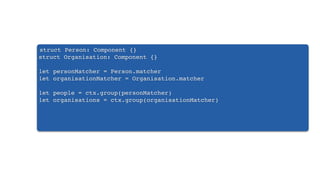
Explizite
Entity Klassifizierung?
struct Person: Component {}
struct Organisation: Component {}
let personMatcher = Person.matcher
let organisationMatcher = Organisation.matcher
let people = ctx.group(personMatcher)
let organisations = ctx.group(organisationMatcher)
Explizite Entity Klassifizierung
durch
“TagComponent”
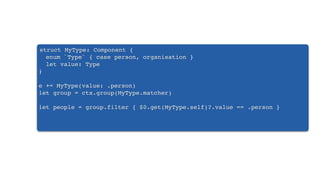
Explizit und Exklusive?
struct MyType: Component {
enum `Type` { case person, organisation }
let value: Type
}
e += MyType(value: .person)
let group = ctx.group(MyType.matcher)
let people = group.filter { $0.get(MyType.self)?.value == .person }
Indexierung der Werte
struct Name: Component {let value: String}
let ctx = Context()
let nameIndex = ctx.index { (name: Name) -> String in
name.value
}
let entities: Set<Entity> = nameIndex["Maxim"]
Ziehen vs. Drucken
Context, Group und Entity
sind
Observable
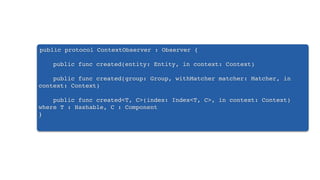
public protocol ContextObserver : Observer {
public func created(entity: Entity, in context: Context)
public func created(group: Group, withMatcher matcher: Matcher, in
context: Context)
public func created<T, C>(index: Index<T, C>, in context: Context)
where T : Hashable, C : Component
}
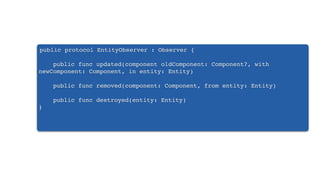
public protocol EntityObserver : Observer {
public func updated(component oldComponent: Component?, with
newComponent: Component, in entity: Entity)
public func removed(component: Component, from entity: Entity)
public func destroyed(entity: Entity)
}
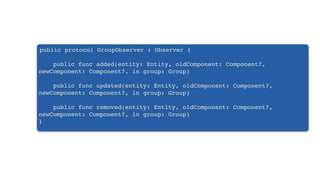
public protocol GroupObserver : Observer {
public func added(entity: Entity, oldComponent: Component?,
newComponent: Component?, in group: Group)
public func updated(entity: Entity, oldComponent: Component?,
newComponent: Component?, in group: Group)
public func removed(entity: Entity, oldComponent: Component?,
newComponent: Component?, in group: Group)
}
Applikationszustand kann
völlig reaktiv und transparent
gemacht werden
Anwendungsmuster
resiapp.io
⌘
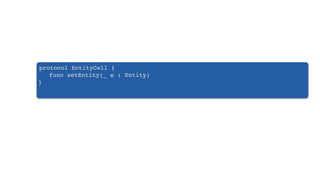
CollectionView oder TableView
Basierend auf einer Group
protocol EntityCell {
func setEntity(_ e : Entity)
}
let message = messageGroup.sorted()[indexPath.row]
let cellId = getCellId(message: message)
guard
let cell = tableView.dequeueReusableCell(withIdentifier: cellId) else {
return UITableViewCell()
}
if let cell = cell as? EntityCell {
cell.setEntity(e)
}
return cell
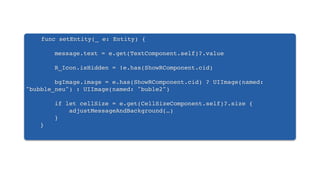
func setEntity(_ e: Entity) {
message.text = e.get(TextComponent.self)?.value
R_Icon.isHidden = !e.has(ShowRComponent.cid)
bgImage.image = e.has(ShowRComponent.cid) ? UIImage(named:
"bubble_neu") : UIImage(named: "buble2")
if let cellSize = e.get(CellSizeComponent.self)?.size {
adjustMessageAndBackground(…)
}
}
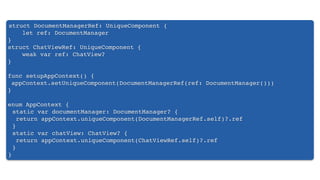
Service Locator
“Dependency Injection
für Arme”
struct DocumentManagerRef: UniqueComponent {
let ref: DocumentManager
}
struct ChatViewRef: UniqueComponent {
weak var ref: ChatView?
}
func setupAppContext() {
appContext.setUniqueComponent(DocumentManagerRef(ref: DocumentManager()))
}
enum AppContext {
static var documentManager: DocumentManager? {
return appContext.uniqueComponent(DocumentManagerRef.self)?.ref
}
static var chatView: ChatView? {
return appContext.uniqueComponent(ChatViewRef.self)?.ref
}
}
Component als Event
Userinteraktion ist
Zustandsveränderung
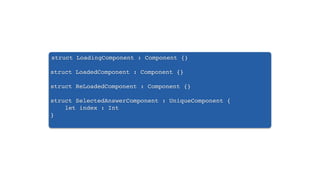
struct LoadingComponent : Component {}
struct LoadedComponent : Component {}
struct ReLoadedComponent : Component {}
struct SelectedAnswerComponent : UniqueComponent {
let index : Int
}
Was ist mit Persistieren?
Was ist mit Multi Threading?
EntitasKit vs. CoreData
•Leichtgewichtig
•Observable
•InMemory (persistieren auf eigene Hand)
•Datenzentriert, kein OOP
•Kein Schema (sehr gut zum improvisieren)
Fragen?
https://github.com/mzaks/
EntitasKit
Vielen Dank
Macoun
⌘

Data model mal anders