Configuring in the Browser, Really!
Tim Geisler, Heribert Schütz
webXcerpt Software GmbH
tg@webxcerpt.com, hs@webxcerpt.com
CWG 2015, Prague 2015-04-28
Our History
● Product configuration since 2002,
with SAP since 2007
● Built and maintained
– Models
– Modeling environments
– Configuration frameworks
Problem 1: Modeling
Problem 1: Modeling
● Framework-specific modeling tools
Problem 1: Modeling
● Framework-specific modeling tools
● Lack of abstraction features and data structures
– Loops, functions
– Arrays, objects (with methods)
Problem 1: Modeling
● Framework-specific modeling tools
● Lack of abstraction features and data structures
– Loops, functions
– Arrays, objects (with methods)
● Models not represented as human-readable text
– Edit, search & replace
– Discuss, annotate
– Compare, manage revisions
Problem 1: Modeling – Solution A
Problem 1: Modeling – Solution B
Our solution so far:
Problem 1: Modeling – Solution B
Our solution so far:
● Customer-specific modeling languages
Problem 1: Modeling – Solution B
Our solution so far:
● Customer-specific modeling languages
● Modeling environments based on Eclipse and
Xtext
Problem 1: Modeling – Solution B
Our solution so far:
● Customer-specific modeling languages
● Modeling environments based on Eclipse and
Xtext
● Automated generation of model representation
for target framework
Problem 1: Modeling – Solution B
Our solution so far:
●
Customer-specific modeling languages
● Modeling environments based on Eclipse and Xtext
● Automated generation of model representation for target framework
●
See also CWG talks
– Vienna 2010:
ConfigModeler and VClipse -
languages and IDEs
for product modeling
– Cologne 2011:
Domain-Specific Languages
for Product Modeling
– Berlin 2012:
How to Build Your Own
Product-Modeling Environment?
Problem 1: Modeling – Solution C
● Use a programming language
– For application-specific inferencing
– But also to build up the model
Problem 1: Modeling – Solution C
● Use a programming language
– For application-specific inferencing
– But also to build up the model
● Use programming tools
– Editors/IDEs
– Debuggers and profilers
– Revision control
– Test and CI frameworks
Problem 1: Modeling – Solution C
● Use a programming language
– For application-specific inferencing
– But also to build up the model
● Use programming tools
– Editors/IDEs
– Debuggers and profilers
– Revision control
– Test and CI frameworks
● General purpose tools and languages
– Maturity
– Re-usable knowledge, may already be available
– Large communities and „ecosystems“
Problem 2: User Experience
● Performance
Problem 2: User Experience
● Performance
– Client-server round trips
Problem 2: User Experience
● Performance
– Client-server round trips
● Rigid UI
– UI structure imposed by framework
– High costs for application-specific UI
Problem 2: User Experience
● Performance
– Client-server round trips
● Rigid UI
– UI structure imposed by framework
– High costs for application-specific UI
● Need to be online
Problem 2: User Experience
● Performance
– Client-server round trips
● Rigid UI
– UI structure imposed by framework
– High costs for application-specific UI
● Need to be online
Increasing gap:
Configurators ↔ Modern web applications
In the meantime ...
In the meantime ...
In the meantime ...
Client hardware
improved
In the meantime ...
Client hardware
improved
● CPU
● Memory
In the meantime ...
Client hardware
improved
● CPU
● Memory
● Even on mobiles
In the meantime ...
Client hardware
improved
● CPU
● Memory
● Even on mobiles
… but the speed of light remained the same.
In the meantime ...
In the meantime ...
Browser improvements:
In the meantime ...
Browser improvements:
● JavaScript performance
In the meantime ...
Browser improvements:
● JavaScript performance
● Standardized features
– UI extensions
– Offline applications
– Local storage
– …
In the meantime ...
Browser improvements:
● JavaScript performance
● Standardized features
– UI extensions
– Offline applications
– Local storage
– …
● Improved compatibility
http://kangax.github.io/compat-table/es5/
In the meantime ...
A software ecosystem for web applications
flourished:
● Web-application frameworks
● Preprocessors for JavaScript/HTML/CSS
● Libraries
● Build tools
● ...
In the meantime ...
In the meantime ...
Web browsers have become a
serious application platform.
In the meantime ...
Web browsers have become a
serious application platform.
Even for the business logic.
In the meantime ...
Web browsers have become a
serious application platform.
Even for the business logic.
And they are getting better and better.
Configuring in the Browser:
Implement configurators in JavaScript.
Configuring in the Browser:
Implement configurators in JavaScript.
JavaScript is also
a reasonable choice for modeling.
Demo
Optical Transport
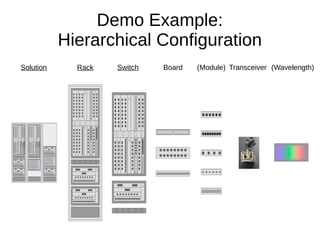
Demo Example:
Hierarchical Configuration
SwitchRackSolution Board (Module) Transceiver (Wavelength)
Demo
http://opencpq.webxcerpt.com/examples/optical-transport/
^
– a JavaScript-based Configurator Framework
● Building-block library
– Components
– Dependencies
– a JavaScript-based Configurator Framework
● Building-block library
– Components
– Dependencies
● Combine building blocks with JavaScript
– a JavaScript-based Configurator Framework
● Building-block library
– Components
– Dependencies
● Combine building blocks with JavaScript
● Add application-specific building blocks
– a JavaScript-based Configurator Framework
● Building-block library
– Components
– Dependencies
● Combine building blocks with JavaScript
● Add application-specific building blocks
● A light-weight layer based on ReactJS and
Bootstrap
– a JavaScript-based Configurator Framework
– an Open-Source Project
Source code and links to live demos
available on Github:
https://github.com/webXcerpt/openCPQ
– an Open-Source Project
Source code and links to live demos
available on Github:
https://github.com/webXcerpt/openCPQ
Liberal MIT license
– an Open-Source Project
Source code and links to live demos
available on Github:
https://github.com/webXcerpt/openCPQ
Liberal MIT license
Use, adapt,
integrate, contribute!
– an Open-Source Project
Modeling with openCPQ:
Cases with Details
Modeling with openCPQ:
Cases with Details
var configuration = CSelect([
unansweredCase("Select Configuration Mode"),
ccase("Switches", "Optical Switches",
CQuantifiedList({}, "Optical Switch",
opticalSwitches)),
ccase("Rack", "Racks",
CQuantifiedList({}, "Rack",
rack)),
ccase("Solution", "Solution",
solution),
]);
cases
details
Modeling with openCPQ:
Cases with Details
function boards(isDoubleWidthSlot) {
return CSelect([
for (b of components.boards)
if (!b.doubleWidth ||
isDoubleWidthSlot)
ccaseBOM(b.name, b.label,
ports(b.ports))
]);
}
var configuration = CSelect([
unansweredCase("Select Configuration Mode"),
ccase("Switches", "Optical Switches",
CQuantifiedList({}, "Optical Switch",
opticalSwitches)),
ccase("Rack", "Racks",
CQuantifiedList({}, "Rack",
rack)),
ccase("Solution", "Solution",
solution),
]);
cases
details
cases
details
Data-Driven Modeling
with openCPQ
Data-Driven Modeling
with openCPQ
Data-Driven Modeling
with openCPQ
Data-Driven Modeling
with openCPQ
Data-Driven Modeling
with openCPQ
function boards(isDoubleWidthSlot) {
return CSelect([
for (b of components.boards)
if (!b.doubleWidth || isDoubleWidthSlot)
ccaseBOM(b.name, b.label,
aggregate("power", b.power,
ports(b.ports)))
]);
}
Data-Driven Modeling
with openCPQ
function boards(isDoubleWidthSlot) {
return CSelect([
for (b of components.boards)
if (!b.doubleWidth || isDoubleWidthSlot)
ccaseBOM(b.name, b.label,
aggregate("power", b.power,
ports(b.ports)))
]);
}
Concise specification of complex models
Modeling with openCPQ:
Application-specific Abstractions
Modeling with openCPQ:
Application-specific Abstractions
Modeling with openCPQ:
Application-specific Abstractions
Modeling with openCPQ:
Application-specific Abstractions
CNameSpace("props", CGroup([
cmember("ConfigType", "Configuration Type",
CNamed("props", "ConfigType", {valueAccessor: n => n.value}, CSelect([
ccase("NEW", "New Configuration"), ccase("EXT", "Upgrade / Extension"),
]))),
cmember("Server", "Server", ep.table([
ep.rowInteger("clients", "Connected clients"),
crow("Size", "Server size", ({props}) => props.ConfigType === "EXT"
? [ep.eCell("Size", CSelect([for (s of serverSizes) ccase(s)])),
() => ep.pCell("Size", CSelect([for (s of serverSizes)
onlyIf(serverSizes.indexOf(s) >= serverSizes.indexOf(ep.E(props.Size)),
"Downgrade not supported", [ccase(s)])]))]
: [ep.pCell("Size", CSelect([for (s of serverSizes) ccase(s)]))]
),
ep.rowBoolean("redundancy", "Redundant server"),
])),
])),
How it Works
Change Propagation
core
state
Change Propagation
core
state inference
full
state
Change Propagation
core
state
user
interfaceinference render
full
state
Change Propagation
core
state
user
interfaceinference render
full
state
core
state
user
update
Change Propagation
core
state
user
interfaceinference render
full
state
core
state
user
interface
full
state
user
update
inference render
Change Propagation
core
state
user
interfaceinference render
full
state
core
state
user
interface
full
state
core
state
user
interface
full
state
user
update
user
update
inference render
inference render
Change Propagation
core
state
user
interfaceinference render
full
state
core
state
user
interface
full
state
core
state
user
interface
full
state
user
update
user
update
inference render
inference render
non-incremental
propagation
Change Propagation
core
state
user
interface
full
state
user
update
core
state
user
interface
full
state
user
update
core
state
user
interface
full
state
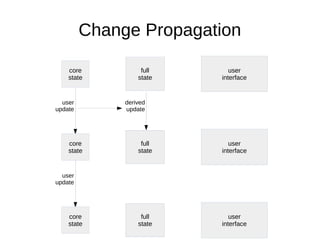
Change Propagation
core
state
user
interface
full
state
user
update
derived
update
core
state
user
interface
full
state
user
update
core
state
user
interface
full
state
Change Propagation
core
state
user
interface
full
state
user
update
derived
update
derived
update
core
state
user
interface
full
state
user
update
core
state
user
interface
full
state
Change Propagation
core
state
user
interface
full
state
user
update
derived
update
derived
update
core
state
user
interface
full
state
user
update
derived
update
derived
update
core
state
user
interface
full
state
Change Propagation
core
state
user
interface
full
state
user
update
derived
update
derived
update
core
state
user
interface
full
state
user
update
derived
update
derived
update
core
state
user
interface
full
state
incremental
propagation
Change Propagation
Change Propagation
Trade-off:
● Non-incremental propagation:
Change Propagation
Trade-off:
● Non-incremental propagation:
– Redo inference steps
● CPU consumption
– Redo rendering
● CPU consumption
● Flicker, loss of UI state (focus, scroll, selection), ...
● Incremental propagation:
Change Propagation
Trade-off:
● Non-incremental propagation:
– Redo inference steps
● CPU consumption
– Redo rendering
● CPU consumption
● Flicker, loss of UI state (focus, scroll, selection), ...
● Incremental propagation:
– Keep track of dependencies
● Error-prone (unless completely shielded from the modeler)
● Consumes memory and CPU
Change Propagation
core
state
user
interface
full
state
user
update
derived
update
core
state
user
interface
full
state
user
update
derived
update
core
state
user
interface
full
state
inference
inference
inference
mixed
propagation
React:
A JavaScript library for building user interfaces
React:
A JavaScript library for building user interfaces
● Unique approach:
– not a widget library
– not an MVC framework
React:
A JavaScript library for building user interfaces
● Unique approach:
– not a widget library
– not an MVC framework
● Virtual DOM ("VDOM"):
– Representation of the DOM tree as a JavaScript
data structure (cheap!)
React:
A JavaScript library for building user interfaces
● Unique approach:
– not a widget library
– not an MVC framework
● Virtual DOM ("VDOM"):
– Representation of the DOM tree as a JavaScript
data structure (cheap!)
● Upon each update:
React:
A JavaScript library for building user interfaces
● Unique approach:
– not a widget library
– not an MVC framework
● Virtual DOM ("VDOM"):
– Representation of the DOM tree as a JavaScript data
structure (cheap!)
● Upon each update:
– User code
● generates VDOM from your model
● possibly using XML templating integrated into JavaScript ("JSX")
React:
A JavaScript library for building user interfaces
● Unique approach:
– not a widget library
– not an MVC framework
● Virtual DOM ("VDOM"):
– Representation of the DOM tree as a JavaScript data structure
(cheap!)
● Upon each update:
– User code
● generates VDOM from your model
● possibly using XML templating integrated into JavaScript ("JSX")
– React
● diffs the VDOM with the previous VDOM
● applies only the diff to the actual DOM
Architecture
State
(JSON)State
(JSON)
Nodes
Nodes
VDOM
VDOM DOM
Types render()
apply
delta
Product
Model
Updates
Architecture
State
(JSON)State
(JSON)
Nodes
Nodes
VDOM
VDOM DOM
Types render()
apply
delta
Product
Model
Updates
Architecture
State
(JSON)State
(JSON)
Nodes
Nodes
VDOM
VDOM DOM
Types render()
apply
delta
Product
Model
Updates
SAP Integration
SAP Integration
● Models
– Conversion of LO-VC and IPC models to openCPQ
● Schema, basic logic: automatable with VClipse extension
● Complex logic: manual conversion
SAP Integration
● Models
– Conversion of LO-VC and IPC models to openCPQ
● Schema, basic logic: automatable with VClipse extension
● Complex logic: manual conversion
– Model storage and management
● Just static resources
● App server not needed (but can be used)
SAP Integration
SAP Integration
● Data
(e.g. materials with classification information)
– Live vs. pre-exported
– Bundling with application vs. loading on demand
SAP Integration
● Data
(e.g. materials with classification information)
– Live vs. pre-exported
– Bundling with application vs. loading on demand
● Runtime
– Loading and saving configurations
● External configurator API
● Mimic IPC
Summary
Summary
Take advantage of modern browser
technology for product configuration.
Summary
Take advantage of modern browser
technology for product configuration.
Powerful modeling based on JavaScript,
React, and openCPQ.
Summary
Take advantage of modern browser
technology for product configuration.
Powerful modeling based on JavaScript,
React, and openCPQ.
Flexible and fast user interface.
Summary
Take advantage of modern browser
technology for product configuration.
Powerful modeling based on JavaScript,
React, and openCPQ.
Flexible and fast user interface.
Use, adapt, integrate, contribute!
https://github.com/webXcerpt/openCPQ
Our Offer
Our Offer
Discuss:
● Use cases, modeling challenges, …
● Integrations
Our Offer
Discuss:
● Use cases, modeling challenges, …
● Integrations
Cooperate:
● Professional services, training, ...
● For end users or integrators

Configuring in the Browser, Really!