qaware.de
Cloud Observability mit Loki,
Prometheus, Tempo und Grafana
Franz Wimmer
franz.wimmer@qaware.de
@zalintyre @zalintyre.chaos.social
Franz Wimmer
Senior Software Engineer @ QAware GmbH
Seit 4 Jahren bei QAware
Studium Informatik an der TH Rosenheim
Vorlesung “Cloud Computing” @ TH Rosenheim
Entwicklung von Cloud Native Applications
DevOps Engineer
Public Speaking *
QAware | 2
* https://codefoundry.de/talks.html
Was ist eigentlich Observability?
Wie gut weiß ich über den internen Zustand meines Systems Bescheid, wenn
ich mir seine Ausgaben ansehe? (vgl. [Kal])
Was hat so ein modernes System als Ausgabe?
■ Eine Webseite?
■ Eine REST-API?
■ E-Mails an den Admin?
■ Ein spärlich gepflegtes Logfile?
Was ist, wenn das System aus vielen Microservices besteht?
QAware | 3
Was ist eigentlich Observability?
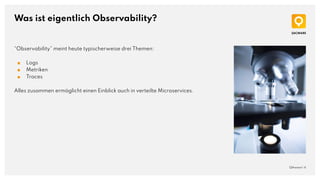
“Observability” meint heute typischerweise drei Themen:
■ Logs
■ Metriken
■ Traces
Alles zusammen ermöglicht einen Einblick auch in verteilte Microservices.
QAware | 4
Warum Observability?
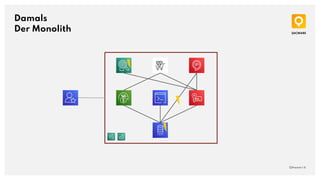
Damals
Der Monolith
QAware | 6
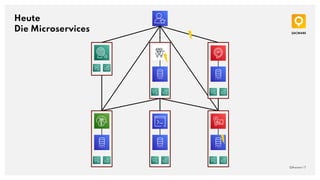
Heute
Die Microservices
QAware | 7
[ ]
Der (Open-Source-)Stack
QAware | 8
Metriken:
Prometheus
Prometheus
QAware | 10
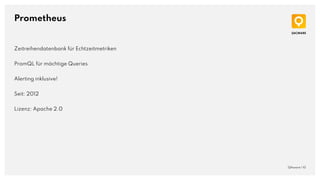
Zeitreihendatenbank für Echtzeitmetriken
PromQL für mächtige Queries
Alerting inklusive!
Seit: 2012
Lizenz: Apache 2.0
Metriken: Grundlagen
QAware | 11
Metriken sind Messwerte, die den aktuellen Zustand des Systems abbilden.
Beispiele:
■ CPU-Auslastung
■ Größe des JVM-Heaps
■ Anzahl der Aufrufe einer Schnittstelle
Die Metriken werden vom zu überwachenden System bereitgestellt.
Metriken können auch Metadaten haben.
Metriken: Grundlagen
QAware | 12
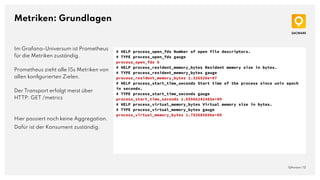
# HELP process_open_fds Number of open file descriptors.
# TYPE process_open_fds gauge
process_open_fds 8
# HELP process_resident_memory_bytes Resident memory size in bytes.
# TYPE process_resident_memory_bytes gauge
process_resident_memory_bytes 2.326528e+07
# HELP process_start_time_seconds Start time of the process since unix epoch
in seconds.
# TYPE process_start_time_seconds gauge
process_start_time_seconds 1.65566242485e+09
# HELP process_virtual_memory_bytes Virtual memory size in bytes.
# TYPE process_virtual_memory_bytes gauge
process_virtual_memory_bytes 1.782685696e+09
Im Grafana-Universum ist Prometheus
für die Metriken zuständig.
Prometheus zieht alle 15s Metriken von
allen konfigurierten Zielen.
Der Transport erfolgt meist über
HTTP: GET /metrics
Hier passiert noch keine Aggregation.
Dafür ist der Konsument zuständig.
Metric Types
QAware | 13
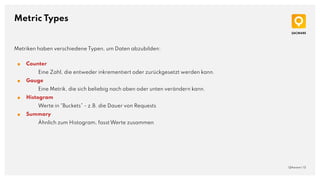
Metriken haben verschiedene Typen, um Daten abzubilden:
■ Counter
Eine Zahl, die entweder inkrementiert oder zurückgesetzt werden kann.
■ Gauge
Eine Metrik, die sich beliebig nach oben oder unten verändern kann.
■ Histogram
Werte in “Buckets” - z.B. die Dauer von Requests
■ Summary
Ähnlich zum Histogram, fasst Werte zusammen
PromQL
QAware | 14
PromQL ist eine mächtige Query Language, um die gewünschten Metriken zu filtern / aggregieren.
Die ganze Zeitreihe:
http_requests_total
Filter nach Labels:
http_requests_total{job="apiserver", handler="/api/comments"}
Rate berechnen:
rate(http_requests_total[5m])[30m:1m]
Prometheus: Architektur
QAware | 15
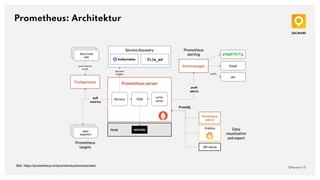
Bild: https://prometheus.io/docs/introduction/overview/
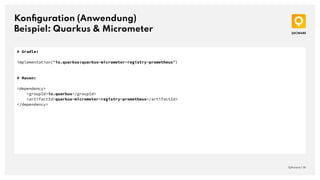
Konfiguration (Anwendung)
Beispiel: Quarkus & Micrometer
QAware | 16
# Gradle:
implementation("io.quarkus:quarkus-micrometer-registry-prometheus")
# Maven:
<dependency>
<groupId>io.quarkus</groupId>
<artifactId>quarkus-micrometer-registry-prometheus</artifactId>
</dependency>
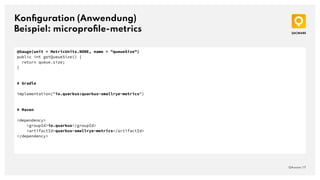
Konfiguration (Anwendung)
Beispiel: microprofile-metrics
QAware | 17
@Gauge(unit = MetricUnits.NONE, name = "queueSize")
public int getQueueSize() {
return queue.size;
}
# Gradle
implementation("io.quarkus:quarkus-smallrye-metrics")
# Maven
<dependency>
<groupId>io.quarkus</groupId>
<artifactId>quarkus-smallrye-metrics</artifactId>
</dependency>
Konfiguration (Prometheus)
Die Metriken einsammeln
QAware | 18
global:
scrape_interval: 15s # Set the scrape interval to every 15 seconds. Default is every 1 minute.
evaluation_interval: 15s # Evaluate rules every 15 seconds. The default is every 1 minute.
scrape_configs:
# The job name is added as a label `job=<job_name>` to any timeseries scraped from this config.
- job_name: "prometheus"
static_configs:
- targets: ["localhost:9090"]
- job_name: "Saturn node exporter"
scheme: https
static_configs:
- targets: ["saturn.qaware.de"]
basic_auth:
username: "*******************"
password: "*******************"
Logs:
Loki
Loki
QAware | 20
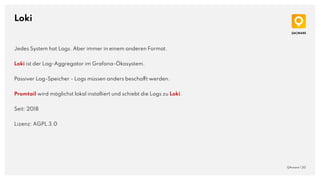
Jedes System hat Logs. Aber immer in einem anderen Format.
Loki ist der Log-Aggregator im Grafana-Ökosystem.
Passiver Log-Speicher - Logs müssen anders beschafft werden.
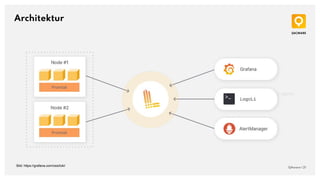
Promtail wird möglichst lokal installiert und schiebt die Logs zu Loki.
Seit: 2018
Lizenz: AGPL 3.0
Architektur
QAware | 21
Bild: https://grafana.com/oss/loki/
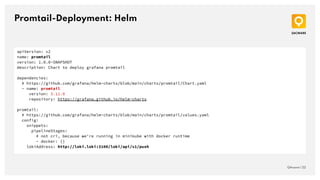
Promtail-Deployment: Helm
QAware | 22
apiVersion: v2
name: promtail
version: 1.0.0-SNAPSHOT
description: Chart to deploy grafana promtail
dependencies:
# https://github.com/grafana/helm-charts/blob/main/charts/promtail/Chart.yaml
- name: promtail
version: 3.11.0
repository: https://grafana.github.io/helm-charts
promtail:
# https://github.com/grafana/helm-charts/blob/main/charts/promtail/values.yaml
config:
snippets:
pipelineStages:
# not cri, because we're running in minikube with docker runtime
- docker: {}
lokiAddress: http://loki.loki:3100/loki/api/v1/push
Promtail-Deployment: Classic
QAware | 23
clients:
- url: "https://loki.qaware.de/loki/api/v1/push"
basic_auth:
username: loki
password: ****************
scrape_configs:
- job_name: journal
journal:
json: true
max_age: 12h
labels:
host: saturn
job: systemd-journal
relabel_configs:
- source_labels: ['__journal__systemd_unit']
target_label: 'unit'
Vorsicht: Labels nicht zu dynamisch verteilen!
https://grafana.com/blog/2020/04/21/how-labels-in-loki-can-make-log-queries-faster-and-easier/
LogQL
QAware | 24
Auch Loki hat eine eigene Query Language.
count_over_time({foo="bar"}[1m]) > 10
{host="$host", job="systemd-journal"}
| json
| line_format "{{ .unit }}: {{ .MESSAGE }}"
|= "$search"
Traces:
Tempo
Tempo
QAware | 26
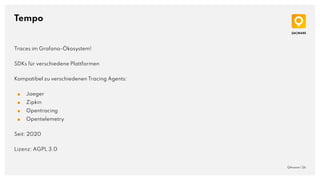
Traces im Grafana-Ökosystem!
SDKs für verschiedene Plattformen
Kompatibel zu verschiedenen Tracing Agents:
■ Jaeger
■ Zipkin
■ Opentracing
■ Opentelemetry
Seit: 2020
Lizenz: AGPL 3.0
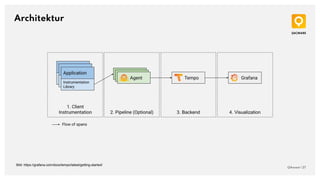
Architektur
QAware | 27
Bild: https://grafana.com/docs/tempo/latest/getting-started/
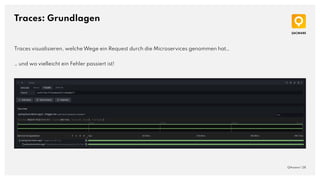
Traces: Grundlagen
QAware | 28
Traces visualisieren, welche Wege ein Request durch die Microservices genommen hat…
… und wo vielleicht ein Fehler passiert ist!
Traces: Grundlagen
QAware | 29
Bild: https://grafana.com/blog/2021/09/23/intro-to-distributed-tracing-with-tempo-opentelemetry-and-grafana-cloud/
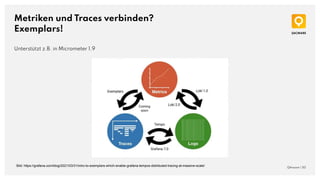
Metriken und Traces verbinden?
Exemplars!
QAware | 30
Unterstützt z.B. in Micrometer 1.9
Bild: https://grafana.com/blog/2021/03/31/intro-to-exemplars-which-enable-grafana-tempos-distributed-tracing-at-massive-scale/
Visualisierung:
Grafana
Grafana
QAware | 32
Visualisierung für viele verschiedene Datenquellen:
■ Prometheus
■ Loki
■ Tempo
■ InfluxDB
■ ...
Seit: 2014
Lizenz: AGPL 3.0
Dashboards
QAware | 33
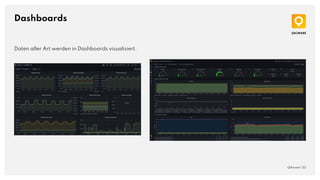
Daten aller Art werden in Dashboards visualisiert.
Grafana - Dashboards
QAware | 34
Keine Angst: Man muss Dashboards nicht mühsam selbst zusammenklicken.
https://grafana.com/grafana/dashboards/
Showcase
Mehr aus dem Grafana-Universum
k6
QAware | 37
Lasttests? k6!
Gebaut mit Go - die Tests werden in JavaScript geschrieben.
Testergebnisse landen in einer InfluxDB - visualisiert wird mit Grafana.
Further reading
QAware | 38
Blog: https://blog.qaware.de/posts/cloud-observability-grafana-spring-boot/
Showcase: https://github.com/zalintyre/cloud-observability-grafana-spring-boot
Grafana: https://grafana.com/
Prometheus: https://prometheus.io/
Loki: https://grafana.com/oss/loki/
Tempo: https://grafana.com/oss/tempo/
k6: https://github.com/grafana/k6
Quellen
QAware | 39
[Kal] R.E. Kalman,
On the general theory of control systems,
IFAC Proceedings Volumes,
Volume 1, Issue 1,
1960,
Pages 491-502,
ISSN 1474-6670,
https://doi.org/10.1016/S1474-6670(17)70094-8.
(https://www.sciencedirect.com/science/article/pii/S1474667017700948)
qaware.de
QAware GmbH
Aschauer Straße 32
81549 München
Tel. +49 89 232315-0
info@qaware.de
twitter.com/qaware
linkedin.com/company/qaware-gmbh
xing.com/companies/qawaregmbh
slideshare.net/qaware
github.com/qaware

Cloud Observability mit Loki, Prometheus, Tempo und Grafana

  • 1.
    qaware.de Cloud Observability mitLoki, Prometheus, Tempo und Grafana Franz Wimmer franz.wimmer@qaware.de @zalintyre @zalintyre.chaos.social
  • 2.
    Franz Wimmer Senior SoftwareEngineer @ QAware GmbH Seit 4 Jahren bei QAware Studium Informatik an der TH Rosenheim Vorlesung “Cloud Computing” @ TH Rosenheim Entwicklung von Cloud Native Applications DevOps Engineer Public Speaking * QAware | 2 * https://codefoundry.de/talks.html
  • 3.
    Was ist eigentlichObservability? Wie gut weiß ich über den internen Zustand meines Systems Bescheid, wenn ich mir seine Ausgaben ansehe? (vgl. [Kal]) Was hat so ein modernes System als Ausgabe? ■ Eine Webseite? ■ Eine REST-API? ■ E-Mails an den Admin? ■ Ein spärlich gepflegtes Logfile? Was ist, wenn das System aus vielen Microservices besteht? QAware | 3
  • 4.
    Was ist eigentlichObservability? “Observability” meint heute typischerweise drei Themen: ■ Logs ■ Metriken ■ Traces Alles zusammen ermöglicht einen Einblick auch in verteilte Microservices. QAware | 4
  • 5.
  • 6.
  • 7.
  • 8.
  • 9.
  • 10.
    Prometheus QAware | 10 Zeitreihendatenbankfür Echtzeitmetriken PromQL für mächtige Queries Alerting inklusive! Seit: 2012 Lizenz: Apache 2.0
  • 11.
    Metriken: Grundlagen QAware |11 Metriken sind Messwerte, die den aktuellen Zustand des Systems abbilden. Beispiele: ■ CPU-Auslastung ■ Größe des JVM-Heaps ■ Anzahl der Aufrufe einer Schnittstelle Die Metriken werden vom zu überwachenden System bereitgestellt. Metriken können auch Metadaten haben.
  • 12.
    Metriken: Grundlagen QAware |12 # HELP process_open_fds Number of open file descriptors. # TYPE process_open_fds gauge process_open_fds 8 # HELP process_resident_memory_bytes Resident memory size in bytes. # TYPE process_resident_memory_bytes gauge process_resident_memory_bytes 2.326528e+07 # HELP process_start_time_seconds Start time of the process since unix epoch in seconds. # TYPE process_start_time_seconds gauge process_start_time_seconds 1.65566242485e+09 # HELP process_virtual_memory_bytes Virtual memory size in bytes. # TYPE process_virtual_memory_bytes gauge process_virtual_memory_bytes 1.782685696e+09 Im Grafana-Universum ist Prometheus für die Metriken zuständig. Prometheus zieht alle 15s Metriken von allen konfigurierten Zielen. Der Transport erfolgt meist über HTTP: GET /metrics Hier passiert noch keine Aggregation. Dafür ist der Konsument zuständig.
  • 13.
    Metric Types QAware |13 Metriken haben verschiedene Typen, um Daten abzubilden: ■ Counter Eine Zahl, die entweder inkrementiert oder zurückgesetzt werden kann. ■ Gauge Eine Metrik, die sich beliebig nach oben oder unten verändern kann. ■ Histogram Werte in “Buckets” - z.B. die Dauer von Requests ■ Summary Ähnlich zum Histogram, fasst Werte zusammen
  • 14.
    PromQL QAware | 14 PromQList eine mächtige Query Language, um die gewünschten Metriken zu filtern / aggregieren. Die ganze Zeitreihe: http_requests_total Filter nach Labels: http_requests_total{job="apiserver", handler="/api/comments"} Rate berechnen: rate(http_requests_total[5m])[30m:1m]
  • 15.
    Prometheus: Architektur QAware |15 Bild: https://prometheus.io/docs/introduction/overview/
  • 16.
    Konfiguration (Anwendung) Beispiel: Quarkus& Micrometer QAware | 16 # Gradle: implementation("io.quarkus:quarkus-micrometer-registry-prometheus") # Maven: <dependency> <groupId>io.quarkus</groupId> <artifactId>quarkus-micrometer-registry-prometheus</artifactId> </dependency>
  • 17.
    Konfiguration (Anwendung) Beispiel: microprofile-metrics QAware| 17 @Gauge(unit = MetricUnits.NONE, name = "queueSize") public int getQueueSize() { return queue.size; } # Gradle implementation("io.quarkus:quarkus-smallrye-metrics") # Maven <dependency> <groupId>io.quarkus</groupId> <artifactId>quarkus-smallrye-metrics</artifactId> </dependency>
  • 18.
    Konfiguration (Prometheus) Die Metrikeneinsammeln QAware | 18 global: scrape_interval: 15s # Set the scrape interval to every 15 seconds. Default is every 1 minute. evaluation_interval: 15s # Evaluate rules every 15 seconds. The default is every 1 minute. scrape_configs: # The job name is added as a label `job=<job_name>` to any timeseries scraped from this config. - job_name: "prometheus" static_configs: - targets: ["localhost:9090"] - job_name: "Saturn node exporter" scheme: https static_configs: - targets: ["saturn.qaware.de"] basic_auth: username: "*******************" password: "*******************"
  • 19.
  • 20.
    Loki QAware | 20 JedesSystem hat Logs. Aber immer in einem anderen Format. Loki ist der Log-Aggregator im Grafana-Ökosystem. Passiver Log-Speicher - Logs müssen anders beschafft werden. Promtail wird möglichst lokal installiert und schiebt die Logs zu Loki. Seit: 2018 Lizenz: AGPL 3.0
  • 21.
    Architektur QAware | 21 Bild:https://grafana.com/oss/loki/
  • 22.
    Promtail-Deployment: Helm QAware |22 apiVersion: v2 name: promtail version: 1.0.0-SNAPSHOT description: Chart to deploy grafana promtail dependencies: # https://github.com/grafana/helm-charts/blob/main/charts/promtail/Chart.yaml - name: promtail version: 3.11.0 repository: https://grafana.github.io/helm-charts promtail: # https://github.com/grafana/helm-charts/blob/main/charts/promtail/values.yaml config: snippets: pipelineStages: # not cri, because we're running in minikube with docker runtime - docker: {} lokiAddress: http://loki.loki:3100/loki/api/v1/push
  • 23.
    Promtail-Deployment: Classic QAware |23 clients: - url: "https://loki.qaware.de/loki/api/v1/push" basic_auth: username: loki password: **************** scrape_configs: - job_name: journal journal: json: true max_age: 12h labels: host: saturn job: systemd-journal relabel_configs: - source_labels: ['__journal__systemd_unit'] target_label: 'unit' Vorsicht: Labels nicht zu dynamisch verteilen! https://grafana.com/blog/2020/04/21/how-labels-in-loki-can-make-log-queries-faster-and-easier/
  • 24.
    LogQL QAware | 24 AuchLoki hat eine eigene Query Language. count_over_time({foo="bar"}[1m]) > 10 {host="$host", job="systemd-journal"} | json | line_format "{{ .unit }}: {{ .MESSAGE }}" |= "$search"
  • 25.
  • 26.
    Tempo QAware | 26 Tracesim Grafana-Ökosystem! SDKs für verschiedene Plattformen Kompatibel zu verschiedenen Tracing Agents: ■ Jaeger ■ Zipkin ■ Opentracing ■ Opentelemetry Seit: 2020 Lizenz: AGPL 3.0
  • 27.
    Architektur QAware | 27 Bild:https://grafana.com/docs/tempo/latest/getting-started/
  • 28.
    Traces: Grundlagen QAware |28 Traces visualisieren, welche Wege ein Request durch die Microservices genommen hat… … und wo vielleicht ein Fehler passiert ist!
  • 29.
    Traces: Grundlagen QAware |29 Bild: https://grafana.com/blog/2021/09/23/intro-to-distributed-tracing-with-tempo-opentelemetry-and-grafana-cloud/
  • 30.
    Metriken und Tracesverbinden? Exemplars! QAware | 30 Unterstützt z.B. in Micrometer 1.9 Bild: https://grafana.com/blog/2021/03/31/intro-to-exemplars-which-enable-grafana-tempos-distributed-tracing-at-massive-scale/
  • 31.
  • 32.
    Grafana QAware | 32 Visualisierungfür viele verschiedene Datenquellen: ■ Prometheus ■ Loki ■ Tempo ■ InfluxDB ■ ... Seit: 2014 Lizenz: AGPL 3.0
  • 33.
    Dashboards QAware | 33 Datenaller Art werden in Dashboards visualisiert.
  • 34.
    Grafana - Dashboards QAware| 34 Keine Angst: Man muss Dashboards nicht mühsam selbst zusammenklicken. https://grafana.com/grafana/dashboards/
  • 35.
  • 36.
    Mehr aus demGrafana-Universum
  • 37.
    k6 QAware | 37 Lasttests?k6! Gebaut mit Go - die Tests werden in JavaScript geschrieben. Testergebnisse landen in einer InfluxDB - visualisiert wird mit Grafana.
  • 38.
    Further reading QAware |38 Blog: https://blog.qaware.de/posts/cloud-observability-grafana-spring-boot/ Showcase: https://github.com/zalintyre/cloud-observability-grafana-spring-boot Grafana: https://grafana.com/ Prometheus: https://prometheus.io/ Loki: https://grafana.com/oss/loki/ Tempo: https://grafana.com/oss/tempo/ k6: https://github.com/grafana/k6
  • 39.
    Quellen QAware | 39 [Kal]R.E. Kalman, On the general theory of control systems, IFAC Proceedings Volumes, Volume 1, Issue 1, 1960, Pages 491-502, ISSN 1474-6670, https://doi.org/10.1016/S1474-6670(17)70094-8. (https://www.sciencedirect.com/science/article/pii/S1474667017700948)
  • 40.
    qaware.de QAware GmbH Aschauer Straße32 81549 München Tel. +49 89 232315-0 info@qaware.de twitter.com/qaware linkedin.com/company/qaware-gmbh xing.com/companies/qawaregmbh slideshare.net/qaware github.com/qaware